
Gold has belonged to the fiftieth anniversary for as long as anyone has been counting, and on a cake it does one job very well: it catches the light on a table full of people who have known the couple for decades. The hard part is using it with restraint. Most of the designs I build for a golden anniversary sit on an ivory base, with gold kept to one or two details such as a painted edge, a scatter of leaf or a topper, plus flowers or pearls to soften the shine. Below are twenty directions, from a four-tier showpiece to a Bundt you could glaze in your own kitchen, with notes on how each one behaves once it leaves the studio.
Which Gold Is Safe to Eat, and Which Is Only for Show
Every design below uses gold somewhere, and not all gold products are food. This is the first thing I check when someone shows me a cake they want to copy.
- Edible gold leaf is real gold beaten very thin, usually 22 to 24 karat, and it’s sold specifically for food. It’s the safest way to get true metallic shine, and it sticks to chilled buttercream or to fondant brushed with a little water.
- Edible gold dust or paint is food coloring with a pearlescent base. Mix the dust with a few drops of clear alcohol or lemon extract and paint it on; the alcohol evaporates and leaves the shine.
- Luster dusts labelled “non-toxic” or “for decoration only” are not intended to be eaten. They’re fine on a topper or a sugar flower that gets removed, never on frosting people will eat.
If a label lists ingredients and calls itself edible, you’re fine. If it only says non-toxic, keep it off the cake. Gold also behaves differently after time in the fridge: condensation forms as the cake warms up and can streak painted gold, so I add the final gold touches after the cake has come up to room temperature at the venue.
1. Gold 50th Anniversary Tiered Cake
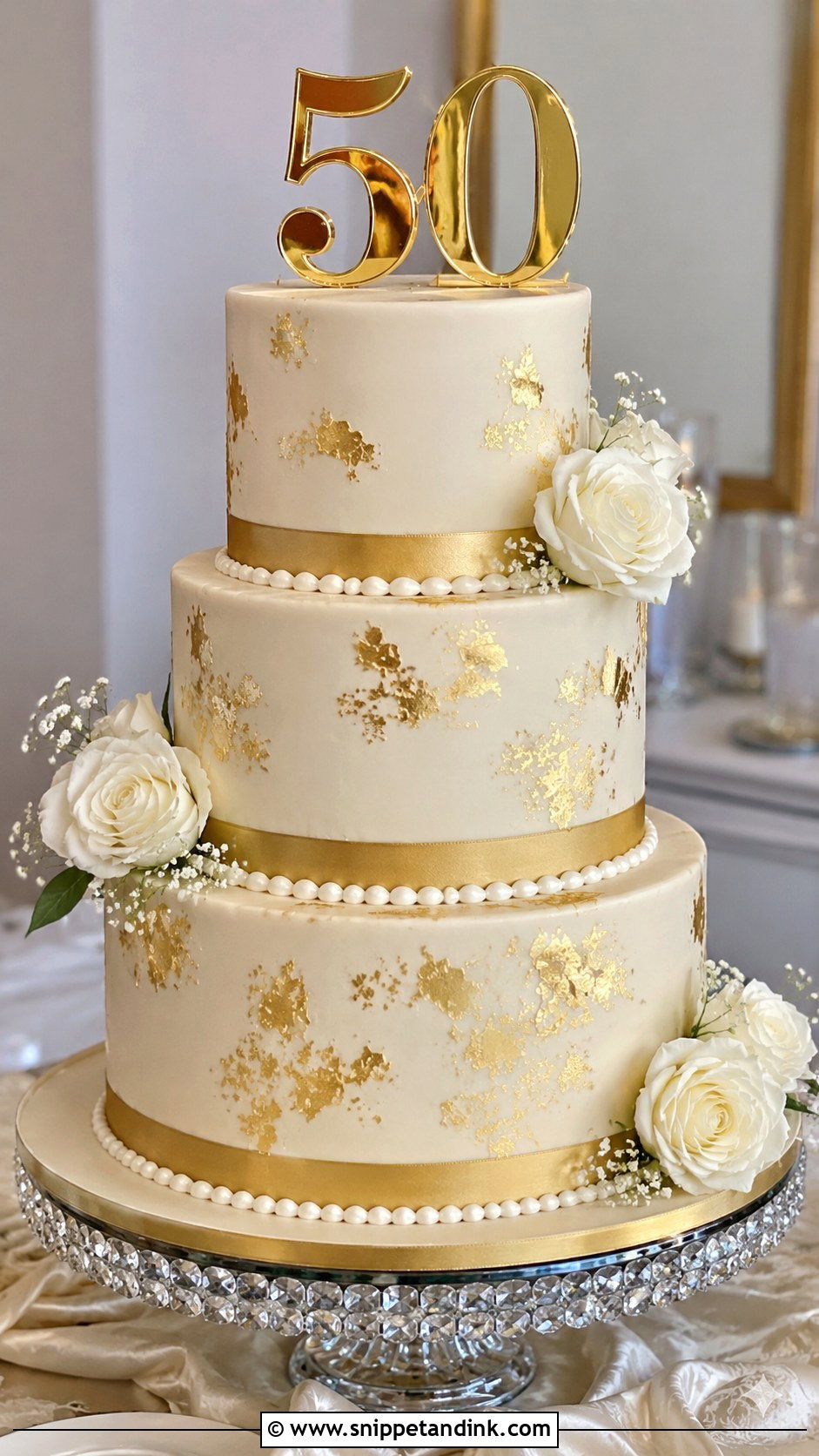
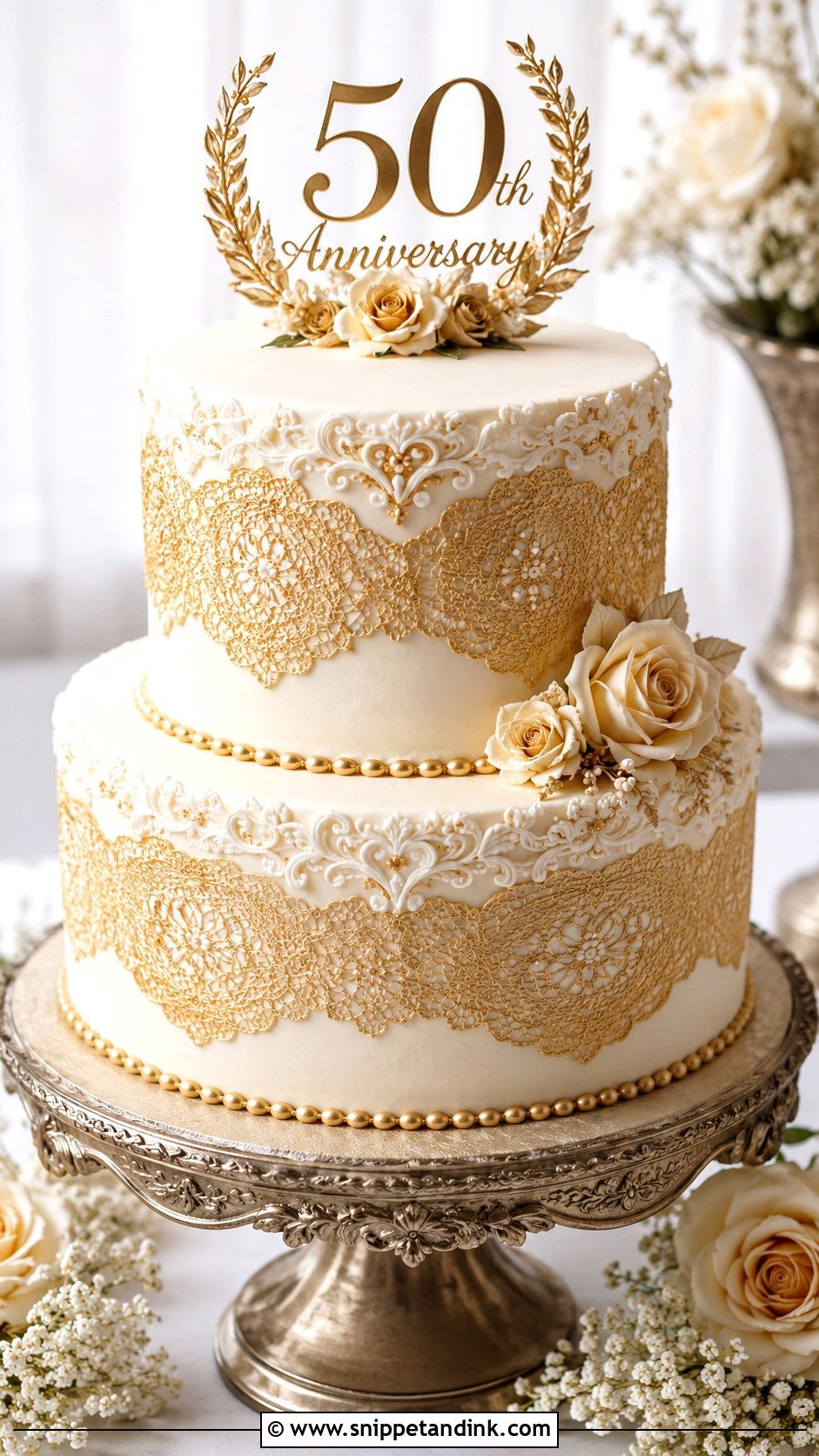
Height is what makes a tiered cake feel like an occasion, and for a big family party it’s still the design I’m asked for most. An ivory or white base lets the metallic details carry, whether that’s ribbon at each tier, a brushed gold edge, edible gold leaf or a bold “50” on top. Vanilla, almond, lemon and white chocolate sponges suit it because they read light after a full dinner. Ask for smooth buttercream or fondant and keep piping to the base of each tier. Anything above three tiers needs internal dowels and a central rod, so check that your venue can take a delivery and set-up slot rather than expecting someone to carry it in assembled.
2. Gold 50th Anniversary Buttercream Cake
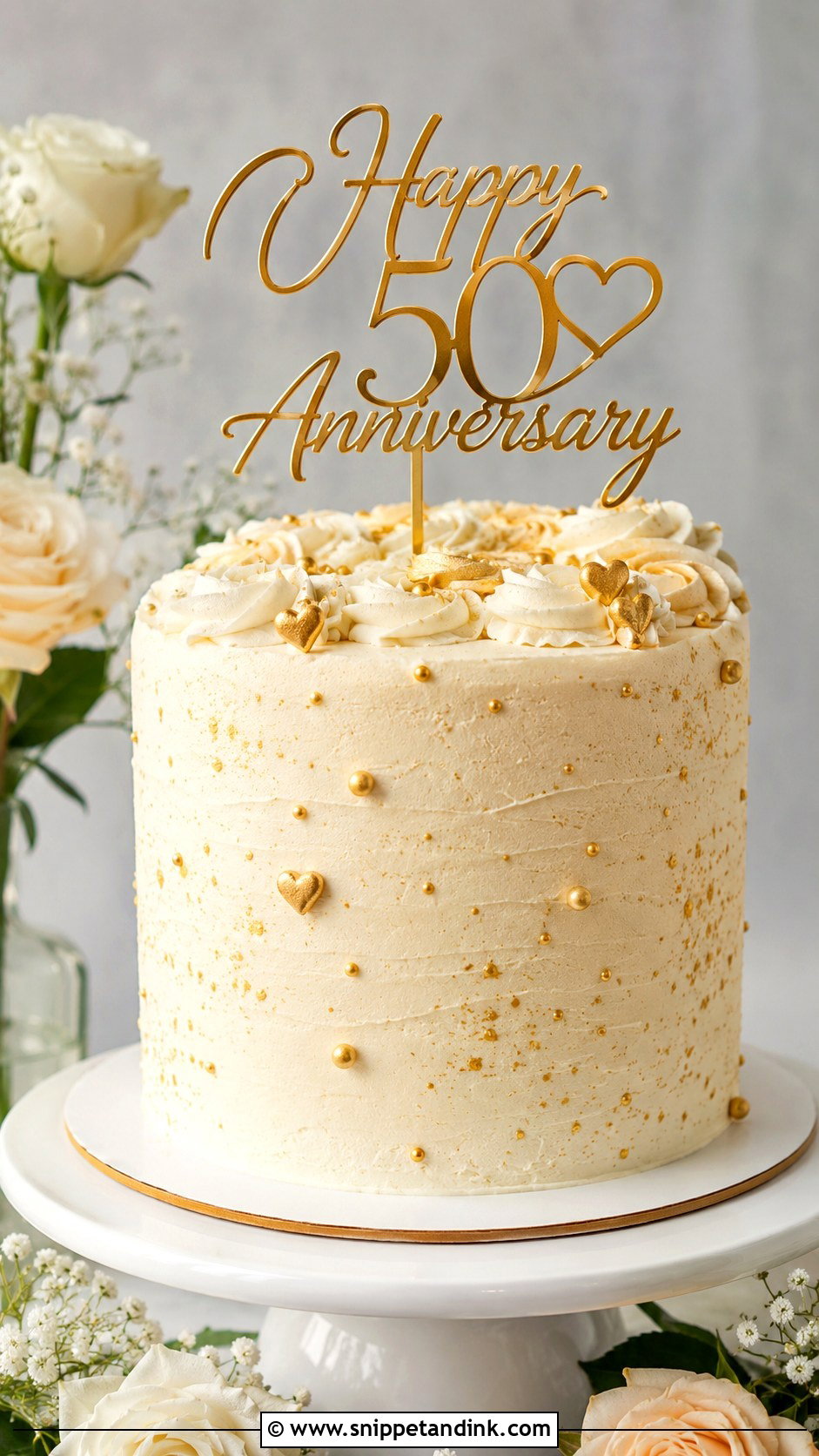
Buttercream gives a softer, friendlier finish than fondant, and it tastes better to most guests. Smooth ivory buttercream takes gold splatter, gold pearls or painted brushstrokes well, provided it has been chilled until the surface sets; paint on soft buttercream and the brush drags the frosting with it. A gold “Happy 50th Anniversary” topper and a few white flowers finish it. Home bakers usually manage this better than fondant. Keep the sides clean, because gold dotted everywhere looks accidental rather than placed.
3. Gold 50th Anniversary Fondant Cake
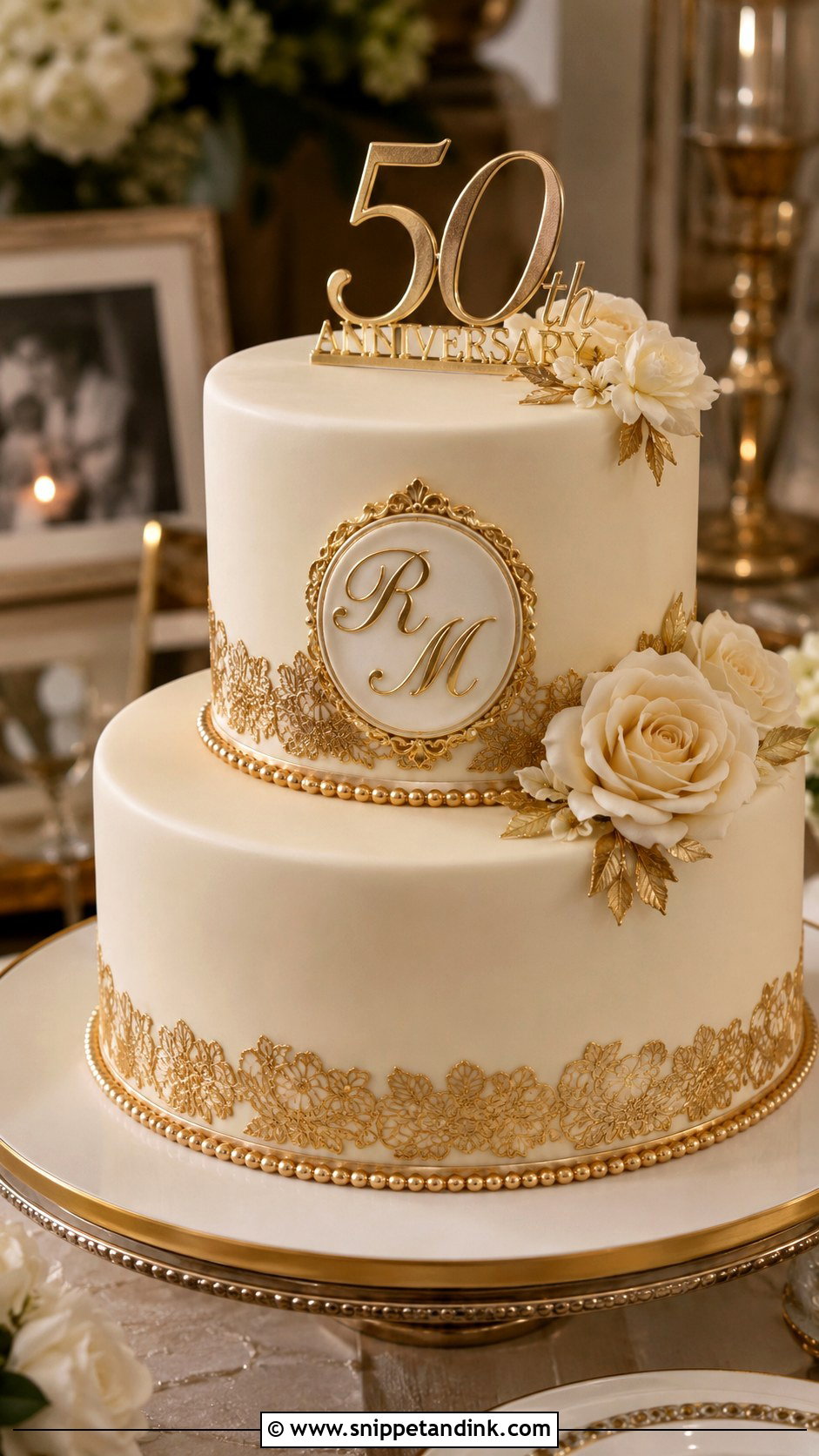
Fondant earns its place when you want crisp edges and metallic details that look sharp up close. An ivory base takes gold lace, gold monogram initials, embossed patterns or hand-painted borders, and gold paint sits more evenly on fondant than on any other surface. Two or three tiers give enough room to decorate without crowding. Underneath, I put a layer of ganache rather than buttercream, since ganache sets firm and gives those sharp corners. Almond with raspberry or chocolate with ganache both hold up well. One honest note: plenty of guests peel the fondant off, so make sure the cake inside is worth eating on its own.
4. Gold 50th Anniversary Floral Cake
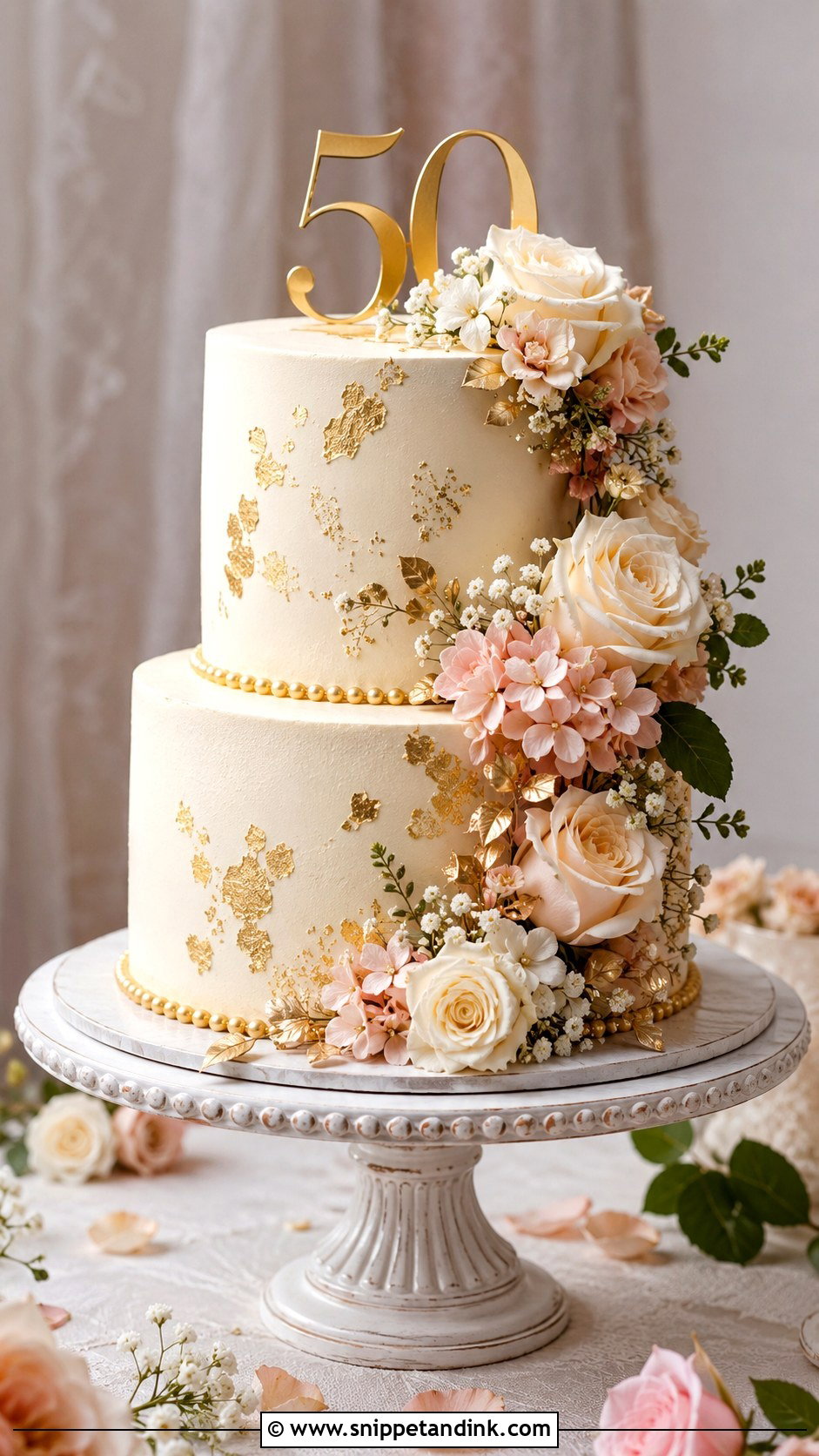
Flowers take the edge off metallic shine and make the cake feel like it belongs to this particular couple, especially if you repeat a bloom from their wedding bouquet. White roses, cream peonies and small greenery sit well beside gold leaf or a pearl border. The balance matters: flowers should frame the cake, not swallow it. If you’re using fresh stems, they need to be pesticide-free, and the stems wrapped or put into food-safe picks before they go anywhere near the sponge. Sugar flowers cost more but last, and many couples keep one afterward. Lemon, vanilla or strawberry fillings keep the flavor fresh.
5. Gold 50th Anniversary Drip Cake
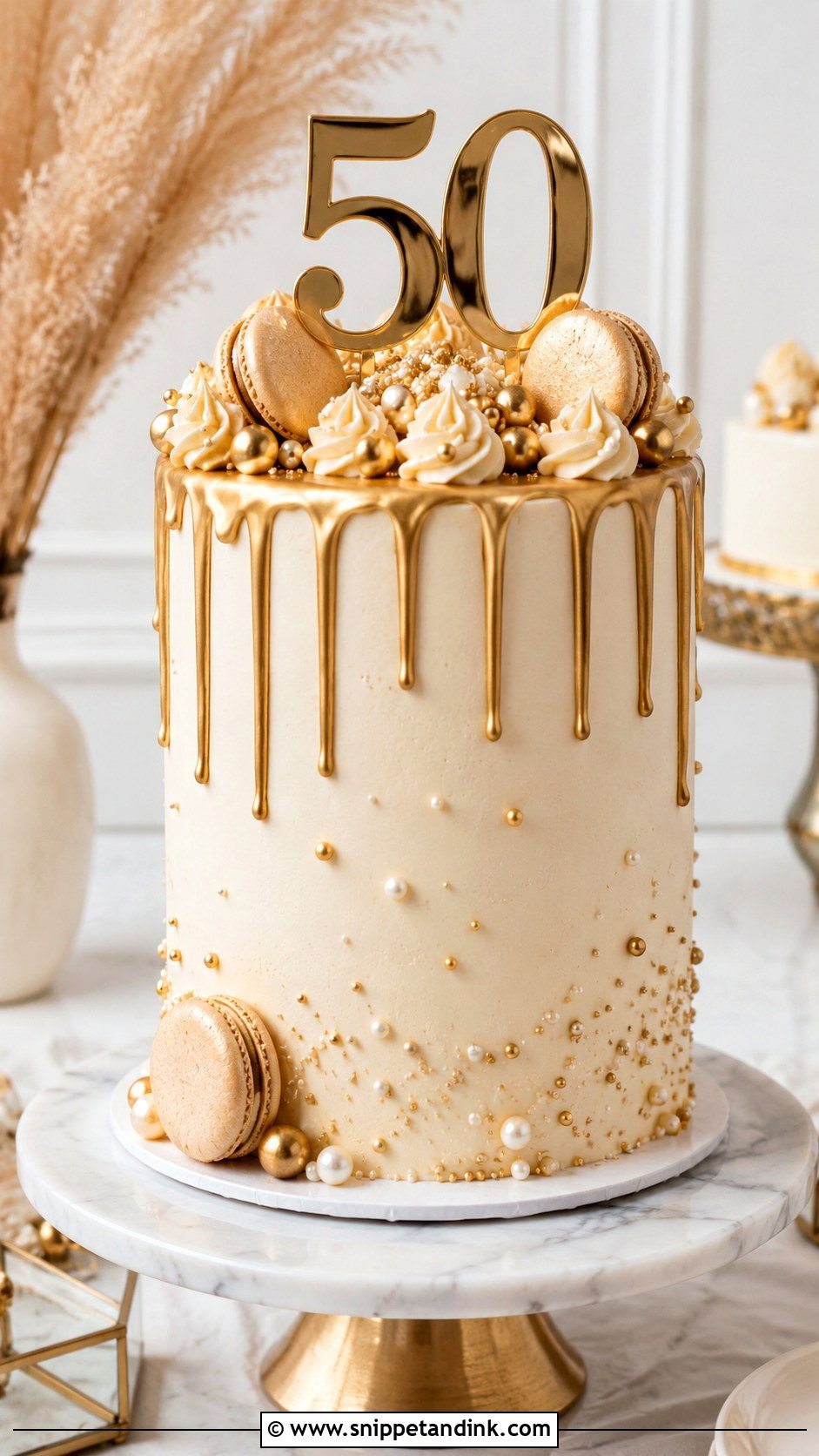
A gold drip is the most modern thing on this list and the most temperamental. The drip itself is usually white chocolate ganache, chilled, then painted gold once set; metallic poured straight from a bottle tends to look flat. It runs best over a well-chilled cake, otherwise the drips keep sliding to the board. Finish with macarons, pearls or a gold number topper. Under reception lights the gold catches from every side. Vanilla, caramel or chocolate inside, and keep the outside bright so the drip has something to contrast with.
6. Gold 50th Anniversary Rosette Cake
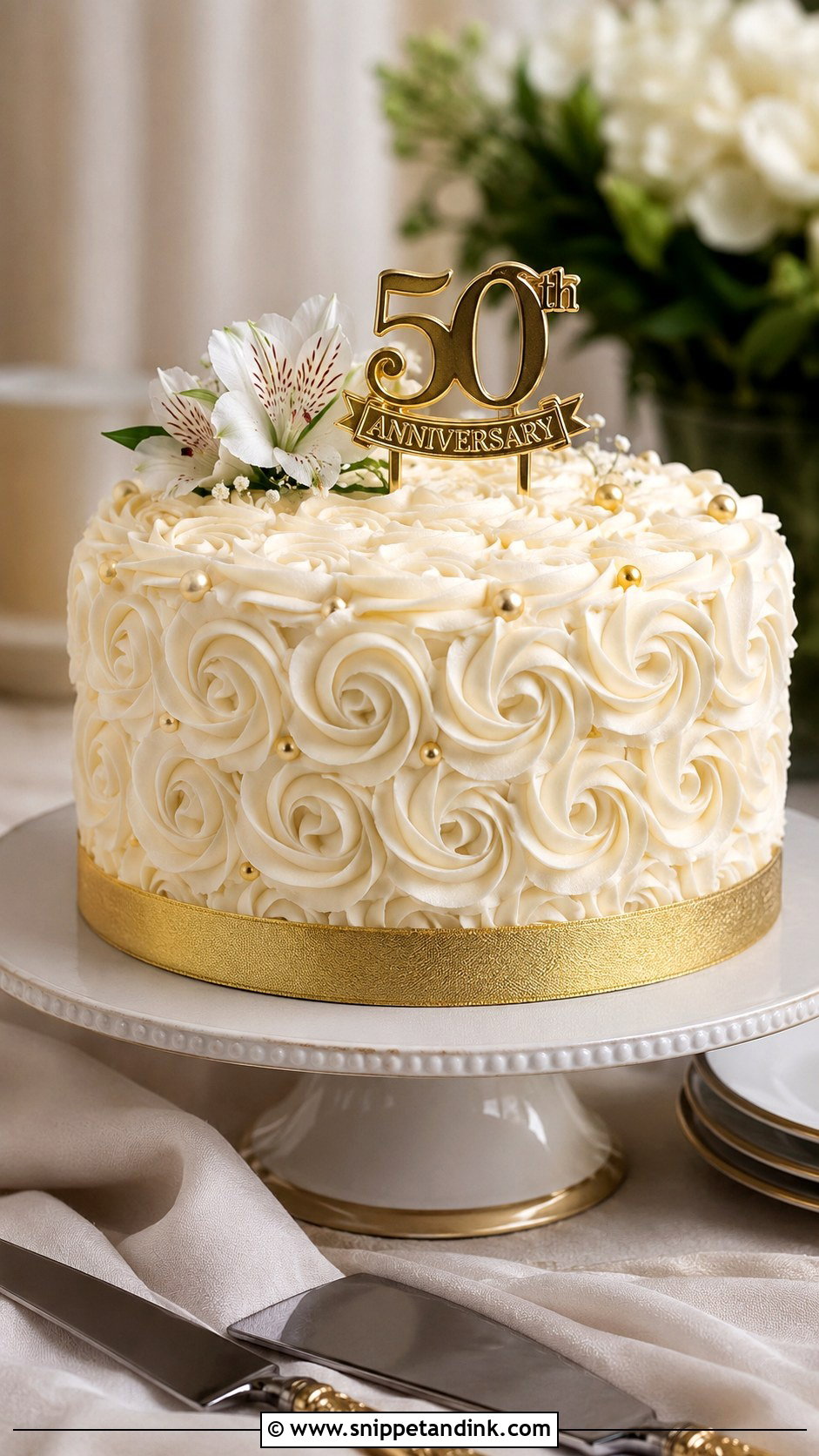
Rosettes suit couples who like traditional, hand-finished detail. Covering the whole cake in ivory buttercream rosettes gives a full texture; piping them only along the top edge keeps it lighter. Add gold pearls, a topper or a thin metallic ribbon at the base. This is the most forgiving design for a home baker, because the texture hides small dents and an uneven crumb coat. Pipe with a stiff buttercream and the rosettes keep their shape at room temperature. Vanilla, almond or coconut all work, and the gold should stay light so the piping remains the point.
7. Gold 50th Anniversary Number Cake
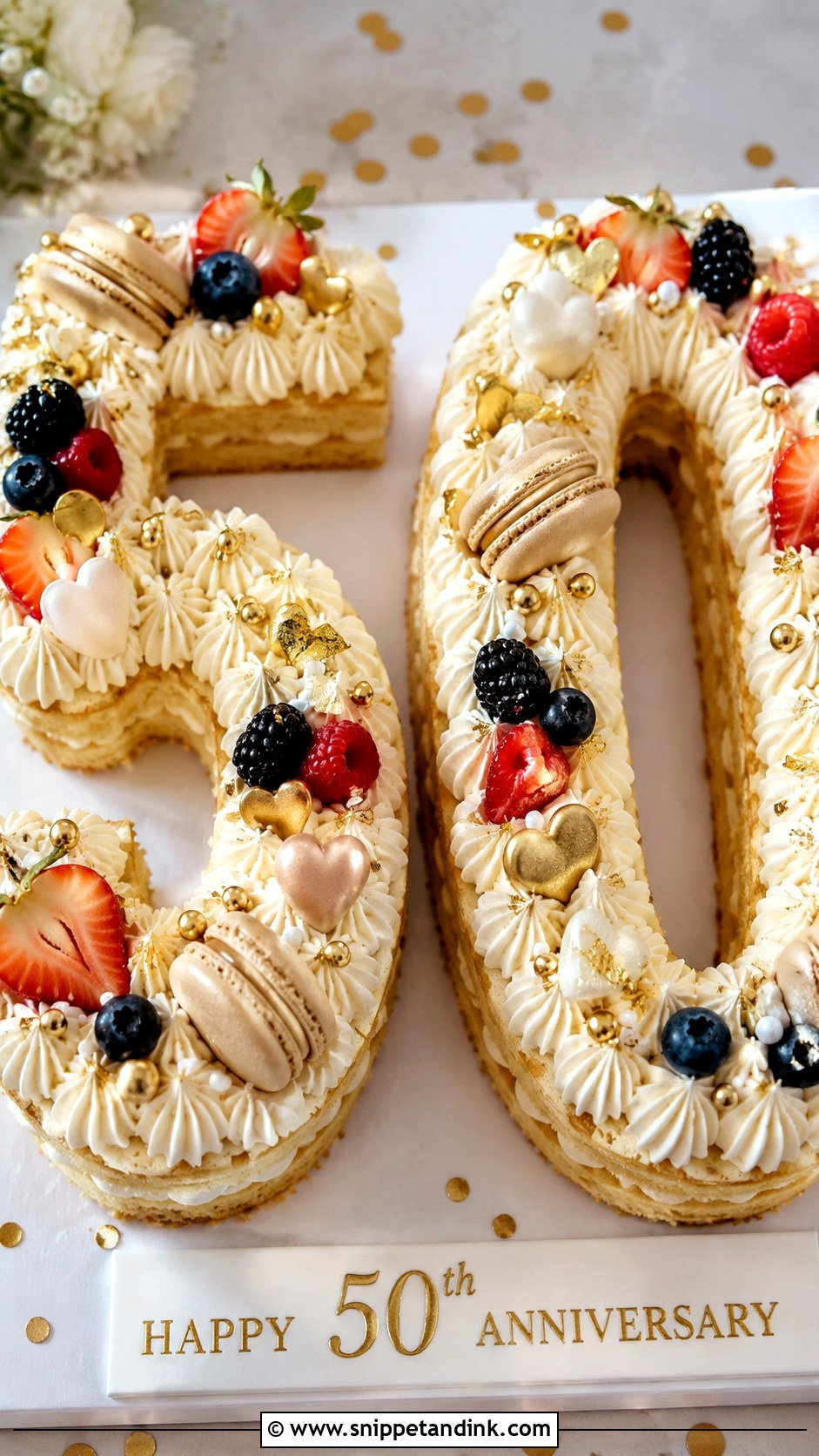
Nobody walks past a cake shaped like the number. You can cut a “50” from sheet sponge or simply top a round cake with tall gold numerals. A number-shaped cake feels relaxed on a dessert table, while a topper version suits a formal room. Fill the numerals with piped buttercream, berries, macarons, pearls and small pieces of gold leaf. The cut-out version is two thin layers, so it serves fewer people than its footprint suggests; I usually add a sheet cake in the kitchen. Vanilla, chocolate or almond sponge keep every generation happy.
8. Gold 50th Anniversary Heart Cake
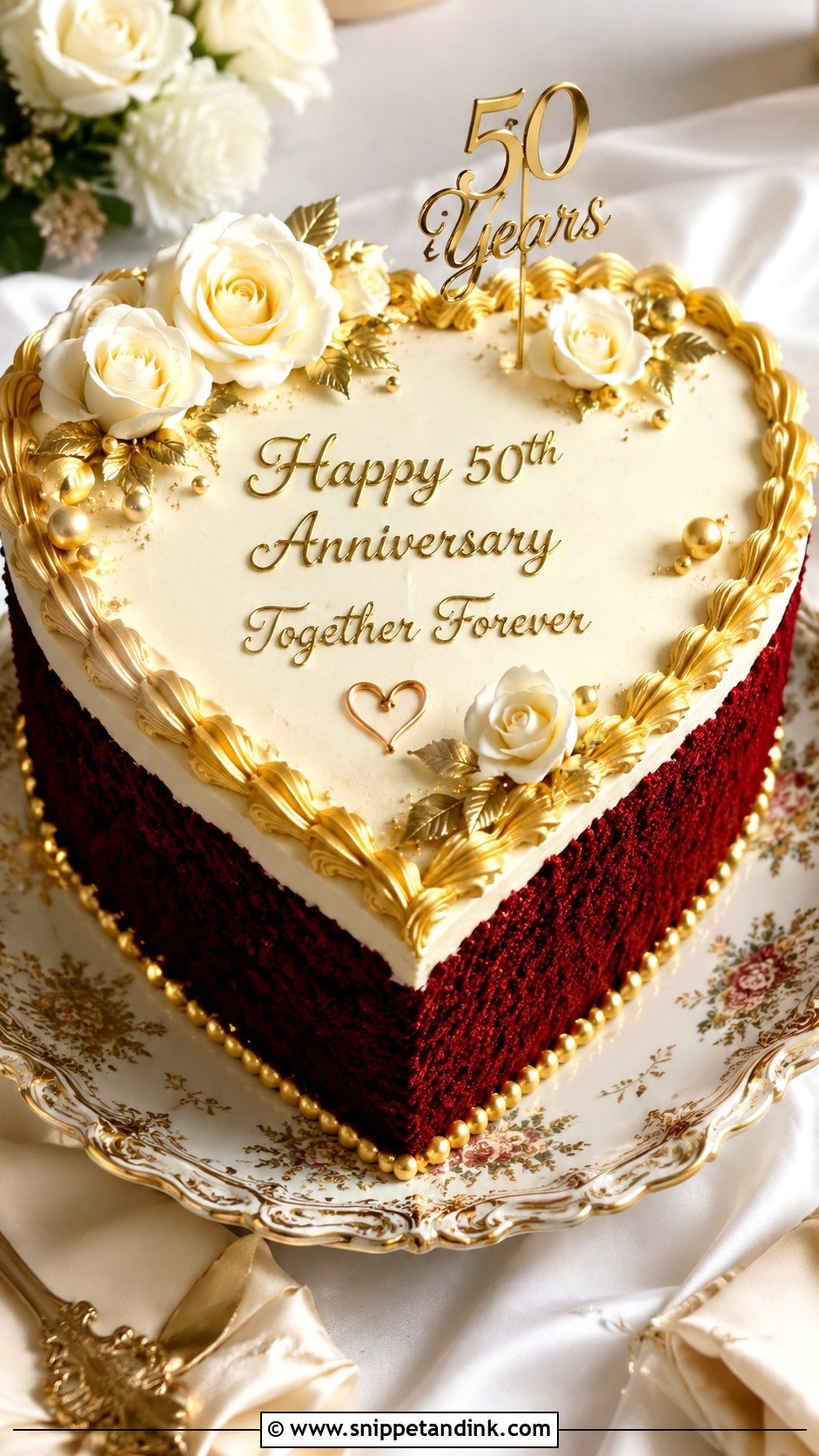
A heart is the simplest way to say what the day is about, and it suits a smaller gathering that doesn’t need tiers. Ivory buttercream, gold piping and a short message on top are enough. For more presence, add gold pearls, white roses and a raised gold border. Heart pans have a deep point at the bottom that bakes slower than the lobes, so a home baker should use a lower oven and a flower nail in the center. It sits well on a vintage glass stand, and strawberry or red velvet suits the theme.
9. Gold 50th Anniversary Square Cake
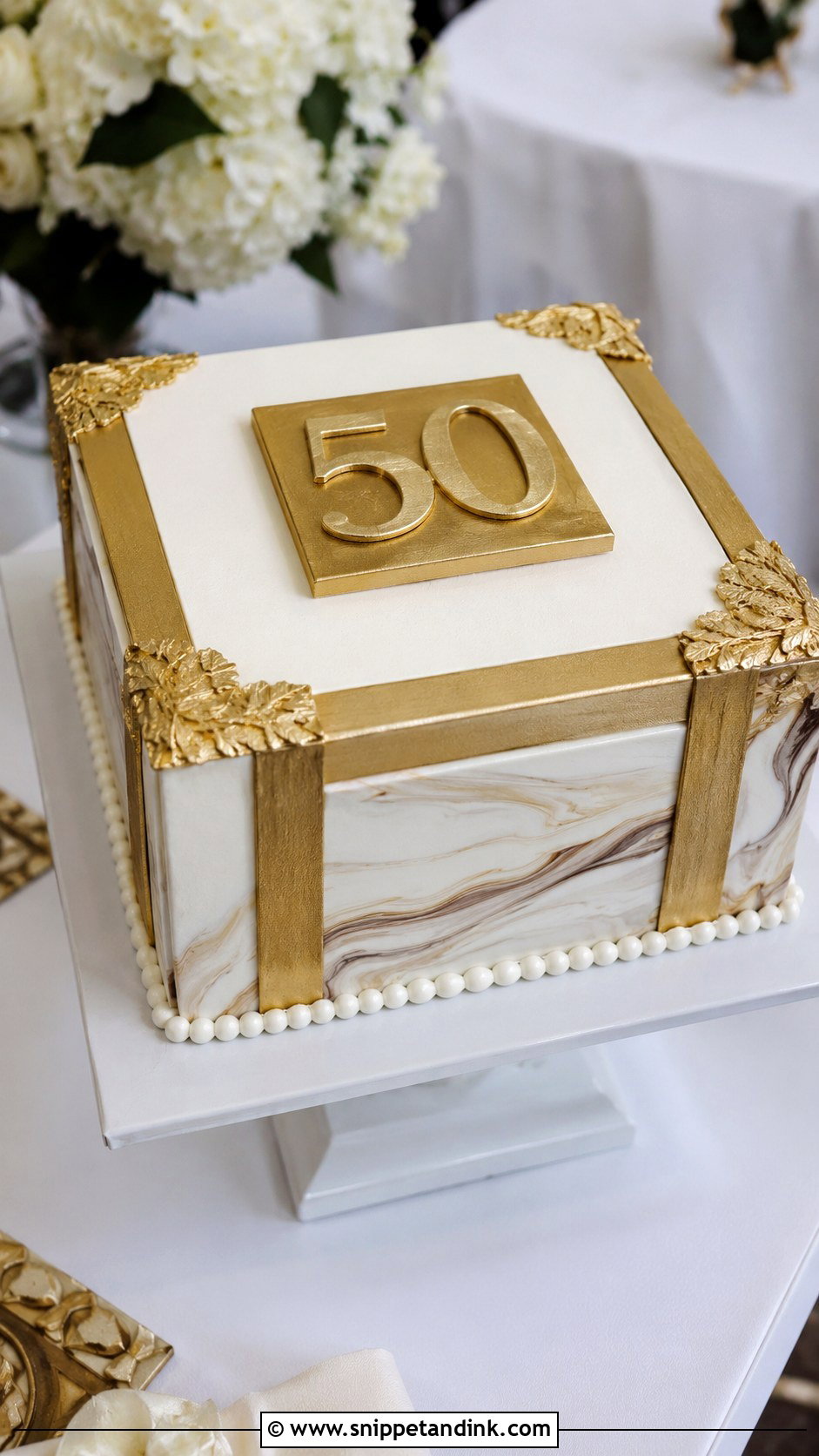
Square cakes look structured and they serve far more neatly than rounds, which matters with a big family. Sharp corners, smooth frosting and gold fondant bands, leaf on the corners or a monogram on the front give a polished finish. Those corners are the hardest thing for a decorator to keep crisp in buttercream, so if clean edges matter to you, ask for ganache or fondant. Stack two tiers for height. Ivory keeps it classic, and a navy or black accent makes the gold read stronger. Chocolate, vanilla and marble all slice cleanly in squares.
10. Gold 50th Anniversary Marble Cake
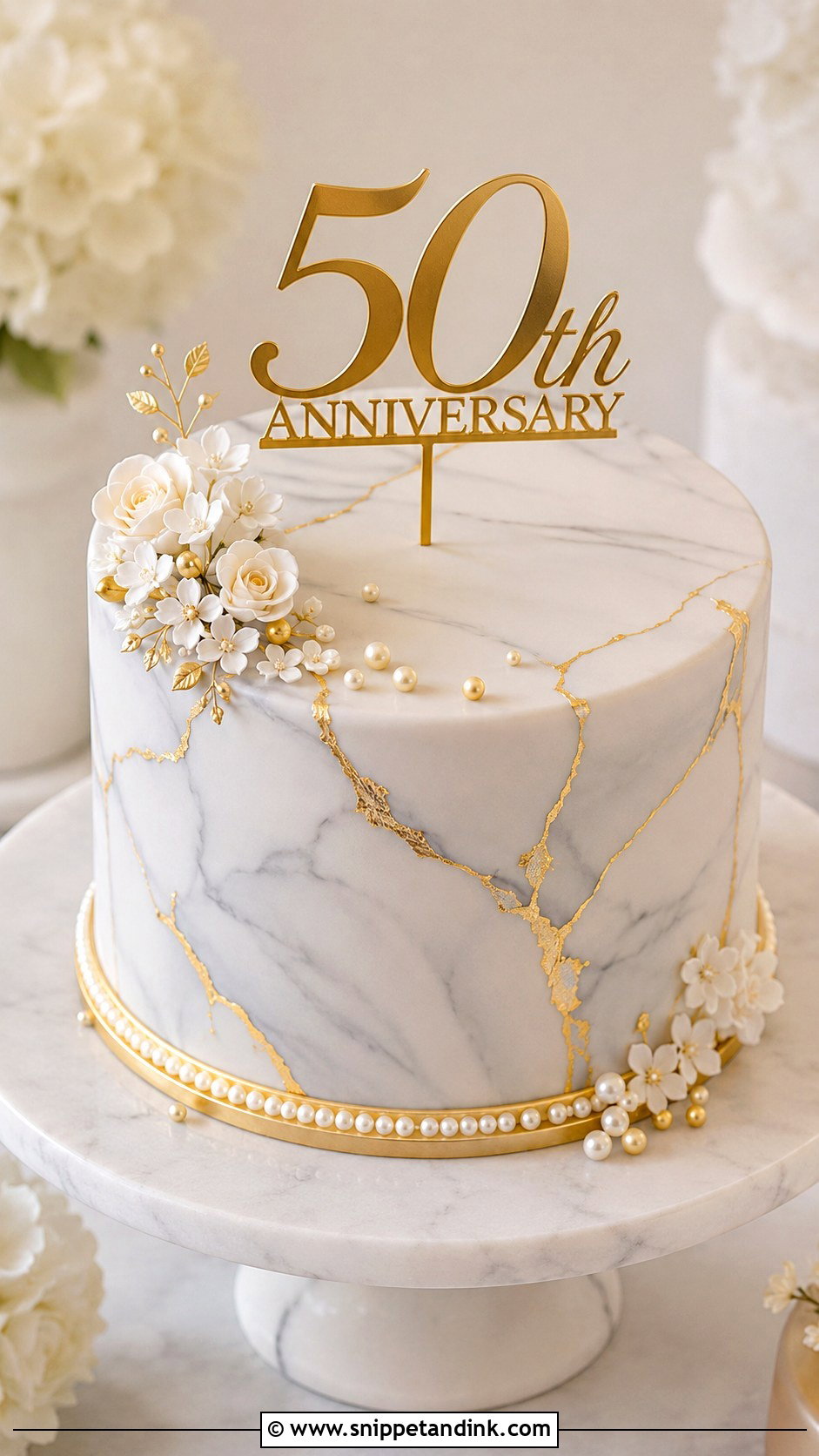
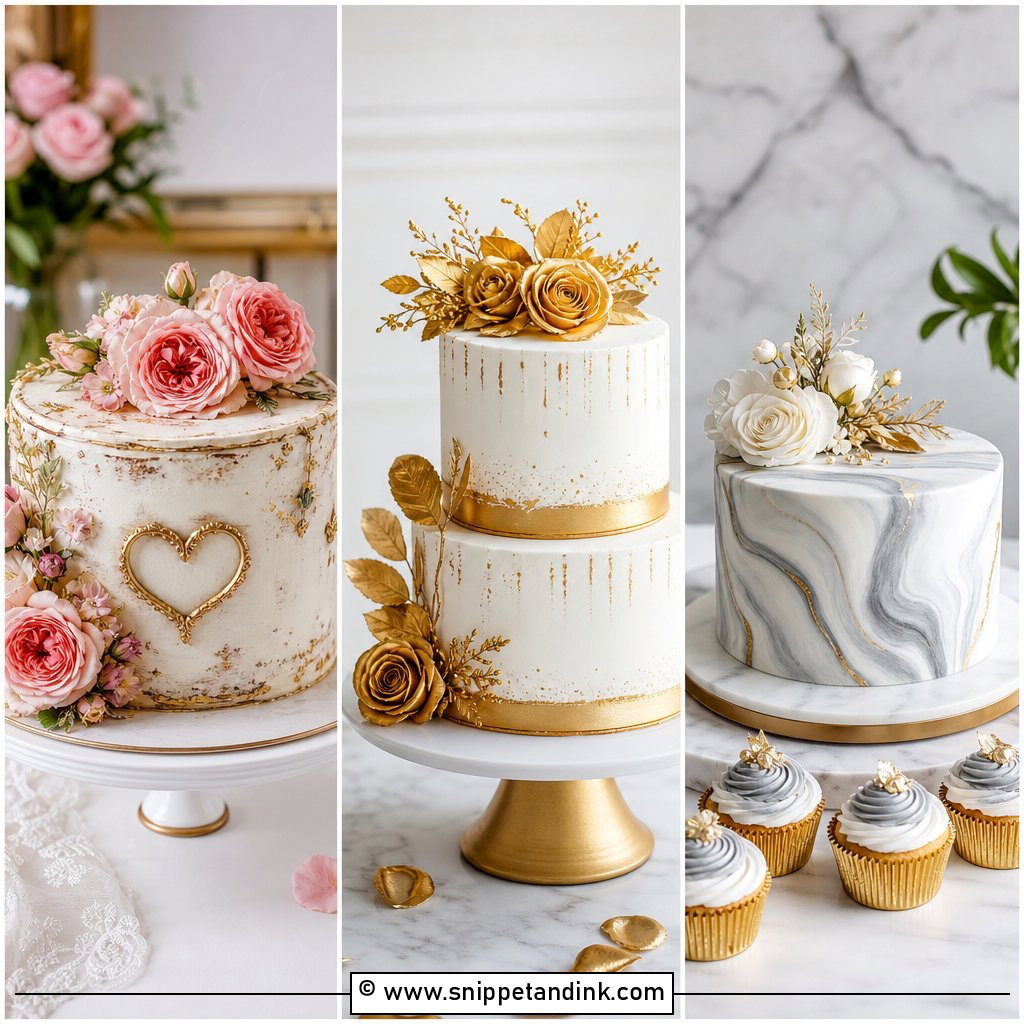
Marbling the outside with ivory, white and pale grey, then running thin veins of edible gold through it, makes a cake look like polished stone. It works in fondant or buttercream, though fondant gives the cleaner veining. The pattern is already the decoration, so add only a topper, a couple of sugar flowers or a ring of pearls at the base. I paint the gold veins last with a fine brush and keep them broken rather than continuous, which is how real marble looks. Inside, a vanilla and chocolate swirl repeats the idea.
11. Gold 50th Anniversary Pearl Cake
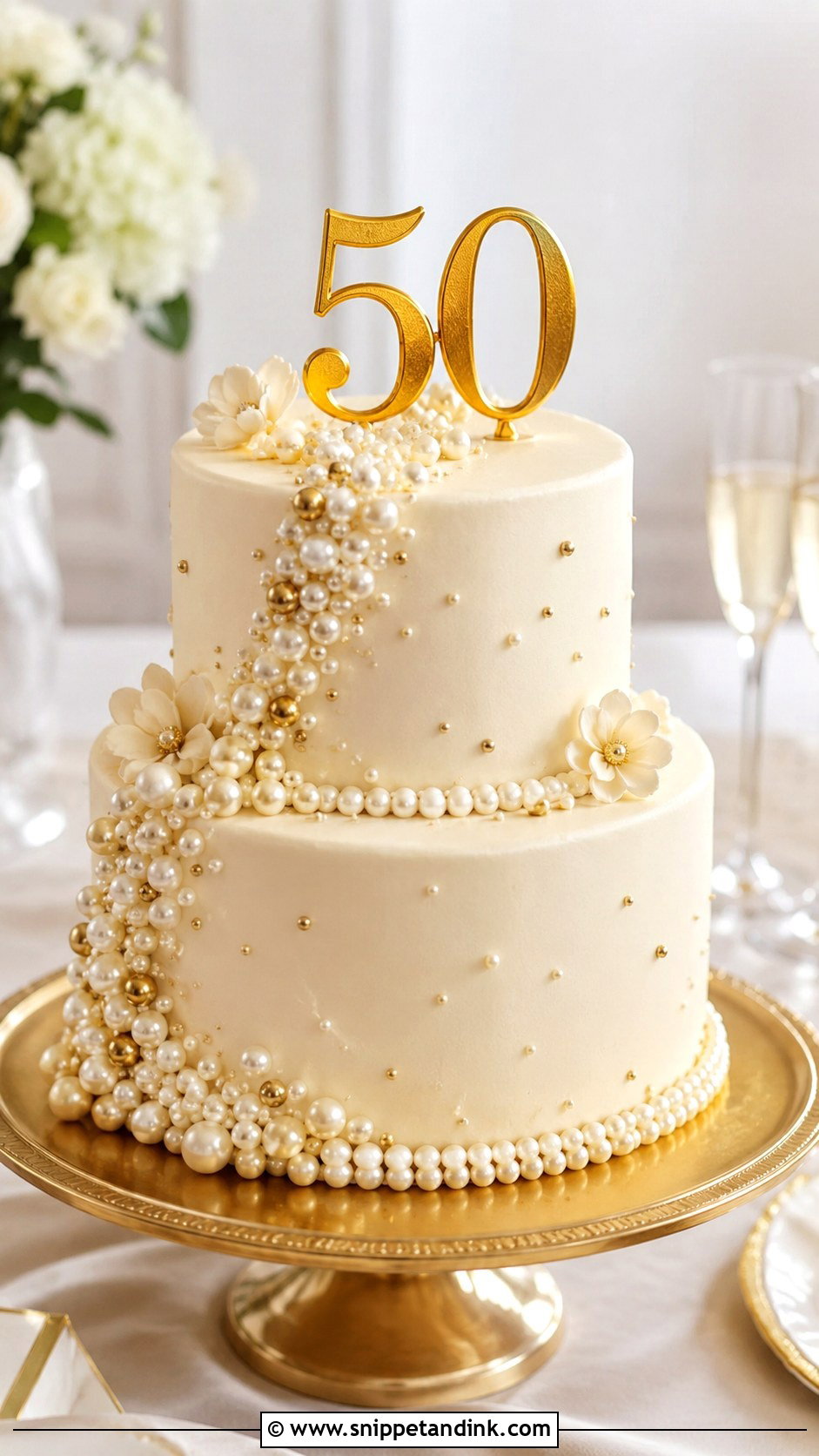
Pearls and gold together feel formal without being flashy. On an ivory base, sugar pearls can ring the tiers, form borders or fall in strands down one side, with a gold “50” on top to make the occasion clear. Sugar pearls are hard, so I keep them small on a cake where older guests will be eating, and I avoid the large silver-coated dragees that some regions only allow as decoration. This design fits afternoon receptions and family dinners well. Vanilla, white chocolate or almond keep the flavor classic. Pick one decoration and repeat it; a pearl cake loses its calm the moment three other ideas join it.
12. Gold 50th Anniversary Lace Cake
Lace carries a vintage note that suits a fifty-year story, and it’s a good way to echo the bride’s original dress if there’s a photo of it. Piped buttercream lace, cast sugar lace and embossed fondant all work. White lace over ivory stays soft; lace brushed with gold looks richer and more formal. Cast sugar lace goes brittle in dry air and soft in humid rooms, so I apply it the day of delivery. Sugar flowers and a simple topper finish it. Keep the pattern consistent around the tier, or it starts to look busy.
13. Gold 50th Anniversary Naked Cake
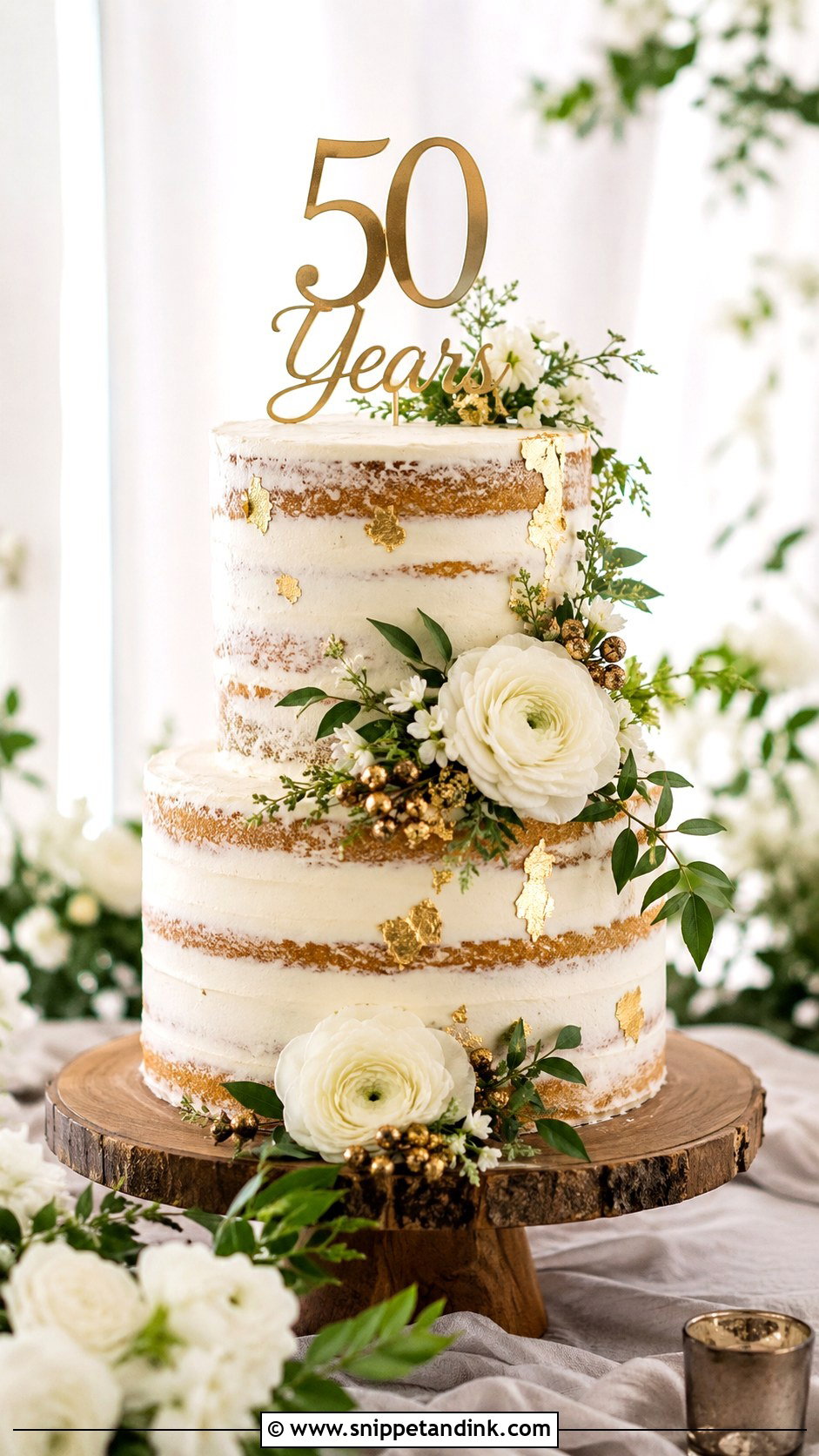
Naked cakes belong at garden parties and barns, and they’re the most relaxed way to mark fifty years. Layers show through a thin scrape of buttercream, with gold added by a topper, leaf flakes, gold-dusted fruit or a ribbon at the base. Fresh white flowers and greenery do the rest. Because the sponge is exposed, it dries faster than a fully frosted cake, so I assemble as close to the event as possible and keep it out of direct sun. Neat, evenly filled layers matter here more than anywhere. Carrot, lemon and almond sponge look good cut open.
14. Gold 50th Anniversary Sheet Cake
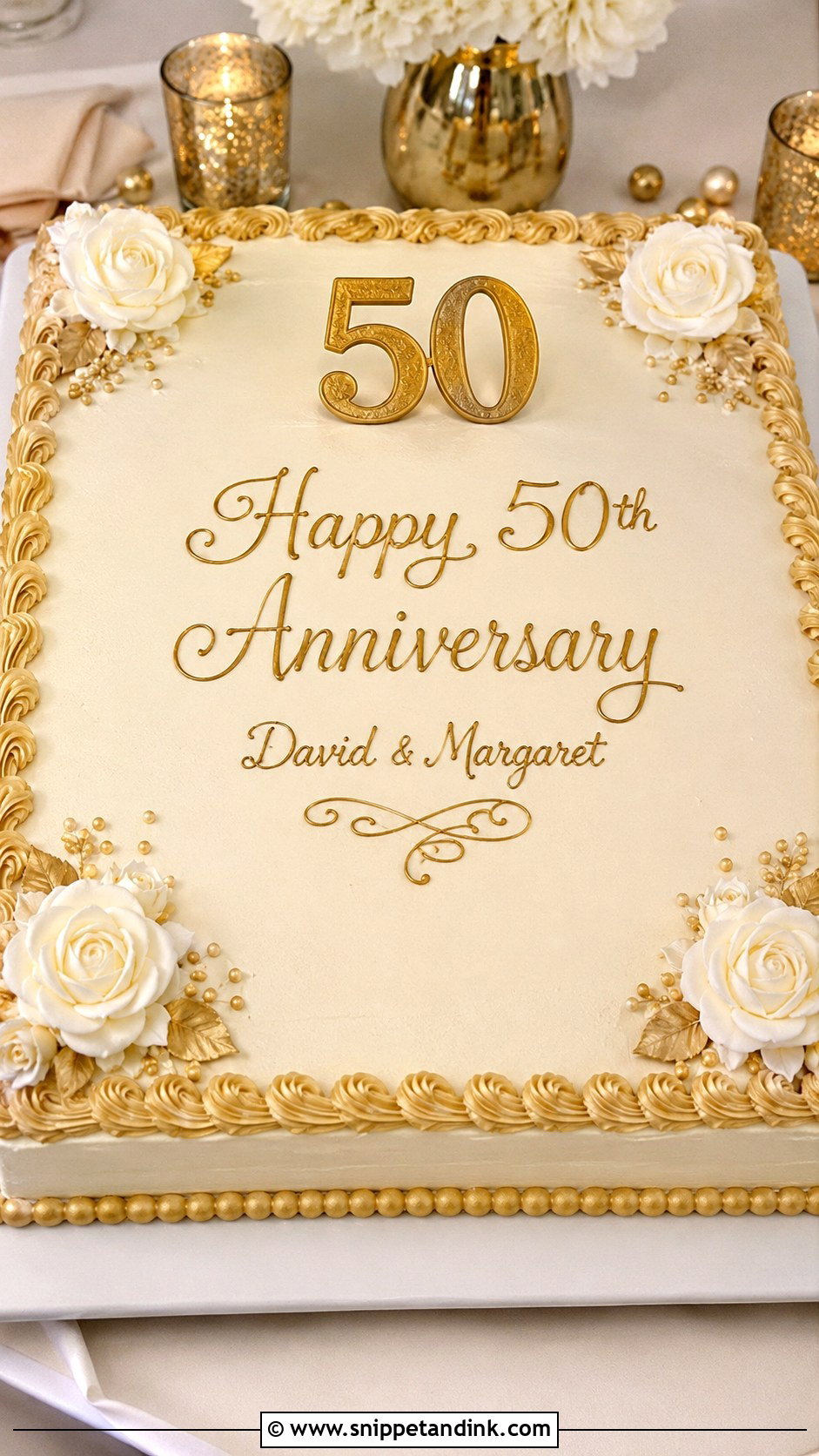
With a long guest list, a sheet cake is the honest answer: it slices fast, serves many and costs less per portion. Smooth white or ivory buttercream, gold piping, pearls and a written message make it look considered. A floral corner, a gold “50” or the couple’s names in gold lettering lifts it above an everyday cake. A neat trick is a small tiered cake on display for the photos and the cutting, with sheet cake in the kitchen for serving. Vanilla, chocolate, marble and carrot are safe with every age group.
15. Gold 50th Anniversary Bundt Cake
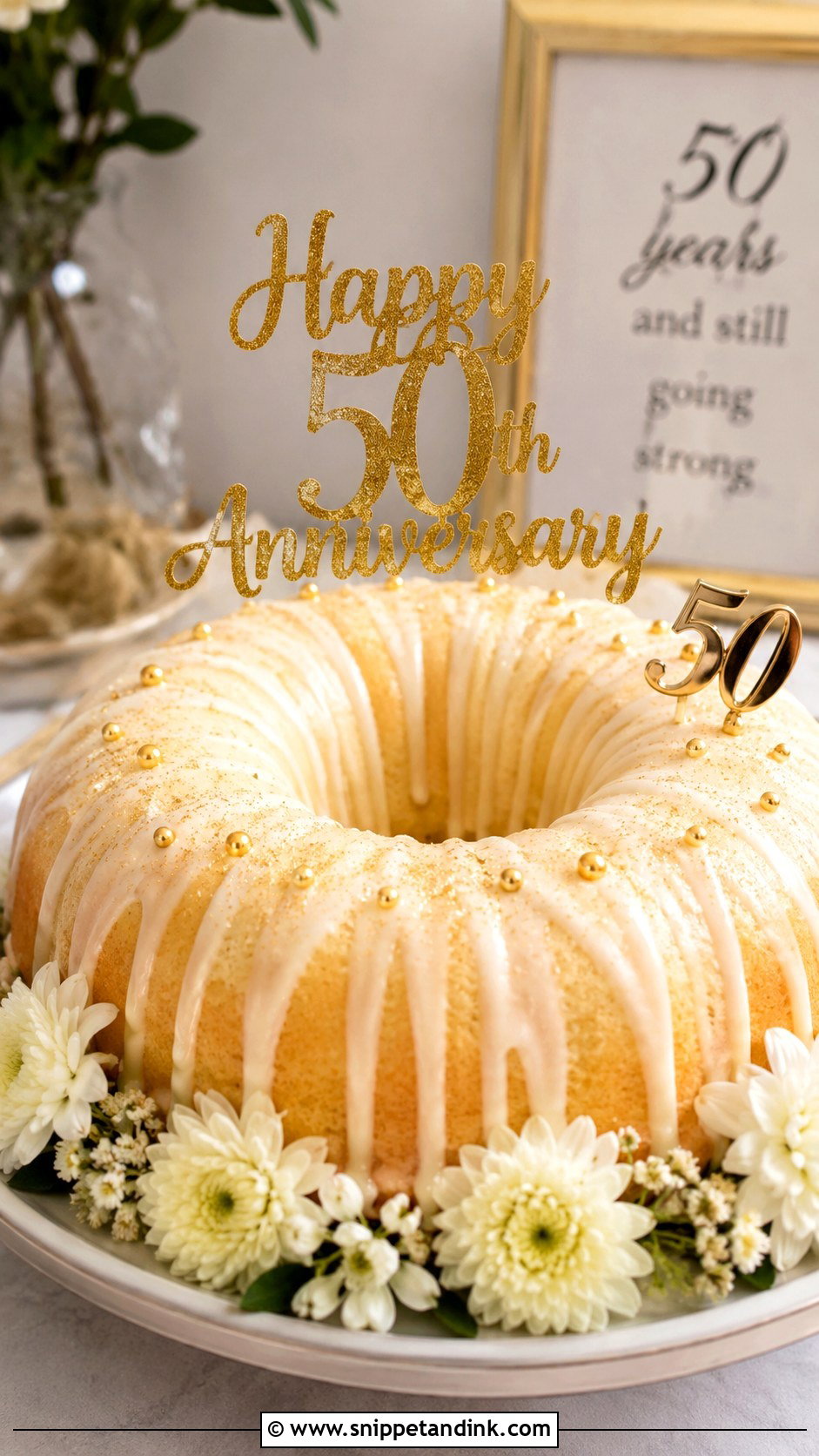
A Bundt suits a brunch or a small dinner at home, where comfort counts as much as display. The fluted shape is decoration already, so it only needs a smooth glaze, a dusting of edible gold and a ring of fresh flowers at the base, or a small topper set in the center hole. Brush the gold on once the glaze has fully set, otherwise it sinks and turns muddy. Lemon, almond and butter cake are my picks, and a dense crumb keeps well if you bake a day ahead.
16. Gold 50th Anniversary Cupcake Cake
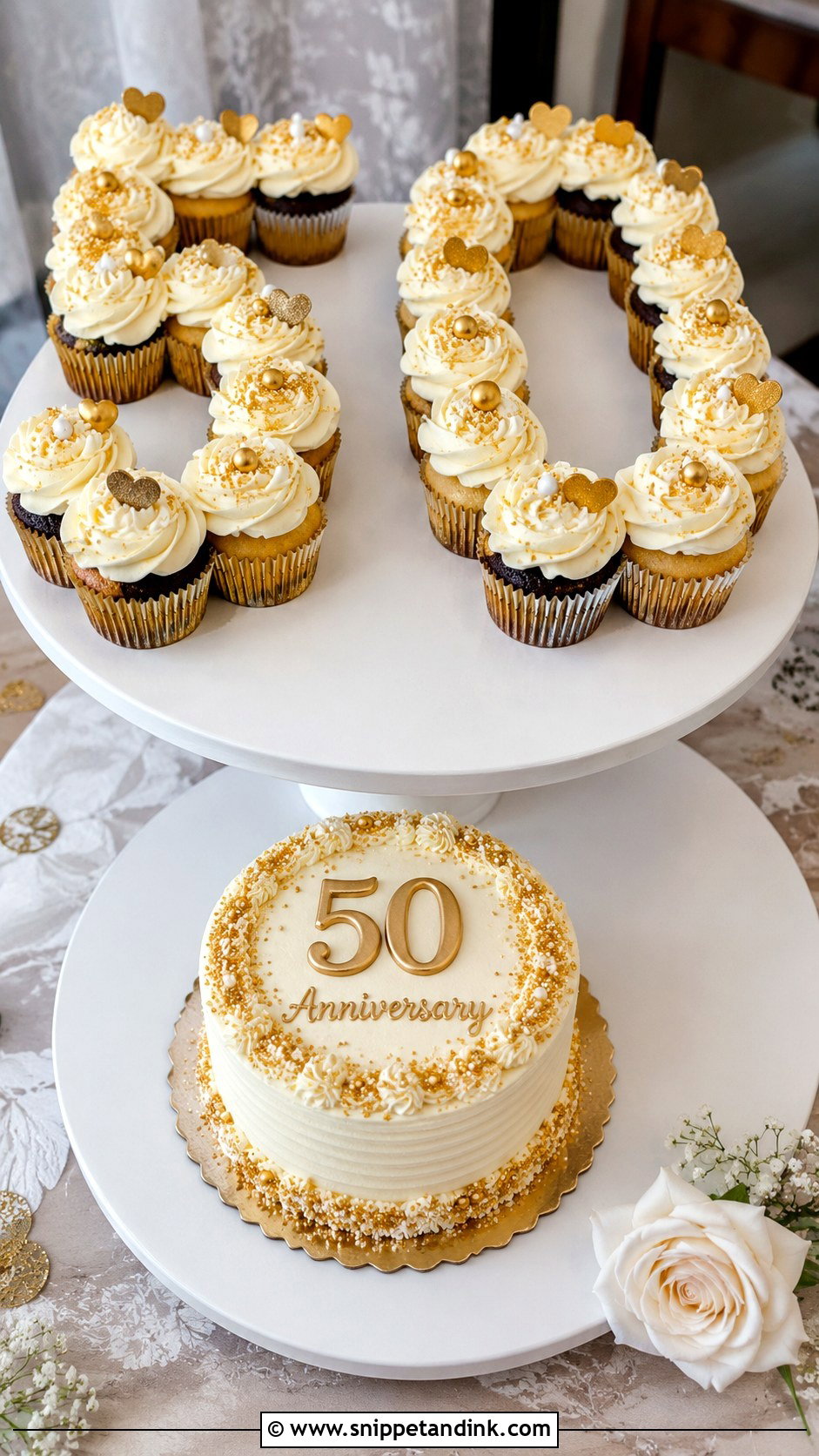
Cupcakes solve the serving problem at a mixed-age party: nobody waits for slicing, and you can offer several flavors at once. Arrange them into a “50” or around a small cutting cake for the couple. Ivory swirls, gold sprinkles, pearls and little gold heart toppers tie them together, and matching gold liners on a plain white stand make the table look finished. Use foil liners if you can, since paper liners can pull away from the cake and look greasy after a few hours. Vanilla, chocolate, lemon and red velvet cover most tastes.
17. Gold 50th Anniversary Black Cake
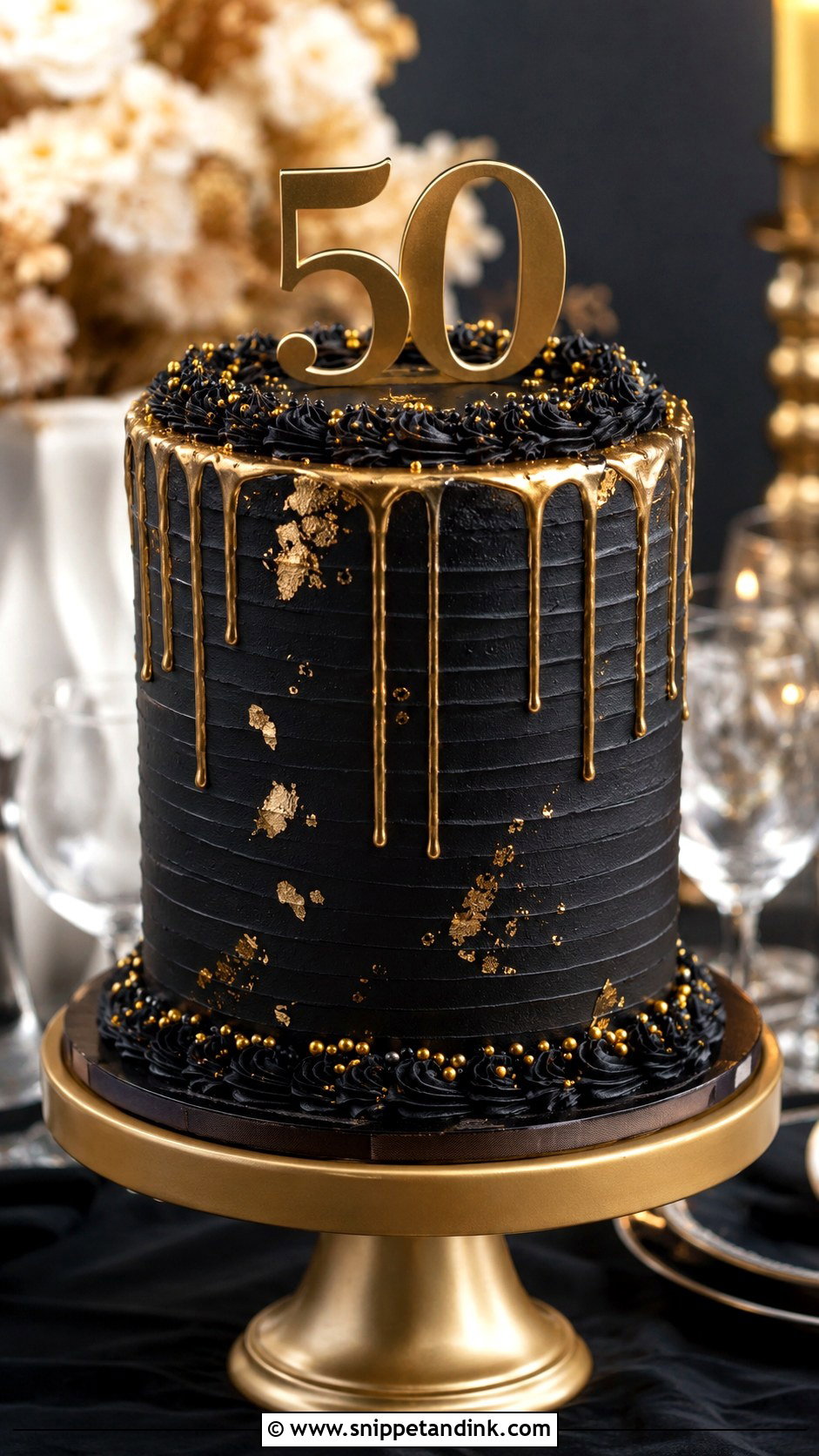
Black and gold is the boldest pairing here and suits an evening dinner in a formal room. The dark frosting makes every gold detail glow, so a little goes a long way: gold leaf, a drip, fine piping or a large metallic “50”. Getting true black takes a lot of coloring, which can stain mouths and taste bitter, so I start from a chocolate buttercream or ganache and darken it from there. Chocolate sponge is the natural partner, and a vanilla filling keeps it from feeling heavy. It’s not one I’d pick for a daytime garden party.
18. Gold 50th Anniversary White Cake
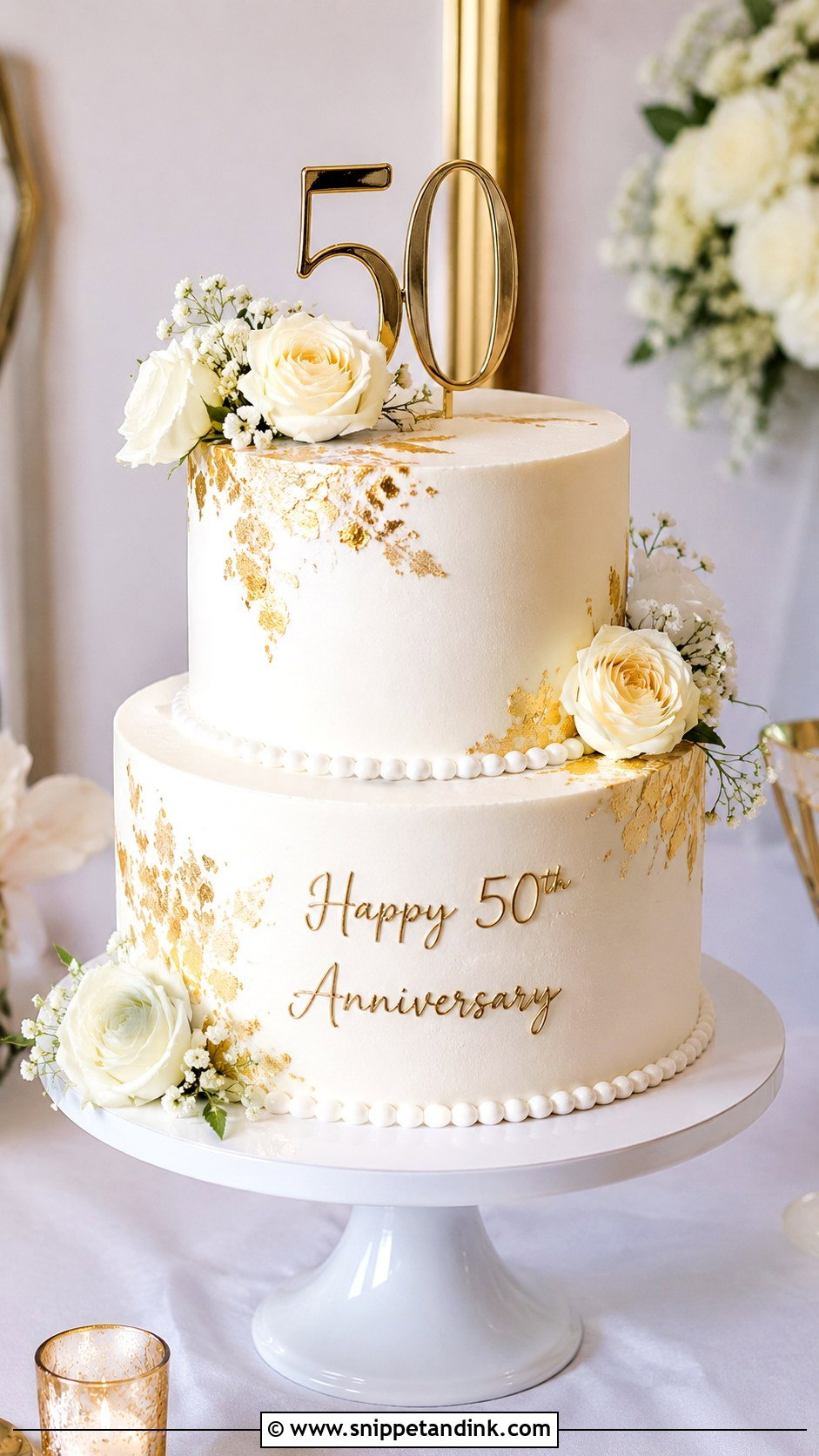
White is the base that fits almost any party, and it gives you the most freedom with gold. Leaf, lettering, pearls, flowers or a single topper all sit on it without clashing. Buttercream feels soft and classic, fondant more formal, and the design works at one tier or three. Pure white buttercream needs a touch of violet coloring to cancel the yellow from the butter, which is something to ask your baker about if you want it whiter than ivory. Vanilla bean, coconut or lemon keep the flavor light.
19. Gold 50th Anniversary Photo Cake
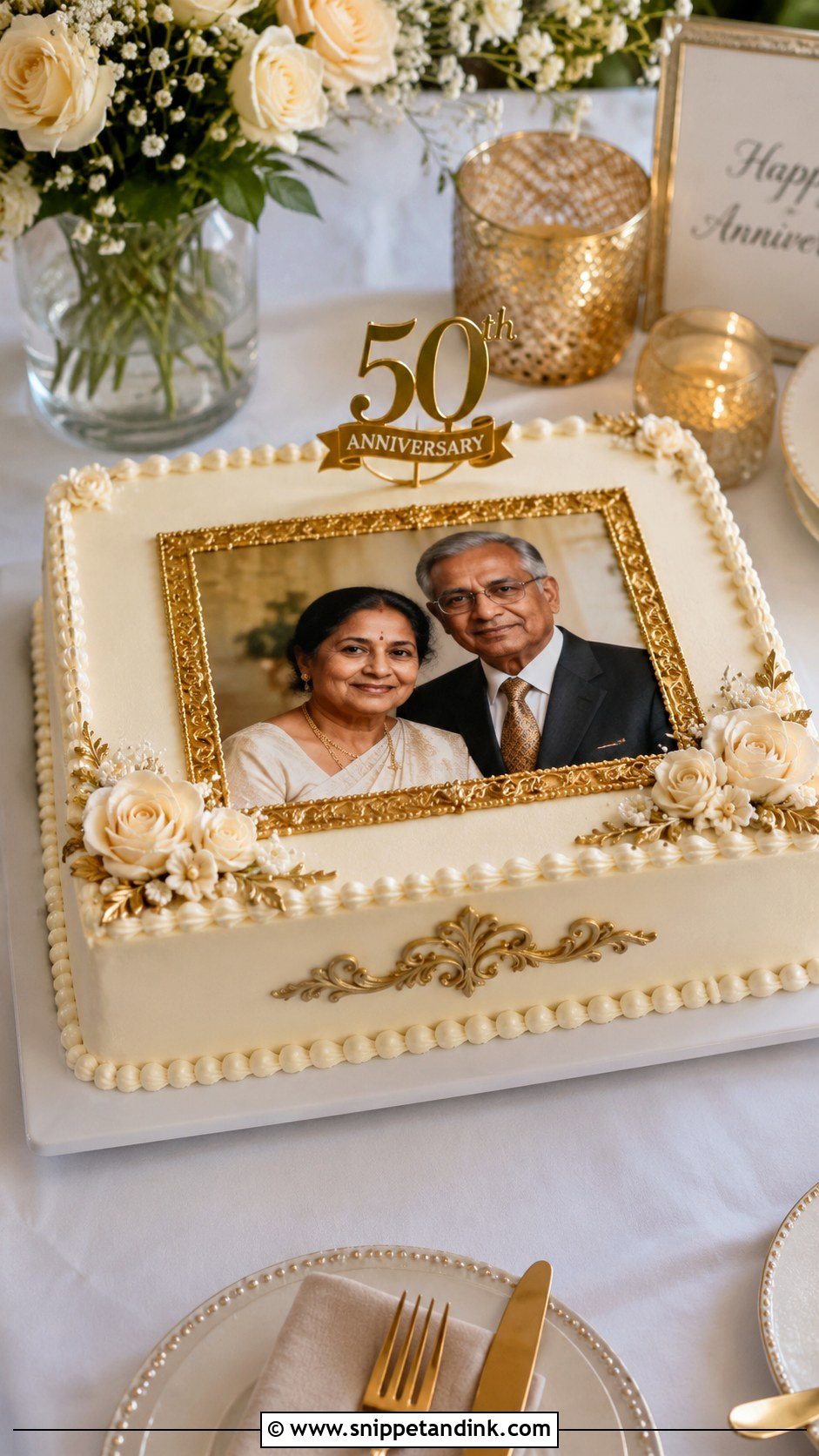
A photo cake turns dessert into a piece of the family history. It can carry an edible image of the couple, a wedding portrait framed in piped gold, or a small collage. Gold borders, pearl trim and floral corners keep it from looking like a supermarket order. Edible prints go on just before the event, because moisture from the frosting can make the colors bleed after a day or so. Scan the original photo at high resolution rather than photographing it with a phone. A rectangle holds a large image best, a round suits one centered portrait.
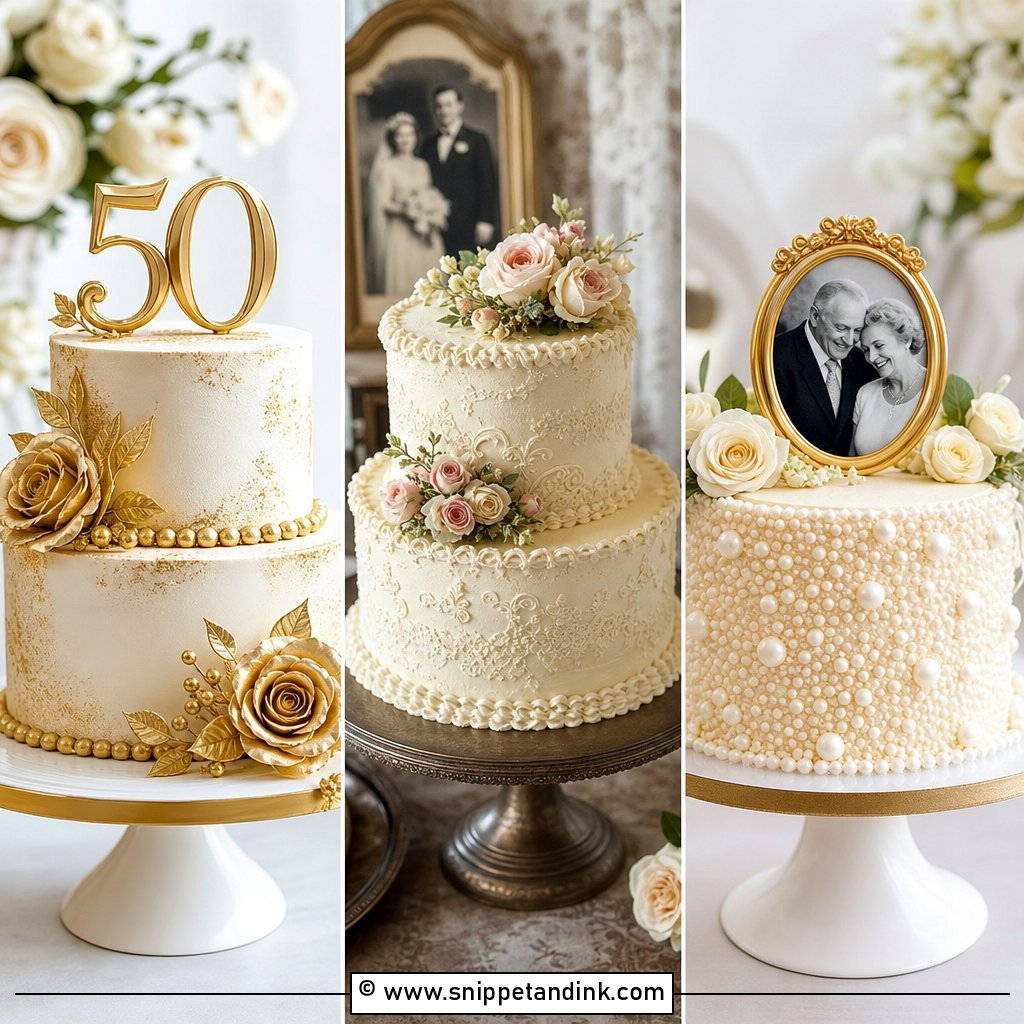
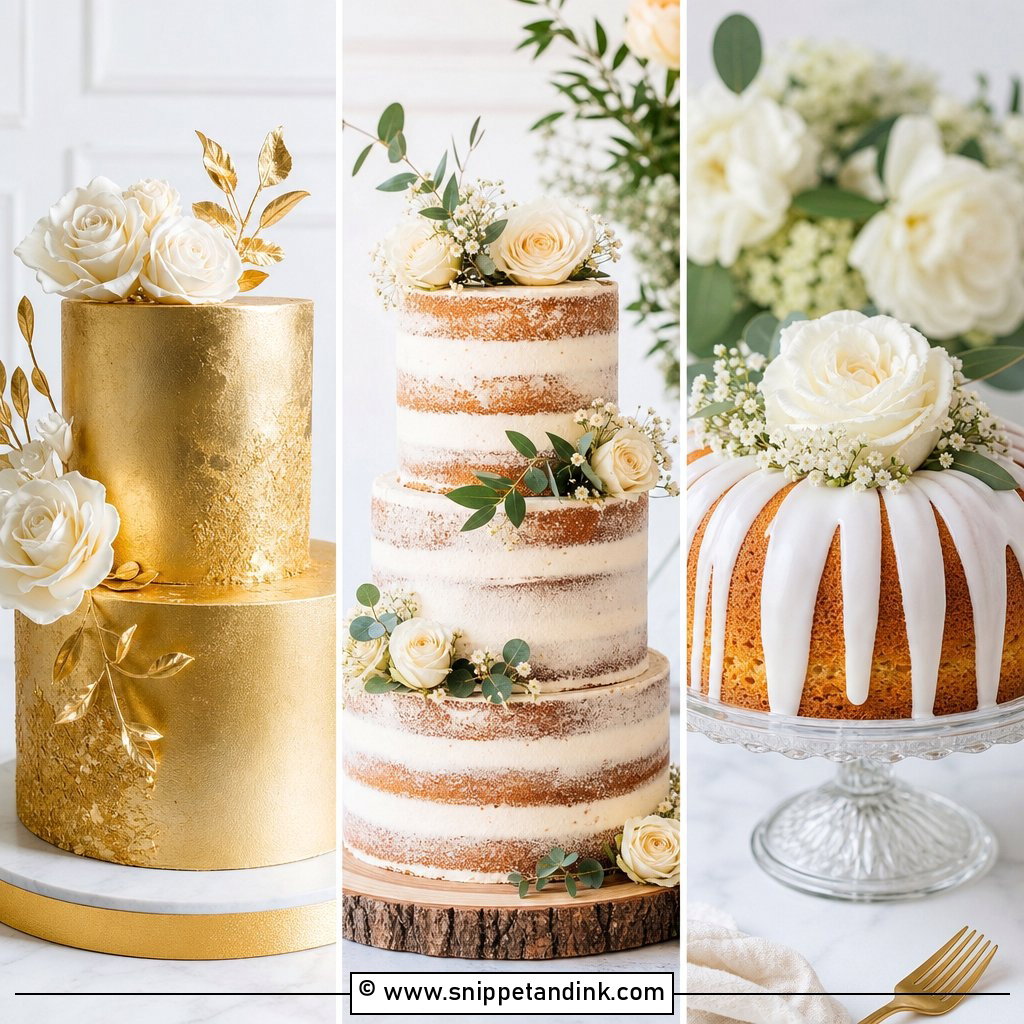
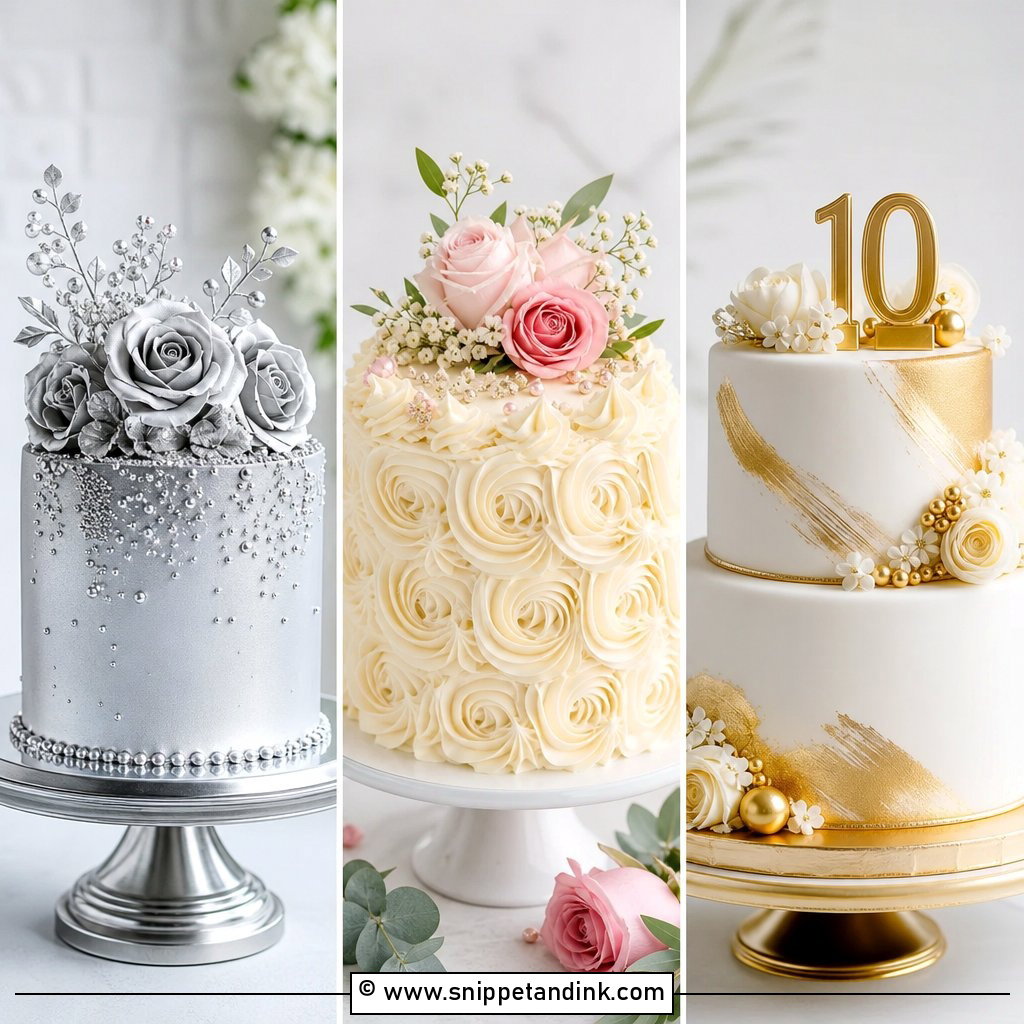
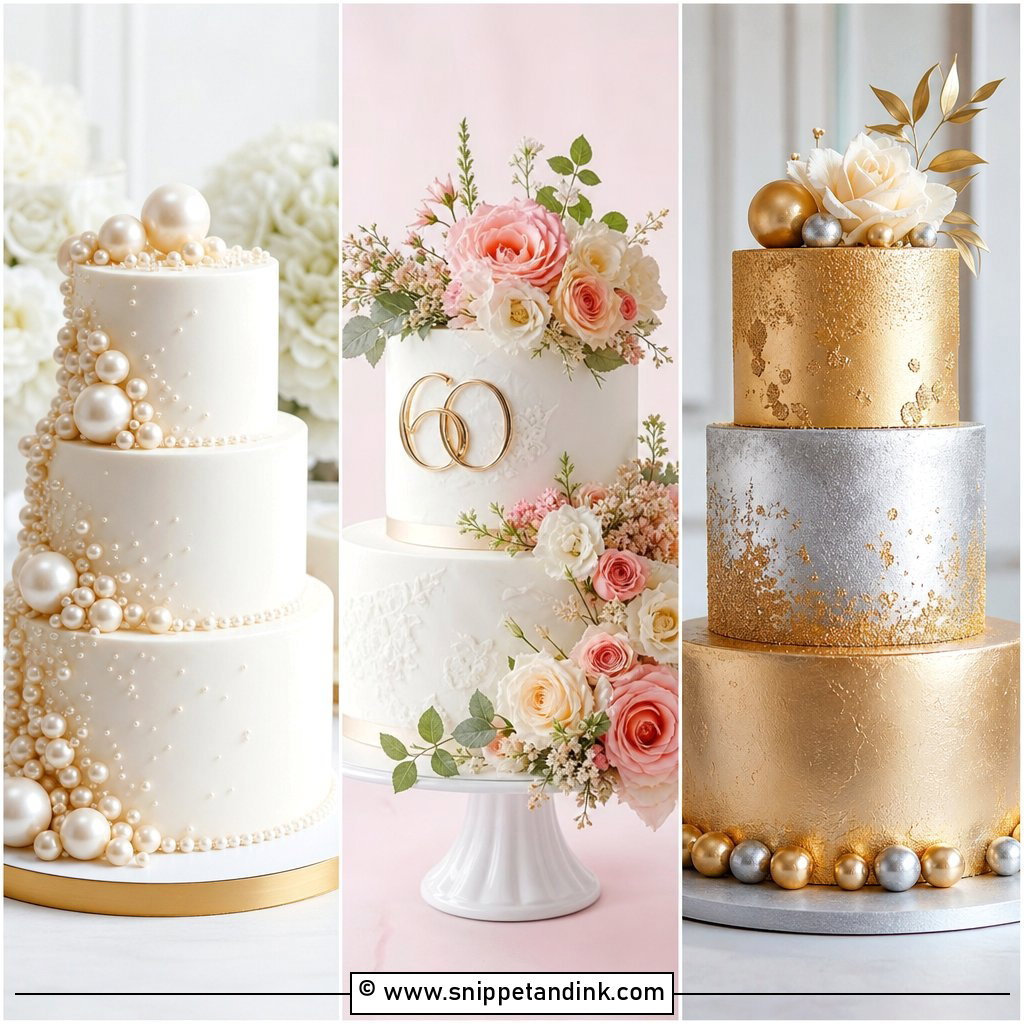
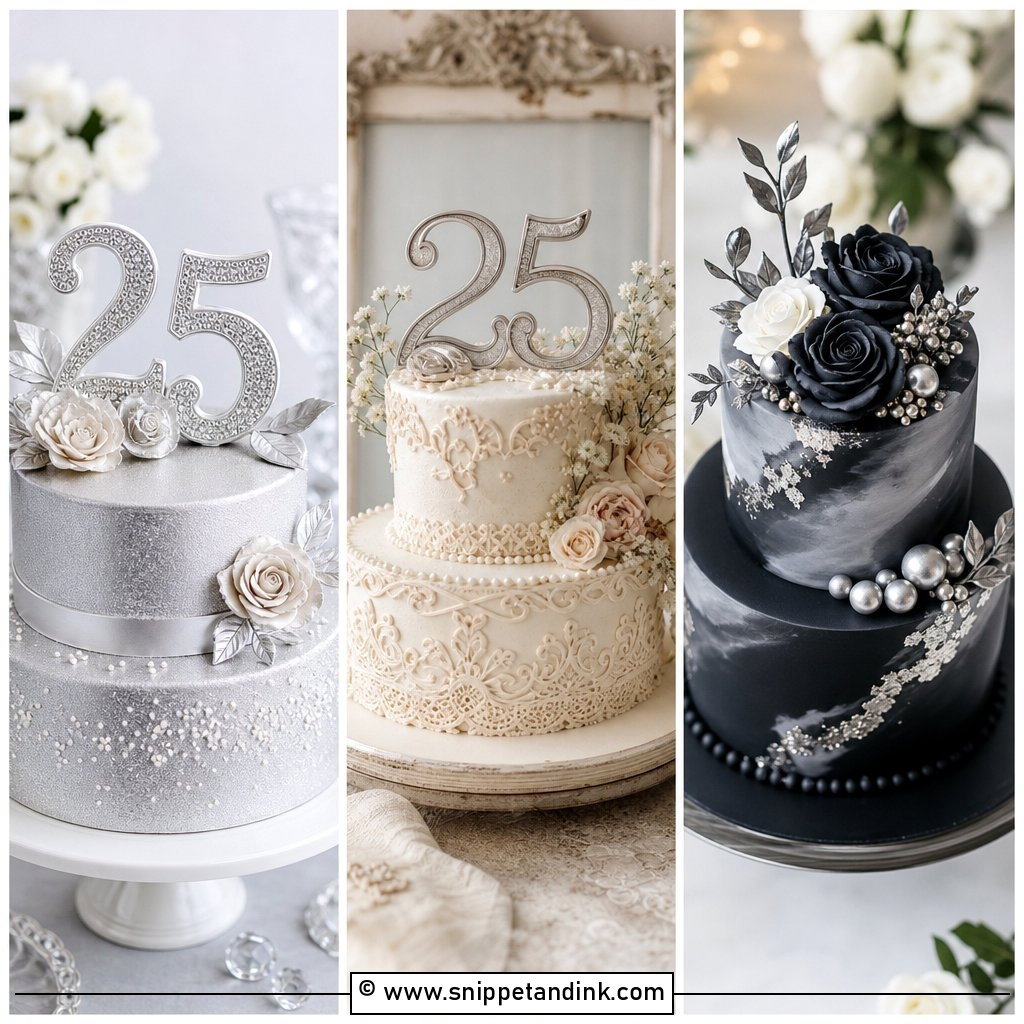
20. Gold 50th Anniversary Minimalist Cake
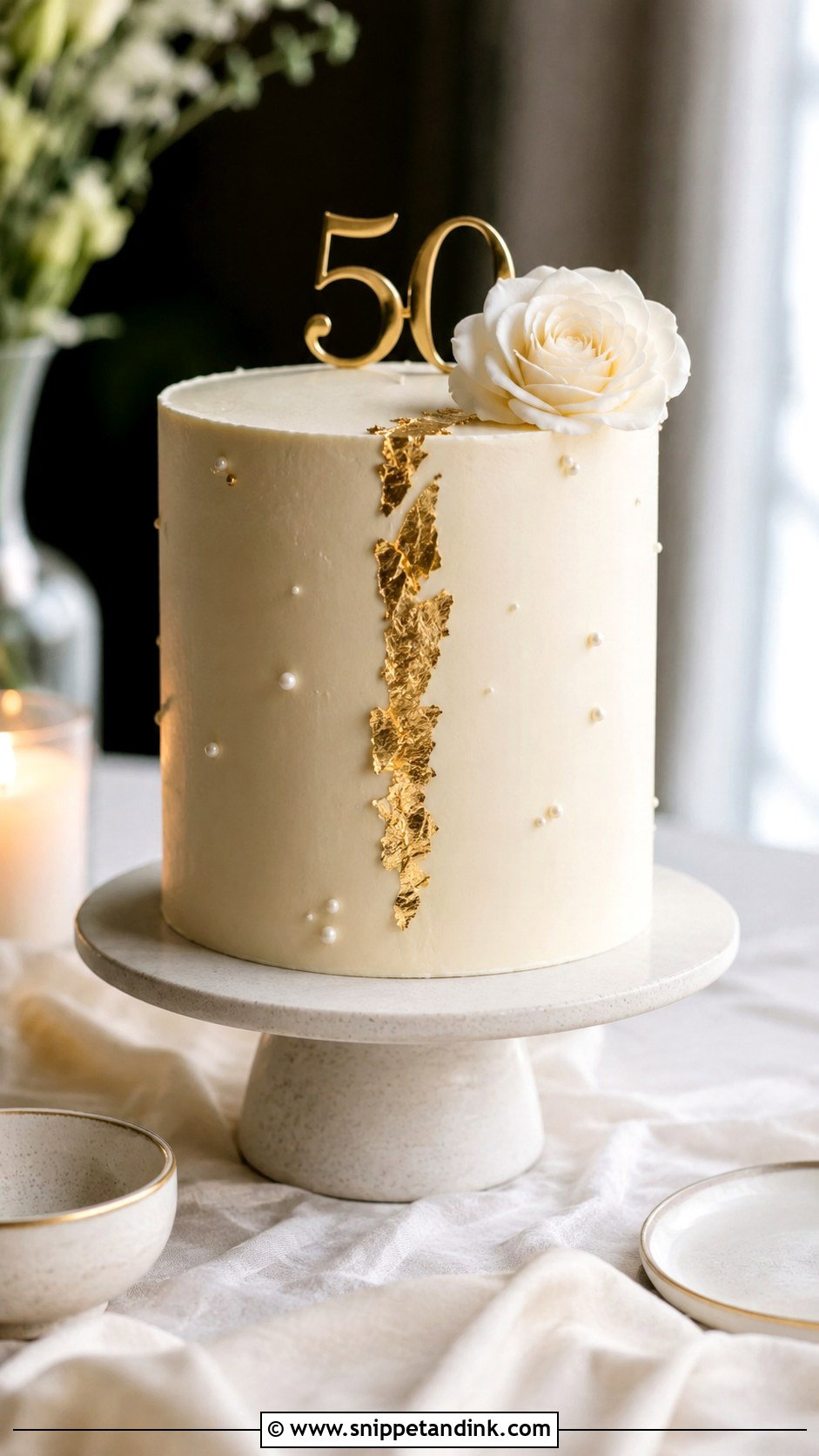
Minimal cakes rely on proportion more than decoration, so the frosting has to be truly smooth. Start with ivory or white buttercream and add one gold detail: a single strip of gold leaf, small gold numerals, a fine line of piping or a clean topper. One tall tier or two short ones suit an intimate dinner at home or a restaurant table. Any flaw in the finish shows when there’s nothing to hide it behind, which makes this harder to execute than it looks. Vanilla, almond or white chocolate keep it quiet in flavor too.
Rebaking the Cake From Their Wedding Album
The request that moves me most at a golden anniversary is a copy of the original wedding cake. Cakes fifty years ago were often fruitcake or a dense sponge under royal icing, with pillars between the tiers and piped scrolls. You don’t have to copy the recipe. I usually keep the silhouette and the piping style from the photo, and swap the inside for a flavor the family actually wants to eat today.
Bring the clearest photo you have, ideally a scan, plus any details the couple remembers: the flavor, the topper, whether the top tier was saved. If the original topper still exists, it can sit on the new cake, wrapped at the base so it never touches the frosting directly.
Serving a Room With Three Generations in It
Anniversary parties tend to have great-grandchildren and the couple’s oldest friends at the same tables, and that changes a few decisions.
- Keep hard decorations removable. Big sugar pearls and thick fondant are hard to chew, and nut-studded borders are a problem for anyone with dentures or allergies.
- Offer one lighter option, such as a lemon sponge or a fruit-topped tier, for guests watching their sugar, and label it.
- Count portions for everyone, then add a few. A dessert-sized slice is smaller than a wedding finger portion, so ask your baker which one their serving chart uses.
- Most cake designers want several weeks’ notice for a tiered order with sugar work, and longer in the summer wedding season. Book as soon as the date is fixed.
Fifty Years Deserves a Cake That Gets Eaten
A golden anniversary cake should look like the couple, not like a catalogue. A tiered cake suits a hall full of family, buttercream and rosettes feel warm, flowers bring in their wedding, and a minimal cake suits a quiet dinner. Sheet cakes, Bundts and cupcakes count just as much when they’re finished with care. Use gold to support the design rather than cover it, choose a sponge people will finish, and give your baker enough time to do the details properly.
You'll Like These Ideas:
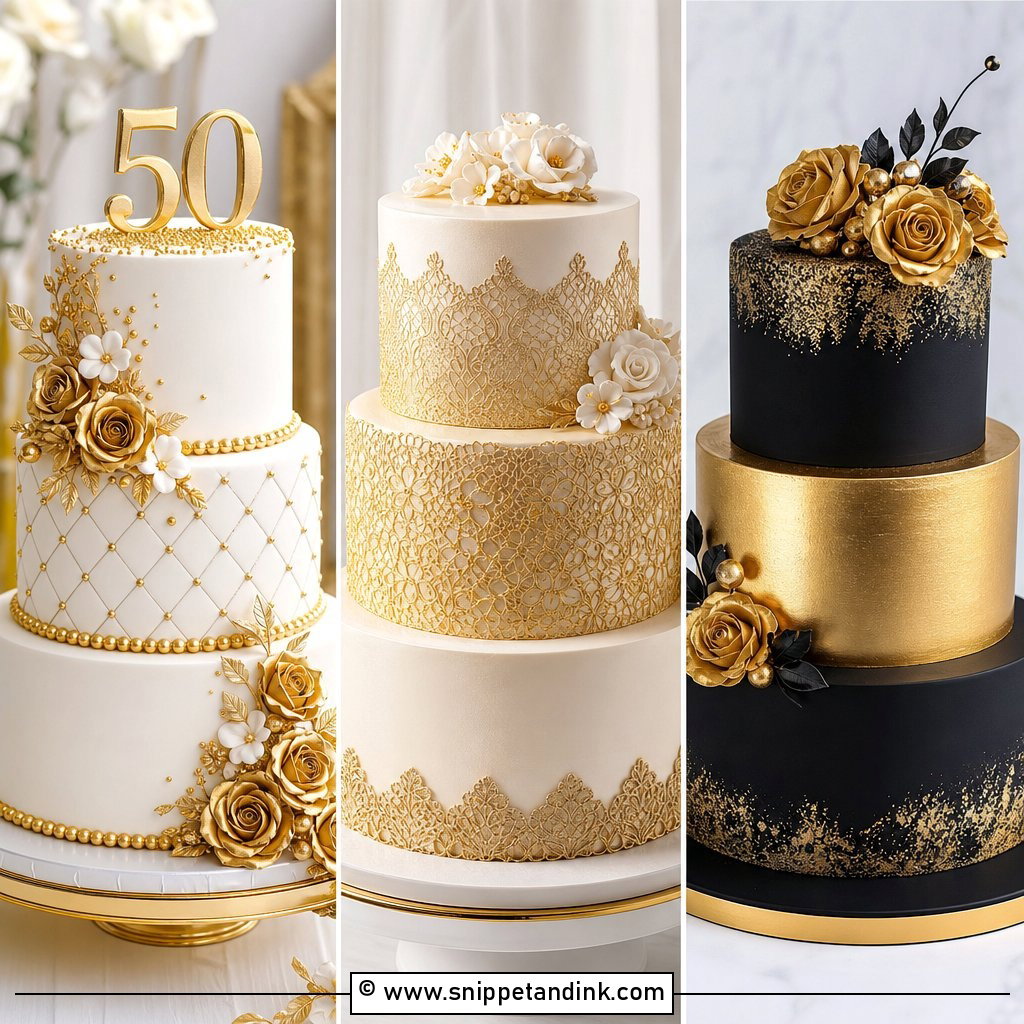


Leave a Reply