
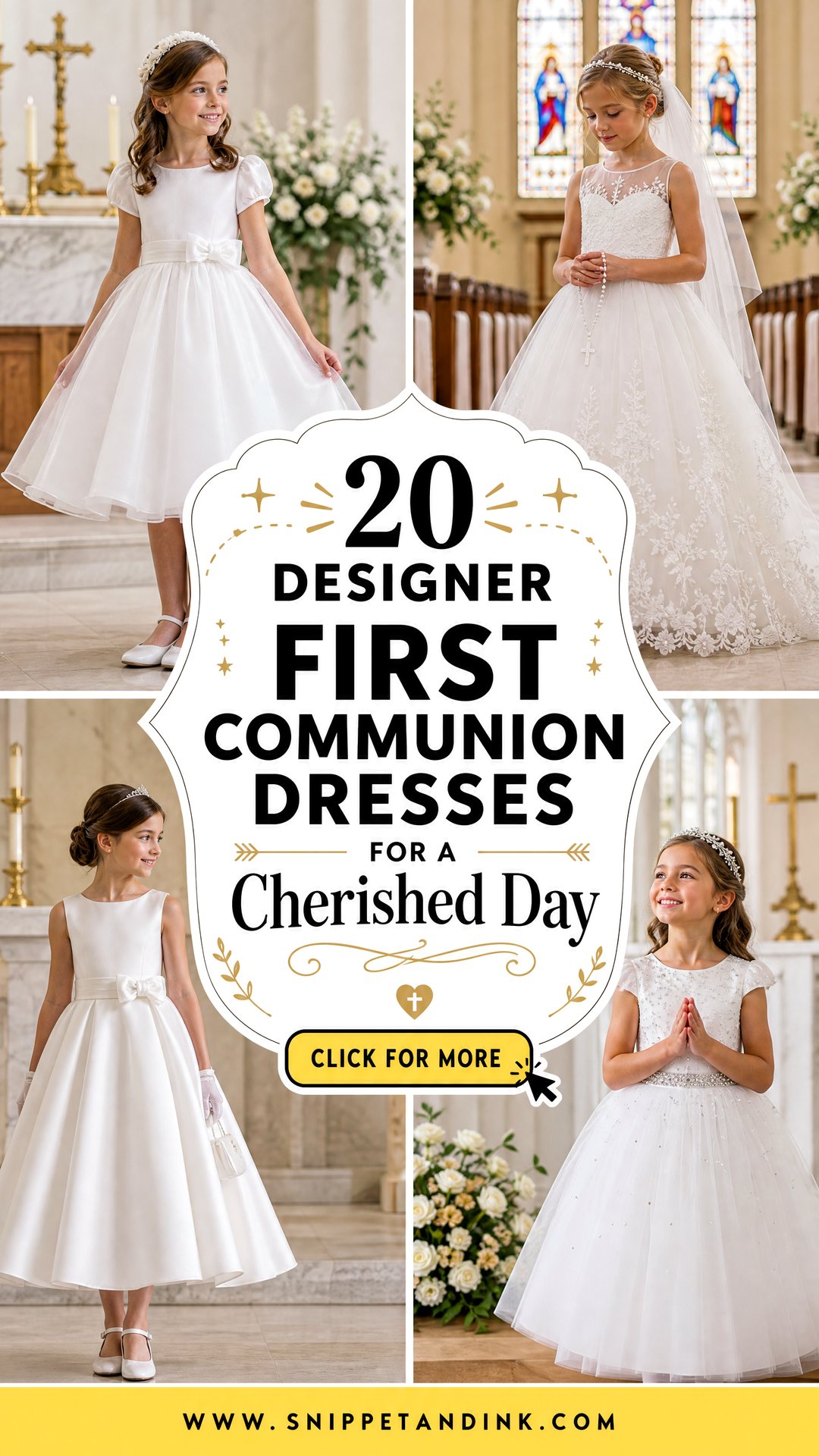
Twenty dresses is a lot to sort through, so I’ve built my notes around what actually matters on a seven- or eight-year-old: whether she can kneel, sit through a full Mass and hug her grandparents afterward without something scratching or slipping. The fabrics run from classic satin and light organza to embroidered lace, layered tulle and woven jacquard, with pearls or small fabric flowers on some. Tea-length and ankle-length hems stay practical for the walk to the altar, and long sleeves, cap sleeves, high necklines and soft cotton linings all give coverage without stiffness. Before you order, check what your parish allows, measure chest, waist and shoulder-to-hem, and leave room in the calendar for a fitting. Shoes, socks or tights, a veil and one small accessory finish each look below.
Ordering a Dress for a Child Who Will Grow Before Spring
Most communion dresses are bought in winter for a spring ceremony, and children grow in between. Made-to-order and designer pieces often need a couple of months or more, longer in peak season, so I like families to start looking around the turn of the year. Off-the-rack dresses arrive faster, but the popular sizes tend to sell out by early spring.
Measurements that actually help the shop
- Chest at the fullest point, arms relaxed, over a thin vest rather than a jumper.
- Natural waist, which on a child is where she bends sideways, often higher than parents assume.
- Shoulder to the hem length you want, measured standing in the shoes she will wear.
- Across the back from shoulder point to shoulder point, the number that decides whether sleeves pull.
If she falls between two sizes, I order the larger one. Taking in a bodice and lifting a hem is quick work for a seamstress, while letting out a dress with no seam allowance usually can’t be done. Book the final fitting two or three weeks before the ceremony, not two months, so you’re fitting the child who will actually walk up the aisle.
1. Classic Satin First Communion Dress
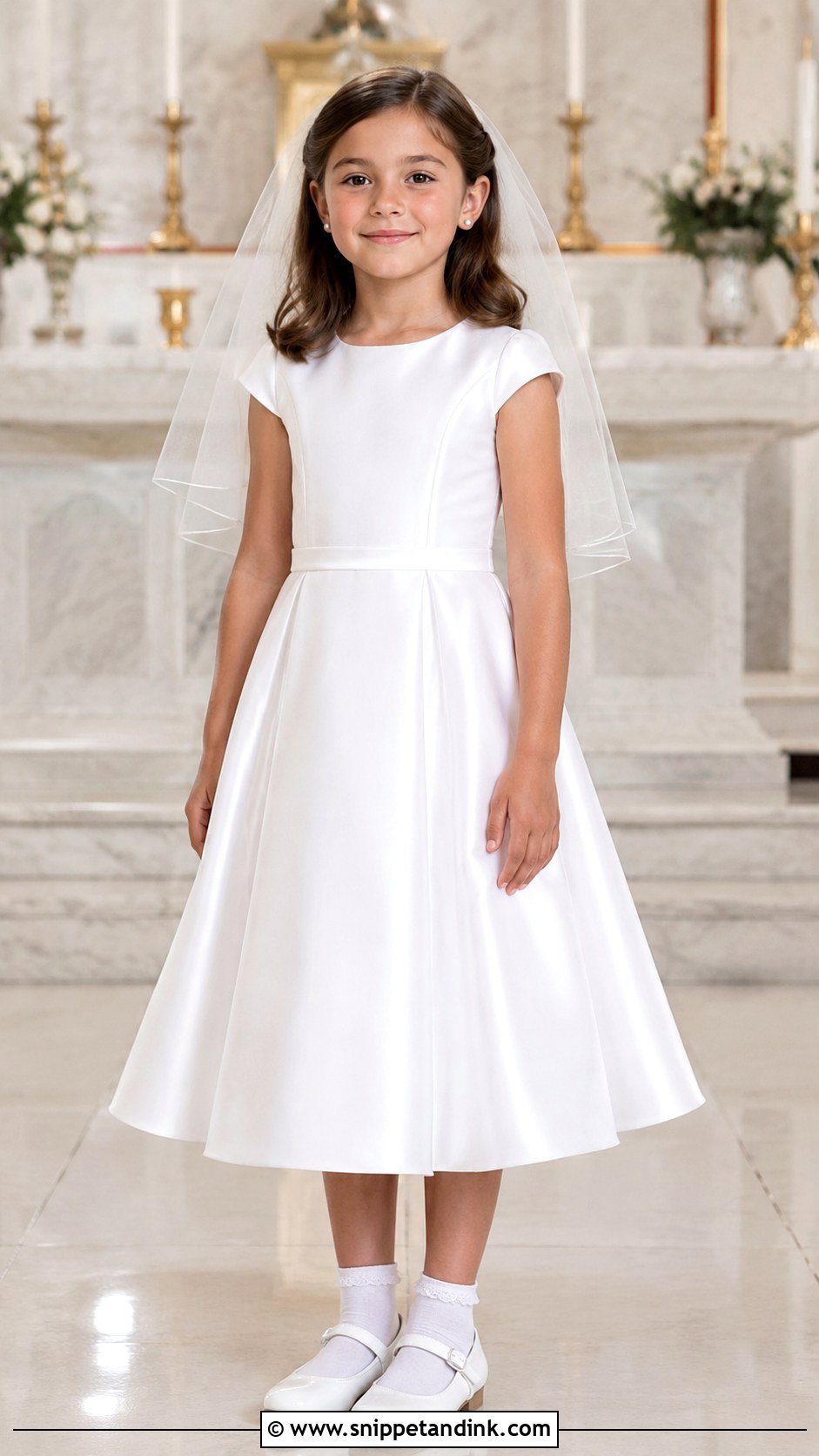
Satin is the fabric I reach for first when a family wants something traditional, because it holds a clean A-line on its own and reads well in church light. Look for a structured bodice, a natural waist, cap sleeves, and a tea-length or ankle-length skirt. Turn it inside out before buying: a full, smooth lining stops the satin seams from rubbing over a long ceremony and lunch. White leather Mary Janes, fine ankle socks and a shoulder-length veil complete it, or swap the veil for a small pearl headband. Satin shows every water mark, so I steam it from the inside and keep drinks well away until the photos are done.
2. Long Sleeve Lace First Communion Dress
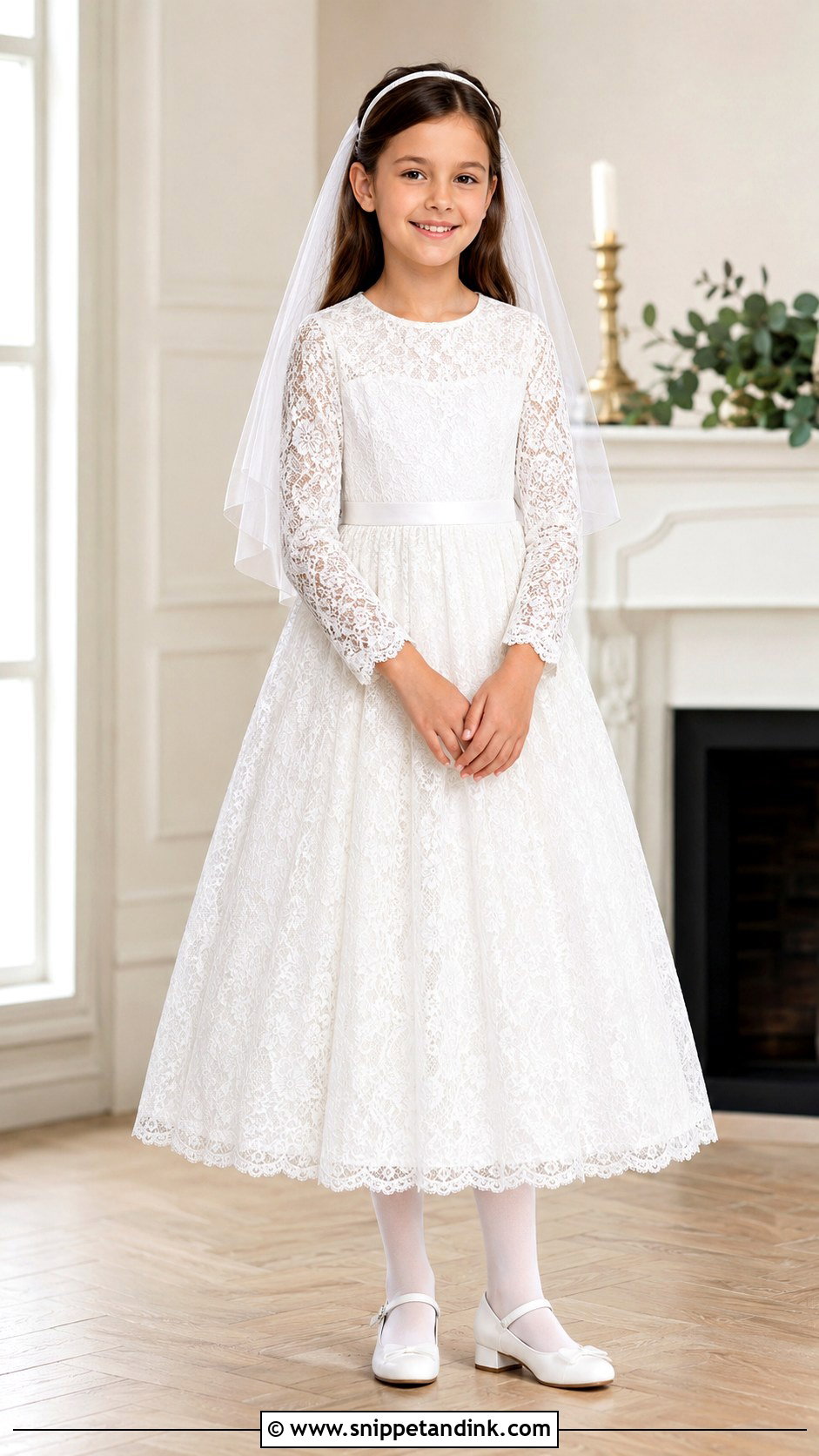
Long lace sleeves are where I see the most fidgeting, so the first thing I do at a fitting is bend the child’s arm. Soft lace that folds at the elbow gives a lace First Communion dress its designer finish without the scratch; stiff corded lace on the inner arm gets pulled at by the second reading. A lined bodice with unlined sheer sleeves keeps it light. Opaque white tights, low block-heel Mary Janes and a narrow satin headband suit it, and a plain veil sits better against busy lace than a trimmed one. Cuffs should stop at the wrist bone and stay there when she folds her hands to pray.
3. Tea Length Organza First Communion Dress
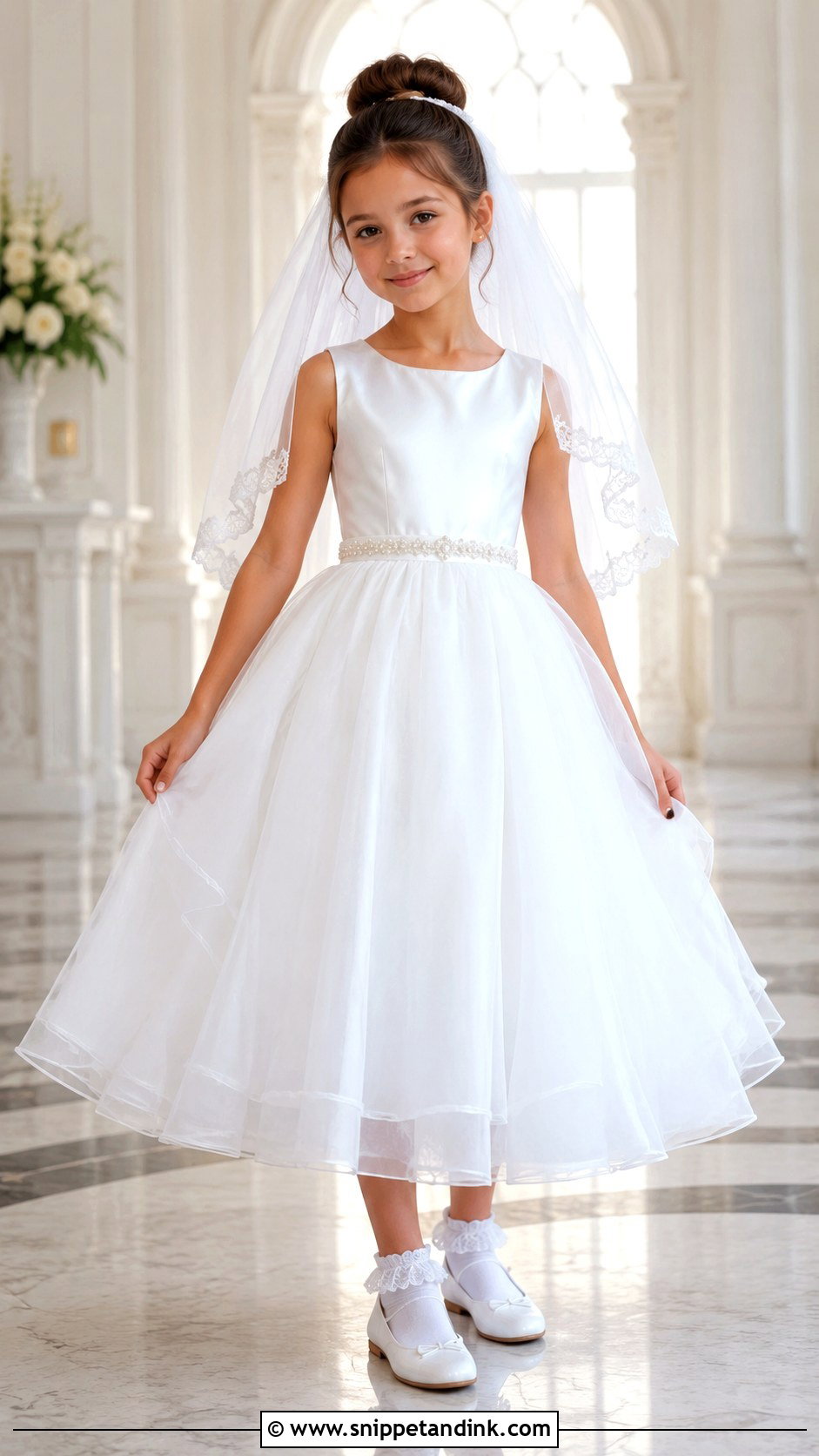
Organza is the dress I suggest for a warm spring church with no air conditioning. It’s sheer and crisp, so a tea-length skirt looks full with very little weight, and a satin bodice with a defined waistband gives it shape. White ballet flats, lace-trimmed ankle socks and a fingertip veil on a small comb go with it. If you add a pearl belt, check that the beads lie flat where her arms rest. Organza creases sharply in a car seat, so hang it the moment you arrive and steam from a hand’s width away; an iron pressed straight onto polyester organza can glaze or melt it.
4. Embroidered Tulle First Communion Dress
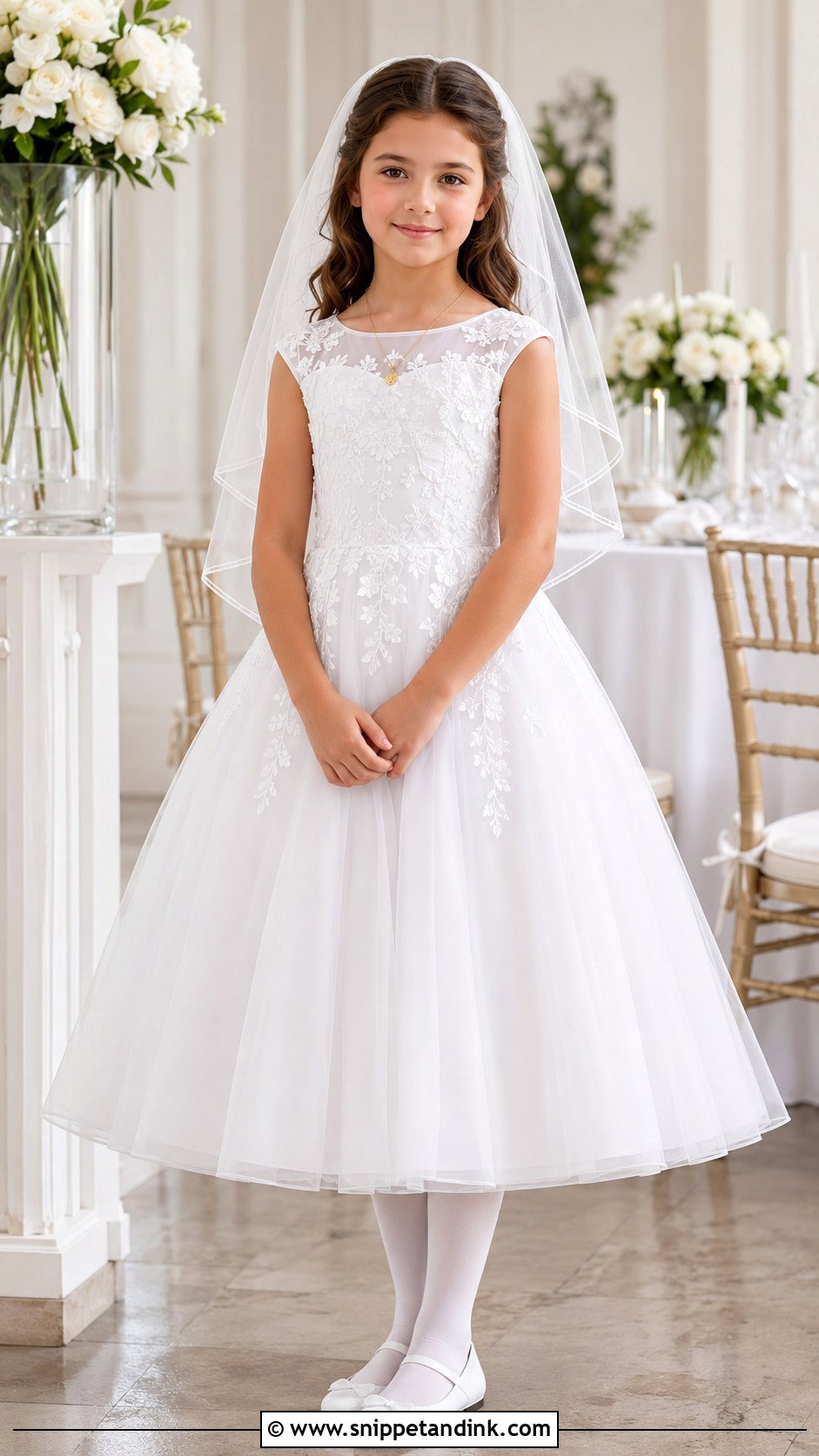
Embroidered tulle can be harsh on young skin, which is why I check the inside before I look at the front. Floral or vine embroidery on a fitted bodice with a flared skirt reads soft and youthful, but the reverse side is often stiff backing and knots, and a full lining has to cover it at the bodice and armholes. Keep shoes plain and jewelry tiny, and pick a veil with only a narrow finished edge, since the embroidery is already doing the work. A little satin clutch for a handkerchief is sweet, though a parent should hold it during Mass.
5. Pearl Waist First Communion Dress
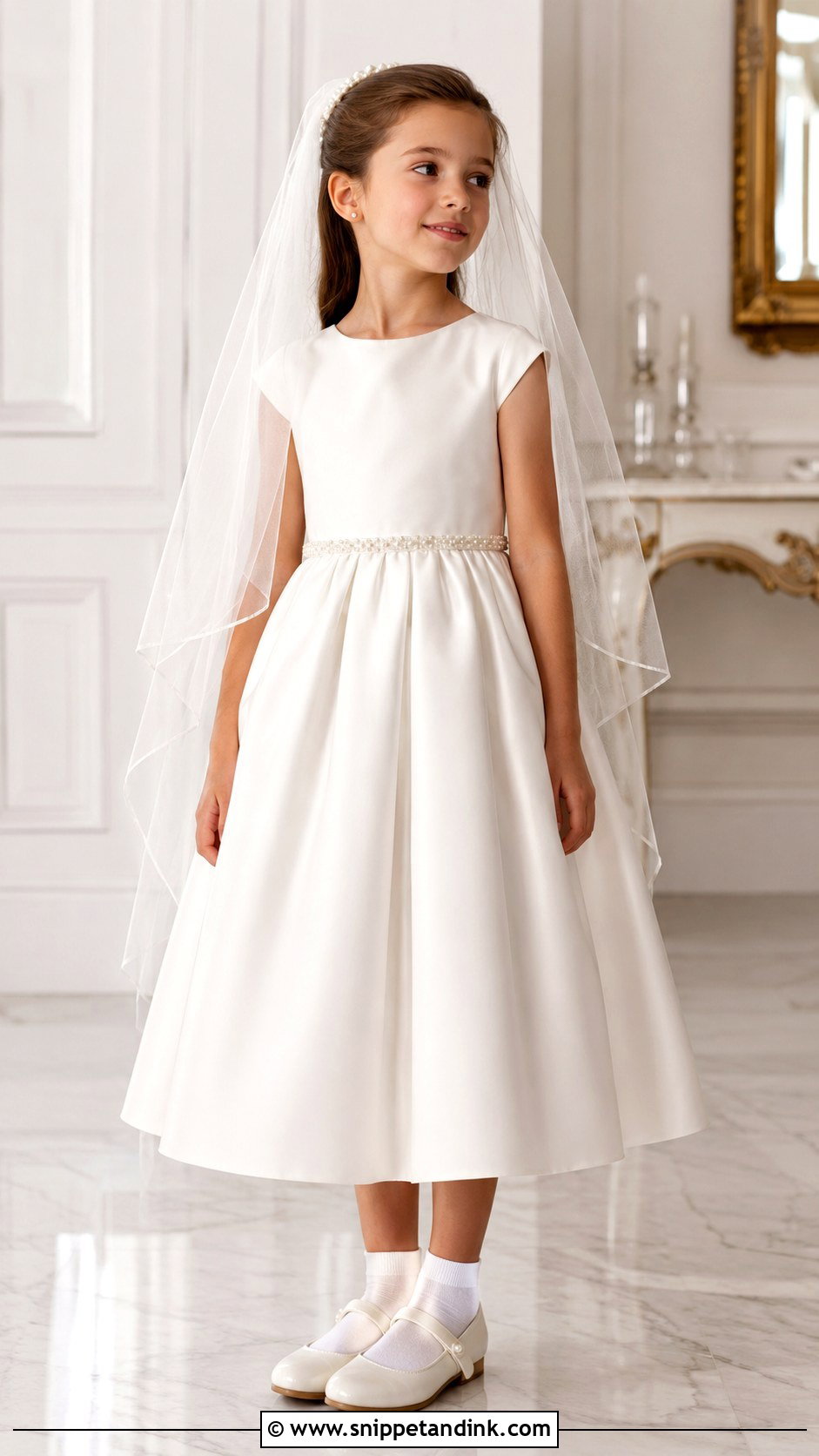
Pearl waistbands are the repair I end up doing most often on the morning itself. Children twist at the waist, and sewn-on beads take all the strain. Choose an A-line with a satin bodice, gathered skirt and a narrow row of pearls, then tug each one gently a week ahead and re-stitch anything loose. Pearl-button Mary Janes, plain socks and a clean tulle veil suit it. Small pearl earrings are fine, but skip the necklace when the waist already carries the detail. The band should sit at her natural waist with a finger’s room to spare while she’s seated.
6. Puff Sleeve First Communion Dress
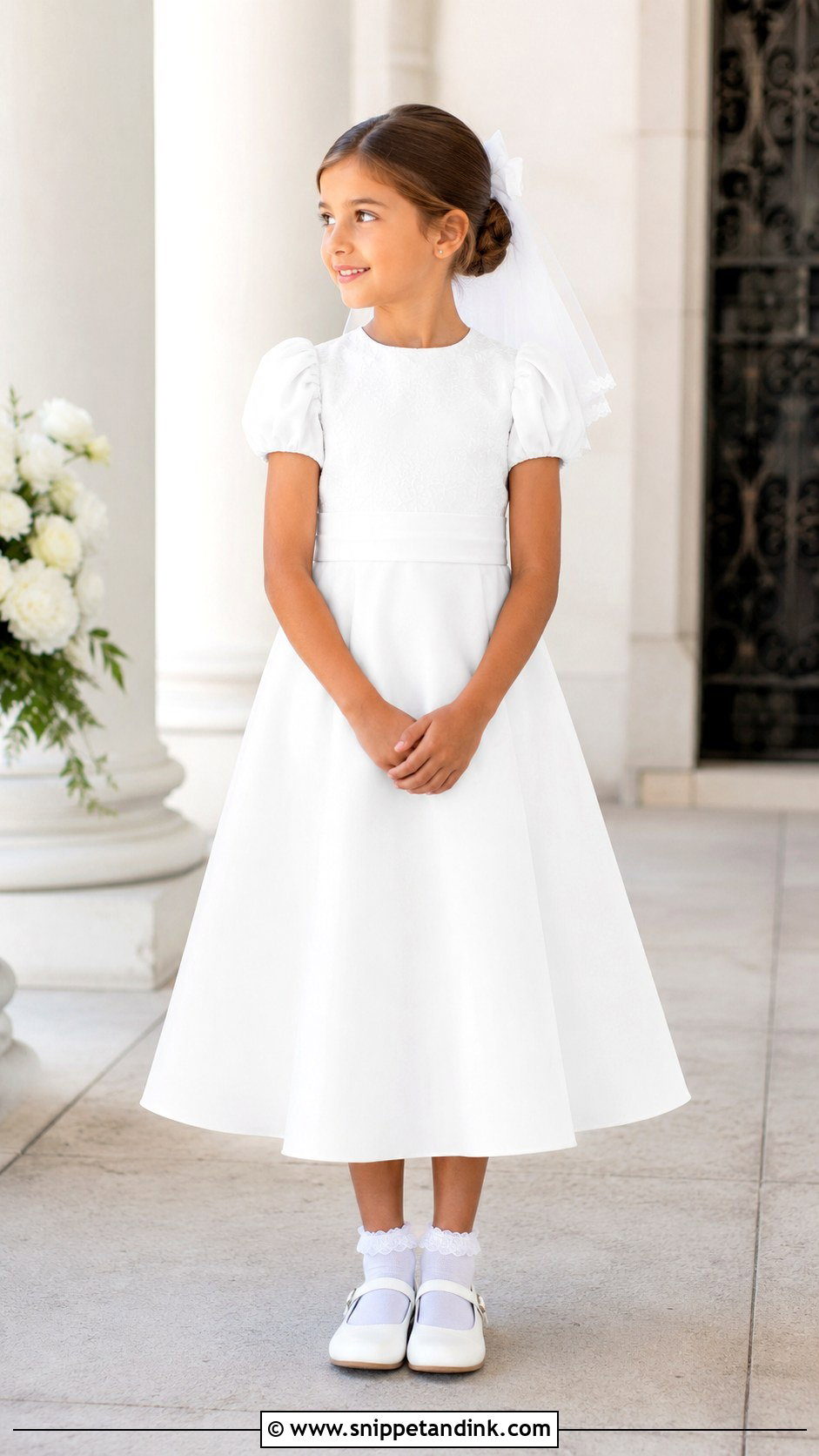
Puff sleeves suit younger, slighter children best; on a broader frame they widen the shoulders more than parents expect. I look for short sleeves with soft elastic or a smooth cuff that doesn’t bite the upper arm. A satin or jacquard bodice over a simple A-line skirt lets the sleeves lead. Add white Mary Jane flats, scalloped socks and a low bun with a small bow comb, and tuck a short plain veil under the comb if you want one. Have her lift both arms over her head in the fitting room. If the sleeves ride up or the armhole pulls, that’s how it will feel all day.
7. Cape Sleeve First Communion Dress
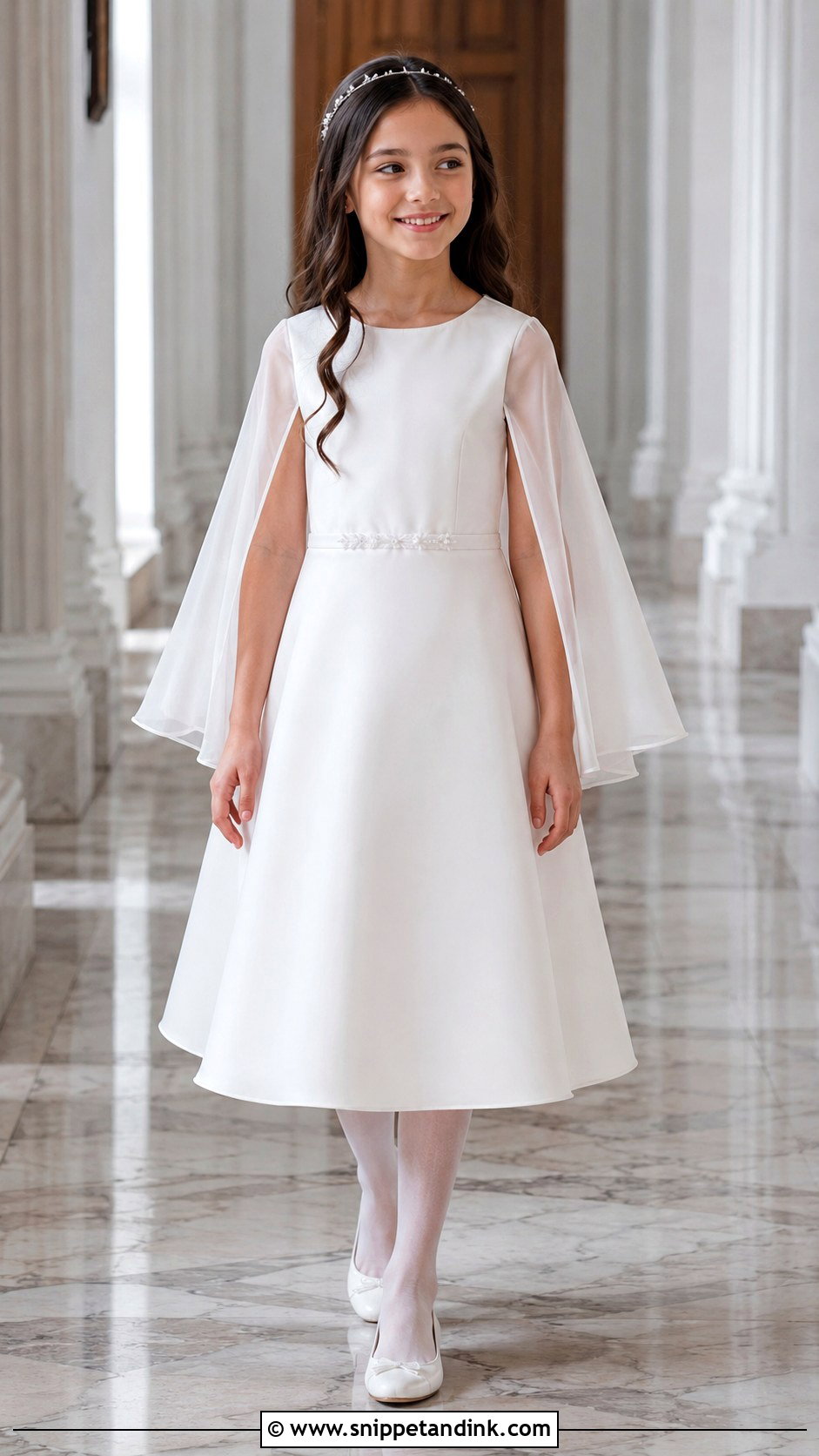
A cape gives coverage without a sleeve seam under the arm, and that’s why I like it for children who hate tight armholes. The chiffon or organza cape should fall from the shoulders and stop above the elbow, over a fully lined dress with a plain A-line or softly pleated skirt. White pointed ballet flats, smooth tights and a slim pearl headband are enough. Plenty of families skip the veil here because the cape already frames her shoulders, but a short plain one works if your parish expects it. Check the neck fastening closely: a cape hooked too high is the first thing she’ll tug at.
8. High Neck Lace First Communion Dress
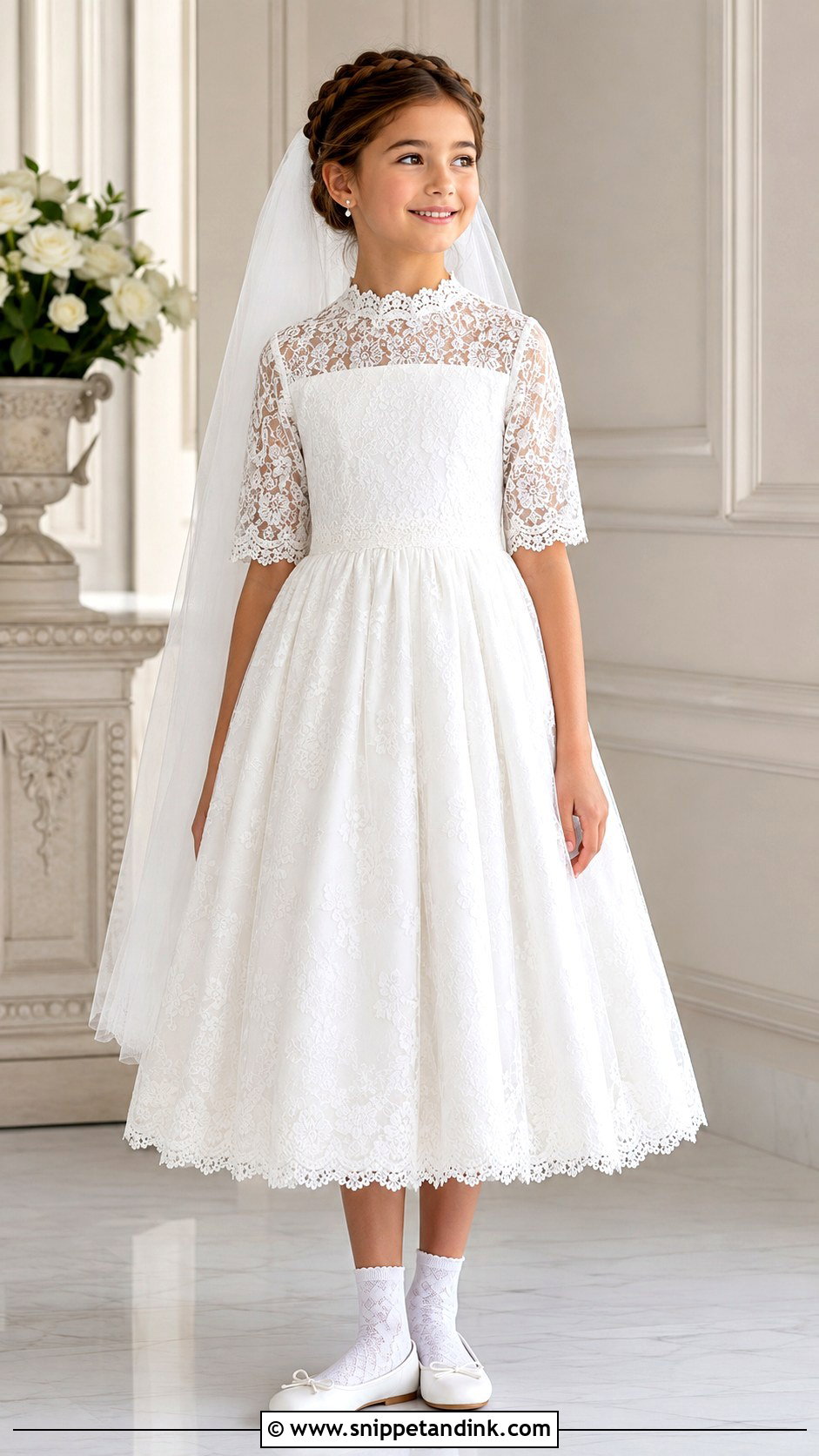
Children turn their heads constantly, so a high neckline has to be fitted with more care than any other part of the dress. A soft scalloped neckline, short or elbow-length sleeves and an opaque lining up to the collarbone keep it modest, and a lightly gathered skirt stops it looking too grown-up. Rounded white flats, fine ankle socks and a plain veil pinned below a braid suit it. I’d leave the necklace off and use tiny pearl or crystal studs instead. At the fitting, ask her to look over each shoulder; if the collar edge rubs now, it will leave a red line by photo time. A covered zip or a row of fabric buttons lies flat under the veil.
9. Minimalist Mikado First Communion Dress
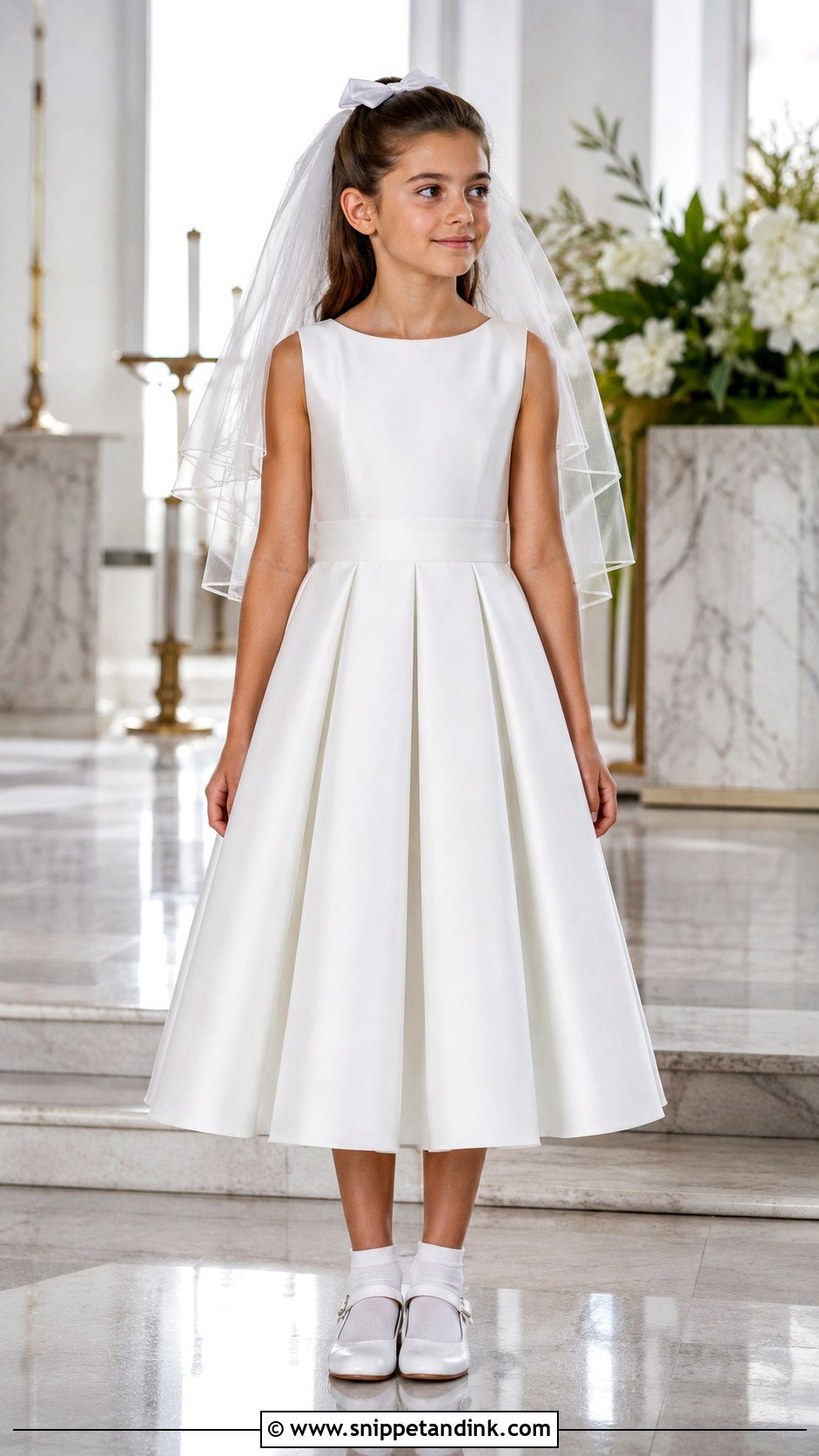
Mikado is a heavy, slightly stiff fabric, and I’d only buy it after a proper fitting, because it won’t drape to hide a poor fit across the shoulders. An A-line with a bateau neckline, fitted waist and crisp box pleats looks sharp while staying age-appropriate. White leather Mary Janes, plain ankle socks, a narrow satin bow in the hair and a sheer shoulder-length veil soften all that structure. Ask her to sit, walk and climb a few steps in it. The pleats crease where she sits, so a quick steam before the church photo helps, and from the back pews the clean lines read far more clearly than lace does.
10. 3D Floral First Communion Dress
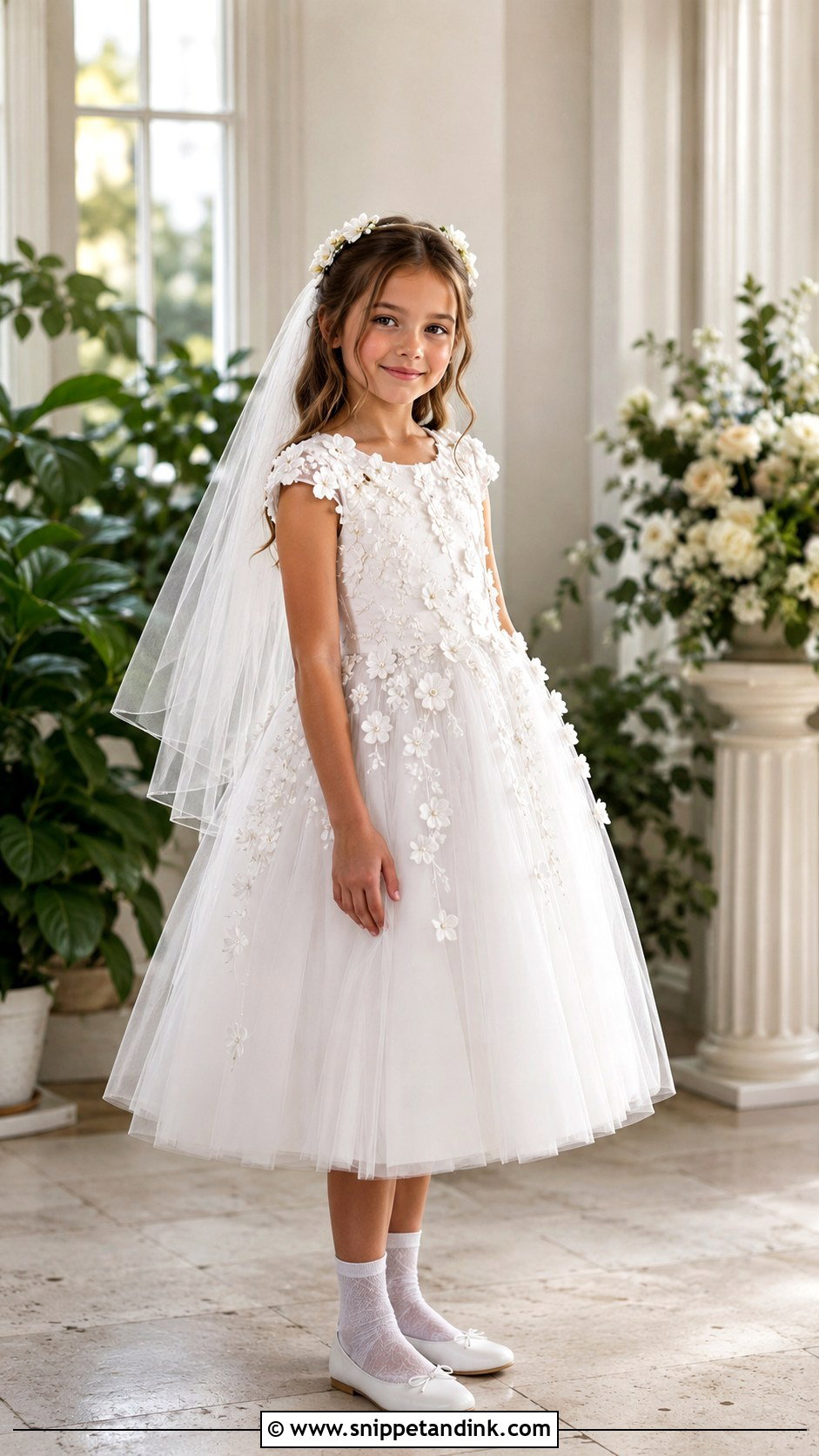
Three-dimensional flowers get my hardest inspection, since a child will pick at a loose petal during a long homily. Small fabric blossoms stitched through the centre hold up far better than glued ones, and a few placed across the bodice look more considered than a skirt covered in them. A sleeveless or cap-sleeve bodice over a tea-length tulle skirt keeps the base soft. Plain white flats, fine socks and a simple floral comb above a low hairstyle are enough, with an untrimmed veil if you need one. Press each flower while she’s seated; it should bend, not crush.
11. Scalloped Lace First Communion Dress
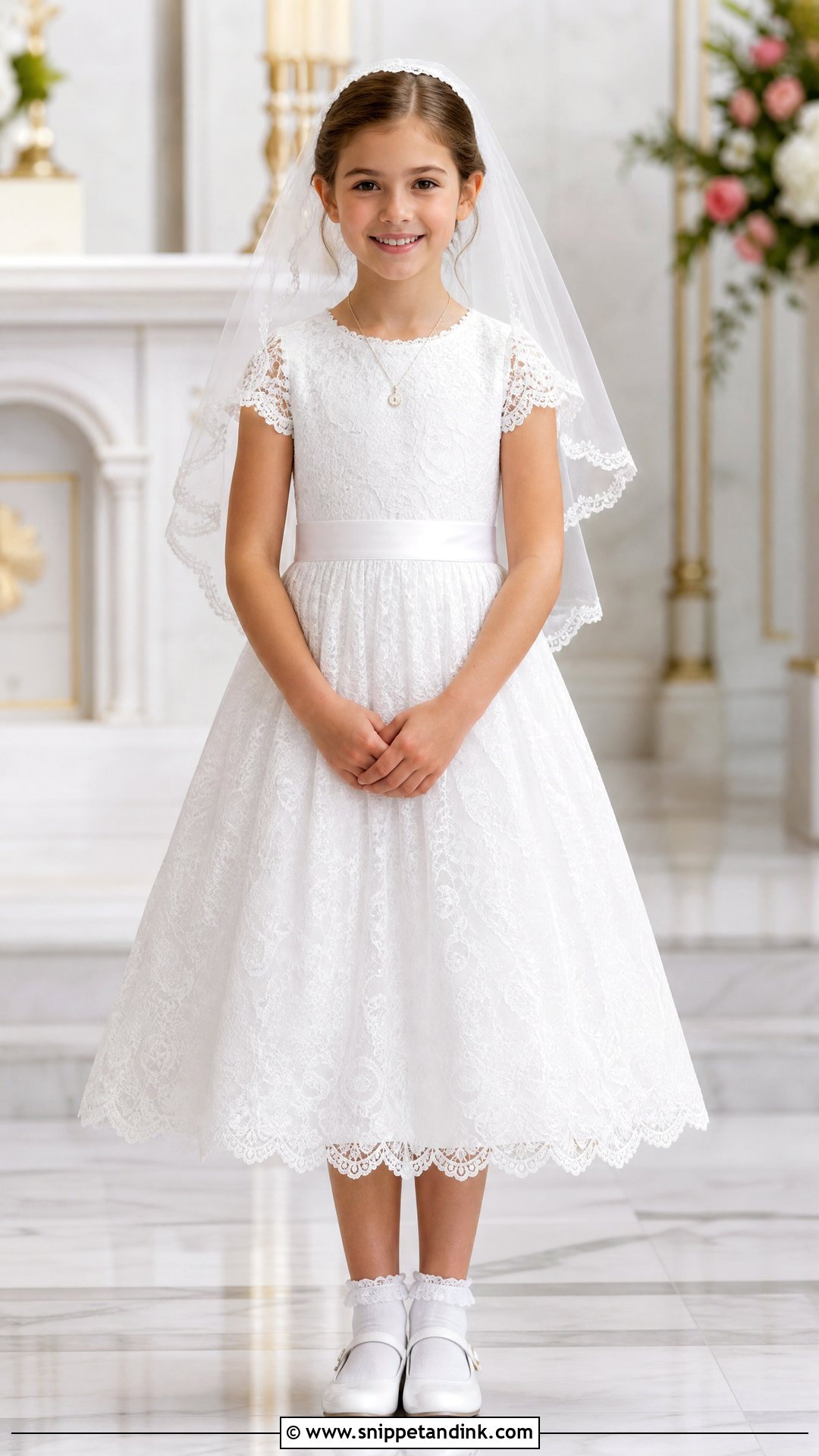
Scalloped lace edges look finished without a single bead, but they’re the hardest thing to shorten well. Choose a lined fitted bodice, defined waist and tea-length skirt, and check that the scallops lie flat instead of curling outward. White round-toe shoes, lace-edged socks and a veil with a matching narrow scallop work together, and a thin satin ribbon at the waist separates bodice from skirt. One small pendant with family meaning is plenty. If the hem needs taking up, I ask the seamstress to shorten from the waist seam so the original scalloped edge survives intact.
12. Bow Back First Communion Dress
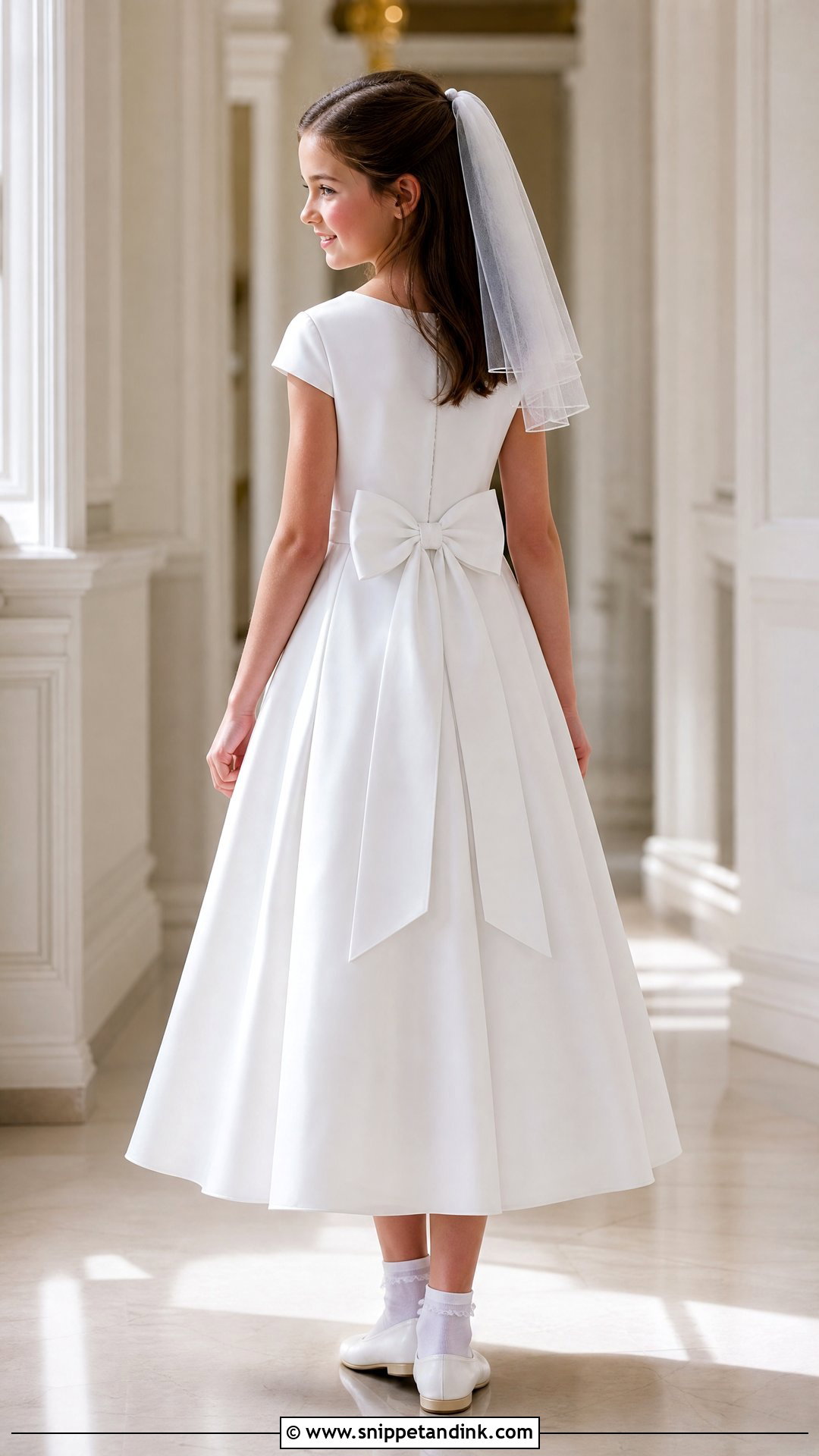
Most of a First Communion is seen from behind, from the pews, so I always look at the back of a dress first. A bow-back with a smooth satin bodice and modest neckline puts the interest exactly there. The bow needs to be soft enough that she can lean against a pew without crushing it, and a detachable one can come off for lunch. White ballet flats, ankle socks and a half-up style keep the back visible, and the veil should end above or below the bow, never on top of it. Make sure the bow doesn’t hide the zip, or the seamstress will have to unpick it before she can alter anything.
13. Pleated Organza First Communion Dress
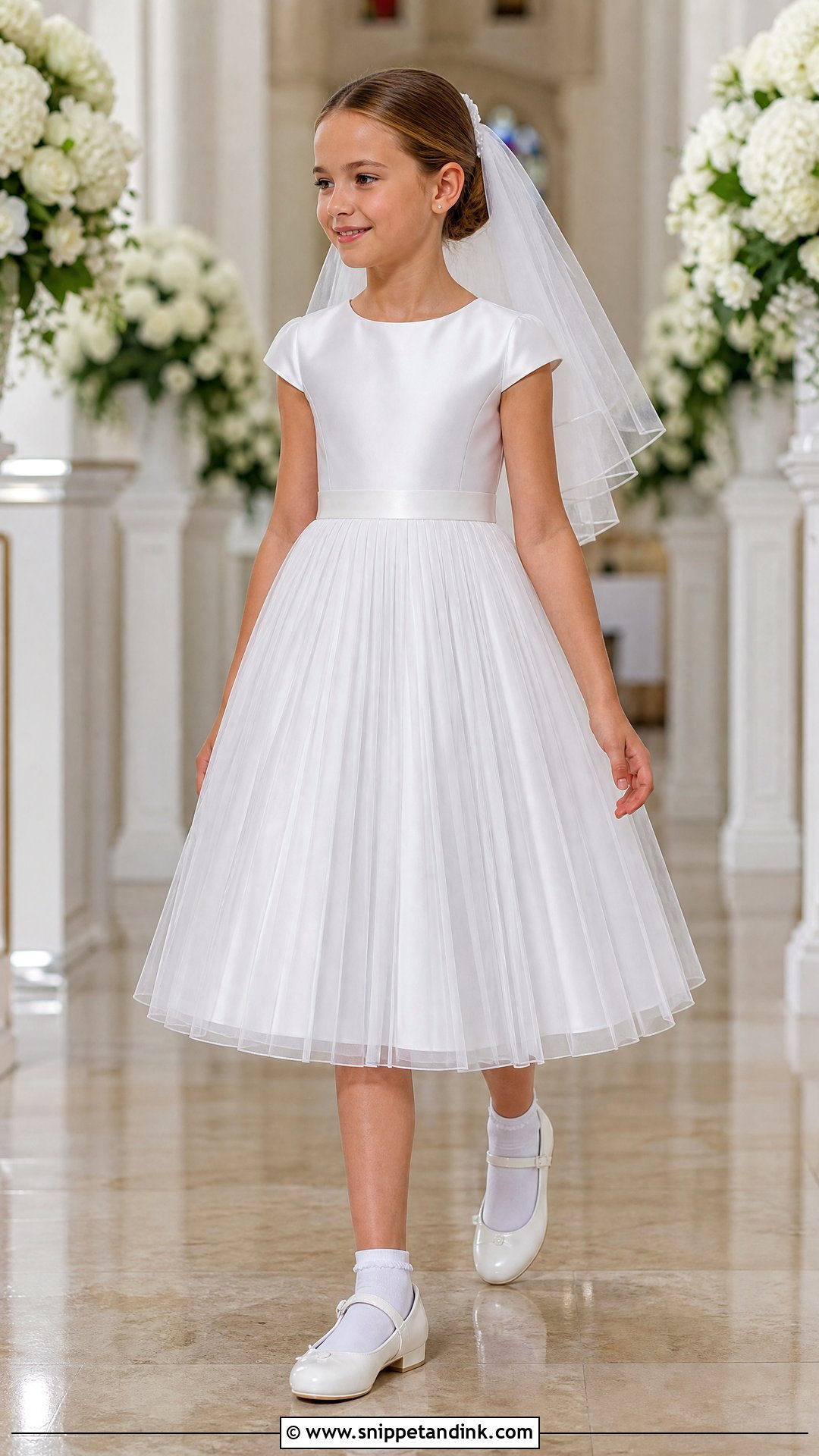
Fine organza pleats give texture without weight, which helps on a hot day. Look for a pleated skirt sewn to a smooth satin bodice, with cap sleeves or a bateau neckline, and check that the pleats fall straight from the waist without bunching at the hips. White strap shoes, plain ankle socks and a short tulle veil on a narrow comb finish it, and a satin waistband gives definition without any beading. A packed wardrobe crushes pleats, so I hang this dress on its own in a roomy garment bag. Steam it from the inside, moving in the direction the pleats run.
14. White Jacquard First Communion Dress
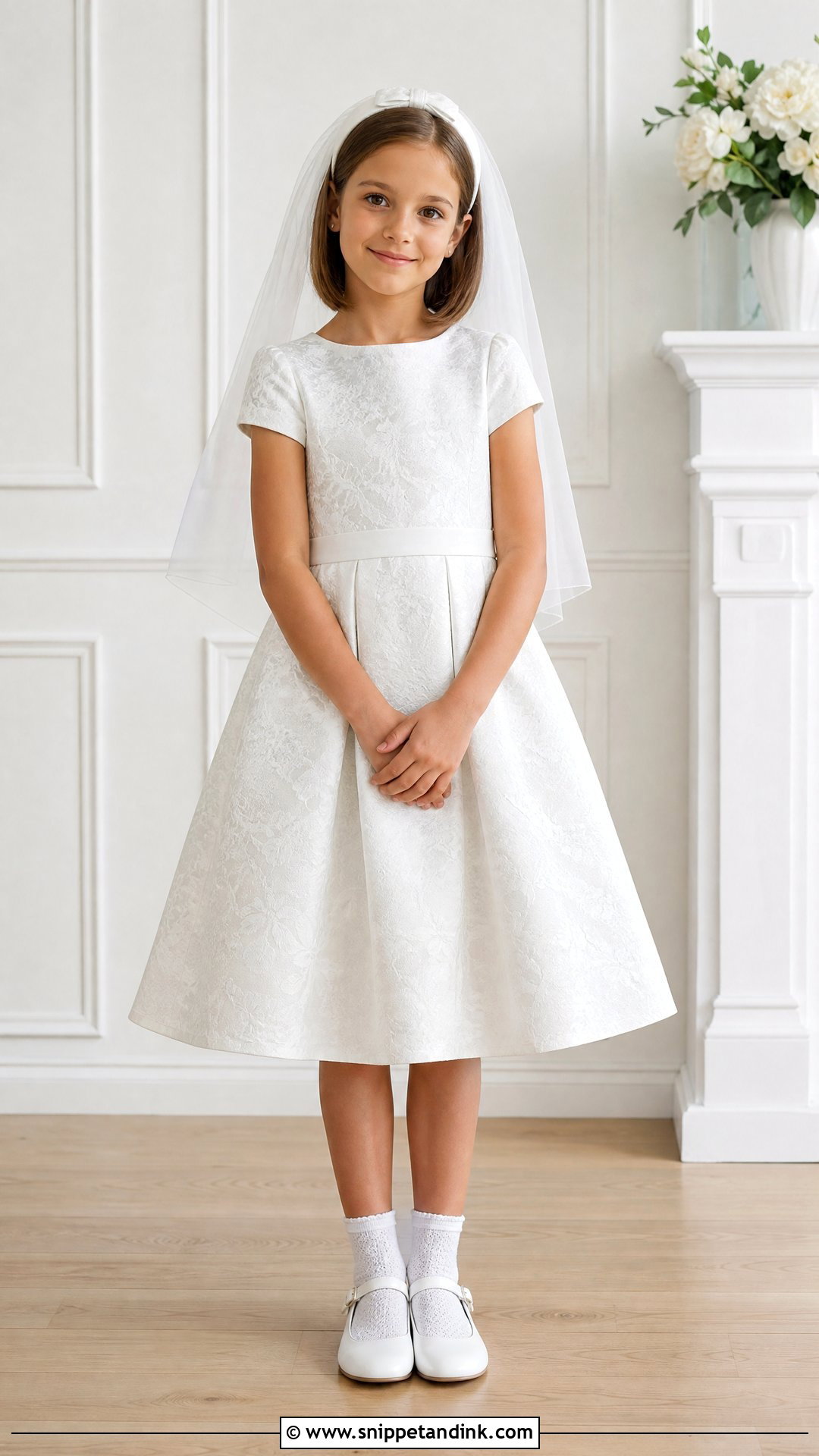
With jacquard the pattern is woven in, so nothing can fall off, which I appreciate on an energetic eight-year-old. A floral jacquard A-line with short sleeves, a fitted waist and a lightly structured skirt looks rich in daylight. Smooth white Mary Janes, fine-knit socks and a satin headband with a small side bow are all it needs, plus a plain veil since the fabric already has detail. Pick a lighter weight; the heavy ones sit like cardboard on a small child. The lining must cover every inside seam, because the loose float threads on the back of jacquard catch and scratch. It also holds its shape with fewer layers than tulle, which makes sitting easier.
15. Tiered Tulle First Communion Dress
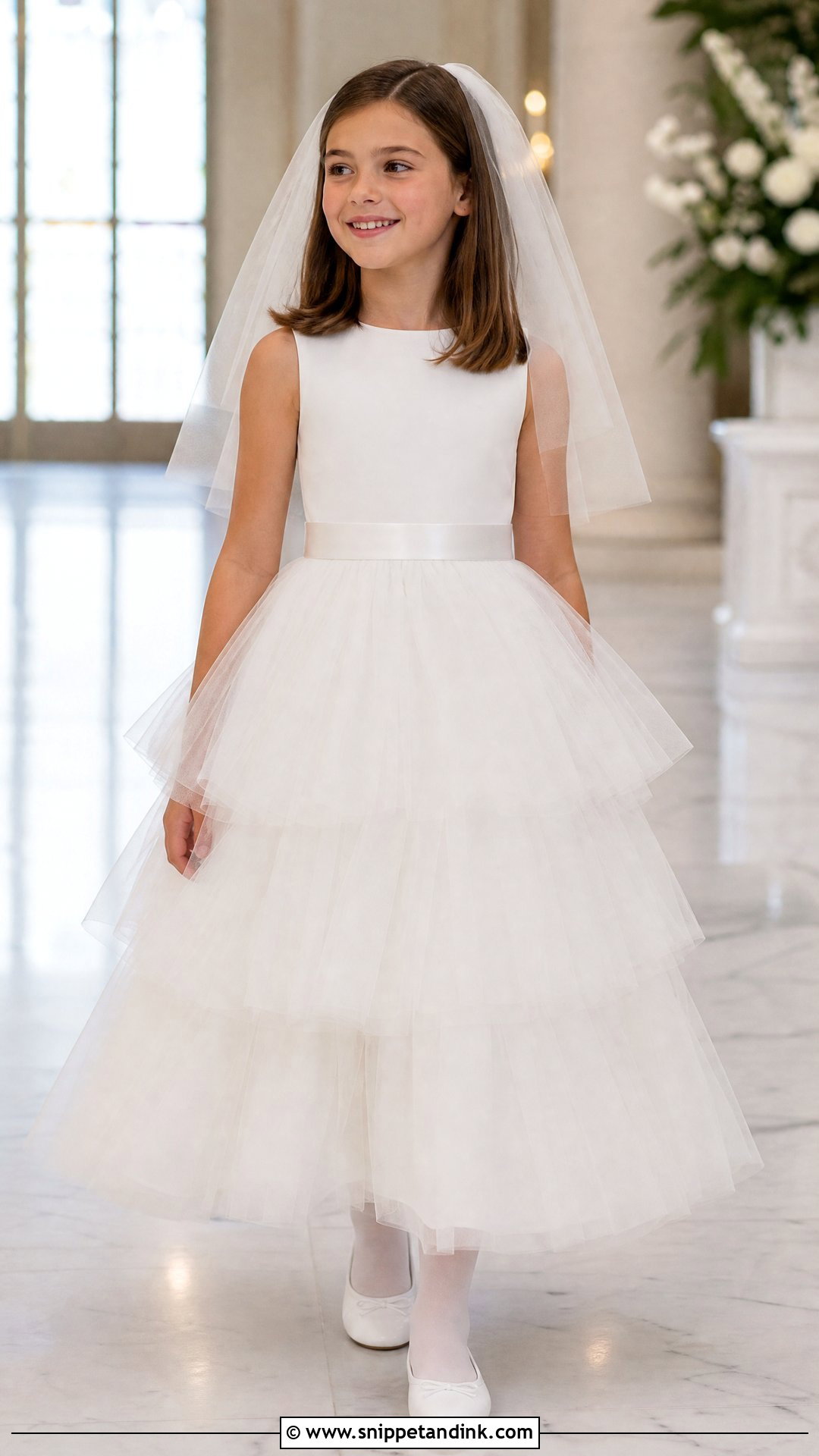
Tiered tulle is the dress children usually pick for themselves, and the twirl is the reason. Keep the bodice plain and the tiers to two or three, starting below the waist; more than that swamps a small frame and makes the pews awkward. Stable white flats, smooth tights, a shoulder-length veil and a small satin belt at the seam are all it needs. Run your hand along each tier’s edge, because cheap netting is often left raw and scratches legs even through tights. A light lining gives coverage without heat. She gets the feel of a designer ball gown at a scale she can actually manage.
16. Duchess Satin First Communion Dress
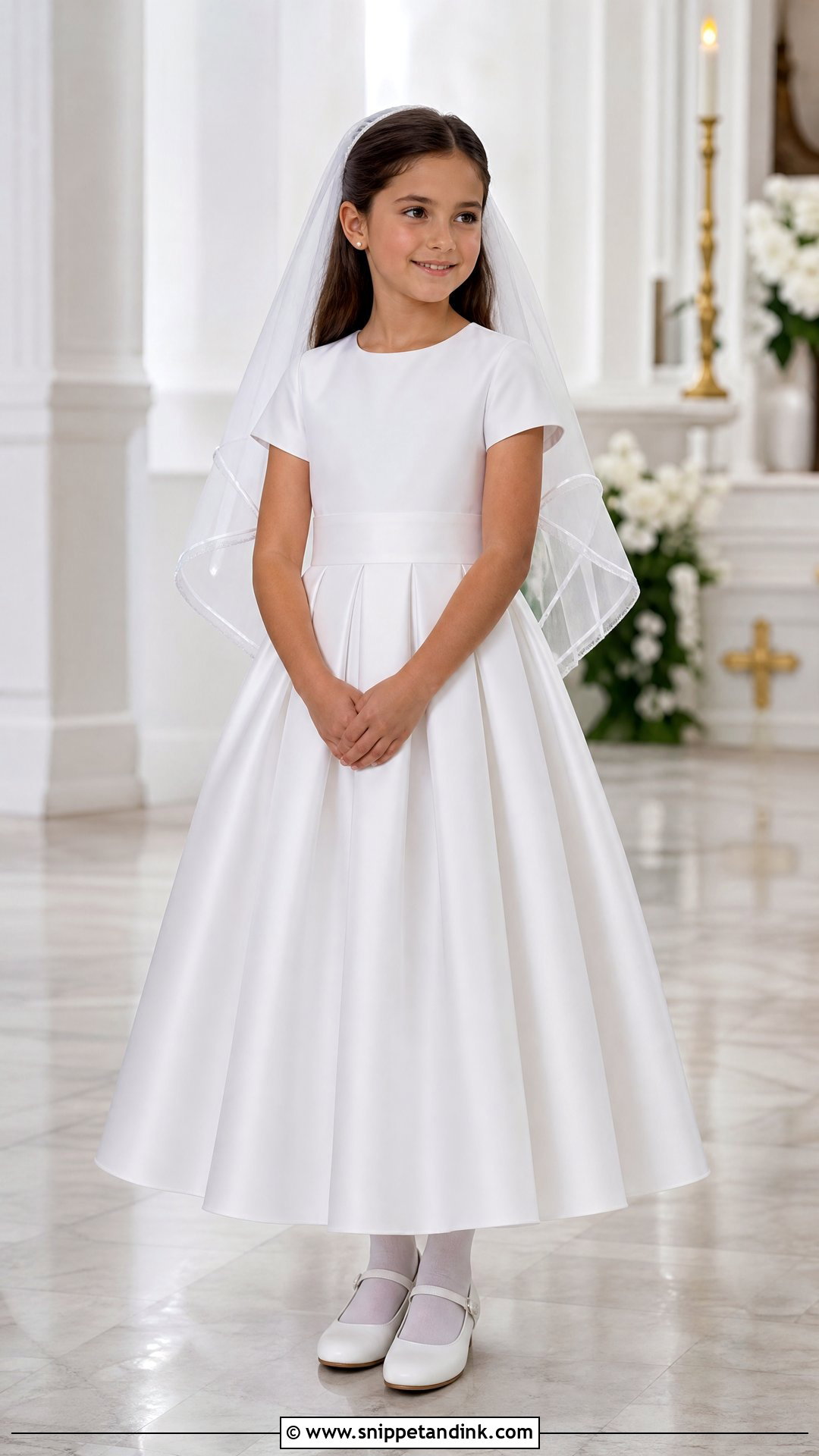
Duchess satin is heavier and smoother than ordinary satin, and it carries a formal dress with no help from beading. A short-sleeve A-line with a fitted bodice, natural waist and ankle-length skirt shows it off, with soft pleats for fullness instead of a stiff petticoat. White leather shoes, fine socks or tights, a sheer veil with a narrow satin edge and pearl studs complete it. The weight is the trade-off. On a hot day or a very small child it can feel like a lot, so have her sit for five minutes at the fitting and ask her honestly how the waistband feels.
17. Cotton Lined Lace First Communion Dress
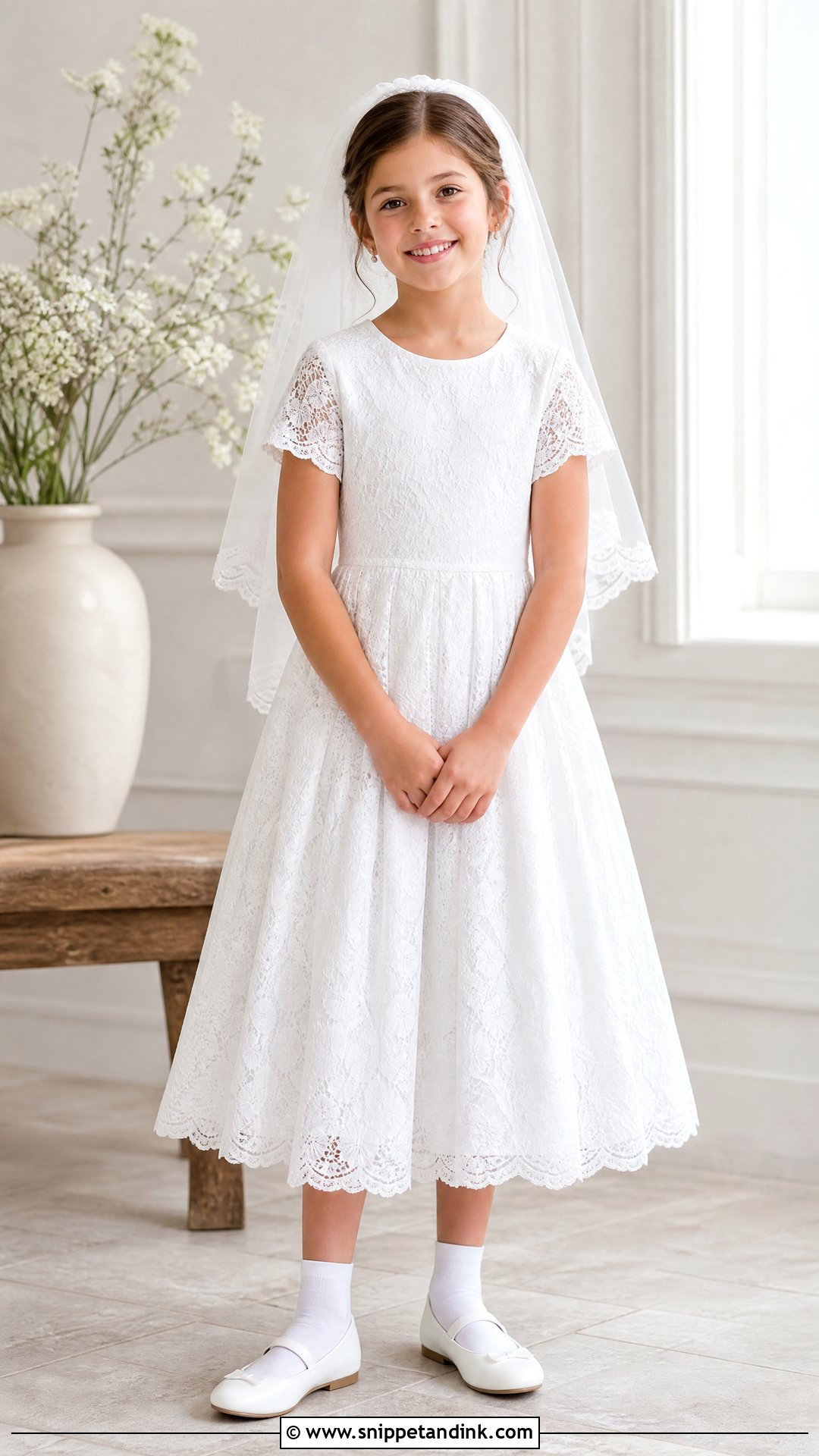
Comfort can’t be an afterthought on a day that runs from morning Mass through a family meal. A cotton lining is the soft layer between skin and lace, and many better-made dresses pair lace, satin, organza or tulle outsides with cotton inside for exactly that reason. An A-line with short sleeves, a natural waist and a mid-calf hem, worn with flexible white flats, smooth-toe socks and a light veil, keeps everything easy. I run a finger around the armholes, neckline, zip and waistband looking for rough seams, and I cut out scratchy care labels. Children with sensitive skin or eczema do best in this one.
18. Silk Organza First Communion Dress
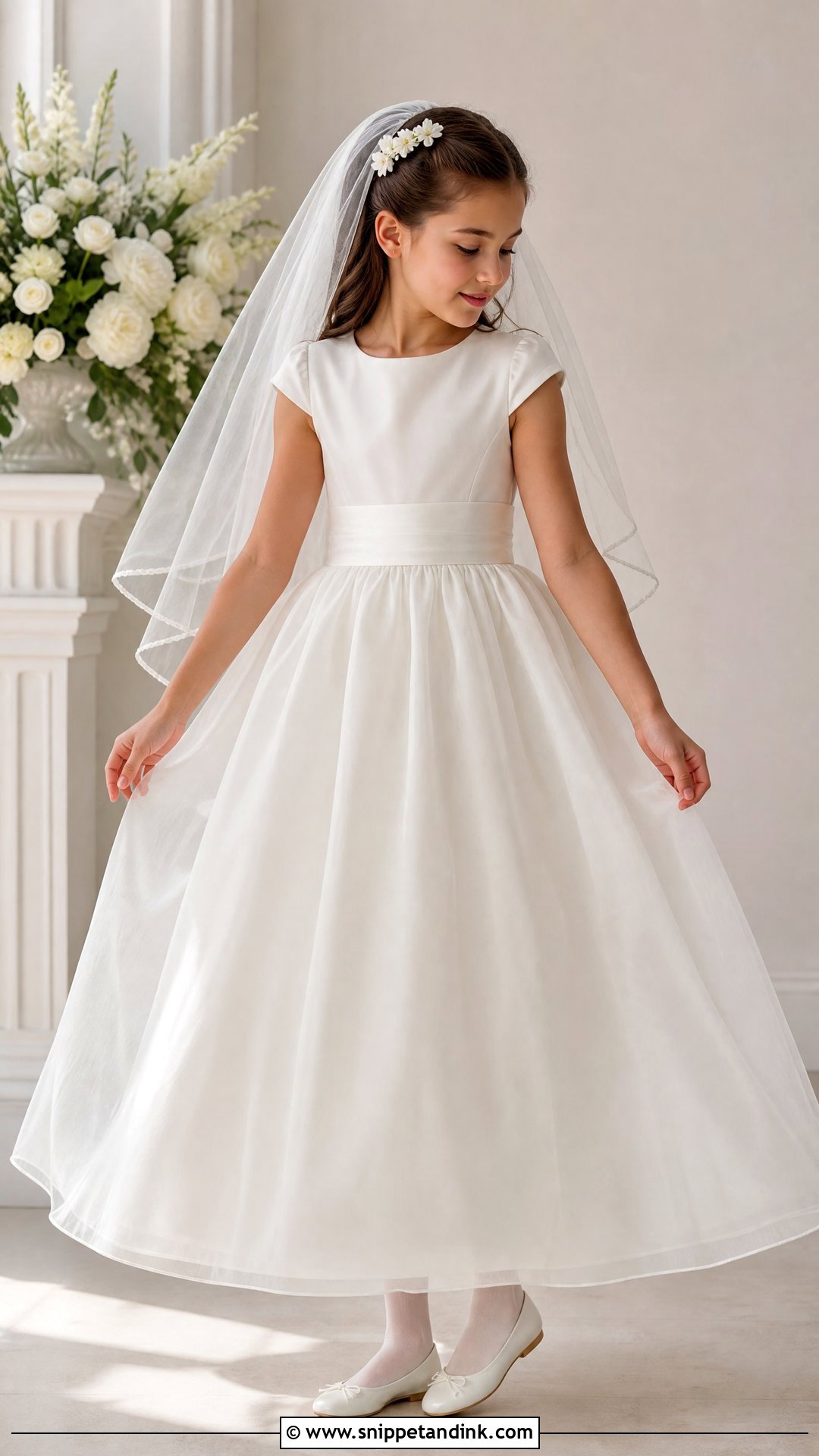
Silk organza has a soft glow that polyester versions don’t quite match, and it weighs almost nothing. Choose an ankle-length dress with a gathered skirt, covered shoulders and a satin sash at the natural waist. White ballet flats, fine tights and a fingertip veil under a small floral comb complete the look. Silk organza snags on anything sharp, so skip beaded bags and shoes with hook-and-loop straps. Water spots silk too. Store it in a breathable cotton bag, never plastic, and ask the shop how they recommend cleaning it before she wears it.
19. Crystal Accent First Communion Dress
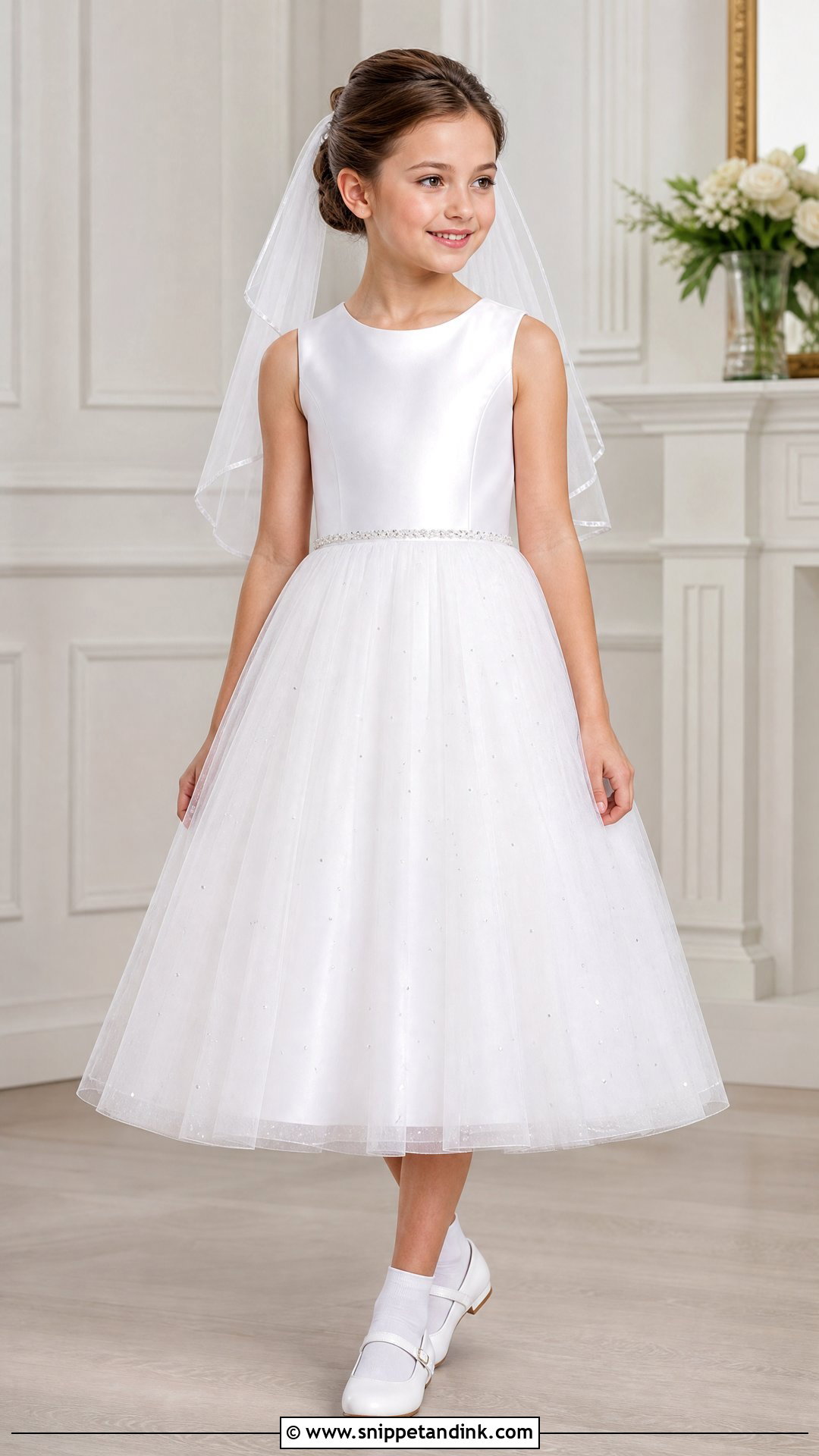
Crystals catch candlelight in church, so a little goes a long way. Look for clear stones along a narrow waistband, the neckline or one small central motif, over a satin bodice and tea-length organza skirt. Plain white Mary Janes, smooth ankle socks and an undecorated veil keep the shine in one place; rhinestone shoes plus a jeweled headband plus a crystal belt is simply too much. I check two things: that every stone is sewn rather than only glued, and that the back of each setting is covered with smooth fabric. Then I ask her to rest her arms at her sides and swing them.
20. Extended Size First Communion Dress
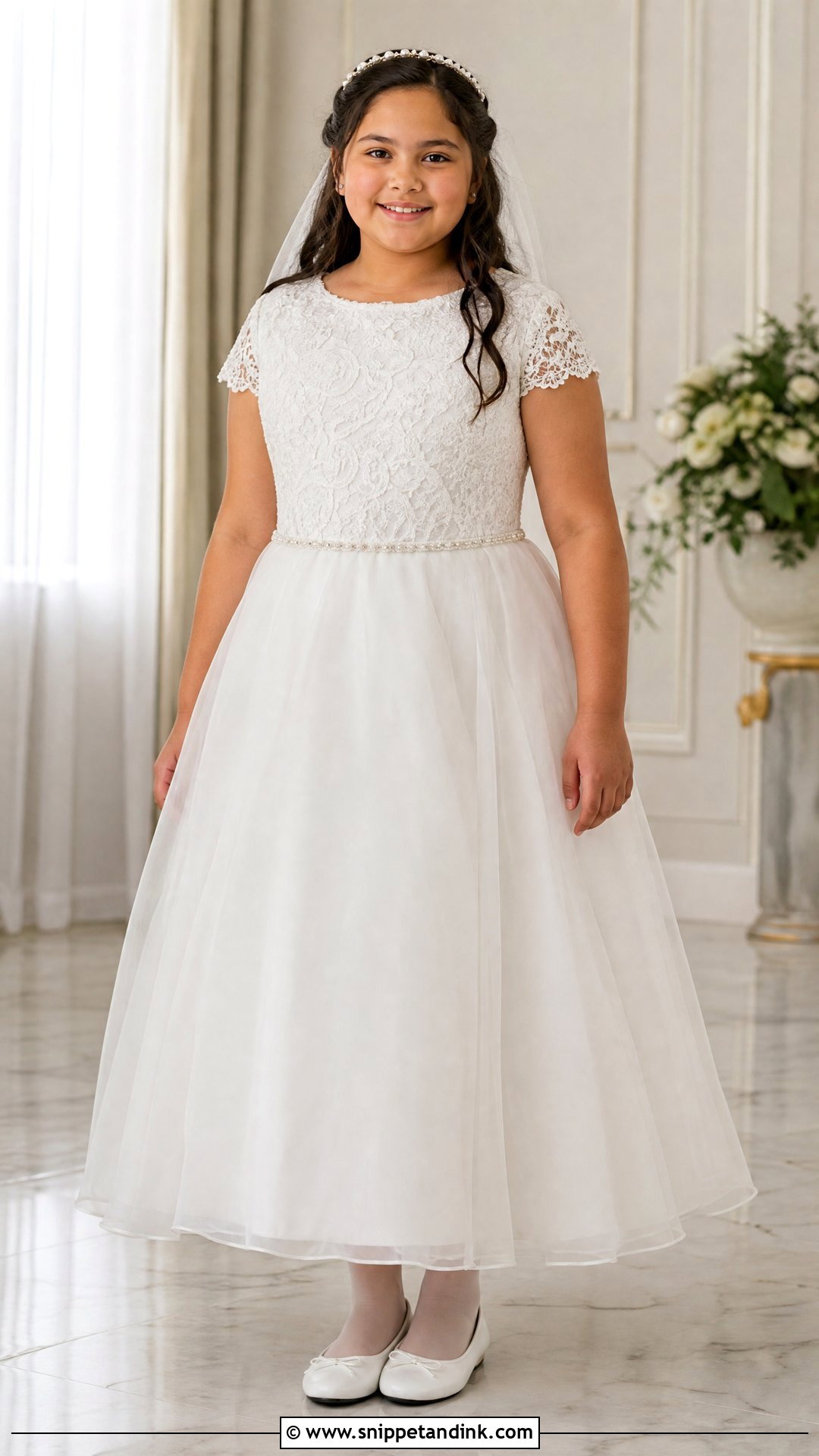
A dress in an extended size deserves the same fabric and detailing as any other. Look for an A-line with supportive lining, a comfortable natural waist and enough room across the shoulders. More collections now carry girls’, preteen and extended ranges, so you shouldn’t have to compromise on style. A lace bodice with a flowing organza skirt gives shape without restricting movement, finished with stable white flats, soft tights and a simple veil or pearl headband. Please don’t buy smaller as motivation or count on drastic last-minute alterations. Order to today’s measurements, then have the hem, sleeves or waist tailored to her.
Ask the Parish About Veils and Sleeves Before Paying a Deposit
Parishes differ more than people expect. Some ask every child to wear a plain white robe, some don’t allow veils, and some want shoulders covered inside the church. It’s common for a family to buy a sleeveless dress and then hunt for a bolero the week before. A quick call to the catechist, or a careful read of the parish letter, saves that scramble. Ask whether veils are allowed, whether a particular hem length is expected, and whether the children sit in pews or on chairs, since a full skirt behaves differently on each.
A dress rehearsal in the hallway
A few days before, I have the child wear the whole outfit for an hour: shoes, tights, veil and all. She should kneel, stand, walk down a hallway with her hands folded and sit at a table. Blisters, a veil comb that slides or tights that sag at the knee all show up now, while there’s still time to swap them.
Juice Stains, Tissue Paper and the Little Sister Who Wears It Next
Deal with spills the same day. Blot rather than rub, and leave grape juice, chocolate and grass marks to a cleaner who handles formal wear, telling them exactly what each mark is. Satin and silk show water rings, so home spot-cleaning often makes things worse.
For storage, I wrap the dress in acid-free tissue with extra tissue inside each fold, then keep it in a cotton bag or archival box somewhere cool and dark. Plastic dry-cleaning bags trap moisture and can yellow white fabric over the years. Take combs and anything metal off the veil before packing it. A well-kept dress can go on to a younger sister or cousin, and that is often the most meaningful thing it ever does.
The Fitting Counts More Than the Label
Out of all twenty, the right dress is the one she has forgotten she’s wearing by the time the family lunch starts. Satin A-lines keep things simple, while lace sleeves, organza, appliqués, bows, pearls and a few crystals add character. Whatever you pick, put a breathable lining, stitched-on embellishments, a skirt she can sit in and a hem that clears her shoes ahead of any trend. Measure her rather than trusting age sizing, book alterations early, and settle on one hair accessory or a veil. Then let her walk, kneel and sit in it before you decide.
You'll Like These Ideas:


Leave a Reply