
A groom’s sherwani is decided by four things, in this order: colour, fabric, fit and how formal the day is. The twenty looks below run from classic ceremony sherwanis to Indo-Western cuts for the reception, light outfits for a destination wedding and heavy evening pieces. Ivory, soft pastels, velvet, floral embroidery, metallic work and structured fusion jackets all appear. For each one I’ve given the bottoms, footwear, stole or shawl and accessories I’d put with it, and the tailoring detail I’d watch. Silk is comfortable outdoors in warm weather; brocade and velvet belong to cool evenings. Above all, make sure the cut lets you move, sit and bend for hours.

Collar, Chest and Churidar at the First Fitting
Most sherwanis that look wrong in wedding photos have the right colour and the wrong fit. When I check a groom in a sherwani, I go through the same points every time, top to bottom.
- Collar: one finger should slide in comfortably. Too tight and it rides up when you turn your head; too loose and it gapes at the throat.
- Chest: buttoned, the front edge should hang straight with no pull lines fanning from the buttons.
- Shoulders: the seam ends at the shoulder bone. Dropped shoulders make the whole jacket look borrowed.
- Sleeves: end at the wrist bone, with enough room to show a little of the kurta cuff if you wear one.
- Length: usually to the knee or just below. Shorter grooms often look better a touch above the knee.
- Churidar: it should be cut longer than your leg so it gathers in soft rings at the ankle. That’s correct, not a mistake.
Give yourself time. Custom sherwanis with hand embroidery commonly need two to three months, and ready-made ones still need a week or two of alterations. Lead times vary a lot between tailors, so ask before you choose the design.
1. Ivory Embroidered Sherwani
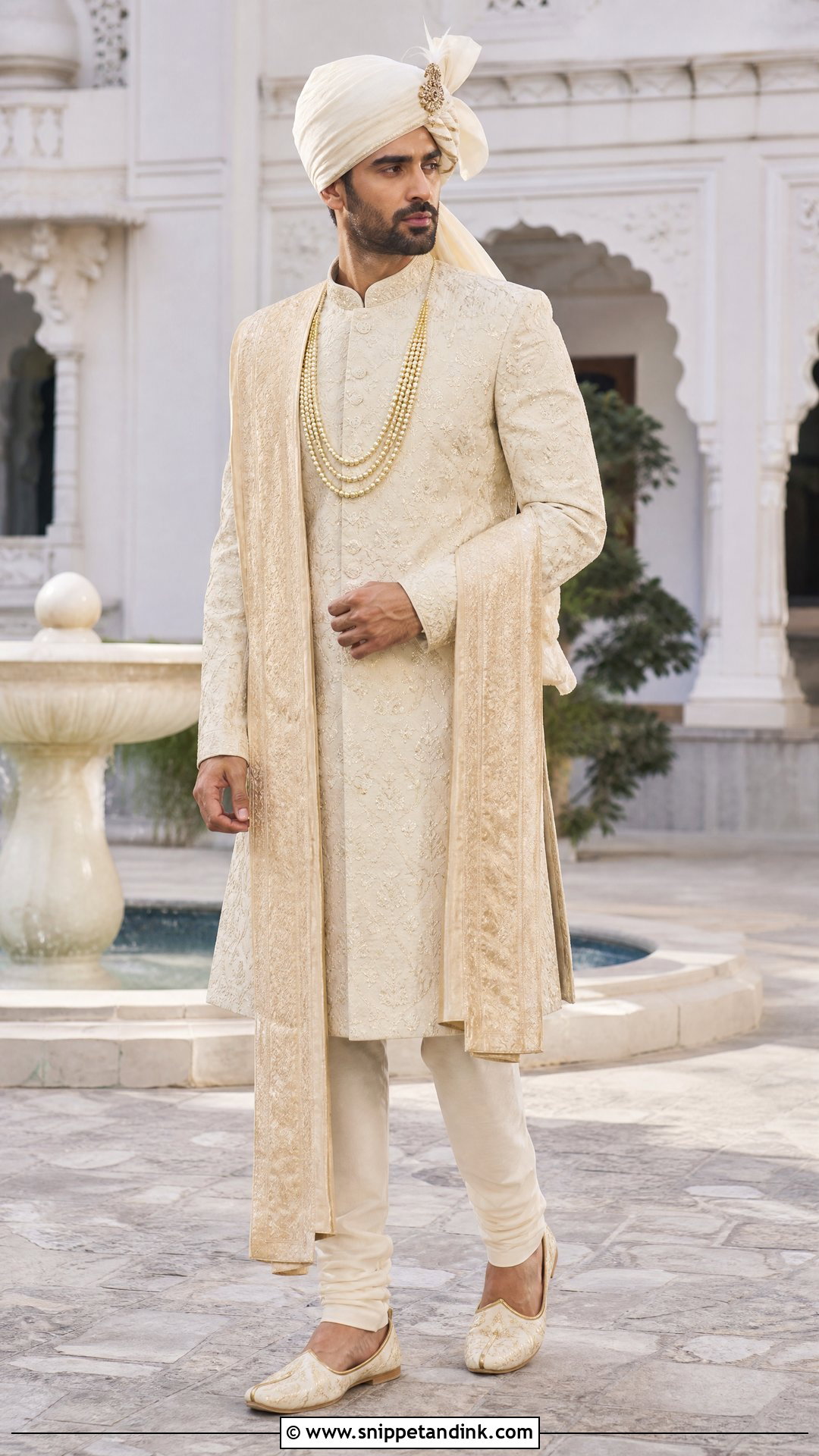
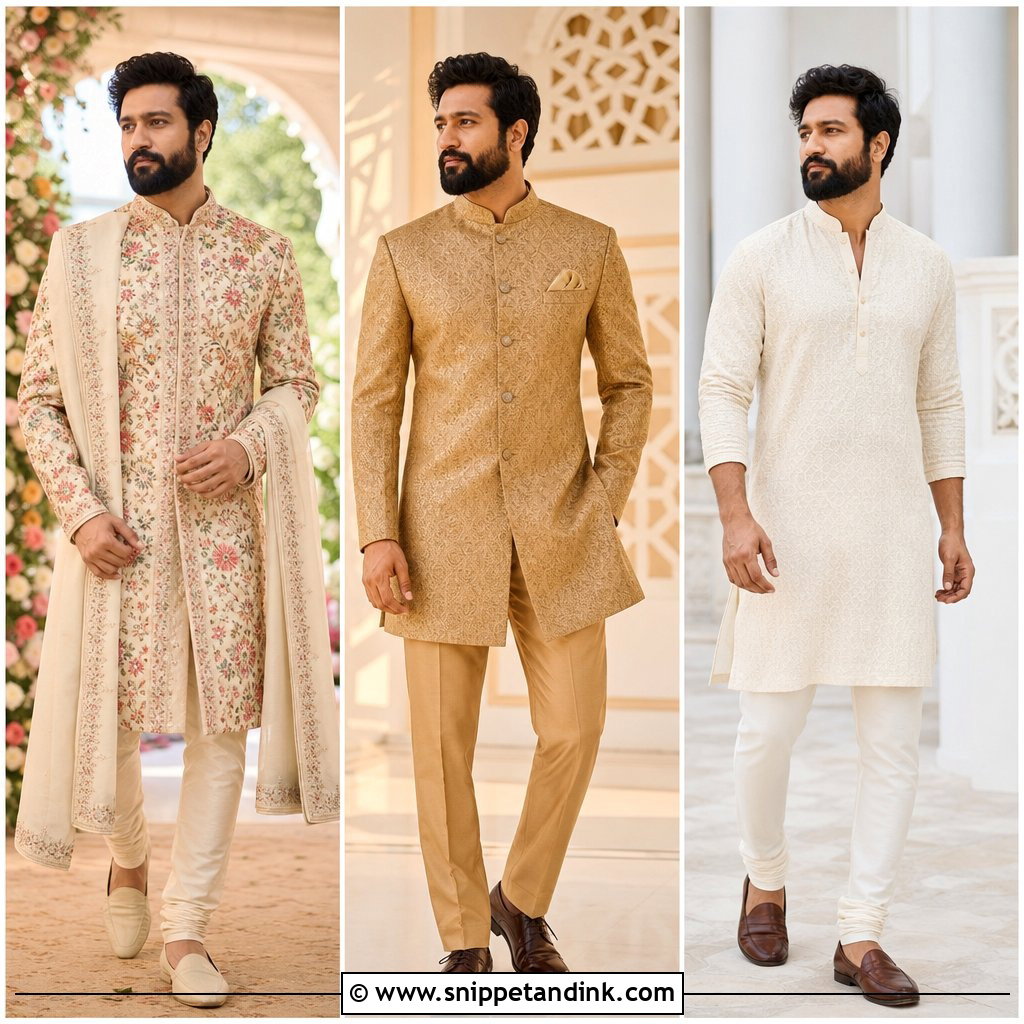
Ivory is the sherwani I recommend most often to a groom who can’t decide, because it sits with nearly any bridal colour: red, pink, green, gold or champagne. The catch is that plain ivory flattens in photos unless the fabric does some work, so I look for tonal threadwork, pearl embroidery or a fine gold line. Keep it knee length and structured. Fitted ivory churidar and cream leather mojaris keep the line unbroken. A pale gold stole, a layered pearl necklace and an ivory safa with a small jeweled brooch complete it. A high collar and a shoulder seam that ends exactly at the shoulder bone make the groom look taller.
2. Gold Brocade Sherwani
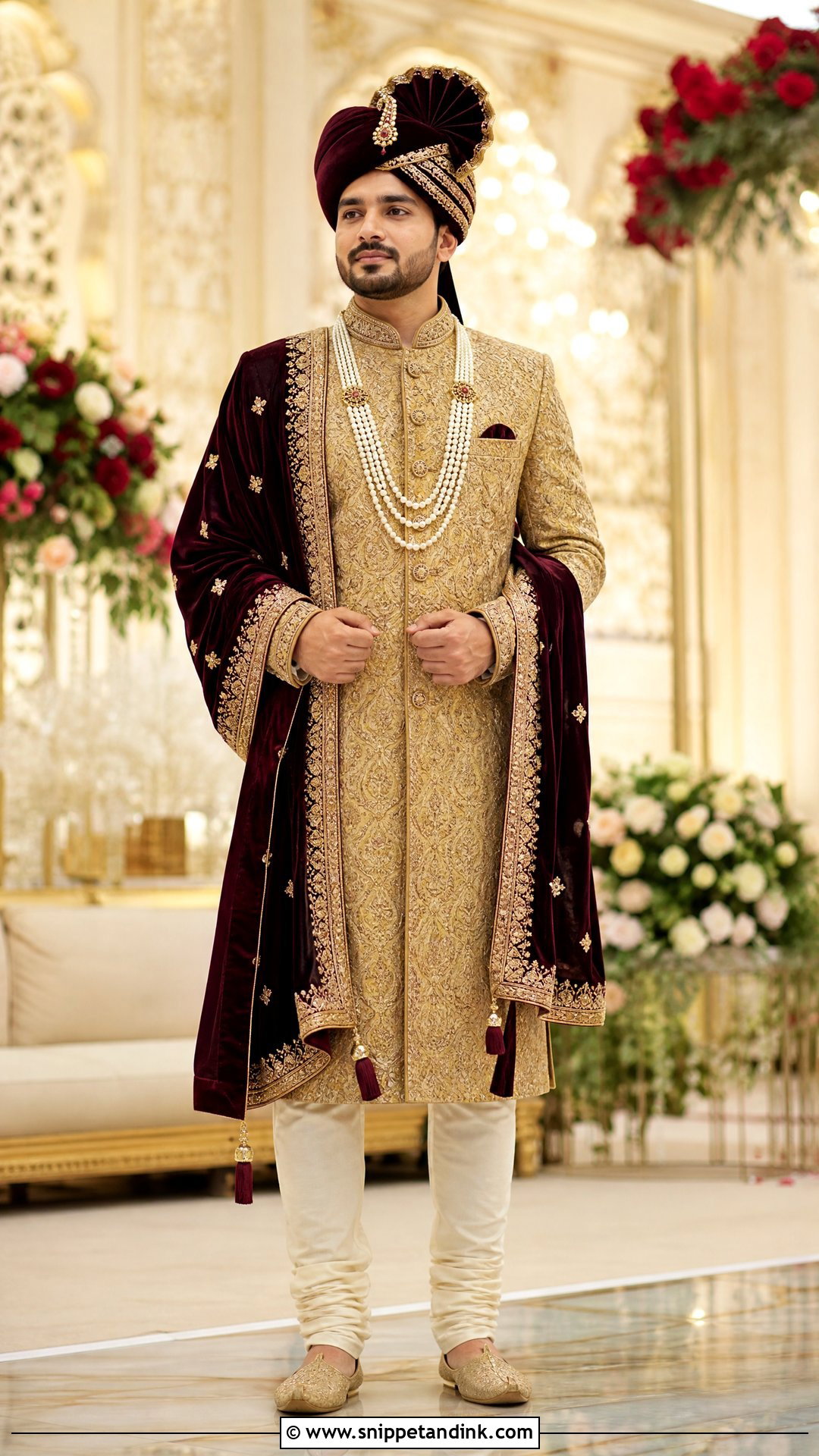
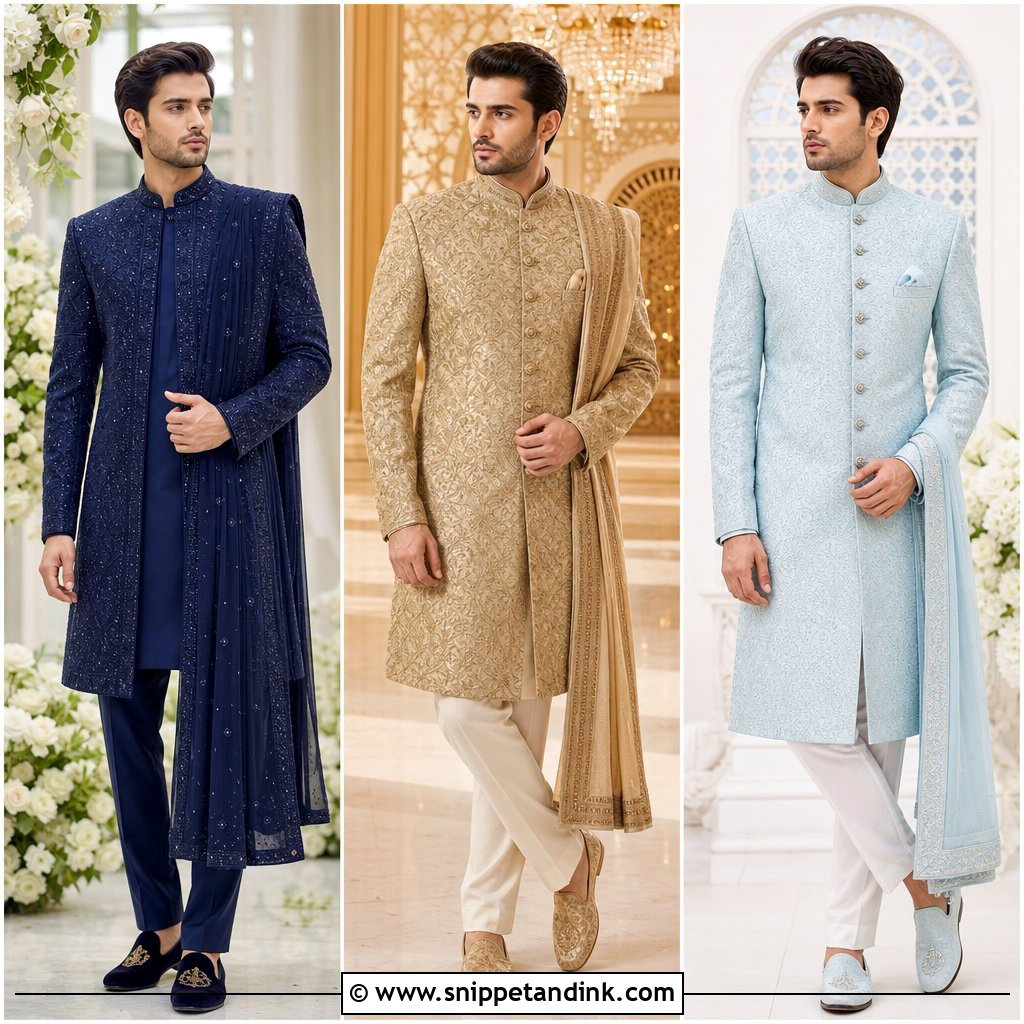
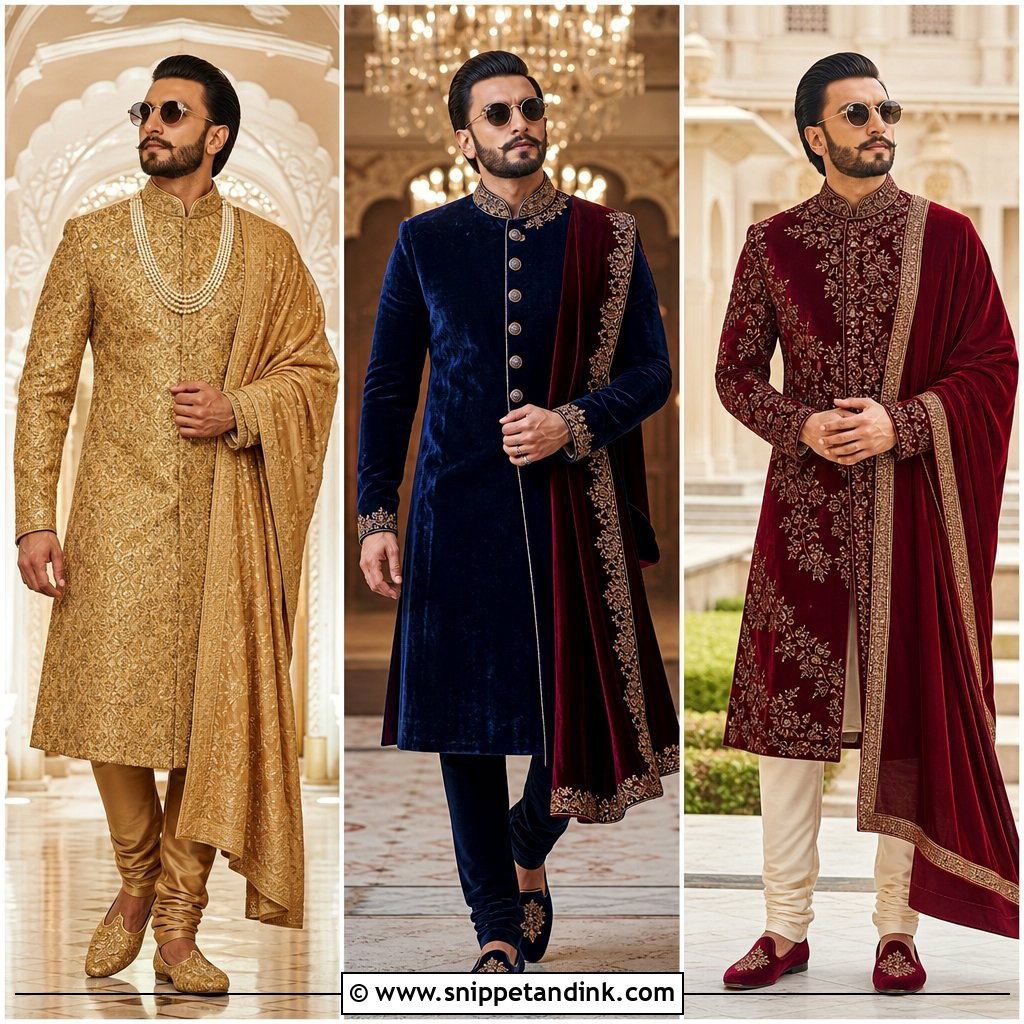
Gold brocade gets its richness from the weave itself, a floral or paisley pattern woven into the cloth, so it doesn’t need extra surface work on top. I’d steer you away from brocade that is also heavily embroidered; the pattern gets lost. Cream churidar and antique gold mojaris balance it, and a deep red or maroon stole adds contrast that can tie in with the bride. Finish with a maroon safa, a simple pearl mala and a classic kalgi. Keep the jewelry restrained. It suits a palace, a ballroom or any evening venue with warm lighting.
3. Maroon Velvet Sherwani
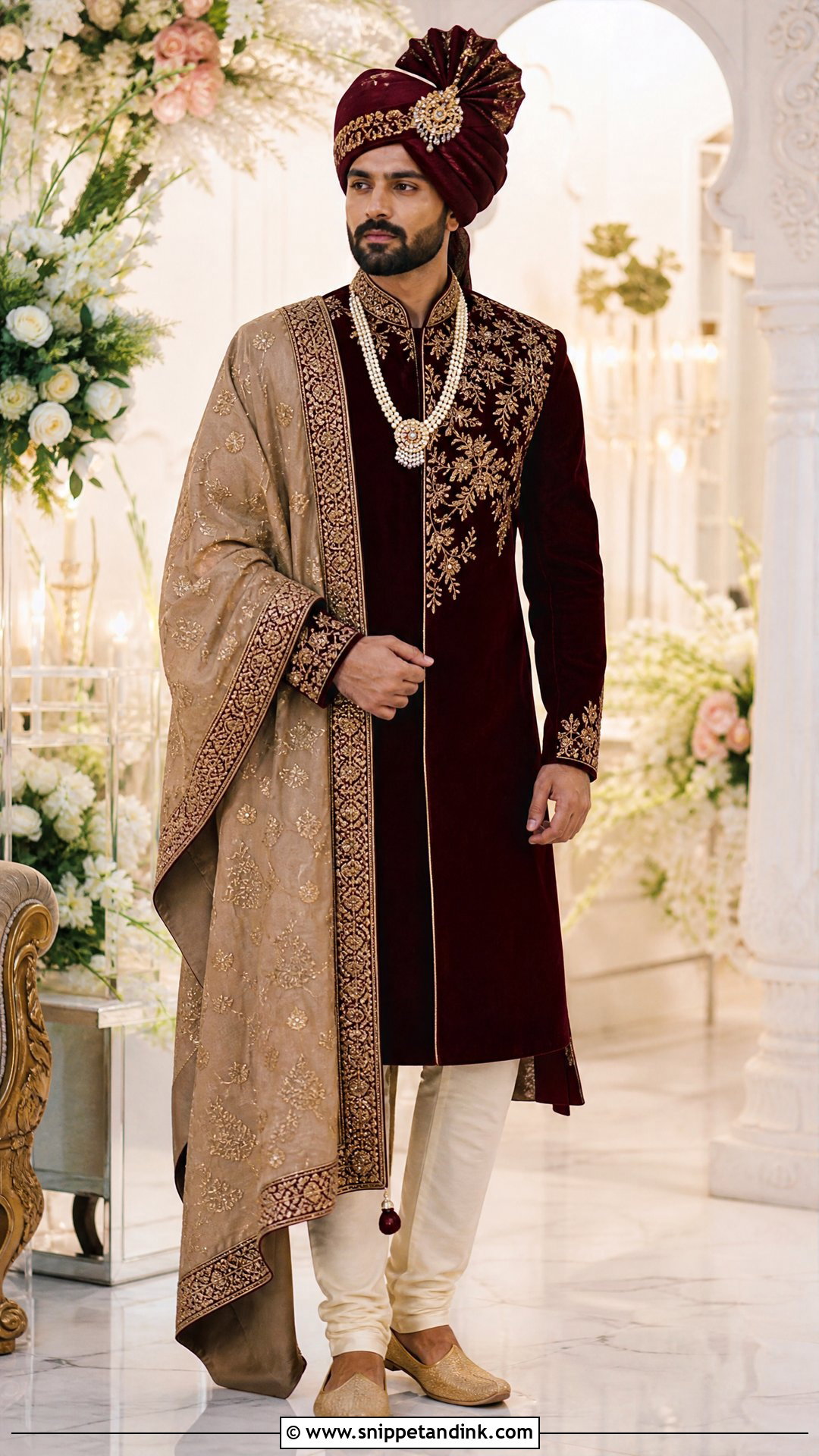
Velvet is warm. That’s its strength in December and its problem in a hot banquet hall, so I only suggest a maroon velvet sherwani for cool-weather or air-conditioned evening venues. The deep colour and soft pile look regal with very little decoration; antique gold embroidery at the collar, cuffs, buttons and hem is enough. Slim cream trousers or a fitted churidar lighten the dark top half, and brown or antique gold mojaris ground it. Drape a beige embroidered shawl over one shoulder, add a layered pearl necklace and a maroon safa with gold trim. Velvet adds bulk, so shoulders and sleeves must be cut close.
4. Pastel Pink Floral Sherwani
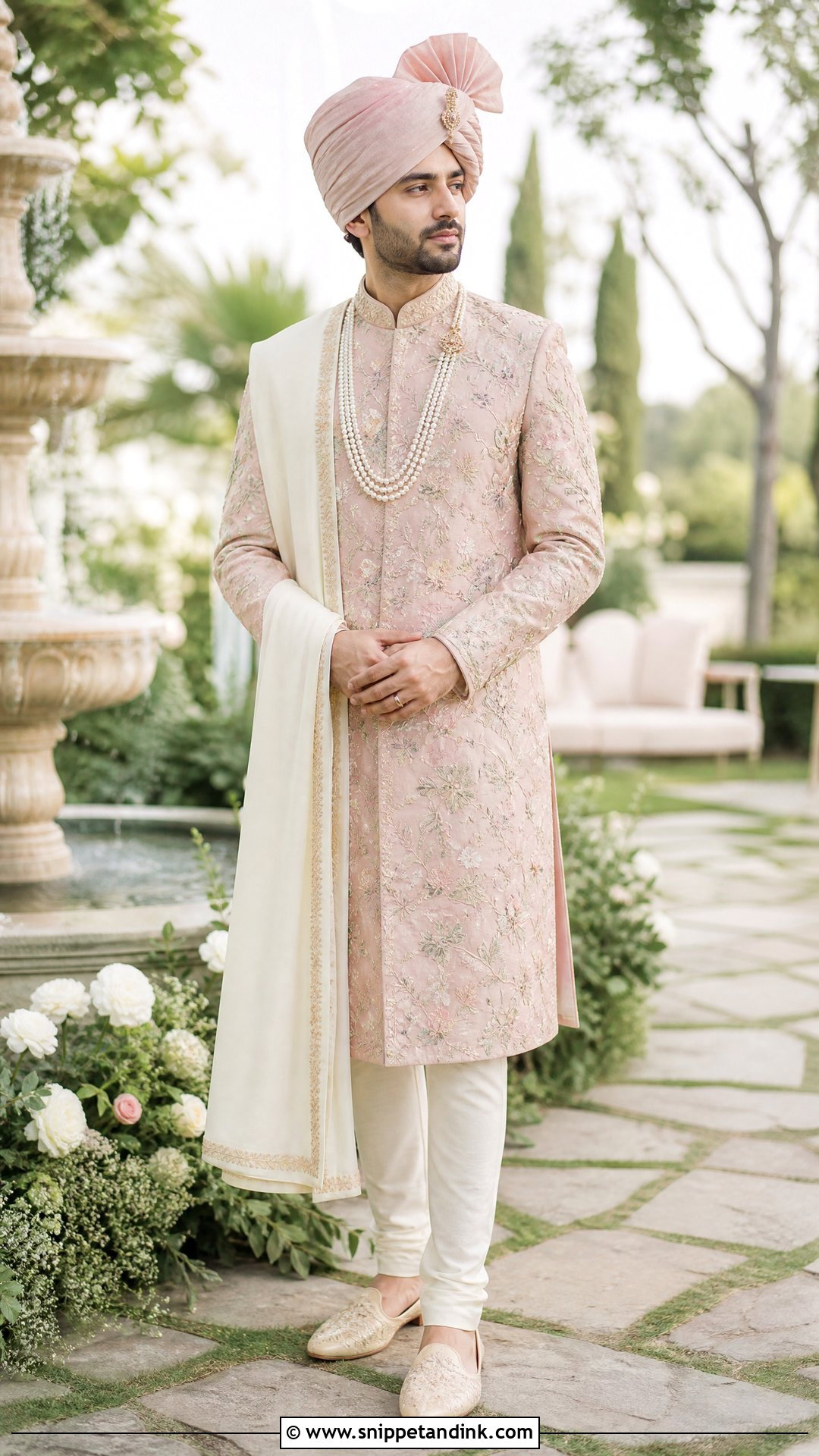
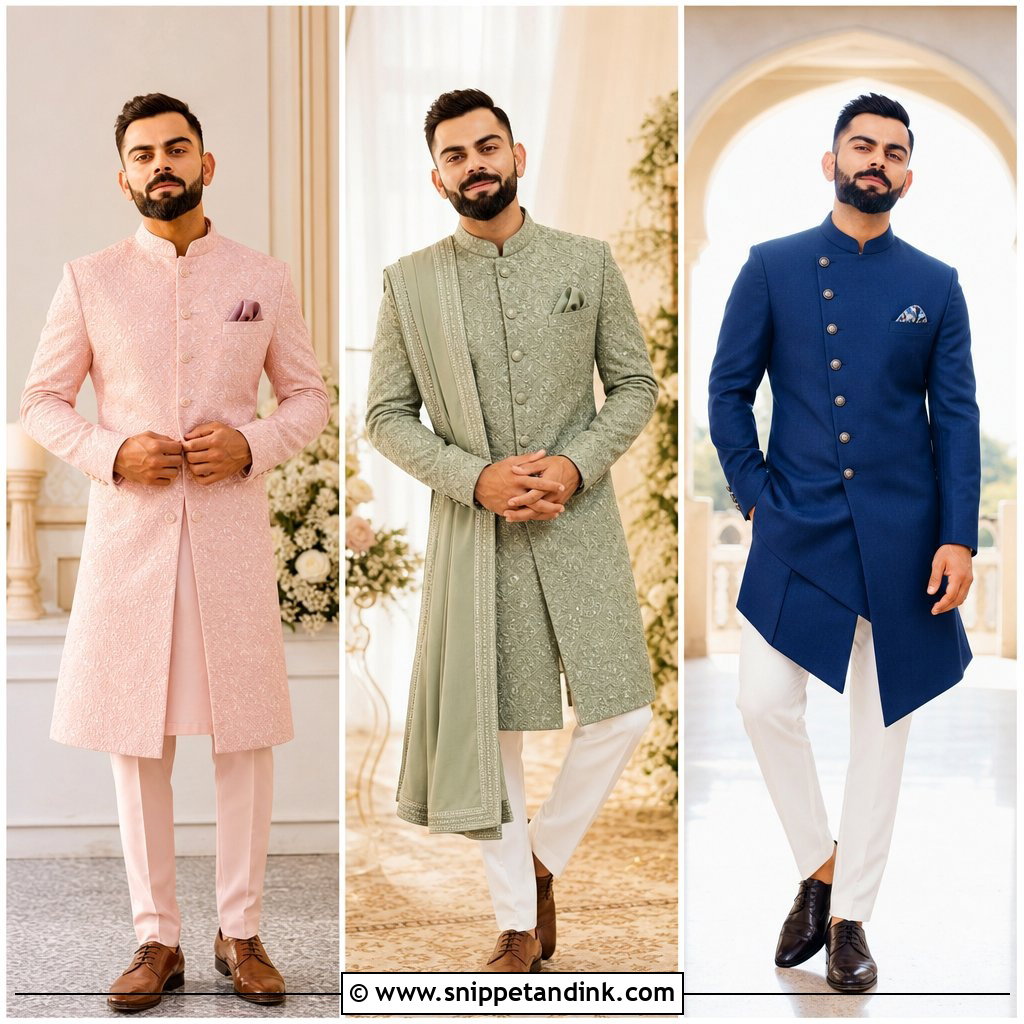
Pastel pink is softer than most grooms expect it to look on them, and it works best in daylight. A pastel pink floral sherwani suits a garden or daytime ceremony when the threadwork stays gentle: ivory, sage, peach and muted gold, not sharp contrast. Plain ivory churidar keeps the florals as the focus, with cream embroidered mojaris, a pearl mala and a light ivory stole. A dusty pink safa makes it tonal; ivory gives contrast. Structure through the shoulders is what stops pink reading as costume, so this is a jacket I’d always have properly tailored.
5. Sage Green Sherwani
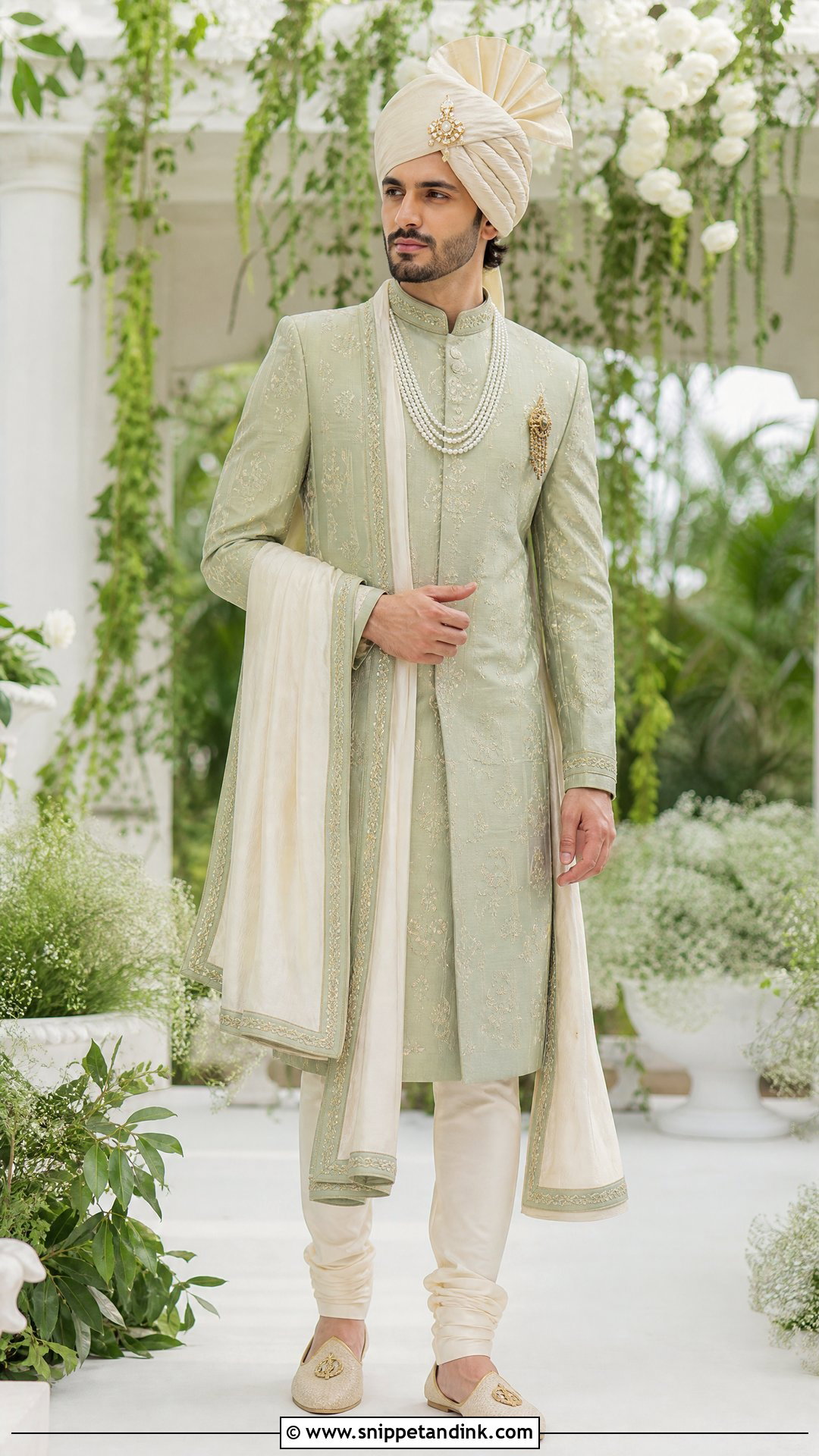
Sage green is my answer for grooms who want to avoid red, gold and ivory entirely. It looks calm against greenery and neutral decor. Pastel greens go flat if the fabric is too smooth, so I choose raw silk or a light silk blend that has some slub and texture, with fine gold threadwork at the collar and front opening. Ivory churidar and beige mojaris keep it light. An ivory stole with a thin sage border, a cream safa, a pearl necklace and a small gold brooch are enough. Don’t add a third and fourth colour. It pairs well with a floral bridal lehenga.
6. Navy Blue Sherwani
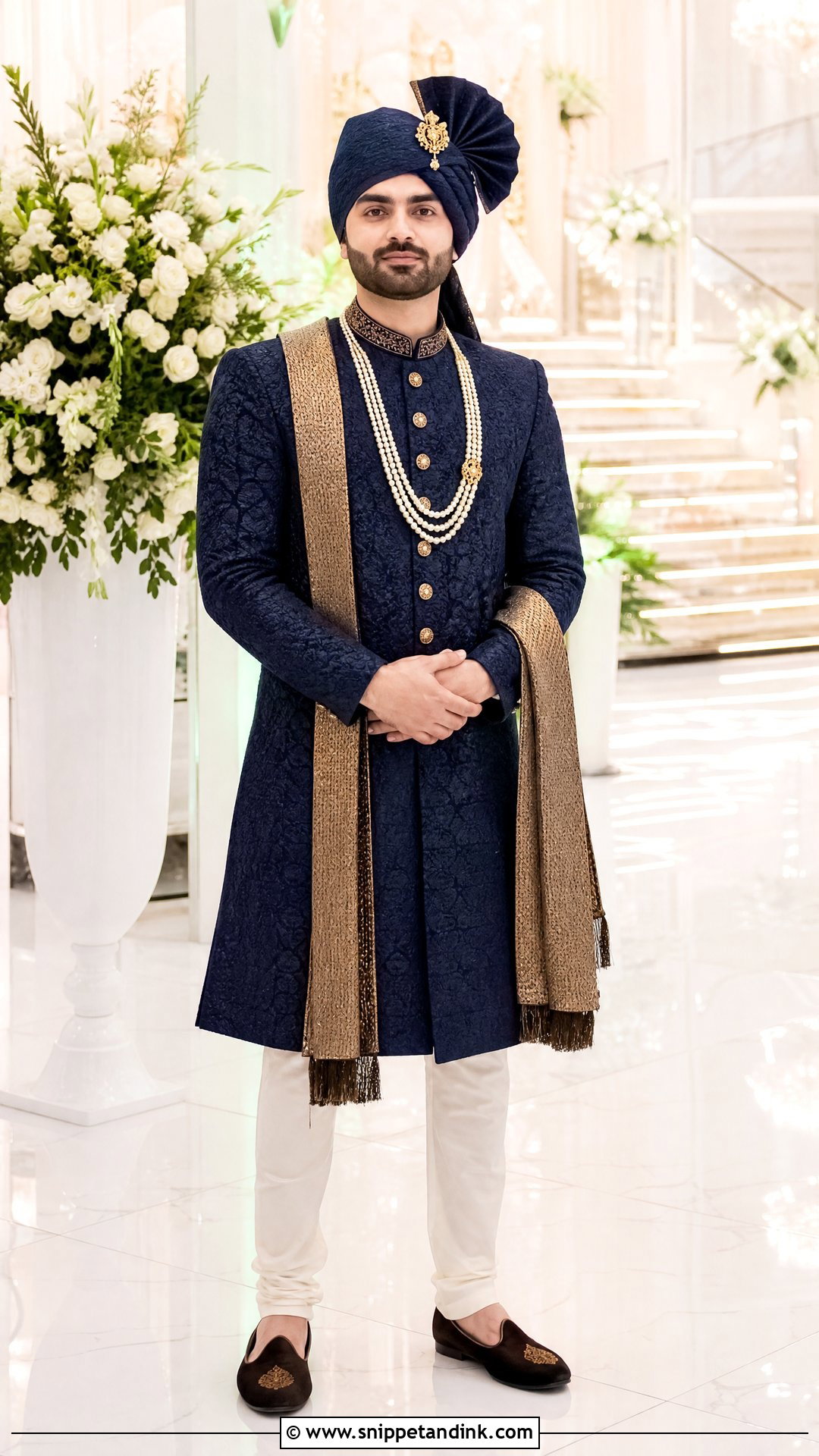
Navy reads formal under evening lights and is gentler than black next to a bride. Silk, jacquard or lightly textured brocade with antique gold buttons gives it depth without loud embroidery. Cream slim trousers lift the dark jacket and show off its length. Brown or gold mojaris suit it. Drape a muted gold stole over one shoulder and choose a navy safa so the head connects to the body. One pearl mala or a collar brooch, not both. When I fit navy, I check that the sleeves end cleanly at the wrist bone and the front closes without pulling across the chest, because dark fabric shows strain lines clearly.
7. Black Indo Western Sherwani
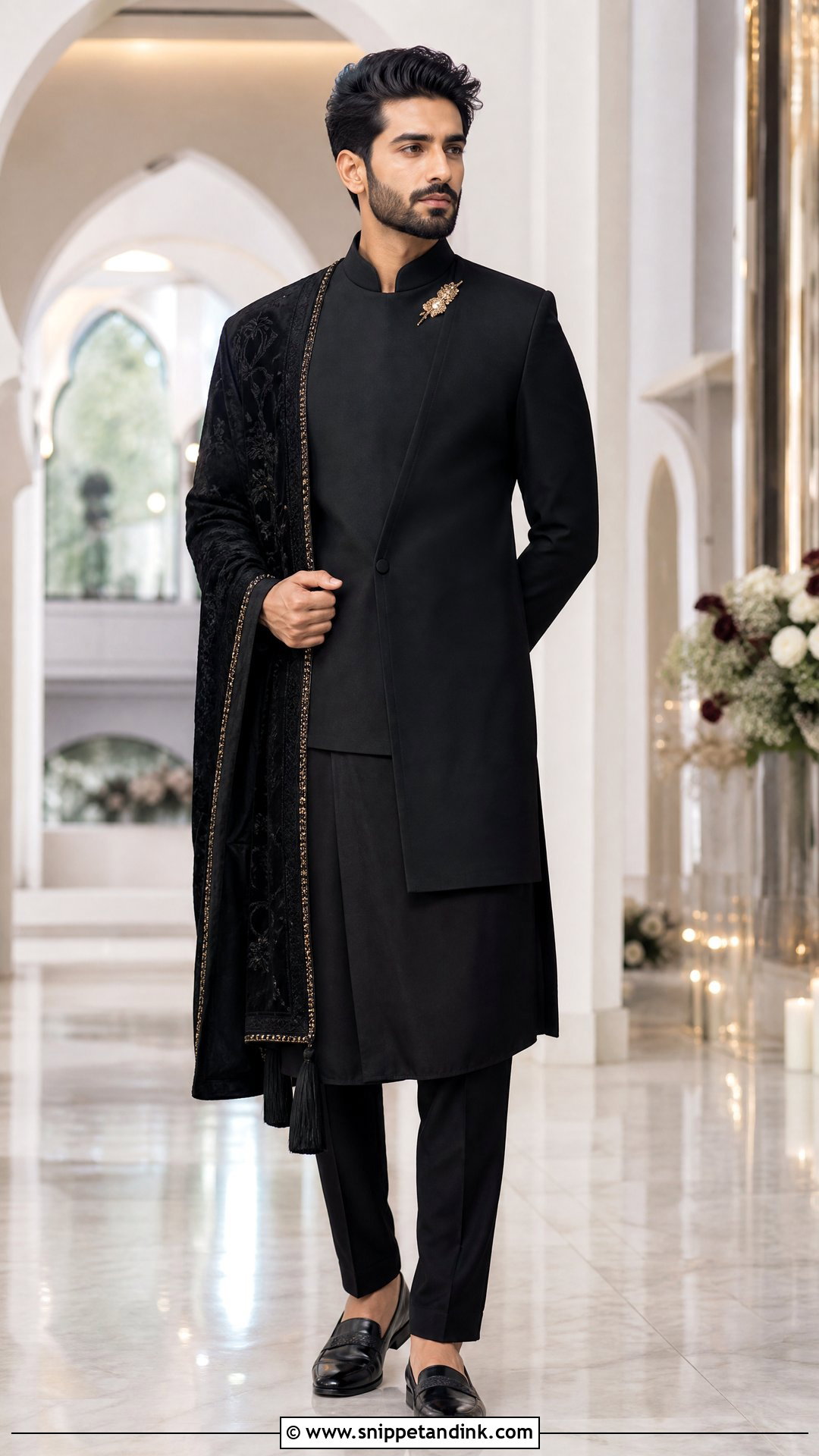
Black Indo-Western works for a reception or a formal evening party rather than most main ceremonies, where many families prefer to avoid black. An asymmetrical jacket with a band collar, subtle embroidery and a firm shoulder sits over a fitted black kurta and tapered trousers. Polished black loafers or plain black mojaris keep it modern. With an all-black base, dimension comes from mixing matte and slightly shiny textures. A metallic brooch, a black stole with a narrow embroidered edge and a pocket detail are plenty. I’d leave the safa off for a reception. It suits a groom who already wears tailored suits.
8. White Minimal Sherwani
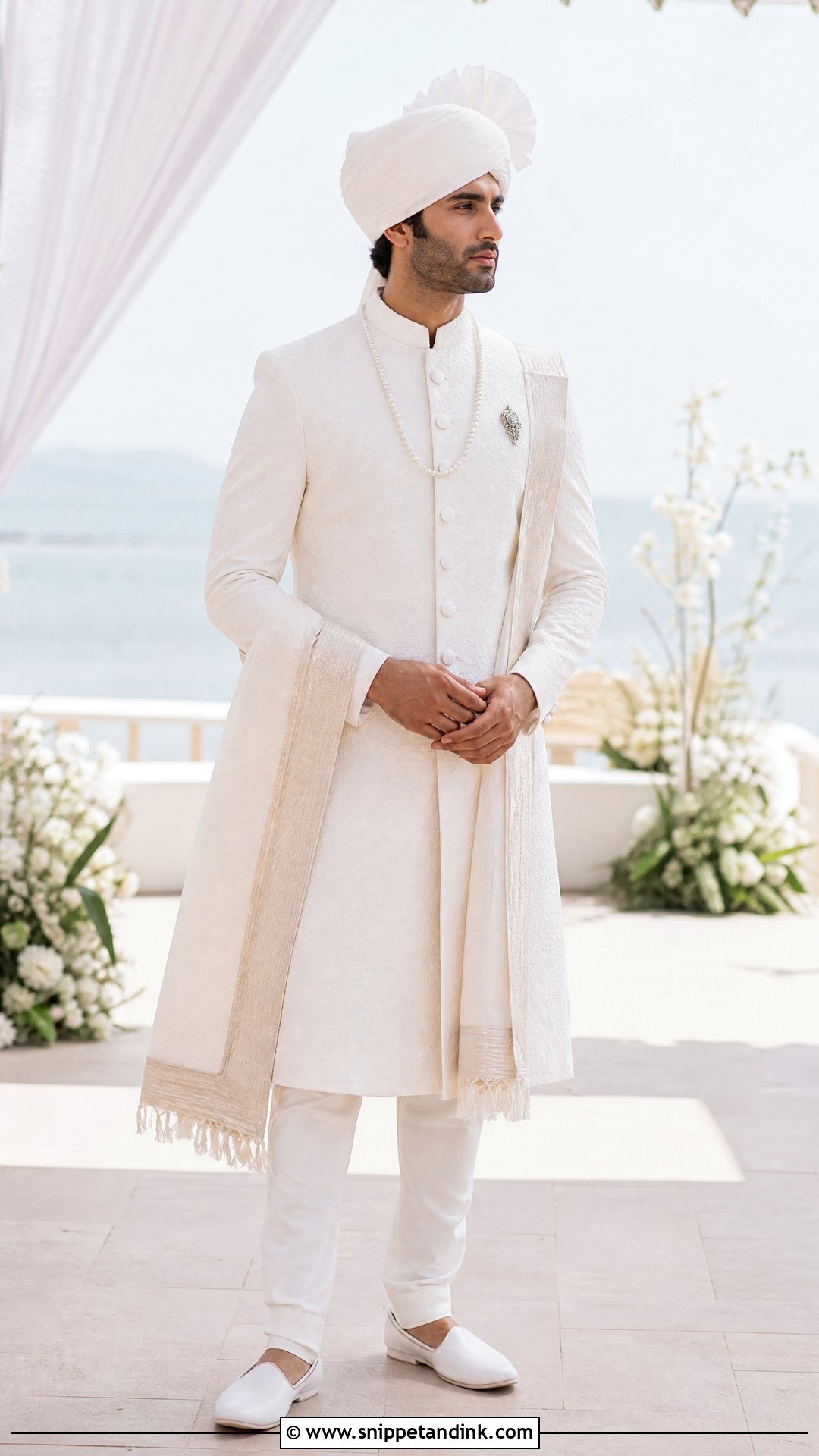
Minimal white sherwanis reveal everything about how they’re made. With no heavy embroidery to look at, the eye goes straight to the collar and the button stand, so I check that the collar sits flat against the neck and the front lies smooth when buttoned. Choose self-textured fabric, covered buttons and light work at the collar. Matching white trousers or churidar and white leather mojaris keep it monochrome; a slim champagne stole adds a little warmth. A single pearl necklace, a small brooch and a white or beige safa finish it. Bright daytime and coastal ceremonies suit it best.
9. Beige Textured Sherwani
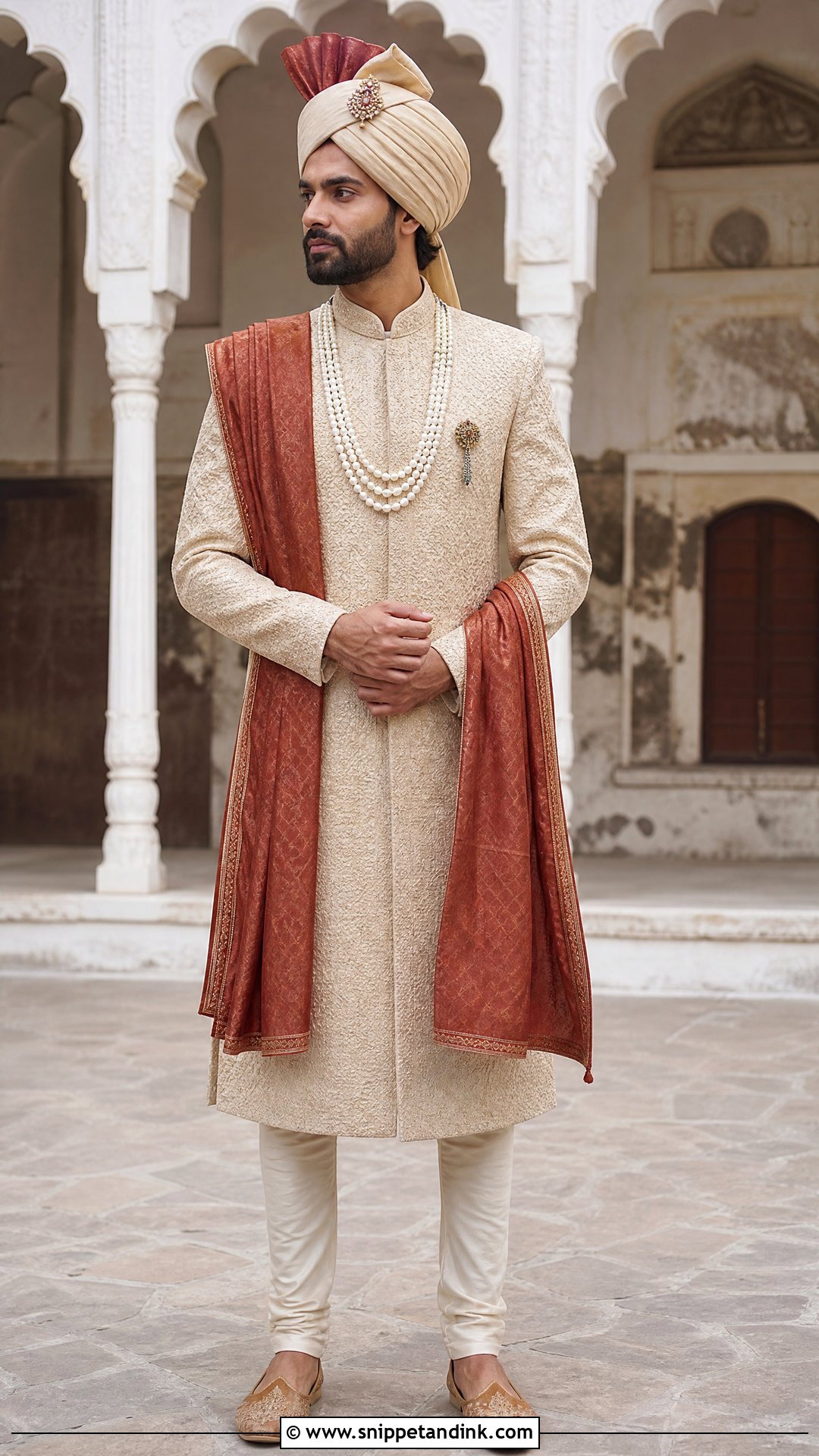
Beige textured sherwanis sit between gold and plain ivory: warmer than ivory, quieter than gold. Jacquard, raw silk or a woven fabric with a subtle geometric or botanical pattern gives the depth. Cream fitted trousers and tan embroidered mojaris keep the palette warm. A rust, maroon, or muted olive stole brings contrast, and I like to repeat its colour as a narrow border on a beige safa so the two read as a set. A pearl mala and an antique gold brooch complete it. Keep the trousers narrow and hemmed exactly to the shoe.
10. Red Zardozi Sherwani
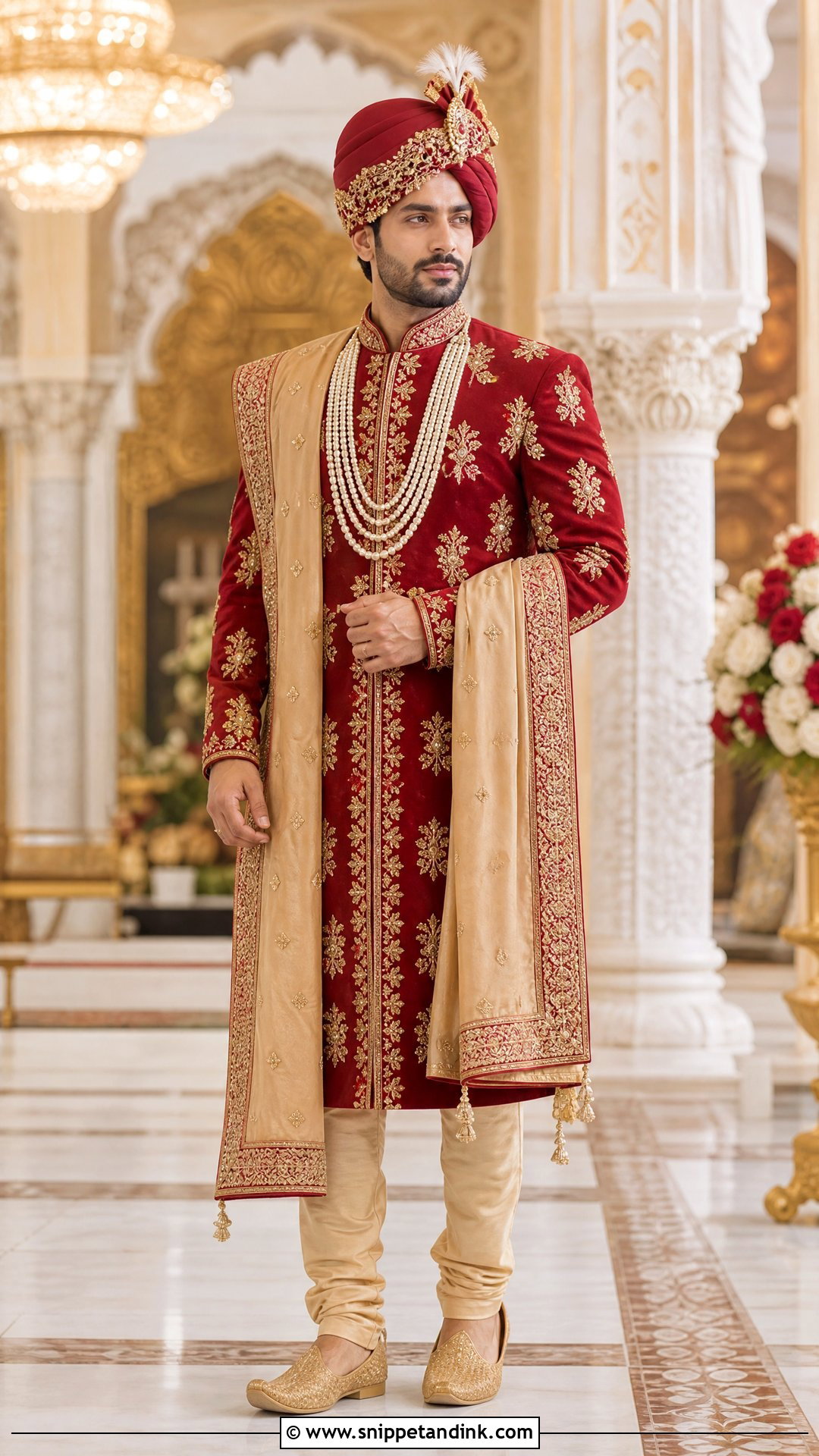
Red zardozi is the full traditional entrance. Zardozi is raised metallic thread embroidery, and it’s heavy, so I prefer it concentrated at the collar, chest, cuffs and hem rather than covering the whole jacket. That keeps the sherwani comfortable for a long ceremony and leaves the red visible. Crimson or a muted red both work. Pair it with cream churidar and gold embroidered mojaris, then soften it with a beige or antique gold stole. A red safa, layered pearl mala, jeweled brooch and kalgi complete the look. With this much going on, add nothing else in a competing colour.
11. Powder Blue Sherwani
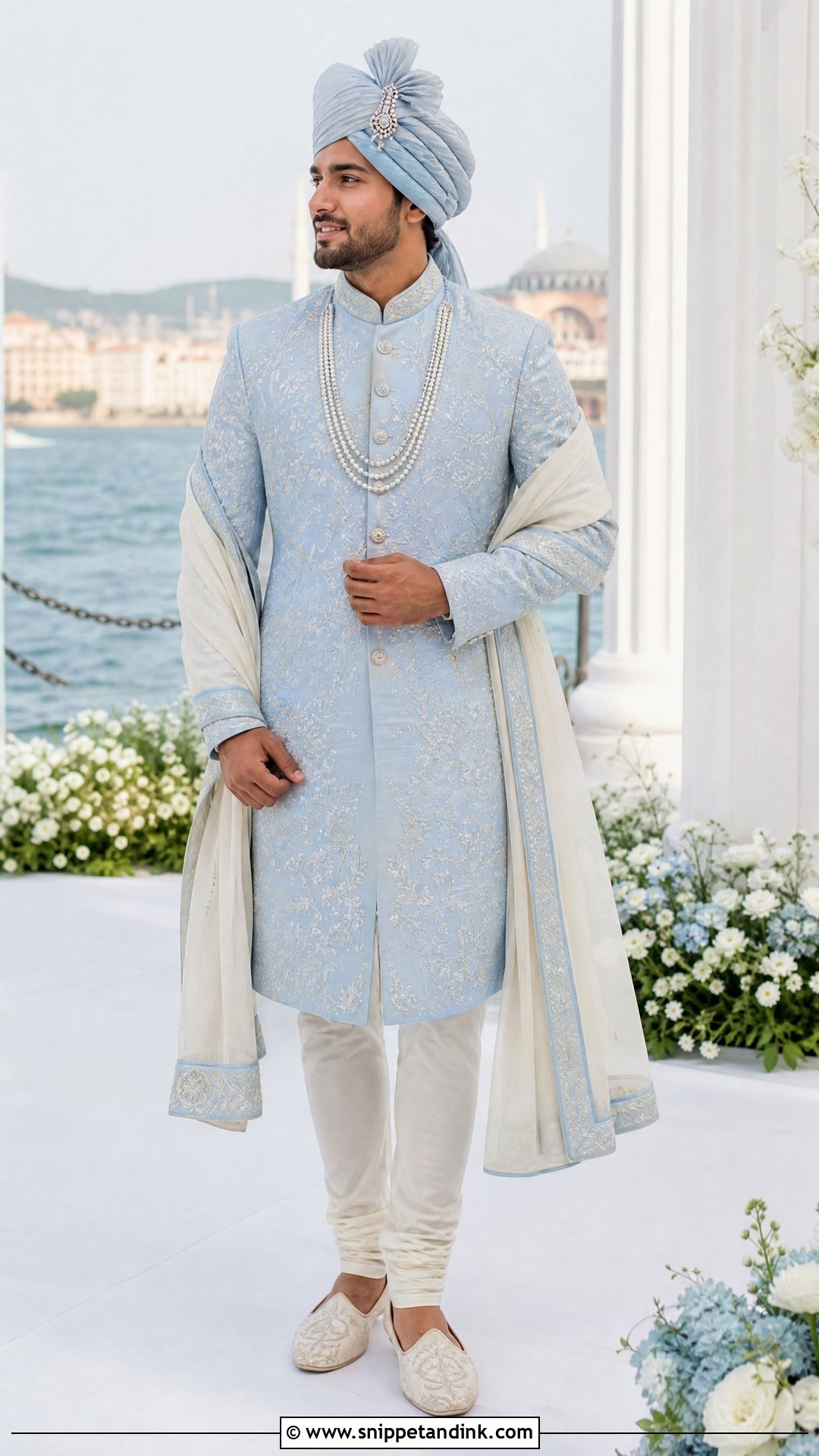
Powder blue is cool-toned, so pearls and silver flatter it far more than heavy yellow gold. A silk or jacquard sherwani with ivory threadwork, pearl buttons or fine silver detail sits well over plain ivory churidar. Cream mojaris with minimal embroidery keep it traditional. An ivory stole with a powder blue edge and a matching blue safa tie it together. Pale colours show poor construction, such as puckered seams and a wavy front edge, so make sure the jacket is lined and properly interfaced. Spring weddings, waterside venues and rooms with pale flowers suit it.
12. Emerald Green Velvet Sherwani
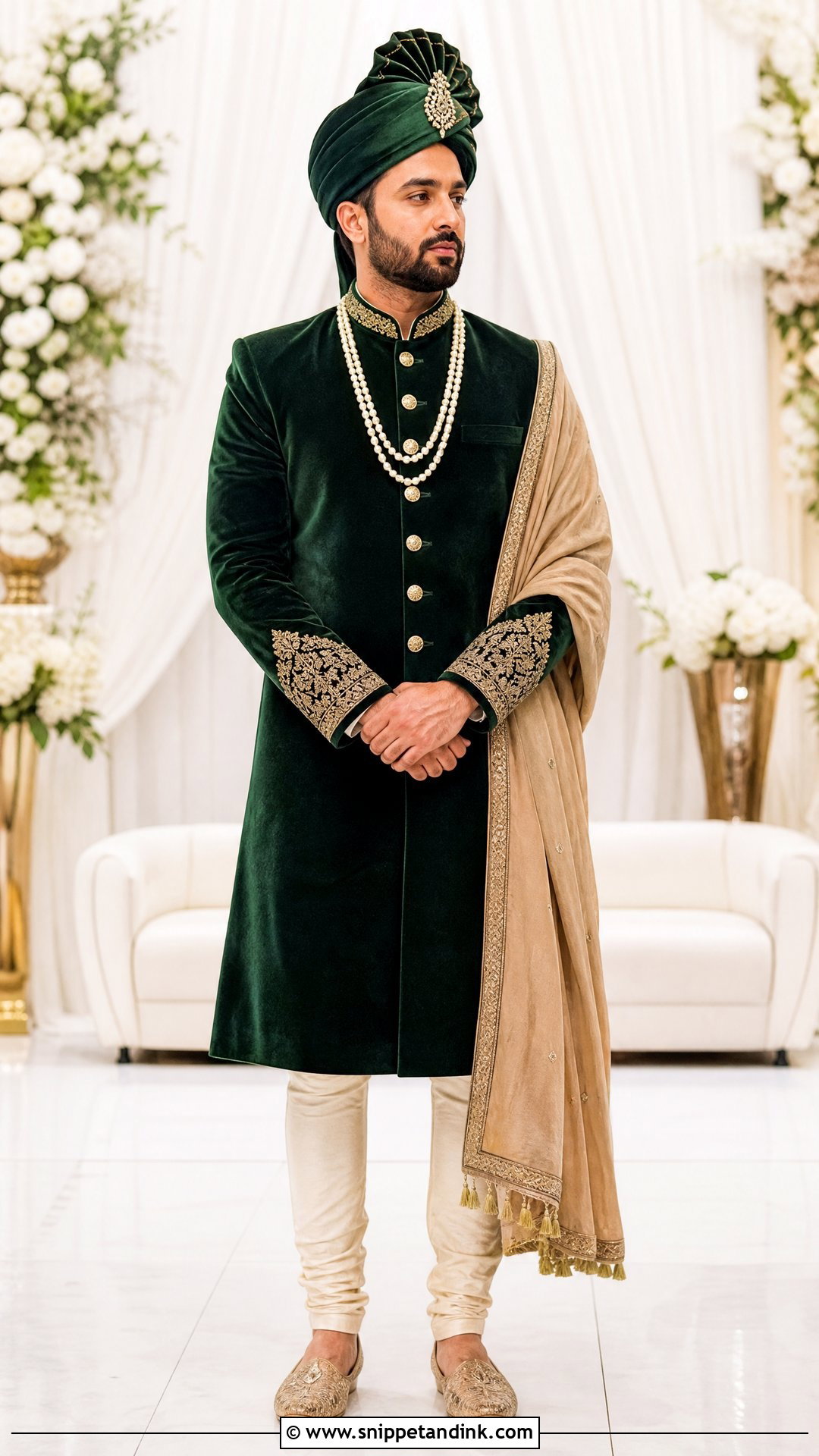
Emerald velvet is dramatic on its own, which is exactly why I tell grooms to keep the embroidery light. Antique gold buttons, embroidered cuffs and a defined band collar are enough on a fitted jacket. Cream churidar balances the intense green. Antique gold mojaris, a beige shawl and a layered pearl necklace add richness. An emerald safa makes a bold tonal look; ivory keeps it lighter. Velvet is for cool evenings only. A straight hem and close-fitted sleeves control the weight of the fabric, so it looks regal rather than costume.
13. Peach Sherwani
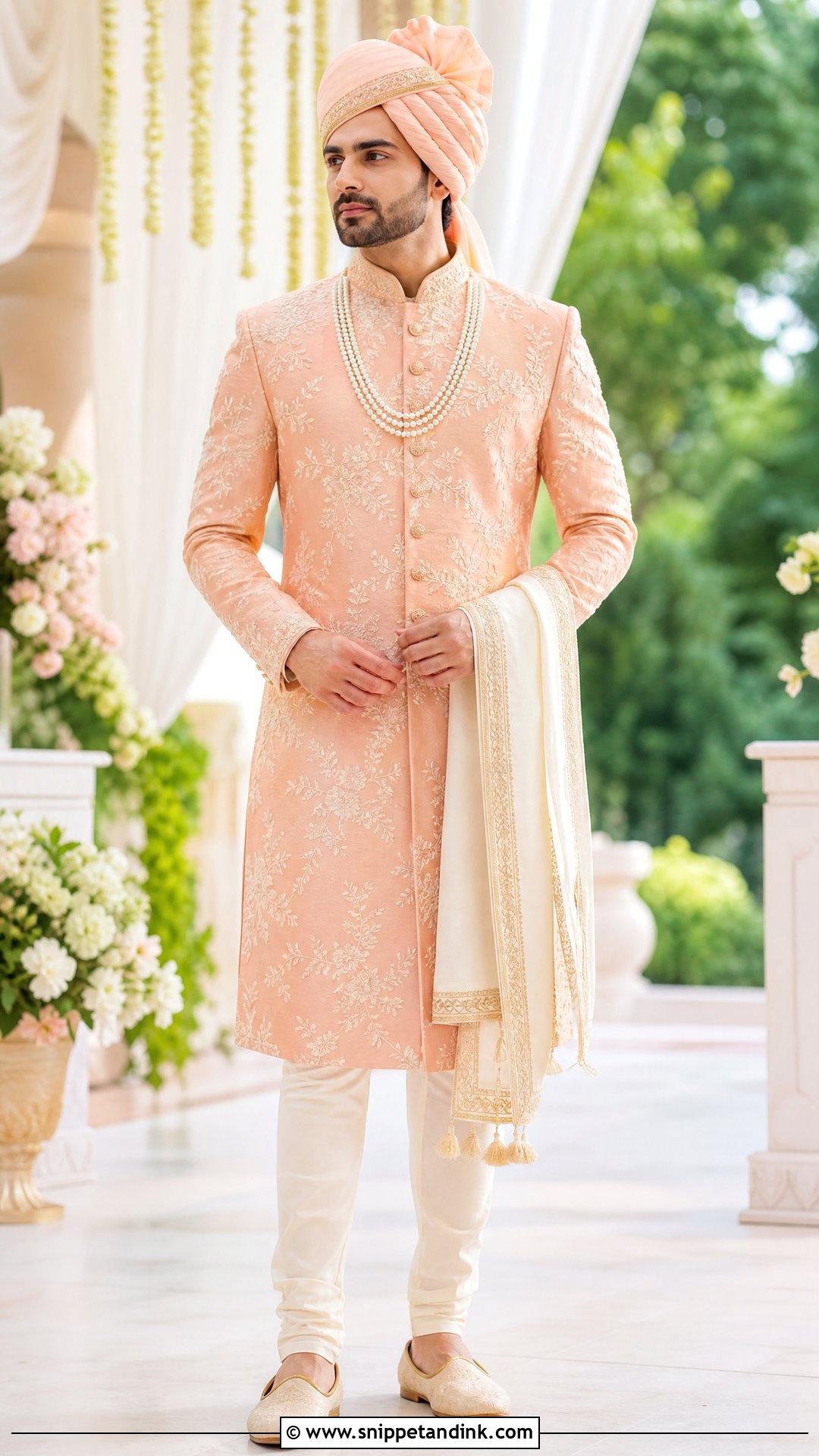
Morning ceremonies and natural light flatter peach more than any other shade in this list. Light silk with ivory floral embroidery or small gold accents keeps it airy. Cream trousers or churidar, beige mojaris with modest threadwork, an ivory stole and a peach safa with a slim gold border complete it, and pearls suit peach without making it too warm. If the bride wears coral, pink, ivory or red, borrow one small detail from her outfit, a border colour or a button, rather than matching her whole palette. A clean cut keeps the pastel looking grown-up.
14. Mirror Work Sherwani
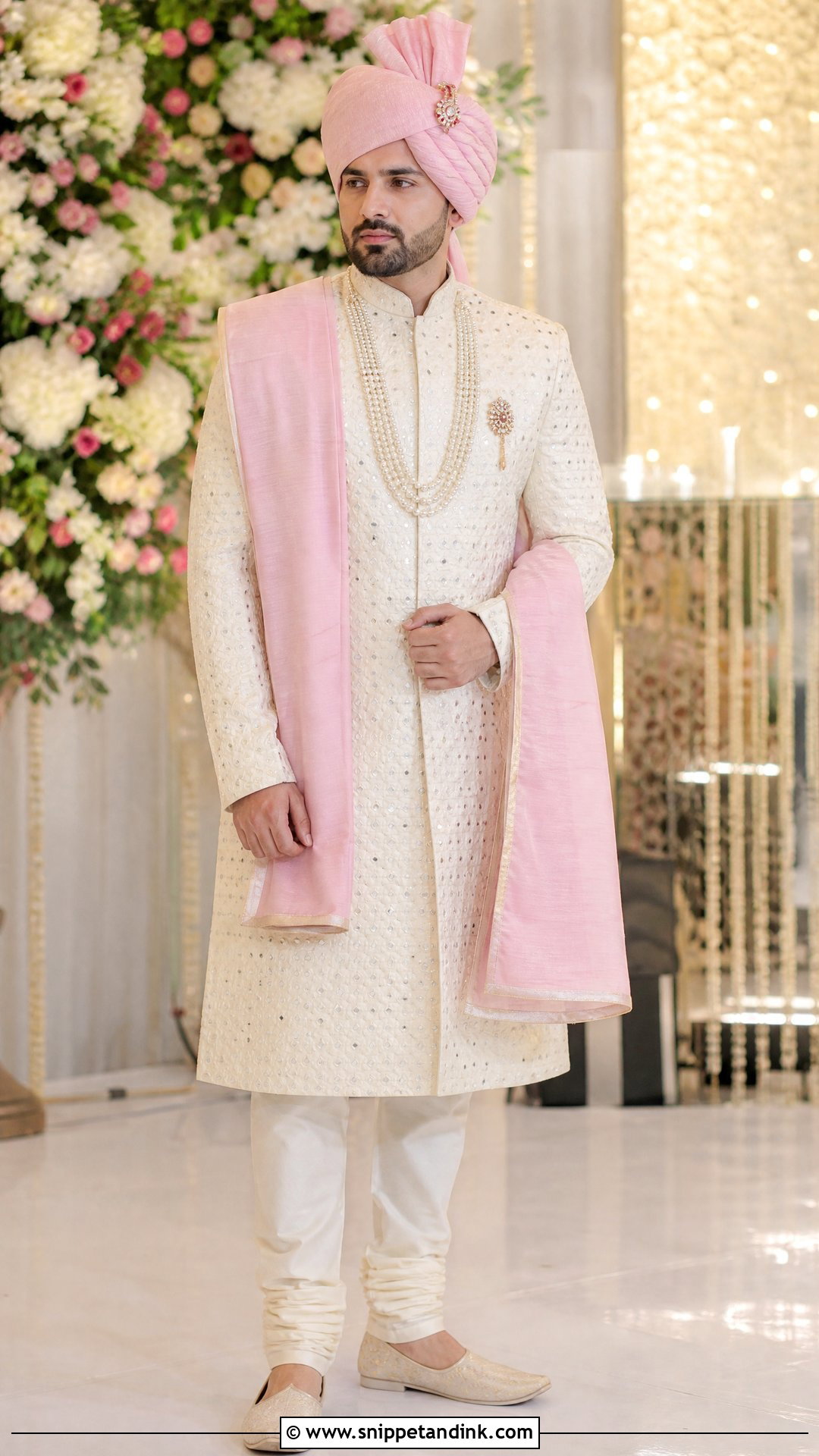
Mirror work catches every light in the room, so placement matters more than quantity. Small, evenly spaced mirrors on an ivory, beige, muted pink or pale blue base look refined; large ones look heavy and can feel stiff on the chest. Pair it with plain ivory churidar and simple cream mojaris. Choose a solid stole in one of the embroidery colours, not another shiny piece. A coordinated safa, a subtle pearl mala and a plain brooch finish it. I’d save it for an evening ceremony or sangeet where the lighting shows the mirrors off, and check the backing inside so stitched mirror edges don’t rub through your kurta.
15. Asymmetrical Indo Western Sherwani
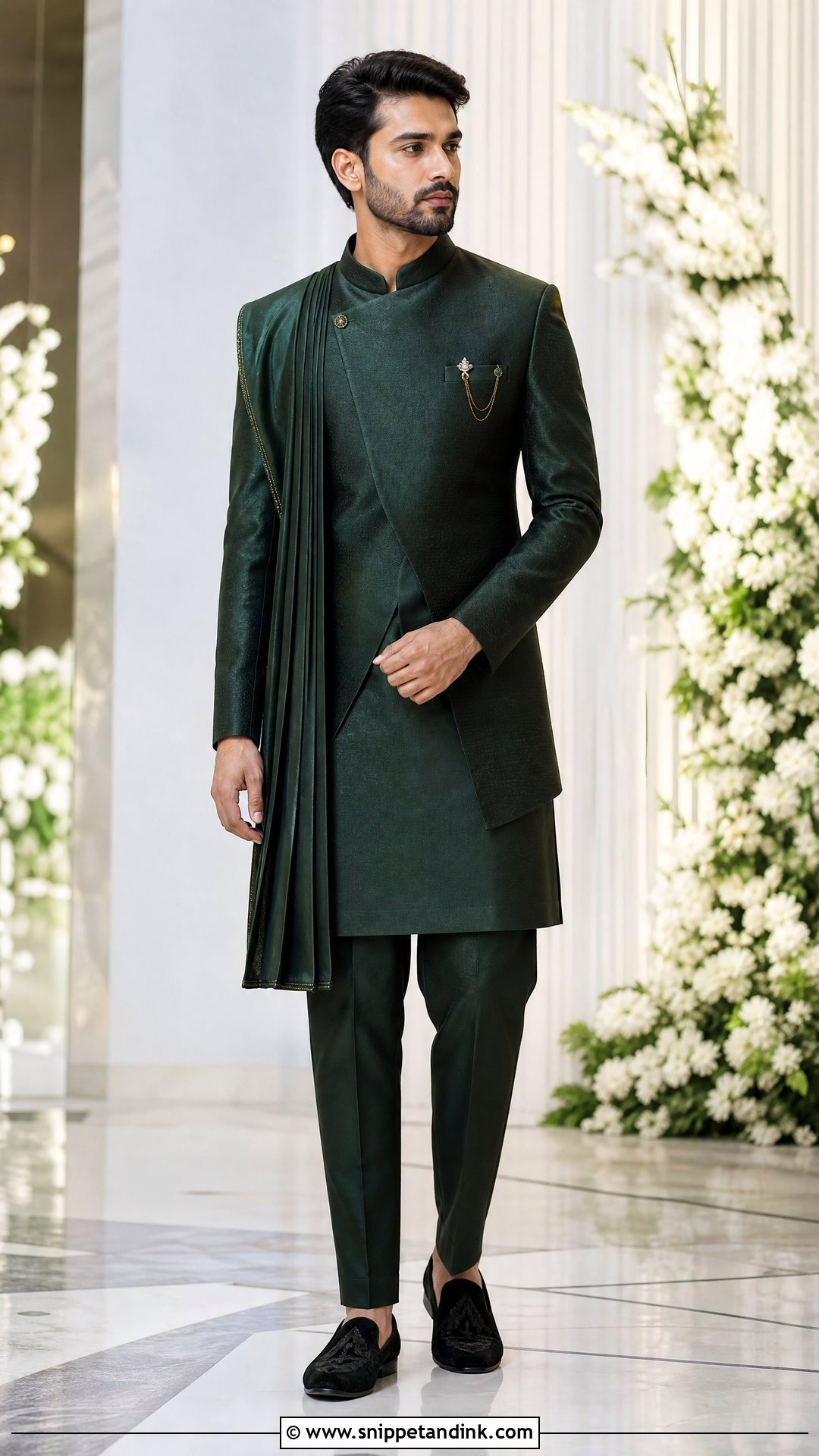
An asymmetrical Indo-Western sherwani has an angled front opening, and that angle has to be cut to your body, not bought off the rail and hoped for. A long jacket with a structured collar and a textured or embroidered front panel goes over a plain fitted kurta and tapered trousers in the same colour family. Black, navy, charcoal and deep green look sharpest at night. Polished loafers or slim mojaris and one metallic brooch finish it. A narrow stole should follow the jacket’s drape, never cover it. It suits a sangeet, reception or modern ceremony.
16. Floral Print Sherwani
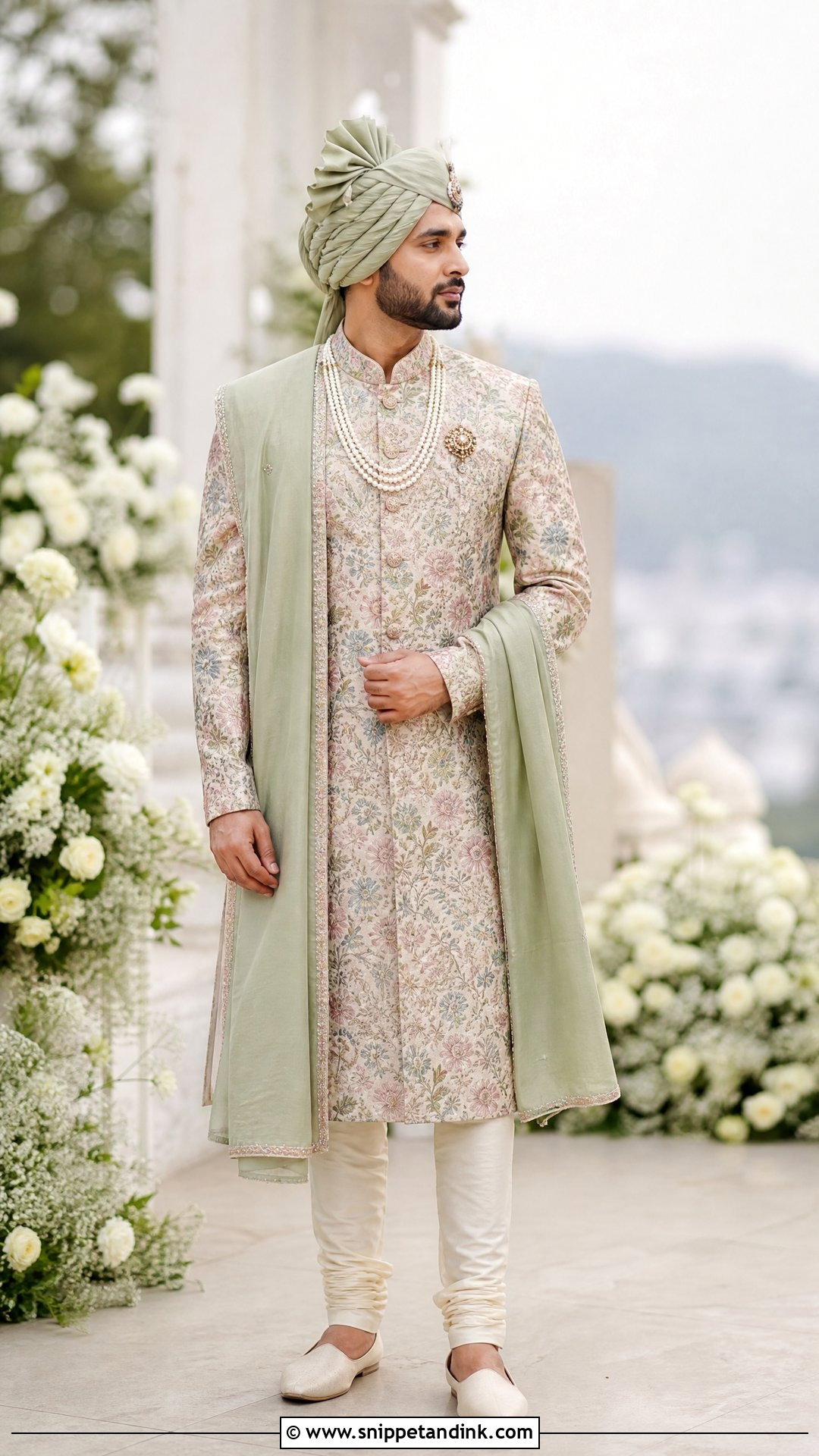
Floral print gives personality without the weight or price of embroidery. A controlled botanical pattern in dusty pink, sage, blue, burgundy or muted gold on a neutral ground works best. I match the churidar to the lightest shade in the print, so the eye isn’t pulled down, and keep mojaris plain cream or tan. A solid safa and stole, never a second print. One pearl necklace or brooch is enough. Check how the pattern meets across the front closure and at the shoulder seams: a print that lines up there looks expensive, and one that breaks looks rushed. Daytime and garden weddings suit it.
17. Bandhgala Sherwani
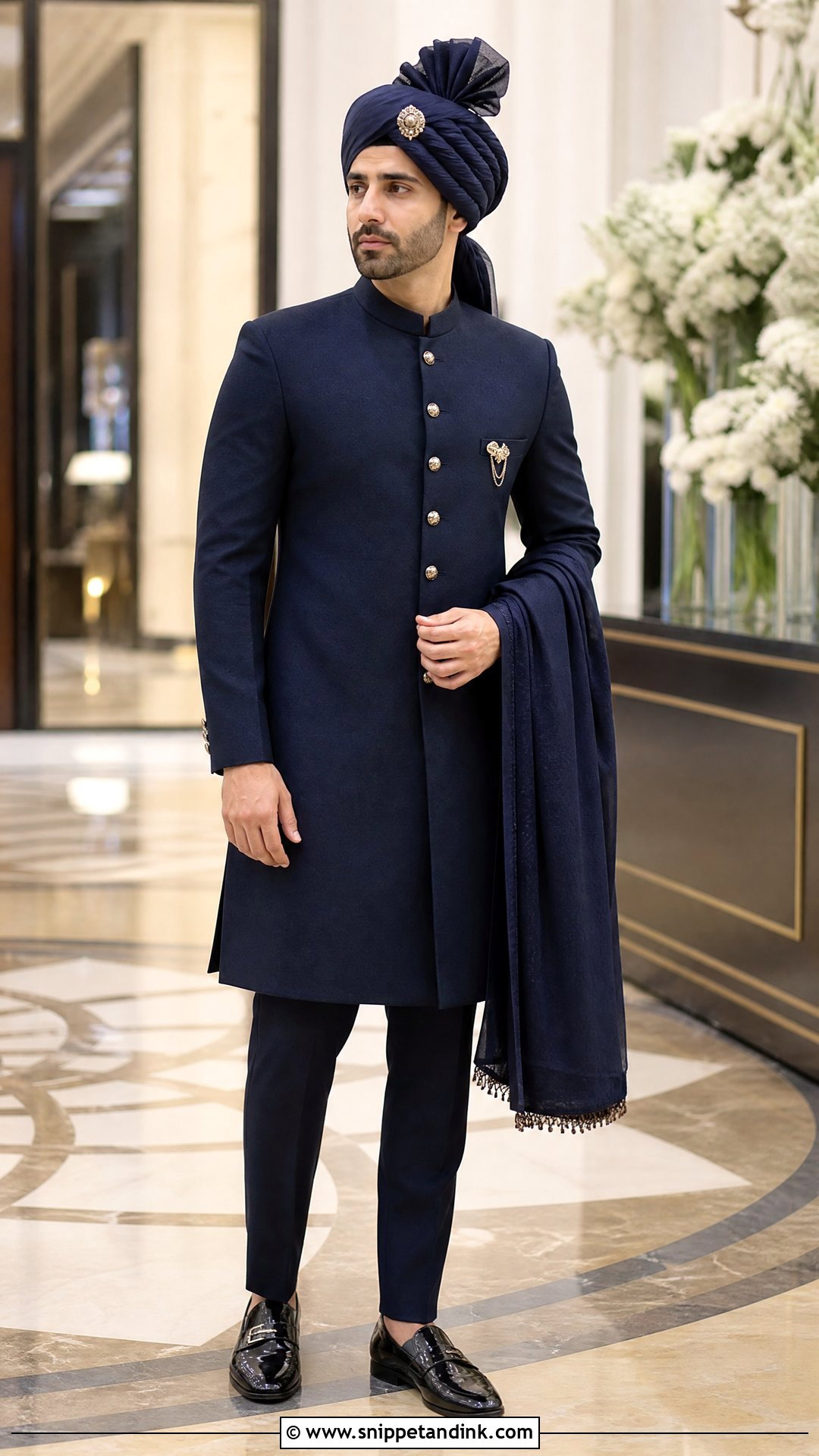
The bandhgala is where Indian formalwear meets Western tailoring: a straight cut, a firm stand collar, defined shoulders and a neat row of metal or covered buttons. Tapered trousers instead of churidar make it sharper. Navy, ivory, charcoal, burgundy and bottle green all work. Polished loafers or sleek mojaris, a pocket brooch and a neatly folded stole finish it; if the jacket is embroidered, keep everything else plain. A tonal safa can go on for the ceremony and come off for the reception. I tell grooms to sit down in it at the fitting, since a stand collar that’s fine standing can dig in seated.
18. Sherwani With Contrasting Shawl
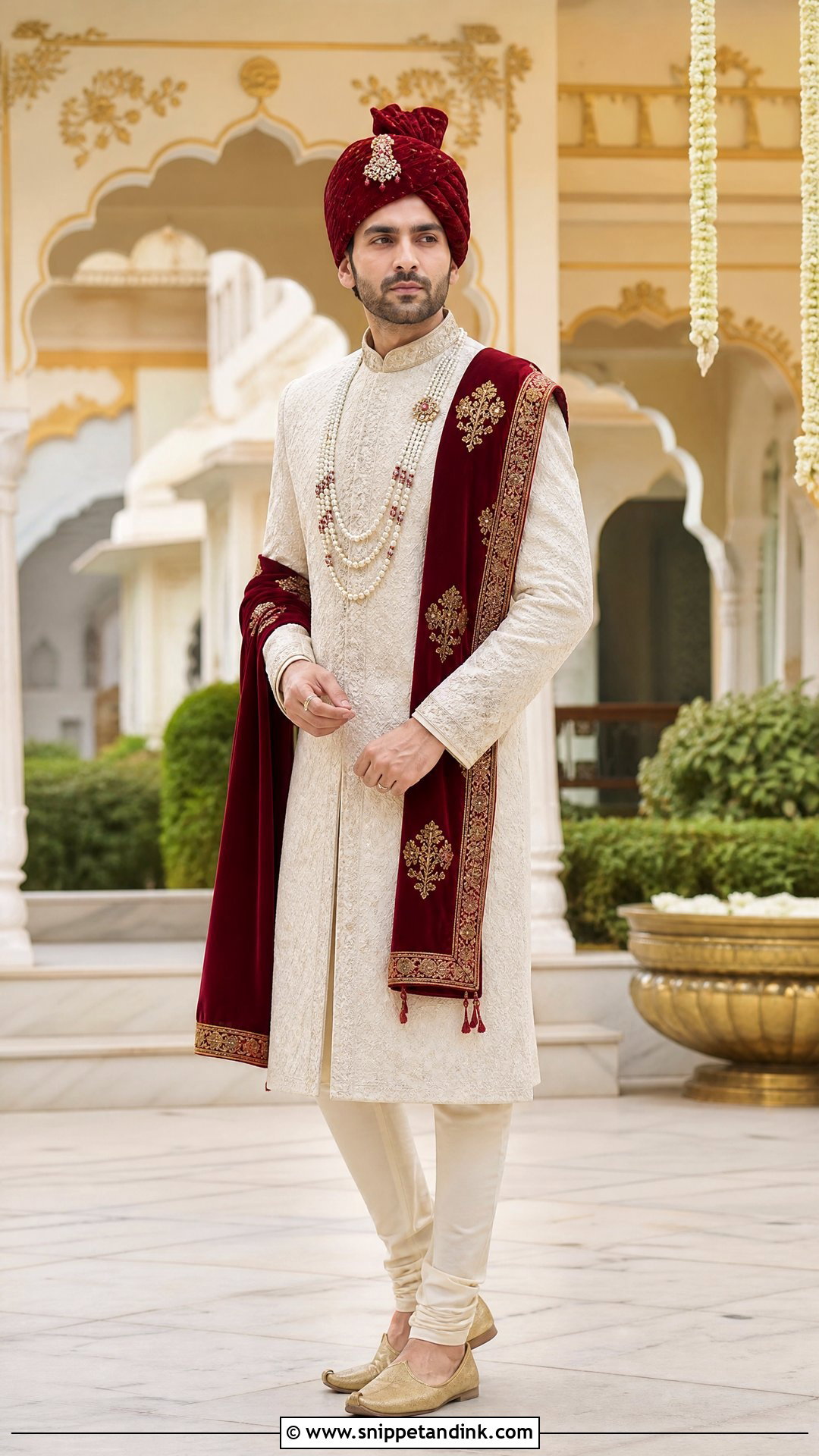
A contrast shawl can turn a quiet sherwani into a ceremony outfit. Start with ivory, beige, gold or cream and restrained embroidery, then add a maroon, emerald, navy or rust shawl with a decorative border. Drape it over one shoulder and pin it underneath at the shoulder seam so it stays put when you bow or hug relatives. Fitted ivory churidar and mojaris that repeat a shawl colour connect the outfit top to bottom. A coordinating safa, a pearl mala and a traditional brooch finish it. The contrast should look chosen, so take the shawl along when you buy the safa.
19. Sherwani With Dhoti Pants
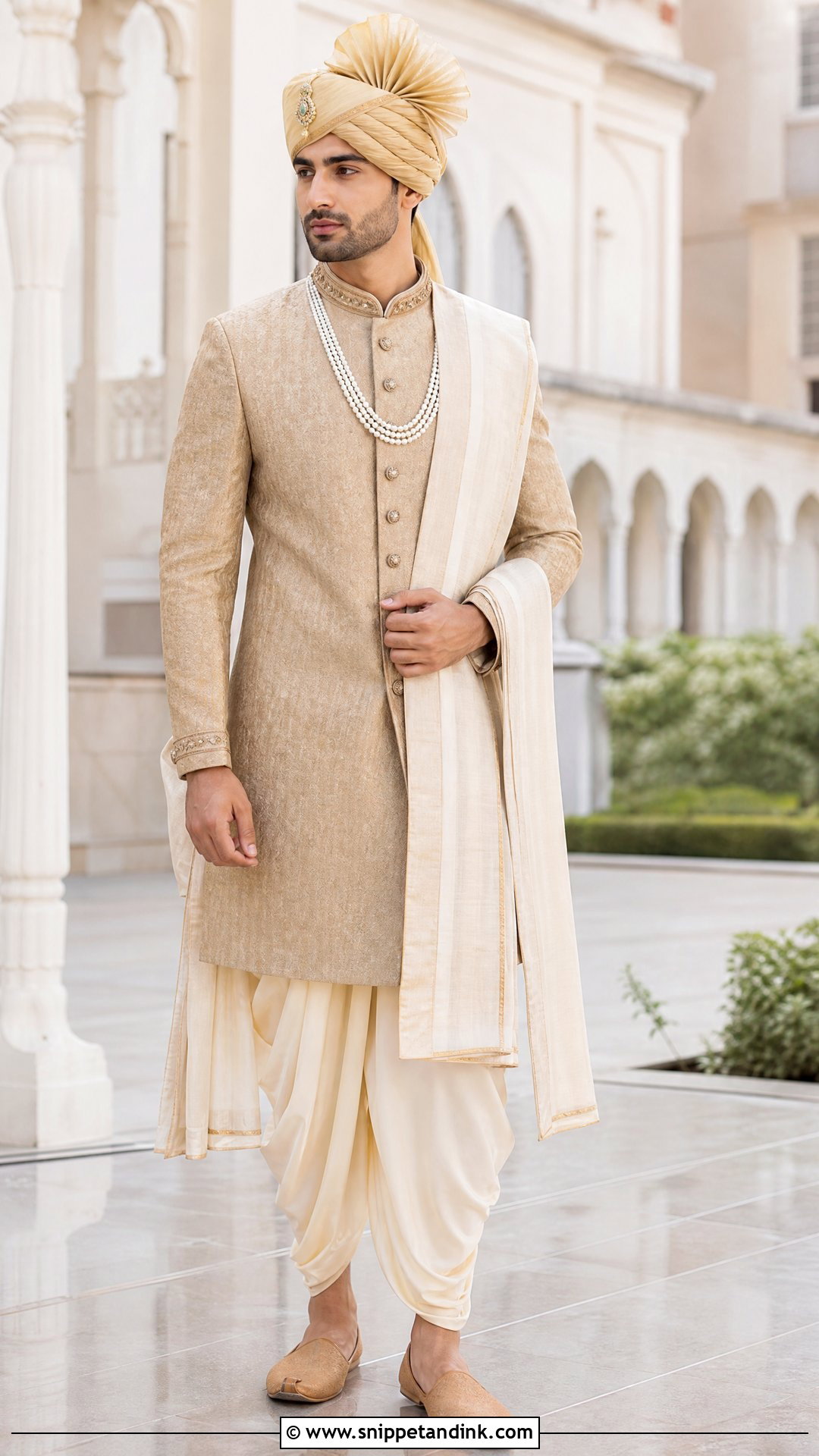
Dhoti pants change the silhouette: fuller and draped below the waist, so the jacket above should be slightly shorter to let the drape show. Pairing a sherwani with dhoti pants works well in ivory, mustard, sage, rust or muted gold over cream dhotis. Keep embroidery at the collar and front opening. Traditional mojaris, a light stole and a simple safa complete it, with one pearl necklace or antique brooch. Length is the fit point I watch: excess dhoti fabric pools around the shoe and gets stepped on, so set the length with shoes on. Daytime and heritage venues suit it.
20. Monochrome Sherwani
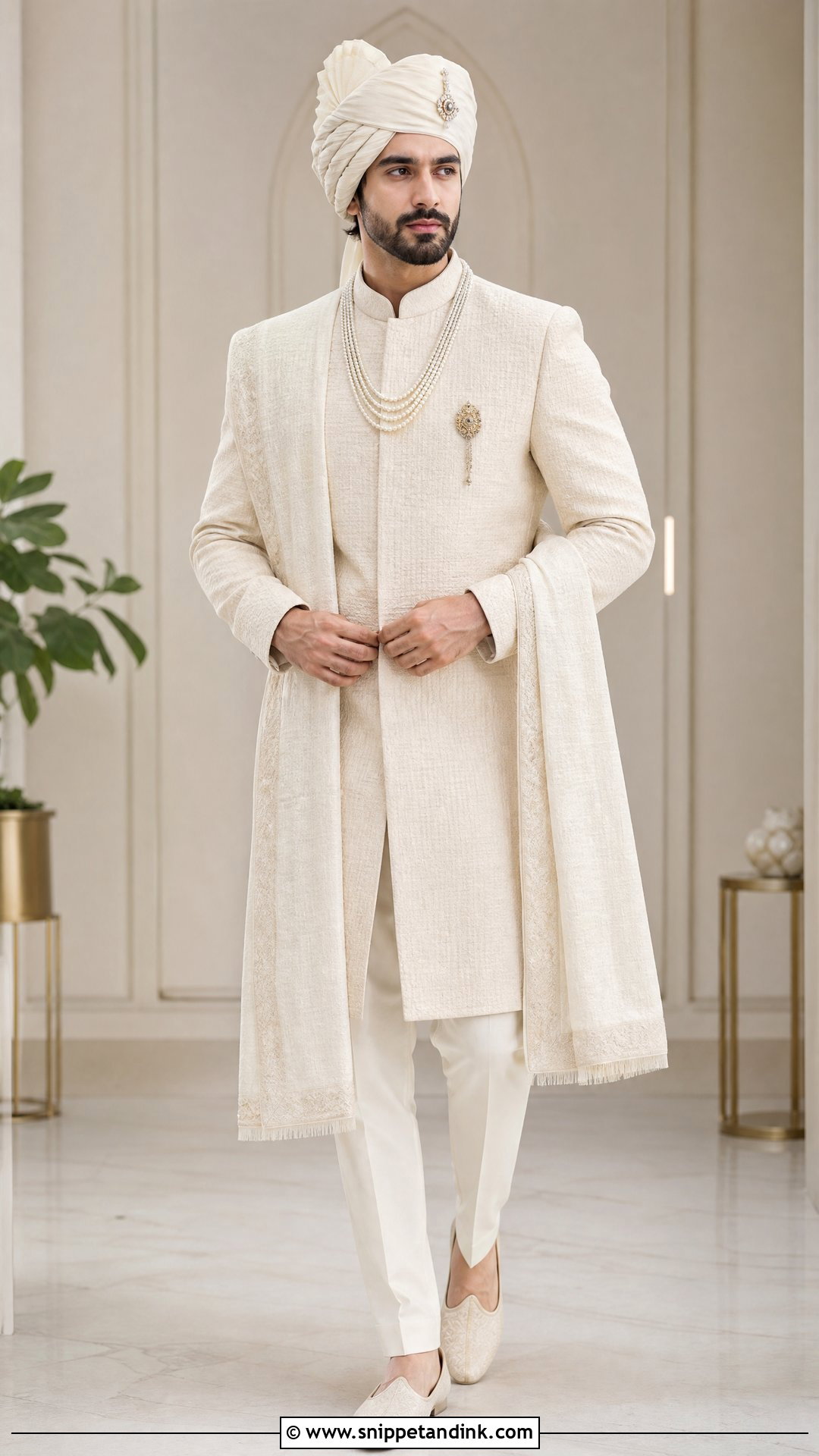
Monochrome lengthens the body by keeping the eye moving from head to toe. Ivory, beige, navy, sage and dusty blue are reliable. The trick is varying texture so it doesn’t look flat: a silk sherwani with matte trousers, velvet mojaris and a lightly woven stole, all in one colour family. A metallic brooch or pearl necklace gives one point of contrast. Shades from different suppliers rarely match exactly, so I lay every piece out together in daylight before the wedding. Strong tailoring matters more here than in any other look, since nothing distracts from the cut.
Sitting Through the Ceremony in a Sherwani
Many ceremonies, whether pheras around a fire or a nikah, mean sitting low or cross-legged for a long time. A stiff, close-cut sherwani fights that. Ask your tailor for side slits deep enough to fold your legs, and sit on the floor at your last fitting to test it. Churidar made with a little stretch in the fabric is far kinder for a long ceremony.
Safa, mojaris and the stole
A pre-tied safa saves a nervous half hour on the morning and sits evenly in every photo. Have it made to your head measurement and wear it once at home. New mojaris are stiff and often rub at the heel, so wear them indoors for a few evenings before the wedding and keep soft insoles in your kit.
Stoles slip the moment you lean down to touch elders’ feet. I pin them under the shoulder with two small safety pins, hidden from the front, and have someone carry spare pins, blotting paper and a small fan for a warm venue. On a summer day, wear a thin cotton vest under the kurta; it stops sweat showing through silk.
Tailoring Carries a Sherwani Further Than Embroidery
A groom’s outfit should feel like him and suit the season, the venue and the ceremony. Ivory embroidery is classic, velvet jewel tones carry an evening, pastel silk is softer for daytime, and modern grooms can go for asymmetric jackets, monochrome, florals or tailored bandhgala silhouettes. Whatever you pick, put the money into fit, bottoms you can sit in, draping that’s pinned securely and footwear you’ve already broken in. Then choose the colour, embroidery, safa, stole and jewelry around it.
You'll Like These Ideas:


Leave a Reply