
A Western bridal look lives or dies on proportion. Get the hem, the boot and the hat working together and the outfit reads as yours; get one of them wrong and it starts to look like a costume. The easy version is a white dress with cowboy boots, but I always style from the dress outward, because the fabric decides which boots, belts and jewelry it can carry. Lace, fringe, denim, satin and embroidered leather all have a place below. For each idea I’ve added what I check at fittings and where it tends to go wrong on a ranch or barn day.
Bring the Boots to Every Fitting, Not Just the Last One
The most common problem I fix on Western brides is a hem cut for the wrong shoe. Most cowboy boots carry a heel somewhere around an inch and a half, and the toe sits longer than a pump, so a hem measured in borrowed heels ends up either dragging or catching on the boot tip. Buy the boots before your first alteration appointment and wear them every time.
Here’s what I check with the boots on:
- Walking stride: the front hem should clear the toe when you step forward, not only when you stand still.
- Sitting: lace and tulle catch on boot pull loops and decorative stitching, so I sit the bride down and watch where the skirt lands.
- Steps and stairs: a barn loft or a porch step will show whether the skirt needs lifting, and whether you’ll need a hand free to do it.
- Bustle points: after the ceremony the train goes up, and the bustle has to be placed with the boots on or the hem will hang uneven.
Break the boots in for a few weeks beforehand, around the house and on grass. New leather soles are slippery on wooden dance floors, and a light scuff on rough pavement or a strip of sandpaper gives them grip. If your feet swell in heat, try them on late in the day.
1. Lace A Line Cowgirl Wedding Dress
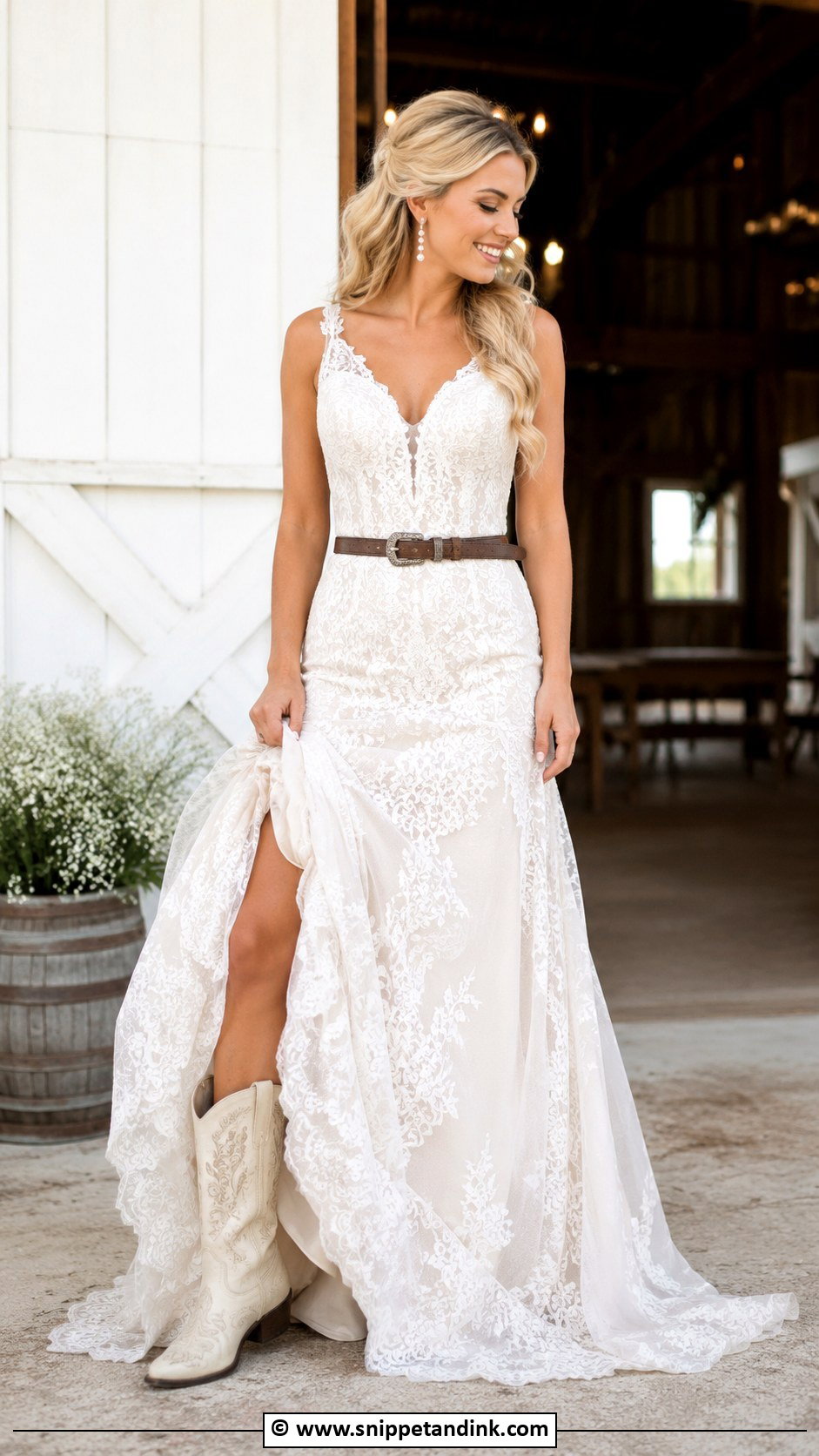
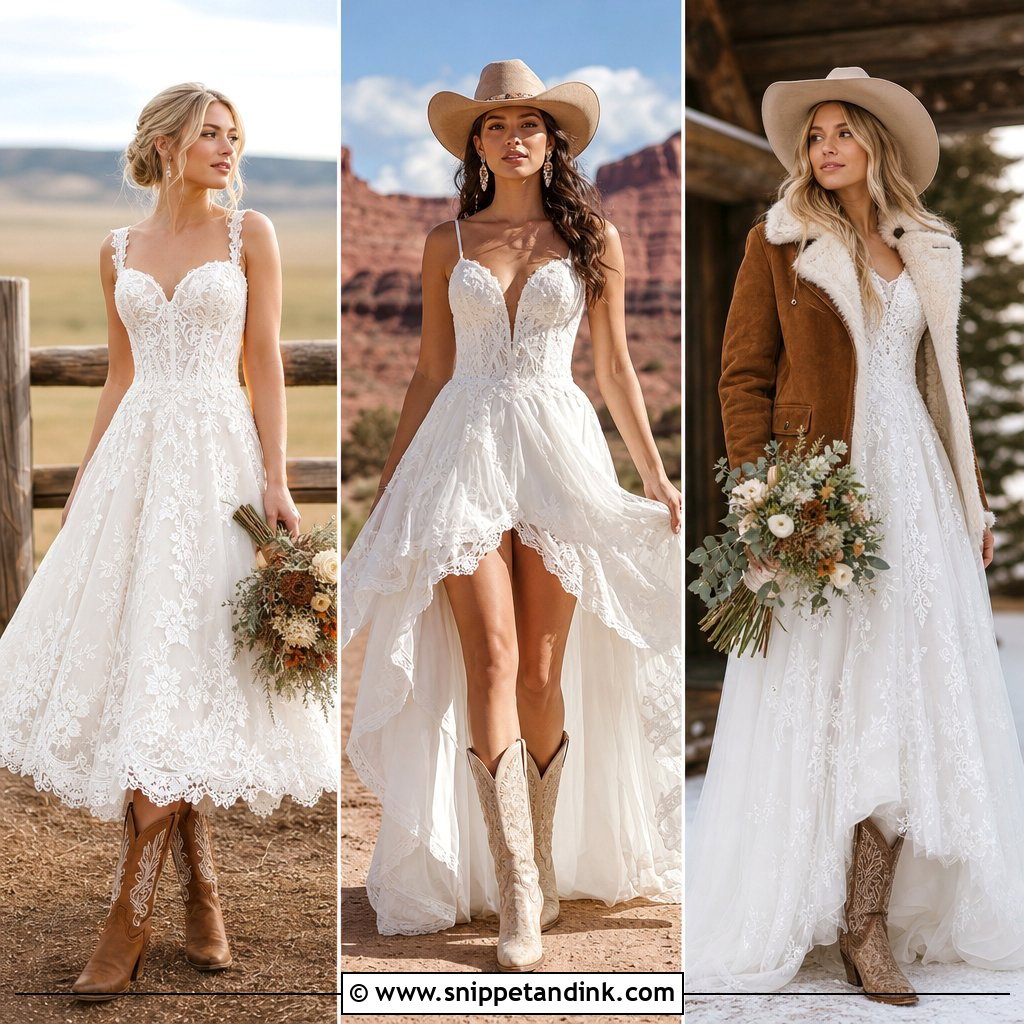
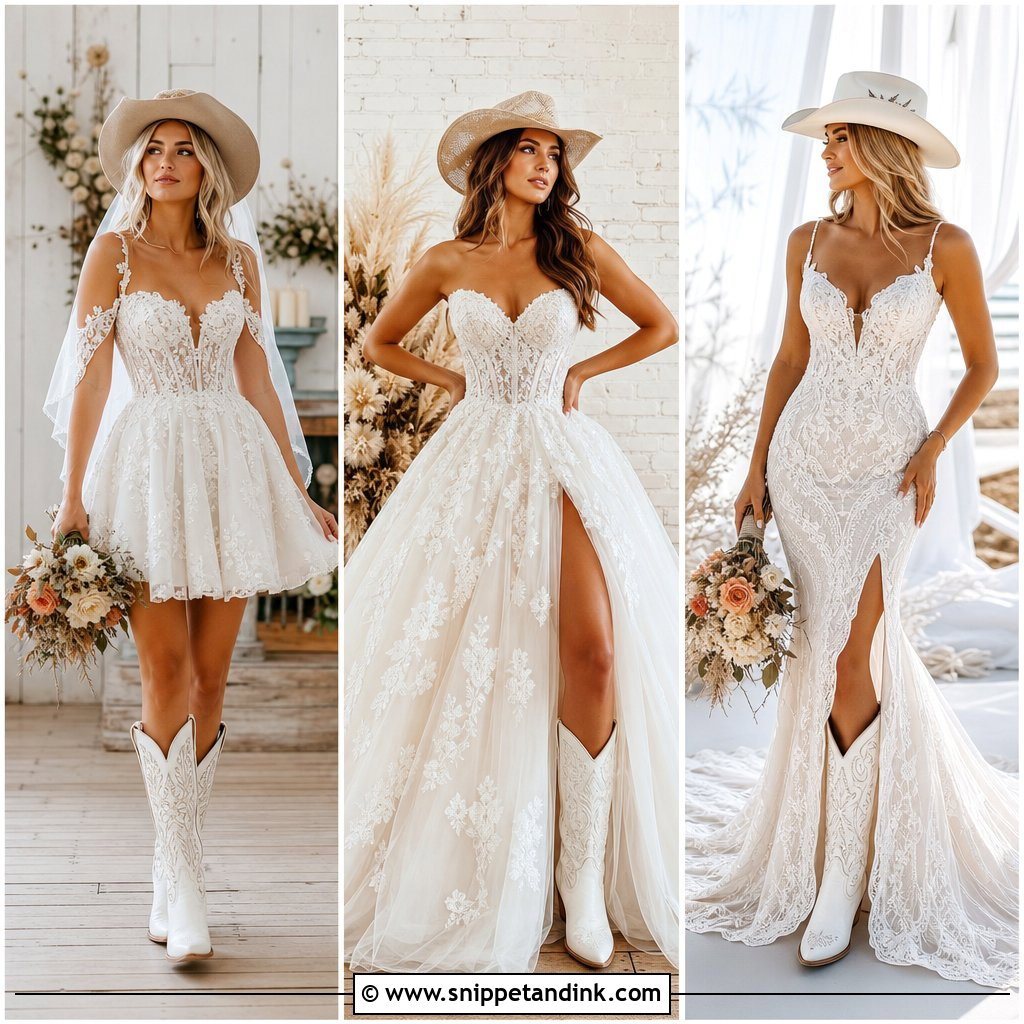
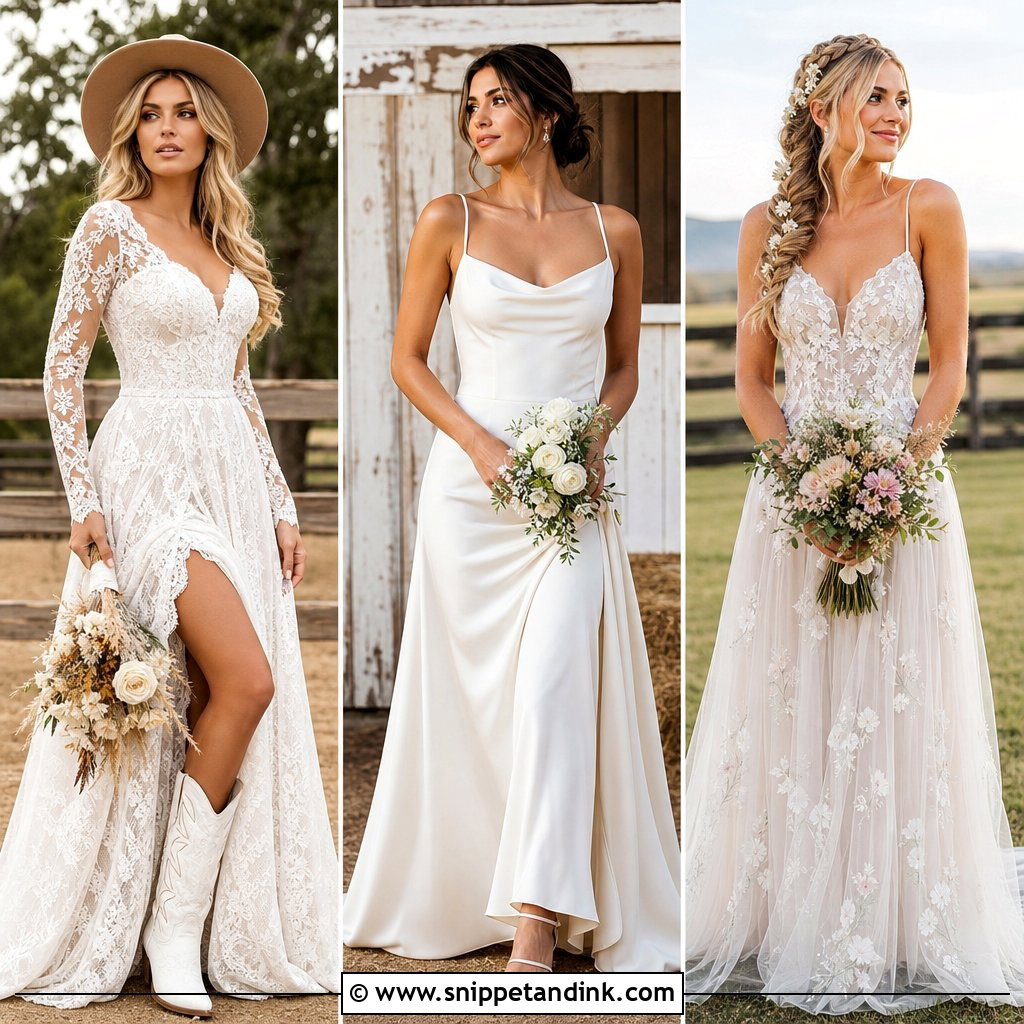
Lace A-lines are where I start most Western brides, because the skirt clears a boot shaft without bunching and the bodice holds its shape on a long day. The thing I watch is the scalloped hem. Lace edging catches on boot pull loops and stitching, so I have the hem finished half an inch higher at the front than a bride wearing flats would need. Ivory lace with cream or tan boots and a slim leather belt keeps it bridal. It’s my default for barn weddings, where a wide floor and wooden steps are kinder to a moving skirt than gravel.
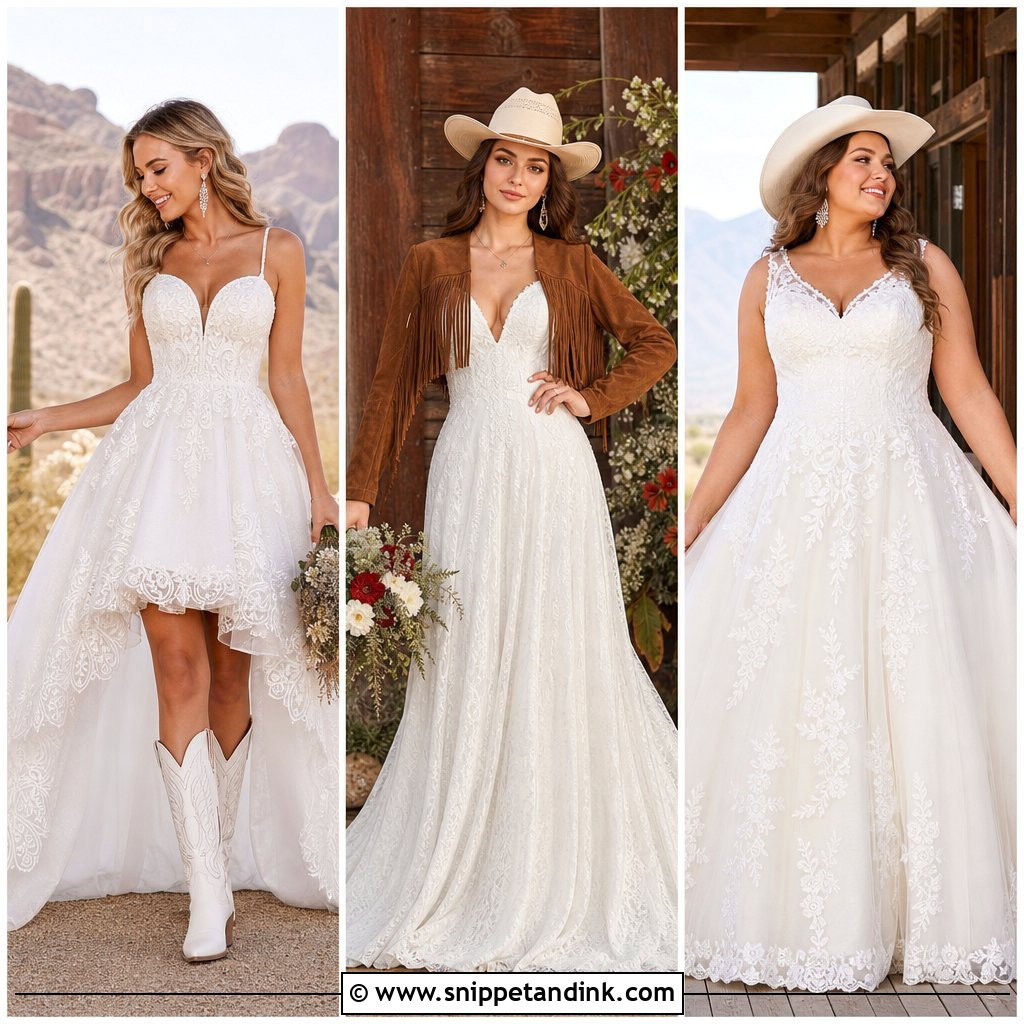
2. High Low Cowgirl Wedding Dress With Boots
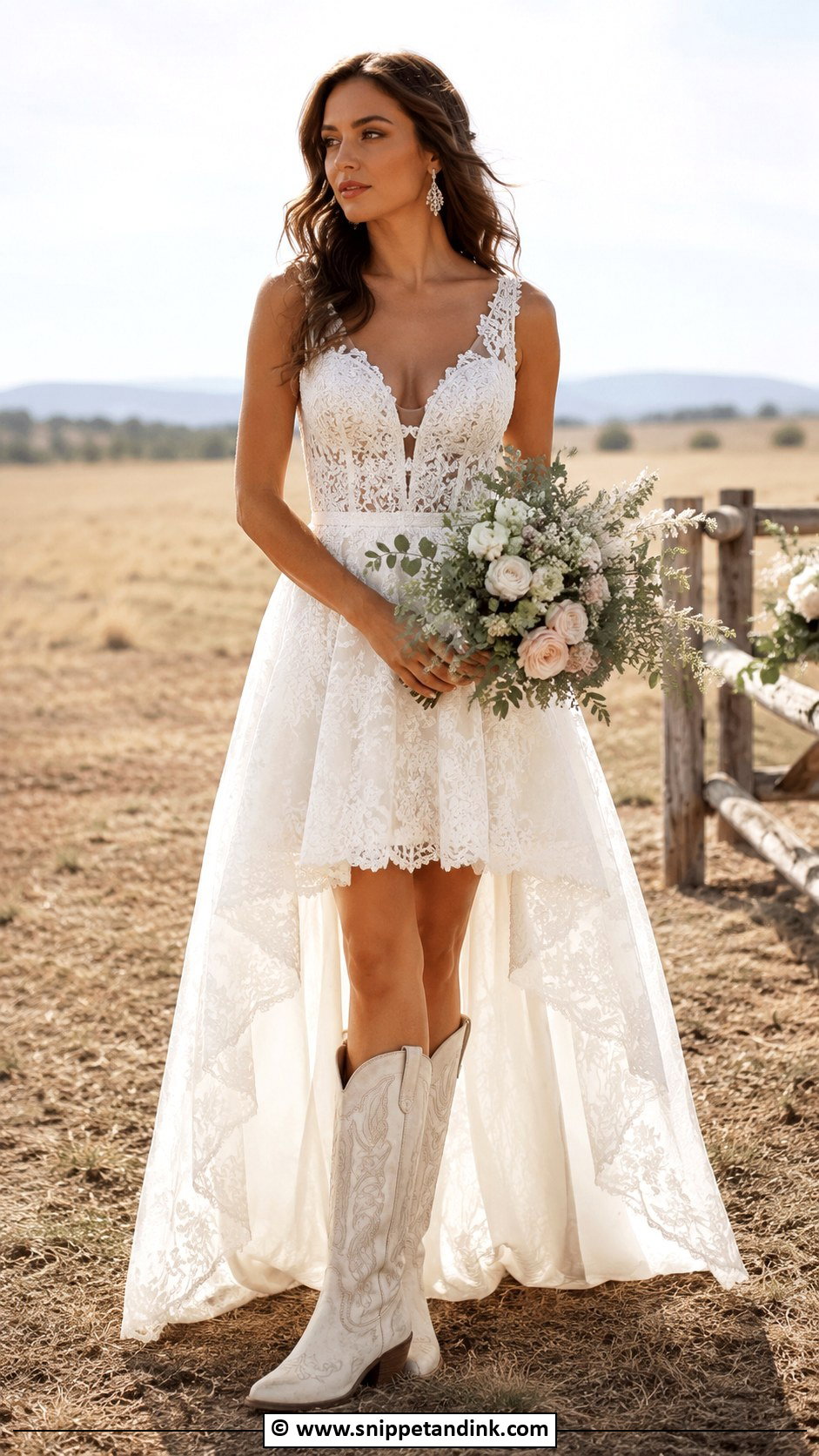
This is the dress for a bride whose boots cost more than she’ll admit. The short front shows the whole shaft, so embroidered or metallic pairs finally get seen, and the longer back keeps a train for the aisle photos. Watch the drop between front and back: too steep and it looks like two garments fighting. On petite brides I keep the front hem just under the knee, which lengthens the leg without flashing the boot top when she sits. Chiffon and soft tulle behave better in wind than stiff lace here.
3. Boho Fringe Cowgirl Wedding Dress
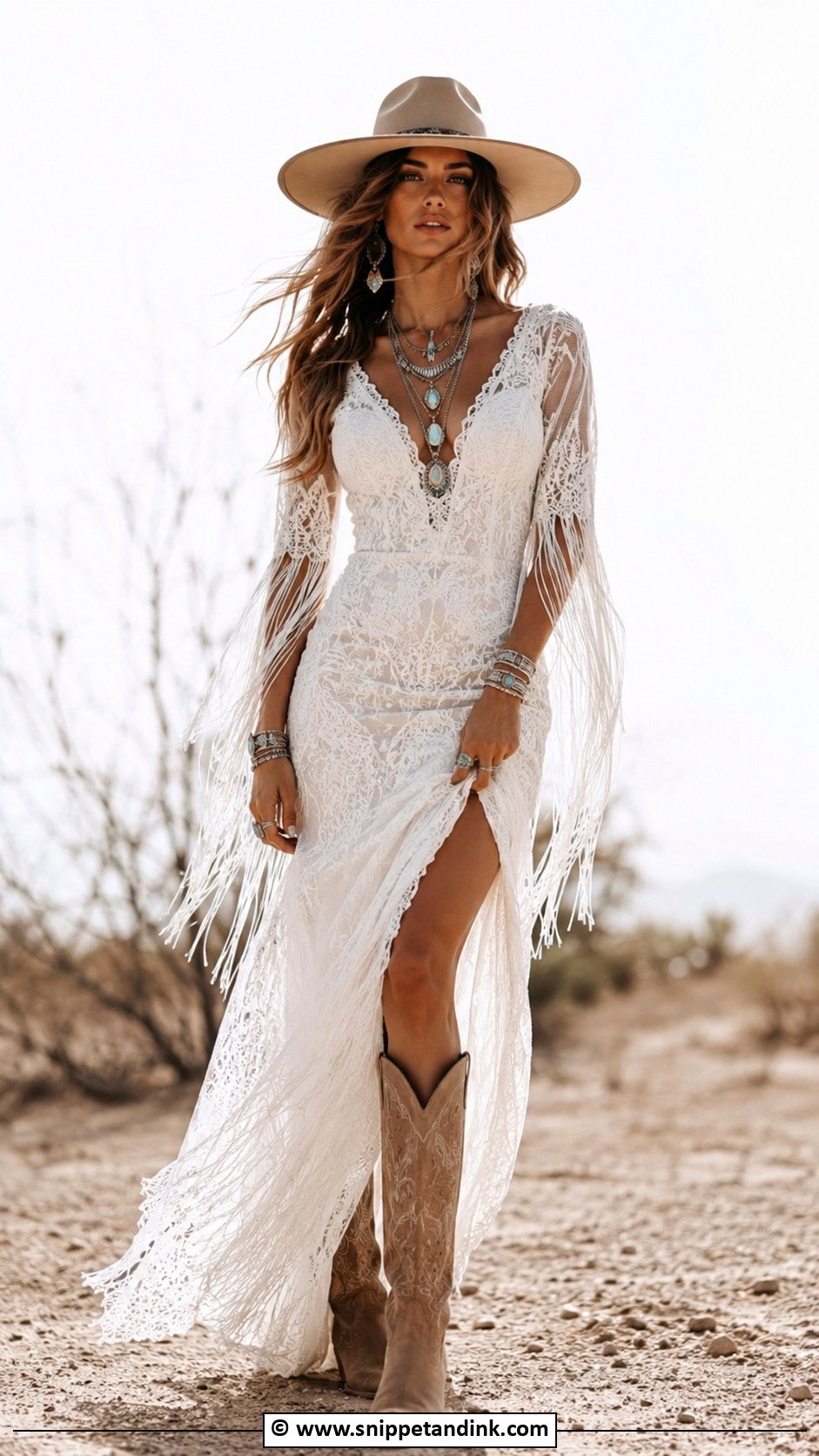
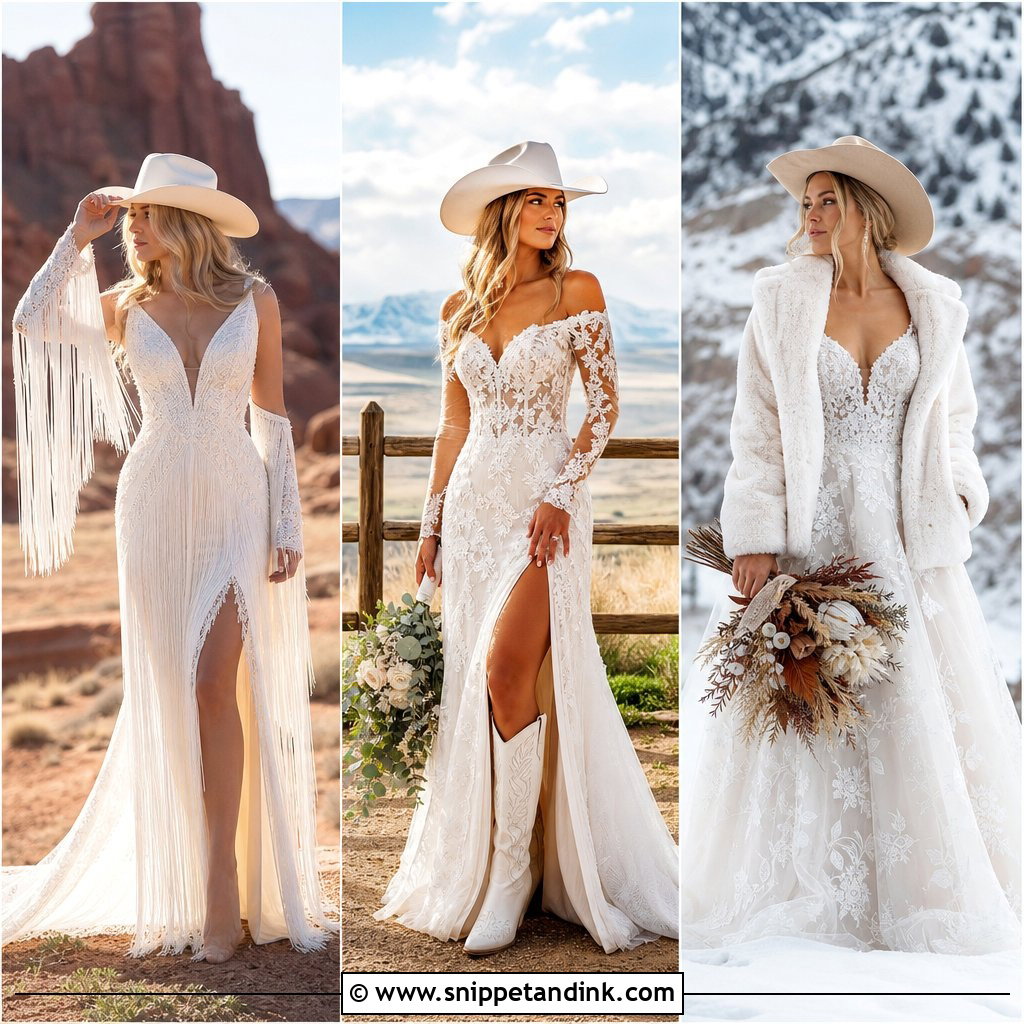
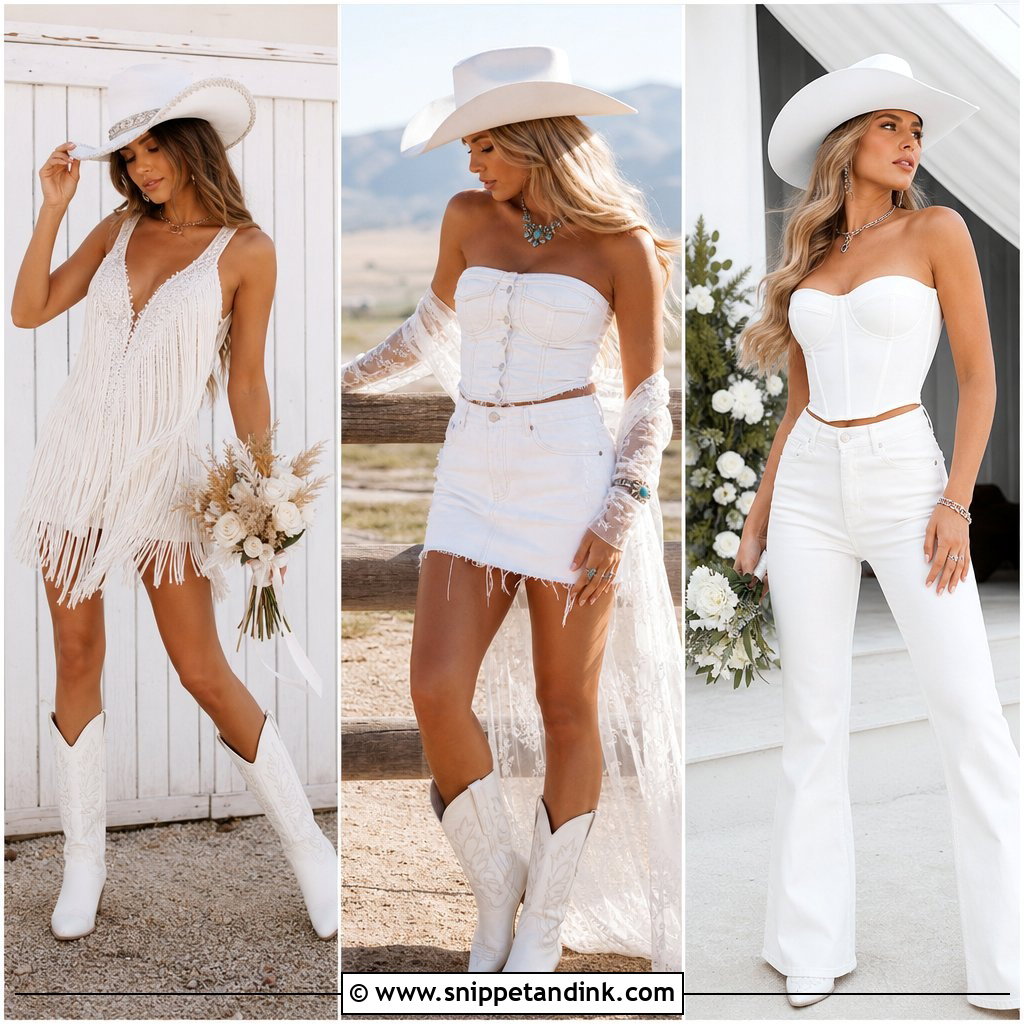
Fringe needs a plain base. Put it on a boho fringe cowgirl wedding dress sleeve, a back yoke or a jacket, and keep the gown itself in crepe or a quiet lace so the swing has room to read. Long fringe tangles in a bouquet and in a veil, which I find out at the first fitting when the bride walks with flowers in her hands. I usually suggest fringe no longer than a hand’s width on sleeves. Pointed-toe boots, layered silver and a wide brim suit it, and desert or ranch elopements give it the open air it needs.
4. Long Sleeve Lace Cowgirl Wedding Dress
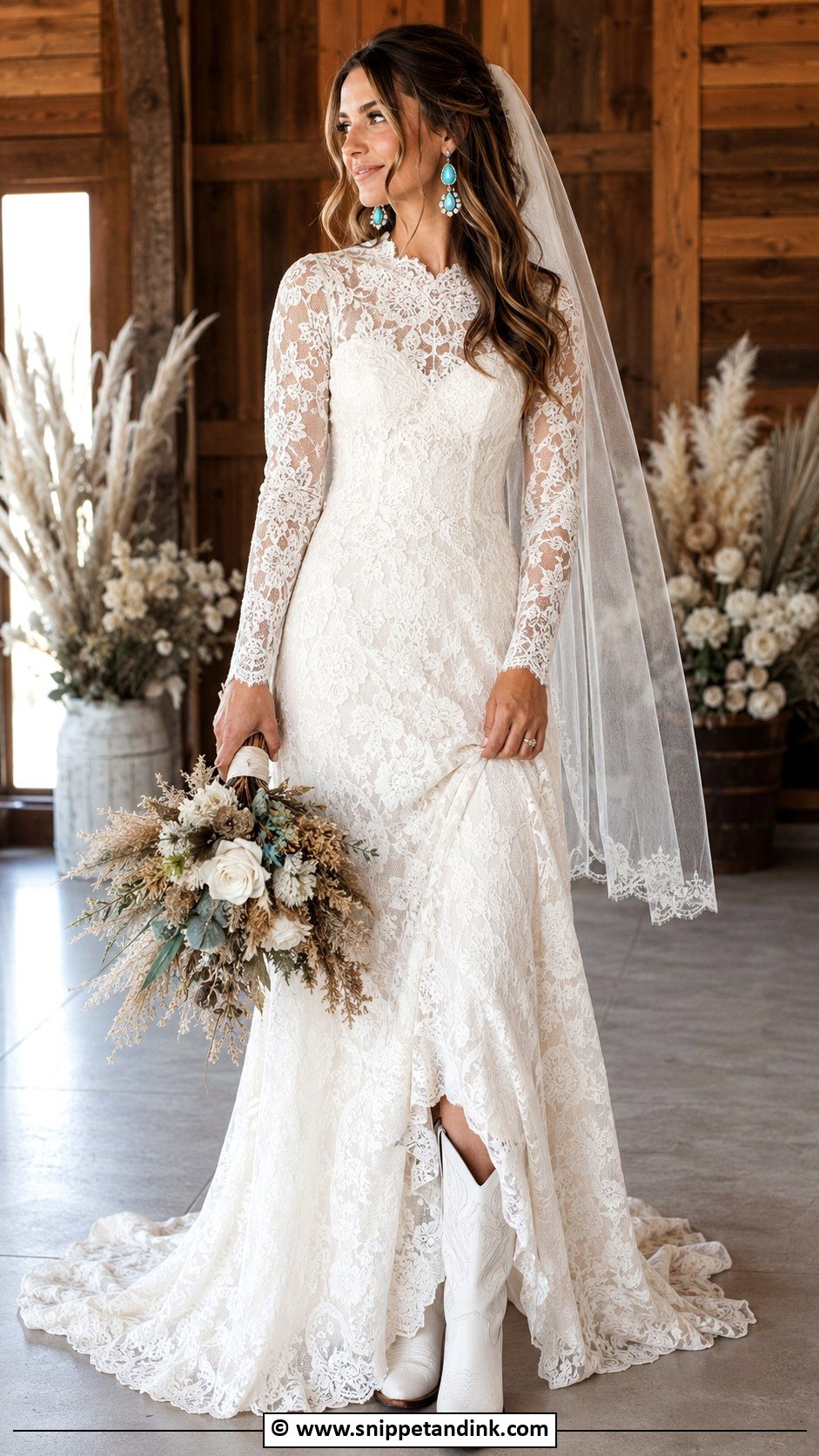
Sleeves change how a bride moves. Before I sign off on long lace sleeves, I ask her to hug someone and lift a glass, because fitted sleeves cut tight at the armhole pull the whole bodice up. A sheer lace sleeve with a slightly lowered armhole fixes most of that. For a cool-season ranch or a candlelit barn, I like ivory boots for a softer read or rich brown leather for tradition, plus a low bun and small turquoise studs. Keep the veil fingertip length so it doesn’t compete with sleeve detail.
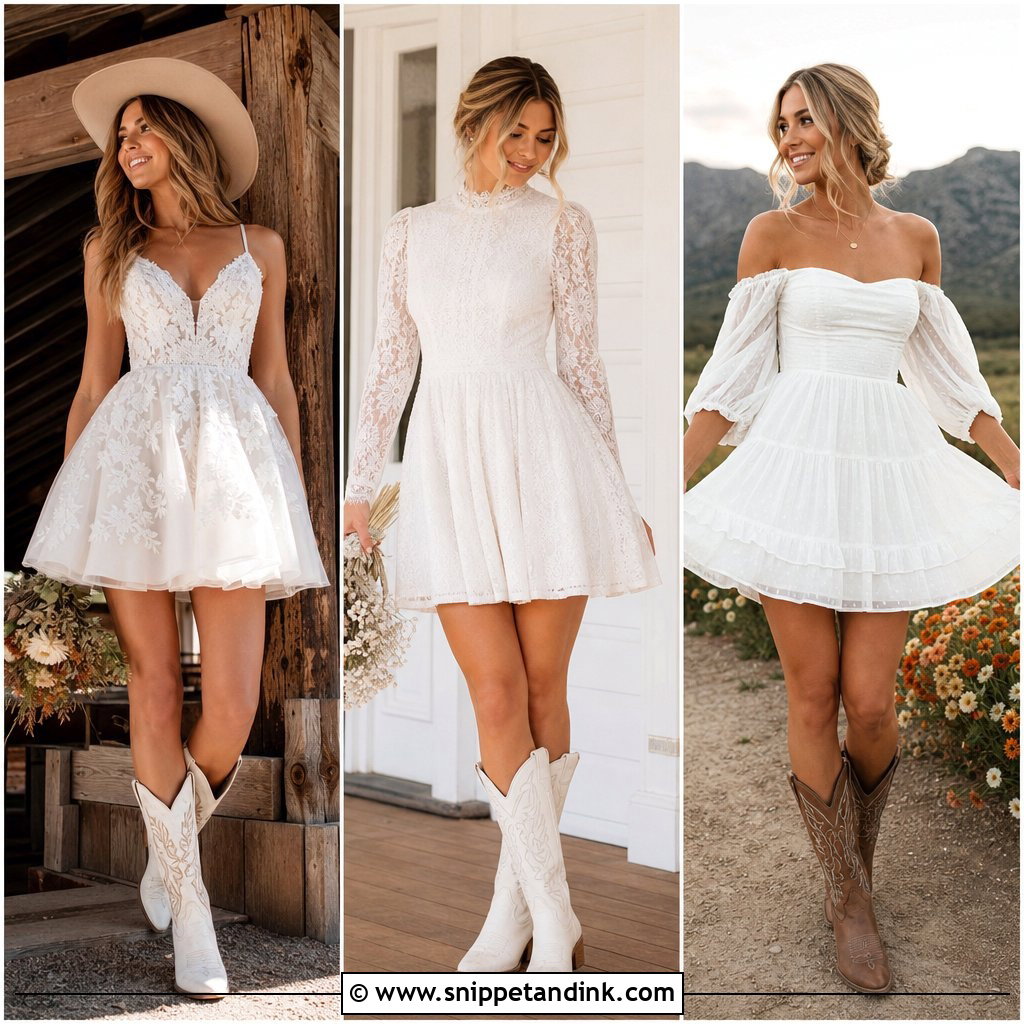
5. Short Cowgirl Wedding Dress With White Boots
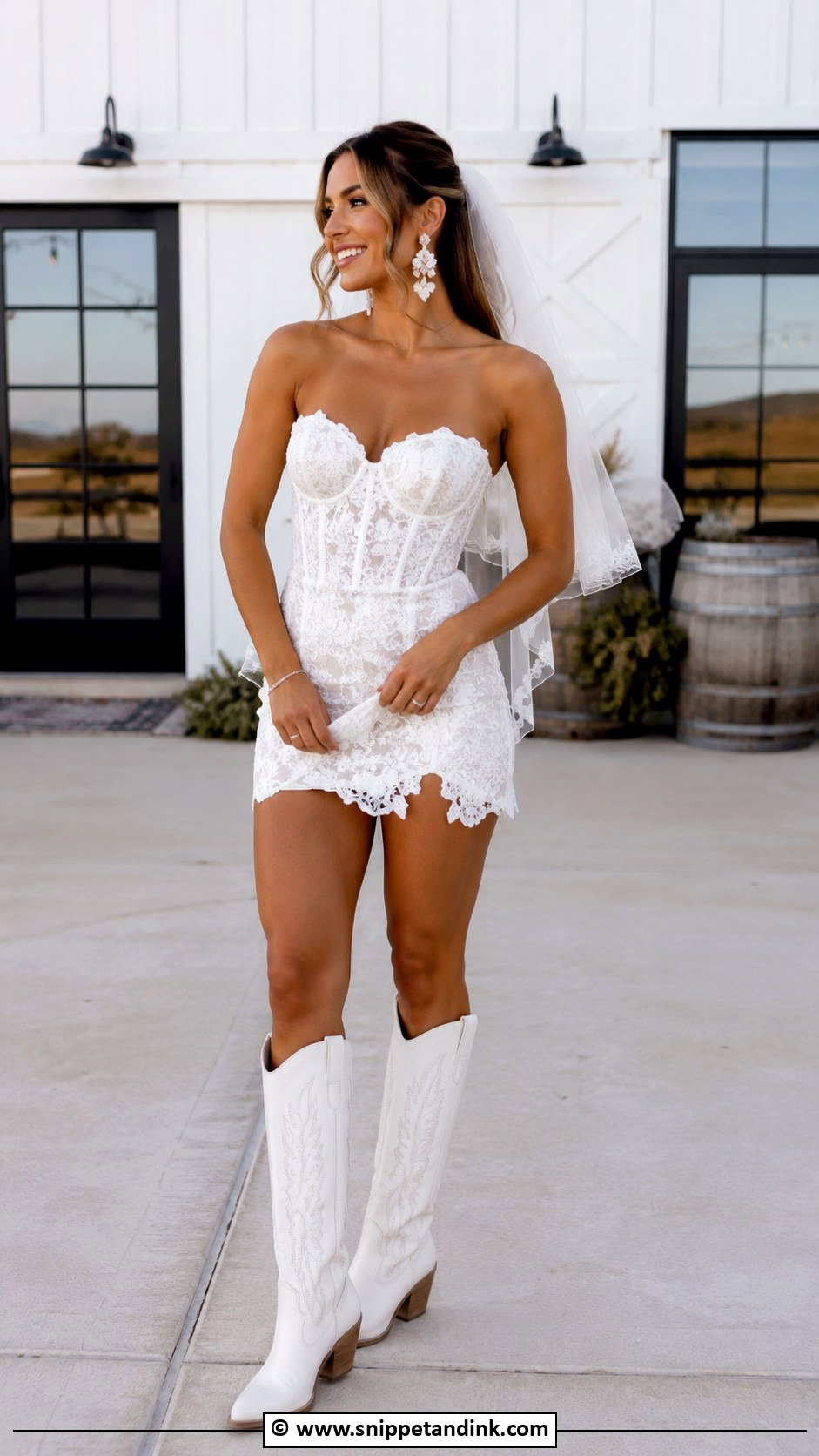
Short dresses put the boots in charge, so I spend more time on the boots than the dress. Where the hem ends against the boot shaft matters: a few inches of leg between them looks deliberate, while a hem that stops right at the boot top chops the leg in half. A structured bodice or a lace overlay keeps a mini from reading as a party dress. I’d pick this for a courthouse ceremony, a reception change or a hot day, and I’d add a small veil or a white hat so nobody mistakes the bride for a guest.
6. Satin Cowgirl Wedding Dress With Brown Boots
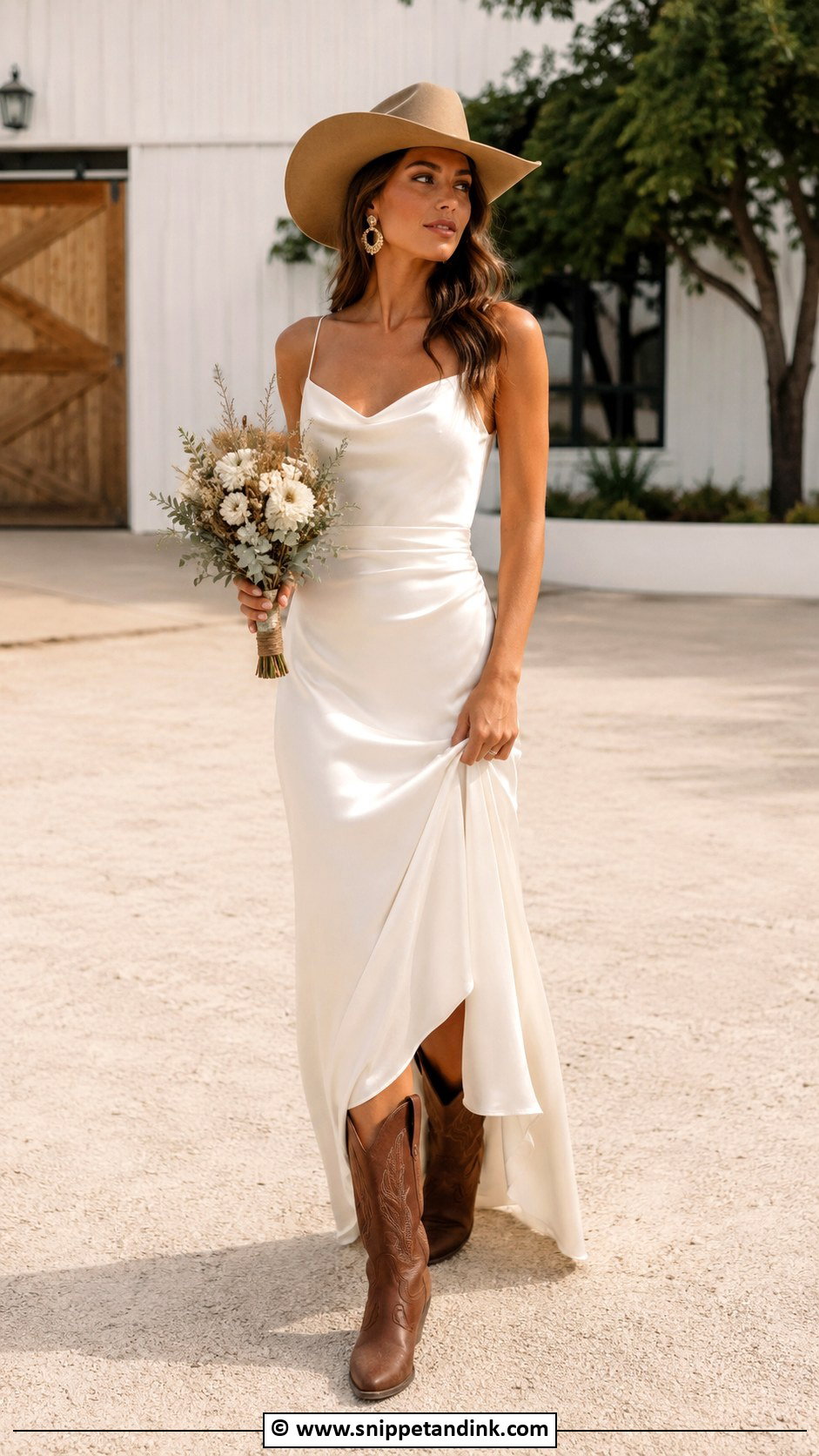
Satin and brown leather is the most grown-up pairing on this list, and it’s one I suggest when a bride wants boots but dislikes lace. The catch is satin itself. It creases where you sit, it shows sweat at the waist and underarm, and a matte heavy satin forgives far more than a high-shine one. I steam it on site rather than trusting it to travel flat. A tan hat, gold jewelry and one leather belt are plenty, since the sheen already does the decorating.
7. Tulle Cowgirl Wedding Dress With Cowboy Hat
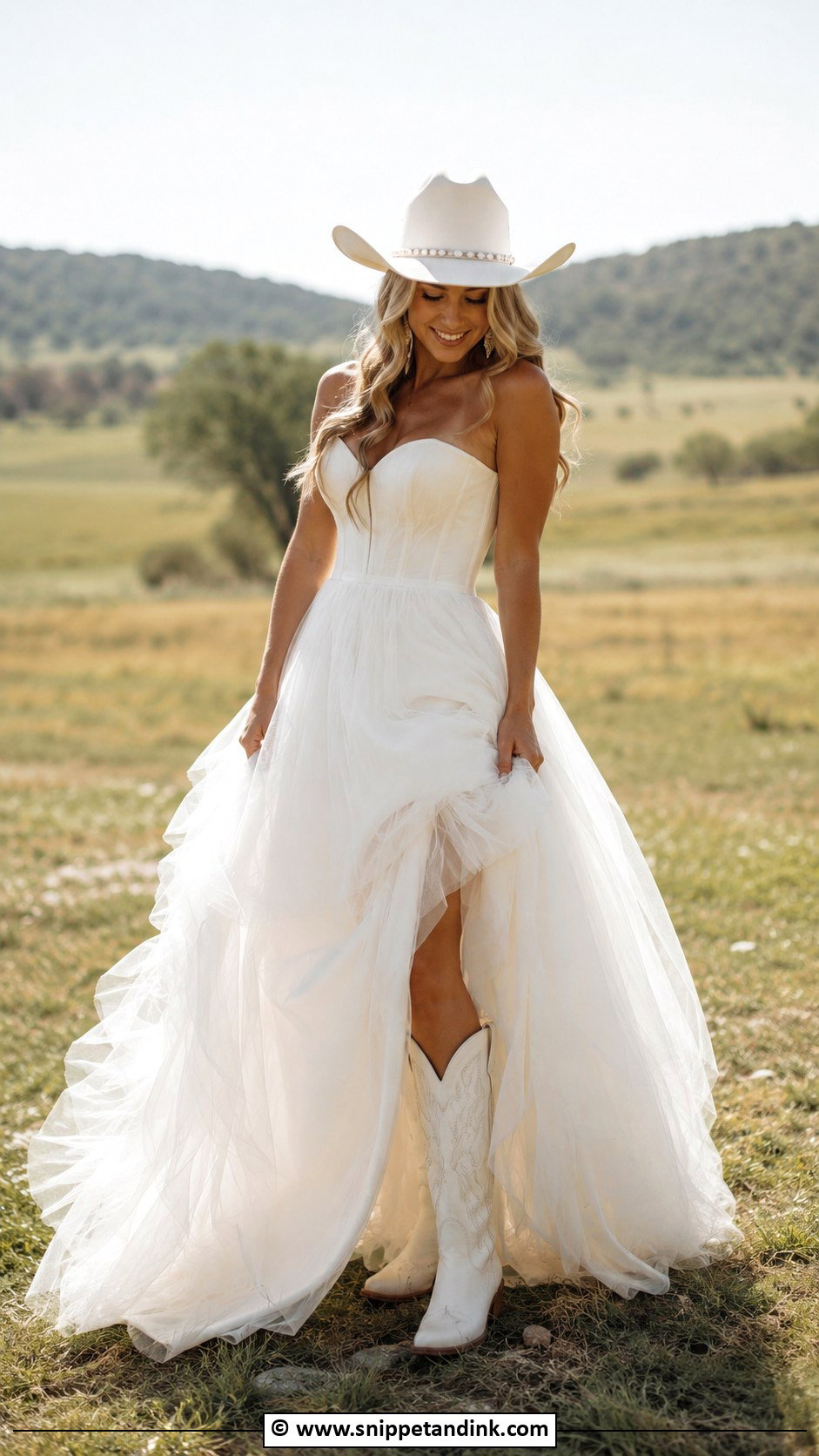
A full tulle skirt with a felt hat brings in two volumes at once, so I keep the bodice fitted and the jewelry small. The practical problem is the veil. You can’t pin a veil comb into a hat, so I place the comb low in the hair behind the crown and let the hat sit just in front of it, then check from the side that the brim doesn’t press the veil flat. Tulle also picks up burrs and dry grass, so carry a lint roller for golden-hour field photos.
8. Off Shoulder Cowgirl Wedding Dress
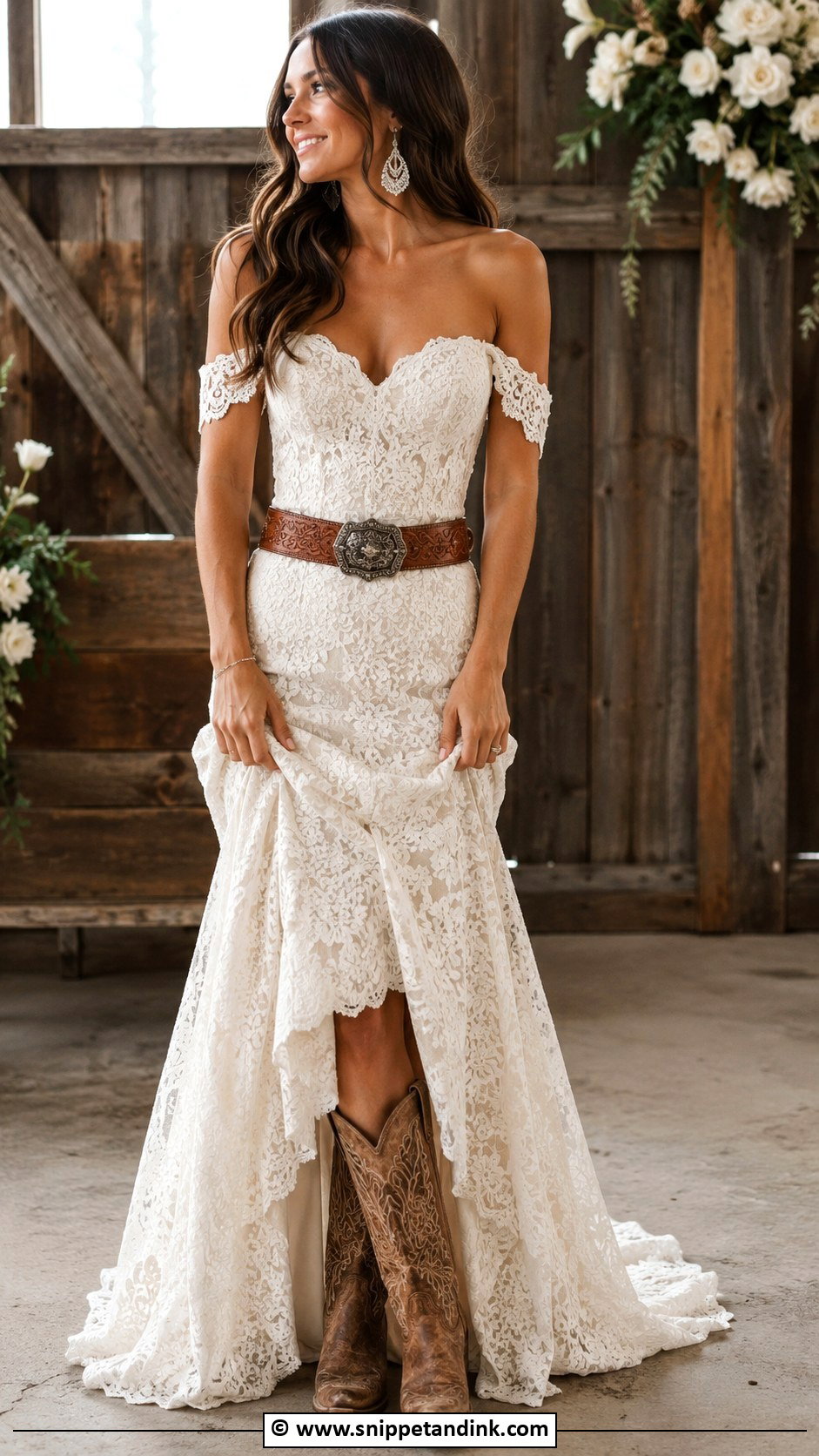
Off-shoulder necklines sit well on most frames, but they slide. Every time a bride lifts her arms, the band rides down unless it has boning or a silicone grip inside, and I ask for one before the final fitting. Lace, crepe and satin all work, depending on the season. With a fitted skirt I’d go for taller boots for a long line; with a fuller skirt, ankle boots keep the weight off the lower half. A tooled belt and plain silver finish it without crowding the collarbone.
9. Fitted Lace Cowgirl Wedding Dress
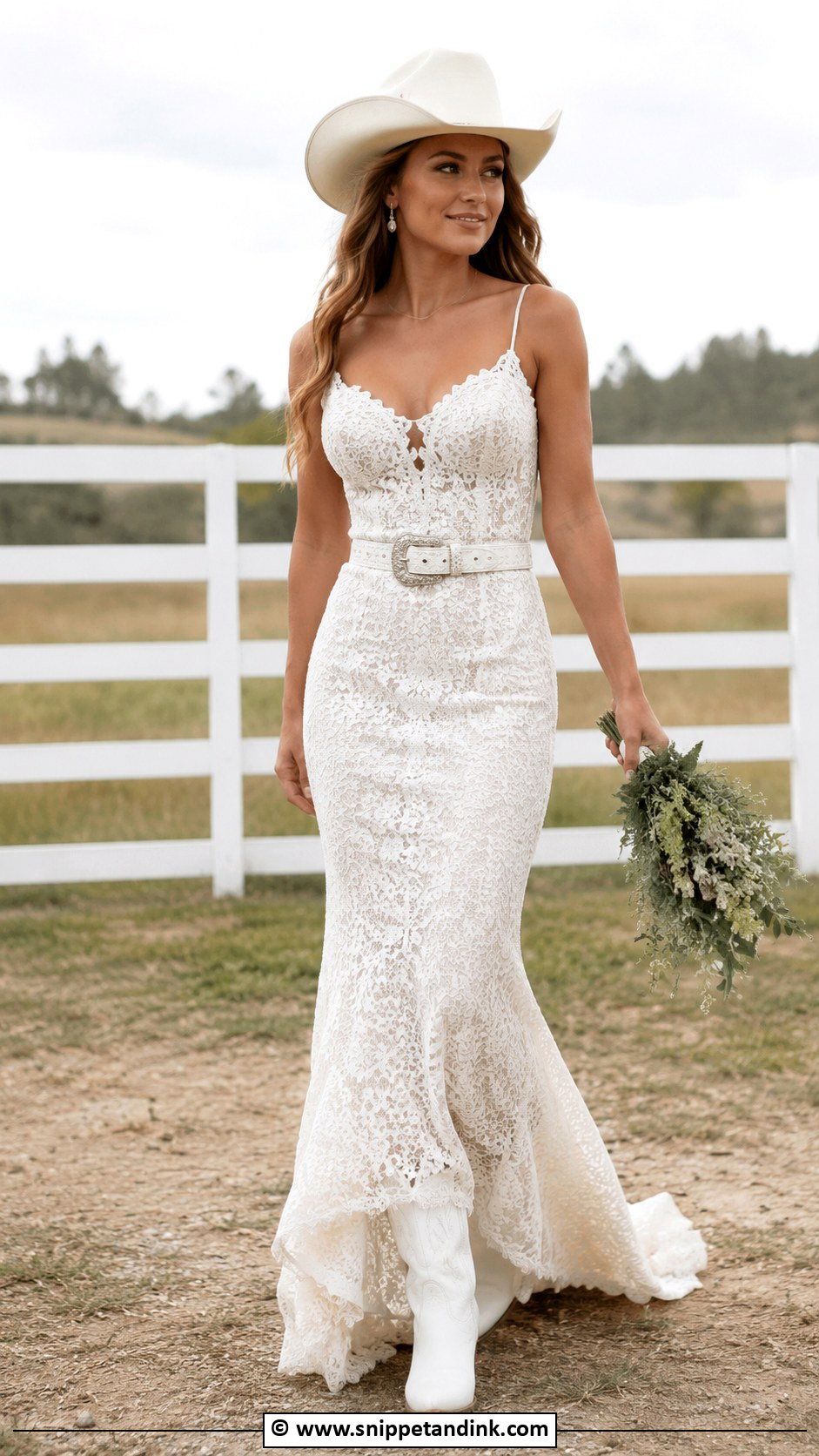
A fitted lace gown is the most modern route to a Western look, and it’s also the least forgiving with boots. A slim skirt shows every bend at the ankle, so I choose plain boots and check that the hem clears the toe when she walks, not only when she stands still. The lining colour matters more than the lace. A nude lining makes ivory lace read lighter against warm skin, while a white lining can look stark in sun. A narrow belt with a subtle buckle and small drops are all it needs.
10. Prairie Cowgirl Wedding Dress
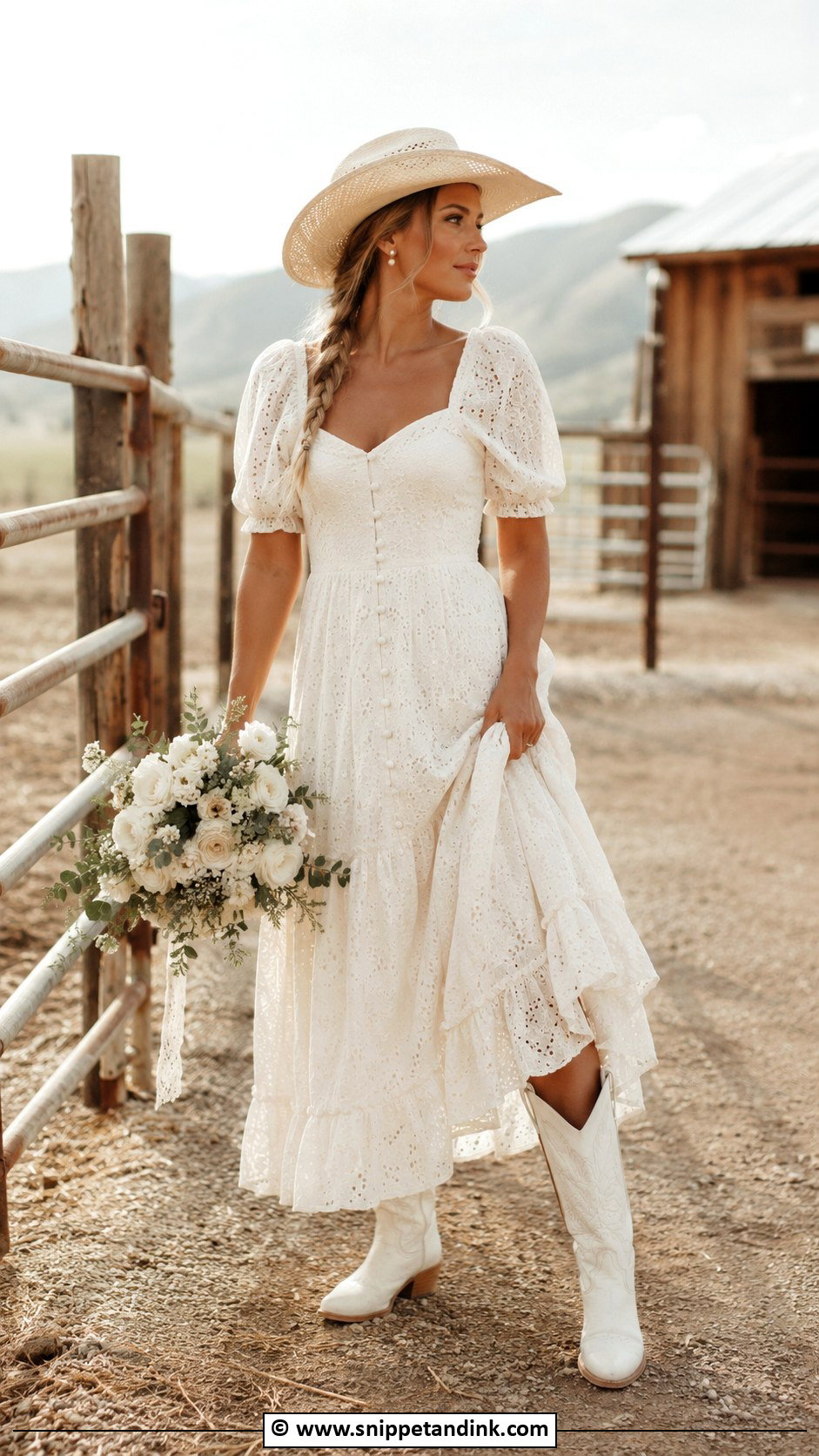
Prairie dresses have the thinnest line between bridal and costume, and fabric quality is what keeps you on the right side of it. Cheap cotton eyelet wrinkles badly in a hot car and looks limp by evening, while a heavier cotton lace or a crisp cotton voile holds its tiers. I steam prairie gowns after the drive, not before. Puff sleeves, button fronts and a high neckline carry the look, so the rest stays plain: cream boots, a woven hat, pearl studs and a loose braid suit small ranch elopements best.
11. Denim Jacket Cowgirl Wedding Dress
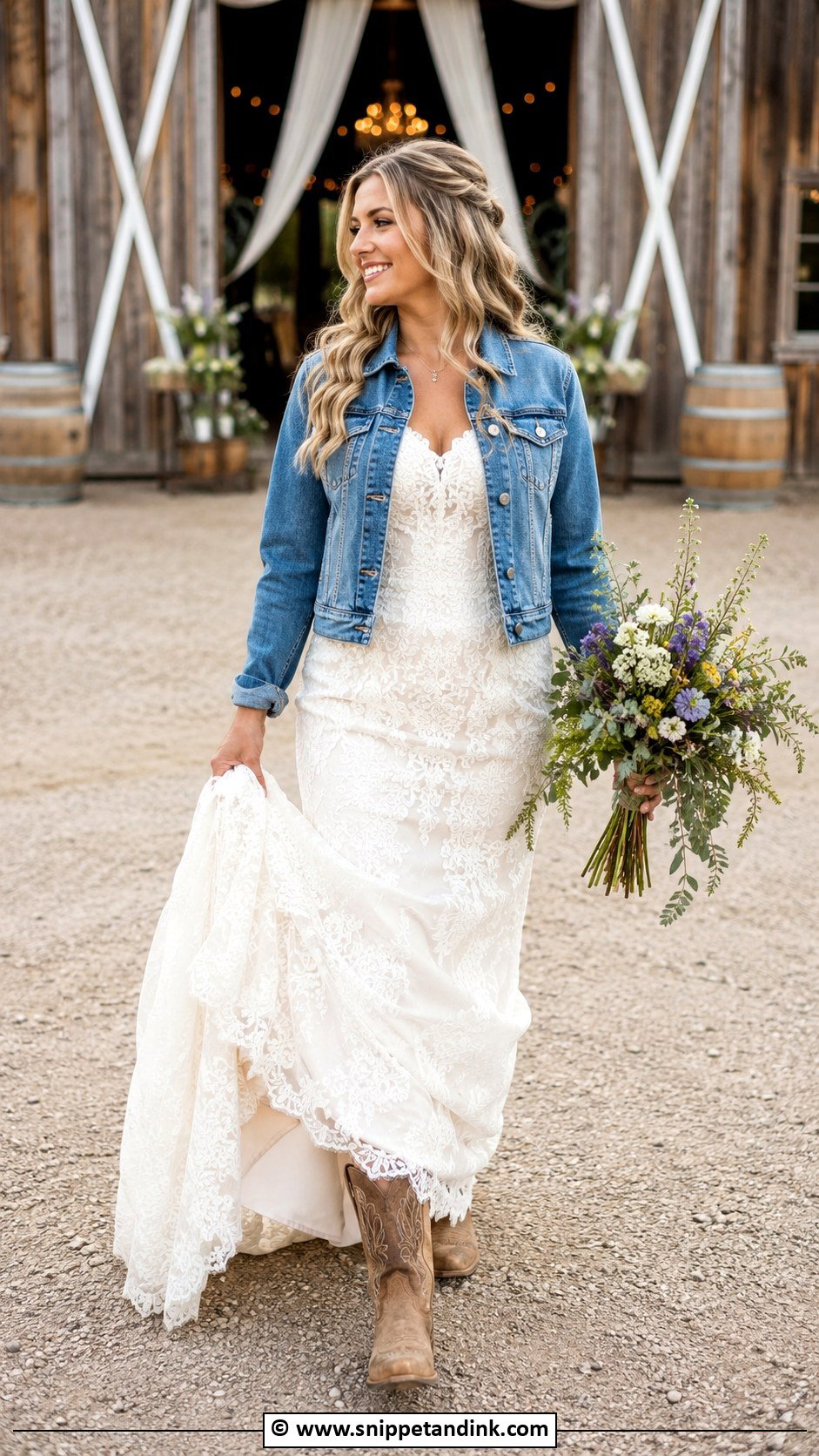
Denim over a bridal gown has one risk most brides don’t know about. Dark indigo can rub off onto ivory fabric where the jacket touches the dress, especially if you get warm. I always ask for a pre-washed jacket, or white denim, and I wipe the inside cuffs with a white cloth before the wedding to test for transfer. A cropped denim jacket keeps the waist visible, which full-length denim hides completely. An embroidered back with your date or initials makes it personal without adding weight to the outfit.
12. Western Belt Cowgirl Wedding Dress
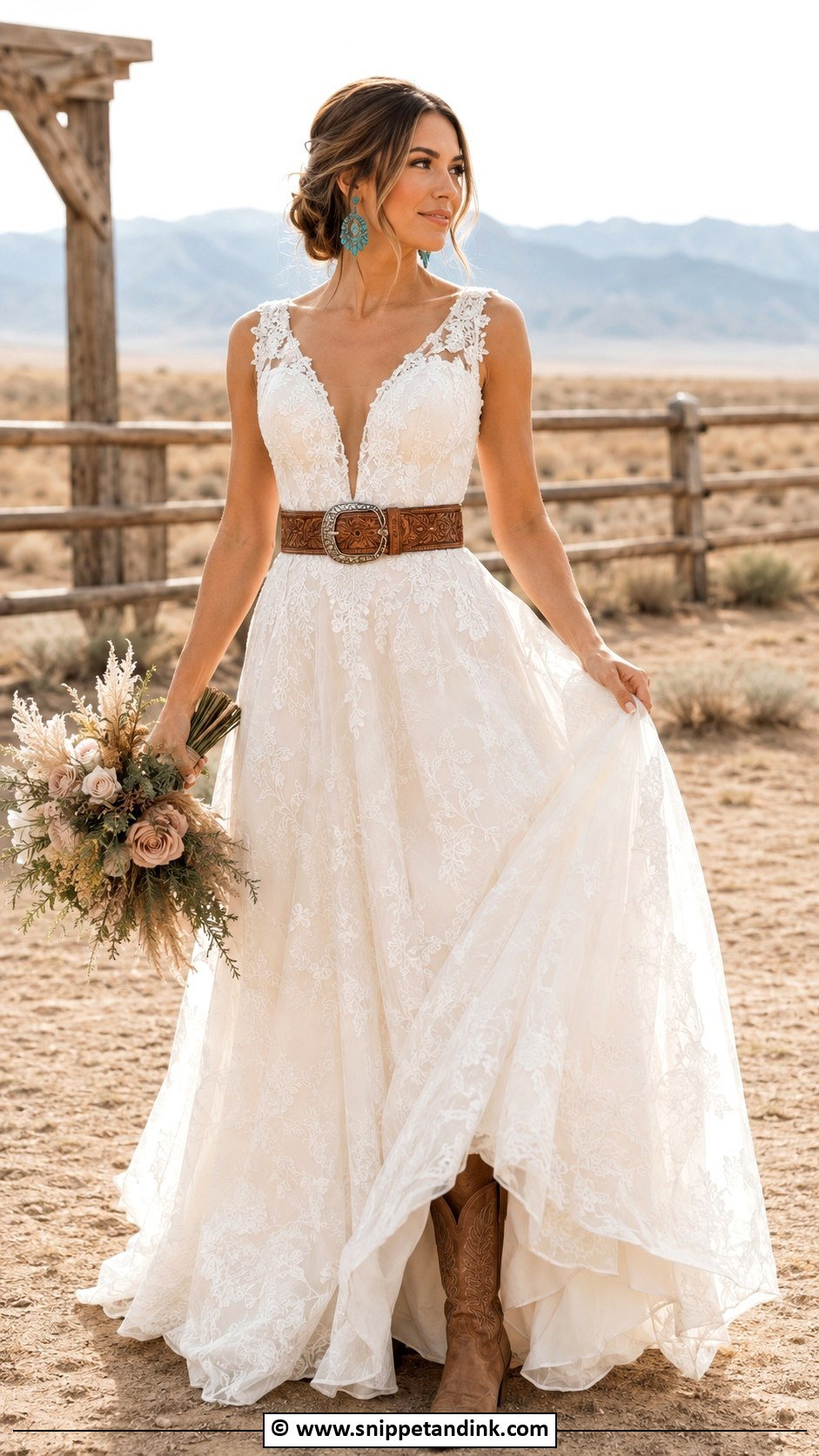
A belt is the cheapest way to turn a plain gown into a Western outfit. It also moves: leather rides up when you sit and a heavy buckle tilts forward on a soft fabric, so I add two small thread belt loops at the side seams to hold it level. Tooled leather, concho styles and slim ivory belts with subtle hardware all work on A-line, slip, sheath and prairie shapes. Match your metals once. Silver hardware with turquoise jewelry, or brown leather with tan boots, keeps the whole thing reading as planned.
13. Embroidered Cowgirl Wedding Dress
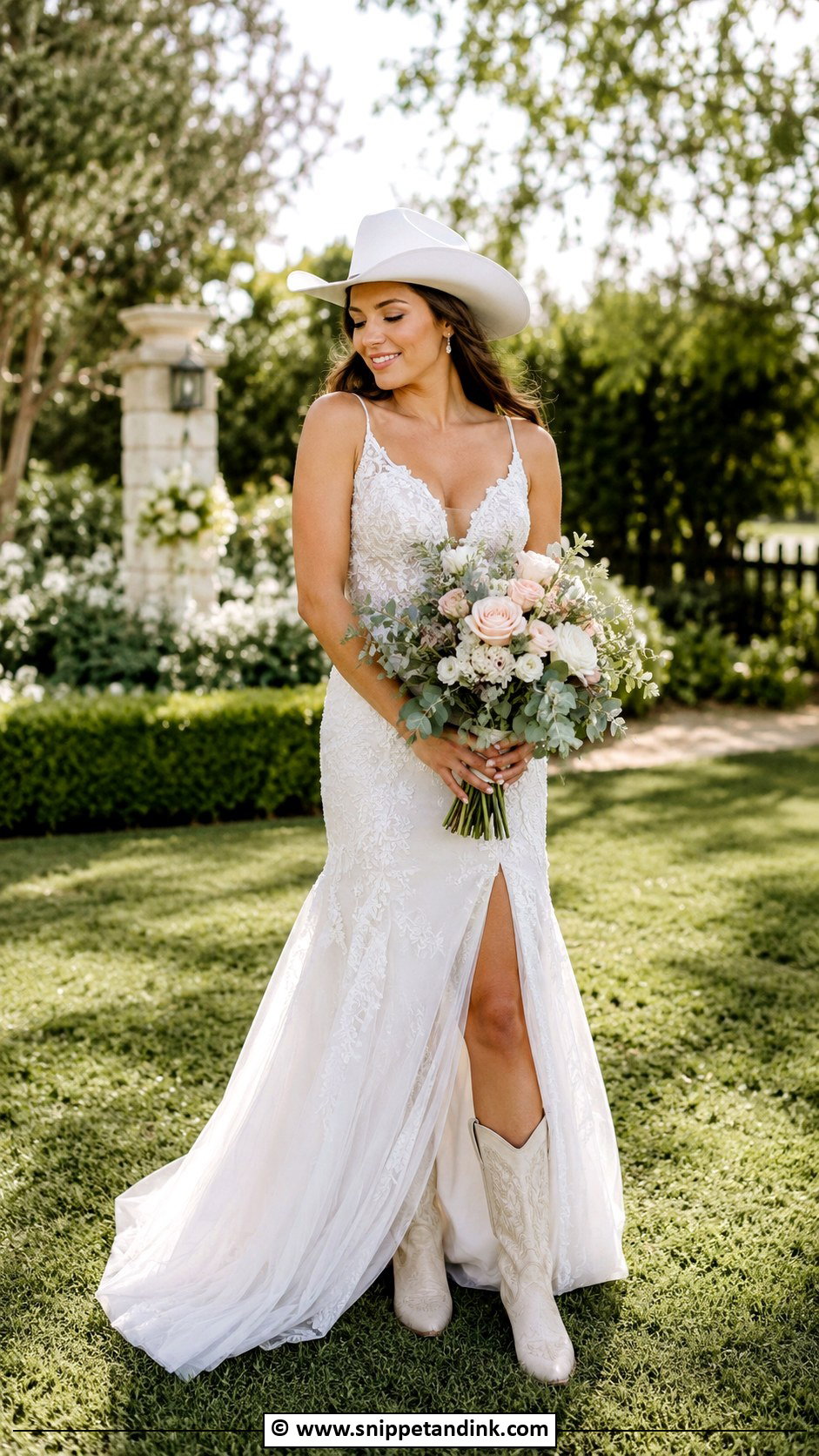
Embroidery carries its own colour, so I choose boots last on these gowns. White-on-white floral work keeps it classic. Blush, sage, champagne or a soft blue thread brings in gentle colour, and that’s when a busy boot starts fighting the bodice. Check embroidery for loose threads around the hips, where a belt or bouquet rubs most. I’d keep the hat plain and the earrings small and let the stitching be the one thing guests remember.
14. Plus Size Cowgirl Wedding Dress
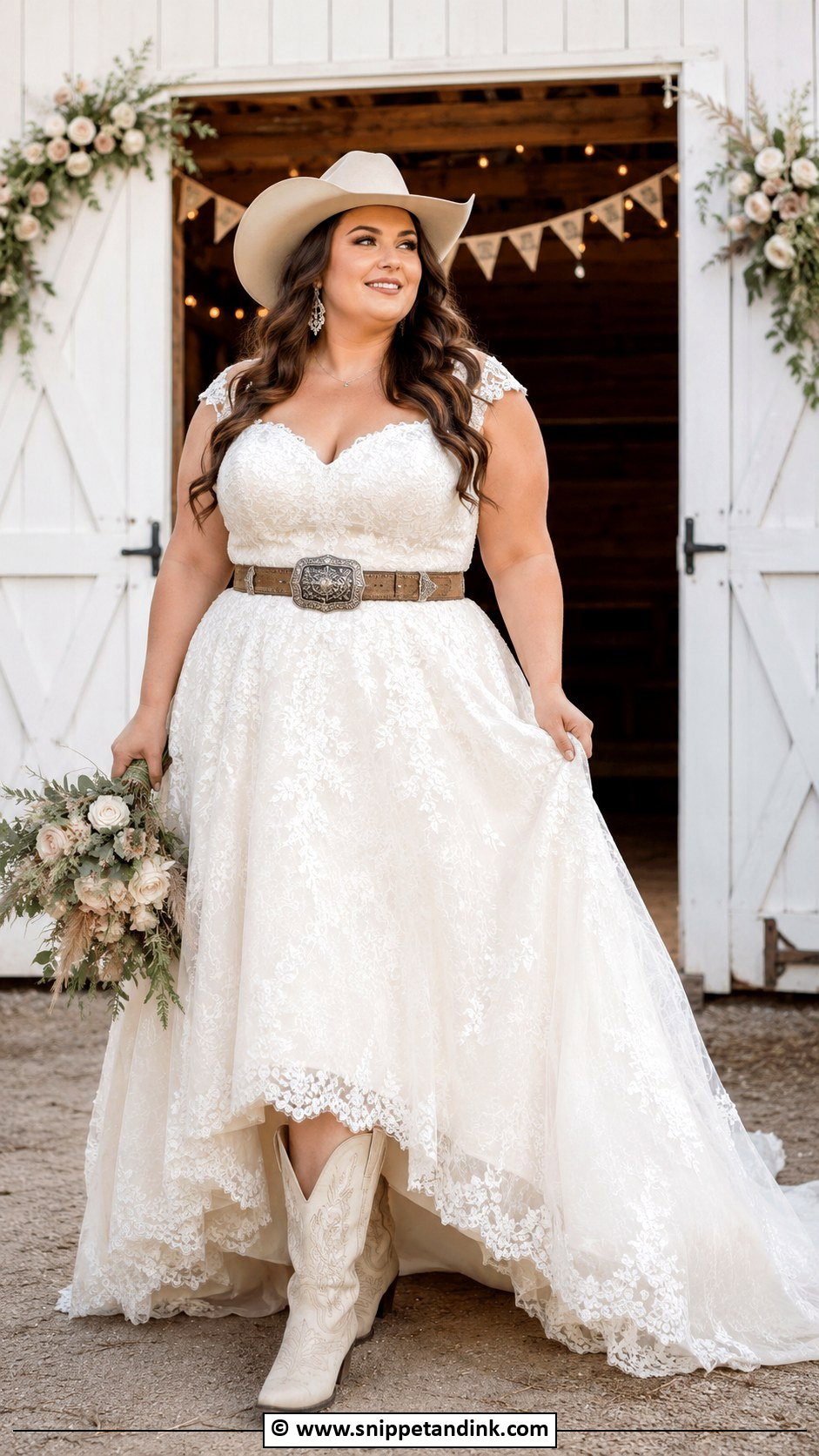
Support comes first for curvy brides, and I build Western styling around it rather than the other way round. A corset back, a wrap bodice or a structured A-line gives shape where you want it, and soft lace sleeves give movement. The boot is where I see the most trouble. Standard Western shafts are cut narrow, so look for wide-calf boots early, because many stores don’t carry them in white or ivory. A block heel is steadier on grass and gravel than a fashion stacked heel, and you’ll be standing for hours.
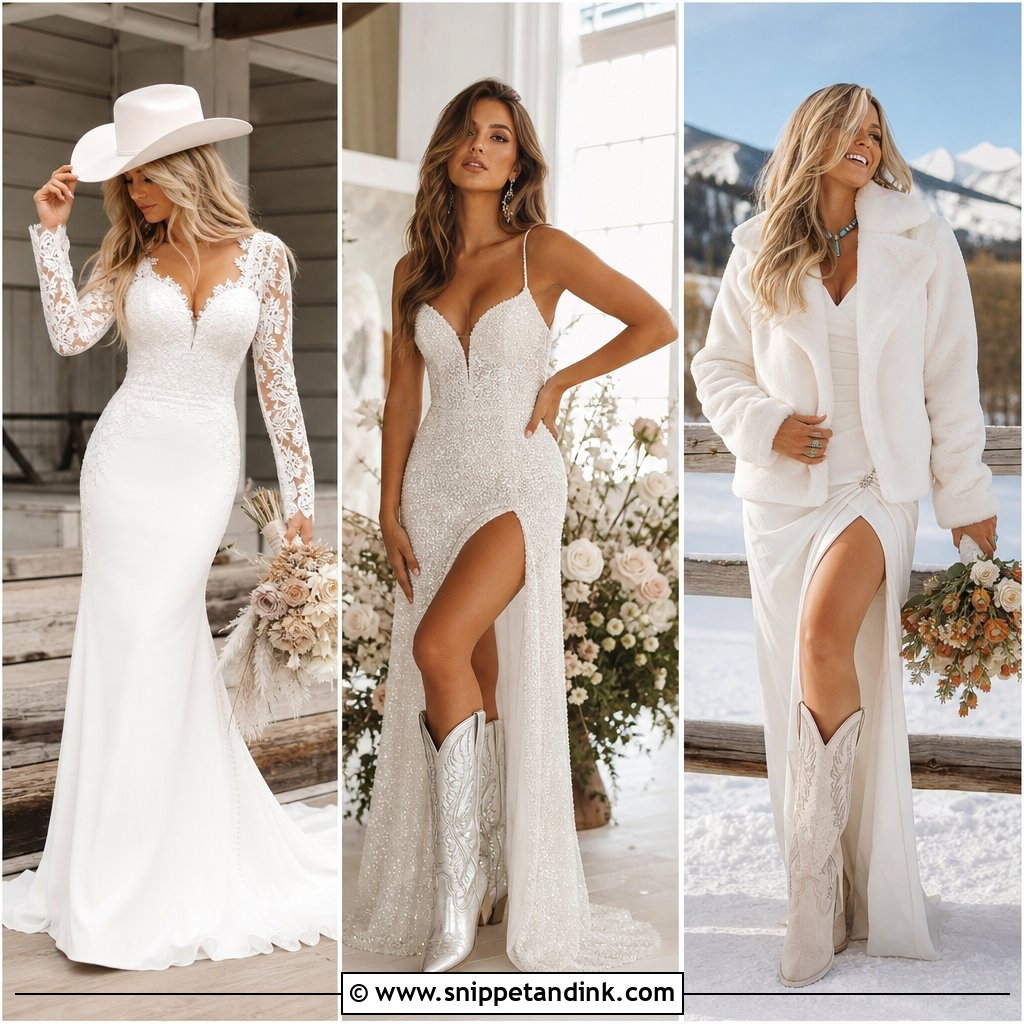
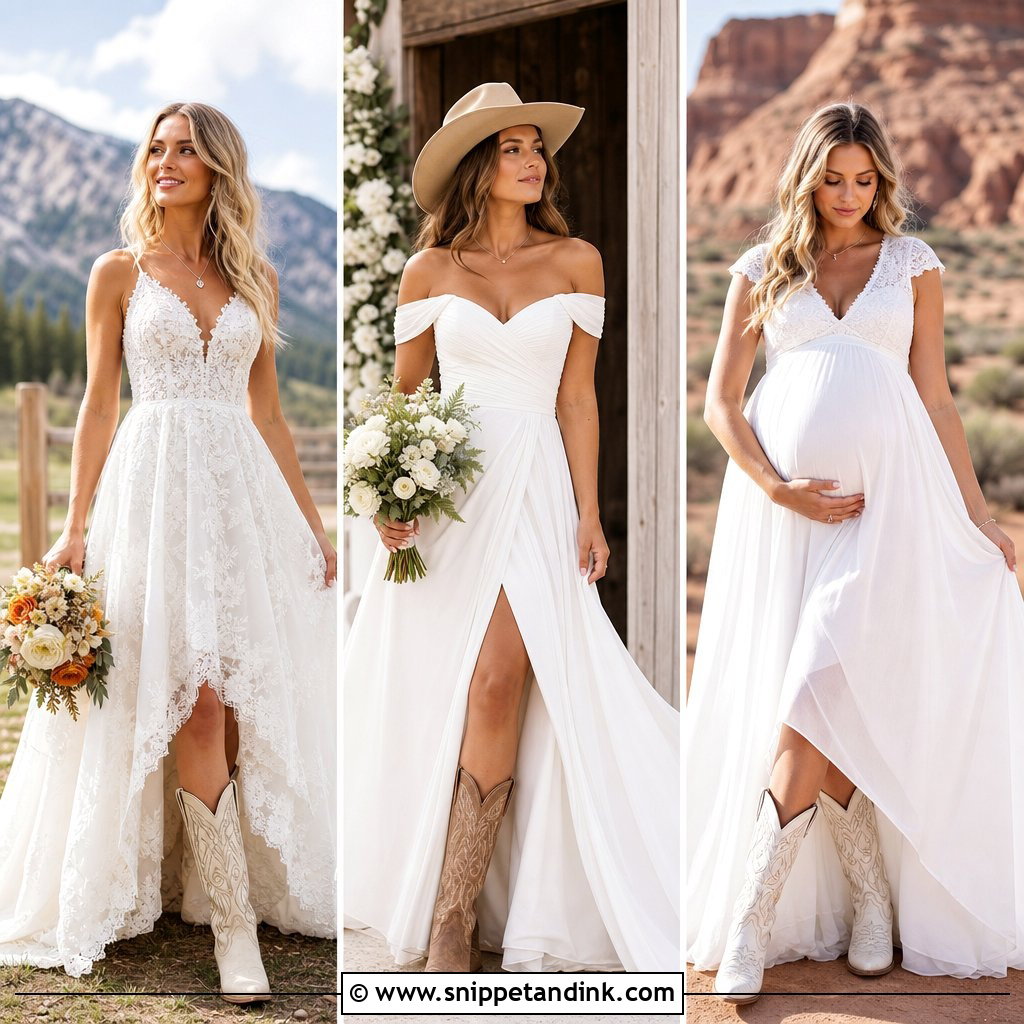
15. Simple Cowgirl Wedding Dress
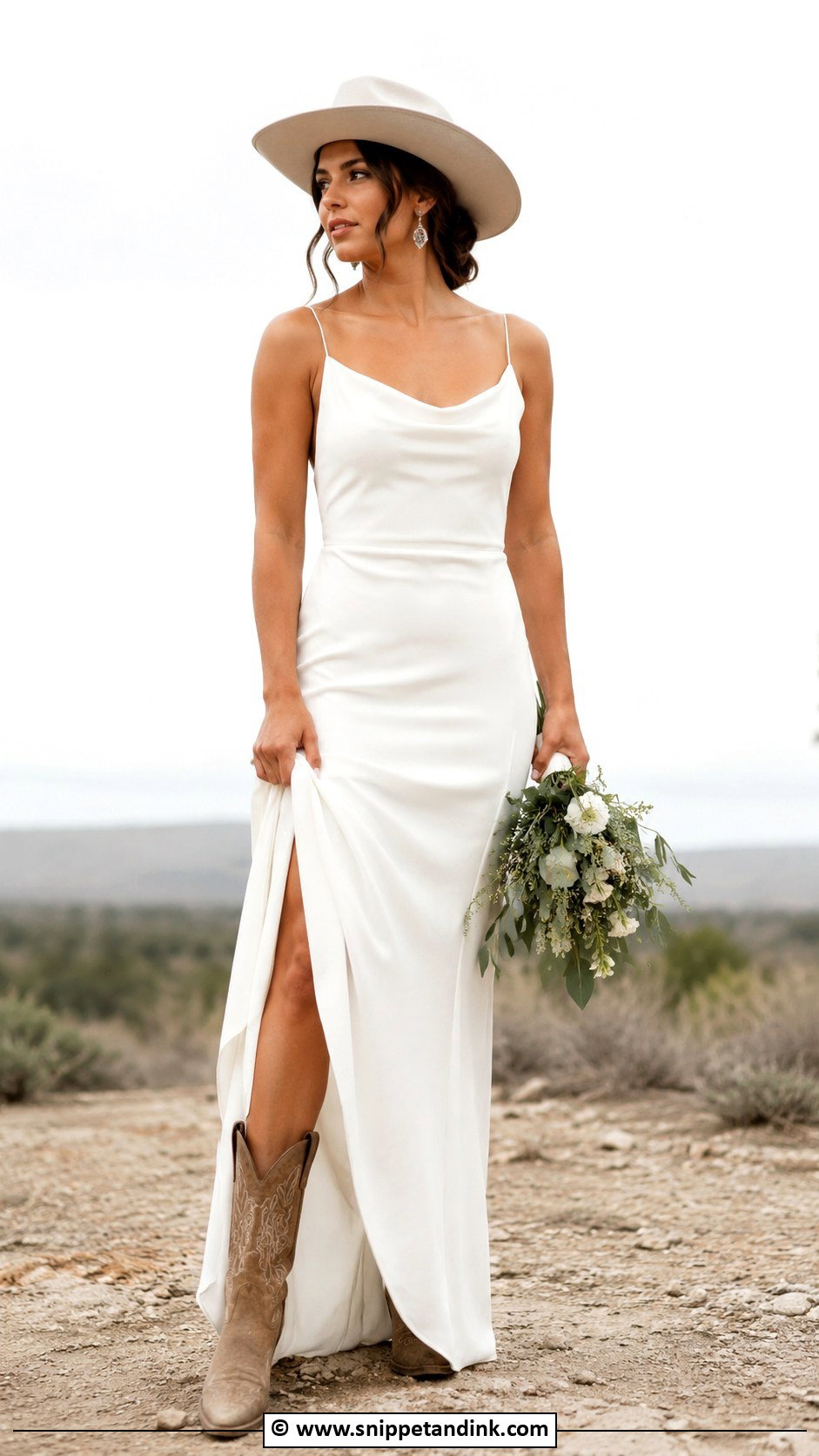
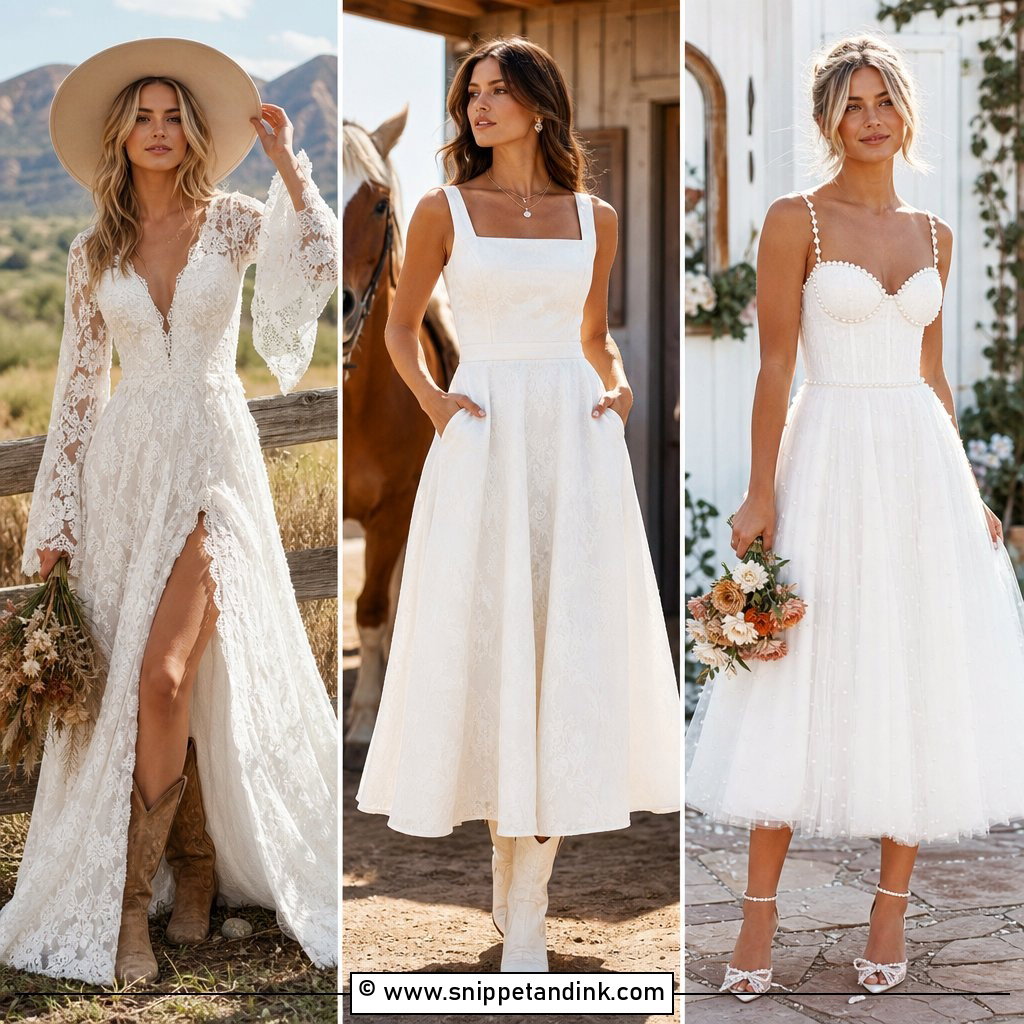
With a plain crepe, slip or chiffon dress, the tailoring is the outfit. I’d put most of the budget into alterations: a hem cut exactly to the boot heel and a bodice that doesn’t shift when you sit. Then add one Western piece with some character, like a silver belt or turquoise earrings, with white or tan boots and a felt hat. Walk the length of a room in the dress and boots before the final hem is cut. Intimate ranch weddings and elopements suit this look best.
16. Sparkle Cowgirl Wedding Dress
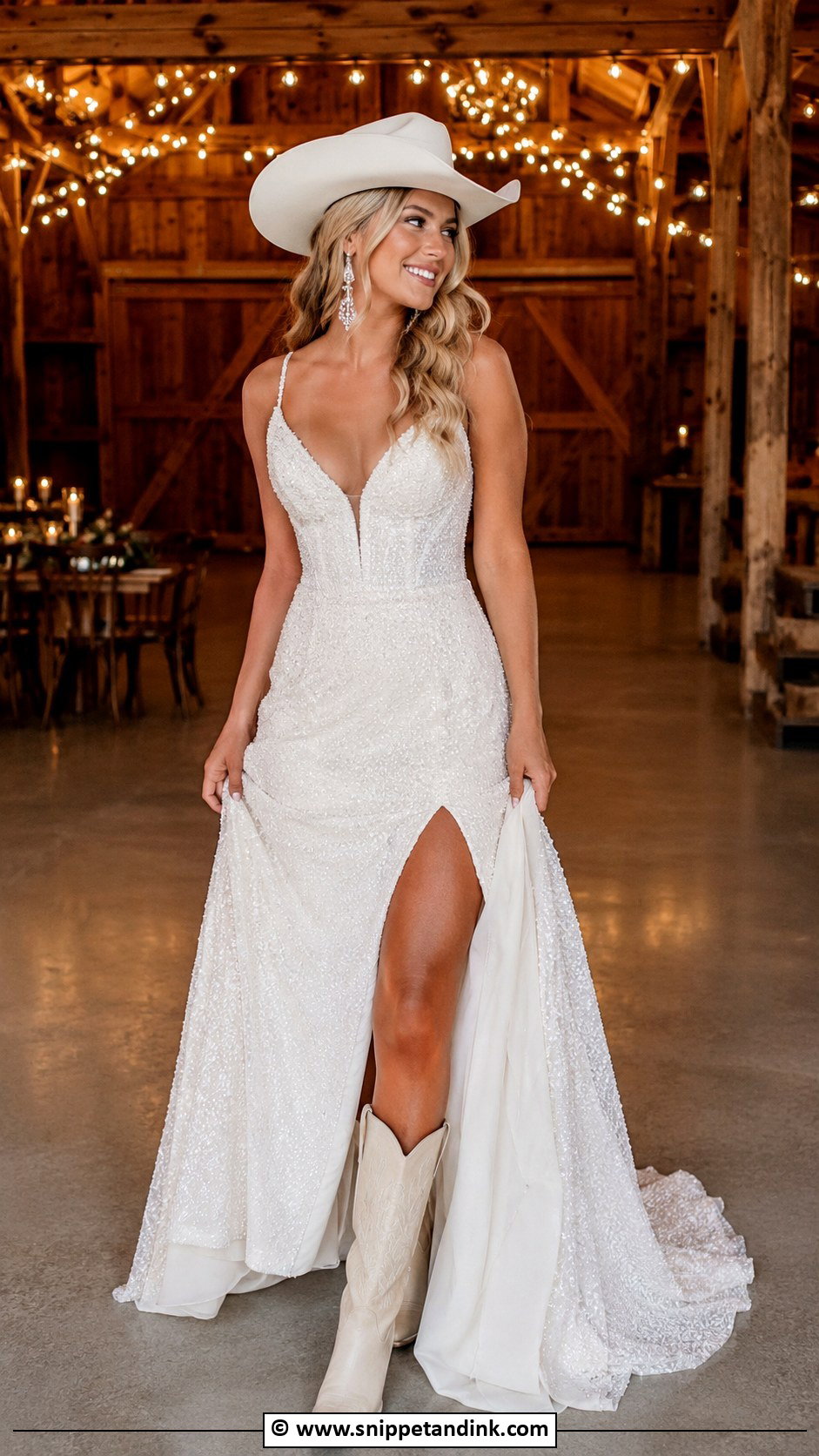
Beading and boots can work together if only one of them shines. If the bodice is sequinned or the tulle has shimmer, I pull the boots back to plain white, ivory or tan leather. Two practical notes from fittings: heavy beading makes a dress noticeably warmer, and sequins on the inner arm scratch through a long evening. Ask for beading to stop short of the underarm. String-lit barns and evening receptions are where sparkle actually reads, because daylight flattens it.
17. Two Piece Cowgirl Wedding Dress
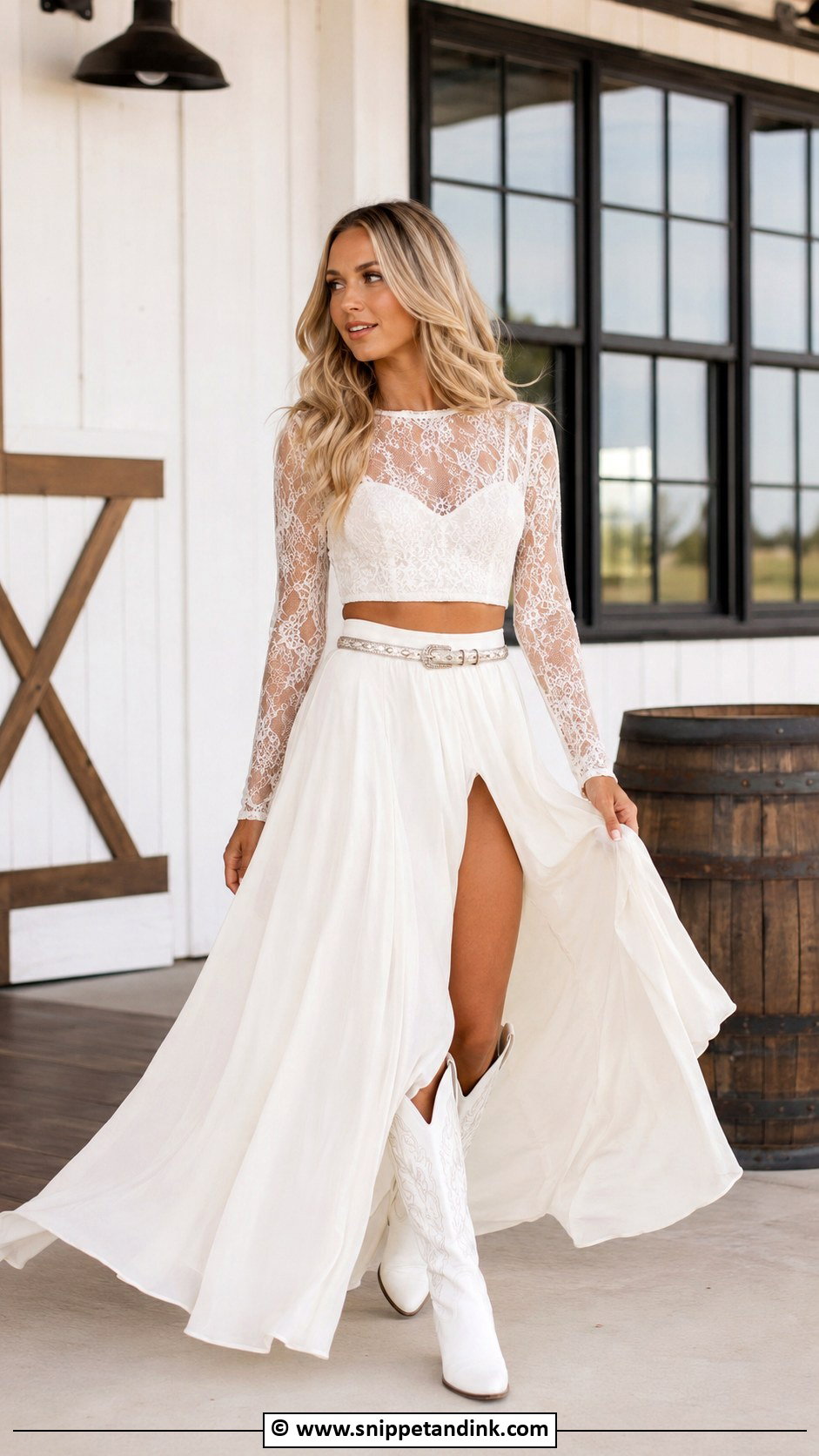
Separates fit more body shapes off the rack, which is why I like a two piece cowgirl wedding dress for brides who fall between sizes. A lace crop with a high-waisted skirt, or a long-sleeve top with a plain bridal skirt, both work. Decide in advance how much midriff shows when you lift your arms, since crop tops ride up at the first dance. Tie the halves together with a belt or the hat, and choose boot height to suit the skirt length. Swapping to a shorter skirt for the reception is easy.
18. Tea Length Cowgirl Wedding Dress
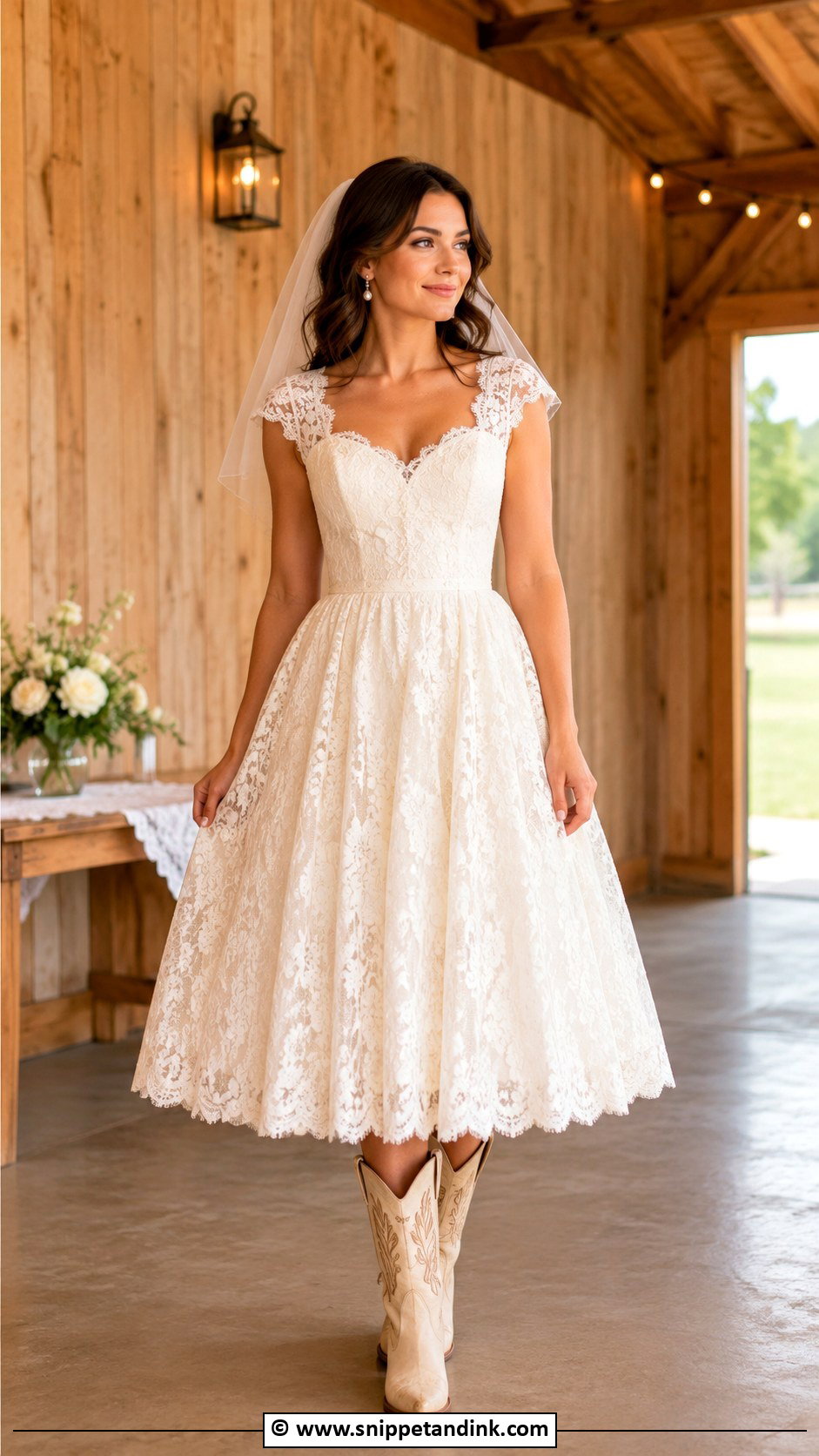
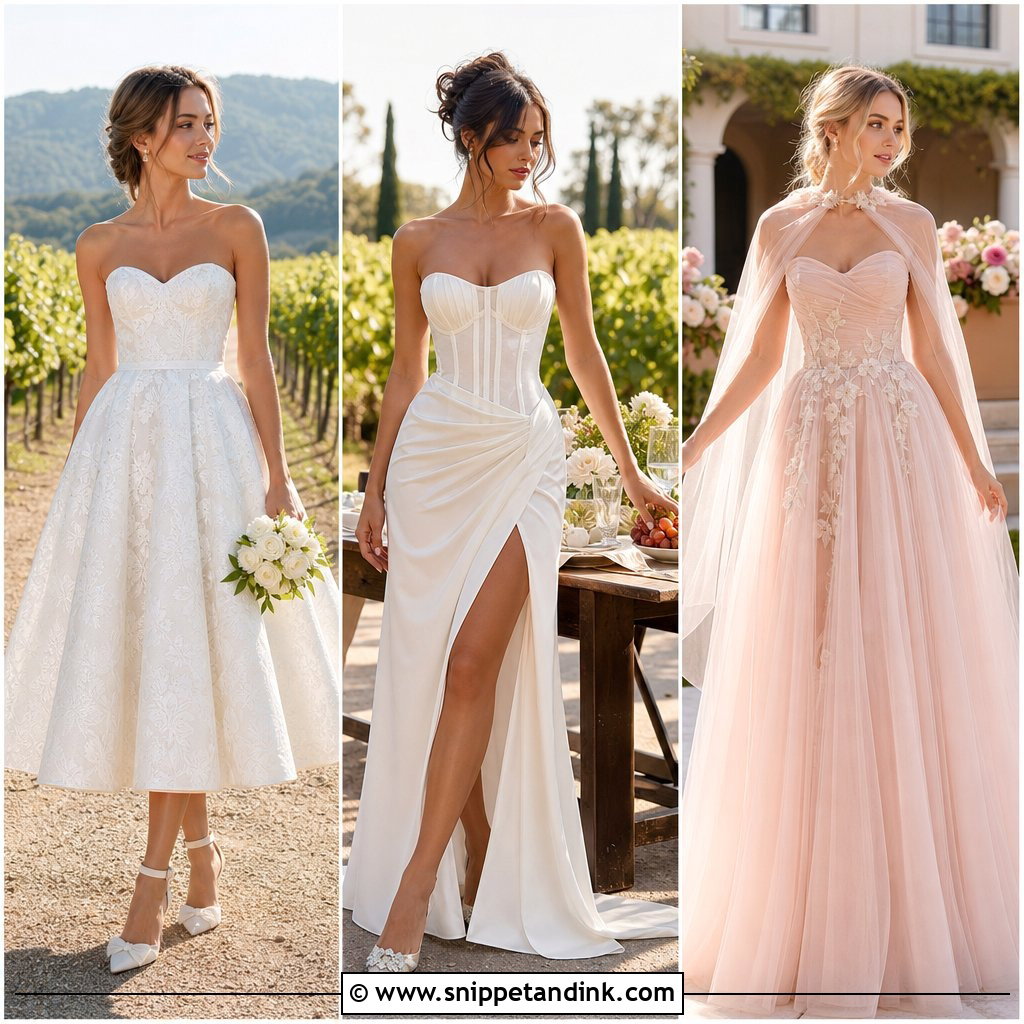
Tea length sits between the knee and ankle, so the boot top and the hem end up close to each other, and that’s the measurement I fuss over. Leave a clear gap of leg, or let the hem fully cover the boot shaft; a hem that grazes the top of the boot looks like an alteration went wrong. Lace reads romantic, satin reads polished and tulle softens it. Embroidered boots, pearls and a short veil give it a retro feel, and the hem stays out of the mud at barn receptions.
19. Ball Gown Cowgirl Wedding Dress
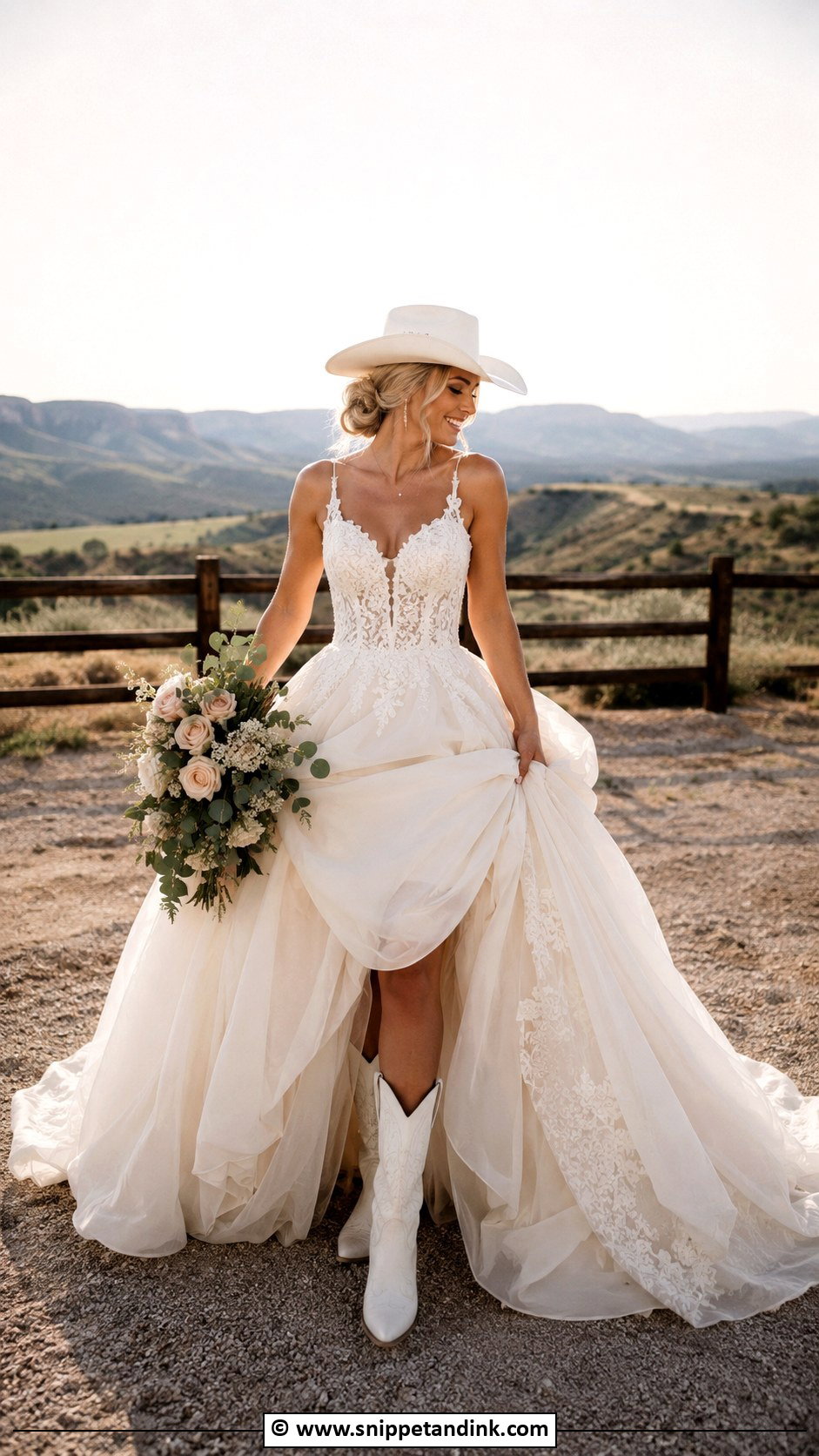
Ball gowns hide boots for most of the day, so comfort beats decoration here. Choose a pair you can stand in for eight hours, because guests will only see them when you lift the skirt on steps. I check one thing at the fitting: a stiff petticoat can catch on a boot’s heel counter, so the crinoline sometimes needs to stop a little higher at the back. A lace overlay or a fitted bodice keeps the volume bridal. A white hat for portraits and a veil for the ceremony both suit large barns and estates.
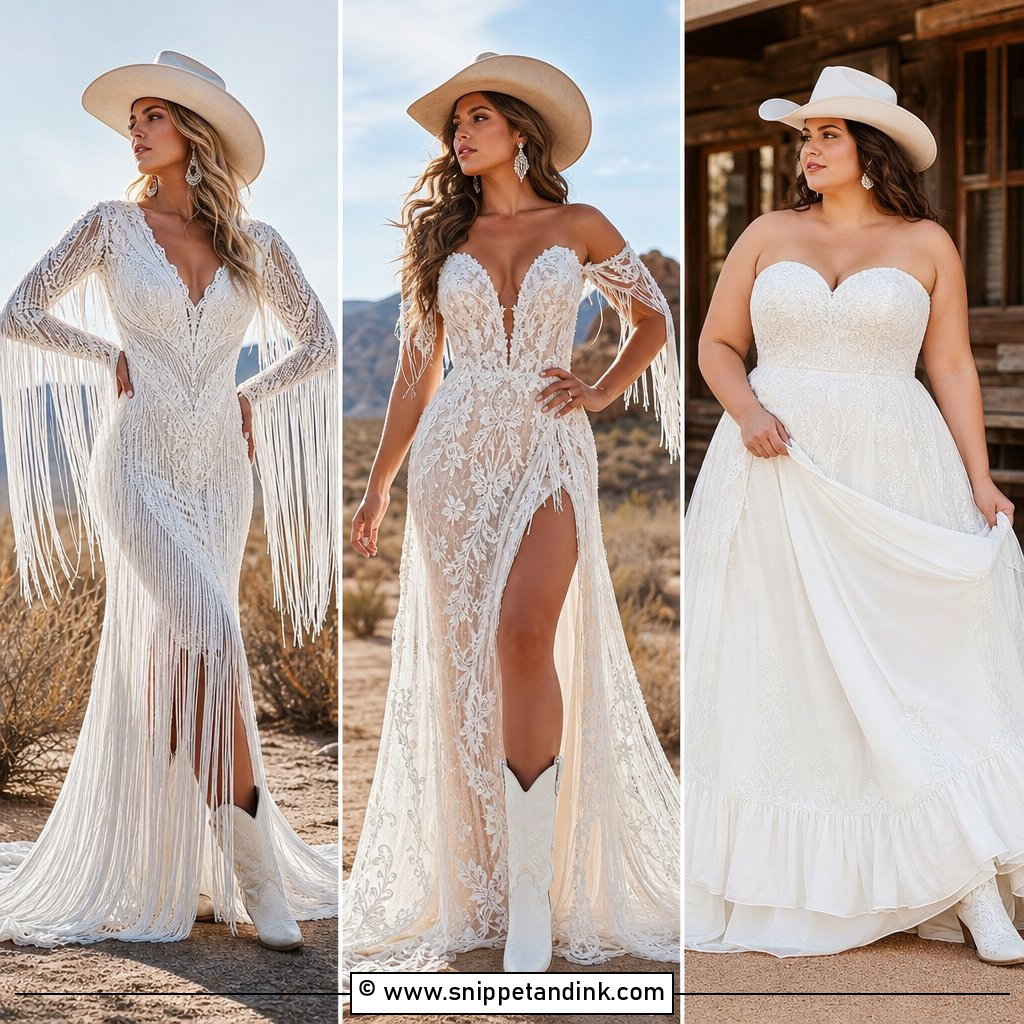
20. Mermaid Cowgirl Wedding Dress
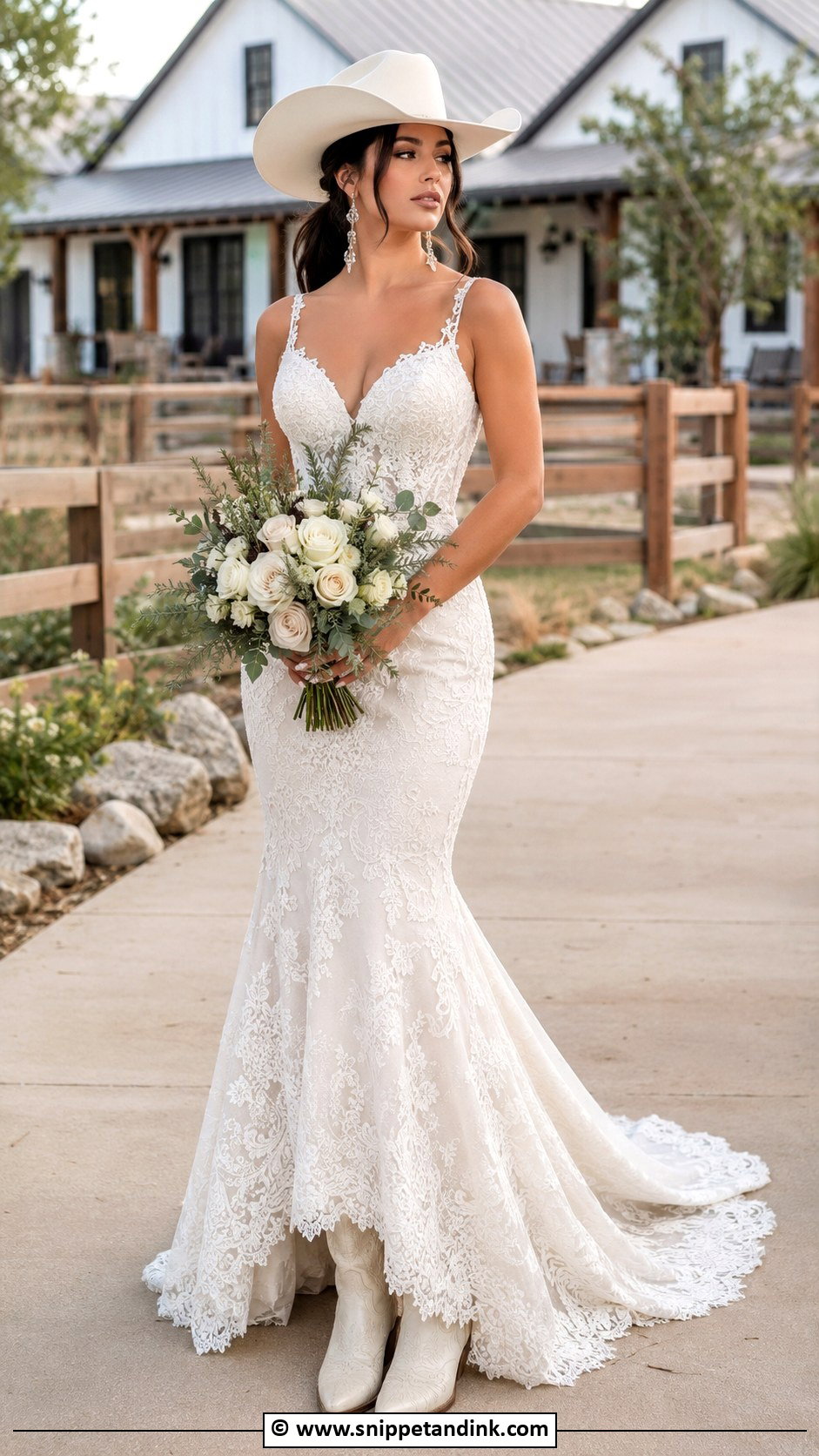
Mermaid gowns and cowboy boots need a walking test before you buy. The flare starts at or below the knee, which restricts stride, and boots add weight to every step, so I have brides climb a set of stairs in both. If that feels tight, a trumpet cut with the flare starting higher gives similar drama with far more ease. Ivory or soft tan boots in a sleek toe suit the silhouette. A low ponytail, silver earrings and a fitted hat keep the attention on the shape.
21. Chiffon Cowgirl Wedding Dress
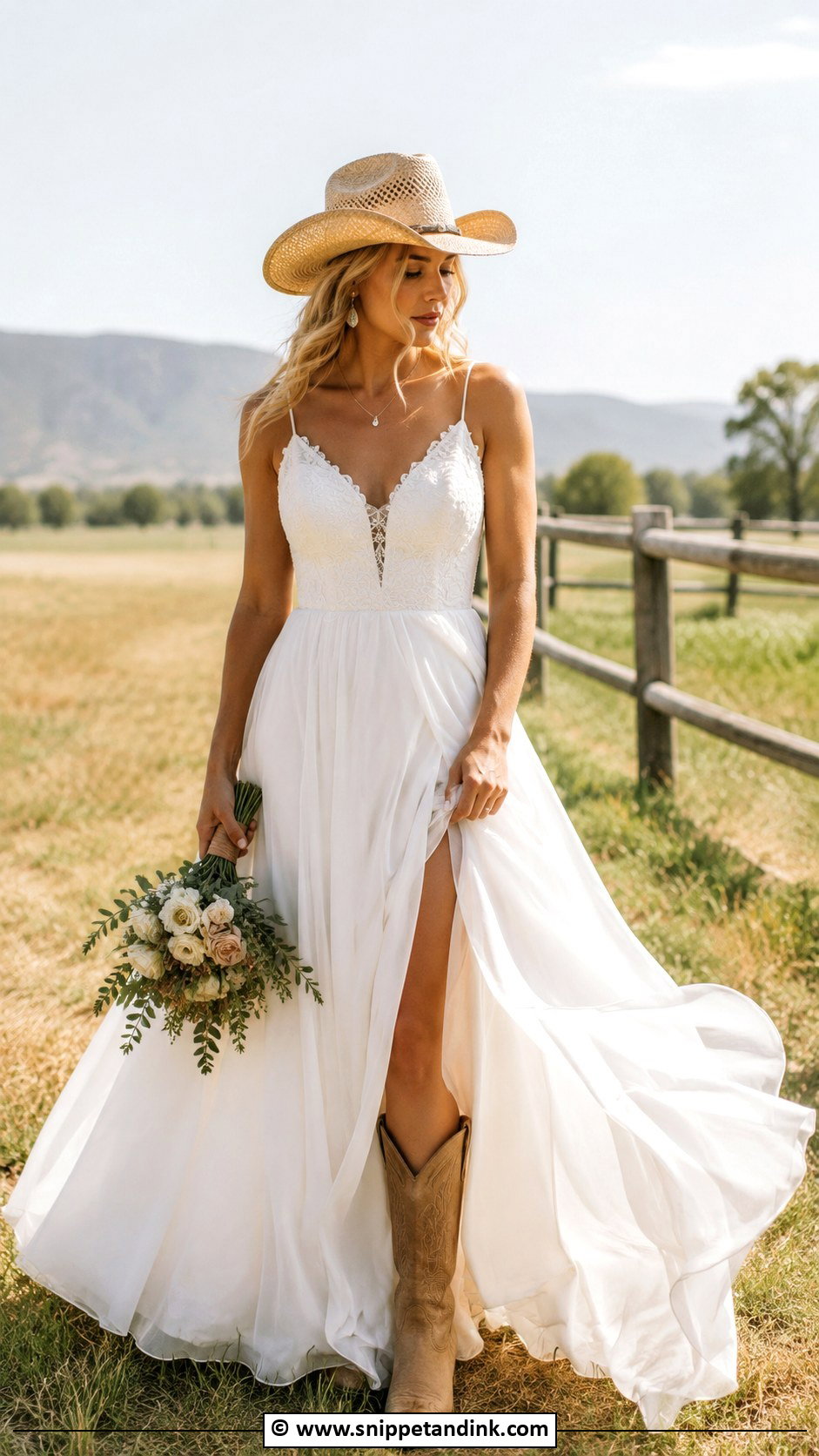
Chiffon is the fabric I steer warm-weather brides toward first, because it breathes and the skirt floats rather than clings. It also snags. Dry grass, a lace belt or a rough fence rail can pull a thread, so keep a small pair of scissors in the emergency kit for snipping loops rather than pulling them. Flowy A-lines, empire waists and wraps all work, with tan or cream boots. A straw or felt hat and a loose bouquet keep it relaxed for summer elopements and garden barns.
22. Rustic Cowgirl Wedding Dress
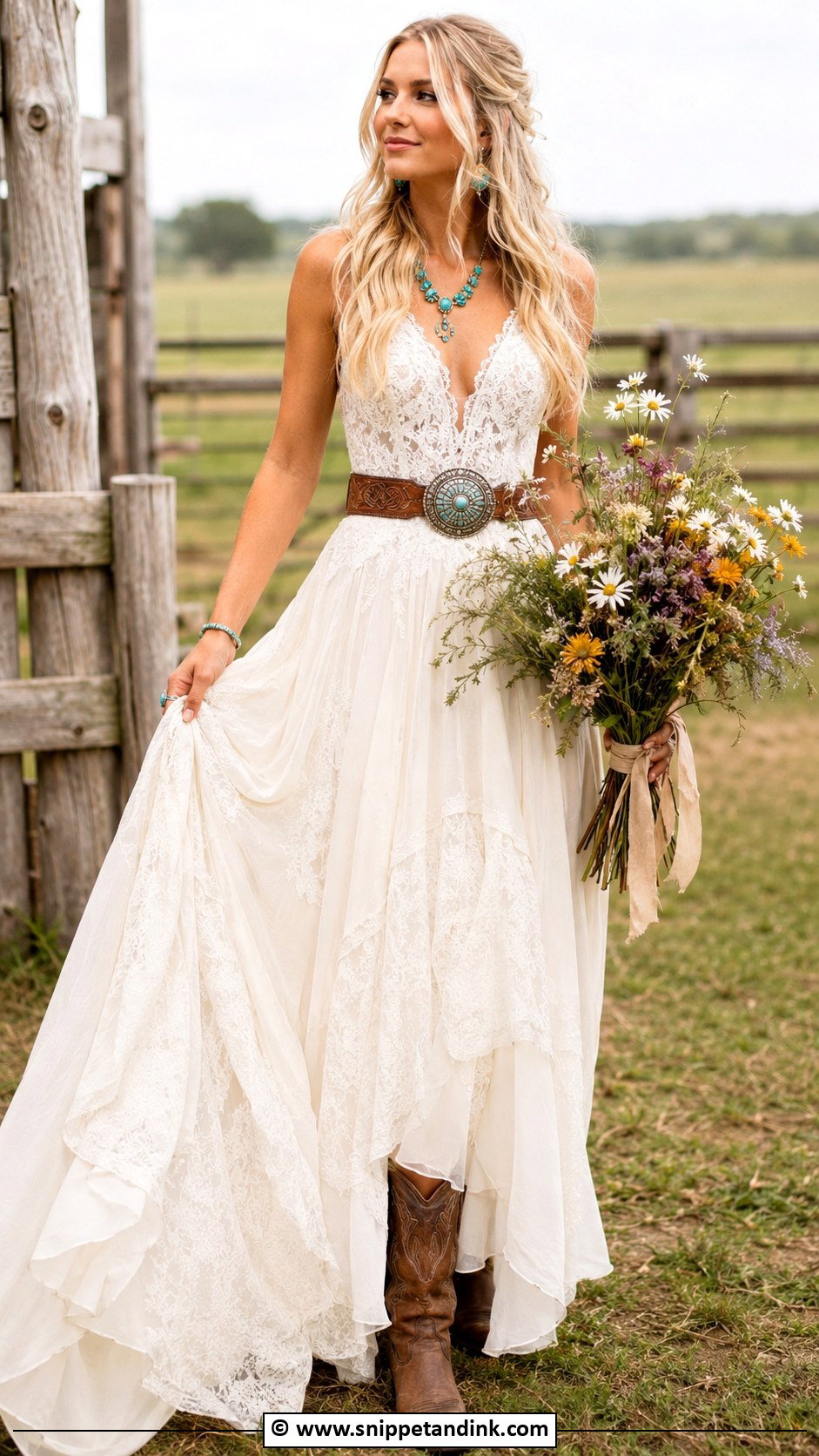
Rustic styling is about texture, not decoration. Cotton lace, linen blends and soft tulle look right next to timber and pasture, while a high-shine fabric can look out of place there. I pair them with brown boots, a leather belt and simple silver or turquoise jewelry, and suggest a bouquet with dried grasses or wildflowers. One thing I tell brides: linen wrinkles by design, so if crumpling bothers you in photos, choose a linen blend rather than pure linen. A relaxed braid or low bun finishes it.
23. Vintage Cowgirl Wedding Dress
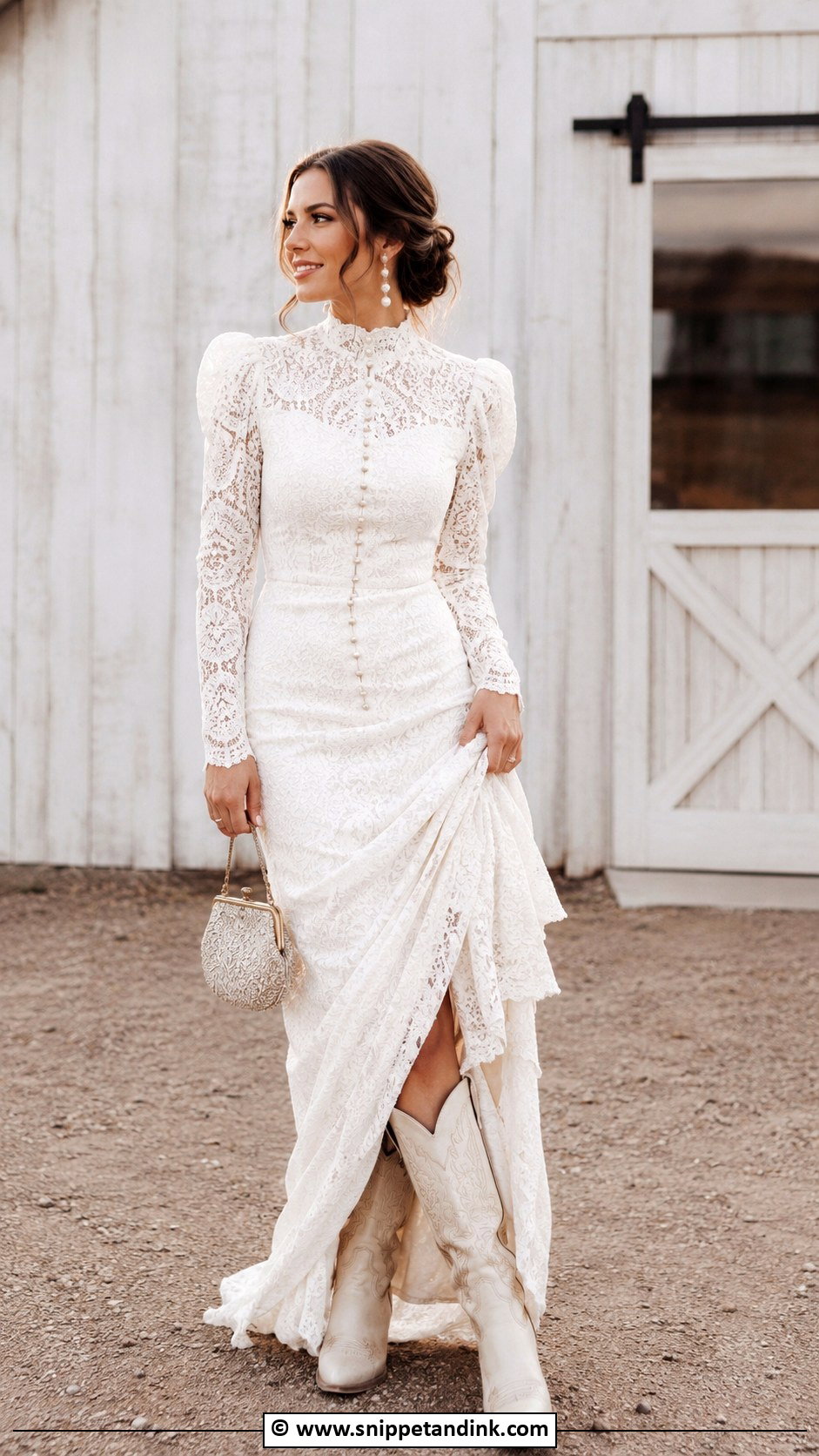
Vintage details look current when everything around them is current. High necks, lace sleeves, button backs, eyelet and tea hems all carry the era, so I keep the makeup, hat and boots modern and clean. Heirloom pieces are where meaning comes in, like a grandmother’s ring or a small pearl bag. If you’re wearing a true vintage gown, have a specialist check the seams and lace before any alteration, because old fabric can split under tension. It suits intimate ranch weddings and Western-styled courthouse ceremonies.
24. Black And White Cowgirl Wedding Dress
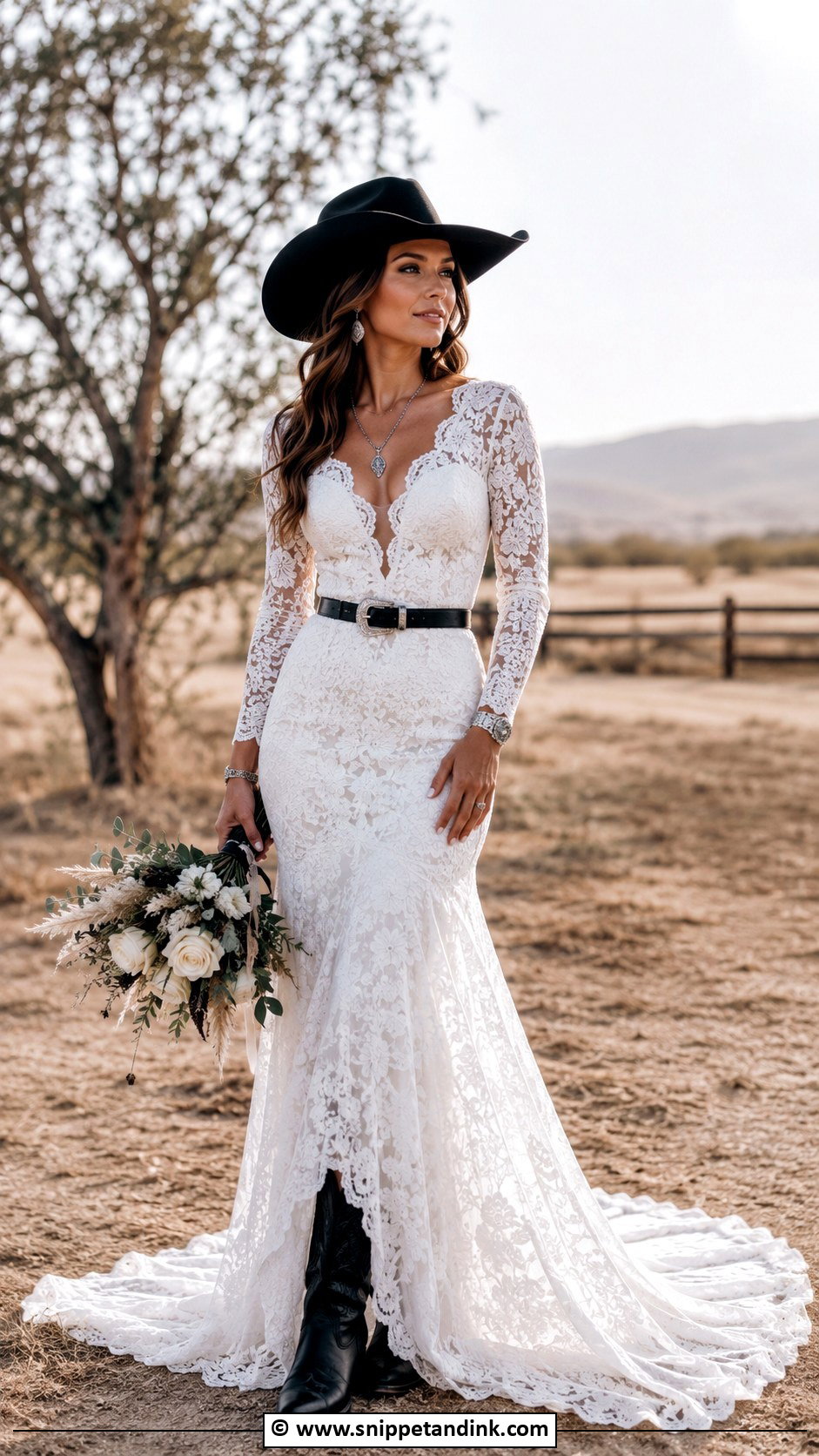
A white dress with black boots, a black felt hat or black lace accents gives real contrast, and it’s the look most likely to test your photographer. Cameras expose for the white gown, so black suede and felt can lose detail. Tell your photographer about the palette in advance. I’d limit black to two pieces, say hat and boots, so it reads as a choice and not a scatter. Silver jewelry and a simple bouquet keep it clean for fall weddings and modern ranch venues.
25. Turquoise Cowgirl Wedding Dress
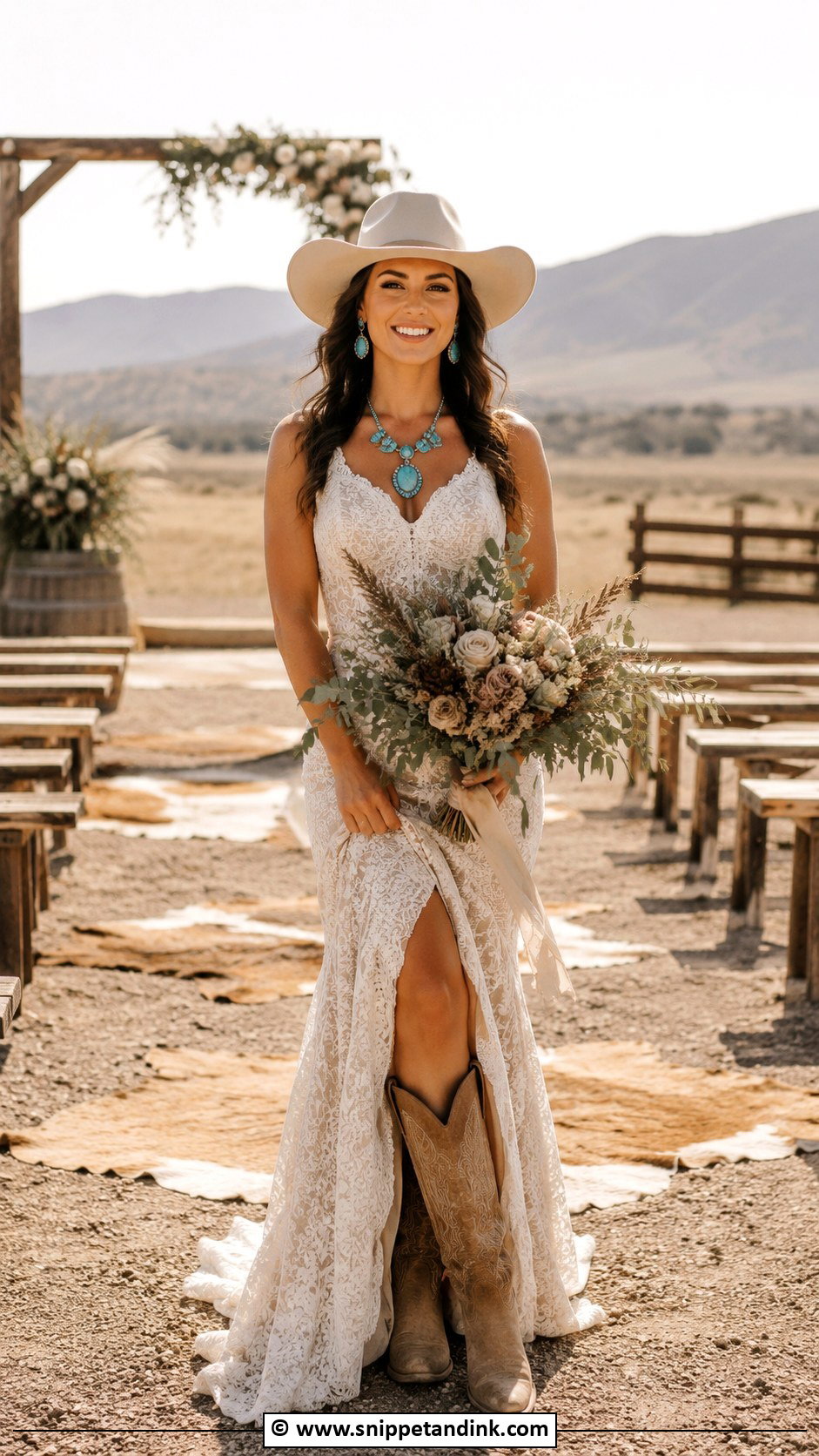
Turquoise styling doesn’t need a turquoise dress. I keep the gown white or ivory lace and let the stones carry the colour: earrings, a ring, or a squash blossom-inspired necklace for a strong neckline. Real turquoise varies from sky blue to green with dark matrix lines, so lay your pieces side by side before the day. Mixed shades look accidental when worn together. Plain tan, ivory or brown boots and a soft hat finish it without competing.
26. Reception Cowgirl Wedding Dress
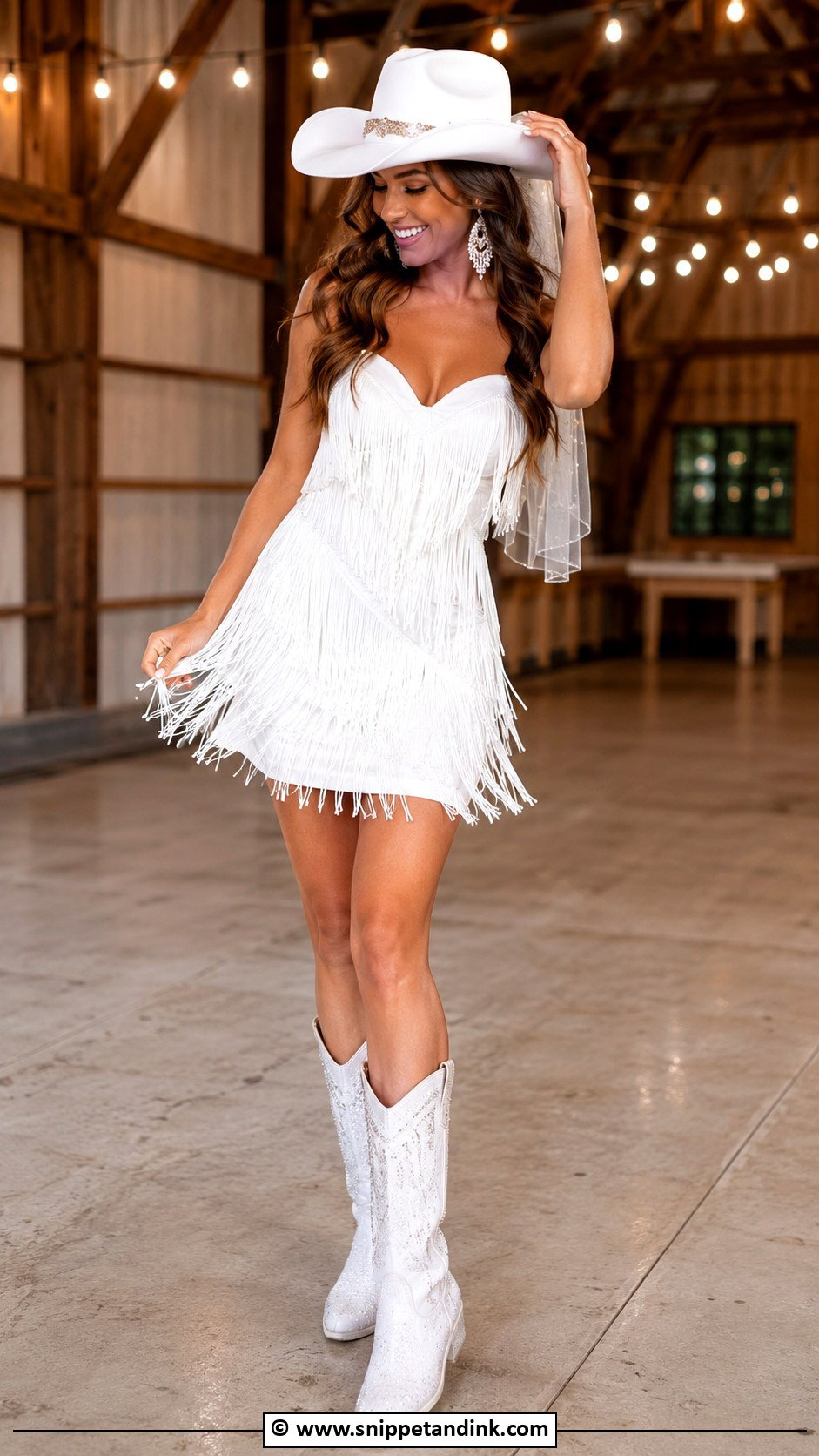
The reception dress is where I let brides have fun, but I still test it the way I test the main gown. Can you dance with your arms up without hitching it? Can you sit on a hay bale? A short lace dress, a fringe mini, a tea-length gown or a satin mini all pass if the fit is right. Sparkly or embroidered boots come into their own here. Keep a small jacket near the dance floor, because barns cool down fast once the sun goes.
27. Summer Cowgirl Wedding Dress
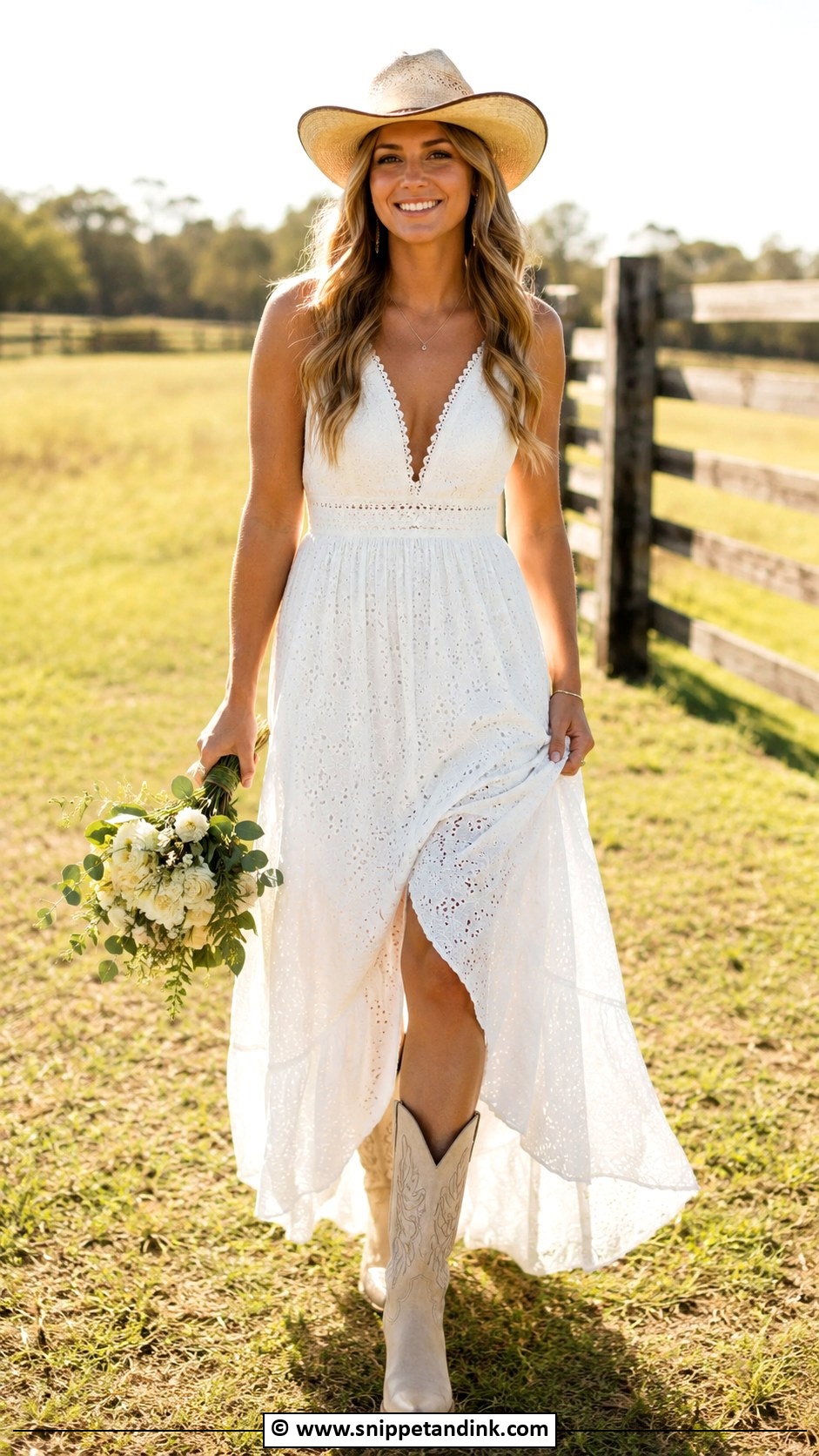
Heat changes the whole plan. Feet swell in warm weather, so boots that fit in a cool fitting room can pinch by late afternoon, and I tell brides to break them in on warm days at home. Breathable fabric matters more than neckline: cotton lace, eyelet, organza and chiffon cope with sun far better than polyester satin. Sleeveless or off-shoulder cuts help, along with a straw hat, soft waves and very little jewelry. If the ceremony is in direct sun, skip any layer you can’t take off.
28. Winter Cowgirl Wedding Dress
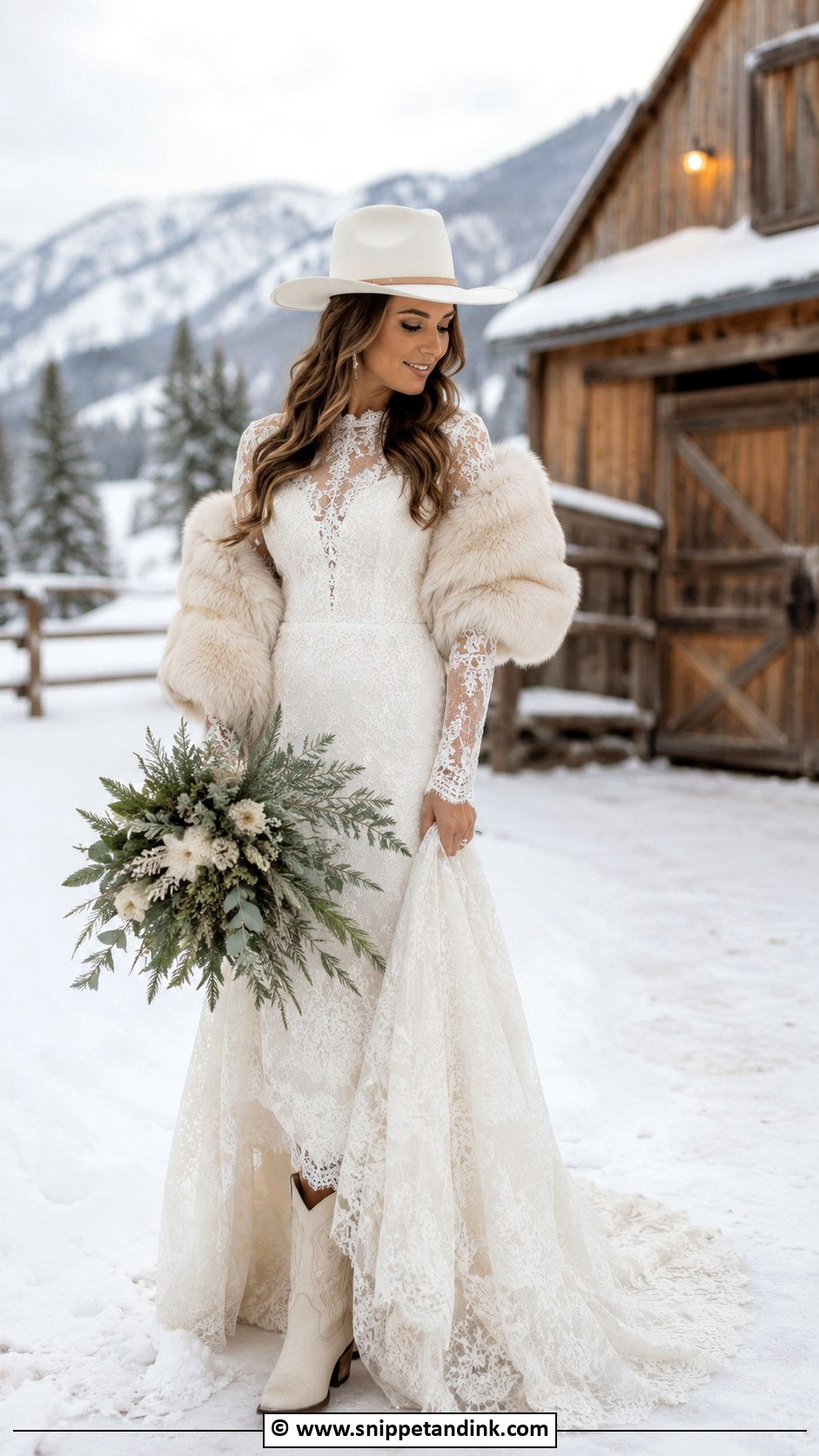
For winter, I think about the ground before the dress. Mud, frost and wet grass soak a long hem, so I keep the length just off the floor in front and plan a bustle for the back. Long sleeves, heavier lace, satin, crepe and layered tulle all hold warmth. Add a faux fur wrap, a suede jacket or an embroidered shawl. Brown, cream or ivory boots with a rubber-capped heel grip better on frozen ground, and a bouquet of winter greenery suits the season without holiday decorations.
29. Desert Cowgirl Wedding Dress
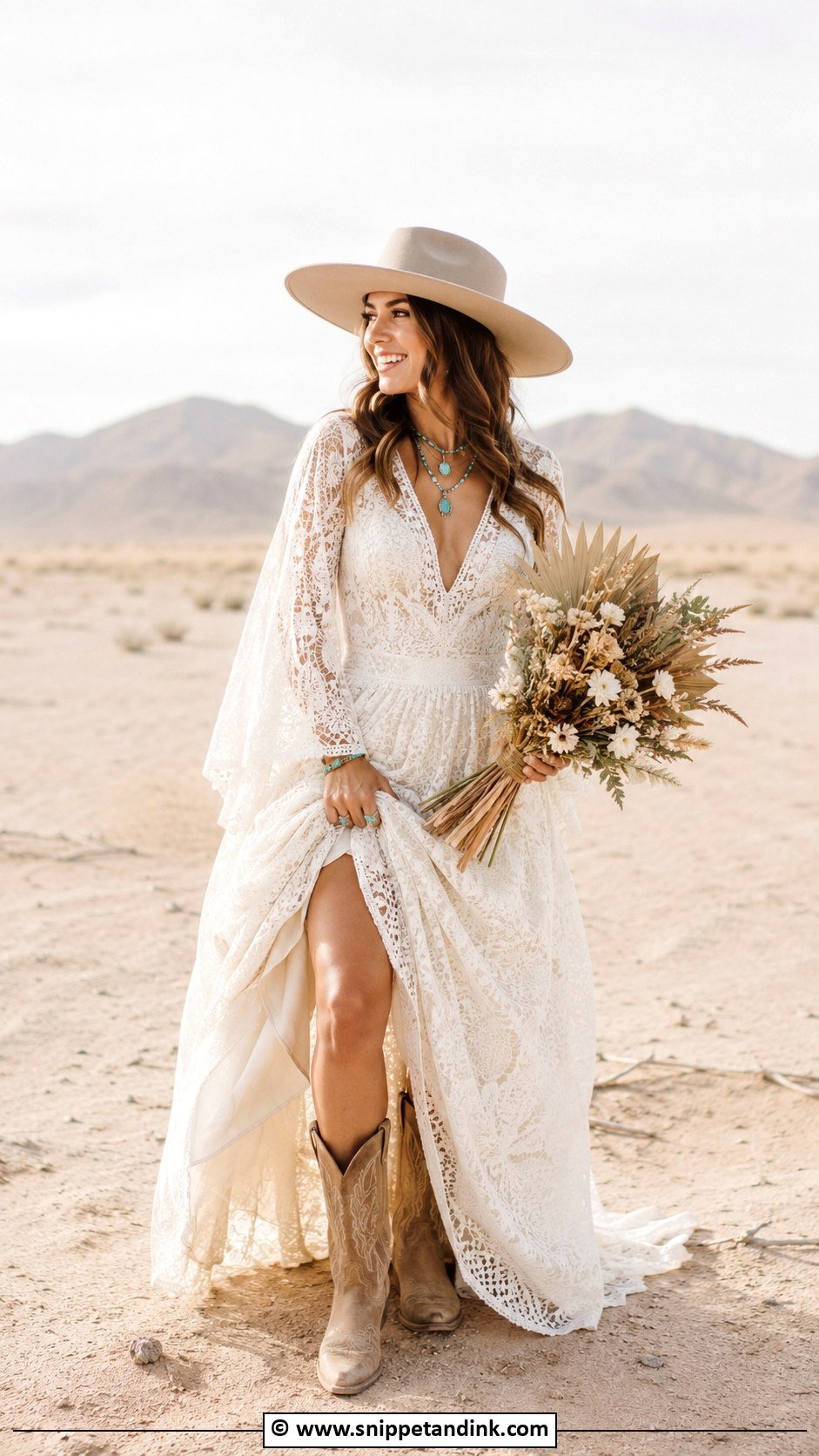
Desert venues bring wind and fine sand, and both go straight into tulle and long fringe. That’s why I lean toward lace, crepe or chiffon in a relaxed shape here, in ivory, champagne or sand tones that sit well against the landscape. A wide brim needs a hat pin or a discreet elastic in a breeze. Tan boots, silver or turquoise jewelry and a muted bouquet keep it light. Sheaths, boho lace and high-low hems all move easily over dry ground at a sunset elopement.
30. Elegant Cowgirl Wedding Dress
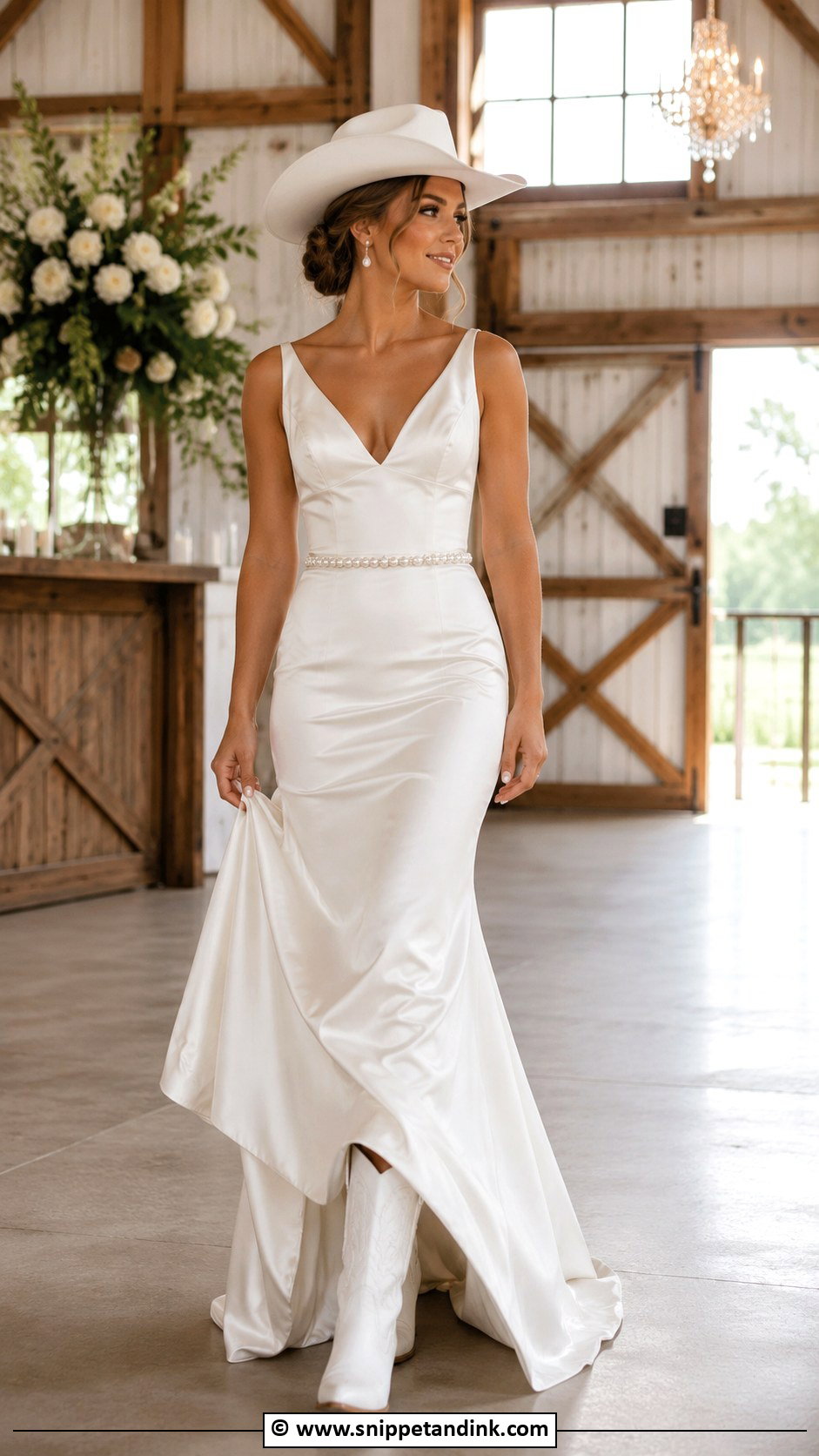
Refined Western style is mostly restraint. A sleek satin gown, a fitted lace dress or a clean crepe silhouette carries one or two Western touches well: white boots, a thin belt, pearls or a white felt hat. I keep the palette within two tones so nothing looks like an afterthought. Upscale ranch venues and formal barns suit it. The dress supplies the formality, and the boots add comfort and a bit of personality.
Red Dirt, Hay Bales and a Pale Hem
Ranch and barn venues are hard on a white dress, and I’d rather you plan for it than panic about it. Dust and dry clay settle into the bottom few inches of the hem within an hour outdoors. I tell brides to accept a little of that in candid photos and keep the portrait session for early in the day, while the dress is still clean.
On the day
- Lay a blanket or a sheet over hay bales before you sit; straw snags tulle and leaves stray pieces in lace.
- Have someone carry a stain pen made for delicate fabrics, a white cloth and a lint roller, and blot rather than rub any spill.
- Use the bustle as soon as the formal photos are done, so the train isn’t sweeping a barn floor all evening.
- Keep the hat off the dress when you take it off. Felt brims pick up dust and transfer it to whatever they rest on.
After the wedding
Get the gown to a specialist wedding dress cleaner within a few weeks. Spilled drinks and sweat dry clear but can turn yellow over time, and mud is easier to lift before it sets. Point out the hem, the underarms and any spot where a denim jacket or leather belt touched the fabric. Store it boxed or in a breathable cotton bag, away from light, and wipe and condition your boots before you put them away.
The Dress Leads, the Boots Answer
Start with a dress shape you’d love even without the Western pieces, then add boots, hat, belt, jewelry or jacket one at a time and stop when it feels like you. Think about the ground you’ll be standing on, the season, and how much you’ll move once the music starts. A lace gown with boots is the classic, while fringe, denim, turquoise or a high-low hem make it more personal. Bring your boots to every fitting and the rest falls into place.
You'll Like These Ideas:


Leave a Reply