
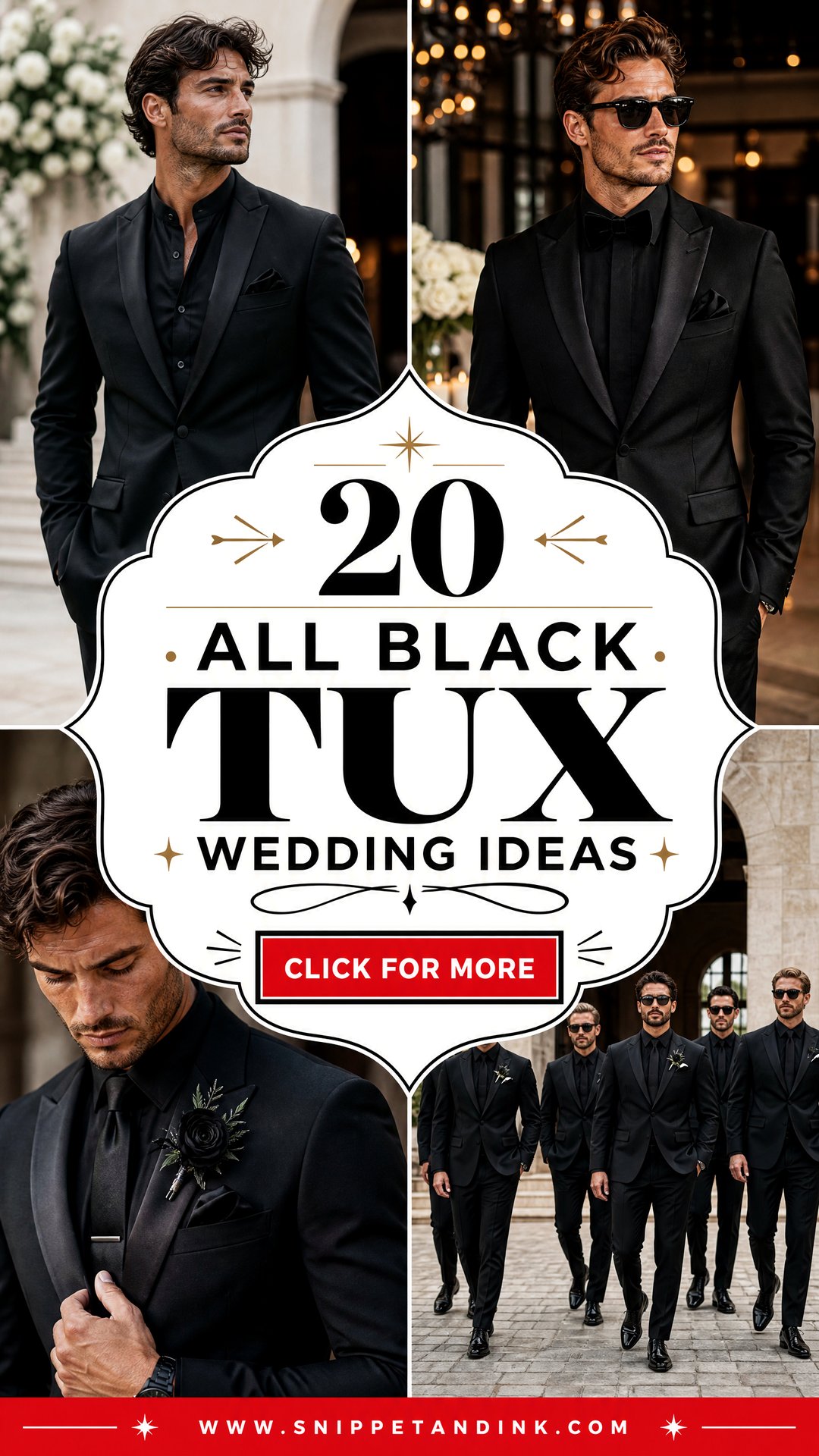
An all-black tux trades the usual white shirt for black from collar to shoes, and it lands somewhere between sharp and severe depending on how it’s built. Strict black tie still means a white formal shirt, a black bow tie, and polished black shoes, so I treat the all-black version as a modern reading of the code rather than the code itself. What makes it work is tailoring and texture. When every piece is the same color, fit is all anyone sees, and small shifts between satin, wool, velvet, and grosgrain are what stop the outfit looking like one flat shape. The twenty outfits below show how to manage that.
Does an All-Black Tux Count as Black Tie?
Strictly, no. Traditional black tie is a black dinner jacket with a white dress shirt, and some hosts care about that. Before I style anyone in head-to-toe black, I want to know who is wearing it and what the invitation says.
- The groom: it’s your wedding, so all-black is your call. Tell your partner and photographer so the rest of the party and the lighting can be planned around it.
- A groomsman: follow what the couple has chosen. Don’t turn up in a black shirt if the others are in white.
- A guest at a black-tie wedding: stick to a white shirt. All-black can read as trying to outshine the groom.
- Black-tie optional or formal: all-black is usually fine, especially at an evening reception.
Religious ceremonies are worth a quick check too. Some families read all-black as mourning dress, and a white shirt for the ceremony with a black one for the party avoids an awkward moment.
1. Classic All Black Peak Lapel Tux
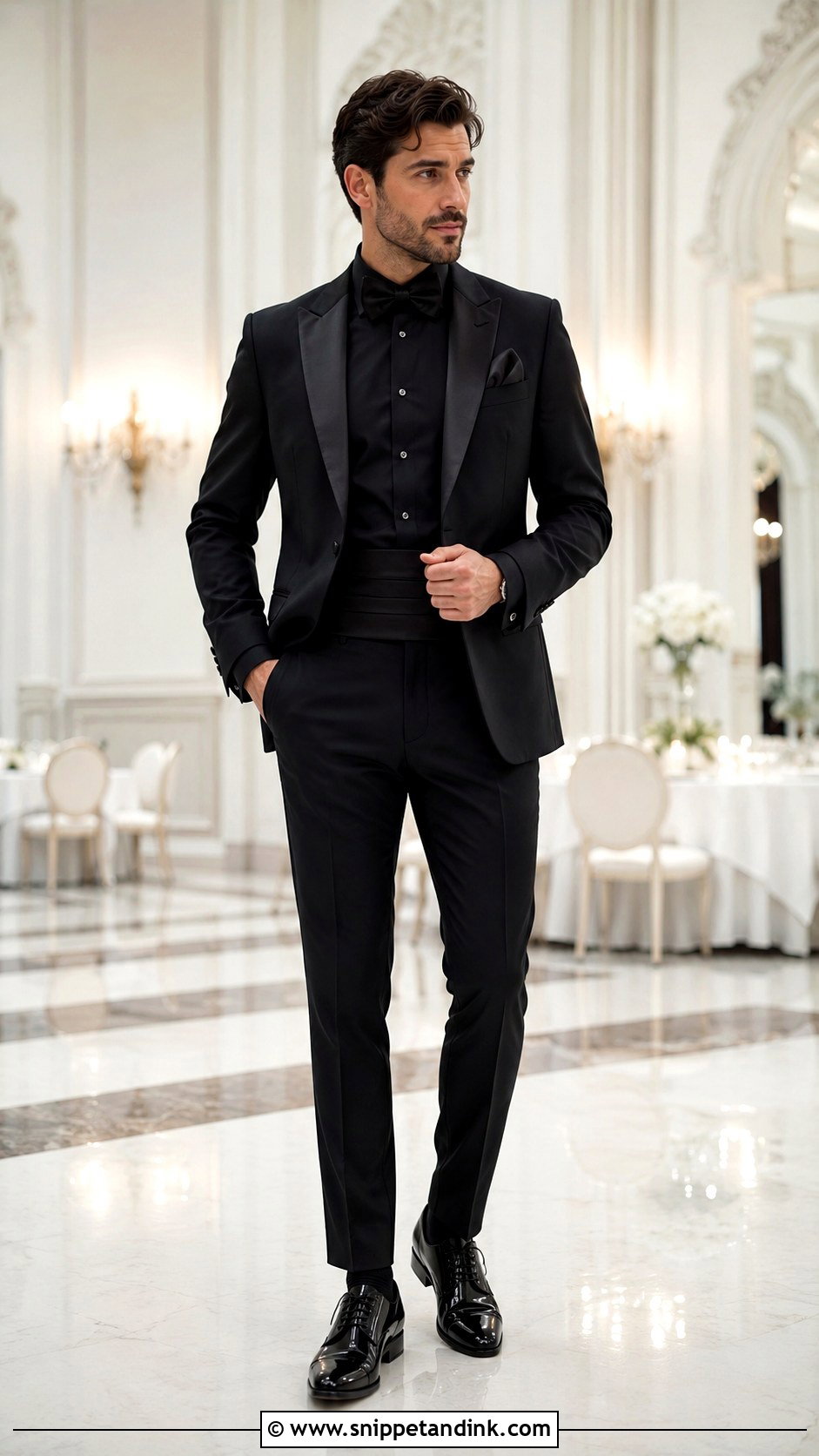
Start here if you’re unsure. A formal all-black wedding outfit built on a structured wool jacket with satin peak lapels, matching trousers, and a fitted black dress shirt covers almost any evening wedding. The satin facings on the lapels, buttons, and trouser stripe are what separate a tux from a suit, so make sure they’re real and they match. A black satin bow tie and a low cummerbund keep the waist clean. Patent Oxfords, black socks, plain cufflinks, and a folded black pocket square finish it. Peak lapels point toward the shoulders and broaden them, which helps narrower frames most.
2. All Black Shawl Collar Tux
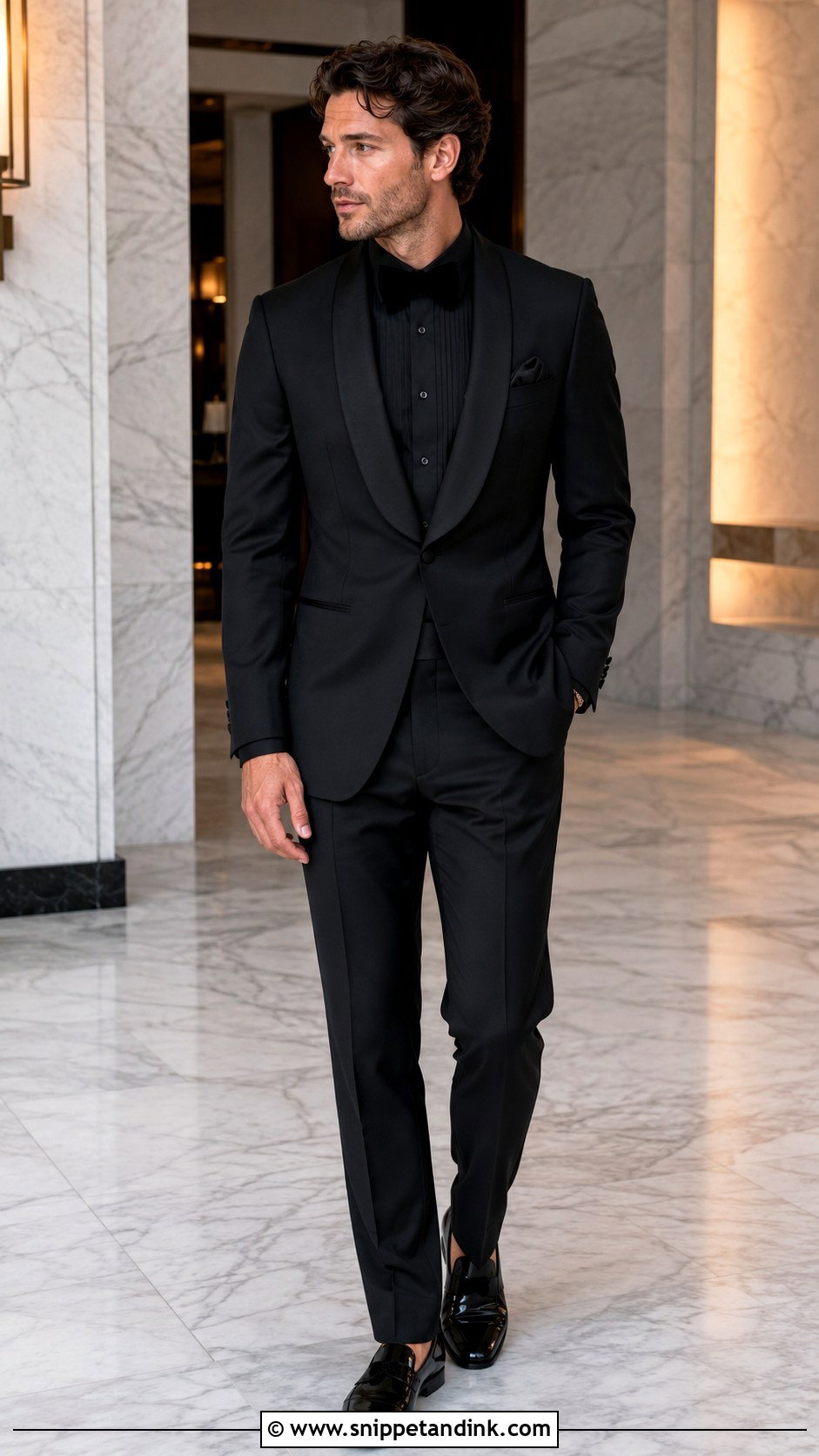
A shawl collar is one continuous curve with no notch, and it softens the whole jacket. I like it on grooms with rounder faces, where peak lapels can look sharp against the jawline. Pair a single-breasted jacket with flat-front trousers and a black pleated-front shirt for a little texture. A velvet bow tie against a satin collar keeps the two from blurring together. Patent loafers, black socks, onyx cufflinks, and a matte pocket square finish it. Let a quarter to half an inch of shirt cuff show past the jacket sleeve; on black-on-black, that line is one of the few that makes the tailoring visible.
3. All Black Velvet Tux
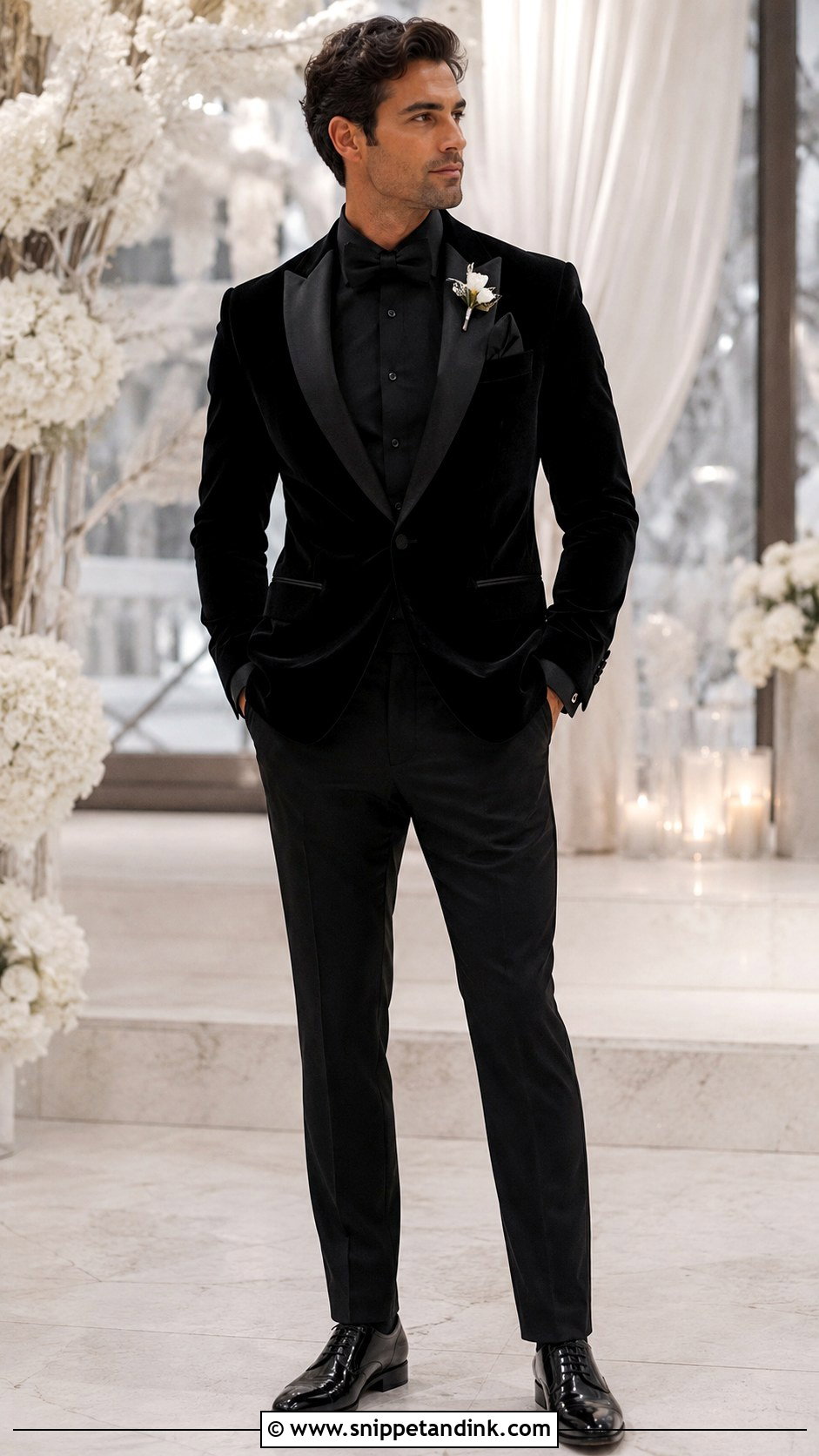
Velvet earns its place at autumn and winter weddings because it absorbs light and looks deeper than any wool. Build on a black velvet dinner jacket with satin peak or shawl lapels, and wear it with smooth tuxedo trousers, never velvet pants, which add bulk and wear shiny at the knees. A matte black shirt and silk bow tie keep the top formal. Polished Oxfords, black socks, simple cufflinks, and a restrained pocket square are enough. Velvet crushes where you sit and lean, so I hang it on a broad hanger and steam, never iron, before the day.
4. All Black Double Breasted Tux
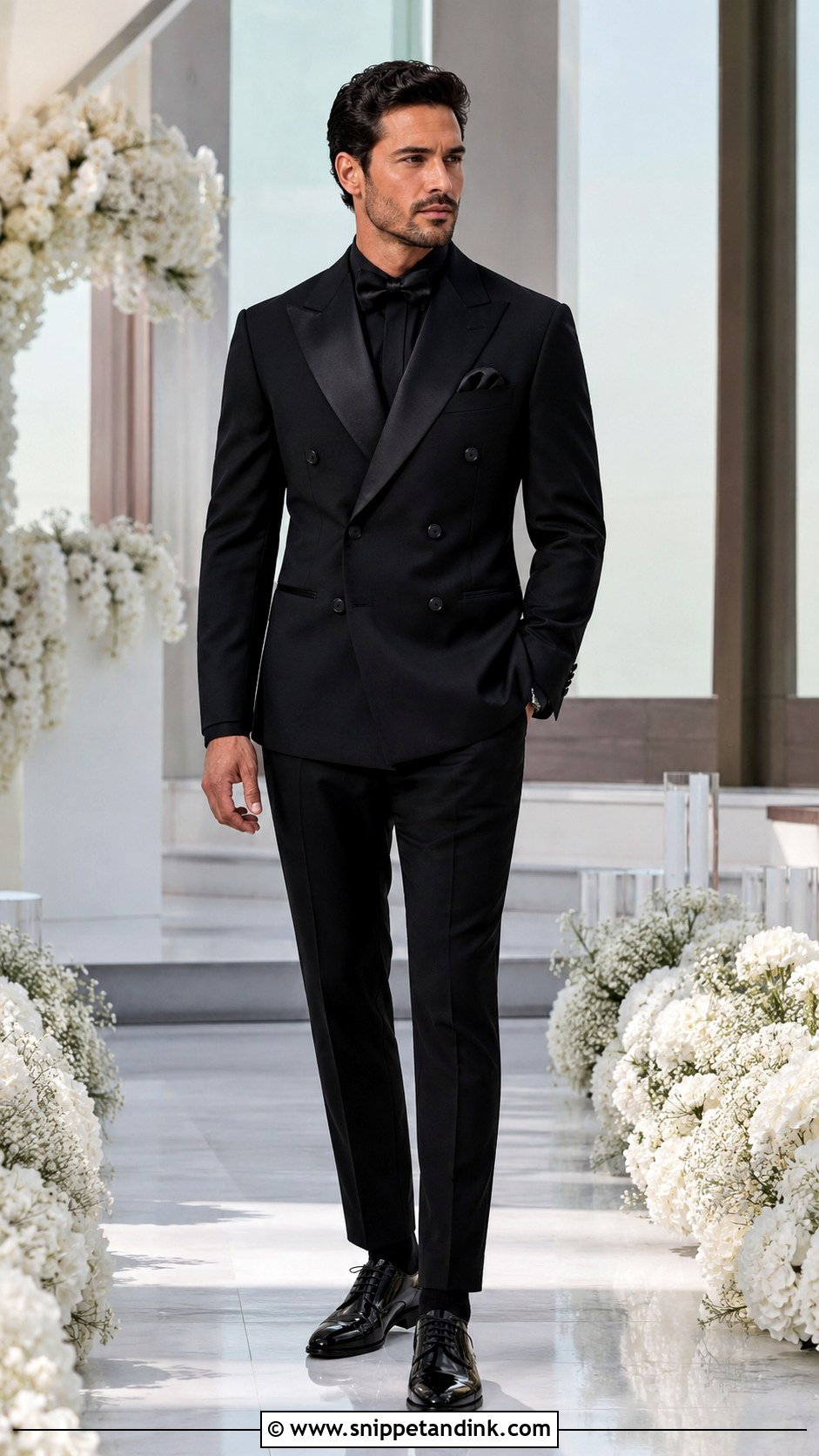
Double-breasted jackets have strong structure, and they need it to be right. An all-black double-breasted tux with six buttons, satin peak lapels, and a defined waist looks commanding on taller men; on shorter grooms, I check the jacket length closely so it doesn’t cut the legs off. Pair it with matching trousers and a smooth spread-collar shirt. Keep the bow tie small, since the jacket already has plenty going on. Patent Oxfords, tonal cufflinks, black socks, and a minimal pocket square finish it. Keep it buttoned while standing, and hem the trousers with little or no break for one long line.
5. All Black Three Piece Tux
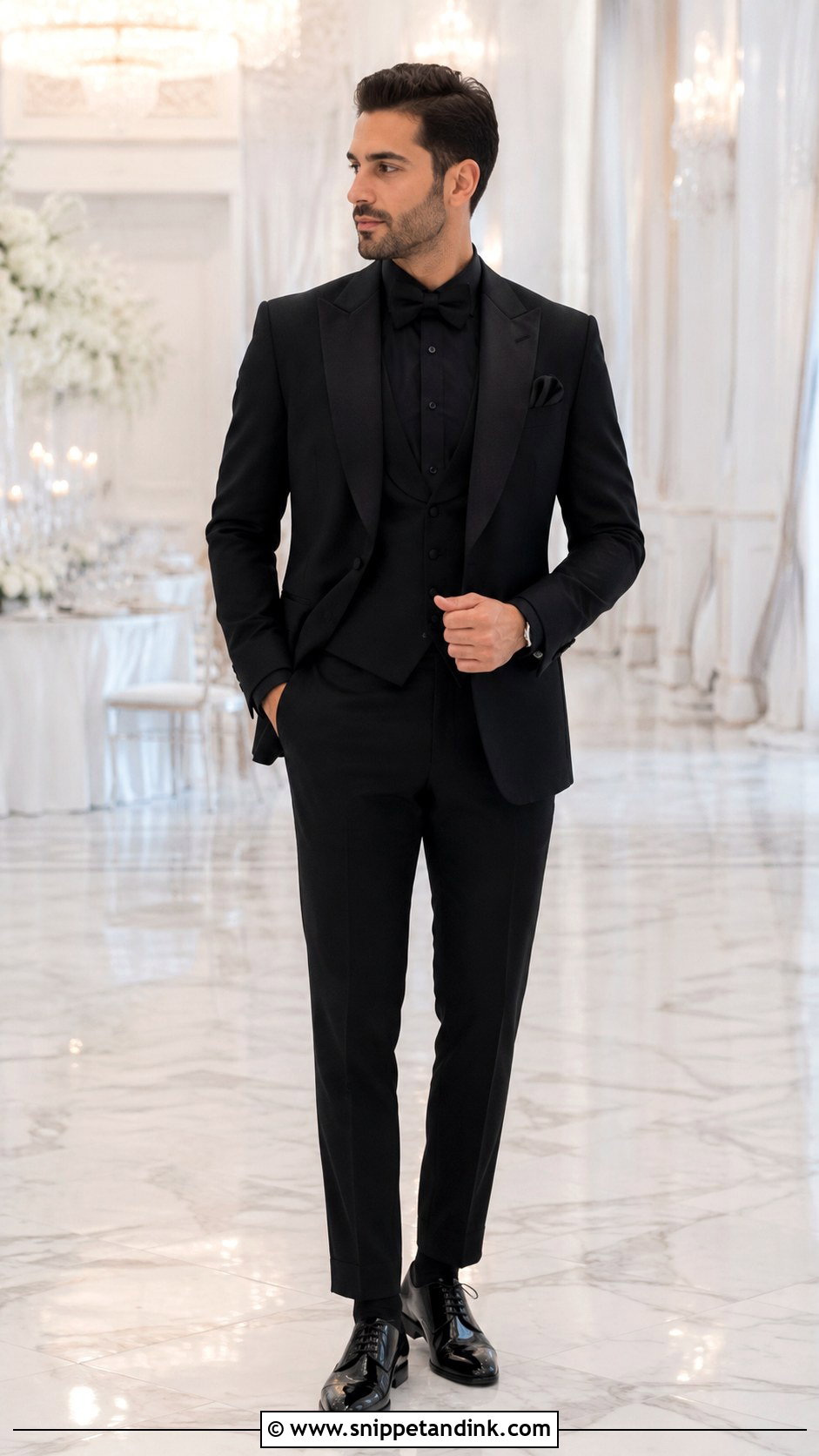
A three-piece holds together after the jacket comes off at the reception, which is when a lot of grooms realize they should have worn one. Start with a peak lapel jacket and matching trousers, then add a low-cut black waistcoat in the same or a closely matched fabric. A black shirt with a concealed placket keeps buttons from breaking up the front. A silk bow tie, patent Oxfords, black socks, and dark cufflinks finish it. The waistcoat should cover the trouser waistband but not peek out below the jacket’s front edge. It’s also a quiet way to set the groom apart when the groomsmen wear two-piece tuxes.
6. Slim Fit All Black Tux
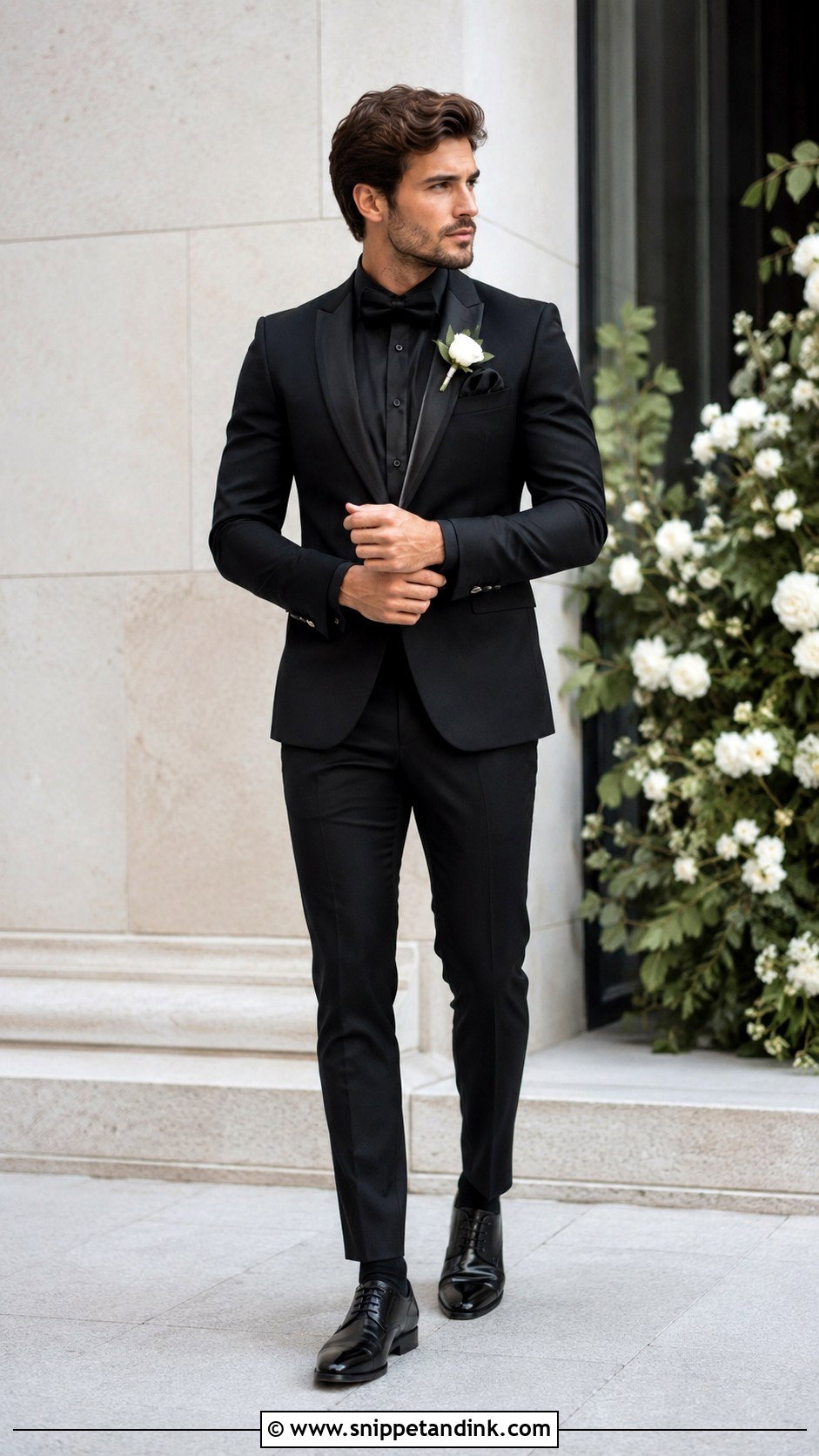
Slim fit gets misread as tight. A good slim jacket follows the body without pulling into an X across the buttons, and that X is the first thing I look for at a fitting. Pair a single-breasted jacket with tapered trousers and a fitted black shirt. A narrow bow tie or a well-proportioned butterfly bow suits the leaner line. Sleek Oxfords, fine black socks, small cufflinks, and a tonal pocket square finish it. Sit, reach, and dance in it before you buy; you need room at the shoulders, thighs, and upper arms. Hem the trousers just at the shoe, not cropped short, for a city or gallery wedding.
7. Relaxed Fit All Black Tux
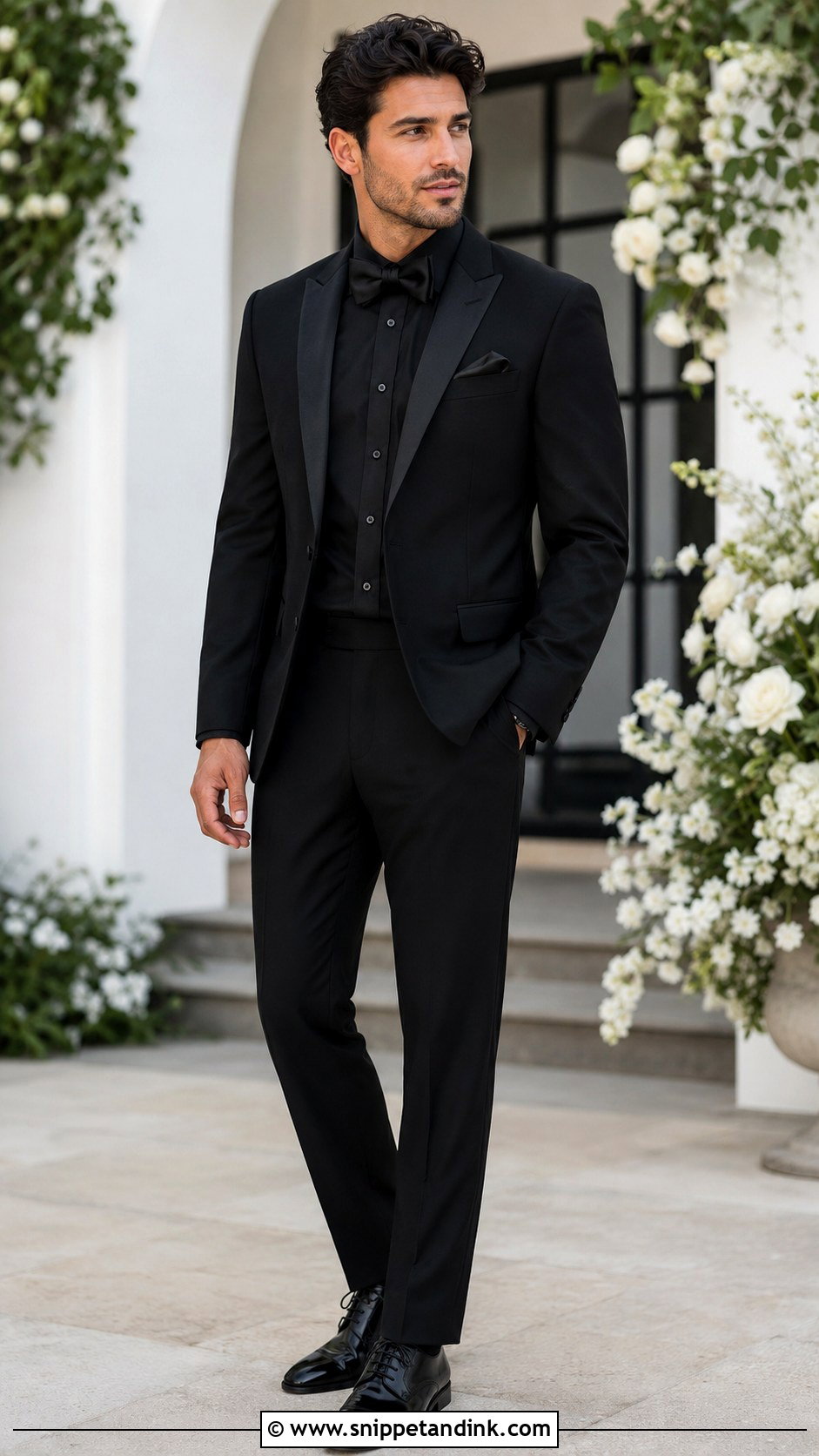
Relaxed doesn’t mean bigger. A softly structured jacket with a little more room in the chest, natural shoulders, and straight-leg trousers is cut that way on purpose. Simply sizing up gives you long sleeves and pooling hems, which reads sloppy in black more than any other color because the extra folds catch shadow. Choose a breathable black shirt with a smooth front and a satin bow tie. Polished derbies are kinder to wide feet than slim formal shoes. Black socks and understated cufflinks keep it in one palette. It’s the outfit I’d suggest for outdoor or creative weddings, and for anyone who hates feeling buttoned in.
8. All Black Tux With Turtleneck
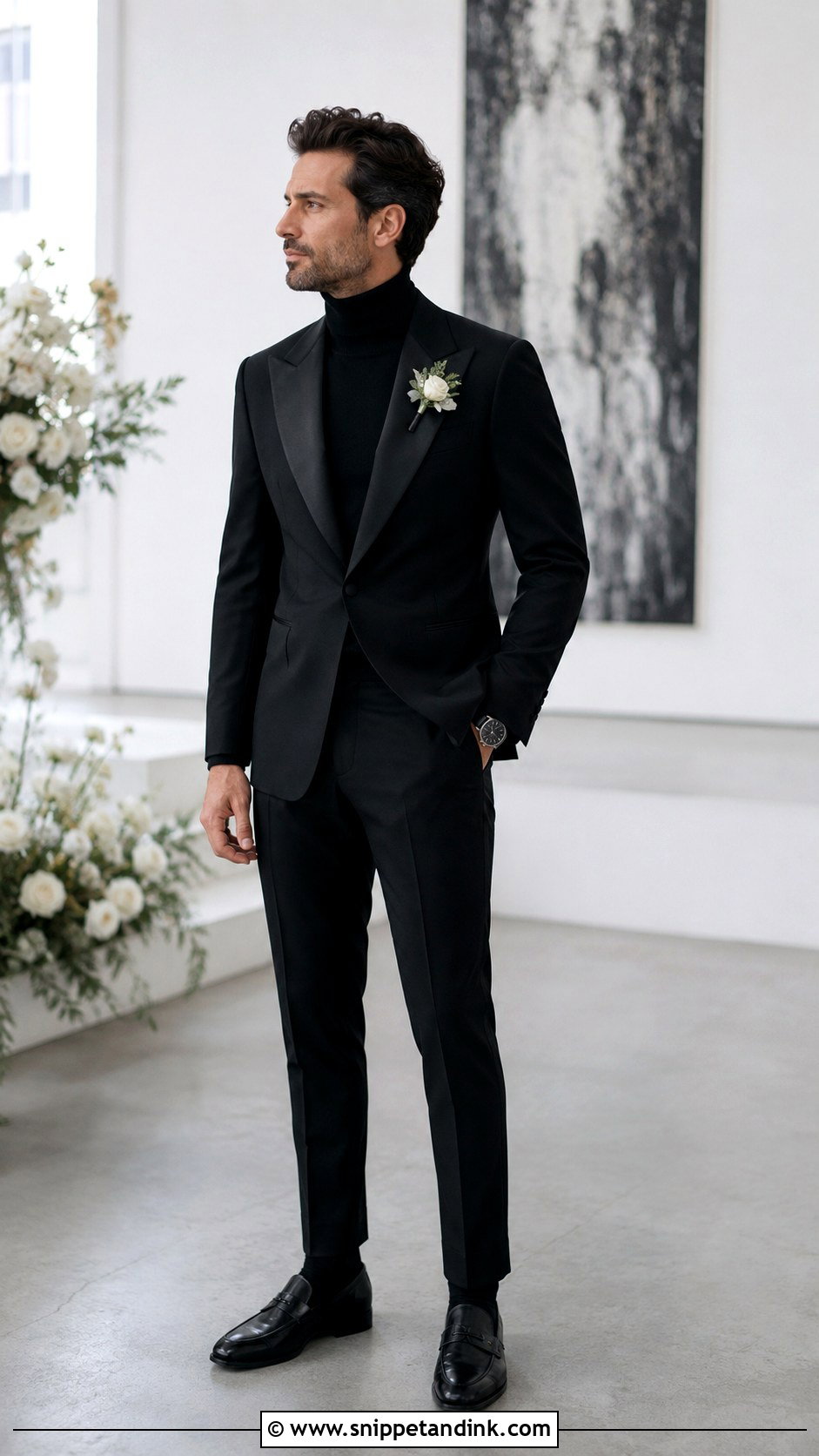
Swapping the shirt and bow tie for a fine-gauge turtleneck turns a tux into something closer to fashion than ceremony. Keep a well-cut black peak lapel or shawl collar jacket and matching trousers, then choose merino or a silk blend thin enough not to bunch under the jacket. Chunky knits ruin the line. Polished loafers or plain Oxfords, black socks, and one metallic watch or ring are all you need; skip the pocket square. I wouldn’t wear this to a strict black-tie wedding. It belongs at black-tie-optional or fashion-led celebrations where the couple has signalled they want something modern.
9. All Black Tux With Band Collar Shirt
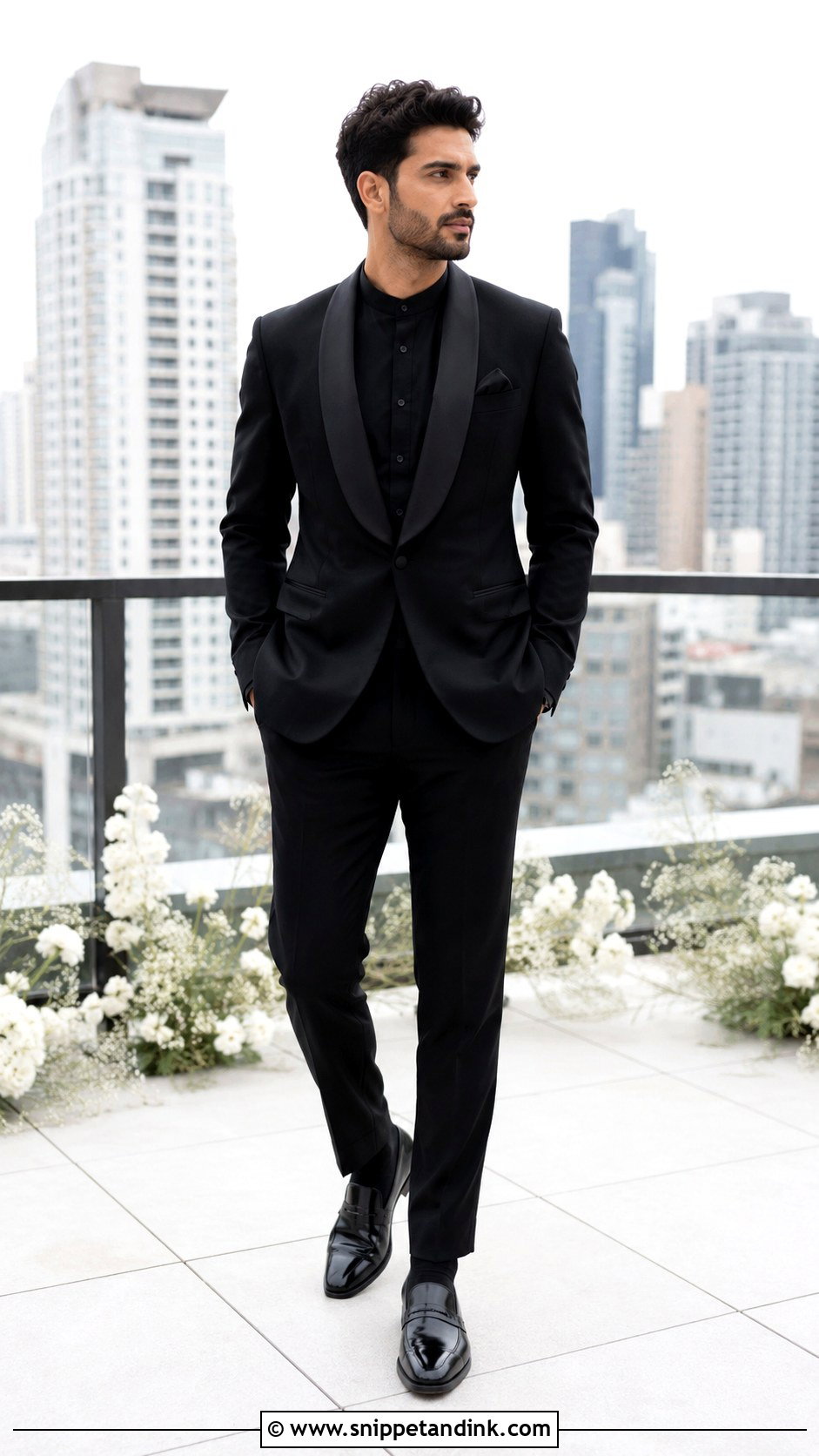
A band collar shirt removes the collar points and the tie altogether, leaving a clean ring at the neck. Fasten it to the top and choose covered buttons or a fly-front placket so nothing interrupts the front. Pair it with a satin-lapel jacket and matching trousers, plus loafers, fine black socks, tonal cufflinks, and a minimal pocket square. Because the neckline reads less formal, the tailoring has to be very good to keep the outfit dressed up. The collar should sit close without pressing on the Adam’s apple; I check by having the groom turn his head both ways. Lofts, rooftops, and modern venues suit it.
10. All Black Textured Tux
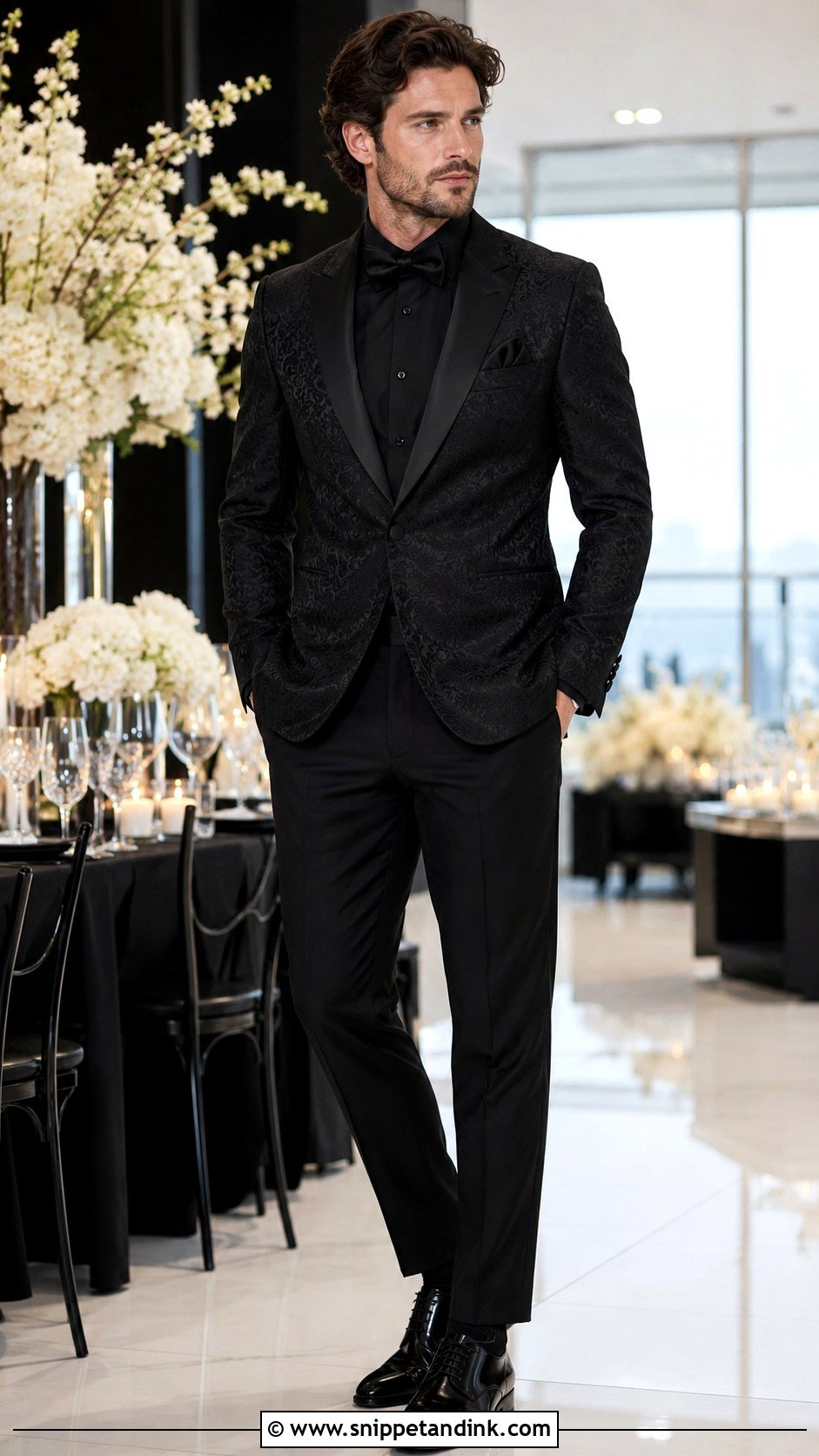
From across the room this outfit looks plain black; up close, the jacket has a jacquard or fine woven pattern that catches light as you move. Keep the lapels in solid satin and everything else plain: trousers, shirt, silk bow tie, Oxfords, socks, dark cufflinks, solid pocket square. One textured piece is enough. Add a patterned shirt or decorative shoes and it turns busy. Pick a low-contrast weave, because a bold motif can moiré on camera, producing a wavy shimmer in digital photos that the eye never sees in person. Under shifting reception light, a subtle weave shows itself without adding color.
11. Matte All Black Tux
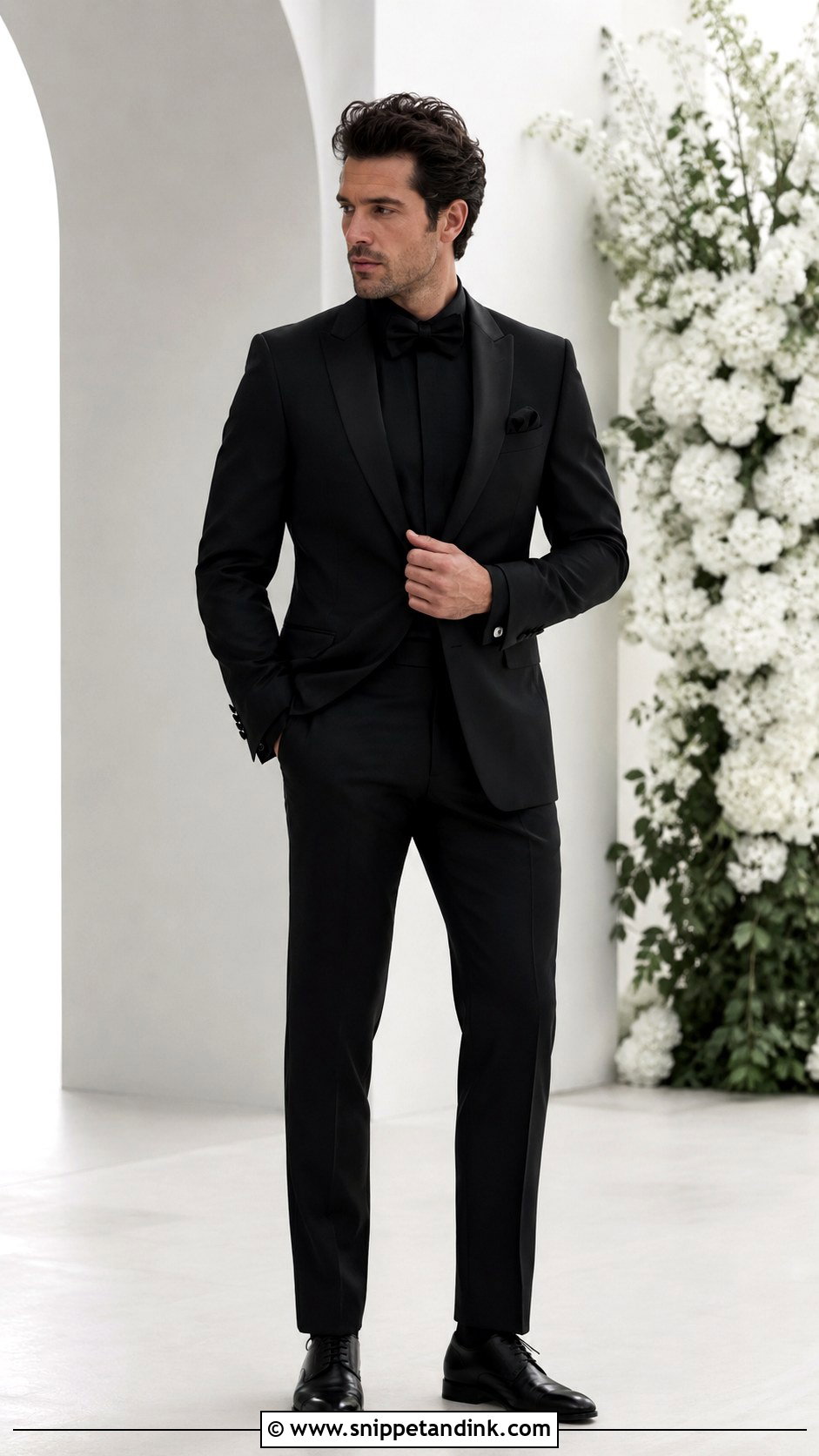
Not every tux needs shine. Grosgrain lapels, with their fine ribbed weave, give a matte finish that looks quieter and very modern next to satin. A wool or wool-blend jacket with grosgrain facings, matching trousers, a soft black shirt with a concealed front, and a grosgrain bow tie keep it consistent. Matte Oxfords, black socks, and brushed-metal cufflinks follow through. A silk pocket square adds just enough sheen to stop it looking flat. In bright venues, matte avoids glare in photos. With so little contrast, fit carries everything, so the shoulders, waist, and hems need to be exact.
12. Satin All Black Tux
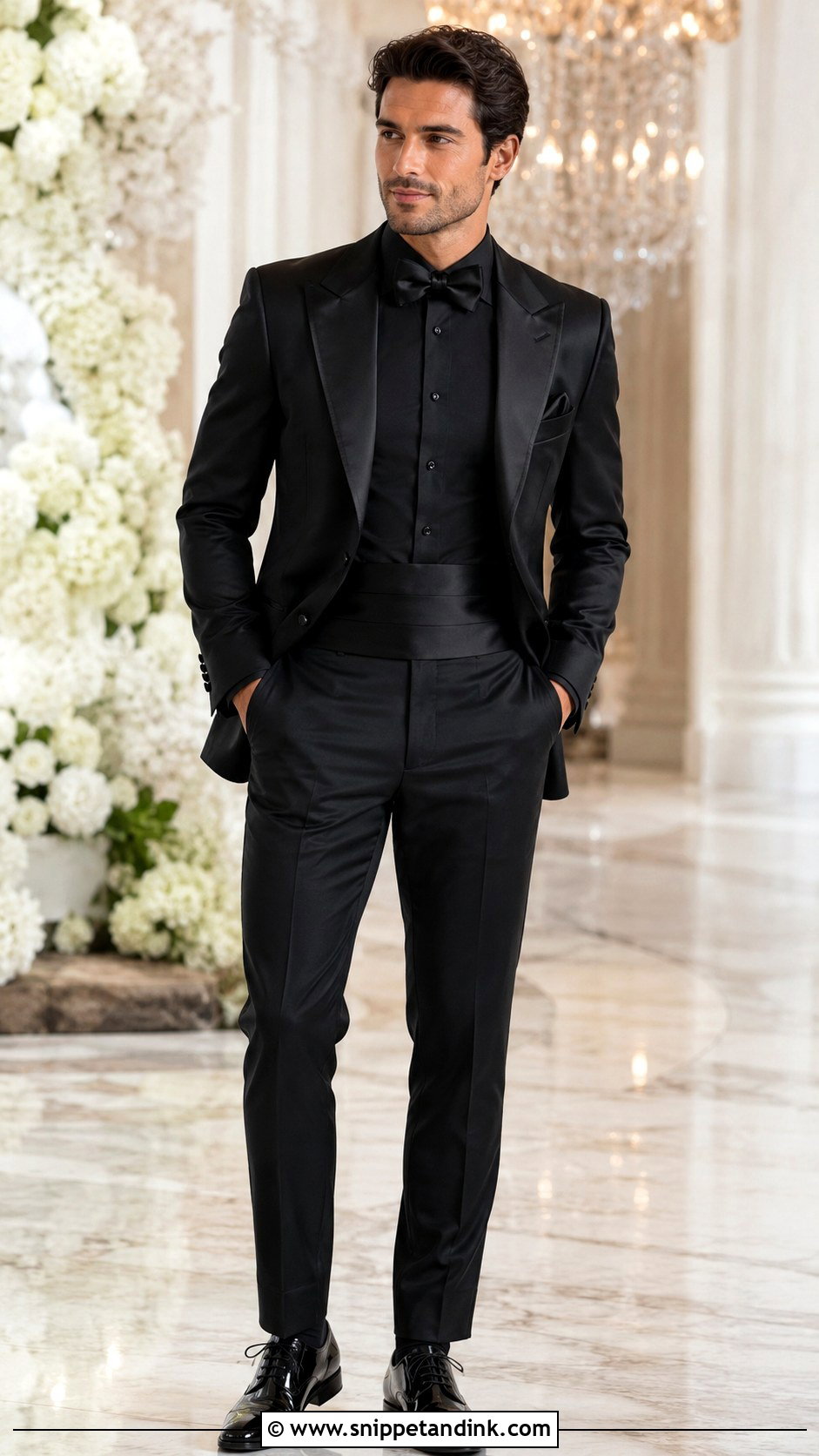
Here the shine is the point. Broad satin peak lapels, satin-covered buttons, a satin bow tie and cummerbund, and patent Oxfords all reflect light, so the shirt and main jacket fabric should stay matte to balance them. Onyx studs, simple cufflinks, and a matte pocket square finish it. Satin shows every crease and press mark, and a hot iron leaves a permanent glaze on it, so I’d have the whole outfit professionally pressed and hung the day before. When every reflective piece is smooth and matching, the result looks deliberate rather than shiny.
13. All Black Tux With Long Tie
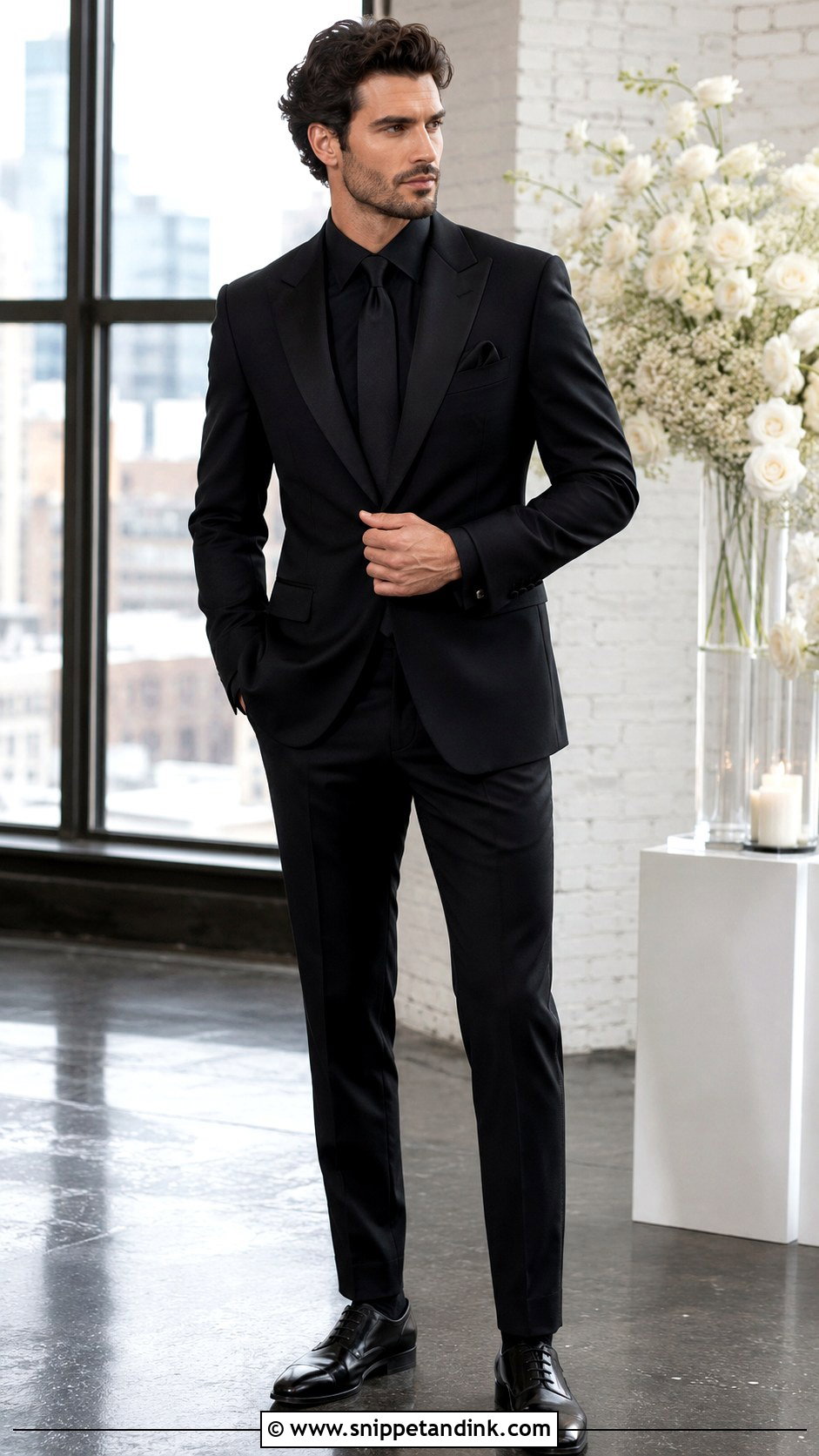
A long black tie is less formal than a bow tie, and I’d only wear it where the couple welcomes a looser take on the dress code. With a fitted peak lapel jacket, matching trousers, and a crisp black spread-collar shirt, a moderate-width silk tie with a knot sized to the collar opening looks sharp. A four-in-hand is usually right; a large knot looks clumsy in a spread collar. Cap-toe Oxfords, black socks, subtle cufflinks, and a flat pocket square complete it. Keep the tie solid, with no visible pattern, and save it for formal or black-tie-optional weddings rather than strict black tie.
14. All Black Tux With Velvet Bow Tie
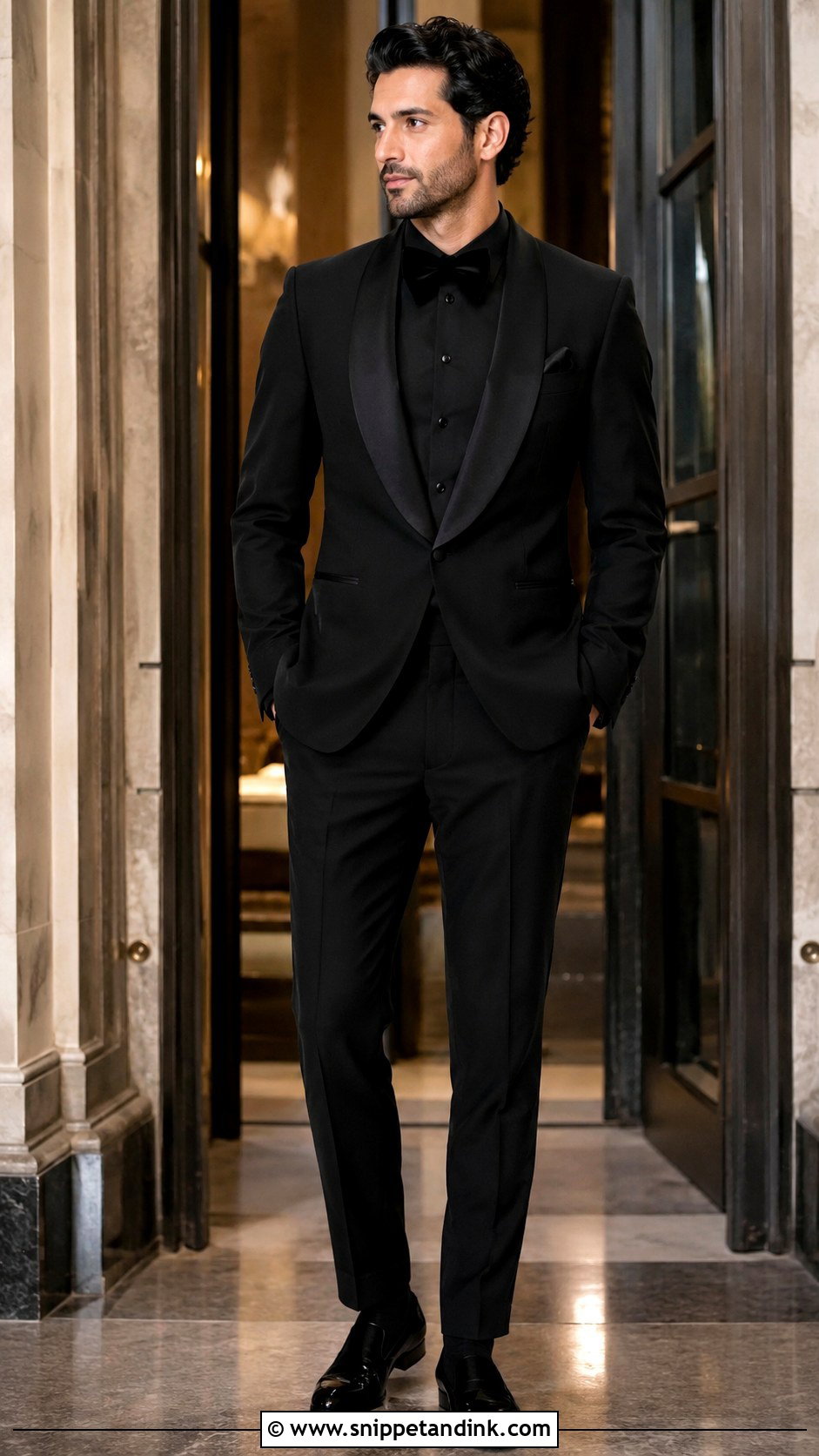
One accessory can set the tone. A plush velvet bow tie against a matte black shirt and a satin shawl collar gives three different blacks in a few inches, which is what keeps the neckline from vanishing. Scale matters: the bow should be roughly as wide as the outer corners of your eyes, not dramatically larger. I prefer a self-tie for its slightly uneven, natural shape. Black loafers, black socks, dark shirt studs, and a neat pocket square finish it. Velvet suits evening receptions and cool-season weddings where the room has warm, low lighting and rich fabrics.
15. All Black Tux With Patent Oxfords
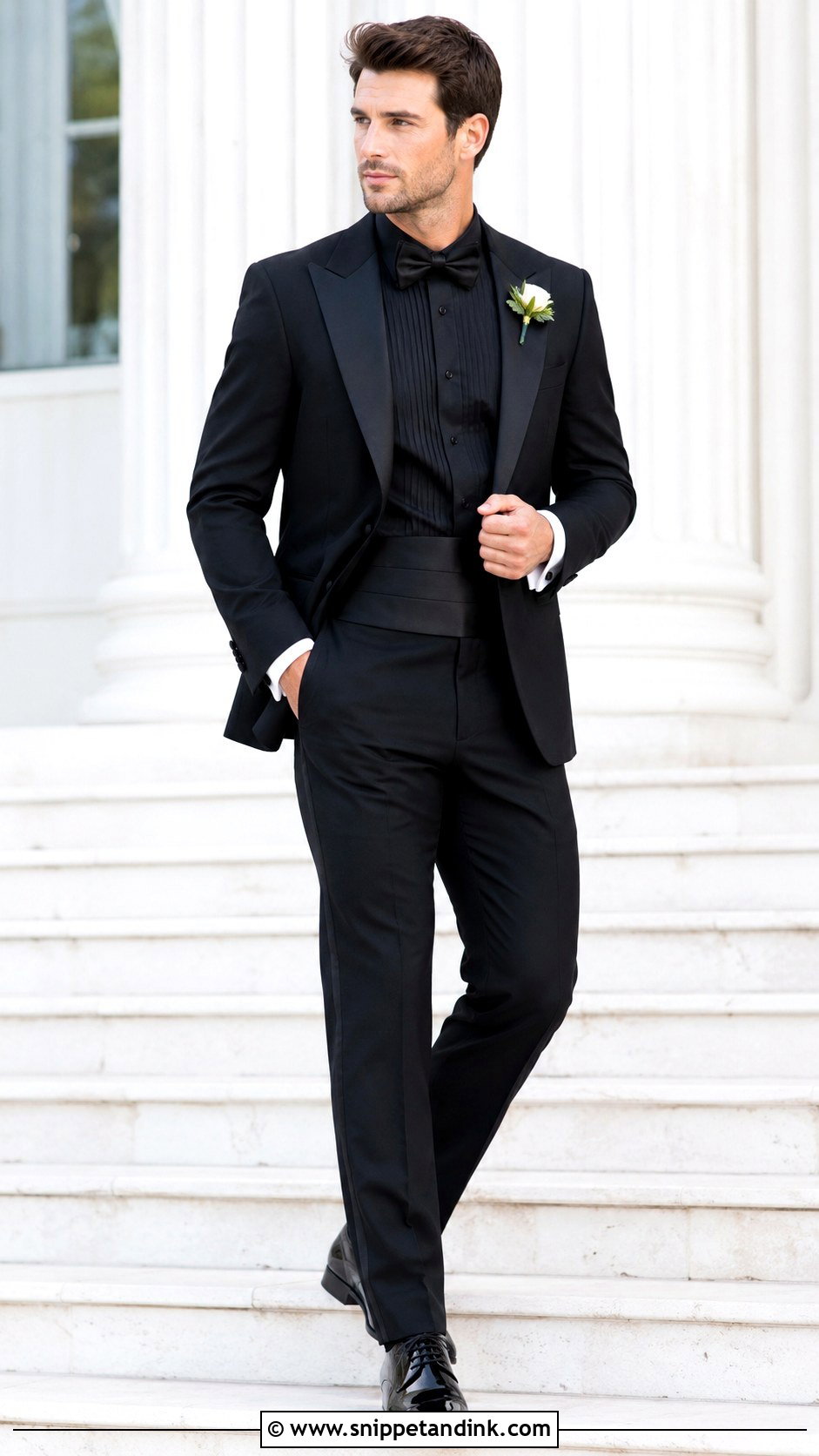
Patent Oxfords pick up the shine of satin lapels and covered buttons, linking top and bottom of a traditional outfit. A single-breasted peak lapel tux with a satin side stripe on the trousers, a pleated-front black shirt, satin bow tie, and cummerbund set the formal base. Wear fine over-the-calf socks so no shin shows when you sit. Onyx cufflinks, black studs, and a tonal pocket square finish it. Patent leather doesn’t stretch much, so break the shoes in at home for a week, and keep a soft cloth handy, since fingerprints and dust show on glossy black more than anything else.
16. All Black Tux With Velvet Loafers
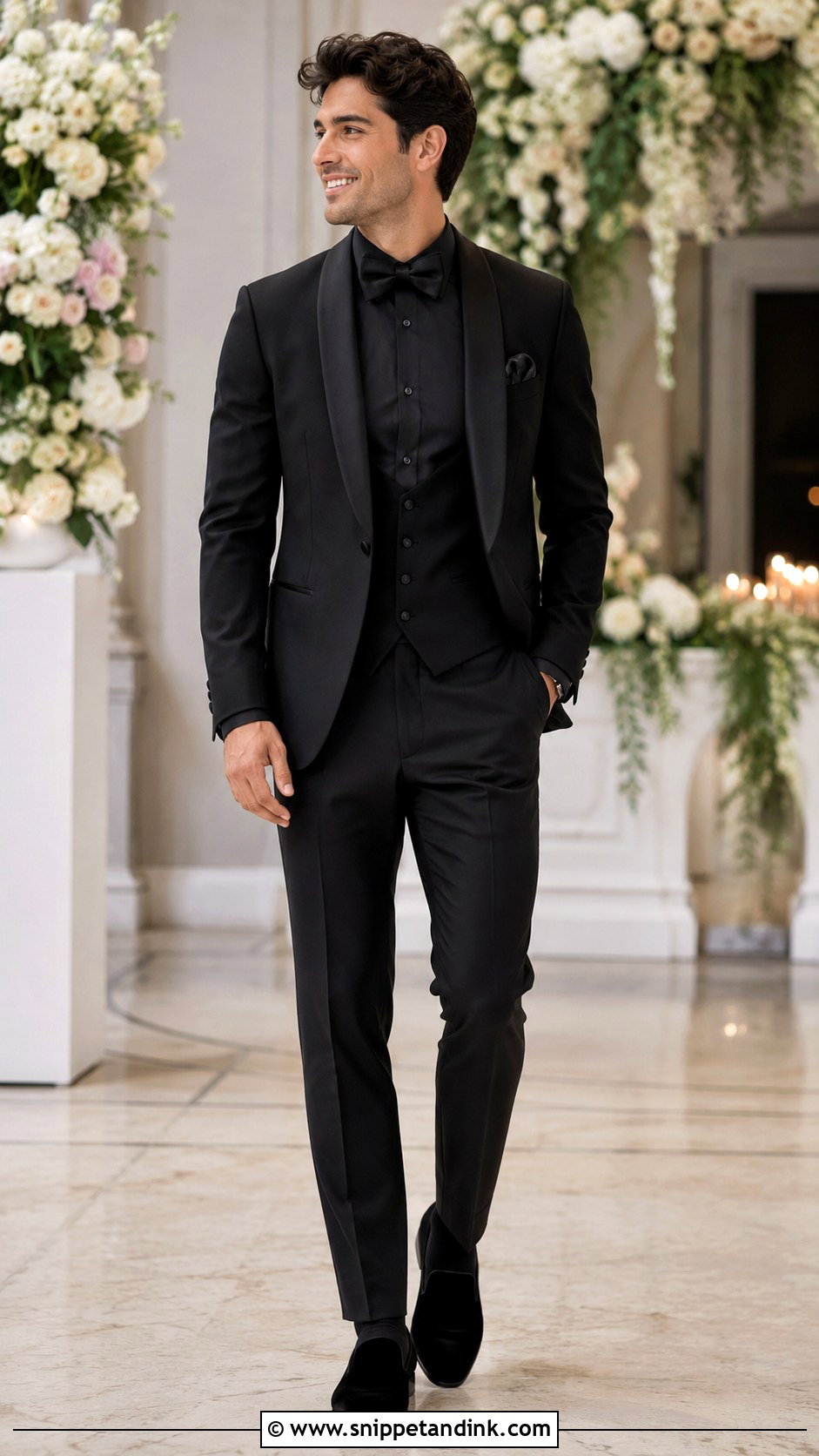
Velvet loafers relax a tux without dropping its formality, and they’re traditional evening slippers rather than a trend. Pair them with a shawl collar jacket, matching trousers, a smooth black shirt, a silk bow tie, and a low-cut waistcoat for structure. Choose plain black velvet with little or no tonal embroidery. Fine black socks, discreet cufflinks, and a matte pocket square finish it. Trousers should have little or no break so the shoes show, but long enough that no ankle appears. Velvet soles slip on polished floors, so I’d have a cobbler add a thin rubber sole before the day, especially for dancing.
17. All Black Tux With Black Boutonniere
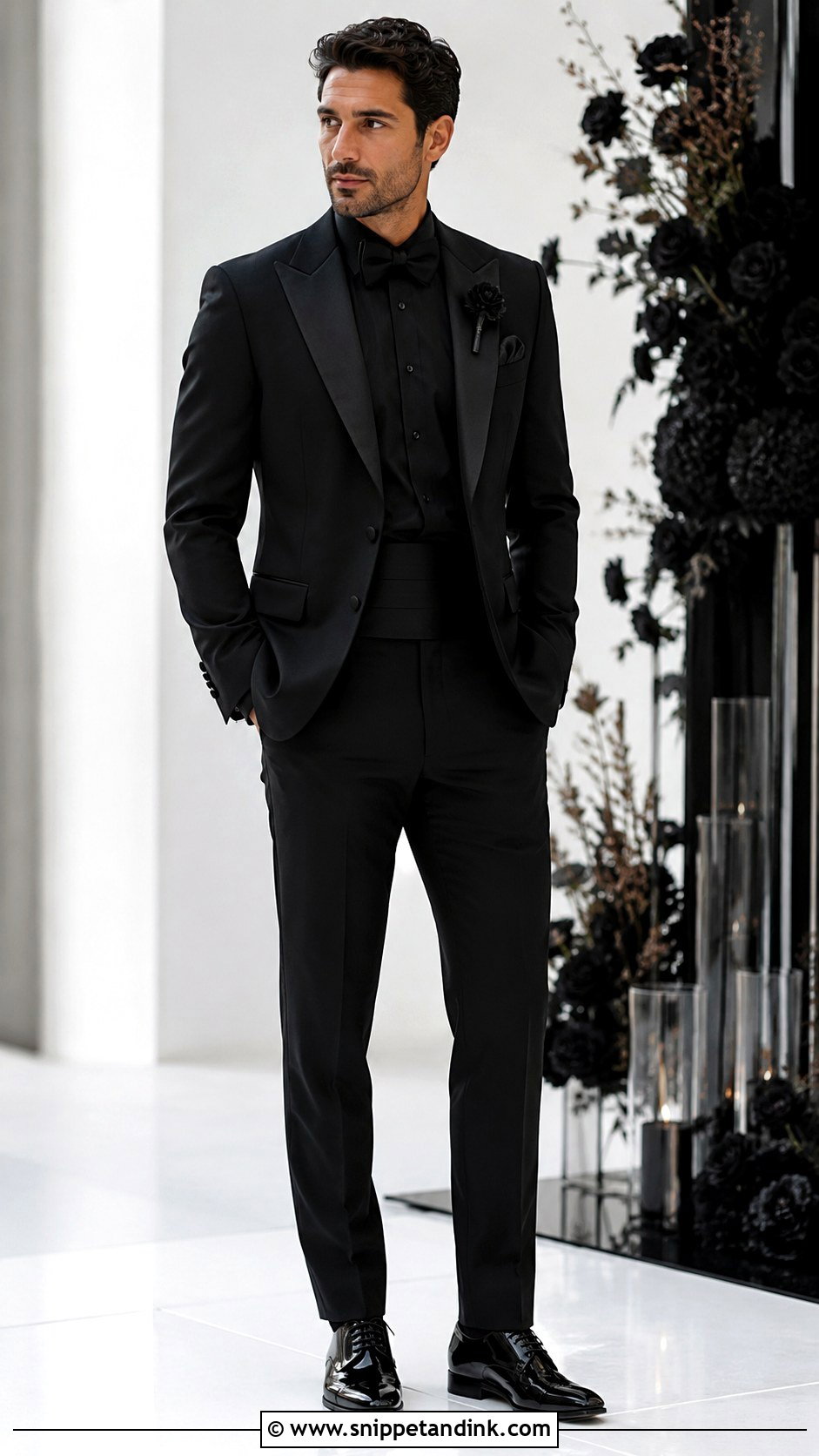
A tonal boutonniere lets the groom stand out without breaking the monochrome. Over a peak lapel tux with a black shirt, bow tie, cummerbund, Oxfords, and black socks, a small black or deep charcoal boutonniere sits on the left lapel. Truly black flowers are rare, so ask your florist about very dark burgundy blooms, dark foliage, or a silk flower. A slightly fuller boutonniere than the groomsmen wear is a simple way to mark the groom. Keep it light and pinned securely through the lapel buttonhole if you have one, so it doesn’t droop by the photos. Onyx cufflinks and a plain pocket square complete it.
18. Lightweight All Black Summer Tux
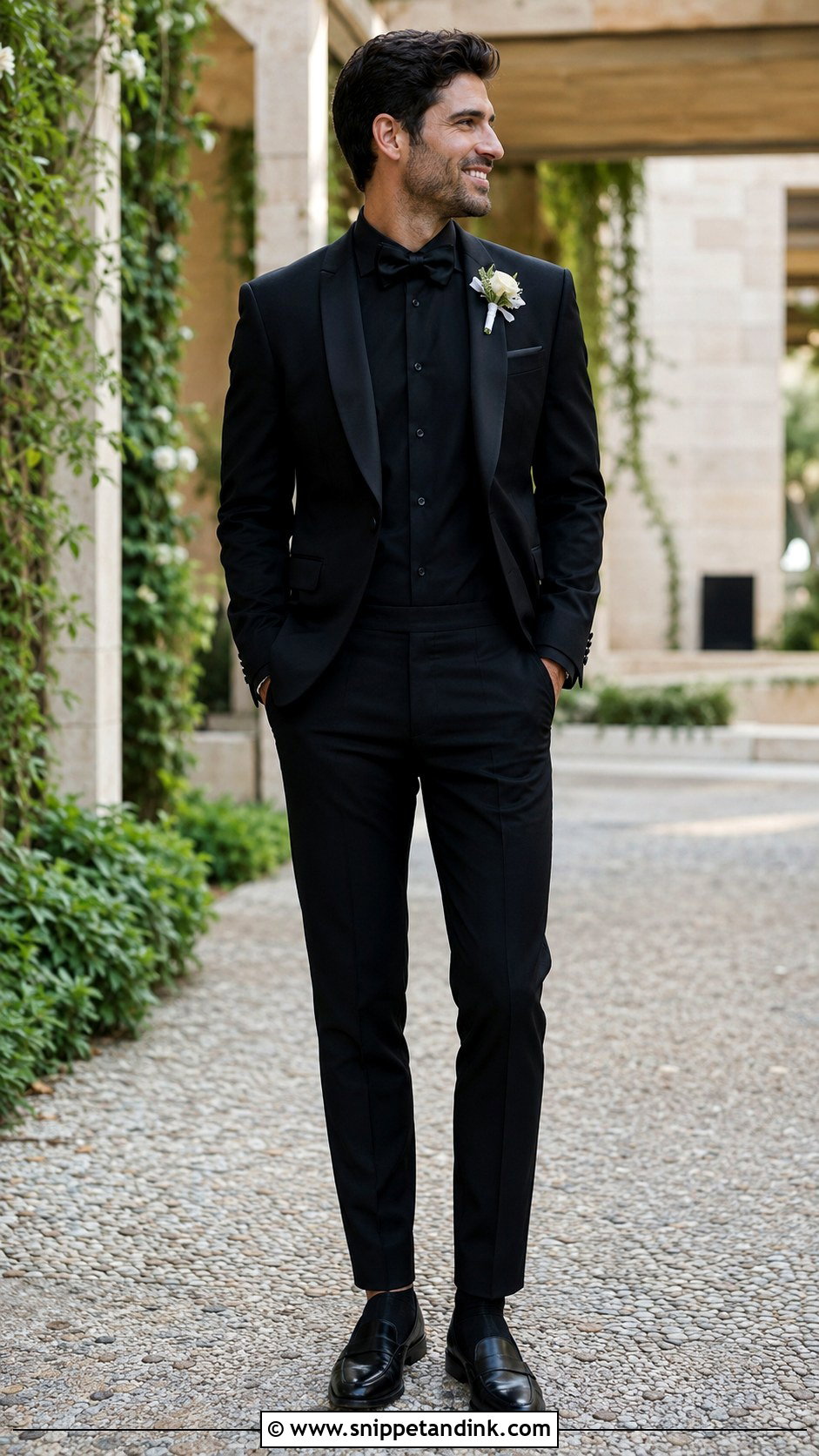
Black in summer is about construction, not color. An unlined or half-lined jacket in tropical wool, a plain weave with an open structure, lets air move through it far better than a fully lined jacket. Pair it with matching lightweight trousers and a breathable black shirt. A slim bow tie, leather loafers, light socks, and simple cufflinks keep it trim. Skip the waistcoat unless the room is well cooled. Black absorbs heat in sun, so I’d push longer portraits into shade or toward evening light. Evening ceremonies, shaded venues, and air-conditioned receptions suit this best.
19. All Black Winter Wedding Tux
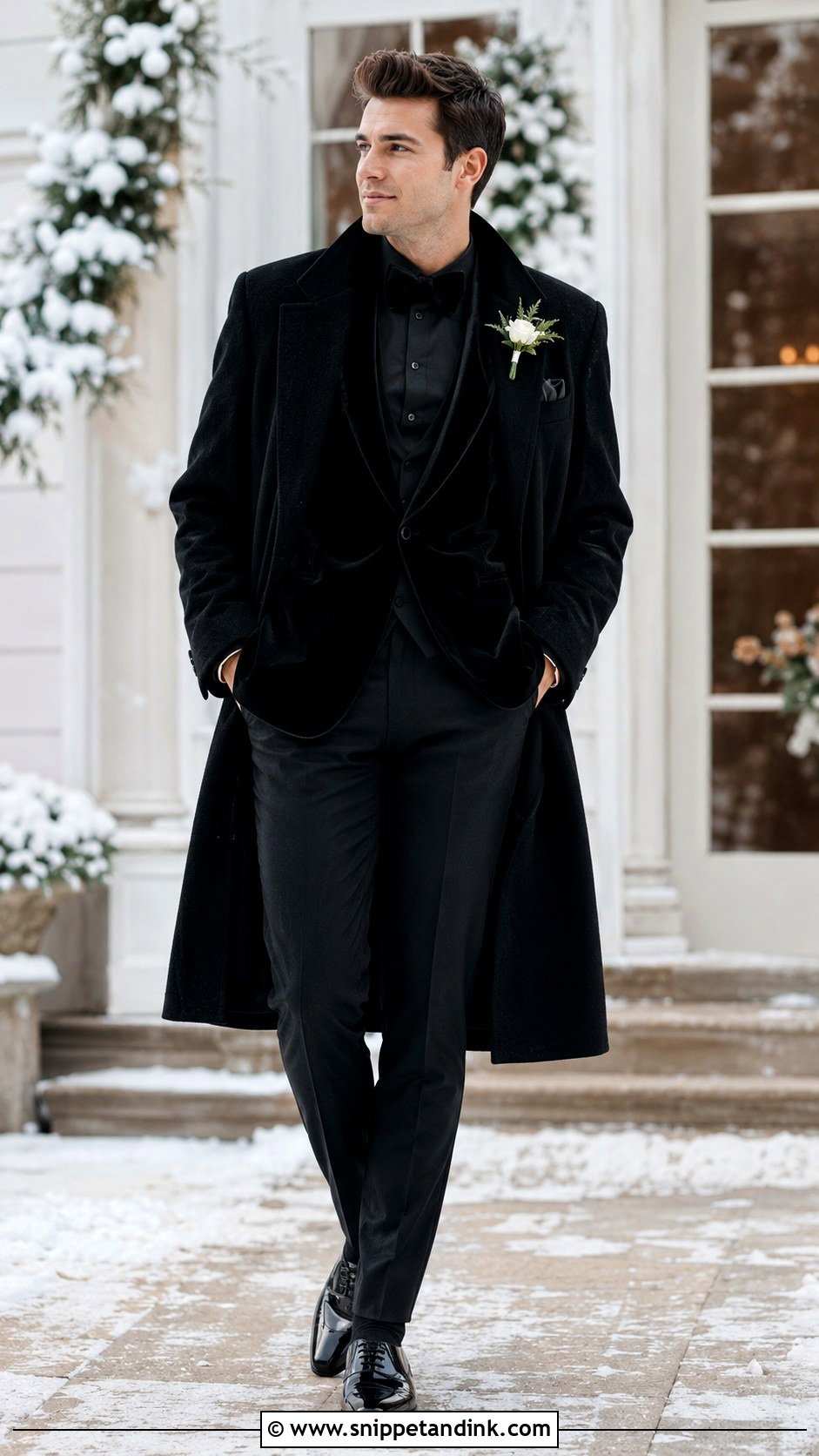
Cold weather lets you layer textures. A velvet or heavy wool jacket with matching trousers, a black formal shirt, a waistcoat, and a velvet bow tie give warmth and depth. Patent Oxfords, thicker black socks, onyx cufflinks, and a folded pocket square finish the indoor outfit. For outdoor photos, a tailored black overcoat looks right; a puffer does not. The overcoat should be long enough to cover the jacket hem fully, ideally reaching the knee. Black leather gloves and a plain scarf can come on and off between shots. Mixing wool, velvet, satin, and leather keeps all that black from looking flat.
20. All Black Groom And Groomsmen Tux
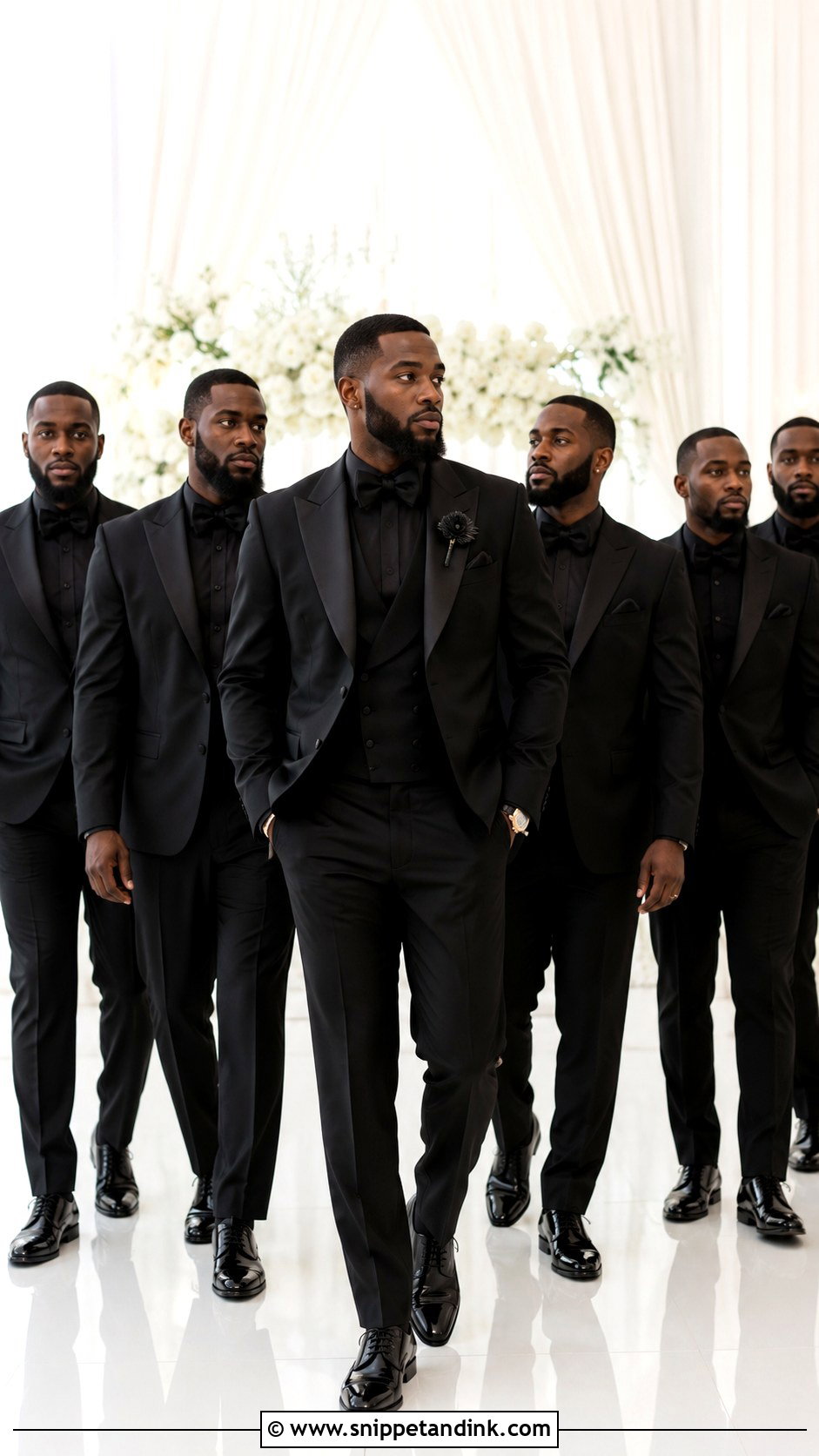
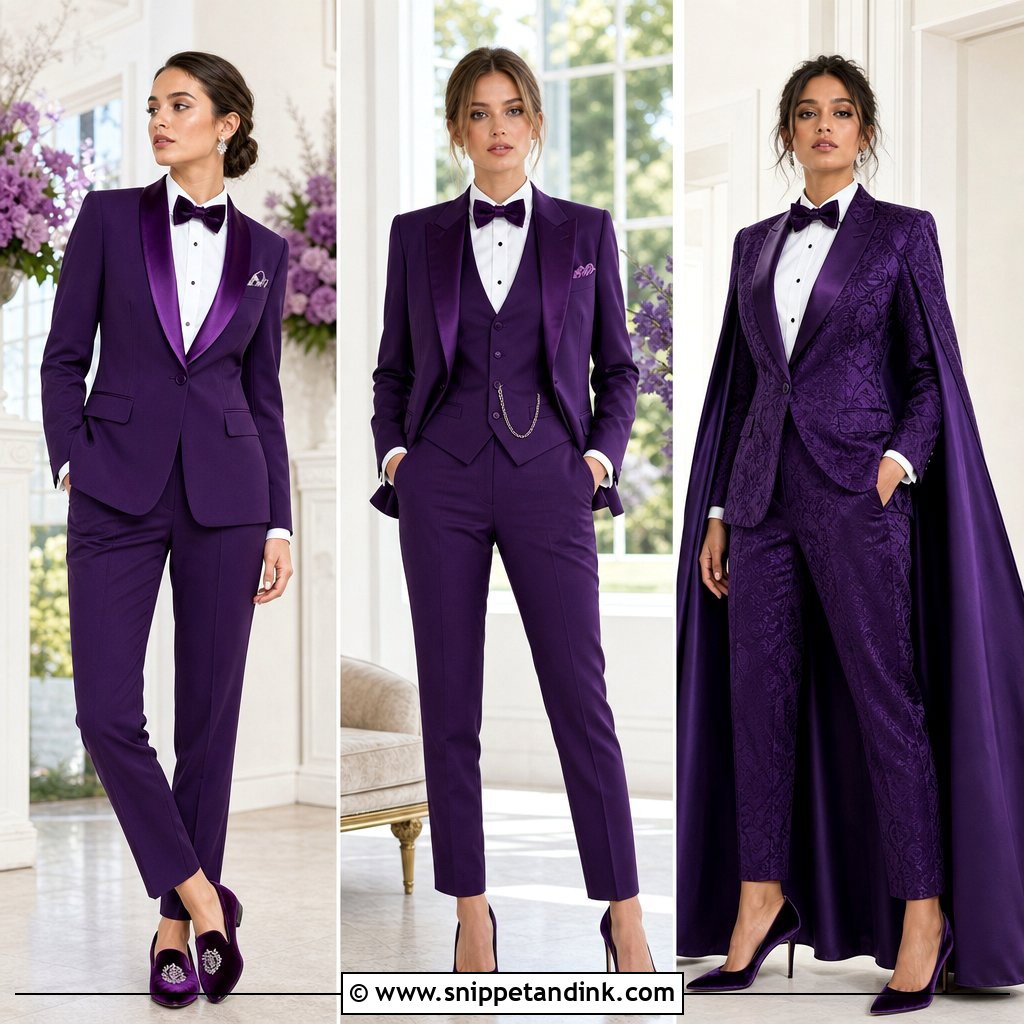
A full wedding party in black tuxes looks sharp in group photos, as long as everything matches closely. Put groomsmen in notch lapel tuxes with black shirts, bow ties, matching trousers, and polished Oxfords. Mark the groom with a peak lapel or velvet jacket, a low-cut waistcoat, and a slightly different boutonniere. One or two differences are enough. Keep shoes, shirts, and trouser fabrics consistent. Blacks carry different undertones, some bluish and some brownish, so I’d rent or buy from one source and check every outfit side by side under similar lighting at the fittings.
Two Blacks Side by Side Rarely Match
This is the problem nobody warns grooms about. A black wool jacket, a black cotton shirt, and polyester-blend trousers can all look black in the shop and turn three different shades under camera flash. Dyes take differently on each fiber, and some blacks lean blue, green, or brown.
How I check it
- Lay every piece together near a window in daylight, then again under warm indoor light.
- Take a phone photo with the flash on. Mismatched blacks show up immediately.
- Buy the jacket and trousers as a set, never separately, and keep the shirt in a slightly different texture so any small shade gap looks intentional.
- If the groomsmen rent, use one supplier and try everything on together.
Keeping it clean on the day
Black shows every fleck of lint, pet hair, and face powder. Pack a lint roller, a small travel steamer, and a soft cloth for patent shoes in the groom’s bag. Put the jacket on after makeup or grooming, not before, and ask someone to roll the shoulders and back right before the ceremony.
It also helps to warn your photographer. Black on black loses detail in shadow, and a photographer who knows can expose for the suit and look for side light that brings out the lapel texture instead of letting the whole outfit go flat.
Texture Is What Keeps Black From Going Flat
An all-black wedding outfit stands or falls on texture and fit. Peak lapels look commanding; shawl collars look softer. Velvet, satin, wool, grosgrain, and jacquard add dimension without breaking the palette, and the shoes, neckwear, shirt, and socks should back up the tux rather than compete with it. Check the venue, season, and the couple’s dress code before swapping the white shirt for black. Book alterations early and look at the finished outfit in daylight and in light like the venue’s. When a groom tries it all on together and can’t spot a single piece that pulls focus, I know it’s ready.
You'll Like These Ideas:


Leave a Reply