
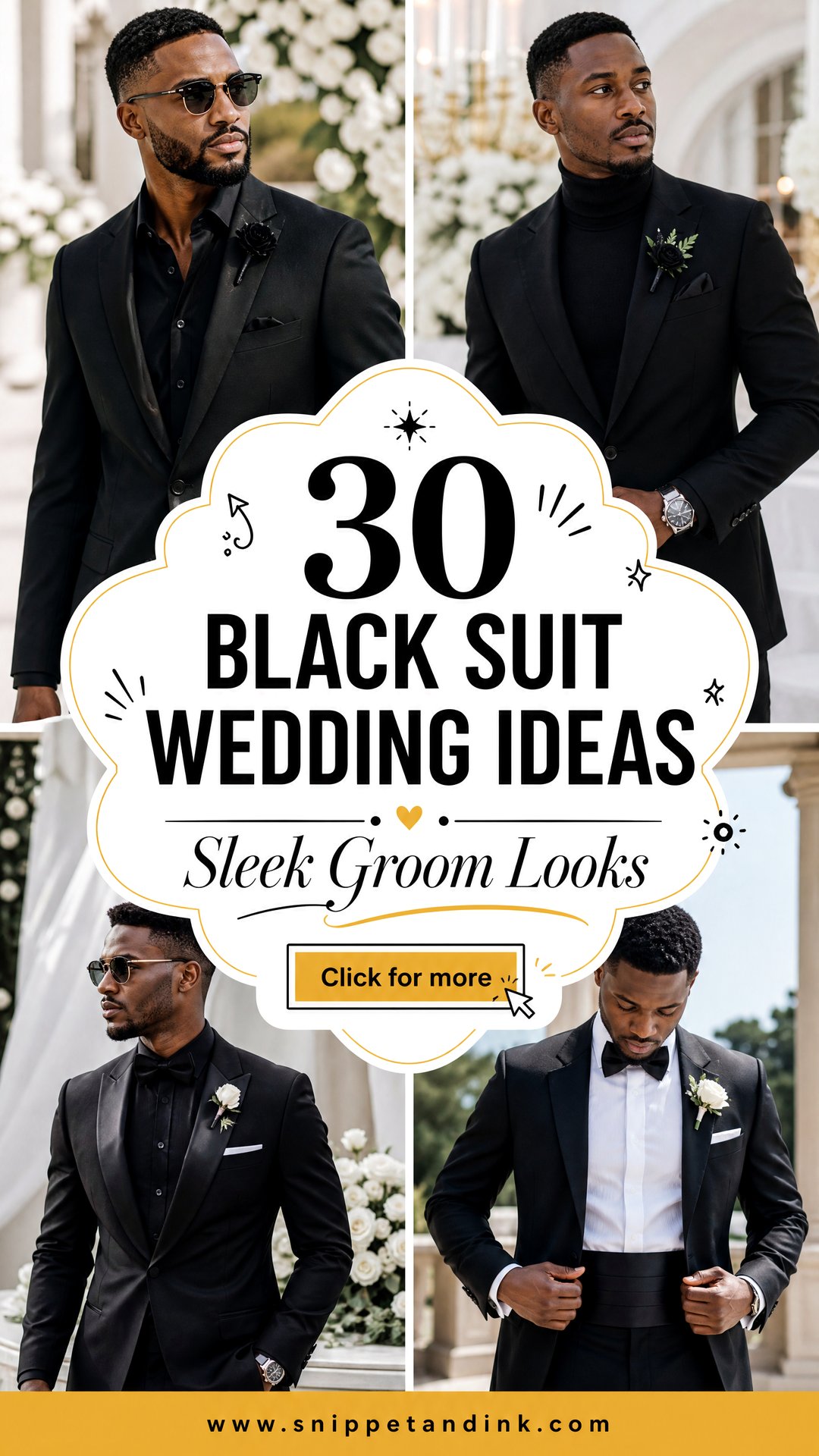
A black suit gets worn to more weddings than any other colour I dress men in, and it earns that spot: it reads formal at night, holds up in a hotel ballroom and still looks right at a city hall at noon. The trouble is that a plain black suit can also look like a work uniform. What separates the two is never the suit alone. It’s the shirt, the tie, the shoes, the lapel and above all the fit. Below are thirty ways I’d build one out, with notes on who each version suits and where it tends to go wrong.
Why Two Black Suits Rarely Look Like the Same Black
When groomsmen buy their suits from different shops, I can usually spot it in the first group photo. Black dye varies a lot from mill to mill. Some blacks lean blue, some lean brown, and cheaper polyester blends carry a sheen that turns grey under a camera flash while wool next to it stays deep. Standing side by side in daylight, the difference is obvious.
- Buy or rent every suit in the party from one supplier and one fabric run if you can.
- Pick wool or a wool blend with a matte finish. It absorbs light, so it photographs as true black instead of a shiny charcoal.
- Check the colour by a window, not under shop lights. Warm indoor bulbs hide undertones that daylight shows straight away.
- Older black suits fade at the elbows and seat after many dry cleans. If one man is re-wearing his, line him up next to a new one before the day.
Weight matters too. A cloth in the region of 9 to 11 ounces is what I’d suggest for most of the year; anything heavier is a winter fabric, and a black suit in July sun soaks up heat faster than any other colour.
1. Black Suit With White Shirt And Black Tie
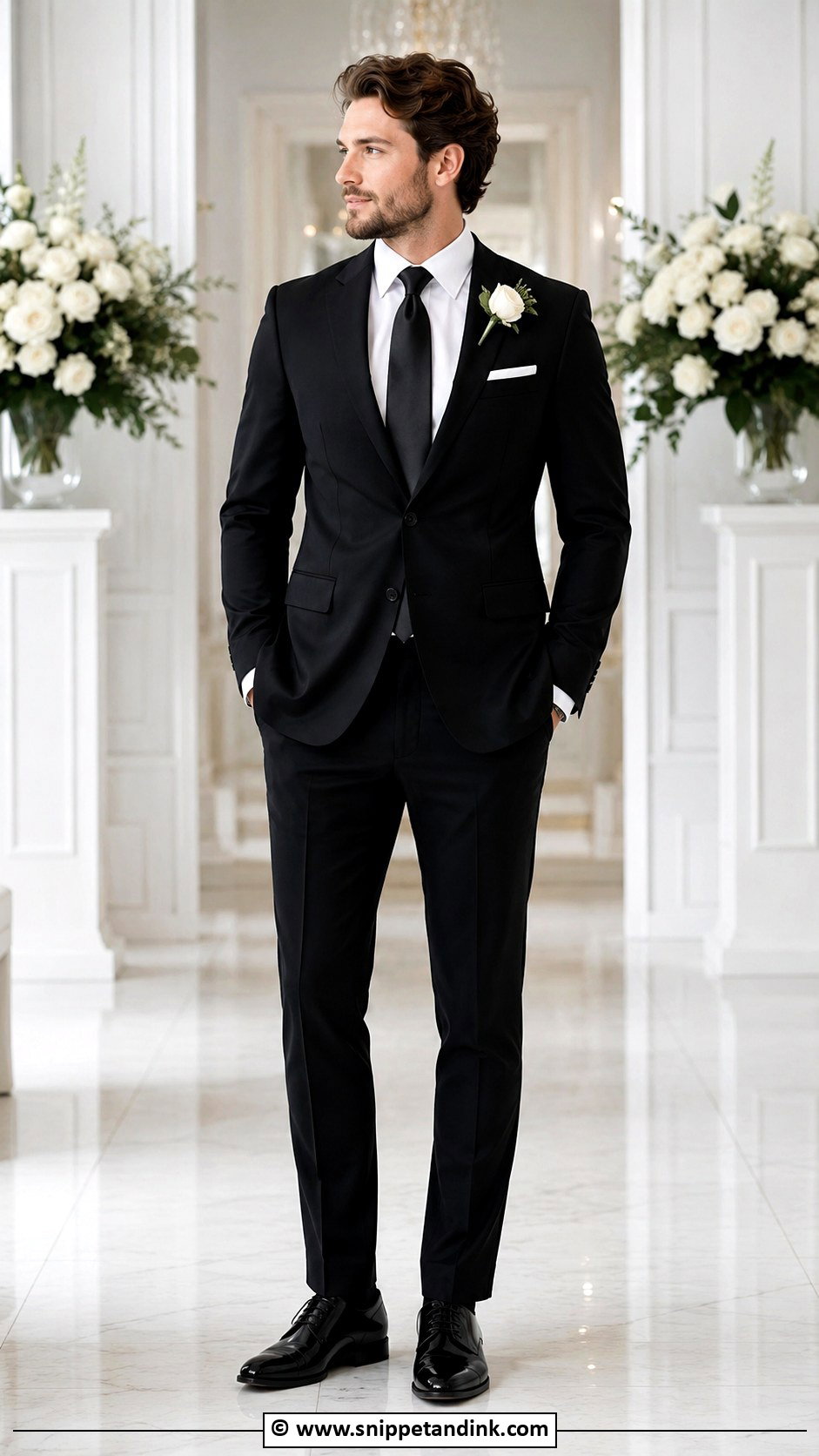
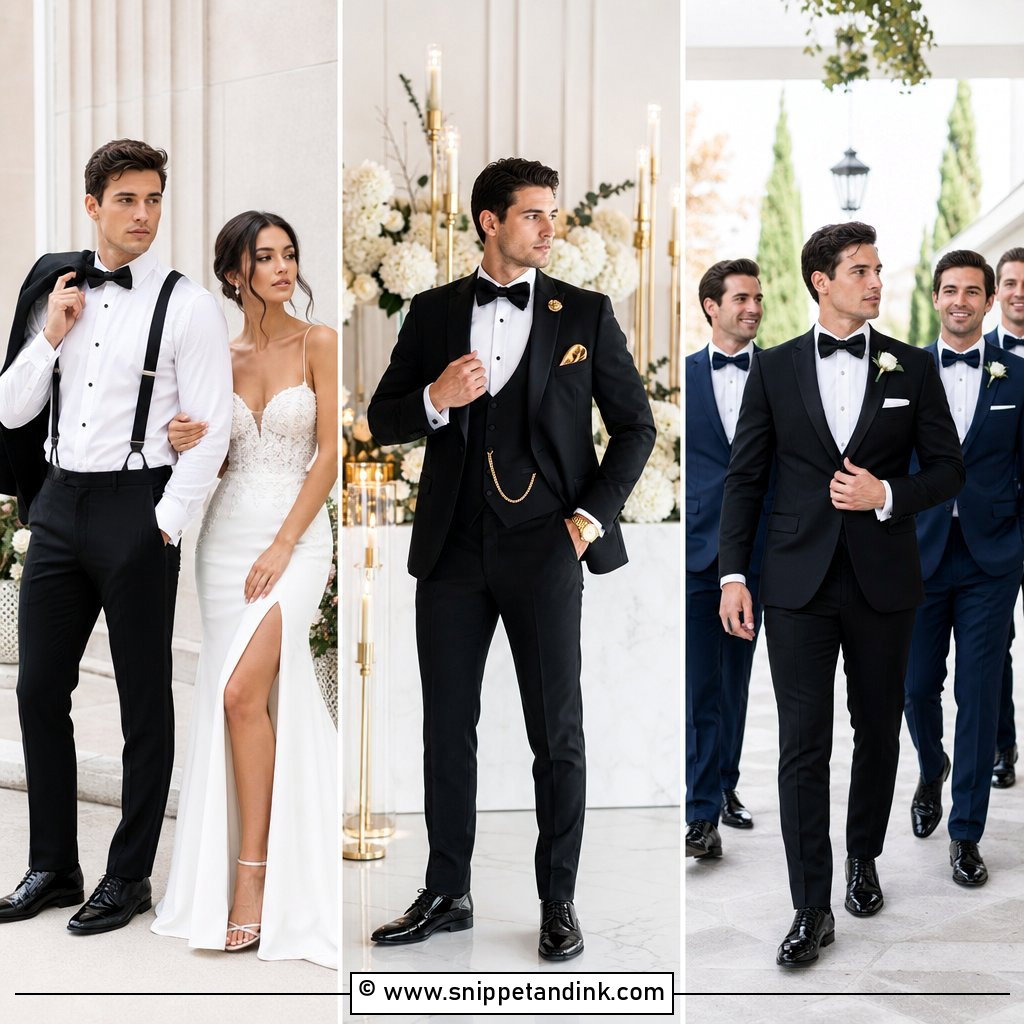
This is the combination I’d hand anyone who just wants to look correct. A two-button jacket, straight or slim trousers, a crisp white shirt and a plain black silk tie leave nothing to argue with. The detail I check most is the collar: a spread collar holds a full Windsor knot without gaping, while a narrow point collar wants a smaller four-in-hand. Black oxfords or derbies, a neatly folded white pocket square, and the groom separates himself from his groomsmen with a boutonniere or a slightly fuller fold.
2. Black Suit With Black Shirt
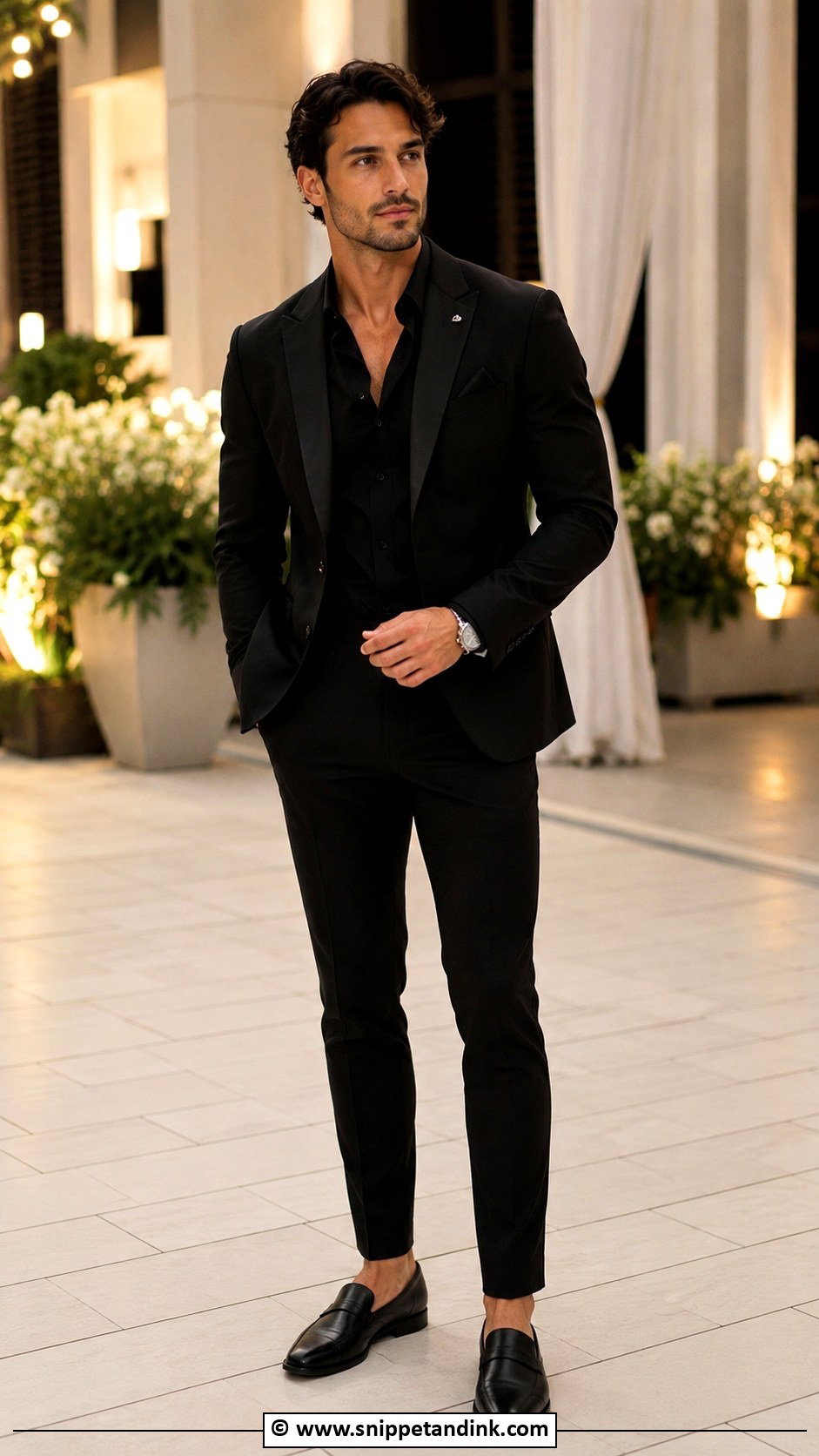
Black on black lives or dies on texture. Two identical flat blacks merge into one dark shape in photos and you lose the lapel line completely, so I pair a matte wool suit with a shirt that has a faint sheen, like a poplin with some lustre or a fine sateen. Keep the extras quiet: black loafers or polished lace-ups, a silver watch, maybe a small lapel pin. It suits rooftop and gallery receptions after dark, and I’d only suggest it to a guest when the invitation reads as relaxed about colour.
3. Black Suit With Ivory Shirt
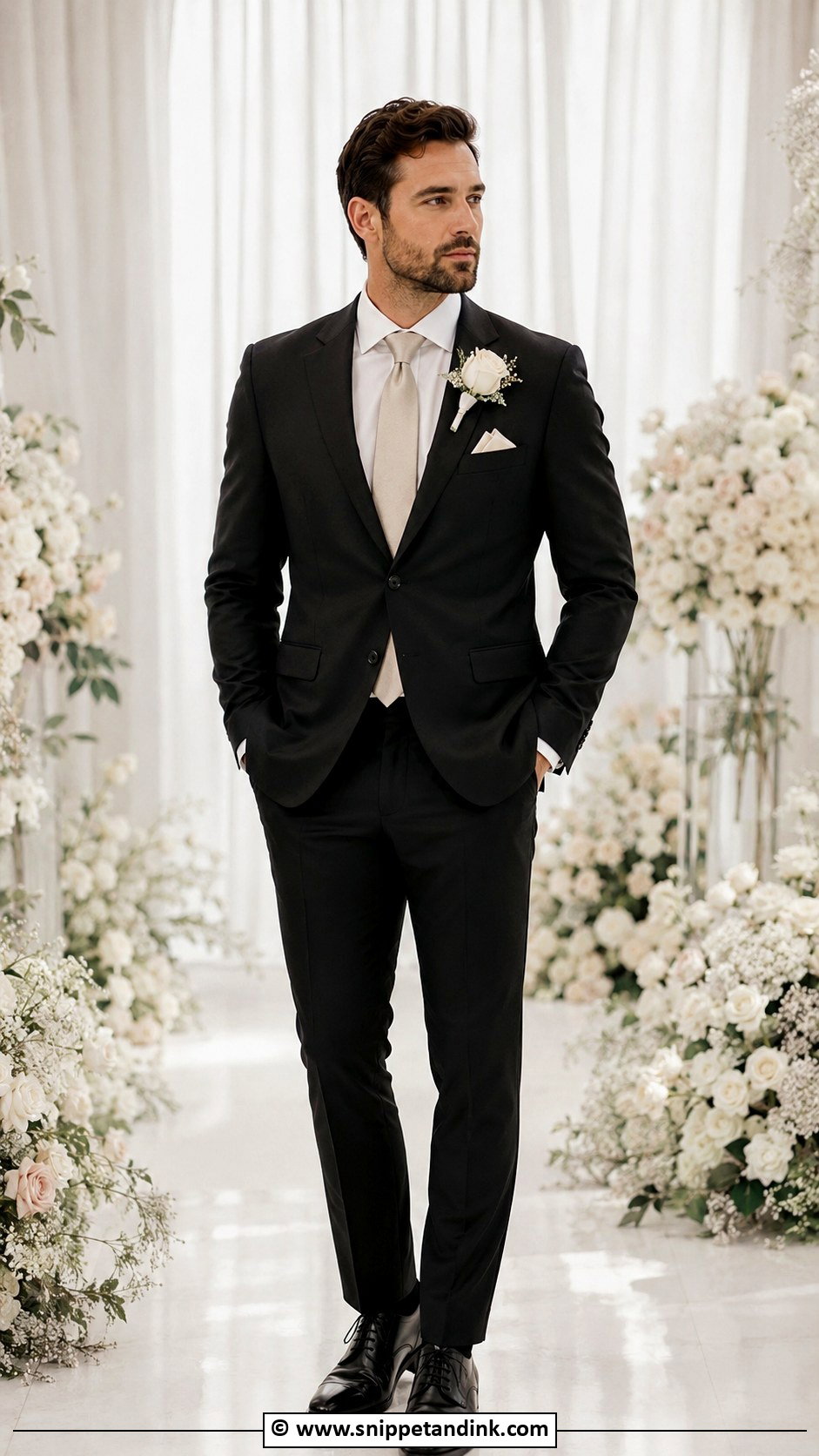
Ivory is my go-to when bright white looks harsh against a man’s skin or against a bride in ivory. Next to an off-white gown, a pure white shirt can make her dress look yellowed in photos, and an ivory shirt fixes that. Tie options open up too: black, champagne, taupe or muted gold all sit comfortably on it. Stay in black shoes. Brown with a black suit almost always reads as a styling mistake at a formal wedding, however good the leather.
4. Black Suit With Burgundy Tie
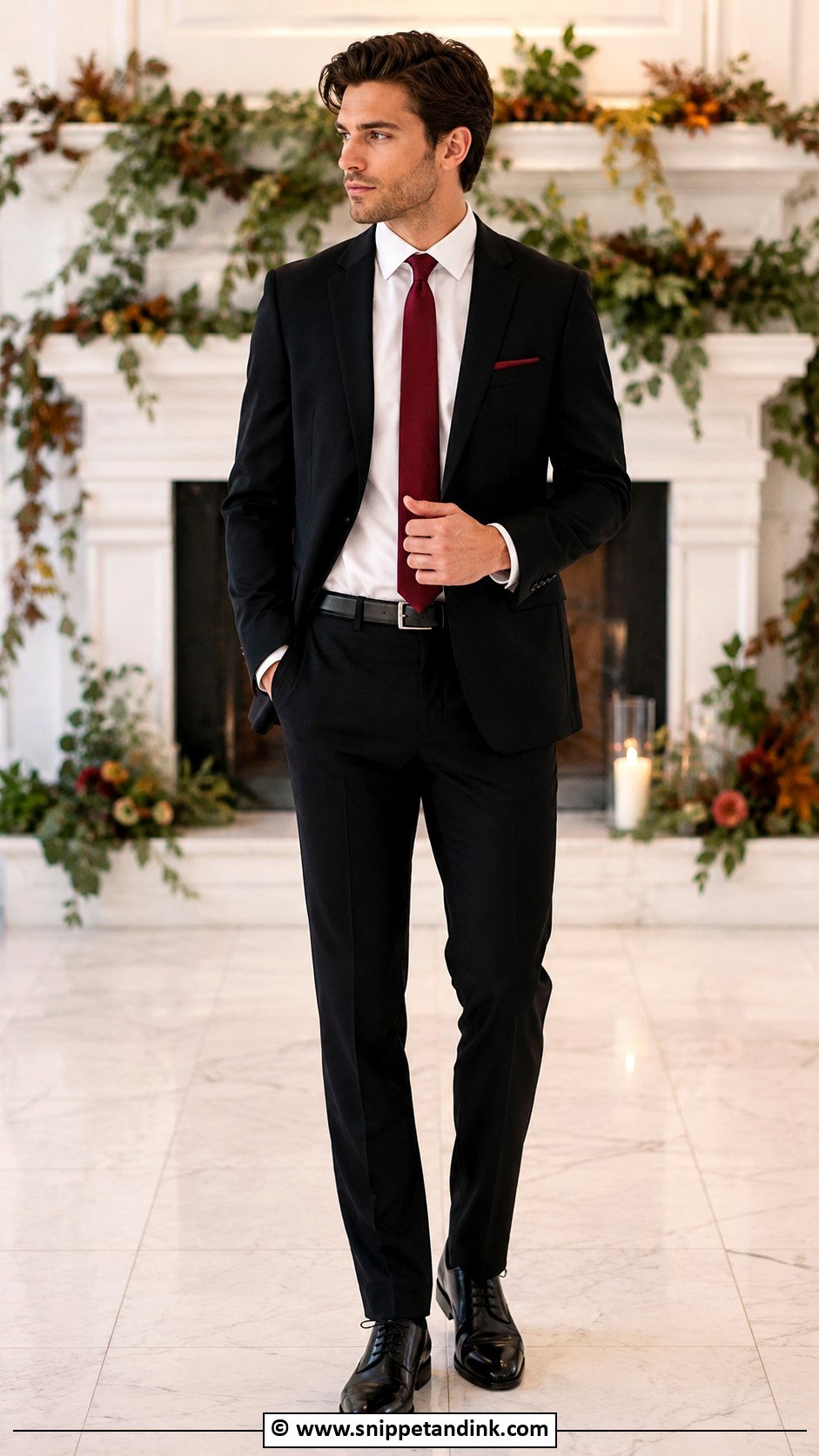
Burgundy is the colour I reach for at autumn and winter weddings because it reads rich on camera without shouting. A woven or grenadine burgundy tie has more depth than a flat satin one, and it catches less glare under flash. Build it on a white shirt and black shoes, and if you want a pocket square, a white one with a thin burgundy edge looks considered rather than matched. It ties neatly into deep red bridesmaid dresses, and it gives a guest a single, grown-up accent.
5. Black Suit With Sage Green Tie
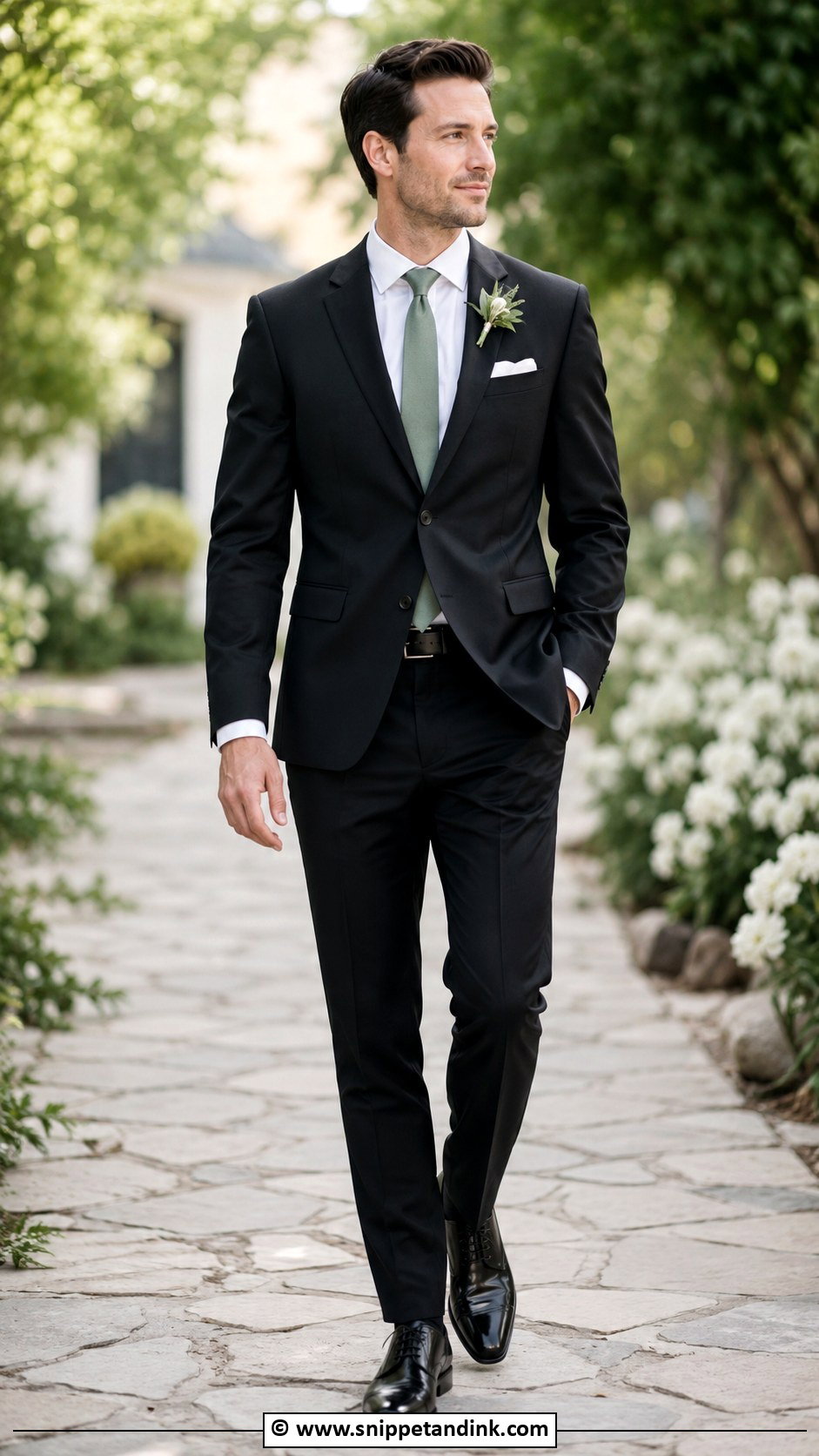
Sage is a soft green, and soft colours can look washed out against black if the tie is too pale or too shiny. I steer clients toward a matte or lightly textured sage with a little grey in it, which holds its colour next to the black instead of fading. A white or ivory shirt and black shoes keep it formal enough. It earns its place when the bridesmaids wear sage or the florals are heavy on eucalyptus and greenery.
6. Black Suit With Champagne Tie
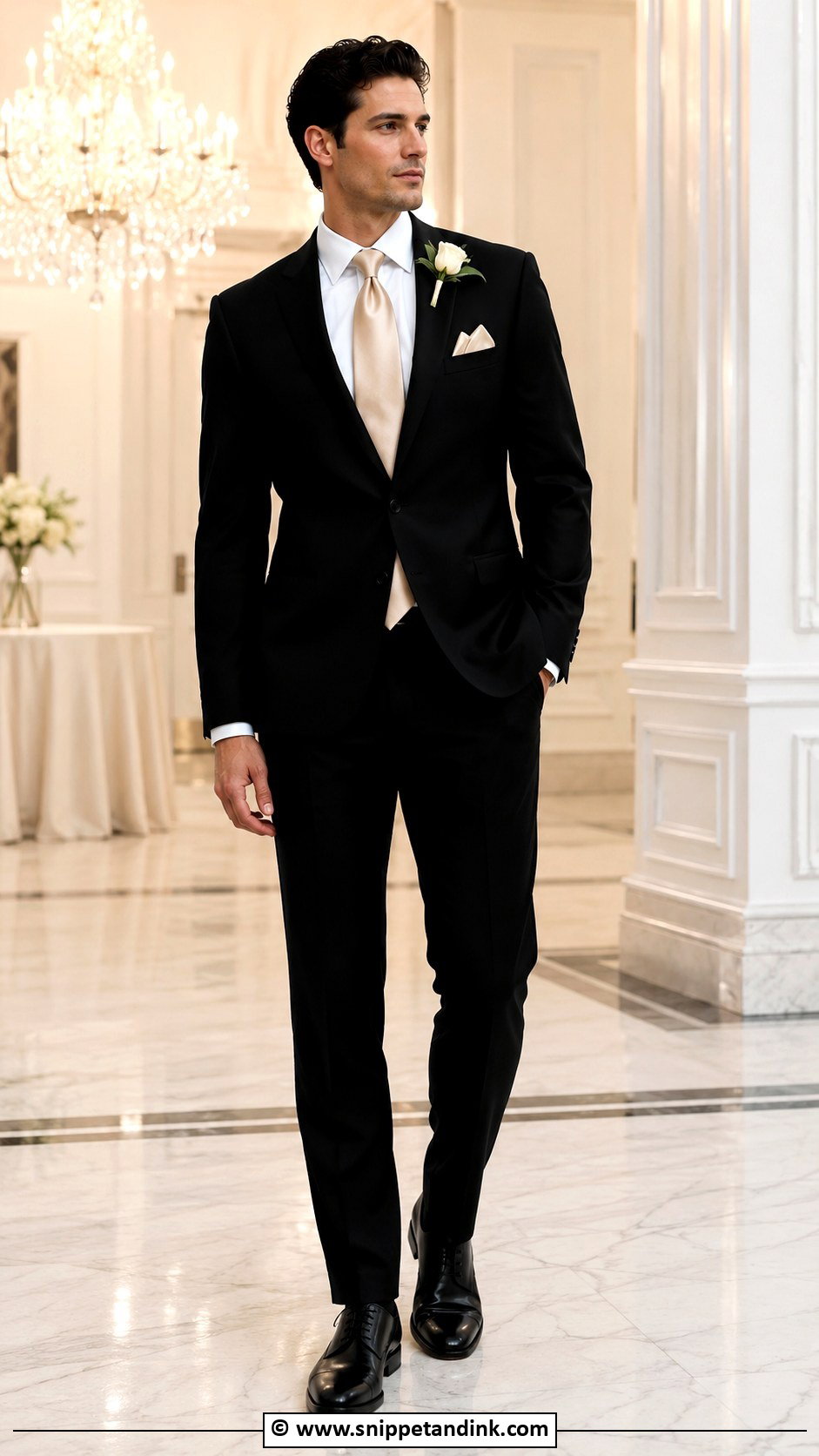
Champagne sits between gold and ivory, and on a black suit it brings warmth without the flash of true metallic. Sheen is where it goes wrong: a high-gloss champagne tie turns almost white under reception lighting and the camera flash, so I always pick one with a subtle, low lustre. A crisp white shirt, black leather shoes and an ivory pocket square finish it. For the groom, cream flowers in the boutonniere pull the whole thing together.
7. Black Suit With Navy Tie
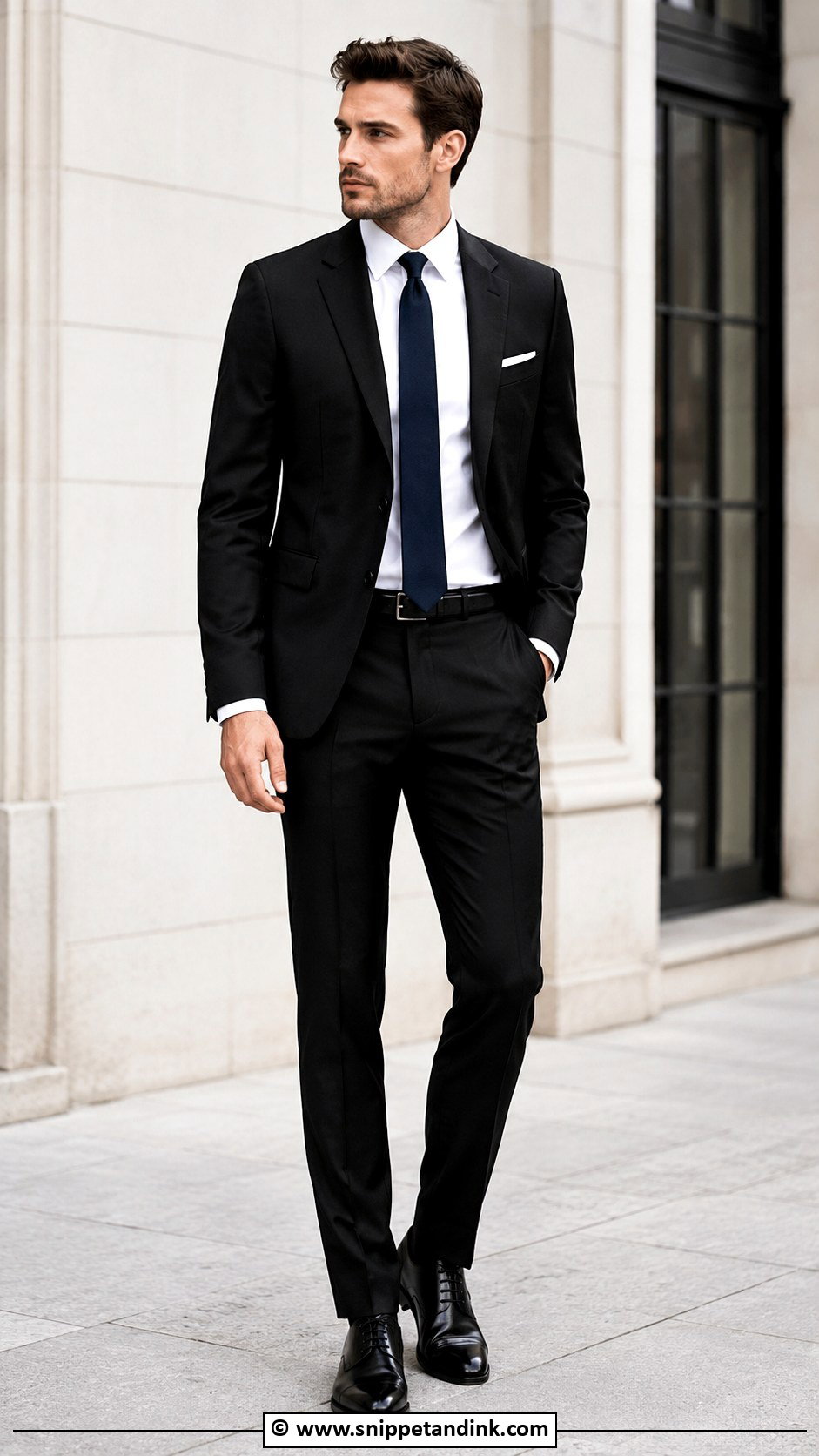
People still tell me black and navy clash. They don’t, as long as the navy is deep and clearly chosen rather than accidentally close to black. A dark navy silk tie on a white shirt gives quiet depth, especially in winter or at a city reception. The one rule I hold to: keep the pocket square plain white, because a second blue next to the tie starts to look like a near miss rather than a decision. If the bridesmaids wear navy, this is the tie that links the men to them.
8. Black Suit With Dusty Blue Tie
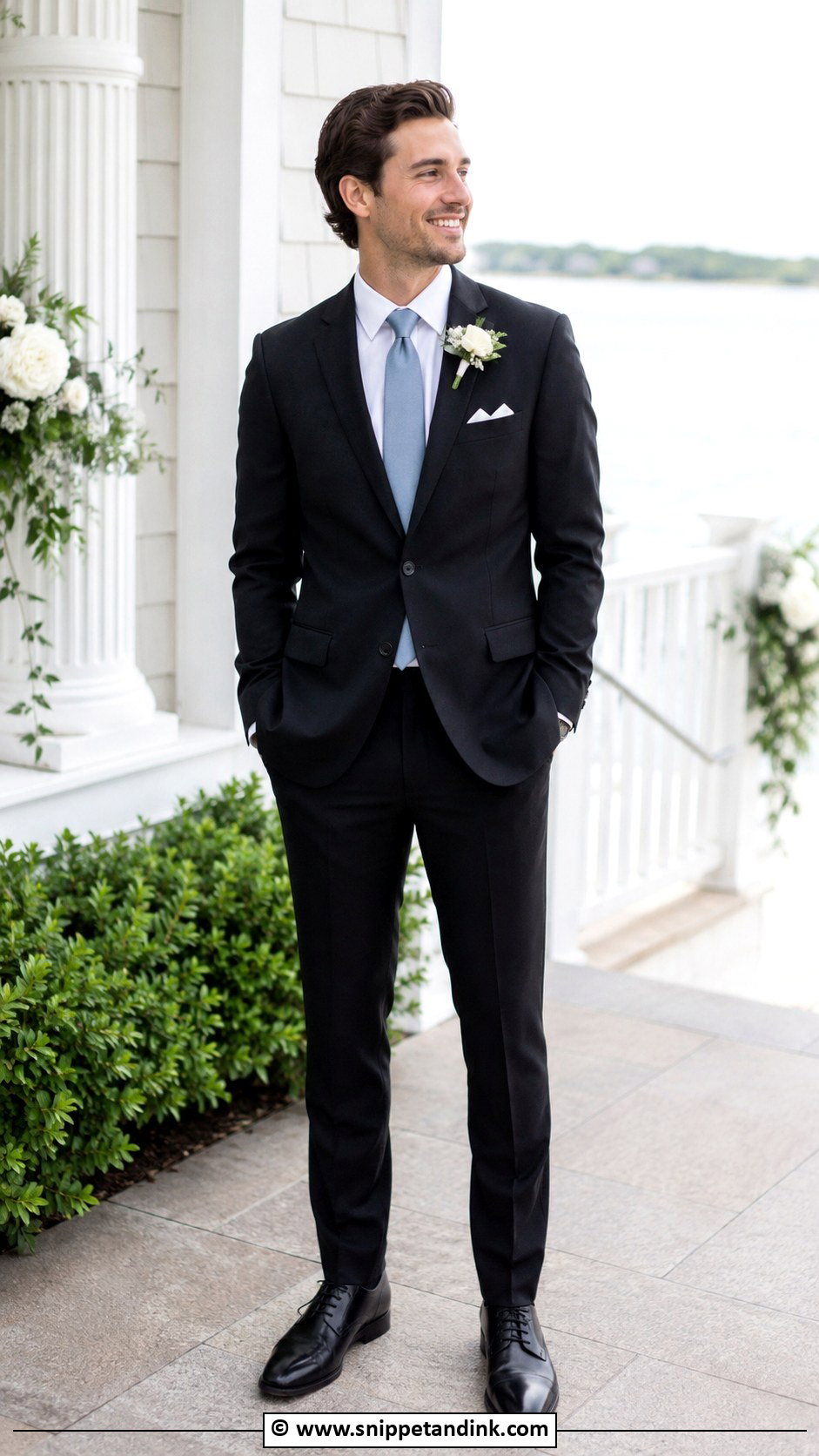
Dusty blue is the easiest wedding colour for groomsmen to wear well because it flatters almost every complexion. Against black it adds lightness, which helps at spring, summer and coastal weddings where an all-black outfit can feel heavy. Pick a muted, greyed blue rather than a bright royal, which jumps out of photographs. A white shirt, black shoes and a pocket square with a touch of grey or blue are enough.
9. Black Suit With Forest Green Tie
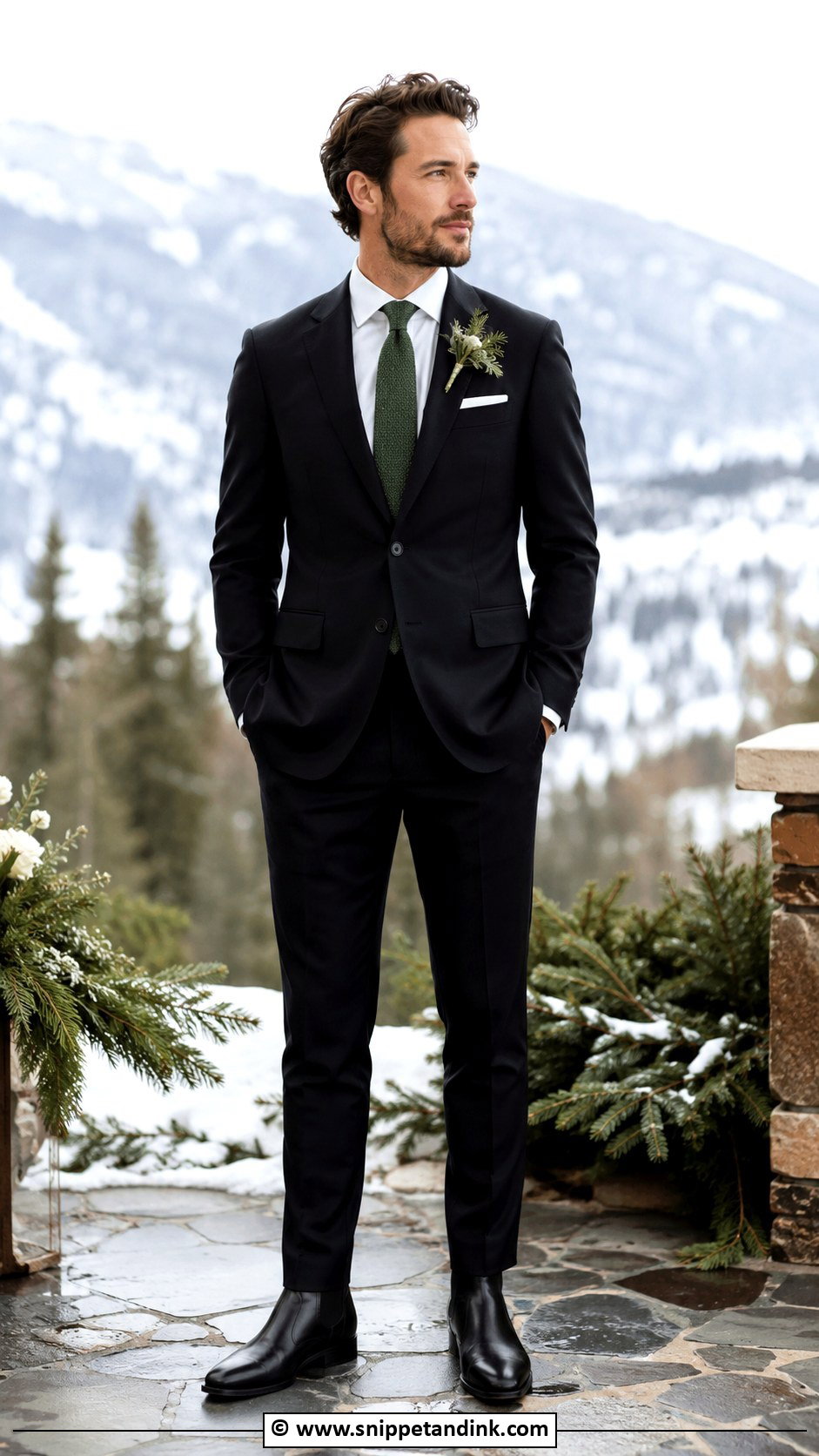
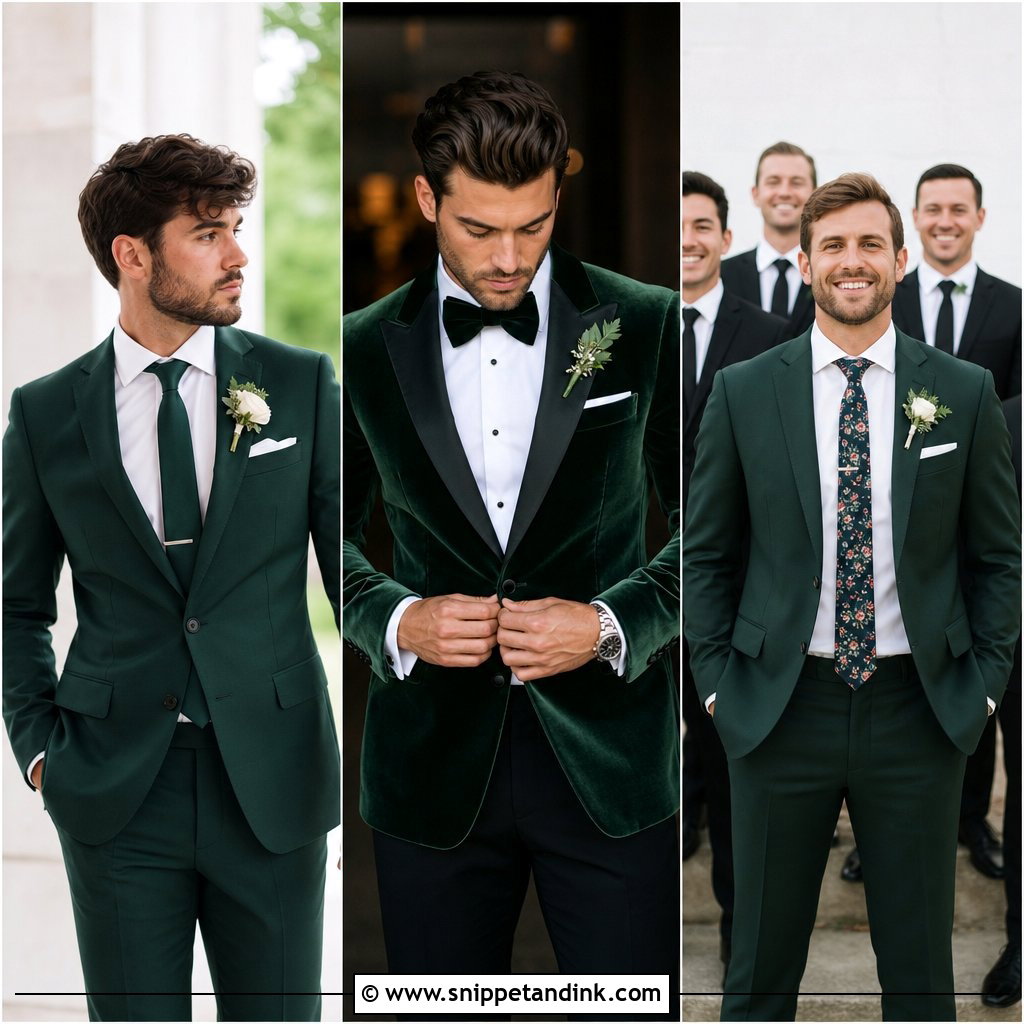
Forest green gives a black suit depth without reading as colourful, which is why I suggest it to men who normally avoid colour. In cooler months a velvet or knitted forest green tie looks rich and tactile; in a warm room I’d stay with silk because velvet ties get heavy and the knot loosens. White or ivory shirt, black shoes, white pocket square. It works with emerald bridesmaids and dark leafy florals, and a guest wearing it looks polished without drawing attention.
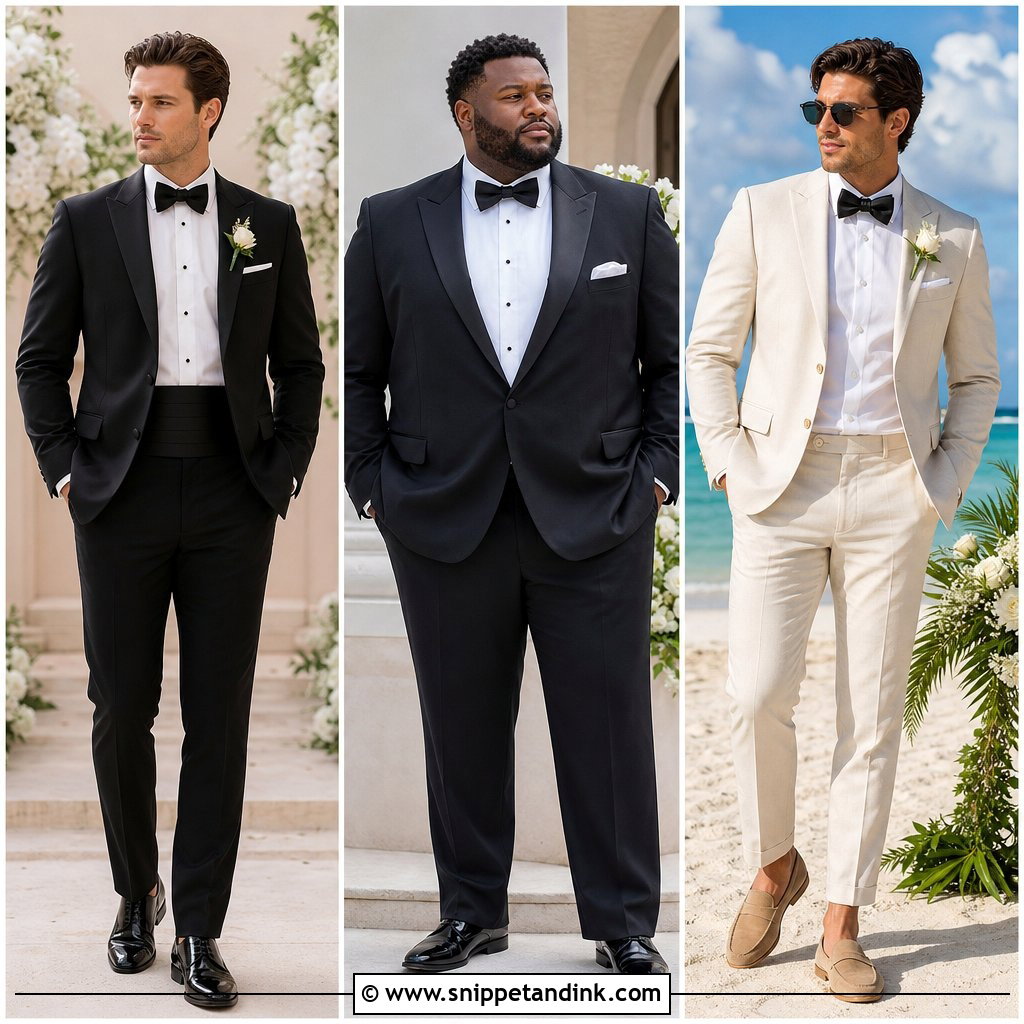
10. Black Suit With Bow Tie
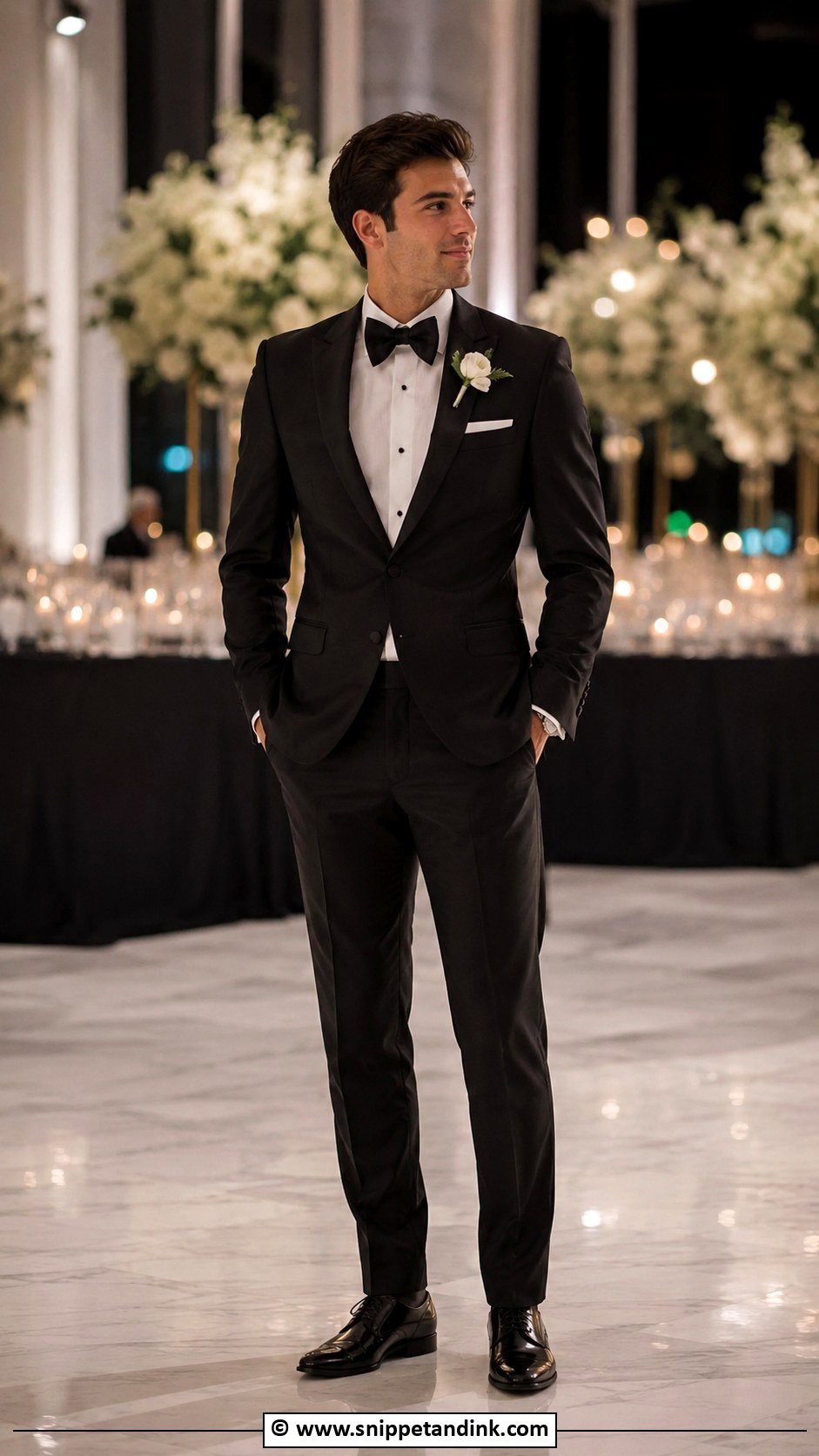
A bow tie dresses a black suit up a level without the commitment of a tuxedo. A plain black bow tie is the classic route; velvet or satin brings more personality. Size is what I adjust most: the width of the bow should roughly line up with the outer corners of the eyes and stay within the collar points, so a broad face needs a slightly fuller bow. Self-tie bows sit more naturally than pre-tied ones, and they look better undone late in the night. A white shirt and black oxfords finish it.
11. Black Suit With Vest
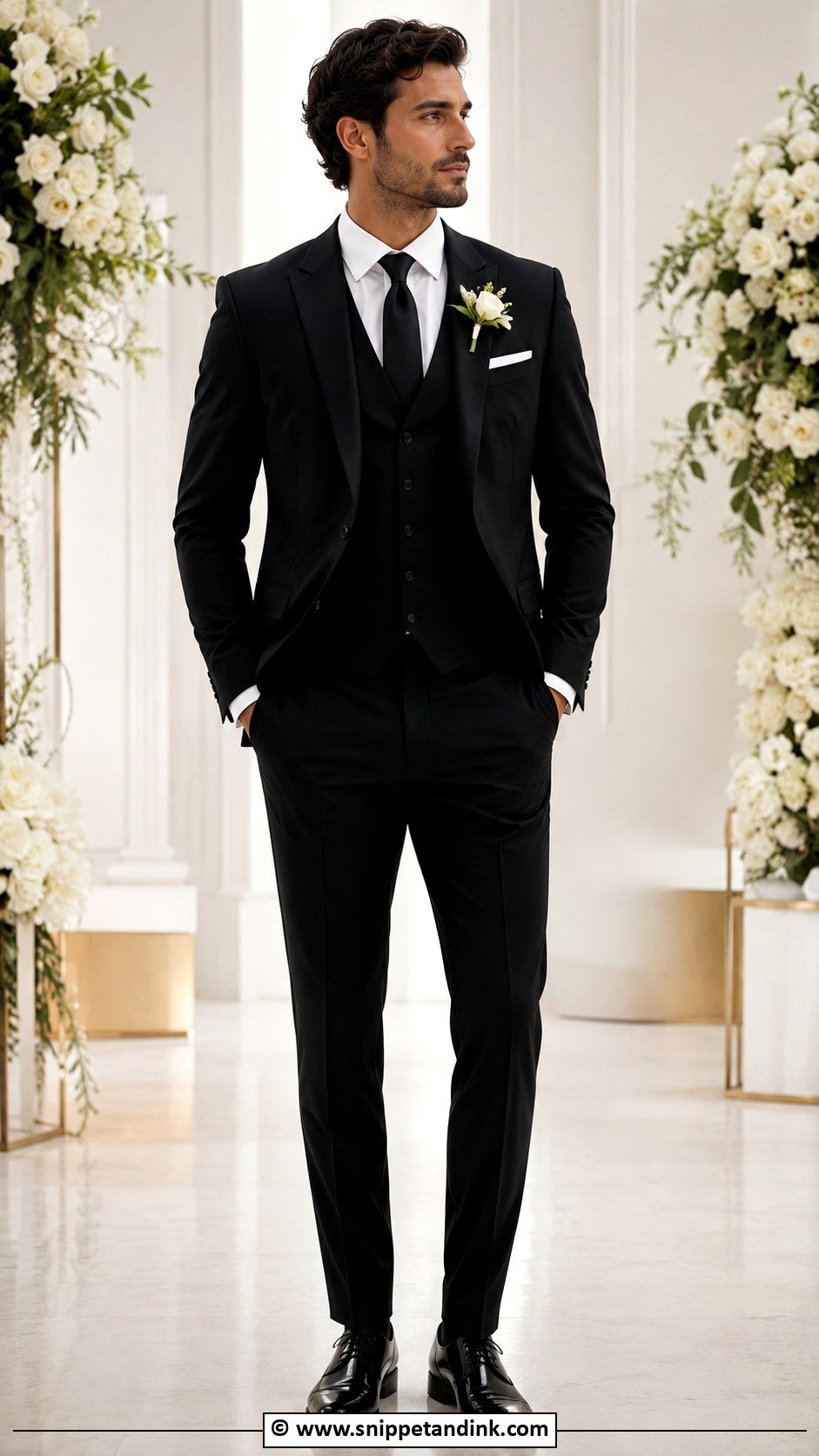
Adding a matching vest turns the suit into a three-piece, and the real benefit shows after the jacket comes off. Without a vest, a man in shirtsleeves at the reception looks like he’s on his way home from the office; with one, he still looks dressed. The fit has to be close. I check that the vest covers the waistband with no shirt showing between them and that it lies flat under the buttoned jacket instead of bunching. Pair it with a black tie or bow tie and black shoes for winter and evening ceremonies.
12. Black Suit With Patterned Tie
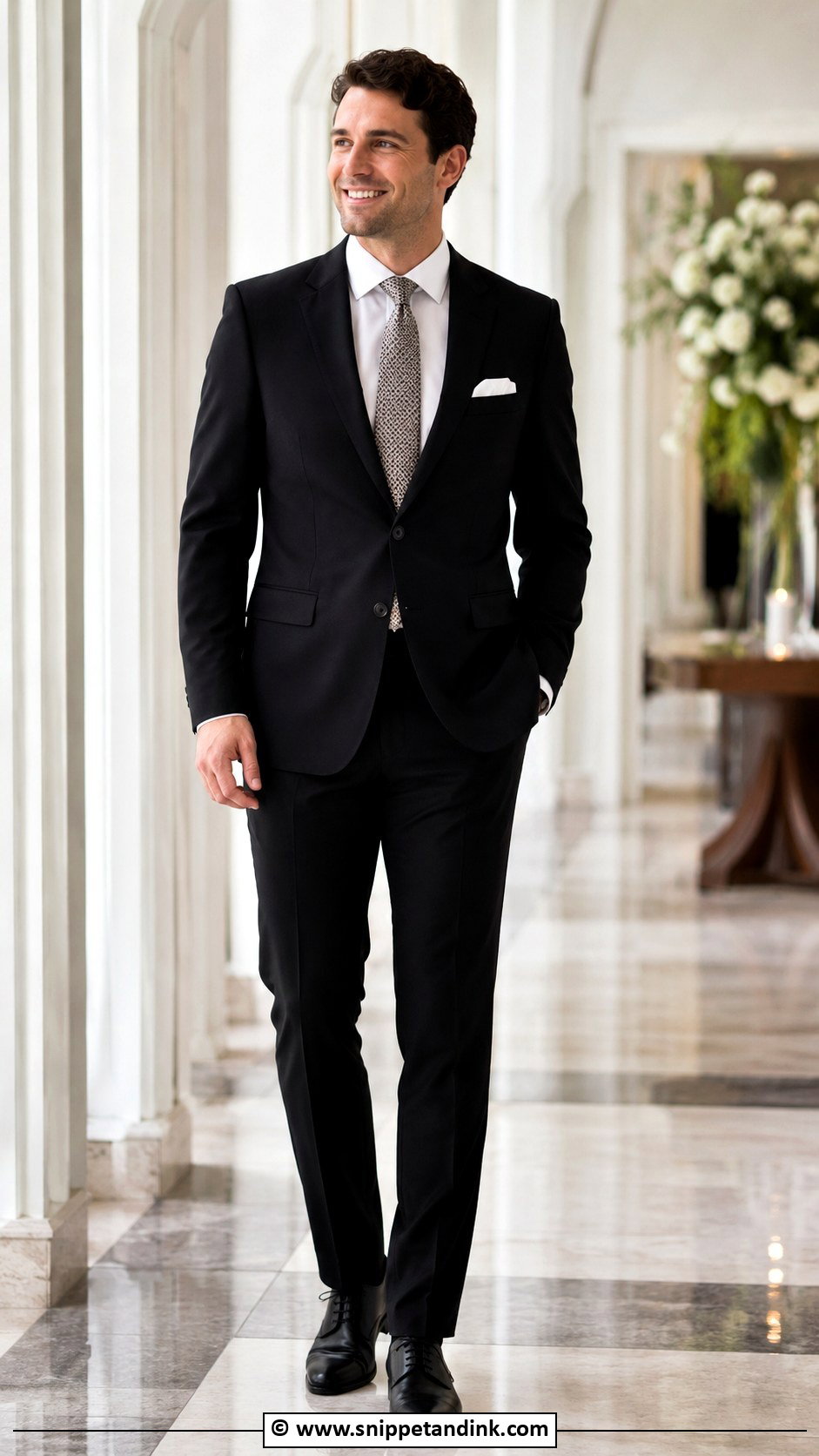
A patterned tie is the simplest way to make a black suit feel personal, as long as the pattern stays small. Micro dots, neat stripes, a fine paisley or a tonal texture all read cleanly from across a room; big novelty prints turn into blobs in group photos. I like giving each groomsman a slightly different pattern within one colour family, which looks coordinated without being identical. Keep the shirt white or ivory so the tie stays the single accent.
13. Black Suit With Floral Tie
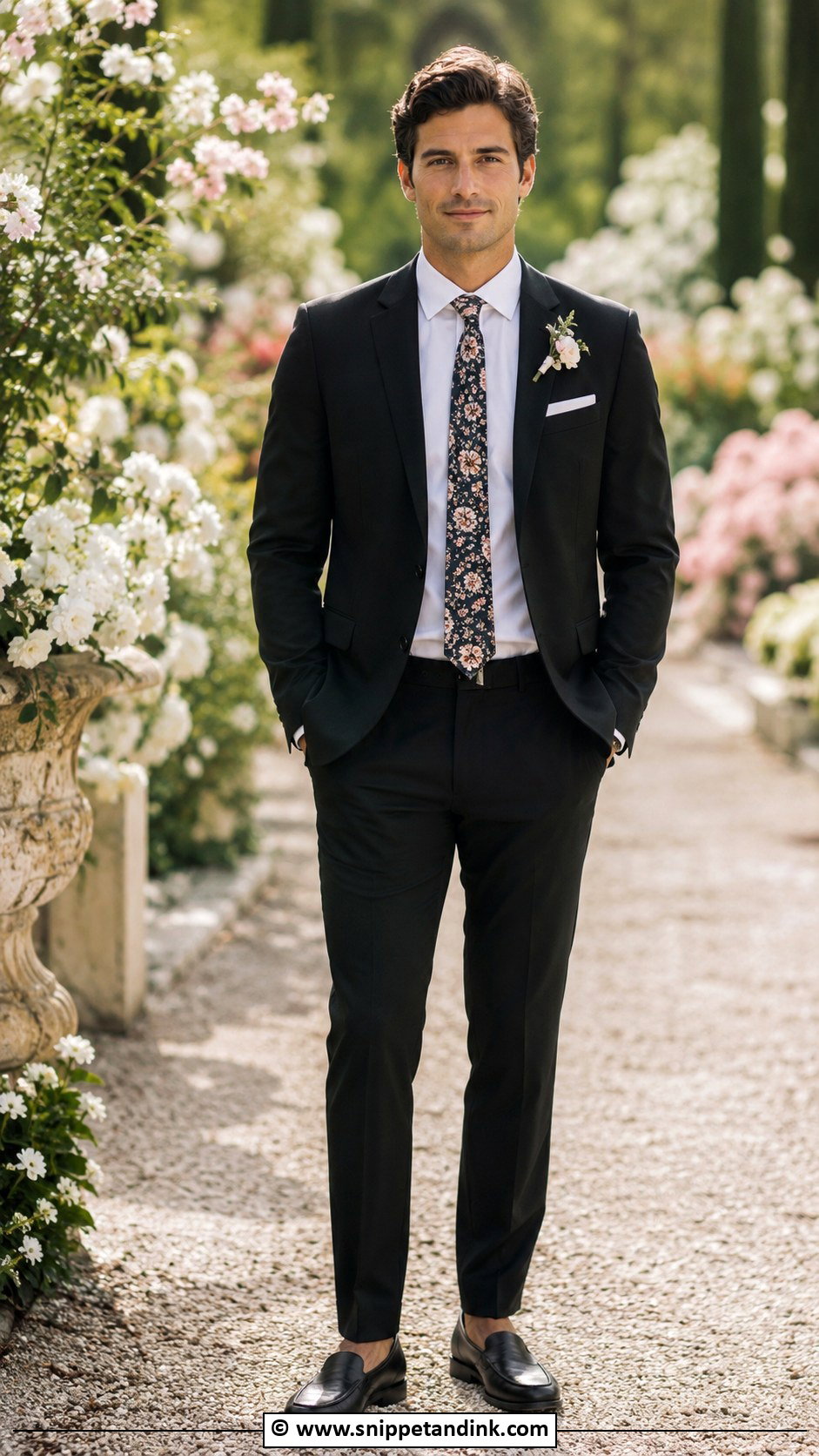
Floral ties work best on a dark ground. A navy or black base with small, muted flowers sits comfortably against the suit, whereas a white or pastel ground with big blooms looks more like a garden party than a wedding. If a couple of the flower colours echo the palette, the groomsmen look tied to the bridesmaids without being matched head to toe. White shirt, black shoes, a simple square. Keep the suit sharply tailored, because a loose fit plus a floral tie quickly reads casual.
14. Black Suit With White Pocket Square
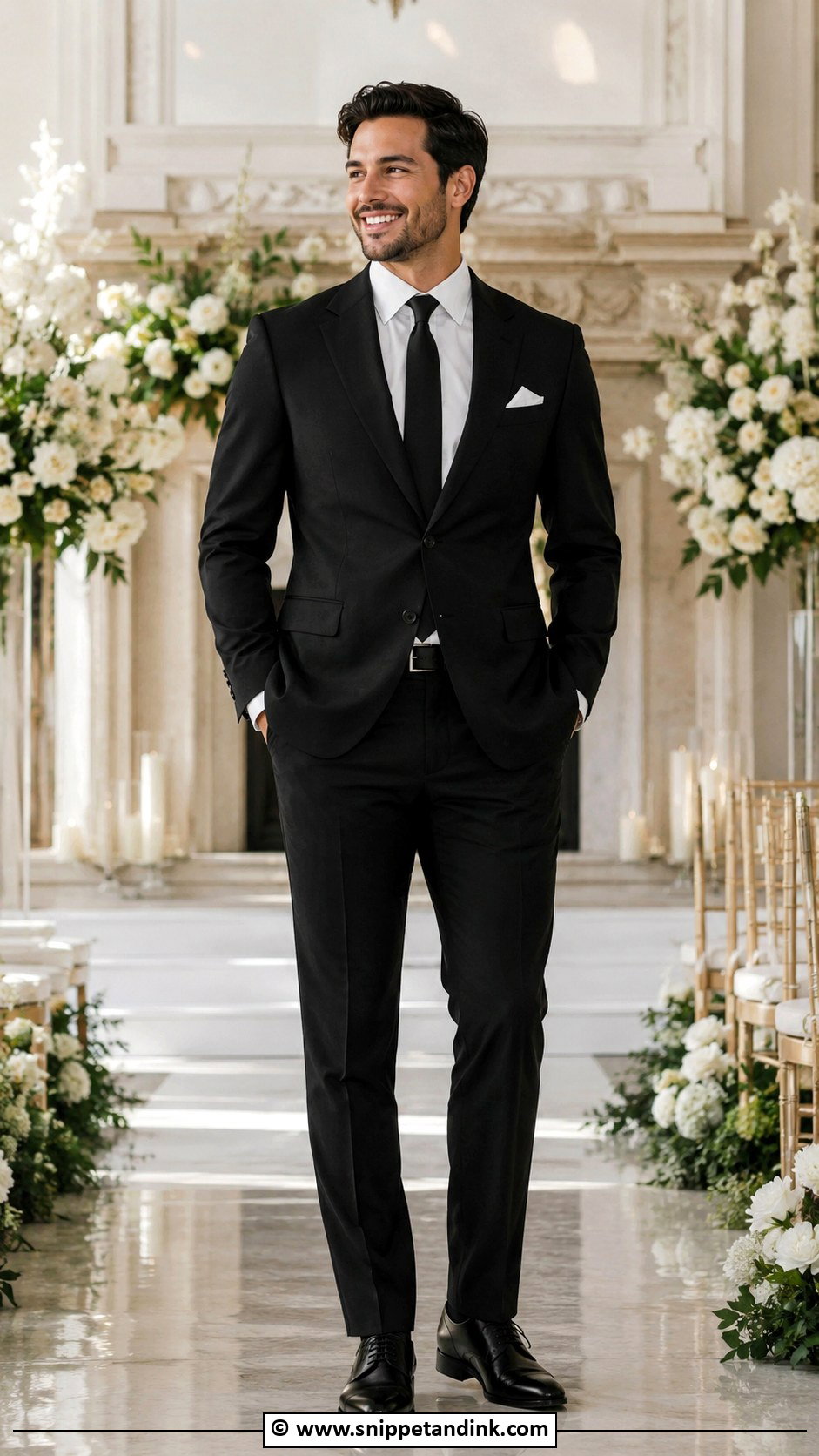
Never underestimate a white pocket square. It’s the cheapest detail in the outfit and the one that makes it look finished. A straight presidential fold is my default for groomsmen because it looks identical on every man in a line-up; a soft puff fold suits the groom or a relaxed guest. Linen or cotton holds a fold better than silk, which slides down into the pocket by the speeches. Press it, and don’t stuff in so much fabric that the breast pocket bulges.
15. Black Suit With Boutonniere
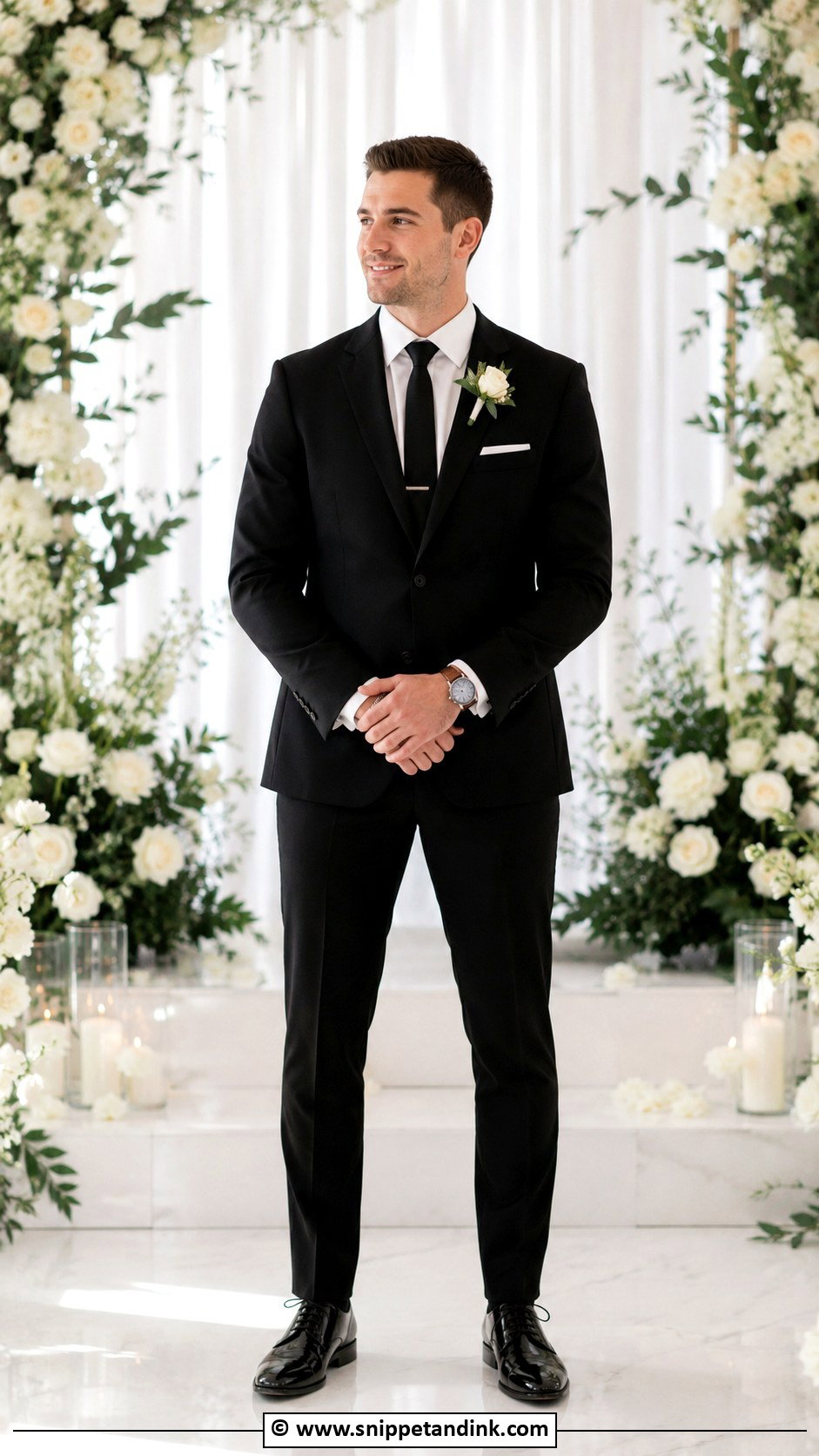
A boutonniere is what turns a black suit from good suit to wedding suit. I pin it on the left lapel, through the buttonhole area, with the pin going in from behind so it can’t be seen, and I angle it to follow the lapel rather than standing upright. Florists usually use sturdy blooms here (spray roses, waxflower, small ranunculus, greenery) because delicate flowers wilt fast against body heat. The groom’s version can be a touch fuller than the groomsmen’s. Leave the lapel otherwise clear so the flower is the only detail there.
16. Black Suit With Loafers
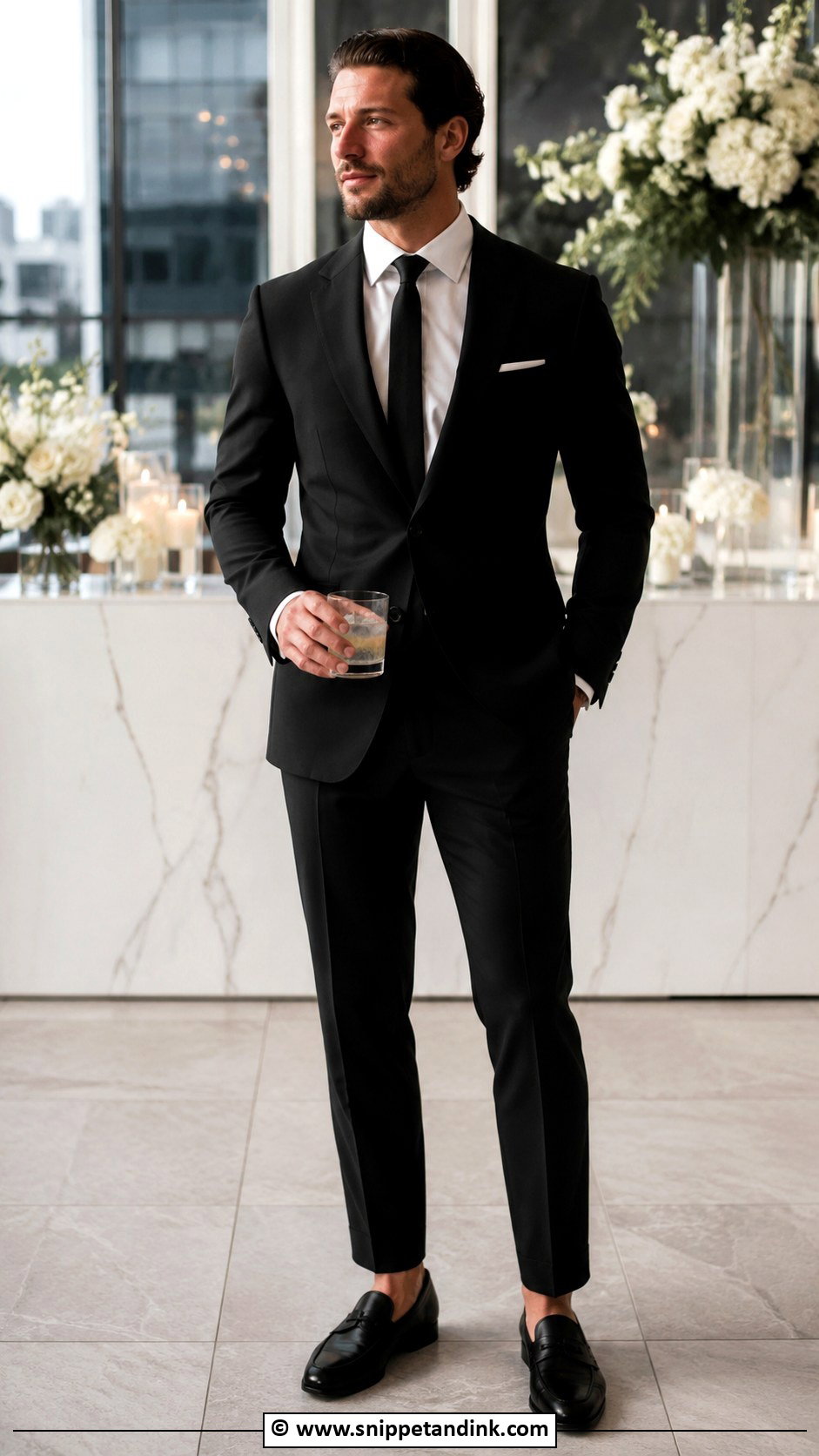
Loafers shift a black suit toward cocktail wedding attire, which suits warm evenings and city venues. Sleek black leather or, for an evening event, velvet; never soft driving shoes with rubber nubs on the sole. The trouser hem is the detail that makes or breaks it: I ask the tailor for little or no break so the loafer shows cleanly instead of being swallowed by fabric. Thin black dress socks or no-show socks, depending on how formal the day is.
17. Black Suit With Oxford Shoes
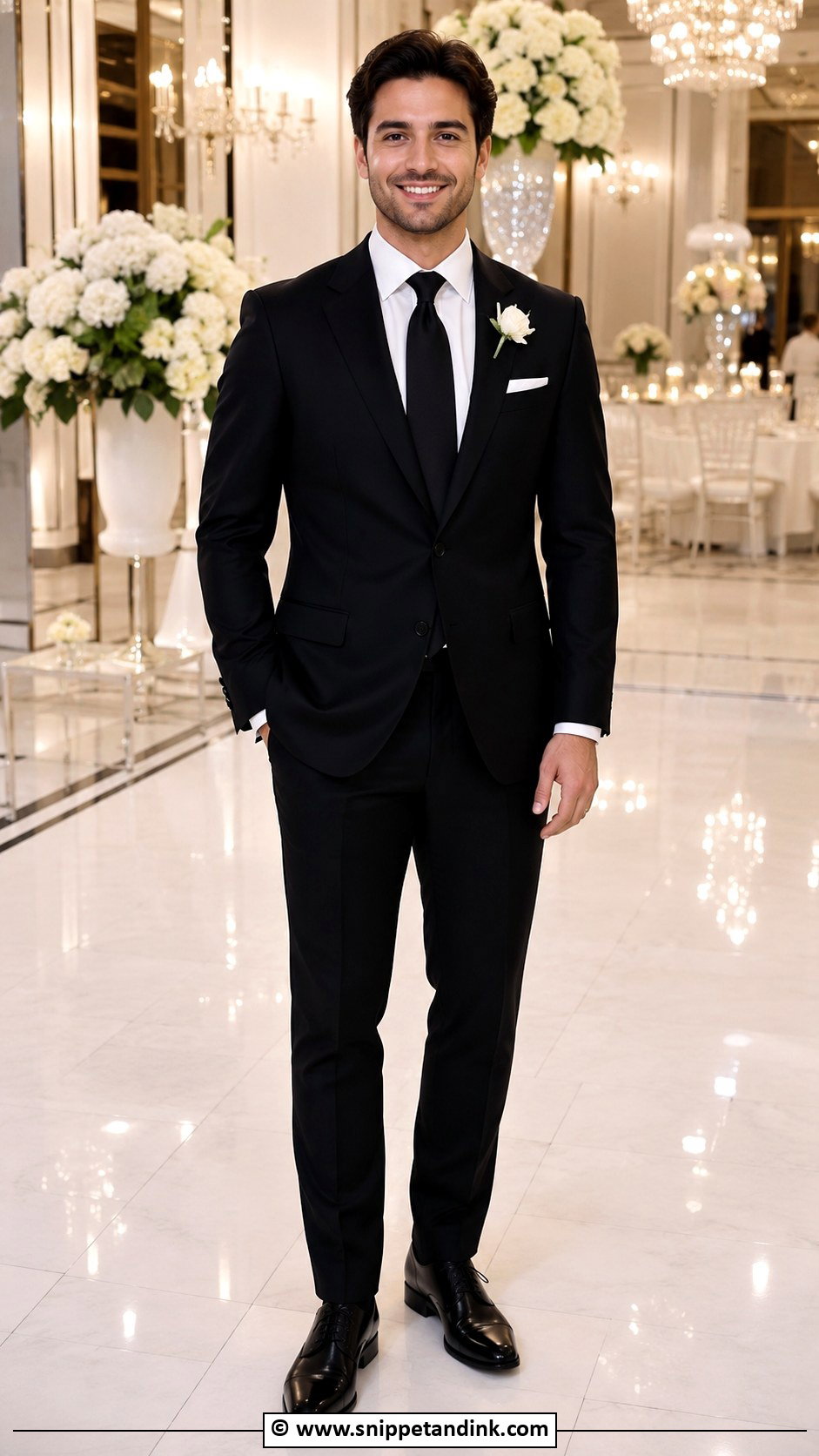
Oxfords are the most formal lace-up there is, with the closed lacing that sits flush to the foot, which is why they’re my default for a black-tie optional wedding. A cap-toe is the most versatile; a wholecut, cut from one piece of leather, looks even sleeker. Black leather shows every scuff under bright lights, so I tell grooms to polish them the night before and break them in for a week beforehand, because new soles on a polished ballroom floor are slippery.
18. Black Suit With Chelsea Boots
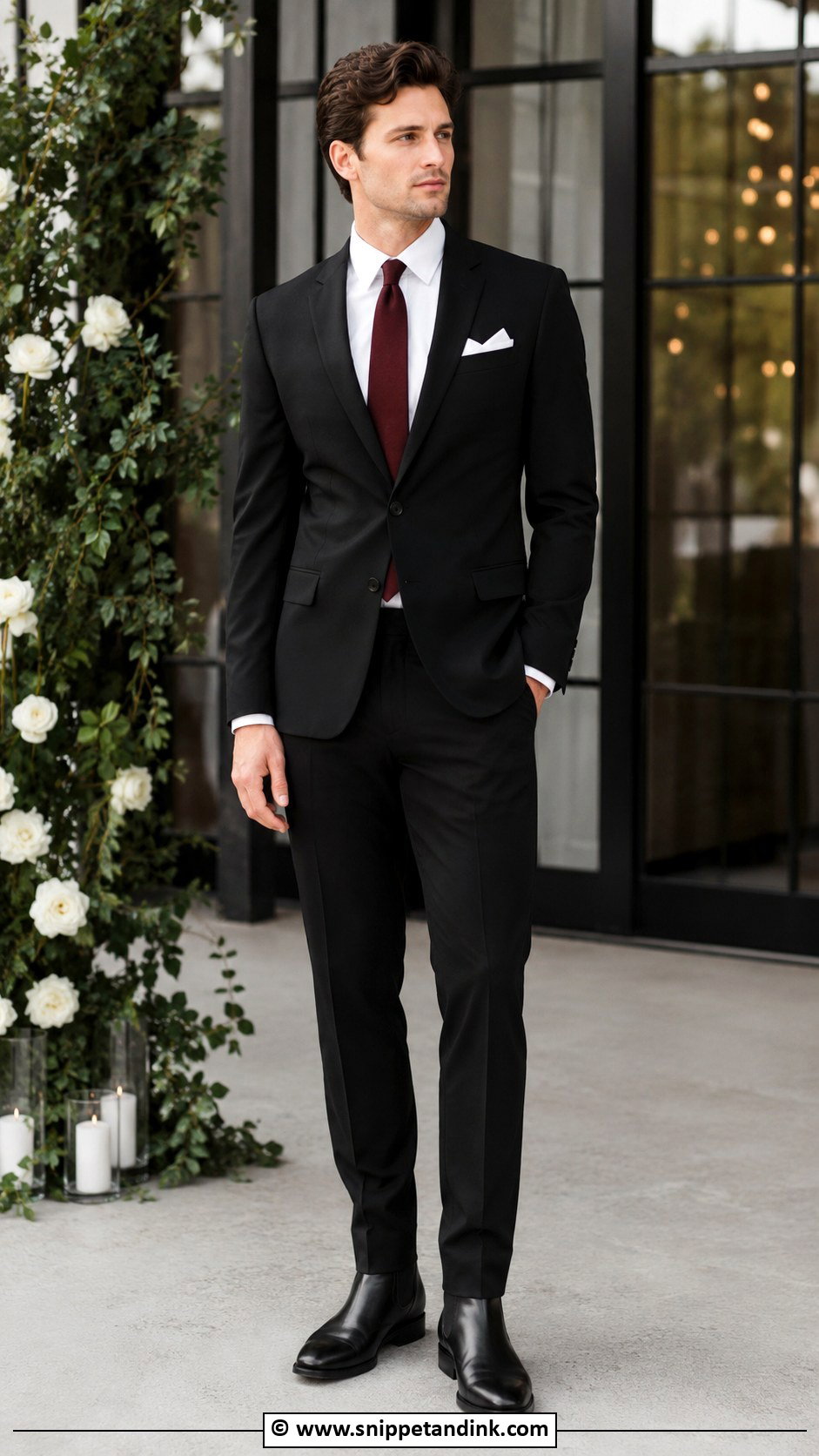
Chelsea boots give a black suit a sharper, more contemporary edge and they’re practical at autumn and winter weddings with damp grass or cobbles. I’d pick a slim black leather boot with an almond toe and a thin sole; chunky commando soles fight the line of tailored trousers. The trouser hem should cover the elastic panel when standing and not pool on top of the boot. Black, burgundy or forest green ties all work, and for a semi-formal guest it’s an easy outfit to get right.
19. Black Suit With Turtleneck
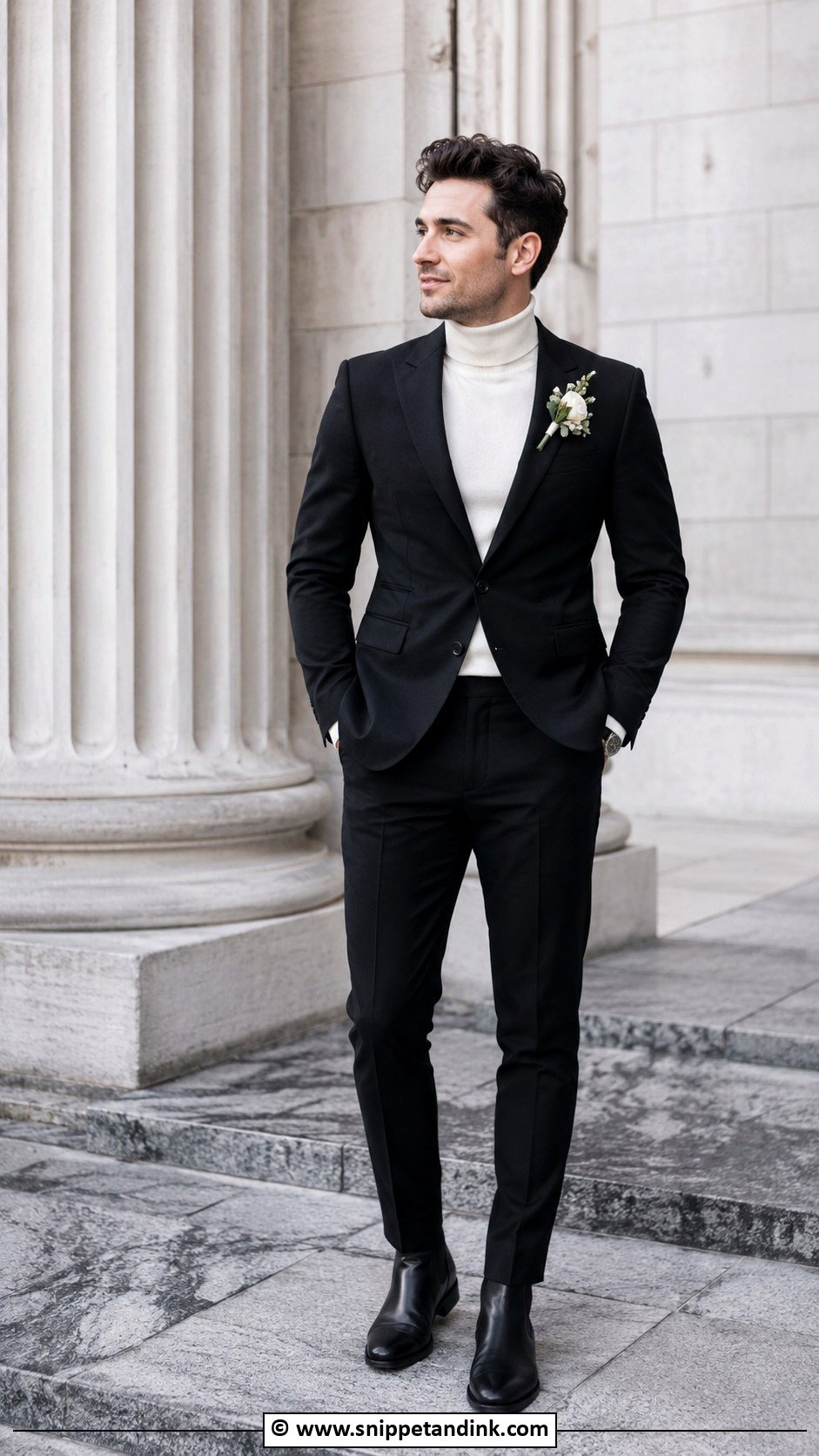
A fine-gauge turtleneck under a black suit is my favourite cold-weather alternative to a shirt and tie. The key word is fine: merino or a thin cashmere blend sits flat under the jacket, while a chunky knit bulks at the neck and looks like a weekend jumper. Black, charcoal, ivory or deep green all work. I’d keep it to winter, courthouse and intimate city ceremonies; it’s too relaxed for a formal church service. A boutonniere is what gives the groom’s version some ceremony.
20. Black Suit With Open Collar Shirt
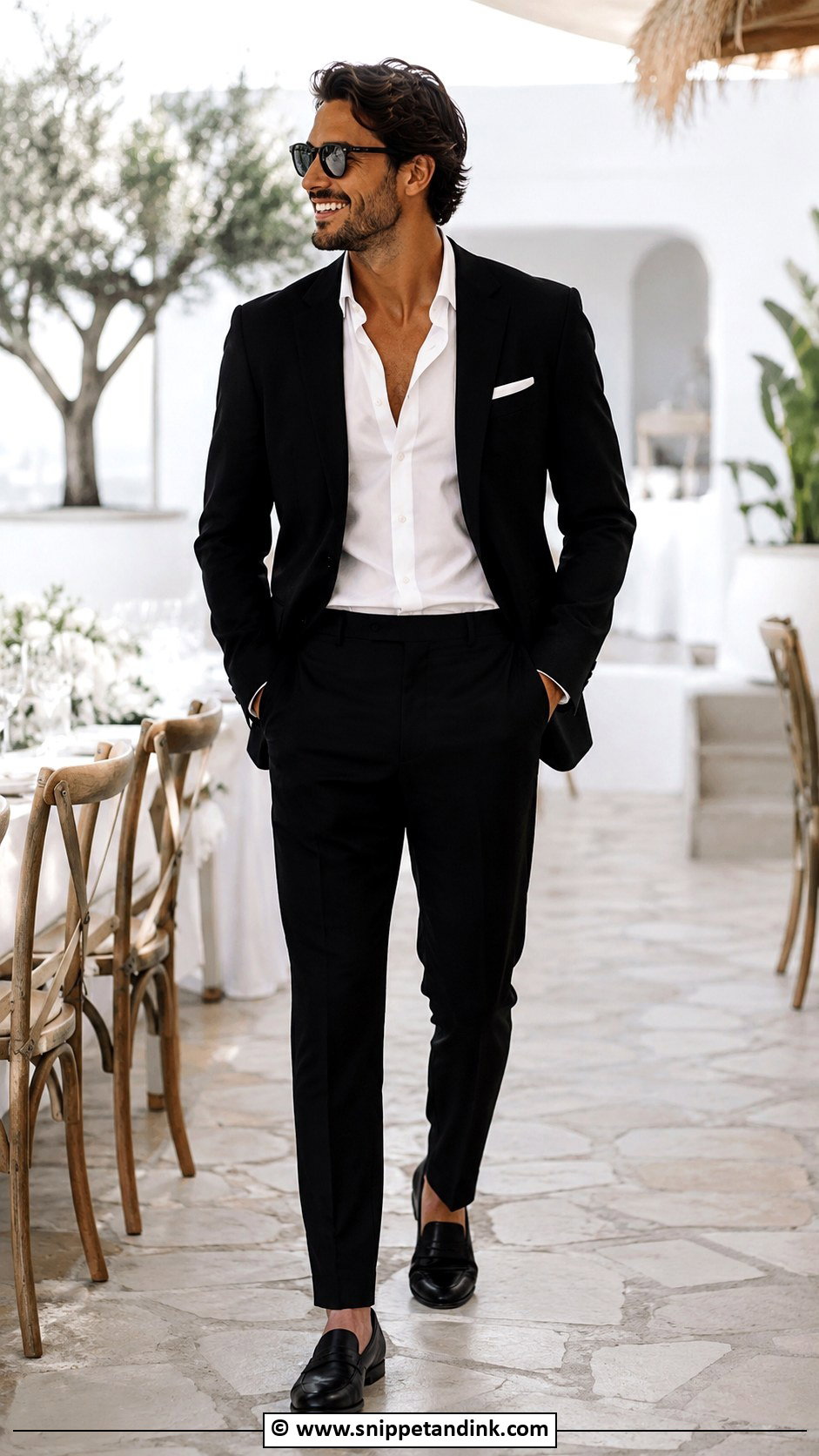
An open collar works at a beach, summer garden or relaxed cocktail wedding, but only if everything else is sharp. One button open, not two. A collar with stiff stays or a cutaway shape stands up neatly instead of collapsing flat under the lapels, which is the usual reason this look slides into business casual. I’d add a pocket square to replace the colour a tie would have given you. Skip it entirely if the invitation says formal.
21. Black Suit With Satin Lapel
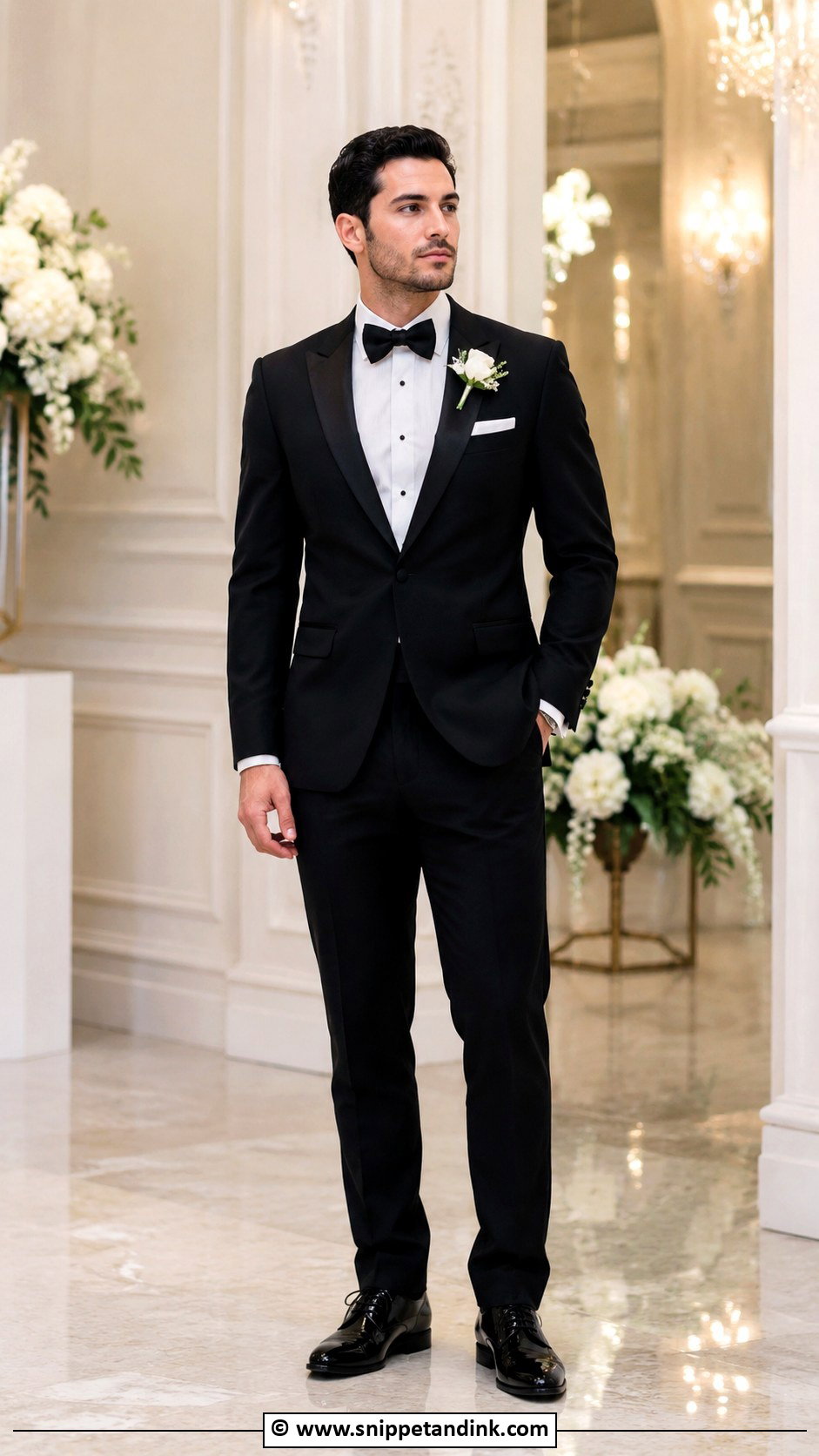
A satin lapel brings a suit close to a tuxedo while leaving it in suit territory, which suits black-tie optional dress codes well. Because the lapel already shines, everything else should be matte: a white shirt, a black bow tie or tie in a fabric that matches the facing, and black patent or highly polished shoes. Too many shiny accessories on top, like a metallic tie bar or a glossy square, and the whole look starts to glare in flash photos.
22. Black Suit With Velvet Jacket
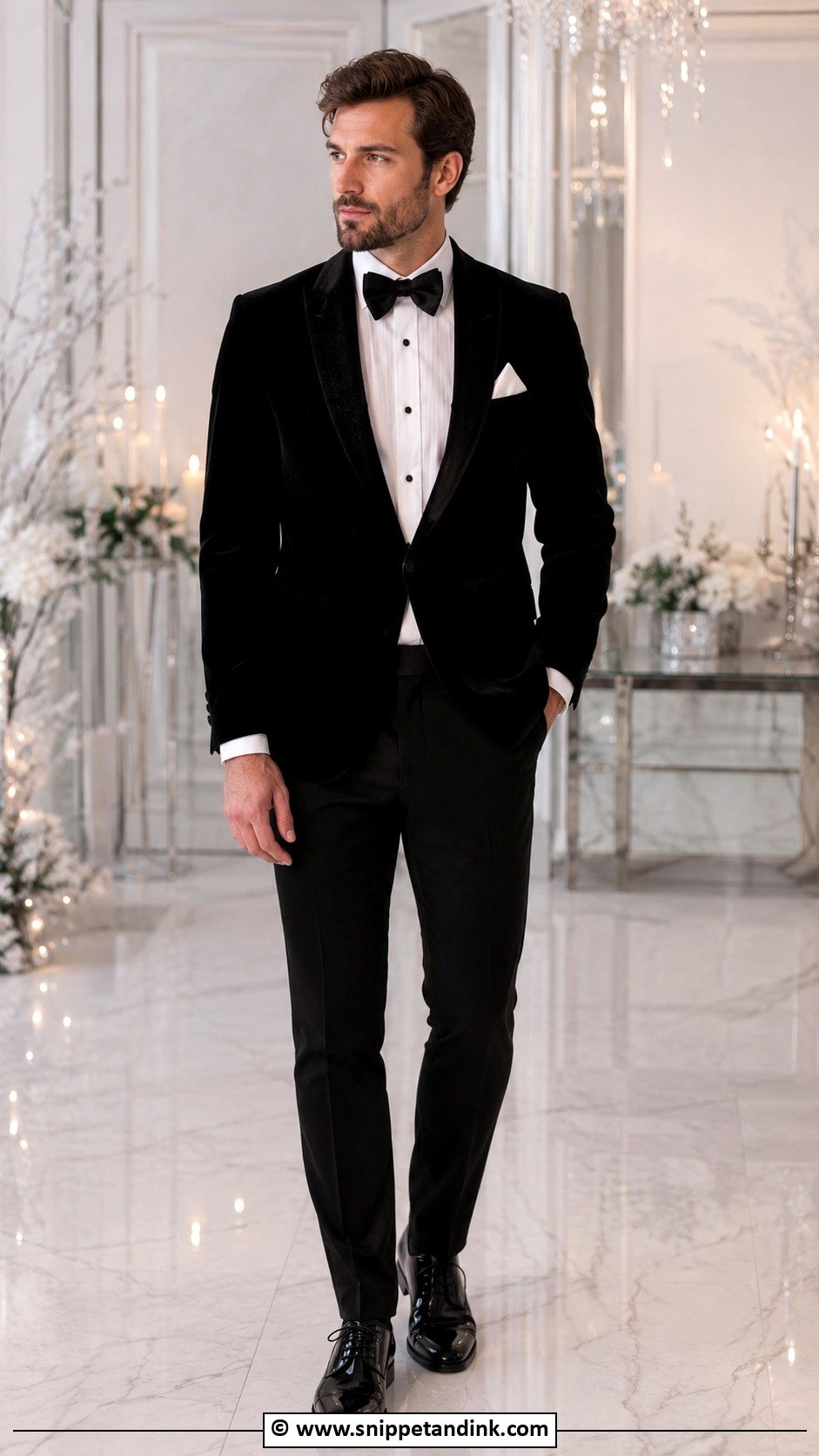
A velvet jacket over black trousers is a winter piece and a groom’s piece; I’d rarely put a whole wedding party in it. Velvet looks richest under warm, low light, and it marks easily, so the groom needs to sit carefully and keep a soft clothes brush nearby to lift crushed pile. Pair it with a white shirt, a black bow tie and black patent shoes or polished oxfords. A white pocket square is the one contrast it needs.
23. Black Suit With Double Breasted Jacket
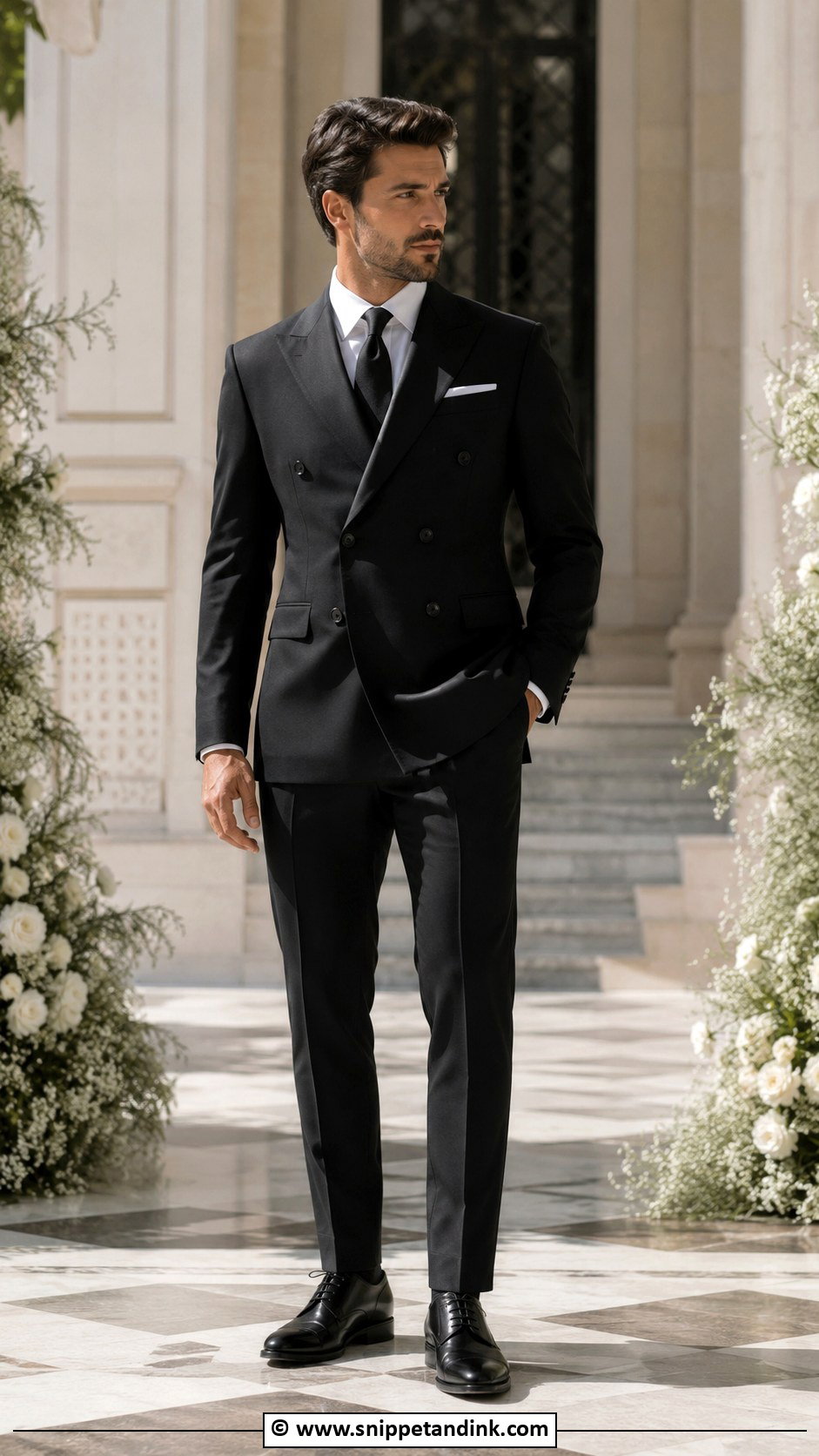
Double-breasted tailoring has real presence, and it punishes a poor fit more than any other cut. The jacket is meant to be worn buttoned, so the shoulders and waist have to be right; loose, it turns boxy and heavy. I’d steer shorter or broader men toward a six-button front with the jacket fastened on the lower button, which lengthens the body. Keep accessories minimal. For warm weddings, ask for a lighter wool, because two layers of fabric across the front add warmth.
24. Black Suit With Slim Fit Tailoring
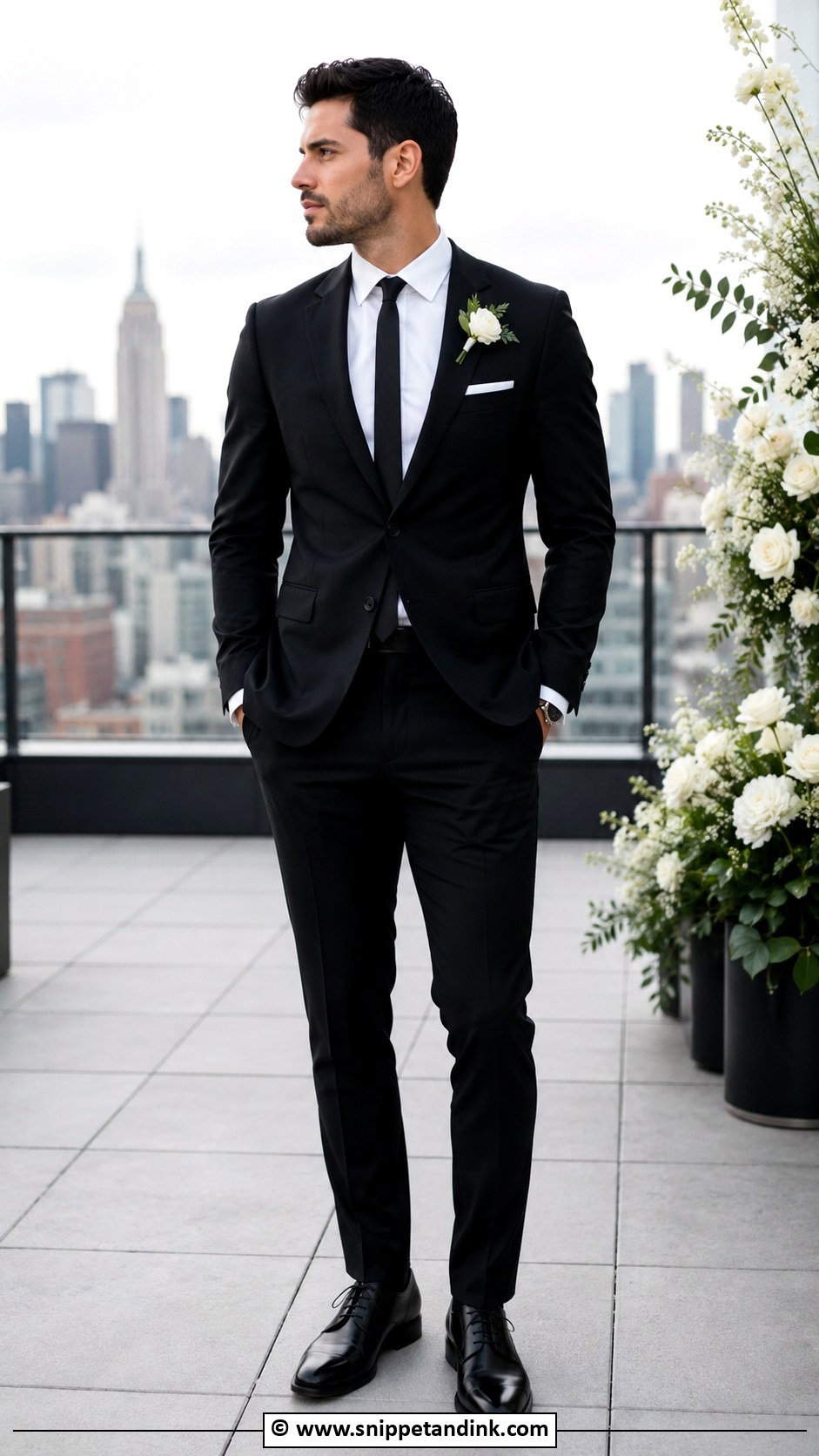
Slim fit should mean clean, not tight. When I check one, the jacket closes without an X of strain lines around the button, the shoulders sit flat with no divot below the seam, and the trousers taper without pulling across the thigh when he sits. If any of that fails, the suit looks uncomfortable in every candid photo. Get it right, and a white shirt with a simple tie and black shoes is all a slim black suit needs.
25. Black Suit With Relaxed Fit Trousers
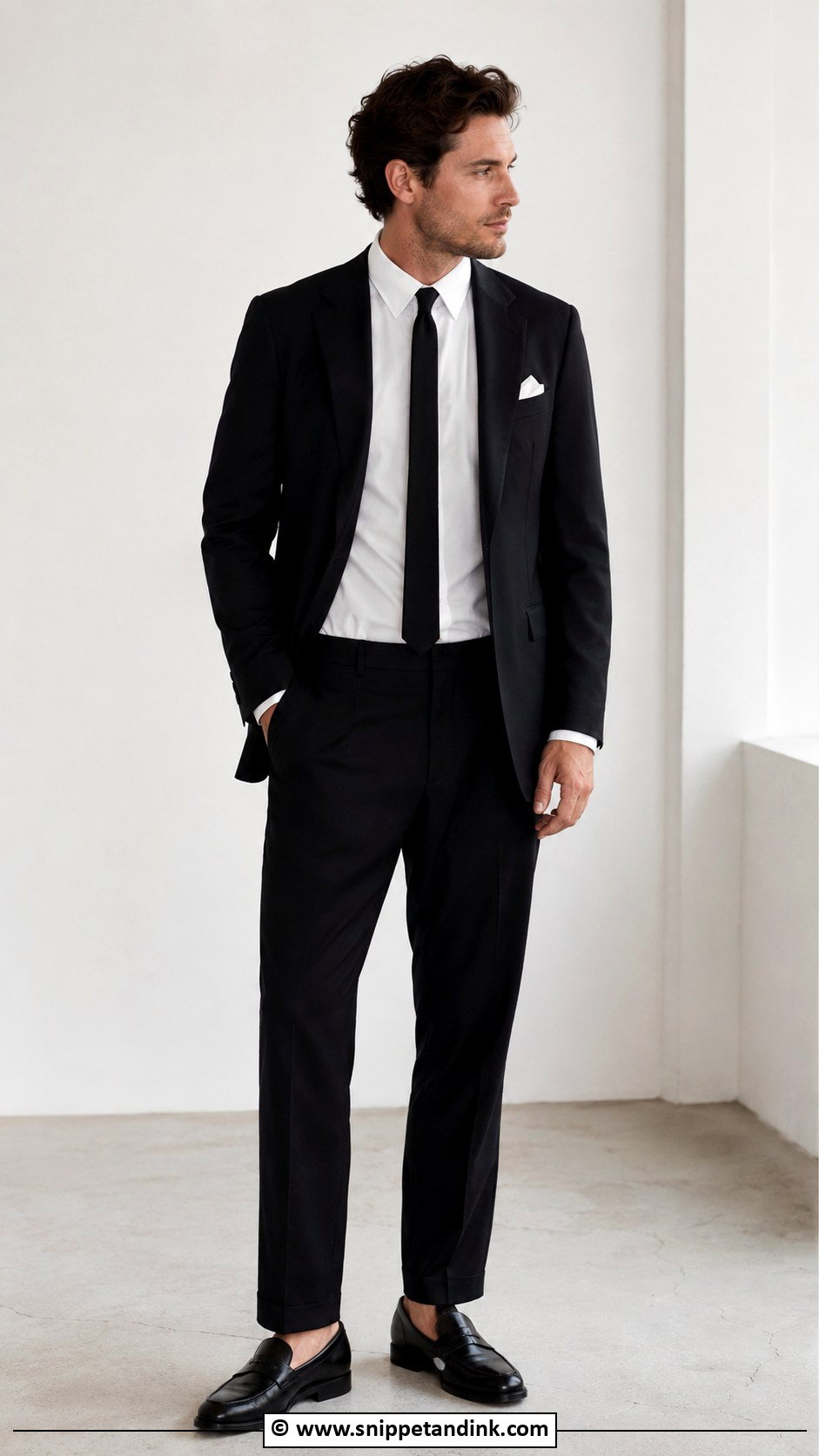
Relaxed trousers are a current, comfortable way to wear a black suit, but the jacket still needs to be tailored or the whole outfit reads as unfinished. I look for a clean drape from hip to hem, maybe a single pleat, and a gentle break at the shoe. Wide is not the same as baggy. This cut suits grooms who dislike the skinny silhouette and men who’ll be dancing for hours, and it pairs well with sleek loafers or oxfords.
26. Black Suit With Suspenders
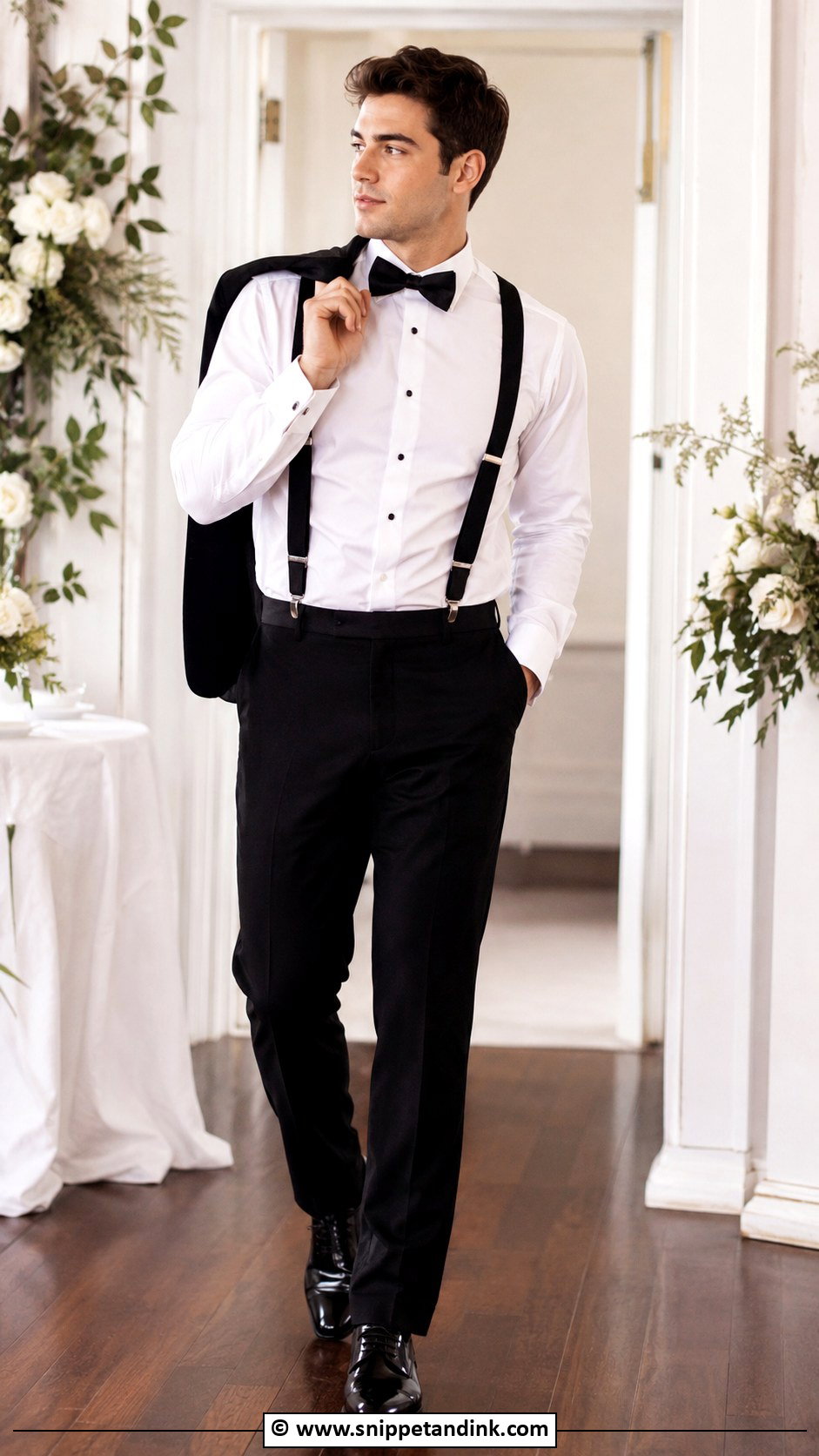
Suspenders, or braces, keep trousers hanging properly all day, and they give the groomsmen a coordinated detail once jackets come off at the reception. Black, white, burgundy or a palette colour all work. Clip-on versions pull at the waistband and can pop off when someone dances, so for anything formal I’d have the tailor add buttons inside the waistband; button suspenders hang straighter and look cleaner. Don’t wear them with a belt; it’s one or the other.
27. Black Suit With Cummerbund
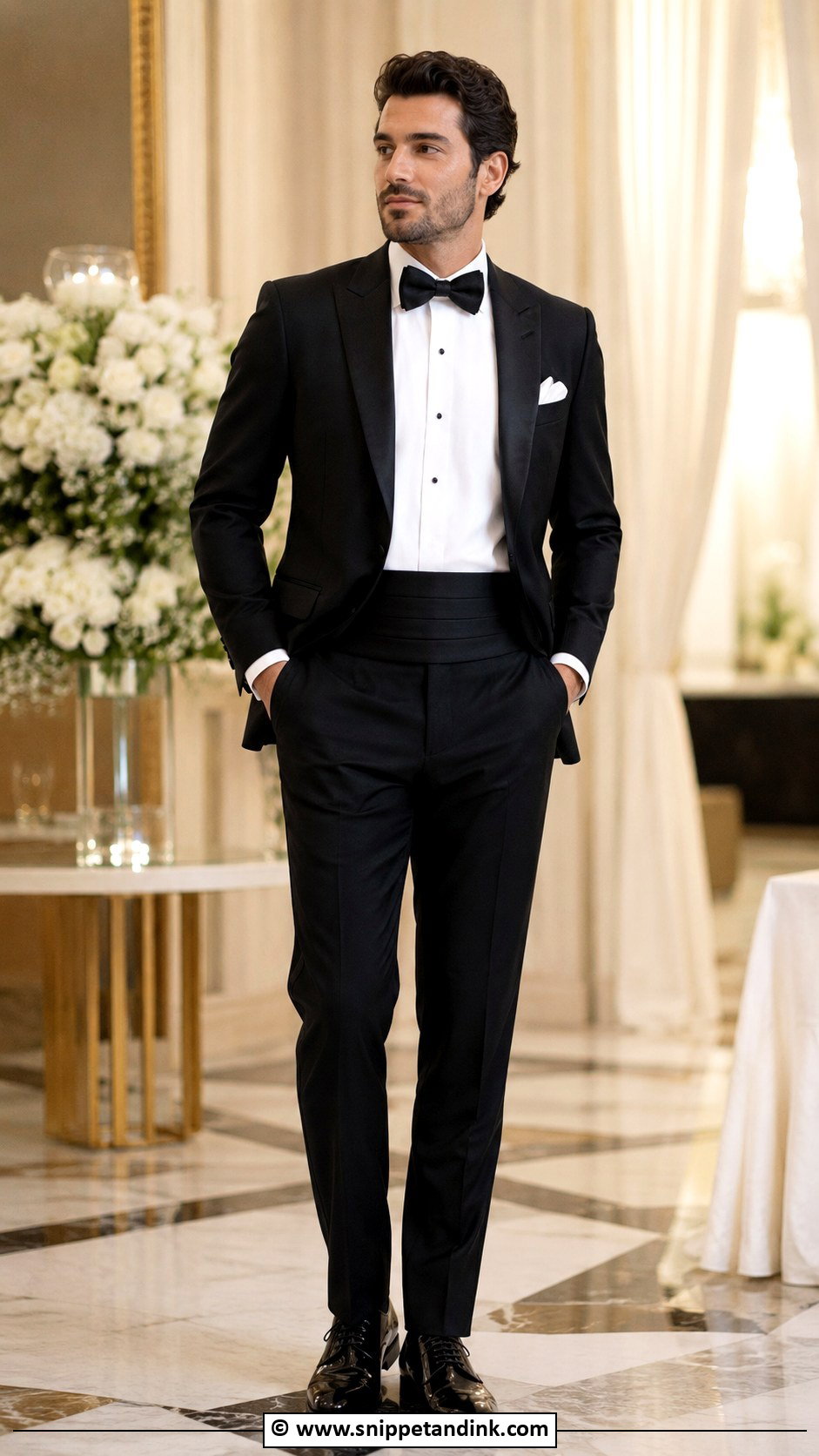
A cummerbund is borrowed from the tuxedo, and it only makes sense on a very formal black suit with a bow tie. Its job is to cover the waistband where the shirt meets the trousers, so it sits at the natural waist with the pleats facing up. I match it to the bow tie in fabric and colour. Keep the jacket buttoned for formal photos so the proportions stay balanced. For an ordinary suit at a relaxed wedding, I’d leave it in the box.
28. Black Suit With Monochrome Accessories
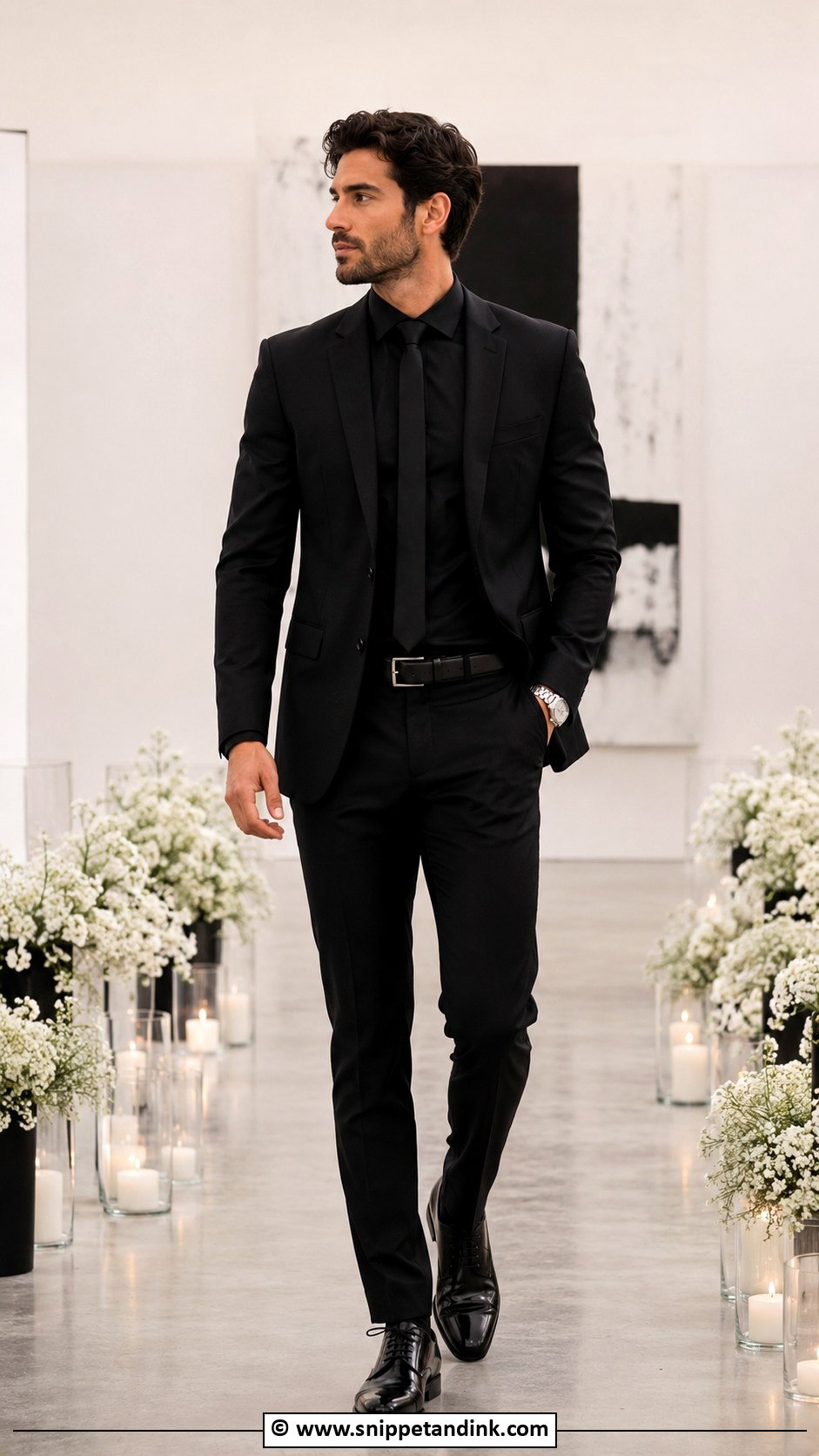
Monochrome works through restraint. Black suit, black tie, black shoes, black belt and a black watch strap: every piece has to fit perfectly because there is no colour to distract from a sloppy hem. With a white shirt, I add a white pocket square for contrast; with a black shirt, I keep the square dark or skip it. On the groom, a boutonniere gives the photographer one bright point to find.
29. Black Suit With Wedding Color Accessories
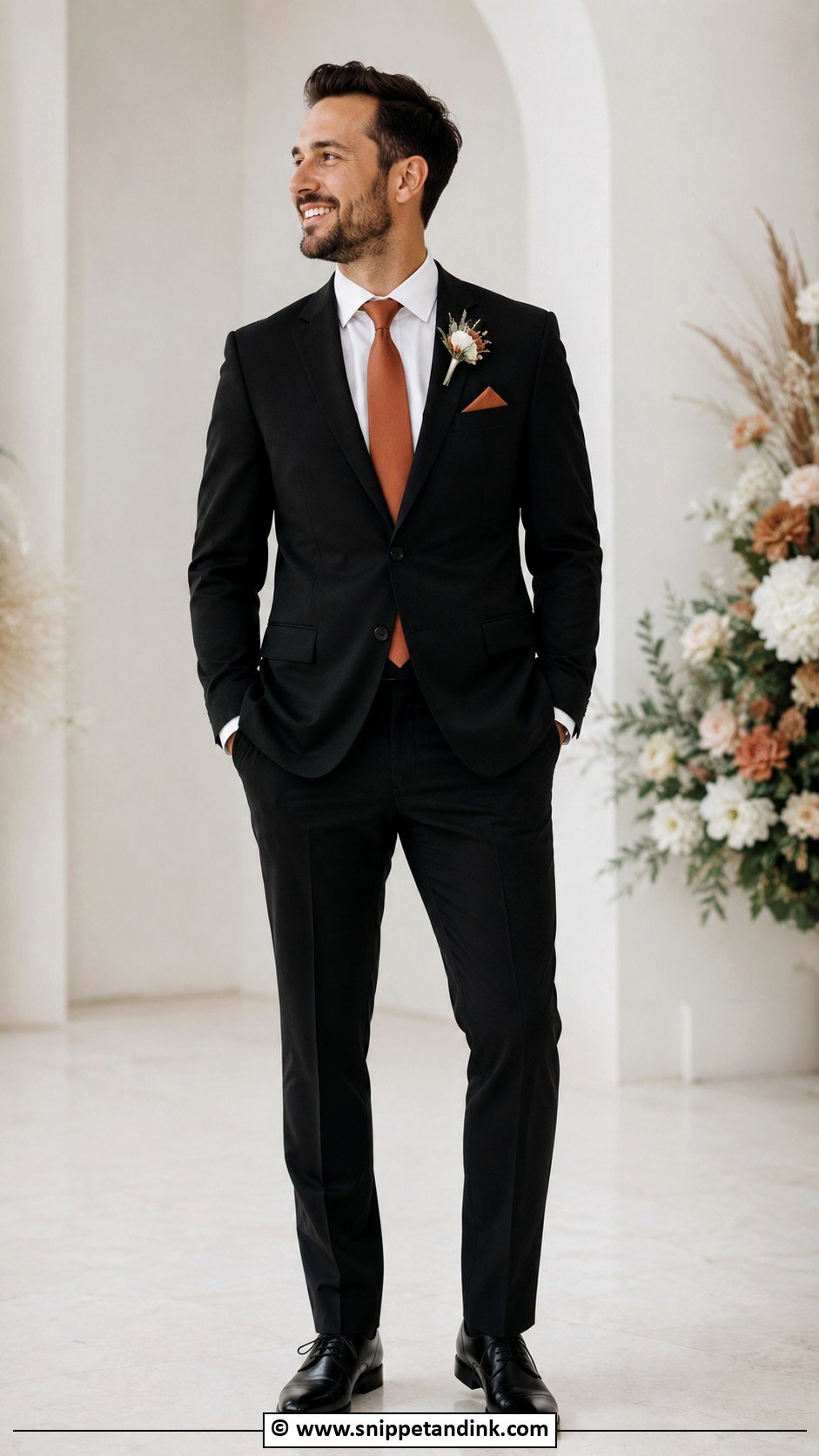
The simplest way to make a black suit belong to a particular wedding is one or two accessories in the palette. Start with the base (black suit, white shirt, black shoes, plain belt) and add the colour to the tie or bow tie, then possibly the pocket square or the boutonniere ribbon. The shades I see most are dusty blue, sage, terracotta and burgundy. My rule is never three accents in the same colour on one man; once the tie, square and socks all match, it looks like a set bought in one box.
30. Black Suit For Courthouse Wedding
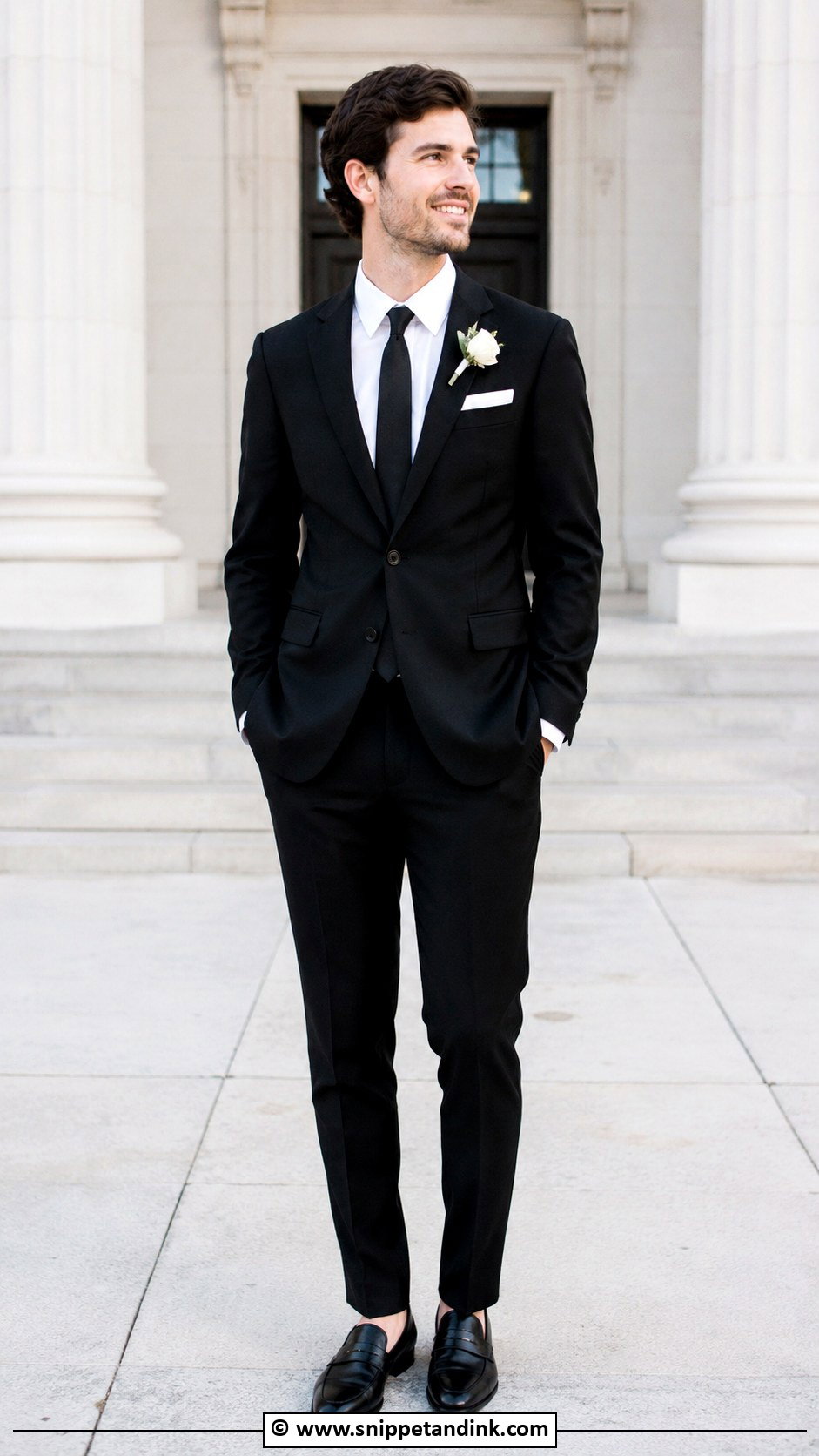
A black suit is the safest thing a groom can wear to a courthouse wedding: dressed up enough for the photos, never overdone in a small civil room. Keep it comfortable, because you’ll stand in corridors and queues. A white or ivory shirt, a slim tie or an open collar, black loafers or oxfords. A small boutonniere gives the photos a wedding signal that the setting itself may not. Go classic with a black tie and lace-ups, or modern with a slightly relaxed trouser and a loafer.
An Alterations Calendar Working Back From the Wedding
Fit is the single biggest difference between a groom who looks tailored and one who looks borrowed, and it needs time. Made-to-measure suits often take several weeks to arrive, and a good tailor can be booked out in spring and early summer, so I plan backwards like this:
- Around three months out: order the suit, or reserve rentals for the whole party at once.
- Six to eight weeks out: first fitting. Sleeves, trouser length and the jacket waist get pinned here.
- Two to three weeks out: second fitting wearing the actual wedding shoes, so the hem is cut for the right heel height.
- The final week: collect, try everything on together, and press it once more.
At each fitting I want to see about a quarter to half an inch of shirt cuff past the jacket sleeve with arms relaxed, a collar that hugs the shirt collar with no gap at the back, and a jacket that covers the seat. Bring the shirt you’ll wear; a different collar height changes how the jacket sits.
Lint, Pollen and Sweat on Black Cloth by Ten at Night
Black shows everything. Lint, dog hair, foundation from a hug, the yellow dust from lilies in the bouquet. I give the best man a small kit to carry: a lint roller, a soft clothes brush, a couple of safety pins and a stain pen. Pollen should be lifted off with tape or brushed when dry, never rubbed, because rubbing presses it into the weave.
Heat is the other enemy. Hang the jacket on a proper hanger whenever it comes off rather than over a chair back, which stretches the shoulders. An undershirt in a skin tone, not white, stops sweat reaching the shirt and won’t show through it. And after the wedding, air the suit for a day before it goes to the cleaner, because black wool fades with every unnecessary clean.
Where a Black Suit Wins or Loses on the Day
A black suit rarely fails because of its colour. It fails on a sleeve that’s too long, a tie that glares under flash, a hem pooling over the shoes. Get the tailoring right first, then let the shirt, tie and shoes set the mood: crisp and classic in white and black, softer in ivory or sage, more formal with satin, more modern with loafers or a turtleneck. Match that to the venue, the season and your role in the wedding party, and the suit will do its job quietly all day.
You'll Like These Ideas:


Leave a Reply