
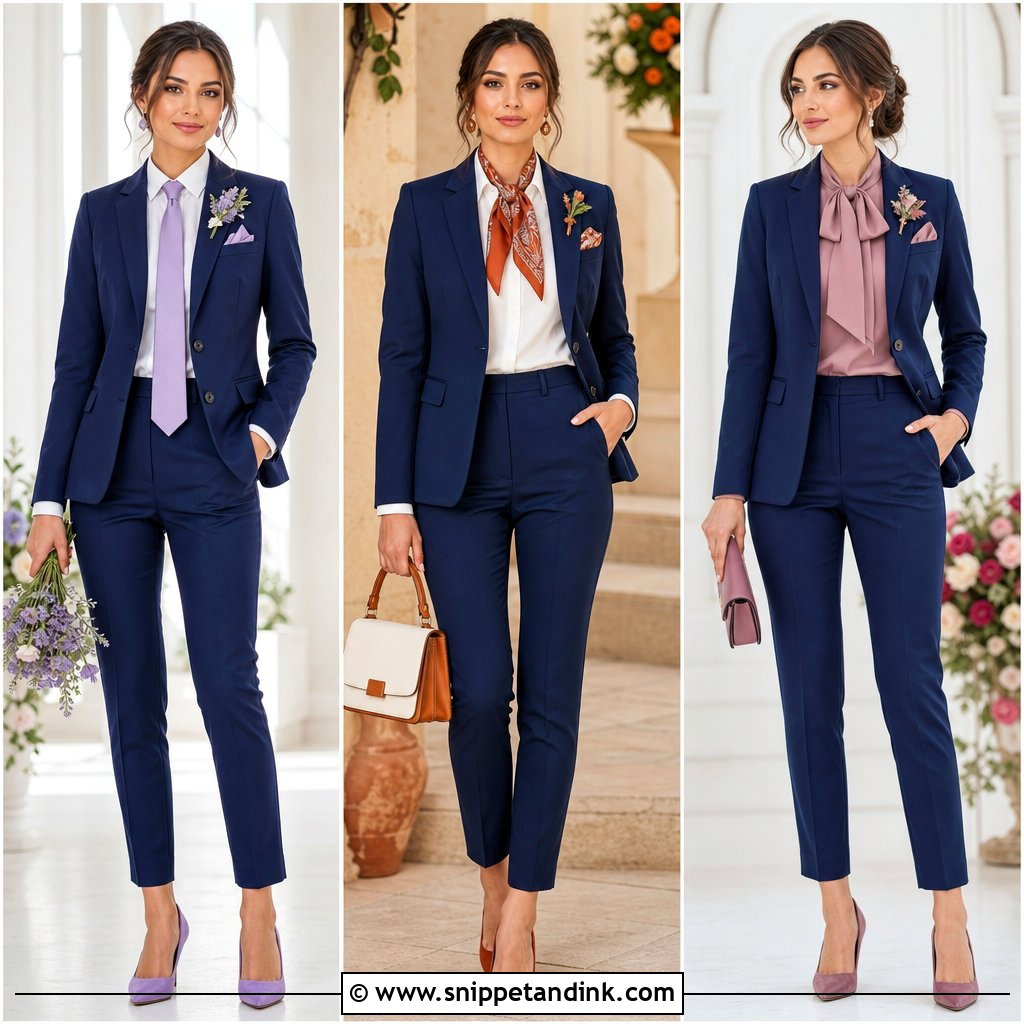
Navy is the suit color I reach for most often when a groom can’t decide, and the reason is practical: it reads dressier than gray in photos, softer than black next to a white gown, and it takes brown or black shoes without an argument. The same suit can go to a city hotel or a garden lawn once you change the shirt and tie. It works for the groom, the groomsmen, the father of the couple and the guest who wants to look put together without guessing. What separates a sharp navy look from a forgettable one is rarely the color itself. It’s the fit, the fabric weight for the season, and one or two accessories chosen on purpose. Below are thirty ways I’d build a navy wedding outfit, with notes on where each one tends to go wrong.
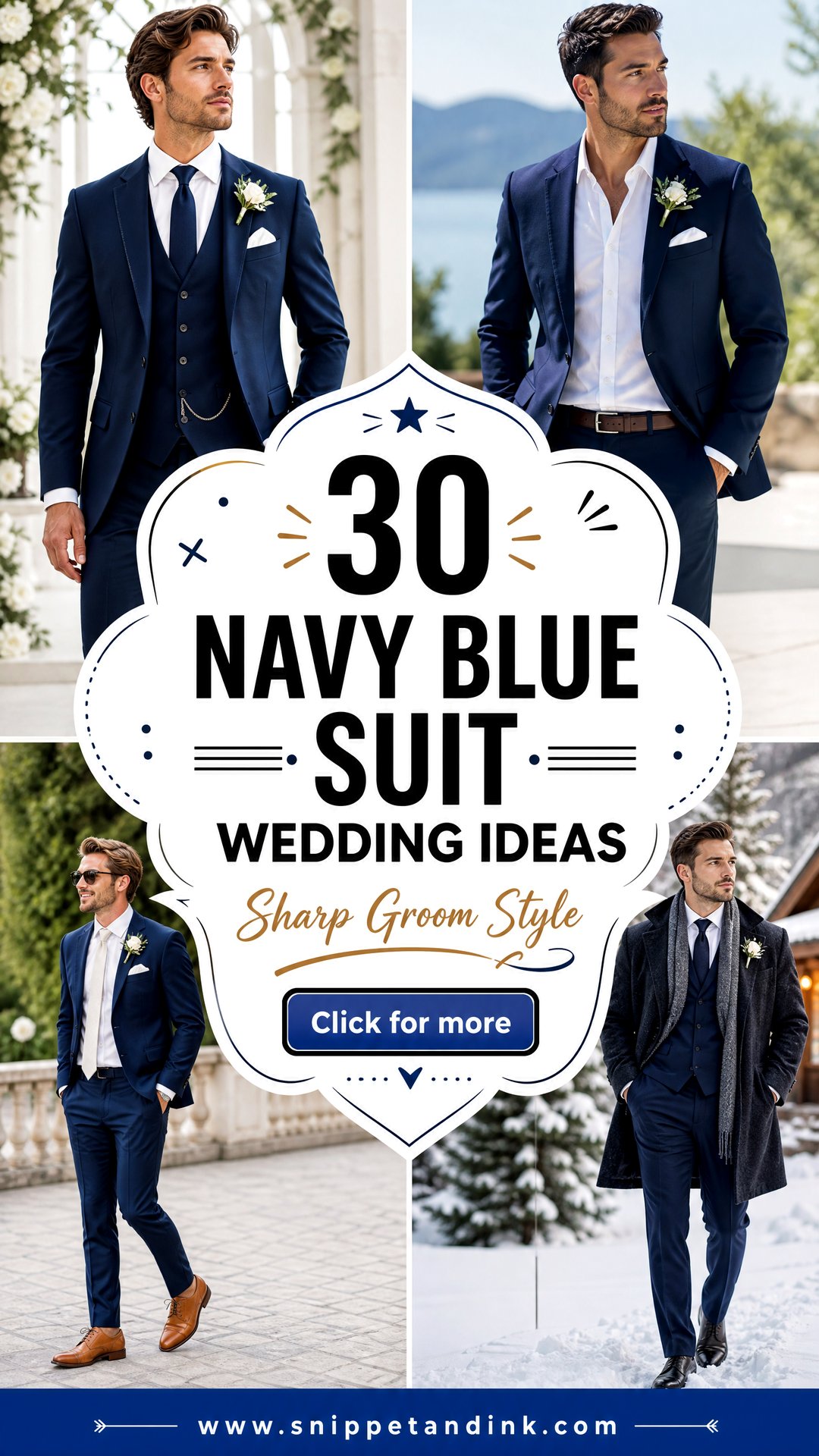
Why Two Navy Suits Rarely Match in a Groomsmen Lineup
Navy is not one color. Every mill dyes its own, and a suit that looks dark blue on a hanger can turn almost purple, grayish or bright under different light. When five groomsmen each buy a navy suit from a different store, the lineup photo shows it instantly: one jacket glows, another looks nearly black.
I fix this in one of three ways. Either everyone buys or rents from the same brand and the same fabric line, or the groom wears a deliberately different shade so the difference looks planned, or the groomsmen bring their suits to one place and we check them side by side outdoors before anyone commits to a tie.
Check the color in the light you’ll be married in
Store lighting is warm and flattering. Step outside or stand by a window. A midnight navy that looks black indoors often shows its blue in daylight, while a bright navy can look loud on a sunny lawn. If the ceremony is in the evening, look at it under warm lamps too, since that’s where black shoes and dark ties either disappear or hold their own.
Hold the tie against the lapel, not the shirt
Most tie mistakes happen because people match the tie to the shirt in the shop. The contrast that matters in photos is tie against jacket. If the tie and lapel blur together from a few steps back, go lighter or add texture.
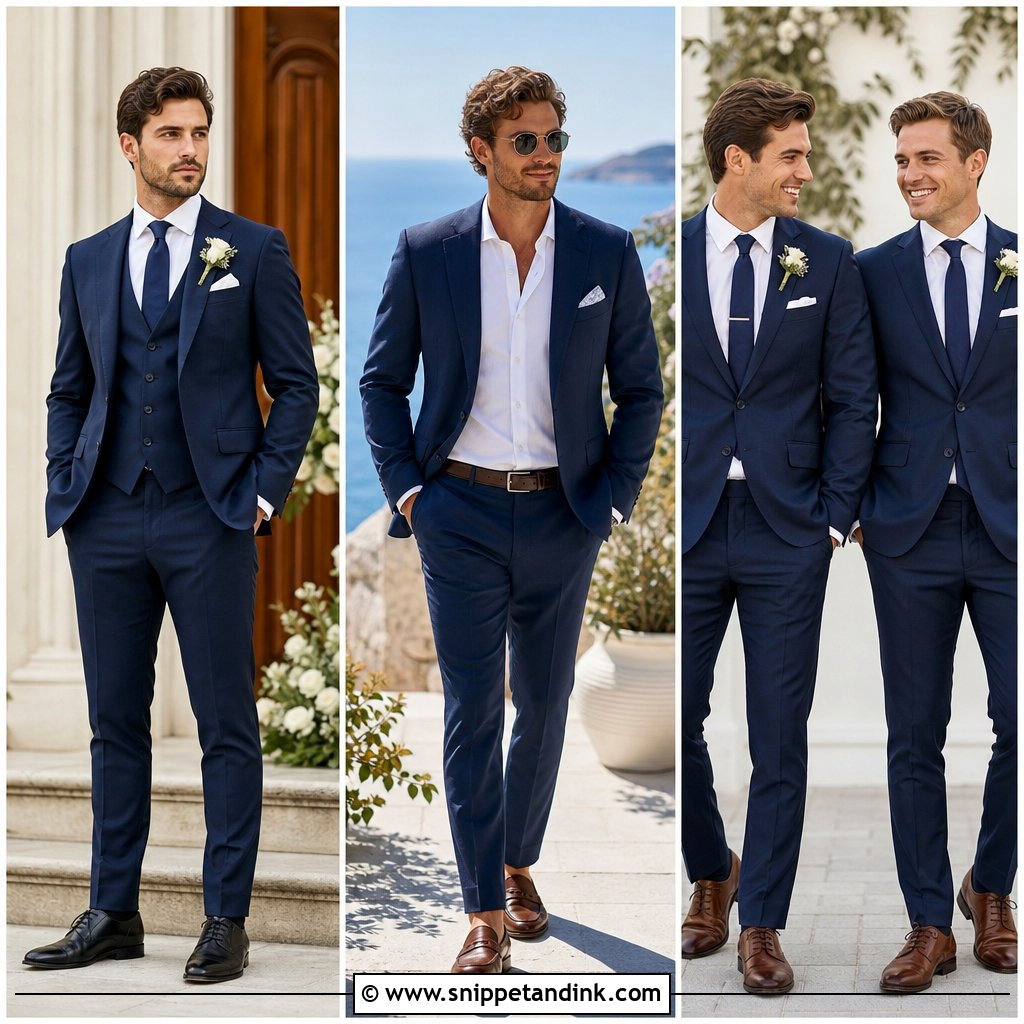
1. Navy Blue Suit With White Shirt And Brown Shoes
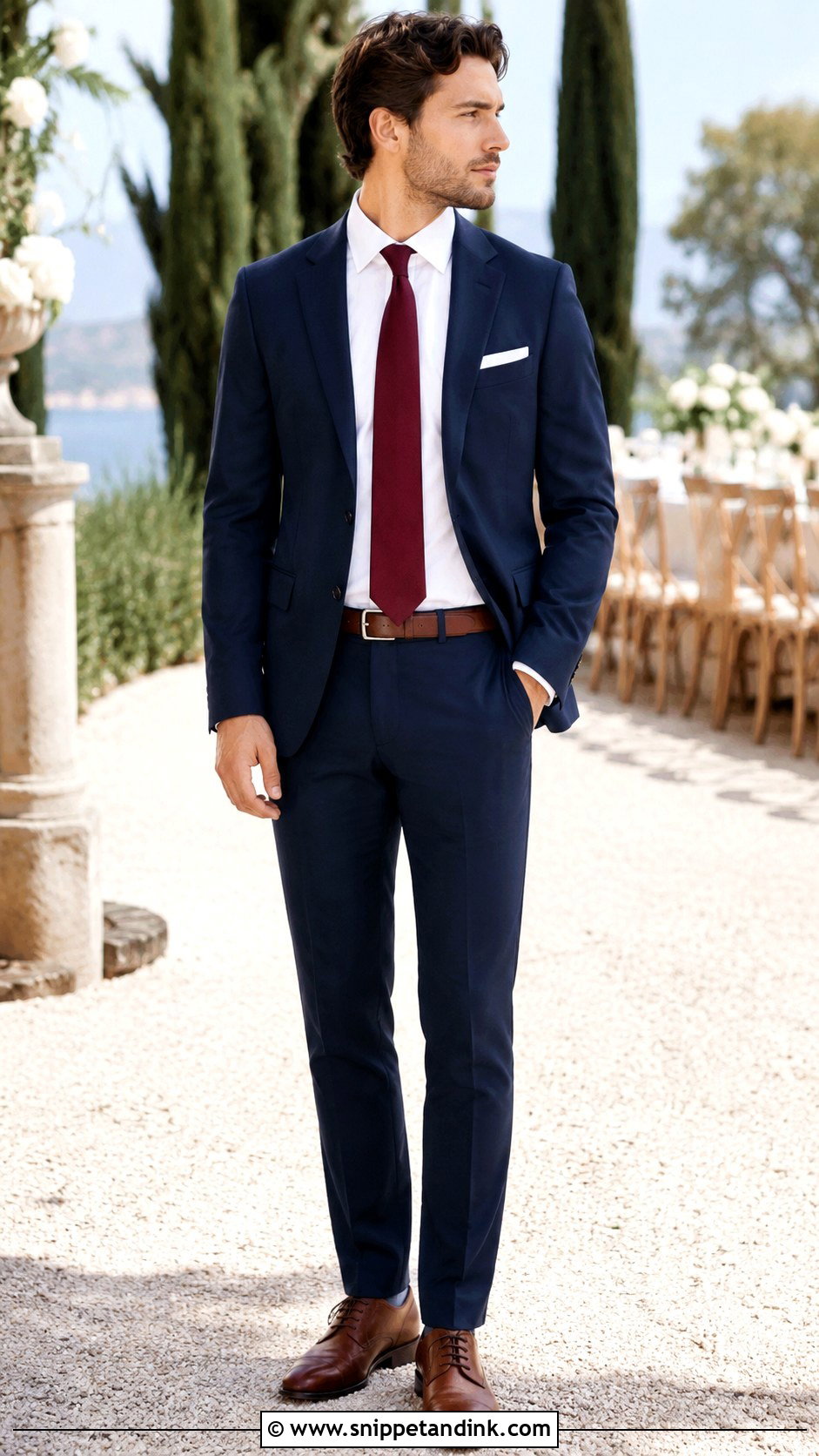
If a groom gives me ten minutes and no brief, this is where I start. White shirt, navy suit, brown shoes: it’s very hard to get wrong. The brown is what keeps it from looking like an office day. I’d pick a medium or dark brown oxford for the ceremony and let derbies take over for a looser reception. Match the belt to the shoe within a shade, or the eye catches the break at the waist in every full-length photo. Burgundy or dusty blue ties both sit well here, and a plain white pocket square is enough. For a groomsmen lineup it’s my safest recommendation, because it flatters almost every build and skin tone.
2. Navy Blue Suit With Black Shoes
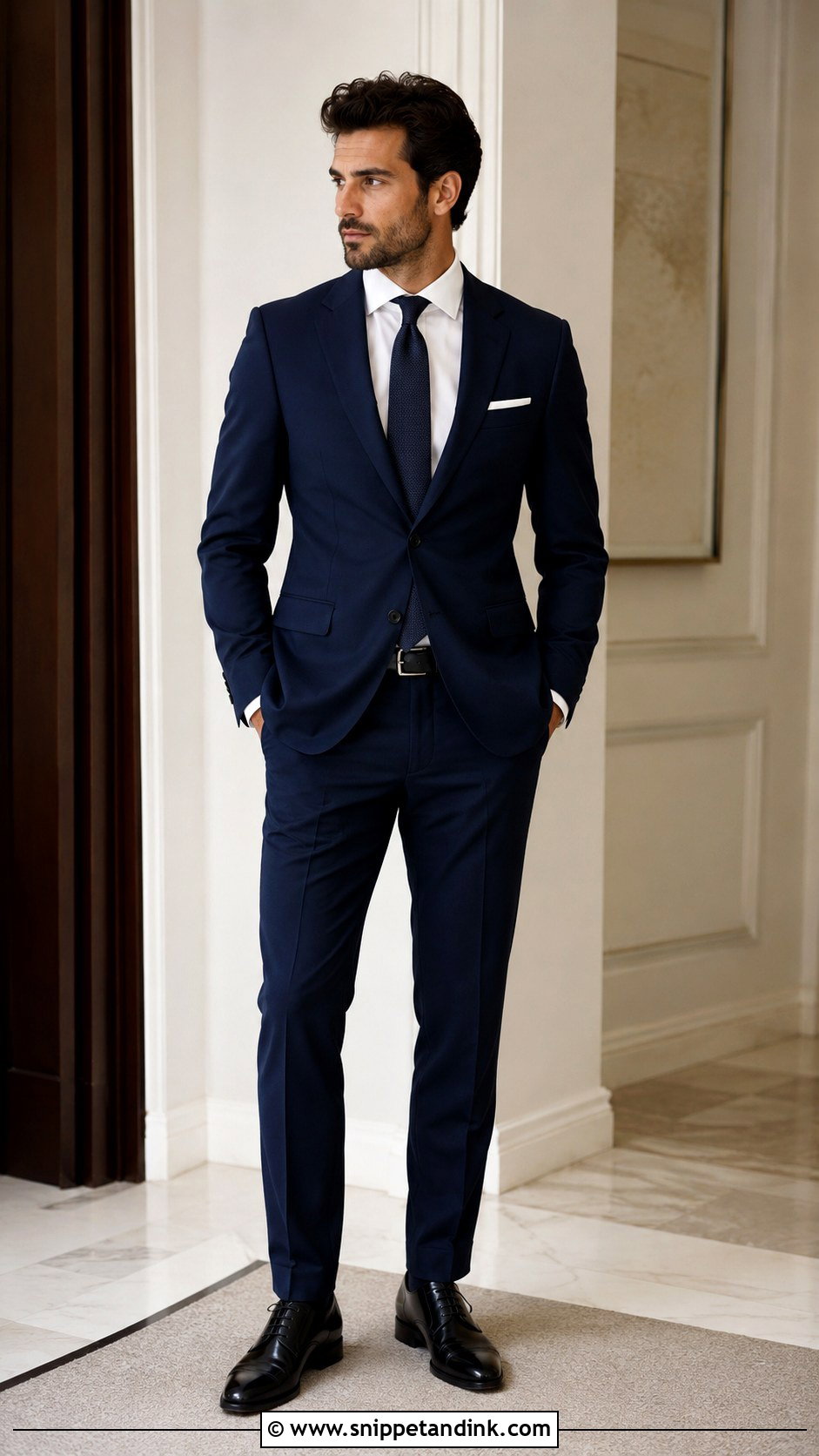
Black shoes change the temperature of navy. They pull it toward evening and formality, so I only use them with a deeper navy and a darker tie, usually charcoal, black or a deep burgundy. Polished black oxfords, a black belt, a white pocket square, a plain watch and stop there. The one thing I check is the navy itself: with a mid-blue suit, black shoes can look heavy and disconnected at the bottom of the frame. On a midnight navy they read as one clean line, which is why this pairing suits hotel receptions where the code is formal but nobody wants a tuxedo.
3. Navy Blue Three Piece Suit Wedding Outfit
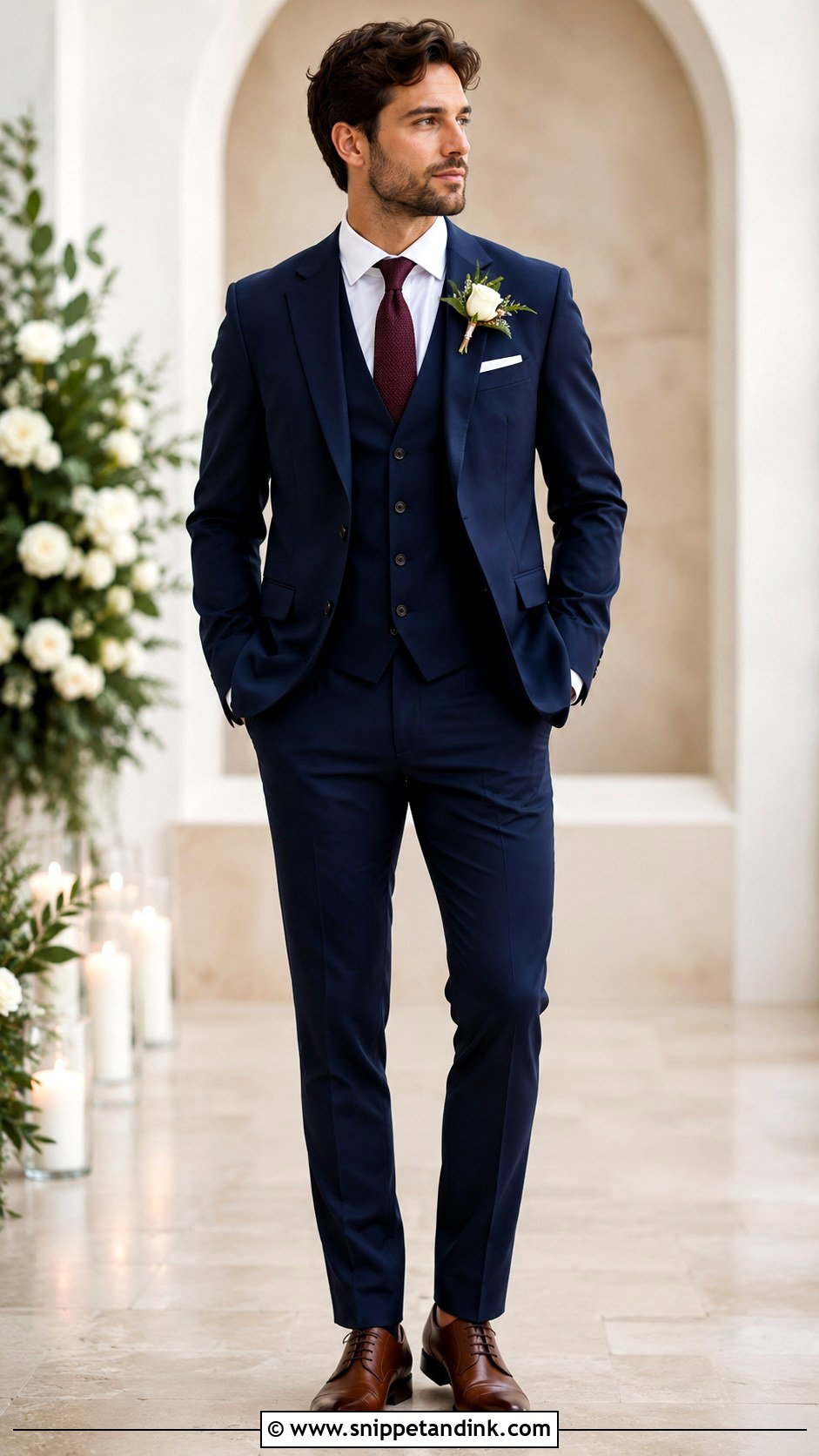
A navy blue three piece suit is my answer for the groom who wants to look dressed up all day, including after the jacket comes off at the reception. The vest holds the chest flat and hides a shirt that has started to bloom over the waistband by the fourth hour. Have the tailor check that the vest’s bottom edge covers the trouser waistband with the bottom button left undone; a short vest that shows a band of shirt ruins the effect. White shirt for a formal ceremony, light blue if it’s a daytime garden.
4. Navy Blue Double Breasted Suit Wedding Outfit
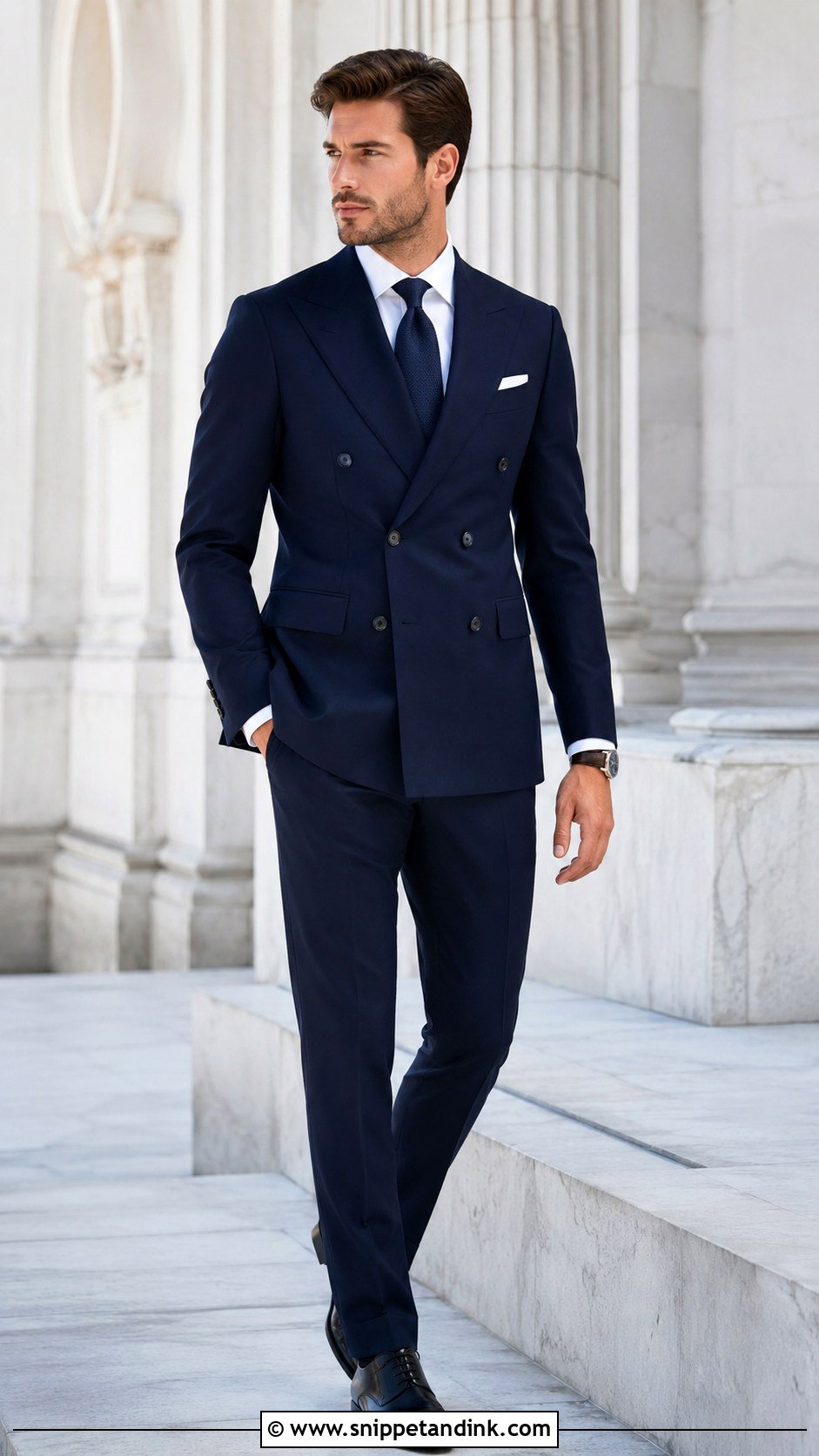
A navy blue double breasted suit has its own presence, so everything around it should go quiet. The overlapping front builds a strong shape across the torso. That shape is also why I’m careful with it: a double breasted jacket is meant to stay buttoned, and if the groom unbuttons it to sit, it flaps open and looks borrowed. Try sitting down in it at the fitting. White shirt, a plain tie, black loafers or oxfords for evening, dark brown for daytime. Folded pocket square, slim watch, neat boutonniere. It suits city venues and evening receptions far better than a barn or a beach.
5. Navy Blue Suit With Burgundy Tie
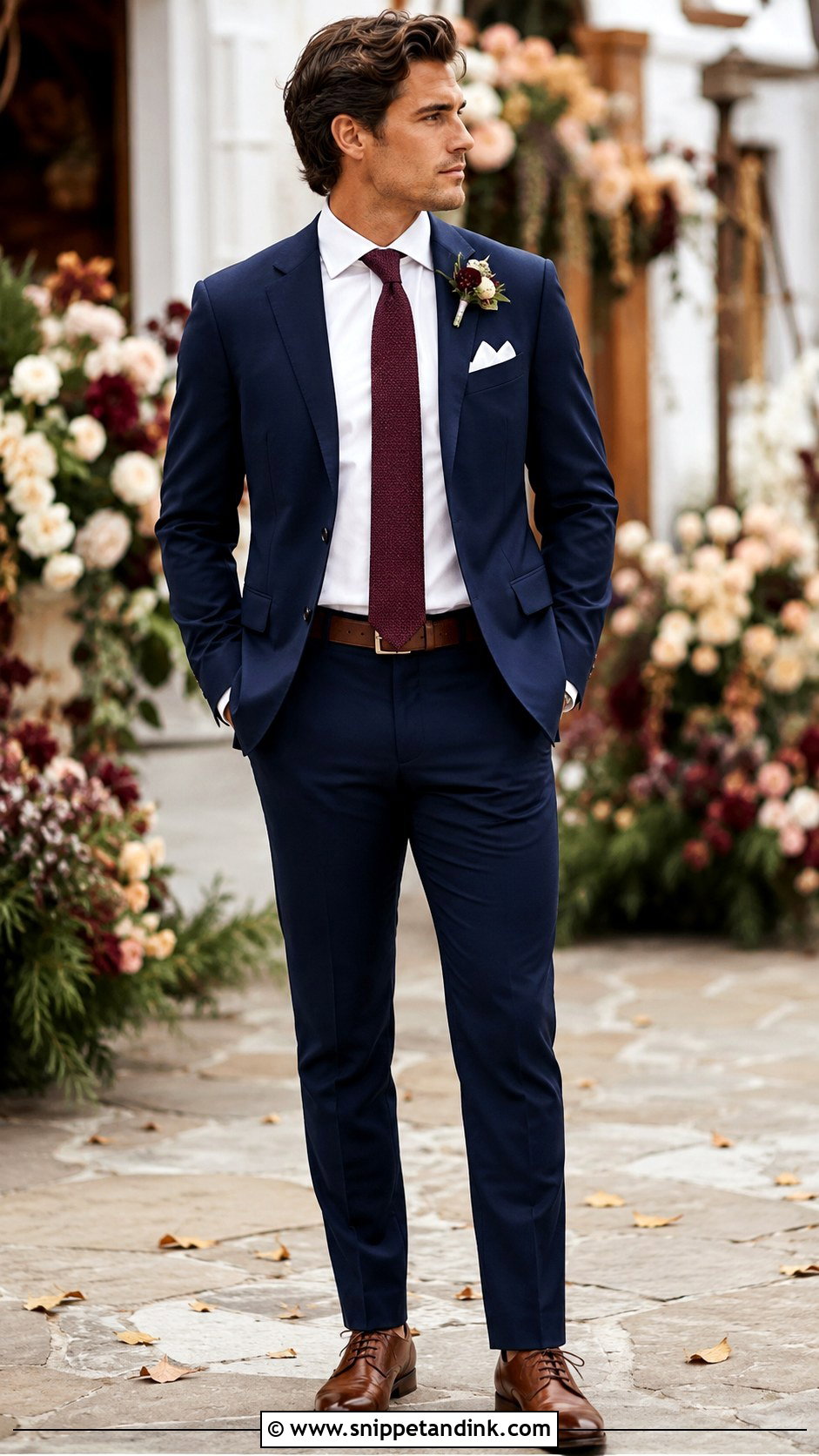
Burgundy is the tie I trust in every season against navy. It adds warmth without fighting the bride’s palette, and it photographs as a real color rather than a dark smudge. The texture is where I spend time: in fall and winter I’d choose wool or grenadine, whose open weave catches light and looks rich up close; for spring, a lighter burgundy or a small pattern keeps it from feeling heavy. White shirt, brown shoes and belt, white pocket square. A burgundy bloom in the boutonniere ties it to the florals if the florist is using that color.
6. Navy Blue Suit With Sage Green Tie
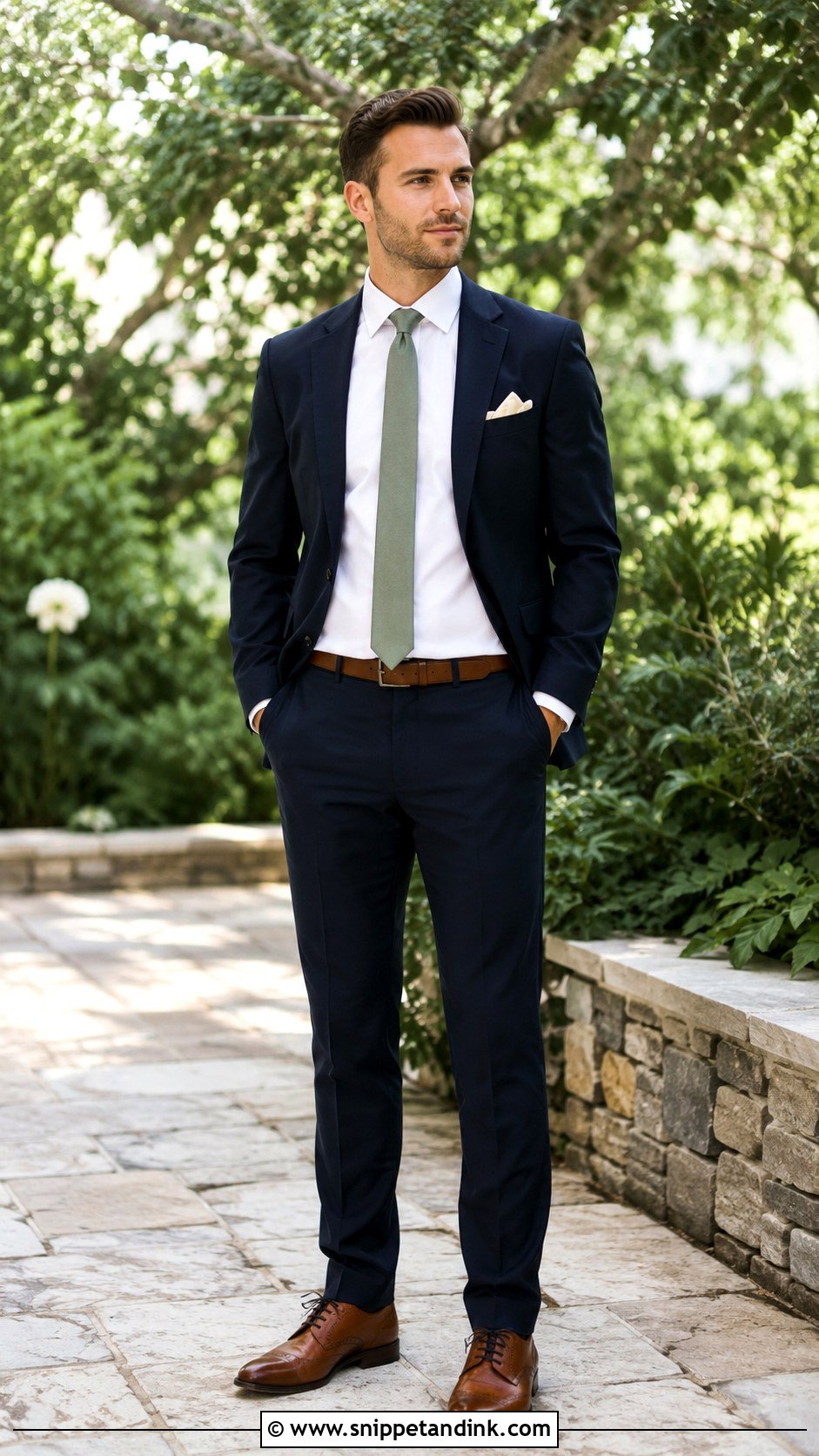
Sage has been the go-to accent for garden weddings for a few seasons now, and it sits well on navy because both colors are muted. The navy anchors it and the sage keeps things calm. Pair it with a white or very pale blue shirt and brown shoes. My one firm rule: matte, not shiny. A glossy sage satin tie turns minty and slightly plastic under daylight, while a matte or knitted one holds the soft green the couple actually chose. It works for groomsmen because it coordinates with greenery without anyone looking costumed.
7. Navy Blue Suit With Champagne Tie
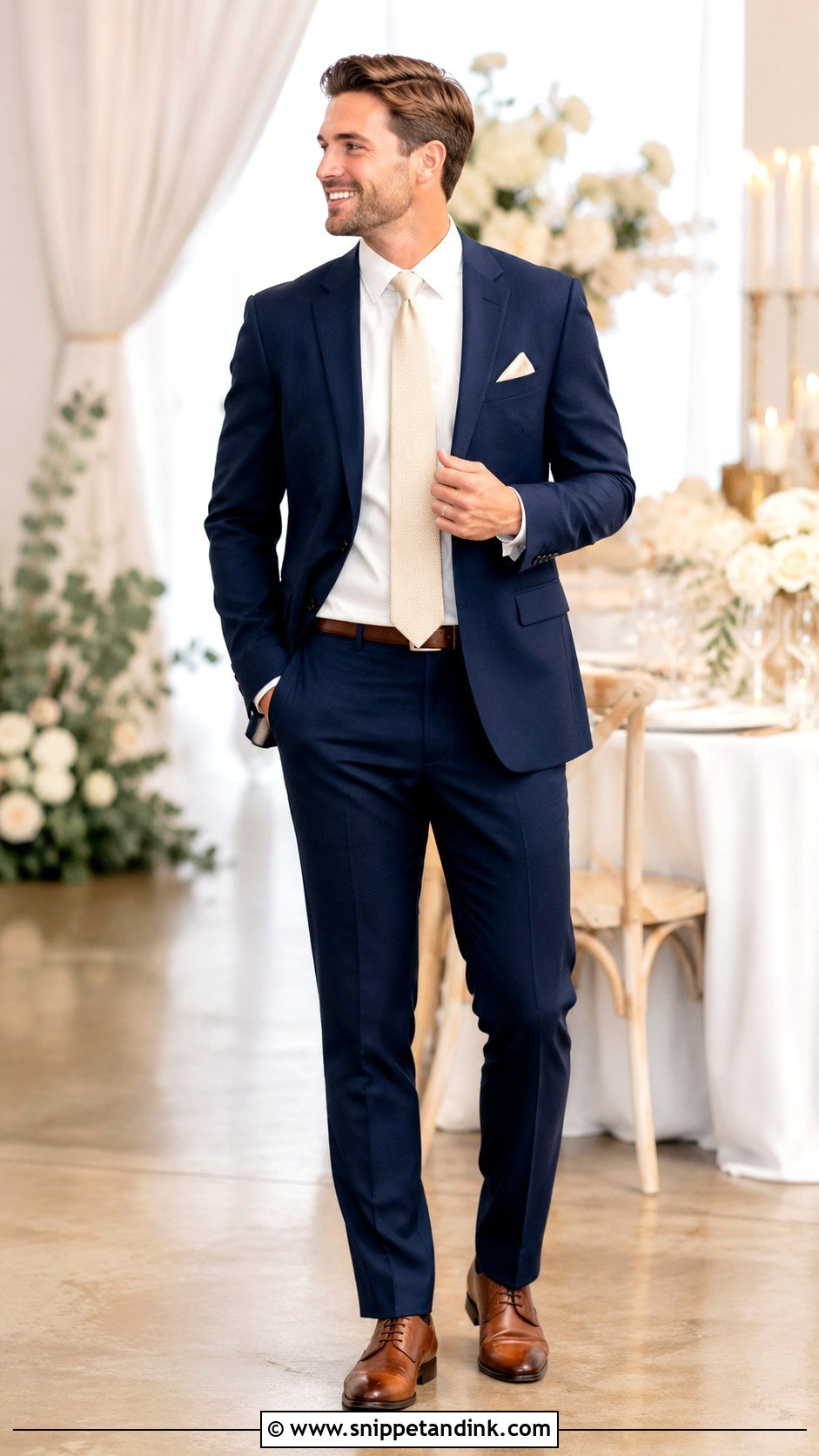
A champagne tie brightens navy without the hard contrast of white. It belongs with ivory, blush, taupe and gold palettes, and I’d wear it with a white shirt, tan or mid-brown shoes and a cream pocket square. The risk is flatness. A plain, smooth champagne silk can photograph almost the same tone as the shirt, so the tie disappears. I look for a woven texture or a subtle pattern so there’s a little shadow in the fabric. For a wedding party that needs to look light rather than dark and heavy, this is my pick.
8. Navy Blue Suit With Blush Pink Tie
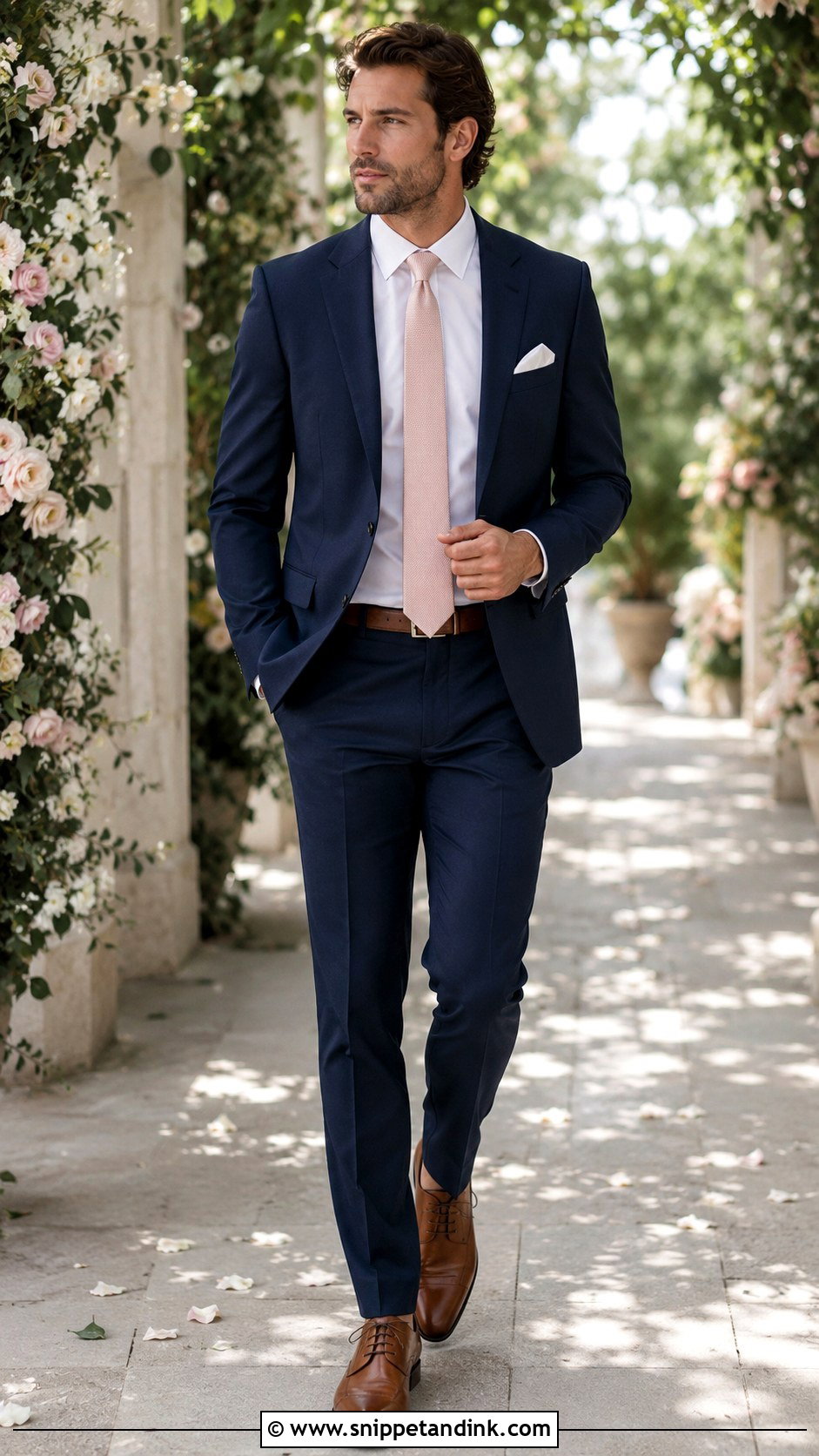
Blush on navy is softer than most grooms expect it to be, and that’s the appeal. Navy keeps the outline sharp while the pink picks up spring and summer palettes. I go muted every time; a bright pink tie looks like a novelty next to dusty rose bridesmaid dresses. White shirt, brown shoes. If you want a blush pocket square, keep it a print with only a hint of pink, because matching tie and square exactly makes the outfit look sold as a set. It also travels well as a daytime guest outfit.
9. Navy Blue Suit With Dusty Blue Tie
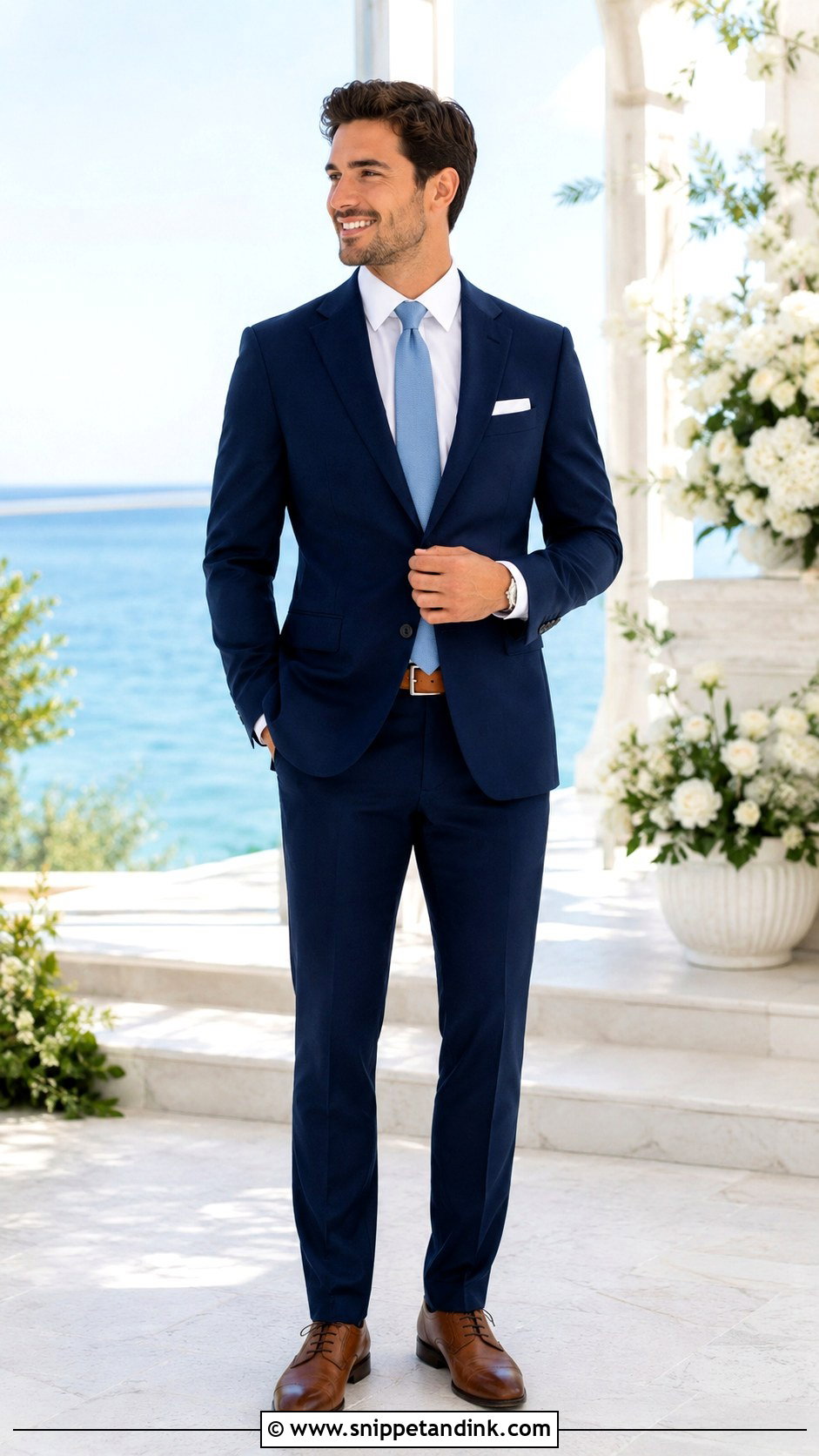
Dusty blue on navy is a tonal look, and tonal outfits live or die on contrast. The tie has to be clearly lighter than the suit, or from across the room the whole front reads as one dark block. I hold the tie against the lapel in daylight before buying. White shirt, brown shoes, a white or pale blue pocket square. It suits coastal and spring ceremonies, and it fits in easily when bridesmaids are already wearing blue.
10. Navy Blue Suit With Floral Tie
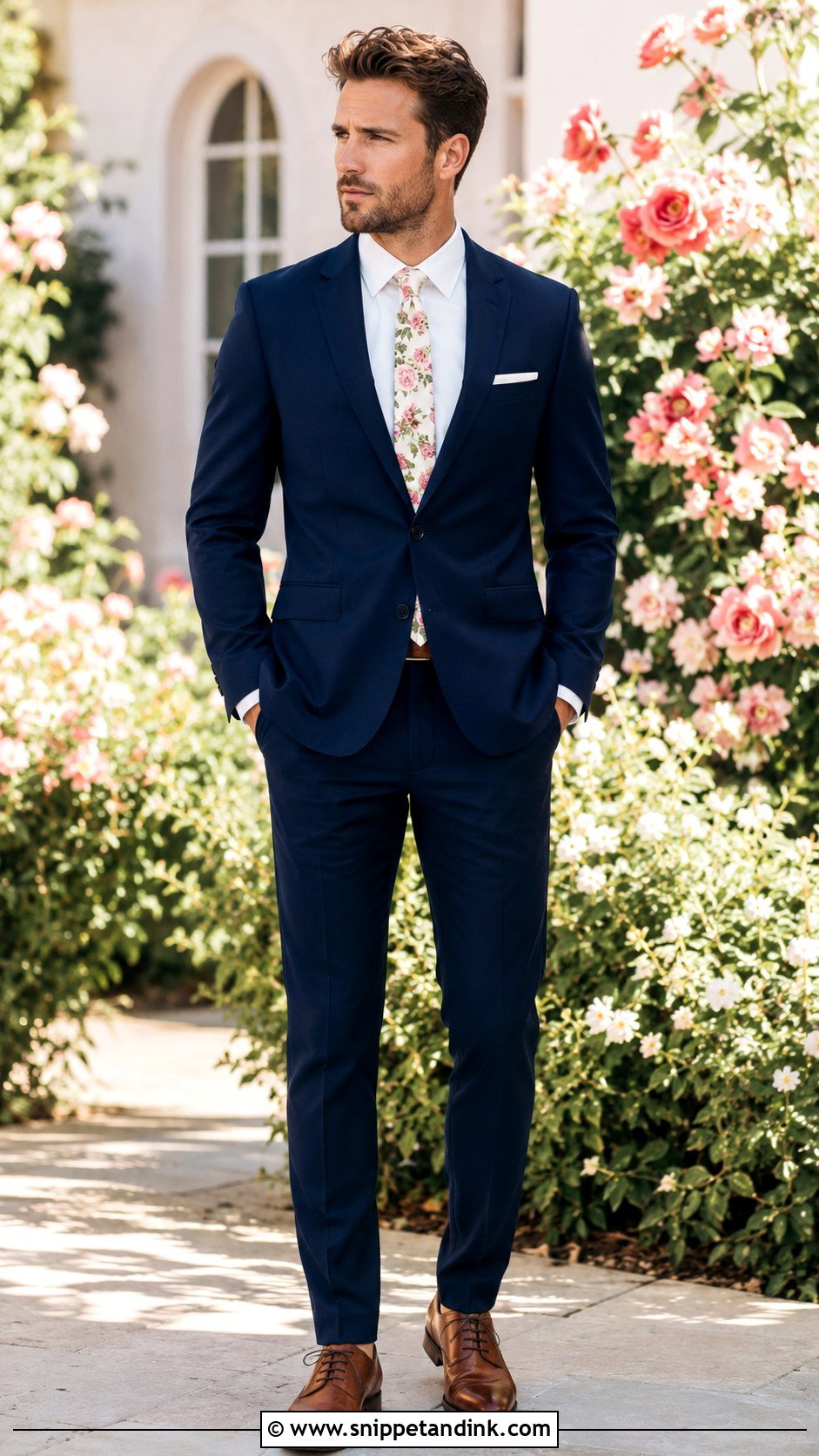
A floral tie is how I let a groom show some personality while the suit stays conservative. Spring and summer prints in blush, sage, ivory or lavender; for fall, rust and forest green. The shirt stays plain, white or pale blue, so the print has room. Brown shoes keep it relaxed, black pushes it formal. Don’t buy the matching floral pocket square. Two identical prints six inches apart look like a gift box, and a plain white square does the job better. It sits best at a garden celebration.
11. Navy Blue Suit With Bow Tie
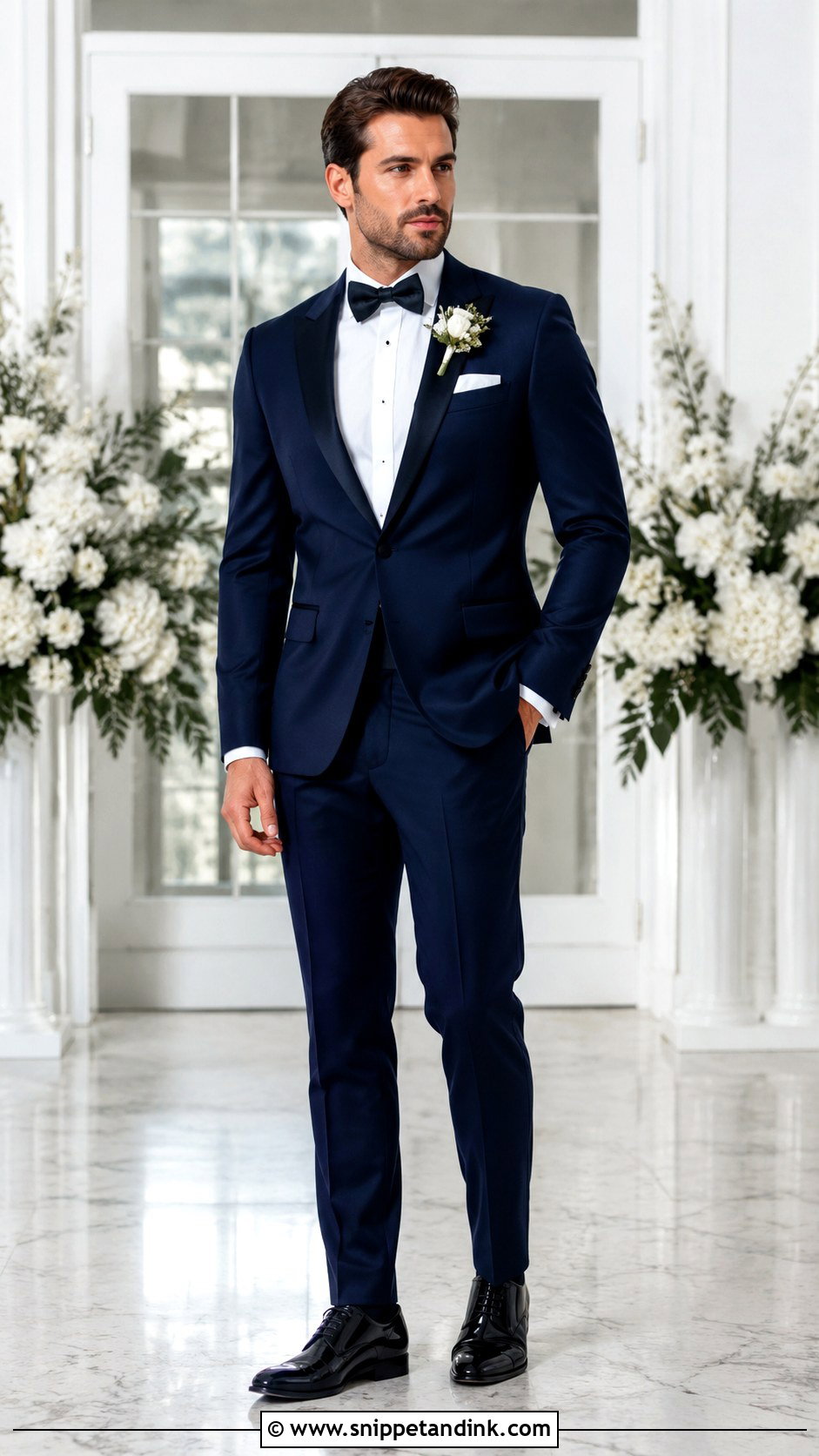
Bow ties are about proportion more than color. The width of the bow should roughly sit within the outer edges of the eyes and not run past the collar points; too small looks fussy, too large looks like costume. A black bow tie is the dressiest version and gets a navy suit close to tuxedo territory. Burgundy or a pattern feels more personal. White shirt, black oxfords if formal, brown shoes outdoors. I’d also suggest a self-tie over a pre-tied one: it sits slightly uneven, which looks human in close-ups.
12. Navy Blue Suit With No Tie
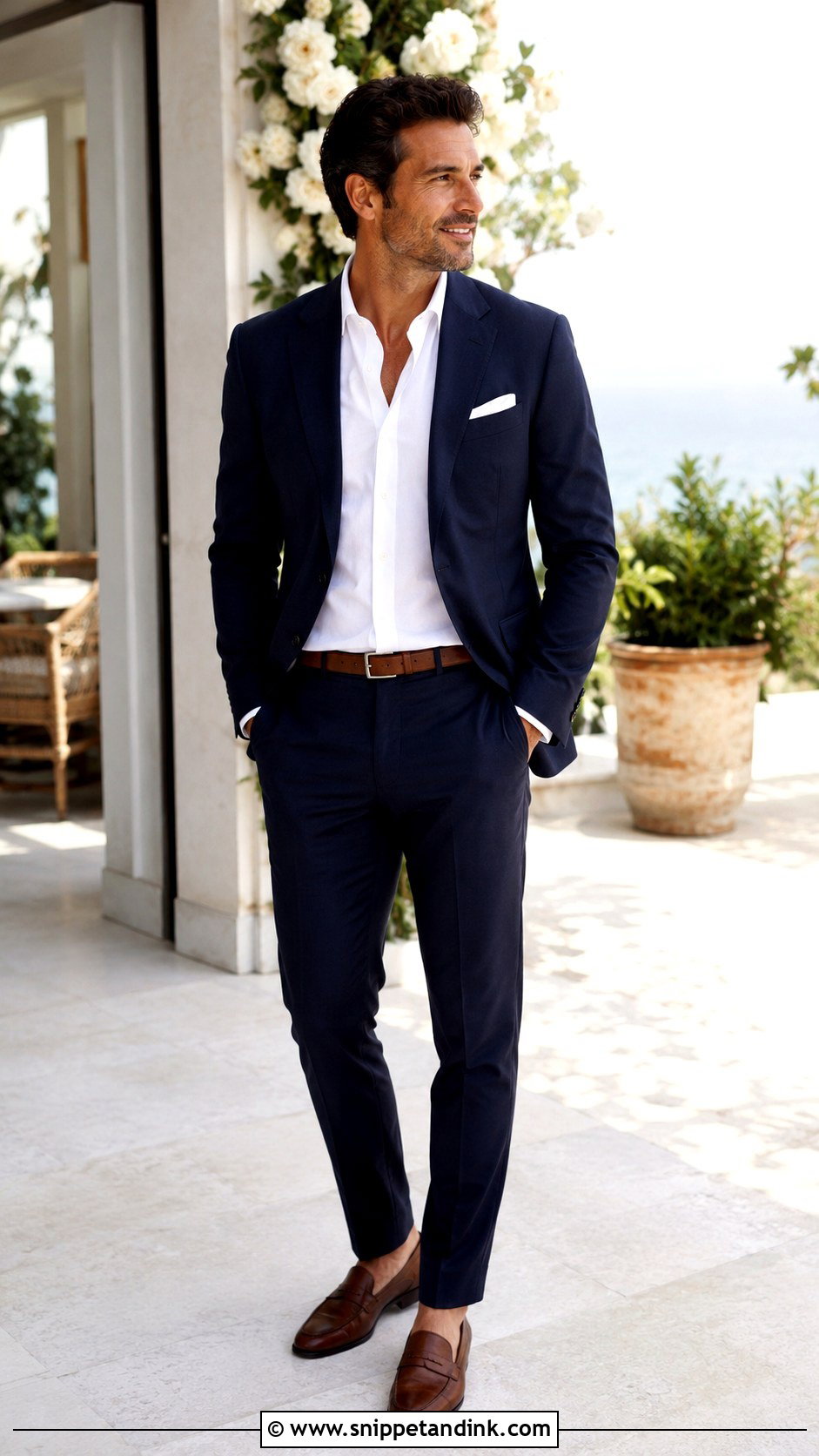
Going tieless only works when everything else is sharper than usual. I’d do this for a beach, a summer destination or a relaxed reception, never for a formal code. The shirt is the whole game: a crisp spread or cutaway collar with enough structure that it stands up inside the lapels, one button open, no more. A soft casual collar collapses flat by mid-afternoon and the outfit starts to look like he forgot something. Brown loafers or suede loafers, a pocket square to replace the color a tie would have added.
13. Navy Blue Suit With Light Blue Shirt
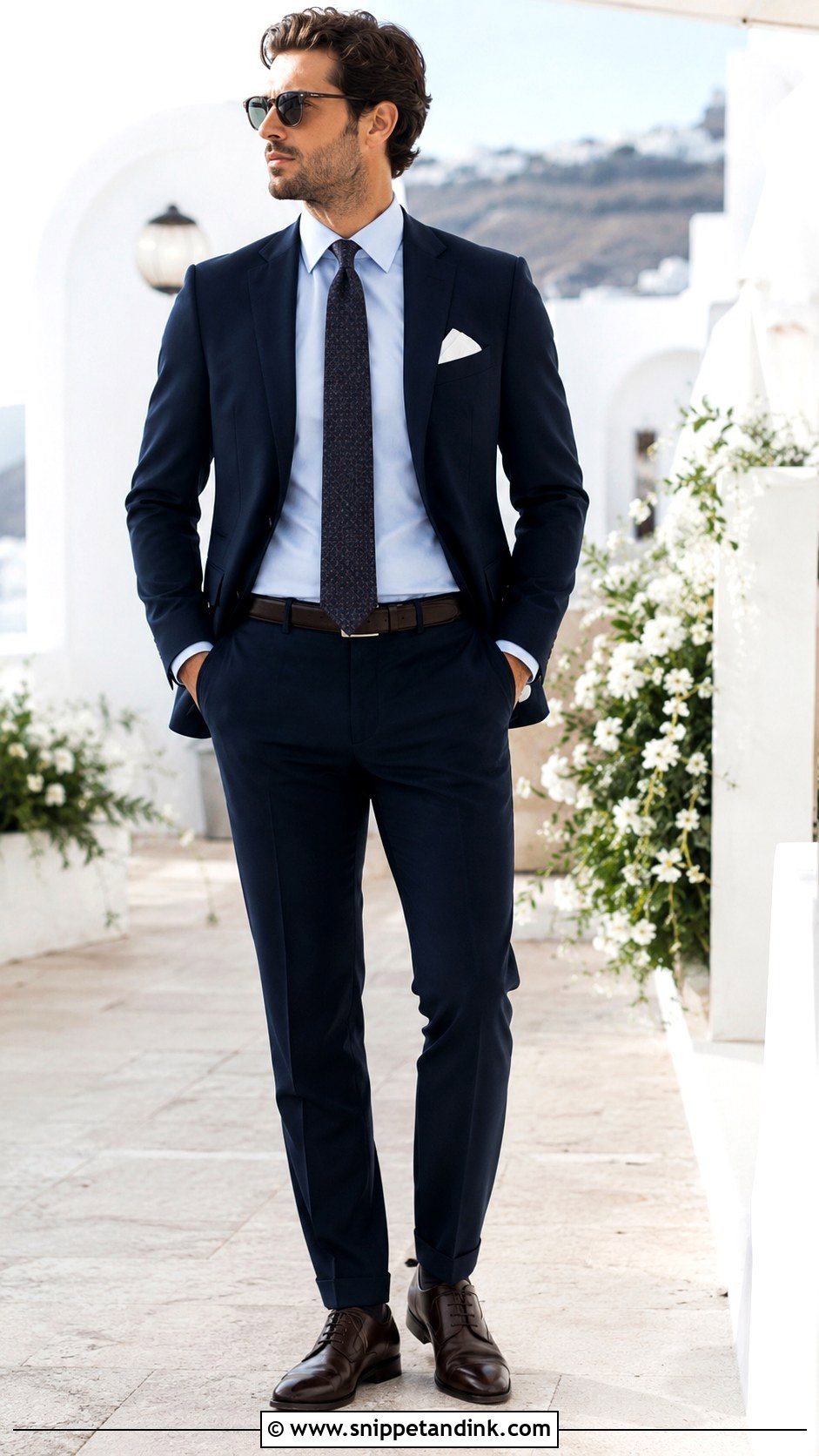
A light blue shirt is my quiet favorite for daytime navy. It’s gentler on the face than bright white, which can bounce harsh light up under the chin in midday sun. Pair it with a navy, burgundy or patterned tie depending on how formal you need to go, brown shoes for approachable, black for structure. Add a white pocket square, otherwise the outfit can drift into too much blue. Groomsmen also tend to wear this shirt again, which matters when they’re paying for it.
14. Navy Blue Suit With Pale Pink Shirt
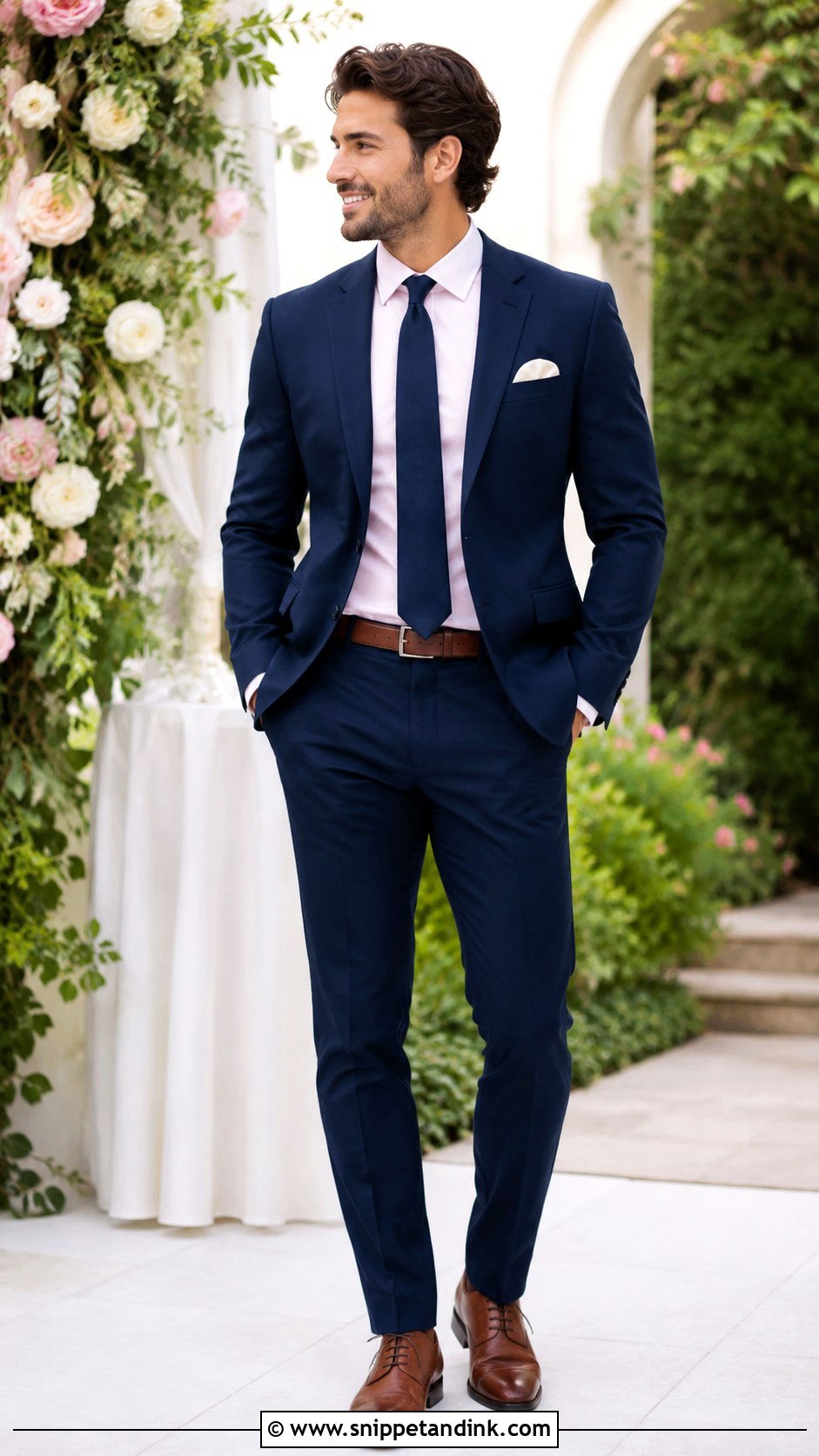
Pale pink under navy surprises people. It’s warm, it lifts complexion in photos, and it suits a spring garden. The tie decides the mood: navy for a tonal finish, burgundy for depth, champagne for softness. Brown shoes almost always, since black can feel cold against the pink. I tell clients to hold the shirt up next to their face in daylight before committing; the right shade is closer to a blush than a candy pink, and anything bright or neon cheapens the suit.
15. Navy Blue Suit With Patterned Shirt
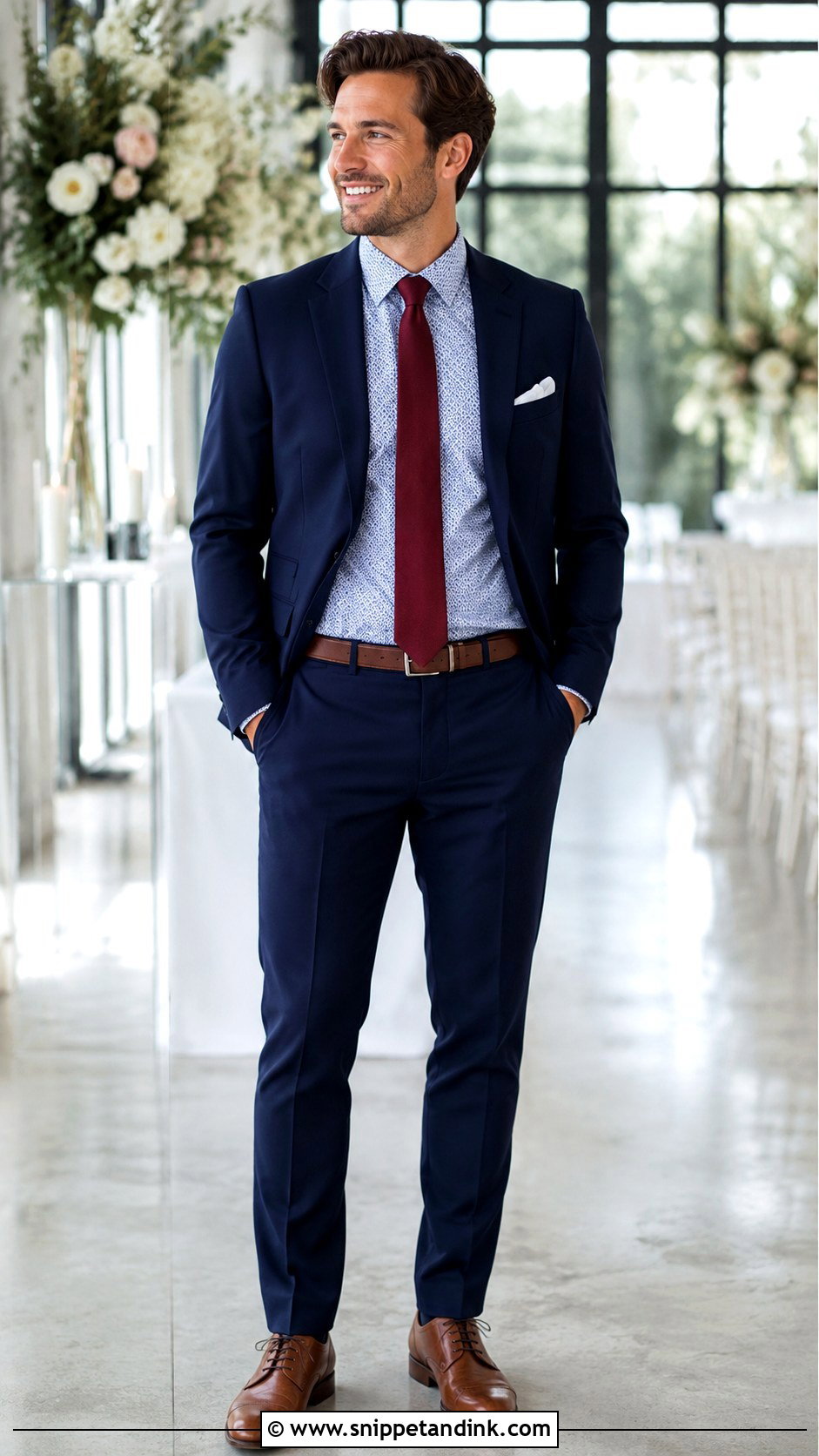
A patterned shirt under navy is for the guest or the relaxed groom, and the pattern needs to be small. Fine stripes, micro checks and tiny prints read as texture from a distance. Larger checks can do something worse on camera: very fine, high-contrast patterns sometimes shimmer on digital sensors, so I steer clients toward patterns that are subtle in color, not just in scale. Solid tie on top, usually navy, burgundy or silver. Brown shoes friendly, black sharper. Rehearsal dinners suit this look more than a formal ceremony does.
16. Navy Blue Suit With Ivory Shirt
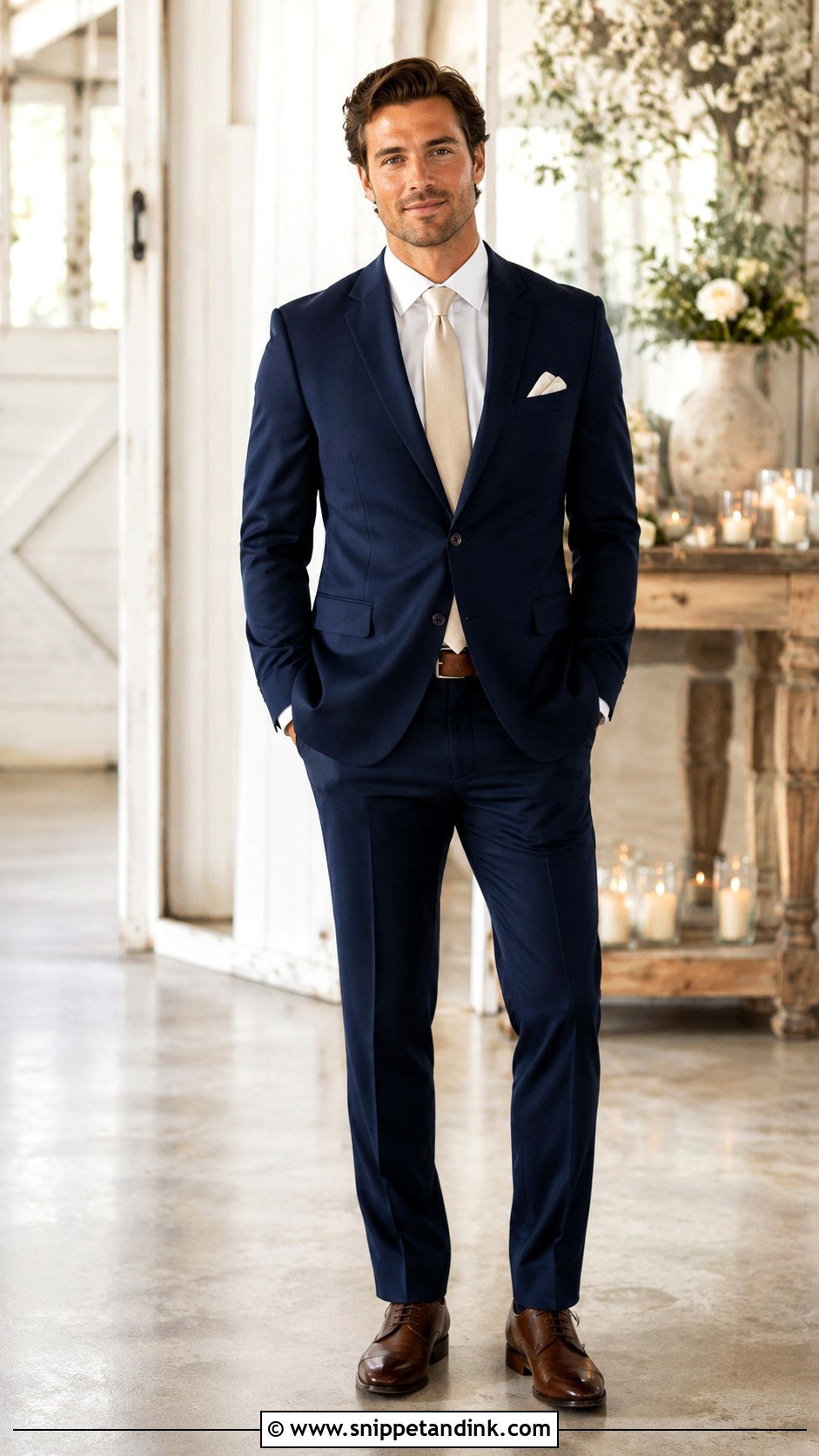
Ivory instead of white is the shirt swap I make when the bride is wearing ivory or the palette leans cream and beige. Bright white next to an ivory gown can make the gown look slightly yellow in photos; matching the warmth avoids that. Taupe, sage, soft brown or burgundy ties all suit it, and brown shoes are better than black here. Keep the pocket square clearly a different shade from the shirt, or the two blur into one off-white smudge. It’s a warmer, less formal look, suited to rustic venues and fall.
17. Navy Blue Suit With Tan Shoes
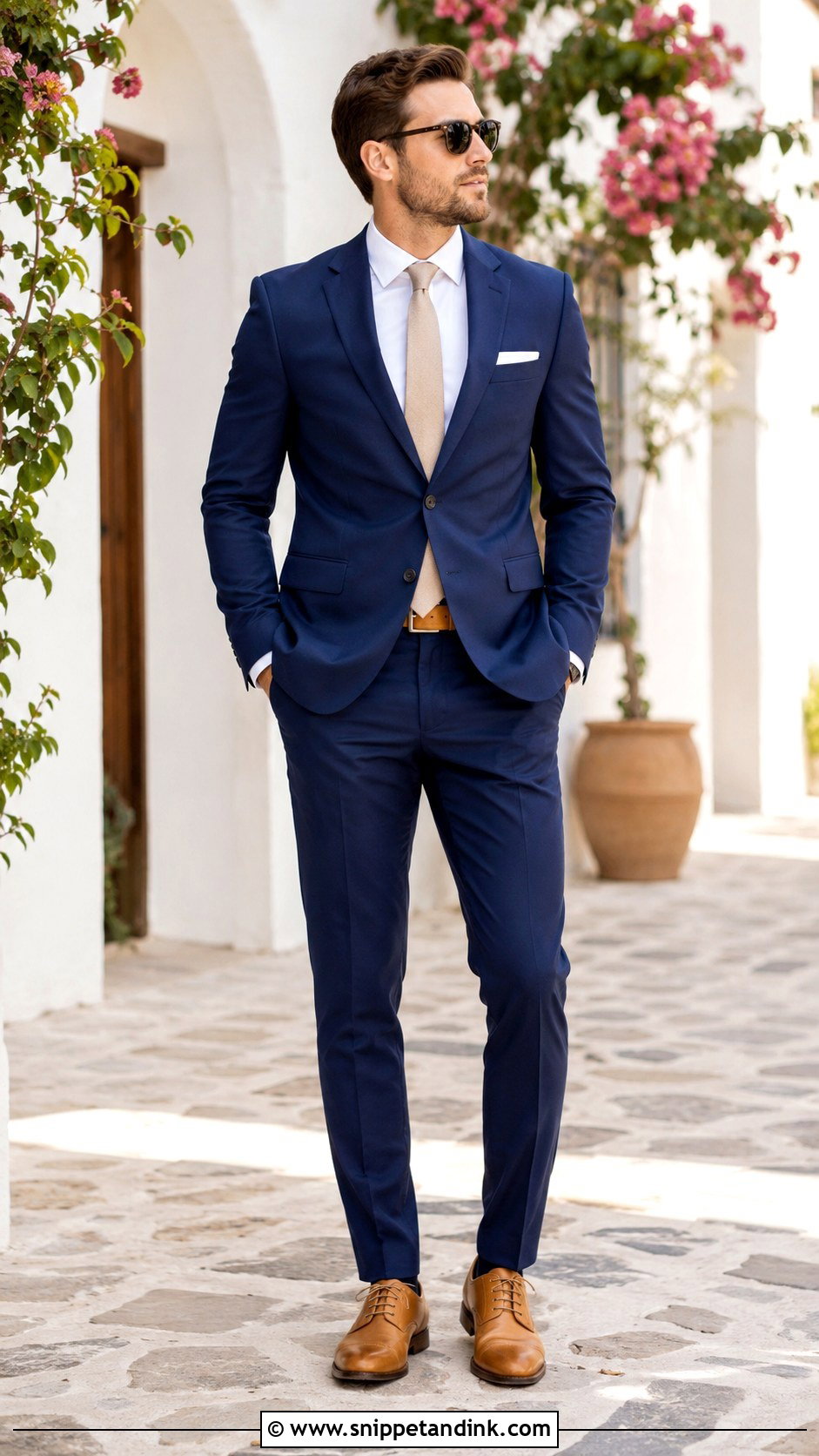
Tan shoes put a lot of contrast at the bottom of the outfit, so they need a medium navy, not a very dark midnight that makes the jump too sharp. White or light blue shirt, a champagne, sage or dusty blue tie, and a tan belt matched closely to the shoes. Here’s what goes wrong: light leather shows every scuff from a gravel path or a dance floor. Polish the morning of and keep a cloth in a groomsman’s pocket. Tan sits on the relaxed side of the dress code, so I keep it for daytime and semi-formal.
18. Navy Blue Suit With Dark Brown Shoes
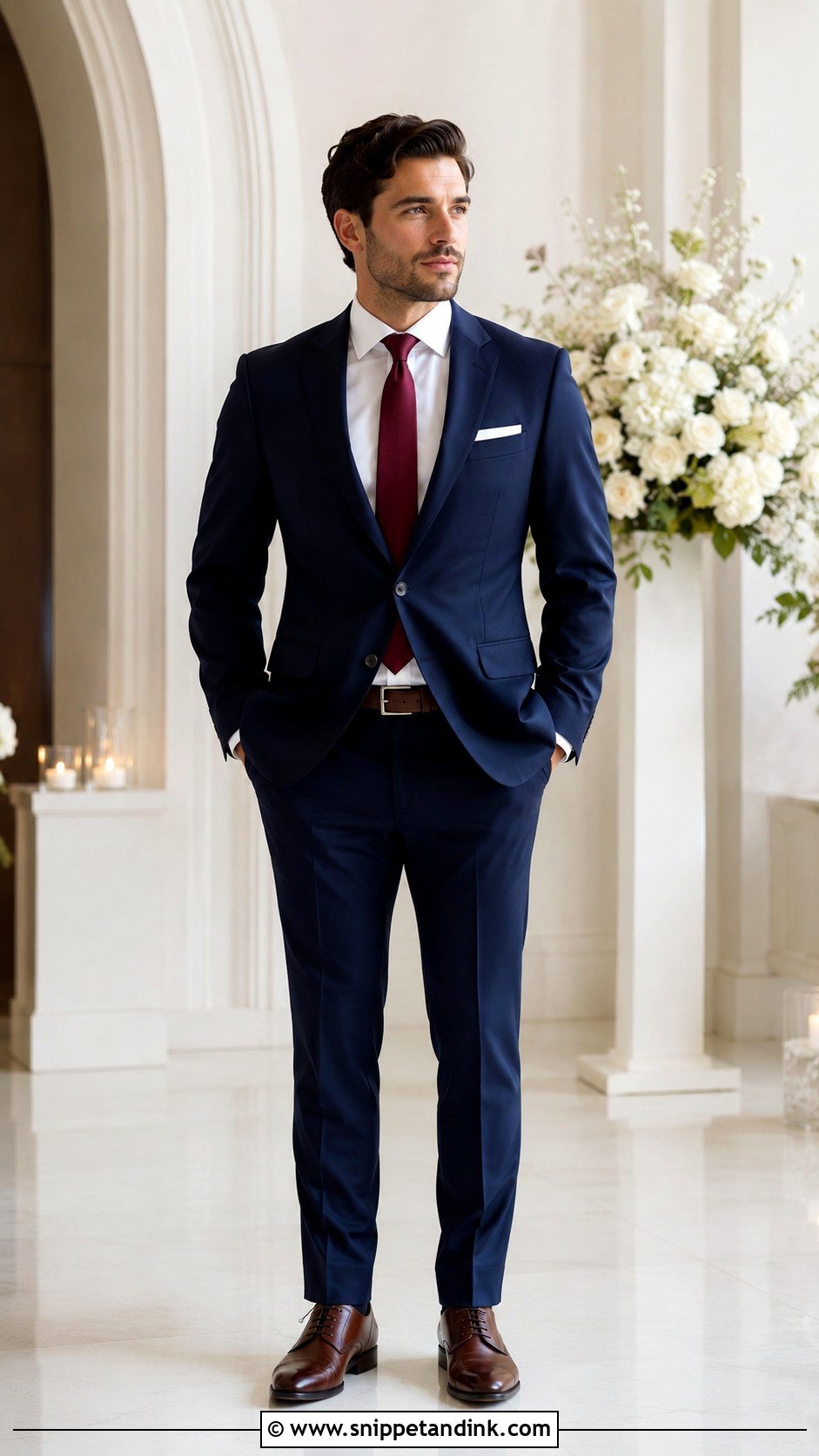
Dark brown sits exactly between formal black and casual tan, which is why I recommend it more than any other shoe with navy. Oxfords for the groom, derbies or loafers for guests and groomsmen. White shirt, a tie in burgundy, silver or sage, a dark brown belt and a clean pocket square. It works in a ballroom and on a lawn alike. If a couple can’t decide between black and tan for the wedding party, this is usually where the conversation ends.
19. Navy Blue Suit With Loafers
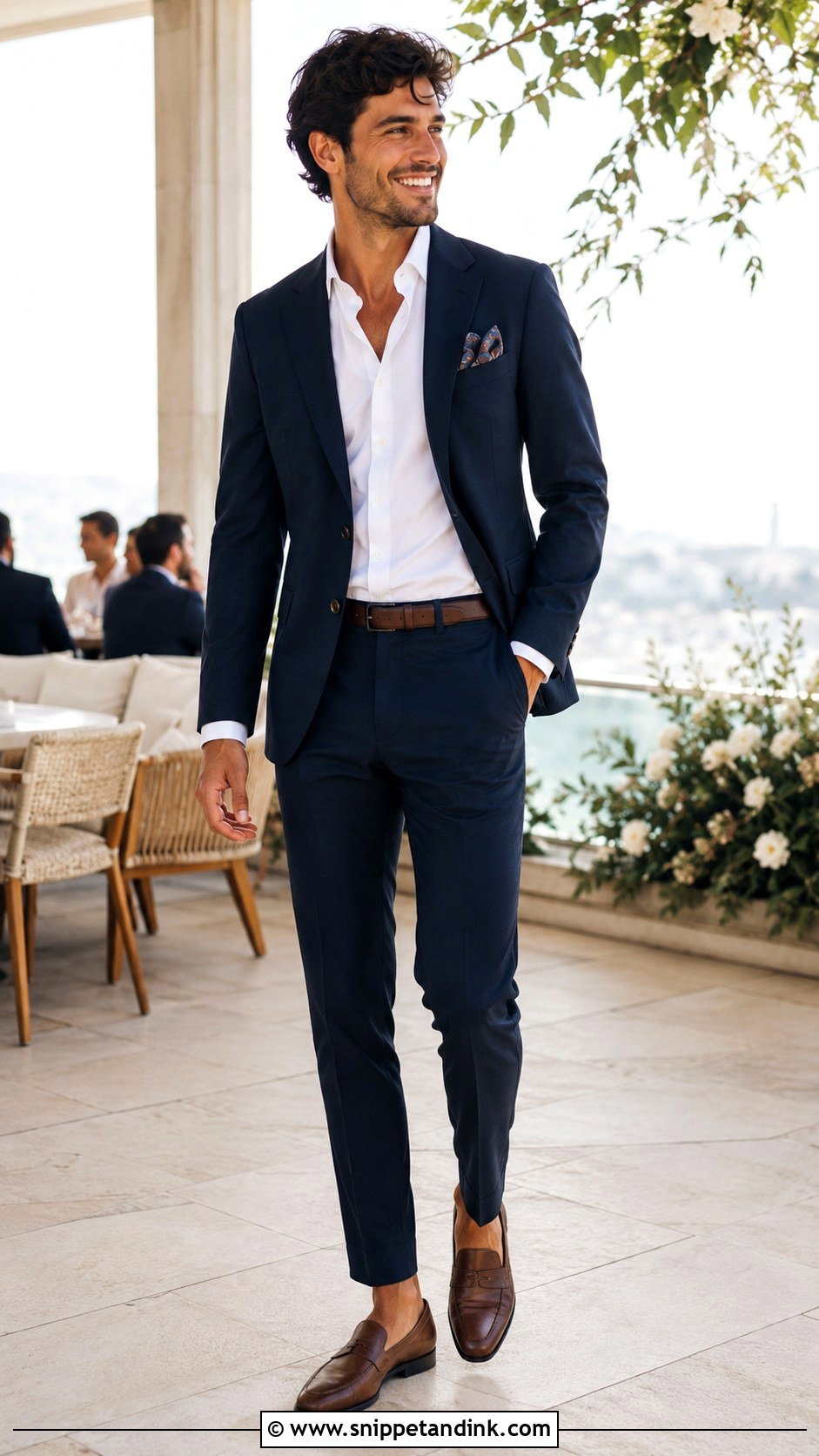
Loafers are a warm-weather shoe, and they expose more ankle than lace-ups, so the sock decision matters. Either a properly invisible no-show sock or a neat dress sock in navy; a sporty ankle sock peeking out wrecks the look in seated photos. Brown leather is classic, suede softer and more seasonal. White or light blue shirt, a slim tie for semi-formal, or none at a beach if the shirt is crisp. I like them for rooftops and daytime ceremonies where people will be standing a long time.
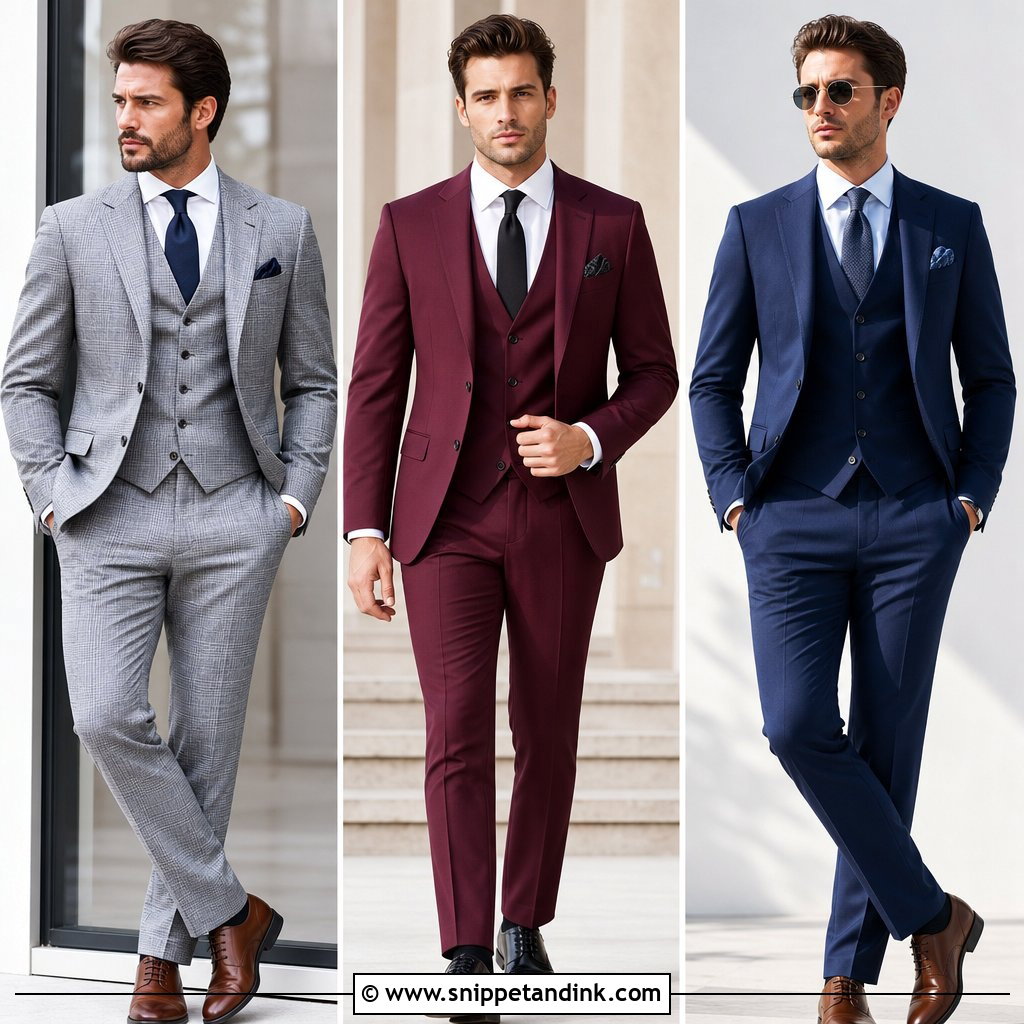
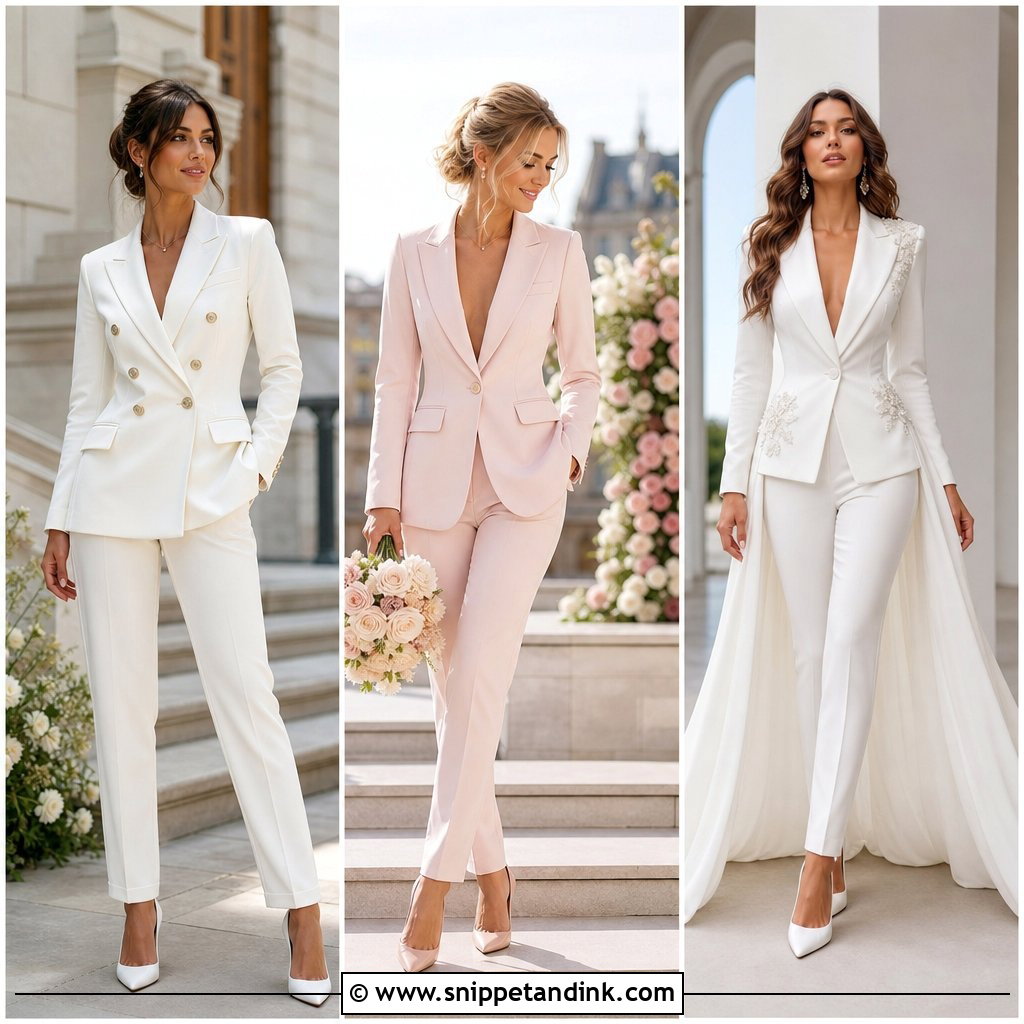
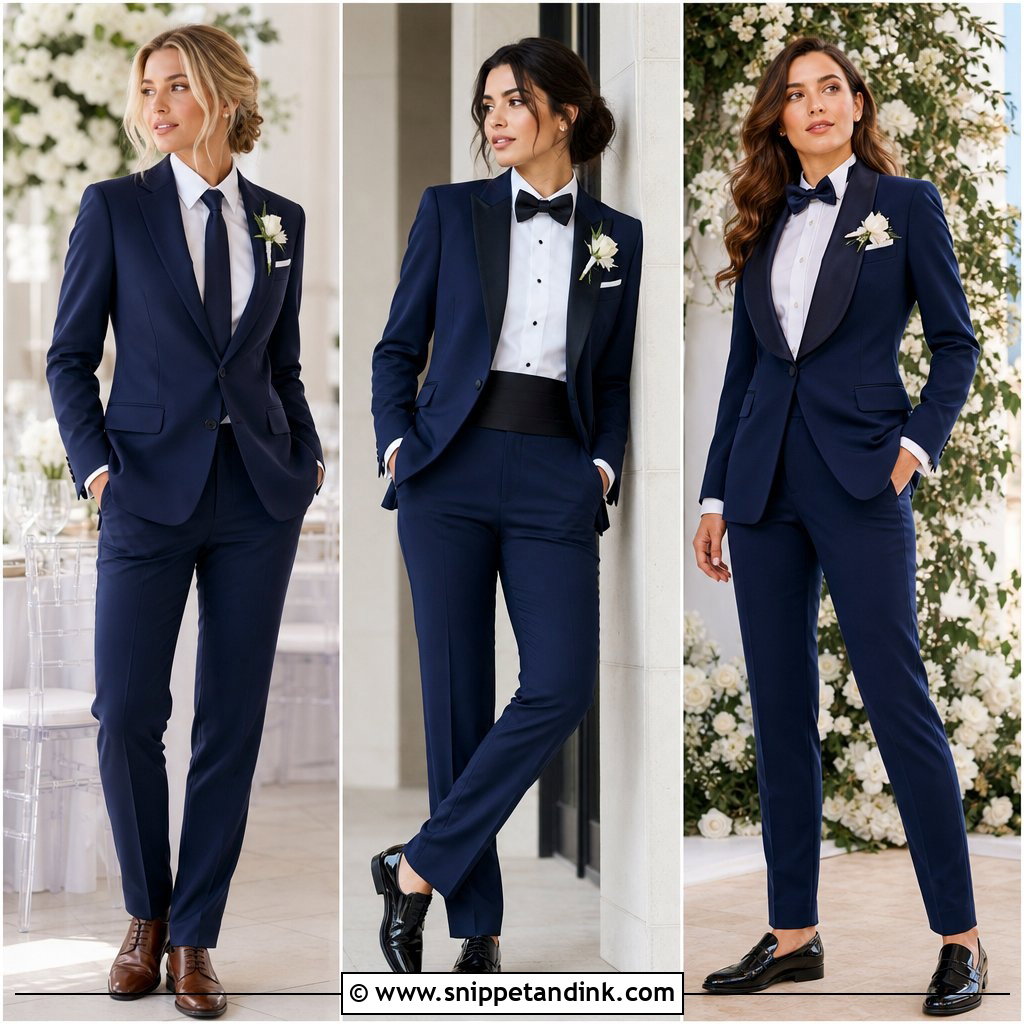
20. Navy Blue Linen Suit Wedding Outfit
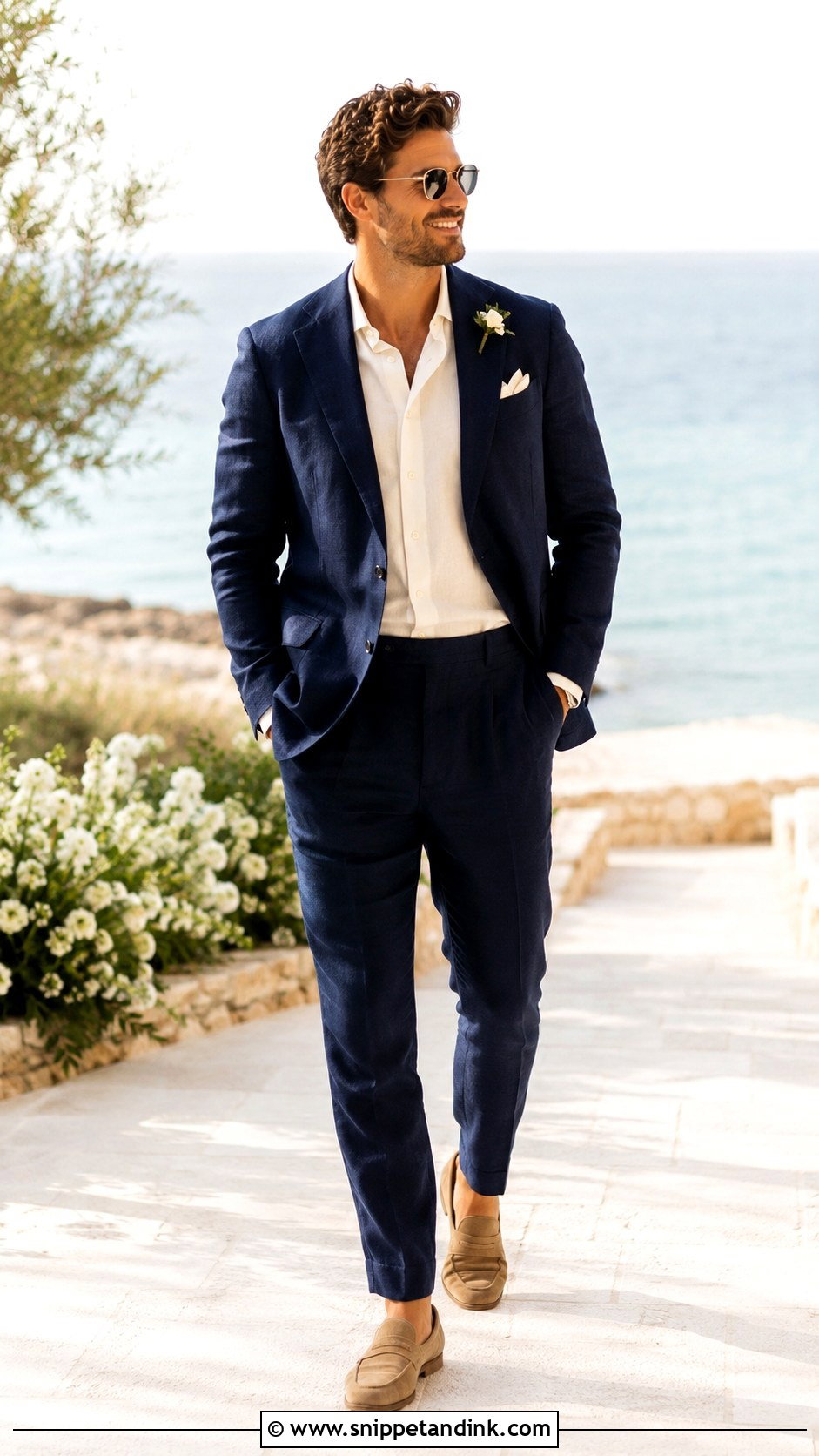
Linen is honest about what it is: it wrinkles within the first hour, and I tell grooms to accept that before buying, because fighting it with a too-tight fit only makes the creases deeper. Size for a little ease across the back and the creases soften into texture. That texture is why dark navy still looks relaxed in linen. White or ivory shirt, tan loafers, a light pocket square. If you want a tie, choose linen, cotton or matte silk in champagne, sage or pale blue. Keep it for airy, bright settings; it looks out of place in a ballroom.
21. Navy Blue Wool Suit Wedding Outfit
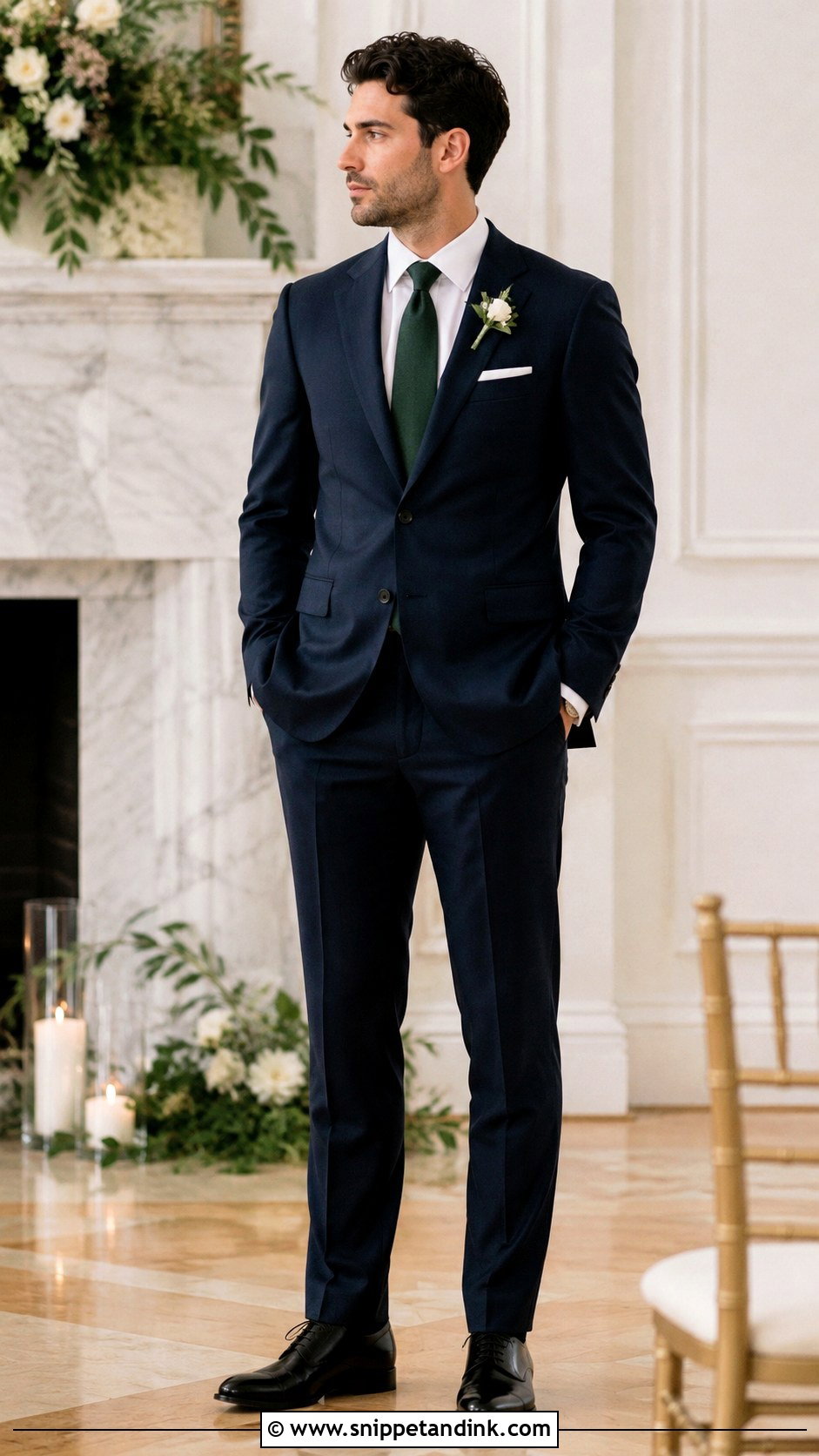
A navy blue wool suit is the one I’d buy if the groom wants to wear it again for years. Wool drapes cleanly and recovers its shape after hours of sitting and dancing, which synthetic blends often don’t. Ask about the weight: a lighter year-round wool for spring weddings, a heavier flannel or twill for winter. White shirt, dark brown or black shoes, a burgundy, silver or forest green tie. It also supports a matching vest if you want the three-piece version later.
22. Navy Blue Velvet Jacket Wedding Outfit
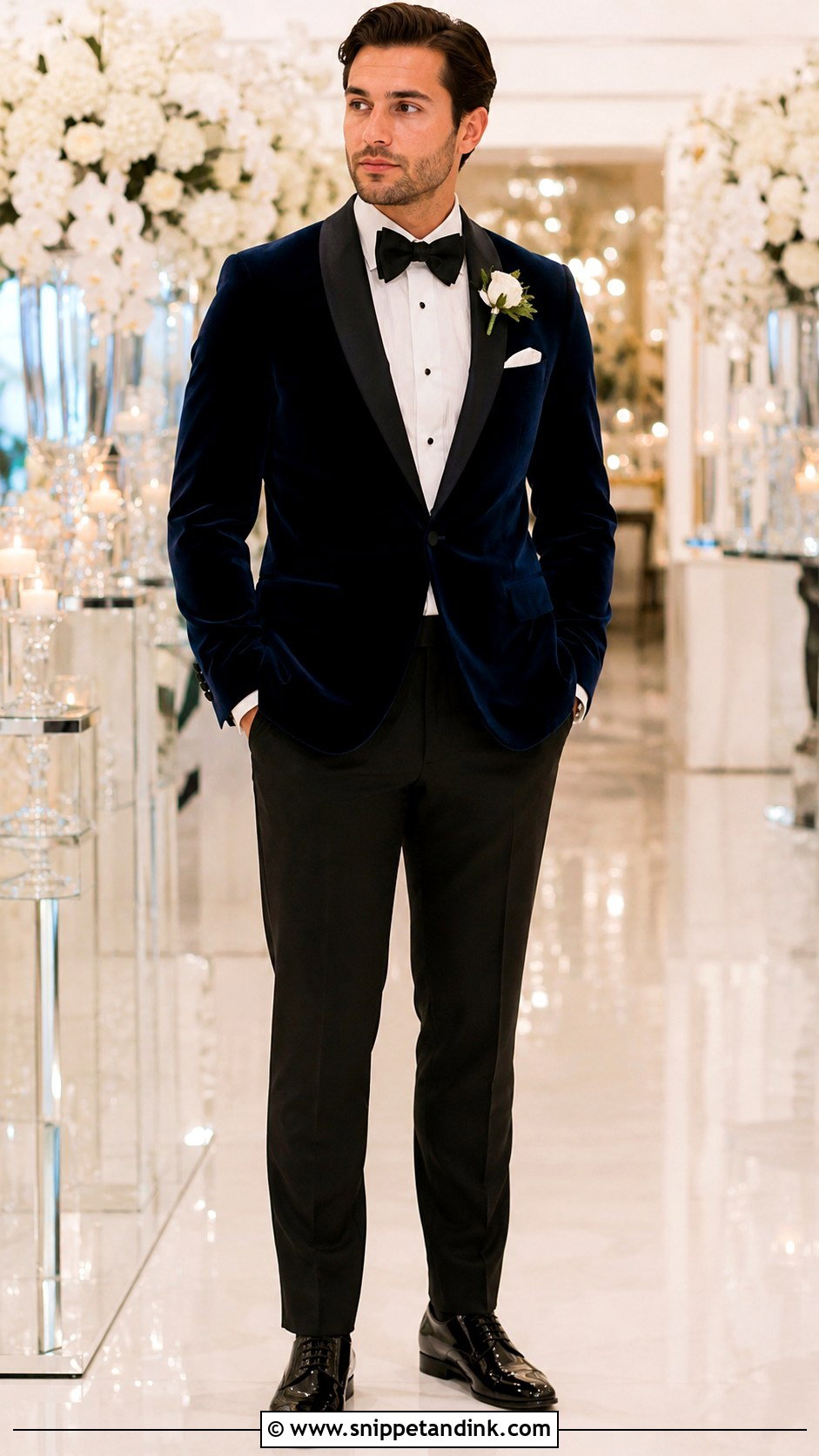
Velvet is an evening fabric. It drinks light, so in candlelight a navy velvet jacket looks almost black with a soft sheen at the folds, and in harsh daylight it can look dusty. I only suggest it for winter receptions and formal venues. Pair it with matching navy trousers or black tuxedo-style trousers, a white shirt and a black bow tie or deep burgundy tie, with polished or patent black shoes. One practical note: velvet crushes where you sit and lean, so steam it the morning of and hang it rather than draping it over a chair.
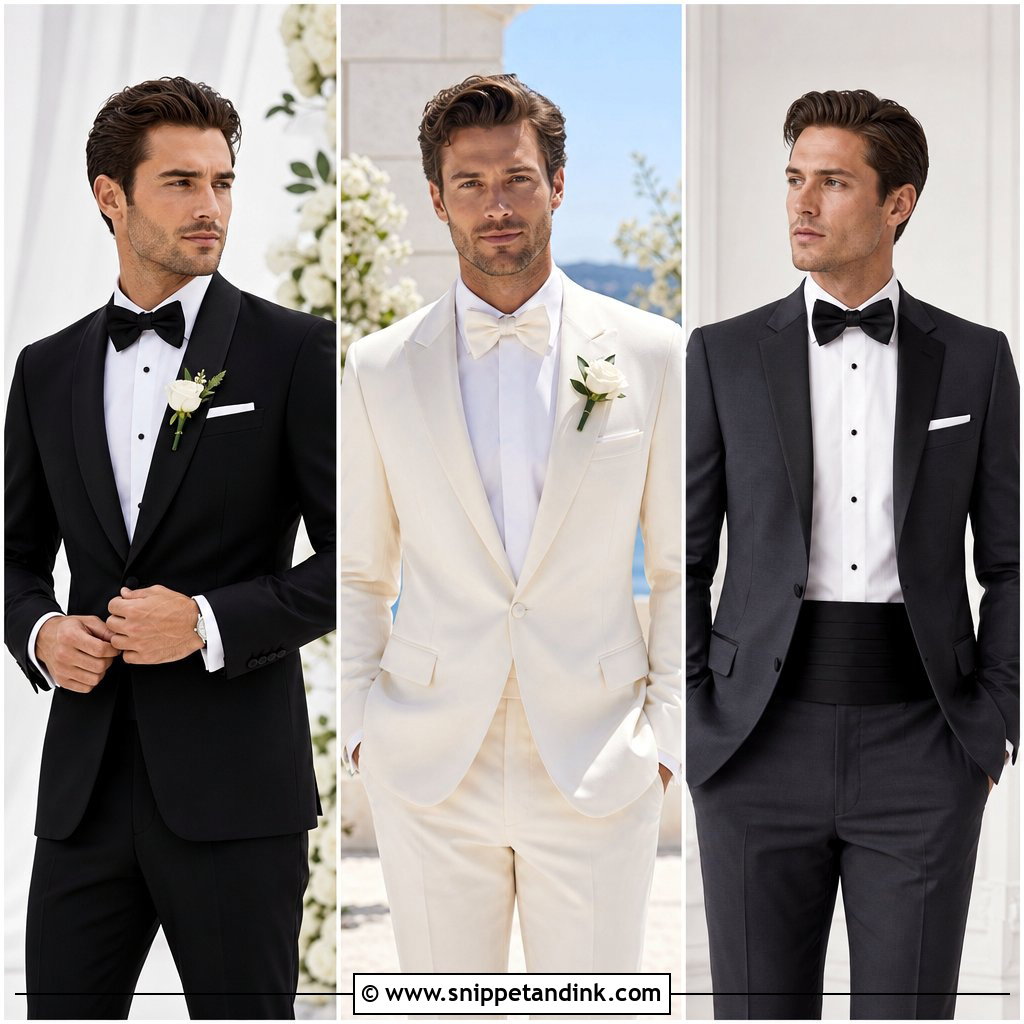
23. Navy Blue Tuxedo Wedding Outfit
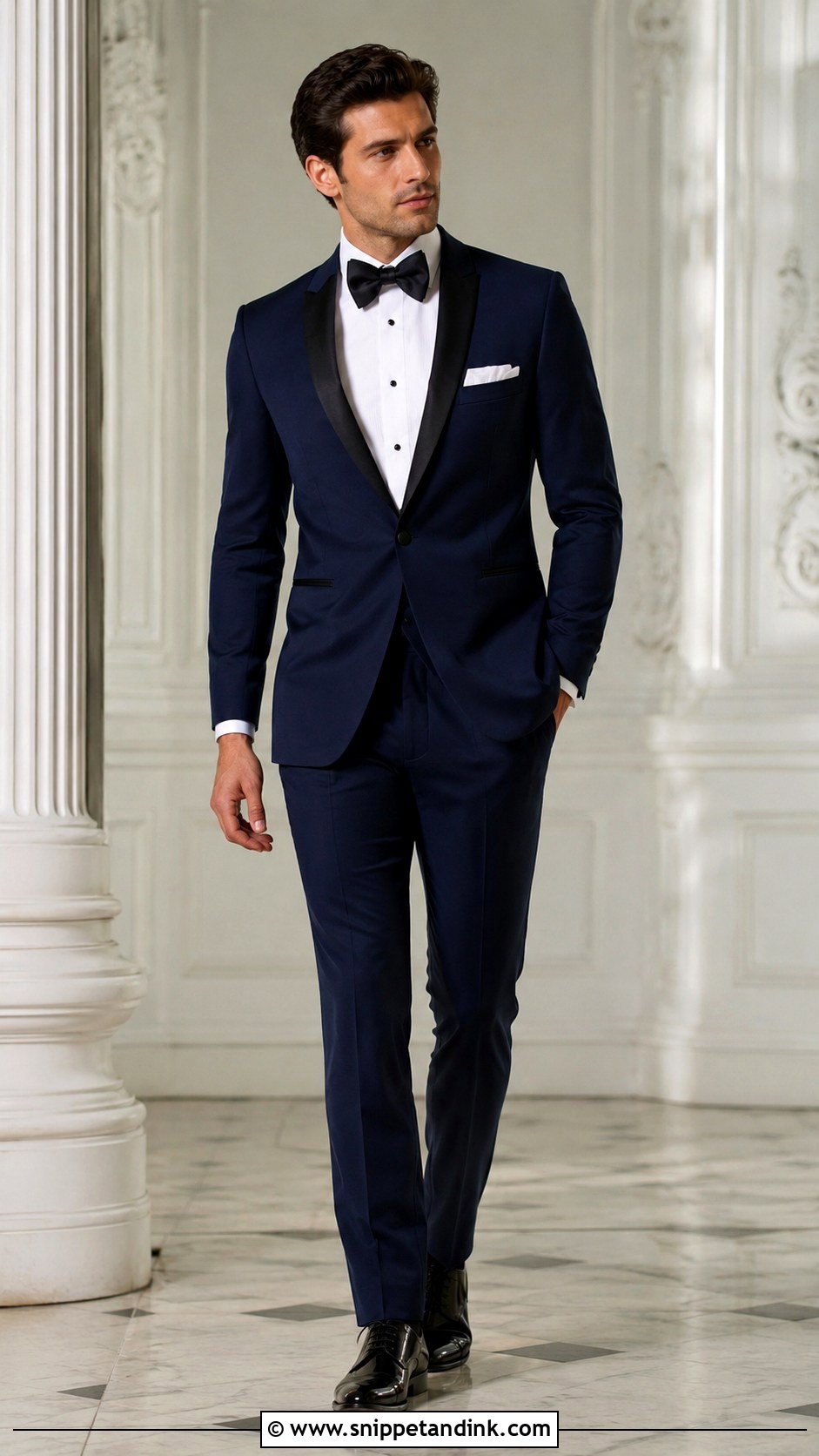
A navy blue tuxedo is how I dress a groom who wants black tie without the sameness of black. Midnight navy actually photographs richer than black under warm evening light, since black can lose its detail and go flat. White tuxedo shirt, black bow tie, black shoes, white pocket square. A useful setup for the wedding party: groom in the navy tuxedo, groomsmen in navy suits, so the lineup coordinates without everyone looking identical. Fit at the shoulders, waist and trouser length has to be precise; satin lapels show every ripple.
24. Navy Blue Suit With White Sneakers
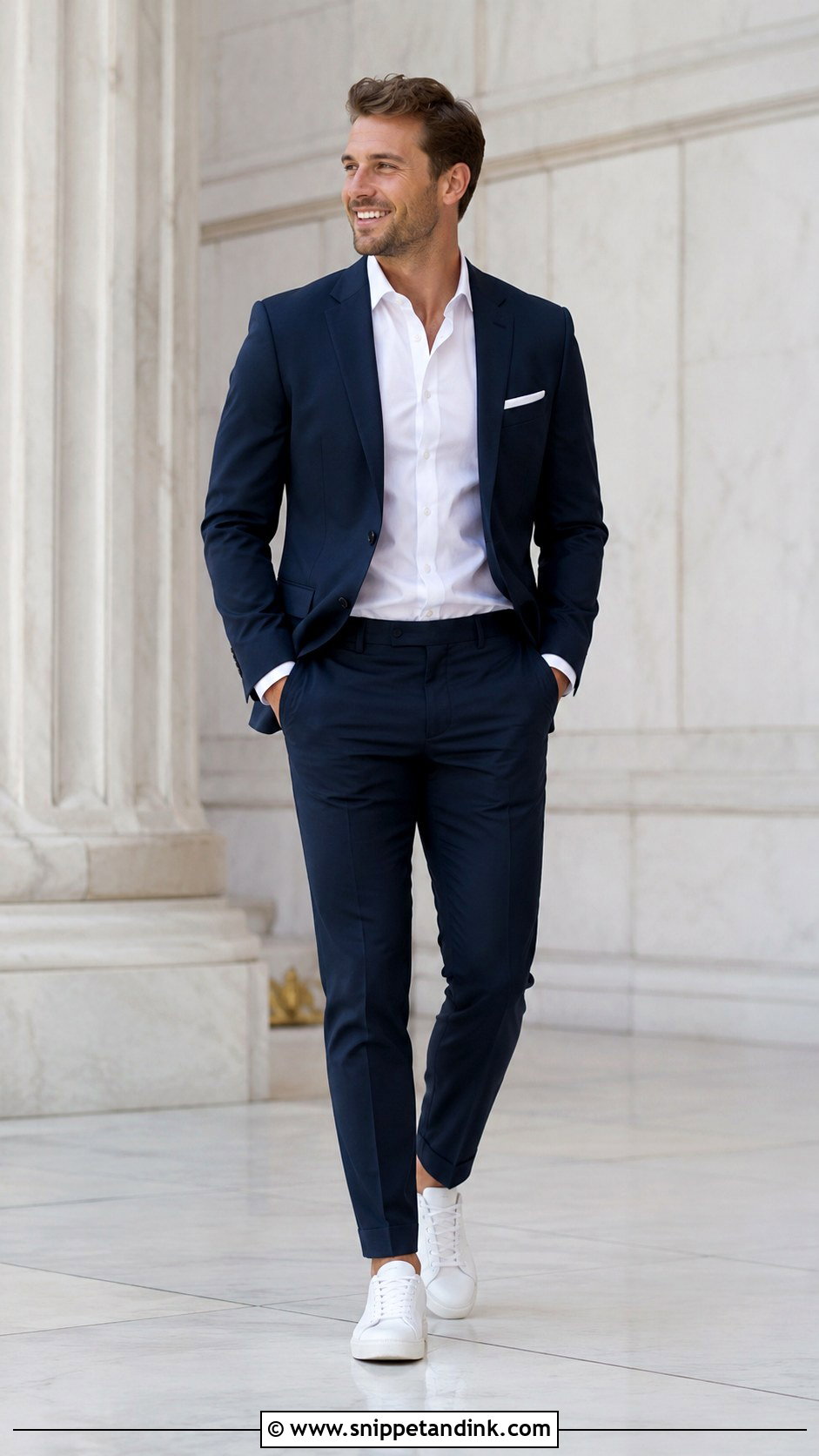
White sneakers with a navy suit is a deliberate choice, and it has to look deliberate. Minimal leather sneakers, spotless, nothing athletic or chunky. Hem the trousers a touch shorter with little or no break so they sit cleanly on the shoe instead of pooling. Skip the tie or use a knit one. I’d do this for a courthouse ceremony or a casual outdoor reception, and I’d steer you away from it at any formal or traditional evening wedding, where it reads as a misunderstanding of the invitation.
25. Navy Blue Suit With Suspenders
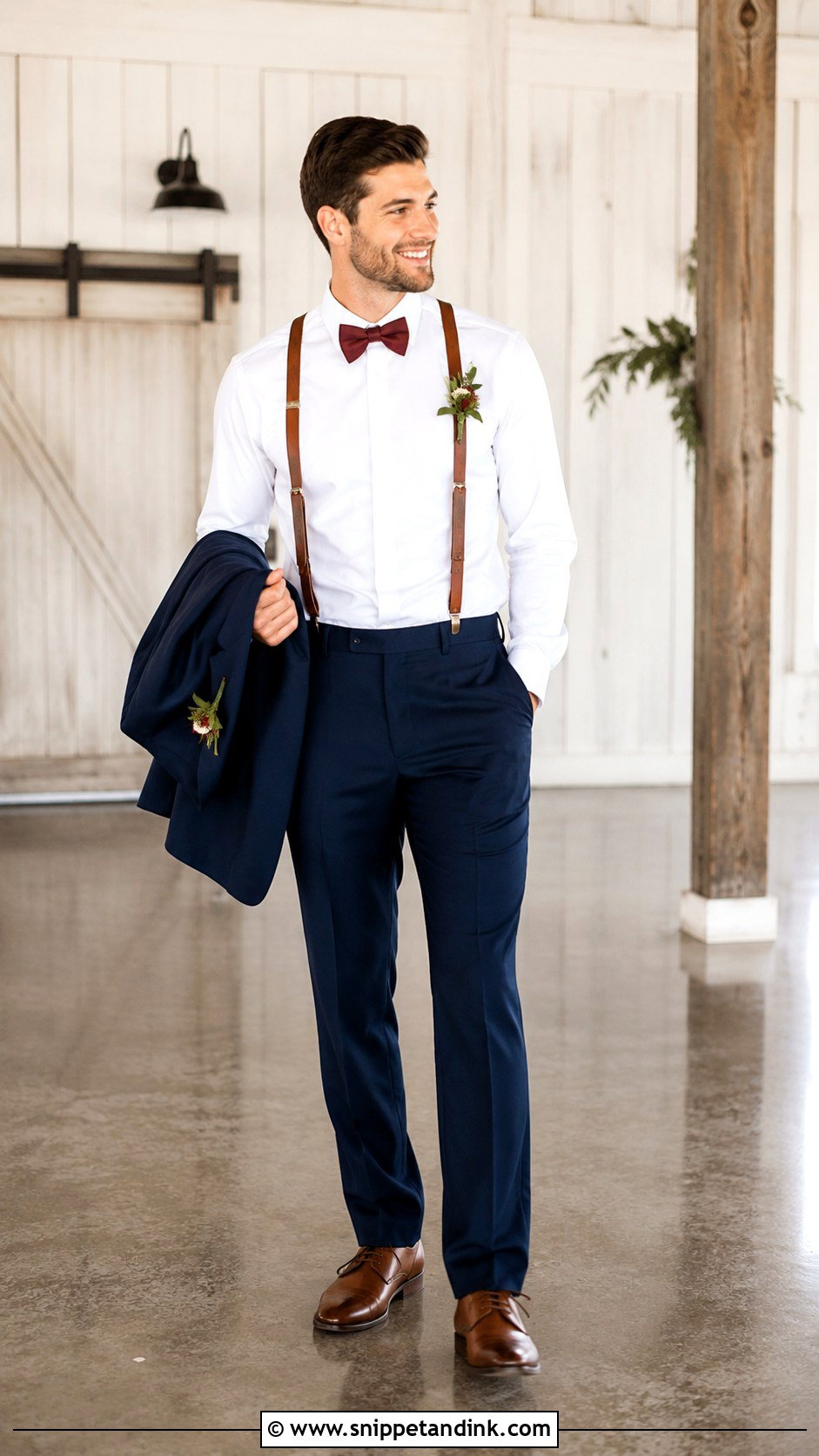
Suspenders come into their own once the jackets come off and the dancing starts. They hold trousers at the right height better than a belt, so the shirt stays tucked through the night. Get proper button-on braces if the tailor can add buttons inside the waistband; clip-ons slip and can mark lighter fabrics. Brown, navy, gray or burgundy, with a white shirt and brown shoes. Never wear a belt with them. It’s a natural fit for vintage-leaning and rustic receptions.
26. Navy Blue Suit With Vest And No Jacket
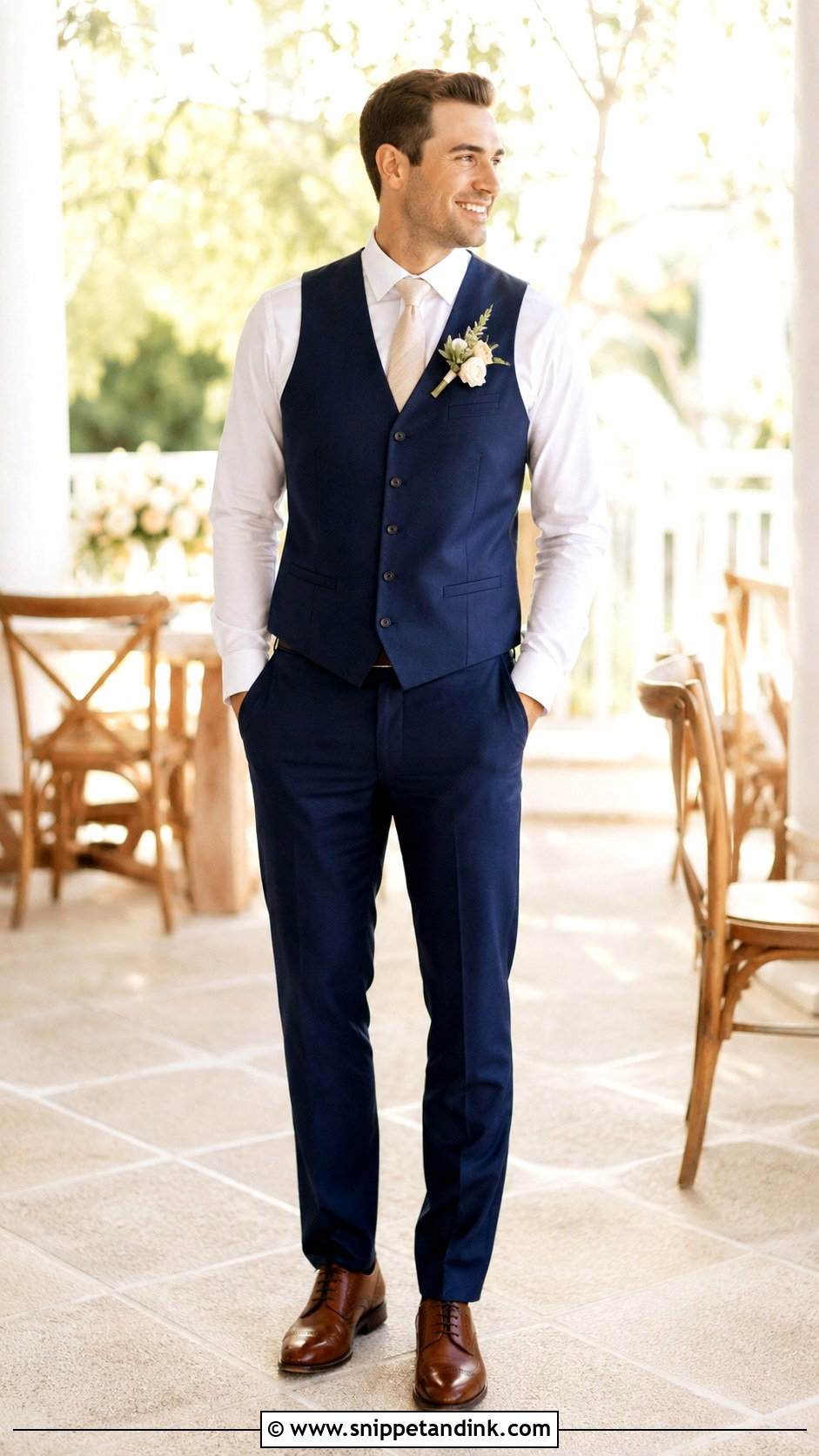
Vest without the jacket is my plan for hot ceremonies. The full suit goes on for the vows, then the jacket comes off and the vest keeps the silhouette tidy for the rest of the day. A matching navy vest stays formal; light gray or tan gives some contrast. The vest must cover the waistband and lie flat across the chest without pulling at the buttons, so have it fitted with the shirt you’ll actually wear. White shirt, tie, brown shoes. Groomsmen look neat in it through every candid shot.
27. Navy Blue Suit With Gray Tie
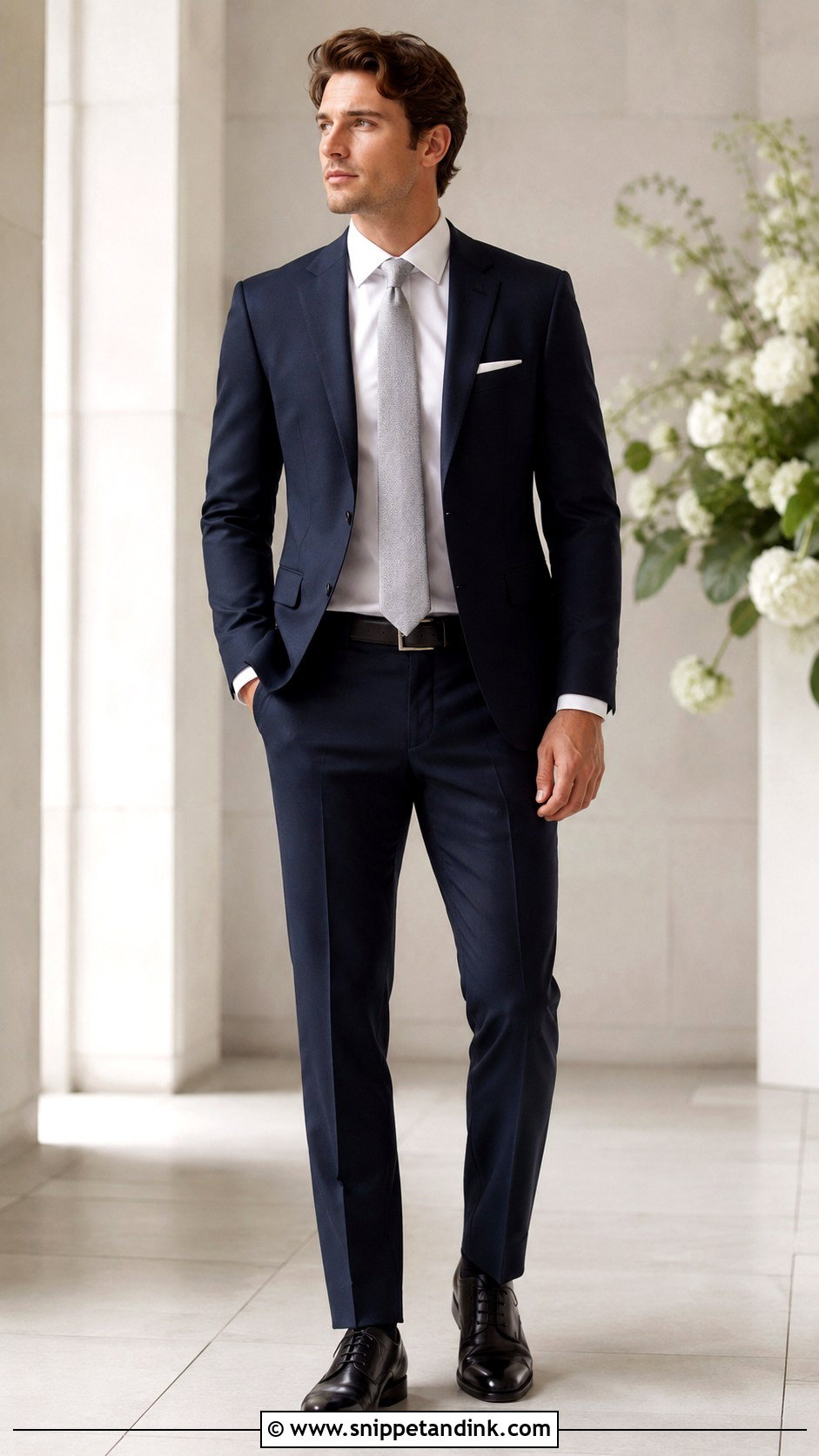
A gray tie is understated on navy, and that restraint is useful. Light gray softens a daytime look; charcoal gives an evening edge. White shirt, black or dark brown shoes, a white pocket square. It sits comfortably in almost any palette, green, blush or silver, which is why I suggest it when the couple hasn’t finalized colors and the groomsmen need to buy early. Fathers of the couple often like it too, because it looks finished without drawing attention.
28. Navy Blue Suit With Green Boutonniere
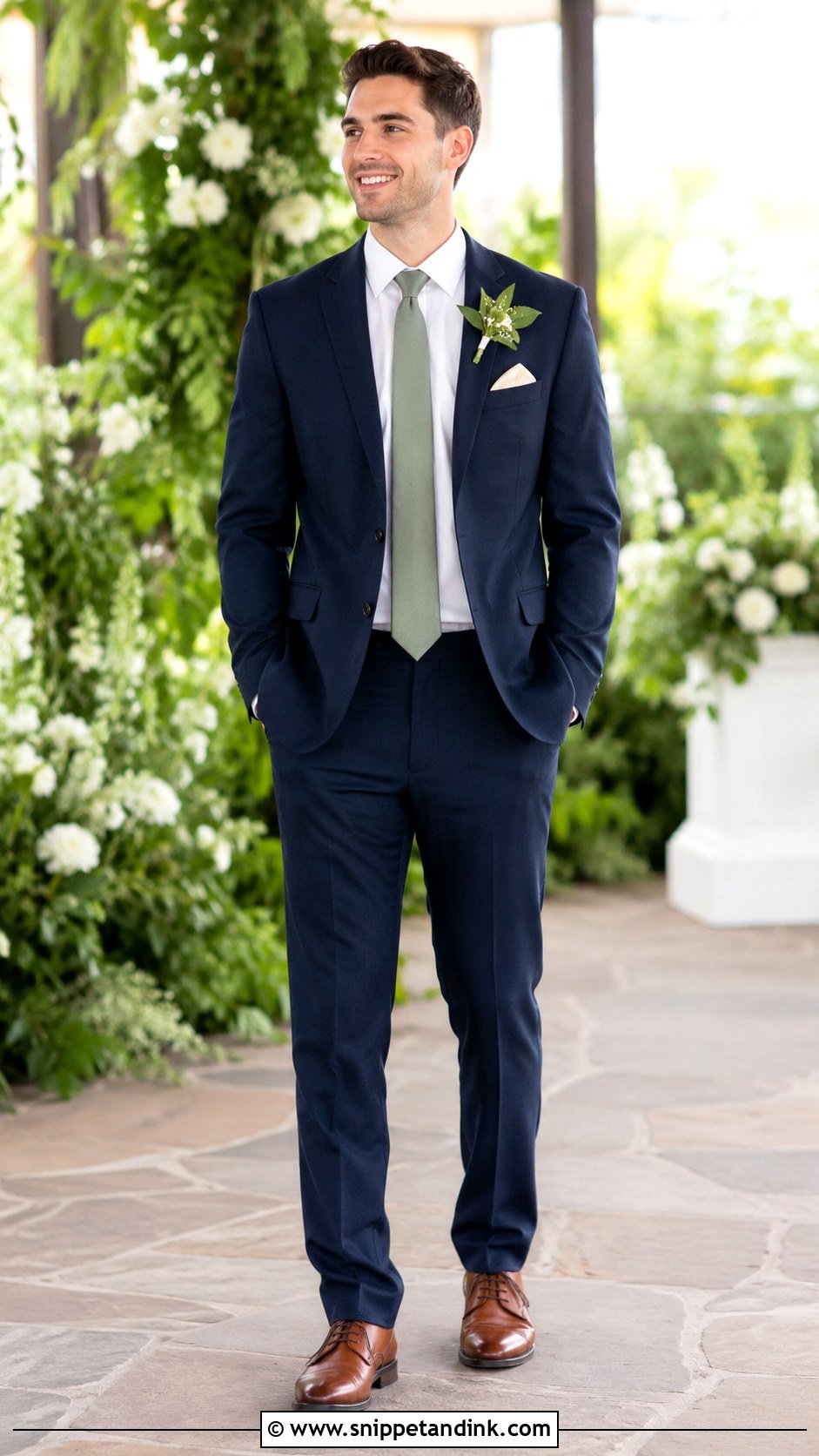
A green boutonniere does most of the work in this outfit, so I talk to the florist about it. Eucalyptus, olive and rosemary hold up well out of water for hours; delicate blooms can wilt on a warm lapel by the speeches. Keep it small enough to sit inside the width of the lapel. Pair it with a white shirt, a sage or champagne tie and brown shoes, and a simple white or cream pocket square. It brings the greenery from the decor onto the suit without needing a bold tie.
29. Navy Blue Suit For Beach Wedding
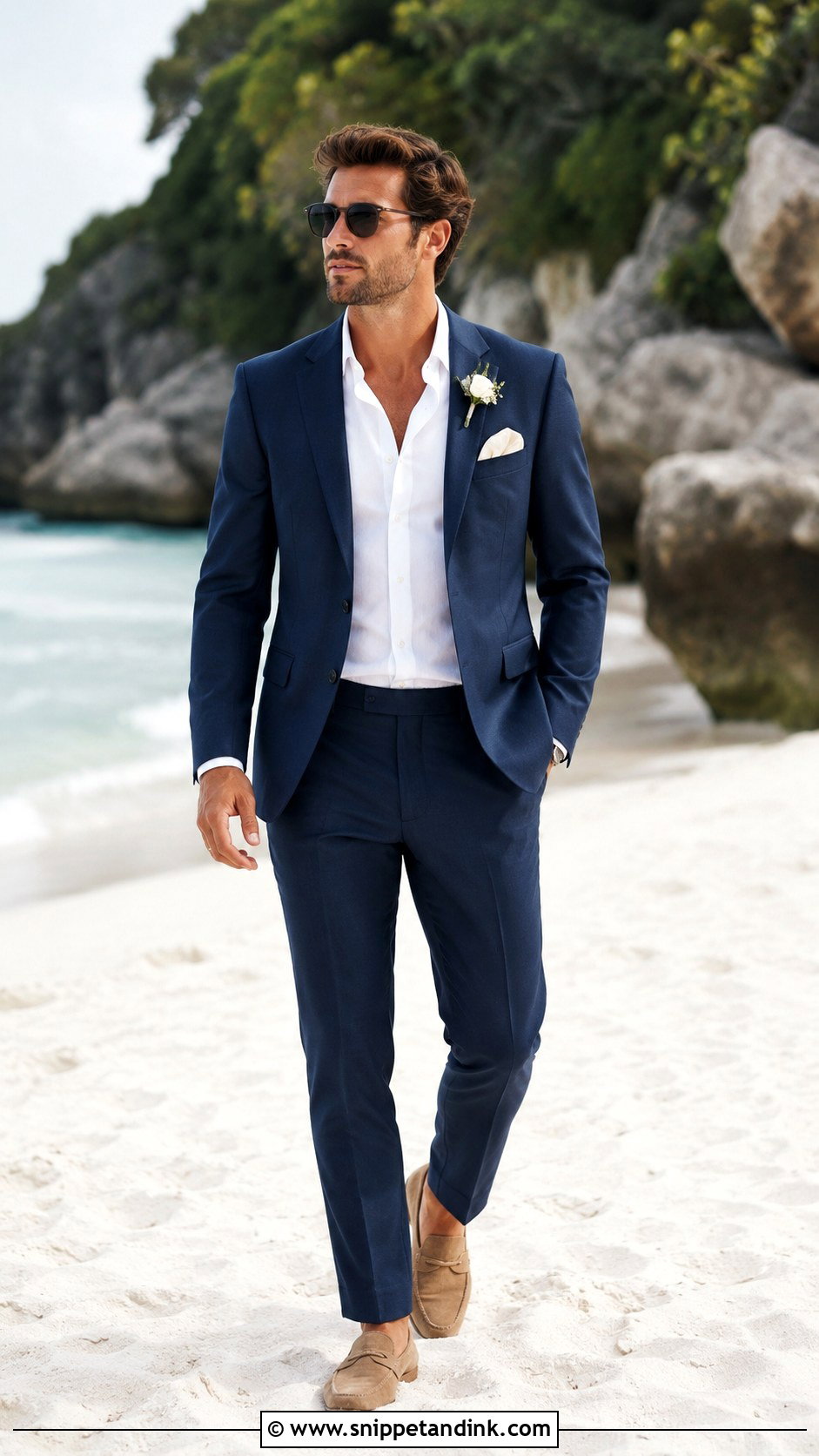
On a beach the suit has to breathe, and the shoes have to survive sand. Linen, a cotton blend or a tropical-weight wool, ideally half-lined or unlined so heat escapes. A slightly lighter navy also helps; a very dark suit in full sun looks heavy and gets hot fast. White or ivory shirt, tan loafers, a soft pocket square. Skip the tie if the ceremony is casual, otherwise pale blue, sage or champagne. Avoid glossy shoes, and check whether the ceremony is on the sand itself before choosing leather soles.
30. Navy Blue Suit For Winter Wedding
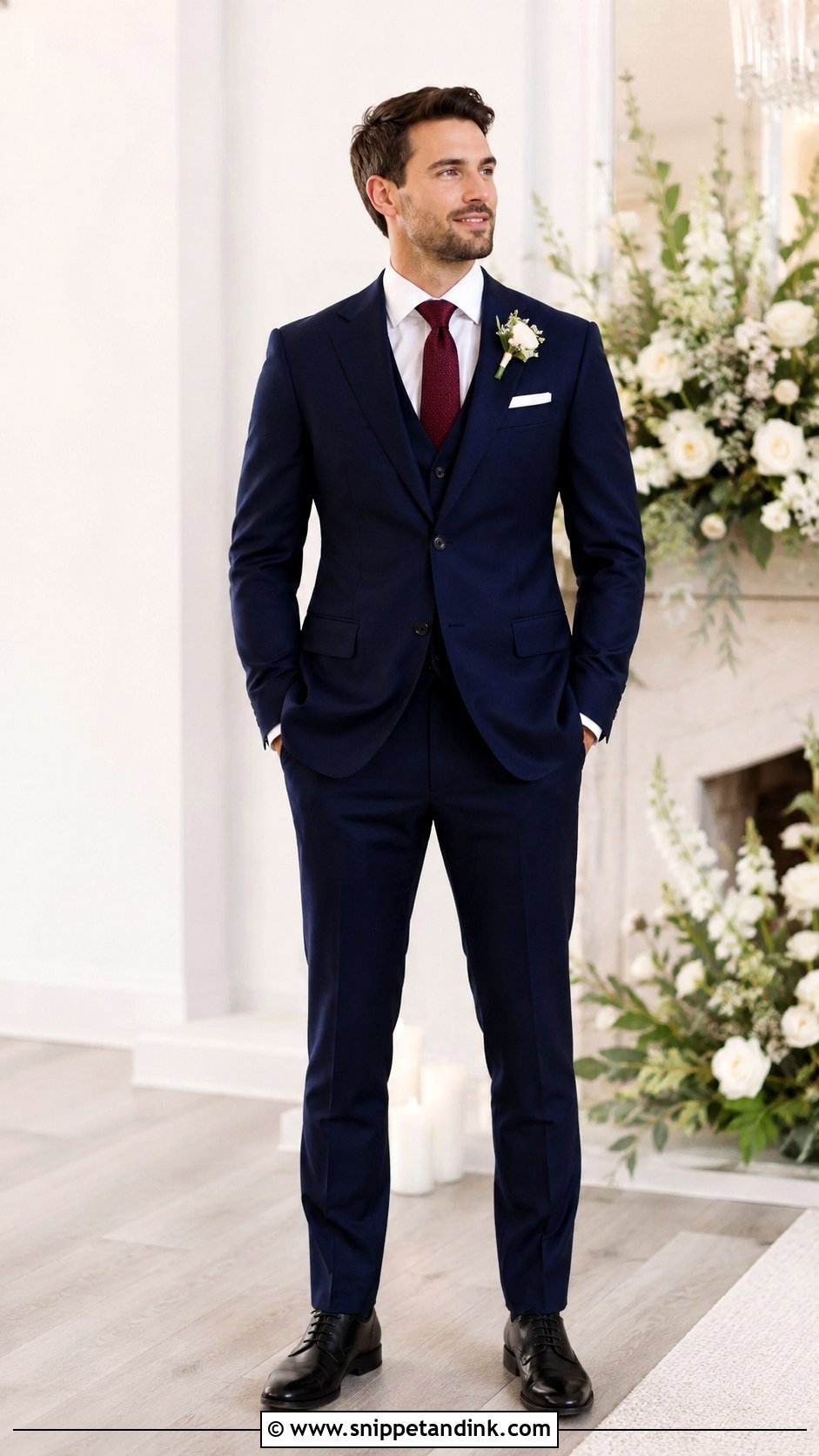
Winter navy should feel heavier and richer, and the fabric is where that comes from. Wool flannel or a wool blend with weight drapes well and keeps its shape in cold churches and drafty venues. White shirt for contrast, with a burgundy, forest green, charcoal or silver tie in a textured weave. Black shoes for evening formality, dark brown for warmth. A three-piece version adds presence and a little warmth for outdoor photos. Navy in winter also lets the groom look formal without defaulting to black.
Rent, Buy Off the Rack, or Have It Made?
Rental makes sense for groomsmen who will never wear navy again and for weddings where matching shade across the whole party matters more than perfect fit. The trade-off is that rental jackets are cut to fit many bodies, so shoulders and sleeve length are often a compromise, and you usually get the suit only a few days before.
Buying off the rack and tailoring it is what I suggest for most grooms. Shoulders can’t really be altered, so buy for the shoulders and let the tailor handle sleeves, trouser hems and the waist. Plan on alterations taking a couple of weeks at a busy tailor, longer in peak wedding season, and book a second fitting with the shoes and shirt you’ll actually wear.
Made to measure gives you the best fit and fabric choice, but it needs the most lead time. Give it at least two to three months, since there’s a measurement session, a production wait and at least one fitting after delivery. Prices vary a lot by maker, so compare what’s included before deciding.
The Fitting Checks I Do Before Signing Off a Suit
- The jacket collar sits against the shirt collar with no gap when he stands naturally.
- Roughly a quarter to half an inch of shirt cuff shows past the jacket sleeve with arms at his sides.
- The buttoned jacket shows no X-shaped pulling around the button.
- He can raise his arms to hug and to dance without the whole jacket lifting off his shoulders.
- He sits down in it. Trousers that are fine standing can pull hard across the thigh once seated at dinner.
- Trouser hems land on the actual wedding shoes, not on the sneakers he wore to the fitting.
On the morning, hang the suit in a steamy bathroom or use a handheld steamer, keep a lint roller with the best man, and leave the jacket on a hanger until photos. Navy shows lint and pet hair more than most colors.
Navy Forgives Almost Anything Except a Poor Fit
Navy gives you more range than any other suit color I work with. Tuxedo details, linen, pastel ties, burgundy, brown or black shoes: it accepts all of them. What changes the result is the season, the venue and the role the wearer plays on the day. Get the suit fitted first, then build outward with one or two accessories you chose for a reason. If it fits at the shoulders and moves when he sits, it will look right from the first photo to the last dance.
You'll Like These Ideas:


Leave a Reply