
Lace is one of the few dress details that translates directly onto a nail, because it’s already a pattern of fine lines and open space. Done well, it reads as texture from across the room and as real craftsmanship up close. Lace can sit over sheer pink, milky white, nude, champagne or a pale blue base for your something blue, and it can be as minimal as a lace tip or as full as floral lace with pearls and crystals. I’ve written each set below the way I’d explain it at my nail table, including what it needs from your natural nails and where it tends to go wrong.
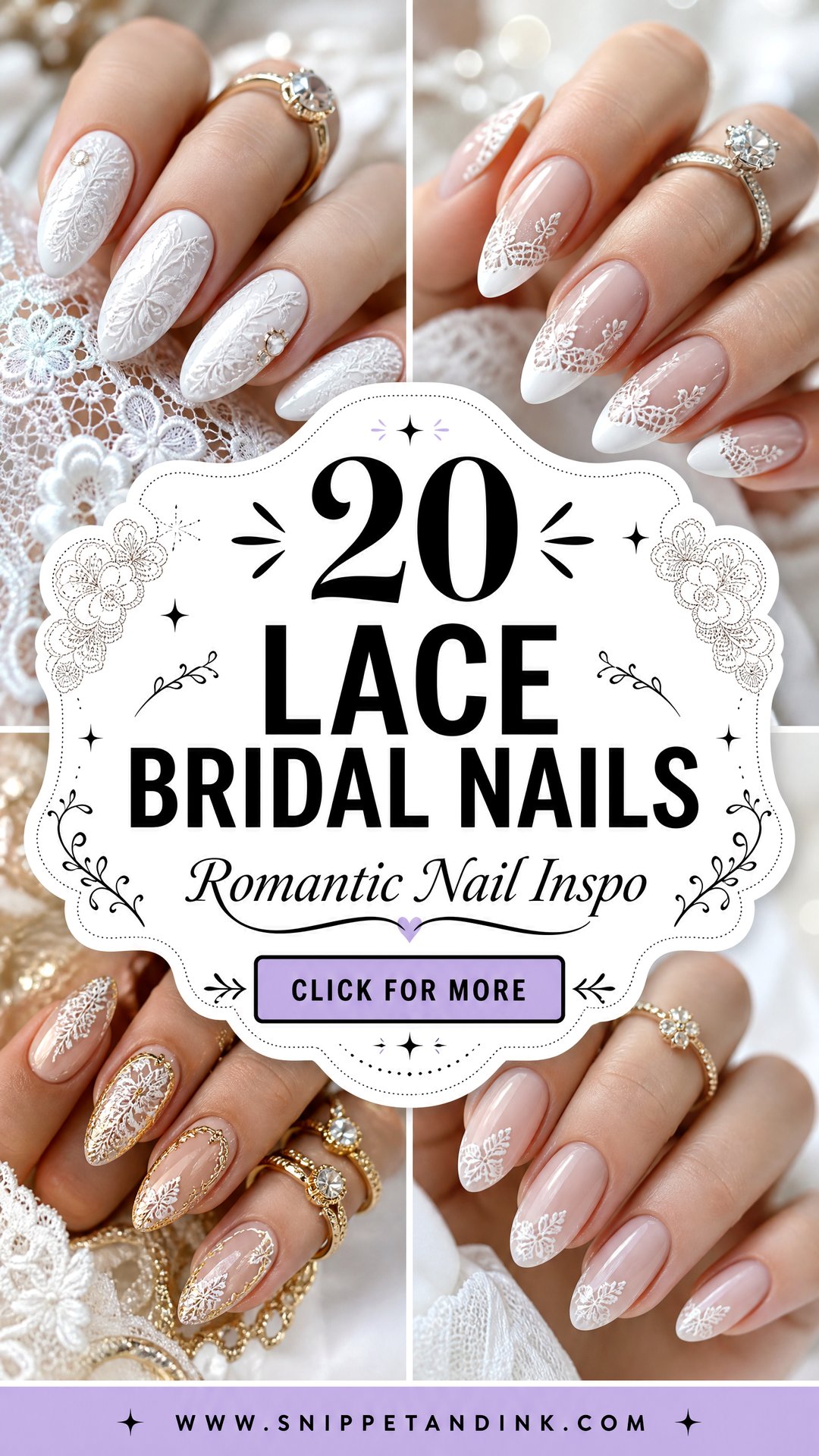
Painted, Stamped or Decal Lace, and What Each One Gives You
Lace gets onto a nail in one of three ways, and the method changes the finished look more than most brides expect. It’s worth asking your artist which one she plans to use.
Hand-painted
I paint lace with a long, thin liner brush and gel paint, one stroke at a time. It’s the only method that can copy the pattern on your actual dress and scale it to each nail, and the lines come out slightly irregular, like handmade lace. It also takes the longest, so book a longer appointment if you want it on every nail.
Stamped
Stamping transfers an etched lace pattern from a metal plate onto the nail with a soft silicone stamper. The lines are crisp and very fine, finer than most hands can paint, and it’s quick. The trade-off is that the pattern is fixed, and on strongly curved nails it can blur at the sides.
Decals and sliders
Lace decals are thin printed films laid onto the nail and sealed under top coat. They’re detailed and identical across all ten nails. Their weak point is the edge, which can lift or show as a faint line in close-ups unless it’s trimmed tight and capped with gel.
On many sets I combine methods: stamped lace for the background net, then a few hand-painted flowers over it so the result never looks printed.
1. White Lace Bridal Nails
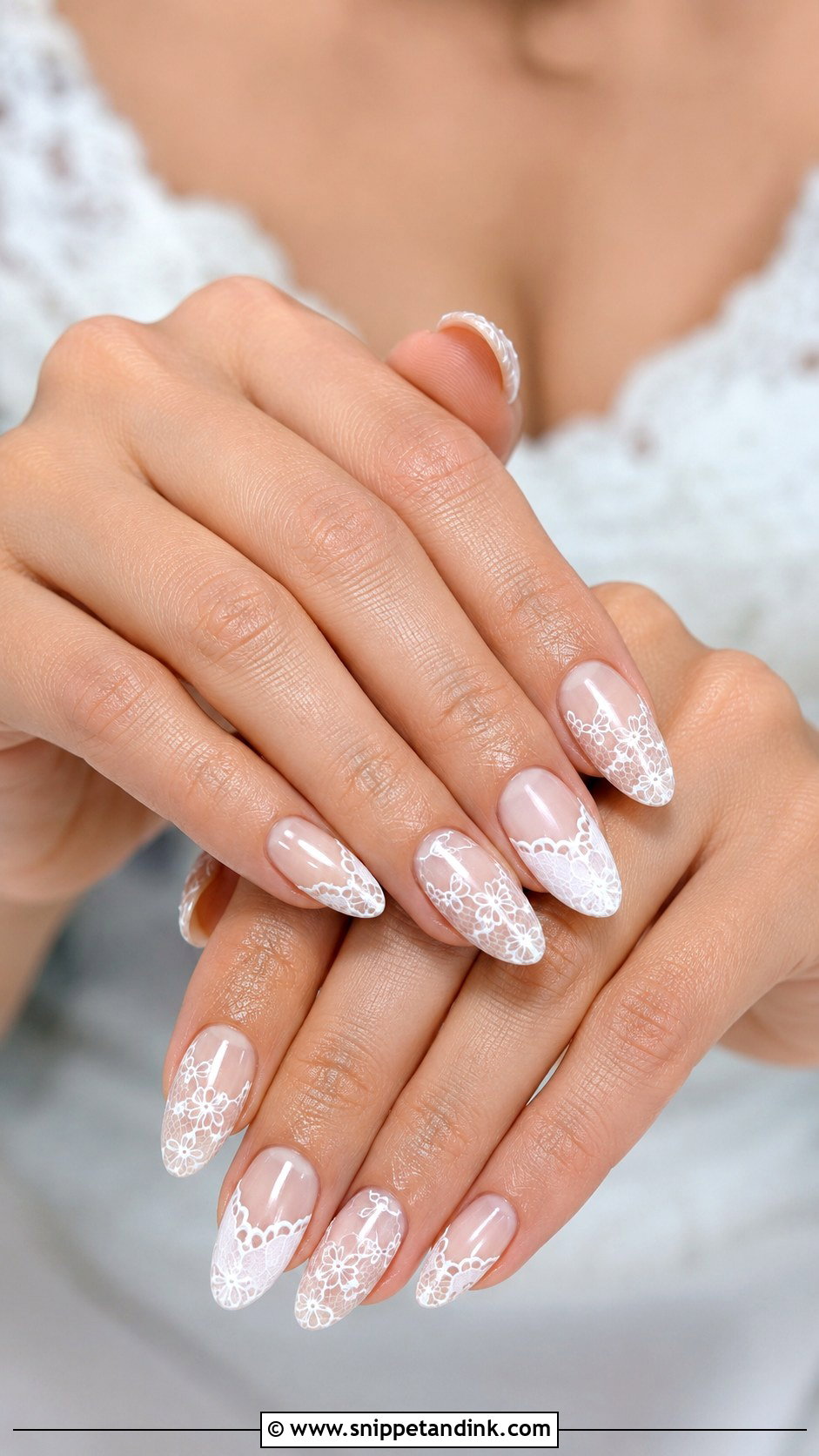
This is the classic, and the one I recommend first if your dress has white lace. White lace bridal nails usually start on a sheer nude or milky pink base, with lace across every nail or just a few. I hand-paint, stamp or apply fine decals depending on how custom you want it. Almond, oval and squoval shapes all frame it well. What makes it read as lace rather than doodles is the scalloped edge: I finish each section with tiny half-circles and dots, the way real lace finishes at a hem.
2. French Tip Lace Bridal Nails
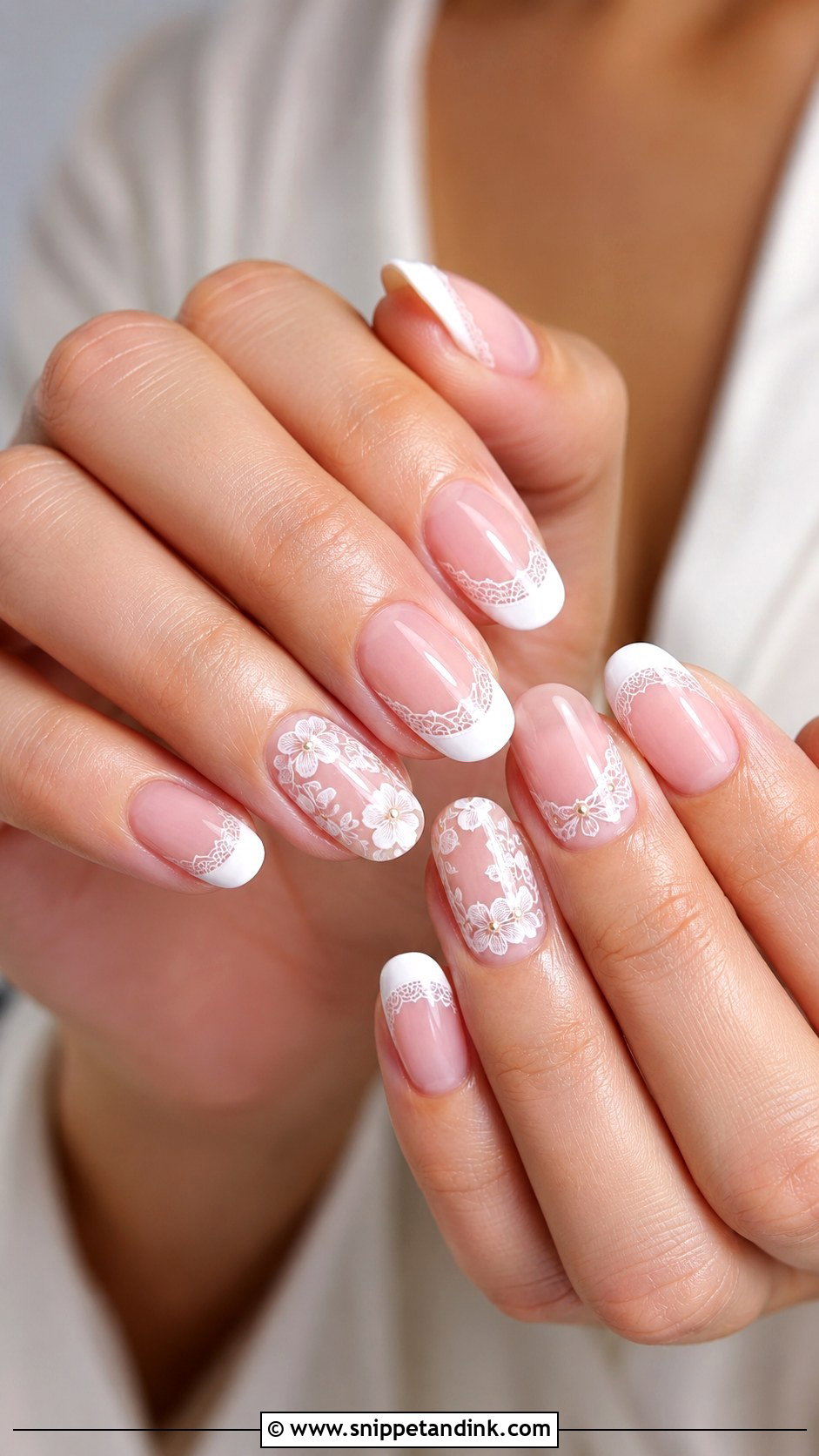
A plain French set gets a bridal upgrade when lace follows the smile line. I paint clean white tips over a sheer pink or nude base, then trace lace just below the tip or across one or two accent nails. Medium almond and oval nails suit it, since the tip already lengthens the finger. Keep the lace thin. Thick lace on top of a white tip merges into one solid white block from a few feet away, and the French shape disappears.
3. Milky White Lace Bridal Nails
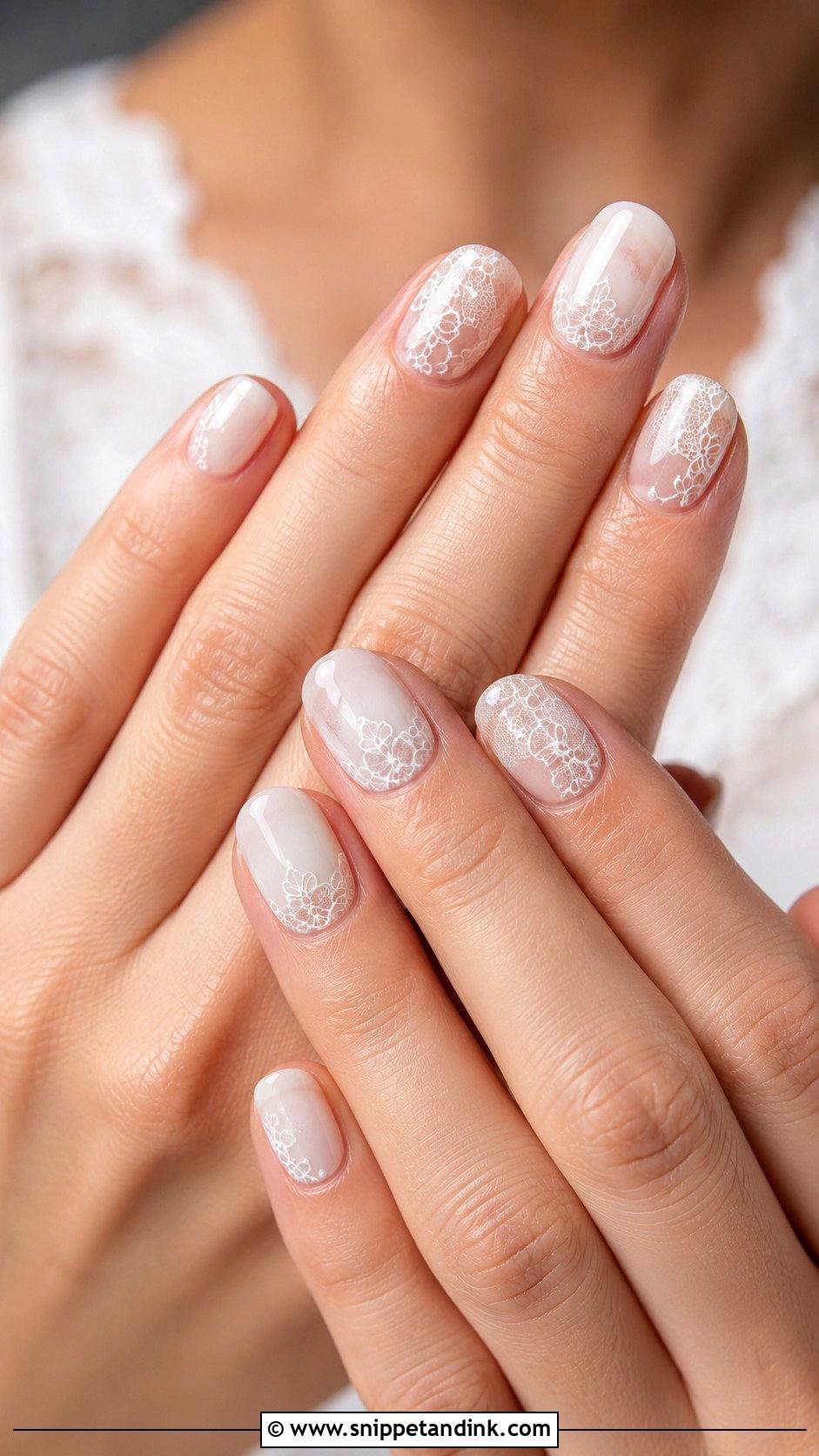
A milky base is translucent, so it gives a veil-like layer under the lace instead of a flat white canvas. I build two thin coats, then add small florals, swirls or a fine net pattern in white. White on milky white is low contrast, which is exactly why it looks modern, but it also means the lace needs a slightly heavier line than usual to show at all. Short to medium lengths look natural, while an oval or soft almond with high-shine gel looks most polished next to pearl jewelry and a lace veil.
4. Nude Lace Bridal Nails
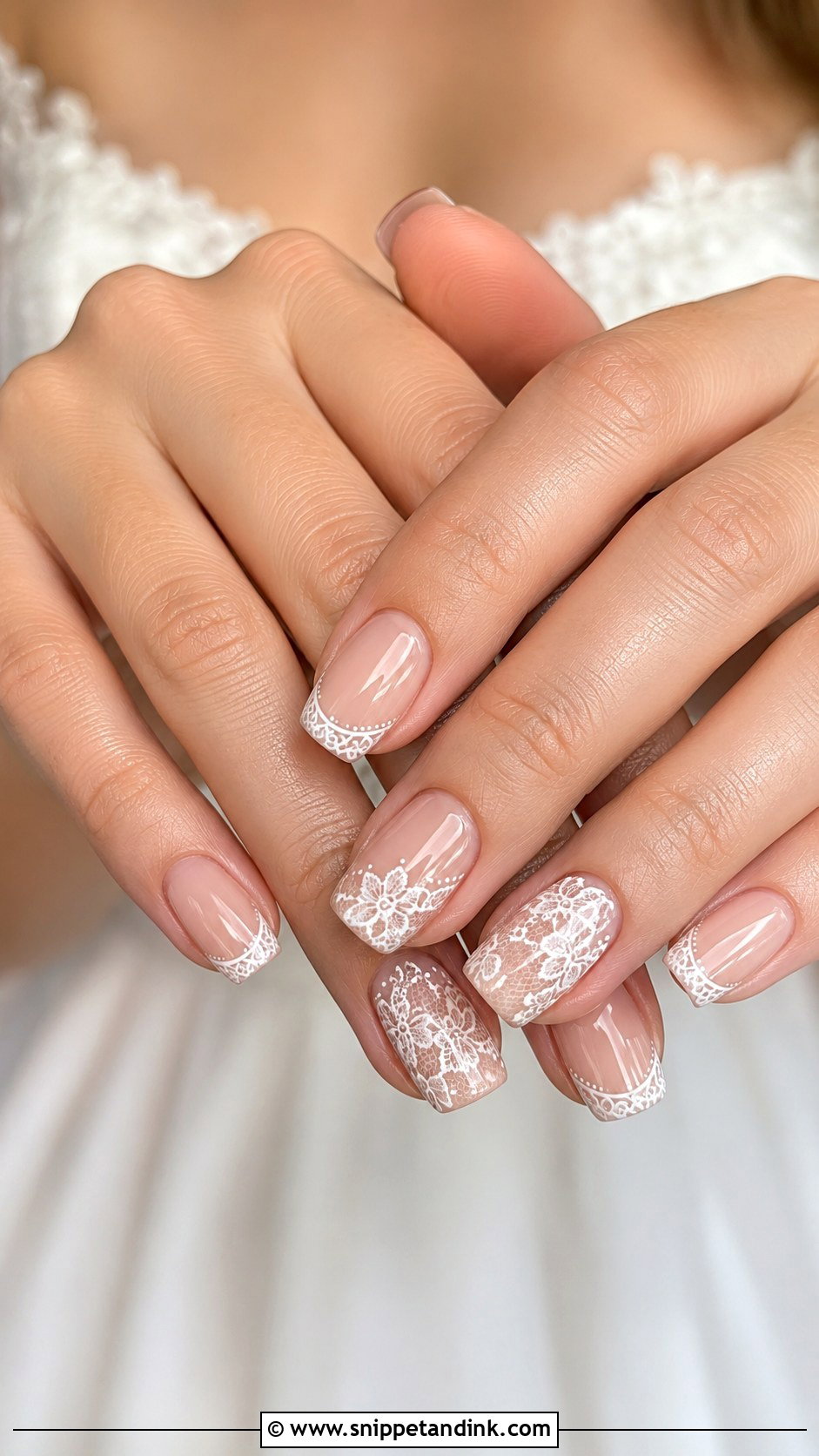
Matching the base to your skin is what makes this set work. Nude lace bridal nails lengthen the fingers and keep attention on the ring, with white or ivory lace adding a soft contrast on top. The base can be beige, blush nude or soft taupe, and I swatch it on the nail right beside your skin, because a nude a shade too pink or too yellow makes the hands look ruddy or sallow. The lace goes on in fine white gel paint. It’s the most understated set here and one of the easiest to wear with any dress.
5. Pink Lace Bridal Nails
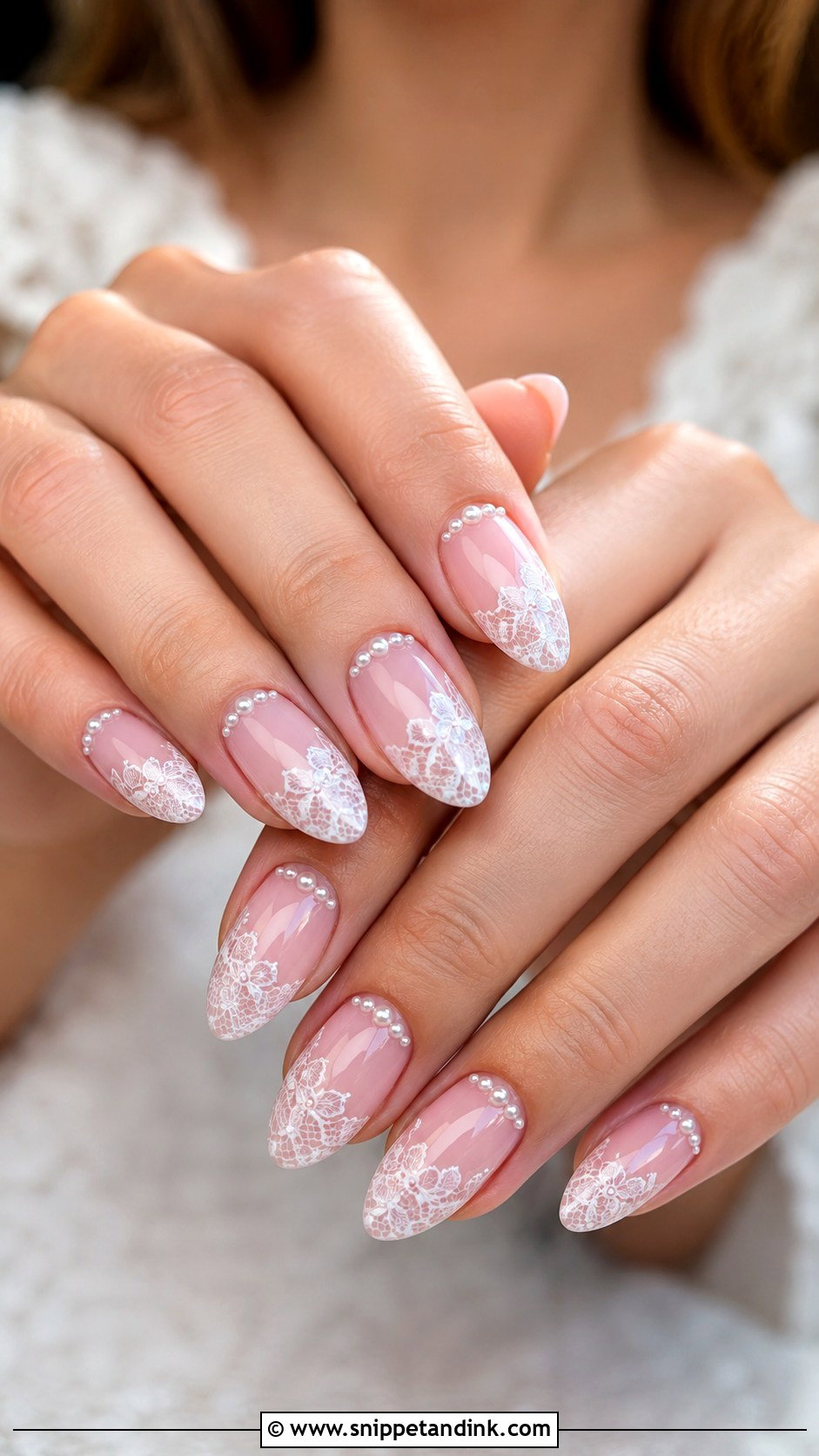
Pink under lace keeps nails looking healthy rather than sugary, provided the pink is sheer. Baby pink, blush or rose nude makes the base, with white lace on top, and it sits well with spring and garden weddings or dresses with floral embroidery. Opaque bubblegum pink is where it goes wrong, because the lace then looks like a sticker on a sweet wrapper. A few tiny pearls near the cuticle add dimension. Oval and almond shapes suit the soft color.
6. Pearl Lace Bridal Nails
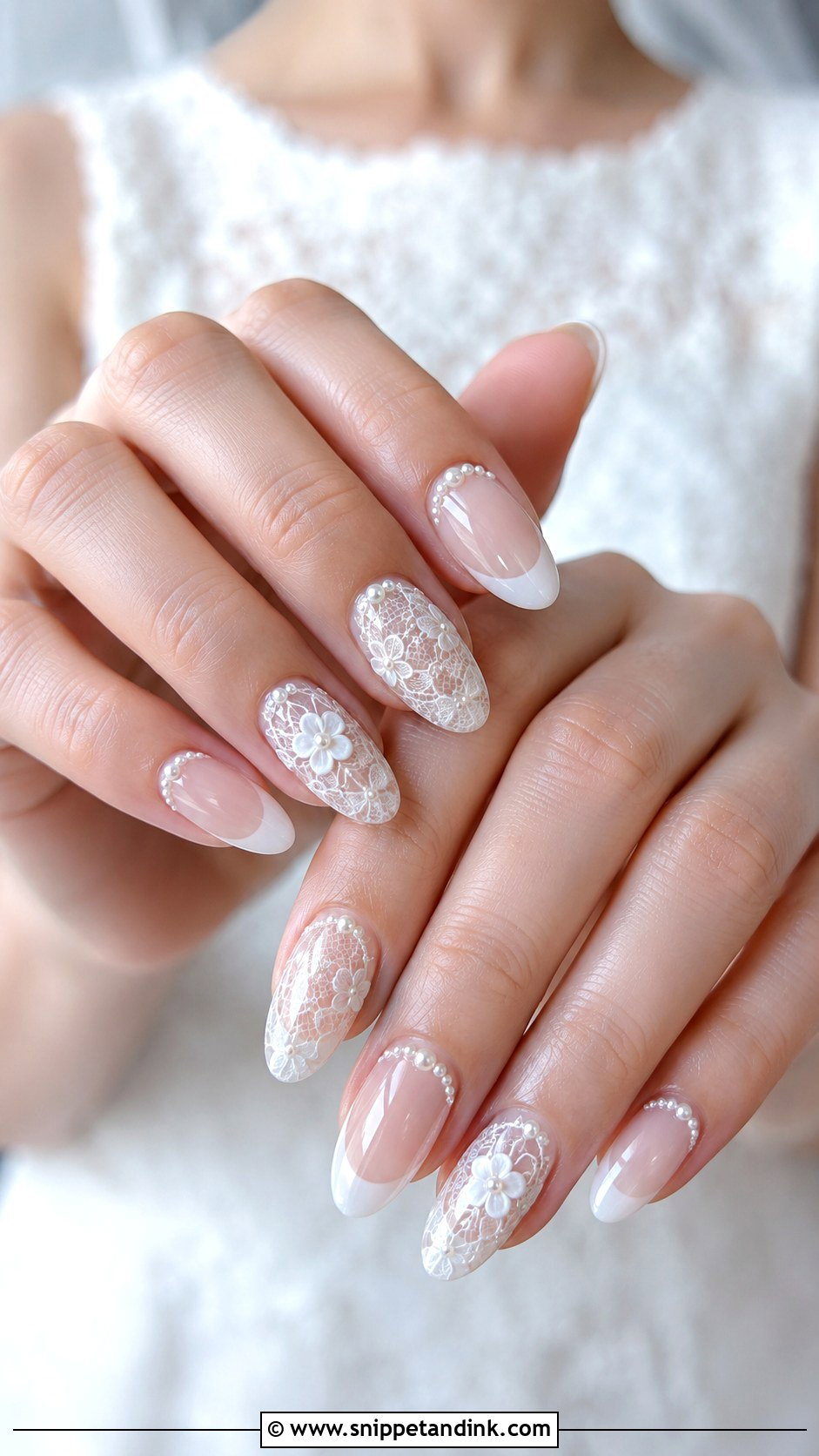
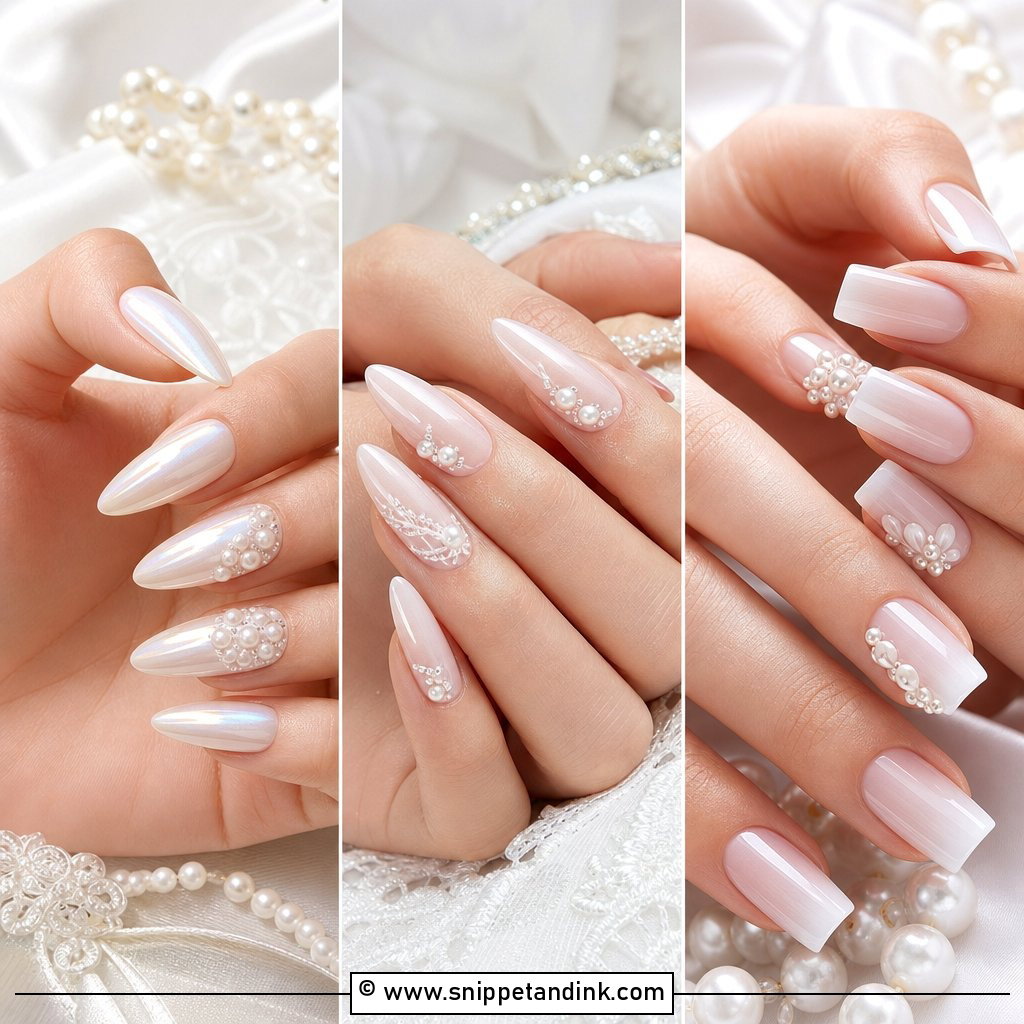
Pearls and lace are two details brides tend to want together. I build the lace first over a sheer nude, pink or milky base, then set tiny pearls at the cuticle, near the tips or at the center of the lace flowers. Pearl size is the decision that matters. Anything much bigger than a couple of millimeters starts catching on tulle and knits, so I keep them small and seat each one in builder gel. A medium almond gives enough room for both lace and pearls without crowding.
7. Chrome Lace Bridal Nails
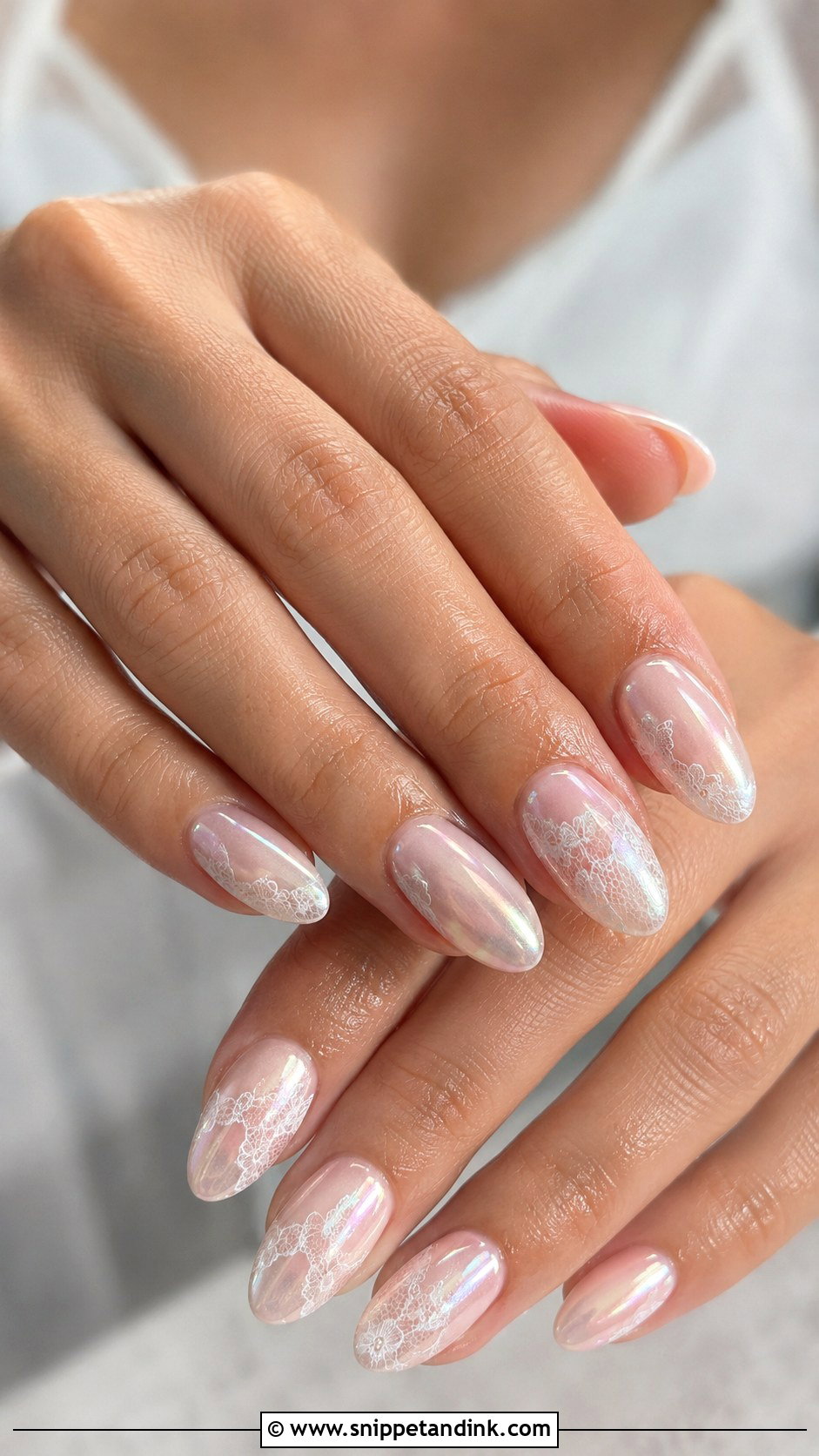
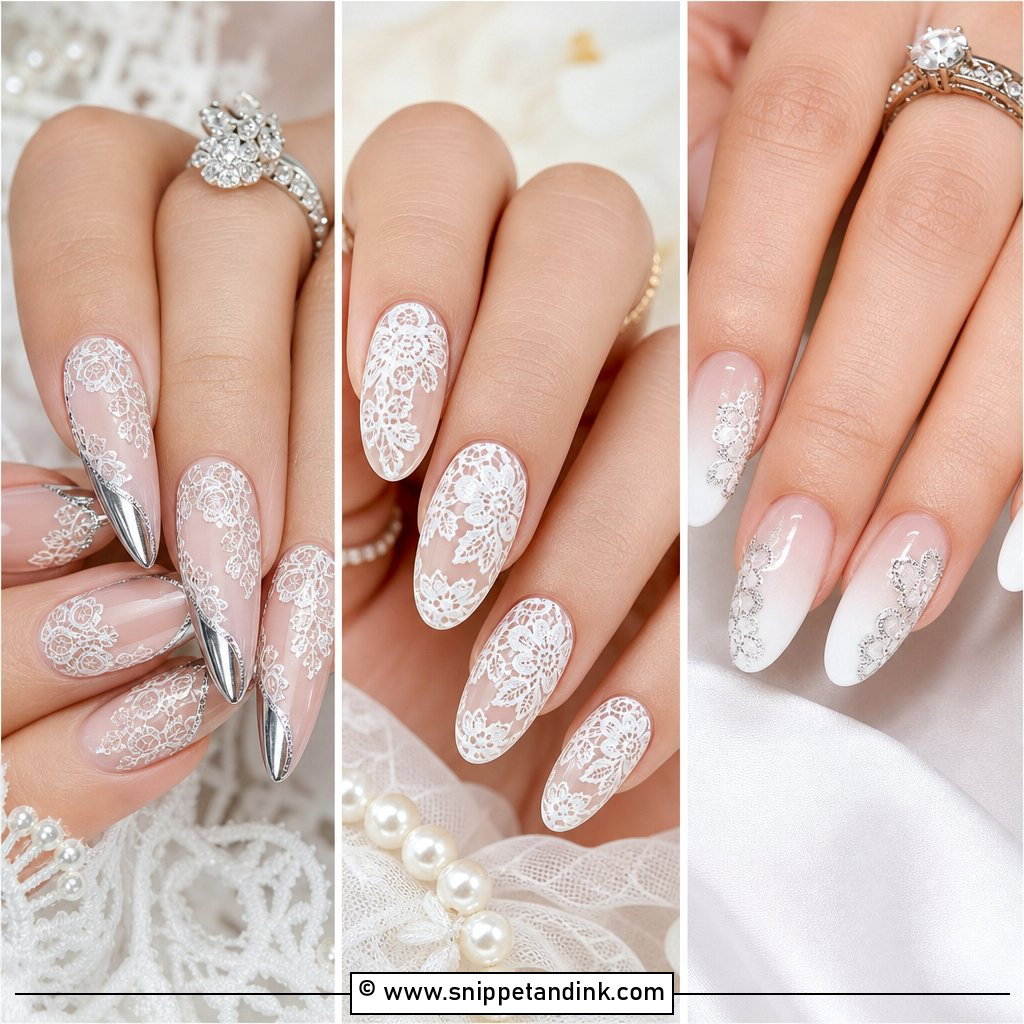
Chrome and lace can fight each other, and the order of layers settles it. Chrome rubbed over the lace dulls it; lace painted over the chrome stays crisp but can look stuck on. My usual method is a thin pearl chrome on the base, lace on top, then a final top coat to sink the lace in. Sheer pink, pearl white or soft nude all work underneath. Keep the chrome glazed rather than mirror-bright so the lace stays visible. It suits sleek gowns and minimal jewelry, on a soft almond or oval.
8. Matte Lace Bridal Nails
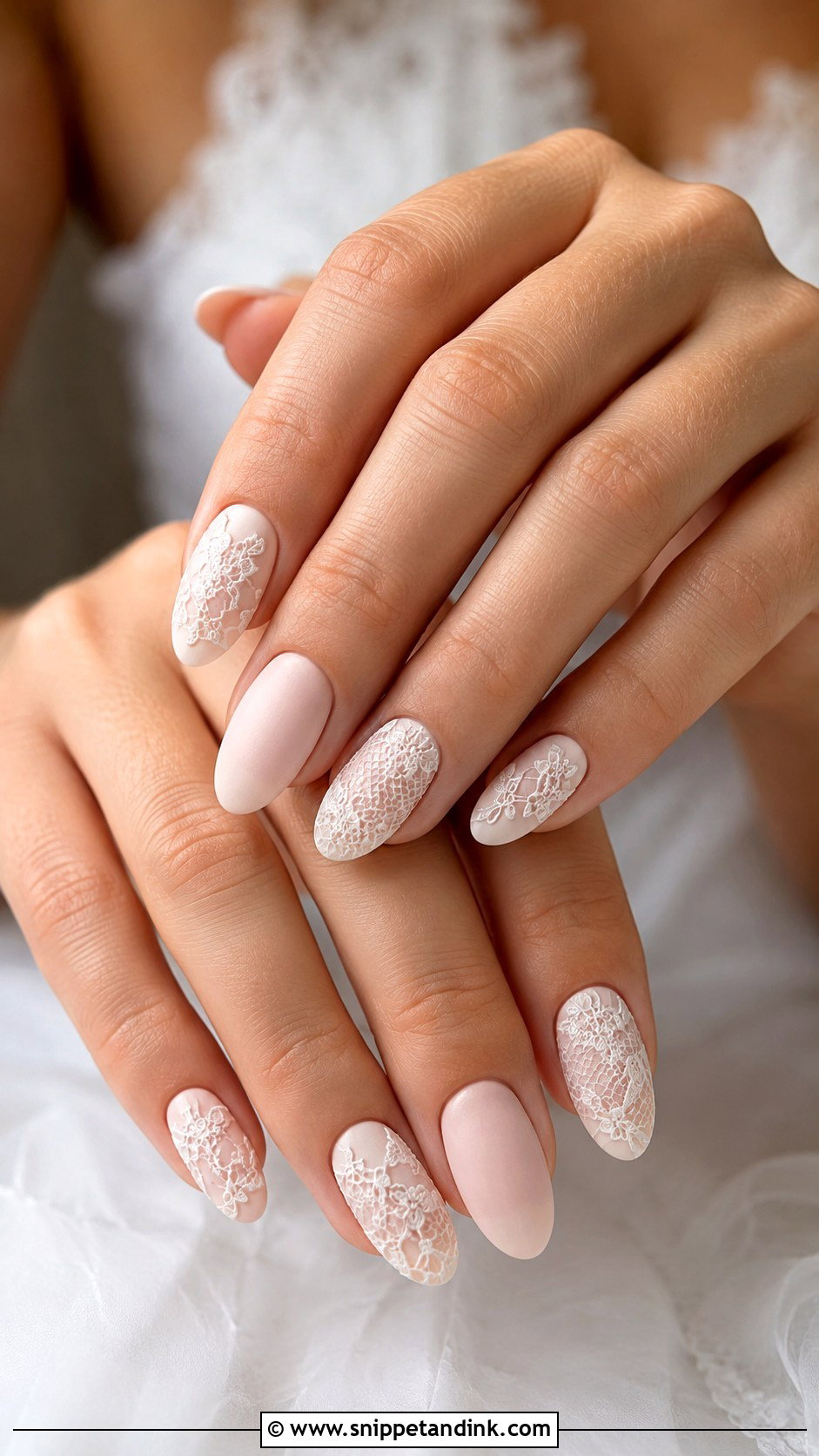
A velvet matte top coat makes a nail feel like fabric, which is why matte and lace belong together. Over nude, blush, ivory or milky white, I can leave the lace flat under the matte layer, or paint it on afterward so it stays slightly glossy and raised and reads more like real thread. Matte does pick up marks. Hand cream and makeup leave shiny patches, so keep oily products off your nails on the day. A short oval or medium almond suits it.
9. Short Lace Bridal Nails
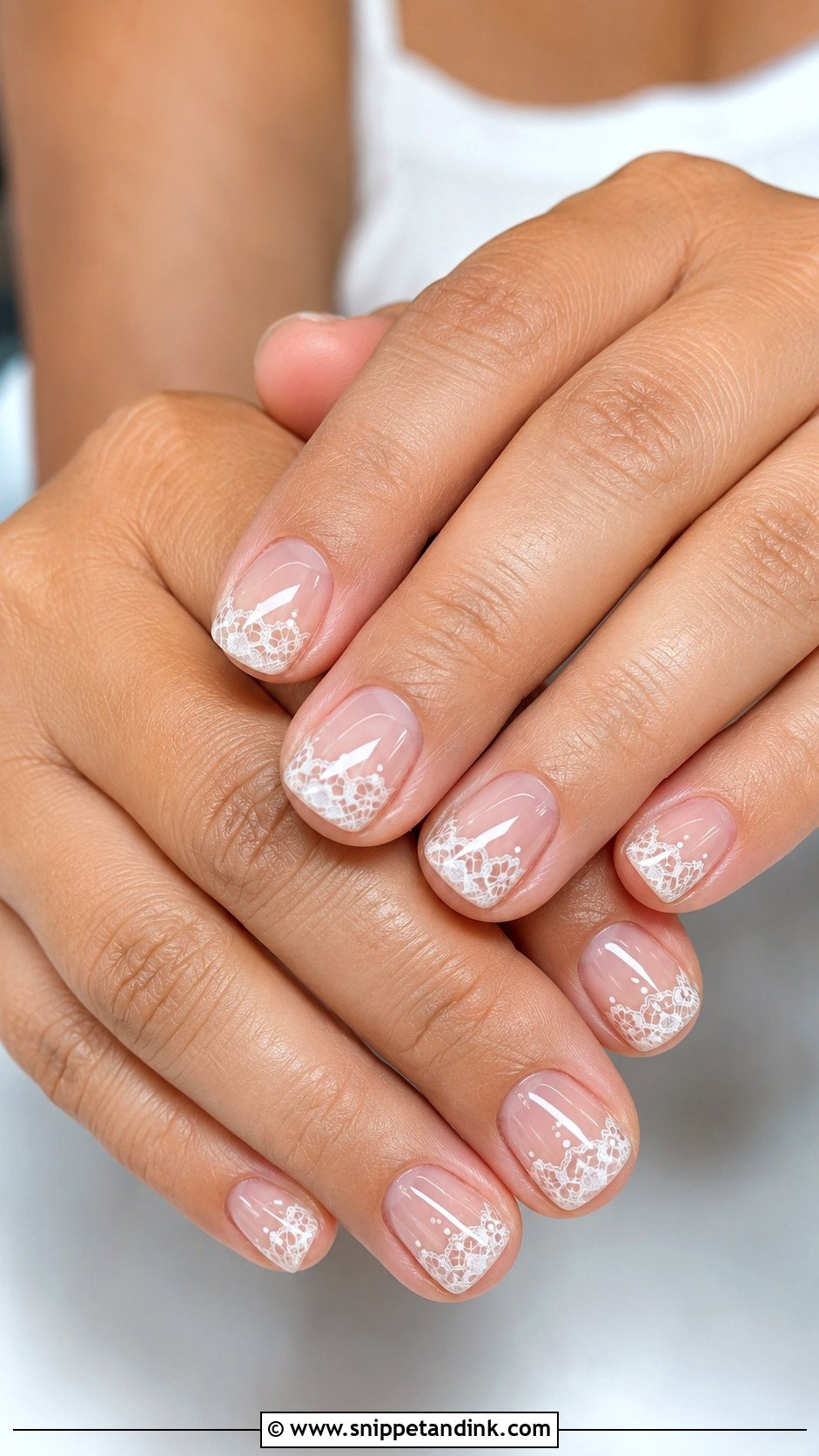
Short nails take lace better than people expect, as long as the pattern scales down. On a short squoval or round nail, I keep the lace near the tip or along one side over a sheer nude or soft pink base, so the nail never looks crowded. It’s the set I’d suggest if you work with your hands or don’t want extensions. Finer motifs and fewer flowers keep it bridal instead of busy.
10. Almond Lace Bridal Nails
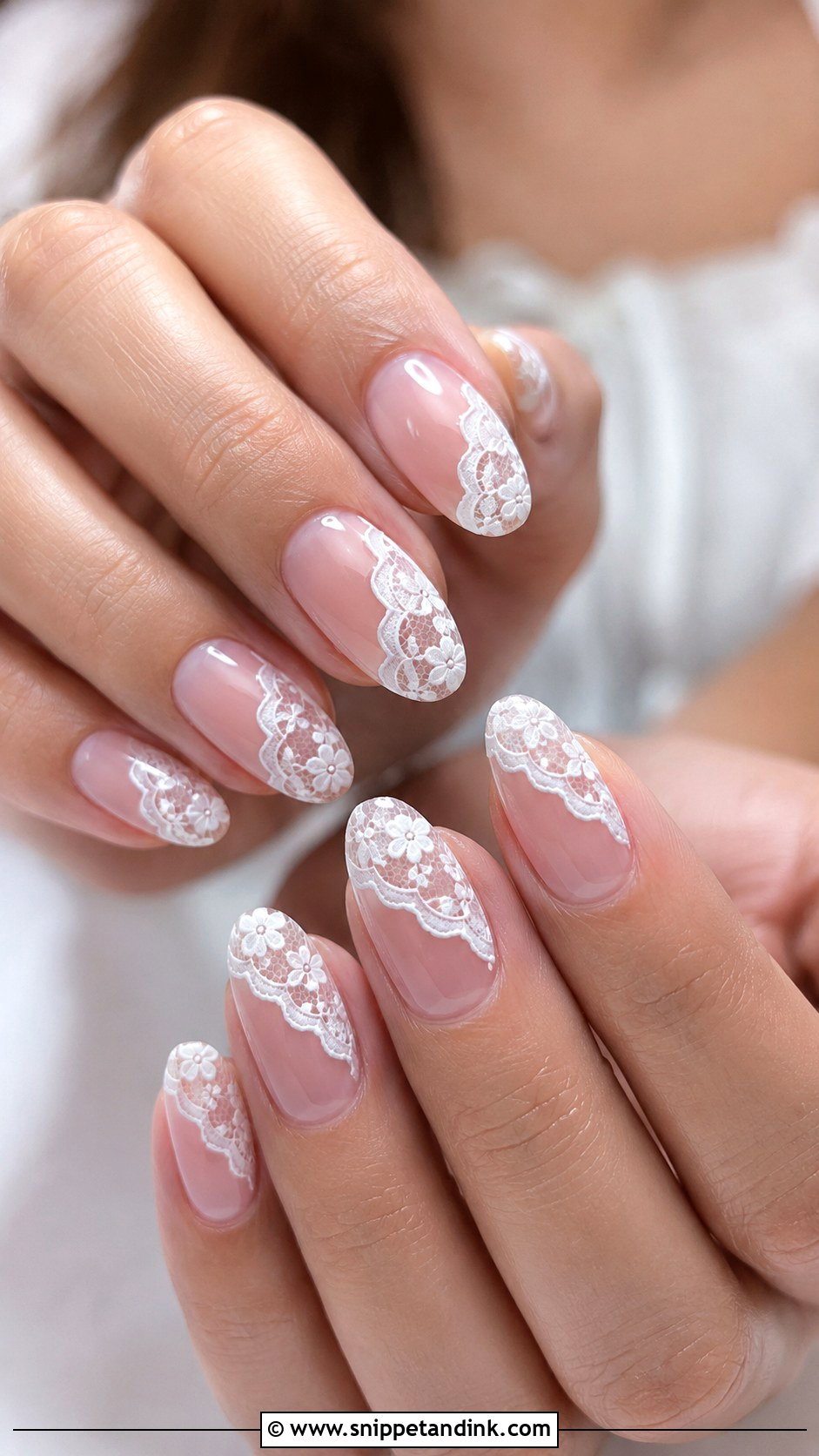
Almond is the shape I reach for most for lace, because the taper lengthens the finger and the rounded tip gives the pattern a soft frame. Lace can run across the whole nail, along the tip or diagonally, over a sheer pink, nude or milky base. An almond also has room for lace patterns with small flowers, curved lines, and scalloped edges. For balance, lace on two or three nails with the rest in a matching sheer shade is plenty. Very short nail beds can’t hold a true almond without extensions, so check that before you set your heart on it.
11. Coffin Lace Bridal Nails
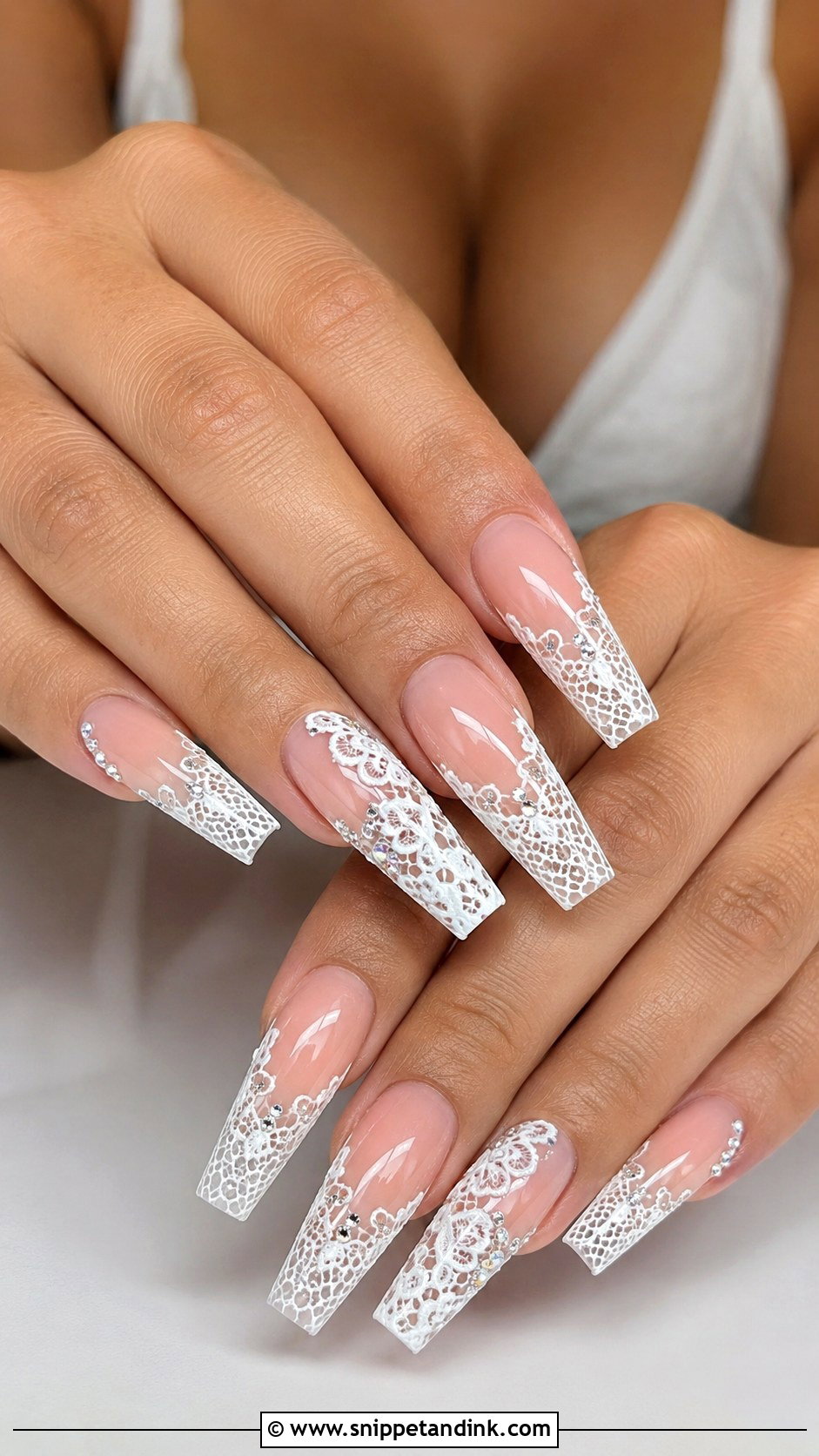
Coffin is the boldest shape here, and it needs at least medium length to taper properly. The straight tip gives a modern edge while the lace keeps it romantic. I balance that strong silhouette with a nude or soft pink base and run the lace across the tips, down the sides or onto accent nails. Long coffin nails take knocks at the corners, so I reinforce the tip with builder gel. A few tiny crystals or pearl dots, used sparingly, are enough.
12. Oval Lace Bridal Nails
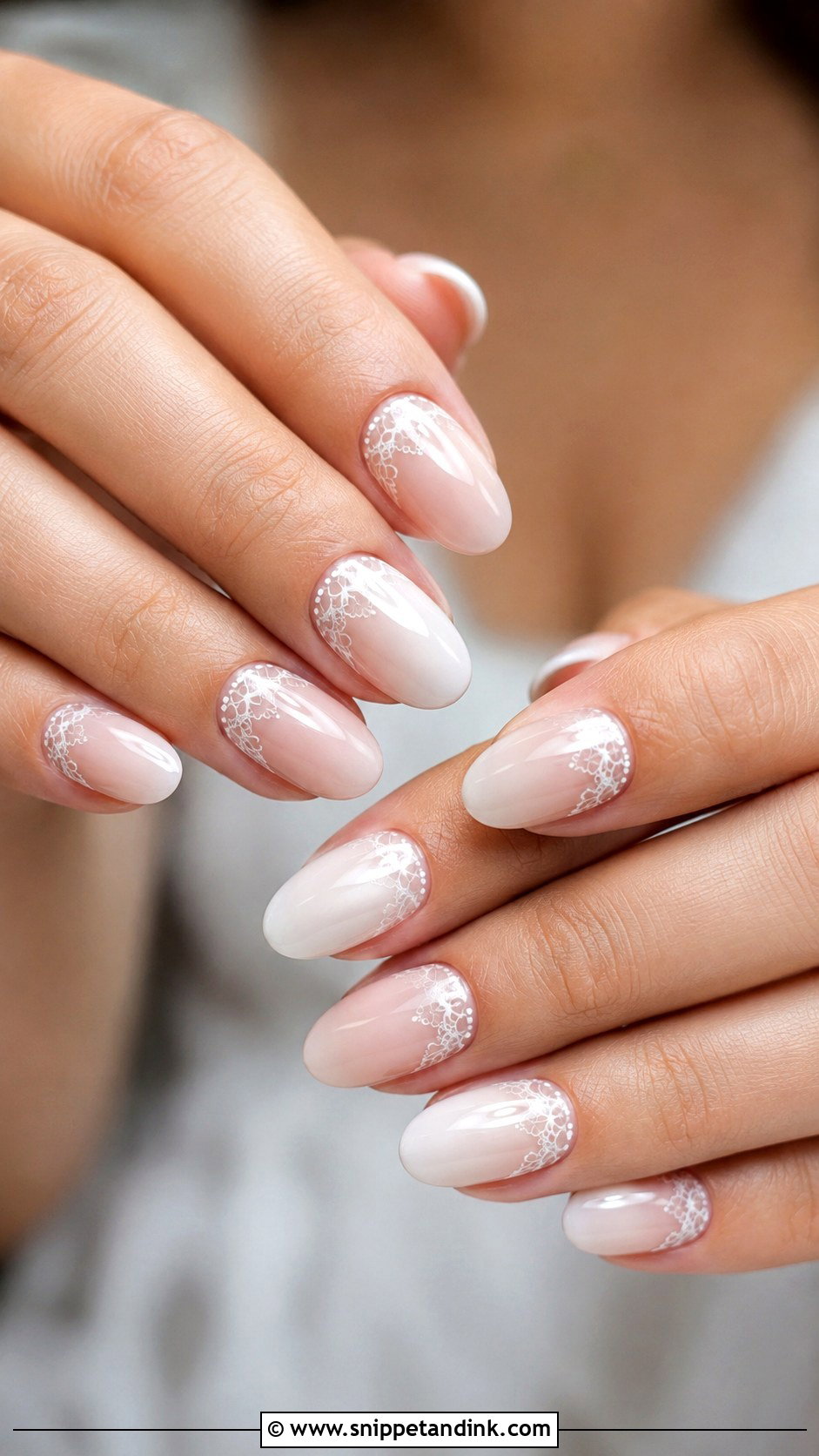
Oval follows the natural curve of the fingertip, which makes it the easiest shape to live with during a wedding week, at any length. Over a sheer blush, milky white or ivory base, I place the lace near the cuticle for a vintage feel or across the tips for something lighter. Ovals have no corners to chip, so I suggest them to brides who type all day or will be setting up the venue the day before. Thin lines and a glossy top coat keep it classic without looking plain.
13. Ivory Lace Bridal Nails
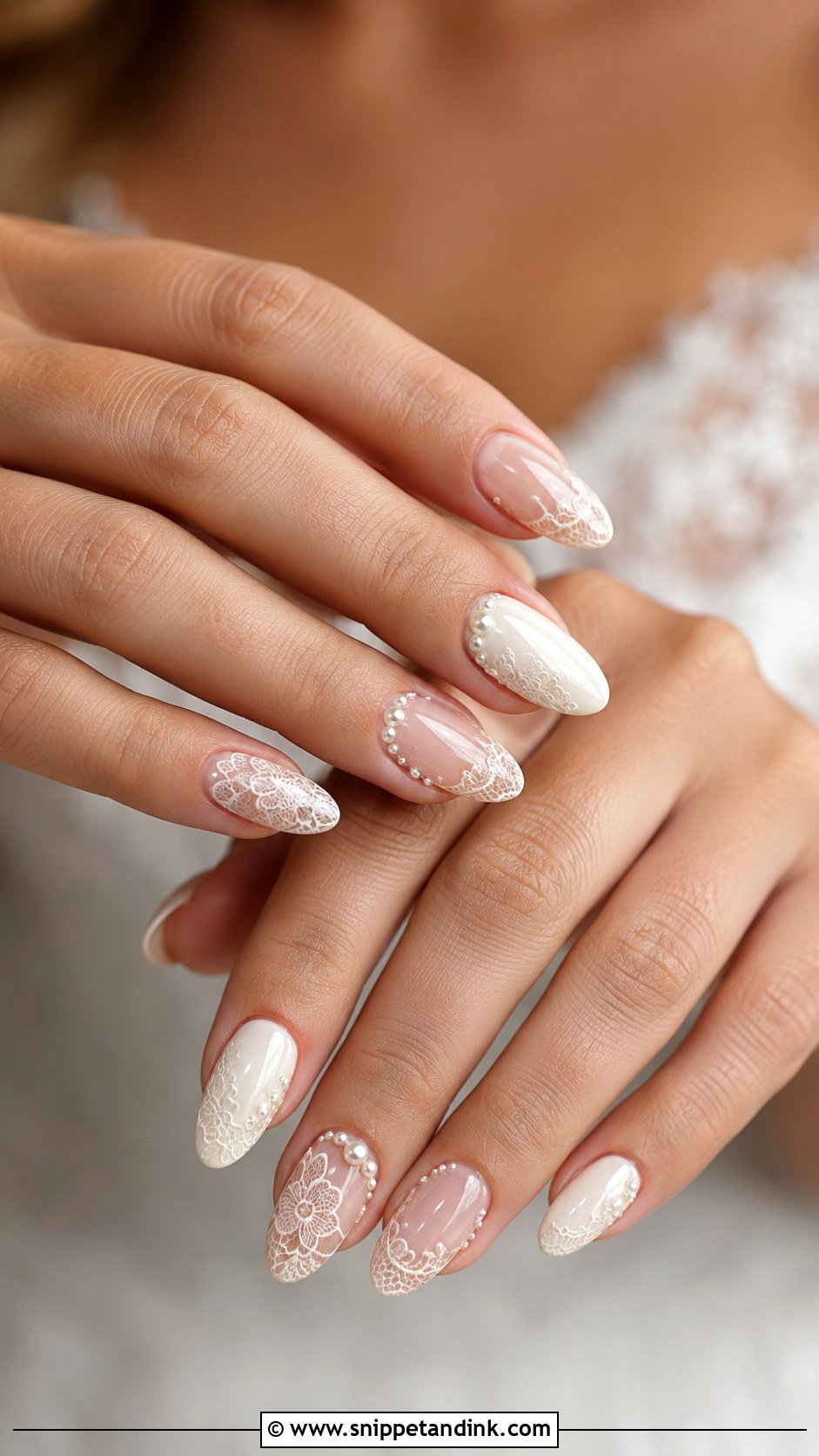
Bright white can look harsh, even slightly blue, against an ivory, cream or champagne gown. Ivory lace on a sheer nude or creamy base matches warmer fabrics far better. I paint the lace in a matching ivory tone, sometimes with slightly raised gel for dimension, and it sits naturally with vintage-inspired dresses and satin. Limit embellishment to one tiny pearl or crystal per accent nail so the lace stays the focus. Ivory varies a lot between bridal designers, so a swatch of your actual dress fabric is worth bringing.
14. Floral Lace Bridal Nails
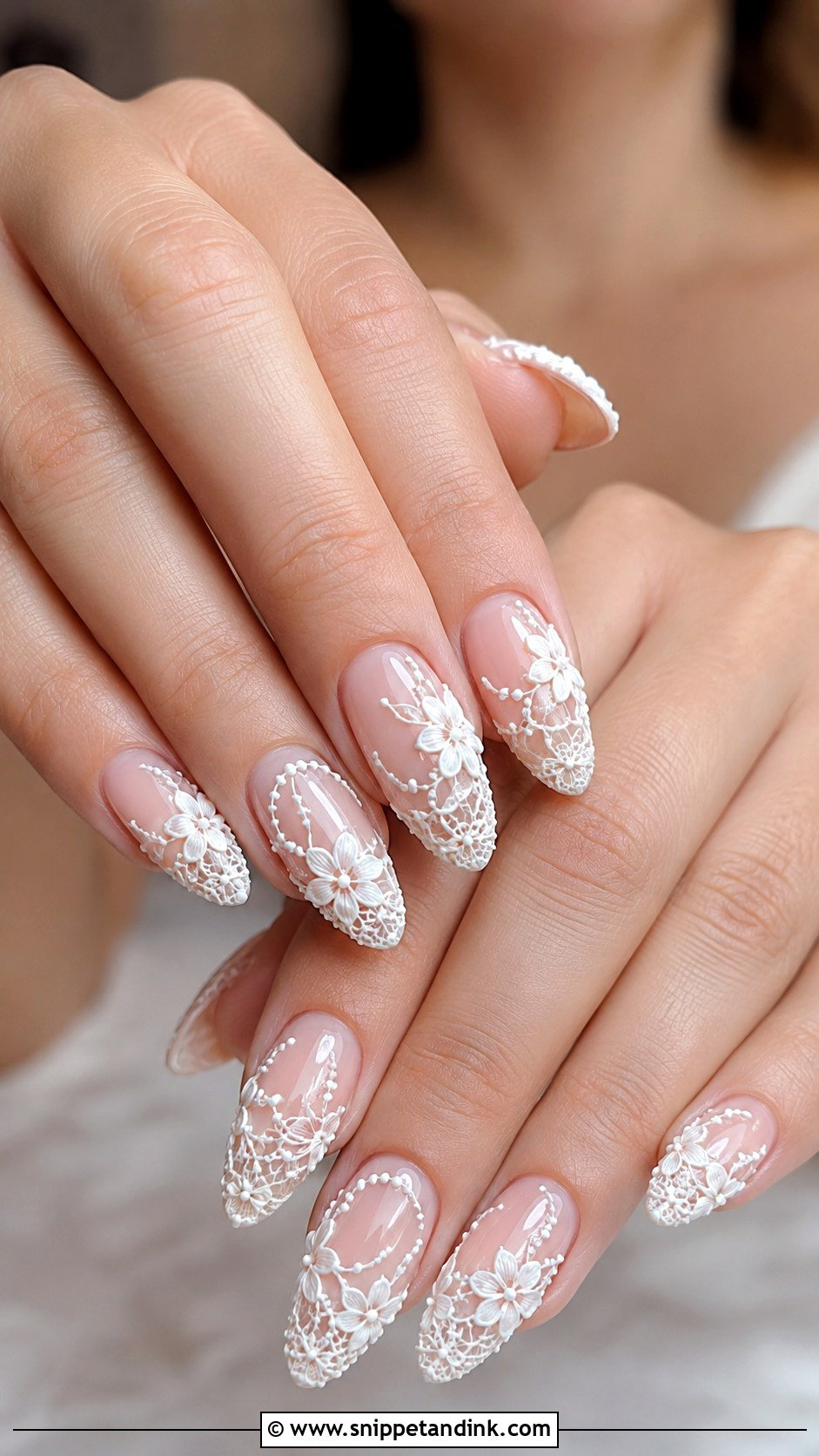
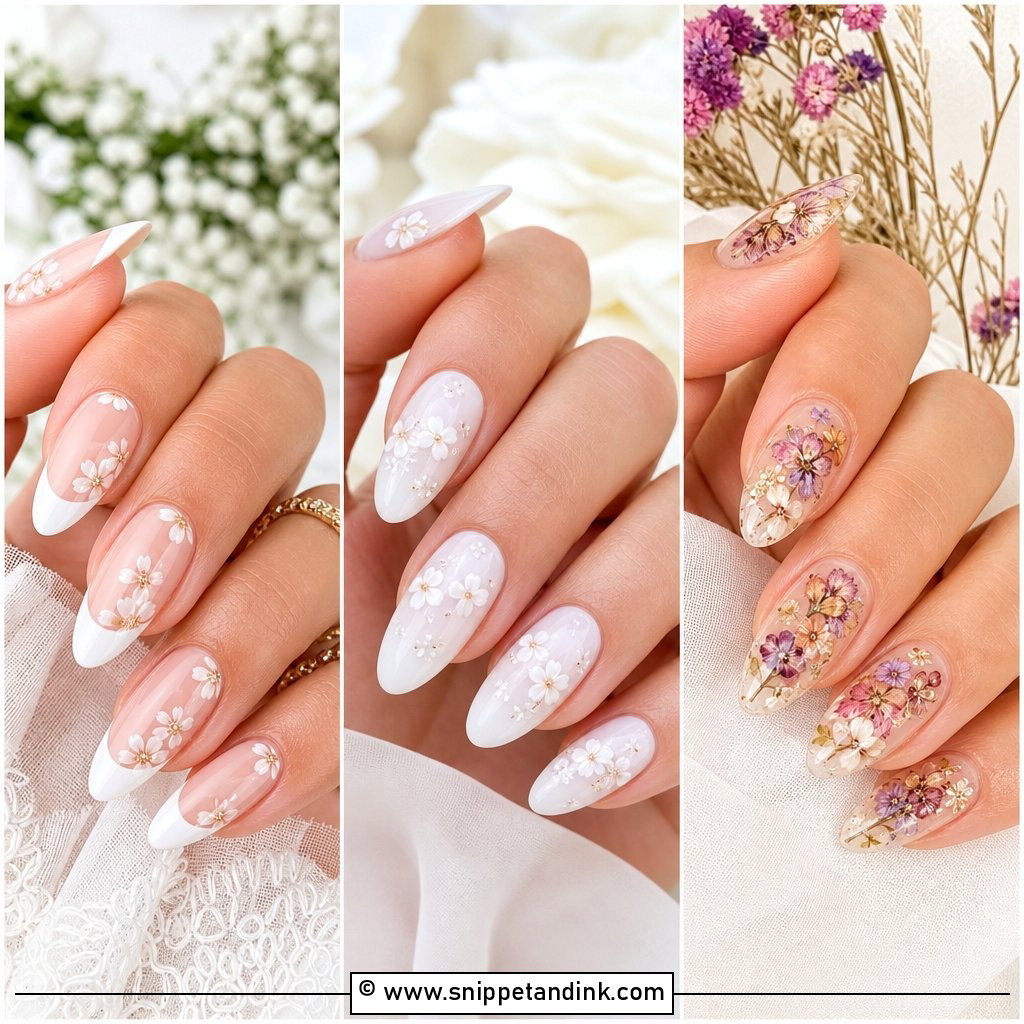
Floral lace is built from small flowers, tiny leaves, dots and curved lines, so it pairs naturally with embroidered dresses and garden weddings. A sheer pink or nude base keeps it light. Covering every nail looks detailed; accent nails only looks simpler. The mistake I see most is flowers drawn too large. Real lace florals are small and repeated, so I keep each bloom only a few dots wide. Almond and oval shapes suit it, finished with a glossy or pearly top coat.
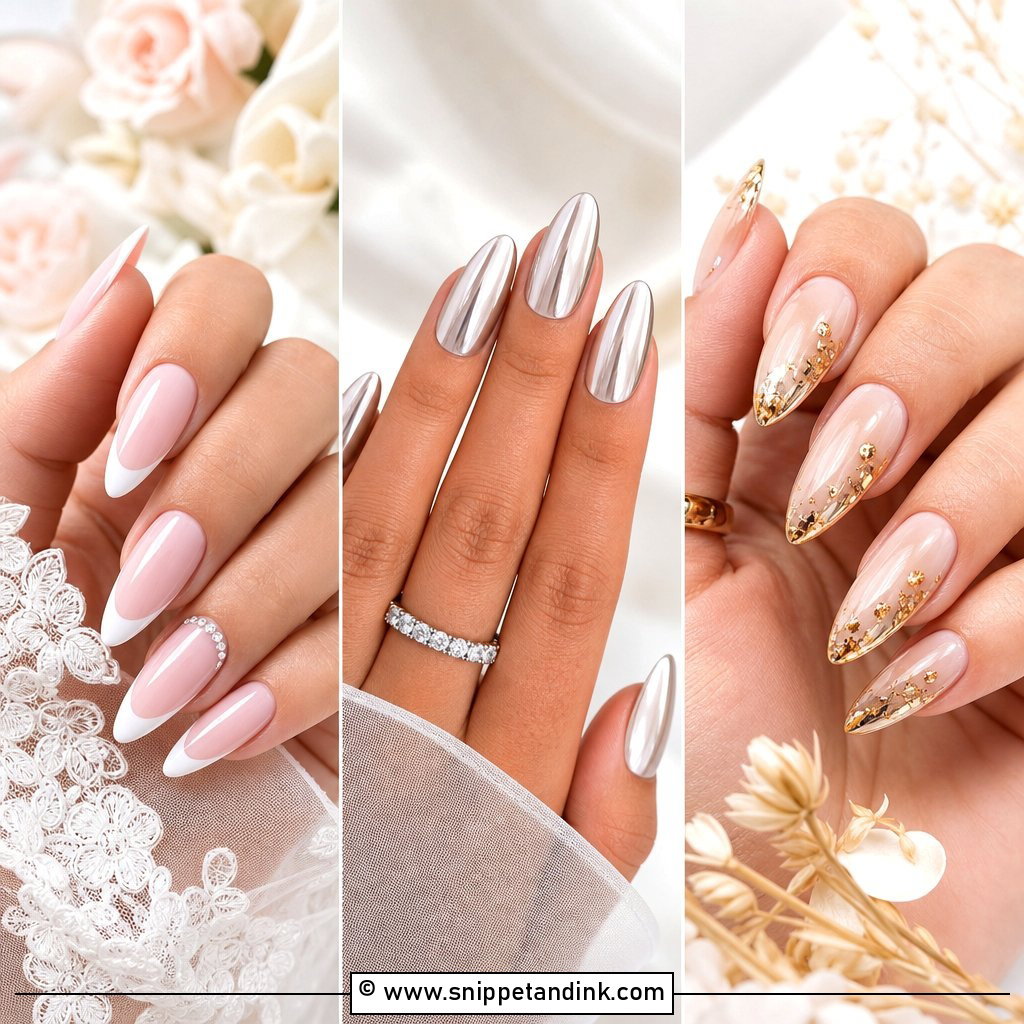
15. 3D Lace Bridal Nails
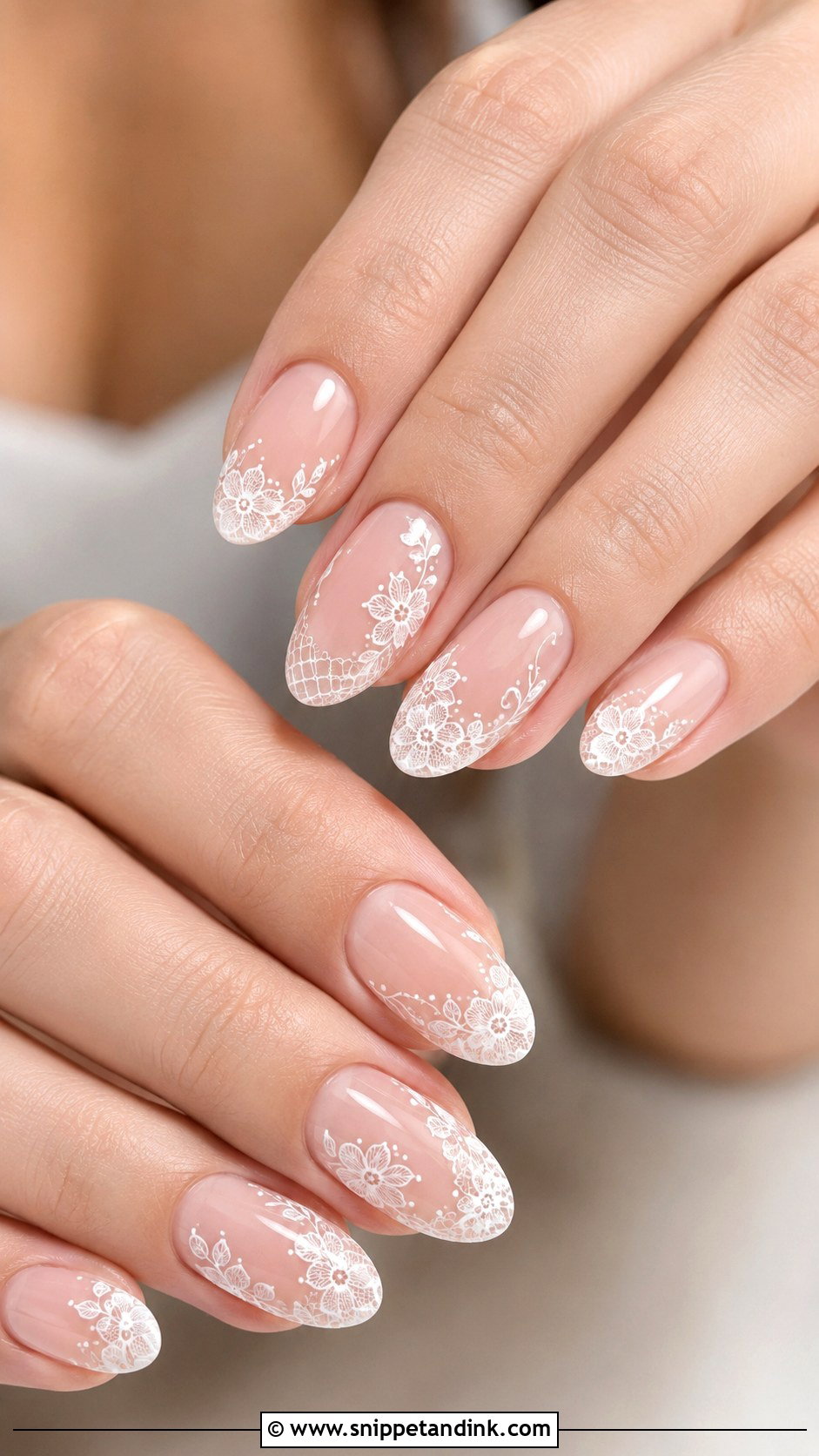
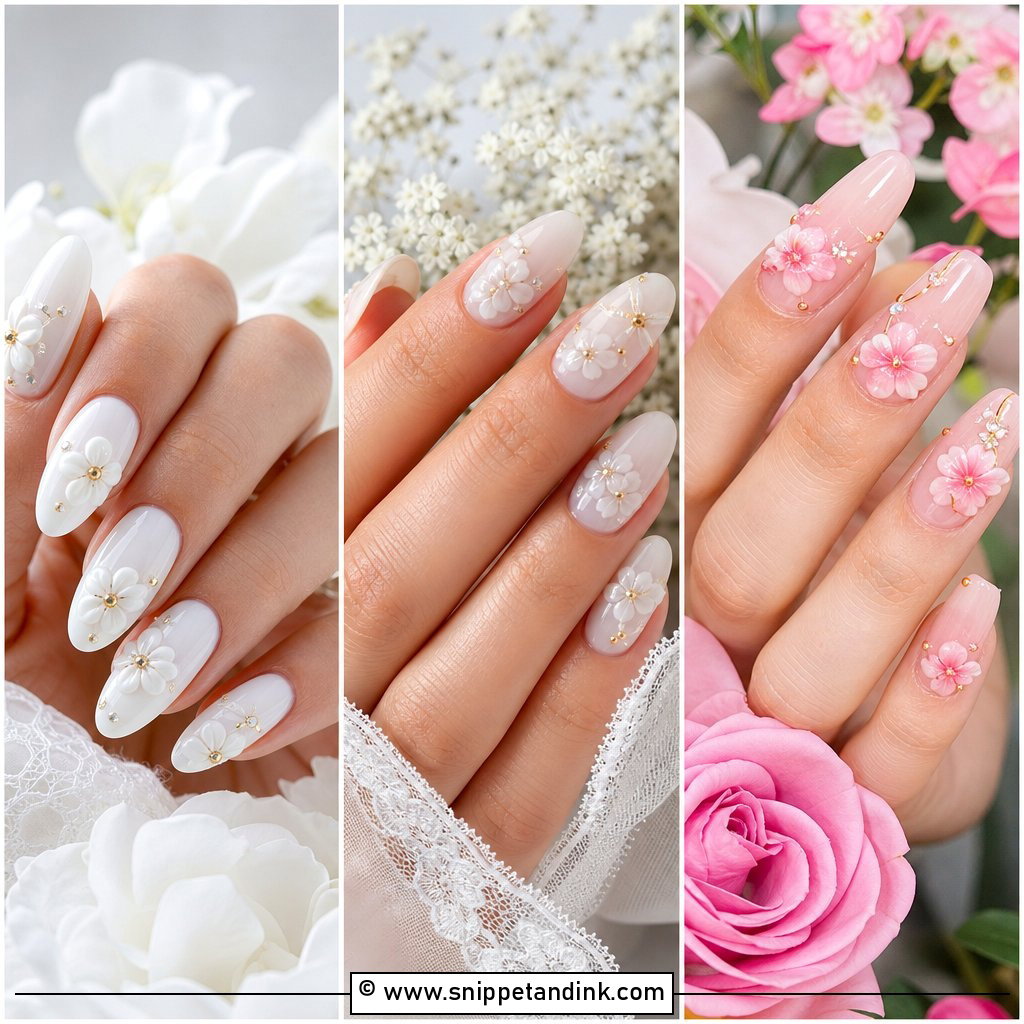
Raised lace is the closest you’ll get to real fabric on a nail. Your artist can build it with builder gel, acrylic powder, or textured gel paint, forming loops, dots and tiny flowers you can actually feel with a fingertip. Keep the colors soft, nude, blush, ivory or milky white, because the texture already does a lot. Ask for low-profile 3D work. Tall details snag delicate fabric and make it awkward to slide rings on and off. A medium almond or oval has the room for it.
16. Lace Bridal Nails With Rhinestones
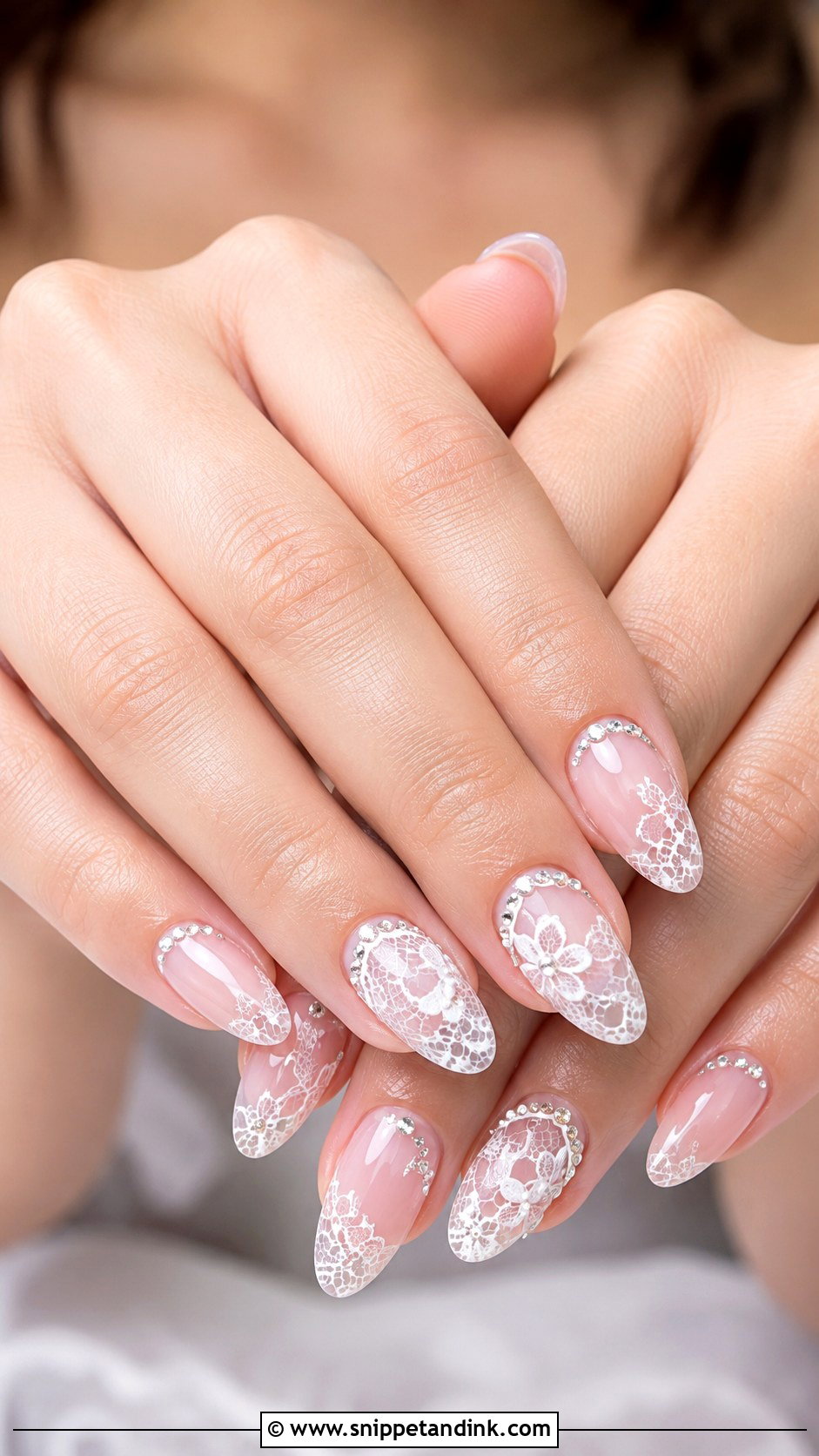
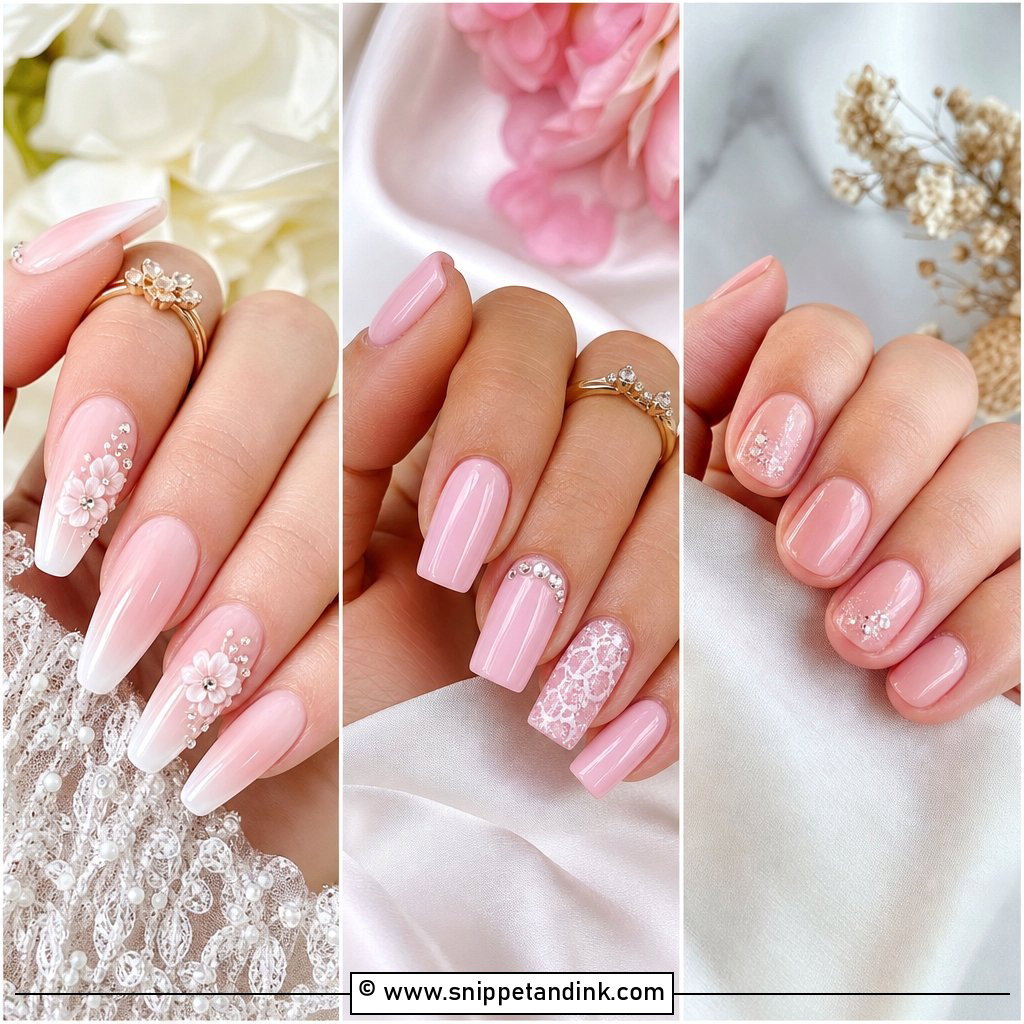
A few rhinestones move lace toward an evening or formal wedding. Over a sheer nude or soft pink base with white lace art, I set tiny clear stones at the center of lace flowers or near the cuticle. Small, flat-backed stones only: large gems overpower lace and catch on beaded gowns. To keep it soft, put the rhinestones on two accent nails and let the lace carry the rest.
17. Lace Bridal Nails With Gold
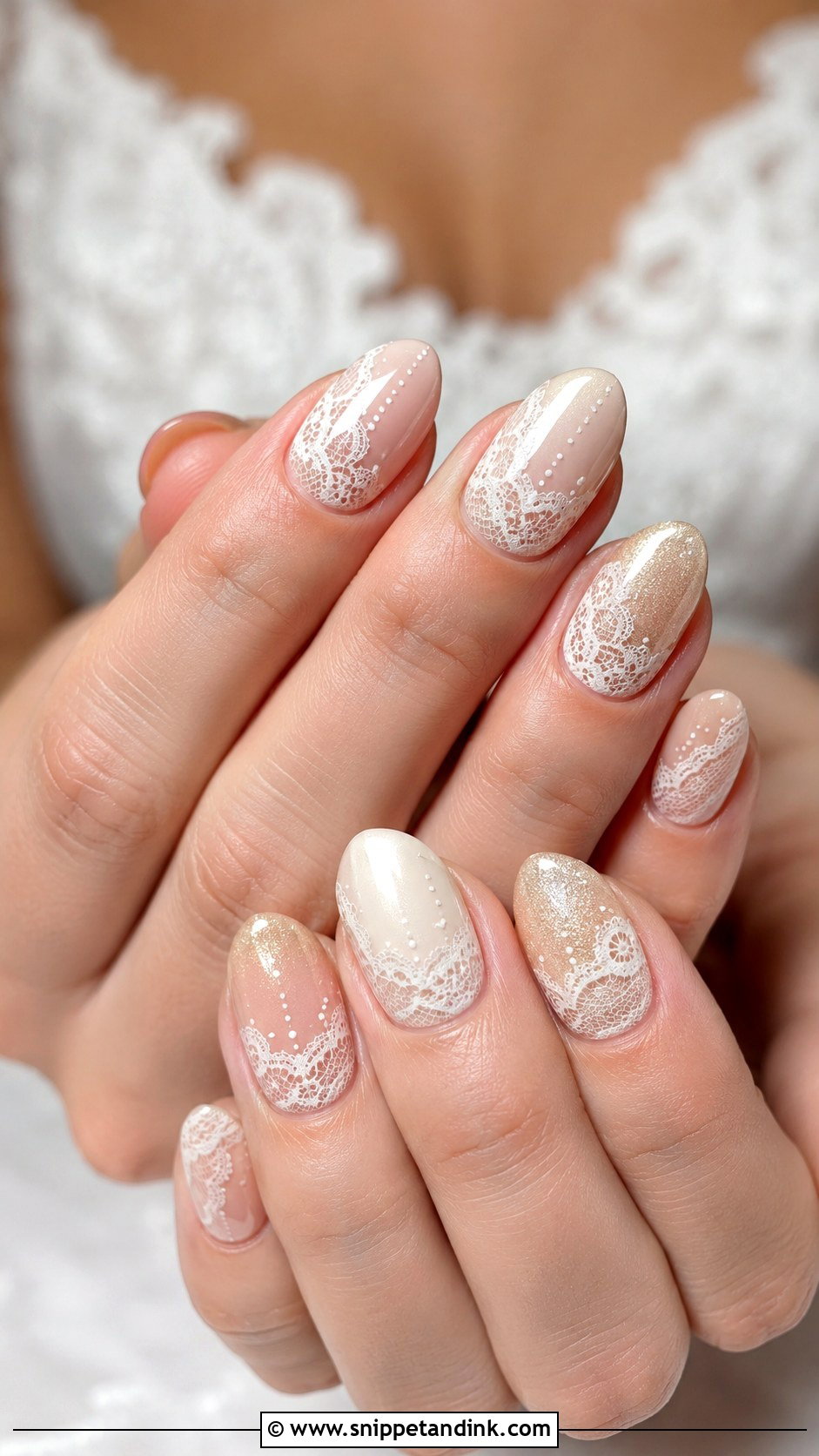
Gold makes lace warmer. I pair ivory or white lace with fine gold foil, small metallic dots or a thin gold outline on a nude, champagne or blush base. It’s the right call when your jewelry, hair accessories or dress beading are warm metals. Silver jewelry beside gold nail details tends to look mismatched in ring close-ups, so check that before booking. Keep the gold fine and let the lace lead. Almond, oval and coffin shapes all take it.
18. Something Blue Lace Bridal Nails
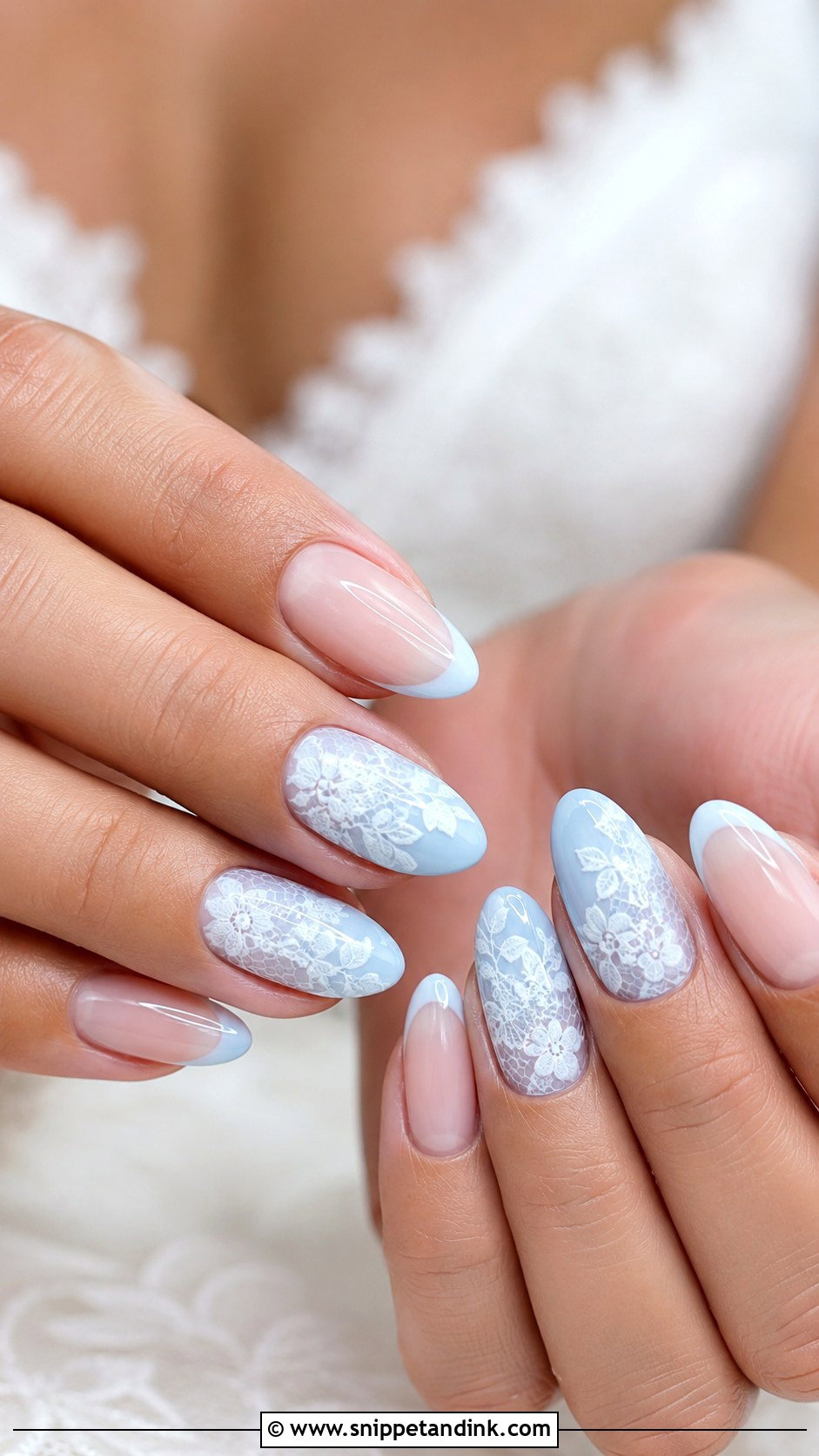
For a quiet nod to tradition, skip bright blue and choose a soft powder blue, pale blue-gray, or sheer blue-tinted base. White lace over it keeps the set bridal. Blue on every nail is a statement, while blue on just the ring finger with the rest nude or milky is the subtler version. Pale blue gel can turn grey under warm indoor lighting, so I check the shade under my table lamp and again by a window. Oval and almond shapes suit it.
19. Vintage Lace Bridal Nails
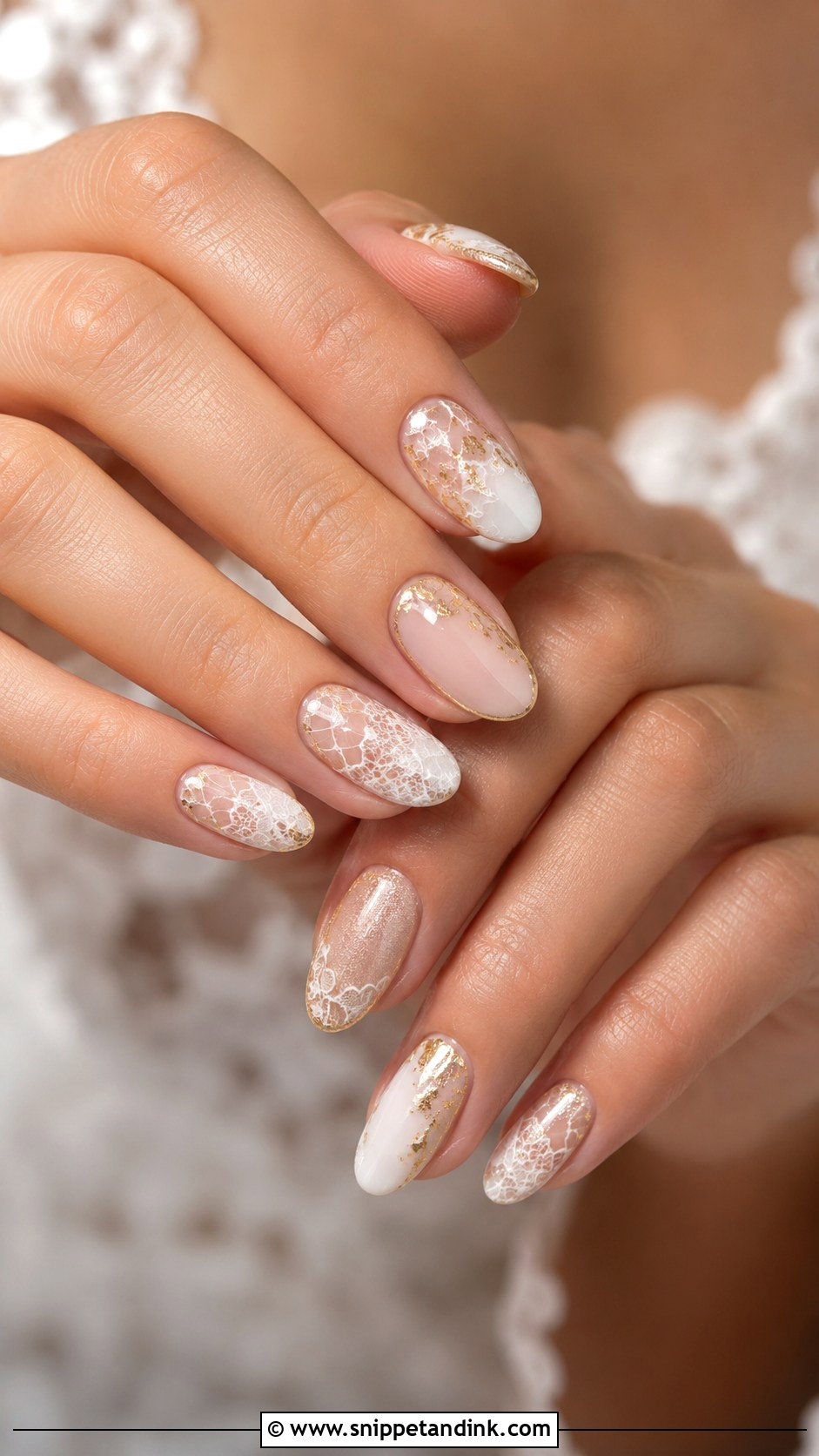
Vintage lace swaps bright white for ivory, cream or champagne, with fine florals, scalloped edges and net-like detail. A satin or matte finish leans antique; a glossy one keeps it fresh. It pairs with heirloom jewelry, lace sleeves and pearls. Leave out heavy glitter and oversized gems, which belong to a different era entirely. A medium oval gives this look its softest silhouette.
20. Minimal Lace Bridal Nails
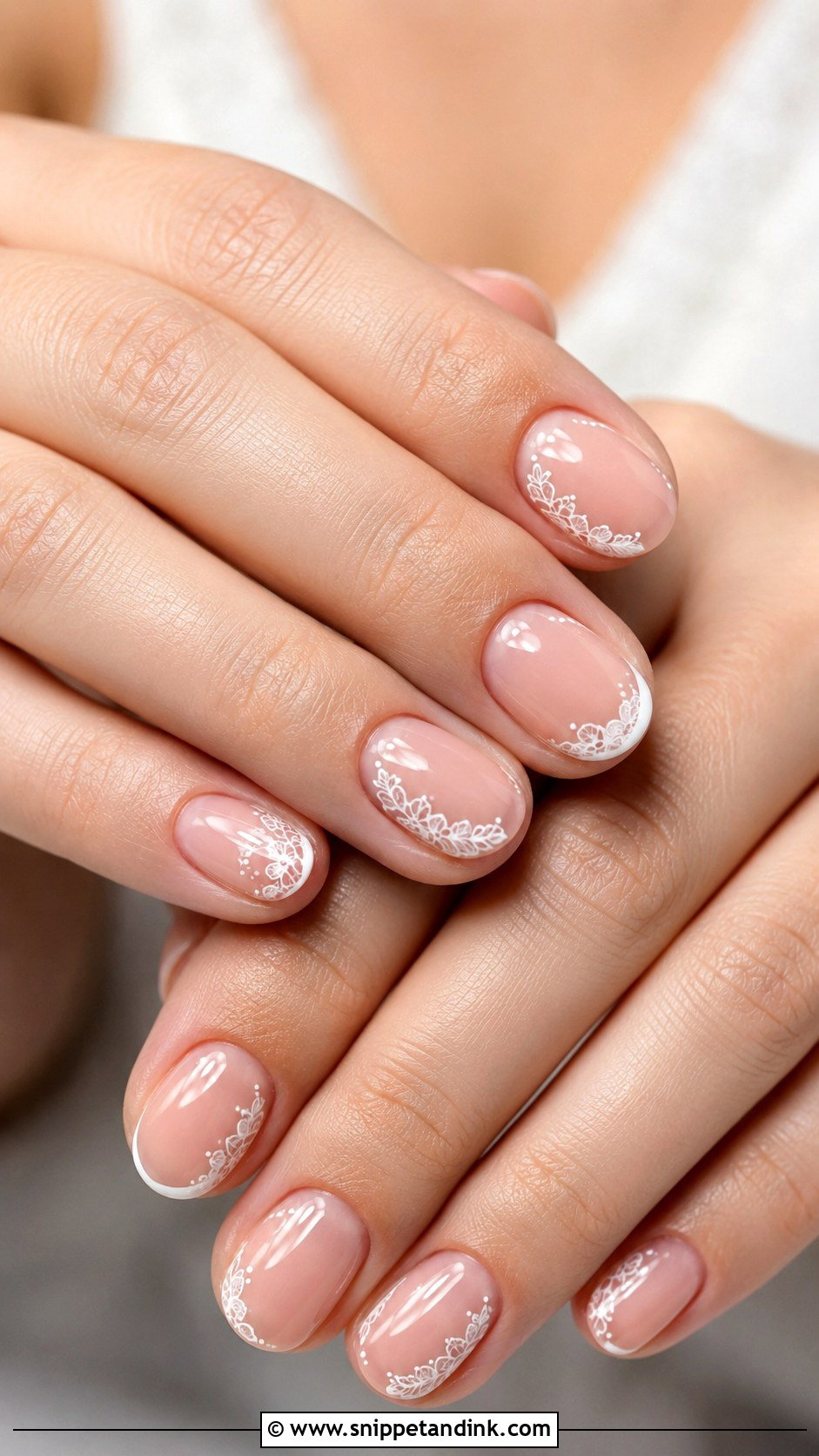
If your dress is heavily detailed, minimal lace keeps your hands from competing with it. I put tiny lace accents on one side of the nail, near the tip, or on only two accent nails, over a sheer nude, pale pink or milky base with plenty of negative space. A short oval or soft almond keeps it simple. It’s also the most forgiving set to have done a few days early, because there’s less detail to chip.
Reading the Lace on Your Gown Before Copying It
Bridal lace comes in very different types, and each translates to a nail in its own way. Look at your dress closely, or ask your bridal shop what lace it is.
- Chantilly: a fine net with delicate outlined florals. On nails it becomes a thin painted mesh with small outlined flowers, best kept flat and sheer.
- Alençon: florals edged with a raised cord. I recreate that cord with a thicker gel line or a low 3D outline around each motif.
- Guipure: heavy lace with no net behind it, just motifs joined together. This suits raised 3D gel work on a nude base.
- Appliqué on tulle: scattered lace motifs on sheer fabric. Mirror it with isolated lace flowers on a milky base and lots of open space.
A close, well-lit photo of the lace helps me more than any inspiration picture. If you can bring a small offcut from your alterations, better still, because I can hold the white or ivory gel against the fabric in the same light before we start.
Keep the Base Sheer and the Lines Thin
Lace nails can be as simple or as detailed as you like, from classic white to nude, pearl, chrome, gold or a pale something blue. The right set fits your dress, your jewelry and the nail length you’ll actually be comfortable wearing. Bring a close photo of your gown’s lace to the appointment, so your artist can echo its real pattern rather than paint a generic one. Keep the base sheer, the lines fine and the shape easy to live with, and the set will hold up in person and in close-up photos alike.
You'll Like These Ideas:


Leave a Reply