
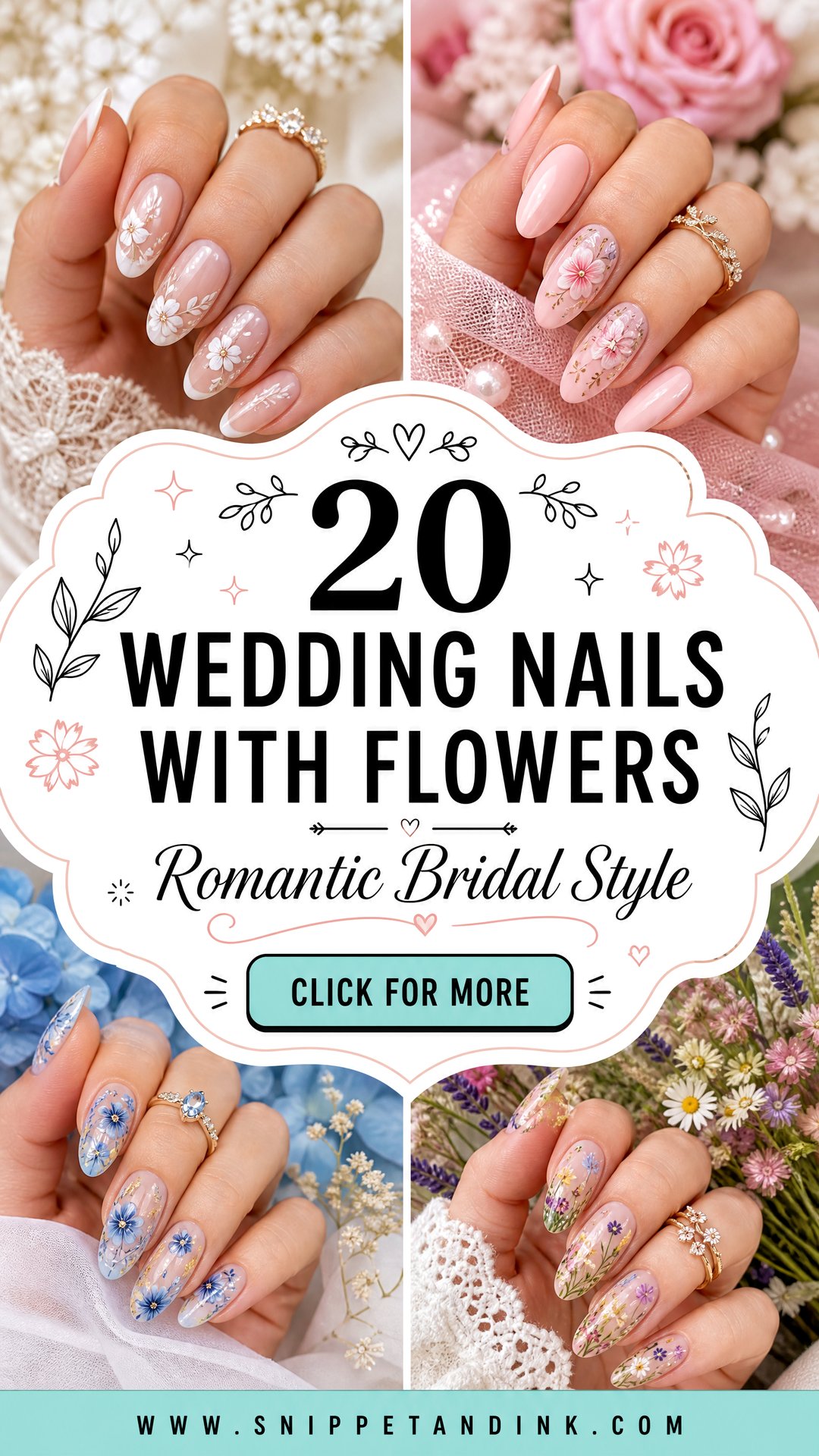
Florals are the nail art I paint most often for brides, because a flower can be scaled down to almost nothing and still read clearly in a ring photo. They suit a white gown in a church as easily as a garden ceremony, a beach or a quick courthouse wedding. The range is wide: tiny white petals on sheer nude, sculpted 3D blooms with pearls, real pressed flowers sealed under gel, or soft watercolor blooms picked out from your bouquet. Here are twenty floral sets I’d do for a bride, with notes on technique, durability and which ones suit short nails.
Turning Your Bouquet Into Something a Nail Brush Can Paint
Brides often show me their bouquet and ask for those exact flowers on their nails. That’s a great starting point, but a peony or a garden rose doesn’t shrink to a few millimetres the way it looks in a florist’s photo. I translate the bouquet rather than copy it.
- Flowers that paint well tiny: daisies, forget-me-nots, baby’s breath, lavender sprigs, small five-petal blossoms. They’re recognisable in a few strokes.
- Flowers I simplify: peonies, roses and ranunculus become a few curved petals in two shades, which reads as the flower from a normal distance.
- Flowers I borrow the colour from instead: proteas, orchids, anthuriums and other large or structural stems. I pull their colour into small blooms rather than attempting the shape.
Bring the florist’s mock-up photo or a list of stems and colours to your appointment. Also tell me roughly how much time you have, because hand-painted florals on several nails take noticeably longer than a plain gel set, and rushing fine linework is when petals go wobbly.
1. White French Tip Wedding Nails With Flowers
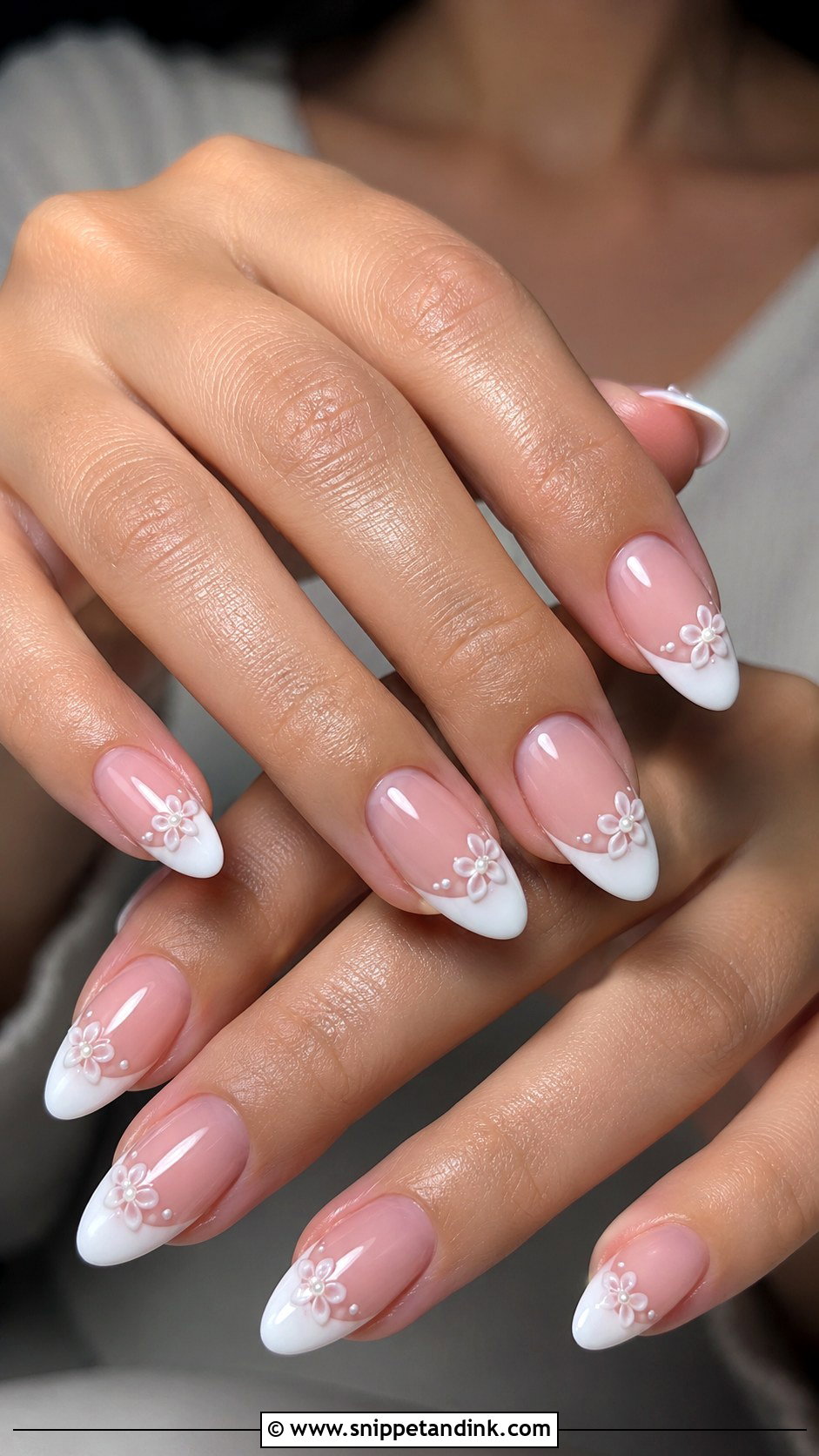
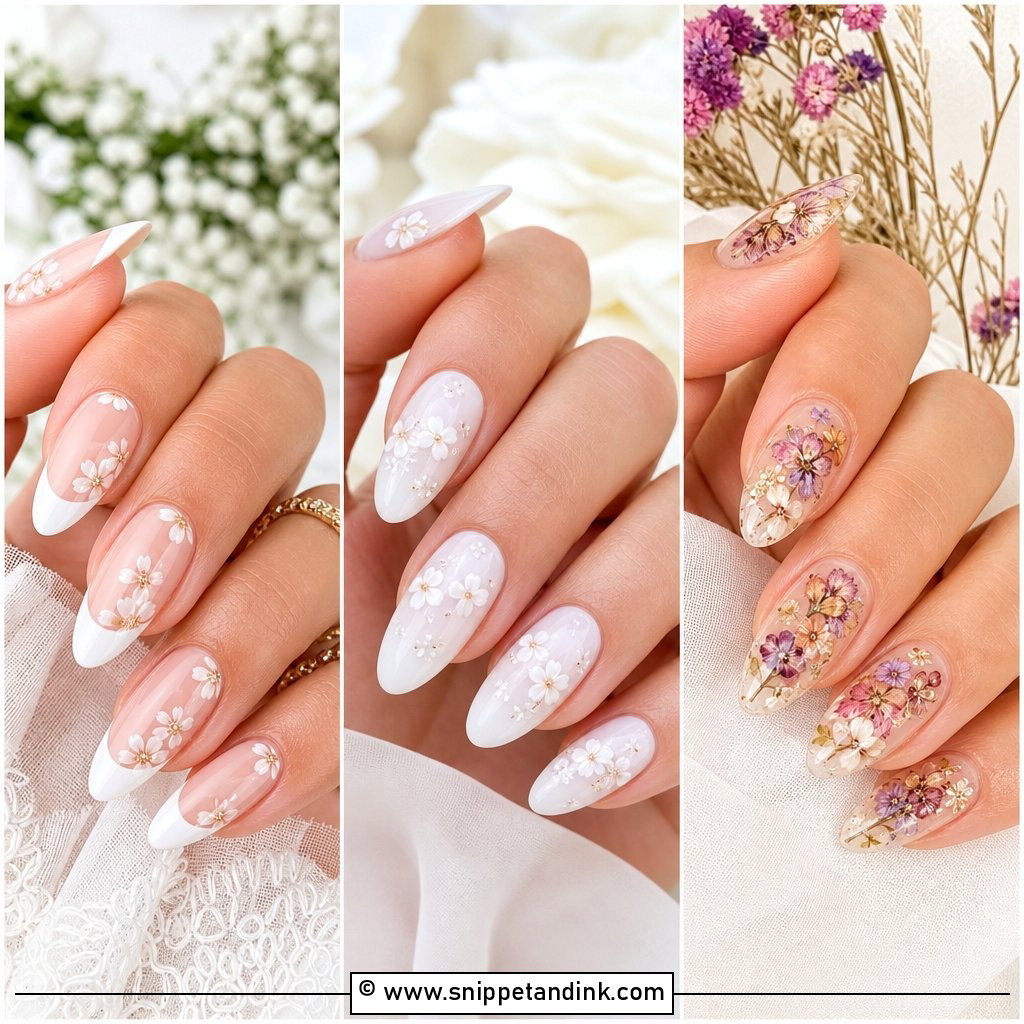
A French with flowers keeps the classic shape and softens it. I paint thin white tips over sheer pink or nude, then add tiny white petals at the smile line, up one sidewall or on two accent nails. Thick, opaque flowers make it look heavy; a few strokes of a fine brush keep it light. Almond, oval and square all work, and it sits naturally with lace, pearls and a simple bouquet.
2. Milky White Wedding Nails With Flowers
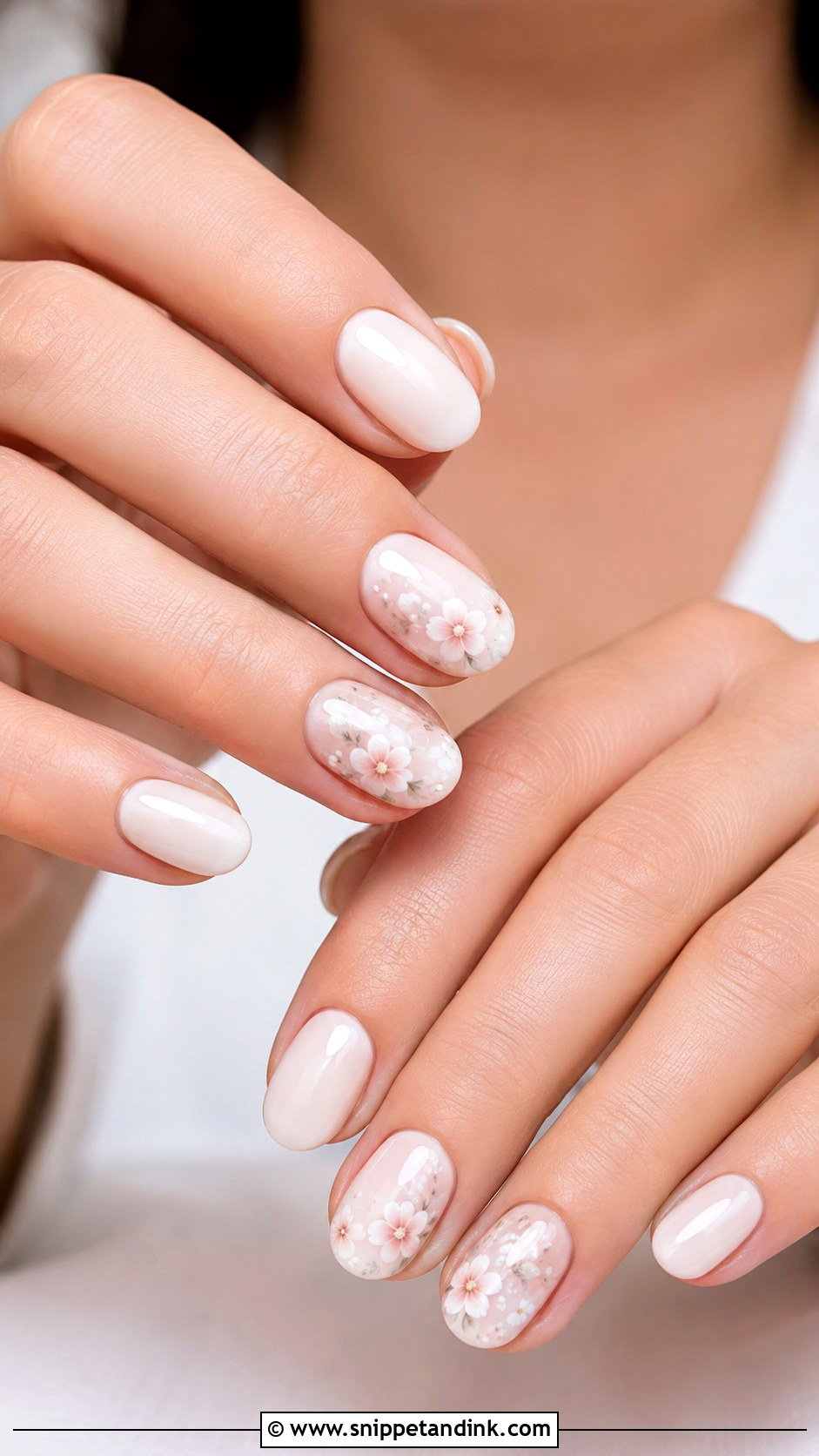
Milky white gives florals a softer canvas than stark white, so pale flowers in white, blush or beige look like they’re woven into the nail rather than painted on it. That’s why I suggest it for dresses with lace, tulle or embroidery. It flatters short oval and squoval nails. A pearl chrome layer adds sheen, but put the flowers on top of the chrome, not under it, or the detail blurs.
3. Nude Wedding Nails With White Flowers
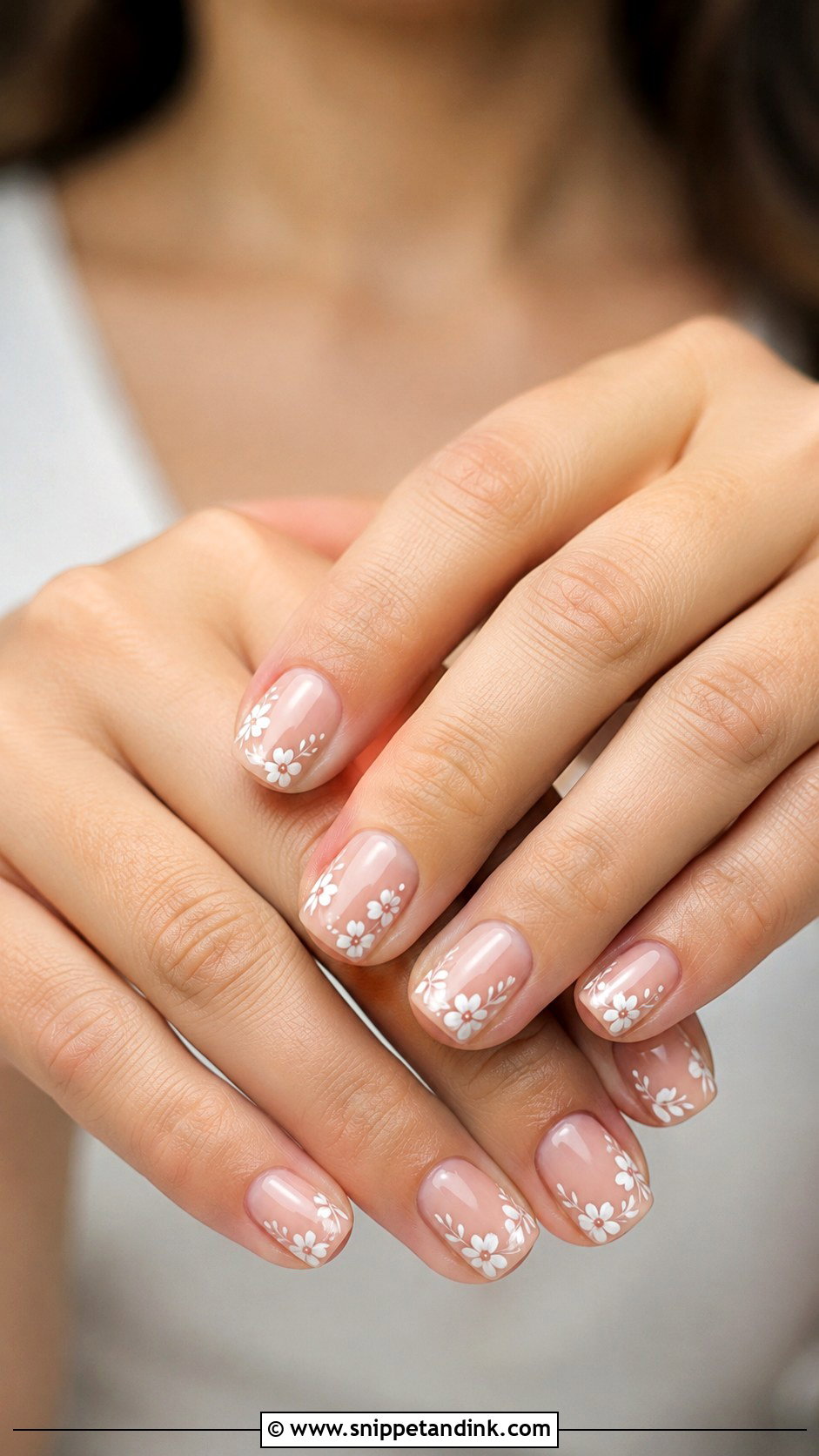
White flowers on nude are the most natural-looking floral set I do. Your nude has to match your undertone first: rosy nudes for fair or cool skin, beige, caramel or mocha for deeper skin. Then I scatter crisp white flowers across each nail or keep them to two or three accents. Tiny dots, a leaf or a pearl centre are all the extra detail it needs.
4. Blush Pink Wedding Nails With Flowers
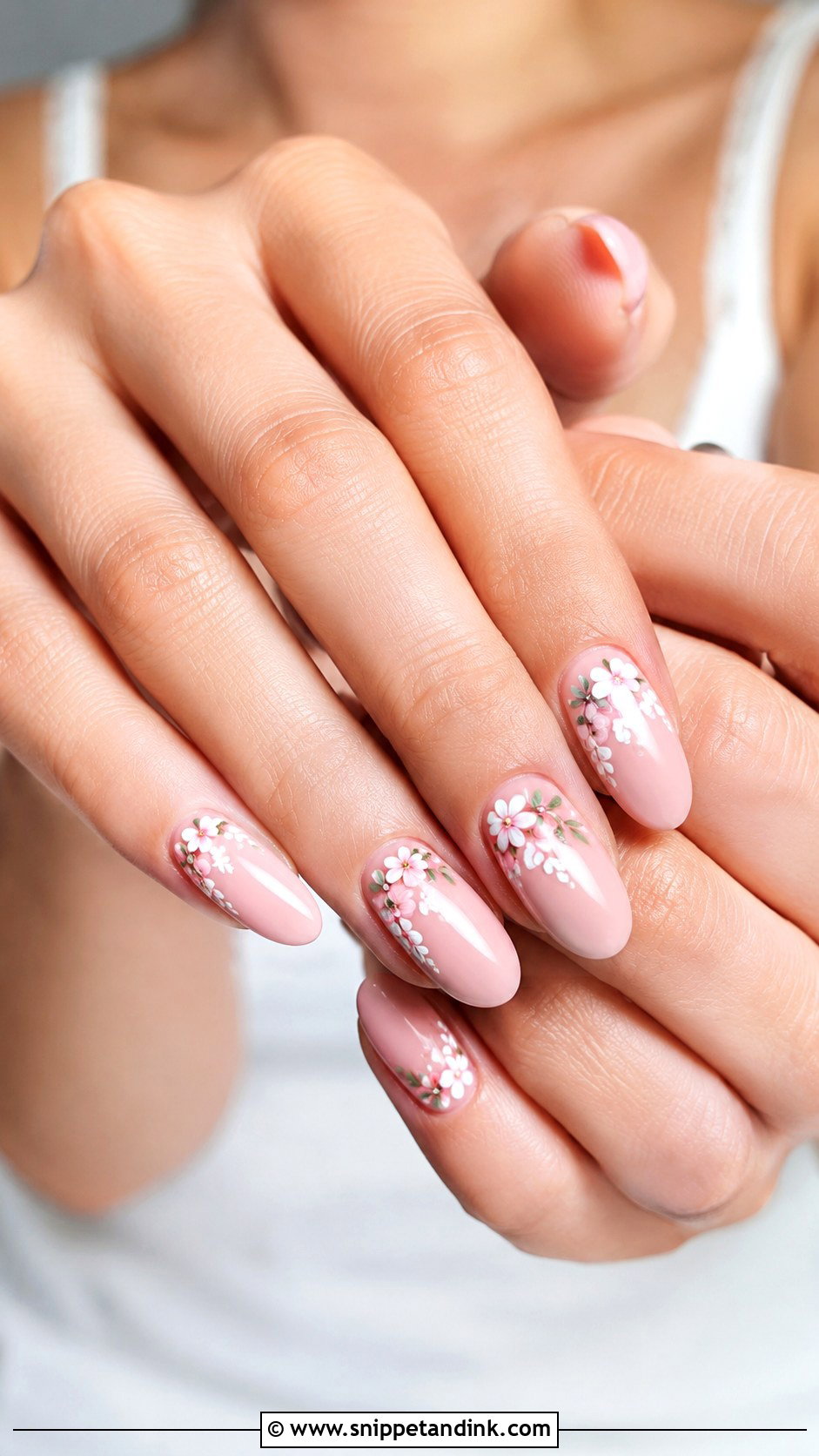
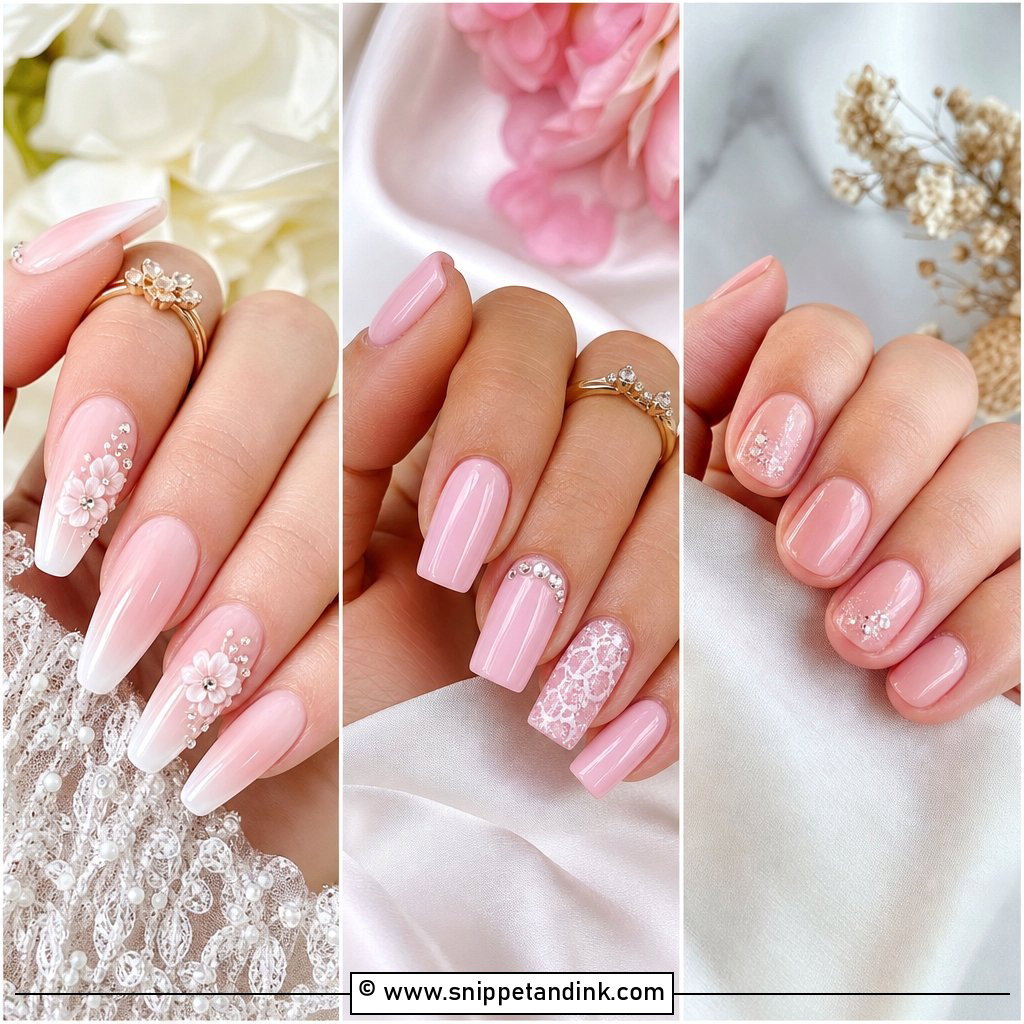
Blush makes florals feel warmer without tipping into sugary. White petals, paler pink blooms or tiny green leaves over it give a garden feel, and the colour works year-round if the flowers stay small. Almond adds length; short glossy squoval works too, with the flowers tucked near the cuticle or corners so they aren’t cut off by the free edge. Most bouquets sit happily beside it.
5. 3D Flower Wedding Nails
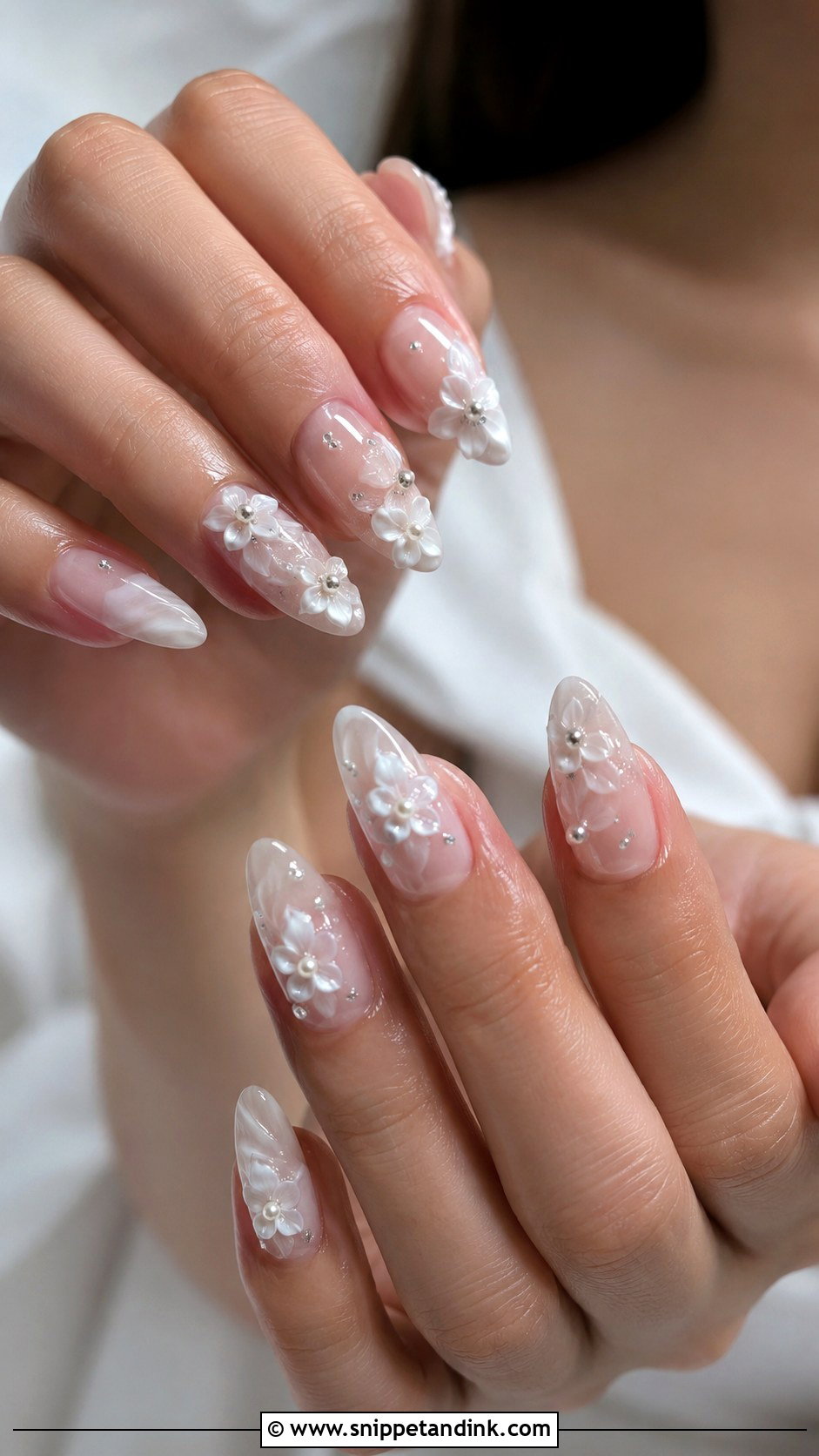
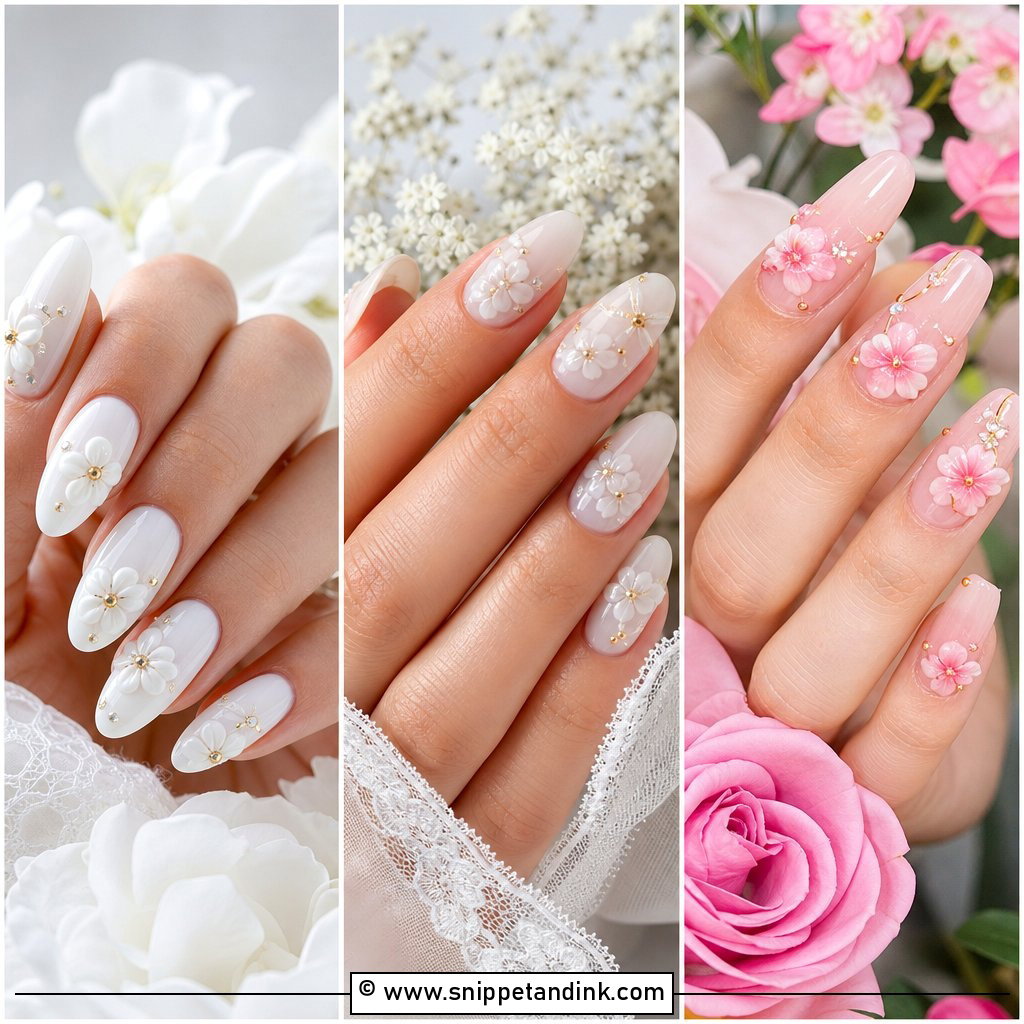
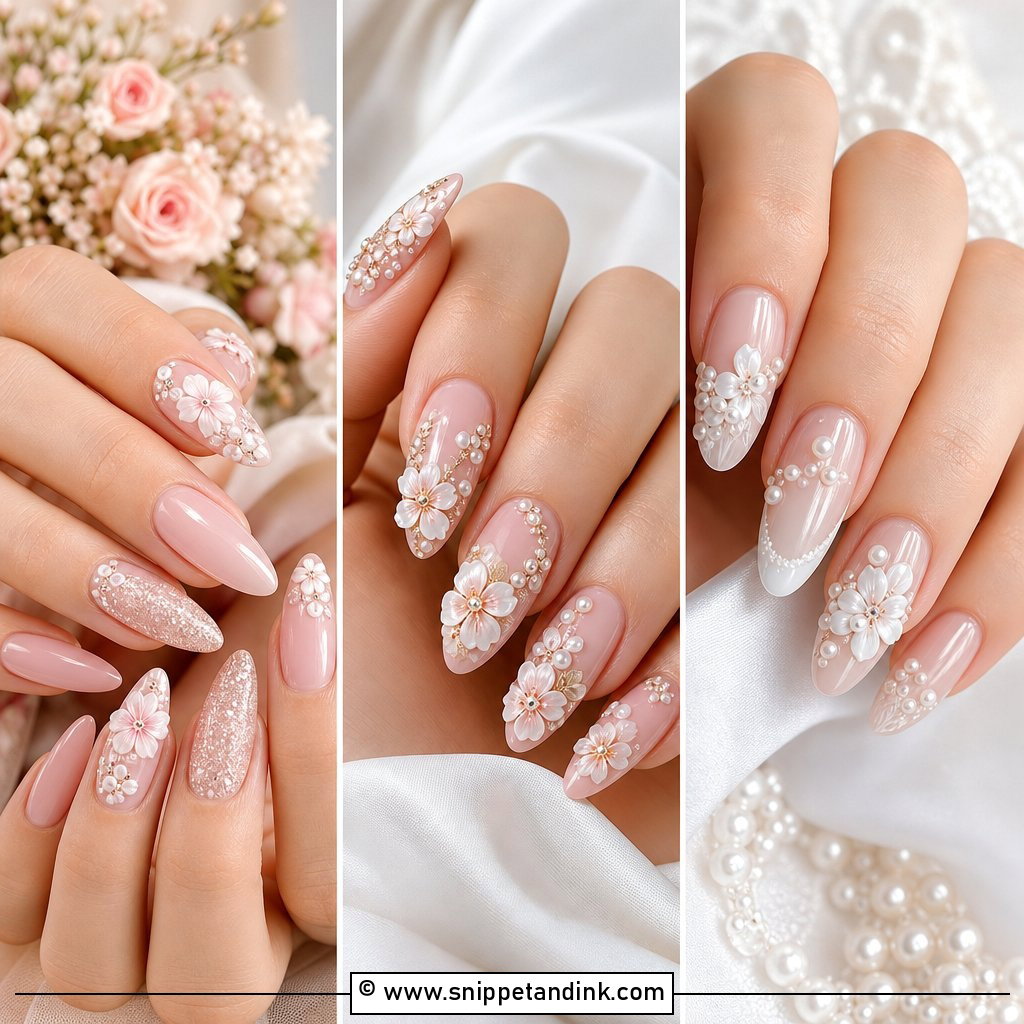
Raised flowers are sculpted petal by petal, with gel or acrylic, and finished with a pearl centre, a tiny crystal or a little shimmer. Keep the base sheer, milky or nude so the bloom is the only texture. One raised flower per ring finger is my usual suggestion; a fuller pattern looks dramatic but catches on lace and hair. Long almond, oval and coffin give room, though short nails can carry a small petal or two. White or ivory reads most bridal.
6. Pressed Flower Wedding Nails
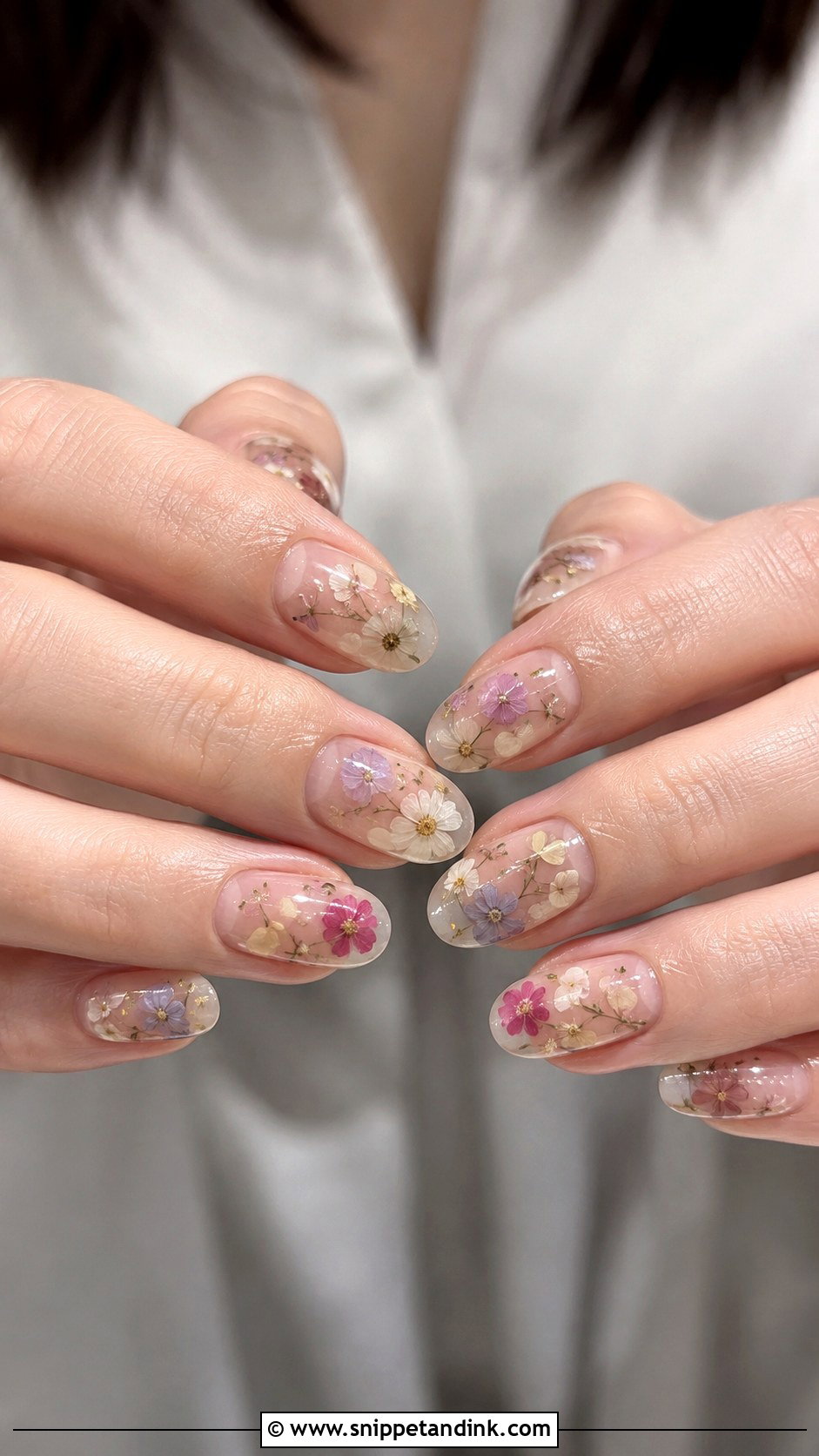
Pressed flowers are real dried petals, or realistic decals, laid onto a clear, nude or milky base and sealed under gel. They look like they’re floating inside the nail. Lavender, ivory, pale yellow and dusty pink stay bridal. The petals must be fully encapsulated with no edge sticking up, otherwise they lift and fray within a day or two. Short oval and medium almond suit it, and I keep the remaining nails plain.
7. Floral Lace Wedding Nails
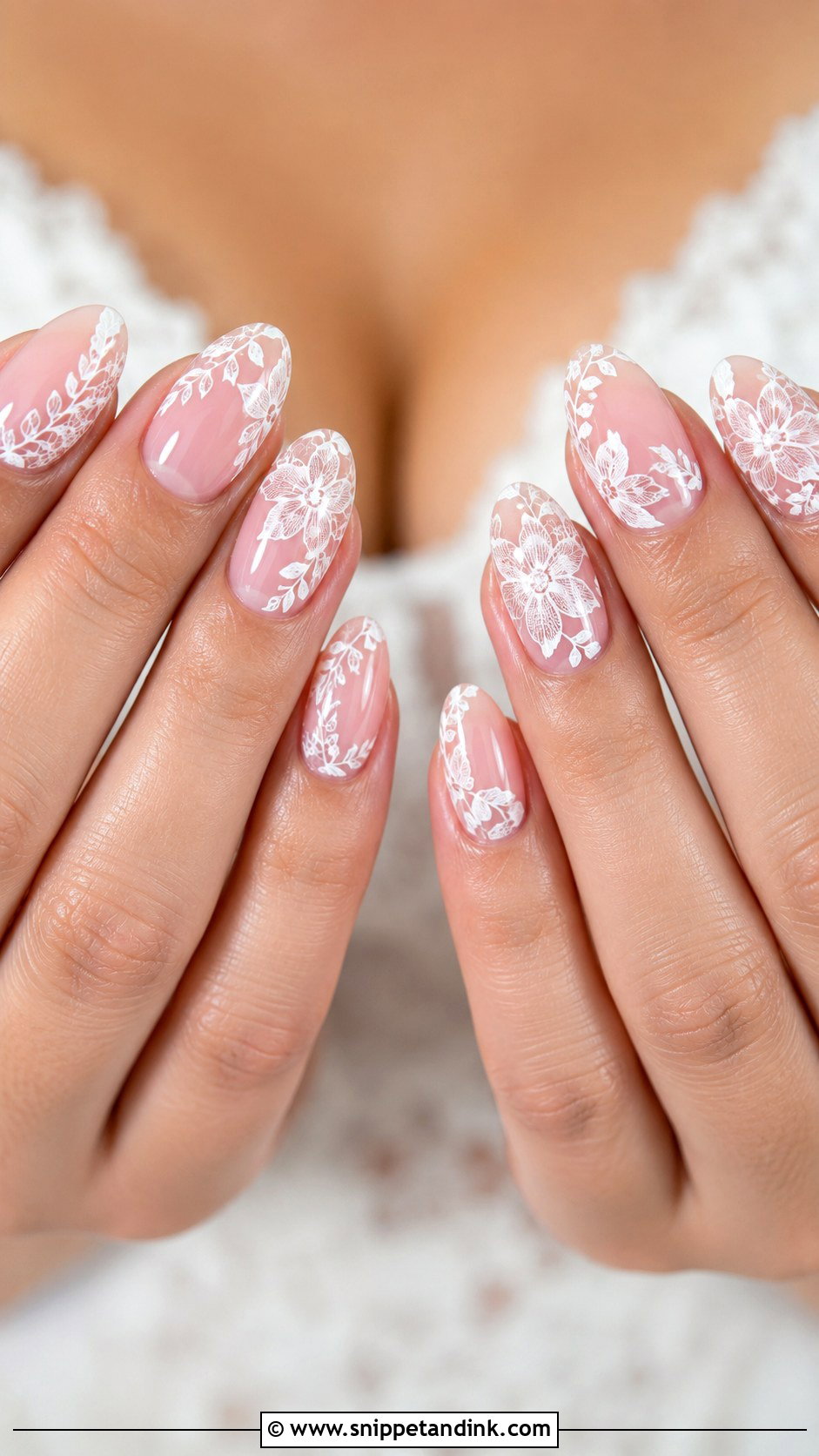
Lace florals are linework, not painting. I use a very fine liner brush and white gel to build a lace-like pattern of petals and scallops over nude or sheer pink, ideally copying the lace on your bodice or sleeves. Lace on all ten nails reads bold; accent nails look cleaner. Almond and oval soften it; short square makes it modern. Matte brings the lace forward; gloss lasts better.
8. Pearl Flower Wedding Nails
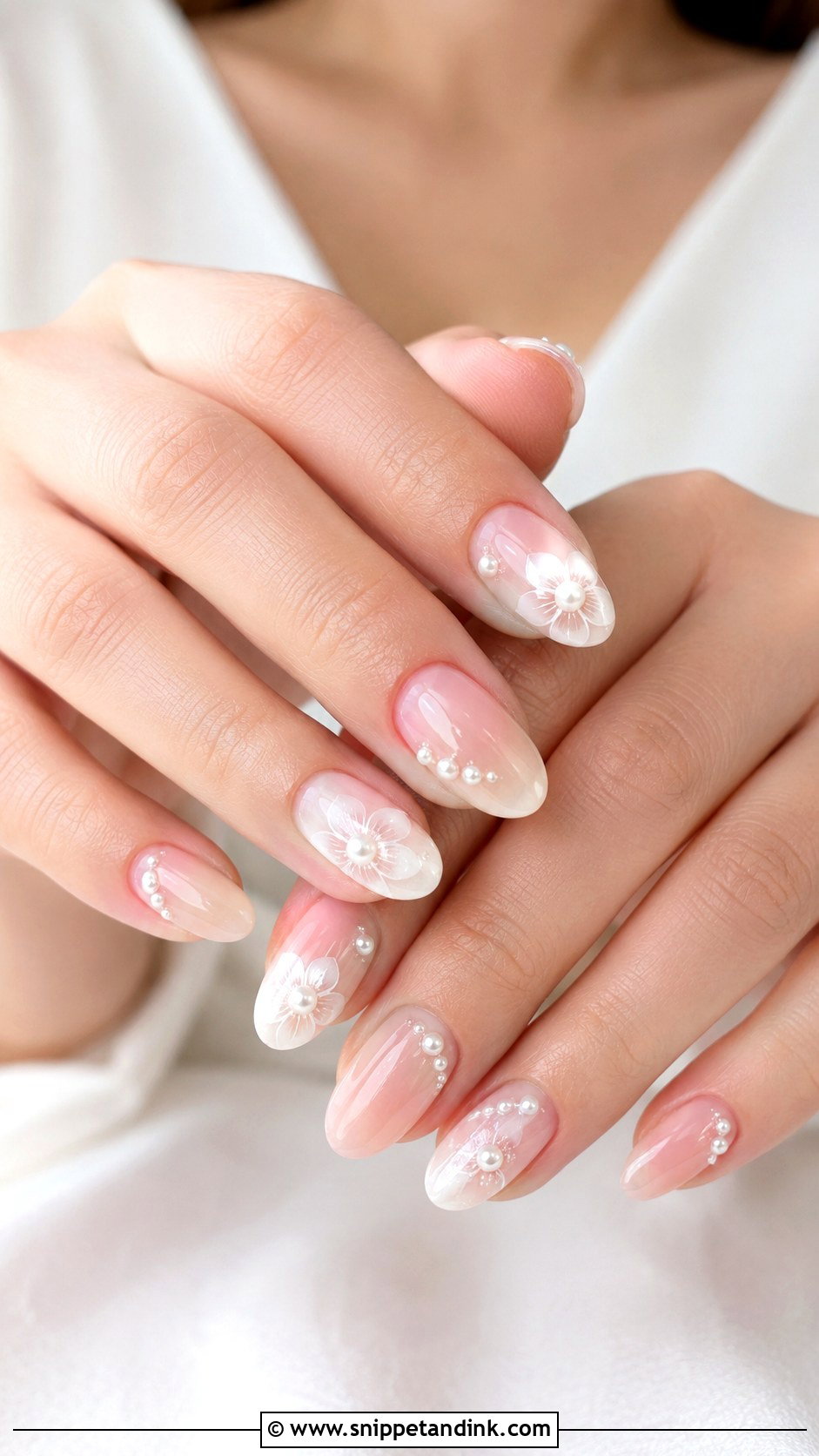
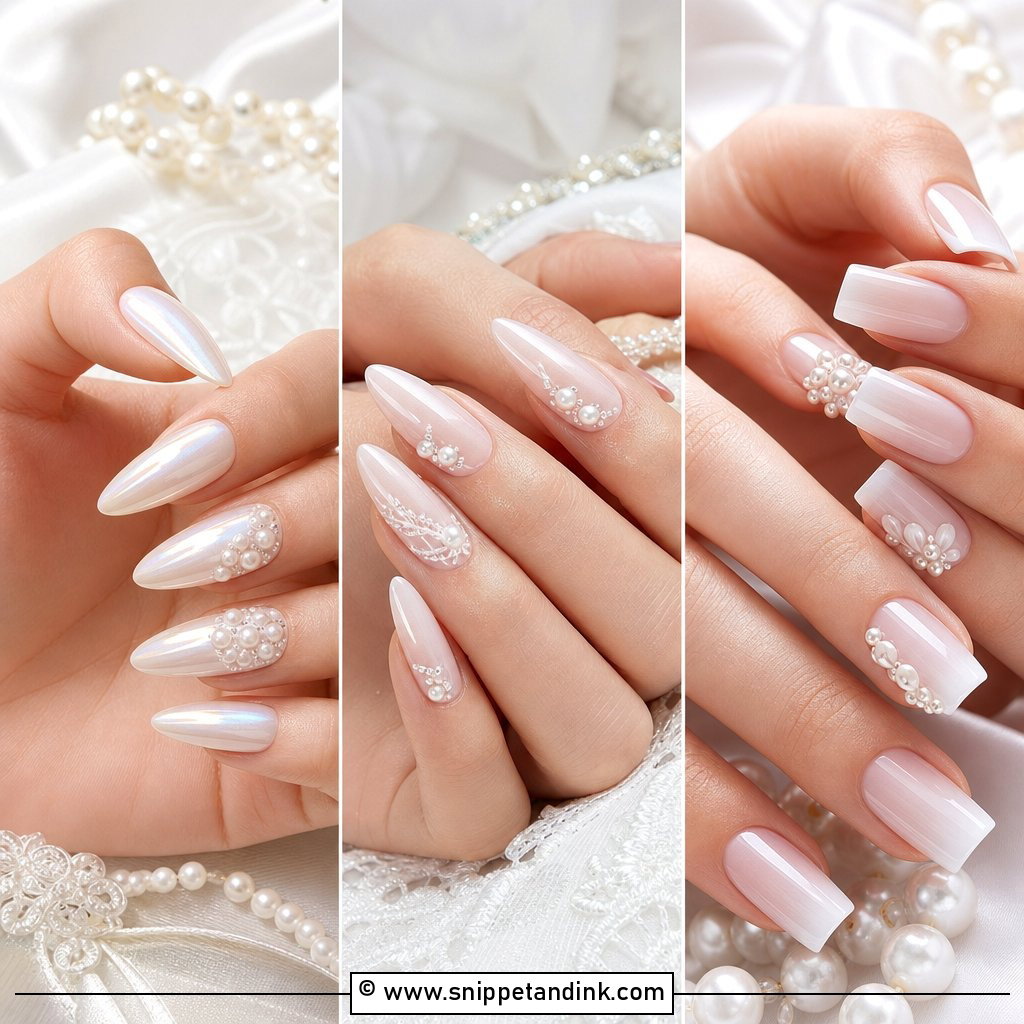
Pearls can sit at the centre of painted flowers, or several tiny pearls can form the petals themselves for a raised bloom. I cure each one into a small bead of gel so they hold. Sheer pink, milky white or nude underneath keeps it soft. If you’re wearing pearl earrings or a pearl-edged veil, this one ties everything together. Keep the pearls small and limit them to a few accent nails, with a soft French or a hint of shimmer on the rest.
9. Chrome Wedding Nails With Flowers
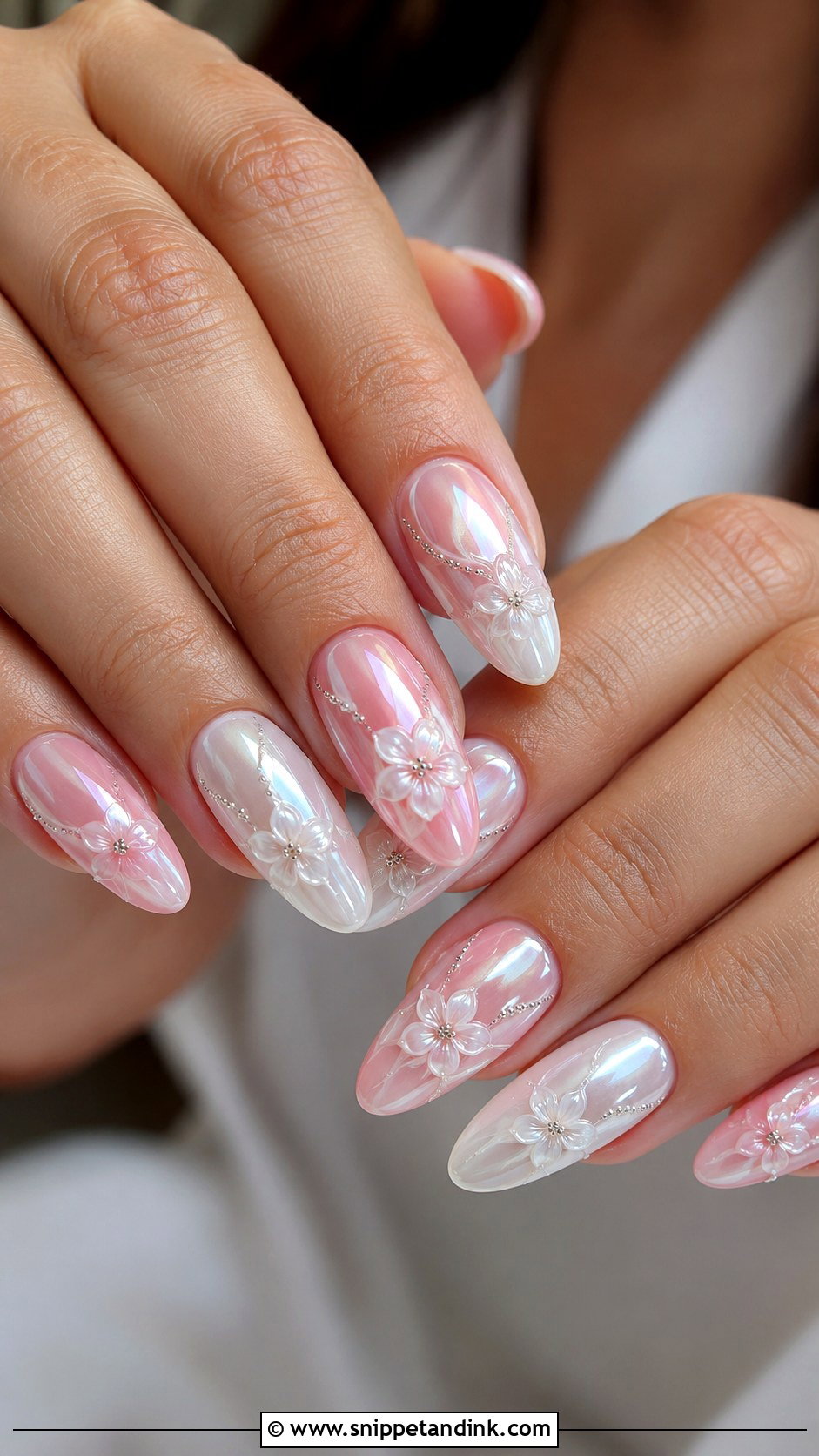
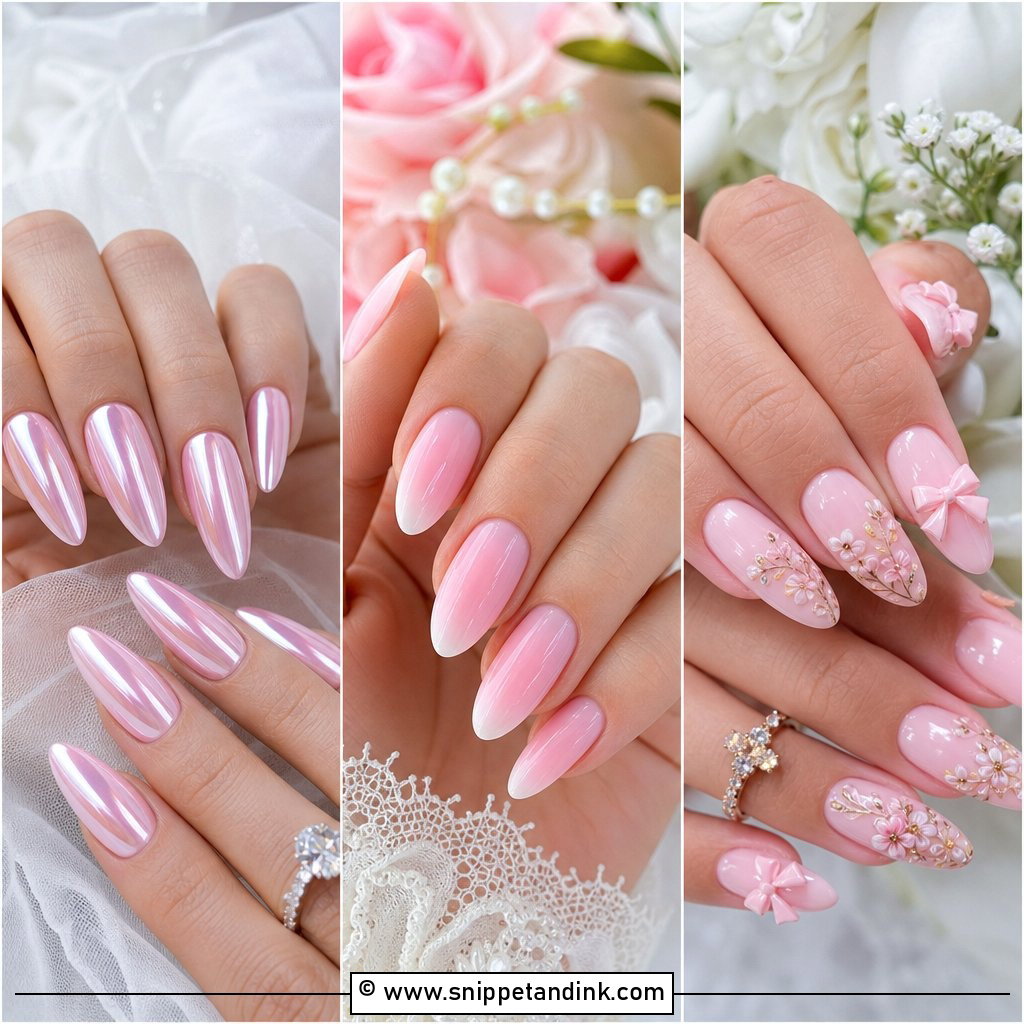
Chrome and florals in one set need a specific order: base colour, then the pearly chrome base rubbed in and sealed, then the flowers painted on top in white, blush or soft silver. Paint them underneath and the chrome fogs them. Pearl, glazed white or pale pink chrome feel bridal; mirror chrome is too harsh with florals. Flowers on the ring fingers only is a quiet version.
10. Short Wedding Nails With Flowers
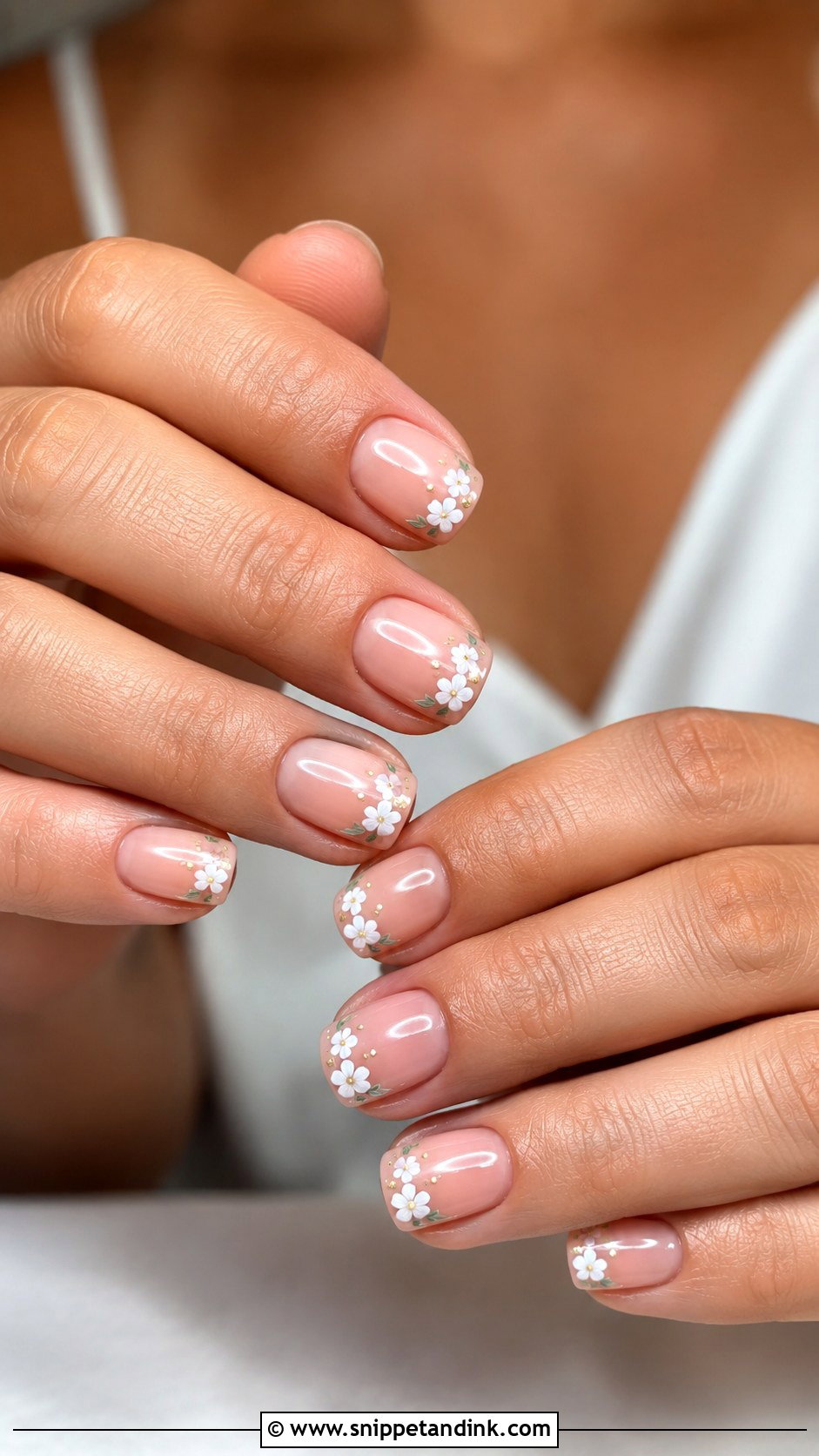
Short nails need small flowers. One tiny bloom in the corner of each nail, a floral French or two accent nails with delicate petals is plenty; anything bigger fills the nail plate and makes it look shorter. A sheer nude, soft pink or milky base helps short nails look longer. Squoval and oval are the most comfortable for a full day of hugging and holding the bouquet.
11. Almond Wedding Nails With Flowers
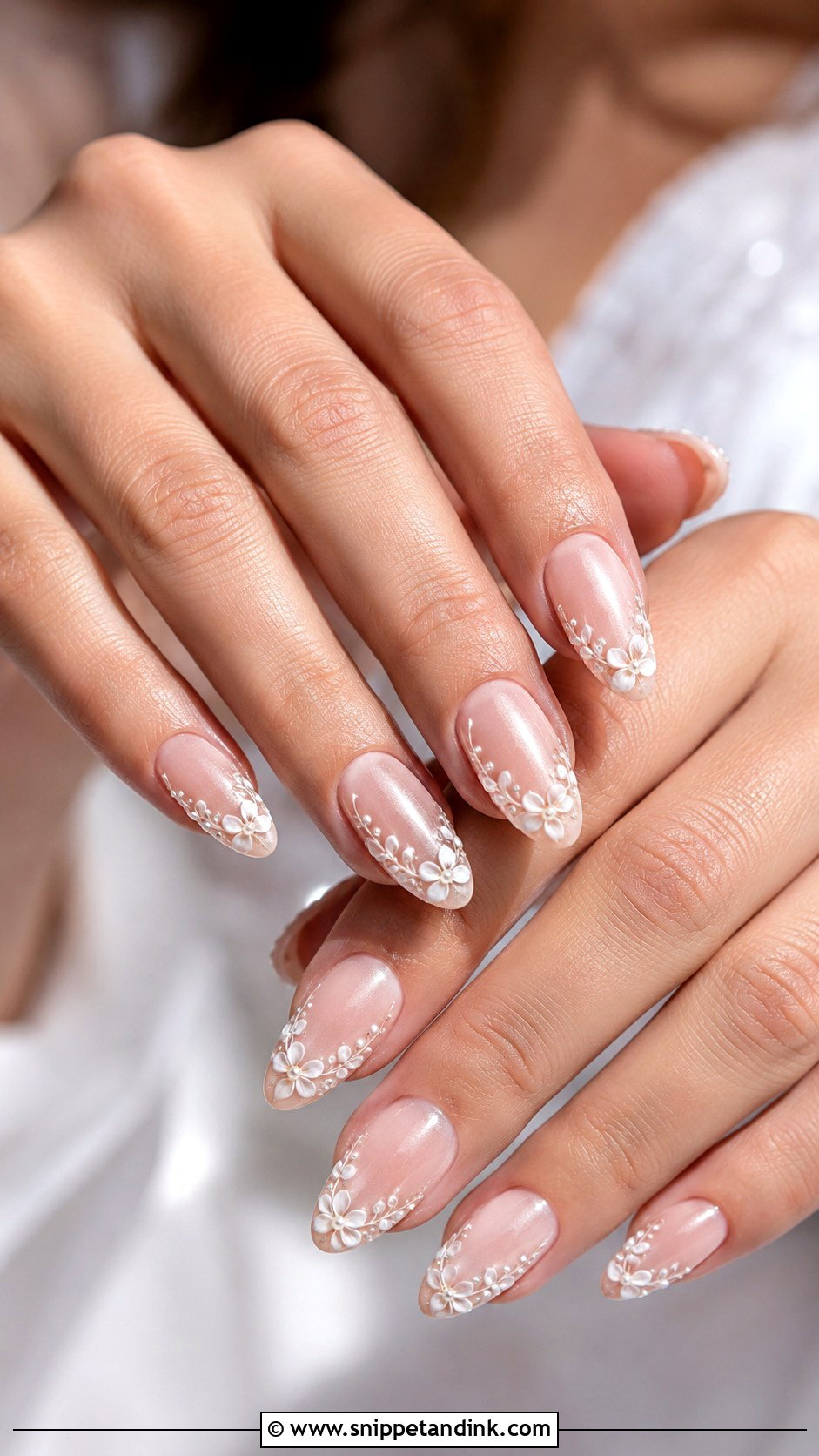
Almond wedding nails give florals a tapered frame. I like flowers running up one side of the nail so they follow the curve toward the tip, rather than centred blobs. White flowers on sheer pink, a French with tiny petals, or a milky chrome with floral accents all suit it. Leaving some bare nail between blooms keeps it modern, and the shape lengthens the finger in ring shots.
12. Square Wedding Nails With Flowers
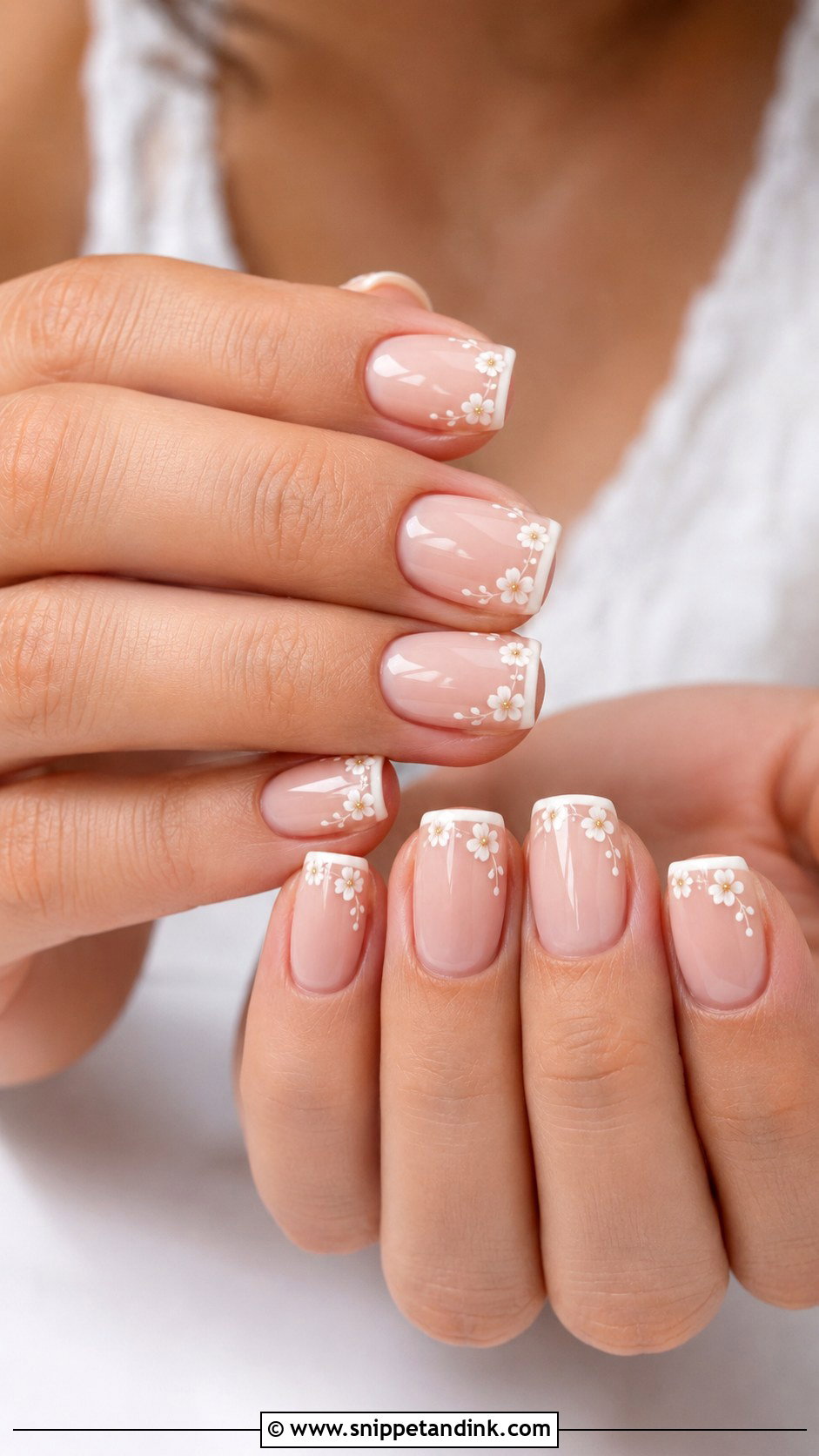
Square is neat and modern, and florals keep it soft enough for a wedding. Short and medium lengths suit it best. Sheer pink or nude with white flowers is the classic route; a soft French makes the shape look sharper. Tiny daisies, micro florals or a flower tucked into each corner feel current. Softened corners are kinder to lace and knitwear.
13. Ombre Wedding Nails With Flowers
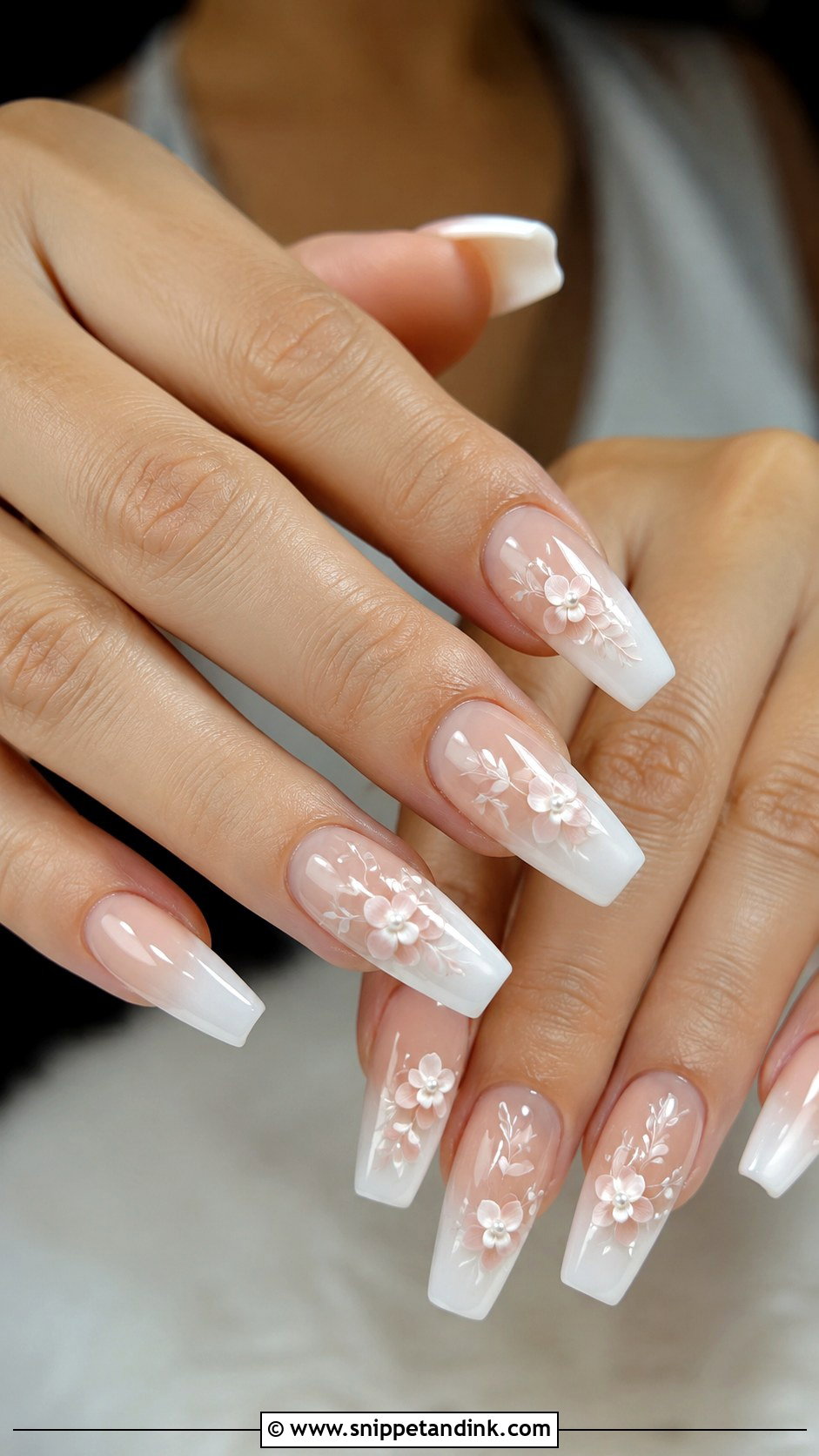
Ombre wedding nails with flowers start with a fade, nude to white, pink to milky or blush to ivory, and then get a few white or pale pink flowers painted over the lighter part. I wait until the gradient is fully cured before painting so the flowers stay crisp. The fade lengthens almond and coffin shapes. Keep the flowers light so the gradient still shows; tiny pearls or dots are optional.
14. Blue Flower Wedding Nails
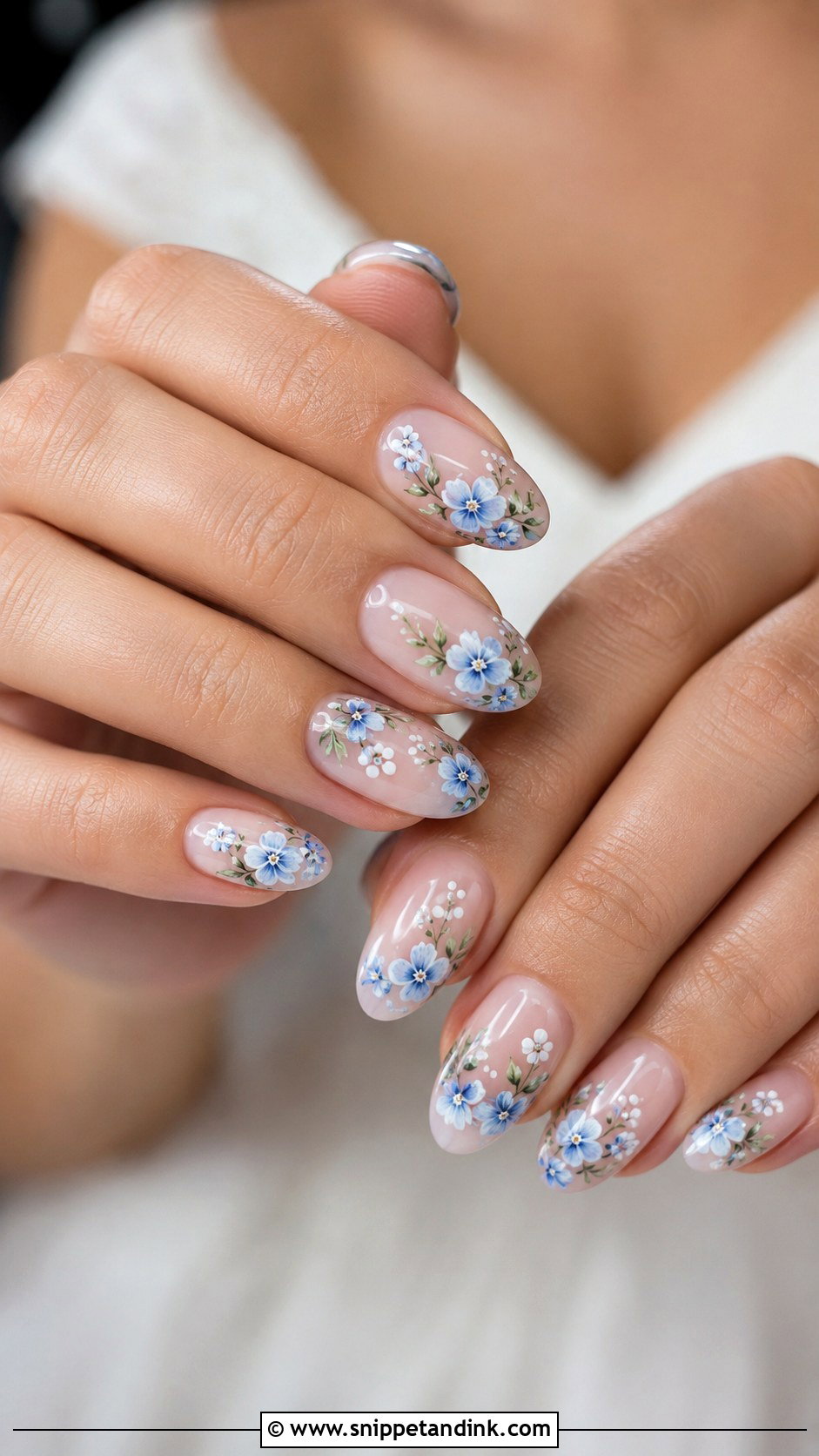
Blue flowers are an easy something blue. I keep the base sheer, nude or milky and add tiny pale blue, dusty blue or baby blue blooms as accents, sometimes with white dots and a fine green leaf. Match them to bouquet ribbons, bridesmaid dresses or a blue accessory. Spring, summer, coastal and garden weddings suit it. Almond, oval and short square all work.
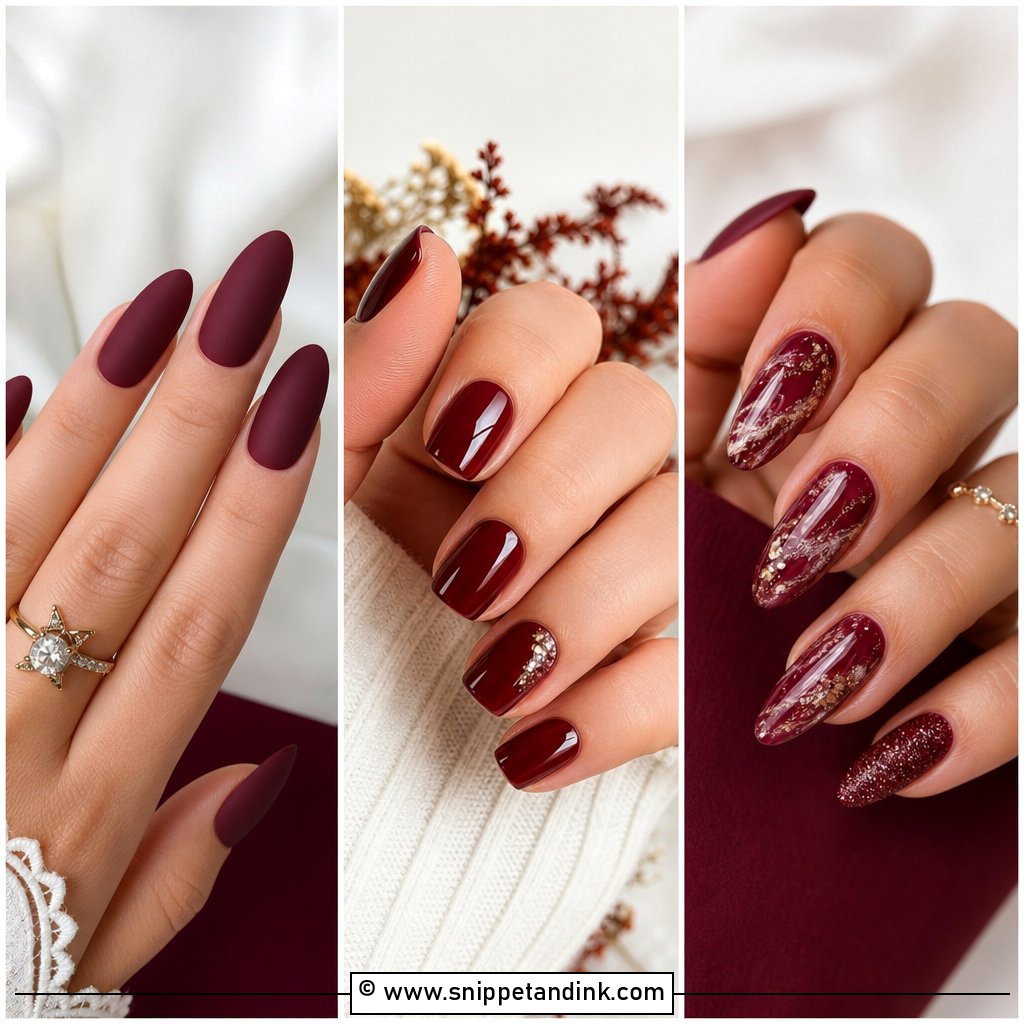
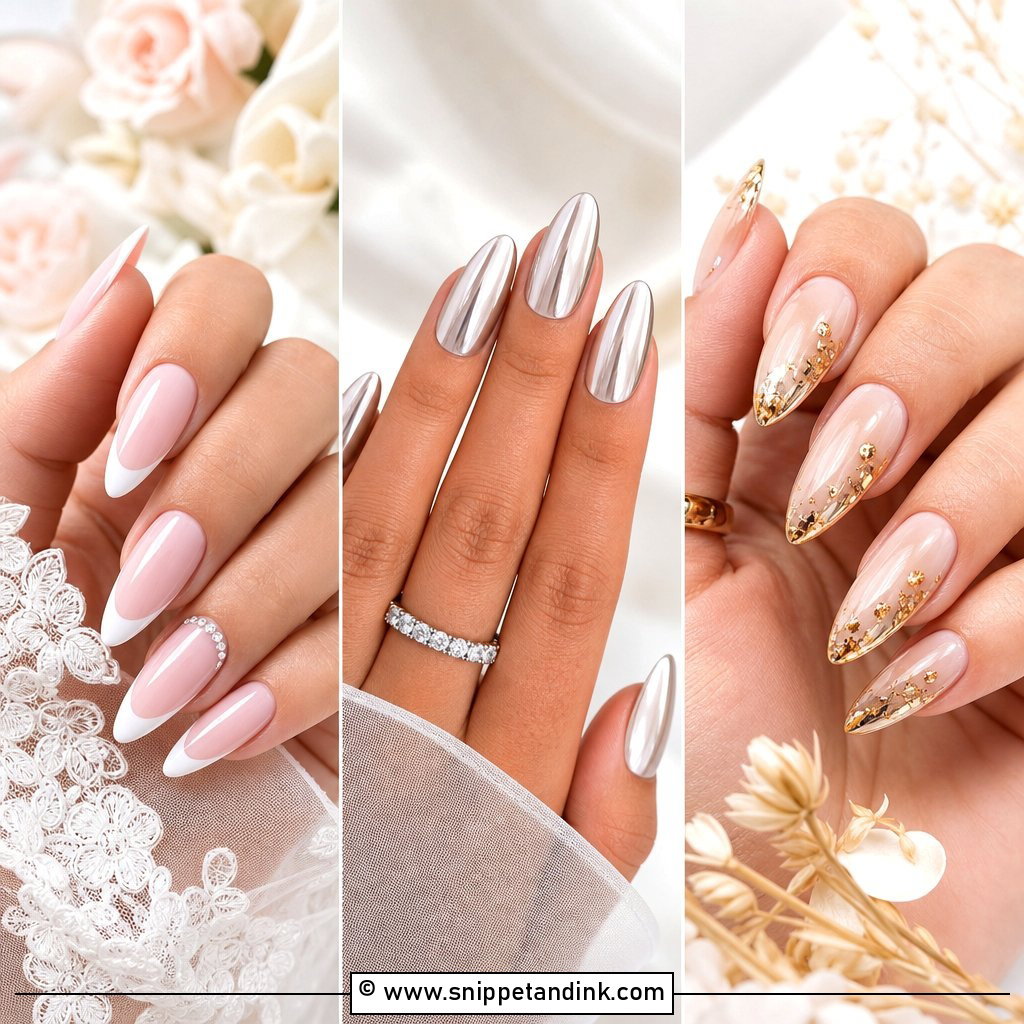
15. Gold Flower Wedding Nails
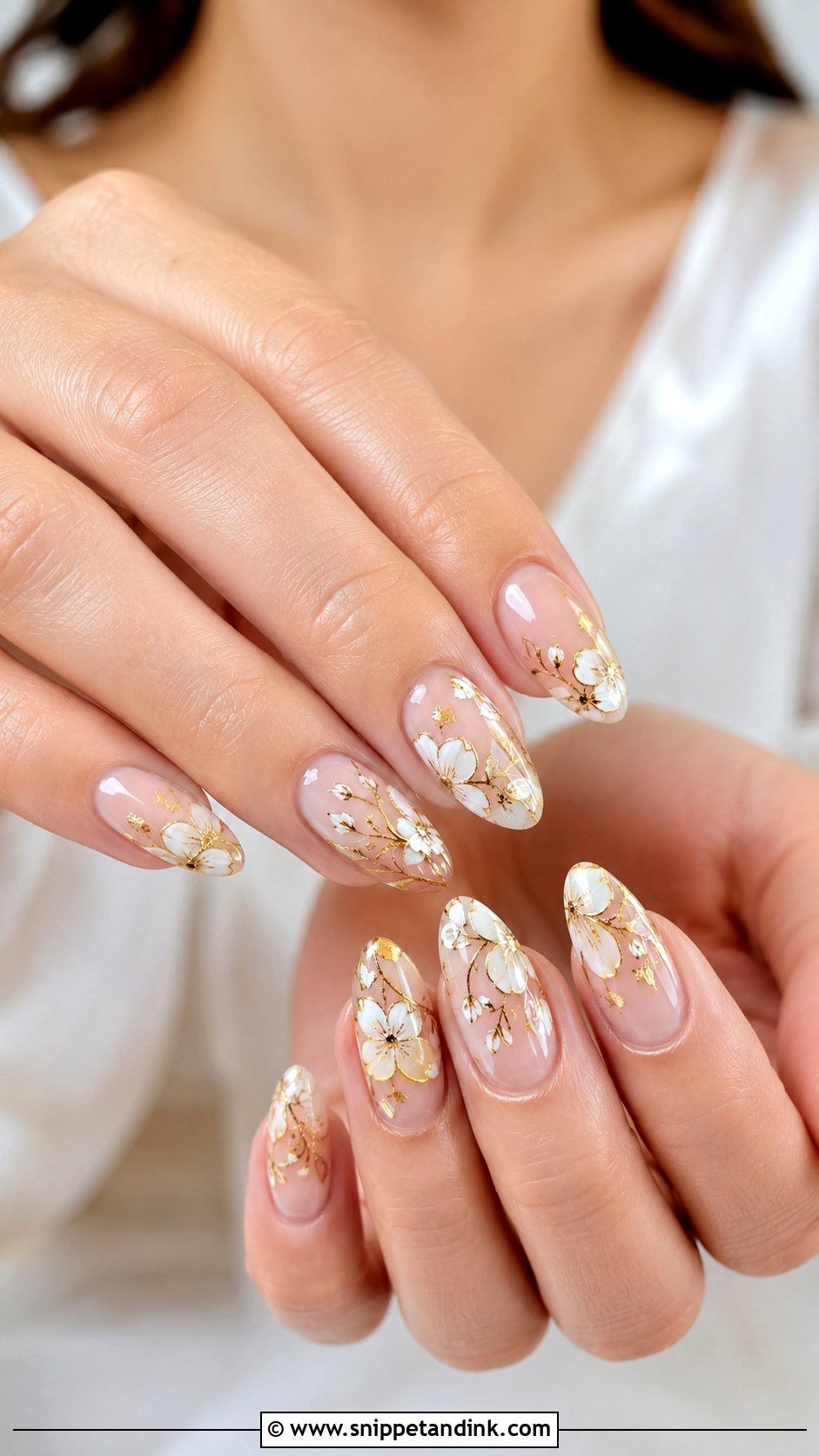
Gold florals come in three versions: fine gold outlines around white flowers, gold foil petals, or small gold centres. Over nude, ivory or blush, the gold stays elegant rather than flashy. I’d pick this if you wear yellow gold jewelry, a champagne gown or warm-toned flowers. Foil flakes near the petals add sparkle. Medium almond and oval give the linework room, and the rest of the set should be plain.
16. Daisy Wedding Nails
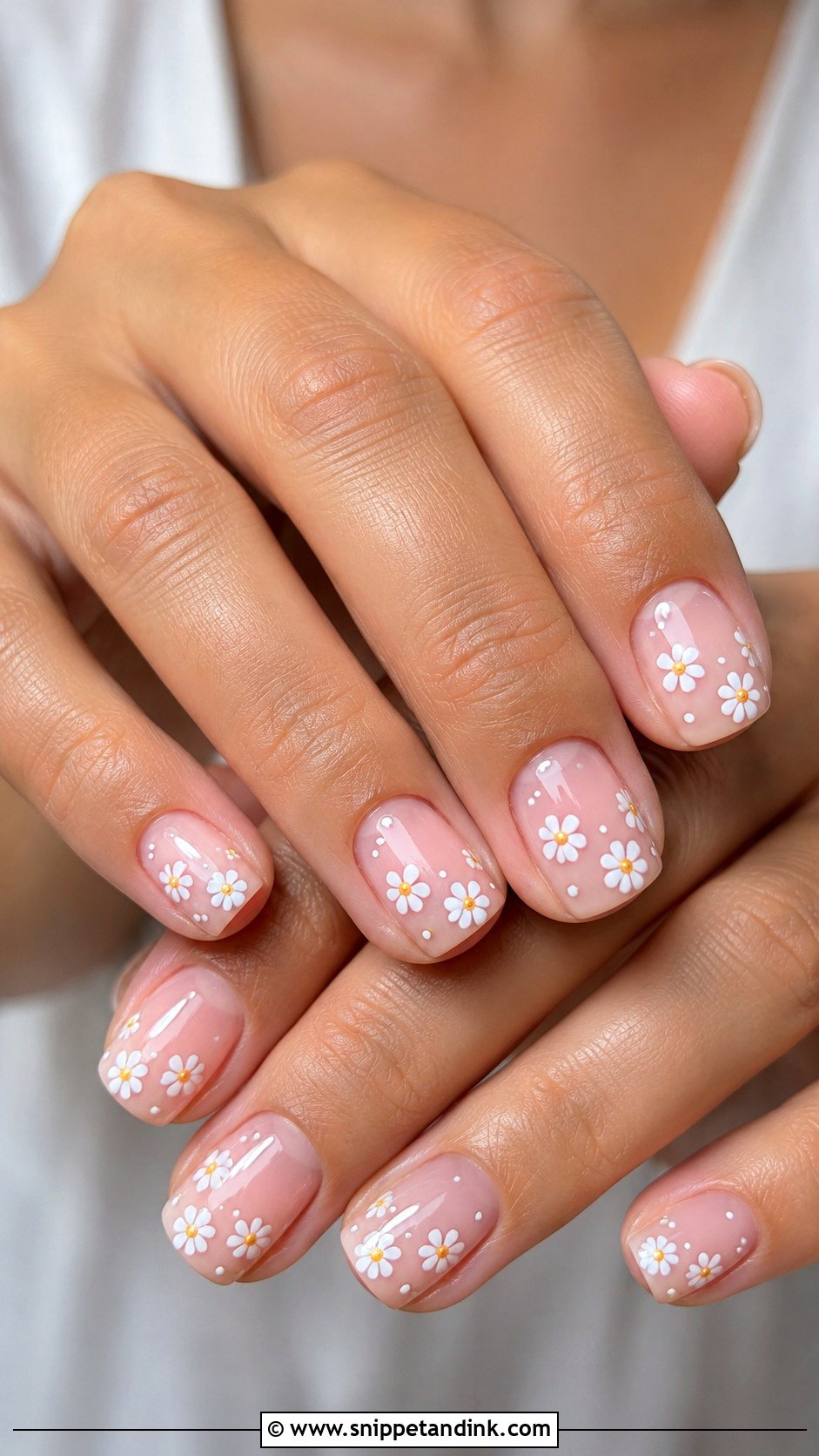
Daisies are the simplest flower to paint small, which is why they suit short nails so well: five dots of white around a centre and you’re done. Over nude, sheer pink or milky white, they read fresh and relaxed, made for casual, garden and spring weddings. Yellow centres are cheerful; pearl or white centres feel more bridal. Run them along the tips like a floral French, or scatter a few on accent nails.
17. Rose Wedding Nails
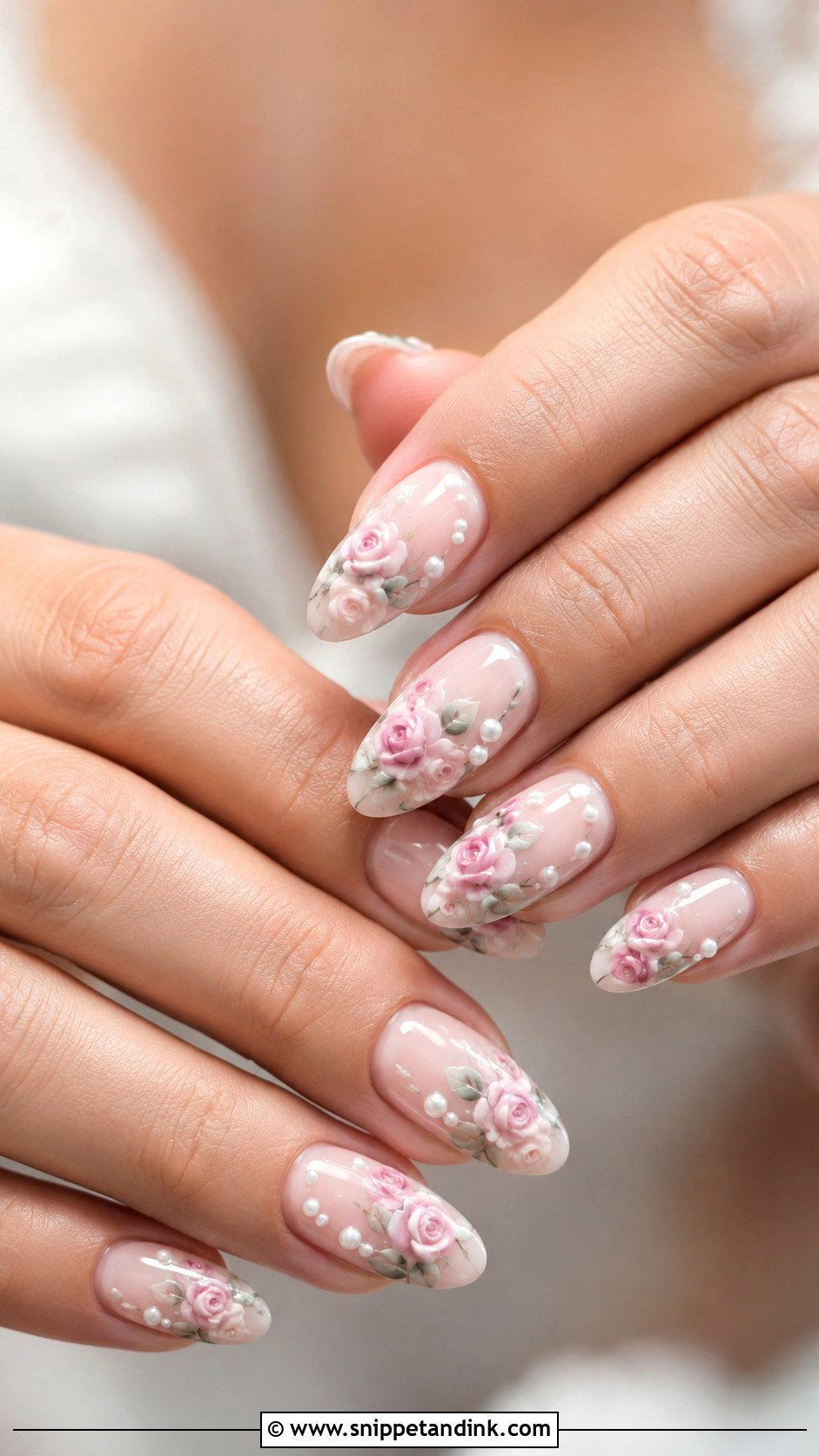
Roses can be detailed, with hand-painted shading on each petal, or abstract, a few curved strokes that suggest a rose. The abstract version looks more modern and wears better at a small size. Soft pink, white or ivory over nude, blush or milky bases suit a rose bouquet or rose decor. Keep it to one or two accent nails, or add tiny leaves, pearl dots or a thin French for more. Almond and oval echo the petals’ curves.
18. Wildflower Wedding Nails
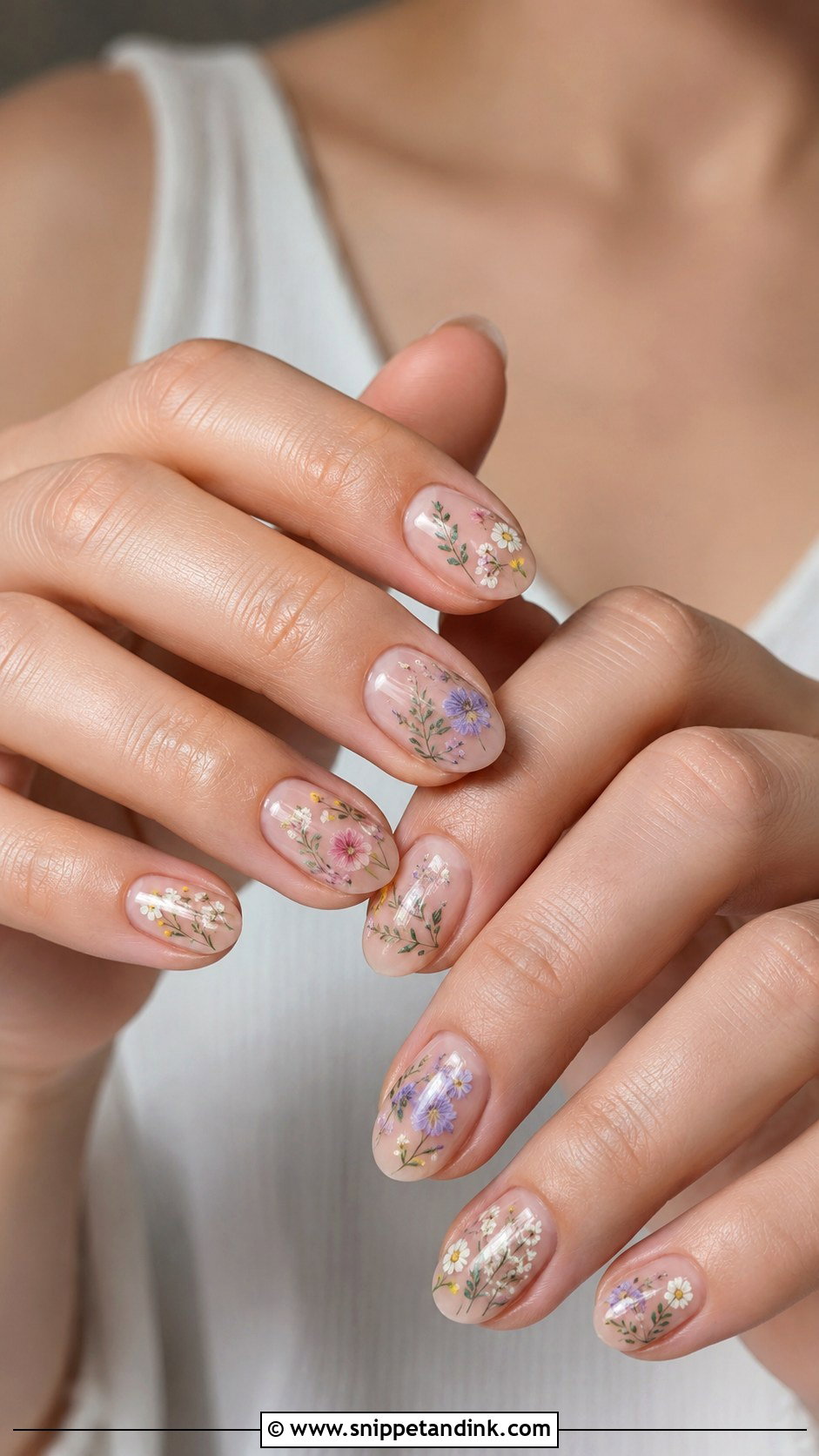
Wildflowers mix several tiny blooms, stems and leaves instead of repeating one flower, so it looks like a small meadow running across the nails. Lavender, white, pale yellow, dusty pink and sage are the shades I reach for. The base must stay sheer or neutral, and the art fine and spaced, or it turns busy fast. I love copying two or three flowers from the actual bouquet for this one. Short oval, almond and squoval suit it.
19. Matte Wedding Nails With Flowers
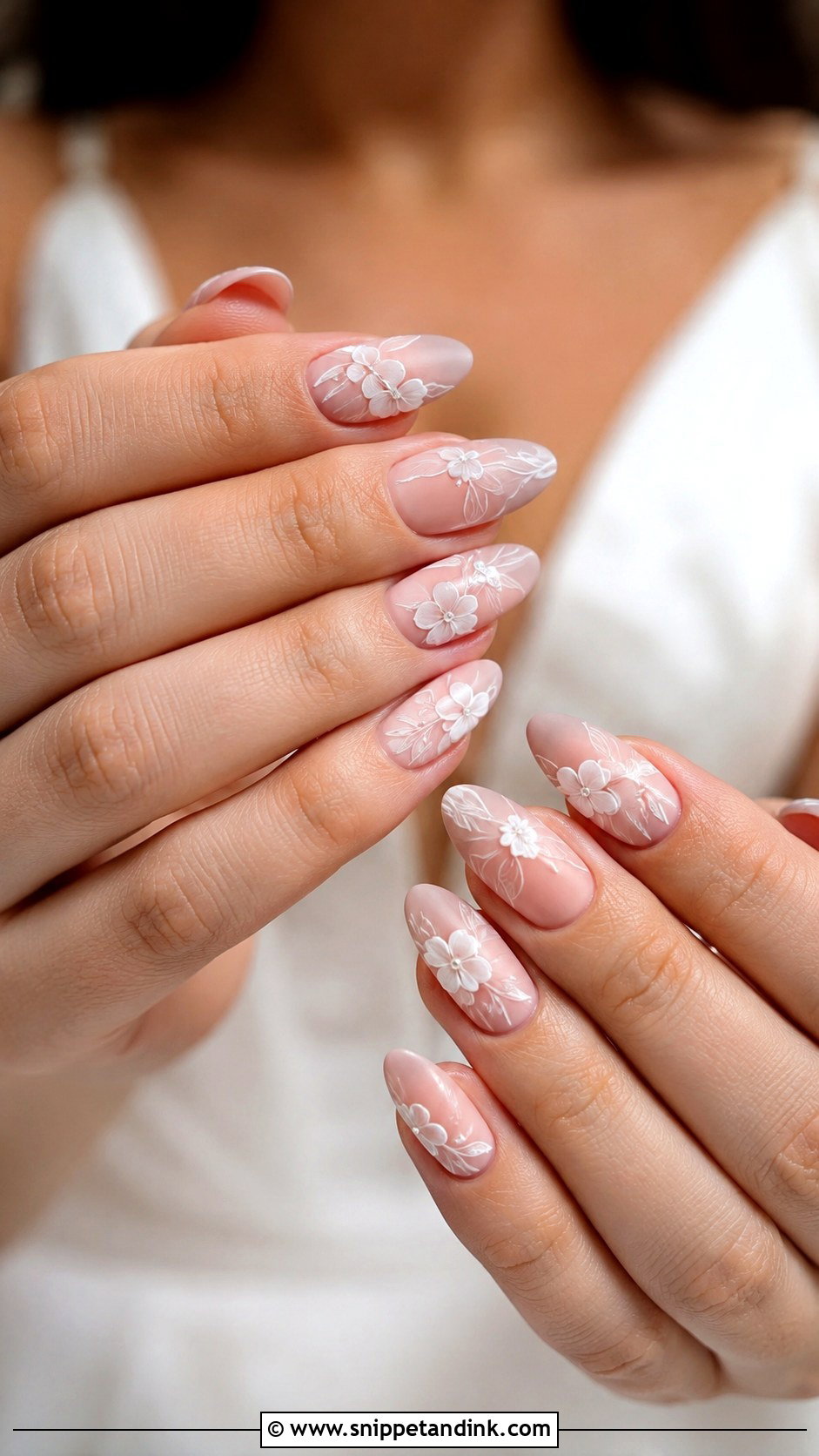
A matte base makes white flowers look crisp and almost printed. I’d use matte nude, blush or milky white, keep the flowers small, and sometimes add a single glossy petal for texture contrast. Be aware that matte top coat can pick up oils from hand cream and makeup and go patchy by evening, so I’d carry a lint-free wipe. Almond and square both work. It suits a simple, clean-lined dress.
20. Clear Wedding Nails With Flowers
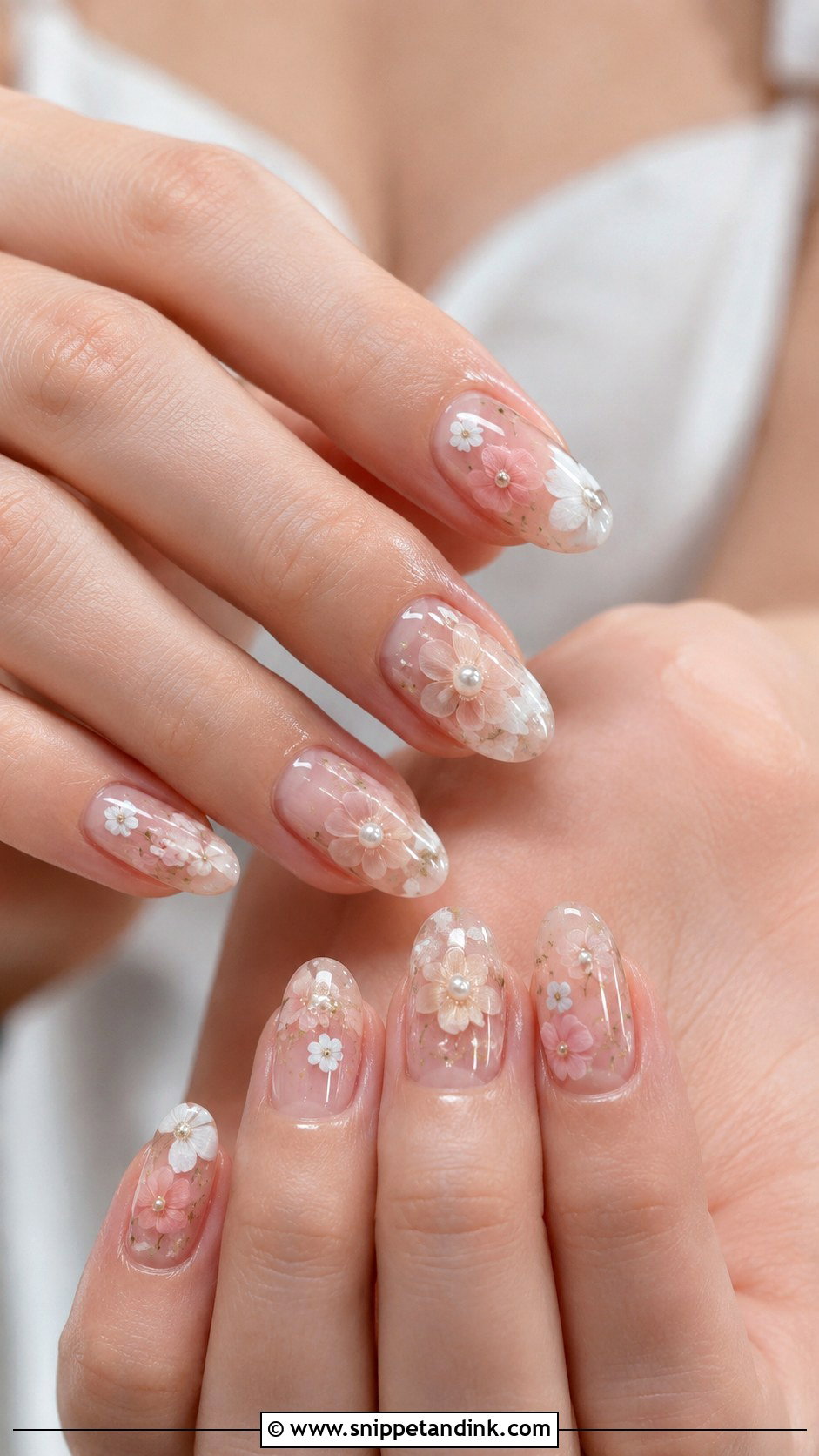
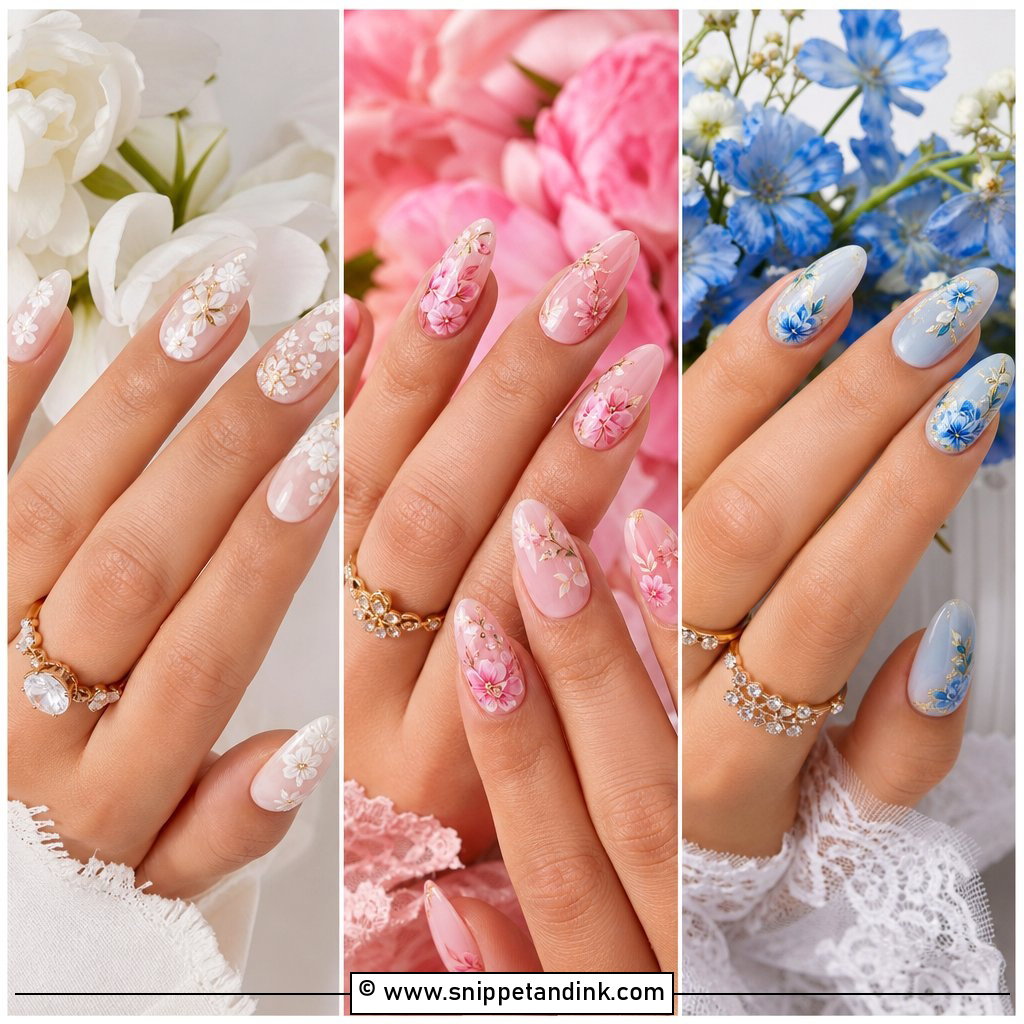
A clear or jelly base lets flowers look like they’re floating. White flowers, soft pink petals or tiny dried blooms all work, and since the base doesn’t compete with anything, it goes with any dress fabric, jewelry or bouquet colour. A thin white outline, small pearl centres or a glazed finish adds polish. Clear gel shows every flaw in the natural nail underneath, so the prep needs to be careful. Medium almond and oval show it off; short nails keep it minimal.
Raised Petals and Pressed Blooms After a Long Day of Hugs
Flat painted flowers under a top coat last as long as the gel itself. Texture is where things can go wrong, so here’s how I’d think about it.
3D flowers
Sculpted petals stand off the nail, which means they can catch on lace, tulle, hair and knitwear. I keep them low and rounded rather than spiky, and place them in the centre of the nail rather than near the free edge, where most knocks happen. If your veil is long or your dress has a lot of lace, I’d limit raised flowers to the ring fingers.
Pressed and dried petals
Real petals are fragile and slightly uneven, so they need a full layer of gel over and around them. If you can feel an edge with your fingertip when you leave, ask for another layer; that edge is where water gets in and the petal starts to lift. Avoid soaking your hands in a bath for a long time the night before the wedding.
Either way, I’d book the appointment a day or two before the wedding rather than a week, so the art is fresh in photos, and keep a tiny pot of nail glue in your bag in case a pearl or crystal pops off.
A Few Small Flowers Go Further Than Ten Big Ones
If I had to give one piece of advice about floral nails, it’s to choose the base first and add flowers last, in fewer numbers than you planned. White floral French tips, nude nails with white flowers and milky florals are the classics. 3D blooms, pearls and pressed petals add texture; blue flowers, wildflowers and roses add colour. Whichever you choose, I’d tie it to your dress, bouquet and jewelry, and keep enough bare nail around each flower that it still reads clearly in a close-up.
You'll Like These Ideas:


Leave a Reply