
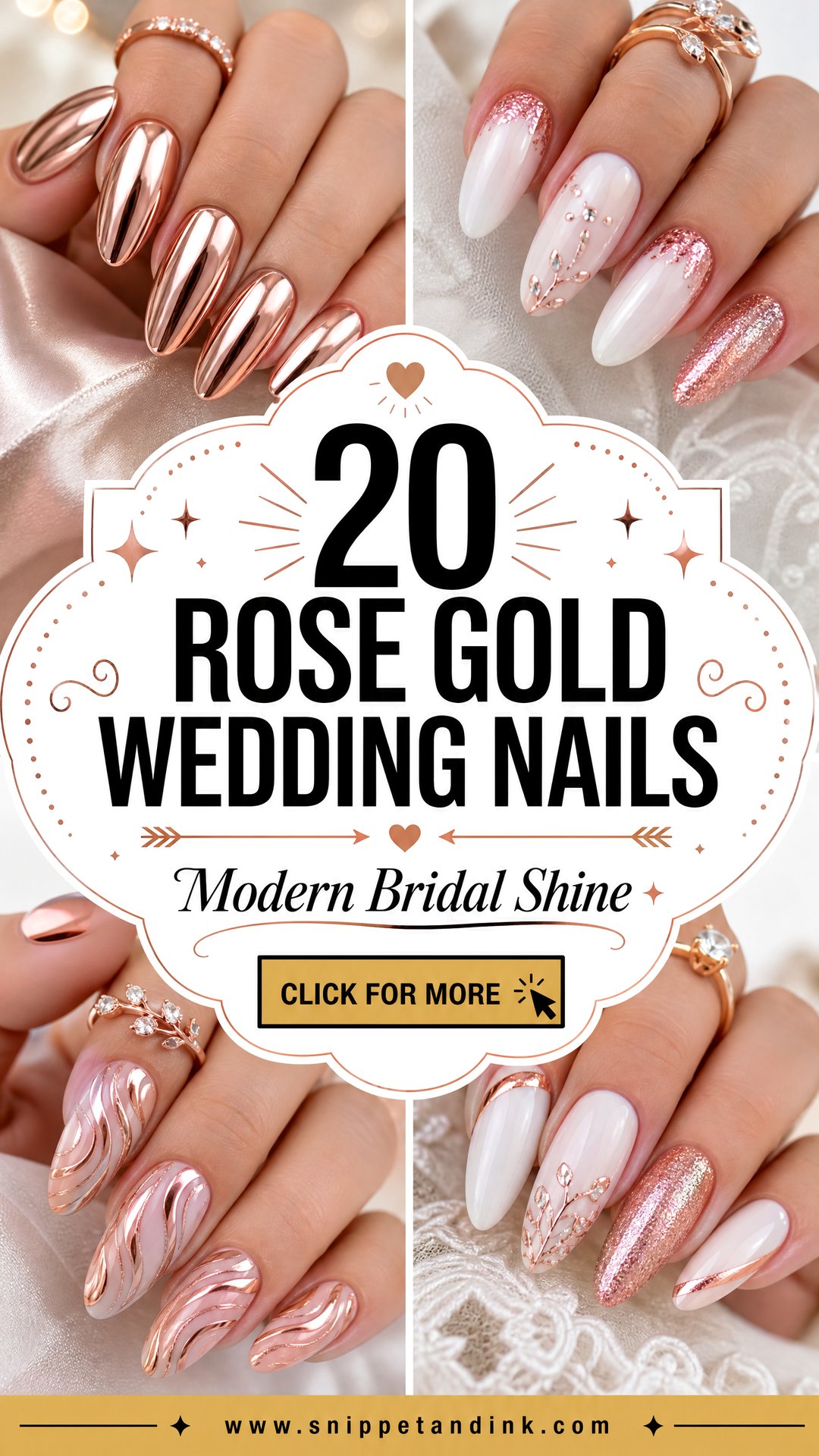
Rose gold is the metallic I suggest most often to brides who are nervous about shine. It sits between soft pink, nude and gold, so it reads warm rather than flashy, and it sits naturally beside ivory dresses, blush bouquets, champagne details and rose gold jewelry. It also suits a wide range of skin tones. On a quiet set it shows up as a thin French tip, a chrome wash or a faint shimmer; on a louder one it becomes glitter, foil, pearls, marble or a full metallic nail. The twenty sets below run from barely-there to detailed, with notes on how each one is built and how it wears.
What a Metallic Set Needs Underneath to Last the Weekend
Rose gold detail is only as durable as what it sits on. Regular polish chips within a couple of days, and on a metallic set every chip shows because the shine stops abruptly. For a wedding, gel is what I recommend. Chrome powder and most foils need a cured gel layer to grip anyway, so they aren’t really an option on regular polish.
If your own nails are thin or peel, ask for a structured gel overlay first. It adds a little strength so a long almond or coffin shape doesn’t crack the week of the wedding. Press-ons are worth considering too: a custom set can be made in advance, fitted at a trial and glued on the night before, which suits brides who can’t sit for a long appointment close to the date.
A simple timeline
- Six to eight weeks out: stop cutting cuticles and start cuticle oil every night.
- Three to four weeks out: book a trial and test the exact rose gold shade with your ring on.
- One to two days before: the real appointment. Gel won’t have had time to show any regrowth.
- The morning of: oil the cuticles once more, then hands off until photos.
1. Rose Gold French Tip Wedding Nails
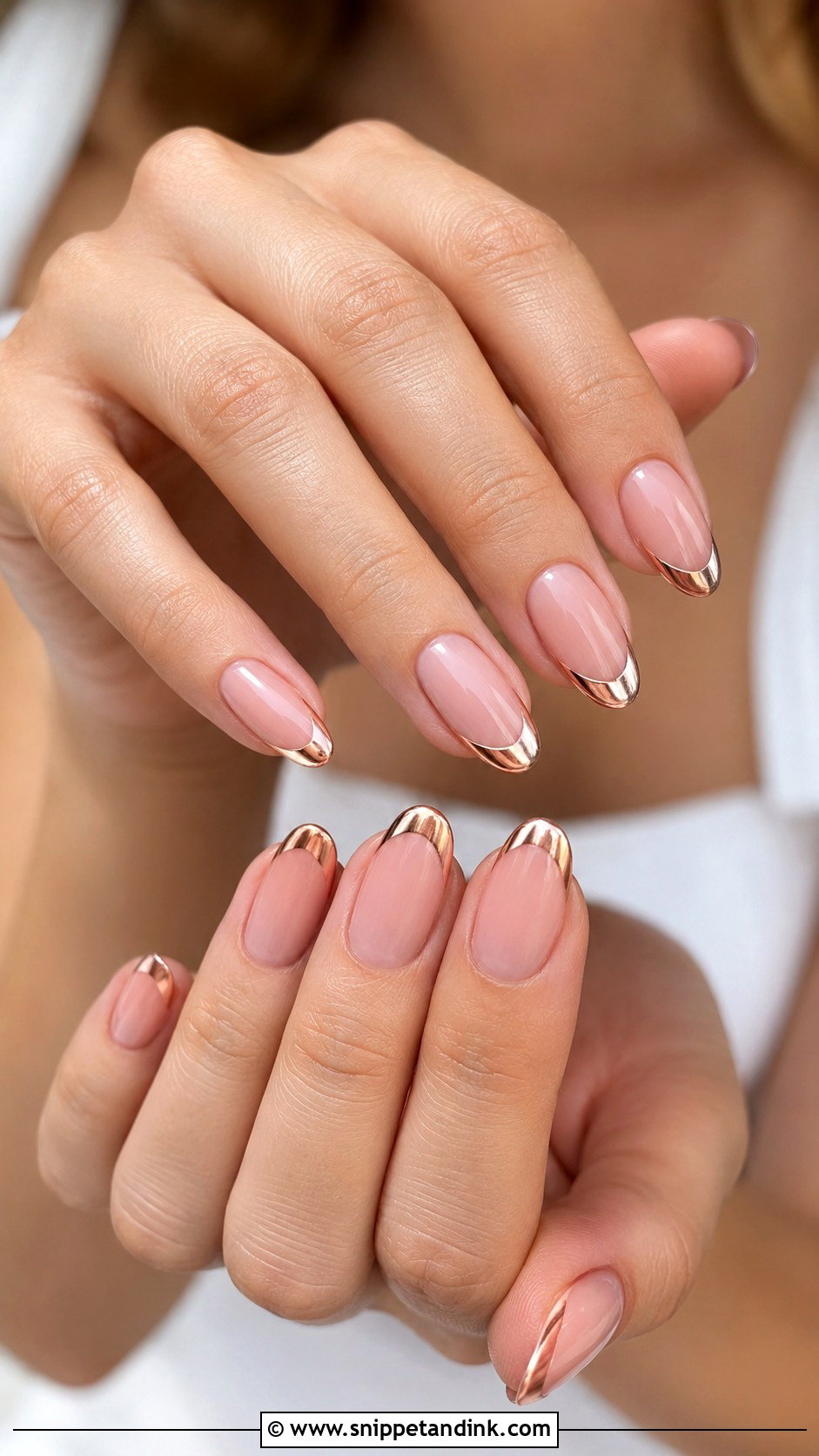
A metallic French tip swaps the bright white edge for a warmer line that glows in close-up ring photos. I paint it over a sheer pink or nude base, and the trick with metallic tips is capping the free edge; skip that and the shine wears off the very end within days. Almond, oval and squoval shapes suit it because the smile line follows the nail’s own curve. Go micro-thin for a minimal look, or a little deeper if you want the tip to register in photos taken from across the room.
2. Rose Gold Chrome Wedding Nails
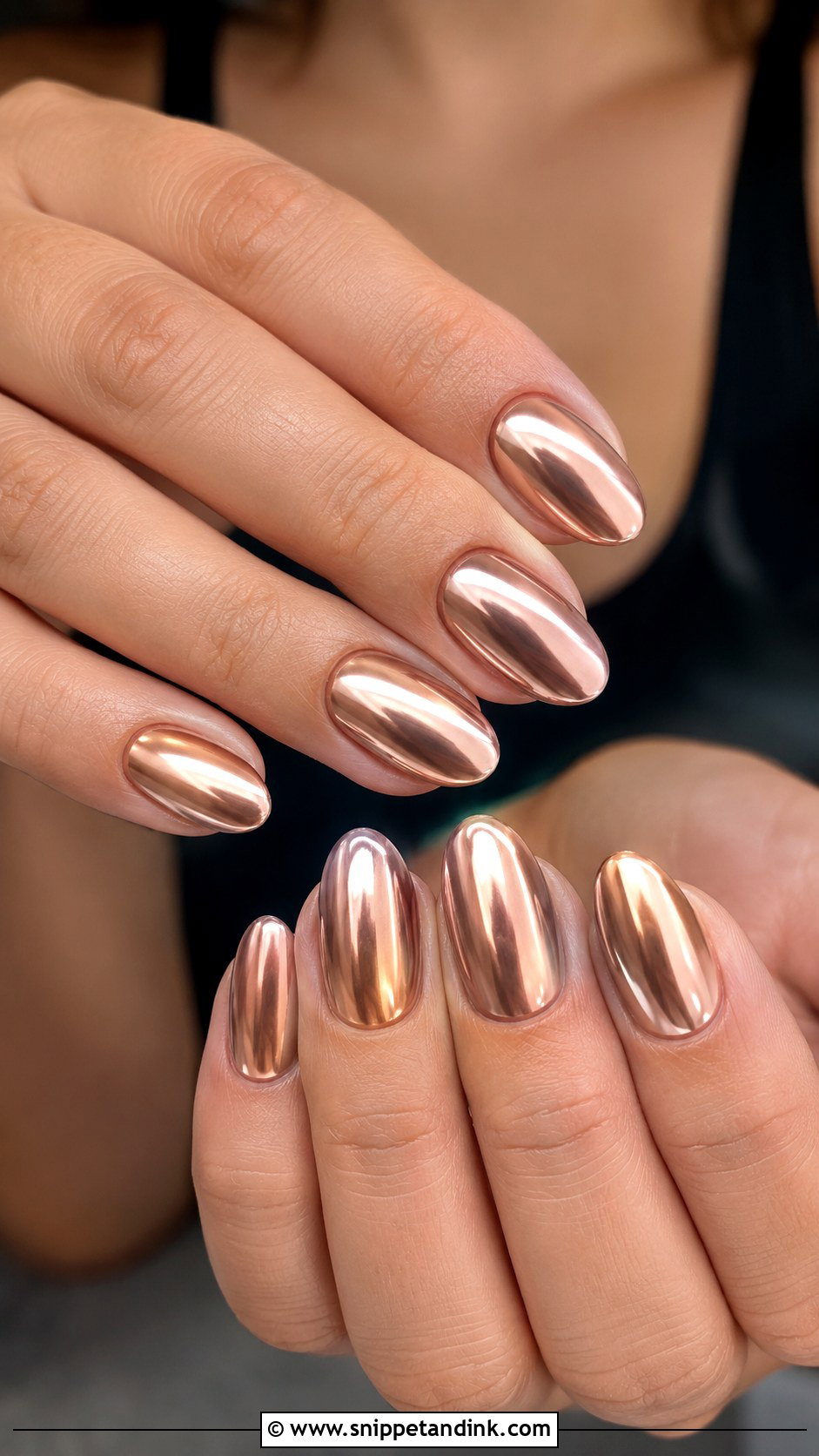
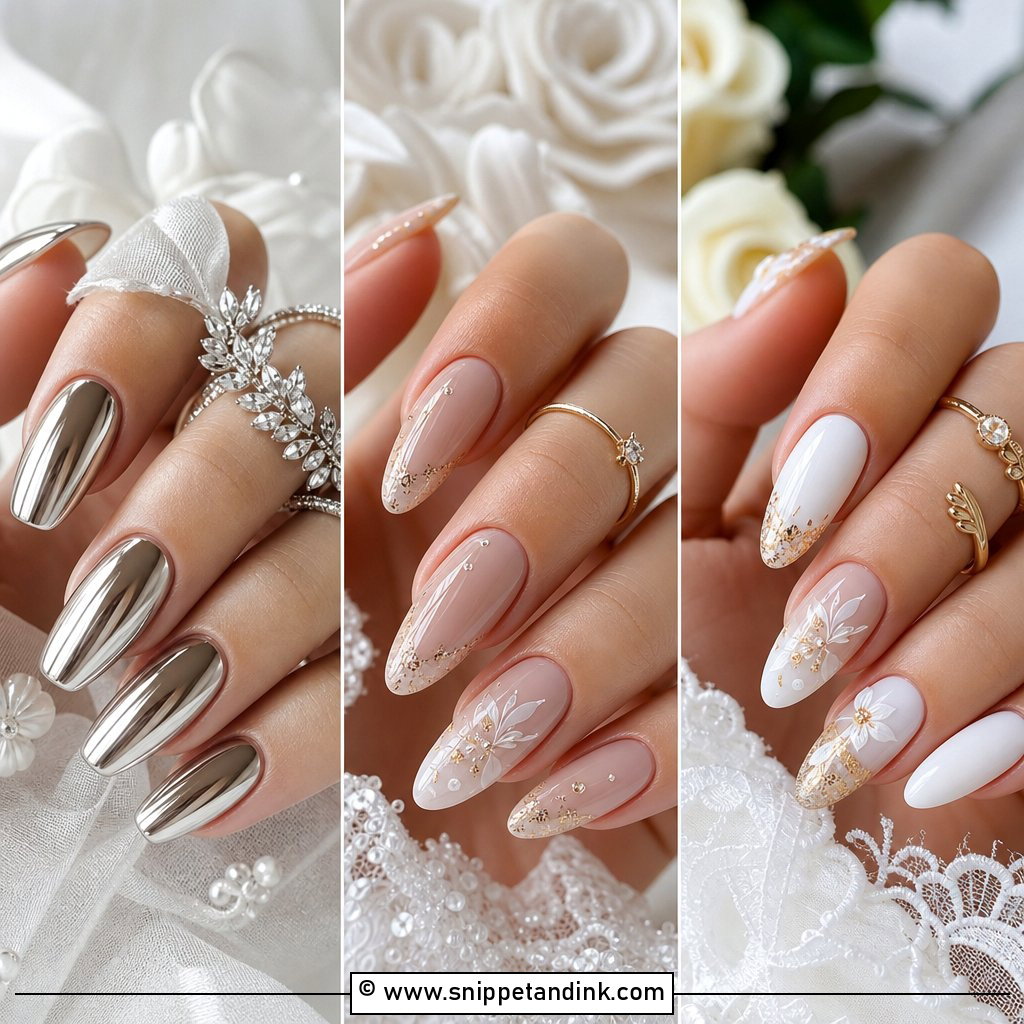
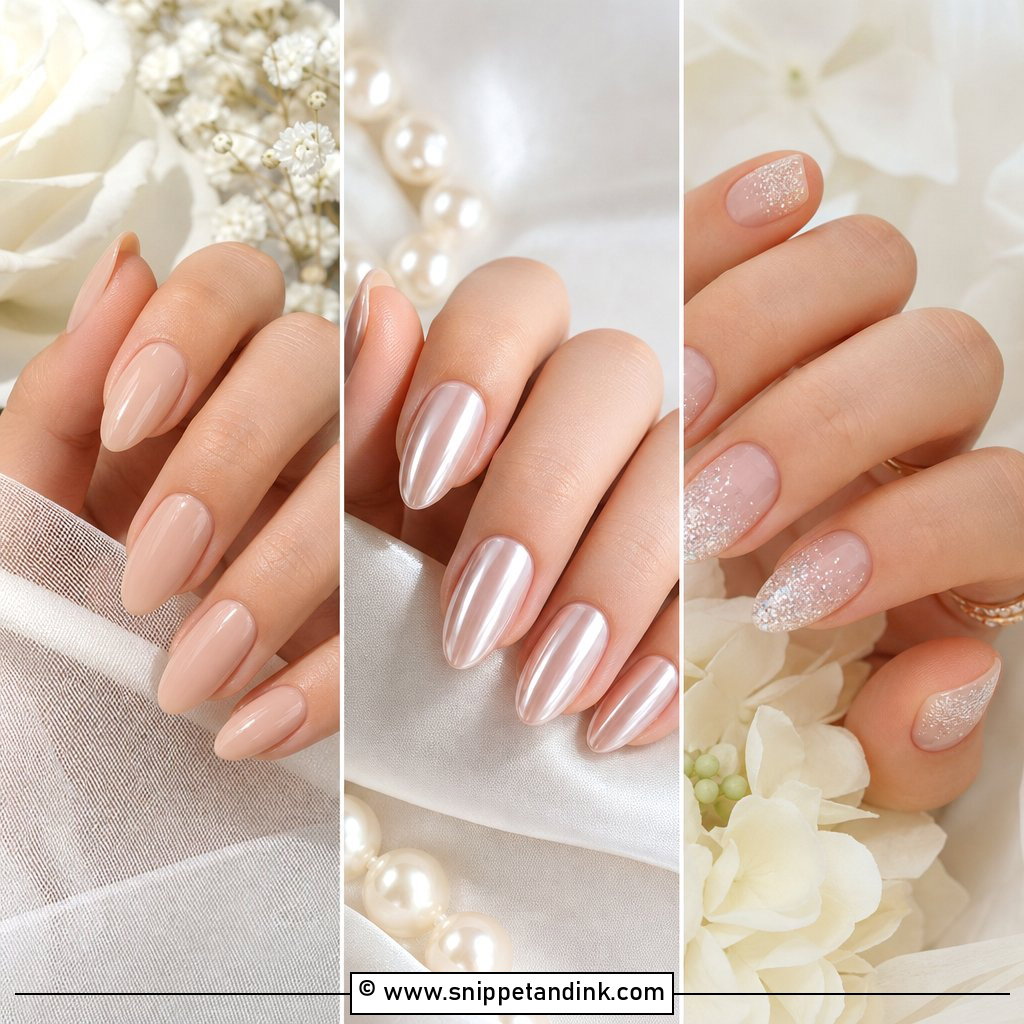
Chrome is a powder, not a polish. I rub it onto a cured no-wipe top coat until it turns mirror-smooth, then seal it with another top coat, which is what keeps it glassy. A sheer blush base underneath keeps rose gold chrome soft, while a warmer nude makes it read closer to champagne. It suits satin, silk and minimalist gowns, since it adds shine without pattern. Keep the shape simple, short oval or medium almond. Its one weakness is the edges: if they aren’t wrapped with top coat, chrome can lift and flake at the tips within a few days.
3. Rose Gold Glitter Ombre Wedding Nails
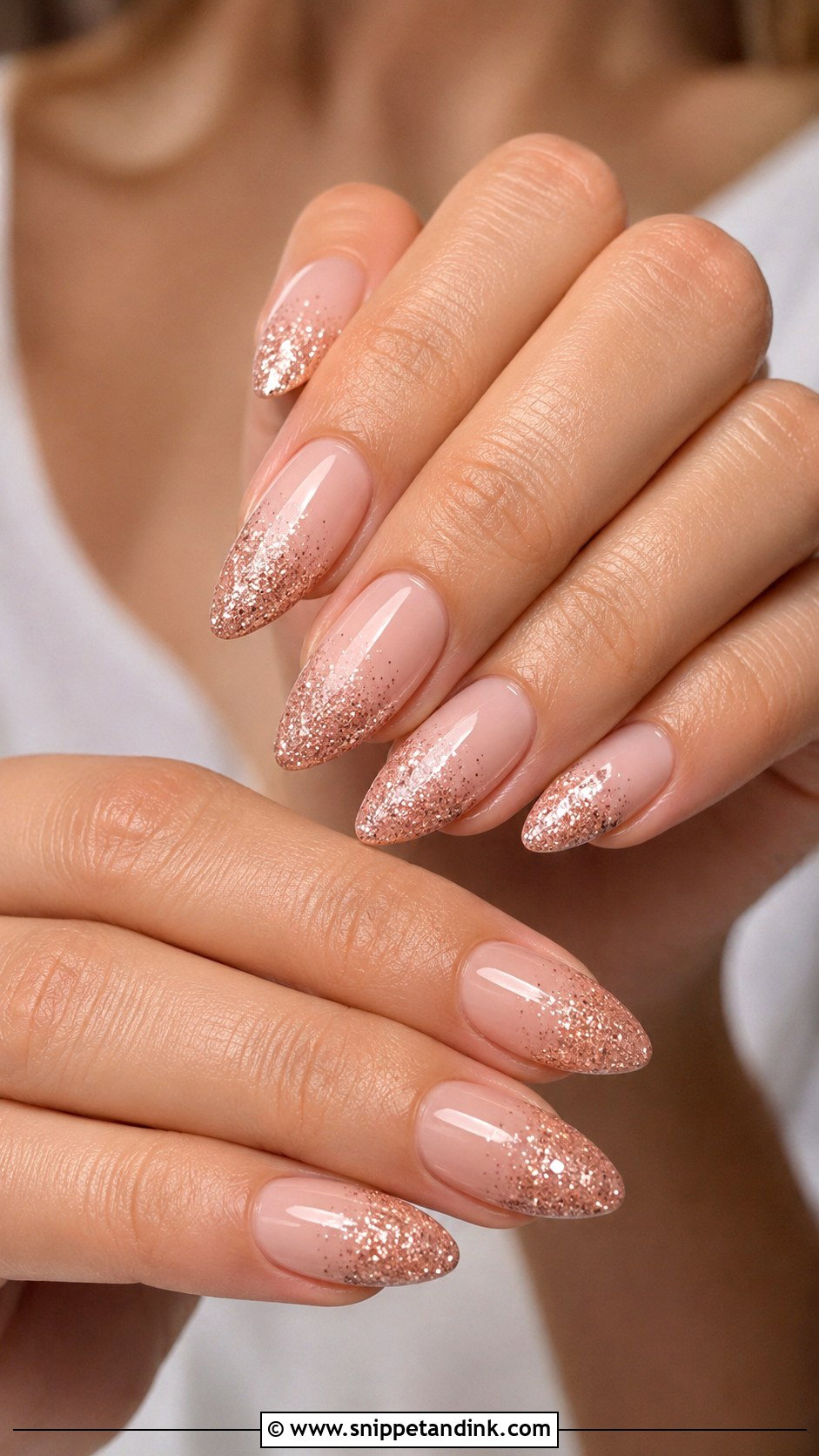
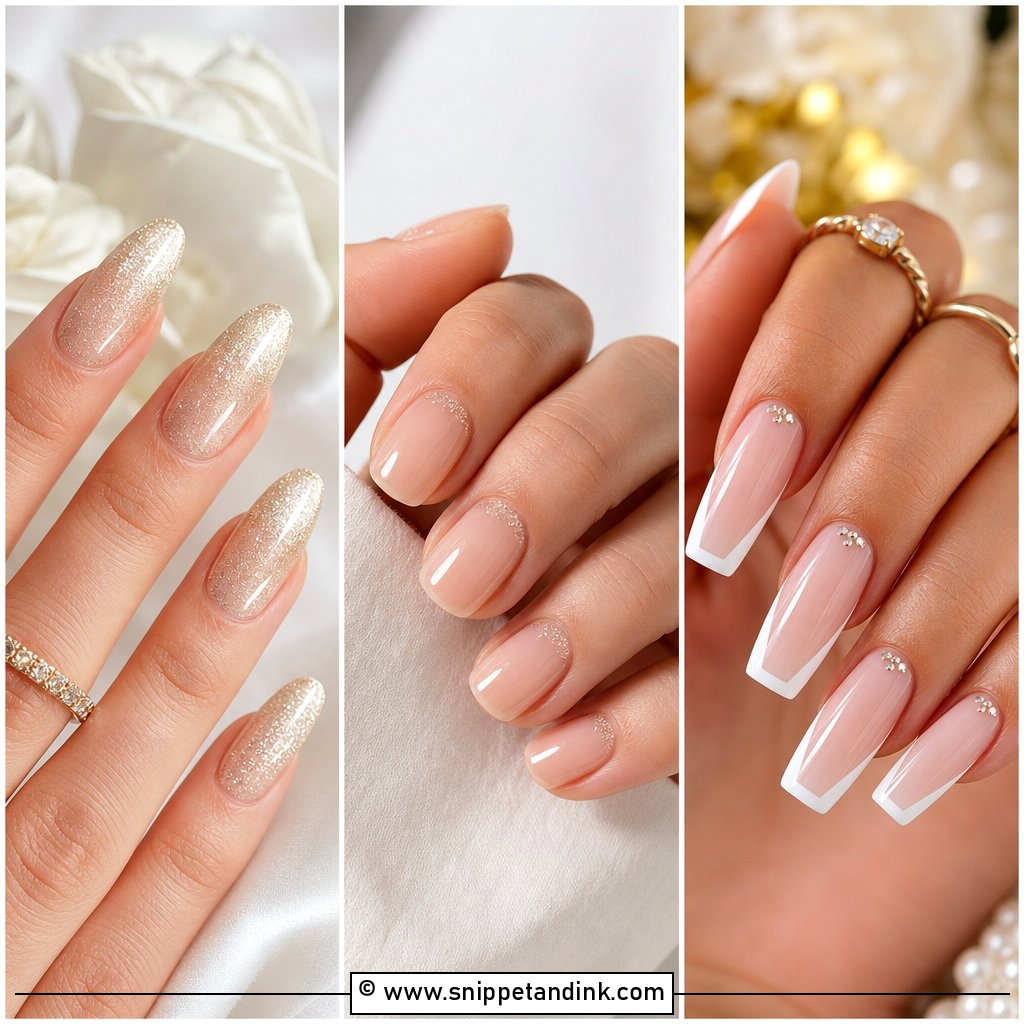
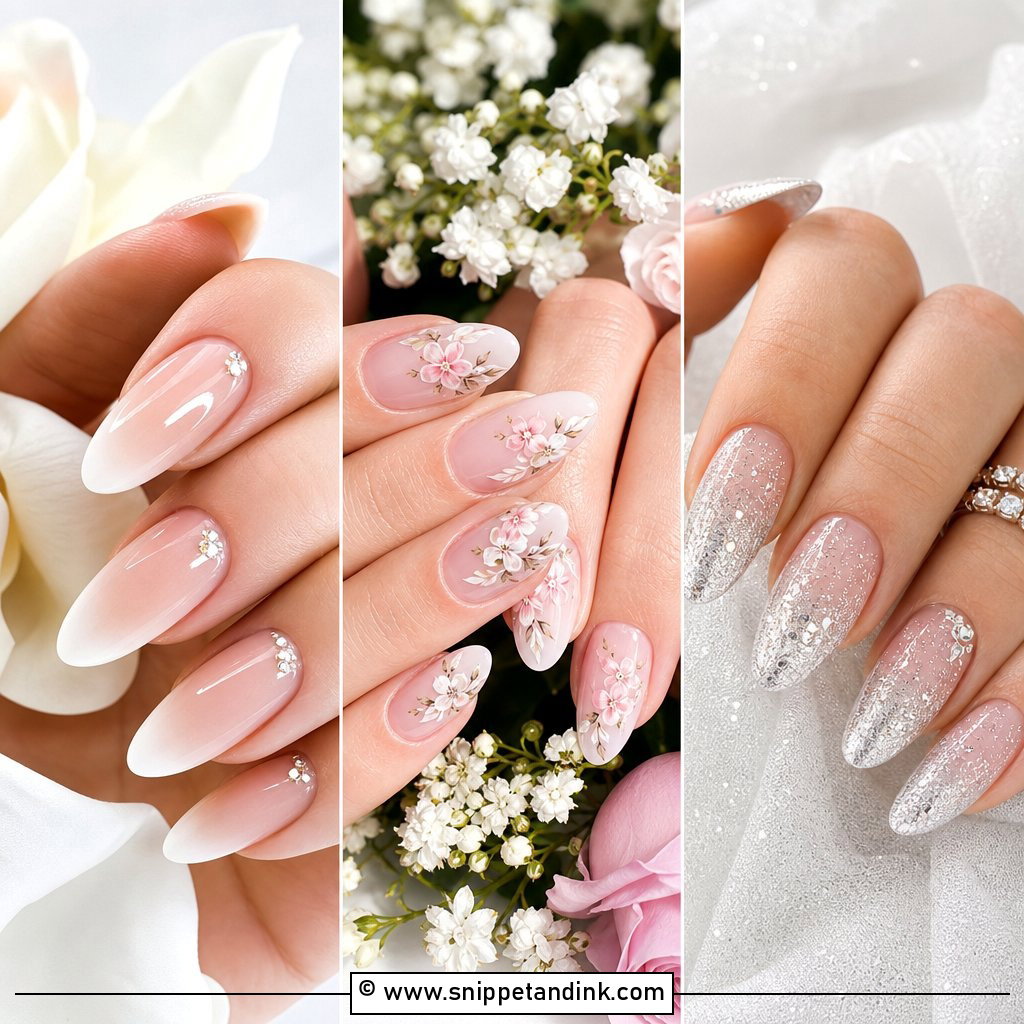
Glitter ombré starts with a nude, pink, or milky base and fades rose gold glitter either down from the tip or up from the cuticle. Tip-heavy glitter makes fingers look longer, while cuticle glitter looks more like jewelry. I use a fine, dense glitter and build it in thin layers with a small brush so there’s no hard line where the fade begins. Chunky pieces on every nail tip it toward party rather than bridal. Medium almond, coffin and oval all carry it, and the shimmer reads as movement in photos without pulling focus from your ring.
4. Nude And Rose Gold Wedding Nails
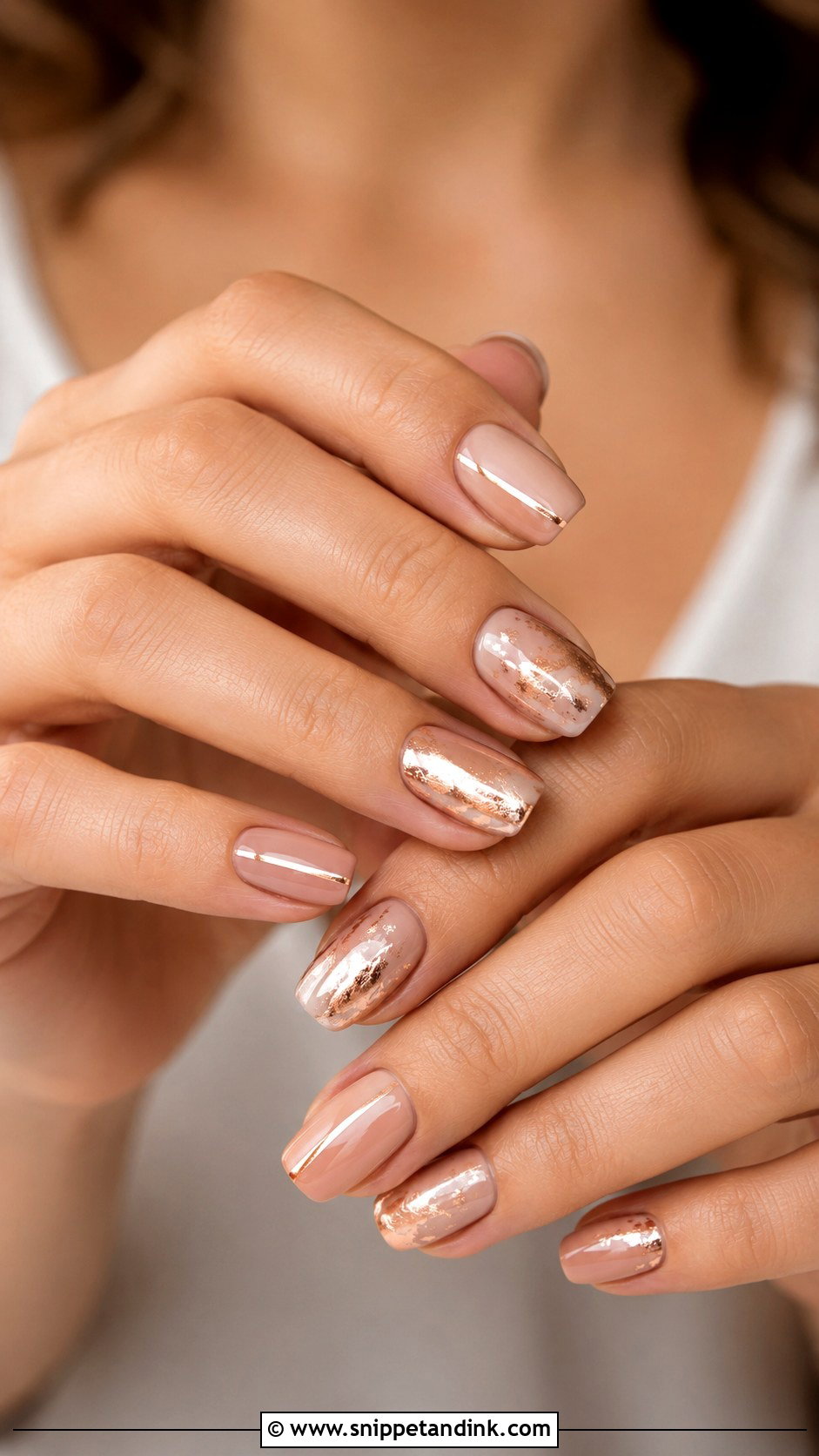
Nude with rose gold accents is the set that goes with everything. The base keeps it soft and the accents bring warmth, whether that’s tips, a thin metallic line, foil flakes or one glitter nail. It sits as comfortably with a plain gown as a heavily beaded one. The base shade is the hard part. Nudes shift a lot between skin tones, so I swatch three or four on the actual nail, at least a week before. Soft beige, pink nude and caramel nude are where most brides end up.
5. Milky White Rose Gold Wedding Nails
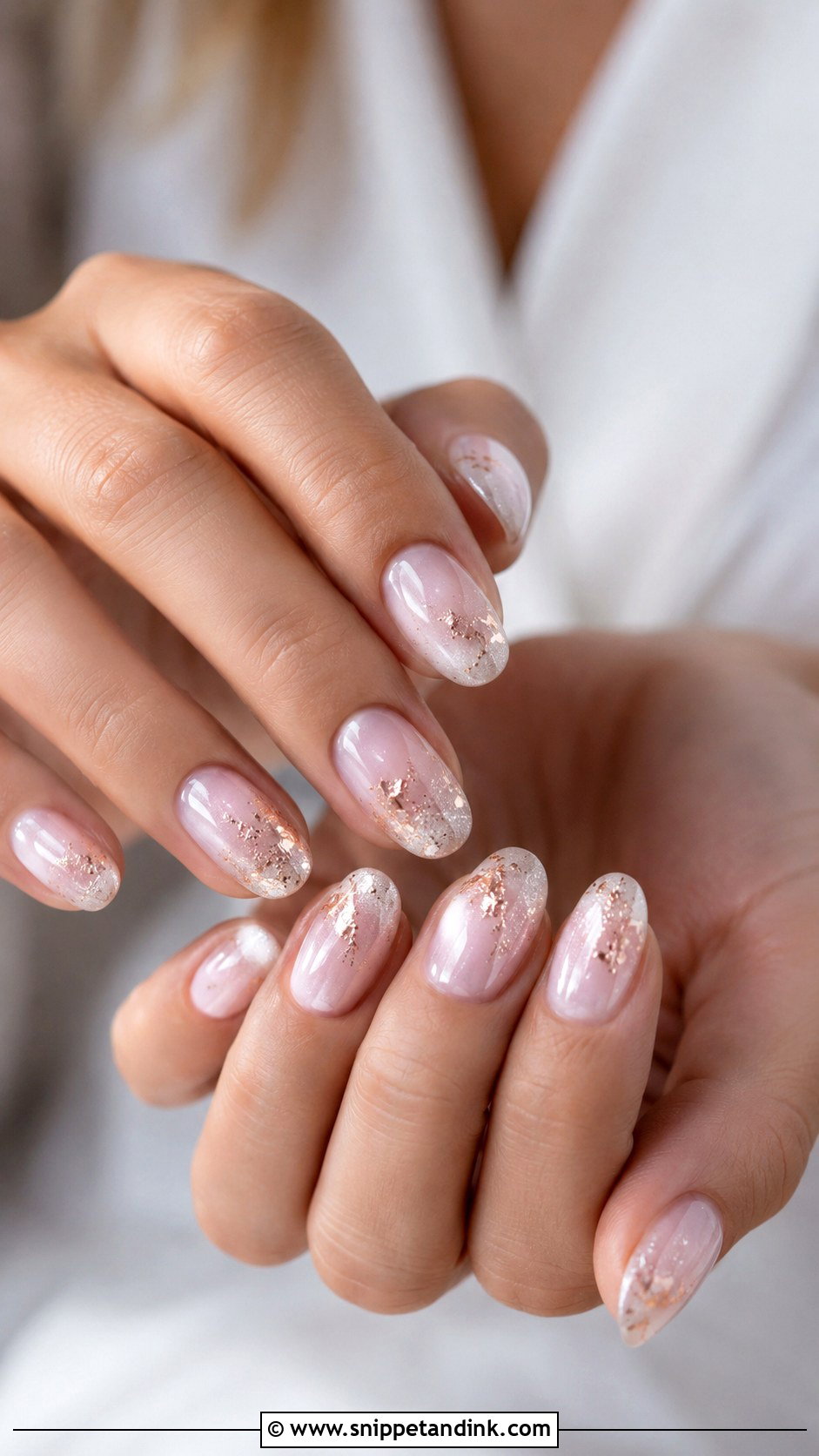
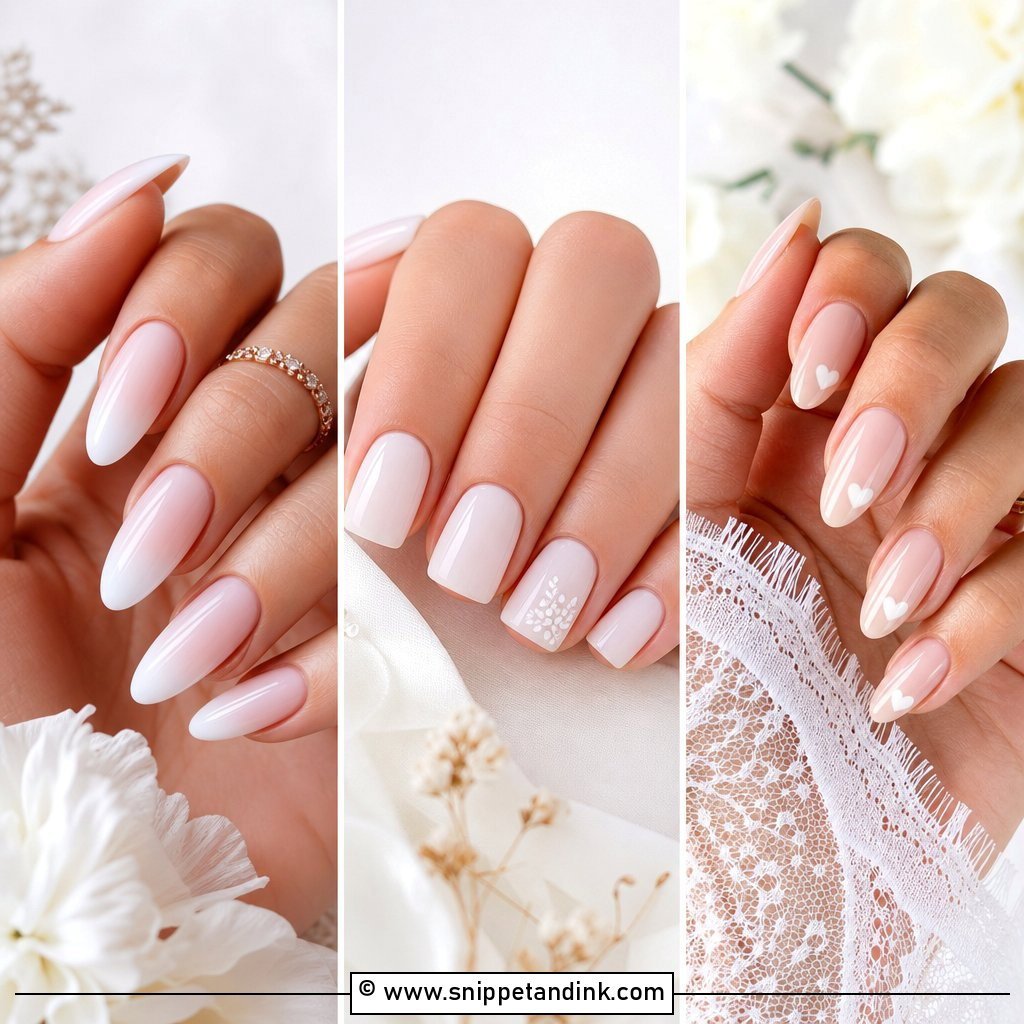
Milky white is a sheer, slightly cloudy white built in two or three thin coats, which gives a soft glow without the chalkiness of a solid white. Rose gold keeps it warmer than plain white: foil, fine glitter tips, delicate swirls or a slim outline around the nail. It looks fresh rather than stark and suits pearls, lace and soft makeup. Keep the metallic thin and scattered. Heavy rose gold over milky white weighs the set down and hides the translucency that makes the base worth doing.
6. Rose Gold Pearl Wedding Nails
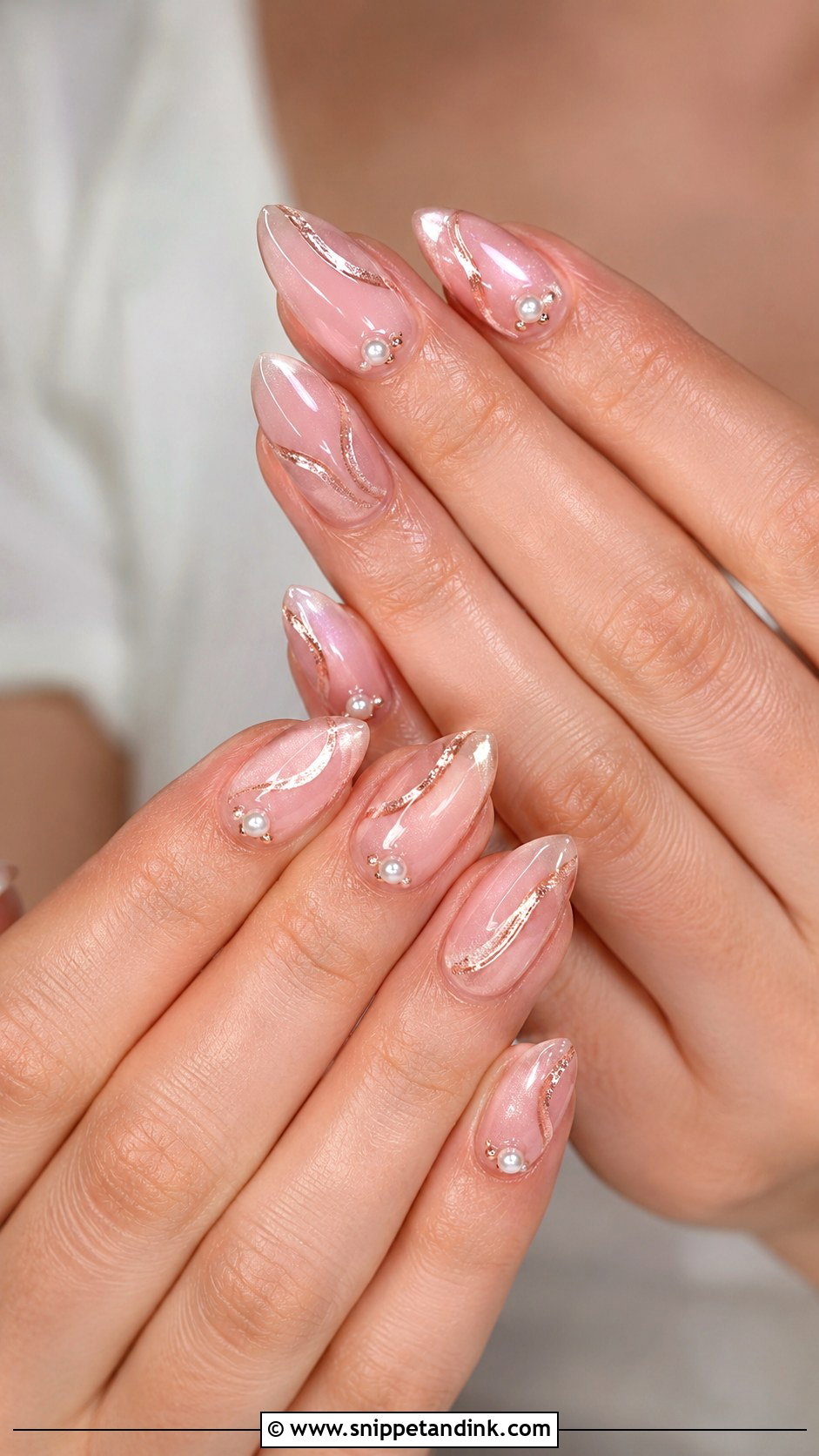
Tiny pearls add a texture that bare metallic can’t. I set them near the cuticle, along a French line or on one or two accent nails, sunk into gel so no edge is exposed. A sheer pink, nude or milky base keeps them delicate. Flat-back pearls are the practical choice: domed or large pieces snag hair, tights and veil tulle, and they’re the first thing to pop off while you’re hugging guests. If you’re wearing pearl earrings or a pearl-trimmed veil, the link is subtle but shows up nicely in close-ups.
7. Rose Gold Marble Wedding Nails
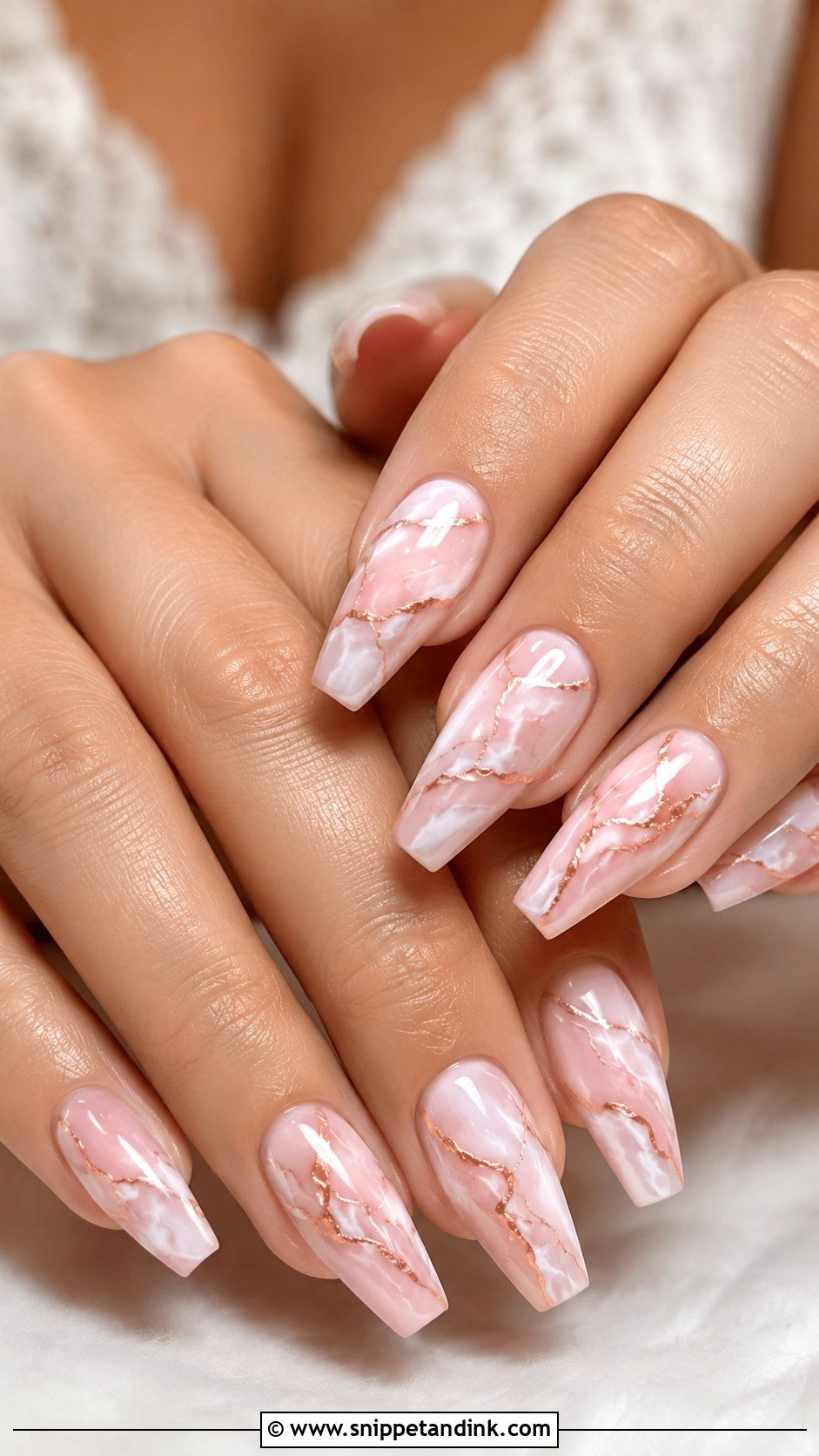
Marble is usually made with a blooming gel that lets color spread into soft, stone-like veins, and then fine rose gold lines are drawn over the top. White, blush, nude or translucent pink make the base. I’d put marble on two or three nails and keep the rest nude or shimmered, because ten marble nails look busy from a distance. Almond and coffin give the pattern enough room. A thick glossy top coat levels the surface so the veins look set into the stone rather than painted on top.
8. Rose Gold Floral Wedding Nails
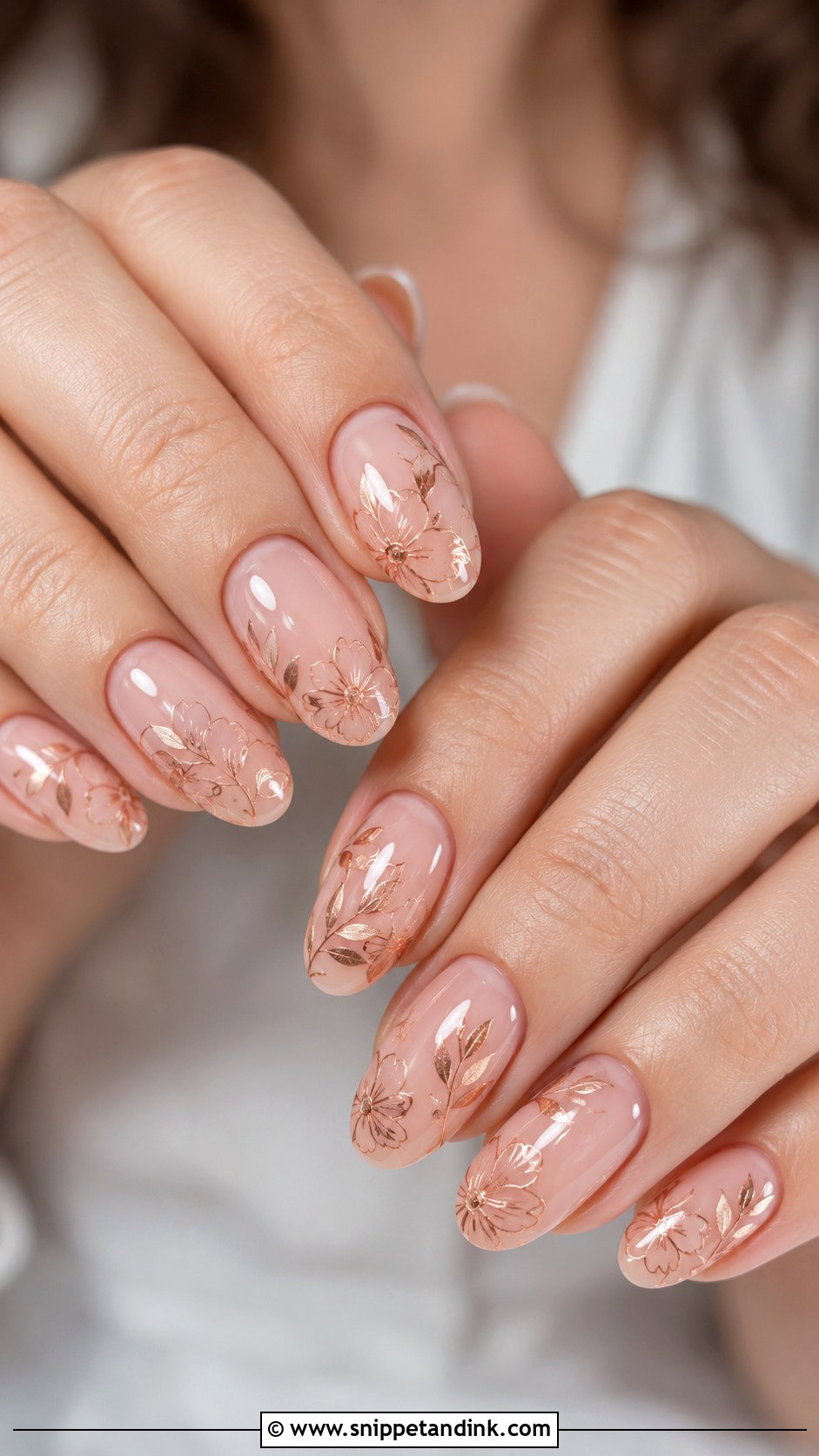
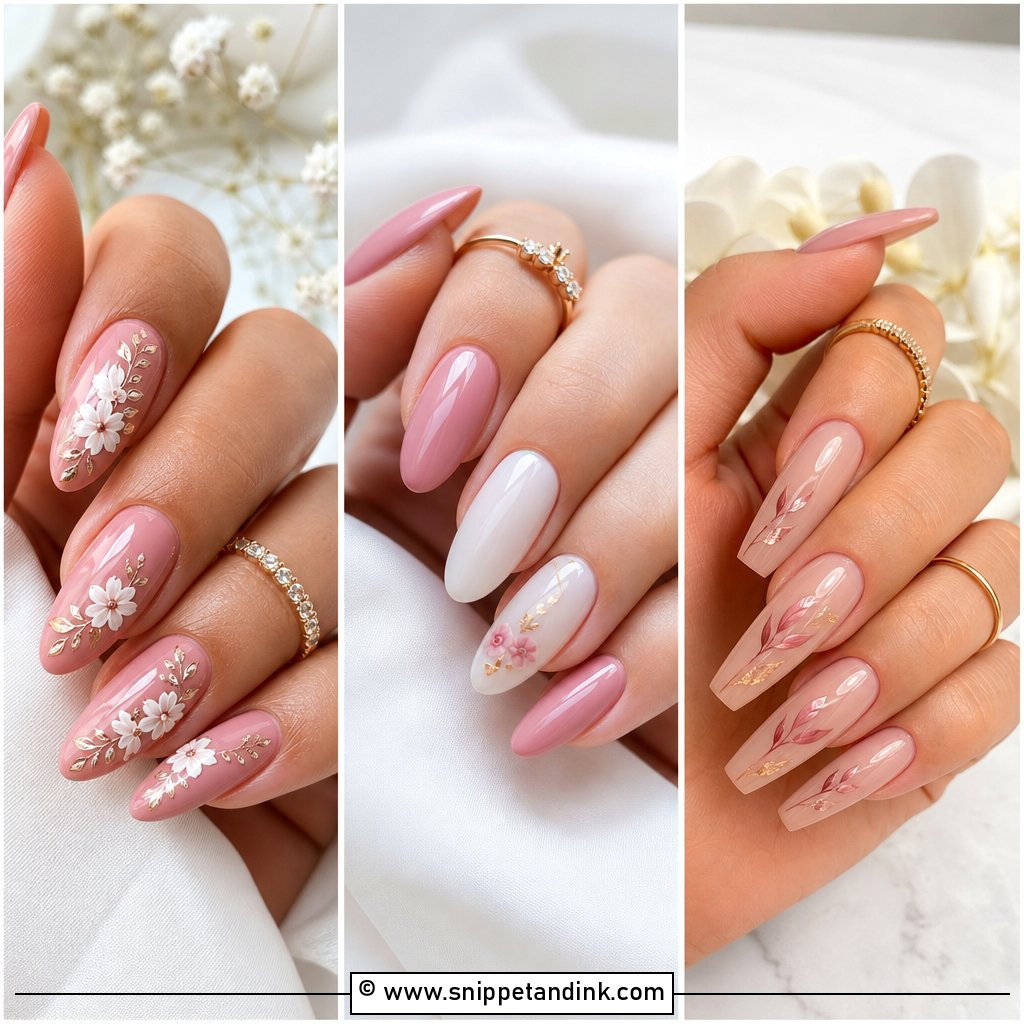
Without colored flowers, this set relies entirely on linework: rose gold lines, foil or shimmer shaped into small blooms or vines over a nude or sheer pink base. Tiny scattered flowers and vines framing the sidewalls both work. The detail is fine, so the brush matters; I use a long, thin liner and a metallic gel thick enough not to bleed. Keep the flowers on accent nails and the rest glossy. Spring, summer and garden weddings suit it, especially alongside floral lace.
9. Rose Gold Lace Wedding Nails
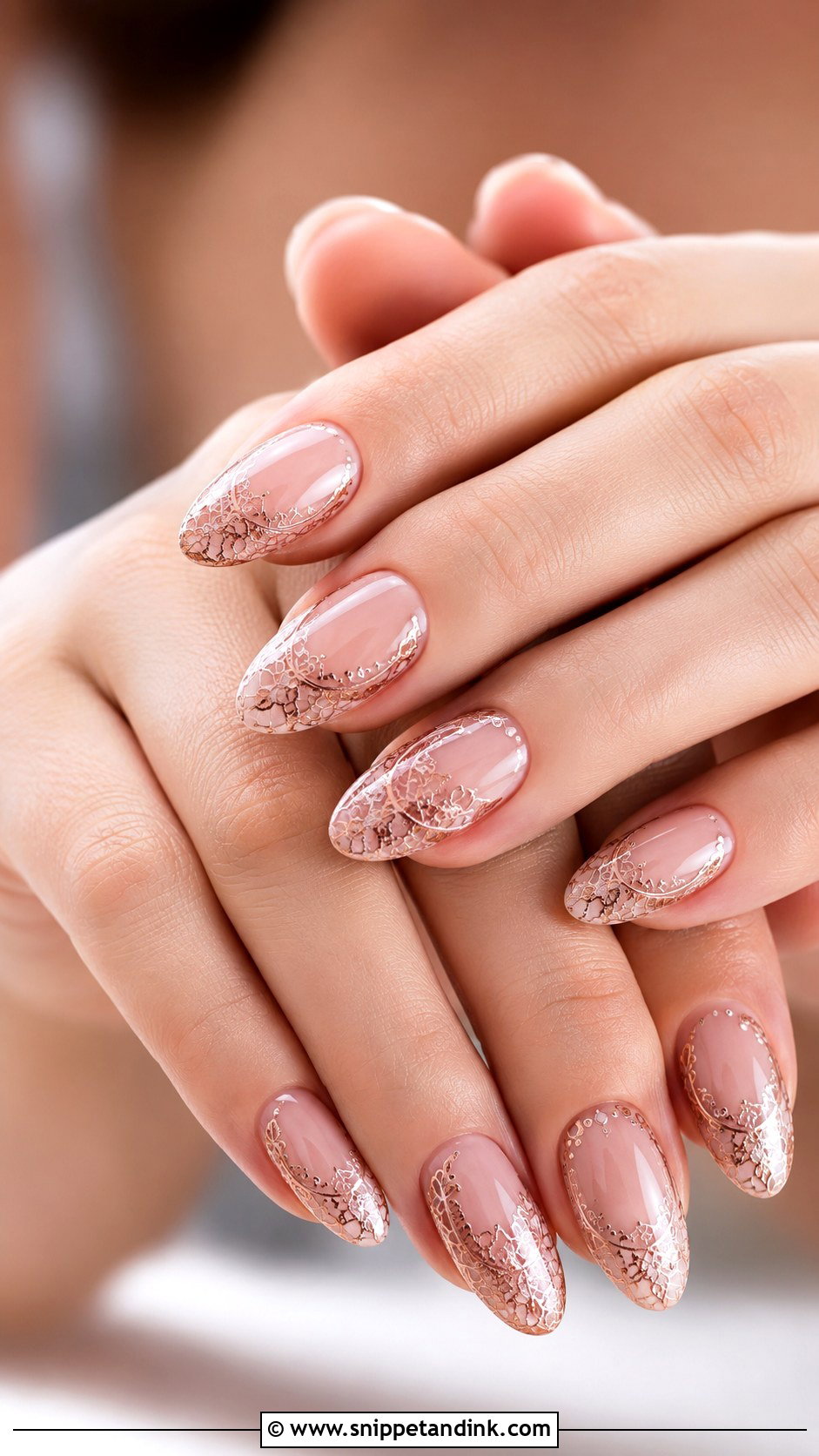
Lace art echoes a lace gown or a detailed veil with fine rose gold lines, dots, curves and net patterns over a nude, blush or milky base. Hand-painted lace takes a long time, so many techs stamp the net pattern and hand-paint the scalloped edges. It gets busy quickly. I’d put it on two accent nails and give the rest a shimmer or a French tip. Short to medium oval nails suit it because the rounded edge softens the pattern, and a gloss coat on top hides the slight ridges stamped metallic leaves.
10. Matte Rose Gold Wedding Nails
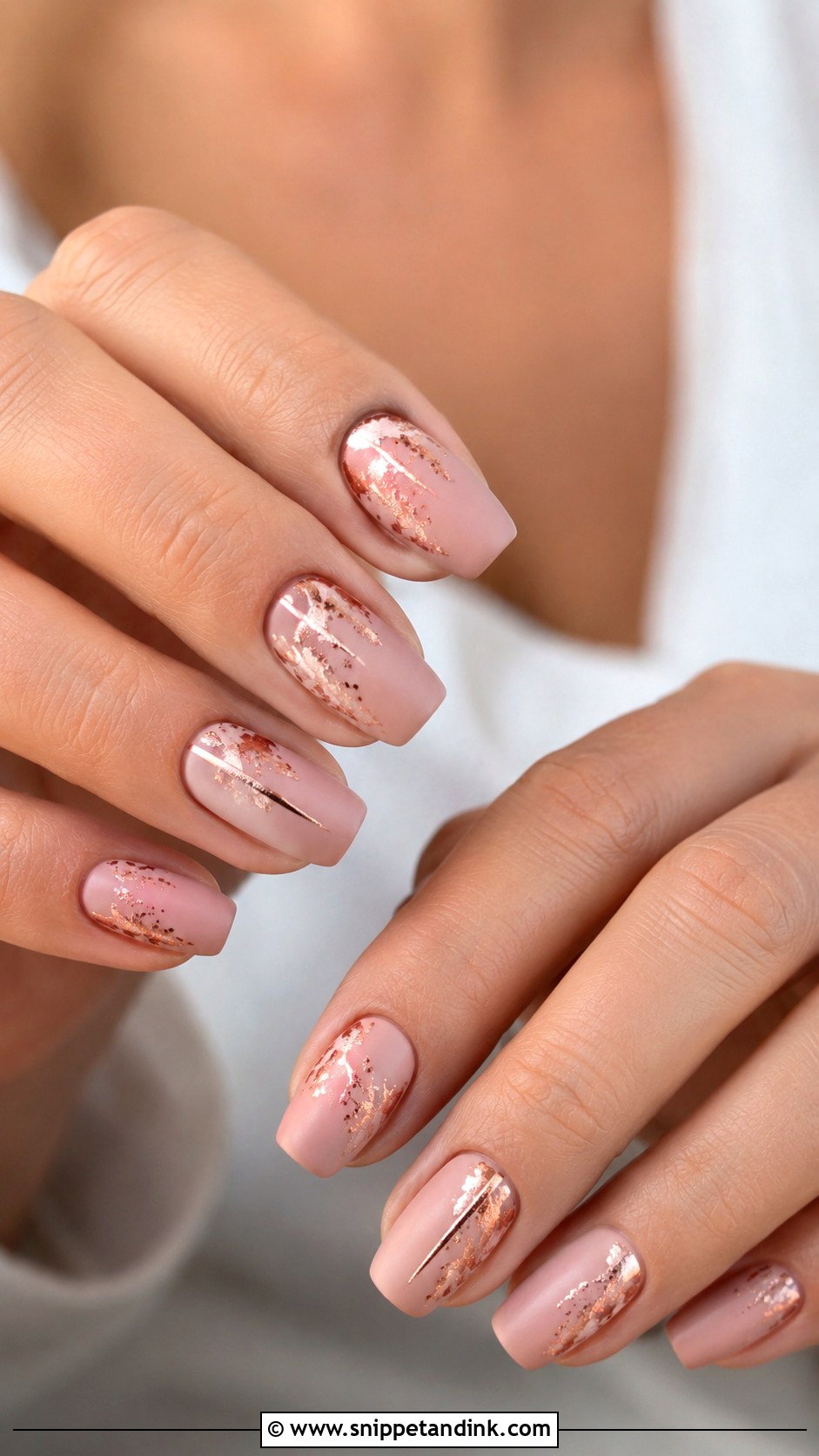
A matte top coat changes rose gold completely. A velvet finish over a muted metallic, or a matte nude base with glossy foil and chrome lines on top, gives a contrast that reads modern, and it suits crepe gowns and minimalist dresses. The catch is that matte shows everything. Every ridge, cuticle tag and patch of uneven base is visible, and matte top coats can pick up stains from makeup or self-tanner. Ask for careful cuticle work, and do this set within a day or two of the wedding, never a week out.
11. Rose Gold Foil Wedding Nails
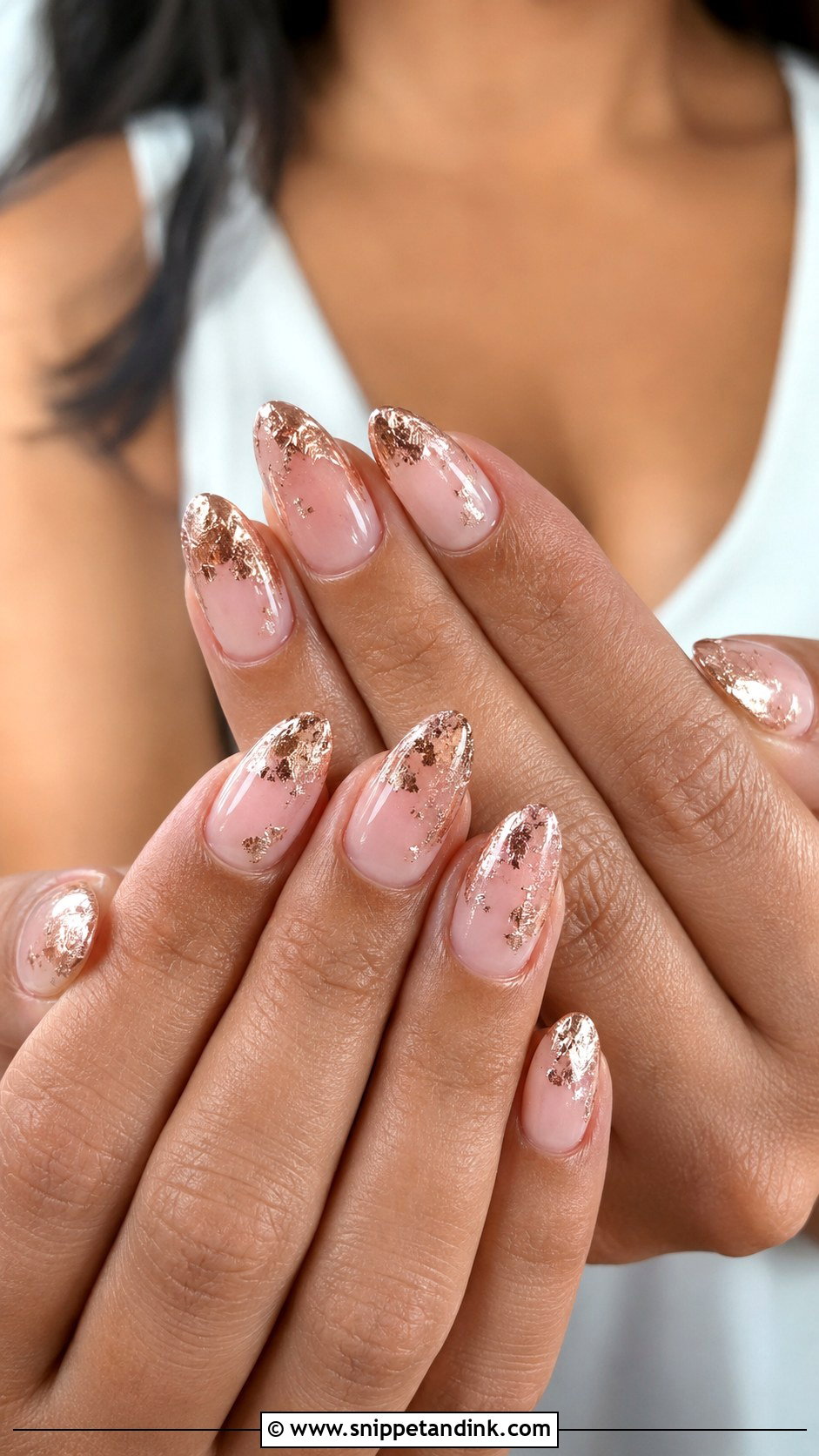
Rose gold foil wedding nails use transfer foil or flakes pressed into a tacky foil gel, which gives an irregular shine that doesn’t need symmetry. Over a nude, blush or milky base it looks organic. Foil suits anyone who likes metallic detail but doesn’t want full chrome or glitter, and it works near the cuticle, along the tips or scattered over accent nails. It sits well with marble, floral art and sheer pink too. Ask for small, thin pieces; large foil sheets can wrinkle under top coat and look crumpled up close.
12. Rose Gold Almond Wedding Nails
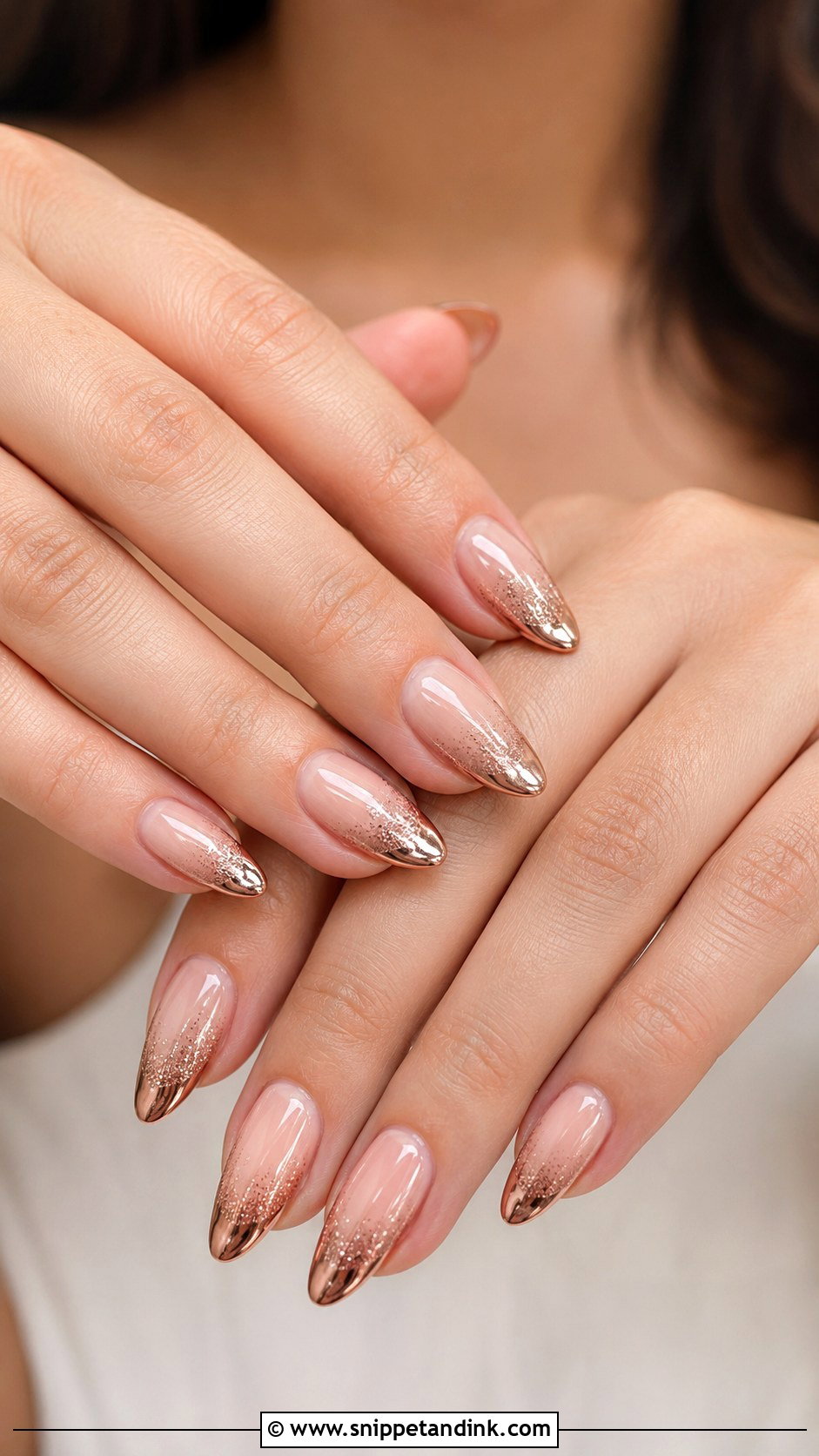
Almond elongates the fingers and is the strongest of the pointed shapes, because the taper keeps material in the center of the nail where it’s needed. A sheer nude with rose gold tips is the simple version; chrome, glitter ombré or fine foil take it further. Medium length is the sweet spot for most brides: long enough to look elegant holding flowers, short enough to fasten buttons and slide on a ring. The tapered tip also gives delicate nail art somewhere to flow toward. Keep the finish glossy.
13. Short Rose Gold Wedding Nails
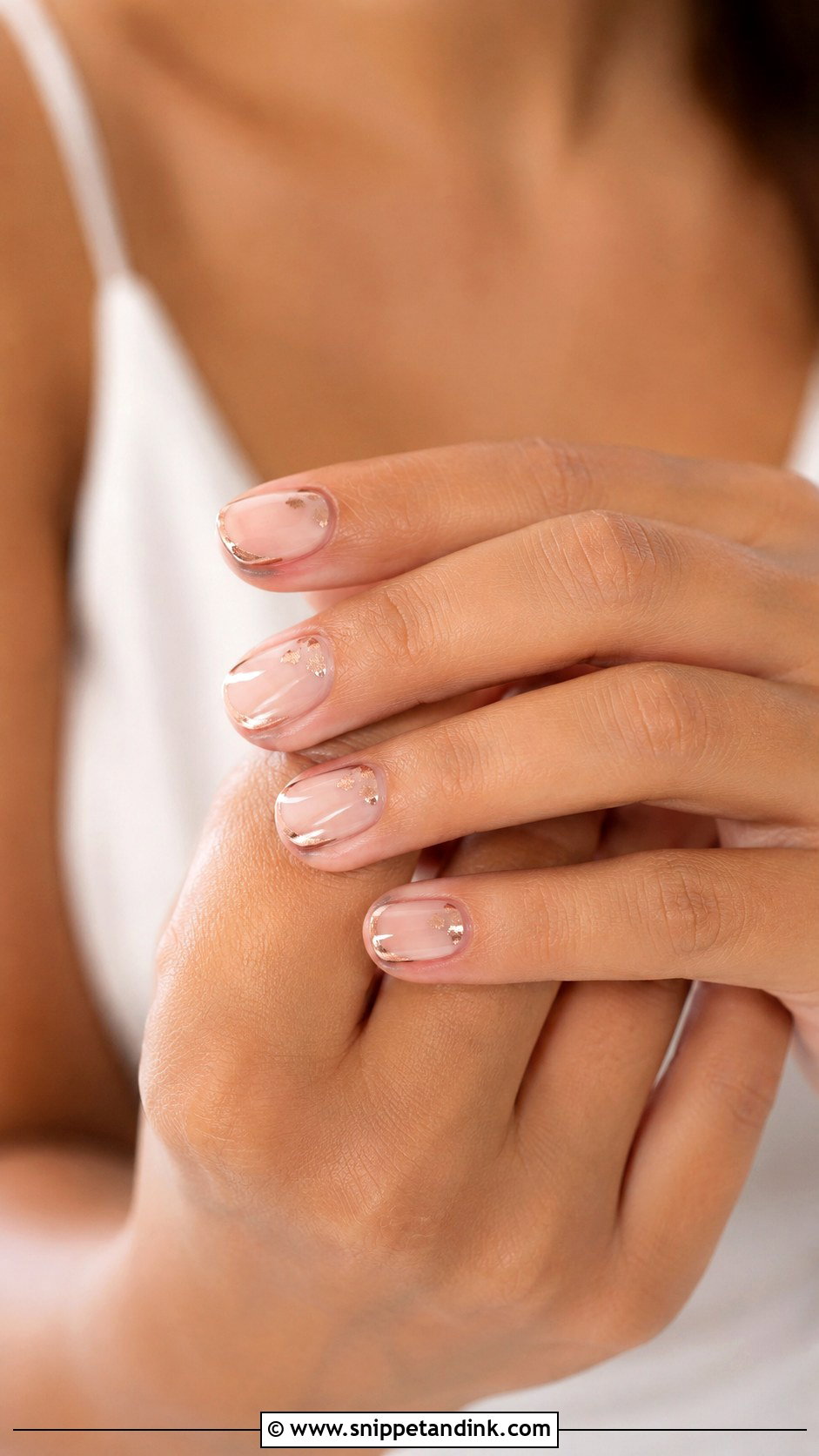
Short nails don’t need length to look bridal. A short squoval or oval with rose gold shimmer, a micro French or a few foil flecks looks clean and is the easiest to live with if you’ve never worn extensions. To make them look longer, match the base closely to your skin tone and keep the rose gold near the tips; a fine glitter fade does the same by pulling the eye outward. I’d skip pearls or stones on very short nails, where there isn’t room before they crowd the cuticle.
14. Rose Gold Coffin Wedding Nails
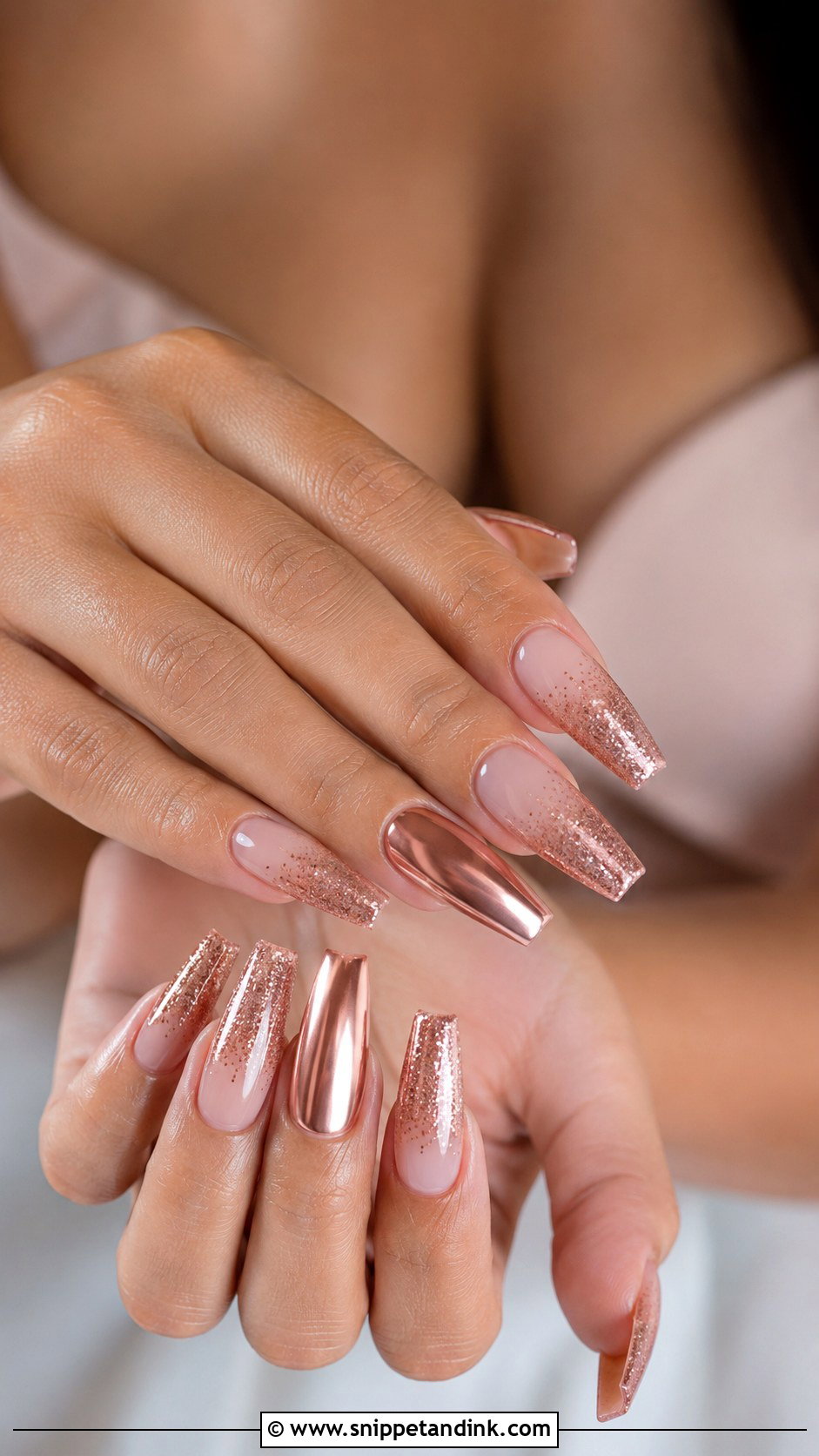
Rose gold coffin wedding nails give the most surface for chrome, glitter, ombré, marble or pearl work, which is why they show up so well in photos. Balance the bold shape with soft colors such as nude, blush, milky white or champagne pink. A metallic French tip on coffin reads modern; a glitter fade reads dramatic. Limit stones to one or two nails. The squared corners are the weak point and can chip or snap, so this shape is for brides already used to length, ideally with a structured overlay underneath.
15. Rose Gold Swirl Wedding Nails
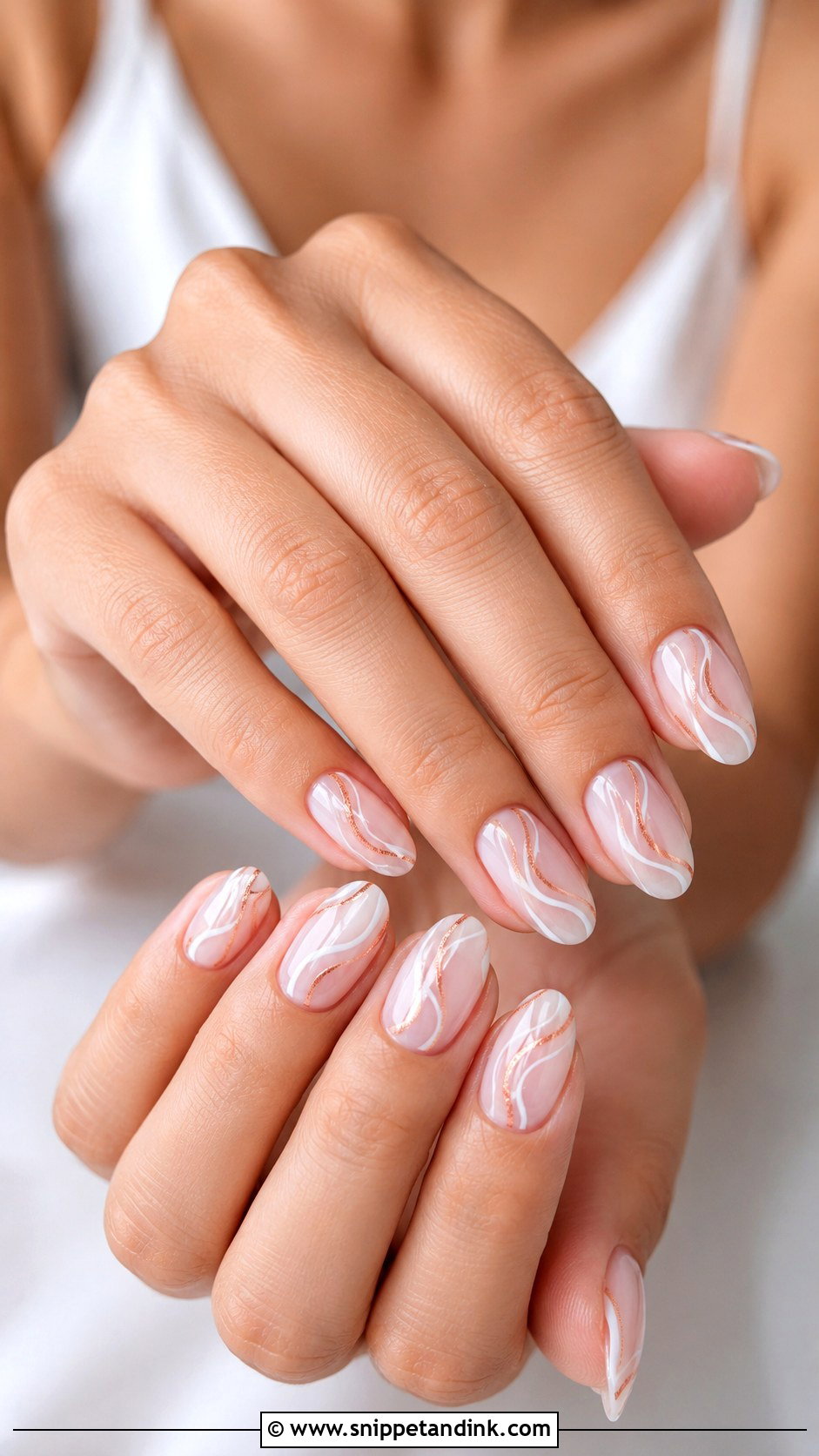
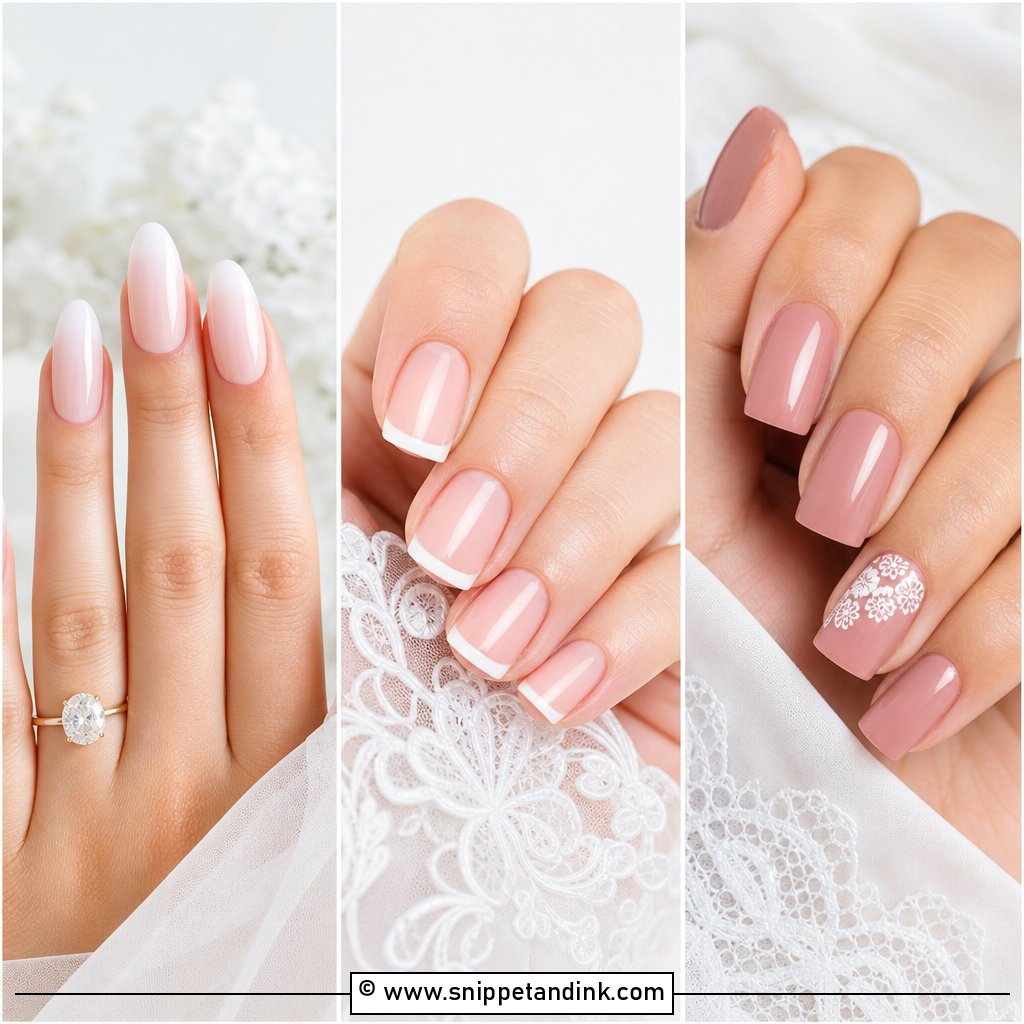
Swirls are thin rose gold curves moving across each nail like ribbon over a sheer nude, pink or milky base. They give movement without the traditional feel of lace or flowers. The lines need to be fine, and the curve has to continue logically from one nail to the next, so I plan the flow across the whole hand before painting a single line. Mixing in a few white or blush lines adds depth. Almond and oval shapes suit it, since the curve of the nail repeats the curve of the art.
16. Rose Gold Rhinestone Wedding Nails
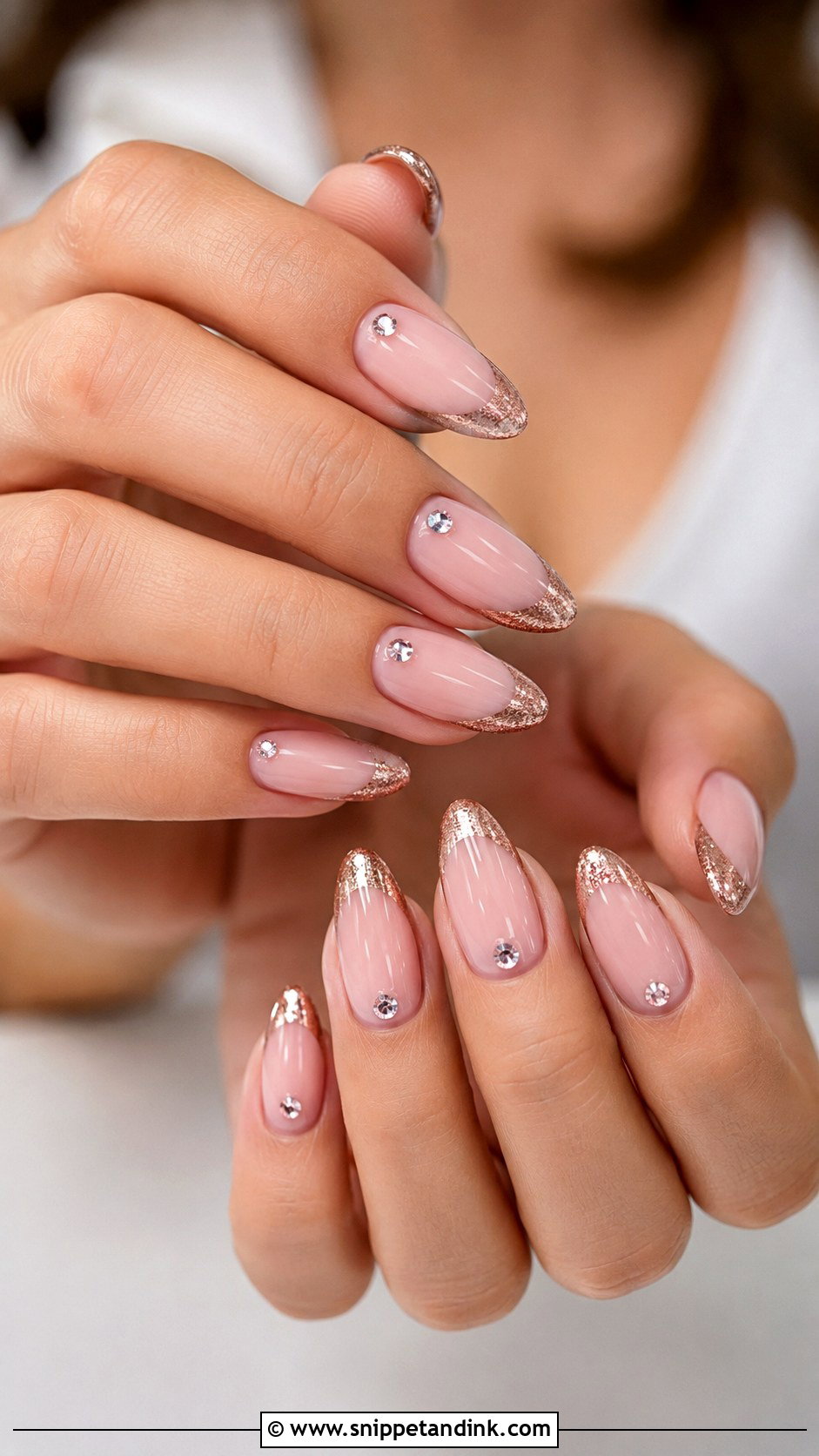
Stones work best small and placed with intention: at the cuticle, along a French line or as tiny accents on one or two nails. Rose gold crystals sit well on nude, pink, white or champagne bases and beside rose gold glitter or chrome. Avoid oversized gems, which catch on lace, tulle and knits and feel awkward when you’re holding hands for hours. I set flat-back crystals in gem gel and run top coat around them, never over the faces, so they keep their sparkle. Everything else on the hand should stay clean.
17. Blush Pink Rose Gold Wedding Nails
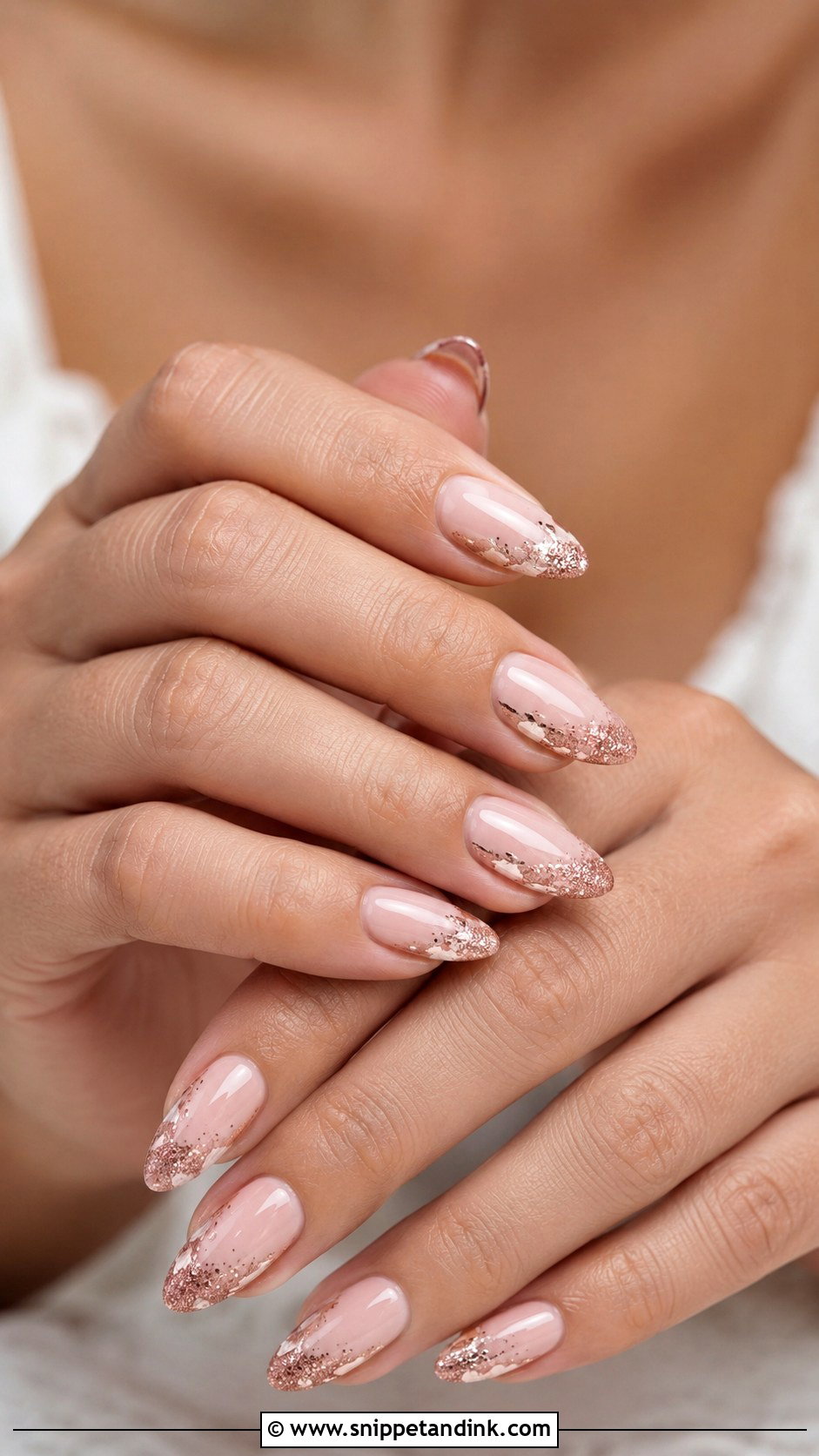
Blush gives the nail a healthy flush, and rose gold adds a soft shine on top. It can be as simple as metallic tips over pink, or more involved with glitter ombré, foil or tiny florals. It’s the right step if you want some color but still want the set to feel traditional, and it sits naturally beside rosy makeup, pink bouquets, champagne bridesmaid dresses and warm-toned jewelry. A sheer blush looks like your own nail on a good day. A creamy blush covers more, which helps if your nails have white spots or uneven tone.
18. Rose Gold Cat Eye Wedding Nails
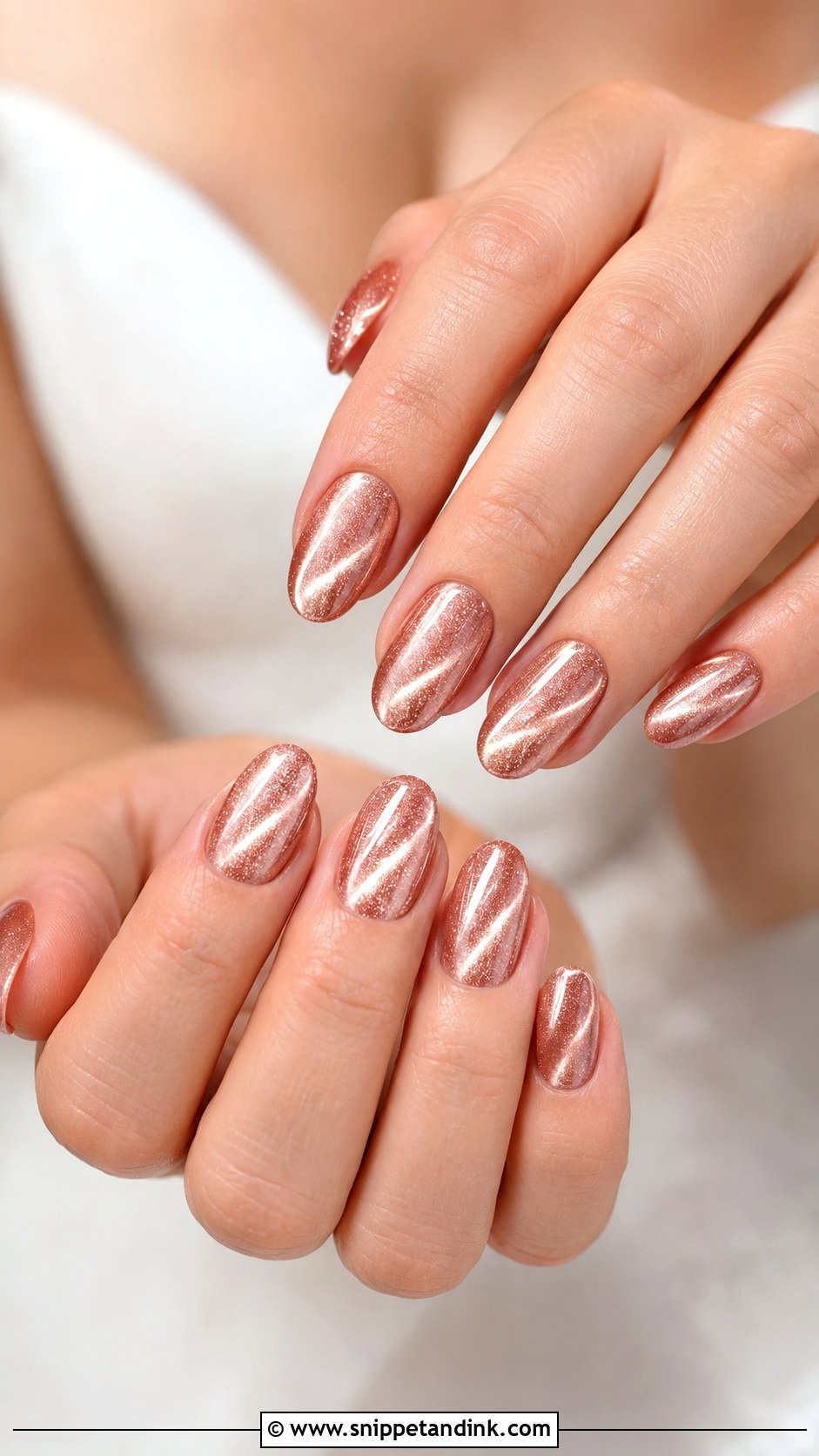
Cat eye gel contains magnetic particles. Holding a magnet over the uncured gel pulls them into a band of light that shifts as your hand moves, which gives depth without any artwork at all. In rose gold it looks warm and slightly dreamy. A soft, sheer version works as a full set; a stronger one is better on two accent nails beside nude. Almond and oval shapes keep the line smooth. For a bride I’d choose a fine, diffused line over a sharp, dark-contrast one, which looks more evening party than wedding.
19. Rose Gold And White Wedding Nails
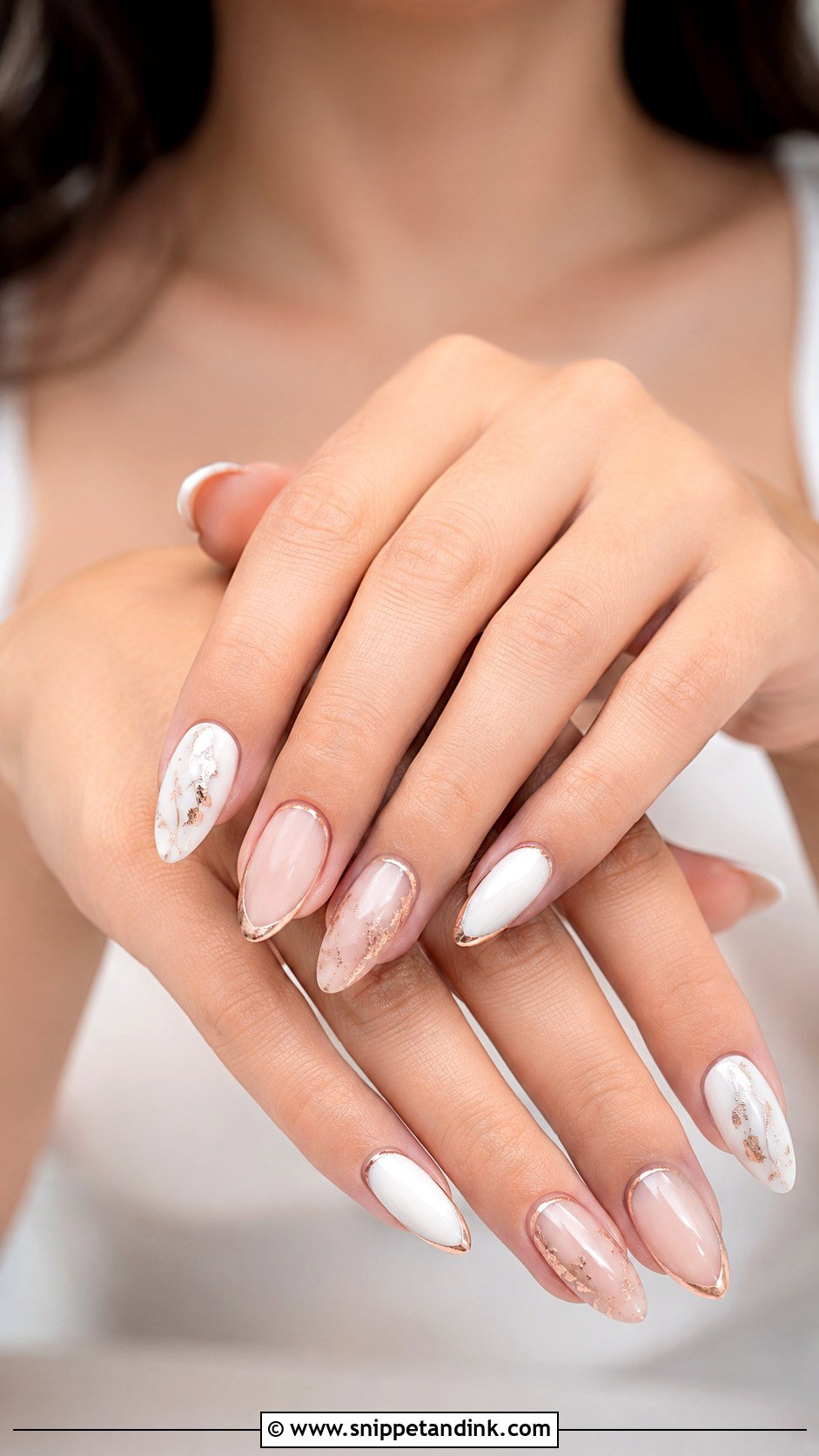
White keeps a manicure fresh and rose gold stops it from looking stark. The main versions are a white base with rose gold foil, a nude base with white tips and rose gold outlines, or milky white nails alternating with rose gold shimmer. If your dress has white beading, embroidery or clean satin, your hands pick that up. Check the white against the fabric, though: a bright white beside an ivory gown makes the dress look yellowish, so match the white to the dress, not to the inspiration photo.
20. Rose Gold Wedding Nails With Accent Nail
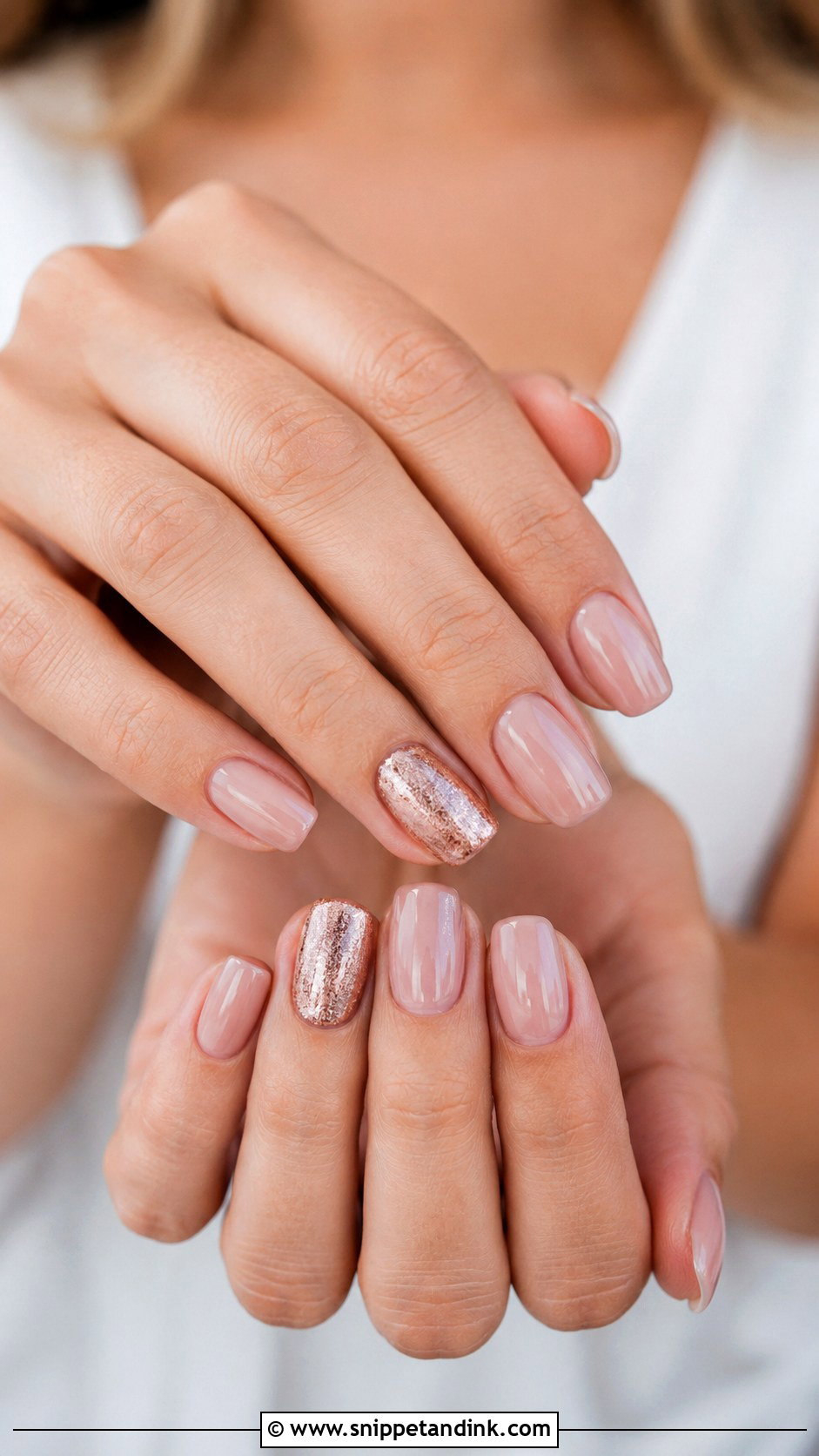
One detailed nail and nine simple ones is the easiest way to get art into a bridal set. Most nails stay sheer pink, nude or milky white, and one carries glitter, foil, chrome, pearls or lace. Tradition puts it on the ring finger, but in ring photos that can crowd the ring itself, so I often move it to the middle finger instead. Whatever you pick, the accent should complement your ring rather than compete with it, and fine shimmer or a light foil scatter is usually the safest.
When Rose Gold Nails Meet a Yellow Gold or Platinum Ring
Rose gold gets its color from copper, and that warmth changes depending on what metal sits next to it. Beside a rose gold engagement ring, the set looks planned. Beside yellow gold, a pink-leaning rose gold can look a little sugary, so I shift toward a champagne or peach version that bridges the two. Beside platinum or white gold, rose gold looks warmer still, and the ring itself can start to look cool and grey by comparison.
With a white metal ring, keep the ring finger itself quiet: sheer nude or milky white, with the metallic on the other fingers. Mirror chrome directly next to a diamond can also compete in macro shots, since both throw light. A satin shimmer or foil gives the photographer one clear point of sparkle.
If something chips or pops off on the day
- Pack a fine nail file. A small chip at the free edge can be smoothed so it doesn’t snag lace.
- A bottle of clear top coat will reseal a lifting edge for a few hours.
- Keep a tiny tube of nail glue for a stone that comes loose, and the stone itself if you can find it.
- Don’t pick at lifting gel. Peeling it pulls layers of your natural nail with it.
Your Ring Gets the Final Say
Rose gold adds warmth and shine to a bridal set whether it’s barely there, fully metallic or detailed with pearls, lace, marble, florals or glitter. Which version fits depends on your dress, your jewelry, your nail length and how much you use your hands day to day. Nude French tips or a soft glitter fade stay classic. For something more current, look at chrome, cat eye, or swirl details. Book a trial set if you can, bring photos, and bring the ring, because the exact finish should be chosen with it on your hand.
You'll Like These Ideas:


Leave a Reply