
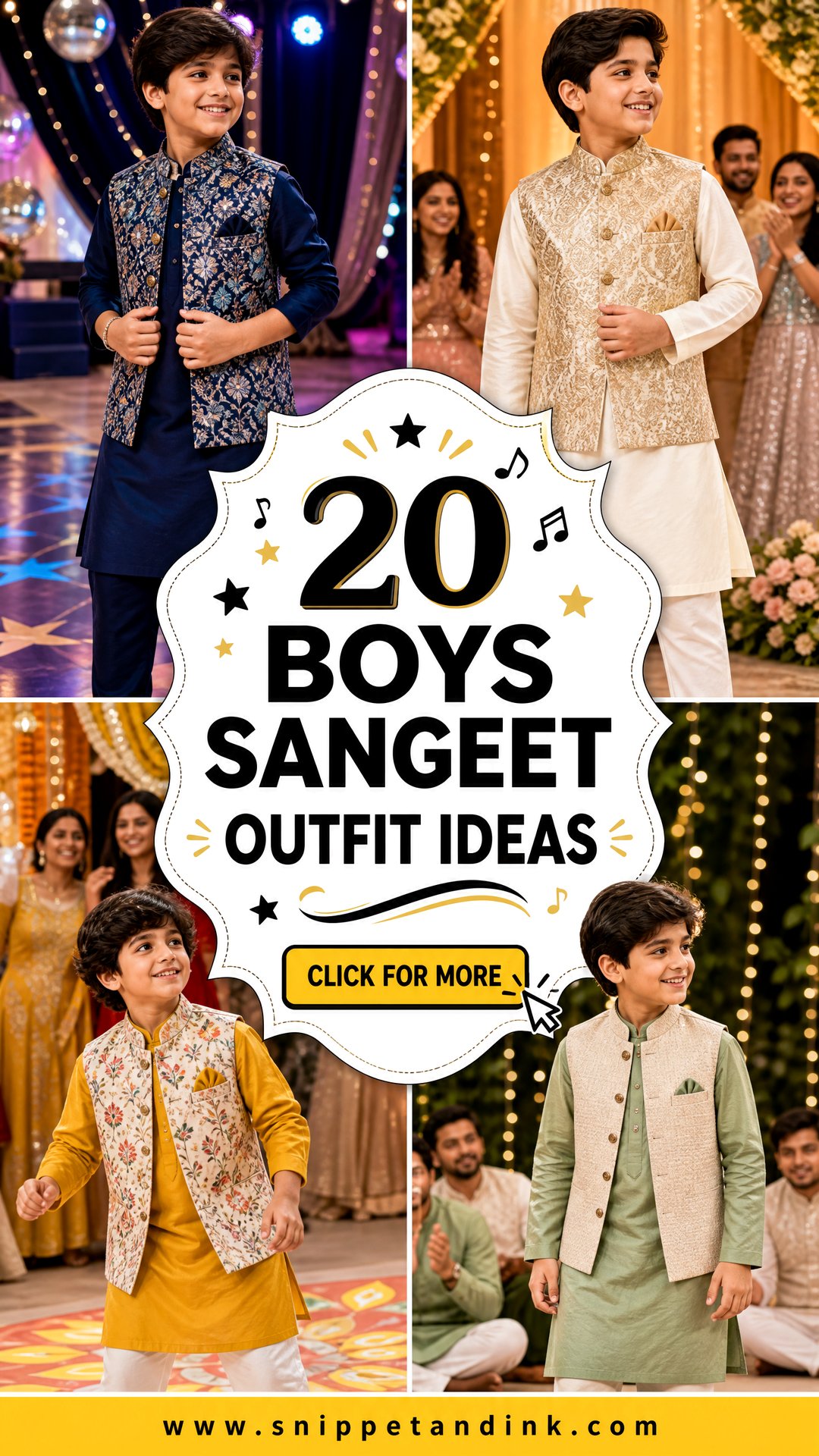
Dressing a boy for a sangeet is a different job from dressing a groom. He will sit cross-legged on the floor, sprint between tables, climb onto the stage for the family dance and probably spill something orange on himself before dinner. So when I put a look together for a nephew or a ring bearer, I start with what the clothes have to survive, then work out the colour. Kurta-jacket sets, short sherwanis, asymmetric kurtas and tailored Indo-Western pieces all do well for boys right now, and each one below is built as a full outfit, shoes included. Jewel tones carry an evening function under warm lights; pastels, ivory and soft florals suit a daytime event or a family that wants to coordinate gently. Look past the photos to the practical details too: a cotton lining, buttons sewn on firmly, a waistband with give, and footwear he can actually dance in.
Sizing a Boy’s Kurta Set When the Wedding Is Months Away
Children grow in bursts, and a set ordered in spring can be short at the wrist by a winter wedding. I order or stitch boys’ outfits about six to eight weeks out, which leaves time for one alteration round without giving him months to outgrow it. If you have to buy earlier, size up and plan to take it in.
These are the measurements I take, with him standing relaxed and wearing a thin vest:
- Chest at the fullest point, plus a good two inches of ease for a kurta and a little more for anything worn over it.
- Kurta length from the shoulder to just above or at the knee. Longer than the knee on a small boy and he will tread on it climbing stairs.
- Sleeve length to the wrist bone with his arm bent slightly, because a sleeve measured with a straight arm looks short the moment he moves.
- Inside leg for churidar, which needs extra length to bunch at the ankle, and a looser measure for straight pants.
Ask the tailor to leave generous seam allowances on the side seams and hem. It costs almost nothing, and it means the same set can be let out for the next family wedding instead of passed down to a cousin.
Ready-made versus stitched
Ready-made boys’ sets are cut generously and fine for most children under ten. For teenagers I lean toward stitched or altered, because a bandhgala or Jodhpuri jacket that’s boxy in the shoulder looks borrowed on a slim fourteen-year-old, and that shoulder fit is the hardest thing to fix after the fact.
1. Navy Blue Kurta With Printed Nehru Jacket
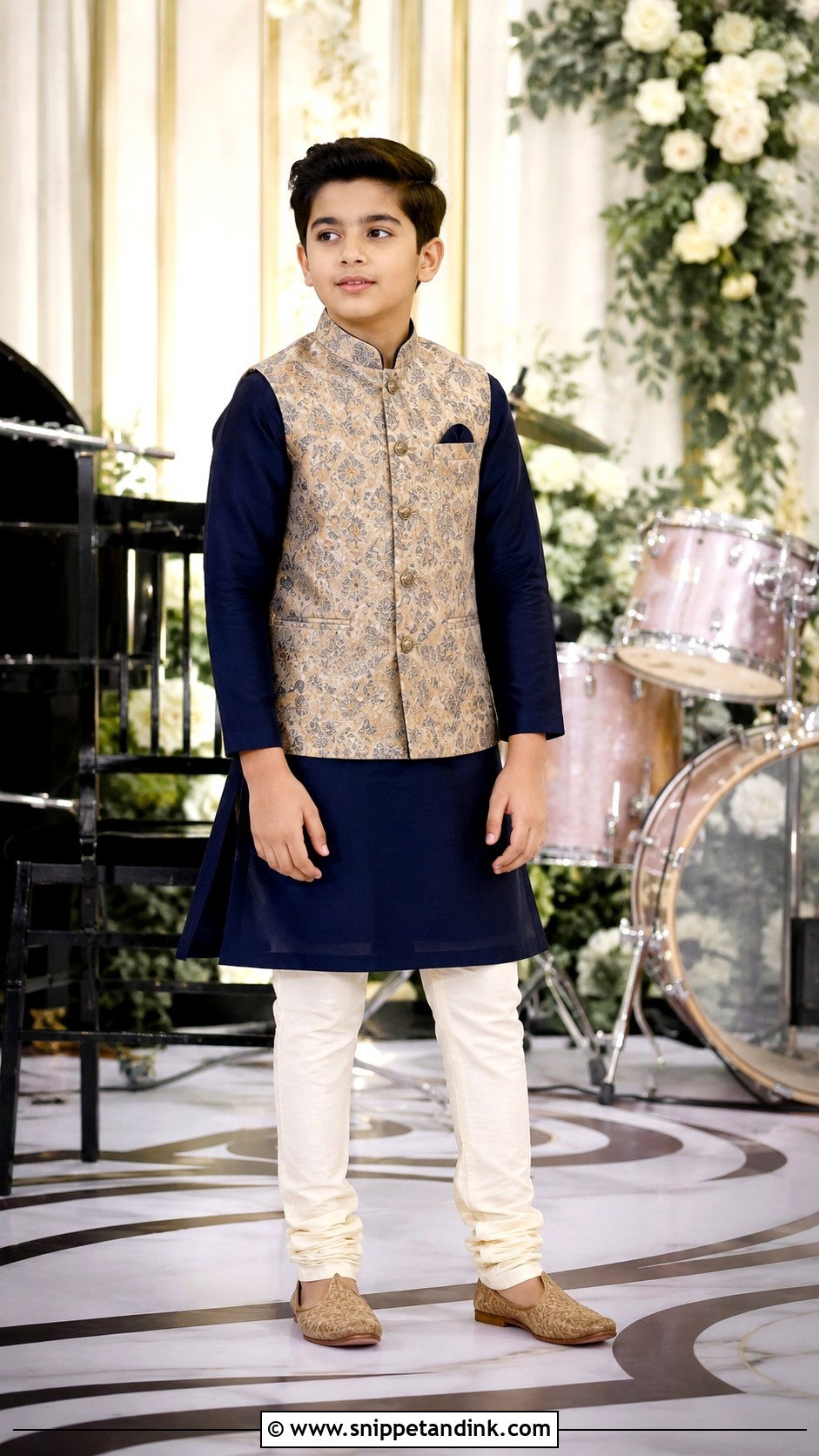
Navy is the colour I reach for first when a family hasn’t settled on a palette, because it sits comfortably next to almost anything the adults wear. A knee-length kurta in cotton silk or a soft blend does the base work, and a printed Nehru jacket in gold or muted blue brings the festivity. Keep the motif small; a big paisley on a seven-year-old’s chest swallows him. Ivory churidar or tapered pajamas go underneath, with loafers for older boys and cushioned tan juttis for the little ones. When he tries it on, ask him to raise both arms over his head. If the jacket rides up to his ribs, it’s too tight across the back for a group dance.
2. Ivory Kurta With Gold Brocade Jacket
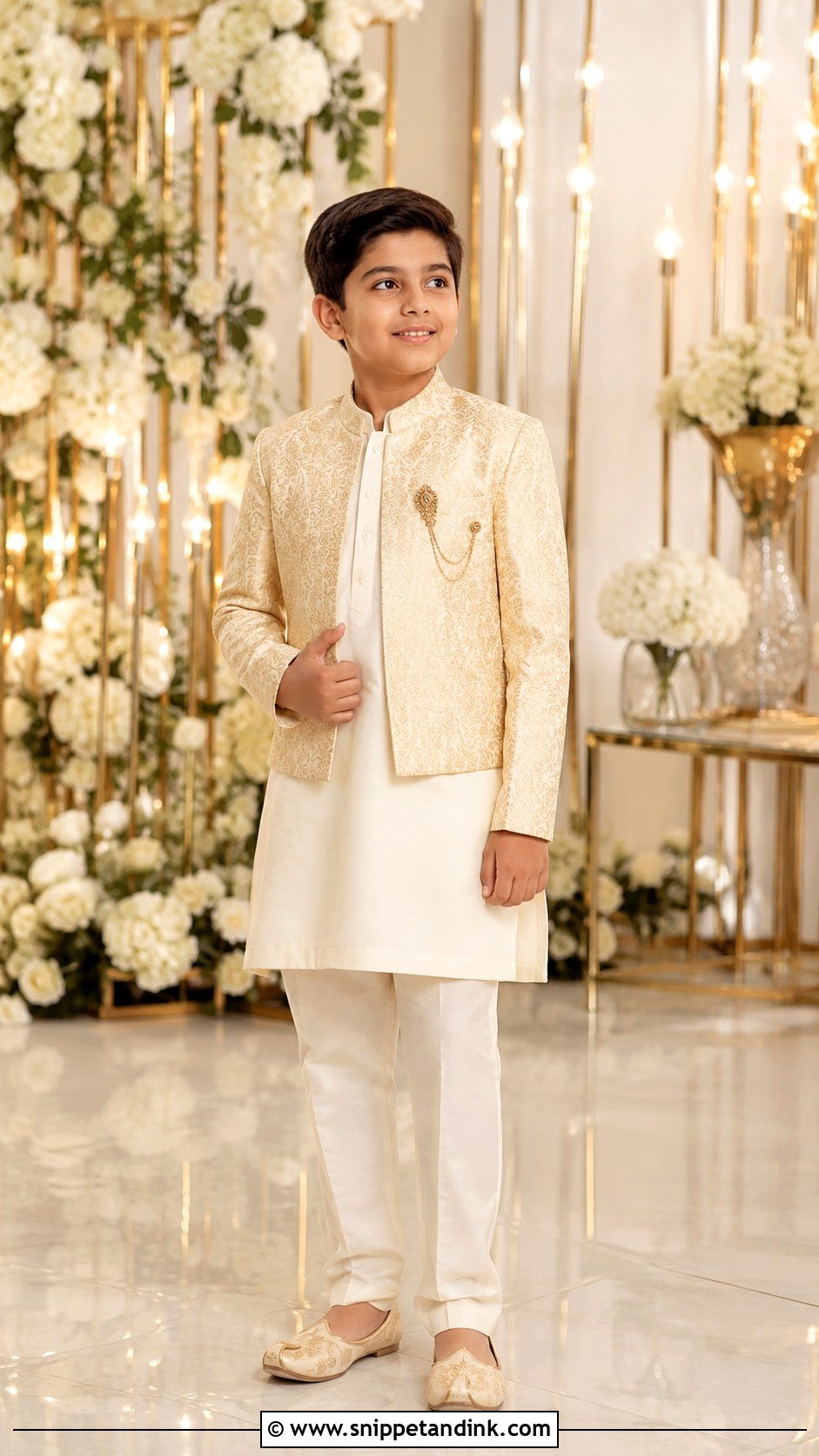
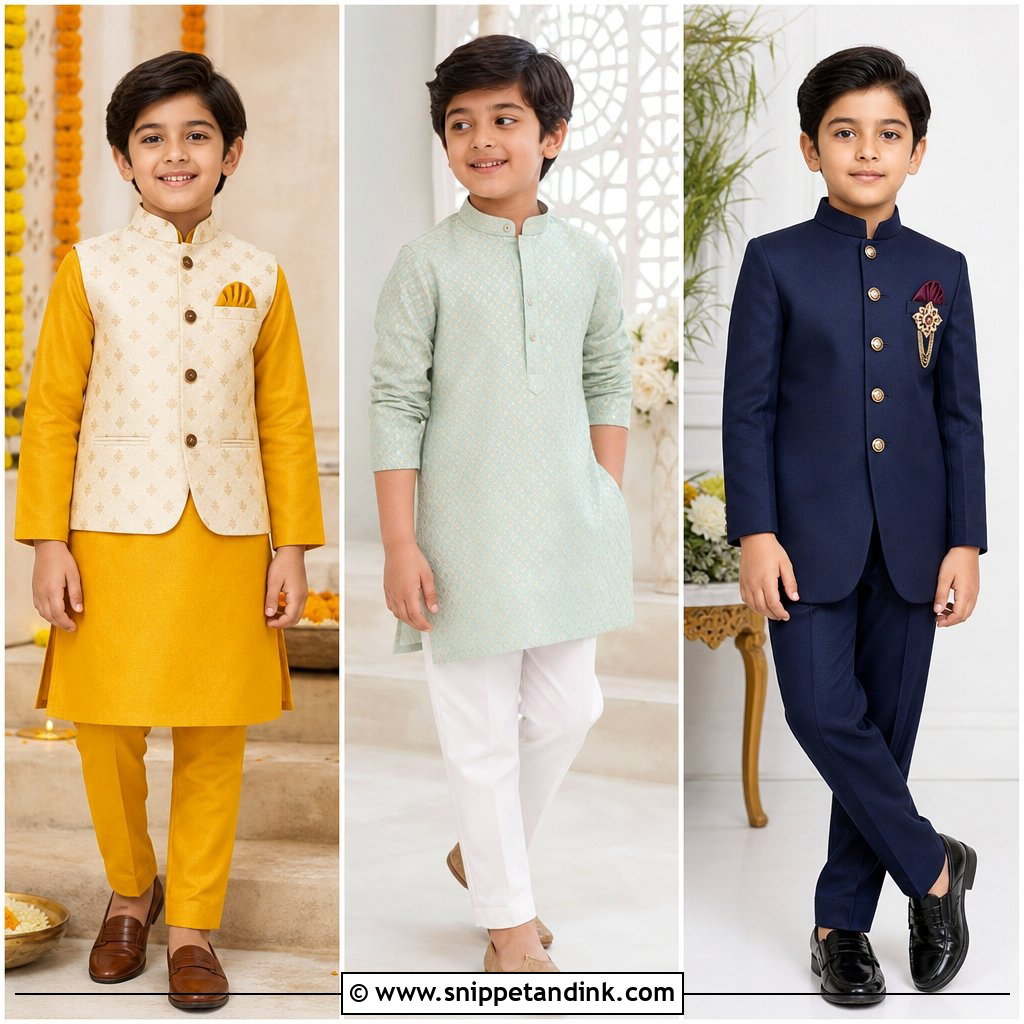
Ivory and gold read as immediate family, so this is the set I’d give the bride’s or groom’s younger brother. The kurta wants a plain band collar and concealed buttons, and the jacket a woven brocade pattern rather than stitched-on embellishment. Brocade is stiff by nature, and the armhole is where it rubs, so turn the jacket inside out before you buy and check for a soft lining and finished seams there. Straight ivory pants are less fussy than a narrow churidar for a child who won’t stand still. Cream juttis or tan loafers finish it, and a small gold brooch can go on just for the formal family portraits.
3. Black Indo Western Jacket With Trousers
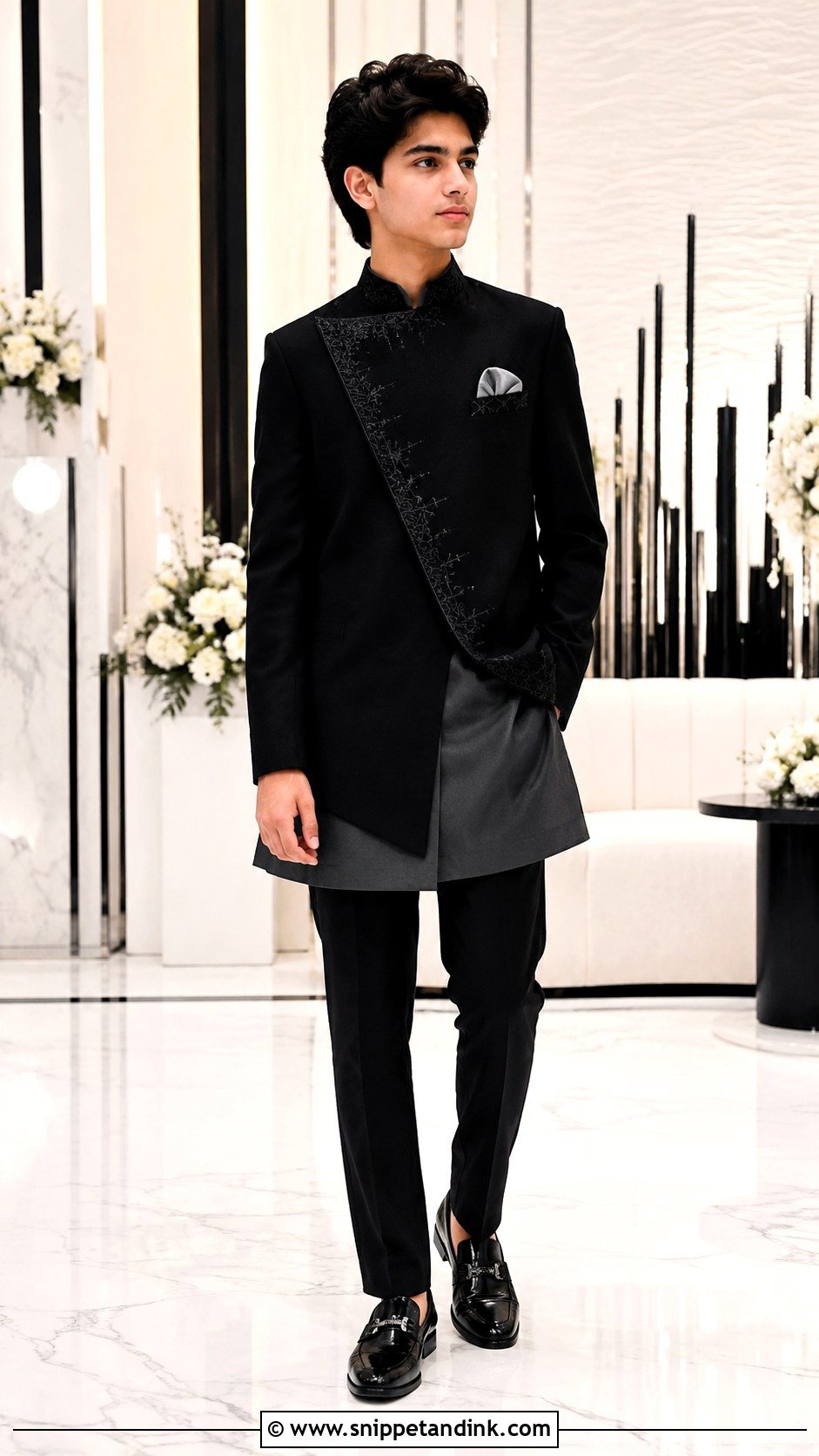
Black is the most grown-up thing on this list, and teenagers usually ask for it by name. A black Indo-Western jacket with a band collar or an asymmetric closure goes over a light black or charcoal kurta that stops just above the knee, with slim straight trousers below. The one detail I’m strict about is embroidery around the buttons: metallic thread is fine, but raised beadwork snags on a dance partner’s dupatta every time. Black loafers or velvet juttis, plus a silver pocket square, and he’s done. It also groups well when several cousins wear black with one metallic accent each.
4. Emerald Green Kurta Pajama With Juttis
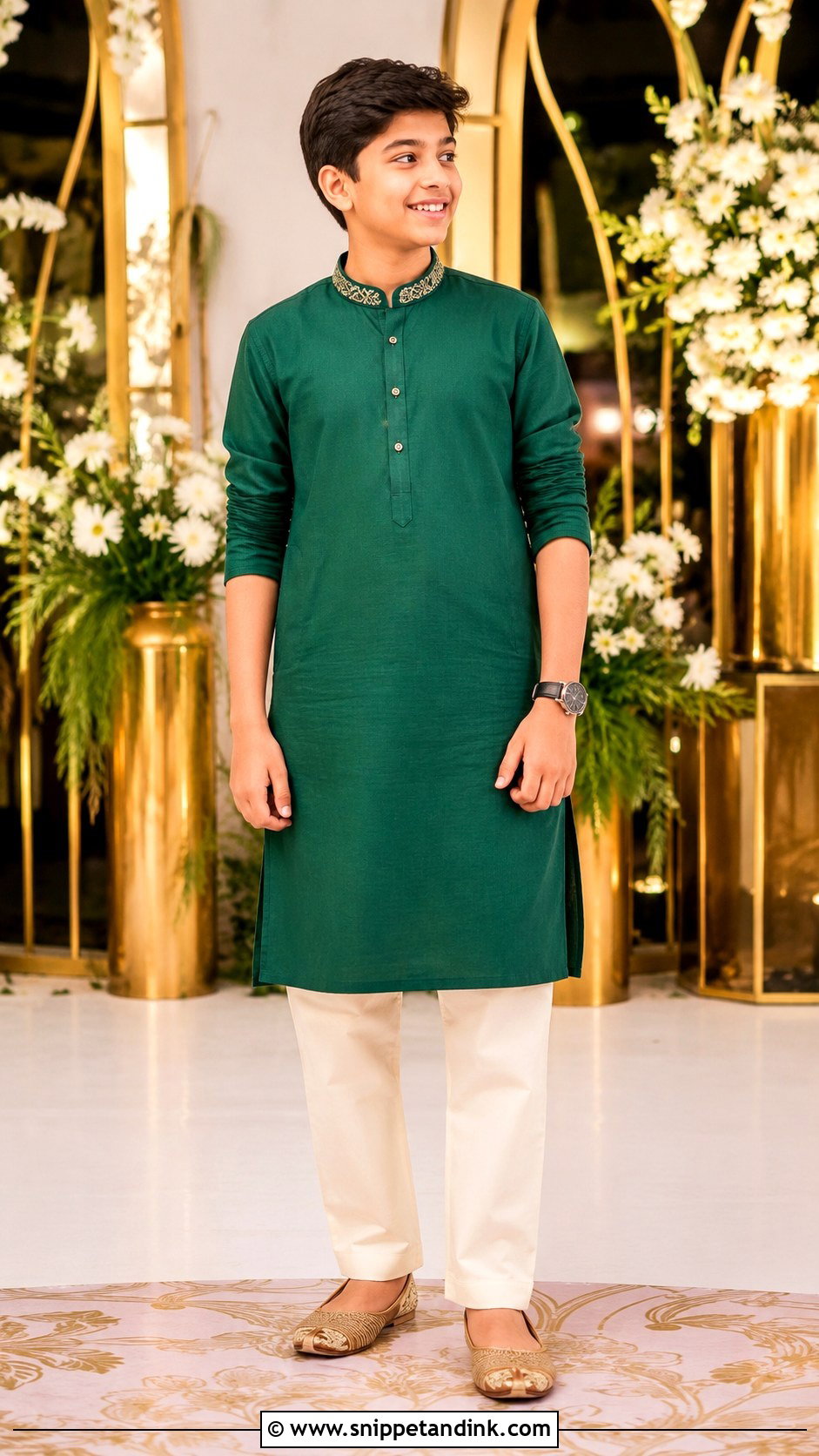
Emerald holds its colour under the yellow uplighting most sangeet venues use, where paler greens can turn muddy. I keep the kurta solid, with a little threadwork at the collar and cuffs, and pair it with cream or off-white pajamas so the green has something to sit against. Straight pants for an active boy; a soft churidar only if the function is formal and he’s old enough to manage it. Tan embroidered juttis suit older boys, and younger ones are happier in cushioned slip-ons. If the fabric already has a sheen, stop there. A stole or heavy jacket on top just competes with it.
5. Maroon Bandhgala With Slim Trousers
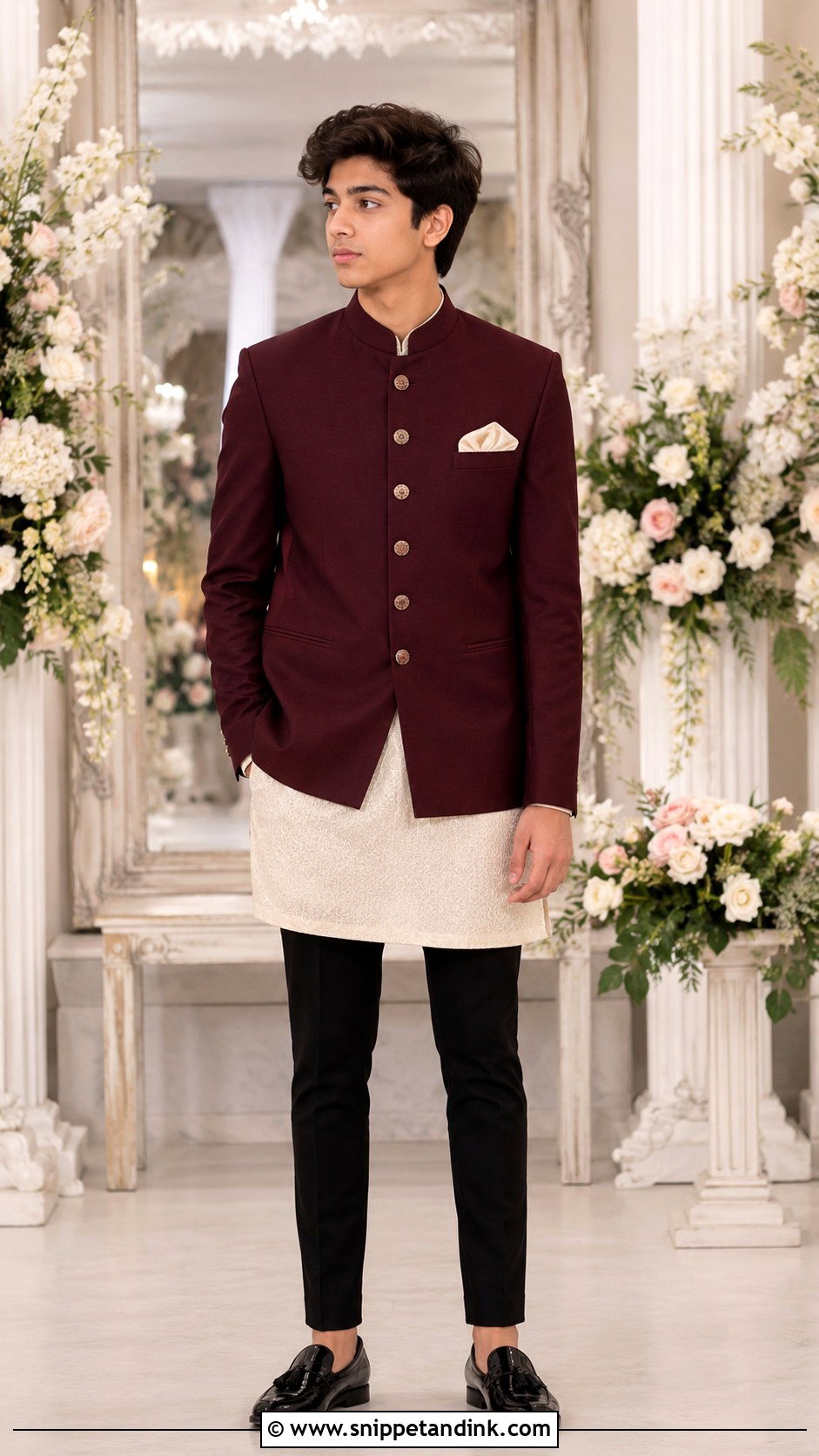
For a fourteen-year-old who’s outgrown kurta sets but doesn’t want a full sherwani, a maroon bandhgala hits the middle ground. Hip length or a touch longer, a clean stand collar, covered buttons, and embroidery kept to one shoulder or the chest. Under it, a black or ivory kurta-style shirt depending on what the rest of the family is wearing. The trousers should be slim but cut from a fabric with some stretch, because rigid suiting splits at the seat during a bhangra squat. Button the jacket and have him sit down; if the fabric pulls into X-shaped creases across the chest, go up a size. An ivory pocket square is all the accessory it needs.
6. Pastel Pink Kurta With White Churidar
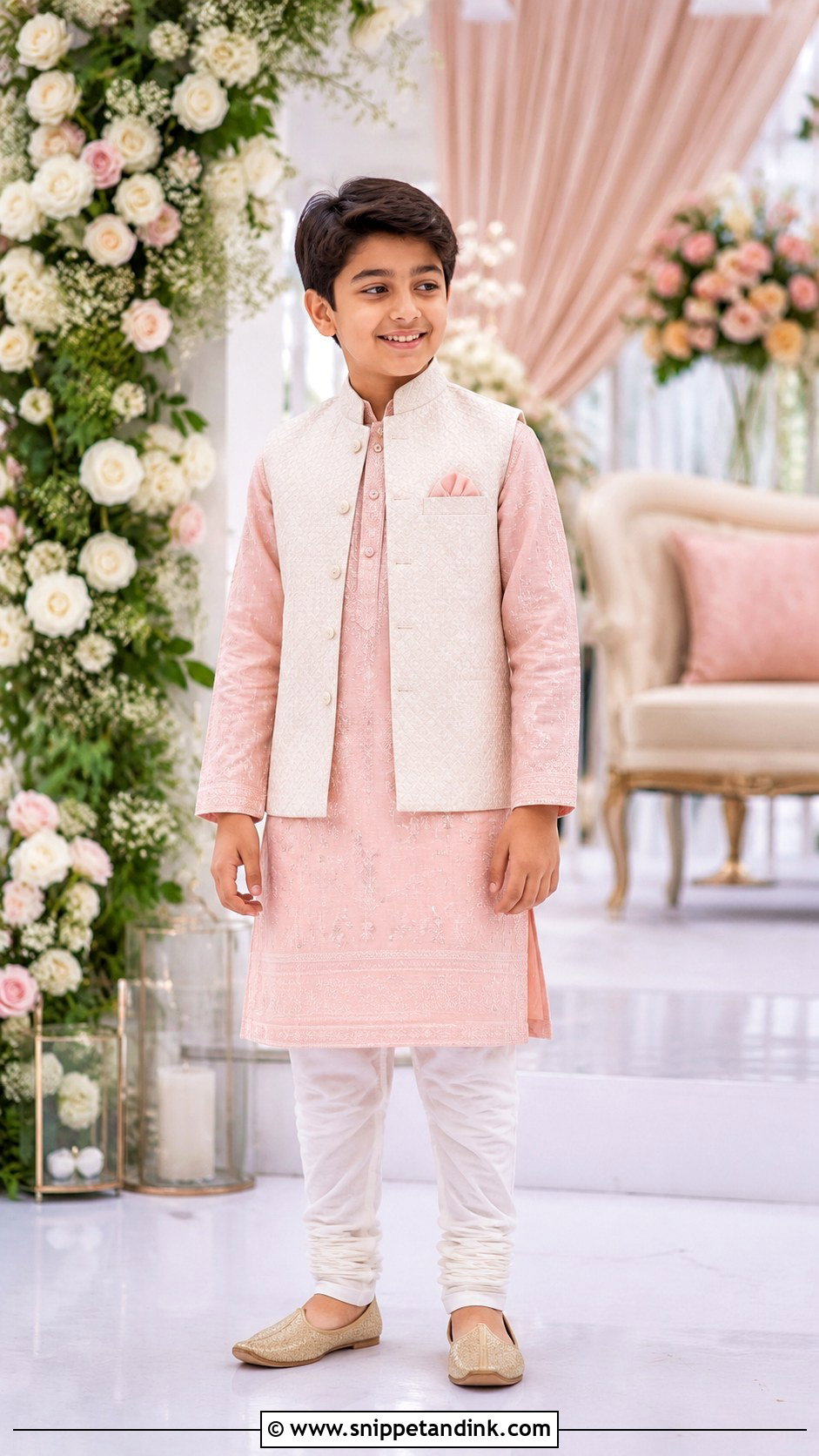
Pastel pink is cheerful at a daytime or early-evening function and looks fresher than another round of beige. Go for a plain cotton-silk kurta or one with fine white embroidery at the neckline, and hold it up to a window before buying. Light pastels are often unlined and see-through, which nobody notices until the stage lights come on. A white churidar is the classic pairing, though younger boys manage straight pajamas more easily. White or pale gold juttis, and if you want a layer, a light ivory Nehru jacket he can shed before the dancing starts. A side opening or an easy front placket saves a lot of wriggling at dressing time.
7. Royal Blue Sherwani With Gold Juttis
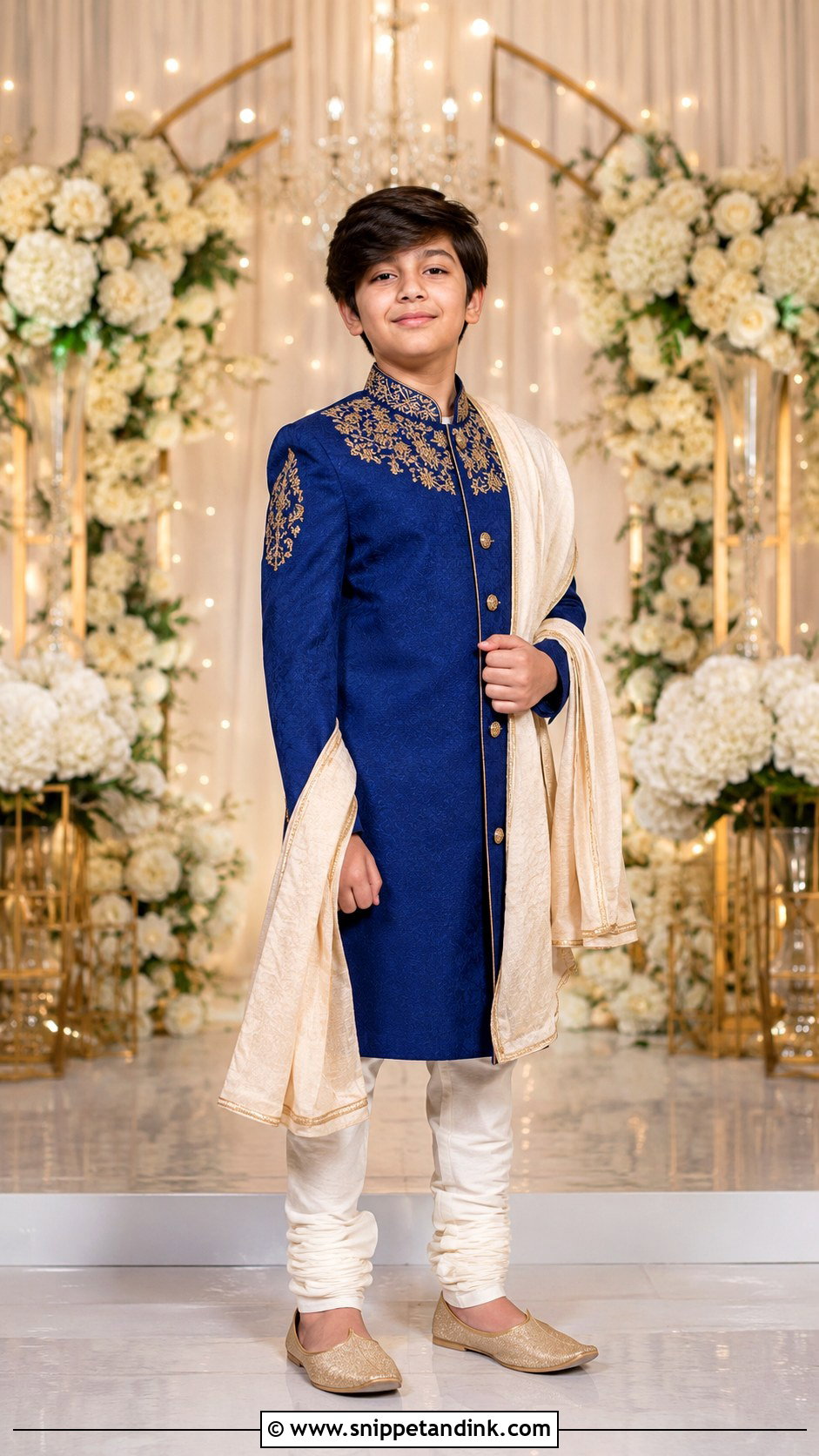
A boy with a real role in the evening, carrying something on stage or leading a family performance, can carry a royal blue sherwani. I choose knee length with moderate gold embroidery and textured buttons, and I turn it inside out before anything else. Heavy zari on the outside often means scratchy backing threads against bare skin, and a child will tell you about it all night. Ivory churidar for a traditional line, or slim cream trousers if he’ll be dancing. Gold juttis need toe room and a cushioned sole; new juttis are tight across the top for the first few wears. A cream stole for portraits, then off.
8. Asymmetrical Kurta With Dhoti Pants
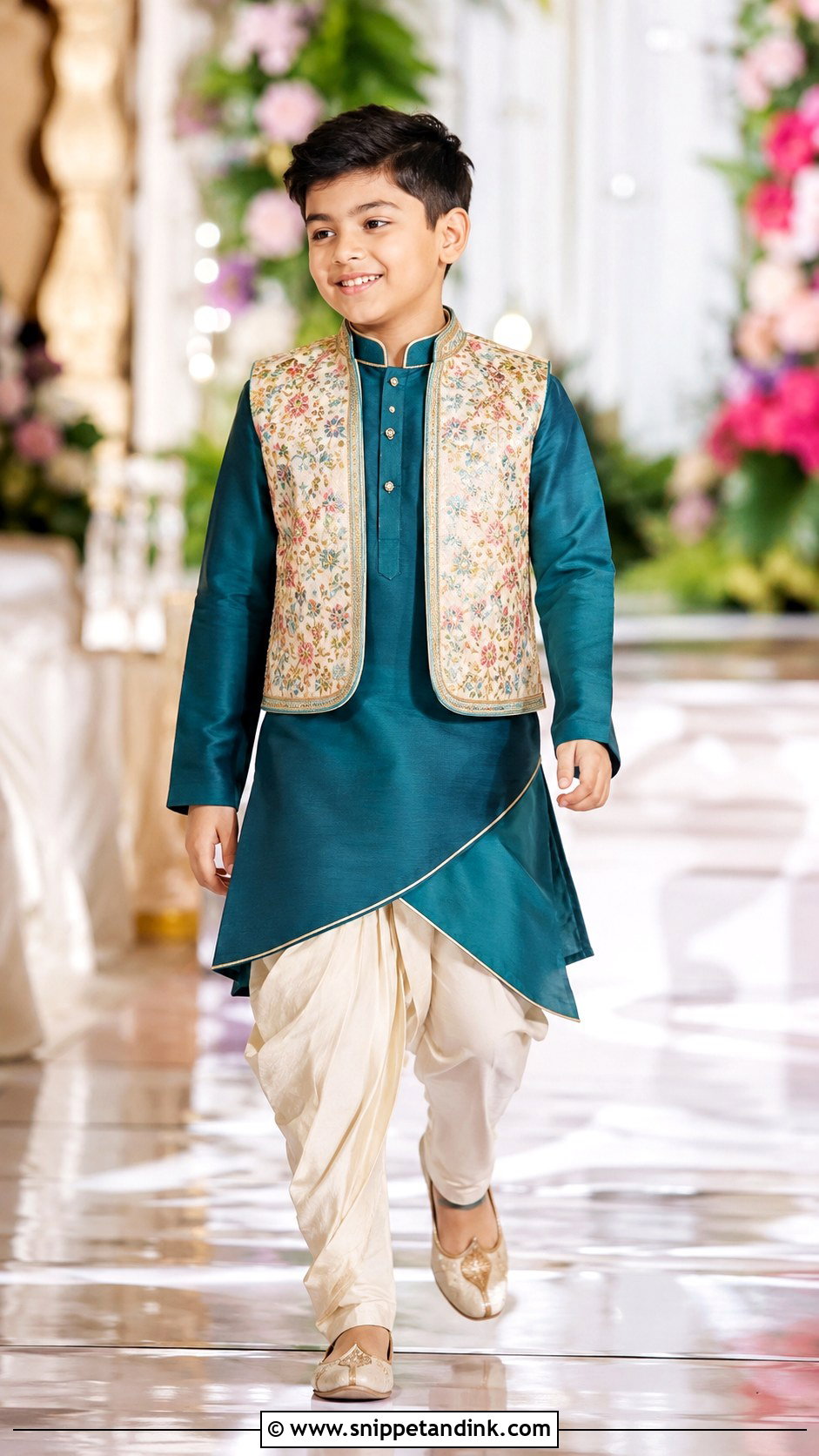
This is the fusion pick for an energetic boy. An asymmetrical kurta with a diagonal hem, an overlapping front panel or a side-button closure goes over pre-stitched dhoti pants, never a hand-wrapped dhoti. I’ve watched a wrapped dhoti come undone halfway through a group number, and the pre-stitched version has a proper waistband that stays put. Navy, teal, maroon and ivory all work for the kurta. Measure the longest point of the hem against his leg; past the knee, it catches when he spins. Neutral juttis or flexible loafers underneath. A short jacket is optional, since the cut already does the talking.
9. Mustard Kurta With Floral Nehru Jacket
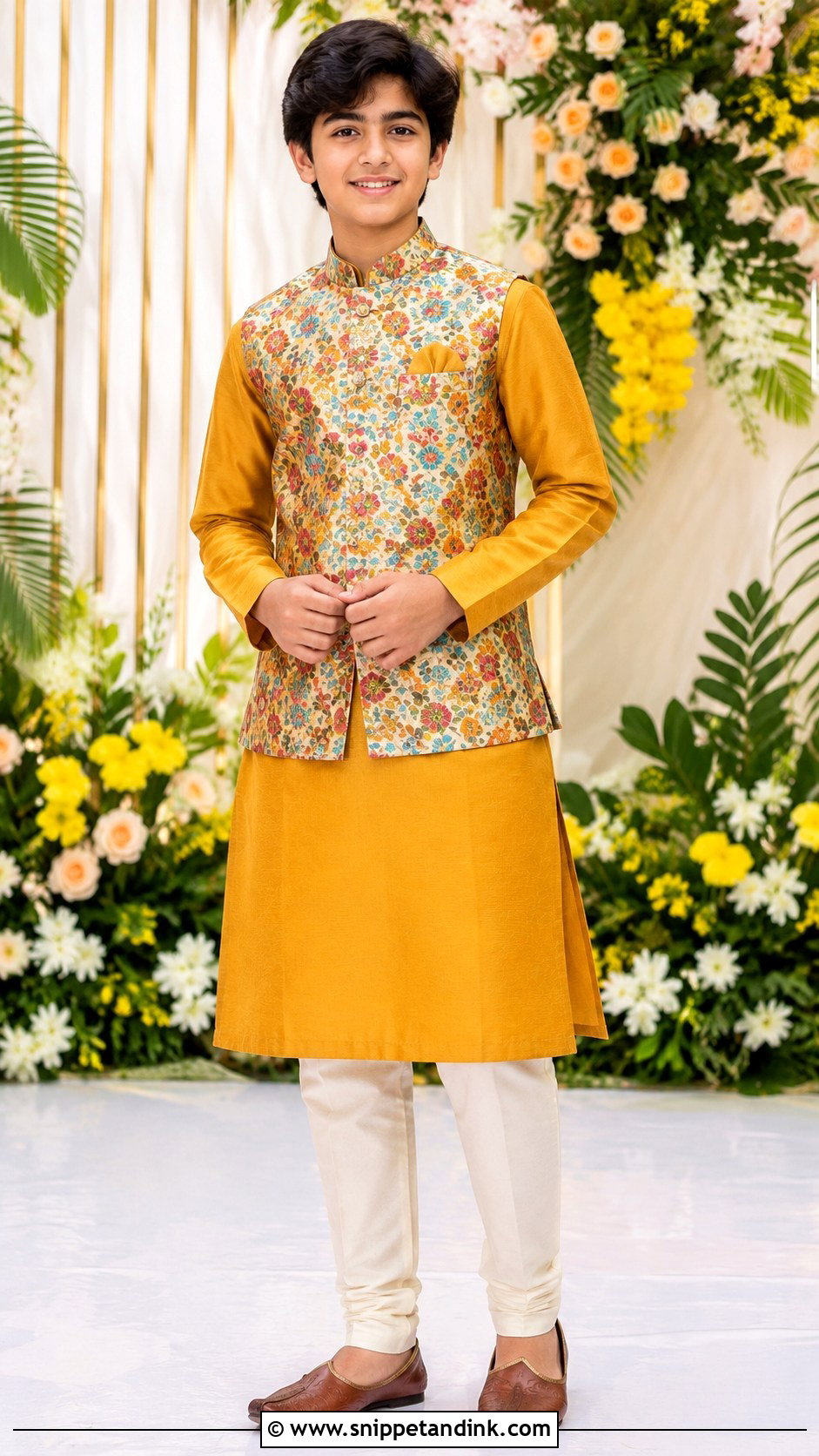
Mustard brightens a room full of dark evening colours, and it’s flattering on most skin tones as long as it leans golden rather than greenish. Start with a solid mustard kurta in breathable cotton silk and ivory straight pants, then add a floral Nehru jacket with blue, green, maroon or cream motifs. Scale matters on a small frame: medium flowers read clearly in photographs, oversized ones look like upholstery. Brown juttis or tan loafers ground it. Skip the pocket square. If the family is coordinating, borrow one colour from the jacket for a sibling’s outfit instead of matching the whole thing.
10. White Kurta With Blue Denim Jacket
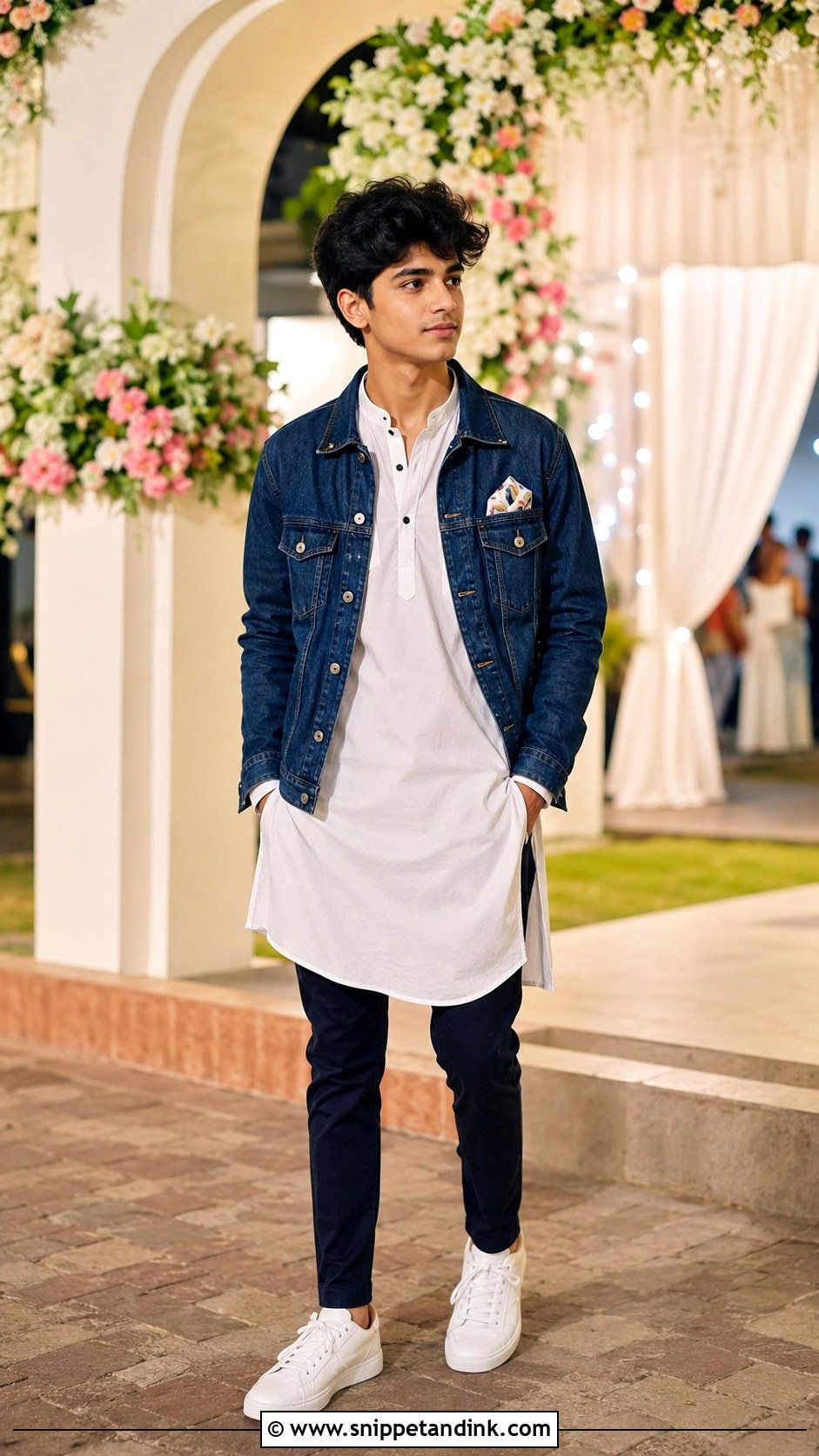
Some boys simply refuse embroidery, and for them I suggest this. It works best when the invite asks for an Indo-Western dress code. A crisp knee-length white kurta, tapered white, beige or navy pants, and a clean blue denim jacket with little or no distressing. The contrast is the whole idea, so keep jeans off the bottom half; denim top and bottom just looks like he forgot to change. White sneakers should be properly clean and properly laced. White also shows every drop of chutney, so pack wet wipes for this one. It suits outdoor venues and relaxed family performances best.
11. Teal Kurta With Embroidered Waistcoat
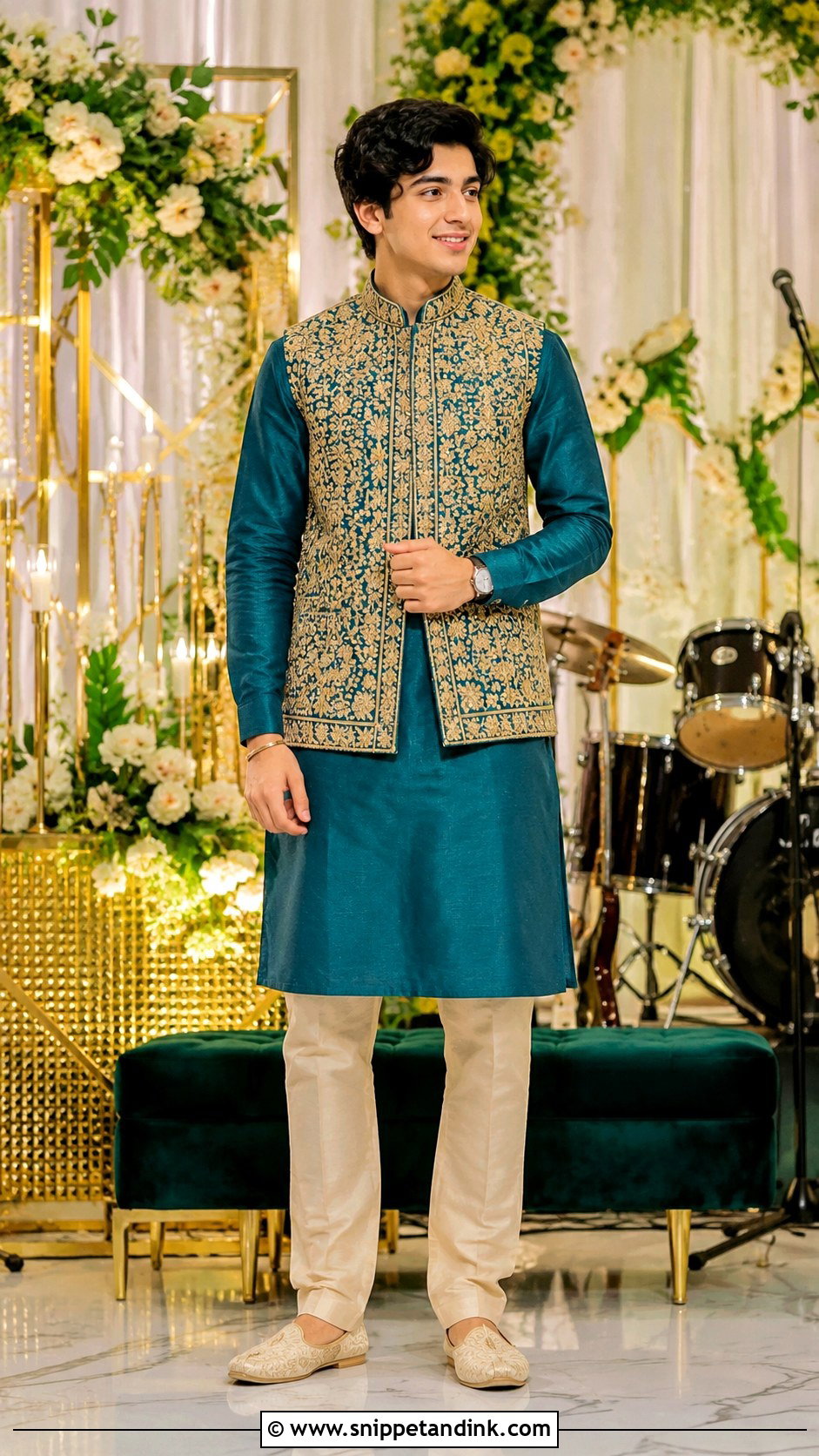
Teal gives you the richness of a blue without being the third navy kurta in the family photo. A straight-hem teal kurta with cream or beige trousers is the base, and an embroidered waistcoat in antique gold, ivory or a deeper teal makes it formal. For under-tens I ask for threadwork only, no beads or loose sequins, because those come off in small hands and end up in mouths or on the floor. The waistcoat should stop at the hip and lie flat over the kurta; if it bunches at the front, the kurta is too long for it. Beige juttis or tan loafers, and nothing else.
12. Velvet Nehru Jacket With Black Kurta
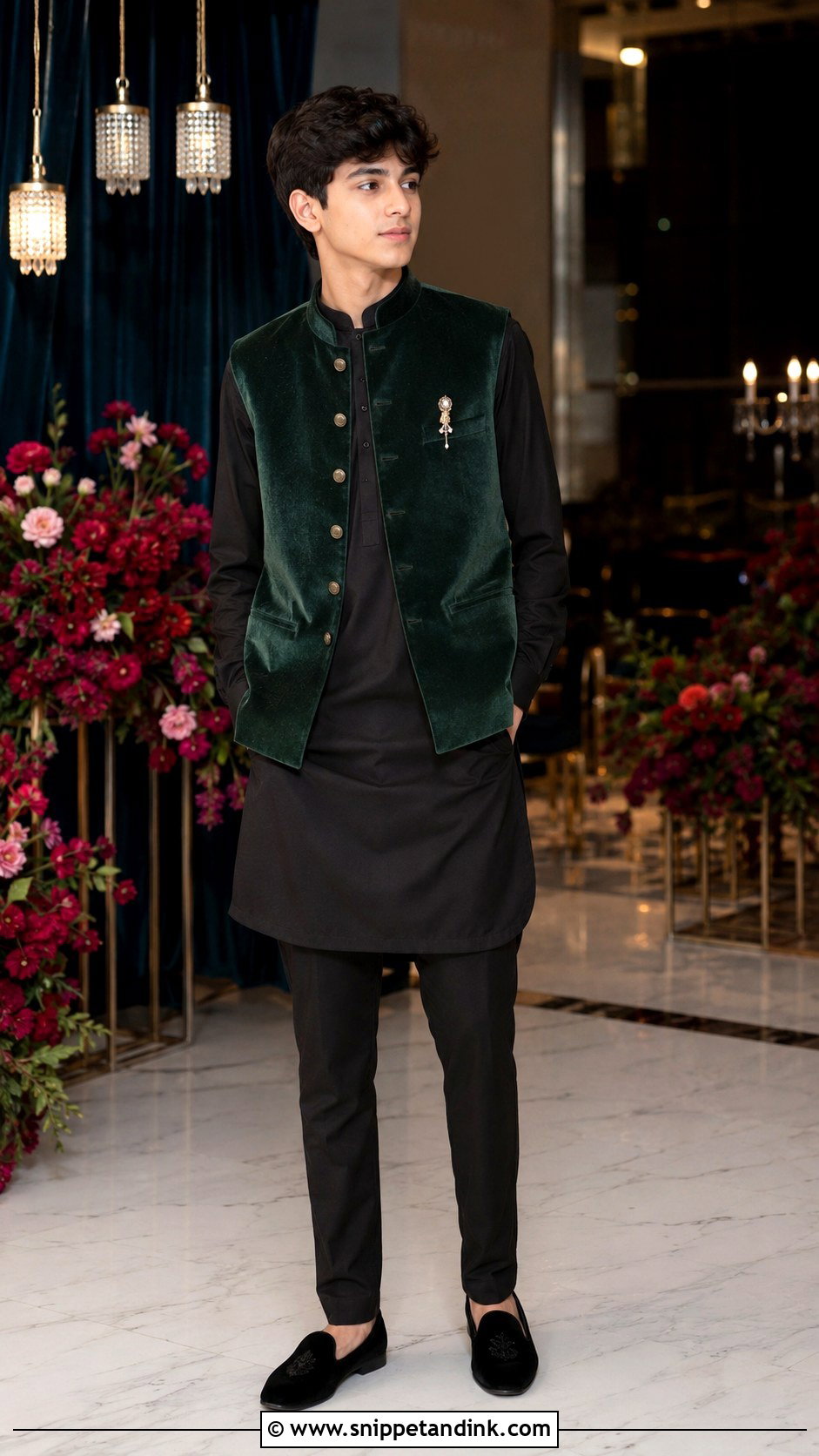
Velvet only makes sense in a cool room. For an indoor winter sangeet, a bottle green, navy, burgundy or deep purple velvet Nehru jacket over a plain black kurta and black straight pants looks rich without any embroidery at all. Velvet pile crushes where it’s pressed, so hang it on a padded hanger and steam it gently from the inside; don’t iron the face. Black loafers or velvet juttis, plus a metallic button row or small brooch for a bit of light. Once the dancing starts, velvet gets hot fast. Make sure the kurta underneath looks finished on its own so the jacket can come off without the outfit falling apart.
13. Printed Short Kurta With Tapered Pants
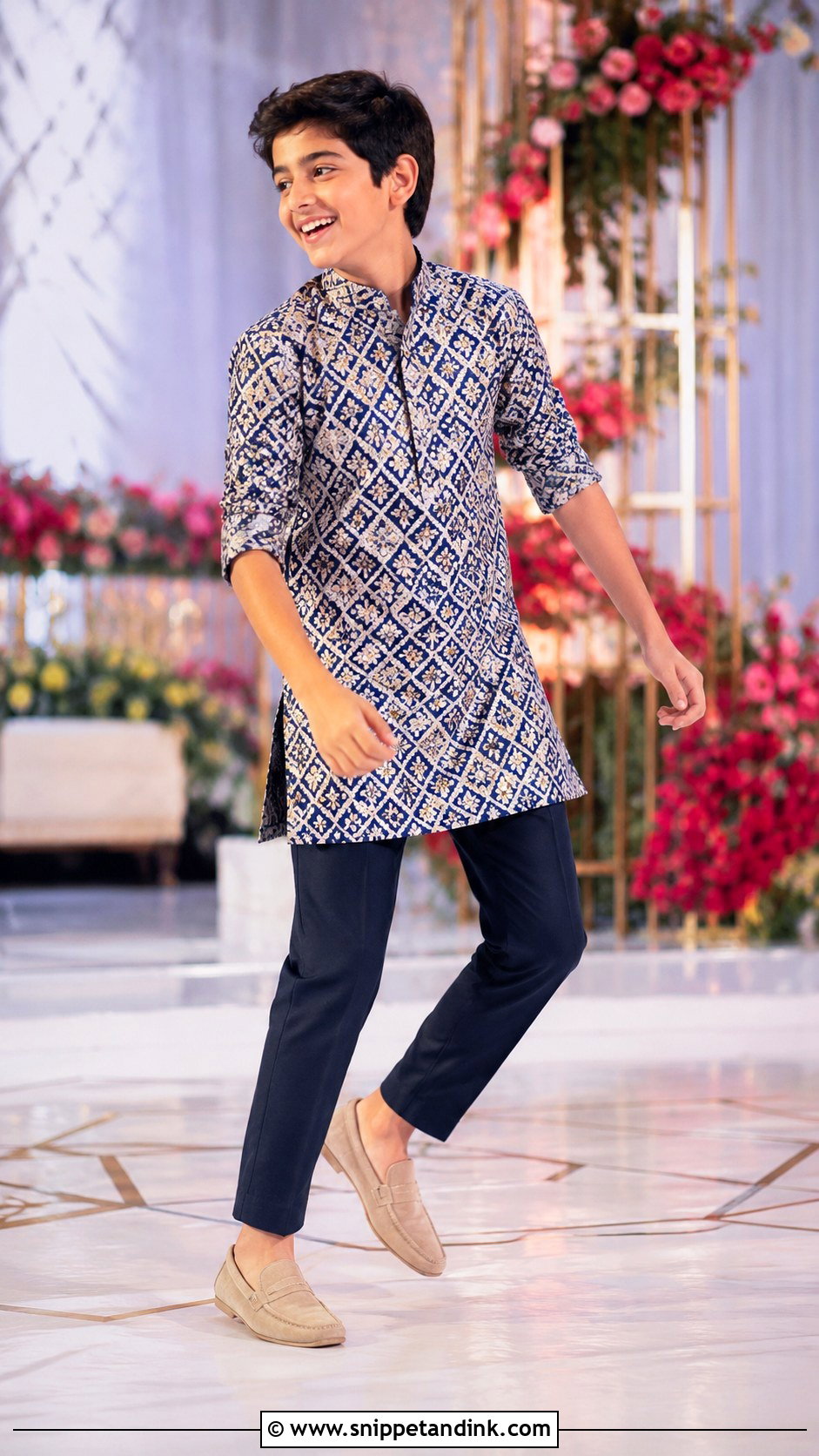
A printed short kurta is the easiest outfit here for a younger dancer, because there is nothing long to trip over and no layer to lose. Mid-thigh length, with geometric, floral or block-print motifs, over solid tapered pants pulled from one colour in the print. Navy, ivory, beige and black bottoms all calm down a busy pattern. Rolled sleeves need to fit at the cuff, not hang loose like borrowed clothes. I’d leave off the jacket unless the print is quiet. Loafers, juttis or plain white sneakers depending on how casual the evening is.
14. Jodhpuri Suit With Formal Loafers
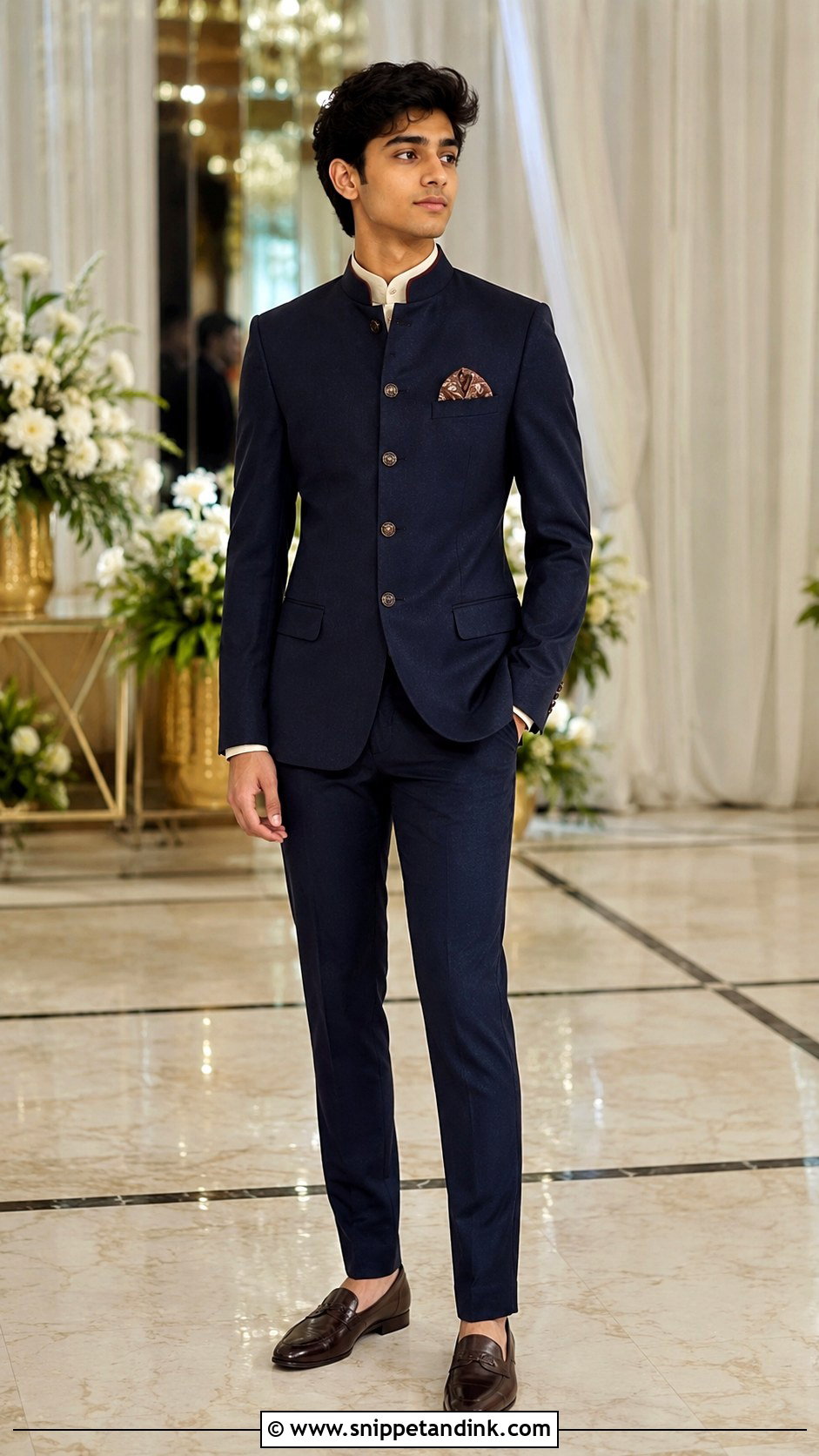
A tailored Jodhpuri suit is what I suggest when a teenage boy wants to look like one of the men. A band-collar jacket in navy, charcoal, maroon or deep green, matching or contrasting slim trousers, and a plain ivory shirt or fitted inner kurta to keep the neckline clean. Two fit points matter. Shoulders should be soft, not padded, on a boy’s frame, and the jacket shouldn’t fall below the hip or it starts to look like a costume. Give the trousers room through the thigh and knee. Black or dark brown loafers with matching socks, a patterned pocket square or a small collar brooch, and that’s enough.
15. Angrakha Kurta With Straight Pants
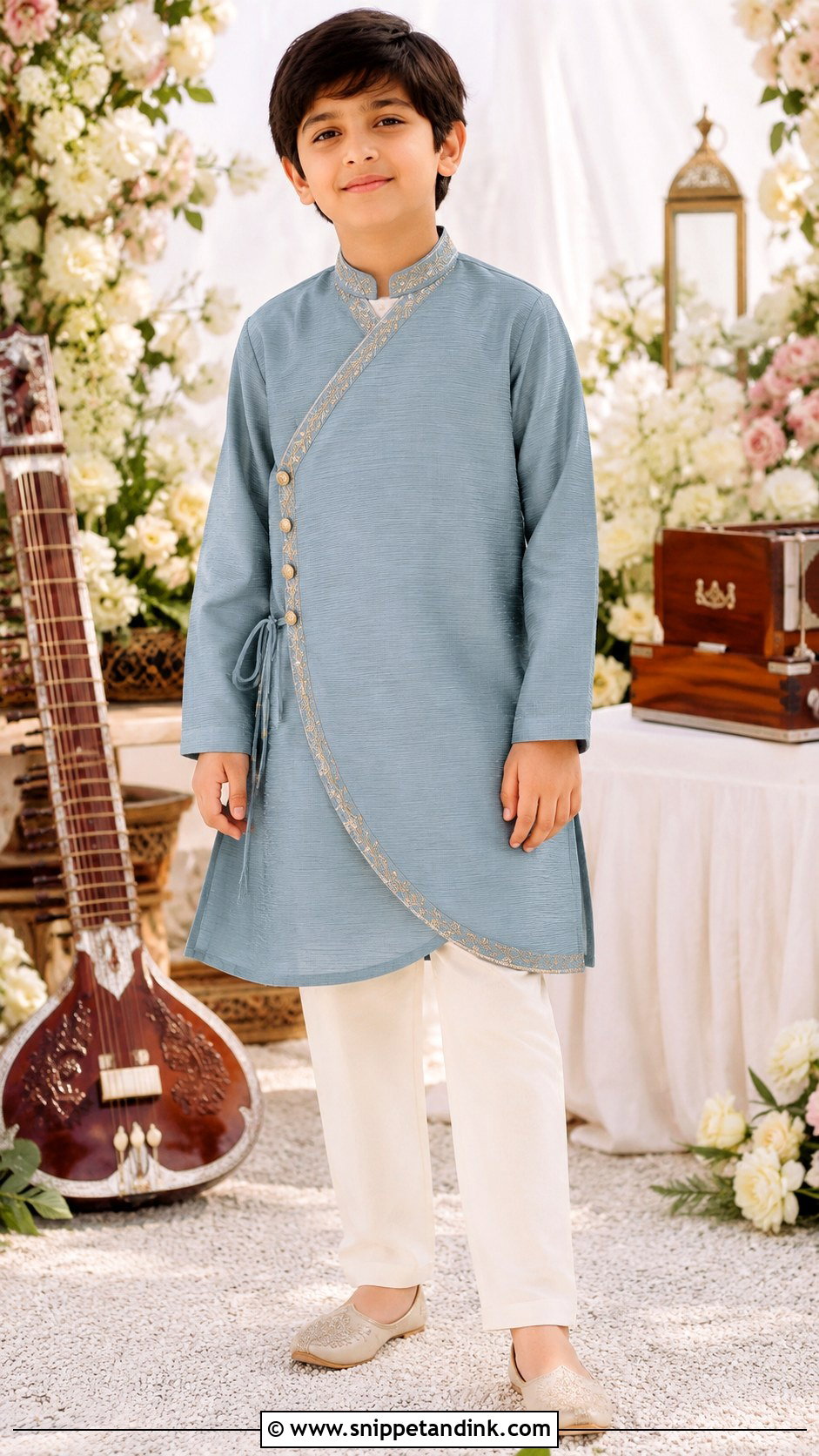
The angrakha’s crossover front is beautiful, and it’s also the part that fails if the fastenings are weak. I look for side ties backed by hidden snaps or proper buttons, so the panel stays closed when he’s jumping around. Sage, dusty blue, maroon, mustard and ivory all suit it, worn over plain straight pants in cream, beige or a matching shade. A light embroidered border on the neckline or overlap is enough detail. Long dangling tie ends are a hazard on the dance floor; knot them short or tuck them in. Juttis for a traditional look, loafers for a slightly modern one, and no jacket needed, which makes it handy for warm venues.
16. Sage Green Kurta With Beige Jacket
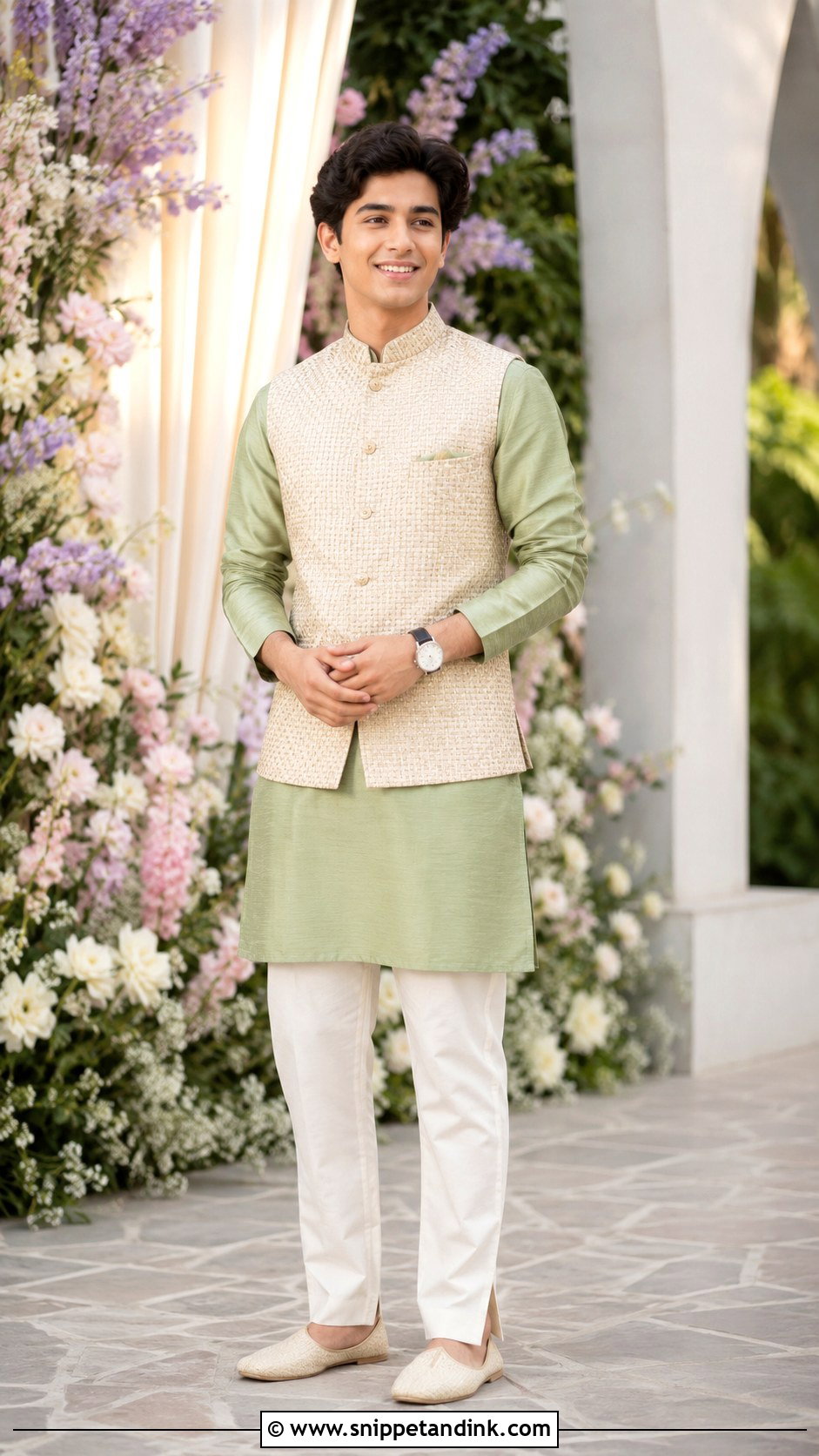
Sage is easy to get wrong. Put a cool grey-green next to a warm yellowish beige and the pair looks accidental, so hold the kurta and jacket together in daylight before you commit. A plain or lightly textured sage kurta, straight ivory pajamas, and a beige Nehru jacket with light gold buttons or tonal embroidery. Cream juttis or tan loafers keep everything soft, and an older boy can wear a simple watch. It suits spring and summer functions, garden venues, and families dressing in blush, lavender, pale blue or muted florals.
17. Wine Sherwani Jacket With Black Trousers
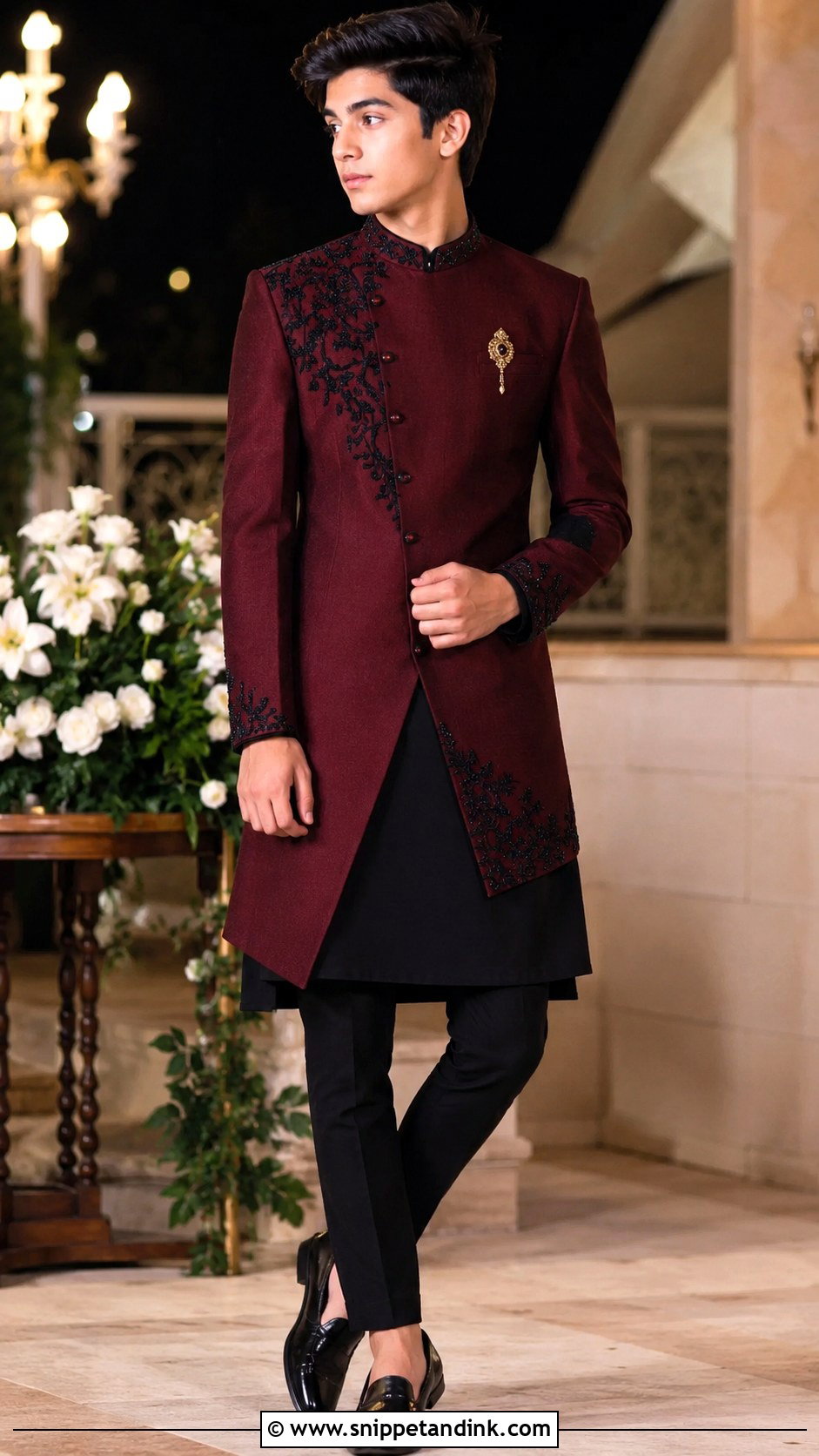
Wine and black is the moody evening option for teens. The sherwani jacket should fall around the knee, with an asymmetric opening or tone-on-tone black embroidery, over a plain black kurta or band-collar shirt so the colour reads cleanly. Slim straight trousers instead of a tight churidar, and black loafers or plain juttis. One antique-gold brooch is plenty. I’d test the fastening before the day: hooks or toggles a teenager can’t undo quickly mean he’ll stay hot in it all night instead of taking it off after the photographs.
18. Powder Blue Kurta Pajama With Ivory Jacket
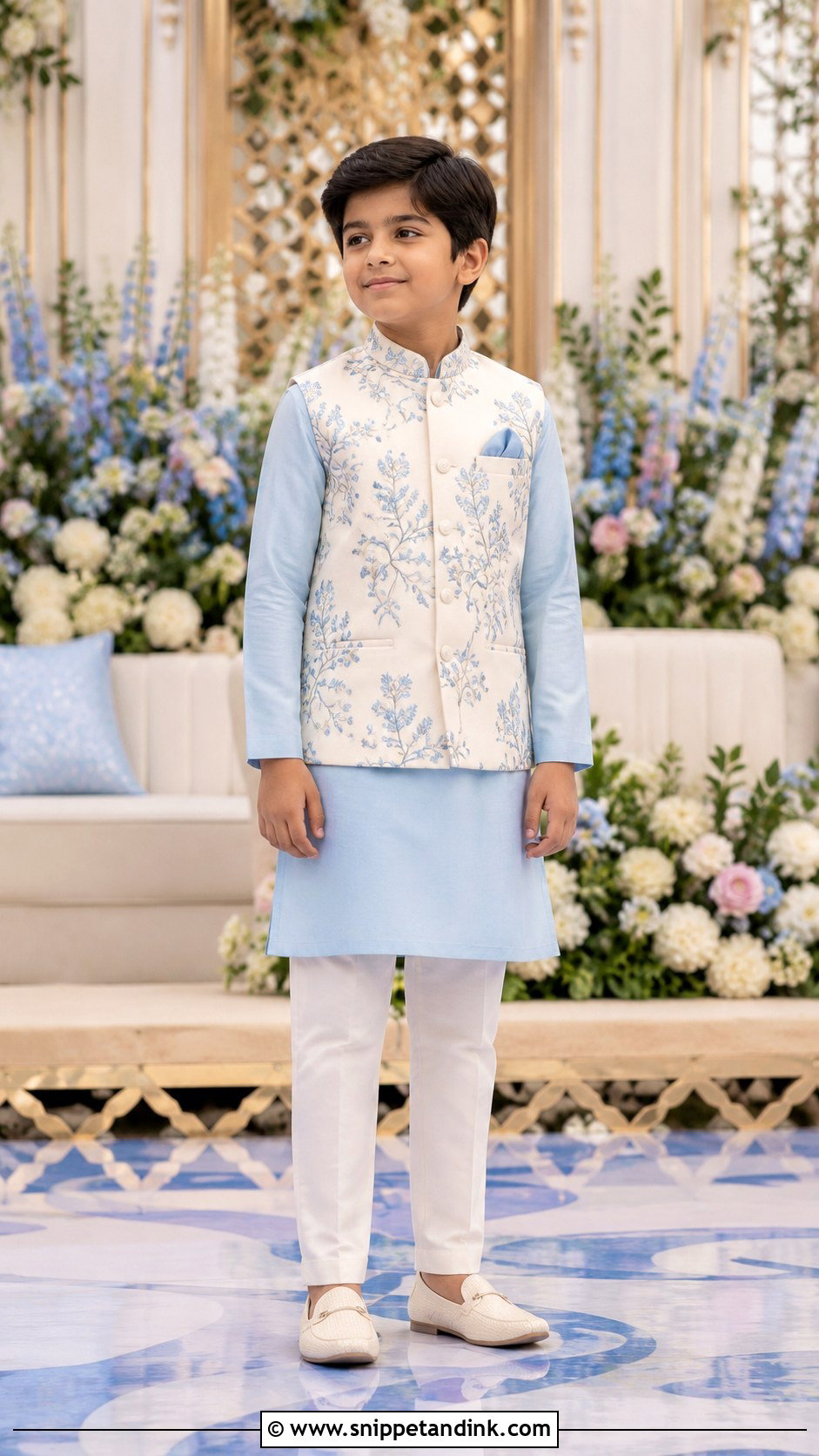
Three-piece pastel sets are where heat becomes a problem, so this powder blue look depends on light fabric in every layer. A soft blue kurta, matching or ivory pajamas, and an ivory Nehru jacket with silver buttons or fine blue embroidery. Cream loafers or light juttis keep it tidy from head to toe, and a pocket square a shade darker than the kurta stops it looking washed out on camera. Check the jacket armholes; they should be roomy enough for him to clap above his head. It works from toddler sizes up to teens and sits well beside pastel family outfits at a daytime function.
19. Black Pathani Suit With Mojaris
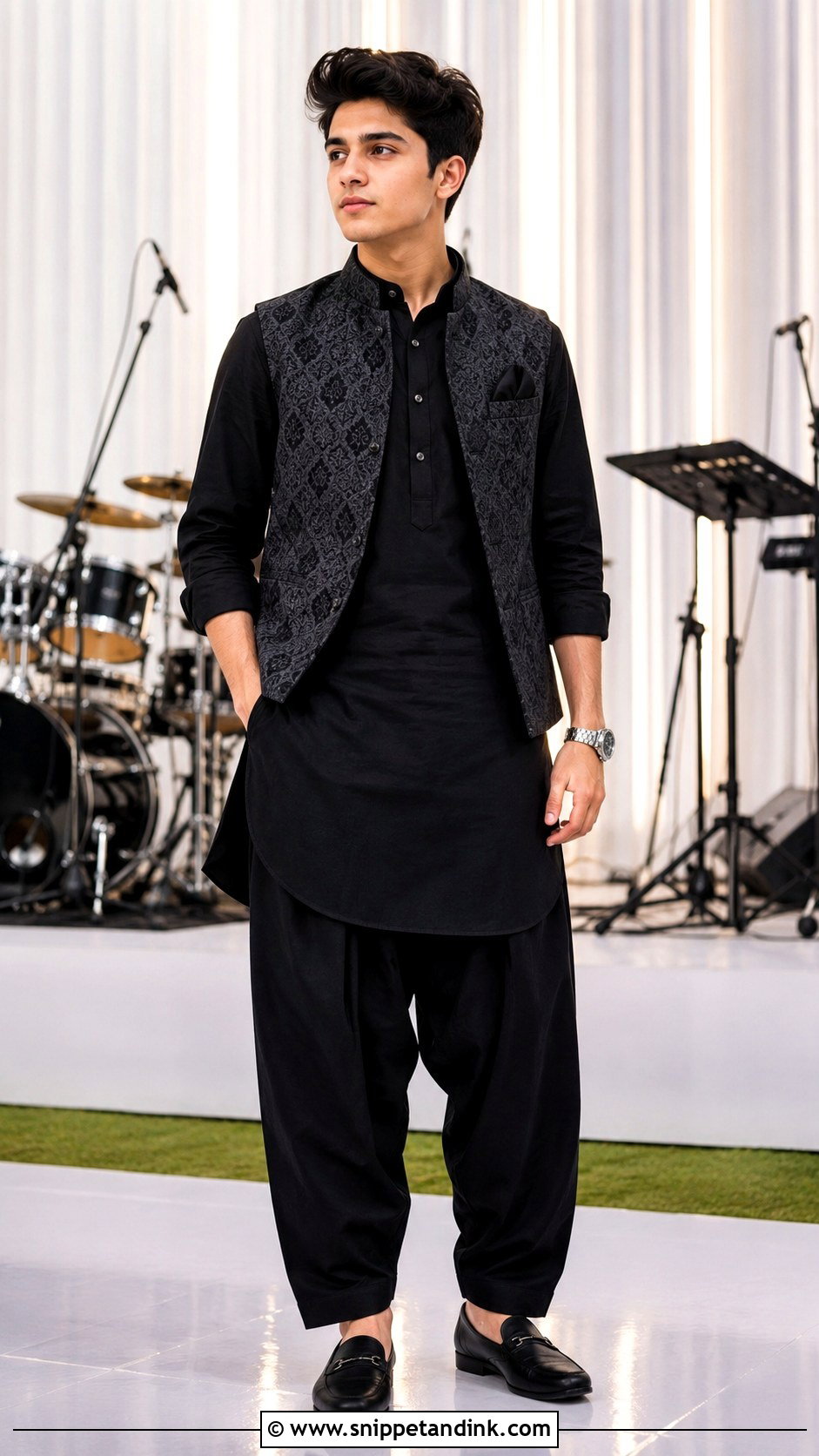
A black Pathani suit is about as simple as festive dressing gets, which is exactly why some teenagers love it. Knee-length kurta with a structured collar, chest pockets and side slits, over matching salwar-style or straight Pathani pants depending on how loose he likes it. Black mojaris are the traditional finish; dark slip-on loafers modernise it. If the evening is very dressy, add a waistcoat in charcoal, silver or deep maroon. Without one, a metal watch or small collar pin is enough. Black in a heavy fabric is hot under stage lights, so look for lightweight cotton or a cotton blend.
20. Floral Sherwani With Ivory Churidar
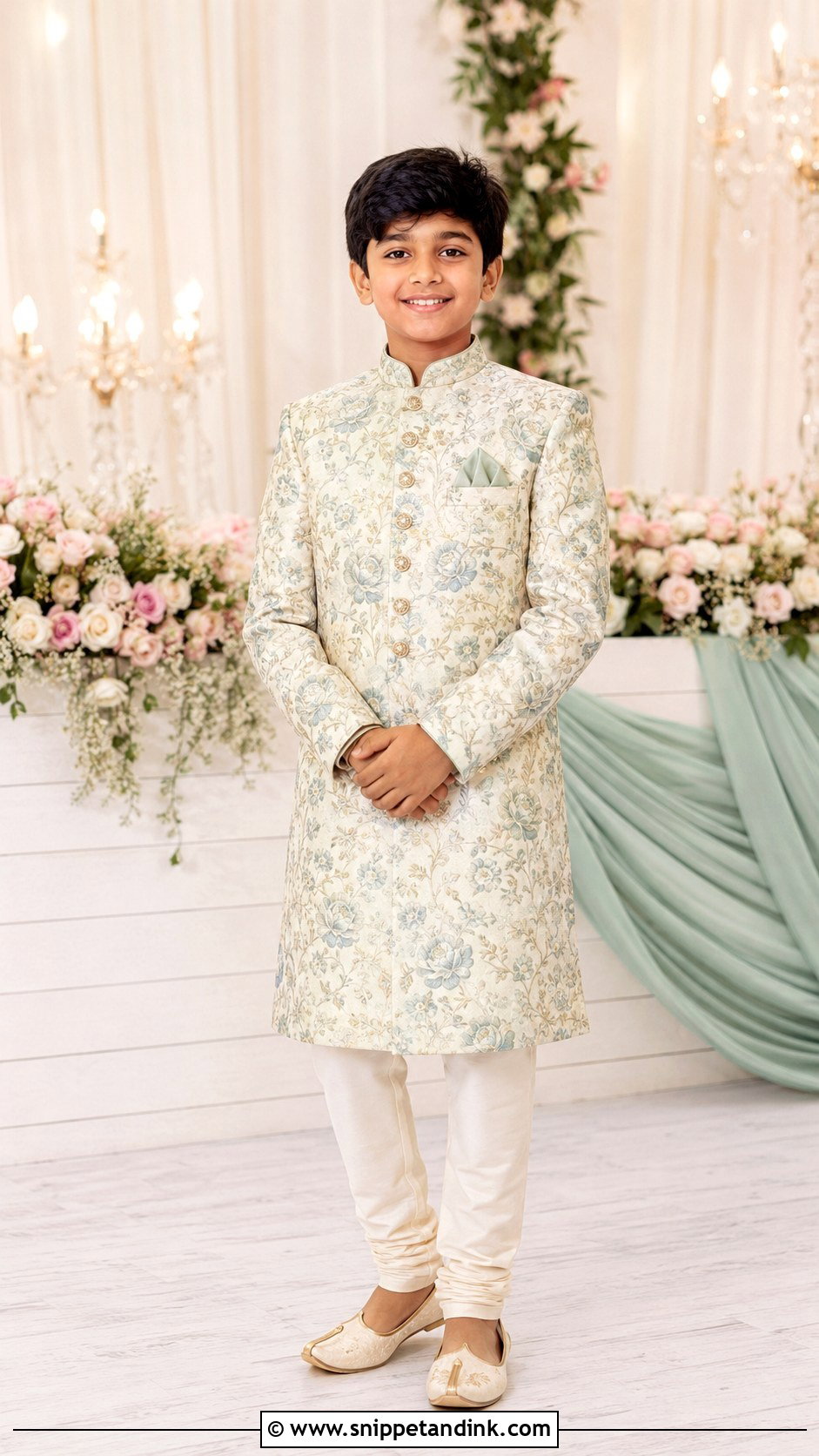
A floral sherwani suits the boy who actually enjoys colour, and you’ll know if he’s that boy. An ivory, pastel blue, sage or blush base with medium-scale printed or embroidered flowers, over a plain ivory churidar so the pattern stays the focus. Cream juttis with a little gold detail and no second print anywhere. Keep it around knee length, and run your hand over the inside of the embroidered panels; if it’s rough to your palm, it will be rough on his chest by ten o’clock. Siblings of the couple and young wedding-party members carry it best.
What Goes Wrong at a Sangeet, and the Bag That Fixes It
The trouble at a sangeet is rarely the outfit itself. It’s the small failure at nine o’clock when nobody has a needle. Over the years I’ve learned to send a small pouch with whoever is in charge of the boys, and it rescues most nights.
- Safety pins in two sizes, for a popped kurta button or a churidar drawstring that has vanished into its channel.
- A few blister plasters. New juttis rub at the heel and across the top of the foot, and a child will just stop dancing rather than complain.
- Wet wipes and a stain pen for food and mehndi smudges, which are the two things that land on a light kurta.
- A plain spare kurta or tee for under-sixes, so a spill at dinner doesn’t end the evening.
Break the shoes in at home for two or three short sessions before the day. Rubbing the inside of stiff leather juttis with a little coconut oil softens them, and wearing them over socks around the house stretches the top slightly. Thread a drawstring through with a safety pin and knot both ends so it can’t slide back in.
Finally, plan for the jacket coming off. Almost every boy sheds his layer within an hour of the music starting. Decide where it goes, label it if several cousins have matching ones, and make sure what’s underneath looks finished, because the late-night candid photos are usually of the kurta alone.
Let Him Dance in It Before the Night
Most of these outfits fail for the same small reasons: a jacket too tight to lift his arms in, juttis that pinch, a lining that scratches. Kurta-jacket sets will cover most boys at most sangeets. Save the sherwanis, bandhgalas and Jodhpuri suits for brothers and boys with a real role in the evening, and let printed kurtas and fusion pieces carry the casual functions. A week before, have him wear the complete outfit at home, shoes and all, and do a few minutes of the family dance. Whatever rubs, pulls or slips will show itself, and you’ll still have time to fix it. Tie his colours to the family palette with one shared shade rather than an exact match, and he’ll look like he belongs without looking dressed up by committee.
You'll Like These Ideas:


Leave a Reply