
Half-up hair is the style I suggest most often to brides who can’t decide between up and down, because it solves the practical problem first. Your hair stays off your face through the vows, the kiss and every hug in the receiving line, while your length still shows in photos. What it isn’t is a no-effort style. The top section carries all the strain of the day, so how it’s anchored matters far more than what sits on top of it. Below are fifteen versions I’d happily build at a trial, with notes on who each one suits and where it tends to let go.
The Anchor Hidden Under the Top Section Does Most of the Work
Every half-up style has a hidden base, and that base decides whether you still look pulled together at eleven at night. Pins pushed into a gathered section hold for a while, then the weight of the hair below and every turn of your head start working them loose. So before any twist, bow or pearl goes in, I build an anchor.
On most hair that means a small clear elastic catching the top section, with two bobby pins crossed over it into the hair beneath. On heavy or very long hair I braid a tiny section flat against the scalp first and pin everything else onto the braid. Silky hair gets dry texture spray at the root before I start, because pins need grit to grip.
- Tell your stylist if your hair is freshly washed on the day; it changes how much texture they need to add.
- Hair washed the night before usually holds better than hair washed that morning.
- Heavy accessories should be pinned to the anchor, never just to loose strands.
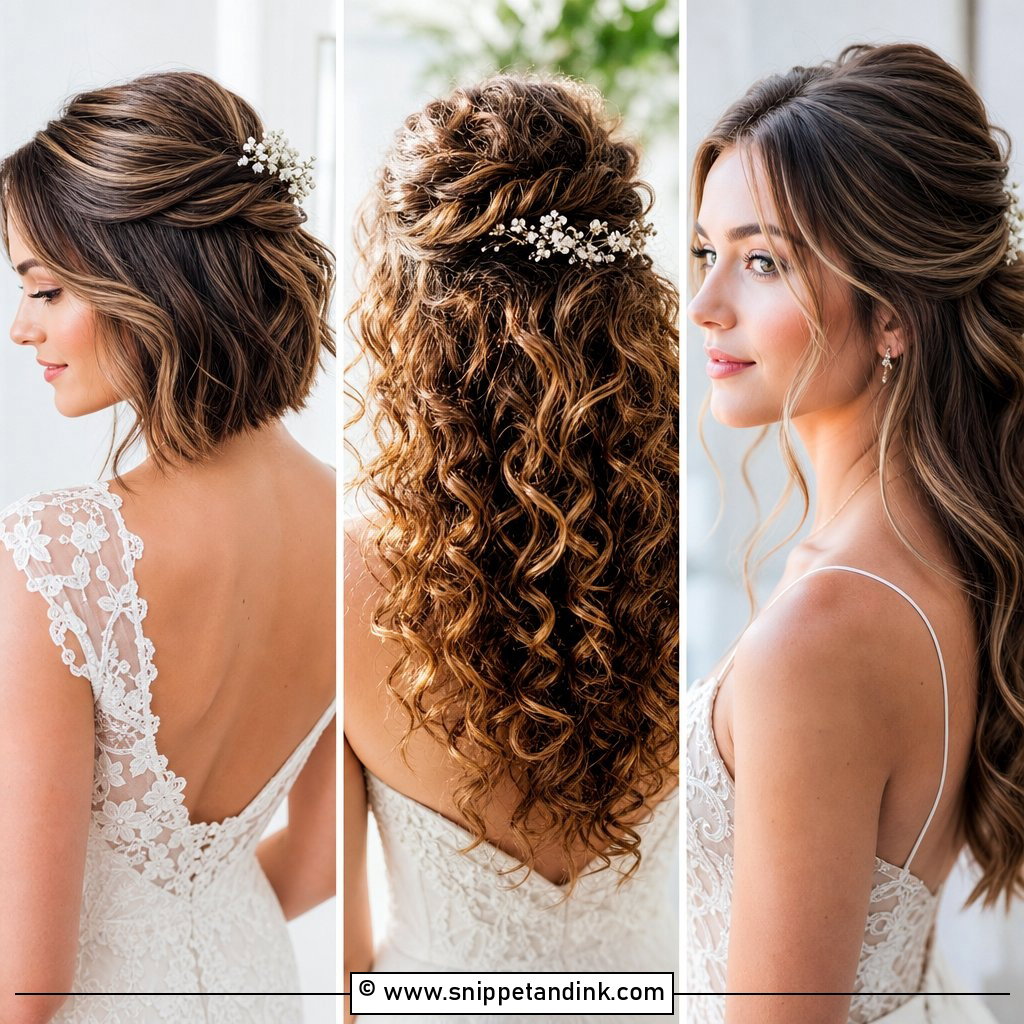
1. Half-Up Bridal Hair With Loose Waves
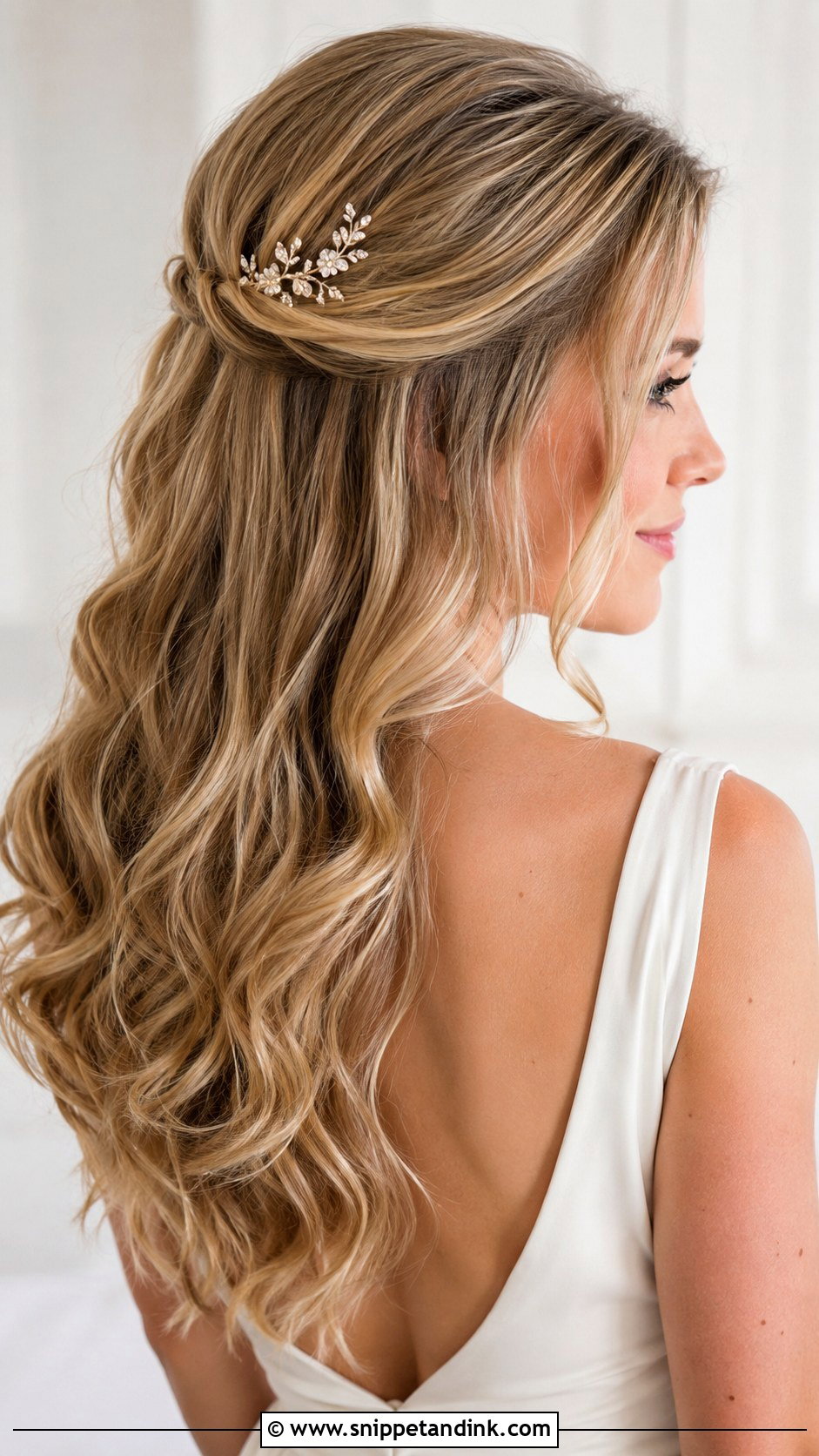
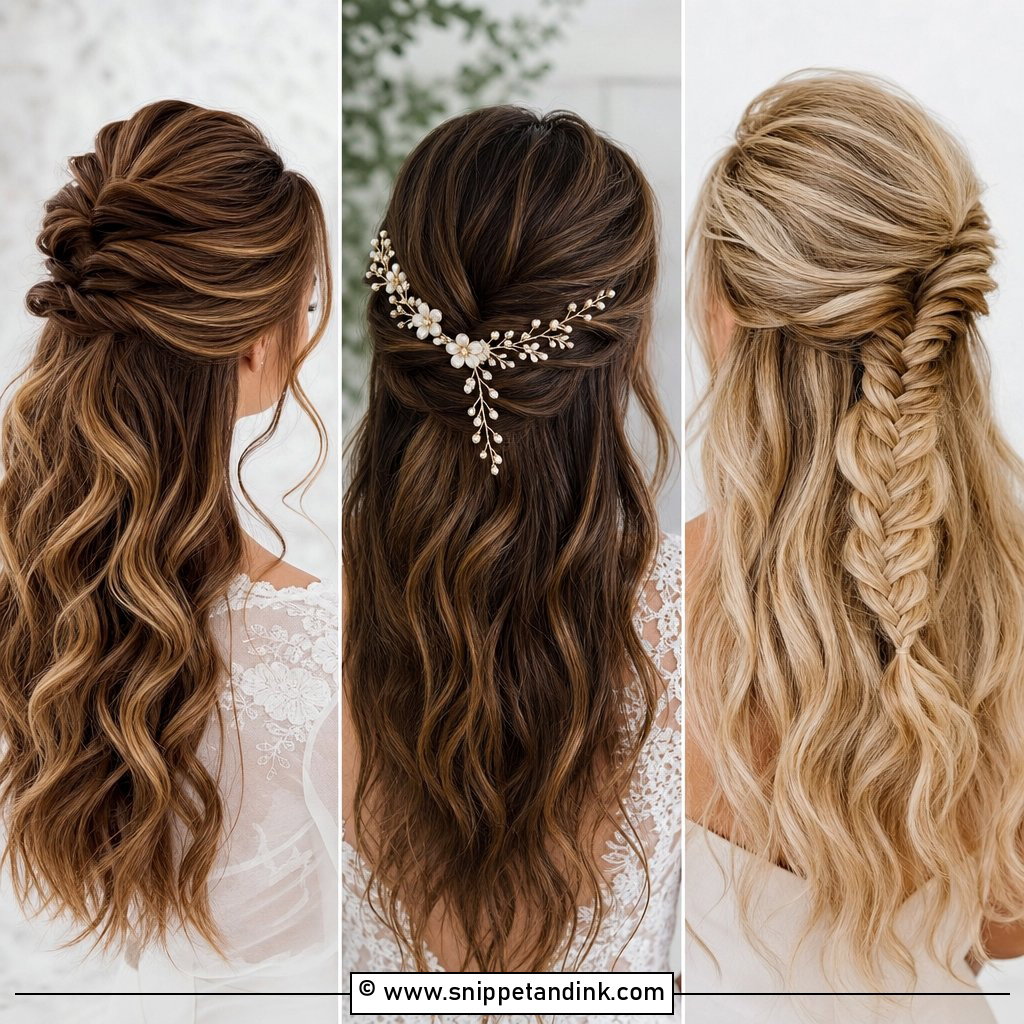
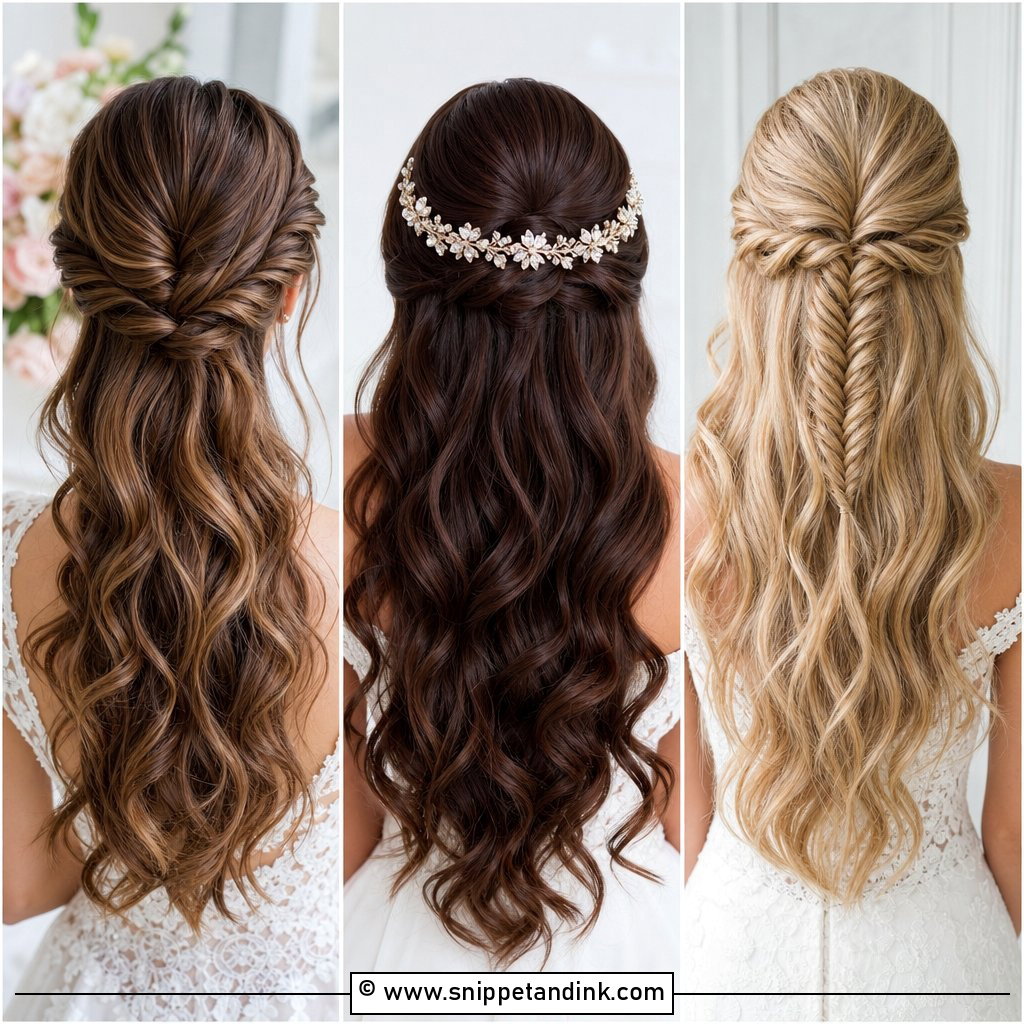
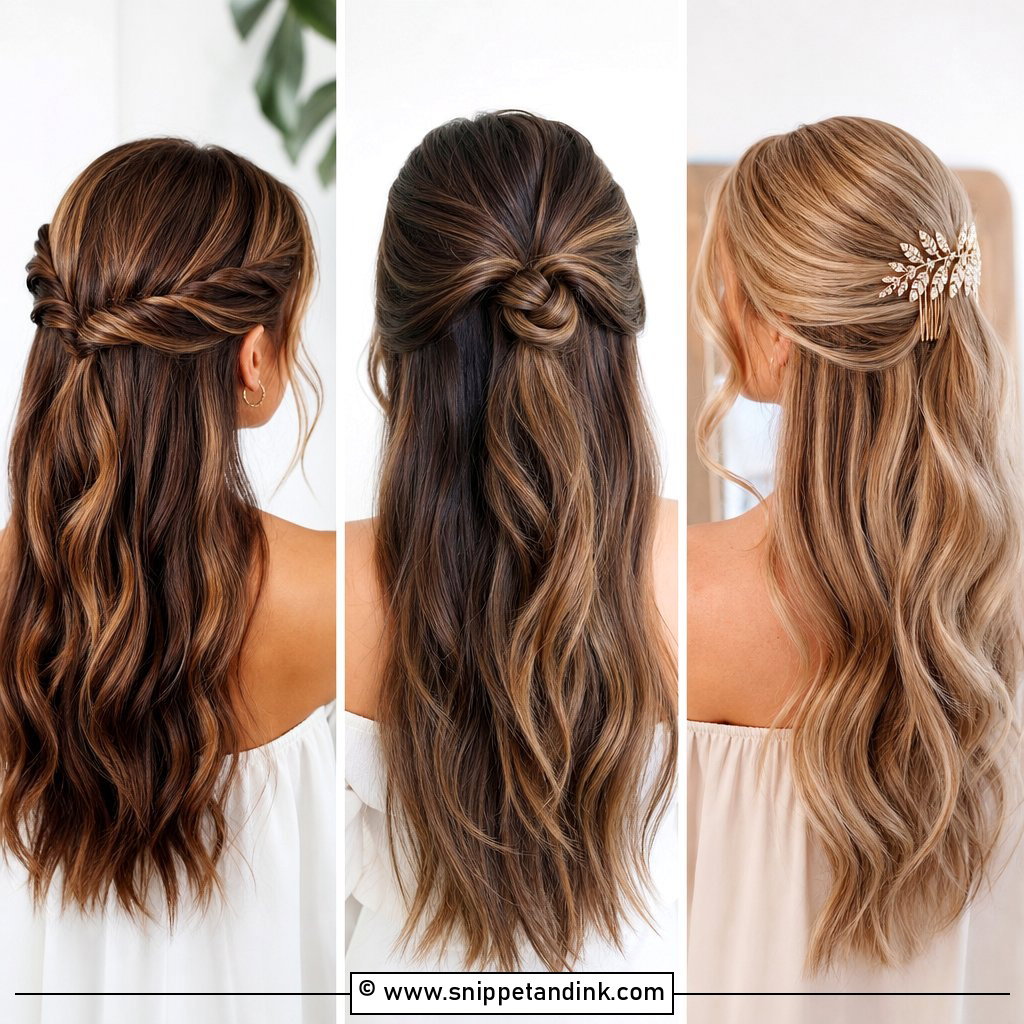
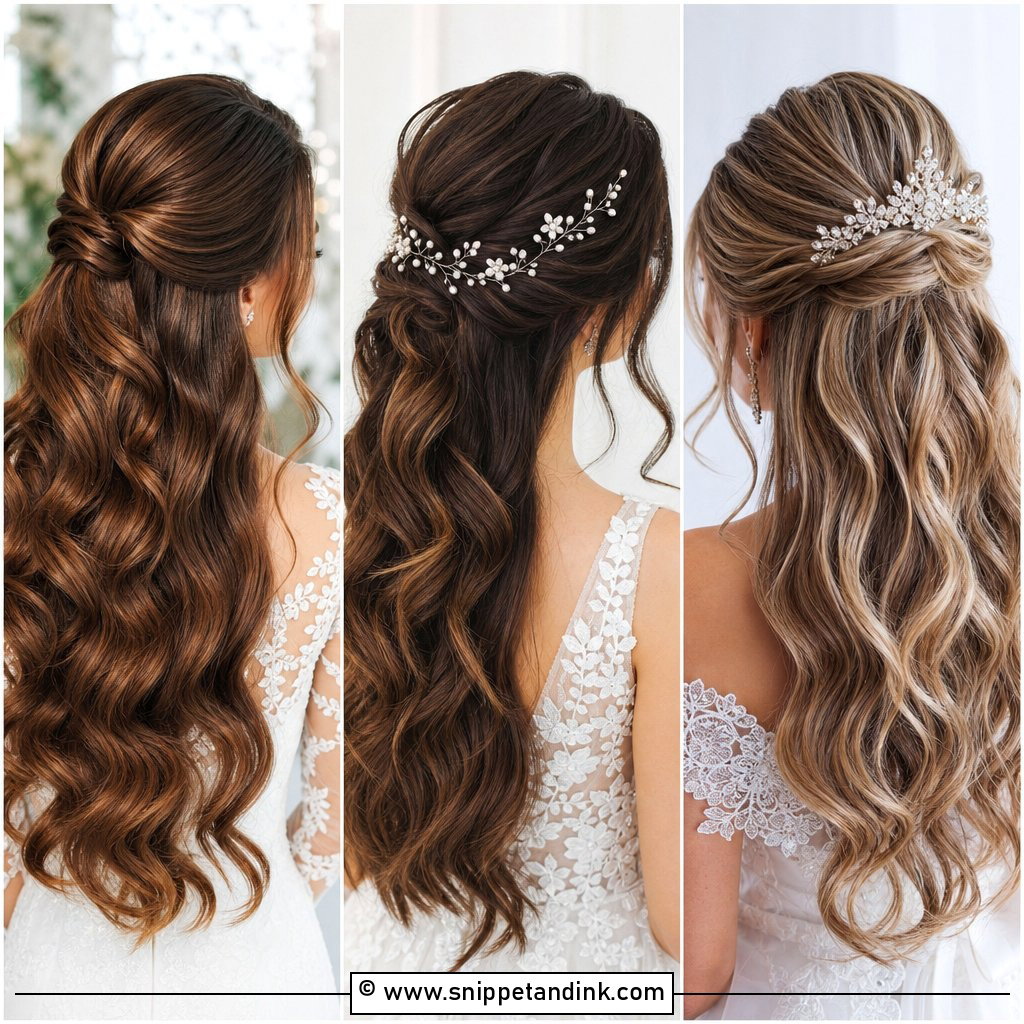
I start a lot of trials with loose waves, because they show me within minutes how your hair holds a bend. The top section goes back onto a small hidden elastic first, and only then do I cover it with a pin or comb; pins alone slide out of waved hair within a few hours. I set the waves tighter than you’ll want them, since they relax noticeably once the heat leaves the hair and you start moving. A little lift at the crown and two light pieces at the front keep you from looking flat when the camera is straight on. Veils, pearl pins and plain combs all sit happily on this base.
2. Half-Up Bridal Hair With Soft Curls
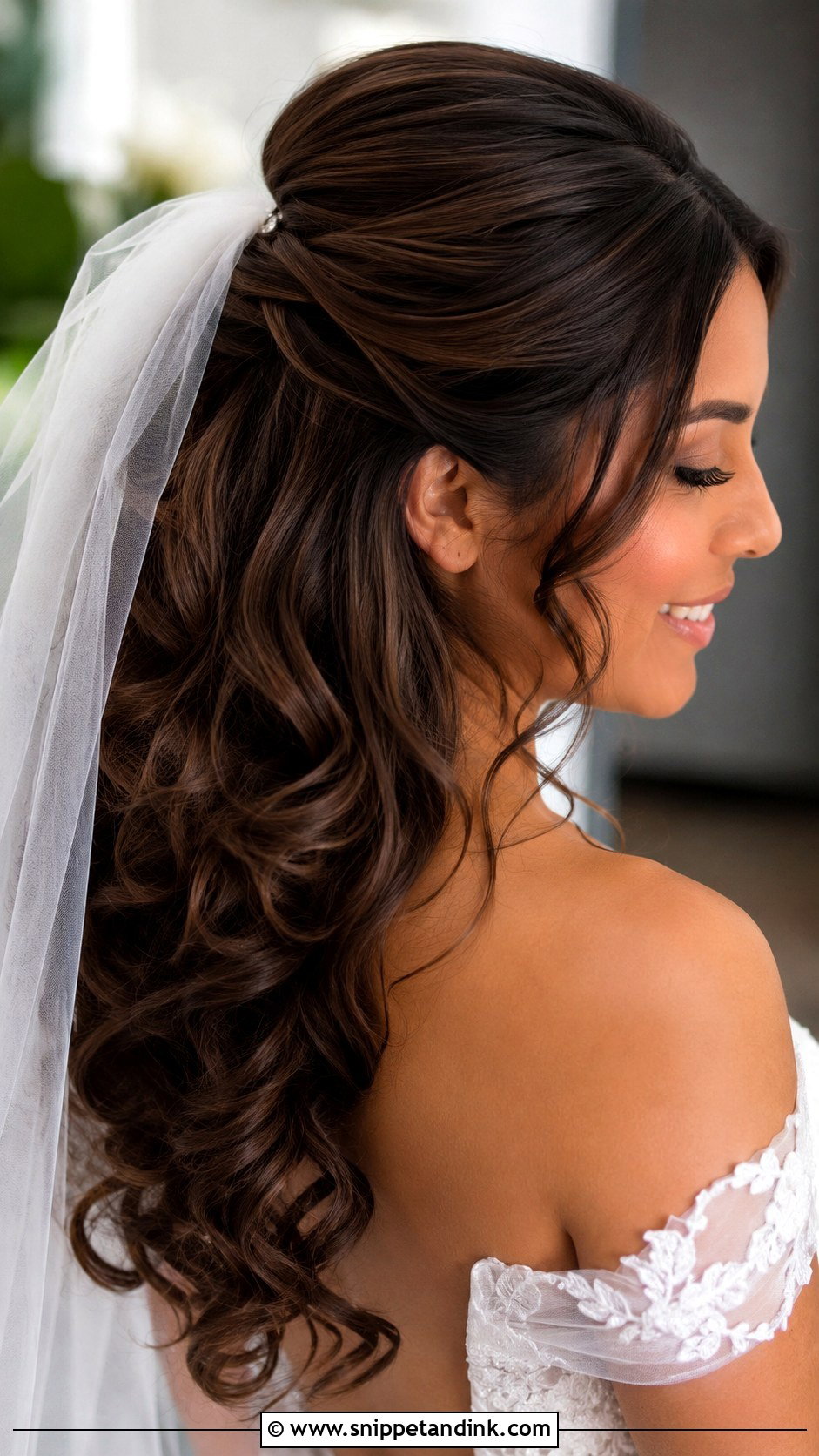
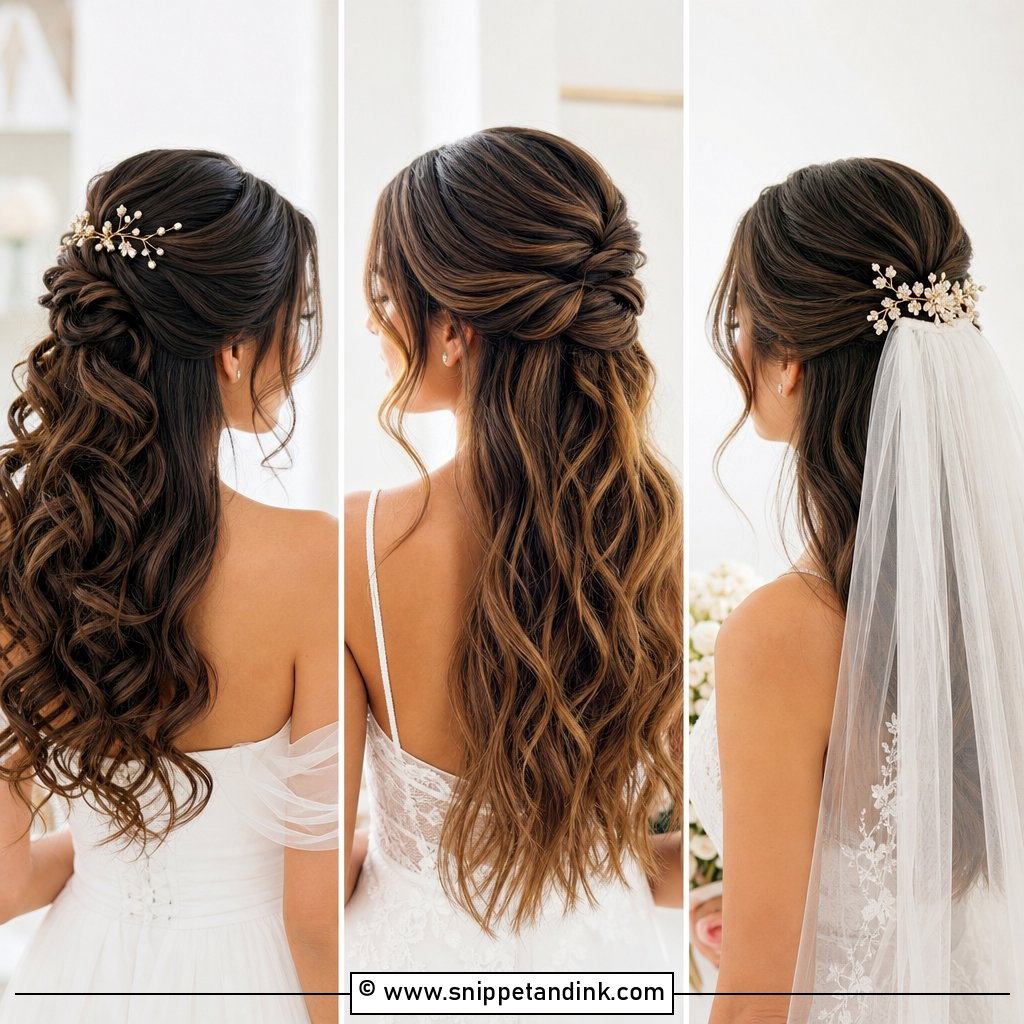
Soft curls give you the look of hair worn down with the control of something pinned. I reach for this on medium and long hair that needs shape but would feel heavy in a full updo. Brushed out, the curls merge into one soft mass; left defined, they bounce and read clearly in group shots taken from further back. What I watch is the join, where the pinned section meets the curls, because that’s where a gap or a stray pin shows. A small veil comb or delicate hair vine placed right over that spot covers it neatly.
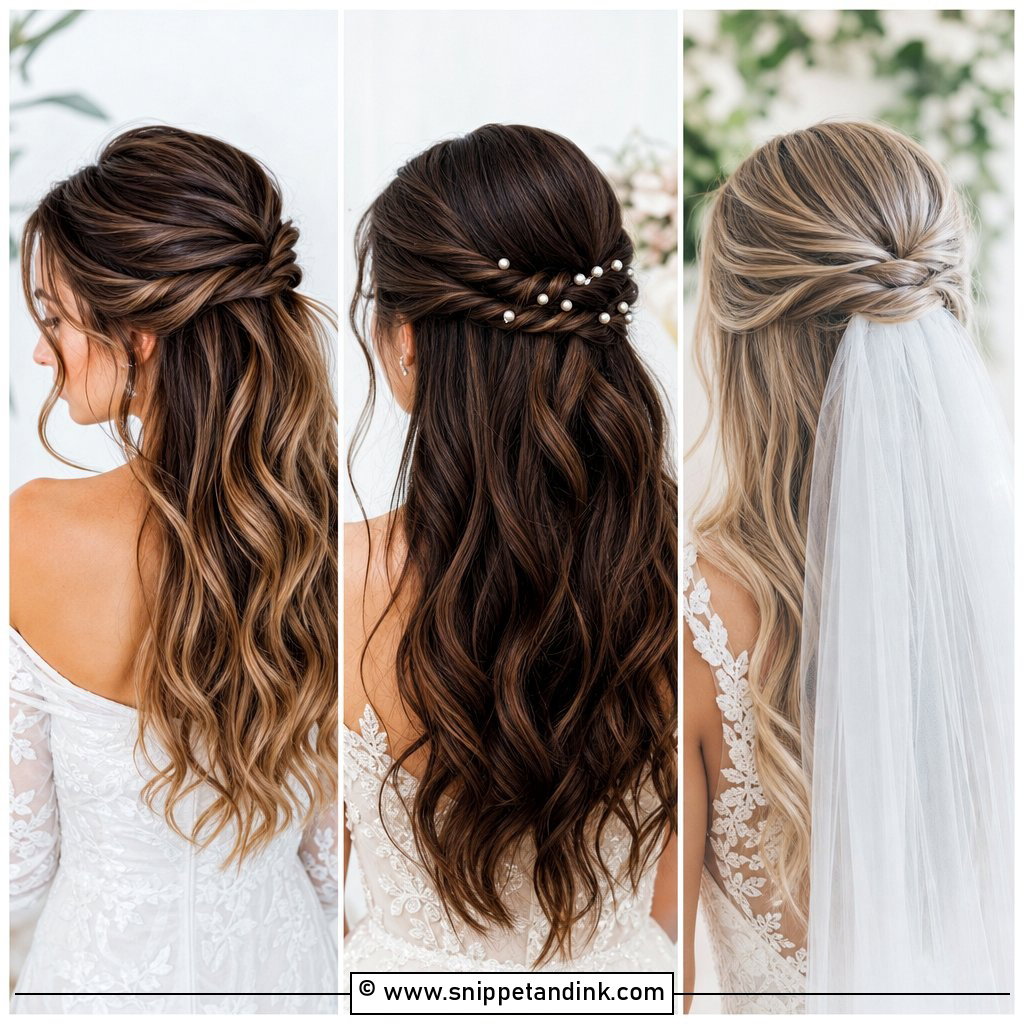
3. Half-Up Bridal Hair With A Twist
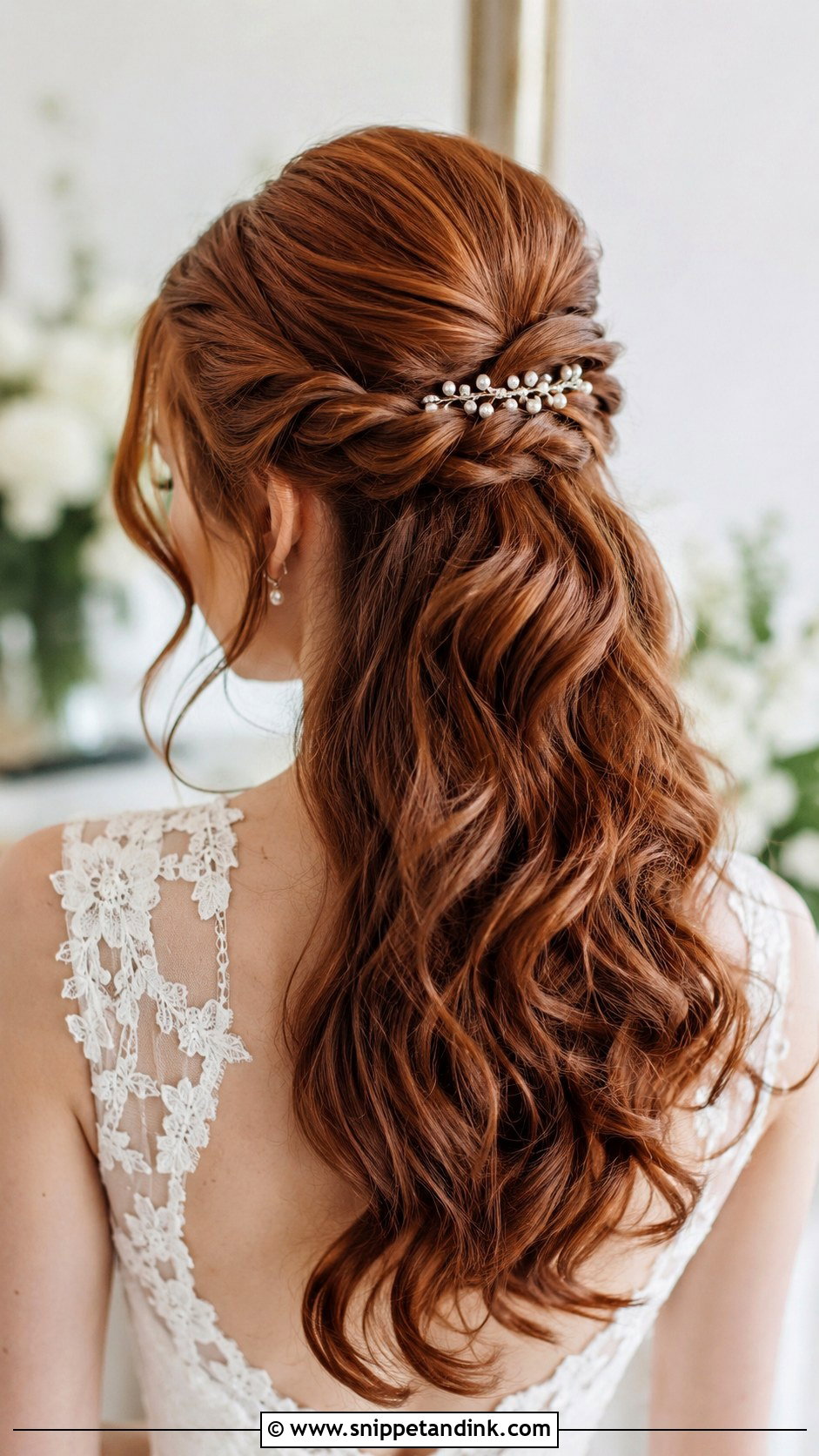
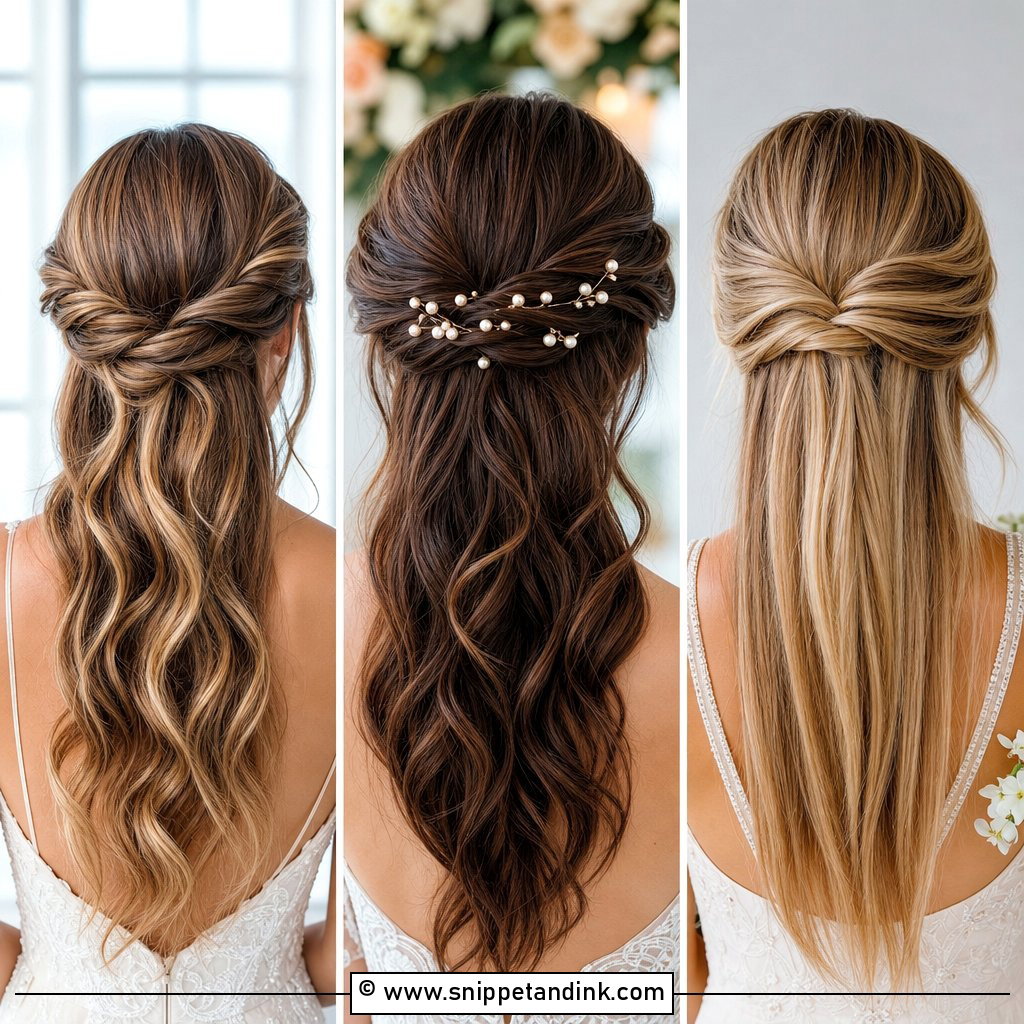
Two side sections twisted back and pinned together is the simplest detail I can add without making the style busy. The usual DIY mistake is twisting clean, silky hair, which quietly untwists itself before the first dance. I mist each section with a dry texture spray before twisting and lock the twist with two bobby pins crossed in an X, which grip far better than one pin pushed straight in. Underneath you can wear waves, curls or a smooth blowout. I’d skip the twist if the hair around your temples is very short, because the ends poke out of it all day.
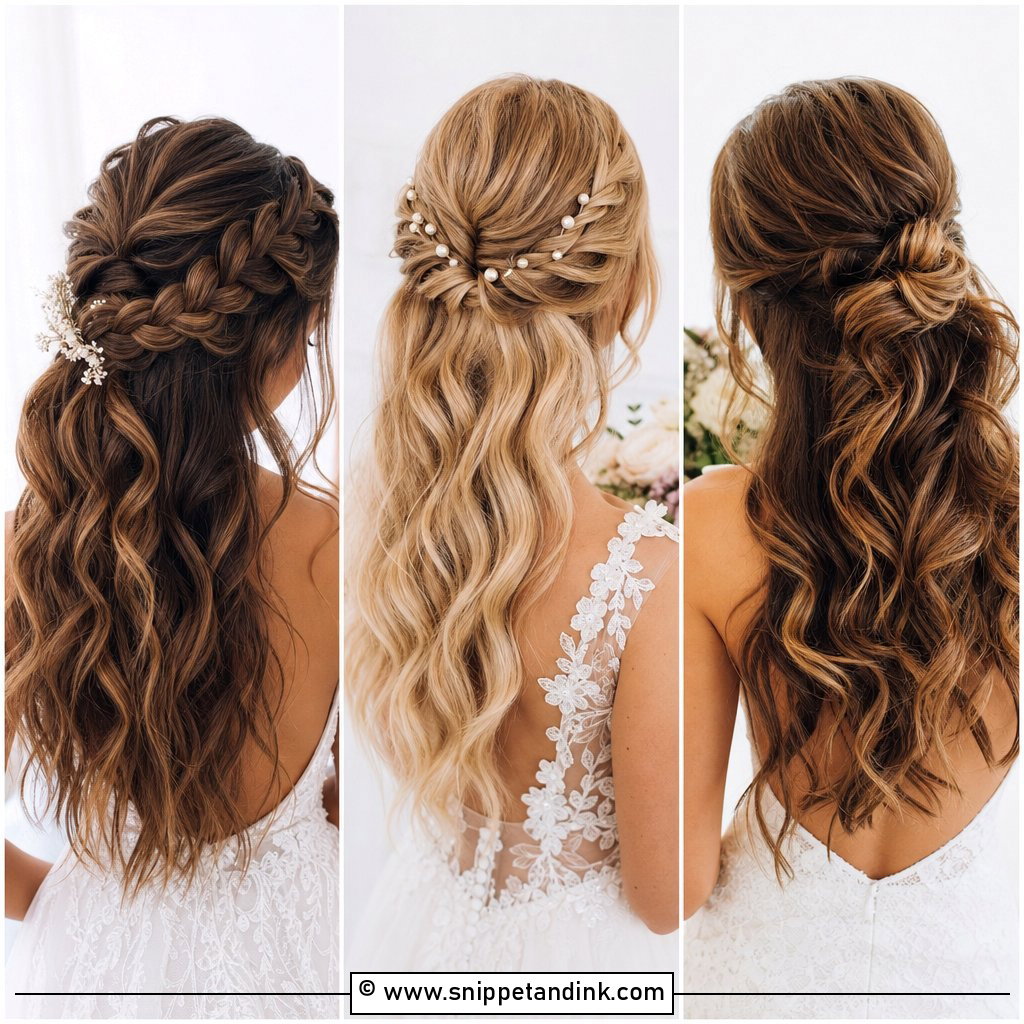
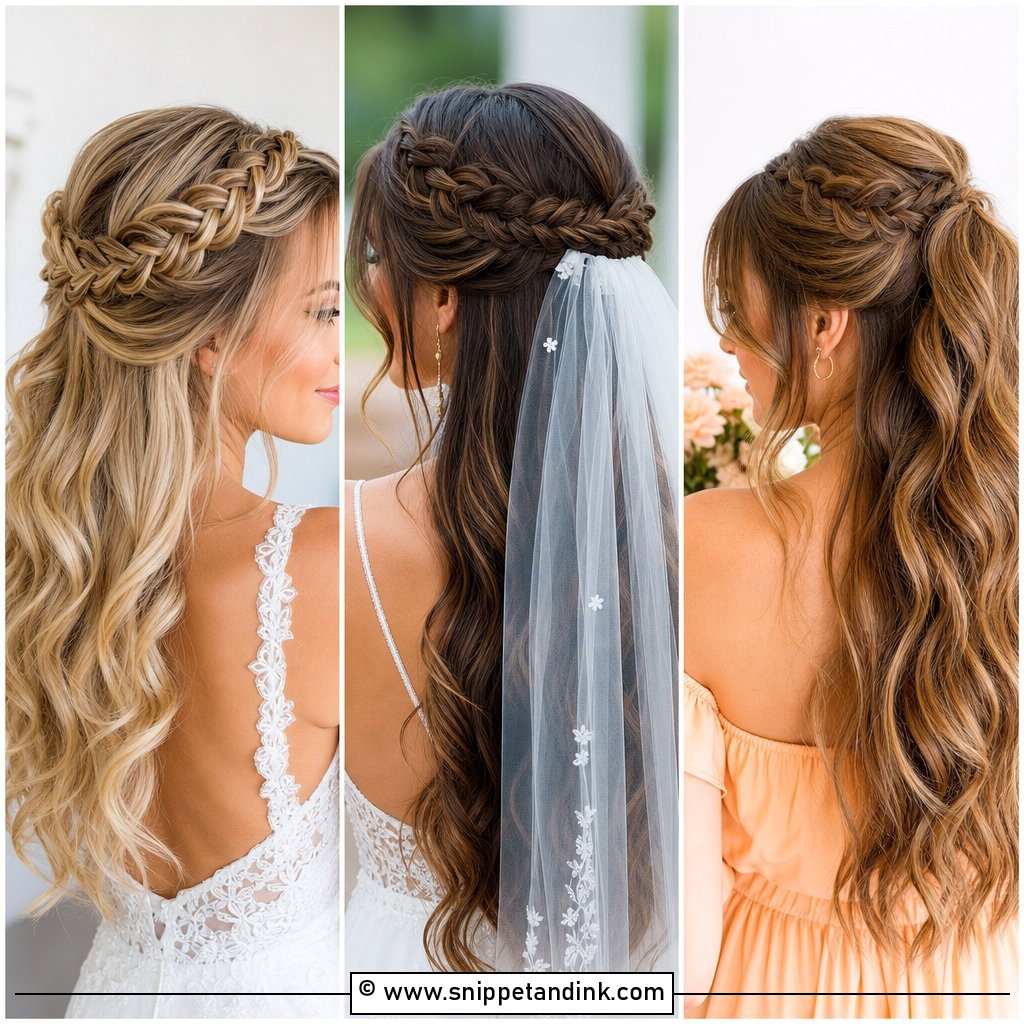
4. Half-Up Bridal Hair With A Braid
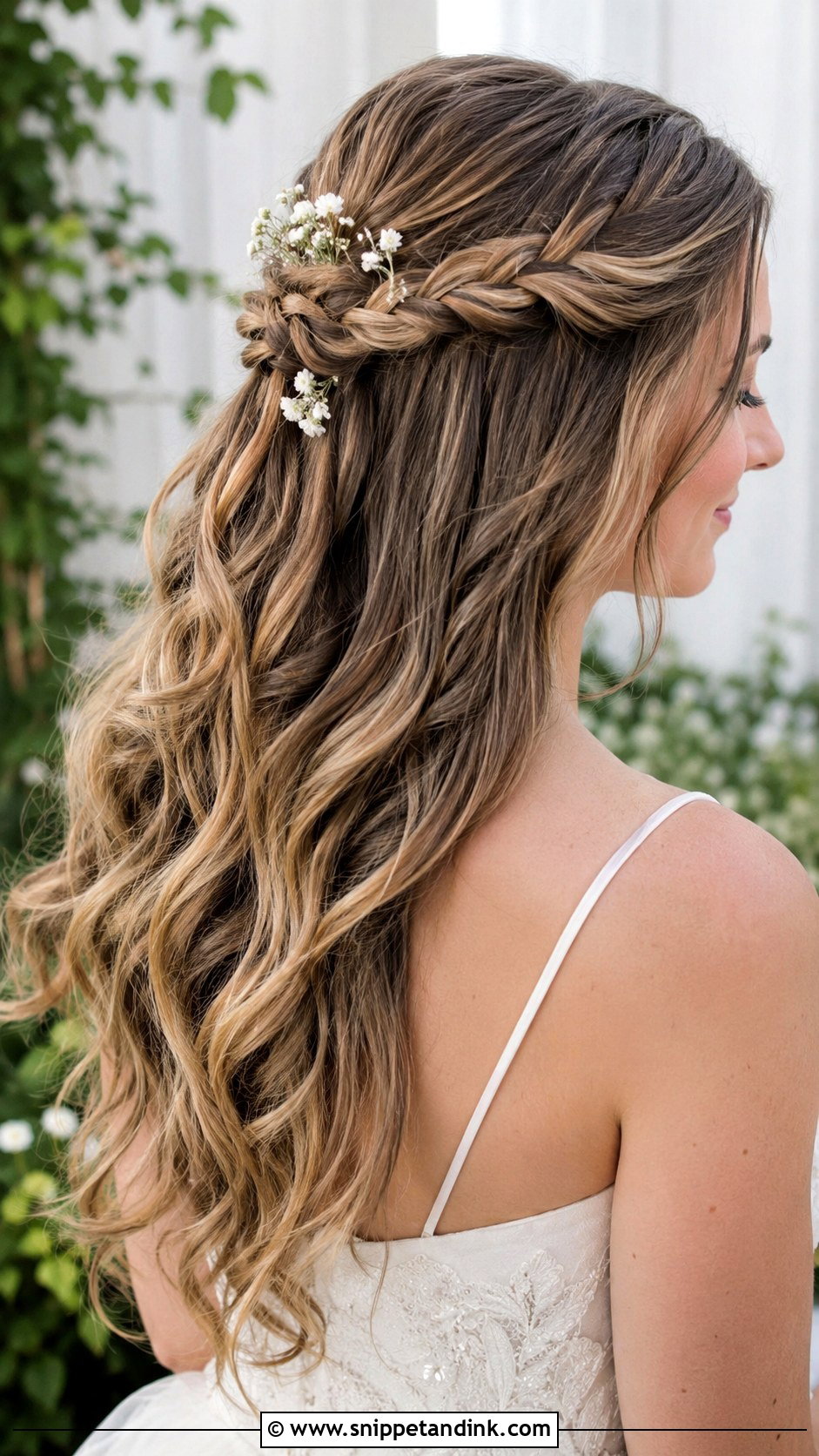
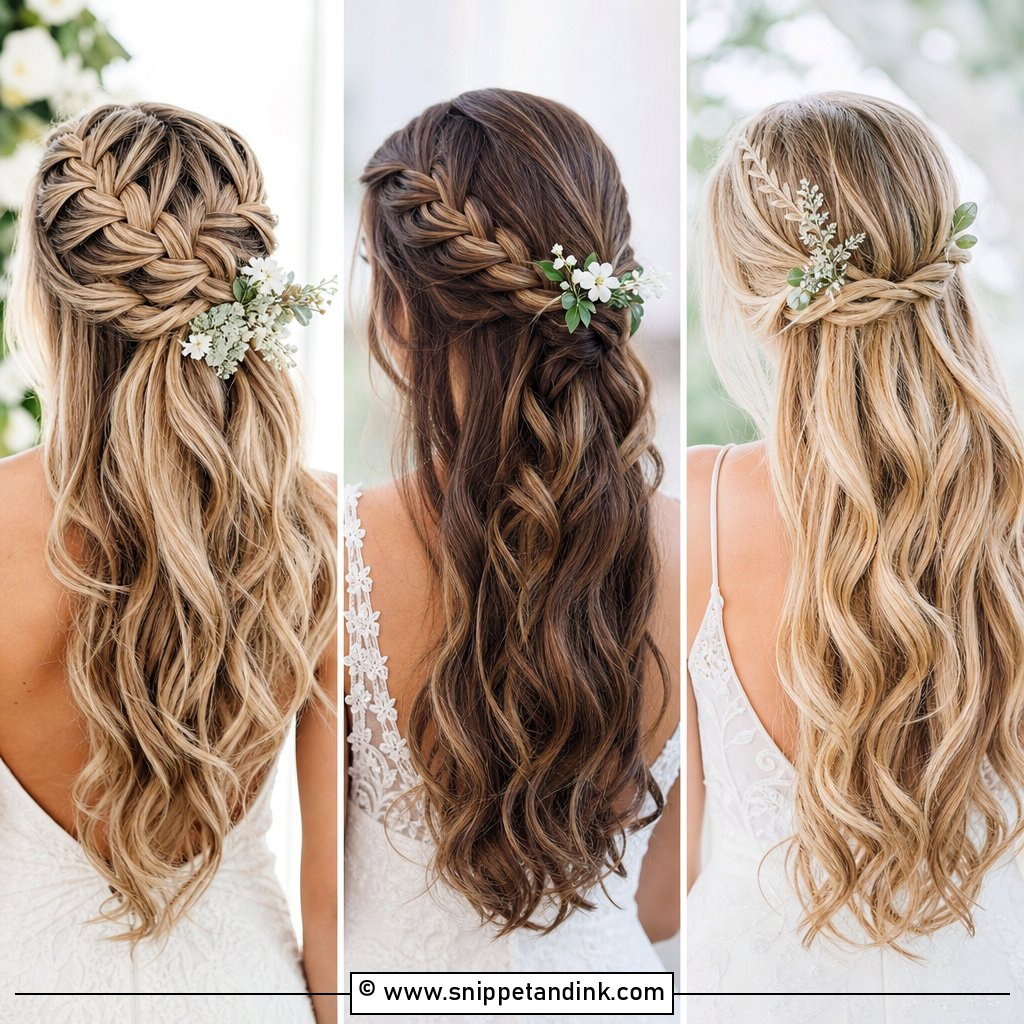
A small braid gives the style structure, so it looks deliberate even when everything below it is loose. It can run straight across the back, wrap in from one side or fade into the waves. I braid it firmly first and then gently pull the edges wider; a braid that starts loose collapses rather than softens. This is my pick for gardens, barns and anywhere with wind, because a twist can be pulled apart by a gust and a braid can’t. Tiny pins or a few small flowers grip the plaits far better than they grip flat hair.
5. Half-Up Bridal Hair With Pearl Pins
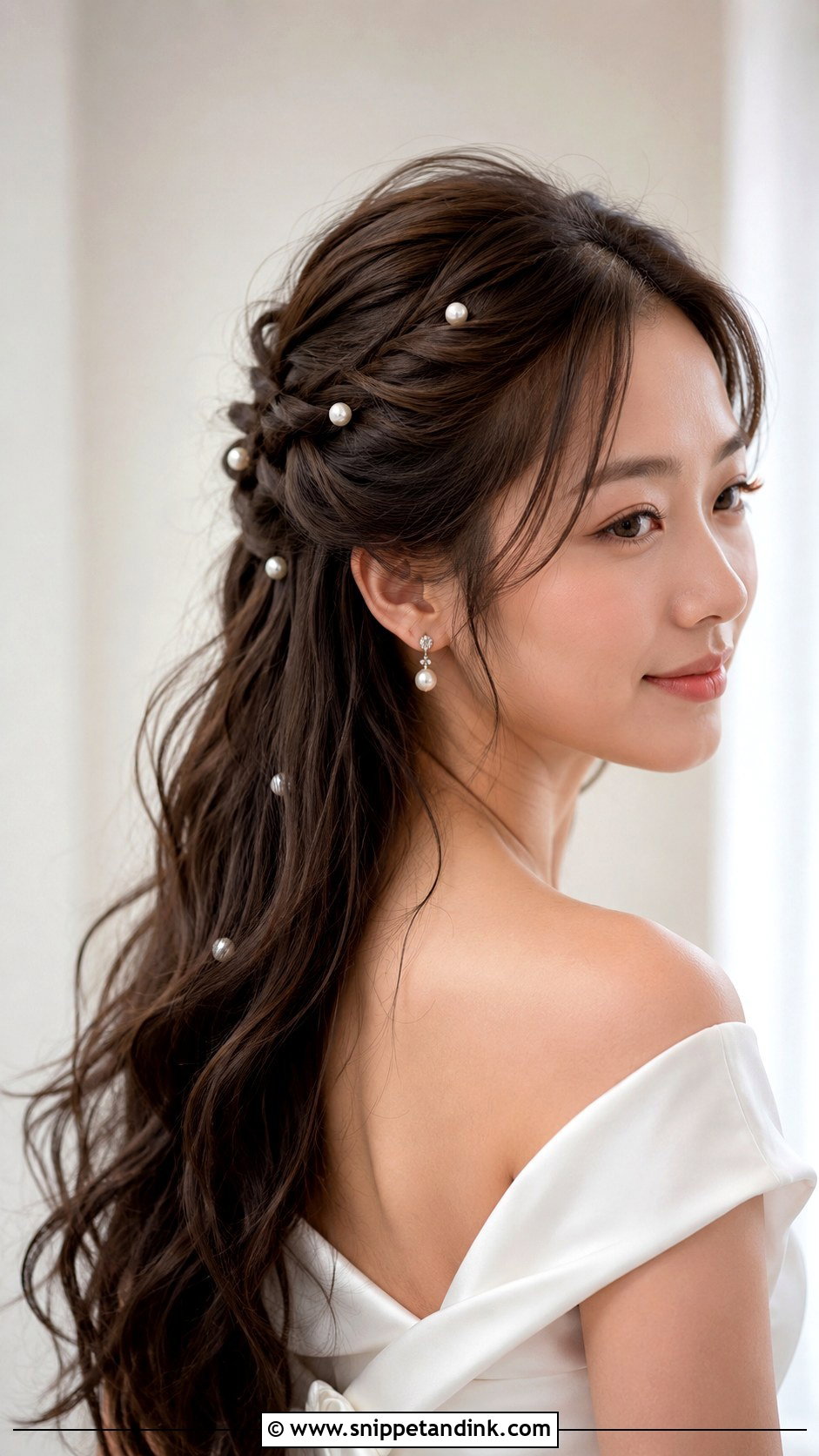
Pearl pins make a plain pinned crown read as bridal from across the room. I place them where the hair gathers and space them at slightly uneven intervals, since a tight straight row looks like a headband from behind. They need texture to hold. On freshly washed hair a pearl pin can slide down within the hour, so I tuck each one behind a hidden bobby pin as a backstop. If your dress has pearl buttons, beading or a classic satin finish, the pearls tie your hair to the gown without adding weight.
6. Half-Up Bridal Hair With A Hair Vine
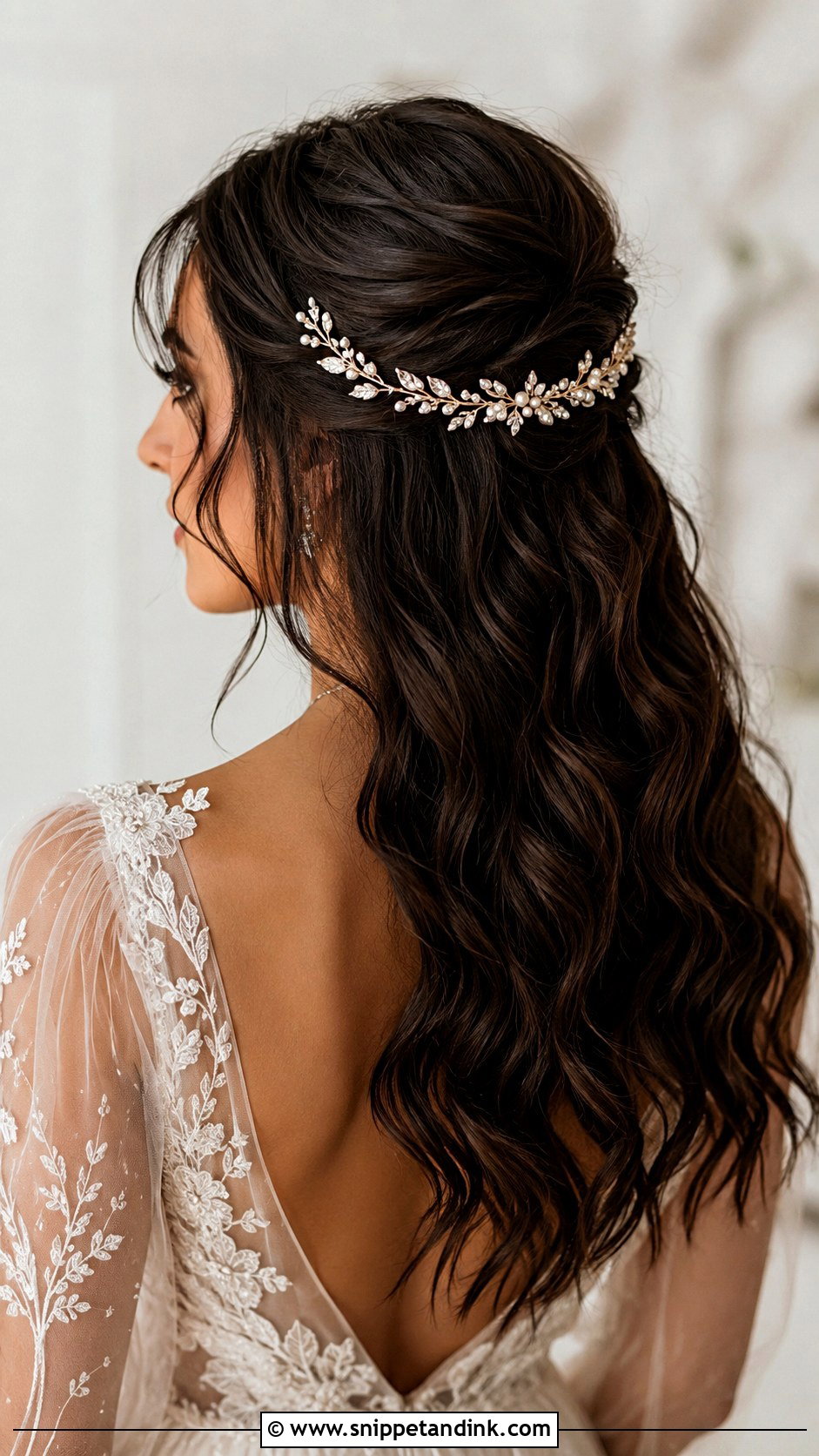
A hair vine follows the curve of the pinned section, so it adds detail without taking over. Before it goes in, I bend the wire to the shape of your head, then secure it with bobby pins threaded through its loops every few centimetres. A vine that isn’t shaped first lifts at the ends and snags on a veil. Pick the finish that echoes your dress, pearl for satin and crystal for beading, rather than whichever photographed best on a model. Keep the texture under it soft and slightly lived-in so the vine looks woven in, not resting on top.
7. Half-Up Bridal Hair With A Bow
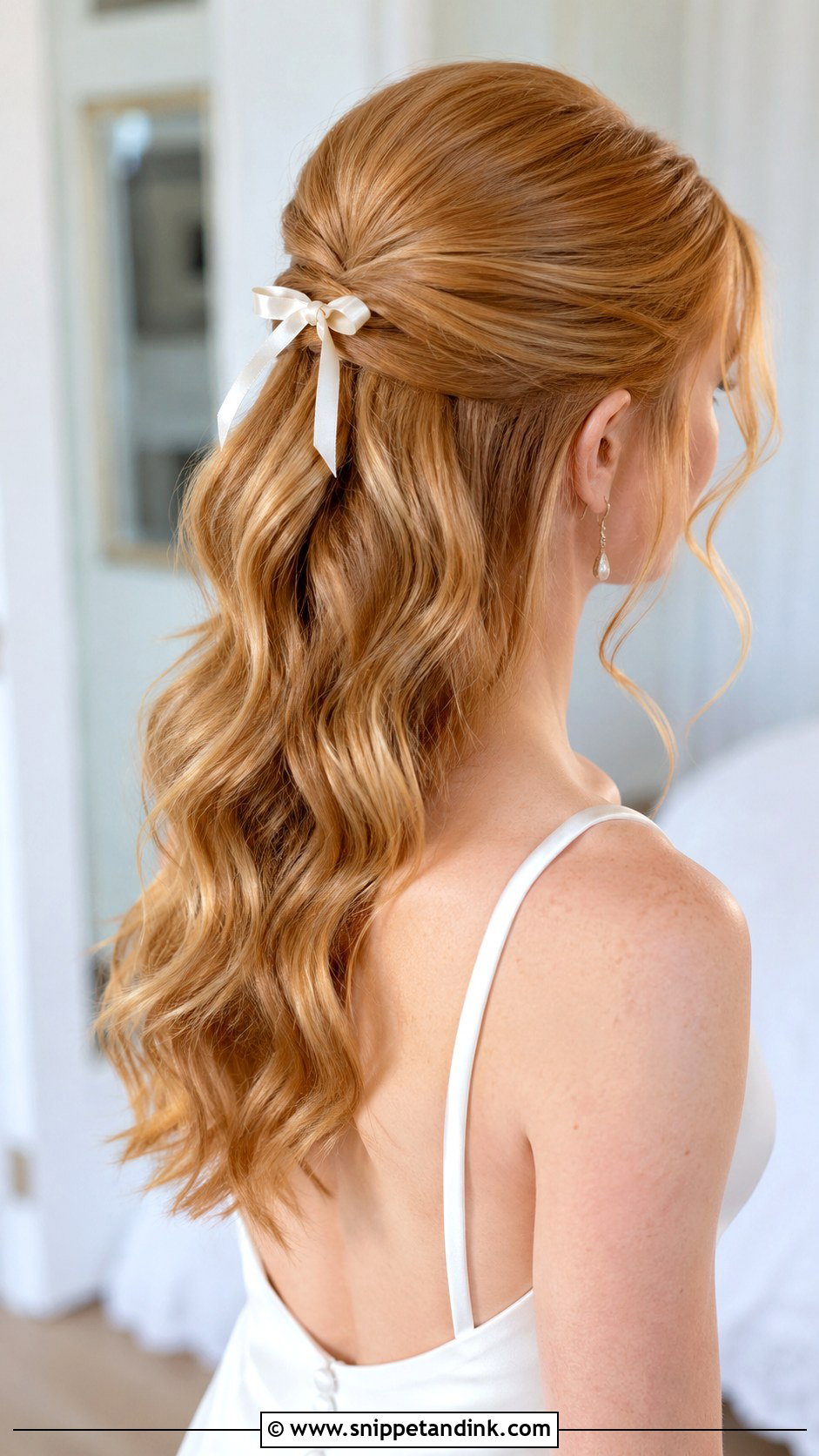
A bow tied over the pinned section is having a real moment, and fabric changes everything. Satin holds a crisp shape, silk drapes and slips, and sheer organza can look limp in photos unless the loops are generous. I tie the bow over a secured elastic and pin through the knot into the hair so it can’t rotate when you turn your head. A small white bow reads modern, while a longer ribbon with tails falling into the waves feels more romantic. Smooth the crown first; a bow sitting on lumpy hair looks like an afterthought.
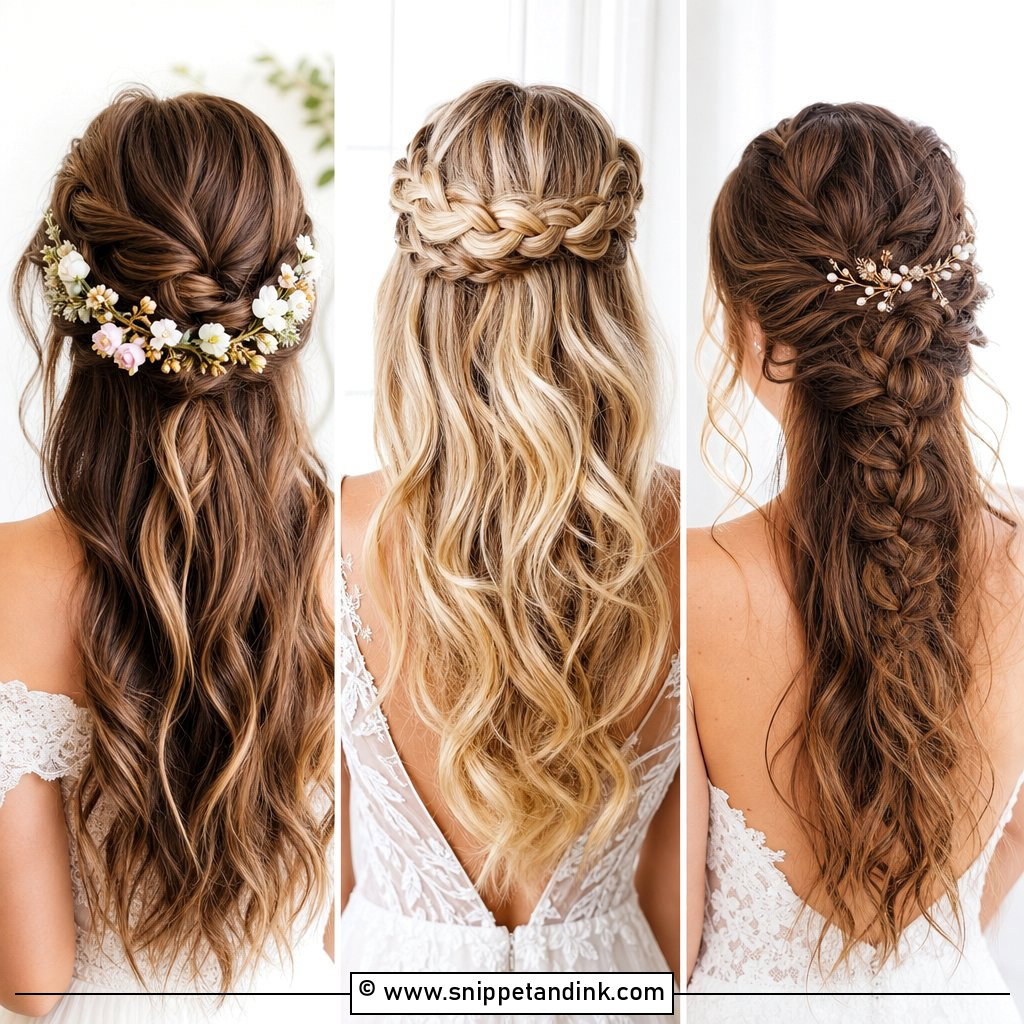
8. Half-Up Bridal Hair With Flowers
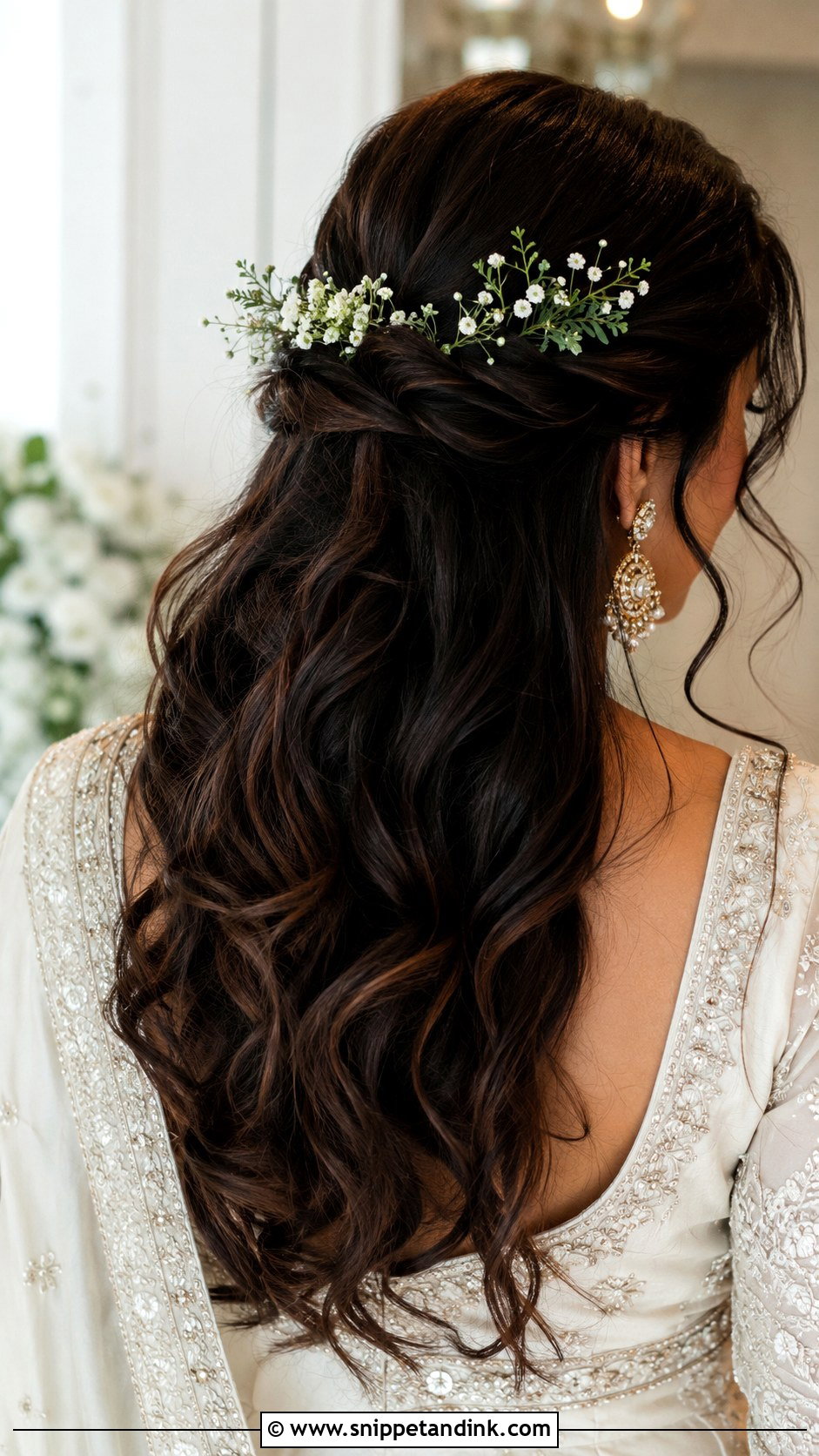
Flowers in a half-up style should be small and few. Tiny blooms, baby’s breath, spray roses and a little greenery tuck neatly into a twist or braid, whereas big heads like peonies drag the section down. Fresh stems wilt against the warmth of your scalp, so I ask the florist for hardy flowers that cope out of water, wired and taped, delivered the morning of so they go in last. Silk flowers skip all of that and can be fixed in place at the trial. Leave the rest of the hair loose in waves or natural curls so the flowers have room to show.
9. Half-Up Bridal Hair With A Veil
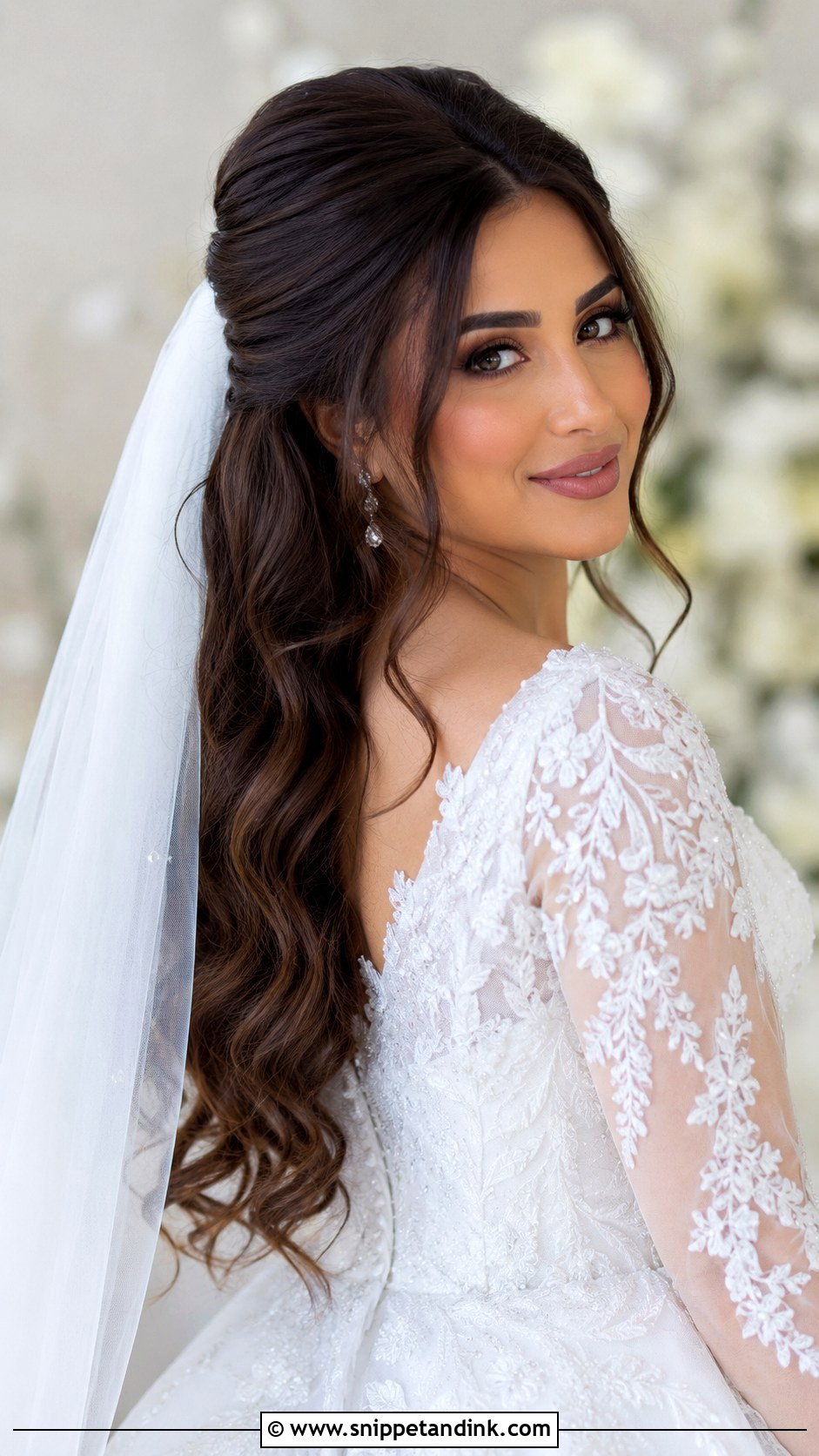
If you’re wearing a comb veil, this is the half-up style I’d steer you toward, because the pinned section gives the comb something solid to grip. On fully down hair the comb only has loose strands to hold, and it drags. I build a small crisscross of bobby pins under the section and slide the comb teeth into that, which stops it tugging during the processional. Placement balances your head shape against your neckline, so I usually try it at the crown and again just below it. Once the veil comes off, you still have a finished style for the reception.
10. Half-Up Bridal Hair For Short Hair
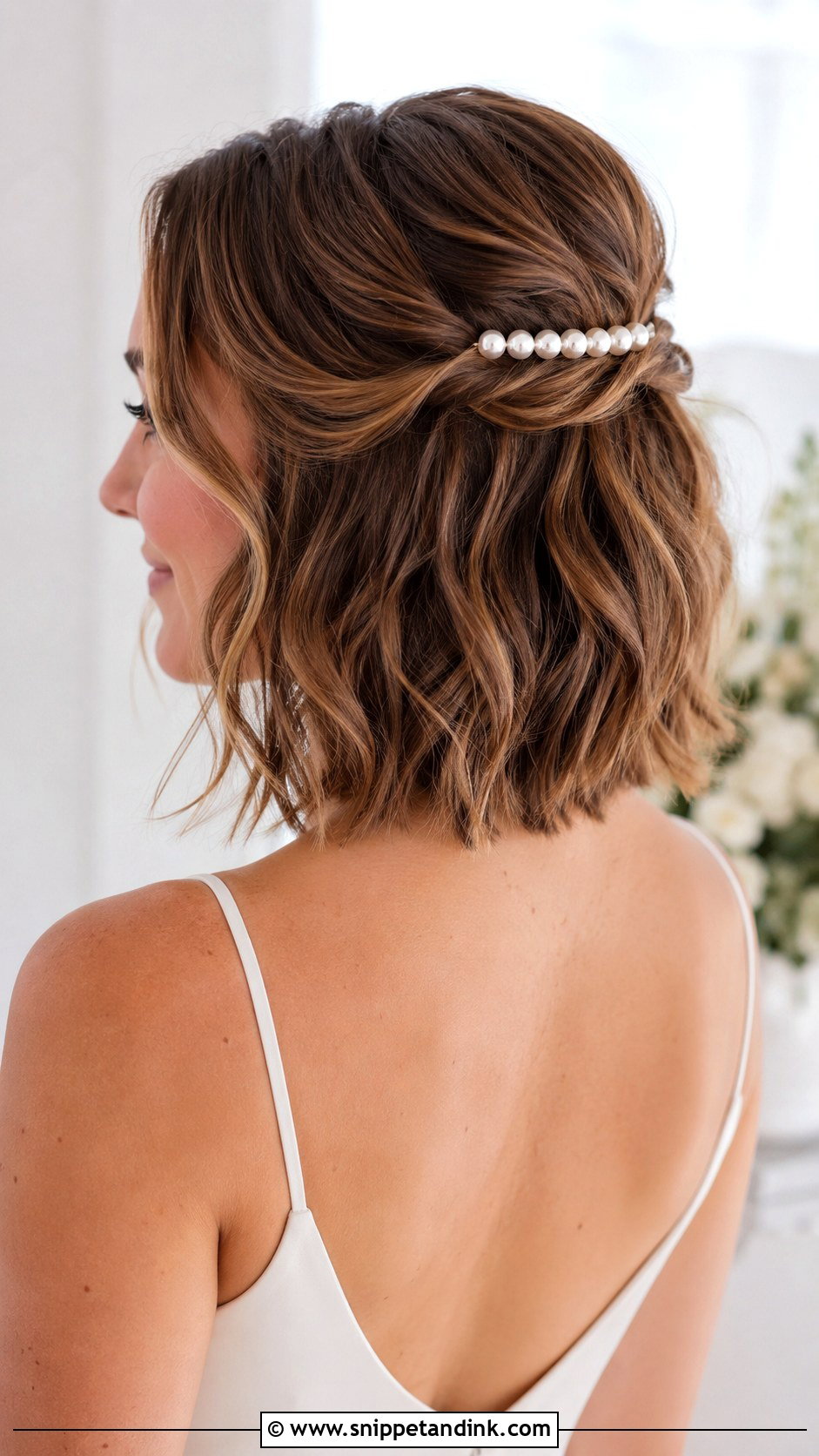
Short hair can go half-up if it reaches your jaw or shoulders. Below chin length the pinned section gets too small to anchor anything, and the ends spring out of a twist. On a bob I’d use one small clip or comb instead of a full twist, with soft bends to give the sides some width. Very fine short hair needs a texture spray and light backcombing at the root so the pins have something to bite. A small pearl clip or barrette finishes it without hiding the cut you chose.
11. Half-Up Bridal Hair For Medium Hair
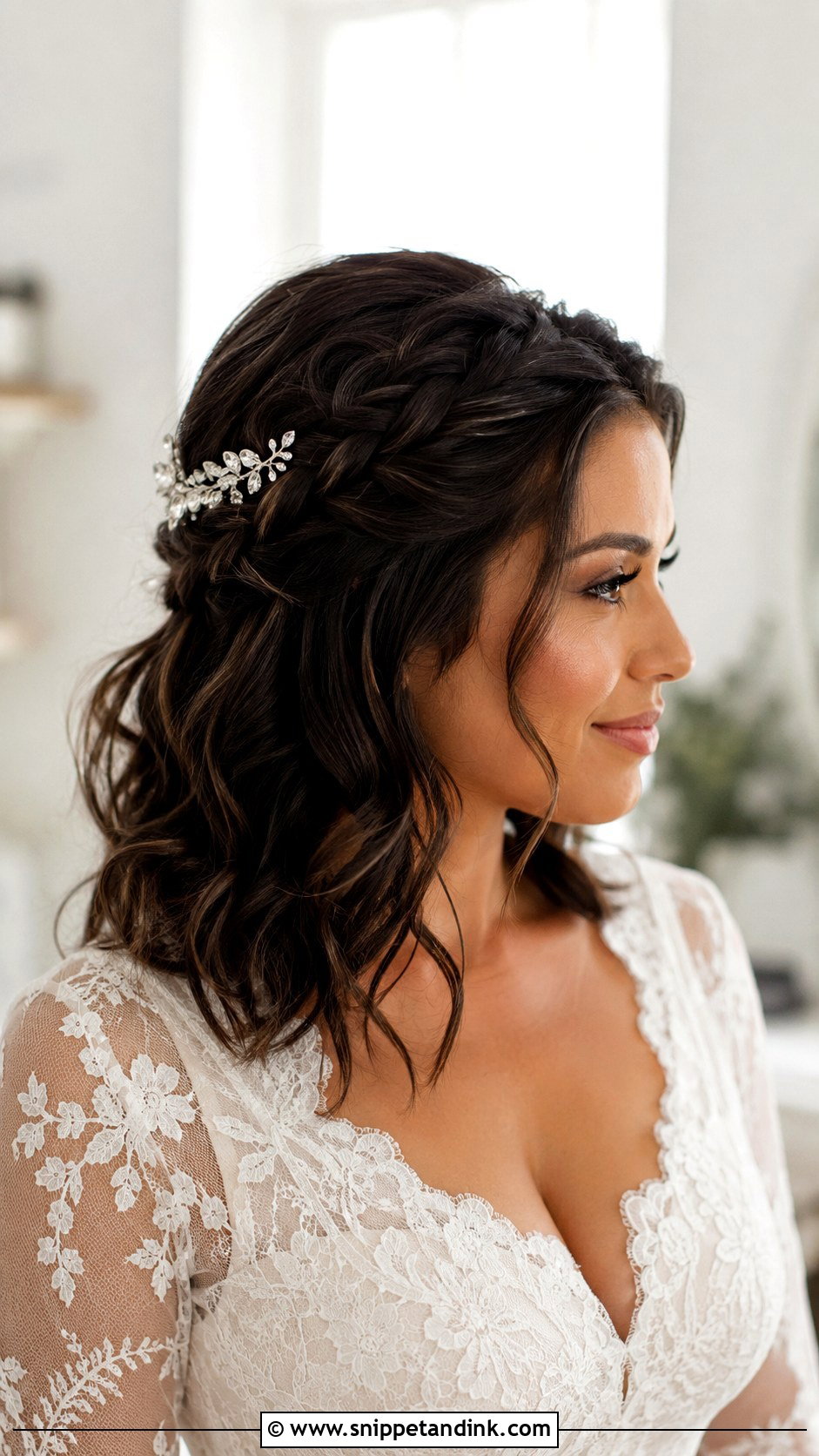
Hair that sits around the collarbone is honestly the easiest length for this. There’s no weight dragging the top section down, and curls last longer because they aren’t fighting gravity. The one drawback is that it can look thin once part of it is pulled up. If that worries you, a couple of hidden clip-in wefts underneath add fullness without changing the shape. Brushed waves suit this length better than tight curls, which make it look shorter than it is.
12. Half-Up Bridal Hair For Long Hair
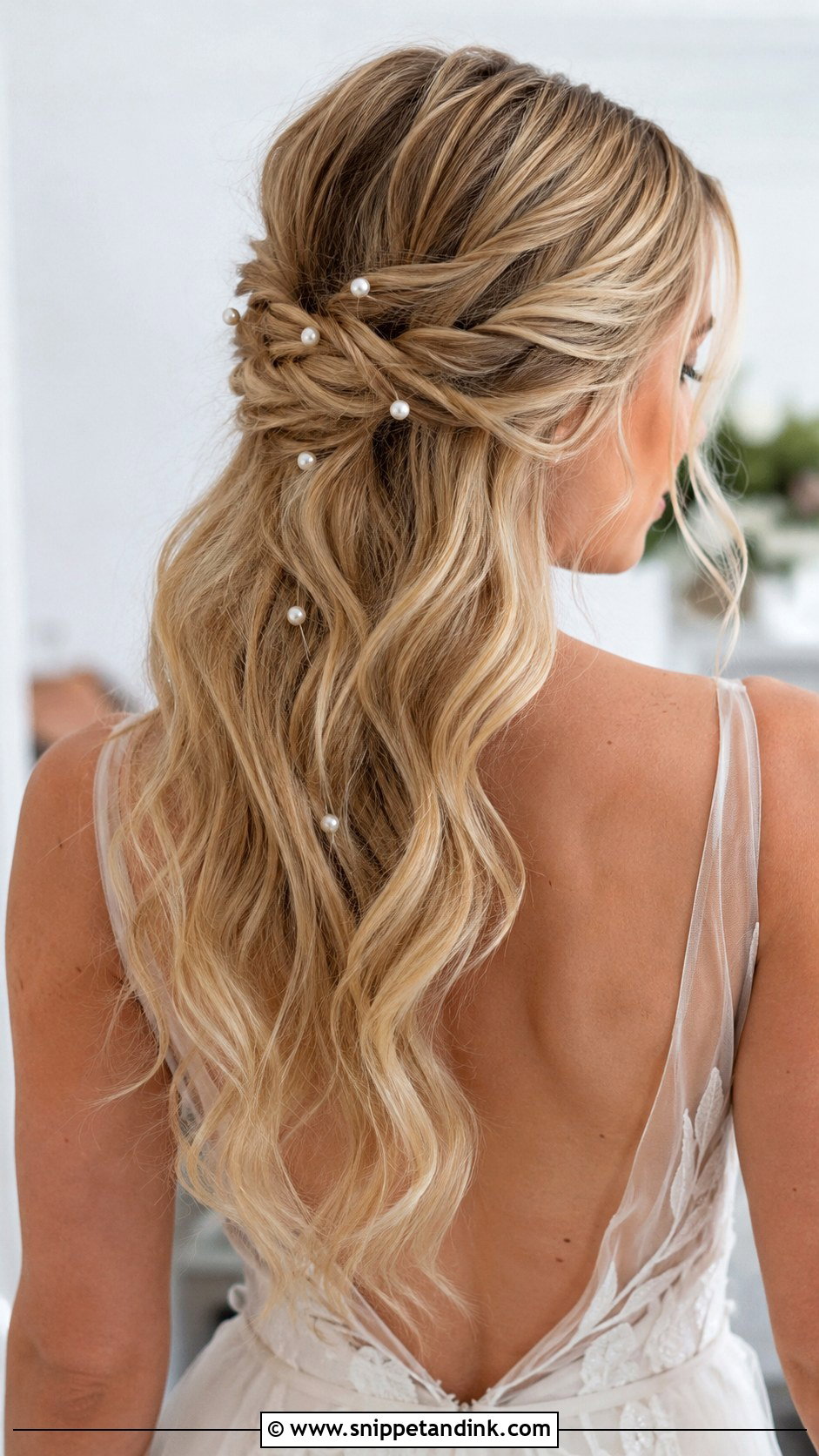
Long hair has the opposite problem to short: weight. Heavy lengths pull on the pinned section all day, and by the evening the top can creep down the back of your head. I counter that by attaching the top section to a small anchor braid or elastic rather than relying on pins, and by starting the curls around the cheekbone or collarbone so the top stays light. Healthy, freshly trimmed ends matter more here than at any other length, since the camera sees every one of them. A veil, a vine or scattered pearls add detail while the length stays the main event.
13. Half-Up Bridal Hair For Curly Hair
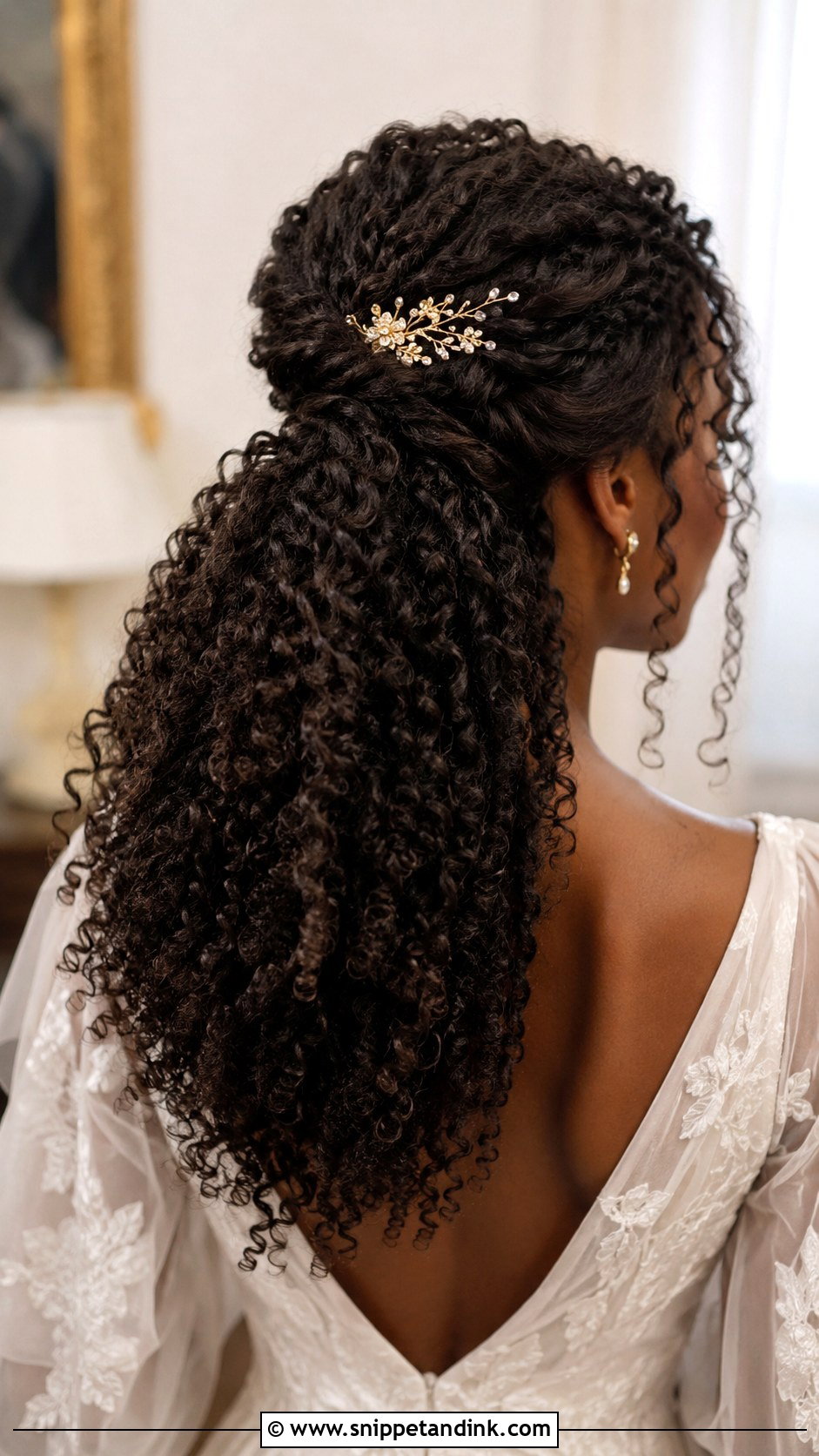
With curly hair, my job is to gather the top section without disturbing the pattern underneath. I hold it with large U-pins, which grip curls without crushing them the way a tight elastic does. Product goes on wet, before any styling: a cream or gel to define each curl, then hands off while it sets. Brushing set curls is the fastest route to frizz before photos. A twist or small decorative comb at the crown gives the shape, and the curls stay full through the sides and back.
14. Half-Up Bridal Hair For Fine Hair
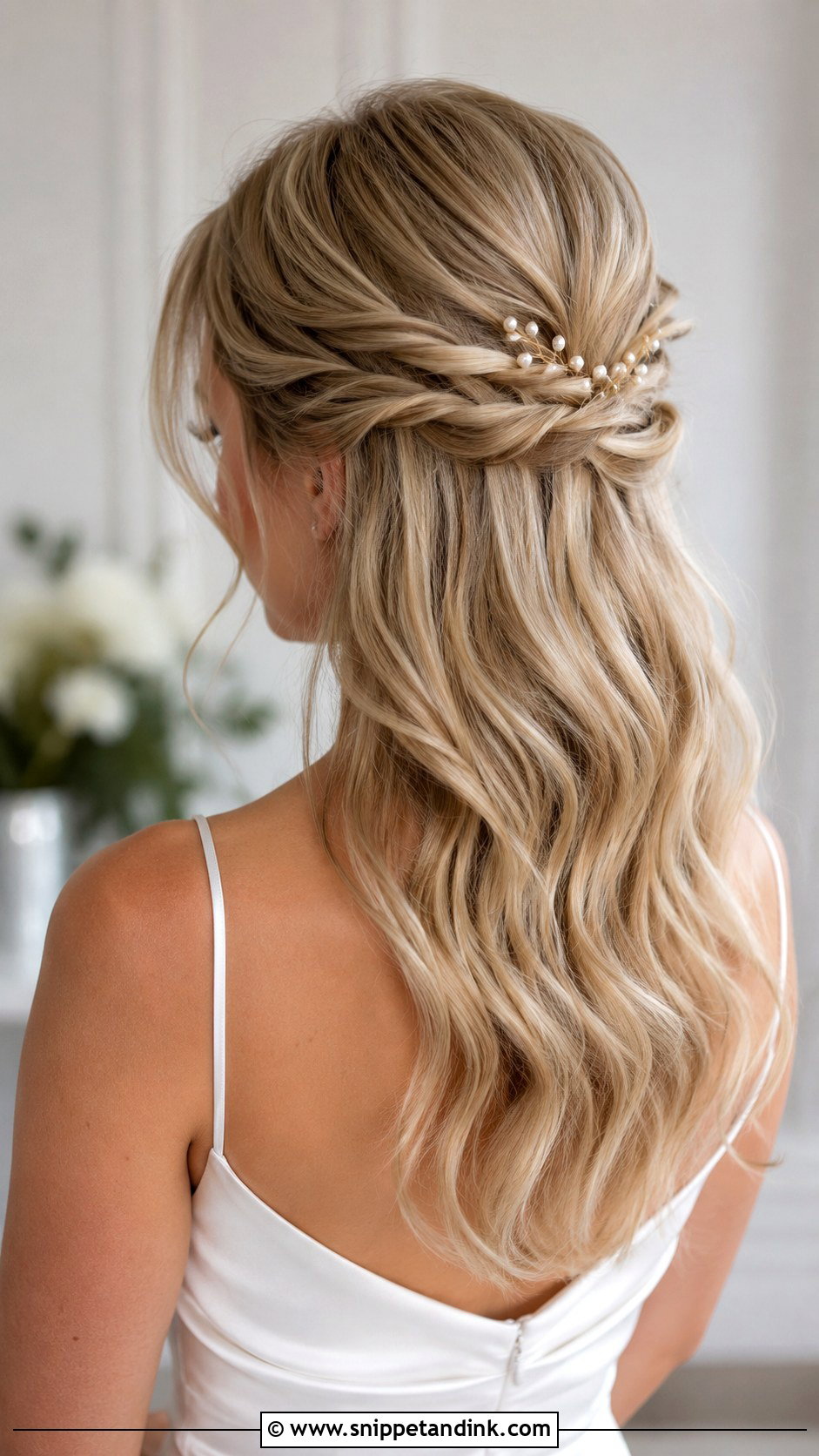
Fine hair can look fuller half-up than it does worn down, provided the shape is built with care. I tease lightly at the crown, set soft waves for width, and keep the pinned section smaller than you’d expect, because a big section leaves the hair underneath looking sparse. A small twist or braid hides pins, which show easily through fine strands. Keep accessories light, since a heavy comb slides straight out. If you want real fullness, clip-in wefts placed under the half-up section are the honest answer, and colour-matched ones disappear.
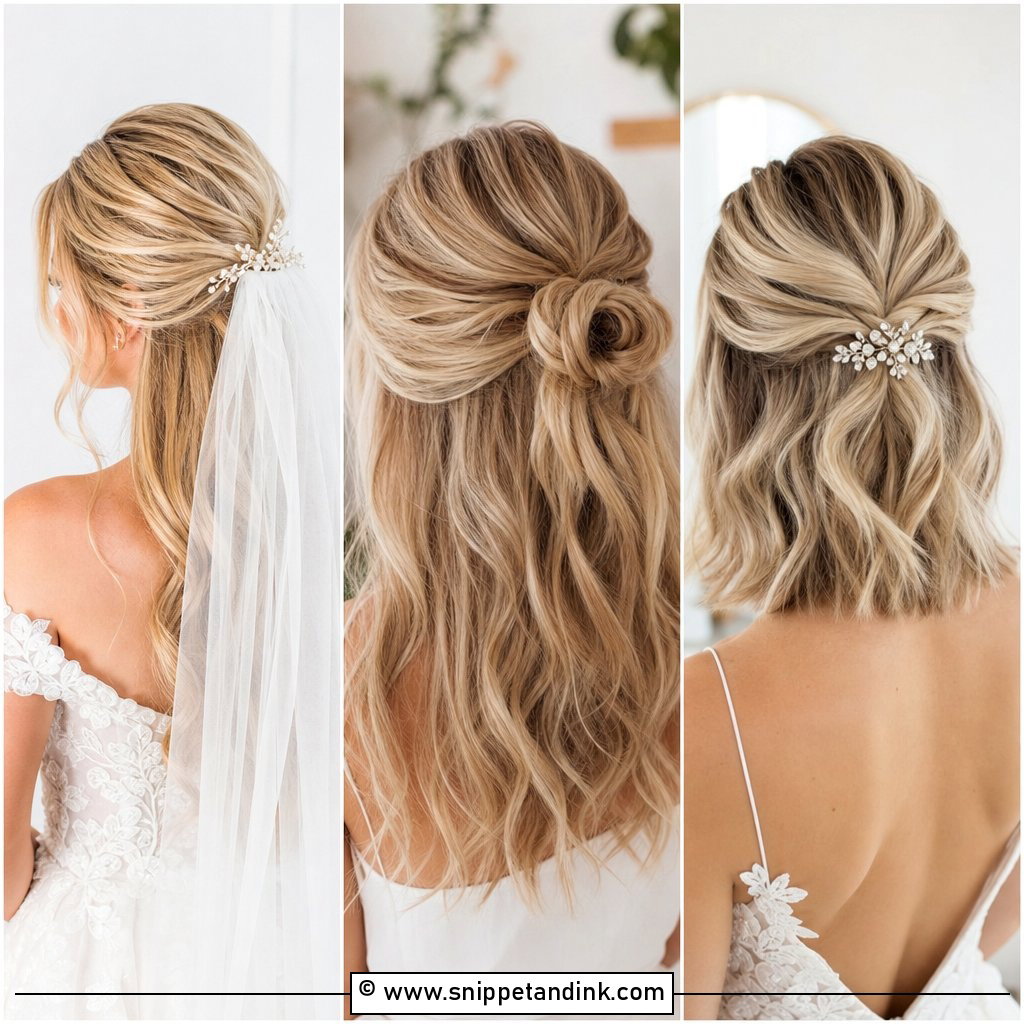
15. Half-Up Bridal Hair With Face Framing Pieces
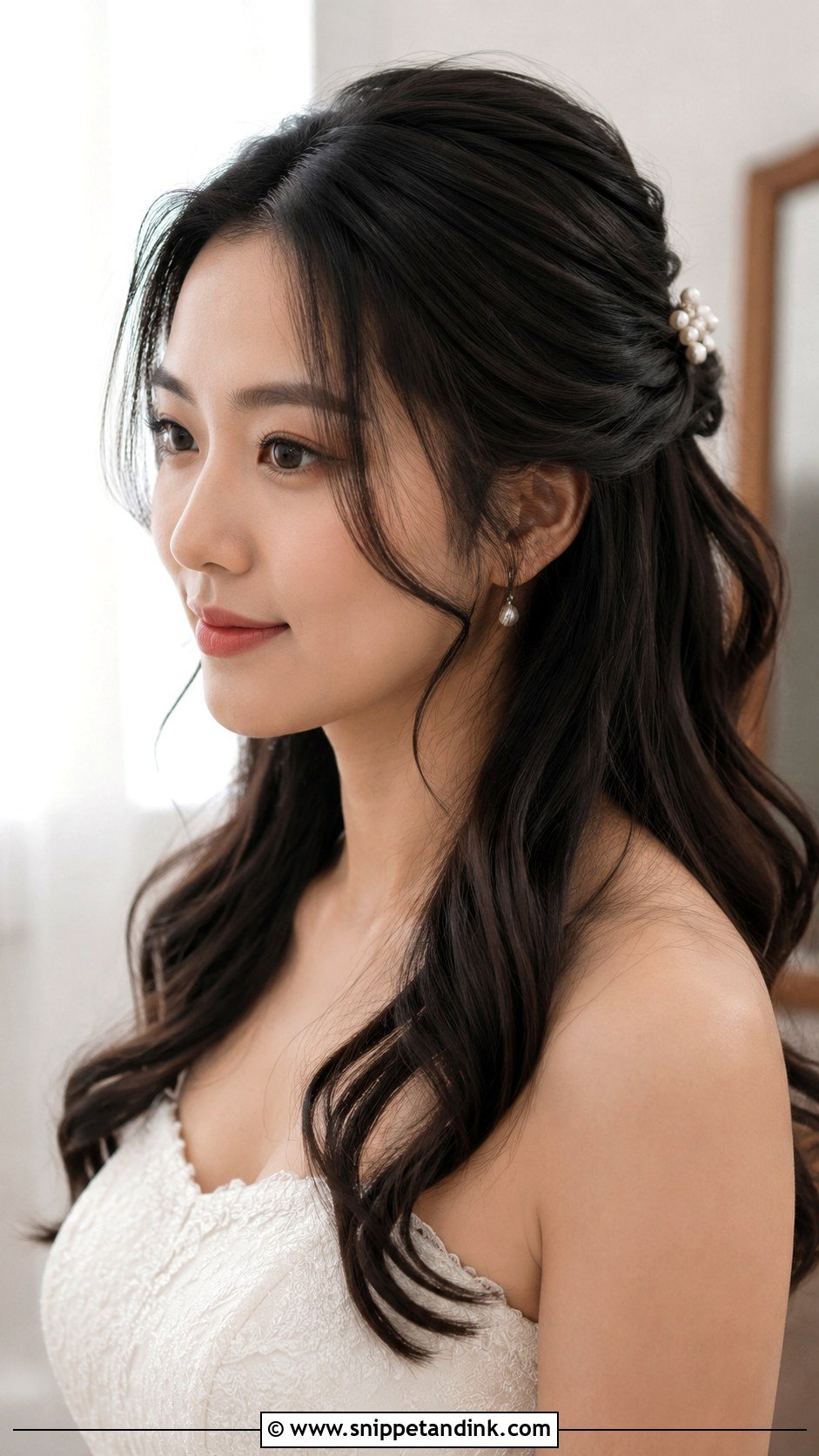
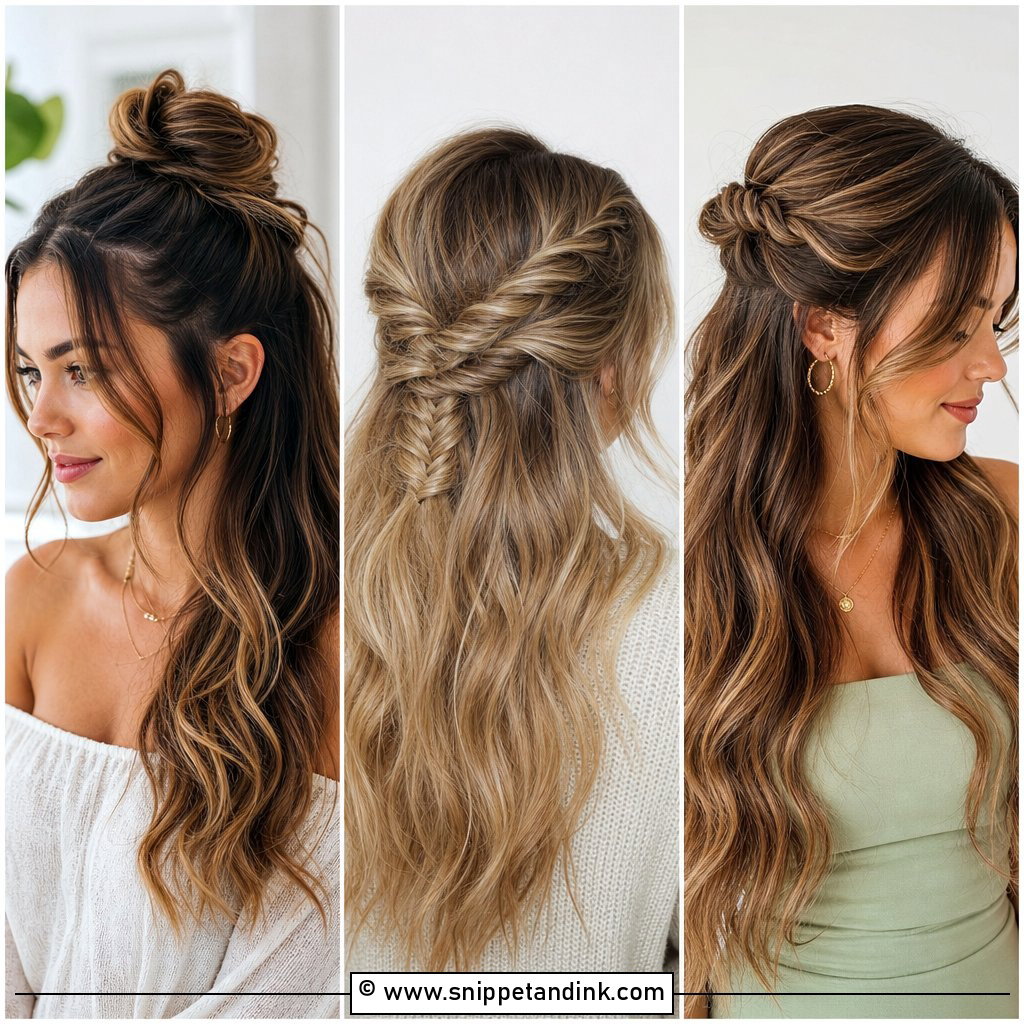
Guests and your photographer mostly see the front of the style, yet nearly every inspiration photo shows only the back. So I spend real time deciding where face-framing pieces should end: at the cheekbone, the jaw or the collarbone, depending on your features and how open you want your face. Curled away from the face, they open it up; left in loose bends, they soften a strong jawline. They should never fall across your eyes, or you’ll spend the day tucking them away. Behind them, the back can stay simple with a twist or one small accessory.
What Loosens a Pinned Crown Between the Vows and the Last Song
Half-up styles rarely fail all at once. They loosen in a few predictable ways, and knowing them helps you decide what to pack and what to ask for at the trial.
Hugs and leaning back
Every hug pushes against the back of your head, right where the pinned section sits. Car headrests and high-backed chairs do the same. A flat anchor and pins tucked in toward the scalp, not sticking out, survive this much better than a raised, teased section.
Warmth and humidity
Curls drop faster in a warm room or outdoors on a muggy day, and the lower half of the style loses its bend first. I’d rather set the curls tight and brush them out an hour later than set them loose and watch them disappear by the speeches. If your venue is humid, ask for a light flexible hairspray on the lengths, not a stiff one on the crown.
The veil coming off
Pulling a comb veil out without care drags pins with it. Ask whoever helps you to hold the hair just above the comb with one hand and lift the comb straight up and out with the other. Then check the crown in a mirror before you go back in.
A tiny kit covers most of this: six bobby pins matched to your hair colour, a travel hairspray and a small comb, handed to a bridesmaid rather than tucked in your bag.
Keep the Trial Style In Until Bedtime Before You Decide
Half-up hair borrows the security of an updo and the movement of hair worn down, which is why so many brides end up here. Pick the version that matches how your hair actually behaves, not only the photo you like most. Bring front and back inspiration pictures to your trial, then keep the style in for the rest of that day before you decide.
You'll Like These Ideas:


Leave a Reply