
Half-up hair is the style I get asked for most, and it’s also the one that fails most quietly. The pinned top keeps your face clear for the vows, the kiss and every hug in the receiving line, while the lengths show off curl, colour and shine. Its weak point is the bottom half. Loose hair carries no pins, so humidity, body heat and a hundred embraces work on it all day, and a curl that looked full at noon can hang straight by the first dance. Every style below can last. It just needs the height, the part and the set planned around your hair rather than around a photo.
Where I Put the Pins So the Top Holds Until Midnight
Every half-up has two jobs pulling against each other. The top has to stay locked, the lengths have to stay soft, and the lengths hang off the top and drag on it all day. So the first thing I build is the anchor: two bobby pins crossed into an X at the gather, or for heavy or slippery hair, a tiny clear elastic hidden underneath that the pins then lock into. Once that’s solid, everything else, including the veil comb, hooks into it.
What I settle at the trial
- The height of the gather. Crown height lifts the face and gives a tiara a base; a lower gather reads softer and leaves room for a comb above it.
- How much hair goes up. On fine hair I take a bigger top section so the pins don’t show; on thick hair I take less so the back doesn’t look bulky.
- Exactly where the veil or accessory will sit, so the pin base is built under it from the start.
- Which way you naturally part, and whether a cowlick at the crown will push against the lift.
Bring the real accessory to the trial, plus a photo of the back of your dress. The view from behind with the gown on is what your guests see for the entire ceremony, so it deserves as much attention as the mirror view.
1. Half-Up Wedding Hair With Soft Curls
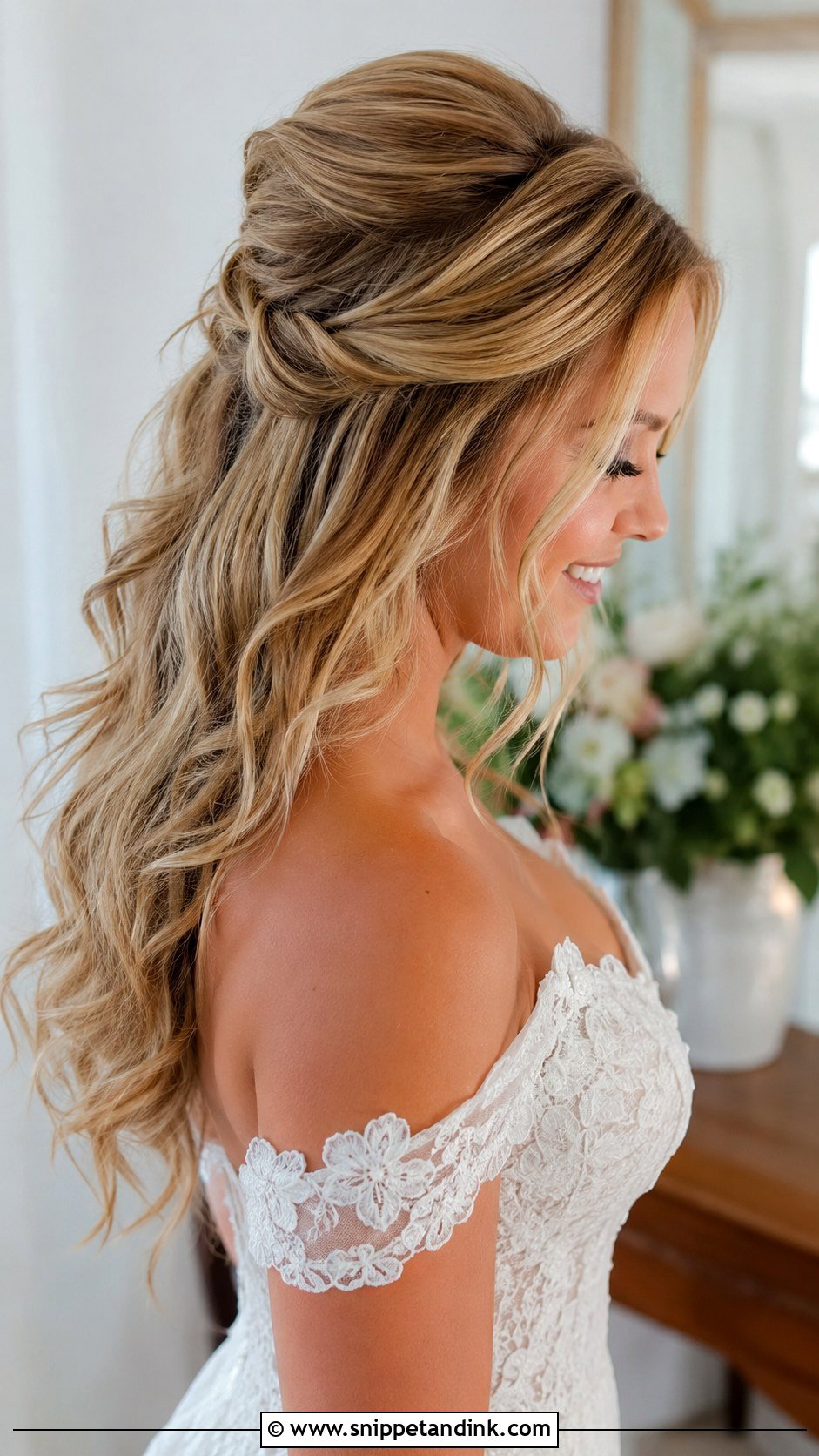
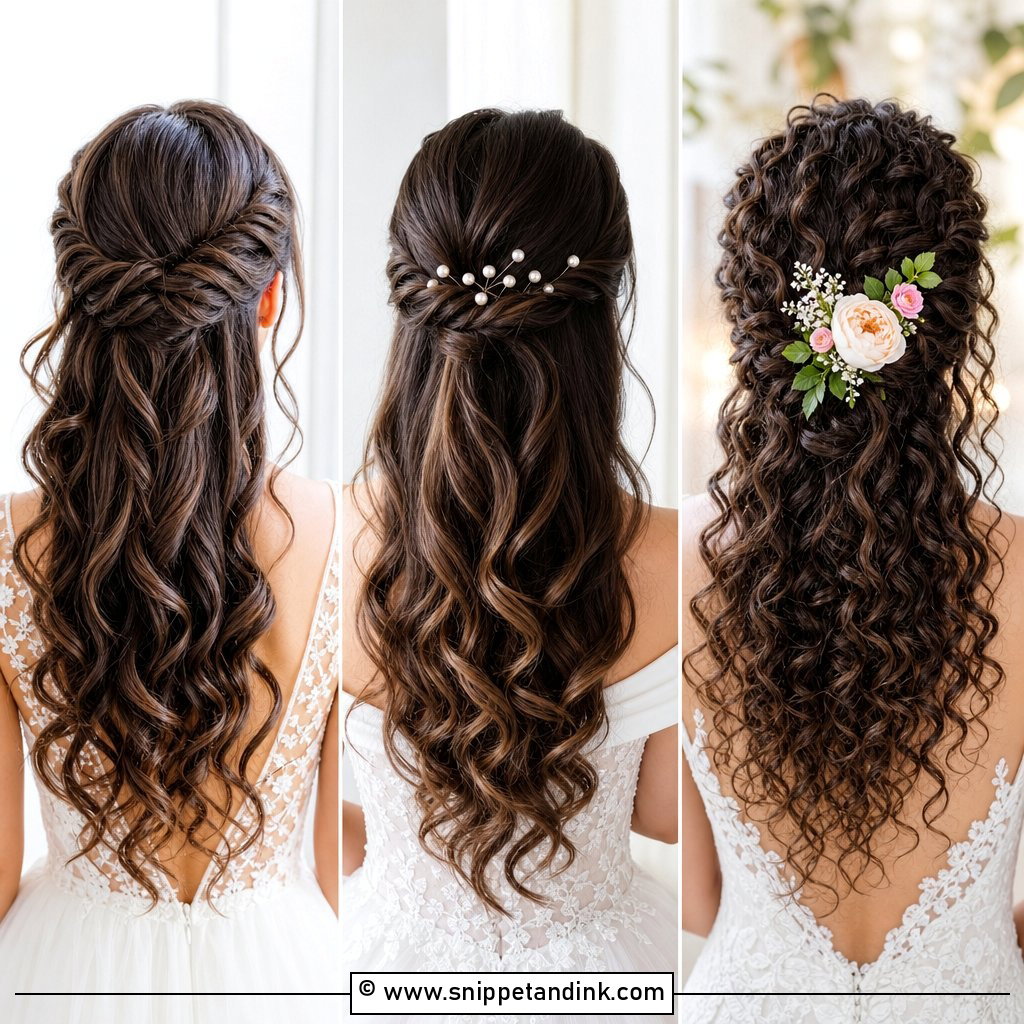
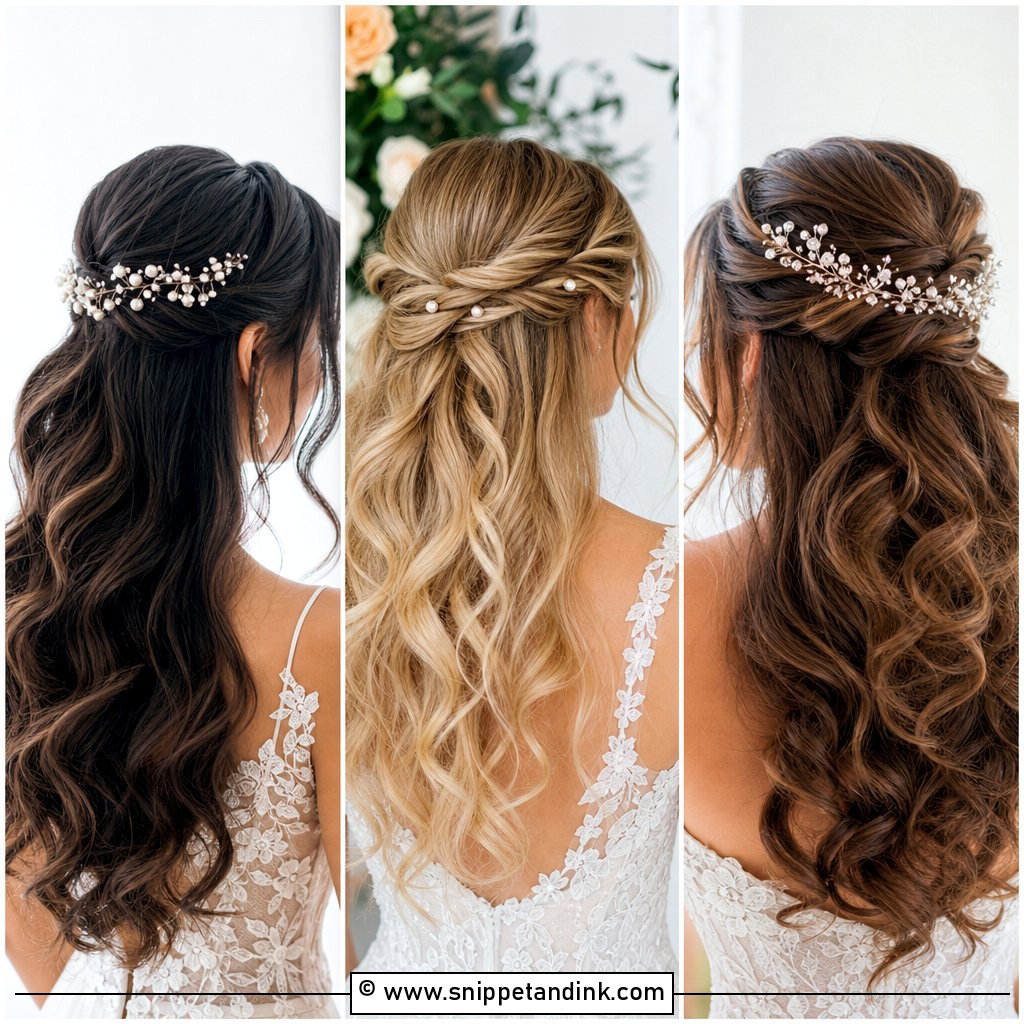
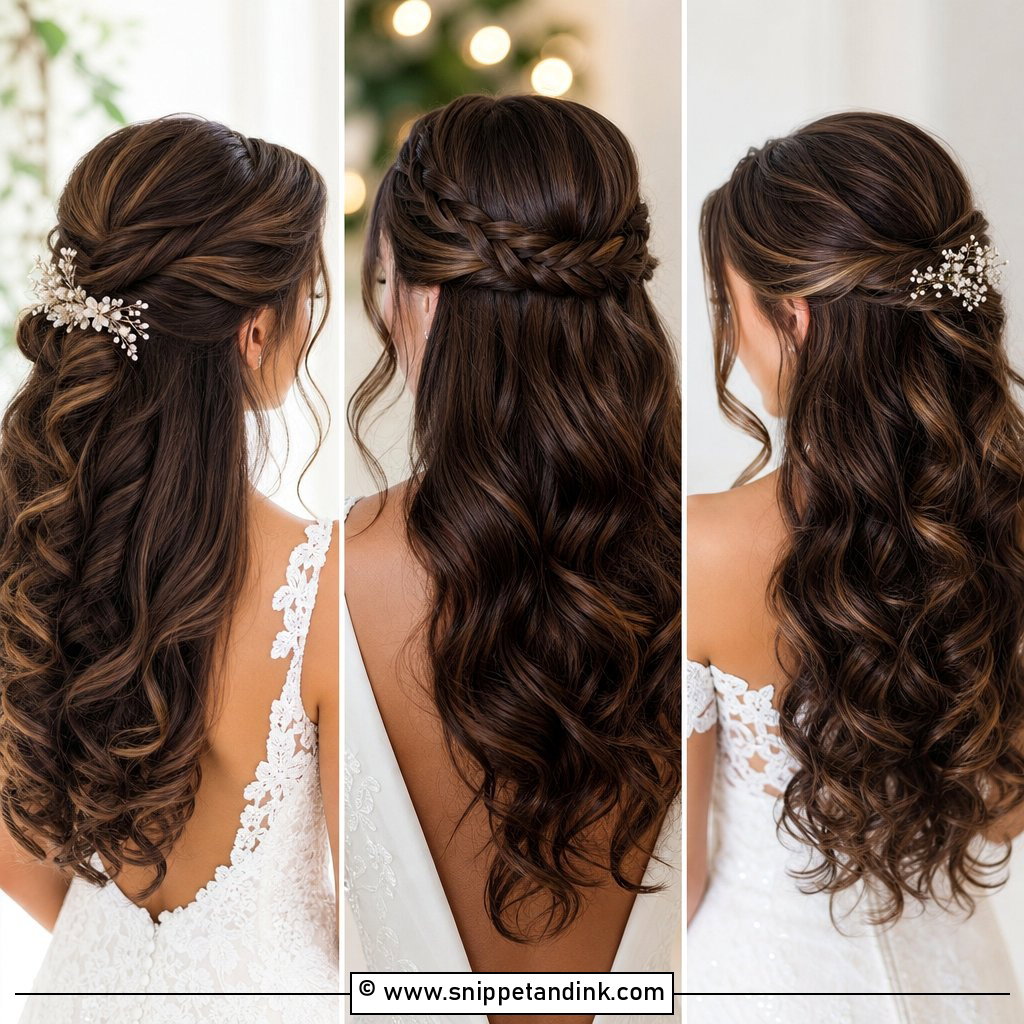
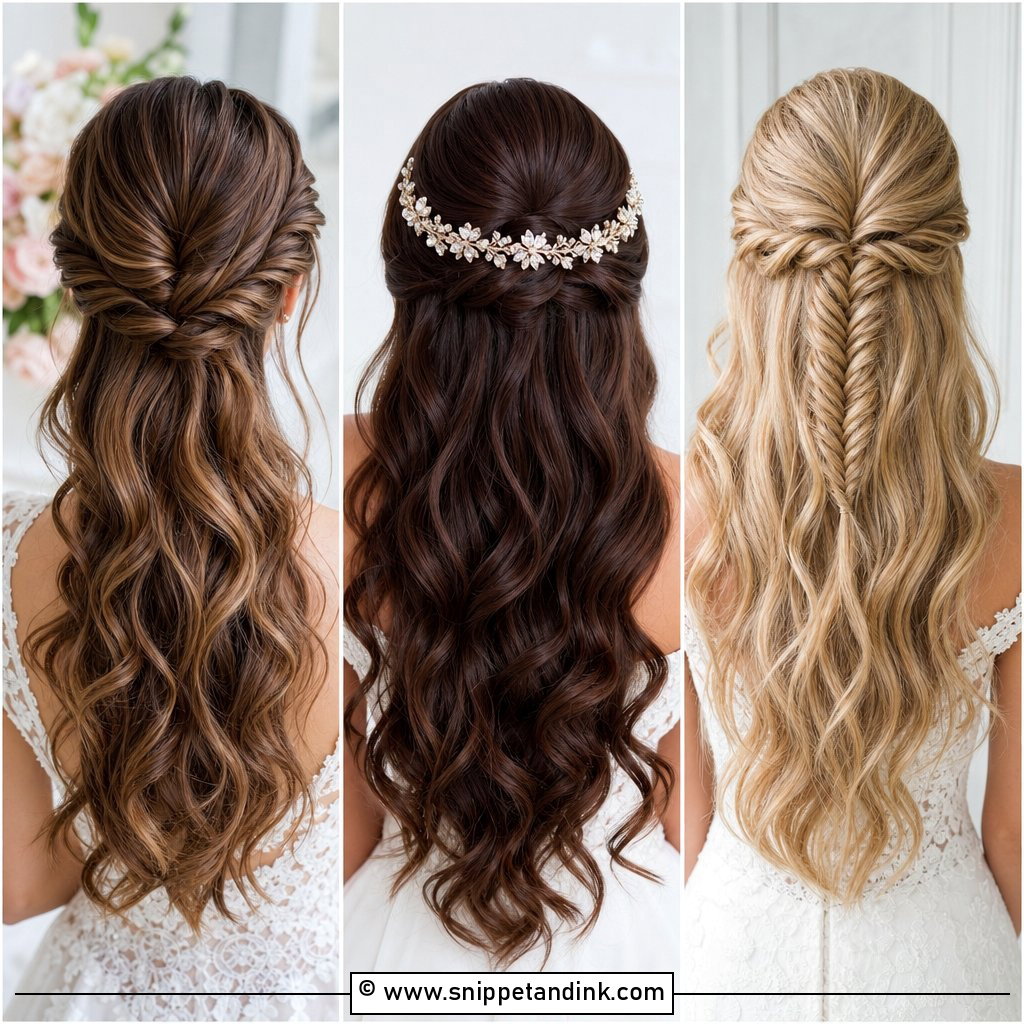
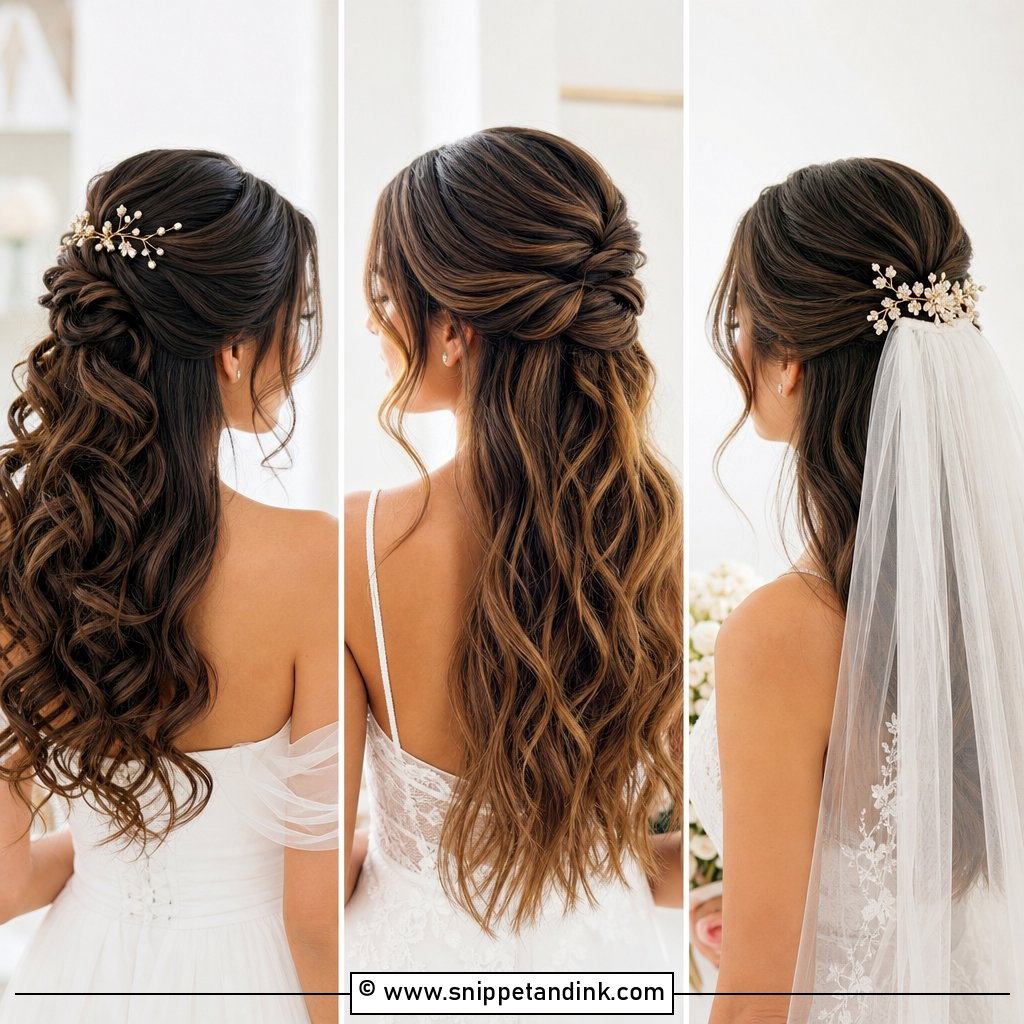
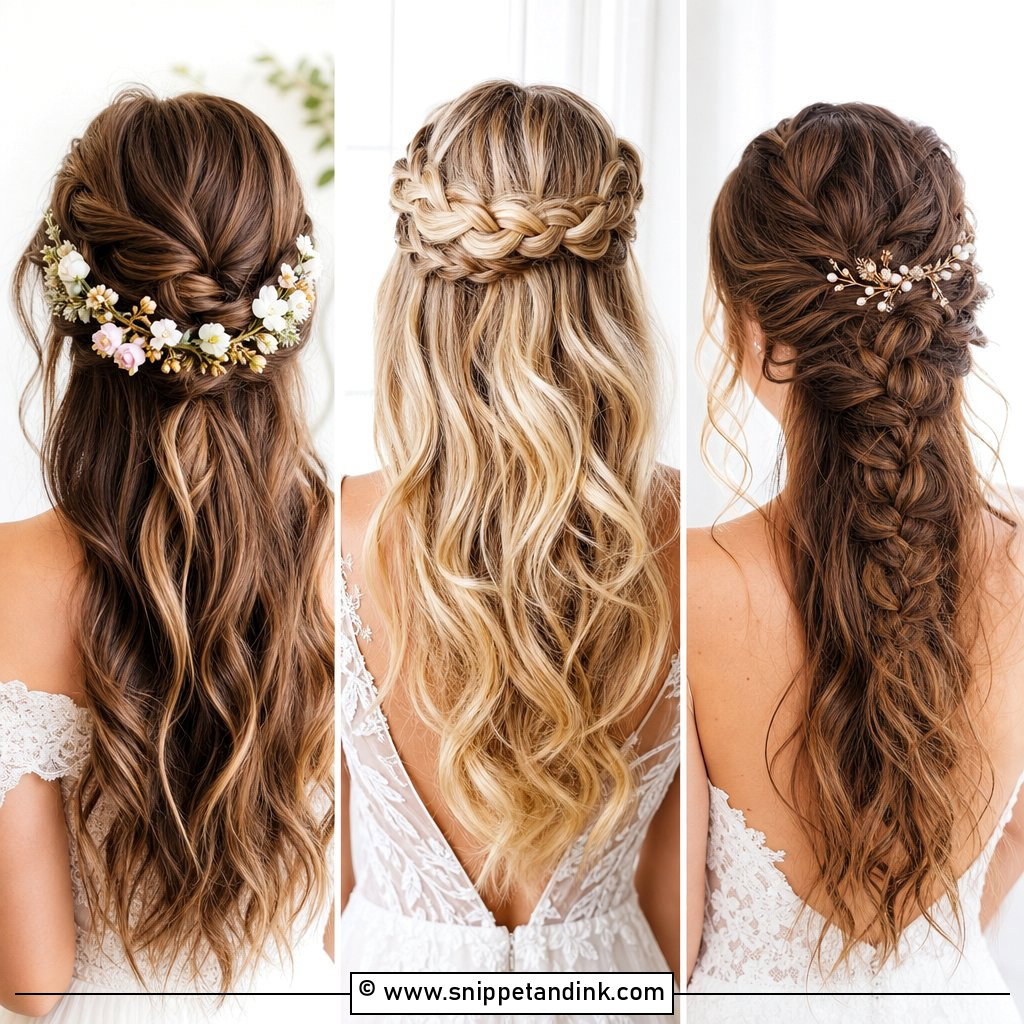
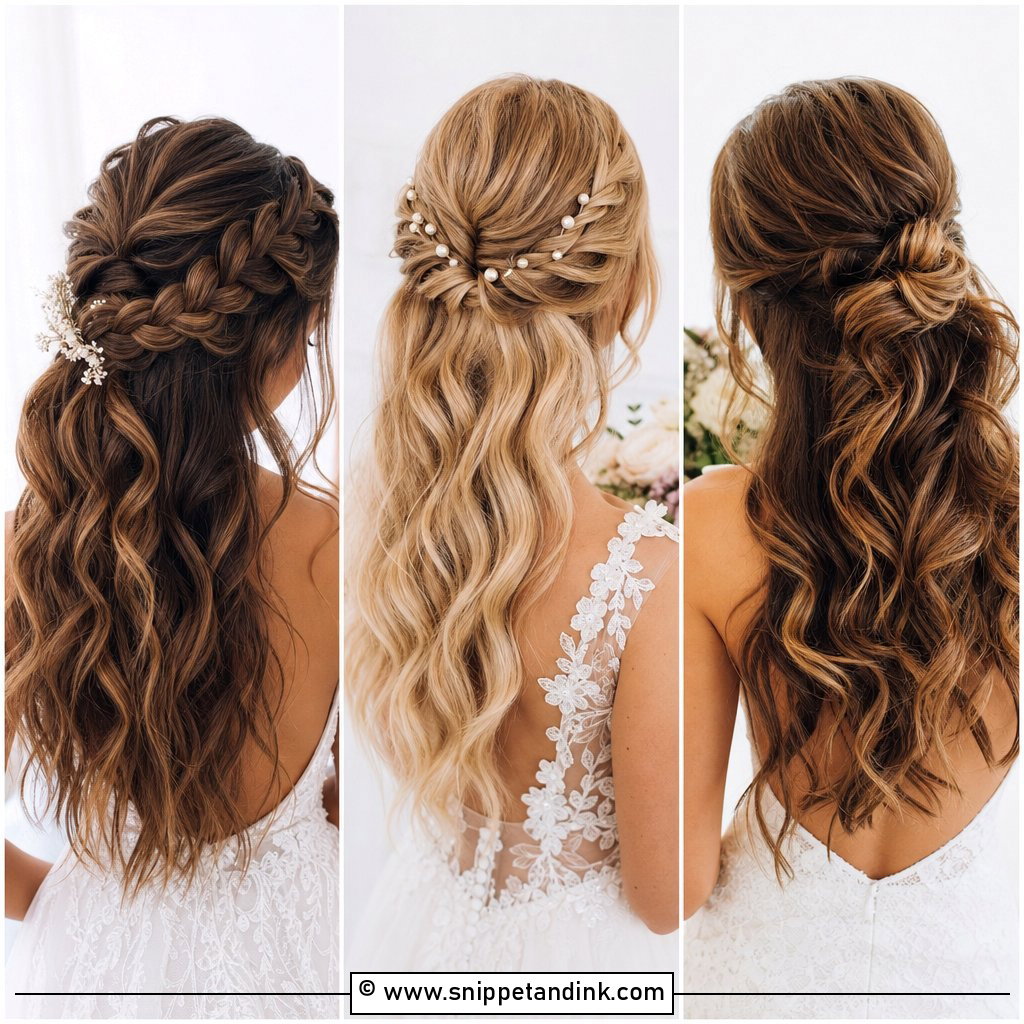
Soft curls are the version most brides picture first, and they’re the easiest to ruin by brushing too early. I curl in larger sections than you’d expect, pin each curl up to cool, and only brush through once every pin comes out cold, so the curl relaxes without losing its spring. The top lifts and pins at the crown while the curls settle over the shoulders. That keeps strapless, sweetheart, off-the-shoulder and lace necklines fully visible, since nothing lies across the bodice. Leave a couple of face-framing strands out. A pearl pin or a slim comb at the gather is plenty.
2. Half-Up Wedding Hair With Loose Waves
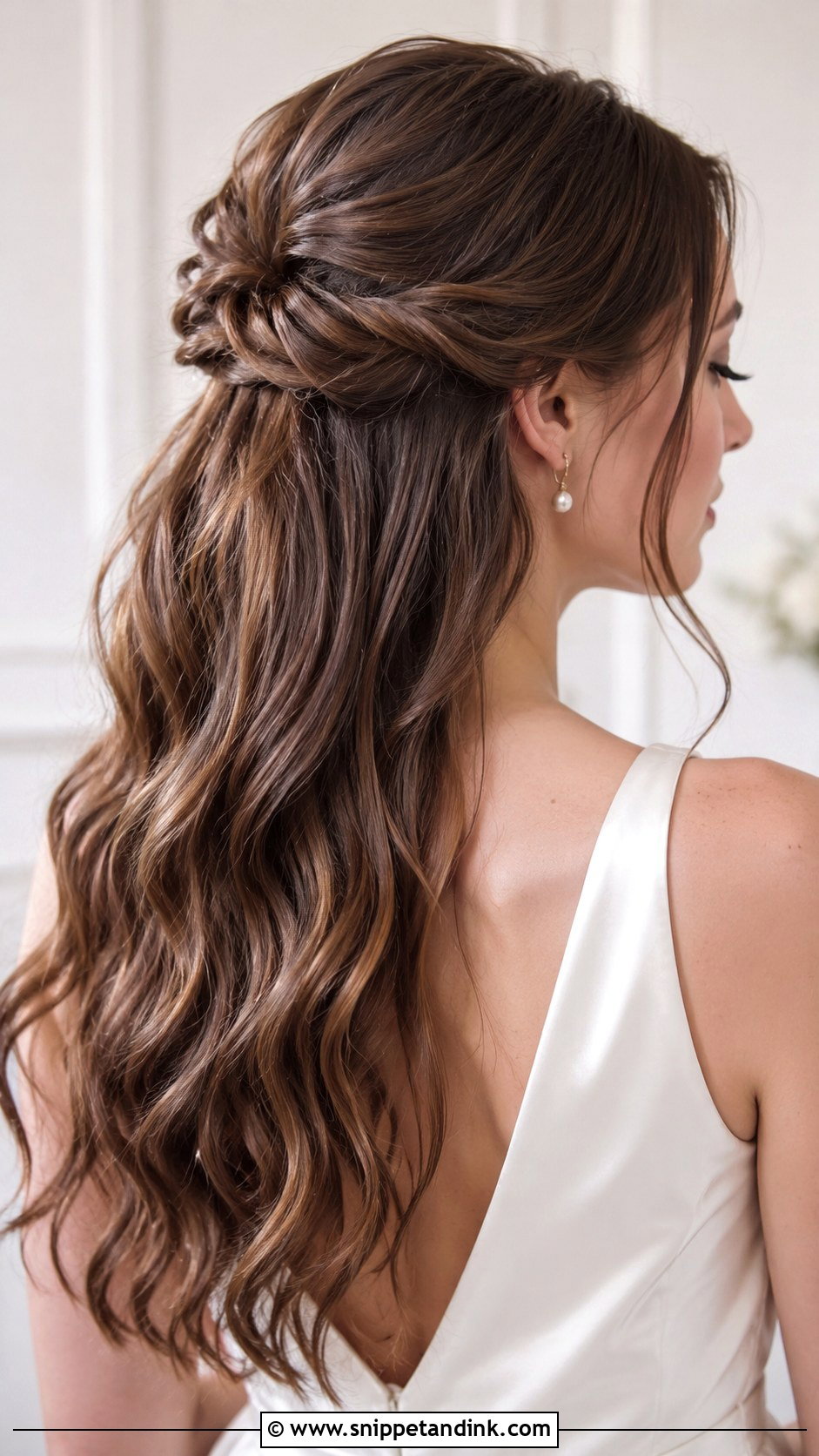
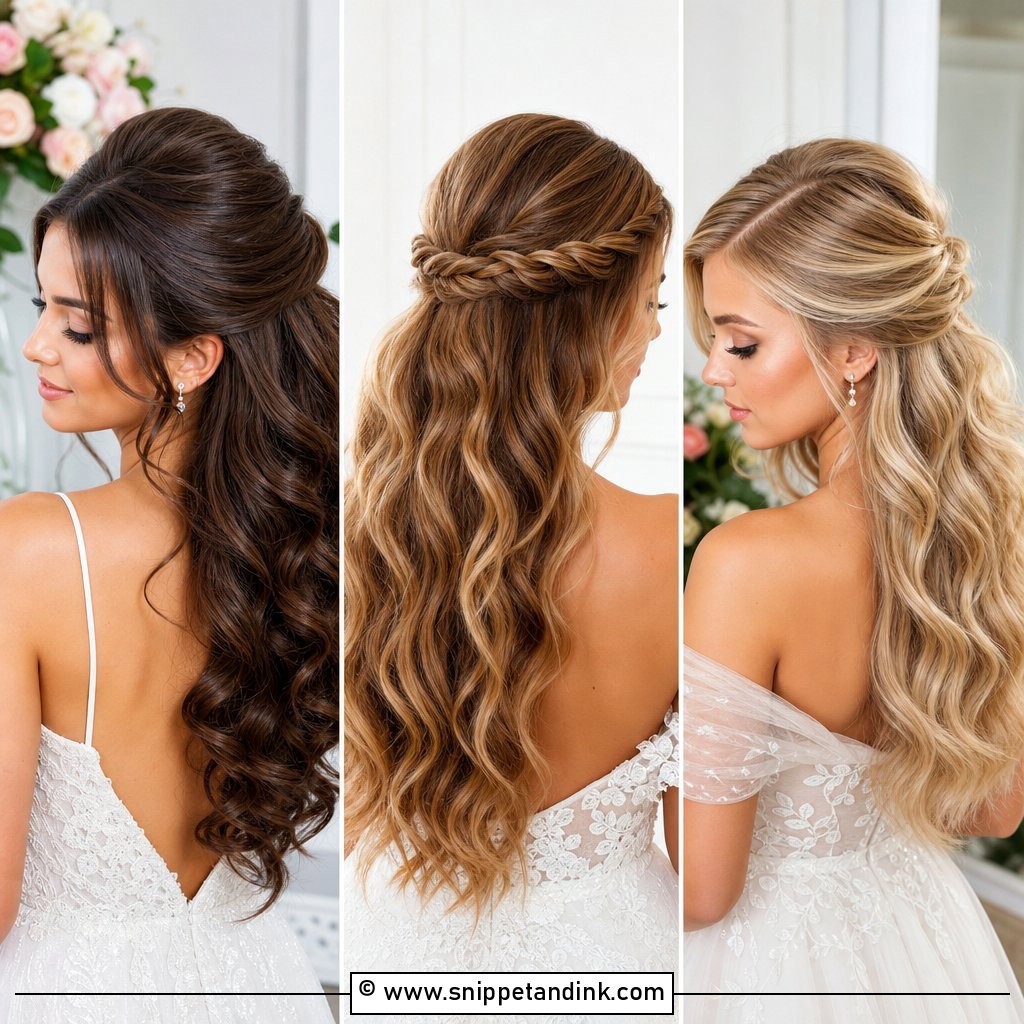
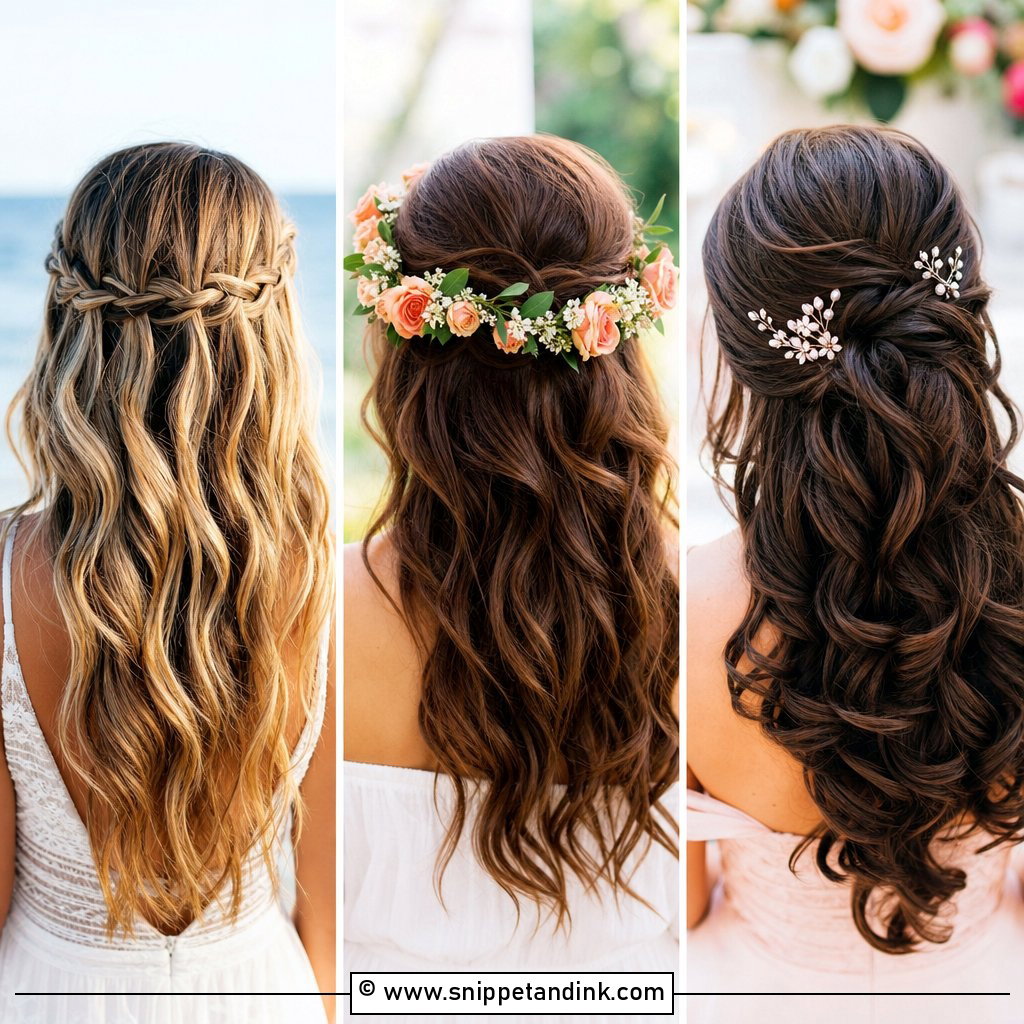
Loose waves are what I suggest to anyone who finds ringlets too formal. The top is twisted or lightly teased and pinned, and the rest falls in a wide, open bend. The hold comes from the set, not the spray: heat, a full cool-down, a soft brush, then a flexible hairspray so the waves stay touchable. My honest warning is for beach and coastal ceremonies. Sea air drops a wave faster than almost anything, so I set them a little tighter than the finished look and let the day relax them. Highlights or balayage show off this shape, because the light picks out each bend.
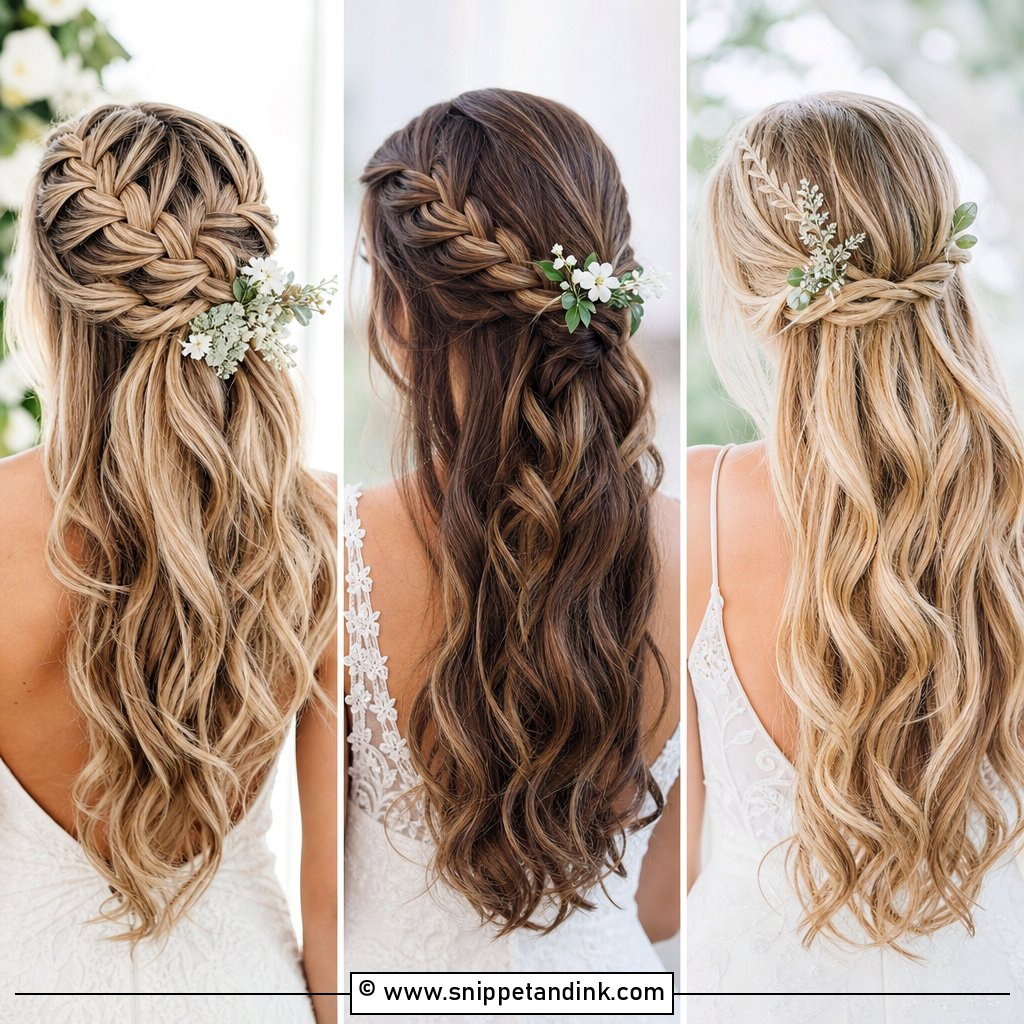
3. Half-Up Wedding Hair With Braids
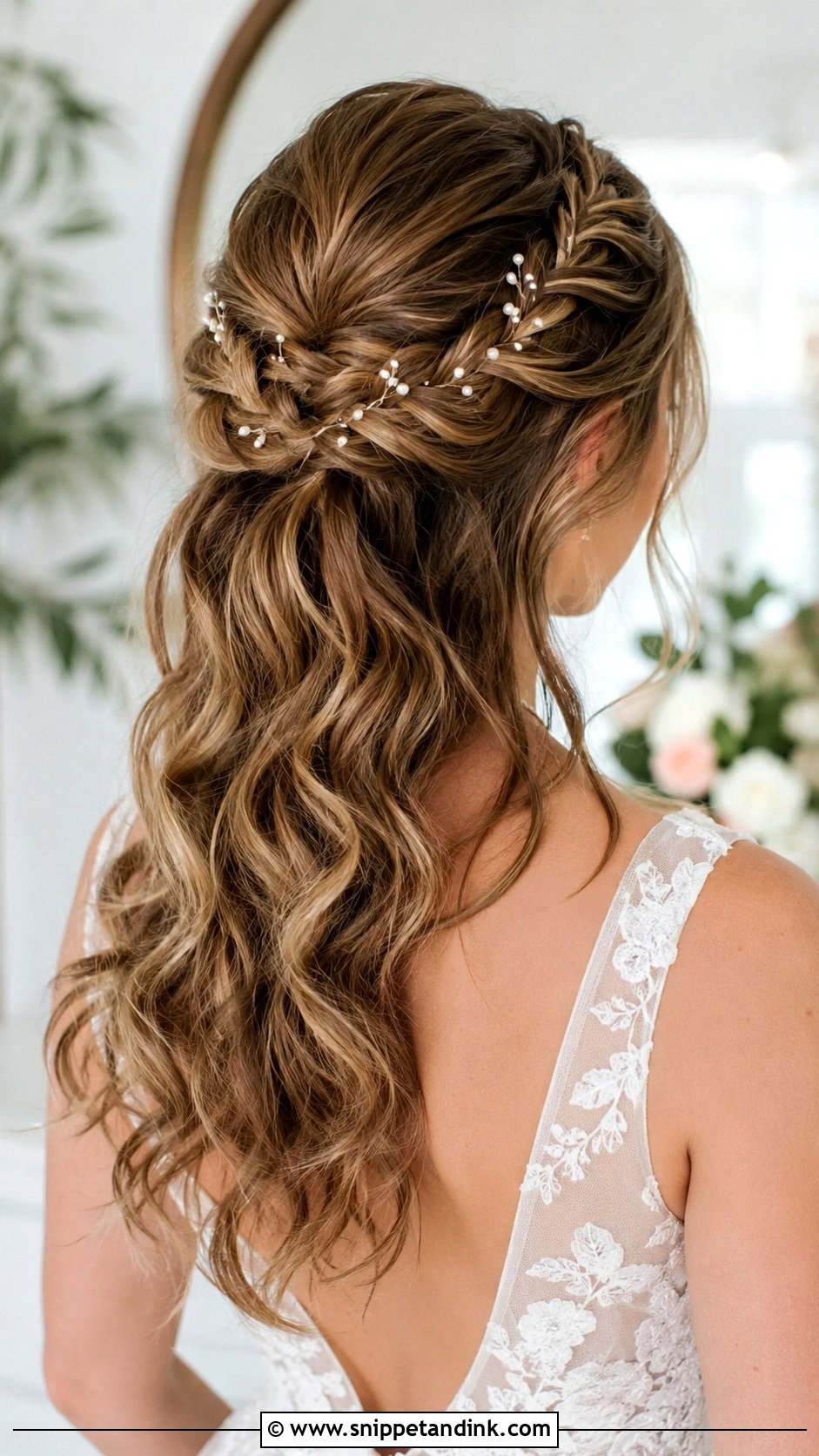
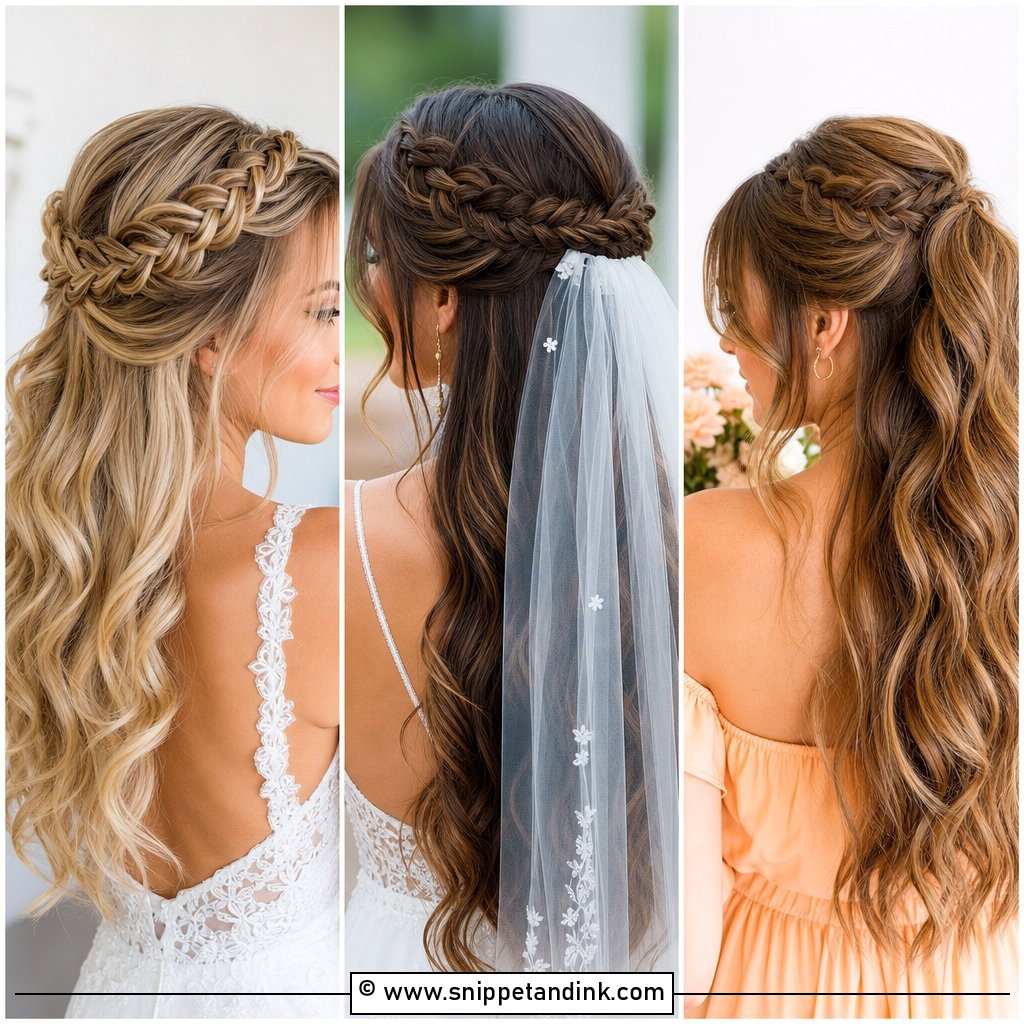
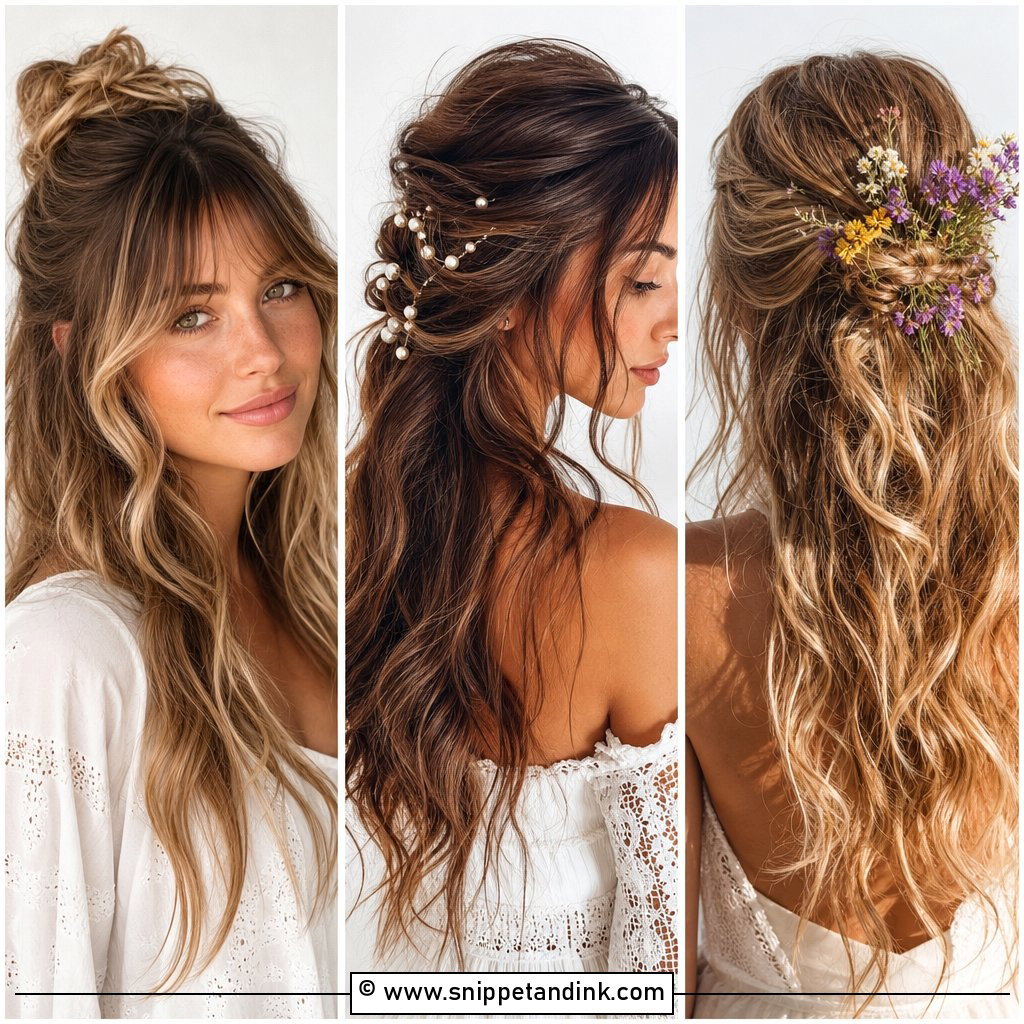
Guests spend the whole ceremony looking at the back of your head, and a braid gives them something to look at. I’ll do a small braid on each side meeting at the back, or one fuller braid sweeping across the crown. Gently pulling the edges loose is what makes a braid read soft rather than tight, but on fine hair I do that before pinning, never after, or it starts to unravel by the reception. Curl or wave the lengths for balance. It sits naturally with garden and rustic venues and boho dresses, and the plaits make a secure home for tiny flowers, pearls or crystal pins.
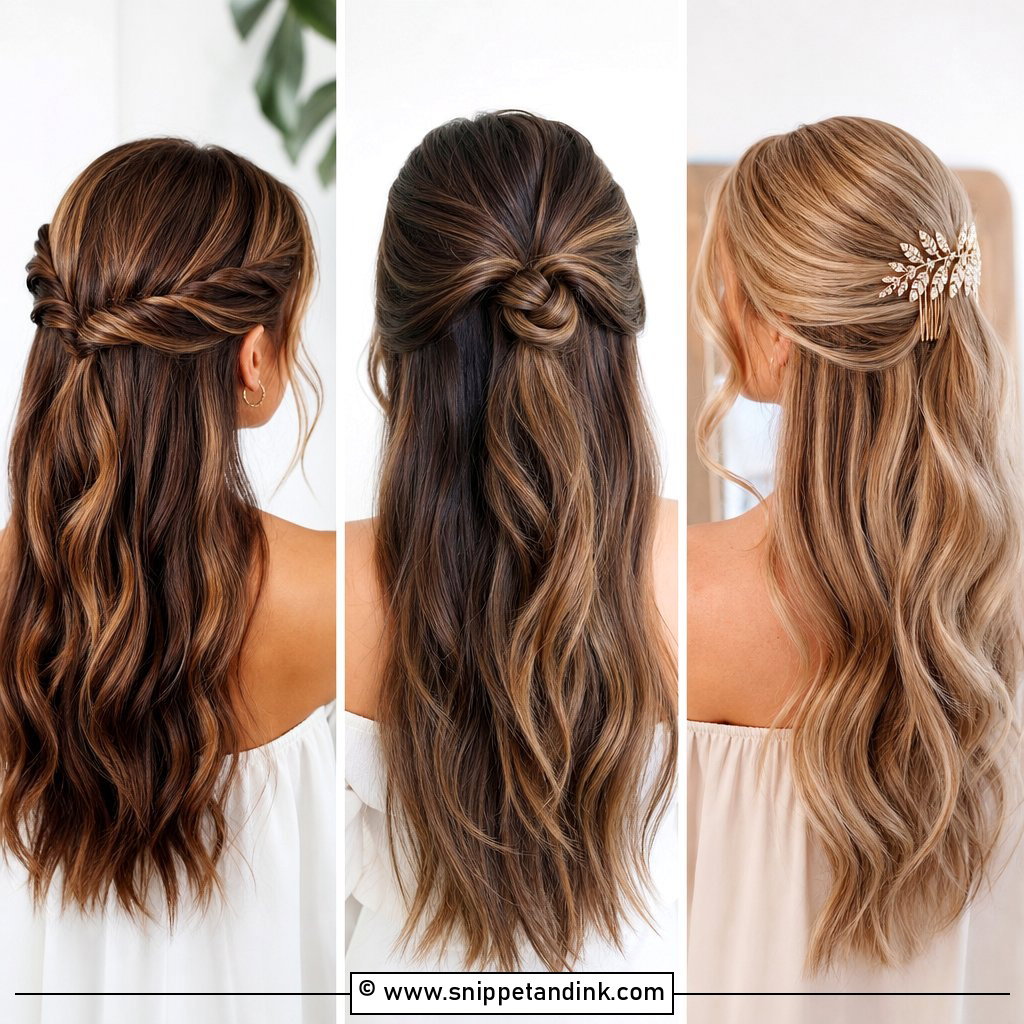
4. Half-Up Wedding Hair With Twists
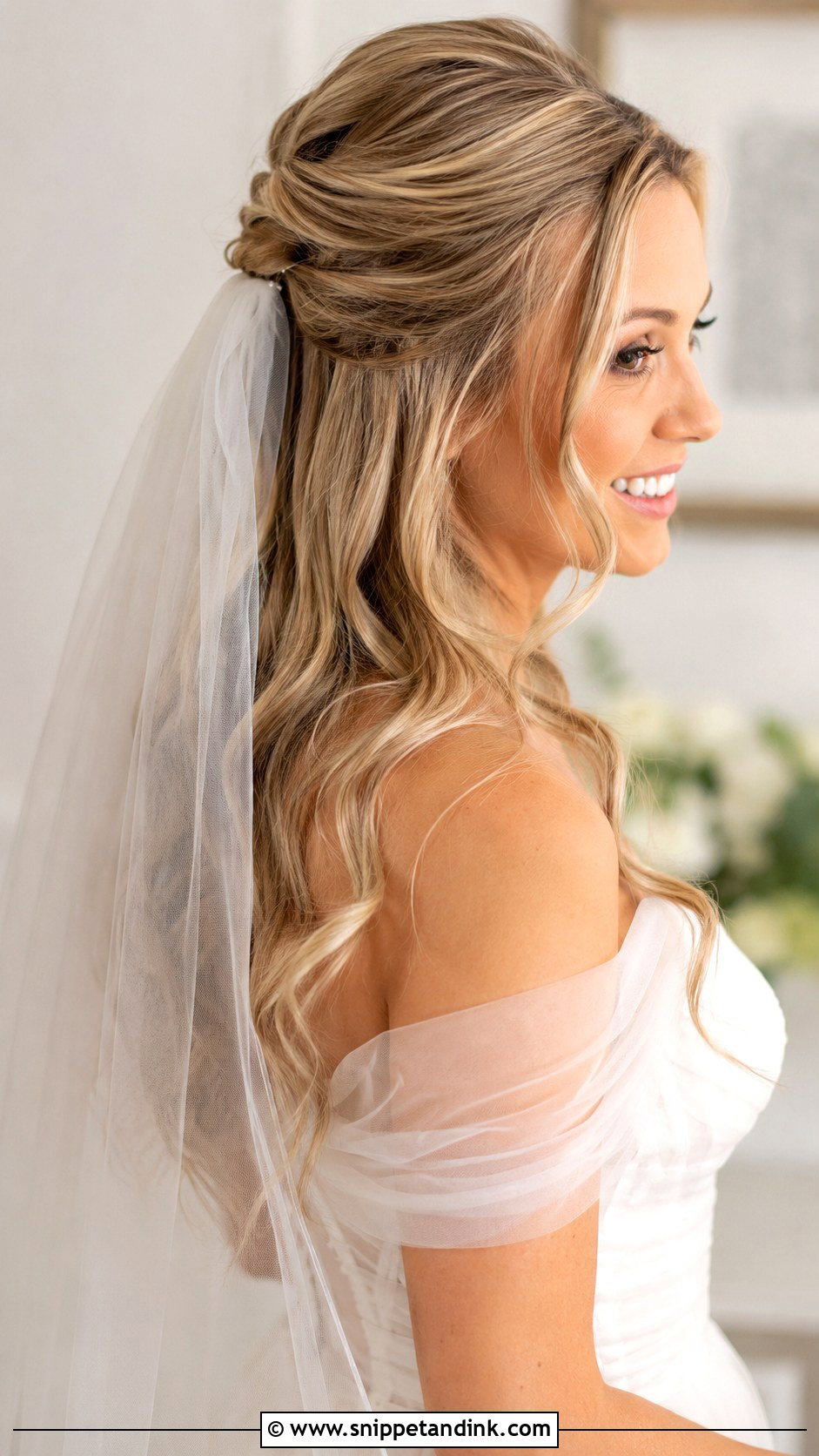
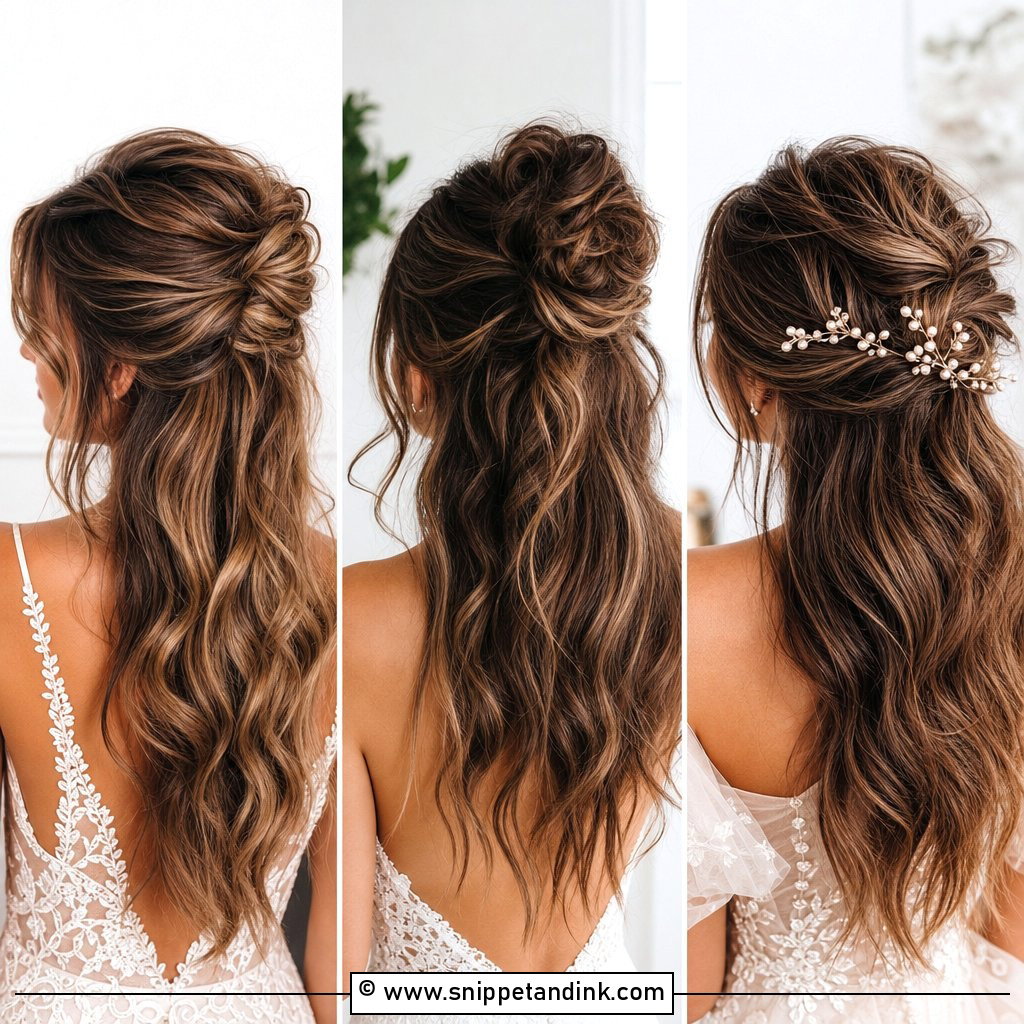
Twists give you shape without the busyness of a braid. Each side section is rolled back and pinned where the two meet, and that’s the whole technique. I place the meeting point according to the veil: low if the comb goes above it, centred or a touch higher if the veil sits beneath. On medium and long hair this is one of the most secure bases I know, because every rotation tightens against the pin. Just don’t twist freshly washed, silky hair with nothing in it. A little dry texture spray first stops the roll slipping open. Finish the ends as waves, curls or smooth lengths.
5. Half-Up Wedding Hair With A Veil
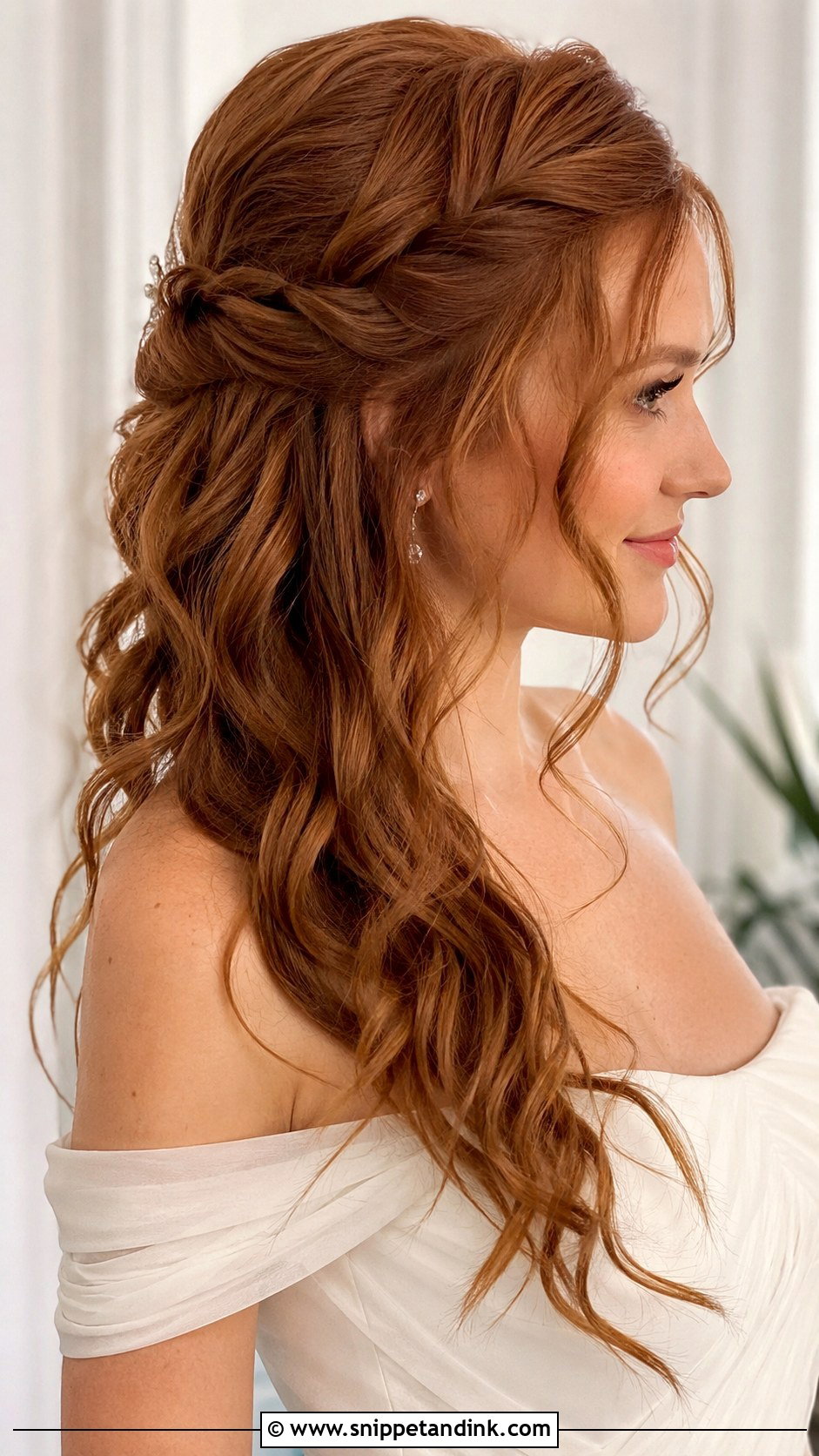
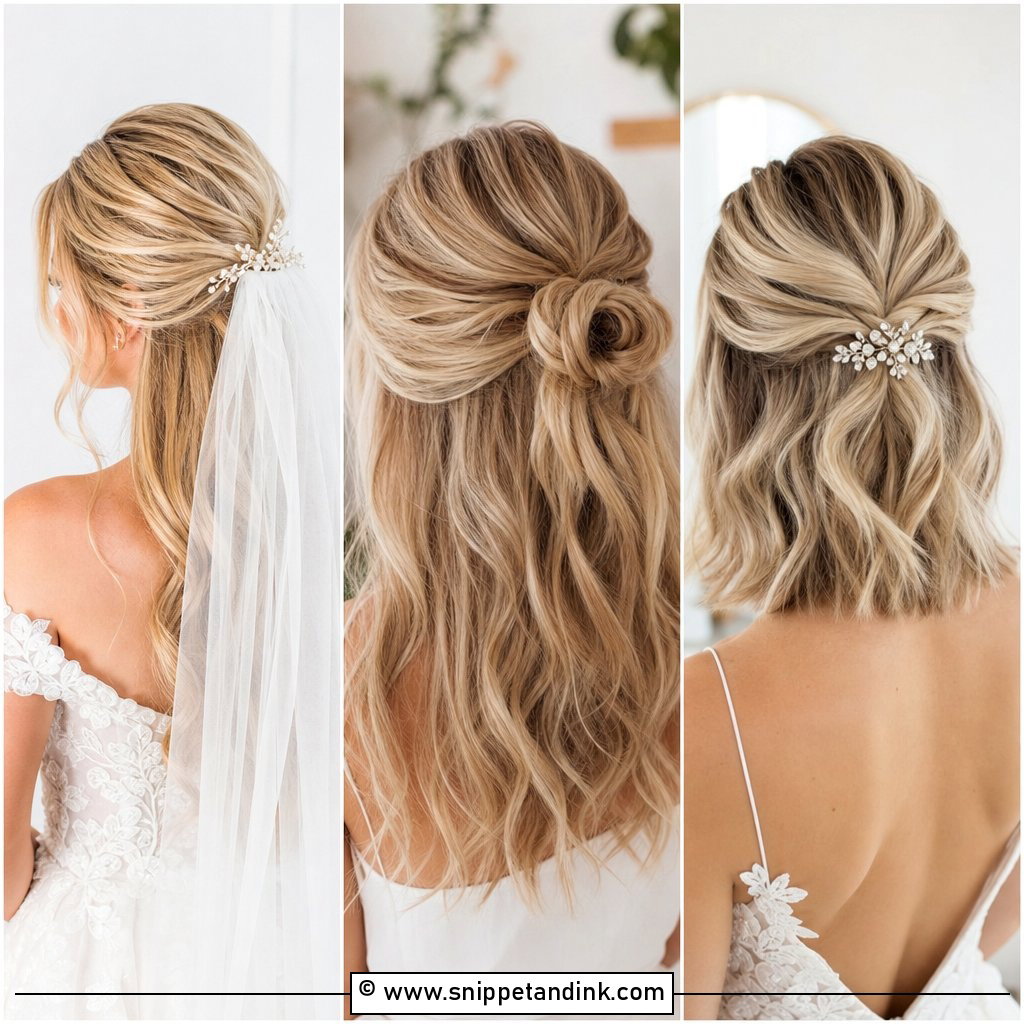
A veil and a half-up get along well, provided we decide where the comb goes before I start pinning. The gathered section is the anchor. I build a small criss-crossed pin base under it so the comb teeth have something to grip, because a comb pushed into loose hair creeps downward every time you turn your head. For a classic line the veil sits just below the crown at the gather; for something softer I set it lower so the tulle falls beneath the curls. The same approach suits cathedral, fingertip, chapel, and simple tulle veils. I keep the top smooth so the hair and veil aren’t competing, and after the ceremony the comb slides out without disturbing anything.
6. Half-Up Wedding Hair With Pearls
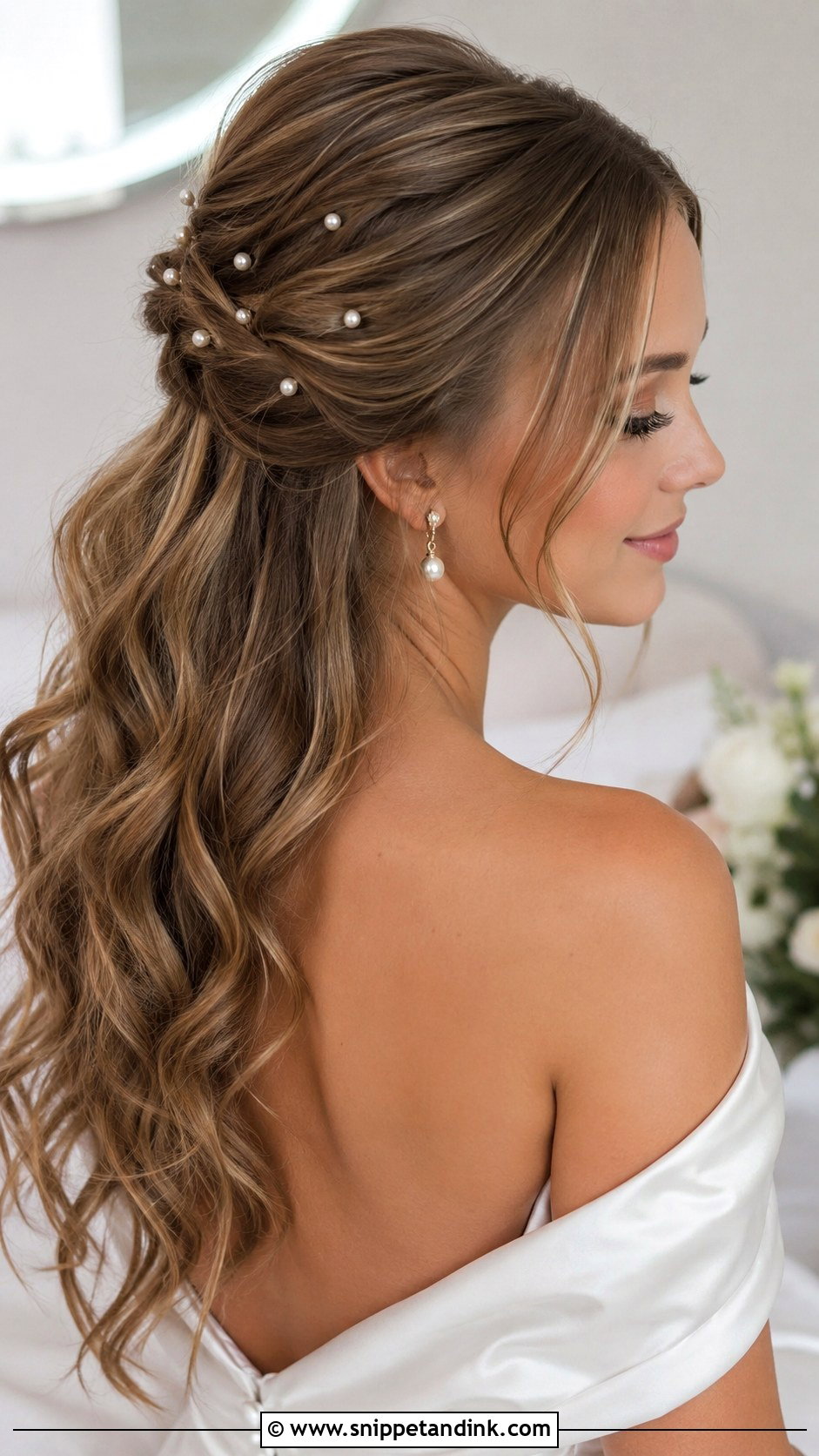
Pearls turn up on half-up hair more than any other accessory: scattered pins, a comb, a wired vine, or small accents tucked into twists and braids. They sit naturally with satin, lace, pearl earrings and classic makeup. The first thing I check is the dress. If the bodice is already heavily beaded, I scale down to a few small pins so the head and the gown aren’t fighting for attention. Keep the curls smooth around them, since frizz swallows a small pearl. Running them asymmetrically along one side of the gather is my favourite way to keep them from looking old-fashioned.
7. Half-Up Wedding Hair With Flowers
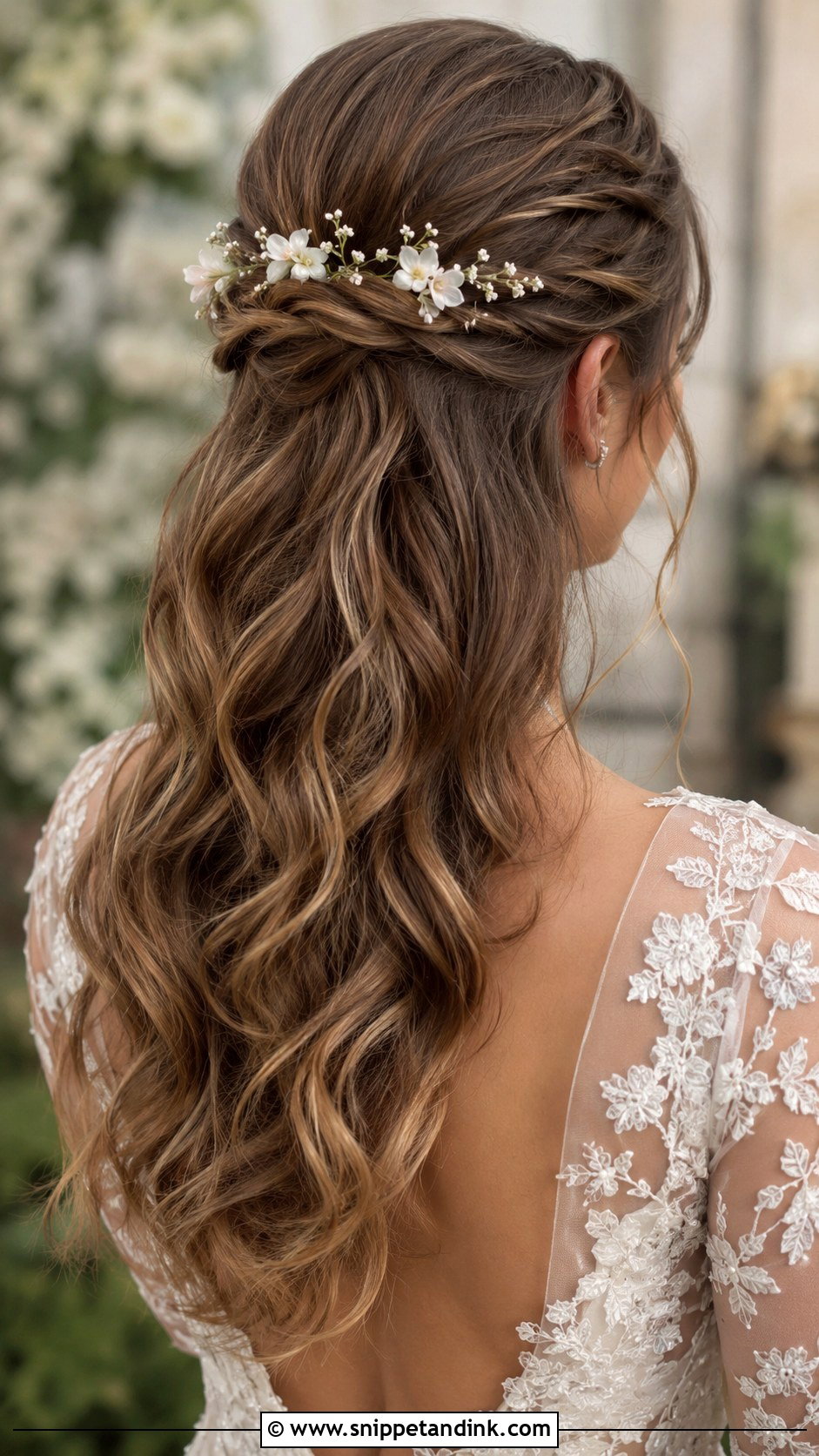
Flowers turn a half-up into a garden look, and I mostly style it for spring weddings, outdoor and vineyard ceremonies, and dresses with floral lace. Small blooms hold best. Baby’s breath, mini roses, orchids, or tiny dried flowers can be tucked into twists, braids, or the back pinned section. I add fresh flowers last, after the final spray, because hairspray can spot petals. Ask your florist for sturdy stems wired for hair, since real flowers have to cope with heat, hugs and movement for hours. Soft curl underneath gives the blooms texture to sit in instead of a flat surface.
8. Half-Up Wedding Hair With A Bow
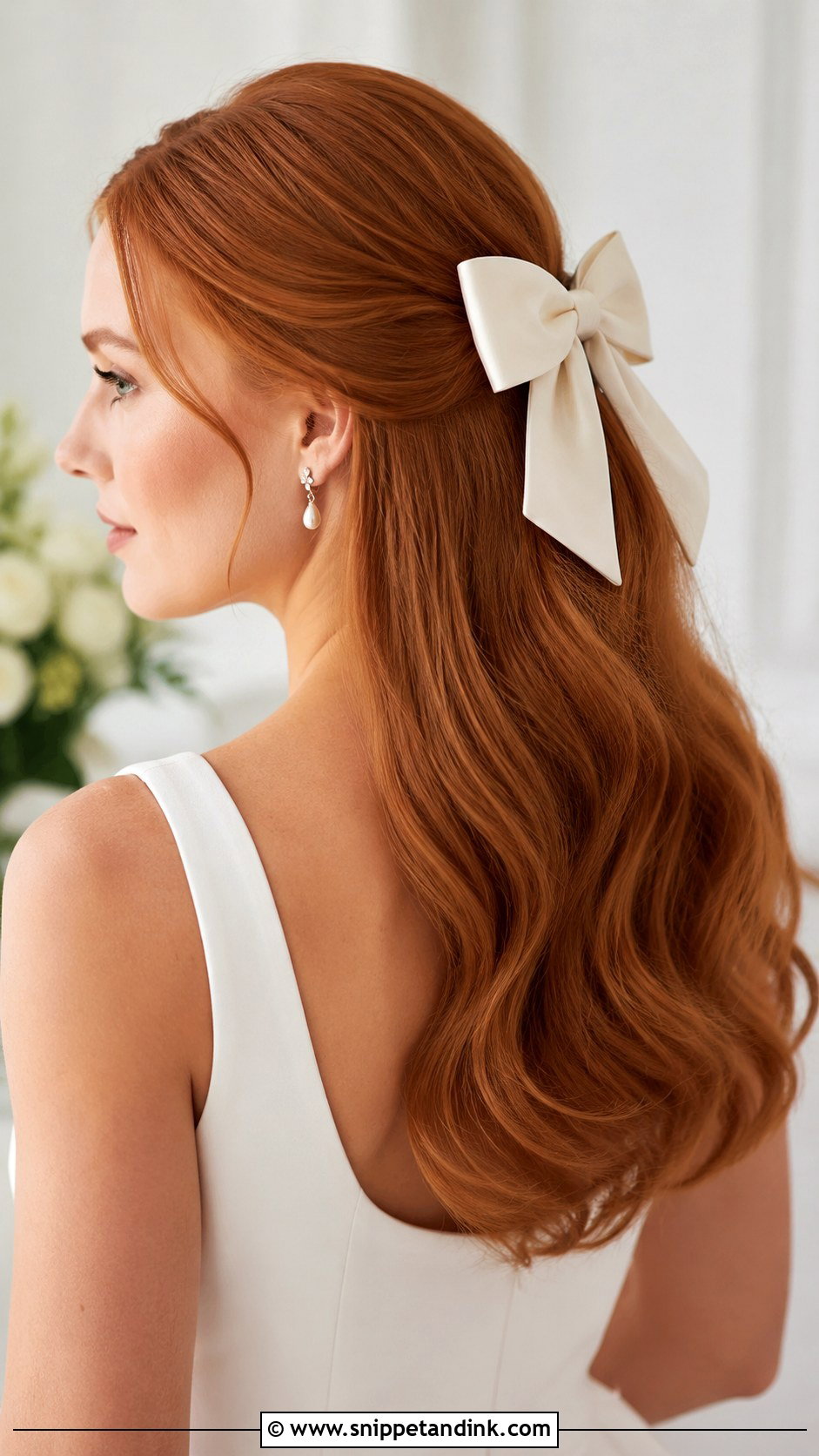
A bow is the most fashion-led accessory here, and the fabric decides everything. Satin and silk look crisp, velvet feels wintry, organza is lighter. A small bow reads delicate, a wide one is a deliberate choice. It sits well with clean gowns, square necklines, simple slip dresses, and understated bridal details. I secure the gather with hidden pins first, then clip or stitch the bow over it so the bow carries none of the hair’s weight. Keep the lengths smooth or lightly waved. Bows go wrong when the ribbon is shiny and a shade off, so hold it against the dress fabric in daylight before you commit.
9. Half-Up Wedding Hair With A Tiara
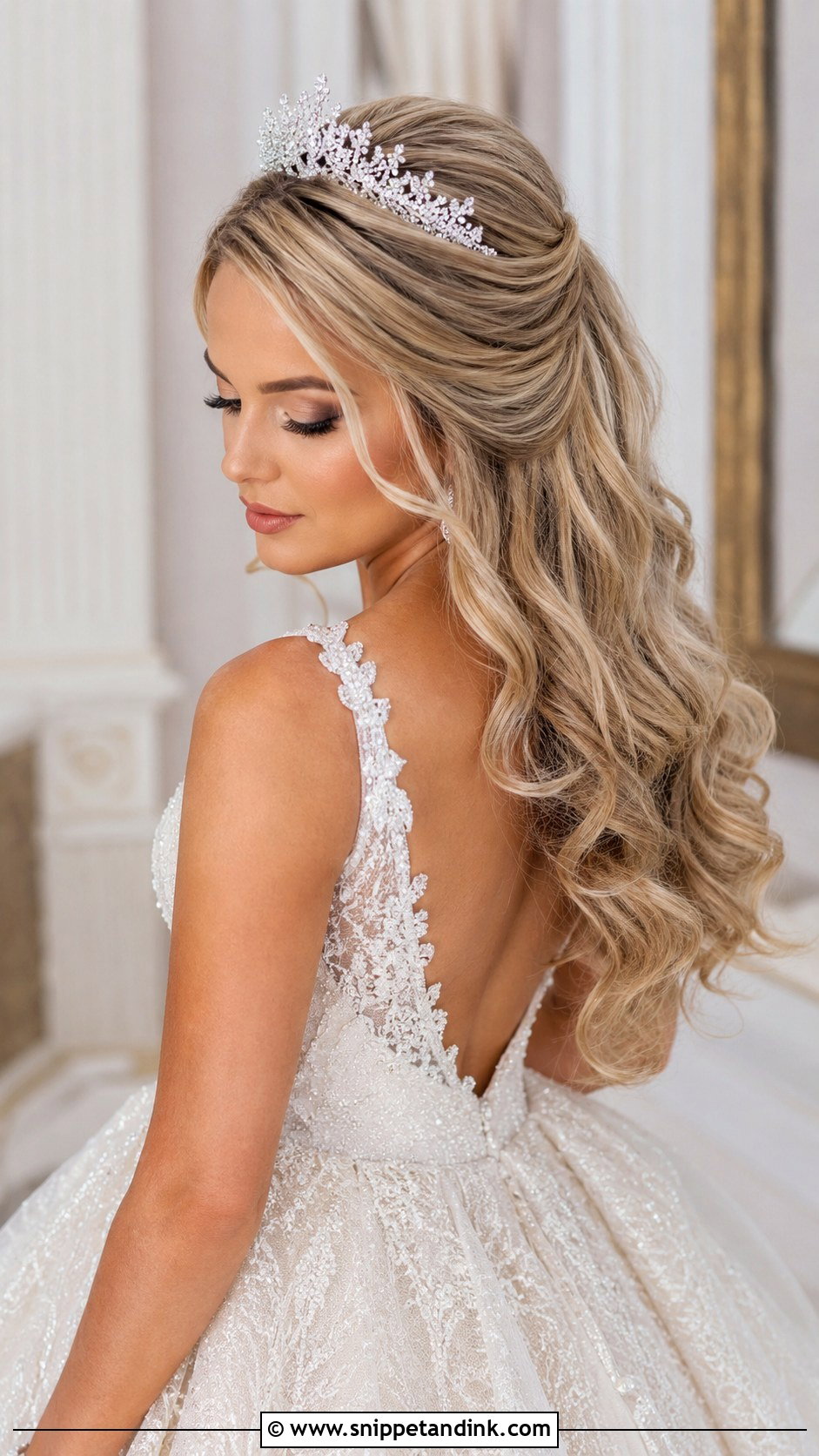
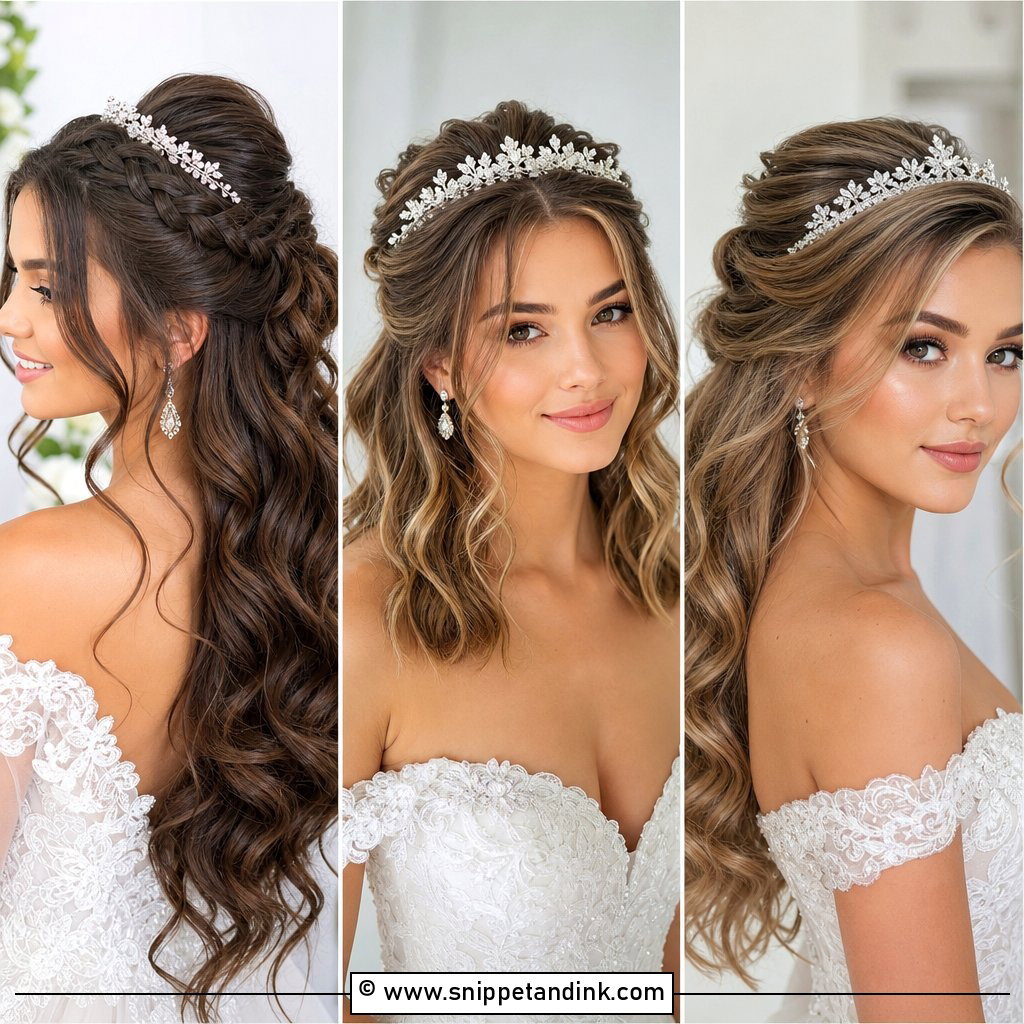
A tiara needs a base, and the lifted crown of a half-up gives it one. I build just enough height to support the band, then set the tiara slightly forward of the pinned section so it frames your face and catches the light. Too much backcombing looks dated; too little and the band sits flat on the scalp and starts to dig in behind the ears by the second hour. Soft curls, glossy waves or smooth lengths all balance the sparkle. It pairs naturally with ball gowns, long veils and formal venues. My rule is one sparkling piece on the head, with quiet earrings.
10. Half-Up Wedding Hair With Hollywood Waves
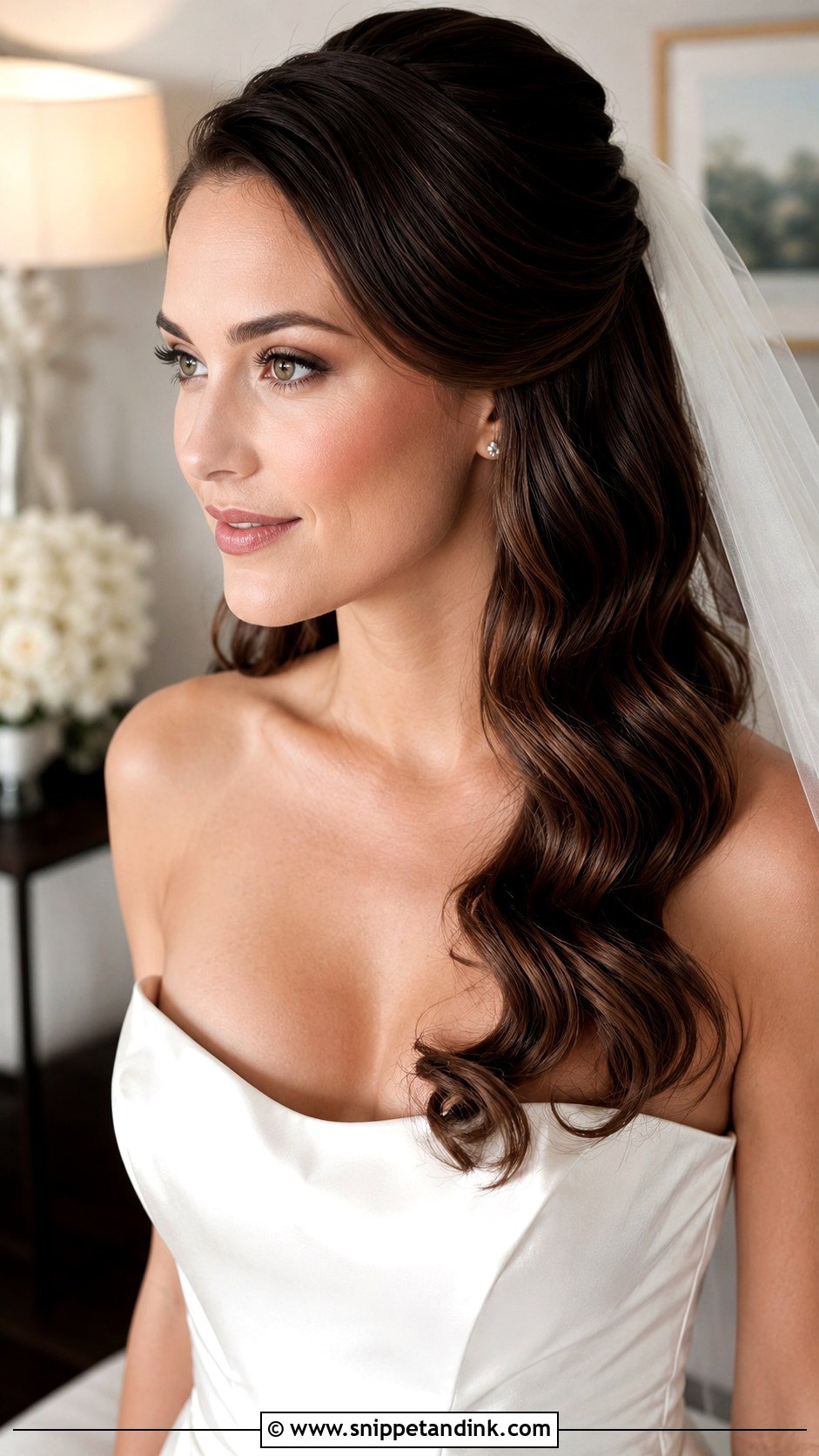
Hollywood waves are the most demanding version on this list. The lengths are shaped into uniform, polished S-waves while the top is drawn back to open the face. I set them with pin curls or setting clips, let everything cool completely, then brush the waves into one continuous ripple, which takes far longer than people expect. They belong with black-tie weddings, vintage gowns, satin and dramatic earrings, usually on a deep side part or a clean centre part, with a light shine spray to finish. If your hair is heavily layered, tell your stylist early. Short layers break the wave pattern and need extra pinning to fall in line.
11. Half-Up Wedding Hair With A Center Part
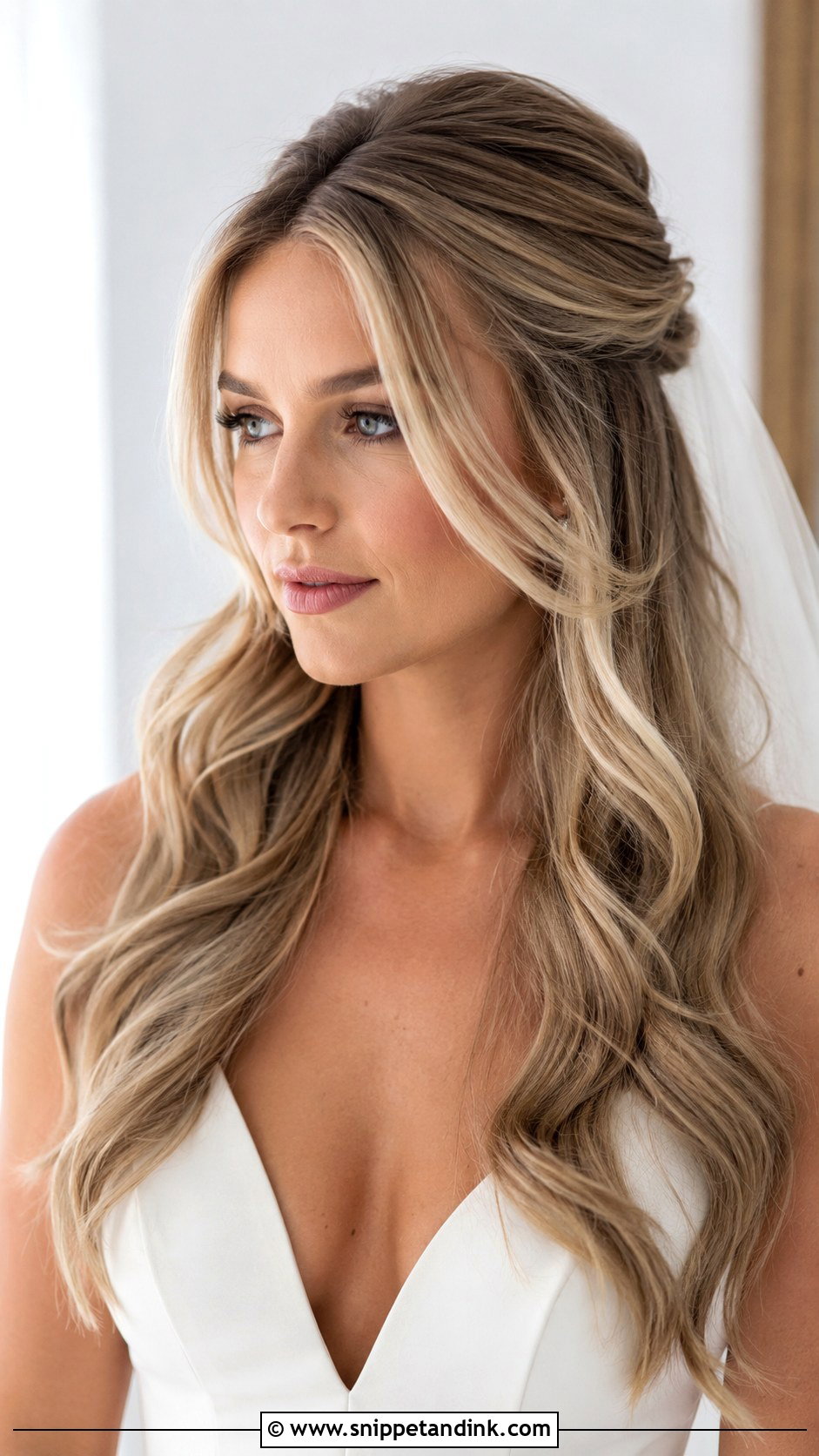
A centre part is all about symmetry, so it shows every imbalance. Face-framing pieces fall evenly on both sides, the top is smoothed back, twisted or gathered small, and the lengths are curled or waved. It works with minimalist dresses, sleek veils, pearls and natural makeup, and it pulls attention to cheekbones and earrings. I check the part at the trial under straight-on light, because a cowlick or a slightly uneven hairline is far more visible down the middle. To keep it from lying flat, I lift the roots at the crown and put soft bends through the lengths.
12. Half-Up Wedding Hair With A Side Part
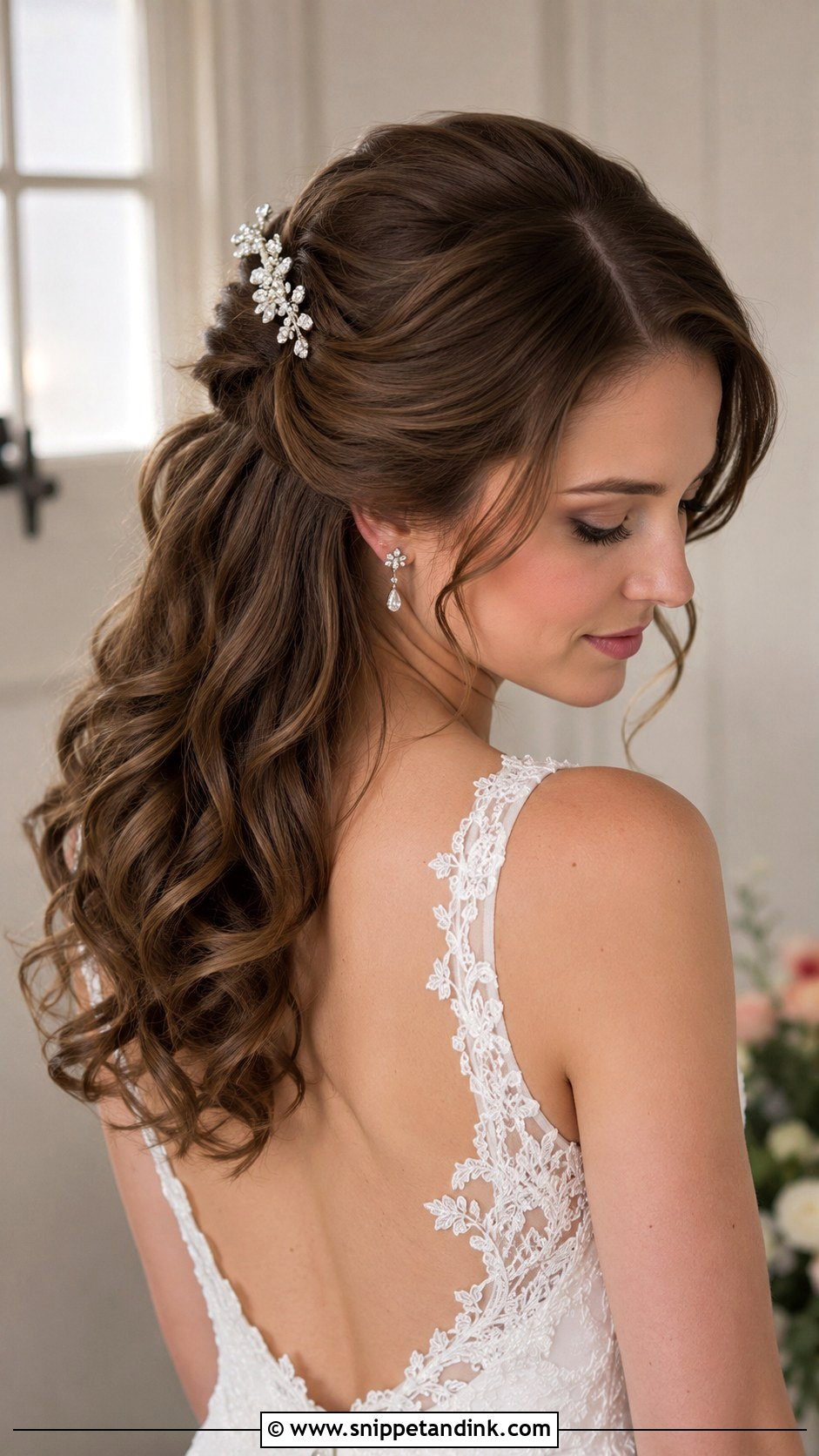
I reach for a side part when someone wants a little drama without going full vintage. It gives instant volume at the front and a softer shape, and it takes side-swept face framing, loose curls or polished waves equally well. The gather can sit low or be lifted for crown height, and a comb looks most balanced on the fuller side. I always ask which side you naturally part on. Flipping it for the wedding sounds simple, but hair trained one way for years fights back by mid-afternoon. Keep the hair right along the part smooth so the line looks clean.
13. Half-Up Wedding Hair For Long Hair
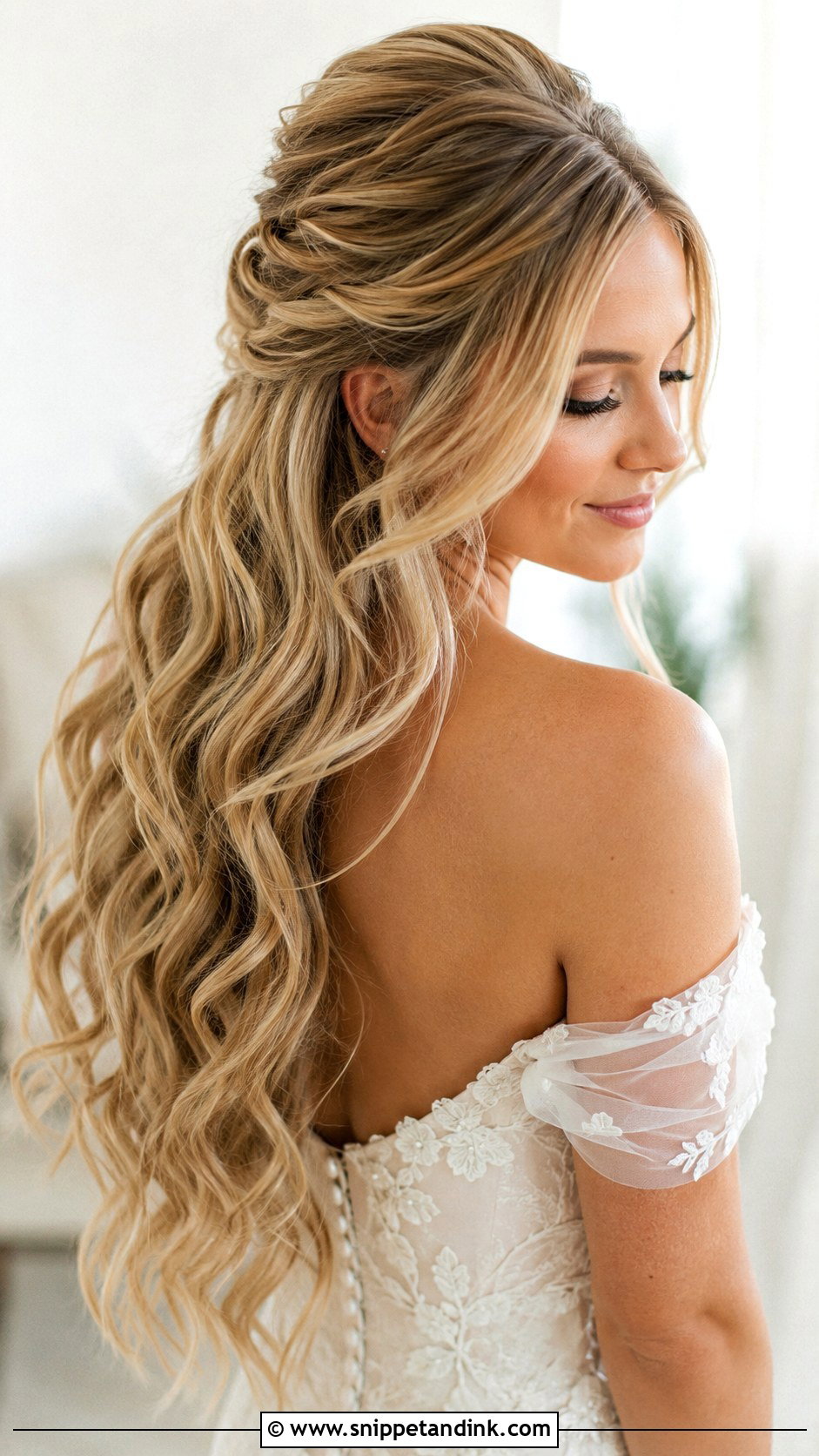
Long hair shows off a half-up better than any other length, and it also tests the pins hardest. Every extra inch hanging below the gather adds weight that pulls on the anchor all day, so with long hair I usually hide a small clear elastic under the pins rather than relying on pins alone. The top keeps hair off the face while the back stays full and flowing. Layers add movement, though very short face-framing pieces need blending. If you’re adding extensions for fullness, the colour and texture have to match exactly, and that gets sorted at the trial, not on the morning.
14. Half-Up Wedding Hair For Medium Hair
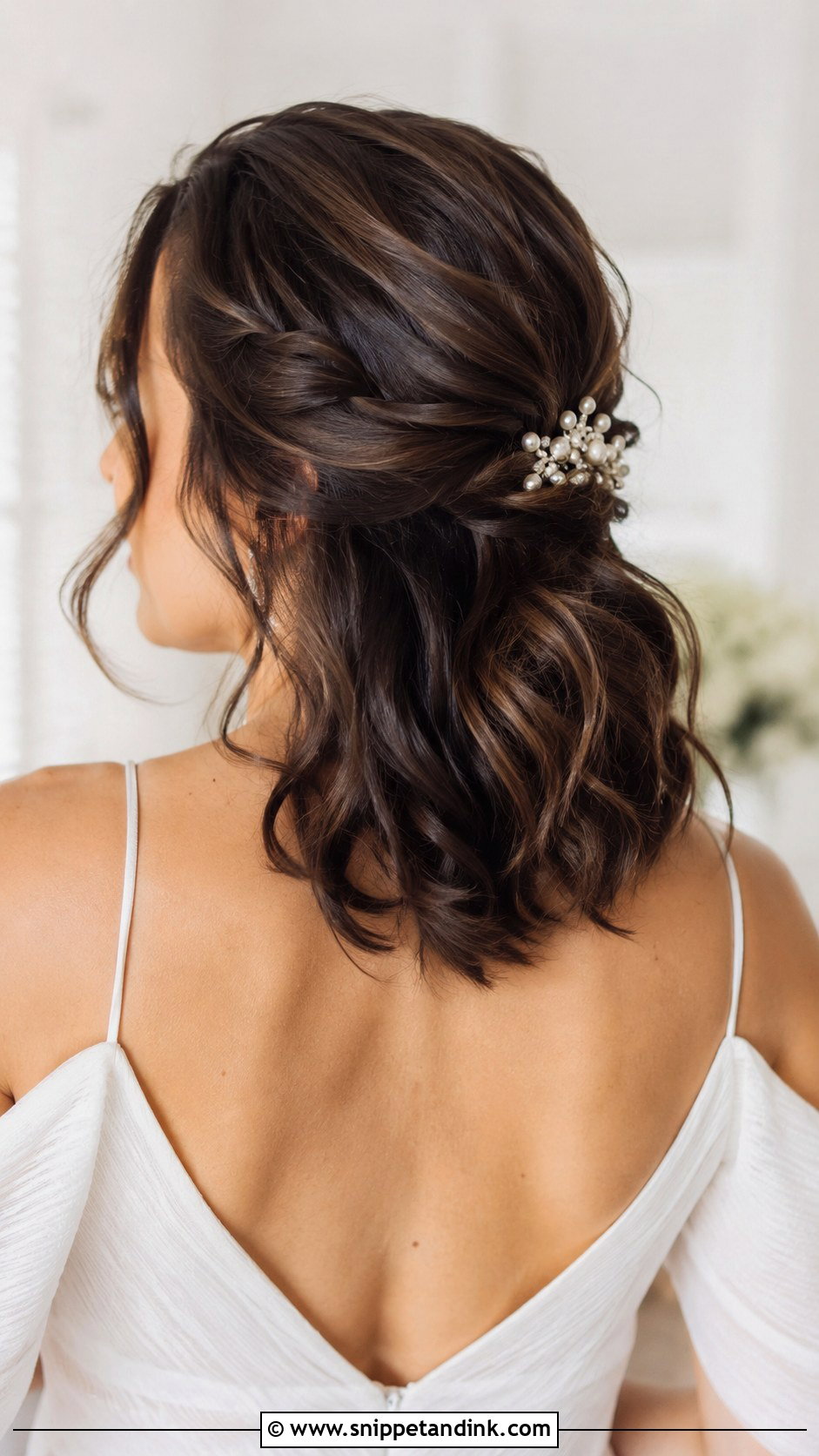
Medium hair is often the easiest length for this style: enough to shape, not so much that it drags. Shoulder and collarbone lengths take soft curls, loose waves and twisted sections well. The skill is building fullness at the sides and back so it reads bridal rather than everyday. On fine medium hair I use texture spray at the roots, and sometimes slip a few clip-in wefts under the gather for body. A small comb, pearl pins or a bow finishes it, and because the face stays open, most necklines are happy with it.
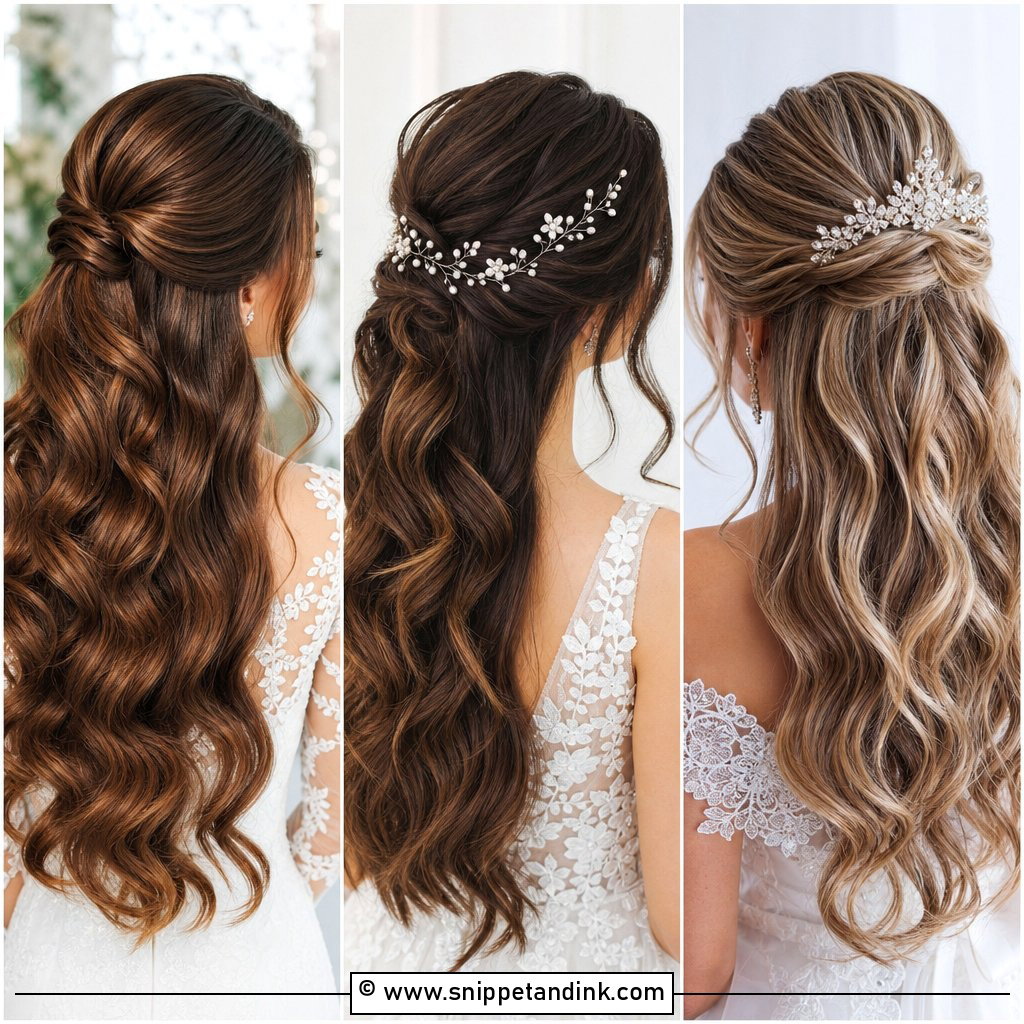
15. Half-Up Wedding Hair For Short Hair
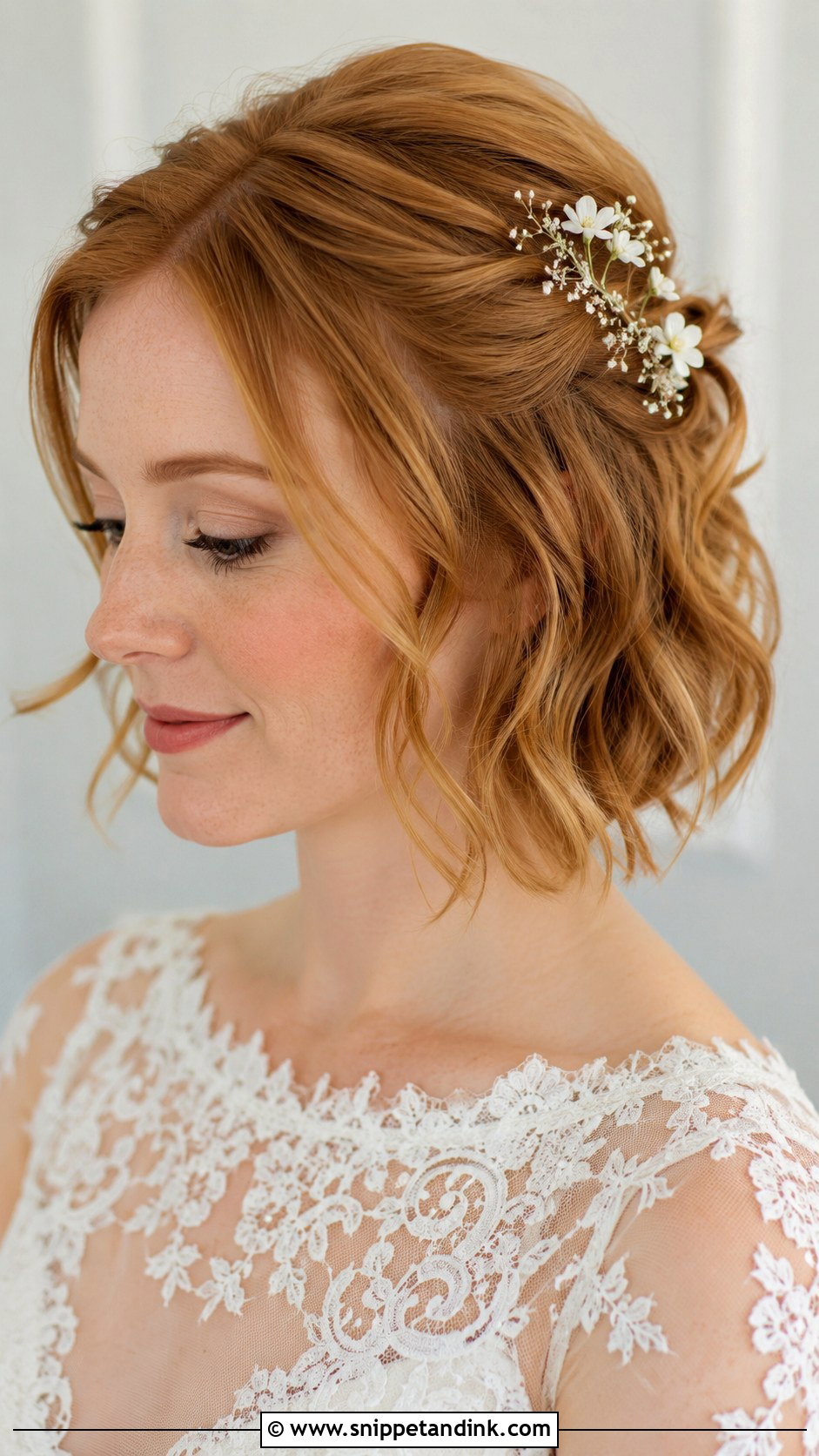
Short hair can wear a half-up, but I’ll be straight about what it looks like: smaller, and more about texture than length. Chin-length bobs, lobs and layered cuts can be curled and pinned back at the sides, and the gather is still enough to hold a veil comb, a slim clip or a few tiny flowers. The risk is short ends escaping by evening, so I use matte bobby pins in your hair colour and set them in crossed pairs. Put shine, soft bends and a little crown lift first, and don’t force a shape the cut can’t hold.
16. Half-Up Wedding Hair For Curly Hair
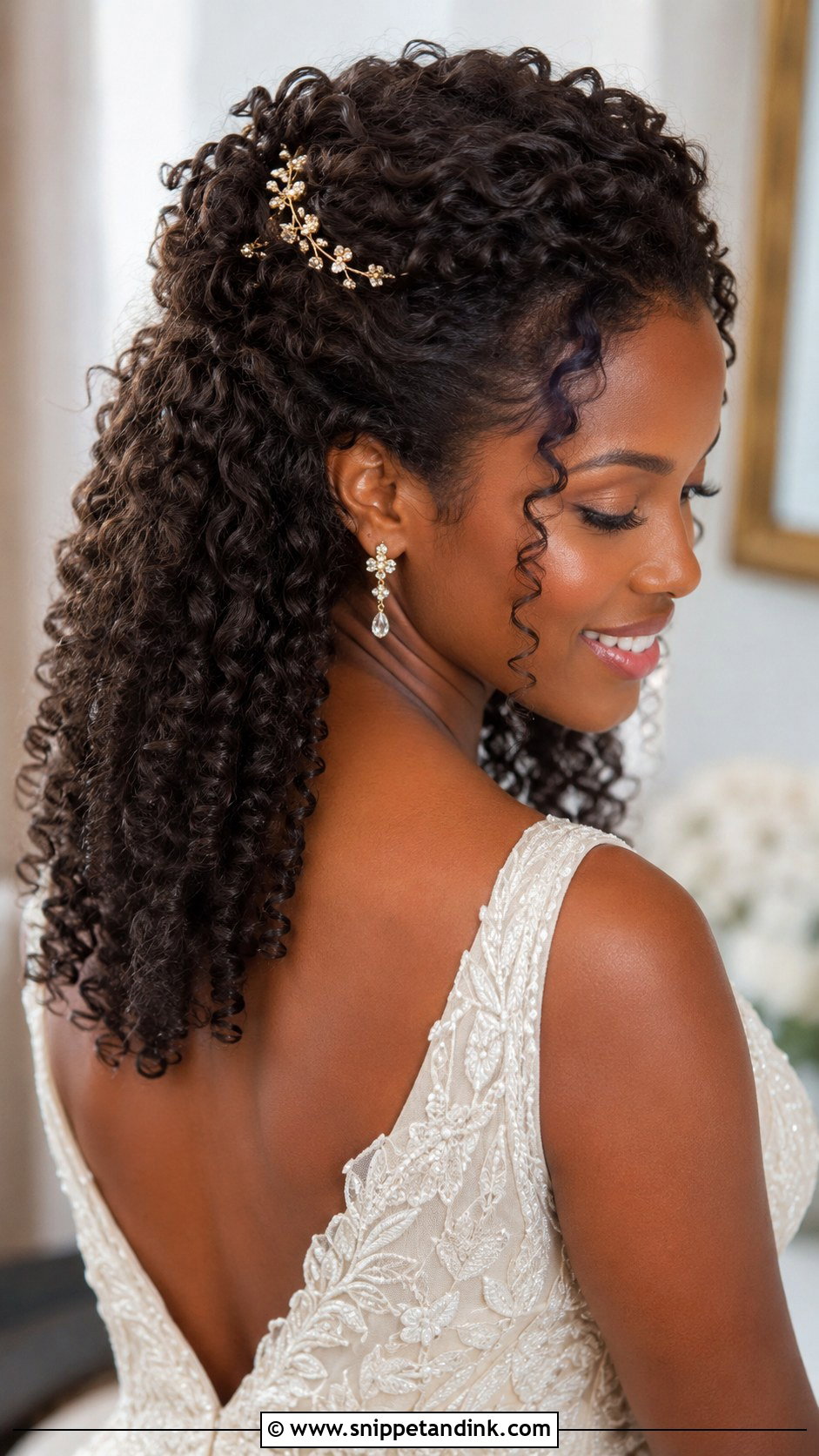
With natural curls I gather the top gently, never brushed and never stretched, so the pattern keeps its shape right up to the pin. Hydration does most of the work here. Start your moisturising and deep conditioning routine in the weeks before, and wear exactly that routine to the trial so we see how your curls behave with it. The lower curls stay full and bouncy while the gather lifts the crown. I’d skip heavy oils on the day, as they weigh curls down by the reception. Gold pins, pearls or small flowers sit softly inside the curl rather than on top of it.
17. Half-Up Wedding Hair For Thin Hair
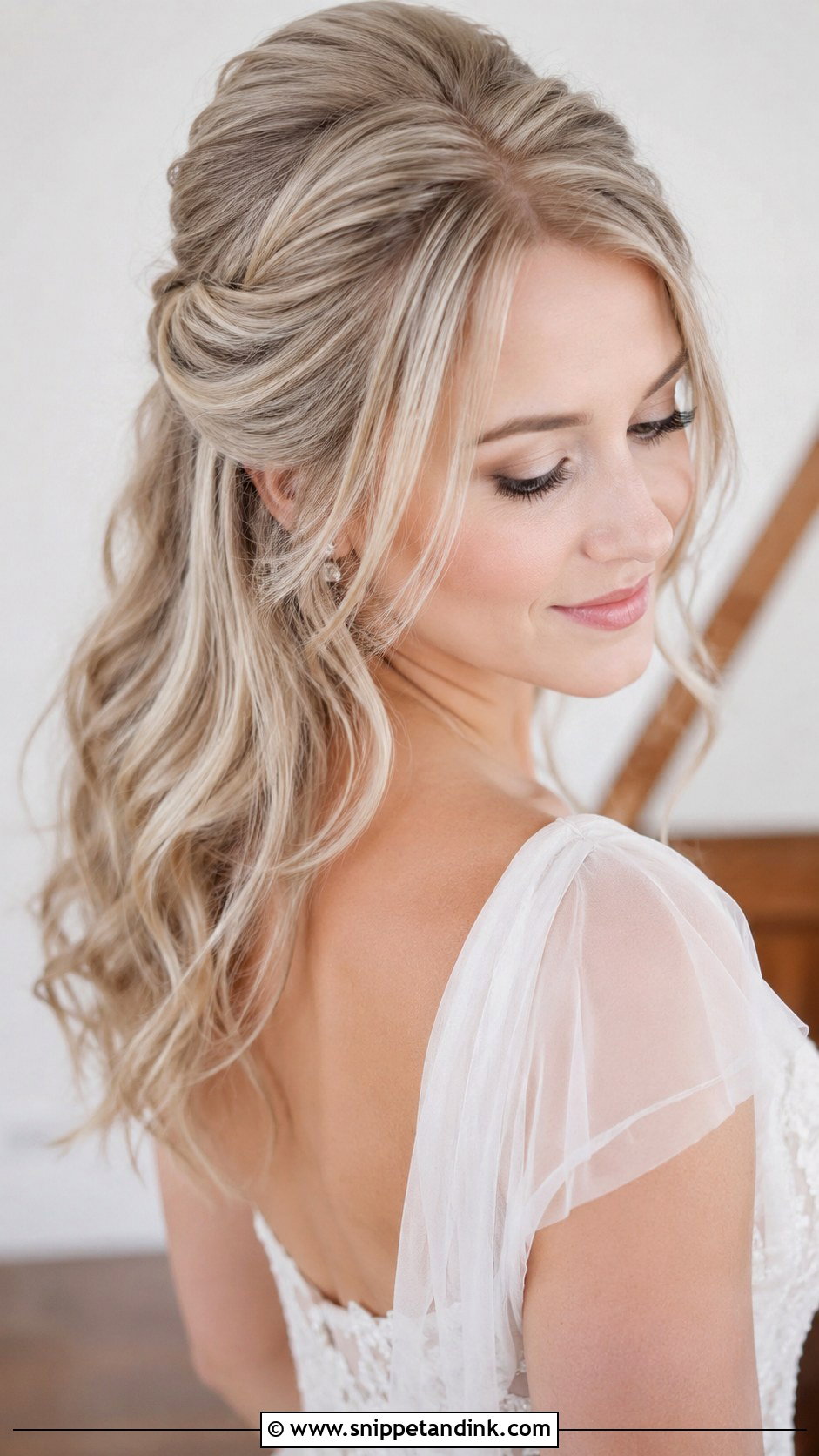
Fine or thin hair can actually look fuller in a half-up than worn fully down, as long as the volume is built rather than faked. I lift the roots, tease lightly at the crown and smooth the top layer over it, sometimes adding hidden padding or a few extensions under the gather. The common mistake is pulling the side sections tight, which shows scalp and flattens the shape. A loose twist or soft braid adds coverage. Keep accessories small and light, because heavy pieces drag fine hair down and expose the pins holding them.
18. Half-Up Wedding Hair With Face-Framing Pieces
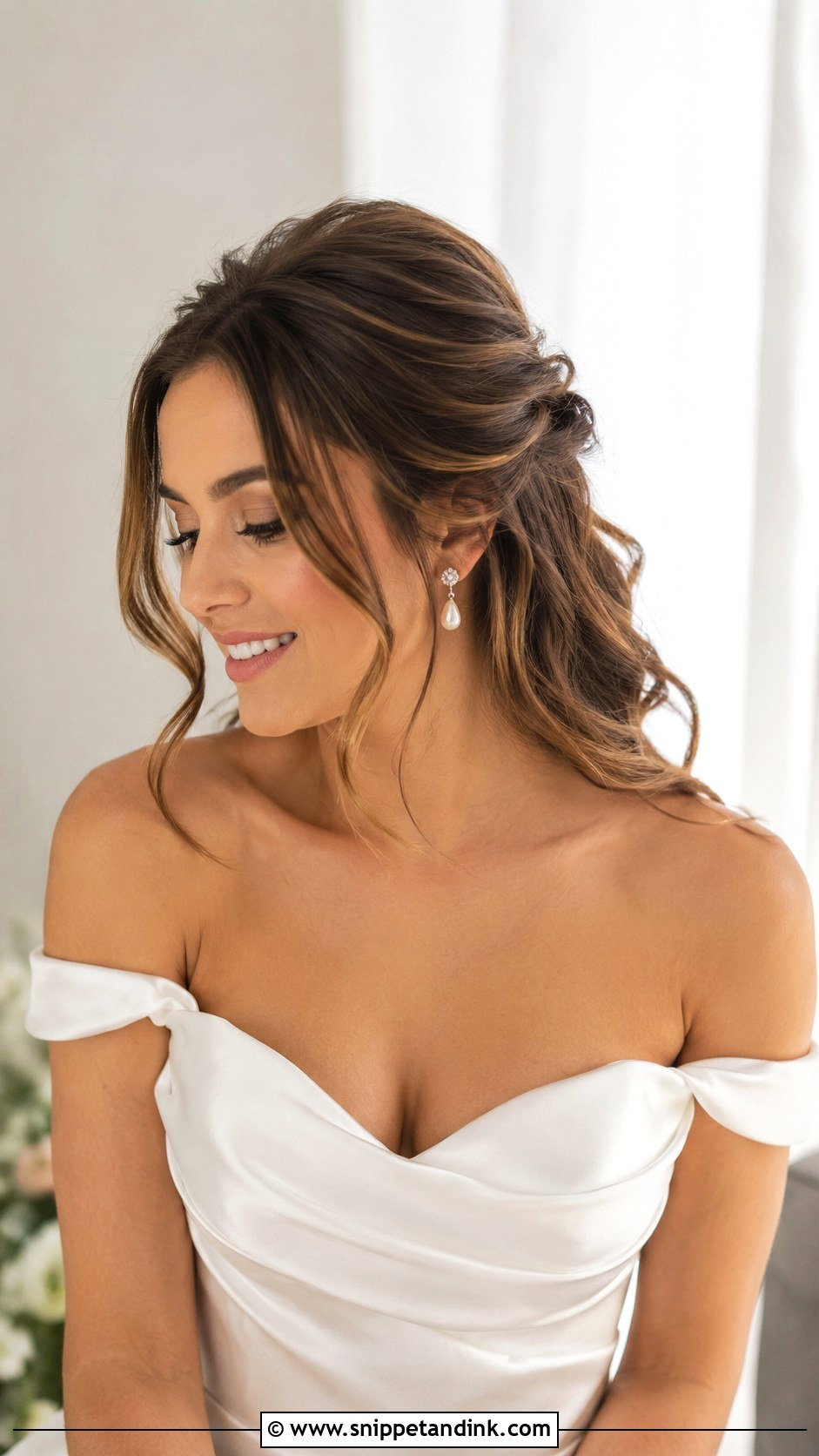
Face-framing pieces are what stop a half-up looking scraped back in close-ups. I curl them away from the face, wave them or leave them with soft bends to match the rest of the style, and they work with either part, with veils and with nearly every neckline. Length is the whole game. Too short and they spring up as the humidity rises; too long and they hang across your eyes in the vow photos. I aim for pieces that land between the cheekbone and the jaw, and I ask brides not to trim them at home the week before.
19. Half-Up Wedding Hair With A Low Twist
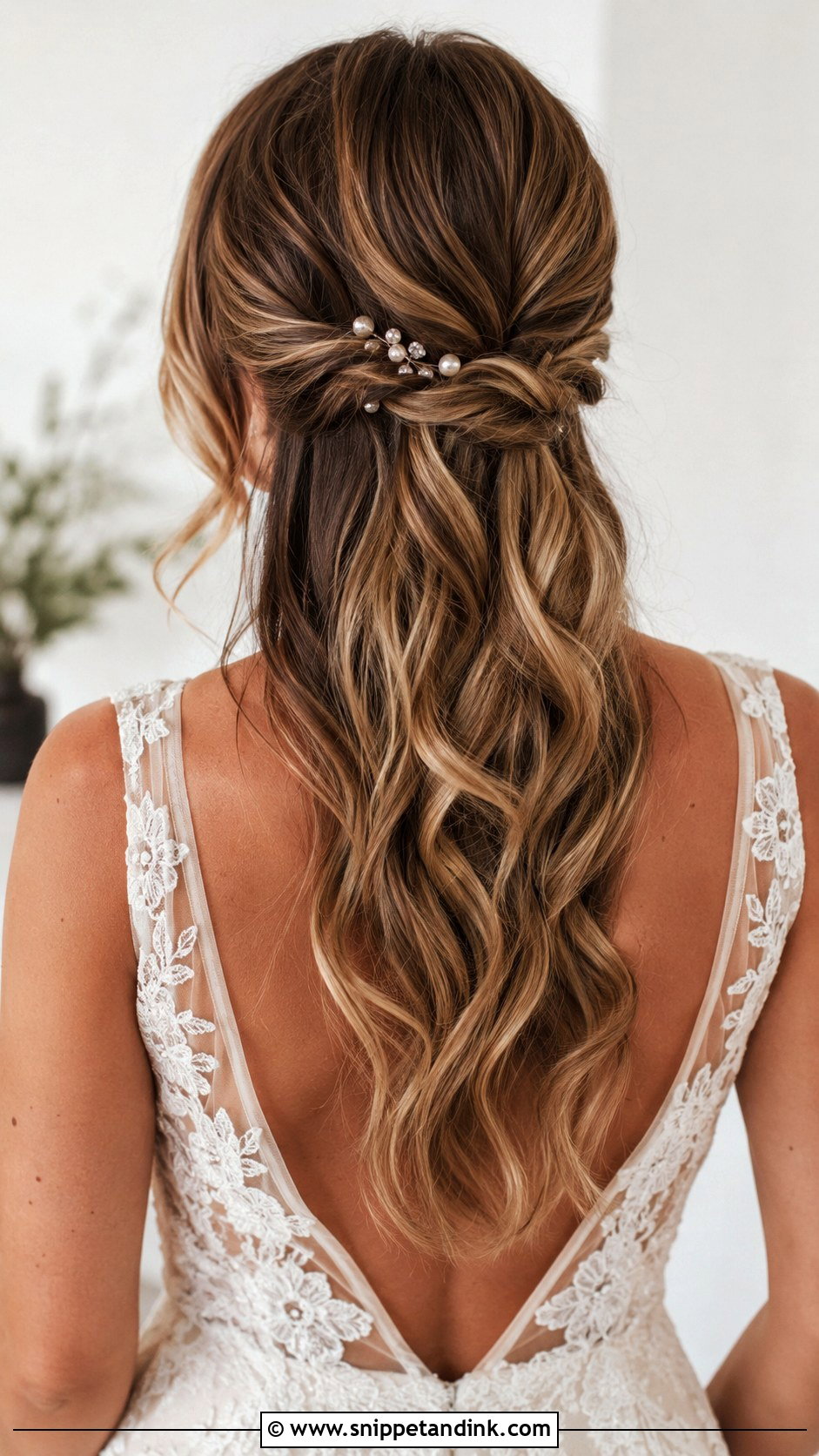
A low twist moves the gather from the crown to the back of the head, which relaxes the whole style while the front stays neat. With low-back dresses and lace it draws the eye down the back, and it suits outdoor ceremonies well. Waves or curls go below, depending on how formal the day is, with a small comb above the twist or pins tucked along the sides. One practical point: a low gather sits right where a high-backed chair presses, so if you’ll be seated for a long dinner I pin it a little flatter.
20. Half-Up Wedding Hair With A Bridal Comb
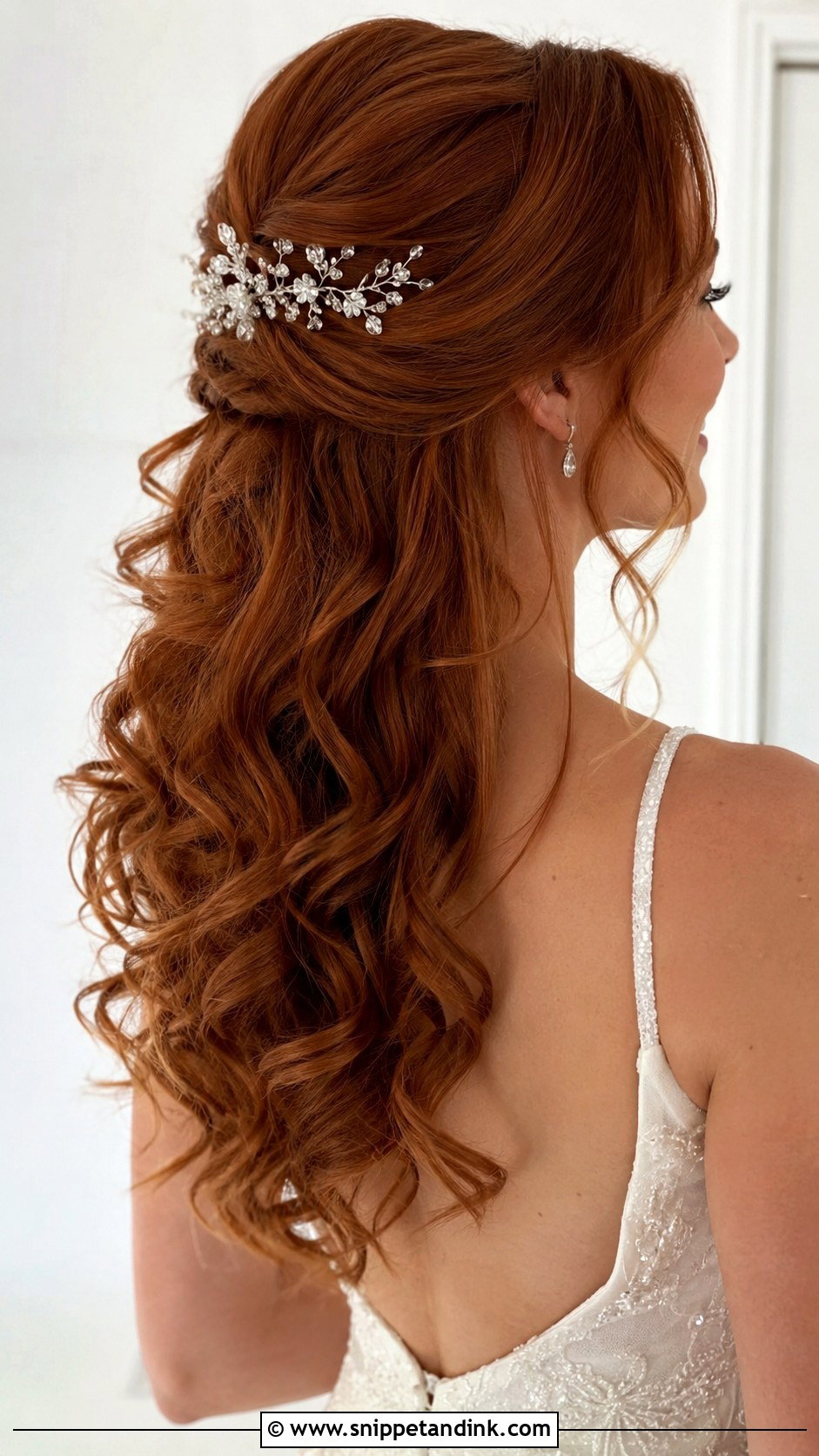
A bridal comb finishes a half-up in one move. It belongs where the top section gathers, because the pins and volume there give its teeth something to grip. Crystal reads glamorous, pearl classic, floral romantic. I suggest one most often when the dress is plain and the hair needs to carry the detail. Soft curls or smooth waves keep the rest balanced. The comb should follow the curve of the gather rather than perch above it. Set too high, it looks like an afterthought and slowly works loose.
Why Curls Drop Below the Pins, and How I Slow It Down
The top of a half-up rarely moves. It’s the loose lengths that change, because nothing holds them except the set. Moisture in the air, the warmth of your own neck and every hug relax a curl a little at a time. On straight, silky hair the drop can be dramatic by evening; on naturally wavy or textured hair it’s usually mild.
In the days before
Wash the day before rather than that morning. Second-day hair holds a heat-set curl far better than freshly conditioned hair, which is slippery and pushes the curl straight back out. Keep conditioner off the roots, skip oils and serums, and arrive with hair completely dry. If you colour your hair, have it done roughly a week out so the tone has settled and the hair isn’t freshly coated.
On the morning itself
- I curl tighter than the finished look, knowing the bend will loosen by evening.
- Each curl is pinned up to cool and stays pinned until it’s cold to the touch.
- For a humid or coastal venue, I’d steer you toward a braid or twist running through the lengths, which keeps texture far better than a loose wave.
- Give a bridesmaid a small kit: a few bobby pins in your colour, a travel hairspray and a fine-tooth comb for flyaways at the gather.
- If your stylist stays on, a quick rewrap of the two front pieces before the reception entrance does more than any amount of extra spray.
The Bottom Half Is Where the Day Is Won
Half-up keeps its place because it adapts. Curls, Hollywood waves, flowers, pearls, a bow, a tiara or a comb all sit on the same basic structure, and the pinned section gives a veil a secure place to anchor. What decides whether yours lasts is the work nobody sees: the pin base and the set. Bring photos to your trial, tell your stylist about your neckline and the forecast, then wear the style for a few hours afterward. If it still has its shape at dinner time, that’s your wedding hair.
You'll Like These Ideas:


Leave a Reply