
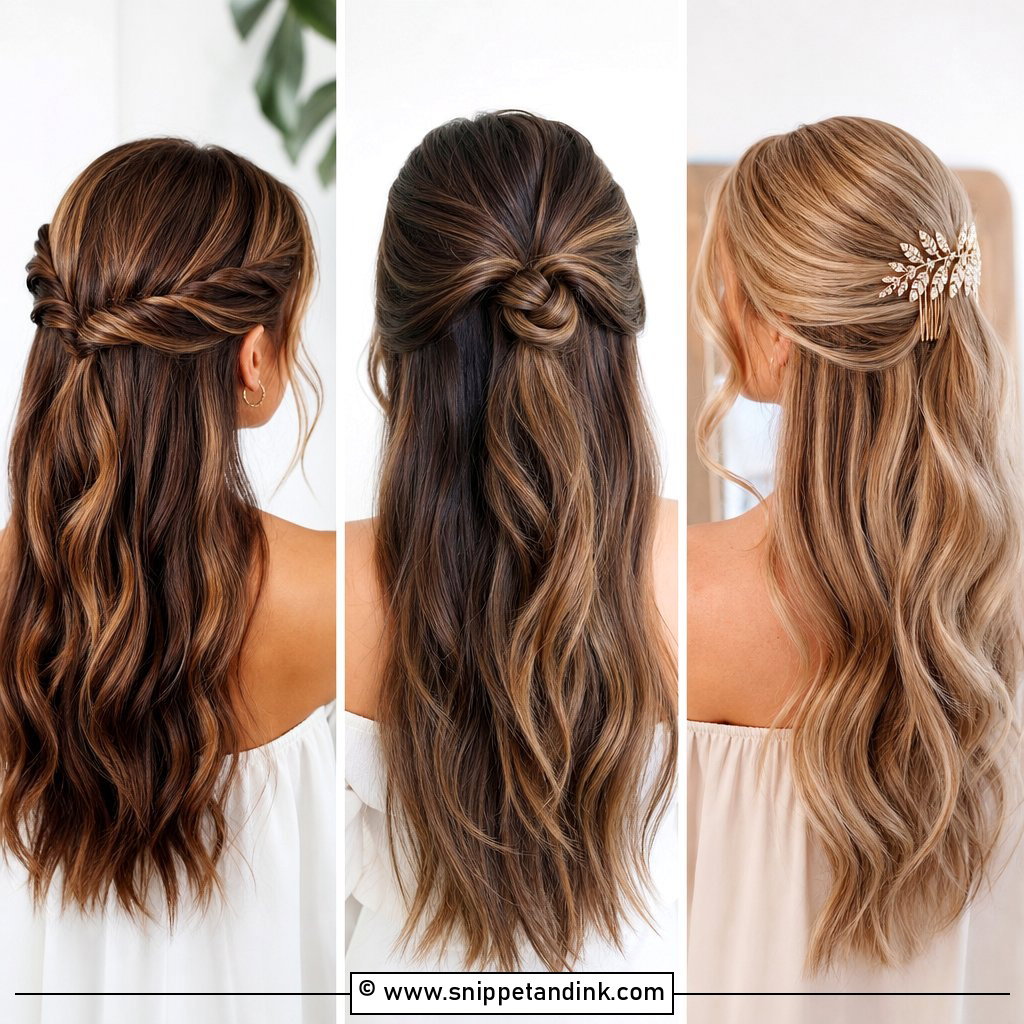
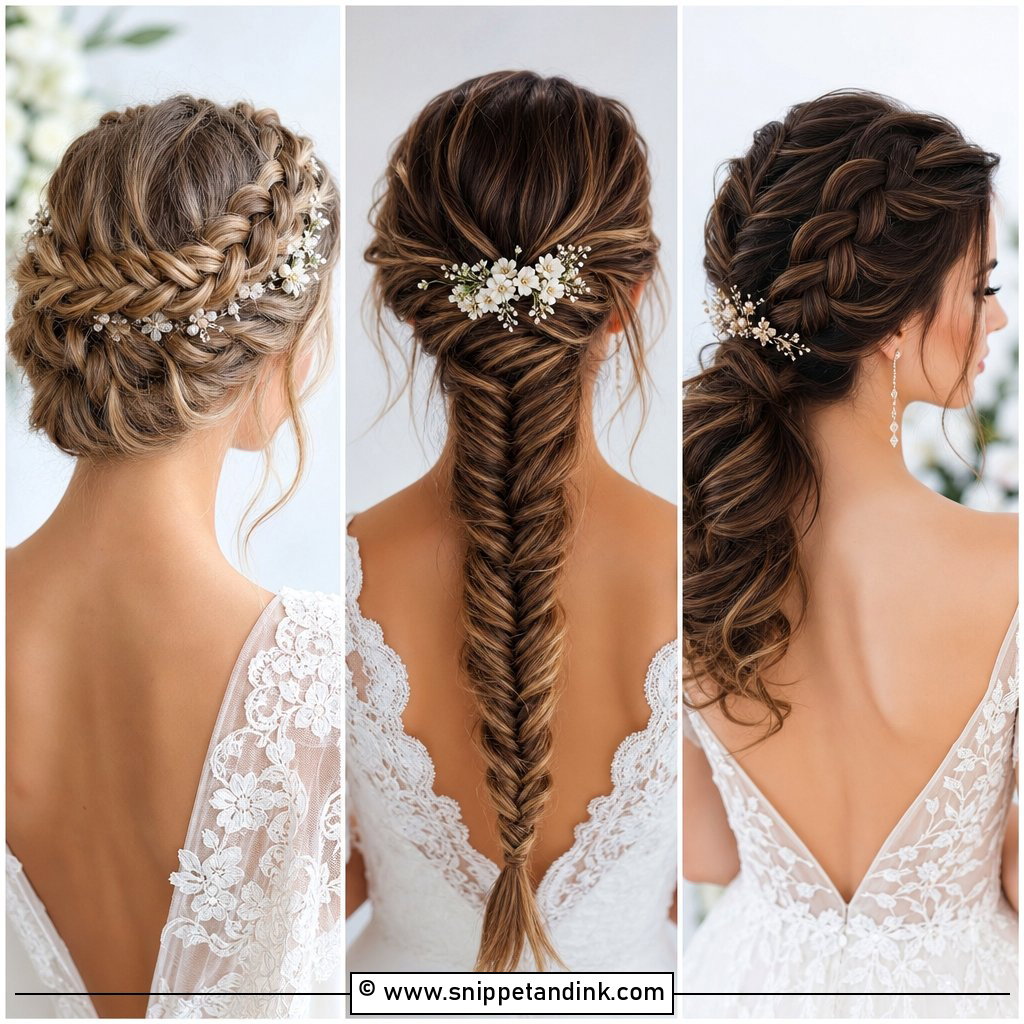
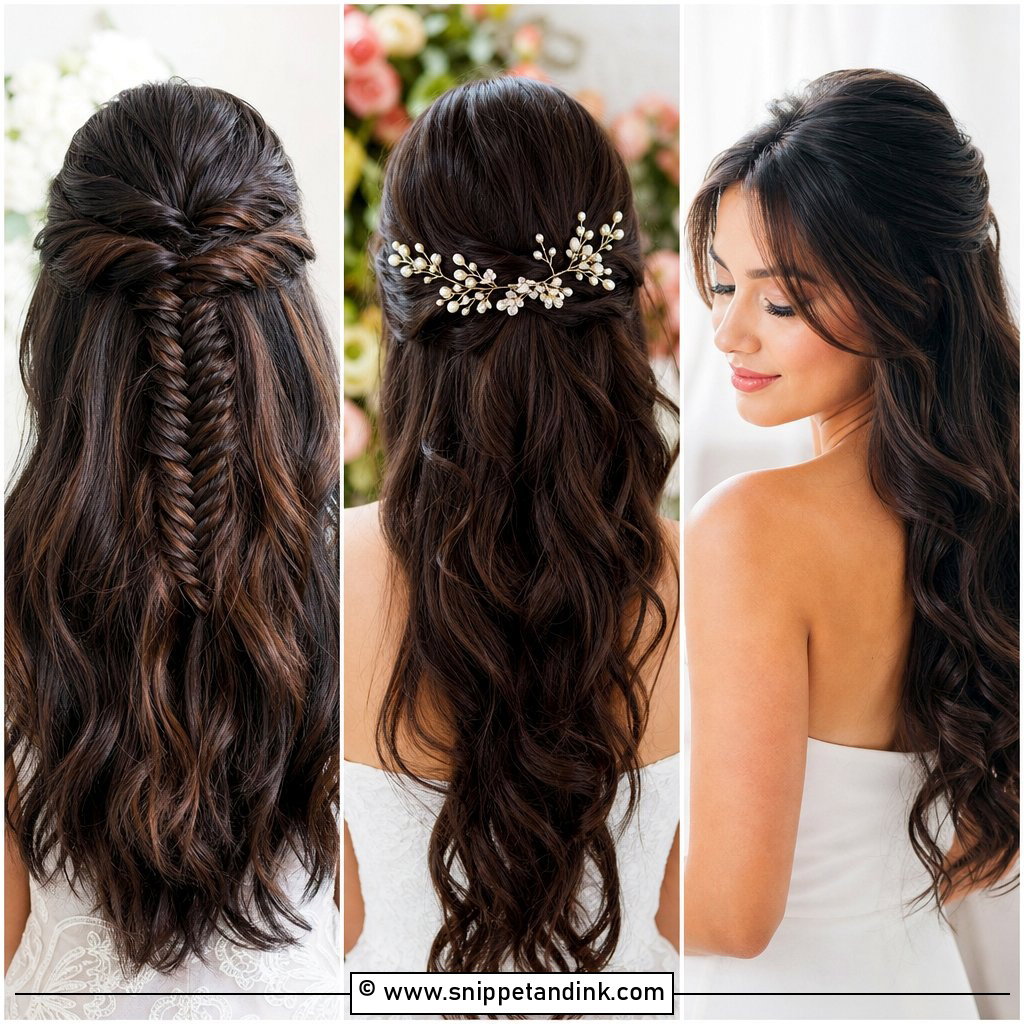
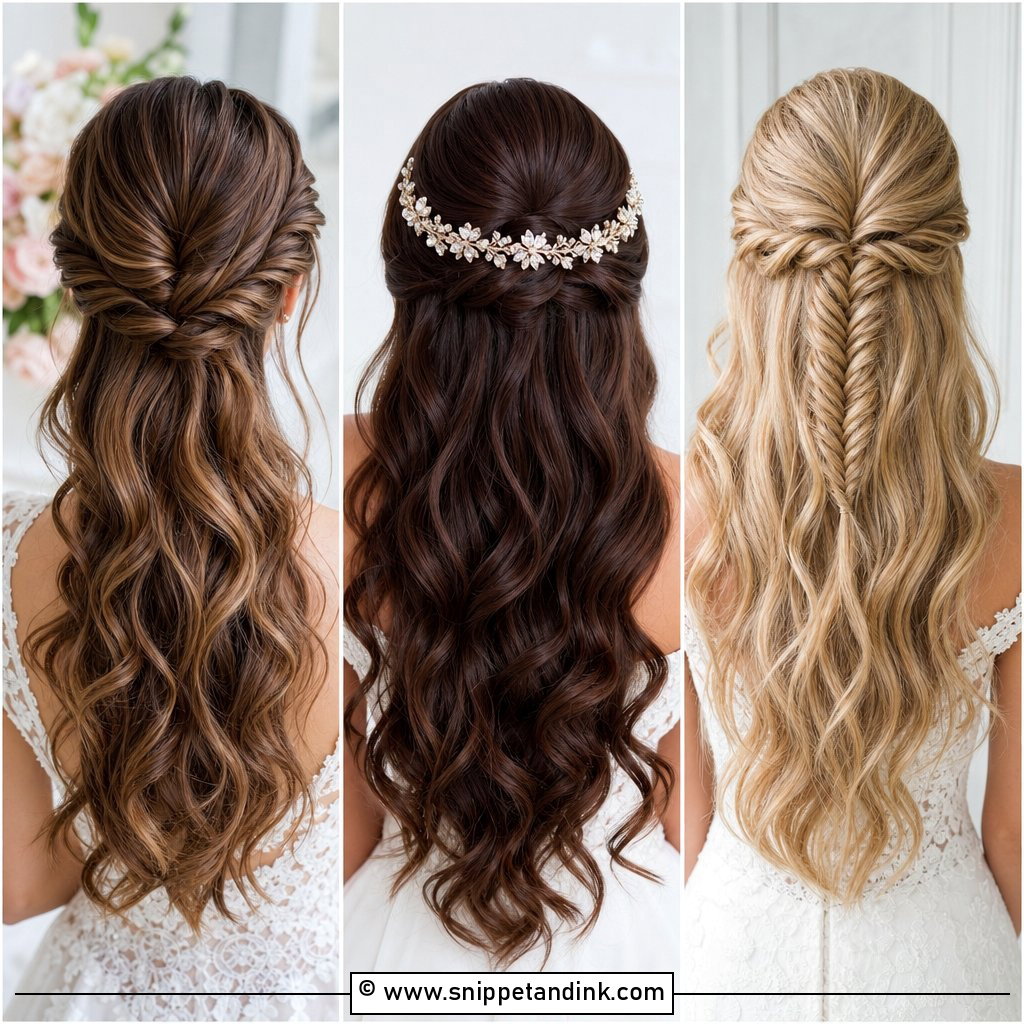
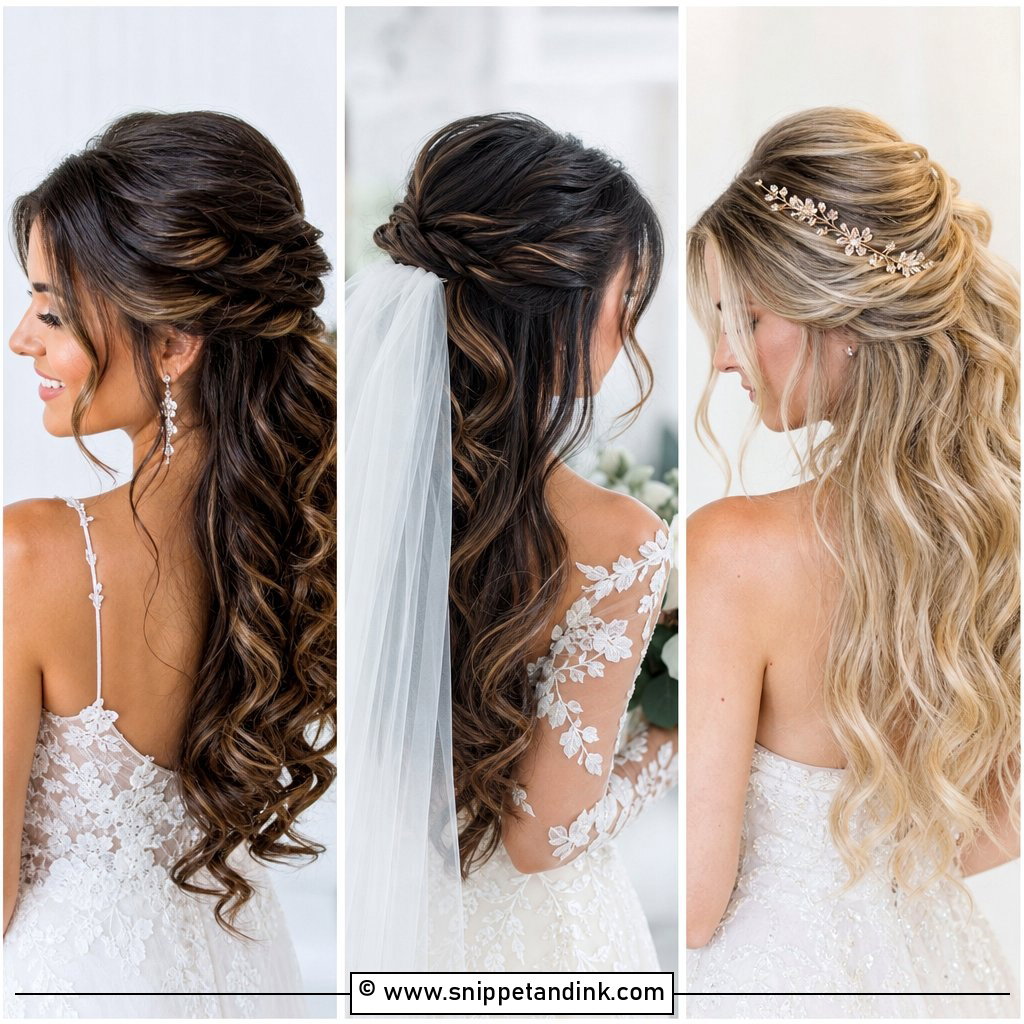
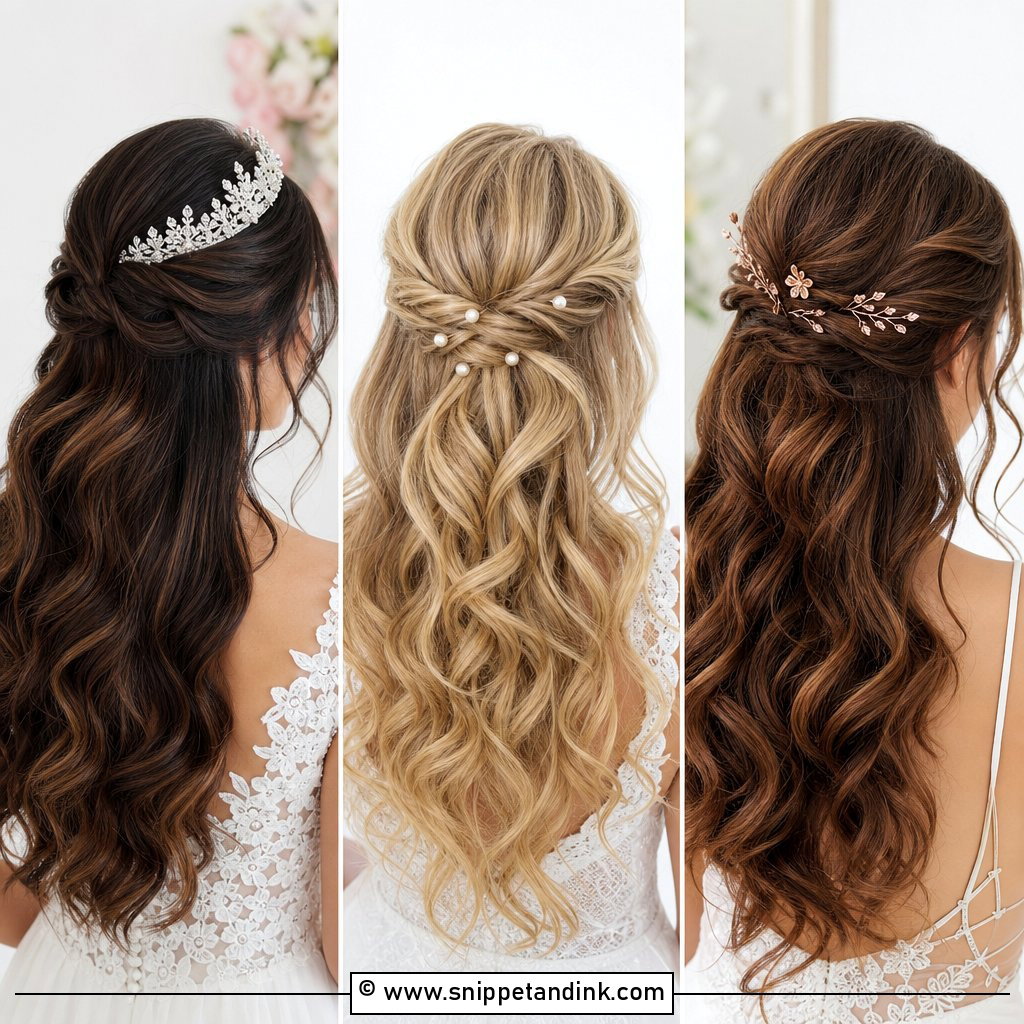
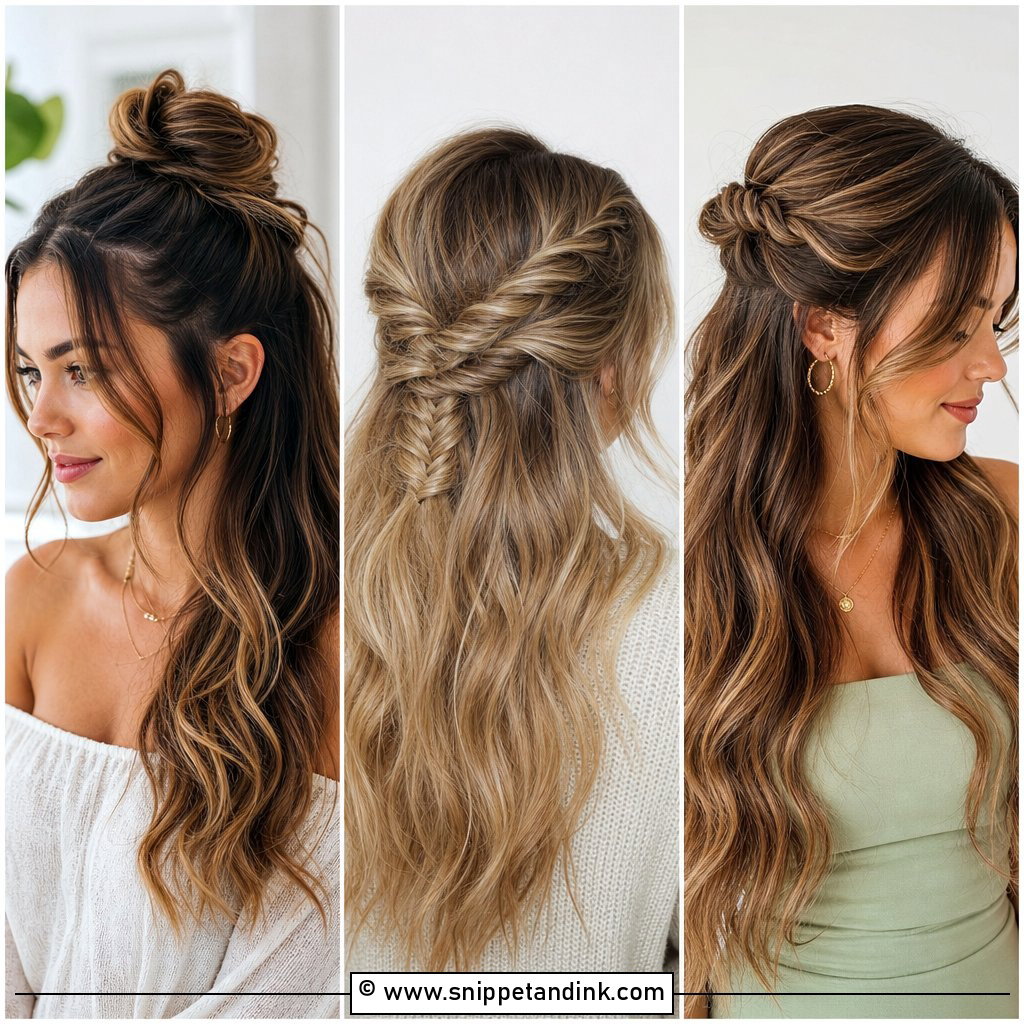
Half-up, half-down is the style brides ask me for most when they can’t picture themselves with every strand pinned away. The braid holds the front off your face and gives a veil somewhere to sit, while your length stays down where you’re used to seeing it. That loose half is also the part that gives out first, so much of what follows is about how each braid, and the curls under it, actually hold. Straight and curly hair can both wear these. From fishtails to bohemian waterfall braids, here are 20 versions and what each one needs.
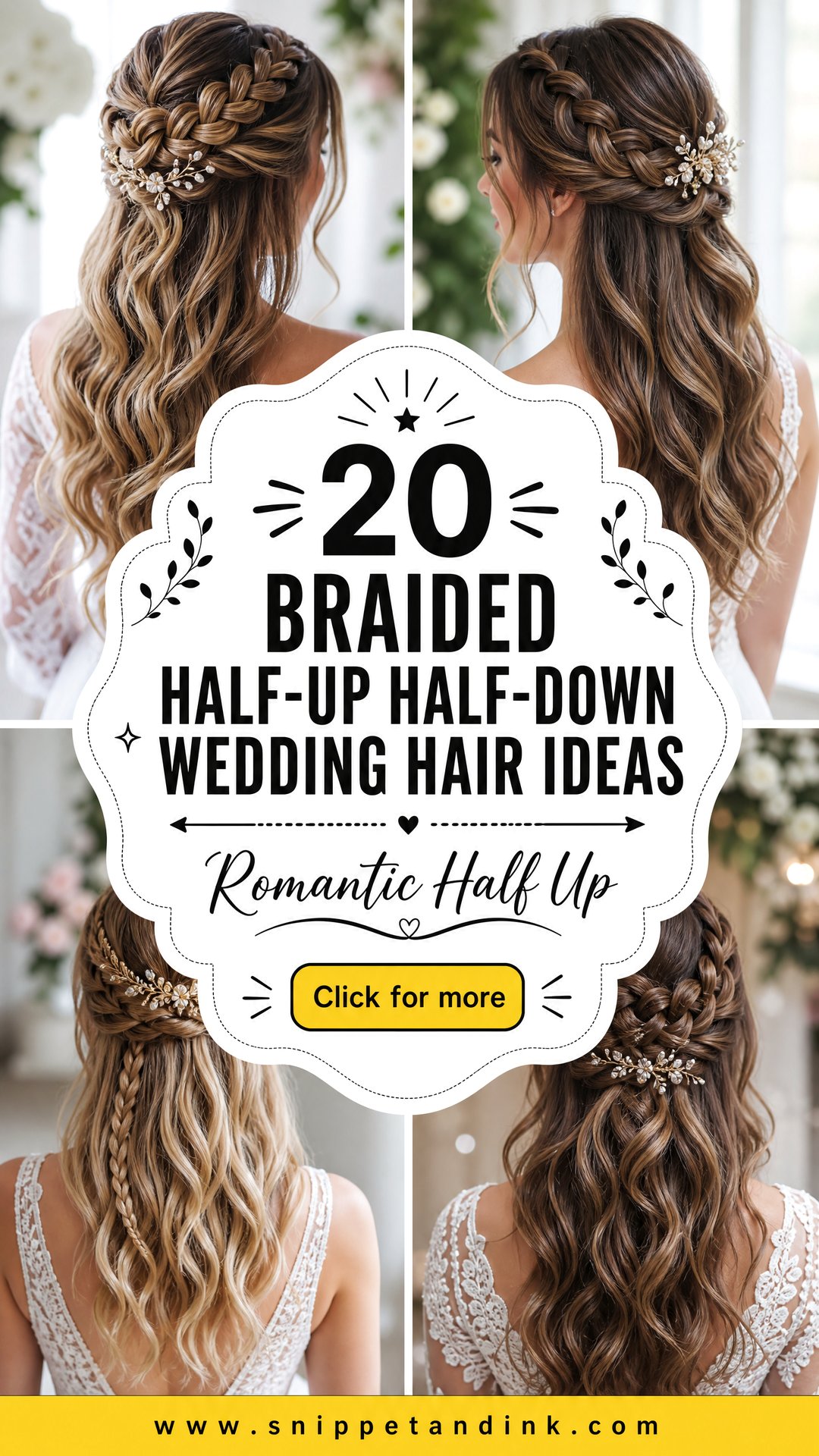
The Down Half Is Where These Styles Give Out
With a half-up style, the braid rarely fails. The loose lengths underneath do. Curls relax with heat, humidity and every hug, and by evening the bottom can look flat beside a braid that’s still perfect. This is how I build curls that last on a half-down.
- Wash the day before with a light conditioner on the ends only. Heavy masks and oils make curls drop.
- Use a heat protectant, then let each curl cool completely in its shape. Pinning curls while they cool is what sets them.
- Curl away from the face, so the front pieces open outward instead of falling across your cheeks.
- Pick the curl size for the evening, not the morning. A slightly tighter curl relaxes into the soft wave you saw in the photo.
- If your hair refuses to hold a curl, rollers left in until the dress is on buy several extra hours.
Wefts for a Fuller Lower Half
Fine hair loses a lot of its thickness once the top section goes into the braid. A couple of clip-in wefts placed just under the braid fill out the down half, and the braid sits right over the clips to hide them.
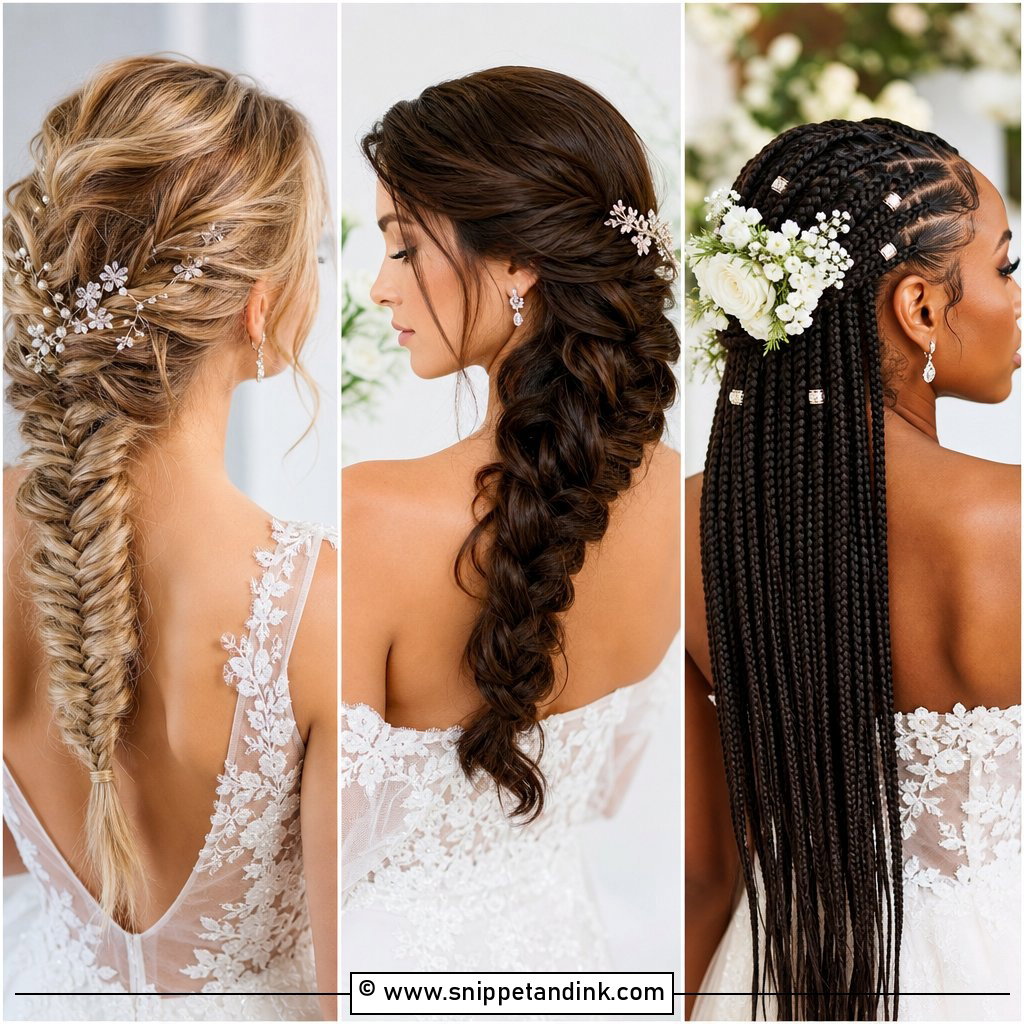
1. Fishtail Braid Half-Up Wedding Hair
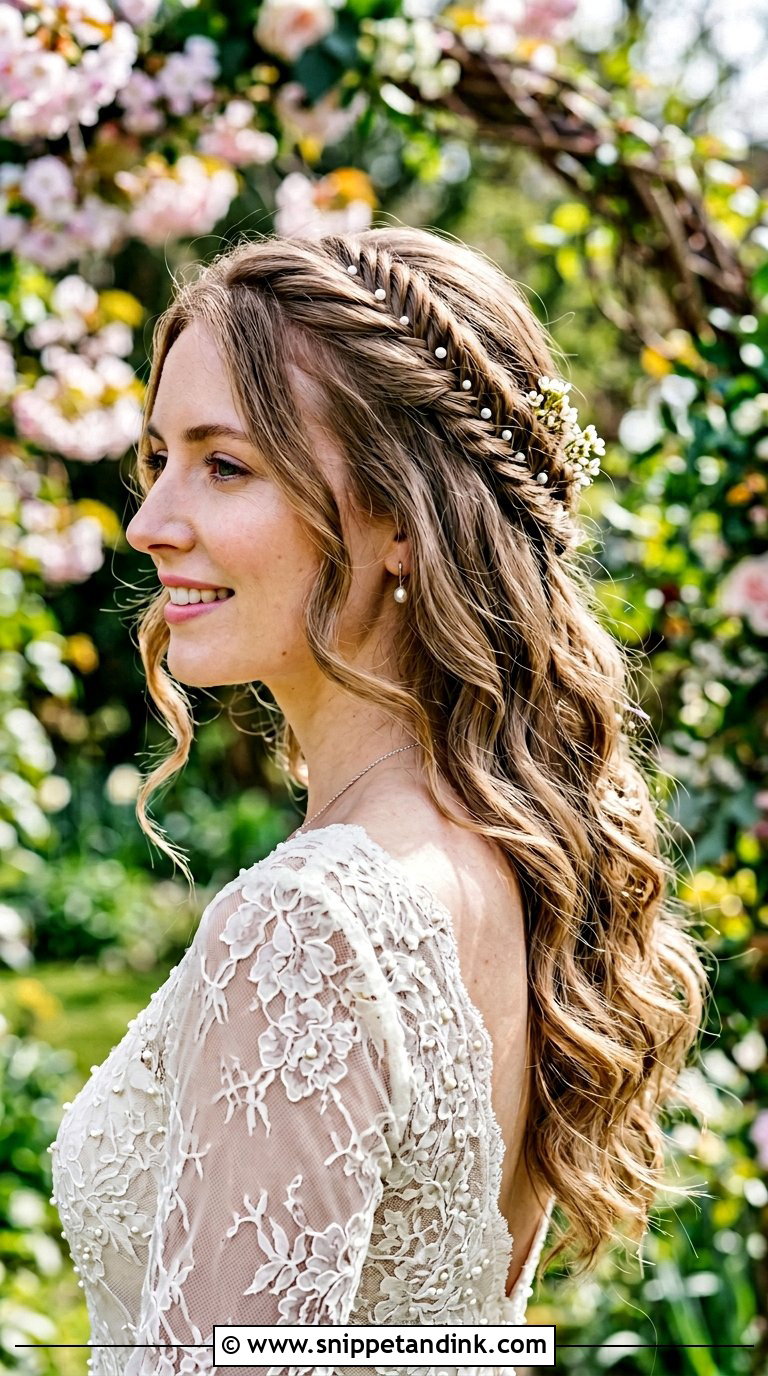
The top section sweeps back into a soft fishtail resting on the waves below. Its fine weave suits medium and long hair, and I pull the edges outward so it looks full rather than tight. On a half-up, the fishtail’s end is the weak spot, hanging loose in the middle of the down section. I tie it with a clear elastic and hide it under a curl instead of leaving it exposed. Pearls or baby’s breath tucked into the weave finish it, with two face-framing pieces left at the front.
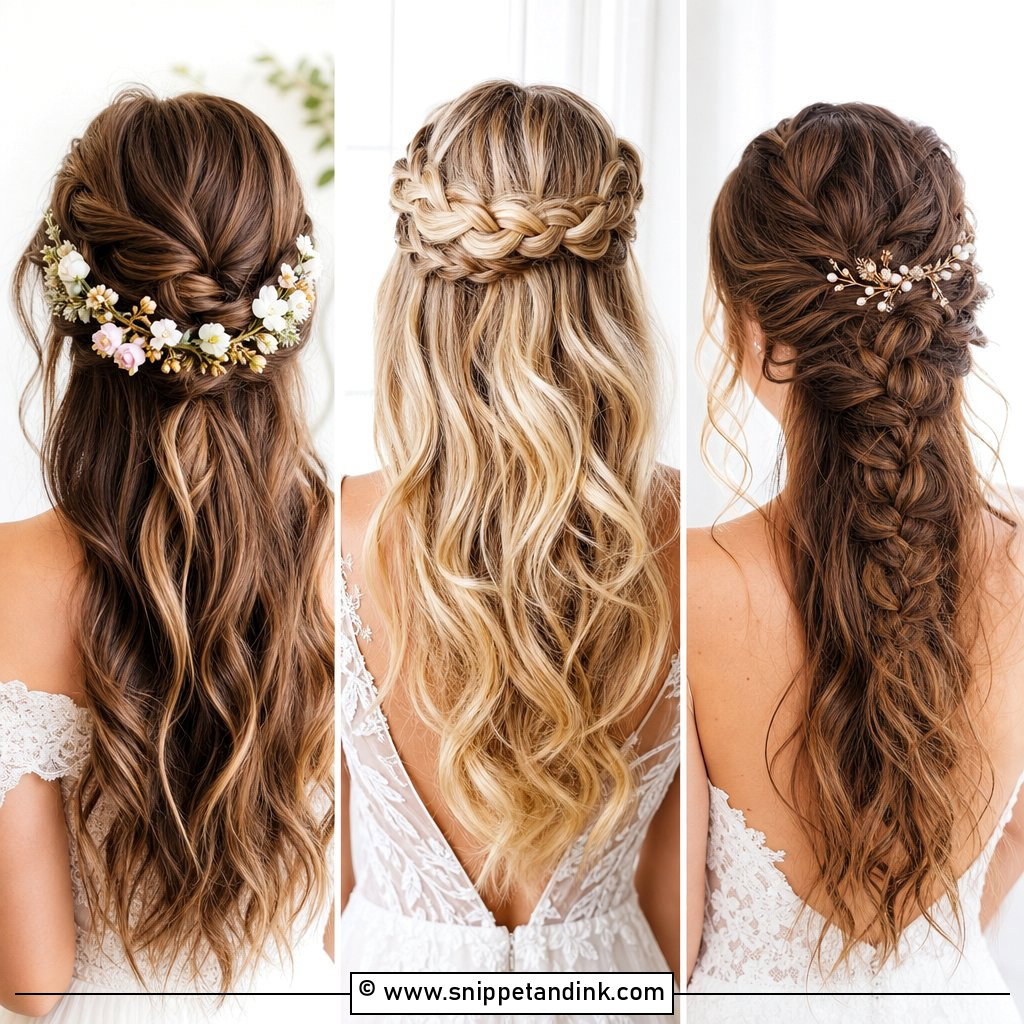
2. Waterfall Braid Half-Up Half-Down Hair
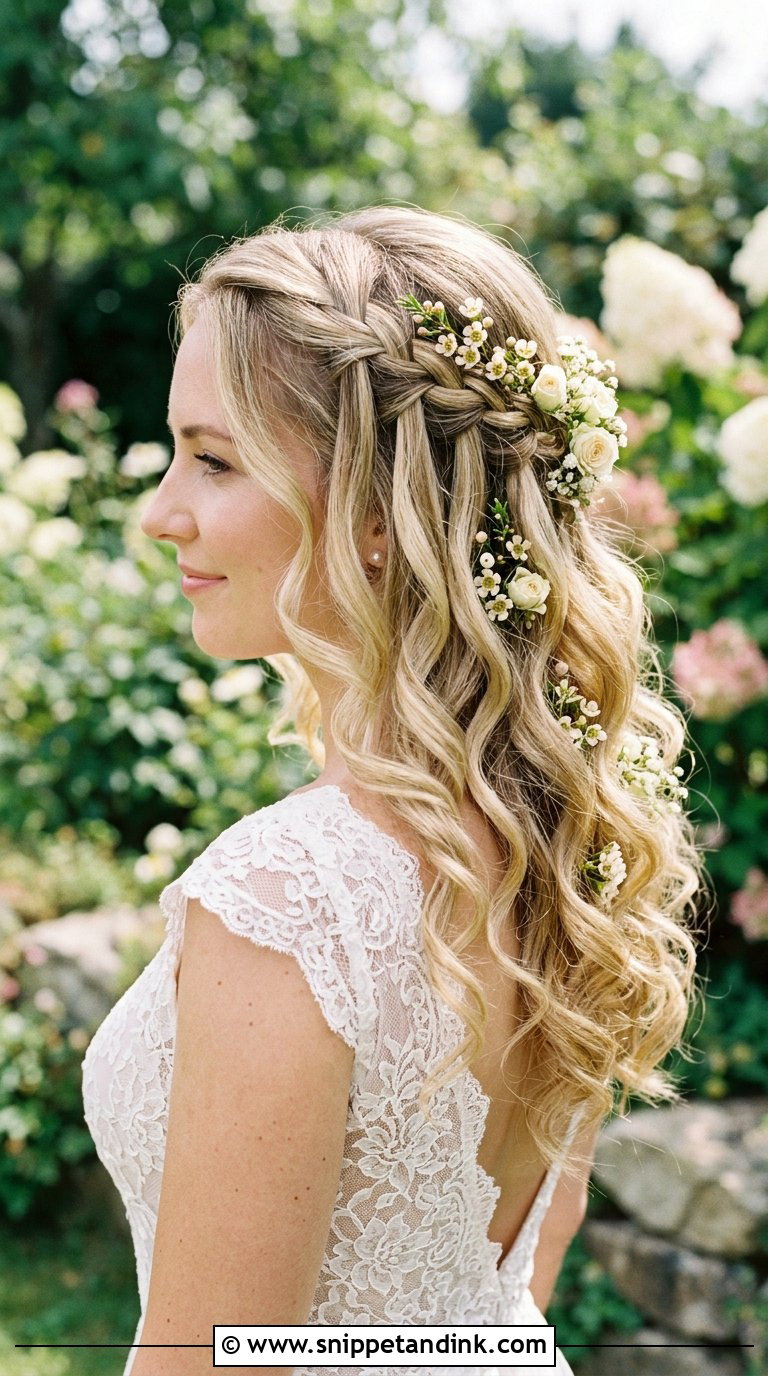
Strands fall through the braid at every pass and join the curls underneath. That’s the whole point, so this braid only works if those curls hold. On hair that drops curl fast, the waterfall turns into a line of limp threads by the speeches. I curl first, pin each curl to set while I braid, then release them all at the end. It sits naturally at a boho or garden wedding, and a few small flowers along the braid are enough.
3. Dutch Braid Half-Up Bridal Hair
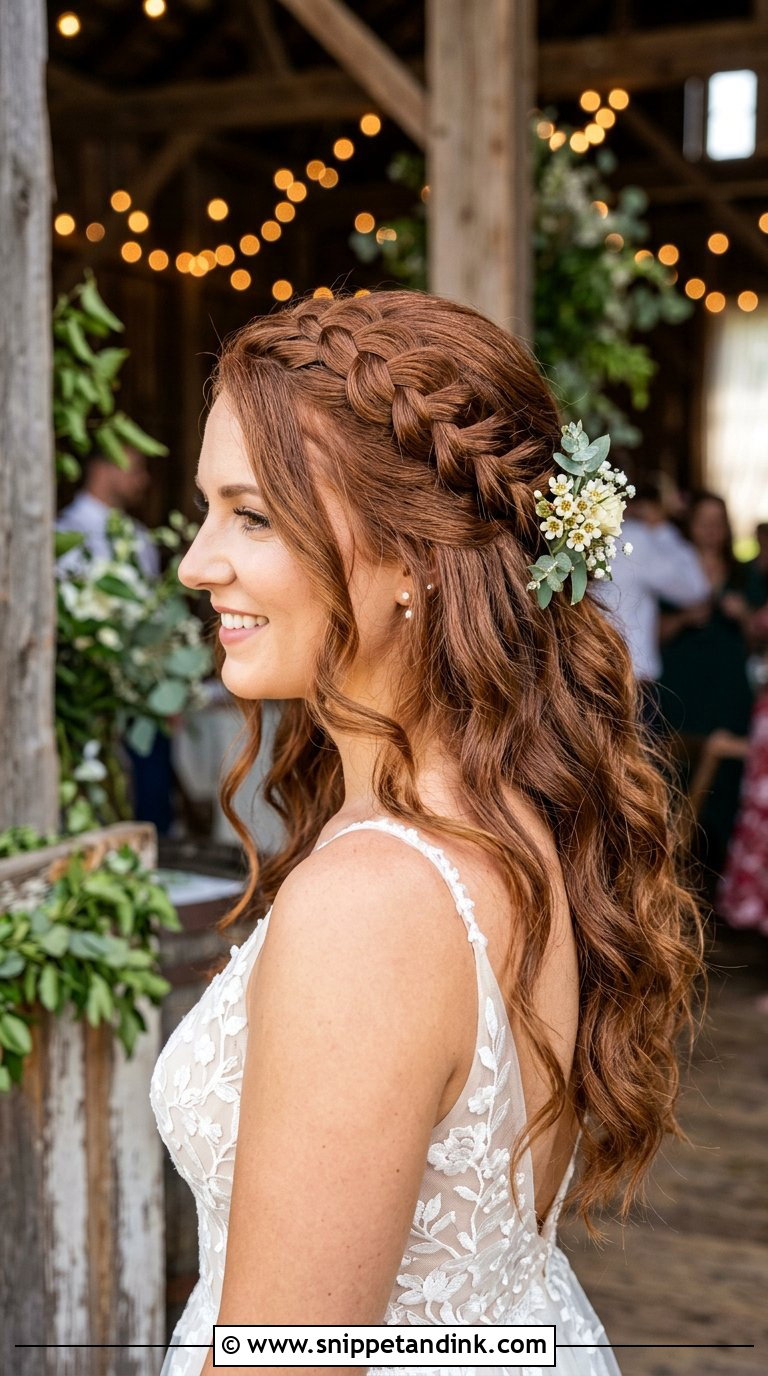
Think of a French braid turned inside out: the sections cross underneath, so the braid stands up off the hair. One or two Dutch braids gather the top back while the rest flows. That raised texture reads clearly from a distance, which helps at a big barn or festival-style wedding where many photos are wide shots. Loosen the edges for a lived-in feel. A thin gold hair vine adds a little shine without hiding the braid.
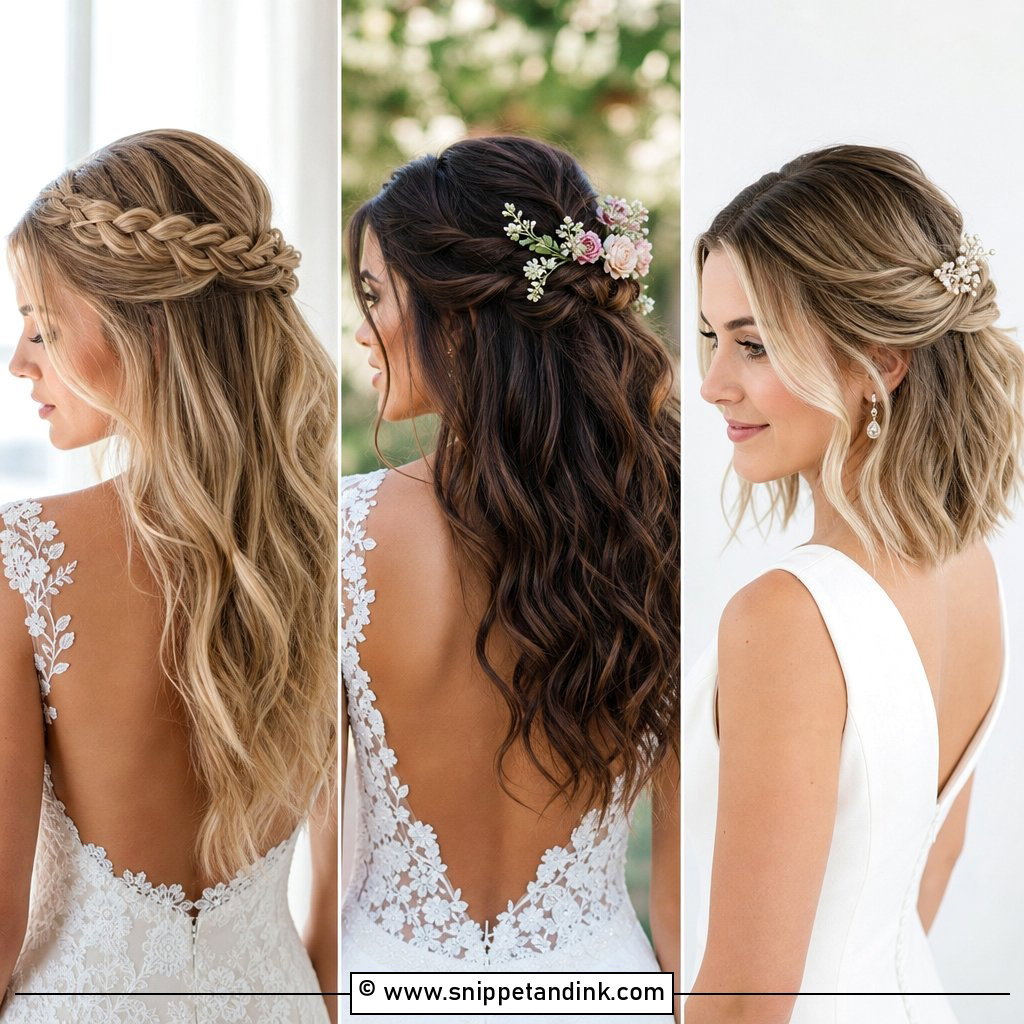
4. Crown Braid Half-Up Wedding Hair
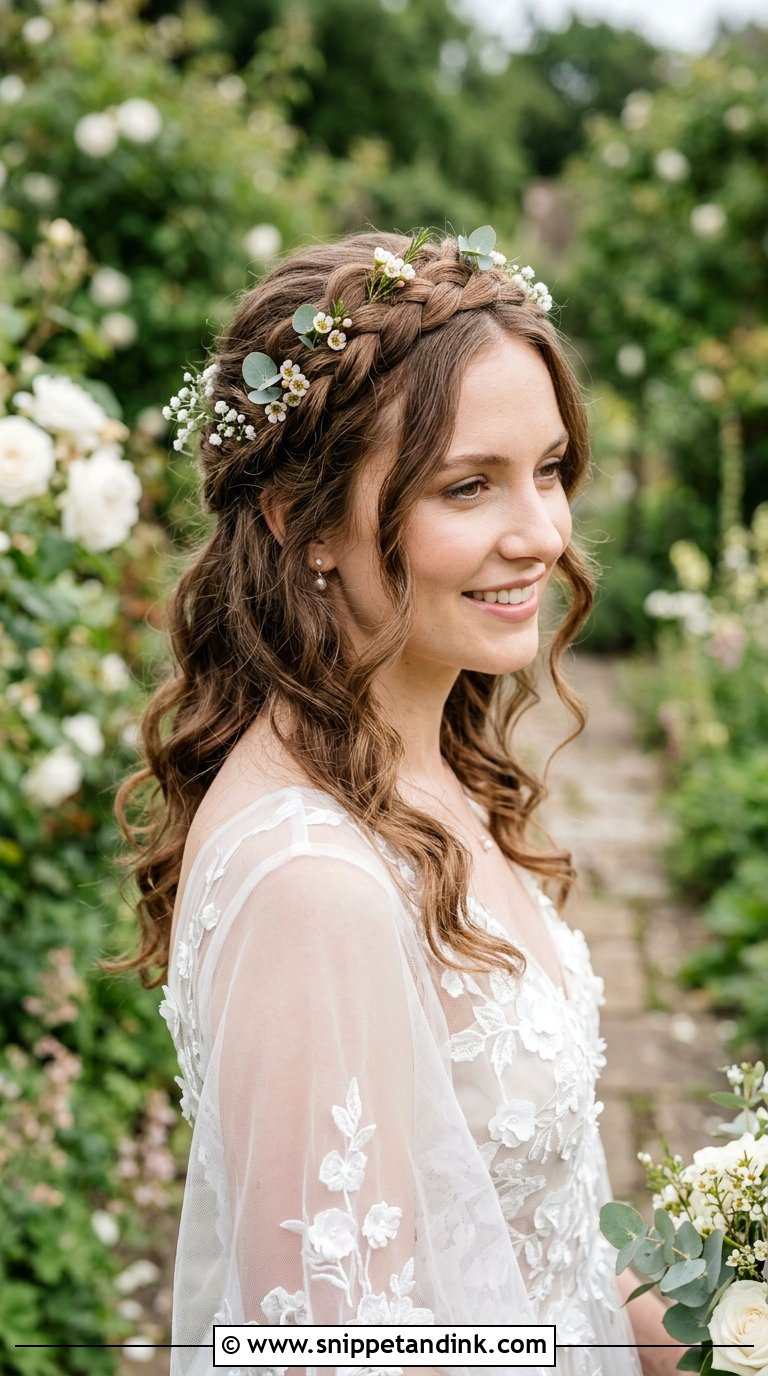
The front section is braided across the crown and secured at the back, so the braid frames your face while the length stays loose below. A veil slides in underneath without disturbing it, which is why I suggest this one to brides who want a halo shape and a long veil. Small blooms or greenery along it suit a garden ceremony. Growing-out bangs should go into the braid from the very start; pinning them in afterward never lies flat.
5. Double Braid Half-Up Half-Down Hair
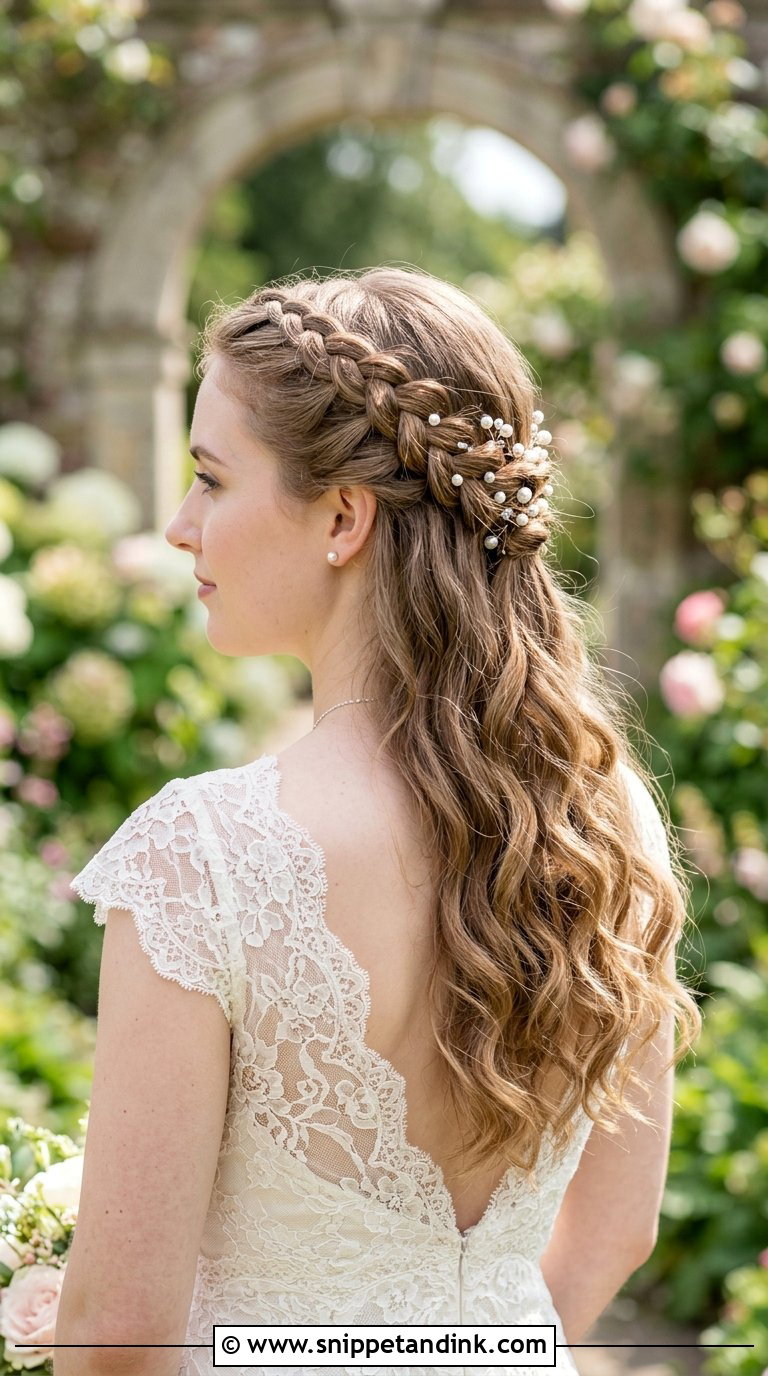
Why settle for one braid when two can frame your face? One braid from each side meets the other at the back. It looks intricate, yet it’s easy to wear because each braid takes only a small section. The join is what matters. I cross the two ends, pin them in an X, and cover the meeting point with a pearl pin or tuck the ends under the waves. Plain three-strand plaits or fishtails both work, and with both sides of the face held clear, an outdoor breeze is far less of a worry.
6. Boho Braid Half-Up Wedding Hair
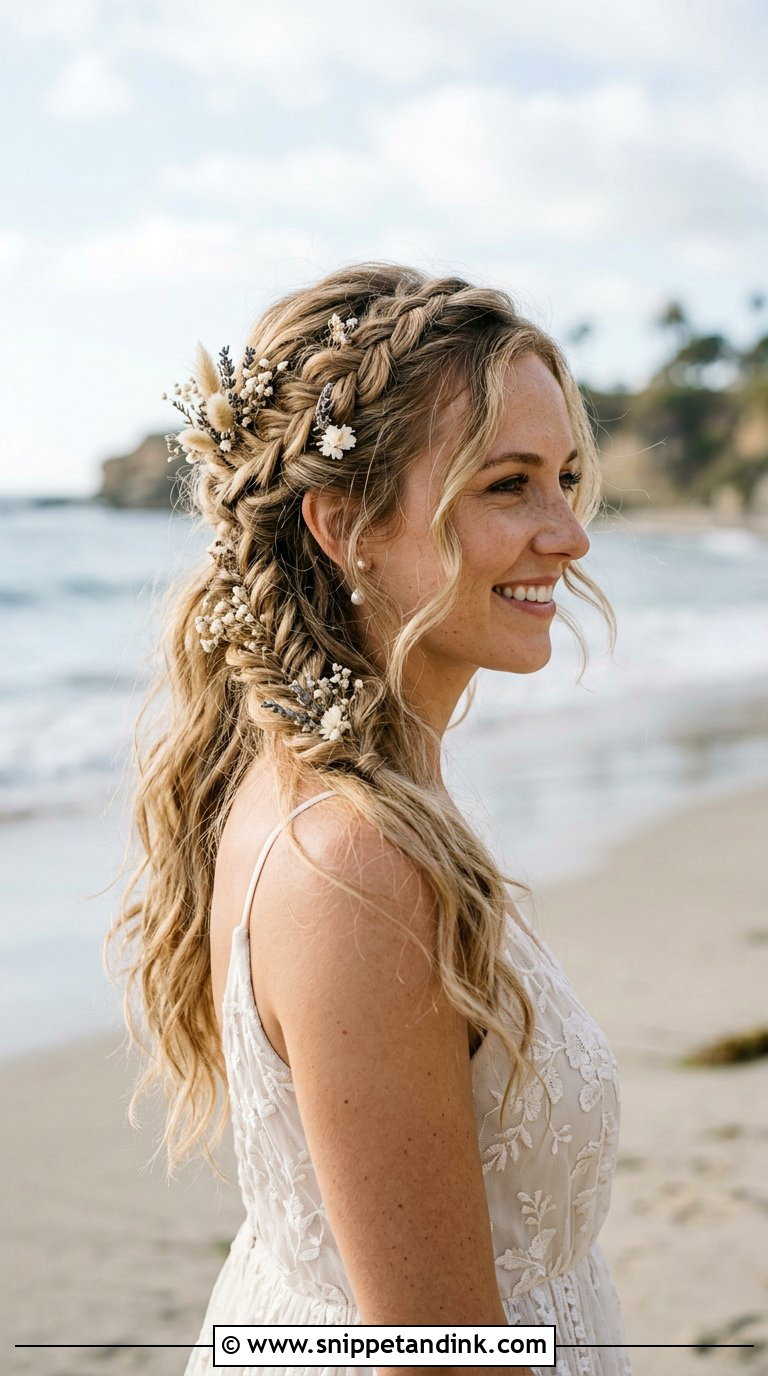
Nothing here should look too done, but it still needs structure underneath. I mix loose, textured braids with a few thin accent braids through the half-up section and leave plenty of face-framing strands. A sea salt spray before styling gives very clean hair the grip it lacks and builds that soft, beachy bohemian feel. Flower crowns, dried florals or simple gold accessories sit well with it at a beach or woodland ceremony. Salt spray can dry out curls that are already dry, so go lightly.
7. Braided Crown With Curls Wedding Hair
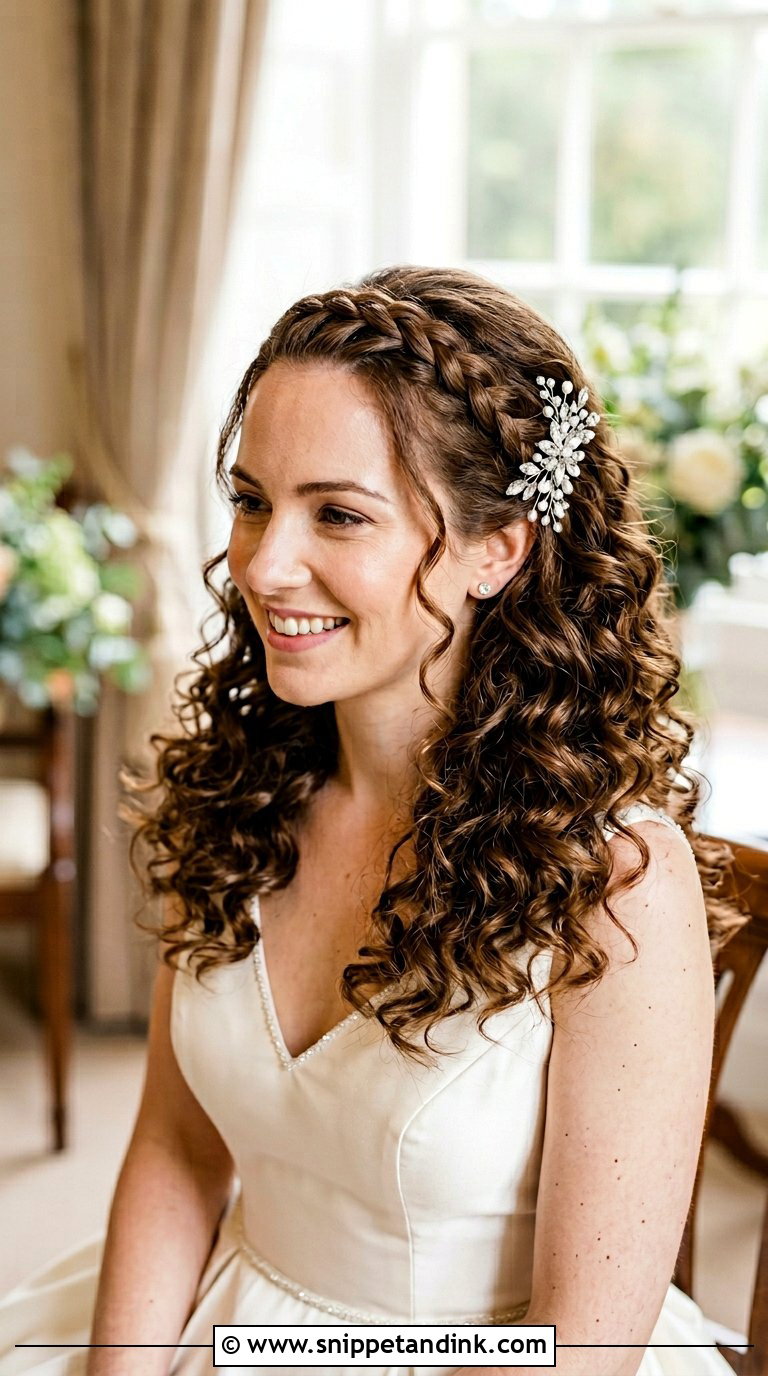
Curl everything first, then braid a thin section across the crown like a headband. The order matters, because curling after braiding means the iron catches the braid and roughs it up. The curls stay bouncy below and give the whole look volume. A little lift at the crown suits a round face, since height balances width. A sparkling hairpiece tucked just behind the braid works at a classic or a modern wedding.
8. Fishtail Crown Braid Wedding Hair
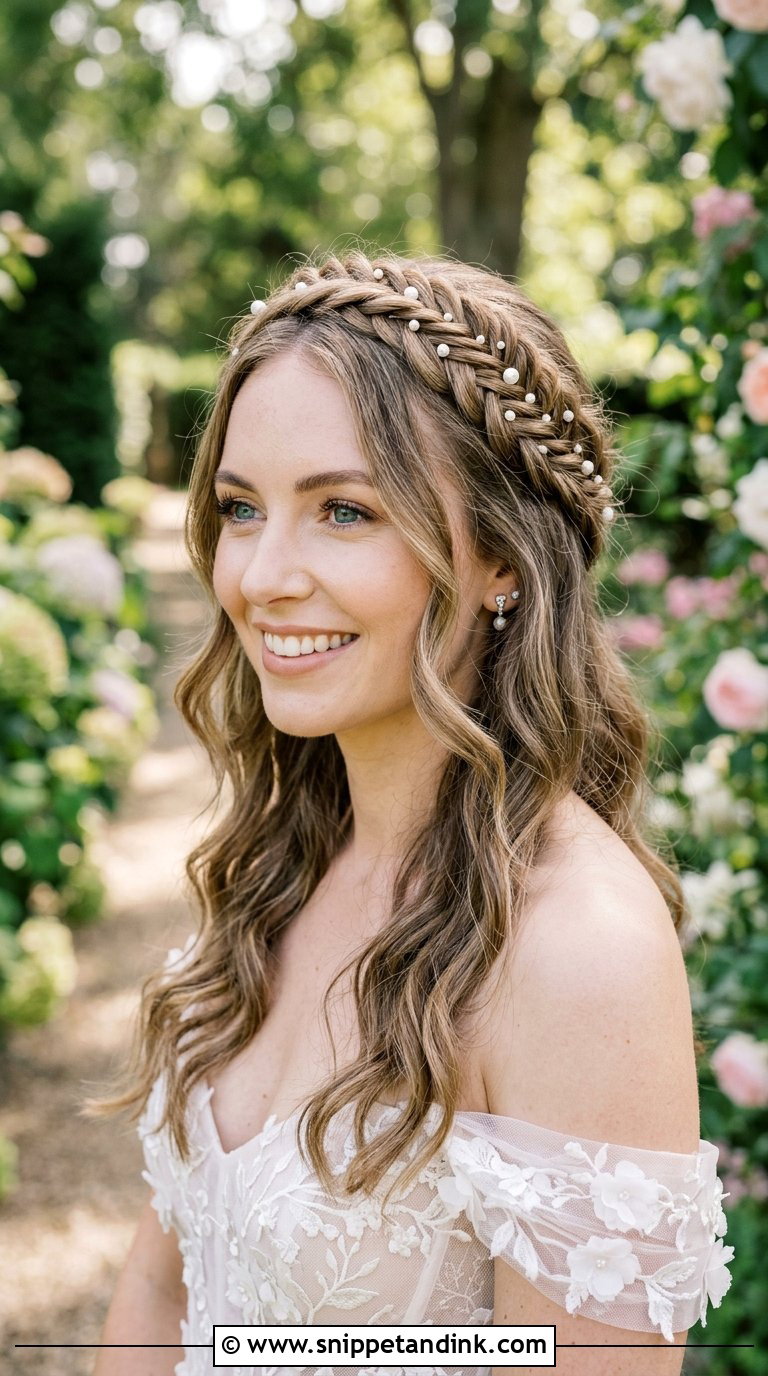
A fishtail wraps softly around the head like a halo, with waves beneath it. It’s intricate and takes time, so ask for it at your trial and have the stylist time it. Left a little loose, it suits an outdoor or boho wedding, and the fine weave catches light. One honest warning: fishtails show grown-out color more than other braids, because every tiny piece shows both root and end. Book any color appointment with that in mind.
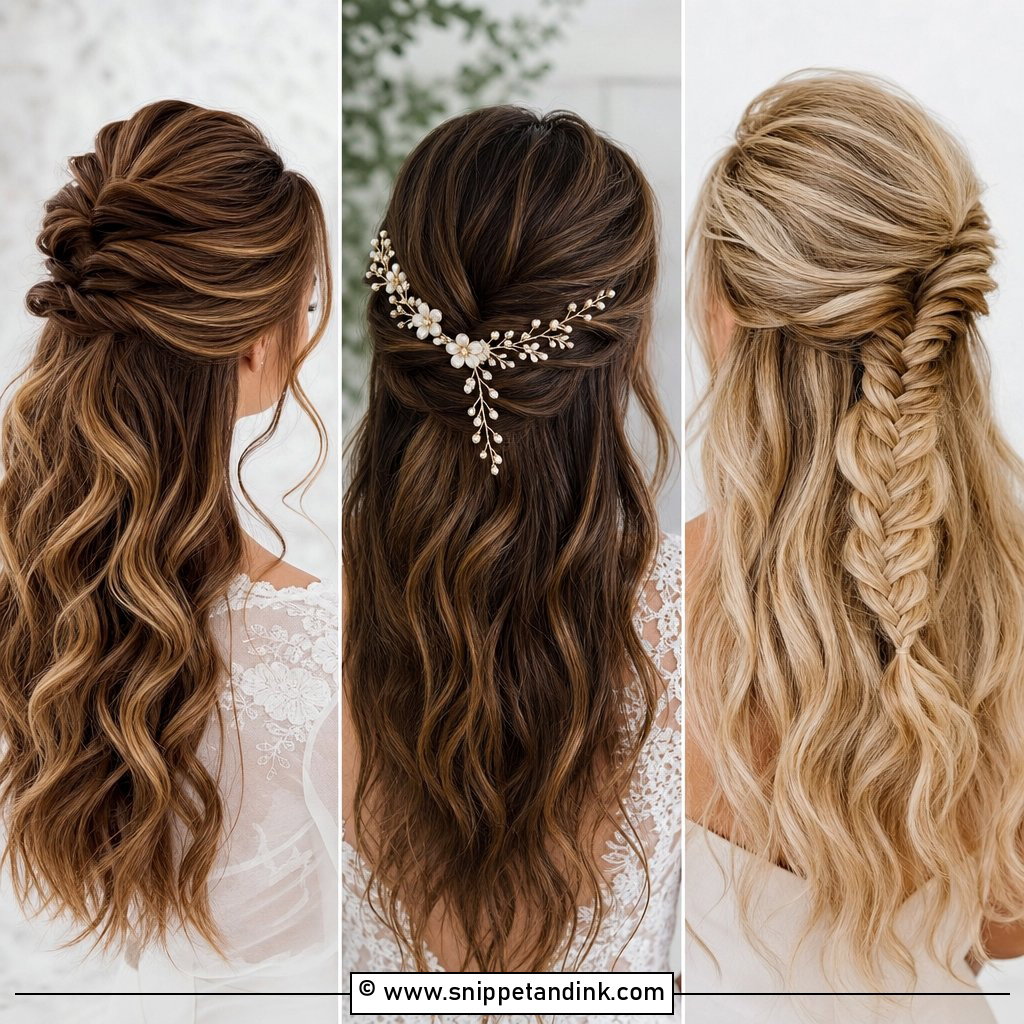
9. Twisted Half-Up Braid Wedding Hair
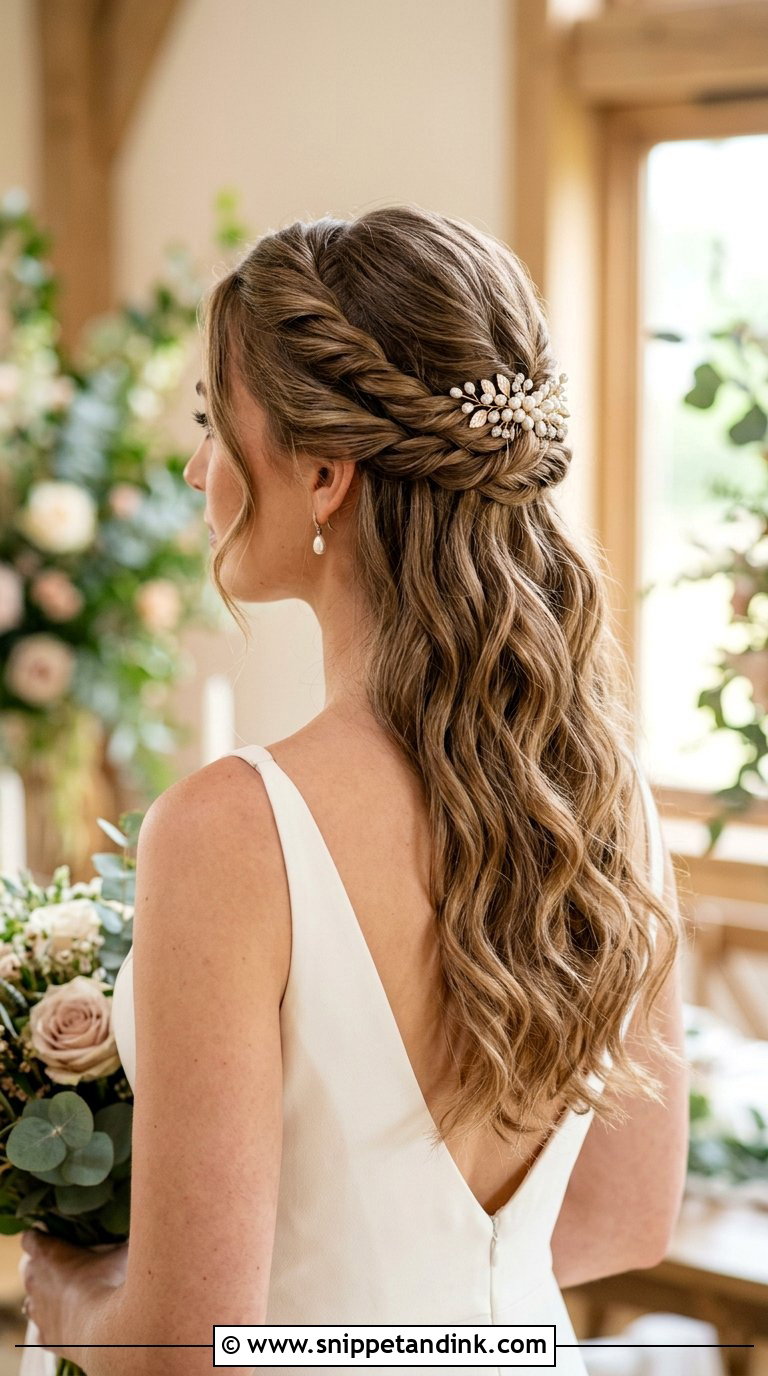
Twists are quicker than braids and gentler on fine hair. Here soft rope twists from each side pull the top section back and meet at the back of the head, with the rest left in loose waves. The finish is cleaner than a braid but softer than a sleek half-up. I often use it for bridesmaids, because the same structure works across very different hair types in one group. Twists unwind unless they’re set, so mist each before pinning, then cover the join with a pearl comb or floral pin.
10. Bubble Braid Half-Up Wedding Hair
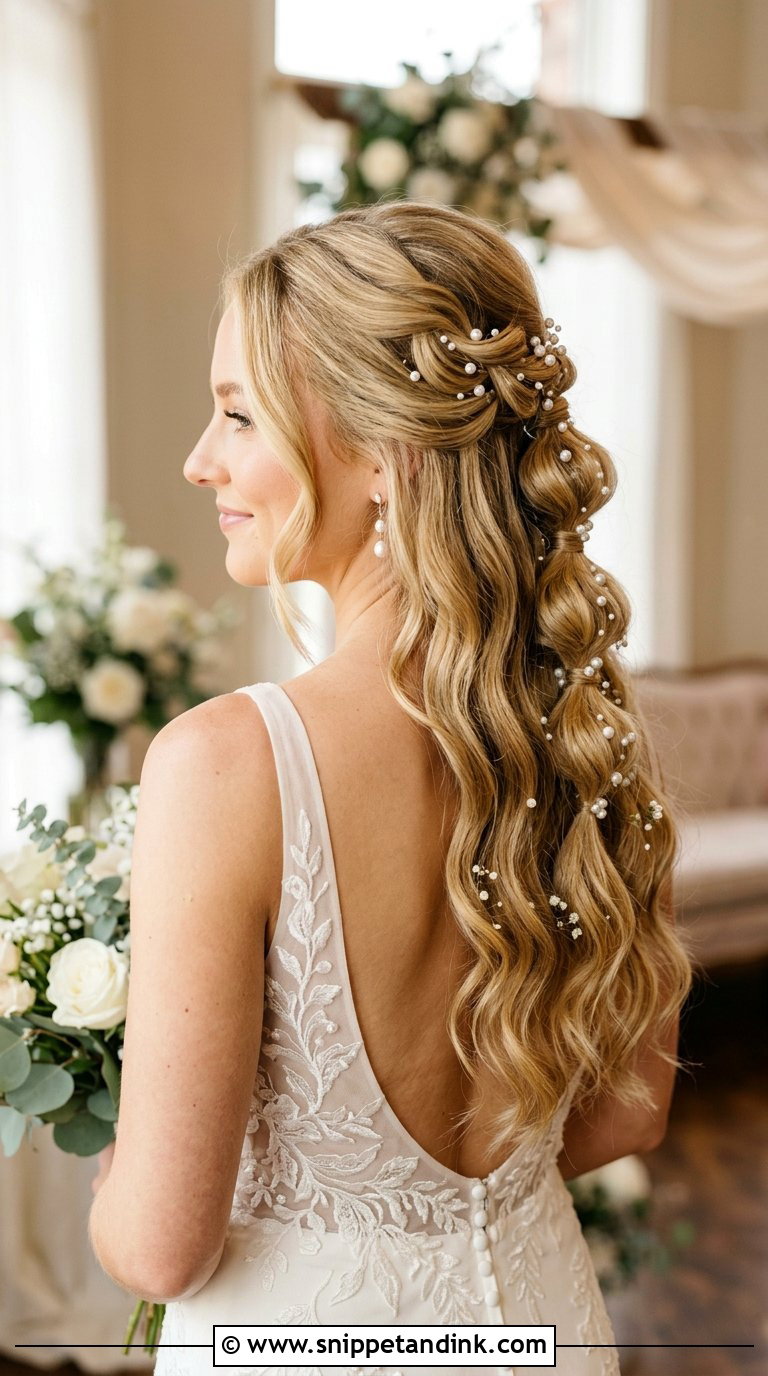
Instead of weaving, sections are tied off with clear elastics and each segment is pulled into a rounded bubble. Run down the back from the top section, it looks playful and modern, and it keeps its shape all day because every bubble is tied. Tiny pearls or beads can sit between the bubbles. At the end of the night, snip each elastic with small scissors rather than pulling it out, or you’ll break hair.
11. Braided Halo Half-Up Half-Down Hair
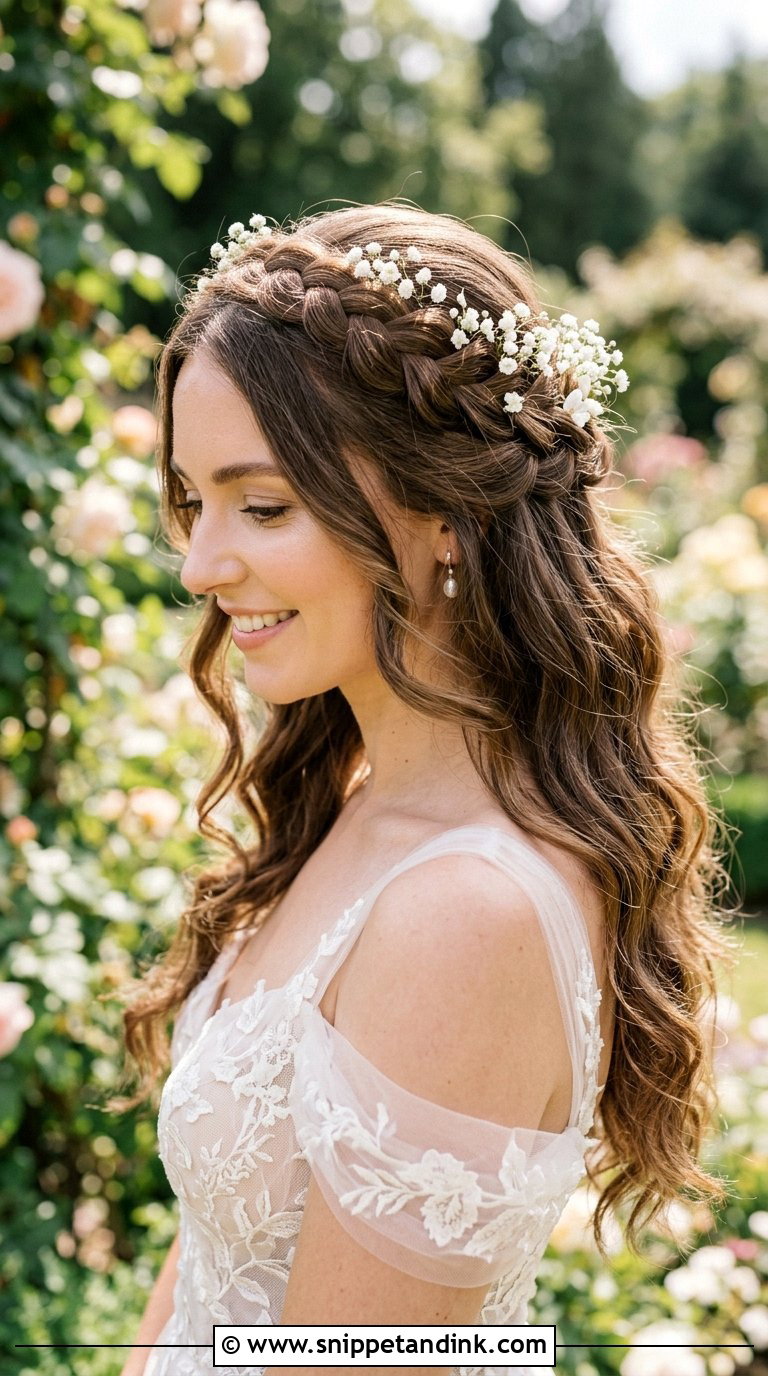
The top sections are braided into a ring that curves across the back of the head, with waves below. It belongs at garden ceremonies and fairytale weddings, and it gives a veil comb a firm ledge to sit under. Pin the braid tight underneath first, then loosen its surface. Baby’s breath or small roses woven in add a fresh touch, though if a veil is going on, I keep the flowers to the sides so the comb has clear braid to grip.
12. Side Braid Half-Up Wedding Hair
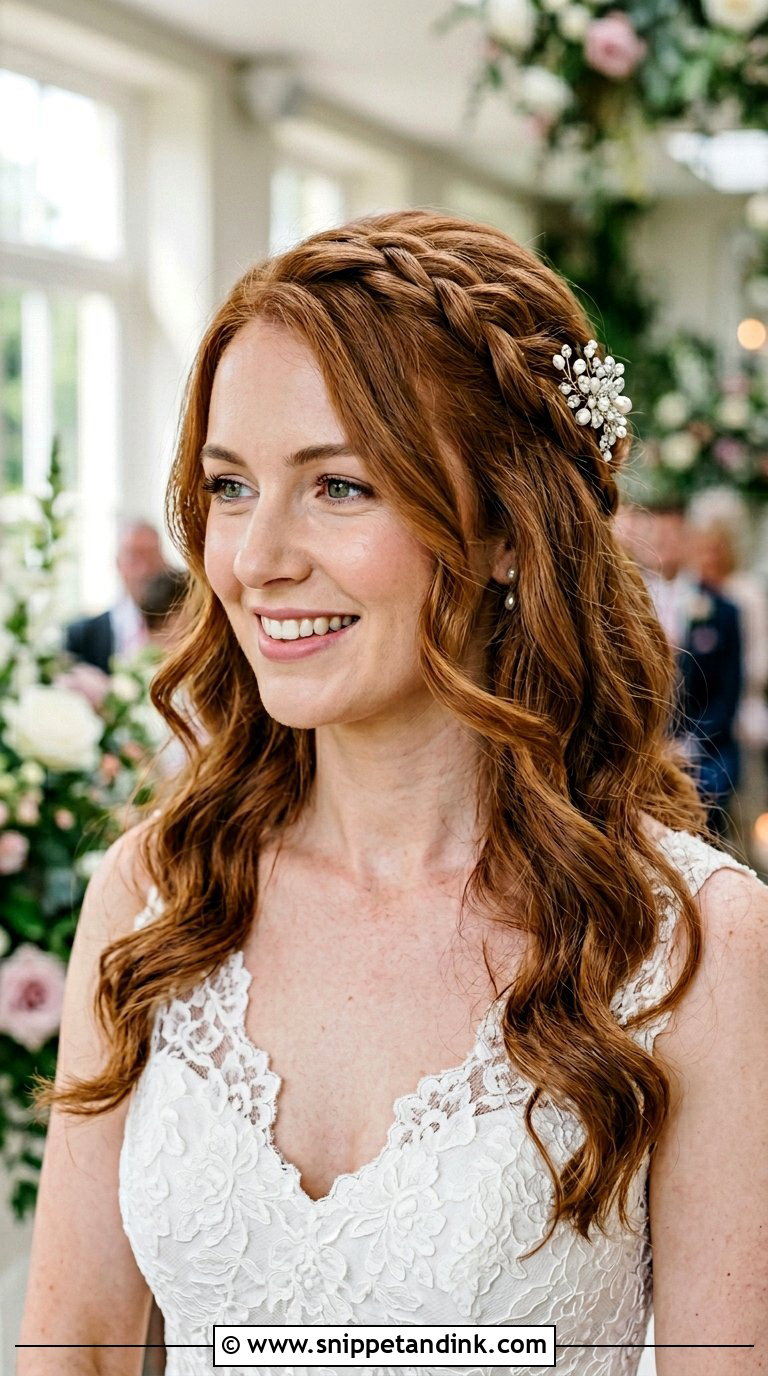
A braid taken from one side, draped across and pinned where it meets the waves makes the whole style asymmetrical. That off-center line leaves the opposite ear and neckline open, so your earrings matter more here. It suits long and medium hair. I anchor the braid’s end behind the far ear with crossed pins, because a side braid held only at its tip tends to slide down over the day. A few wispy strands and one jeweled pin finish it.
13. Messy Braid Half-Up Half-Down Hair
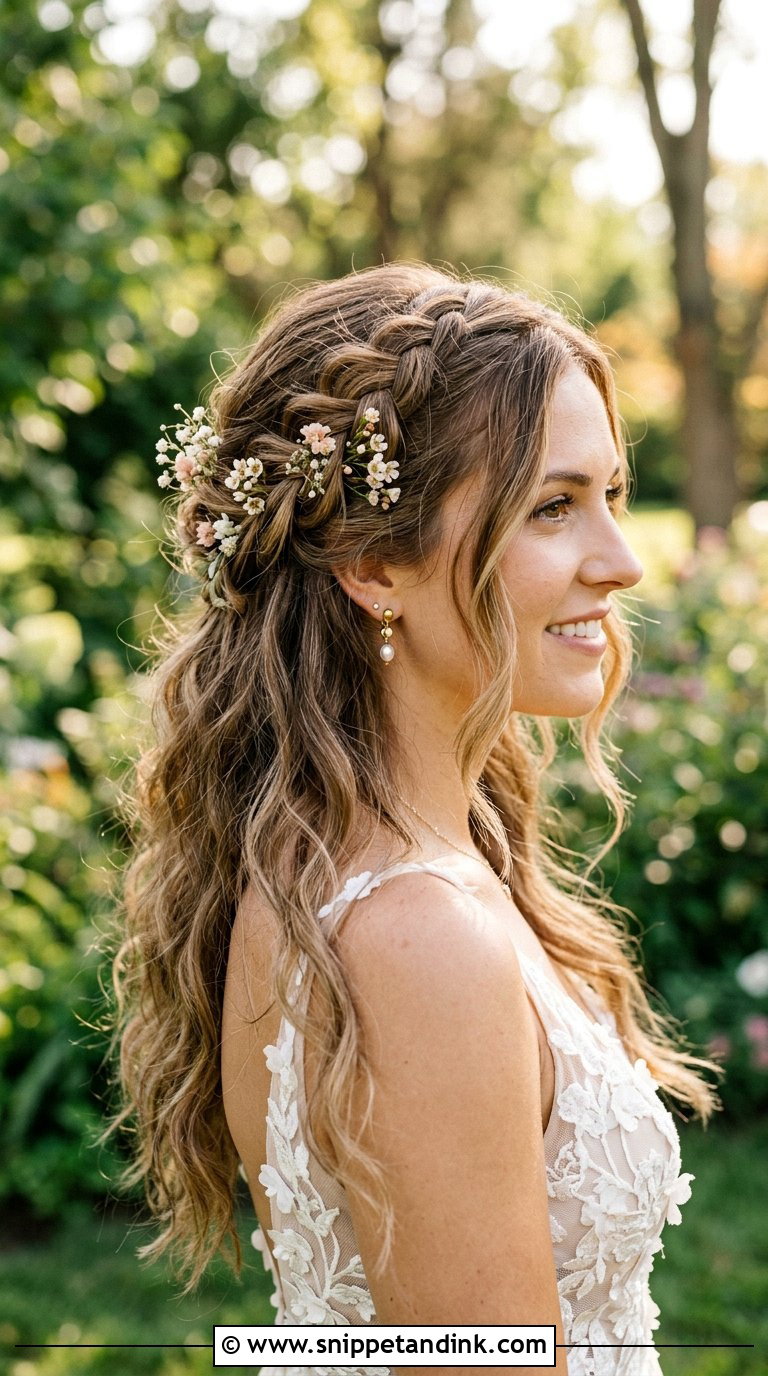
Messy is a finish, not a method. The top section is braided properly, then pulled apart, and the rest stays tousled; skip the firm base and it simply falls. I point brides here who hate the feel of tight styling, especially at boho or outdoor weddings. Let face-framing pieces fall where they want and add a few scattered pins or small dried flowers. Spray it after loosening, not before, so it still looks chosen at midnight.
14. Braid With Veil Half-Up Wedding Hair
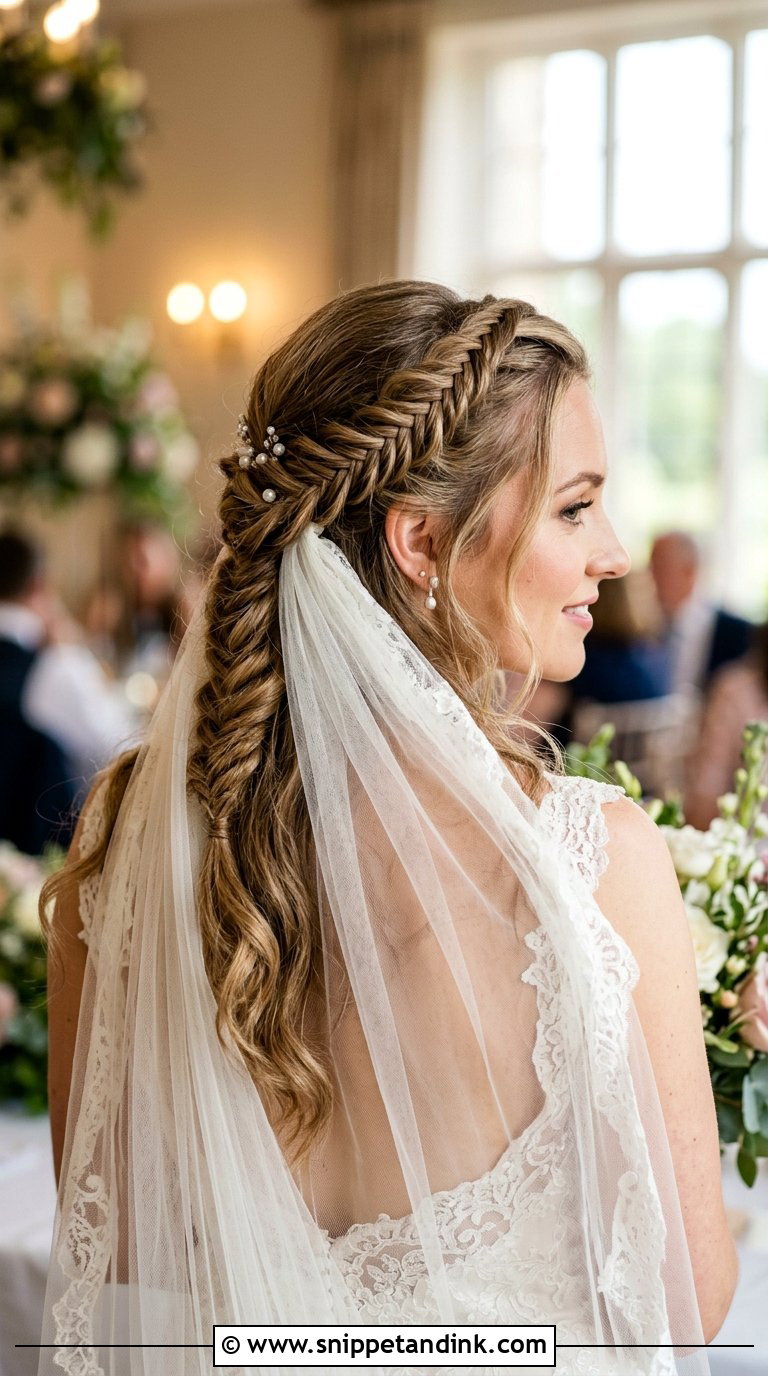
Wondering how to wear a braid with your veil? A half-up braid is the anchor the comb needs. Braid the top section softly and slide the comb in just beneath it, teeth facing in, so the braid sits above the veil like a frame. The waves below fall over your shoulders under the tulle. When the veil comes out at the reception, the braid is still complete. A heavy veil pulls on a half-up more than on an updo, so bring yours to the trial.
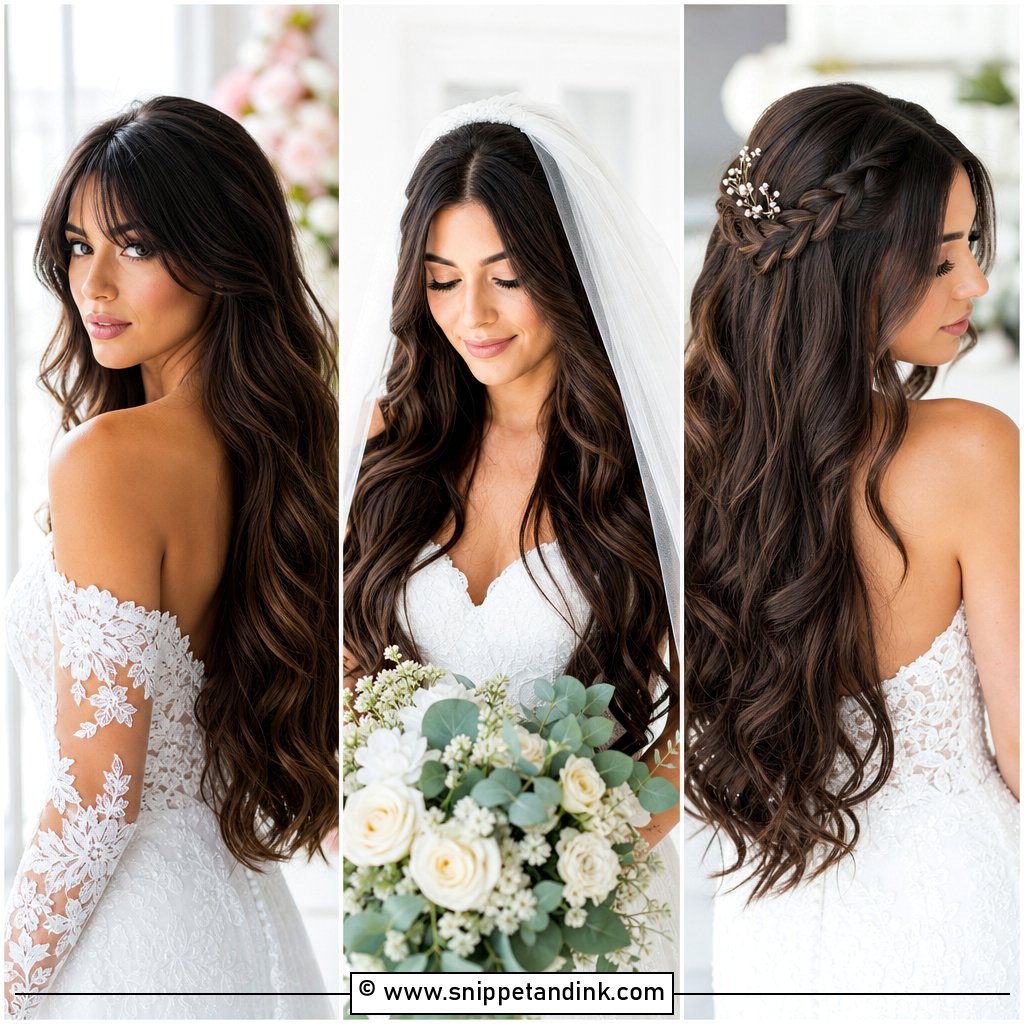
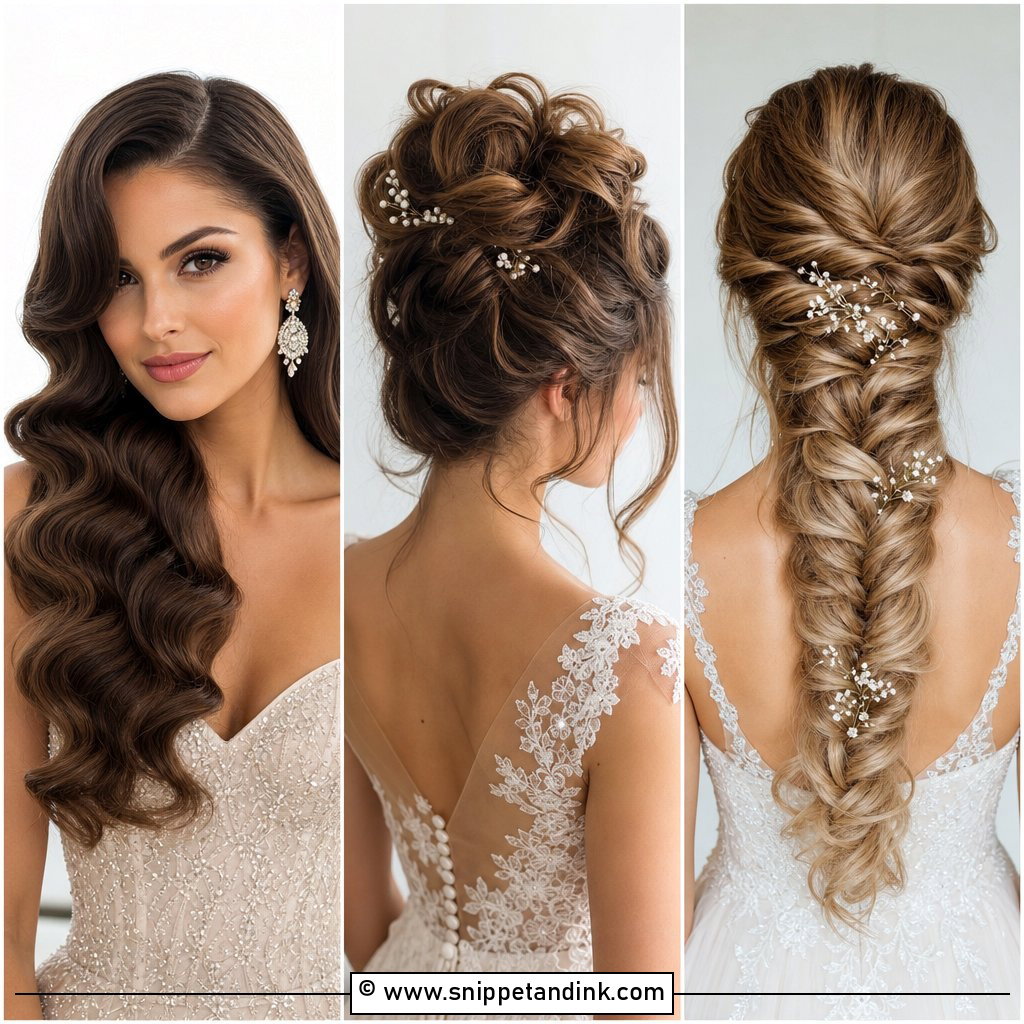
15. Accent Braid Half-Up Half-Down Hair
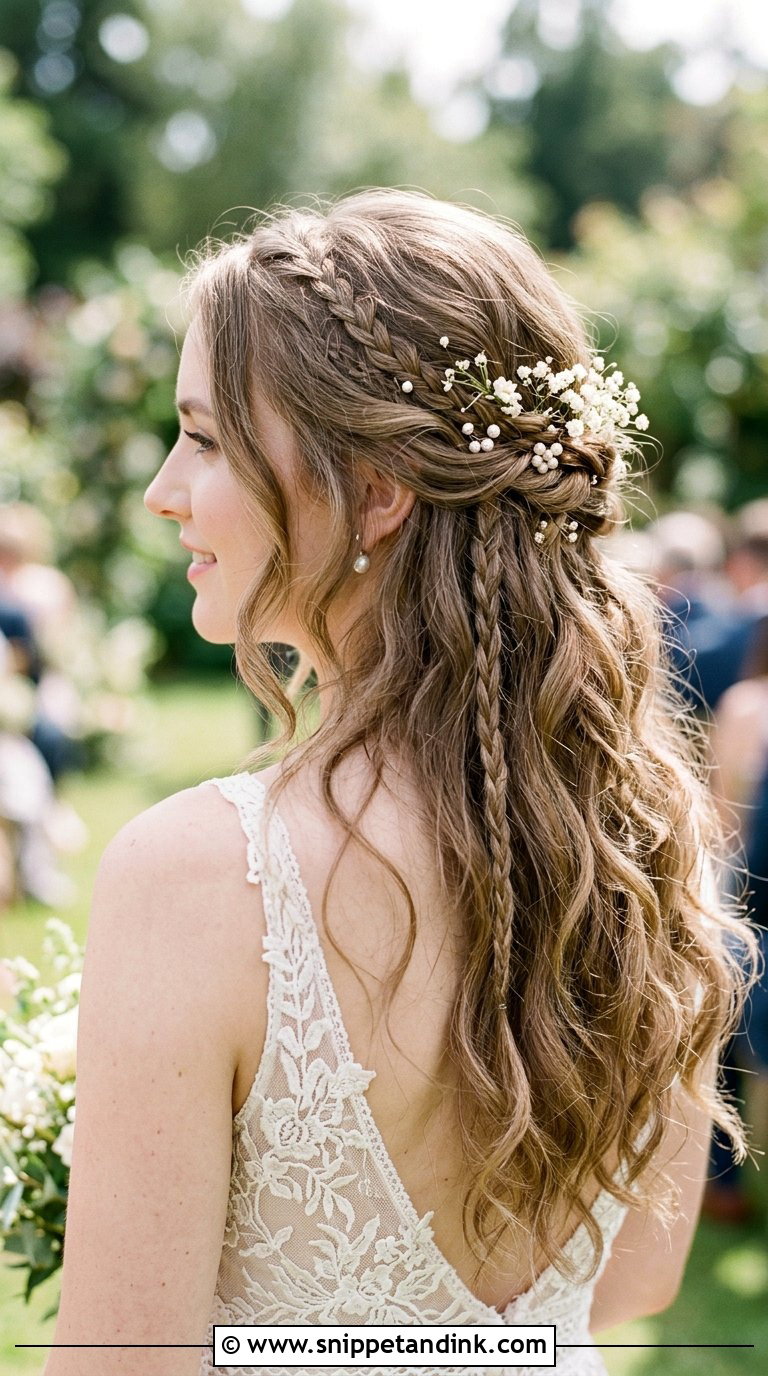
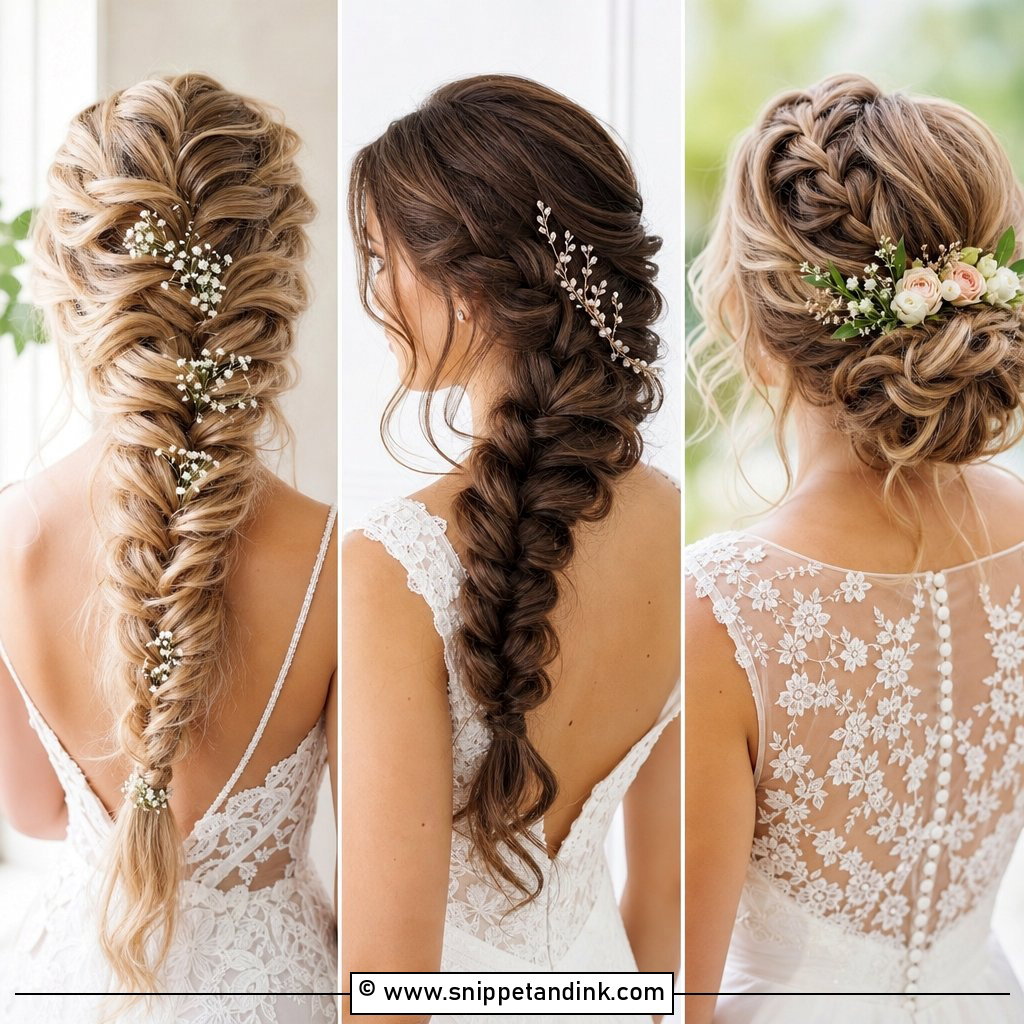
Several thin plaits scattered among loose waves, instead of one big braid. The texture stays light, so it suits a bride who wants braided detail without a statement. The thin braids are gathered into a half-up section pinned at the back, and the rest flows. Tiny beads or pearls on a few of them add shimmer. Very thin braids on fine hair can look stringy, so I make each one at least a finger’s width.
16. French Braid Half-Up Wedding Hair
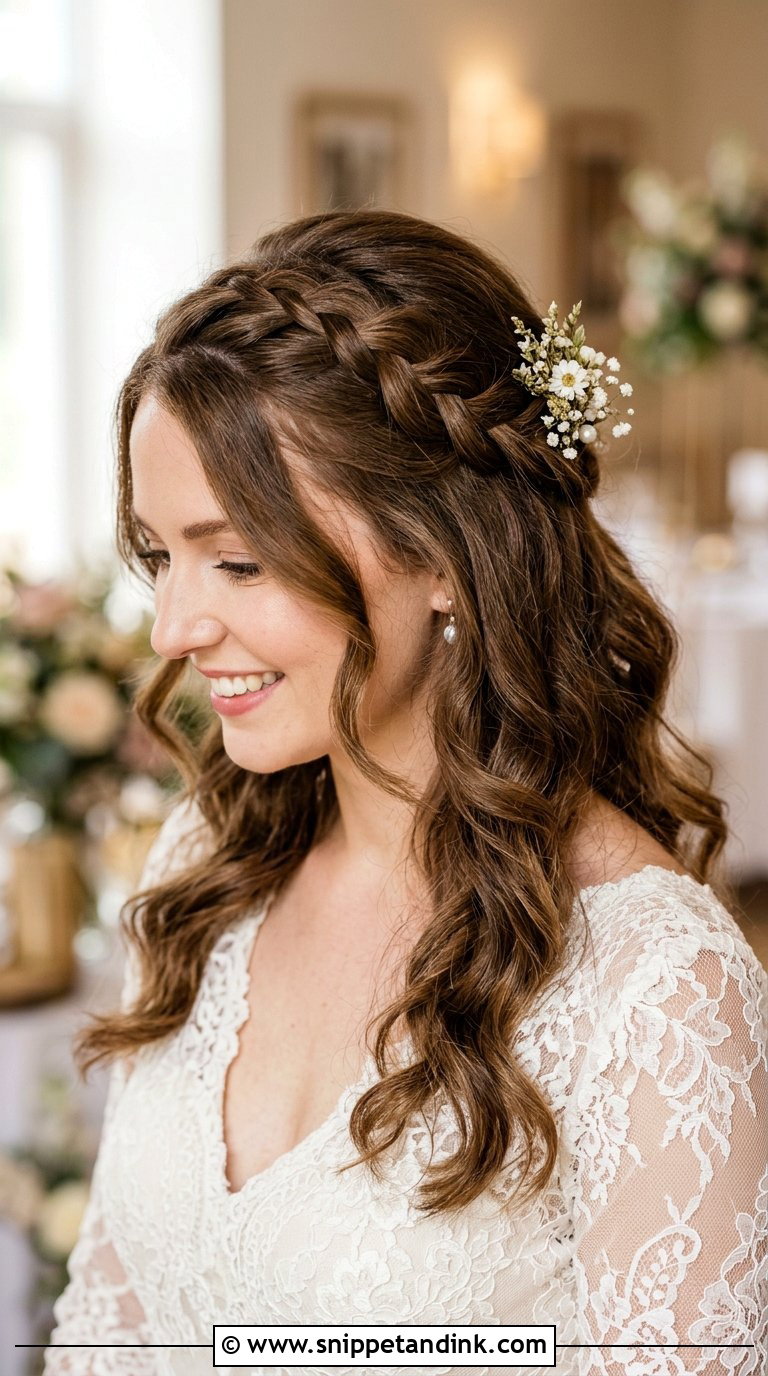
The top section is French braided back along the scalp and secured where the waves begin. It’s smooth and familiar, suits nearly every face shape and texture, and lasts through a long day because it hugs the head. Start it too close to the hairline and it can look schoolgirlish; starting an inch or so back with a little root lift keeps it bridal. Loosen it slightly for softness, and add a few small flowers or one pearl pin.
17. Braided Bun Half-Up Wedding Hair
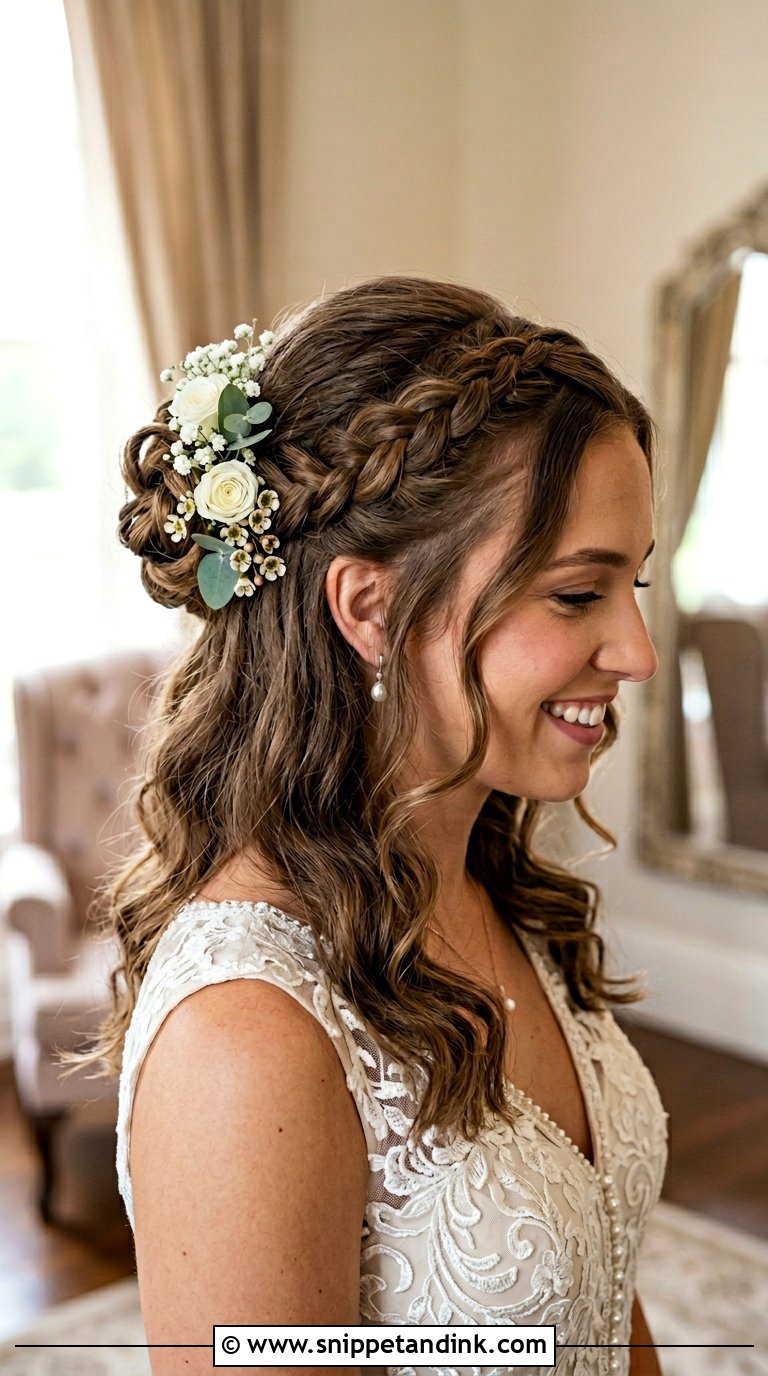
The top sections are braided back and looped into a small bun at the crown while the rest falls in curls. It has more height and structure than any other style here. Height suits a round face, and on a long face I’d keep the bun lower. Secure it with U-pins and tuck in a few florals. The veil goes beneath the bun, which hides the comb completely; it’s the neatest veil placement on this list.
18. Pearl Braid Half-Up Half-Down Hair
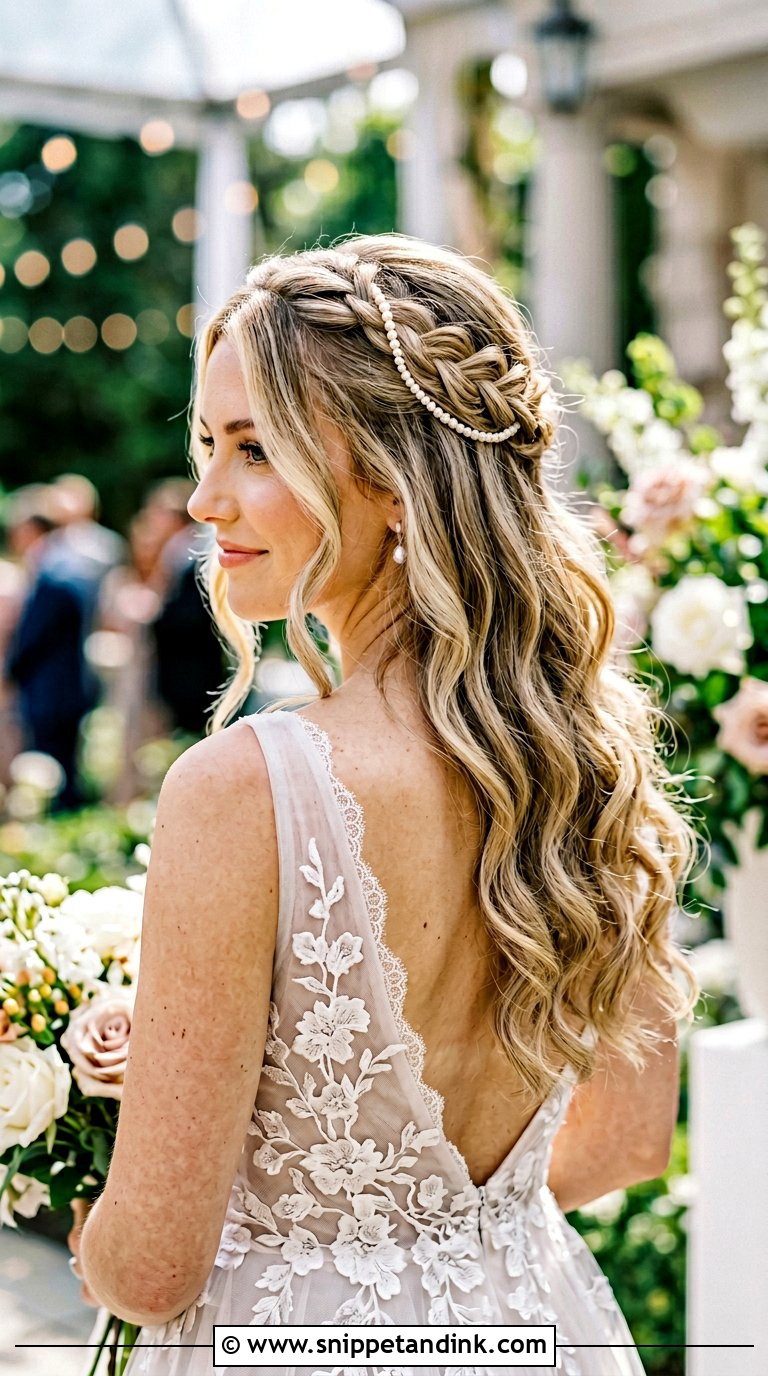
A pearl strand is worked into the braid as you go, laid along one of the three sections so it surfaces on alternate passes. Use a strand made for hair, on soft wire or thread, not a real necklace. A clasp digs into the scalp, and a snapped string means pearls everywhere. Against the waves below, the pearls catch light softly. Simple, refined gowns suit it best, with plain earrings so the braid holds the attention.
19. Rope Braid Half-Up Wedding Hair
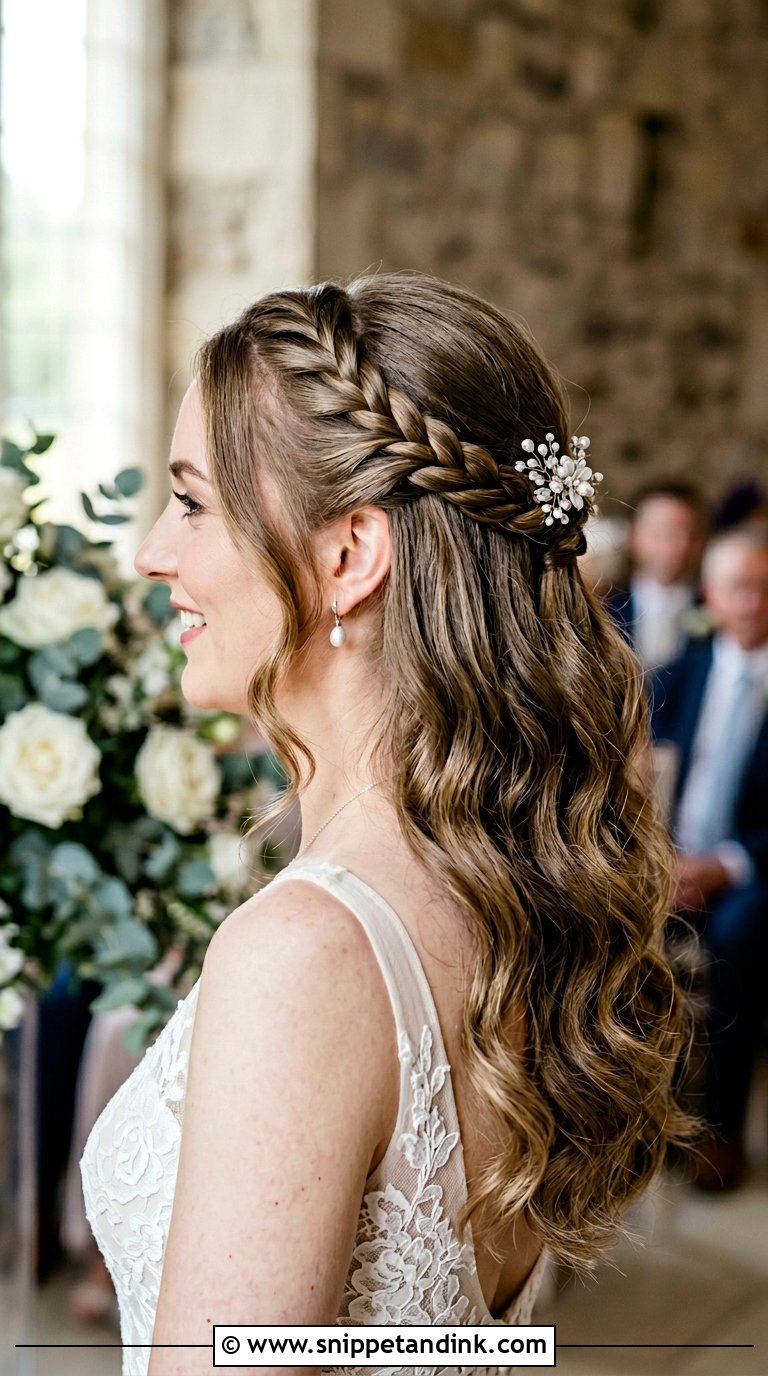
Two sections are twisted one way and wrapped around each other the other way. Taken back from the top, a rope braid has a cleaner line and more shine than a three-strand braid, which suits a bride who likes a polished look. It’s quick to make and holds well. Loosen it slightly for softness, then finish with a delicate hairpin or a small floral accent.

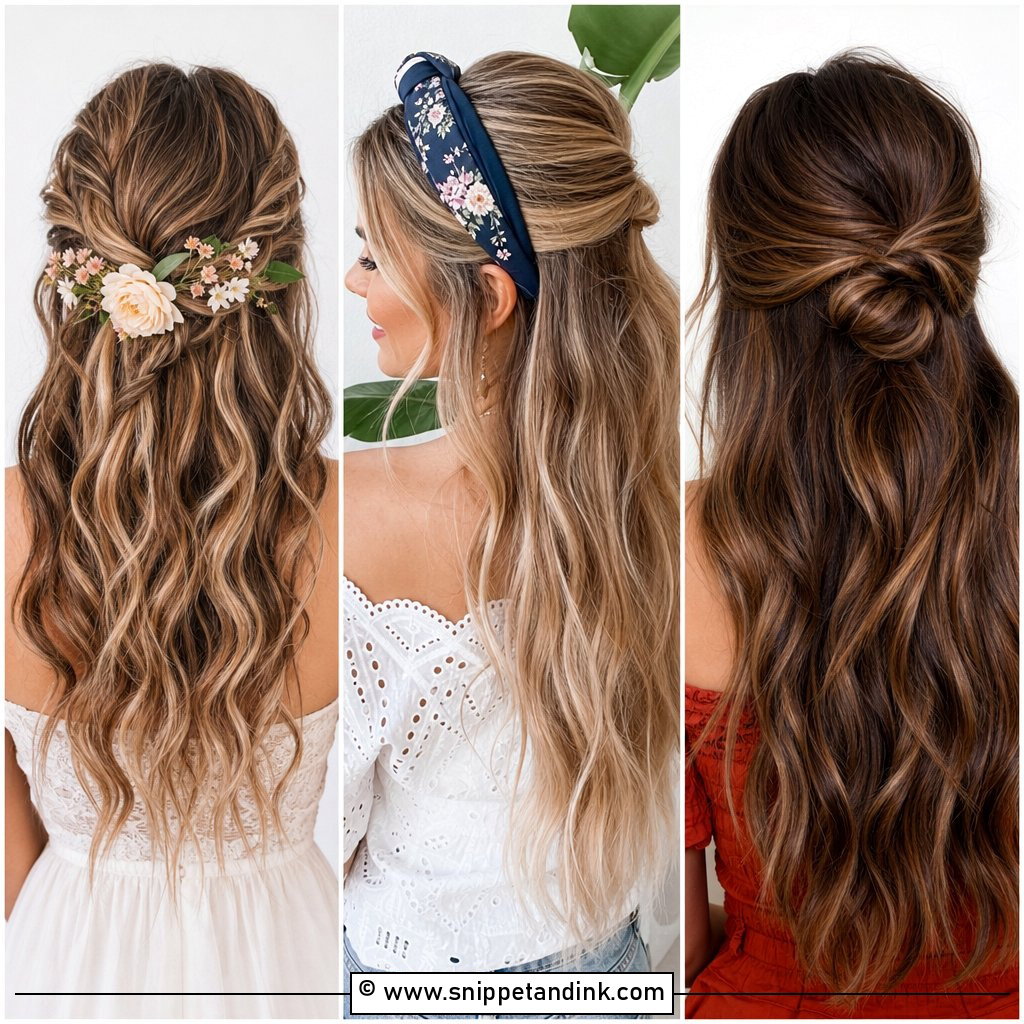
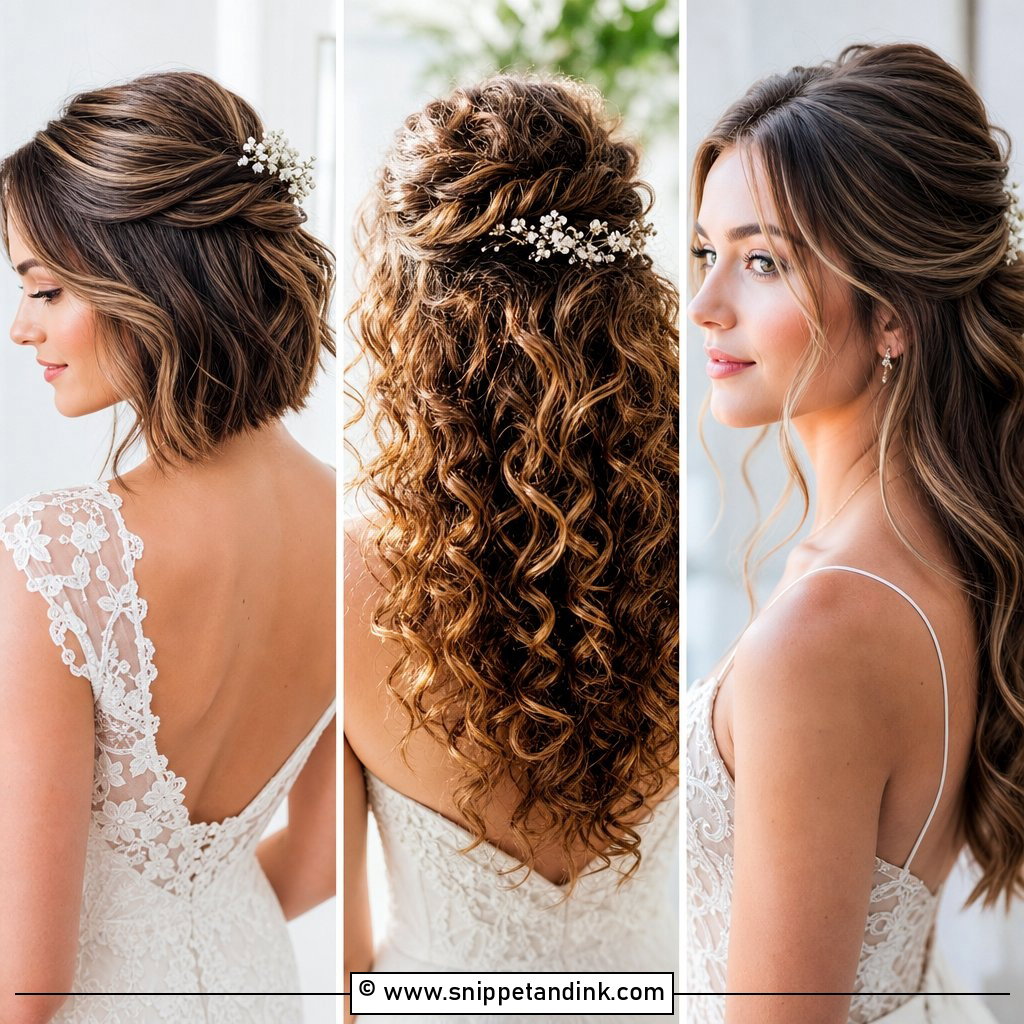
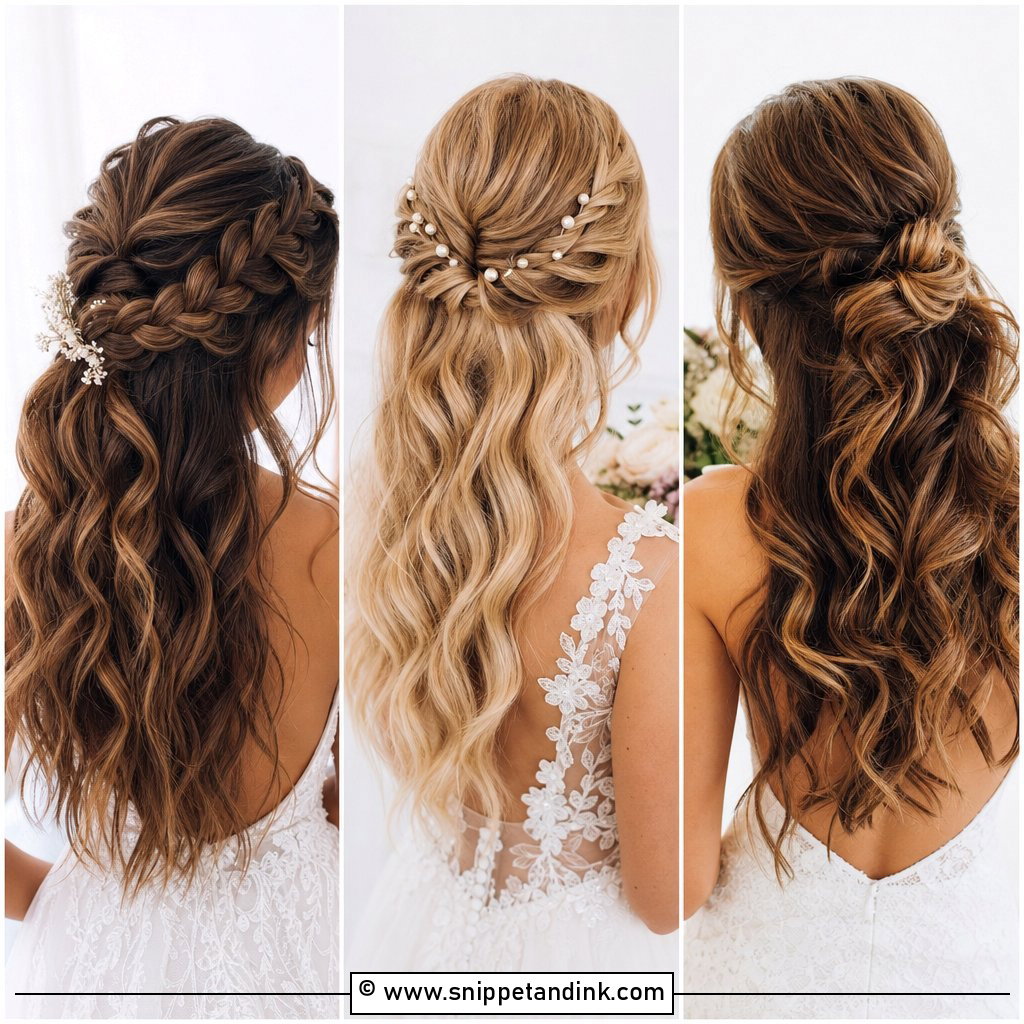
20. Floral Braid Half-Up Half-Down Hair
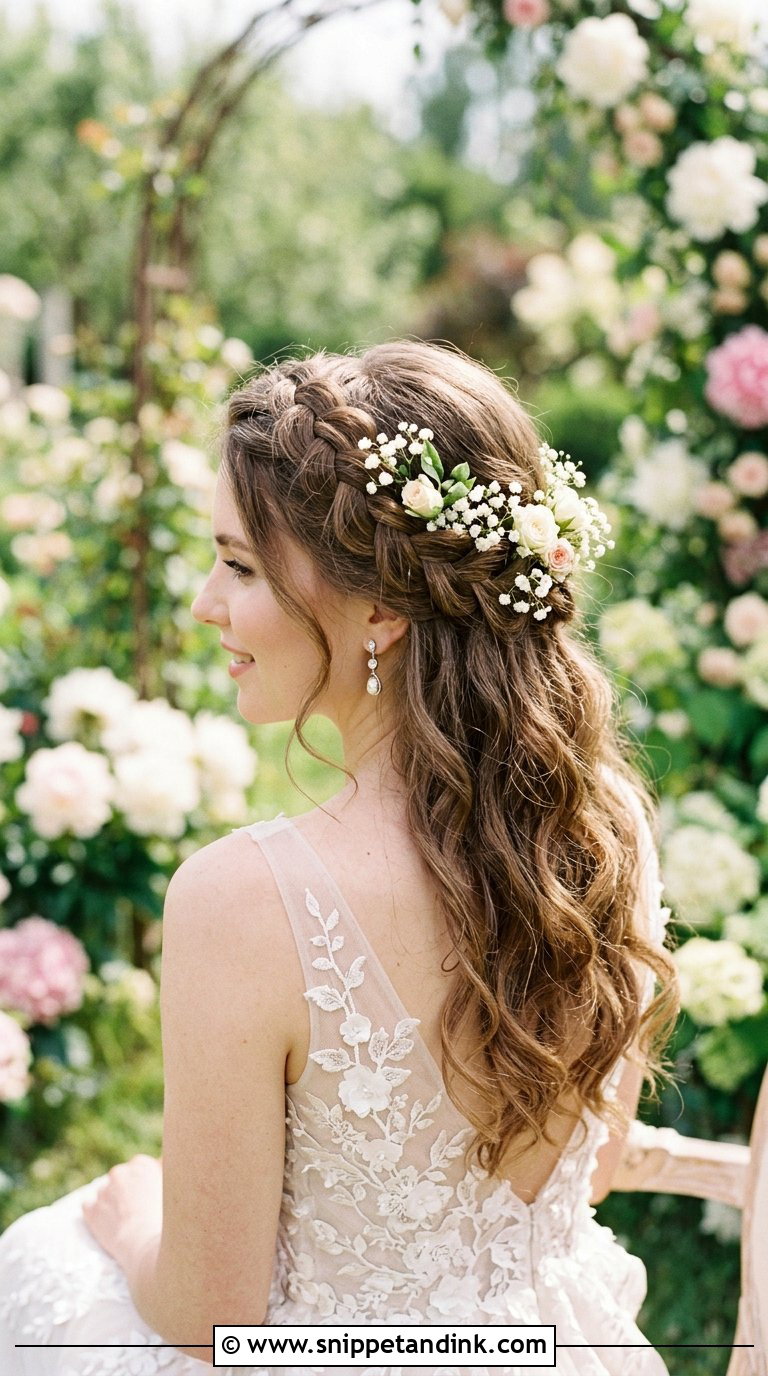
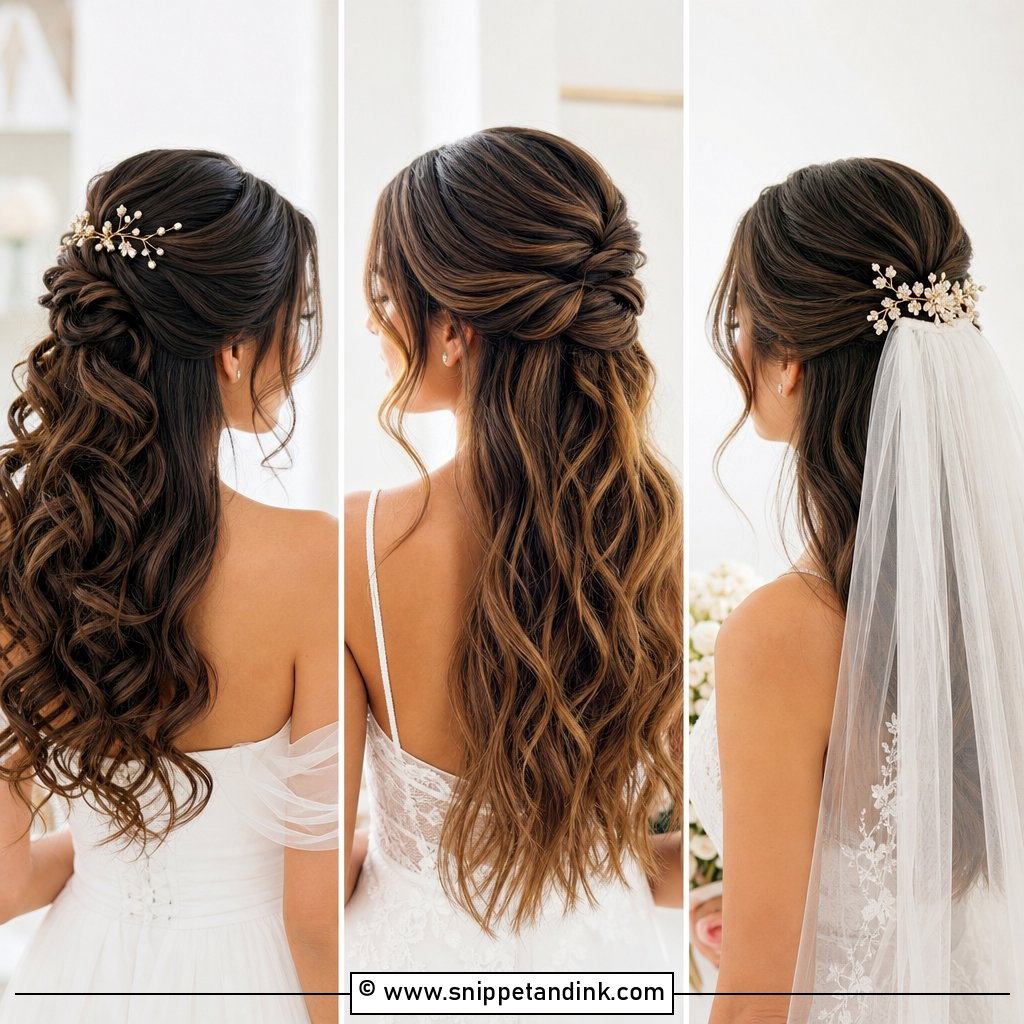
Small flowers like baby’s breath, spray roses or sprigs of greenery are tucked along the braid, with the rest of the hair loose below. Flowers in hair have no water, so they need hardy varieties, wired and delivered on the morning. Matching them to the bouquet ties everything together. I add them last, after the veil comb is in, so I’m not crushing petals while I pin. Spring and summer garden ceremonies suit it.
Where to Split the Top From the Bottom
The part line between the braided section and the loose section changes the whole style. It’s a decision to make at the trial, not on the morning.
- Temple to crown: a small top section with more hair left down. It looks soft, but the braid is thinner.
- Ear to ear: a bigger section, a fuller braid and better veil grip, with less hair below.
- Fine hair: take less into the braid than you’d expect, or the down part starts to look sparse.
- Thick hair: a larger section helps, because the braid carries weight that would otherwise drag the curls flat.
Then sit down and lean back in a chair. If the pins and braid ends land exactly where your head meets the seat, move the join up an inch or two. You’ll lean back at dinner far more often than you’d guess.
Half Up for the Vows, Still Holding at Midnight
Half-up braids do two jobs at once: they hold the front for the ceremony and keep your length on show for the party. Fishtails, crowns, bubbles and floral braids all adapt across lengths and textures, in a ballroom or a small garden. What decides whether yours lasts is the down half. Plan the curl, bring the veil and every accessory to the trial, and ask your stylist to show you the pins holding the join.
You'll Like These Ideas:


Leave a Reply