
Blue and white is the pairing I get asked for most when a bride wants her “something blue” detail somewhere she will actually see it all day. It suits a coastal ceremony as easily as a winter ballroom, because the white keeps the set reading as bridal while the blue sets the mood. Baby blue stays soft; navy, cobalt and porcelain blue look deliberate and tailored. What people underestimate is the white itself: a stark gel white and a milky sheer white change the whole manicure. Below are twenty versions I would happily put on a bride, from a quiet micro French to a full royal blue accent, with notes on where each one tends to go wrong.
Undertones Decide Whether Blue Looks Crisp or Grey
Before we talk designs, I look at your hands next to two or three blue swatches, because the same polish can look fresh on one bride and chalky on another. Cool, pink-toned skin usually takes icy baby blue and cobalt easily. Warmer, olive or golden skin tends to look better with blues that lean slightly green or grey, like dusty blue or a deep navy, which do not fight the warmth in the skin.
The white matters just as much. A stark, opaque white looks graphic and modern, but against an ivory or champagne gown it can make the dress look yellow in photos. If your dress is not pure white, I mix a milky, slightly sheer white instead so the nails and fabric sit in the same family.
- Bring a scrap of the dress fabric or a photo taken in daylight, not under shop lights.
- Wear your engagement ring to the appointment so we can see the metal next to the colour.
- Check the swatch outdoors if you can; blues shift a lot between warm indoor bulbs and daylight.
1. Blue And White French Tip Wedding Nails
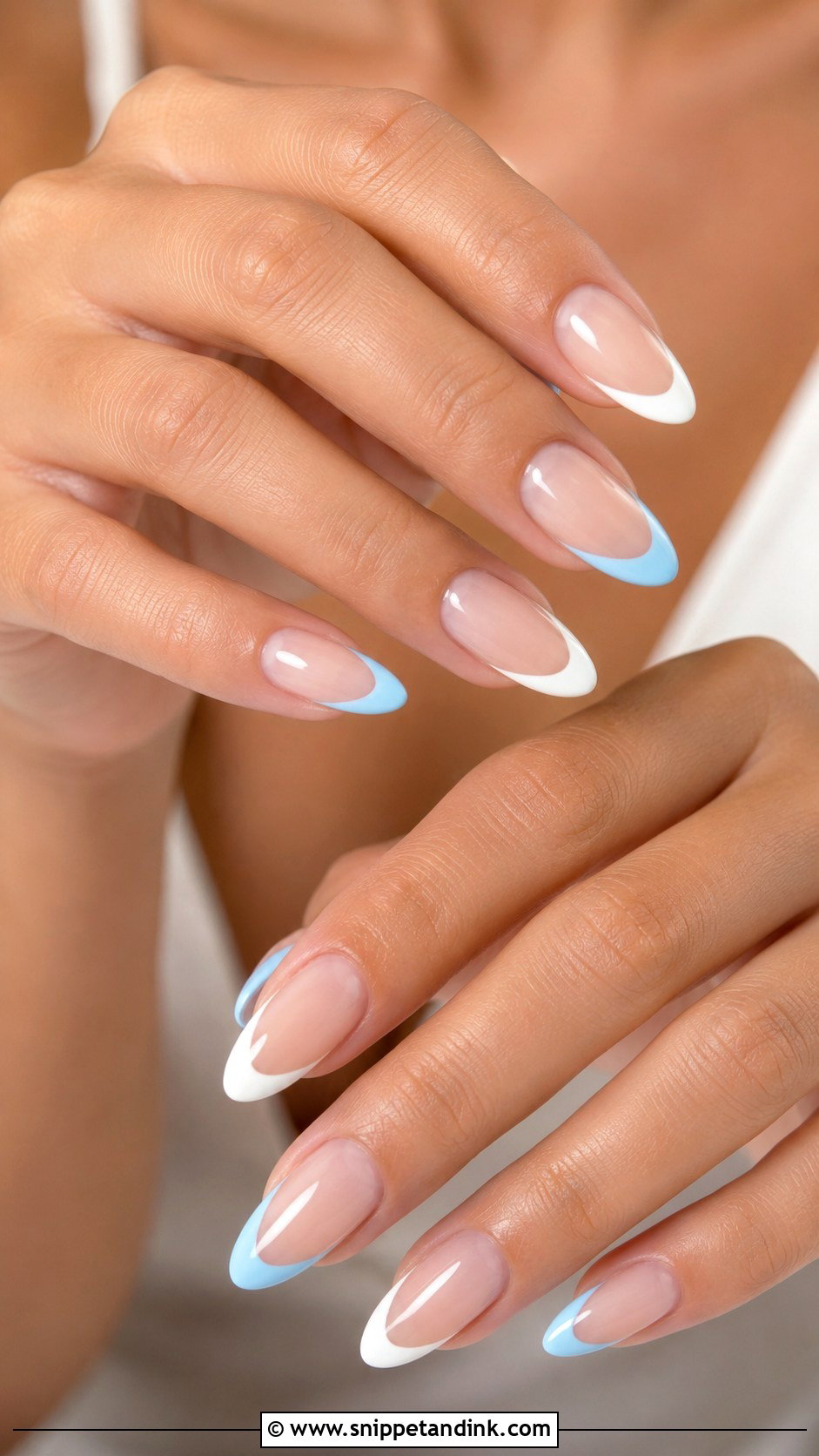
If you already love French tip wedding nails, swapping some of the white tips for baby blue is the gentlest way to bring in colour. I paint them over a sheer nude or milky pink base, alternating white and blue. The thing I watch is the smile line: blue shows a wobble far more than white does, so I draw it with a fine liner brush instead of a quick swipe. Almond, oval and short square shapes hold a neat tip line. Micro tips read soft, while cornflower blue is visible from across the aisle.
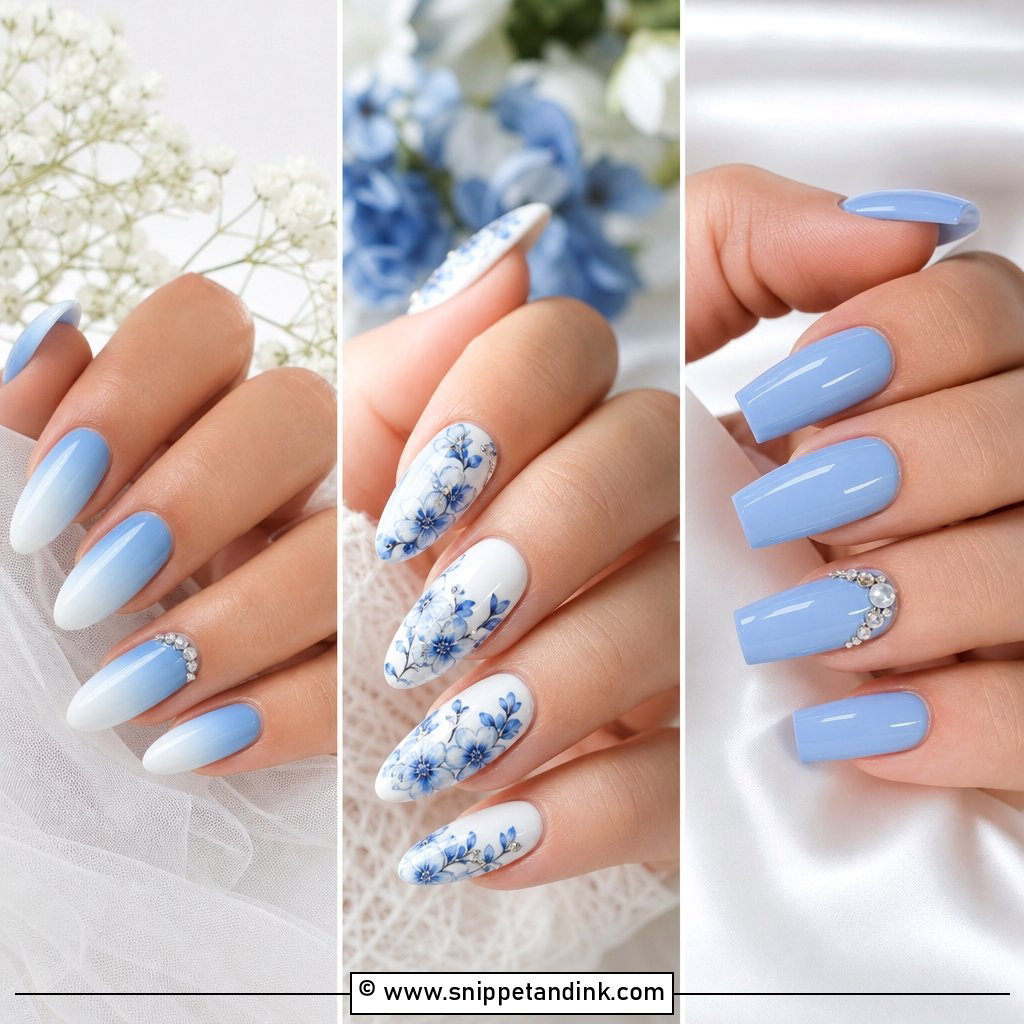
2. Baby Blue And White Ombre Wedding Nails
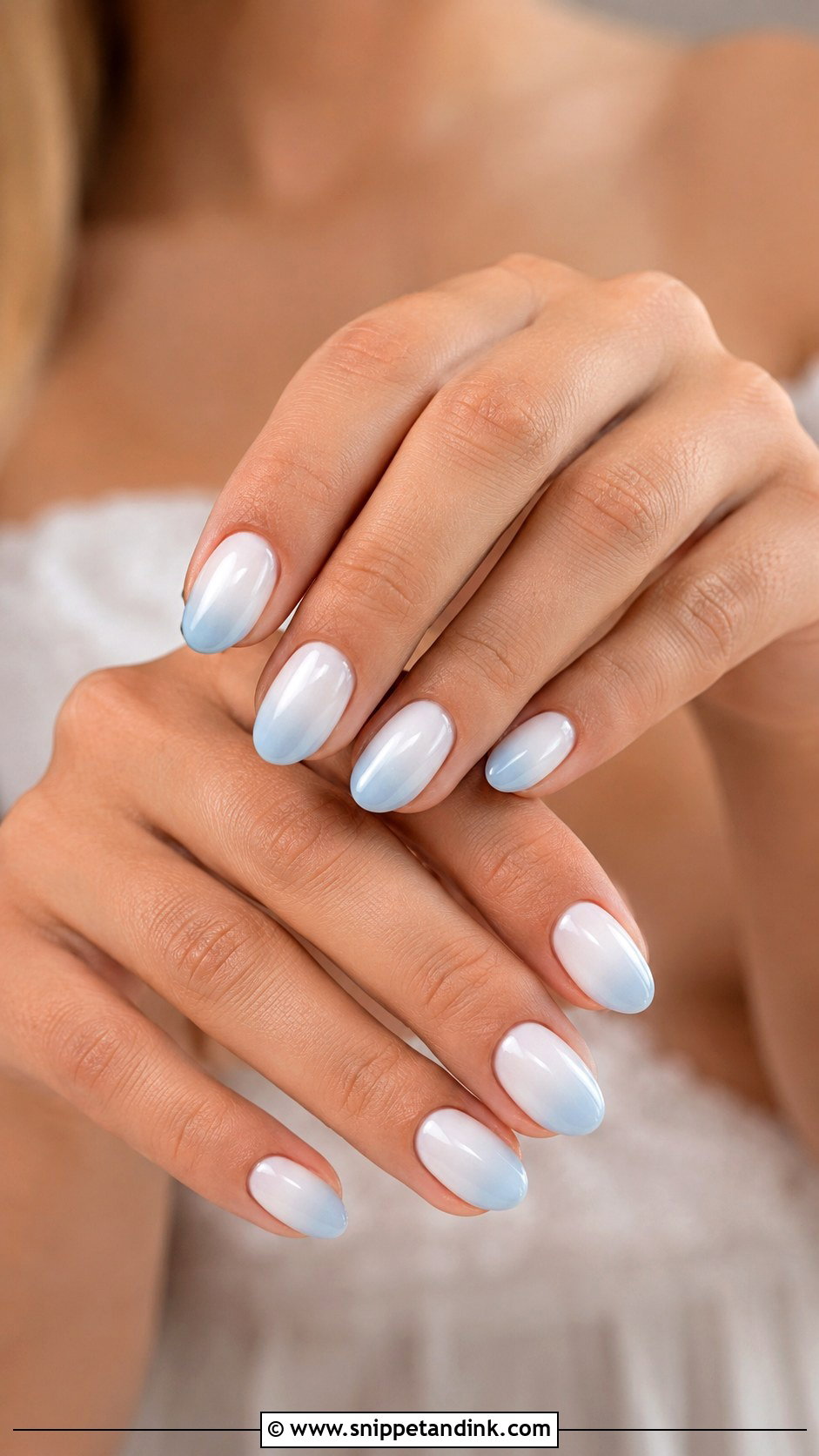
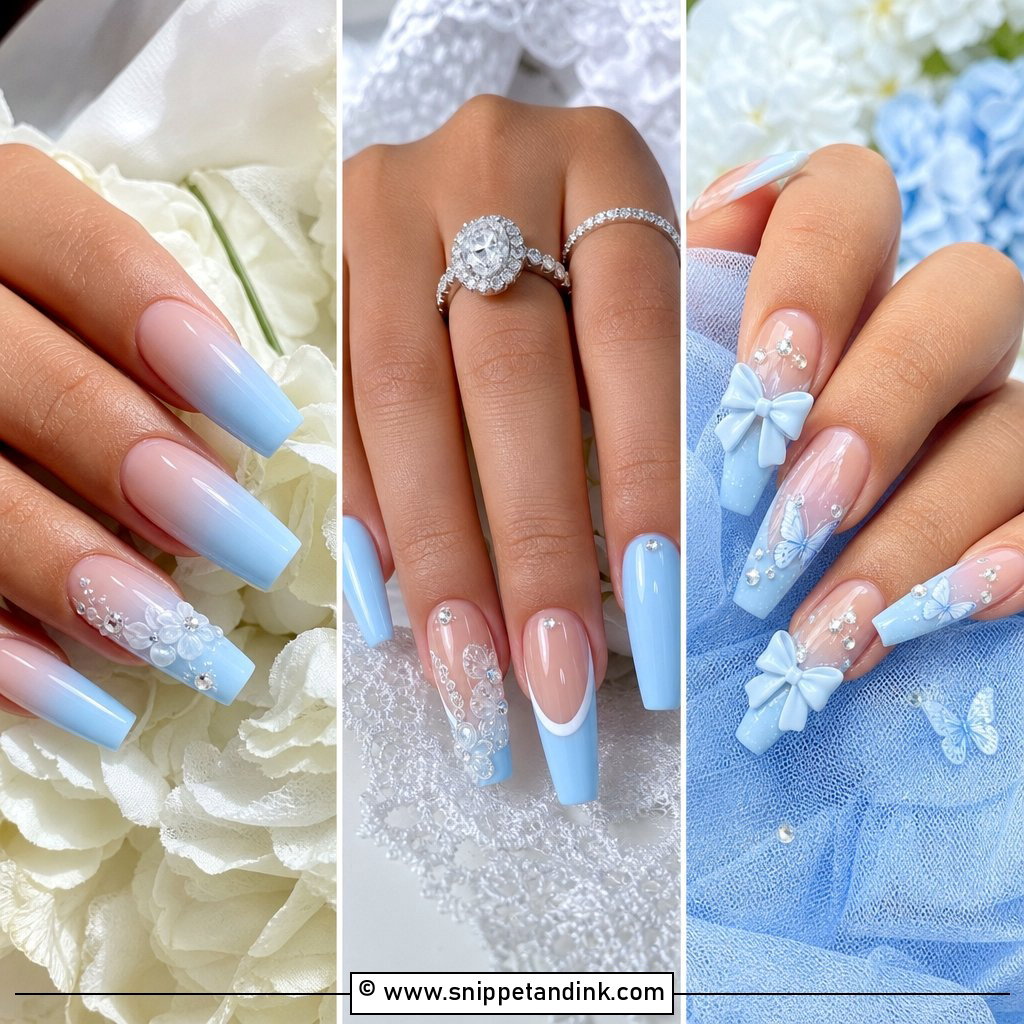
Baby blue and white ombré needs length to work. On a very short nail the fade has nowhere to travel and ends up looking like two stripes, so I usually steer short-nailed brides toward a French instead. On almond, coffin or oval nails the gradient melts properly, especially over a semi-sheer base. I blend gel ombré with a sponge or a dry fan brush and cure it in thin layers; rush it and you get a visible ridge where the two colours meet. A fine shimmer top coat is plenty. Chunky glitter fights the softness and dates quickly in photos.
3. White Wedding Nails With Blue Floral Art
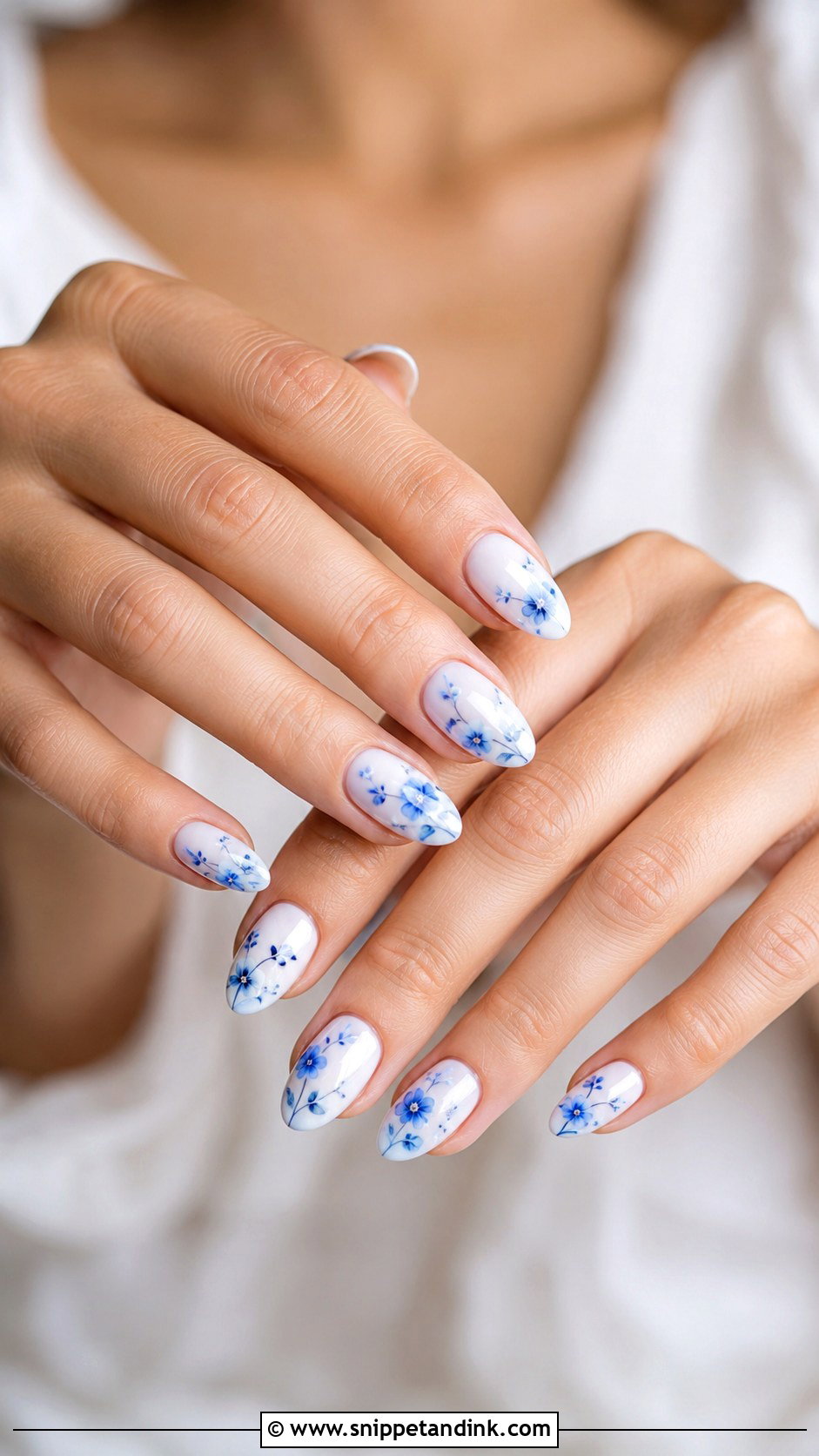
Hand-painted blue flowers on one or two accent nails give you detail without covering every finger. I keep the petals small and the stems hairline thin, then add a touch of lighter blue for shading so the flowers do not look flat. Negative space is what keeps this clean. Crowd the nail and the motif turns into a blue smudge at ring-shot distance. It sits naturally beside floral lace or pale blue hydrangeas, and short oval nails keep it sweet.
4. Blue And White Lace Wedding Nails
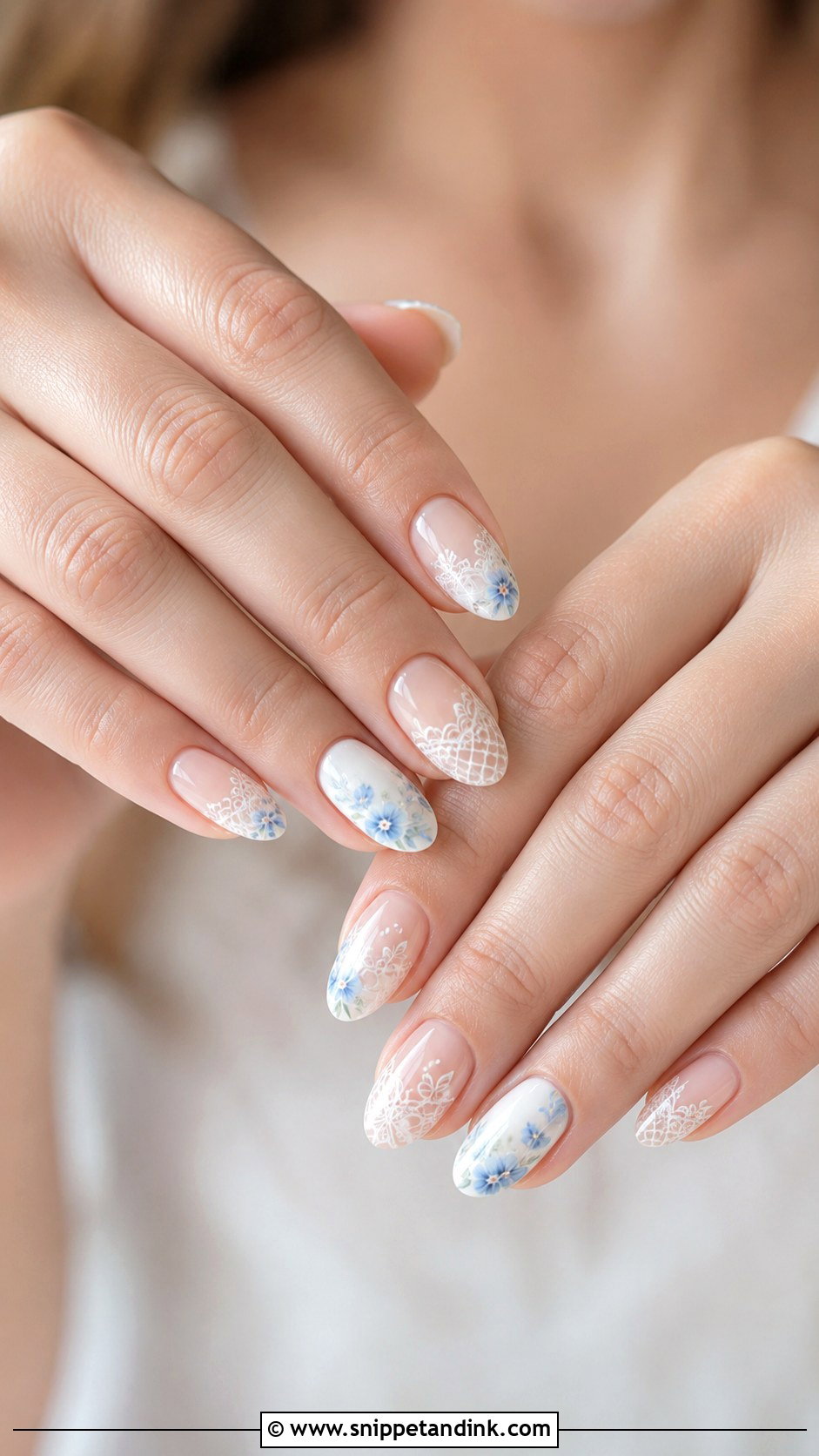
Lace is the design I would only ever do on accent nails. Ten nails of lace look busy, and fine line work takes real time, which matters in a packed wedding week. Over a sheer nude, milky white or pink base, I pull white lace lines with a long thin striper and tuck small blue vines into the pattern. Bring a close-up photo of your actual dress lace if you can. Matching the scallop or flower in the fabric looks far more convincing than a generic net pattern, and one tiny pearl near the cuticle is all the extra it needs.
5. Navy Blue And White Wedding Nails
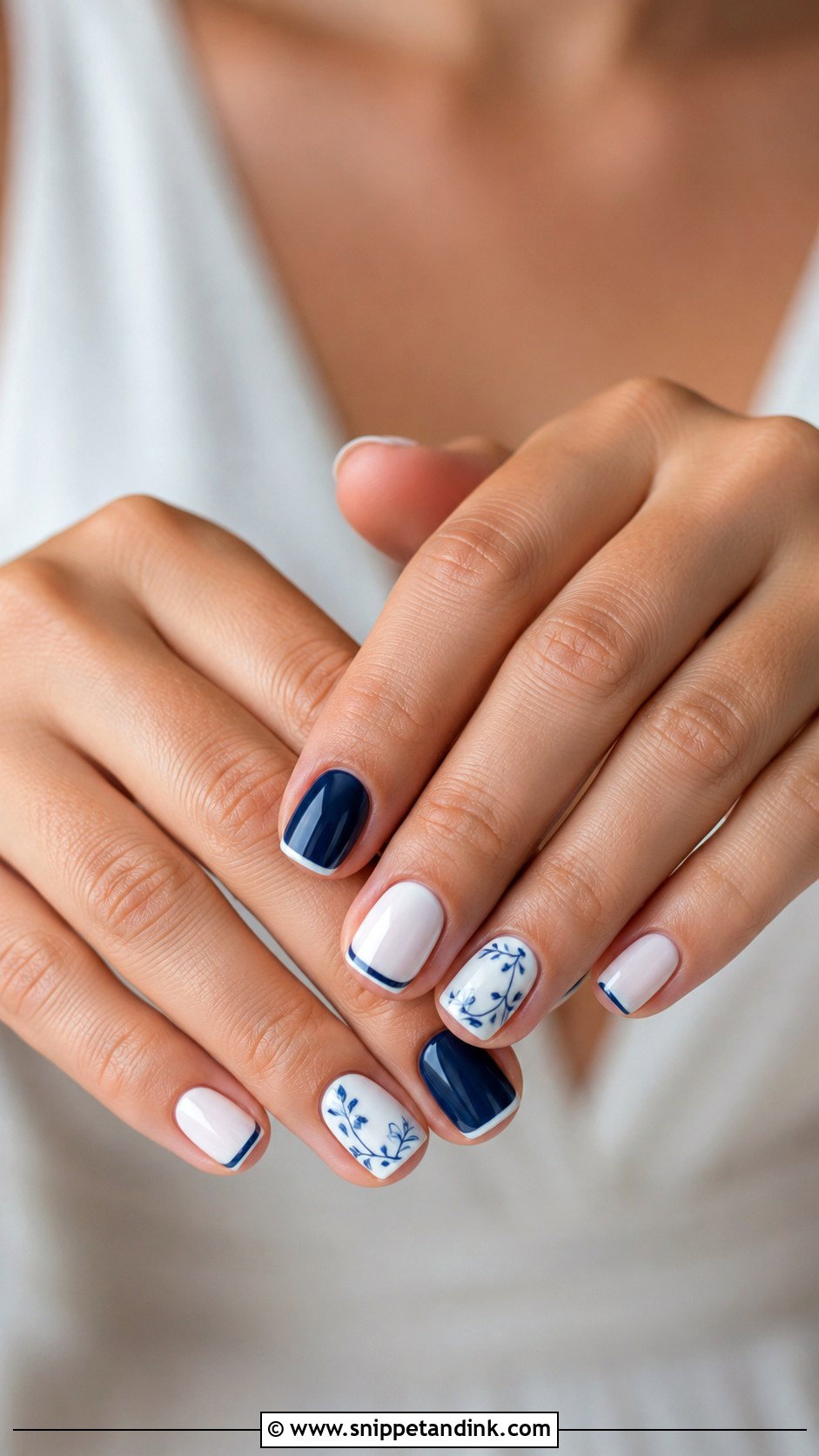
Navy reads almost black under evening lighting, which is exactly why it suits formal venues and winter palettes. A full navy set can feel heavy against a white dress, though, so I break it up with white nails, thin white tips or white florals painted over the navy. It sits well beside silver jewelry and navy bridesmaid dresses. Dark polish also outlines every dry cuticle in close-ups, so start oiling a week ahead. Short square looks crisp; almond softens it.
6. Blue And White Chrome Wedding Nails
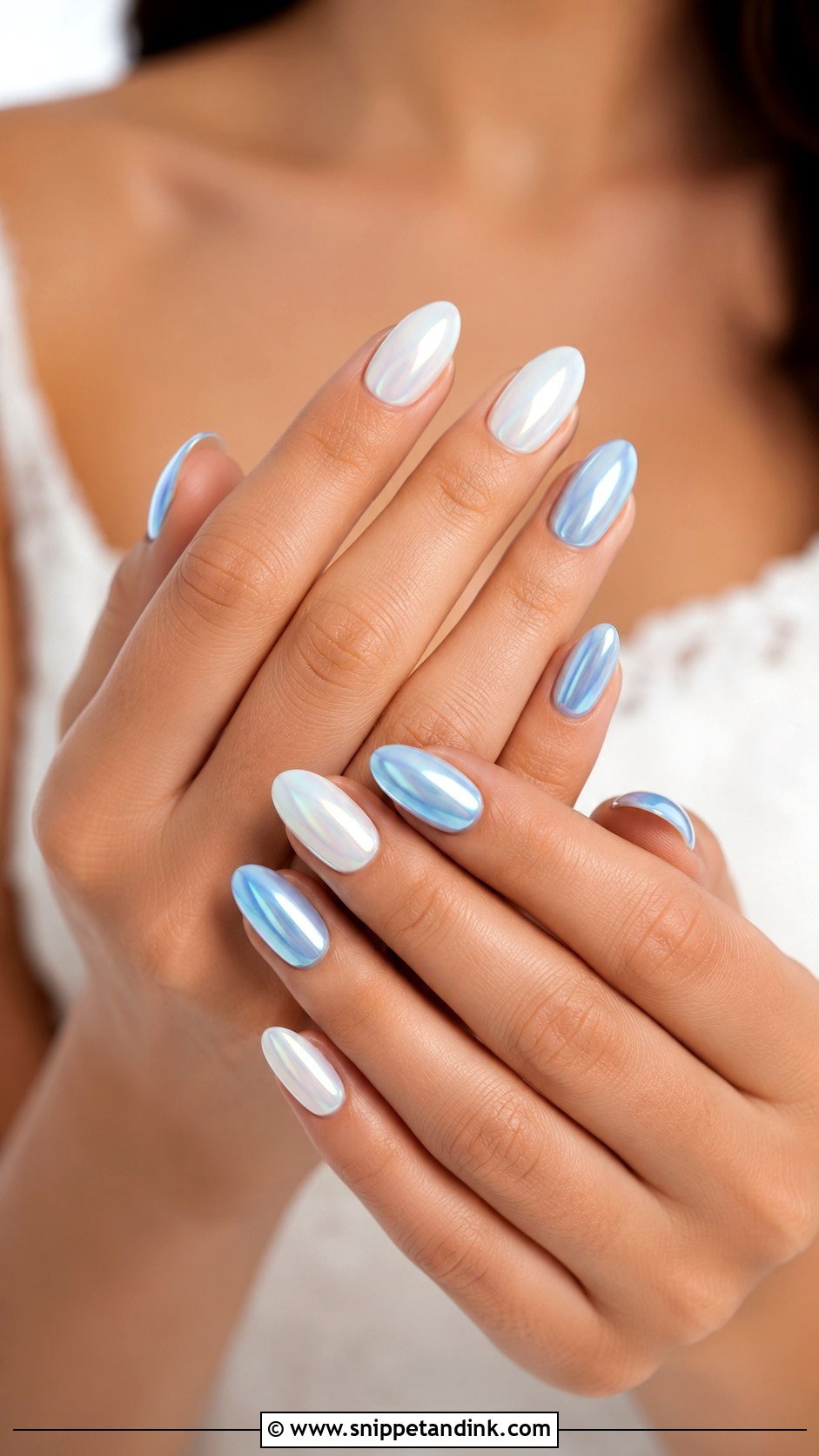
Bridal chrome should glow, not mirror. My usual version is a milky white base with pale blue chrome powder buffed over a no-wipe top coat, or soft blue chrome alternating with creamy white. The powder only grips a fully cured, tack-free surface, and the free edge has to be sealed or the chrome starts wearing off the tips within a few days. In ring photos it gives depth without any painted art. Almond, oval and medium coffin all carry it, and a thin white French over the chrome adds detail if you want it.
7. Blue And White Pearl Wedding Nails
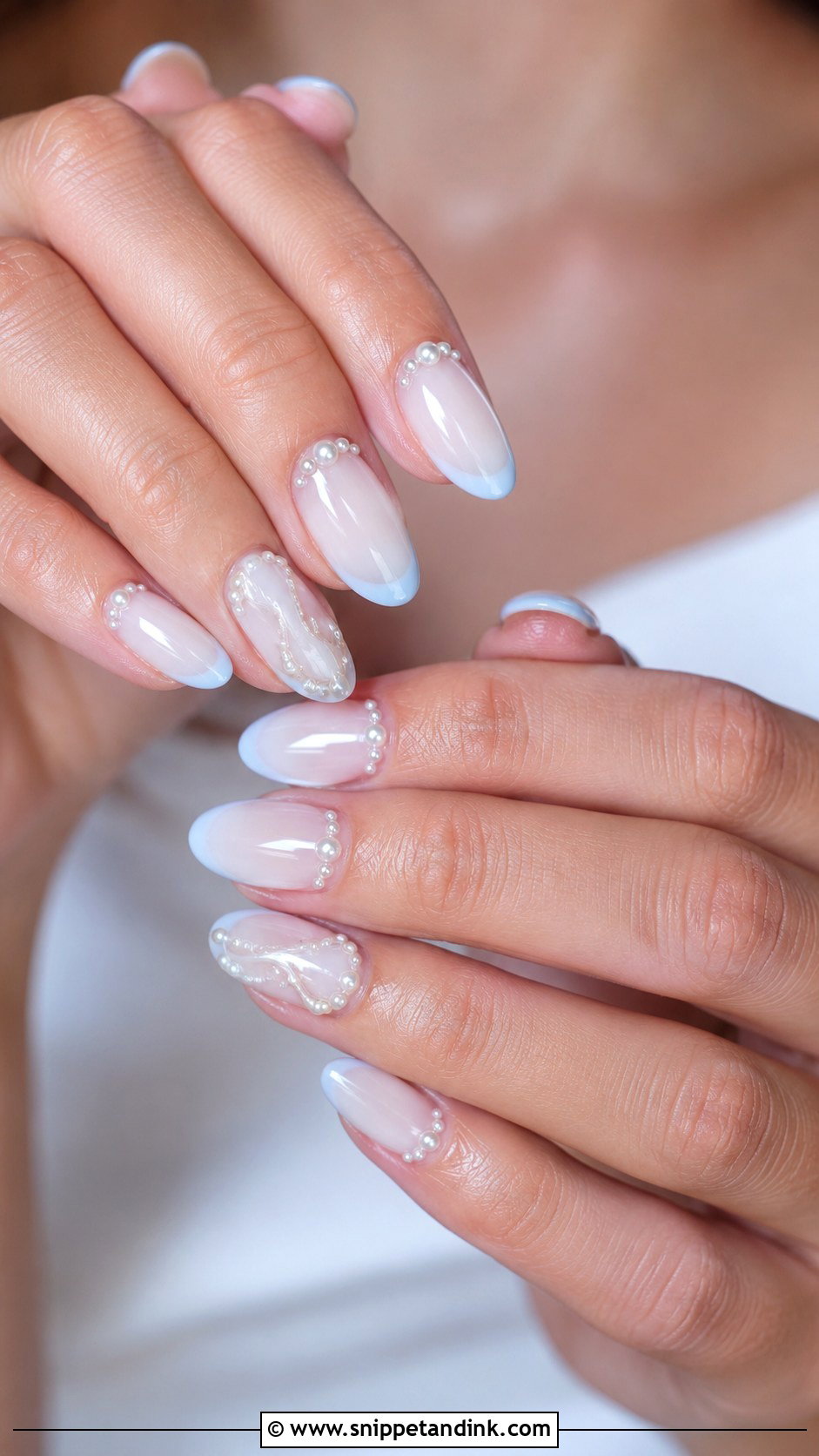
Pearls on milky white are already classic; the blue makes them yours. Try baby blue French tips with pearls near the cuticle, or one blue accent nail with a small cluster. I set flat-back pearls into builder gel rather than trusting top coat alone, because a pearl that sits proud catches on hair, tights and veil netting. Keep them tiny and spaced out. I seal around the pearl rather than over it, so it keeps its own sheen next to pearl earrings and satin.
8. Dusty Blue And White Wedding Nails
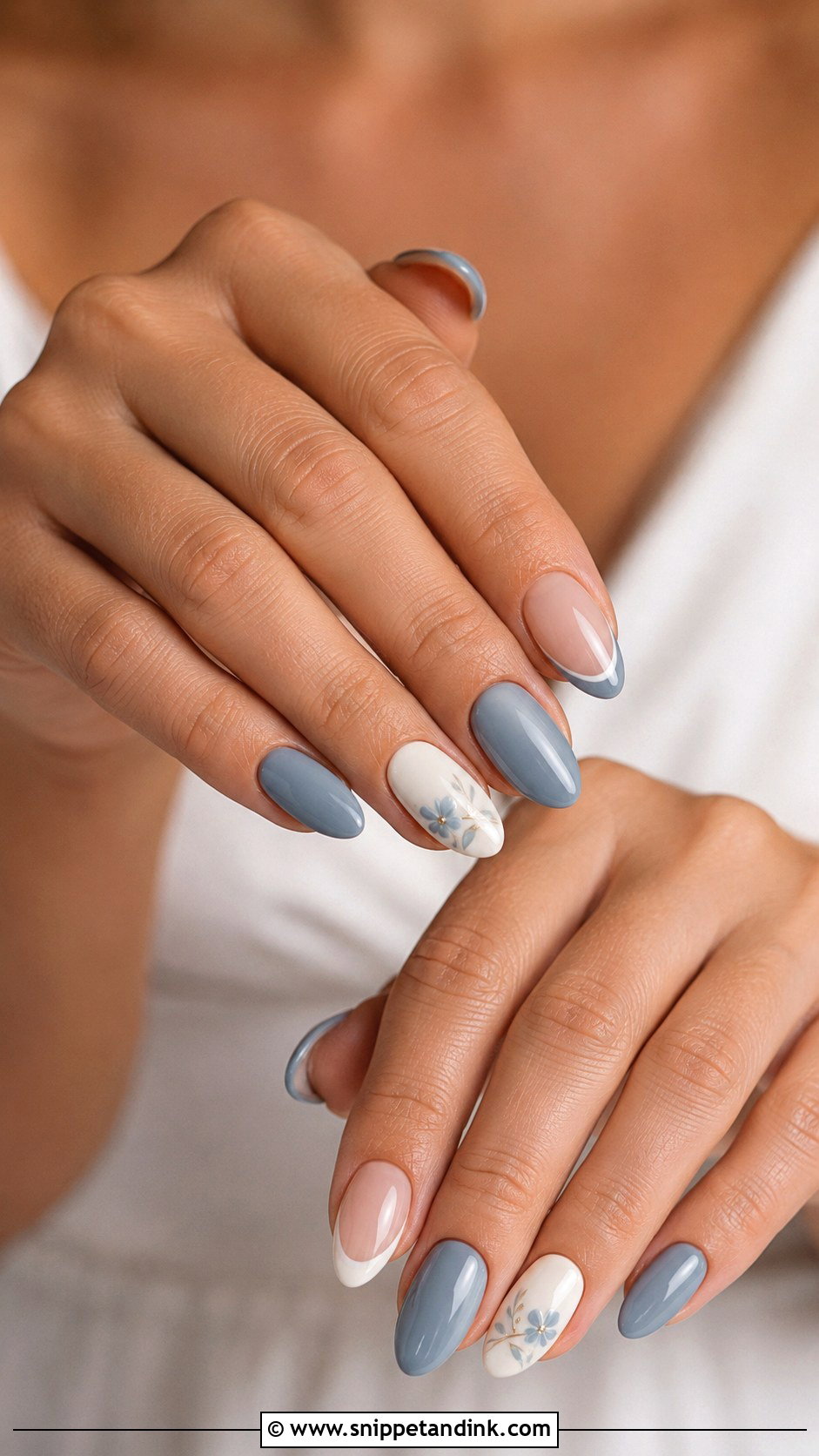
Dusty blue has a grey undertone, so it reads muted where pastel or cobalt reads bright. I suggest it most to brides whose palette already includes slate or blue-grey linens. Pair it with warm white or milky ivory rather than stark white, which can make the grey look tired. It works as French tips, an ombré, small florals or alternating nails, and it suits fall weddings and rustic barns especially well. Glossy keeps it soft. A satin-matte top coat makes it quieter still.
9. Blue And White Marble Wedding Nails
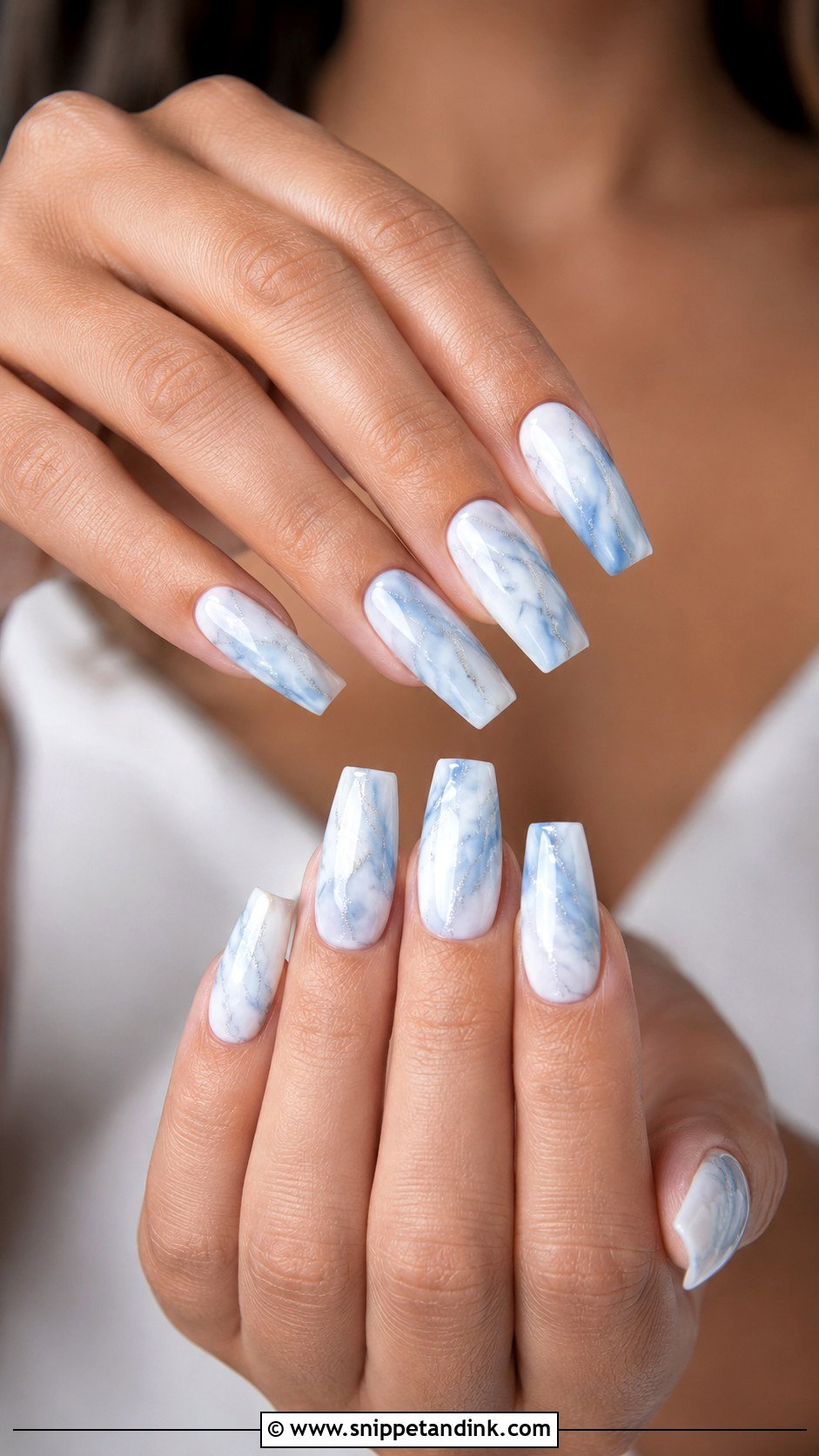
Marble only stays bridal when the veining is thin and airy. I lay a milky white base, drop fine blue lines into the wet gel and drag them with a thin brush so they feather, instead of building heavy dark swirls. A little silver or pearl shimmer between the lines gives a real stone feel. Coffin, almond and oval nails give the pattern room to flow. Keep it to one or two accent nails with plain white or pale blue on the rest, because a full marble set rarely looks calm in close-up.
10. Blue And White Porcelain Wedding Nails
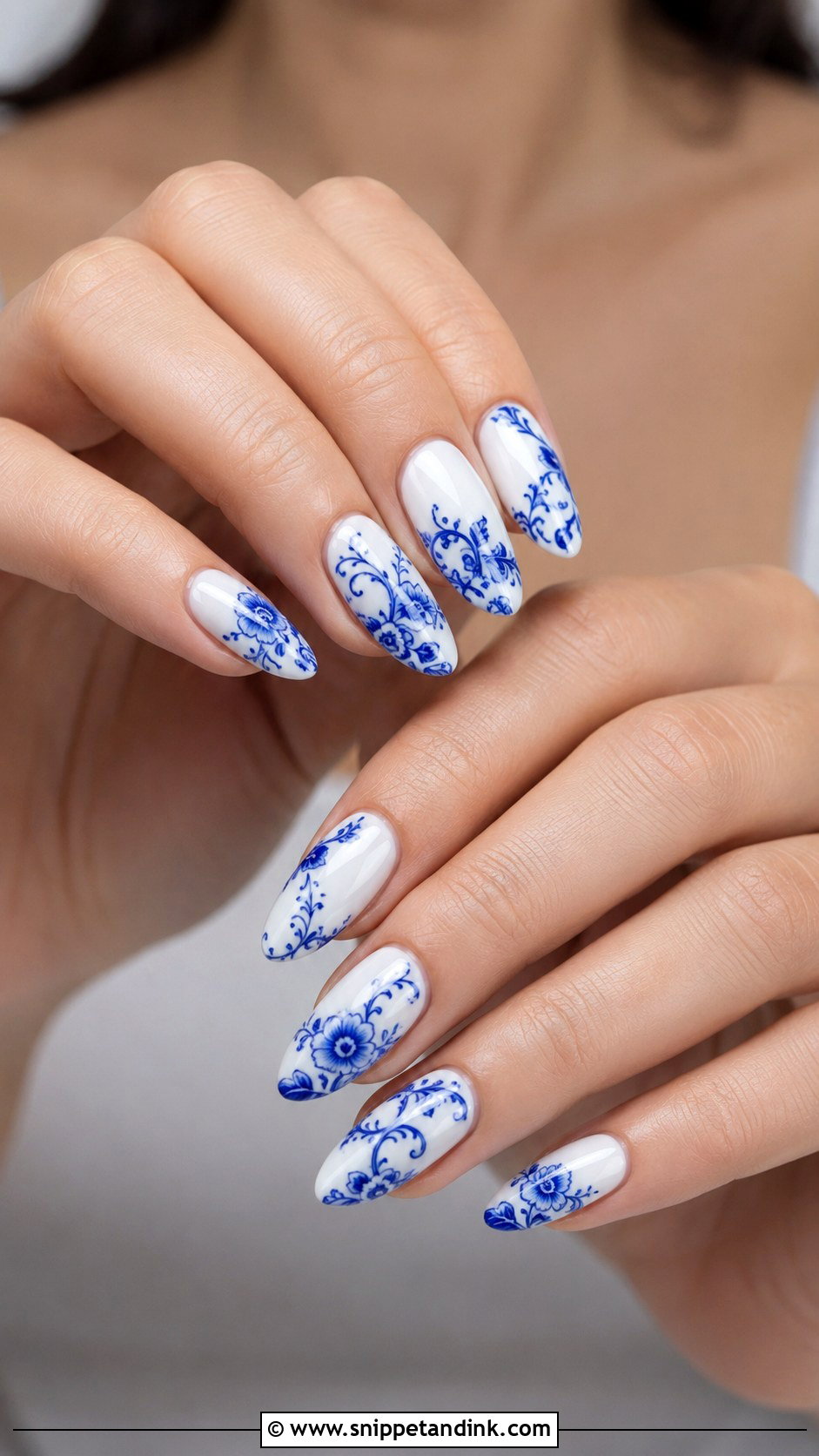
Porcelain art borrows from blue and white ceramics: fine cobalt or royal blue scrollwork on a crisp white base. It is detailed freehand work, so I book extra time for it and treat each accent nail like a small painting. On a plain gown, these nails become the detail guests ask about. Ask for thin, precise lines and plenty of white space. Before you book, look through the artist’s portfolio for line work, because shaky scrolls are the first thing a close-up catches.
11. Light Blue And White Glitter Wedding Nails
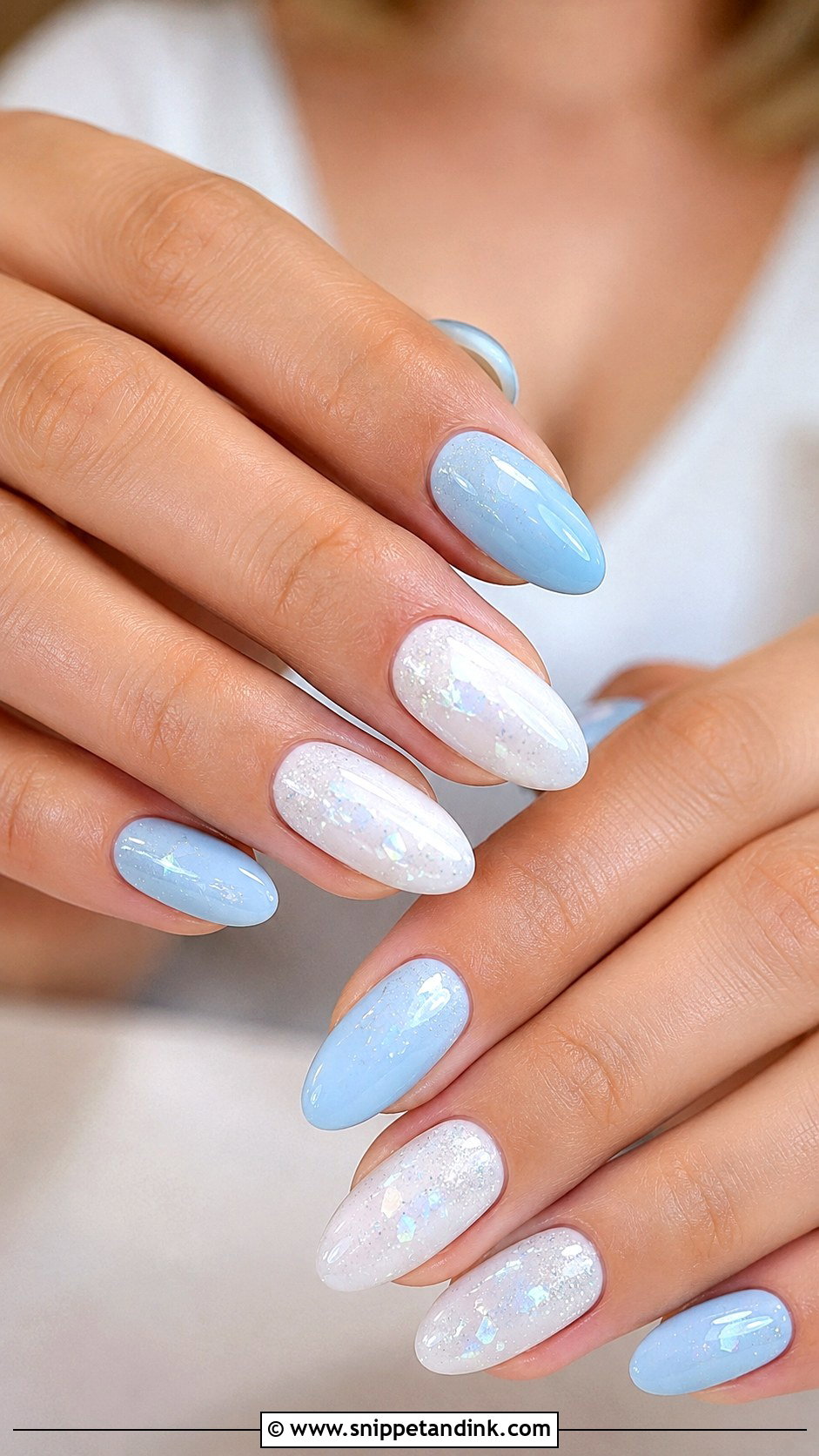
Fine glitter is the only kind I would use here. A pale blue base on some nails and milky white on others, then silver or iridescent micro glitter faded toward the tips or cuticles. Large hex glitter scatters camera flash and looks lumpy under top coat, while fine glitter simply glows. It suits winter weddings and ballroom receptions, and almond or coffin shapes give the fade room. One warning: glitter gel is the slowest finish to soak off, so plan for that if you want different nails for the honeymoon.
12. Blue And White Short Wedding Nails
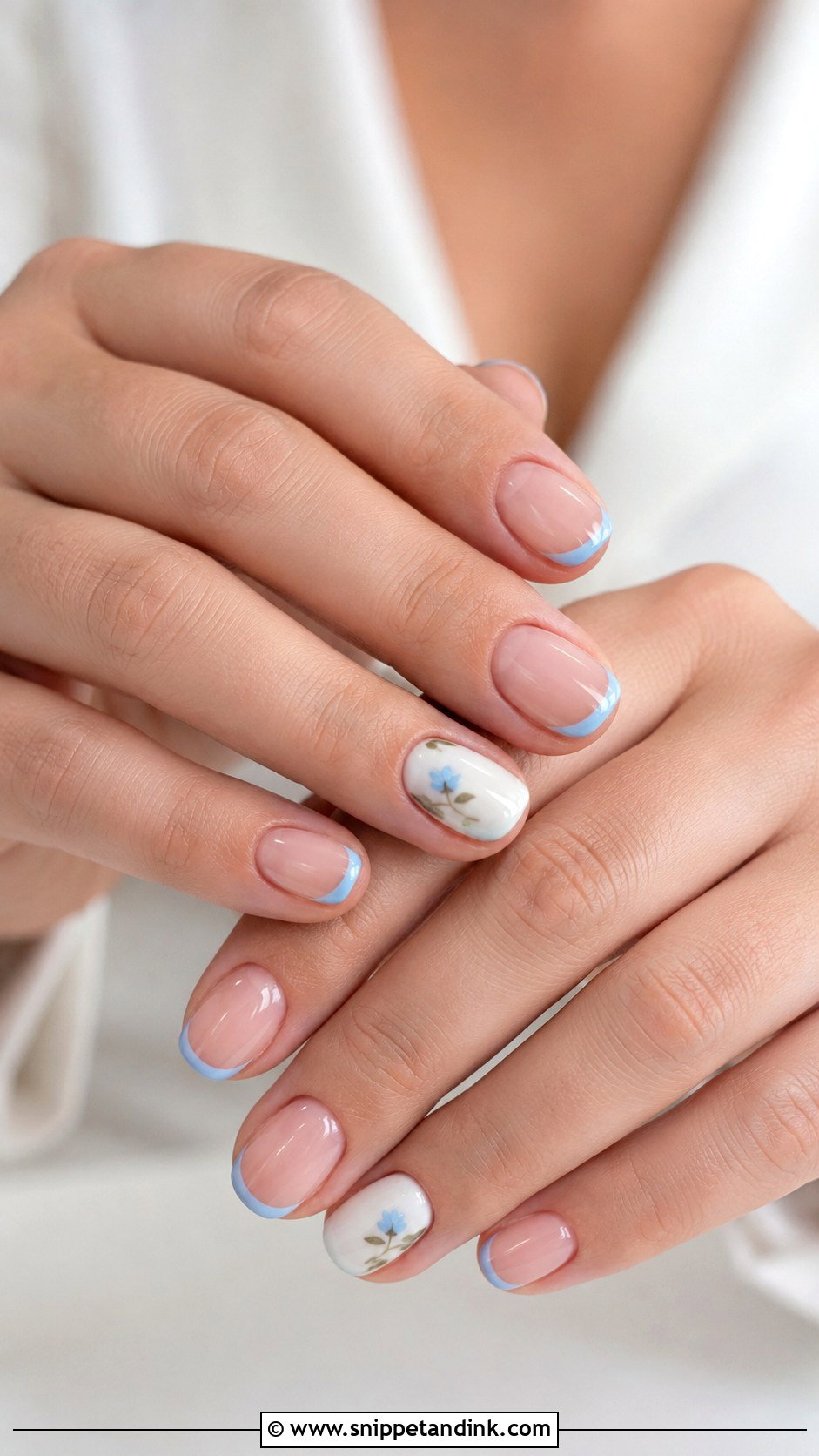
Short nails look every bit as bridal as extensions when the shape is clean. Slim baby blue French tips on a sheer pink base, or milky white nails alternated with pale blue accents, both read polished. Keep the art small: a tiny flower, two pearls or one shimmer detail. Short square and short oval are kind to brides who are not used to length, which matters when you are doing up buttons and holding a bouquet. On very short nails I make sure all ten free edges match, since uneven lengths stand out more than any colour choice.
13. Blue And White Almond Wedding Nails
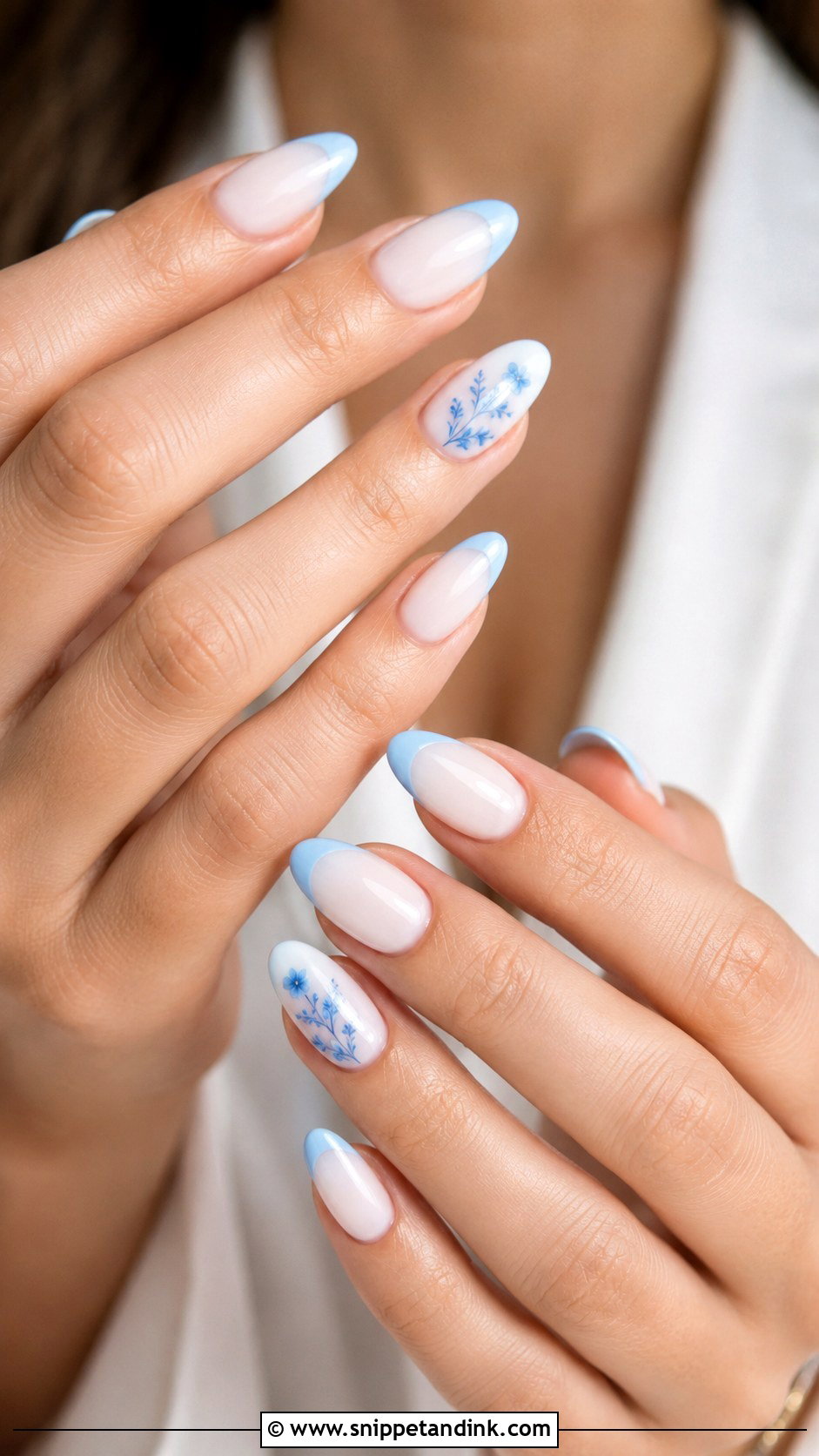
Almond lengthens the fingers and makes even plain designs look softer. Pair a milky white base with pale blue tips, small florals or a gentle ombré, and chrome sits well here too because the curve picks up light evenly. For more detail, put blue lace or porcelain art on the ring fingers only. My one caution: a very sharp almond on a thin natural nail can snap at the stress point, so I either build it with gel or keep the point slightly rounded. Classic and modern gowns both take it.
14. Blue And White Coffin Wedding Nails
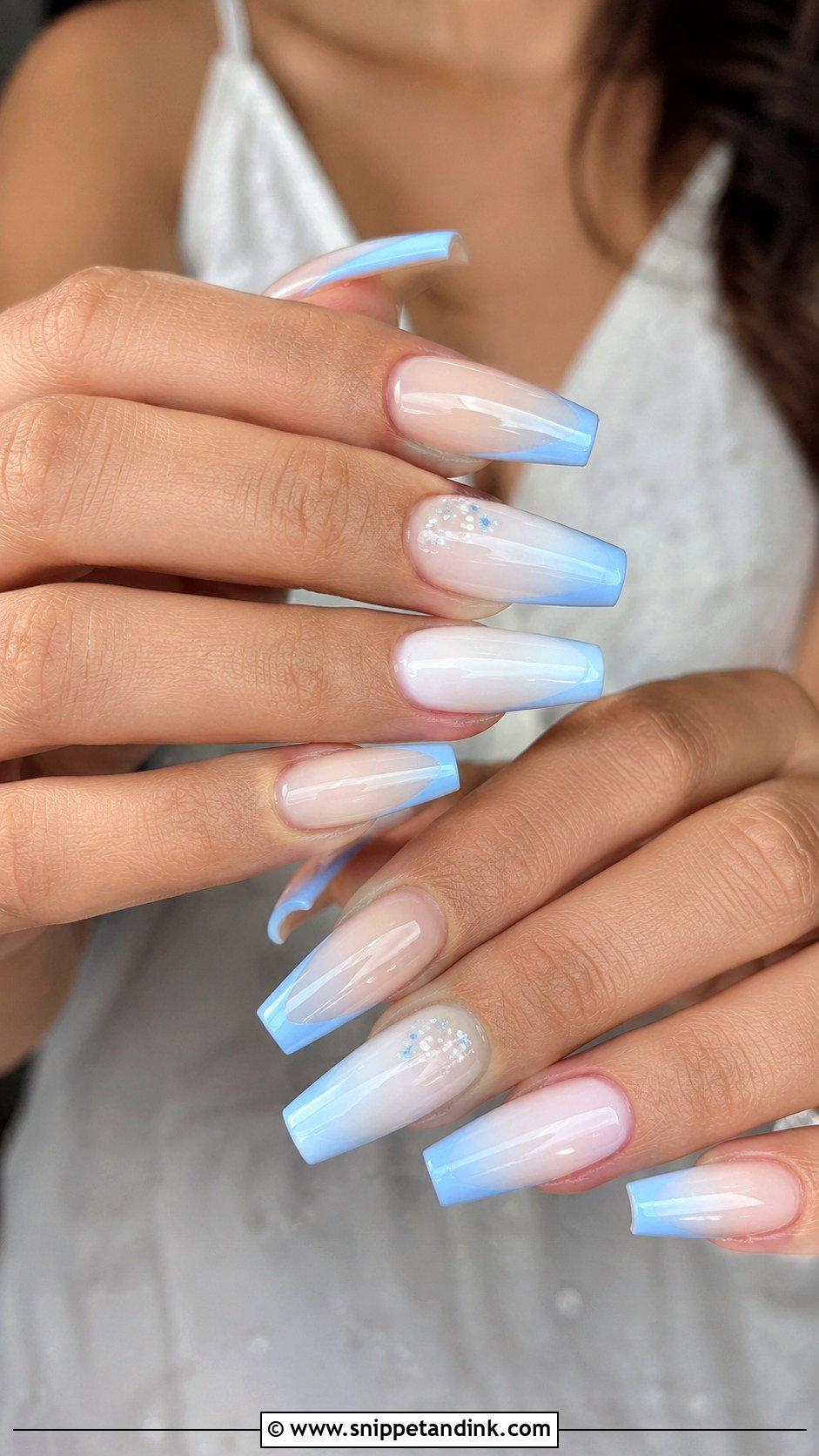
Coffin nails give you a flat tip with room for French designs, ombré, marble and pearls. To keep them bridal, do not make every nail loud: a soft white base with blue tips or pale blue ombré looks balanced, and navy with white florals on just two nails gives you drama. I recommend medium length. Long coffin nails fight with jewelry clasps and zips, and their square corners take every knock. A smooth glossy finish keeps the shape sharp.
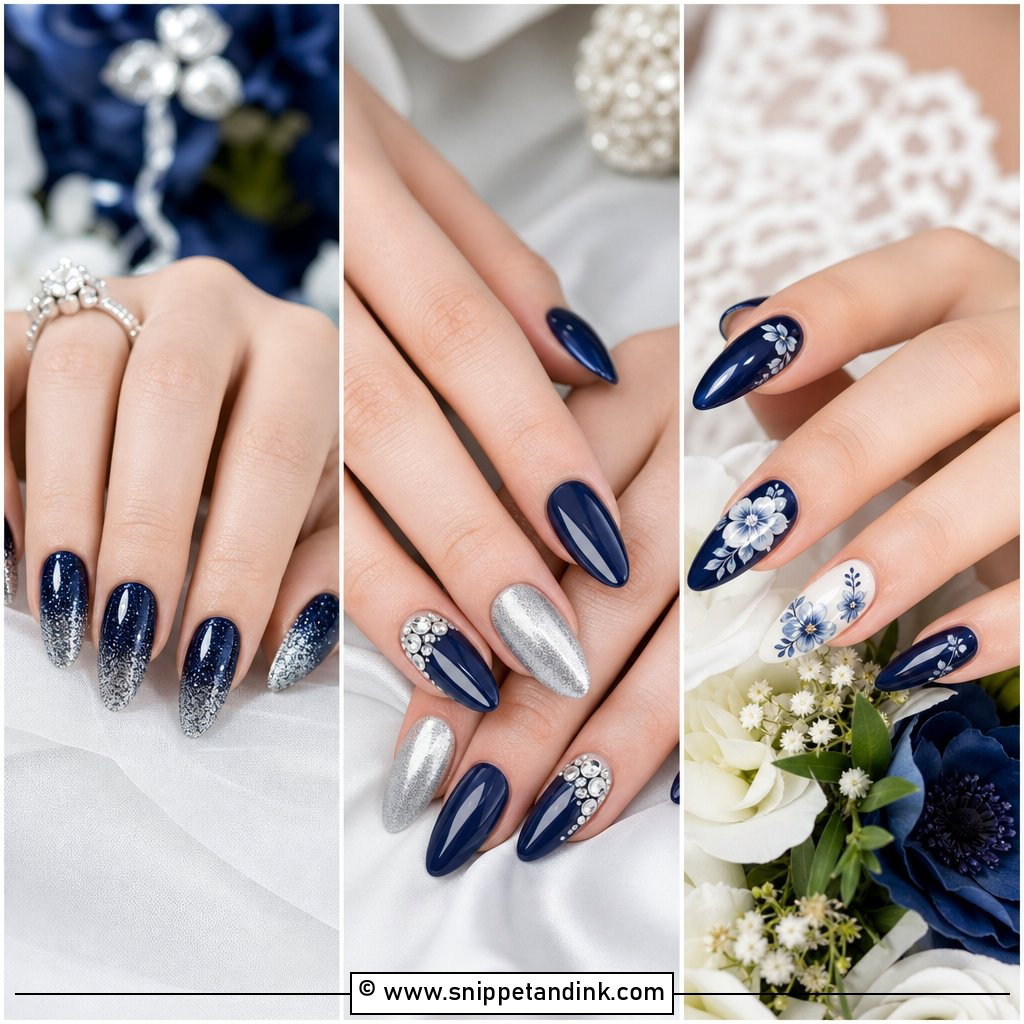
15. Blue And White Square Wedding Nails
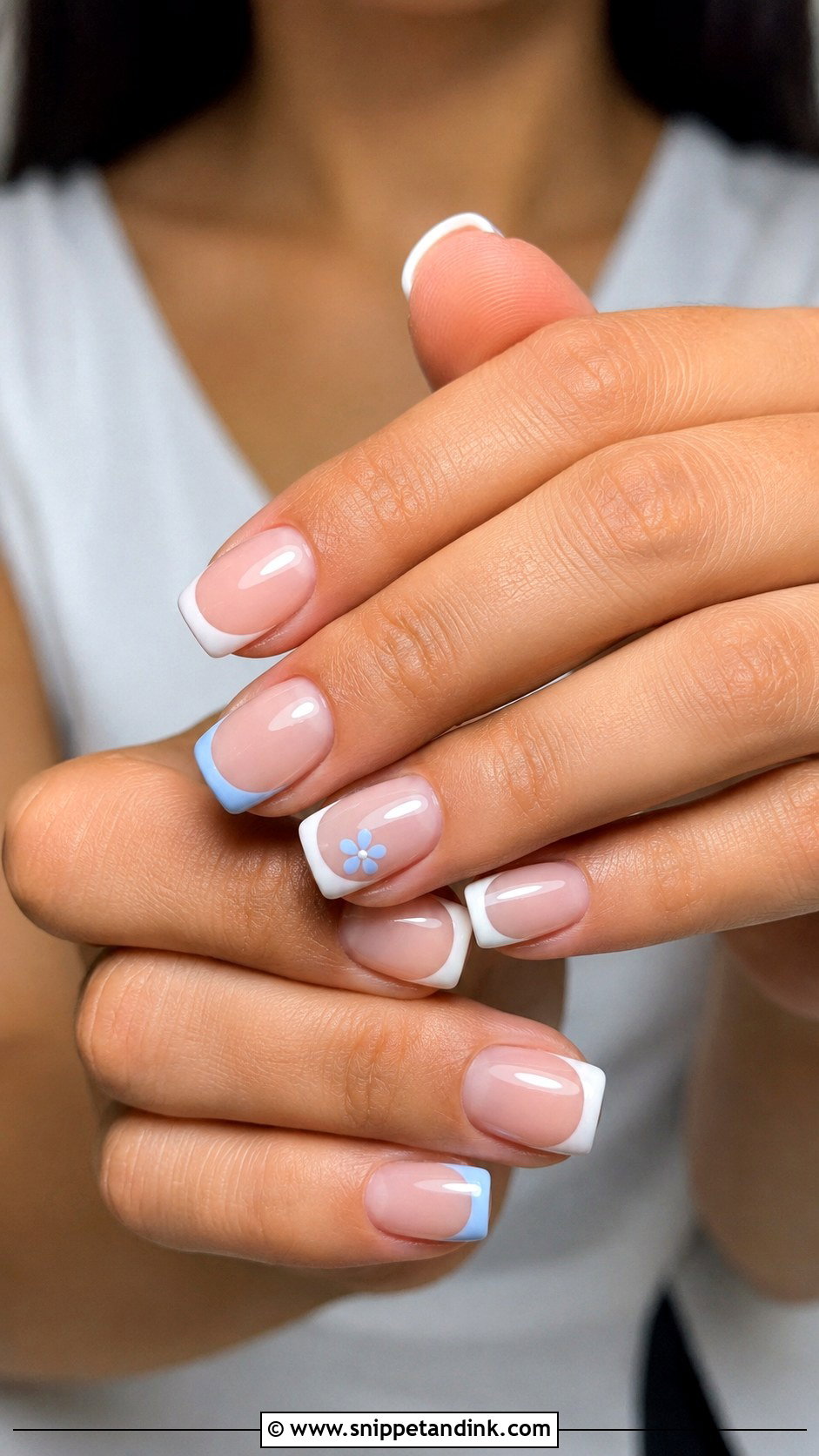
Square nails reward precision. Any wobble in the sidewalls or an uneven free edge is visible, so I shape them before any colour goes on and check them from the side as well as straight on. A short or medium square with white tips and a few baby blue accent tips looks fresh. A milky base with a thin blue outline tip is sleeker still. It suits minimalist gowns and structured dresses, and one small blue flower on each ring finger softens it.
16. Blue And White Matte Wedding Nails
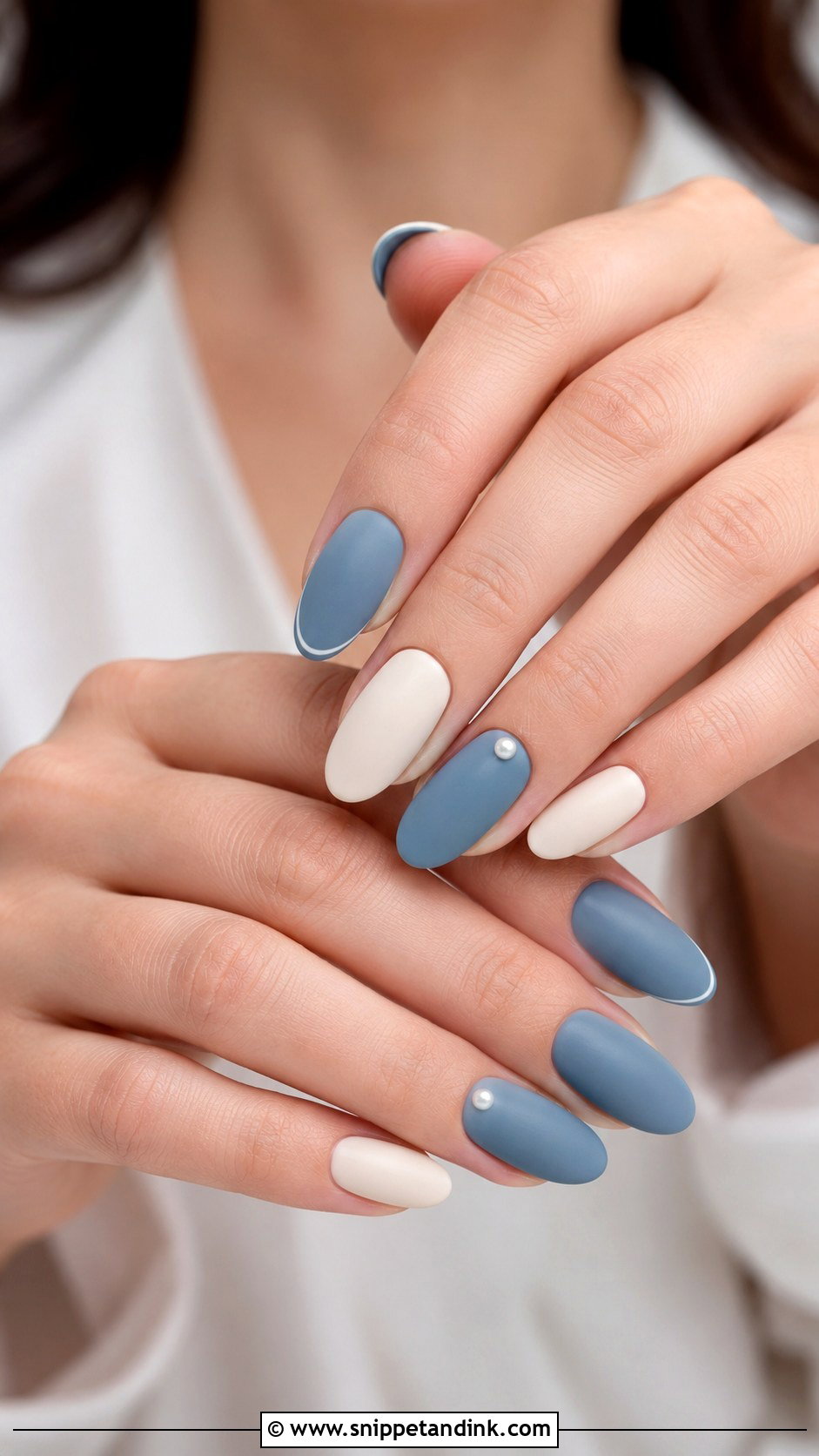
Matte top coat turns powder blue and ivory velvety, but it also shows every bump, so the surface has to be perfectly level before I seal it. Keep the art simple: white French tips over blue, or pale flowers on milky white. Matte picks up oil from hand cream and foundation and can look patchy by day two, so I tell brides to rub lotion in with their palms and keep it off the nail plate. One glossy accent or a tiny pearl gives you contrast.
17. Blue And White Rhinestone Wedding Nails
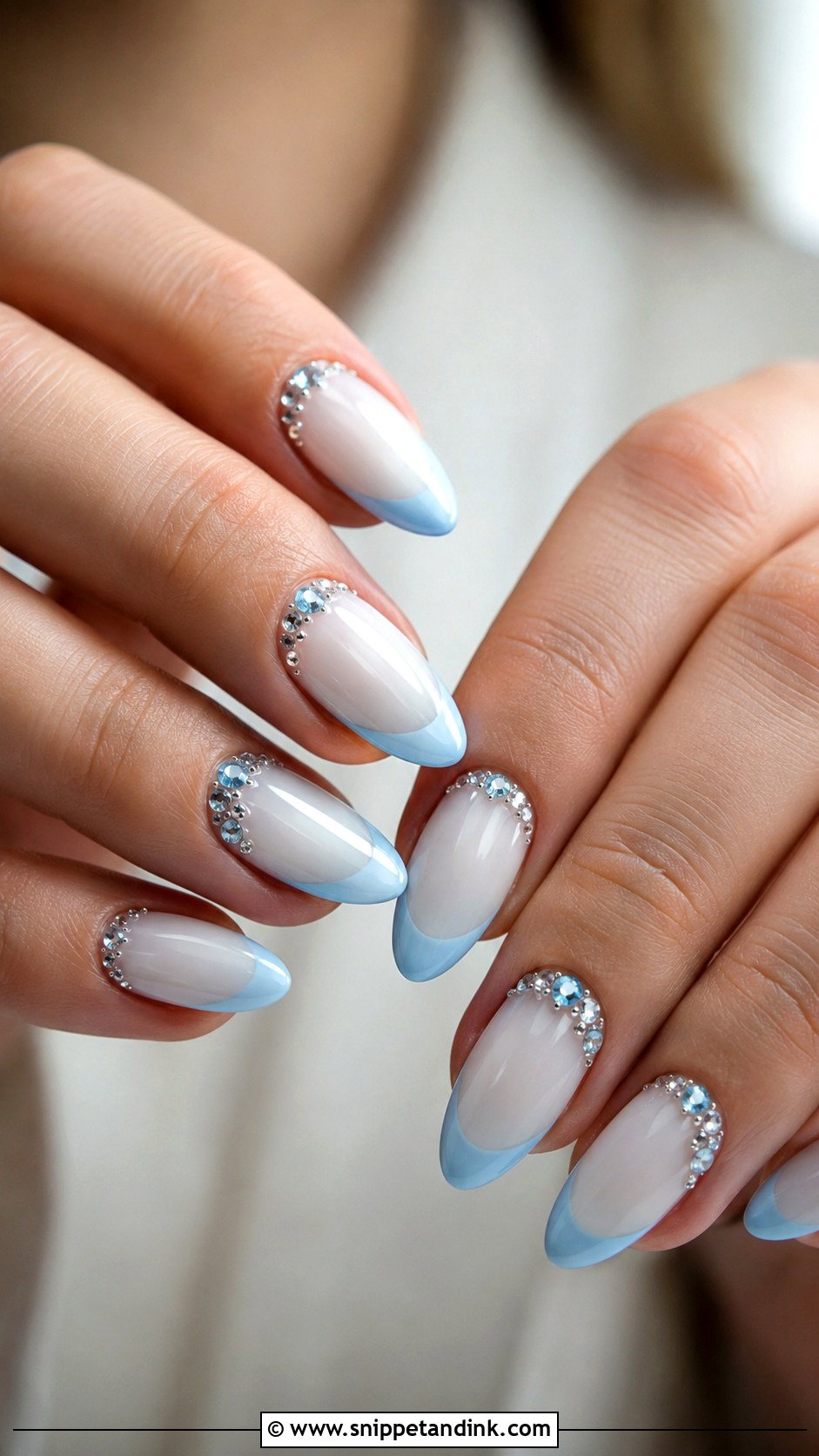
Blue and white rhinestone wedding nails work when the stones are highlights, not the design itself. Try milky white nails with baby blue tips and a few tiny crystals at the cuticle, or a short line of stones on one accent nail. Clear, silver or pale blue crystals stay inside the bridal palette. I set them in gel and cap the edges so they cannot snag lace or tulle. Almond and coffin shapes give them enough room.
18. Blue And White Swirl Wedding Nails
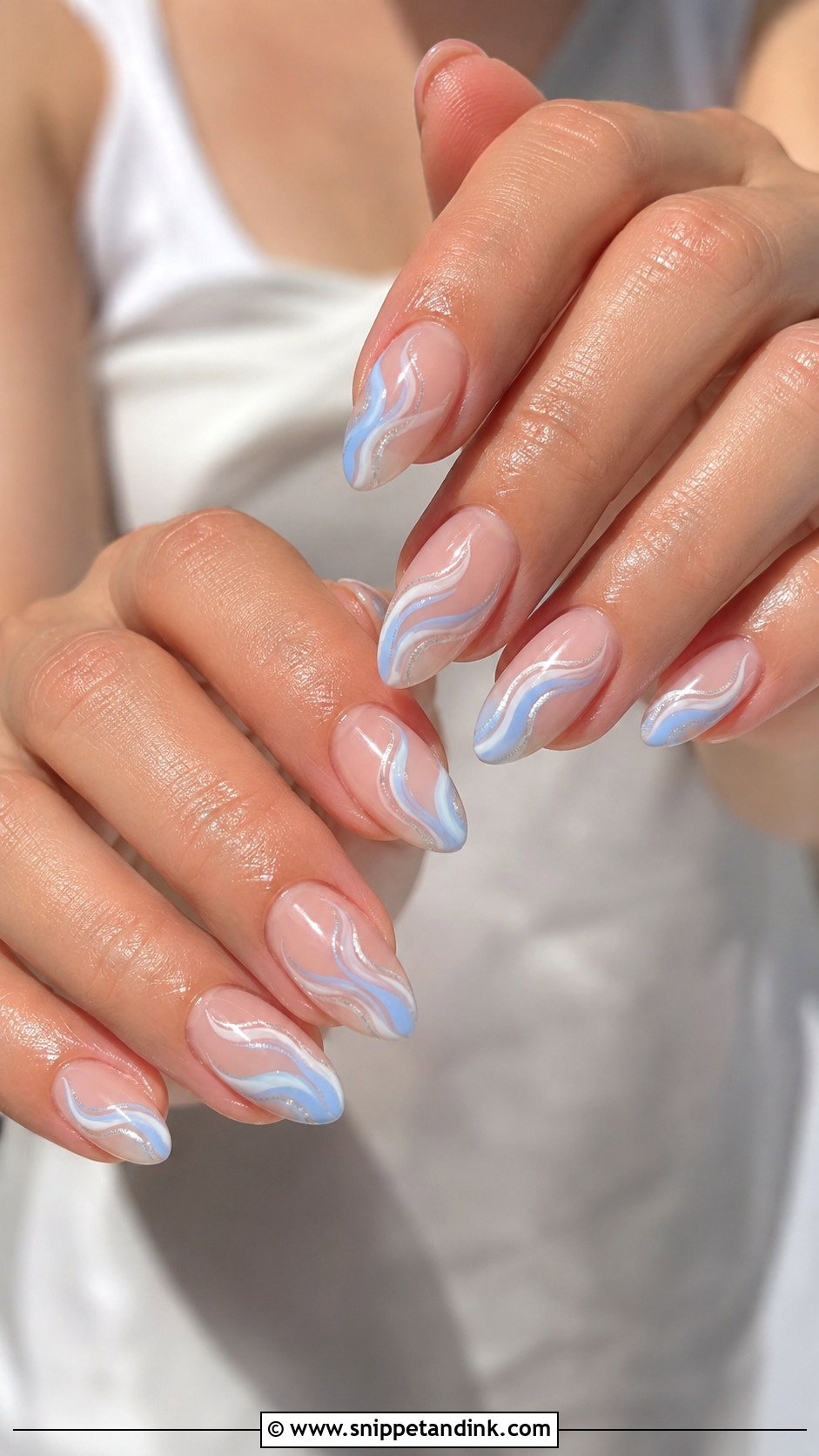
Swirls need confident, continuous strokes. Paint one in short sections and every join shows. Thin blue and white lines over a sheer nude or milky base look best kept light, and they suit beach weddings and dresses with soft draping. Run them diagonally across each nail or keep them to accents. Almond makes the curves look natural, and a glossy top coat smooths the lines into a glassy finish.
19. Blue And White Bridal Nails With Silver Accents
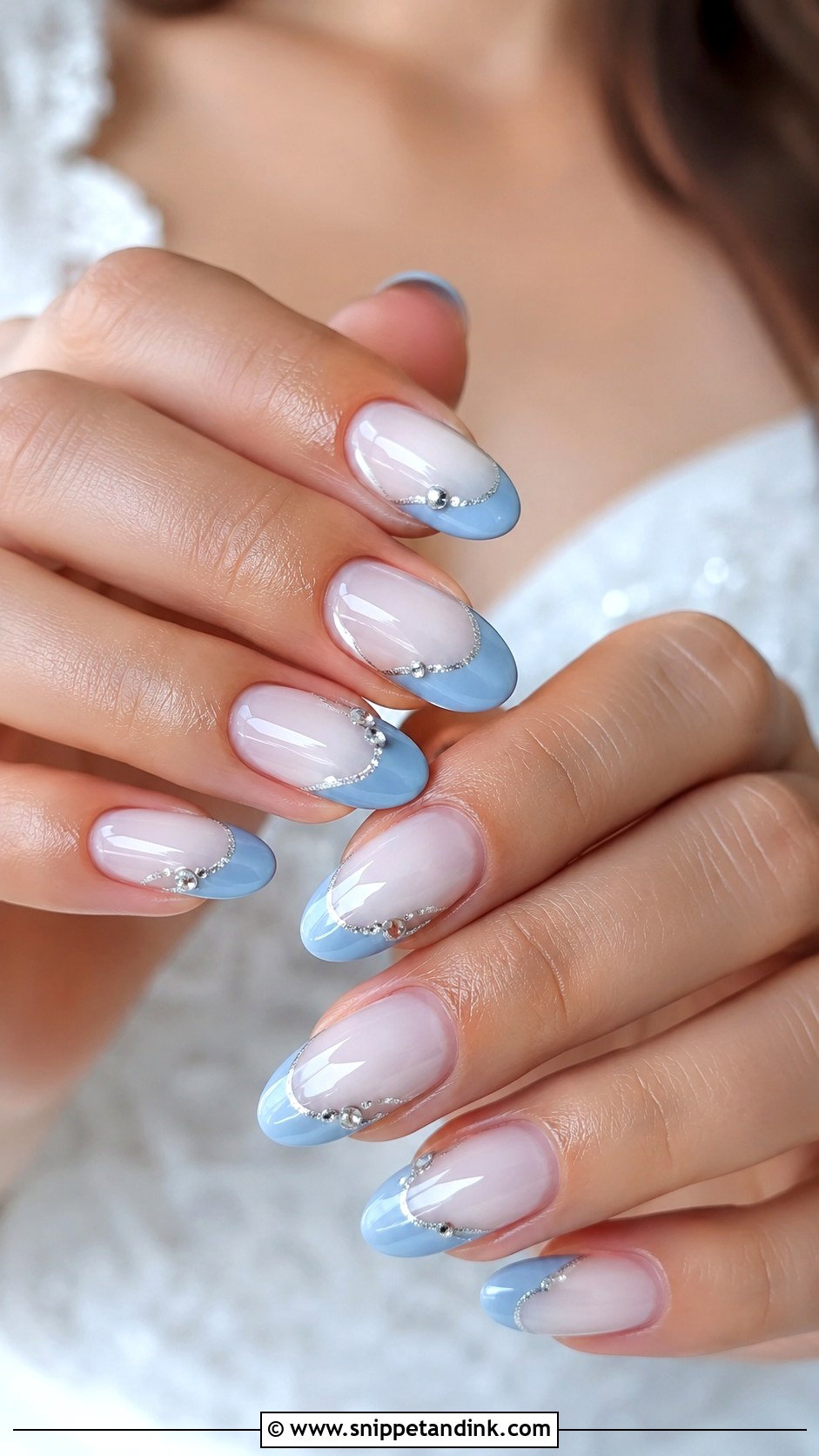
Silver ties the set to silver jewelry and cool-toned gowns. Start with soft white or sheer nude, add pale blue tips, accent nails or small blue flowers, then bring in silver as a thin glitter line, a chrome edge or one tiny crystal. Silver should be the highlight, never the main event. Hold your ring next to the swatch before committing, because a warm white gold band and a cold chrome silver do not always agree. Fine silver detail looks the most refined.
20. Royal Blue And White Wedding Nails
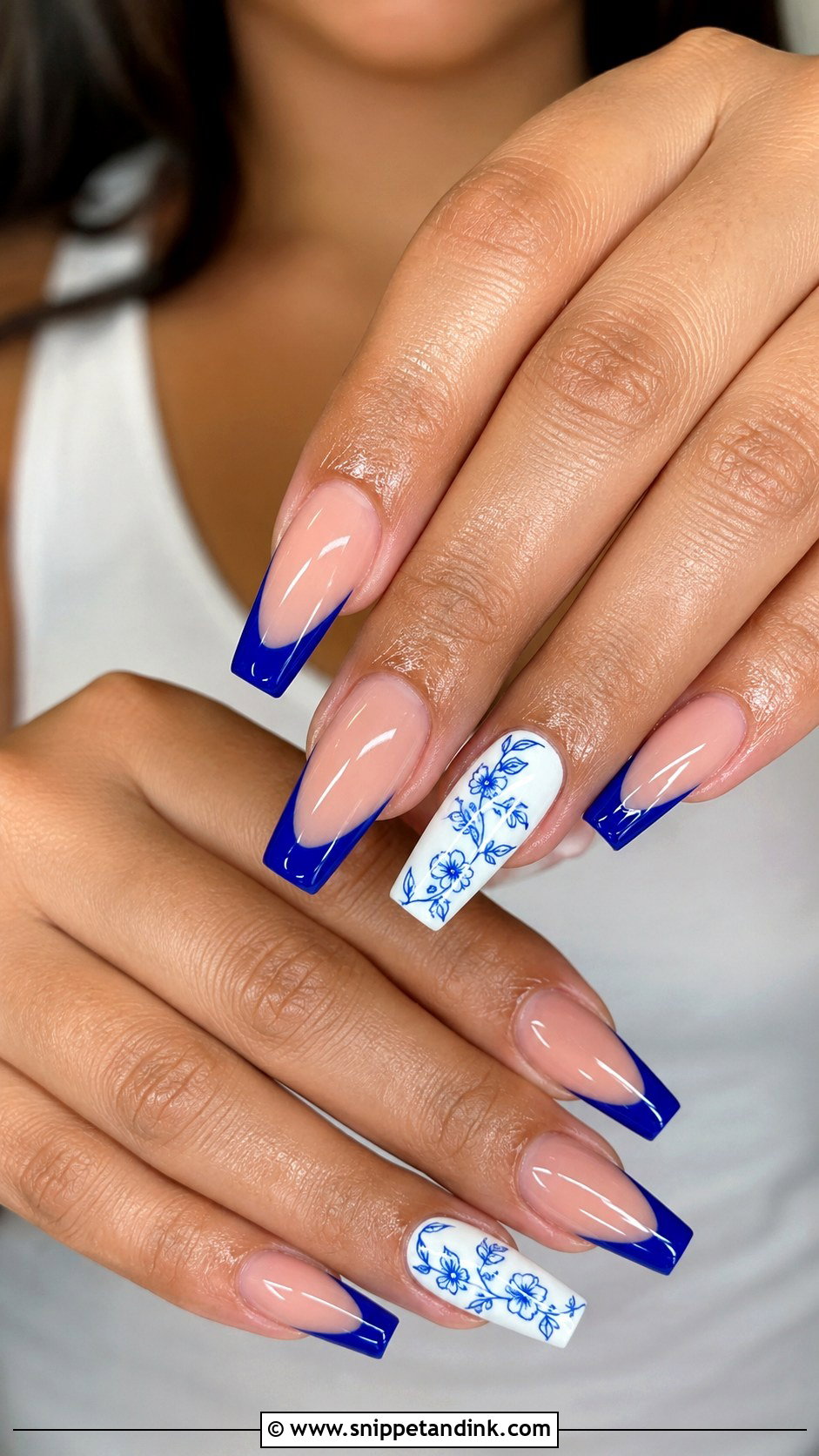
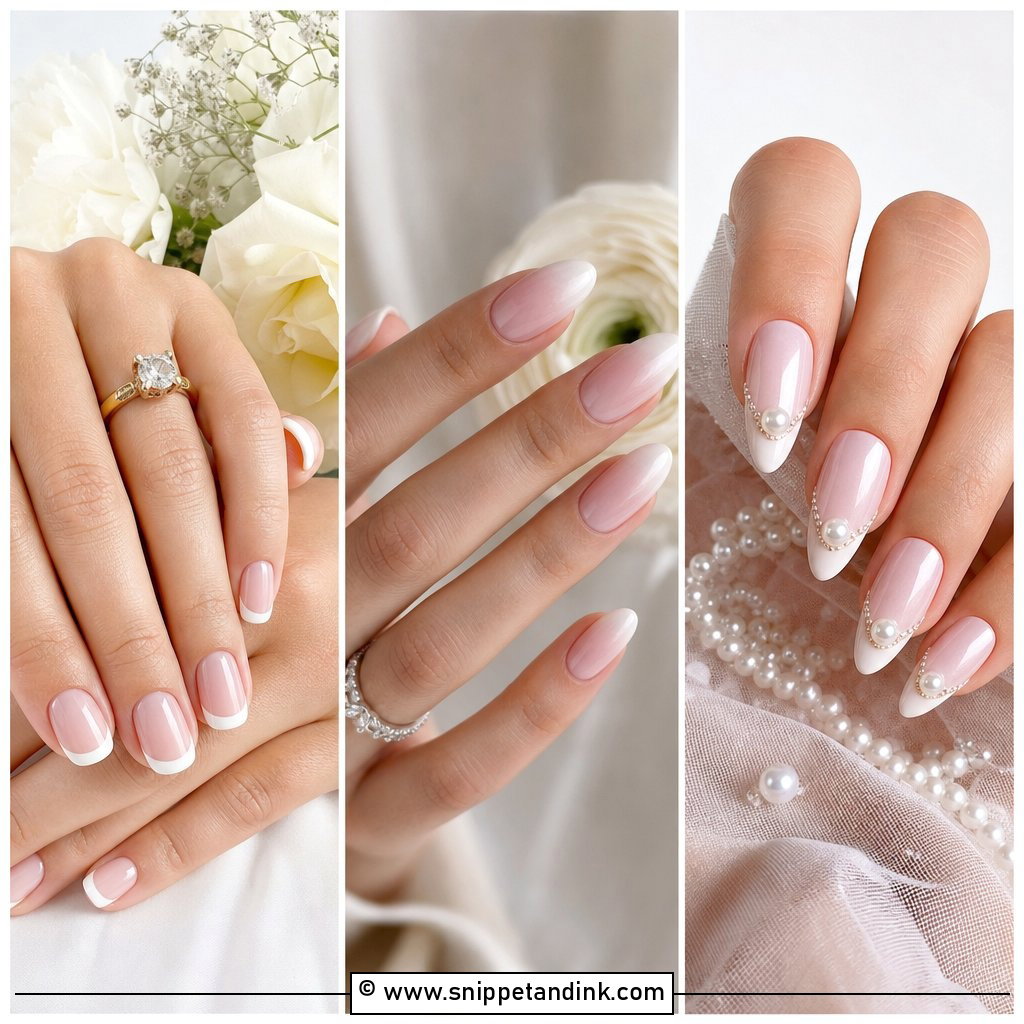
Royal blue is for the bride who wants her something blue to be seen. I balance it with clean white, sheer nude or soft French details: royal blue tips on nude with white florals on two nails, or royal blue nails alternated with white ones carrying fine blue line art. Saturated blues can stain bare natural nails, so a proper base coat is not optional if you are wearing regular polish. Medium almond or coffin keeps the colour from looking heavy, and a glossy finish keeps it rich.
Gel, Dip or Press-Ons for a Blue Wedding Set
For most brides I recommend gel, done one to three days before the wedding. That gives the cuticles time to settle without the set looking grown out in honeymoon photos. Gel also holds fine line work like lace and porcelain scrolls better than regular polish, which can drag and smear under top coat.
Dip powder is tough, but the colour range is narrower and detailed art usually has to be painted on top anyway. Press-ons are a sensible choice if you want long coffin or almond nails for the day only; have them sized at a trial so none of them pinch at the sidewalls, and use proper glue rather than adhesive tabs if you want them to last a full wedding day.
A Chipped Blue Tip at the Reception
White hides small chips; blue does not. If a tip catches on a car door or a bouquet wire, do not peel at it, because lifting gel takes a layer of natural nail with it. A clear top coat in your bag will seal a small chip until the end of the night, and a matching mini bottle of the blue shade lets a bridesmaid touch it up in a couple of minutes.
Ask your nail artist for the exact shade name before you leave the salon. A near match in blue looks obviously off under flash, far more than a near match in nude ever would.
Matching the Blue to Your Dress, Ring and Bouquet
The shade sets the mood: baby blue and dusty blue are soft, navy and royal blue are formal, porcelain blue is artistic. The white decides whether it still reads bridal. If you want quiet, go with French tips, ombré, short nails or milky chrome; if you want detail, lace, florals, marble, pearls or porcelain art. Bring your dress fabric, ring and bouquet colours to the appointment, then pick the set you will be comfortable wearing through every handshake and toast.
You'll Like These Ideas:


Leave a Reply