
Couples who ask me for a stack of cheese wheels instead of a sponge cake usually have the same two reasons: they’d rather feed people than serve a dessert half the room leaves on the plate, and they want a reception centerpiece that looks a little unexpected. A cheese tower does both. It is wheels stacked like tiers, dressed with fruit, herbs and honey, and surrounded by crackers and bread so it turns into a grazing station once the photos are done. It suits barns, gardens, vineyard-style venues and cosy evening receptions. Below are twenty ways I’d build one, with the practical notes on structure, serving and timing that make the difference between a showpiece and a sagging pile.
How Much Cheese Does a Tower Really Need?
The first thing I work out with a couple is what job the cheese is doing. A tower served alongside a full dinner is a small taste. A tower that replaces the evening food is a meal. The quantities are very different.
- As a nibble after a full meal: roughly 1 to 2 ounces (30 to 60 g) of cheese per guest.
- As the main evening food or a cocktail-hour spread: closer to 3 to 4 ounces (85 to 115 g) per guest, with plenty of bread and crackers.
- Plan for about three-quarters of your guest list to eat from it. Some people always skip the cheese.
A stack of whole wheels often holds more cheese than you need, which is fine if you’re happy taking leftovers home. If not, a smaller display tower with sliced backup cheese in the kitchen is better value.
Ordering whole wheels
Large wheels are rarely sitting in a shop’s cold room. Speak to a cheesemonger several weeks ahead, give them the diameters you need for each tier, and ask them to hold the wheels until a day or two before the wedding. Bring a tape measure to the conversation. Tier sizes matter more than names on a tower, and a good cheesemonger can suggest swaps when a cheese you want only comes in an awkward size.
1. Cheese Wheel Wedding Cake
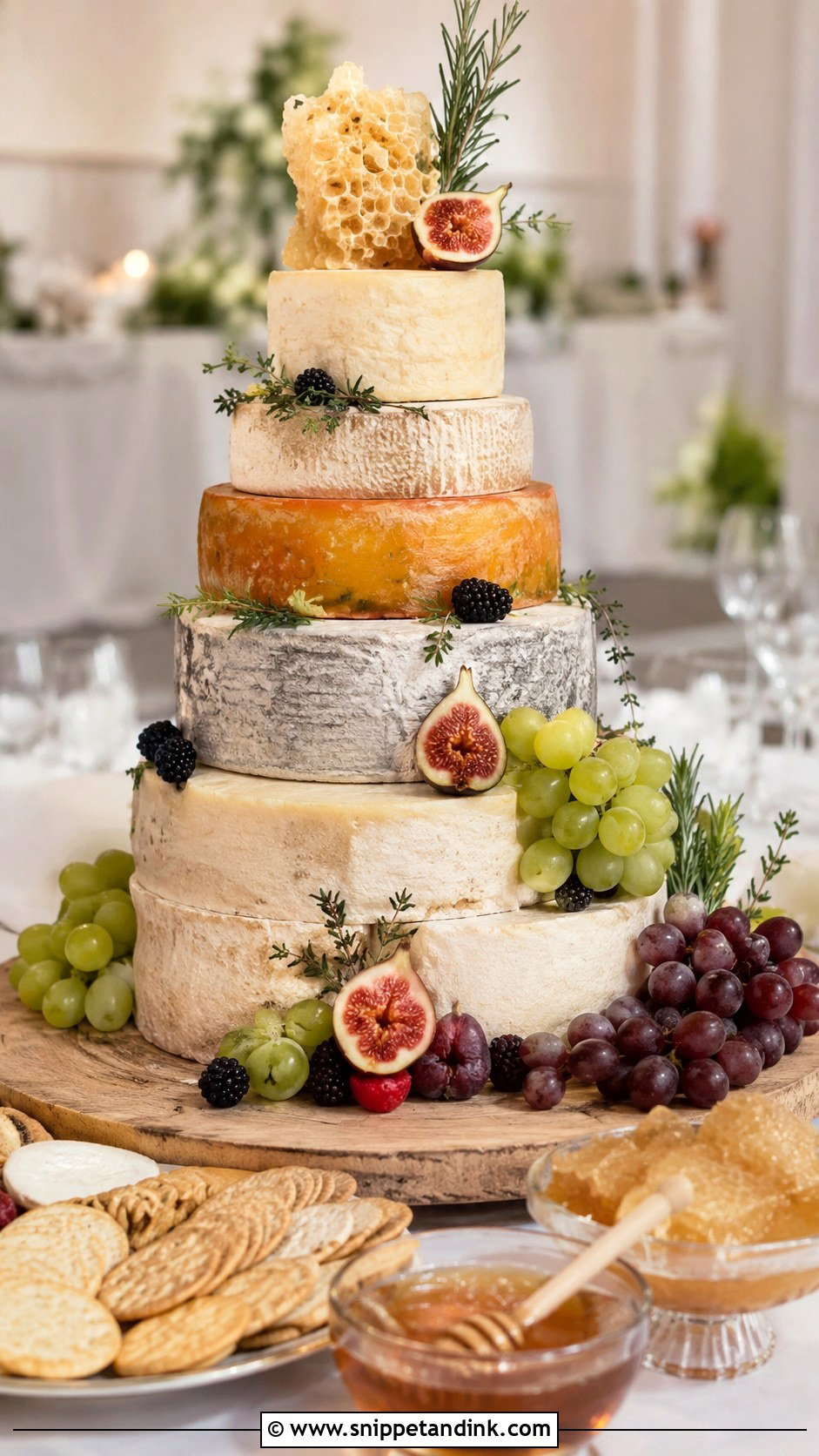
The classic version is a straight stack of wheels getting smaller toward the top. A large, firm wheel goes on the bottom because it carries everything above it, then medium and small rounds step upward. I mix textures, something like a cheddar, a brie, a goat cheese and a blue, so guests get a real choice. Grapes, figs, berries, rosemary and a few edible flowers go around each ledge, and crackers and sliced bread wait on the board below. One thing people don’t expect: a stack of whole wheels is heavy, so it gets assembled on its final board and table, never carried across a room.
2. Rustic Cheese Board Wedding Cake
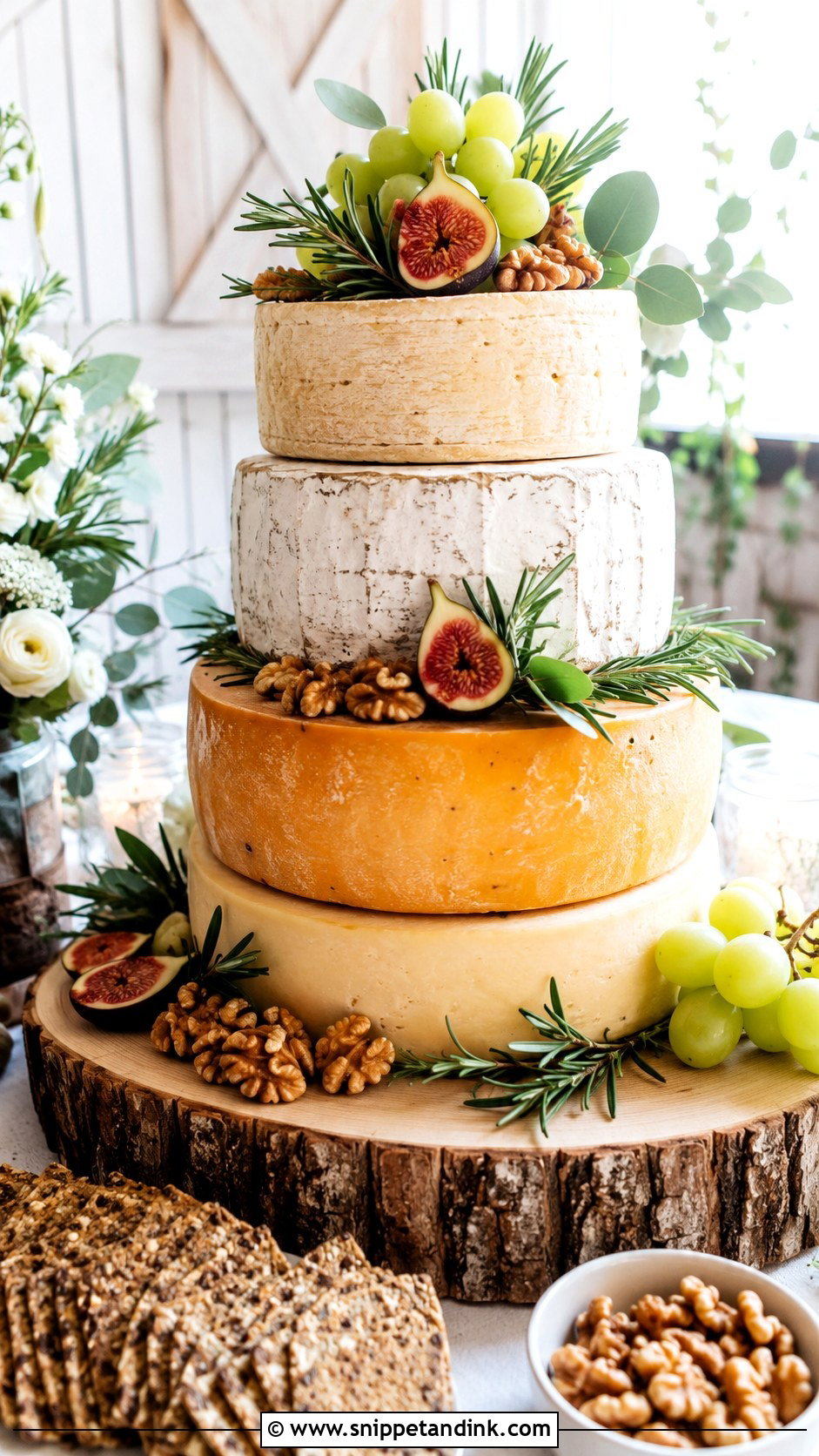
Rustic works when the cheeses look like they came from a farm rather than a supermarket. I choose wheels with visible rinds, slightly uneven edges and warm cream tones, set on a thick wood slab or a farmhouse board. Seeded crackers, grapes, figs, pear slices, walnuts and loose greenery fill the base. Abundant and messy are close neighbours, so I group each ingredient in its own cluster instead of scattering it. Pears and apples brown within minutes of slicing; a quick toss in lemon water keeps them pale through the photos. Barns and countryside receptions suit it.
3. Elegant Cheese Board Wedding Cake
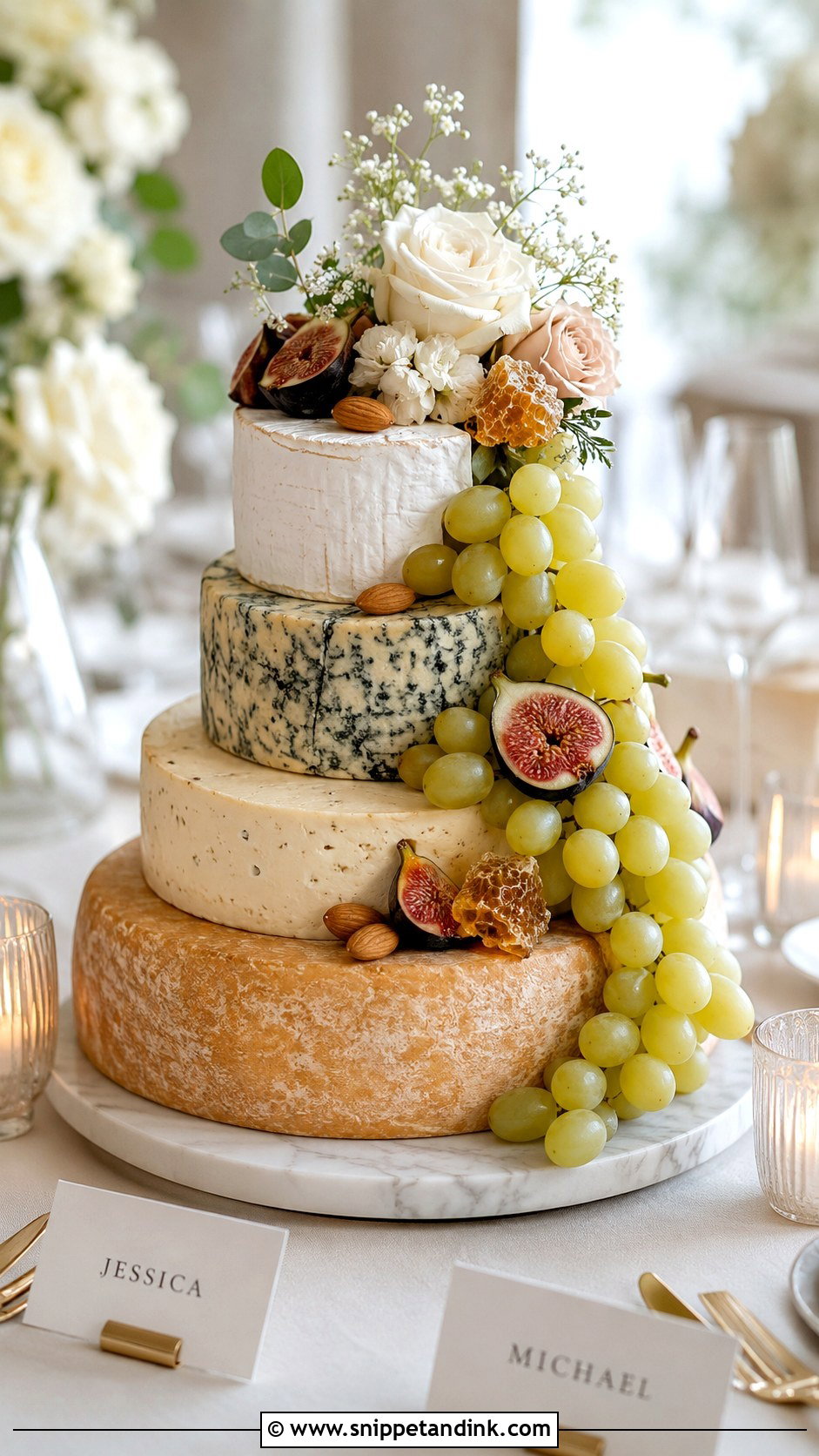
For a formal room, the cheeses themselves need to look tidy: smooth ivory rinds, pale yellows and a gentle blue for contrast, stacked dead centre. Garnish stays minimal, with white grapes, figs, honeycomb, almonds and a few delicate flowers. A marble cake stand or a white ceramic platter lifts the whole display. I add small labels printed to match the wedding stationery, because guests won’t help themselves to a cheese they can’t name. Honeycomb drips; it sits in a shallow dish, not directly on the board.
4. Small Cheese Board Wedding Cake
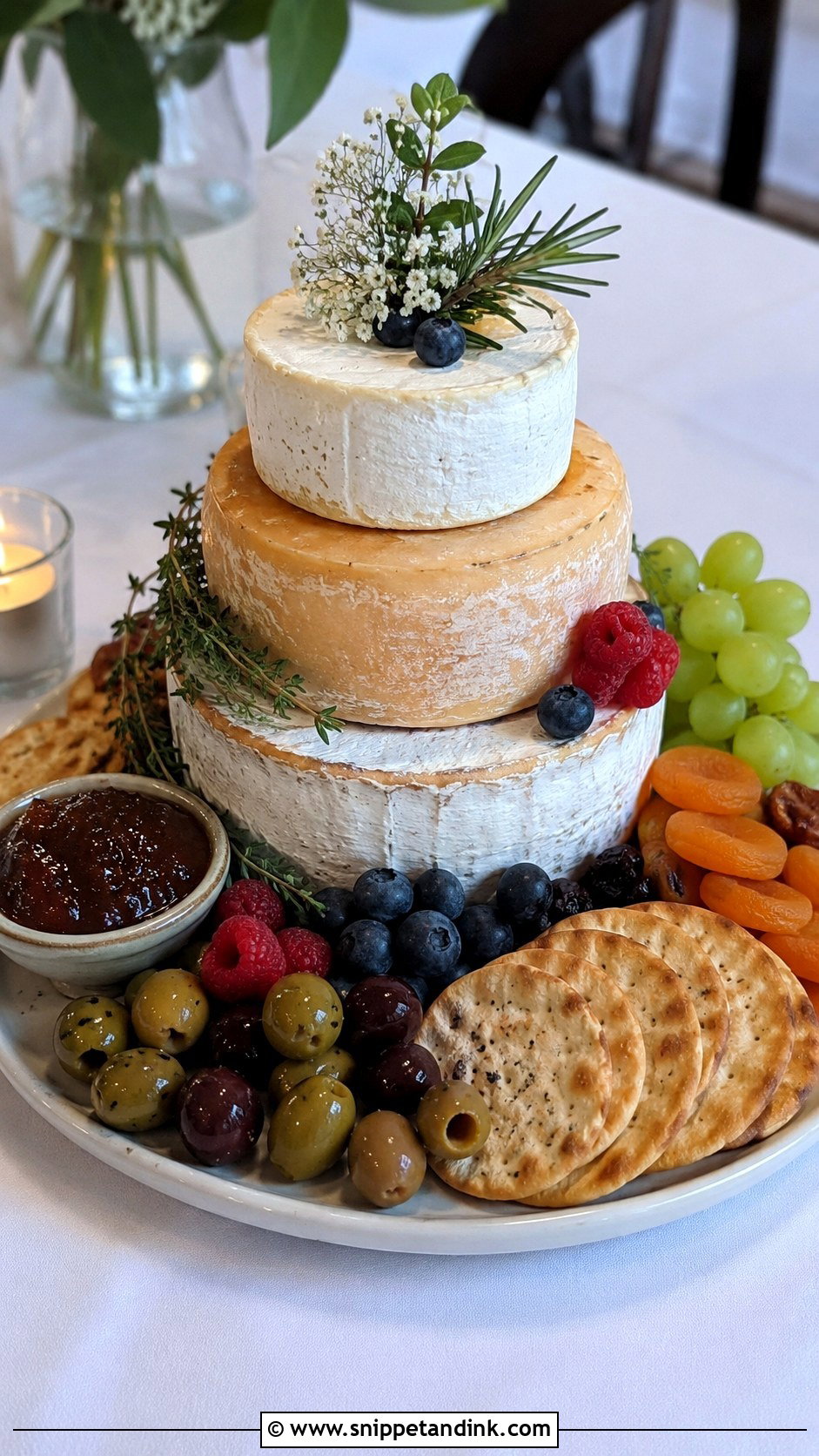
Two or three wheels are plenty for a micro wedding, a courthouse lunch or a brunch reception. I’d pick one creamy, one firm and one stronger cheese so the selection still feels complete. Crackers, berries, dried apricots, olives and a small bowl of chutney fill the base. A short stack needs height from somewhere else, so I raise it on a cake stand and let the garnish build up around it. A simple topper or a few herbs and flowers in the wedding colours finish it. For a small group this can be the whole savoury course, not just an accent.
5. Large Cheese Board Wedding Cake
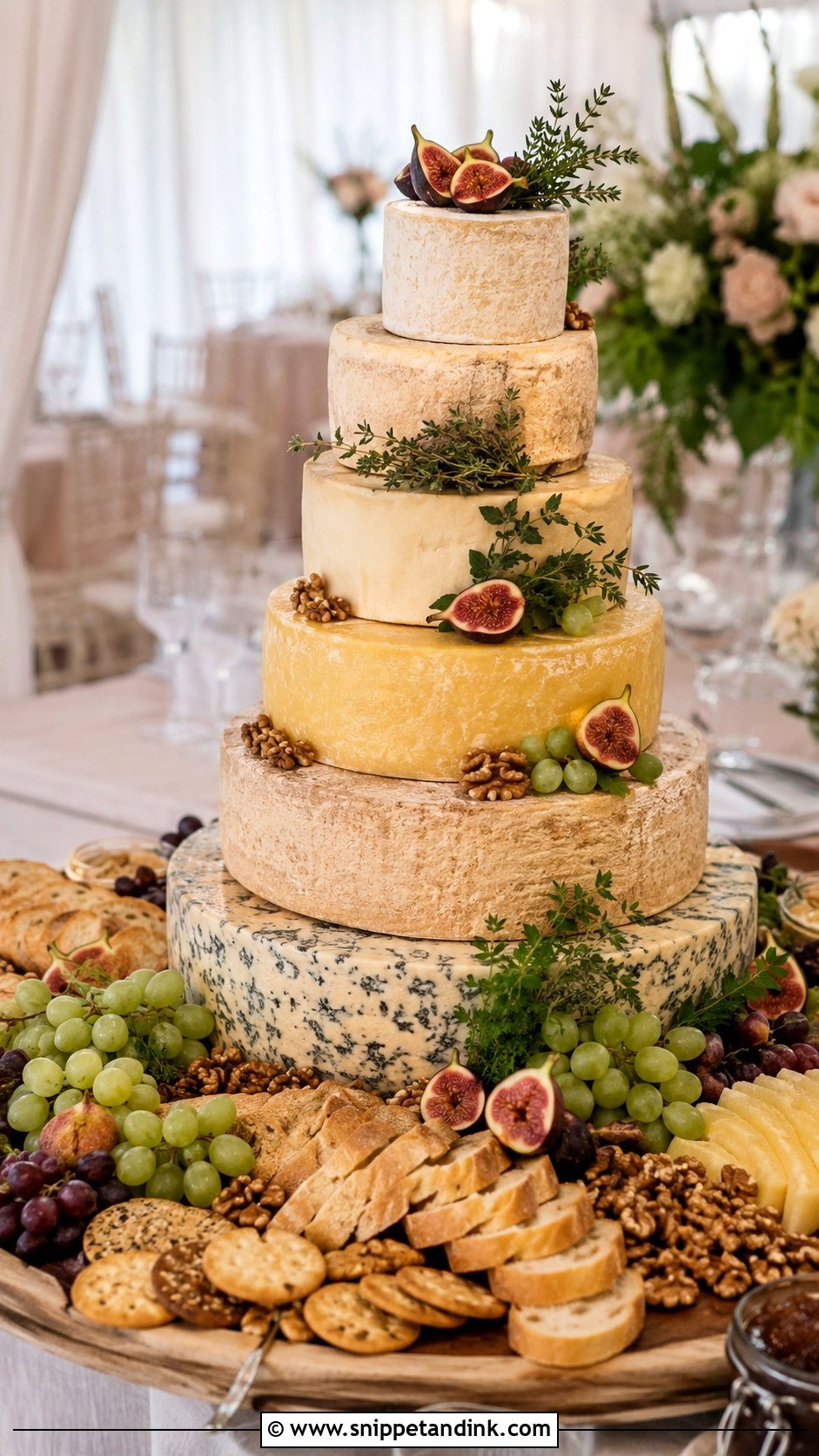
A big tower is mostly an engineering problem. A wide, sturdy wheel sits at the bottom, and every tier above it decreases in size. Firm cheeses take the lower positions because soft ones slump under weight. Any soft cheese higher up sits on a thin, hidden, food-safe board so it can’t sink into the wheel below. The board around the base needs real serving space for grouped crackers, sliced baguette, grapes, figs, nuts and preserves. With a large guest list, I plan for the display to be cut in the kitchen while backup cheese of the same kinds goes out on platters, so the tower stays standing for the room.
6. Charcuterie Cheese Board Wedding Cake
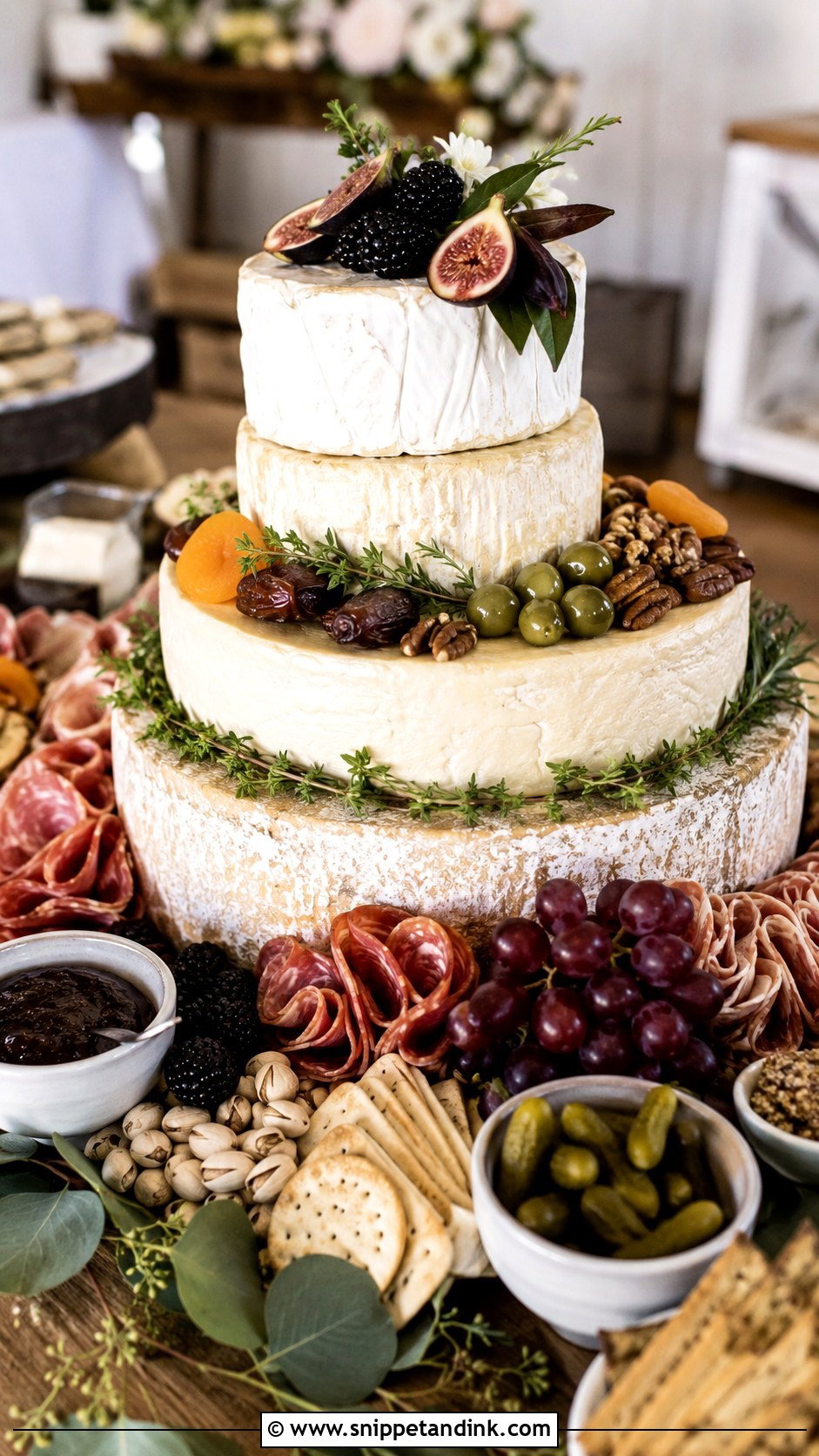
Charcuterie turns the tower into a full grazing table. The wheels stay in the centre, and the board around them carries folded cured meats, crackers, breadsticks, olives, fruit, pickles, nuts and spreads. I fold or roll the meat so each slice is easy to pick up with tongs, and use herbs and small bowls to break the board into sections so flavours don’t run into each other. Cured meats sweat as they warm, so I put them out in batches rather than all at once. It works well for cocktail hour or a late-night snack and can replace a separate appetiser station.
7. Fruit Cheese Board Wedding Cake
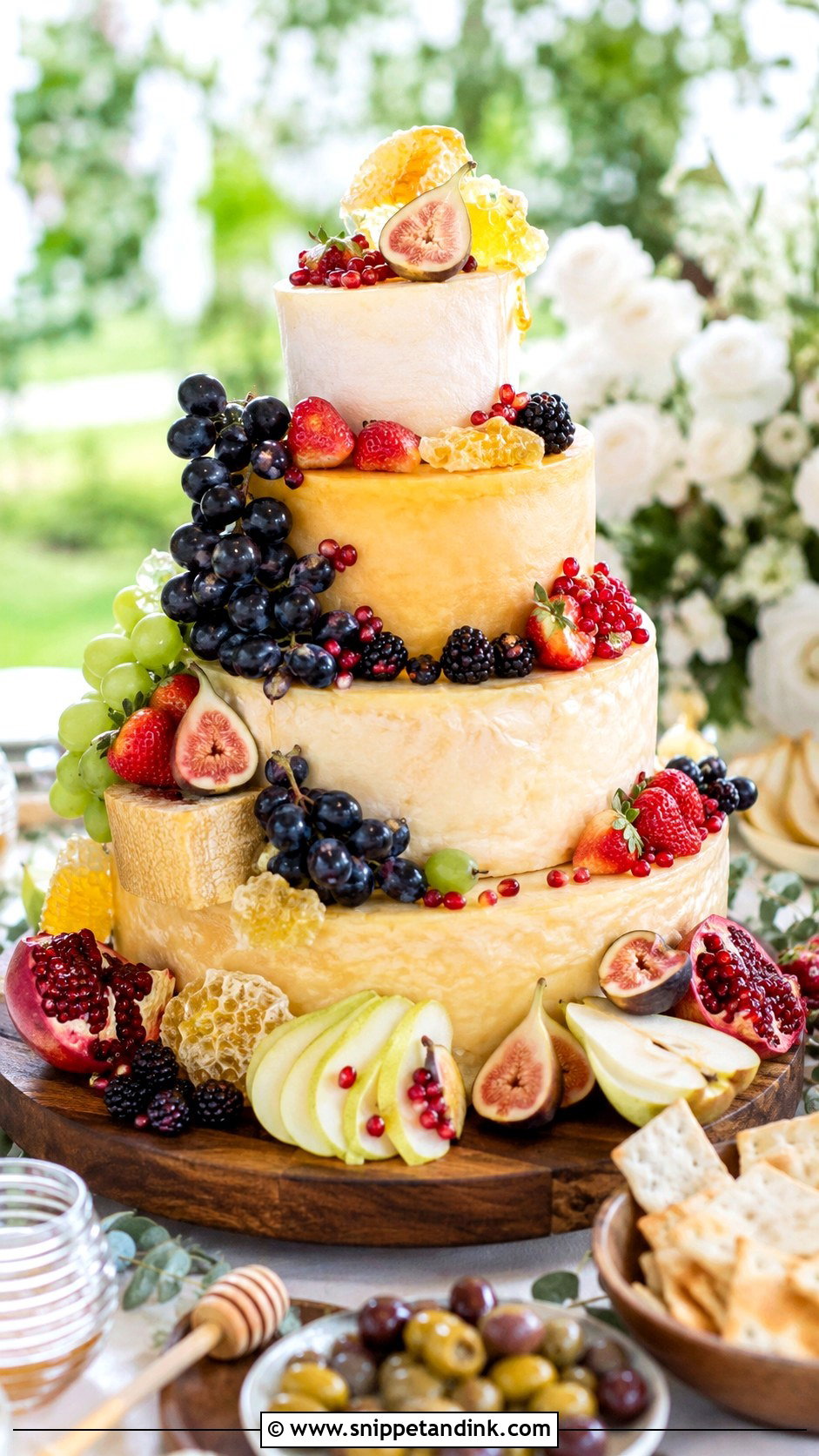
Fruit brings colour, and I place it in clusters instead of sprinkling it everywhere. Grapes drape over the tiers naturally; figs, strawberries, blackberries, pear slices and pomegranate seeds add depth. Choose fruit that holds up out of the fridge. Whole grapes and figs last for hours, while cut strawberries weep onto the cheese and raspberries collapse. Honeycomb or a fruit preserve adds sweetness without turning the board into dessert. Spring and summer weddings suit it, and guests understand it at a glance.
8. Flower Cheese Board Wedding Cake
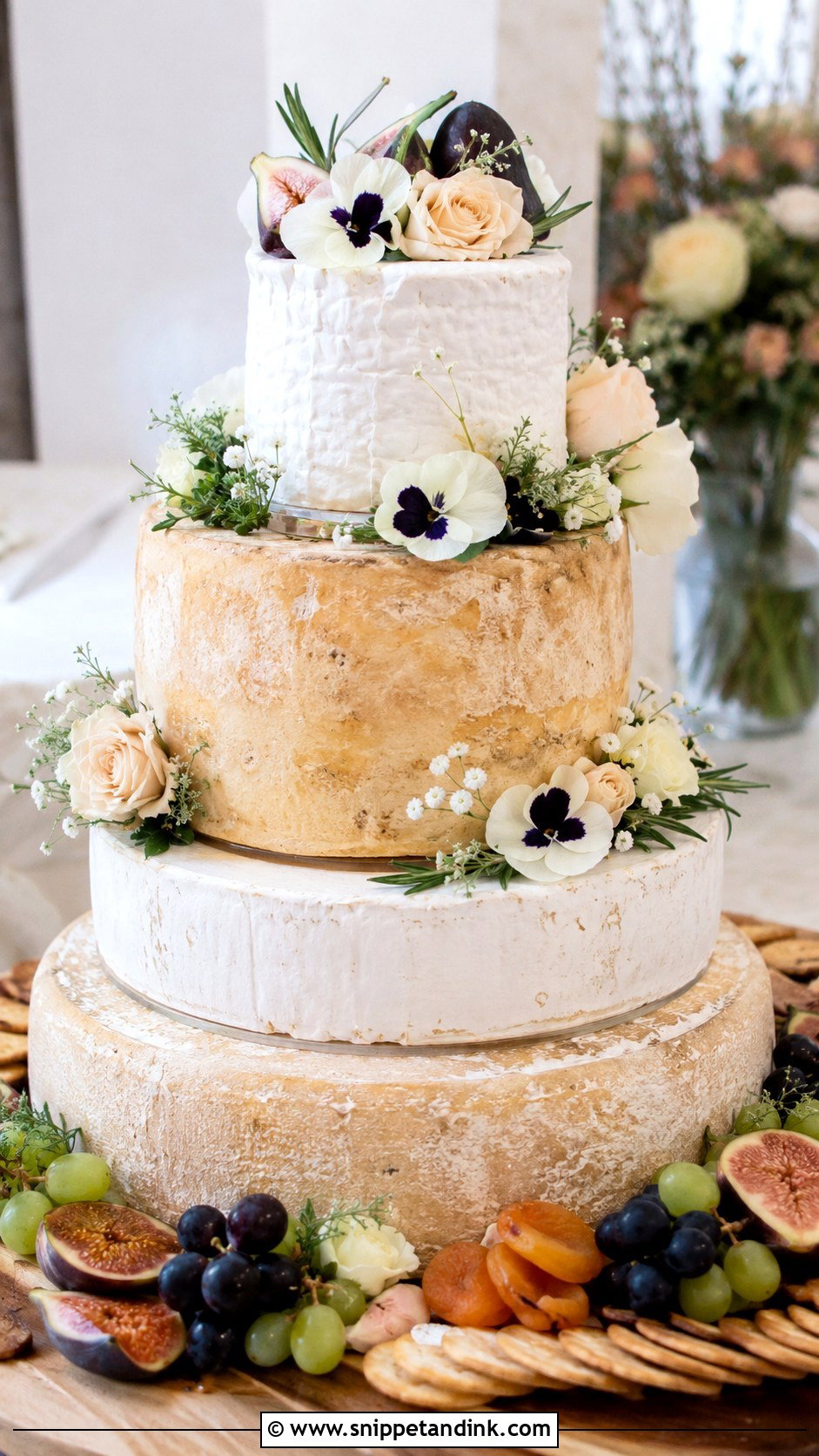
Flowers soften a cheese tower, but they’re the riskiest garnish on it. I tuck small food-safe flowers, herbs and greenery between the tiers: roses grown without spray, chamomile, pansies, lavender sprigs. Eucalyptus is not food-safe, so anything like it stays around the board edge, never touching cheese. If a bloom isn’t edible, it either sits on a barrier like a small square of parchment or it isn’t on the tower at all. Figs, grapes and crackers keep it working as food. The result is the most bridal-looking version of the trend.
9. Garden Cheese Board Wedding Cake
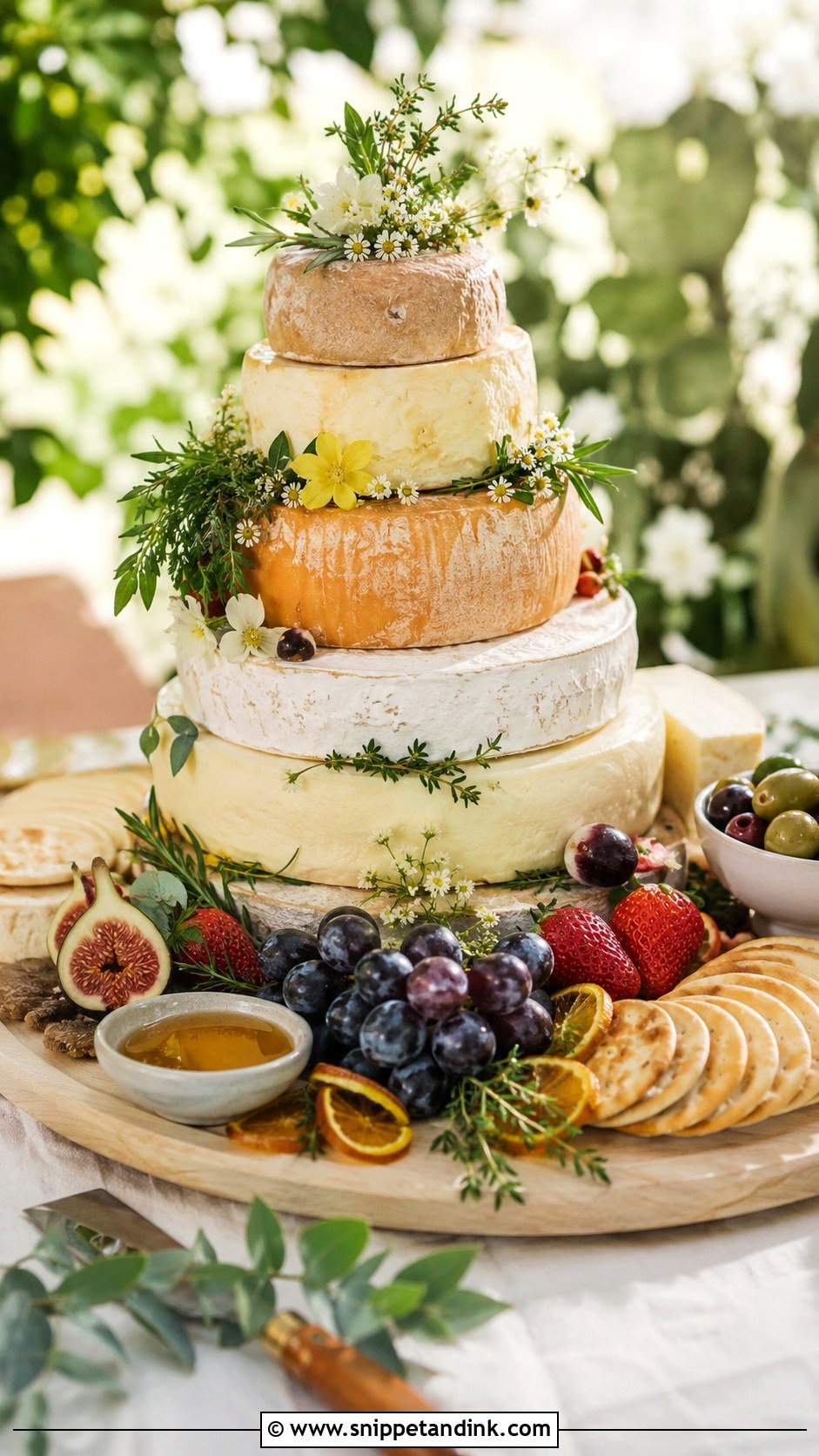
A garden version should look light and seasonal rather than like a heavy buffet. Pale cream, golden yellow and soft white wheels, decorated with herbs, edible flowers, berries and small clusters of grapes, sit well on a light wood board, a stone platter or a white stand. Crackers go in neat rows, with chutney, honey or olives in small bowls. Outdoors brings flies and sun. I keep a mesh dome or a clean cloth ready for the stretch between setup and serving, and I never put the tower where the afternoon light will fall on it, because direct sun warms soft cheese fast.
10. Boho Cheese Board Wedding Cake
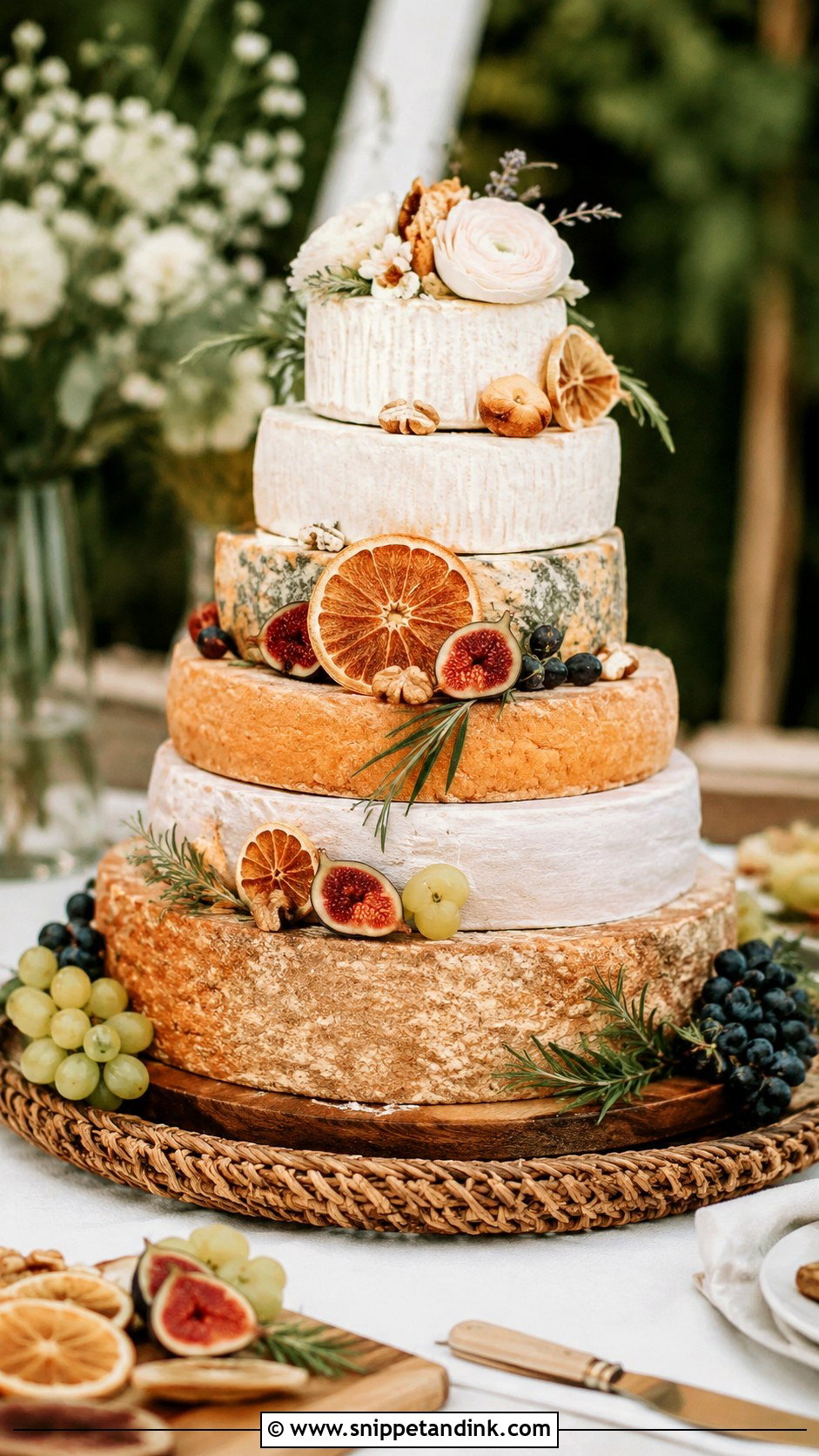
Boho is about mixed shapes and heights. I stack wheels with different rind colours and profiles, then decorate with dried citrus, figs, grapes, rosemary, nuts and small neutral flowers. Pampas and other dried grasses shed, so they stay well away from anything people will eat. A woven mat, a wood board or a low ceramic platter carries the look, in warm cream, tan, honey, rust and sage. Outdoor and desert-style receptions suit it. It’s less formal than a traditional cake but still gives the room a clear focal point.
11. Modern Cheese Board Wedding Cake
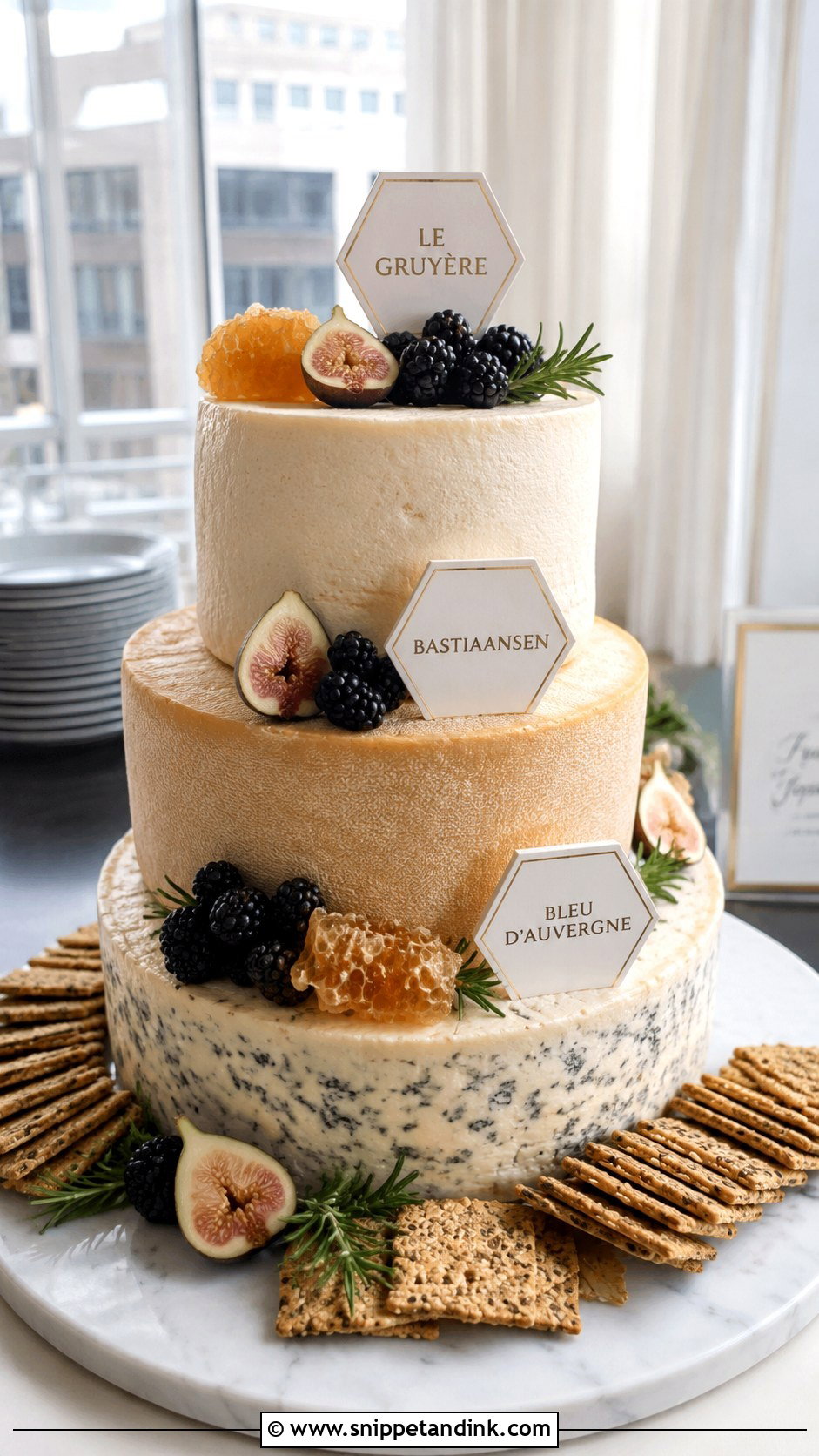
Modern means fewer things, each placed on purpose. I choose wheels with smooth, simple shapes and stack them on a marble board, an acrylic stand or a matte ceramic platter. Blackberries, white figs, honeycomb, rosemary and slim crackers go in geometric rows, with labels in clean, minimal type. Empty space is part of the design, which makes this the hardest style to keep looking right once guests start eating. I refill and tidy the board every half hour, or the geometry disappears. Lofts and city venues suit it.
12. Simple Cheese Board Wedding Cake
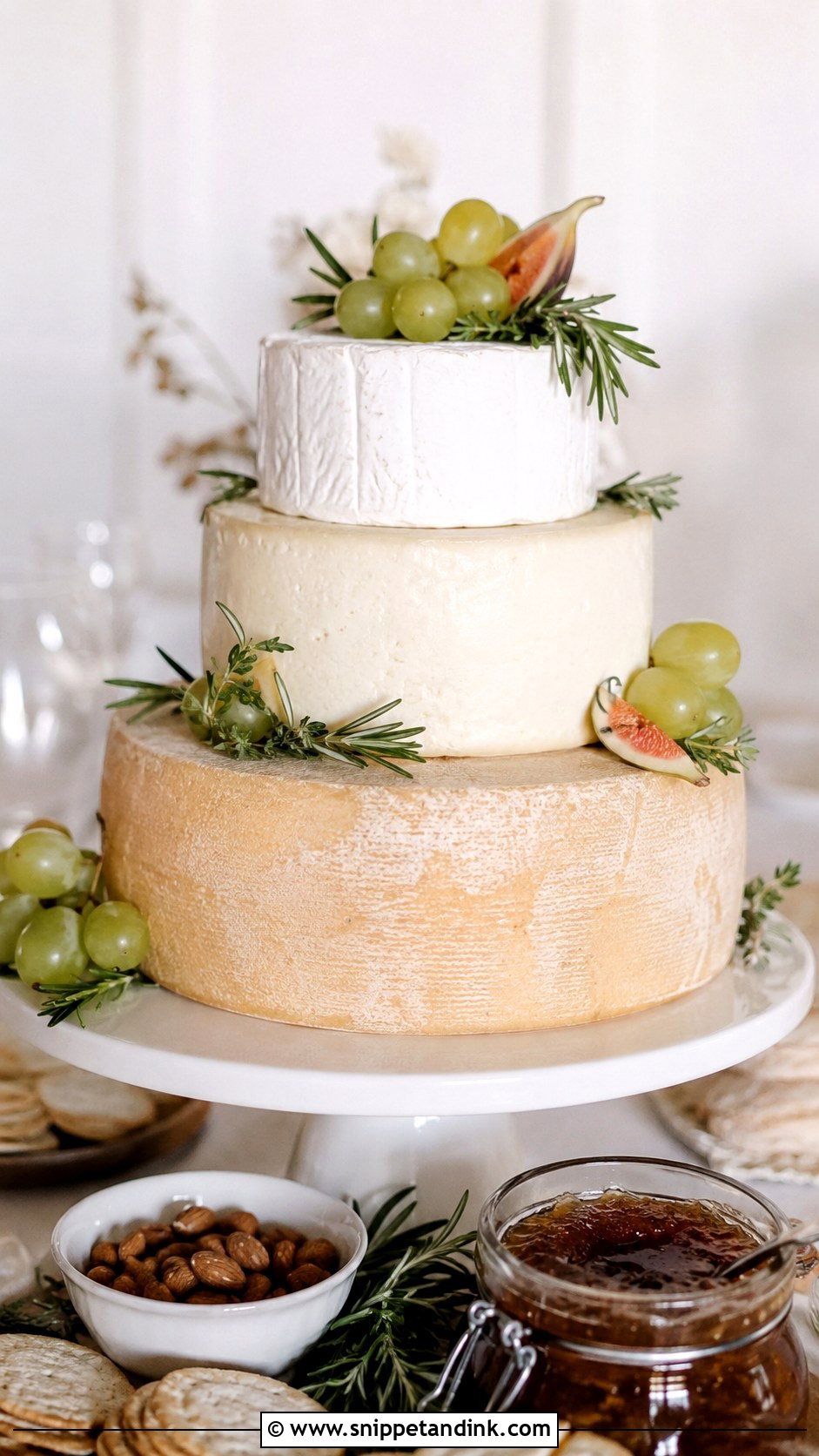
Simplicity makes catering easier. Three or four wheels in different sizes, stacked neatly, then one fruit, one cracker, one nut and one spread: grapes, plain water crackers, almonds and fig jam is a combination almost nobody dislikes. A plain wooden board or white stand keeps attention on the cheese. This is the version I suggest for DIY weddings or a small catering team, since there are only a handful of things to refill. It looks calm on the table and costs less to put together.
13. DIY Cheese Board Wedding Cake
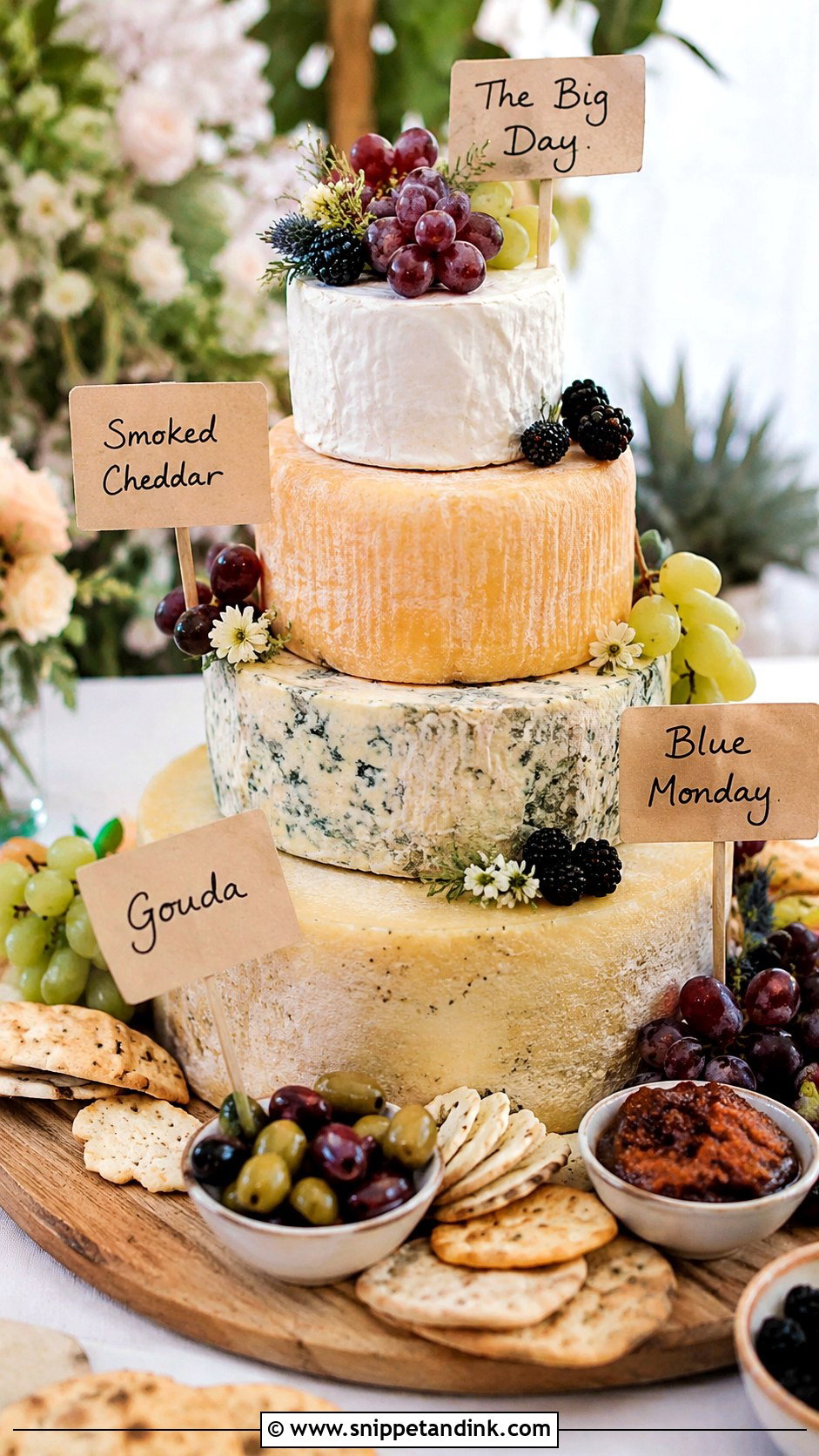
You can build this yourself if the planning happens well before the day. Pick cheeses by diameter first and flavour second; a tower with no clear size steps looks like a pile. Firm and wide at the bottom, smaller toward the top, with soft cheeses supported on thin boards. Wash and dry fruit the day before, pack crackers in sealed tubs so they stay crisp, and bring small bowls for spreads, olives and nuts. Assemble as close to serving as you can, and assign one person to do it so you aren’t stacking cheese in your dress. Smaller and casual receptions suit DIY best.
14. Tiered Cheese Board Wedding Cake
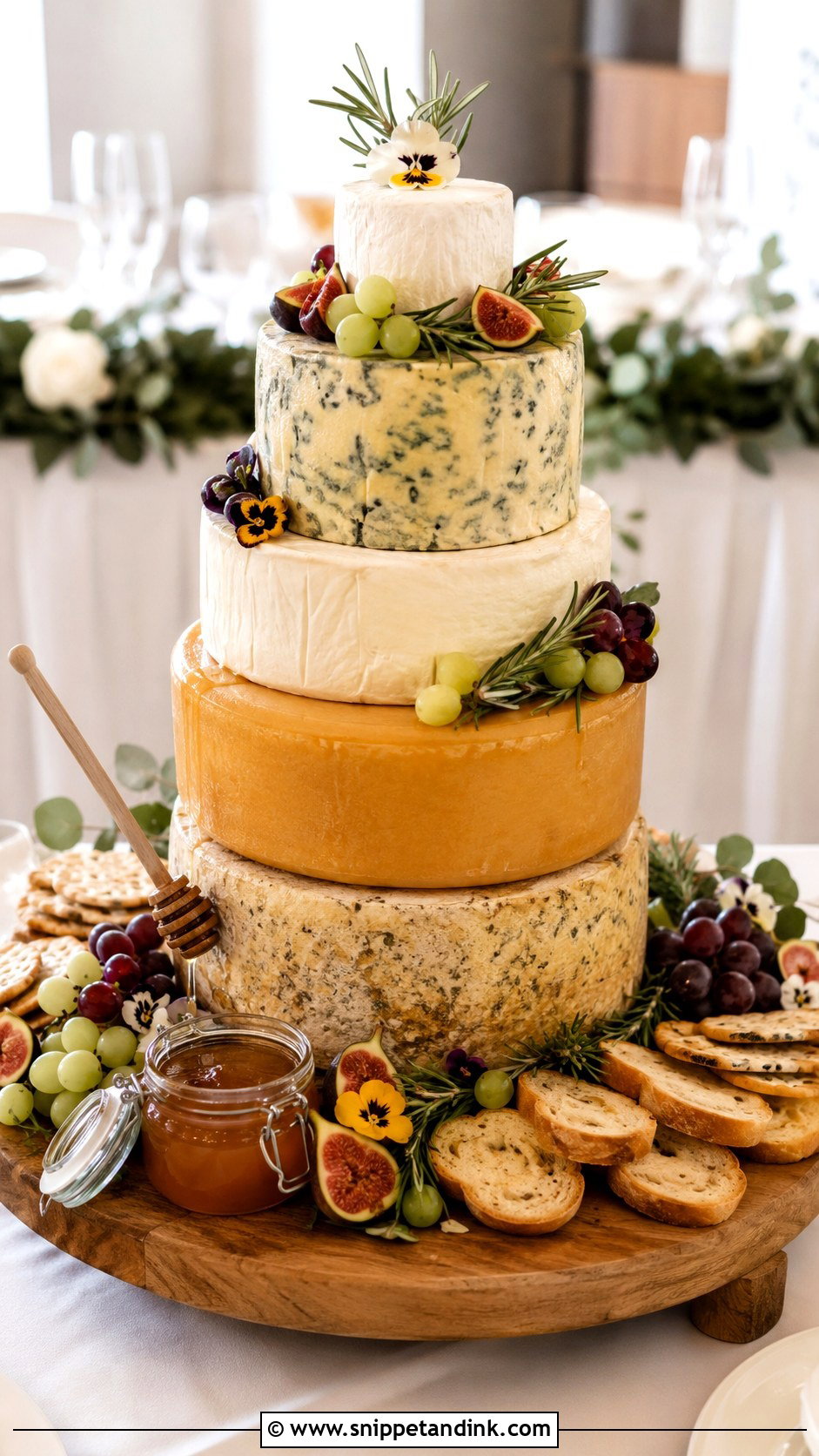
A tiered tower gives the strongest wedding cake silhouette. The secret is clear size changes between every level, with a visible ledge on each, so the shape reads as intentional from across the room. Firm cheddar, a manchego-style sheep’s cheese or an aged gouda sit lower down; brie, goat cheese or blue add contrast higher up. Each ledge gets a small cluster of fruit, herbs and edible flowers, and extra crackers and bread wait around the base. Aged hard cheeses are also the ones that stay looking fresh longest out of the fridge.
15. Round Cheese Board Wedding Cake
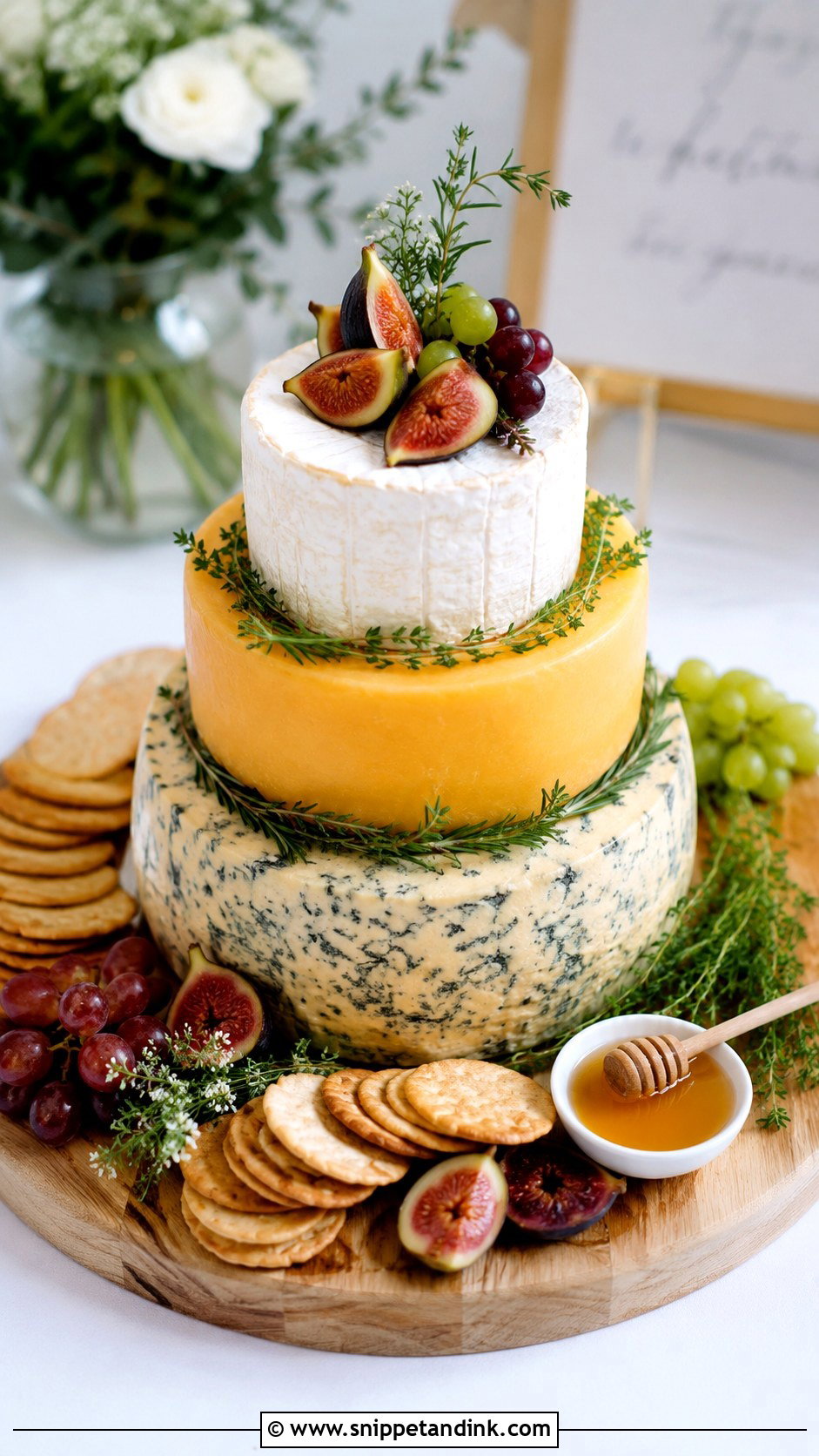
Round wheels in gradually smaller sizes mimic a layer cake most naturally, and a centred stack looks stable from every side. I echo the shape at the base with grape clusters, round crackers, figs and small bowls of honey or jam. Contrast does a lot of the visual work: ivory brie, golden cheddar and a blue-veined top tier read clearly in photos. A round tower is also the easiest to portion. Firm wheels are cut like a cake, in wedges from the centre, then each wedge is sliced into fingers for serving.
16. Square Cheese Board Wedding Cake
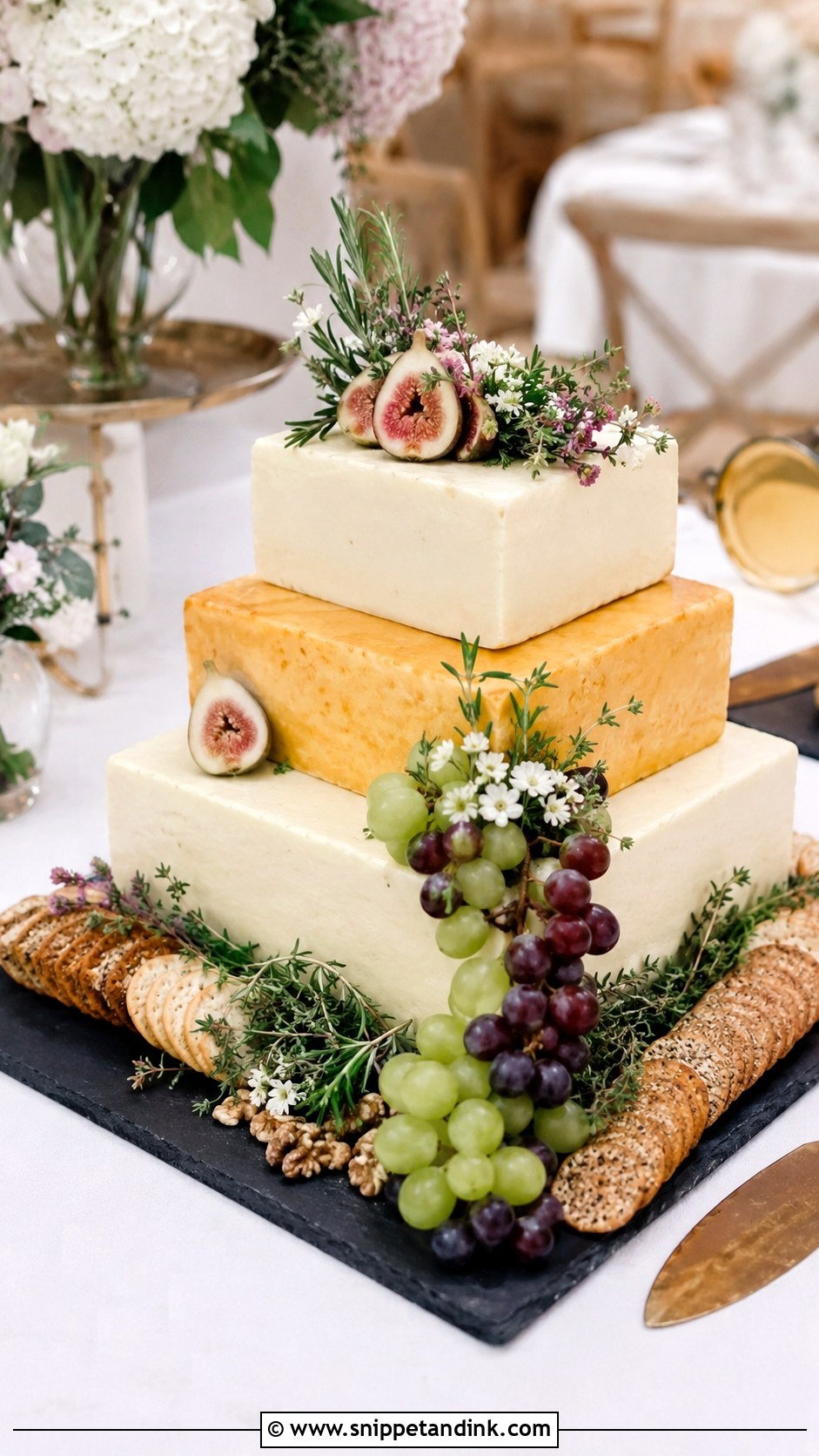
Square or block cheeses give a sharper outline, and they look strong on slate or a rectangular wood platter. Square stacking needs more care than round, since a corner that overhangs the tier below draws the eye immediately; I line the corners up or rotate each level by 45 degrees on purpose. Grapes spilling from one corner and crackers lined along another side keep it from feeling stiff. Contemporary and industrial venues suit it, and it avoids the look of every other round tower on social media.
17. Brie Cheese Board Wedding Cake
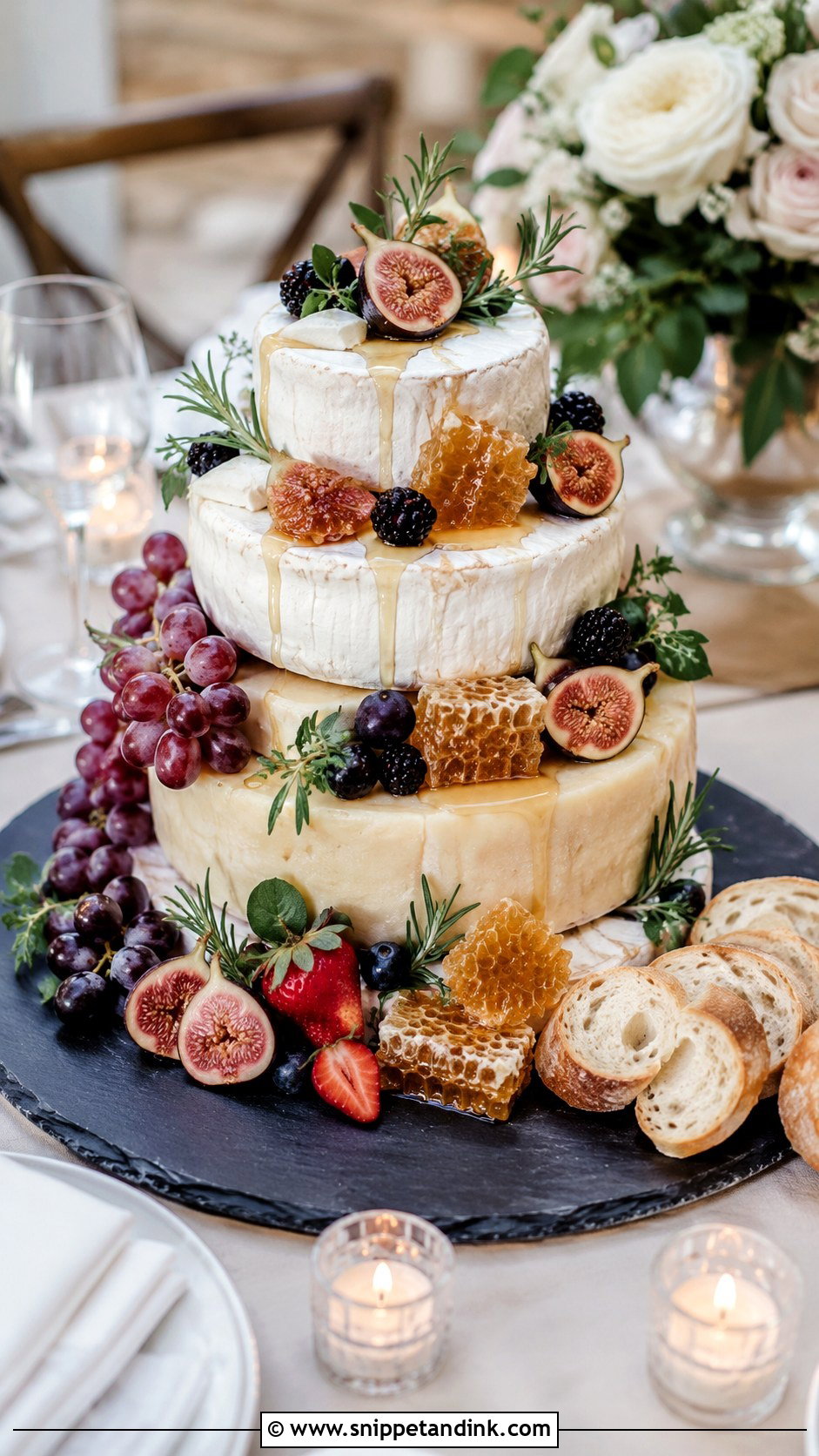
Brie is the cheese guests go to first and the one that behaves worst in a stack. It softens quickly at room temperature, so it belongs in the middle or top, sitting on a hidden board, with firmer cheeses beneath it carrying the weight. Figs, honeycomb, grapes, berries and sliced baguette pair well, and the white rind looks especially good on dark slate or natural wood. Put a dedicated knife beside it. Once a whole brie is cut and starts to run, it collapses faster than the rest of the tower, so I serve brie wedges from a backup wheel rather than the display.
18. Goat Cheese Board Wedding Cake
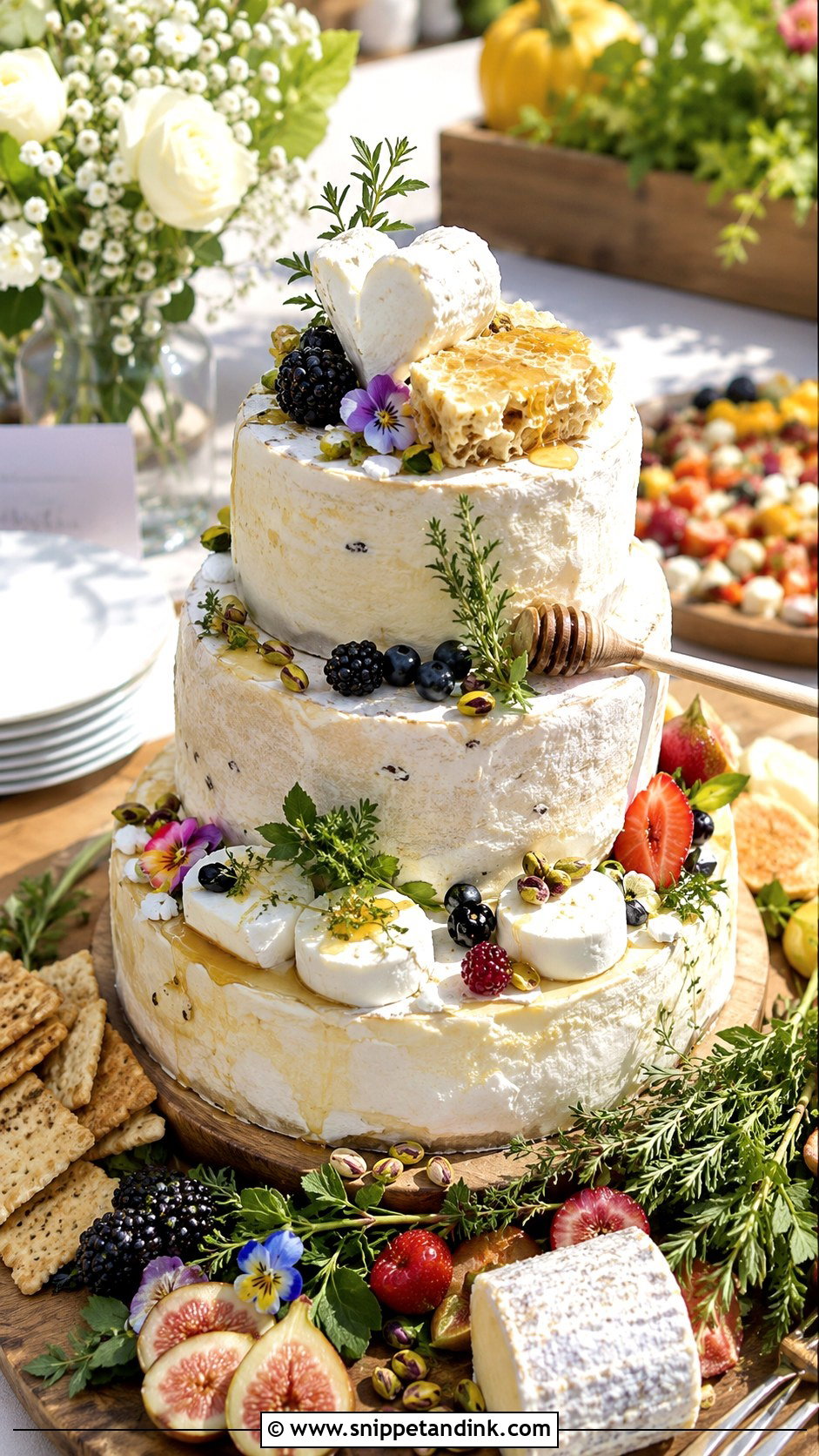
Fresh goat cheese tastes bright and looks bridal, but it’s soft and crumbly, so it can’t carry weight. I use it as the top tier, as small rounds around a firmer stack, or as logs at the base. Rolling small rounds in chopped herbs or crushed pistachios adds colour and helps them hold their shape. Honey, berries, figs and crisp crackers suit it. Garden weddings and brunch receptions are natural fits. If you have pregnant guests, ask your cheesemonger for a pasteurised goat cheese and label it so they know they can eat it.
19. Blue Cheese Board Wedding Cake
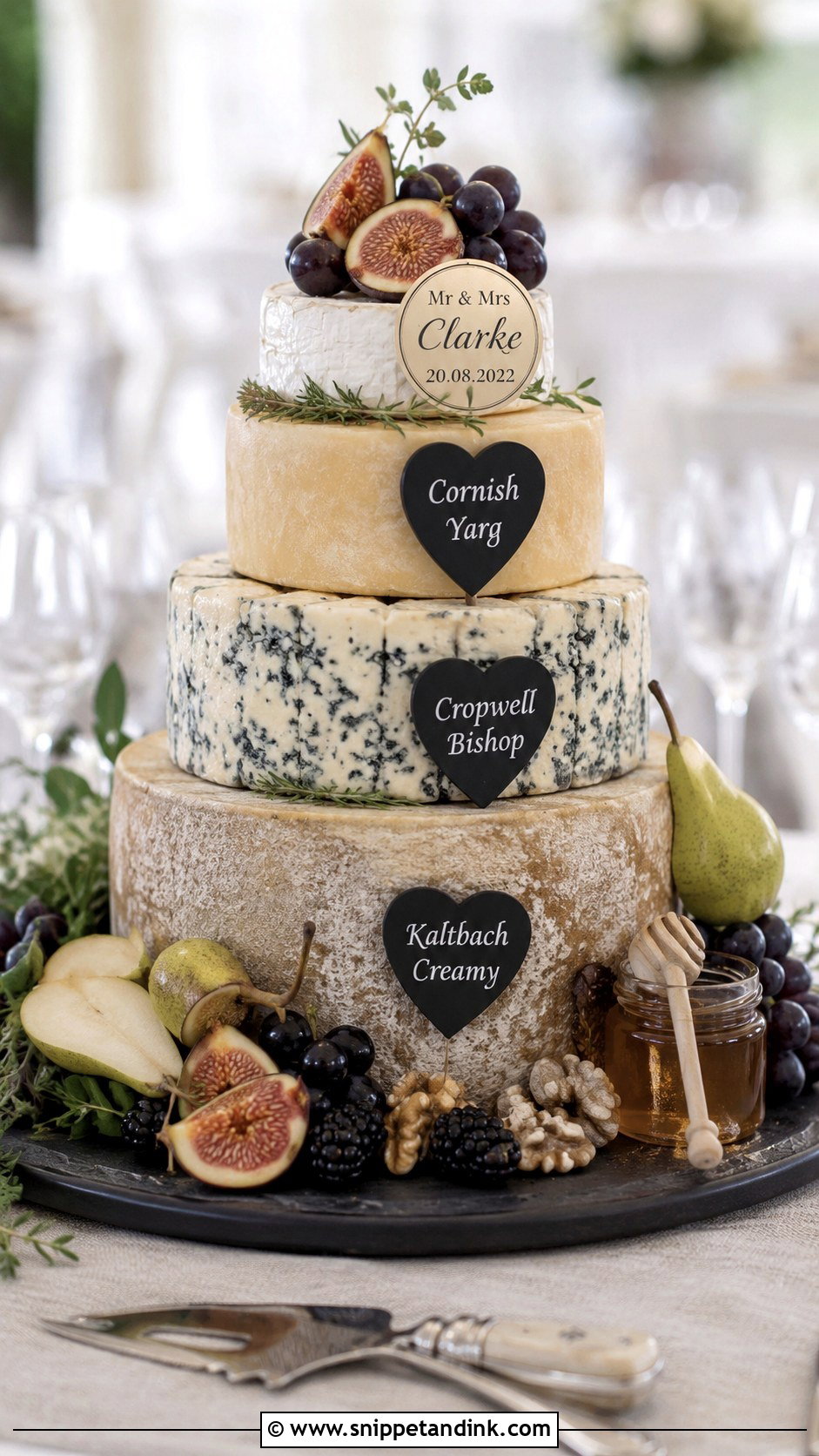
Blue cheese brings strong colour and flavour, and it’s divisive. I use it as one tier only, never the whole cake, alongside a milder cheddar, brie or gouda for guests who don’t like it. Figs, pears, grapes, walnuts, honey and dark berries all soften its edge, and the veins look striking against ivory and gold. Blue’s aroma travels, so on a buffet I keep it at the far end of the board from delicate cheeses and give it its own knife. Clear labels let people decide before they reach for it.
20. Grazing Table Cheese Board Wedding Cake
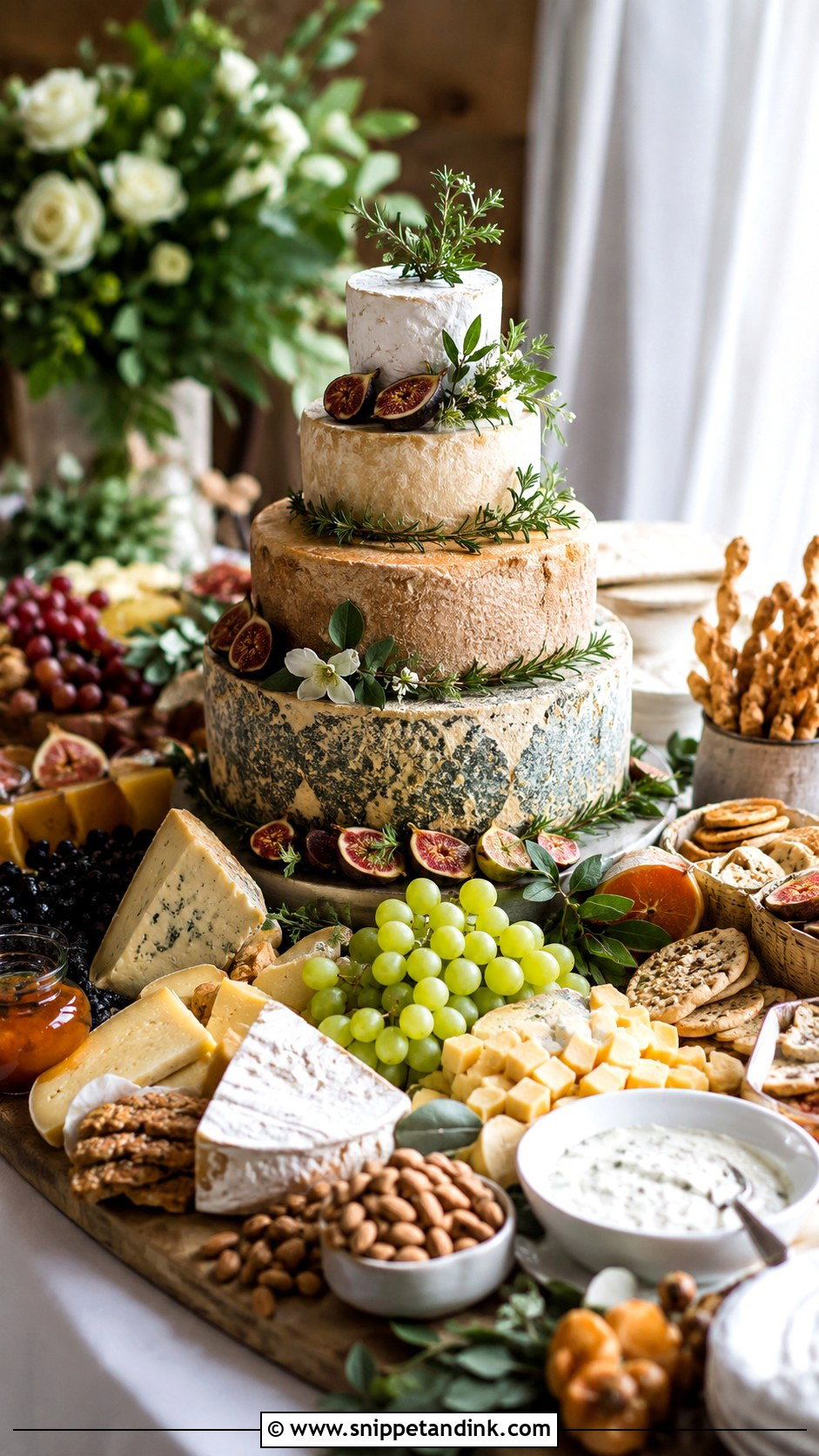
Here the tower becomes the centre of a whole food table. The stacked wheels sit raised in the middle, and the layout around them spreads out with crackers, breads, fruit, nuts, vegetables, spreads and small savoury bites. Risers, bowls and boards create levels so the table looks designed rather than flat. I keep the main tower slightly higher than everything else and clear of serving traffic so it stays intact for photos. A grazing table needs a refill plan and a person to carry it out, otherwise it looks picked over an hour in.
Warm Rooms, Soft Rinds and Guests Who Can’t Eat Everything
A cheese tower sits out longer than any other food at a wedding, because it’s on display before anyone eats. That changes how I plan it.
Time out of the fridge
Hard cheeses actually taste better after an hour at room temperature. Soft cheeses are different: as a general food-safety rule, perishable food shouldn’t sit out longer than about two hours, and less in a hot tent. I set the tower up with the hard cheeses at the base, add brie and fresh goat cheese last, and swap them for chilled backups if the room is warm.
Labels that do real work
- Mark which cheeses are made with unpasteurised milk. Pregnant guests are usually advised to avoid soft unpasteurised cheese, and they’ll want to know at a glance.
- Keep nuts in their own bowls rather than scattered across the board, and say so on a card.
- Put gluten-free crackers on a separate plate with their own tongs, so they don’t pick up crumbs from regular bread.
Taking the tower apart
Never cut a wheel while it’s still in the stack. Lift the top tier off, cut it on a board, then work downward. Firm wheels are cut in wedges like a cake, then sliced into fingers; brie is cut in wedges with the rind on; blue is easiest crumbled into a bowl. Brief whoever is serving on this before the day, because a half-cut tower is a sad thing to photograph.
A Savoury Cake Is Only as Good as Its Serving Plan
A cheese tower makes a reception feel generous, and it’s clearly different from the usual dessert table. The ones that work are planned for serving as much as for looks. A tall stack gives you the cake moment, a grazing table makes the food easy to reach, and fruit, herbs, crackers, honey and labels turn plain cheese into a centrepiece. Decide early who cuts it, where backup cheese is kept and when it goes out. Get those details right and the cheese gets eaten, not just photographed.
You'll Like These Ideas:


Leave a Reply