
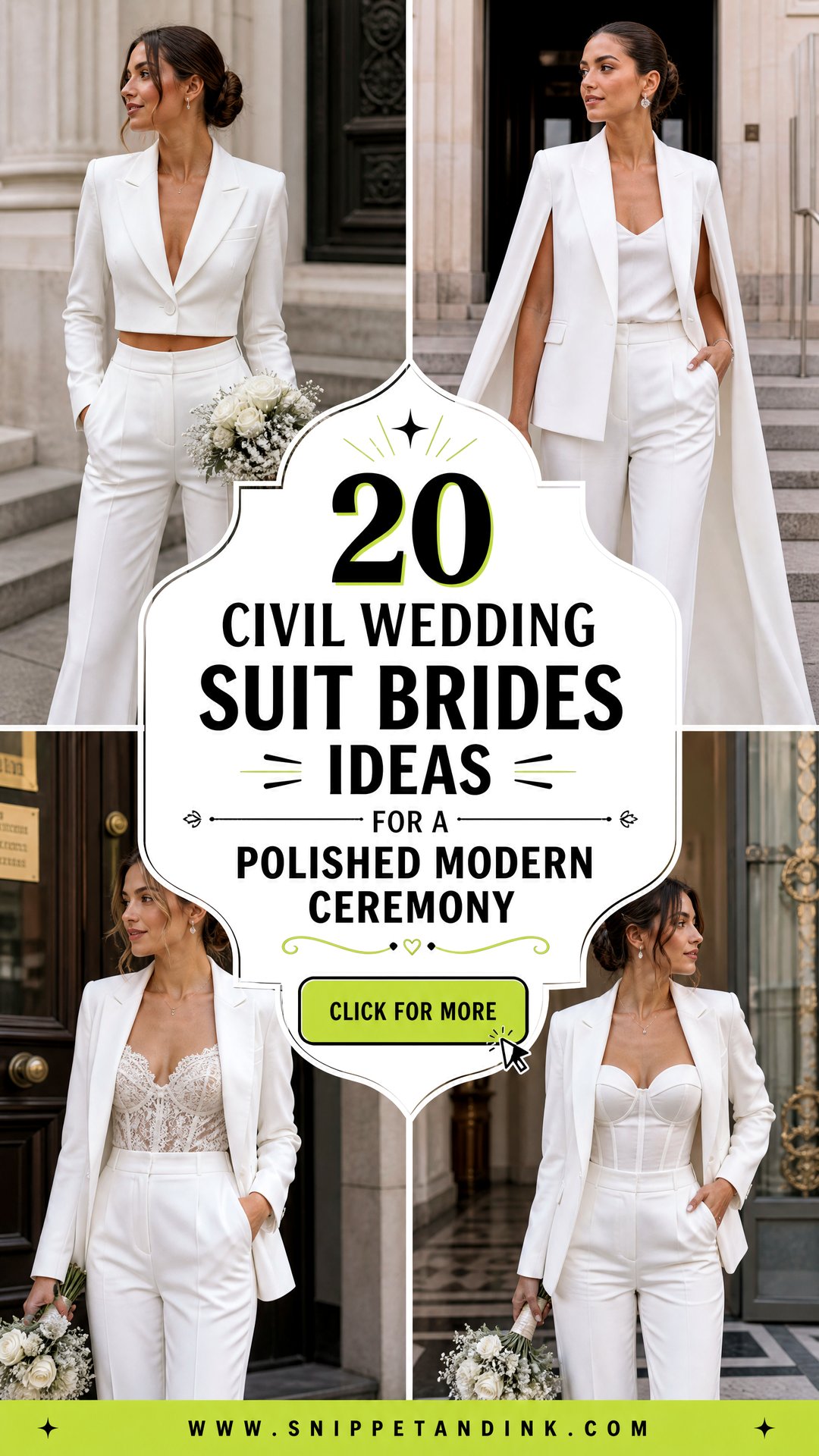
Most of the brides who ask me about a suit for a registry office or city hall wedding have already decided they don’t want a gown. What they’re unsure about is how to make tailoring read as bridal rather than as a good interview outfit. The answer is almost always fit first, fabric second and one deliberate bridal detail third. A suit also has a life after the ceremony, which is a big part of its appeal, and the separates carry real rewear potential. White and ivory are the obvious starting points, but I’ve included champagne, blush, pale blue and black-and-white looks below, along with skirts, capes and a three-piece. Each one comes with the fitting and styling notes I’d give you at an appointment.
Buy for the Shoulders, Tailor Everything Else
When I shop with a bride for a suit, I fit the jacket to her shoulders and the trousers to the widest part of her hips, then ignore the rest of the label size. A tailor can take in a waist, shorten a sleeve and hem a trouser easily. Narrowing shoulders or adding room across the seat is difficult, expensive and often impossible.
Allow time for at least two fittings, and start the first one roughly six weeks before the ceremony so there’s room for a second adjustment. Bring the exact shoes and the exact top you’ll wear underneath to each fitting. A camisole and a corset top change how a blazer closes, and a two-inch heel changes where a hem should fall.
What I ask the tailor to check
- Sleeves ending at the wrist bone, so a bracelet or your ring hand shows when you hold the bouquet.
- No pull lines across the buttons when the jacket is closed and you’re seated.
- Trouser hems with a slight break or none, depending on the shoe, measured while standing in those shoes.
- Lining in white or ivory suiting, which stops pockets and seam allowances showing through in bright sun or flash.
1. White Tailored Civil Wedding Suit
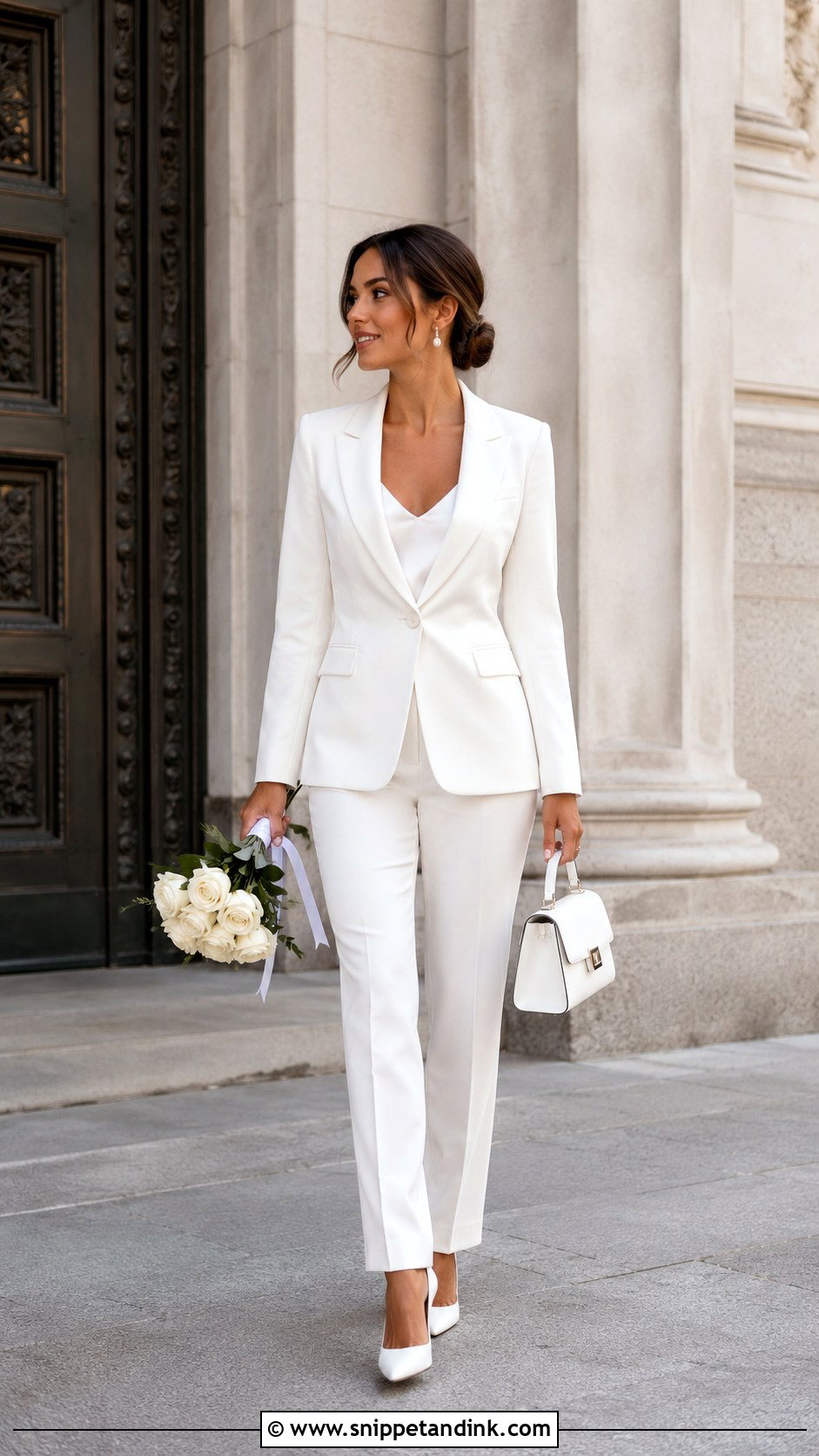
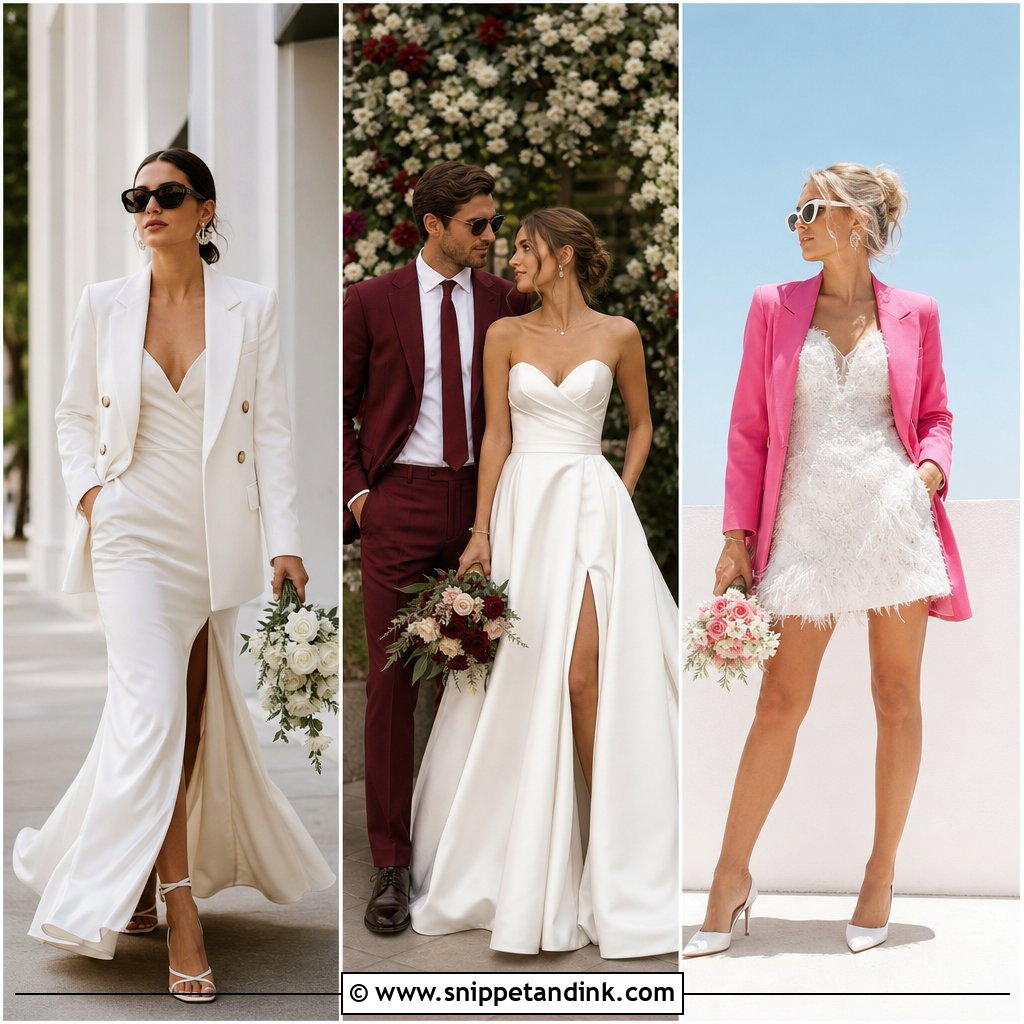
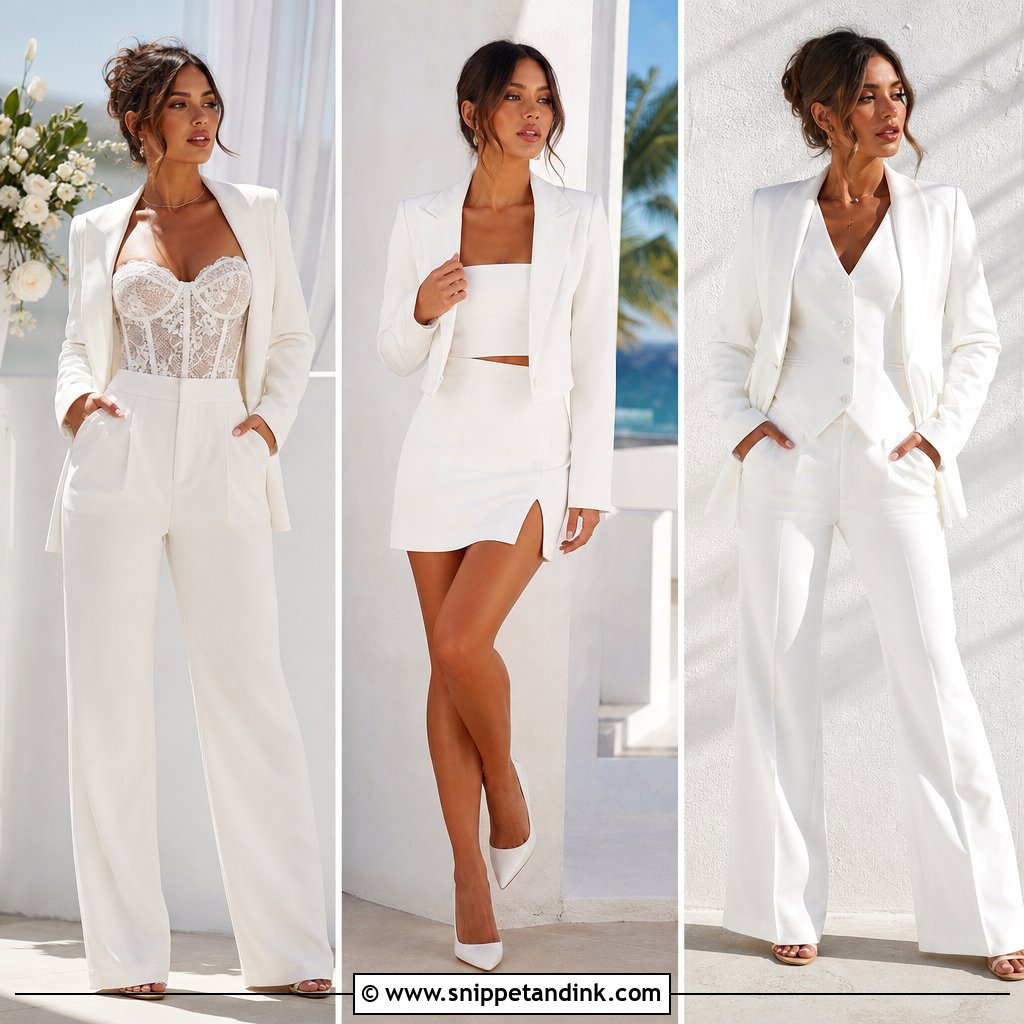
Plain white tailoring is the hardest thing to fake, because there’s no pattern or texture to hide a poor fit. I start with the shoulder seam: it should end exactly where your shoulder bone does, since that’s the one area a tailor can barely change. A single-breasted blazer with a gently shaped waist and straight-leg trousers is the safest base, with a silk camisole or square-neck bodysuit underneath so it never looks like office wear. Petite brides usually look taller in an ankle-length trouser; taller brides can carry a full hem. White pumps, pearl earrings and a few white roses or calla lilies finish it. Spend the money on alterations rather than the label, because a well-altered inexpensive suit beats an unaltered designer one every time.
2. Ivory Double-Breasted Civil Wedding Suit
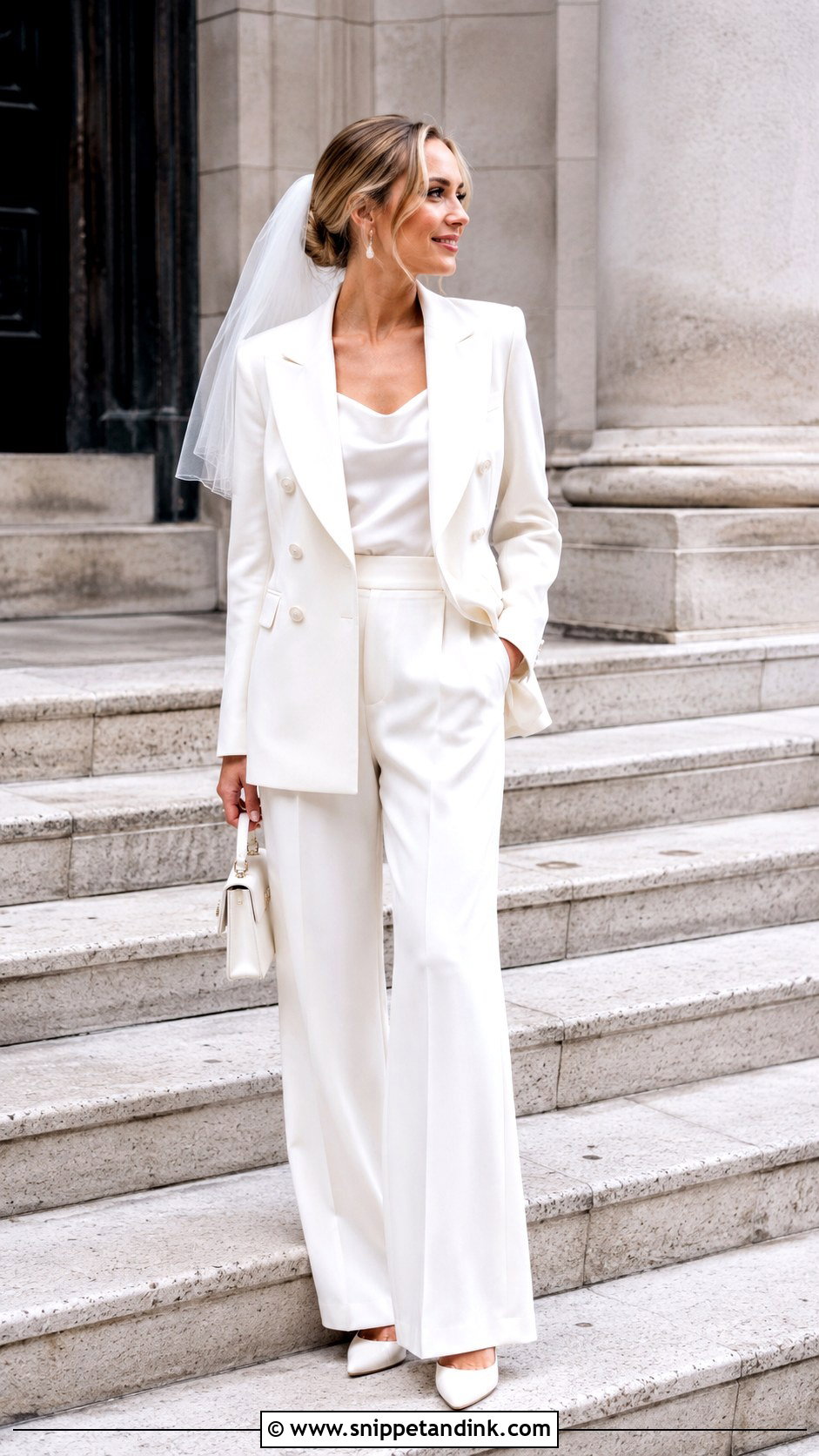
Ivory is kinder than bright white on most skin tones, and an ivory double-breasted suit keeps a strong, structured shape. The detail I check is where the buttons sit. If they land close to your natural waist, the jacket defines your figure; if they sit low, it boxes you in. Moderate lapels are easier to wear than wide ones. With a fuller bust, I’d usually style this jacket open over a fitted shell, because a closed double-breasted front adds two layers of fabric across the chest. Gold buttons pair well with fine gold jewelry. A shoulder-length veil adds tradition without covering the buttons, which are the whole point of this cut.
3. White Tuxedo Civil Wedding Suit
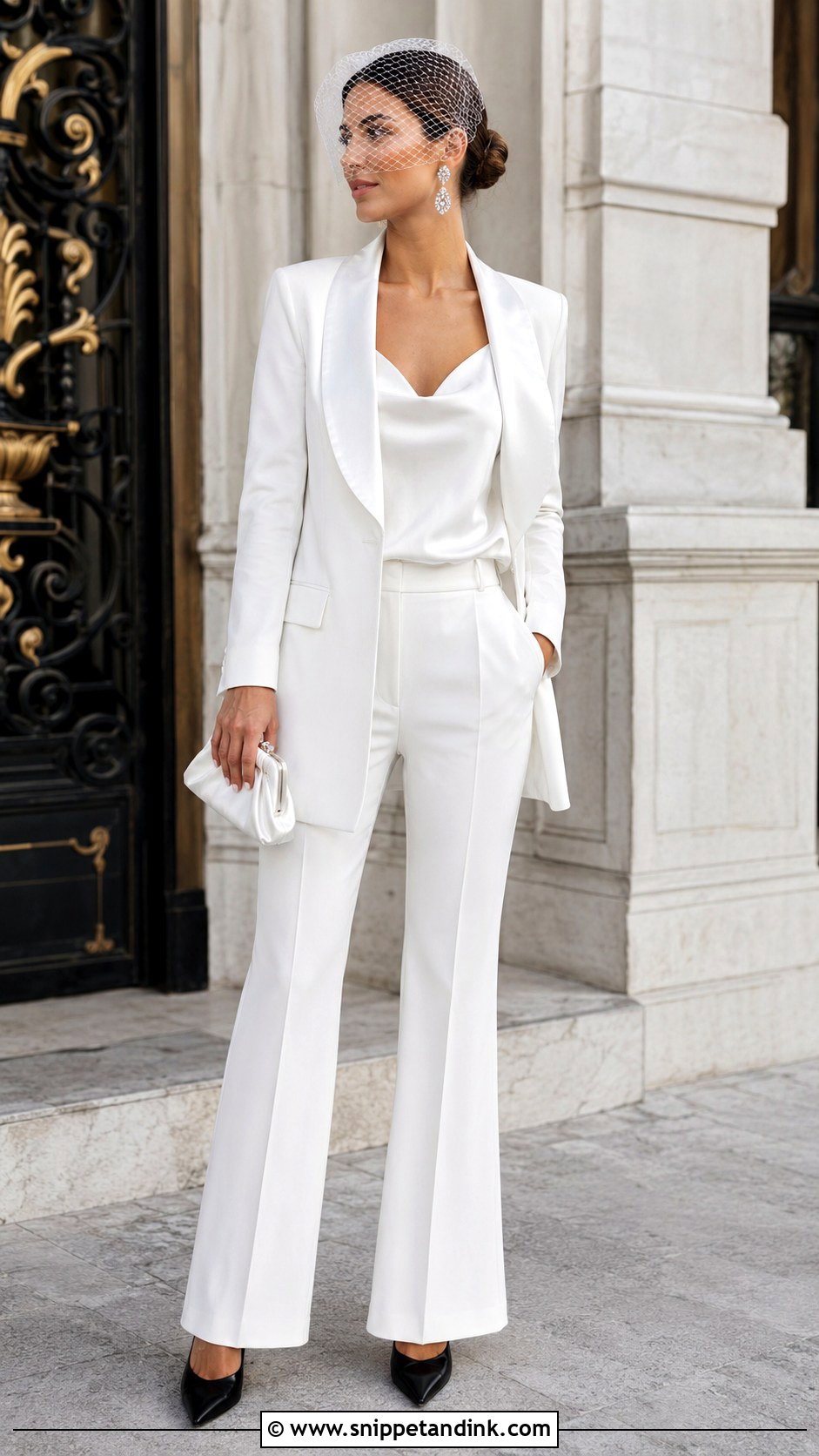
Satin lapels are what separate a tuxedo suit from ordinary workwear. I prefer a longer jacket with a single covered button, worn with slim or slightly flared trousers. Satin has one problem nobody warns you about: it marks. Foundation, lip colour and even damp fingers show on a satin facing, so I always ask brides to dress after makeup and to keep a clean tissue between chin and lapel when hugging. Underneath, a satin camisole or cowl-neck top works; if you go for a bandeau, have it secured to the jacket lining so it can’t slip. Black pumps give a graphic contrast and white ones keep it tonal. A birdcage veil suits the vintage feeling here better than a long one.
4. Cream Wide-Leg Civil Wedding Suit
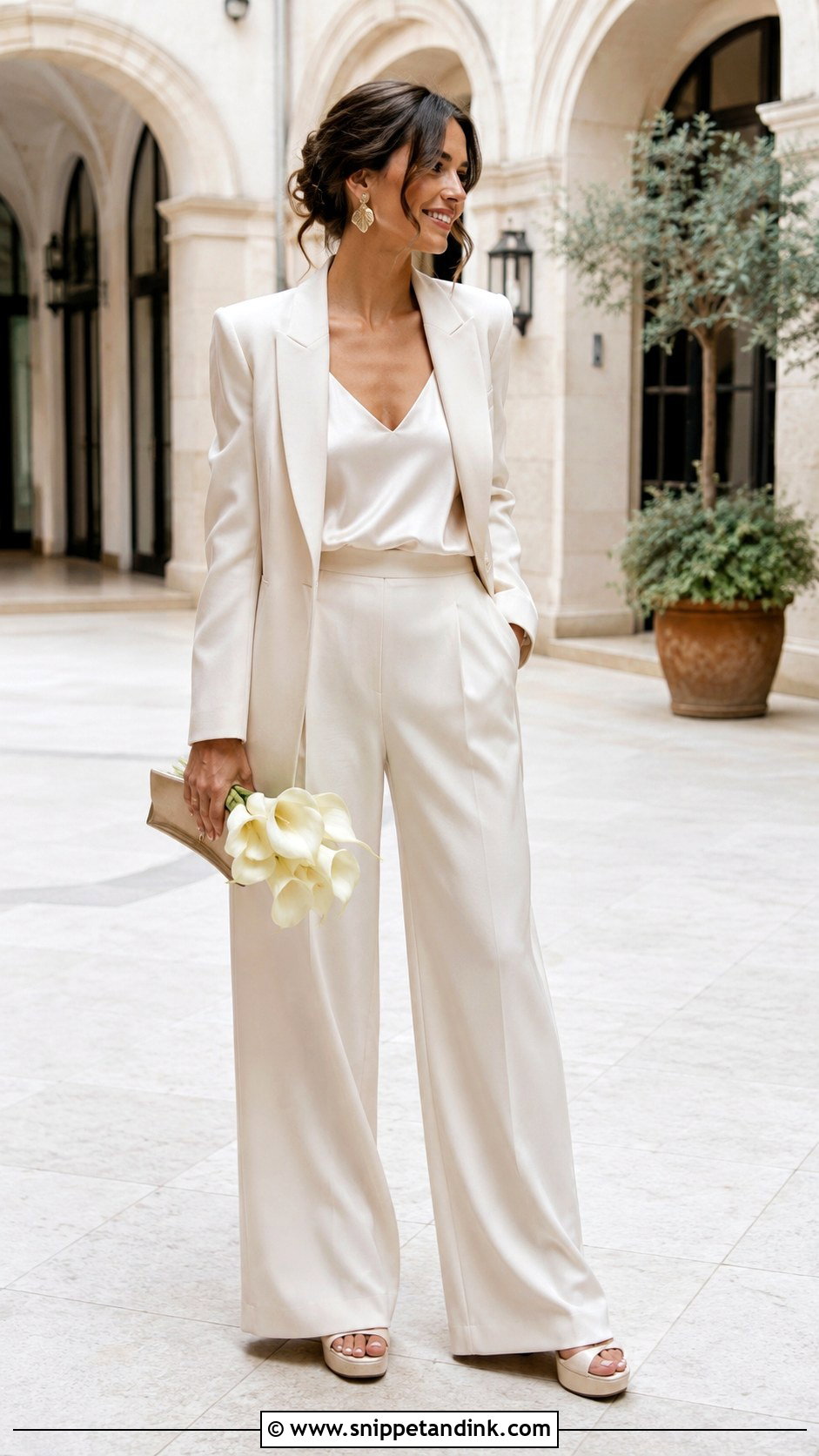
Wide-leg trousers in cream move rather than hold a shape, and that’s why brides who want room through the hips and thighs find them so comfortable. The fit point is the high waist: the trousers should skim the hip and then fall straight, not cling and flare. Hem length depends entirely on your shoes, so bring the exact pair to every fitting. I aim for the hem to nearly cover a platform or block heel while staying a finger’s width off the floor, because cream picks up pavement dirt on the first step outside. A fitted blazer and V-neck camisole balance the volume, and a small bouquet keeps the long line from looking crowded.
5. Cropped Blazer Civil Wedding Suit
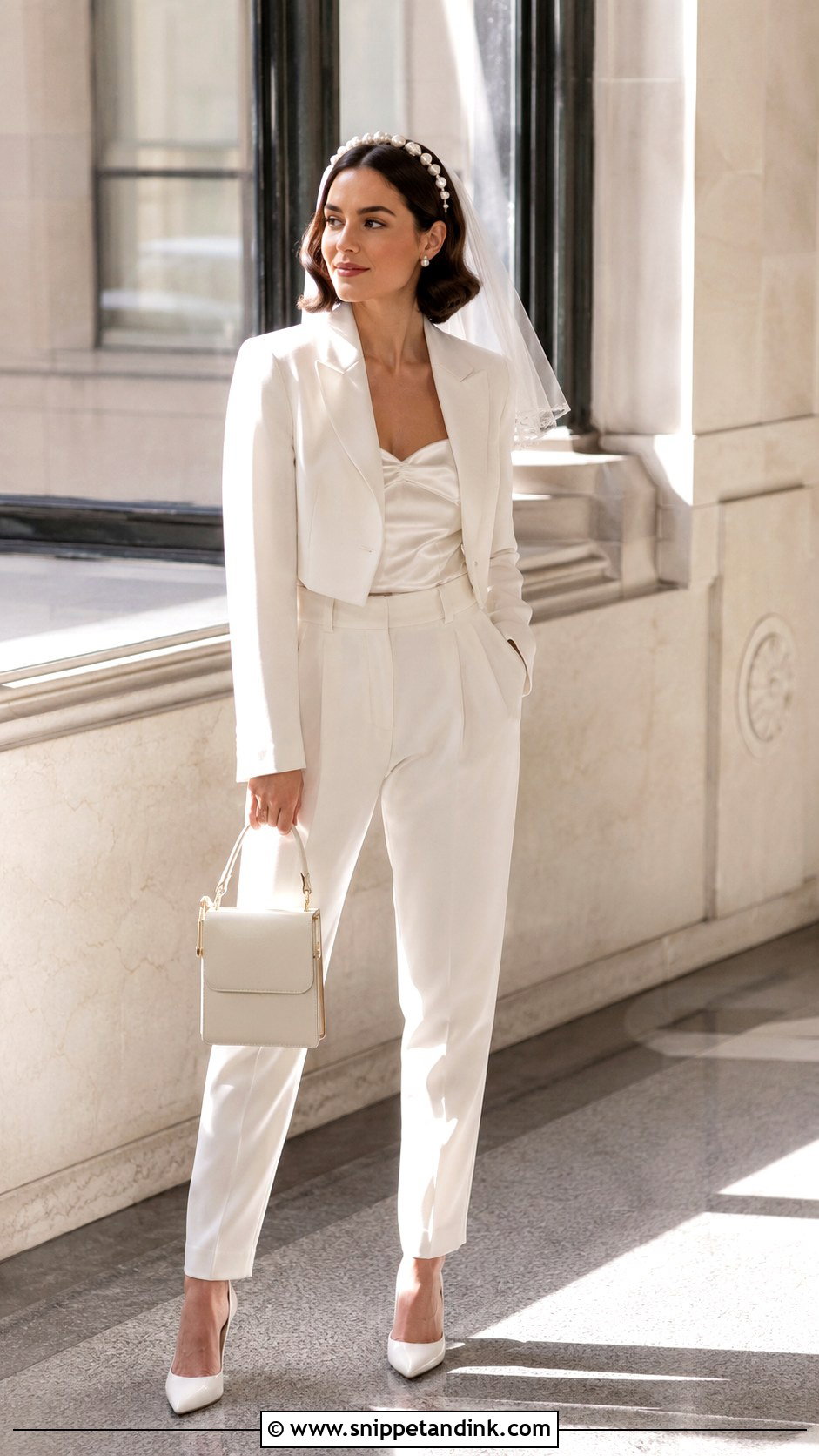
A cropped blazer only works when there’s no gap between jacket and waistband. I have brides raise their arms at the fitting, since that’s when a too-short crop exposes skin or the top underneath. Pleated high-waisted trousers, a fitted satin top and pointed pumps make the base. On petite frames the short jacket makes the legs look longer; on curvier figures, I’d pick a slightly relaxed crop that follows the body rather than gripping it. A pearl headband and short veil give the bridal signal. Keep everything one colour from head to toe, which matters more with a cropped cut because any colour break at the waist cuts you in half visually.
6. Three-Piece Civil Wedding Suit
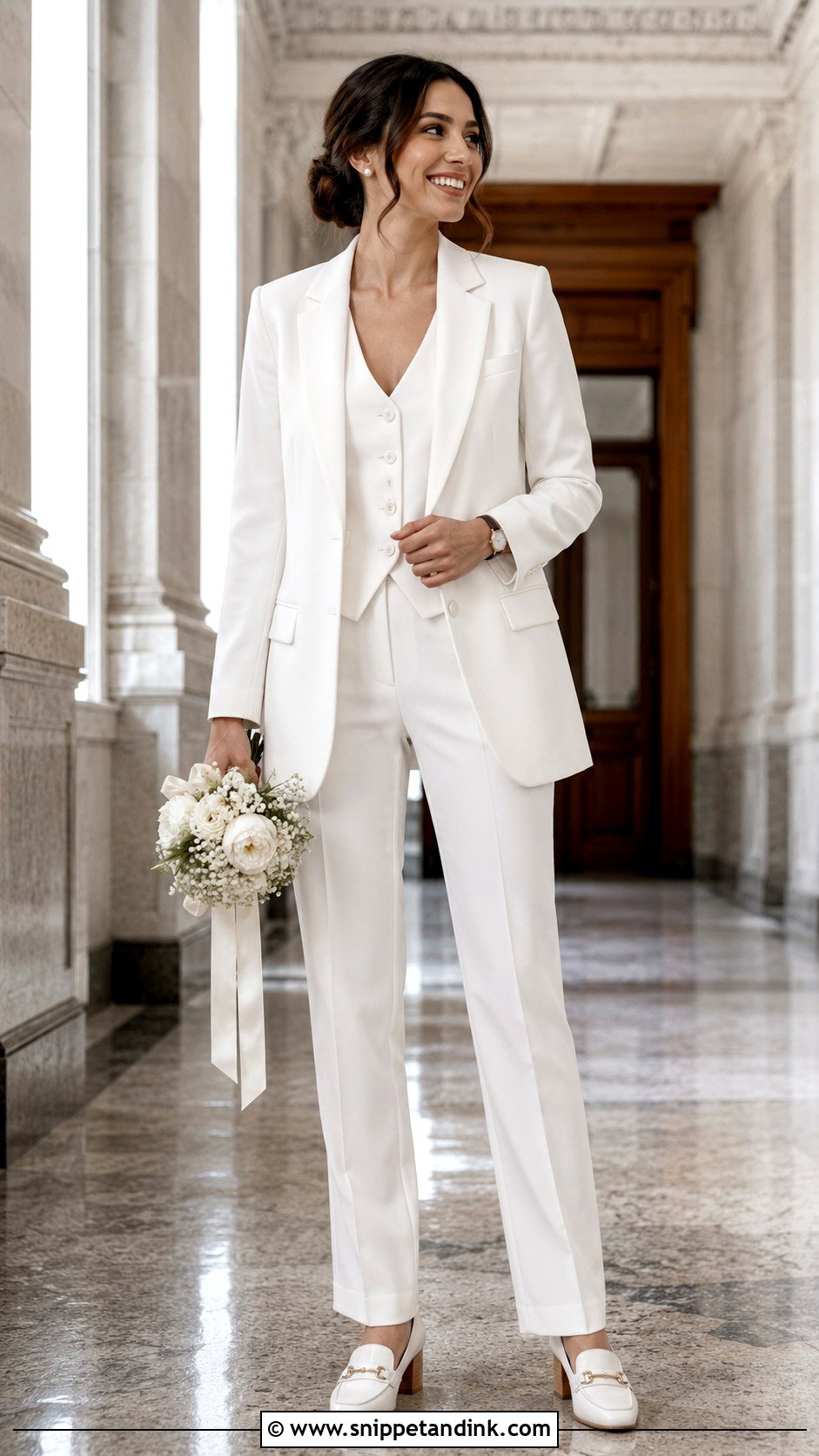
The three-piece is the most practical suit here because it gives you two outfits. The vest can be worn alone as a top, or over a silk blouse if you want more coverage, and once the ceremony is done you can drop the blazer and still look finished for dinner. The vest is also the piece I fuss over most. It must lie flat at the bust and waist; a button that pulls even slightly will gape every time you sit or lift your arms. A long single-breasted blazer and straight or slightly wide trousers balance the fitted waistcoat. Heeled loafers suit a lot of walking, and a small bouquet tied with satin ribbon keeps the mood soft.
7. White Skirt Civil Wedding Suit
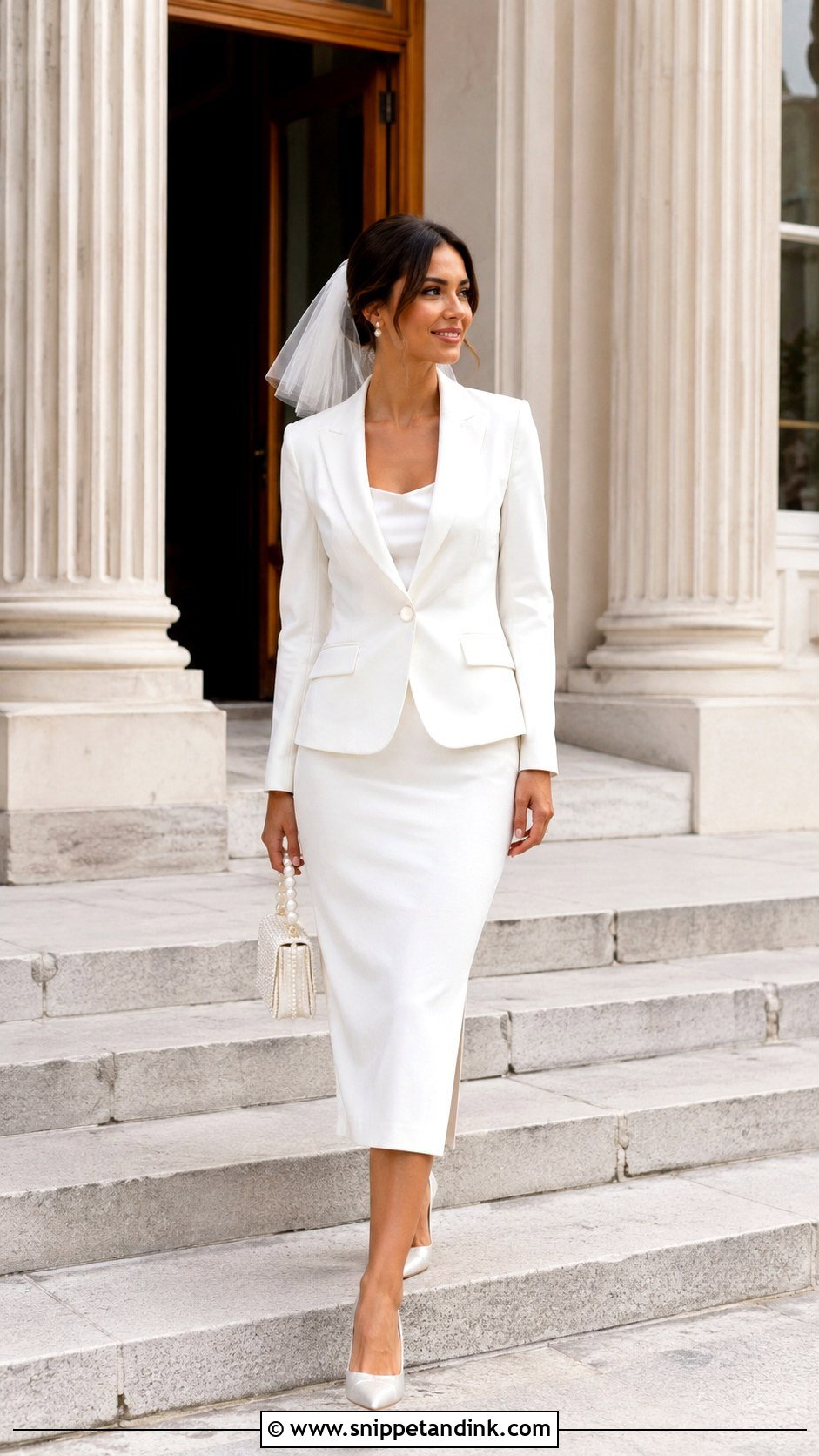
A skirt suit is the gentlest step away from a gown. I steer brides toward an A-line midi if the day includes stairs, a car and a restaurant, because a pencil skirt gives the cleanest line but restricts your stride more than you expect. Whichever you choose, sit down and walk around in it at the fitting: the back slit should open enough for a normal step, and the skirt mustn’t twist around your hips as you move, which usually means the waistband needs taking in. Crepe or bouclé softens the whole outfit compared with standard suiting. A silk shell, slingbacks and a short tulle veil complete it.
8. Blazer And Mini Skirt Civil Wedding Suit
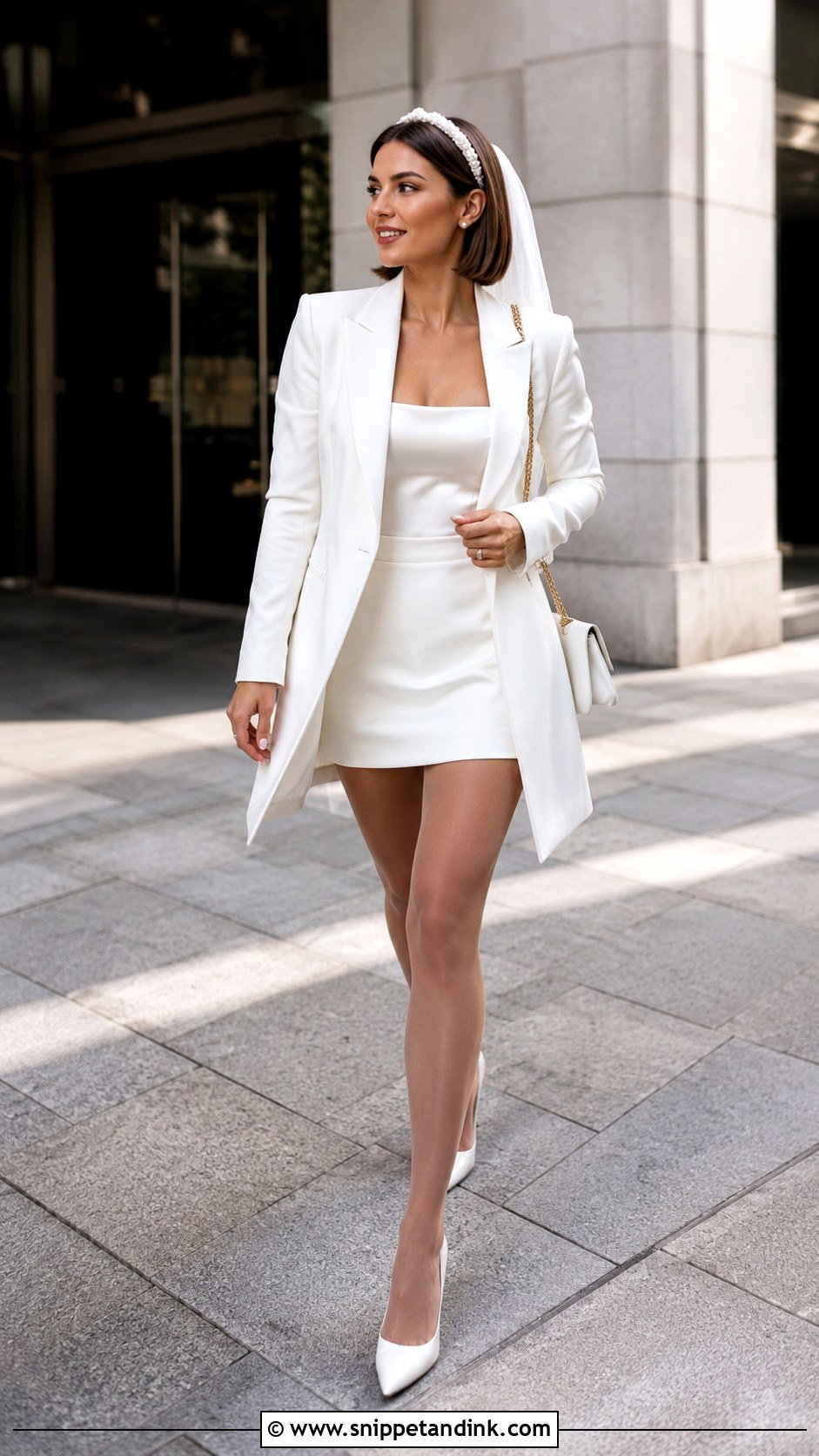
A mini skirt suit is fun, but it’s also the outfit most likely to cause a problem on the day, usually when you’re climbing courthouse steps or getting out of a car. Test it on stairs before you commit. I usually suggest a hem a few inches above the knee rather than an ultra-short cut, paired with a slightly longer, structured blazer so the proportions stay grown-up. A fitted camisole or bodysuit underneath avoids bulk. Sheer tights in cooler months look polished, not dowdy. A wide headband, short veil or bow is what tells everyone you’re the bride, so don’t skip it. Keep jewelry minimal.
9. Satin Lapel Civil Wedding Suit
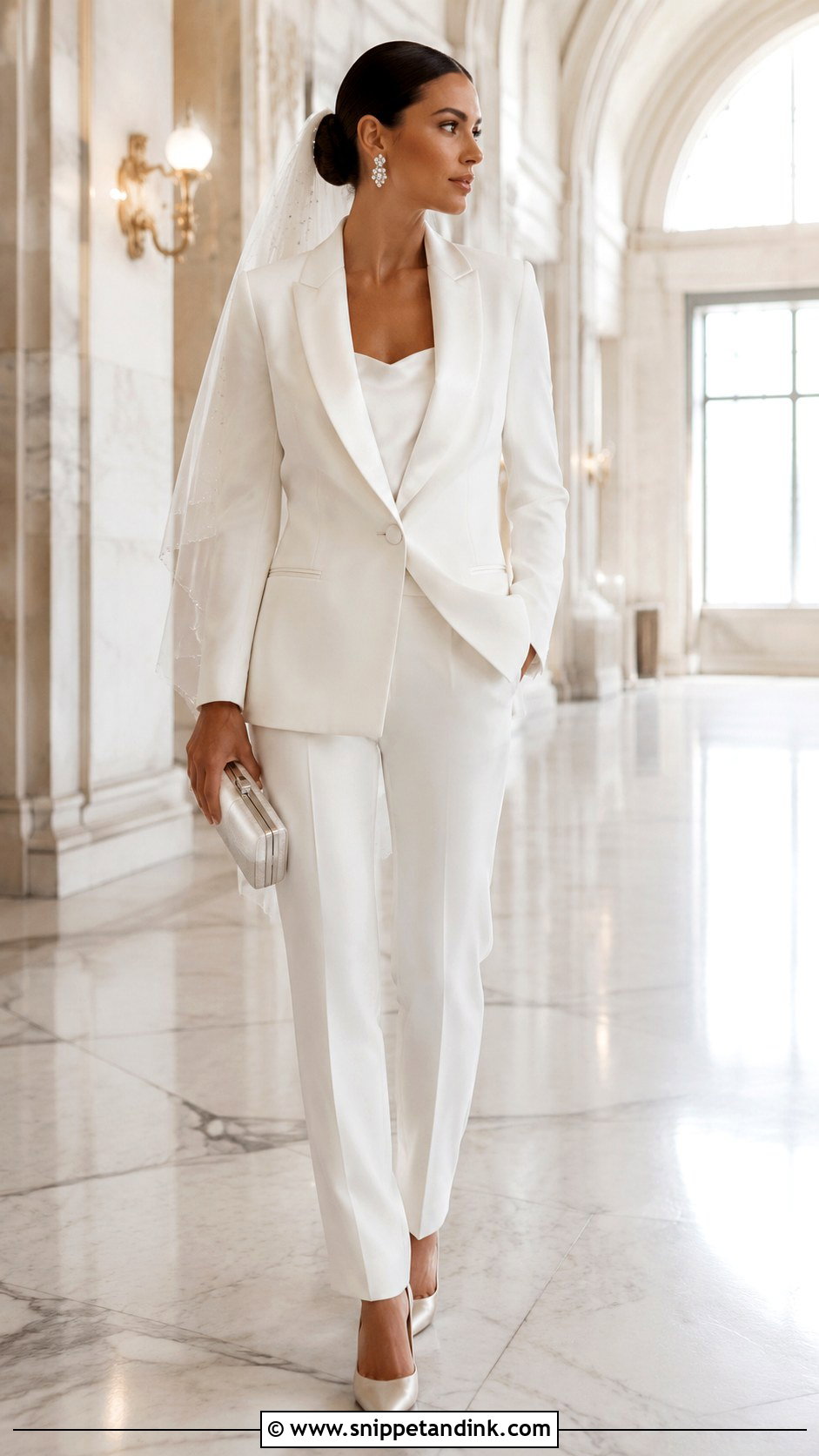
Satin lapels on a matte crepe body give you contrast without much shine, and it’s one of the most versatile ways to make a civil wedding suit feel formal. The contrast is the design, so I keep everything else quiet: a single-button closure, a smooth camisole or strapless top, satin pumps and crystal drops. A sleek bun with a fingertip veil keeps the lapels visible; a sculptural comb is the less traditional swap. As with any satin facing, protect it from makeup and hairspray. This suit carries well from a morning ceremony to a long lunch, provided the accessories stay restrained.
10. Cape Blazer Civil Wedding Suit
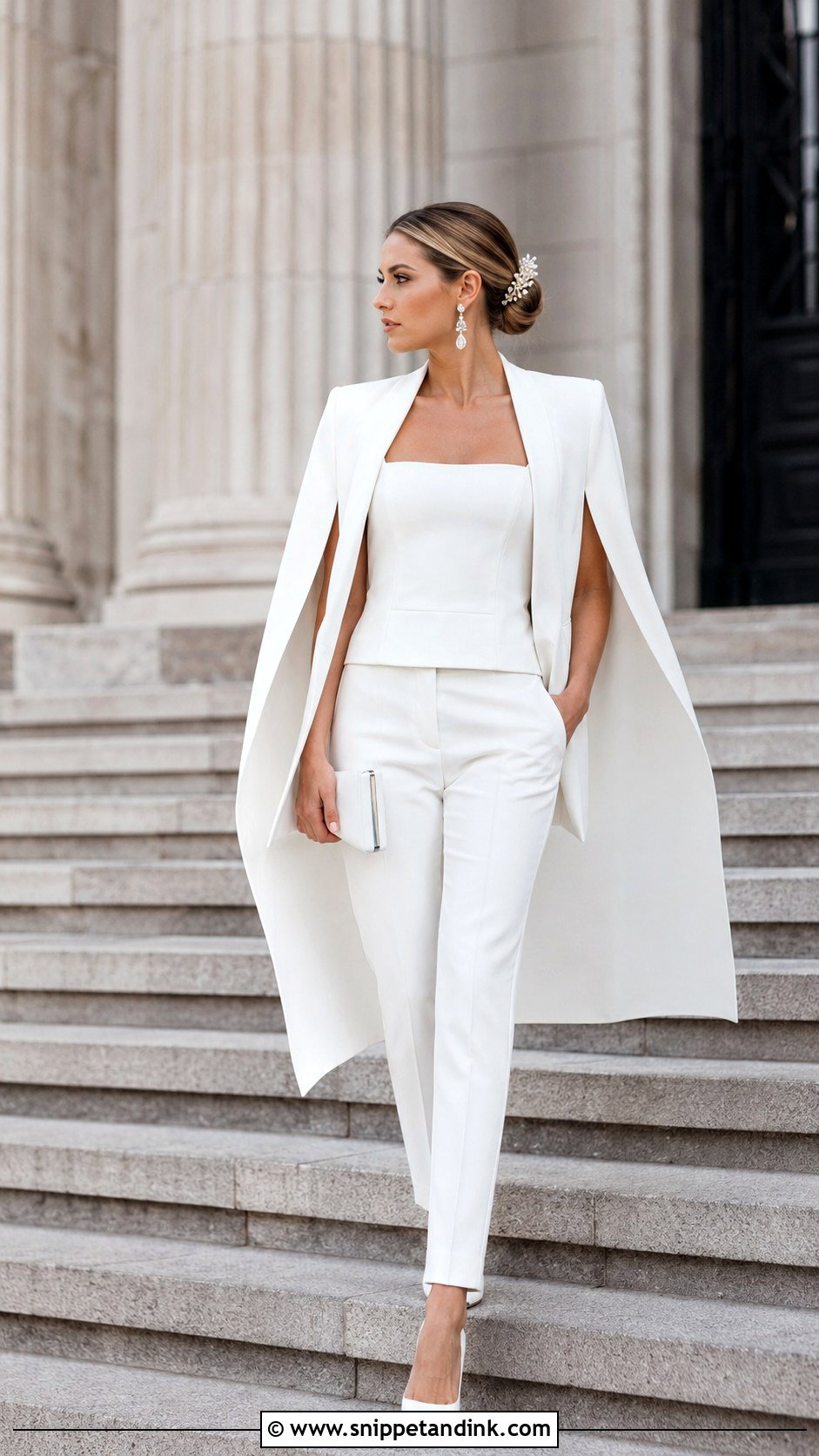
Capes look dramatic in full-length photographs, but they can be awkward to live in. Before buying one, I ask brides to mime the day: signing the register, holding a bouquet, hugging a parent, carrying a clutch. If the cape restricts your arms or slides off one shoulder, it’ll irritate you within an hour. A cape that falls from the shoulders and leaves the forearms free is the easiest version. Slim or straight trousers and a fitted sleeveless top keep it from looking heavy. The cape already carries the drama, so skip the long veil and use a sleek bun, jeweled barrette or minimal headband.
11. Lace Camisole Civil Wedding Suit
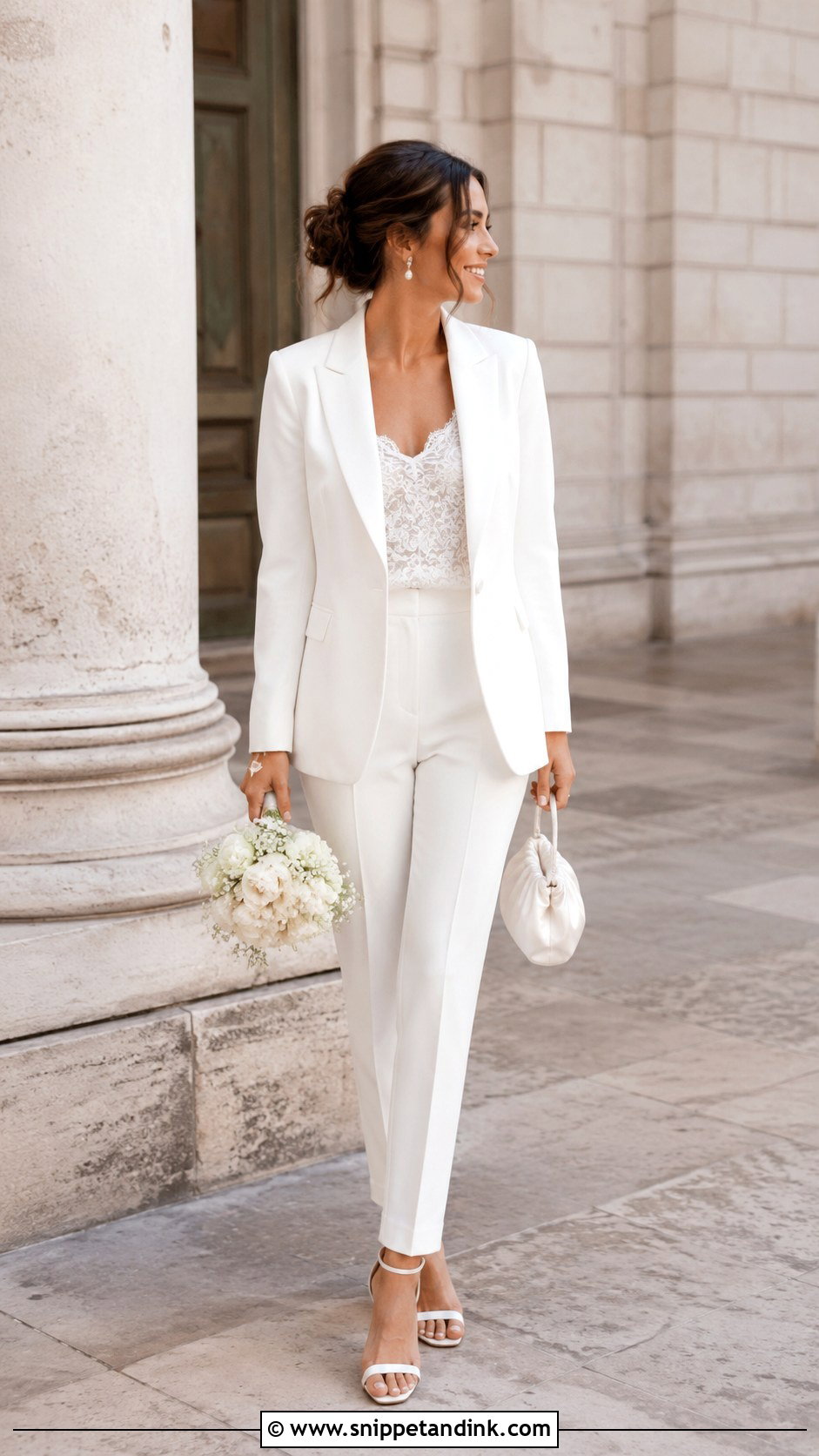
Lace softens a sharp suit, but only one lace element at a time; two competing patterns look busy within a white outfit. I like a lined lace camisole under a single-breasted crepe blazer, with the lining in nude or ivory so the lace pattern shows clearly without becoming see-through in camera flash. Check that the neckline sits comfortably under the jacket opening rather than peeking out unevenly. If you need support, a bodysuit-style camisole or cups sewn in by a tailor solves it neatly. A loose chignon or waved bob, ankle-strap heels and a satin mini bag complete it.
12. Silk Blouse Civil Wedding Suit
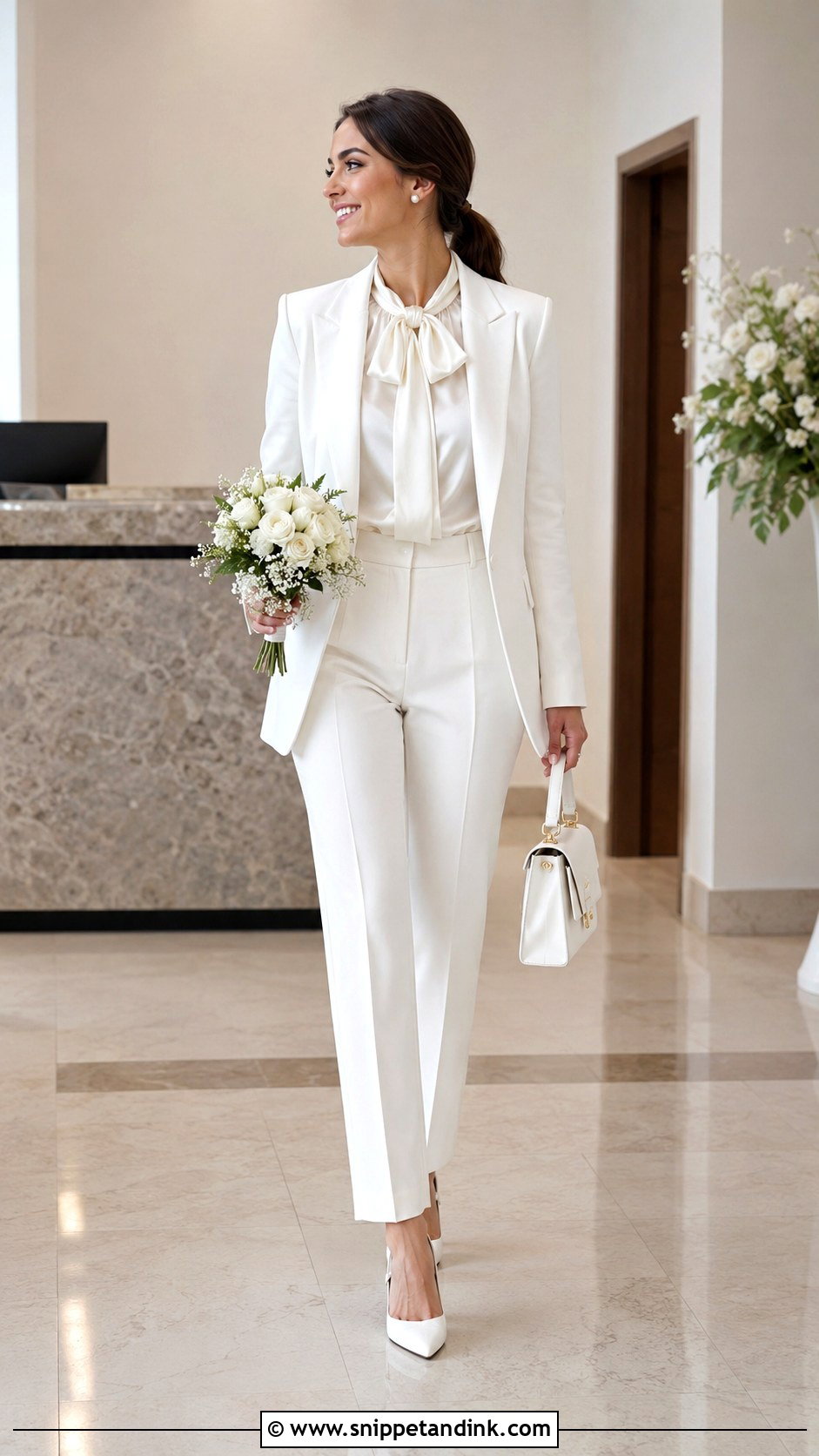
A silk blouse gives more coverage than a camisole and moves with you, which suits brides who don’t want to bare their shoulders. The bow-neck and draped styles are the most bridal. Wear the jacket open so the blouse isn’t crushed at the neckline. The sleeve is where this usually goes wrong: a full blouse sleeve stuffed into a slim blazer bunches at the elbow and pulls the jacket out of shape, so try them together before buying either. If there’s a necktie, a loose bow or two hanging ends both work. Pointed slingbacks keep the long line if you prefer flats.
13. Corset Top Civil Wedding Suit
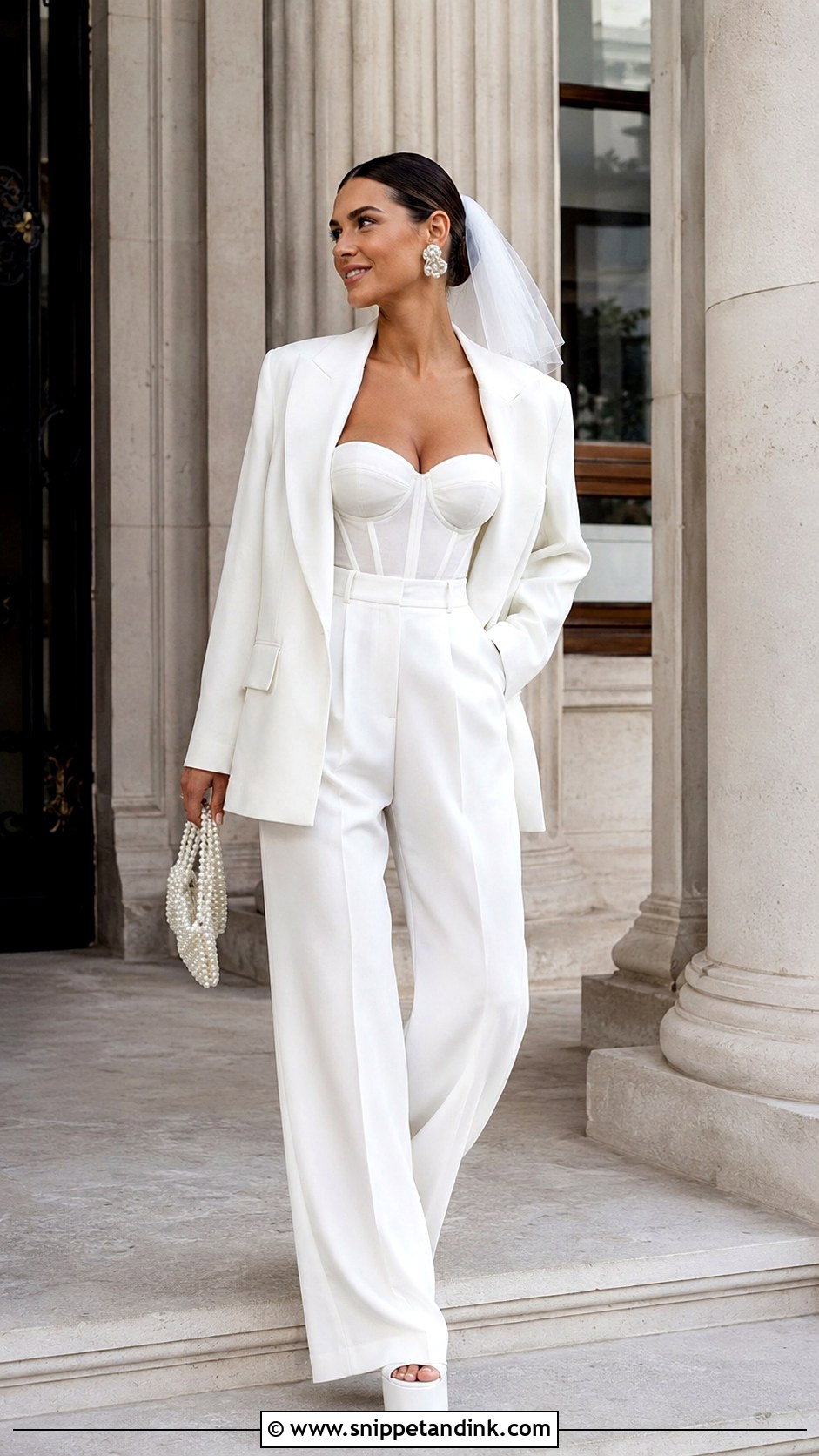
A corset top gives an oversized suit a defined waist and a more celebratory feel than a plain camisole. The quality test is simple: look for real boning, a soft lining and a top edge that stays put when you sit and lean forward to sign. Cheap corset tops dig in at the ribs after an hour. I pair it with a long white blazer and wide-leg trousers; the jacket length matters, because a short jacket over a corset and wide trousers can look top-heavy. Detachable tulle sleeves or a short veil can be added for the ceremony and taken off afterwards. A slicked-back bun keeps the neckline clear.
14. Champagne Civil Wedding Suit
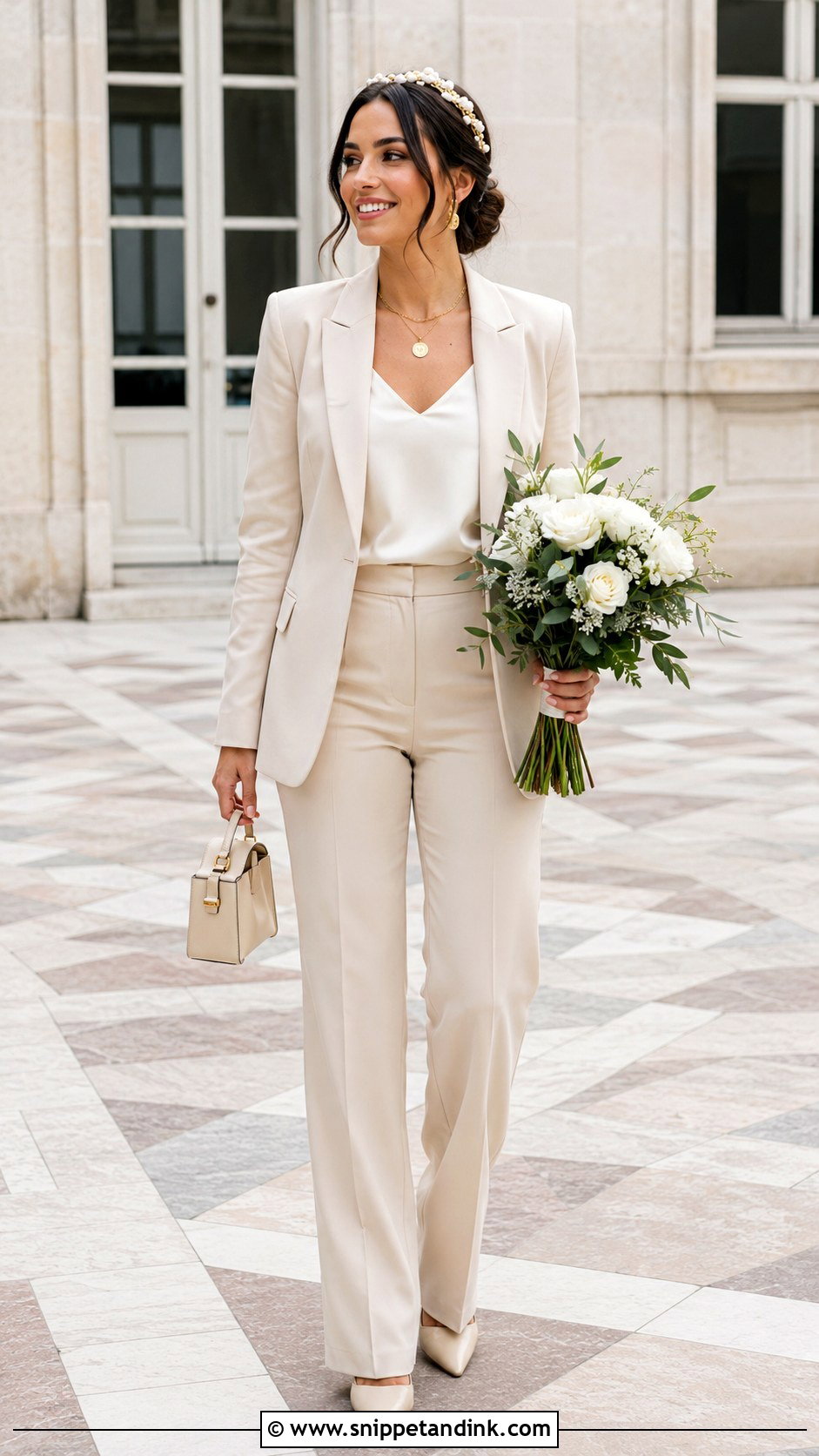
Champagne is the colour I most often recommend to brides who find white harsh against warm or neutral undertones. The risk is that it reads as bridesmaid, so it needs one unmistakably bridal piece: a veil, a pearl headpiece or a satin bow. Matte satin or crepe looks expensive; shiny polyester satin in champagne looks cheap under flash. Pair it with a warm ivory camisole so the two tones don’t fight, and gold jewelry or creamy pearls. Look at the fabric by a window and under indoor lighting before you buy, because champagne shifts from pink to beige to grey depending on the light.
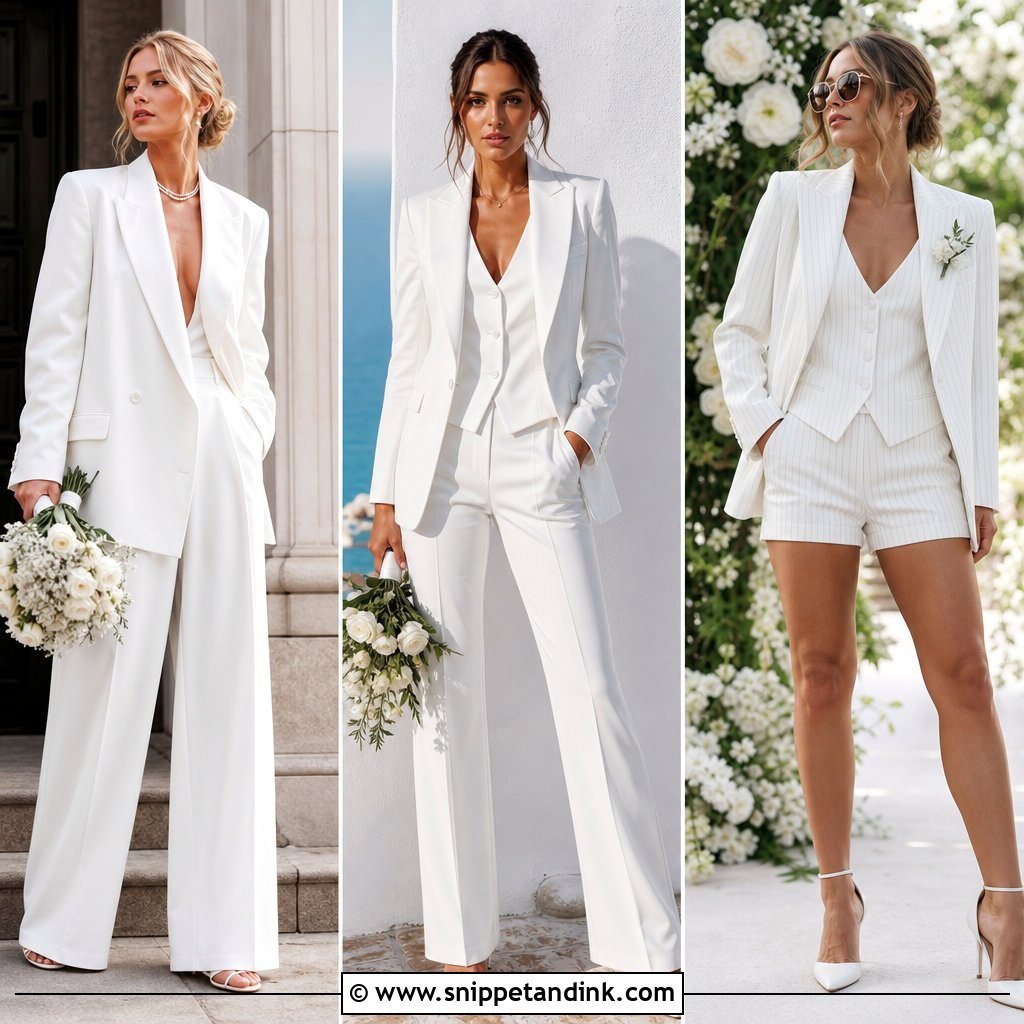

15. Blush Civil Wedding Suit
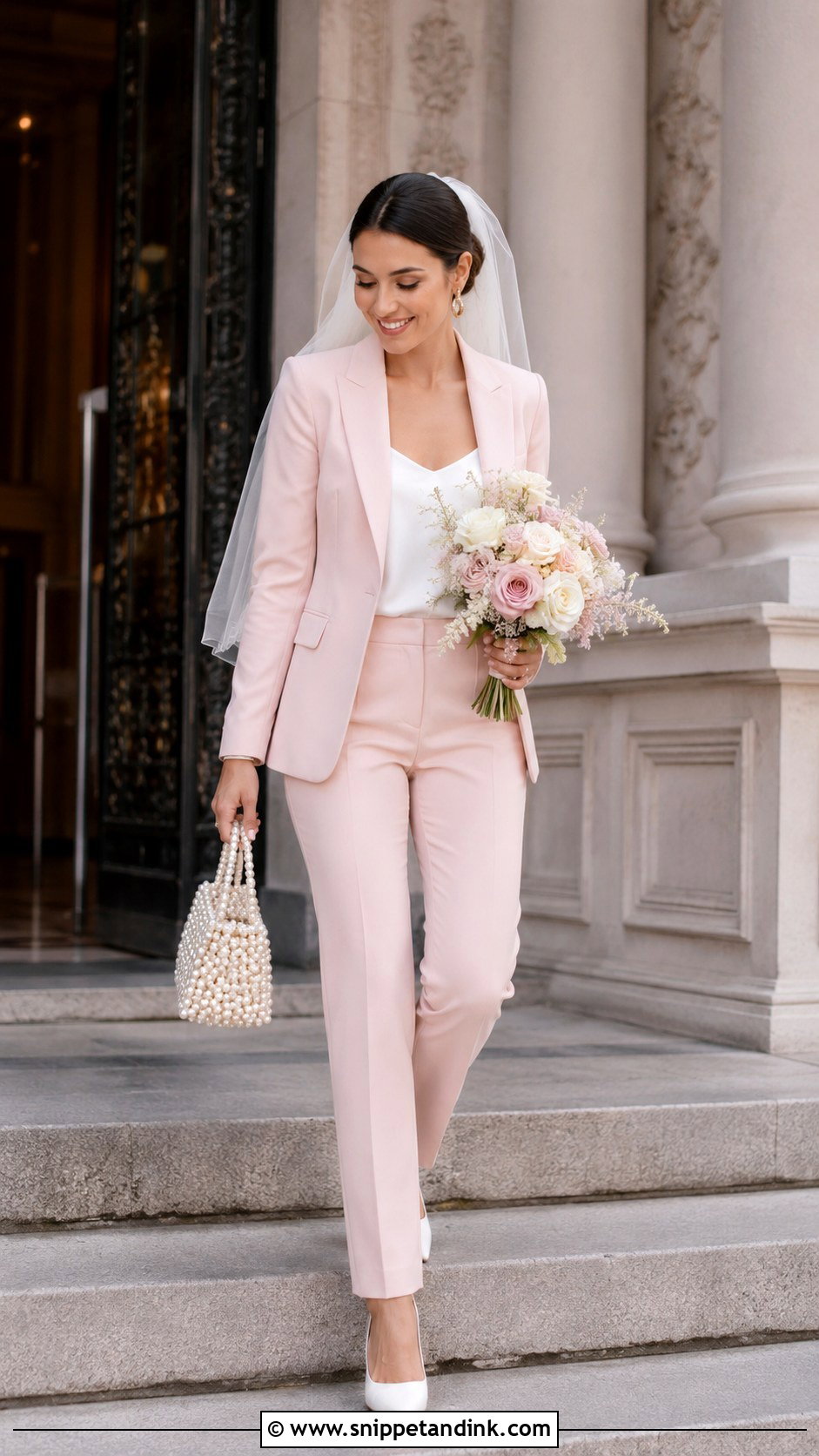
Blush works best when it’s muted and close to skin colour; a bright pink suit stops looking bridal very quickly. Hold the fabric near your face in daylight, since some blush shades wash out fair skin and others turn sallow. I keep the tailoring simple and let ivory accents do the bridal work: an ivory silk top, white pointed pumps and a pearl handbag. Rose-gold earrings echo the colour without matching it too exactly. A short ivory veil or a small floral comb, plus a tonal bouquet of cream and pale pink with soft green, finishes it.
16. Pale Blue Civil Wedding Suit
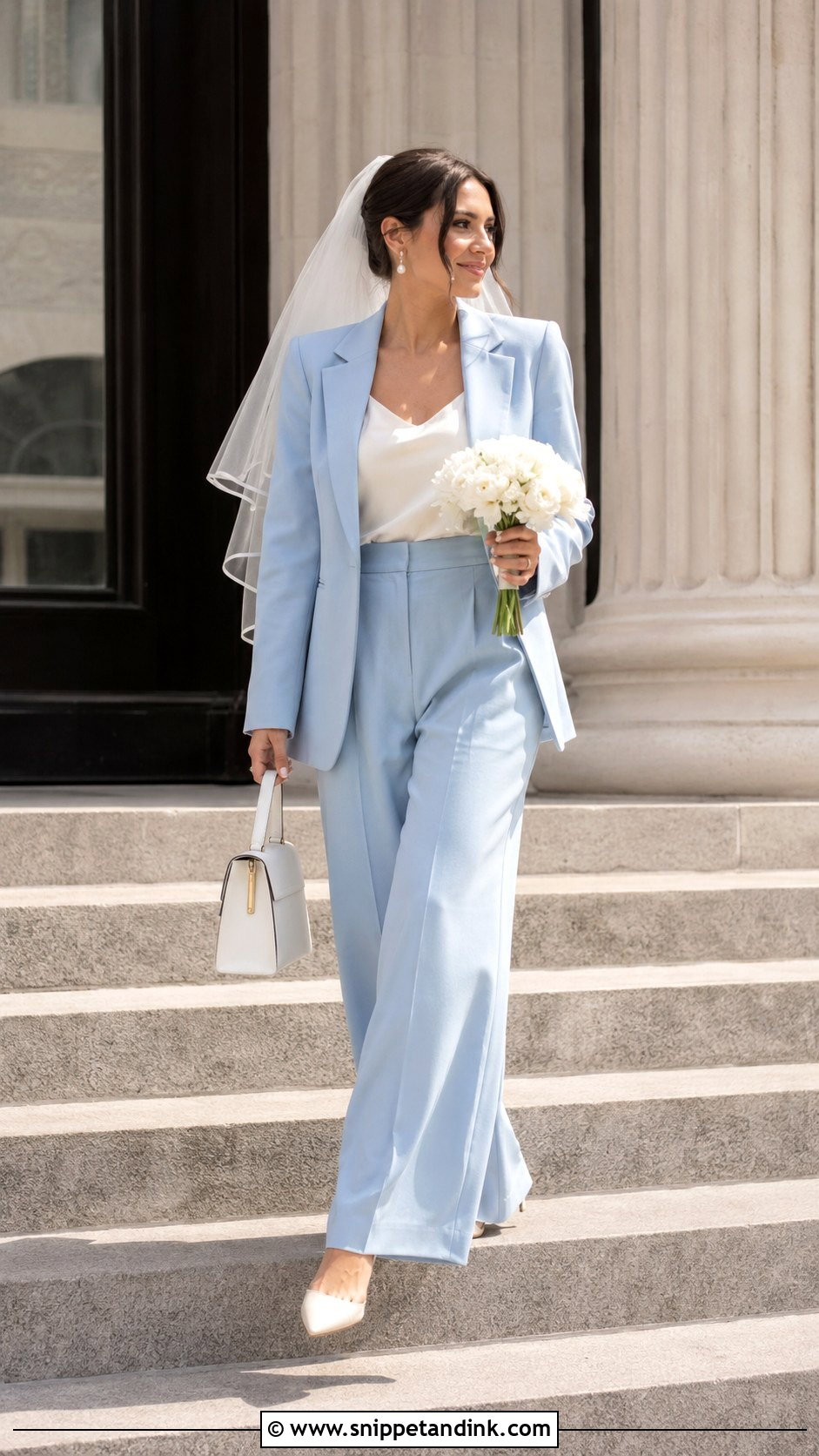
Pale blue gives you a suit and your something blue in one. The shade has to stay light and muted, though; anything near a mid blue starts to look like a standard business suit. I’d layer an ivory camisole underneath and keep the accessories white so it stays clearly bridal: white slingbacks, pearl drops and a structured white bag. Silver jewelry suits cool blue better than gold. A small white bouquet and a simple veil add ceremony. A detail I like here is having the wedding date or initials embroidered inside the jacket lining, which costs little and stays with the suit afterwards.
17. Black And White Civil Wedding Suit
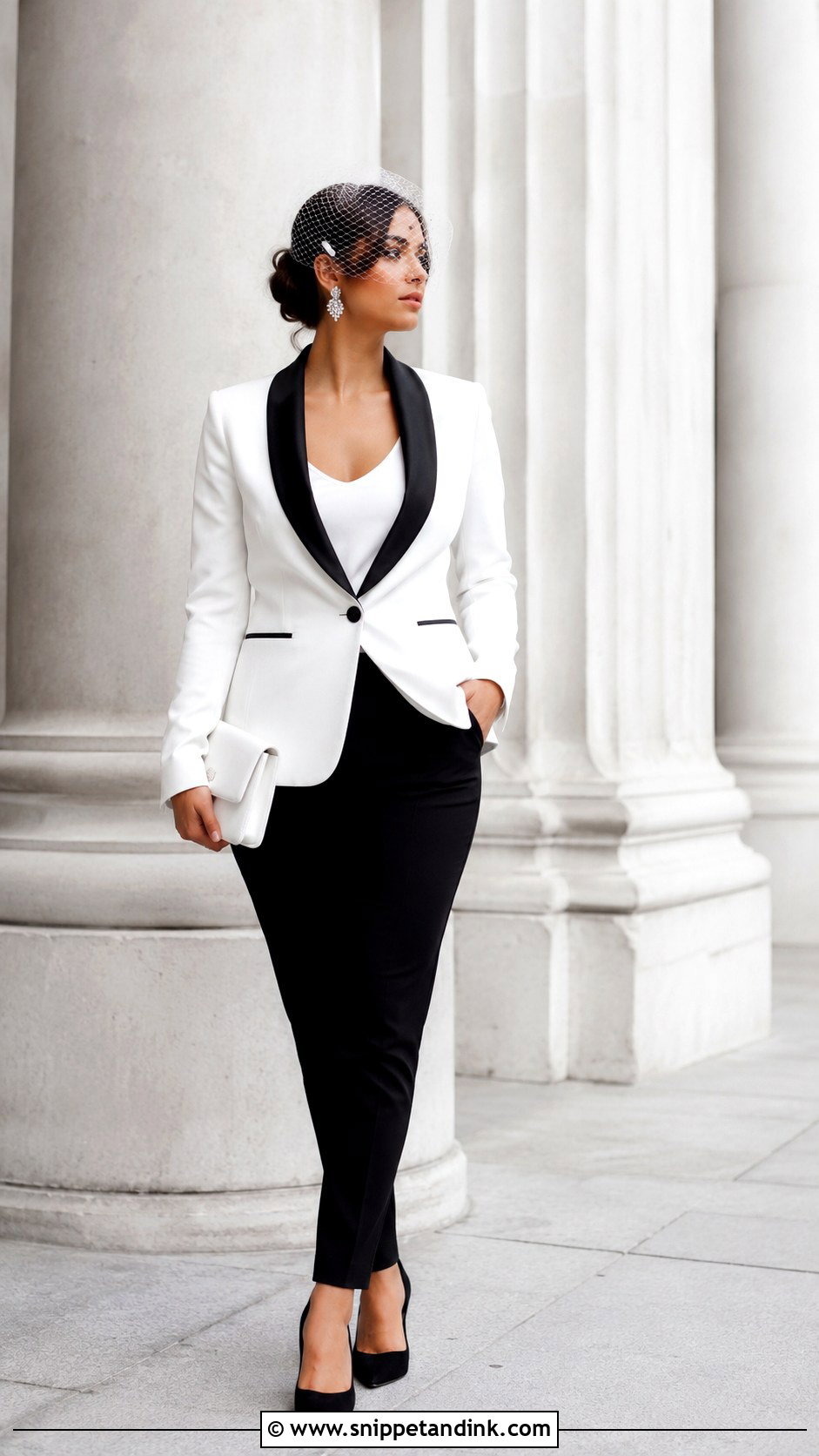
A black and white tuxedo suit is for the bride who likes graphic contrast and is comfortable being looked at. A white blazer with black satin lapels over black trousers and a white camisole is the classic version. The honest warning is that contrast shows every flaw in fit, since a black lapel against white fabric draws a sharp line around anything that pulls or sags. A birdcage veil keeps it obviously bridal. For a softer version, try an all-white trouser suit with a black bow tie or black silk blouse. Keep the bouquet white and compact so it doesn’t compete with the palette.
18. White Pinstripe Civil Wedding Suit
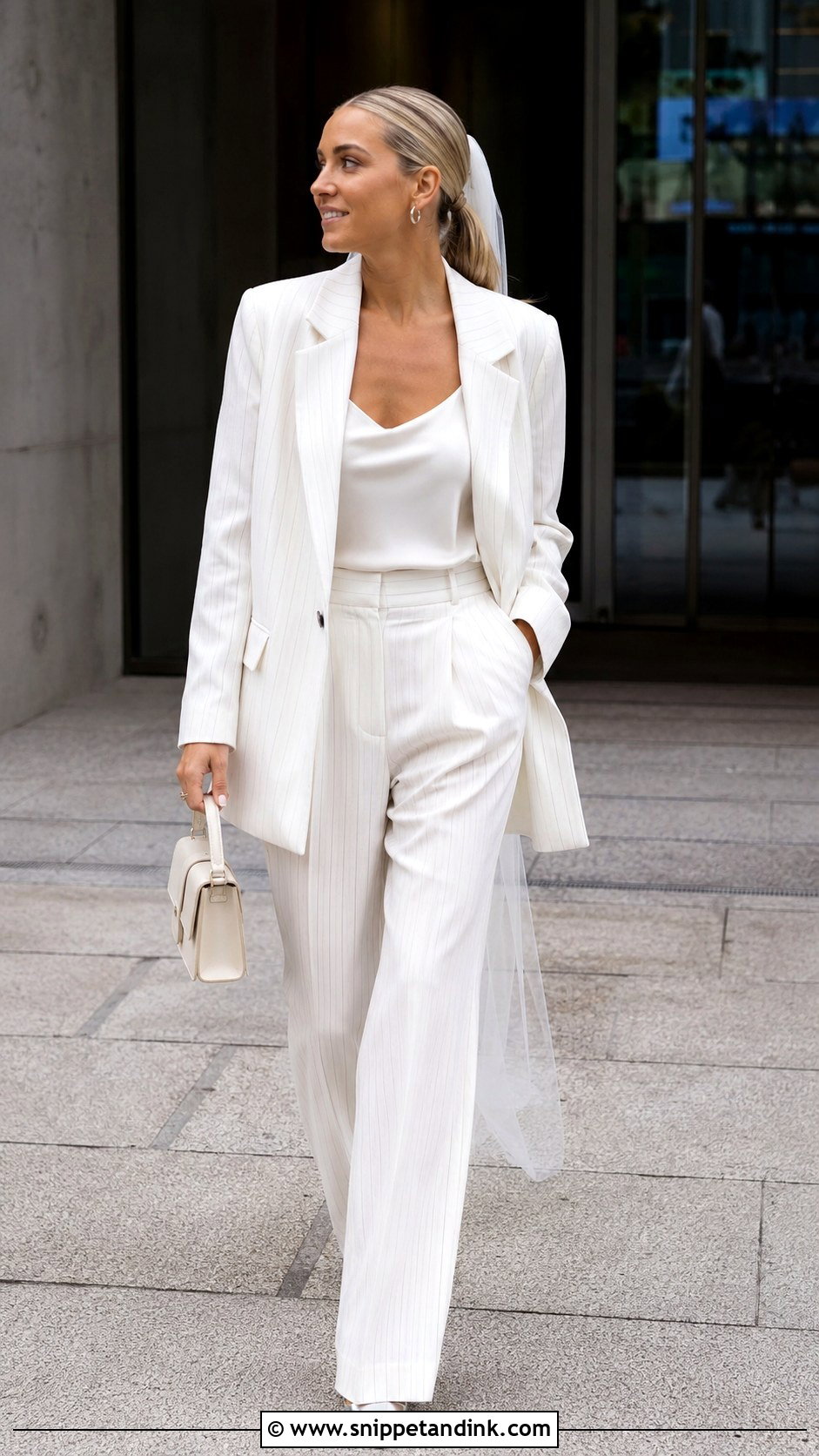
Pinstripe in white only works when the stripe is tonal, meaning ivory or pale silver on white rather than dark businesswear lines. Up close it gives the fabric depth; from a distance it simply reads as white. Vertical stripes lengthen the body, especially with a full-length trouser hem. Have the tailor check that stripes line up at the seams, because a mismatched stripe at the shoulder or side seam is easy to spot in close-up photos. A slightly oversized blazer, high-waisted trousers and a plain silk camisole suit it, and I’d keep every other pattern out of the outfit. A narrow belt or a shaped seam adds waist definition.
19. White Linen Civil Wedding Suit
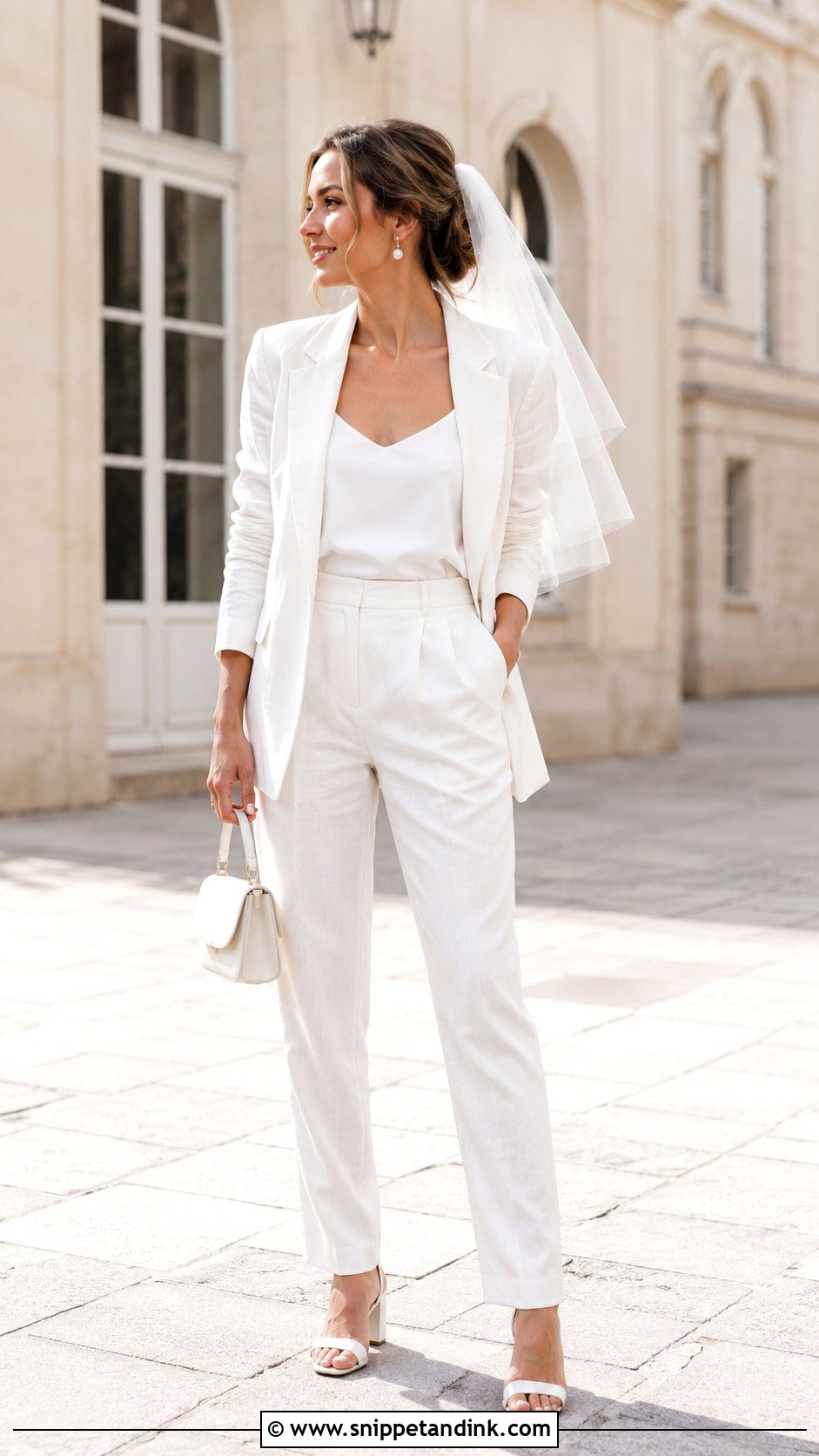
Linen is the honest choice for a hot-weather ceremony, but it will crease, and no spray stops that entirely. I tell brides to choose a lined linen blend for a white linen suit, since the lining reduces transparency in sun and limits the worst wrinkling, and then to accept a softer tailored line rather than expect crispness. Steam it just before leaving and stand in the car if you can, rather than sit. A silk camisole underneath, block-heel sandals or loafers for walking, pearl earrings and a small woven bag keep it relaxed. A low bun and short veil suit the mood.
20. Ivory Velvet Civil Wedding Suit
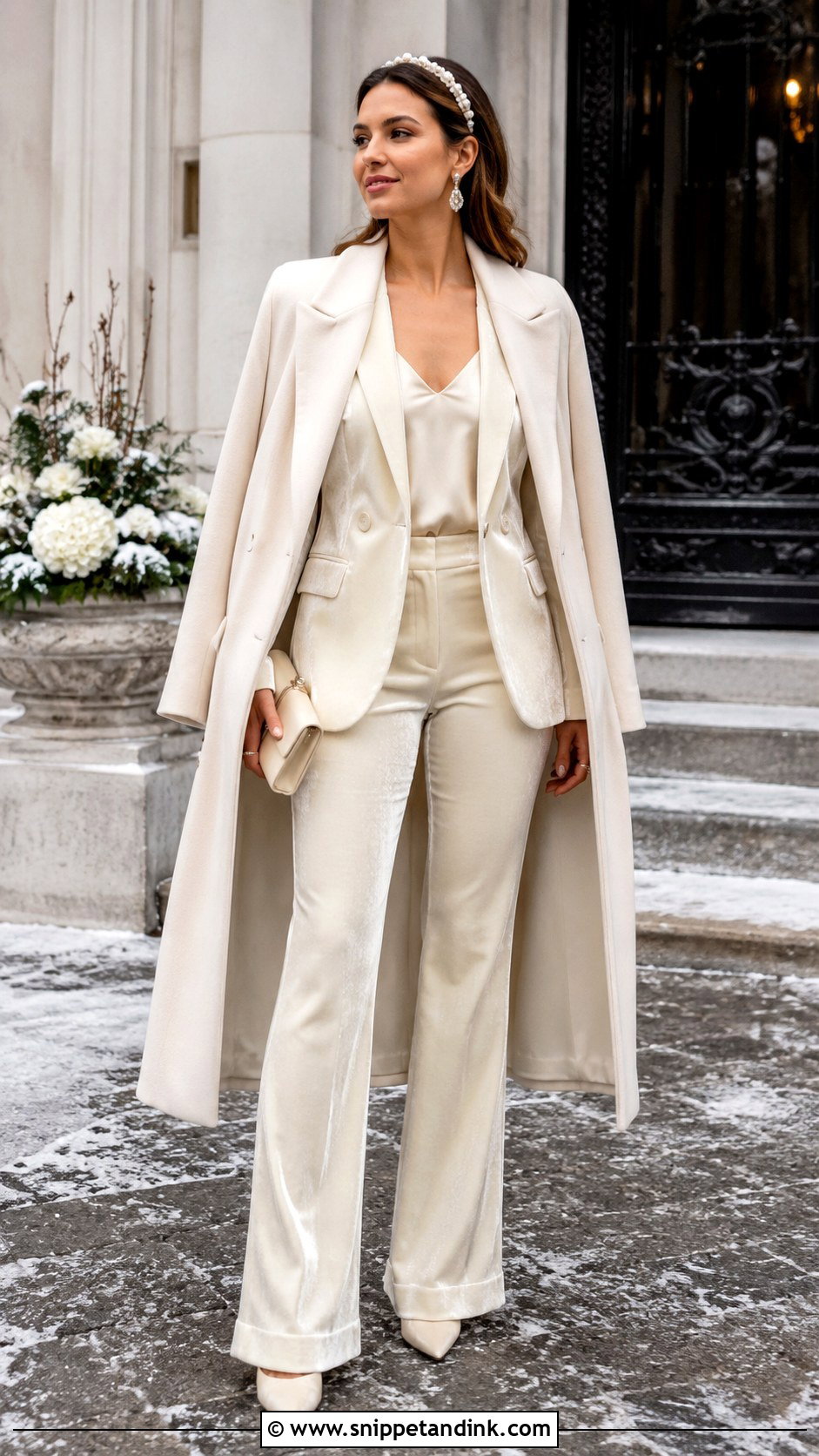
Velvet has a nap, which means it reflects light differently depending on which way the pile runs. Before alterations, I hold the jacket and trousers side by side in daylight; if one piece was cut with the nap running the other way, it will look like two shades of ivory in every photo. A fitted blazer with simple lapels, matching straight or flared trousers and a satin camisole underneath give texture contrast. Velvet already looks rich, so go easy on embellishment. Closed-toe pumps, crystal earrings and a long ivory wool coat for arriving and leaving make it work in cold weather.
How White Tailoring Holds Up at the Registry Office
A civil ceremony is short, but the day around it isn’t. You’ll sit in a waiting room, stand for the vows, lean over a desk to sign, hug everyone outside and probably eat lunch in the same outfit. Each of those moments tests the suit in a different place.
Seated creases at the hip and behind the knee are the most common complaint, and they show more in linen and lightweight crepe than in wool blends. Stand while you wait if you can, and keep the jacket on a hanger in the car rather than folded on a seat. For marks, I pack a small kit: a stain pen tested on a hidden seam first, white chalk to cover a light mark on matte fabric, safety pins, a lint roller and blotting papers for the lapels.
Wearing the Pieces Again Without Wearing the Wedding
The pleasure of a suit is that the blazer becomes your best jacket and the trousers go with everything you already own. Have both pieces cleaned together, even if only one got marked, because white and ivory fabrics shift tone slightly with each clean and you want them to age at the same rate. Store them on a shaped hanger in a breathable cotton bag, never plastic, which traps moisture and can yellow white fabric over time.
One Bridal Detail Is All a Well-Cut Suit Needs
Whichever suit you choose, the order of decisions stays the same. Settle the silhouette that suits your proportions, put the budget into alterations, choose shoes you can actually walk in, then add one clear bridal detail, such as a veil, pearl headband, bouquet or satin bow. White is the classic, but champagne, blush, pale blue and black-and-white all hold their own at a civil ceremony. Trousers, skirts, vests and capes each change how the outfit moves, so try it on standing, sitting and signing before you commit.
You'll Like These Ideas:


Leave a Reply