
A suit is a serious alternative to a gown, and it loses none of the meaning of the day. I’ve seen more brides ask about tailoring in recent seasons, and the ones who look best in it treat the suit with the same care as a dress: proper fabric, proper fittings and accessories chosen for the cut. Below are twenty complete looks, from pantsuits and skirt suits to tuxedo styles and modern separates, for different seasons, venues and figures. Each one comes with the shoes, veil and finishing details I’d put with it, in fabrics from ivory crepe and lace to linen and beaded evening cloth.
Shoulders Can’t Be Faked, So Fit Them First
A wedding dress forgives a lot with boning and volume. A suit forgives very little, so I shop for one in a particular order. The shoulders come first, because that’s the one area a tailor can barely change. If the shoulder seam doesn’t sit on your shoulder bone in the store, put the jacket back, however lovely the fabric.
What a tailor can and can’t change
- Easy: trouser hems, sleeve length from the cuff, taking in the waist of a jacket or trousers, and moving a button.
- Possible, with skill: letting out seams where there’s spare allowance, and adjusting the trouser rise slightly.
- Very hard or impossible: shoulder width, lapel shape, and jacket length when there are pockets near the hem.
Give yourself time. Made-to-order bridal suiting can take several months, and lead times vary by designer, so ask when you order. Plan two or three fittings in the final six to eight weeks, and bring your wedding shoes and the exact top you’ll wear under the jacket to every one.
1. White Tuxedo Bridal Suit
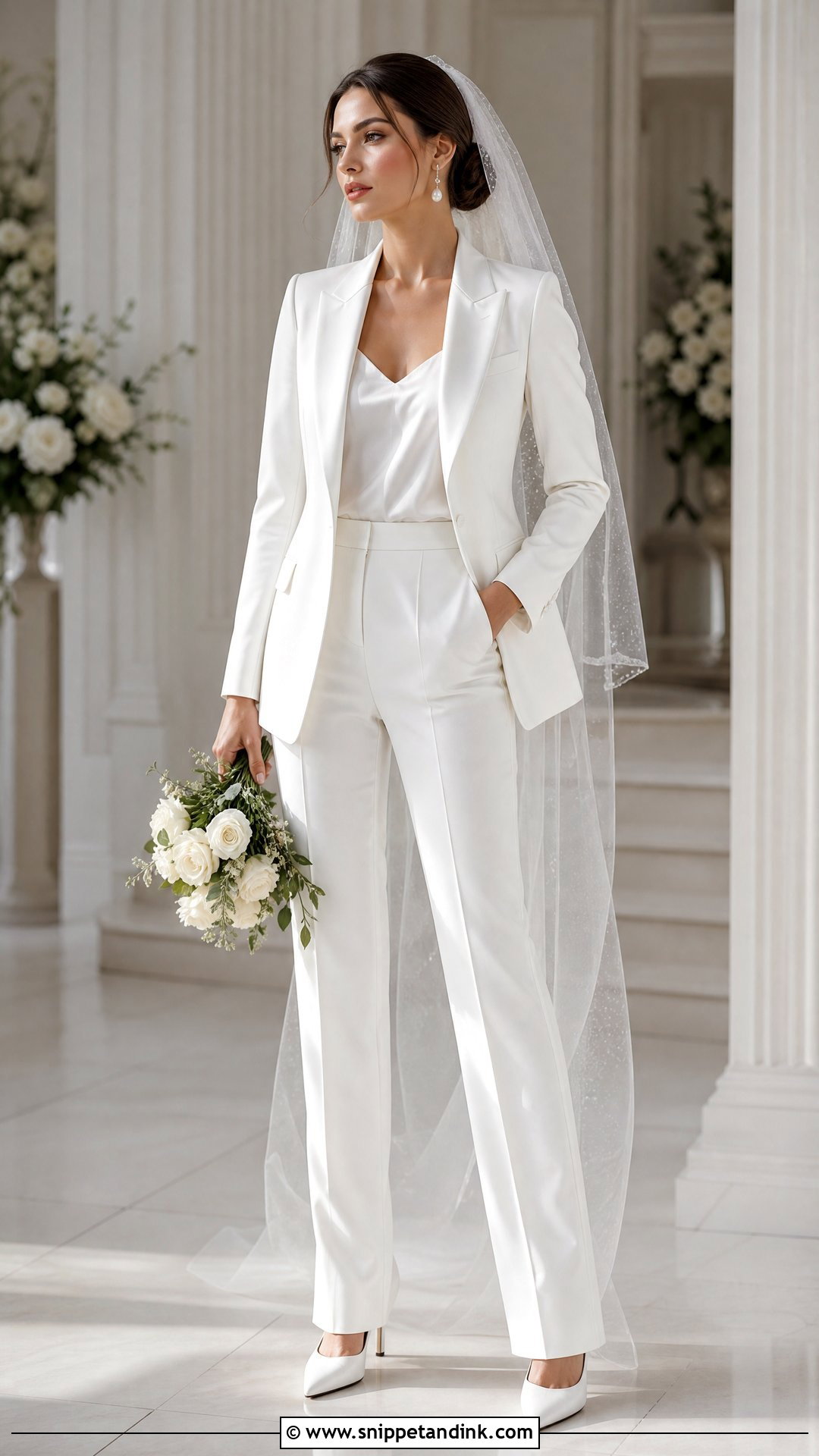
A white tuxedo bridal suit is the most formal suit on this list, and the satin lapels are what make it a tuxedo rather than a business suit. Keep the blazer sharply cut with a lightly shaped waist and the trousers straight. A silk camisole underneath softens it; a structured corset makes it dramatic. When I fit a tux, I watch the lapel roll. If it buckles when the jacket is buttoned, the chest is too tight, and no steaming will fix it. Pointed white pumps, pearl drops and a fingertip veil complete it, and a low bun keeps that neckline clear in photos.
2. Ivory Wide Leg Bridal Suit
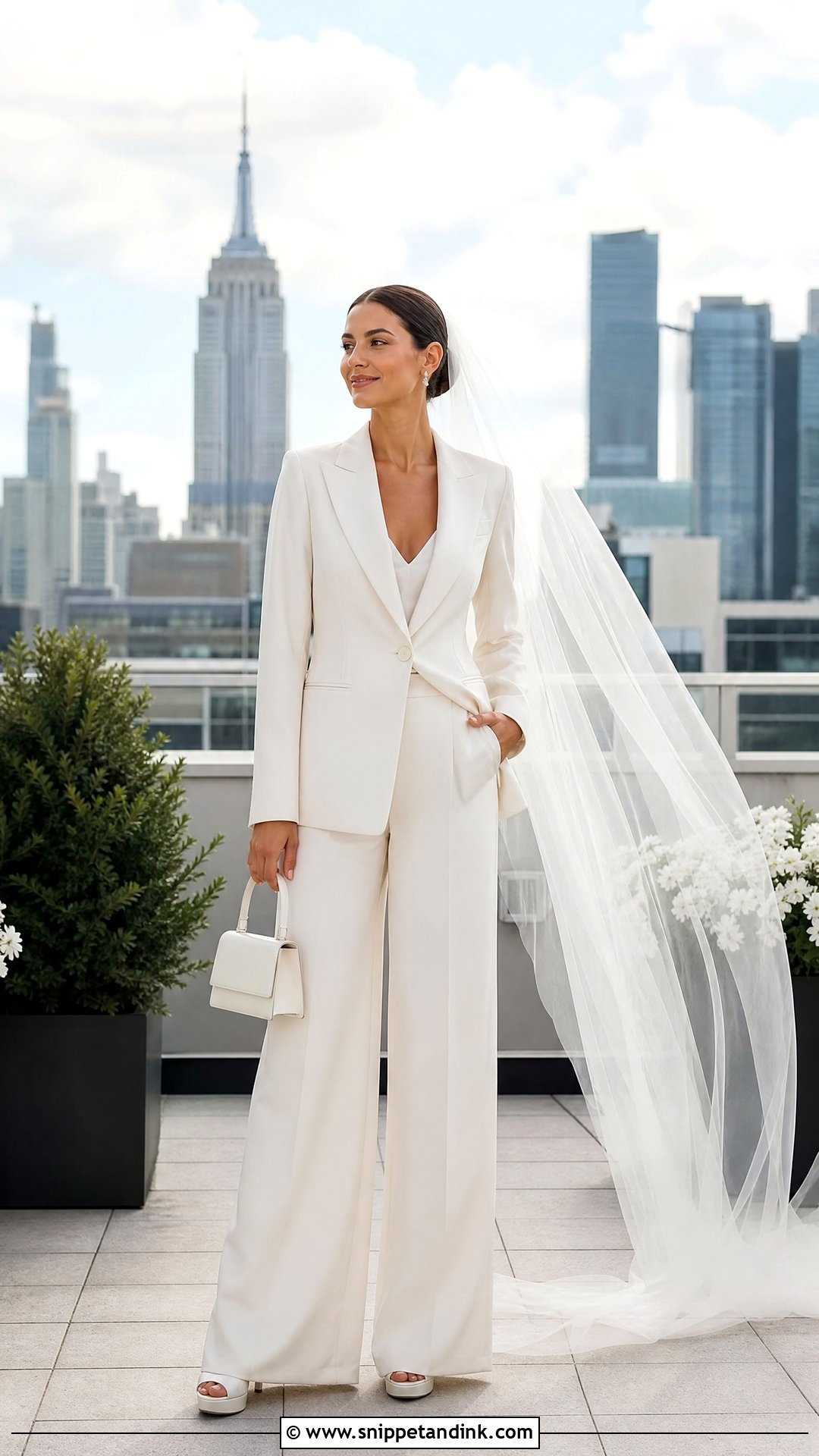
Wide-leg trousers move like a skirt when you walk, which is why this suit feels so bridal. Choose a high waist and a cut that falls straight from the hip, hemmed to almost cover the shoe. Hem it in your wedding platforms and nothing else, since an inch of difference in heel height will either drag the trousers on the floor or flash the ankle. A fitted single-button blazer balances the volume below. Underneath, a satin shell or square-neck bodysuit in the same ivory works well. A long lightweight veil suits the length of the line, and the defined waist flatters most figures.
3. Satin Bridal Pantsuit
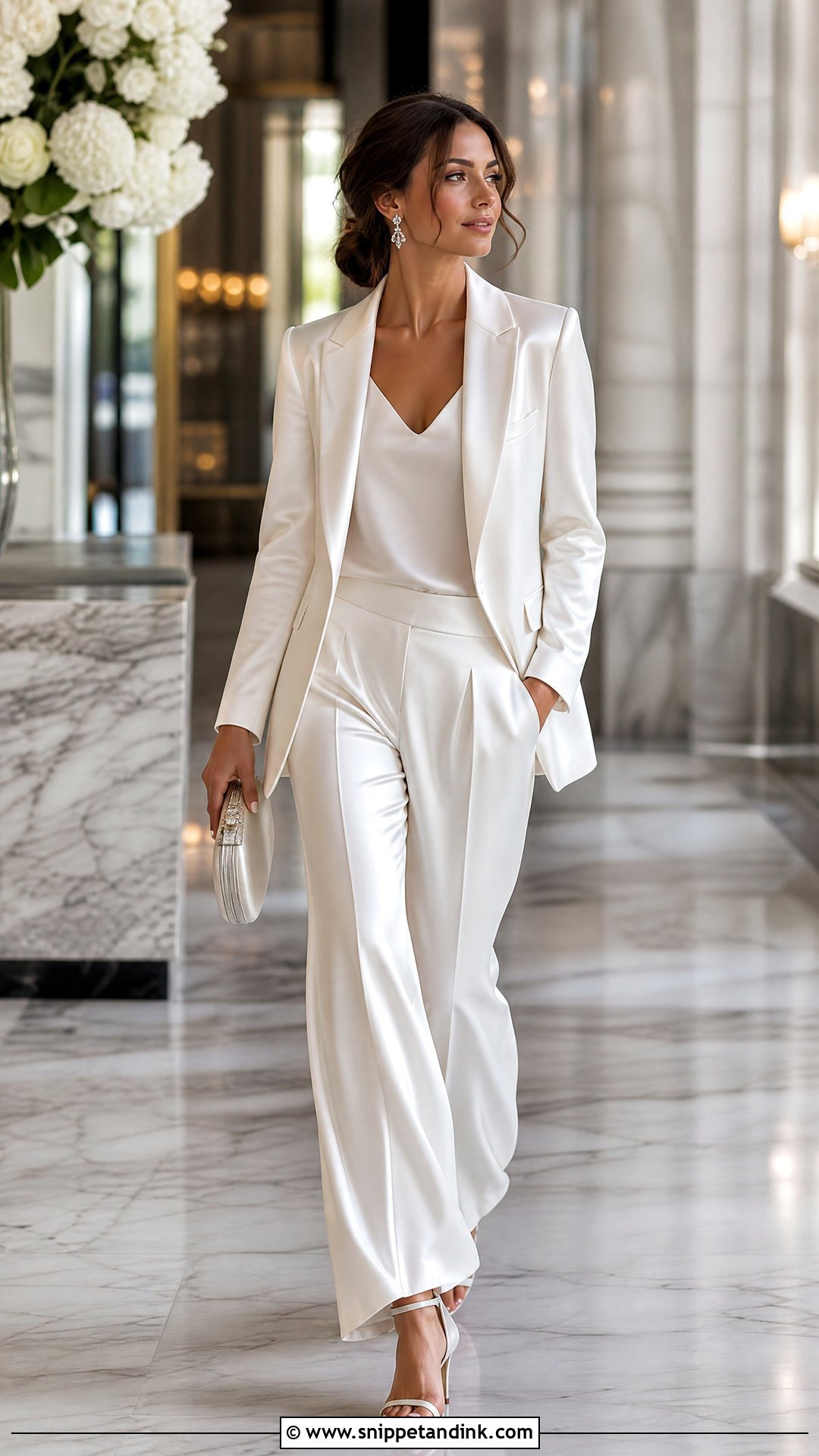
Satin is the fabric that shows everything. It catches light along every seam, so a pantsuit in pearl white or champagne needs no decoration, and it also shows every pull, ripple and crease. I insist on a good lining and at least two fittings with satin. A matte silk camisole underneath stops the whole outfit looking like one shiny surface. Ankle-strap heels, crystal earrings and a compact satin bag keep it refined. Expect satin trousers to crease at the lap after the ceremony; a quick steam before the reception photos sorts it.
4. Lace Blazer Bridal Suit
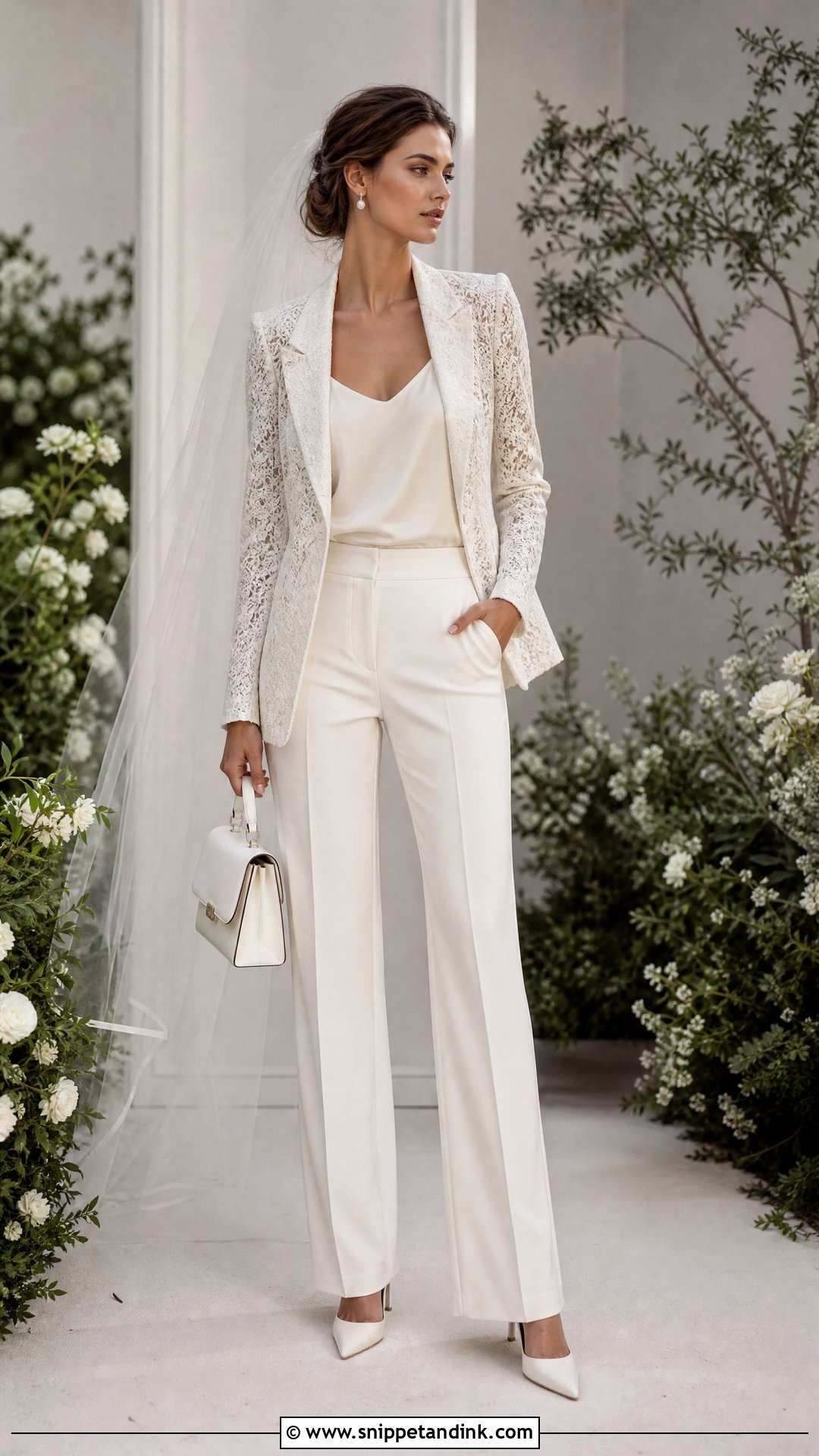
Lace on a blazer softens tailoring without turning it into a dress. A fitted lace jacket over a simple ivory camisole or lined bustier, with plain crepe trousers, lets the lace lead. My first check with lace jackets is the lining. Unlined lace shows the seams and darts of whatever’s beneath it, and that looks unfinished up close. If you wear a lace-edged veil, its pattern should be simpler than the jacket’s, or switch to clean tulle. Keep jacket and trousers in exactly the same shade of ivory so the separates read as one outfit. Pointed slingbacks and pearl earrings finish it.
5. Bridal Skirt Suit
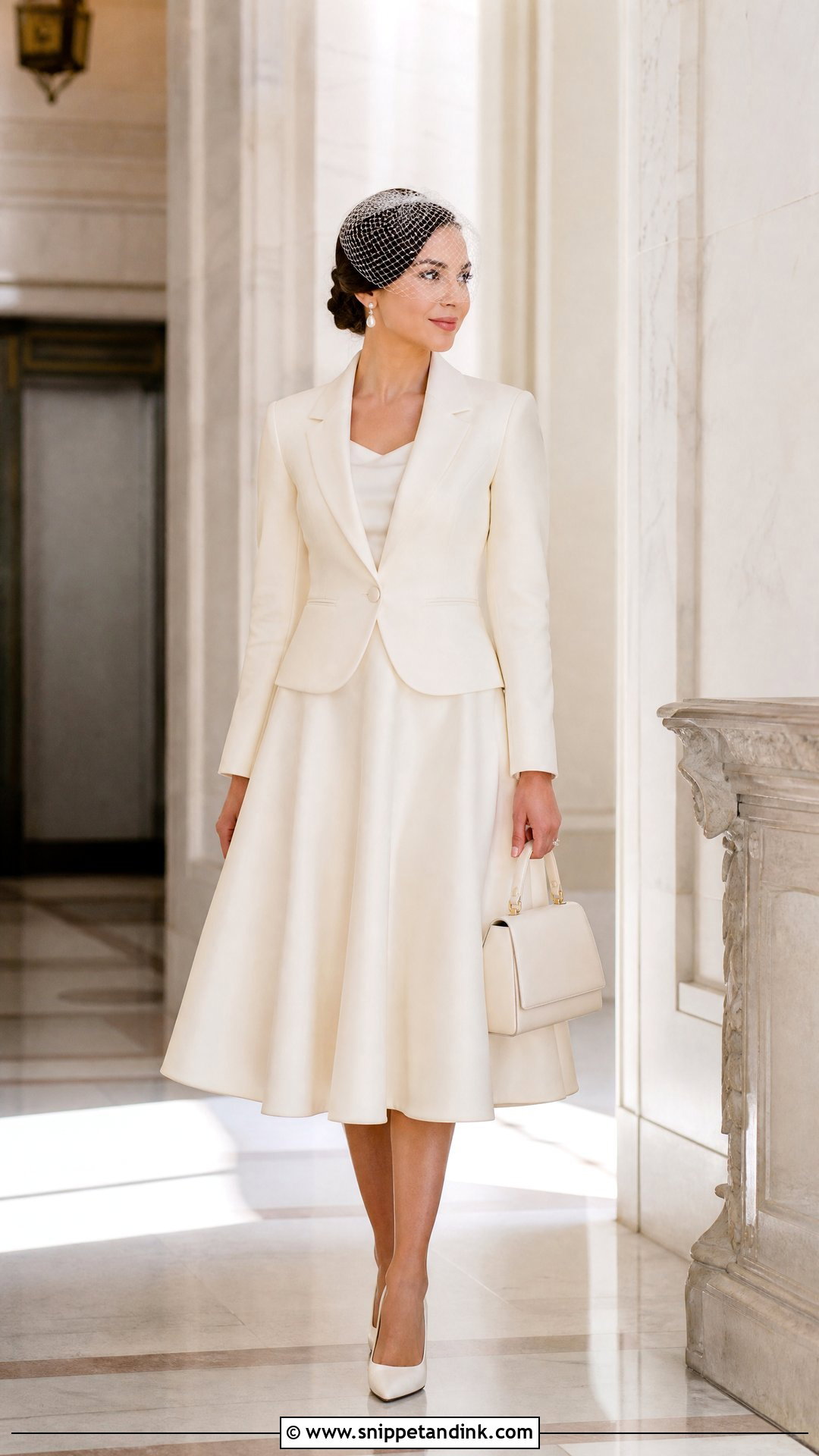
A skirt suit has a vintage feel that works especially well at a courthouse or an intimate wedding. Pair a fitted waist-length jacket with a knee, midi or tea-length skirt; straight is sleek, a soft flare is easier to walk in. The jacket must end at the natural waist. When it stops at the widest part of the hips, it cuts the body in half, and I’ll shorten a jacket before I do anything else to this outfit. A silk shell, ivory pumps and a birdcage veil suit the era. For more coverage, choose a high neckline and bracelet-length sleeves.
6. Double Breasted Wedding Suit
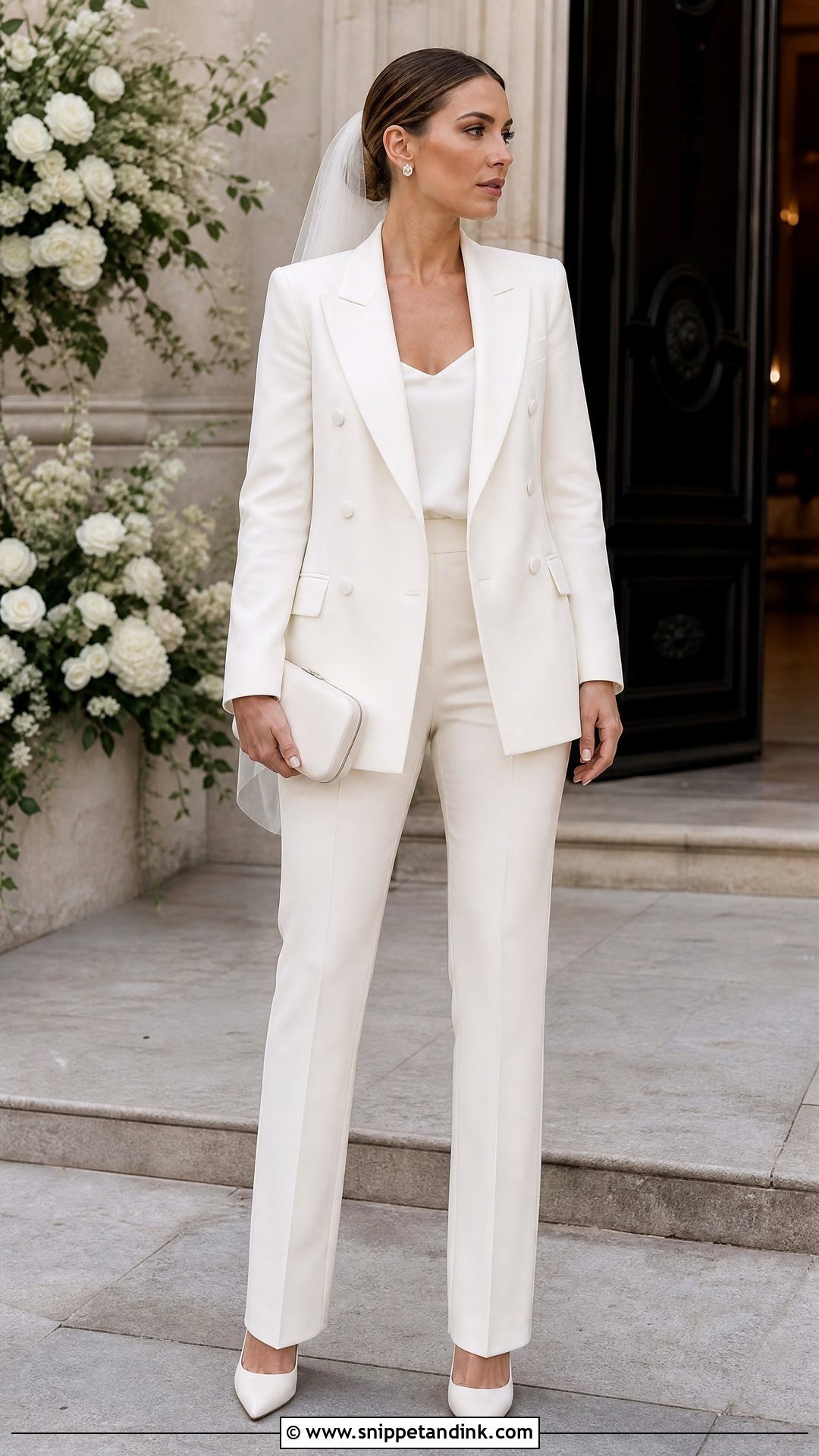
Strong lapels and a wide front overlap give a double-breasted wedding suit real presence. It’s designed to be worn buttoned, so the fit has to be right closed: covered buttons, no pulling into an X across the stomach. Straight or gently tapered trousers suit it, and pointed heels balance the broader shoulders. Wearing the jacket with nothing beneath is a fashion choice I support only when the neckline is tailored to sit flat and the client has moved around in it at a fitting. Ivory crepe is the safe fabric; a subtle jacquard adds texture. Small crystal earrings and a minimal tulle veil keep it clean.
7. Cropped Blazer Bridal Suit
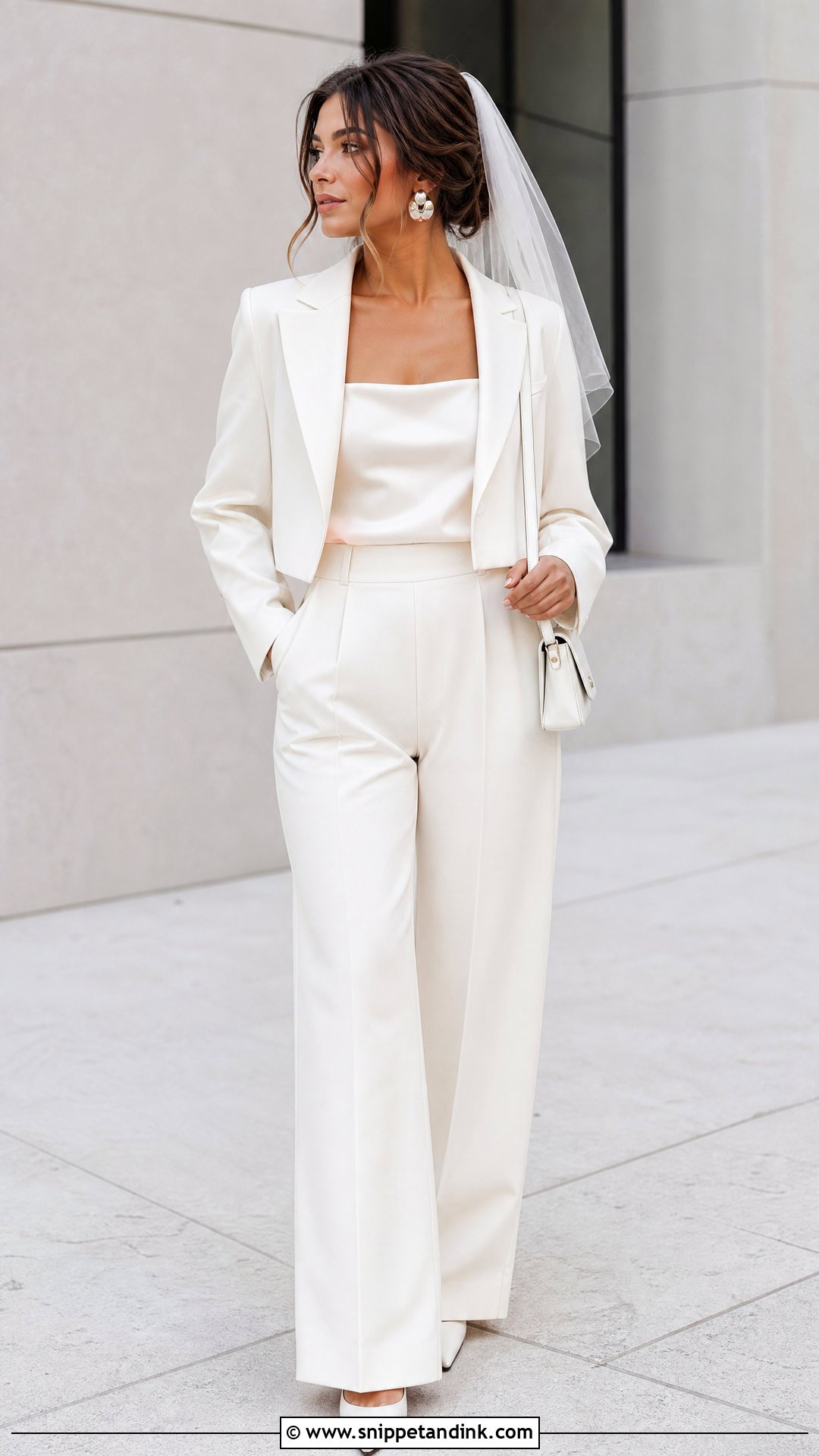
A cropped blazer sits at or just above the waist, so it shows the line where your trousers start. That’s why it suits petite brides: the raised waistline makes the legs look longer. Pair it with high-rise trousers so only a narrow strip of the top underneath shows. Wide legs give contrast, slim ones a minimal look. A square-neck bodysuit or satin corset gives secure coverage when you lift your arms. I’d steer you to a short veil or a hair bow here, as a full cathedral veil overpowers the cropped proportion. Keep the trouser waistband flat and smooth, since any bunching there is right at eye level.
8. Longline Blazer Bridal Suit
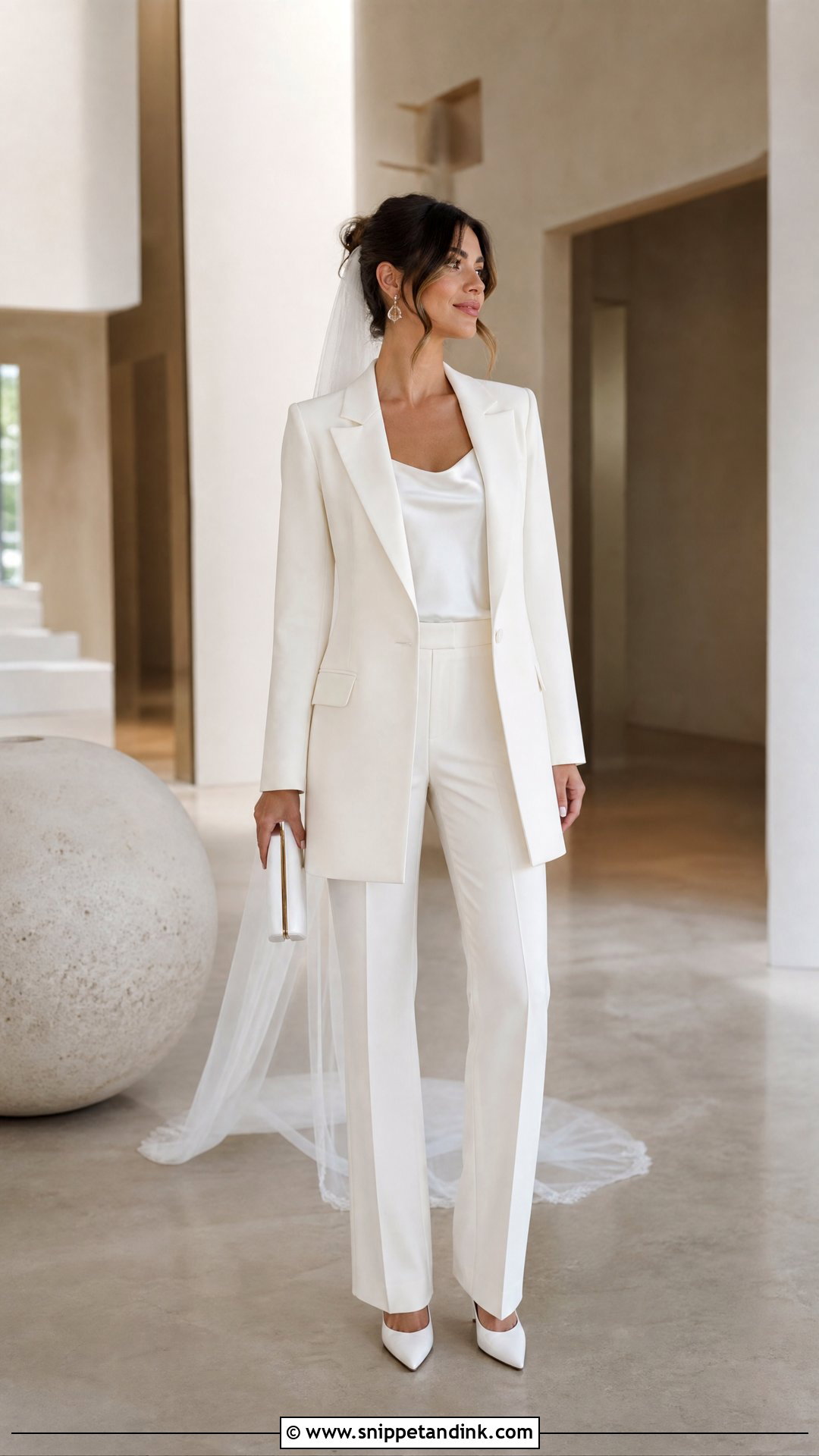
A longline blazer draws one long vertical line from shoulder to thigh, which is flattering on almost everyone and comfortable over the hips. Choose straight or slightly flared trousers and a fitted silk shell beneath so nothing adds bulk. Wear it buttoned for the ceremony, then open it for the reception. Where the hem lands is the detail I check most. If it stops at the widest point of your hips or thighs, it widens rather than lengthens, so move it an inch up or down. Pointed heels, delicate earrings and a simple veil keep attention on the tailoring.
9. Vest Bridal Suit
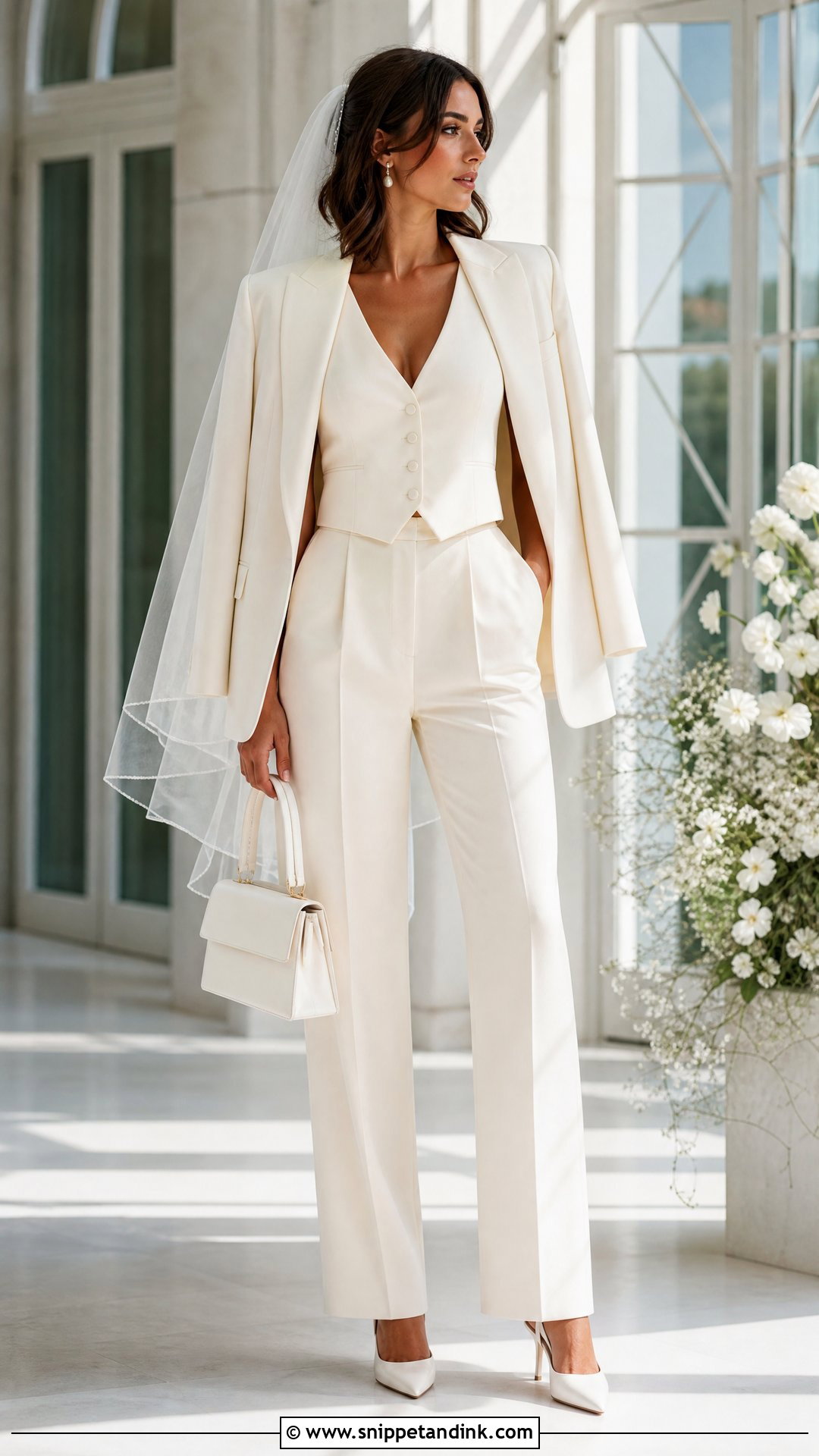
In heat, a vest suit is cooler than anything with sleeves. A fitted waistcoat with covered buttons and matching high-waisted trousers can be worn alone or over a fine silk blouse. Add the matching blazer for the ceremony and take it off for the party. The vest has one job: lie flat across the chest without gaping between the buttons. If it gapes, it needs letting out or a hidden hook between buttons, which a good tailor can add. A shoulder-length veil keeps the neckline visible. Pointed slingbacks and a structured white bag are all the accessories it needs.
10. Corset Bridal Pantsuit
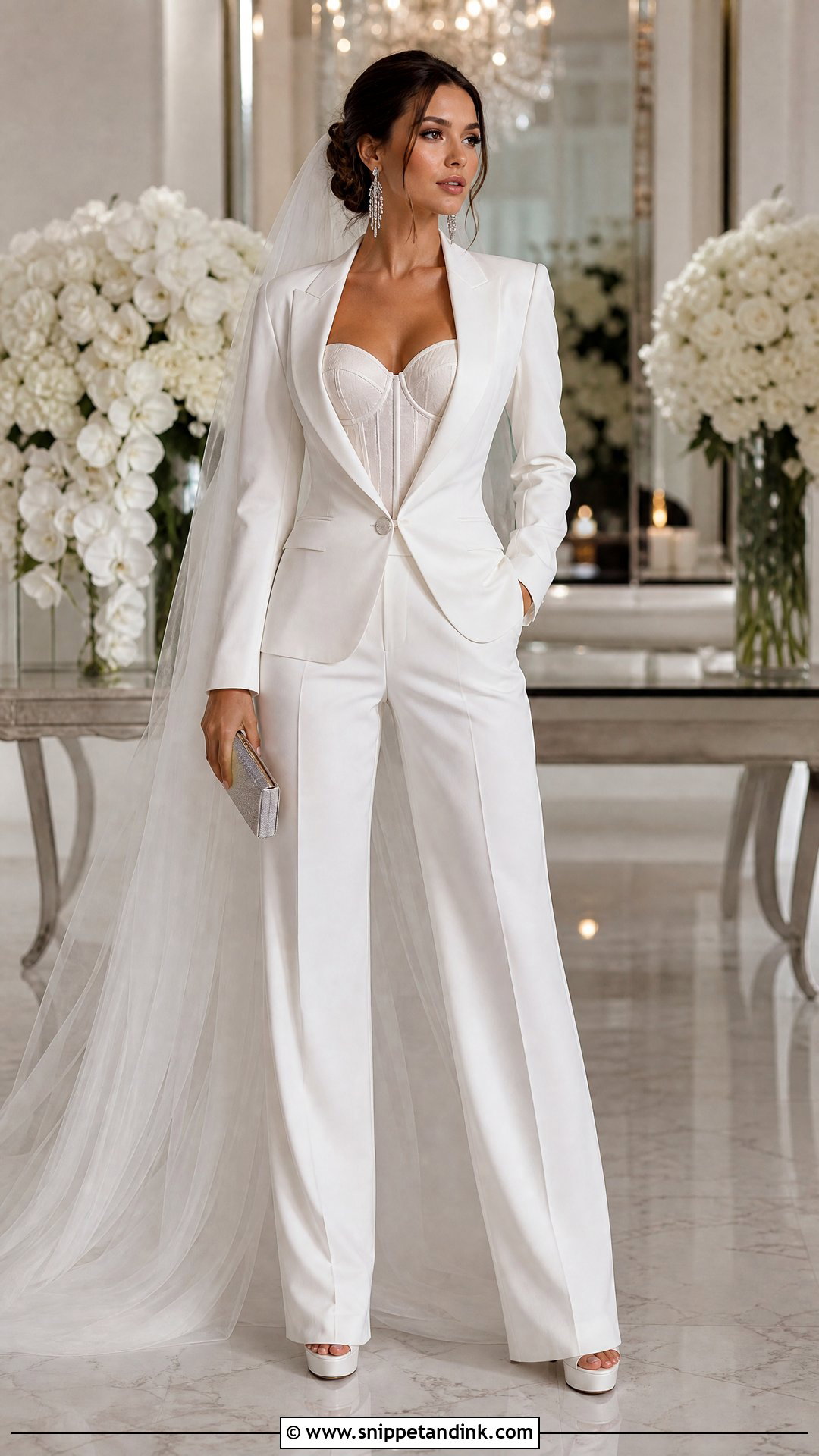
Pairing a tailored suit with a boned corset gives you structure and an obvious waist. A satin or crepe corset over high-rise wide-leg trousers creates an hourglass shape, and a single-button blazer layered on top keeps the ceremony look covered. Take the jacket off later to show the neckline. A corset has to support rather than squeeze, so at every fitting I ask the bride to sit down, eat something and raise her arms. If any of that is uncomfortable in a fitting room, it will be worse after eight hours. Keep the suit, corset and shoes in one ivory family. Crystal drops and a soft tulle veil finish it.
11. Cape Blazer Bridal Suit
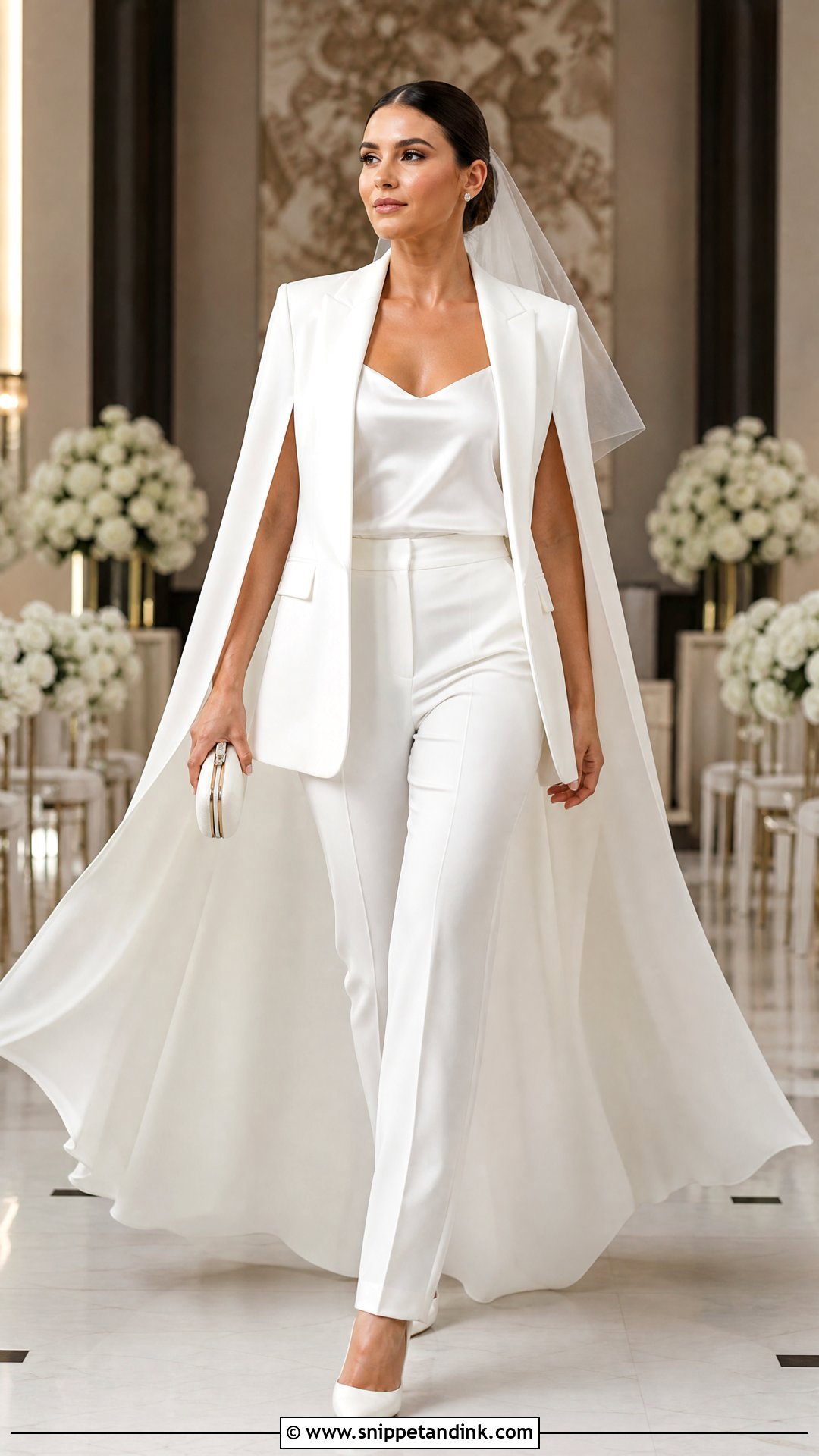
A cape blazer brings drama without the weight of a skirt or train. Cape panels fall from the shoulders over a fitted jacket, and narrow or straight trousers keep the lower half clean. Hold your bouquet at the fitting. If the panels cover your hands or tangle with the stems, they need shortening. Since the cape already moves, a short veil or no veil at all is enough. A simple camisole, pointed heels and studs keep the lines clear, and the back view of this suit is often the best one, so ask your photographer for a shot walking away.
12. Peplum Bridal Suit
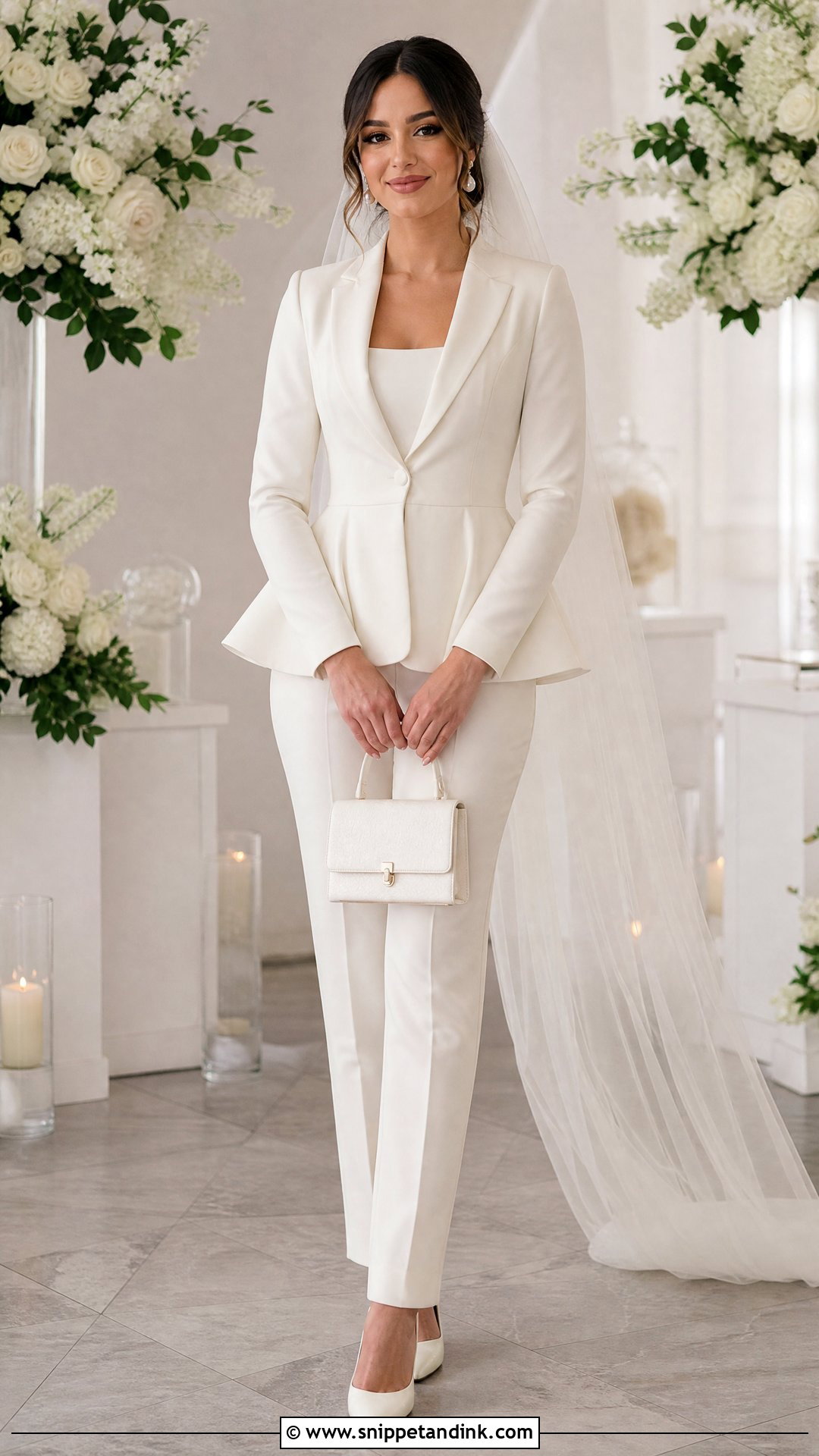
The peplum flares out from the waistline over the hips, giving traditional tailoring a softer edge. Pair it with slim, straight or subtly bootcut trousers to balance the volume at the hem. Fuller hips suit a longer, softer flare; brides after more waist definition do better with a short structured peplum. The waist seam has to sit precisely at your natural waist, and alterations there are where I spend most of the fitting. A waist-length veil echoes the shape. Pointed pumps, pearl drops and a small top-handle bag keep it classic.
13. Minimalist Crepe Wedding Suit
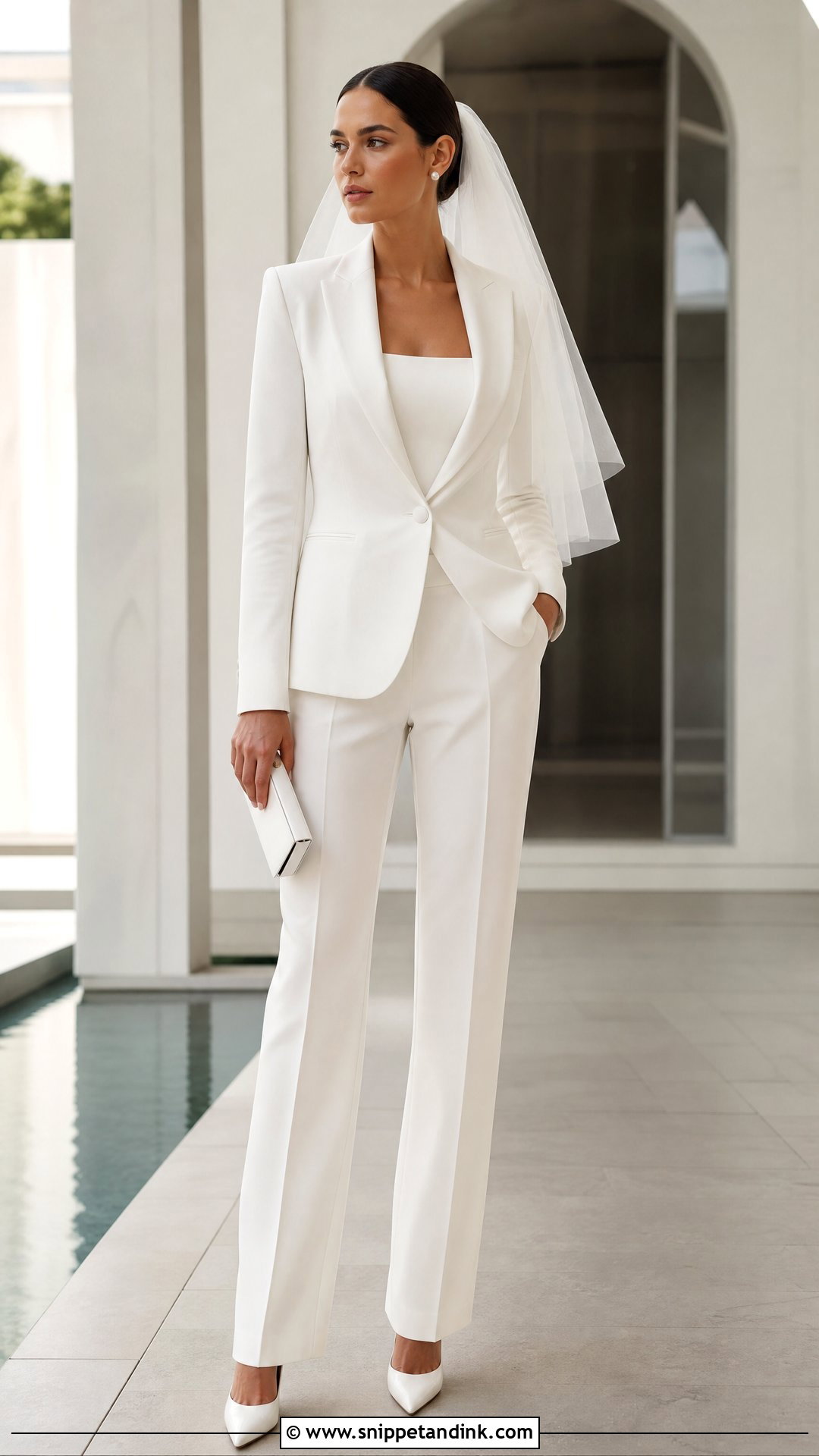
A minimalist crepe suit hides nothing, so it depends entirely on fabric quality and tailoring. Choose a single-button blazer with lightly shaped shoulders and matching trousers in a straight or wide-leg cut, with a smooth, untrimmed square-neck top underneath. My fitting checklist for this one is long: shoulder seams sitting on the shoulder bone, sleeves ending at the wrist bone, a flat waistband and a clean trouser break over the shoe. White pumps, pearl studs, a slim clutch and a plain tulle veil are all it wants. It suits courthouses, galleries and rooftops equally well.
14. Embellished Bridal Suit
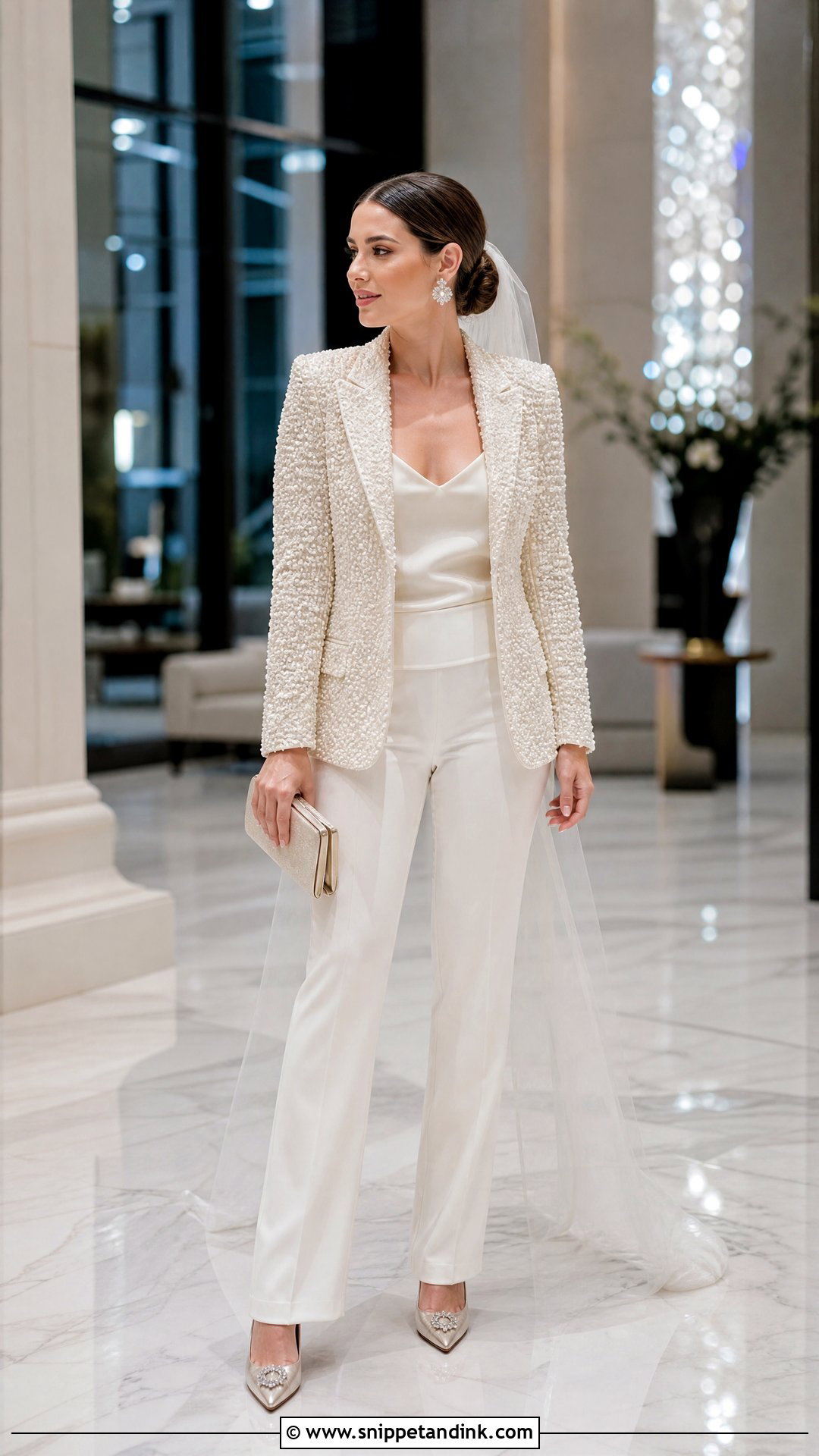
Beading, pearls or sequins turn a suit into an evening outfit, but only one piece should carry them. I usually put the sparkle on the blazer and keep the crepe trousers and satin camisole plain, which stops it looking like a costume. Small studs and a smooth clutch avoid competing with the jacket. Beaded jackets are heavy and catch on veils, so pick a simple veil or a crystal comb instead. Before the day, go over the beadwork and secure anything loose. This makes a strong evening reception look, or a second outfit after a traditional ceremony.
15. Linen Beach Wedding Suit
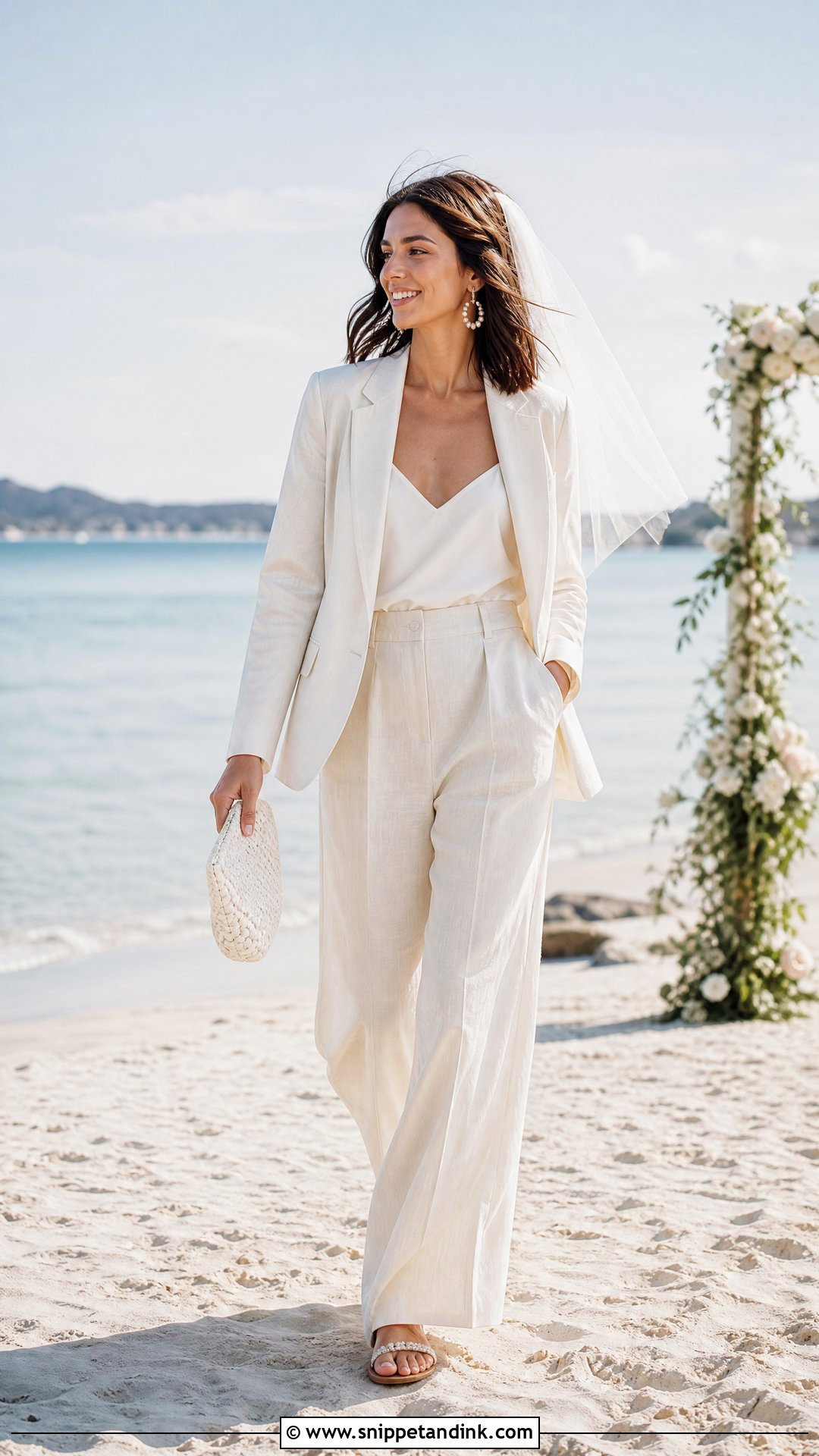
Linen breathes in heat like nothing else, which makes it the natural fabric for a beach. It also creases the moment you sit, and I tell every linen bride to accept that, because a few soft creases are part of its character. An ivory single-breasted blazer and wide-leg trousers over a cotton or silk camisole suit the setting. Keep the fit relaxed but deliberate at the shoulders and waist. Hem the trousers a little shorter than you would for a hall, so they don’t drag through wet sand, and choose block heels or flat sandals that won’t sink. A low ponytail handles the breeze. This complete linen wedding suit sits easily at a tropical venue or waterfront ceremony.
16. Velvet Winter Bridal Suit
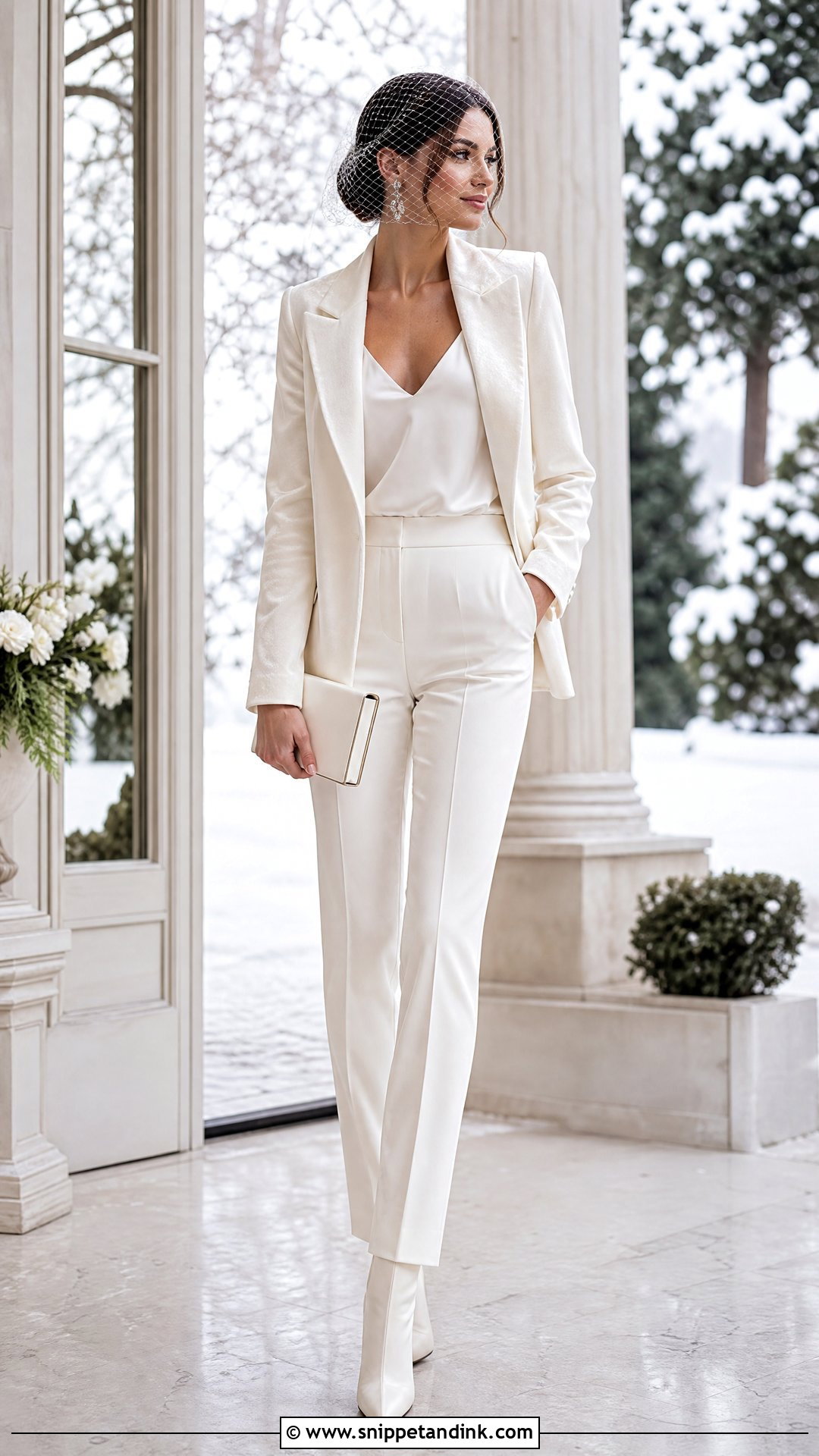
Velvet is warm and has depth no flat fabric can match, which is why it belongs in winter. An ivory velvet blazer with matching trousers, or with smooth crepe trousers for a lighter balance, over a satin camisole works in a ballroom or for snowy portraits. Velvet has a nap: the pile lies in one direction and reflects light differently depending on how it’s cut. So every matching piece should come from the same bolt and dye lot, cut in the same direction, or one leg can look a shade darker than the other. Closed-toe pumps or ankle boots keep you warm. Keep accessories minimal.
17. Bridal Shorts Suit
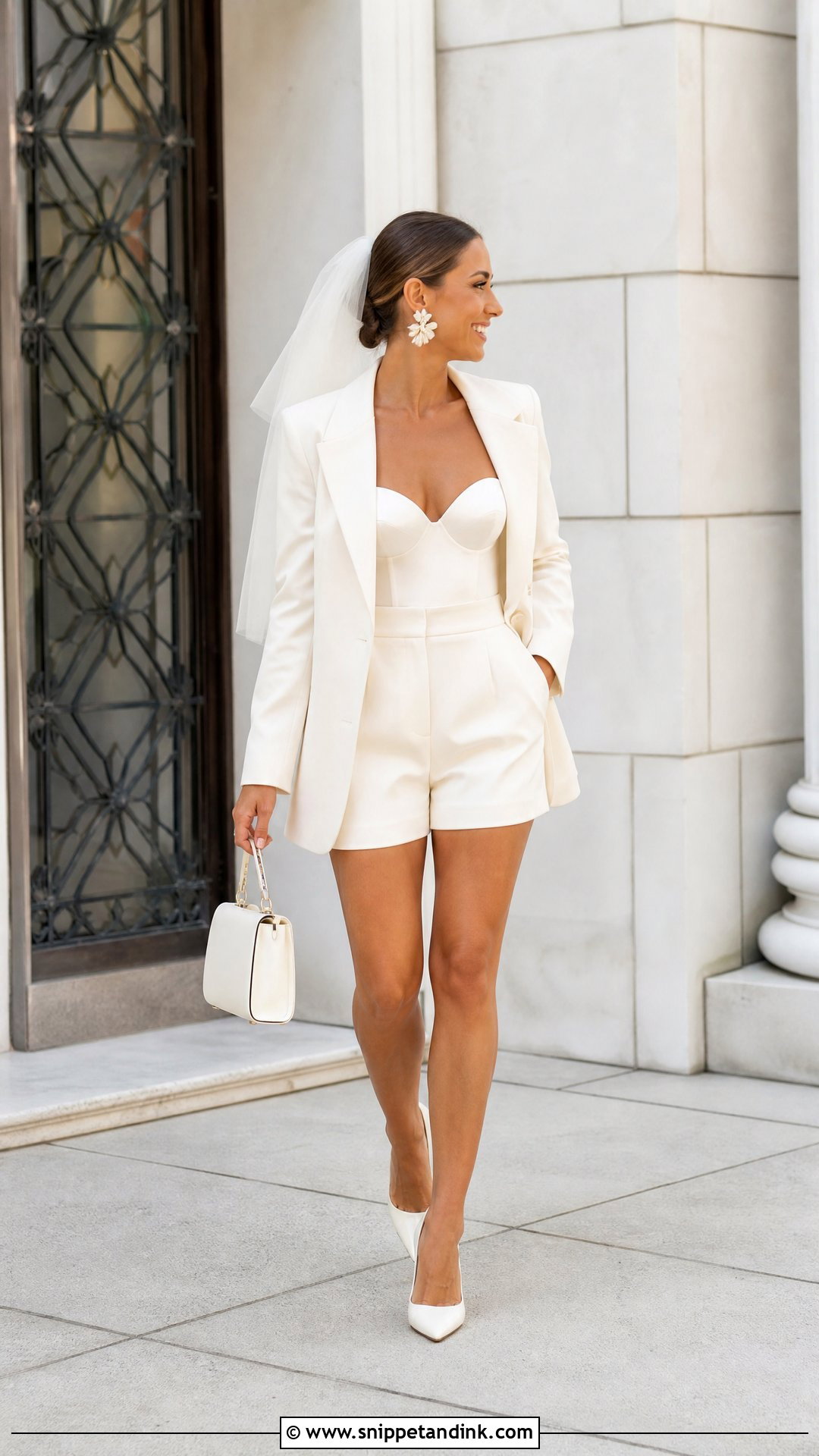
Shorts are the most playful suit here, and the one I’d most often suggest for a reception change or a warm courthouse wedding. Tailored high-waisted shorts with a blazer reaching just below the hip, over a silk camisole or fitted bustier, keep it bridal. The test that matters is sitting. Shorts ride up on a chair, so sit, cross your legs and climb a step in front of a mirror at the fitting. Pointed pumps lengthen the leg. Crisp tailoring and a short veil are what make shorts read as wedding clothes rather than holiday wear.
18. Plus Size Bridal Pantsuit
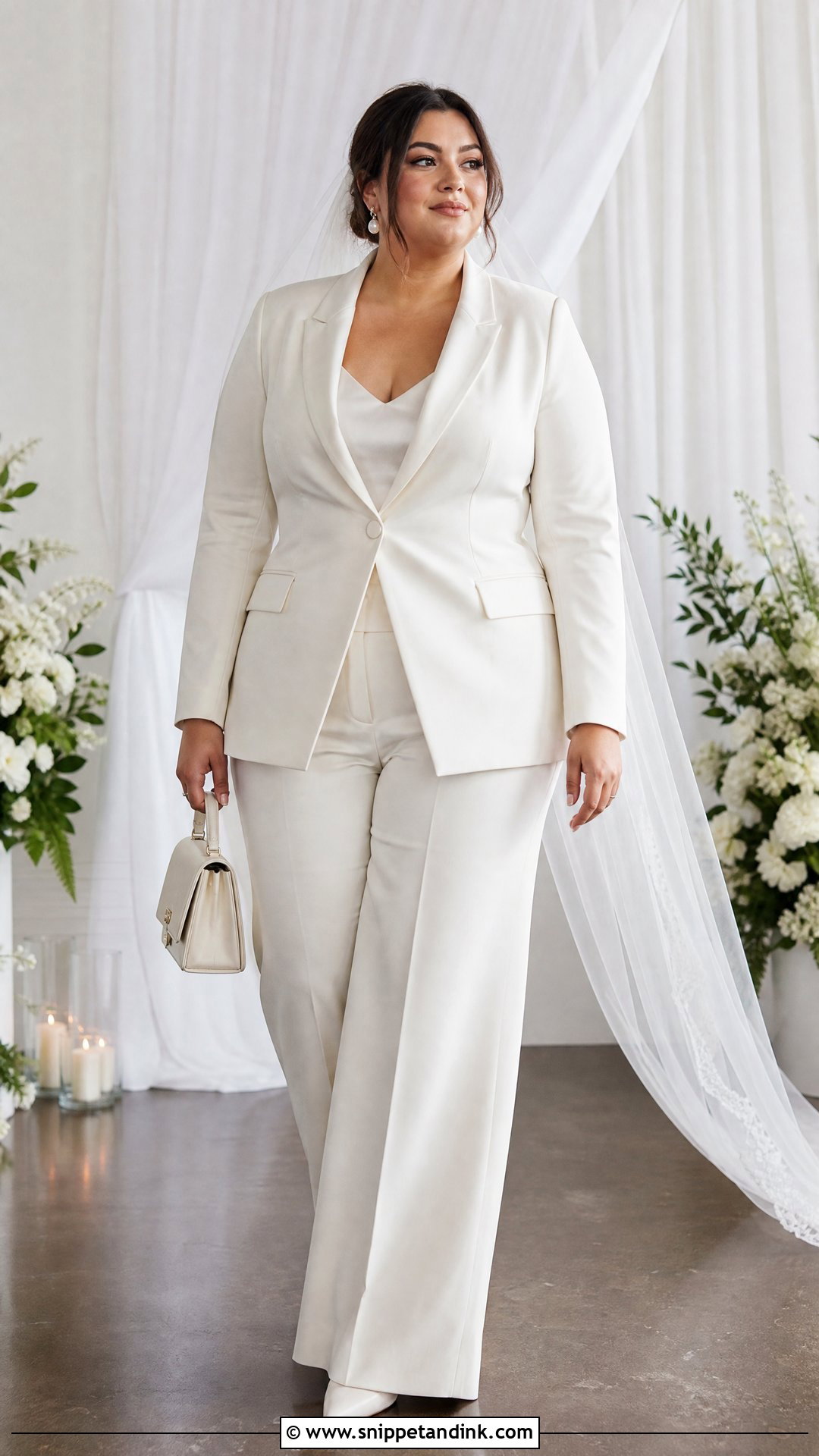
A plus size bridal pantsuit should follow the body, not hide it. Look for a blazer with defined shoulders, gentle waist shaping and enough room to button smoothly without pulling. High-rise straight or wide-leg trousers give a long vertical line. A V-neck satin shell opens up the neckline. The mistake I see most is buying a size up for comfort, which adds fabric everywhere and blurs the shape. Buy for the largest measurement instead and have the tailor take in the rest. A flowing veil softens the tailoring, or a crystal hair accessory keeps it simple.
19. Petite Bridal Suit
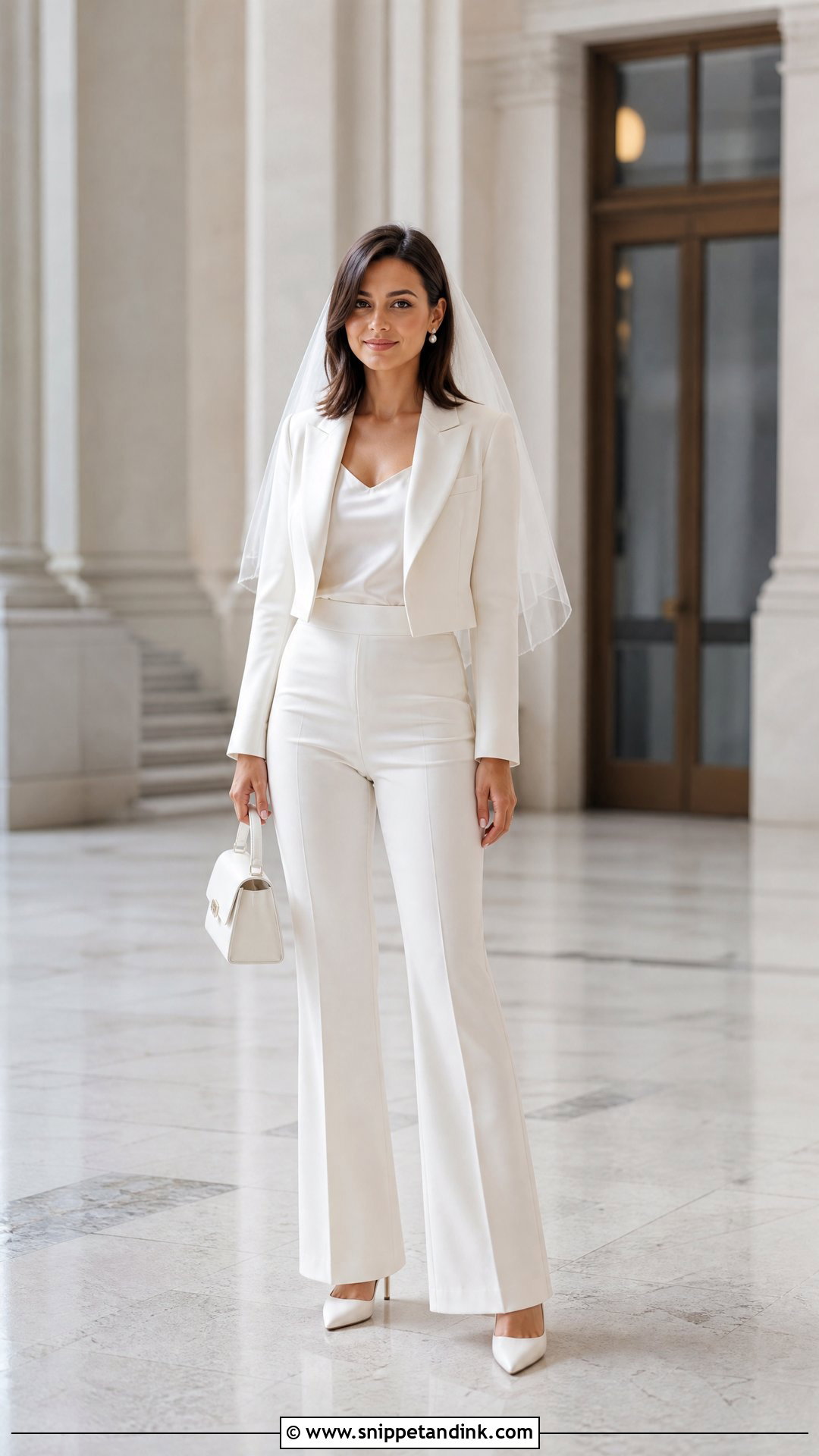
On a petite frame, proportion matters more than style. Choose a cropped or hip-length blazer and high-waisted trousers in a straight or slightly flared cut, all in one ivory so the eye travels top to bottom without a break. Off-the-rack suits are cut for an average height, so even when the size is right, I expect to alter the sleeves, move the jacket button up and adjust the trouser rise. Pockets can sit too low as well. The hem should just touch pointed pumps without pooling. A narrow veil keeps the frame from being swamped, and long jackets only work if they’re cut for petite proportions.
20. Modest Bridal Suit
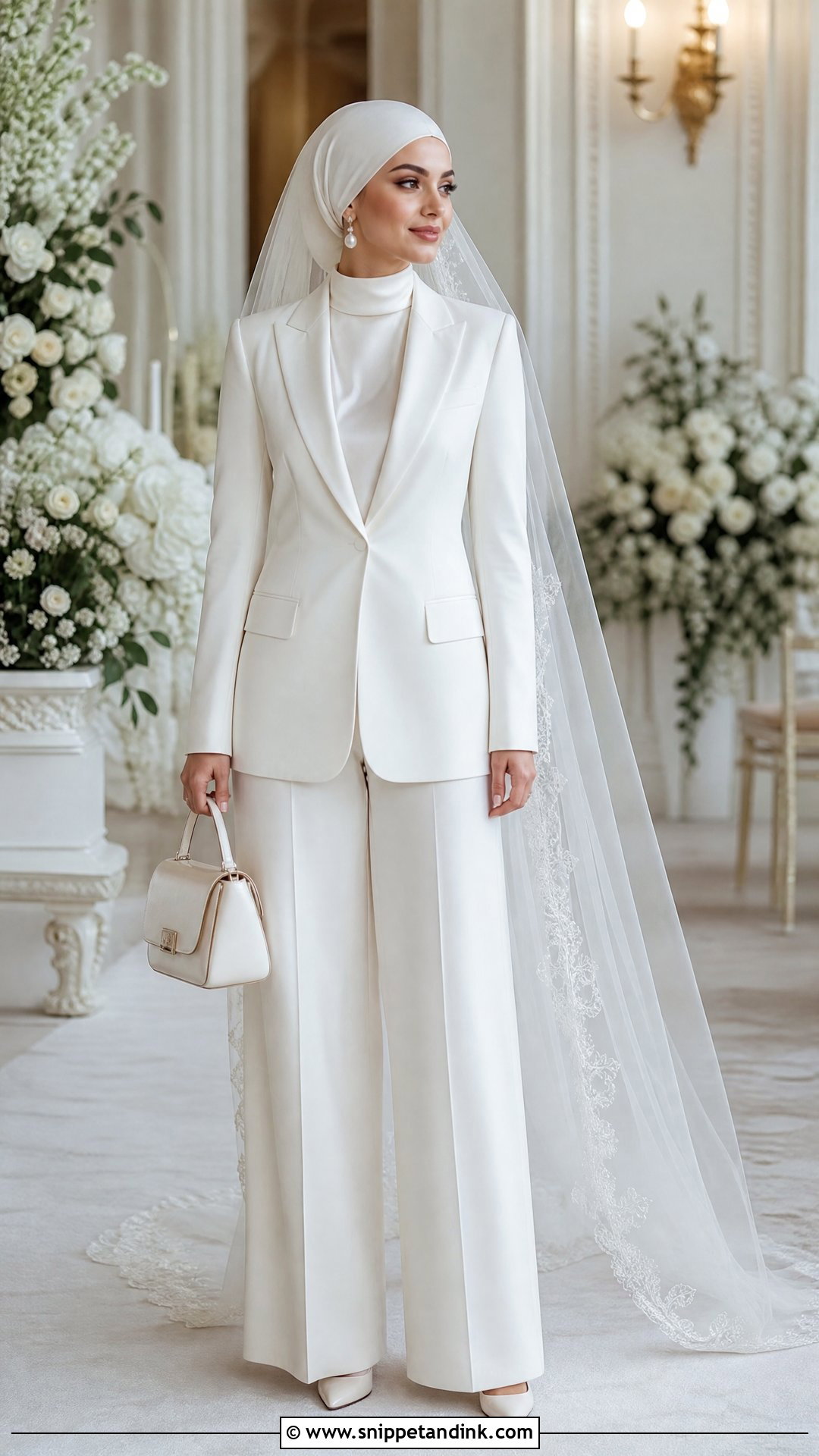
A modest bridal suit can cover the arms and neckline and still look sharp. Choose a long-sleeve blazer with a high neckline, or layer it over an opaque silk blouse, with wide-leg or straight trousers that fit cleanly through the hips. Covered buttons, lace cuffs or a draped collar bring the bridal detail. Two things I check at fittings: that you can raise your arms without the whole jacket lifting, and that the lining breathes, because full coverage gets warm. A softly shaped waist stops the layers looking boxy. Pair with closed-toe pumps, and a full-length veil or a neatly wrapped head covering, depending on your tradition.
Matching Ivories That Come From Different Racks
Many brides build a suit from separates, and this is where I see things go wrong. Ivory from one label can be noticeably yellower or pinker than ivory from another, and the difference shows clearly in photographs. Hold every piece together by a window, not under store lighting, before you commit. Order fabric swatches where you can.
Then think about your skin. Bright white flatters cool undertones and deep skin, while softer ivory and champagne tend to sit better against warm or very fair complexions. If a shade makes you look tired in daylight, it will do the same in every photo.
Tape, Cups and Invisible Layers Under the Jacket
Suits worn with little or nothing beneath the blazer need some engineering. These are the things I pack for a suited bride:
- Double-sided fashion tape to hold a plunging lapel to the skin. Test it at the final fitting with your arms raised.
- Adhesive cups or a low-back smooth-finish bodysuit in your skin tone, so nothing shows when the jacket opens.
- A lint roller. Ivory crepe and velvet pick up every fiber, from the car seat to a guest’s sweater.
- A handheld steamer for the morning. Press satin and crepe through a cloth if you have to iron, never directly.
One last detail: new jackets often arrive with pockets and back vents tacked shut with loose stitches. Snip those carefully before the day, or the vent will pull and the pockets will sit stiff.
Which Suit Fits the Way You Plan to Celebrate?
Bridal tailoring lets you look polished and feel comfortable in clothes that match your own taste. The range is wide, from white tuxedos and lace jackets to linen for the beach and velvet for winter. Start with the silhouette you feel most confident in, then weigh the venue, season, shoes and formality. Budget properly for alterations, since precise shoulders, sleeves, waist and hems are what make a suit look bridal rather than borrowed. Then keep the accessories deliberate. One strong detail, a veil or a pair of statement earrings, does more than decoration everywhere.
You'll Like These Ideas:





Leave a Reply