
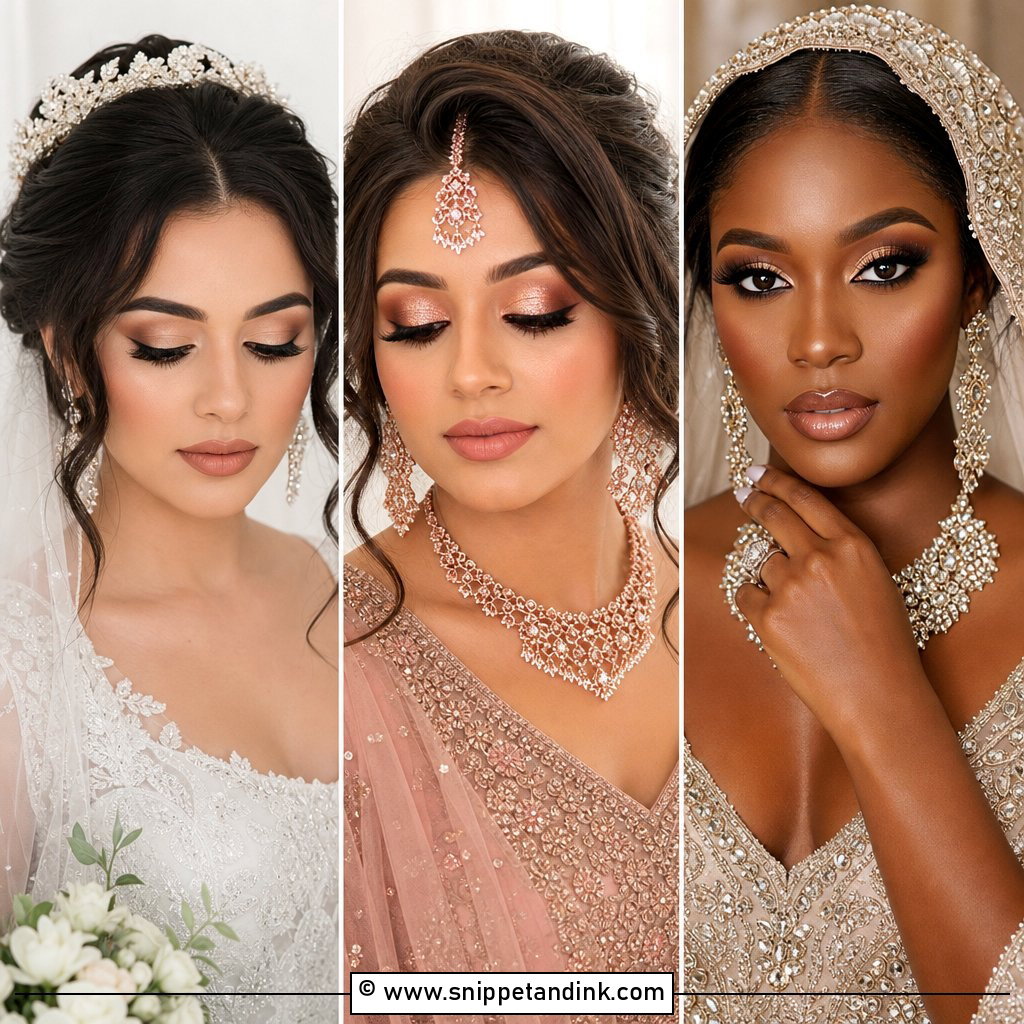
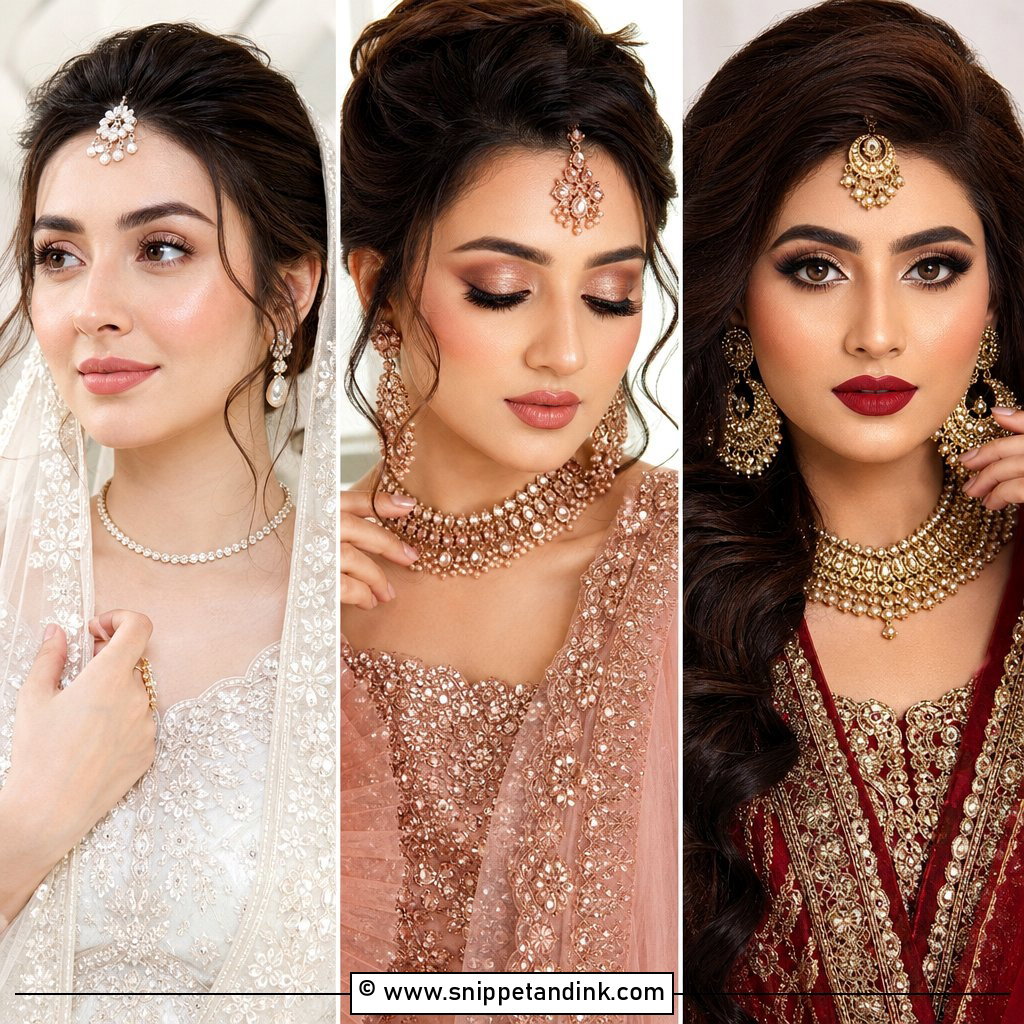
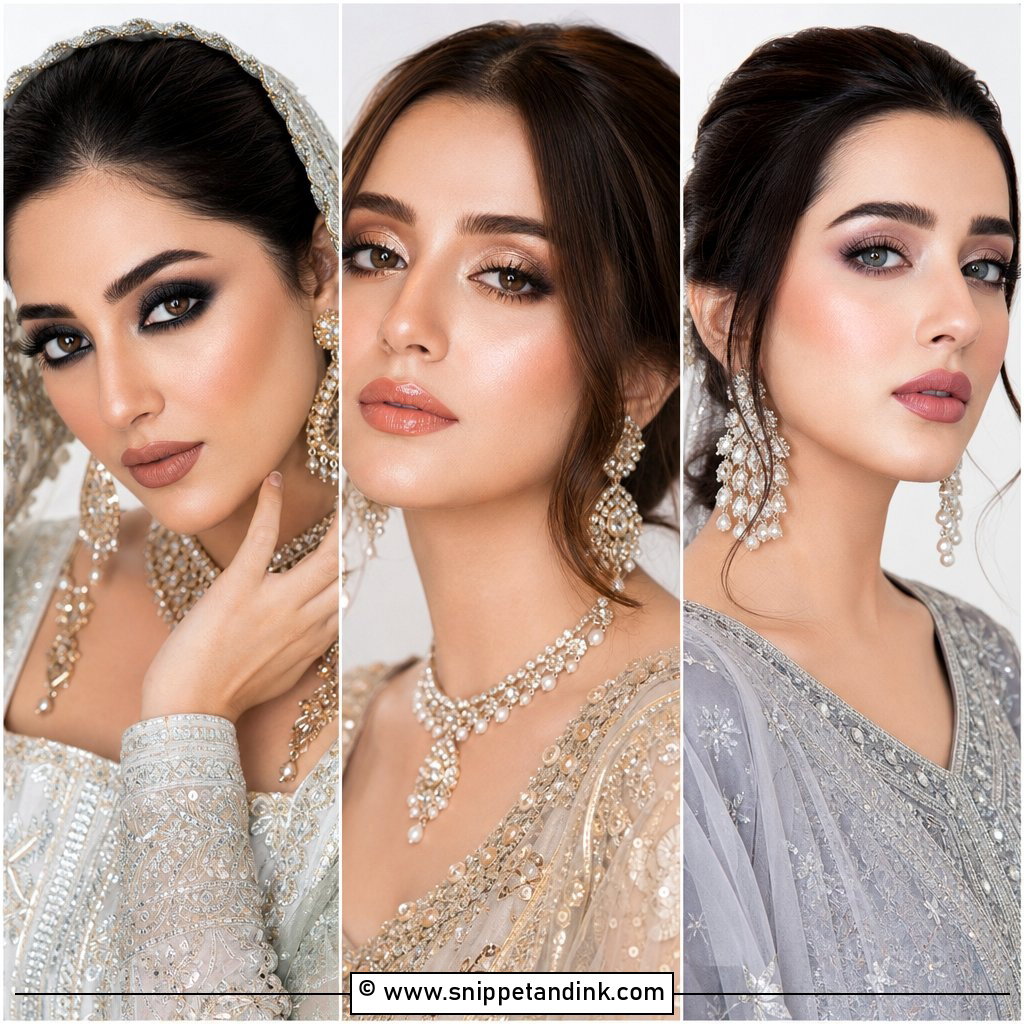
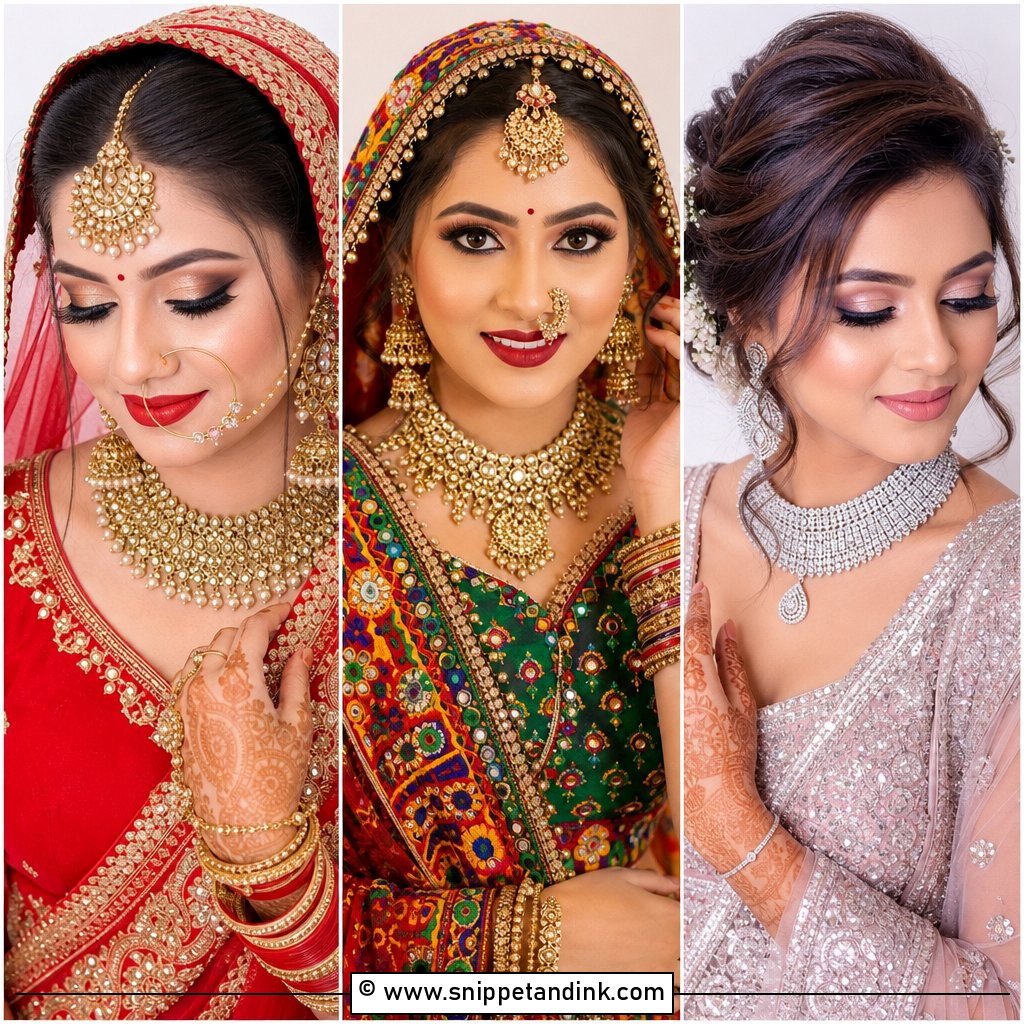
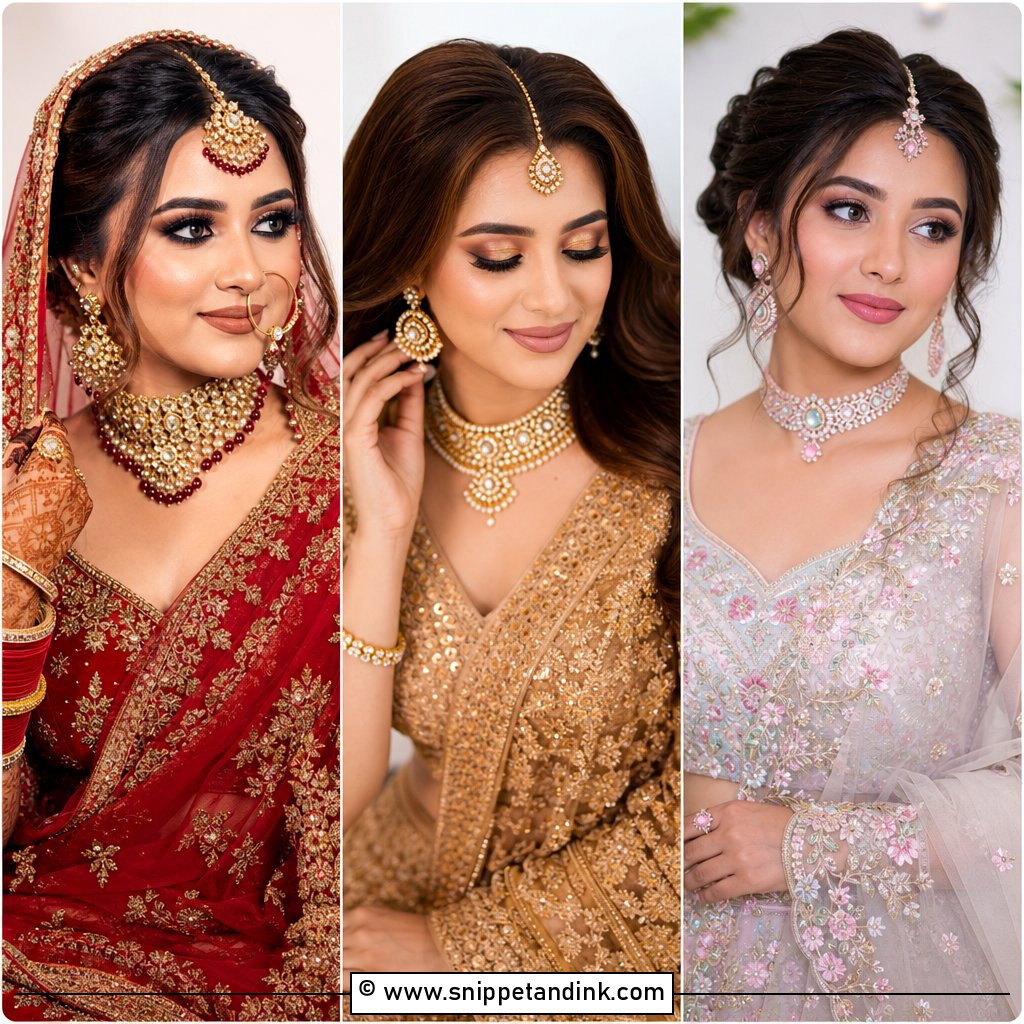
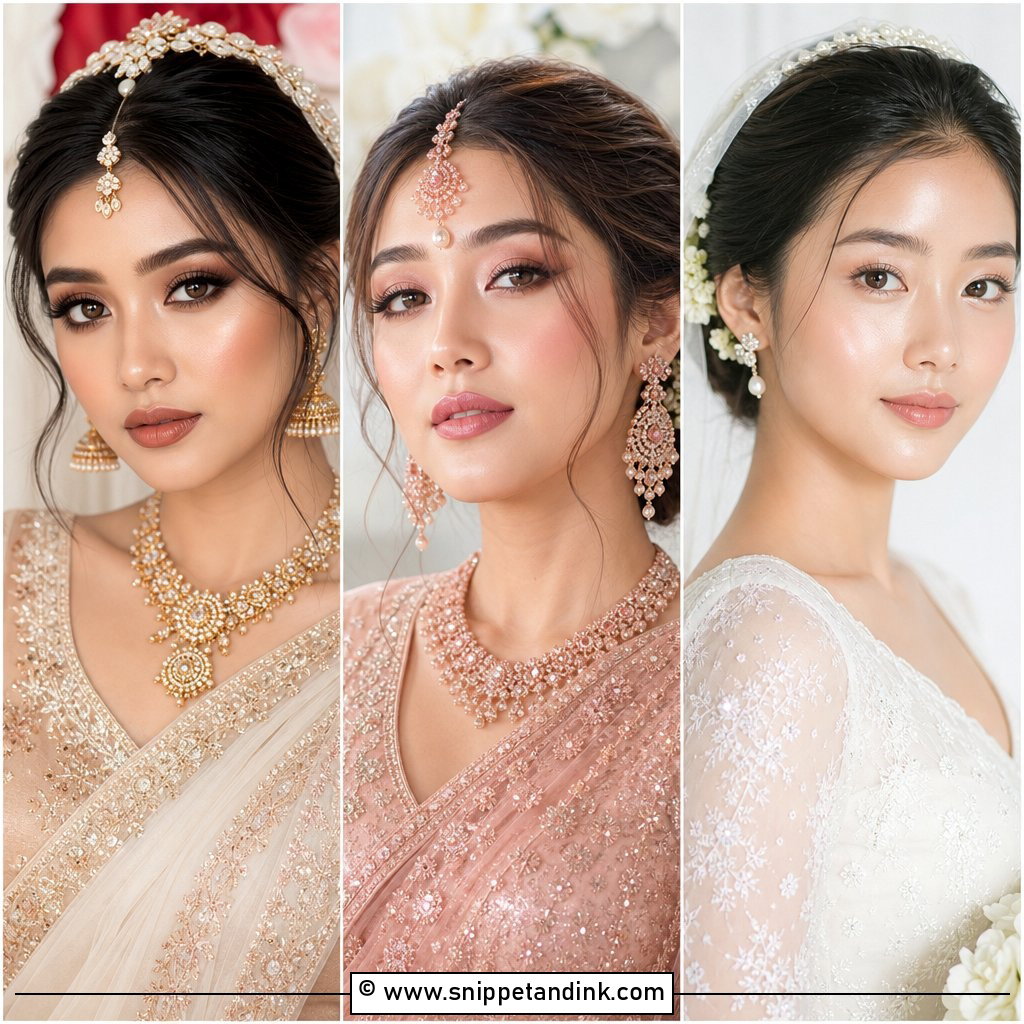
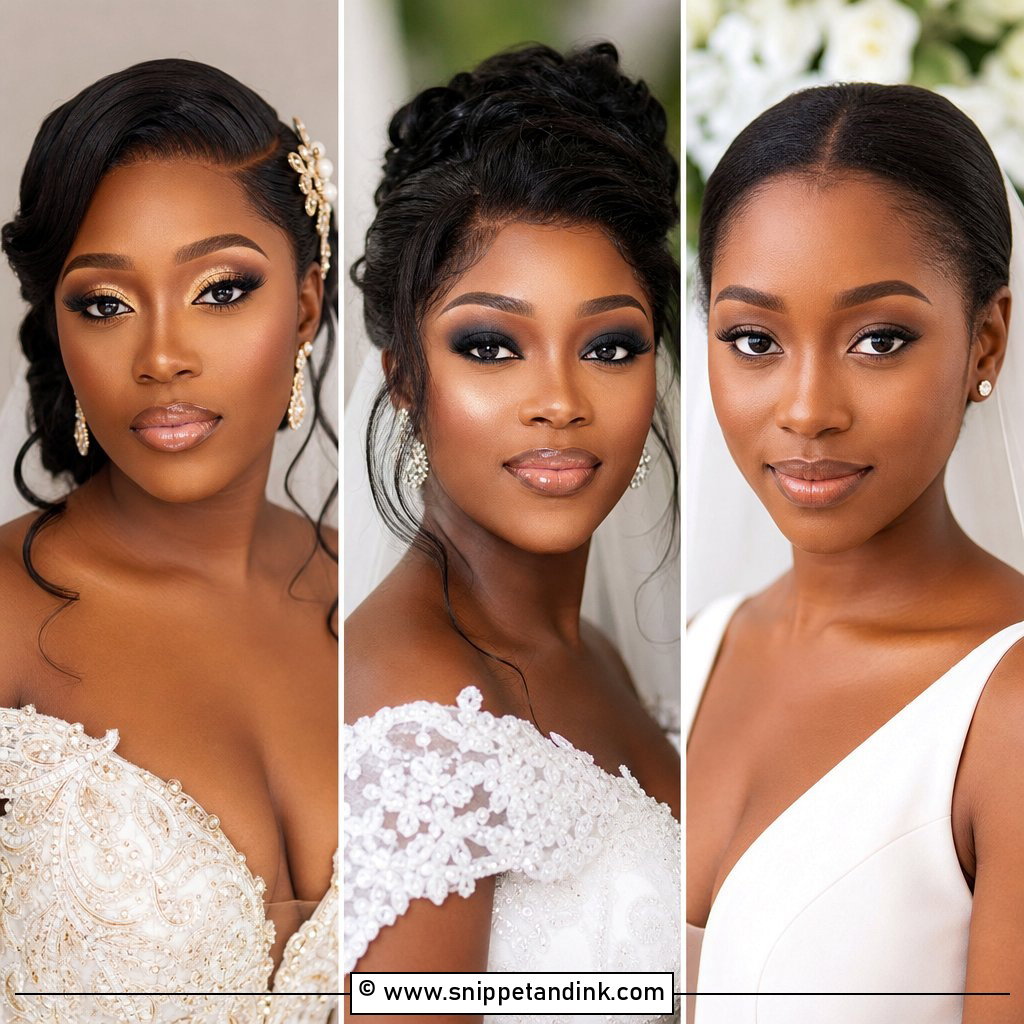
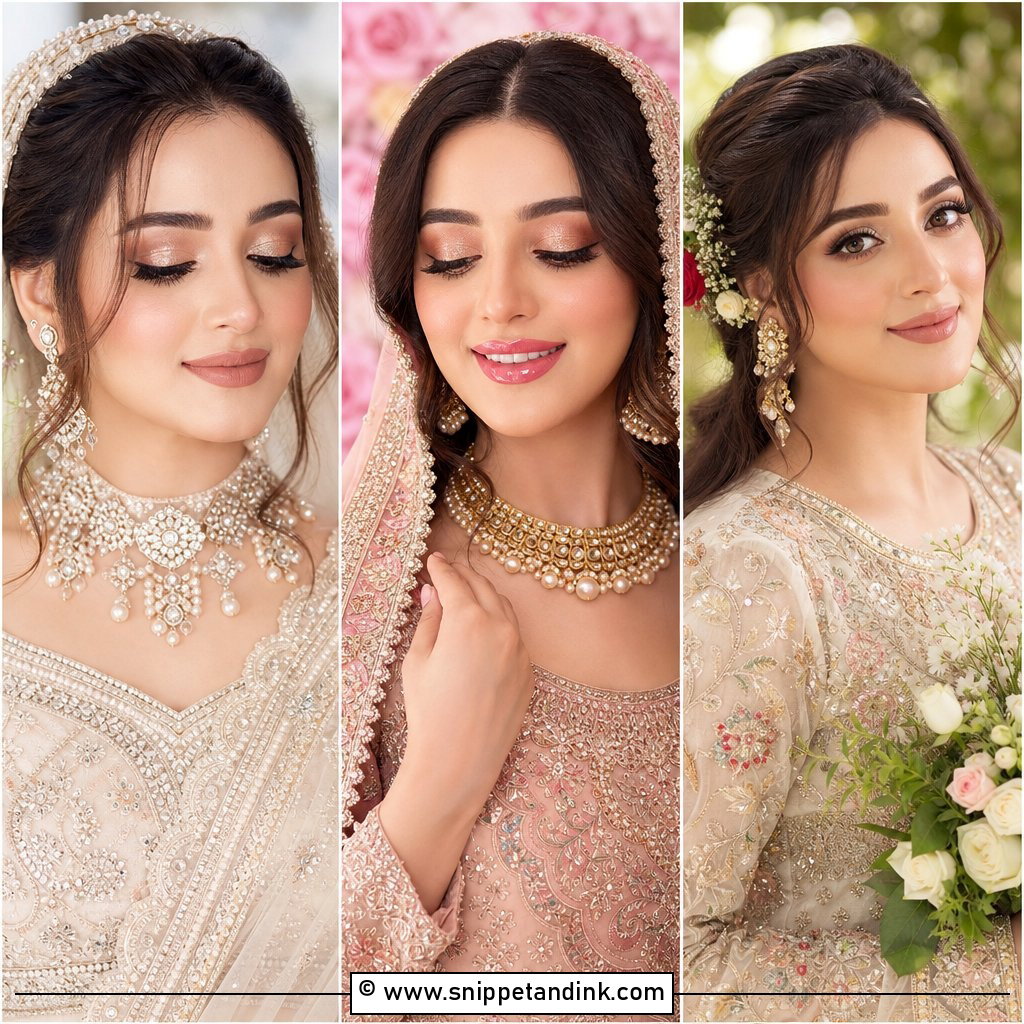
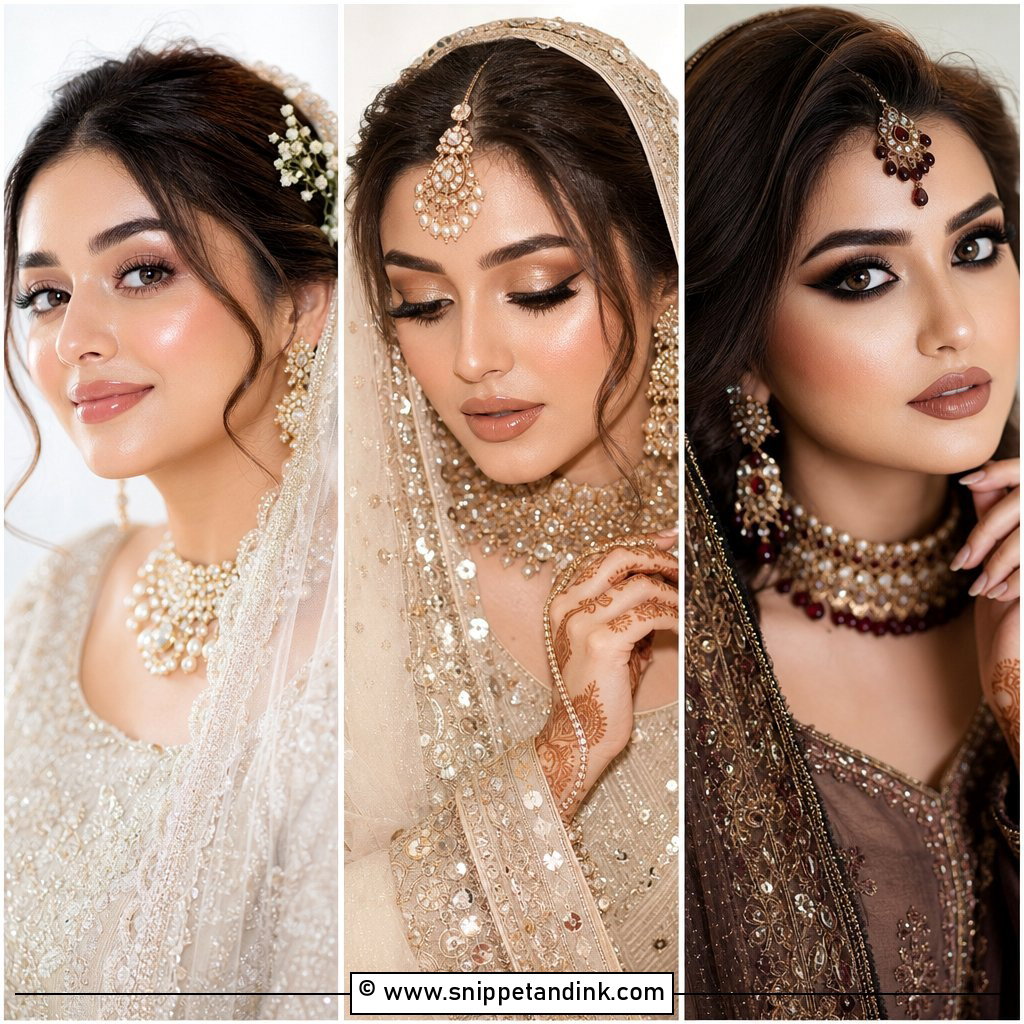
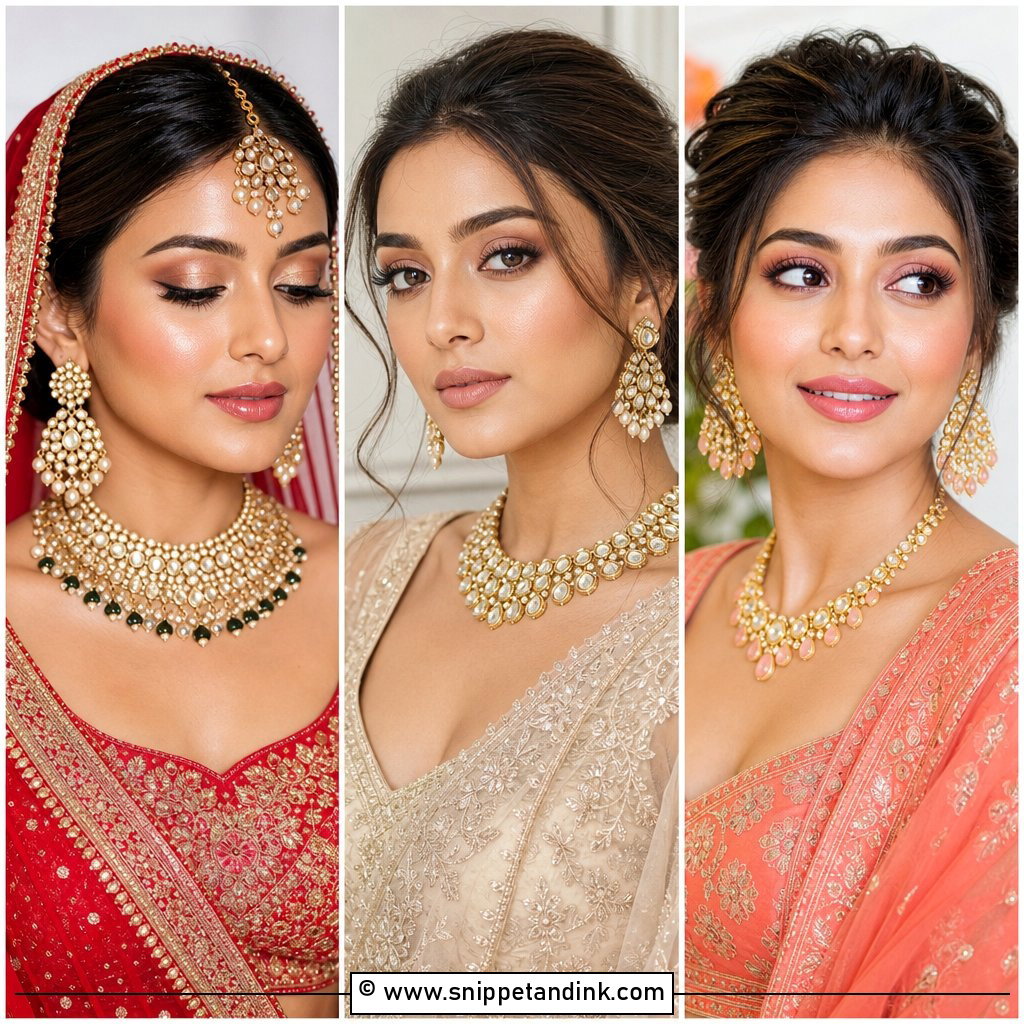
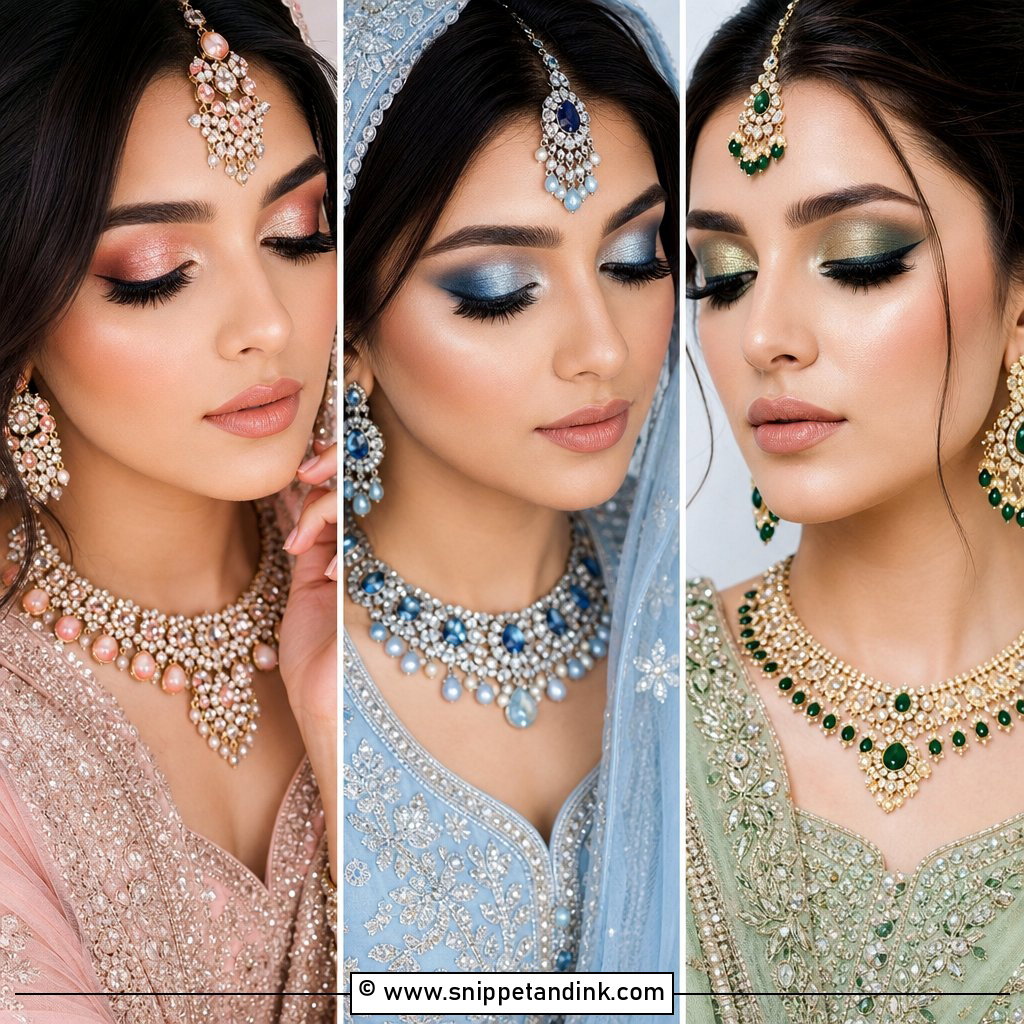
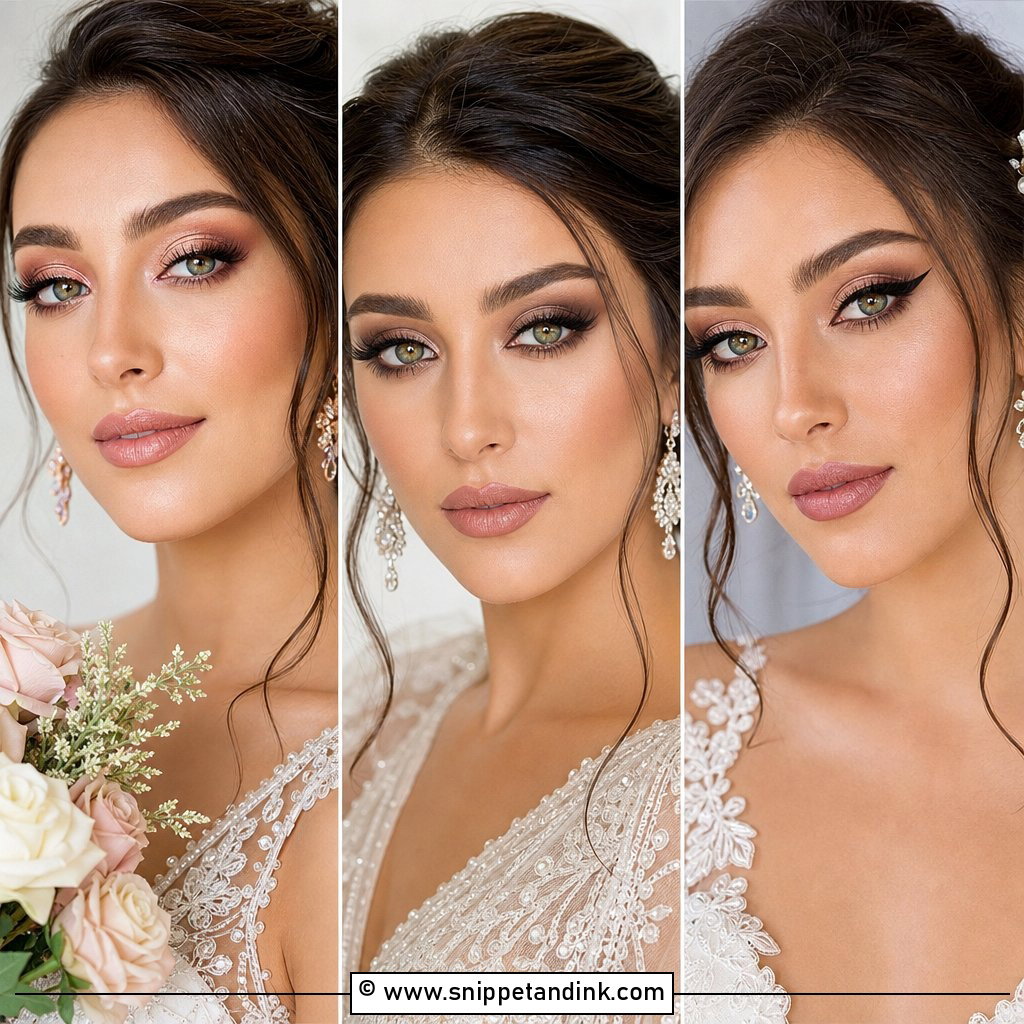
Indian bridal makeup used to mean one heavy base, one smoky eye and one red lip. That is no longer the brief I get. Brides now ask for soft glam, dewy skin, regional details, pastel palettes and reception faces that look nothing like the ceremony one. What hasn’t changed is the workload. The face has to survive hours of rituals, hot lights, jewelry pressing on the skin, tears at the vidaai and a dance floor afterwards. Below are 20 full faces I’d actually build, with notes on what each one needs to hold up.
Foundation Shade Is Where Indian Bridal Faces Usually Go Wrong
Most disappointing bridal photos I see trace back to the base, not the eyes. On brown skin, a foundation that’s slightly too light or too pink turns grey under flash, and the neck and hands end up visibly darker than the face. With jewelry framing the face and mehndi on the hands, that mismatch is impossible to hide.
How I match shade and undertone
- I swatch three shades on the jawline and judge them in daylight by a window, never under vanity bulbs.
- I look for the gold or olive in the skin first. Much South Asian skin carries more yellow than the neutral shades in many ranges.
- I wait 15 to 20 minutes before deciding, because many long-wear formulas oxidise and darken once they settle.
- If the blouse is low, I take the base down the neck and onto the chest so the neckline doesn’t show a line.
Flash is the other trap. Some setting powders and high-SPF foundations reflect light and leave a white cast, called flashback, in photos taken with flash. I test the finished face with a phone flash at the trial. If the under-eyes glow white, the powder gets swapped before the wedding, not on the morning.
1. Red Lehenga Indian Bridal Makeup
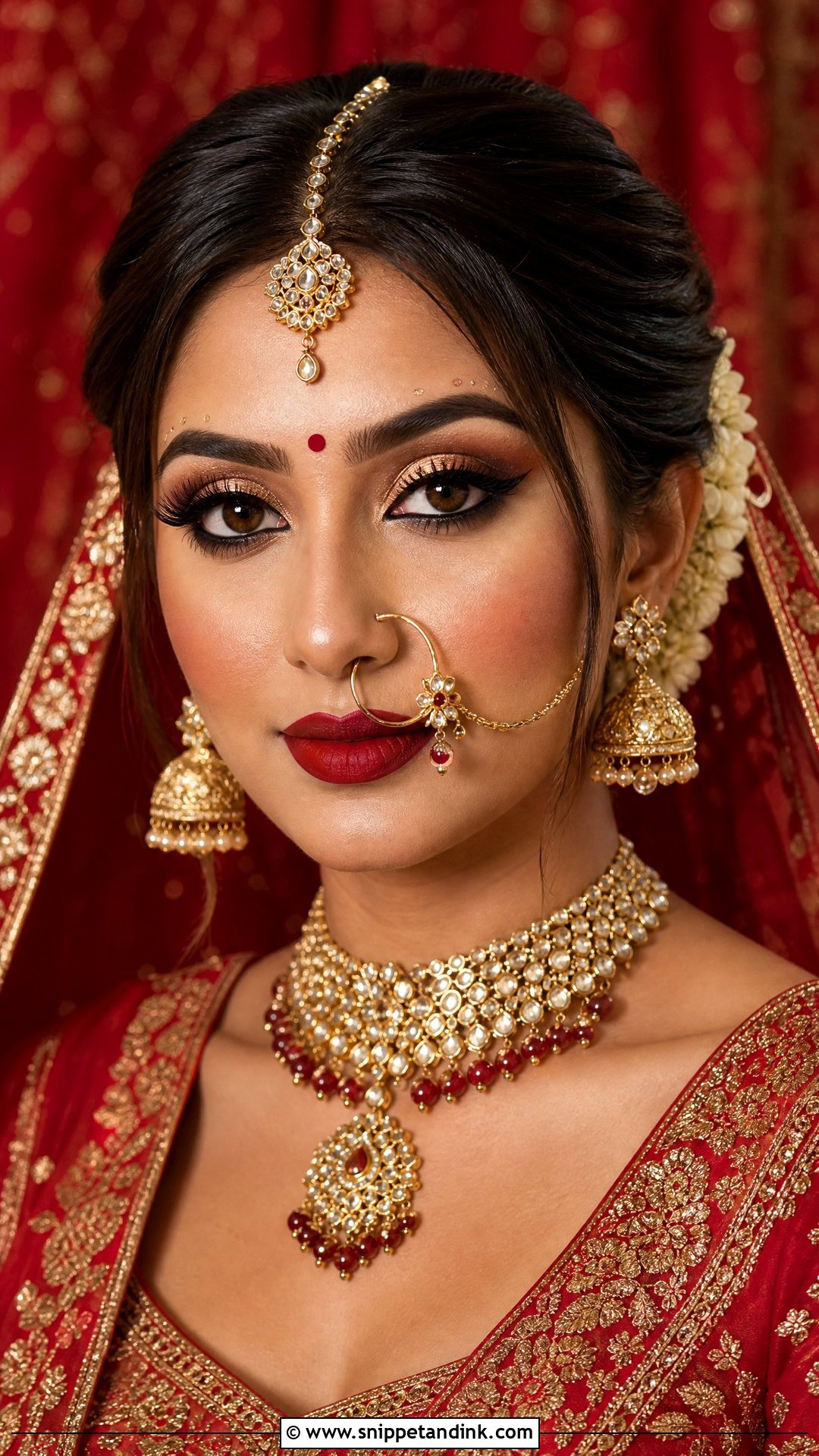
Red is the outfit that forgives the least. If the base leans pink, the whole face turns flushed next to the fabric, so I neutralise redness first and keep the foundation a touch golden. Gold or bronze on the lid adds warmth without competing with the lehenga, and black liner plus kohl gives the eyes enough structure to sit under a heavy maang tikka. I match the lipstick to the red of the outfit in daylight, not under salon bulbs, because a brick red and a blue red that look identical indoors split apart outside. Keep the blush muted, a warm rose or terracotta, or the cheeks start to fight the lip.
2. South Indian Bridal Makeup
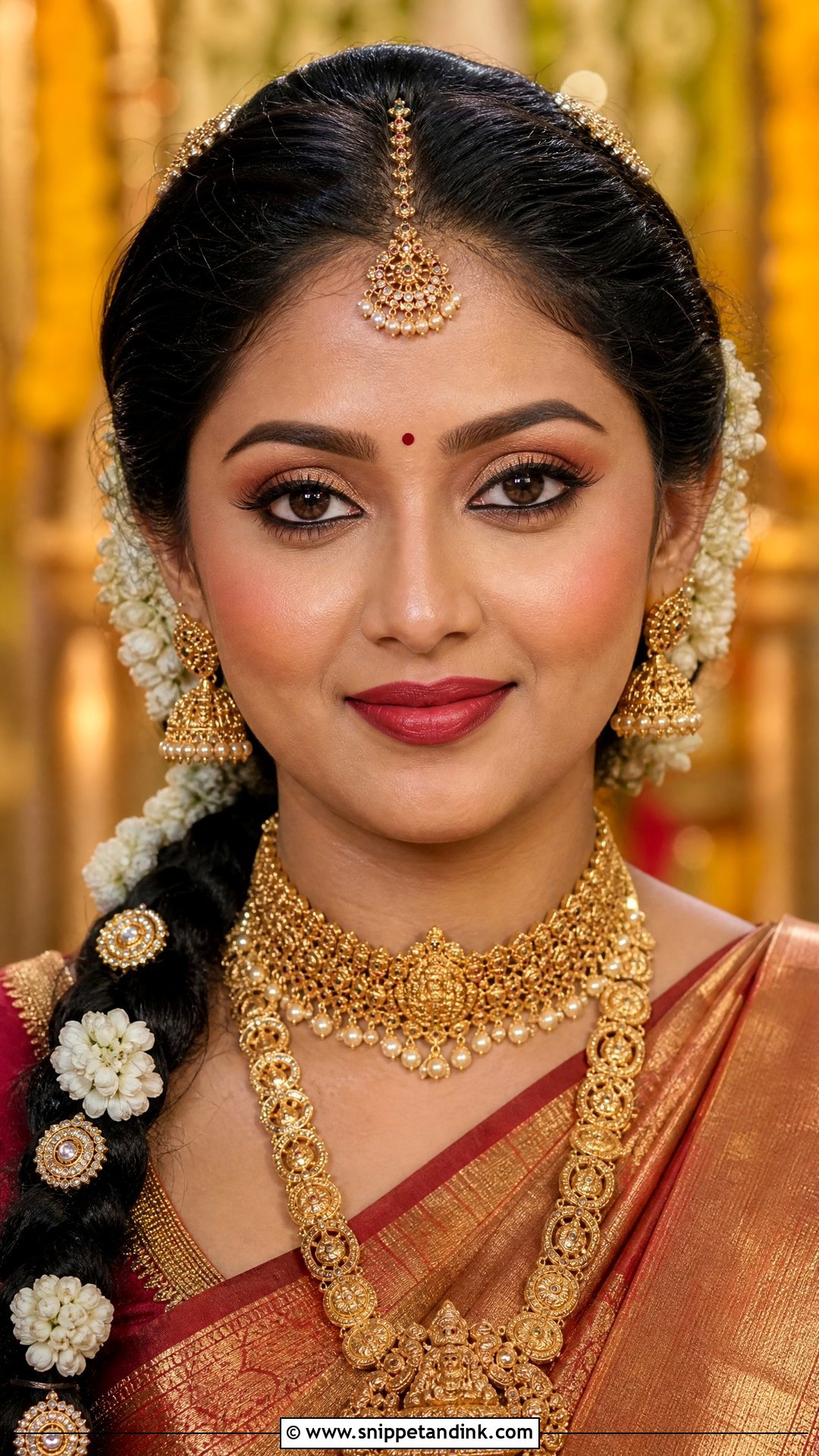
South Indian bridal makeup is built around temple jewelry and heavy silk, and both bounce light up onto the face. That is why I keep the glow on the tops of the cheekbones only and powder the T-zone properly; jasmine in the hair and a humid mandapam bring out oil faster than almost anywhere else. Champagne gold on the lid, a soft brown crease and thick lashes frame the eyes. For the lip, I hold the saree up against the bride’s face before deciding between classic red and a muted berry, because a maroon kanjivaram and an ivory one ask for completely different depths.
3. Punjabi Bridal Makeup
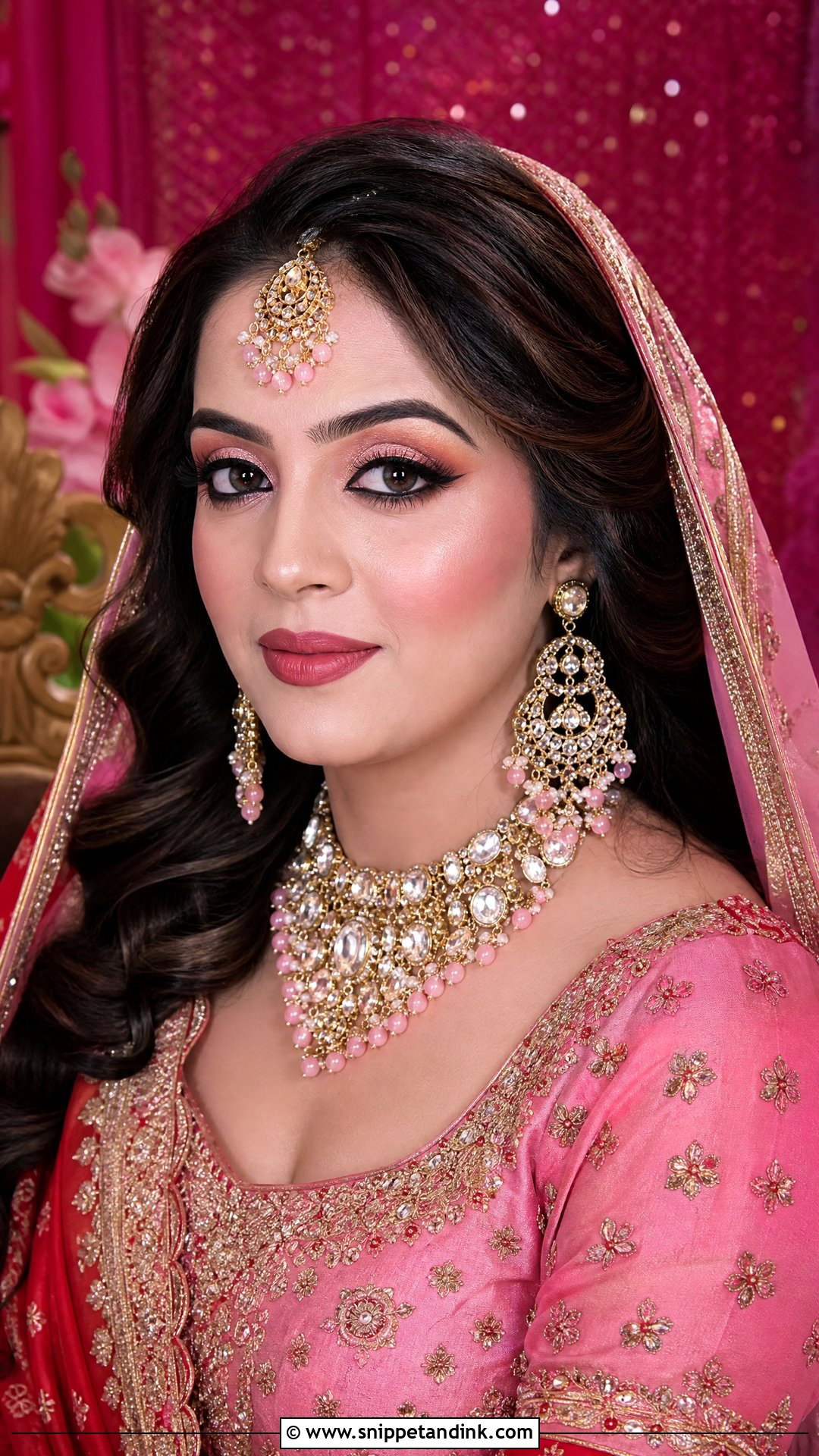
Punjabi weddings tend to run long and loud, often with a day ceremony and an evening party on the same face. I build this one with more contour than usual, under the cheekbone and along the jaw, because the chooda and kaleeras pull attention downward and a soft face can get lost above them. Copper or rose-gold shimmer with a winged liner holds up to the energy. Where I hold back is highlight on the nose; under flash it reads as shine, not glow. Pick the lip last, once the lehenga and jewelry are both on.
4. Bengali Bridal Makeup
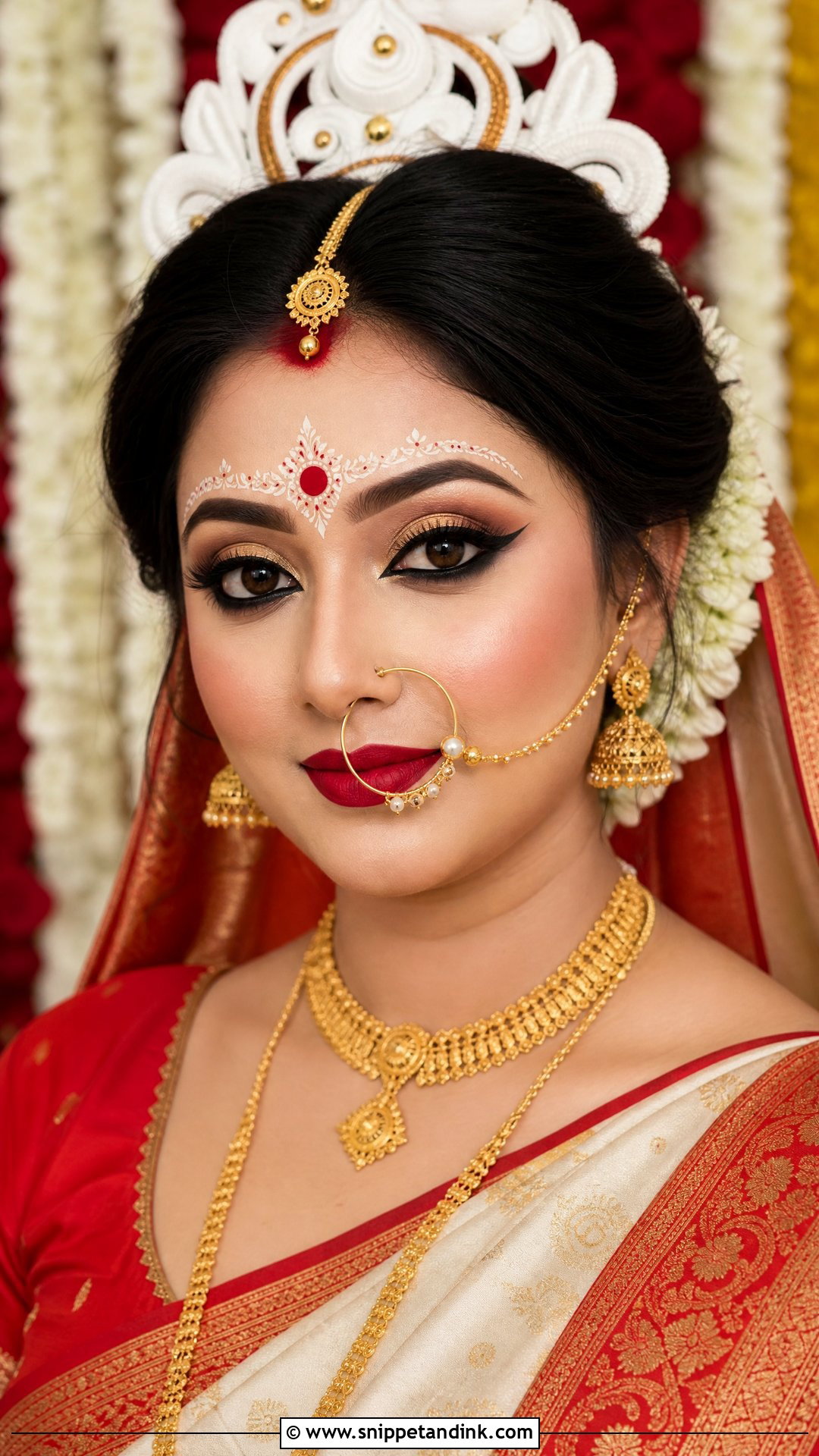
A Bengali bride often wears chandan dots across the forehead and brows, so that area needs a clean, even base for whoever draws the design. I set the forehead with a thin layer of powder before any sandalwood or kumkum work goes on, otherwise it smudges as soon as she warms up under the mukut. Gold lids, brown depth in the crease, black winged liner and full lashes make the frame. The red lip is the anchor of this look. I line the whole mouth, fill it with pencil, then apply the red in two thin layers with a blot in between, which outlasts one thick coat.
5. Maharashtrian Bridal Makeup
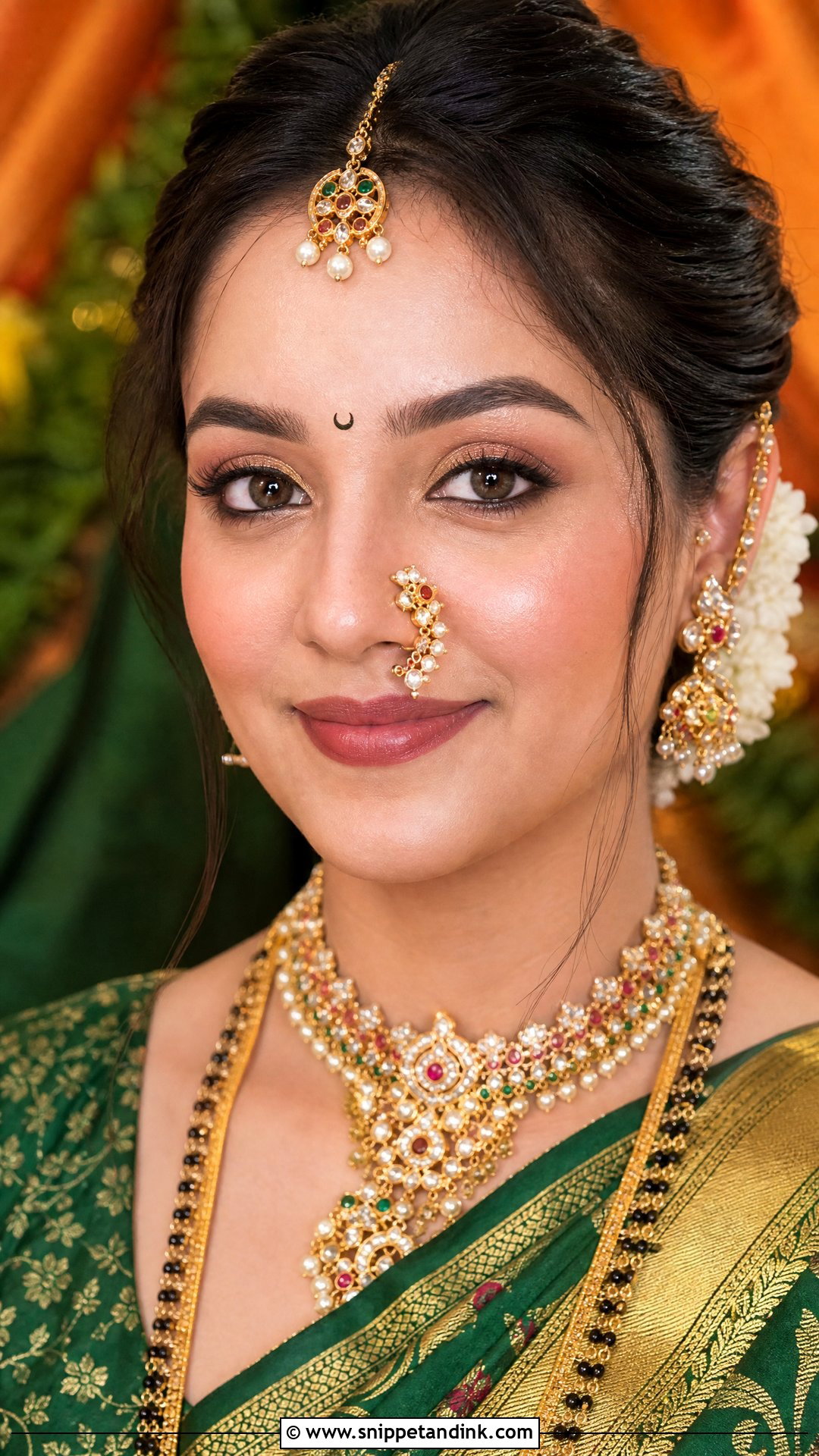
The nath hangs right over the upper lip and catches on anything sticky, which is my main reason to keep Maharashtrian brides in a satin or matte lip rather than gloss. The base should look like skin, and the eyes stay lighter than in many other regional looks: copper or warm brown, a thin wing, separated lashes. The chandrakor bindi and the nath already give the face its drama. Peach or rose blush sits well against the yellow and green paithanis many brides choose.
6. Muslim Indian Bridal Makeup
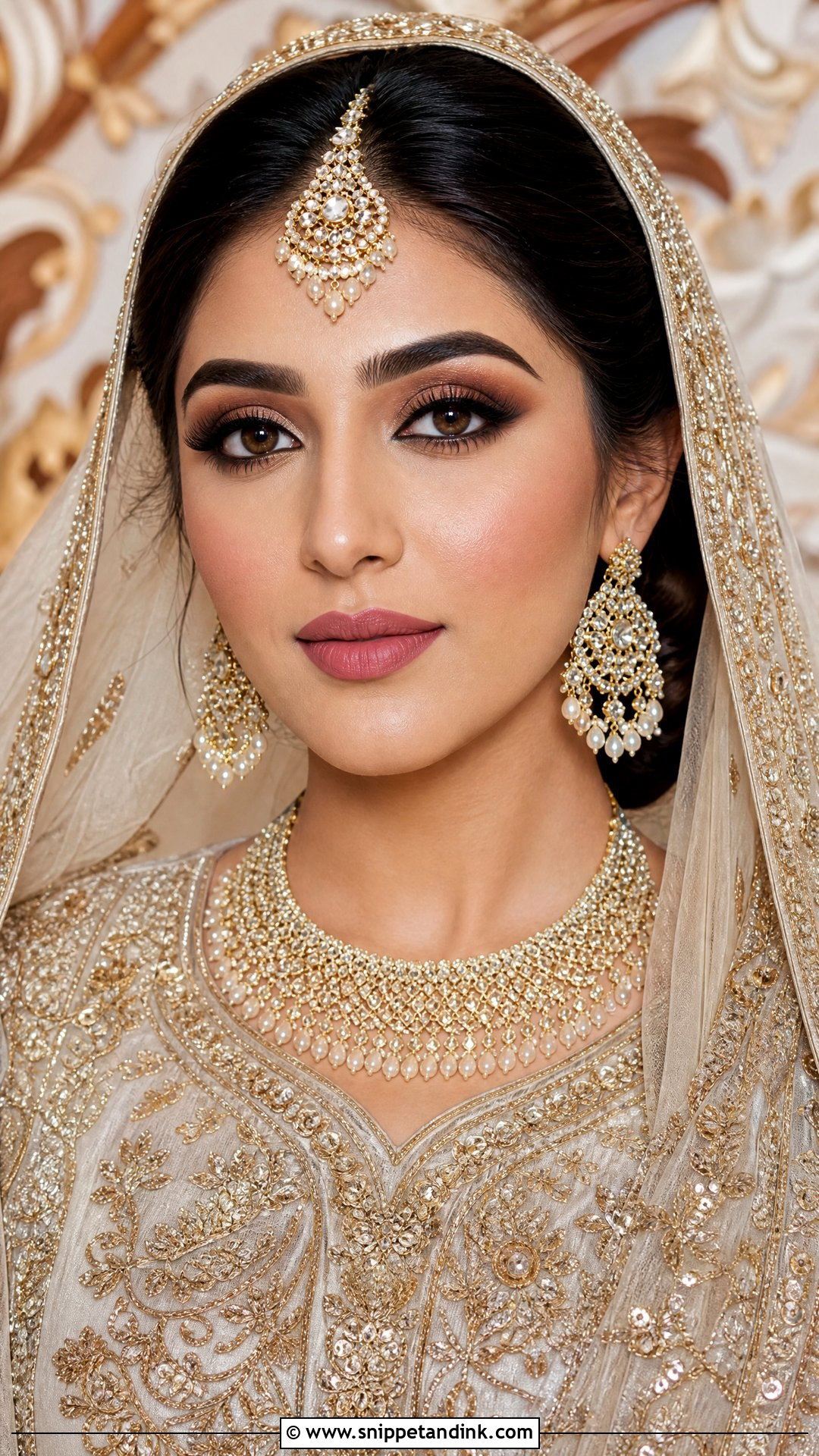
Muslim Indian brides often wear a sharara or gharara with a dupatta set over the head and a jhoomar at the side of the parting, so the eyes do most of the talking. I build them with bronze or smoky brown shadow, black liner, kohl and well-curled lashes, and keep the contour soft under the cheekbones. The nikah itself can be short, but the photos afterwards run long, so the base is long-wear and set thoroughly. Mauve or nude rose suits a pastel gharara; deep red belongs with a red or maroon outfit. If the dupatta is heavily embellished, I keep shimmer off the lids so two kinds of sparkle aren’t competing.
7. Sikh Bridal Makeup
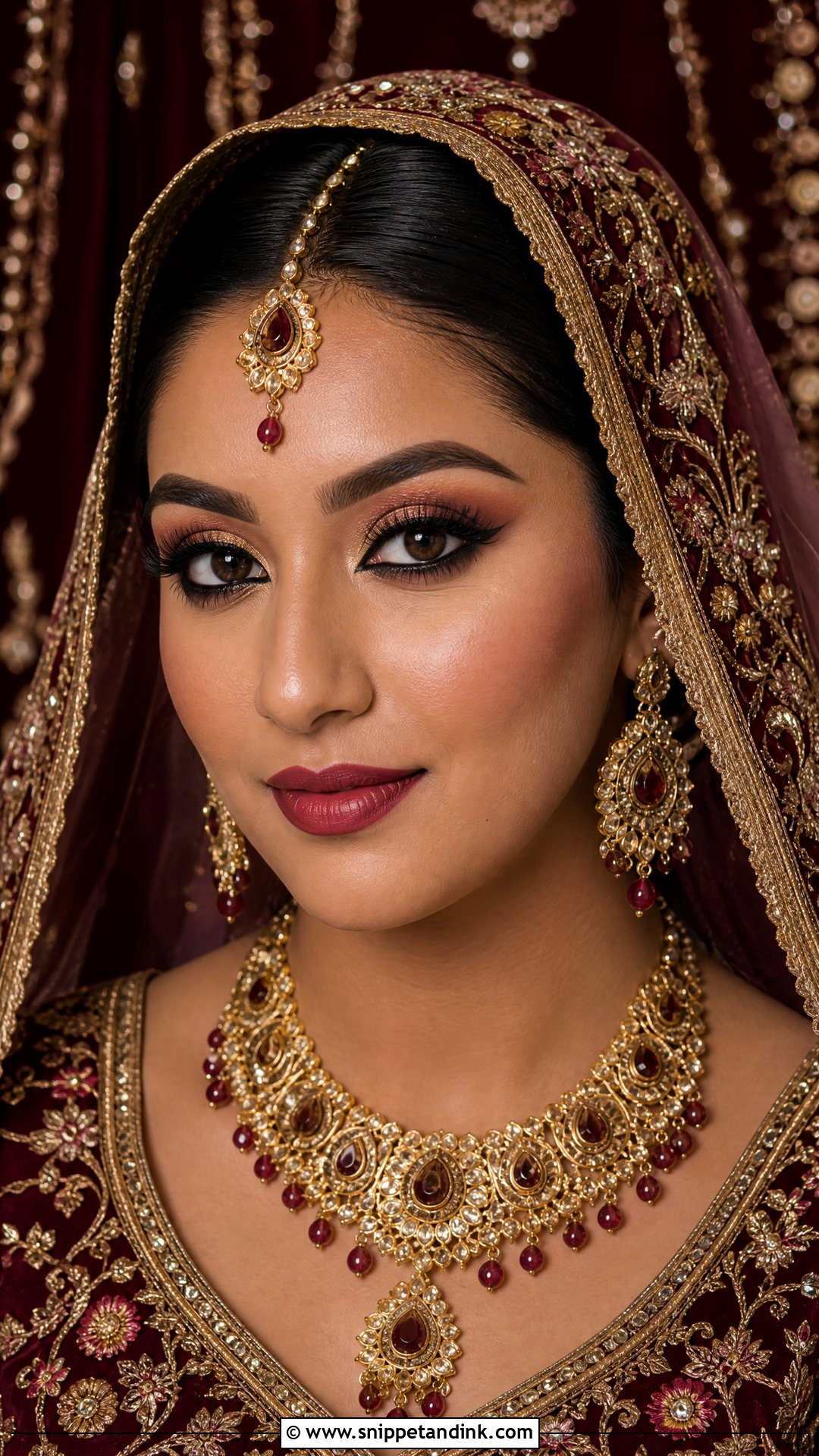
Sikh bridal makeup has to work under a dupatta drawn forward over the head, which shades the face for most of the Anand Karaj. Shade swallows detail, so I go one step deeper on the lip and keep the lashes full. The ceremony is usually in the morning, in a gurdwara, so I avoid heavy shimmer and keep the skin satin-matte. Gold or bronze lids suit red and maroon outfits. Blush placed a little higher than the apples keeps the face lifted when she looks down during the laavan.
8. Gujarati Bridal Makeup
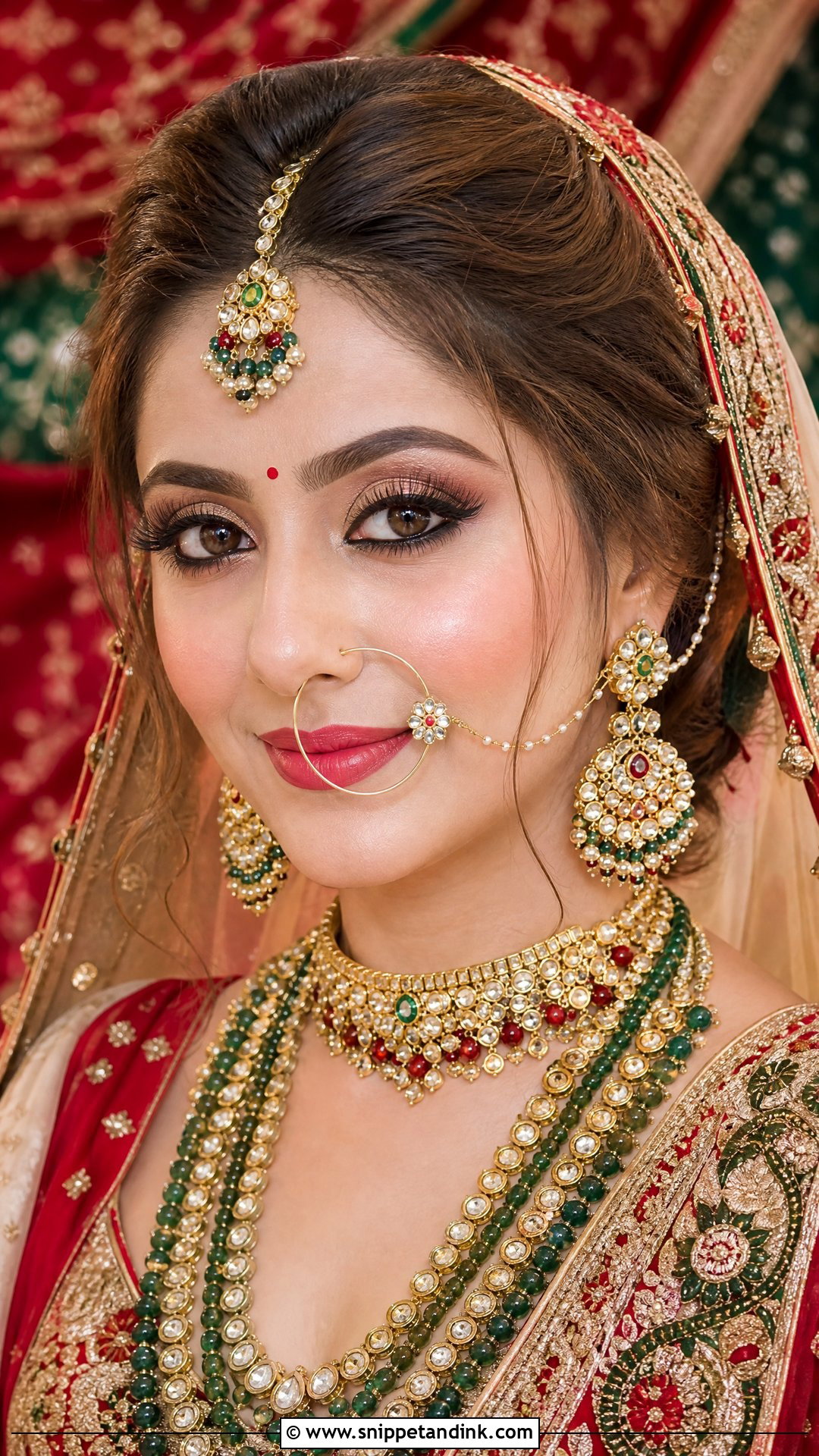
Gujarati brides often wear a panetar or gharchola with a lot of white and red near the face, and that white bounces light upward. It works in my favour: I need less highlighter than you’d expect, so I keep it to the cheekbones and inner corners. Champagne or soft pink shimmer on the lid, a defined liner and wispy lashes keep the eyes open. Garba the night before can leave a tired bride, so I prep with cooling eye patches and a hydrating layer before the long-wear foundation goes on.
9. Rajasthani Bridal Makeup
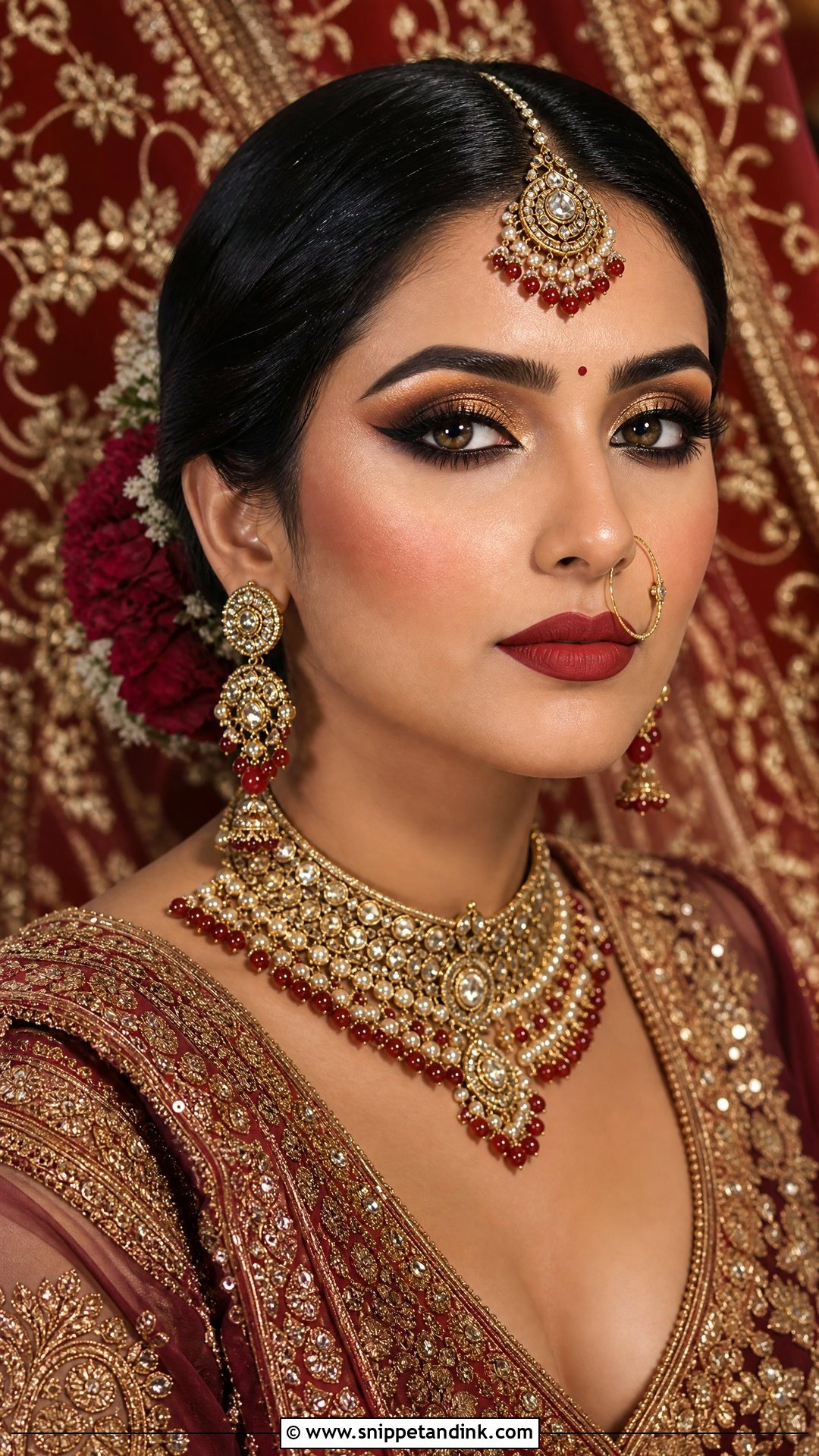
The borla sits at the centre of the forehead and pulls every eye straight to the middle of the face, so the brows need to be strong and the forehead base flawless. Rajasthani outfits are heavy, and the light at palace and haveli venues is often warm and low. Under that light, antique gold and bronze lids look richer than cool tones, and deep red or maroon lips stay visible across a courtyard. I’d steer anyone with small or hooded eyes away from full lower-lash kohl here. With this much jewelry, a smudged upper wing gives the eye more lift.
10. Minimal Indian Bridal Makeup
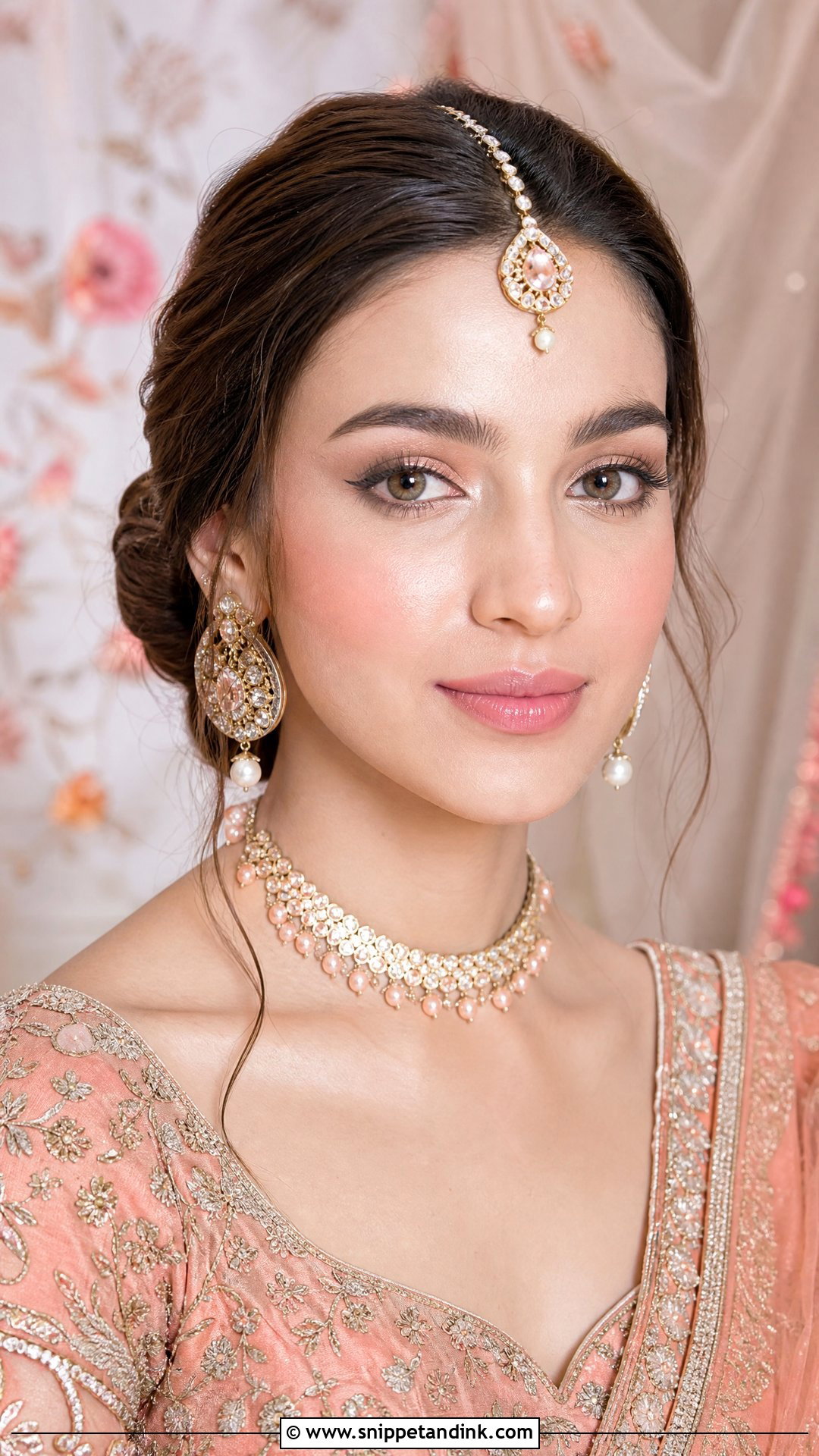
Minimal doesn’t mean less work. It usually means more skin prep and thinner layers, because there’s nothing to hide behind. I spot-conceal instead of covering the whole face, then press a thin long-wear base in only where it’s needed. Soft brown on the lid, a thin liner and curled lashes are enough. The risk is looking washed out next to a heavily embroidered outfit, so I check the face through a camera at the trial and add a little more blush than feels necessary in the mirror.
11. Dewy Indian Bridal Makeup
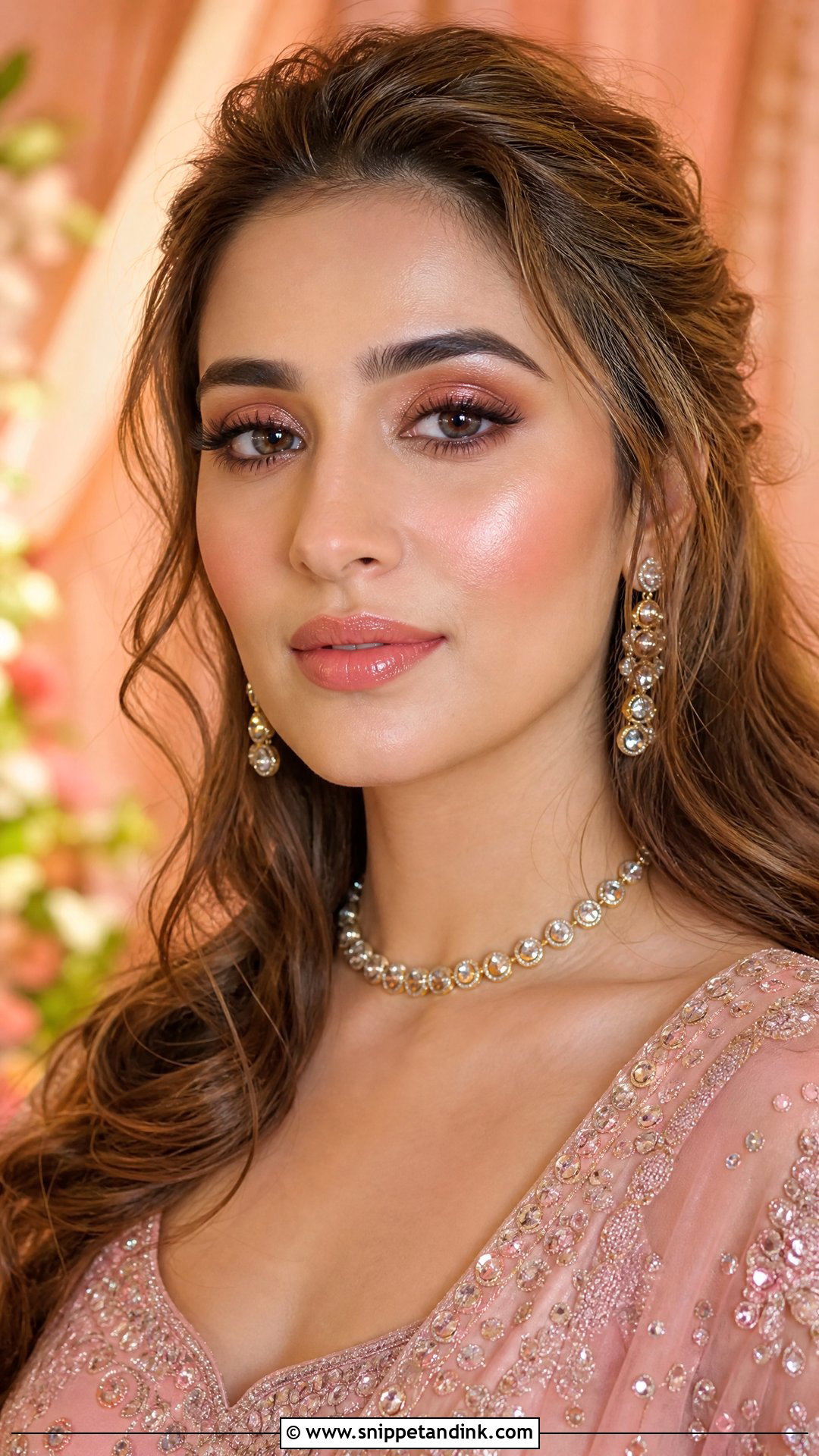
Dewy skin is the look that goes wrong fastest at an Indian wedding, because heat and long hours turn glow into grease. The fresh, glowing, and romantic finish people love comes from placement: hydrating prep, a luminous foundation that still has some grip, cream blush, and liquid highlight on the high points only. I powder the sides of the nose, the chin and under the eyes no matter how dewy the brief is. It suits day weddings and pastel lehengas. I’d skip it for a summer outdoor ceremony unless the bride has genuinely dry skin.
12. Matte Indian Bridal Makeup
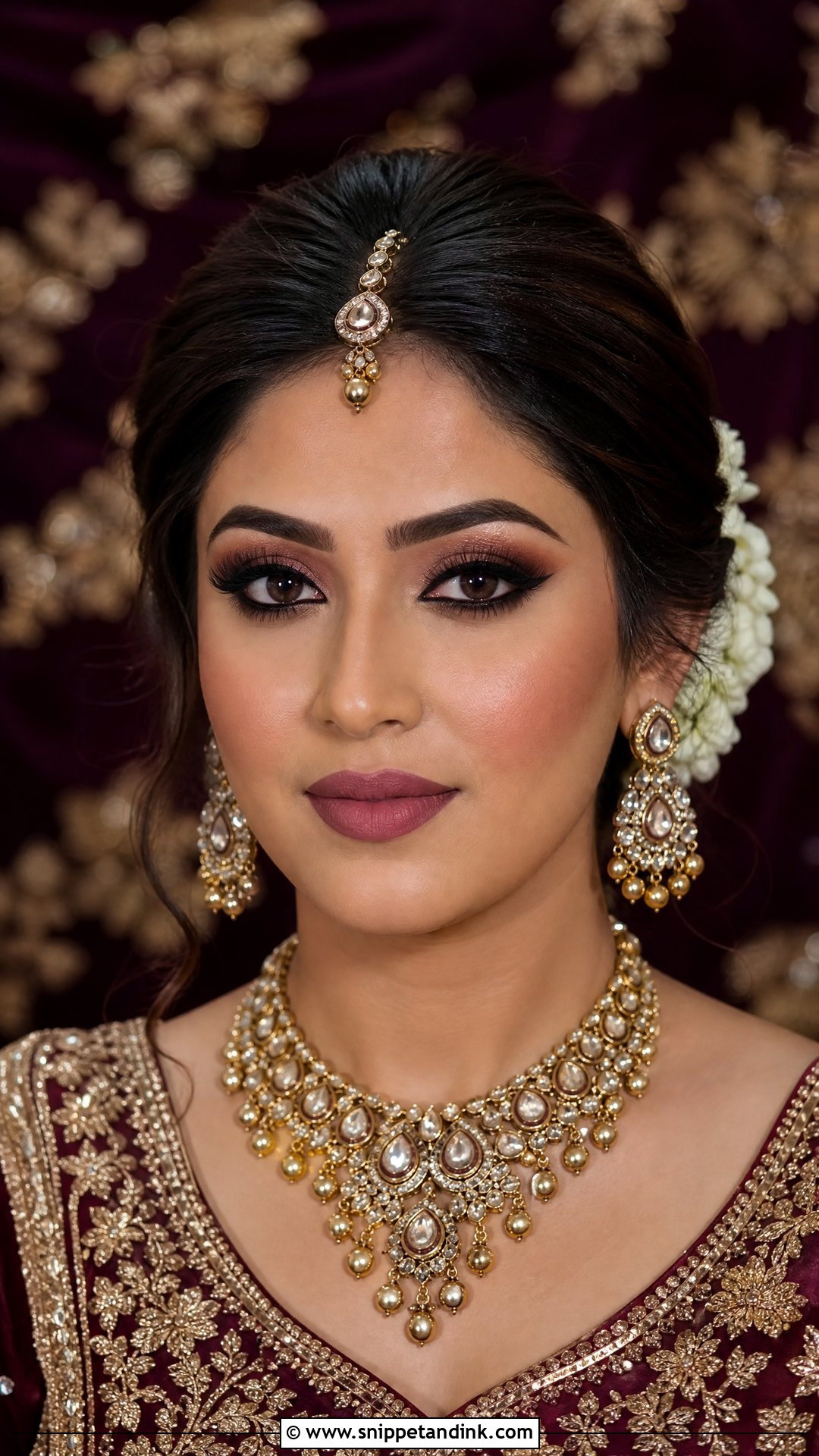
Matte is my usual suggestion for oily skin and long outdoor ceremonies. The worry is flatness, and the fix is building in layers: an oil-control primer, a matte foundation, cream contour set with powder, then a touch of highlight on the inner corners so the face doesn’t read as a mask. I’d avoid a fully matte face on very dry or mature skin, since it settles into texture after a few hours. Warm brown or plum lids and a matte rosewood lip finish it.
13. Smokey Eye Indian Bridal Makeup
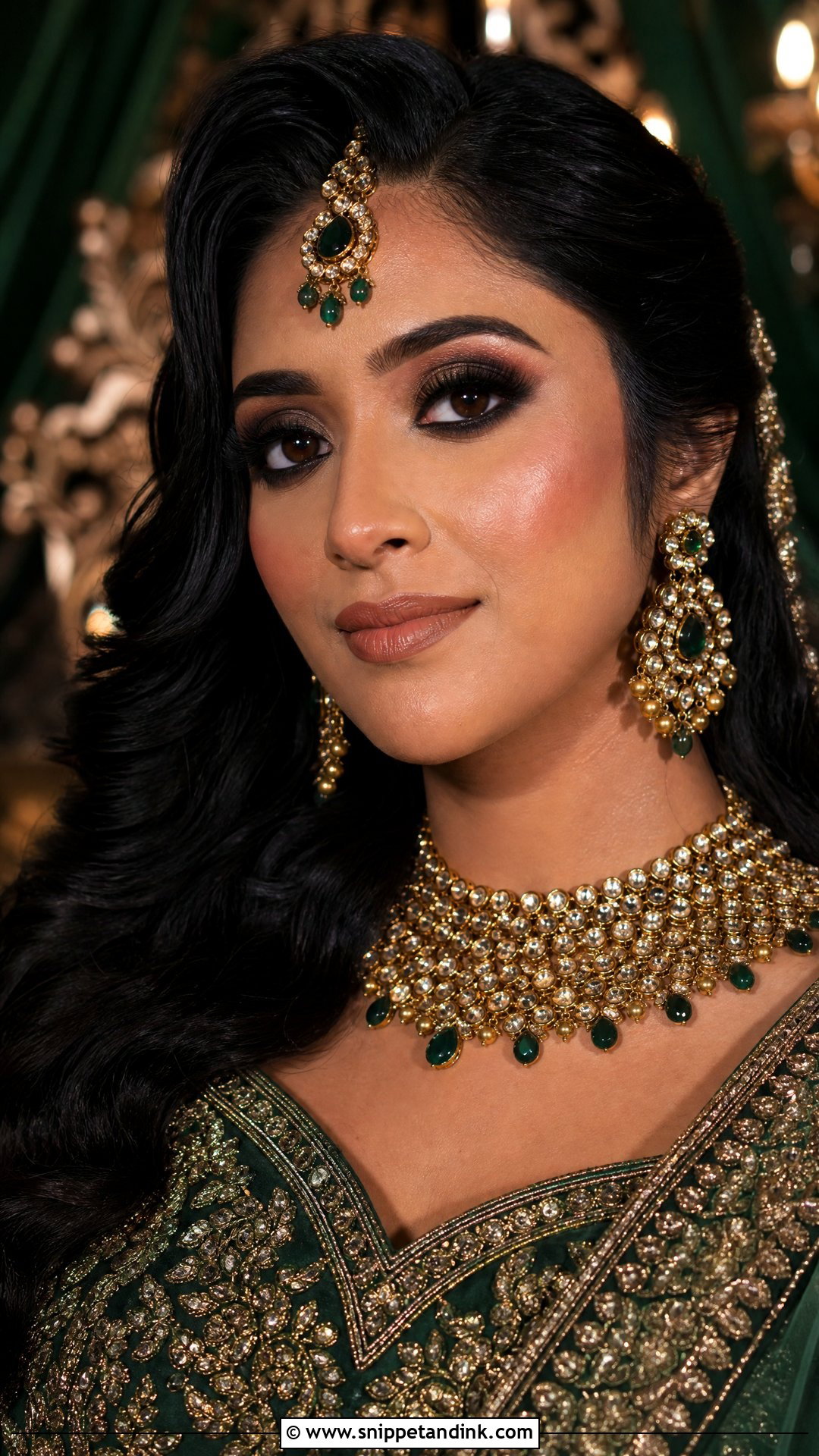
A smoky eye on an Indian bride lives or dies at the outer corner. If the darkness drags downward, it looks tired by evening, so I build the shape up toward the tail of the brow and smoke only the outer third of the lower lashline. Kohl on the waterline gives the traditional intensity, but it travels, so I set it with a matching powder shadow. With this much depth on the eyes, the lip stays caramel or nude rose, and blush brings warmth back to the face.
14. Gold Eye Indian Bridal Makeup
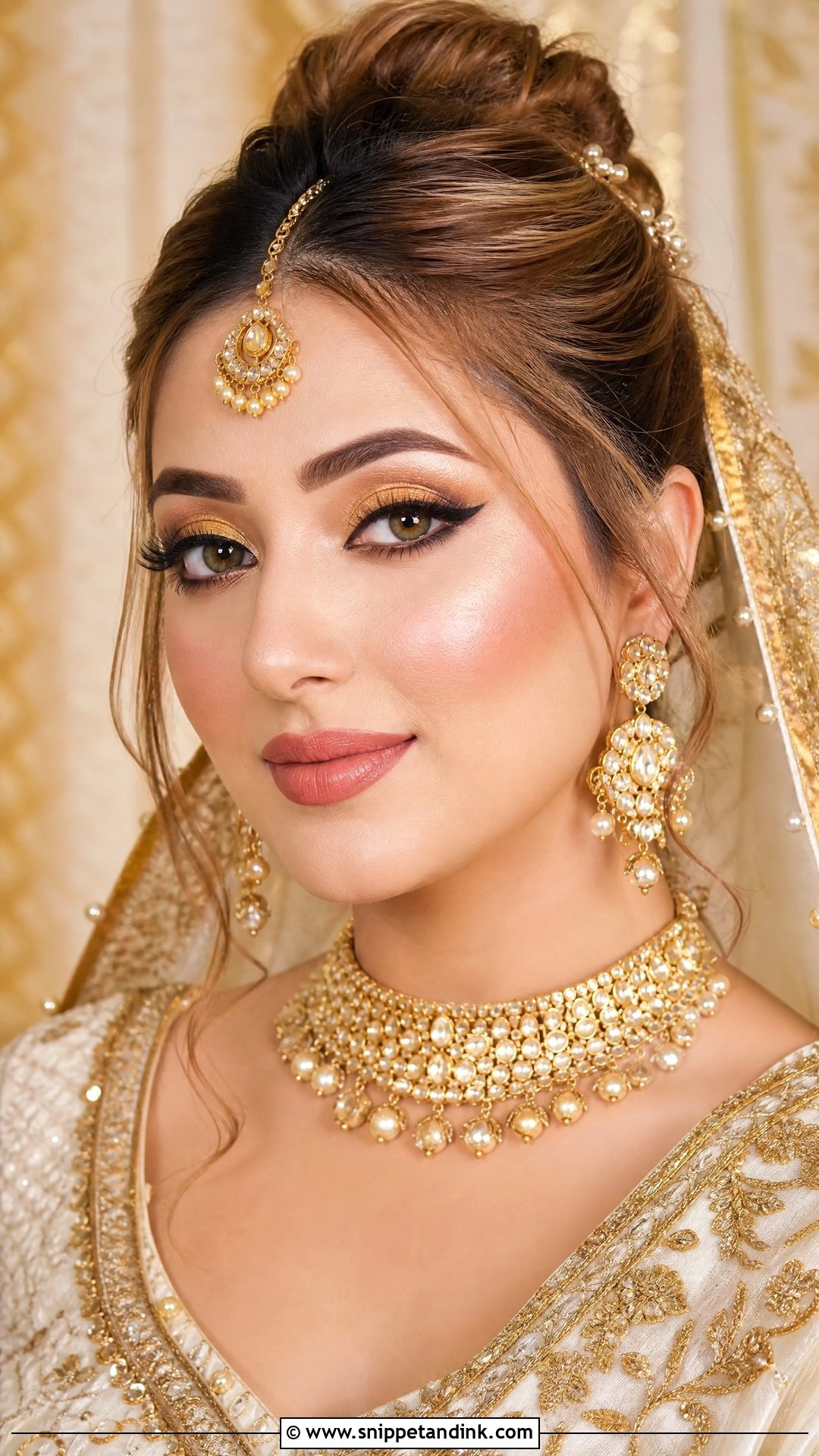
Gold is the safest shadow in my kit for Indian bridal work, because it repeats the jewelry and flatters almost every undertone. The real choice is between pale champagne gold, which brightens hooded eyes, and antique gold with bronze depth, which suits deeper skin and evening ceremonies. I press metallic shadow on with a damp brush or a fingertip so it doesn’t scatter onto the cheeks. A brown crease, black liner, kohl and lifted lashes stop it looking flat.
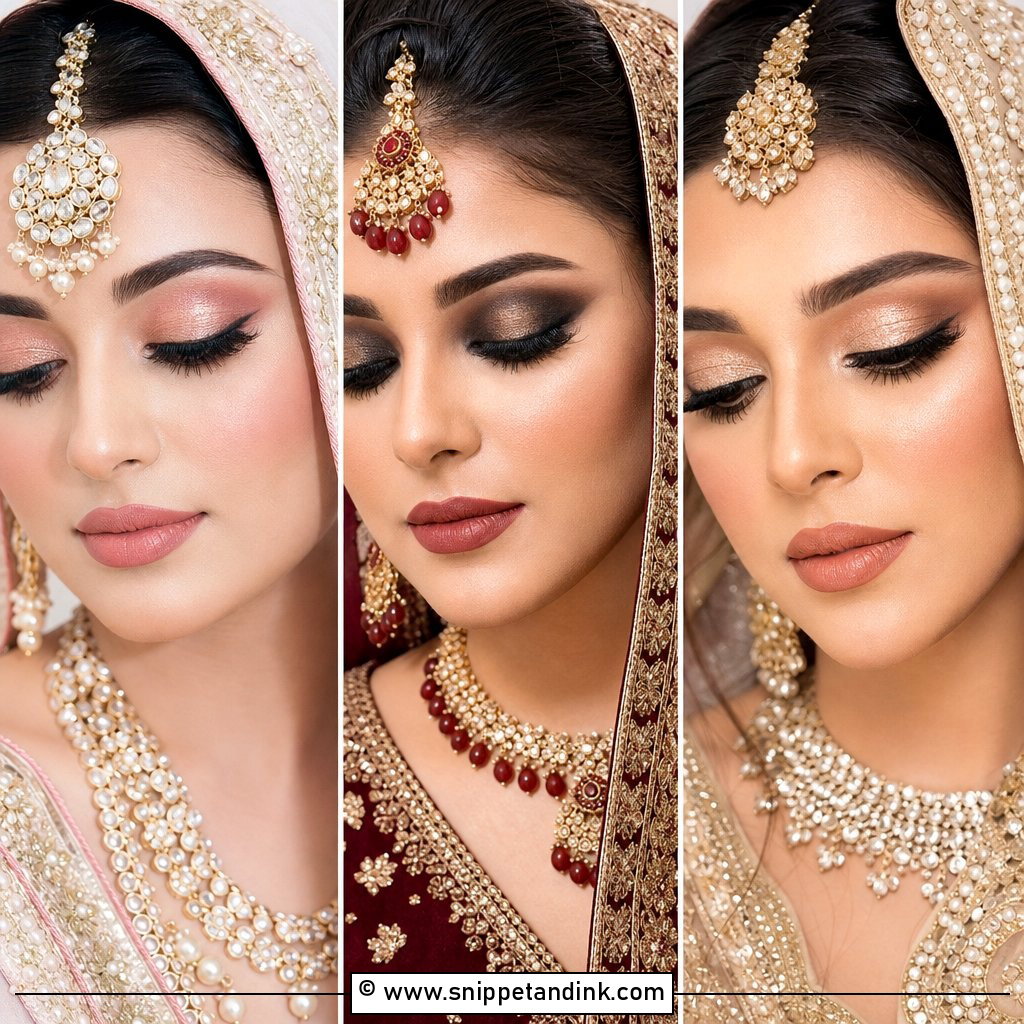
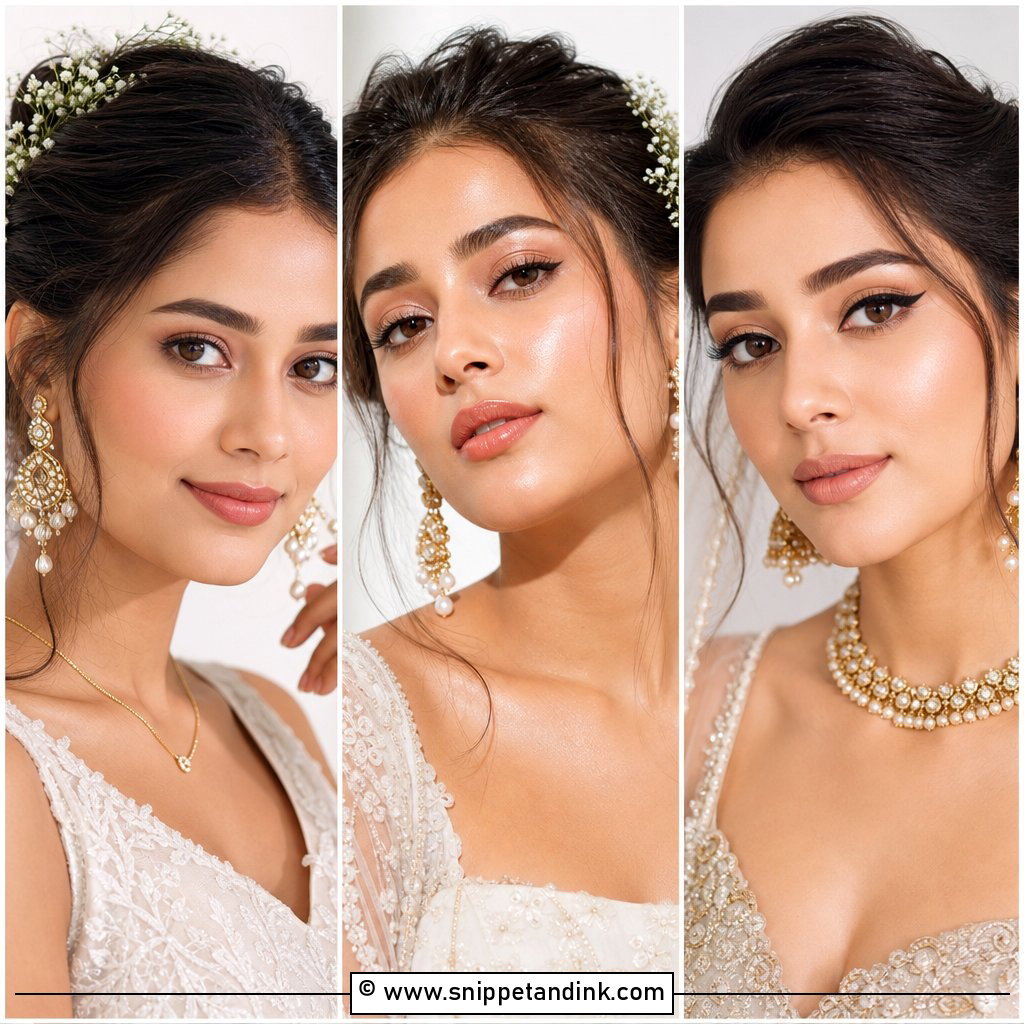
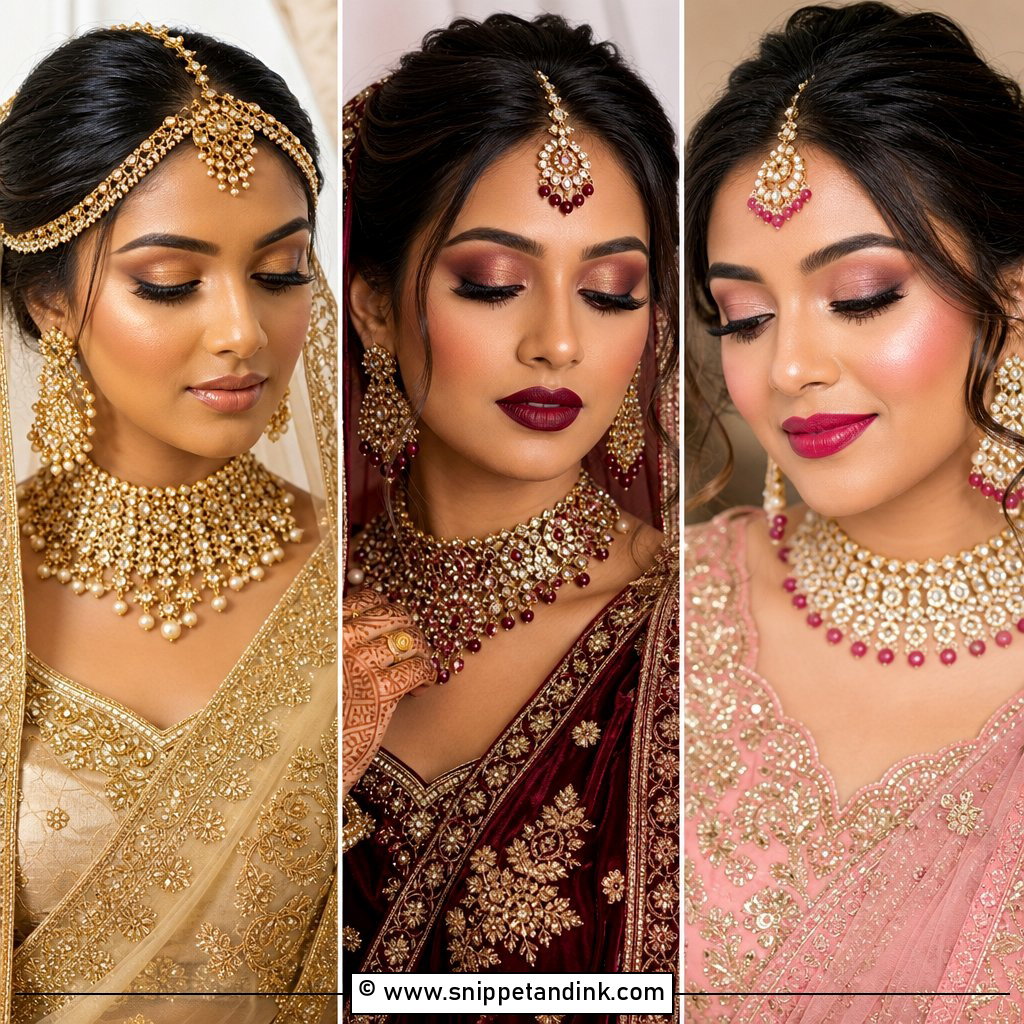
15. Nude Lip Indian Bridal Makeup
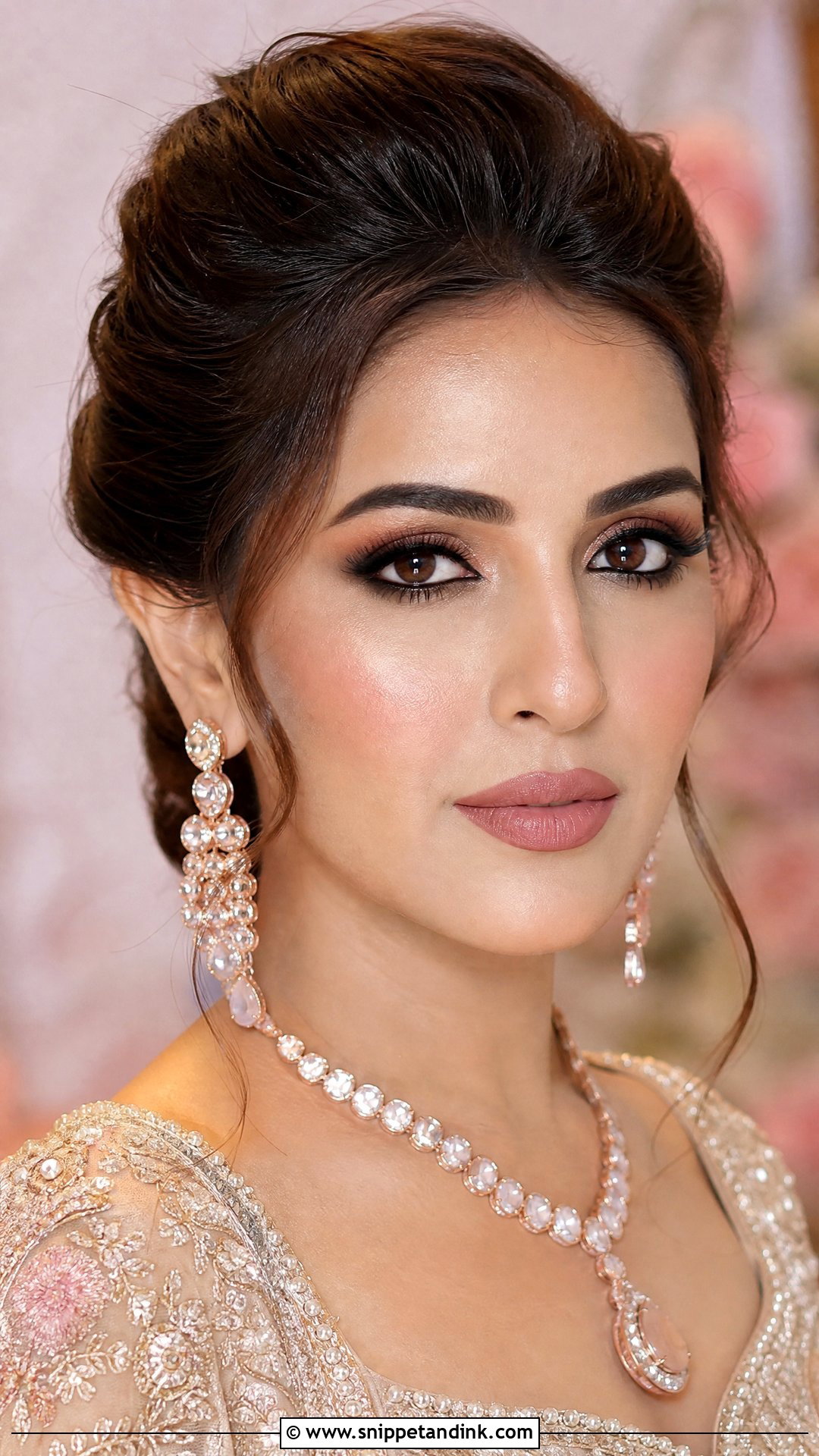
Nude lip Indian bridal makeup is how I balance a face when the eyes or the jewelry are already loud. The mistake I see most is a nude made for fair skin; on medium and deep skin it turns grey and the mouth disappears in photos. Look for a nude one or two shades deeper than your own lips, usually rose-brown or caramel, and line it with a pencil a touch darker so the shape holds. Keep the blush generous so the face doesn’t go flat.
16. Red Lip Indian Bridal Makeup
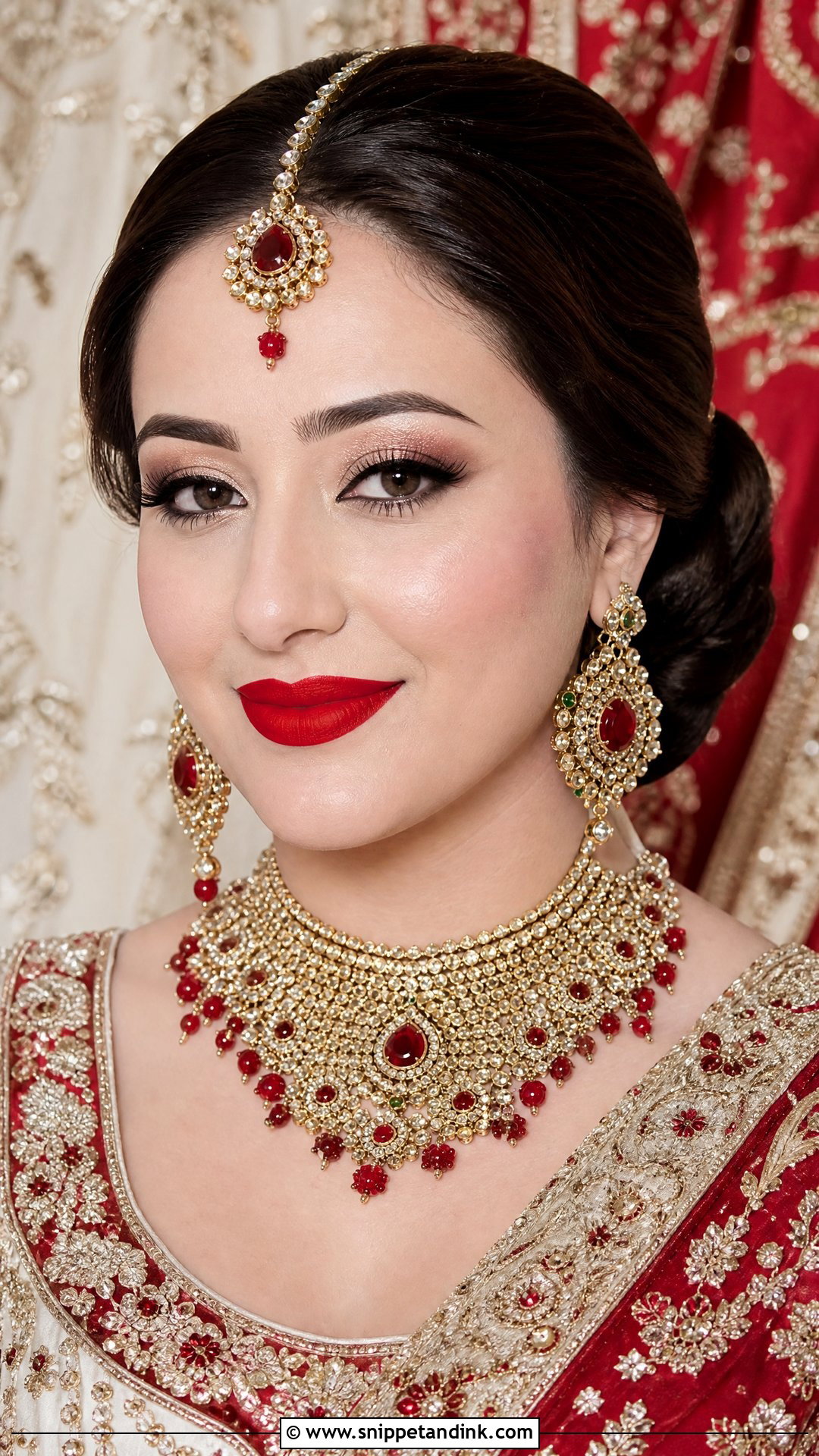
A red lip makes every other choice simpler: clean skin, soft contour, champagne or soft brown lids and a black liner. The decision that matters is undertone. Blue-reds look crisp and make teeth look whiter; brick reds sit warmer on golden skin; ruby gives depth at night. I always test the red with the outfit on, because a red lehenga next to a slightly different red lip looks like a mismatch rather than a choice.
17. Pink Indian Bridal Makeup
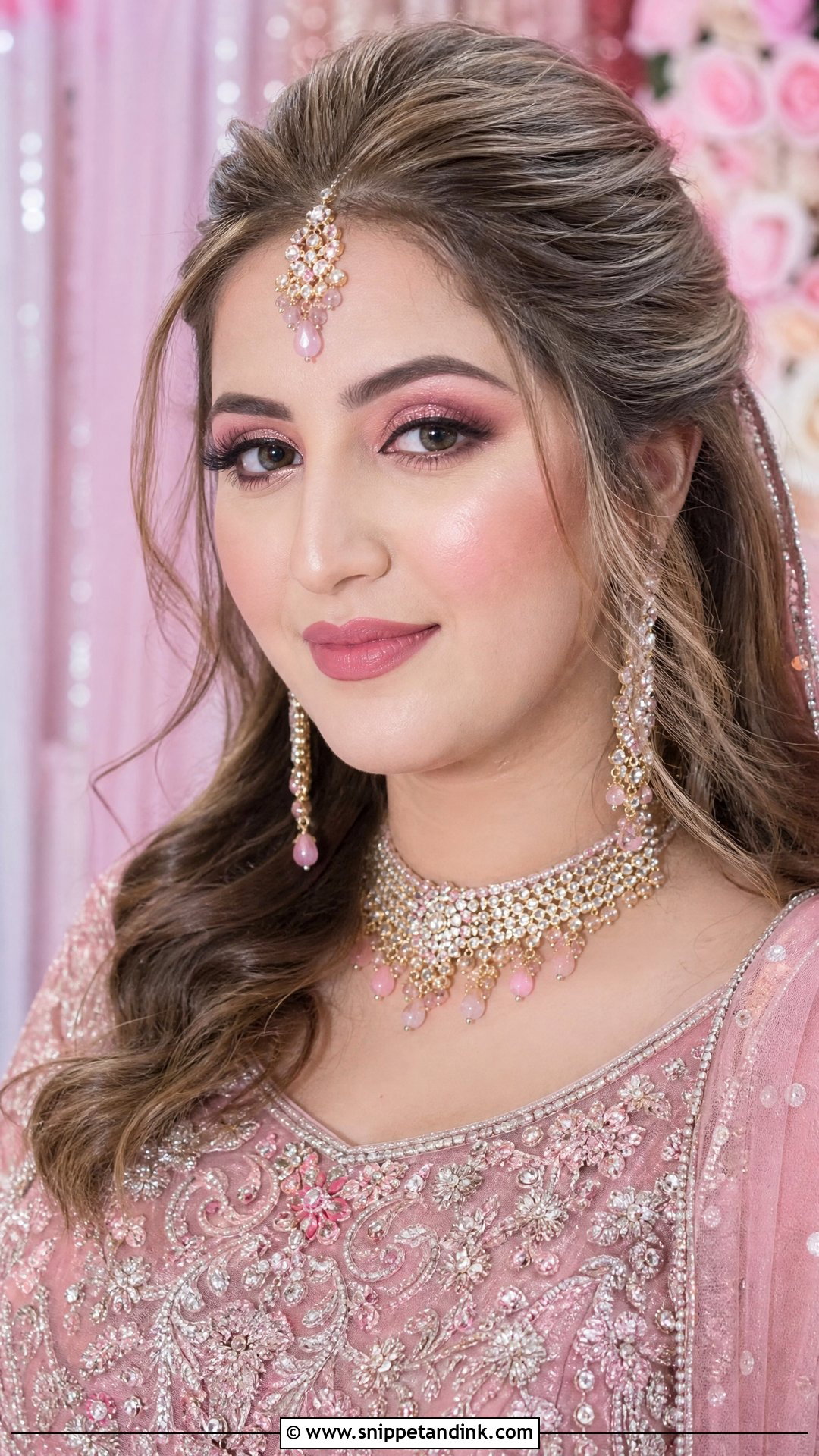
Pink suits brides in blush, rose or pastel outfits, as long as the pink isn’t chalky. That’s my main check, because pinks with a lot of white in them sit on brown skin like a film. Rose or mauve on the lids, a thin liner and wispy lashes keep it delicate, and I carry the same pink through the cheeks and lip so the face reads as one colour story. It’s a good engagement or daytime choice. Under warm evening lights, soft pink can fade to almost nothing.
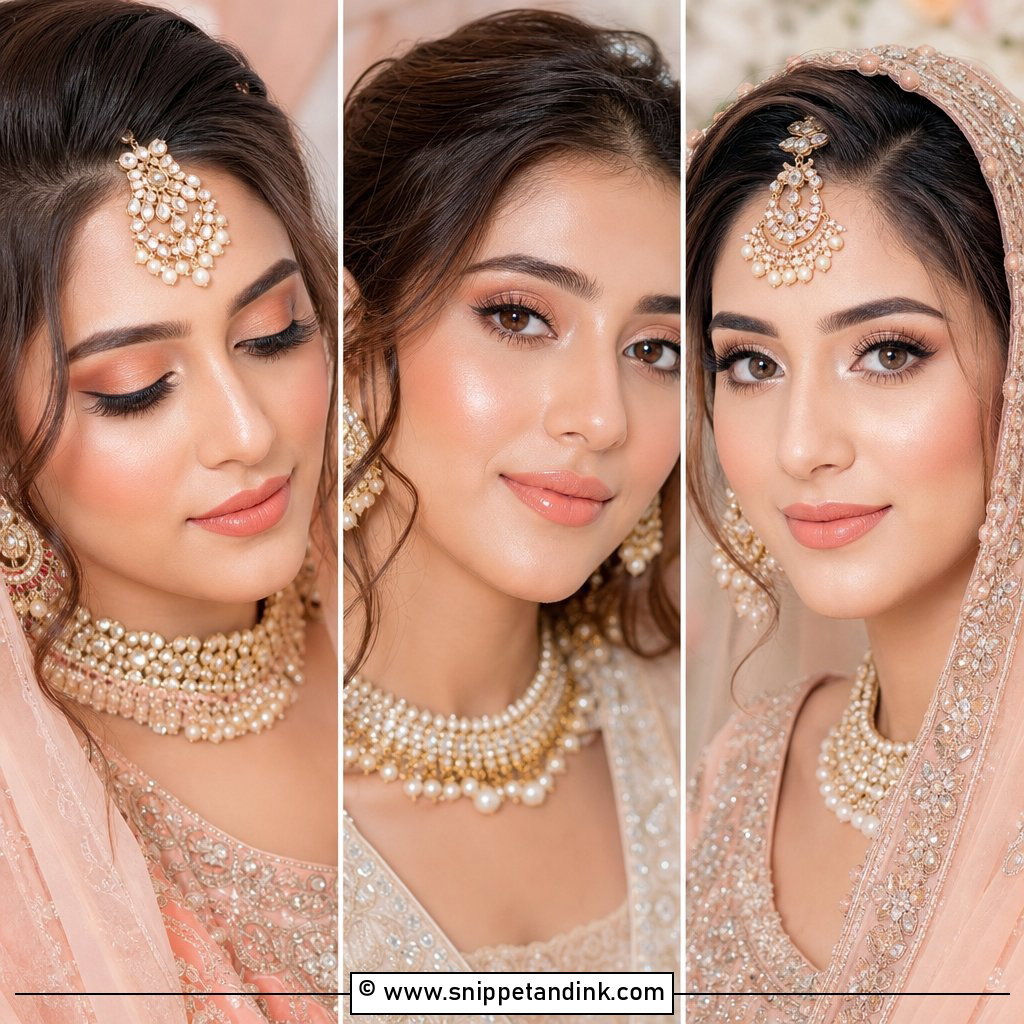
18. Peach Indian Bridal Makeup
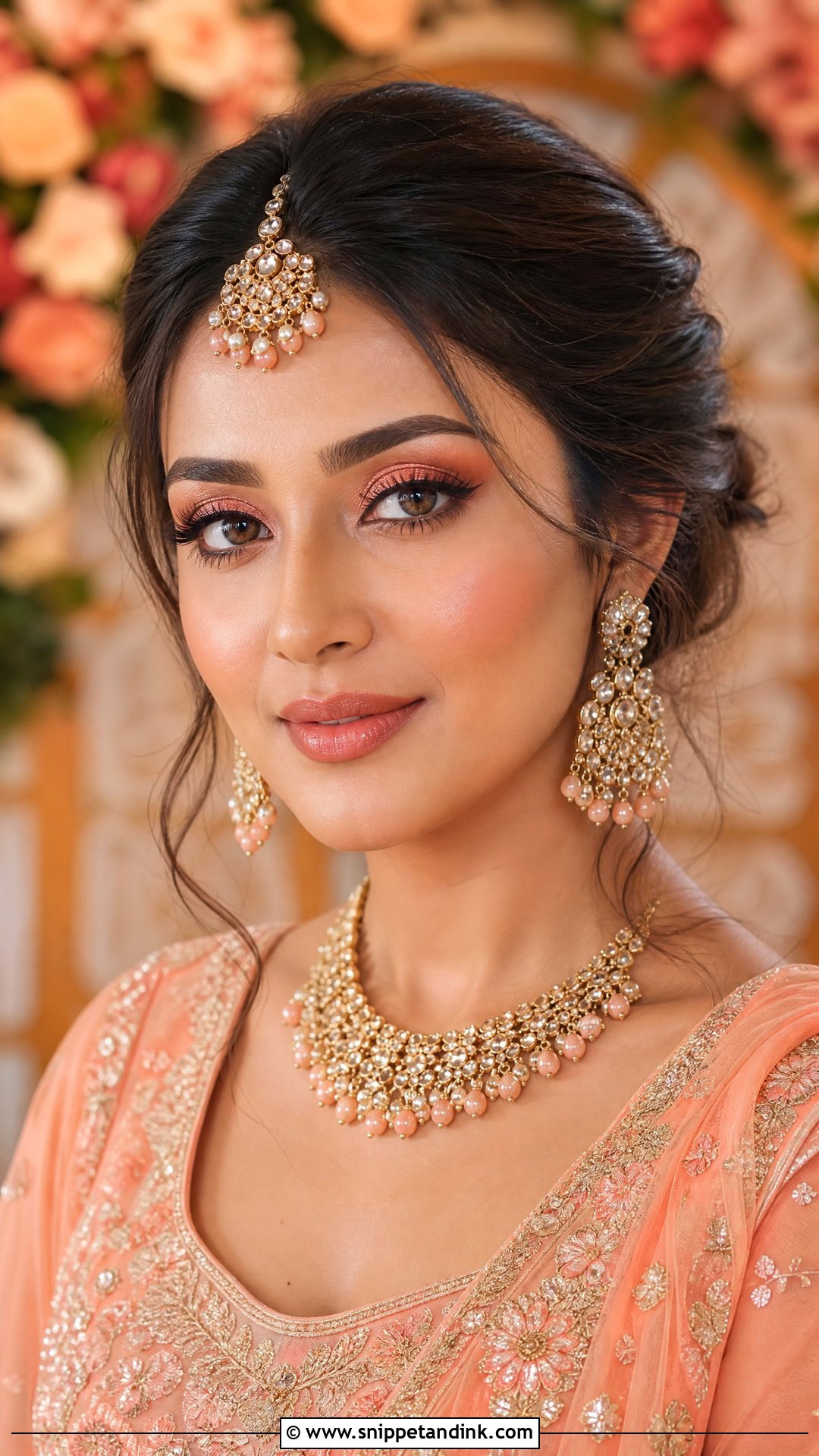
Peach gives warmth without the weight of red or berry, which is why I reach for it at daytime functions. It does depend on undertone. On olive or cooler skin, straight peach can look orange, so I swap in a peach-rose. The method is simple: peach shadow with champagne shimmer, brown liner, curled lashes, then peach blush blended from the apples upward. Keep the lip peach-nude so it sits quietly beside ivory, mint or coral lehengas.
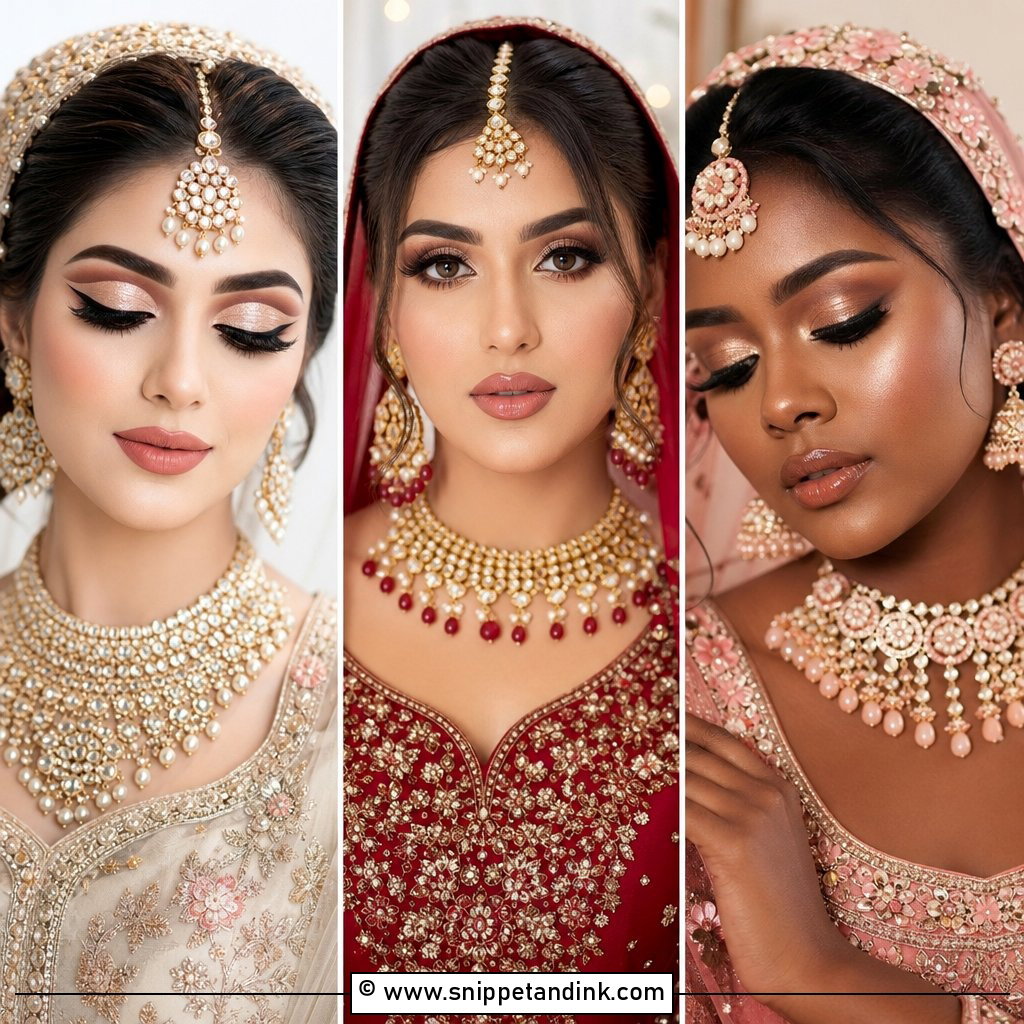
19. Reception Indian Bridal Makeup
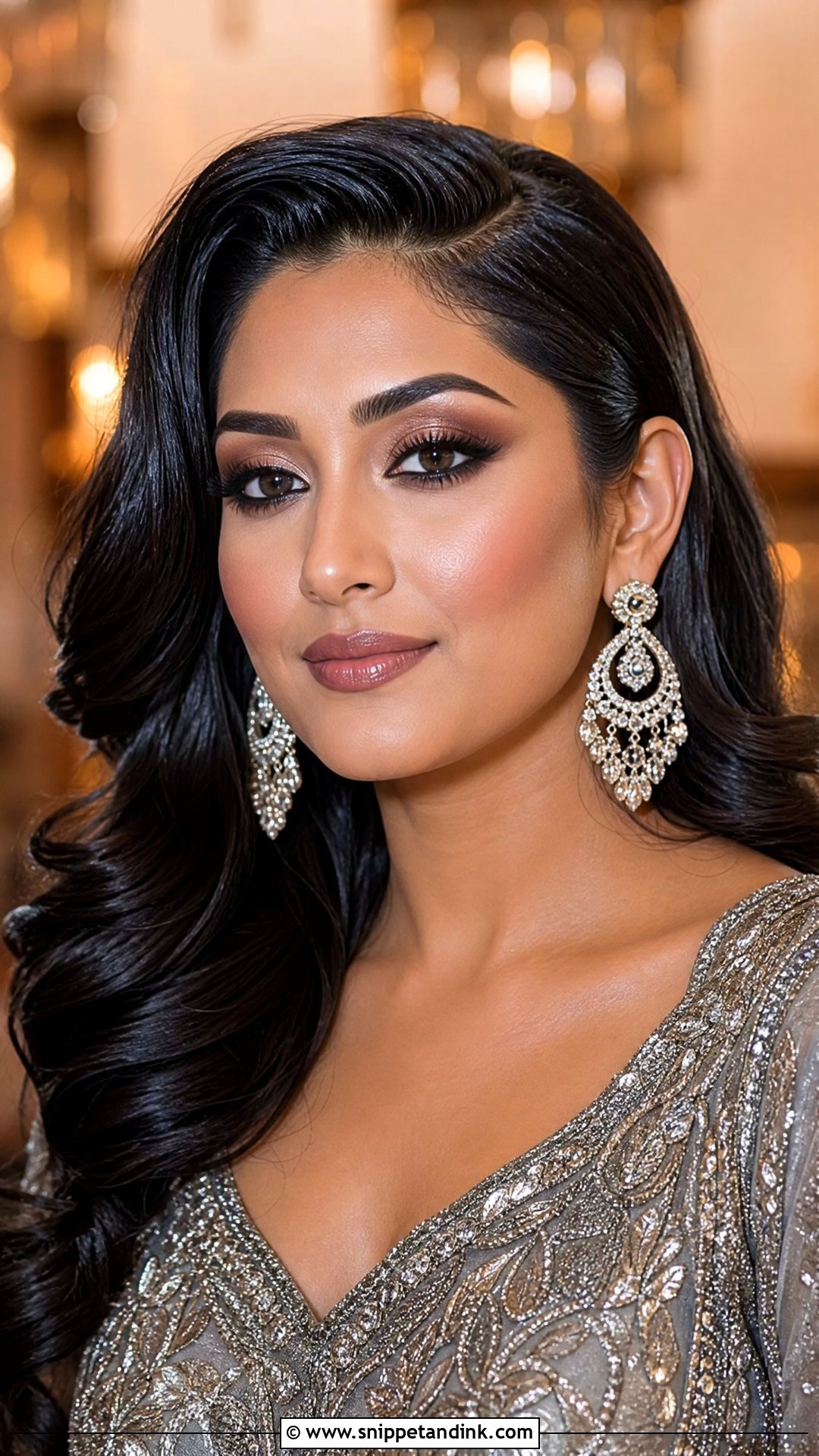
The reception is where most brides want a change, and it’s only realistic if the ceremony base was built to be refreshed. I don’t strip the face. I blot, press a little fresh foundation where it has broken down, then change the eyes and lips. Metallic bronze or rose-gold lids, a sharper wing and fuller lashes read well under evening and stage lighting. Gloss is fine now, since there’s no nath or ritual to catch on, and the contour can go a little stronger because reception photos are mostly flash.
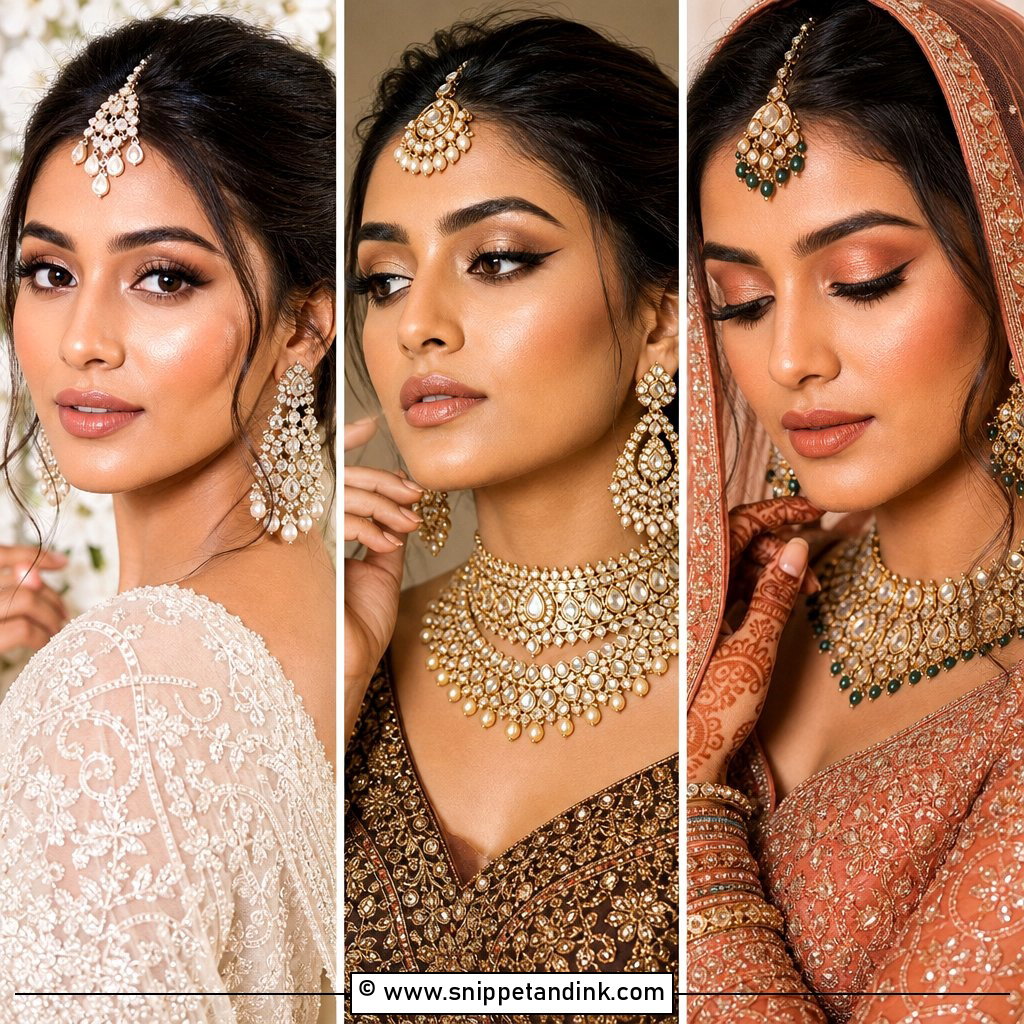
20. Haldi And Mehndi Bridal Makeup
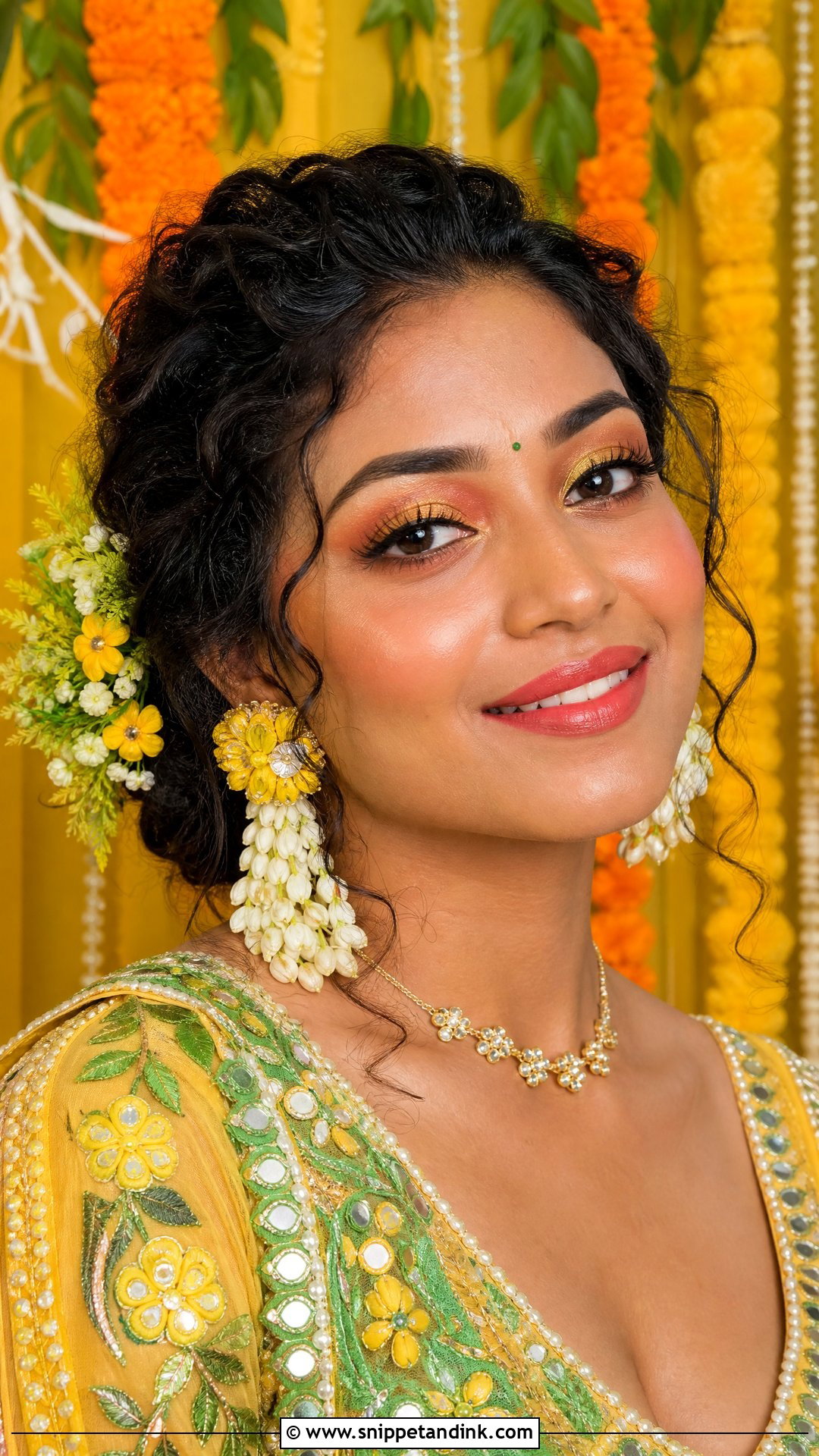
Haldi and mehndi bridal makeup has to cope with turmeric paste, hours of sitting still while henna dries, and hands that can’t touch the face. At the haldi I skip full foundation and use a light tinted base, because it will be covered in yellow paste within the hour anyway. For the mehndi I lean on cream blush and highlight, which wear better than powders in heat. Yellow-gold or soft green lids and a coral lip suit the colours of both events. Waterproof mascara is essential; these functions come with laughter and splashes.
Where Makeup Wears Off First During a Long Indian Wedding
I plan every Indian bridal face around the places it breaks down. In order, that’s usually the lip, the under-eye, the nose and the forehead under the tikka. Each needs a slightly different fix.
The dupatta and the jewelry
A dupatta pinned to the hair rubs against the forehead and temples all day. I set those areas with a fine layer of powder and setting spray, and I ask whoever drapes it to pin the fabric so it doesn’t lie flat on the skin. Heavy earrings and a matha patti press into the base too, so I let the foundation dry completely before any jewelry goes on.
Tears at the vidaai
Emotional moments are guaranteed. Waterproof mascara and kohl set with powder will survive crying; liquid liner on the lower lid usually won’t. That’s why I keep the lower lashline to smudged shadow.
What goes in the touch-up pouch
- Blotting papers for midday shine, rather than more powder
- The exact lip liner and lipstick, plus a small lip brush
- Cotton buds and a little micellar water for smudges under the eye
- A pressed powder in the bride’s shade for the nose and chin
- Spare lash glue if she’s wearing strip lashes
Hand the pouch to a sister or friend who will stay close all day. A lehenga rarely has a pocket.
Let the Lehenga and the Ceremony Clock Decide
There isn’t one correct Indian bridal face. Some brides feel most like themselves in kohl, gold lids and a red lip; others want skin, a nude lip and a little shimmer. Both work when the colours suit the outfit and the textures suit the hours ahead. Before you decide, look at your ceremony start time, how heavy your jewelry is and whether you’ll be outdoors. Then book a trial with your real foundation shade, lashes and lip, and wear it for a few hours afterwards. That afternoon will tell you more than any photo.
You'll Like These Ideas:


Leave a Reply