
Most Kerala brides I style arrive with one picture in mind: a long braid hidden under jasmine, or a smooth bun ringed with a gajra. Both work, and so do the newer curled and half-up versions, but the flowers change how I build the hair underneath. Jasmine, roses, kanakambaram and layered garlands add real weight and scent, and they sit against a kasavu saree, temple jewellery and soft makeup in a way no metal ornament can copy. Below are 15 styles I’d consider for a Kerala wedding, with notes on how each one behaves through a long ceremony.
Buying Jasmine the Evening Before a Morning Muhurtham
Jasmine is sold as buds and opens over the following hours, so when you buy it decides how it looks in your photos. For a morning muhurtham I ask the family to buy the strings the evening before, while the buds are still closed and firm. Wrapped in a damp cotton cloth and kept in a closed box somewhere cool, they’re fresh and just starting to open by the time I pin them. Bought two days ahead, the edges brown. Bought at dawn from a stall that has had them in the sun, they can wilt before the ceremony ends.
A few things I ask families to sort out with the flower seller:
- Order by length, not by bunch. Tell the seller how long the hair is and whether the braid is fully covered or only edged, because a full cover takes several times more than a bun ring.
- Keep one spare string for the reception. Flowers crushed during the ceremony rarely recover.
- If you want orange, add kanakambaram. It has almost no scent and outlasts jasmine in heat.
- If the bride gets headaches from strong scent, tell me early so the jasmine stays at the back of the head, away from the face.
When I attach the strings, the pins go through the string’s own knots, not across it, so the flowers lie flat against the hair instead of standing up.
1. Kerala Bridal Bun With Jasmine Flowers
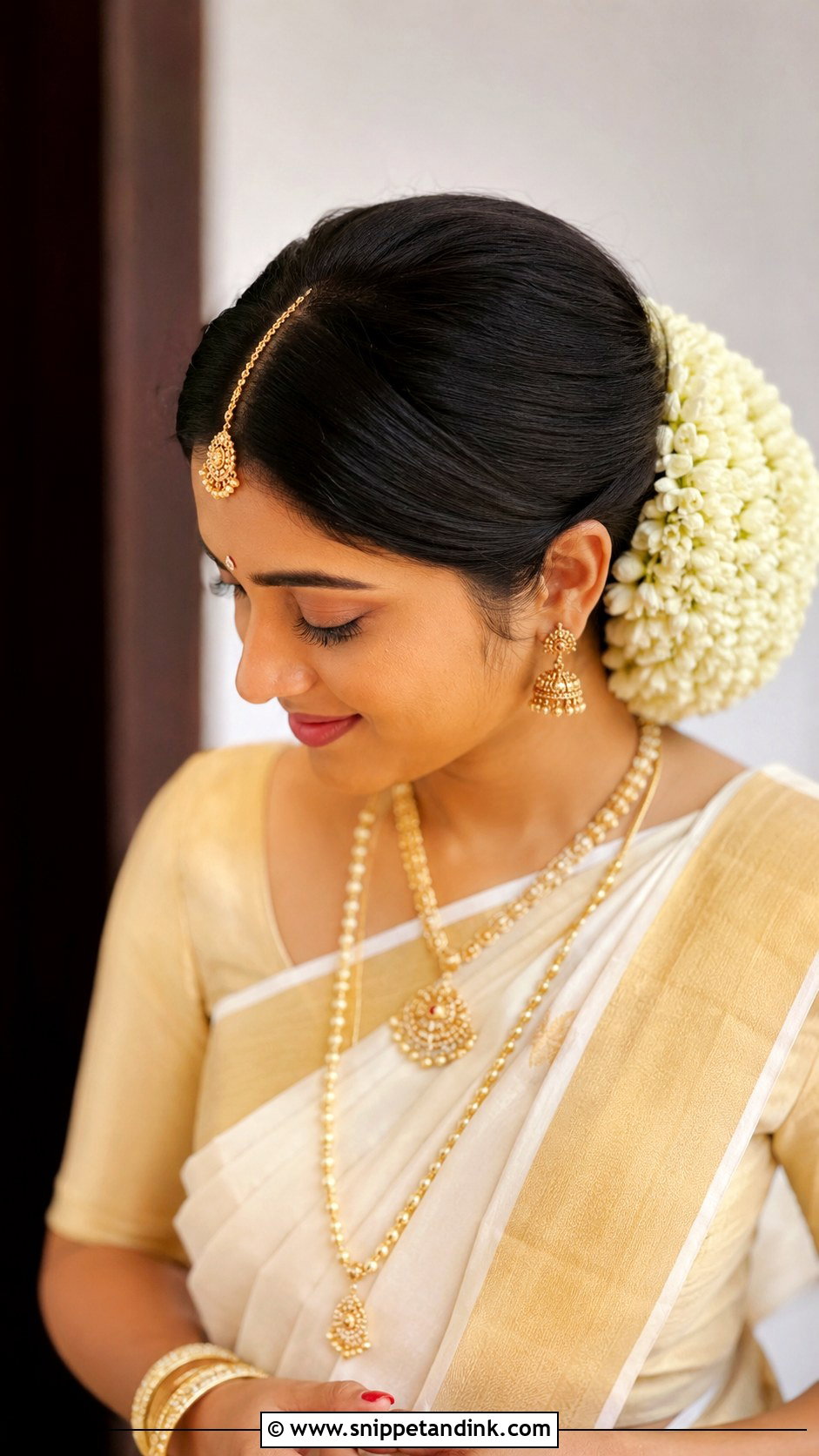
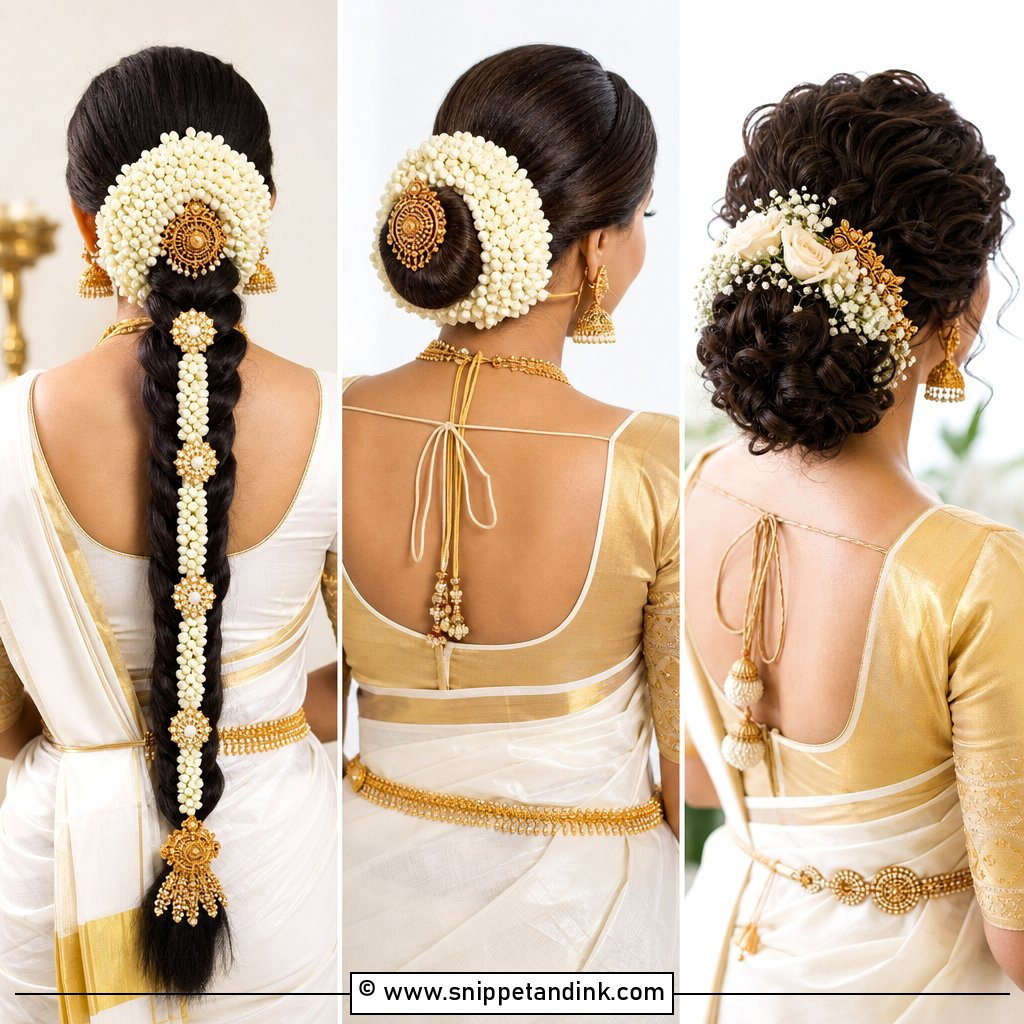
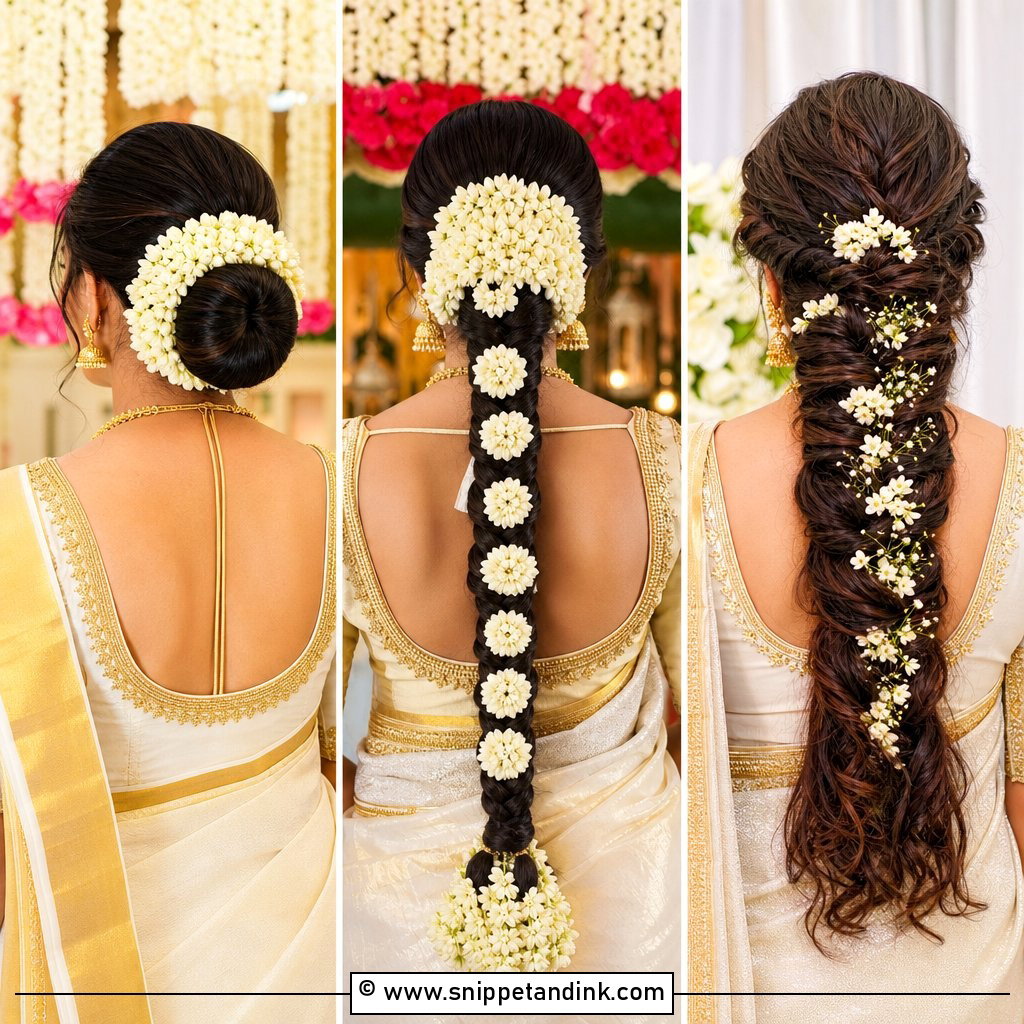
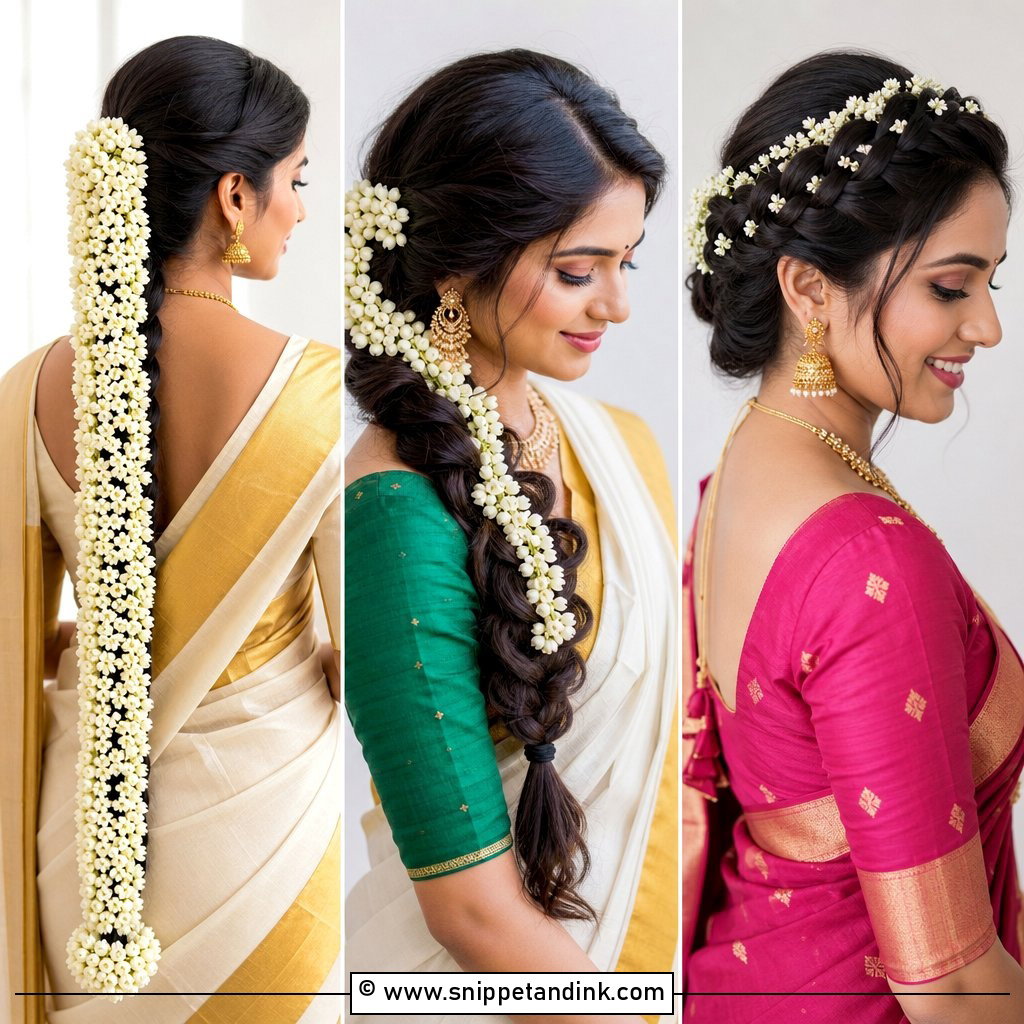
The Kerala bridal bun with jasmine flowers is the request I hear most, and for good reason. I part the hair cleanly, smooth it back and set the bun low or at mid height, then wrap the gajra so it forms a white border. Against a cream kasavu saree that white repeats the fabric, which is why the pairing reads so naturally in photos. Before any flowers go on, I pin the bun into a small anchor ponytail with crossed pins, because jasmine strings drag downward as the morning goes on. A few gold pins or a maang tikka are enough; past that the head starts to look crowded.
2. Kerala Bridal Braid With Jasmine Flowers
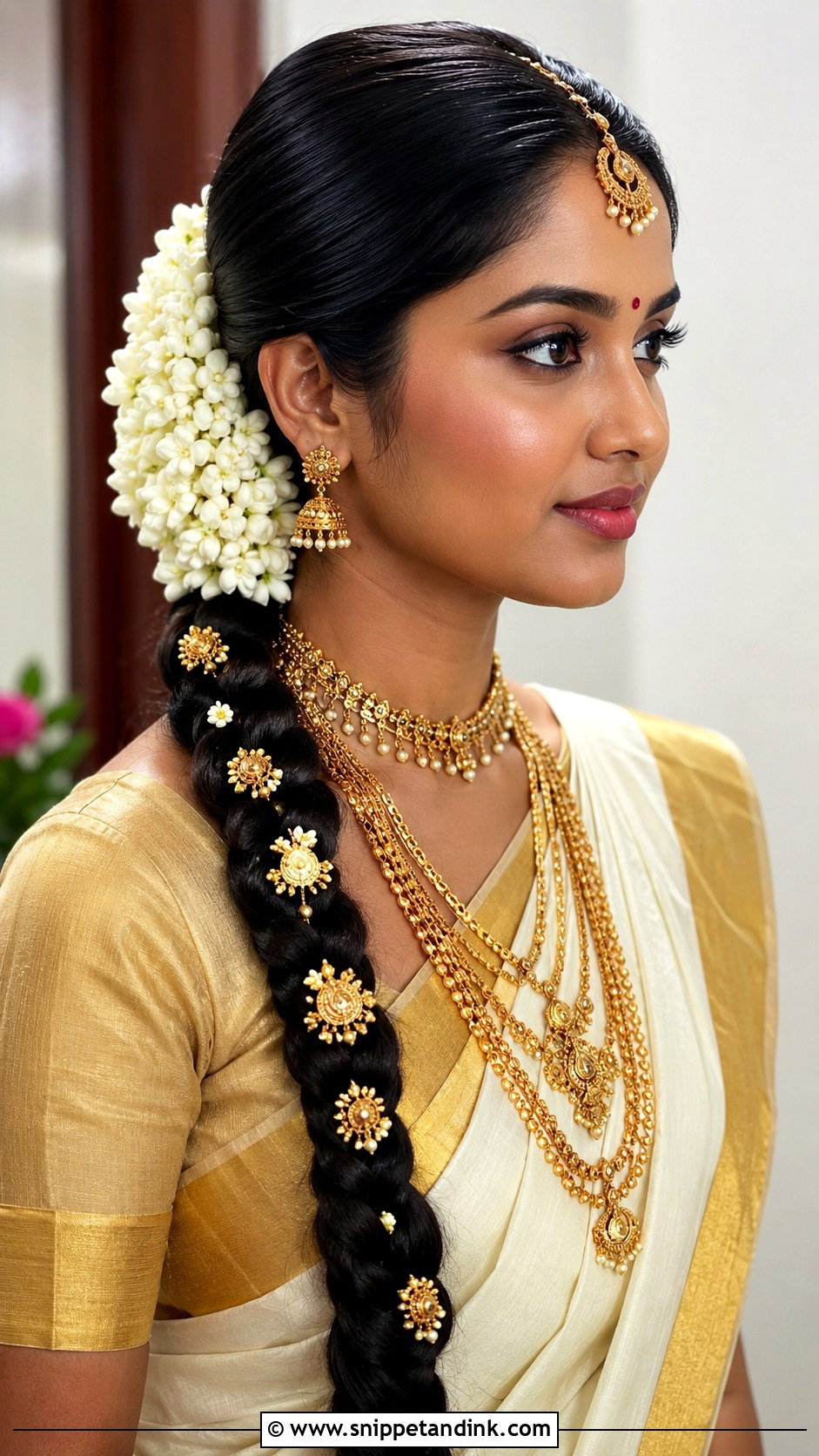
A long braid wrapped in jasmine reads as Kerala from across the hall, which is half its appeal. I part at the centre, braid straight down the back and lay jasmine strings along the full length, with gold braid ornaments between the flower sections if you want them. Thick hair can stay sleek. Finer hair needs each section pulled slightly wider, or the flowers end up broader than the braid they sit on. Since the braid swings every time you bend during rituals, I stitch the strings on with thread instead of trusting pins alone. Temple necklaces and jhumkas carry the gold through to the front.
3. Kerala Bridal Poola Jada With Flowers
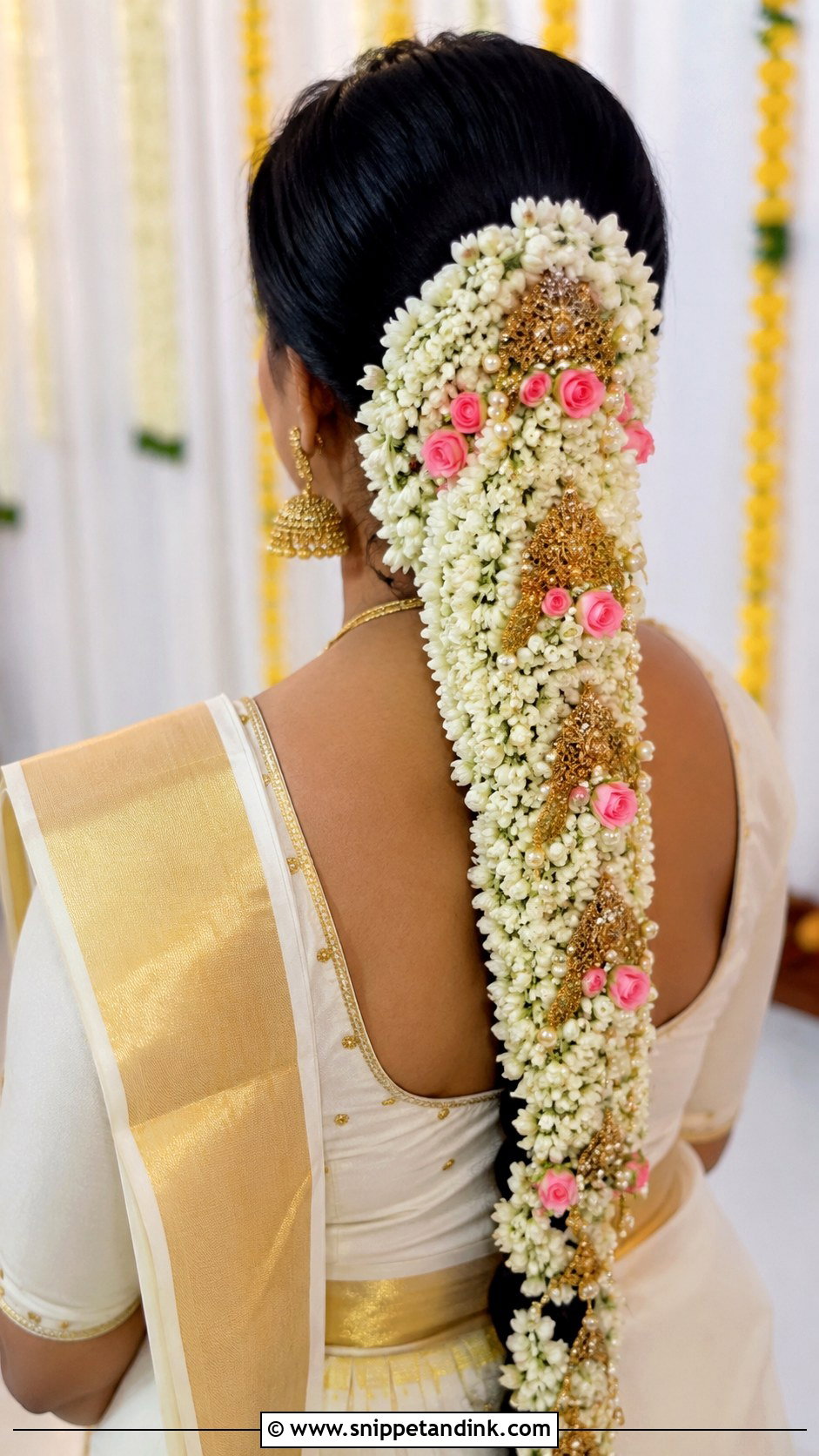
A poola jada with flowers turns the braid into part of the outfit. The base is a long braid, then I cover it with fresh flowers, floral discs, gold ornaments and sometimes pearls. Jasmine leads, with roses, marigolds or tuberose added for colour and scent. Most poola jadas are built on a separate base that is fixed to the braid, so your own hair carries the load at a few anchor points rather than along every strand. You need long hair or extensions for it, and it shows best in ceremonial portraits taken from behind or at a three-quarter angle.
4. Kerala Bridal Low Bun With Gajra
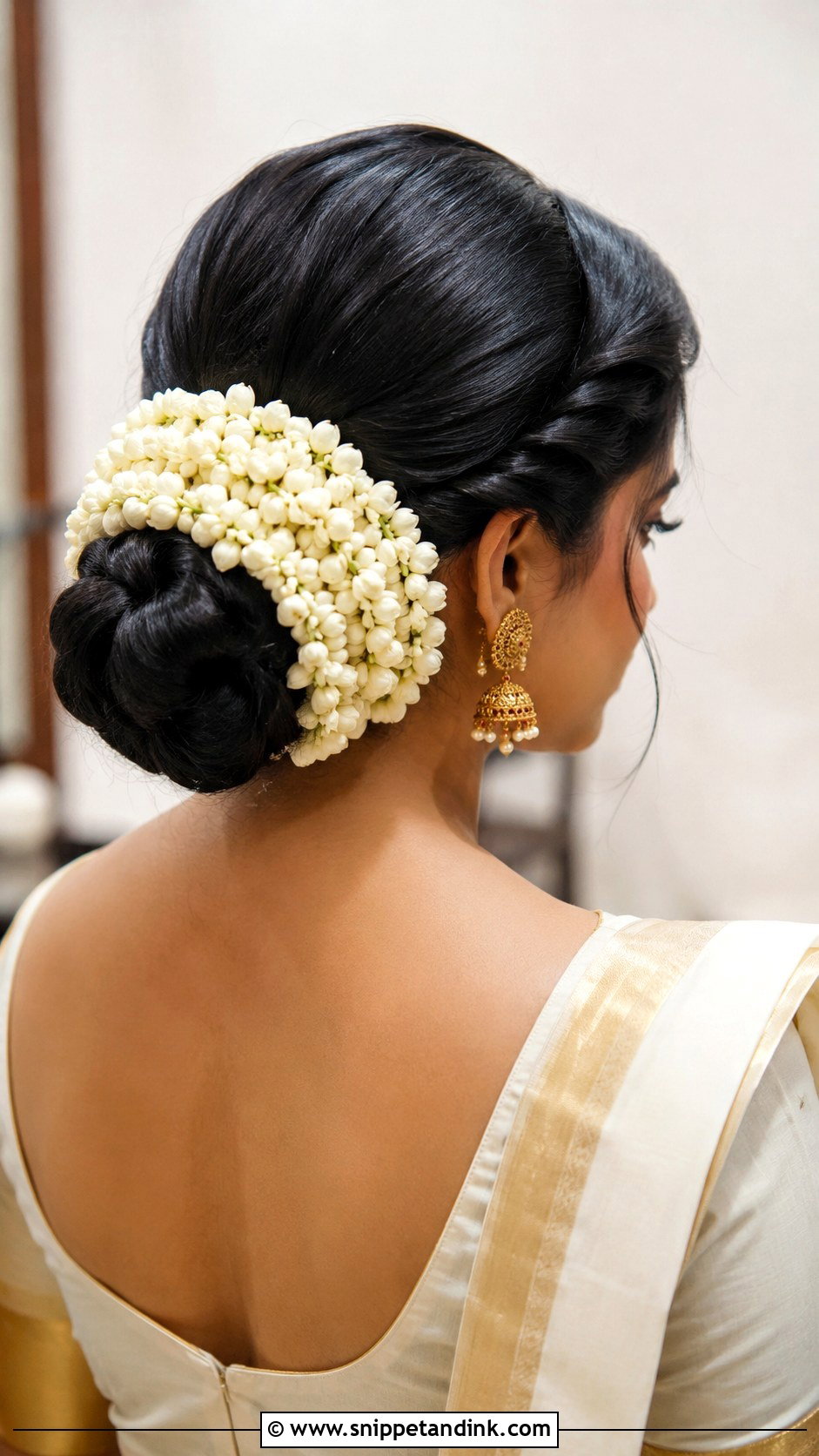
I like a low bun at the nape for brides with heavy earrings and layered necklaces, because it leaves the neck clear and gives the jewellery room. The white jasmine gajra goes on tight; a loose wrap slides down within the first hour. In Kerala humidity this is one of the most dependable shapes I know, since nothing is left hanging to frizz. If you want softness, I’ll leave two fine pieces at the temples, cut short enough that they don’t stick to your foundation.
5. Kerala Bridal Long Braid With Flowers
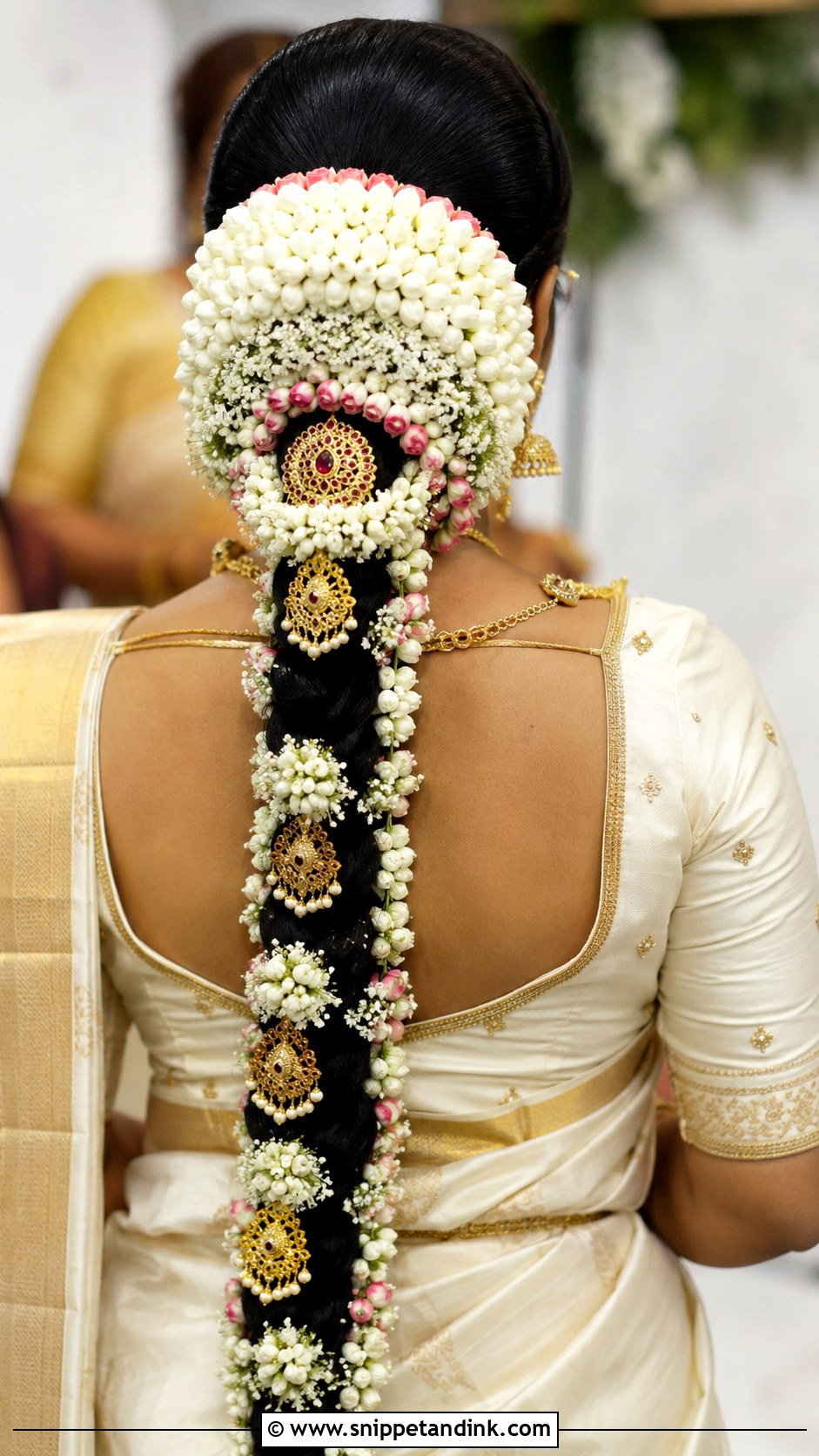
Everything here depends on the braid being even from crown to tip. Natural hair thins out in the lower third, so I often clip in extensions matched to your colour before braiding. Jasmine strands, small rose clusters or gold pieces go on only after I’ve gently pulled each section wider. The finished braid reads clearly from the back during rituals and sits well with cream, ivory and deep jewel-toned sarees. If your cut has short layers, expect them to poke out of the plait; a little gel worked into each section before braiding keeps them in.
6. Kerala Bridal Fishtail Braid With Flowers
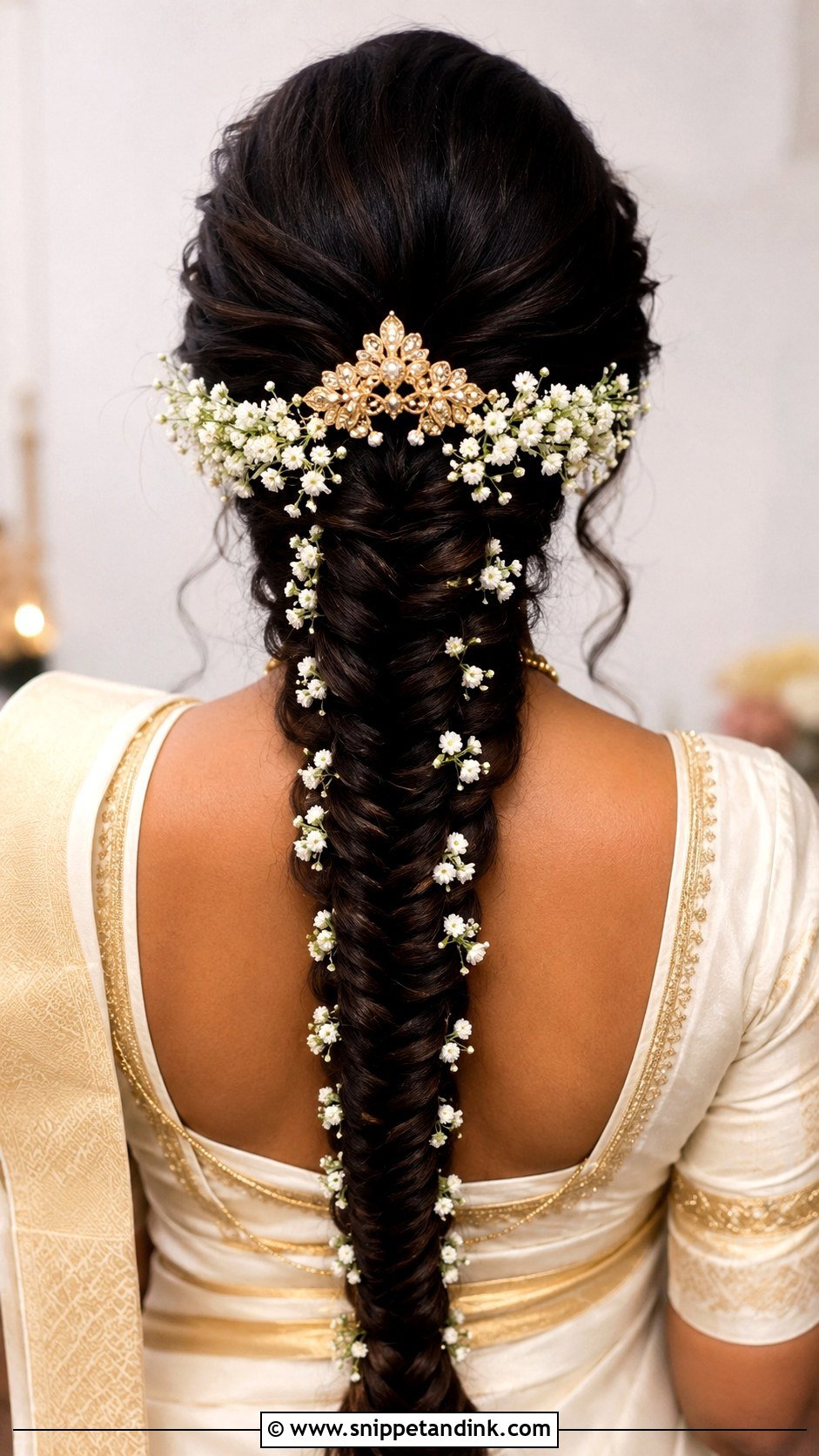
A fishtail has far more crossings than a three-strand braid, and every crossing is an edge where a jasmine bud can sit. I tuck buds or tiny white flowers along those edges to trace the pattern, then add soft front twists or a centre part. Honestly, I’d save this one for the engagement or reception rather than a long muhurtham, because fishtails loosen faster and flyaways show at the crossings by evening. On fine hair I braid it tight first and loosen it afterwards, never the other way round.
7. Kerala Bridal Side Braid With Flowers
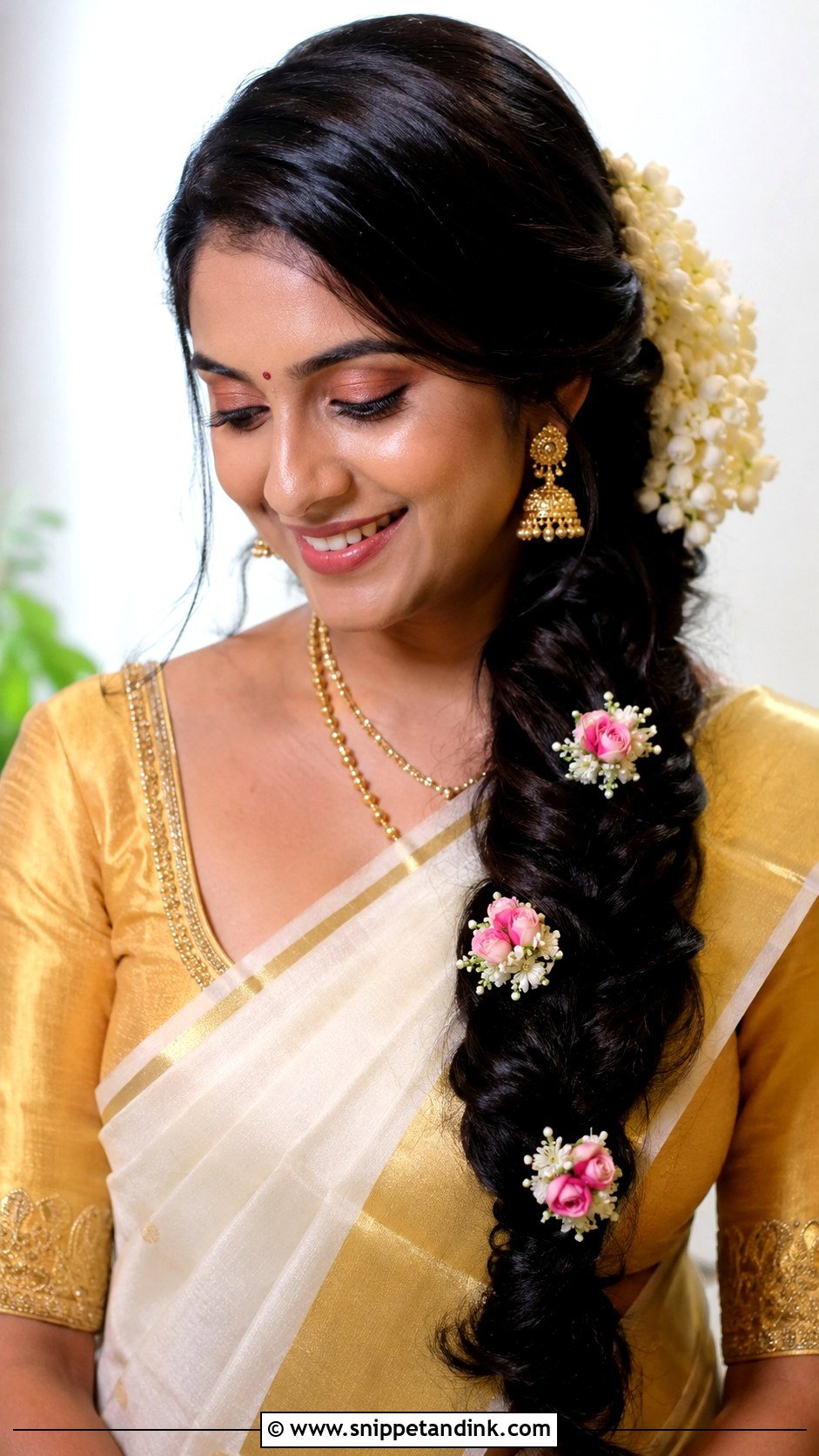
Swept over one shoulder, the braid moves the flowers to where the camera is. That’s the reason to wear it: close-up portraits show braid and flowers together instead of hiding them behind you. I place jasmine strings or rosebuds along part of the length, not all of it, so the weave stays visible. The catch is that a side braid rests on the blouse and pleats, and crushed petals can leave damp marks on pale silk, so I keep the flowers on the outer face. A side part and statement earrings balance the weight on the opposite side.
8. Kerala Bridal Bun With Rose Flowers
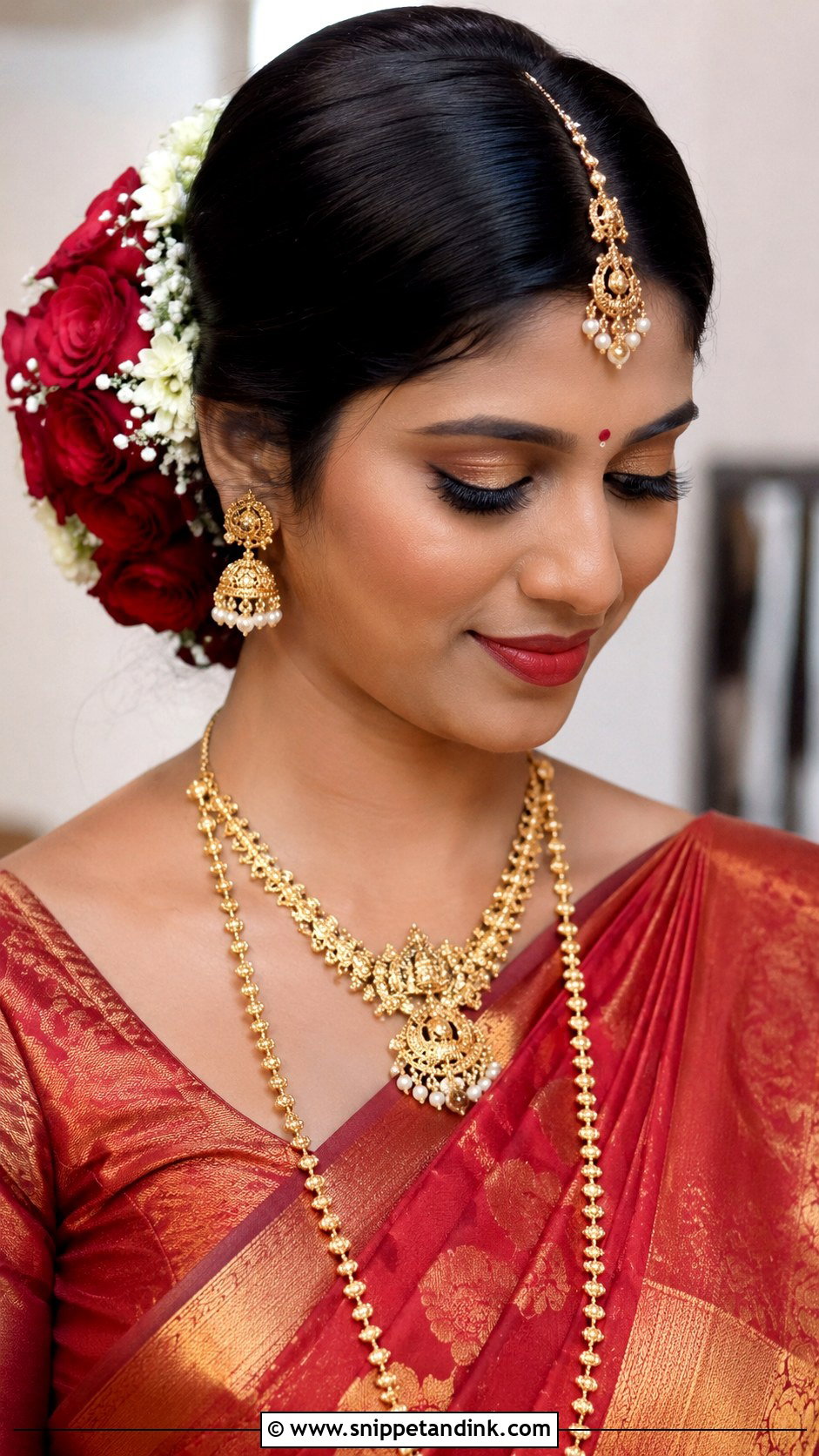
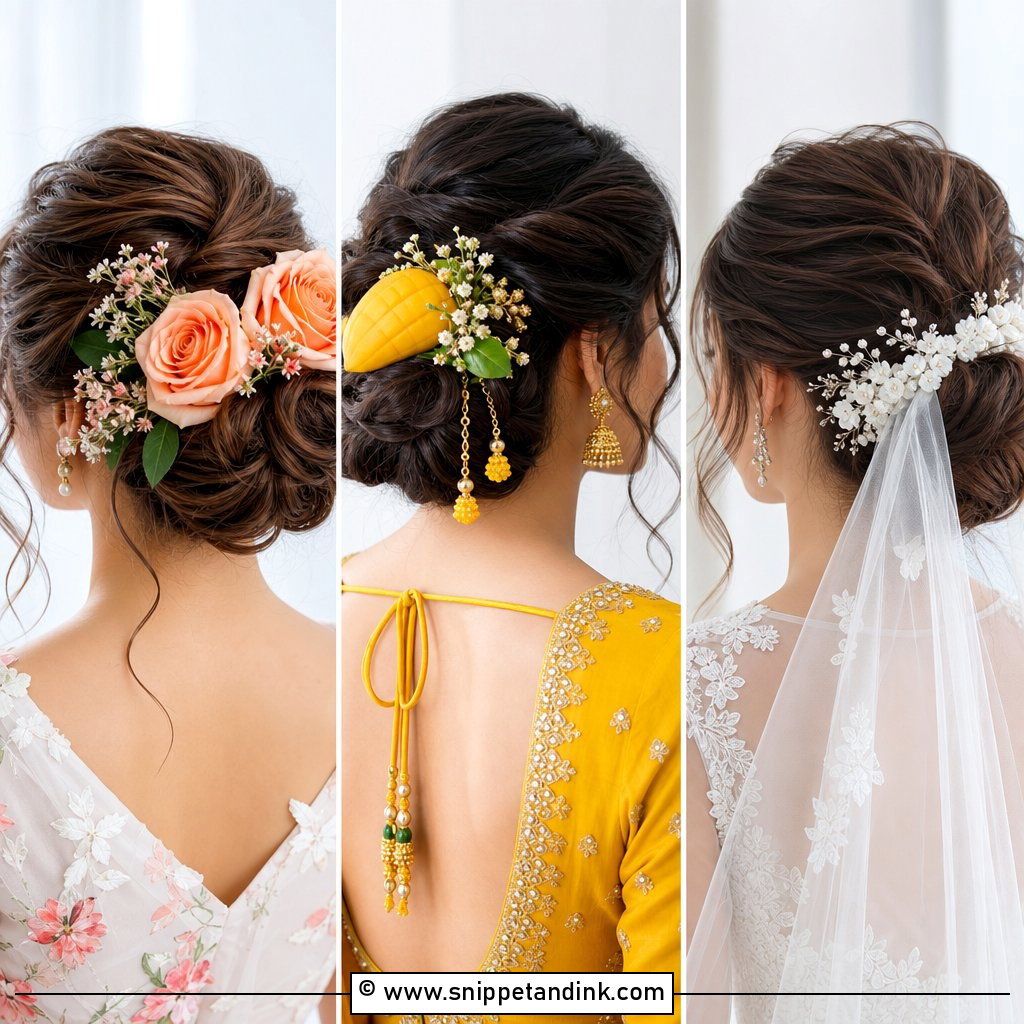
Roses give a much fuller outline than jasmine, so even a small bun looks festive. I use red or deep maroon around a low bun, sometimes mixed with jasmine, sometimes as one cluster at the centre, and they sit best against rich silk in red, green or burgundy. Balance matters more than quantity: a smooth, tight bun underneath and the roses doing the talking. Rose heads droop faster than jasmine in heat, so I pin each one at its base and keep spares in my kit. Leave out gold pins if the roses are dense.
9. Kerala Bridal Bun With Kanakambaram Flowers
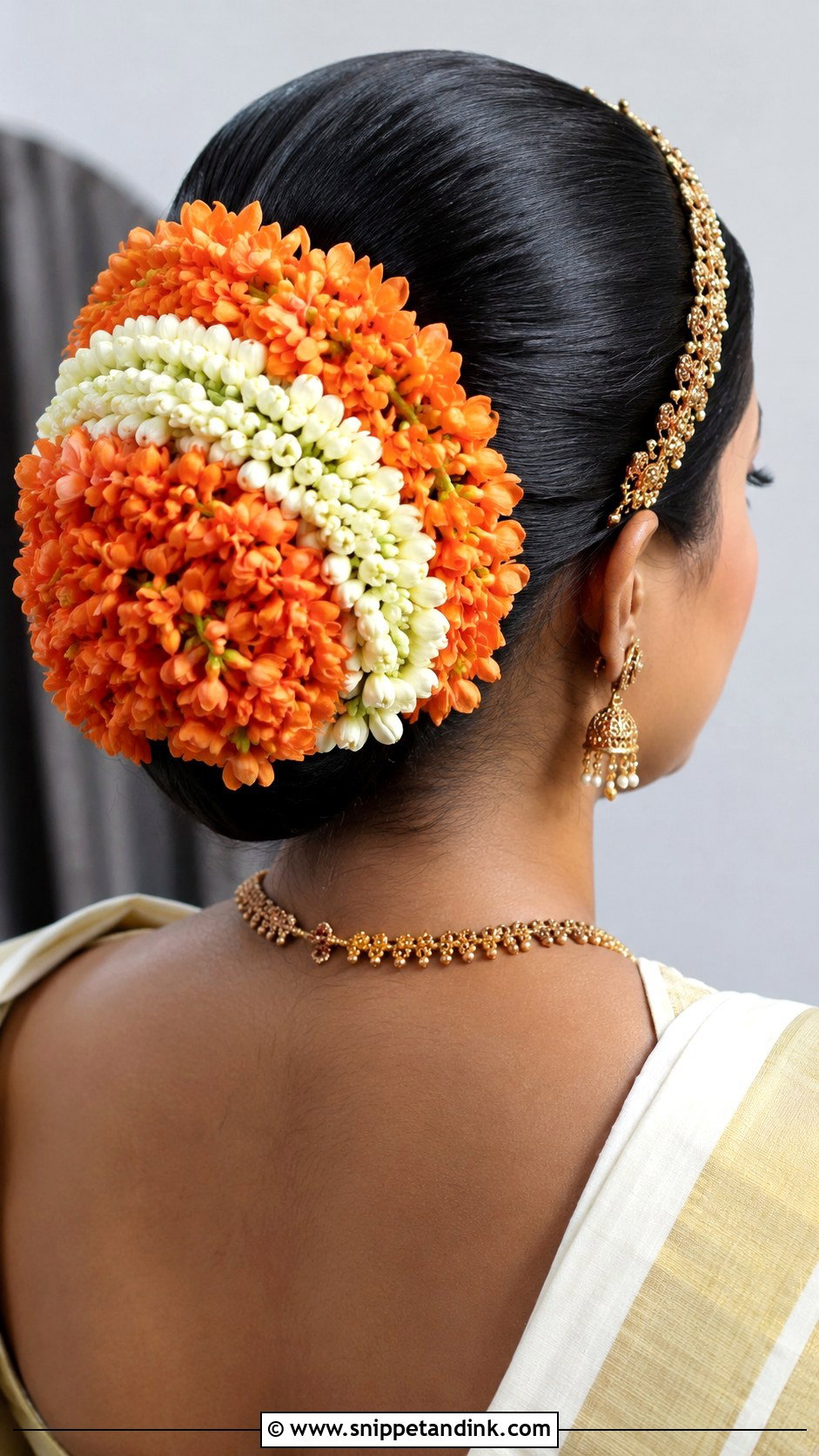
Orange kanakambaram flowers, often called firecracker flower, glow against dark hair and antique gold. I either pair them with jasmine for a white and orange contrast or use them alone for a stronger regional feel, layered around a low or rounded bun. They’re sold strung, the strings are light, and they keep their shape through a warm day far longer than jasmine does. If you want colour without the bulk of roses, this is my first suggestion. It sits naturally beside kasavu, mustard silk and antique temple jewellery.
10. Kerala Bridal Open Hair With Flowers
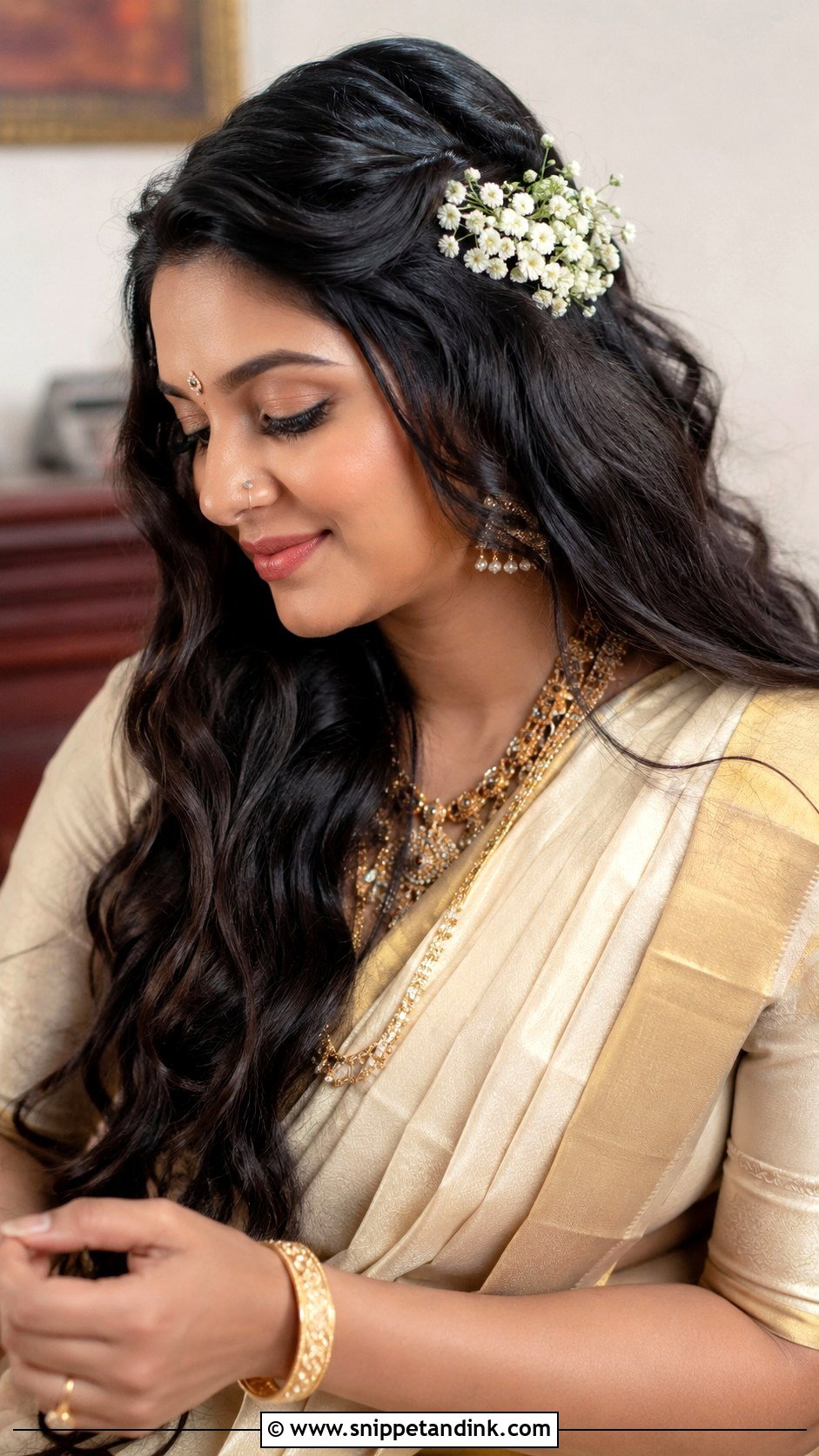
Open hair is the style I’d steer you away from for the main ceremony in a Kerala summer, and toward for the reception or a pre-wedding function. It’s smooth waves or loose curls, small jasmine clusters or floral pins near the crown, and usually a half section pinned back to keep the face open. Humidity is the problem: curls can drop within a couple of hours, and loose hair catches on necklaces. I set the curls in pin curls to cool before releasing them, then use a light setting spray. Keep the flowers minimal, because heavy strings pull loose hair flat.
11. Kerala Bridal Half Up Hairstyle With Flowers
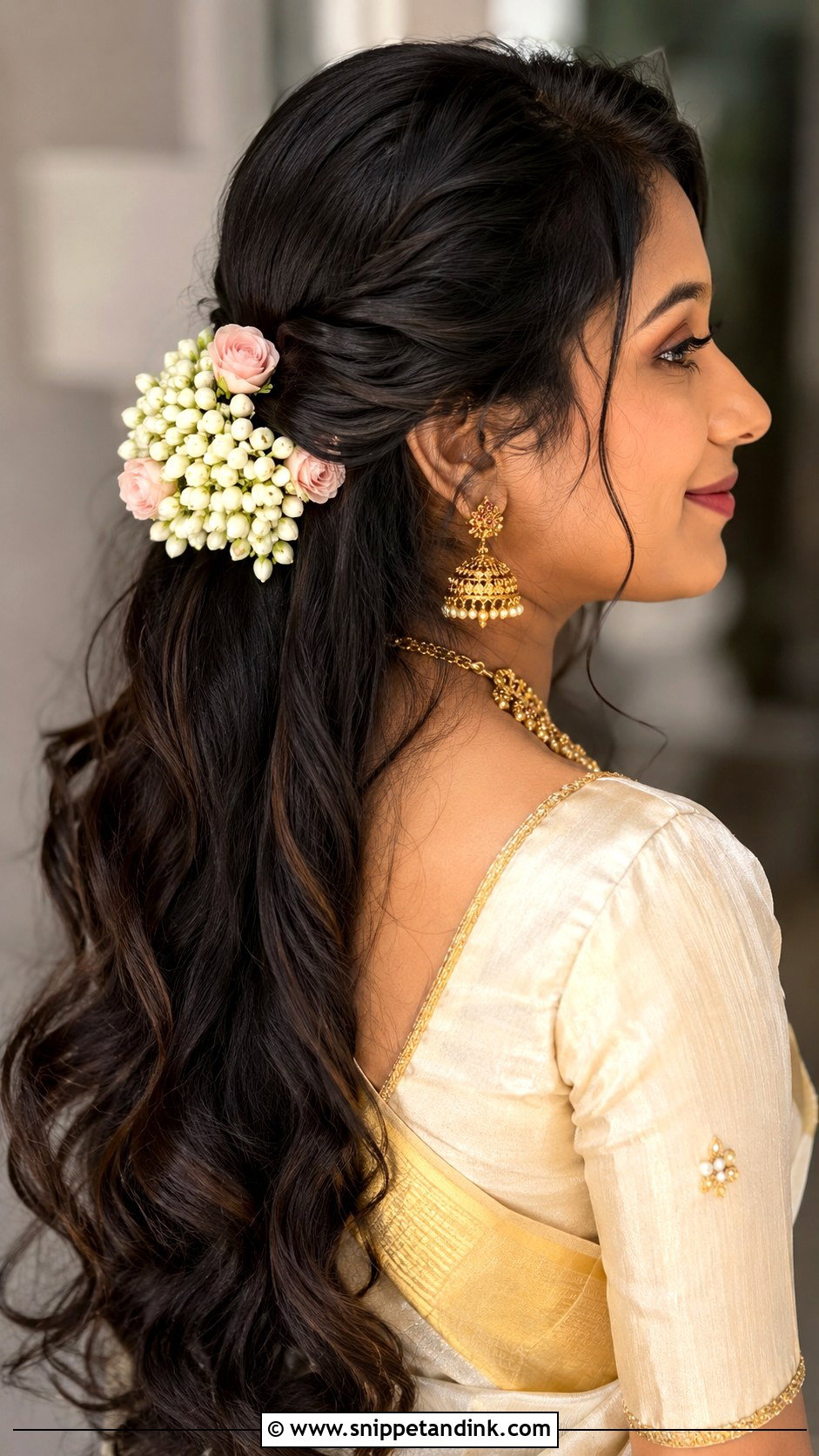
Half-up gives you crown volume and still shows your length. I pin the top section back with twists or small braids and let the rest fall in curls or waves. The flowers go exactly where the hair is secured, since that’s where jasmine buds, mini roses or pearl-flower pins can hide the grips. It’s a good answer for hair that sits around the shoulders and can’t make a long braid. Keep the saree detailing delicate and the makeup soft so the crown isn’t competing with everything else.
12. Kerala Bridal Crown Braid With Flowers
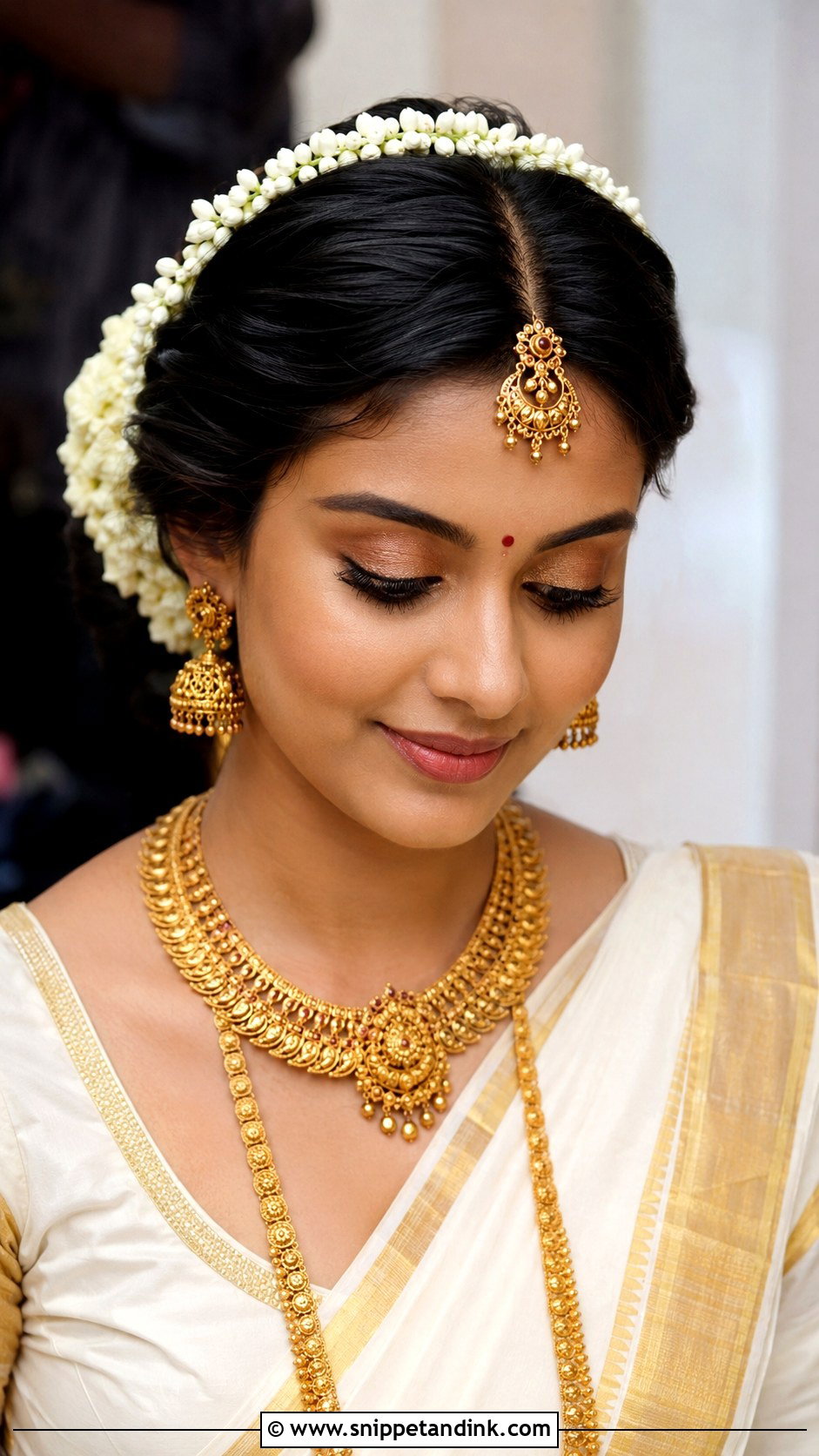
Wrapped around the head like a halo, a crown braid frames the face, with tiny jasmine buds or white flowers worked into it. I add flowers sparingly so the pattern still shows; overfill it and it looks like a garland resting on top of the head. It pairs with a centre part, soft front pieces and a low bun at the back. You need hair past the shoulders for a full crown, and very thick hair can bulk out at the temples, so on those brides I braid only a front section and pin the rest into the bun.
13. Kerala Bridal Puff Bun With Flowers
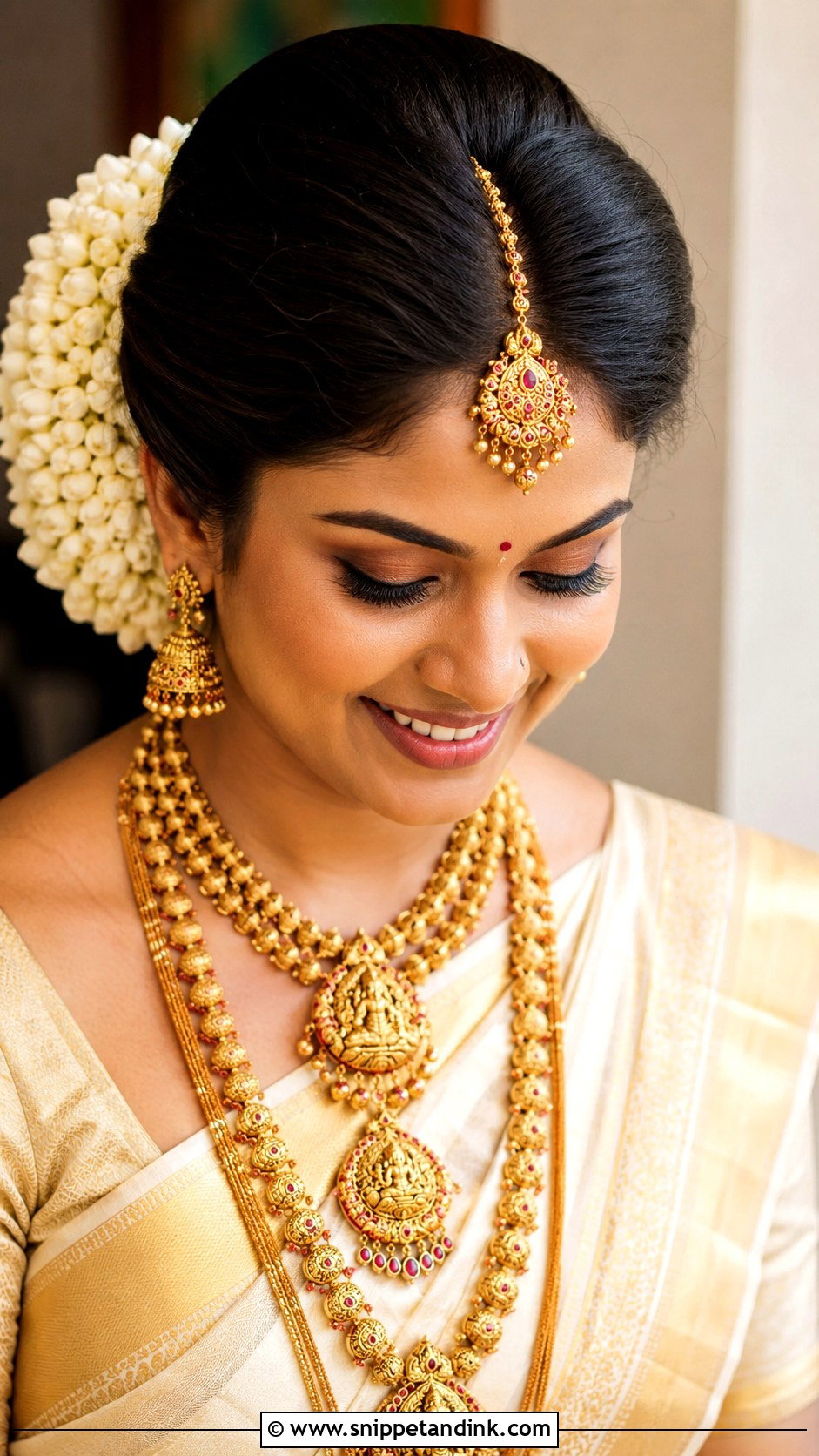
A Kerala bridal puff bun with flowers adds height. I backcomb the front crown at the roots, smooth the top layer over it, then gather the rest into a neat bun ringed with gajra, rose petals or mixed flowers. Round and oval faces gain balance from that lift, and the structure holds a maang tikka and temple hair jewellery well. The puff is where I’m most careful. An oversized one dates a photo instantly, so I keep it to a gentle rise you mostly notice in profile.
14. Kerala Bridal Twisted Bun With Flowers
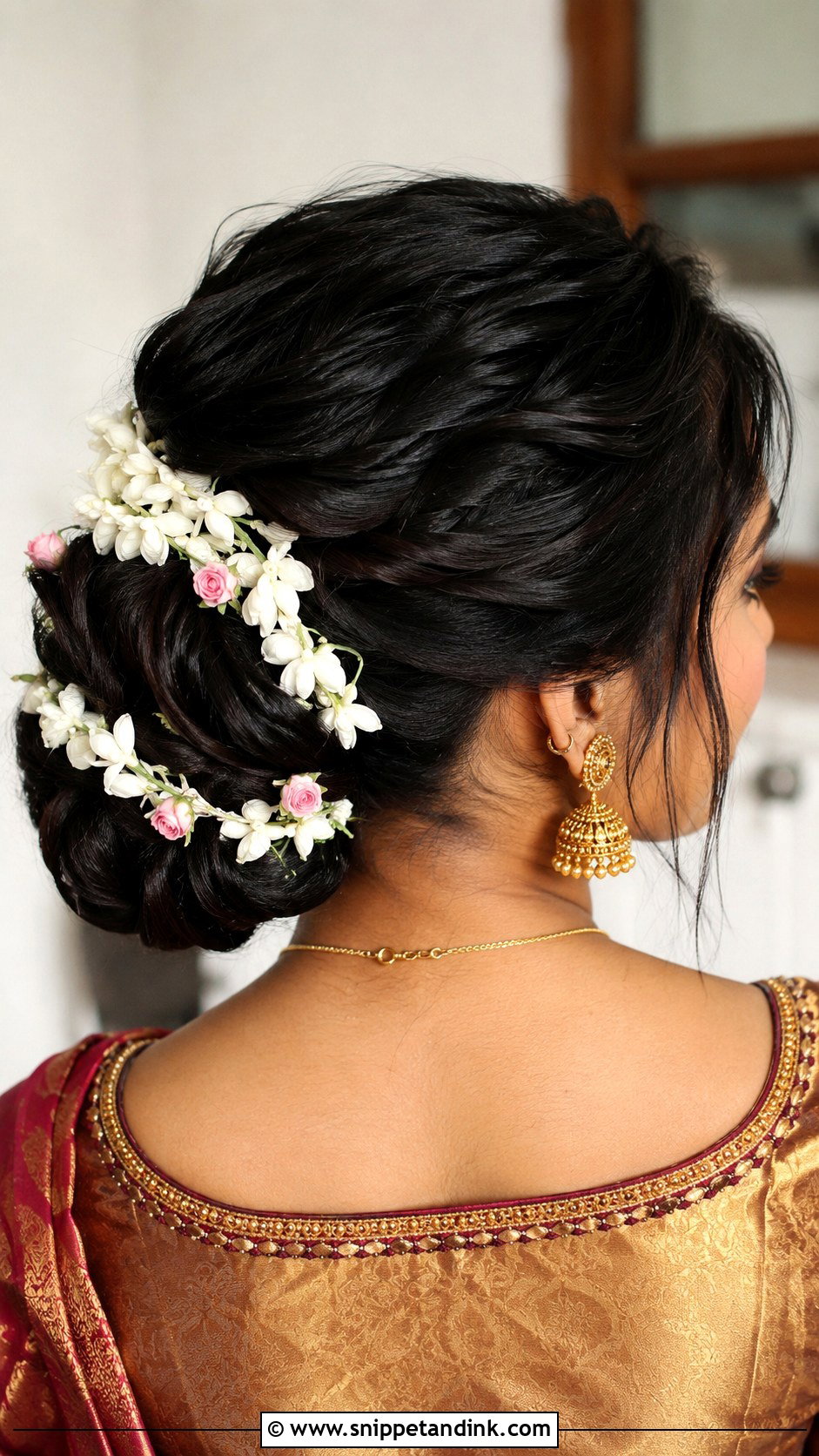
Texture you can read in a close-up comes from twisting each section before it’s pinned. I work piece by piece, then tuck jasmine or small rosebuds into the gaps between twists rather than wrapping flowers over the top and hiding the work. Medium-length hair suits it, because the twists create volume a plain bun can’t. Freshly washed hair is slippery and the twists can loosen, so I prefer hair washed the day before. The front can take a middle or side part, with a few face-framing strands if you like.
15. Kerala Bridal Curly Bun With Flowers
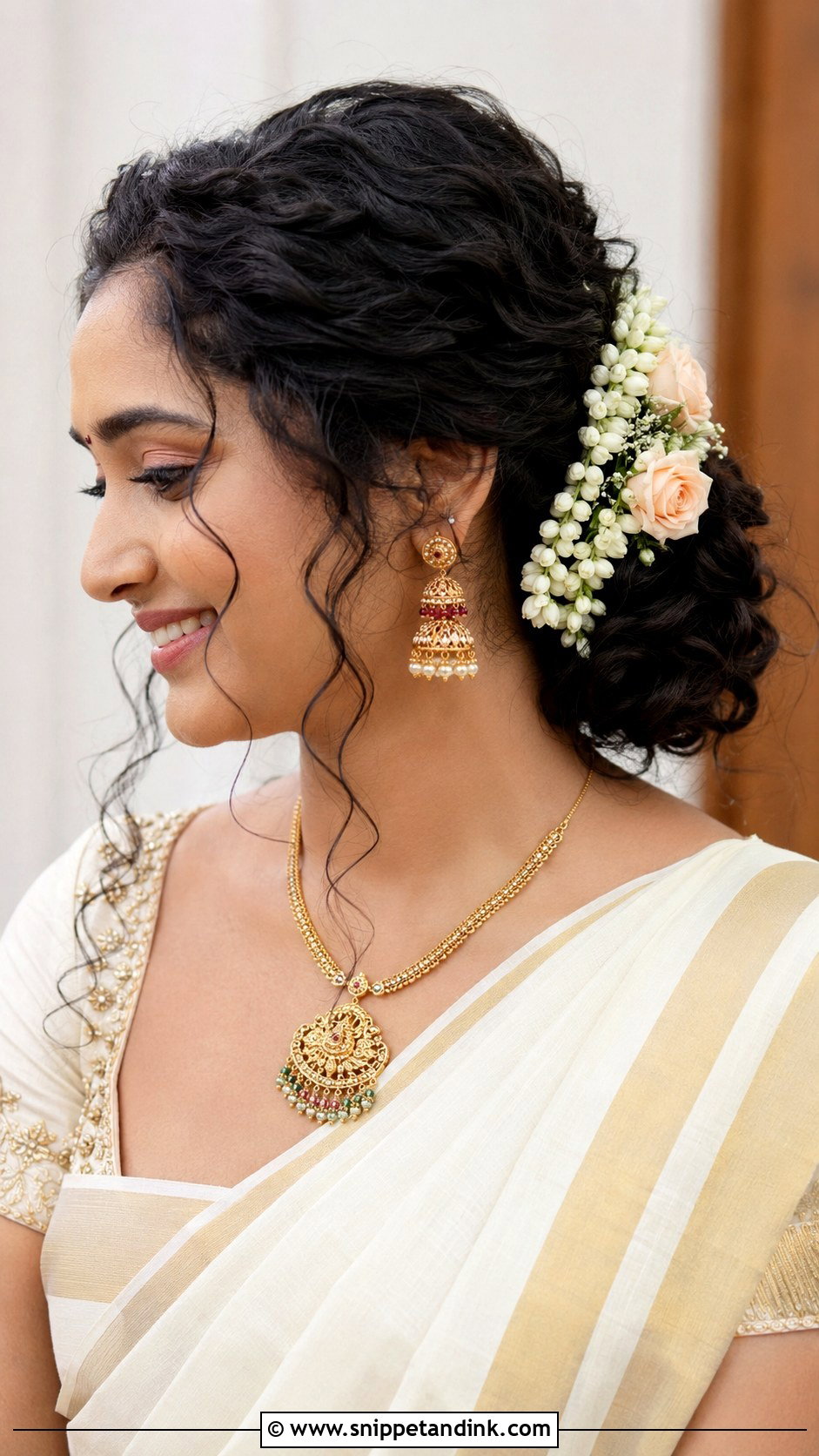
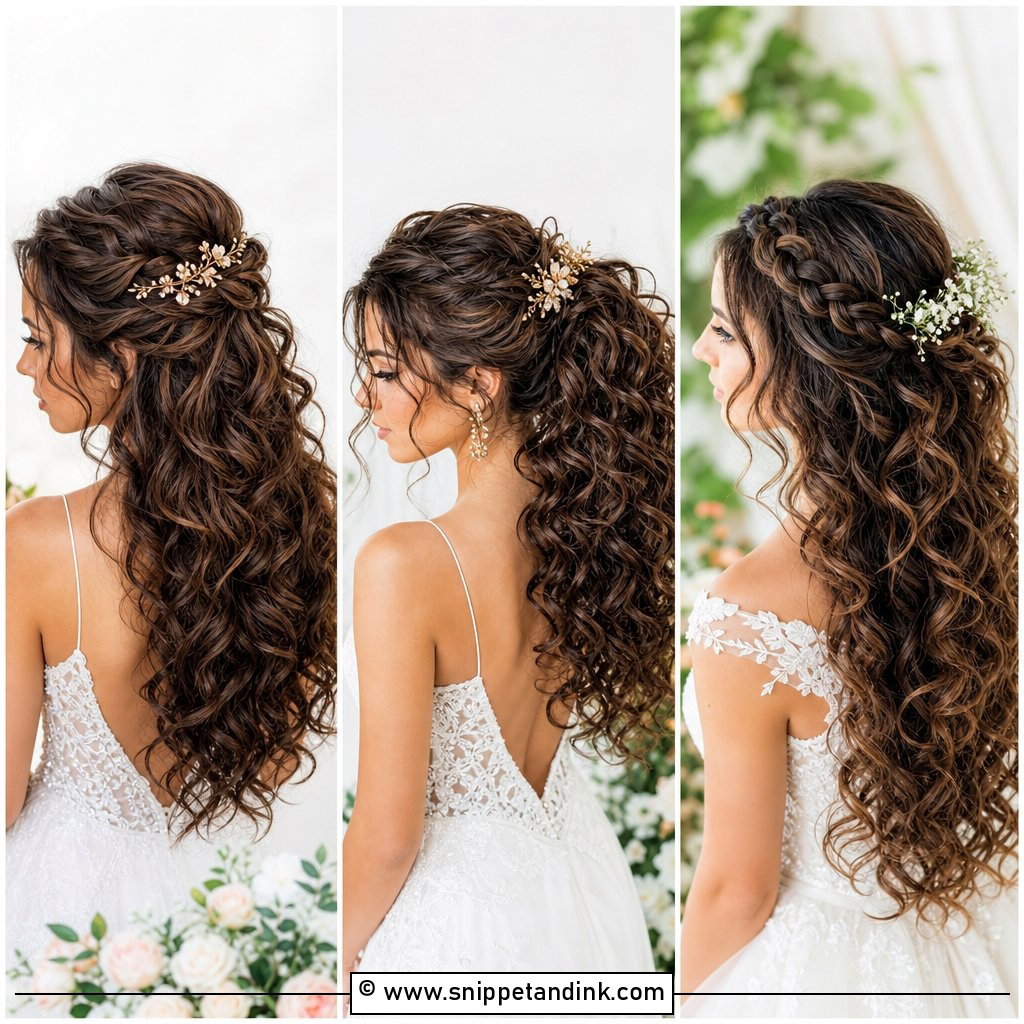
Naturally wavy or curly hair is made for this, since I’m working with the texture instead of flattening it. On wavy hair I curl first, then pin into a loose bun that keeps visible movement, wrap the gajra around it and tuck small rosebuds into the curls. On very curly hair I skip the iron entirely and define the curls with a cream, which holds better than heat curls in humidity. It shows well from the side. Keep the front controlled so the volume stays at the back where the flowers are.
Carrying the Weight of a Full Poola Jada
A braid covered in jasmine, ornaments and a jada base weighs far more than it looks, and all of it hangs from the crown. The first sign of trouble is a dull ache behind the ears an hour or two in. So I spread the load: under the braid I build a small, tight anchor at the crown and cross pins into it, and the jada base is fixed at several points rather than hanging from one.
If the reception follows straight after, I plan a short break to unhook the jada, take out the hardest-working pins and let your scalp rest. Do your trial with real flowers, not artificial ones. Fake strings weigh much less, and they hide exactly the problem the trial is meant to find.
Extensions and a Parandi for Shoulder-Length Hair
A traditional Kerala braid assumes waist-length hair, and plenty of brides don’t have it. Clip-in extensions fill the gap if they match your colour in daylight, not under salon lights, so bring them to the trial. A parandi, the tasselled braid extension, can be braided in from below the nape and finishes the tip neatly. Wash and condition human-hair extensions a few days before so they blend with your texture.
Synthetic pieces are cheaper but they melt under hot tools and can shine oddly under flash, so I only use them where flowers will cover them completely.
Jasmine, Roses or Kanakambaram on the Day
Every one of these Kerala bride hairstyles with flowers depends on fresh flowers behaving, so plan the hair around them. For long rituals, a bun or a full braid is the safer choice. For portraits and the reception, curls, a side braid or half-up gives more softness. Match the shape to your saree, your jewellery and the length of your day, then pick blooms that mean something to you and that you can comfortably wear for hours.
You'll Like These Ideas:


Leave a Reply