
Wearing your “something blue” on your nails means you don’t have to change the dress, shoes or bouquet to honour the tradition, and it’s the one place the colour sits right beside the ring in every close-up. Blue is also more forgiving than people expect. Baby blue reads soft against a white gown, dusty blue settles into muted palettes, chrome adds a cool shine and navy carries an evening dress. Which one suits you depends mostly on your dress fabric and the metal of your jewelry, and I’ll explain how I test that below. Every design here is one I’d happily put on a bride, a bridesmaid or a guest.
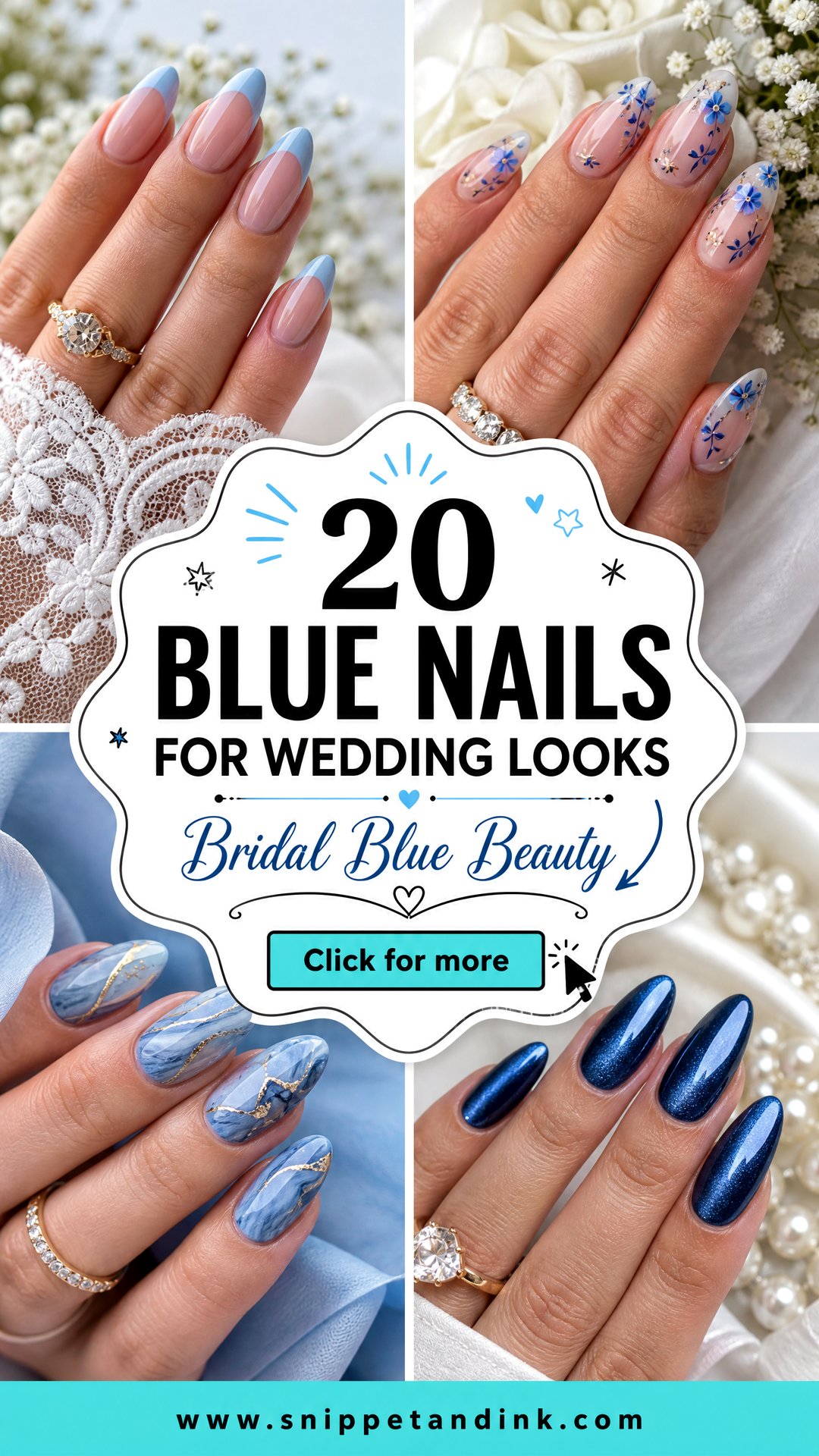
Testing a Blue Against Your Dress Fabric and Your Ring
The white of your gown decides which blue looks right far more than your skin tone does. Bright white makes pastel blues look fresh. Ivory and champagne have yellow in them, and next to those a very cool, icy blue can drift slightly green or grey, so for warmer gowns I lean toward a dusty shade or a blue with a little warmth in it.
When a bride books with me, I ask her to bring a fabric swatch from the dress, or at least a photo taken next to a window, and to wear her engagement ring and the earrings she plans to wear. We paint the candidates onto a couple of nail tips and hold them against the fabric in daylight, then again under warm indoor light, because most reception lighting is much warmer than a salon.
The questions I ask before we settle on a shade
- Is your jewelry silver, platinum, white gold or yellow gold? Cool blues belong with white metals; gold asks for navy or a softer dusty blue.
- How hard do your hands work in the week before? Long nails with stones need a gentler week than short gel, so typing, cooking and childcare all count.
- Will blue flowers sit right beside your hands? Next to hydrangeas or delphiniums, I go clearly lighter or darker than the petals, because a near-match looks like a mistake.
1. Baby Blue French Tip Wedding Nails
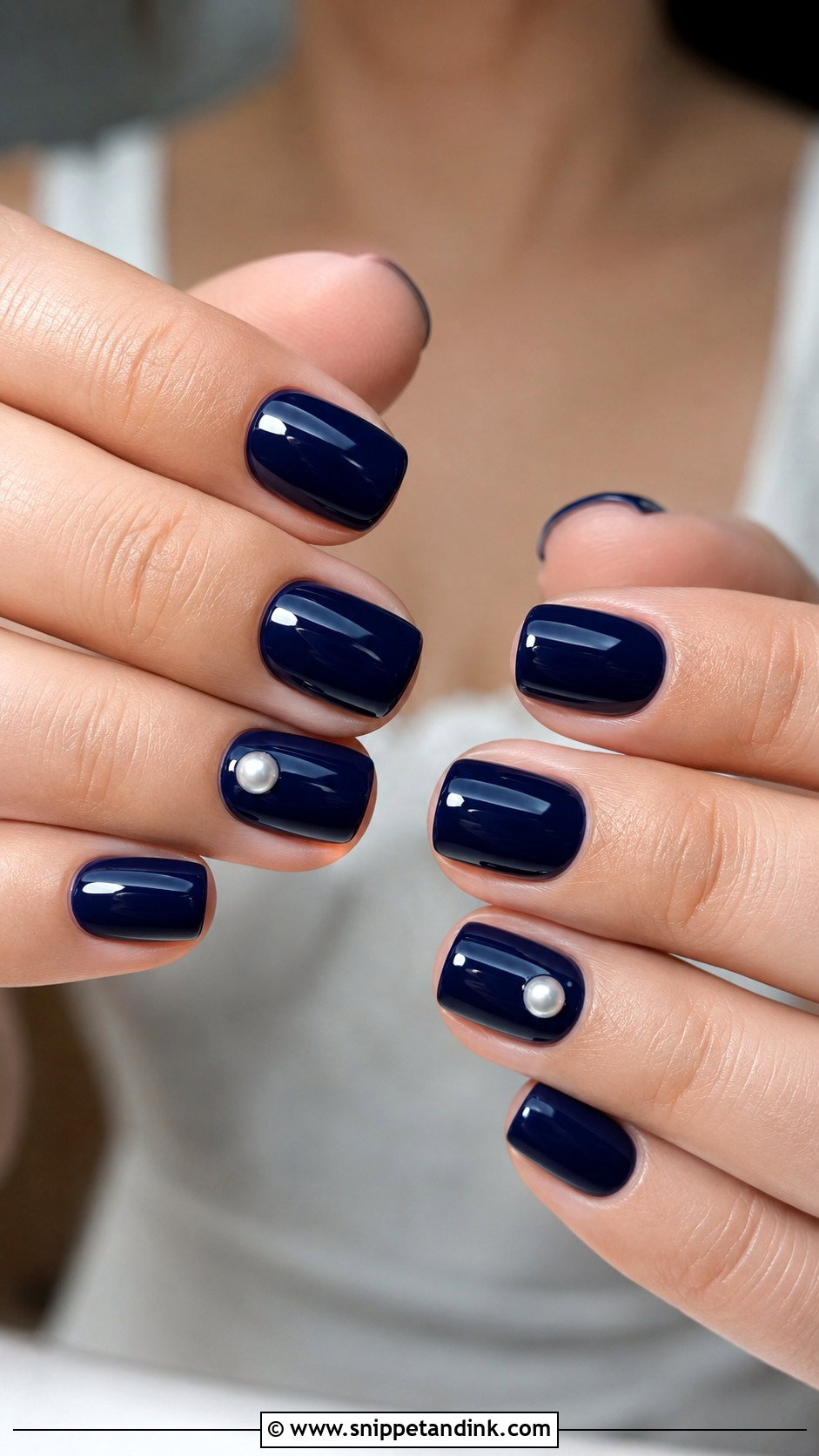
If colour makes you nervous, start here. Baby blue French tip wedding nails keep the base sheer pink or nude, so only the free edge carries the blue. I paint the smile line a little thinner than a classic French because pastel blue looks heavier on camera than it does in the mirror. Almond and oval shapes flatter the curve of the tip best. On short square nails I switch to a micro French so the colour doesn’t swallow the nail bed. Silver and pearl jewelry suit it better than yellow gold.
2. Blue Chrome Wedding Nails
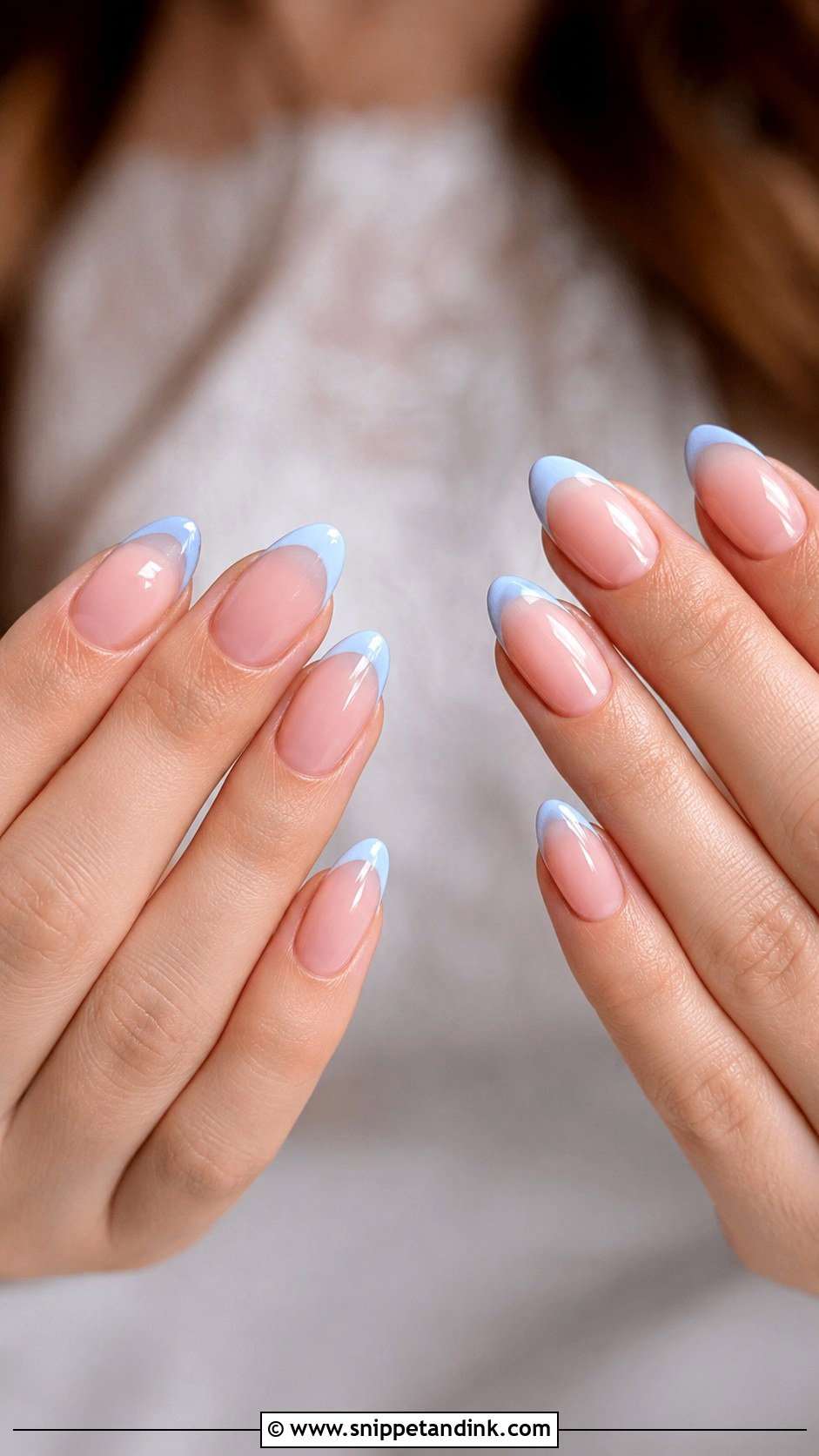
Chrome is a fine powder buffed into a no-wipe top coat, so the finish can only be as smooth as the gel underneath it. Blue chrome wedding nails therefore take more of my time on the base layer than on the powder itself. Over a milky base, an icy or pearl-blue powder glows instead of shouting, and it catches the flash well in ring shots. The weak spot is the free edge, which can wear through after a week of typing, so I seal it twice. Satin and silk gowns have the same sheen, which makes the pairing look planned.
3. Dusty Blue Wedding Nails
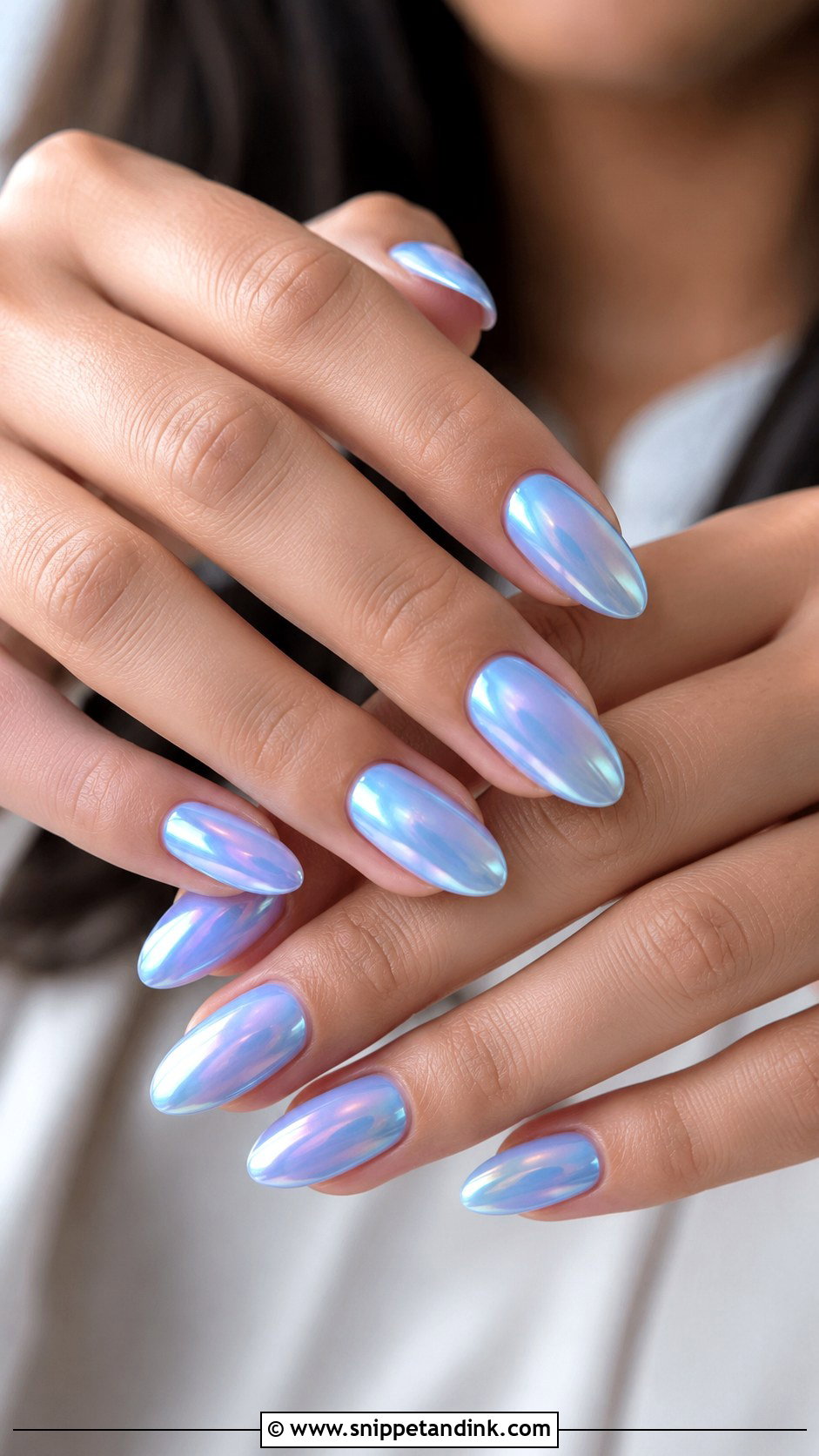
Dusty blue has grey mixed into it, and that grey is what keeps it calm next to a white gown. I reach for it when the palette already includes sage, slate or silver, because it sits with those colours instead of fighting them. One caution: on some warm, olive or deep skin tones a dusty blue can turn slightly chalky, so I swatch two or three versions on the nail before committing. Gloss keeps it classic. It’s also my usual answer for bridesmaids who need to match without competing, finished on a clean oval or squoval.
4. Blue And White Wedding Nails
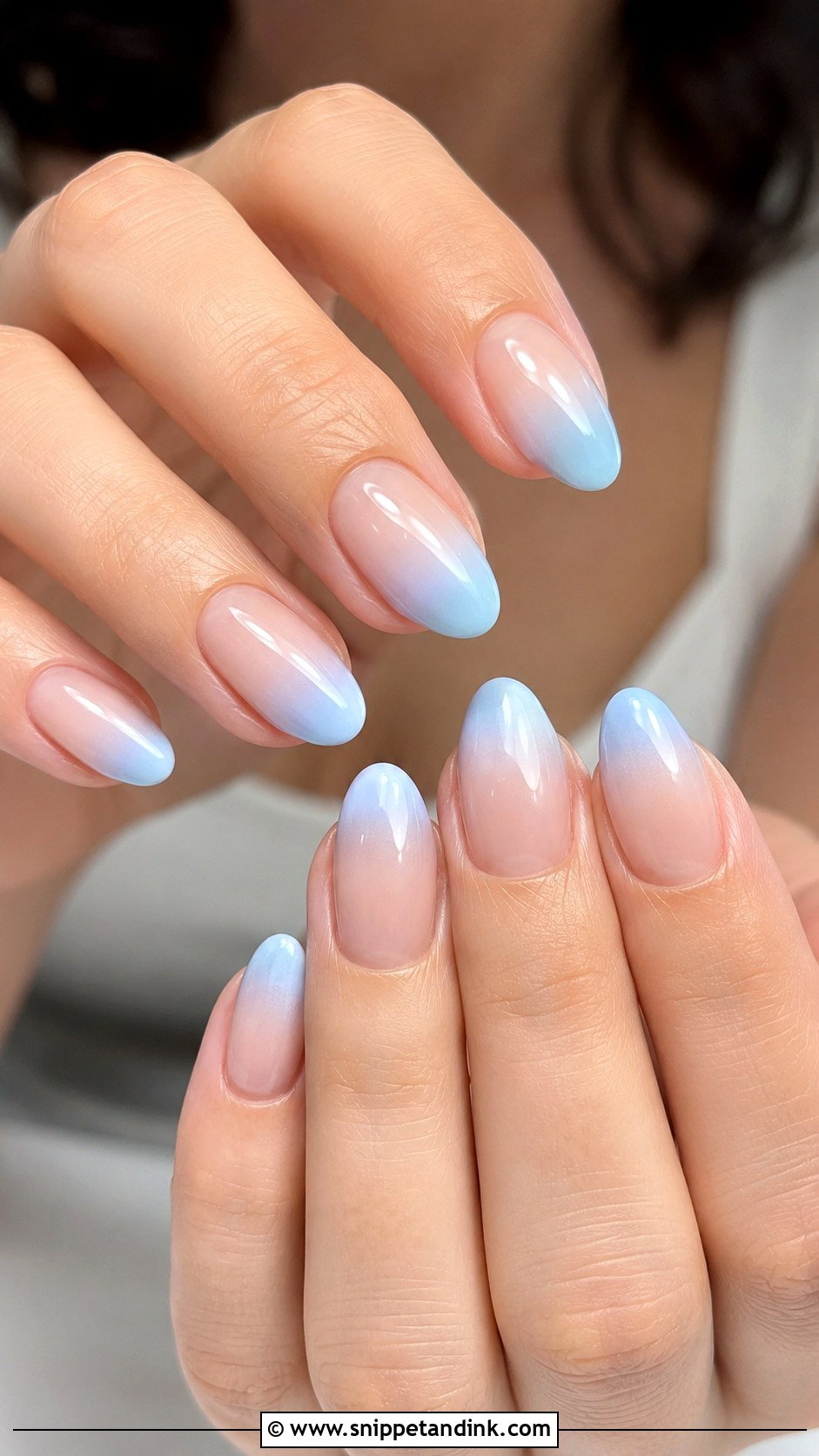
White ties the manicure to the dress and blue gives it the meaning, but the two only look crisp when the ratio is decided up front. My rule is that one colour leads. A white base with thin blue tips, or pale blue nails with a single white floral accent, reads clearly from across a room, while an even half-and-half split usually looks busy in photos. Watch the white, too. Pure white gel can look stark beside an ivory gown, so I often use a soft milky white instead.
5. Light Blue Wedding Nails With Pearls
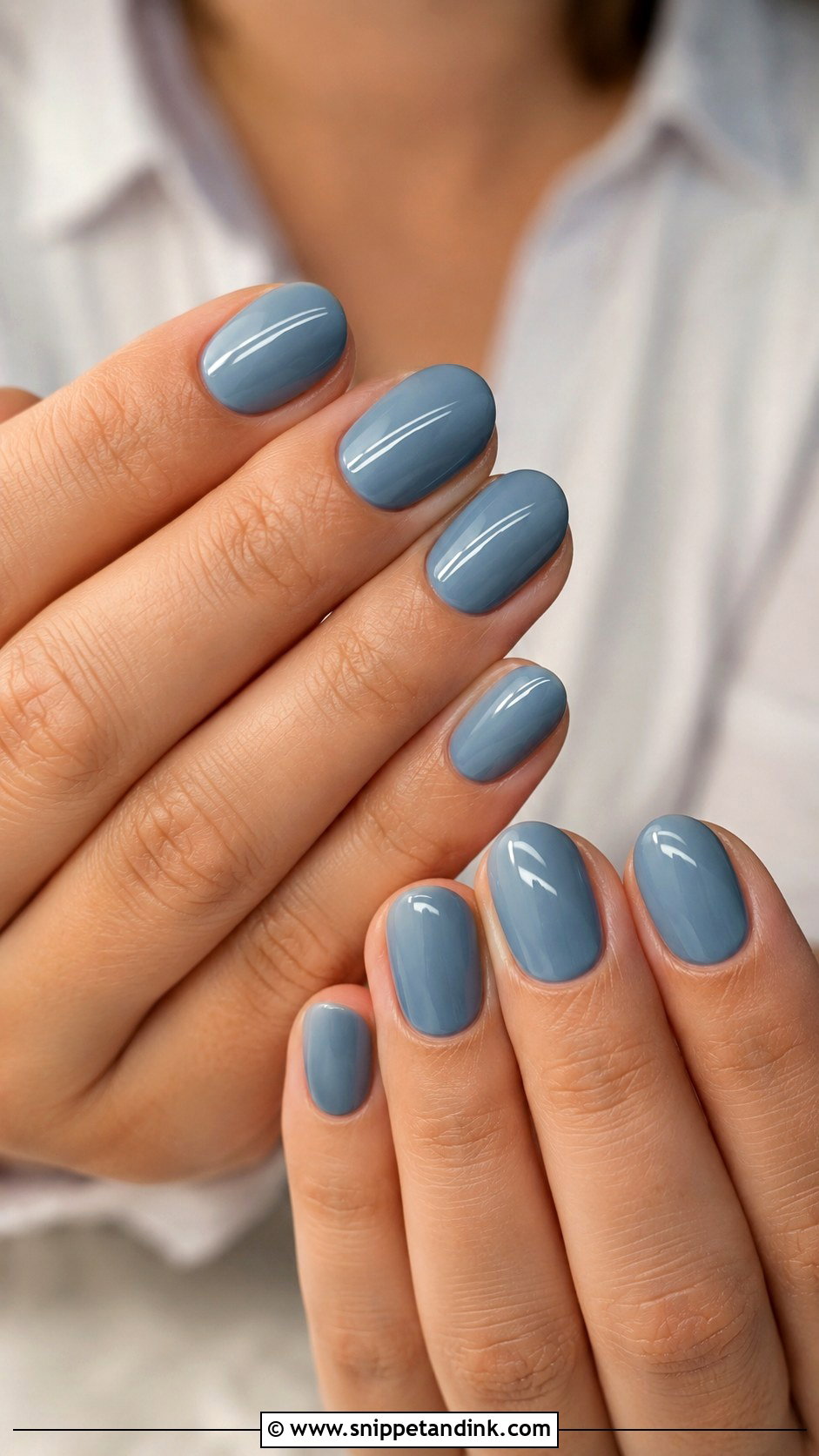
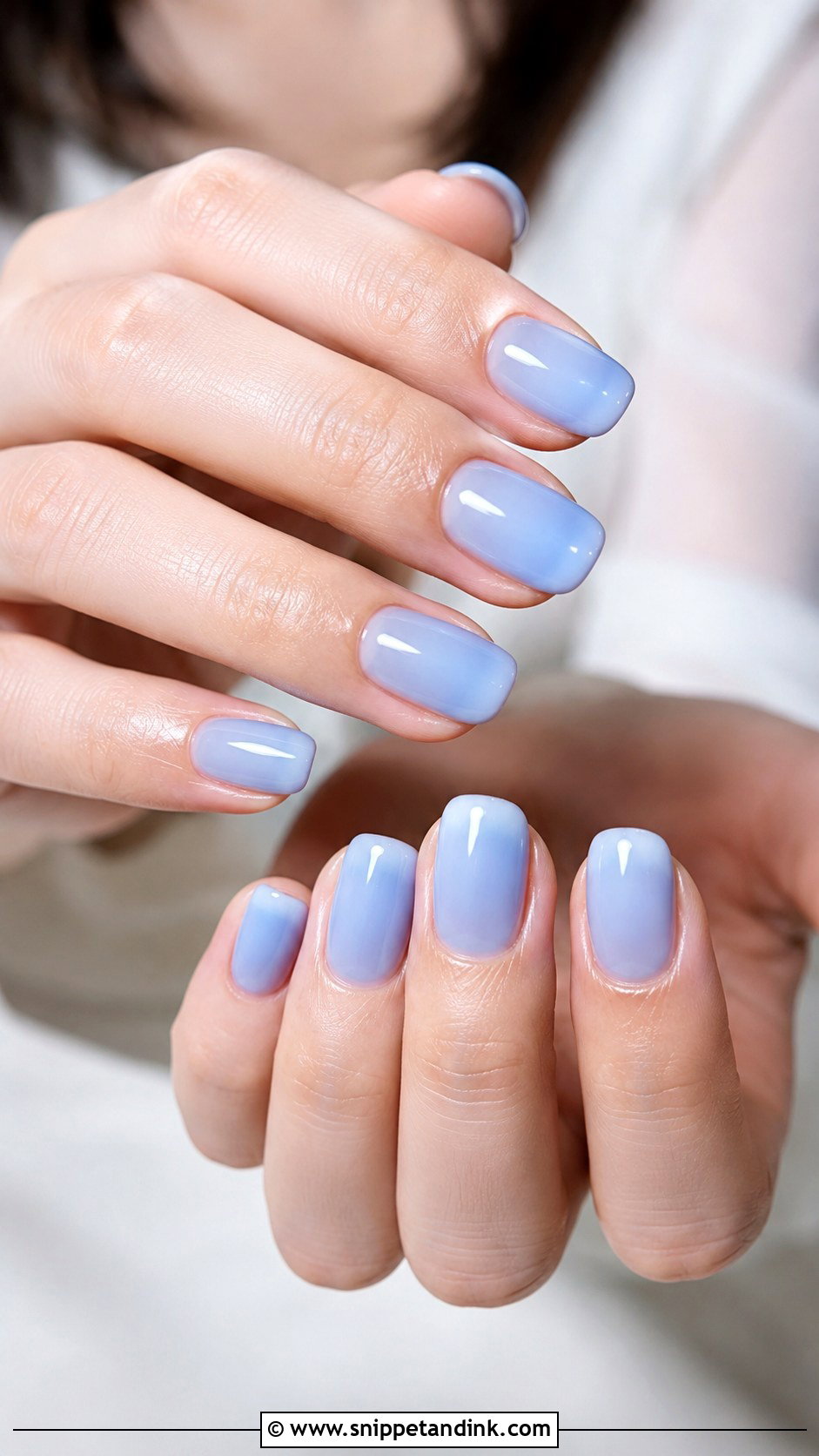
Pearls give texture without the glare of rhinestones. On a sheer light blue base I set small half-pearls into builder gel near the cuticle or down one accent nail, never large ones on every finger, because big domed pearls snag on veil tulle. Two nails with a few pearls each is plenty. They echo pearl earrings and lace without trying hard, and almond or oval tips give them room to sit.
6. Blue Ombre Wedding Nails
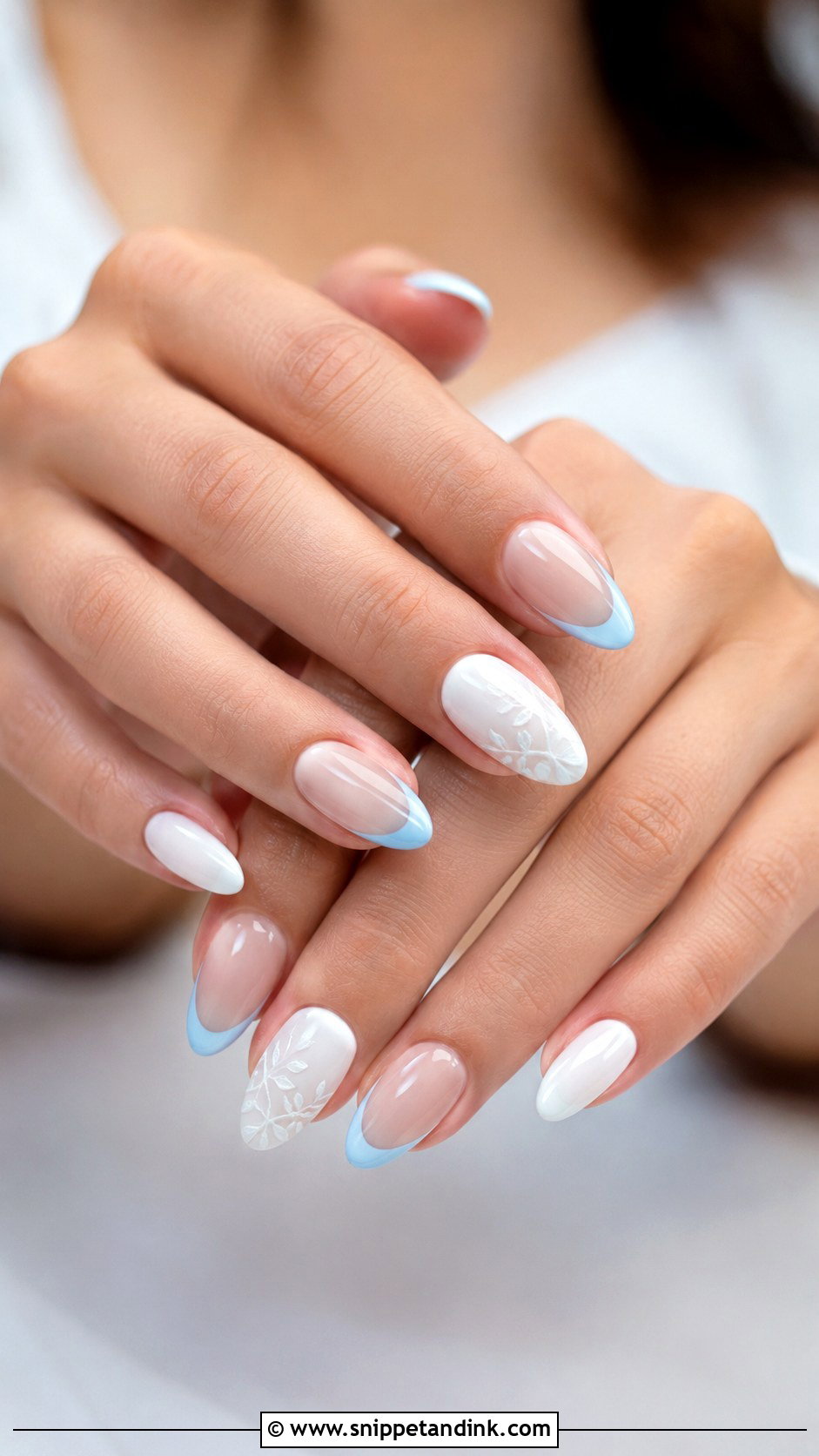
Ombre is mostly a blending job, and the hard part is making the fade disappear without a visible stripe. I build it with a soft sponge or gradient brush in thin layers, moving from nude or milky white into sky blue at the tips. Done well, it makes nails look longer, which helps anyone with short nail beds. It also grows out kindly because the area near the cuticle is already neutral. For beach and outdoor ceremonies, a pale fade looks right in bright daylight where a solid blue can feel heavy.
7. Navy Blue Wedding Nails
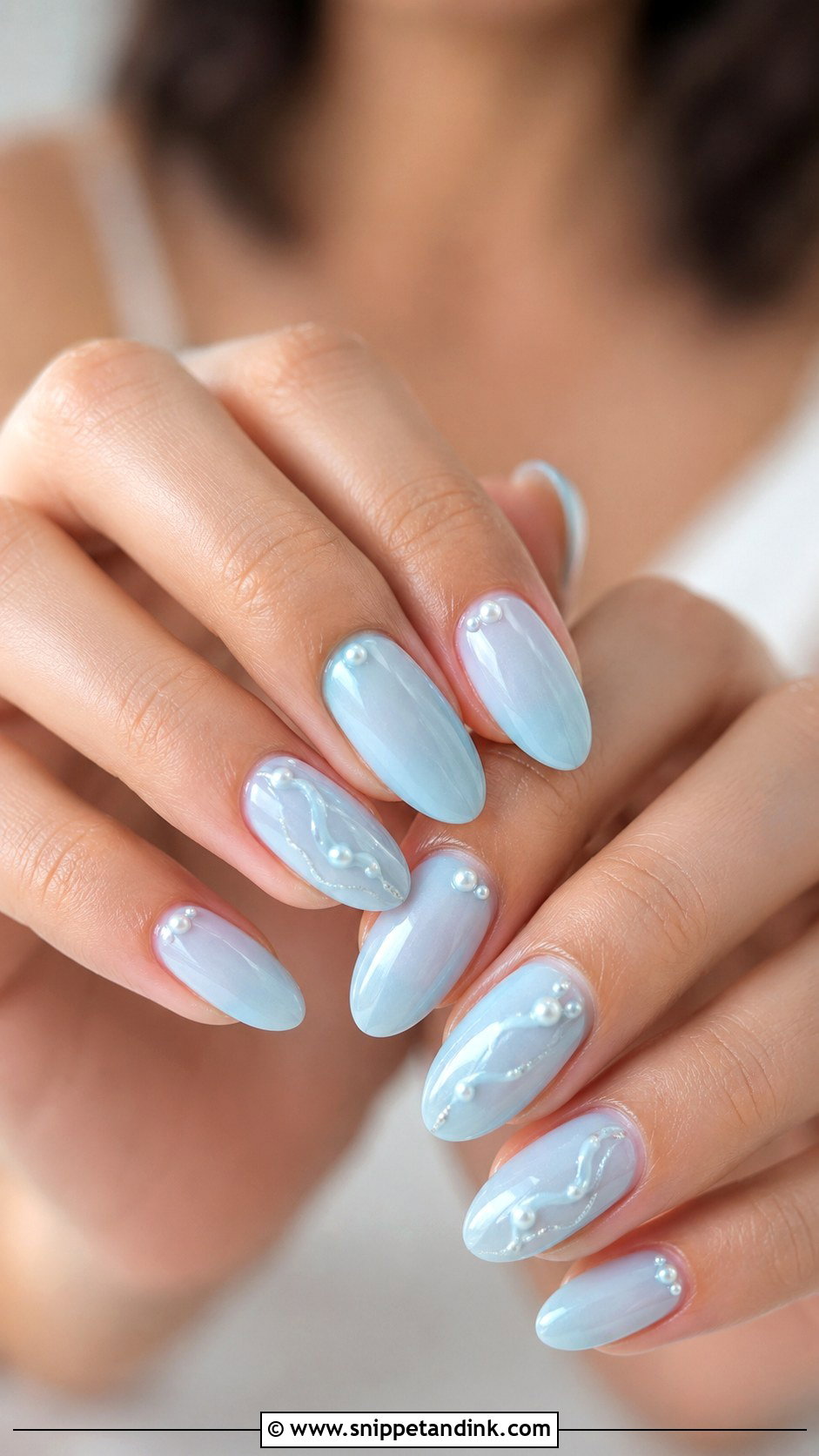
Navy is what I suggest to brides in a very plain gown who want one strong beauty detail. It’s dark enough for a formal evening reception, and in winter it looks richer than black. The trade-off: dark polish shows every chip and every slightly flooded cuticle, so the prep has to be tidy and I’d book it no more than two days out. A thin silver line or one sheer nude nail with a navy accent softens it for photos. Short square nails make it modern, almond makes it softer, and sapphire jewelry is the obvious partner.
8. Blue Floral Wedding Nails
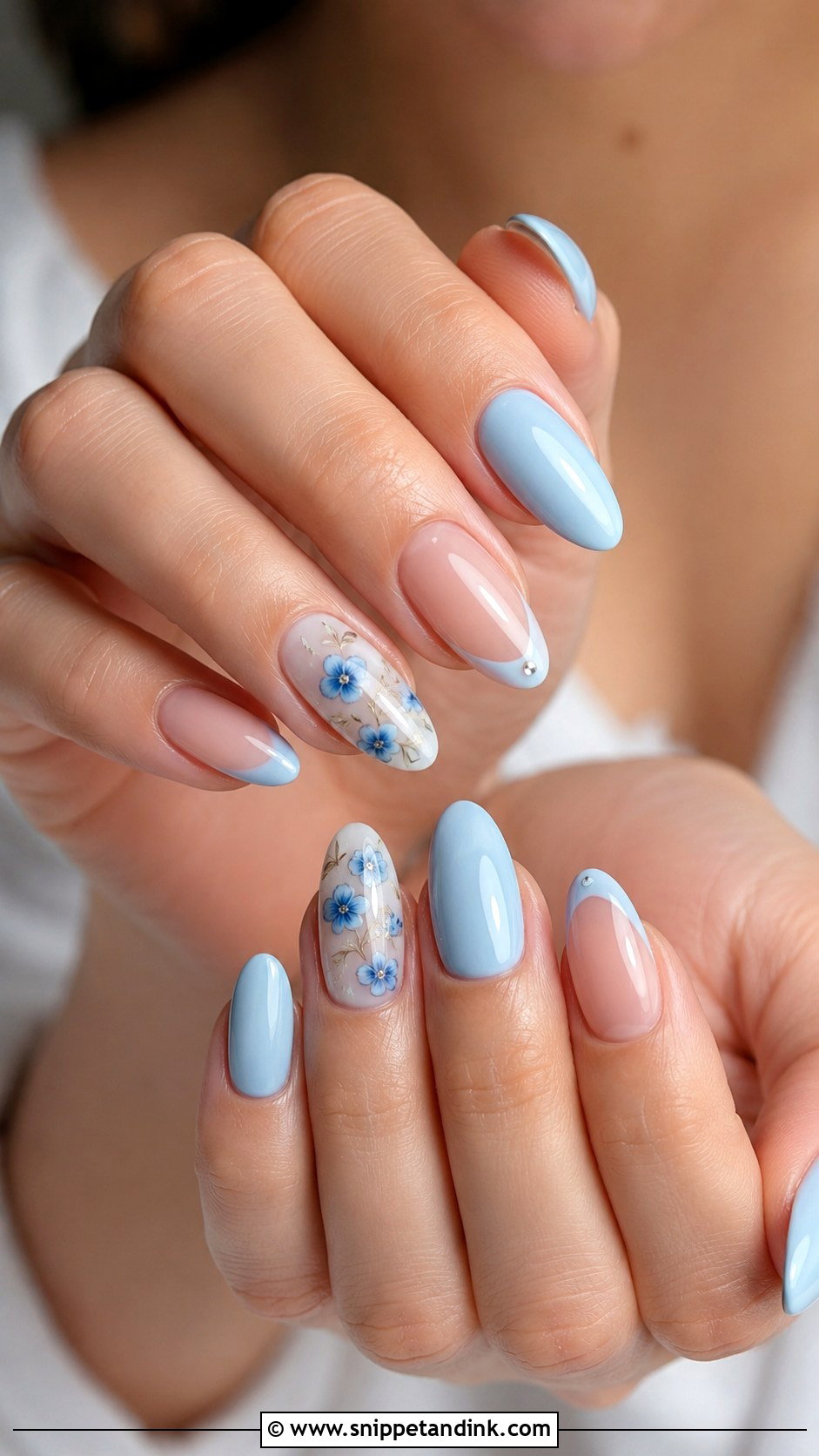
Hand-painted flowers are where wedding nails go wrong most often, usually because there are too many of them. I keep the blue petals to one or two accent nails on a nude or milky base and leave the rest plain or French. At nail scale, simple five-dot flowers read more clearly in photos than detailed roses, which blur into a blob. Pale blue petals stay soft; deeper cornflower gives more contrast against lace or an embroidered bodice. A glossy top coat over the art stops the petals from catching.
9. Blue Marble Wedding Nails
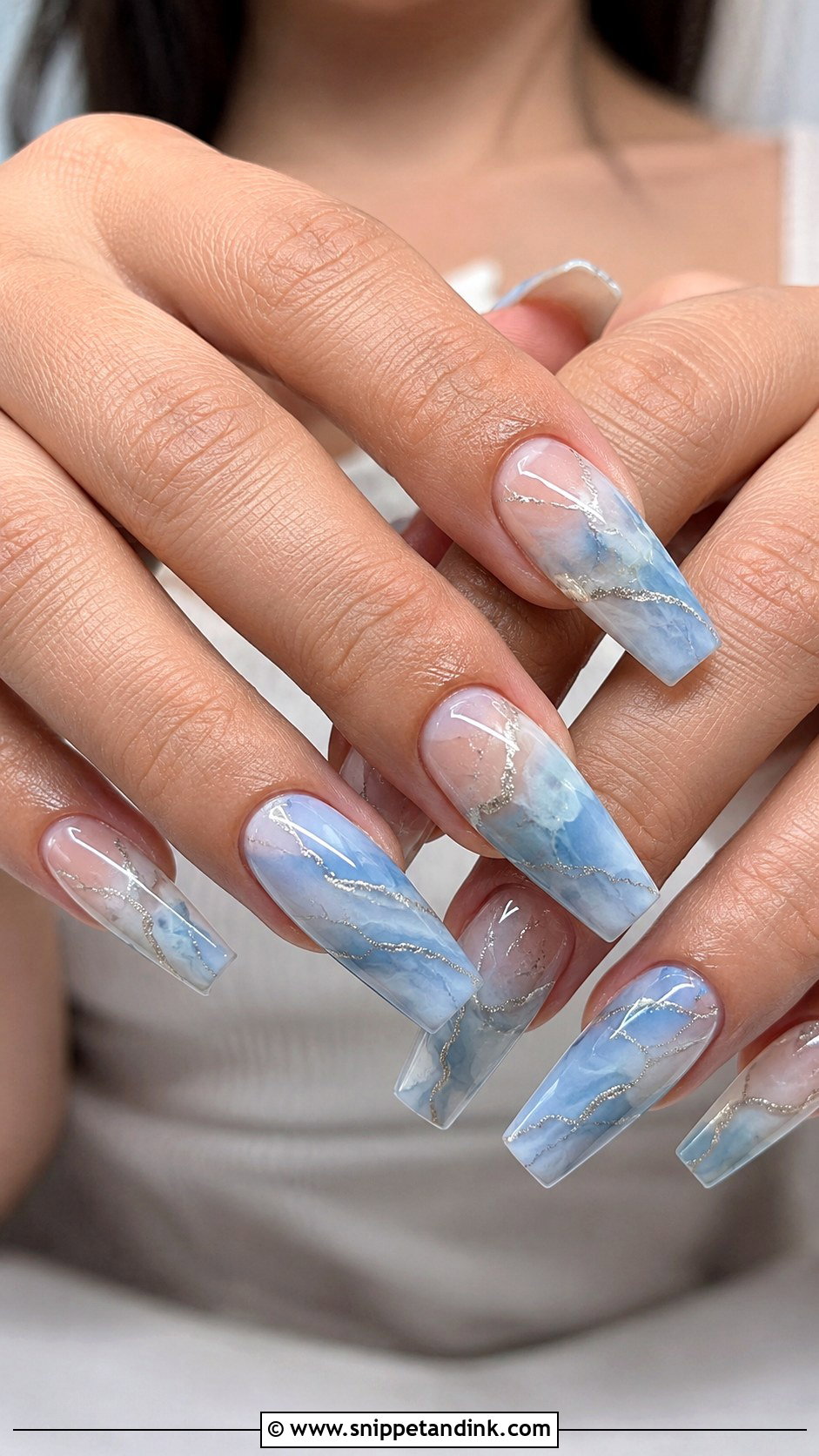
Marble is painted wet into wet, so no two nails come out the same, and that randomness is the charm. Blue marble wedding nails look most like stone when I keep the palette to pale blue, white and a translucent nude, rather than a dark storm of colour. A few fine silver lines dragged through the pattern add depth. The veining needs length to flow, so almond, oval or coffin shapes suit it better than very short nails. I marble two or three nails per hand and leave the others solid or sheer so the eye has somewhere to rest.
10. Blue Glitter Wedding Nails
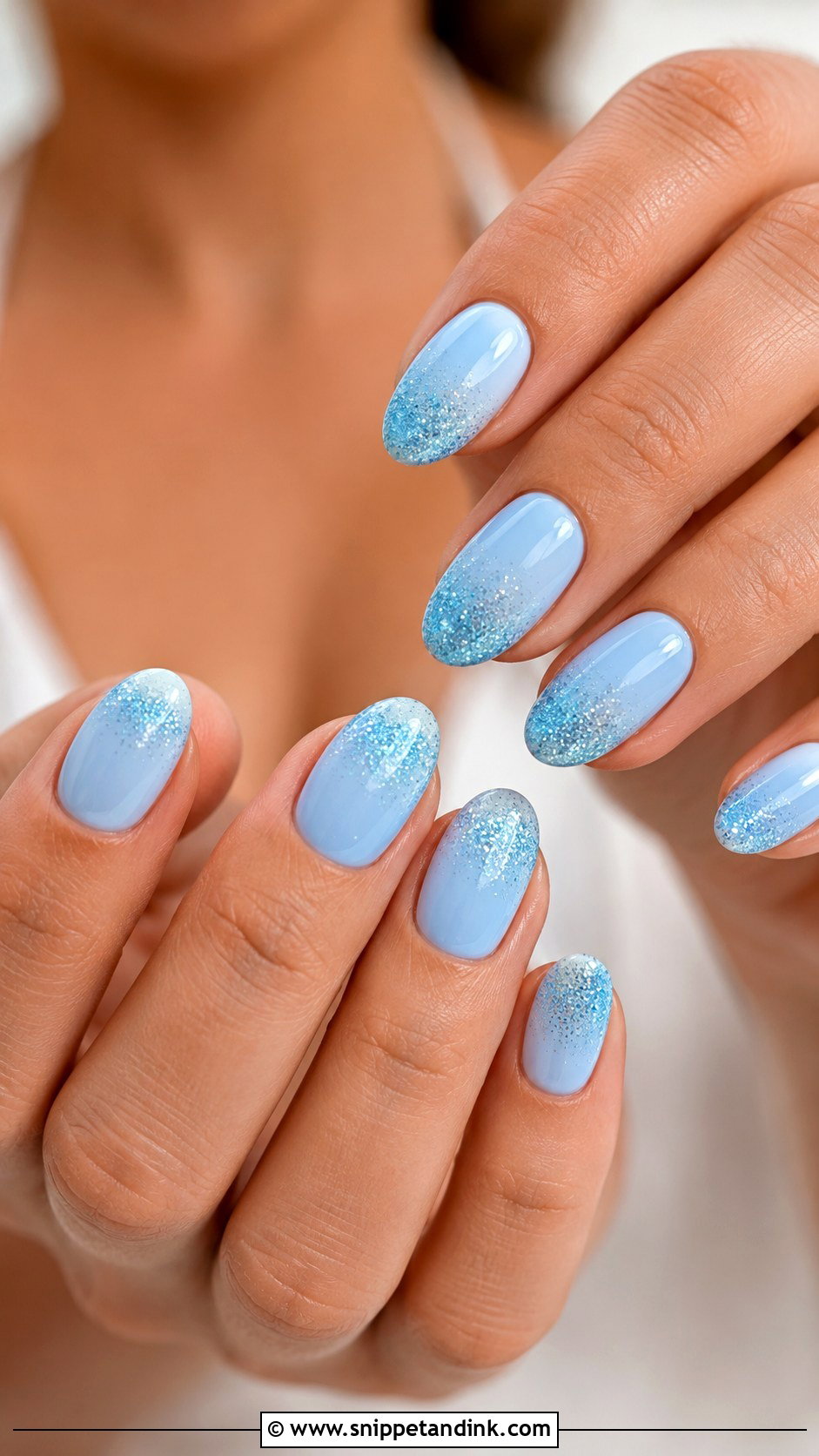
Chunky glitter is slow to remove and can look cheap under a camera flash, so for weddings I nearly always use fine shimmer instead. A pale blue glitter fade from the tips, or one sparkling accent beside glossy blue nails, gives the reception some sparkle without turning the whole hand into a disco ball. Silver-blue glitter looks cooler and more formal than baby blue. Keep your jewelry simple with this one; glitter plus a large ring plus a beaded sleeve is a lot for a single close-up.
11. Blue French Tip Wedding Nails With Rhinestones
Stones are where I’m strictest about placement. On blue French tip wedding nails with rhinestones, I set a few small clear crystals near the cuticle or down a single accent nail, where they still catch the light but don’t sit on the edge that takes all the knocks. Crystals on the free edge tend to pop off within days and snag on hair and lace. The nude or sheer pink base stops the blue tips from looking heavy. Almond softens the design, square makes it graphic, and silver accessories flatter clear stones more than gold.
12. Pale Blue Wedding Nails
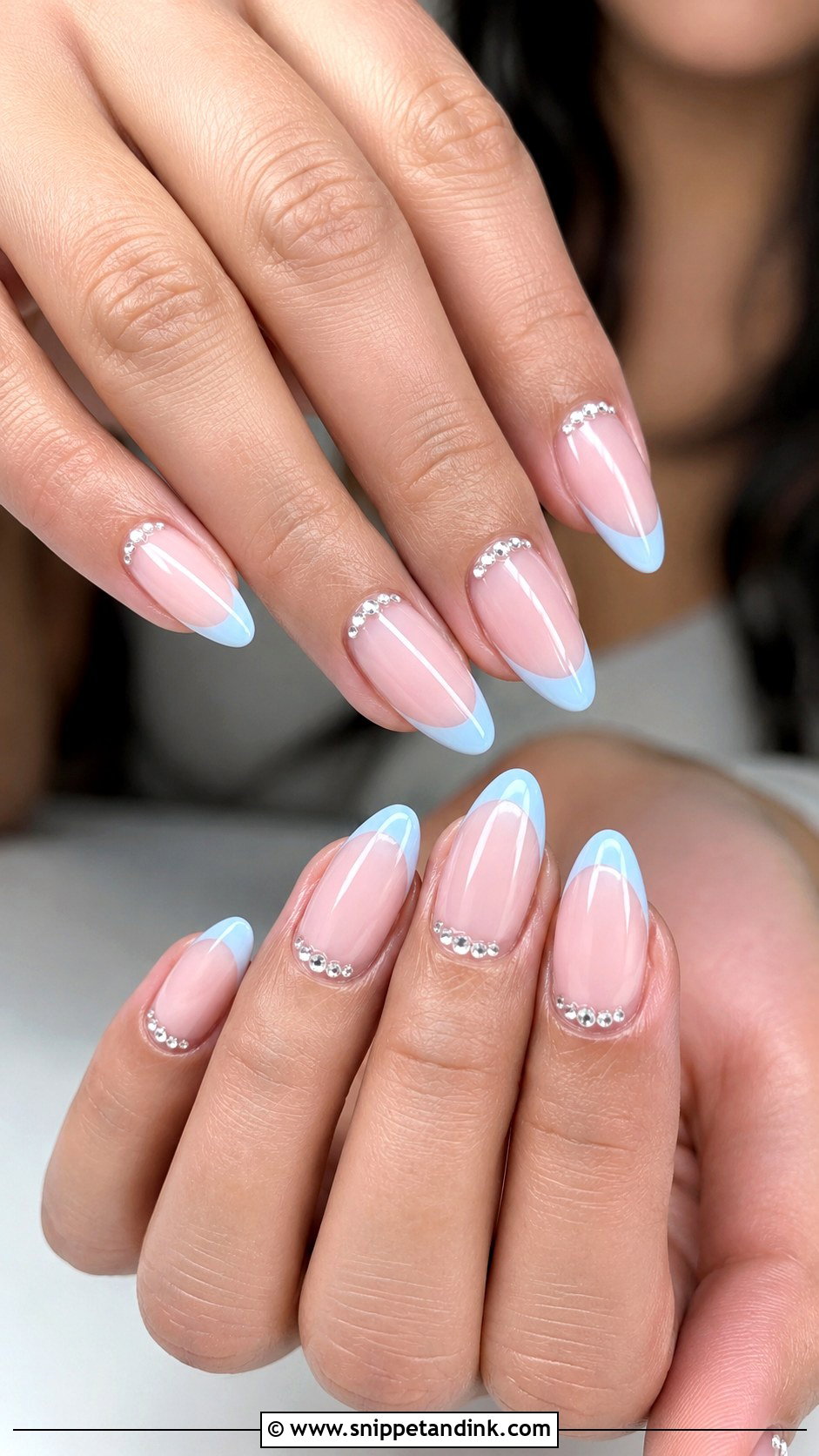
A creamy pastel blue on every nail is the quietest way to carry the tradition, and it won’t compete with lace, pearls or tulle. Formula matters more than you’d think. Pale creams are often streaky on the first coat, so I build them in three thin layers rather than two thick ones that can wrinkle under the lamp. A sheer version looks delicate on longer almond nails, and an opaque cream looks neat on short ones. A pearl chrome top coat softens it even further.
13. Blue Wedding Nails With Silver
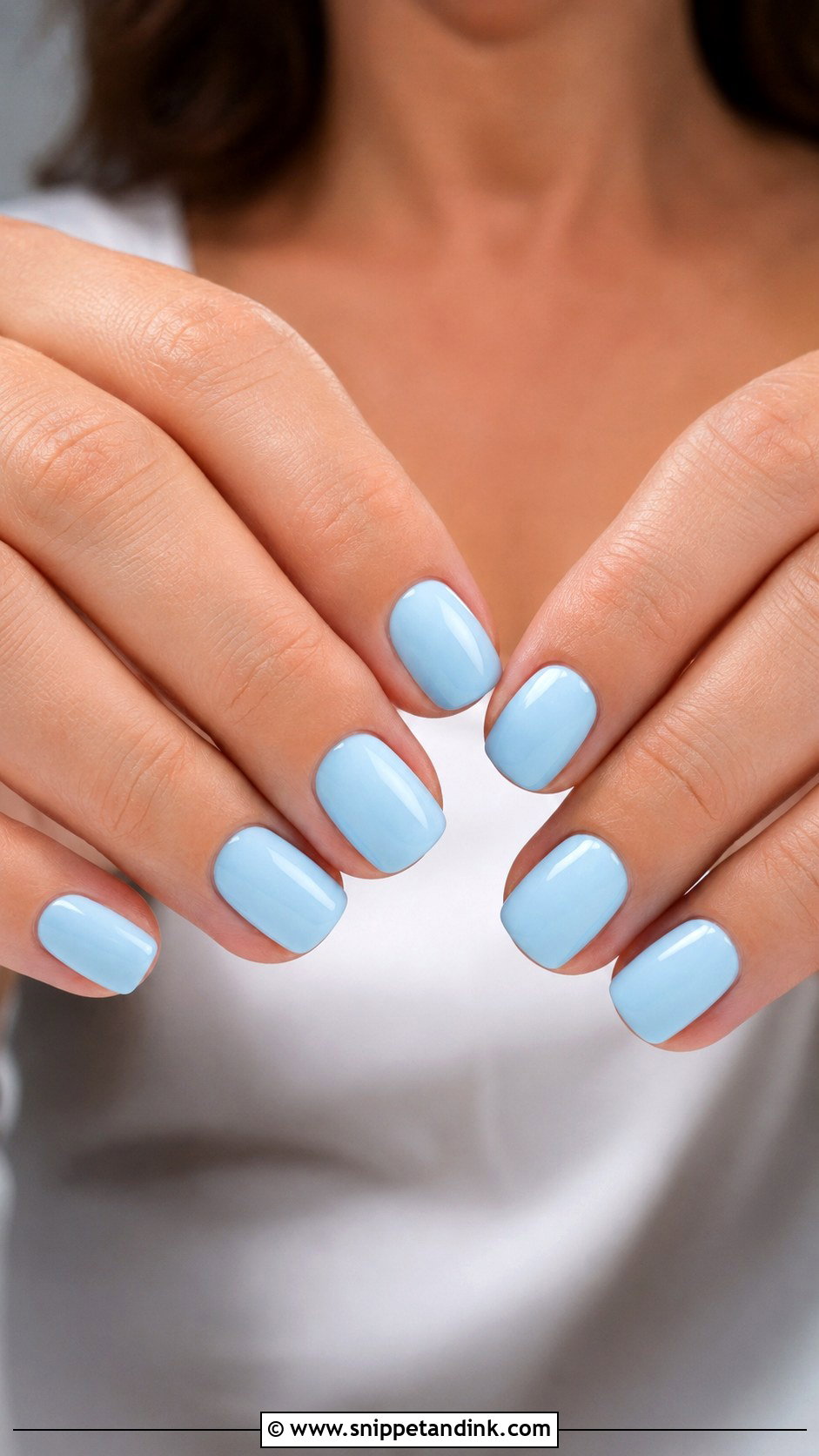
Silver detailing makes sense when your ring and earrings are platinum, white gold or silver, because the nails then repeat the metal right next to the stone. I pick one blue as the main shade and use silver only as an accent: a thin foil line, a striped tip or one metallic nail. Light blue with silver looks icy, while navy with silver turns formal. Clean fabrics such as satin or crepe suit how crisp it looks, and so do winter and evening weddings.
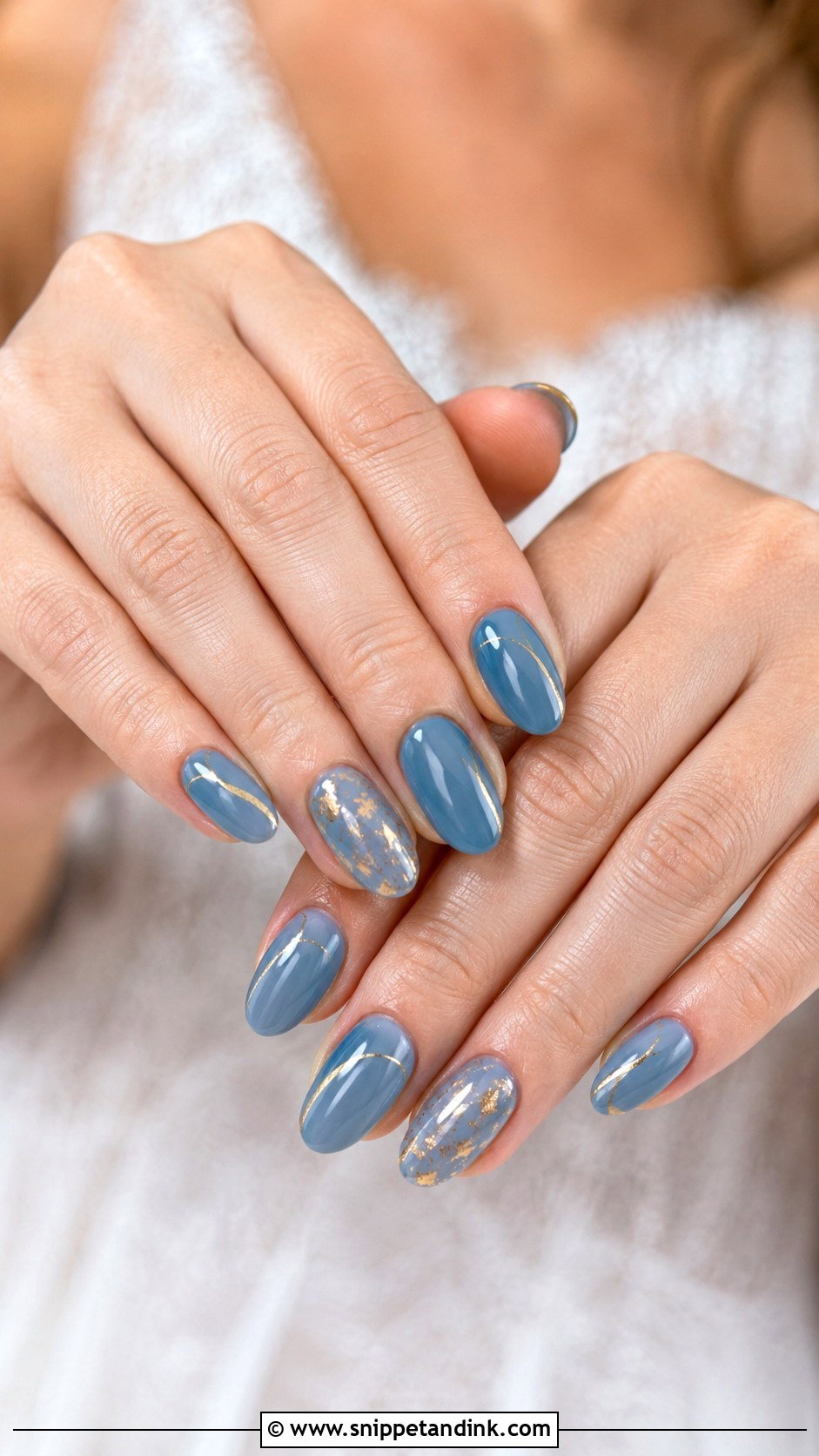
14. Blue Wedding Nails With Gold
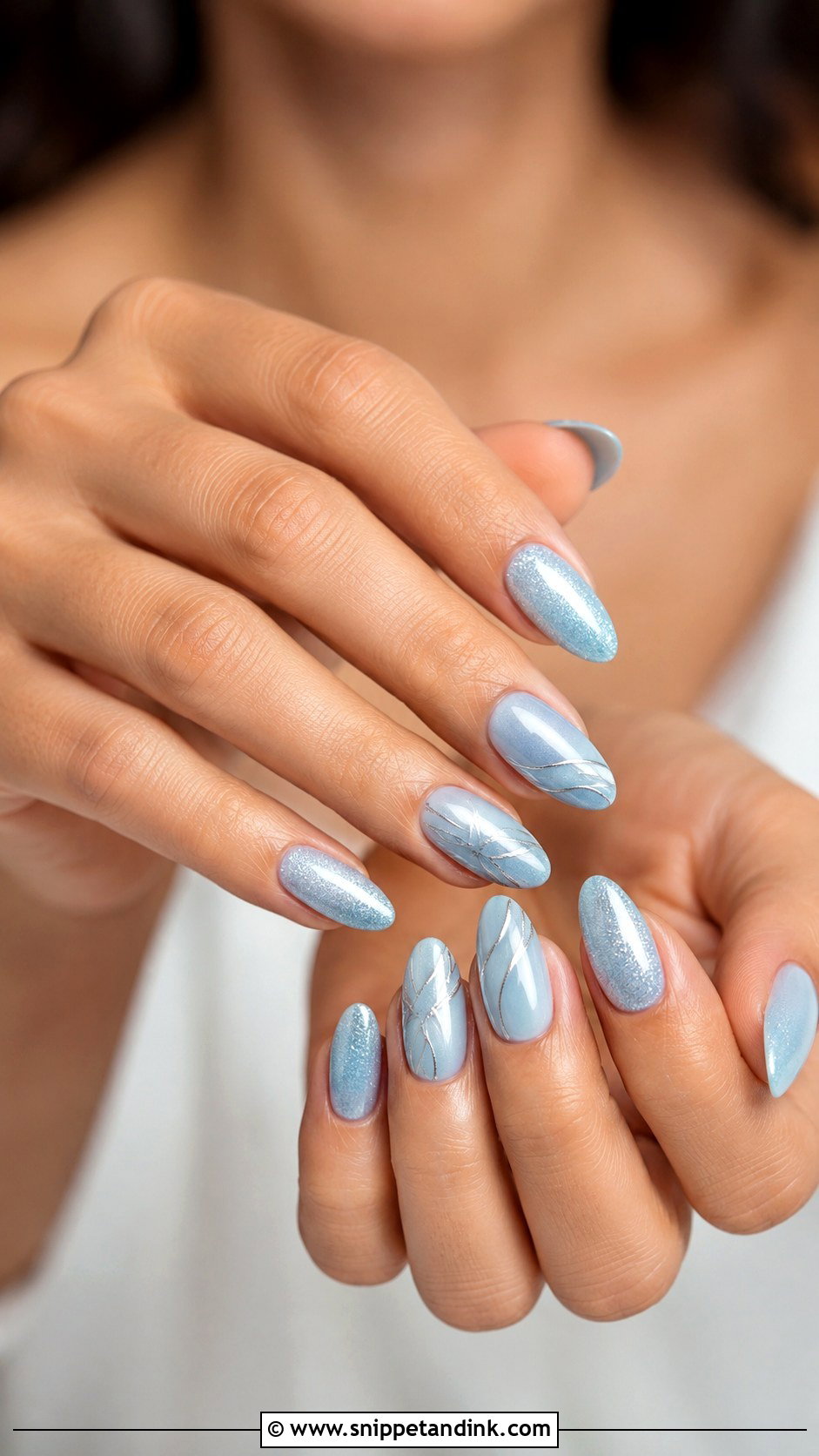
Blue with gold is warmer and slightly regal, and it belongs with gold jewelry and ivory or champagne gowns more than bright white. The detail has to stay fine. I use gold leaf flakes or a thin striping brush loaded with gold gel, because thick gold polish looks brassy against navy in pictures. Dusty blue with scattered foil is the softer route; navy with fine gold French tips is the dramatic one. Curved almond and oval shapes take the hard edge off the metal.
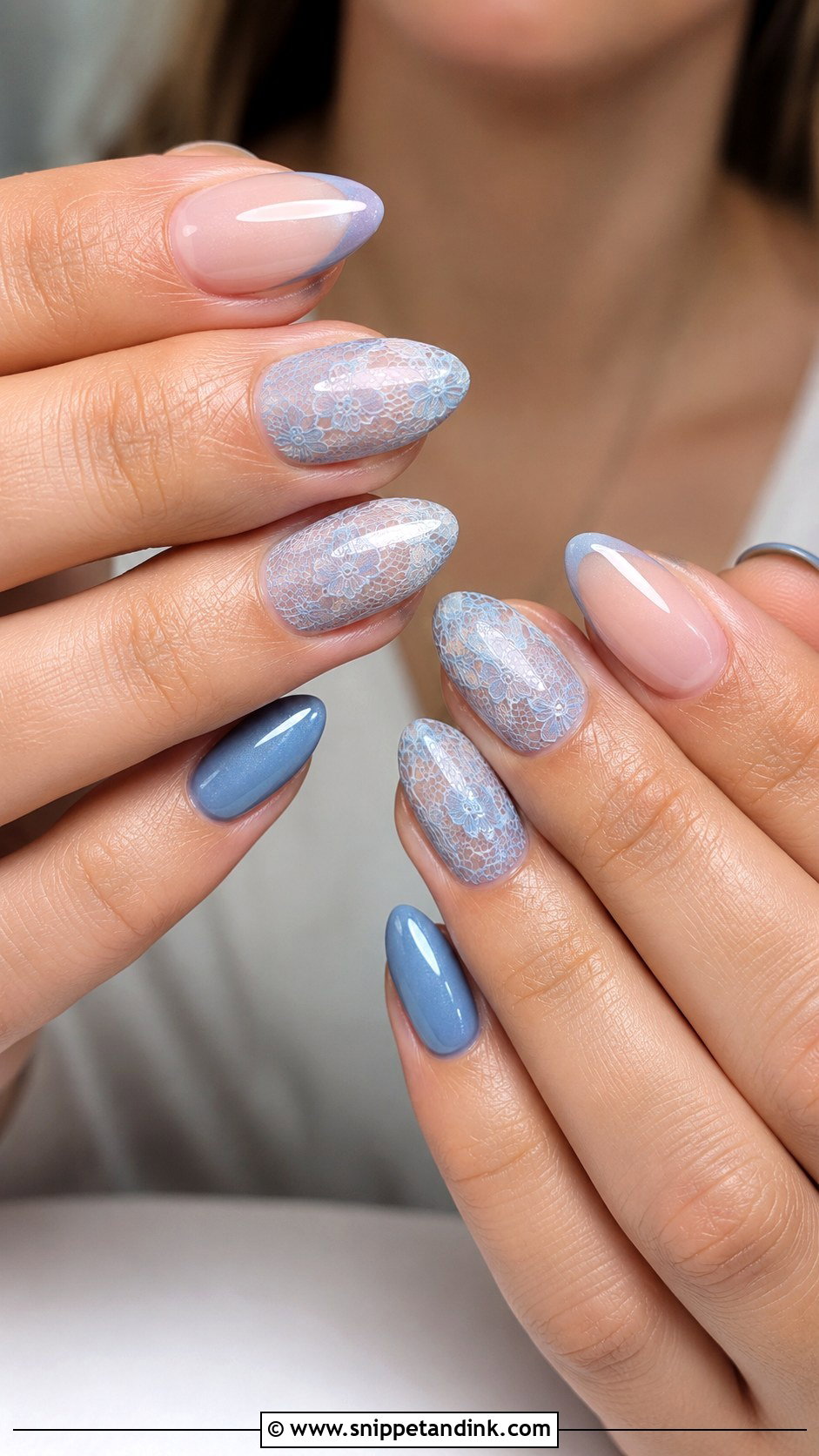
15. Blue Lace Wedding Nails
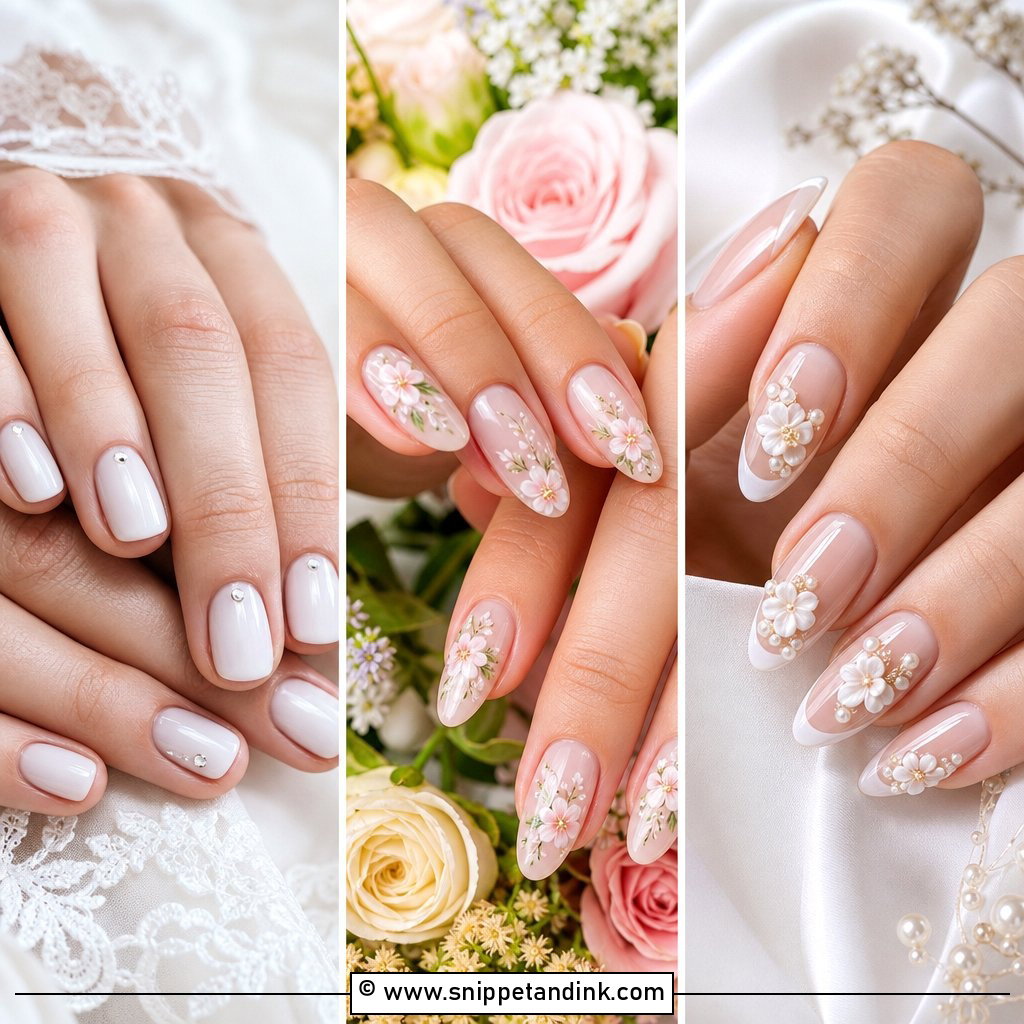
Nail lace is drawn freehand with a very fine liner brush, and it only looks like lace if the lines stay thin and the gaps between them stay open. Over a nude, milky or sheer pink base, I keep the blue linework to accent nails, and when a bride brings a photo of her sleeve or veil I copy one motif from it. Pale blue looks gentle and dusty blue looks vintage. If your dress has no lace at all, I’d pick another design, because lace nails can look as if they belong to a different outfit.
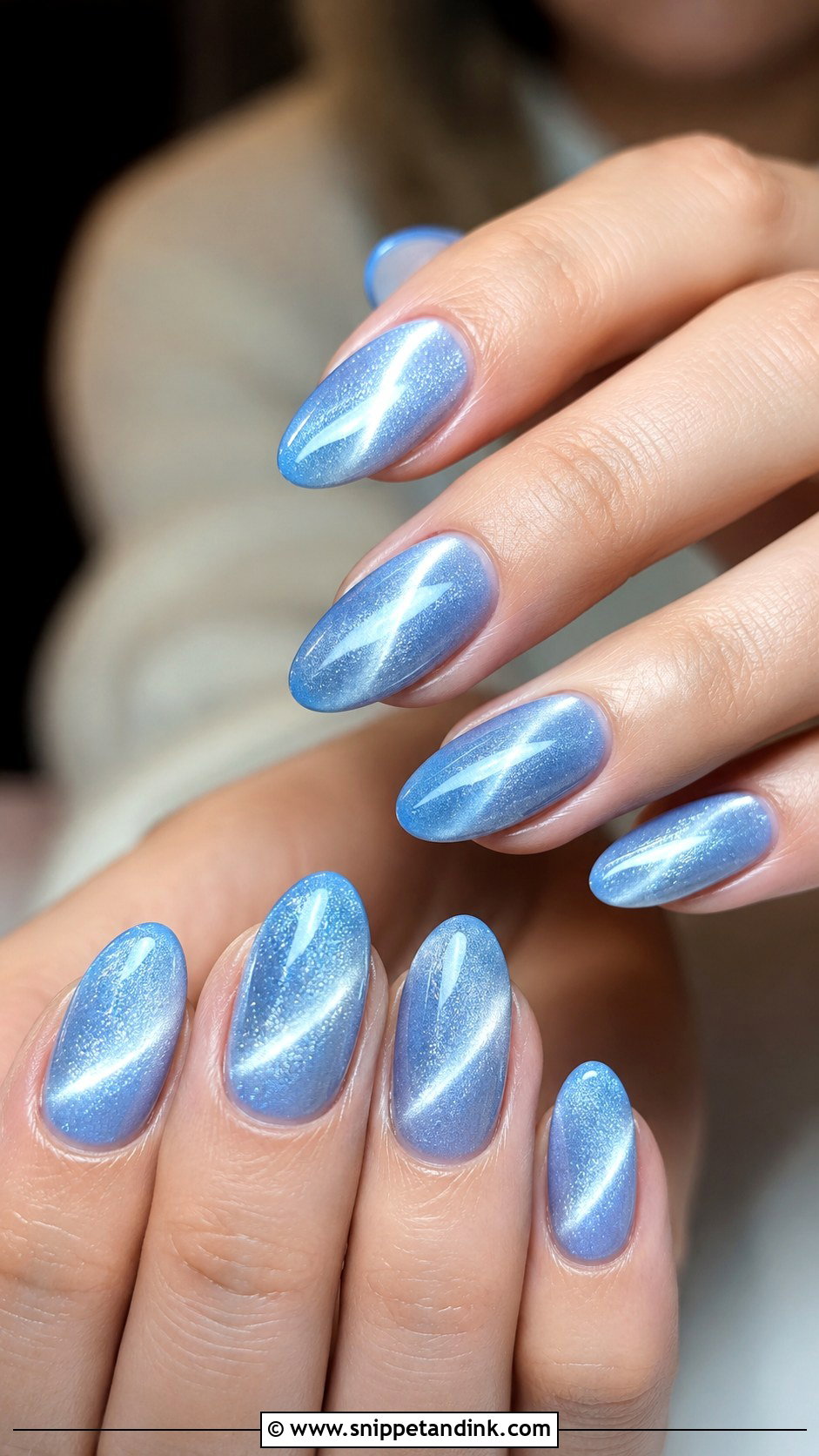
16. Blue Cat Eye Wedding Nails
Cat eye gel holds tiny magnetic particles, and I pull them into a band of light with a magnet before curing, so the shine shifts as your hand moves. For a wedding I use icy blue or deep sapphire rather than neon shades. It sits between plain polish and nail art: more interesting than a cream, far less fussy than painted detail. The catch is that the effect depends on light. It looks strongest at evening receptions and flatter in overcast daylight.
17. Blue Jelly Wedding Nails
Jelly polish is translucent, so a hint of the natural nail shows through the colour and the finish looks glassy and light. It flatters short and medium lengths most. Because it’s sheer, every ridge and uneven cuticle shows straight through, so I buff carefully and lay a thin builder layer before the blue goes on. A faint pearl top coat makes sky blue jelly feel more bridal. Summer and beach weddings suit it, and so do bridesmaids who dislike colour that looks thick.
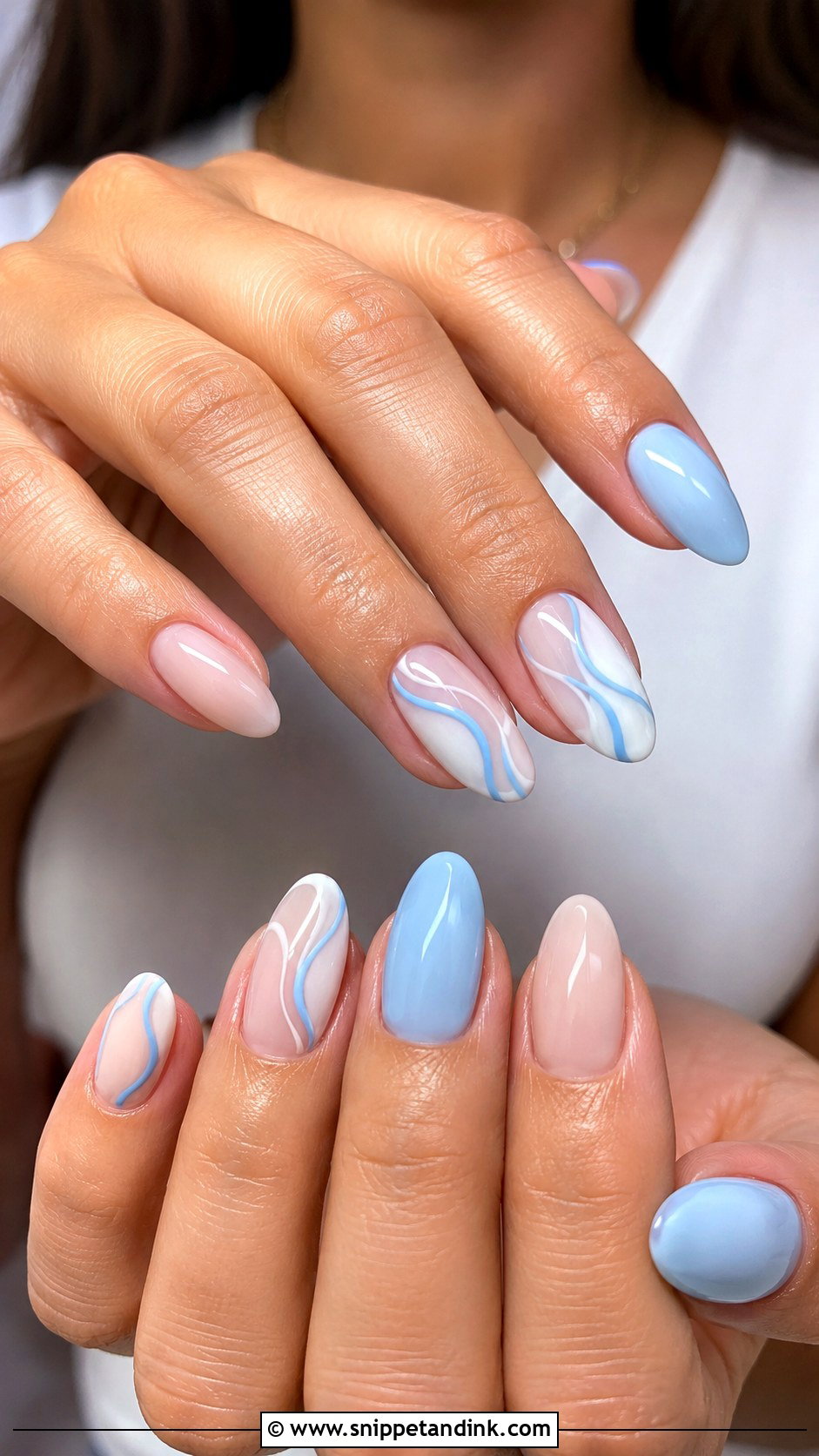
18. Blue Swirl Wedding Nails
Swirls give movement without flowers or glitter, which appeals to brides who find florals too sweet. Blue swirl wedding nails work best on a sheer nude, milky white or pale pink base, with thin blue lines across a few nails and tiny blue tips or plain colour on the rest. The lines need a steady liner brush and should follow the curve of the nail. On almond tips they look graceful; on square nails they can look chopped off at the edge. Baby blue keeps it soft, and a deeper blue is easier to see across a room.
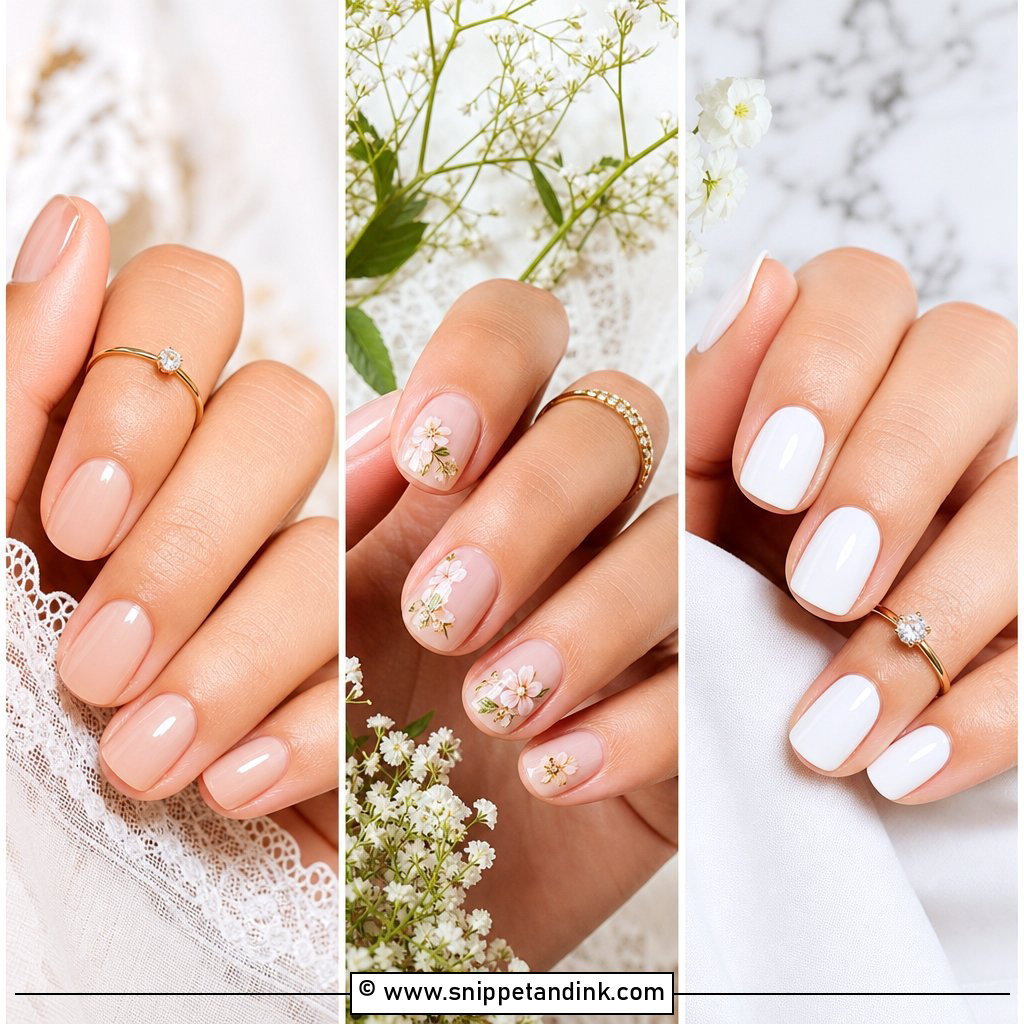
19. Blue Wedding Nails For Short Nails
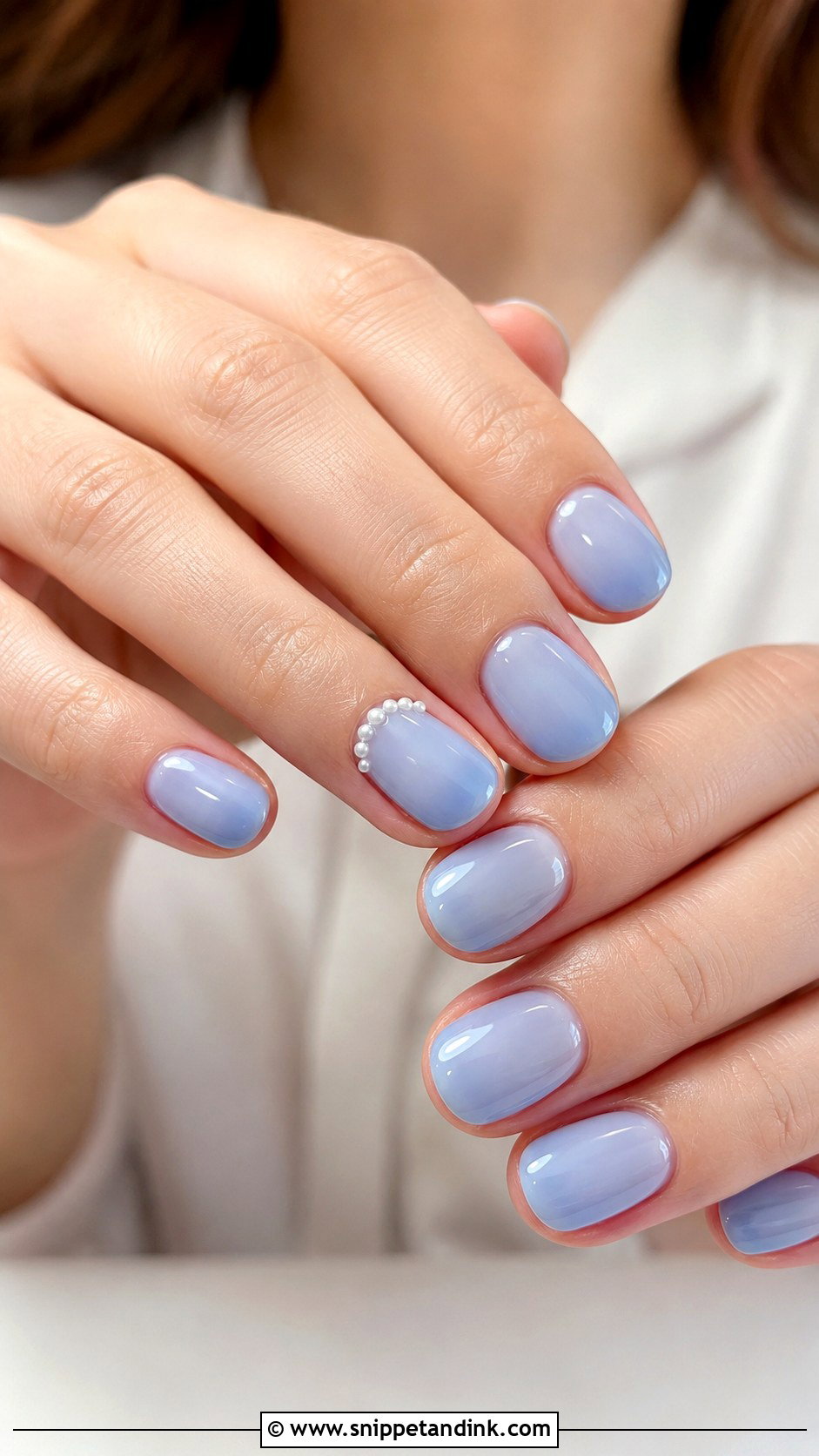
Short nails are often the smarter wedding choice. They don’t catch on lace, and they survive the packing, the decorating and the dancing. I shape them into a rounded square or soft oval and keep the colour placement simple: pale blue all over, a baby blue micro French or glossy dusty blue. Sheer blue, a soft ombre or a fine vertical shimmer all make fingers look a touch longer. If you bite or pick, short gel is the most durable combination I know.
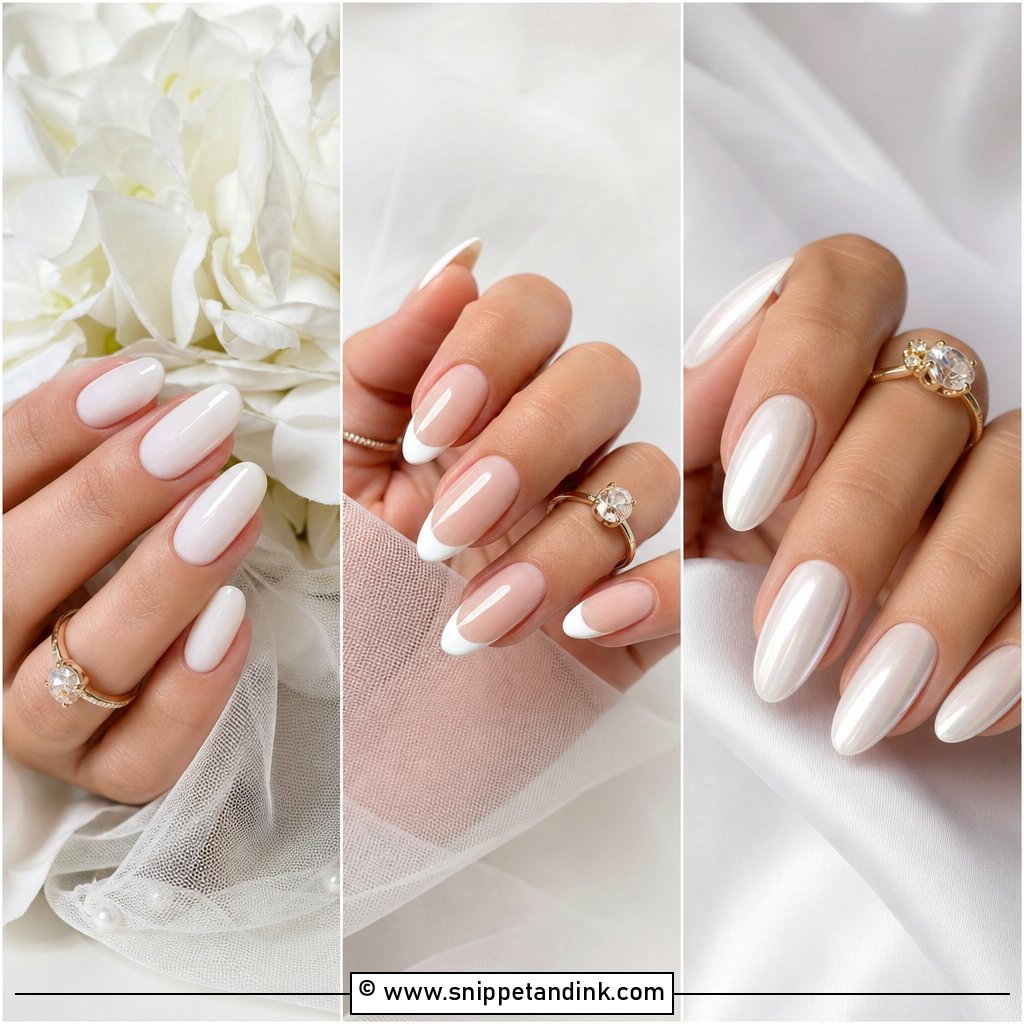
20. Blue Wedding Nails For Bridesmaids
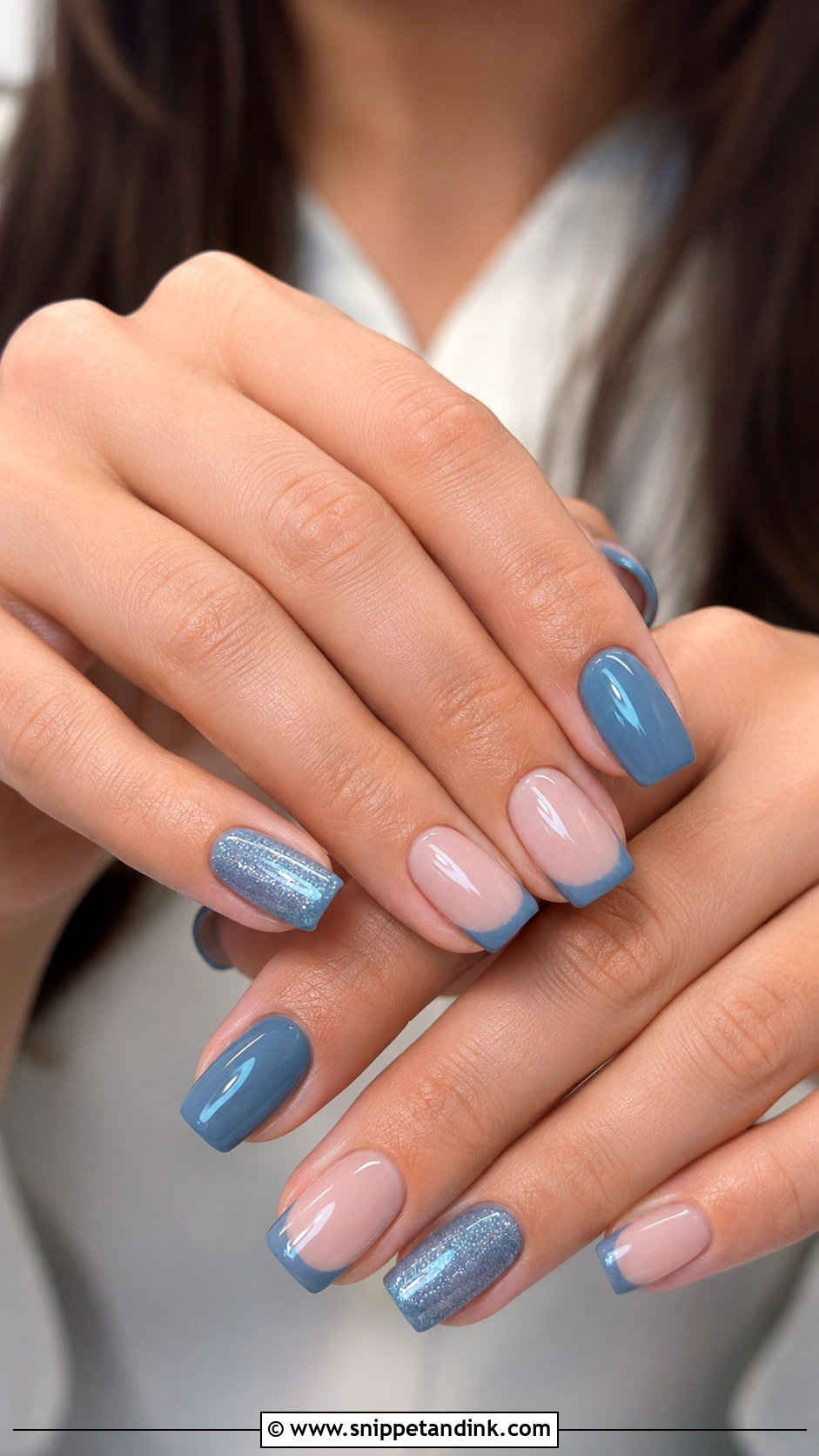
A bridal party looks unified when the nails relate to the dresses without copying them. Blue wedding nails for bridesmaids work best a shade lighter or darker than the fabric, because an exact match vanishes against the dress in group photos. Soft blue, dusty blue, pale French tips and blue-grey gloss all suit a wide range of skin tones. With mismatched dresses, a sheer nude base with blue tips ties everyone together. Anything bold is the bride’s call, and shimmer only goes on if it fits the rest of the day.
Timing the Appointment So Blue Gel Still Looks Fresh on the Day
Book the wedding manicure one or two days before, not the morning of. Gel is fully cured under the lamp, so there’s no drying time to fuss over, but that buffer leaves room to fix a chip or a lifted corner. Book it a week early and you’ll see a growth gap at the cuticle, which shows far more with navy than with pale blue.
If you’ve never worn gel, try one set three or four weeks ahead. You’ll learn how your nails take it and whether that particular blue suits your hands in photos, and you won’t be finding out on the day itself.
Blue staining and other small problems I see
Strong blue pigments can stain the natural nail when the base coat is skipped, leaving a faint blue-grey tint after removal. Make sure a proper base goes on, especially under navy and cobalt. Chrome and glitter wear first at the free edge, so I cap the tip with top coat and tell brides to use cuticle oil twice a day that week, because hydrated nails lift less.
Put a fine nail file and a small bottle of clear top coat in the emergency kit. When a nail snags on a veil, it’s nearly always a rough edge, and thirty seconds with a file stops it from pulling the tulle.
How Much Blue Your Hands Can Carry
Every design here can be turned up or down. Baby blue tips and a pale cream give the quietest version of something blue, while navy, chrome, marble and cat eye carry far more presence. Pearls, metal, flowers, lace and ombre add the bridal detail, as long as you stop at one or two of them per hand. Bring a scrap of your dress fabric and wear your jewelry to the appointment, and the right blue usually becomes obvious within a few swatches. Bridesmaids and guests can follow the same thinking with a little more freedom.
You'll Like These Ideas:


Leave a Reply