
A white-iced cake with chocolate inside is my favourite kind of quiet surprise. From across the room it reads as a traditional wedding cake; the moment the first slice comes out, guests see dark cocoa layers against the pale icing and the line starts forming. It suits a garden lunch as easily as a ballroom dinner. What changes from cake to cake is the coating and the decoration, and each one behaves differently over chocolate sponge. Below are twenty finishes I’d happily make, with the practical notes I’d give a couple sitting at my tasting table.
Why Dark Sponge Under White Icing Needs Extra Care
White icing over vanilla sponge is forgiving. Over chocolate, every loose crumb and every thin patch shows. When I quote a couple for this kind of cake, I talk about three things before any decoration.
- The crumb coat. A thin sealing layer, chilled hard, then the final coat. Skipping the chill is the most common reason home-made white cakes look grey and speckled.
- The shade of white. Butter-based icings are ivory. Fondant and some ganaches can be closer to pure white. Bring a fabric swatch from your linens if the shade matters to you.
- The filling. Dark fillings like chocolate fudge can bleed into the outer icing at the seams if the dam of icing around each layer is too thin.
I also ask about the flavour balance. Rich chocolate sponge plus thick buttercream plus ganache filling is heavy, so for a long dinner I often suggest a lighter mousse between layers.
1. Chocolate Wedding Cake With White Buttercream
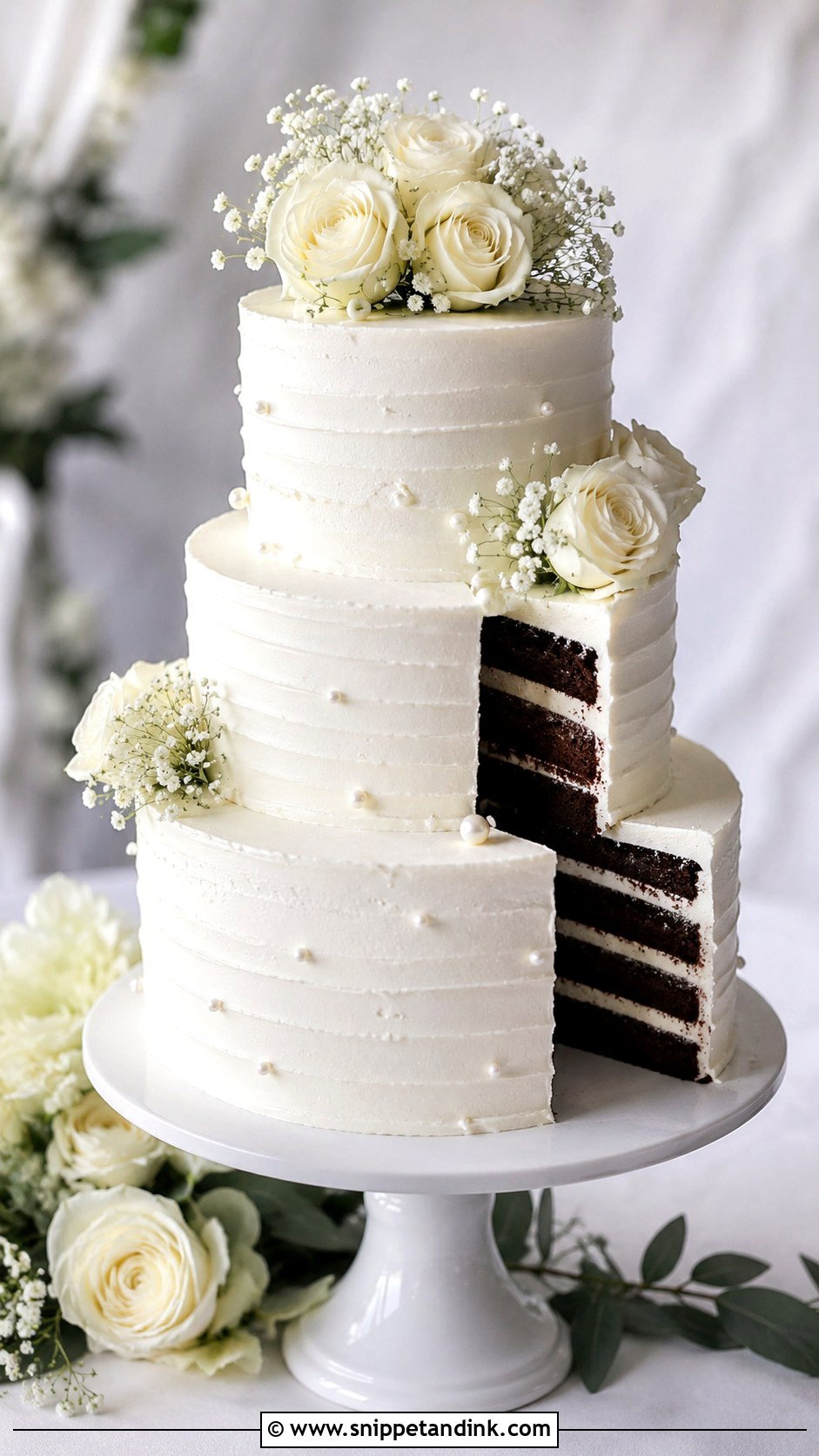
Plain white buttercream over chocolate is the version I make most, and the crumb coat is what decides whether it looks clean. Dark crumbs show through white icing like pepper, so I seal the cake with a thin first layer, chill it until firm, then apply the final coat. Swiss meringue buttercream is naturally ivory because of the butter; if you want true white, ask your baker how they handle that, since some whiten it and some prefer the warmer shade. Small piped borders, a few fresh white flowers or pearl dots finish it without making it busy.
2. Chocolate Wedding Cake With White Fondant
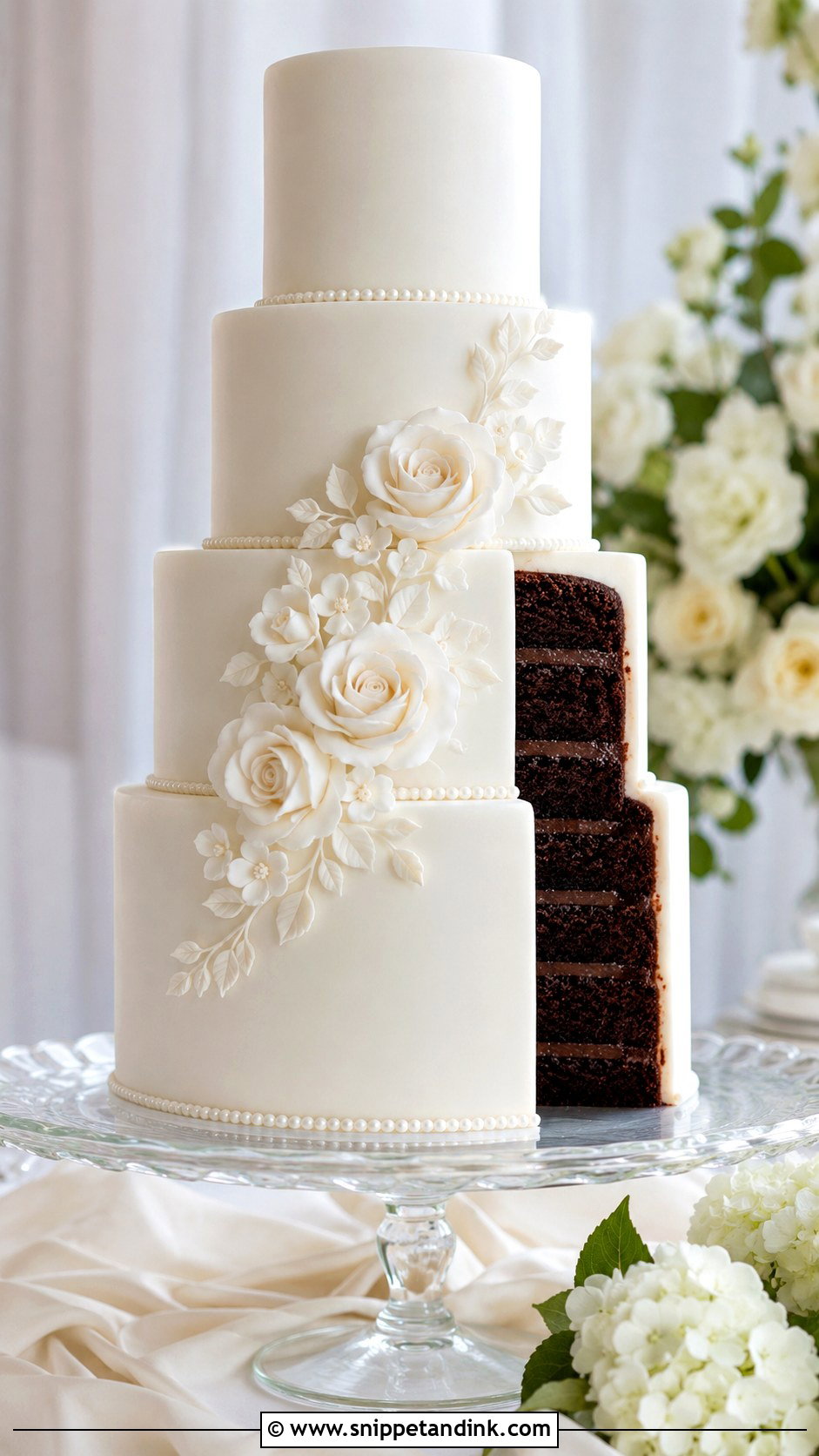
A chocolate wedding cake with white fondant gives you sharp edges and tall, formal tiers. I never put fondant straight onto soft chocolate cake; it goes over a firm layer of ganache so the corners stay crisp and the surface doesn’t ripple. Inside, vanilla buttercream, white chocolate mousse or raspberry gives contrast. Fondant is the best canvas for edible lace, ribbon bands, monograms or pressed texture. I’d pick one strong accent, such as sugar flowers or a pearl trim, rather than layering all of them.
3. Chocolate Wedding Cake With White Chocolate Ganache
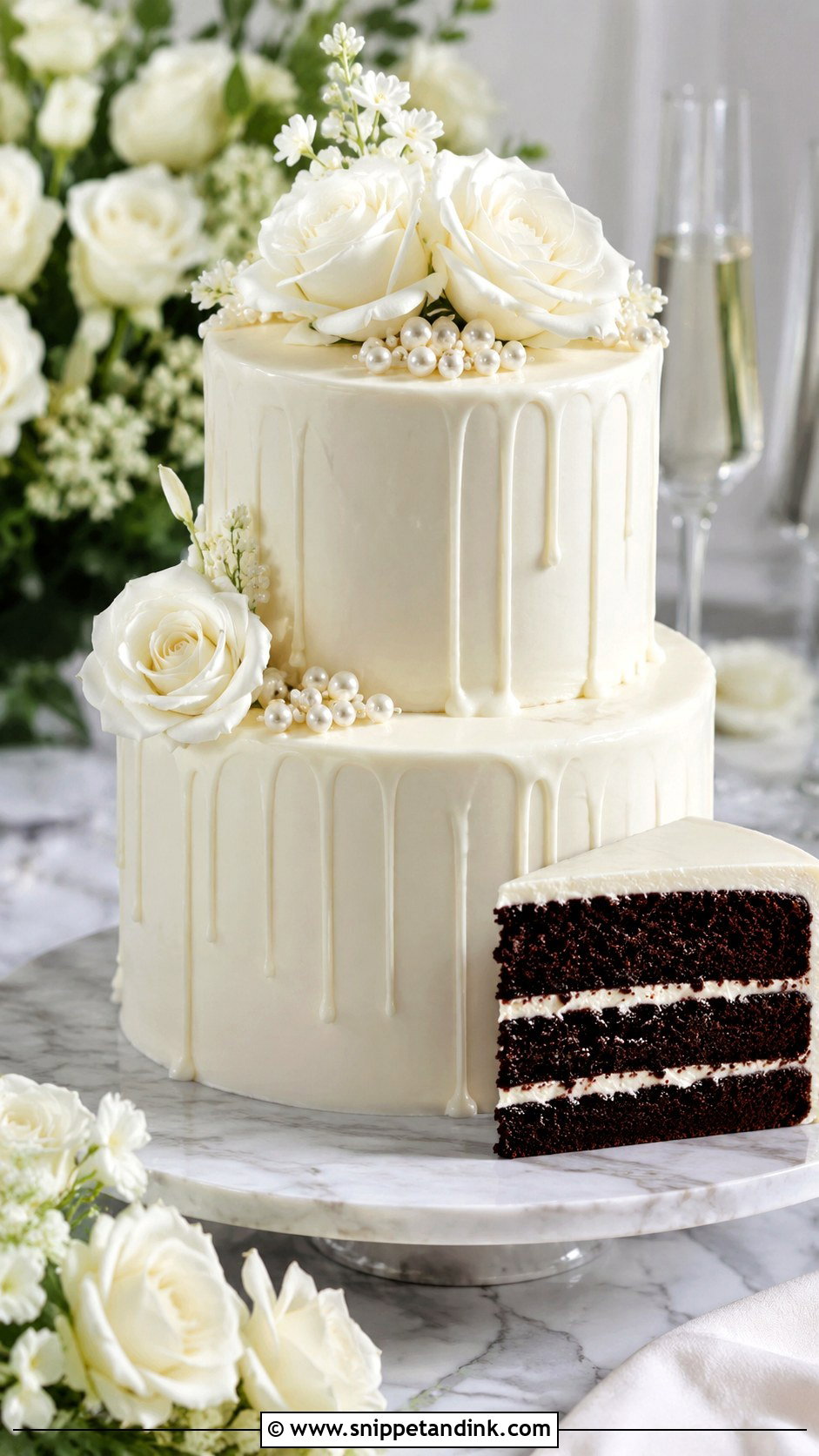
White chocolate ganache sets firmer than buttercream, which is why it gives such neat sides. It’s also softer than dark ganache, so I use more chocolate to cream in the ratio to make it hold. The flavour is sweet and creamy, and against dark chocolate sponge it rounds off the bitterness rather than hiding it. A satin finish, a few sugar roses and tiny pearls are plenty. I’d avoid it for an outdoor summer table, since white chocolate softens sooner than people expect.
4. Chocolate Wedding Cake With White Drip
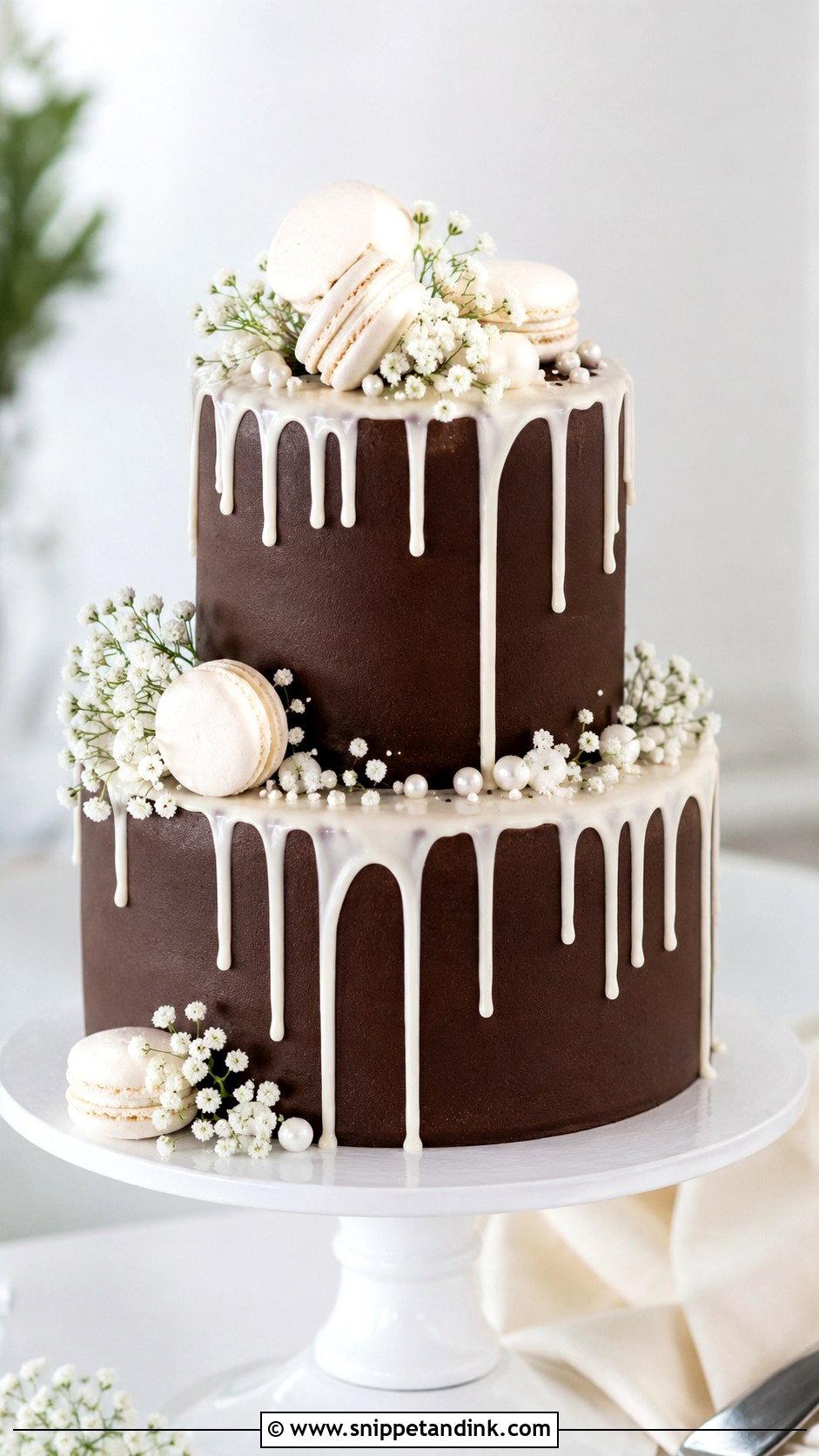
Drips only fall in clean lines when two things are right: the cake is cold and the ganache is just warm. Too hot and it runs to the board; too cool and it stops in fat blobs halfway down. I test one drip at the back before going round. White ganache over chocolate-coated or white buttercream gives a neat modern look, and the slice shows strong contrast. Macarons, pearl sprinkles or a small flower cluster on top keep it wedding-ready. Thin, evenly spaced drips look formal; longer uneven ones feel looser.
5. Chocolate Wedding Cake With White Roses
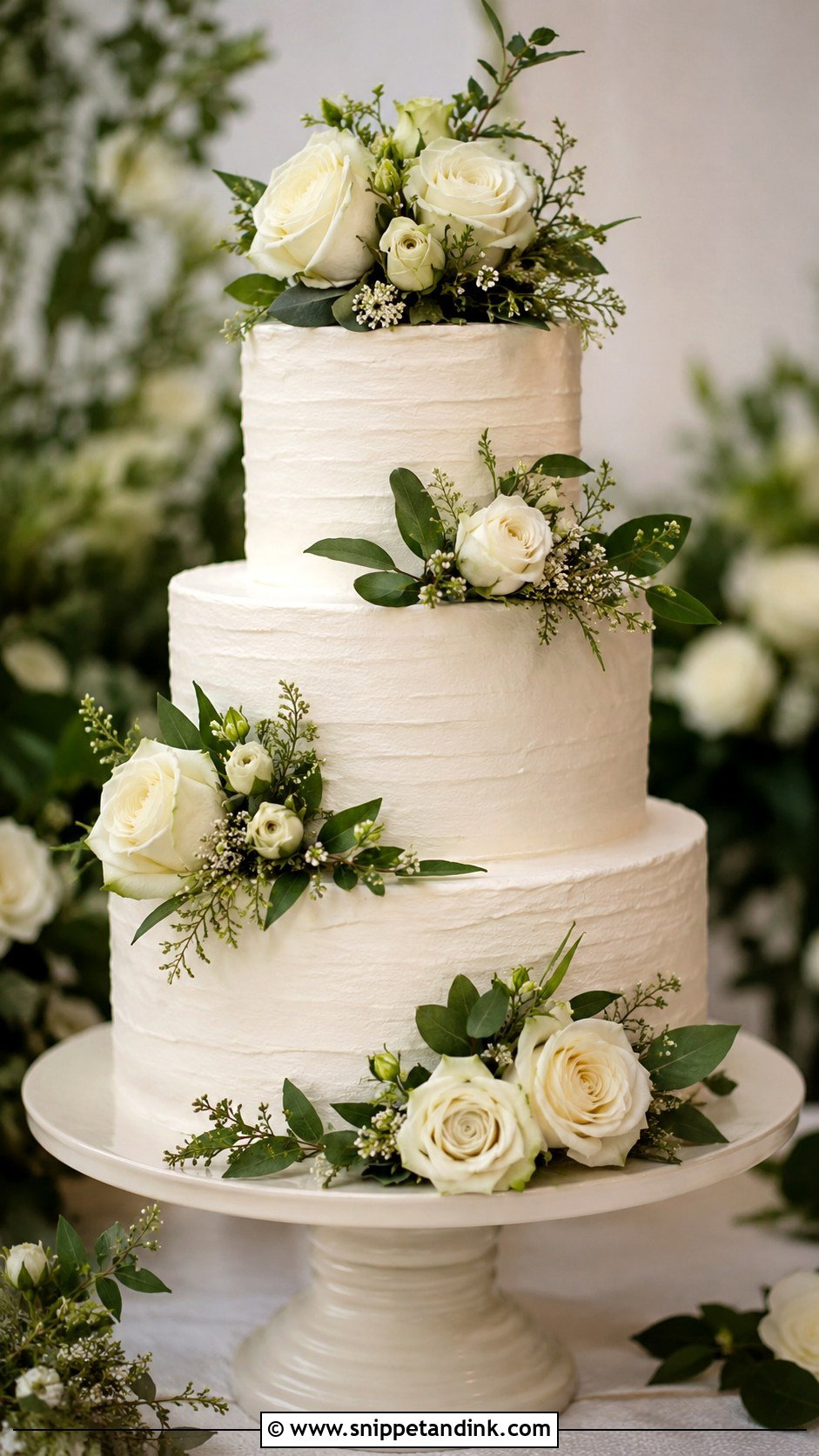
Roses suit almost any palette, which is why this design rarely dates. I can cover the cake in buttercream or fondant and then use fresh roses, sugar roses or piped buttercream roses. Fresh roses need to be pesticide-free and the stems wrapped or placed in a food-safe pick, never pushed bare into the cake. Larger blooms sit at the base, smaller ones between tiers. Leaves make it look garden-cut; all white keeps it soft.
6. Chocolate Wedding Cake With White Piping
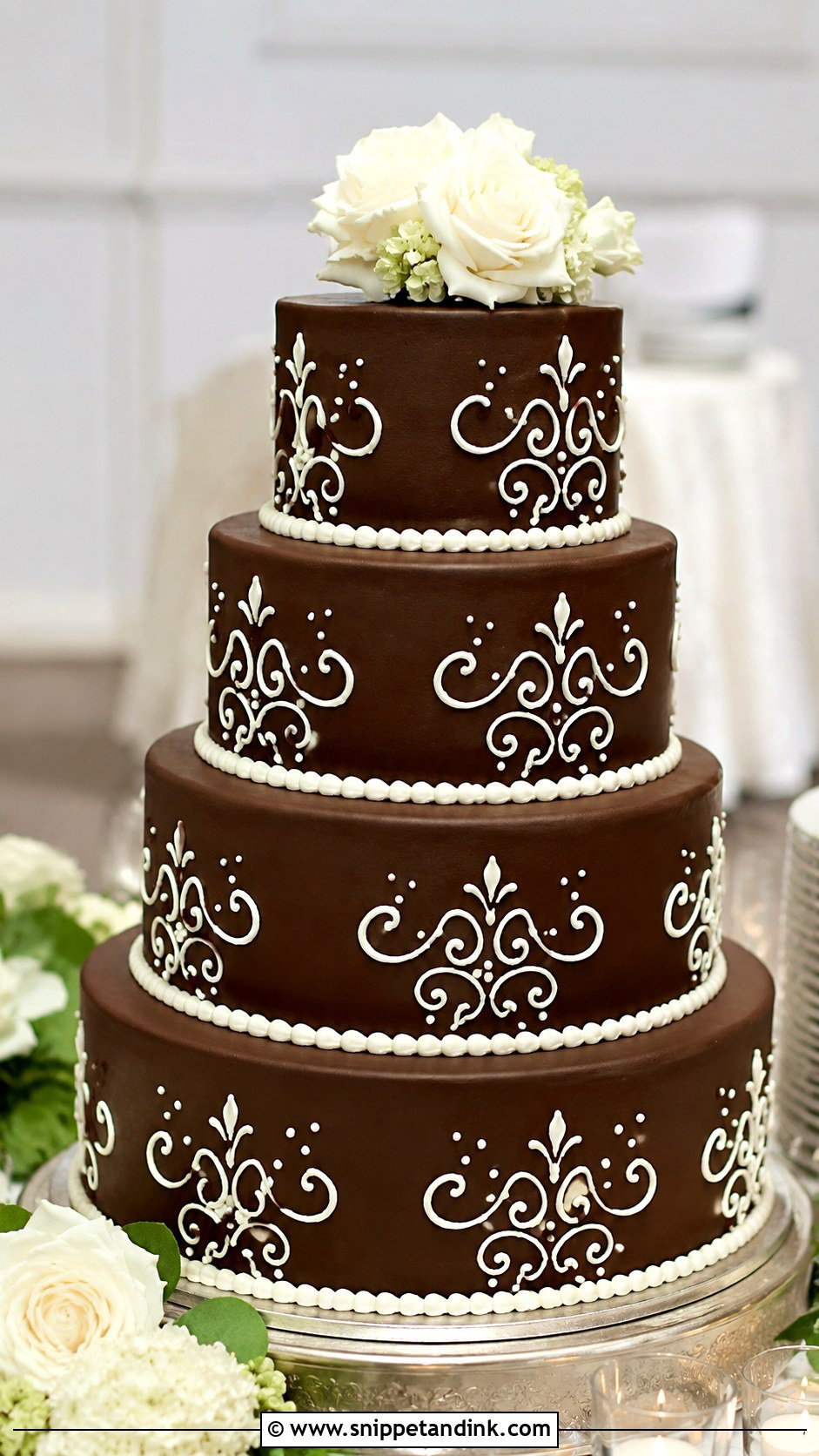
A chocolate wedding cake with white piping shows off old-fashioned skill, and the icing choice matters here. Royal icing holds fine lace and scrollwork crisply but dries hard; buttercream piping is softer to eat but rounder at the edges. Shell borders, dots, lace and piped flowers all read well on white. Because the inside is already rich, the outside doesn’t need much. I’d keep all the piping white and add pearl accents only if you want texture.
7. Chocolate Wedding Cake With White Sugar Flowers
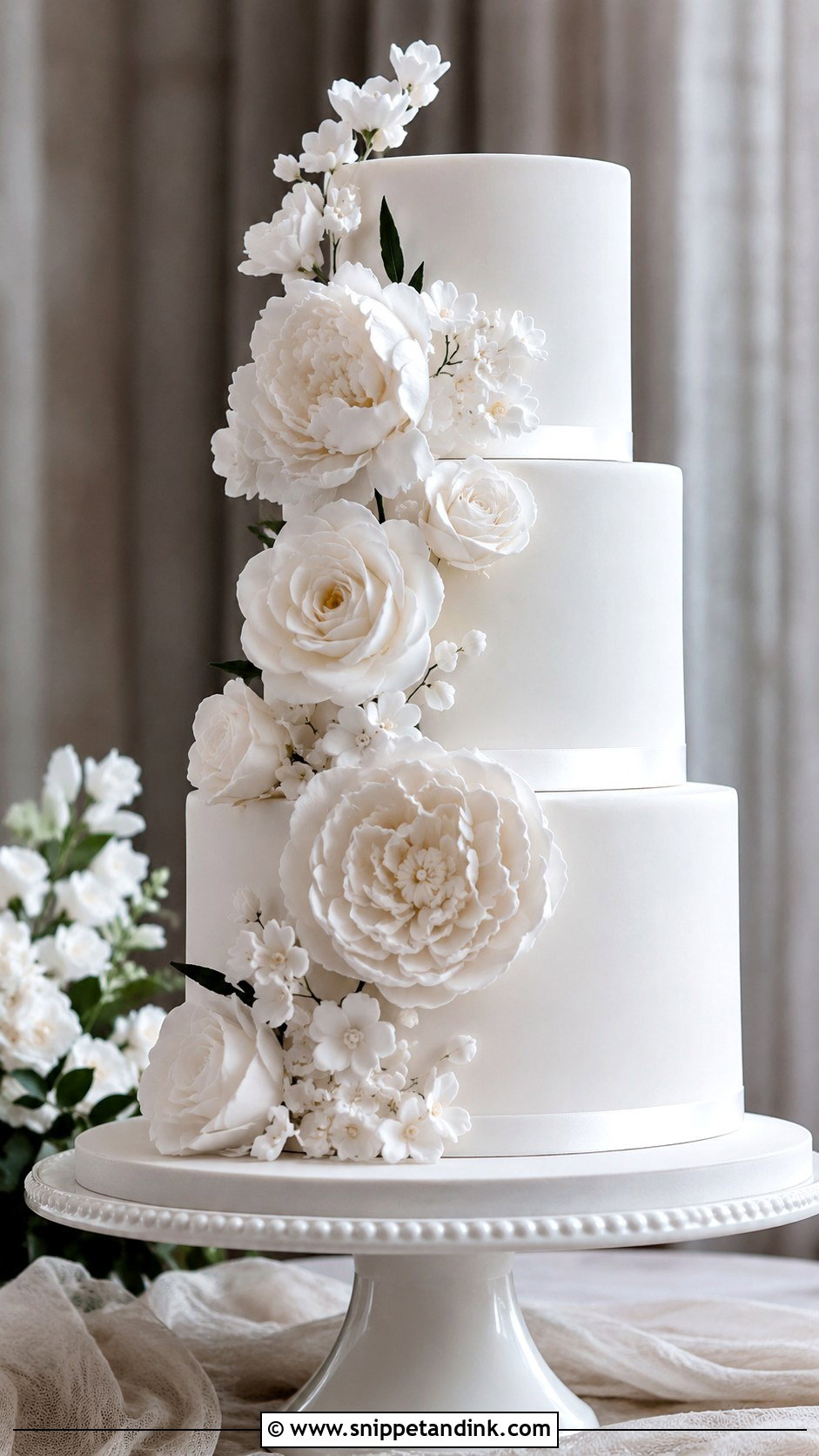
Sugar flowers are made petal by petal and dried for days, so they hold their shape through a long reception when fresh blooms might wilt. I can model roses, peonies, ranunculus, orchids or small blossoms, and match a shade or size the florist can’t source that week. Most contain wires and are meant to be lifted off and kept, not eaten. A cascade down the tiers gives drama; one cluster is cleaner. They’re usually among the bigger costs on a cake because of the hours involved.
8. Chocolate Wedding Cake With White Pearl Icing
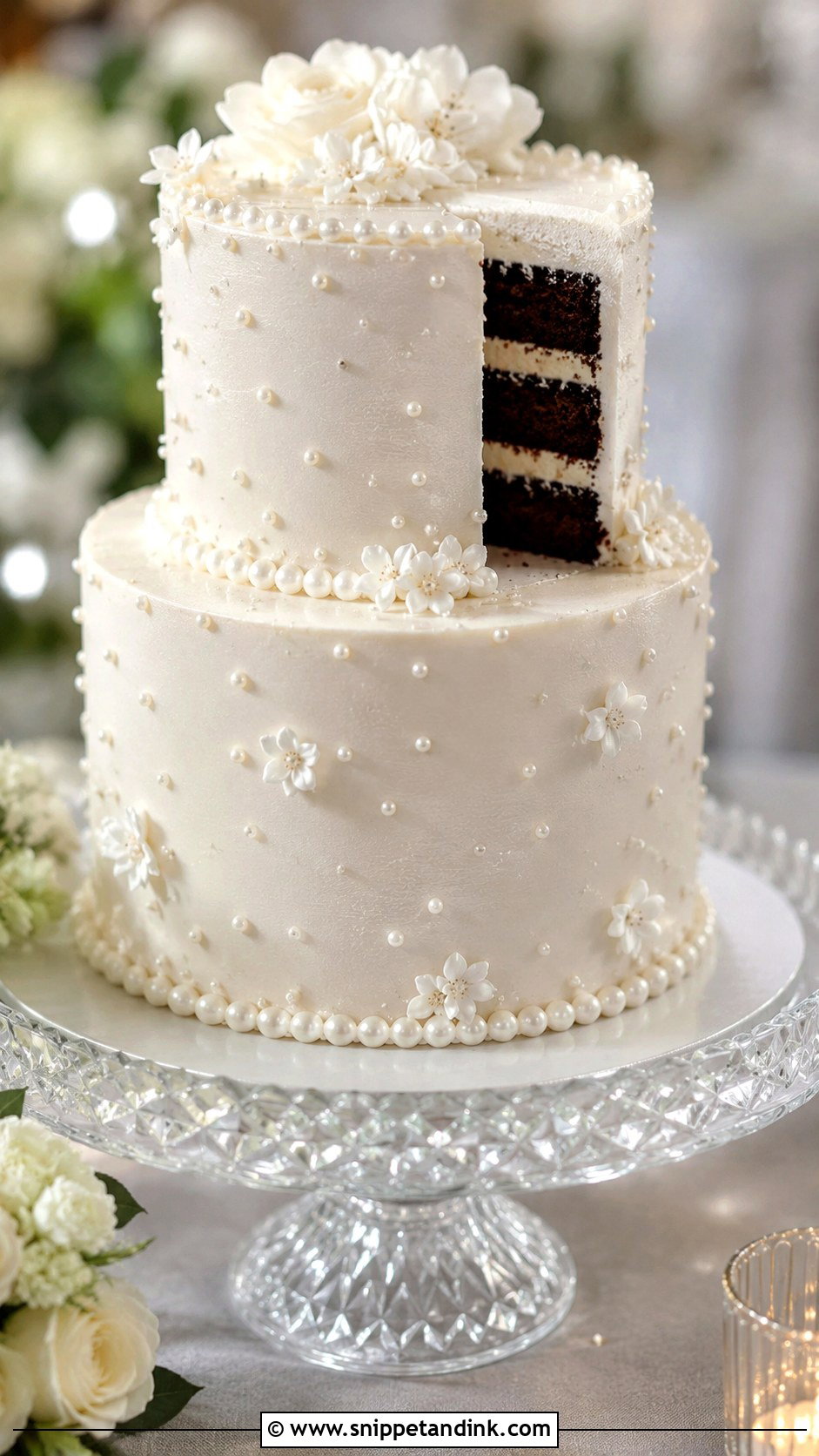
Pearls make a chocolate wedding cake with white pearl icing look formal in a very simple way. I make them from fondant or use edible sugar pearls, and the hard sugar ones can be a surprise to bite into, so I keep those to borders rather than the top surface. A row at each tier base, a light scatter or a full beaded panel all work. Smooth buttercream or fondant shows them clearly. The sheen is subtle, which suits a wedding table.
9. Chocolate Wedding Cake With White Lace Icing
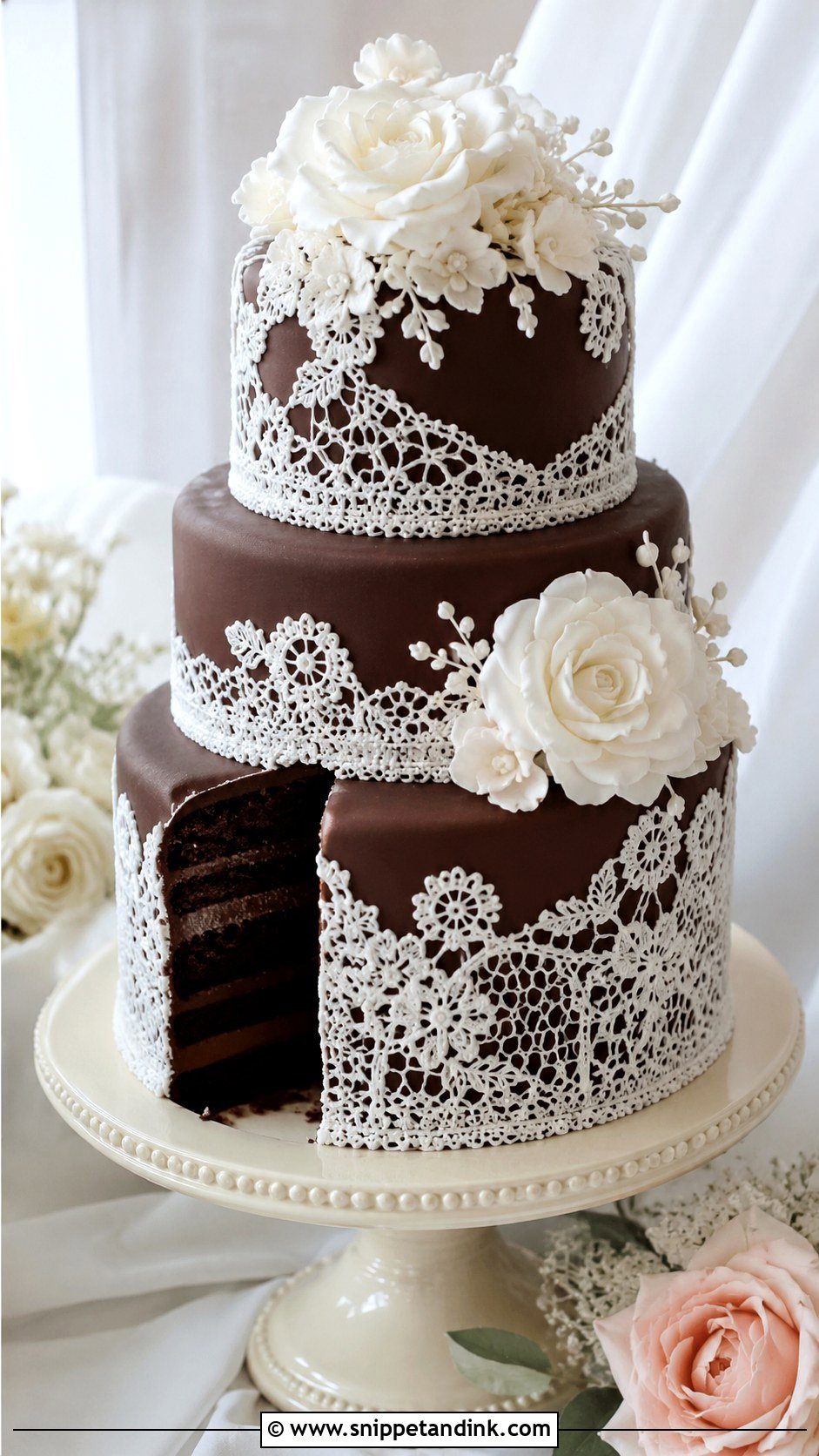
Lace can be piped in royal icing, pressed into fondant with a mould, or applied as an edible lace sheet, and each gives a slightly different depth. It needs a perfectly smooth base, since any bump shows through the pattern. Inside, chocolate with vanilla buttercream or white chocolate filling is warm and rich. Lace on every tier looks formal; on one tier it feels softer. Edible lace sheets can go limp in humidity, so I add them as late as possible.
10. Chocolate Wedding Cake With White Ruffle Icing
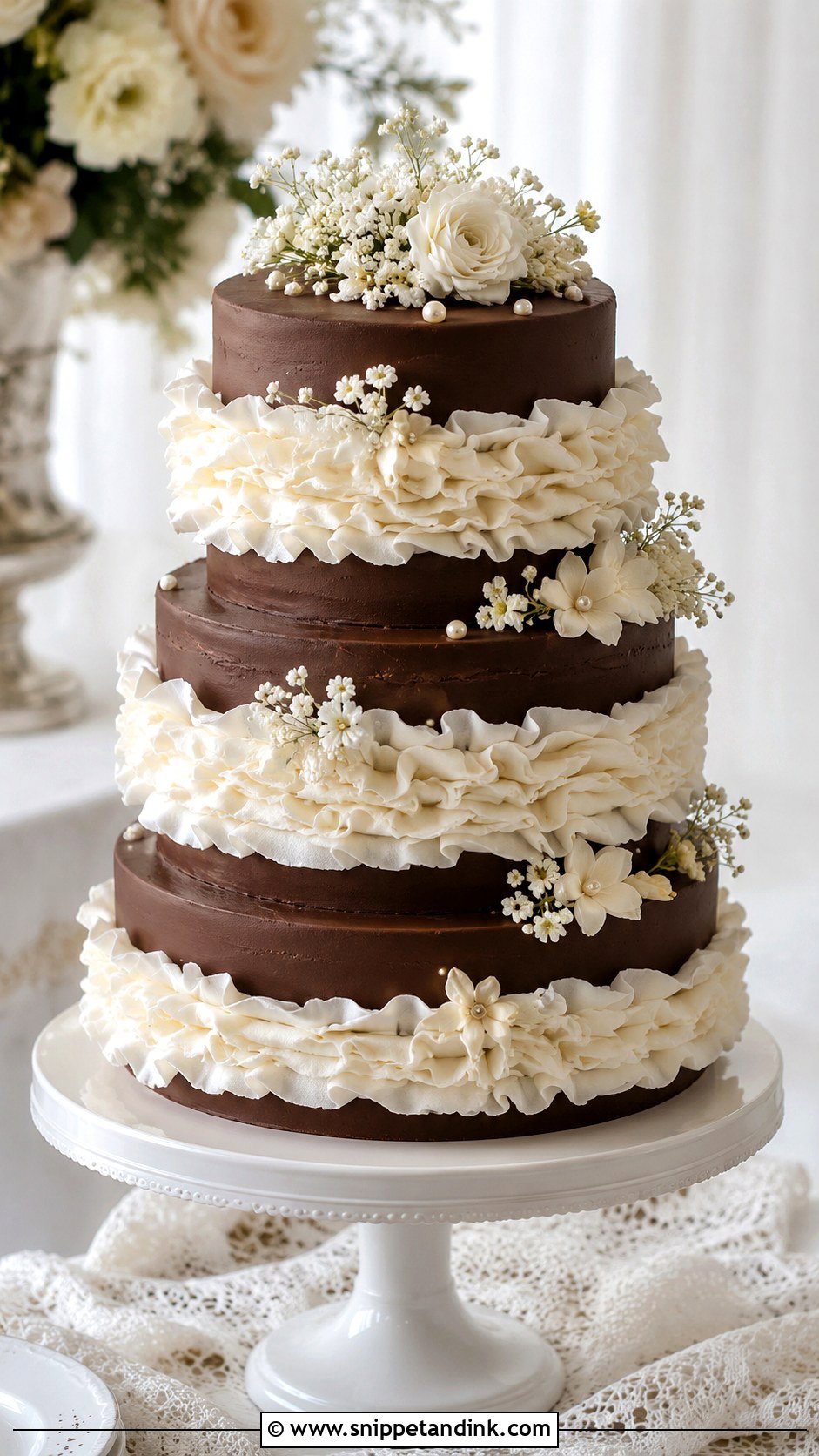
Ruffles are piped with a petal tip, row by row, and they add movement without colour. They also forgive: small dents and air bubbles hide inside the folds, which makes this practical for buttercream. Horizontal rows, vertical waves or loose petal shapes all look different, so I’ll pipe a sample at the tasting. A smooth top tier gives contrast; ruffles all over are dramatic. It uses a lot more icing, so the ratio of icing to chocolate cake goes up in every slice.
11. Chocolate Wedding Cake With White Ombre Icing
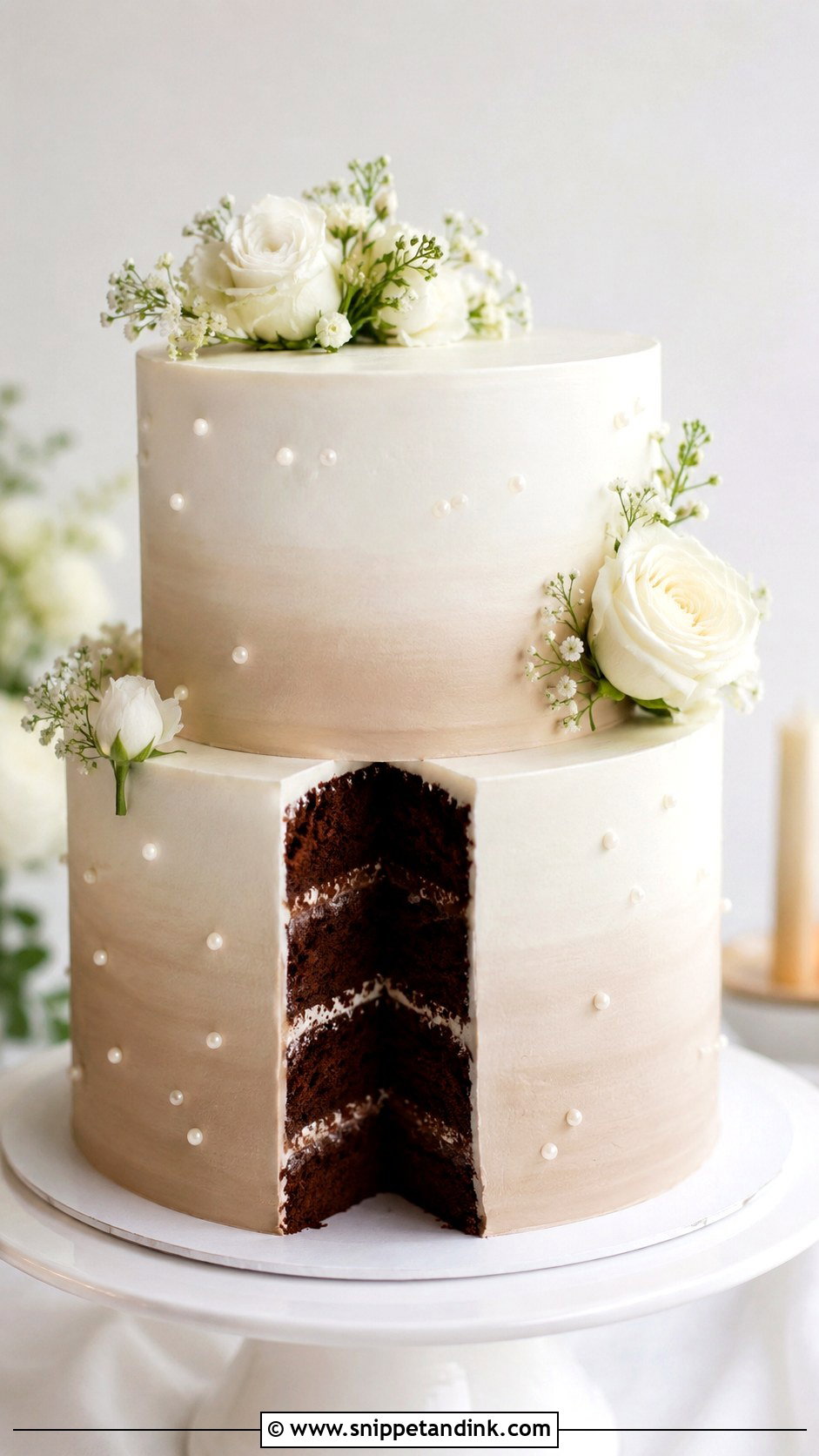
This is a quiet gradient: white at the top fading to cream, ivory or a very pale cocoa near the base. I blend it in buttercream with a bench scraper while it’s still soft. The effect is subtle in person and needs good light to read in photos, so I’d keep the steps between shades visible rather than too gentle. Inside, the chocolate gives the strongest contrast of all when sliced. White flowers, pearl dots or a plain topper finish it.
12. Chocolate Wedding Cake With White Semi Naked Icing
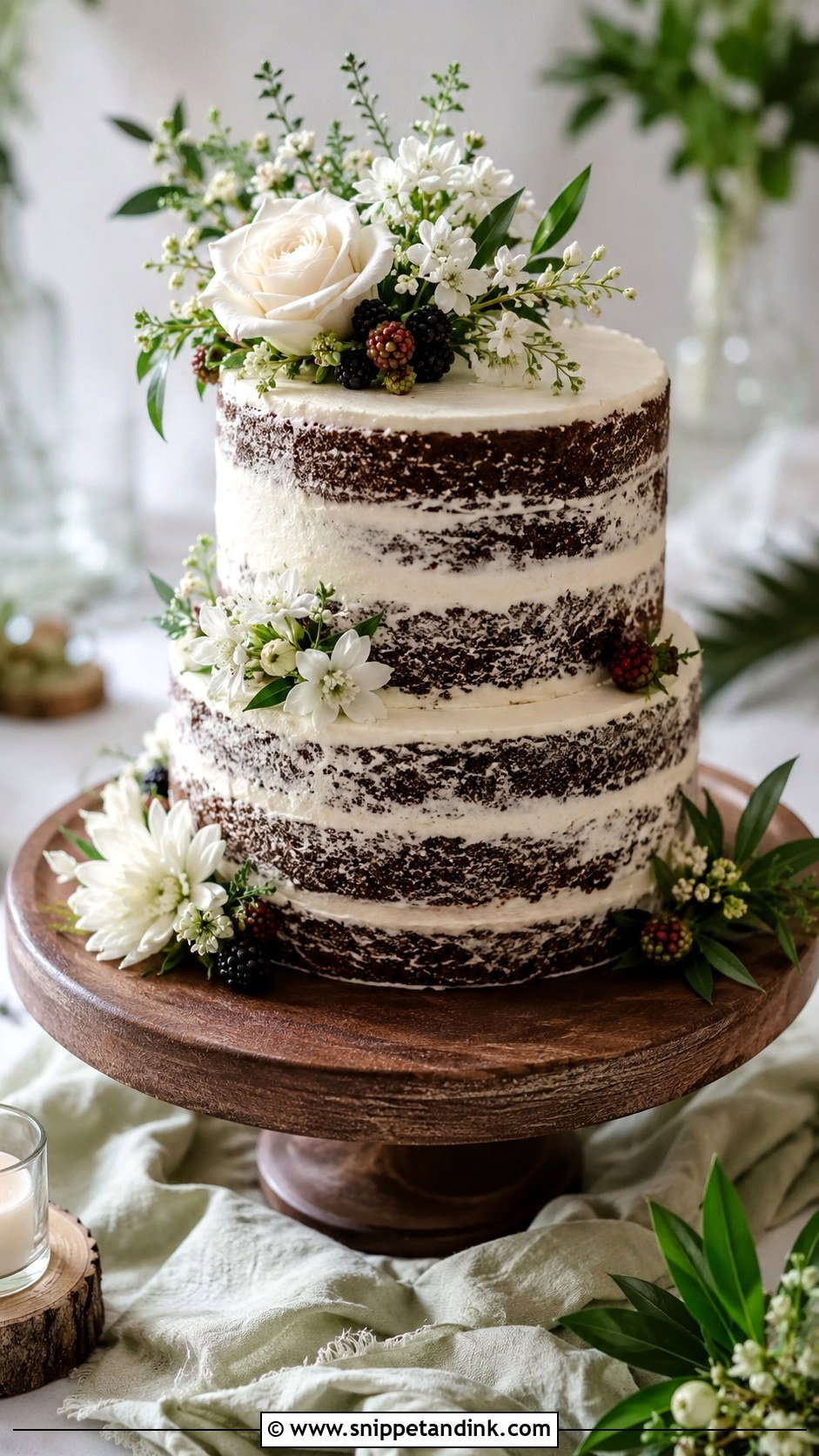
Semi-naked means a thin scrape of white buttercream with chocolate layers showing at the edges. It suits a garden, barn or backyard wedding, and the chocolate flavour stays front and centre. The trade-off is that less icing means less protection, so the sponge dries faster in open air. I assemble it as close to delivery as I can and brush the layers with syrup. Flowers, berries or greenery finish it; a dusting of icing sugar softens it further. The balance I look for is enough white to feel bridal and enough cake showing to feel rustic.
13. Chocolate Wedding Cake With White Floral Cascade
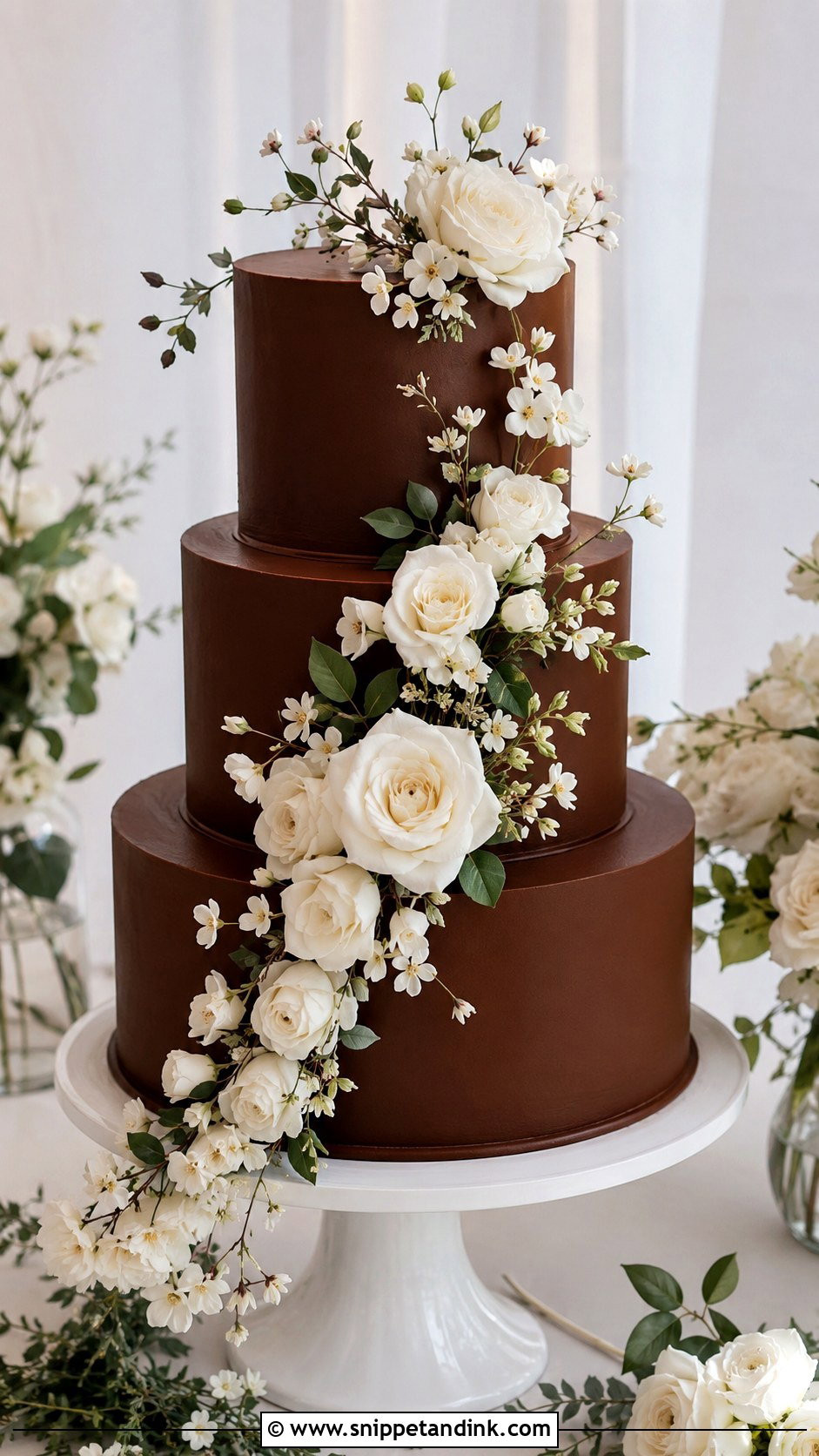
A floral cascade gives the dessert table its focal point, and it needs height to travel, so I’d plan two tiers at the very least. The cake stays smooth while fresh flowers, sugar flowers or wafer paper flowers flow down one side. Fresh is cheapest but must be placed by someone who knows which blooms are safe near food; wafer paper is light and holds up in heat. I tuck small fillers and leaves in for depth and leave plenty of white showing.
14. Chocolate Wedding Cake With White Macarons
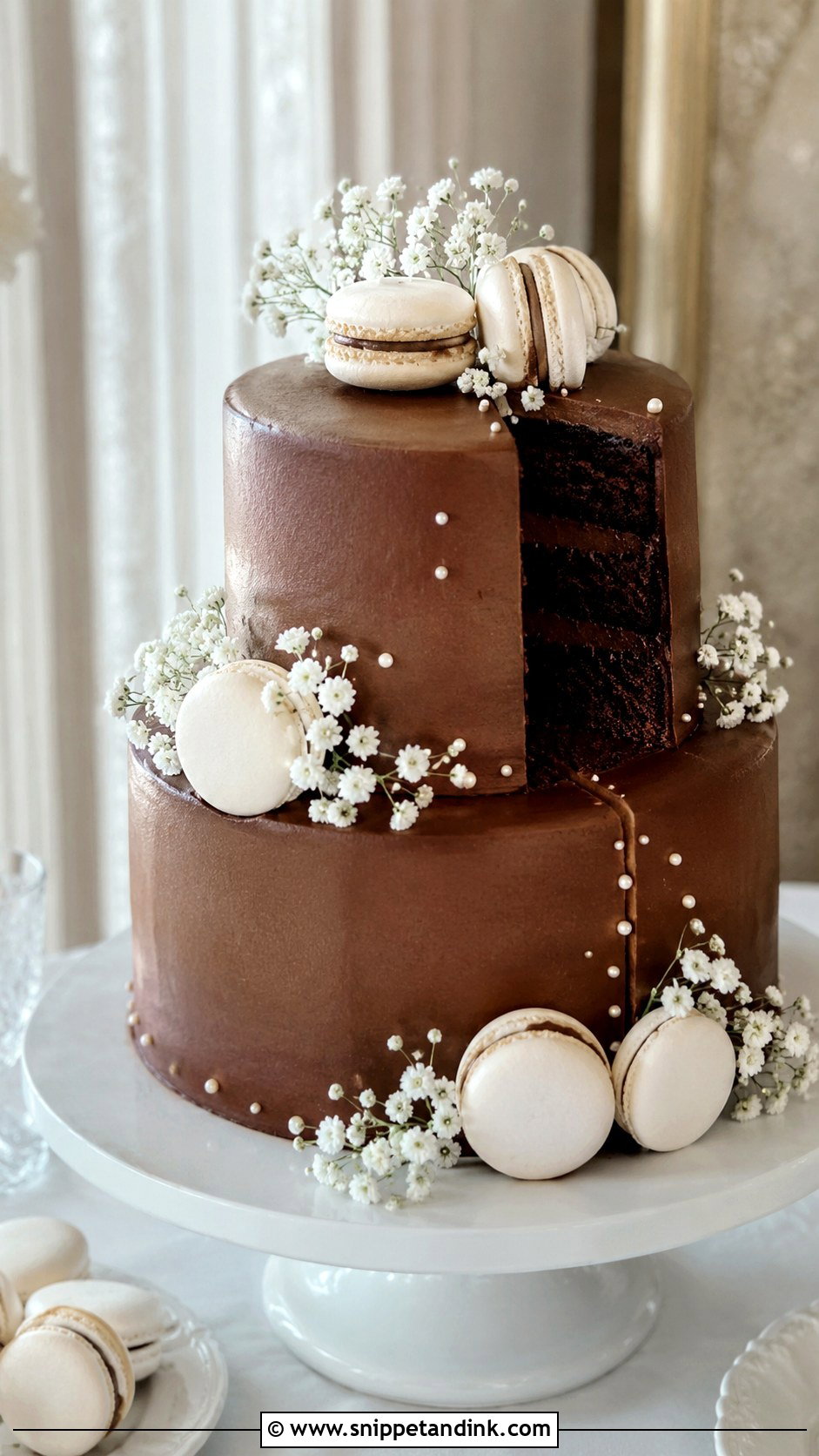
Macarons add round texture, and white shells blend into buttercream or fondant. They can sit on top, follow the edge of each tier, or be grouped with flowers and pearls. Inside, chocolate cake pairs well with vanilla, white chocolate, espresso or raspberry. One thing I warn about: macarons soften once they touch damp buttercream for hours, so I attach them on site. Ordering extra for the dessert table ties the whole spread together.
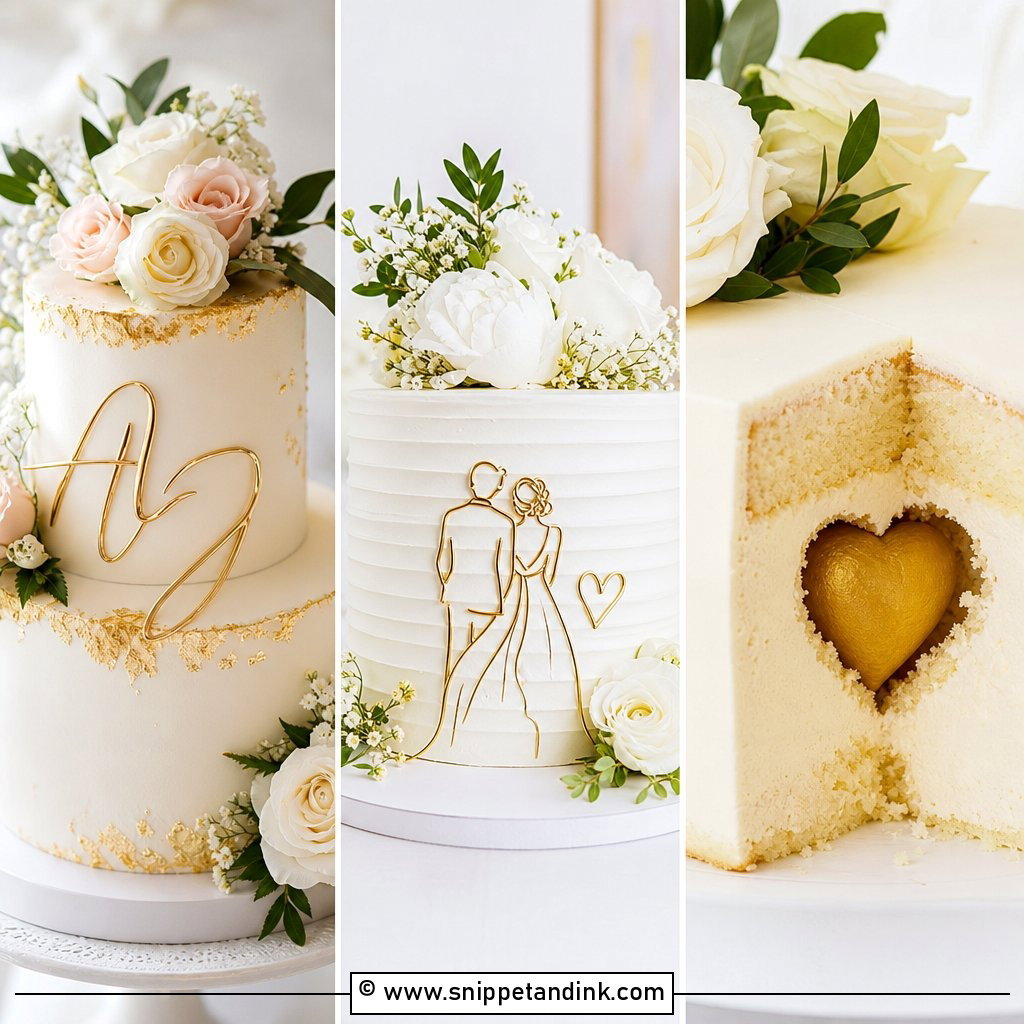
15. Chocolate Wedding Cake With White Bow
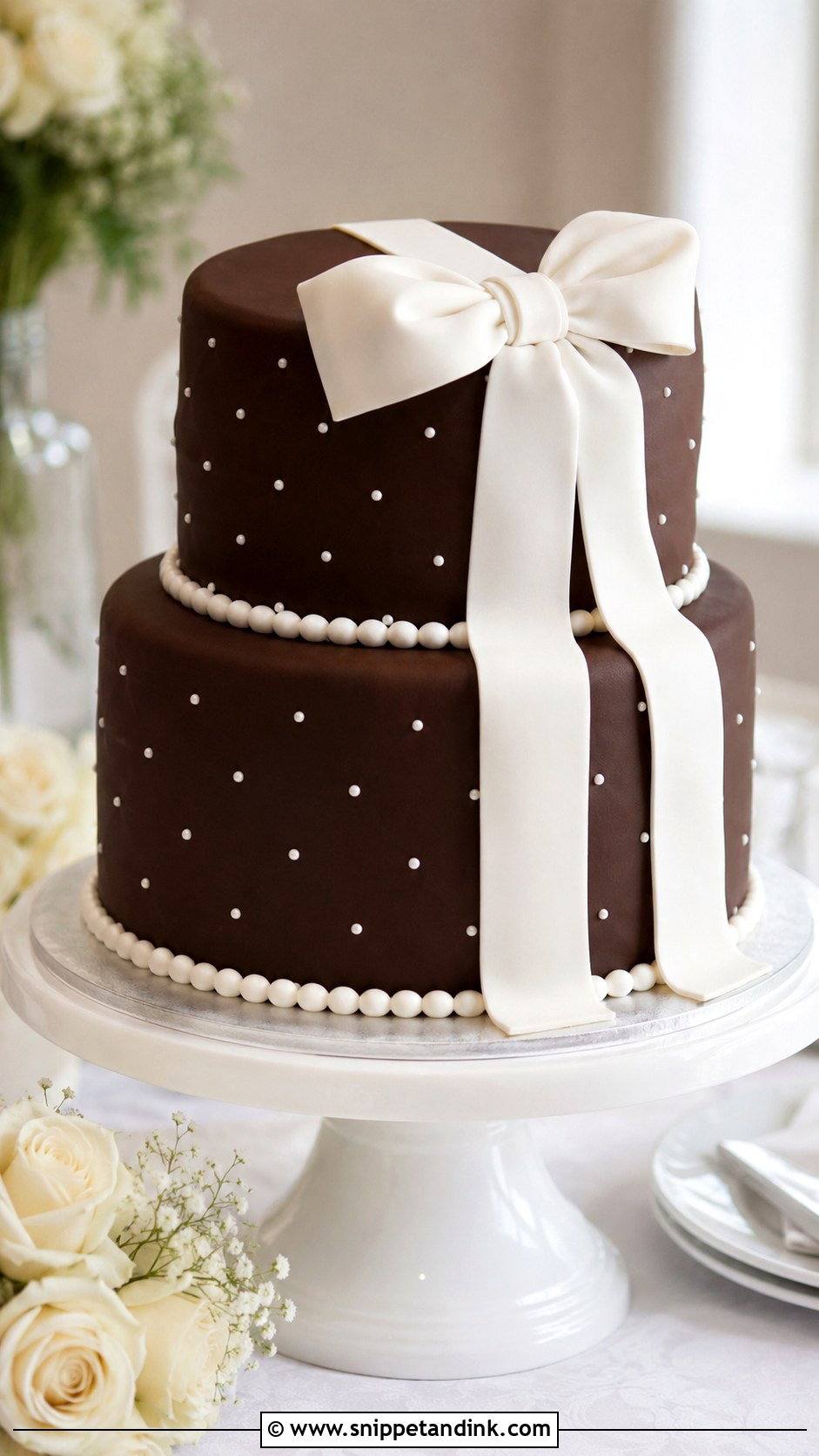
A bow is one of the simplest ways to dress a white cake. I make it from fondant or modelling chocolate when it needs to hold its loops, use real ribbon when you want a fabric look (with a barrier strip so grease doesn’t seep through), or pipe it in buttercream for a softer shape. One big bow on a single tier looks like a wrapped gift; small ones round each tier are gentler. Keep the sides smooth and the flowers minimal so the bow stays the main detail.
16. Chocolate Wedding Cake With White Texture Icing
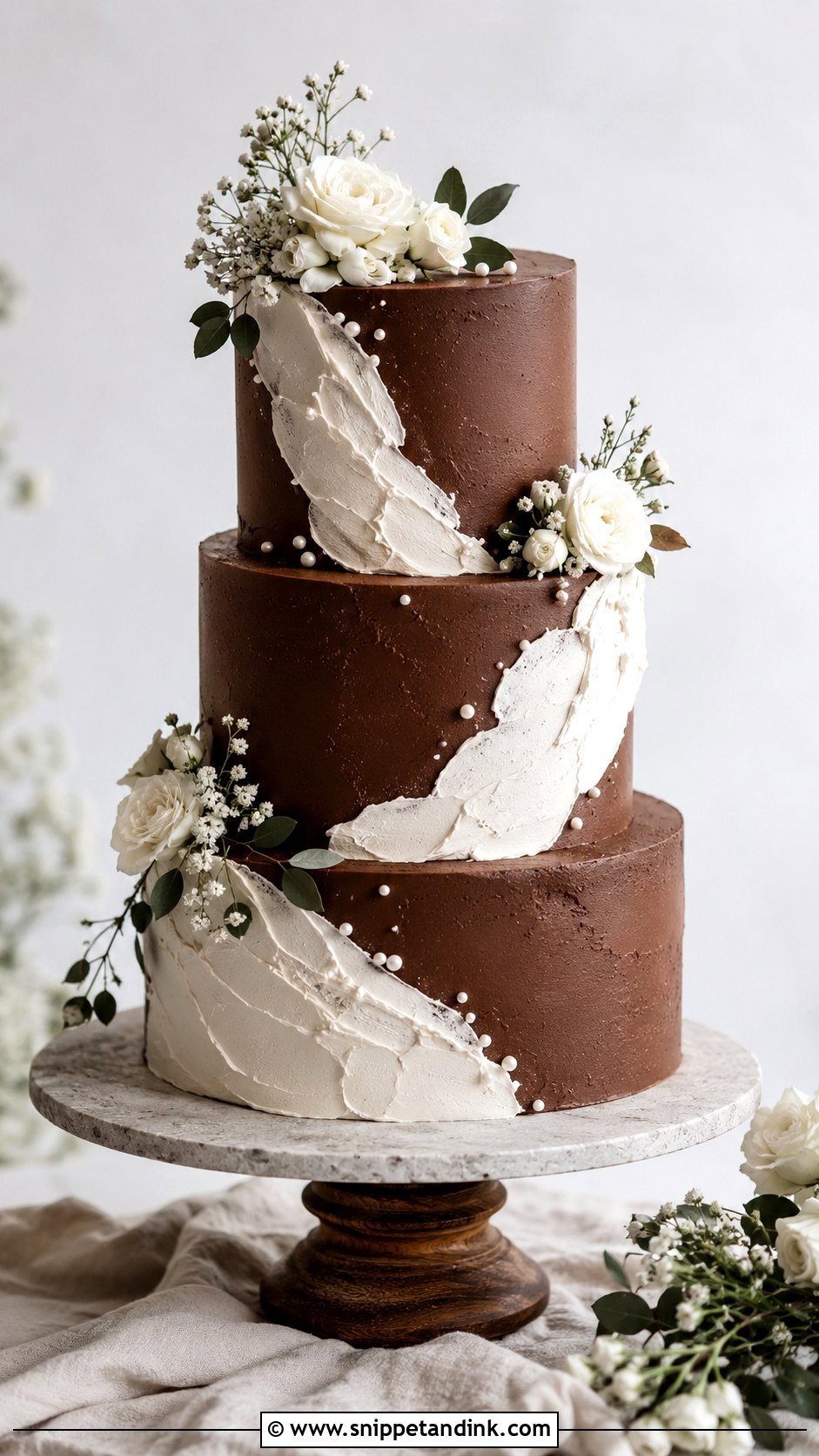
Texture with a palette knife, comb or spatula is the most forgiving finish I make. Ridges, stucco swirls or soft horizontal lines look handmade and warm, and the slight irregularity is the point. That’s why I often suggest it for home bakers making a family wedding cake. White flowers make it romantic; plain suits a minimalist reception. Chocolate sponge underneath keeps the inside bold.
17. Chocolate Wedding Cake With White Tiered Icing
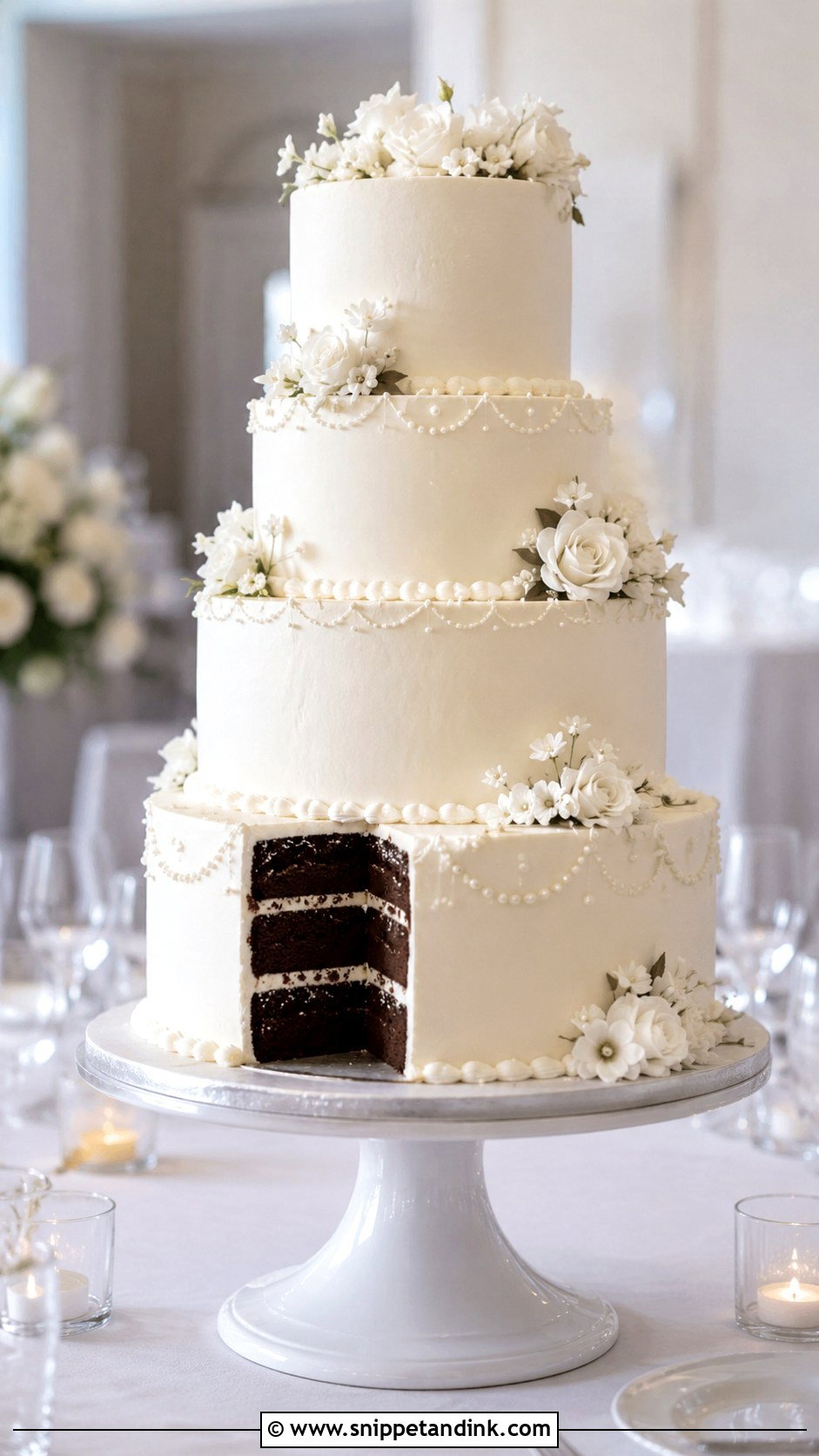
A chocolate wedding cake with white tiered icing gives you the classic stacked silhouette with a deeper flavour. Each tier can be chocolate, or you can mix it with vanilla bean, caramel, coconut or raspberry so guests get choices. Every tier above the base needs internal dowels and a cake board, because chocolate sponge with filling is heavy. Fully white outside matches any flowers and linens. Small borders, fresh blooms or pearl trim connect the tiers visually.
18. Chocolate Wedding Cake With White Square Icing
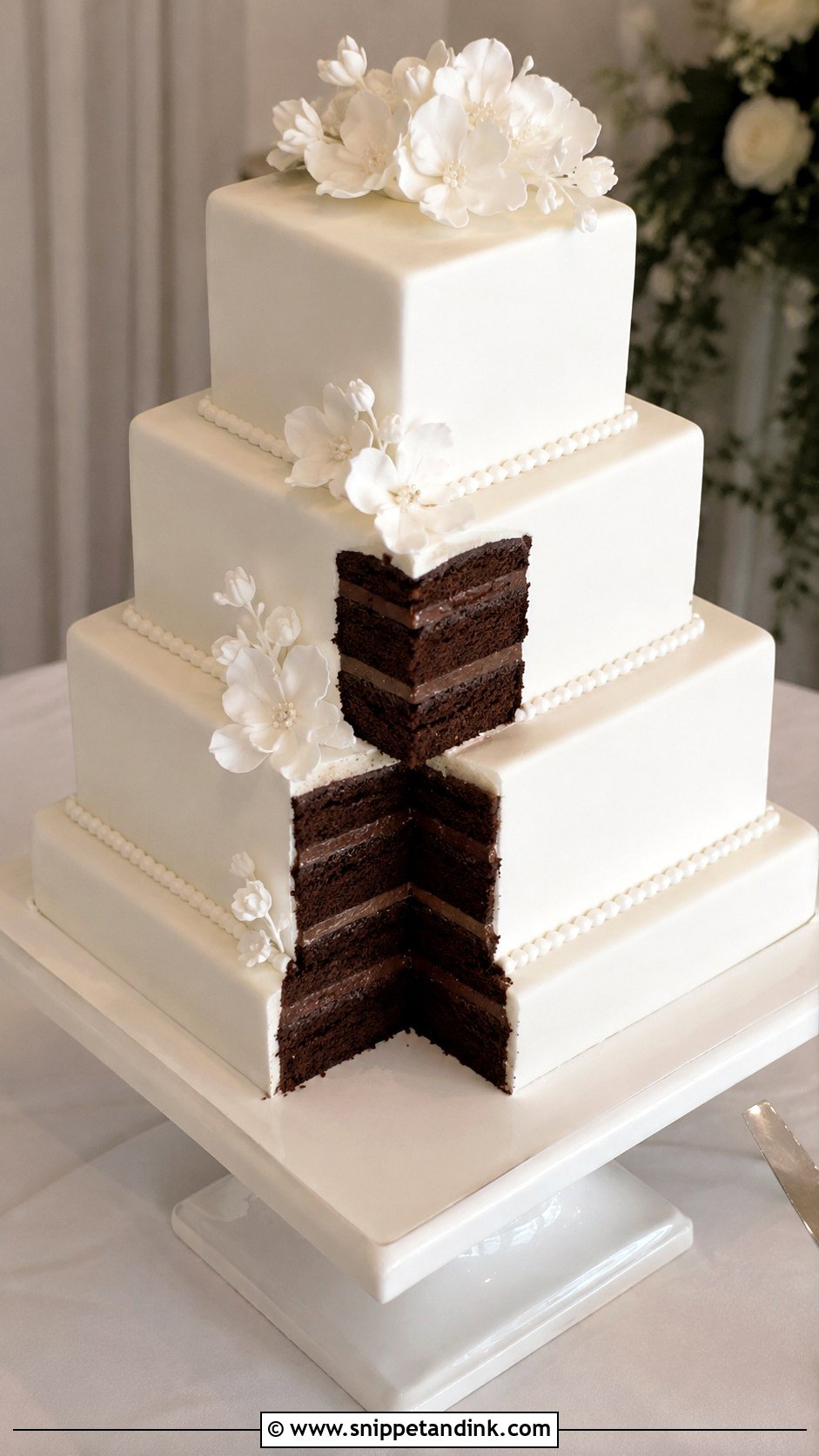
Square tiers look architectural and suit a formal venue. They’re also harder to ice than round ones: every corner shows if the coat is uneven, so I prefer fondant over ganache or a very firm buttercream. The good news is that a square tier gives more servings than a round one of the same width. Thin white piping, small sugar flowers or a ribbon-style band around each tier is enough. Stacking slightly off-centre gives a modern twist.
19. Chocolate Wedding Cake With White Cupcake Tower
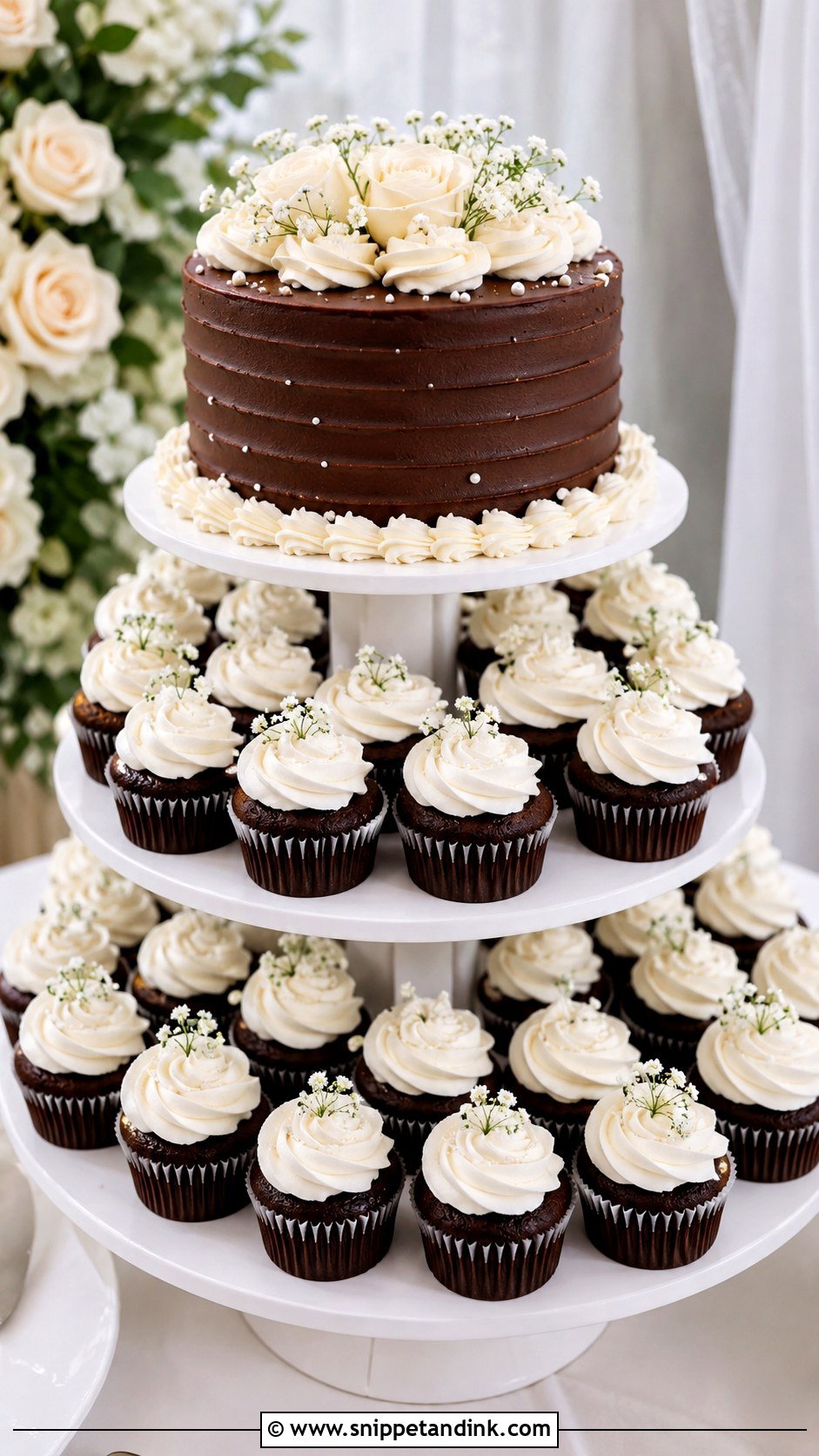
A chocolate wedding cake with white cupcake tower keeps a small cutting cake on top for the photo and puts the servings below. Chocolate cupcakes with white buttercream swirls fill the tiers, with tiny pearls or mini flowers to match the main cake. It makes portions simple and lets you offer a few fillings for mixed tastes. The catch is that cupcakes are fully exposed, so on a warm day the buttercream swirls soften quickly. I’d keep the tower in the shade.
20. Chocolate Wedding Cake With White Mini Cakes
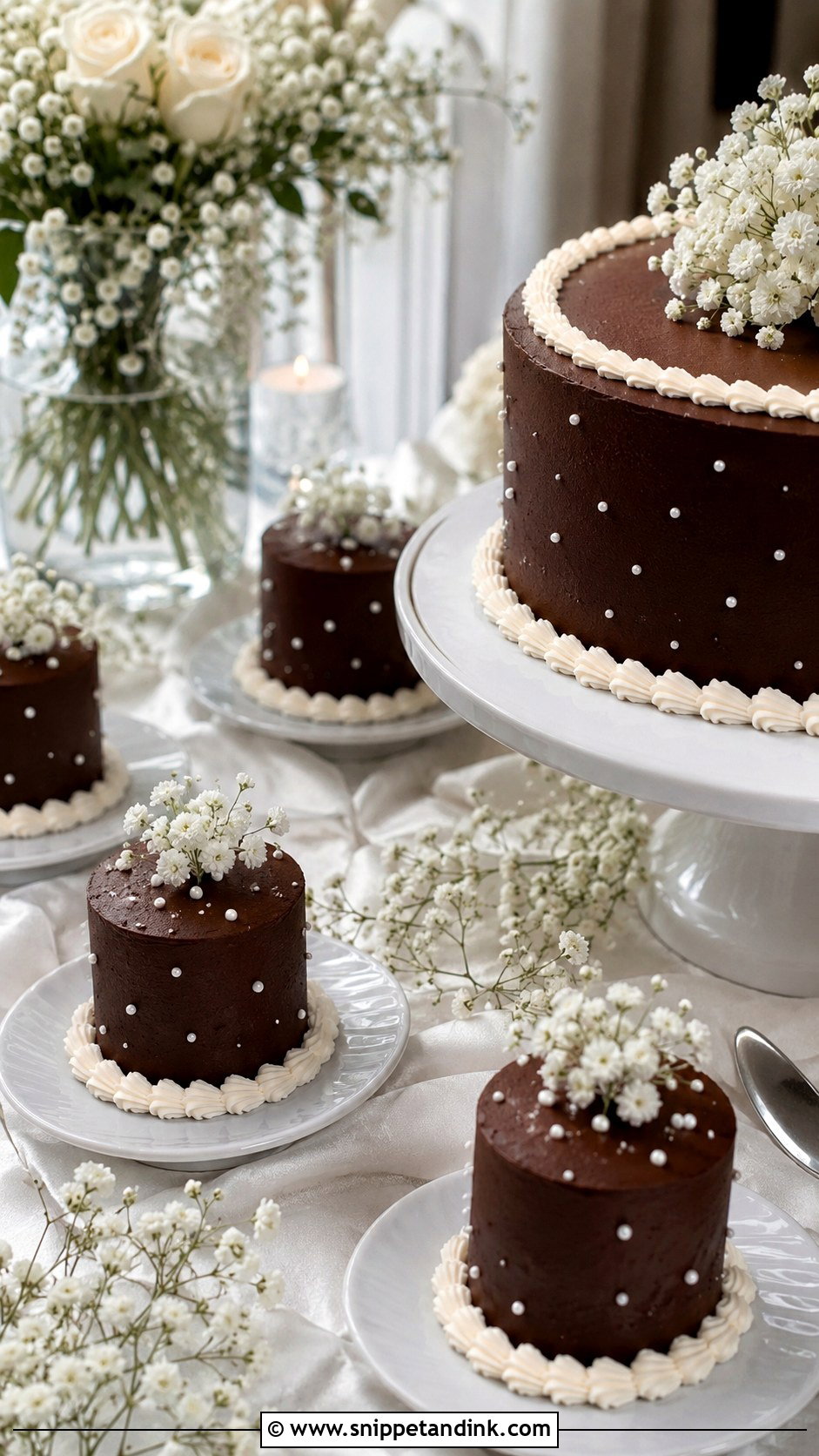
Chocolate wedding cake with white mini cakes suits an intimate reception or plated dessert service. Each guest gets a small chocolate cake in white icing with a flower, pearl or piped detail, and one larger display cake can still stand for photos. Minis are much more labour-intensive per serving than slicing a tiered cake, because every one is filled, coated and decorated individually. For a small guest list, though, nothing feels more personal.
Heat, the Delivery Van and the Hour Before Cutting
Most cake disasters happen between my kitchen and your cake table. A tiered cake travels chilled on a flat, non-slip surface with the air conditioning on, and the taller ones are often stacked on site. If your venue is outdoors or a marquee in summer, tell your baker early, because it changes what they’ll recommend.
- Buttercream starts to slump in a hot room and slides in direct sun. Ask for the cake table to be indoors or fully shaded and away from candles and heaters.
- Fondant over ganache handles warmth best, but coming out of a cold fridge into humid air it can sweat. That moisture dries off if nobody touches it.
- White chocolate ganache and drips soften sooner than dark chocolate ones.
- Fresh flowers wilt fastest of all; sugar and wafer paper flowers hold.
How Far Each Tier Goes When the Cake Is This Rich
Wedding portions are cut as narrow fingers rather than party wedges, and with chocolate sponge that’s usually welcome, since a thin slice is satisfying. I’d still order to your guest count rather than trimming it, because chocolate tends to disappear faster than other flavours. If you have guests who avoid gluten, dairy or nuts, ask whether a separate small cake can be made rather than adjusting the whole recipe, and make sure the caterer knows which tier is which.
The Slice Is Where This Cake Pays Off
White outside, chocolate inside gives you a traditional look and a flavour people remember. The outside can be smooth, textured, ruffled, piped, floral or modern, and the inside can stay simple or carry vanilla, white chocolate, raspberry, caramel or espresso. Think about the venue, the season, how many people you’re serving and how the cake will be lit. A cake doesn’t need to be complicated. It needs a coating that suits your weather, decoration that fits the room, and sponge you’d happily eat on an ordinary Tuesday.
You'll Like These Ideas:






Leave a Reply