
A plunging neckline is one of the few bridal details that depends almost entirely on engineering you never see. When I pull deep plunge wedding dress ideas for a client, I look past the V itself and check what is holding it: the boning, the cups, the strap angle and whether there is a mesh panel doing quiet work in the centre. Crepe shows every seam, lace forgives a little, and tulle needs a firm bodice underneath to carry it. Below are twenty gowns that handle the opening in different ways, from slim columns to full ball skirts, with notes on what each one asks of you at the fitting stage.
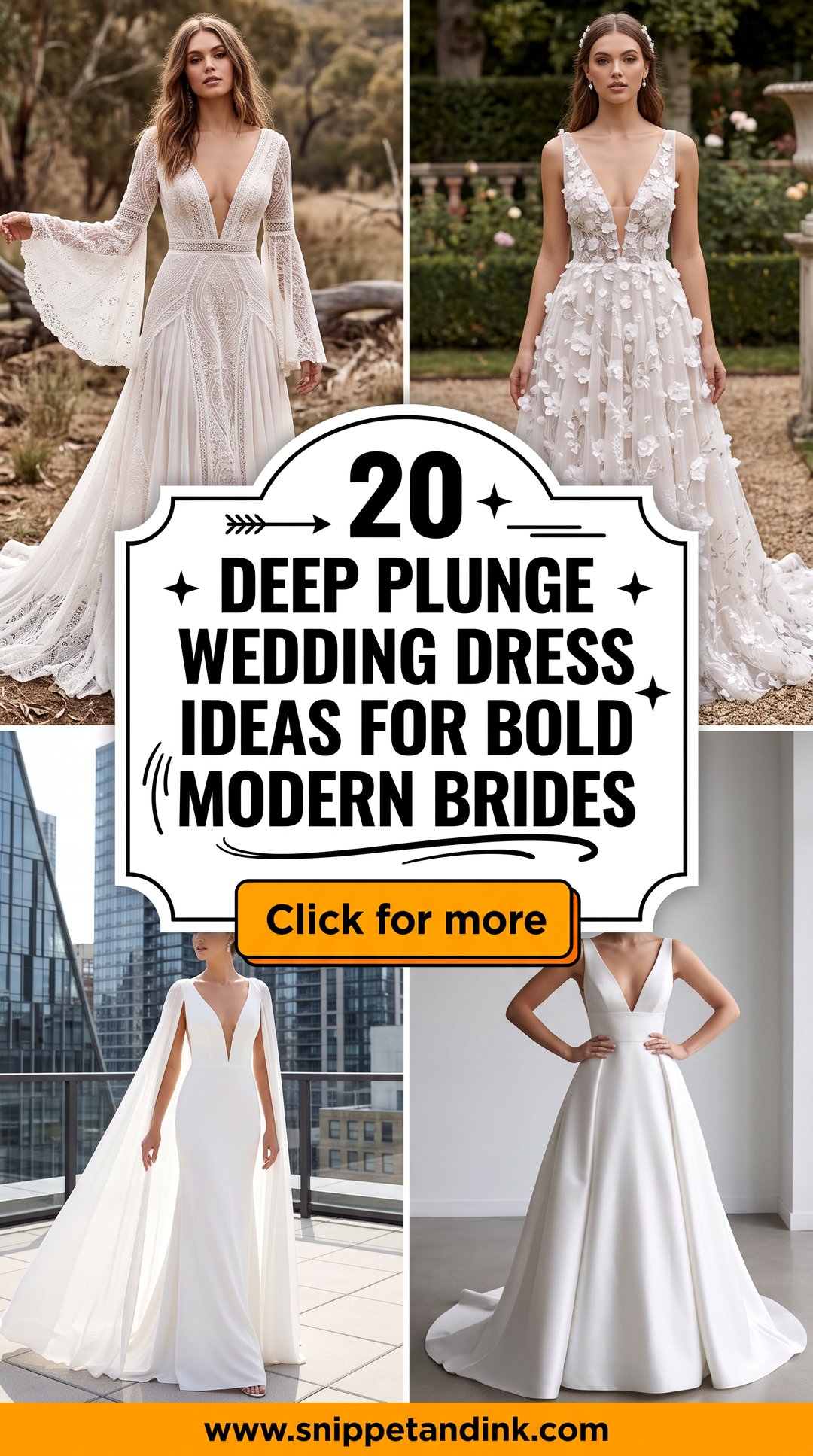
How Deep Is Too Deep for Your Frame?
The depth of a plunge is measured from the base of your throat to the point of the V, and the comfortable range is different for every body. On a smaller bust, a V can drop to the waist and still sit flat, because there is little for it to wrap around. On a fuller bust, the same depth leaves the fabric bridging open air, and it will gape the moment you lean forward. I start at the sample stage by pinning the point higher or lower with a clip at the back, so a bride can see the difference in the mirror before anything is cut.
What actually keeps a V in place is a combination of four things, and a well-made gown uses at least two of them:
- Spiral or flat boning running along each side of the opening, so the edges can’t roll outward.
- Cups sewn into the lining, which hold the bust in position instead of relying on the fabric.
- A strip of illusion mesh across the centre, which can be cut almost invisibly low.
- Straps set close to the neck rather than out at the shoulder point, since a wide strap angle pulls the V open.
Fashion tape is a backup, not a structure. It can lose grip on warm skin after a few hours of dancing, so I treat it as insurance for a dress that already fits.
1. Deep Plunge Lace Wedding Dress
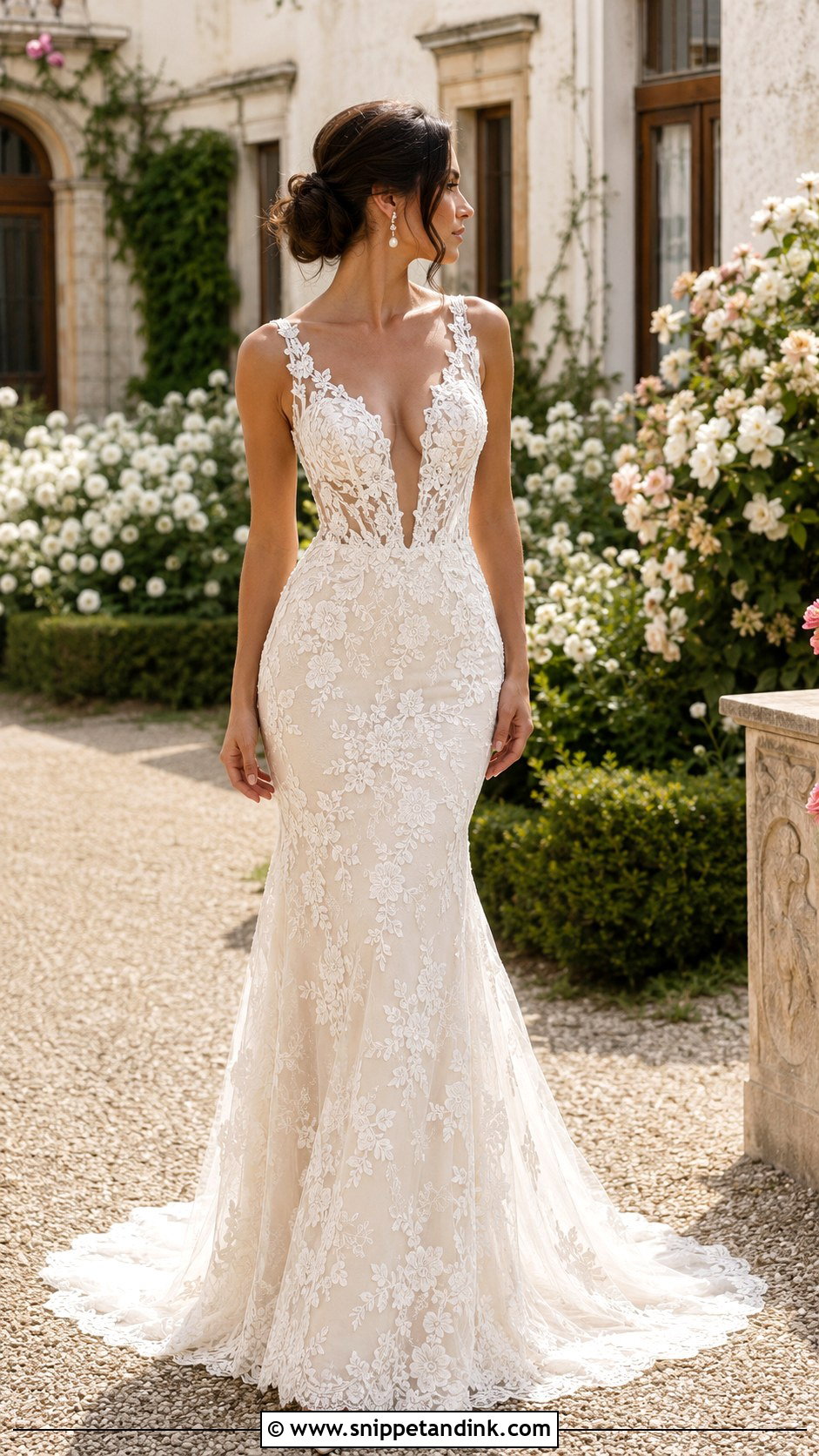
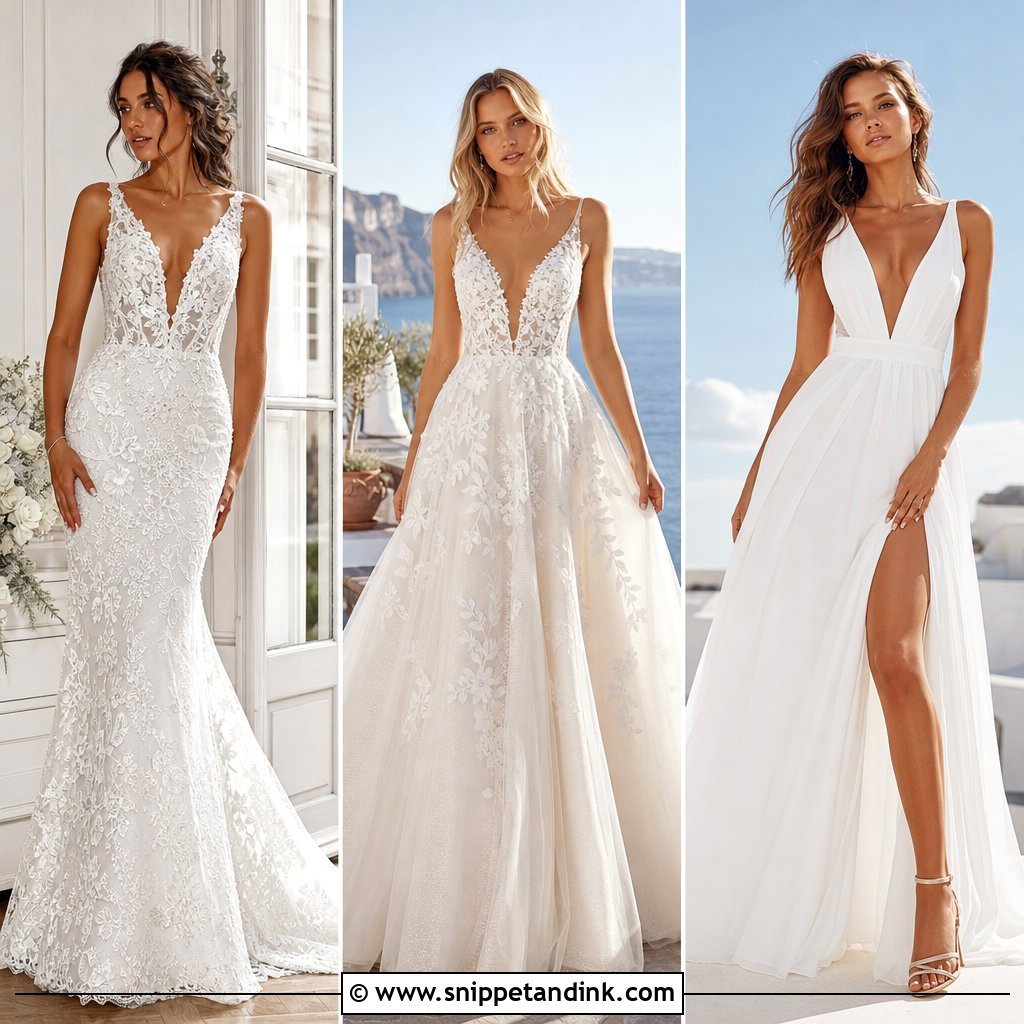
Lace is the easiest fabric to wear a deep V in, because the appliqués can be cut and stitched along the edge so the opening finishes on a motif instead of a raw line. I always ask the seamstress to tack those edge flowers down by hand; loose ones lift when you lean forward to sign the register. A sheer insert keeps the V open to the eye while stopping it from spreading. Pair it with a gently flared skirt, a chapel train, pearl drops and a low twisted bun, and leave the neck bare so the lace does the talking. Gardens and estate houses suit it best.
2. Deep Plunge Satin Wedding Dress
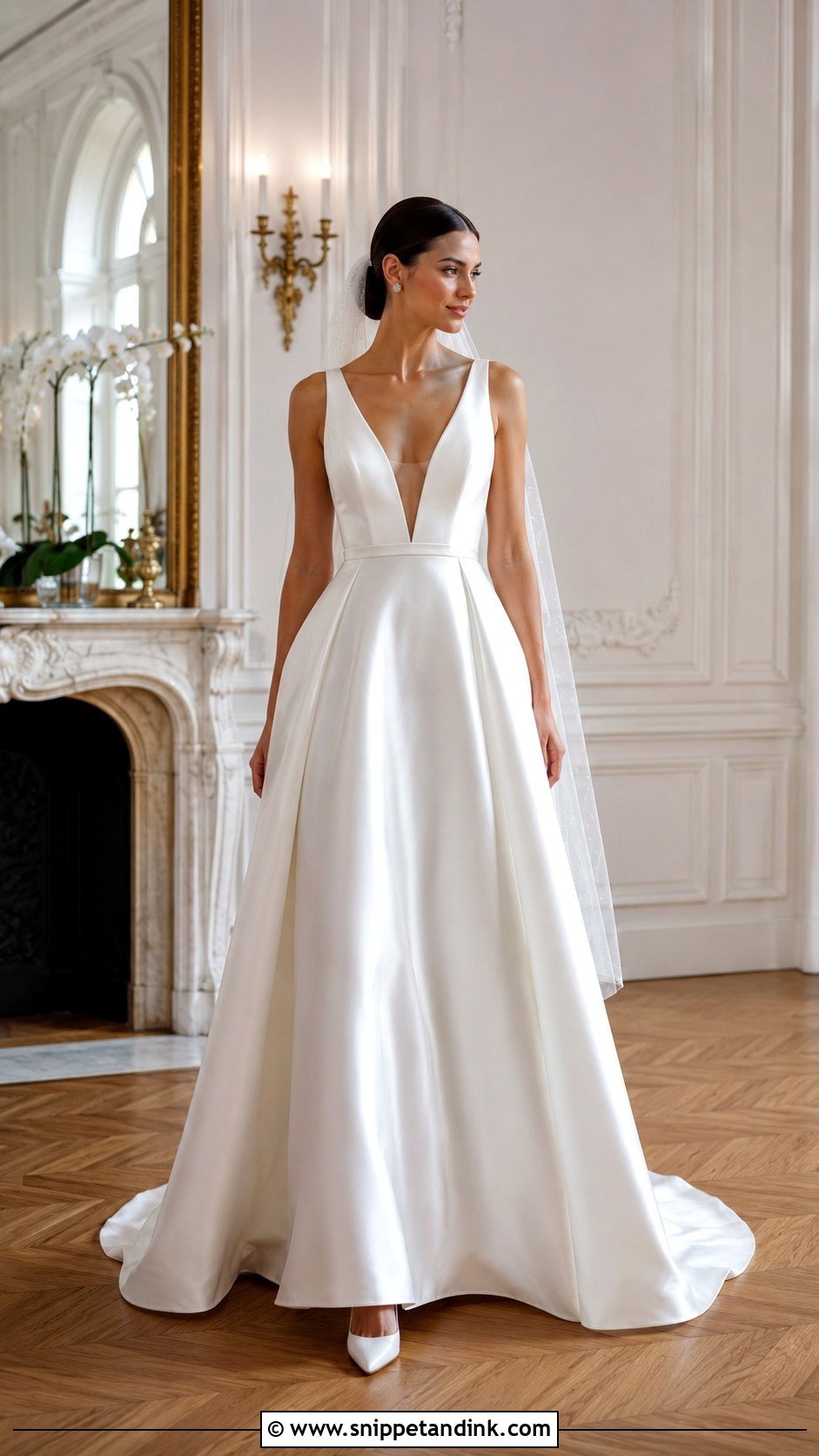
Smooth satin gives a deep plunge neckline real weight, which is exactly why it stays put better than lighter fabrics. The catch is that satin shows creases and any puckering at the point of the V, so I check that point first with the bride seated. Wide straps and an A-line skirt keep the gown balanced; pointed satin pumps, crystal studs and a sleek low bun are all it needs. A fingertip veil softens the ceremony without hiding the bodice for long. Ask for sewn-in cups and a skin-tone panel even if you think you won’t want them. They are easier to remove than to add later.
3. Deep Plunge Long Sleeve Wedding Dress
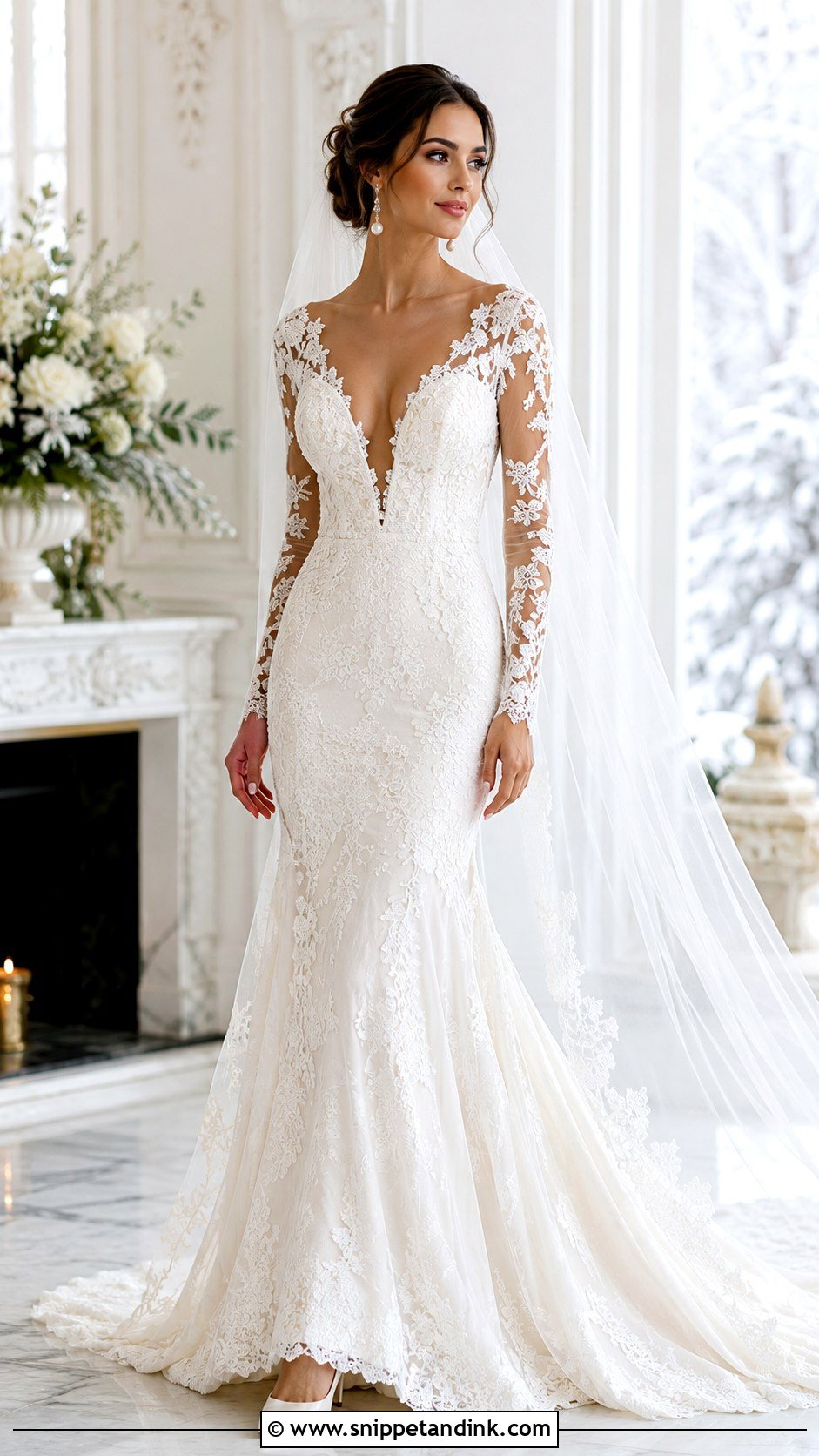
Sleeves do more than cover arms on a plunge gown. A well-set sleeve anchors the shoulder, and that stops the V from drifting outward when you hug people. Sheer lace sleeves over a structured bodice and a fit-and-flare skirt give the most contrast, with covered buttons at the cuffs and down the back. I’d pair it with a cathedral veil and a chignon sitting just under the comb. For a cold-month wedding, choose denser lace or a lined crepe skirt, and have the tailor check the sleeve head before anything else, because an arm that can’t lift will pull the whole neckline.
4. Deep Plunge A-Line Wedding Dress
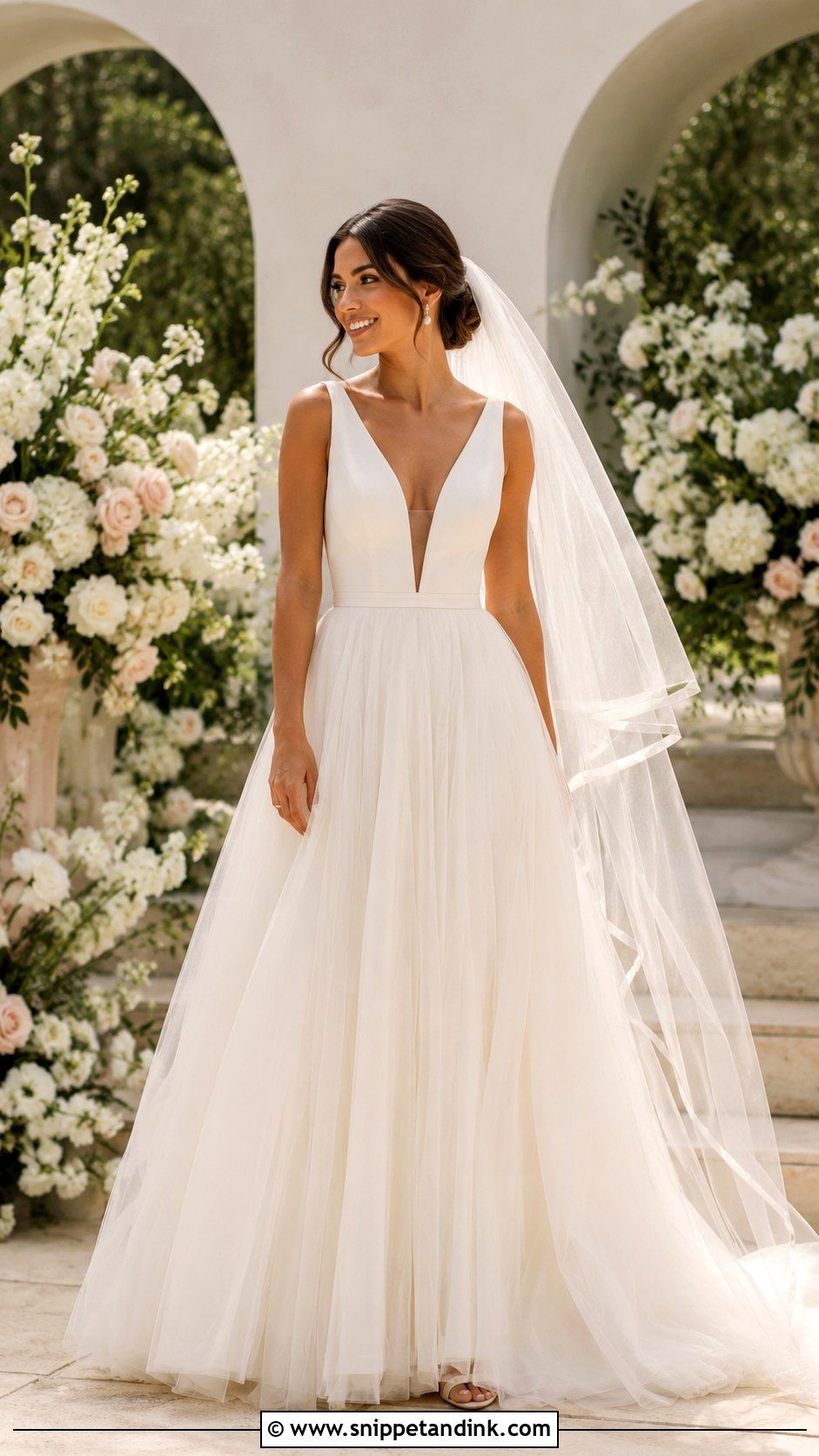
Could any silhouette sit more naturally under a deep V than an A-line? The eye travels down the neckline and the skirt simply carries on outward from the waist, so nothing fights. I look for supportive straps, quiet waist seaming and a skirt in light tulle or organza. Pearl drops, low block heels and a loose updo keep it relaxed; a veil with a narrow satin edge ties it together. At the fitting, raise both arms above your head. If the edges of the plunge move more than a finger’s width, ask for a mesh insert in your skin tone.
5. Deep Plunge Mermaid Wedding Dress
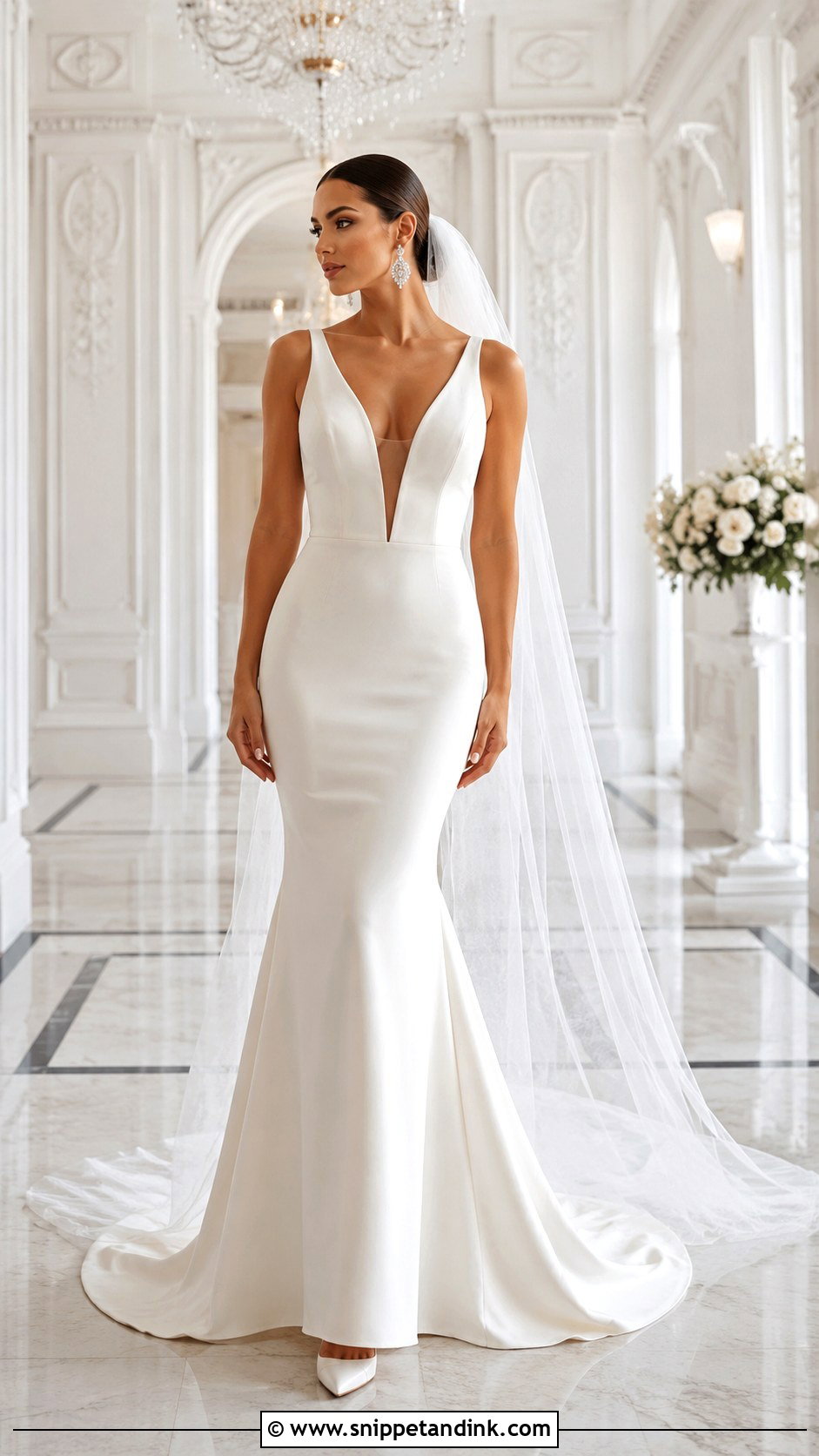
A mermaid cut is the most demanding pairing here. The fitted hip and the open chest mean the bodice can’t borrow support from a full skirt, so I want wide straps and real internal boning, not just a lining. Stretch crepe or lined lace that widens at the knee works best. Crystal earrings, pointed pumps and a smooth side part keep it sharp, and a long plain veil extends the line into the train. Book a fitting where you walk stairs and sit through a full meal; if the knee flare is set too low, you’ll shuffle all evening.
6. Deep Plunge Ball Gown Wedding Dress
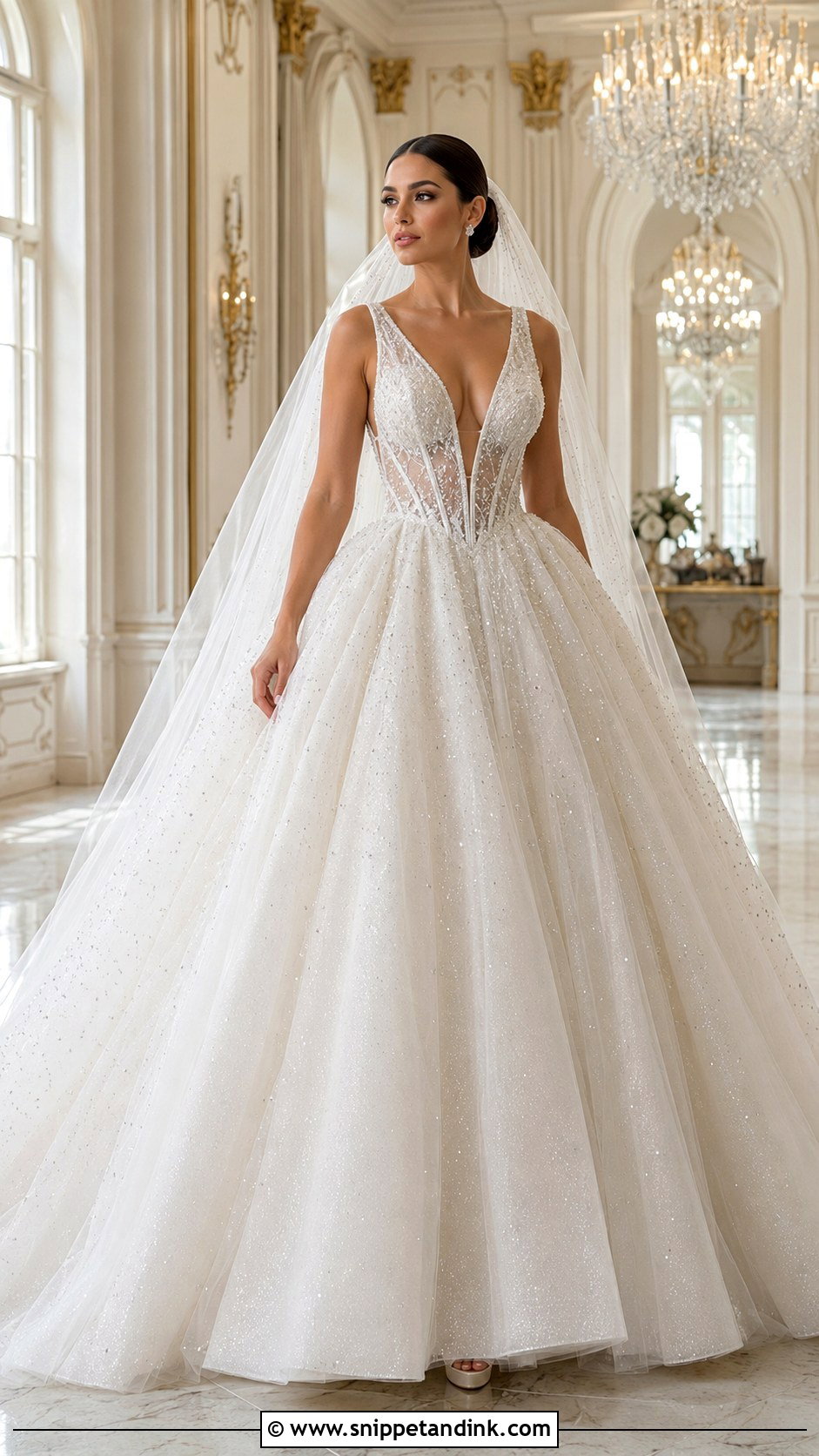
Volume changes how a plunge reads. With a huge skirt, the eye sees the whole shape first, so the neckline looks regal rather than revealing. Look for a structured bodice with broad straps, an illusion insert in the V and a natural or basque waist, over layers of tulle, mikado or organza. Crystal studs, platform heels and a polished bun under a long veil are enough. The weight of all that skirt pulls down on the bodice, so I always check the bustle points and the hem at the same fitting as the neckline.
7. Deep Plunge Illusion Wedding Dress
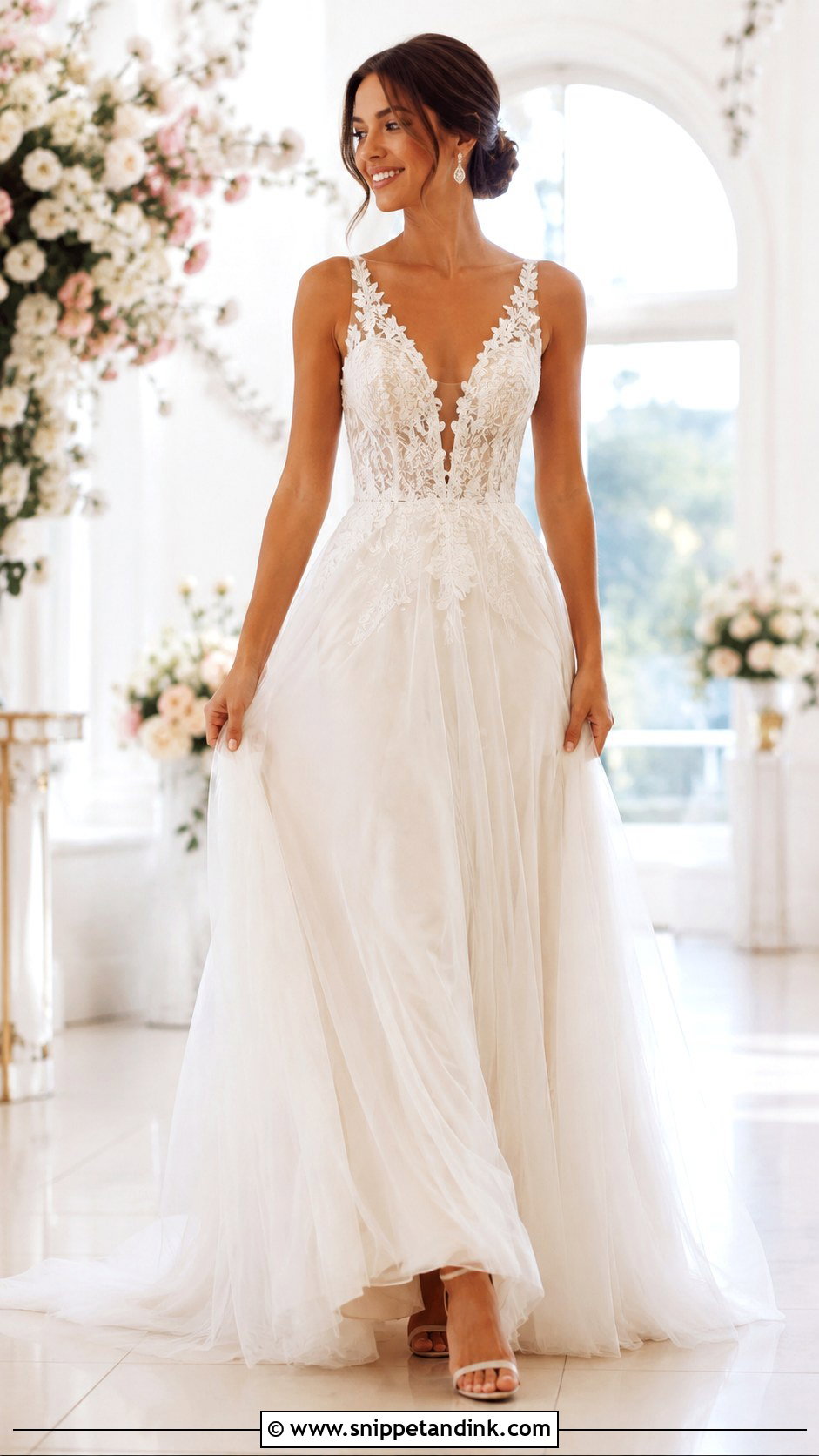
An illusion neckline lets you have the look of a very low V with a panel of mesh holding the two sides together. The single thing that makes or breaks it is colour. I take the fine mesh panel to a window and then under warm indoor bulbs, because a shade that disappears in daylight can turn grey or pink at the reception. Floral appliqués along the edge hide the join between fabric and mesh. A flowing tulle skirt, slim heels and drop earrings finish it, with a low bun or half-up style to keep attention near the face. If you’ll be bending to greet small relatives all day, this is the version I’d point you to.
8. Deep Plunge Crepe Wedding Dress
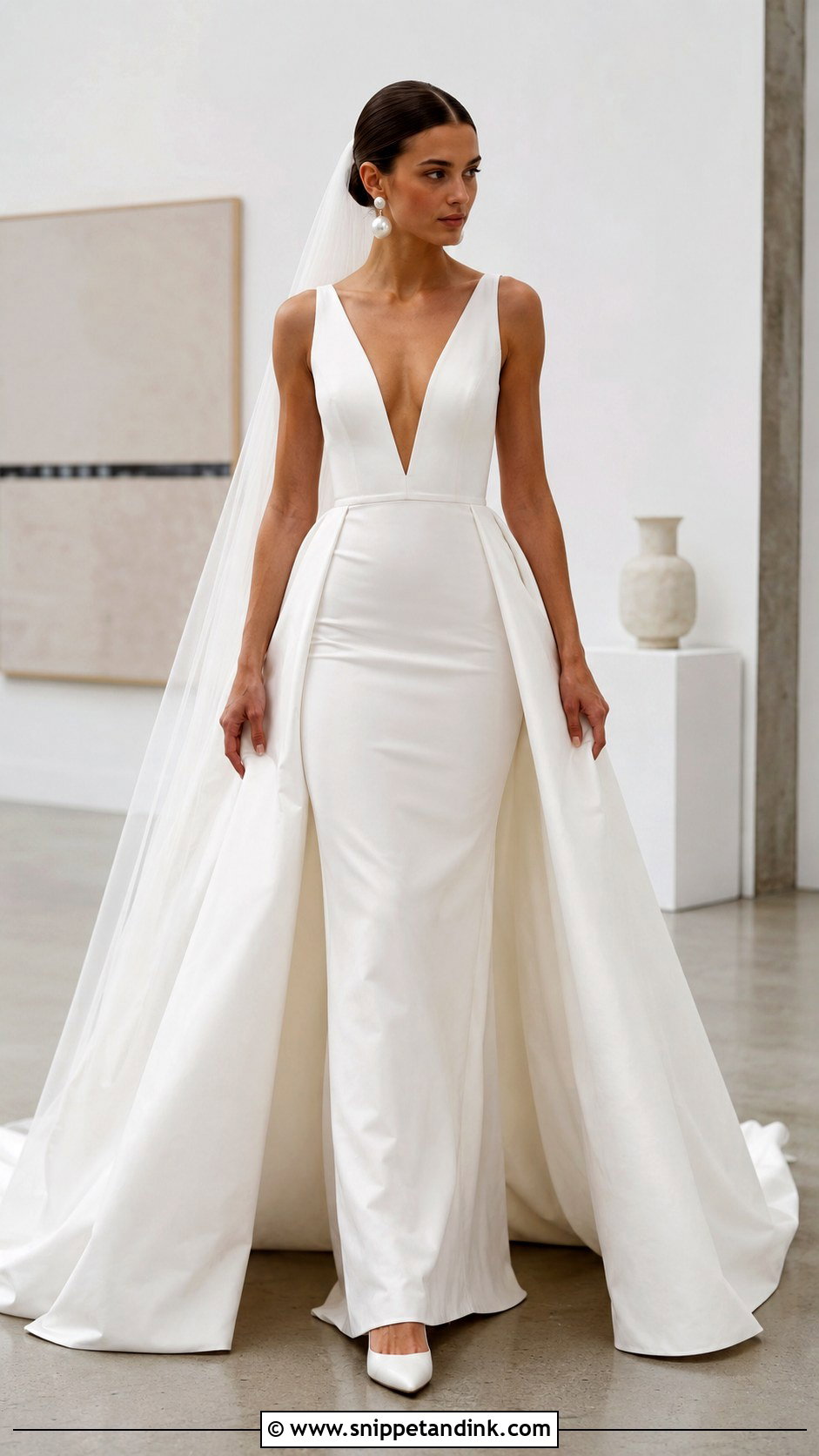
Crepe is honest fabric. It shows every cup edge, every dart and every bit of tape, which is why a crepe plunge needs the smoothest internal support of anything on this list. In return you get a clean, contemporary column or fit-and-flare with almost no decoration. Sculptural pearl earrings, white pointed pumps and a centre-part bun suit it, with a plain cut-edge chapel veil. A detachable overskirt gives you ceremony volume and comes off for dancing. Galleries, rooftops and city venues with crisp white flowers are where it makes sense.
9. Deep Plunge Boho Wedding Dress
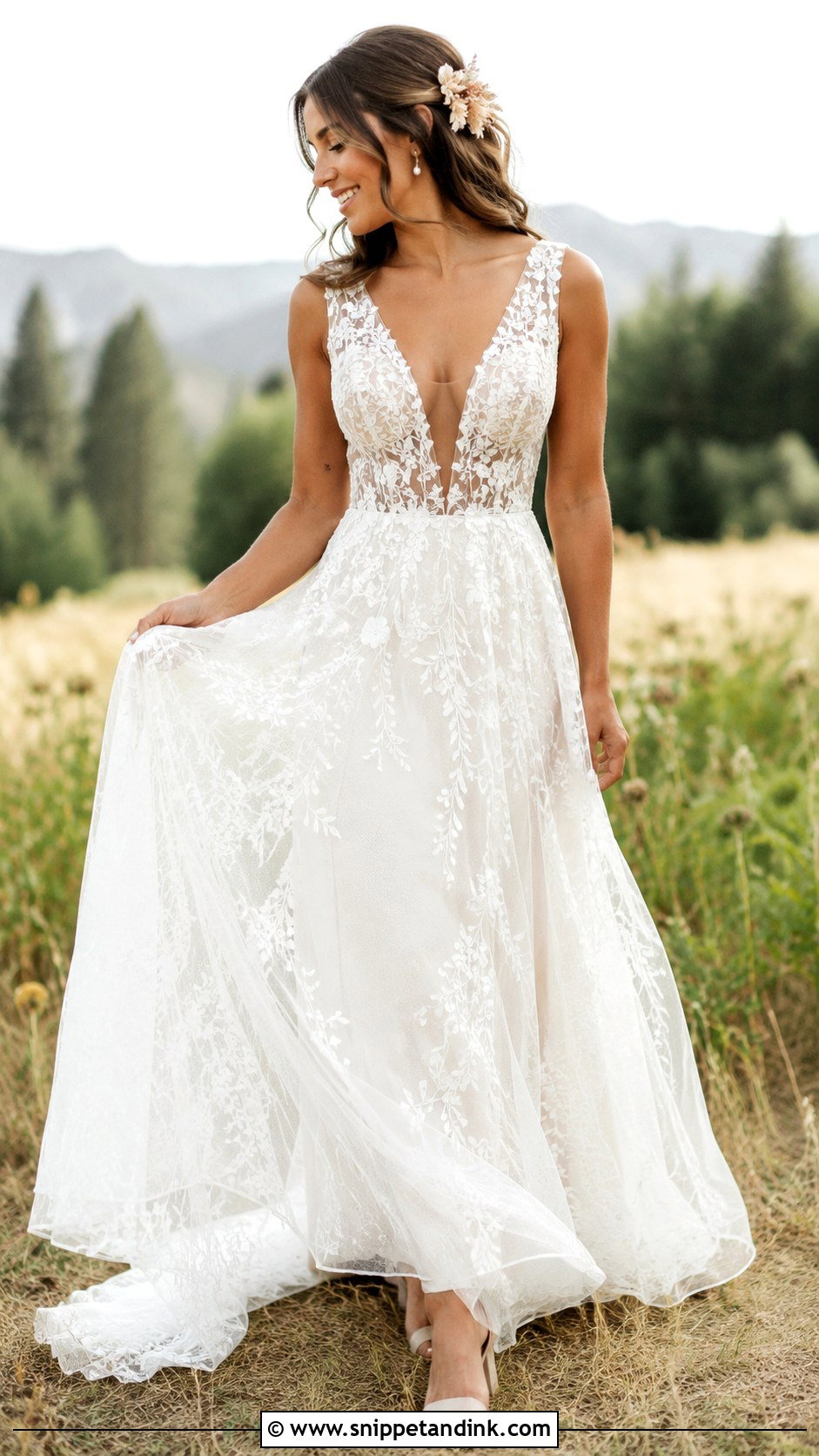
Botanical lace, wide straps and a skirt that moves freely take a plunge somewhere softer. Flutter sleeves or a short lace cape can give optional cover without closing the V. I keep accessories natural: neutral block-heel sandals for grass, small pearls, textured waves and a floral comb rather than a heavy crown. Two practical points for outdoor ceremonies. Keep the train short enough to bustle in under a minute, and ask for a matte illusion panel, because shiny mesh catches the sun and spoils the relaxed texture of the lace.
10. Deep Plunge Beaded Wedding Dress
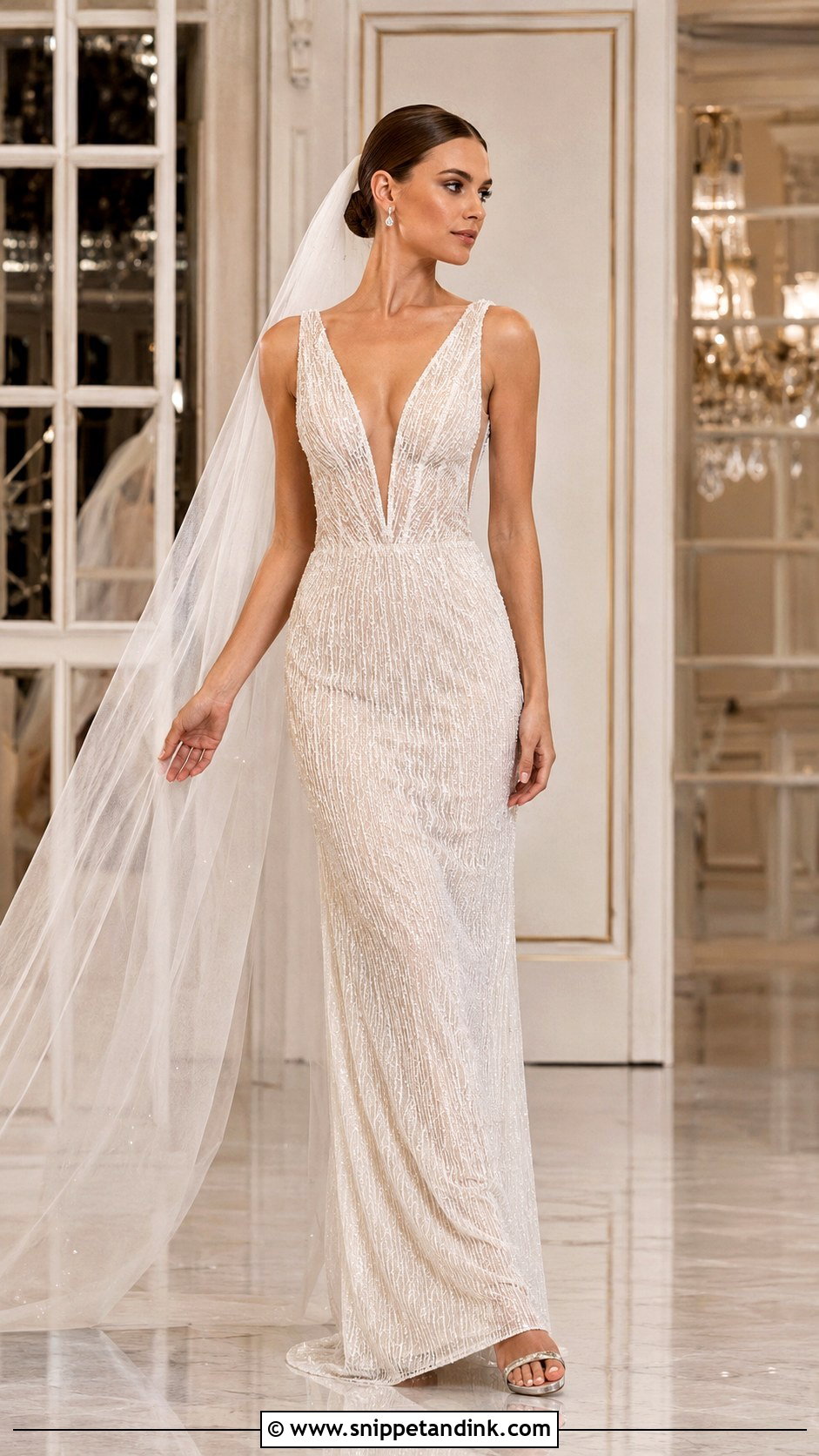
Beads add light and weight at once. When the beadwork runs vertically, following the V and continuing down the body, it lengthens the whole figure and sparkles with every step. Heavy beading does need checking. I run a finger along the armholes and the neckline edge at the first fitting, because a stray bugle bead there will rub raw skin by the reception. Simple metallic heels, small crystal earrings and a smooth low bun keep it clean, and skip any statement necklace; it will fight the embellishment. A plain tulle veil gives the surface some contrast. Evening ballrooms and hotel weddings suit it.
11. Deep Plunge Floral Appliqué Wedding Dress
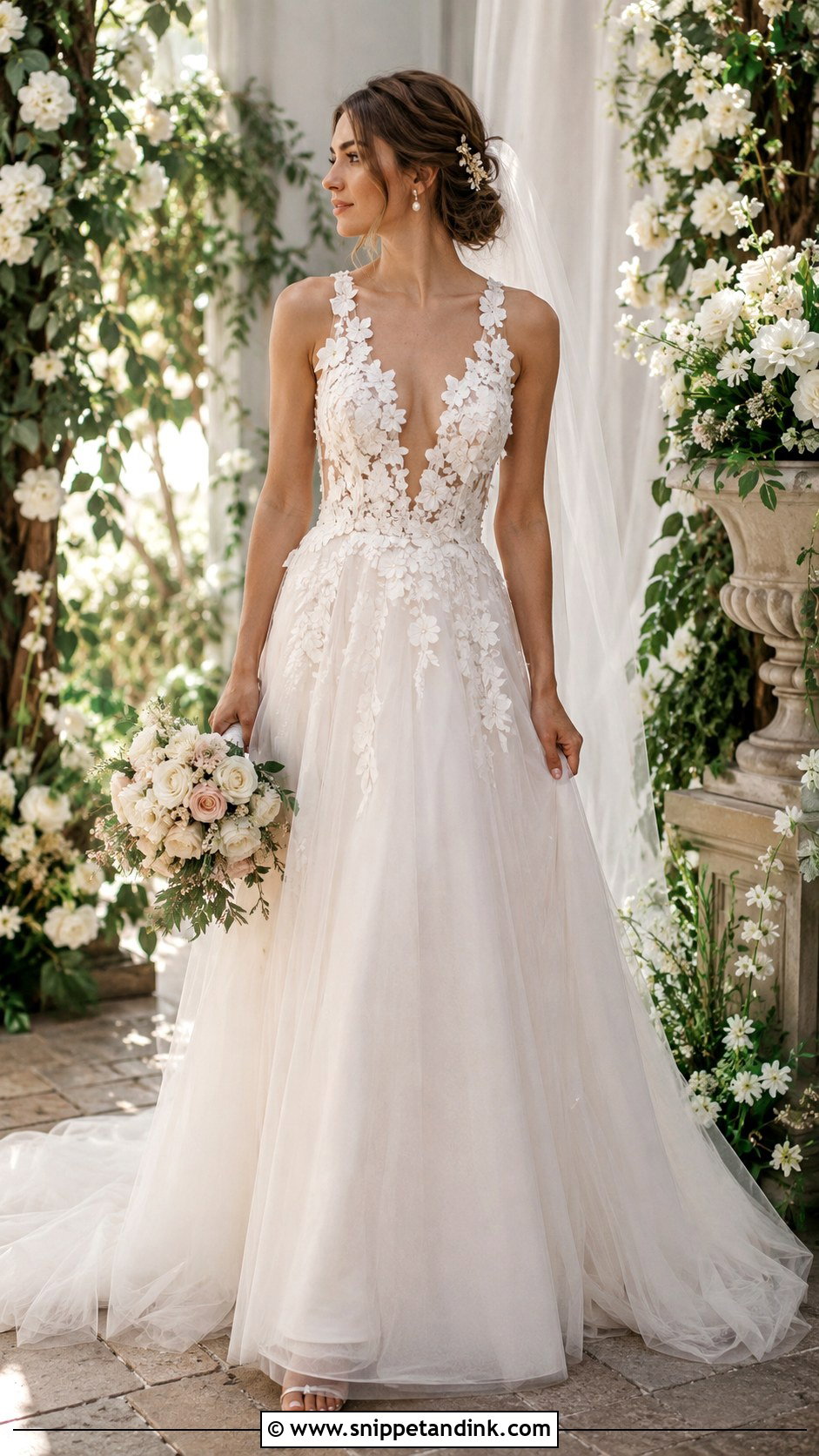
Raised flowers scattered from the edge of the plunge onto an airy skirt make the most romantic version here. A nude or ivory illusion panel underneath gives the appliqués the effect of resting directly on skin. Pearl earrings, delicate sandals and a loose bun with a small floral comb are all it needs, and a simple veil lets the flowers show. Spring and summer gardens are its natural home. During alterations I often ask for individual flowers to be unpicked and moved, so the neckline looks even and the cups stay covered when you turn.
12. Deep Plunge Square Back Wedding Dress
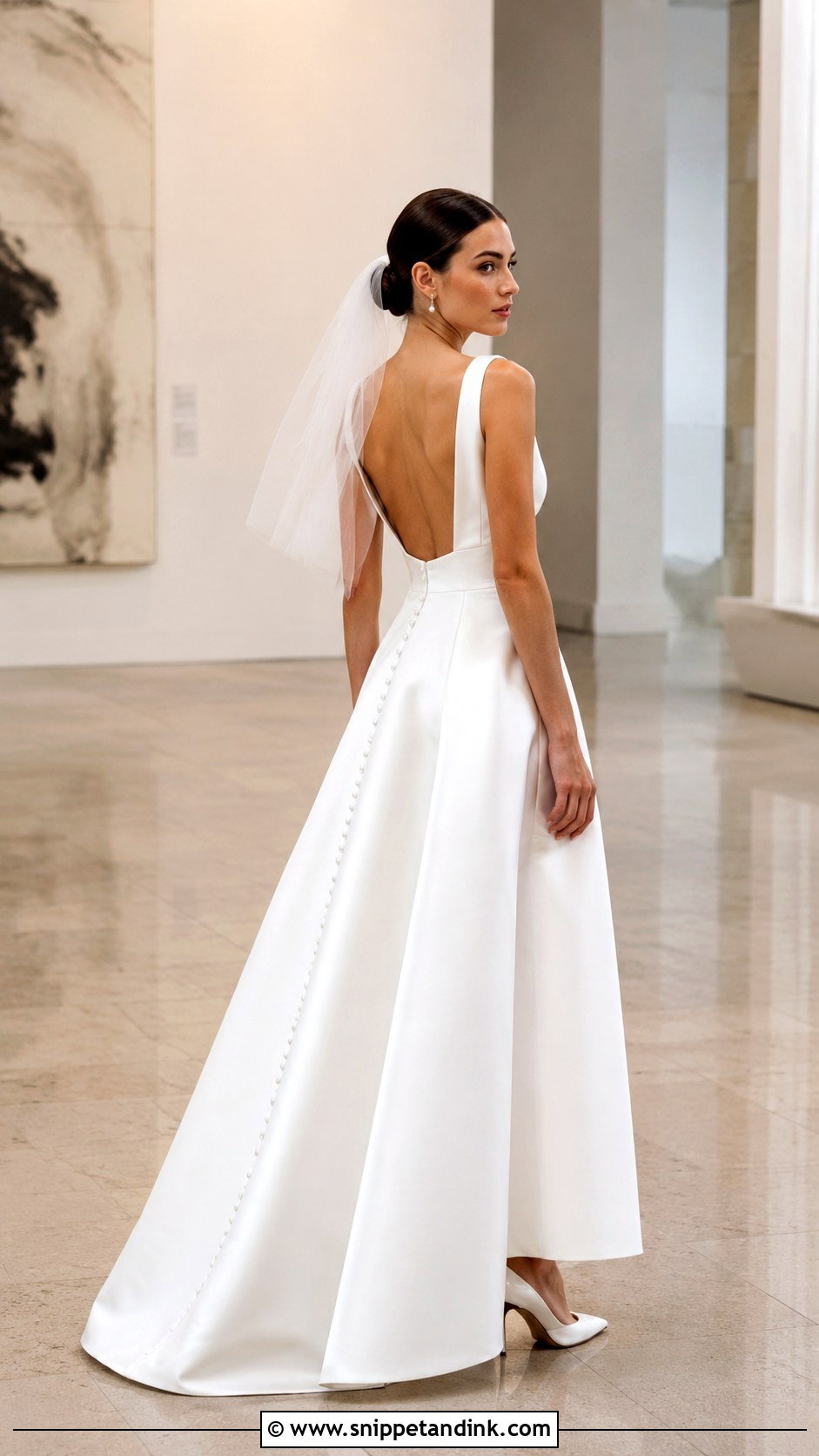
A low front with a square back is a gown that looks deliberate from both sides. Structured mikado or satin, broad straps, a sharp V and a geometric back opening, finished by a fitted waist and full A-line skirt. Since the straps join front and back, any adjustment to one changes the other, and I ask the tailor to pin both at once rather than in separate sessions. Clean seams and almost no ornament keep the architectural appearance intact. Wear pearl buttons, satin pumps and a sleek bun, with a short veil that stops above the back detail. Museums and modern estates suit it.
13. Deep Plunge Wedding Dress With Cape
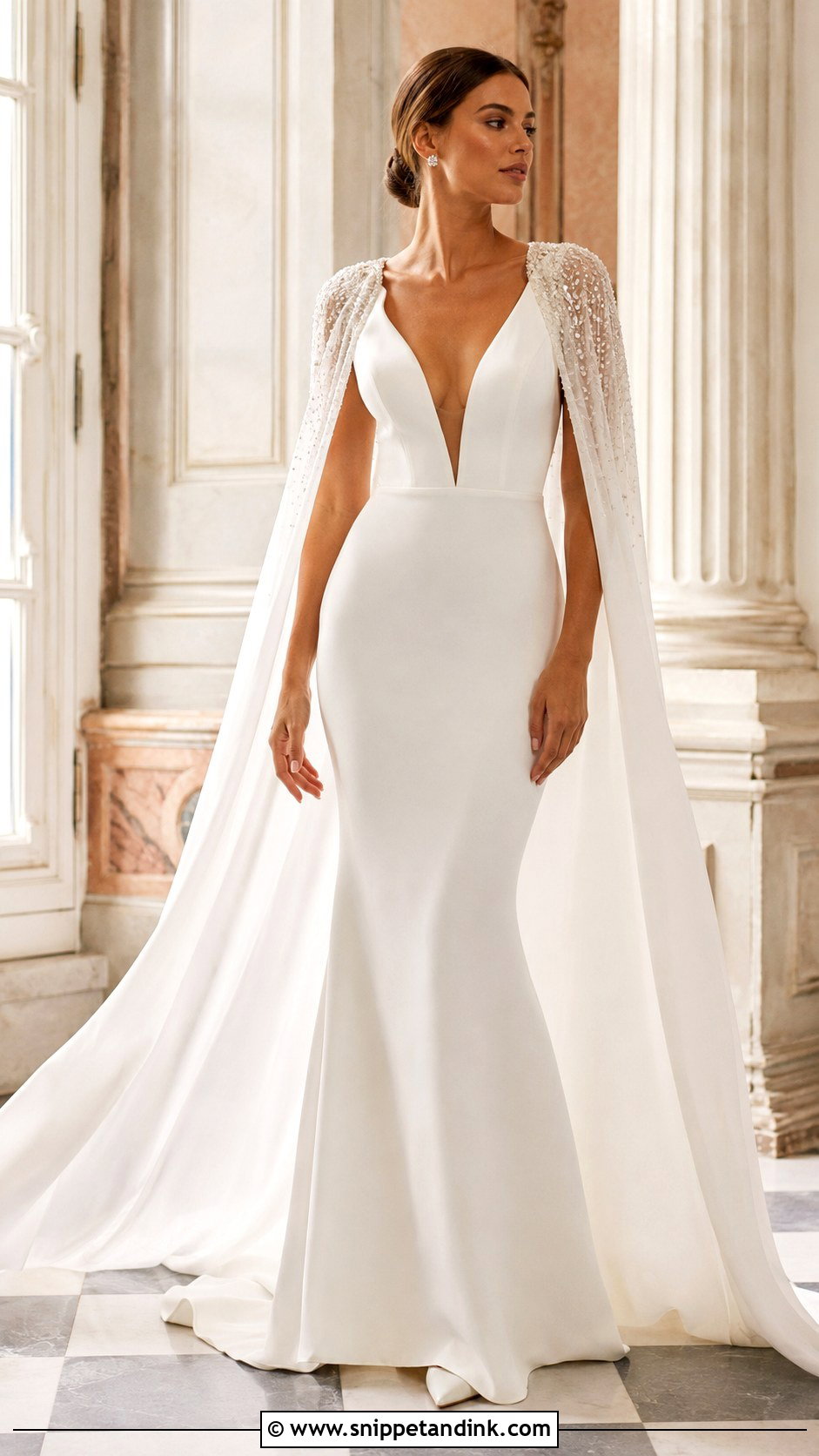
A cape gives a plunge gown movement and a bit of cover for the walk down the aisle. Start with a fitted crepe or satin dress with a clean V and simple floor-length skirt, then add a detachable sheer cape: plain tulle for a minimal finish, lace-edged for romance. It can stand in for a veil. The thing I watch is where it attaches. If the cape hooks onto the straps, its weight drags them outward and opens the neckline, so I prefer anchor loops sewn into the shoulder seam. Crystal studs, pointed heels and a polished low bun keep the focus on the drape.
14. Deep Plunge Wedding Dress With Overskirt
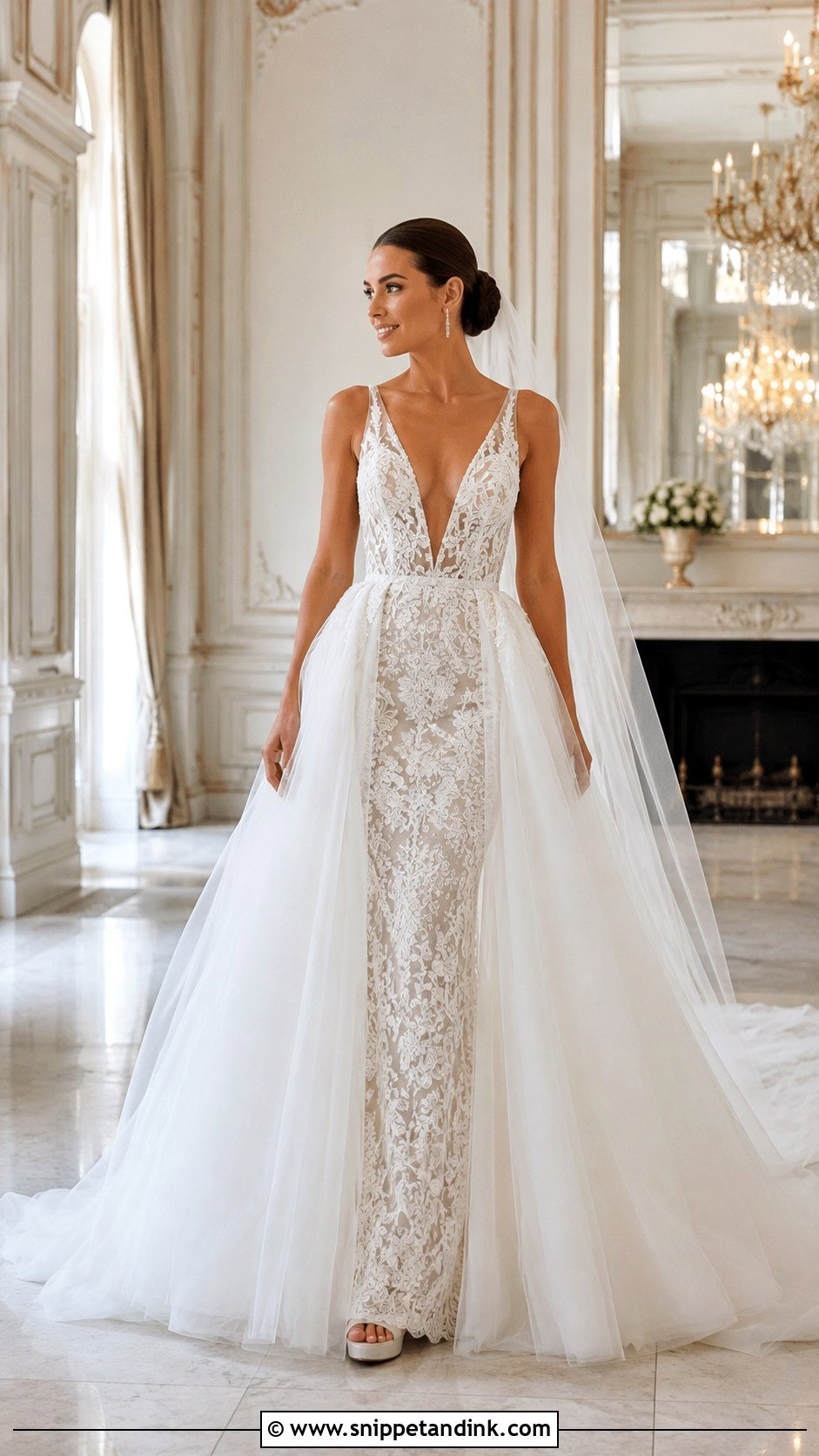
A detachable overskirt gives you a ball gown for the ceremony and a slim dress for the party. Under it you want a fitted crepe, lace or satin base with supportive straps; on top, a full tulle or mikado layer. Drop earrings, comfortable platform heels and a long veil complete the first look. When the overskirt comes off after photographs, the change is dramatic for very little effort. Practise the waistband closure at your final fitting. If it sits bulky or tugs the bodice down, the V will gape every time you sit.

15. Deep Plunge Drop Waist Wedding Dress
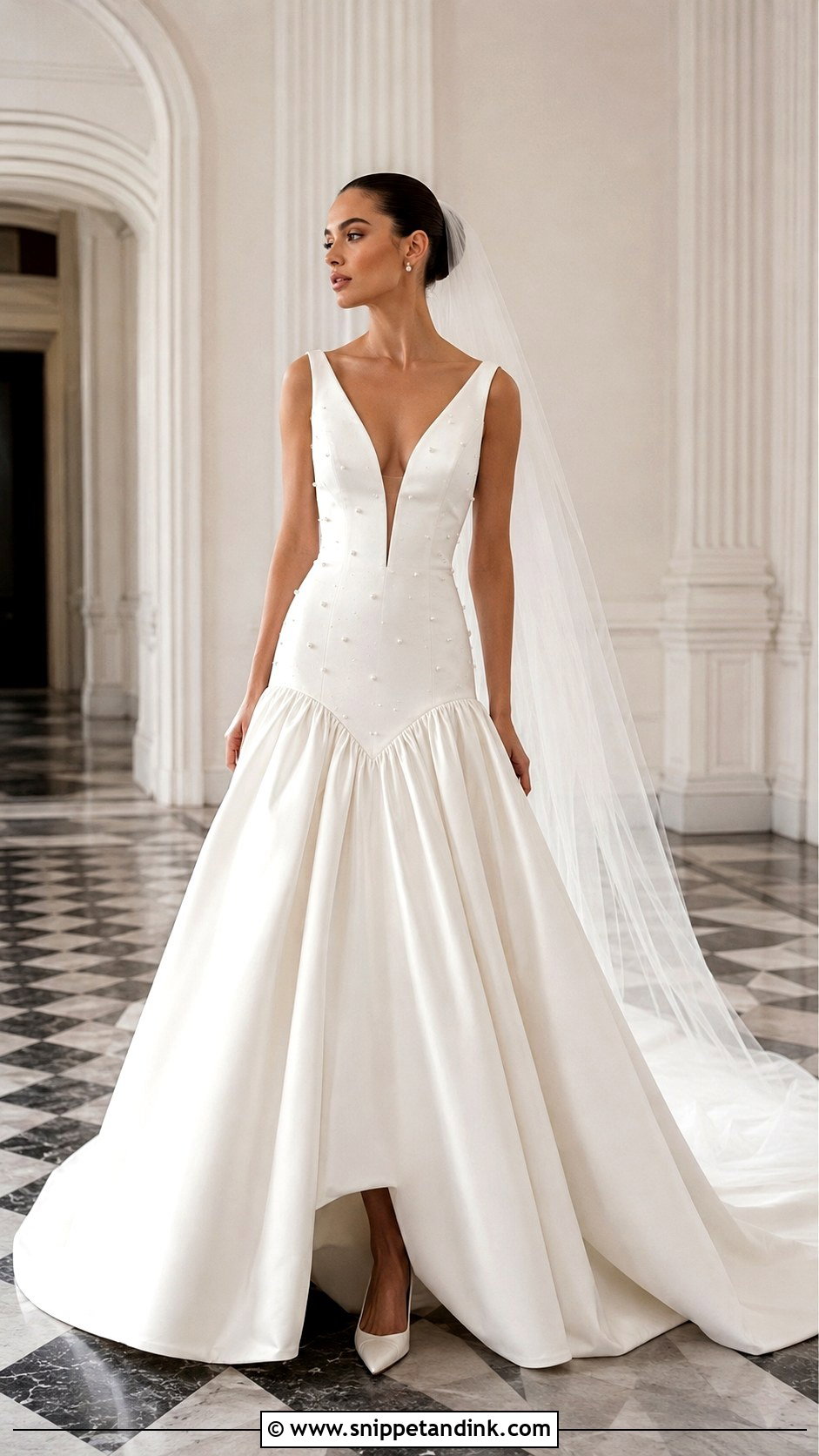
A dropped waist runs the bodice long and fitted past the natural waist before the skirt opens. With a plunge above it, the result is a striking, modern line. Look for satin or mikado, structured straps, curved waist seams and controlled skirt volume. Pearl studs, ivory pumps and a slicked-back bun, plus a long plain veil. This shape is unforgiving in the seat: because the seam sits low, it can bite at the hip when you sit. I have brides sit on a hard chair for a full five minutes at the fitting before we sign off on it.
16. Deep Plunge Plus Size Wedding Dress
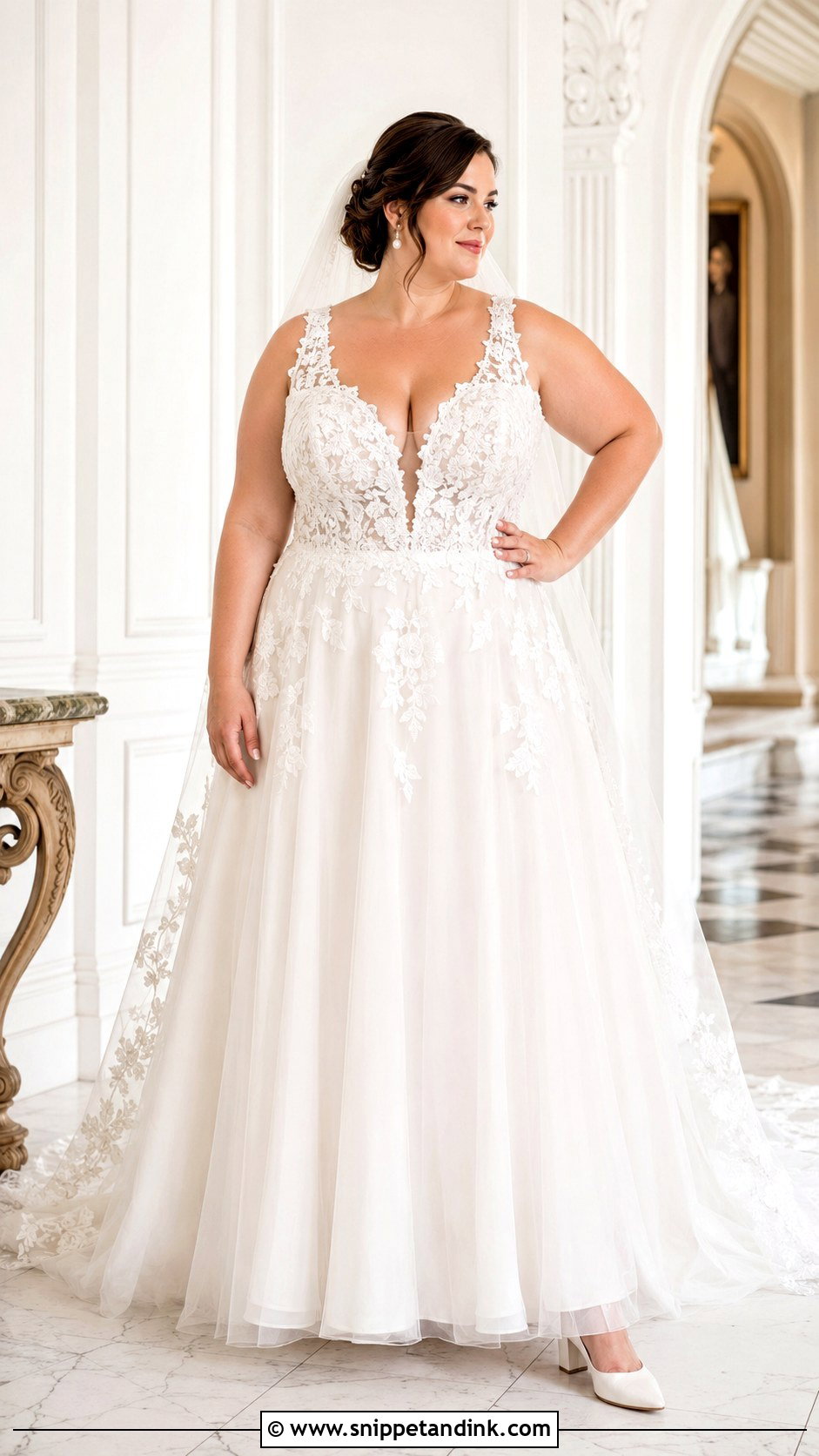
On a fuller bust, the question isn’t whether you can wear a deep V. It’s what’s built into the dress. I look for wide straps, firm boning, properly sized cups and a good illusion insert, usually on an A-line or fit-and-flare. Lace appliqués around the neckline soften the structure and hide it. Block-heel pumps, pearl drops and a side-swept updo suit it, with a fingertip or chapel veil. The most valuable thing you can do is find a tailor who has adjusted cup placement and V depth on curvy brides before, then insist on fittings that include walking, sitting and dancing.
17. Deep Plunge Petite Wedding Dress
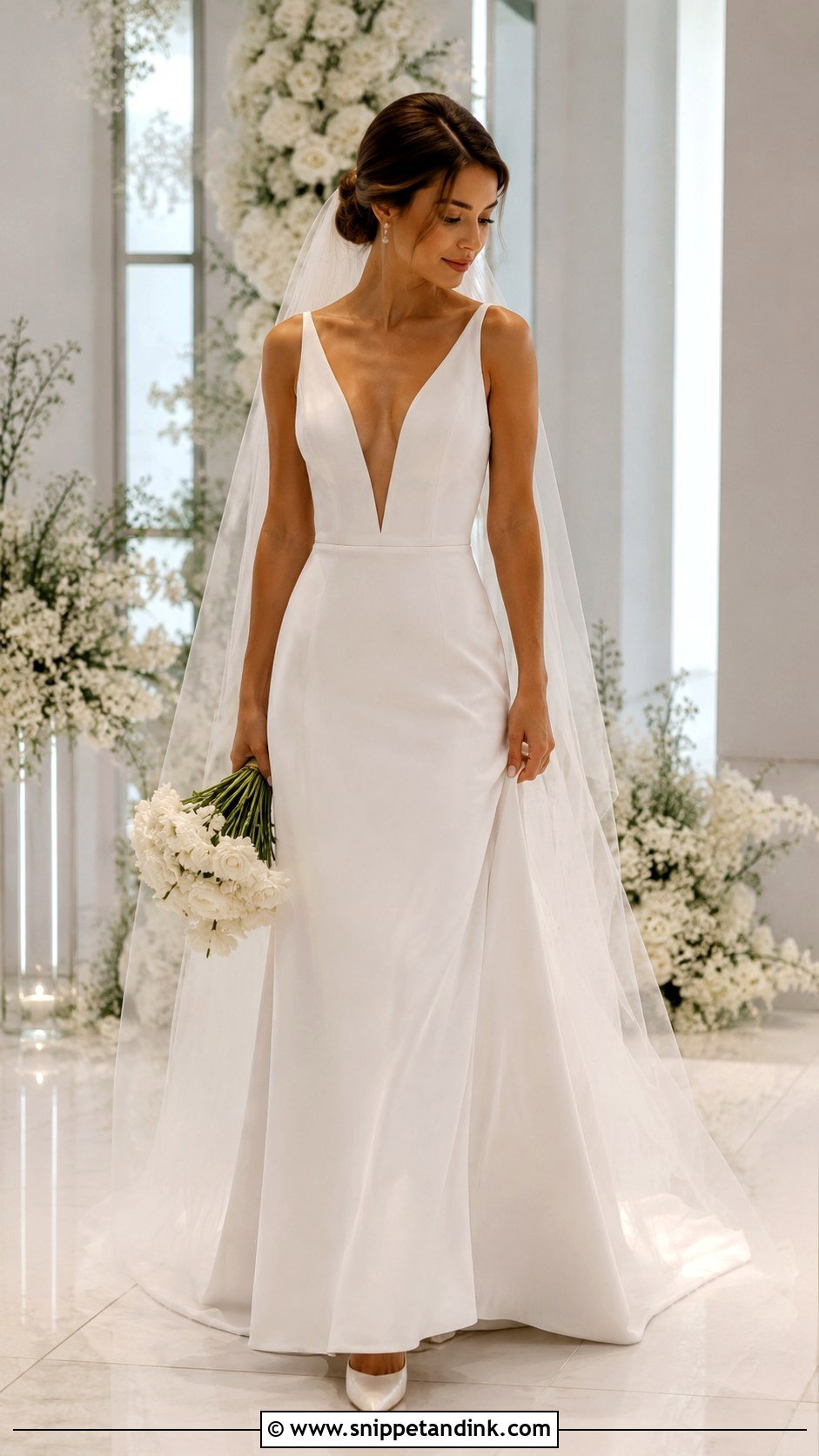
A deep V draws a clear vertical line through a short torso, which makes it one of the more flattering necklines for petite brides. Keep the skirt simple, either A-line or a narrow fit-and-flare, in lightweight crepe, satin or soft tulle, with straps and appliqués scaled down to your frame. Pointed heels, small earrings and a compact low bun finish it. Watch out for extra layers at the waist. The real expertise is in the alteration. A bodice should be shortened at the proper points, not hitched up at the straps, or the plunge ends up sitting too high and losing its shape.
18. Deep Plunge Beach Wedding Dress
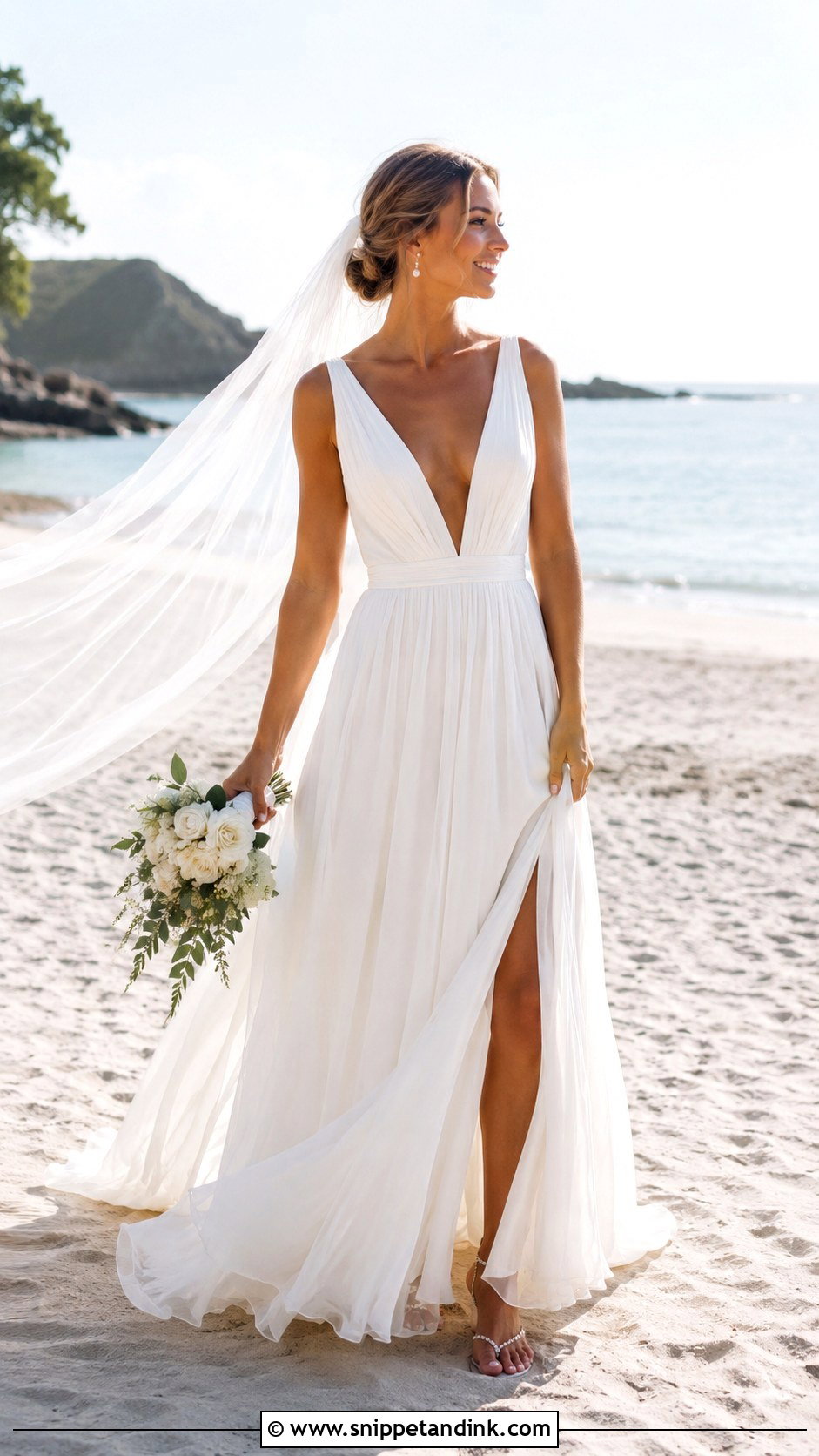
On a beach, the plunge is the easy part; the wind is the problem. Chiffon, soft crepe or lace with secure straps, a fitted waist and a flowing skirt all move nicely, but I keep the train to a short sweep because a longer one drags sand. Embellished flat sandals, pearl earrings and a low bun that can take a gust are the practical choice. Trade a heavy veil for a light fingertip one or a comb. Sea breeze lifts the neckline more than you’d expect, so this is one place I’d never skip the illusion insert and sewn-in cups.
19. Deep Plunge Minimalist Wedding Dress
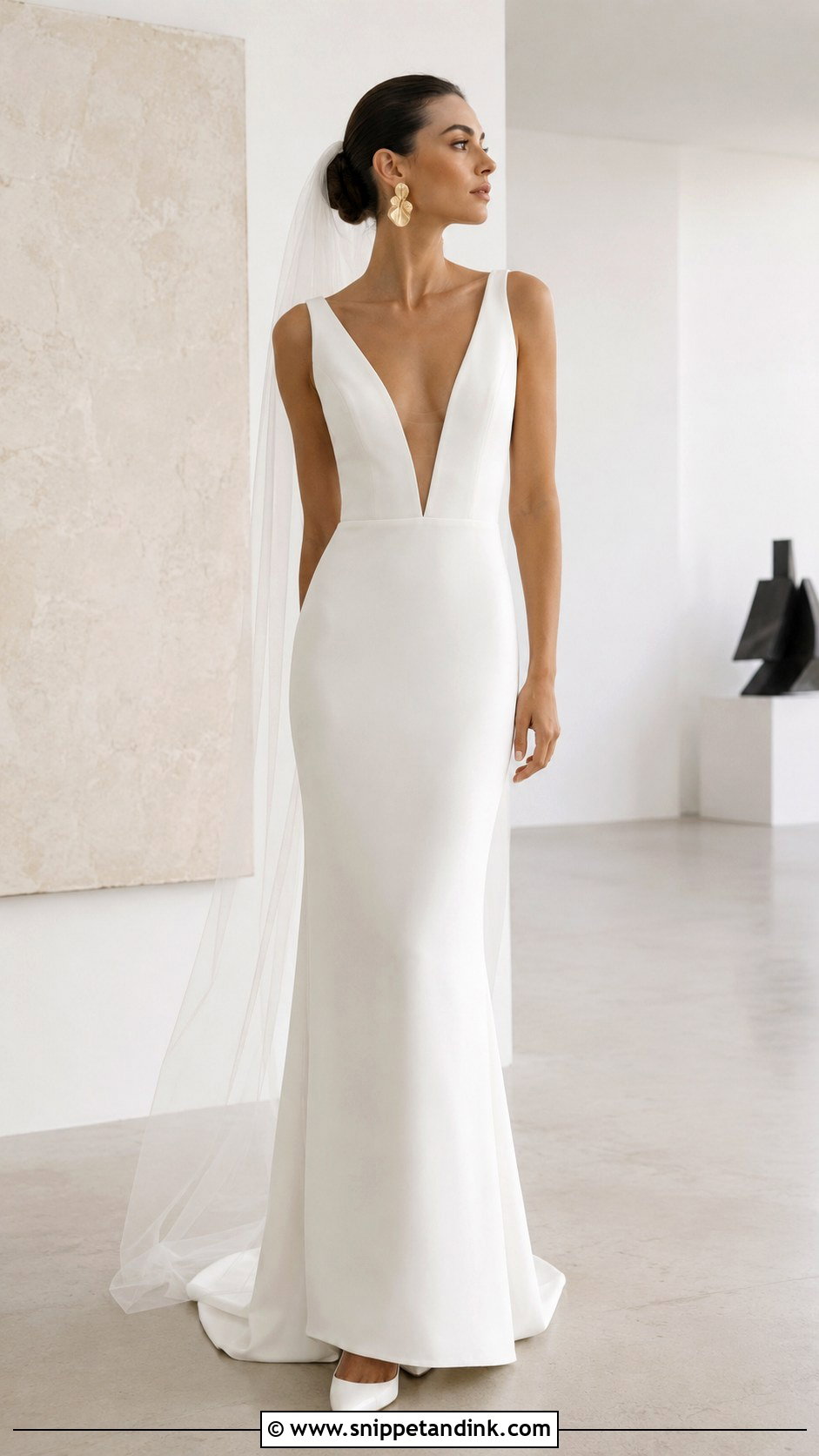
When every seam is on show, the fit has nowhere to hide. A minimalist plunge gown needs a sharp V, wide straps, a defined waist and a fluid column or A-line skirt, cut in matte crepe for softness or mikado for structure. Sculptural earrings, white pointed pumps and a sleek bun, with a plain cut-edge veil or just a hair pin. I expect at least three fittings for this one, since the neckline must lie flat to the body without the slightest gap. Hidden boning and discreet mesh keep it steady. Courthouses, galleries and restaurants are its setting.
20. Deep Plunge Wedding Dress With Removable Sleeves
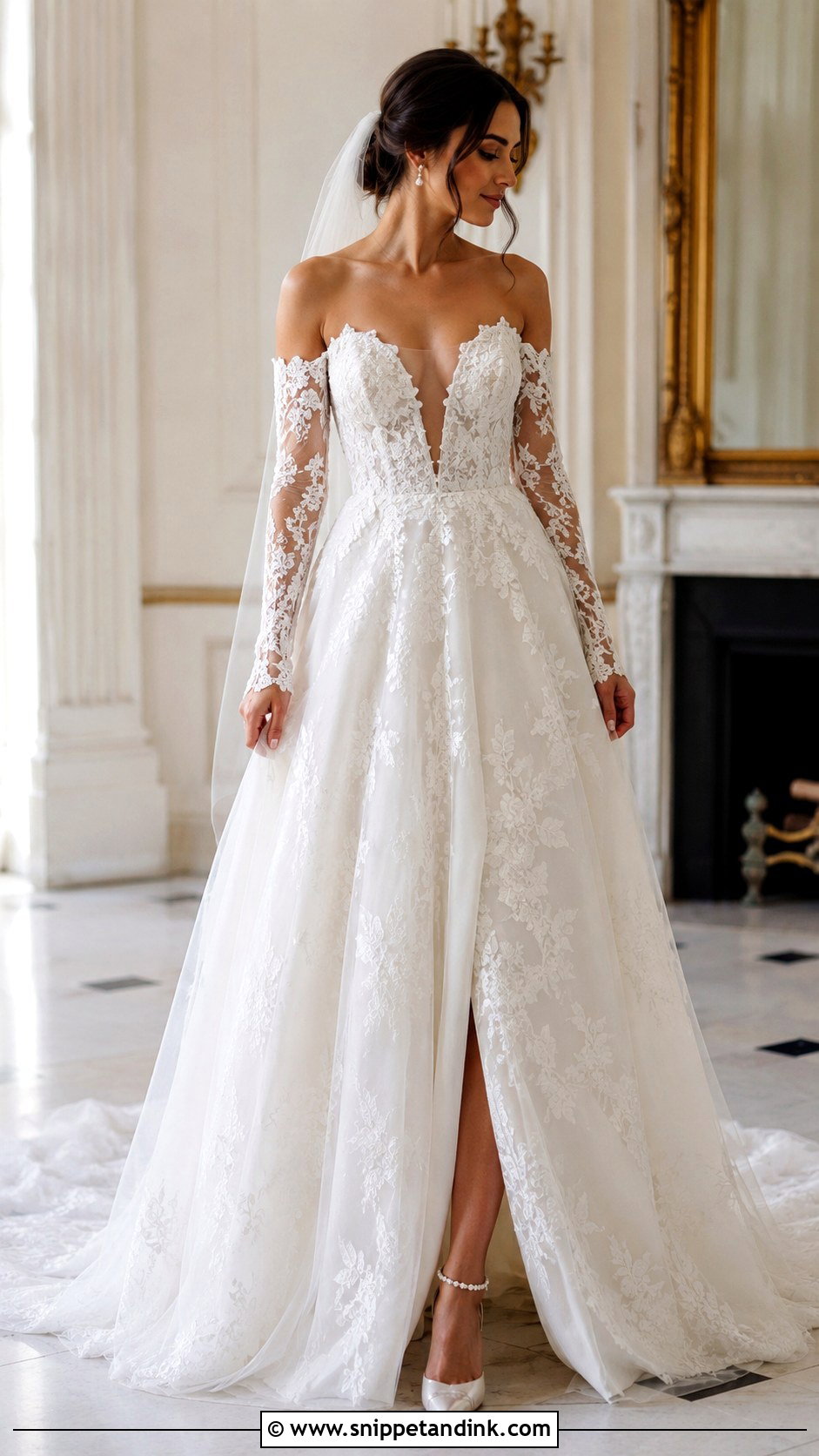
Removable sleeves give you two gowns in one. The base is a sleeveless lace or crepe dress with a deep V, a supportive bodice and a fitted or A-line skirt; the sleeves, in matching lace, sheer tulle or crepe, go on for the ceremony and come off for the reception to show the full shoulder line. Pearl earrings, pointed pumps and a low textured bun work for both halves. Ask the tailor to hide the attachment points under a seam or appliqué. If the snaps show when the sleeves are off, the gown looks unfinished.
Fittings, Timing and Undergarments for a Low V
Most bridal gowns take several months to arrive once ordered, and a plunge gown should leave room for more alteration time than a sweetheart or high neck. I plan for three fittings, starting about two months before the wedding. Bring the actual shoes and whatever you’ll wear underneath to every one. A stick-on bra or body tape at the final fitting is not the same as bringing them to the first, because a cup change can move the point of the V by a centimetre or more.
What I check at each appointment
- First fitting: strap length and the angle at which they meet the shoulder, since everything below depends on it.
- Second fitting: cup placement, mesh colour and whether the edges lie flat while seated.
- Final fitting: a movement test with arms raised, a deep bow and a hug, plus a look at the neckline from directly above, which is how many reception photos are taken.
On the morning itself, ask whoever dresses you to smooth the neckline from the centre outward before the bodice is fastened, then check it again after the first sit. A small safety pin inside the strap seam, out of sight, is worth carrying in the emergency kit.
Testing a Plunge the Way You’ll Actually Move in It
A plunge gown should feel as secure as it looks bold. Lace, satin, crepe, chiffon and beaded tulle all handle the opening differently, and the skirt shape matters as much as the depth of the V, so try an A-line, a mermaid and a column before deciding. At every appointment, look past the neckline to the straps, cups, boning and mesh, and keep jewellery away from the chest. Then walk, sit, lift your arms and hug someone. If the V holds through all of that, you have found your dress.
You'll Like These Ideas:







Leave a Reply