
Dressing a couple in traditional African wear is a balancing act, and in my experience the groom’s outfit is usually the one that gets planned last and fitted worst. The strongest pairings aren’t two garments in identical print. They share a cloth, a colour or a thread, then let each person wear a shape that suits their body and their role. Africa holds hundreds of cultures with their own garments, so start from the tradition that is genuinely yours or your family’s, not from a general idea of African style. Robes, wrappers, tunics and embroidered pieces all need real tailoring, and below I’ve noted for each pairing where the coordination works and where the men’s side tends to go wrong.
Coordinating When Two Tailors Make Your Outfits
Couples often use one tailor for her outfit and another for his, since womenswear and menswear are different skills. That’s sensible, but it’s also where coordination falls apart. I’ve seen trims arrive two shades apart and embroidery threads that almost match, which is worse than not matching at all.
- Buy all the shared fabric in one purchase from one batch, then split it between the two tailors.
- Cut a small swatch of every shared cloth and thread and give each tailor an identical set.
- Agree who chooses the embroidery thread colour, and have the second tailor match that sample, not a photo.
- Book his first fitting no later than hers; agbada and senator sets need as many adjustments as a gown.
- Hold one final try-on with both outfits together, under daylight, before either tailor does the last finishing.
If the budget only stretches to one tailor, choose the one who is strongest on the garment that’s harder to fit. For most couples in this list, that’s his agbada or her structured gown, not the shirts.
1. Matching Ankara Gown And Senator Outfit
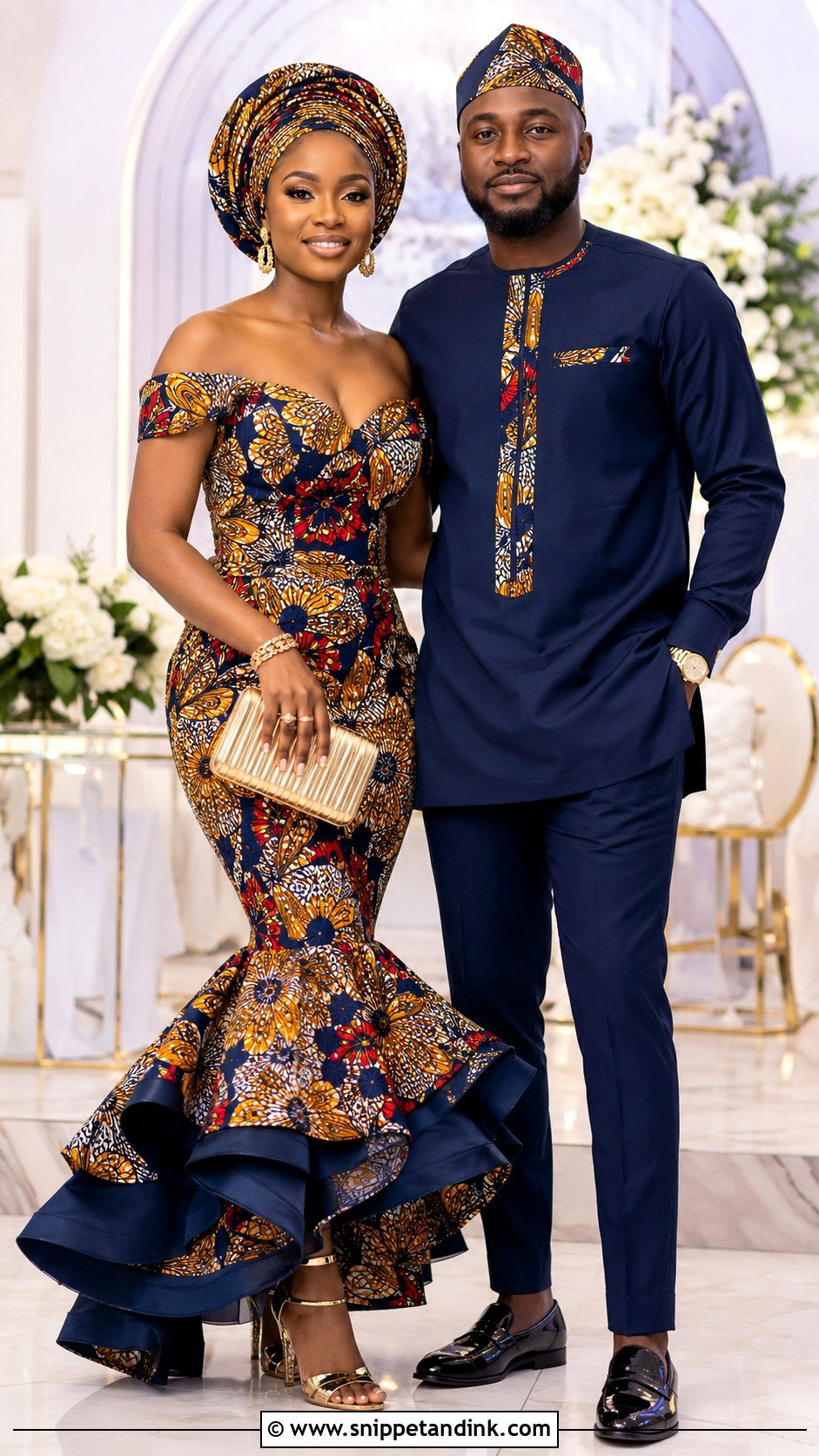
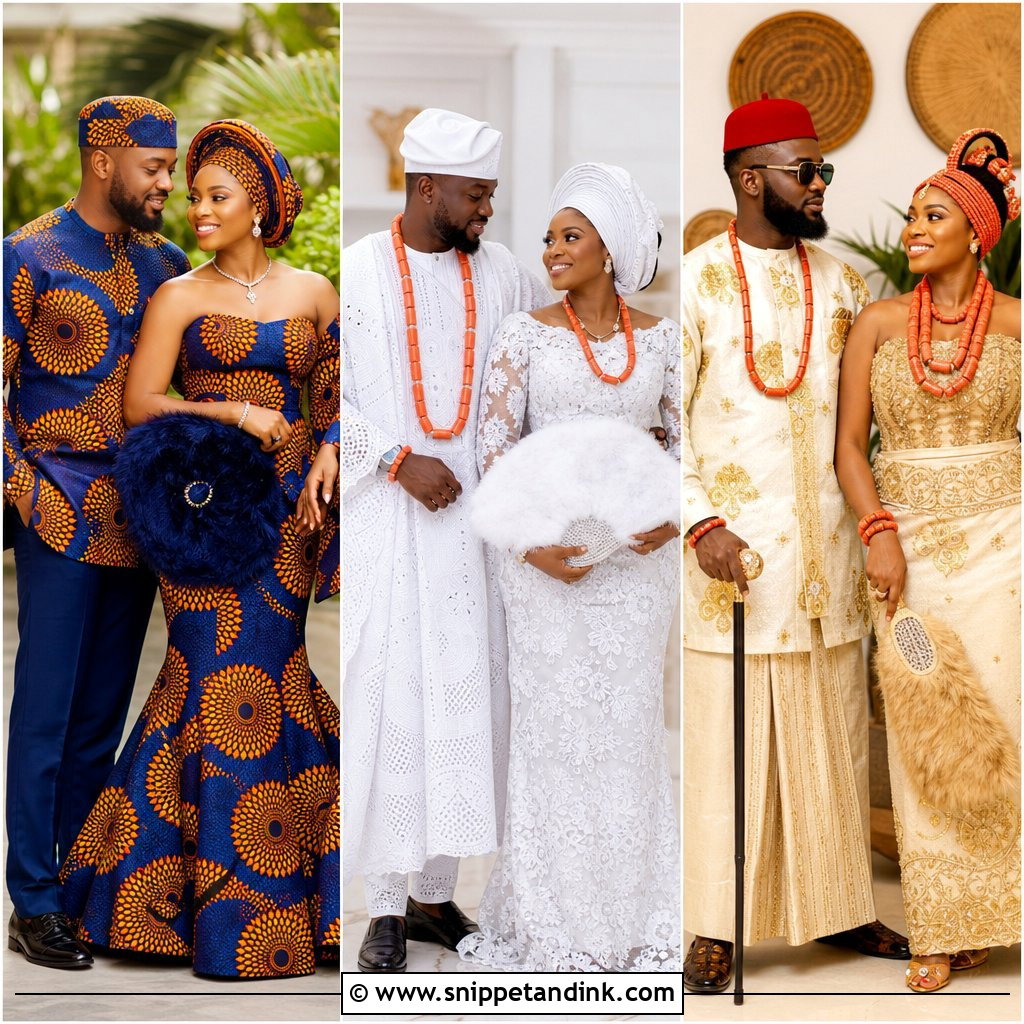
This is the pairing I suggest most often for an engagement or a family event, because it’s hard to get wrong. She wears the Ankara fully, in a mermaid gown, a flowing maxi or a structured A-line. He wears a solid senator set with the print limited to the collar, chest panel, cuffs or pocket trim. The trick is the base colour of his outfit: pull the quietest shade from her print, not the loudest, or his trousers will fight her dress. A senator tunic should end around mid-thigh and sit straight at the side seams; if it flares, it’s too tight across the hips. She can add a headwrap, metallic sandals and a small clutch, he adds leather loafers and a matching cap.
2. Kente Couple Wedding Outfit
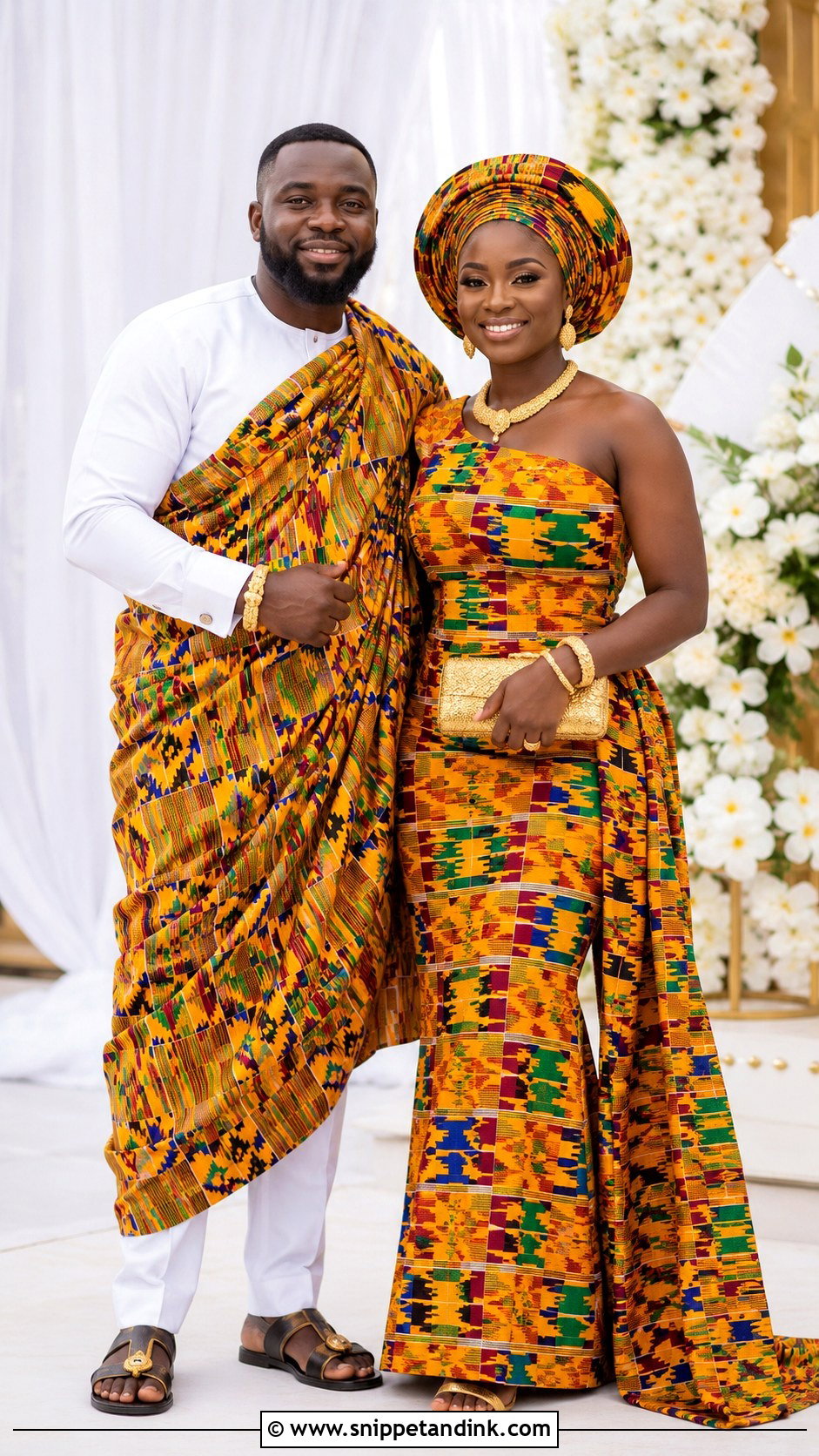
A Kente couple wedding outfit works best when both of you wear the same cloth in very different amounts. She might take a one-shoulder Kente gown, a corset dress or a wrapped skirt with a structured blouse, finished with gold jewellery, a headwrap and metallic heels. For him, the traditional way is a length of Kente draped toga-style over one shoulder, worn over a plain tunic or alone. That drape takes practice: the cloth is heavy, and an untrained wrap slides off the shoulder within the hour, so have someone who knows how to wrap it dress him. A tailored shirt with Kente panels is the modern alternative. Kente carries meaning in Ghana and Côte d’Ivoire, so choose the pattern with family or a knowledgeable weaver.
3. Yoruba Aso Oke Couple Outfit
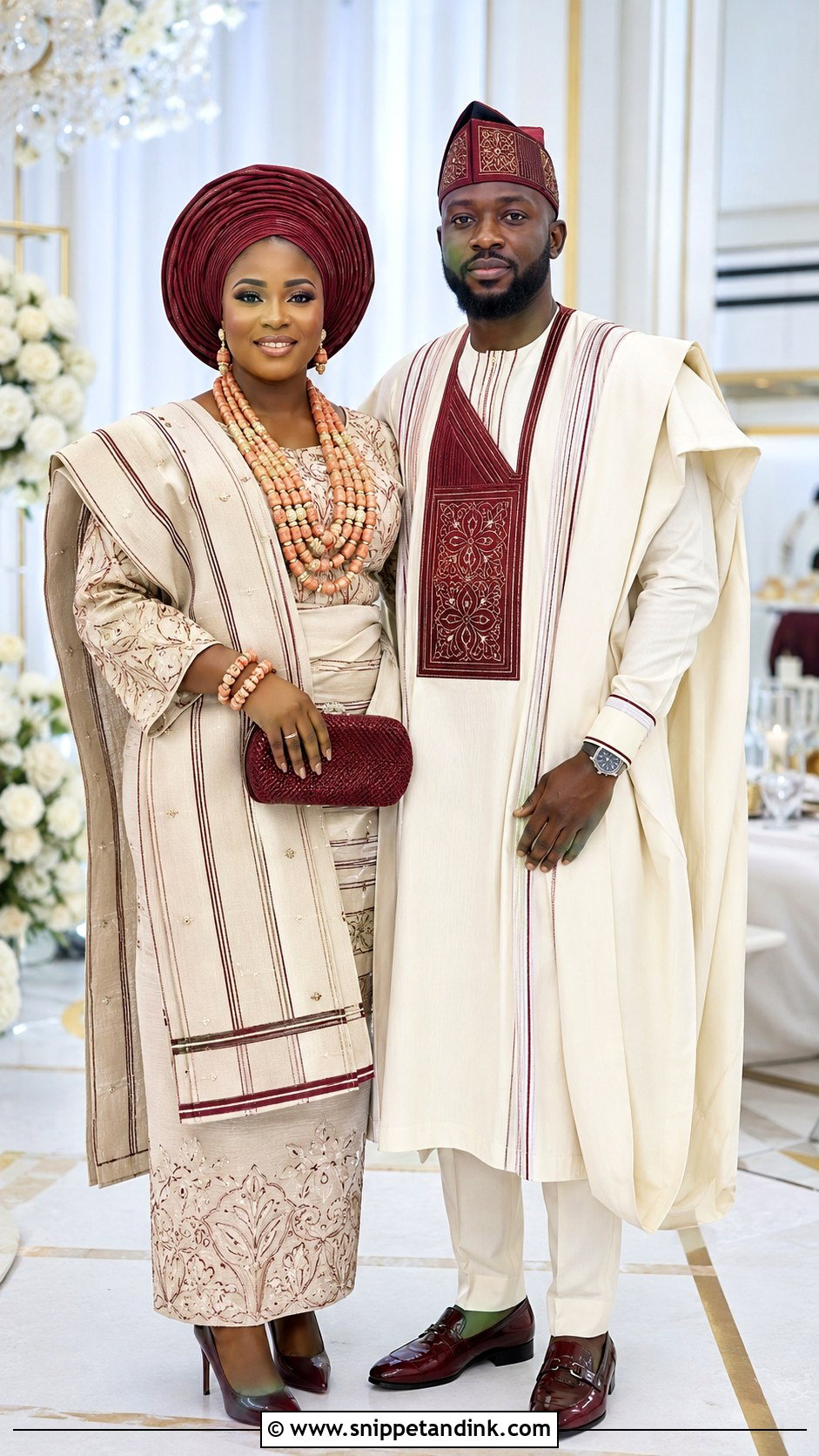
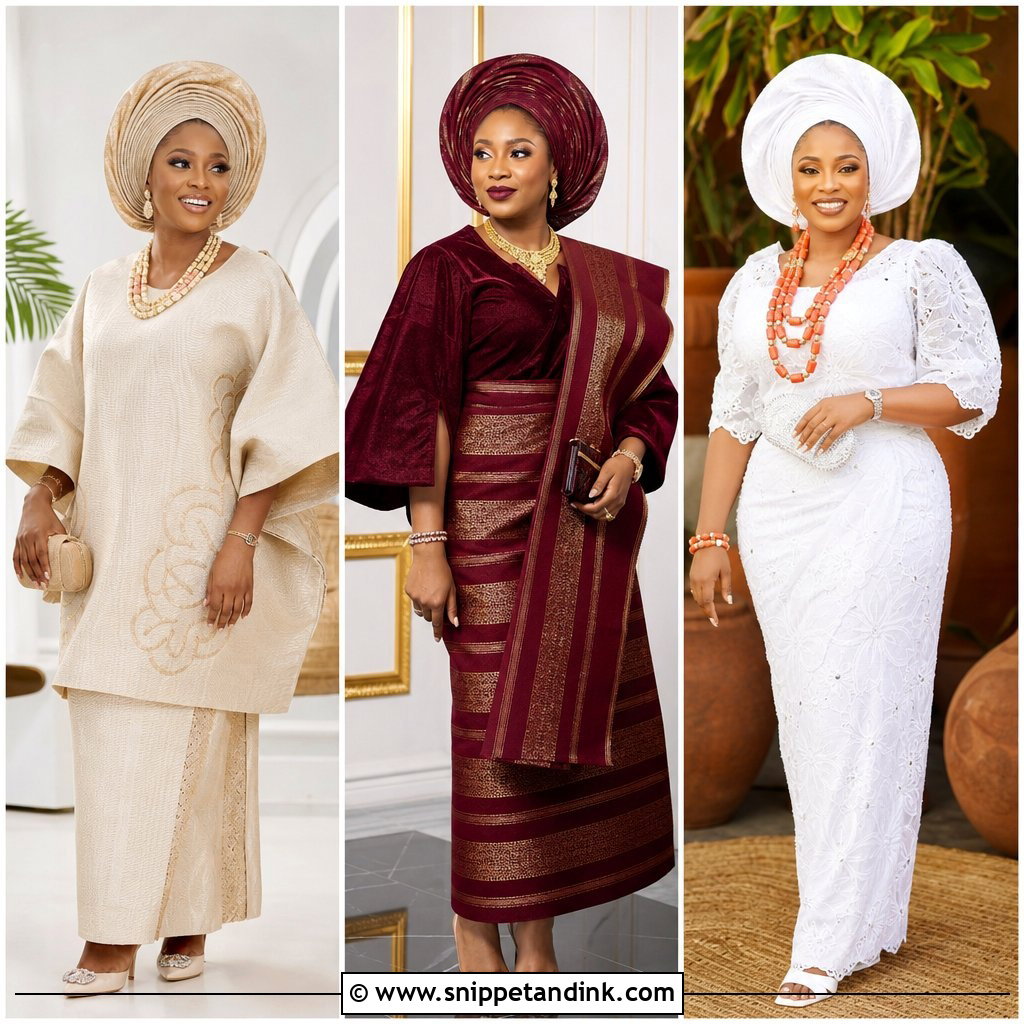
A Yoruba Aso Oke couple outfit is ceremonial from head to toe. She wears iro and buba with the ipele over one shoulder, a carefully tied gele, statement earrings, layered beads and heels. He wears the full agbada: the wide outer robe over an embroidered inner tunic and trousers, with a fila cap and polished loafers. The agbada is where fit matters most on his side. The robe is cut very wide, and if it’s too long in the body it swamps a shorter man, so I have it measured from his shoulder in the shoes he’ll wear. Ivory, burgundy, champagne, emerald and royal blue all work, especially with a slight metallic thread. You don’t need every piece to match; one colour family across both outfits is enough.
4. Igbo Isiagu And George Wrapper Outfit
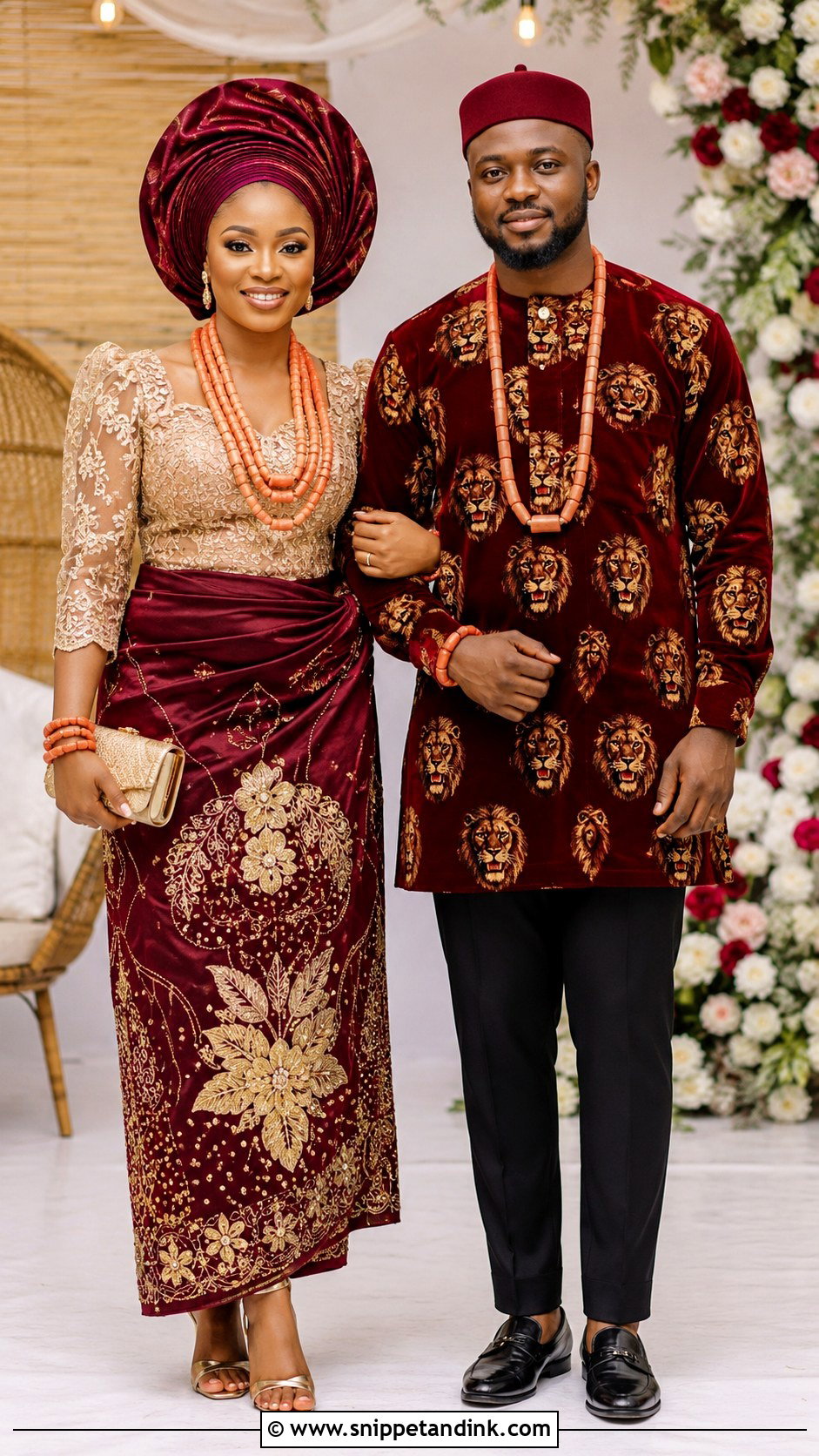
Deep red beads and heavy fabric give this Igbo pairing its weight. She wears a George wrapper with an embroidered blouse, coral-style beads, a head tie and heels. He wears the isiagu, the pullover patterned with lion heads, with tailored black trousers, his traditional cap and accessories, and polished shoes. George is a dense, often embroidered cloth that’s warm to wear, so for a long outdoor ceremony I’d ask for a lighter blouse lining. The easy way to link the two outfits is to repeat one colour from his isiagu in her blouse embroidery. His sleeves and hem should be altered with care, since the isiagu pattern has to stay recognisable after tailoring.
5. Senegalese Boubou And Kaftan Outfit
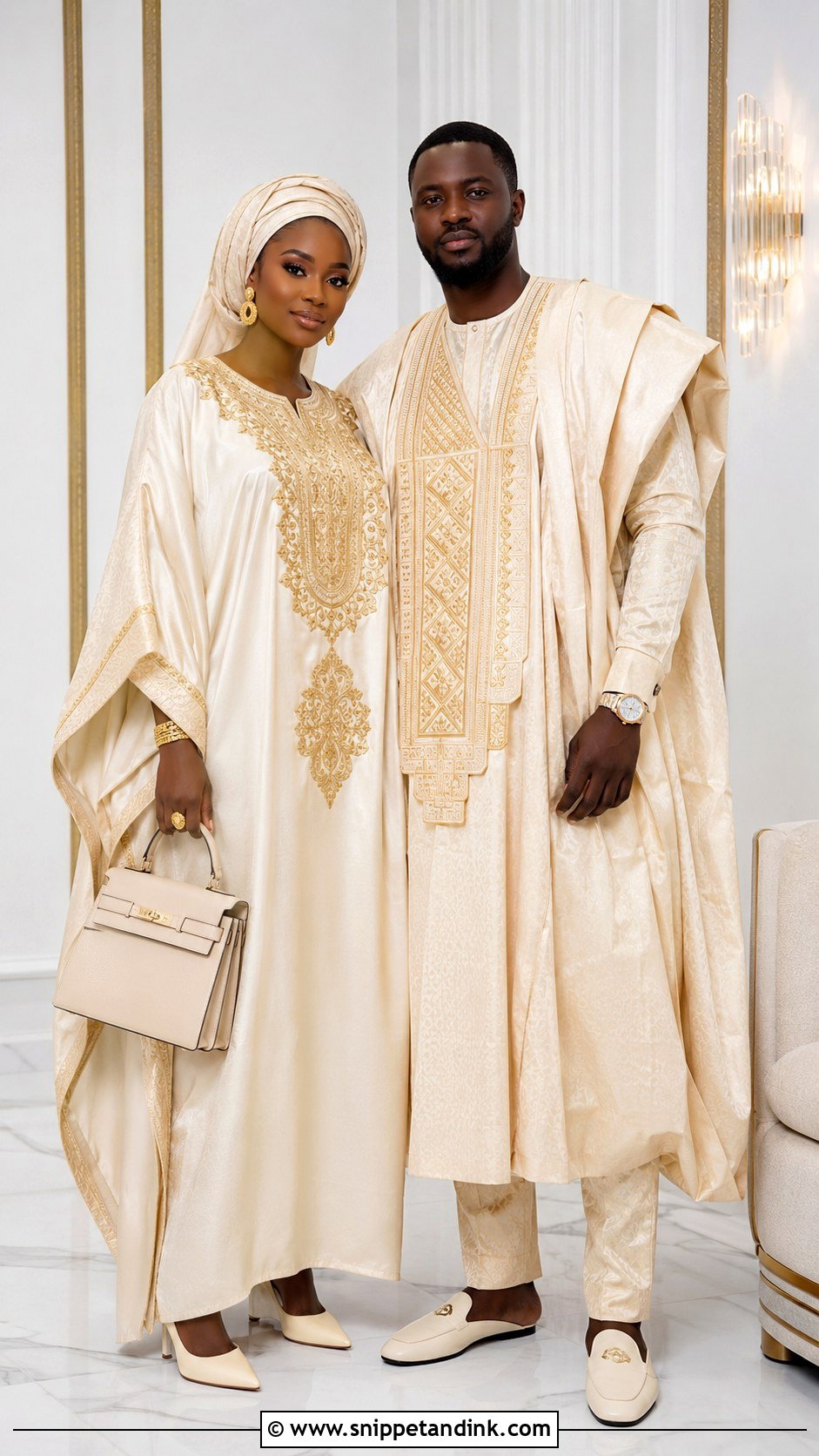
Flowing silhouettes make this the most comfortable pairing on the list, especially in heat. She wears a floor-length kaftan with embroidery at the neckline, pointed shoes, a structured handbag and refined gold pieces. He wears a grand boubou over a matching tunic and trousers with leather slip-ons. Both garments are wide, and the length is what I check: the hem should just clear the top of the shoe. Too long and he’ll catch it on every step; too short and the outer layer looks borrowed. Use the same base colour and different but related threadwork rather than identical embroidery. White and gold reads ceremonial; navy, forest green, burgundy or lavender are richer.
6. Shweshwe Dress And Shirt Outfit
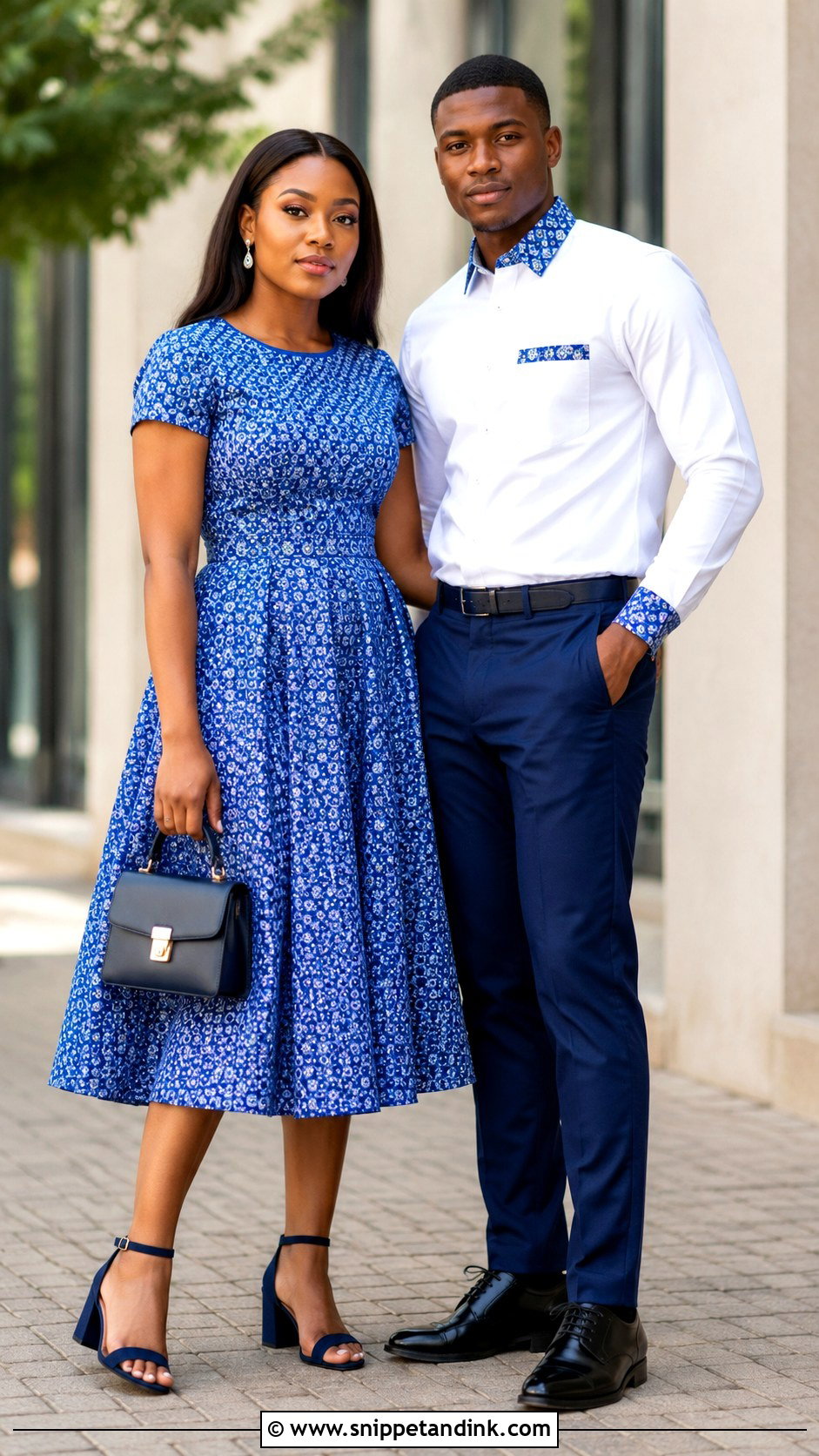
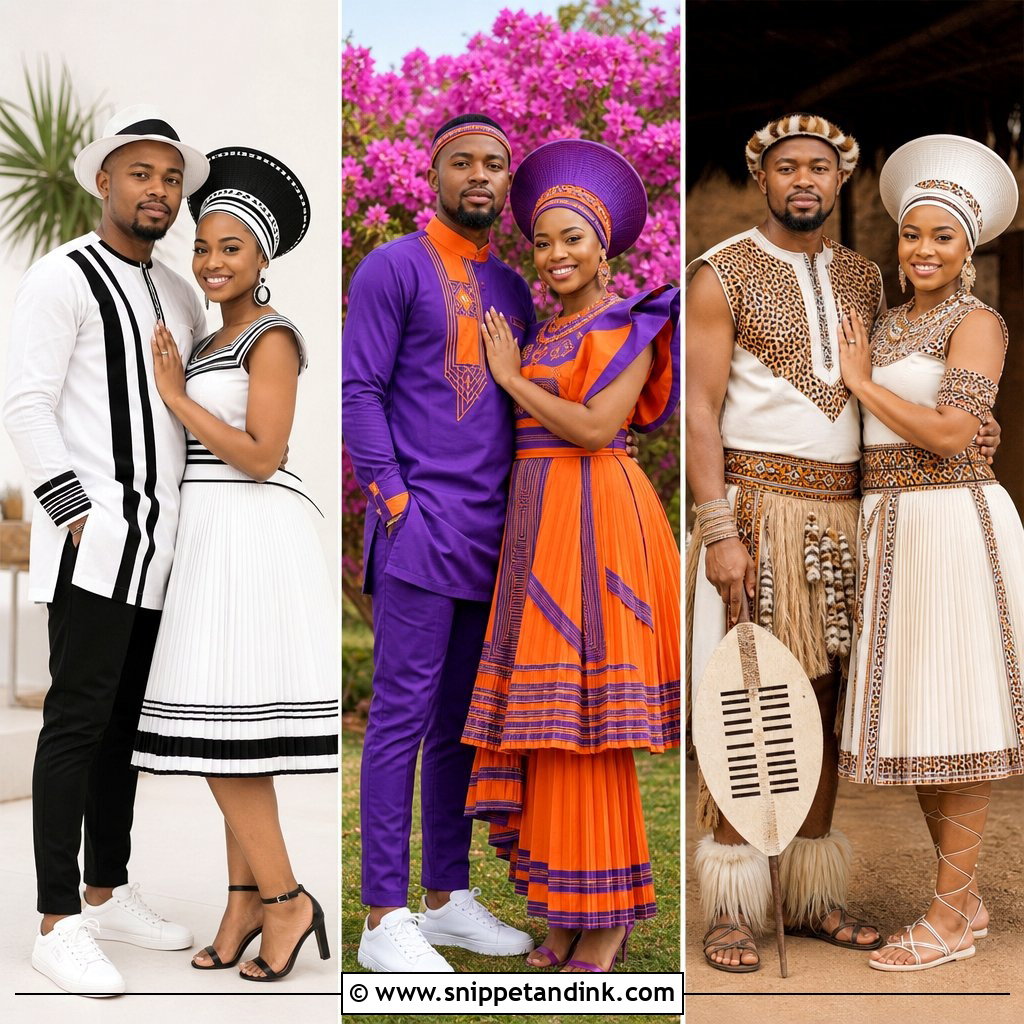
Shweshwe on his shirt and on her dress is a relaxed, practical pairing that suits a daytime wedding or a celebration after the main ceremony. She takes a fit-and-flare midi, a peplum gown or a full-length dress with a defined waist. He wears a white or navy shirt with shweshwe on the collar, placket, cuffs or chest pocket only. A whole shweshwe shirt is stiff when new and can look boxy on a slim build, which is why I prefer trim. Pre-wash the cloth before either of you has anything cut, because it shrinks. Tailored trousers and clean leather shoes for him; block heels, a small bag and simple earrings for her. Blue, brown and red shweshwe all sit well with neutral accessories.
7. Zulu Traditional Couple Outfit
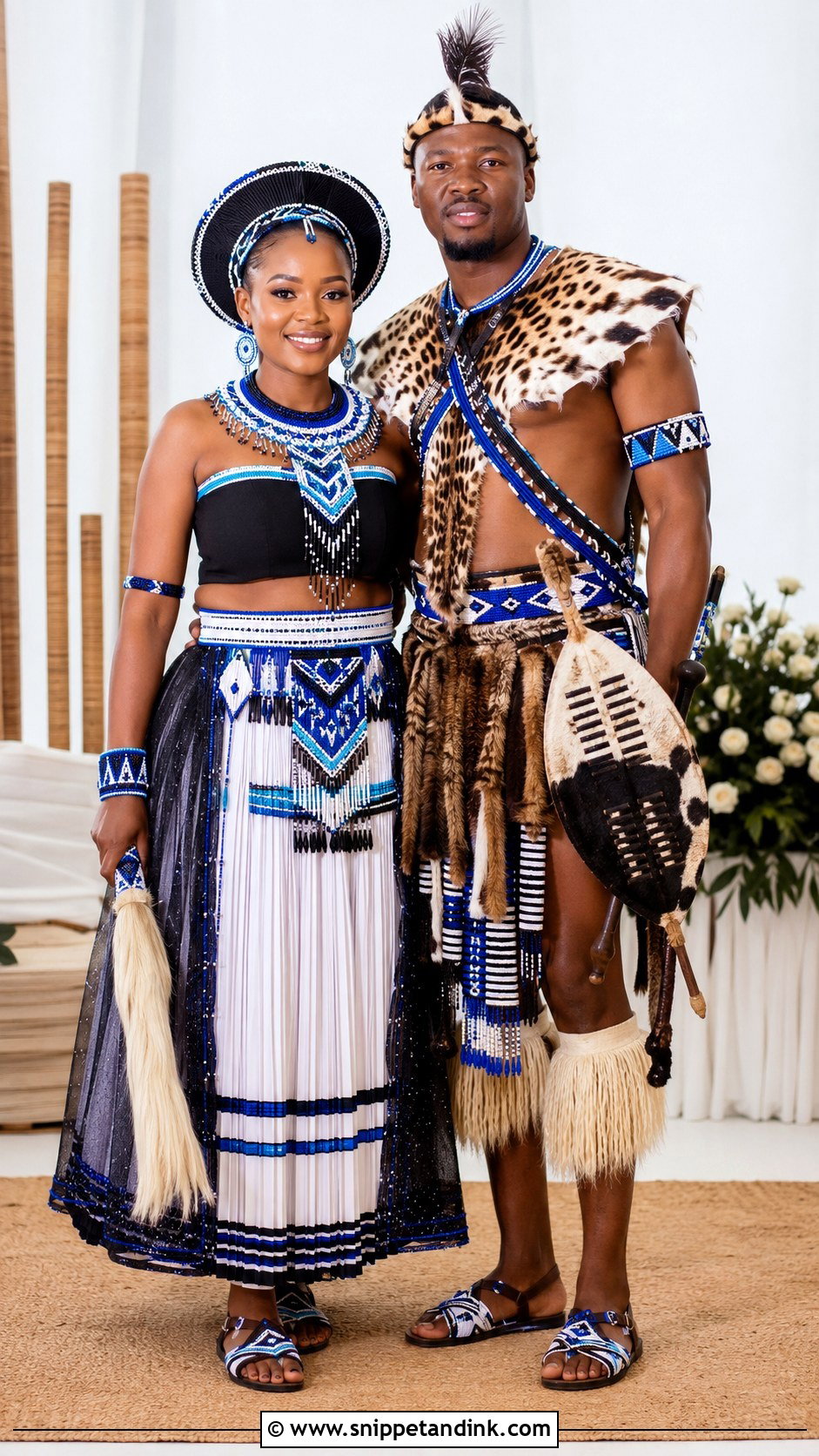
Zulu traditional dress is chosen by family background and by the ceremony, not by look alone. Women’s garments, beadwork and headpieces can show life stage or marital status, so talk to relatives or a cultural specialist before deciding anything. A woman might wear a full traditional ensemble with a long skirt, beaded accessories and the right headpiece. Her partner wears his own traditional garments with related colours, textures and bead patterns. Red, black, white, blue and yellow often form the shared palette. For both of you, choose footwear for walking and dancing on uneven ground. Don’t mix meaningful pieces just because the colours look good together; ask what each one means first.
8. Ethiopian Habesha Kemis Couple Outfit
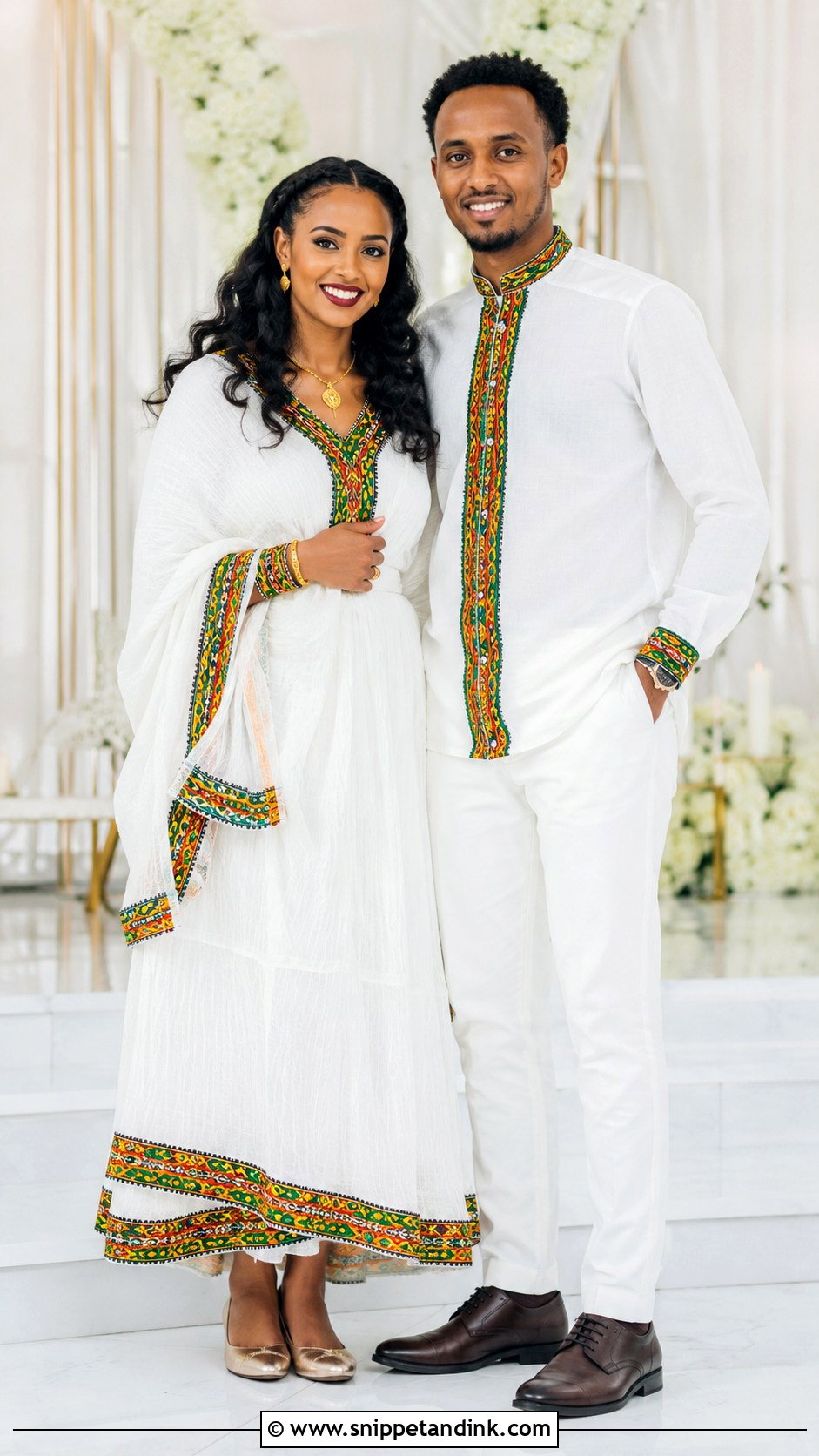
An Ethiopian Habesha Kemis couple outfit is white cotton with coloured borders on both sides. She wears a flowing kemis with woven detailing at the neckline, sleeves and hem, a light shawl, metallic flats and delicate jewellery. He wears white trousers with a traditional-style shirt or tunic carrying a related border. The borders don’t need to be identical, but they should share a similar scale. A wide band on her hem next to a hairline trim on his cuff looks mismatched in photos. Green, gold, red, blue or multicolour trim can all work. An Ethiopian tailor or weaver will know how each garment is built and which accessories suit the ceremony.
9. Eritrean Zuria And Kaba Couple Outfit
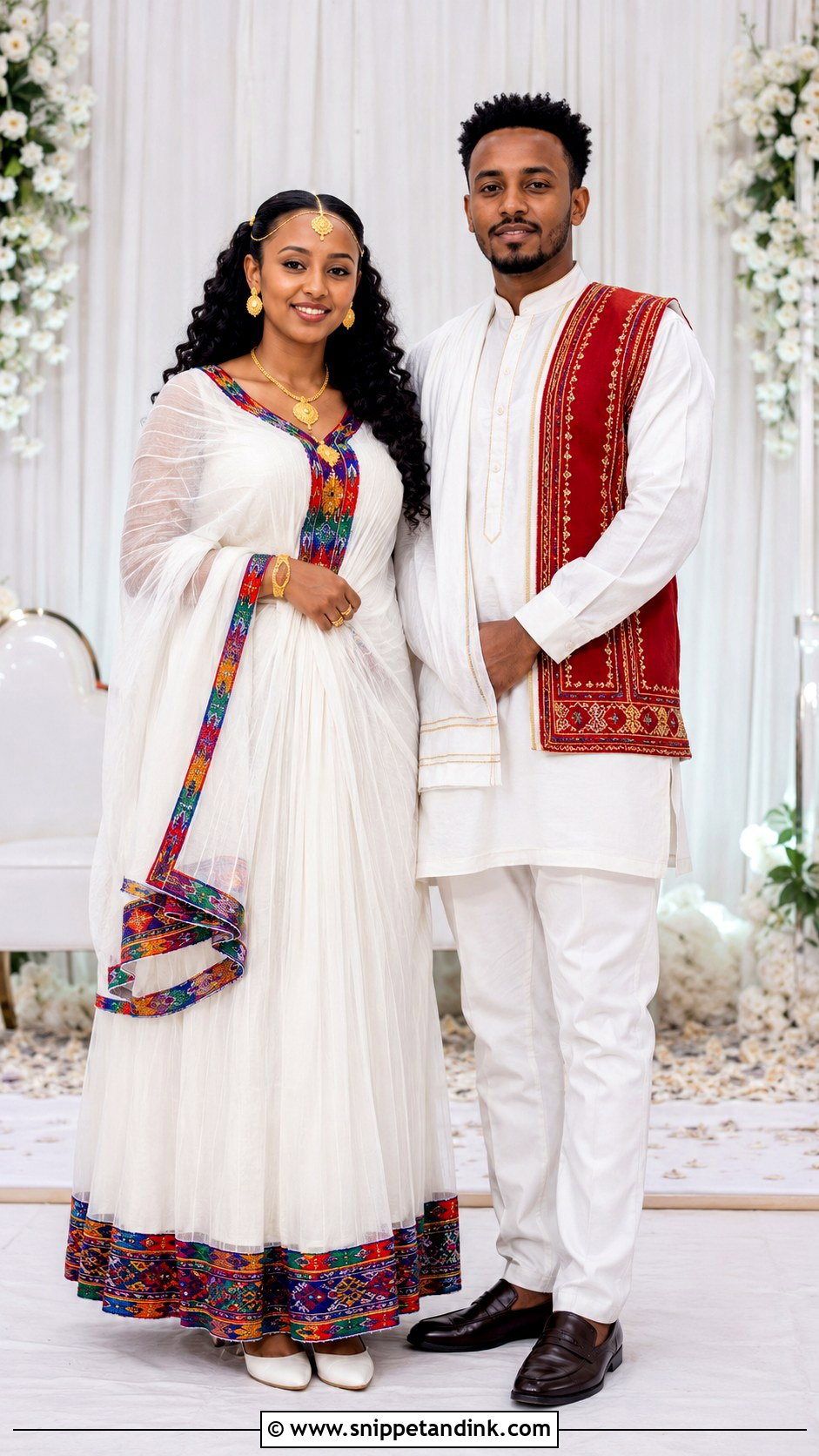
The Eritrean zuria is a white dress with woven borders, and the kaba is a ceremonial cape-like layer worn over formal dress. She wears a long zuria with coloured accents, a shawl, gold jewellery and closed-toe shoes. He wears crisp white traditional clothing and adds a kaba when the occasion calls for it. Repeat one border colour across both outfits and you’re coordinated. Because these ceremonial layers have specific purposes, family members or an experienced Eritrean designer should confirm the look before it’s final. Keep modern extras understated: a neutral clutch, polished shoes, little jewellery.
10. Maasai Inspired Couple Outfit
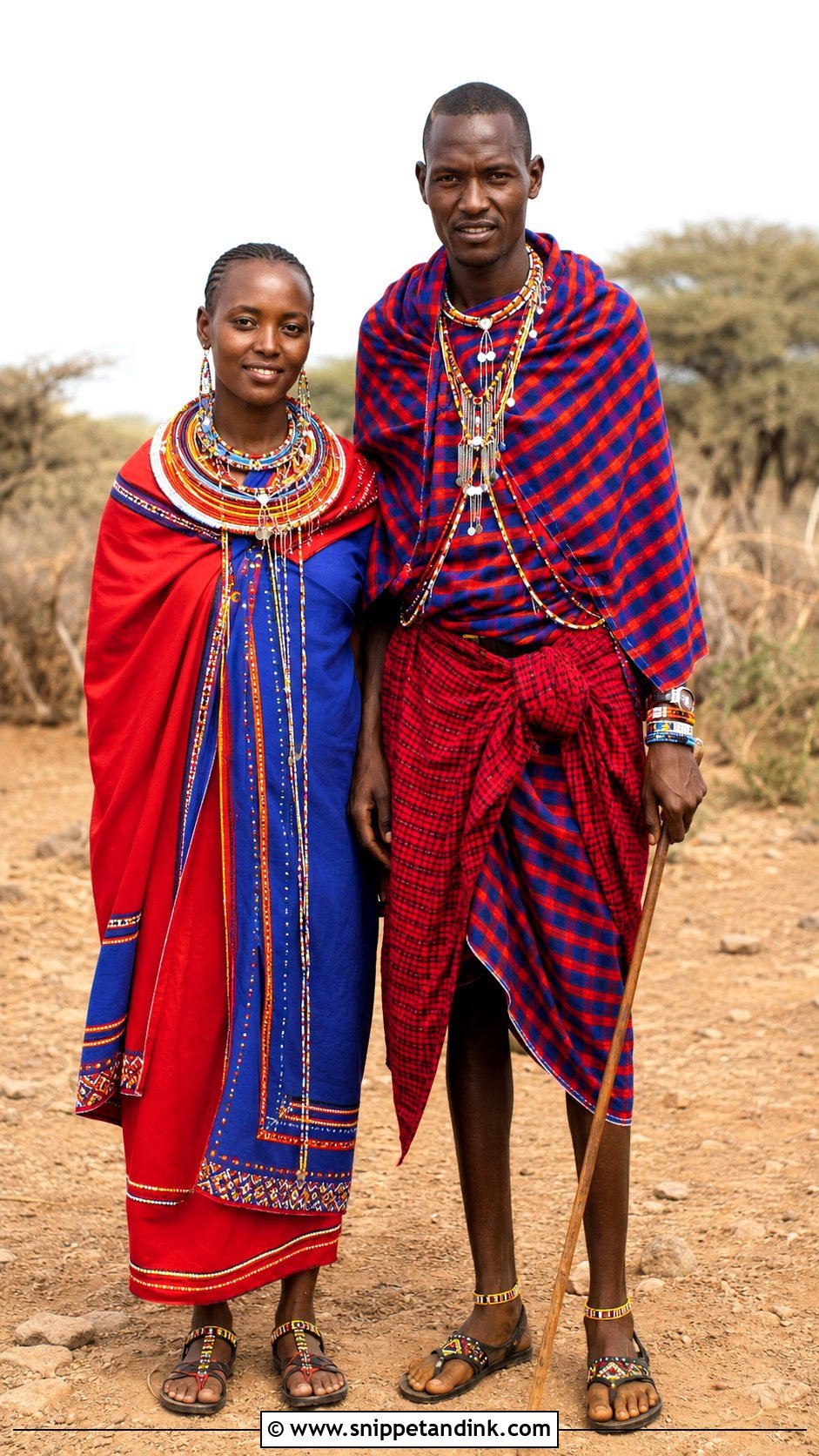
Maasai garments and beadwork carry identity, so this pairing belongs to couples with a real connection to Maasai heritage, working with local artisans or family. Her look may include a long dress or wrapped garment in red, blue or checked fabric, with layered beaded necklaces and sandals. His centres on the shuka, the checked or solid cloth wrap, with simple garments, sandals and chosen beadwork. A shuka must be wrapped and knotted securely, and a thicker one holds better through a long day of movement. Sharing two or three colours looks better than copying every accessory. For portraits, an open outdoor setting and plain styling keep the beadwork central.
11. Xhosa Umbhaco Couple Outfit
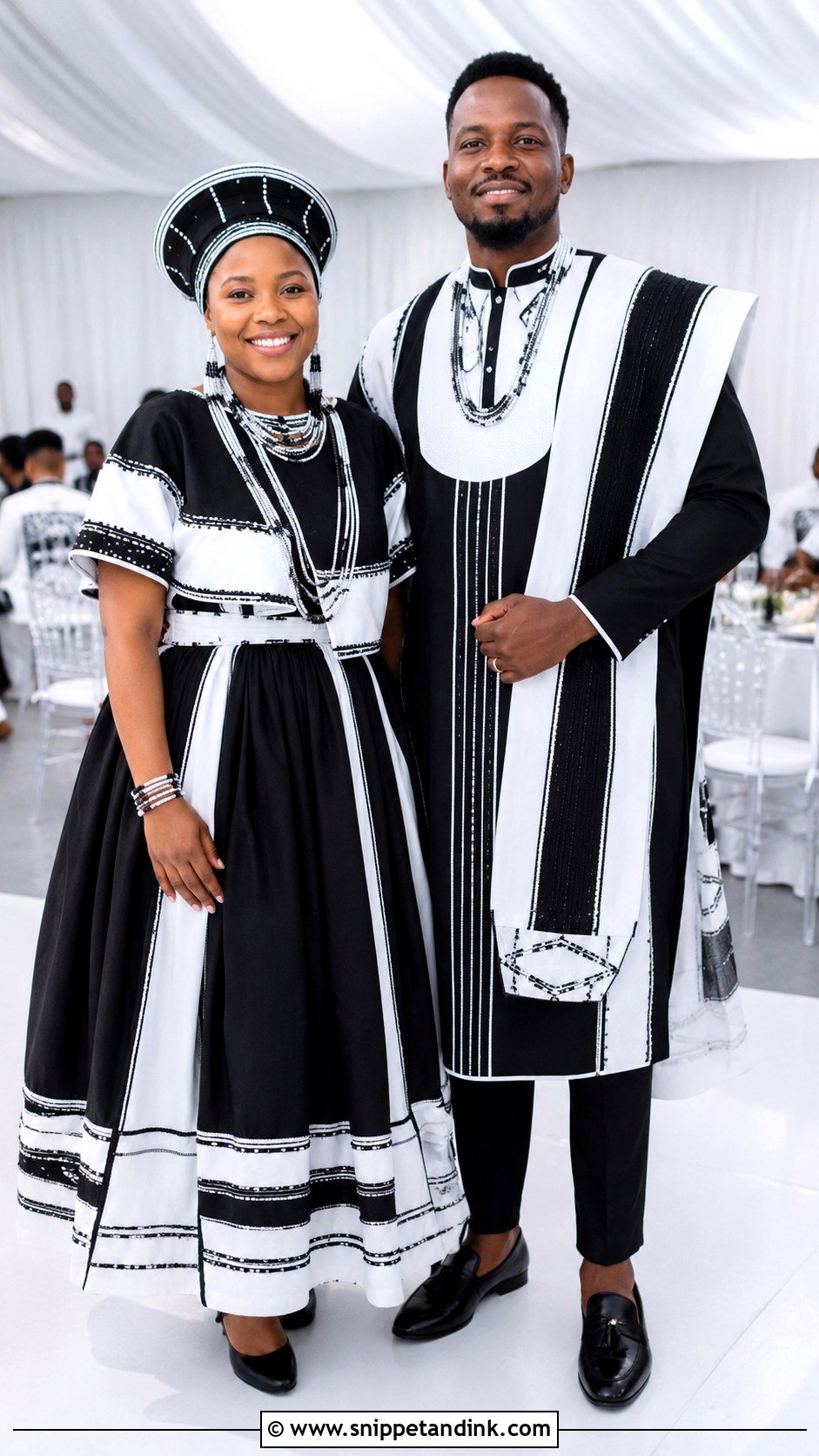
Black on white is the signature of a Xhosa Umbhaco couple outfit. She wears a full skirt and matching top with black bands, braid or beadwork, a head covering, layered necklaces and simple shoes. He wears a long tunic or shirt with matching black detail, tailored trousers and, where appropriate, a traditional blanket or outer layer. Line up the band widths on both outfits; a narrow trim on his shirt beside her broad skirt bands looks like two separate events. Red, blue or yellow can come in sparingly through beads. Details can signal identity, family or status, so cultural guidance comes before colour-matching.
12. Ndebele Patterned Couple Outfit
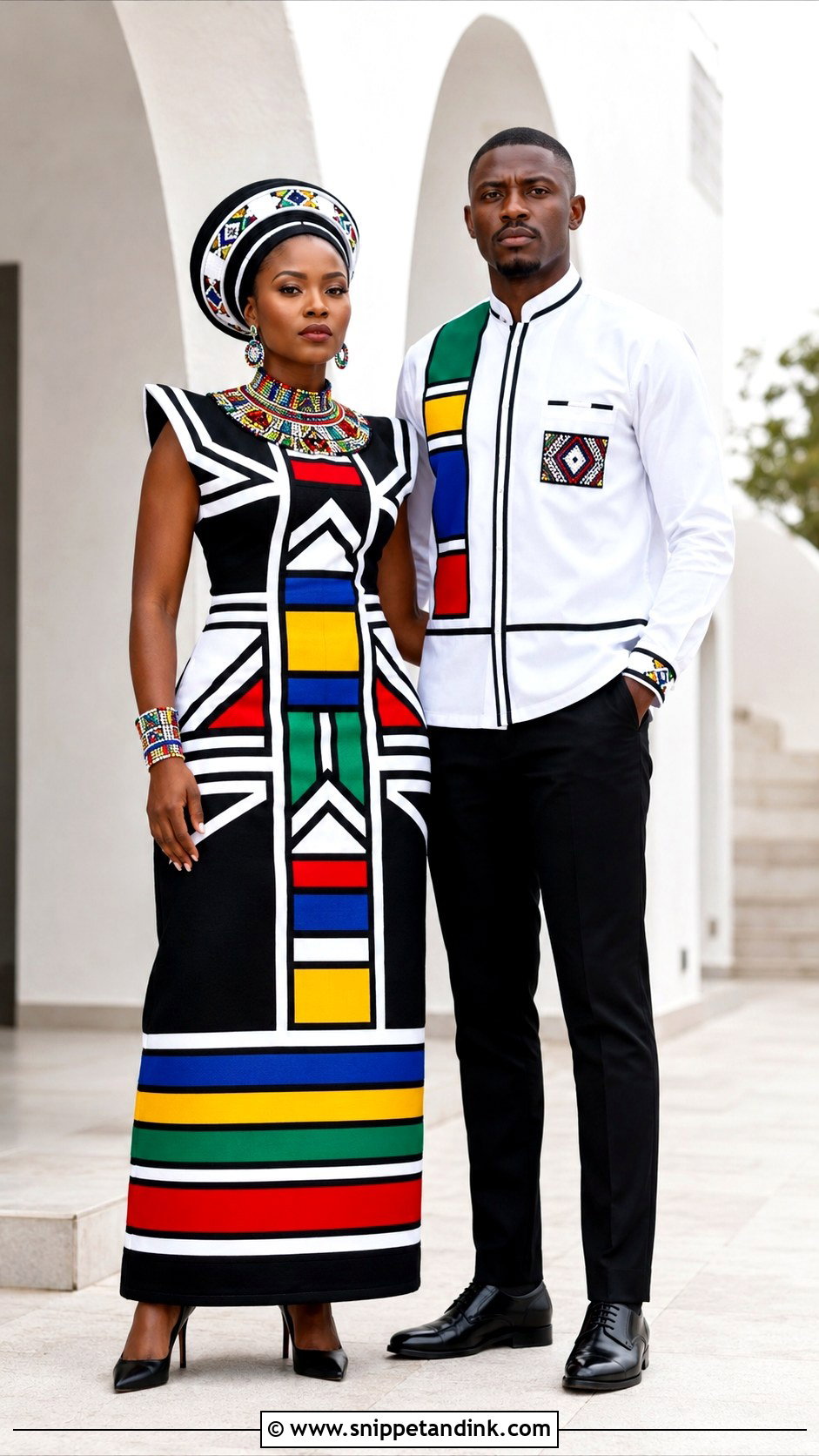
Ndebele geometry is strong enough to need simple garments around it. She wears a structured midi or maxi with clean bands of black, white, red, yellow, green and blue, a beaded collar, cuffs and solid heels. He wears black trousers and a white or black shirt with one restrained geometric panel across the chest, collar or sleeves. If his shirt carries the same full pattern as her dress, the two of you merge into one block in group photos, so keep his to a single panel. Traditional layers can be added for a more ceremonial look with cultural guidance, and meaningful motifs should come from Ndebele artisans or designers.
13. Swati Emahiya Couple Outfit
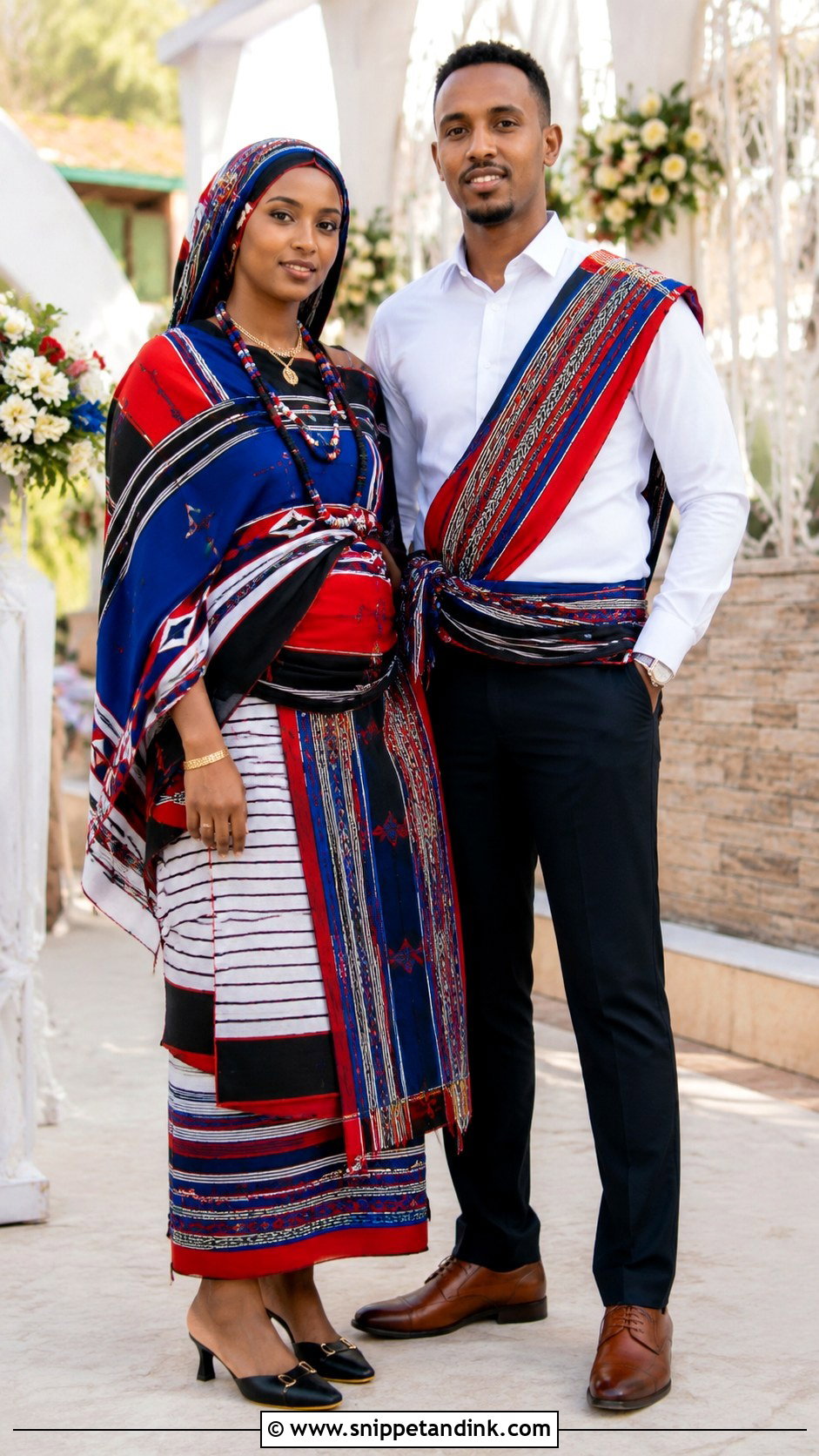
Emahiya is the bright Swati wrap cloth, often printed in red, blue, black and white, and it’s tied rather than tailored. She can wear it as a full-length wrap dress or a layered ensemble with jewellery, a headscarf and low heels or sandals. He pairs a matching or complementary wrap with a crisp shirt, tailored trousers and leather shoes. The knot placement is what I check on both: a wrap knotted on the wrong shoulder or tied loosely drops every time you lift your arms, so practise it before the day. Keep the print evenly balanced between the two outfits. For lobola-related or other specific ceremonies, ask the family which garments and arrangements are expected.
14. Tswana Leteisi Couple Outfit
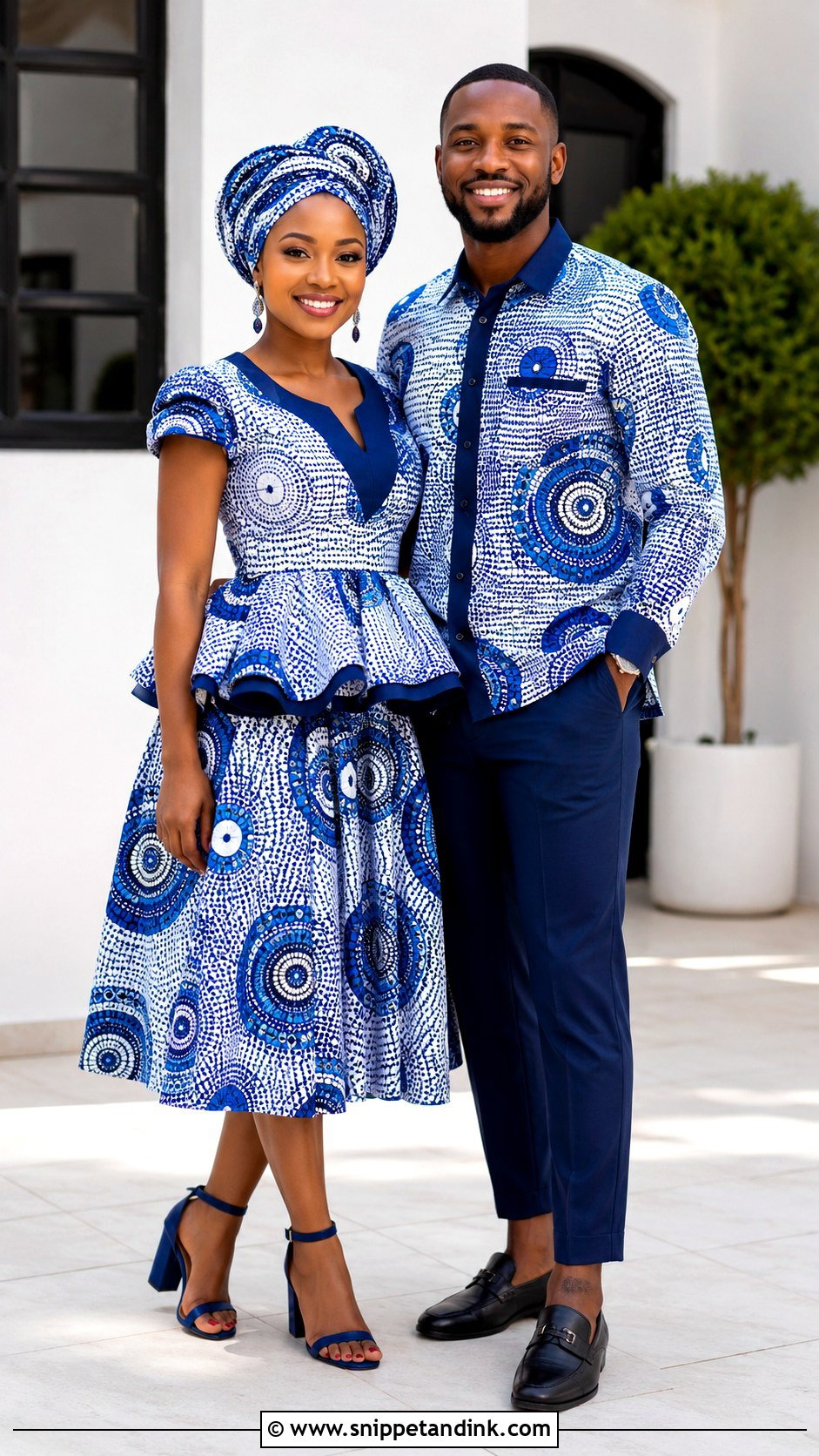
Leteisi is the Tswana name for the starched indigo print, and its small repeating geometry is very easy to coordinate. A Tswana Leteisi couple outfit might pair her fitted peplum top and full skirt, floor-length dress or tailored midi with his shirt in the same fabric and navy, black or cream trousers. A solid shirt with leteisi trim is quieter. Blue and white is the classic; brown, red and green are warmer. On his side, the cloth is crisp and won’t stretch, so I order the shirt a little roomier through the shoulders and chest than a cotton poplin would be. Her skirt needs the same allowance for walking and sitting.
15. Kitenge Maxi Dress And Shirt Outfit
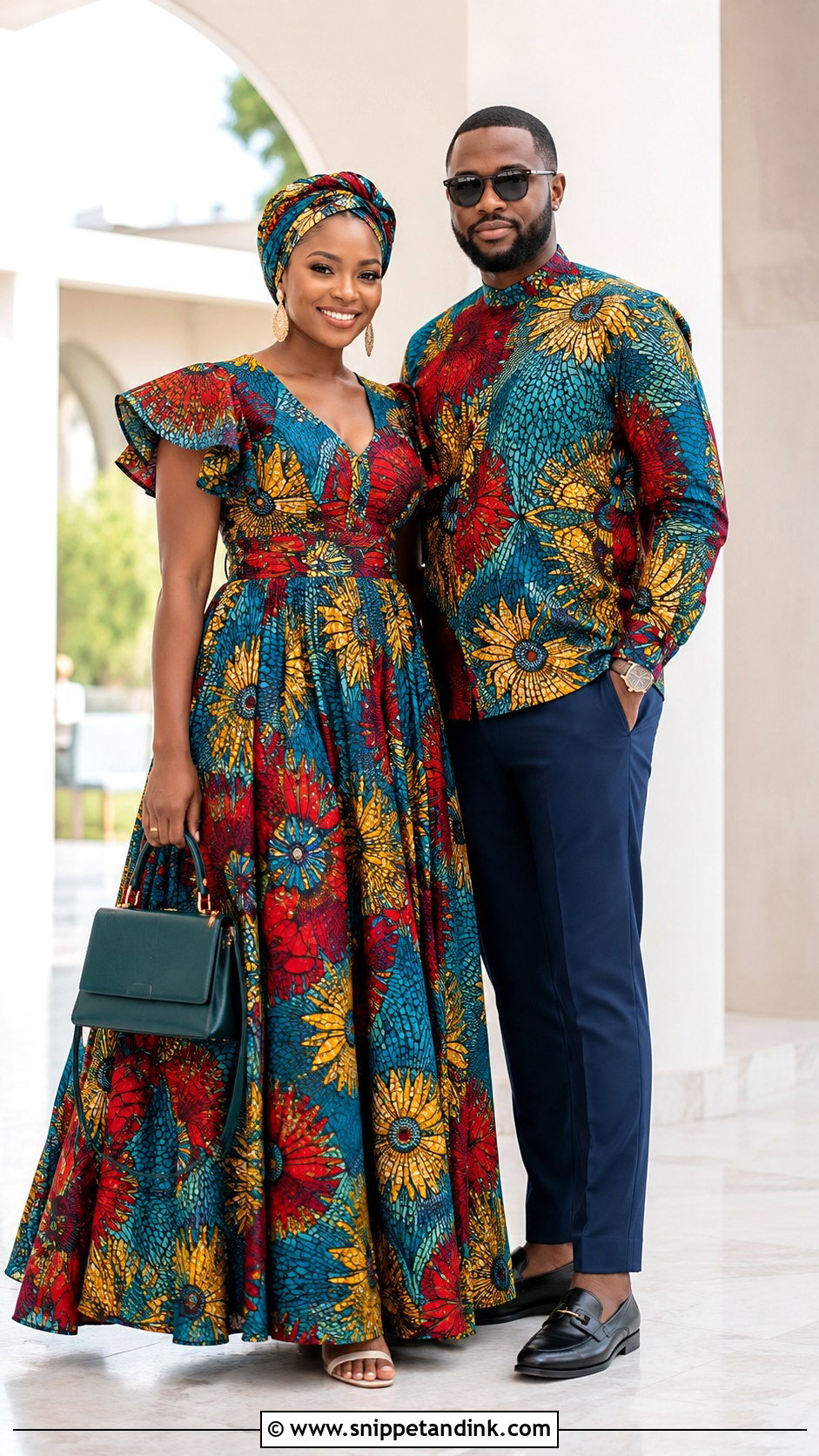
Kitenge suits cultural gatherings, family portraits and daytime parties where nobody wants anything stiff. She wears a flowing maxi with a fitted bodice, flutter sleeves and a full skirt. He wears a short or long-sleeved kitenge shirt with solid trousers in a colour taken directly from the print. Loafers keep him smart; clean sneakers keep it casual. The shirt length is where men’s print shirts usually fail: worn untucked, it should end at mid-fly, no lower, or it reads like a tunic. She adds block-heel sandals, a headwrap and a small structured bag. With a very bold print, keep the jewellery minimal on both of you.
16. Matching Dashiki Couple Outfit
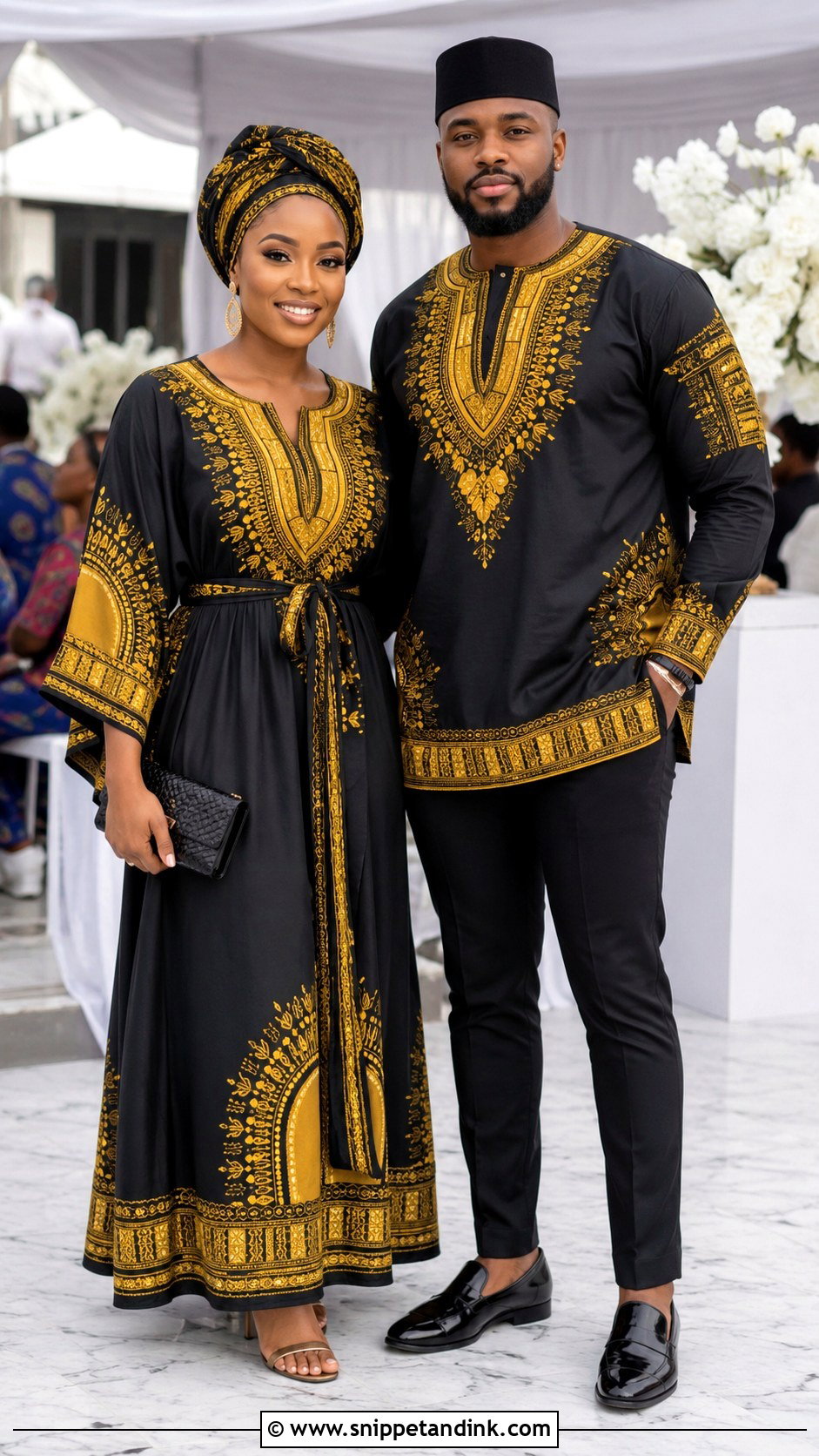
A dashiki is a loose pullover with a printed or embroidered neckline, so the neckline is what ties the two outfits together. She can wear a belted dashiki maxi, an A-line mini over fitted trousers or a floor-length gown with an embellished neck. He wears a traditional dashiki shirt with solid trousers and loafers, sandals or sneakers. Use one print scale for both, then vary the garment shapes, which keeps it from looking like a costume. Black and gold feels formal; blue, green, orange and white is brighter for daytime. A headwrap and small earrings complete hers, and he can add a simple cap or bracelet but not much more.
17. Ankara Jumpsuit And Tunic Outfit
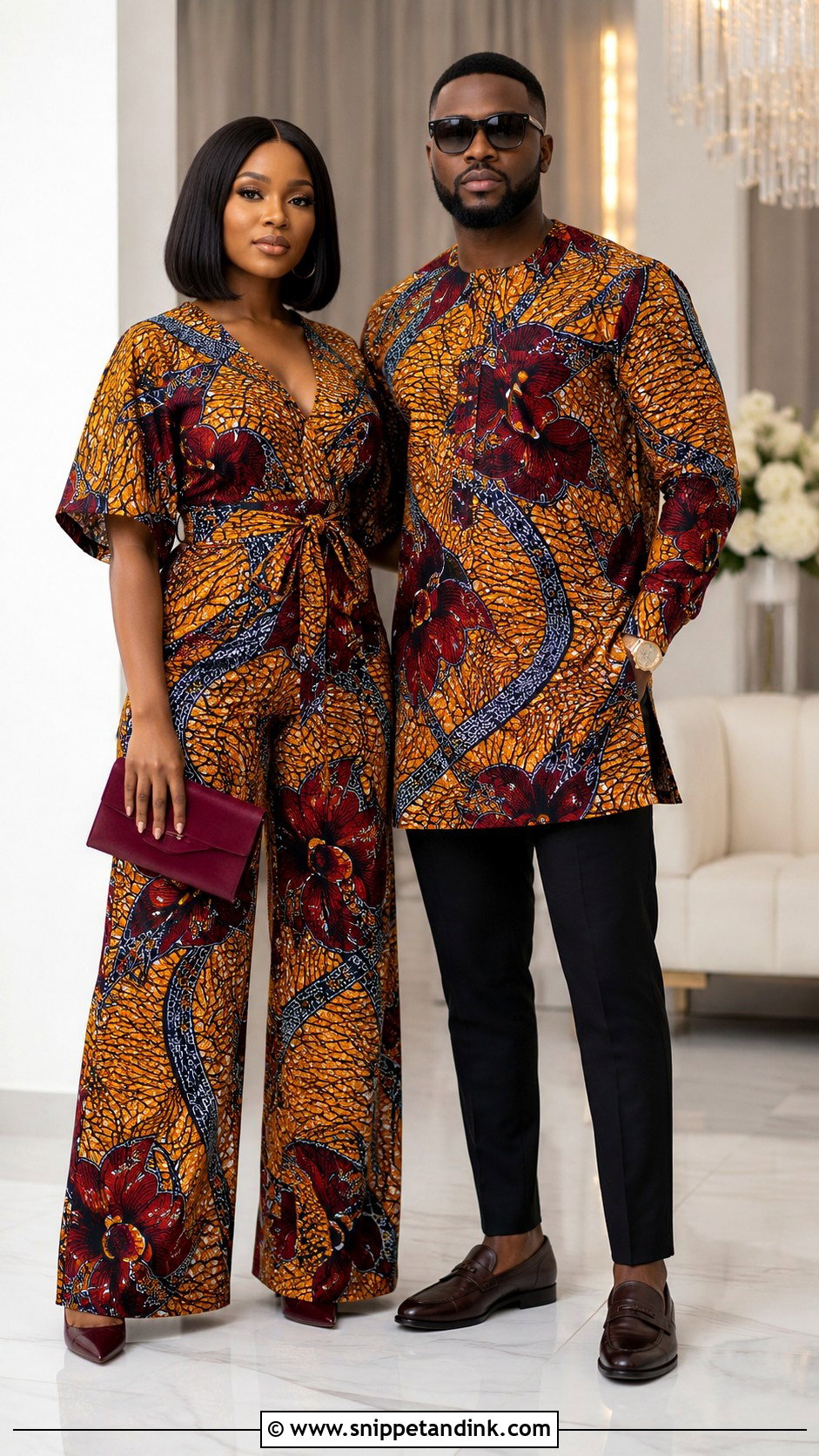
For couples who like modern tailoring, an Ankara jumpsuit and tunic outfit keeps the print central without anything feeling traditional. She wears a wide-leg jumpsuit with a defined waist, good sleeves and a neckline suited to the event, plus pointed heels, hoops and a solid clutch. He wears a knee-length Ankara tunic over plain fitted trousers and loafers. A full-print knee-length tunic is a lot of fabric, and on a broad frame I’d limit the print to the front panel, collar or cuffs. Hem her jumpsuit in her real shoes. Coordinate through one dominant colour rather than piles of matching accessories.
18. Brocade Kaftan And Agbada Outfit
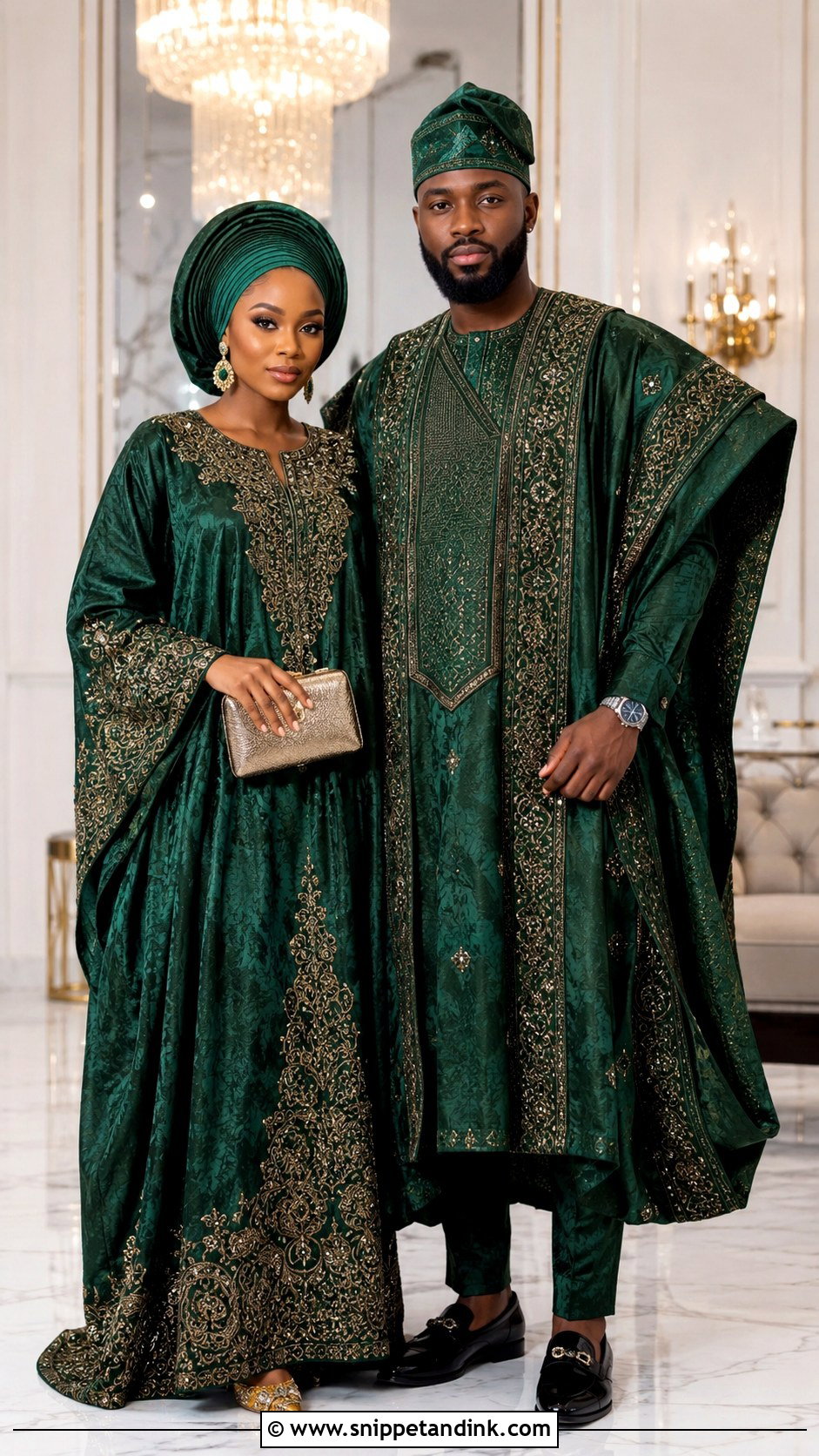
Brocade and embroidery make this the most formal pairing here. She wears a floor-length kaftan with a defined neckline, embellished sleeves and enough structure to show her shape, plus a headwrap, metallic clutch, earrings and pointed mules. He wears an embroidered agbada over a tunic and trousers with a matching cap and loafers. Brocade agbada is heavy and hot, so for a summer evening I’d keep the embroidery to the neckline and chest and choose a lighter brocade for the robe. Champagne, ivory, plum, emerald and midnight blue all suit an evening or indoor celebration. Cut both garments to each wearer’s height so the cloth falls cleanly.
19. White Lace Traditional Couple Outfit
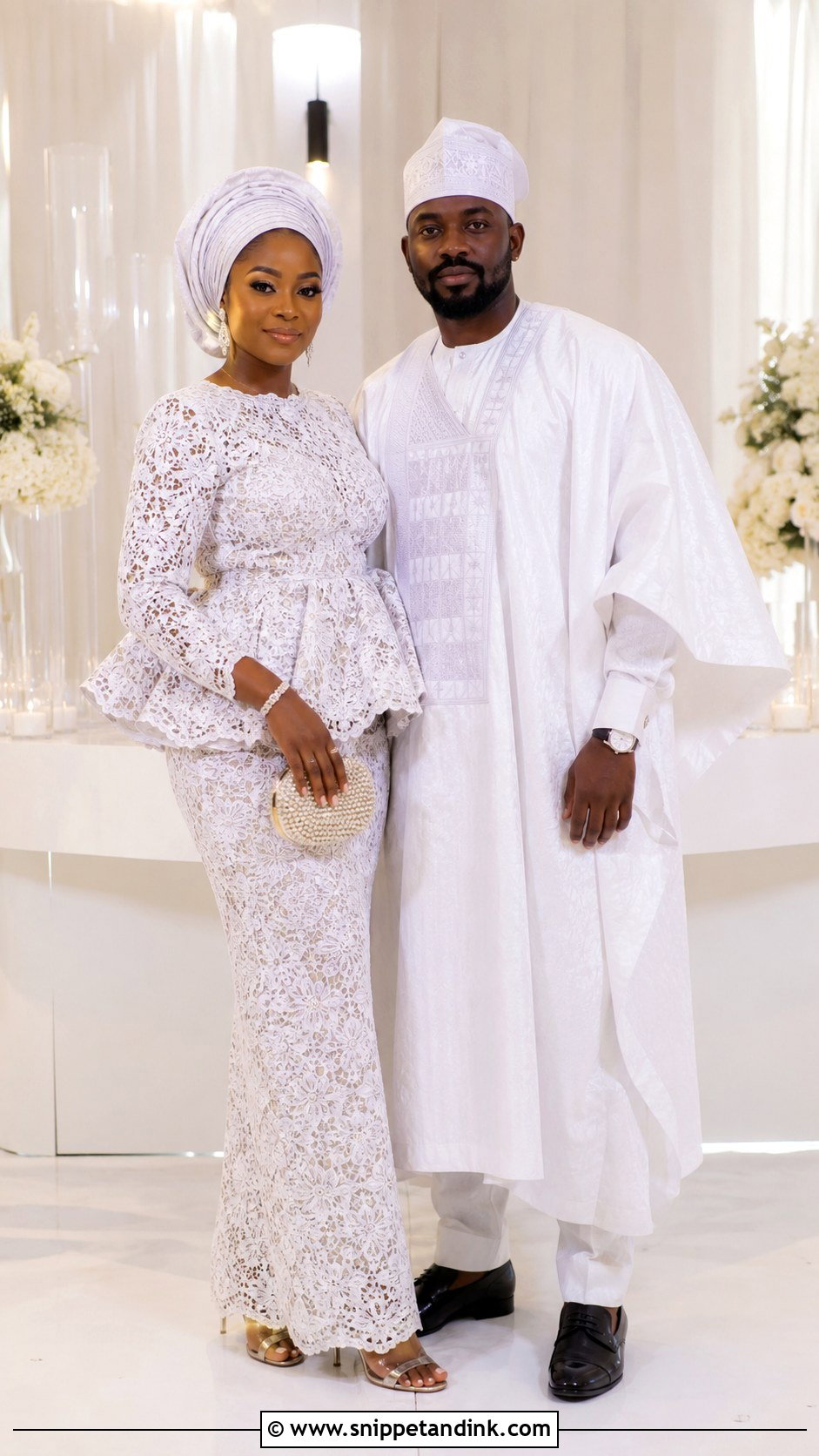
All-white lace sounds simple to match, and it’s the pairing where I see the most mismatches. Bright whites from two different bolts rarely agree: one leans blue, the other cream, and the camera exaggerates it. Compare both fabrics side by side in daylight before anything is cut. She can wear a lace wrapper and blouse, a structured peplum gown or a lined kaftan with a white or soft metallic headwrap, pearl-style earrings, a beaded clutch and silver or gold shoes. He wears a white lace tunic and trousers or an embroidered agbada over a simpler set. Texture can vary between you as long as the white is the same. One shared accent, gold thread, green beads or burgundy, personalises it.
20. African Print Suit And Peplum Dress Outfit
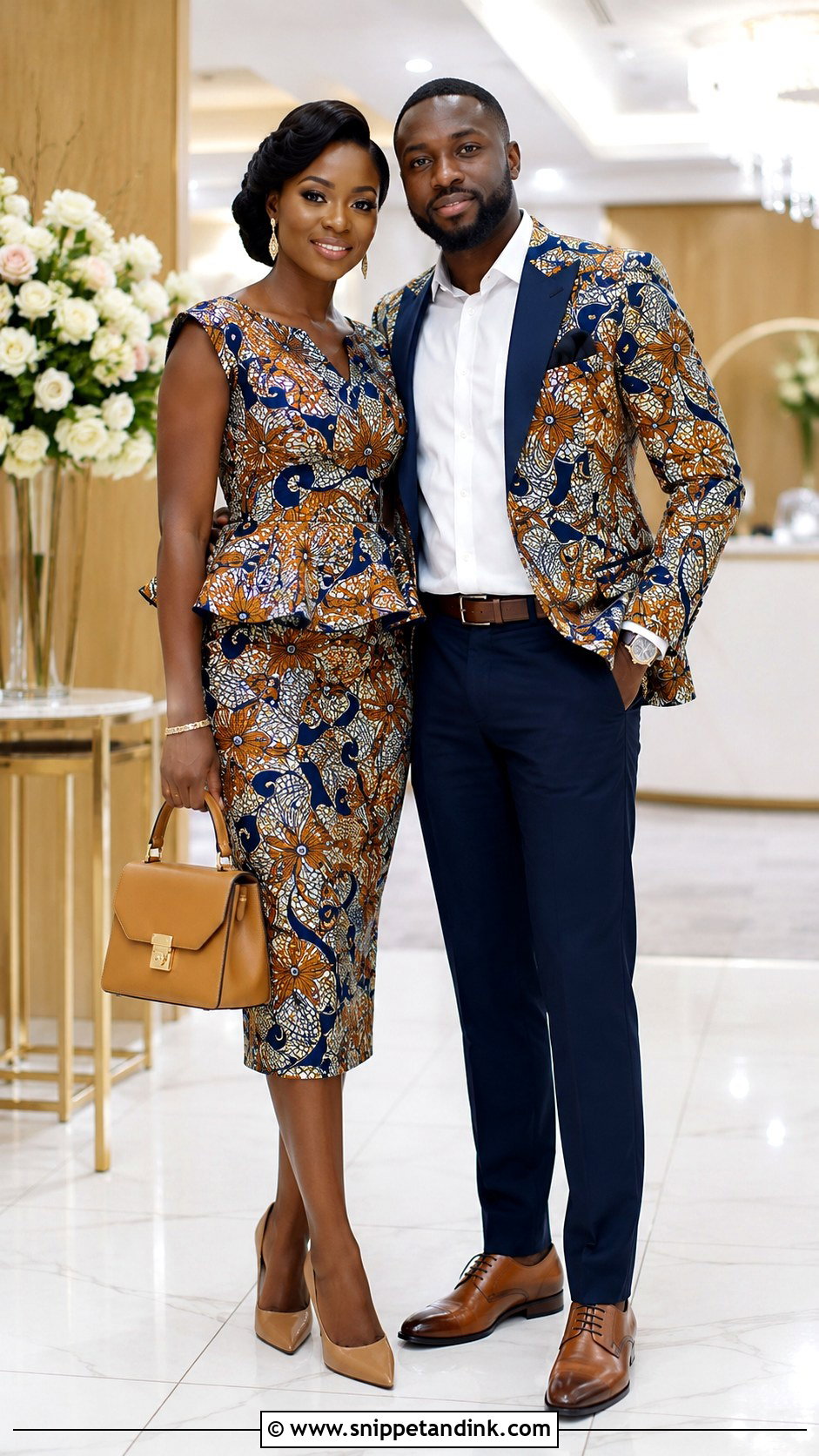
This is the city version: a print blazer for him and a peplum dress for her, for engagement shoots, receptions and cultural events with a modern dress code. She wears a fitted midi with a peplum waist, short or three-quarter sleeves and a pencil skirt, with pointed pumps, a structured bag and simple earrings. He wears a tailored blazer in the same print with solid trousers, a plain shirt and leather dress shoes. A printed blazer is the hardest piece to tailor because the pattern has to meet at the lapels, pockets and centre back seam, so give the tailor extra fabric. For a quieter version, put the print on his waistcoat, tie or lapels only.
Agbada Sleeves, Wraps and Caps After the Ceremony
Traditional menswear is built for presence, and that means wide sleeves, long robes and caps that shift. None of it is a problem if you know how to manage it once the formal part ends.
For him
The wide agbada sleeves are meant to be gathered and folded up onto the shoulders when the hands need to be free, for eating, greeting and dancing. Practise it at home in the actual robe. A fila or cap should be fitted to his head size, not just tilted; a loose one comes off during the first dance. If he’s wearing a draped cloth or shuka, carry two safety pins inside a pocket.
For her
Wrappers and wrap dresses loosen with movement. Ask the person who ties it to show you, or a bridesmaid, how to retie it in under a minute. A gele can be pinned discreetly at the back if it starts to lift.
Colour Checks Before the Portraits
Matched fabrics often look less matched in photos than in person. Indoor warm lighting shifts creams toward yellow, and flash can make metallic threads read flat or blown out. Before the day, stand together by a window and take a few phone pictures with and without flash. If one outfit looks noticeably cooler or brighter than the other, swap an accessory or change the trim now, while there’s still time.
Two Outfits, One Shared Thread
Coordinating as a couple is about more than two garments cut from the same fabric. Start with the tradition, the textile or the ceremony that actually connects to you. Then bring in tailors, artisans and family members who know those garments and what they mean. The shared detail can be small: an embroidery colour, a bead, a trim. From Kente and Ankara to aso oke, shweshwe and embroidered robes, the pairings that look best in photos are the ones where both of you could move, sit and dance all day, and where his outfit got as much fitting time as hers.
You'll Like These Ideas:


Leave a Reply