
Braids are the request I get most from brides who don’t want a stiff, sprayed helmet but still need their hair to last from the morning photos to the last song. A woven section grips pins, flowers and veil combs far better than smooth hair does, and it hides the odd frizzy patch that a sleek bun would show. What decides success is less the pattern you save from a photo and more the hair you actually bring to the chair: its length, its layers and how well it holds a bend. Below are 25 braided styles, from tight cornrow updos to loose side plaits, with notes on what each one needs from your hair and where it tends to go wrong.
Why Braids Slip, and the Prep That Stops It
A braid that looks crisp at 10 a.m. and fuzzy at 6 p.m. almost always started on hair that was too clean. Freshly washed hair is slippery, so the crossings loosen as soon as you move. I ask brides to wash the day before, skip heavy conditioner on the lengths, and come in with dry, product-free hair. Then I mist each section with a dry texture spray before I braid it, which gives the strands just enough friction to stay locked.
Layers are the other problem. Short pieces poke out of every crossing, especially around the crown and nape. A little light wax on my fingertips as I braid tucks them in, and on very layered cuts I’ll choose a fishtail or a twist instead of a chunky three-strand plait.
When I add extensions
- Crown braids and halos on hair shorter than about shoulder length, since the braid has to reach all the way around.
- Fine hair that turns a fishtail or Dutch braid into a thin rope; a single matched clip-in weft roughly doubles the width.
- Low buns and chignons where the bun would otherwise look small under a veil.
- Match the color in daylight at your trial, and bring the extensions on the day already washed and dried.
1. Fishtail Braid Bridal Updo
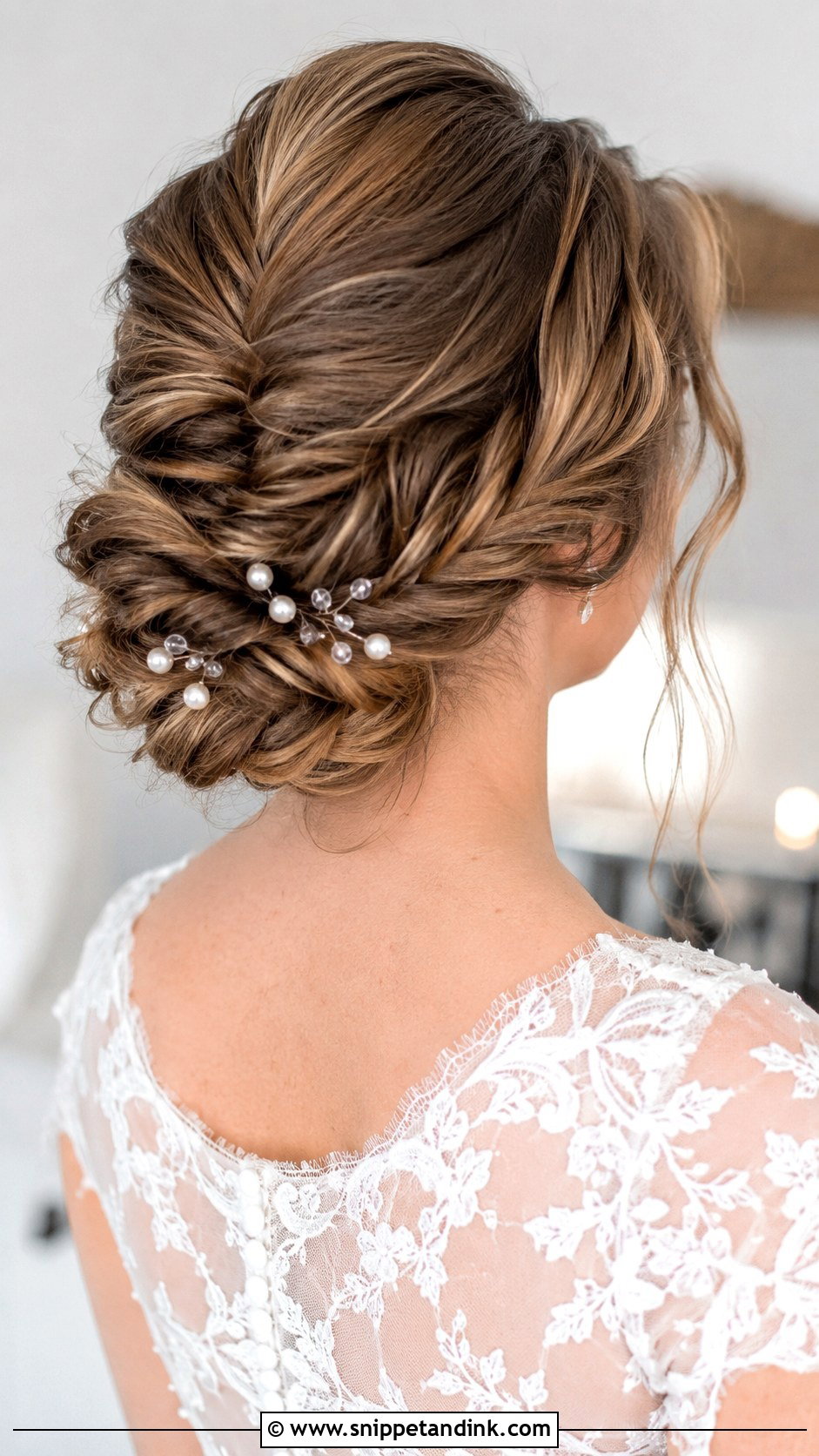
A fishtail looks complicated, but it’s only two sections crossing tiny pieces over and over, which is why it reads so detailed in close-ups. Pinned low at the nape, it leaves room above for a cathedral veil comb. The catch is thickness. On fine hair a fishtail shrinks to a thin rope, so I braid it fairly loose, then pancake the outer edges with my fingertips to double its apparent width before pinning. A few pearl pins slipped into the crossings hold far better than in a plain bun, because the weave gives them something to bite into.
2. Boho Crown Braid With Loose Curls
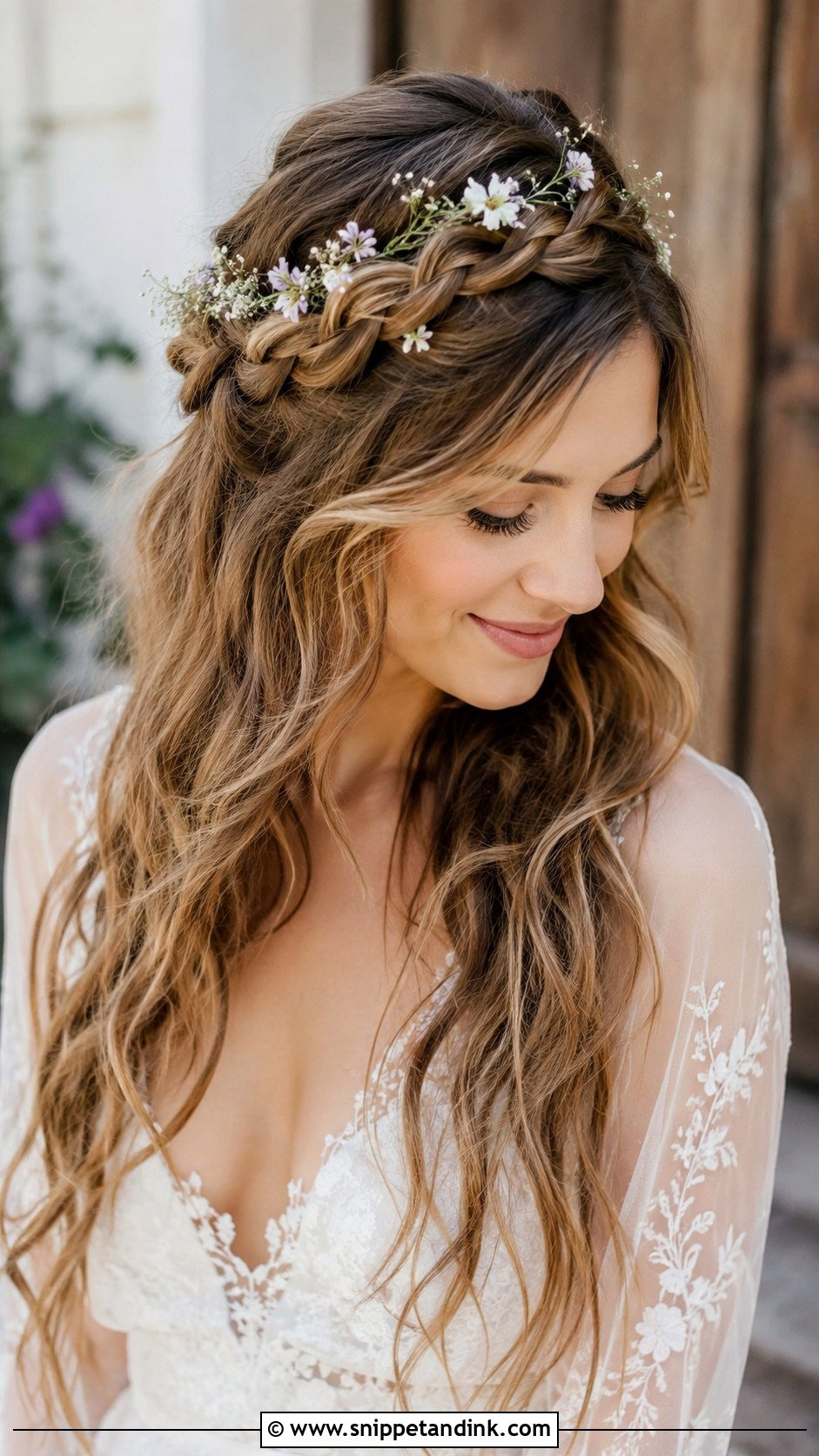
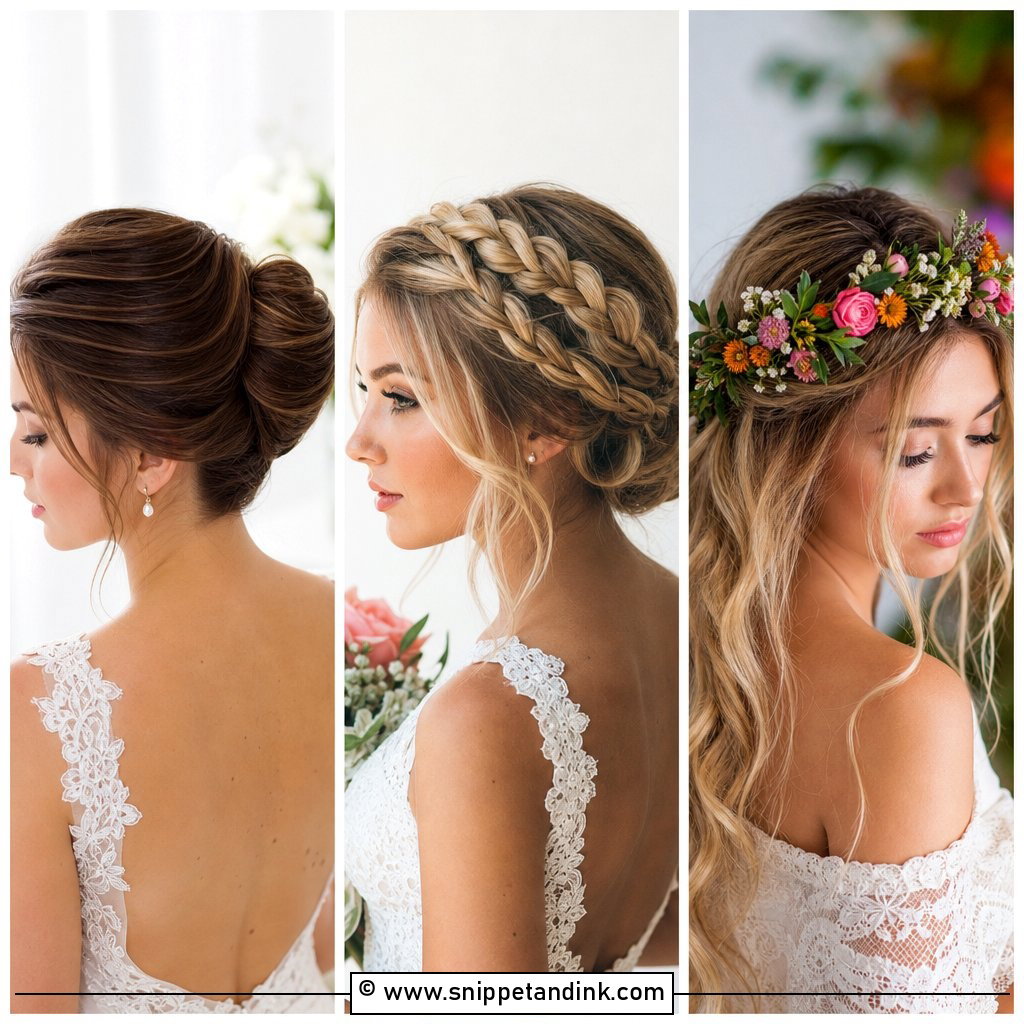
This is the one I picture at a garden ceremony: a soft braid circling the crown and the rest left in loose waves. The braid has two jobs, framing the face and anchoring anything you tuck into it. Baby’s breath and small greenery sit happily in the plait, but heavier wildflowers need wiring or a bobby pin behind each stem. I’d warn very slippery, freshly washed hair off this one; the crown braid slides back by mid-afternoon unless the hair has some grit from a texture spray first.
3. Dutch Braid Half-Up Style
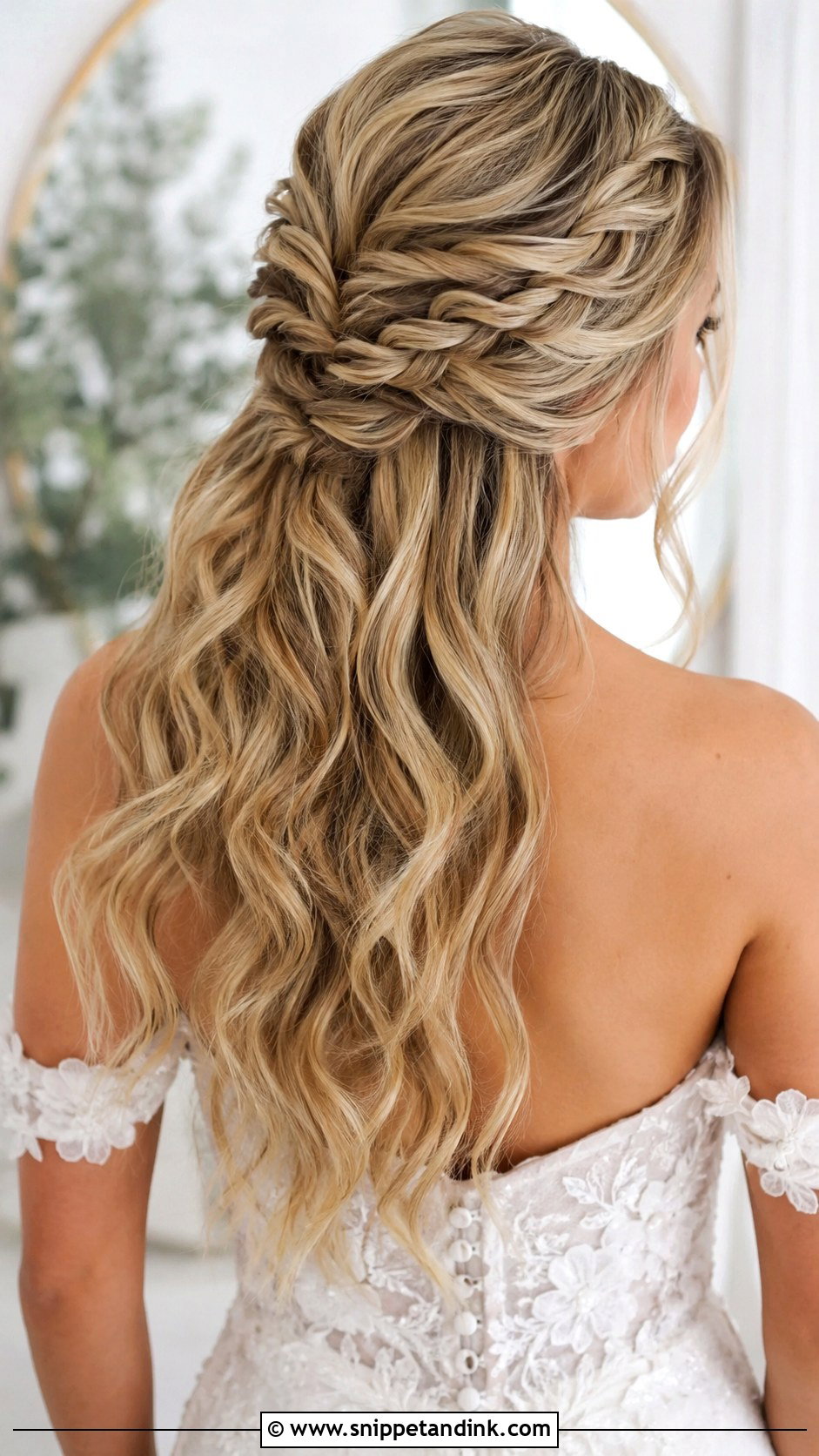
Dutch braids are worked underhand, so the plait sits raised on top of the hair instead of tucked in like a French braid. That raised ridge is what gives the half-up version its bold definition. One braid or two can run back from the face and meet at the center while the length below stays curled. I tighten the first three crossings at the hairline more than the rest, since that’s where a half-up loosens first once you start hugging guests. Pearl pins work here, though I keep them to the braid itself rather than the hanging curls, where they slip.
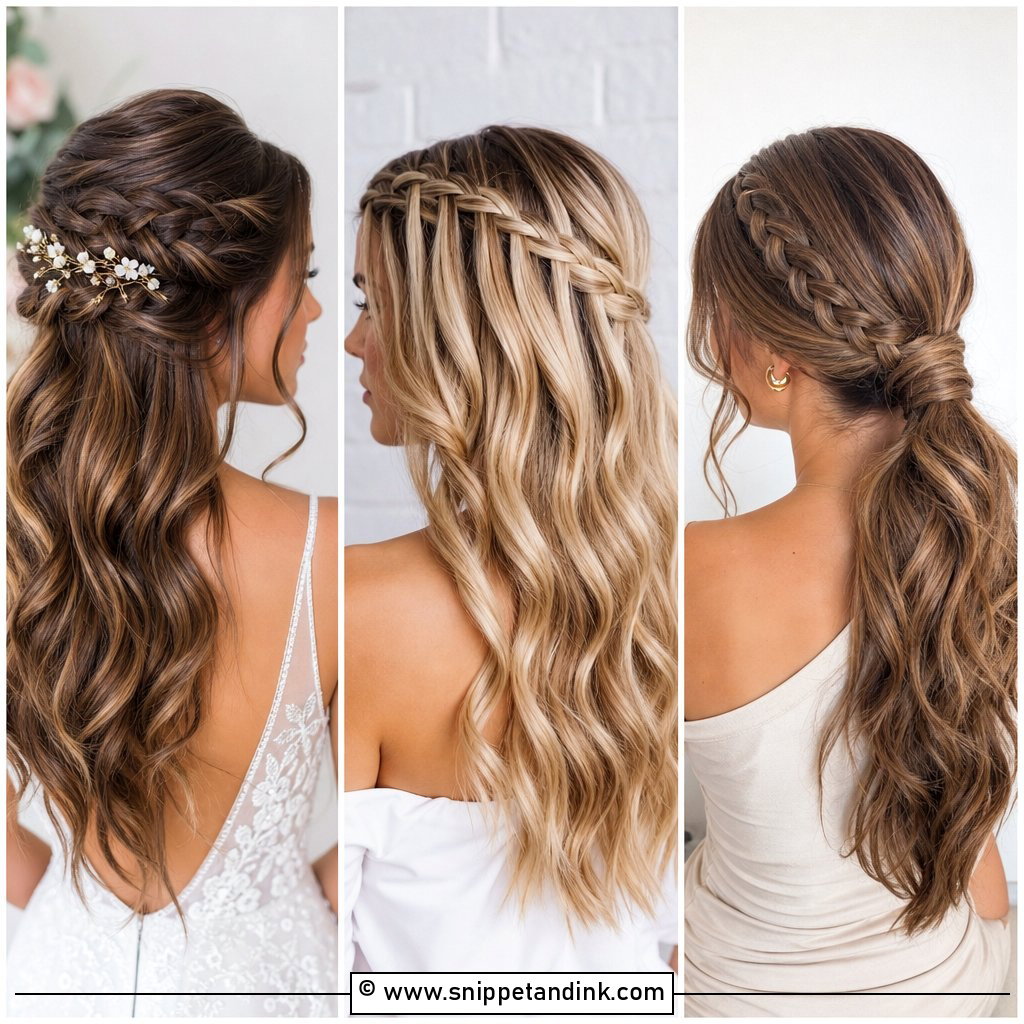
4. Waterfall Braid Wedding Hairstyle
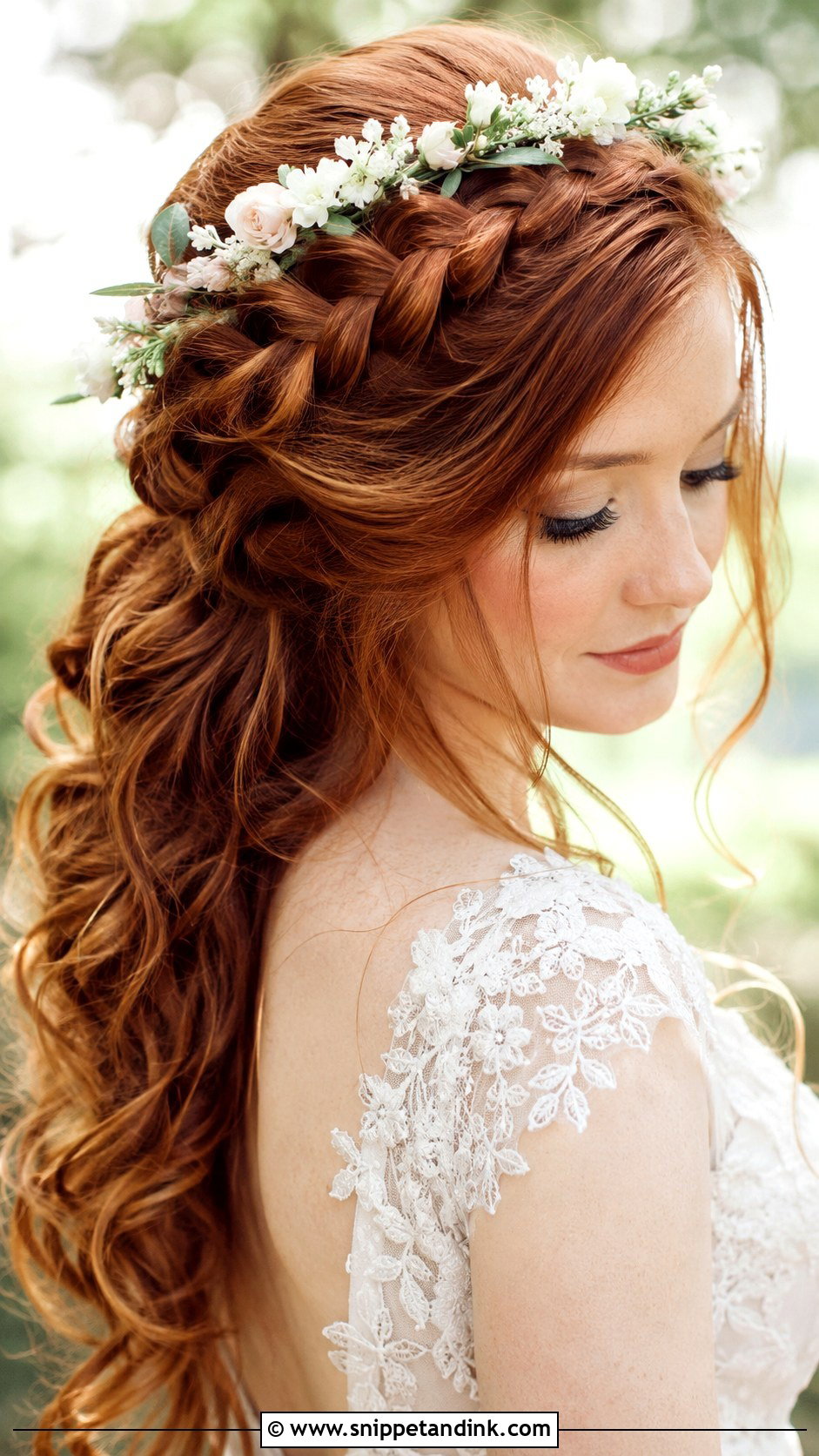
The waterfall gets its name from strands dropping out of the braid as it travels across the head. Each time I cross, I let the top piece fall and pick up a fresh one, so the braid stays thin and airy. It needs curls underneath to show off those falling pieces; on straight hair they just hang and the effect disappears. A scattering of tiny blooms along the line adds a little fairytale magic, but go light, since the braid itself is delicate and heavy stems pull it down.
5. Braided Low Bun Bridal Style
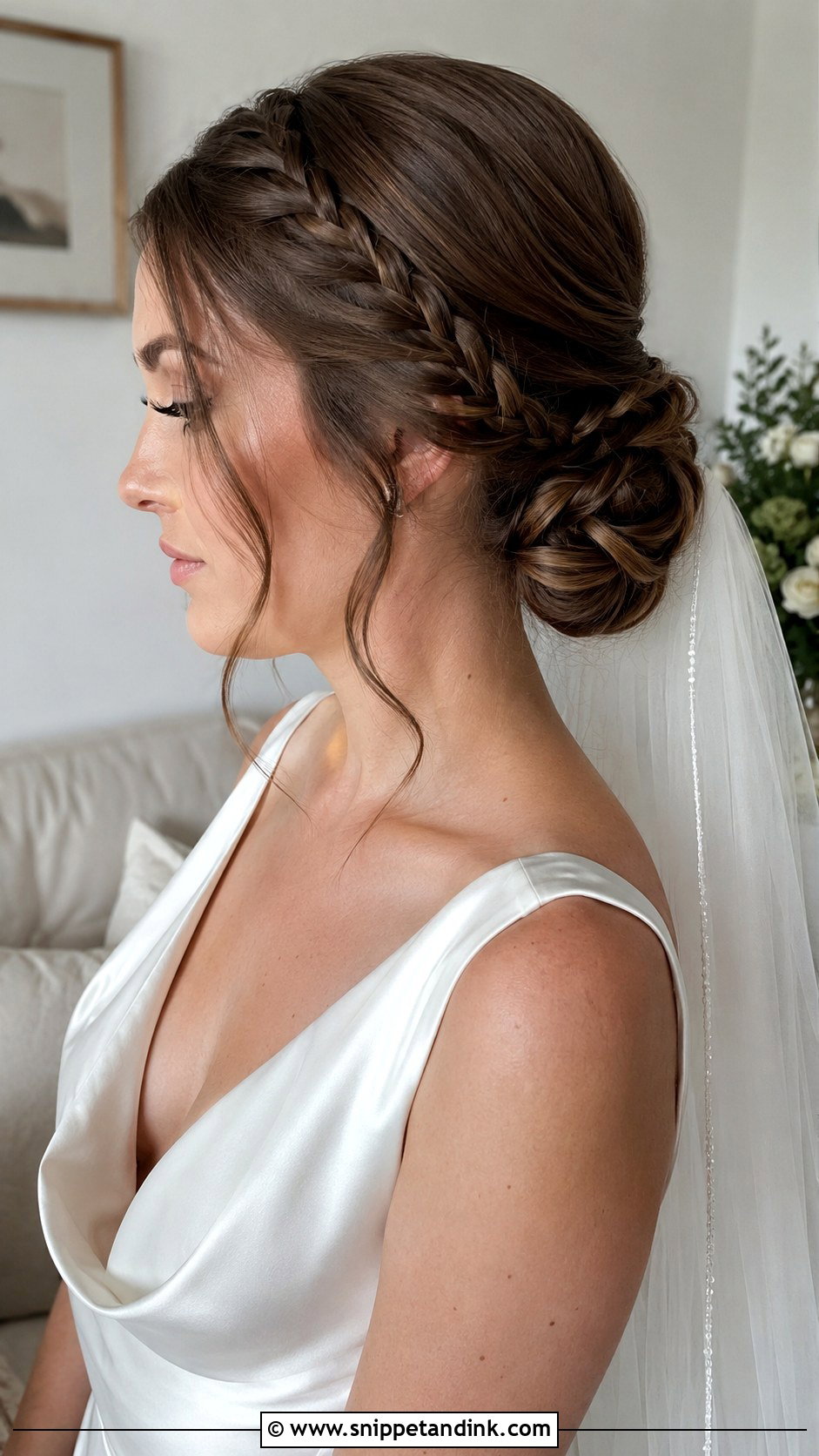
For a formal ceremony, a braided low bun is my most dependable style. I gather the hair at the nape, weave one or two braids through the twisted base, and pin in a crisscross so the bun can’t rotate. Sitting low, it stays clear of a veil comb placed above it and leaves the earlobes visible for statement earrings. Face-framing tendrils are optional. On hair cut above the collarbone I’ll add a small padded insert or a clip-in weft so the bun doesn’t look skimpy from the back.
6. Side Swept Braid With Floral Accents
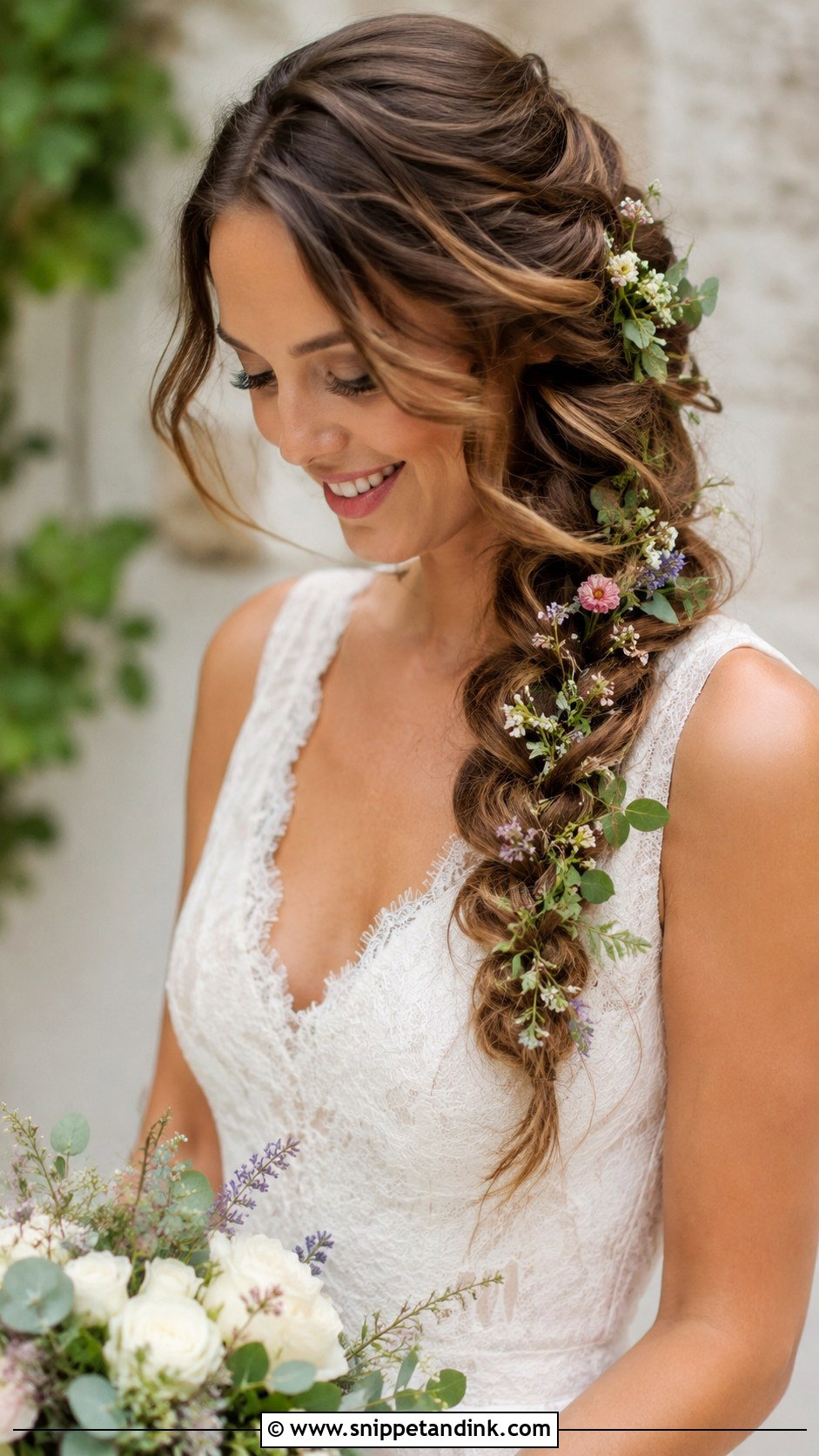
A braid pulled over one shoulder flatters the jaw and neckline, and it keeps the opposite ear clear for one dramatic earring. Fresh flowers or greenery tucked along its length suit a garden setting best. The side sweep is held by pins hidden behind the ear on the side the hair leaves, and that’s what I test hardest, because turning your head toward the officiant again and again pulls against them. It needs at least medium length; anything shorter won’t reach far enough to drape forward over the shoulder.
7. Crown Braid With Veil
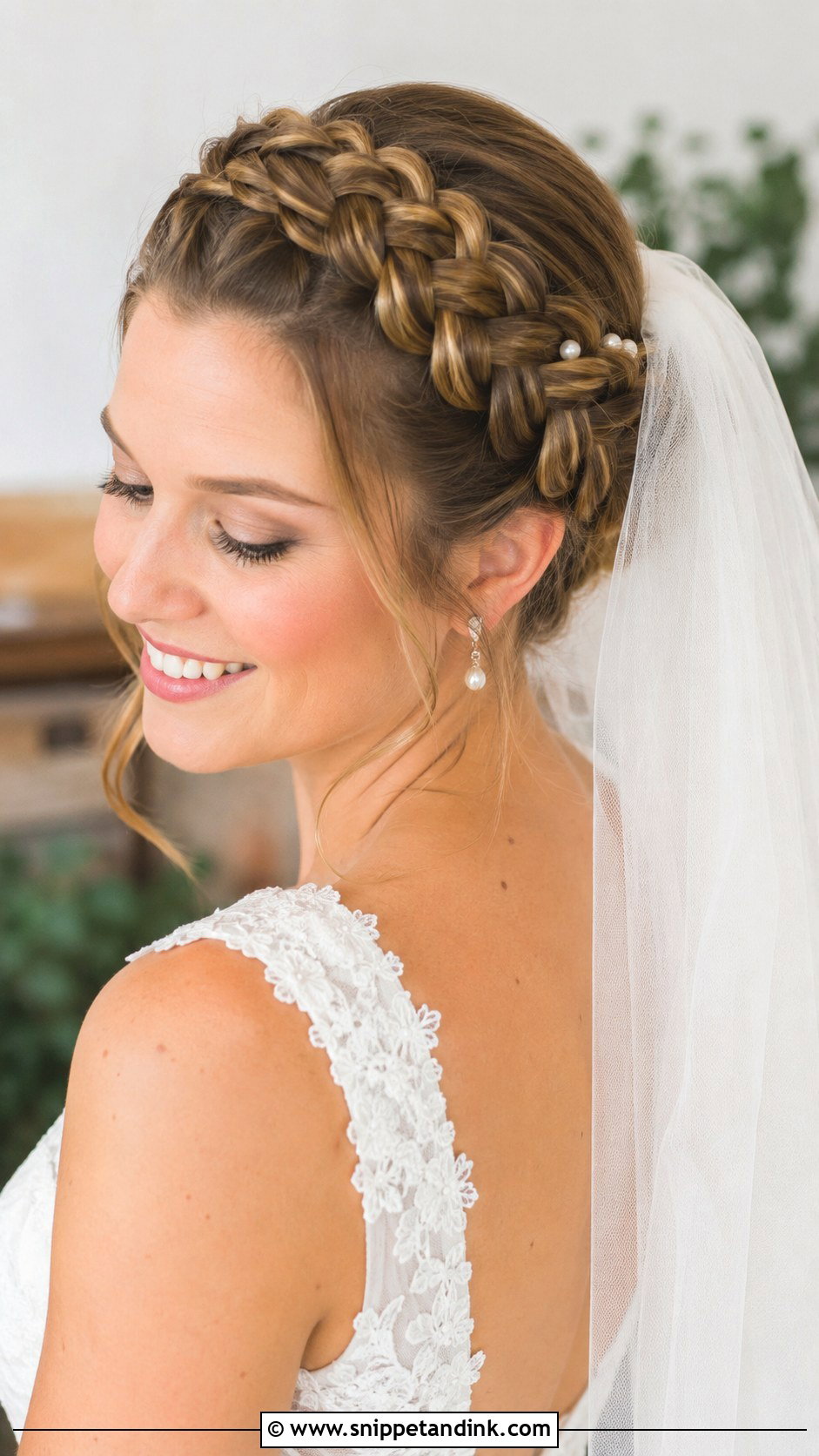
The braid wraps the head like a tiara, and the veil comb slides in just beneath it at the back, which is the most secure spot you’ll find. That pairing keeps everything off your face for the ceremony. Later the veil comes out and you’re left with a finished braided crown ready for the dance floor. I always practice that veil removal at the trial. The comb catches on the braid if it’s angled wrong, and being yanked out in front of guests is how a crown braid loses half its pins.
8. French Braid Updo for Brides
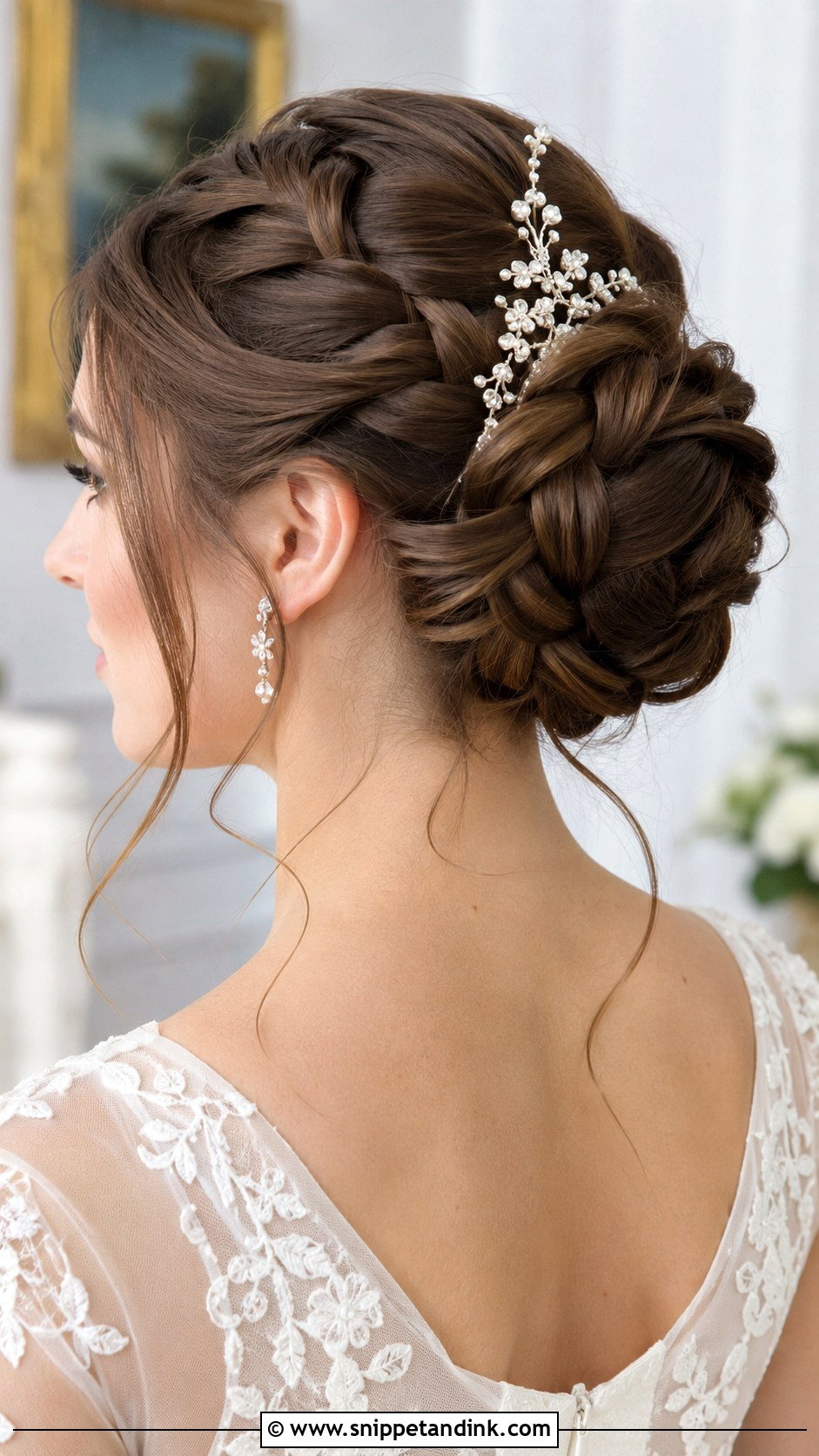
This is the classic, and as a bridal updo it holds about as well as anything I do. The hair is woven smoothly from the crown down, then tucked into a structured shape at the back. Because every section is locked into the braid, there are very few loose ends to escape during a long day. I usually soften the hairline with two loosened tendrils so it doesn’t read too school-photo. A sparkling comb along the tuck catches light nicely, but it should go in at the trial, not on the morning itself.
9. Braided Halo With Baby’s Breath
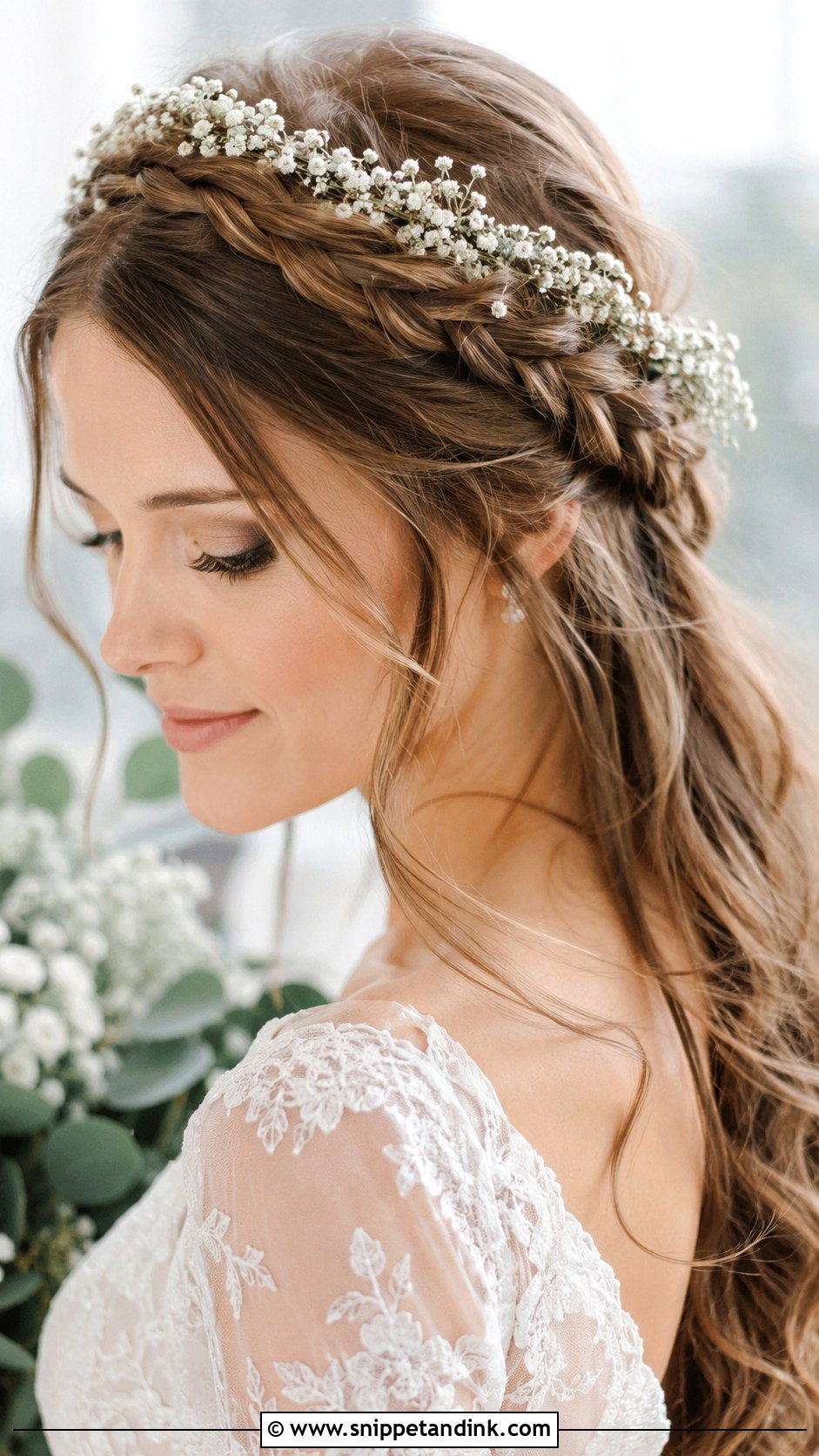
A braided halo dotted with baby’s breath is about the gentlest look on this list. The braid circles the crown and tiny white blooms are tucked through it one sprig at a time. Baby’s breath copes better than most flowers out of water, which is why florists and stylists keep reaching for it, though it can brown at the tips in direct afternoon heat. I ask the florist for small sprigs on the morning, kept cool, and I add them last, after the hairspray has dried, so the spray doesn’t spot the petals.
10. Fishtail Braid With Pearls
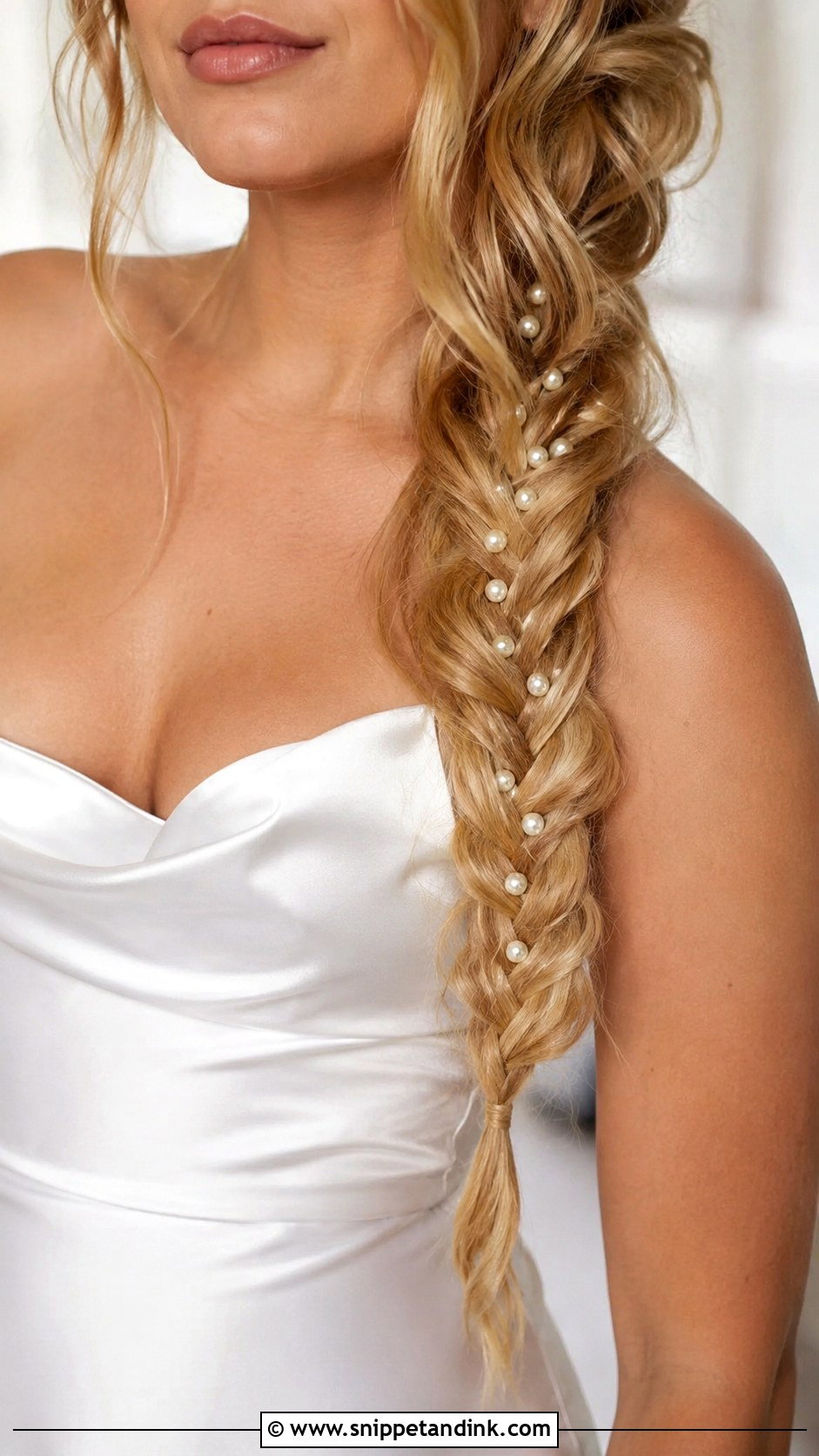
Pearls and braids suit each other because a weave gives pins somewhere to grip. A fishtail threaded with pearl pins, or with a fine strand of pearls woven in as one of the sections, has a vintage feel without looking costume-like. Worn over the shoulder or straight down the back, the pearls catch light every time you move. I space pins unevenly on purpose; perfectly regular spacing looks printed. Bring the actual pins to the trial, because their weight and finish change how many look right.
11. Half-Up Braided Crown
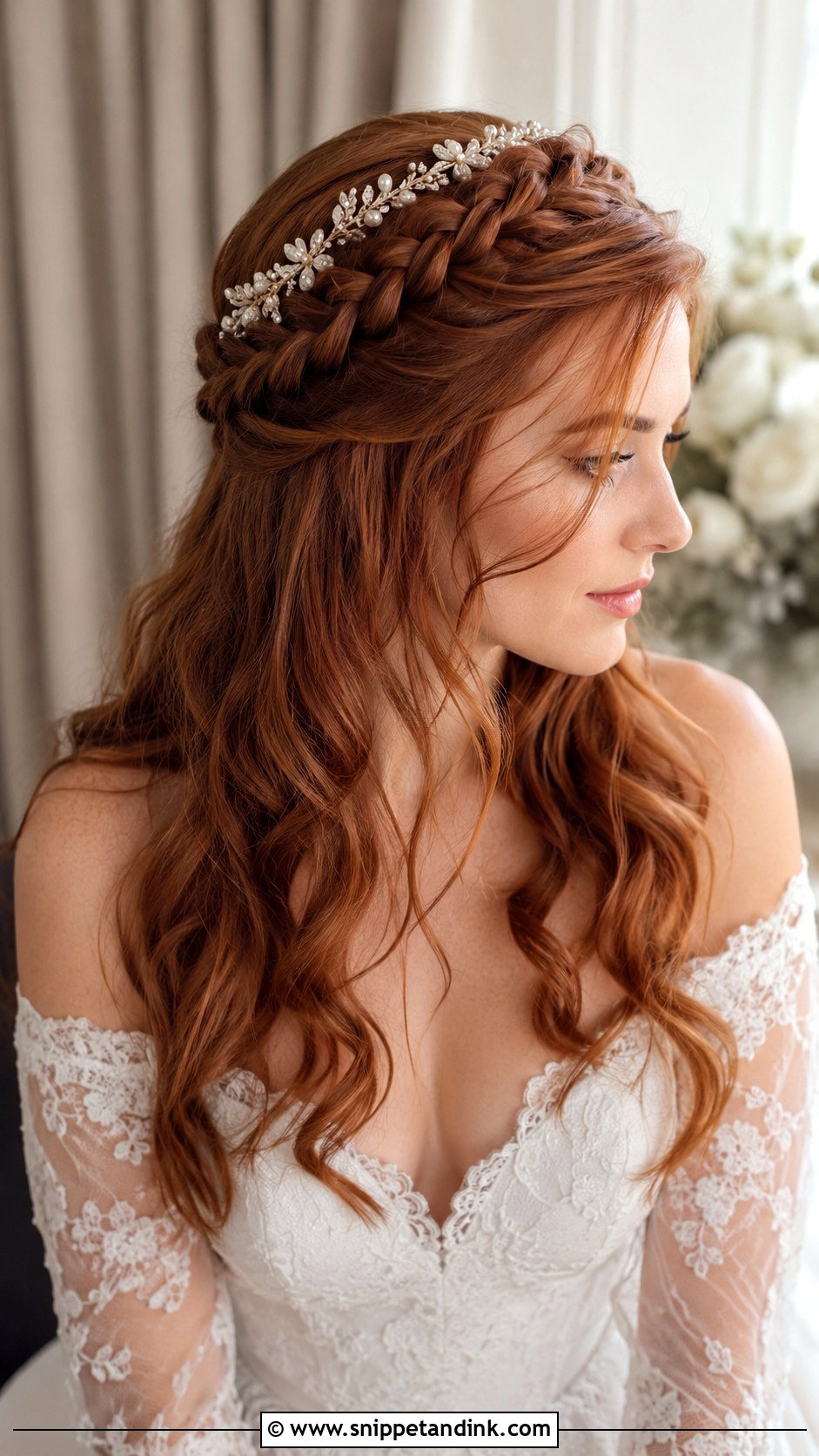
Hair is braided back from the face and wrapped across the crown while the length falls in waves or curls below. Most lengths from collarbone down can manage it. A veil placed at the crown hides under the braid neatly, and pieces at the temple stay put through the ceremony. My usual note: the hanging half shows how well your hair holds a curl. If a curl drops out in an hour on you, set it with pins while it cools and spray it before brushing out, or ask for a tighter iron than you think you need.
12. Messy Braided Bun for Boho Brides
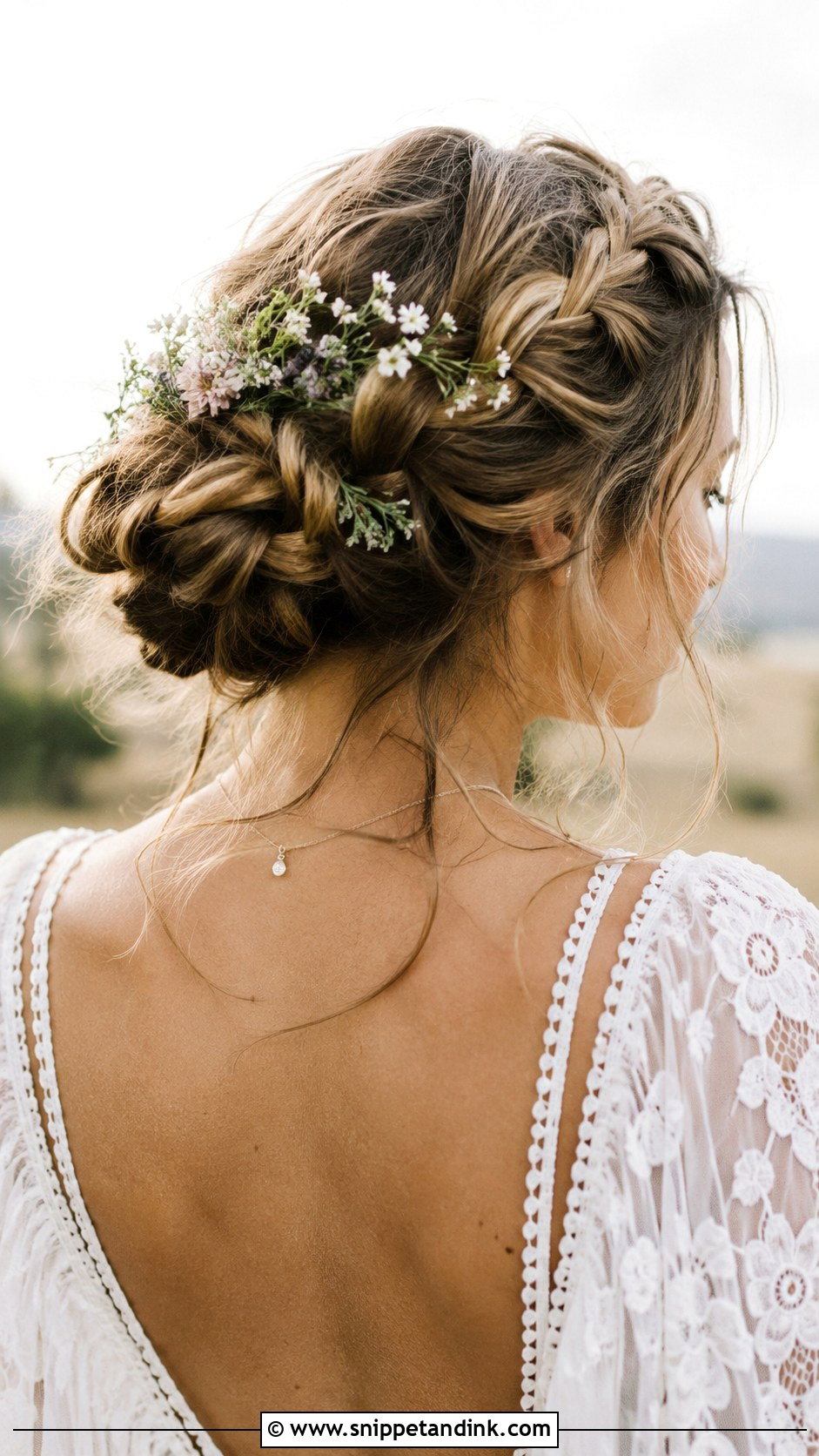
For the free-spirited bride, this is a loose bun built from braided sections with a few strands left free around the face. Undone hair is harder to do well than tidy hair, honestly. Every piece that looks accidental has been placed, and every placed piece needs a hidden pin. I braid each section first, pancake it, then coil and pin it so the texture stays even. Tucked wildflowers suit a rustic or beach setting, but on a windy beach I’d keep the bun a touch firmer than in the photo you saved.
13. Braided Ponytail Wedding Style
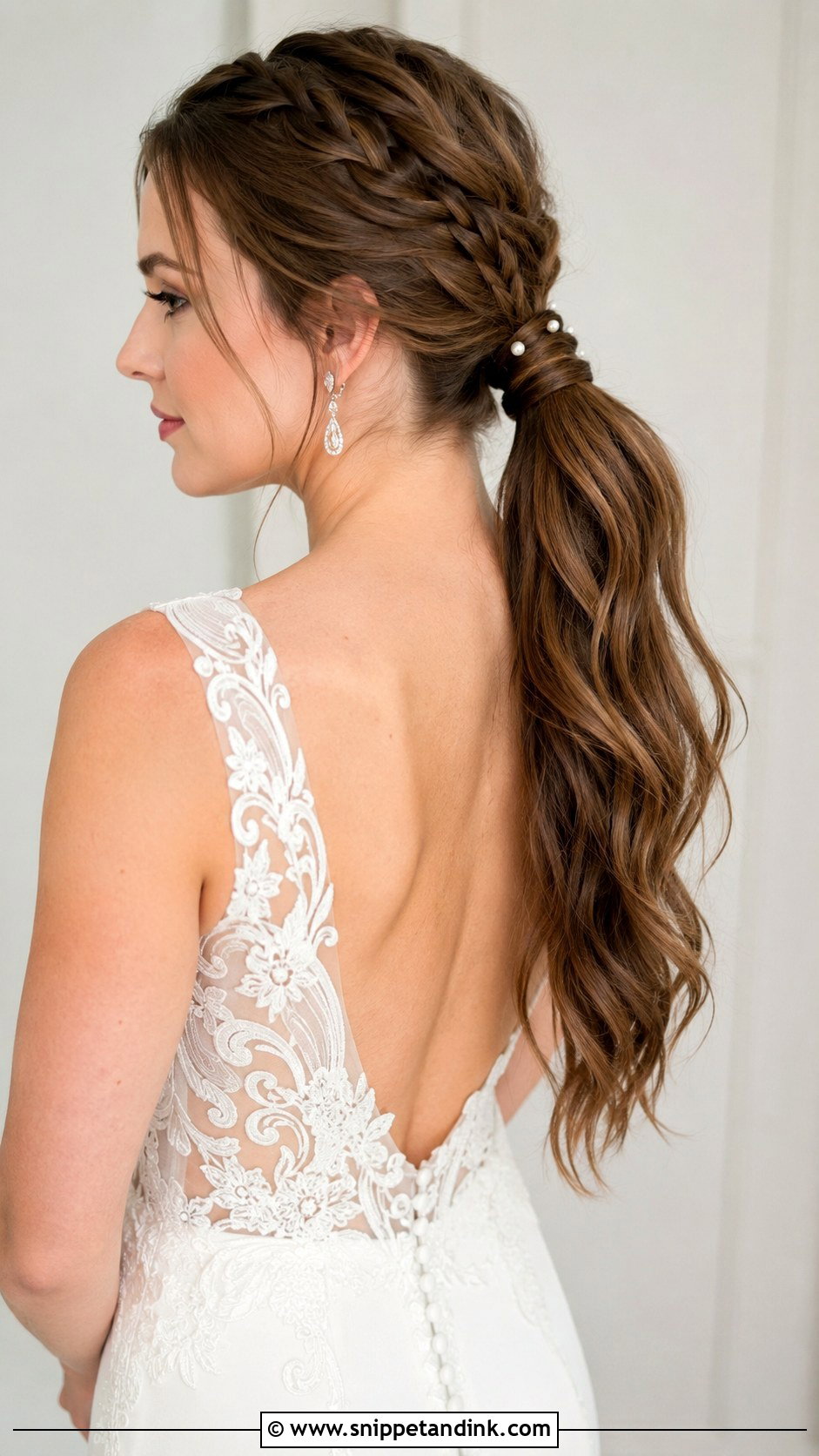
A braided ponytail is the practical modern pick: hair off the neck for dancing and nothing to collapse. I hide the elastic by wrapping a small braid around the base and pinning its end underneath. The braid running through the tail can be sleek or pulled out for texture. One honest limit is weight. A long, heavy ponytail drags on the scalp after several hours, so for very thick hair I set it slightly lower than a gym pony and anchor it with two crossed pins under the elastic.
14. Twisted Braid With Flowing Curls
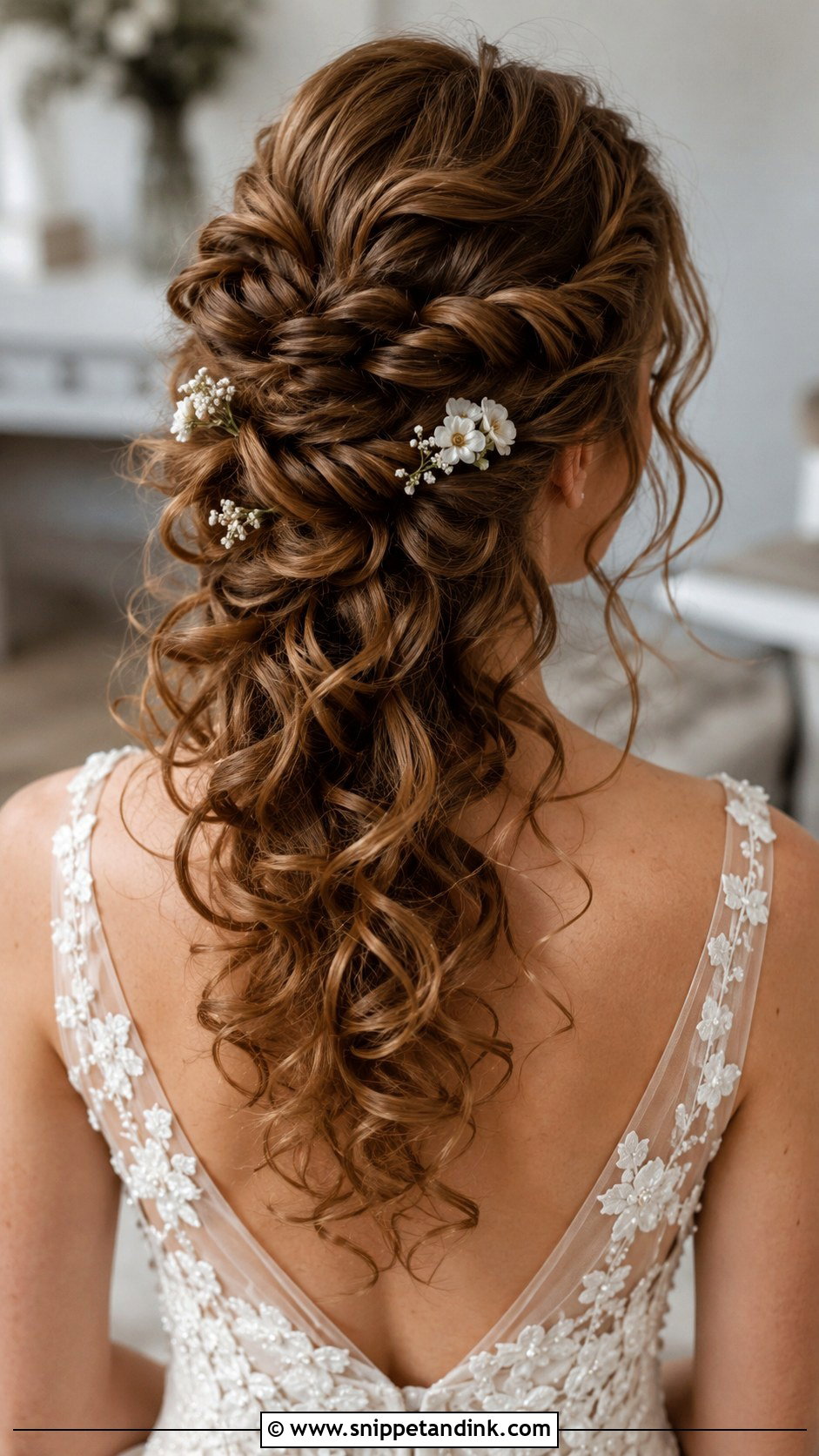
Twists are gentler than braids, which is their charm and their weakness. Sections are rolled back from the face and pinned while curls tumble below, so you get some structure and plenty of movement. Twists unravel faster than braids though, so on silky hair I lock each one with a small pin hidden every couple of inches. The twisted line softens a round or heart-shaped face by drawing the eye back. Small blooms or pearl pins can go in, kept to the pinned points where they won’t slide.
15. Goddess Braid Bridal Look
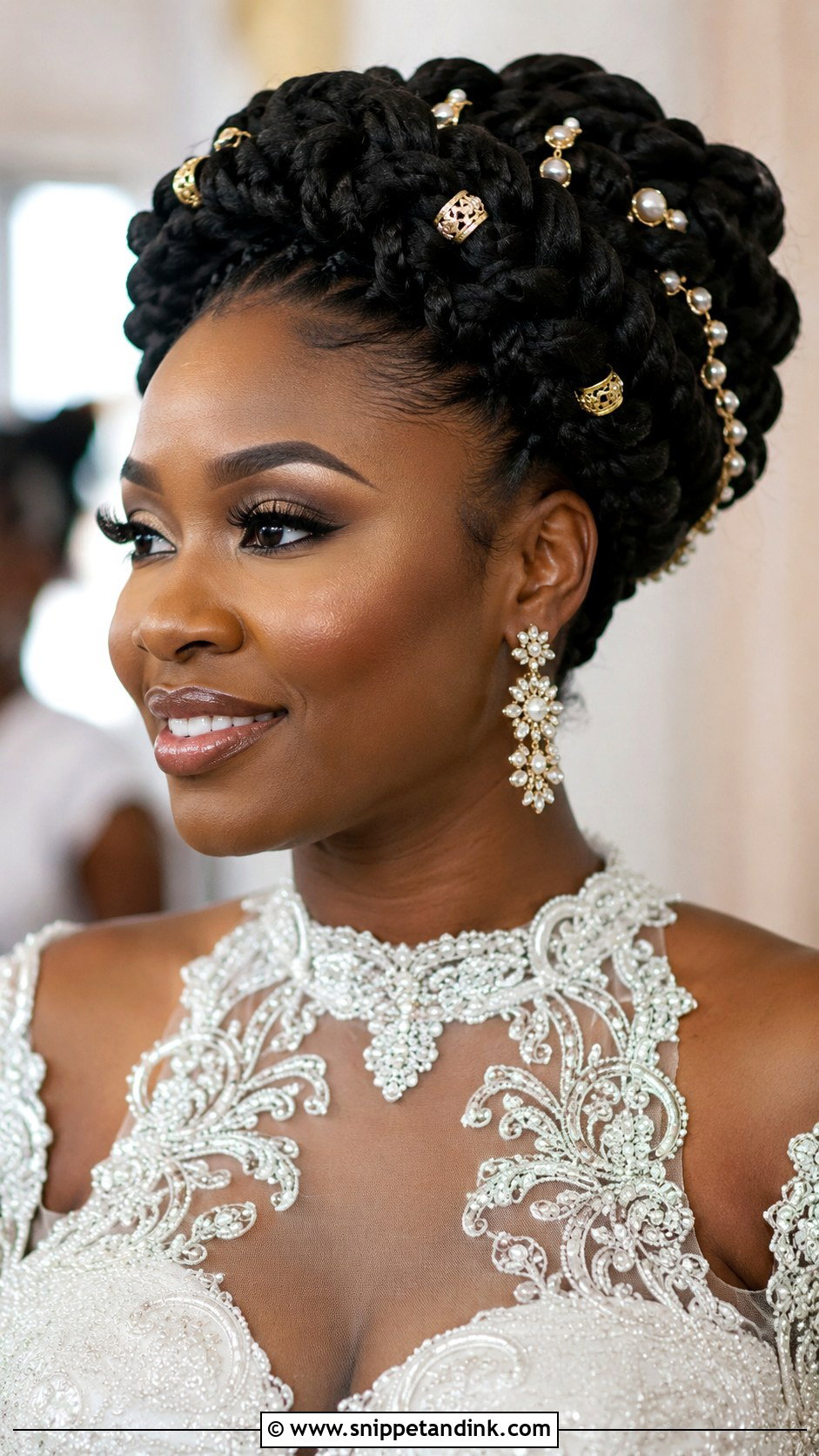
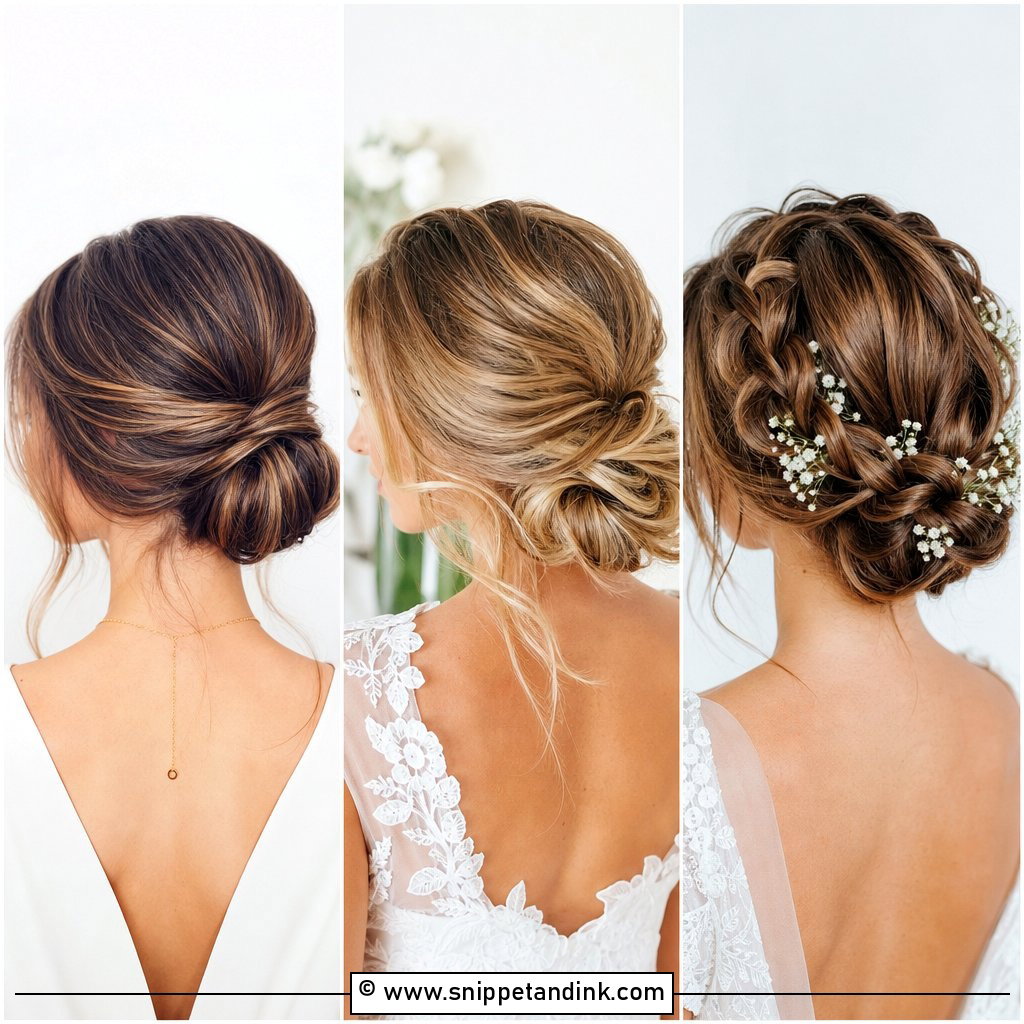
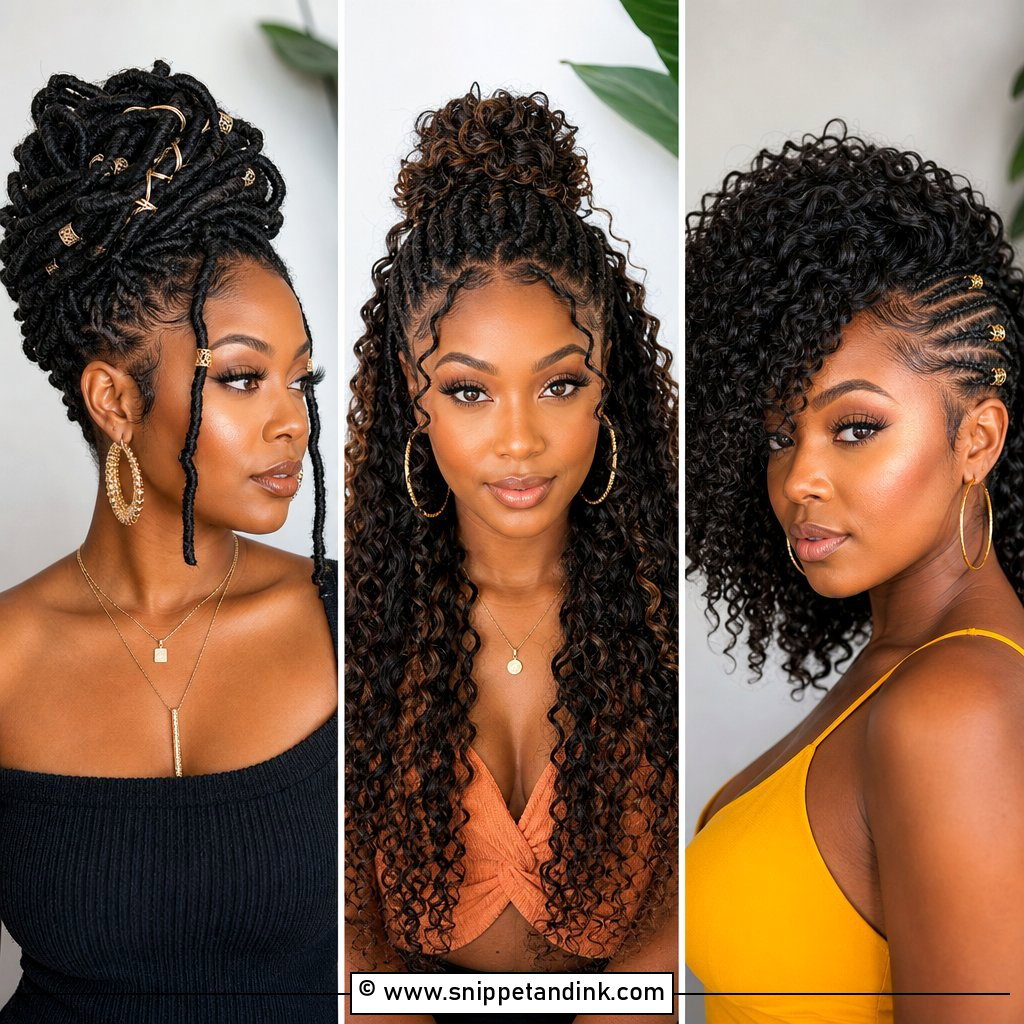
Goddess braids are thicker, defined plaits worked close to the scalp and often built up into a crown or updo. The scale is the point; they read clearly even from the back of a large hall. These usually need a specialist braider rather than a general salon stylist, and they’re best installed a day or two before so the scalp has settled. Adorning them with gold cuffs, pearls or fresh flowers personalizes the look. The style has deep roots in Black hair tradition, so I’d book someone who knows the technique well and won’t over-tighten at the edges.
16. Braided Chignon for Elegant Brides
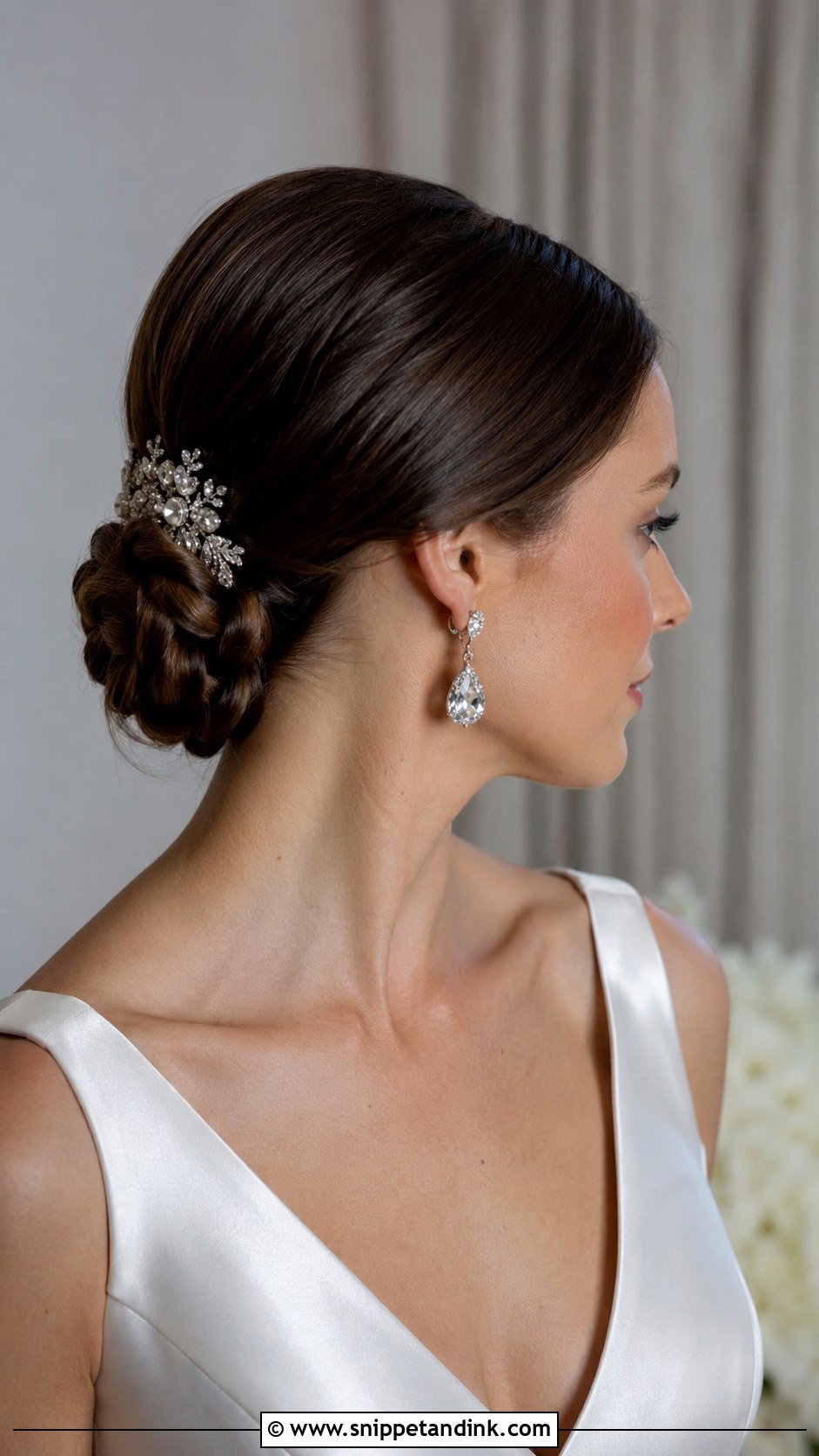
Braided hair is coiled into a smooth, low knot at the nape, with the weave showing on the surface of the chignon. It’s my answer for a cathedral veil and a high-necked gown, because nothing competes with the neckline. Keep it polished for a formal room or tug the braid slightly looser for a softer read. The common mistake is setting it too low, right on the collar, where it rubs against a high back and flattens by the reception. I set it just above the hairline at the nape and check it with the dress on.
17. Double Dutch Braids Wedding Style
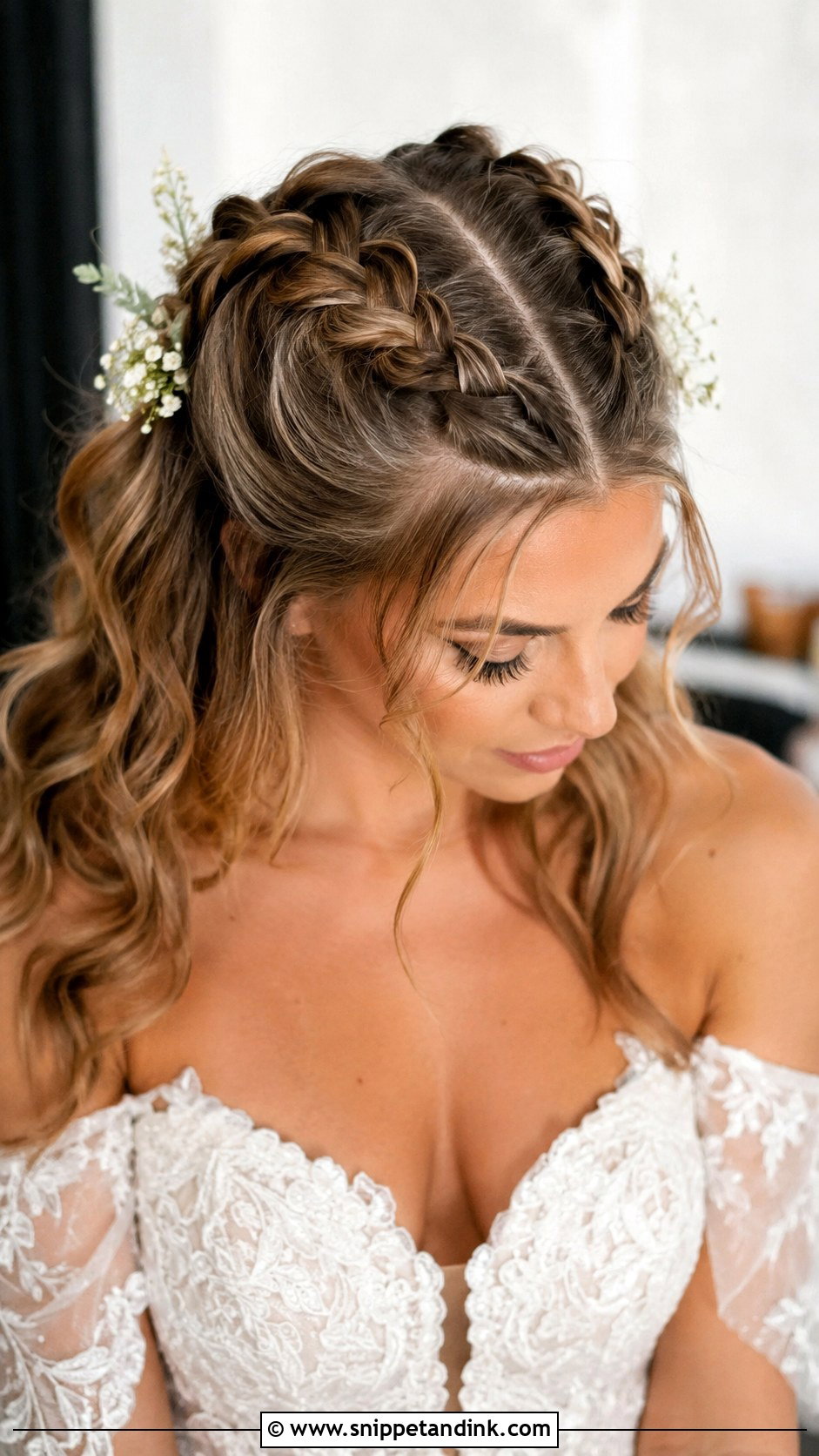
Two raised braids running down the scalp are bold and a little sporty, which is exactly why some brides want them. They can hang loose or be gathered into a bun at the back. Few bridal styles survive an energetic dance floor this well. I make the part dead straight with a tail comb, since every wobble shows on a two-braid style, then pull the edges out a little for width. For brides with fine hair I sometimes add a slim clip-in weft into each braid before I start.
18. Braided Updo With Tendrils
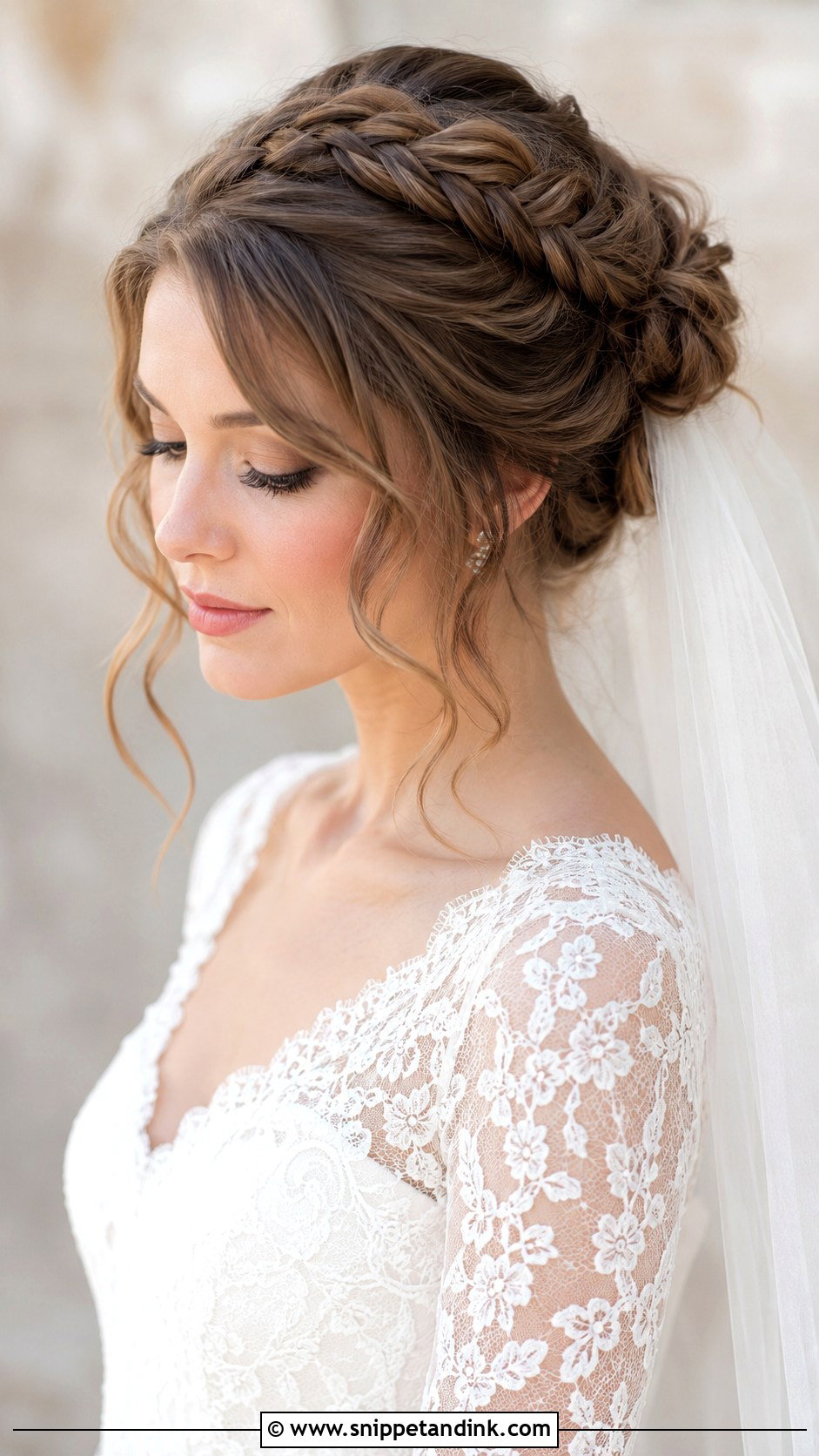
A few loose tendrils make a structured braided updo look softer and younger. The trick is choosing which pieces stay out. I pull them before I build the updo, not after, so they come from the hairline rather than being dragged out of finished work. Tendrils are also the first thing to lose their curl, so I give them a smaller iron than the rest of the head and a light spray. A delicate veil or small hairpiece suits this style, kept above the bun so it doesn’t flatten the curled pieces.
19. Halo Braid With Fresh Flowers
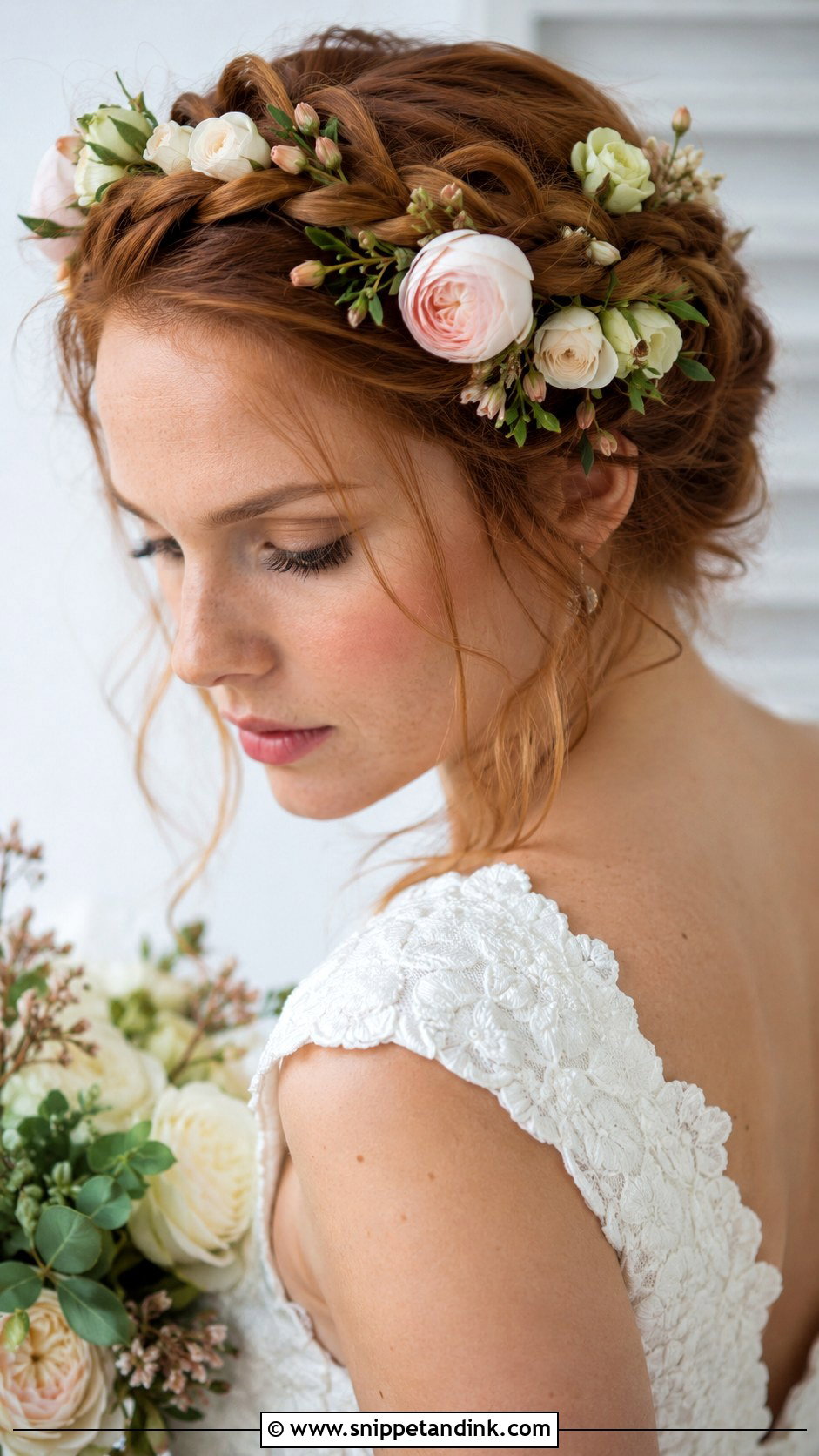
A braid circling the whole head with real flowers woven through it is about as garden-wedding as hair gets. Your face is fully clear, which suits brides who don’t want anything near their eyes. Choose roses, ranunculus, or daisies depending on your palette, and ask your florist which of them will last out of water on a warm day. Spray roses and waxflower are hardier than they look; gardenias bruise and brown quickly. I place blooms only after the braid is pinned and sprayed.
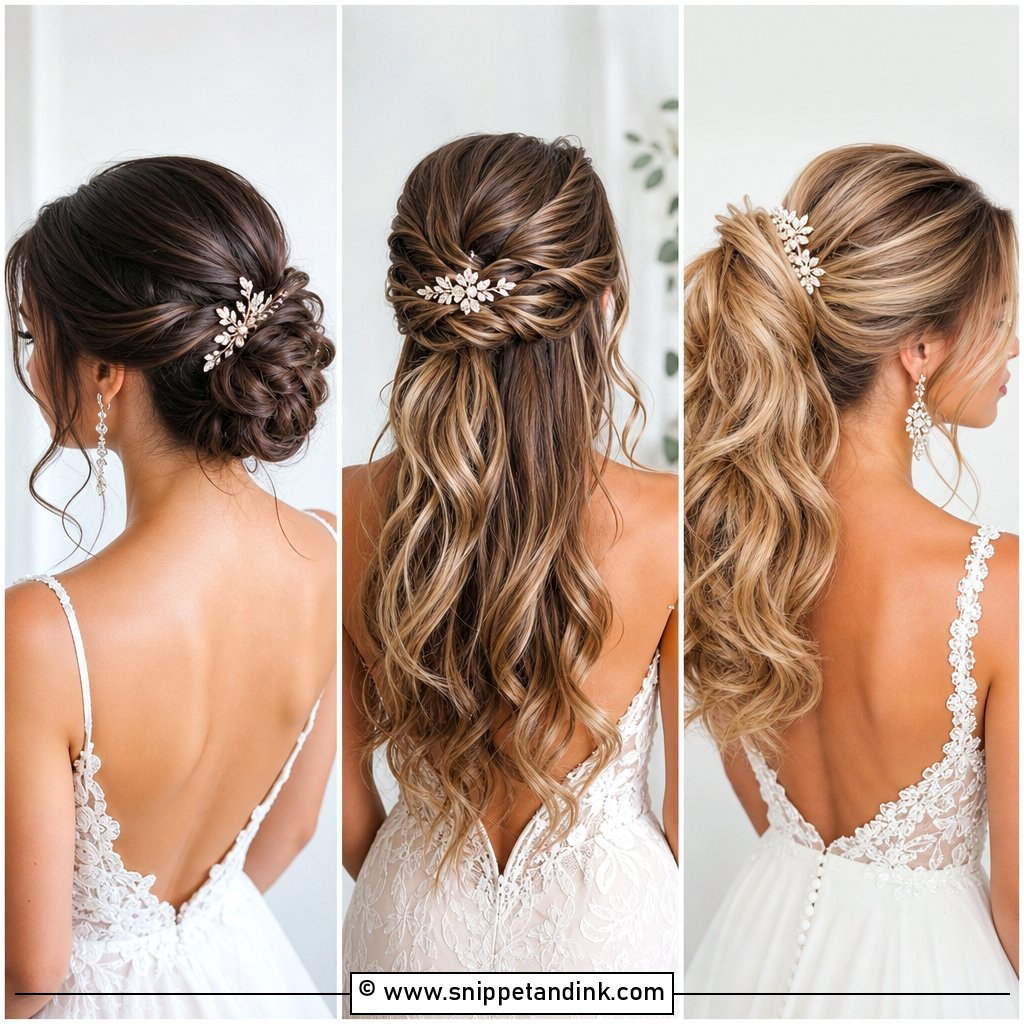
20. Braided Bun With Pearl Accents
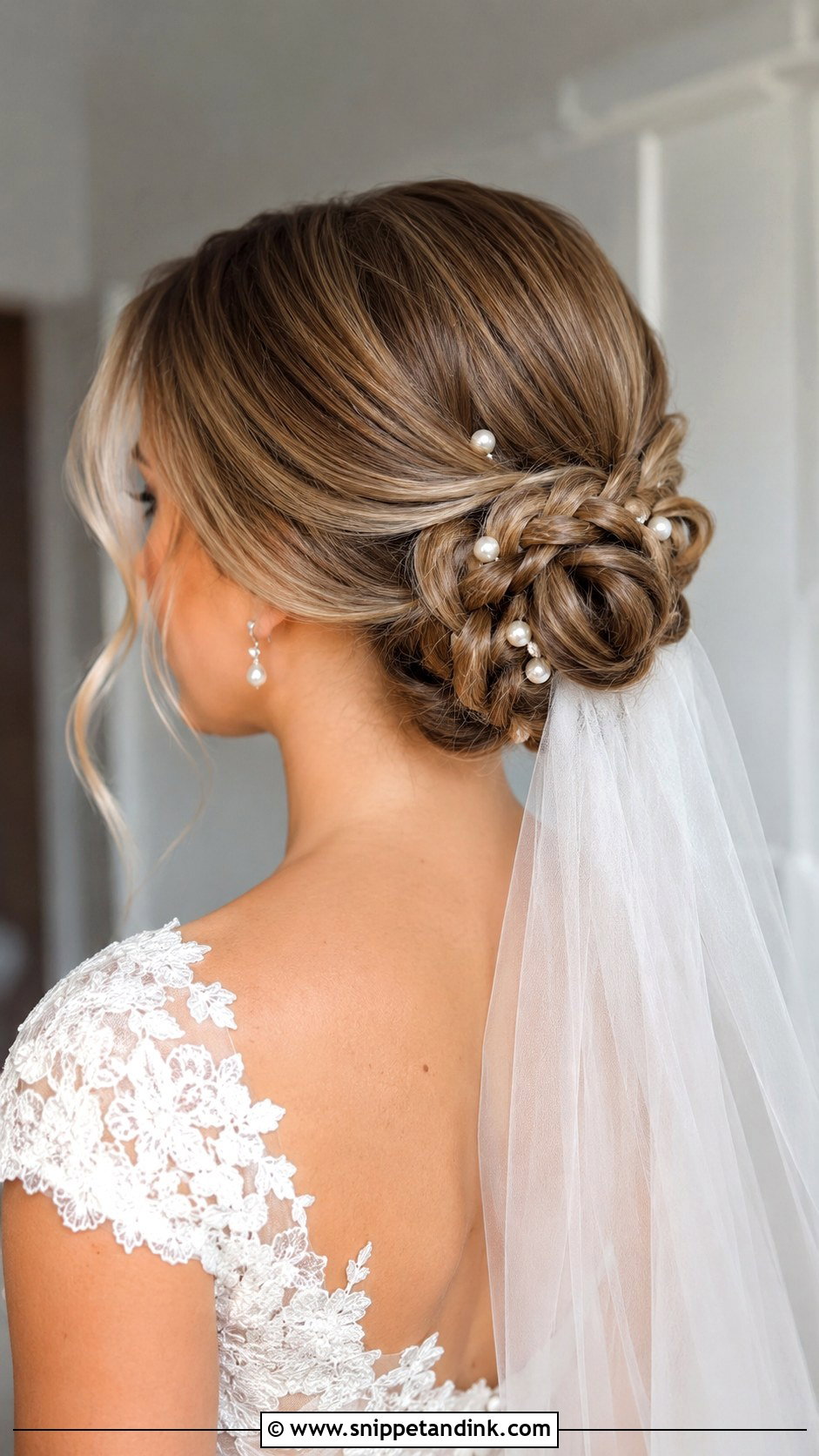
Here a braided bun gets pearl pins scattered through the weave for a touch of luxury. They catch the light in a soft, vintage way rather than glittering like crystals. Set low or mid-height, it sits neatly under a veil and next to a classic gown. My rule is to add pearls in odd numbers and in a gentle curve that follows the bun’s shape. Lined up in a row, they make the bun look busier and smaller, which is the opposite of what refined detail should do.
21. Loose Side Braid With Waves
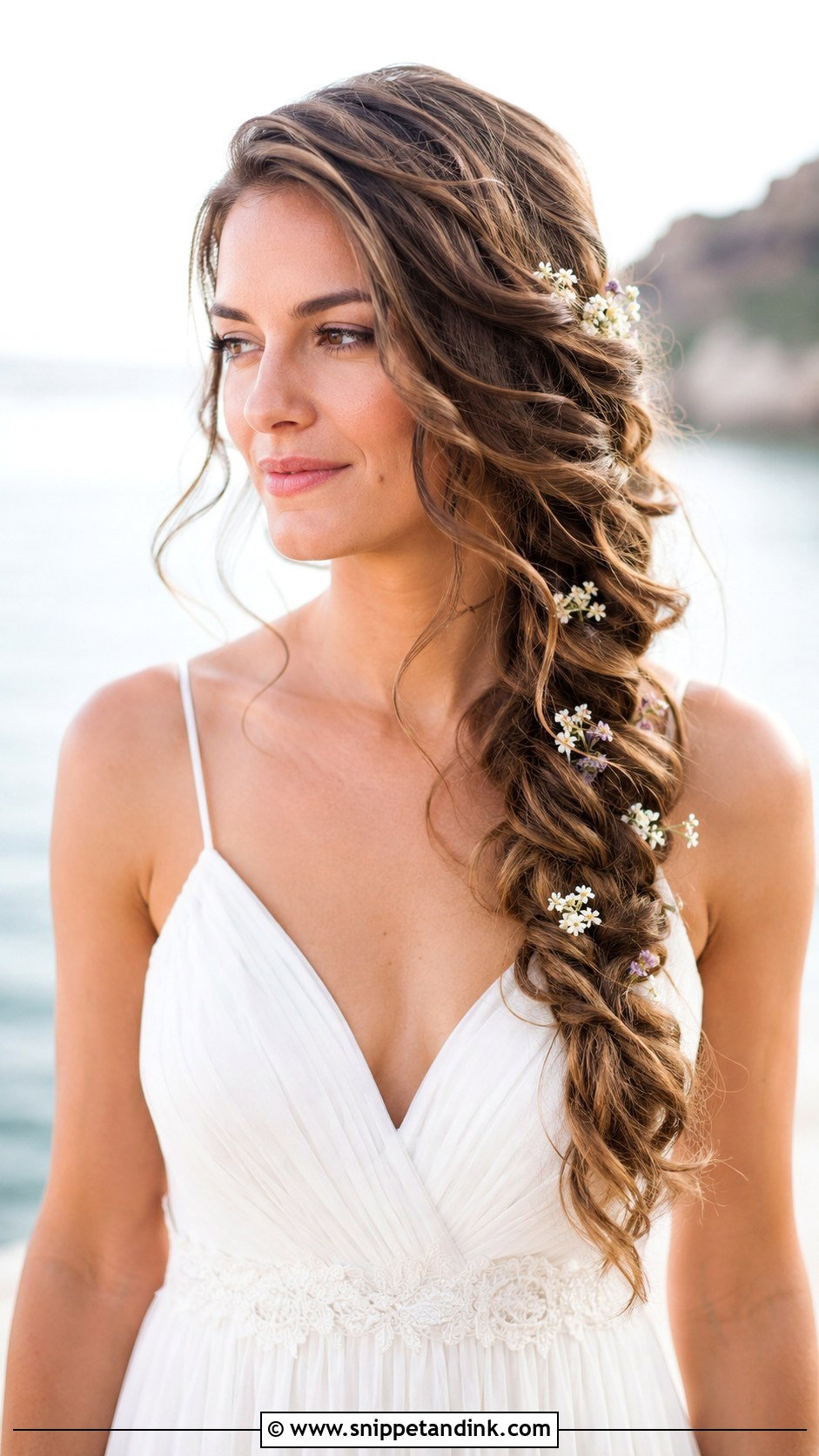
Loose, wavy hair is braided over one shoulder without being pulled tight, so the waves still show through each crossing. It suits a beach or boho wedding and light, flowing gowns. Because the braid is loose, it relies on texture to hold, and on silky hair it slowly unwinds. I curl first, braid with a bit of texture spray on each section, then secure the tail with a tiny clear elastic hidden under a wrapped strand. Tuck flowers only near the top, where the braid is firmest.
22. Braided Half-Up With Veil
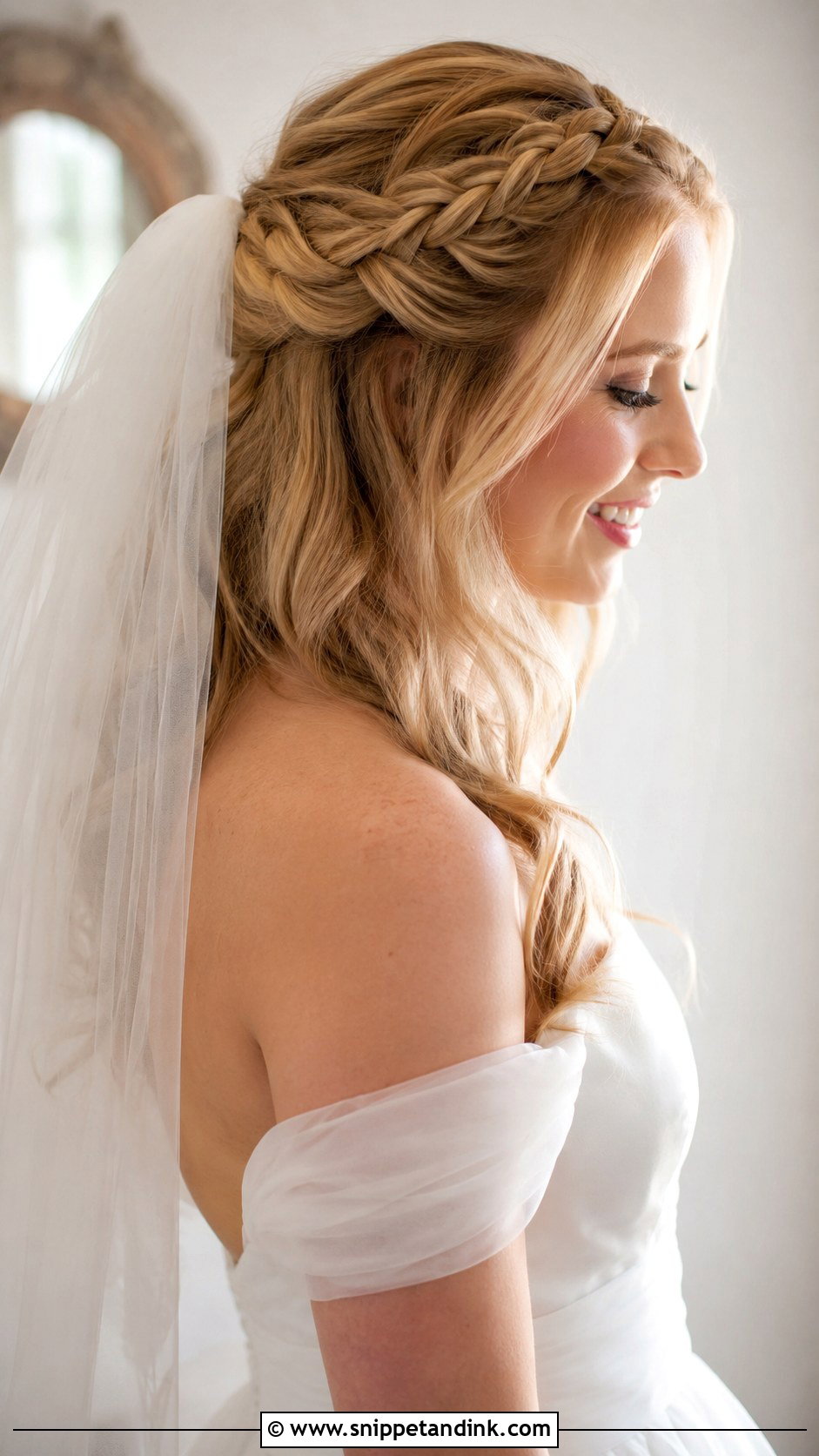
Hair is braided back from the face and secured half-up, the rest left to fall, with the veil anchored at the crown. Once the veil is off, the braid becomes the reception look. Most hair lengths manage it, and soft curls underneath give the length some shape. The one thing I’d plan for is weight. A long veil hangs off that crown anchor all through the ceremony, so I build a small hidden pin base under the braid first, otherwise the comb slowly drags the whole half-up backward.
23. Cornrow Braided Updo for Brides
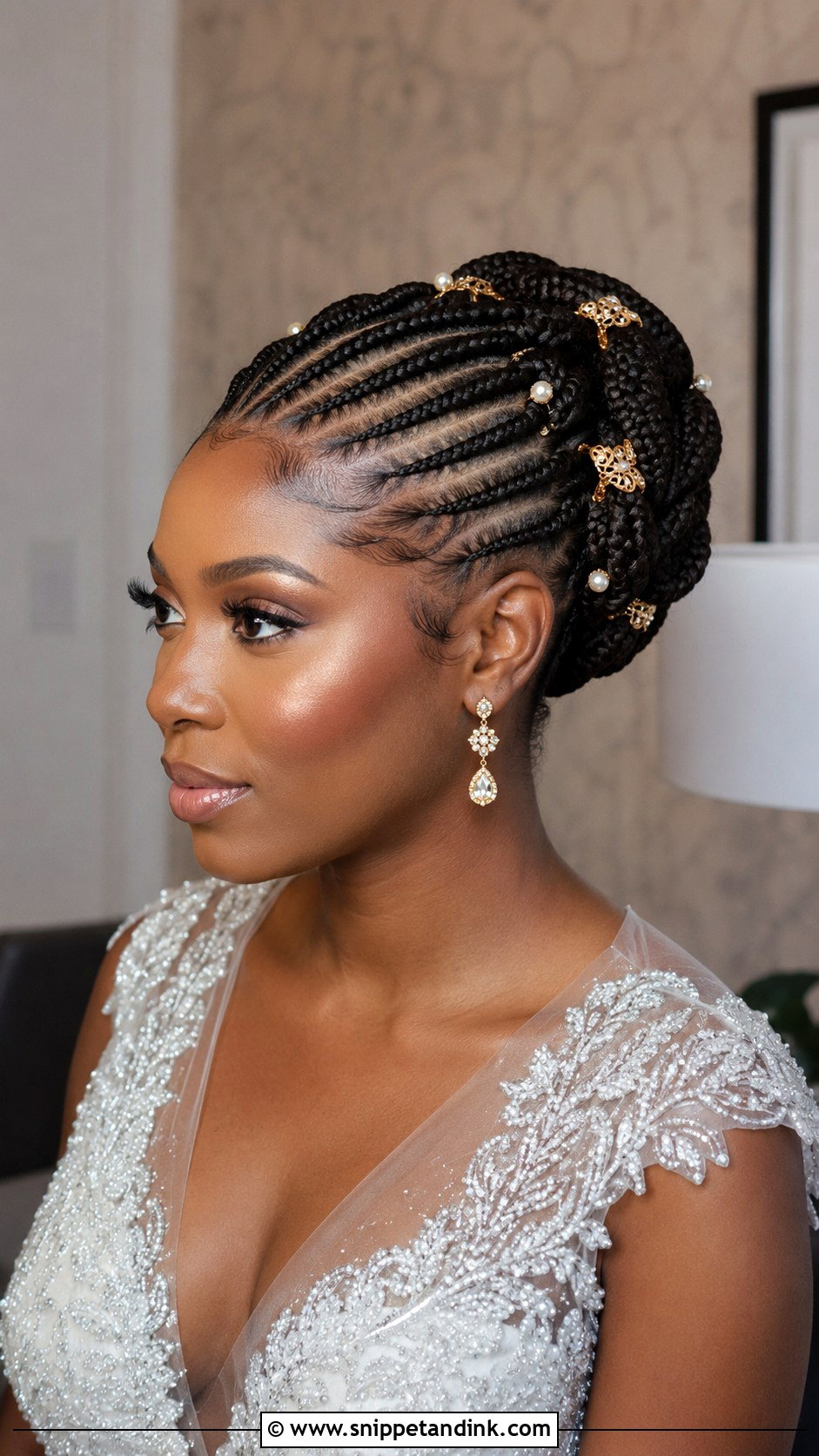
Sleek cornrows are braided close to the scalp in a planned pattern, then gathered into an updo. The precision is the beauty of it. They hold for the whole day and much longer, so they’re typically installed a few days ahead by a braider who specializes in them. Gold cuffs, pearls or fresh flowers can be added on the morning. If you have a sensitive scalp, ask for medium tension, and give it a day or two to settle before the wedding rather than having it done the night before.
24. Braided Crown With Curls
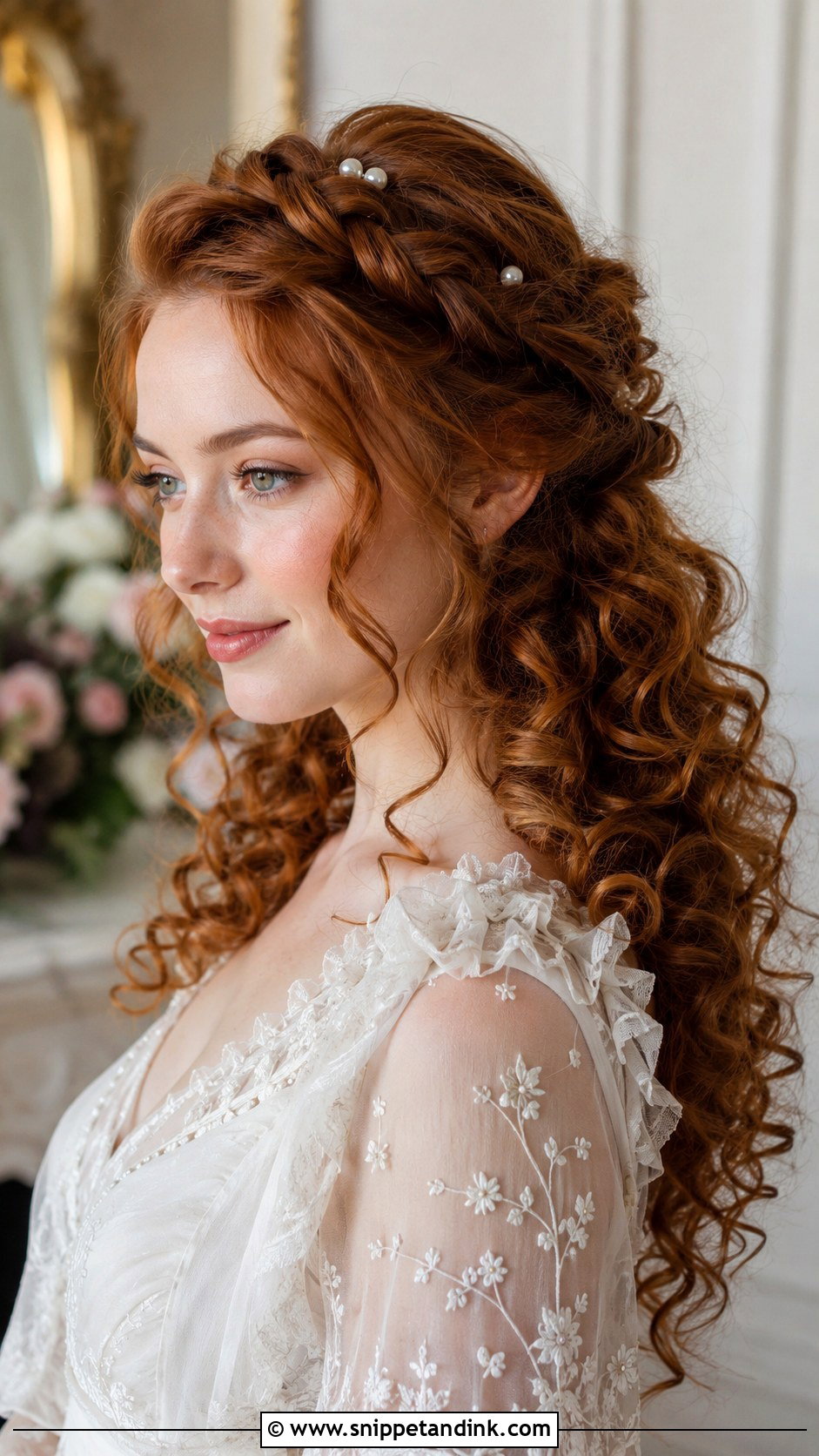
A braid runs around the crown while curls fall for volume and movement. It’s regal and soft at once, and it gives the face a clean frame. How well it suits different textures comes down to the curl underneath; natural curls give the most volume with the least effort, while straight hair needs setting. I build the crown first, then curl, so the iron doesn’t loosen finished braid work. Pearl pins or small flowers along the crown are optional extras.
25. Fishtail Braided Half-Up Style
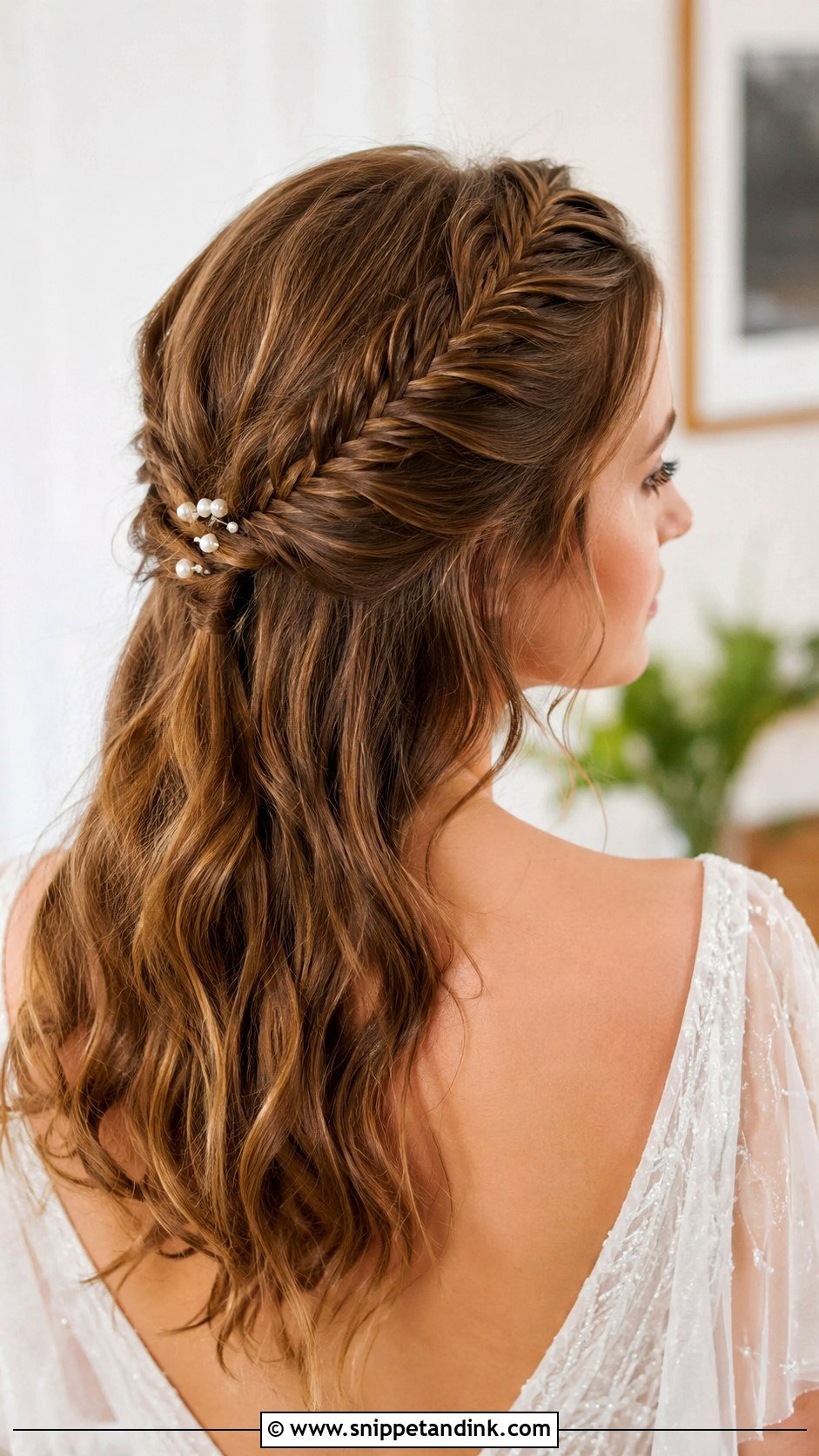
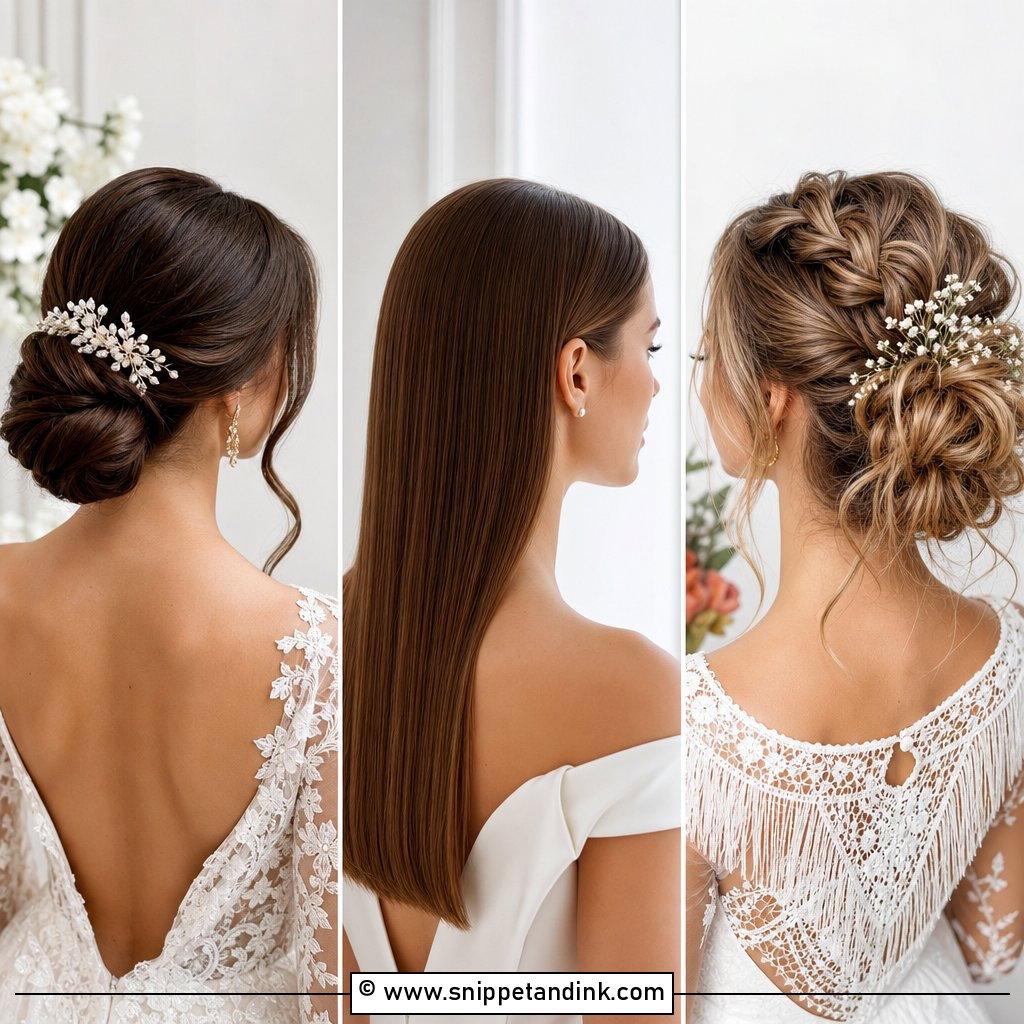
A fishtail is woven back from the face and secured half-up while the rest falls in loose waves. Its herringbone texture gives close-up photos something to show. I loosen it gently once it’s pinned, edge by edge, never by pulling the whole braid at once, which can make one side collapse. It’s a good choice for brides with layered hair, because shorter layers tuck into the tiny fishtail crossings more easily than into a chunky three-strand braid.
From First Look to Last Dance: How a Braid Wears
Braids are forgiving, but they still change through a long day, and knowing how lets you plan for it. Here’s what I watch for and what I tell brides to pack.
Humidity and heat
Curly and wavy hair swells in damp air, so a sleek braid gets a soft halo of frizz by late afternoon. On an outdoor summer wedding I’d rather plan a slightly looser, textured braid from the start, because a little frizz then looks intentional. A small travel hairspray and a few spare bobby pins in your bridesmaid’s bag cover most fixes.
The veil coming out
This is the riskiest minute for any braided updo. Someone excited tugs the comb straight back and pulls pins with it. Show your maid of honor at the trial how to tilt the comb up and slide it out, and have her do it in a quiet moment rather than on the dance floor.
Taking it down
Don’t brush a braid out dry at midnight. Remove every pin first, unravel the braid with your fingers, then work a little conditioner or oil through the crimped lengths before brushing from the ends upward. Flowers and pearls tangle into the weave, so pull those out before anything else. Cornrows and goddess braids should be taken out patiently over an evening, or by the braider, to avoid snapping at the roots.
Your Hair Length Decides More Than the Photo Does
Braids give you more control than almost any other bridal hair, and far more places to tuck flowers, pearls and veil combs. Start from what your hair actually does, its length, its layers and its hold, rather than the photo alone, and book a trial where you wear something close to the dress neckline. From a sleek chignon to a halo full of baby’s breath, there’s a braid here that suits the hair you have, and it should still be in place when you sit down after the last dance.
You'll Like These Ideas:



Leave a Reply