
Lace has come back into bridal in a more personal way: fewer stiff, all-over gowns and more dresses where the lace has a specific job, whether that’s a sleeve, a scalloped hem or a corset panel. Below are thirty-five lace styles I’d put in front of a bride at a first appointment, from full ceremony gowns to short reception changes, with notes on how each one actually wears. If a fitted mermaid gown is already on your mind, look through the rest anyway. Plenty of brides arrive certain of a silhouette and leave in a different one once they feel how lace sits on their own body.
Chantilly, Alençon or Guipure? How Each Lace Actually Wears
Before we talk silhouettes, it helps to know which lace you’re touching, because the type decides how the dress feels, moves and holds up. I name it for brides as soon as they put a gown on, since it changes what they ask for next.
- Chantilly: very fine, flat net with delicate floral outlines. Light and cool, it drapes well on sleeves and slip dresses, but it tears more easily and catches on rings and bracelets.
- Alençon: net lace with its motifs outlined in a raised cord. It has more body and holds a scalloped edge well, which is why it shows up so often on bodices and hems.
- Guipure: no net background at all; the motifs are joined by small bars. Heavy, sculptural and nearly opaque, it suits structured modern shapes but feels warm and stiff on a sleeve.
- Re-embroidered or beaded lace: any of the above with extra cord, beads or sequins added. More sparkle, more weight, and it needs careful steaming.
Turn the lace over and look at the reverse. Loose threads, glue marks, or appliqués held on at only a few points tell you how it will survive a day of hugs and a crowded dance floor.
1. Long Sleeve Lace Wedding Dress
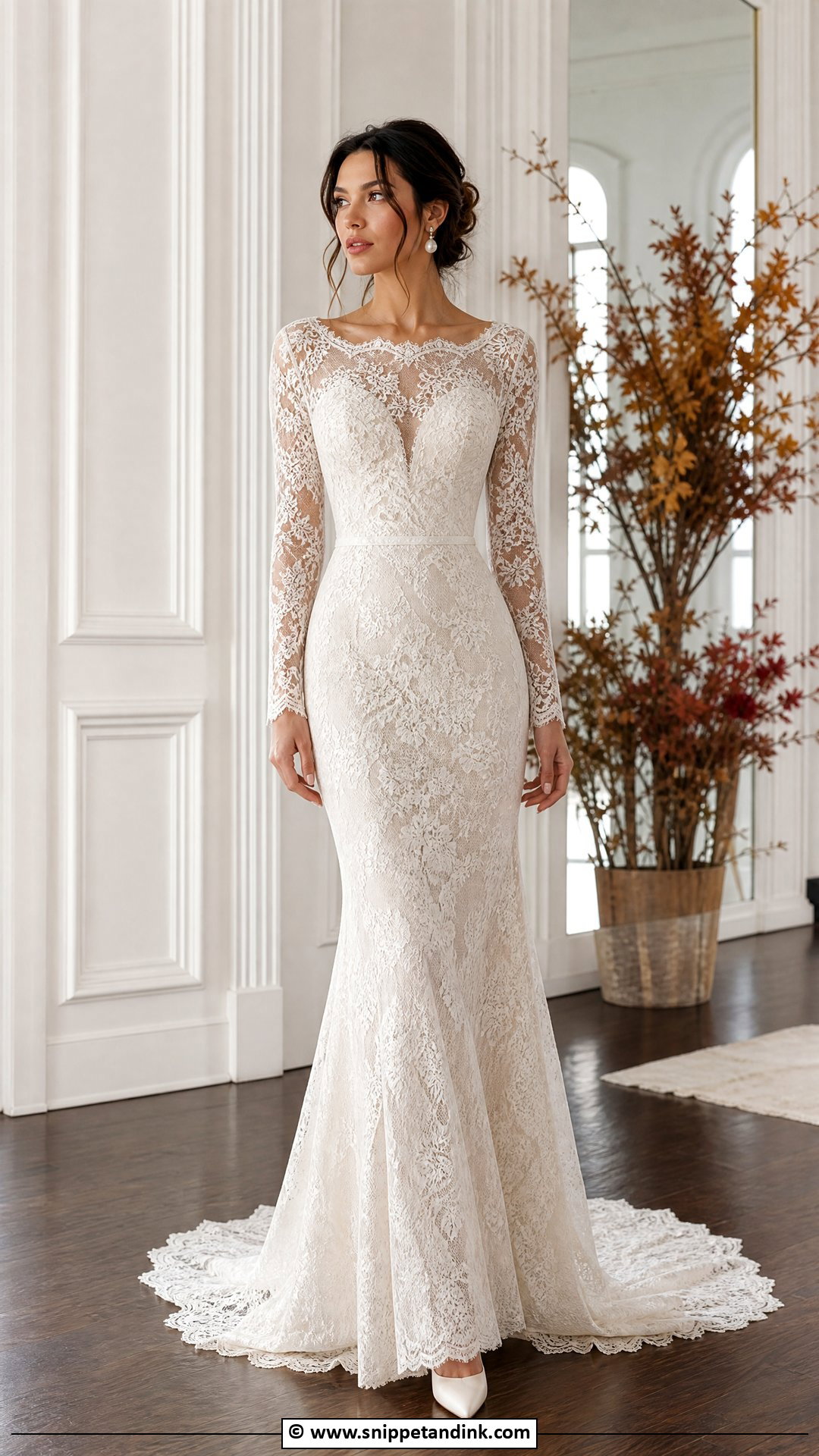
Long lace sleeves are the style brides worry about most, usually because they expect to overheat. Unlined Chantilly sleeves are far cooler than they look; it’s the lined, corded versions that trap warmth. What I check at the fitting is the armhole. If it’s cut low, every time you lift your arms to hug someone the whole bodice rises with them, and a high, close armhole fixes that. Fitted sleeves read refined while slightly flared ones lean boho, and either works best with a low bun, pearl studs and a plain veil so the sleeves stay the detail people notice. Window light or late-afternoon sun shows the sheer pattern far better than flash.
2. Strapless Lace Wedding Dress
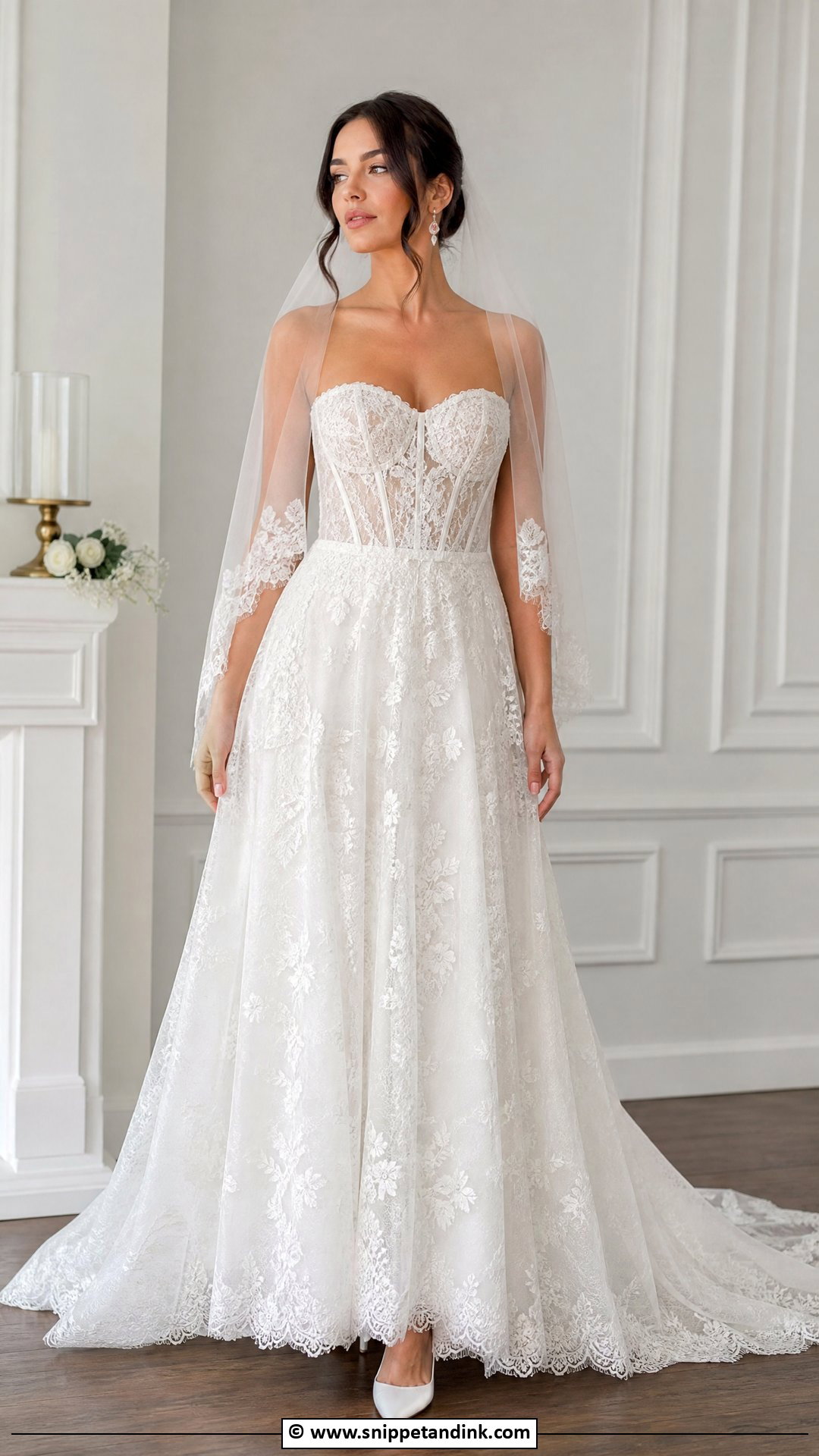
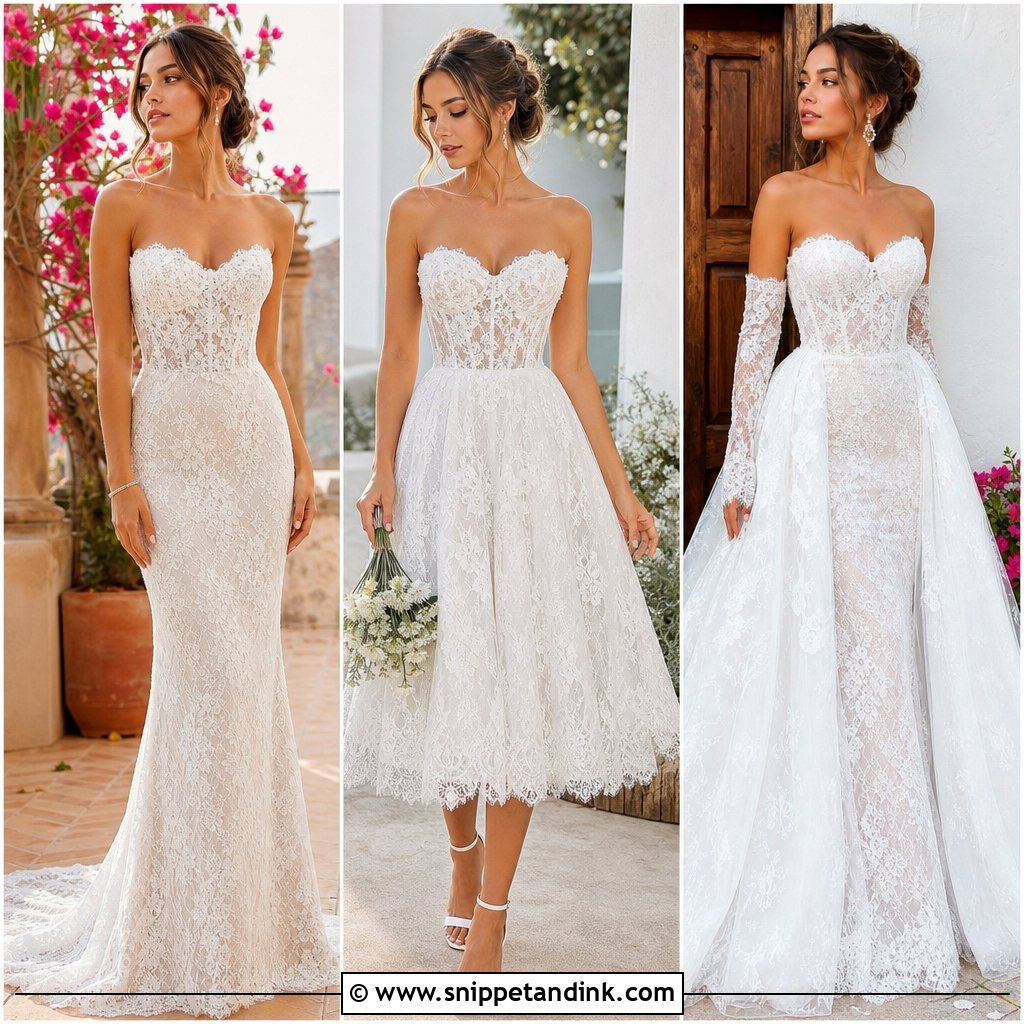
A strapless lace bodice lives or dies on what’s inside it. Before I let a bride fall for one, I have her raise both arms and bend forward; if the neckline gaps or slips, it needs boning or a waist stay added, not just a tighter zip. Lace over a corset with an A-line or fit-and-flare skirt gives the most support, and a cleaner floral lace without heavy beading keeps it current. For a covered ceremony and bare shoulders at the party, a removable lace topper does the job without a second dress.
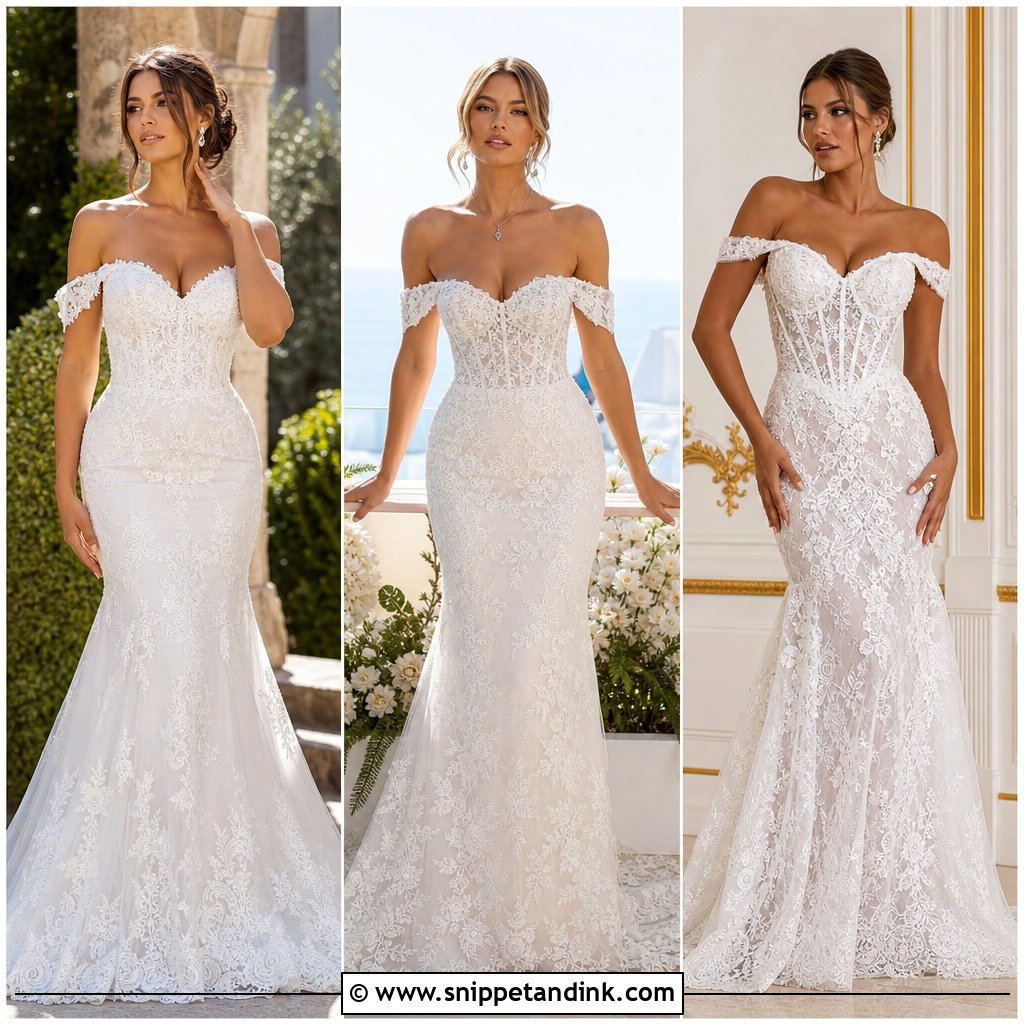
3. Off The Shoulder Lace Wedding Dress
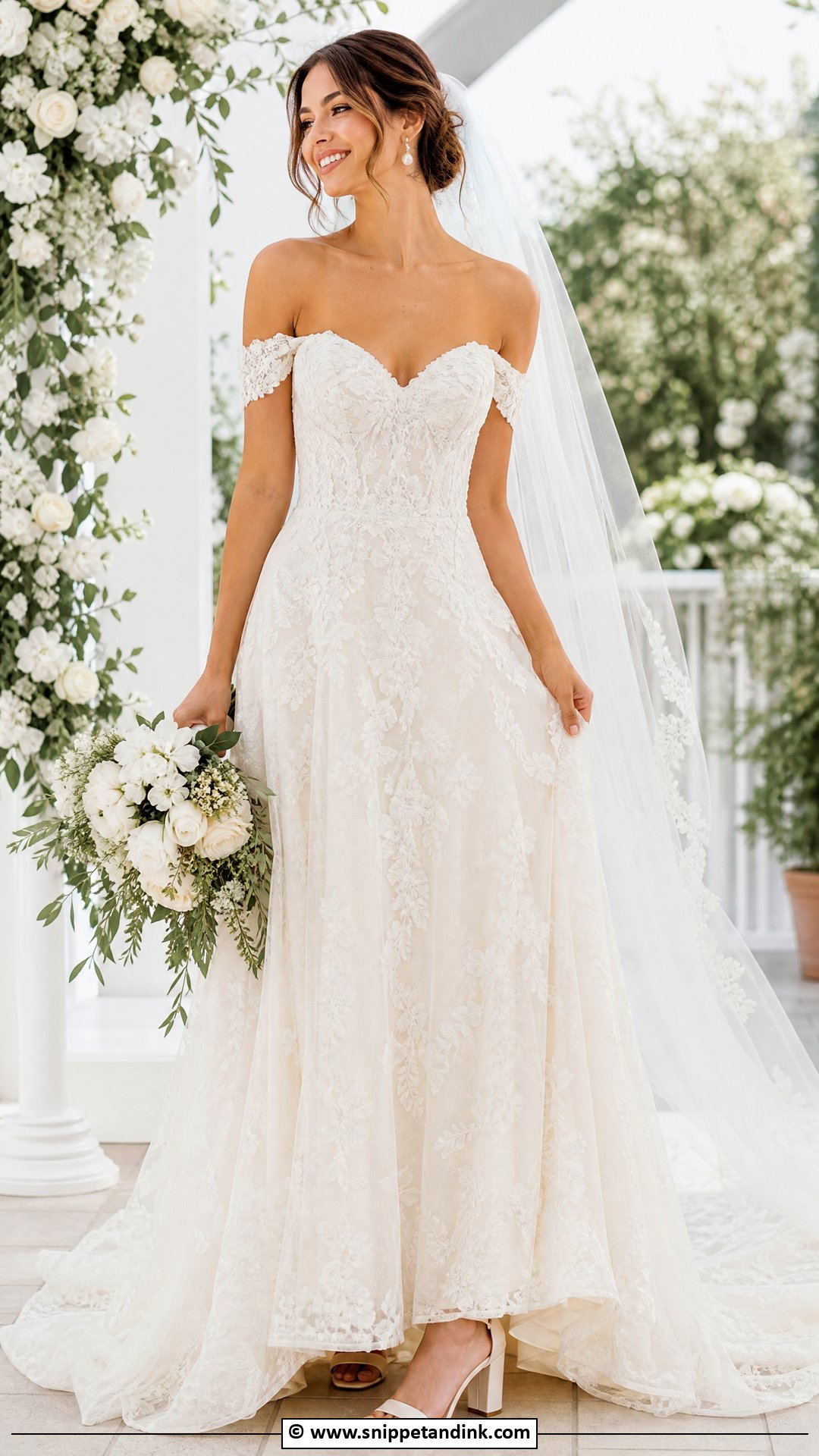
Off-the-shoulder lace looks soft in pictures, but it restricts your arms more than people expect, because the band across the upper arm stops you lifting them high. I ask brides to mimic tossing a bouquet in the fitting room. If that feels trapped, a slightly higher band or stretch lace straps solve it. On an A-line skirt it reads classic; on a mermaid it turns dramatic. The neckline already frames your collarbones, so I’d leave the necklace off and rely on pearl earrings and a smooth updo.
4. Lace A Line Wedding Dress
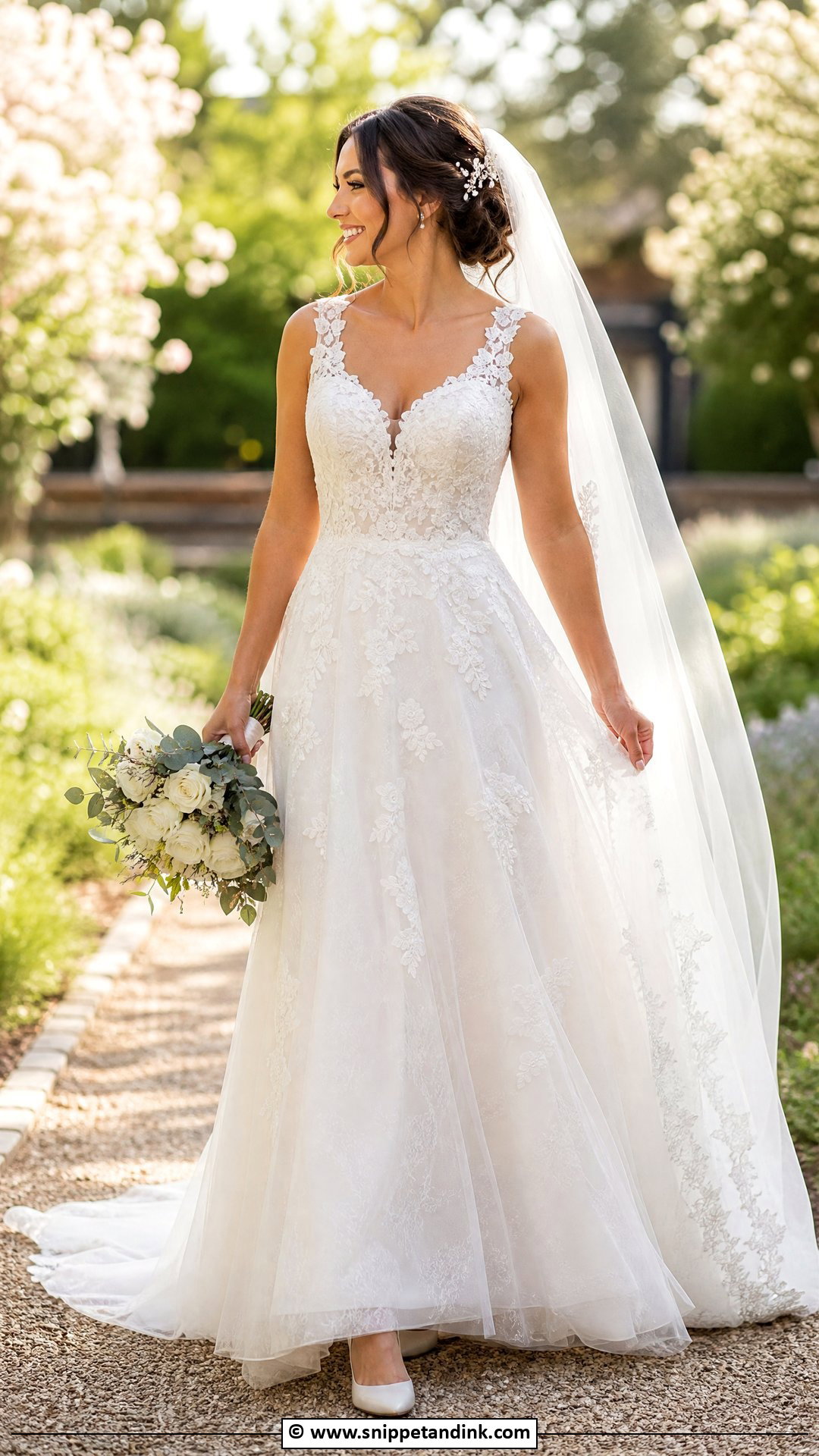
Of every lace silhouette, the A-line forgives the most. The bodice holds the waist and the skirt falls away from the hips, so you can sit through dinner without the seams pulling. I like appliqué that thins out as it travels down the skirt, which keeps the weight up top where the structure can carry it. Add a chapel veil, low sandals and a small pearl comb. It suits hotels, gardens and churches equally, and you can dance in it without a bustle emergency.
5. Lace Ball Gown Wedding Dress
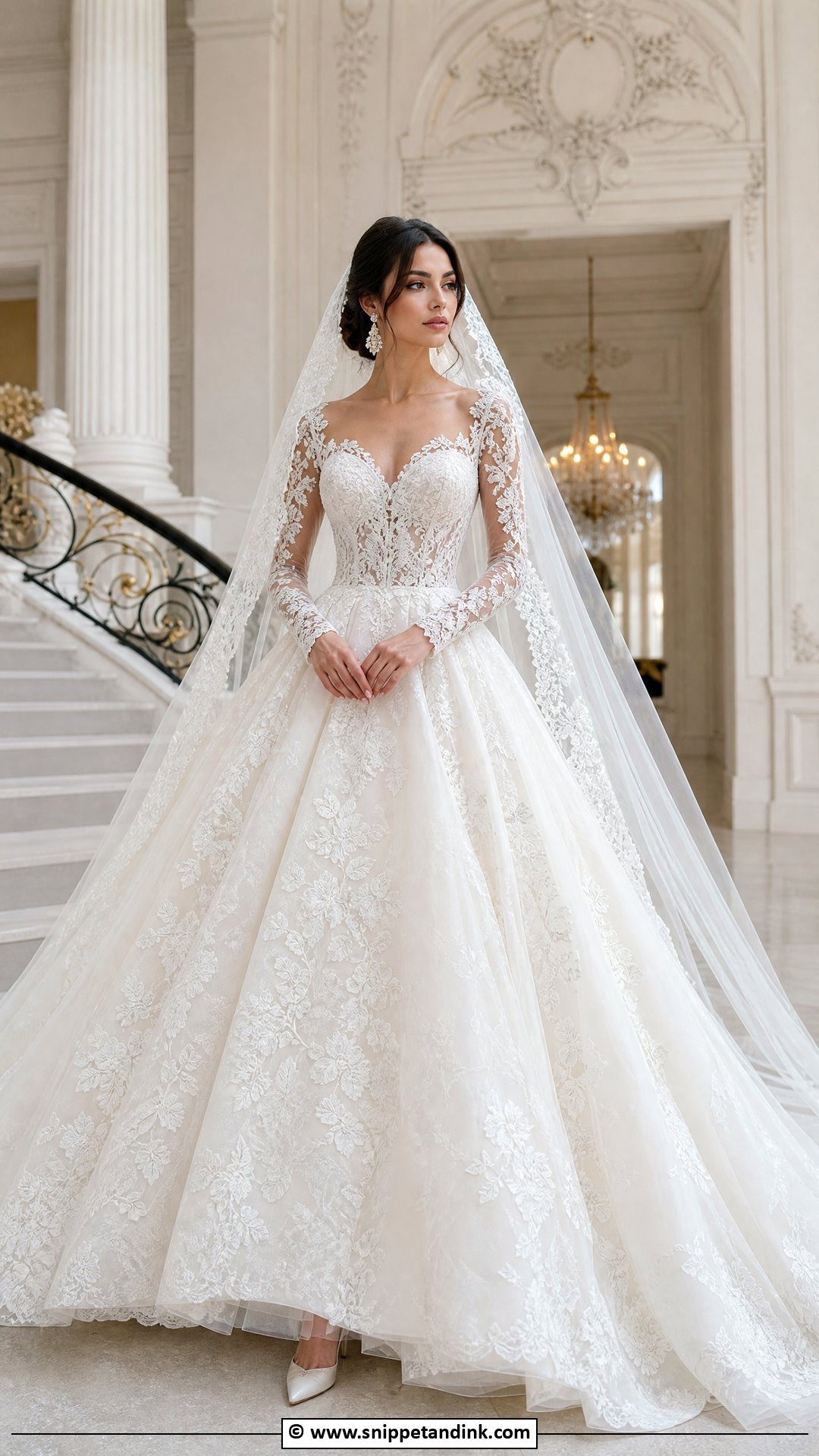
A full lace ball gown is heavy, and that’s the first thing I tell anyone trying one on. Layers of tulle plus appliqué add up quickly, so the bodice has to be built to carry the skirt from the waist, not the shoulders. In a ballroom or historic estate the volume makes sense; in a small room it can swallow you and jam doorways. Keep accessories minimal, wear closed-toe heels you’ve already broken in, and choose a cathedral veil only if the aisle is long enough to show it. A smooth bun reads regal, soft waves relax it.
6. Lace Mermaid Wedding Dress
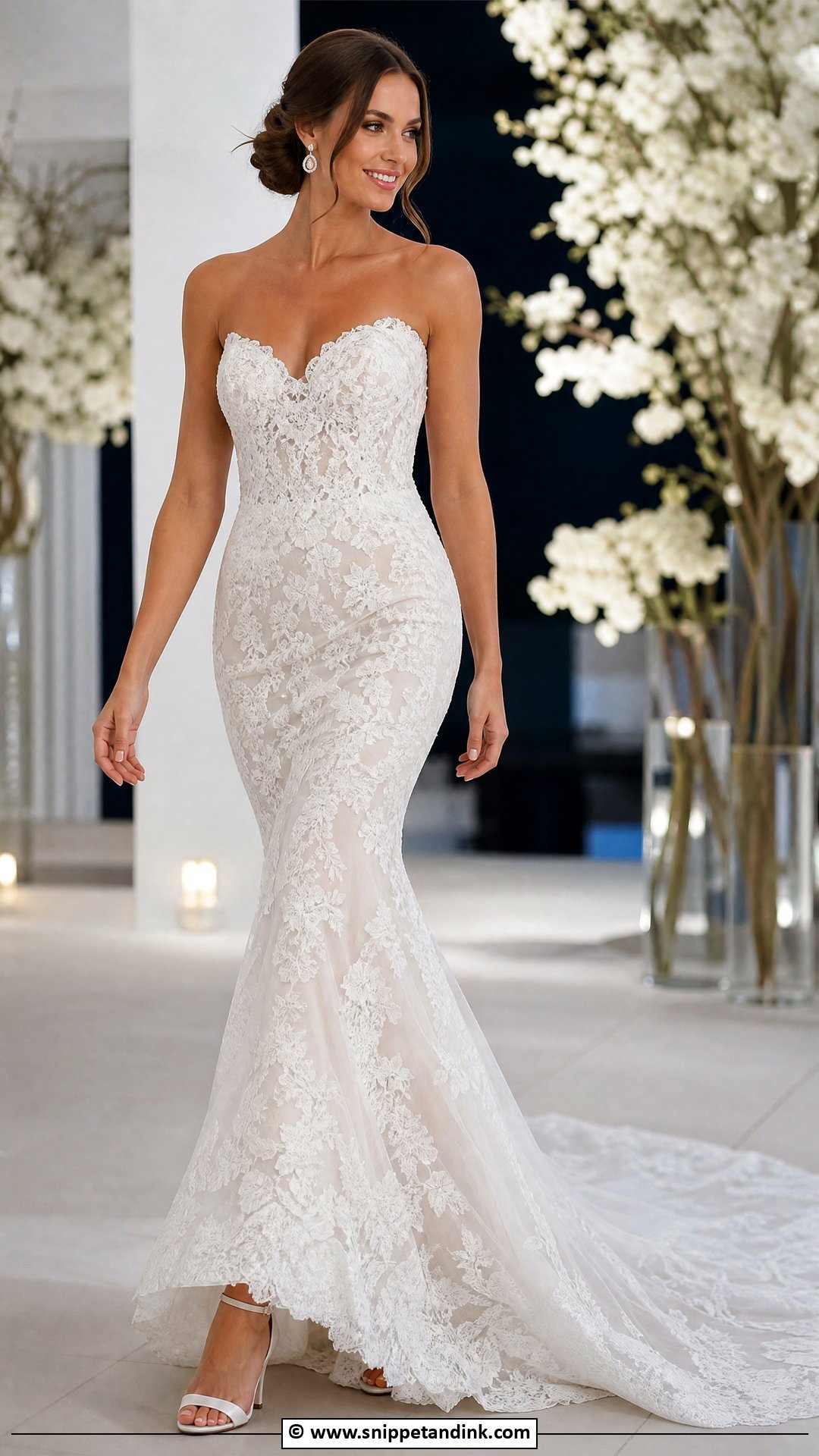
Mermaid lace is the silhouette where fit matters to the half-inch. The flare should start where your knee actually bends: too high and you’ll shuffle, too low and stairs become a problem. Ask for stretch lining and sit down in it at every fitting. Lace softens the sculpted shape, and a sweetheart neckline or illusion back gives it a focal point. I keep everything else sleek, with a fitted veil, simple earrings and nothing at the neck. I’d steer a bride away from mermaid if she plans to dance hard all night and has no second outfit.
7. Lace Fit And Flare Wedding Dress
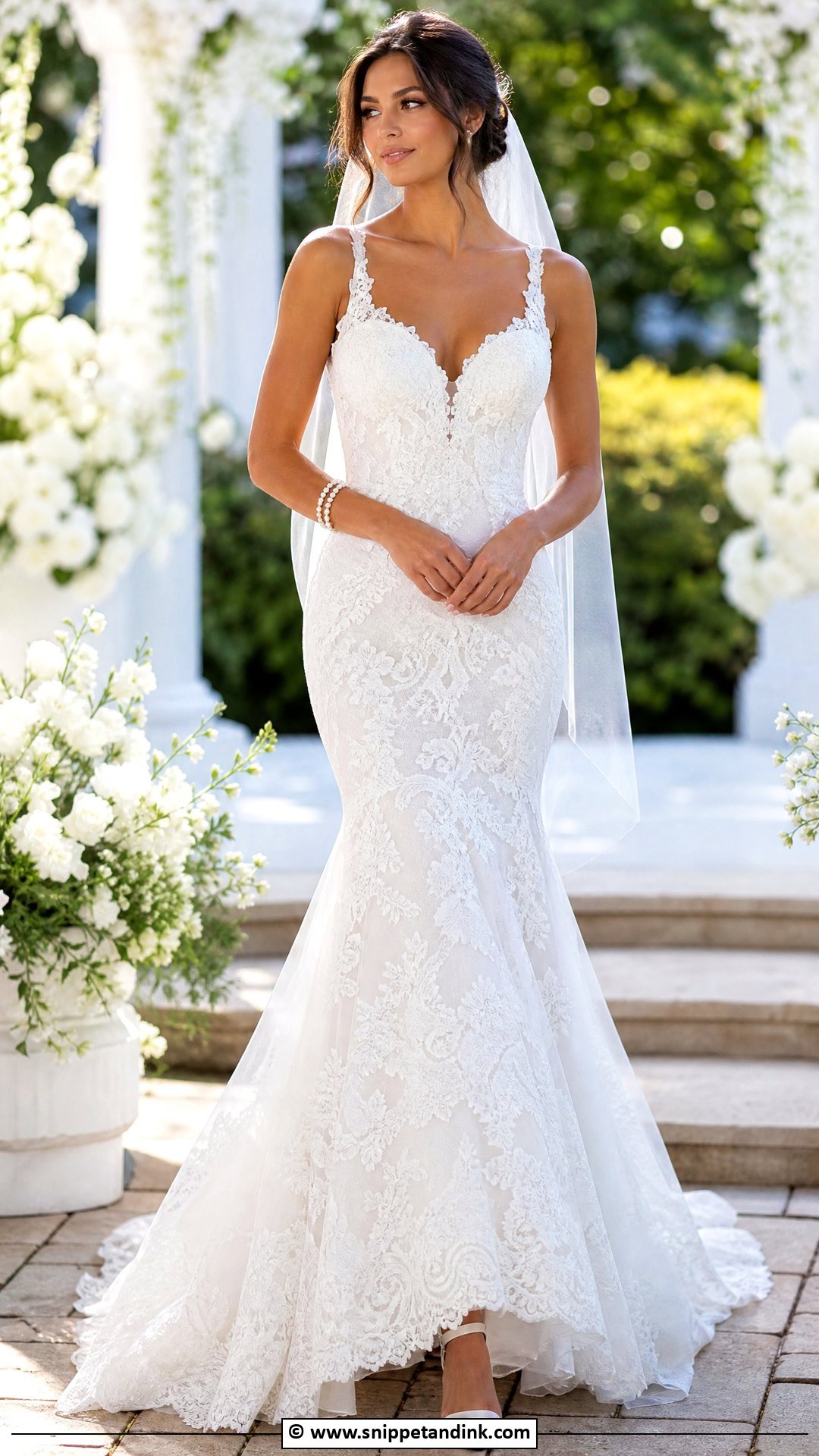
Think of fit and flare as the mermaid’s easier sister. It hugs through the hips and opens higher, around mid-thigh, so walking and sitting feel normal. Brides who want shape without a dramatic flare usually settle here. Floral lace over a soft tulle lining with a modest train balances it, and a row of lace-covered buttons down the back gives the photographer something to shoot while the bustle goes up. Ankle-strap heels help, since a full hem can tangle around a loose shoe.
8. Boho Lace Wedding Dress
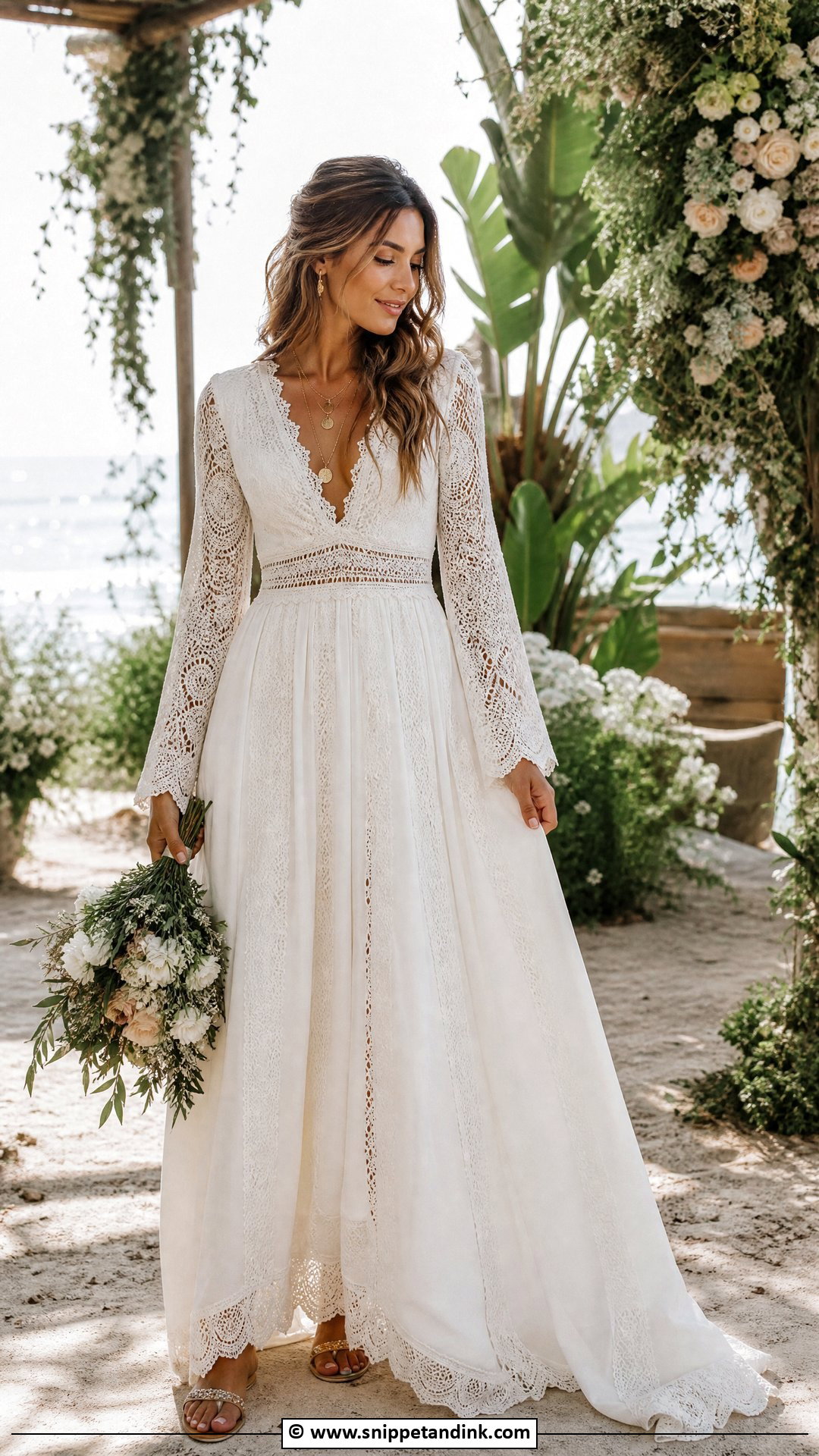
Boho lace is where I see the most fabric damage, because looser weaves snag on wooden benches, rough stone and the Velcro on a camera bag. If you love crochet-inspired lace or open scallops, plan for that. Light lining, flowing sleeves and an easy skirt suit beaches, gardens and mountain venues, and flat sandals or low block heels stop you sinking into lawn. Loose waves, fine gold jewelry and a flower pin finish it without making it formal. Pack small scissors for pulled threads.
9. Vintage Lace Wedding Dress
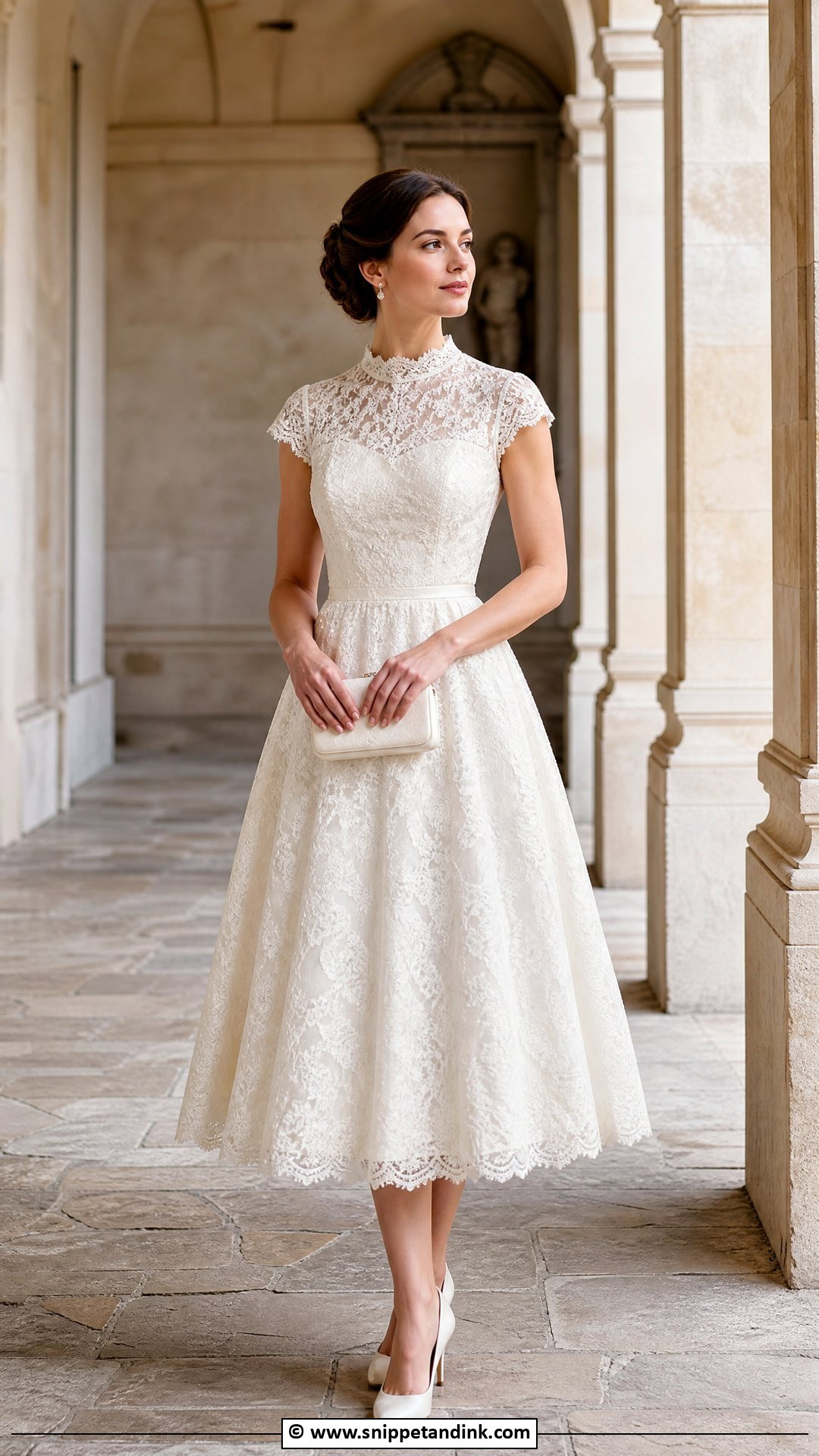
With vintage lace I follow one rule: pick a single era detail and keep everything else current. A high neck with a clean skirt works. A high neck plus cap sleeves plus covered buttons plus a tea-length hem starts to look like costume. If the dress is genuinely old, check the lace at the underarms and hem first, since that’s where age shows as splits or yellowing, and have a restorer look at it before any alterations. Pearl earrings, a structured clutch and soft waves suit historic venues and small ceremonies.
10. Modern Lace Wedding Dress
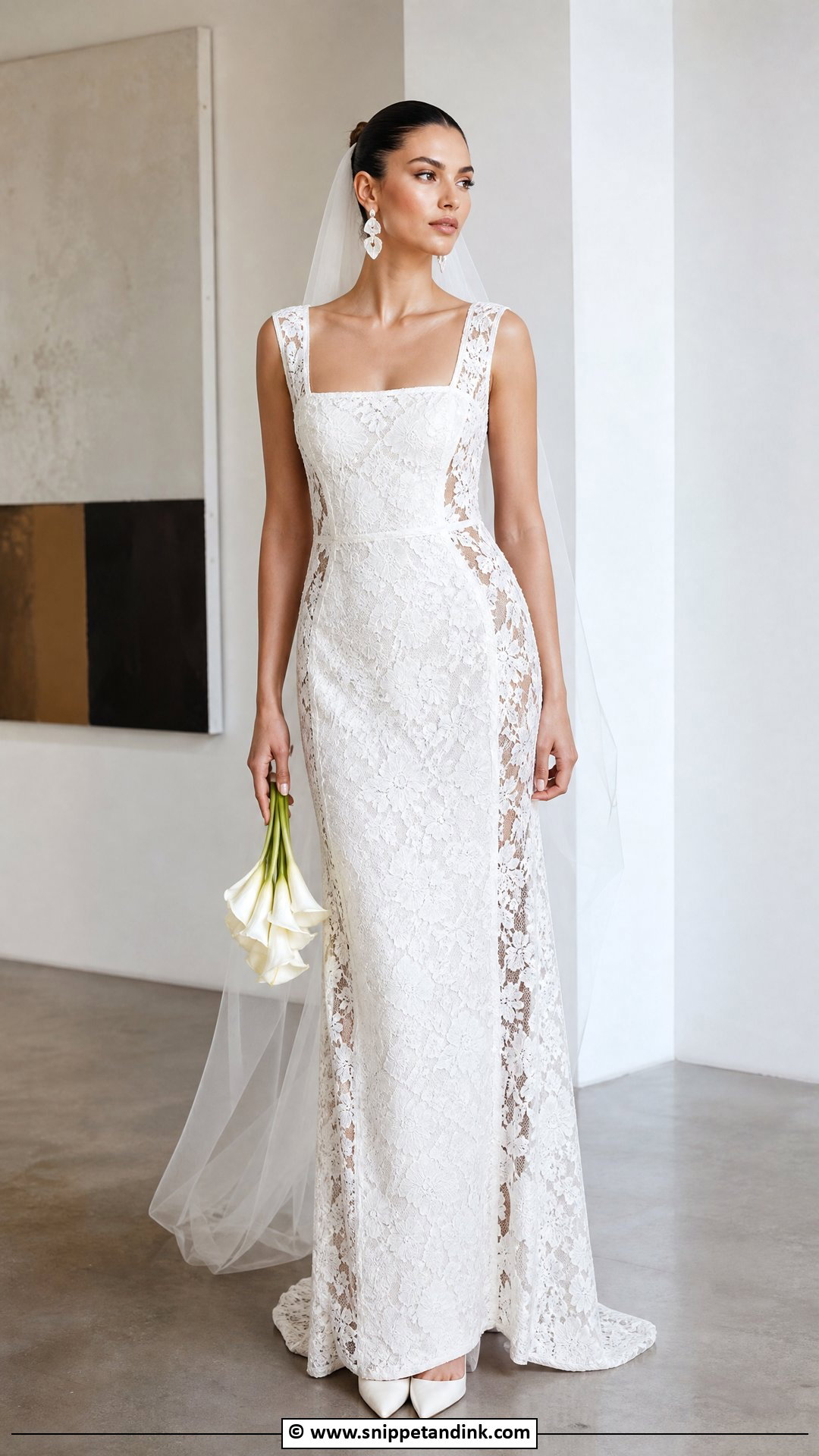
Modern lace is about restraint: sheer panels, one appliqué placement, or a crepe skirt with lace only on the bodice. Square necklines, corset seams and column shapes keep it from sliding back toward tradition. I pair these with sculptural earrings and a slick bun or straight hair, because a lot of soft curl fights the clean lines. The risk is that every flaw in fit shows on a plain gown, so leave time for a proper tailor.
11. Floral Lace Wedding Dress
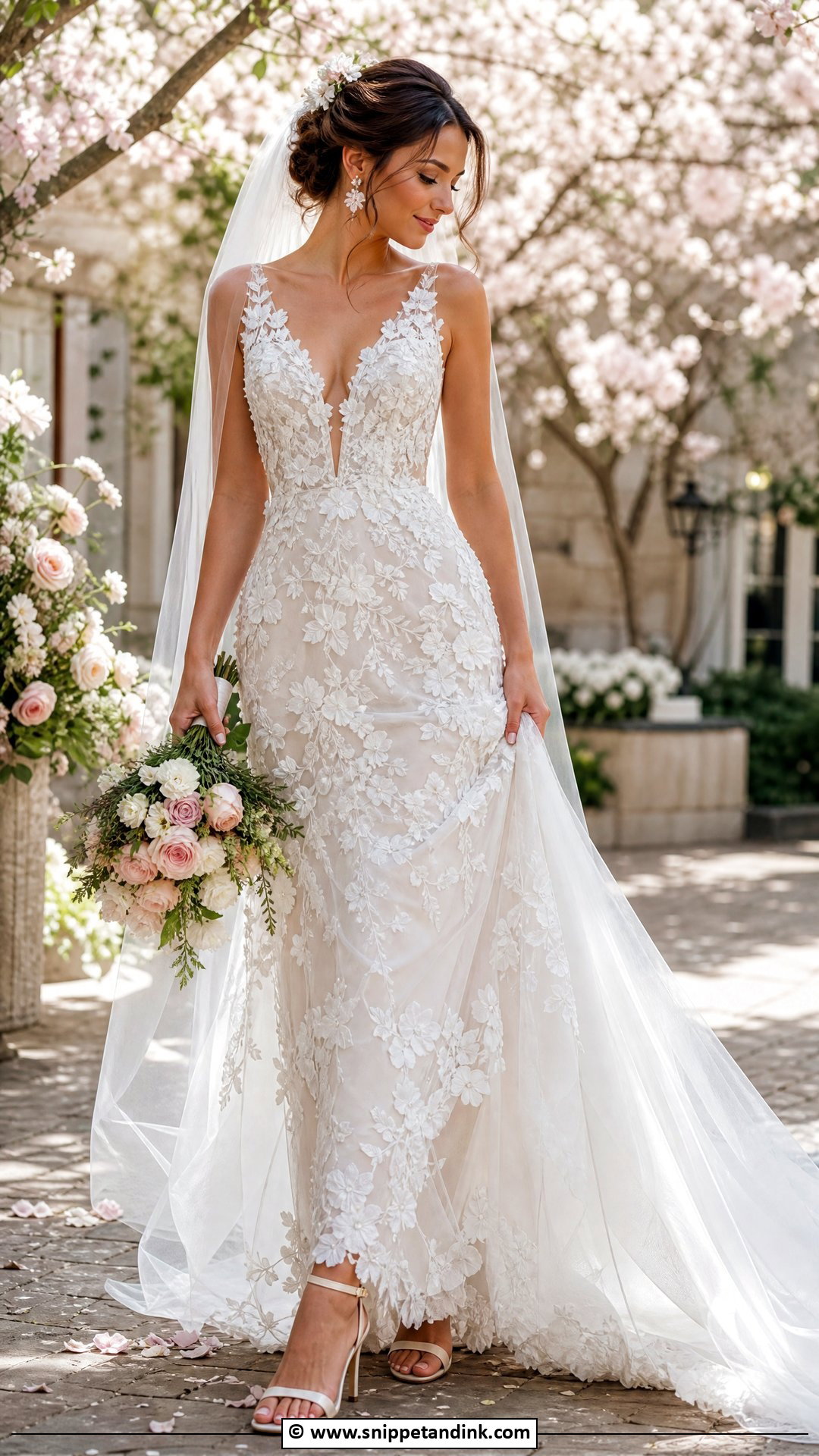
Scale is everything with floral lace. Large appliqués read bold and fashion-led, tiny florals read soft and classic, and on the hanger you can’t tell how either will land on your body. In the fitting I look at where the biggest motifs fall. A heavy flower sitting right at the widest point of the hip pulls the eye there, which some brides like and others really don’t. Botanical earrings and a plain veil let the pattern show, and spring or summer gardens suit it best.
12. 3D Lace Wedding Dress
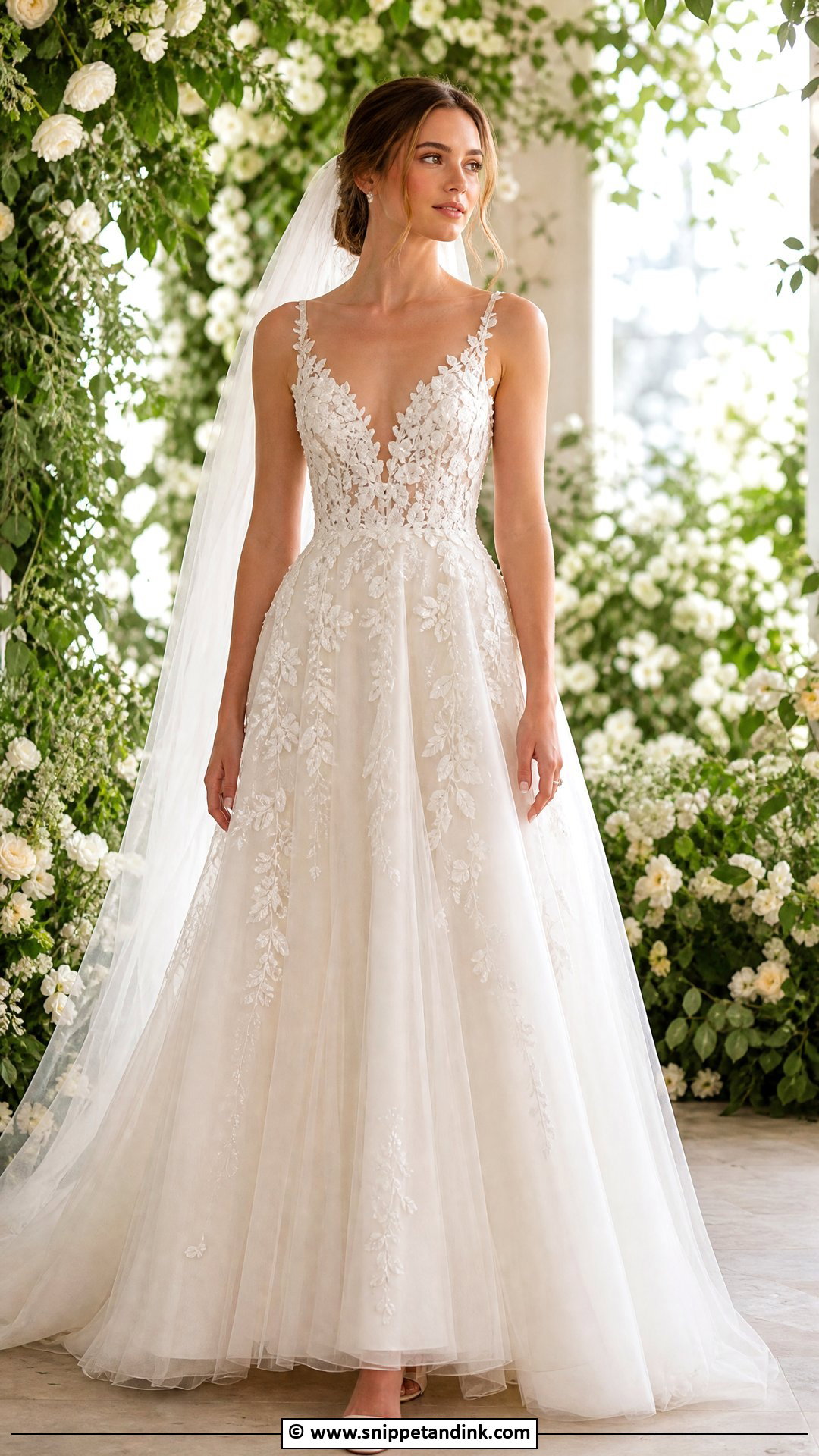
Three-dimensional lace has flowers that stand off the fabric, so it reads across a room and in close-up. The trade-off: raised petals crush. Sitting in a car, long hugs or a tight bustle can flatten them, and I always ask the seamstress to tack down the loosest petals before pickup. A 3D bodice over soft tulle feels dreamy; all-over 3D on a column is more editorial. Keep jewelry to pearl studs because the texture is already busy.
13. Lace Corset Wedding Dress
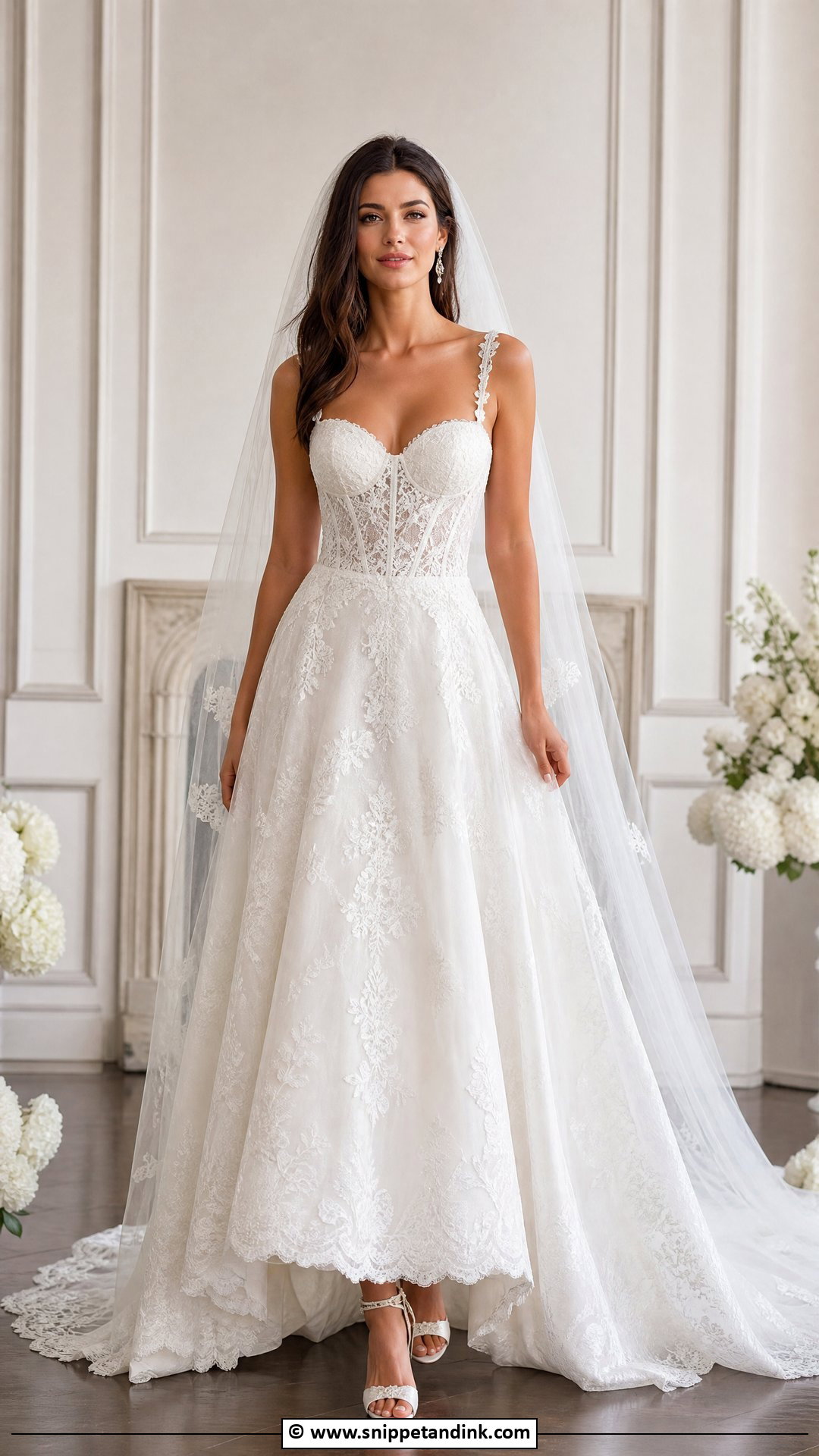
A lace corset wedding dress combines structure with romance, but that structure has to stay comfortable through a long day. Visible boning under sheer lace looks modern; a fully lined sweetheart corset is more classic, and both pair with A-line, ball gown or fitted skirts. My test is simple. At the final fitting you should be able to sit, eat a few bites and take a full breath without bones digging into your ribs. Loosening the laces on the morning won’t rescue a corset that was cut too small.
14. High Neck Lace Wedding Dress
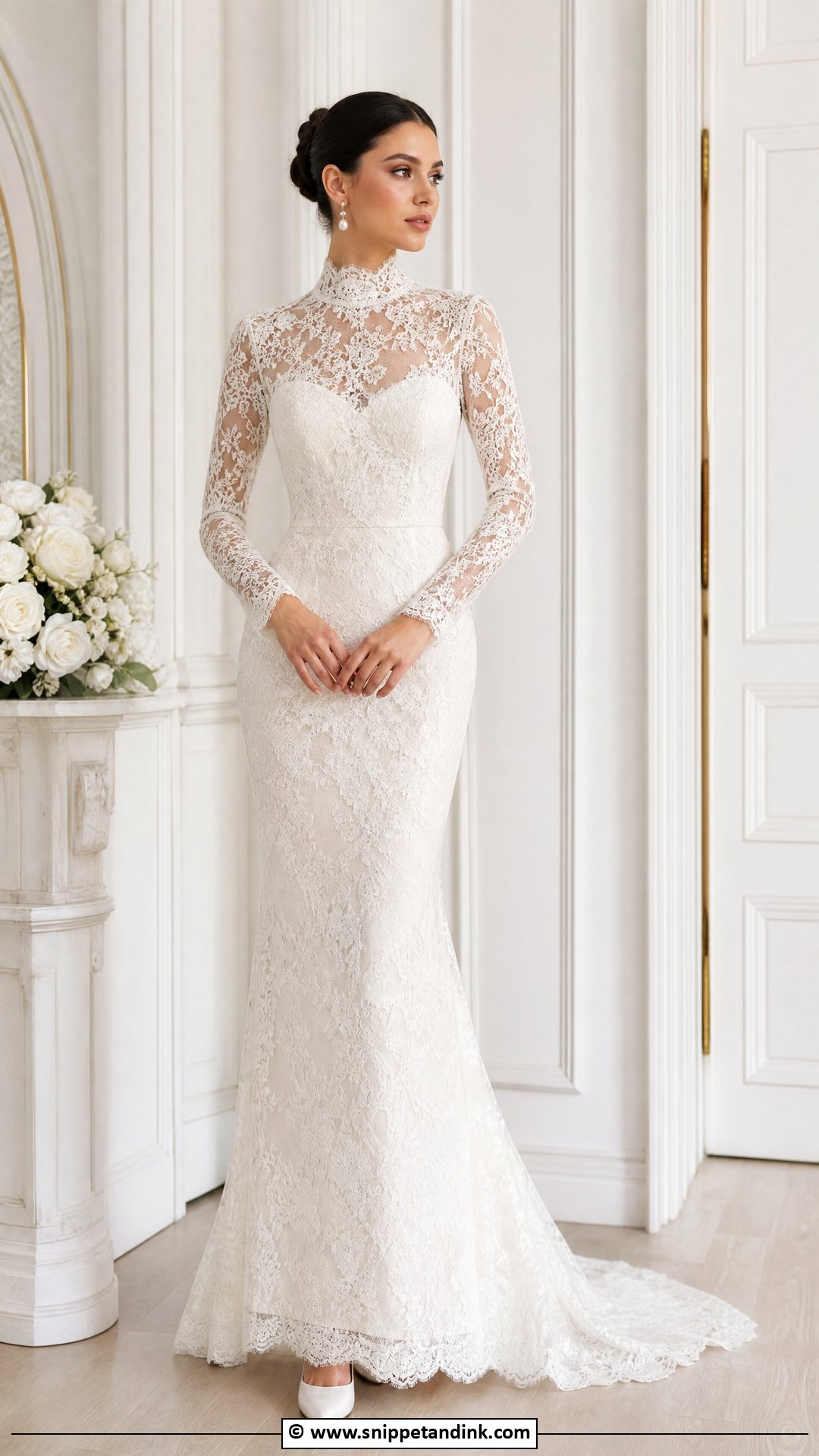
High necks frame the face and suit cooler months and formal ceremonies. I watch the collar closely: too snug and you’ll feel it every time you swallow, too loose and it buckles when you look down at your bouquet. Sheer lace at the throat keeps it light. Skip the necklace entirely, wear a sleek bun with pearl earrings, and set the veil comb low behind the bun so it doesn’t interrupt the neckline.

15. Square Neck Lace Wedding Dress
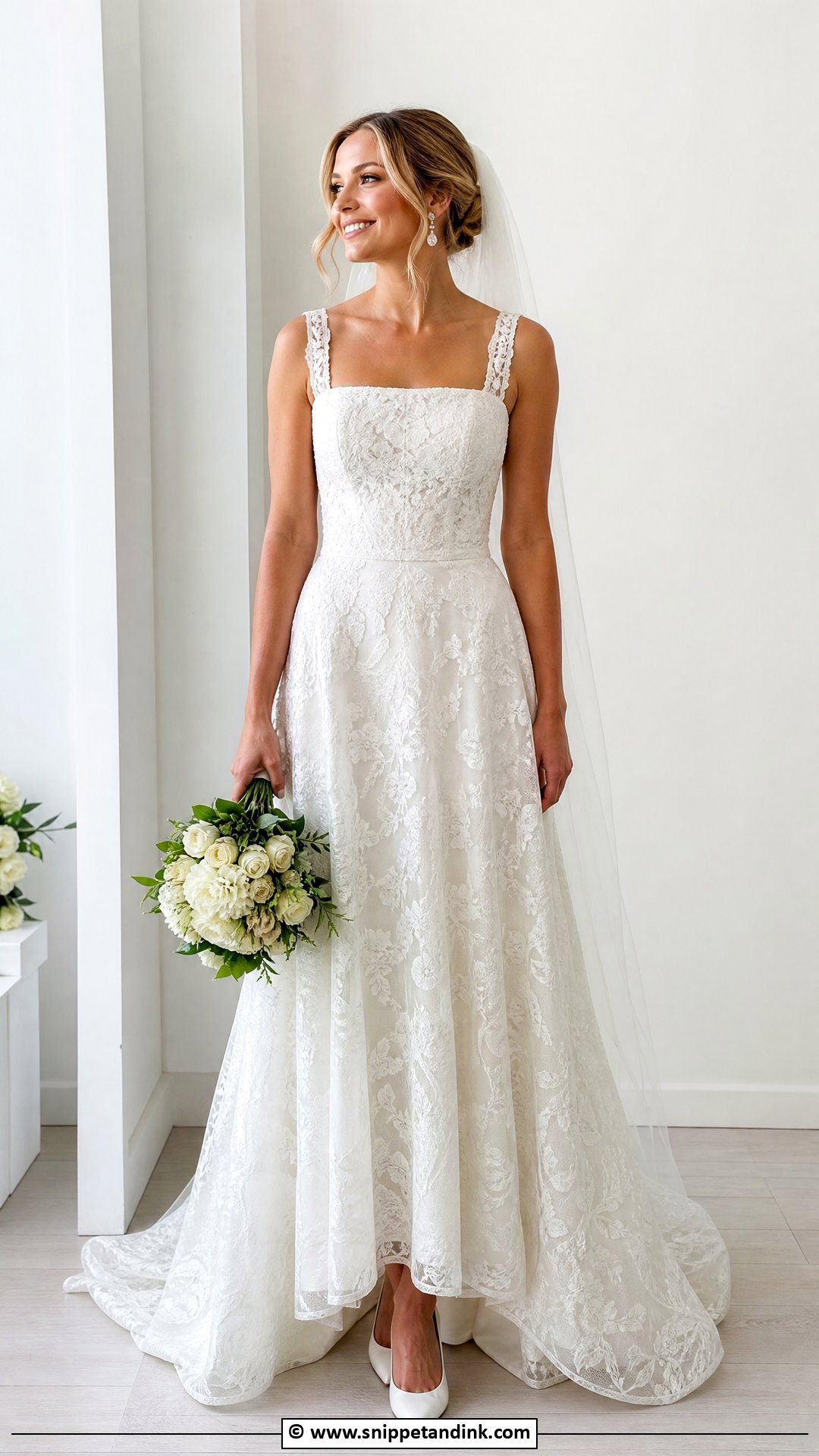
Square necklines open the chest without plunging, and lace softens what is otherwise a fairly architectural line. The corners must sit flat; if they lift when you breathe in, the bodice needs taking in at the side seams. An A-line version stays classic and a column feels newer. Medium drop earrings and pointed pumps suit both.
16. V Neck Lace Wedding Dress
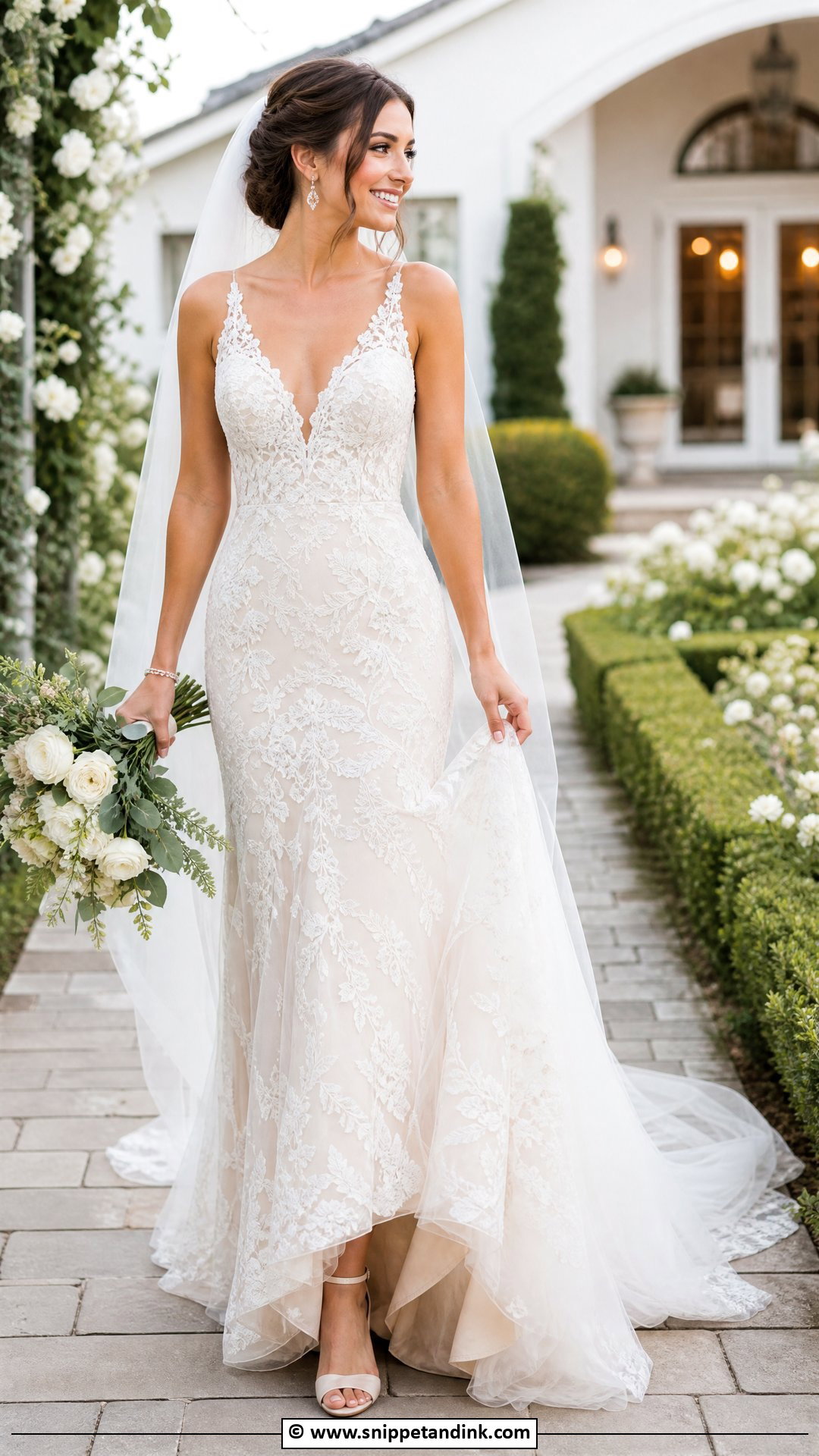
A V neck lengthens the torso and suits most silhouettes, but depth is personal, so I judge it seated rather than standing. A plunge that looks fine in the mirror can gape once you sit at the top table. Illusion mesh or lace laid across the center keeps it secure, and fashion tape is essential for anything below the bust line. Wear a pendant only if the neckline edge is plain; with scalloped lace, earrings do the work better.
17. Illusion Lace Wedding Dress
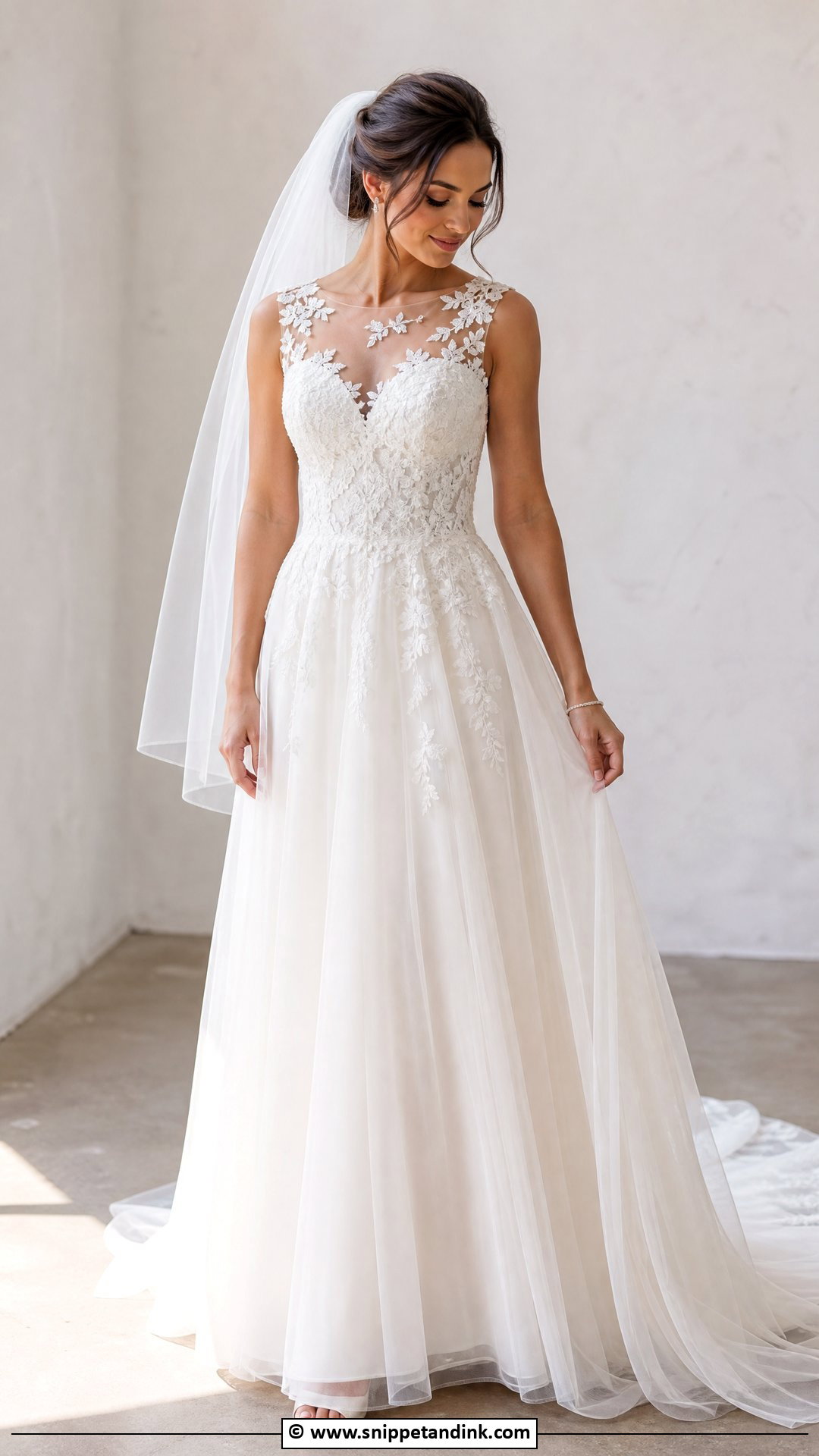
Illusion lace floats appliqué on fine mesh, so the motif looks drawn onto your skin at the neck, back or sleeves. The detail that makes or breaks it is mesh color. Shops carry several tones, and I hold swatches against the inner arm in daylight, because a mesh even a shade too pale reads grey in photos. A sheer back closed with covered buttons is the classic version. Keep jewelry minimal; the mesh already supplies the detail.
18. Lace Wedding Dress With Sleeves
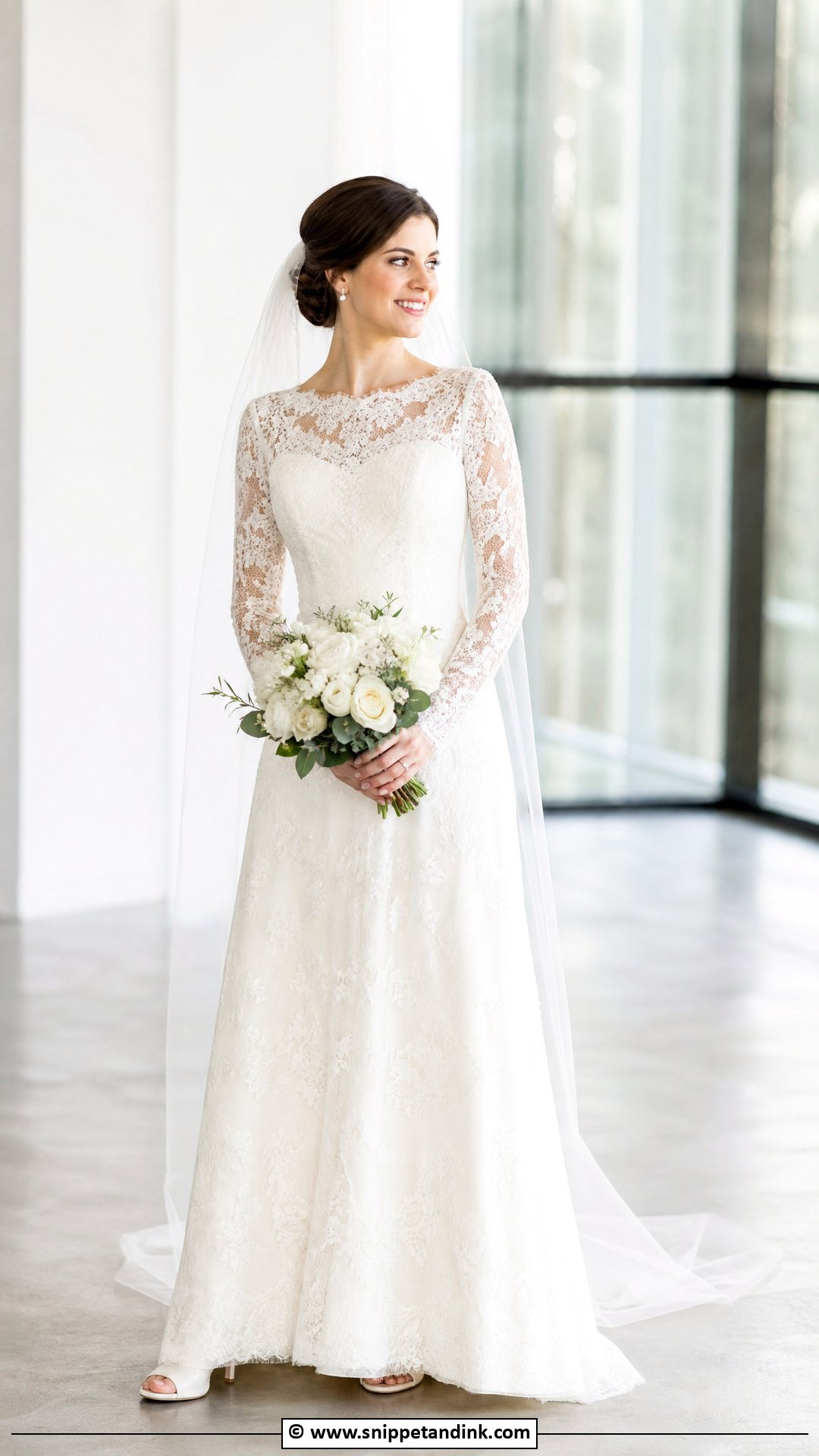
A lace wedding dress with sleeves changes character with the sleeve itself: fitted reads classic, puff reads fashion, bell reads relaxed and cap reads sweet. Match sleeve to skirt, so a fitted sleeve on a sleek gown and a flutter on a soft A-line. Tailoring matters more here than almost anywhere. A sleeve a little too long bunches at the wrist, and every shot of you holding flowers shows it. Choose a veil that falls behind your arms, not over them.
19. Lace Cap Sleeve Wedding Dress
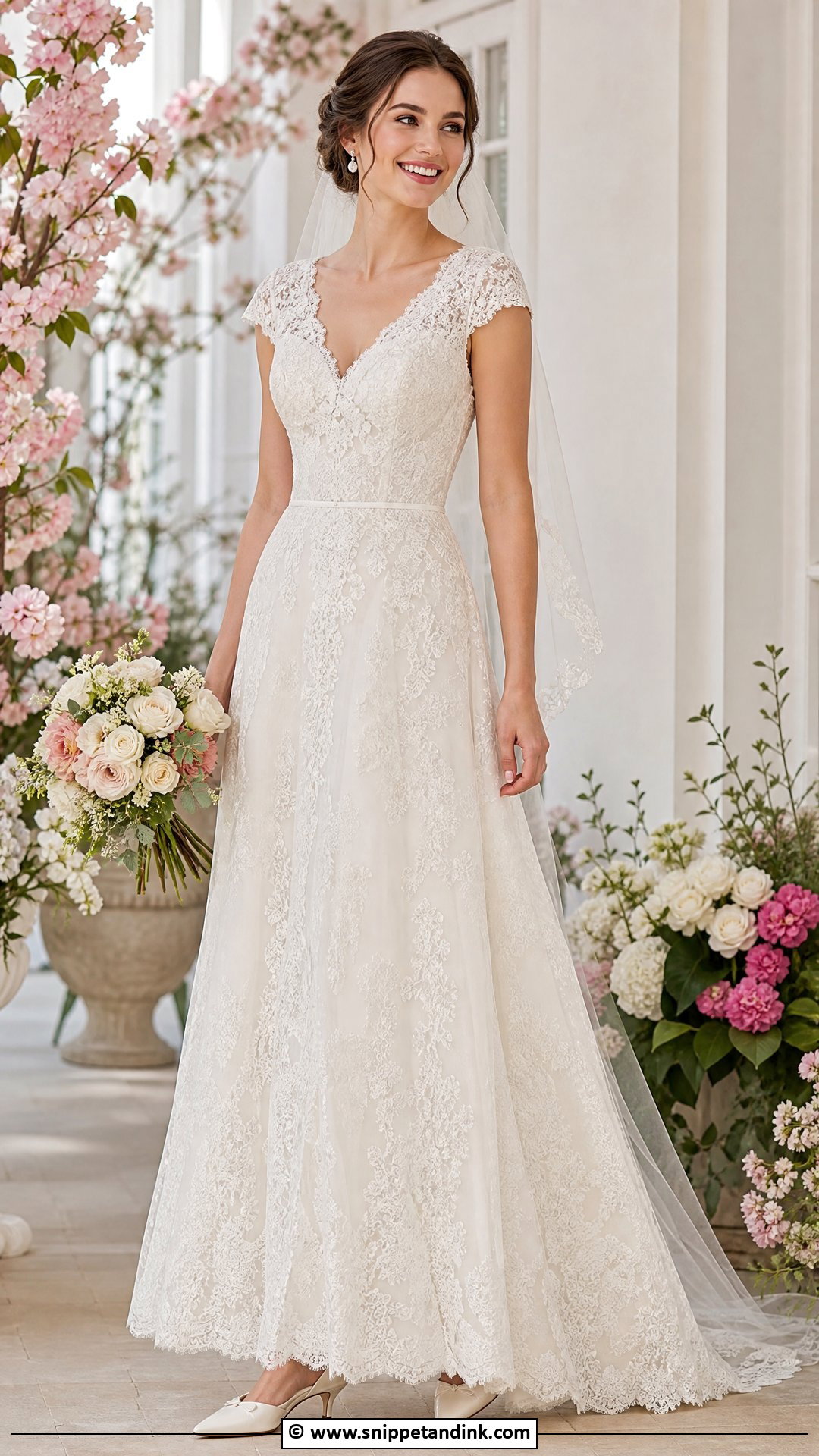
Cap sleeves cover the shoulder without adding warmth, which is why I suggest them to summer brides who don’t want to go strapless. The lace has to lie flat over the shoulder bone; stiff lace there sticks out like a small wing. They sit well on A-line, sheath and fit-and-flare shapes, with pearl earrings, a low bun, kitten heels and a fingertip veil keeping the scale right.
20. Lace Wedding Dress With Detachable Sleeves
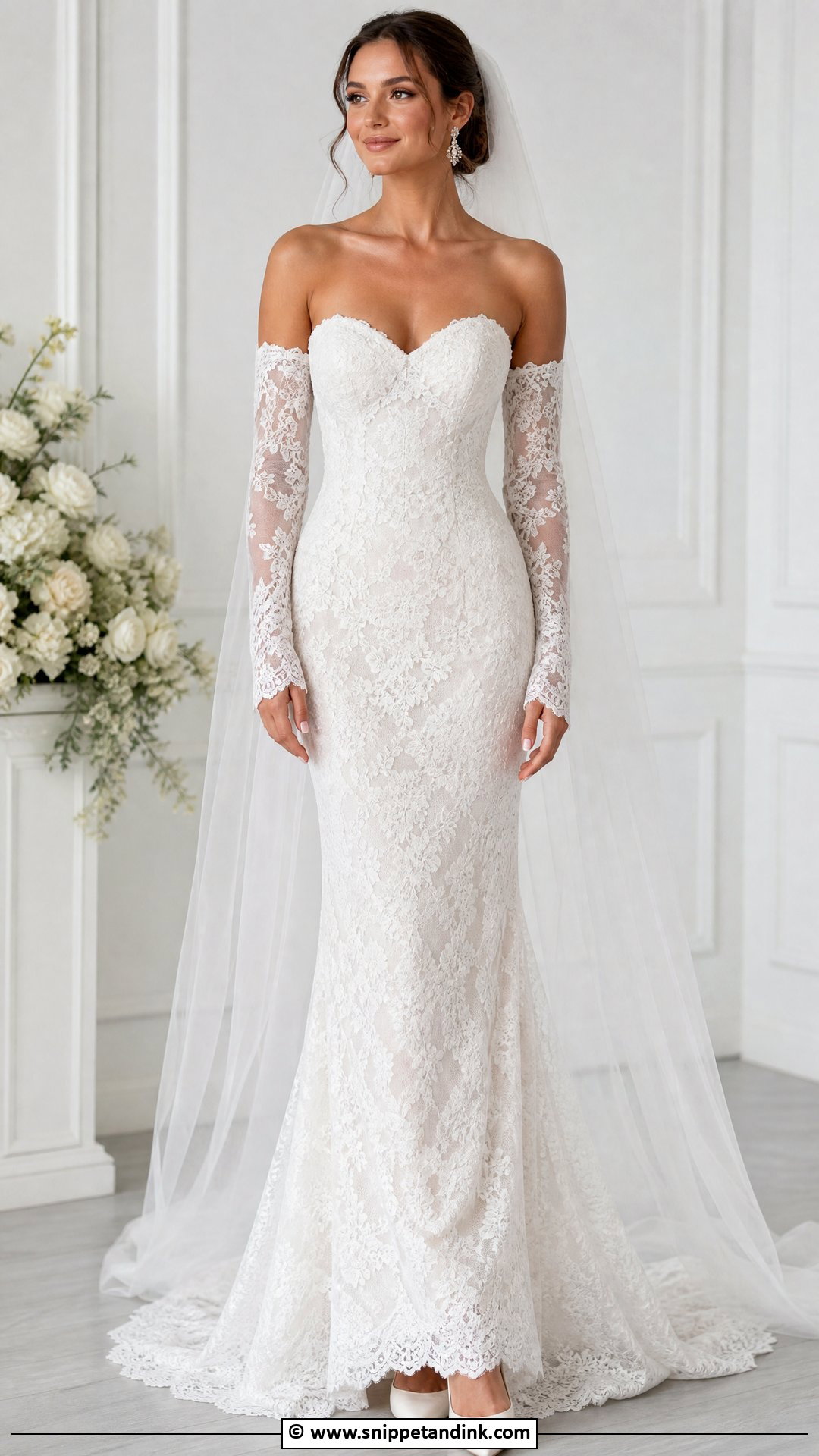
Detachable sleeves give you a covered ceremony look and bare arms for dancing. The attachment is what I inspect. Snaps and hidden hooks are quicker on the day than rows of tiny buttons, and they need to be sewn into a reinforced seam so the bodice doesn’t tear when someone pulls them off in a hurry. Have whoever is helping you change practise once at the final fitting. Swap to bolder earrings when the sleeves come off so the reception look feels deliberately different.
21. Lace Wedding Dress With Cape
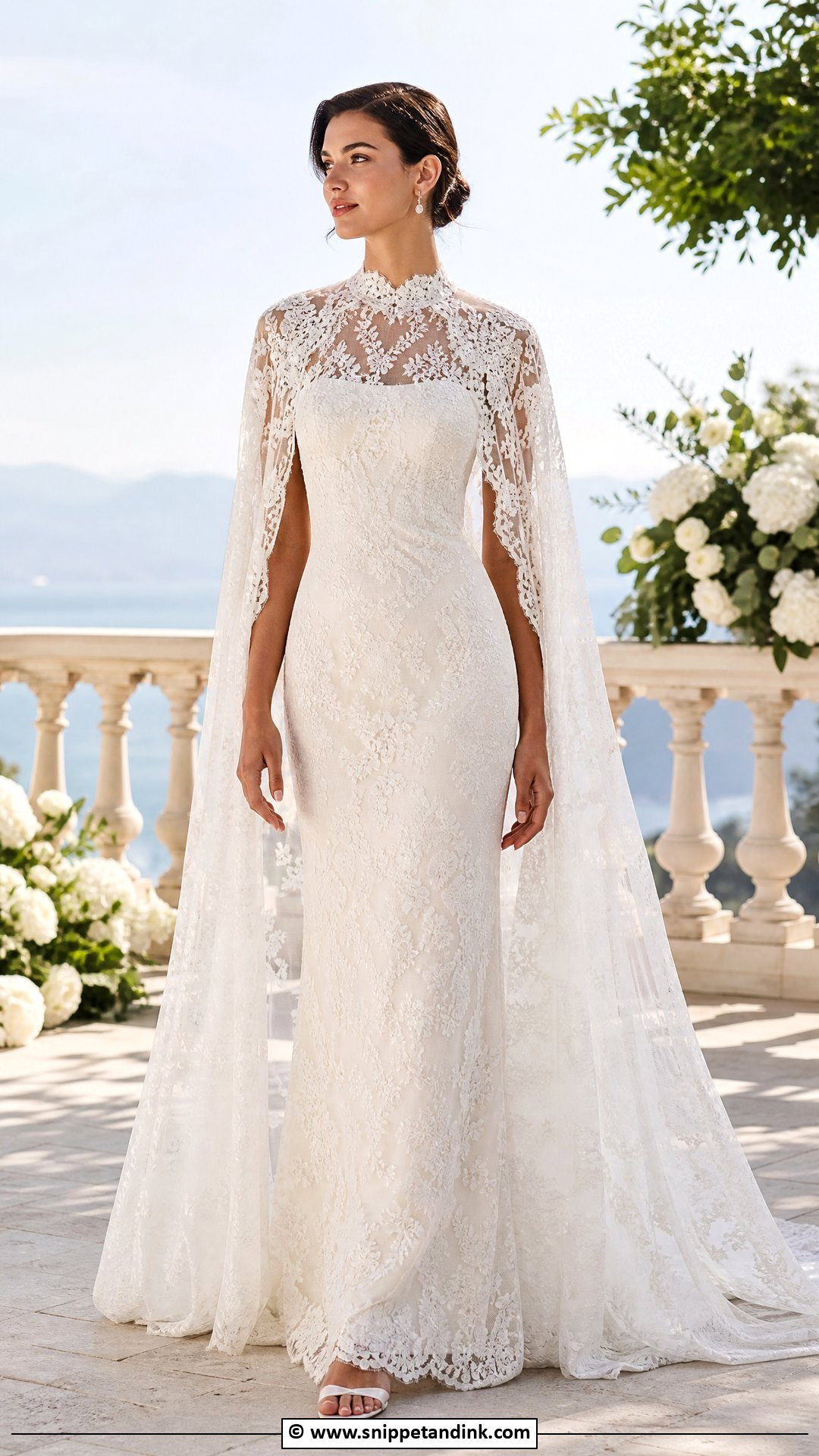
A lace cape can replace the veil altogether, and it moves well when you walk. Wind is the catch. Outdoors, a long sheer cape blows sideways during vows, so I ask for small hem weights or a wrist loop. A plain gown underneath works best because the cape carries the detail. Decide in advance when it comes off; most brides remove it after portraits so nobody treads on it at dinner.
22. Lace Wedding Dress With Overskirt
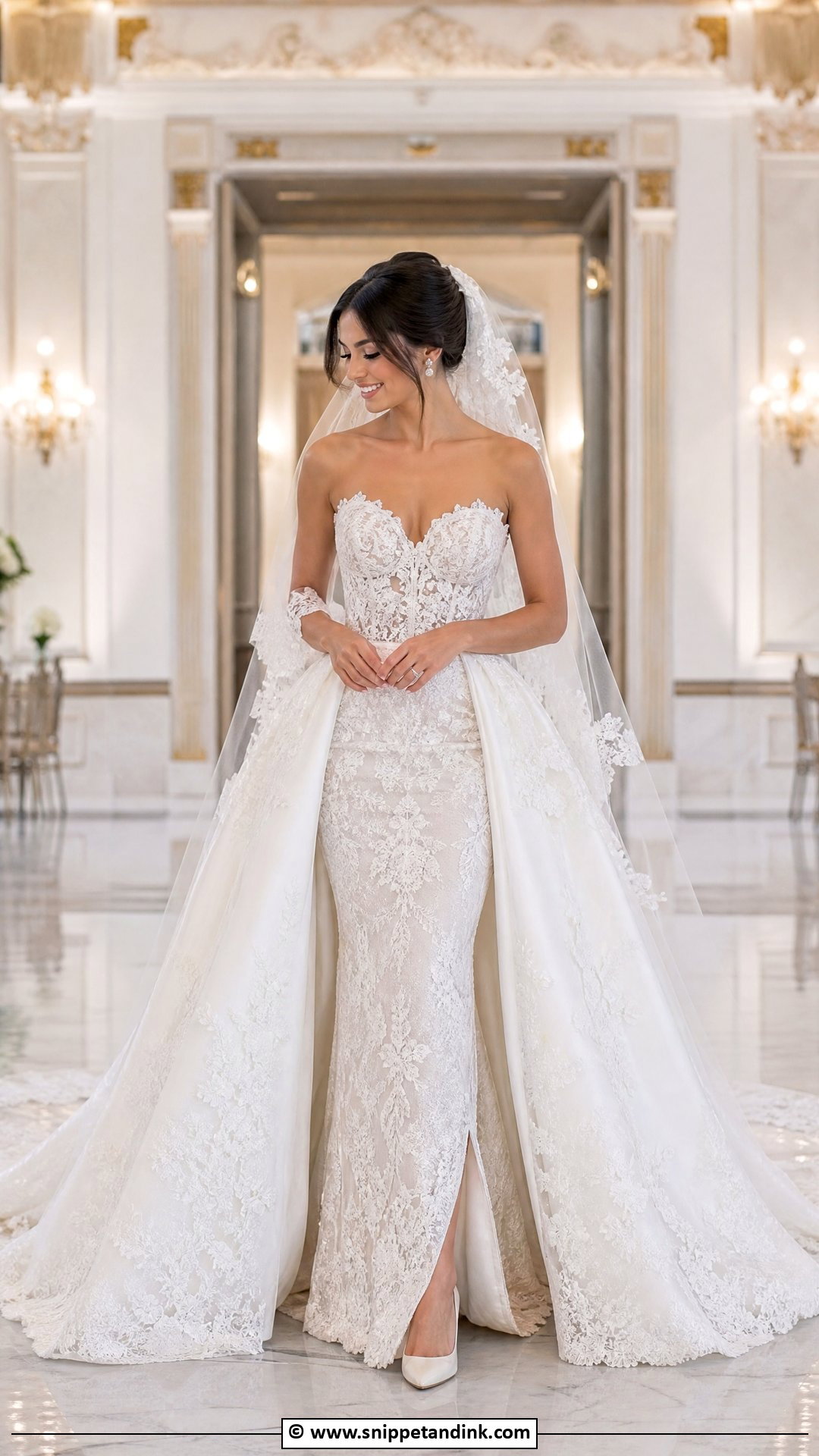
An overskirt gives you ball-gown volume for the aisle and a slim dress for dancing. The appliqué should repeat on both layers so they read as one outfit rather than separates. I always check the closure: a heavy overskirt needs a sturdy waistband hook plus hidden snaps, or it slowly twists toward one hip during the ceremony. It answers the bride torn between two silhouettes who doesn’t want to buy two dresses.
23. Lace Wedding Dress With Pearl Details
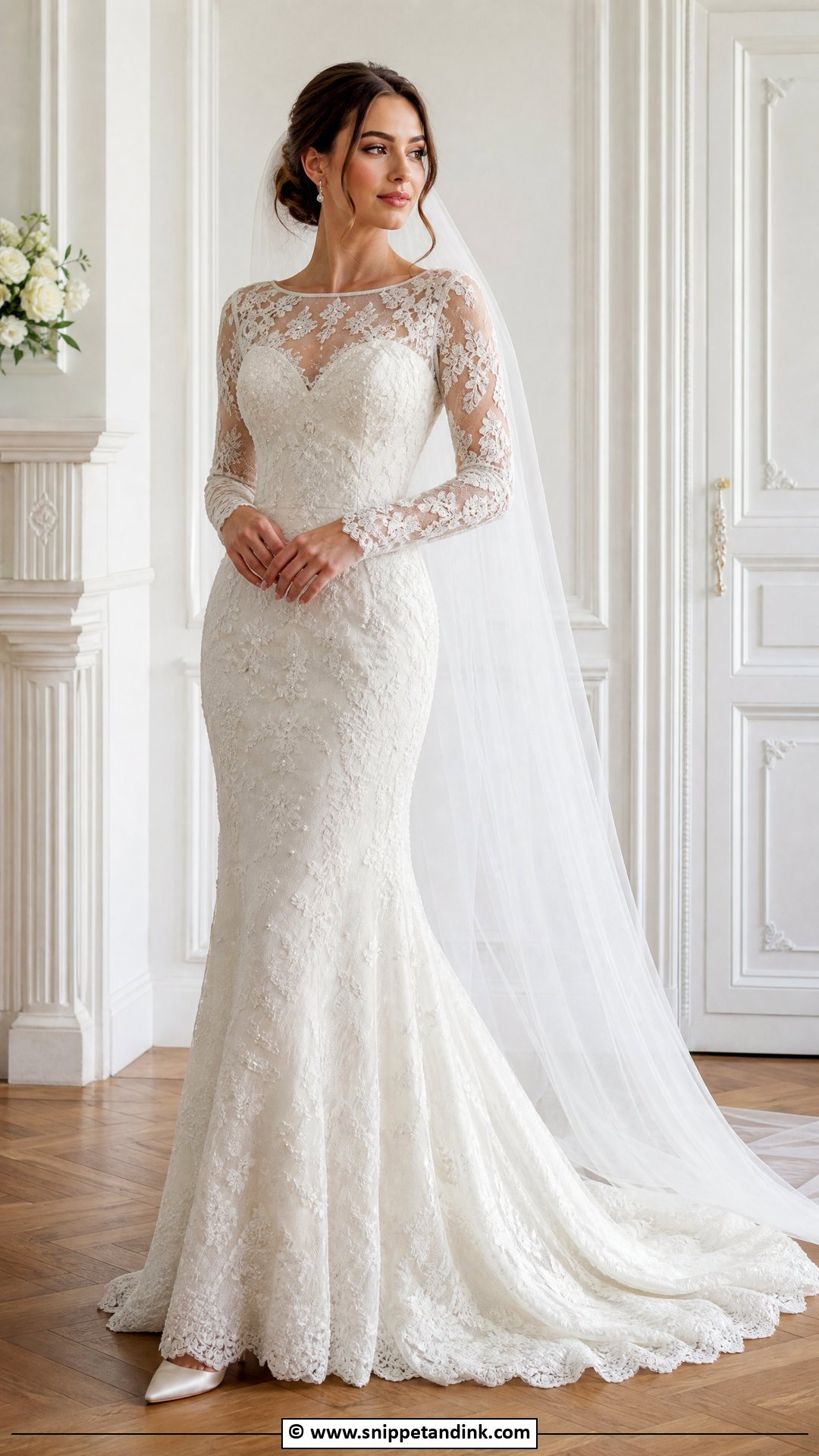
Pearls glow rather than sparkle, which suits ivory and champagne fabric. Scattered on appliqué, lined along straps or used as back buttons, they all work. I look at how they’re attached, because glued pearls can loosen when the dress is steamed while stitched ones stay put. One pair of pearl earrings is enough; matching pearl everything starts to look heavy.
24. Lace Wedding Dress With Beading
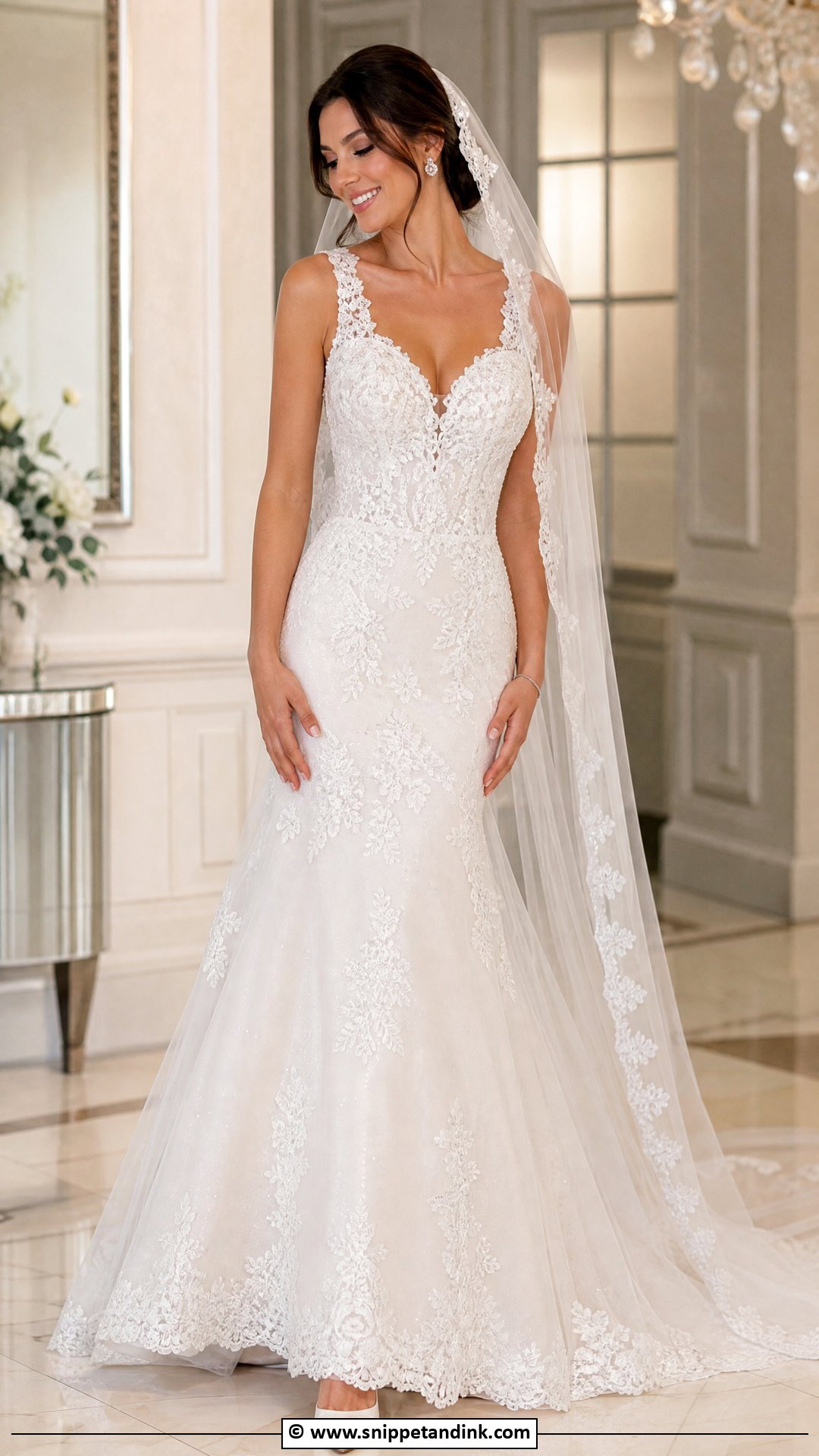
Beaded lace brings shimmer, along with weight and snags. Fine beading traced along the lace outlines adds depth, while all-over beading reads evening glamour. I ask brides to walk in it for several minutes, because a heavily beaded skirt can drag the waist down and pull the hem. Beads also catch on tulle, so a veil with a plain edge saves a lot of tugging. Ballrooms and hotel receptions with warm lighting show it at its best.
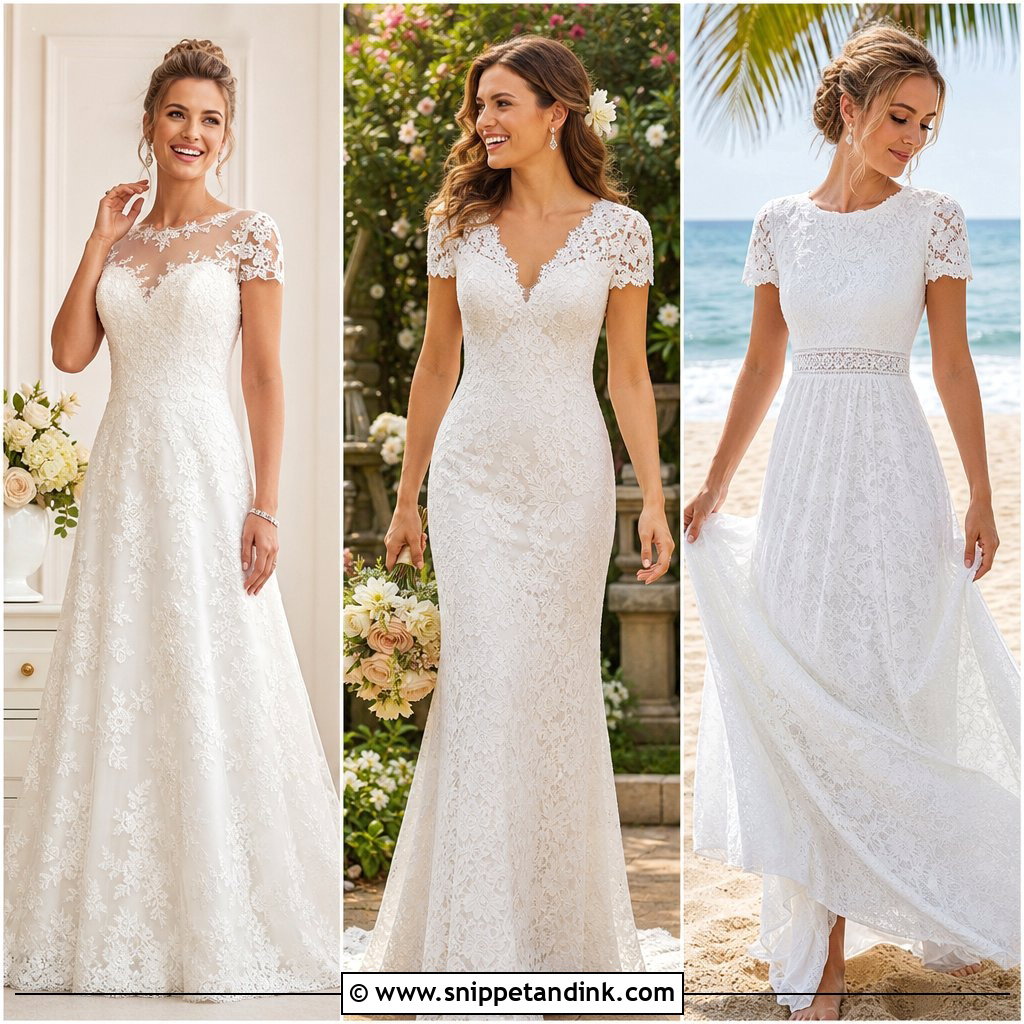
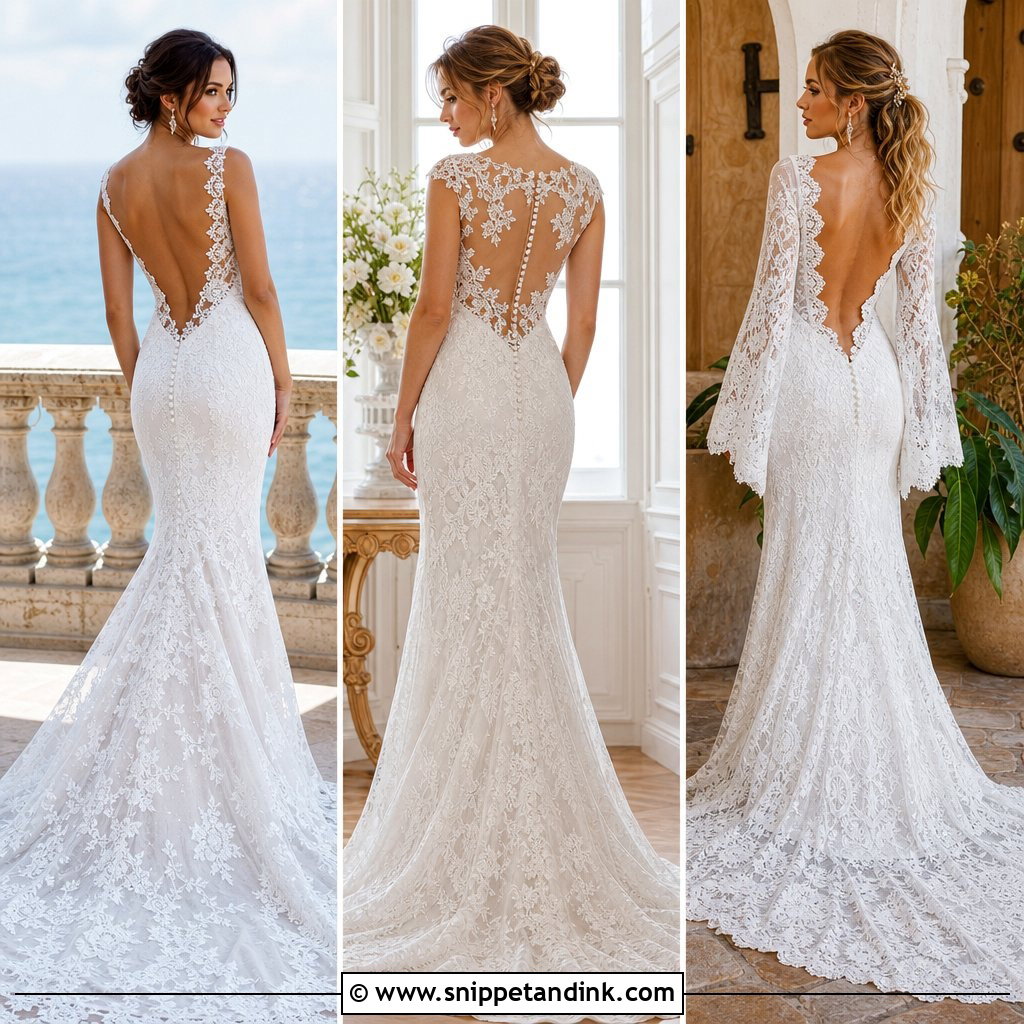
25. Lace Wedding Dress With Open Back
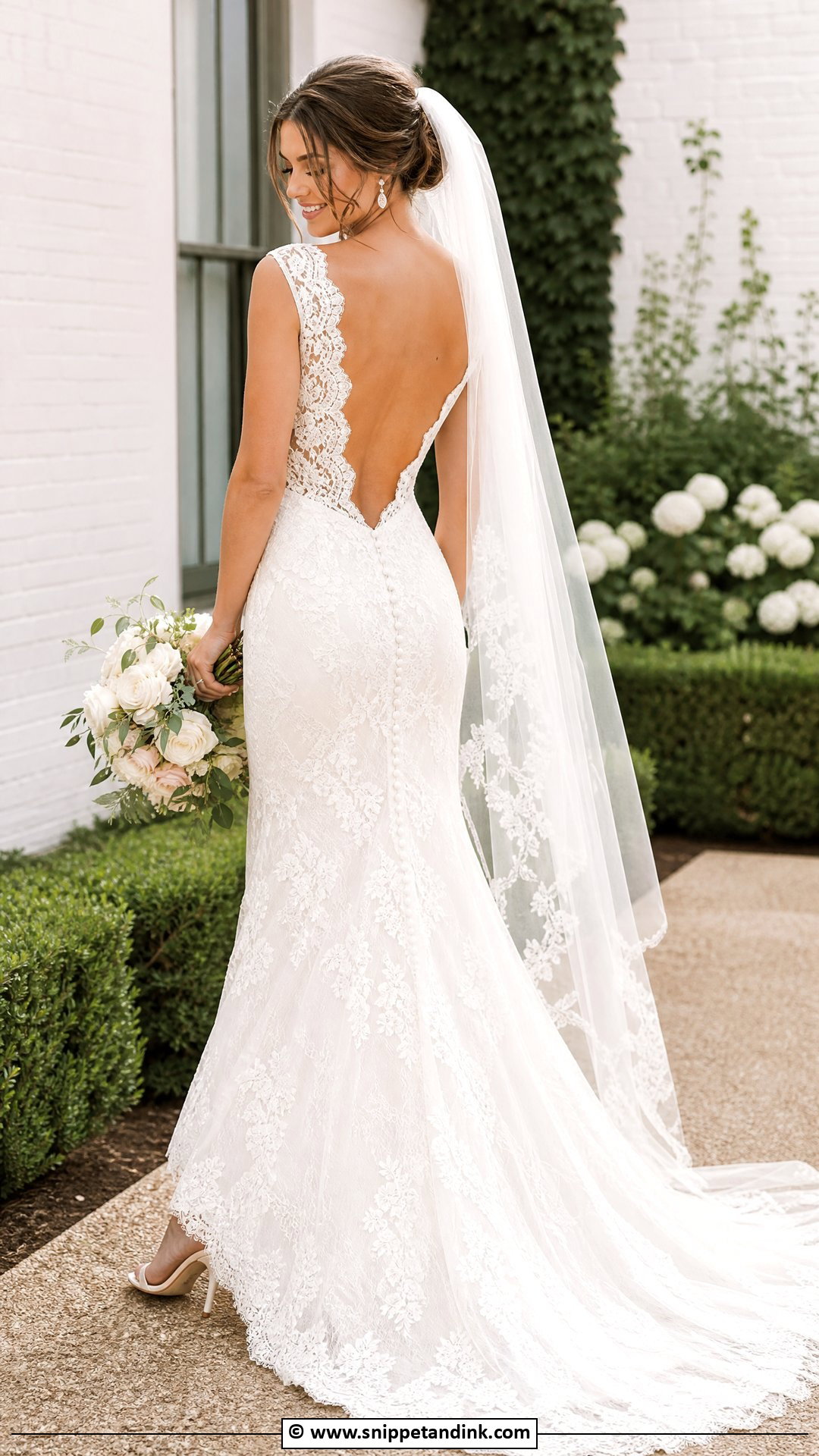
An open back gives the photographer a strong shot during the ceremony, when guests are mostly looking at your back anyway. Lace edging, covered buttons, illusion mesh or a scalloped border keep it refined. The lower the back, the more support has to come from a built-in cup or side boning, so ask about that before you fall in love. Wear your hair up so the design shows, and pick a sheer veil.
26. Lace Wedding Dress With Train
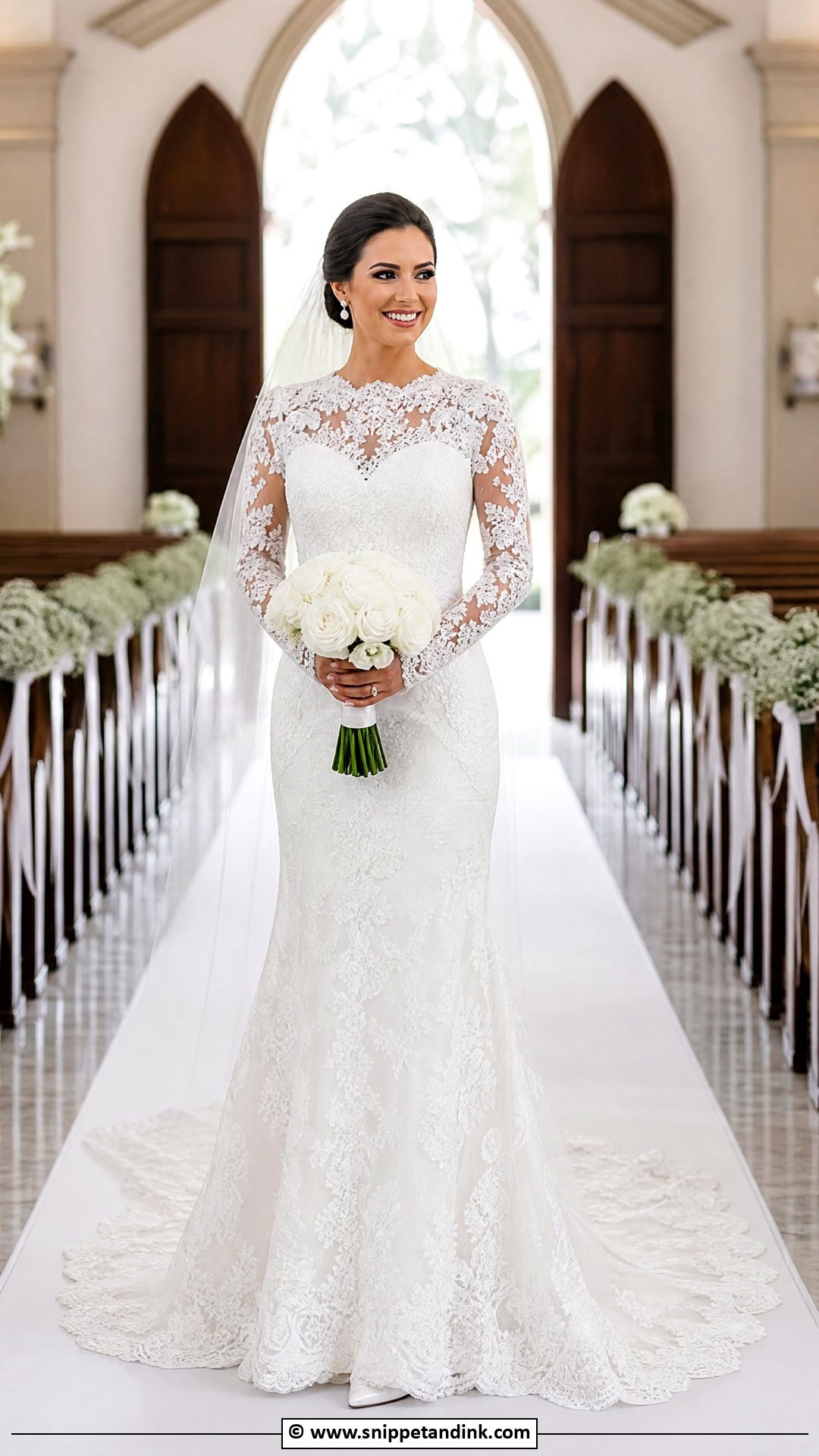
Lace trains look their best when the pattern runs unbroken from skirt to scalloped hem. The practical part is the bustle. Lace trains can be bustled over or under, and heavy appliqué often needs several points to hang evenly. Ask your seamstress to teach a bridesmaid at the final fitting and record it on a phone. I’d also choose a veil clearly shorter or longer than the train so the two don’t blur together.
27. Simple Lace Wedding Dress
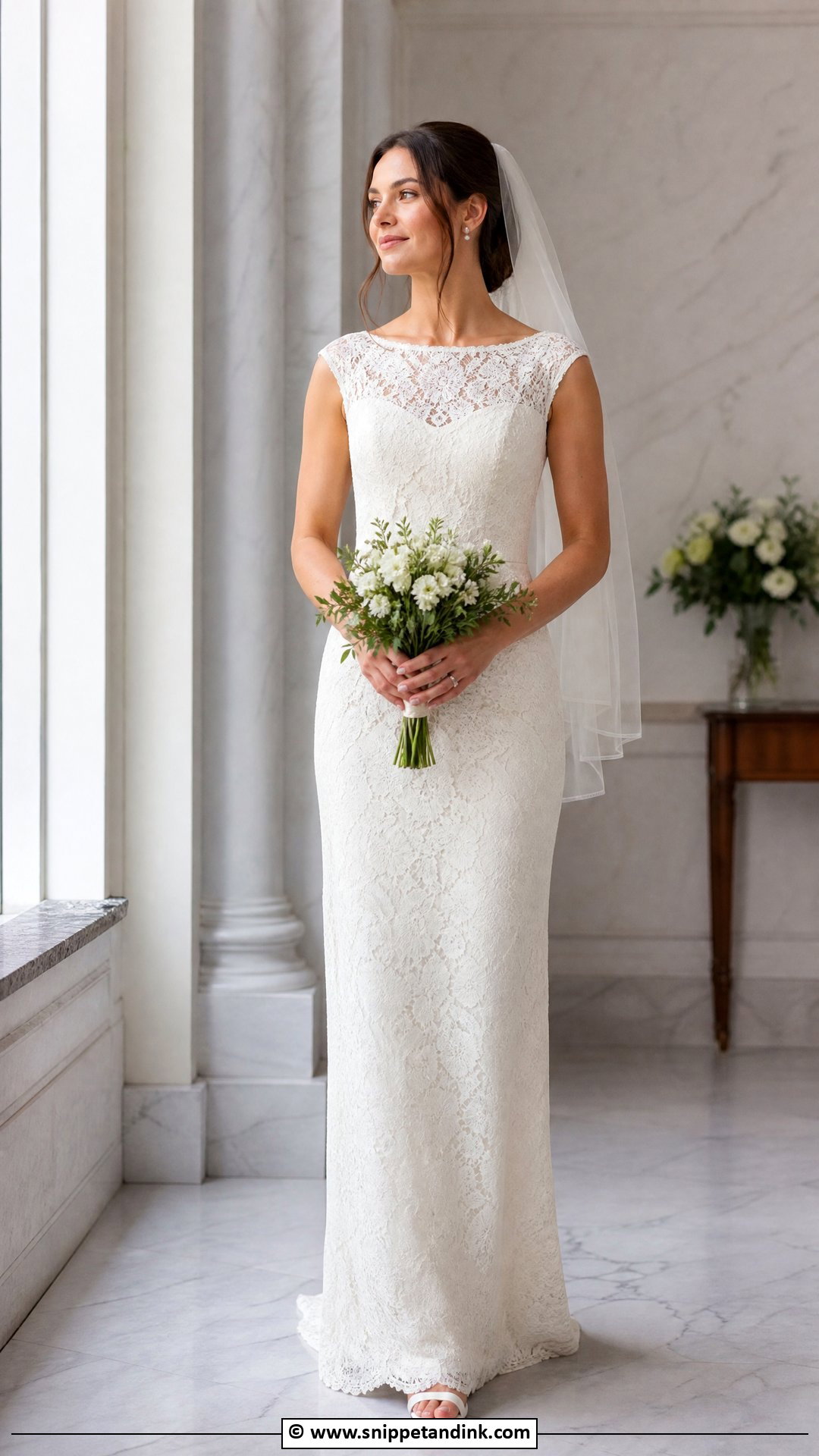
A simple lace dress has very little to hide behind, so fabric quality shows straight away. Fine-patterned lace over a smooth lining, in a sheath, A-line or slim fit-and-flare, suits courthouse ceremonies, small destination weddings and minimal venues. Low heels, small earrings and a relaxed veil or hair bow keep it light, and your face, flowers and setting carry the picture.
28. Minimal Lace Wedding Dress
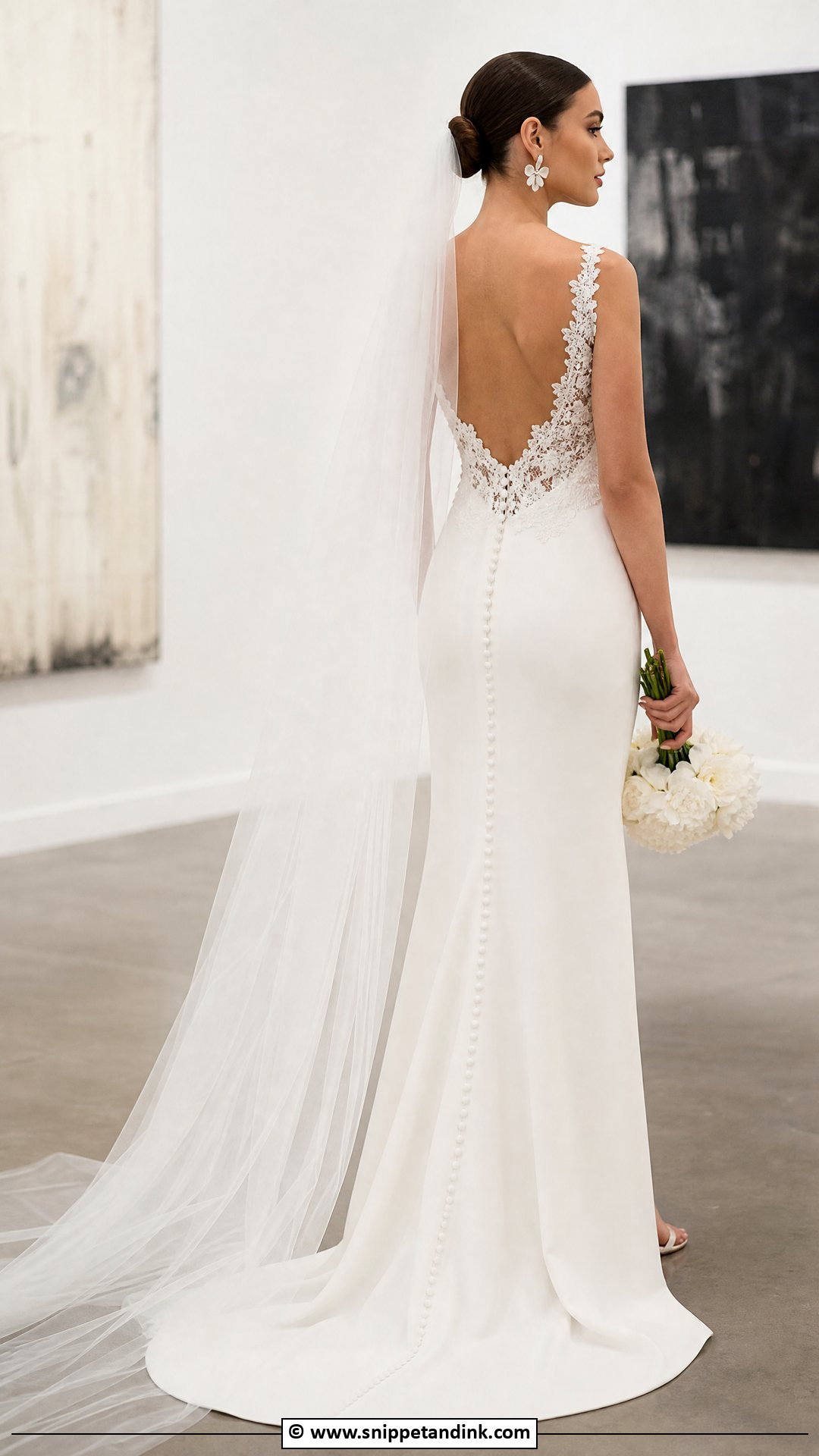
Minimal lace puts the lace in one place: straps, a trimmed neckline, a back panel or inserts in a crepe skirt. Placement becomes the whole decision, so I ask brides where they want people’s eyes to land and put the lace exactly there. Column and plain A-line shapes keep it modern, with sculptural earrings, sleek heels and a plain veil for city venues and galleries.
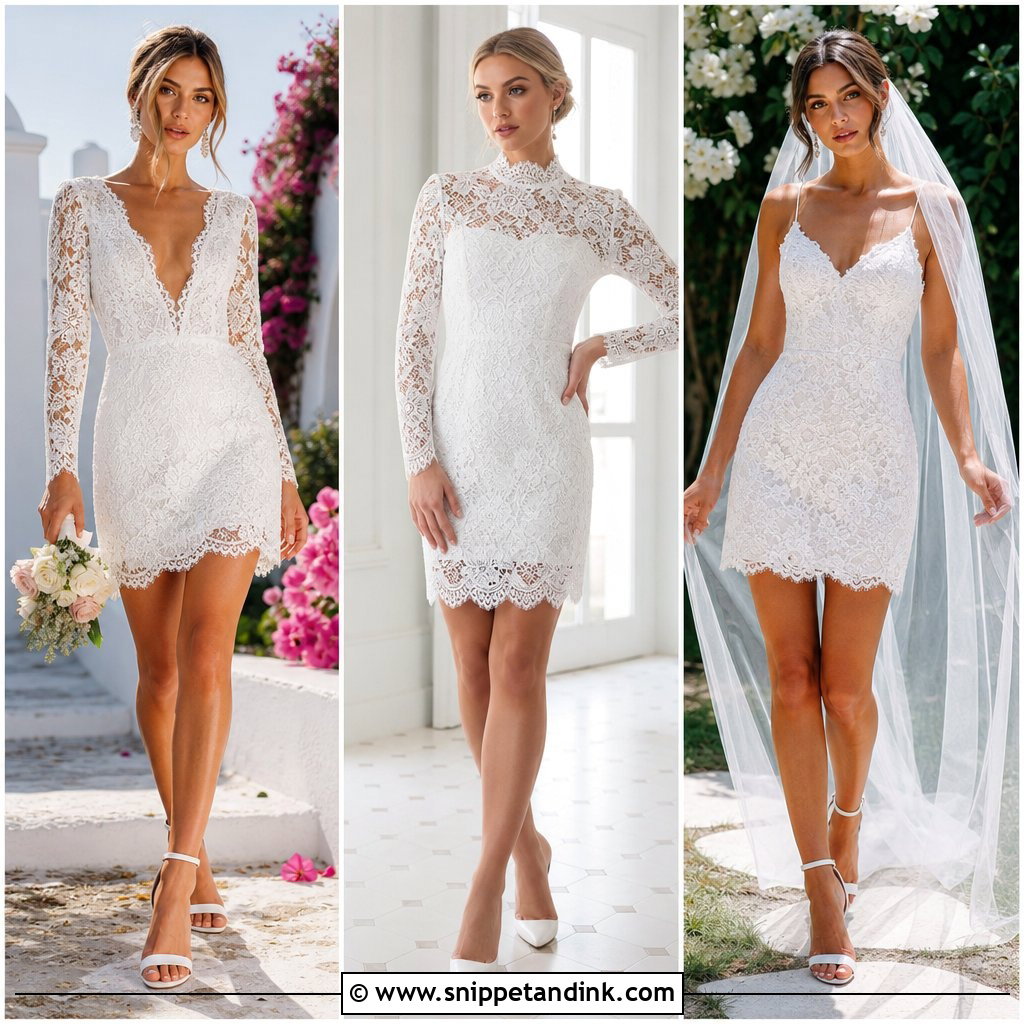
29. Short Lace Wedding Dress
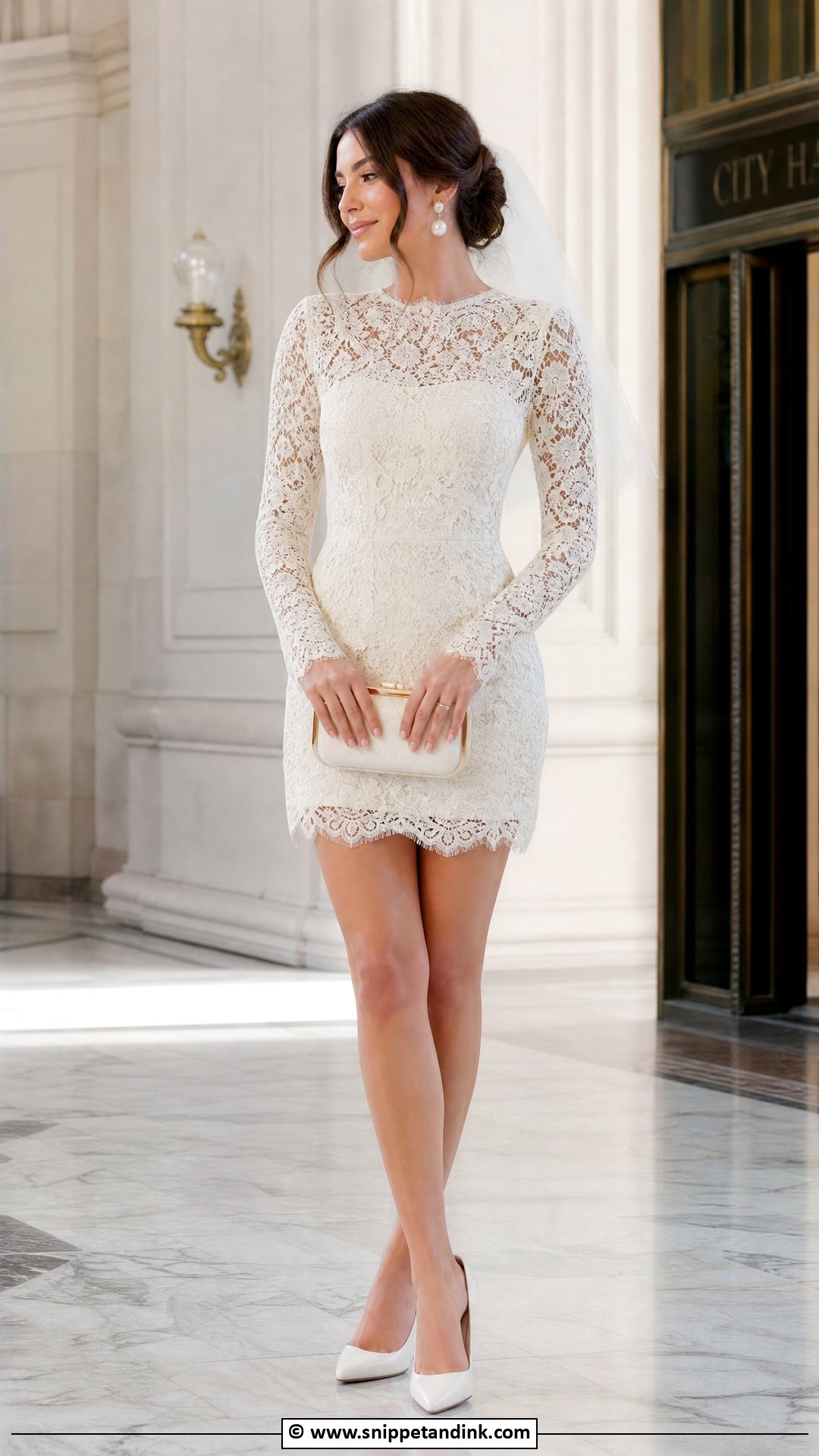
Short lace dresses earn their place at civil ceremonies, as a reception change, and at showers and after-parties. A mini reads playful; knee or tea length reads vintage. The hem is where cheap lace gives itself away, so look for a finished scallop rather than a raw cut edge. Shoes depend on the floor, and a small veil or headband keeps it bridal. In real heat it’s the most comfortable option I know.
30. Tea Length Lace Wedding Dress
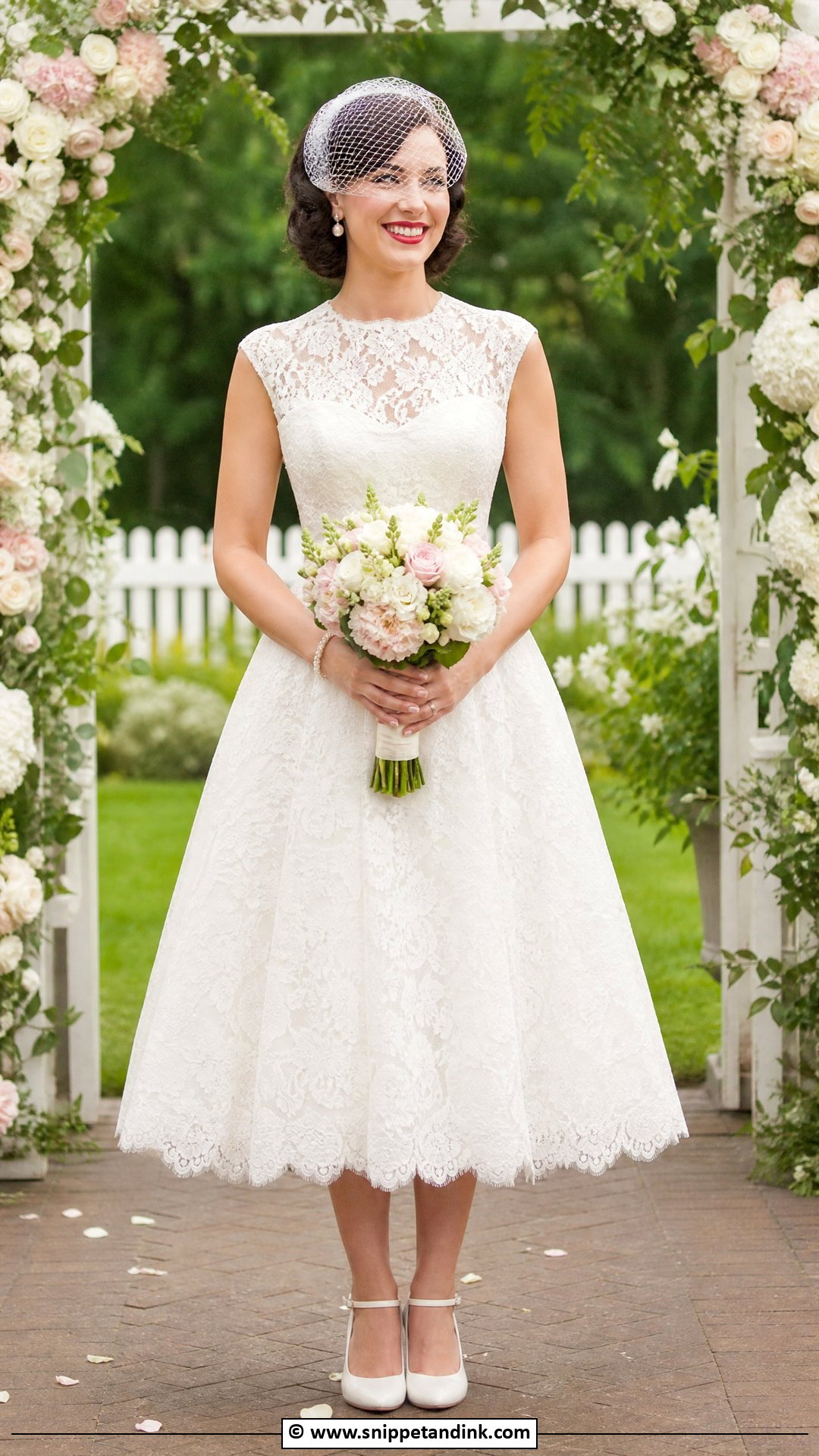
Tea length sits at mid-calf, which makes your shoes part of the outfit. Mary Janes, slingbacks and pointed pumps all suit it, and you’ll walk faster and more comfortably than in a floor-length gown. A birdcage veil and pearl earrings complete it for courthouse and garden ceremonies. I’d make sure the hem lands at the slimmest part of your calf; an inch higher or lower changes the whole proportion.
31. Sheath Lace Wedding Dress
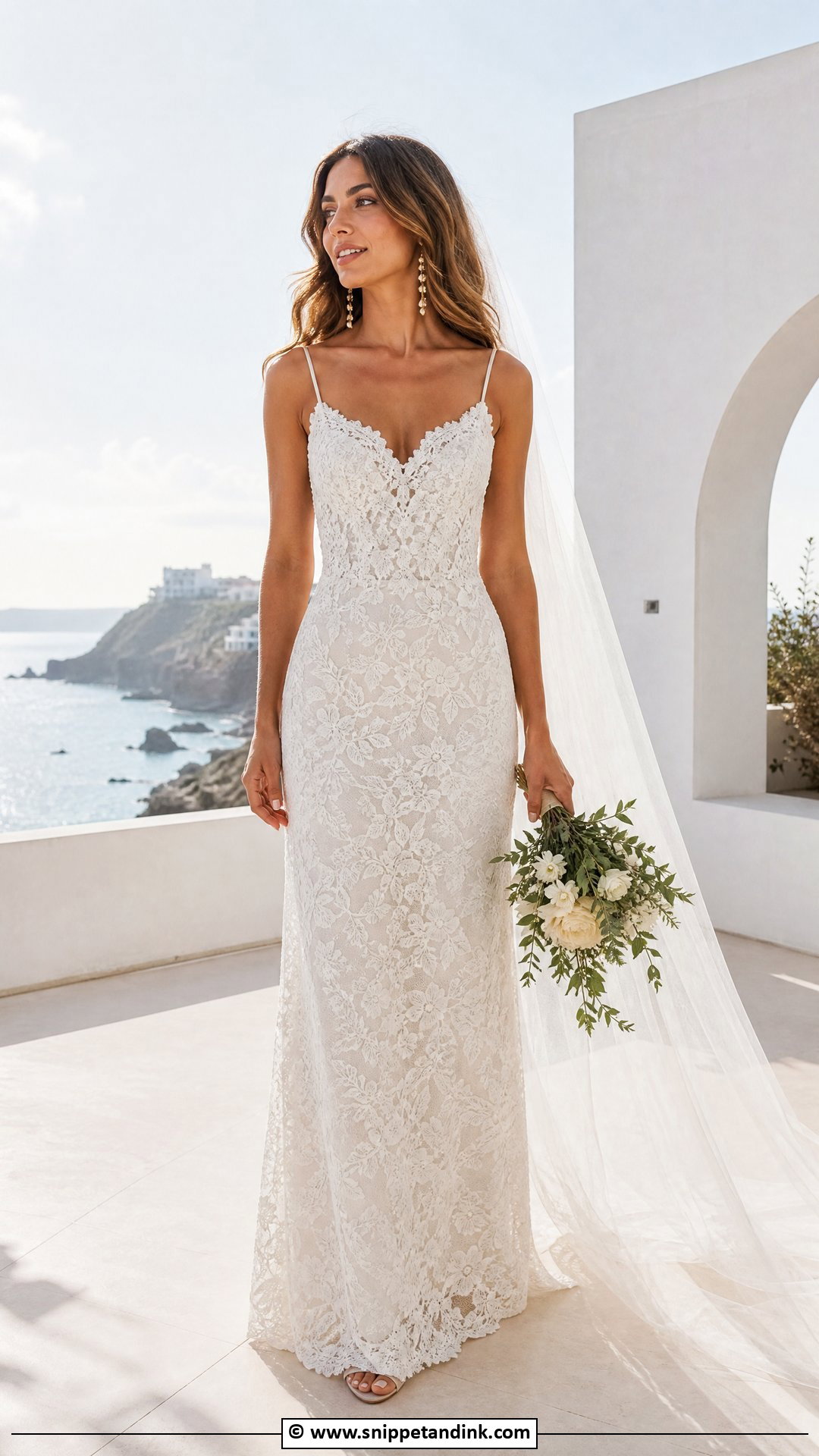
A sheath follows the body in a straight line without the grip of a mermaid. It’s light, so it packs and travels well for destination weddings, and lace gives the plain shape depth. Watch the train. On sand or grass a sheath train drags and collects debris, so a short sweep is wiser. Delicate sandals, drop earrings and loose waves keep it relaxed, and a long veil adds drama if the dress is very plain.
32. Lace Slip Wedding Dress
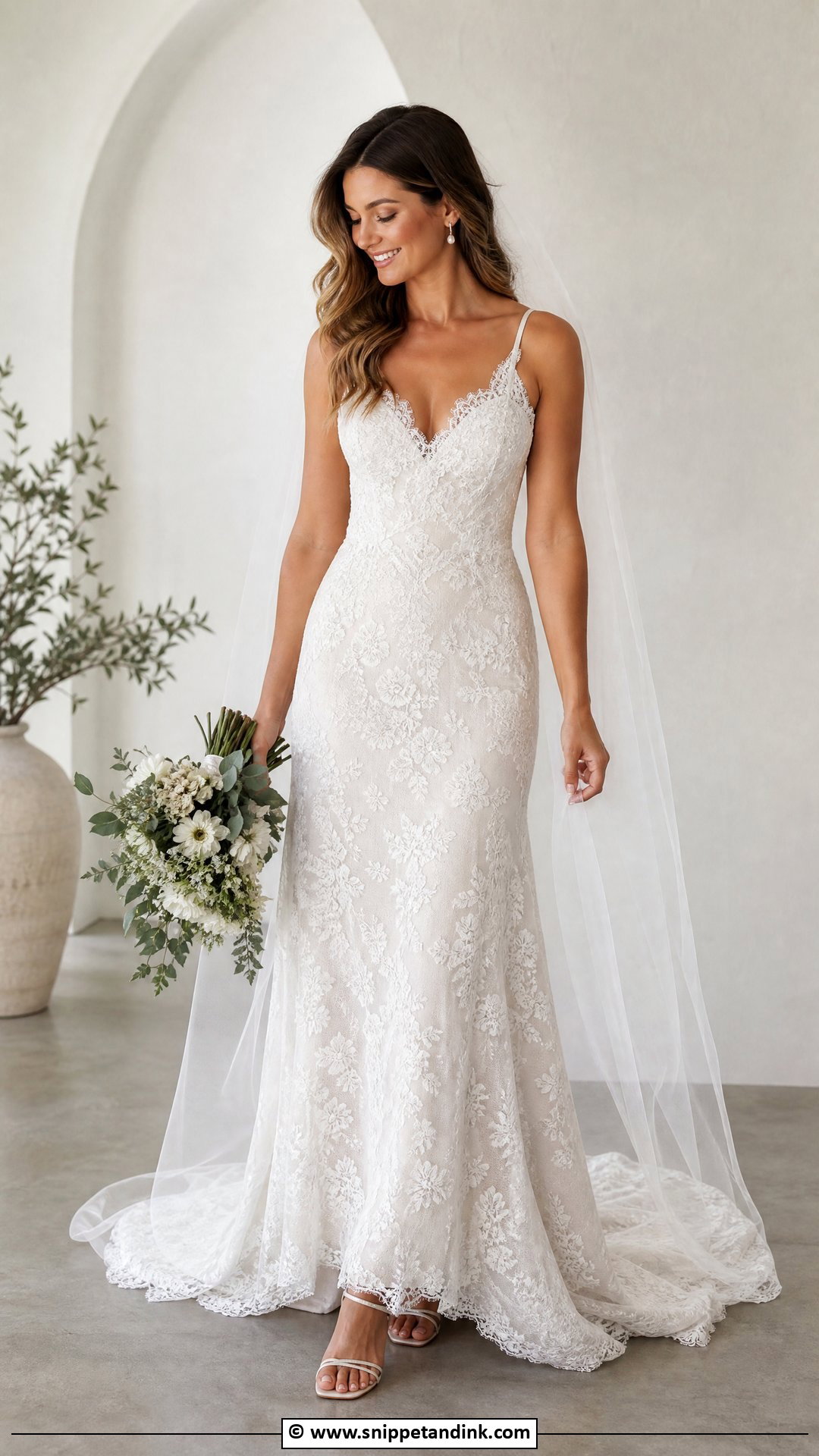
A lace slip dress is usually cut on the bias, which gives it that liquid drape and also makes it unforgiving. Bias-cut fabric clings and shows every seam underneath, so the right underwear matters as much as the dress. Lace trim or a lace overlay softens it. Thin satin under lace shows every crease from the car ride, so fabric quality isn’t optional. Strappy heels, simple earrings and a sheer veil or lace scarf suit relaxed ceremonies.
33. Colored Lace Wedding Dress
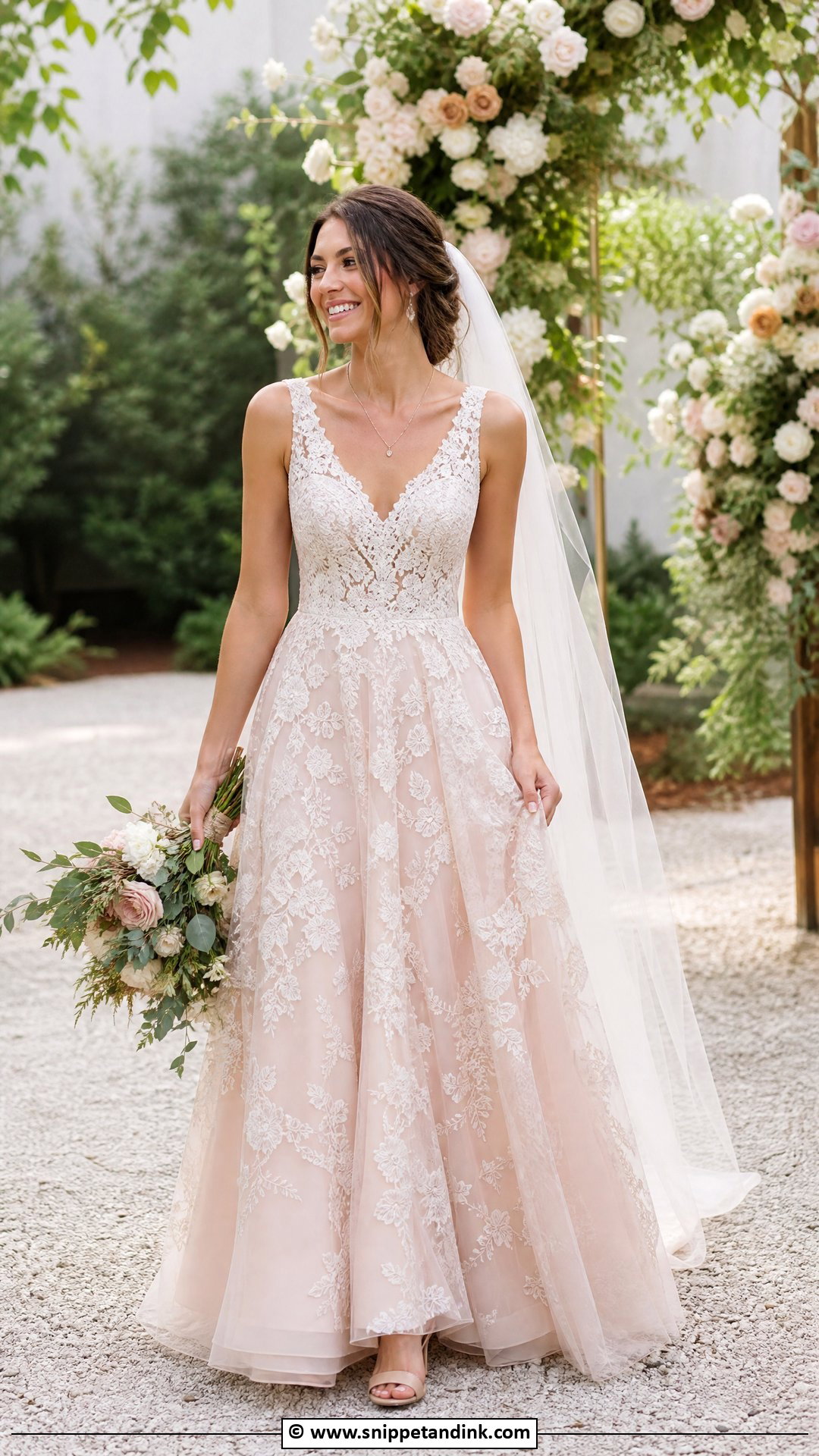
Colored lace makes the pattern pop because the motifs contrast with the lining. Blush, champagne, ivory-nude, pale blue, dove grey and lavender are the shades I’d consider. Champagne and nude linings look different on every skin tone, so test them in daylight by a window, not only under shop spotlights. Match your jewelry metal to the dress’s undertone and keep the veil plain so the color stays the personal touch.
34. Plus Size Lace Wedding Dress
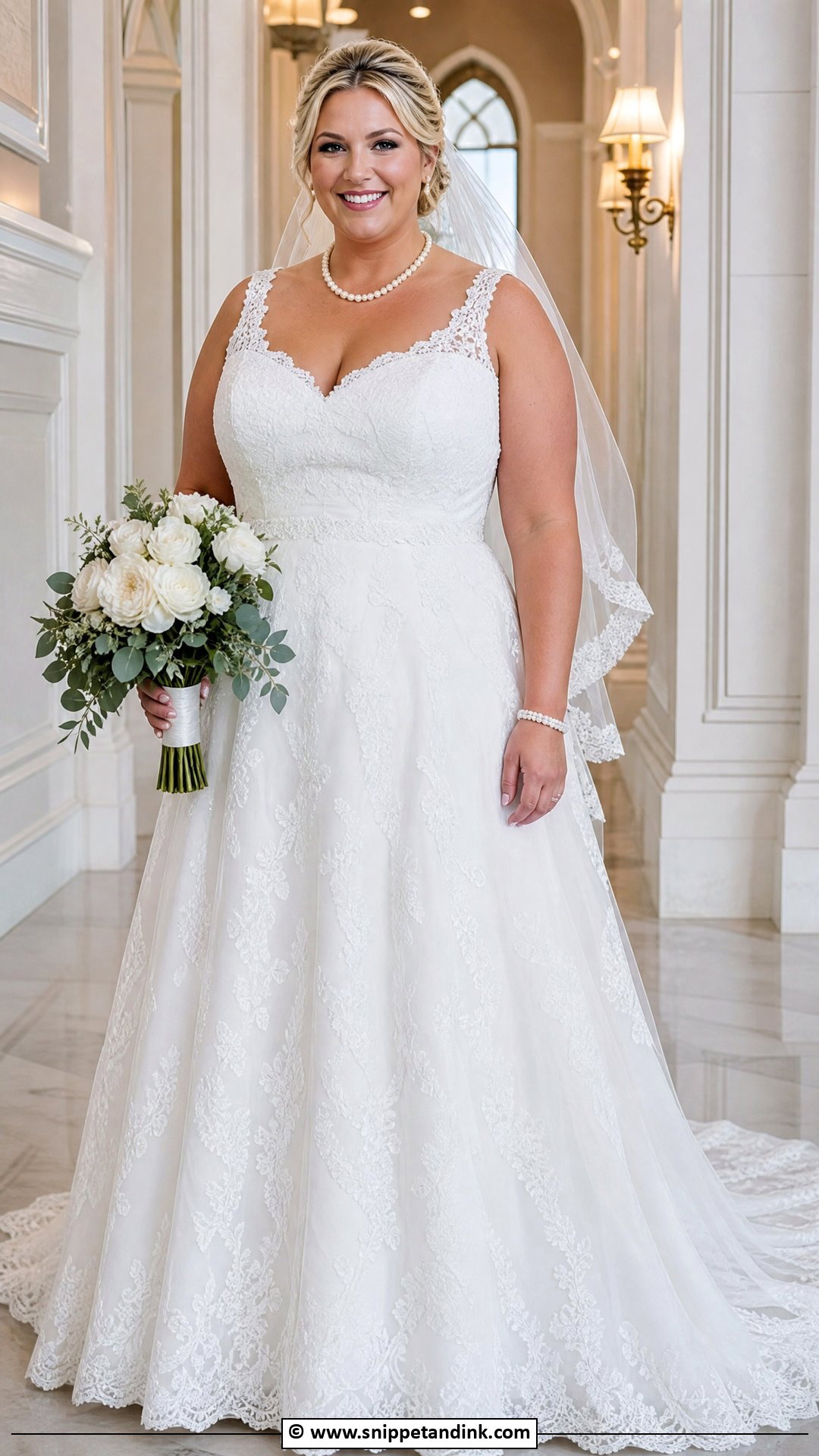
For a plus size lace gown, construction comes before style. I look for internal corsetry, a smooth lining and lace placed where you want attention. A-line, fit-and-flare, ball gown and corset shapes all work once tailored, and wide straps or illusion sleeves give support without bulk. Bring your actual shoes and shapewear to every fitting, because a half-inch heel difference changes the hem. Fit beats the number on the tag every time.
35. Maternity Lace Wedding Dress
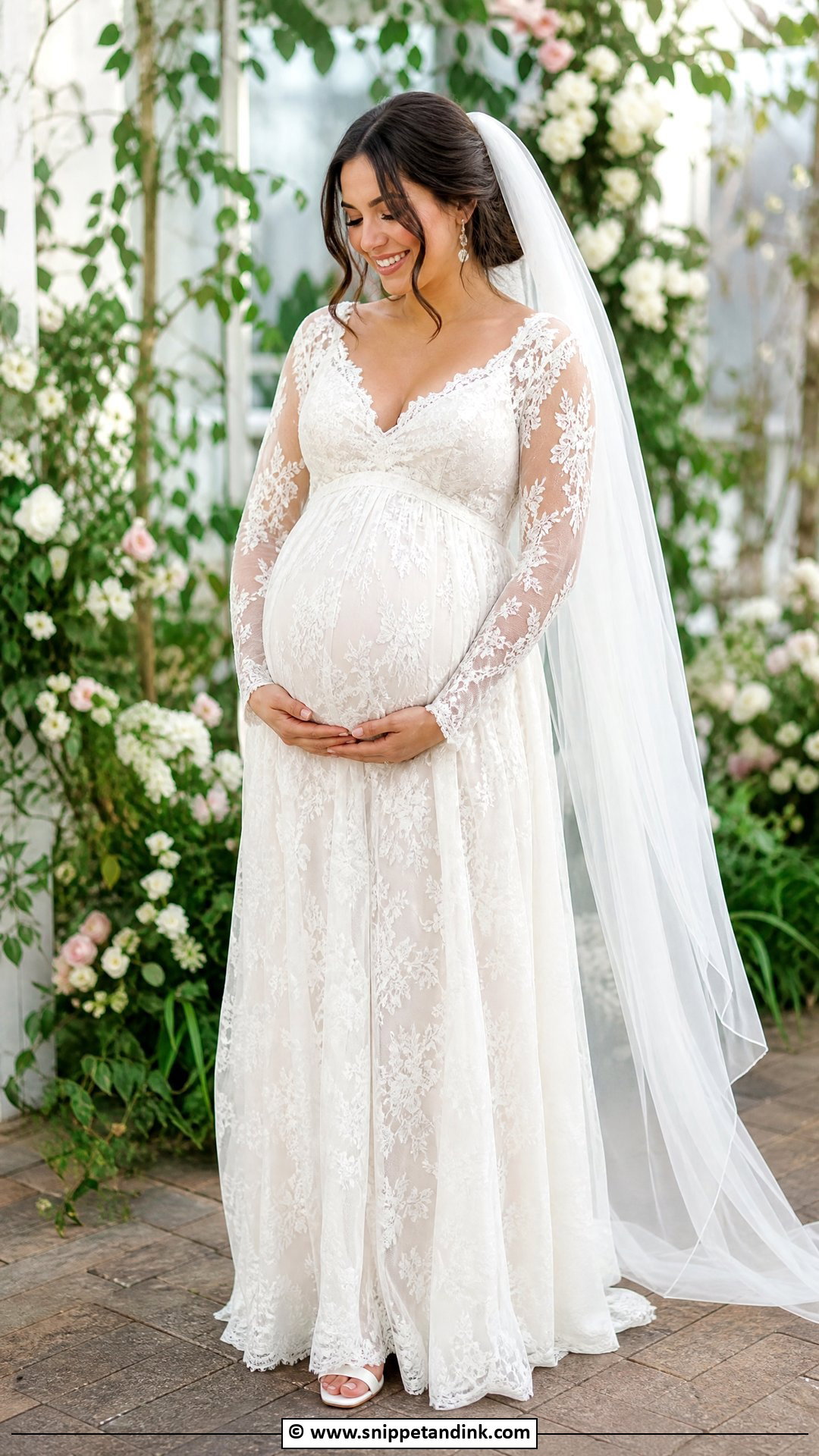
Maternity lace has to allow for change, because a bump can grow noticeably between the last fitting and the wedding. I book the final fitting as close to the date as the seamstress allows, and lean toward empire waists, A-lines and stretch lace that give room. Breathable lining matters, since pregnancy runs warm. Low block heels or cushioned flats, a soft veil and natural makeup keep you comfortable from ceremony to last dance.
Altering Lace Takes Longer Than Altering Satin
Lace can’t be shortened the way plain fabric can. To keep a scalloped hem, the seamstress unpicks the border motifs, cuts the skirt to length and hand-stitches the motifs back on, so a lace hem takes far longer than a simple one and usually costs more. Taking in a lace bodice works the same way: the appliqué is lifted, the seam moved, and the lace laid back over the join so it disappears.
That’s why I plan lace alterations earlier than most brides expect. Order the gown so it arrives with time to spare, then allow two or three fittings starting roughly two to three months out, with the last one a couple of weeks before the wedding. Bring your wedding shoes and the underwear you’ll actually wear to every appointment.
Questions worth asking at the first fitting
- Will the hem be cut and the scallop reapplied, or taken up from the waist?
- Are the bodice appliqués stitched or glued?
- How many bustle points will this train need, and who will you teach to fasten them?
- Can loose petals and beads be tacked down before I collect the dress?
What a Lace Gown Needs the Week After
Lace stains don’t always show on the night. Champagne, white wine and perspiration dry clear and then oxidize into brown patches over the following weeks, so I tell brides to get the dress to a specialist gown cleaner within a few weeks, not months. On the day itself, blot spills with a clean white cloth and leave it; rubbing pushes the stain into the net and can pull threads.
For storage, never leave a lace gown on a hanger long term. The weight of the skirt stretches the lace at the shoulders, and the hanging loops cut into it. Fold it loosely with acid-free tissue in every fold, keep it in an acid-free box or a breathable cotton bag, and store it somewhere dark, cool and dry, away from attics and basements. Plastic dry-cleaning bags trap moisture and can yellow ivory lace over time.
Silhouette First, Lace Second
Lace can read classic, modern or relaxed, and the silhouette decides which. Start from your venue, the season and how much you plan to move, then let the lace follow: sleeves for cool months and churches, strapless or cap sleeves for heat, 3D florals if guests will see you up close, a plain sheath if the setting is the main event. Sit, walk and lift your arms in every dress on your shortlist. The gown that looks right in pictures and the gown you can wear from morning to midnight should be the same one.
You'll Like These Ideas:

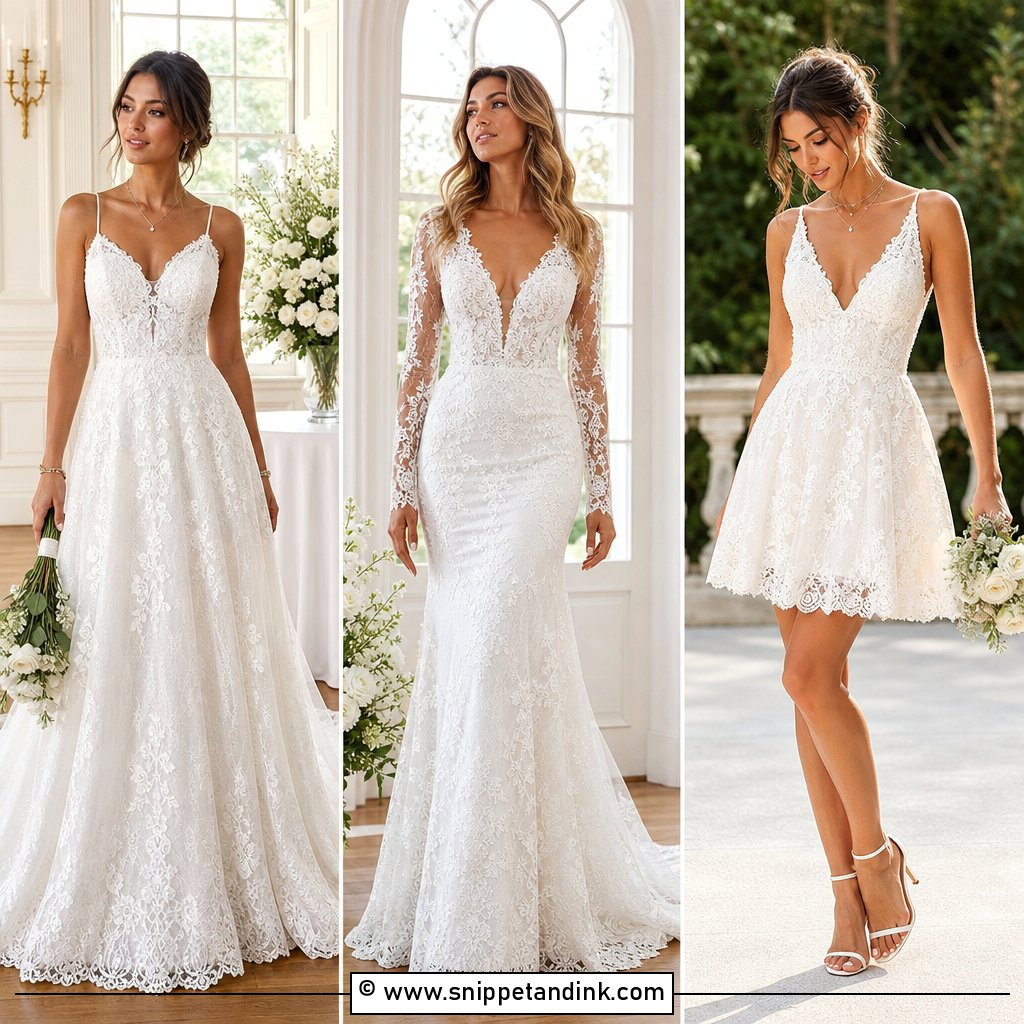
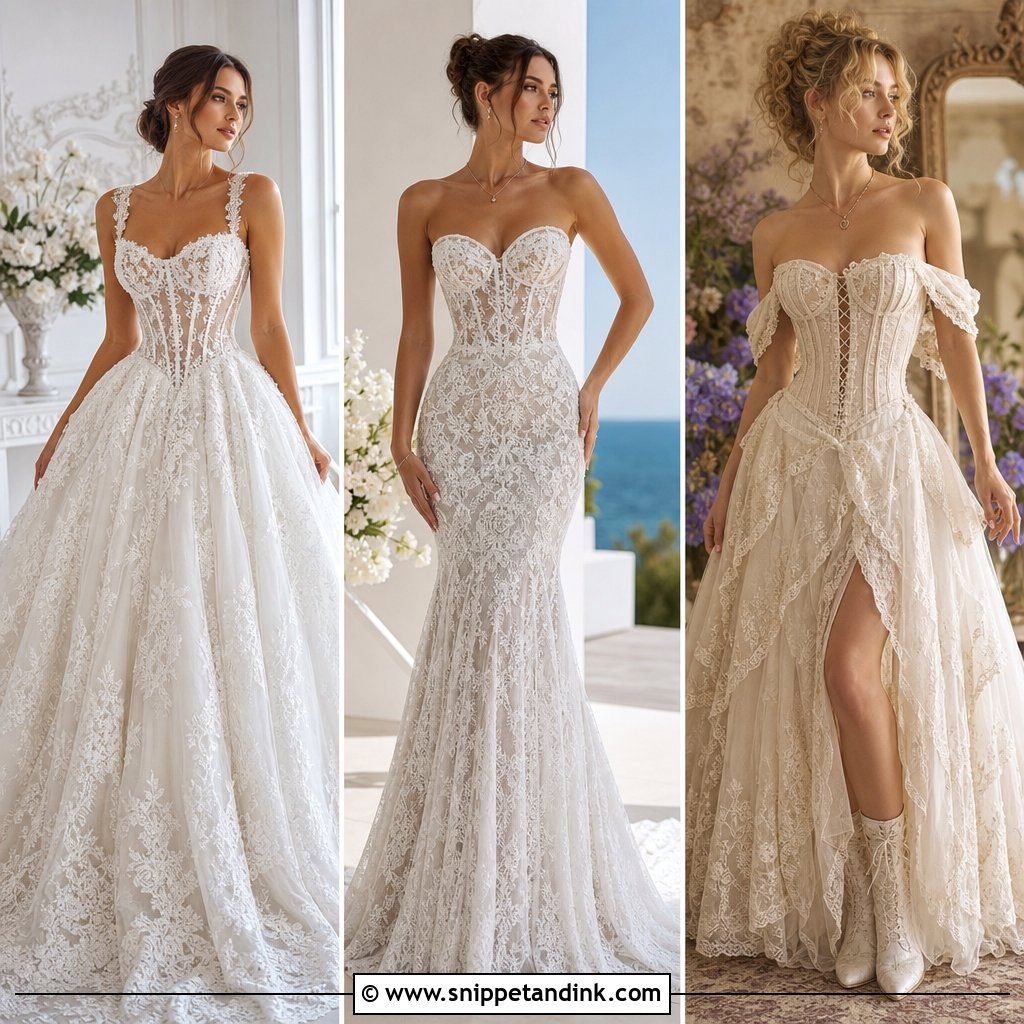
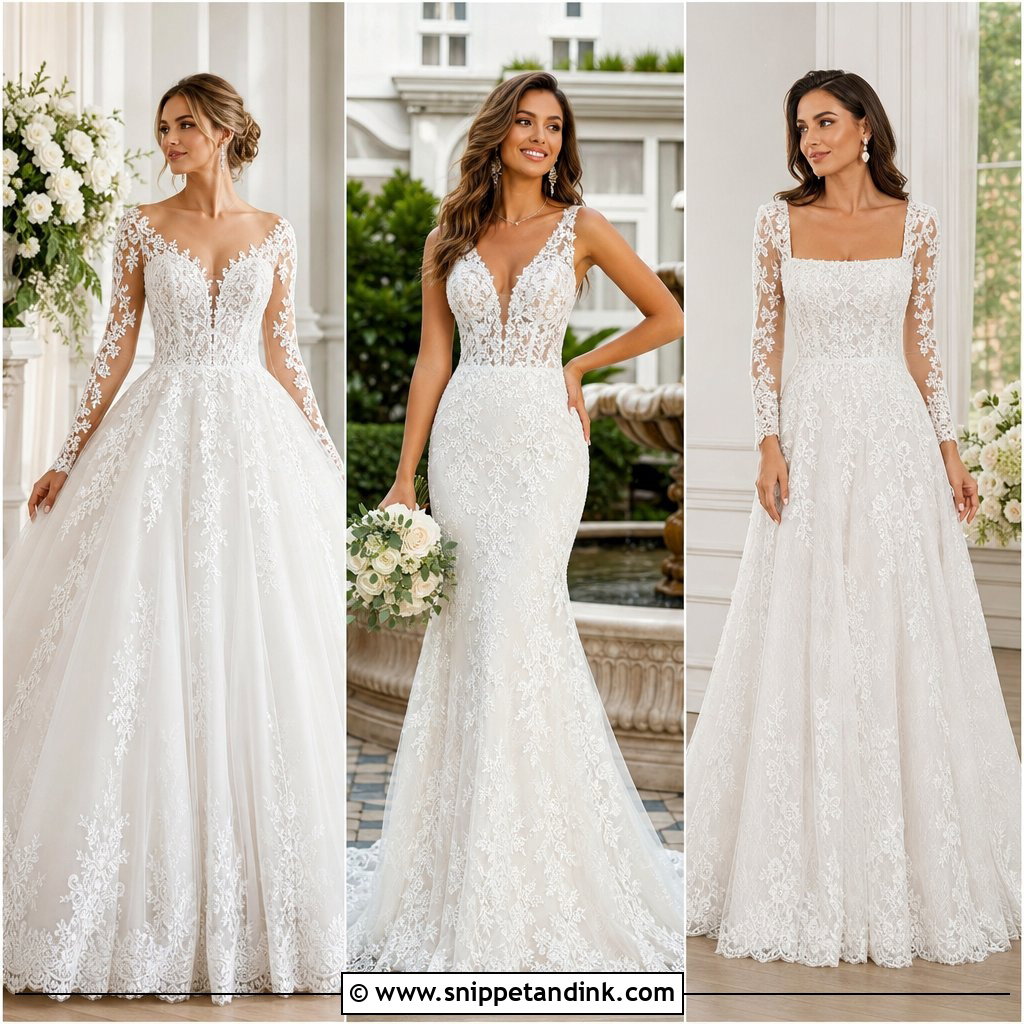






Leave a Reply