
An Indian wedding is rarely one event. There’s the mehendi, the sangeet, the ceremony and often a reception, and each asks something different of your hair: comfort while you sit on the floor, grip on the dance floor, strength under a dupatta, polish under stage lights. The twenty Indian wedding hairstyles below cover buns, braids and open hair for every length, and for each one I’ve noted what I’d actually check before putting it on a bride, a sister or a guest. When you save the ones you like, keep the back view as well as the front. That’s the view your stylist needs.
One Look per Function, or One Look Reworked?
Before you pick from the list, map your functions. Most brides need three or four looks over a few days, and the order matters: the morning after a heavily sprayed sangeet style, your hair won’t hold a sleek bun until it has been washed.
- Mehendi: something off the face and off the arms, such as a side braid or a half-up. You’ll sit for hours with wet paste on your hands, so nothing should need touching.
- Sangeet: braids and textured buns that survive dancing. Avoid open curls if the venue is hot.
- Ceremony: a firm bun or braid that anchors the dupatta and tikka. This is the look to trial most carefully.
- Reception: the place for open hair, ponytails or jewelled pins, often reworked from the ceremony bun in a short gap between events.
Reworking is quicker than starting over. A low ceremony bun can drop into a ponytail or loose waves if the hair was curled before it went up, so tell your stylist at the trial that you want the base to convert later. Ask how long each change takes and build that into the day, with a buffer for outfit changes and photos.
1. Low Messy Bun With Jasmine Flowers
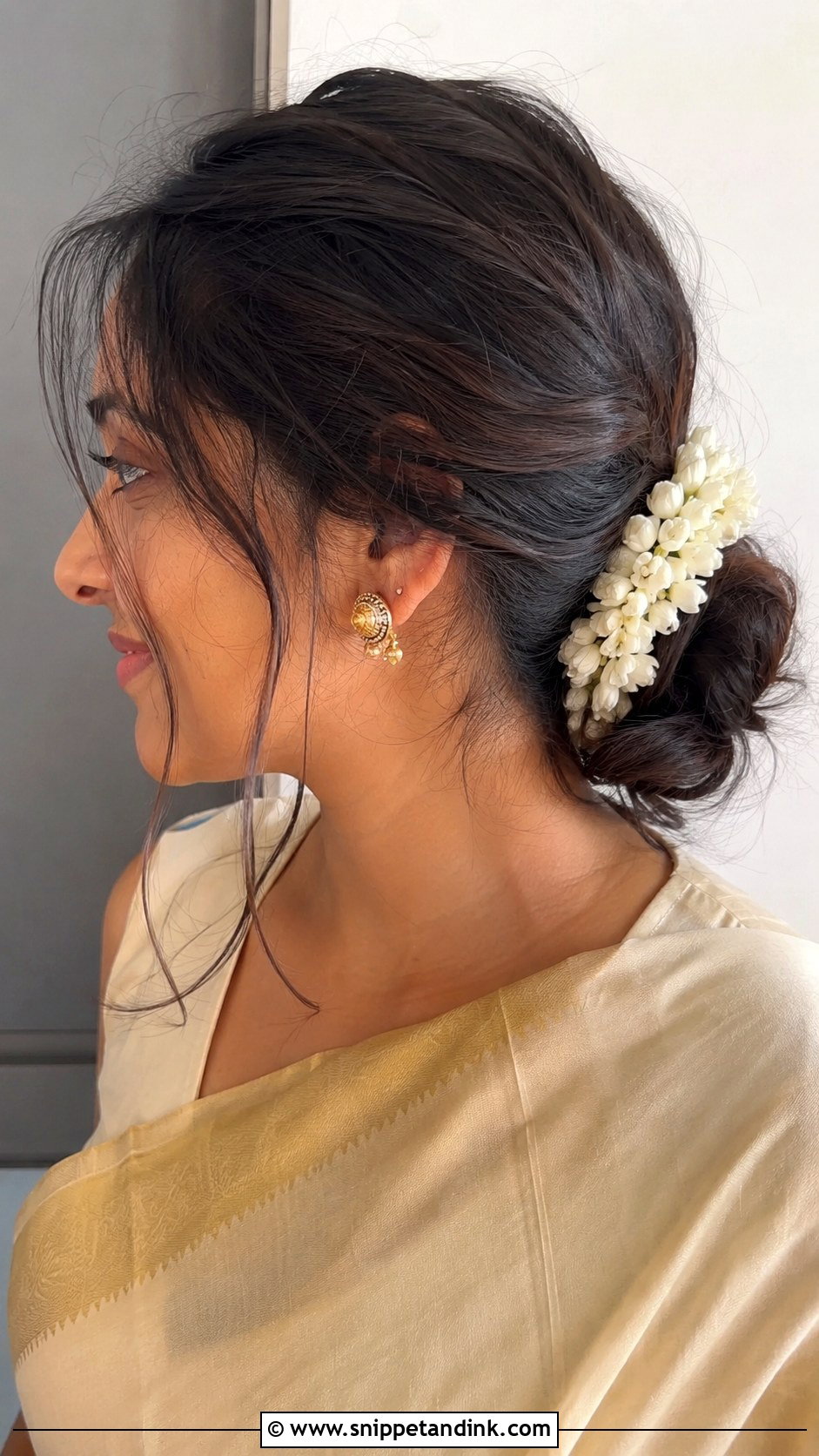
Soft hair gathered at the nape, twisted into a relaxed knot, a few strands left out at the face, and a gajra tucked around it. I curl the hair before I gather it, because a messy bun made from straight hair looks flat rather than soft. Nothing is pulled tight, so it stays comfortable through long ceremonies, and it forgives a little movement, which is why I suggest it to brides who will be touching up their own hair between functions. It goes equally well with a saree or a lehenga.
2. South Indian Braid With Hair Jewelry
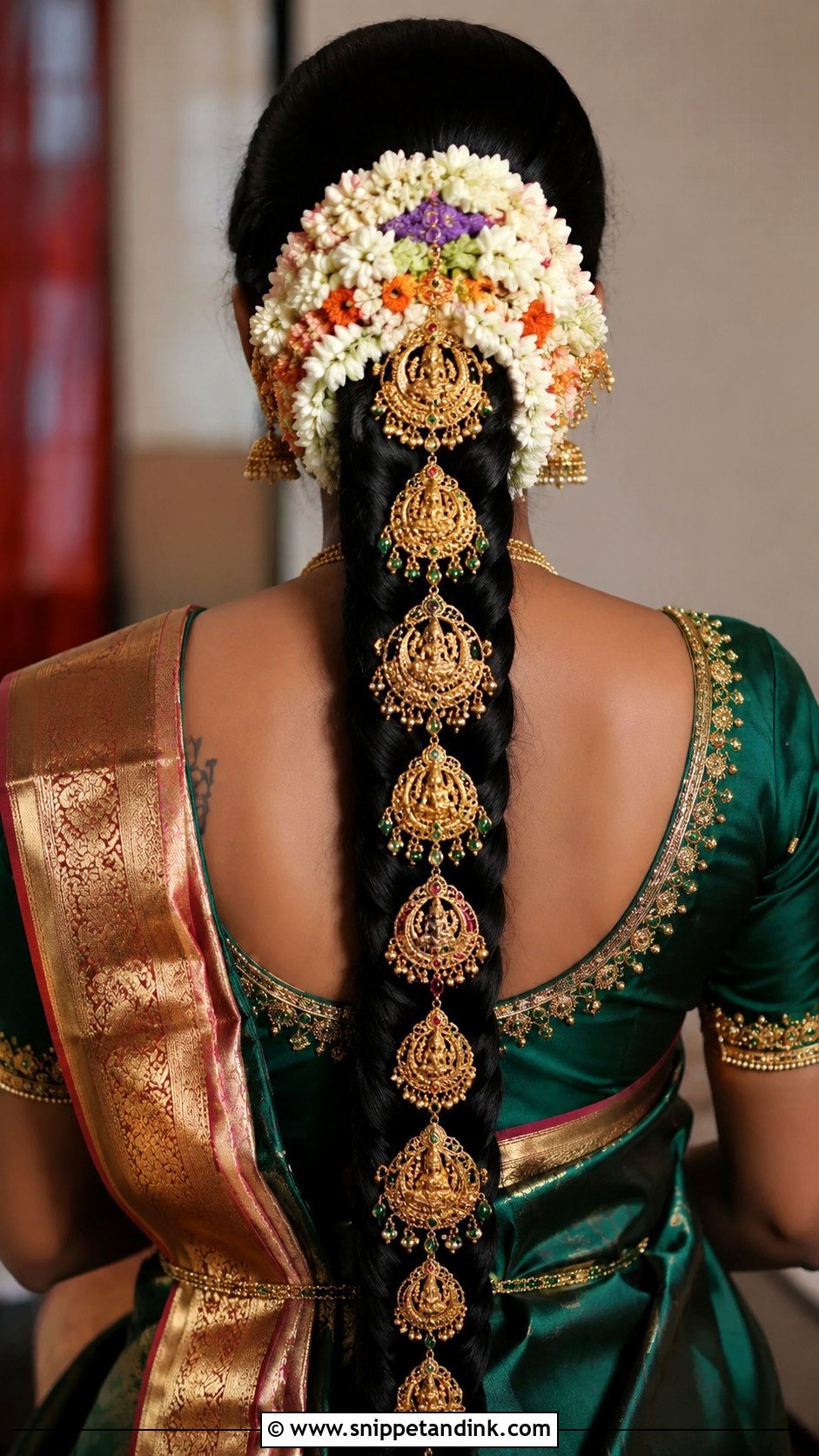
A long, full plait down the back, dressed from crown to tip with jadai billa ornaments, flowers and small gold accents. The South Indian braid is traditional at temple weddings with silk sarees, and it needs length. Most brides I dress get a matching braid extension, because the ornaments are sized for hair that reaches the waist. The plait has to be firm and fixed to the ornament at regular points, otherwise the gold pulls it sideways the moment you sit. Try the full set at your trial; it is heavier than people expect.
3. Floral Bun With Roses And Mogra
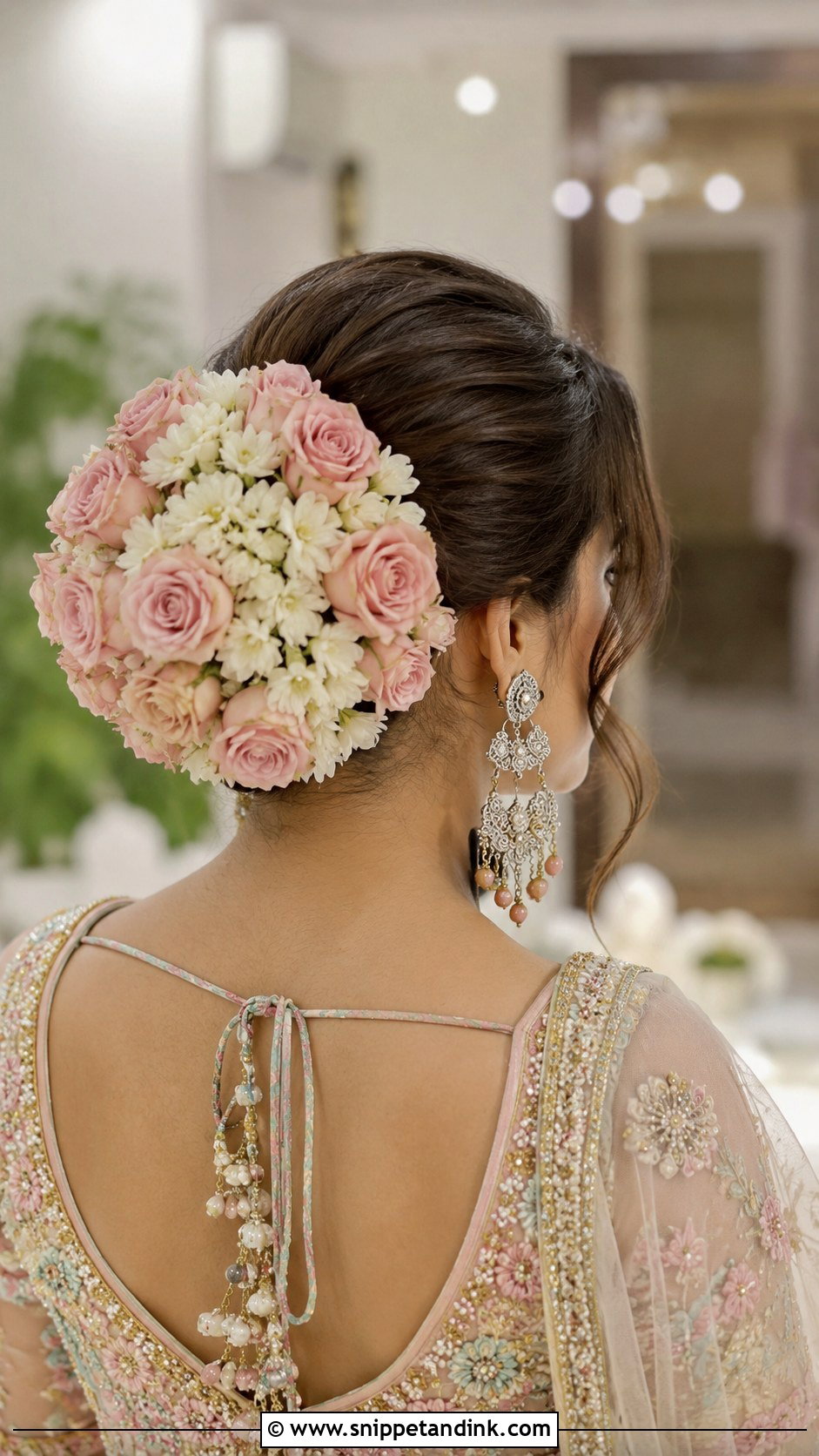
Think of this as a flower dome: a generous bun at the back covered almost completely in pink roses and white mogra. The base matters more than it looks. A full cover of fresh flowers is heavy and slightly damp, so I build the bun firm and a little smaller than the finished size, since the blooms add bulk. It suits daytime ceremonies where the scent is part of the experience. With this much going on at the back, I’d keep earrings as your only other statement.
4. Pearl-Lined Braid For Brides
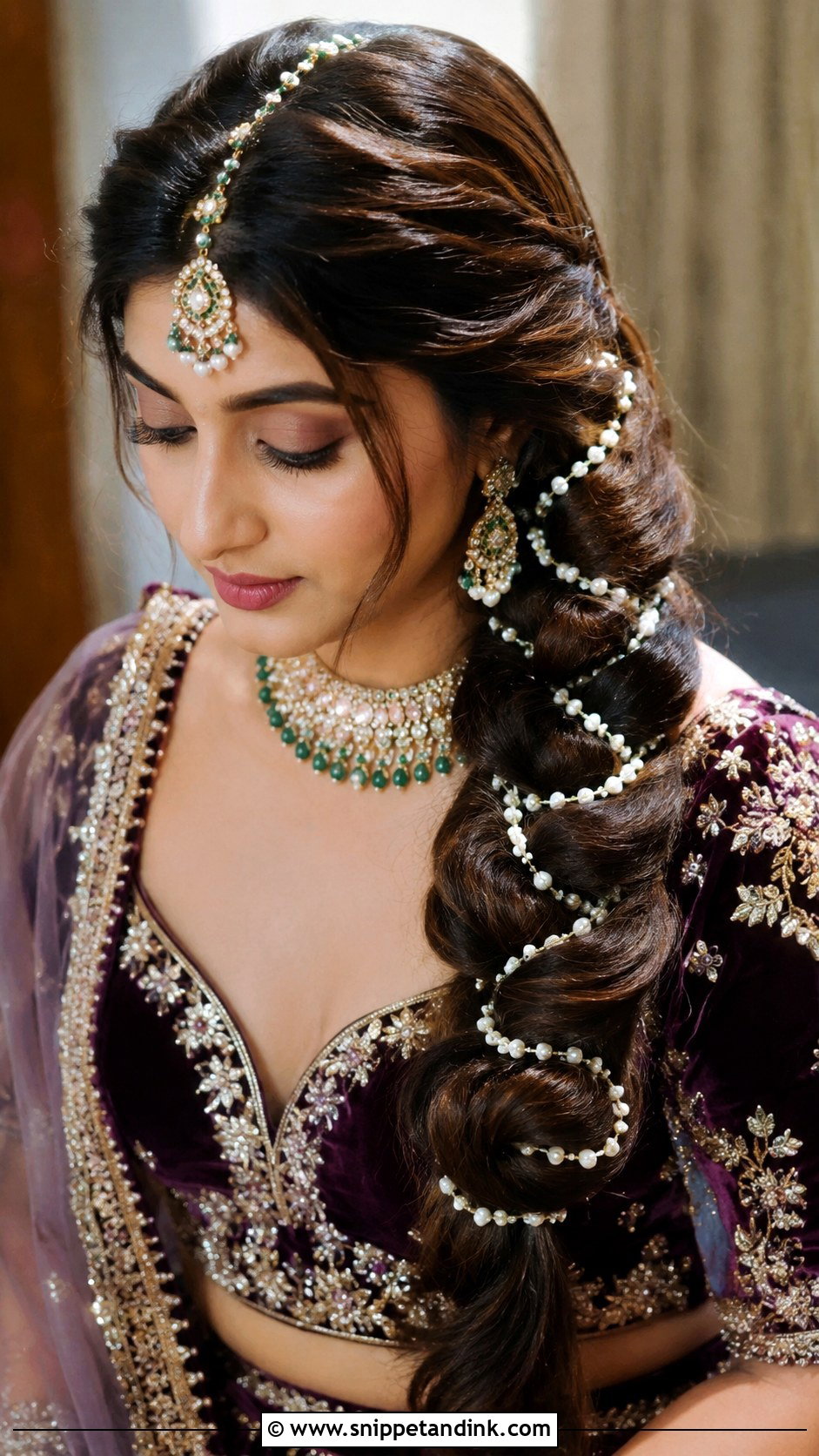
Pearl strands woven through a thick side or back braid give shimmer without florals. I thread the pearls in as I plait rather than wrapping them on afterwards, so they follow every crossing and can’t slide down. A looser plait reads softer, a tighter one holds through dancing. Pearls go with nearly any colour, pastel or jewel tone, which makes this one of the easiest styles to carry from one function to the next. Fine hair is the only real limit, since the pearls can end up looking heavier than the braid. A clip-in fixes that.
5. Messy Bun With Side Braid
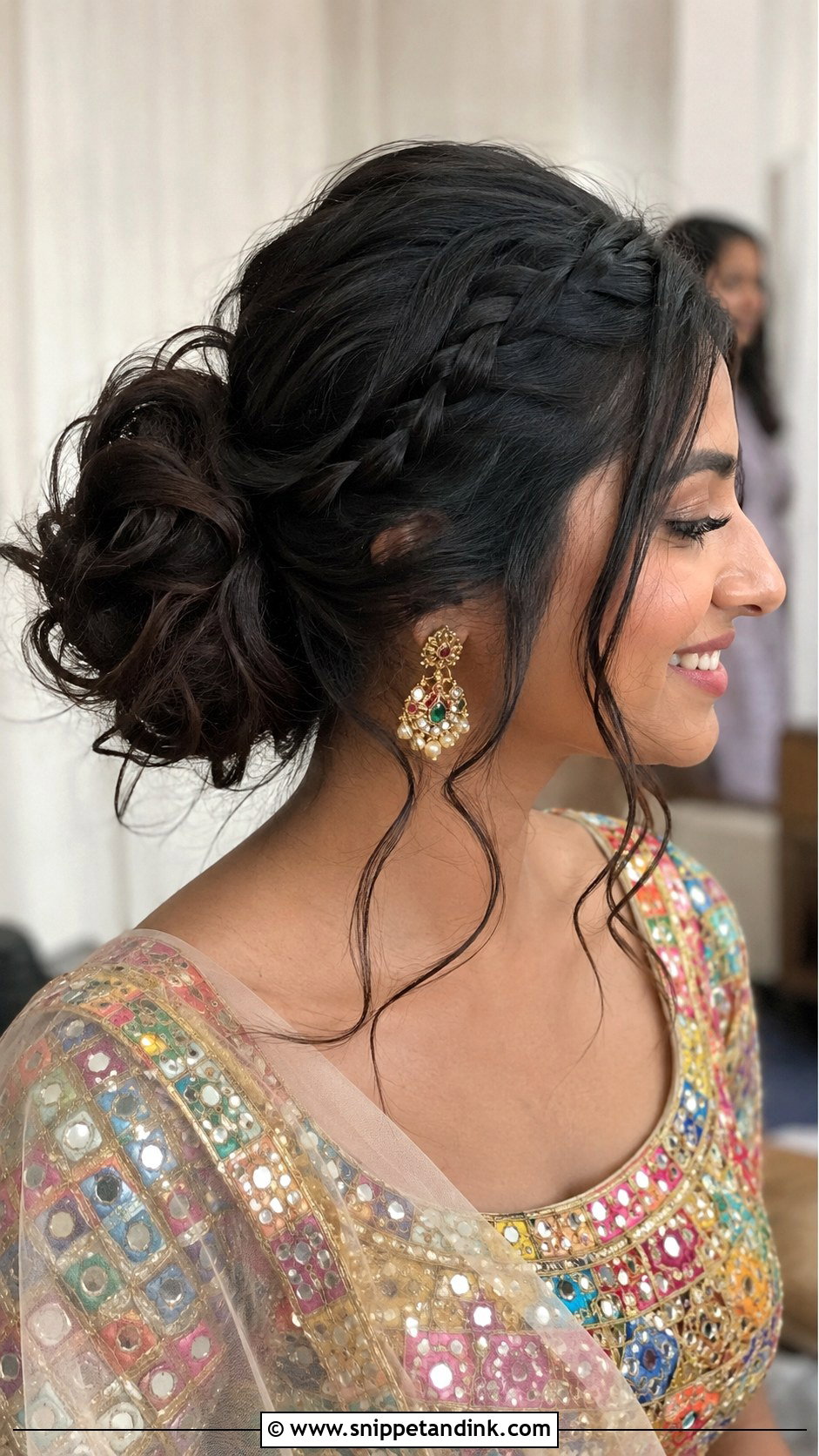
One side is plaited and wrapped back toward a relaxed, full bun, with a few loose strands at the face. Sangeet and mehendi suit it because it moves well and nothing sits tight. On hair that only reaches the shoulders, the braid is too short to reach the bun without tension, so I swap it for a simple twist. A small flower or jewelled pin where the braid meets the bun hides the pin work.
6. Sleek Low Ponytail With Accessories
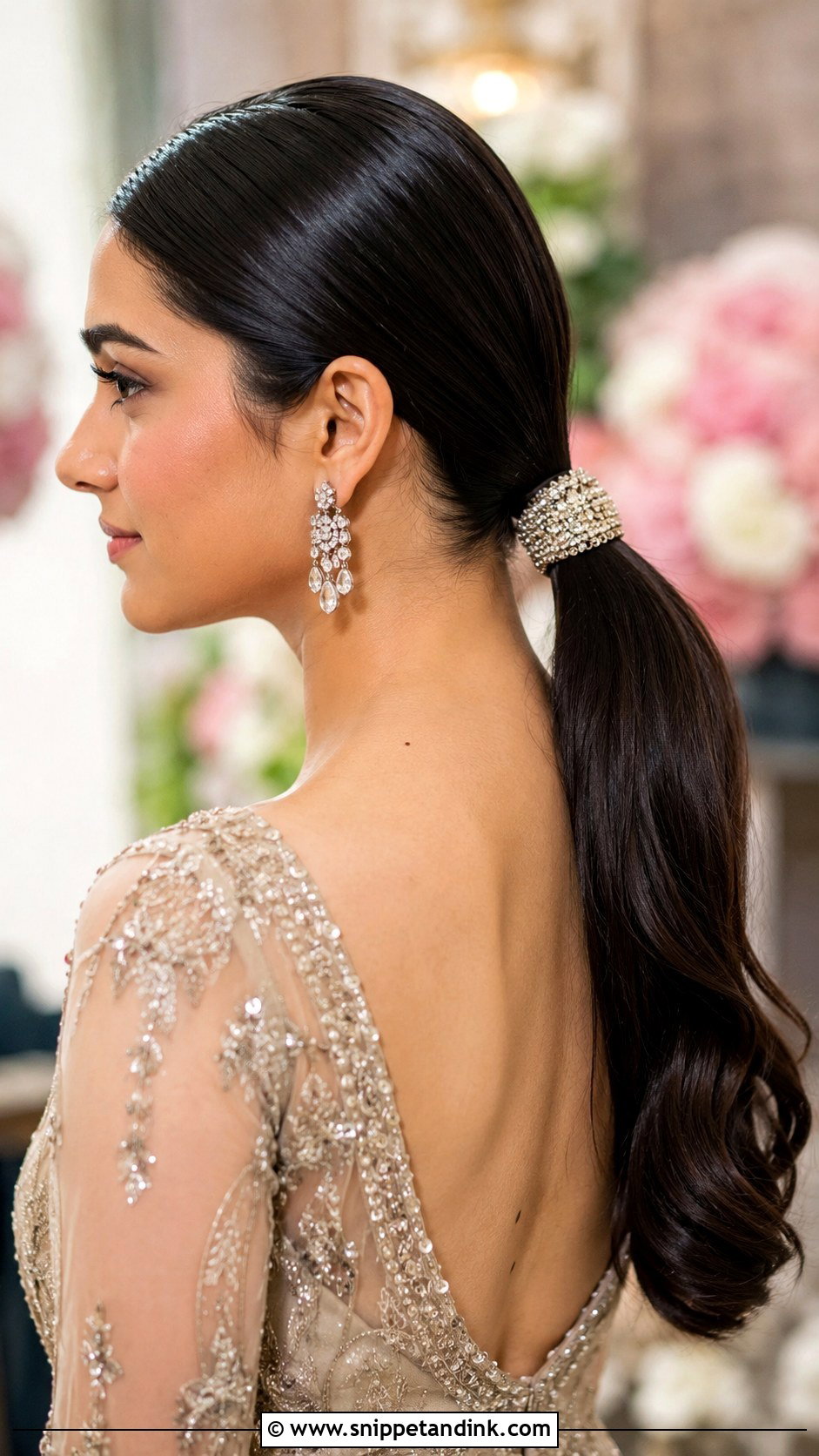
Simplicity works hard here. The hair is smoothed back into a polished tail at the nape and finished with a jewelled cuff, or a section wrapped around the base to hide the elastic. It shows off the face, earrings and neckline, which is why I like it for receptions and fusion evenings, and it sits as well with Indo-western gowns as with classic sarees. The catch is that a ponytail shows every bump and flyaway, and a long tail tangles in necklace clasps. I smooth it with a bristle brush and a drop of serum, then run a flat iron down the length.
7. Open Hair With Soft Curls
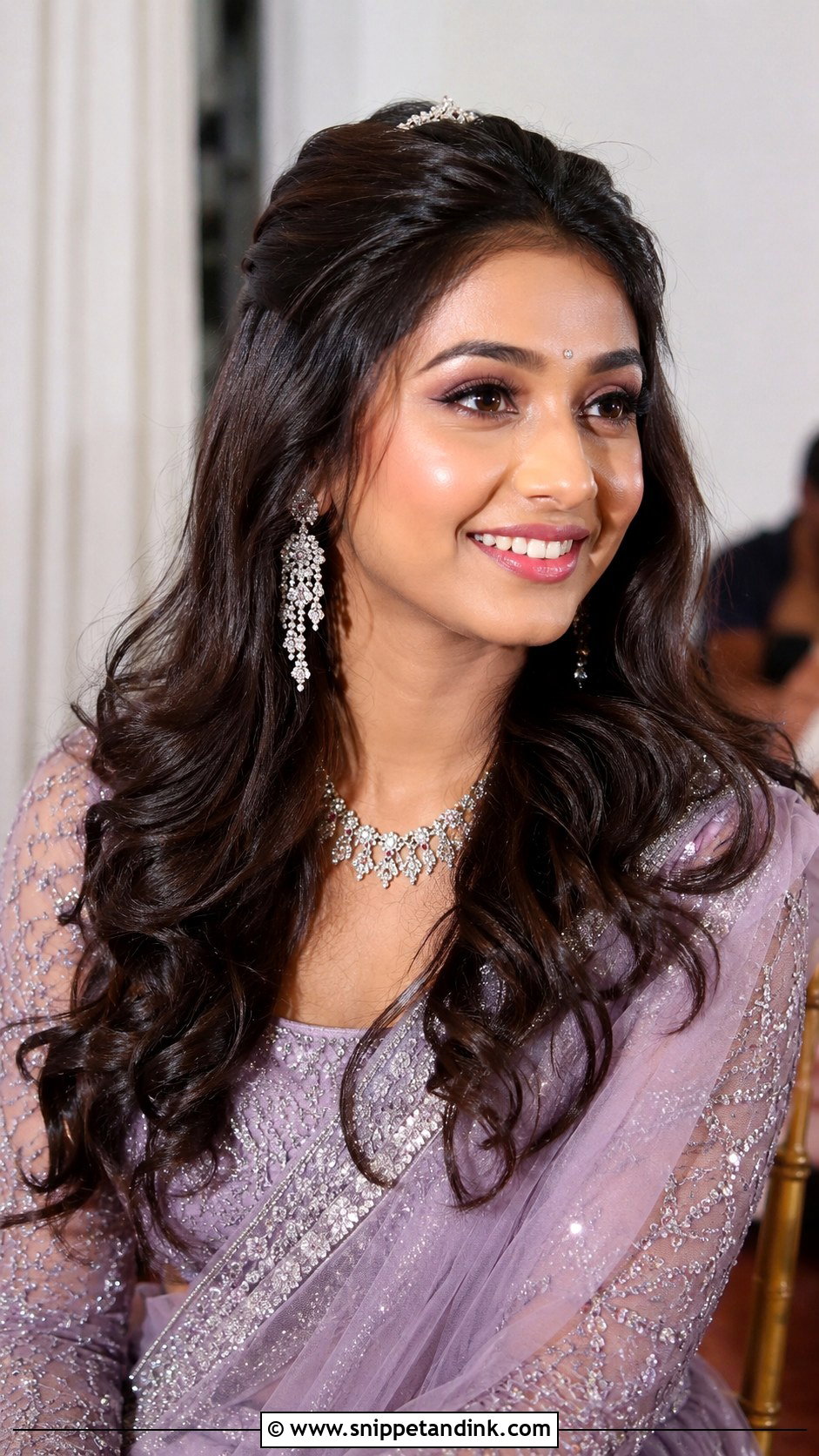
Open hair in soft curls is lovely for a reception, but it’s the style I’m most careful about recommending. The length flows over the shoulders in loose waves, with a small half-pin or jewelled piece at the crown to keep it tidy. Curls drop in heat and humidity faster than any updo, and open hair catches on heavy earrings and blouse embroidery. If you love it, keep it for an air-conditioned evening and expect the curls to relax into waves by the last dance. That’s not a failure, just how curls behave.
8. Half-Up Half-Down With Gajra
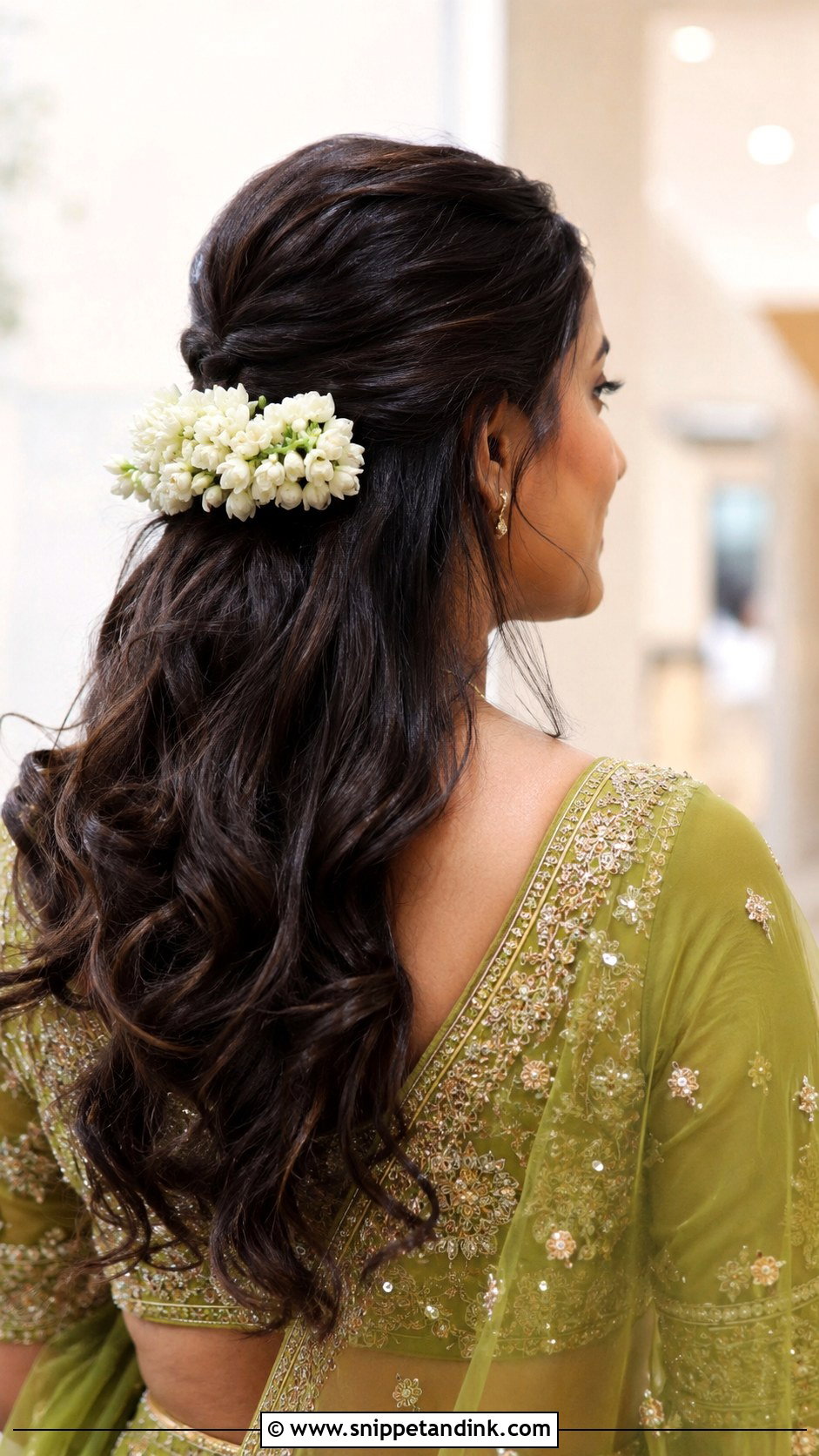
The length stays visible, the top section is gathered back, and a gajra wraps around the gathered part. Mehendi and haldi suit it because your hair stays off your face while you sit still for hours. I anchor the top section with a small hidden elastic and cross pins beneath it, because jasmine on a half-up has nothing solid behind it the way a bun does. The open length can drag through wet mehendi on your arms, so I usually sweep it over one shoulder before the artist starts.
9. Braided Bun With Hair Accessories
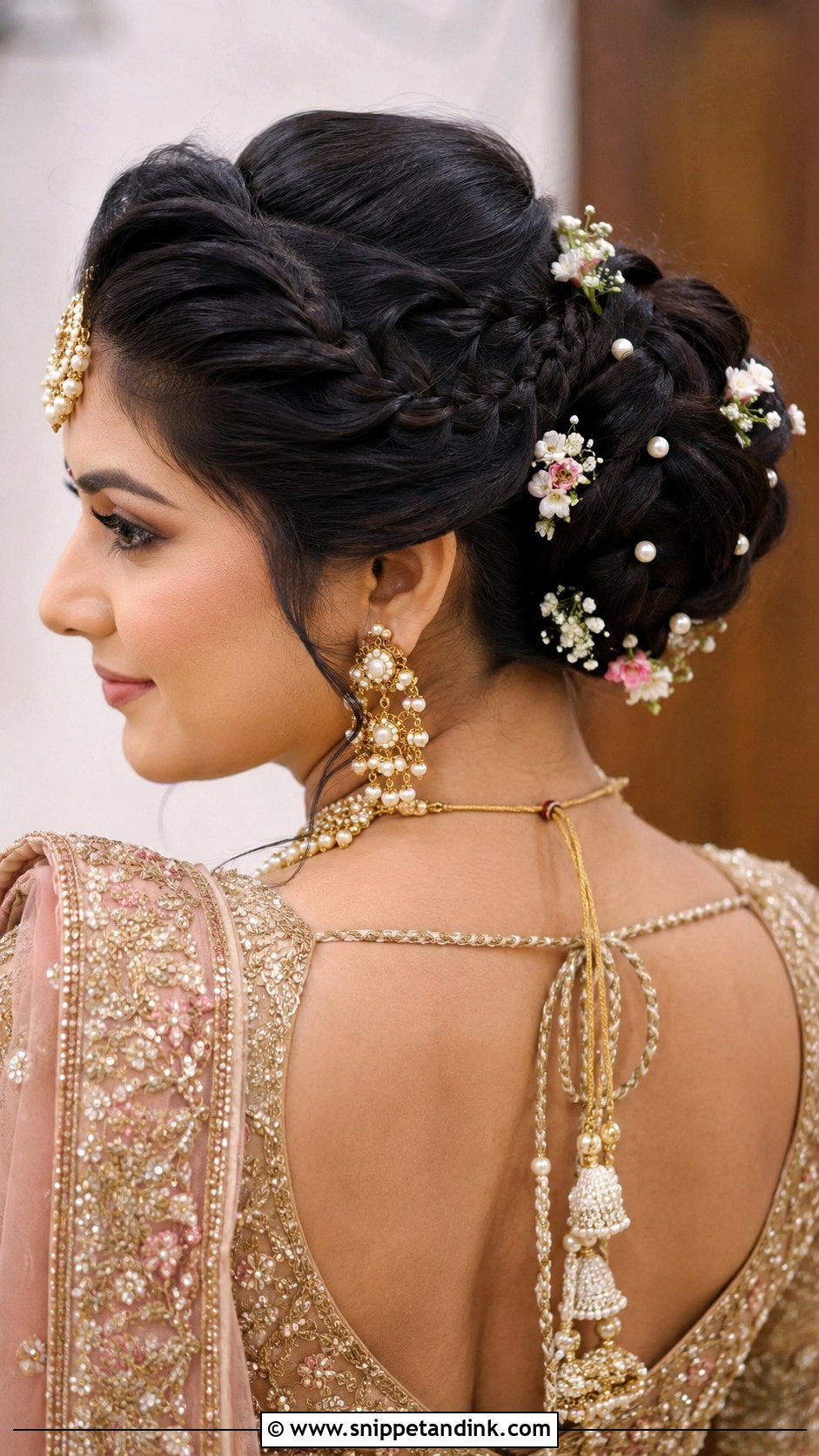
Braiding the sections before coiling them gives the bun visible texture, and it also makes it hold, because braided hair grips pins far better than smooth hair. I coil each braid and pin it into a rounded shape, leaving small pockets between the folds for flowers or pearl accents. It’s one of the sturdiest options for a long wedding day. Thick or long hair gives the most volume. With a heavy lehenga and a statement maang tikka, it reads as bridal from every side.
10. Fishtail Braid For Sangeet
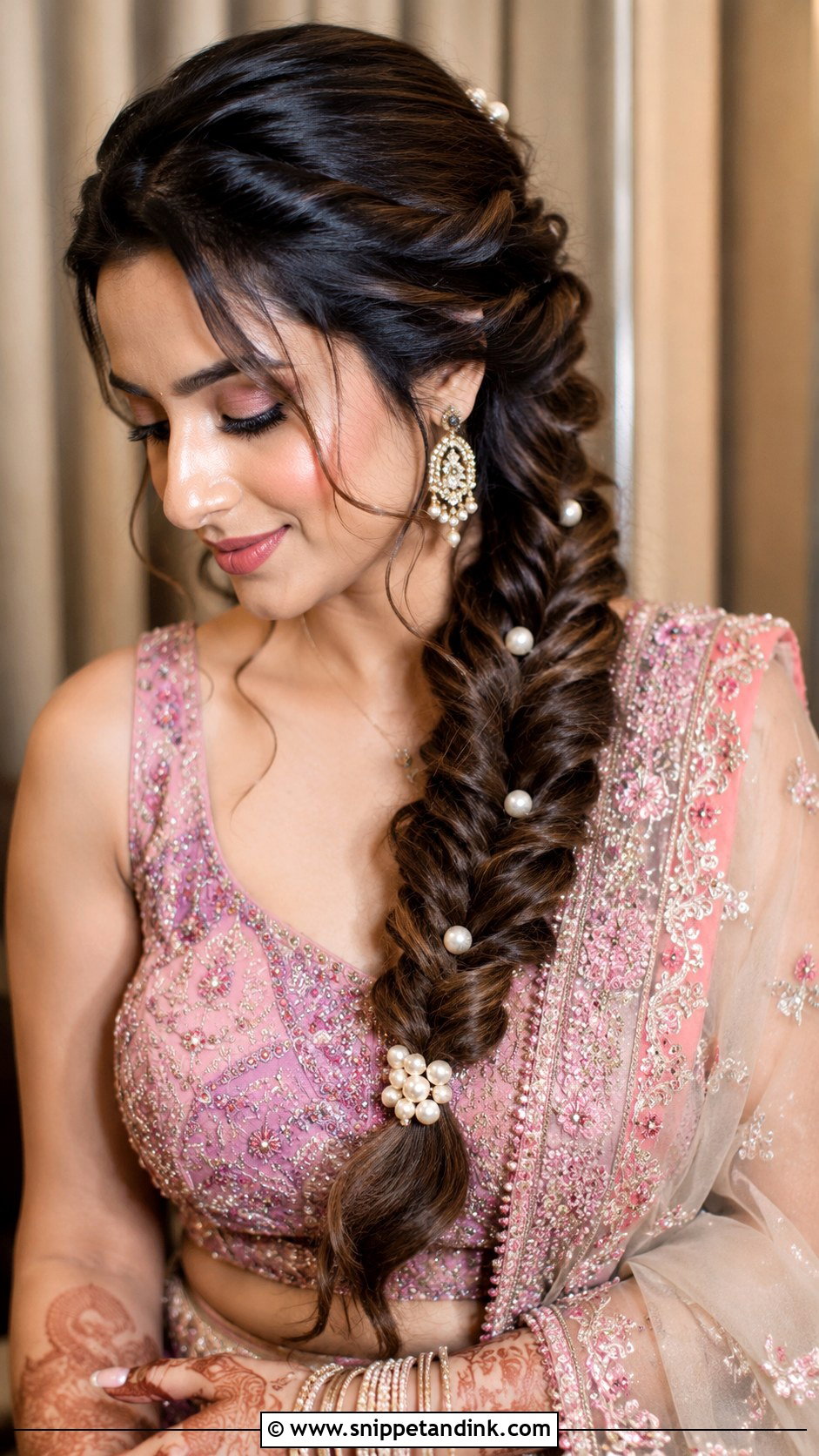
The fishtail crosses small strands from two sections into a rope-like pattern. It’s quicker to do than it looks, and it holds well through a sangeet night of dancing. I wear it to one side and pull the edges out a little so it reads in photos; a tight fishtail looks thin from across a room. Tiny flowers or pearl pins along the length add sparkle. On medium hair it ends around the collarbone, which still works. Any shorter and the pattern gets lost.
11. Bun With Maang Tikka And Veil
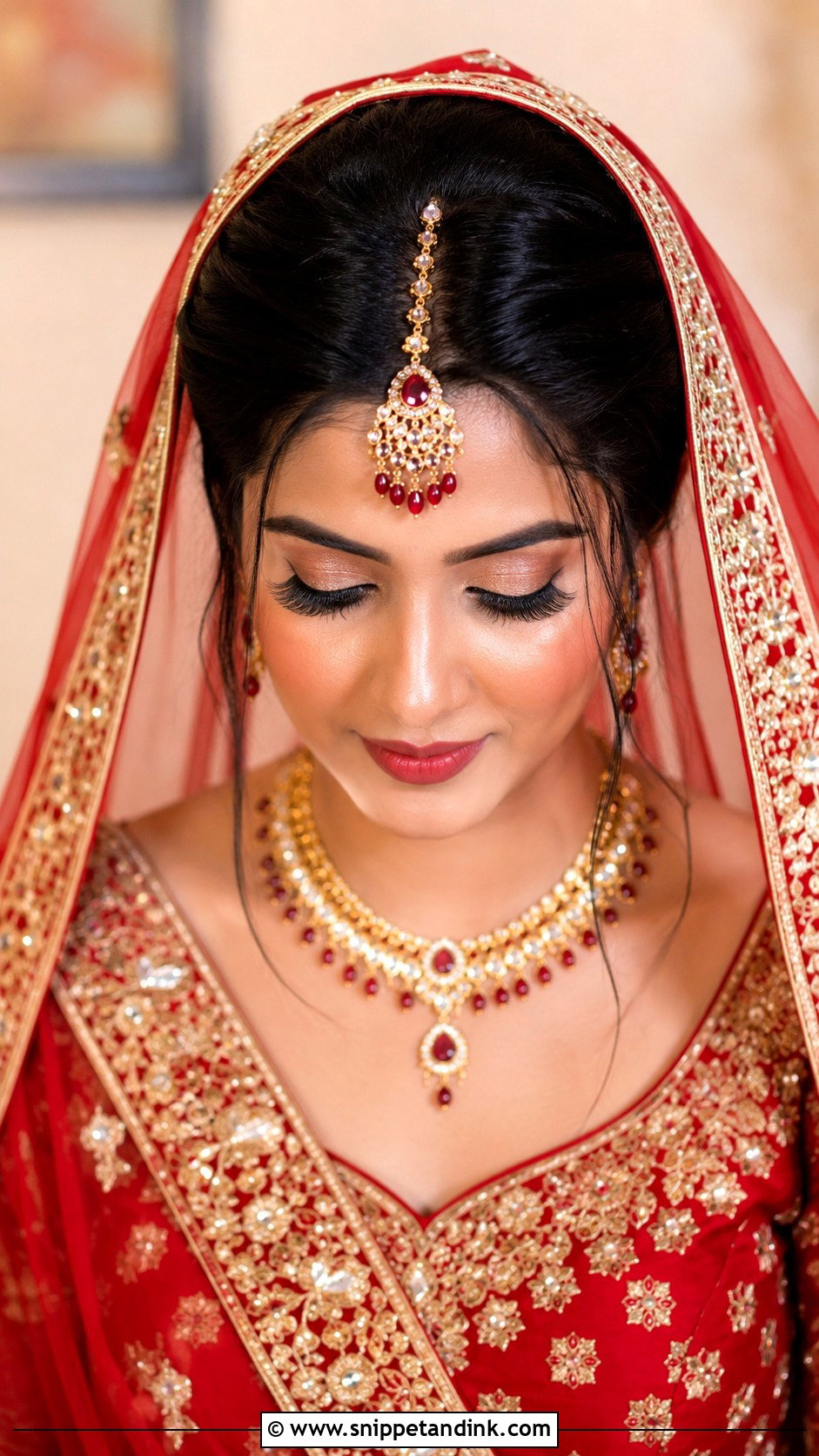
For the main ceremony, a classic bun with a maang tikka and dupatta veil does the most work with the least fuss. The bun sits smooth at low or mid height to give the dupatta a solid anchor, and the tikka rests along the centre part. I set the bun’s exact position with the dupatta on at the trial, because a bun placed too low pushes the veil forward over the face. Soft baby hairs at the hairline take the hardness off a very smooth finish, and the whole thing stays comfortable through hours of rituals.
12. Loose Waves With Side Flowers
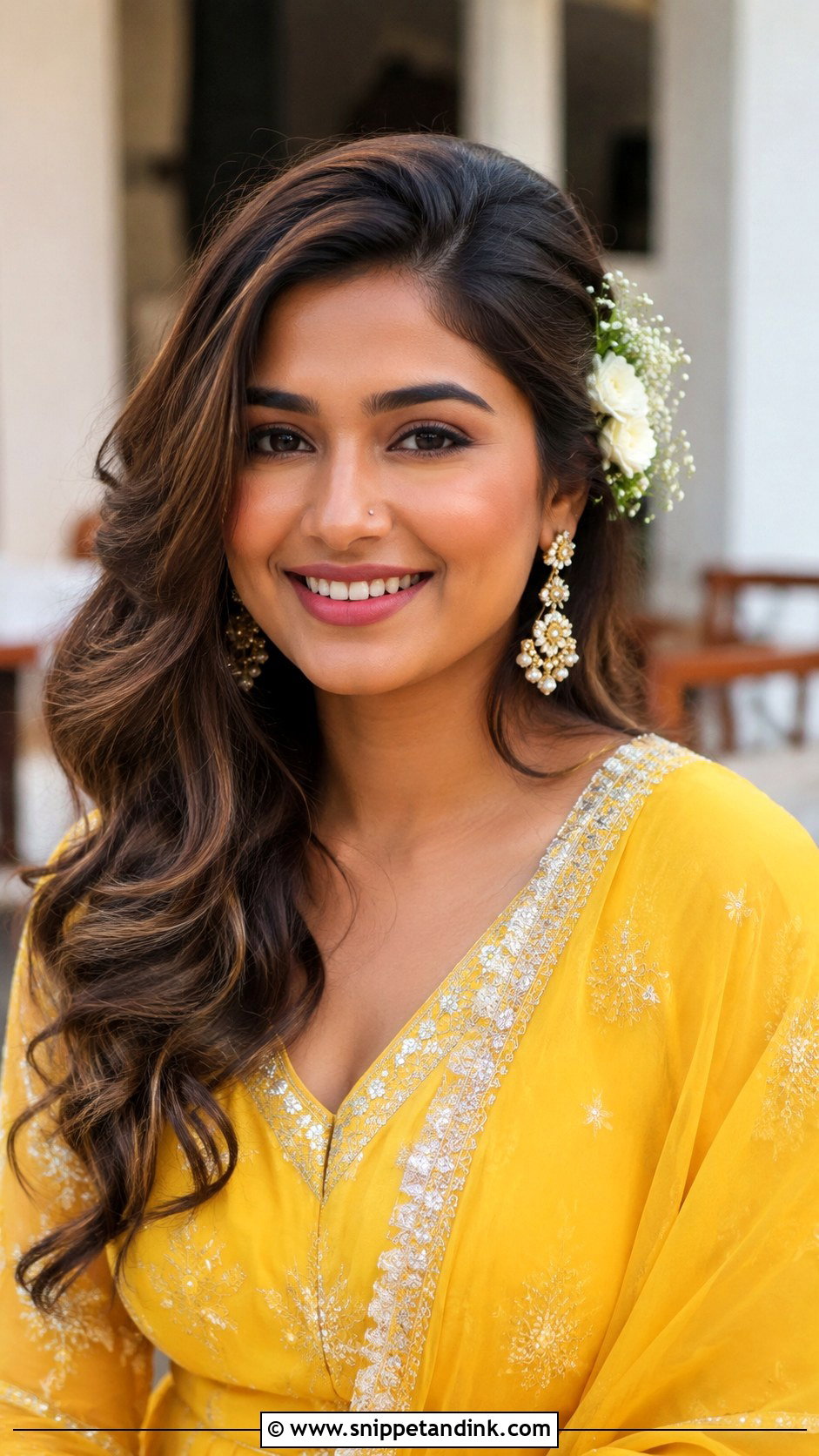
Waves swept over one shoulder, with flowers tucked behind the opposite ear. Guests like it, and it suits daytime events like haldi when you want open hair with a festive touch. Swept-over hair needs pinning behind the ear on the flower side or it creeps back to centre within the hour, so I hide two crossed bobby pins under the blooms. I’d skip it with heavy shoulder embroidery, which the hair snags on.
13. Donut Bun For Long Hair
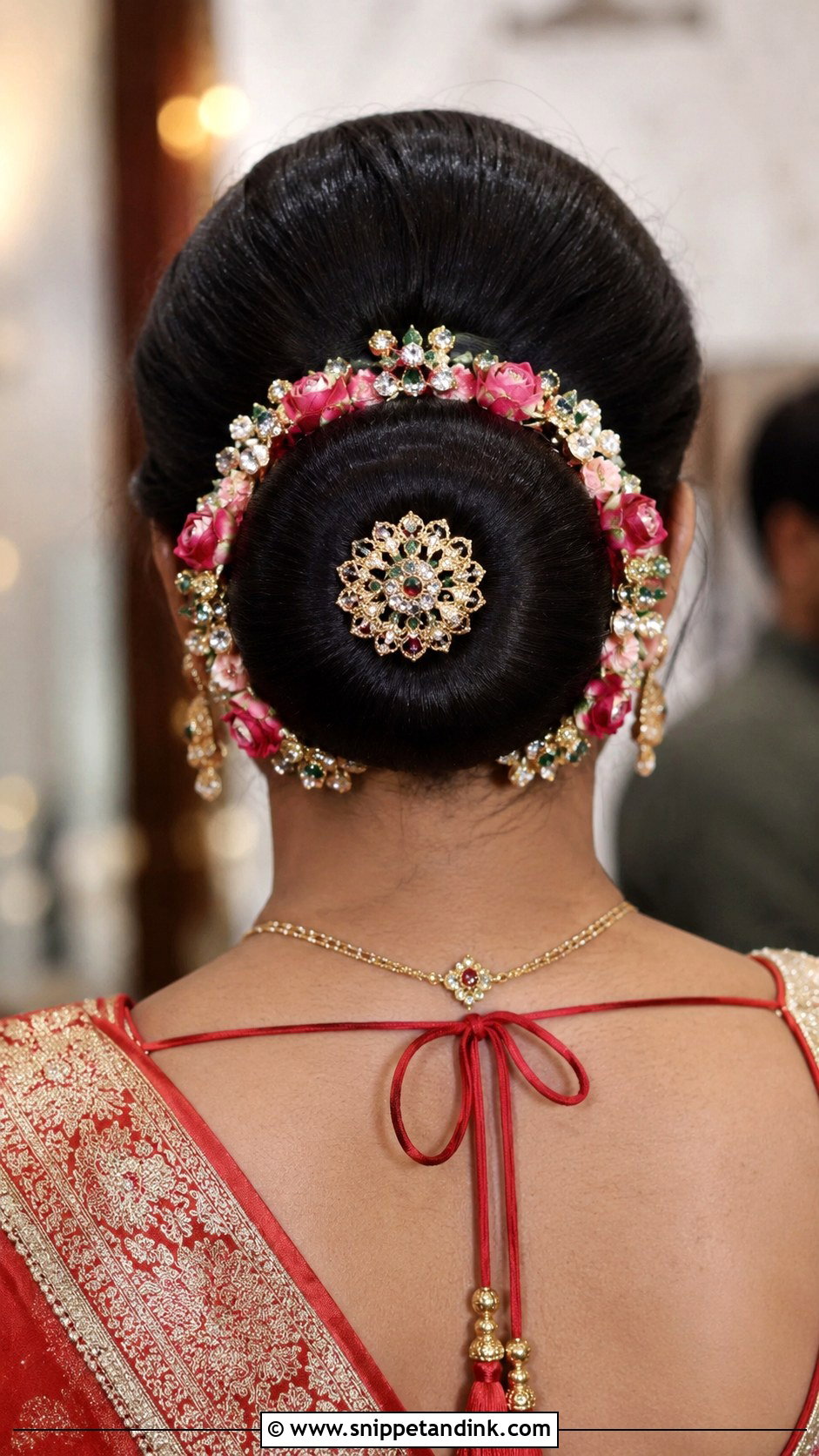
A bun ring gives a full, rounded dome with real height, and on long, thick hair it can grow quite large. I sometimes braid the excess and tuck it underneath so the bun stays in proportion with the head. It carries heavy jewellery and ornate pins along its edges without sagging. Set low, it reads traditional; at mid height, more modern. Flowers, pearls or jewelled pins can match whatever you’re wearing.
14. Rose Twist Hairstyle
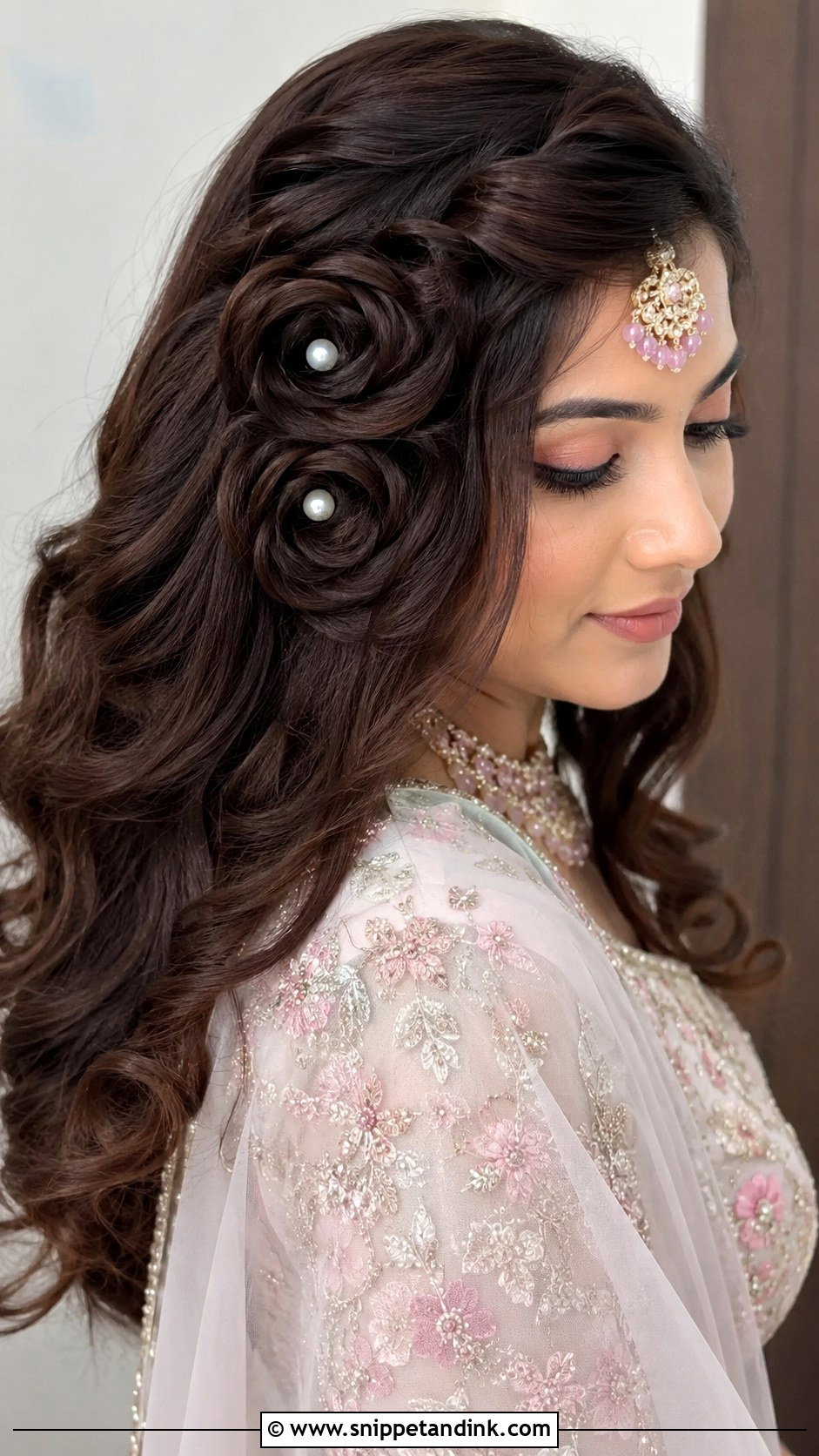
Sections are twisted and coiled into a flower shape, either as a half-up accent or as part of a larger updo. It’s a detail people lean in to look at, which means it needs a skilled stylist and a test run; uneven tension makes the petals look lopsided. A single pearl at the centre finishes it neatly. I pair it with loose waves below so the twist is the one sculpted element. Very fine hair struggles to hold the coil, so prep it with texture spray.
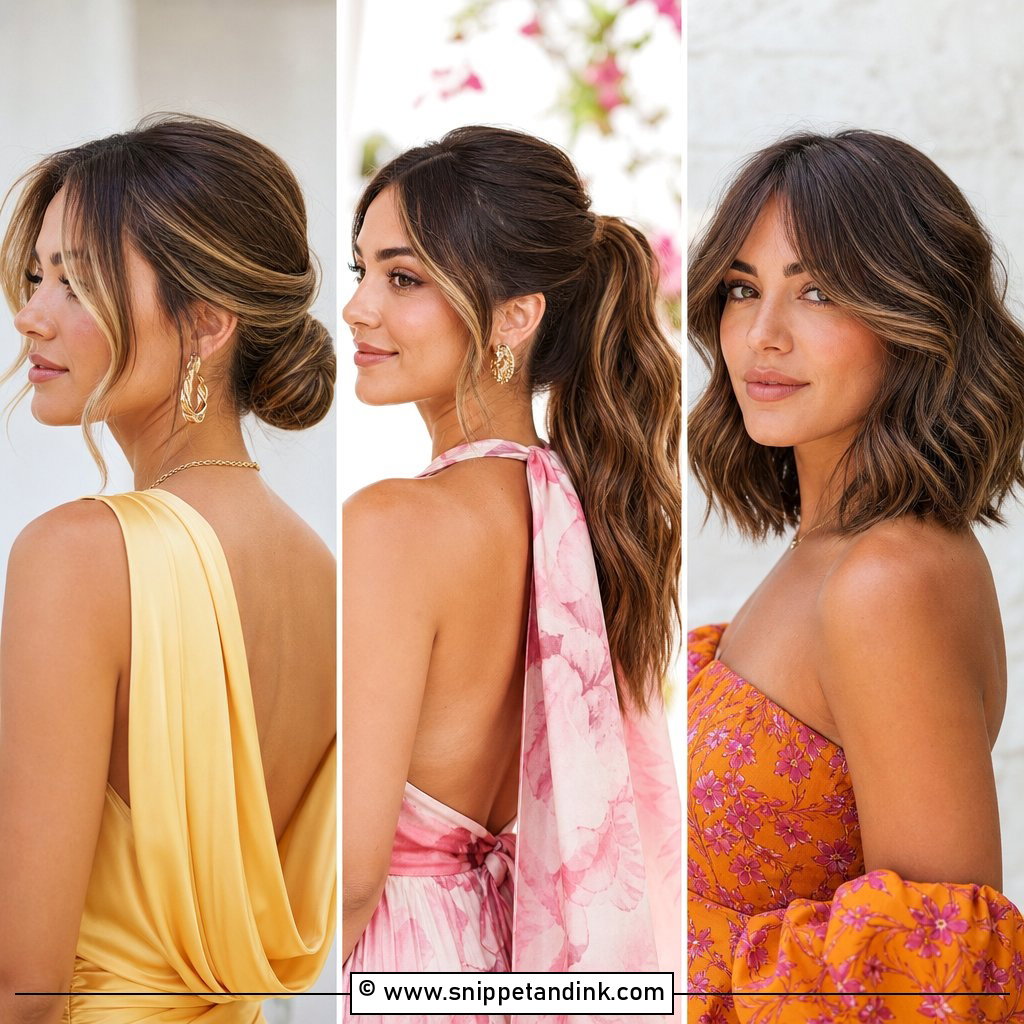
15. Mermaid Braid With Butterflies
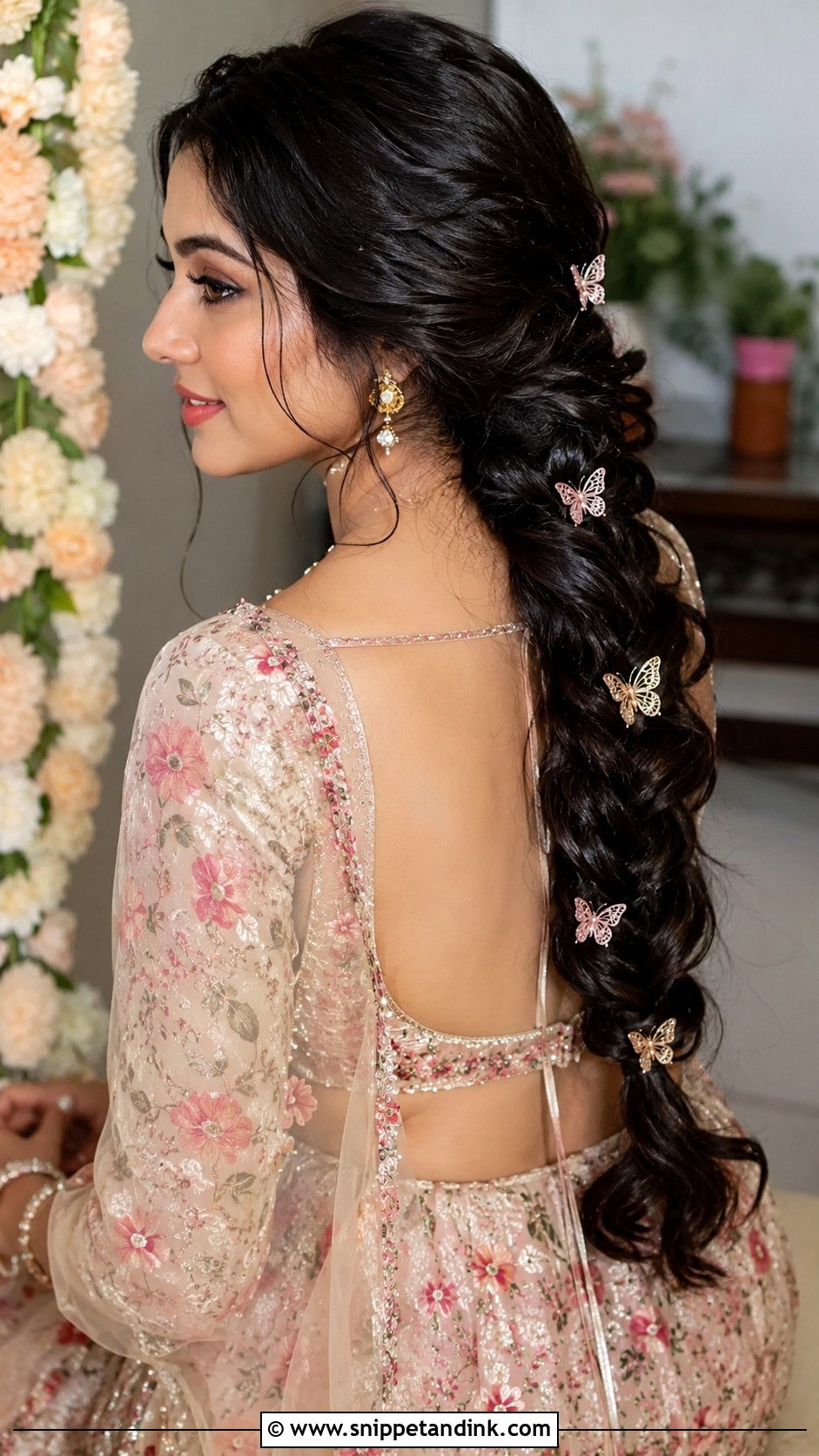
A loose plait pulled wide down the back, with small decorative butterflies pinned along it. It reads young and playful, so I’d keep it for sangeet evenings and pastel or floral outfits rather than the main ceremony. The wide mermaid effect comes from pulling each loop outward after plaiting, which needs long, thick hair. On finer hair I add clip-ins first so it doesn’t look stringy. Leave a few face-framing strands free.
16. Sleek Bun With Center Parting
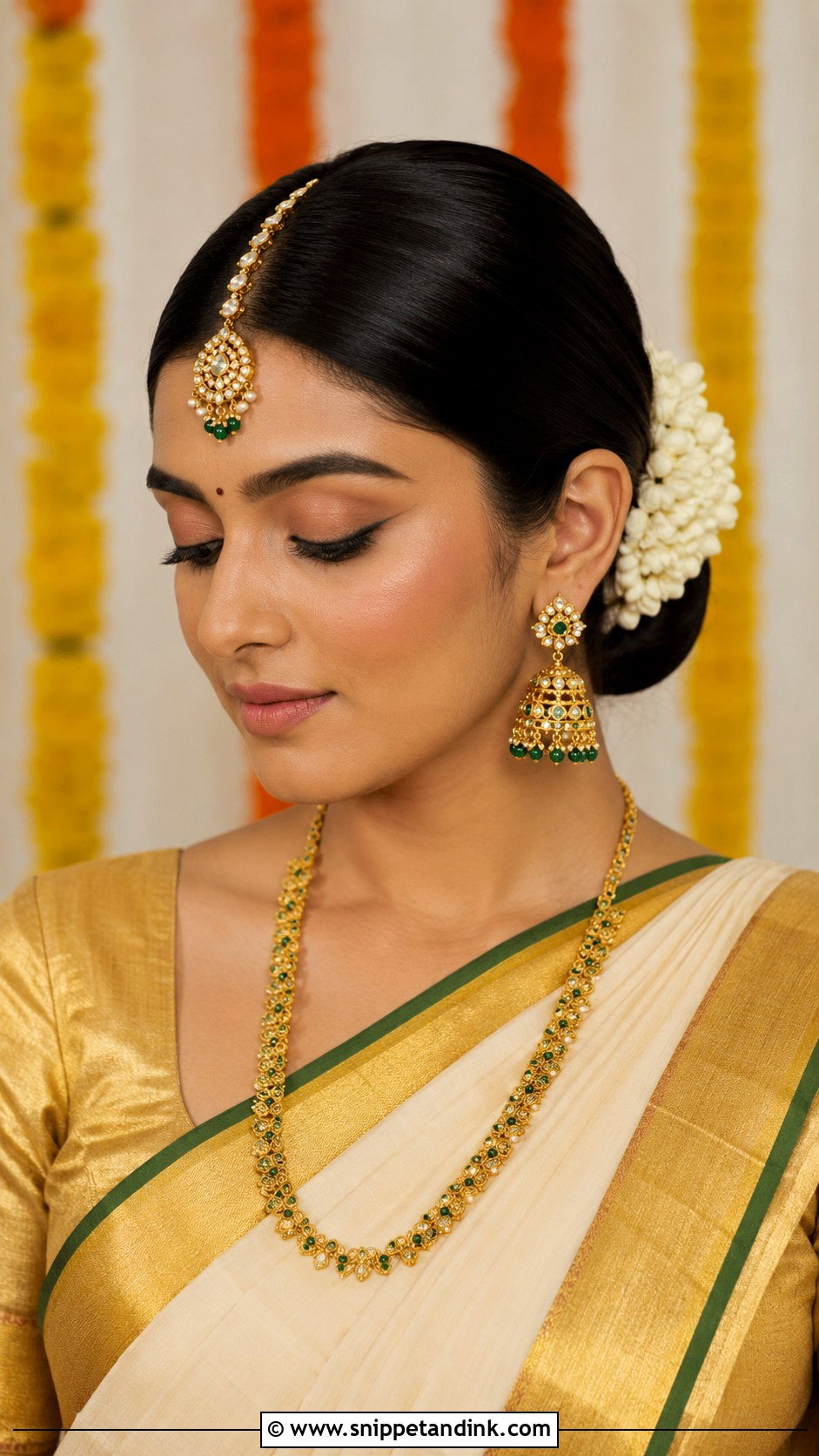
Straight down the middle, smoothed back, a tidy low knot at the nape. It’s symmetrical and quiet, so jhumkas and a maang tikka get the attention. The parting has to be exactly centred; I check it in the mirror from the front and then from above, because a part that’s slightly off shows in every front-on portrait. A small gajra or a jewelled accent adds festivity. It holds its shape all day, which is why I suggest it to brides who’d rather not think about their hair at all.
17. Curly Bun With Baby’s Breath
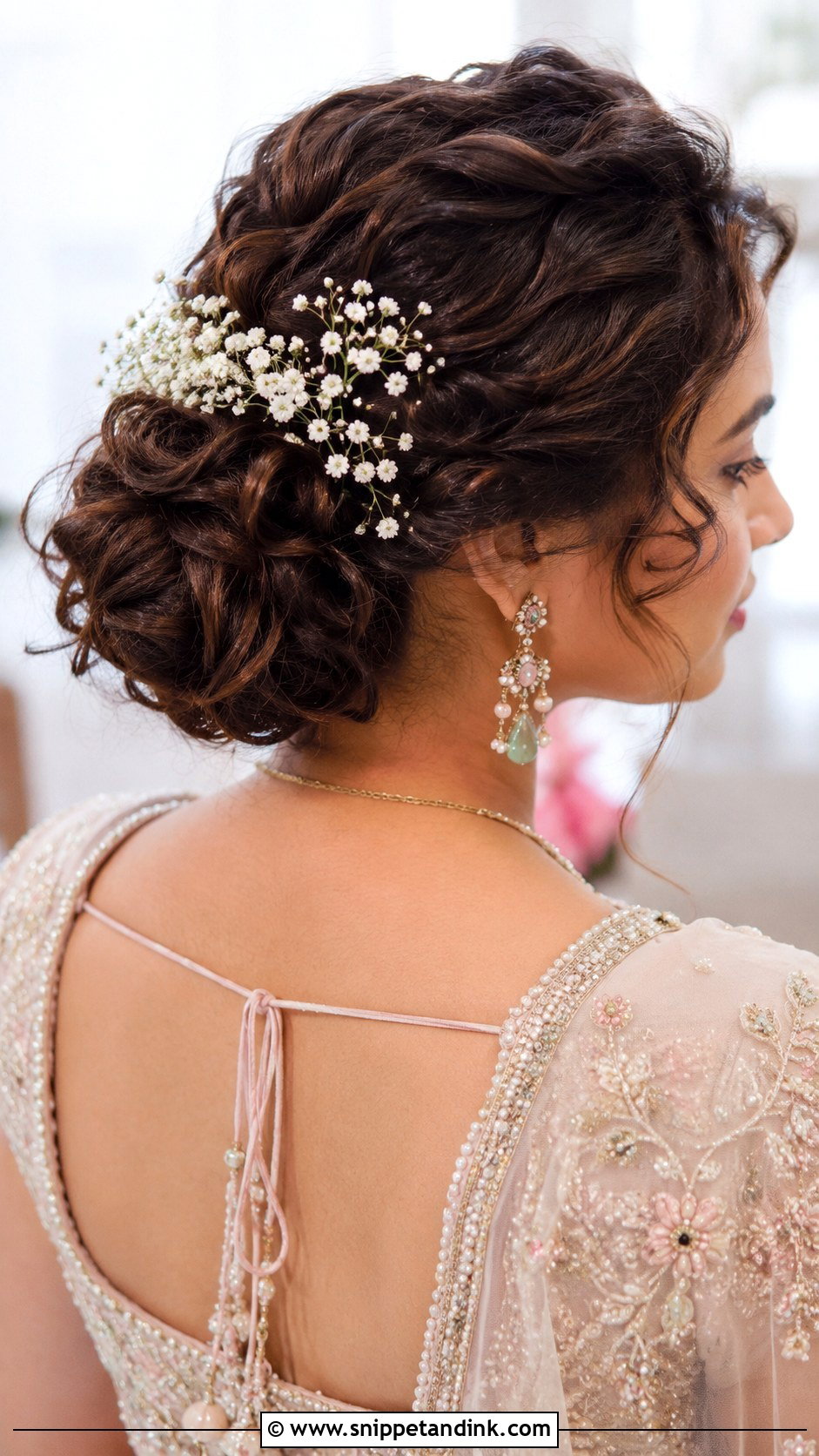
Curled hair gathered into a textured bun, with sprigs of baby’s breath tucked through it. Baby’s breath is a forgiving flower for hair: it’s light and keeps its look for hours out of water, so the bun doesn’t sag or wilt by evening. Daytime ceremonies, intimate weddings, pastel outfits and fine jewellery all sit well with it. I set the curls and let them cool fully before pinning, which keeps the texture defined much longer.
18. Side-Swept Braid With Flowers
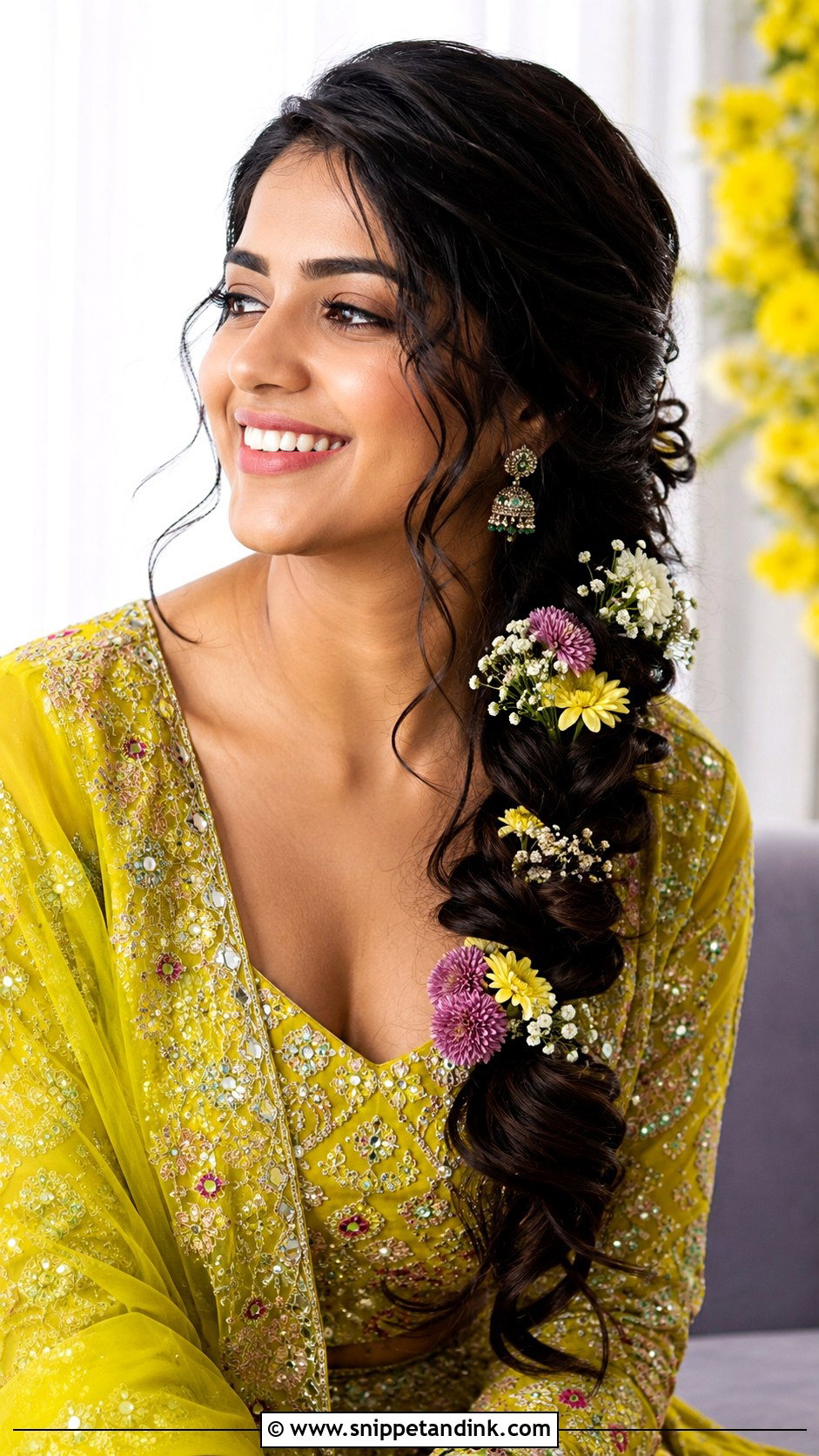
All the hair goes over one shoulder in a loose plait, dressed with fresh flowers along its length. It keeps hair manageable at mehendi and haldi without pinning anything up. I start the braid behind the ear rather than at the nape, so it falls forward naturally and doesn’t swing back every time you turn. Flowers on a moving braid need to be small and wired; large heads fall out. Bright, traditional outfits and medium to long hair suit it best.
19. Bun With Bejeweled Hairpins
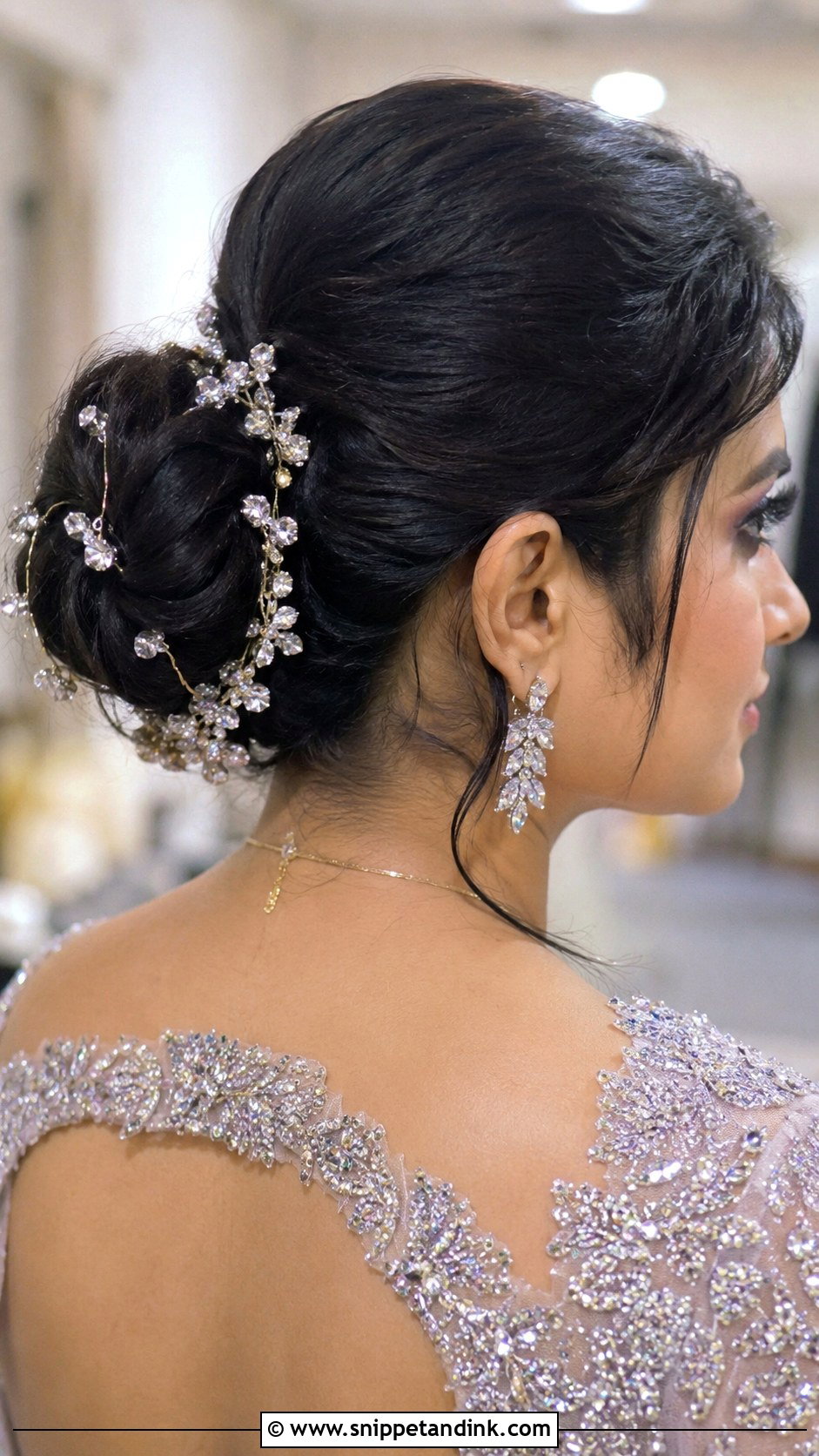
Sparkle instead of flowers. A smooth bun forms the base, and jewelled pins, crystals or clips are arranged across it, either scattered or lined up in a pattern. It catches stage lighting at evening receptions and pairs neatly with sequined or embellished outfits. At the trial I place the pins and photograph the back, because a pattern that looks even in the mirror often looks clumped in a photo. Heavy crystal clips need a firm base or they droop.
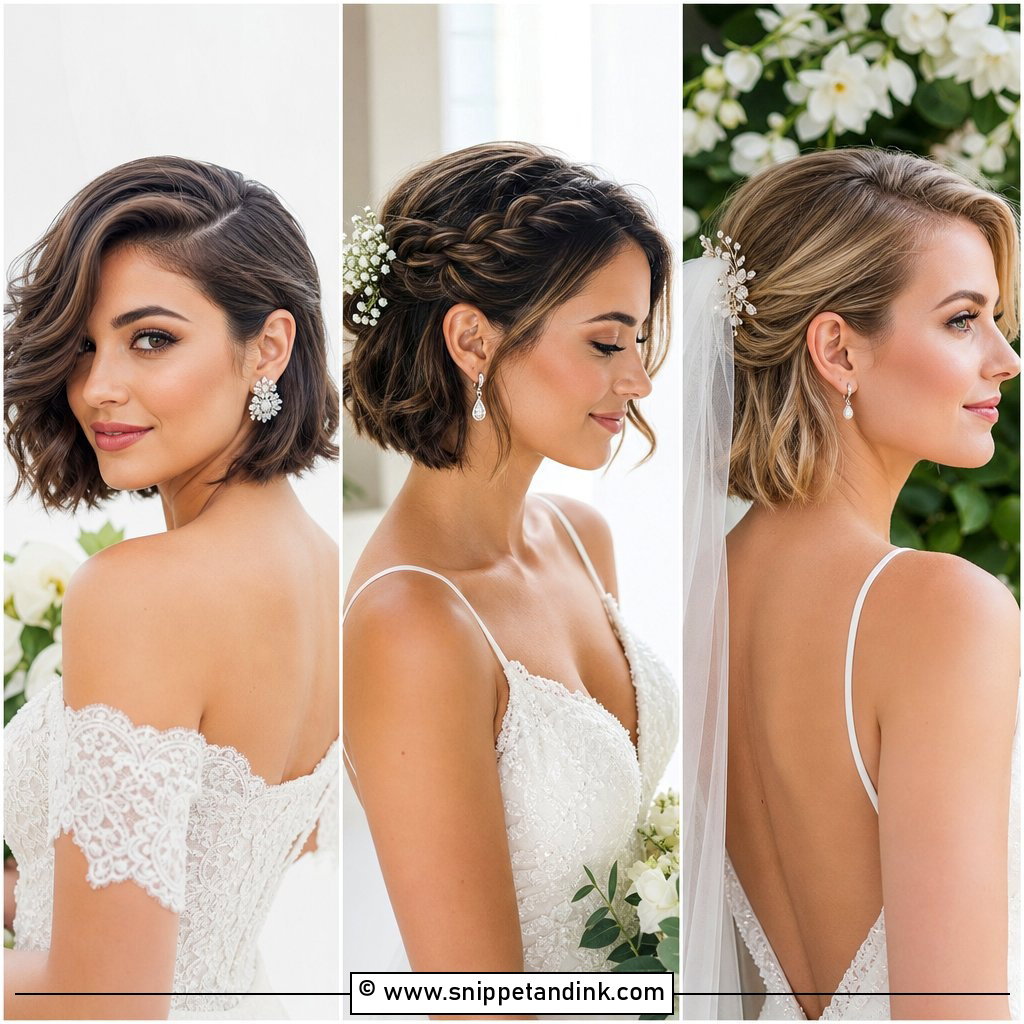
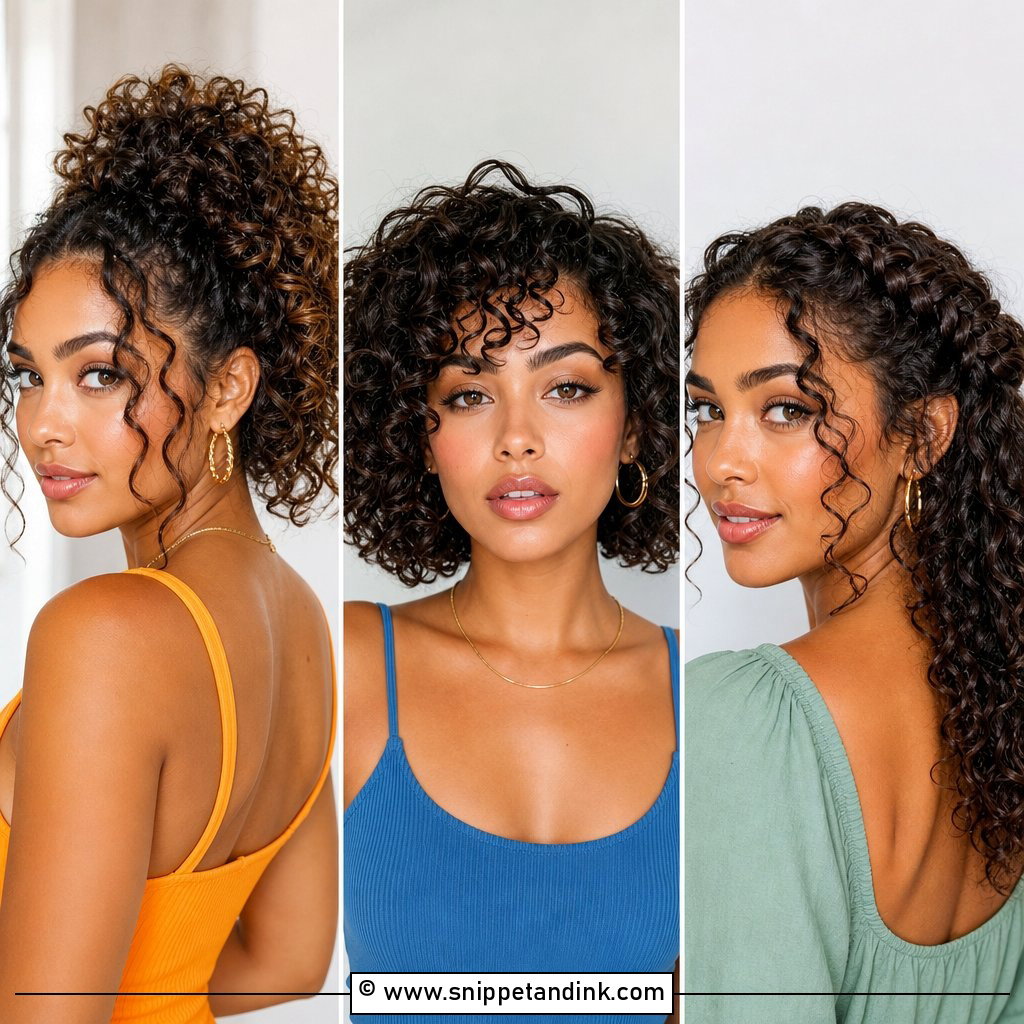
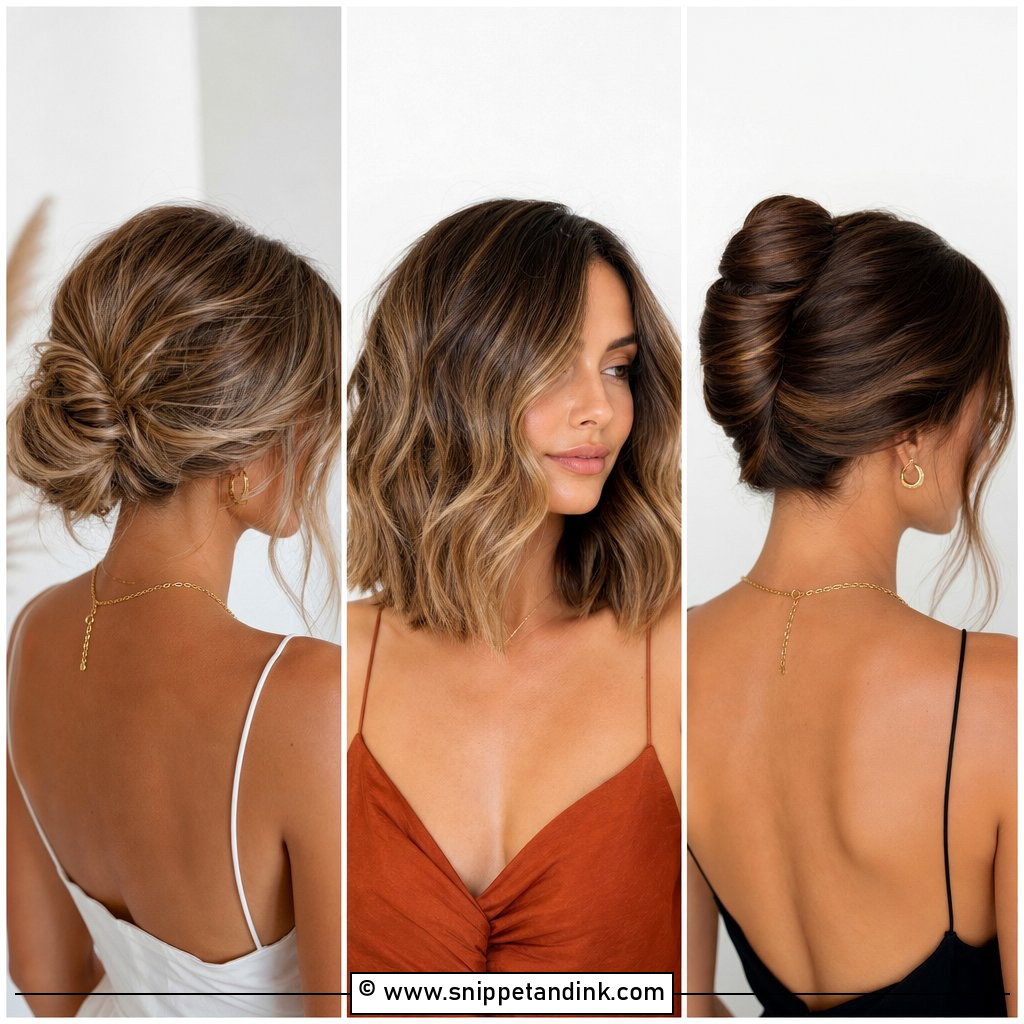
20. Twisted Updo With Maang Tikka
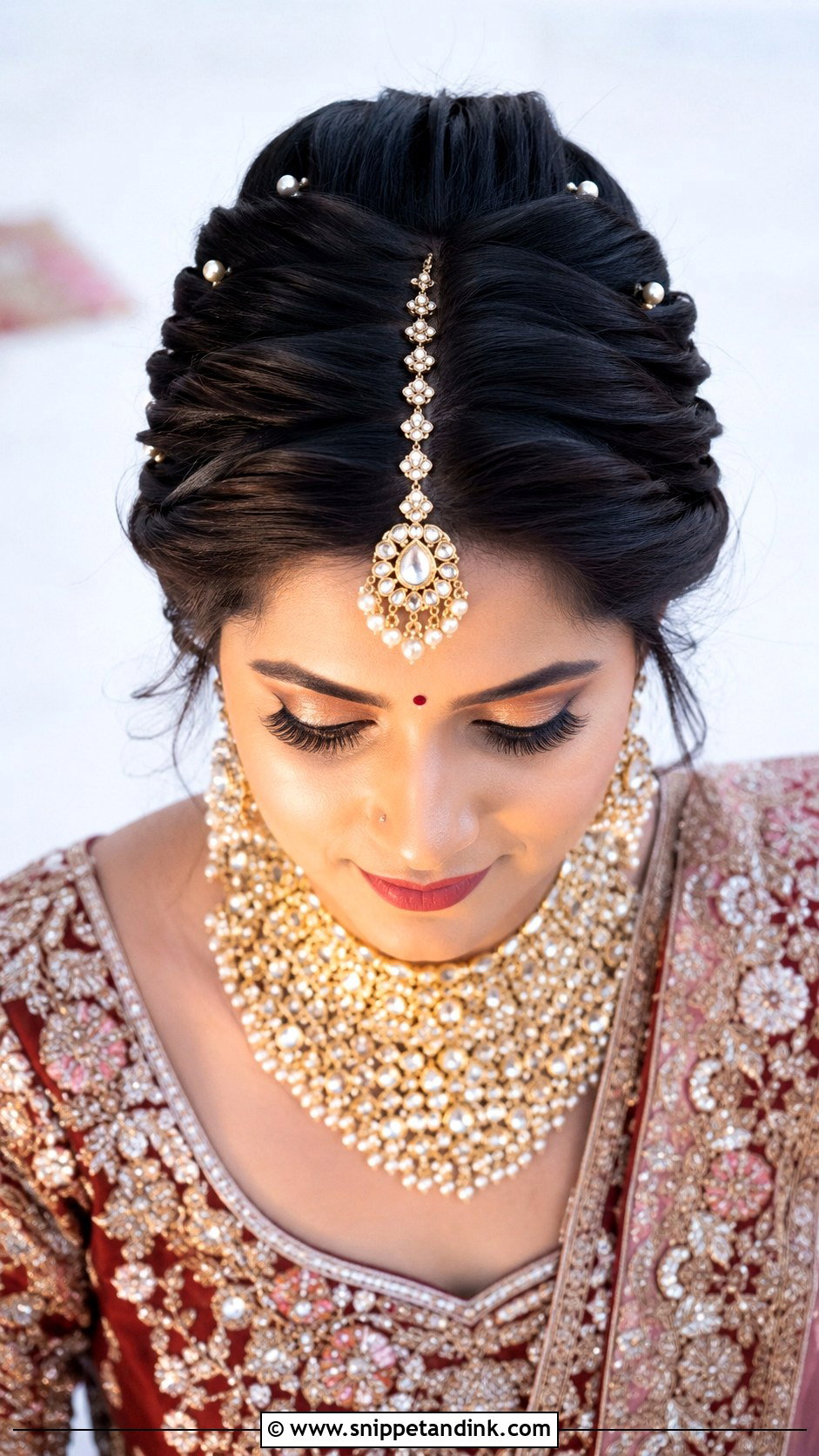
Sections are twisted and pinned upward into a sculpted shape at the back, finished with a maang tikka at the parting. Each twist locks against the next, so it holds well through long rituals, and it’s a strong choice for the main ceremony. If you’re wearing a dupatta over it, ask for a flatter area at the crown so the veil sits down instead of balancing on the twists. Small flowers, pearls or jewelled accents finish it.
Why Curls Drop in a Humid Mandap
Heat and humidity undo curls because moisture in the air relaxes the shape that heat set into the hair. Indian weddings often fall in warm months, under lights, in a crowd, so I plan for it rather than hope.
- Curl clean, completely dry hair. Damp patches near the scalp never hold.
- Pin each curl up while it’s warm and let it cool fully before releasing it. This step alone buys hours.
- Build a humidity-resistant spray in light layers rather than one wet coat.
- For an outdoor summer ceremony, choose a braid or bun and save open curls for an indoor evening.
Oil, Washing and Henna in the Days Before
Plenty of brides oil their hair the night before a function out of habit. Oiled hair is slippery and won’t hold pins, so stop oiling at least a day ahead and wash it out properly. Wash the morning of each styled function if you can, or the night before, with light conditioner on the ends only. Plan a wash just before your mehendi too, because once the paste is on your hands you won’t be washing your hair for the rest of the day. If you colour with henna, do it a week or more ahead, since a fresh treatment can leave hair dry and harder to smooth.
Your Outfit, Your Hair Length, Then the Flowers
Most of these choices come down to the celebration, the outfit and how much hair you have to work with. Jasmine buns and braids carry the ceremonies; sleek ponytails and jewelled updos suit the reception. Mix tradition and newer ideas freely, but test anything with heavy ornaments or fresh flowers before the wedding week. Take your saved photos to your stylist, back views included, and be honest about how long you can sit in the chair on each day.
You'll Like These Ideas:



Leave a Reply