
A hi-low skirt is the one bridal silhouette where your shoes become part of the dress. The front rises somewhere between knee and ankle, the back keeps a sweep or a train, and that diagonal line is what everyone’s eye follows down the aisle. When a bride brings me a hi-low gown, I start with the hem before anything else, because where the front lands decides the shoe, the veil and even how you’ll sit at dinner. Fabric comes next: lace holds an edge crisply, satin shows every ripple, and airy tulle adds volume without hiding the dramatic hemline. The twenty outfits below are built head to toe, for settings from a ballroom to a courthouse step.
Settling the Front Hem Height Before Your First Fitting
With a hi-low, the shoe is decided before the hem, not after. A seamstress pins the front length while you stand in the exact pair you’ll wear, and a two-inch difference in heel height moves that diagonal line enough to change the whole proportion. So buy the shoes first, break them in at home on carpet, and bring them to every appointment.
Then think about where the front should stop. These are the heights I talk brides through:
- Just above the knee: playful and very leggy, best for a short ceremony and a party. It leaves nowhere to hide a shoe that isn’t comfortable.
- Mid-calf: the easiest height to wear. It shows the whole shoe, flatters most legs and still looks formal in a church.
- Ankle: the subtle version. The hi-low reads mostly from the side, which suits brides who want coverage with a little movement.
- Front hem dipping lower than the back: avoid it. Uneven pinning sometimes produces this, and it looks like a mistake in photos.
One more check I insist on: stand in front of a long mirror and walk toward it. Seen straight on, the front hem should look level from side to side. If one side drops, it needs re-pinning before anyone cuts the fabric.
1. Lace Hi-Low Wedding Dress With Pearl Heels
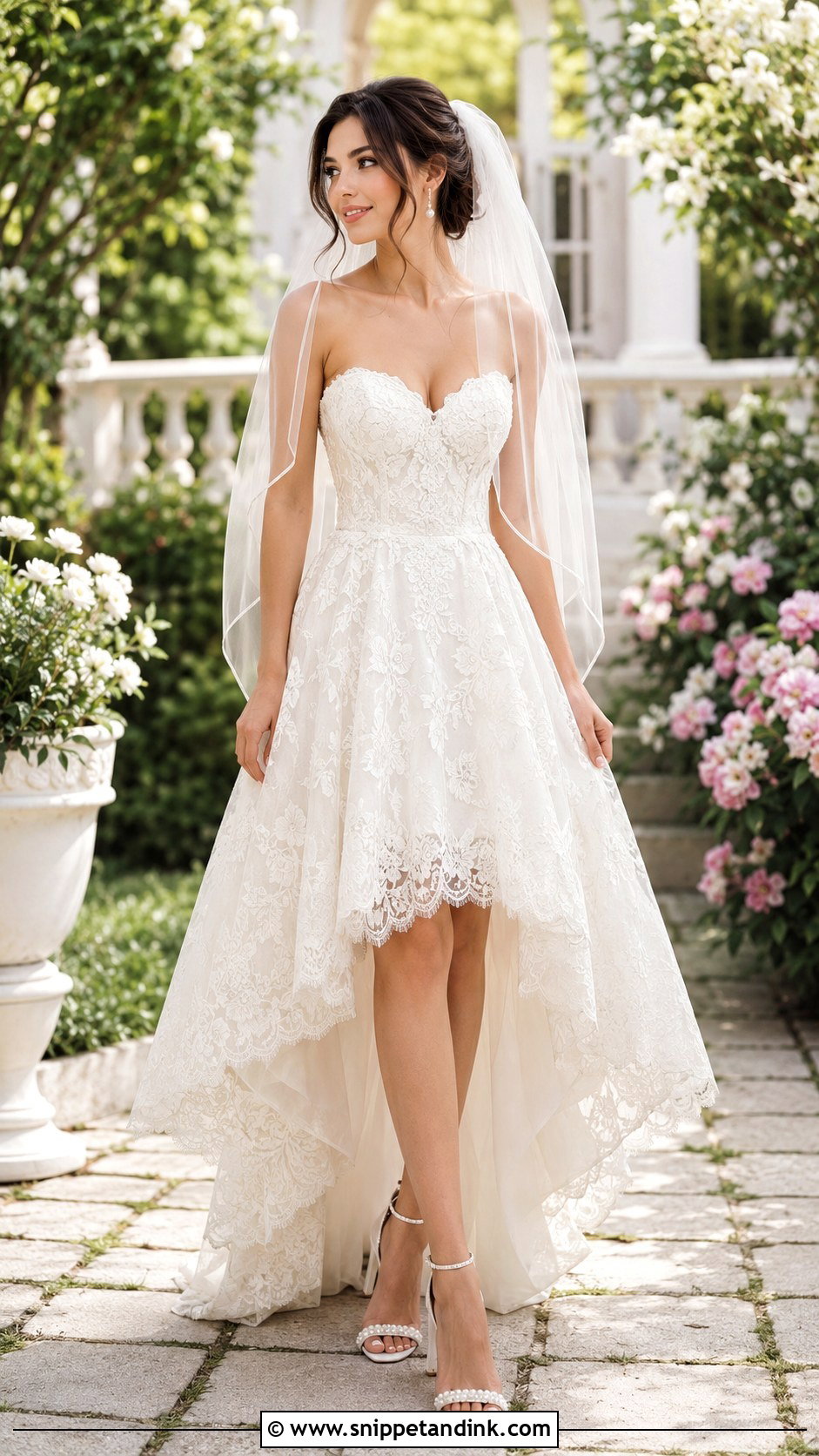
Lace is the forgiving fabric for this cut, because a scalloped edge disguises the curve where the front hem climbs toward the back. An A-line with fitted lace through the bodice and softer layers below, finished near the knee or mid-calf, shows off pearl-trimmed heels without fighting the texture. I keep the rest small: pearl studs, a fingertip veil, a satin clutch, and soft waves or a low chignon. If you want more support, ask for wider straps over a structured bodice. The detail I watch at every hemming appointment is where the lace motif gets cut. A good seamstress lifts the lace border off, shortens the layers underneath and stitches the scallop back on by hand, so the edge still finishes on a flower rather than halfway through one.
2. Strapless Satin Hi-Low Wedding Dress With Bow Heels
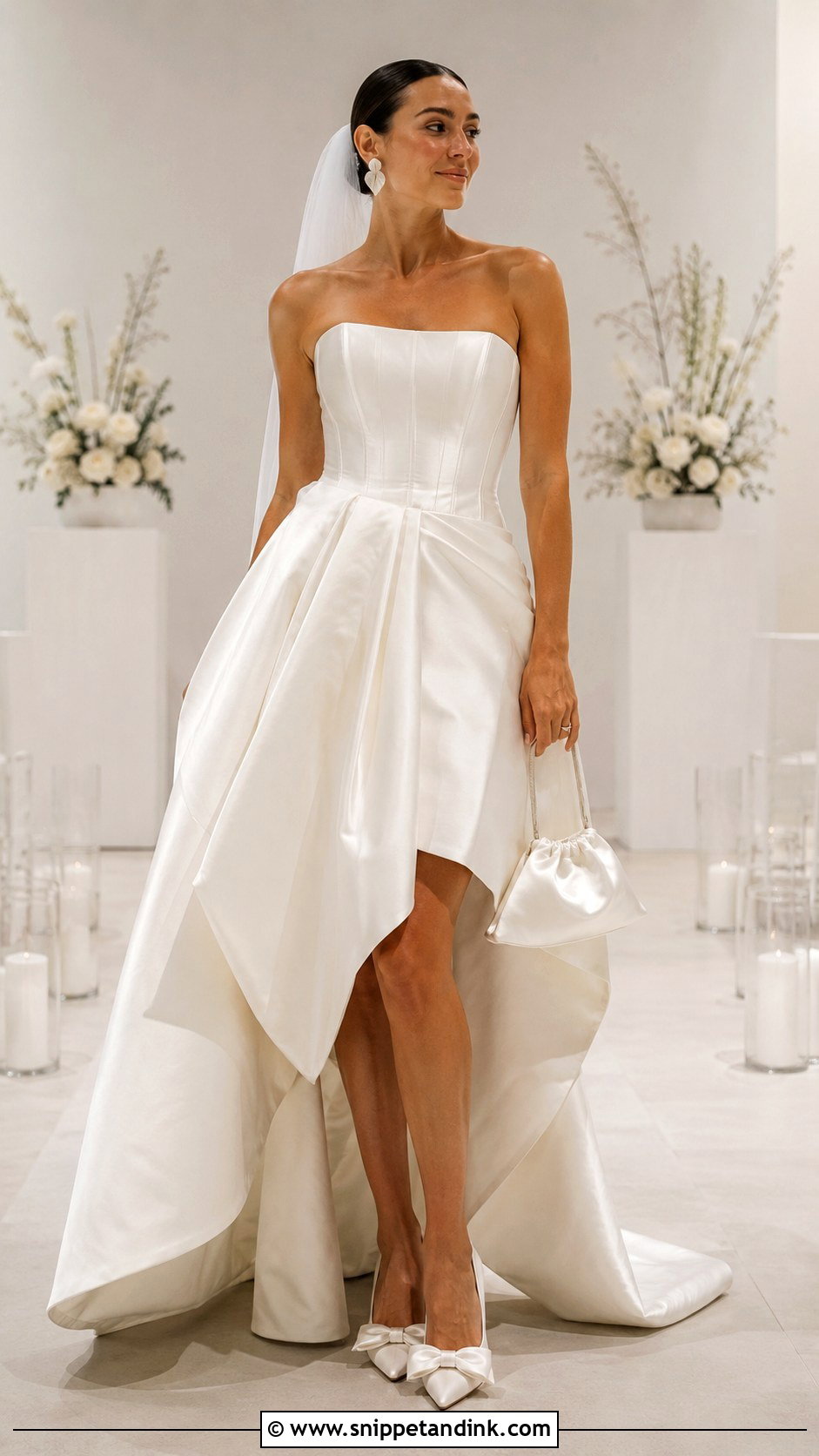
Satin is unforgiving, and I say so up front. It shows a puckered seam, a drag line from a tight zip and any wobble in a hem that was shortened unevenly. Get it right, though, and a strapless satin hi-low reads cleaner than almost anything else on the rail. Insist on a proper inner corset so the bodice is held at the waist, not by a tight edge at the bust, and a pleated or softly folded skirt to balance the longer back. Bow pumps sit right in view under the raised front. A short veil, sculptural studs, a small ivory bag and a sleek bun keep the shoulders as the focus, with a satin wrap on standby for a chilly ceremony.
3. Tulle Bubble Hem Hi-Low Wedding Dress With Crystal Pumps
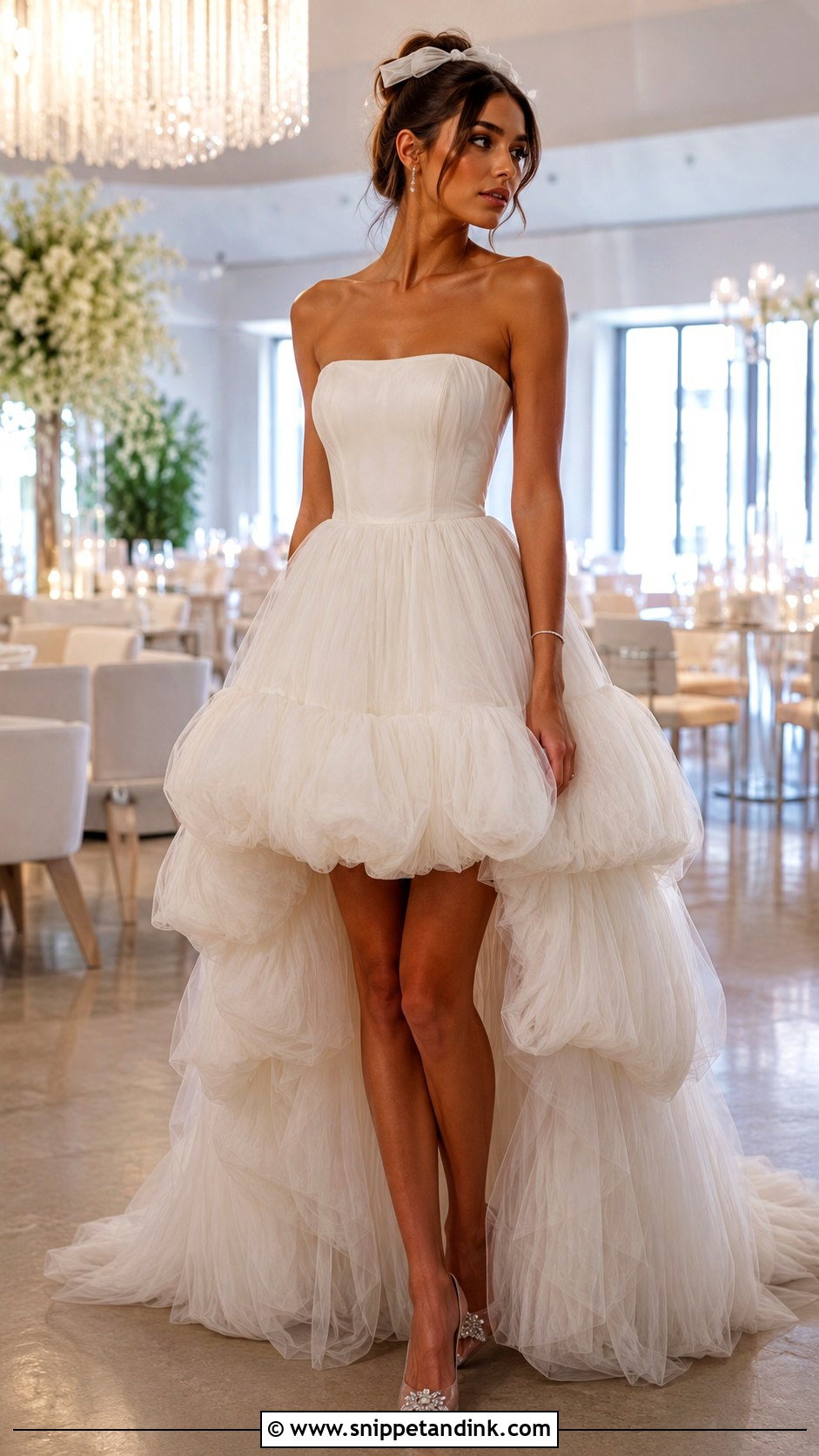
A bubble hem is fun, but it’s also the hi-low I see go wrong most often in fittings. The rounded front is made by tucking the tulle back under itself onto a lining, so if that lining is cut too short the bubble pulls up and sits around the hips like a lampshade. Walk, sit and climb a step in it before you sign off. Keep the bodice fitted so the volume has a clear starting point, then add crystal pumps where the short front draws the eye, a slim tennis bracelet and small drop earrings. A shoulder-length veil or a hair bow suits the youthful proportion far better than a cathedral veil. Nothing reaches your feet, which makes it a brilliant dress for dancing.
4. Long Sleeve Lace Hi-Low Wedding Dress With Bridal Boots
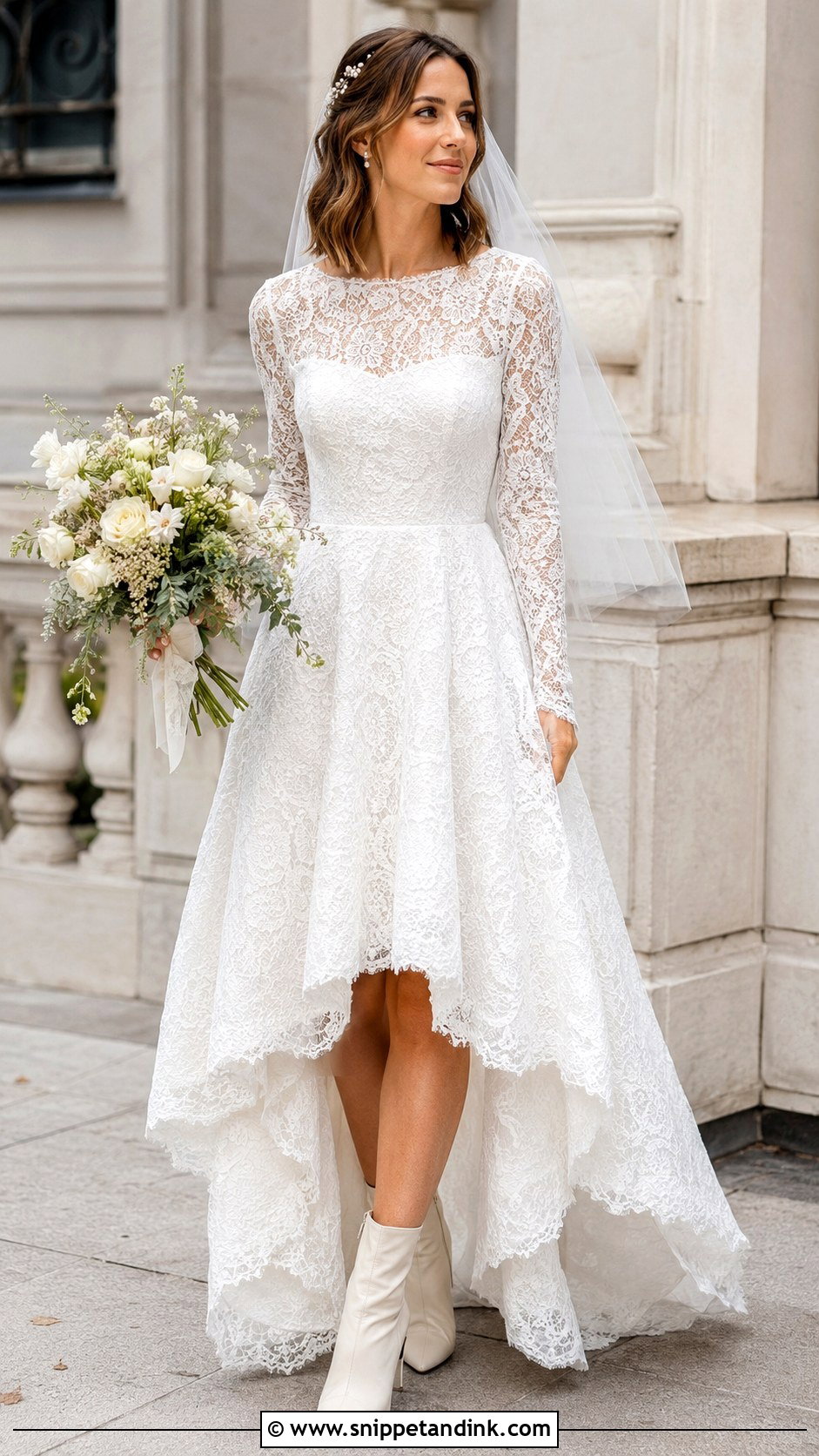
For an autumn or winter date, I’d take this over a strapless gown every time. Fitted lace sleeves over a lined bodice keep you warm through outdoor portraits, and pointed ankle boots in ivory leather or satin cover more than pumps do. The boot is where people slip up: the shaft should finish below the front hem with a little leg showing between, otherwise the boot top cuts a hard line across the calf. Raise your arms and hug someone in the fitting room, because lace sleeves set too tight drag the whole bodice upward. A chapel veil suits a moderate train. For a lighter finish, I’d choose a shoulder veil, pearl pins and a tailored white coat for the photos outside.
5. Off Shoulder Hi-Low Wedding Dress With Ruffled Sandals
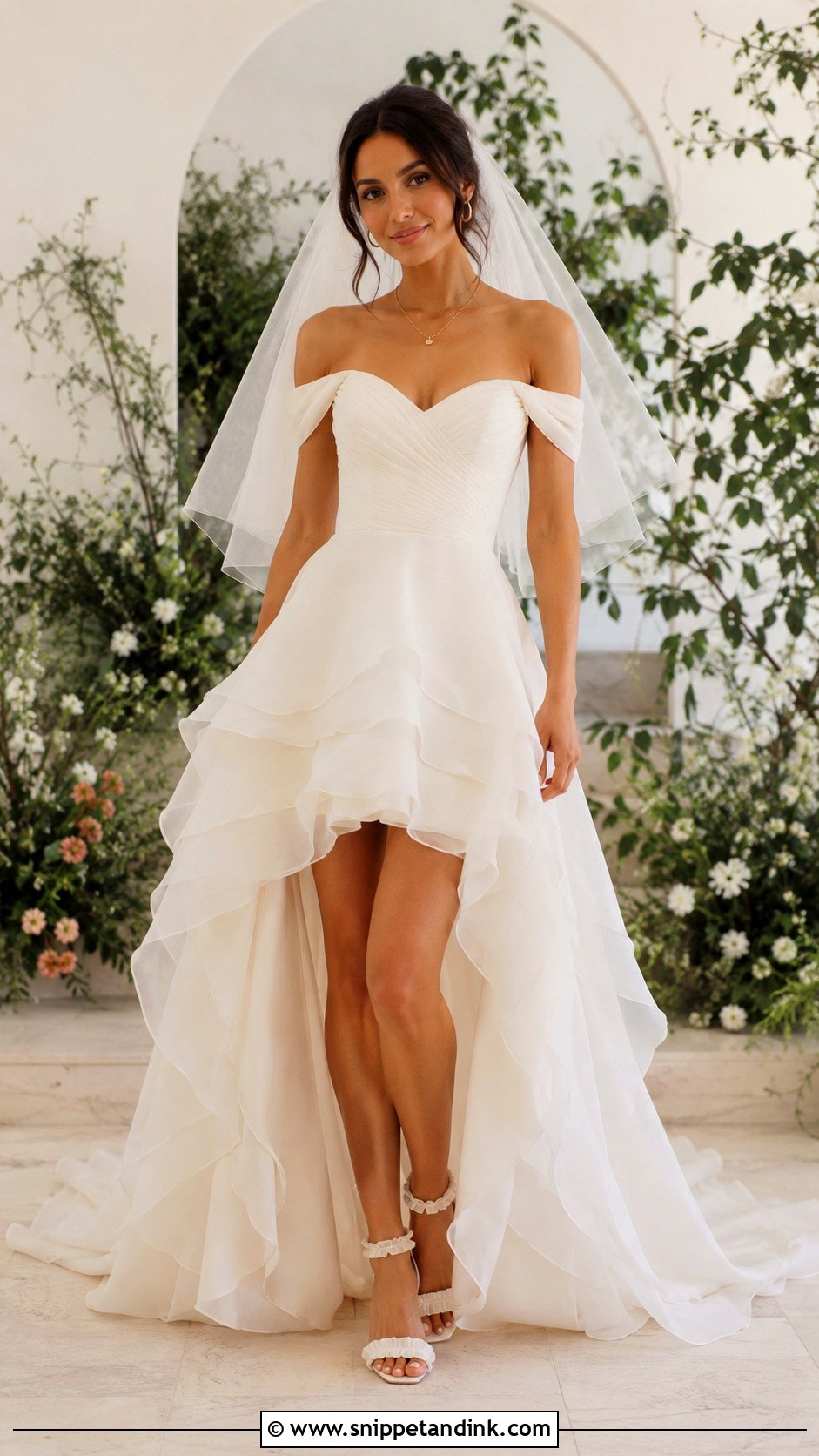
Off-the-shoulder necklines drift down over a long day, so the first thing I ask is what’s holding this one up. Look for hidden inner straps or real corsetry; a neckline relying on elastic alone needs hitching every time you lift your arms. Organza ruffles cascading from the shorter front into the back train give texture from every side, and slim ruffled sandals echo them without doubling up. Go light on jewelry with a fine pendant, small hoops and a sheer elbow-length veil. A loose updo keeps hair off the shoulders. Keep the bouquet narrow so it doesn’t sit over the spot where bodice meets skirt.
6. Minimalist Crepe Hi-Low Wedding Dress With Slingback Heels
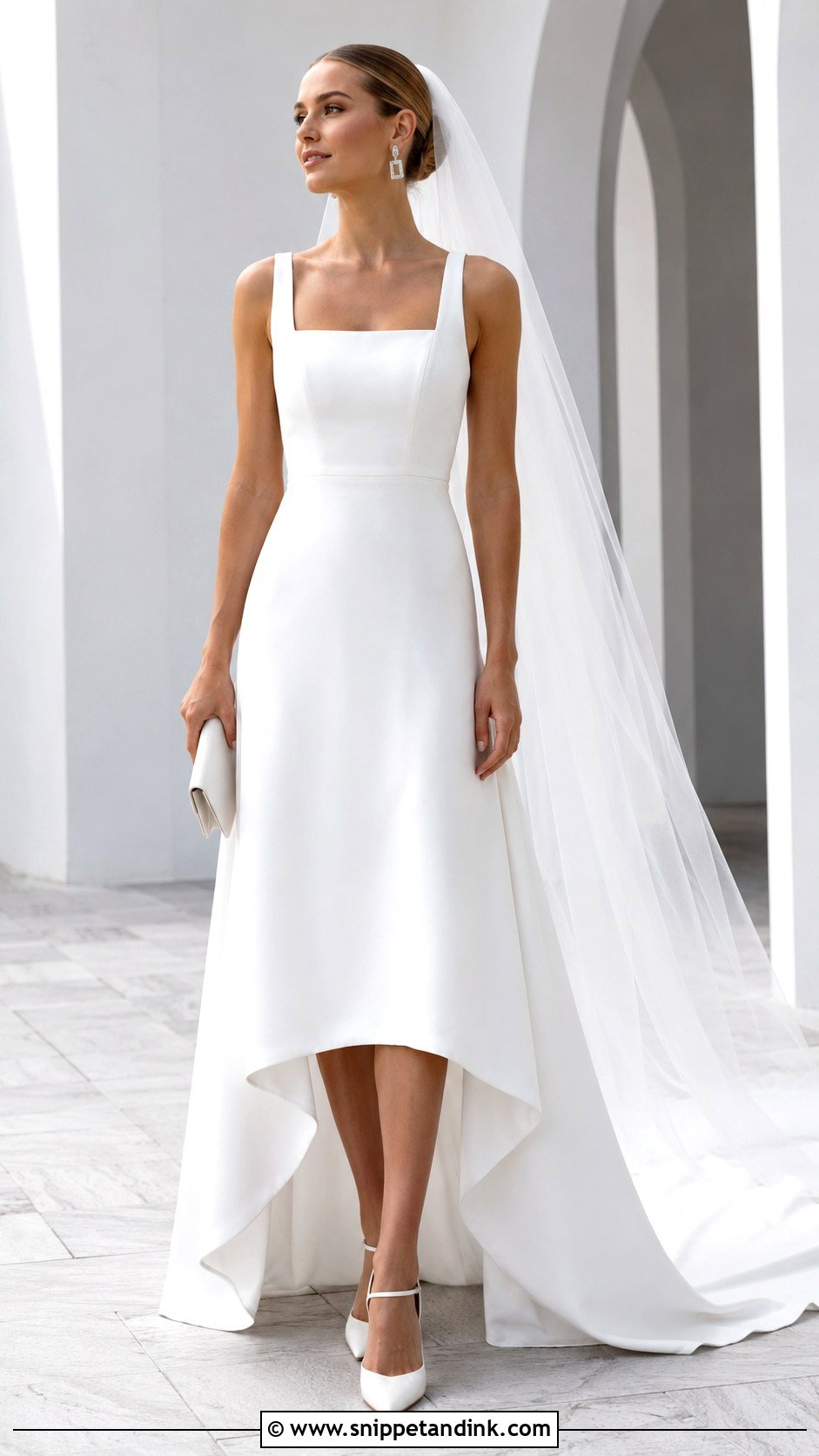
Crepe has no embellishment to hide behind, so the tailoring is the whole dress. A square neckline, a defined waist and a front hem at the lower calf give a calm proportion, and the back can fall into a clean sweep train. Pointed slingback heels carry the line down and stay on your feet far better than open-back mules on a long night. Add geometric earrings, a smooth clutch and a raw-edge veil, with hair in a sleek low bun. In the fitting I always look at the hip from the side. Heavy crepe that’s a fraction too tight creases horizontally across the front the moment you stand still.
7. Floral Applique Hi-Low Wedding Dress With Pastel Heels
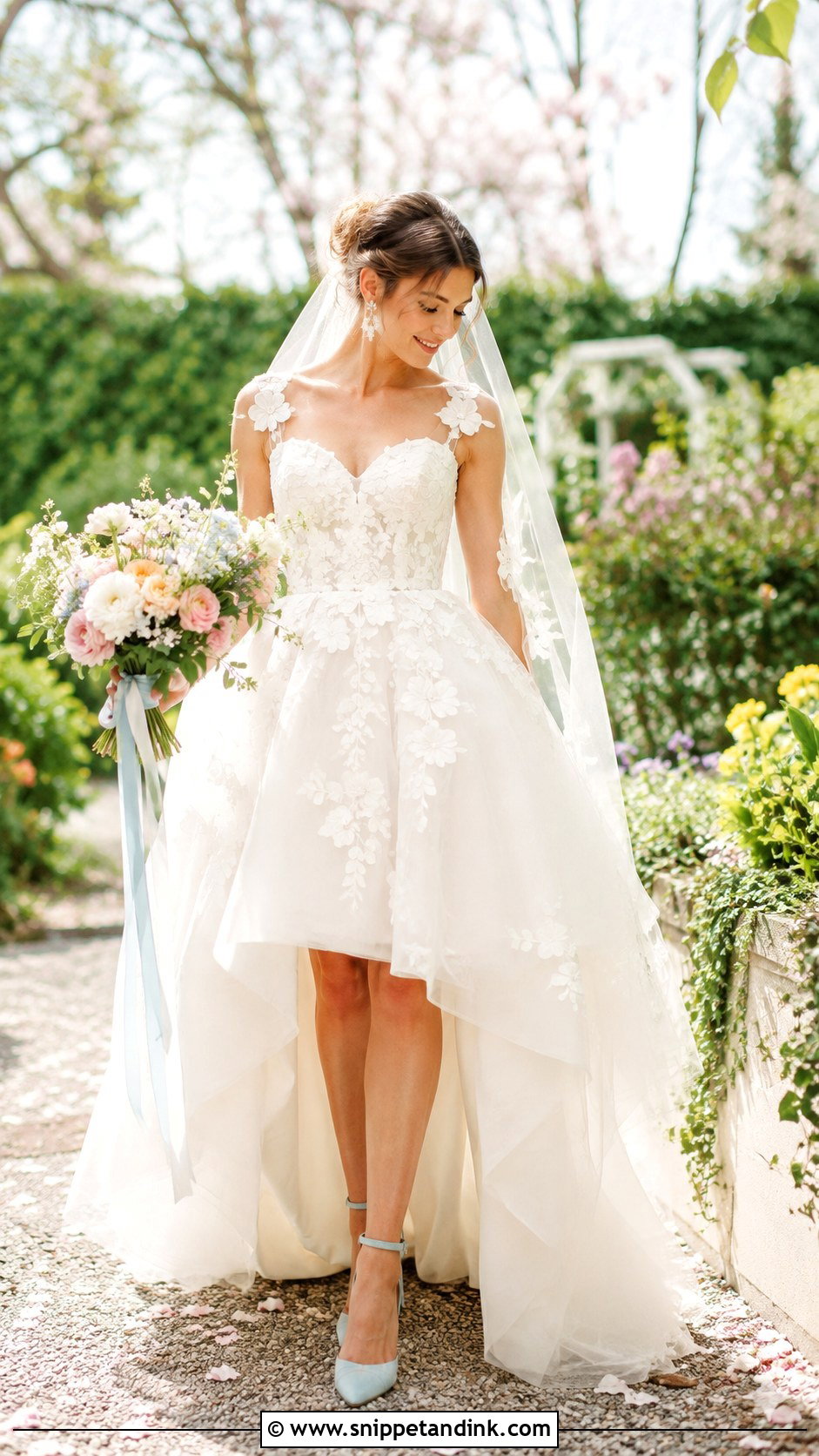
Appliques should thin out as they travel toward the hem. When they stay dense all the way down, the hi-low curve disappears under decoration and the skirt just looks uneven. Choose a sheer-overlay bodice with secure lining and let the flowers scatter lightly onto the skirt. Pale blue or blush heels add a quiet bit of color under the shorter front; repeat it once, in earrings or a bouquet ribbon, and stop there. A fine tulle veil with a few scattered appliques works if the bodice is restrained. Before you order, ask exactly where the front will be shortened, because any applique sitting on that line has to be removed and re-placed by hand.
8. Basque Waist Hi-Low Wedding Dress With Pointed Pumps
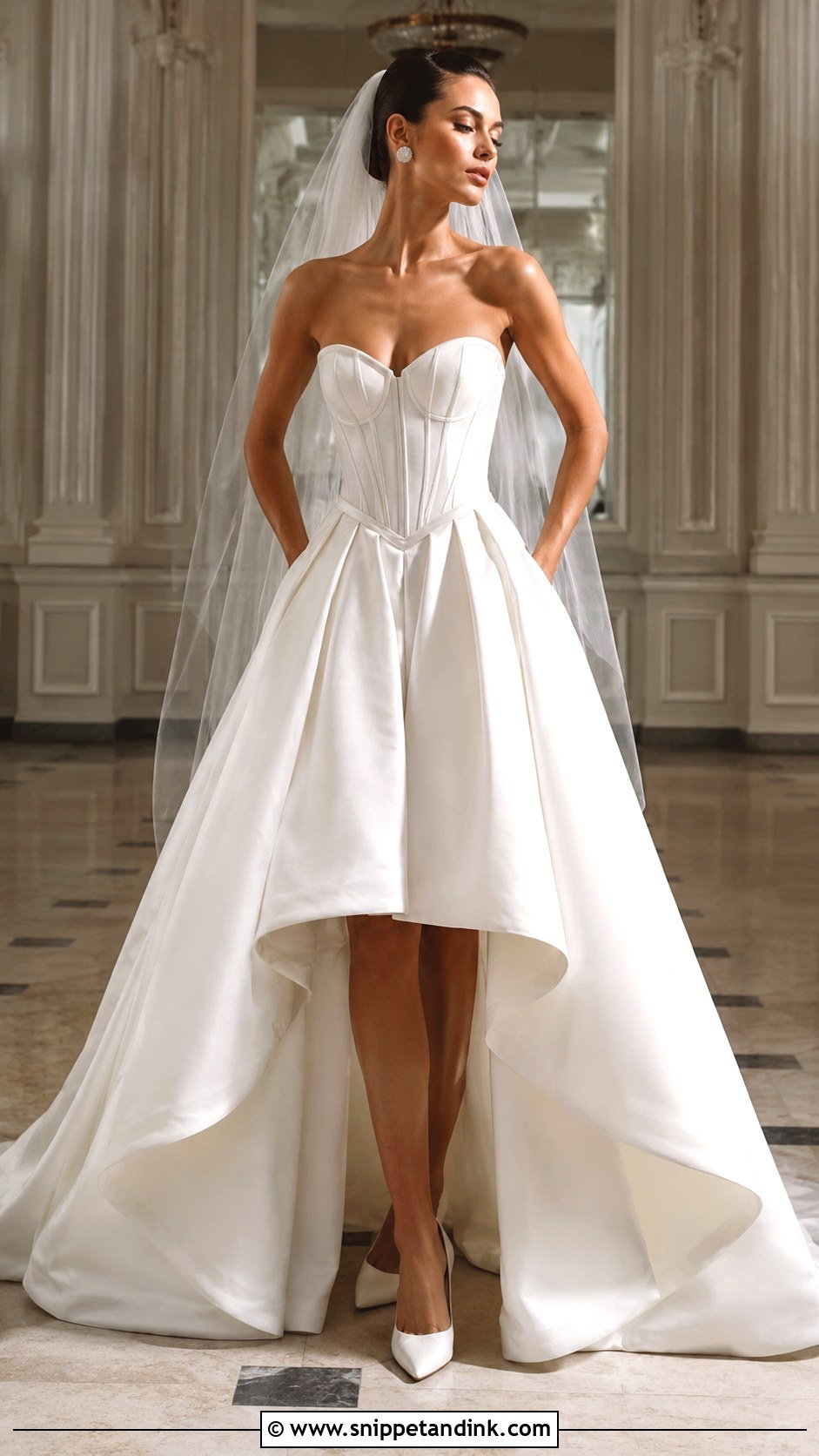
A basque waist dips into a V below the natural waist, which lengthens the torso before the skirt opens out. It’s a strong shape and it needs fabric that can hold it, so think taffeta, mikado or crisp satin rather than anything that drapes. Look for a corseted bodice with boning you can actually breathe in, then add pointed ivory pumps. A cathedral veil only works if the train is long enough to carry it; otherwise a fingertip veil and statement studs do the job, with an updo that shows the bodice seams. The thing I check is the point of the V when you sit. Set too low, it folds and digs into your lap all through dinner.
9. Halter Satin Hi-Low Wedding Dress With Statement Earrings
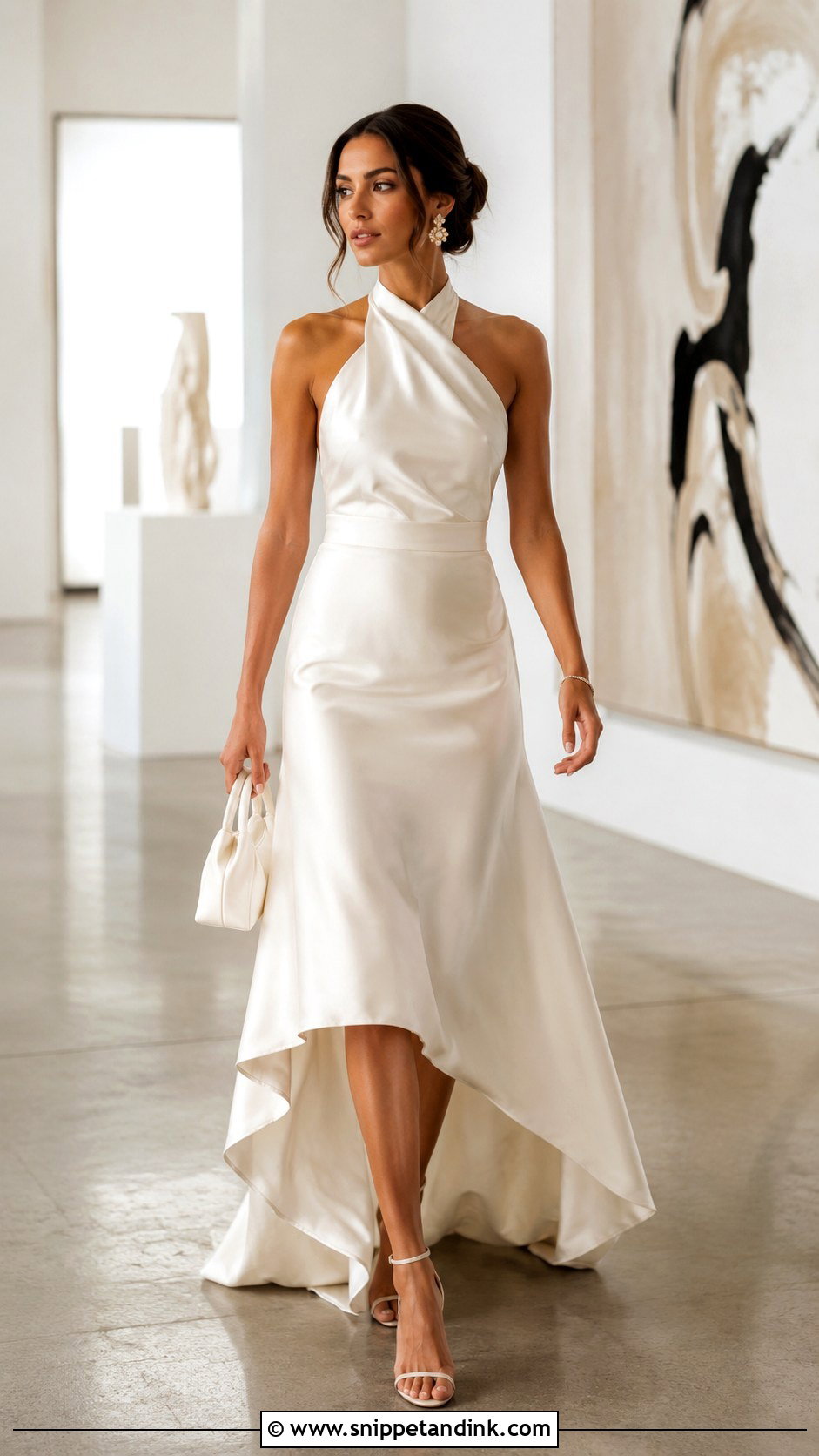
Halters are comfortable right up until the neck strap is cut a fraction short, and then you feel it by the speeches. I have brides turn their head side to side and raise both arms at the fitting, because the strap shouldn’t tug and the armhole shouldn’t gape. Fluid satin gives a softer effect, while mikado holds a more architectural skirt. A mid-calf front hem gives strappy heels room without making the dress feel short. Since the neckline already frames your face, skip the necklace and let statement earrings take over, with a slim bracelet, a satin bag, a simple comb and a high bun or smooth ponytail.
10. One Shoulder Organza Hi-Low Wedding Dress With Metallic Sandals
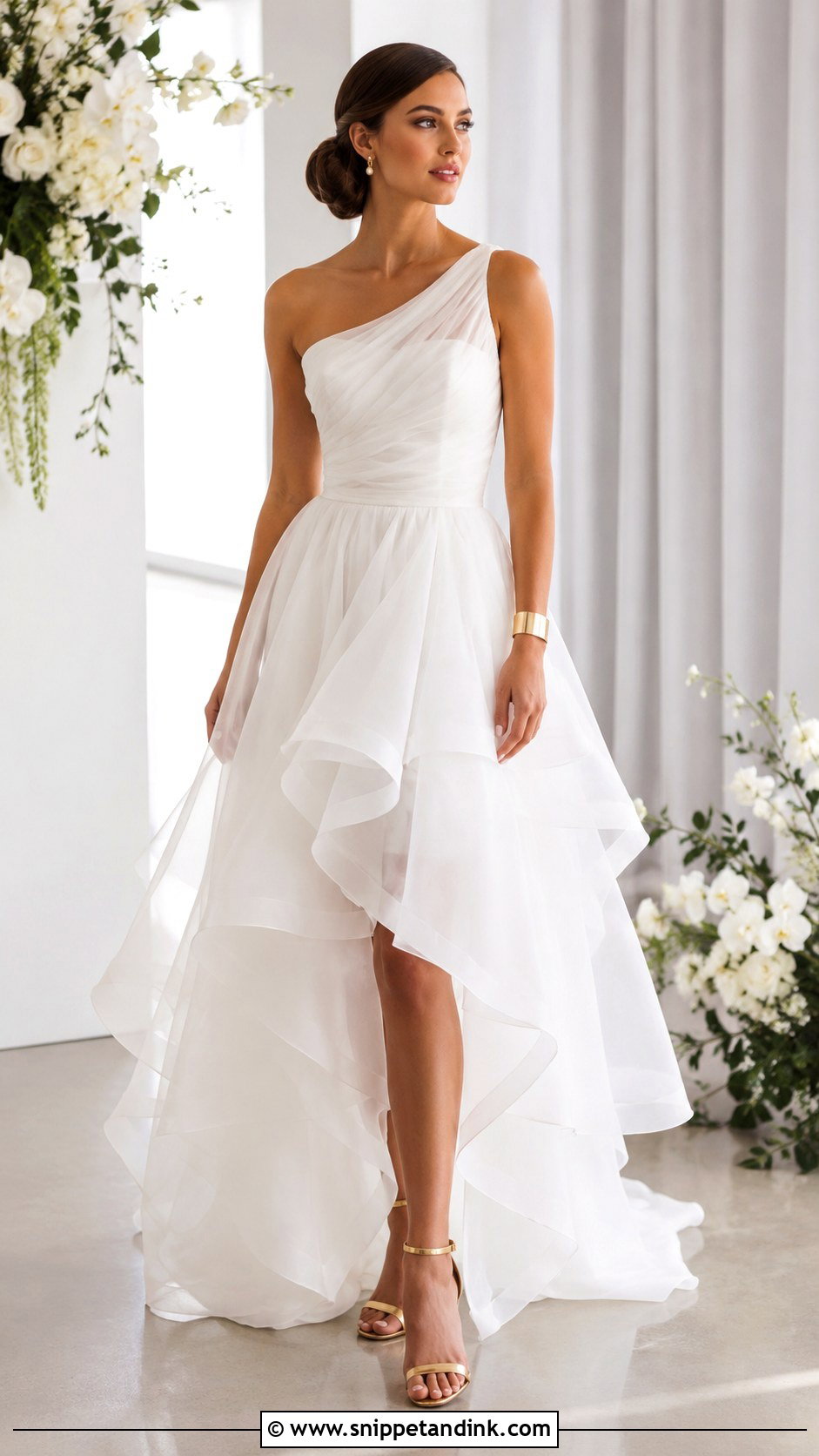
Organza is crisp and sheer, which is why it can drape into a sculptural one-shoulder bodice and still feel airy. The catch is that it creases at the slightest crush, so plan to steam it on the morning rather than trusting it straight out of the garment bag. Metallic sandals in soft silver or pale gold suit the exposed front; repeat the metal once, in a cuff or small earrings. I often leave the veil out with this neckline. A side bun placed opposite the shoulder strap balances the asymmetry, and a compact bouquet keeps any large bow in view. Ask your tailor to check the skirt from all sides so the climb from front to back looks deliberate.
11. Boho Chiffon Hi-Low Wedding Dress With Block Heels
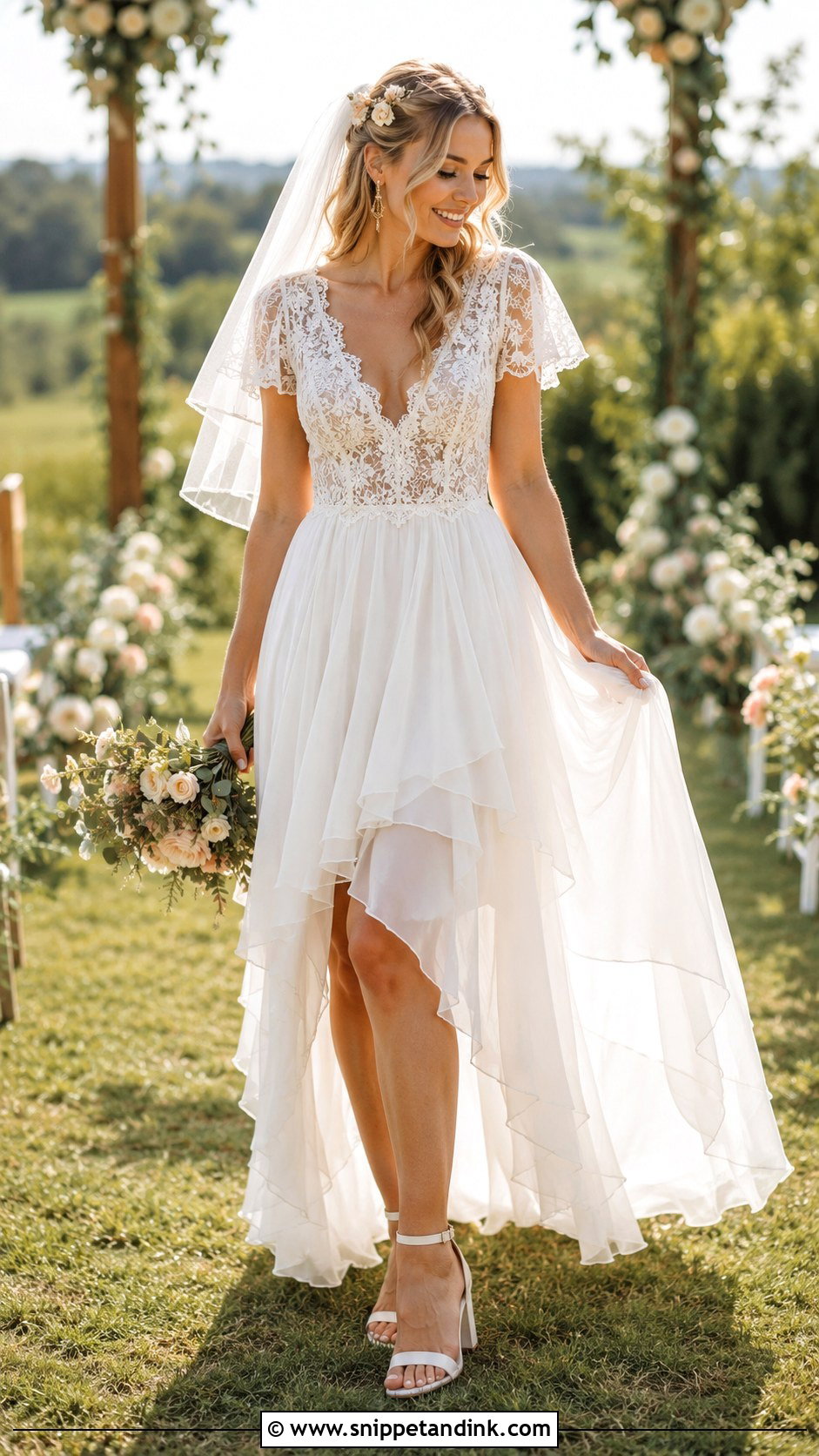
Chiffon is the fabric I’d pick for an outdoor hi-low, with one warning. It’s so light that a breeze lifts the short front and wraps the long back around your legs, so test it outside before the day. A softly fitted lace bodice, flutter sleeves and a layered chiffon skirt with a moderate front hem let you move freely without looking casual. Suede or fabric-covered block heels won’t sink into a lawn the way stilettos do. A floral comb and fine gold earrings are plenty, since heavy pieces drag the fabric down. Loose waves or a textured braid suit it. Get the back bustled with hooks or loops that will hold when you dance.
12. Beach Hi-Low Wedding Dress With Flat Sandals
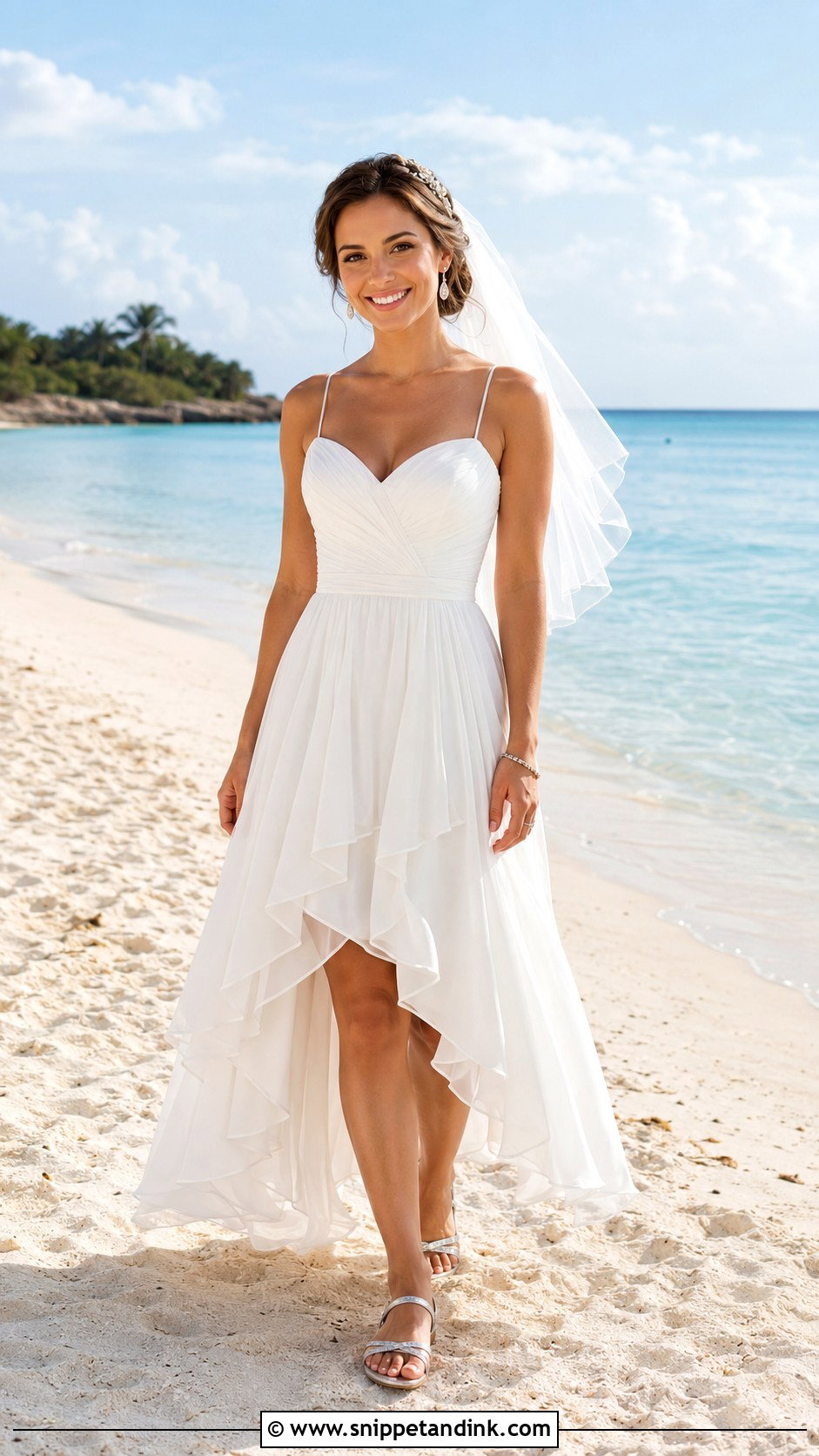
On sand, flats aren’t a compromise. A heel sinks, tips you forward and makes the raised front swing awkwardly, while a flat sandal lets the hem hang the way it was cut. Choose chiffon or soft tulle with the back barely grazing the ground; anything longer drags damp sand up into the layers, and that grit is miserable to brush out. Pearl or shell-inspired details read better in sea light than heavy crystals. Keep the veil short so the wind can’t turn it into a sail, and wear a braided updo or low ponytail. A wrist loop sewn into the back hem makes the walk from ceremony to dinner much easier.
13. Courthouse Hi-Low Wedding Dress With Classic Pumps
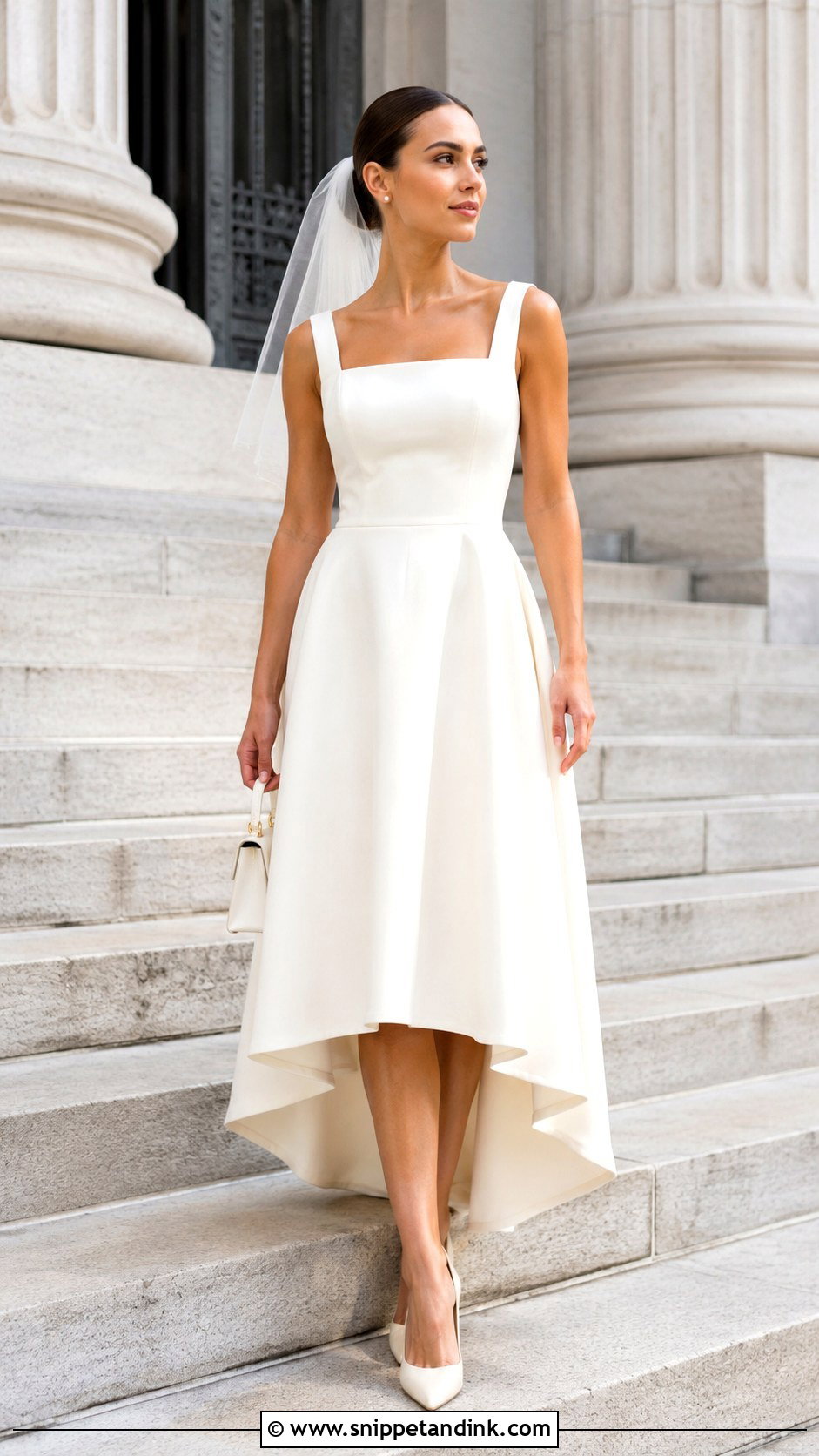
City halls come with stairs, revolving doors and wooden benches, so I size the back hem for those, not for a cathedral aisle. A knee-to-midi front hem with a softly extended back gives enough drama for photos on the steps without catching in a doorway. Structured crepe, satin or mikado holds its shape in transit, and a bateau or square neckline suits the setting. Classic pumps, pearl studs, a short veil and a top-handle bag big enough for your paperwork cover the essentials; a tailored blazer helps on a cold morning. Practice sitting down at home. The back should fan out behind you, not bunch underneath you on the bench.
14. Sweetheart Corset Hi-Low Wedding Dress With Embellished Heels
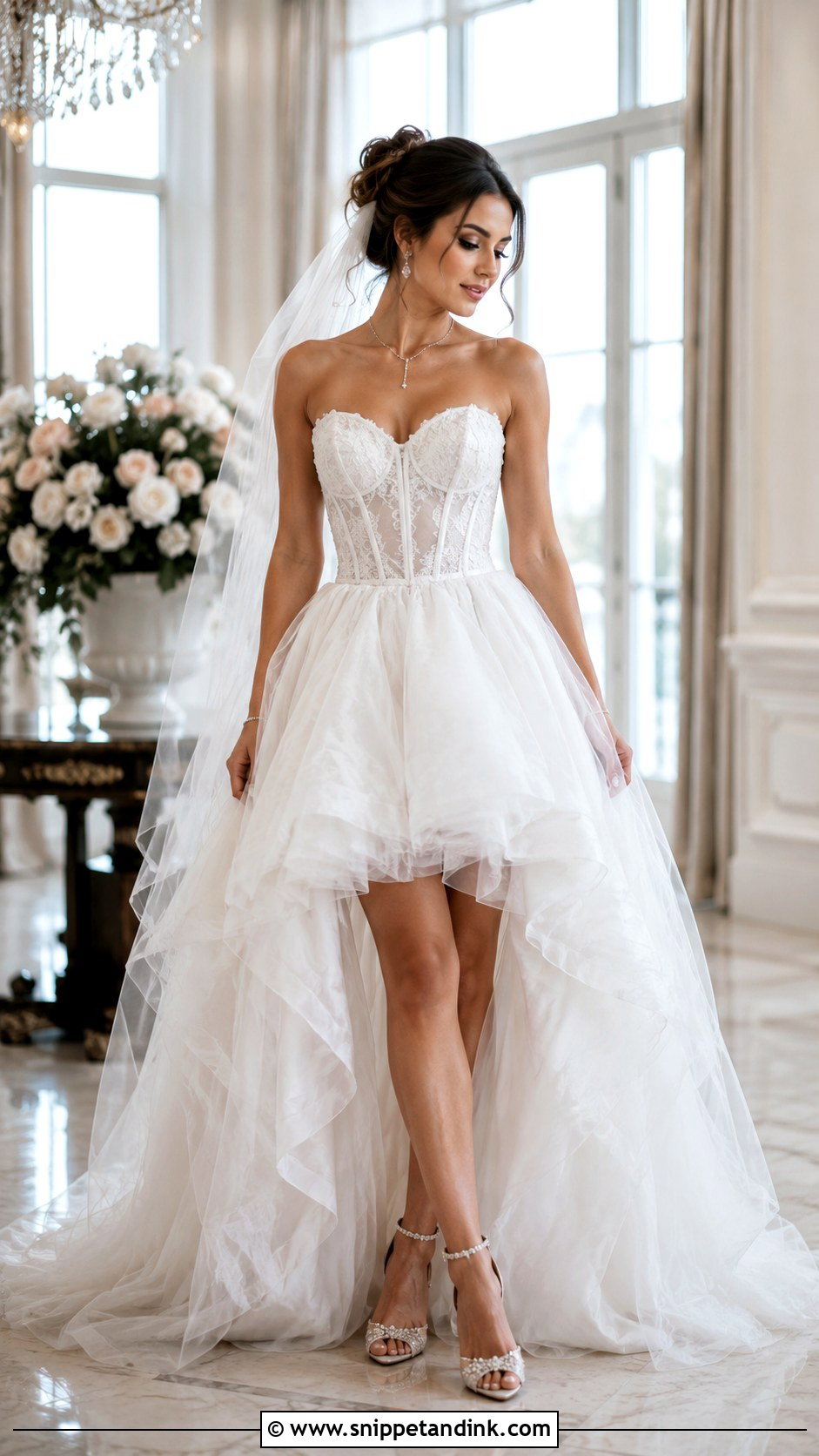
A sweetheart corset depends on the cups and waist being fitted to you, not to the sample. Off-the-rack boning sits in the wrong place on most bodies, so expect your fitter to move or shorten it. When it’s right, you can sit, bend and take a full breath without the bodice slipping or pressing. Layers of tulle or organza soften the structured top. Embellished heels are worth the spend here because the hem puts them on show; pick crystals or pearls that echo the bodice rather than starting a separate theme. A fine necklace, drop earrings and a sheer veil set under a soft updo finish it, and removable straps or a light bolero add coverage for a religious ceremony.
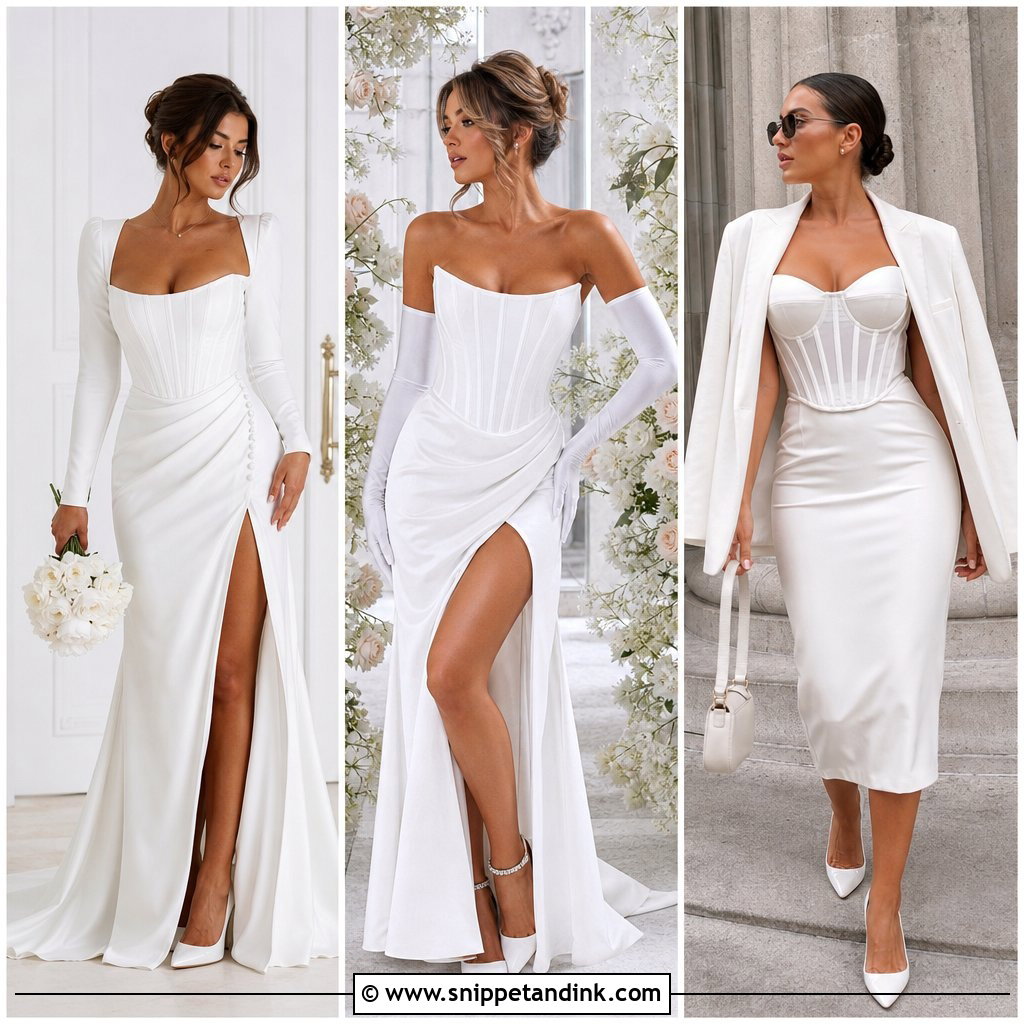
15. Plus Size Hi-Low Wedding Dress With Supportive Block Heels
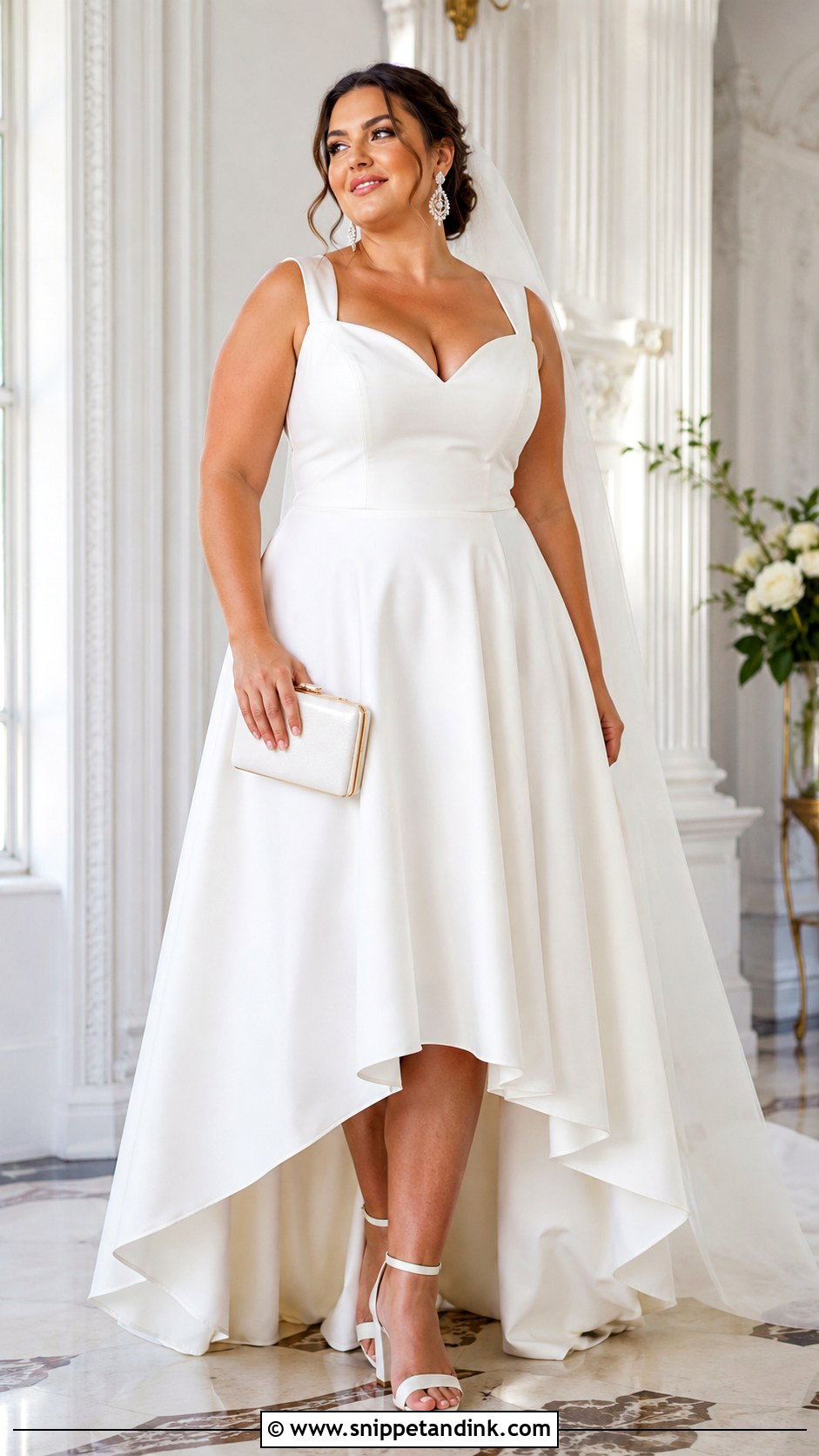
Support comes from inside the dress, so I look at construction before style. Wide straps, properly shaped cups and internal structure that follows your proportions do more for you than any cut of skirt. An A-line with a smooth waist and a graduated hem keeps the shape graceful without extra bulk. Decide where on your leg you want the front to stop and have the hem set there, instead of accepting the factory length. Block heels will carry you through ten hours far better than narrow stilettos, and bold earrings with a simple veil keep the attention up near your face. Ignore the number on the label. Bridal sizing runs small, and the alterations are what make it fit.
16. Modest Hi-Low Wedding Dress With Closed Toe Heels
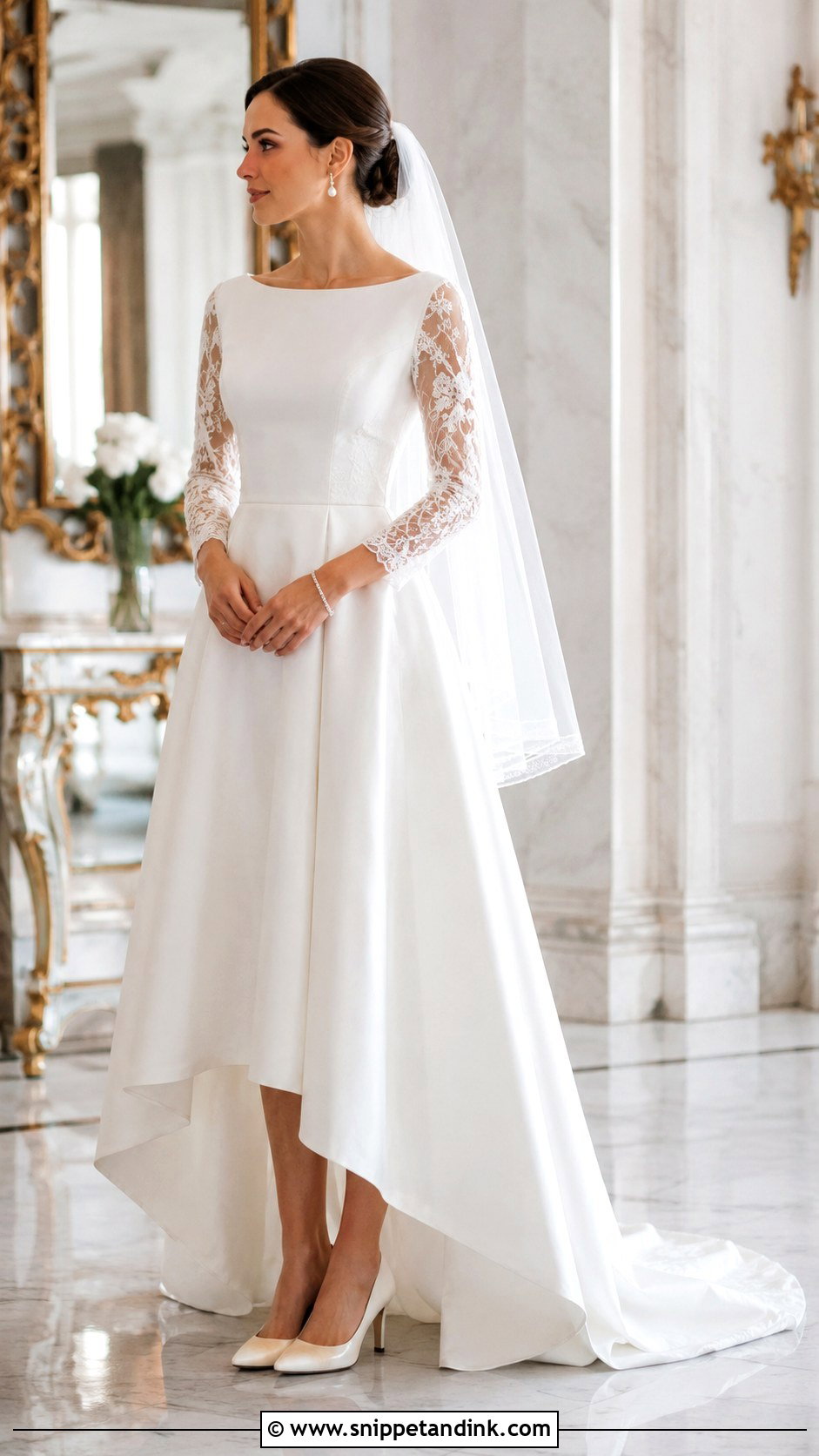
Coverage doesn’t have to look heavy when each piece is chosen on purpose. A bateau neckline, three-quarter or full-length sleeves and an opaque bodice pair well with a front hem at the lower calf, which keeps the asymmetric shape while staying modest. Closed-toe heels in satin or smooth leather finish it, especially in a cooler season. I always check the lining in two kinds of light, because a bodice that’s opaque under shop spotlights can turn see-through in direct sun. If the sleeves are lace, keep the skirt plain and the train moderate. A veil set beneath a neat bun, pearl earrings and a narrow bracelet are enough.
17. Vintage Tulle Hi-Low Wedding Dress With Mary Jane Shoes
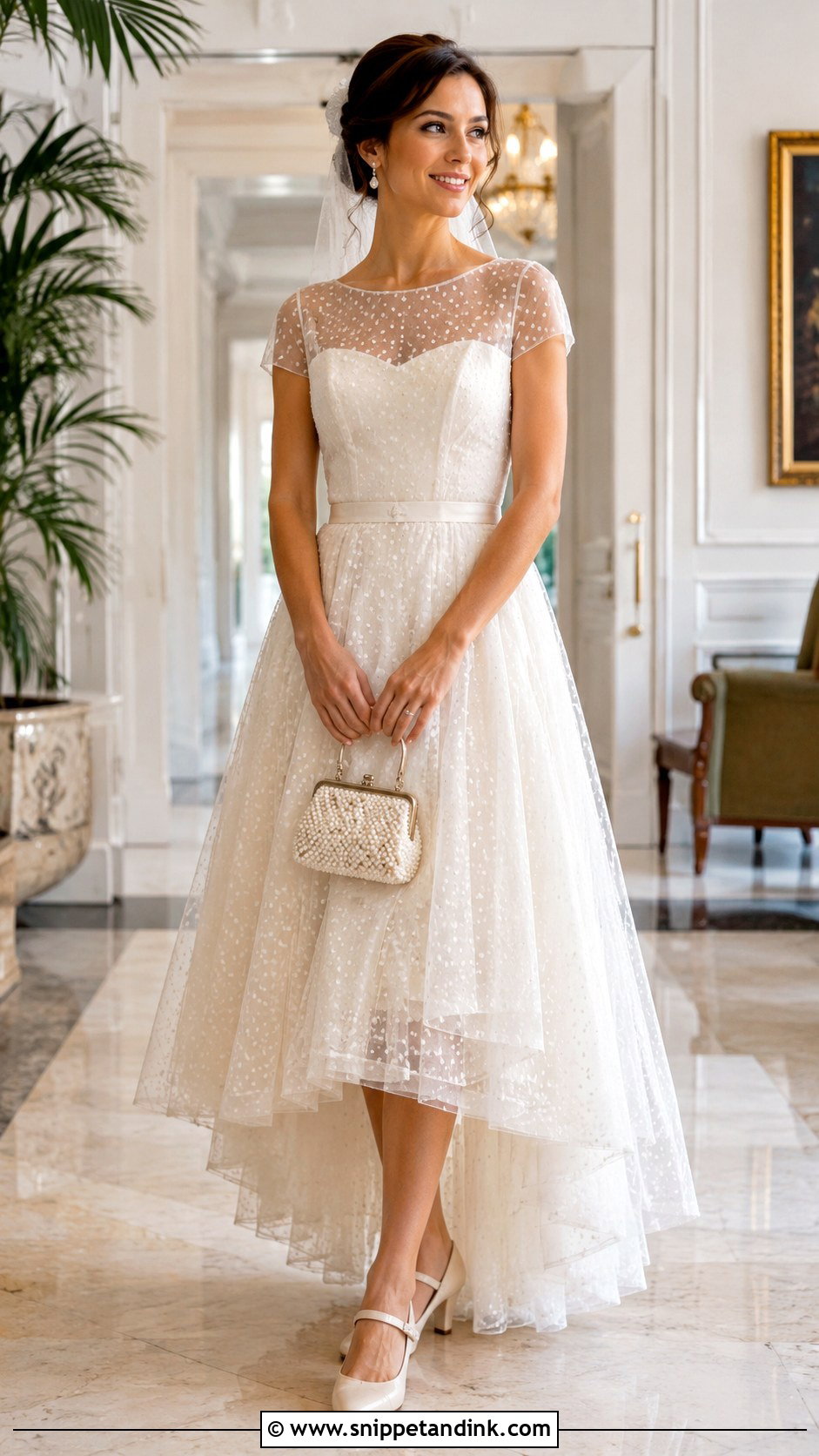
Dotted tulle and a tea-length front are the quickest route to a 1950s feel, and the Mary Jane strap keeps your shoe on through a long reception. Look for a fitted bodice with a higher neckline, cap sleeves or fine straps, over a softly layered skirt whose back skims the ankle. A birdcage or short tulle veil, pearl buttons and a petite top-handle bag fit the period. My one rule with retro bridal looks is to pick two references and stop. Match every accessory to one decade and the outfit tips into costume.
18. Detachable Overskirt Hi-Low Wedding Dress With Reception Heels
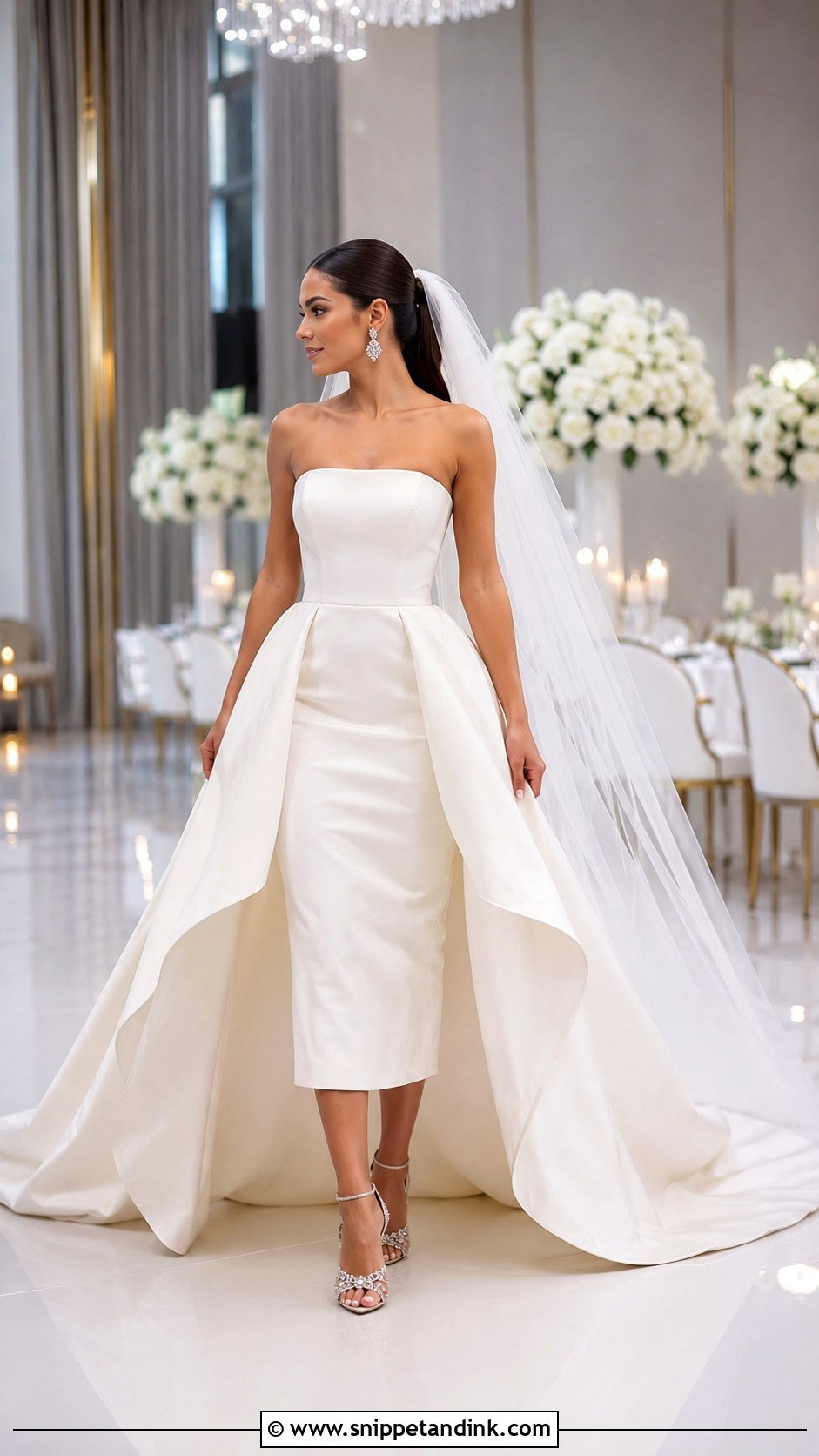
An overskirt gives you two dresses for one set of fittings. The base is a fitted short or slim column dress; the structured overskirt rises in front and trails behind for the ceremony, then comes off for dancing. The fastening makes or breaks it. Hidden hooks, snaps or a concealed button band should sit flat at the natural waist with no twisting or sagging when seen from behind. Teach a bridesmaid how it comes off before the day, because at the reception you’ll have a crowded room and a few minutes. Pick earrings and a veil that suit both versions, then swap the ceremony pumps for lower embellished heels with a sleek ponytail or bun.
19. Champagne Hi-Low Wedding Dress With Gold Heels
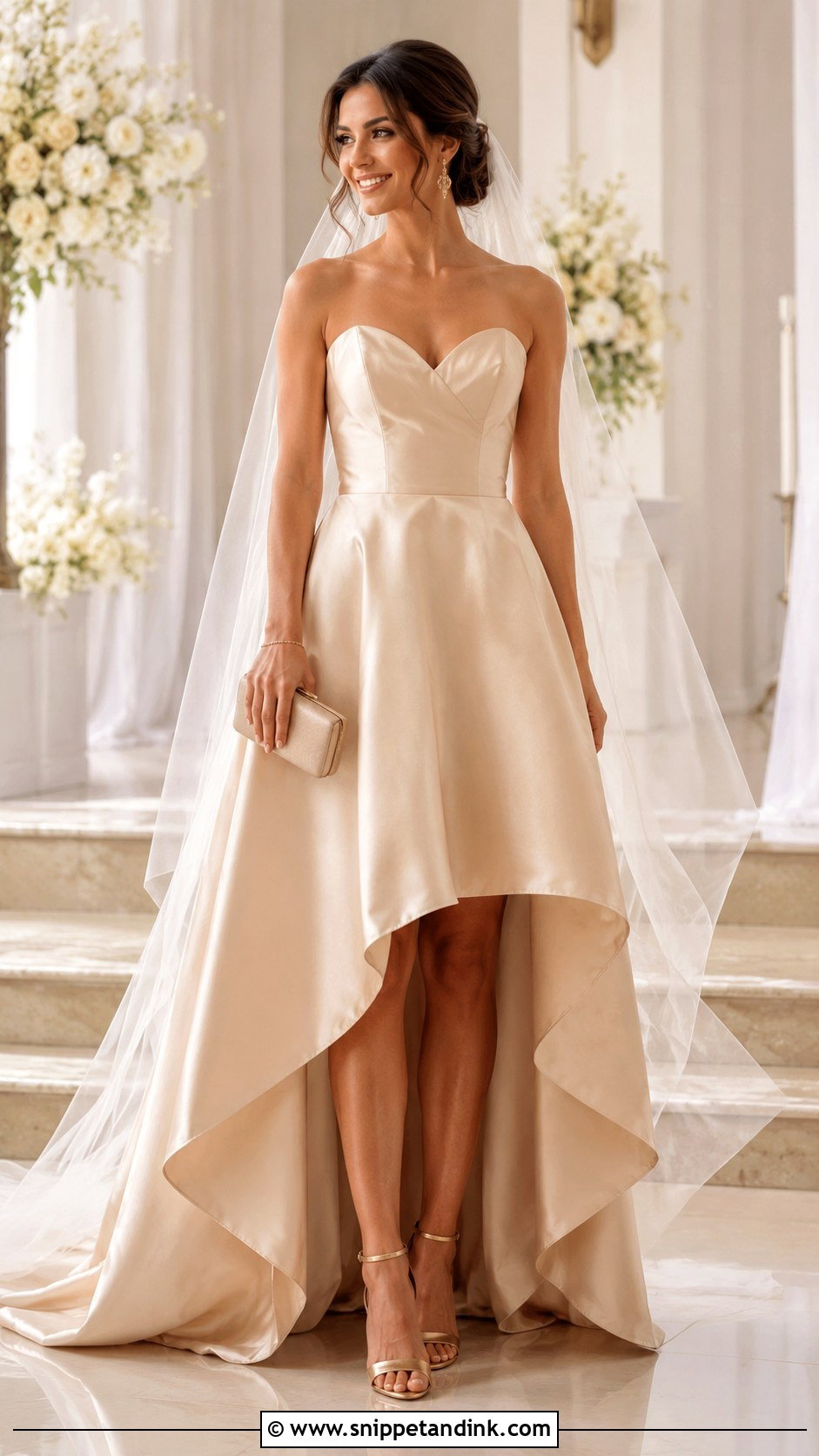
Champagne isn’t one color. Some versions lean pink, some lean yellow, and the wrong one can make skin look sallow, so I compare the fabric against the inside of your wrist by a window, never under shop lighting. A structured bodice and flowing hi-low skirt show the shade shifting as the fabric moves. Gold heels sit warm under the shorter front; add gold earrings and a delicate bracelet but keep the clutch neutral. A champagne-edged veil matches well, and plain ivory can work if the tones are close. Bring every accessory to the final fitting so all the neutrals are seen together.
20. Black And White Hi-Low Wedding Dress With Black Pumps
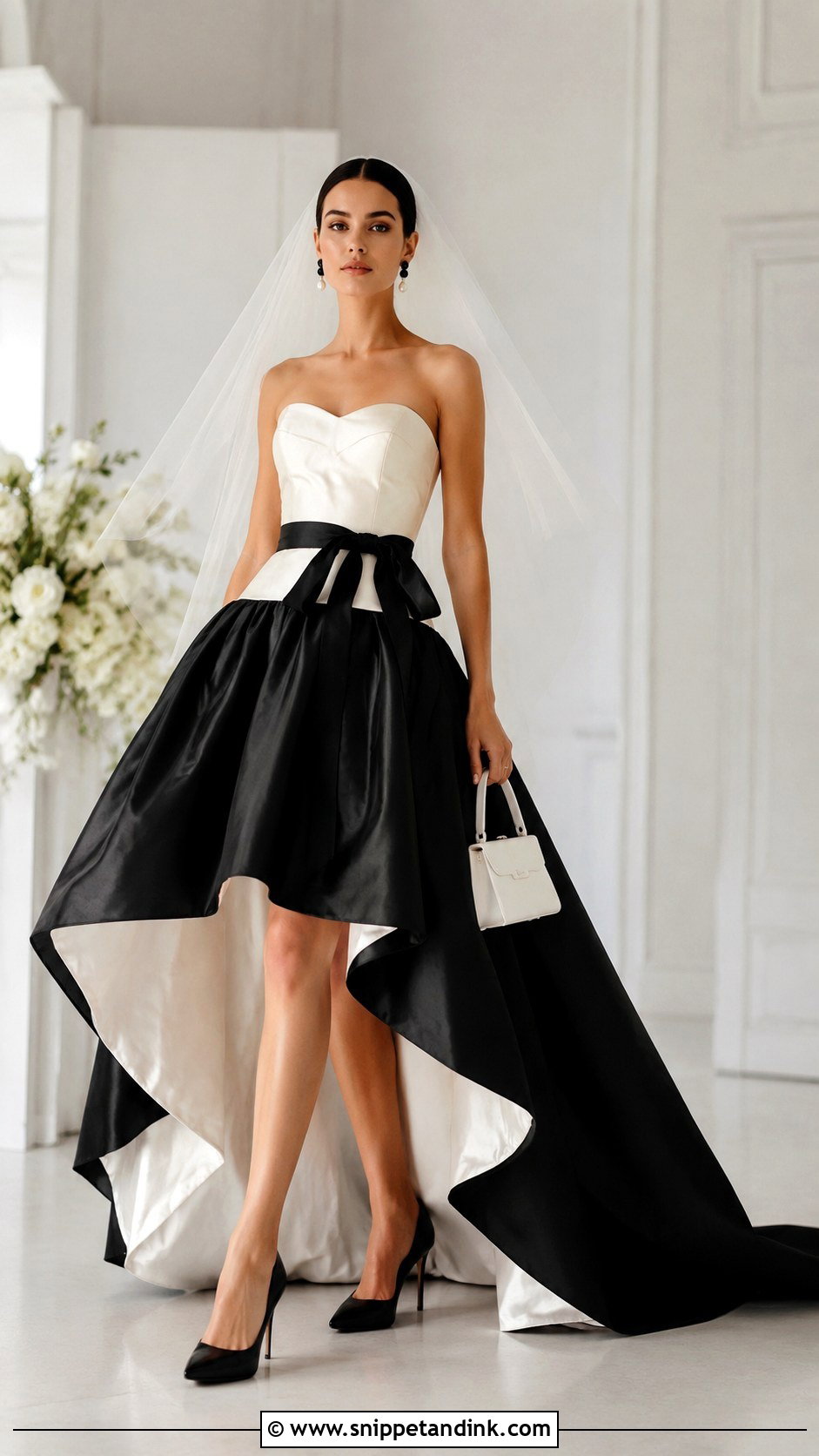
A white hi-low with carefully placed black accents is graphic, so placement is everything. A black waist bow, a velvet shoulder or a narrow trim defines the silhouette, while a band in the wrong spot chops you in half. I always step behind the bride to judge this one, because the train is where a dark detail either frames the line or breaks it. Sleek black pumps make the visible shoes part of the design. Add black-and-pearl earrings, a compact white bag and a plain veil so the look stays bridal, and cap the palette at black, white and one metal.
What an Exposed Front Hem Goes Through on the Day
A floor-length gown hides a scuffed hem. A hi-low puts it at knee height, where every grass mark, drink splash and makeup smudge gets noticed. I pack a small kit for exactly this: a handheld steamer for creased organza or chiffon, a stick of white tailor’s chalk to soften a mark on matte fabric, a lint roller and clean white cloths. On silk satin I don’t rub at anything on the day, because water and friction leave a ring that’s harder to remove than the original spot.
Afterward, before the dress goes into storage
Get the gown to a specialist cleaner within a few weeks. Spilled champagne and sugary drinks dry clear, then slowly oxidize to brown spots months later, and the exposed front catches more of them than a long skirt would. Ask for the hem to be checked for small tears where a heel caught it. Store it flat or folded in acid-free tissue inside a breathable cotton box or bag, away from light, and never in the plastic sleeve it came home in, which traps moisture and can yellow white fabric over the years.
Where Your Front Hem Should Actually Land
Start from the hem. Decide how much leg and shoe you want on show, then let that line pick your shoes, veil and train for you. Flowing chiffon suits a relaxed outdoor day, while mikado, satin and layered tulle give more structure. Because the diagonal hem is the focal point, alterations matter more than with a floor-length gown, so take your actual shoes and underwear to every fitting. Lace, crepe, a warm shade or a detachable overskirt: the right one is the version you can walk, sit and dance in without thinking about it.
You'll Like These Ideas:


Leave a Reply