
A tulle sleeve adds coverage without weight, and that’s why I reach for it so often when a bride wants arms covered but dreads looking wrapped up. The same net can be almost invisible as an illusion sleeve, gathered into a loose bishop, puffed at the shoulder, or made as a separate piece that comes off before the dancing. Sleeves also do structural work: they balance a full skirt, soften a boned corset and give a plain satin gown something to look at. Many designers now offer sheer, embellished and removable sleeves as options on the same dress. Below are twenty ways to wear them, across different necklines, skirts and seasons.
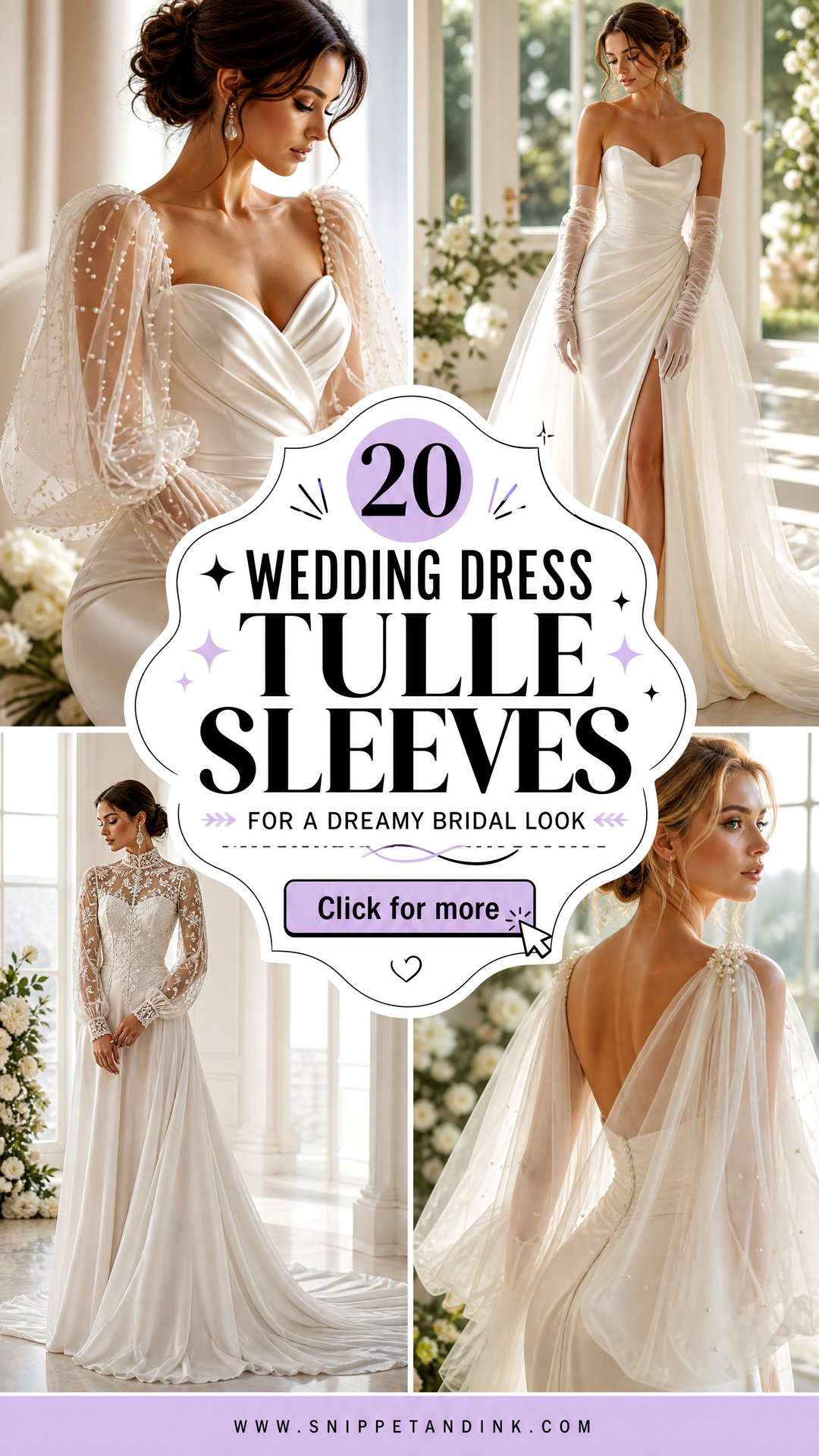
Not All Tulle Hangs the Same Way
When a bride tells me she wants tulle sleeves, the next question is which tulle. The word covers several nets that look similar on a hanger and behave very differently on an arm.
Silk tulle
Very soft and fluid, with a slight sheen. It drapes close to the arm and suits bishop and flutter sleeves. It’s also delicate, creases easily and costs noticeably more.
Nylon and polyester tulle
Crisper and stronger. This is what holds a puff or balloon shape, and it’s what most ready-to-wear gowns use. Cheaper versions can feel scratchy at the underarm, so rub a sample against the inside of your wrist.
Stretch mesh
Used for close illusion sleeves because it moves with you. It’s the most comfortable for long fitted sleeves and the most important to match to your skin tone, since there’s no lace to distract from the color.
Ask your consultant which net a sample is made from. It tells you more about how the sleeve will behave after five hours than the photo does.
1. Long Illusion Tulle Sleeve Wedding Dress
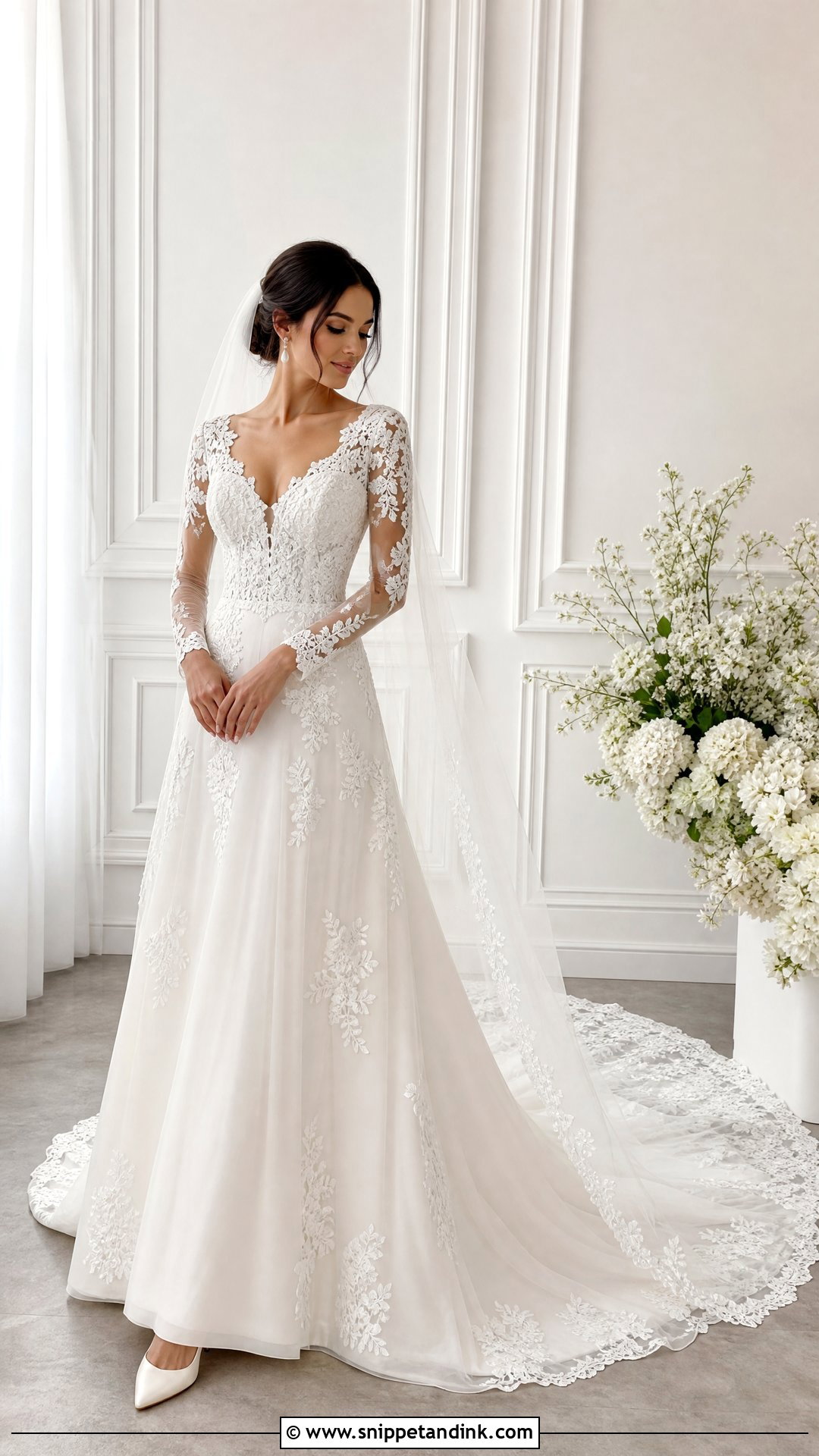
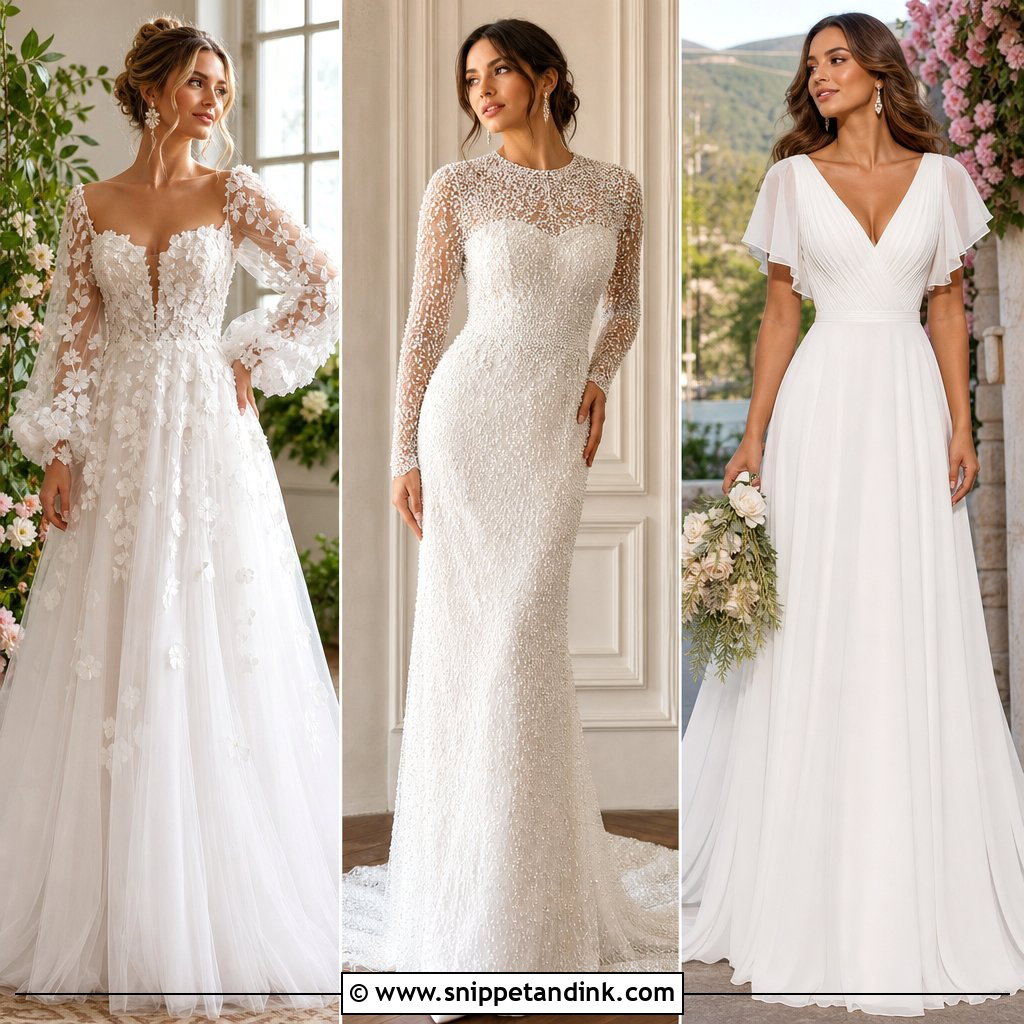
Long illusion sleeves give coverage that still reads as skin from a few feet away. They sit best on an A-line with a fitted bodice, running from shoulder to wrist with a few lace appliqués scattered along the arm. A V-neck keeps the upper body open, and a chapel train adds weight to the back. Ivory pumps, pearl drops and a fine-edged veil are enough; skip the necklace. The fitting test I never skip: lift both arms as if hugging someone, then bend them. Close-fitted illusion tulle has very little give, and if the armhole is cut low the whole bodice rises when you reach.
2. Puff Tulle Sleeve Ball Gown Wedding Dress
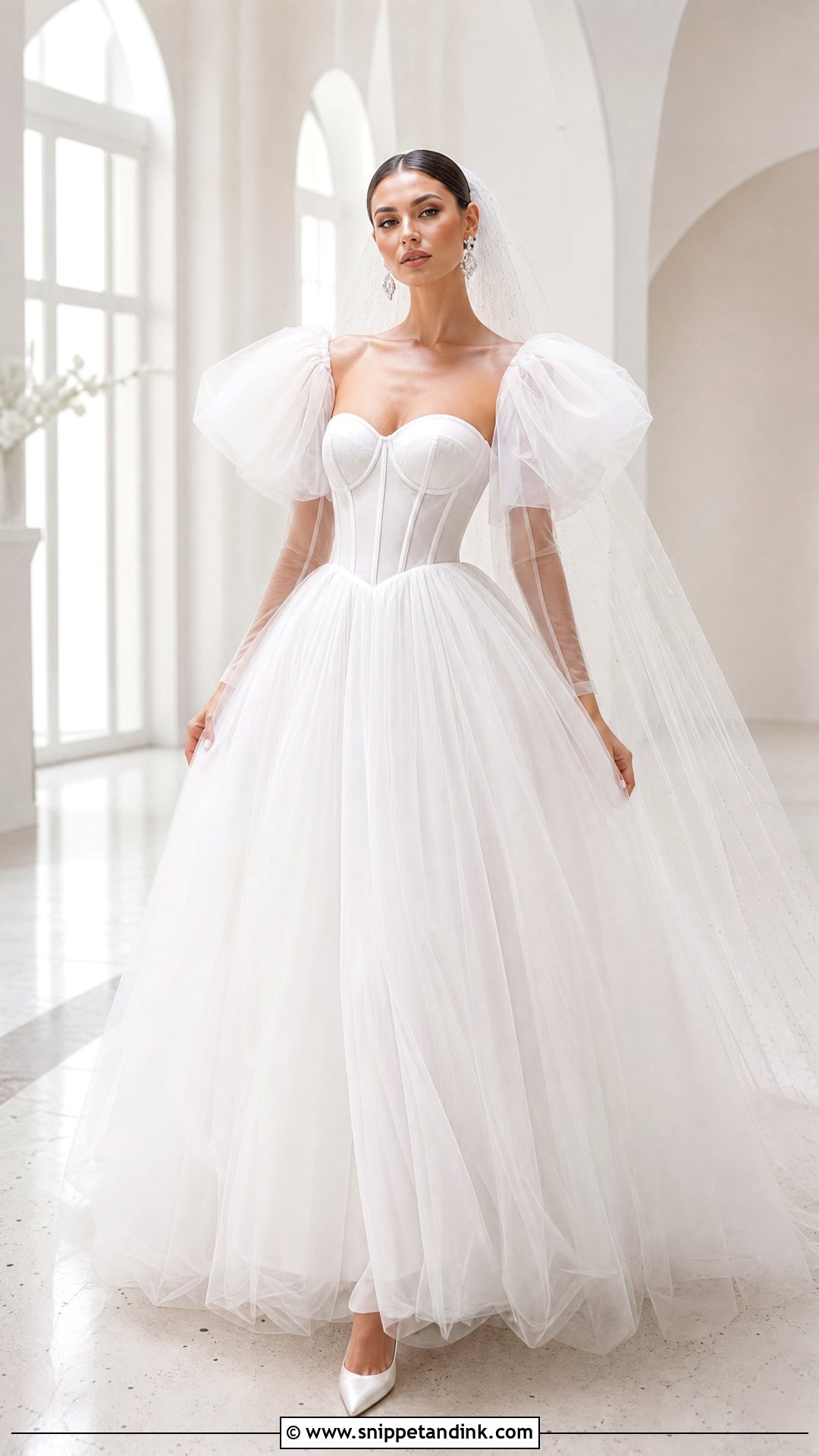
Big voluminous puff tulle sleeves need a defined waist to answer them, which is why they pair so well with a corset ball gown. A sweetheart neck takes the edge off the structure. Ask for sleeves that taper or gather neatly at the wrist, or the top half starts to swallow you. I’d scale the puff to your height: a smaller one on a petite frame, a fuller sculptural one on a tall bride with a big skirt. Crystal earrings, a smooth low bun, satin heels and a fingertip veil, nothing longer, since a cathedral veil fights the sleeves for space.
3. Detachable Bishop Tulle Sleeve Wedding Dress
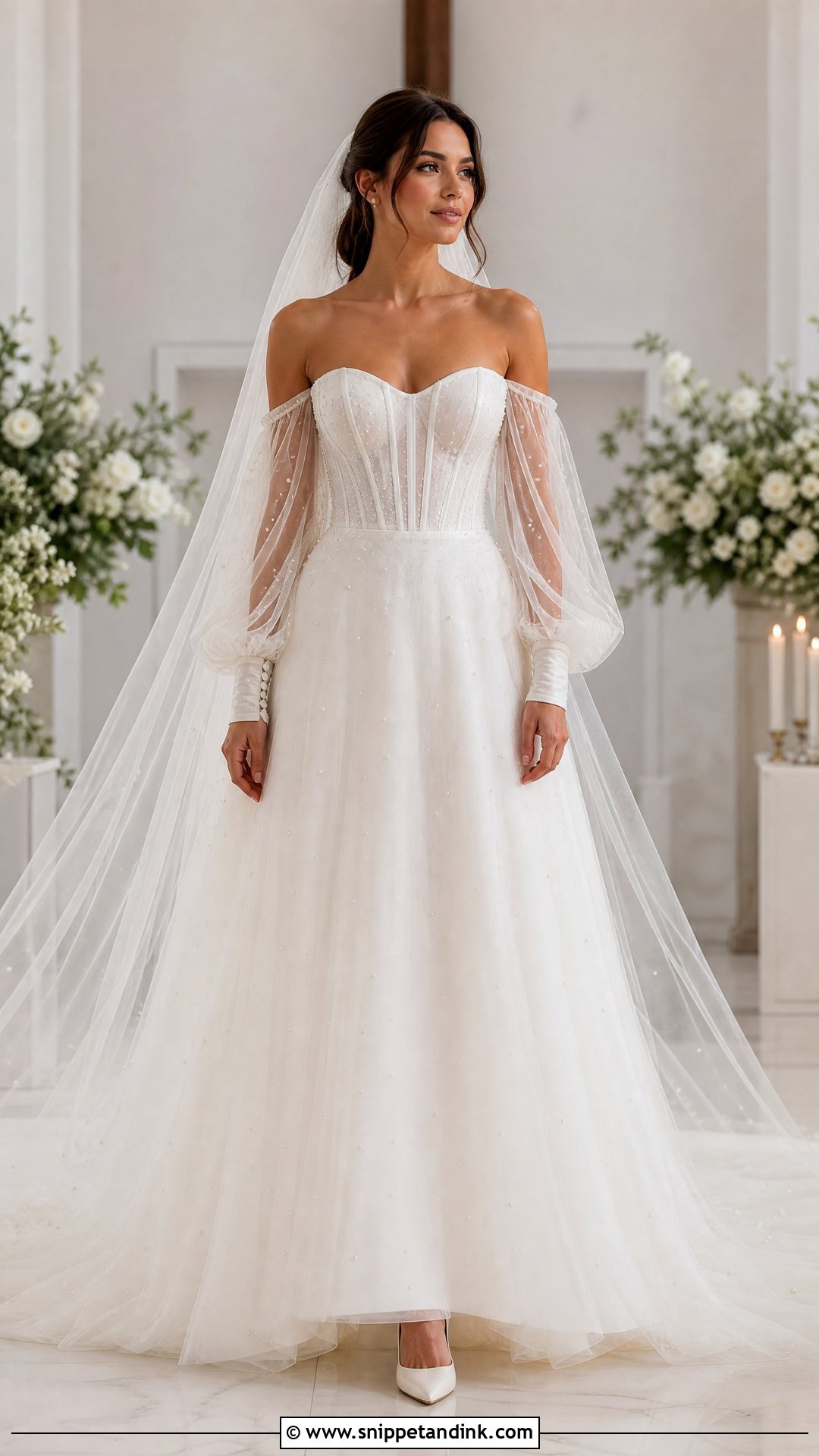
This is two dresses for one fee. Bishop sleeves on a strapless corset for the ceremony, then off before the reception. A good bishop stays close at the upper arm, widens below the elbow and gathers into a narrow cuff, often finished with covered buttons. An A-line or soft skirt keeps the proportions right. Pearl studs and a cathedral veil for the vows; bolder earrings once the sleeves come off. The part that makes or breaks it is the attachment. Your seamstress should hide snaps or thread loops under the neckline edge, and you should practice taking them off with a bridesmaid at a fitting.
4. Off Shoulder Tulle Sleeve Mermaid Wedding Dress
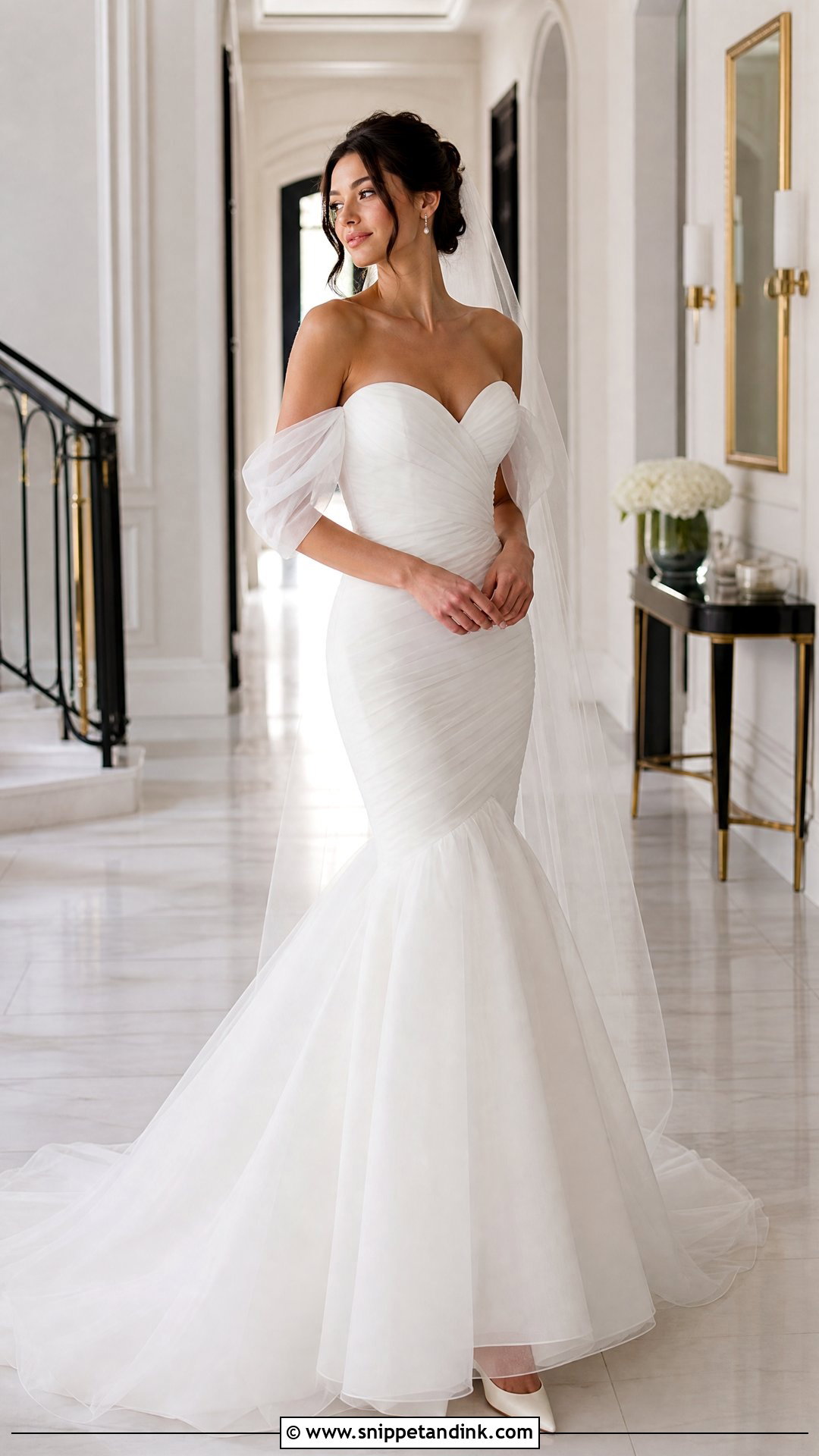
Off-shoulder tulle on a mermaid shape plays soft against sculpted. The sleeves should drape below the shoulder and connect firmly to the bodice, with a clean sweetheart neck to show the collarbone. The skirt follows the body to the knee and then flares. My honest caution: off-shoulder sleeves pin your arms down, and on a fitted mermaid that’s noticeable by the first dance. At alterations, ask about hidden elastic or a small underarm gusset, which let you raise your arms without the sleeves sliding up. A sleek updo, small earrings, pointed heels and a plain veil.
5. Pearl Tulle Sleeve Satin Wedding Dress
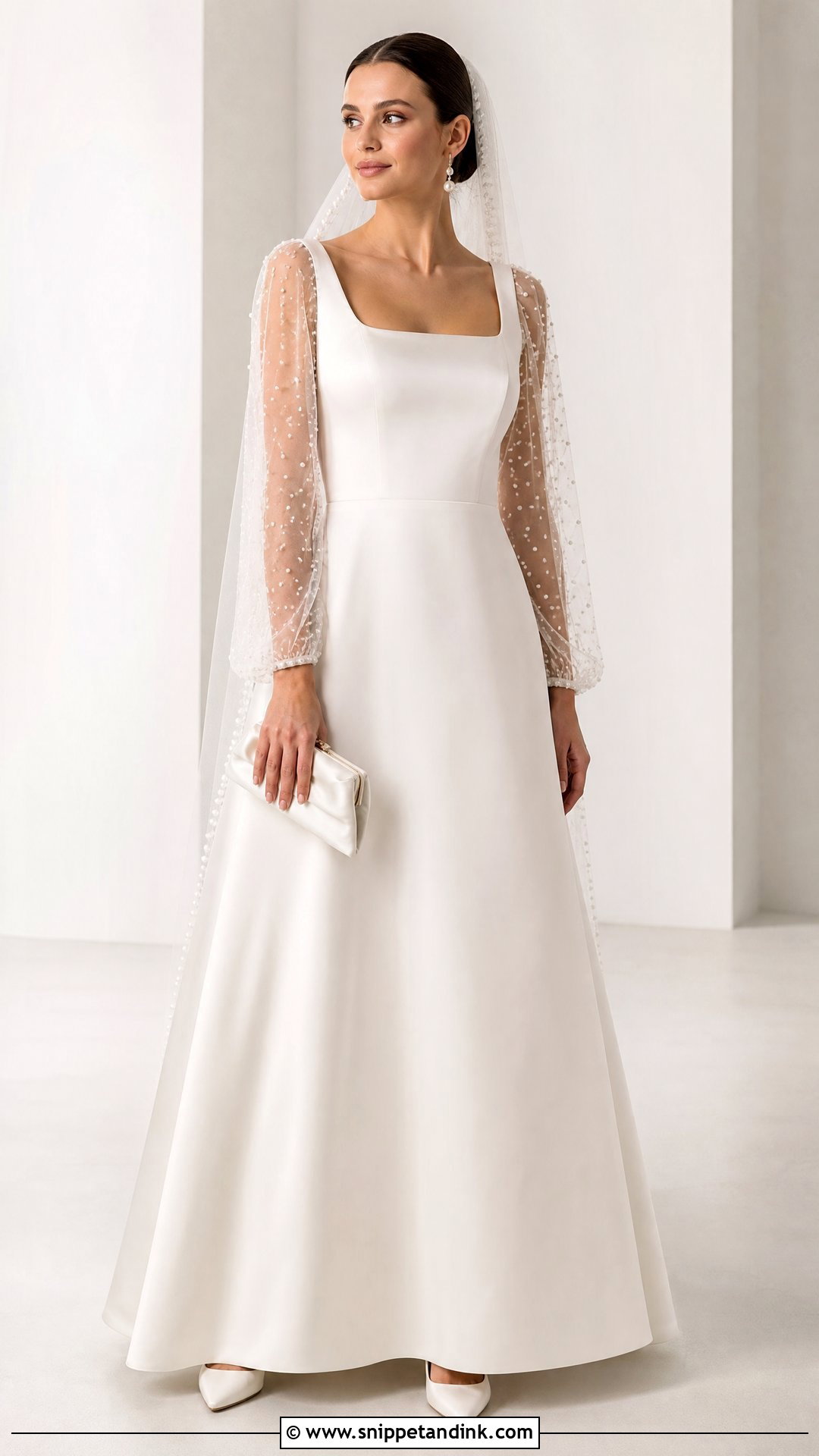
Satin is plain enough to let pearl-scattered sleeves carry the whole look. Choose an A-line or column with a square neck and long sheer sleeves dotted with small pearls; pearl drops and an ivory clutch carry it through. Before you commit, turn the sleeve over and check how the pearls are attached. Each one should be sewn on, not glued, and the thread shouldn’t be loose enough to catch on the veil. If you want something quieter, cluster the pearls at the cuffs only. An even spread from shoulder to wrist reads as much more formal.
6. Floral Appliqué Tulle Sleeve Wedding Dress
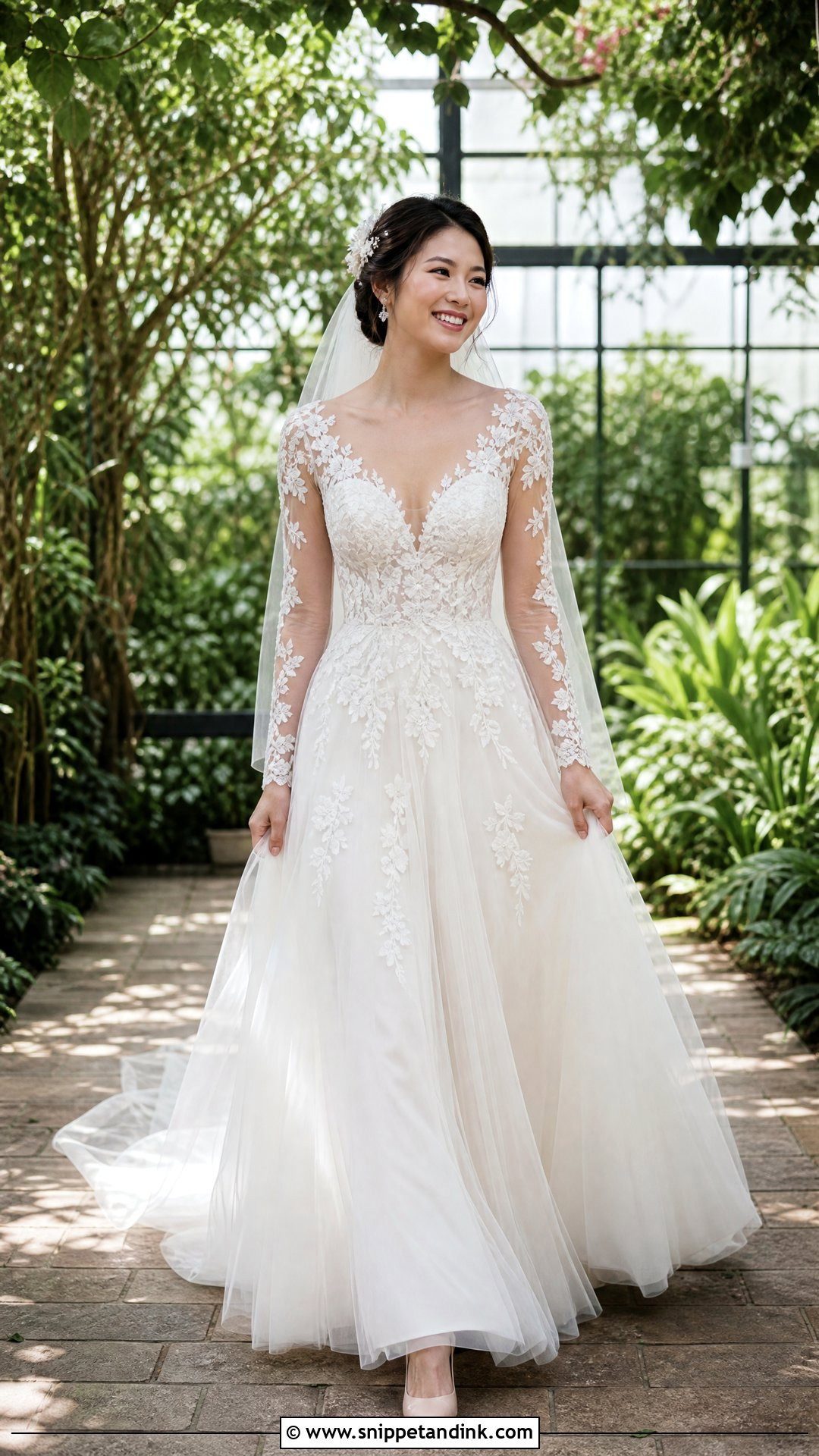
Floral appliqué sleeves look as if the lace has grown out of the bodice and down the arm. They sit well on an A-line with a soft waist. The detail I look at closely is the grading: motifs should get smaller and sparser toward the wrist, or the forearm looks heavy and the eye stops there. A V-neck or soft scoop suits the organic pattern. Floral pins, small crystal earrings and neutral pumps, plus a plain tulle veil so you don’t add a second pattern. At the fitting, check where appliqués cross the shoulder seam; on well-made sleeves you can’t see the join.
7. Fitted Tulle Sleeve Crepe Wedding Dress
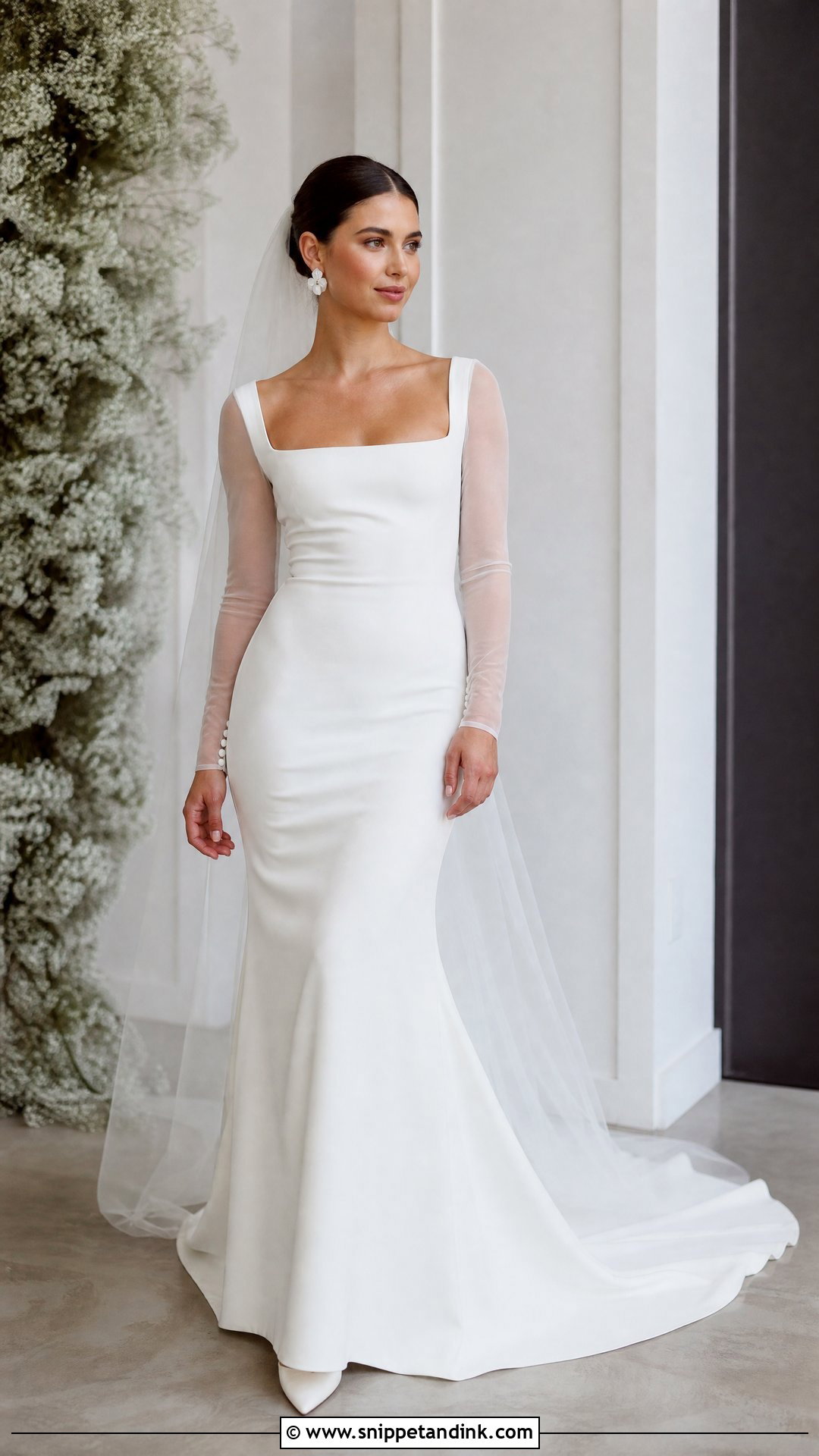
Crepe and sheer sleeves are a modern pairing, mostly because nothing on them is decorated. A sheath or fit-and-flare with a bateau, square or modest V-neck takes plain illusion tulle sleeves that hug the arm and close with covered buttons at the wrist. Sculptural earrings, a sleek bun, pointed pumps and a chapel veil. What makes or breaks plain illusion is color. Tulle sold as nude comes in several shades, and on a fair or deep skin tone the wrong one shows as a pale or ashy band at every seam. Ask to see swatches against your inner arm in daylight.
8. Balloon Tulle Sleeve Wedding Dress
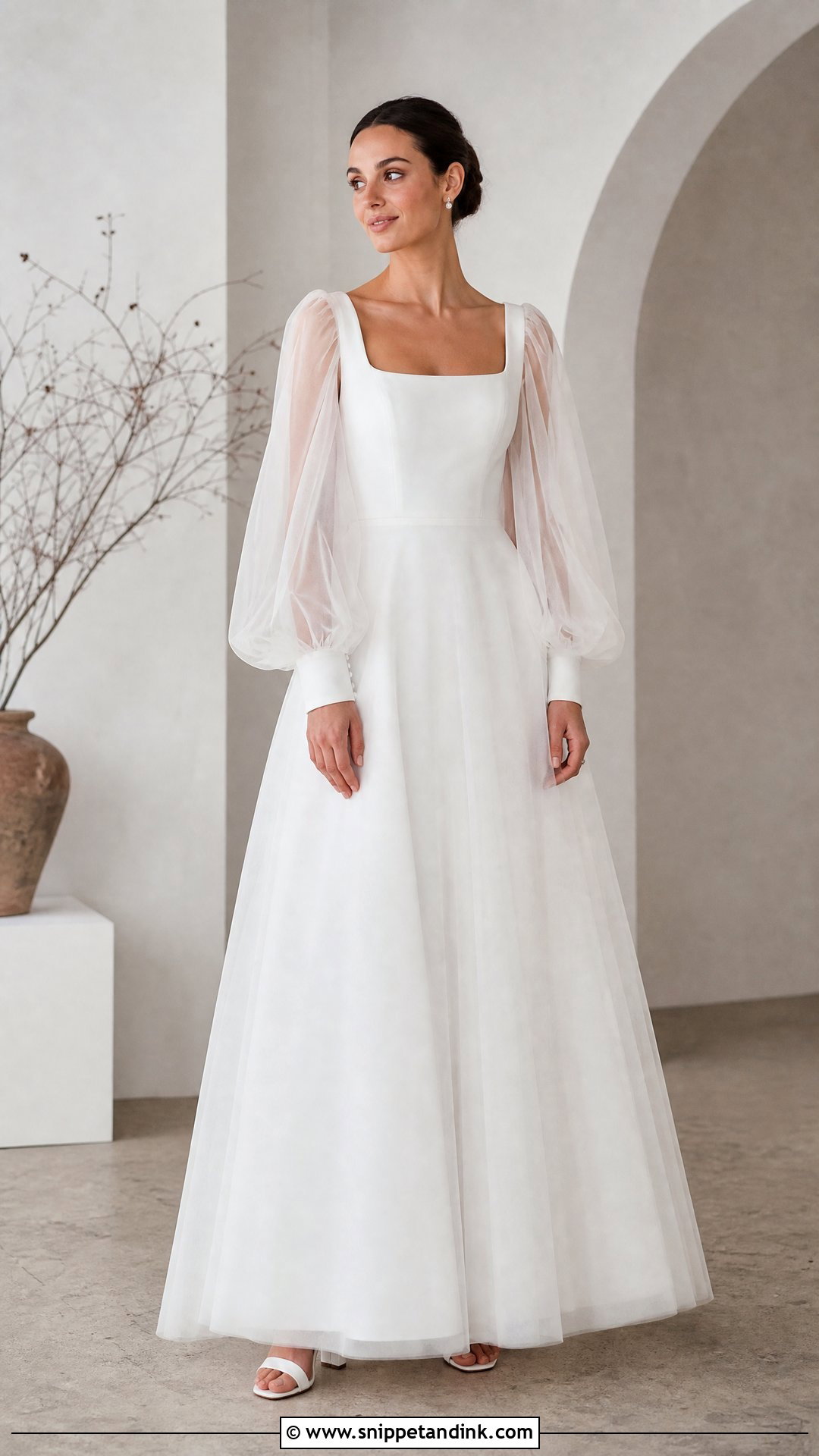
Balloon tulle sleeves carry their fullness down the whole arm and gather at the wrist, unlike a puff that sits up at the shoulder. Keep everything else quiet: a plain square-neck bodice and a controlled A-line skirt. A chignon, small earrings and satin block heels are plenty. Skip the necklace. Try two versions if the boutique has them. Soft tulle gives a loose, slightly collapsed balloon that moves; layered or stiffer net holds a firm round shape. Which suits you depends on your frame and on whether the venue is relaxed or formal.
9. Bell Tulle Sleeve Boho Wedding Dress
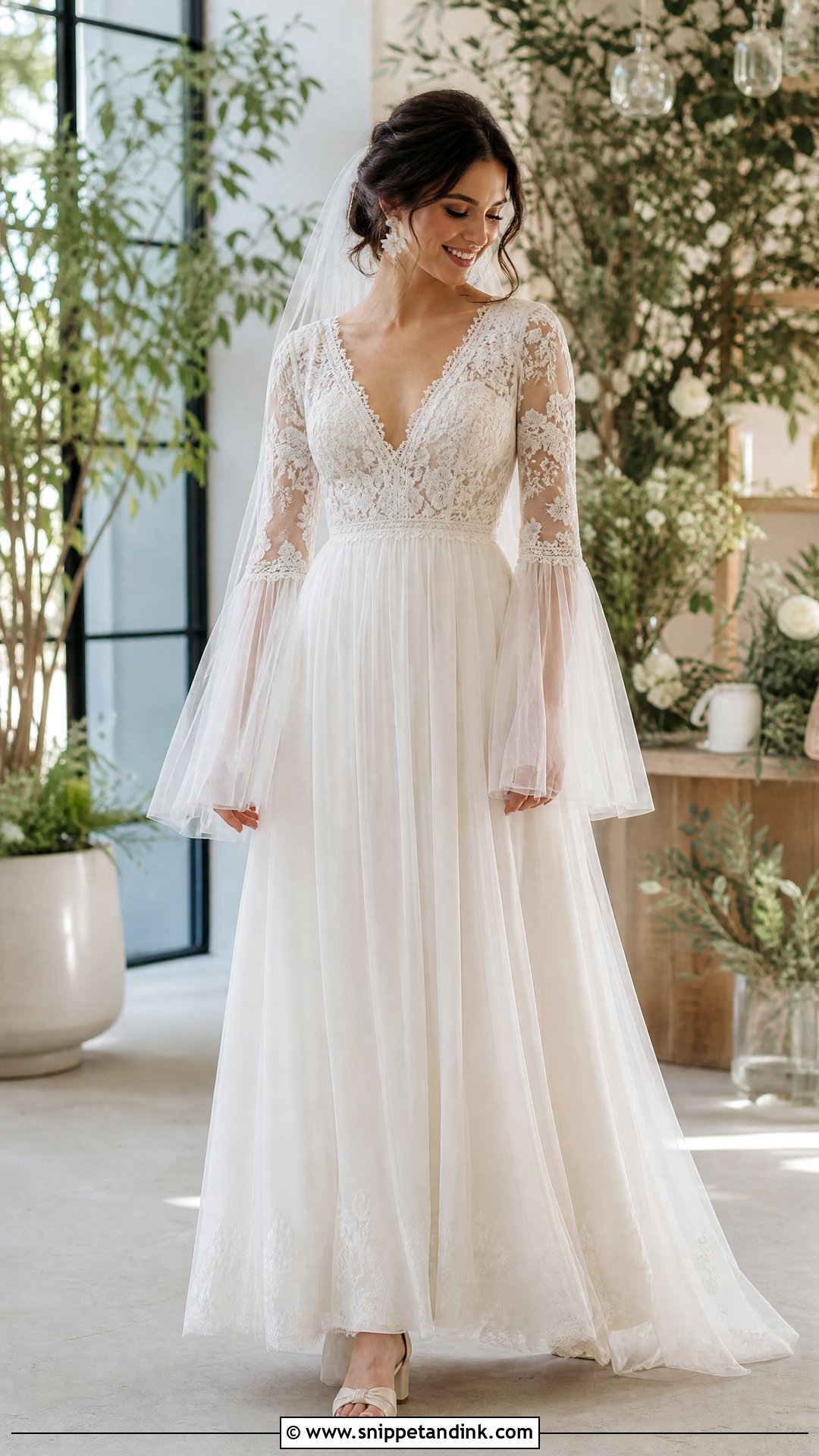
Bell sleeves stay close above the elbow and open toward the hand, so they move every time you do. On a lace-trimmed A-line with an open V-neck and a gathered tulle skirt, they give a boho feel without fringe. Loose waves, small floral earrings, low block heels and a fingertip veil. Here’s the practical problem: a bell that reaches past the wrist drags through the bouquet stems and gets in the way at the ring exchange. I usually suggest stopping it at the wrist bone. It still shows its shape and works far better in a garden.
10. Cap Tulle Sleeve Tea Length Wedding Dress
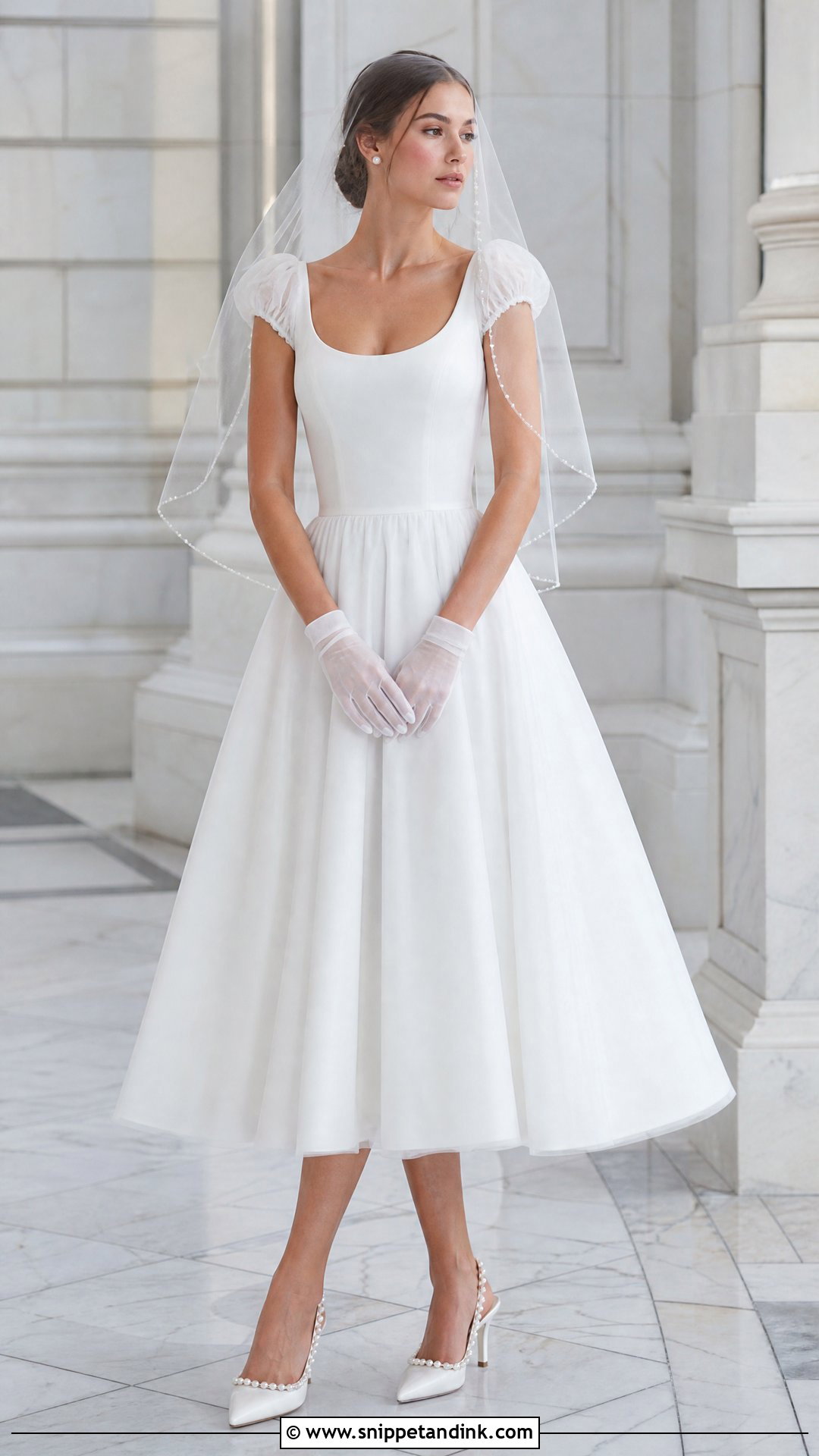
Tea length shows your shoes, so the shoes become half of the outfit. A fitted bodice with a soft scoop neck, a full skirt ending between knee and ankle, and small gathered cap sleeves for light shoulder cover. Pearl-trimmed pumps or neat slingbacks, short gloves, pearl studs, and a birdcage or fingertip veil. It’s a natural fit for a courthouse ceremony or a daytime party. Look at where the cap ends on your arm in a side mirror: a cap that stops at the widest part of the upper arm draws attention there, while one that ends slightly higher or lower looks easier.
11. Flutter Tulle Sleeve Empire Wedding Dress
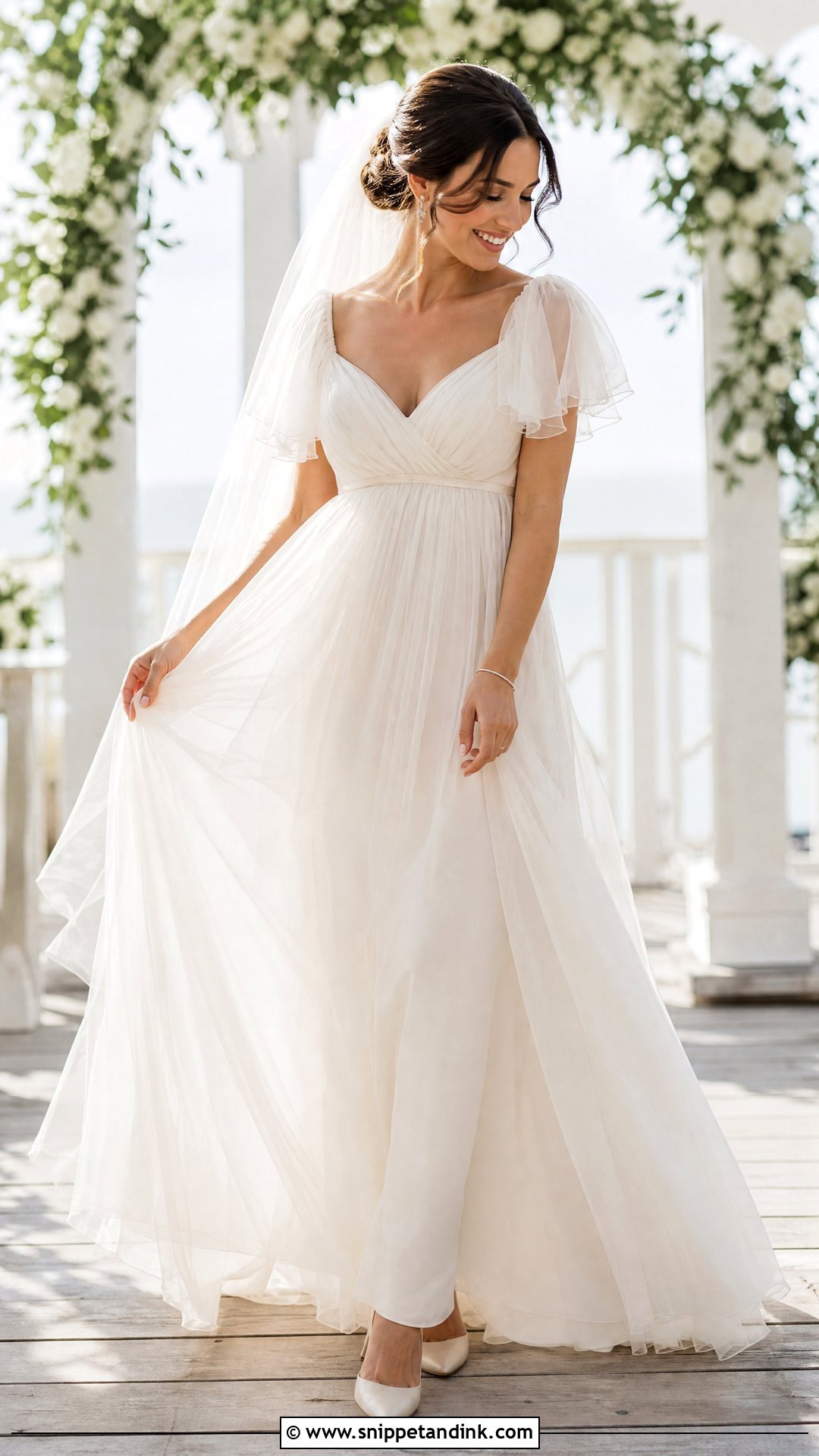
Flutter sleeves suit an empire waist because neither depends on tight structure. The tulle should fall in short, overlapping layers from the shoulder and move freely, not stand stiffly out. A softly draped bodice and a skirt that starts under the bust give a long line. Low heels, a fine bracelet, small drops, a light veil and a loose updo. They’re comfortable in summer heat because air moves through them. Check from the side and back, though, since flutters can lift and fold over the bodice details when you turn.
12. Juliet Tulle Sleeve Vintage Wedding Dress
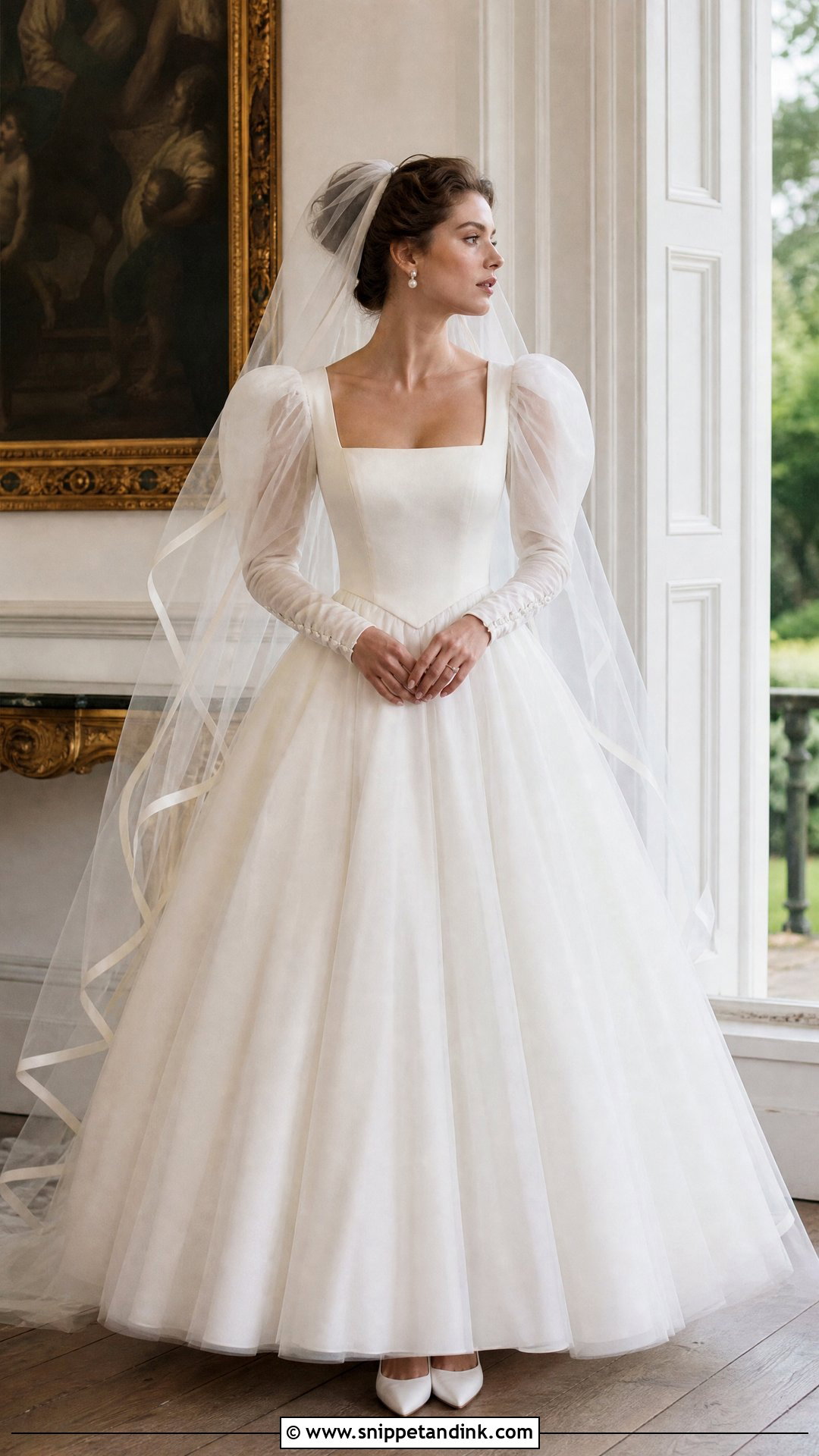
Juliet sleeves puff at the shoulder and then fit closely down the forearm, a shape borrowed from historical dress. Sheer tulle keeps them from feeling heavy. Pair them with a softly pointed waist, a square neck and a full A-line skirt, with covered buttons at the wrist. Pearl earrings, a ribbon-edged veil, closed pumps and a low bun; a small floral comb if you want it. The fitted lower section is where problems show. Ask your tailor to measure you with your elbow bent, not straight, or you’ll feel it the first time you lift a glass.
13. Ruched Tulle Sleeve Wedding Dress
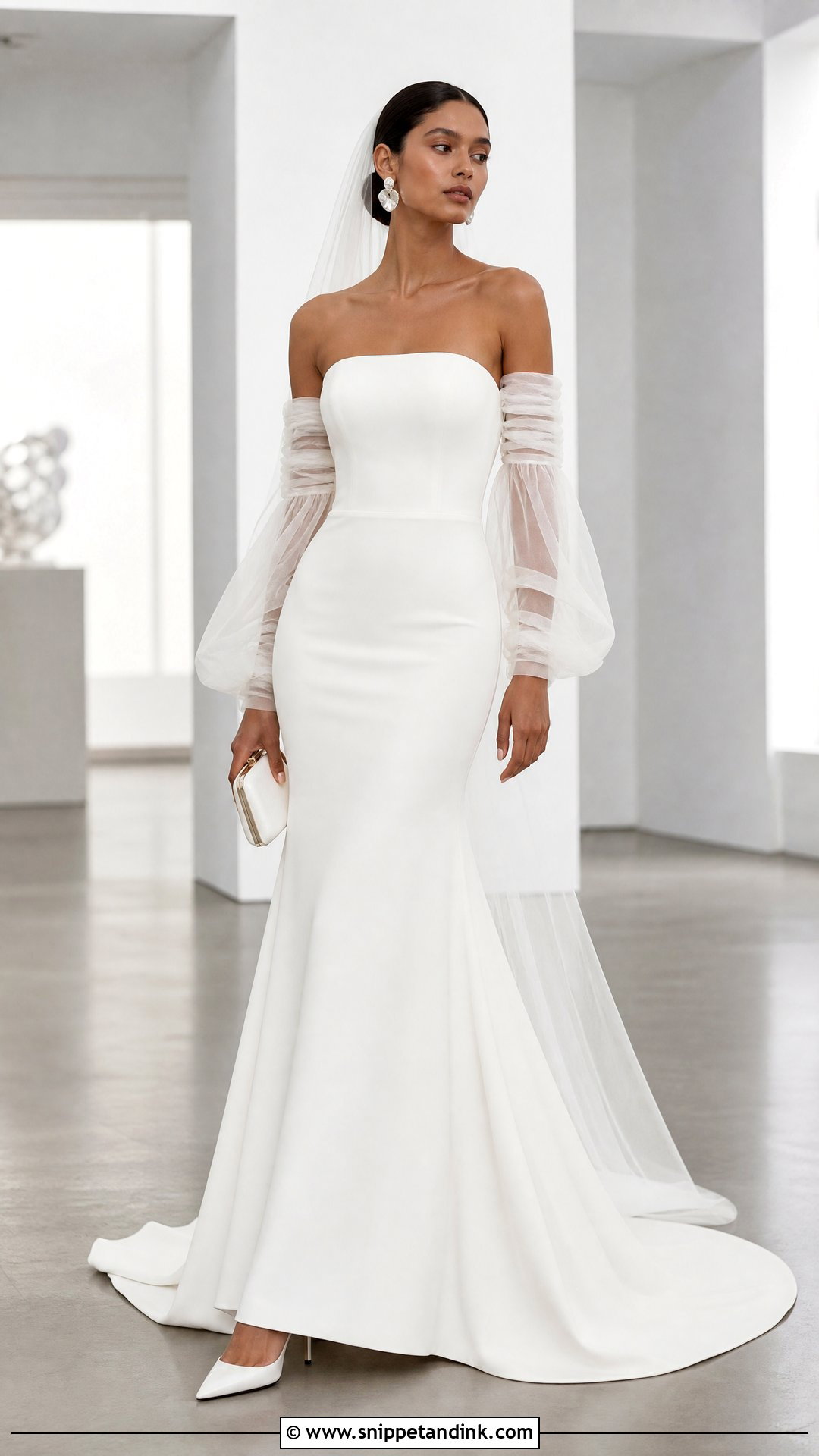
Ruching gives sleeves texture with no beading at all. Fine gathers along the arm look handmade, and they contrast well with a strapless column or fit-and-flare that has a smooth bodice. A structured clutch, sleek heels, statement studs and a plain veil. The trouble with ruching is that it drifts. Uneven gathers twist around the arm during the day and bunch at the elbow, so I check that they’re stitched down at intervals rather than just gathered at the ends. Detachable ruched sleeves are worth asking about if you want a strapless look later.
14. Tulle Sleeve Gloves Wedding Dress
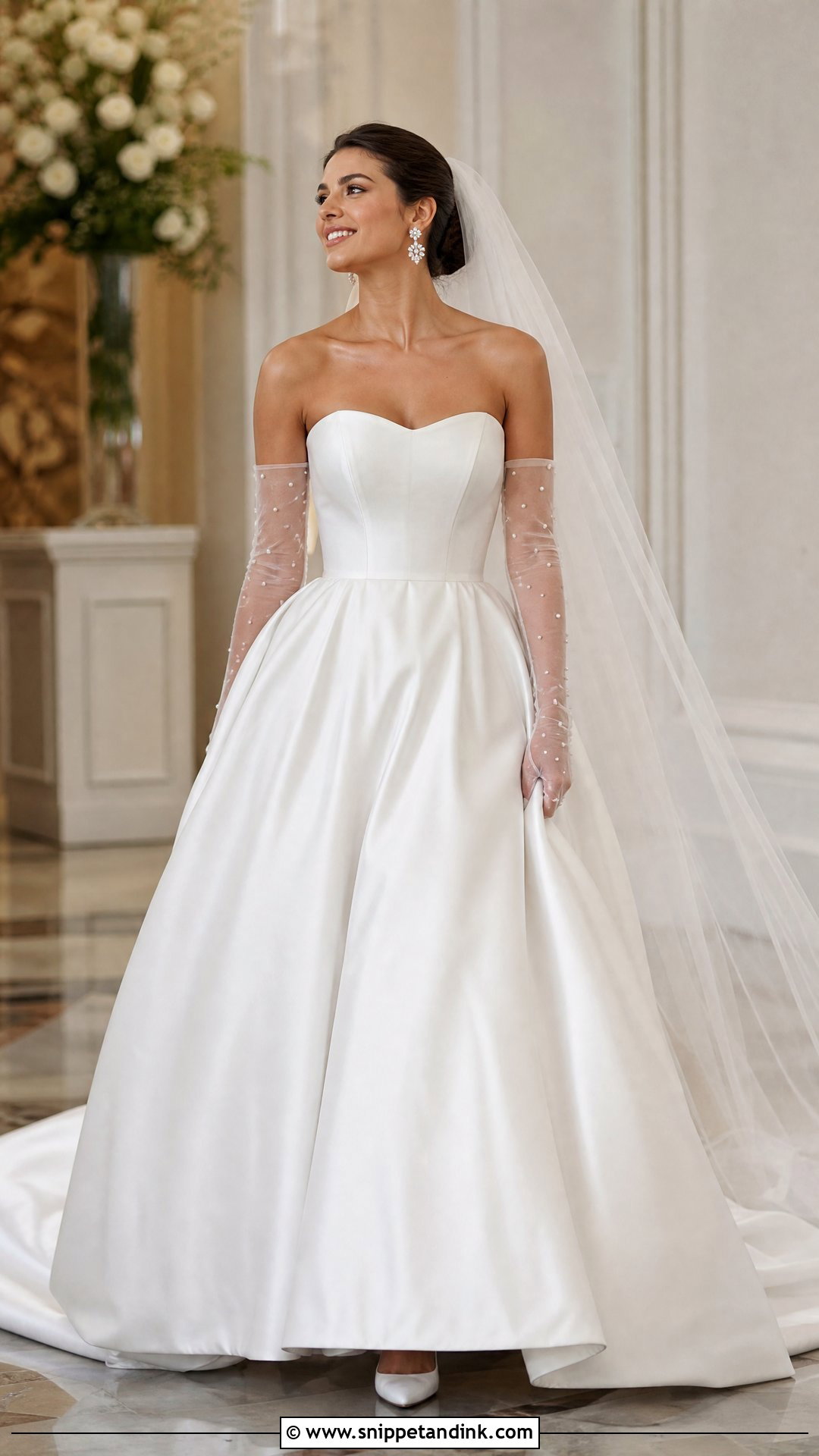
Sleeve gloves give the line of a long sleeve without attaching anything to the gown. They usually start above the elbow and run over the wrist or onto the hand. They suit a strapless satin ball gown or a clean A-line. Choose plain tulle, or scattered pearls if the dress has them too. A neat bun, crystal earrings, pointed pumps and a cathedral veil. The top edge is the part to test: it needs a silicone grip or a gentle elastic so it stays up without biting into the arm. And match the net to the gown’s ivory, since separates that are slightly off in shade look borrowed.
15. Dotted Tulle Sleeve Wedding Dress
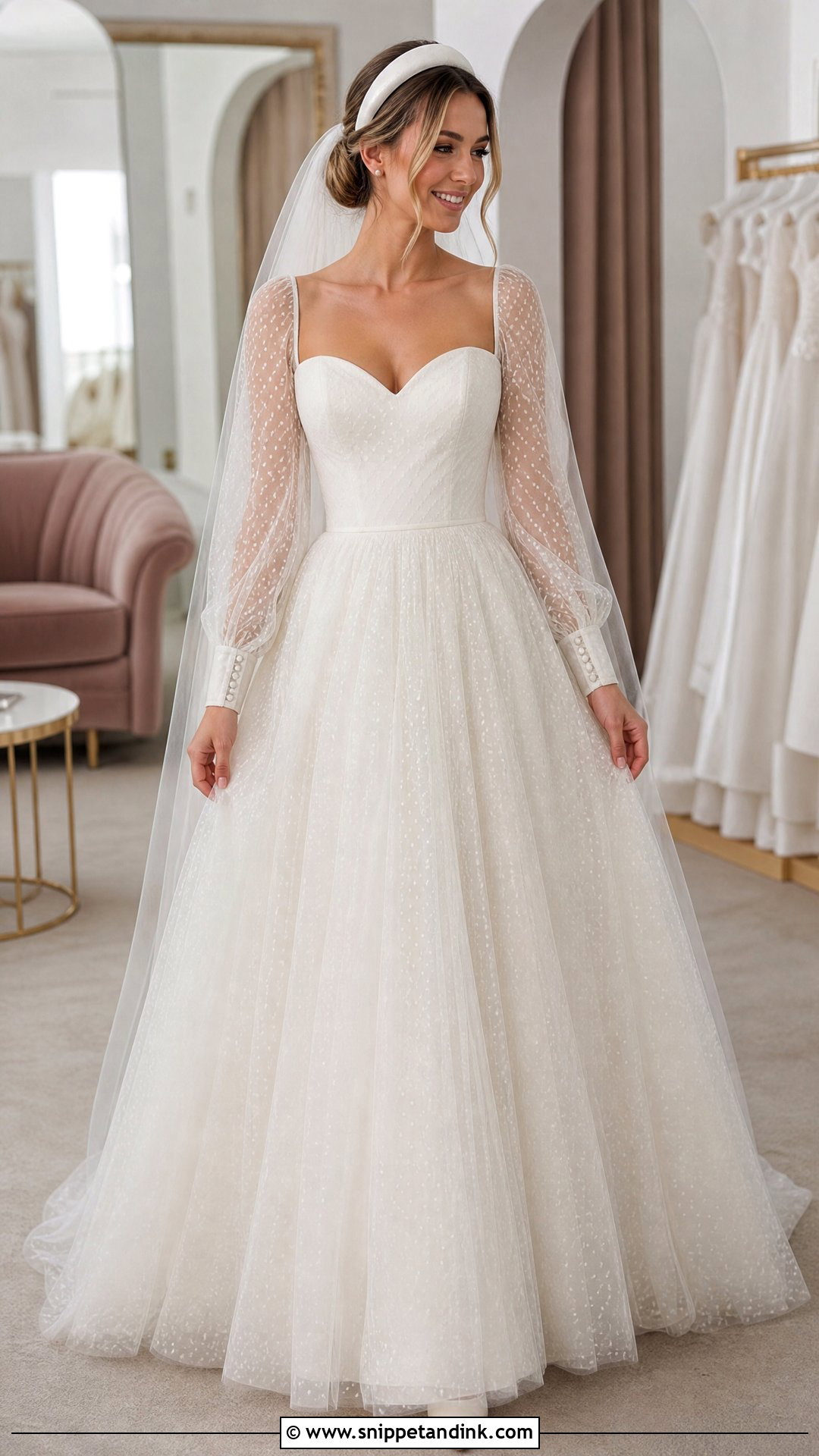
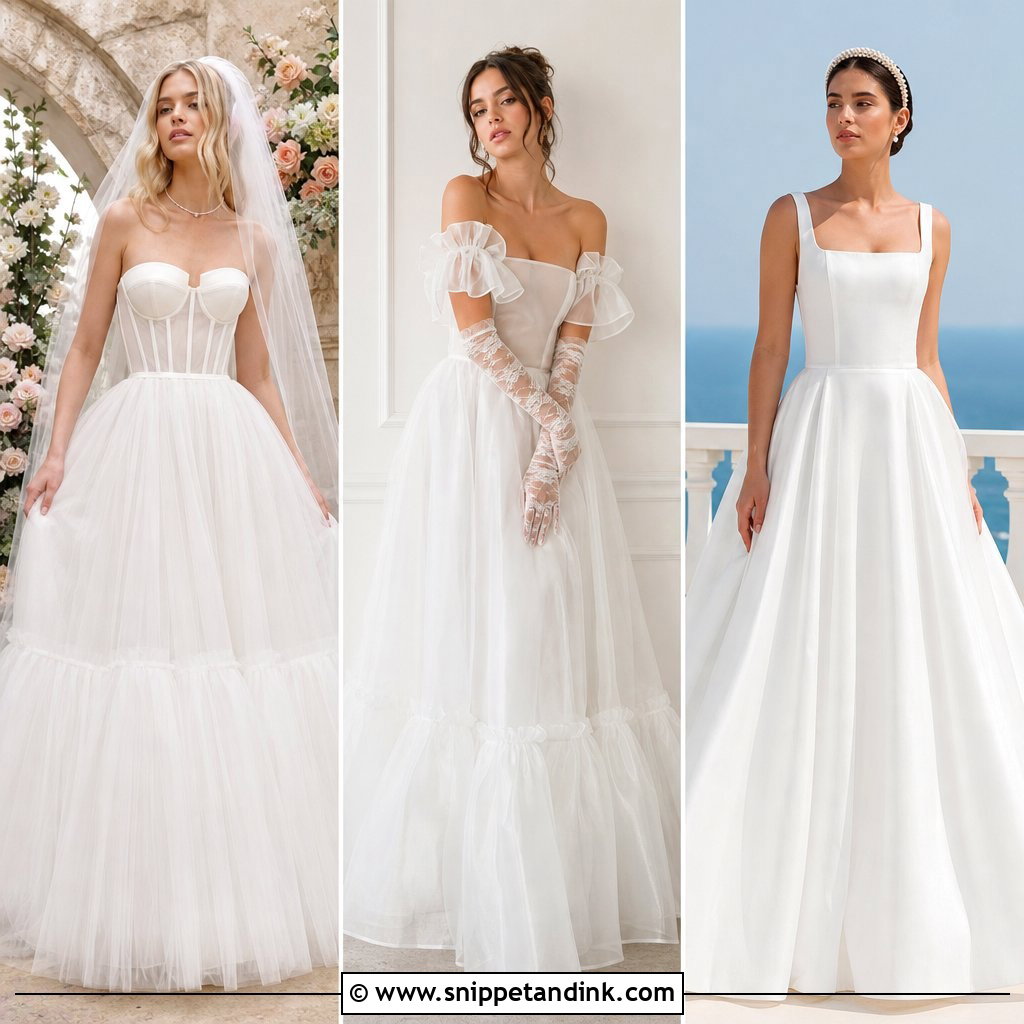
Dotted tulle is playful and still delicate. Put it on long sleeves over a clean sweetheart bodice with a fitted waist and an airy A-line skirt; the flocked dots soften the open neckline and show nicely in close photos. Narrow cuffs with covered buttons. Pearl studs, a satin headband, classic pumps and a plain veil, with no other pattern anywhere. Large dots feel vintage; tiny ones feel current. At the fitting, look at the seams under the arm: when the maker has aligned the dots there, it’s a sign the rest of the construction is careful too.
16. Embroidered Tulle Sleeve Modest Wedding Dress
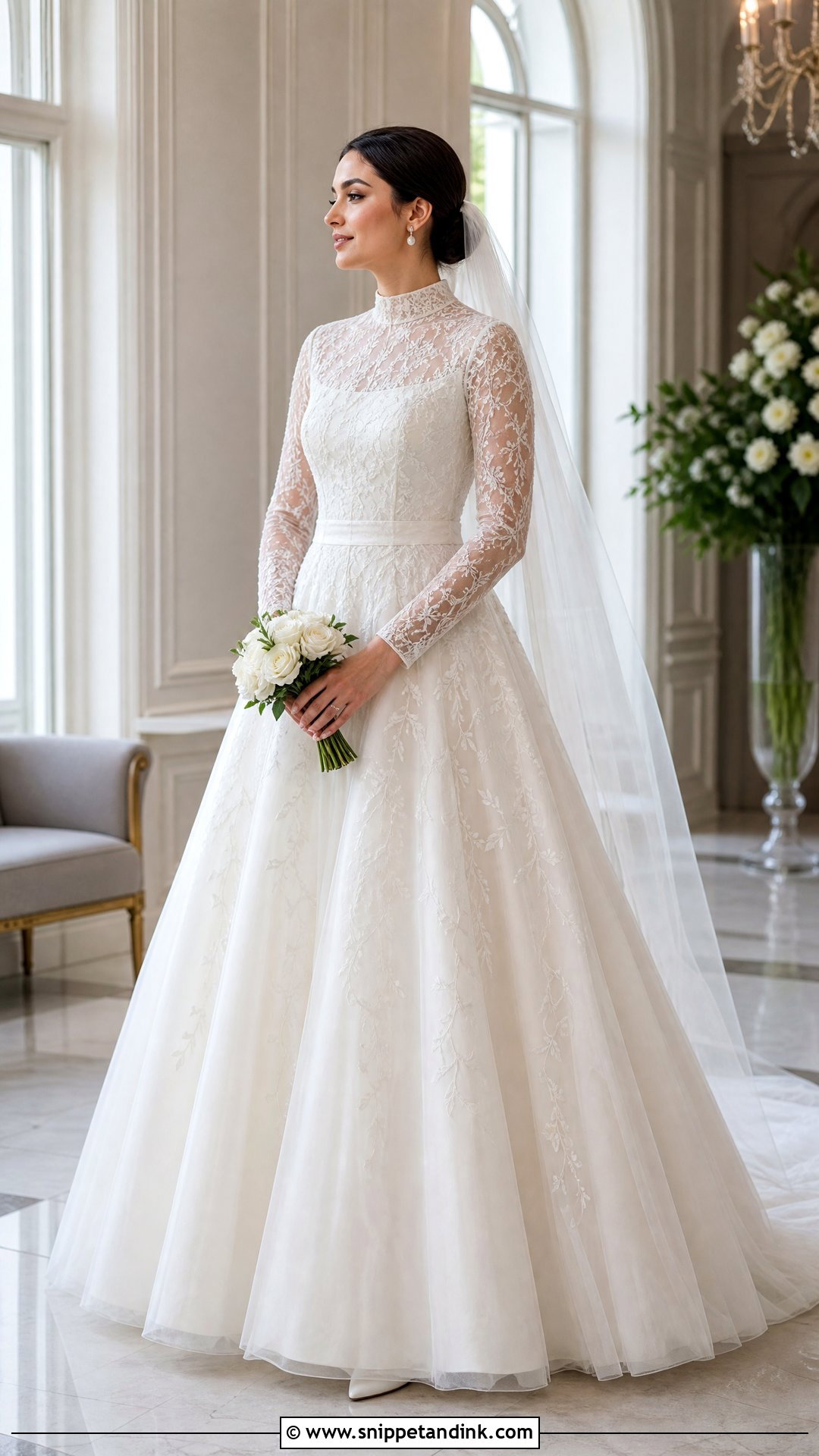
For a bride who wants real coverage, a high neck with embroidered tulle sleeves keeps the look soft. Look for a lined bodice, a natural waist, and embroidery placed at the shoulders, cuffs or outer arms. A full A-line skirt balances the closed neckline. Pearl earrings, closed heels, a plain veil and a low bun; skip the necklace. If sheer isn’t enough for your family or ceremony, ask whether the sleeves can be lined with a second layer of matching mesh or a fine stretch fabric. Most good seamstresses can do it, but the lining must flex at the elbow or the sleeve will pull.
17. 3D Floral Tulle Sleeve Wedding Dress
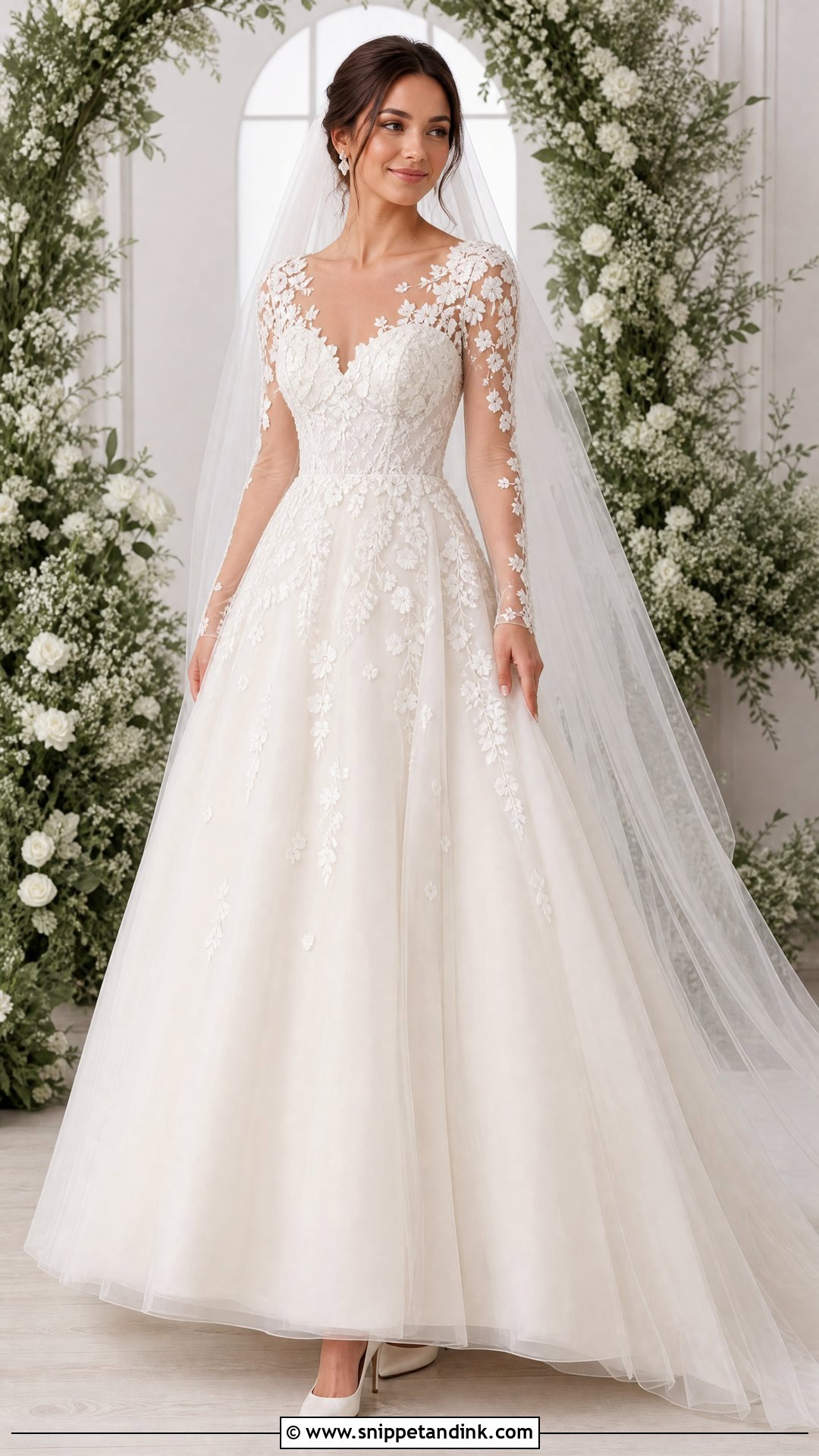
Three-dimensional flowers turn sleeves into the focal point. They work on a fitted bodice with a layered ball gown or A-line skirt, as long as most of the blooms sit at the shoulder and upper arm and shrink toward the wrist. Too many at the hand gets in the way of everything you’ll hold. Keep the rest quiet: simple earrings, plain heels, a cathedral veil and smooth hair. Raised petals catch on veil edges, so test both together at the fitting. Lighter appliqués are more comfortable over a long day and keep the sleeve moving.
18. Short Puff Tulle Sleeve Wedding Dress
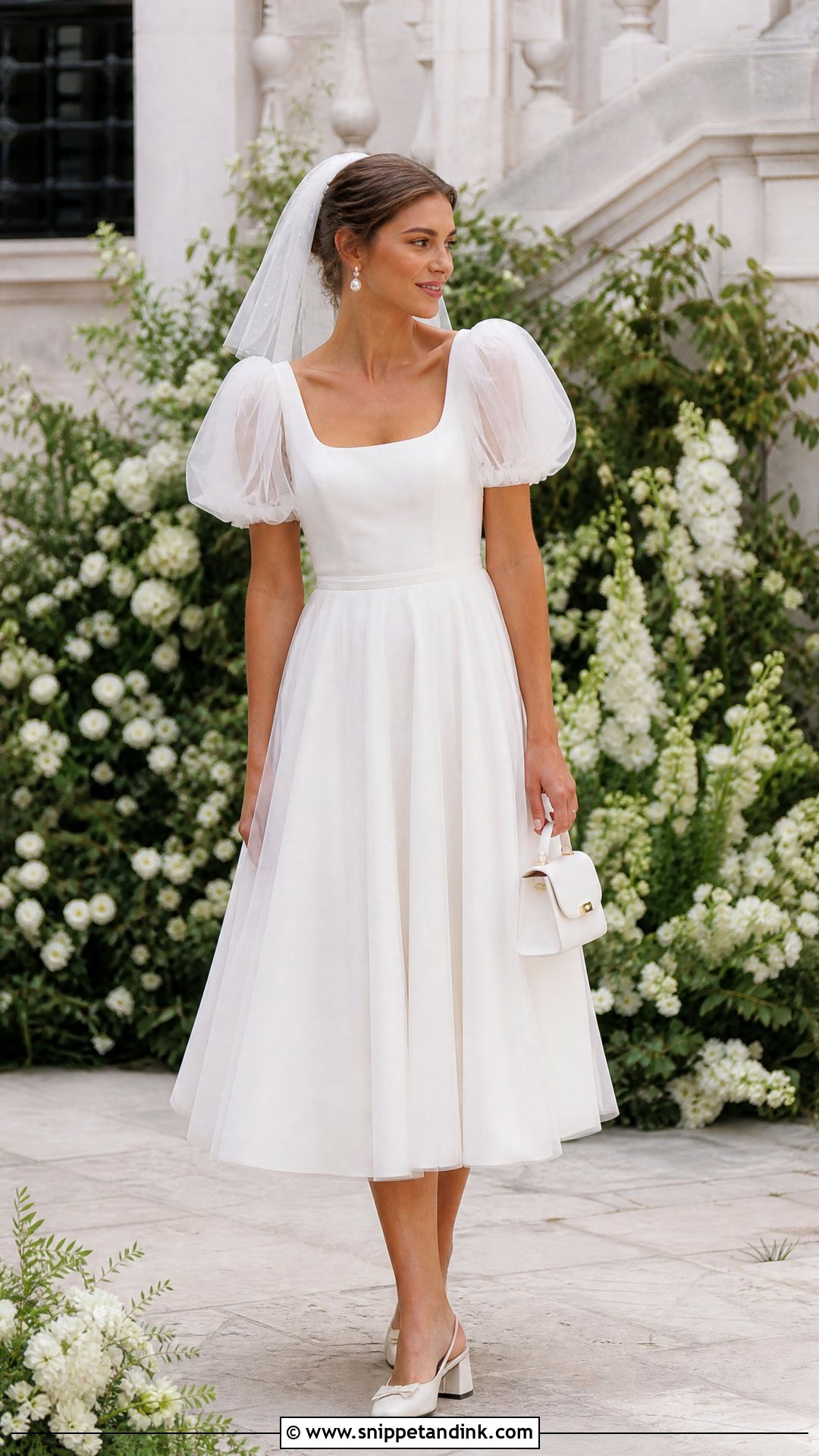
Short puff sleeves ending above the elbow give shape without covering the arm. A square-neck bodice, a defined waist and a flowing A-line skirt keep the volume in proportion. Low block heels, pearl earrings, a fingertip veil and a loose bun or soft waves. One layer of soft tulle gives a gentle puff; several layers make it much rounder. The band is what I check most: elastic that’s slightly too tight leaves a red line on the arm, and that line shows up in every photo taken after a few hours.
19. Cold Shoulder Tulle Sleeve Wedding Dress
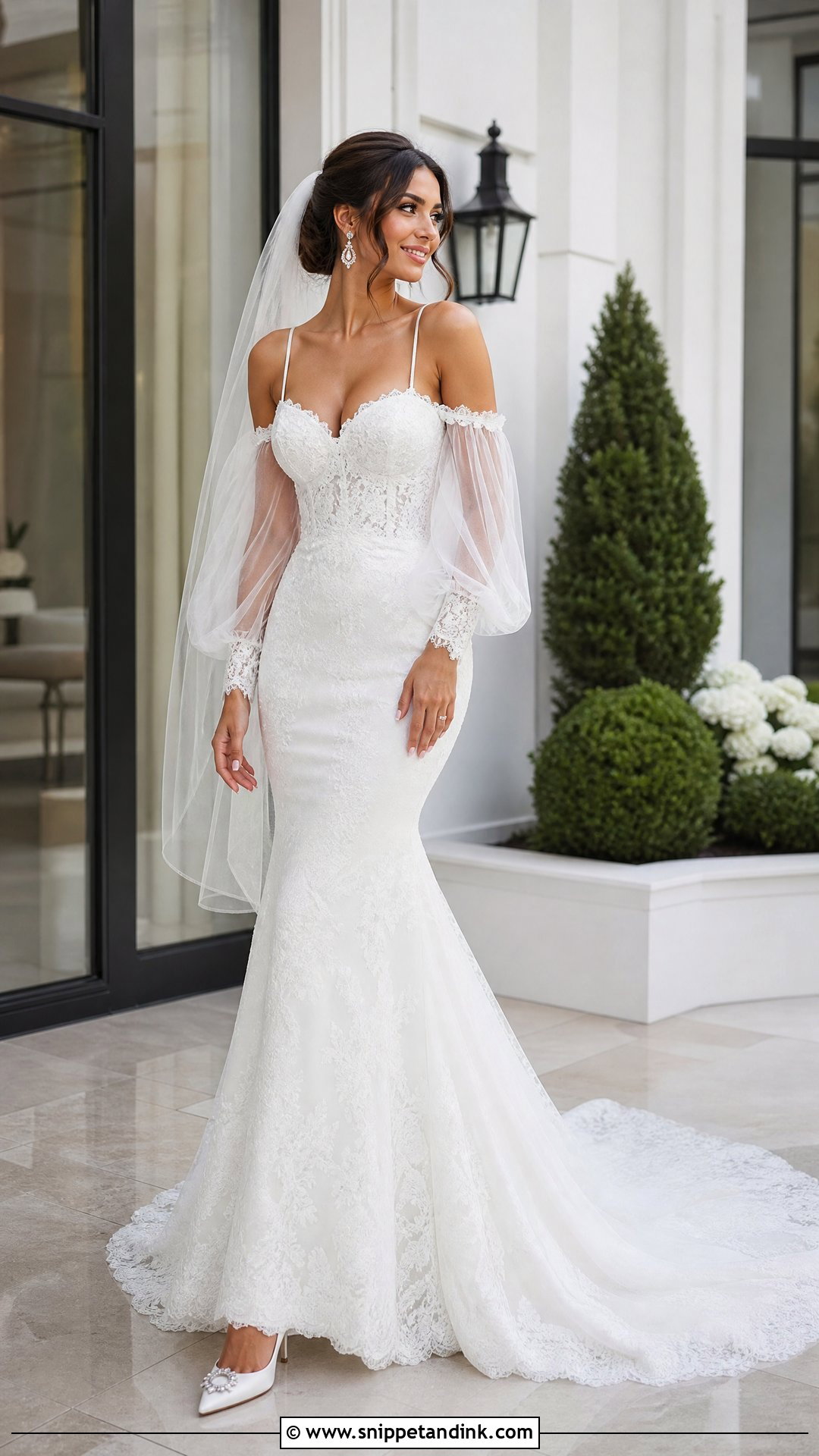
Cold-shoulder sleeves leave the top of the shoulder bare and cover the arm below. They’re usually detachable and pair with a fit-and-flare that has thin straps or a sweetheart neck. The sleeve should start just under the shoulder and stay fitted or slightly full to the wrist. Floral appliqués tie into a lace bodice; plain tulle suits crepe or satin. Drop earrings, a low updo, pointed heels and a narrow veil, with nothing bulky at the shoulder. Swing your arms at the fitting. If the band slides down, it needs grip tape or a firmer fit before the day.


20. Detachable Tulle Sleeve Topper Wedding Dress
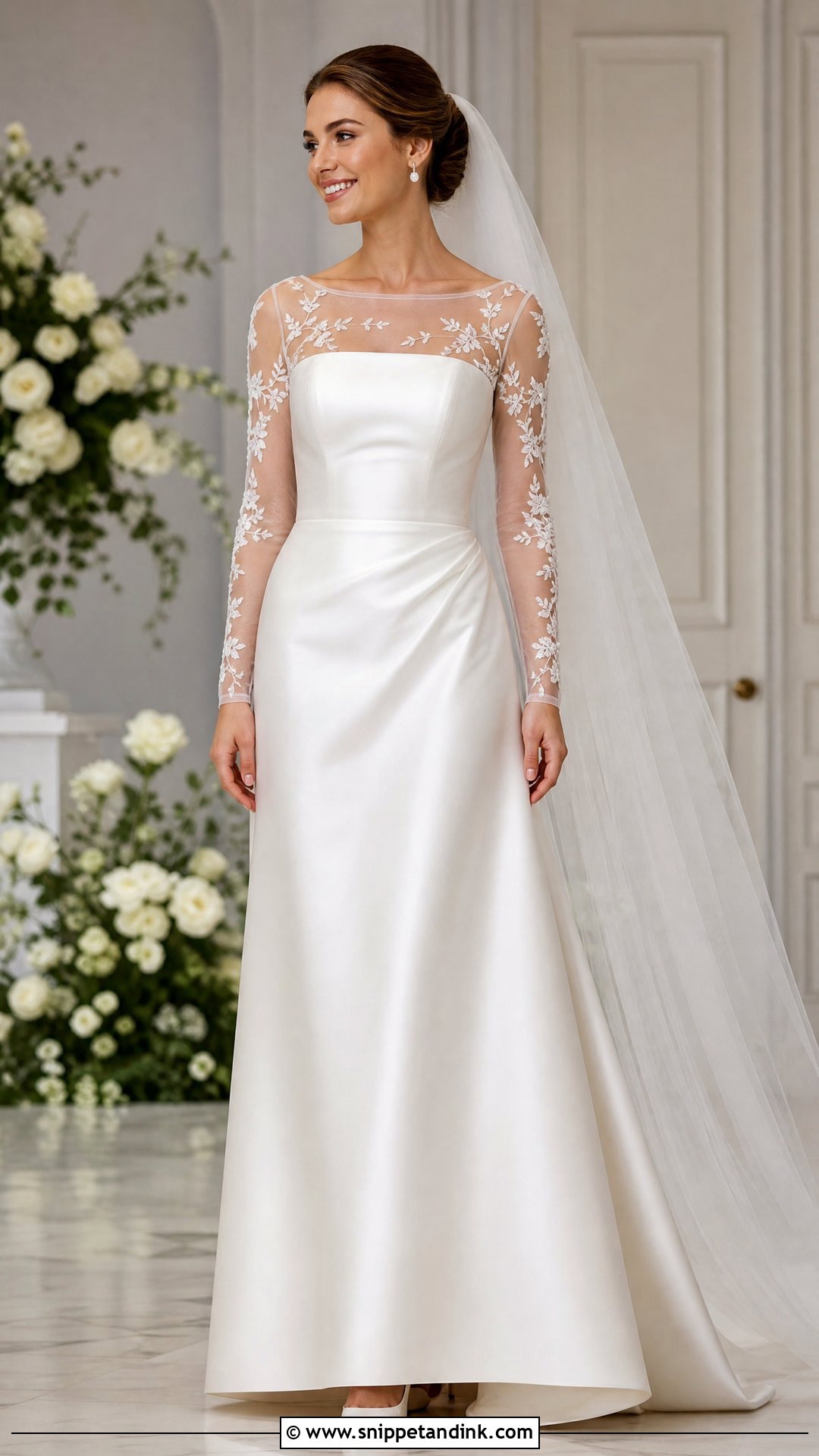
A tulle topper turns a strapless gown into a sleeved one and then hands it back. Choose a sheer piece with a bateau, high or off-shoulder neck; plain net over minimal satin, or lace and pearls matched to a detailed bodice. A long veil, pumps, small earrings and a polished updo for the ceremony, then take it off to show the original neckline. The edge at the waist is where toppers fail, so it should tuck into the bodice line rather than ride on top of it. Bring the actual gown to every topper fitting so shade, seams and fastenings can be matched.
Planning Alterations Around a Sheer Sleeve
Sleeves add time to alterations. A fitted illusion sleeve is cut close, so small changes at the armhole or wrist take careful work, and adding or lining sleeves is often a separate job. I’d tell your seamstress about sleeve work at the first fitting and expect alterations to begin around two to three months before the wedding, depending on how busy she is.
- Bring the bra and shoes you’ll wear, since both shift where the armhole sits.
- Test movement properly: hug, raise a glass, lift your bouquet, put your arms around someone’s shoulders.
- Check wrist length with your arms down and then bent; the cuff should stay at the wrist bone.
- For detachable pieces, practice removing and refitting them with the person who’ll help you on the day.
Snags, Steam and Makeup at the Cuffs
Sheer net is the most fragile part of most gowns. Rings with raised prongs, beaded bracelets and the hook side of a fastening tape will all catch it, so I keep bracelets off the wrist that a fitted sleeve covers and turn ring settings inward while dressing.
Never put an iron on tulle; it melts or goes shiny. A handheld steamer held a short distance away relaxes creases. Foundation and fake tan transfer onto cuffs and necklines easily, so finish makeup and let any tan settle before the gown goes on. After the wedding, have the dress cleaned before storing it, and pad sleeves with acid-free tissue so they don’t crease flat in the box.
Where a Tulle Sleeve Earns Its Place
Sleeves change the balance of a whole gown. Illusion styles give quiet coverage; bishop, balloon and puff shapes add visible volume; pearls, appliqués, embroidery and dots link the arm to the bodice. Detachable pieces give you a formal ceremony look and a lighter evening one without buying a second dress. Whichever shape you lean toward, test it with your arms moving, make sure it’s securely built, and get the color matched to your skin and the gown during alterations.
You'll Like These Ideas:






Leave a Reply