
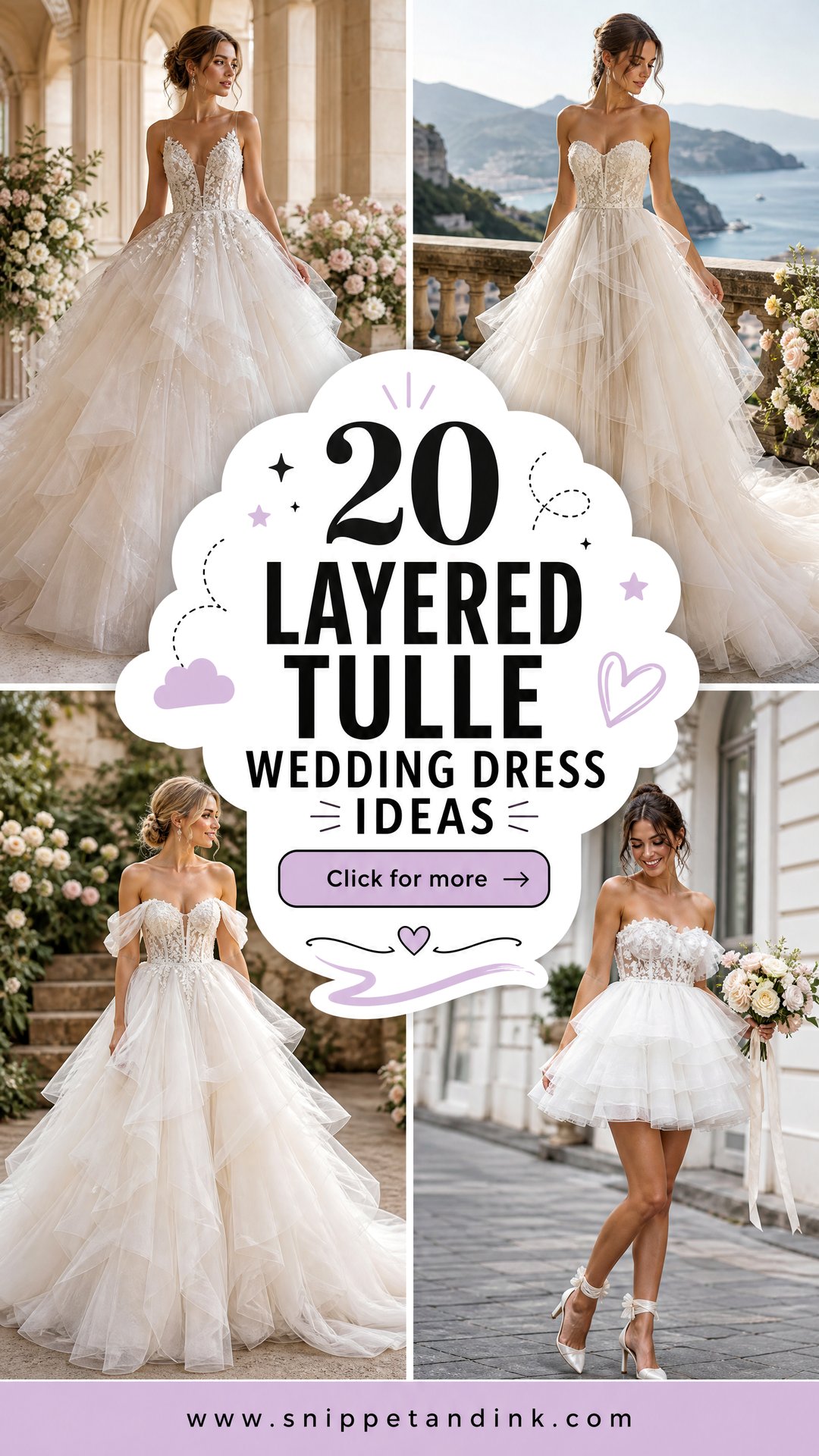
Tulle is the fabric I reach for when a bride wants volume that still moves. Layer it and the skirt gains depth you can see from across a room, yet the gown weighs far less than the same fullness would in satin or mikado. The ideas below run from full ball gowns and lace bodices to corsetry, colored linings and short reception dresses. Bridal collections lately have leaned into fuller petticoats, tiered skirts and dipped basque waists, so there is more choice in tulle now than there was a few seasons ago. At an appointment I look at how a skirt suits your venue, your proportions and how many hours you’ll stand in it, and only then at your personal aesthetic. Accessories come last, and with this much texture they should stay quiet.
Silk, Nylon or Soft Net: What the Tulle Itself Will Do on the Day
Two skirts can look identical in a photo and behave completely differently in person, and the reason is usually the tulle. Before I talk necklines with a bride, I take a handful of the skirt and squeeze it. How it springs back tells me most of what she needs to know.
The three tulles you’ll meet in a salon
- Silk tulle is the softest and drapes close to the body. It creases easily and costs more, so it suits slimmer skirts and veils better than huge ball gowns.
- Nylon tulle is what most bridal skirts use. It holds volume well, recovers from crushing quickly and takes steam without fuss.
- Soft net or English net sits between the two, with a fine hexagonal mesh and a hand closer to silk. It is common on lighter designer skirts and veils.
- Polyester tulle is cheaper and stiffer. It can feel scratchy against bare legs, and I check for that on every budget gown.
Layer count matters as much as fibre. A skirt might carry anything from three layers to more than a dozen, and each one adds warmth around the legs. For a midsummer outdoor wedding I’d rather see fewer layers over a good petticoat than a dozen layers trapping heat.
At your appointment, stand by a window and look down at the skirt. Fine tulle shows the lining colour through it; coarse tulle shows a visible grid. Then sit on a chair for a minute and stand up. If the front of the skirt stays flattened, it will look the same after the ceremony, the meal and the car ride.
1. Layered Tulle Ball Gown Wedding Dress
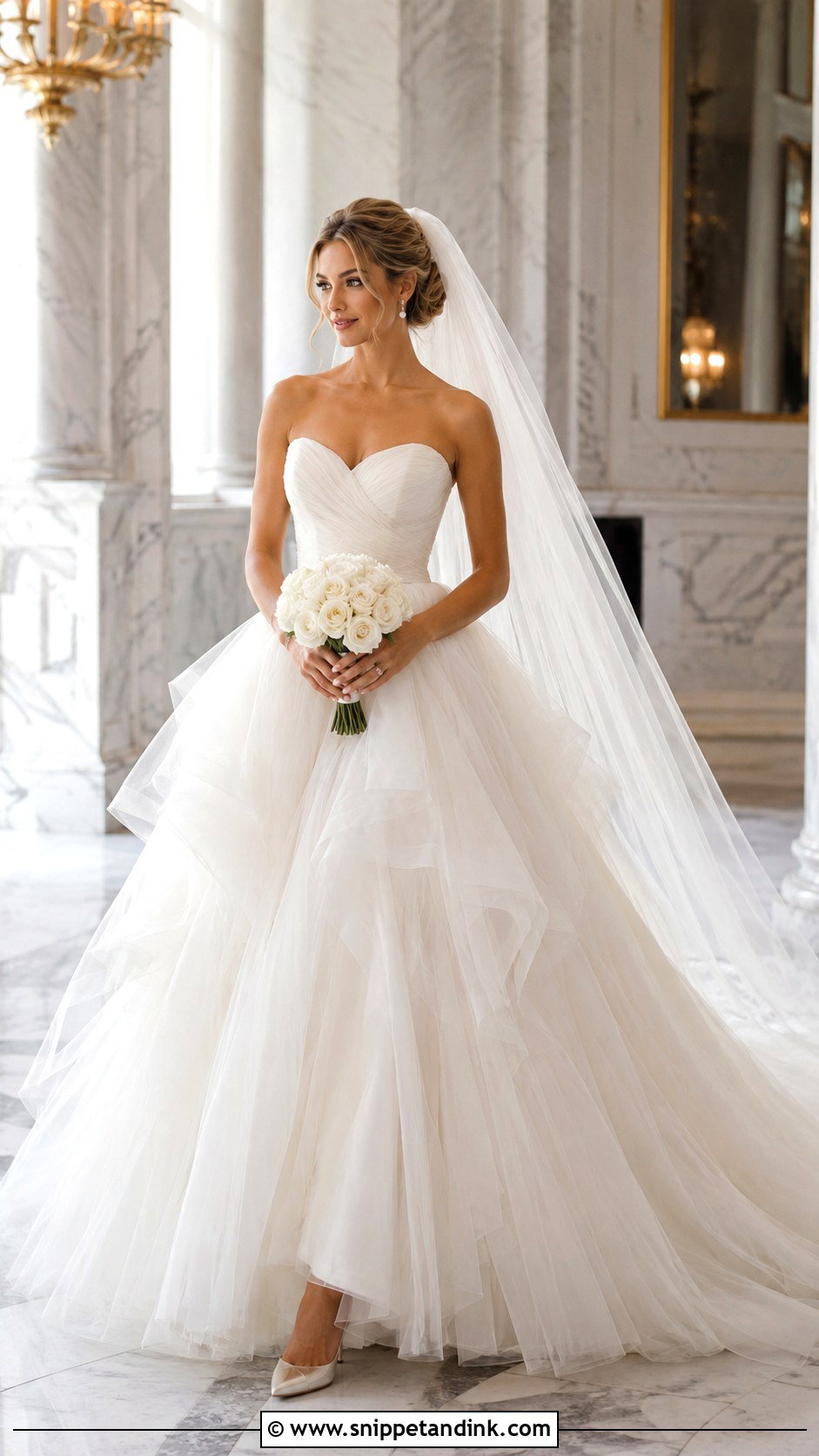
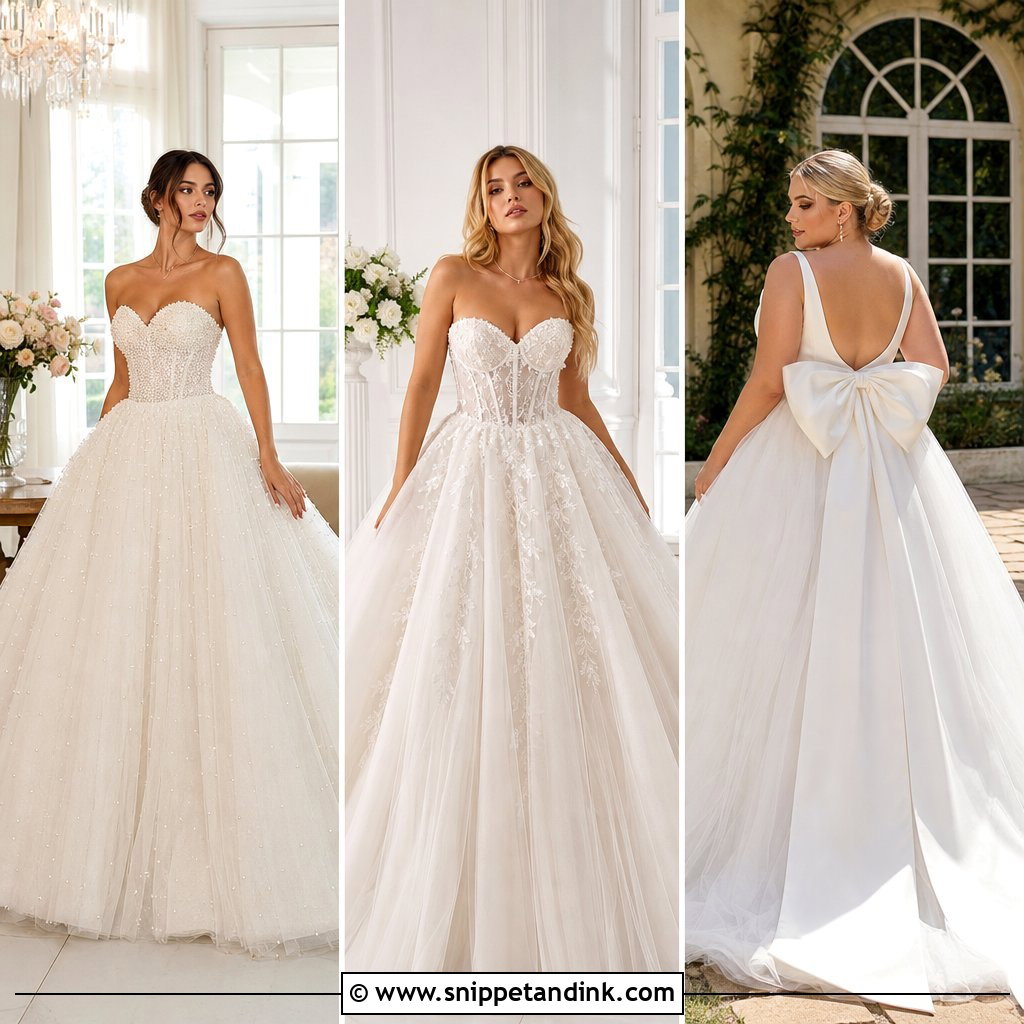
Most tulle ball gowns get their shape from what sits underneath, either a hoop or a stiff net petticoat, because the soft outer layers alone will sink by evening. I always ask a bride to walk the length of the salon in both versions, since a hoop swings and a petticoat brushes. Pair the full skirt with a structured bodice and a softly curved neckline so the top half doesn’t disappear. A cathedral veil belongs in a formal ceremony here, with pearl studs and pointed satin pumps, and a compact bouquet of white roses or calla lilies keeps your hands clear of the skirt. If your waist needs more definition, a basque or gently dipped waist does the job. I usually skip the necklace altogether.
2. Layered Tulle A-Line Wedding Dress
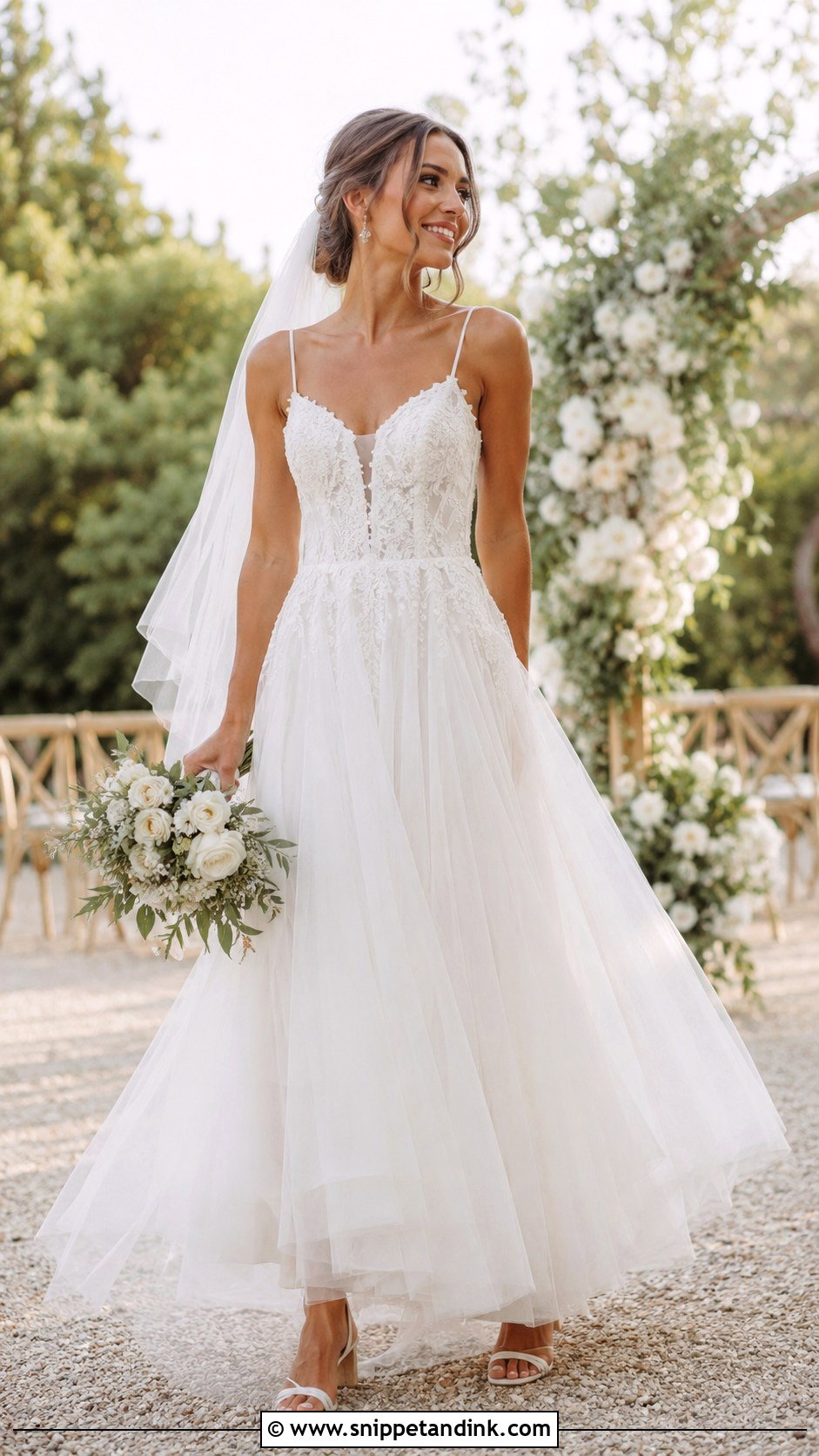
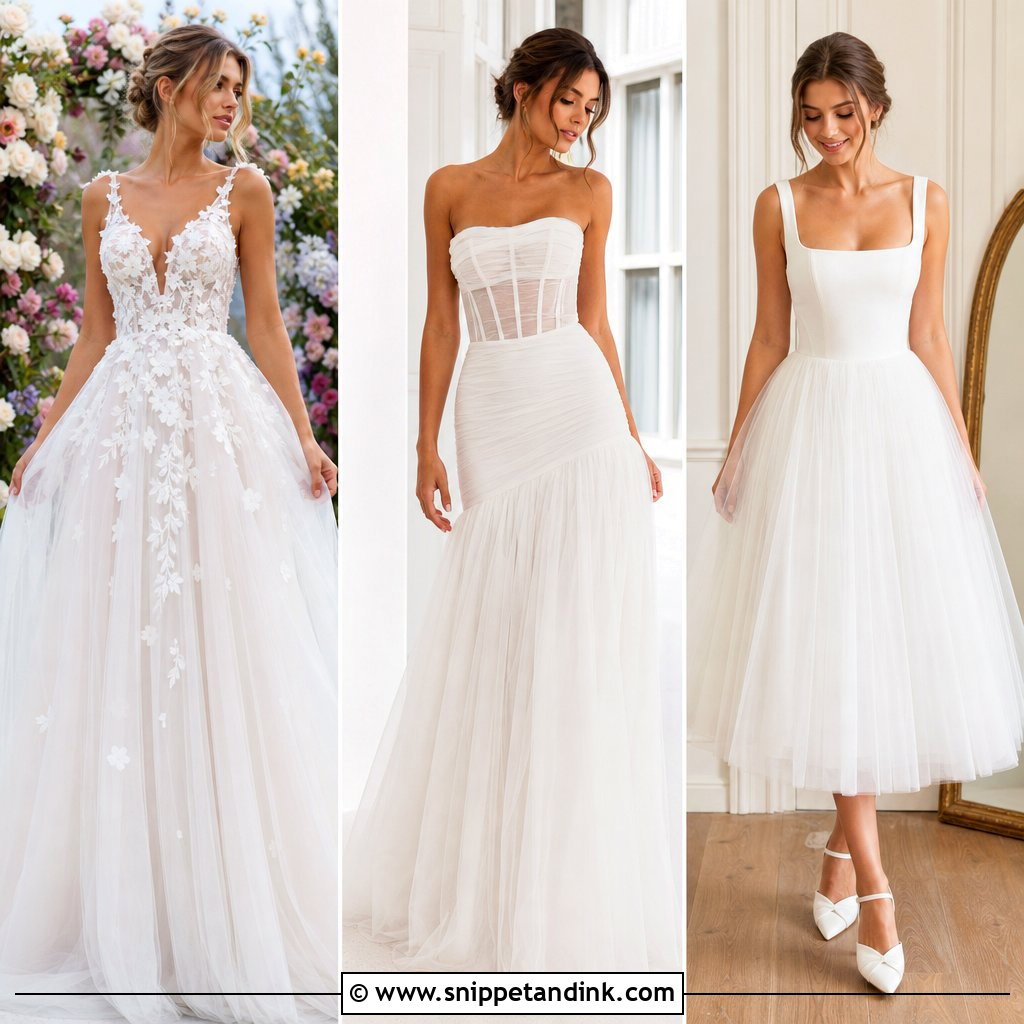
An A-line is the tulle shape I suggest most often to petite brides who feel swallowed by a ball gown. The skirt opens from the waist gradually, so you get movement without a wall of fabric around your knees. A fitted lace bodice with thin straps or a square neckline keeps it fresh. Choose a fingertip veil that stops above the widest point of the skirt; longer than that and the two layers of tulle start to merge in photos. Low block heels hide under the hem and won’t sink into a lawn. Gardens and estates suit it, and so do bright indoor rooms where a big skirt would crowd the aisle.
3. Layered Tulle Wedding Dress With Corset Bodice
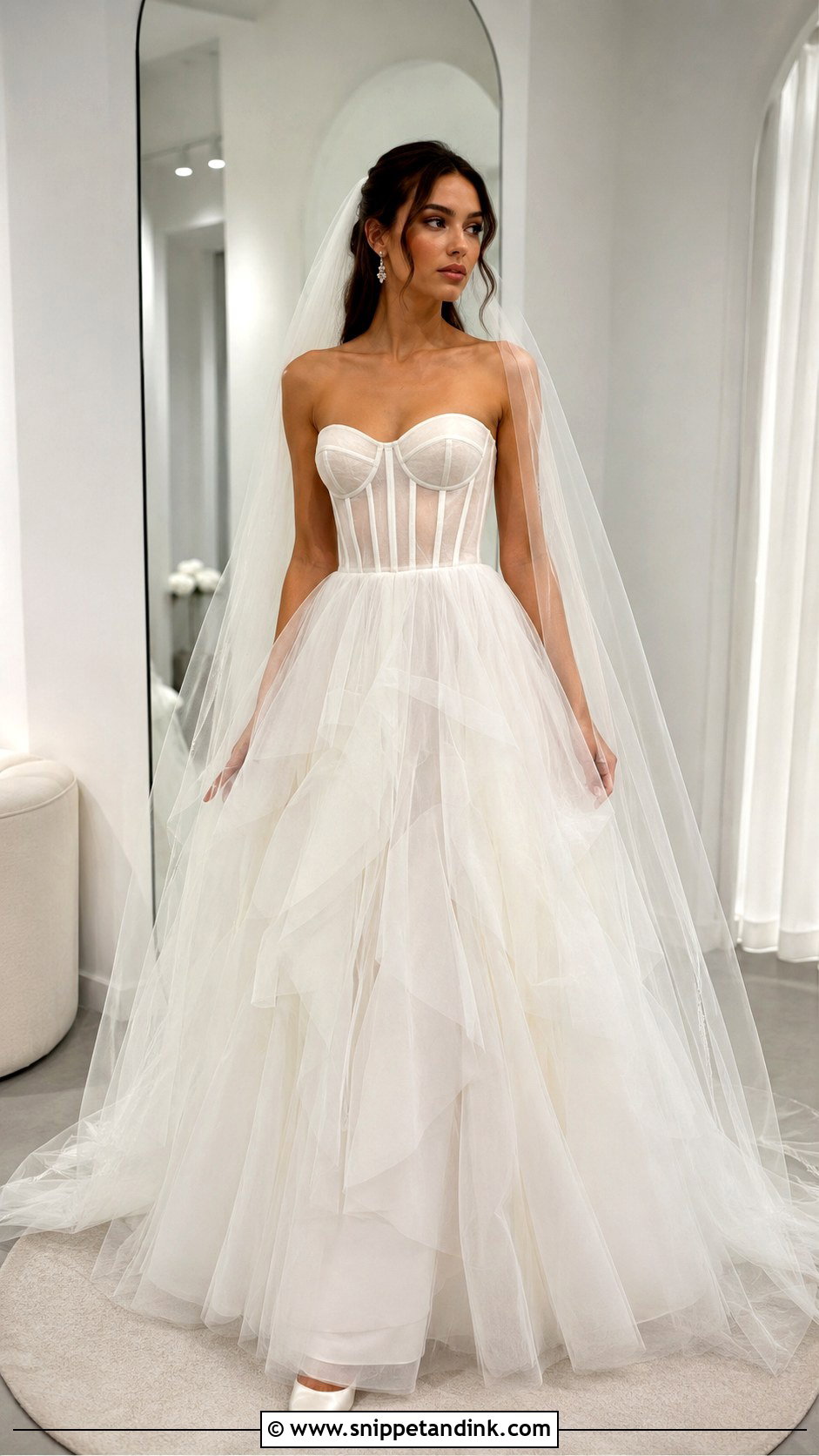
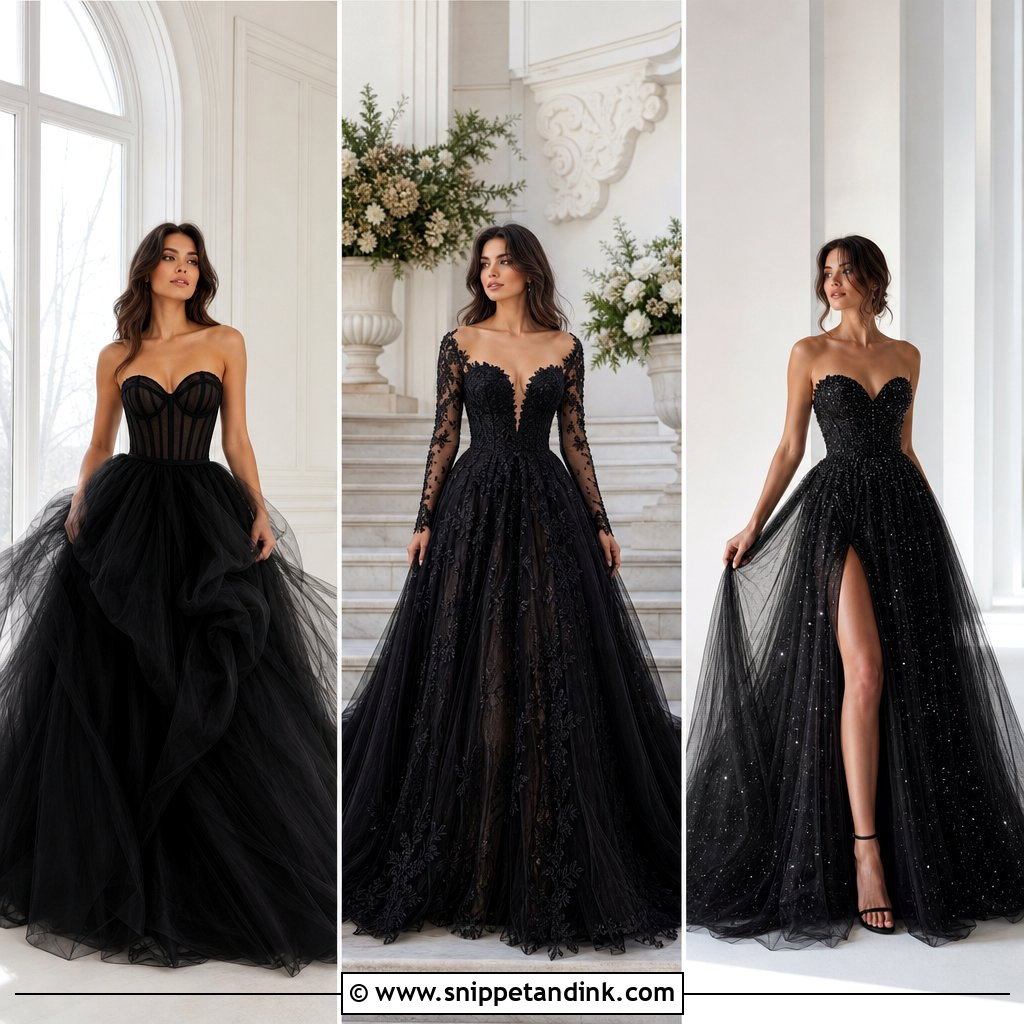
Visible corsetry looks simple on a hanger and is anything but. I check three things before a bride falls for one: where the boning sits against the ribs, whether the cups actually support or only shape, and how the back closes. Lacing gives a fitter more room to adjust on the morning; a zip is quicker but fixed. An ivory lining under sheer panels makes the bodice kinder against skin without losing the see-through effect. Let the skirt stay light and floating to balance the firm top, and add a raw-edge veil, crystal studs and ivory satin heels. A sleek low bun suits it. If the corset already carries lace or pearls, carry a streamlined bouquet and leave the neck bare.
4. Layered Tulle Wedding Dress With Lace Bodice
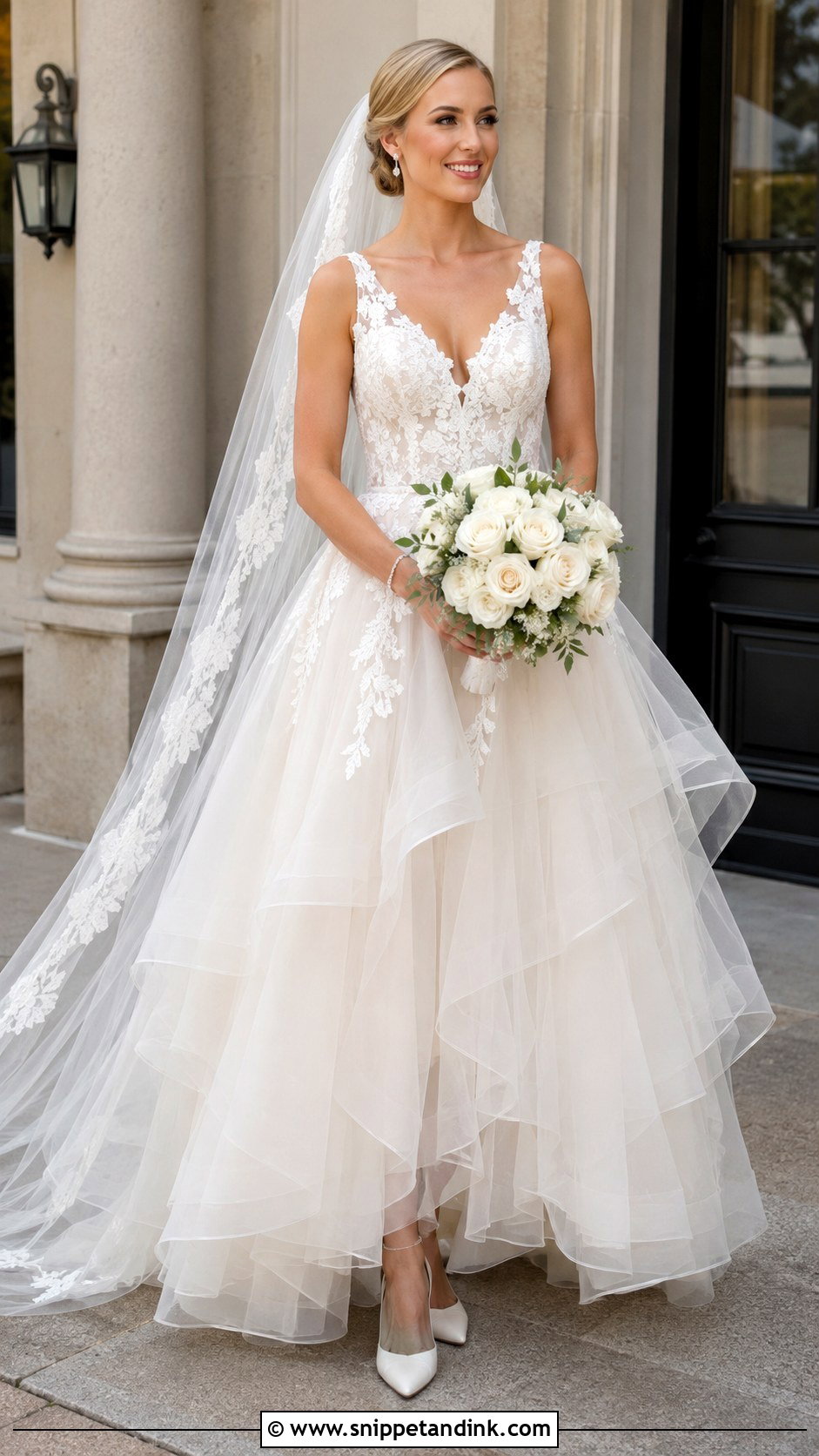
Lace on top and tulle below is the classic pairing, and it goes wrong at one spot: the waist seam. I look for lace motifs that spill a little way past the waistline so the bodice melts into the skirt rather than stopping in a hard line. A V-neck lengthens the torso; wider straps give you room for a proper bra. Repeat one motif in a lace-edged veil instead of matching the whole pattern, and finish with pearl drops, a slim bracelet and almond-toe pumps. At fittings, sit down and breathe deeply. Lace has little stretch, so if it gapes or digs while you’re seated, it needs taking in or letting out before the final fitting.
5. Strapless Layered Tulle Wedding Dress
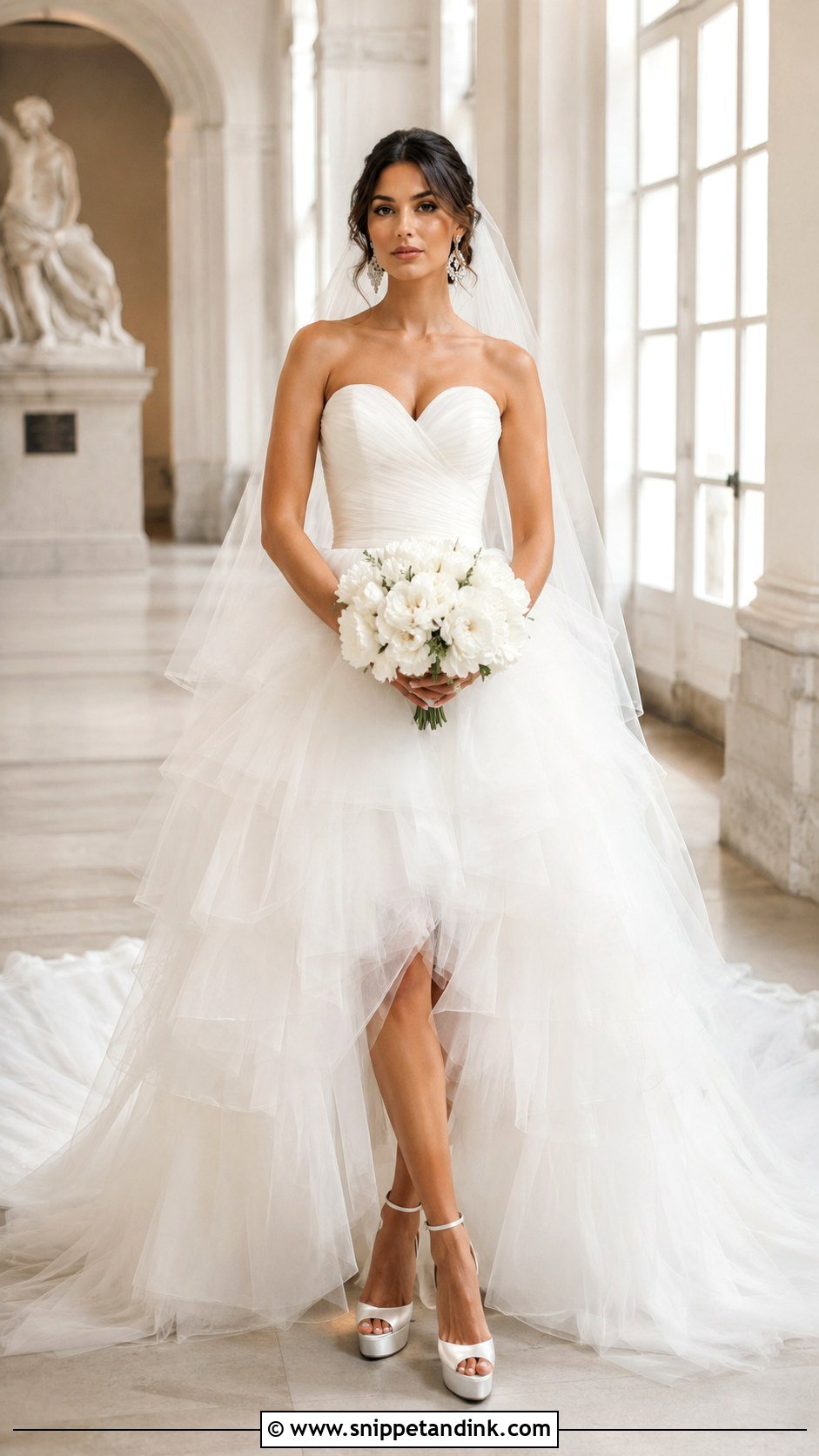
Strapless tulle lives or dies on its internal corset. A good one grips at the waist, not the bust, so you aren’t hitching the top up all evening. Sweetheart necklines soften the line; a straight neckline reads more minimal. I like a cathedral veil for the ceremony that comes off before the reception to show the bodice. Statement earrings fill the open neckline better than a necklace. Satin platforms and a structured white bouquet finish it. I’d steer you away from strapless if you dread checking your neckline in every photo; detachable tulle sleeves or a sheer wrap give you a way out on a cold day.
6. Off-The-Shoulder Layered Tulle Wedding Dress
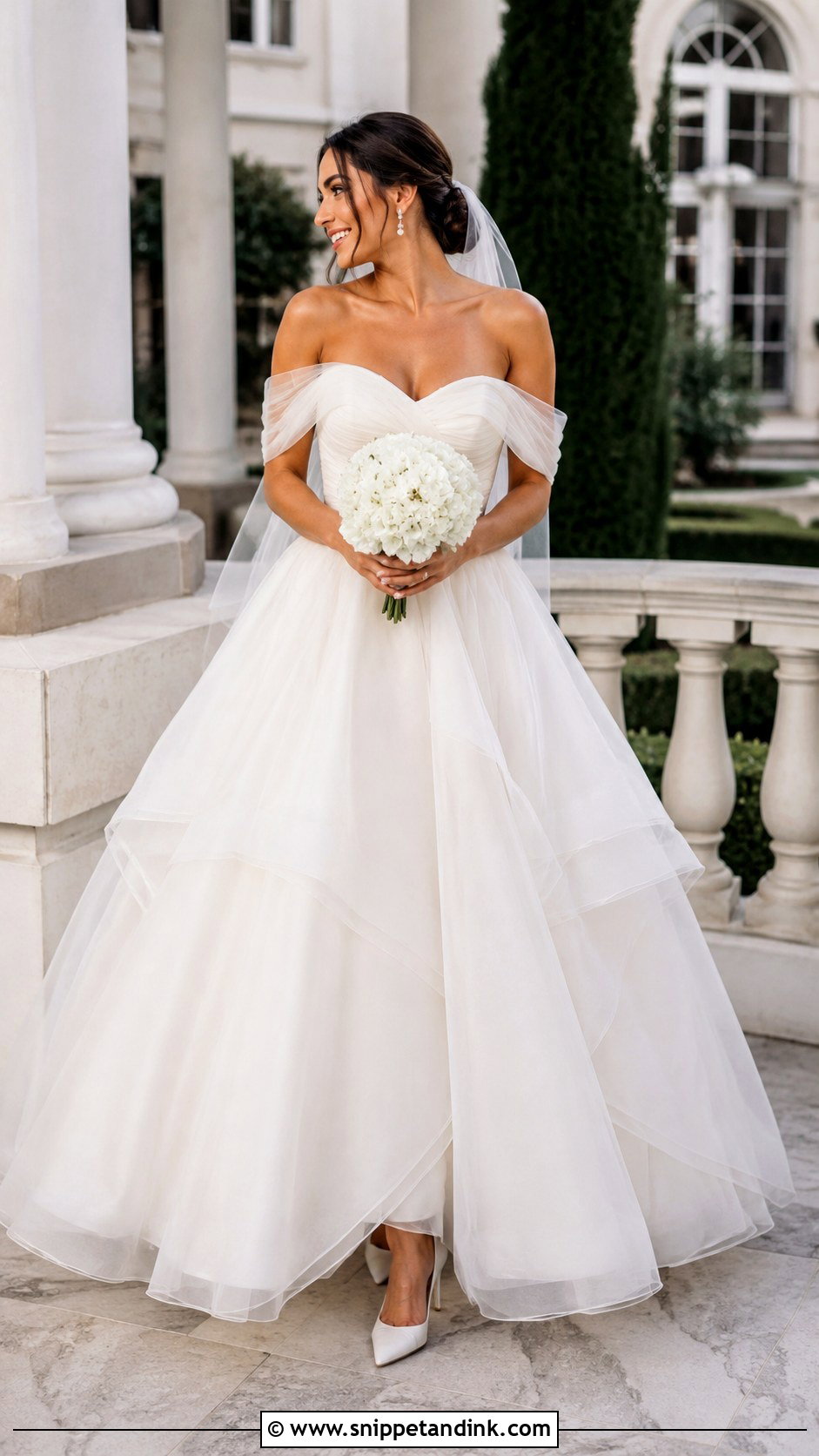
Off-the-shoulder sleeves are a fitting test more than a style choice. Raise your arms, sit, and hug your fitter during the appointment, because many of these sleeves are cut so tight around the upper arm that a full embrace pulls the whole neckline down. Elasticized tulle or a hidden clear strap solves most of it. A natural or basque waist balances the wide shoulder line, and the shoulders become your jewellery, so a fine pendant or nothing at all works best. Add pearl and crystal earrings, ivory slingbacks and a light veil tucked under a low chignon. A rounded bouquet with a little greenery suits the shape.
7. Long Sleeve Layered Tulle Wedding Dress
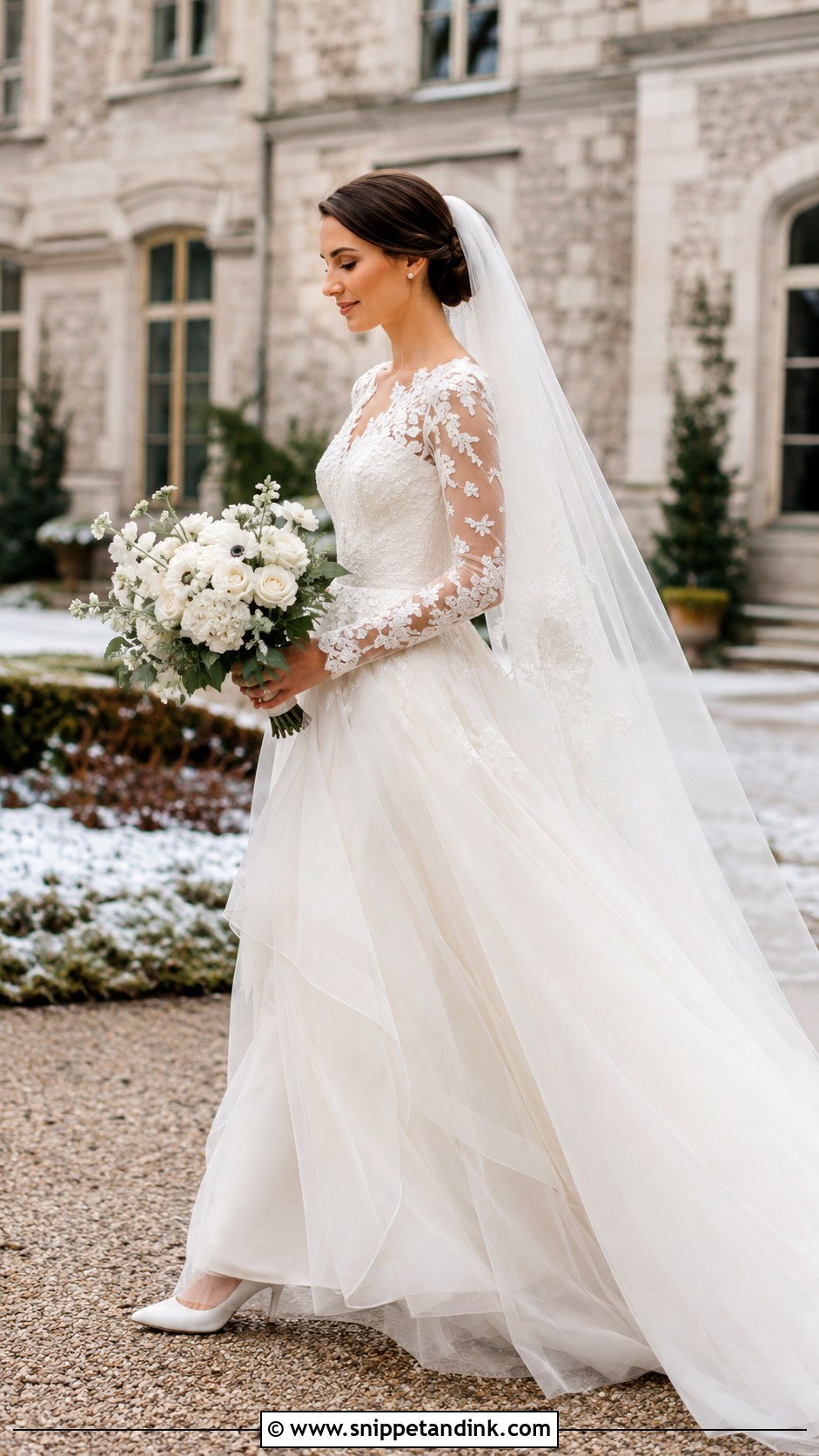
Long sleeves suit cooler months, and in tulle they stay light enough for dancing. Sheer sleeves with scattered lace appliqués give coverage with air in them; plain fitted sleeves with a clean cuff look sharper. The thing I ask the seamstress to check is the elbow. Tulle sleeves cut too slim bind when you bend your arm to eat or raise a glass, and the cuff creeps up your wrist. With a close bodice the skirt can carry several layers without looking heavy. Closed-toe pumps, pearl studs and a chapel-length veil keep it neat, and an updo shows off the sleeve detail. Roses, anemones or seasonal greenery finish it.
8. Layered Tulle Wedding Dress With Floral Appliqués
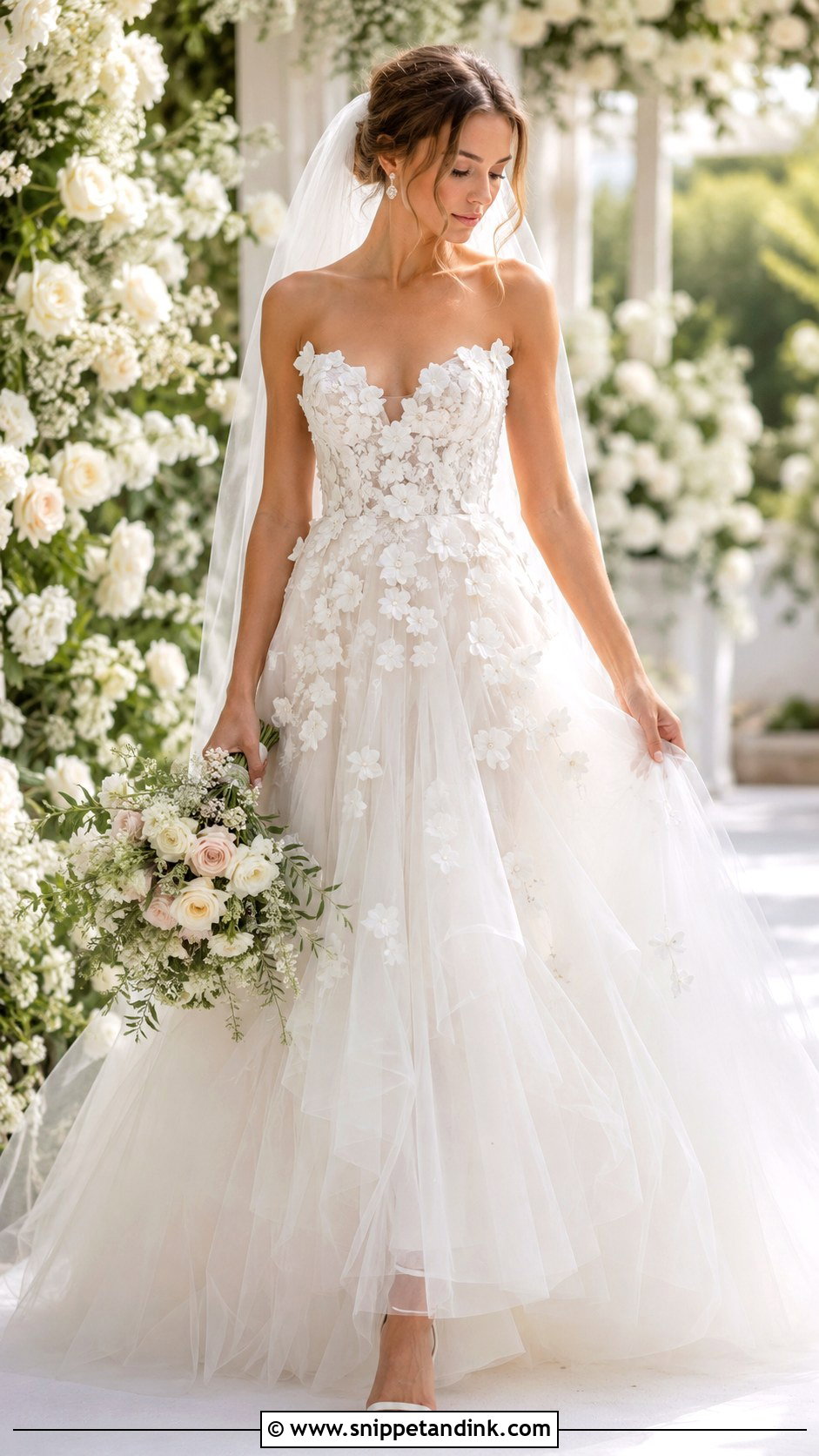
Appliqués work best when they thin out as they travel down the skirt: dense at the bodice, a scatter by the knee, almost nothing at the hem. That spacing keeps the silhouette readable. Three-dimensional petals look rich in close-ups, but I run my hand over them before a bride commits, because stiff petals catch the veil every time it moves. A plain tulle veil and understated drop earrings let the flowers lead. Carry a loose bouquet that echoes the appliqués rather than copying them. For a spring or garden date, a pale blush or champagne lining under the skirt throws ivory flowers into relief.
9. Tiered Layered Tulle Wedding Dress
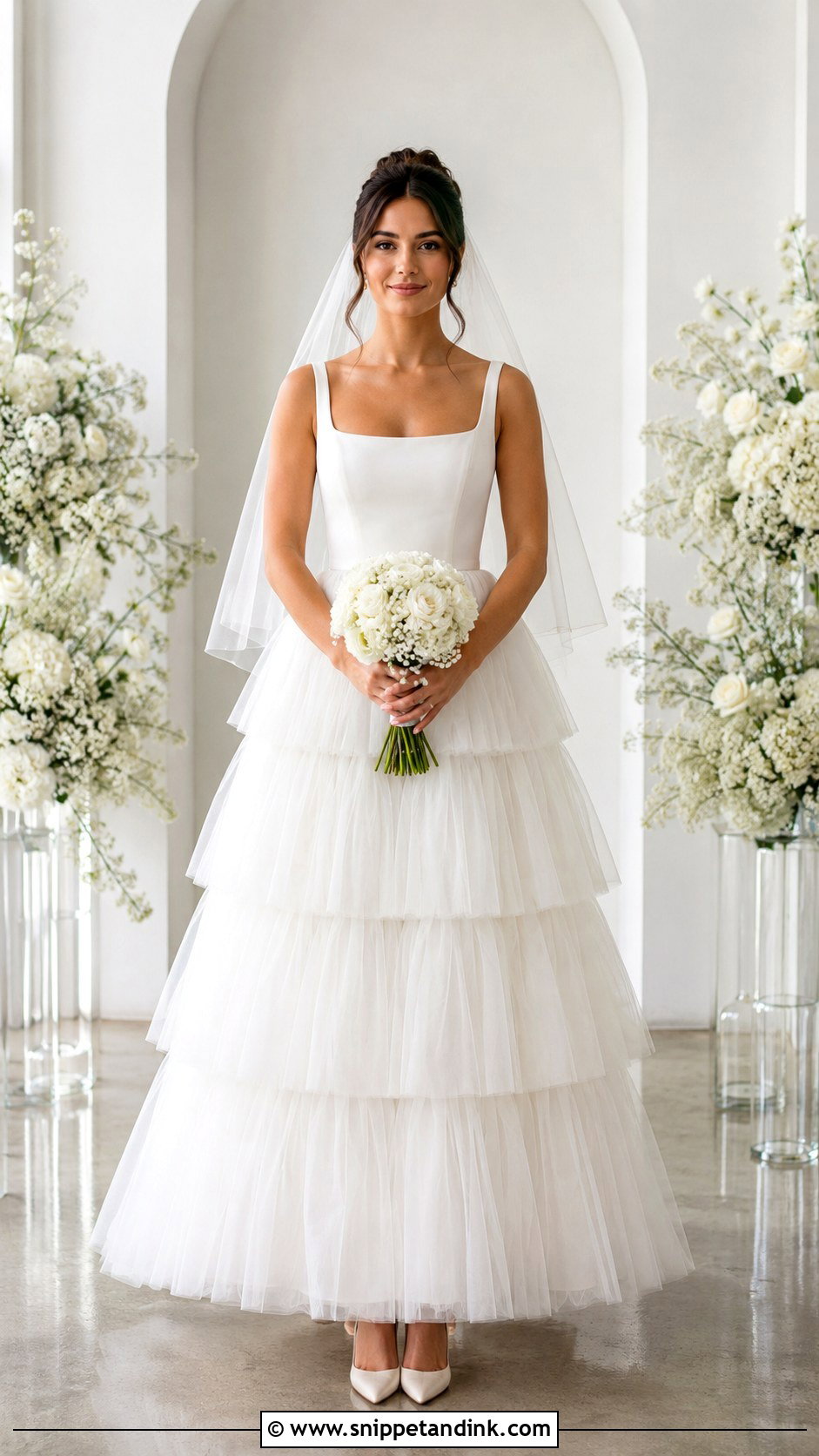
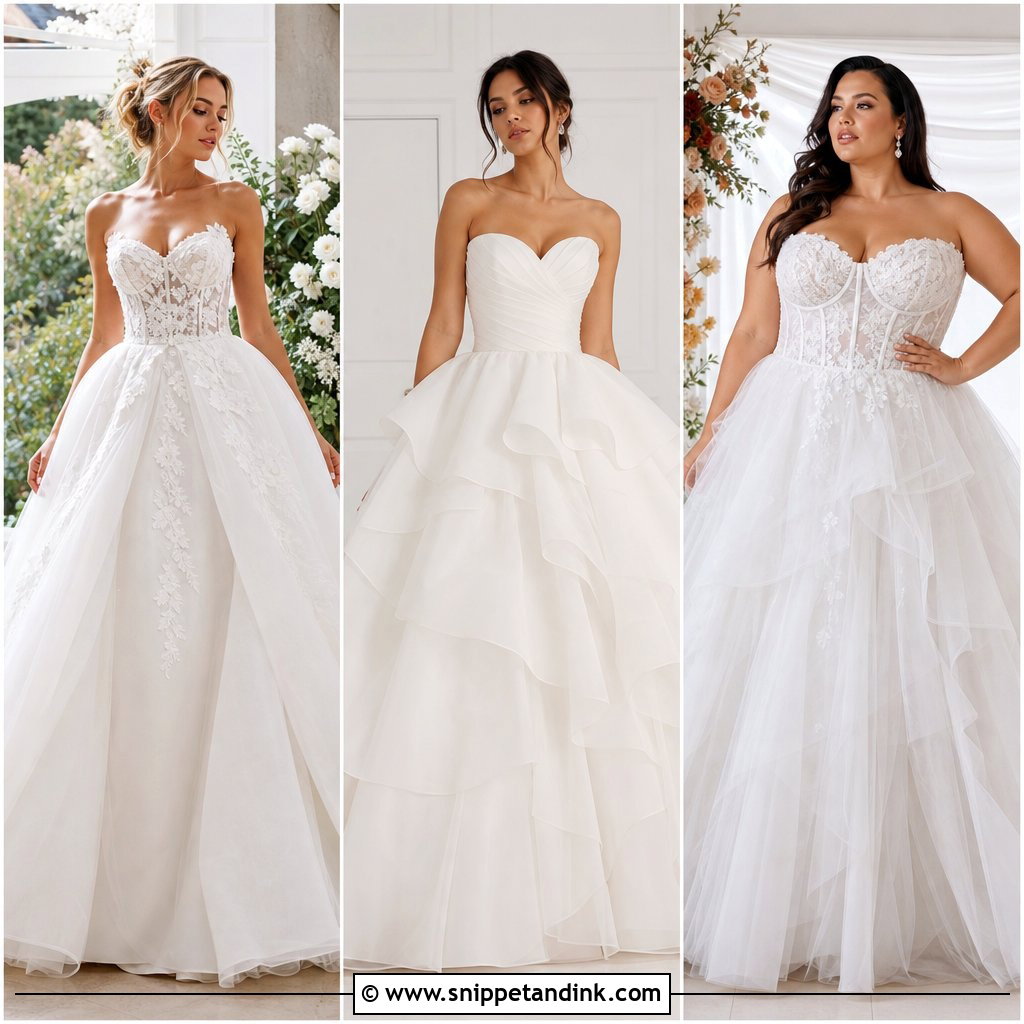
Tiers give a tiered tulle wedding dress its rhythm, and the width of each tier sets the mood. Wide, softly gathered tiers read elegant; narrow cascading ones read playful. Keep the bodice plain or the skirt starts to look busy. Because every tier adds fullness, a compact bouquet is more in proportion than a trailing one, and pointed pumps with a fingertip veil keep the rest light. Wear your actual wedding shoes to every alteration appointment. Each tier is hemmed relative to the one above, so a change of two centimetres in heel height throws the whole sequence off.
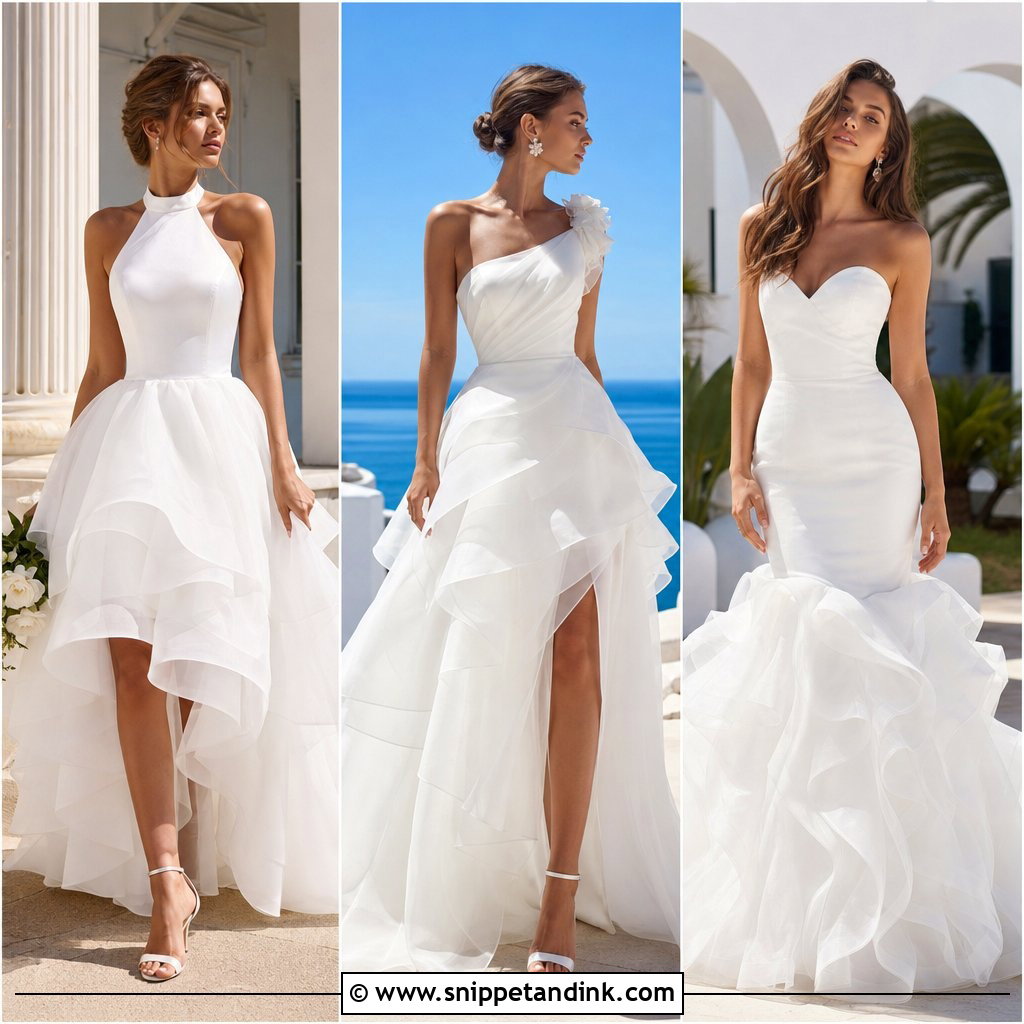
10. Ruffled Layered Tulle Wedding Dress
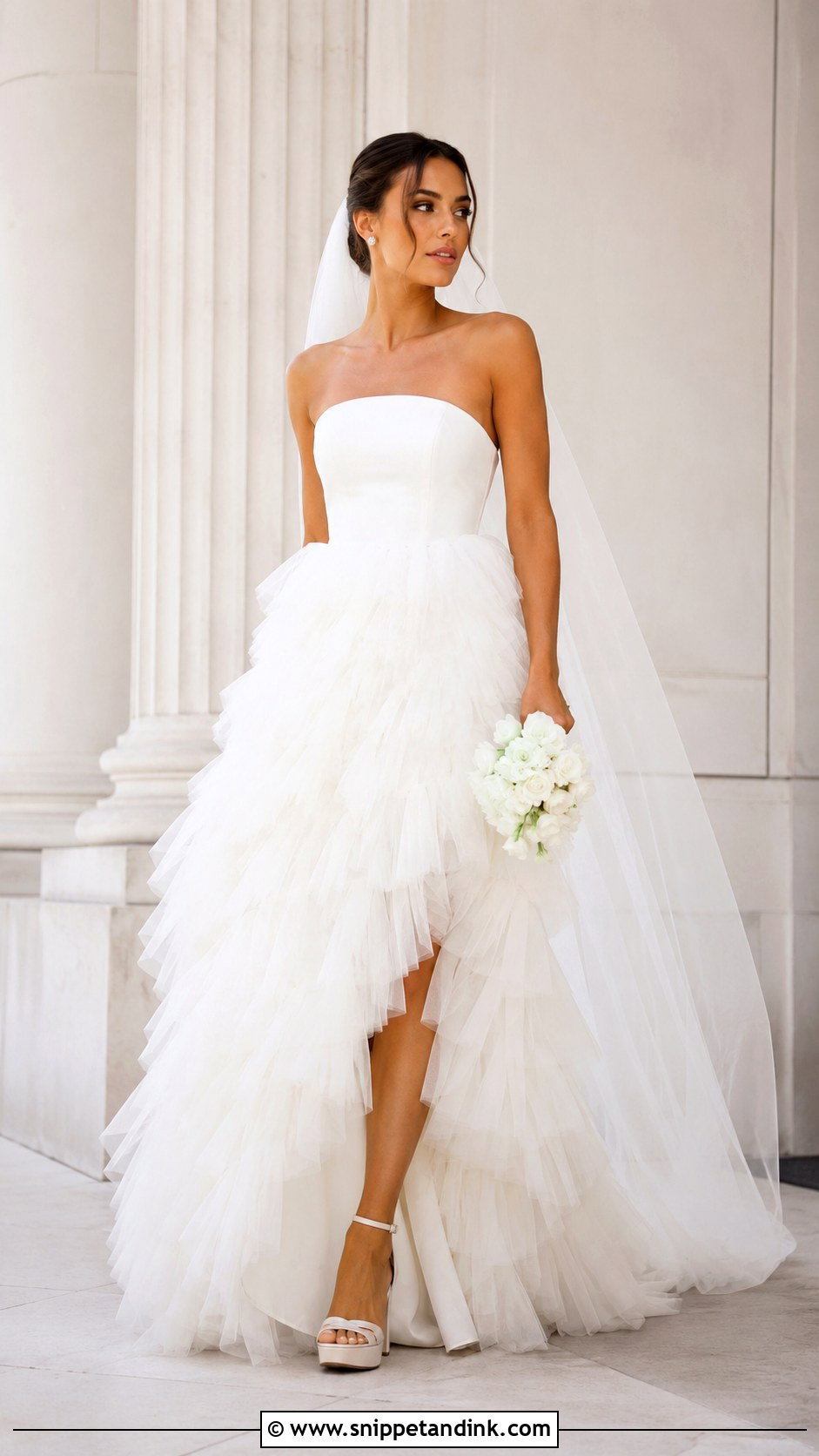
Ruffles are heavier than they look. Several metres of gathered tulle sewn in cascading rows add real weight to the hips, so I always send a bride up and down a staircase in a ruffled sample before she orders. The wearable versions run their ruffles vertically or on a diagonal, which adds length as well as width. Keep the bodice fitted and simple, with a strapless or narrow-strap neckline, and pull hair into a smooth ponytail or low bun for contrast. Crystal studs, ivory platforms and a plain chapel veil are enough. A small single-colour bouquet sits better against all that texture than a loose oversized one.
11. Basque Waist Layered Tulle Wedding Dress
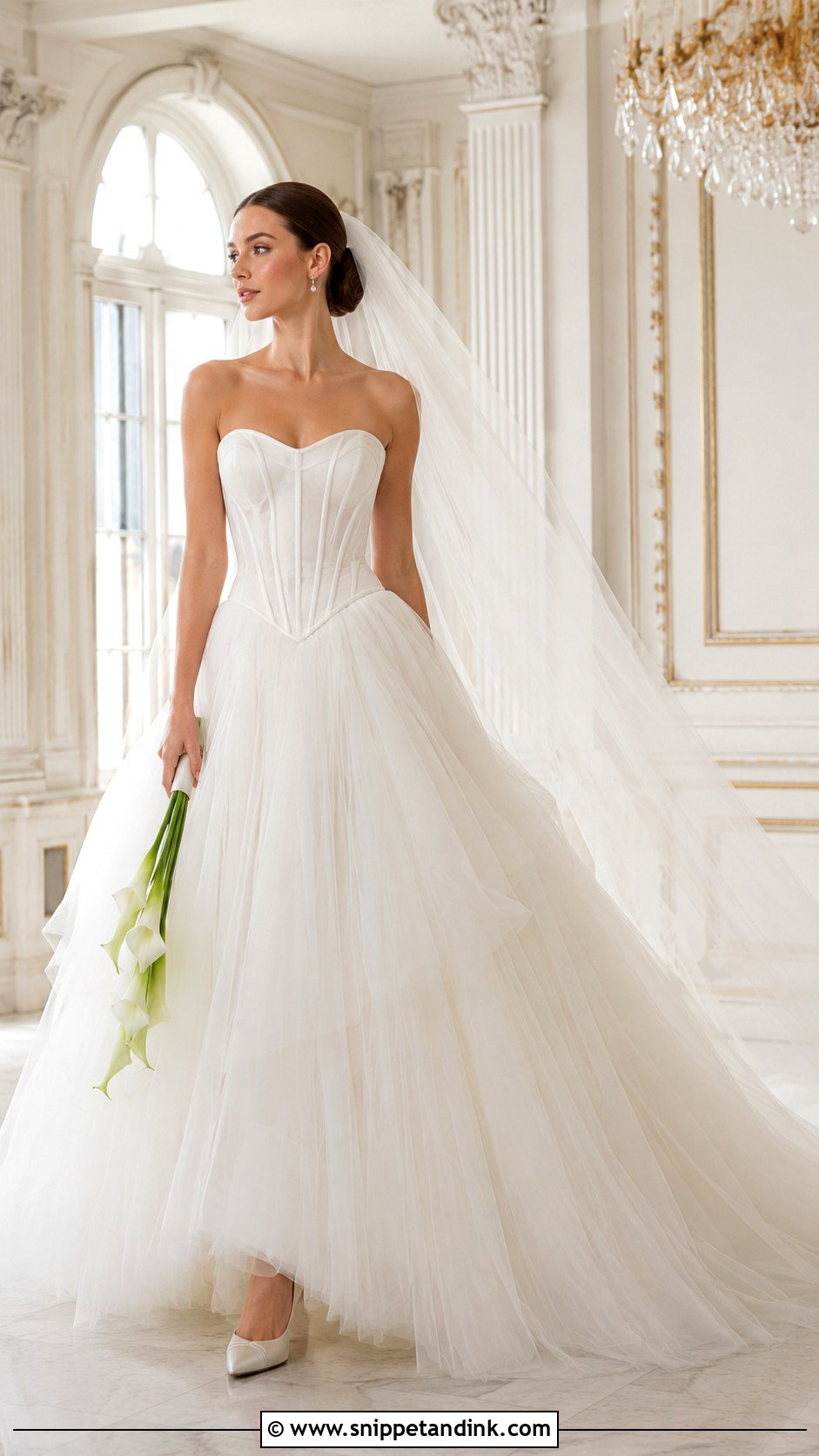
A basque waist dips into a point below your natural waist and makes the torso look longer. It suits a corset bodice because the pointed seam carries the eye straight into the skirt. The catch is symmetry. If the point sits even slightly off-centre, everyone notices in the front-on portraits, so I ask the fitter to check it with the bride standing and again seated. Plain tulle keeps it refined; scattered lace adds interest. A cathedral veil, pearl earrings and pointed satin heels suit the formality, and a narrow bouquet with long stems follows the vertical line. Keep hair sleek or softly waved.
12. Drop Waist Layered Tulle Wedding Dress
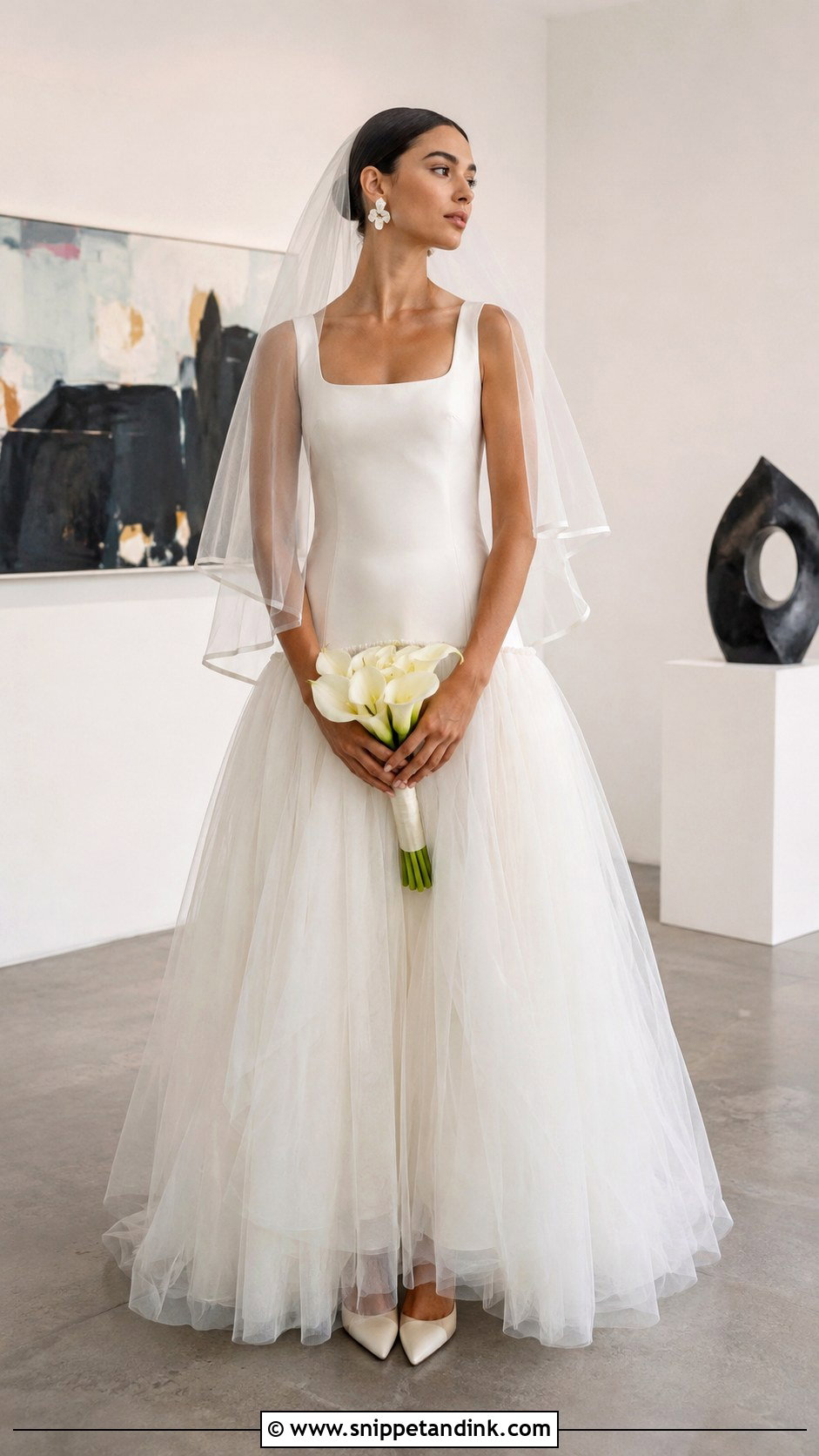
Sitting down is the real test for a drop waist. The seam lands at the hips, so a bodice cut close through the torso can pull or crease across the lap once you’re seated at dinner. I have brides sit on a hard chair for a full minute at fittings. Done right, the long torso and late flare look modern, especially with a square neckline or a plain strapless top. Gathers concentrated near the hips give gentle drama without extreme fullness. An elbow-length veil, sculptural earrings and sleek pumps suit it, along with a polished bun and a compact calla lily bouquet.
13. Sparkle Layered Tulle Wedding Dress
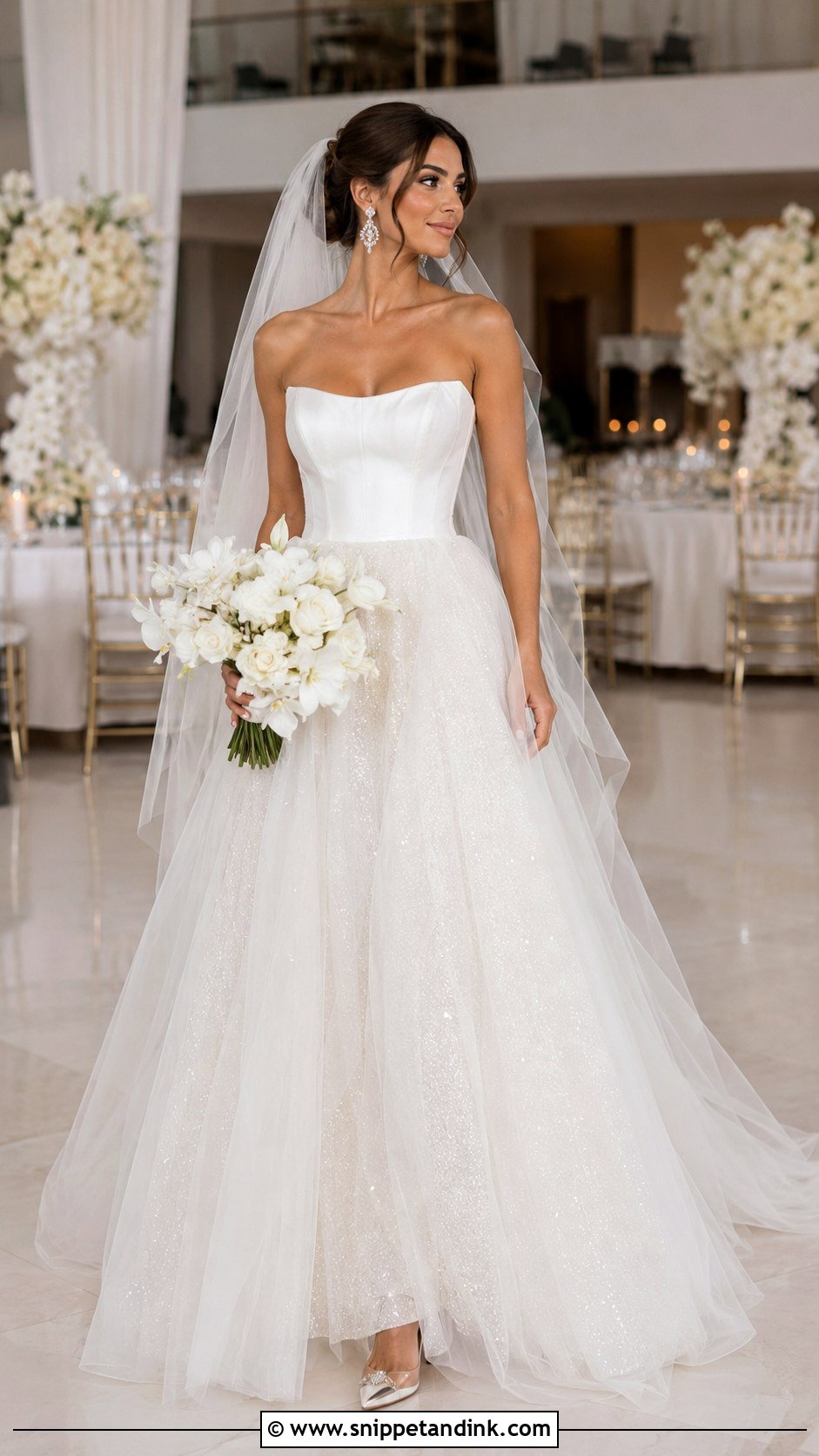
Sparkle tulle reads best buried. Put the glitter layer underneath a plain outer skirt and it glints through as you move instead of turning the dress into a disco ball. Pair it with a clean corset or satin bodice and hold back on jewels; crystal earrings are plenty. A raw-edge veil and a smooth hairstyle keep it grown-up, and a white bouquet with little greenery looks crisp beside the shimmer. Before you order, look at the sample in daylight, under warm lamps and with a phone flash. Some glitter tulles throw hard white spots back at the camera, and cheaper ones shed onto everything they touch.
14. Blush Layered Tulle Wedding Dress
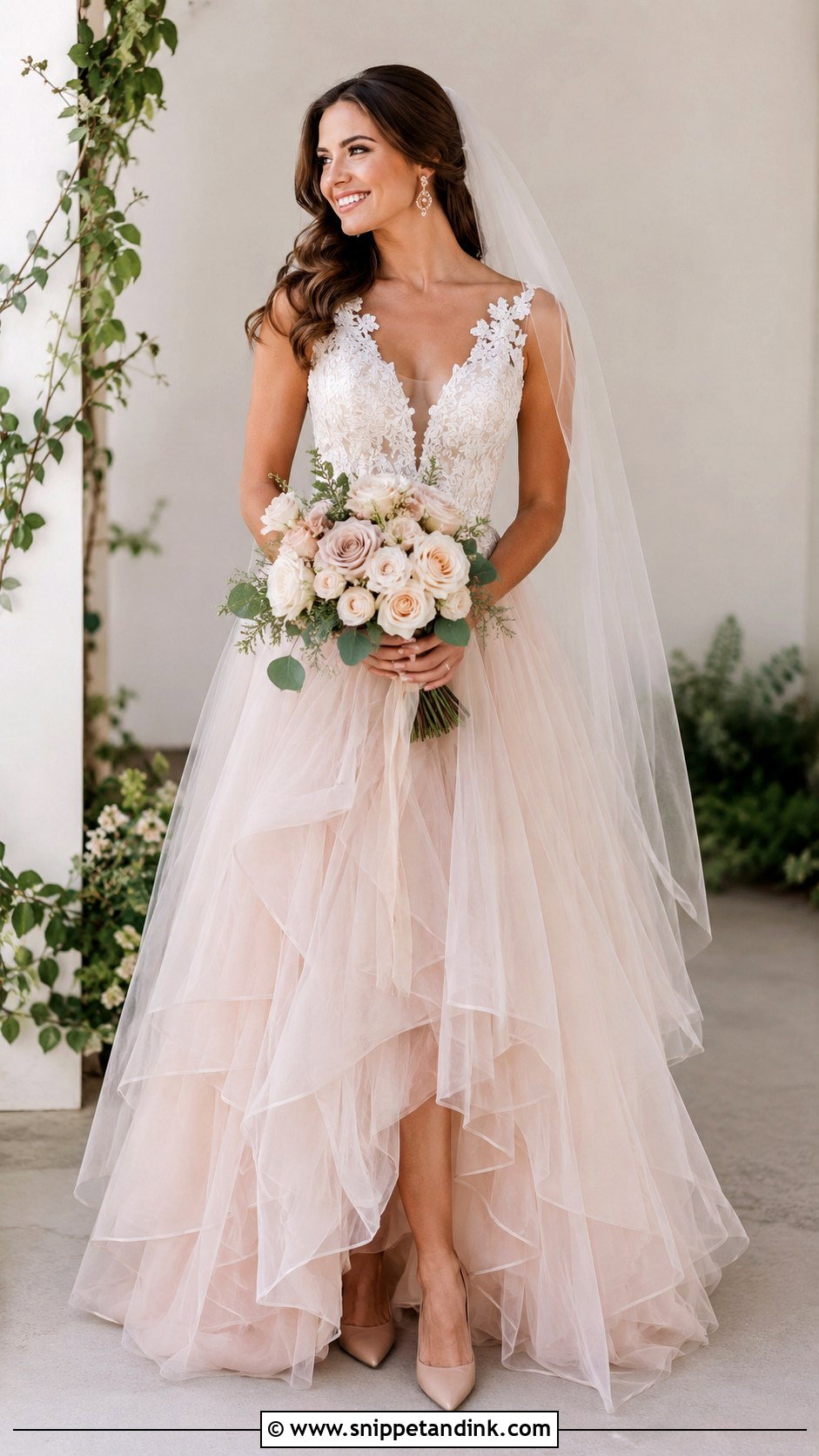
Blush deepens with every layer. One pink layer over ivory gives a wash of colour, while five layers of the same tulle look distinctly pink, so judge the finished skirt rather than a swatch. Hold it next to your face in daylight; cool, fair skin can look sallow against a peachy blush. An ivory lace or beaded bodice eases the transition from skin to colour. Nude or pale blush heels, rose-gold earrings and an ivory veil let the skirt colour show. Bouquets in cream and muted pink pull the palette together. For only a hint of colour, ask for blush lining under ivory tulle.
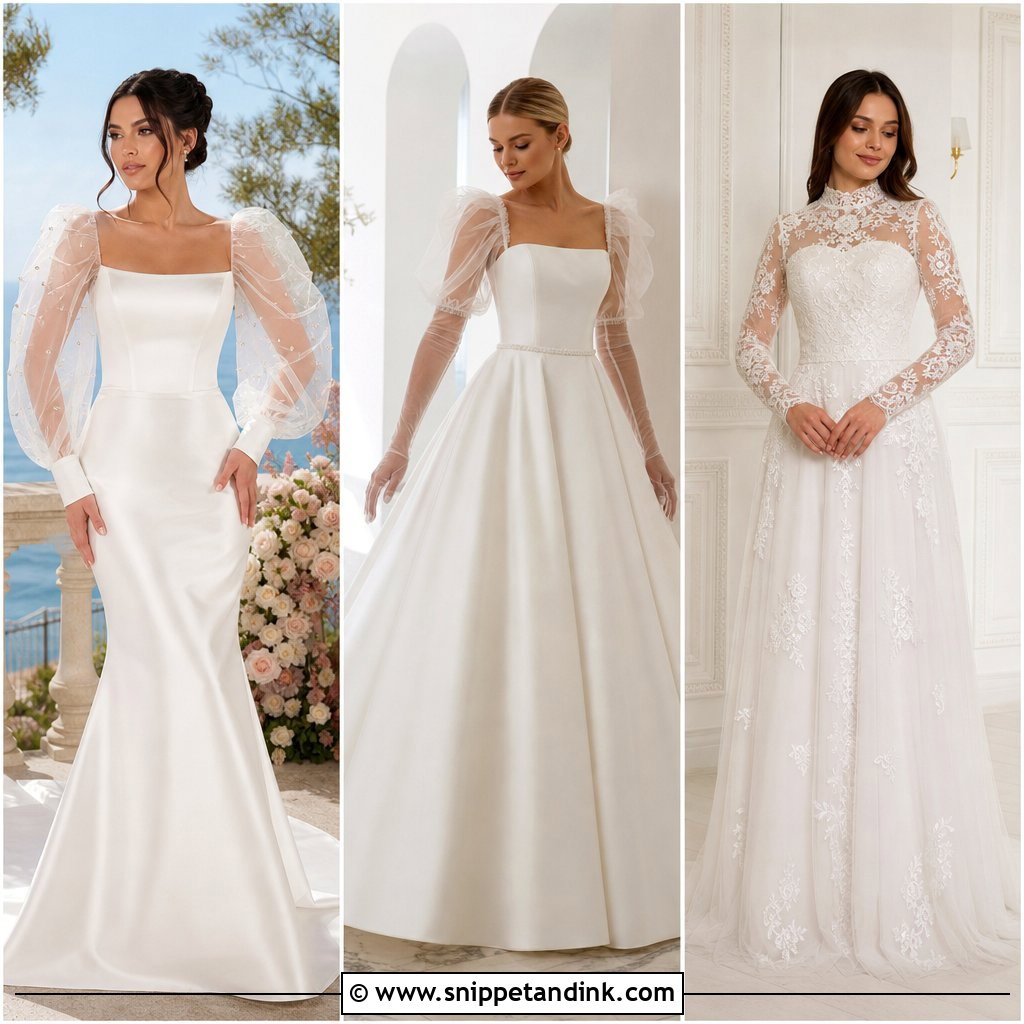

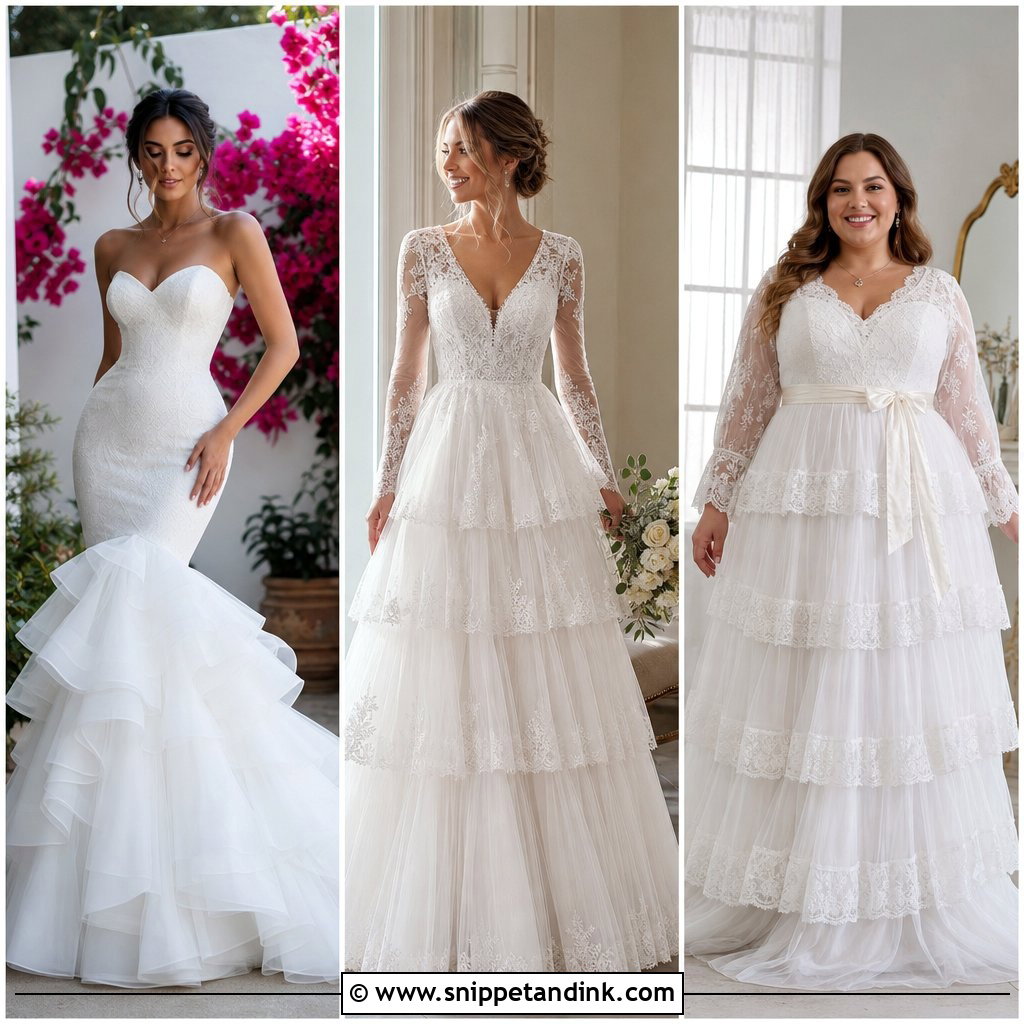
15. Champagne Layered Tulle Wedding Dress
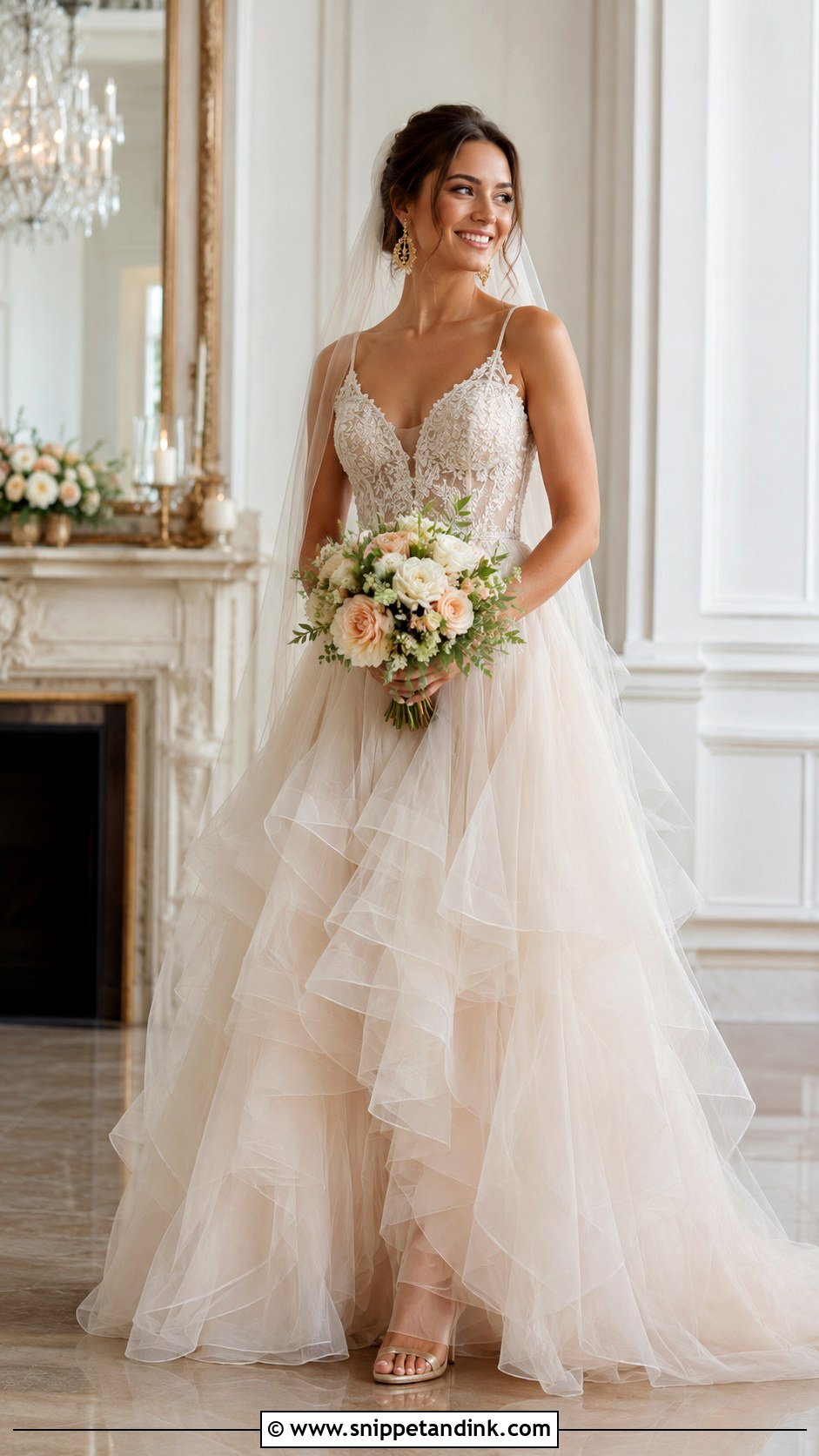
Champagne lining under ivory tulle warms the whole dress and makes lace and embroidery stand out, which is why it looks so rich in evening venues. It is also the colour that shifts most between lights. Under warm tungsten it can go almost gold, and in a cold white room it can look grey, so I ask brides to view the sample both by a window and under the shop lights before ordering. Keep a defined waist and let the skirt fall softly. Gold-toned earrings, champagne satin heels and a sheer ivory veil complement rather than match. White flowers with beige or pale peach accents finish it.
16. Layered Tulle Mermaid Wedding Dress
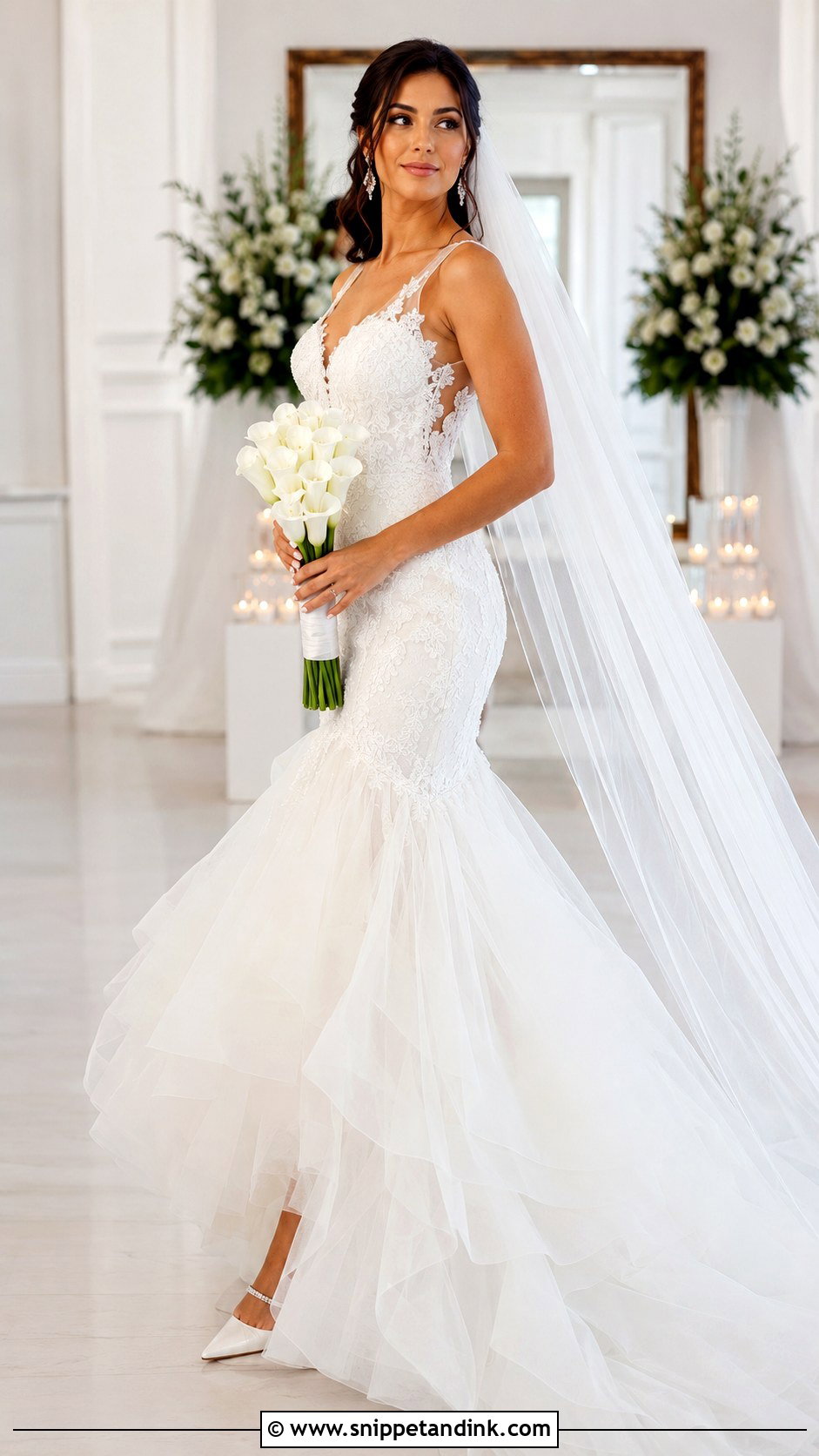
In a tulle mermaid, all the volume sits below the knee, so the fit above it has to be close but forgiving. Look for a flexible lining and shaped seams; I ask brides to take a full stride and then sit, because a mermaid cut too tight through the thigh turns walking into shuffling. Graduated layers around the flare give it movement. Wear supportive pointed heels, delicate earrings and a long plain veil that runs past the train, and keep the bouquet narrow so it doesn’t hide the fitted bodice. Plan the bustle early. A flared tulle train usually needs several lift points before anyone can dance near it.
17. Layered Tulle Tea-Length Wedding Dress
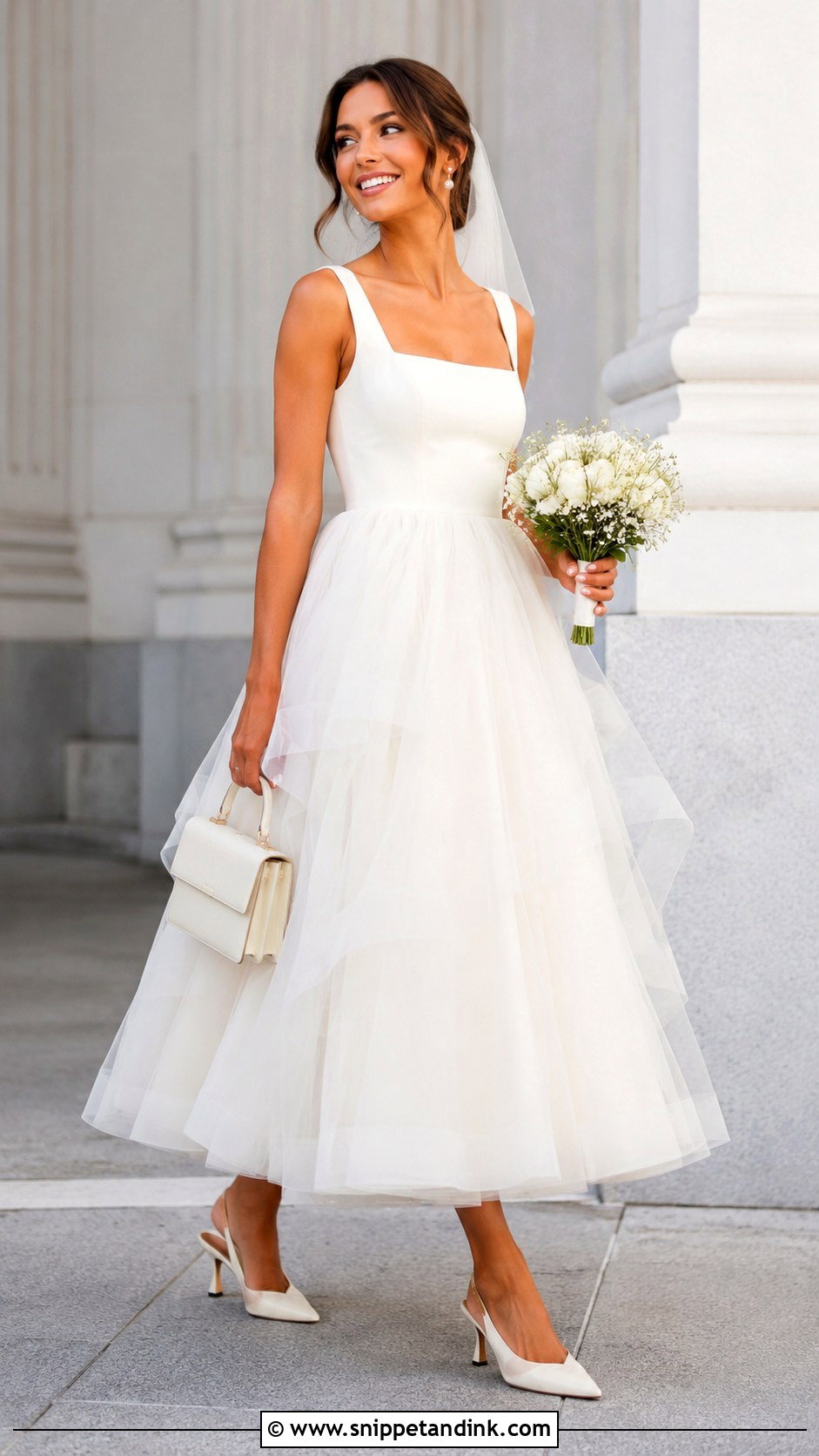
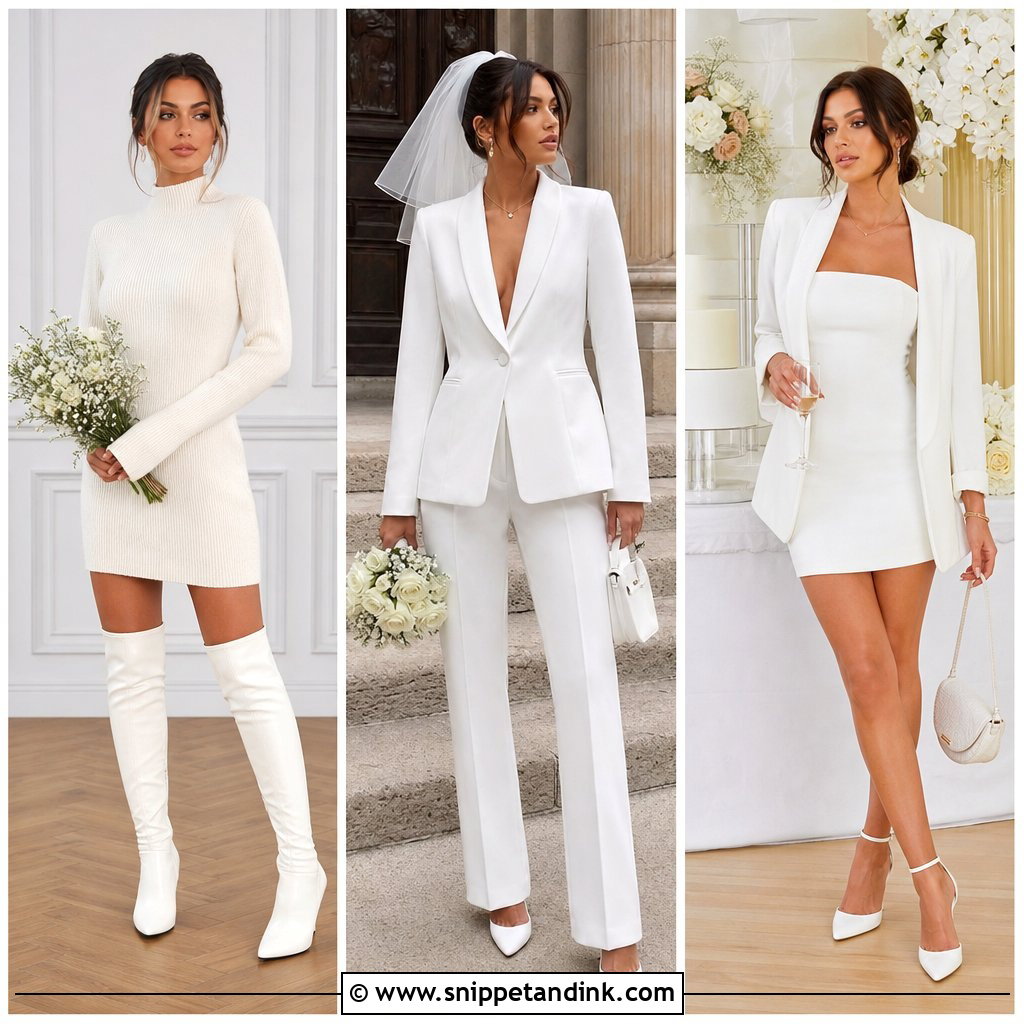
Tea length is my pick for a courthouse ceremony or a relaxed reception, and the hem is everything. It should land between lower calf and ankle; a few centimetres higher and it can cut the leg at its widest point. Because the shoes are on show, choose them first and hem to them. A fitted bodice with a square, scoop or sweetheart neckline keeps proportions tidy. Pointed slingbacks, pearl earrings and a short birdcage or shoulder-length veil suit the scale, along with a small structured bag and a compact bouquet. Ask your seamstress to check the hem while you walk and turn, not only standing still.
18. Layered Tulle Mini Wedding Dress
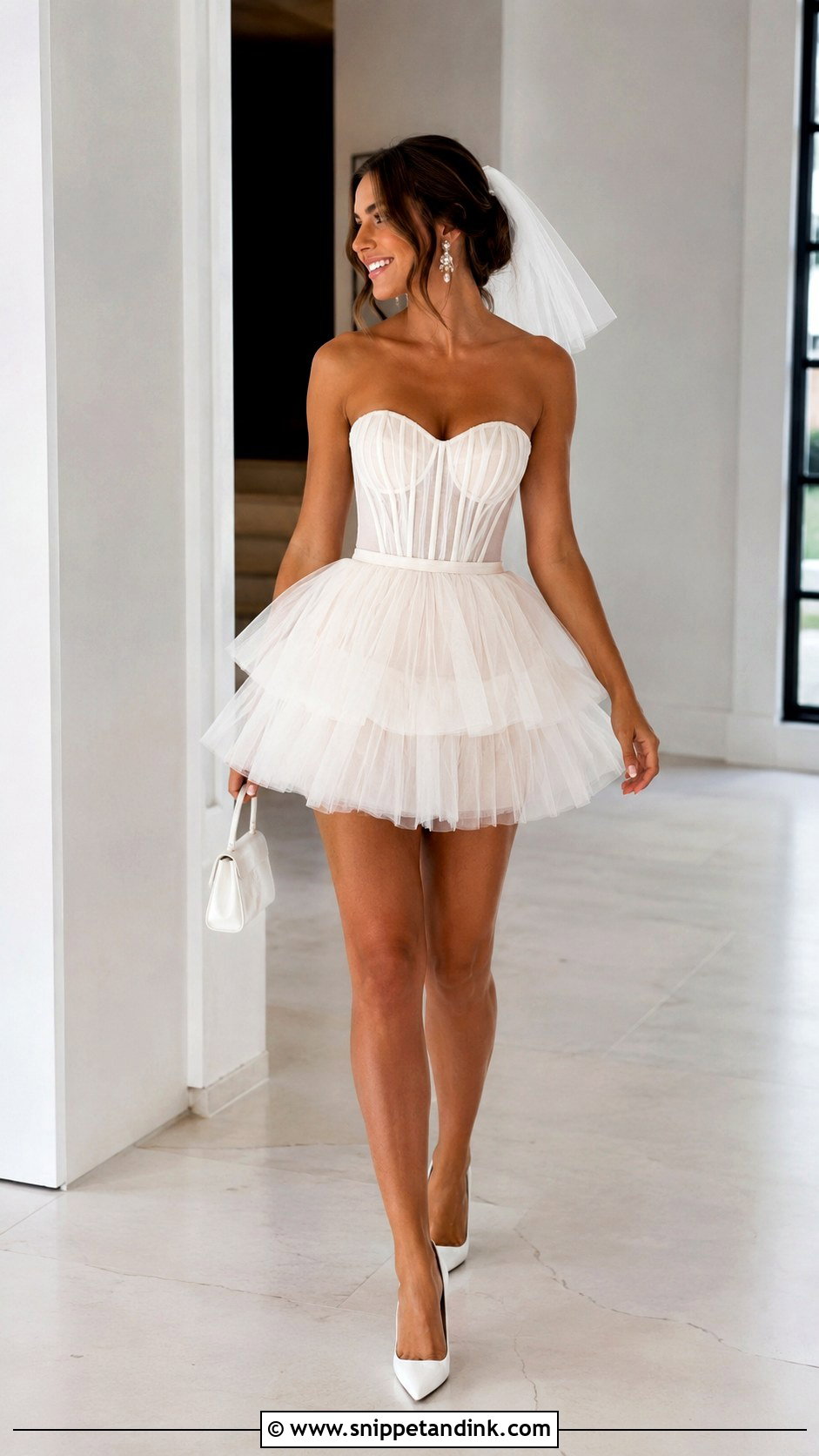
A tulle mini needs structure on top to look intentional rather than costume. A corset, a square neckline or long fitted sleeves all give it that weight. I’d add fitted shorts underneath without hesitation; short tulle flips up on every turn of the dance floor. Keep the layers soft around the hips so they bounce instead of sticking out. Pointed pumps or ankle-strap heels, statement earrings and either a short veil or an oversized bow suit it, and a small white bag holds a lipstick and a phone. It works brilliantly as a reception change or for a civil ceremony.
19. Layered Tulle Wedding Dress With Detachable Sleeves
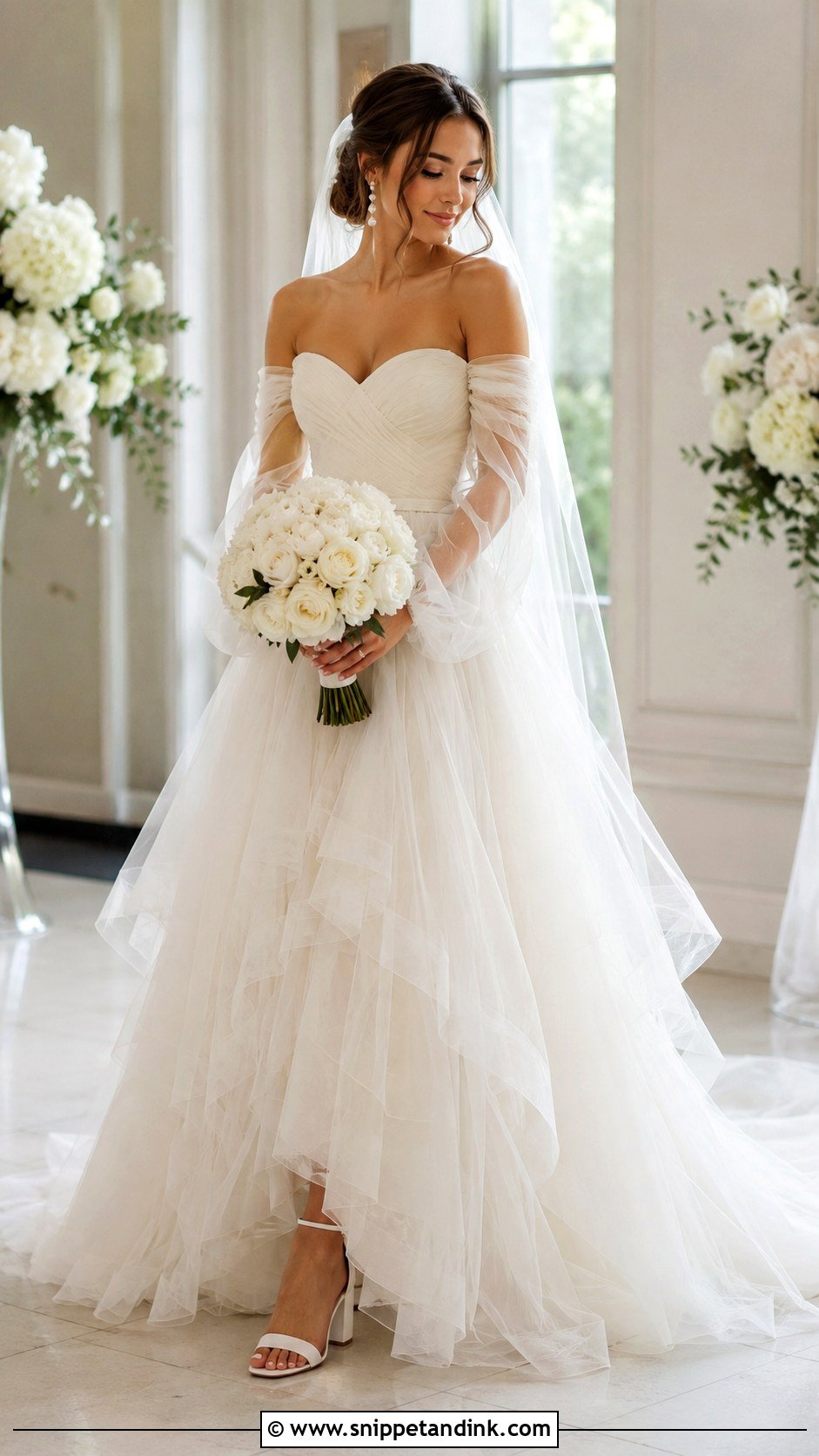
Detachable sleeves give you two looks from one gown, but only if the attachment is invisible once they’re off. Check that the snaps or loops lie flat against the bodice with nothing poking out. Sheer puffs, fitted lace or draped off-shoulder pieces can carry the ceremony, then come away for a cleaner reception look. A half-up hairstyle suits both versions. Pair with a fingertip veil, pearl drops and satin block heels you can stand in for hours. Hand the job of removing them to one named person and have them practise at the last fitting, with a small bag ready to keep the sleeves from crushing.



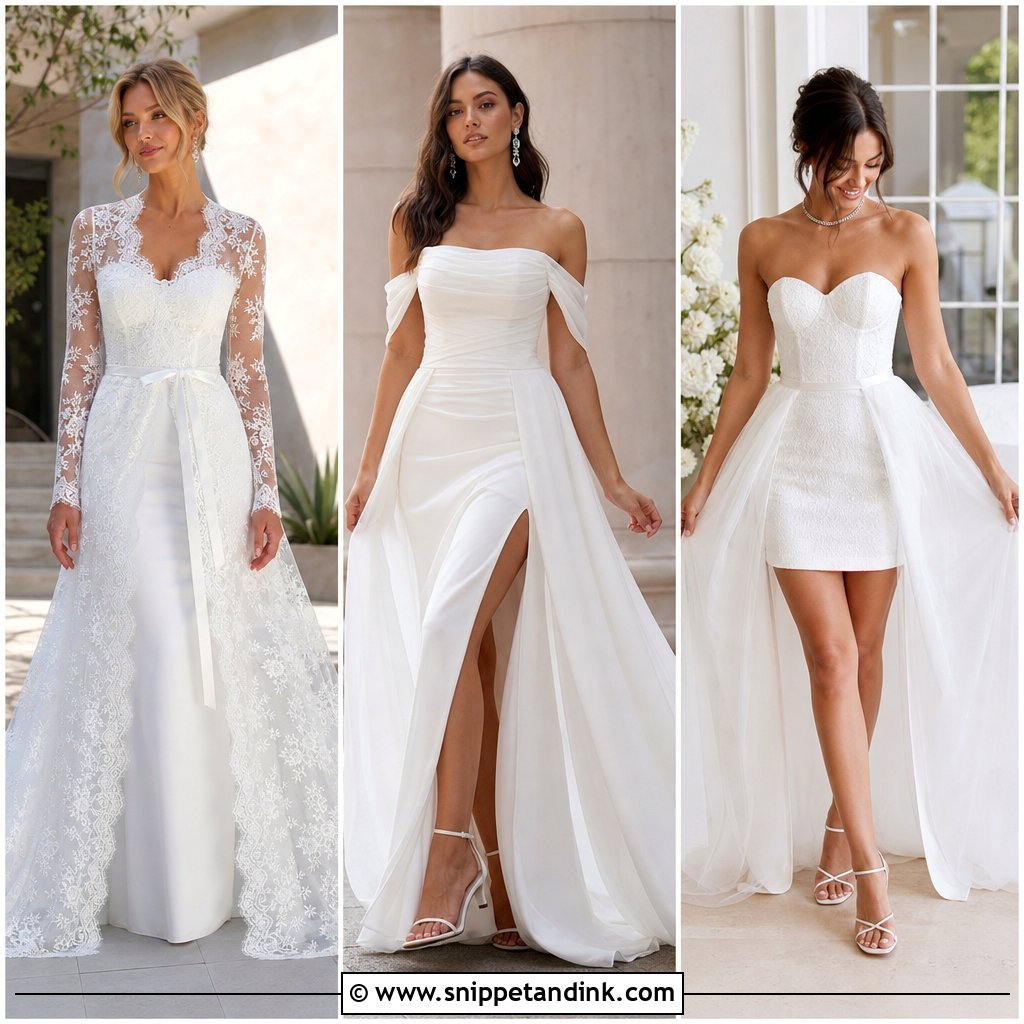
20. Layered Tulle Wedding Dress With Detachable Overskirt
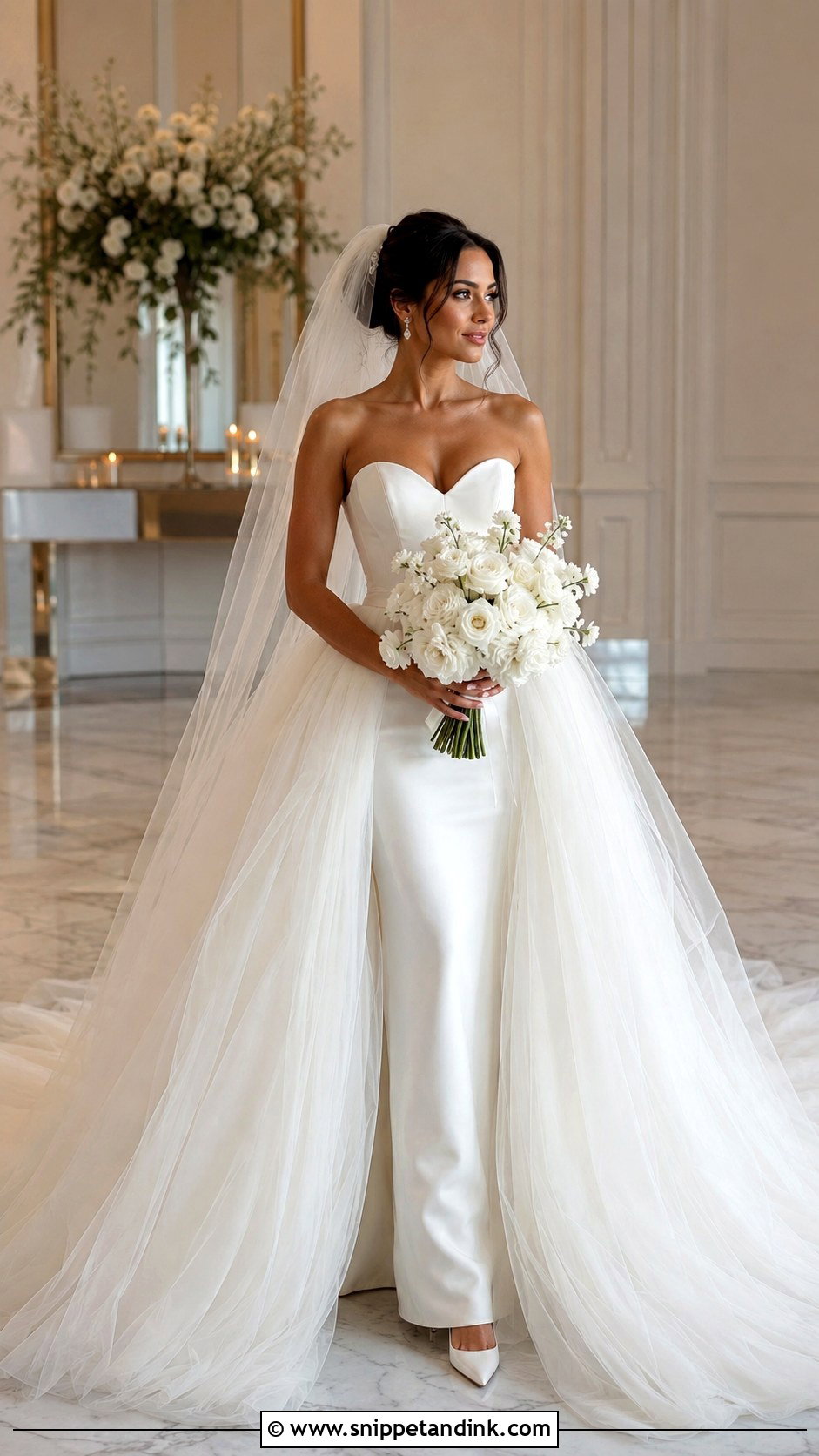
A detachable overskirt is two outfits in one: a fitted crepe, lace or satin dress underneath and a full tulle layer that fastens at the waist. The base dress must stand on its own with a finished waistline, because that is what you’ll dance in. I look for fastenings you could undo yourself in a bathroom, hooks or a hidden button band rather than a row of tiny buttons. Style the ceremony with a cathedral veil, pearl earrings, pointed heels and a structured bouquet, then switch to bolder earrings for the evening. Bring a garment bag for the removed tulle; left on a chair it gets sat on within the hour.
Steam, Snags and the Car Ride: Getting Tulle to the Aisle Intact
Tulle forgives a lot, but it has three enemies on a wedding day: crushing, catching and damp. Most of the damage I fix on the morning happened in the 24 hours before.
The days before
Take the dress out of its bag as soon as you reach the venue or hotel and hang it from its inner loops on a door or rail high enough that the hem doesn’t pool on the floor. Most creases drop out on their own overnight. Anything stubborn gets a handheld steamer held a few inches away, worked from the inside of the skirt outward. Never press tulle with an iron; nylon melts in a second and leaves a shiny hole.
On the morning
- Take off bracelets with prongs, watch clasps and anything with Velcro before you step in. They pull threads straight out of the mesh.
- Ask the florist to wrap bouquet stems in ribbon well past the ends. Cut stems and wire snag the skirt every time you lower your arms.
- In the car, sit first and let someone feed the skirt in after you, spread across the seat rather than folded under you.
- Keep small sharp scissors and a needle threaded with ivory thread in the emergency kit. A pulled loop is best snipped, never tugged.
Rain or wet grass is less of a disaster than people fear. Nylon tulle dries quickly, but the bottom layers act like a mop, so lift the skirt from the sides on damp ground. A layered skirt also needs its bustle planned with that in mind. Your seamstress may bustle the lining separately from the tulle, so learn which ribbon goes to which hook at your last fitting and teach it to whoever will do it on the night.
Shoes On, Arms Up: Testing a Layered Skirt Before You Commit
Movement is what you’re buying with tulle, and structure is what keeps that movement under control for a whole day. Compare necklines, waist placements and skirt volume in person, because tulle on a screen looks lighter than it is on your body. Take your wedding shoes and undergarments to every fitting, then sit, walk, turn and lift your arms in the dress. Keep accessories in support: a plain veil over floral appliqués, statement earrings with a clean strapless bodice. A classic ball gown, a drop waist and a detachable overskirt all depend on the same thing in the end, which is careful alterations by someone who has handled a lot of tulle.
You'll Like These Ideas:





Leave a Reply