
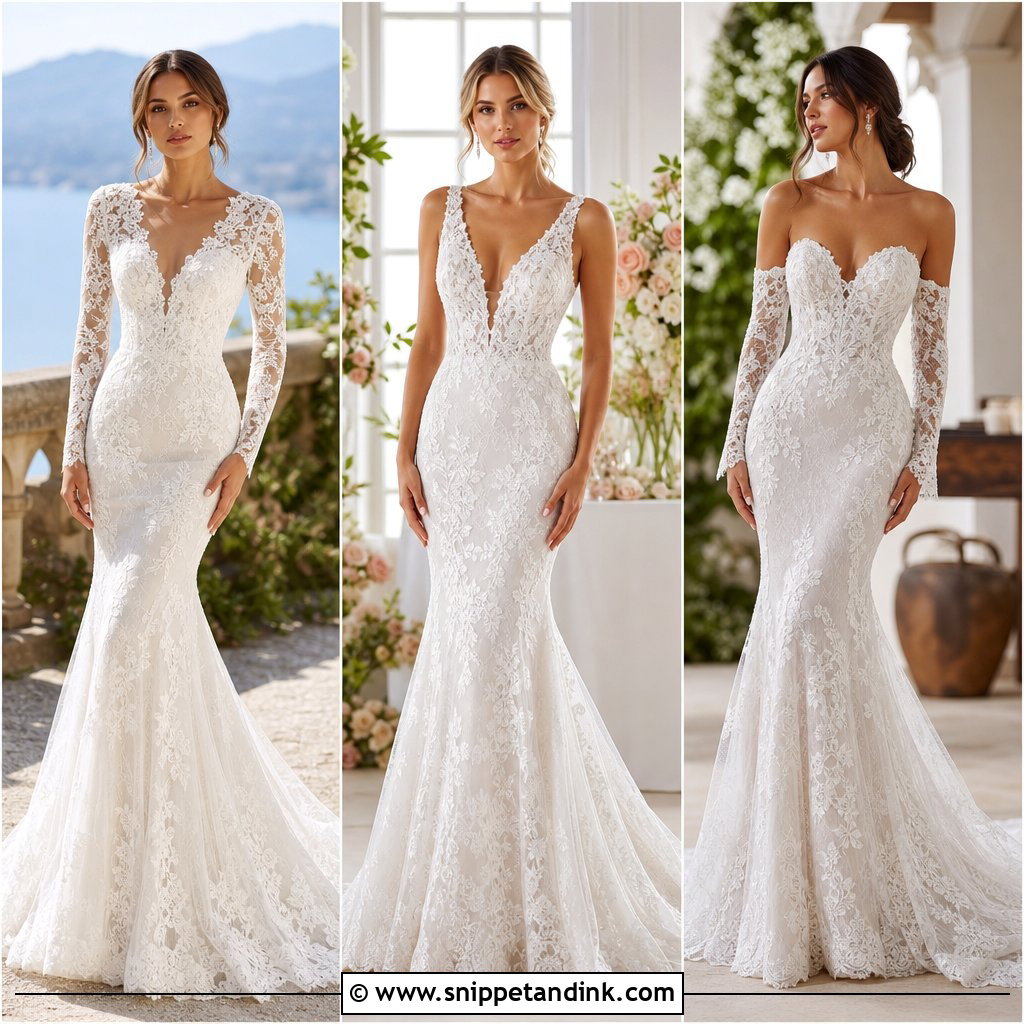
A long sleeve is the hardest part of a wedding dress to get right, and the part brides notice least in the shop. Fit it badly and you feel it every time you lift your bouquet or hug your grandmother. Fit it well and you forget it’s there. The twenty gowns below cover lace, satin, chiffon, crepe and beaded fabrics in A-line, ball gown, column and tea-length shapes, each styled with veil, shoes, jewellery and flowers. As you compare them, think about your venue, the season and how much you’ll be moving, because a sleeve that suits a church in January can be miserable in a July garden.
Sleeve Fit Is Where Long Sleeve Gowns Go Wrong
Most sample gowns are made in one size and clipped to fit you in the shop, so the sleeves you see in the mirror are rarely the sleeves you’ll get. When I fit a long sleeve, these are the points I check, in this order.
Armhole height
A higher, closer armhole actually gives you more arm movement than a low, roomy one, which sounds backwards but holds true. When the armhole is cut low, lifting your arm drags the whole bodice up with it. If the waist rises when you raise your hand, the armhole is the problem, not the sleeve.
Length at the wrist
Measure with your arm slightly bent, as if holding flowers. A sleeve that ends neatly at the wrist bone with a straight arm will ride up once you bend it. Many brides like the cuff to just cover the wrist bone, or a point that extends onto the back of the hand.
Ease through the forearm
Fitted lace sleeves are often made from stretch lace, but satin, Mikado and crepe have little or no give. Ask for a finger’s width of room through the forearm in non-stretch fabrics, and check that the cuff opening lets you push the sleeve up to wash your hands.
Lined, sheer or partly lined
Sheer sleeves are cooler but show the arm in flash photos. A lined sleeve is fully covered but warmer. If you need coverage and expect heat, ask whether the sleeves can be lined in a fine, skin-toned mesh rather than satin, which keeps them opaque from a distance and lighter to wear.
1. High Neck Lace Wedding Dress
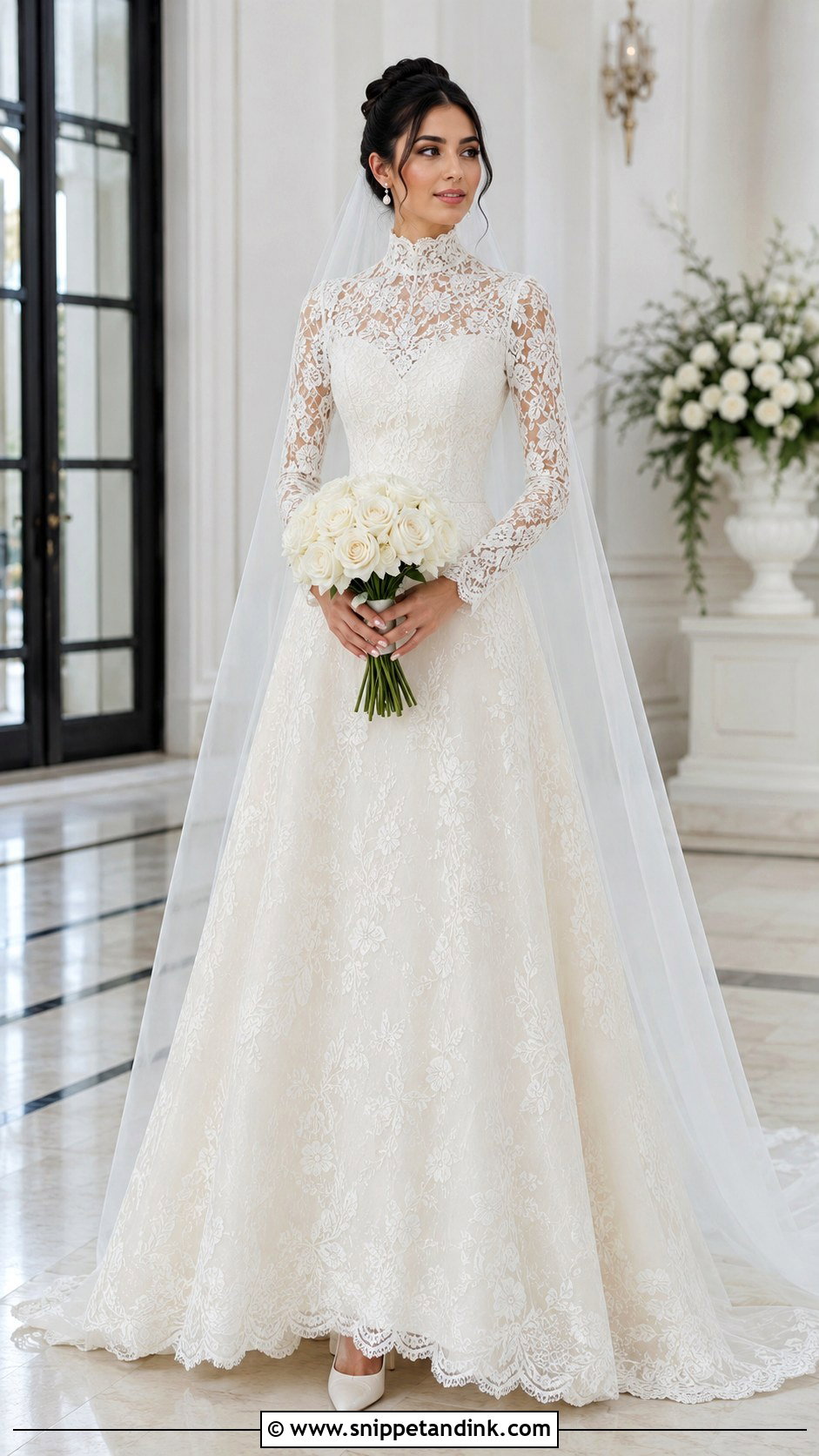
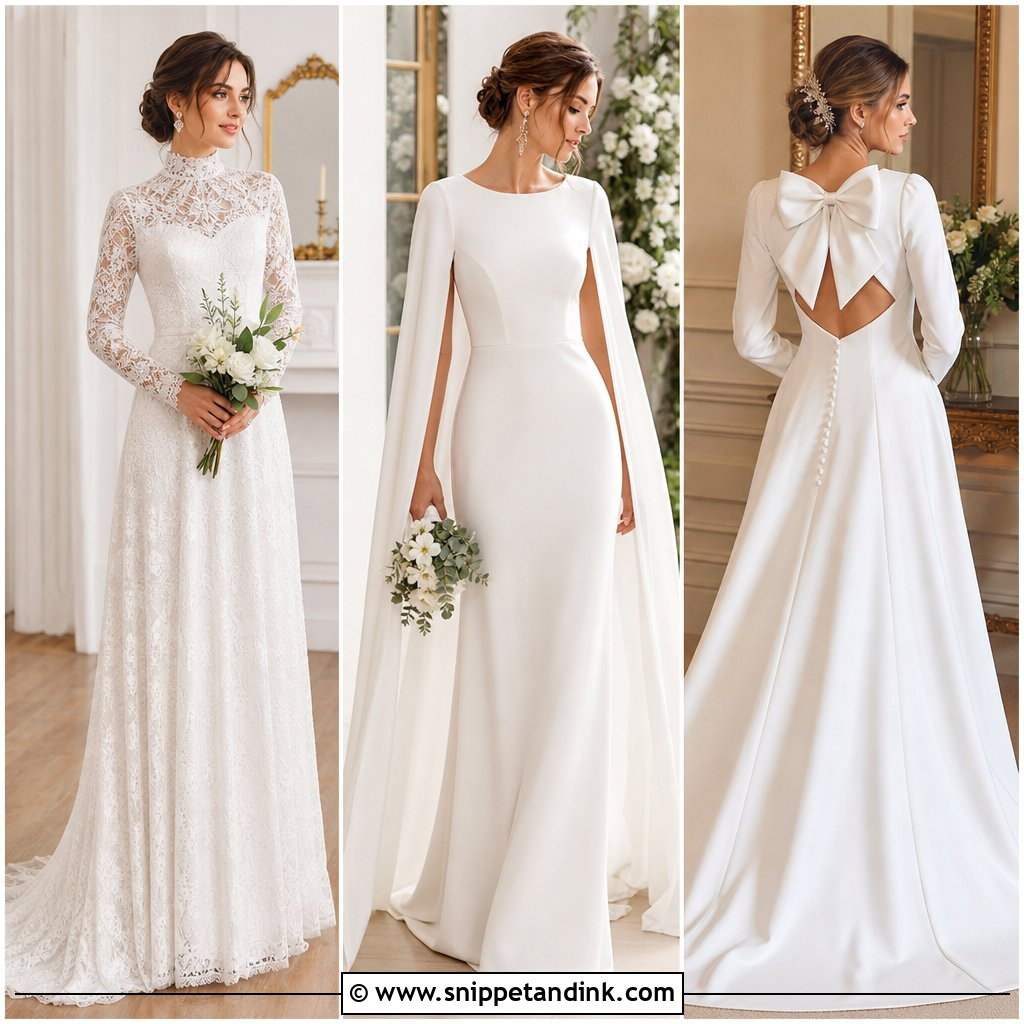
High-neck lace covers you from collarbone to wrist, so the lining underneath decides how it really looks. Choose a fully lined bodice if you want it opaque and let the lace run into fitted sleeves, with an A-line skirt for room to move. Scalloped cuffs and covered buttons add detail without clutter. Pearl drops, pointed ivory pumps and a cathedral veil pinned under a low bun are enough, plus white roses and greenery. Skip the necklace. With a neck this high, anything at the throat crowds the lace and makes the collar feel tighter than it is.
2. Satin A-Line Wedding Dress With Sleeves
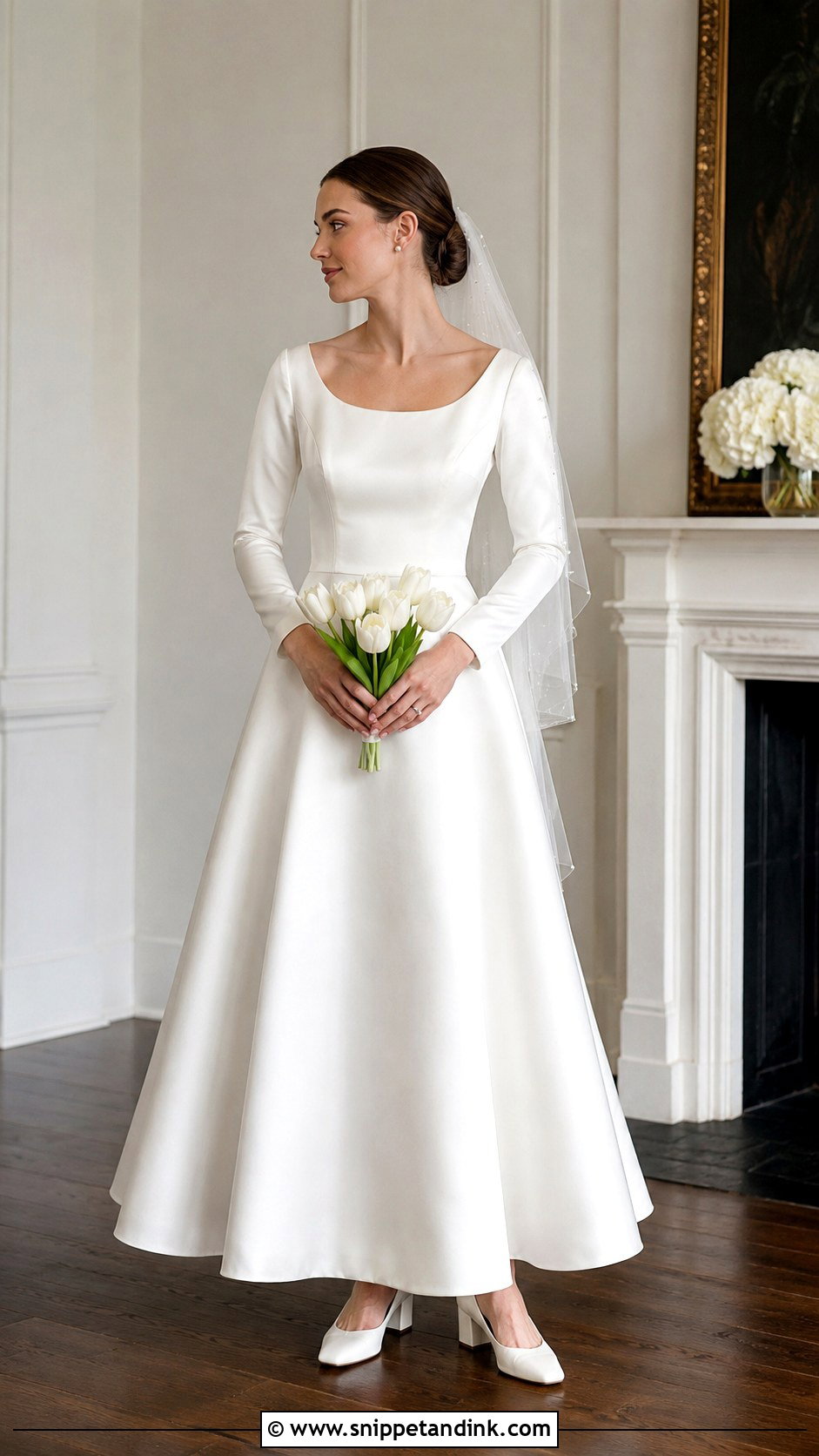
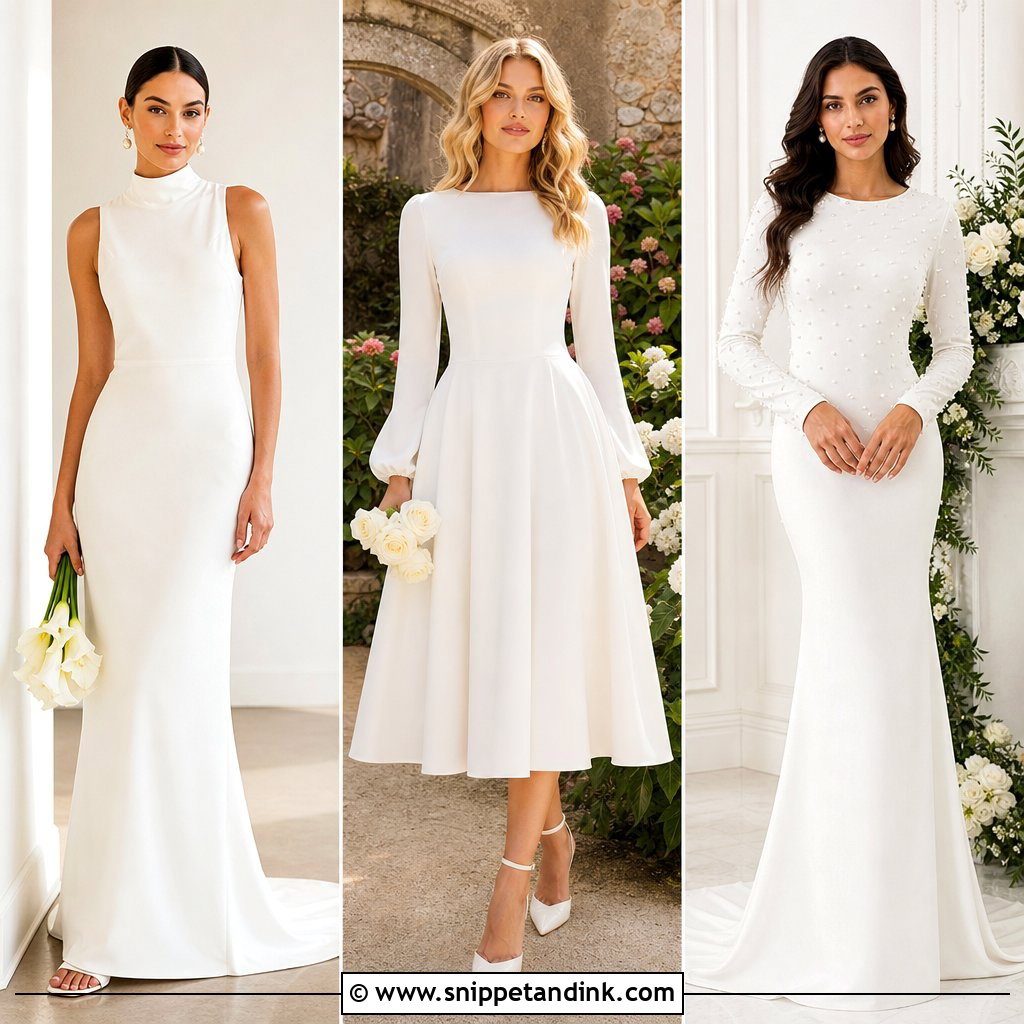
Satin sleeves show every wrinkle at the elbow, so this gown rewards a precise fit more than most. Look for a structured bodice with a scoop or bateau neck, a natural waist and a skirt without heavy gathering, finished with small covered buttons at each cuff. Style it with a sleek chignon, pearl studs and a fingertip veil, plus ivory block heels that stay steady under the full skirt. White tulips or callas suit its minimal lines. I’d ask for the sleeve cut with a touch of ease at the elbow. Satin doesn’t stretch, and a sleeve fitted dead straight pulls as soon as you bend your arm.
3. Square Neck Modest Wedding Dress
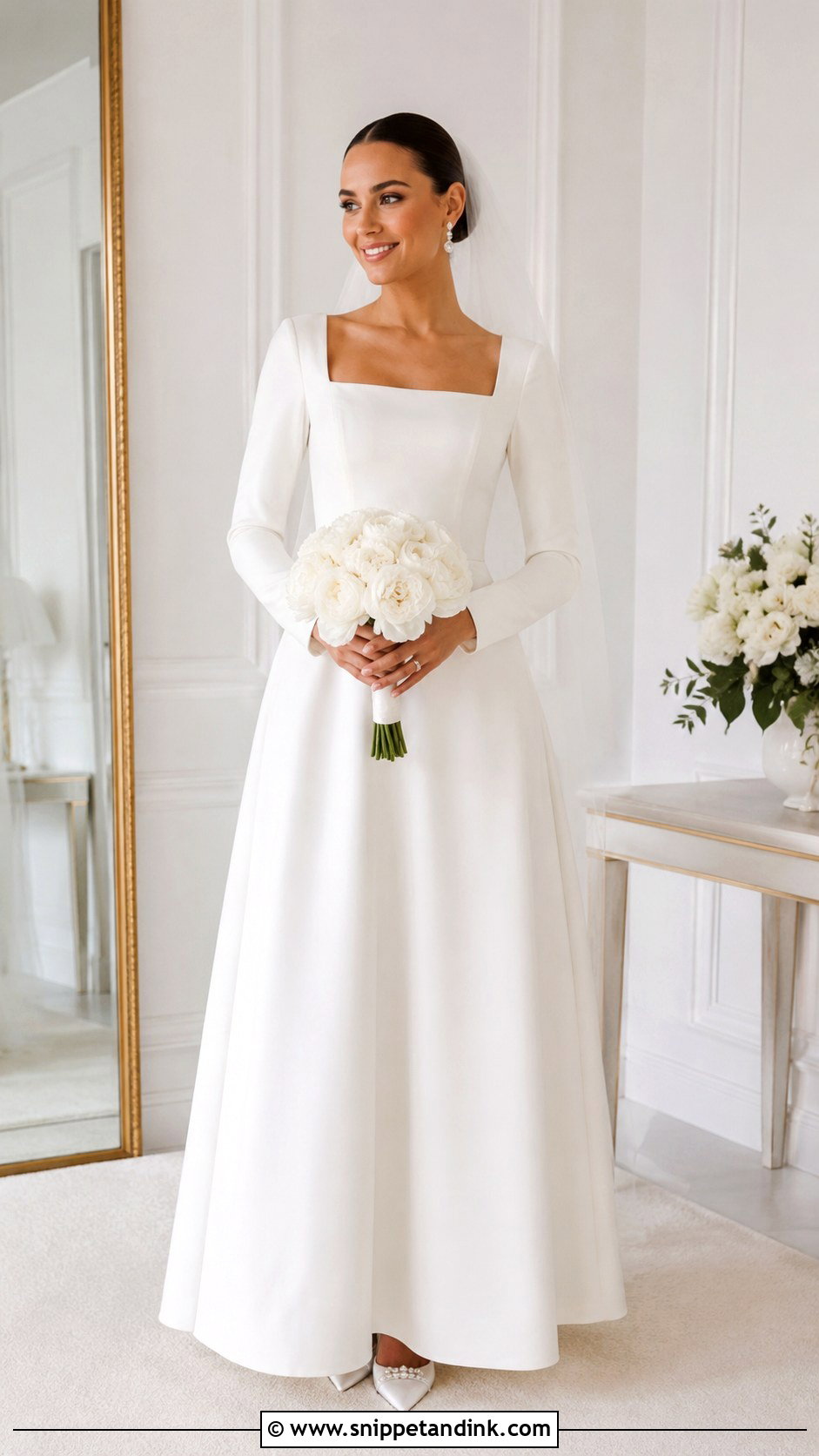
Square necks are the most reliable modest neckline, as long as the corners sit flat. Pair one with long fitted sleeves and an A-line or softly flared skirt, in matte crepe for a simple look or satin for more formality. A waist seam or narrow matching belt adds shape. Finish with pearl and crystal earrings, pointed satin shoes, a plain-edged chapel veil and soft waves or a smooth bun, with a rounded bouquet to soften the angles. Raise your arms and lean forward at the fitting. If the neckline lifts away from your chest at the corners, it needs taking in at the shoulder seam.
4. Long Sleeve Lace Ball Gown
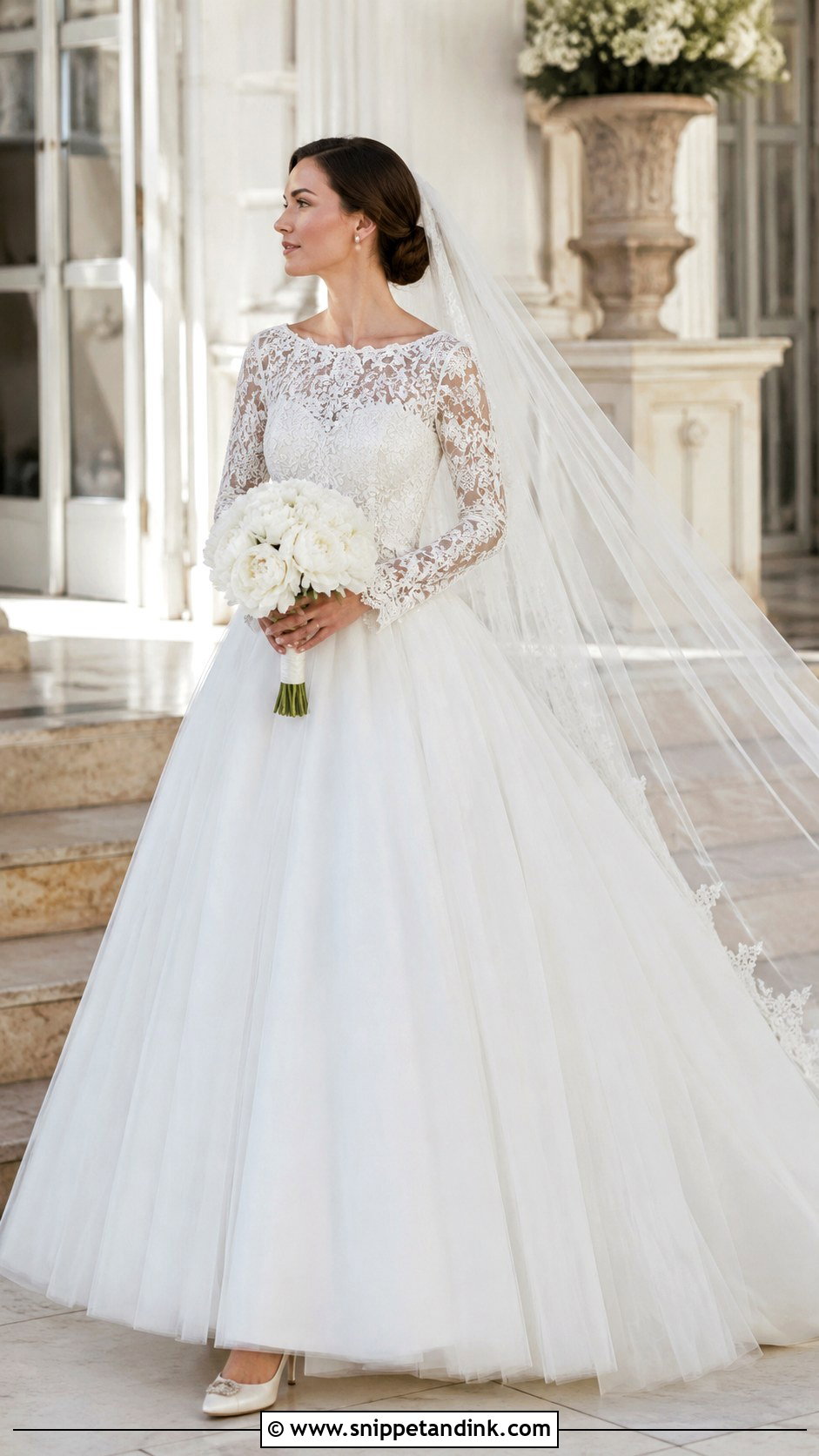
A lace ball gown with long sleeves is about as covered and as dramatic as bridal gets. The lace should travel from sleeve to neckline to upper skirt so it reads as one design, and a lined bateau or soft scoop neck keeps the neck from looking short. Tulle layers give the skirt its volume, and good internal boning keeps the bodice comfortable for hours. Low embellished heels, a long plain veil and small pearls let the lace lead. Choose an updo that shows off the back buttons and a peony or rose bouquet scaled to the skirt. Bear in mind a full skirt this wide needs space in the car, the aisle and the restroom.
5. Crepe Column Wedding Dress With Sleeves
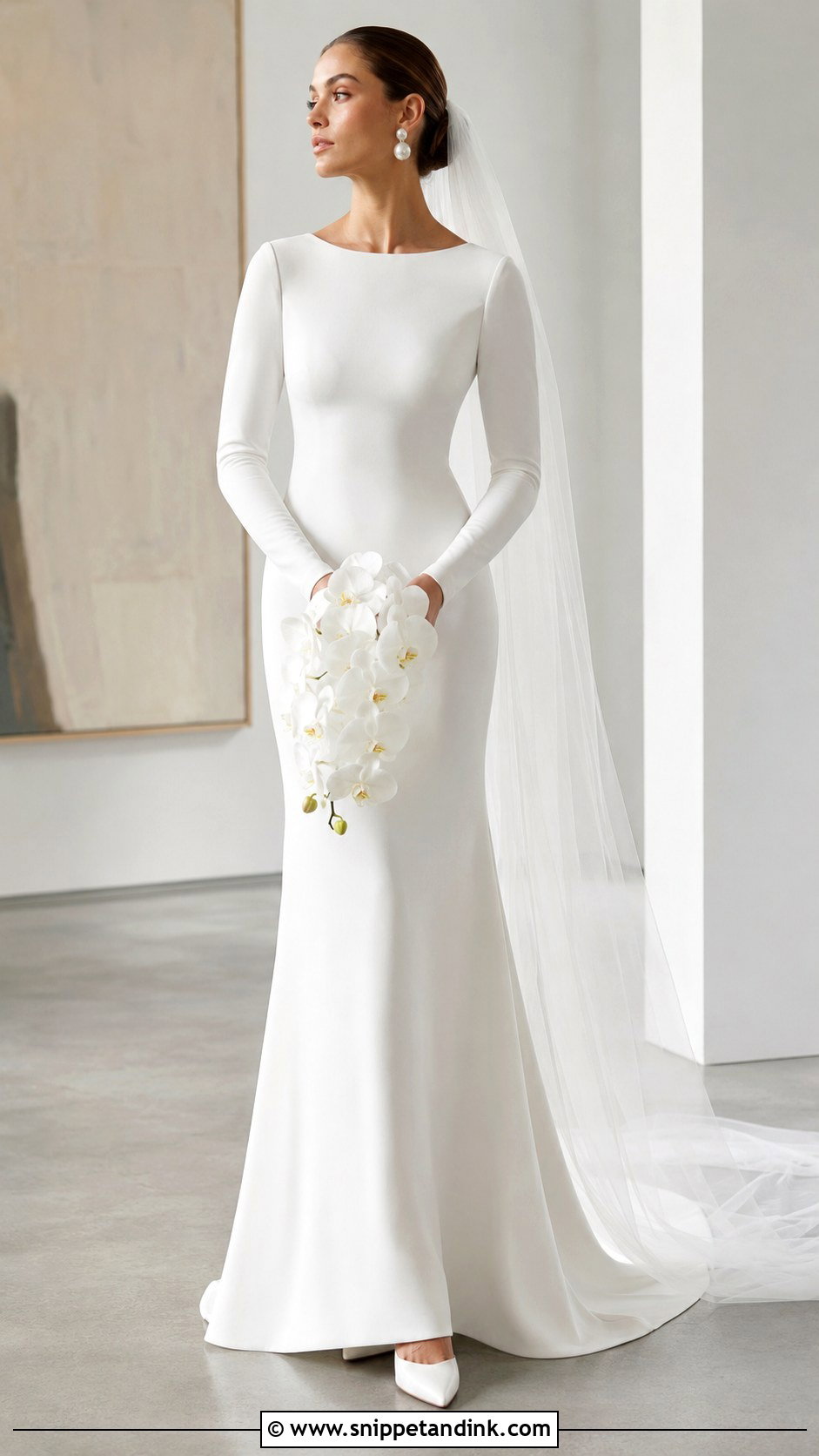
Crepe columns rely completely on tailoring, since there’s no lace or beading to distract from a wrinkle. Choose long fitted sleeves, a high scoop neck and a full lining, with a gently defined waist and a slight flare at the hem so you can actually stride. Sculptural pearl earrings, closed pumps and a long veil on a polished bun suit it, with white orchids for movement. If you want a grander ceremony look, a detachable crepe overskirt gives you volume for the aisle and comes off for dinner. Crepe also forgives a long seated reception better than satin, because it creases less.
6. Bateau Neck Wedding Dress With Sleeves
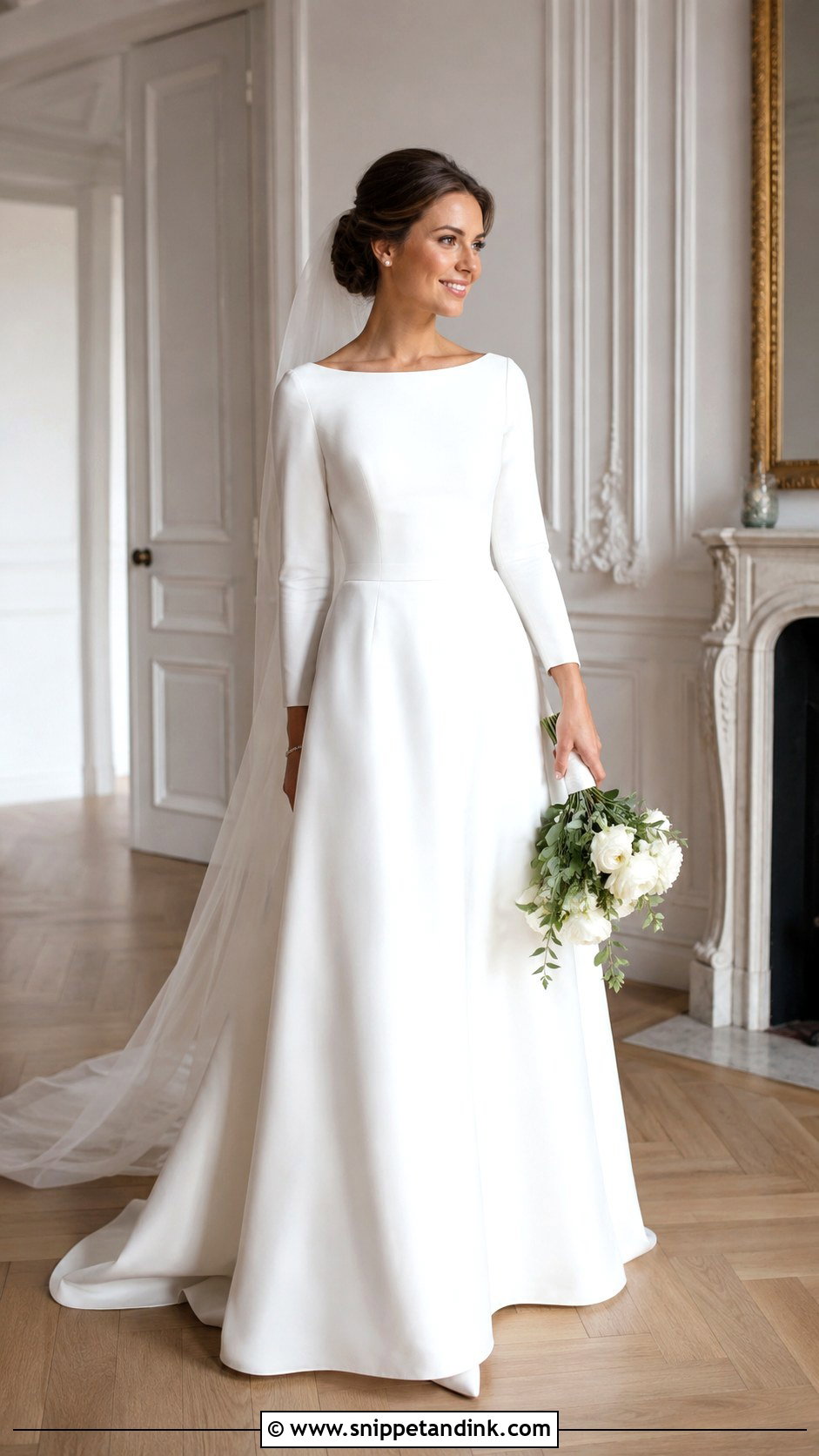
The bateau neckline runs straight across the collarbones, which covers the chest fully while still showing the line of the neck. With long sleeves it is about as traditional as a modest gown gets. Satin gives it structure, crepe makes it modern and lace softens it, and an A-line skirt balances the wide neck. Wear a French twist, pearl studs and a veil set low at the back of the head, with pointed ivory shoes. A bateau needs no necklace at all; a slim bracelet and loose white flowers with greenery are plenty. Check the neck edge isn’t so wide that it slips toward your shoulder when you reach forward.
7. Floral Applique Long Sleeve Wedding Dress
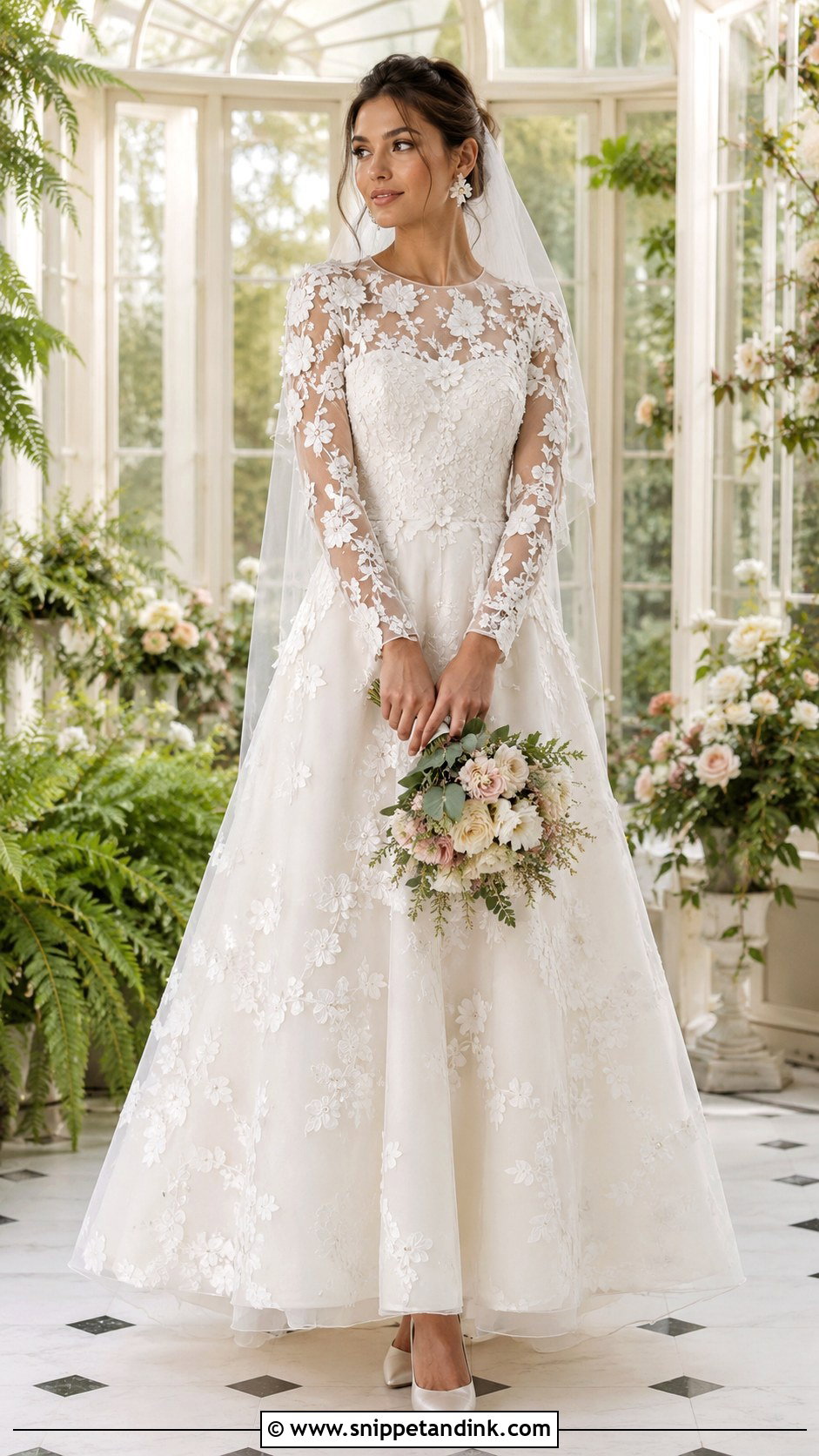
Appliqués look best when they travel. I like flowers clustered on the bodice over an opaque lining, then scattered more sparsely down the sleeves and into the skirt, so the eye moves rather than stopping at the torso. A soft A-line keeps the texture light. Pair it with satin pumps, small floral earrings, a sheer veil with a minimal edge and a loose low bun or pinned curls. Choose bouquet flowers that echo the appliqué shapes without matching them exactly. Decorated sleeves already draw the eye to your hands, so keep rings and bracelets fine, and check that raised petals near the wrist don’t catch on the bouquet wrap.
8. Modest Basque Waist Wedding Dress
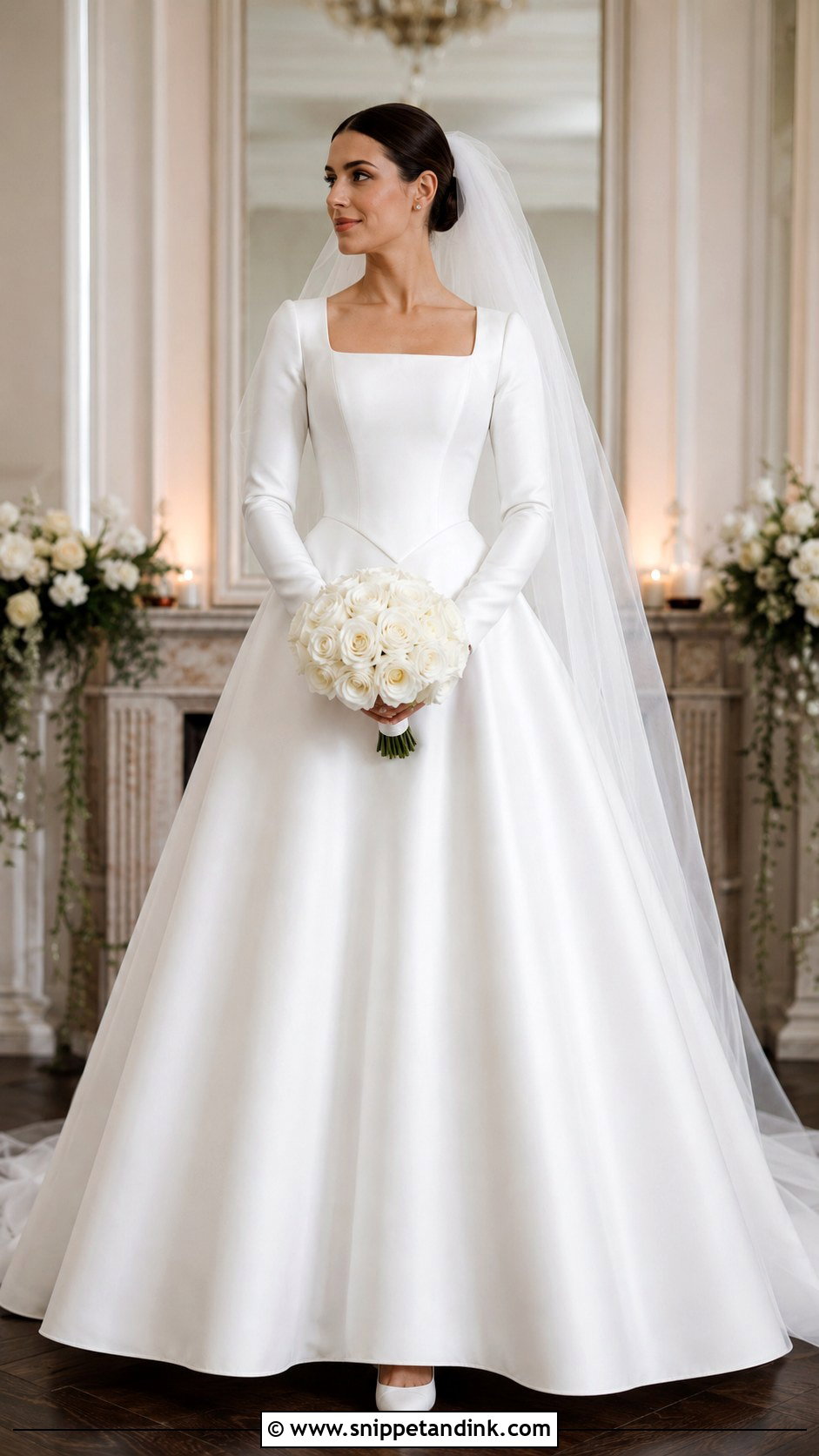
A basque waist wedding dress has a bodice that drops into a point below the natural waist, which lengthens the torso. For a covered version, choose a lined square or scoop neck with long fitted sleeves, in structured satin or Mikado that holds the point crisply over a full skirt. Let the construction be the detail and keep embellishment low. Add a plain cathedral veil, crystal studs, closed satin heels, a smooth bun and white roses with trailing greenery. The point can press into your stomach when seated, so sit for a while at every fitting. Shorter-waisted brides may need the point raised slightly.
9. Chiffon Bishop Sleeve Wedding Dress
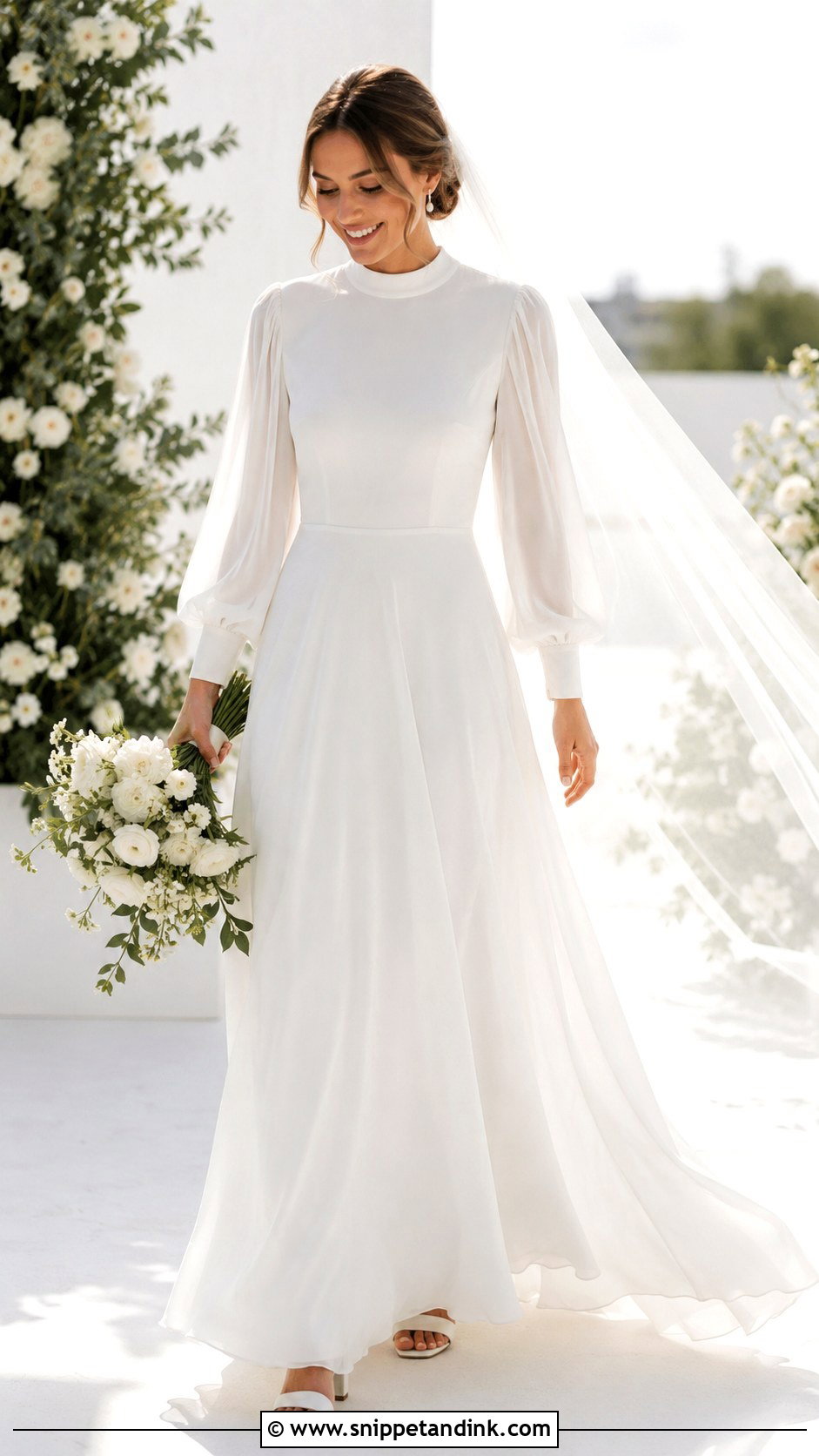
Soft chiffon bishop sleeves are the coolest long sleeve to wear, because air moves through the loose fabric. They do need fitted cuffs to keep the volume controlled. Pair them with an opaque high-neck bodice and a light A-line chiffon skirt, low block heels, delicate drop earrings and an airy fingertip veil. A braided low bun or relaxed updo suits the softness, as do loose garden flowers. Leave bracelets off. Gathered cuffs snag raised settings, and a bracelet under a bishop sleeve can’t be seen anyway.
10. Vintage Tea-Length Wedding Dress With Sleeves
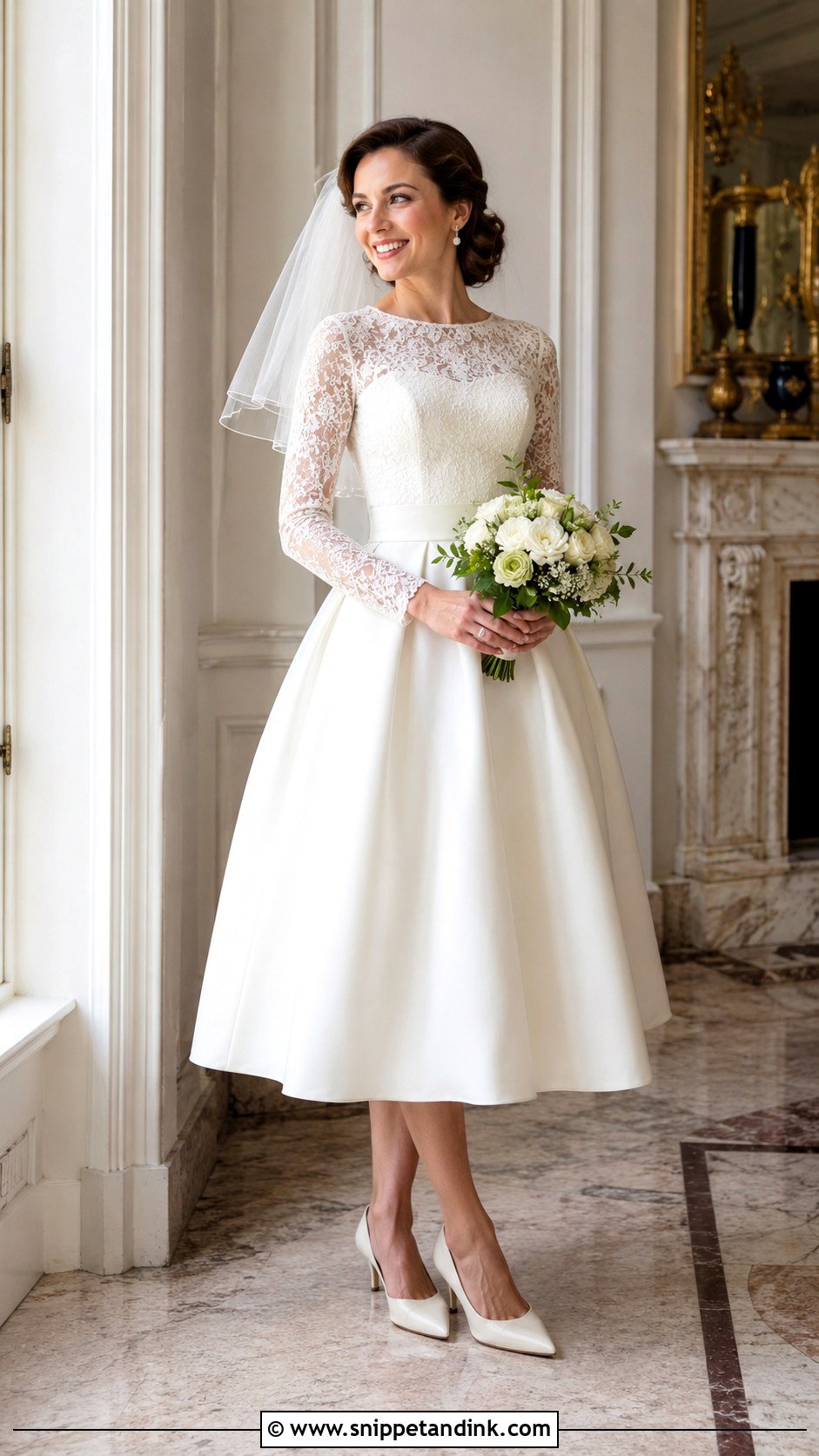
Tea length puts your shoes on show, and that changes how carefully you choose them. Look for an opaque bateau neck, fitted lace sleeves, a defined waist and a structured skirt ending between knee and ankle. Ivory slingbacks or low block heels, pearl earrings and a birdcage or shoulder-length veil keep it vintage. A smooth bun, softly waved bob or pinned curls stop it tipping into costume, and a compact bouquet won’t swamp the shorter skirt. Because the hem is visible, have it altered while you wear the actual wedding shoes, as an inch either way changes the proportion noticeably.
11. Pearl Beaded Long Sleeve Wedding Dress
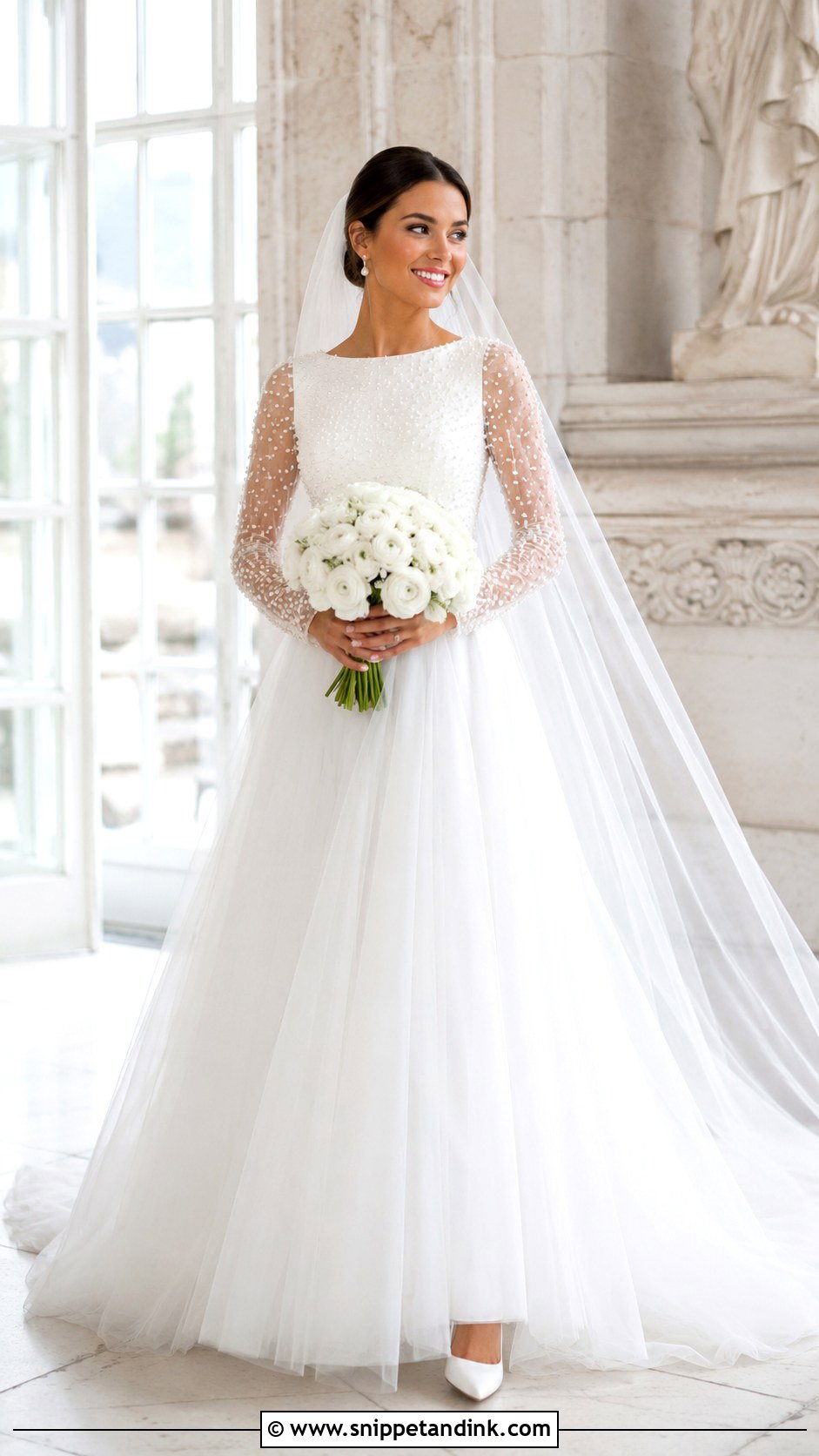
Scattered pearls give a covered gown a soft glow without the flash of crystals. Choose pearls spaced across the bodice and sleeves rather than packed over every surface, sewn onto an opaque lining, with a fitted top and an A-line tulle skirt. Plain satin heels, small pearl studs and an unbeaded veil keep the accessories from competing. A low bun or soft updo shows the neckline, and white roses or ranunculus finish it. I’d ask the shop whether the pearls on the inner arm can be thinned out, since they rub against your sides with every movement.
12. Modest Fit-and-Flare Wedding Dress
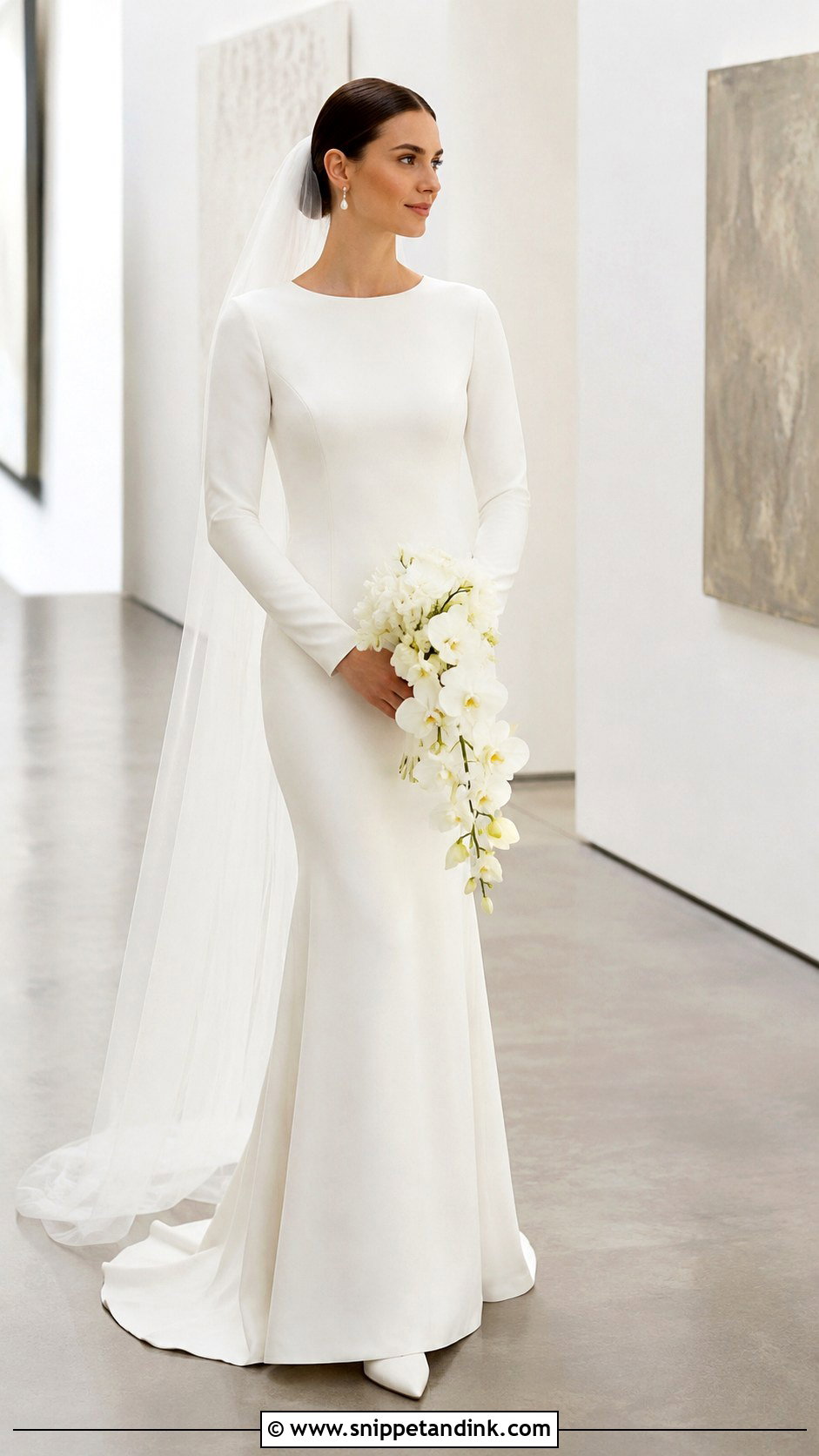
Fit-and-flare follows you through the hips before widening low on the skirt, so the long sleeves and higher neck are there to balance a closely fitted shape. Substantial crepe, lined lace or smooth satin hold it without feeling tight. A subtle train adds ceremony drama and a bustle tidies it for the reception. Pointed pumps, drop earrings, a plain chapel veil and a low ponytail or structured bun suit its vertical line, as does a slightly elongated bouquet. The flare point decides your stride. If it sits too high you’ll take tiny steps all day, so walk the length of the shop before signing off.
13. Button Back Long Sleeve Wedding Dress
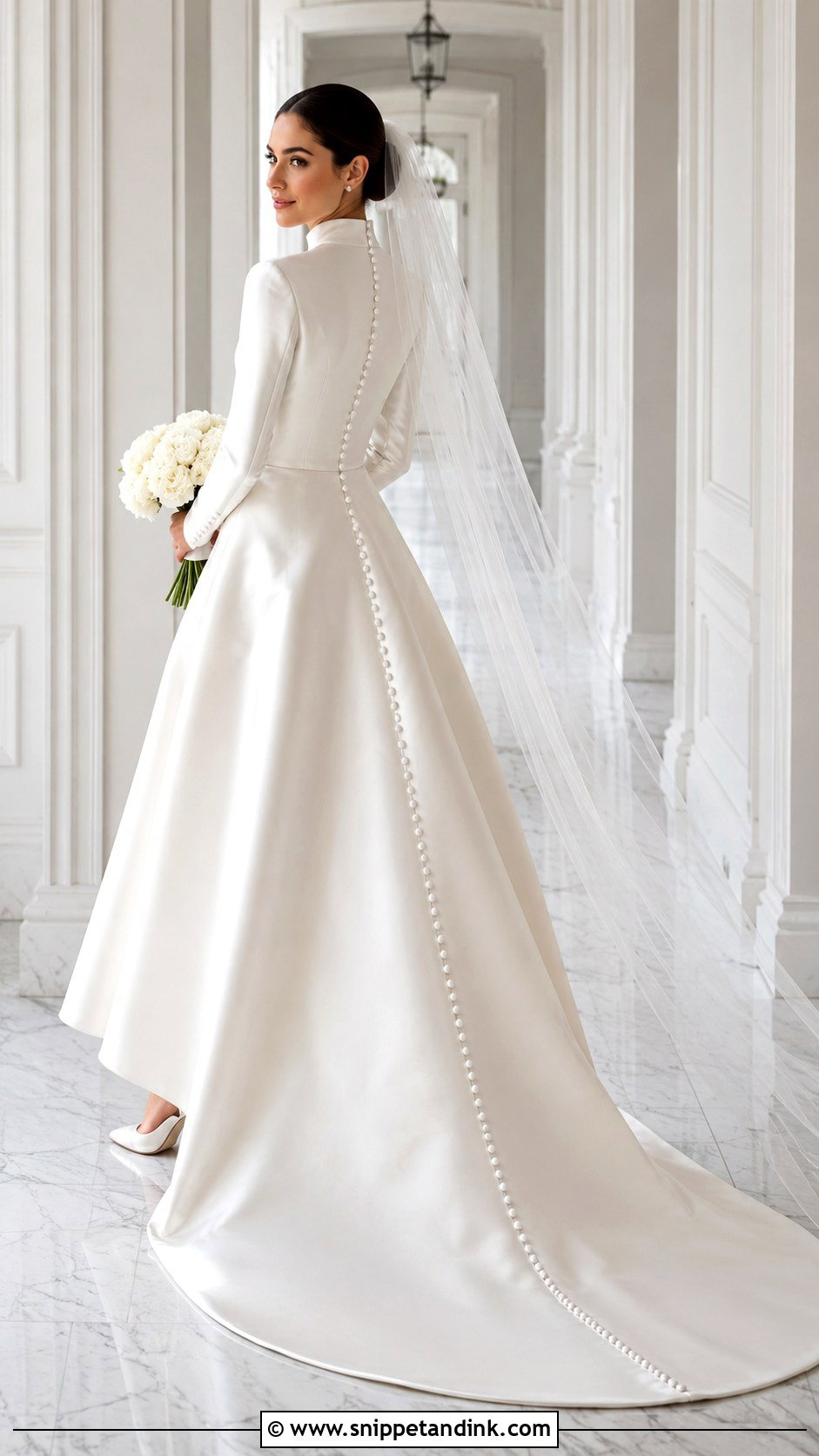
The back is what guests see for the whole ceremony, which is why I take button backs seriously. Look for a gown with buttons extending from the high back to the waist or down the train, with matching buttoned cuffs on long fitted sleeves. Satin looks traditional and lace softer. A sheer veil, pearl studs and closed ivory heels keep the button line visible, and an updo leaves the upper back clear. Ask your seamstress to add a hidden zip or hook closure under the buttons. Fastening dozens of loops on the morning takes far longer than anyone plans for.
14. Modest Boho Lace Wedding Dress
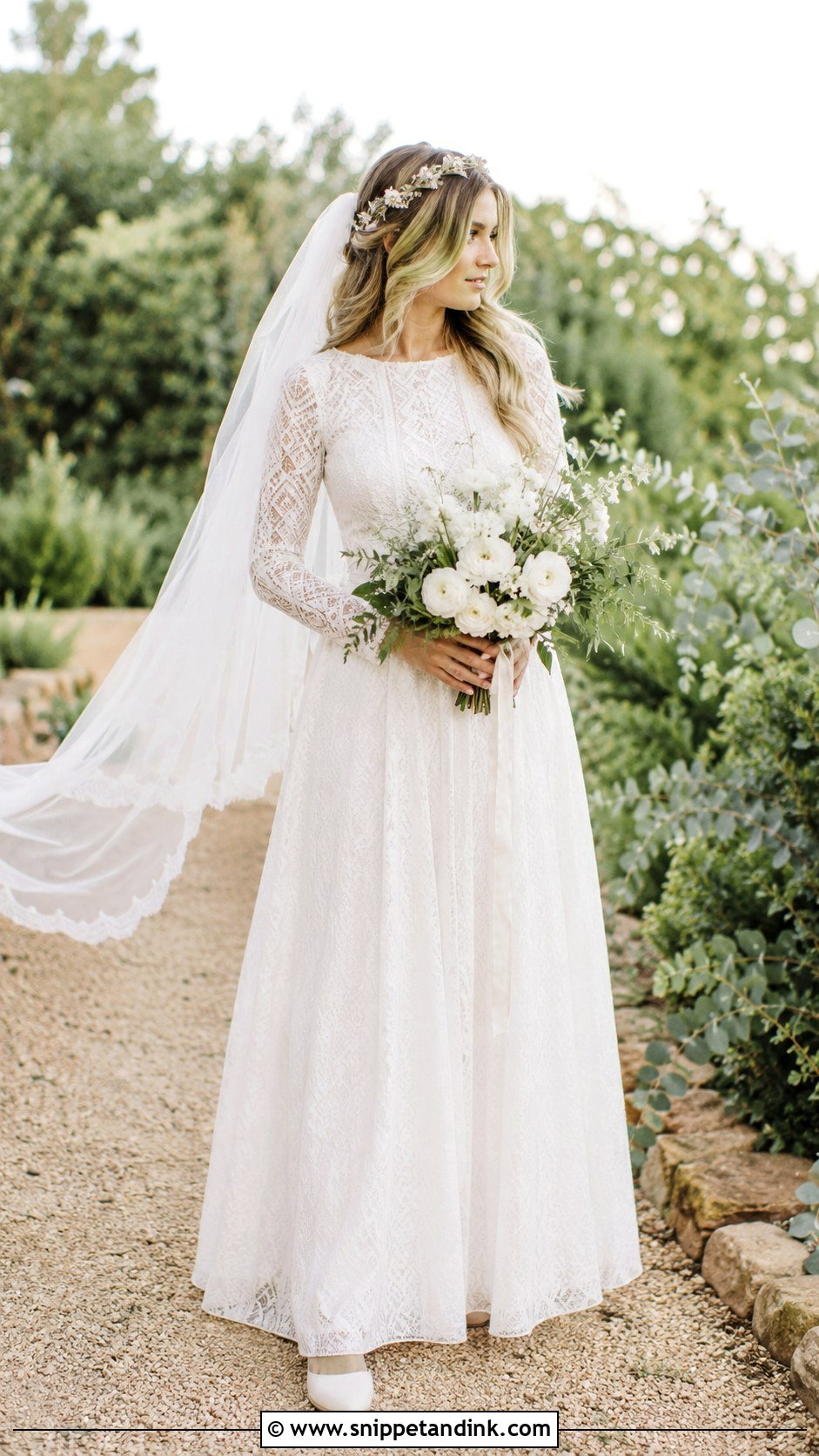
Boho lace and full coverage combine more easily than you might think, since the style is about texture rather than skin. Choose soft geometric or floral lace over an opaque lining with long sleeves, a high scoop neck, a gently defined waist and a flowing A-line skirt. Low ivory block heels, a delicate hair vine and a raw-edge veil suit loose waves or a textured bun. Carry white flowers with trailing stems. Pick one decorative element to lead, usually the lace, and keep everything else plain. Bell or flared lace sleeves are common in this style; check they don’t drag on the table when you eat.
15. Long Sleeve Wedding Dress With Detachable Train
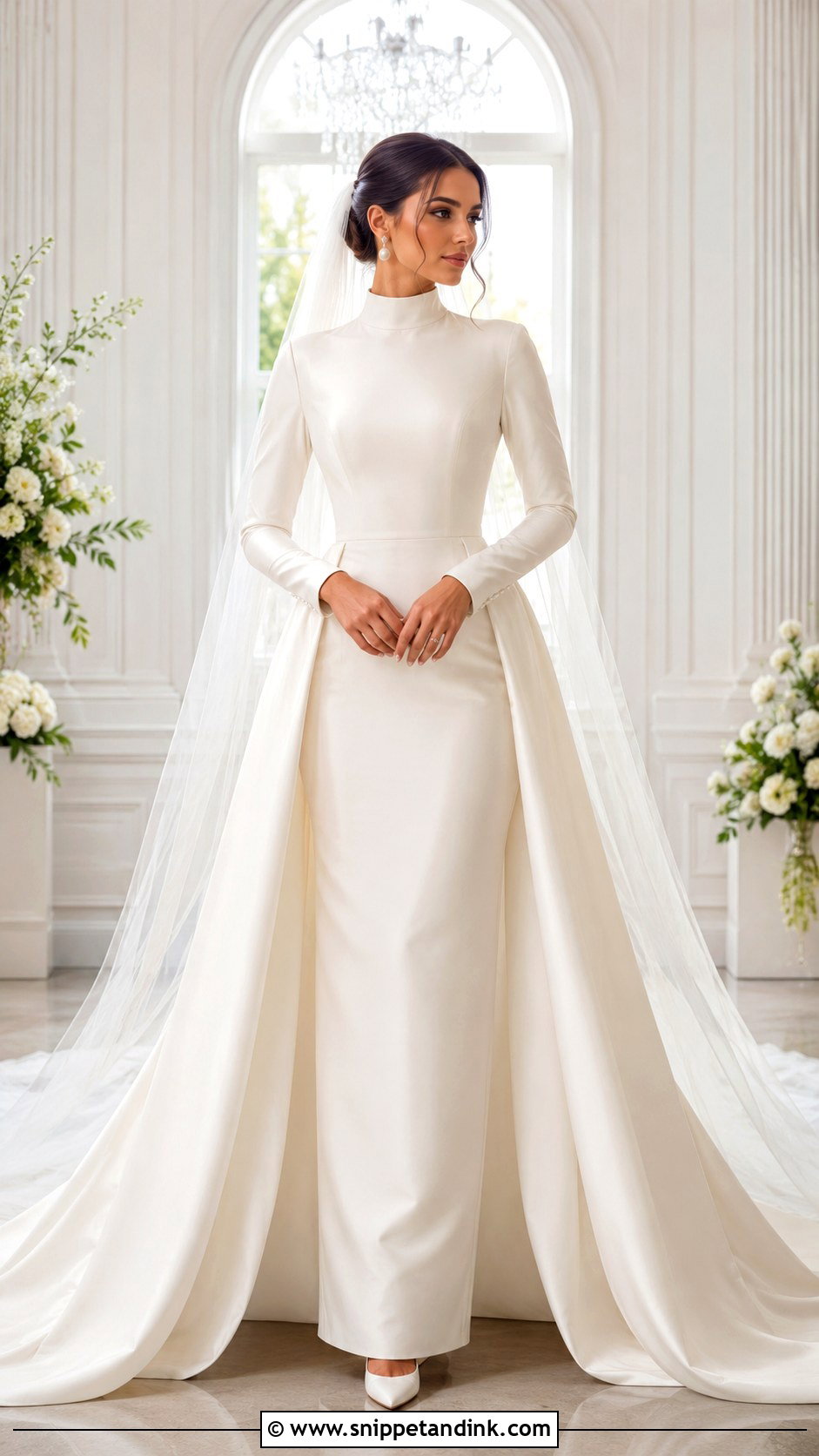
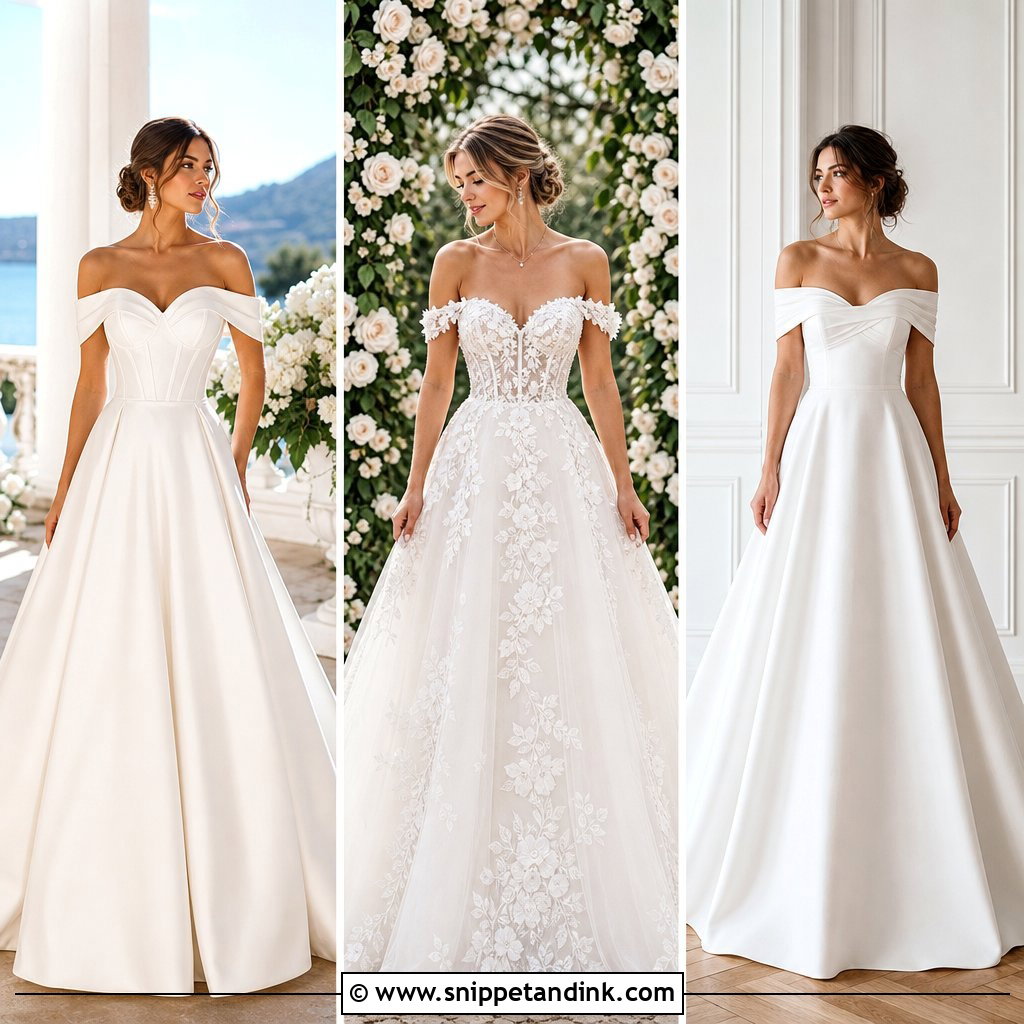
A detachable train gives you a grand aisle moment and an easy reception from one gown. Start with a long sleeve column or A-line gown with a high neck, covered back and fitted bodice, then add a matching overskirt or train for the ceremony and remove it after photos. The fabric match matters; a slightly different ivory looks like an add-on. Pearl earrings, closed heels, a sleek bun and a veil a touch longer than the train complete it. Practise the removal at your final fitting with whoever will help on the day. Hooks and snaps that seem simple in the shop are fiddly with a crowd waiting.
16. Embroidered Tulle Wedding Dress With Sleeves
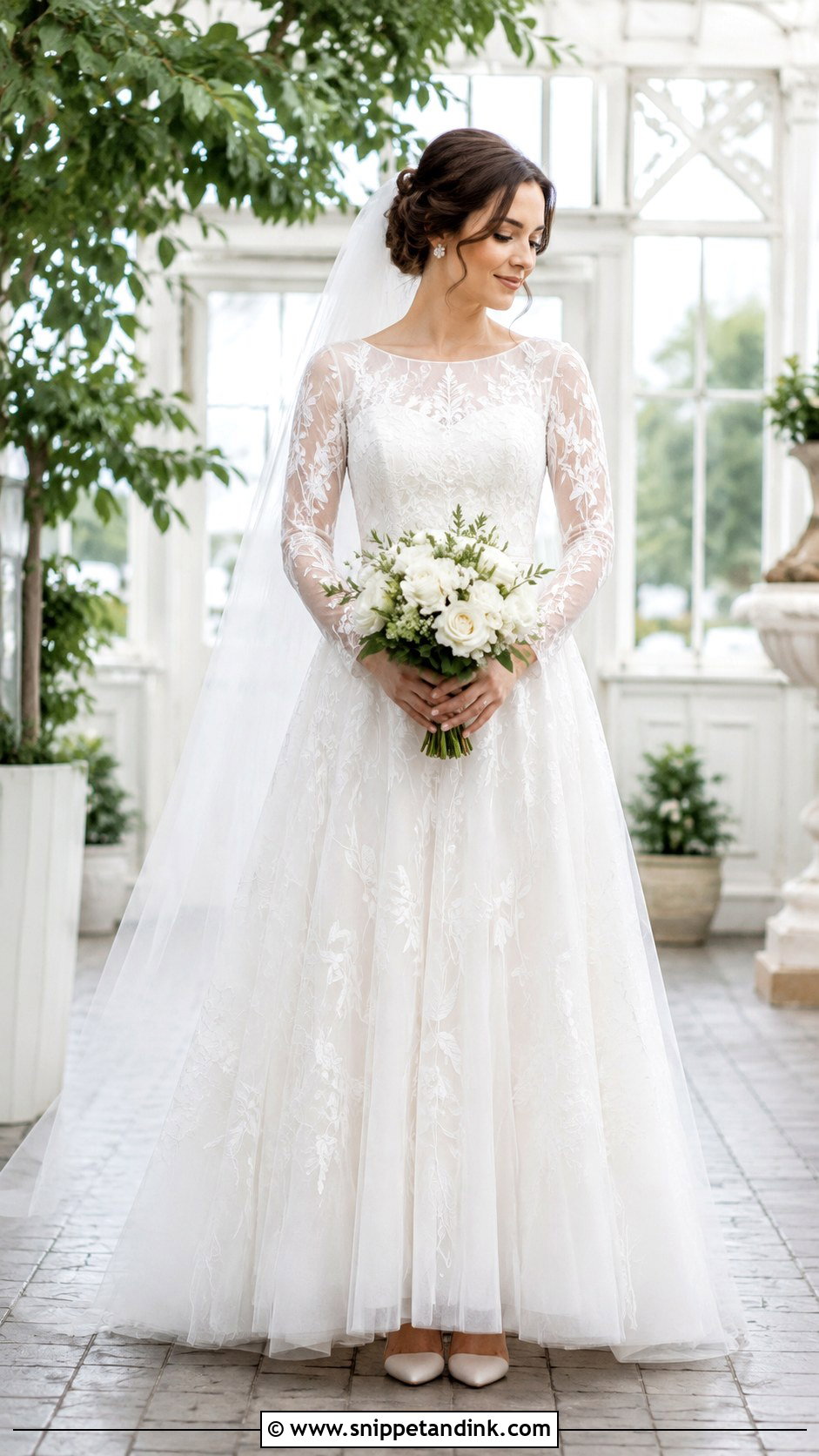
Embroidered tulle gives texture without the weight of corded lace, which makes it a good choice for long sleeves in warmer months. Choose an opaque bodice under the embroidery and ask for lined sleeves if you need full coverage. Small botanical motifs flowing from the neckline into the skirt look continuous, and an A-line lets the tulle move. Simple ivory pumps, tiny crystal studs, a plain veil and a softly twisted updo keep it neat, with clean white flowers. Run your fingers along the inside of the cuffs and underarms before buying. Embroidery threads there can feel scratchy within a couple of hours.
17. High Neck Satin Ball Gown
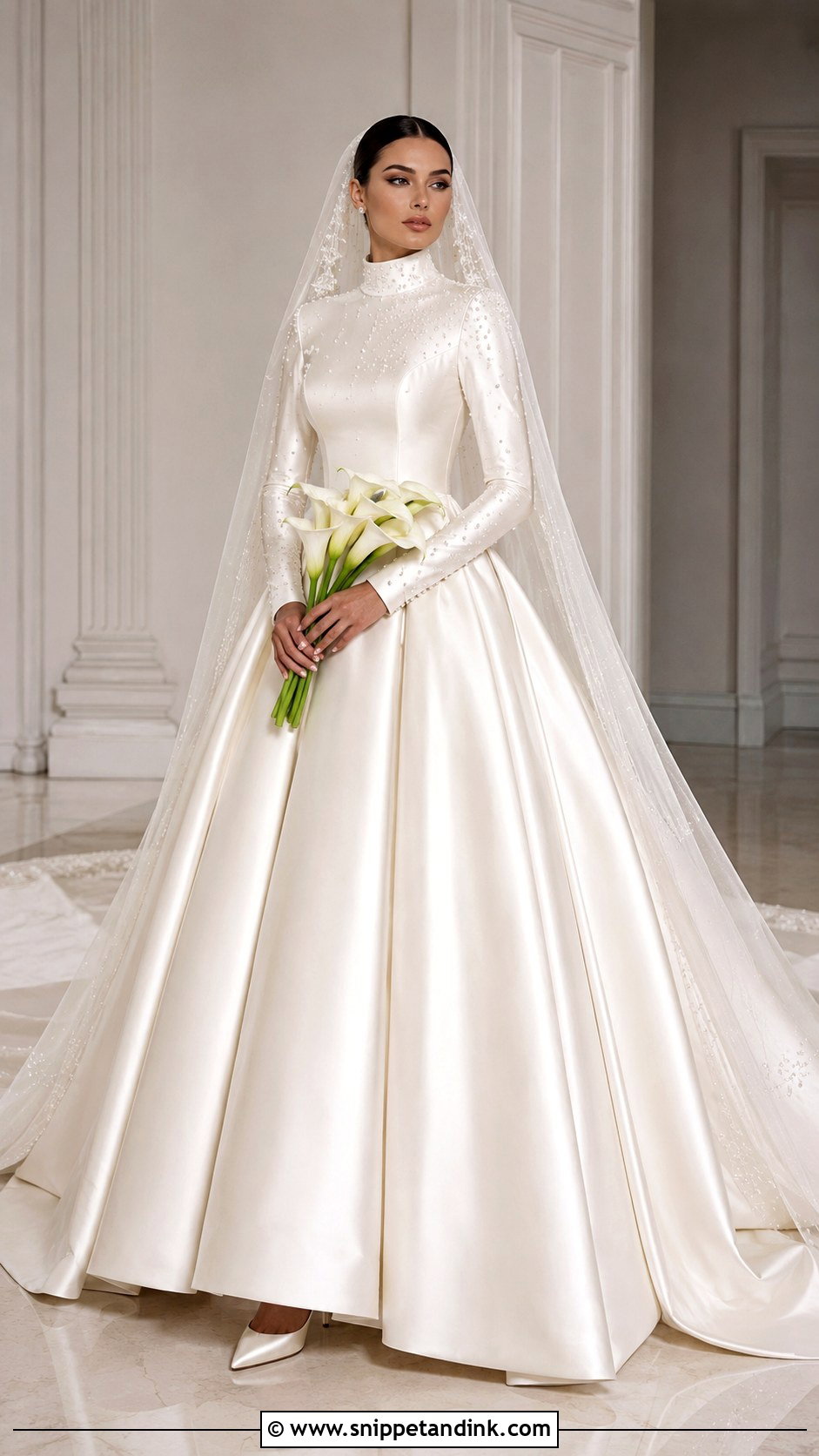
A high-neck satin ball gown is as formal as bridal dressing gets, and satin exposes every seam, so construction matters more than decoration. Look for precise seams, firm internal support and a well-fitted waist, with long sleeves that taper to the wrist without pulling at the elbow and a full pleated skirt. Crystal studs, pointed satin pumps and a long veil under a polished bun are enough; the high collar replaces a necklace. White callas or roses add softness. Ask about pockets and a good bustle. With this much skirt, you’ll be glad of somewhere to put a lip balm and a way to lift the train once the ceremony ends.
18. Modest Wedding Dress With Lace Cuffs
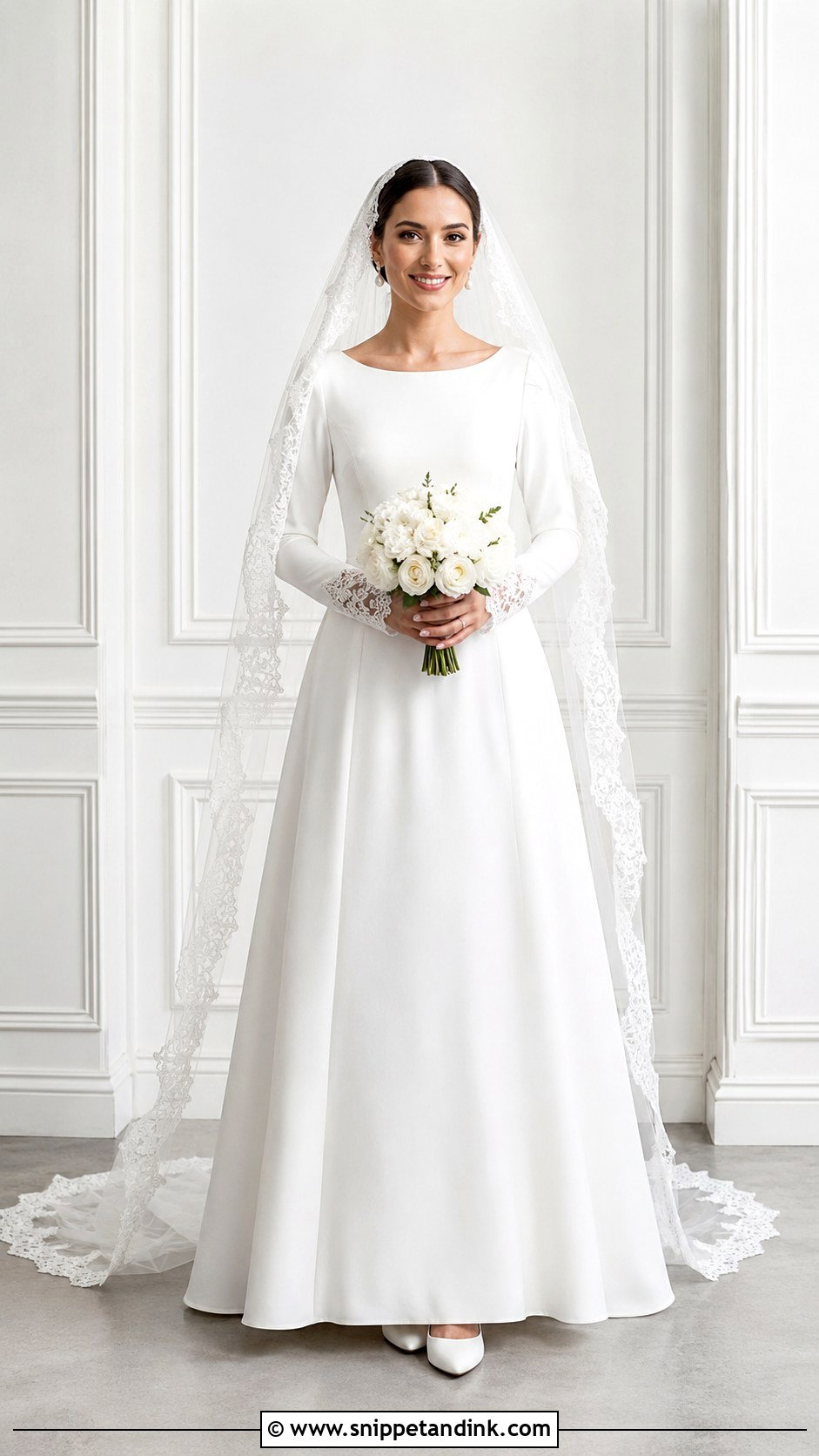
Lace cuffs put all the detail at your wrists, which is where every ring photo is taken. Start with a clean crepe or satin A-line with a modest scoop neck and opaque sleeves, then choose cuffs reaching just above the wrist, repeating the lace on the veil edge or waist if you like. Small covered buttons make them feel tailored. Pearl earrings, closed heels and a smooth low bun keep the rest quiet, so leave the watch and large bracelet off. Check the cuff opening is wide enough for your partner to slide a ring on easily, and that the lace doesn’t snag bouquet ribbon.
19. Long Sleeve Wedding Dress With Cape Veil
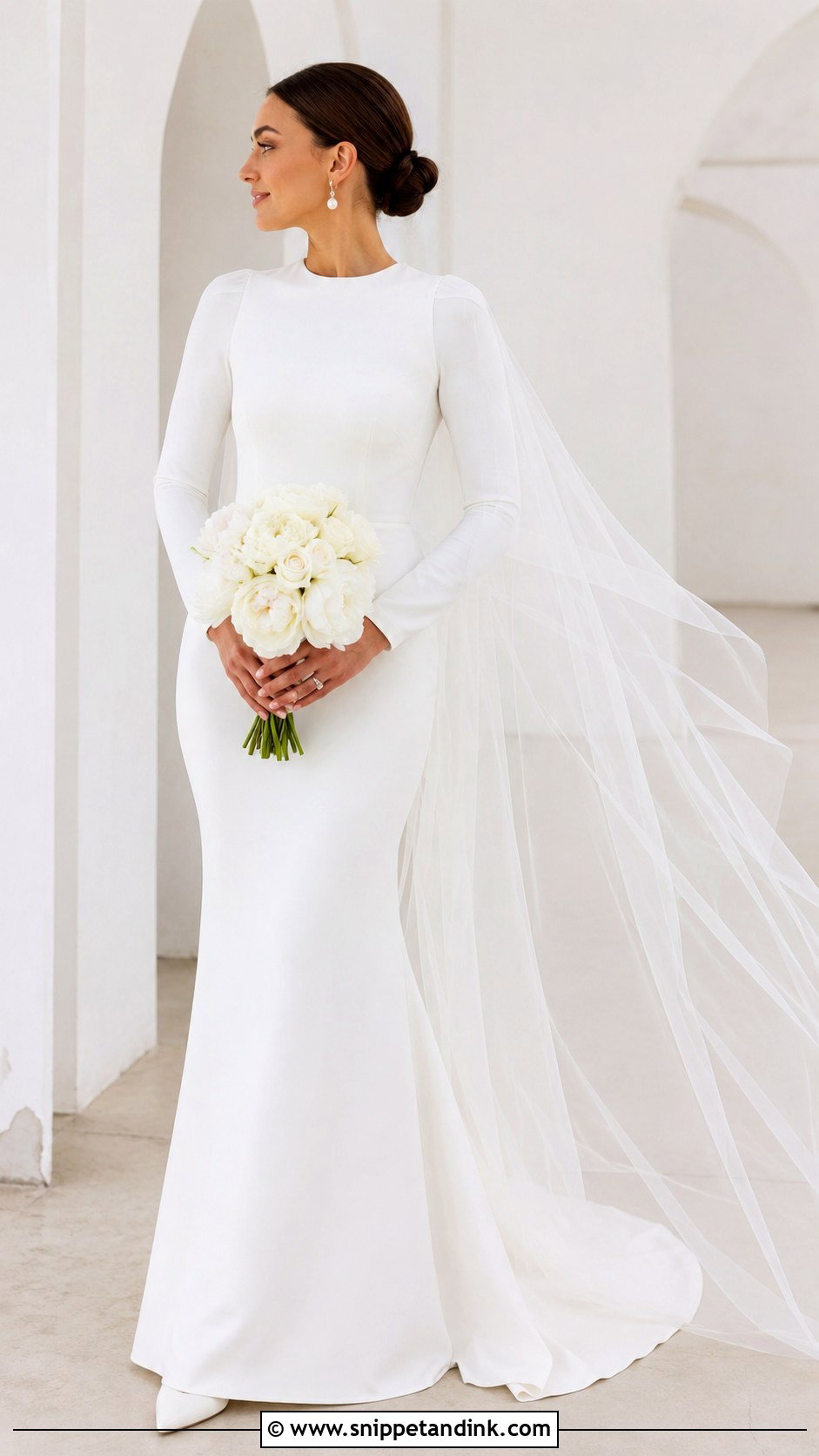
A cape veil falls from the shoulders rather than the head, so it leaves your hairstyle on show while adding movement behind you. Pair it with a plain crepe or satin gown with a high neck, covered back and softly flared skirt, and let the cape fall just past the hem without hiding the dress. Plain tulle is minimal; a narrow lace edge adds texture. Pearl drops, pointed shoes, a sleek low bun and a structured white bouquet finish it. The attachment points take the strain when you sit or turn, so test them at the fitting and make sure they’re sewn to the dress, not just pinned.
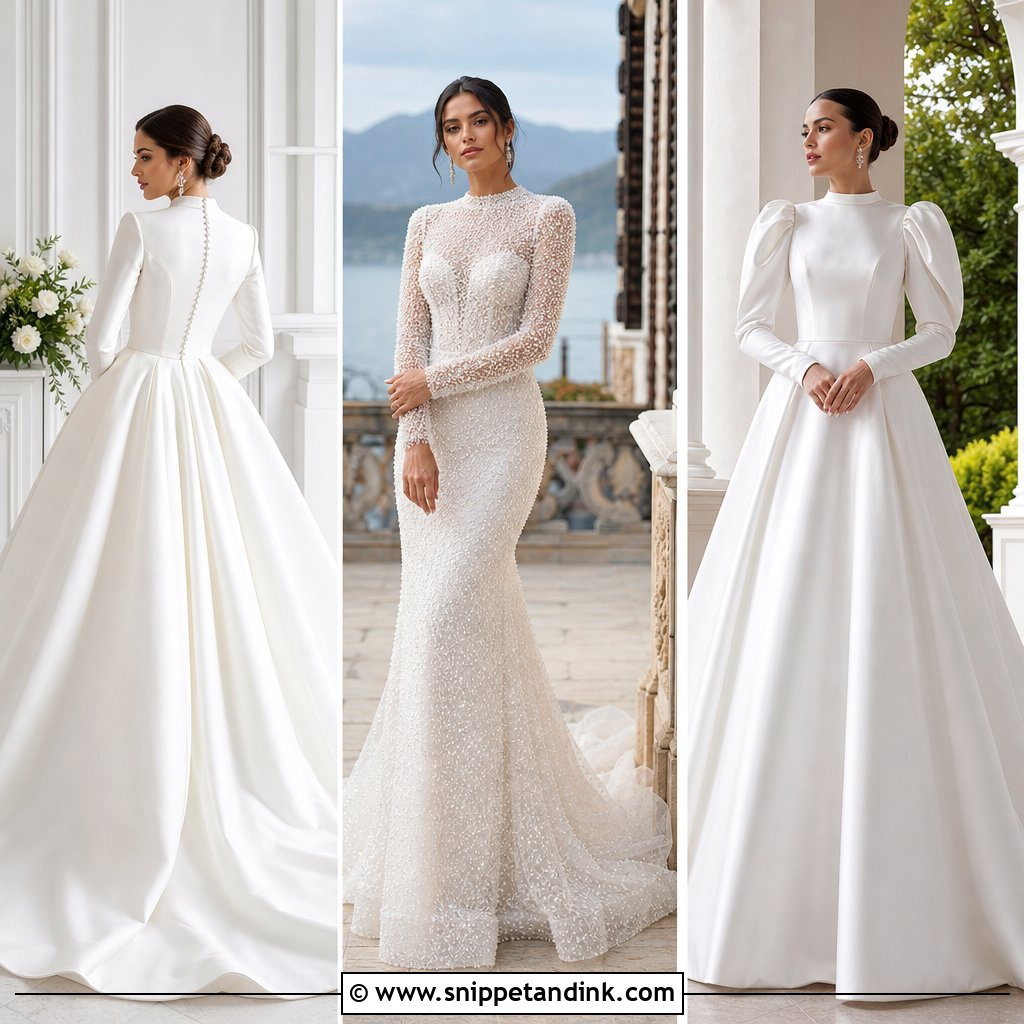
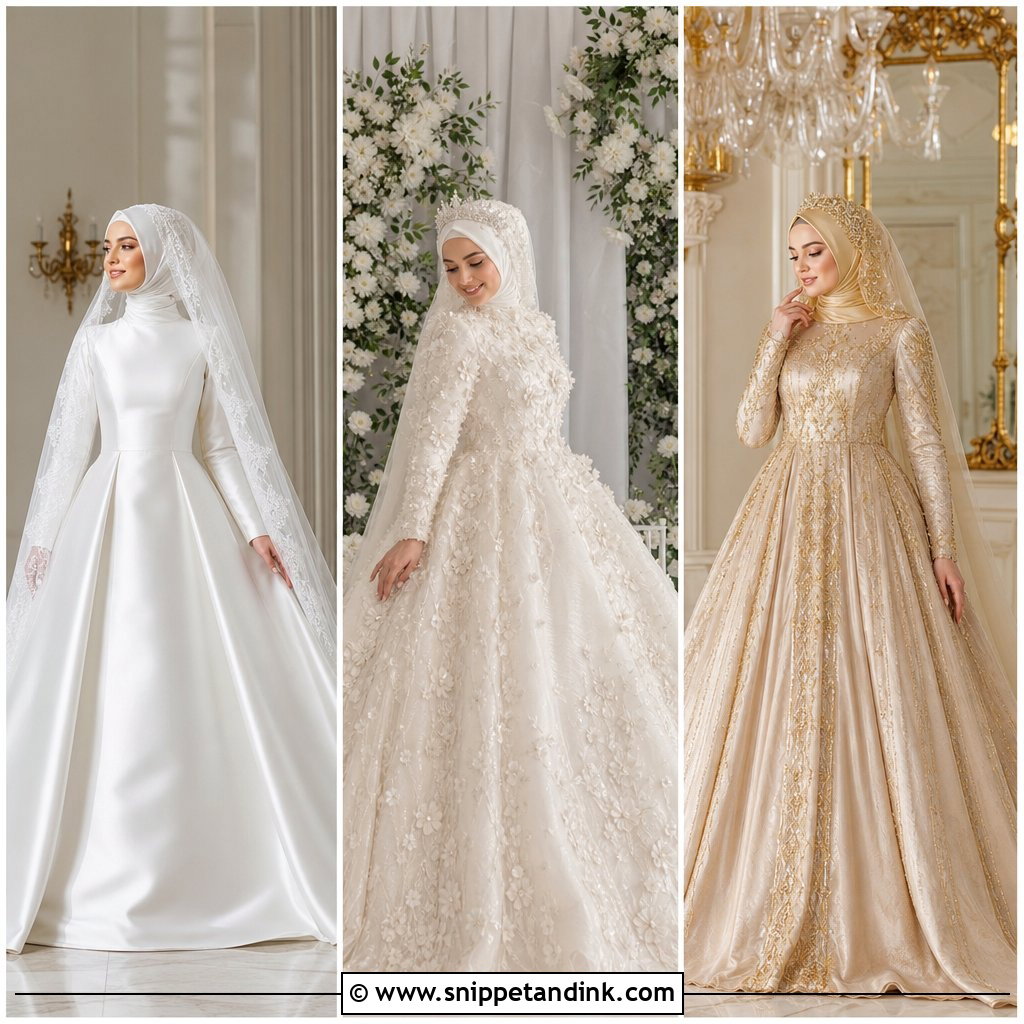
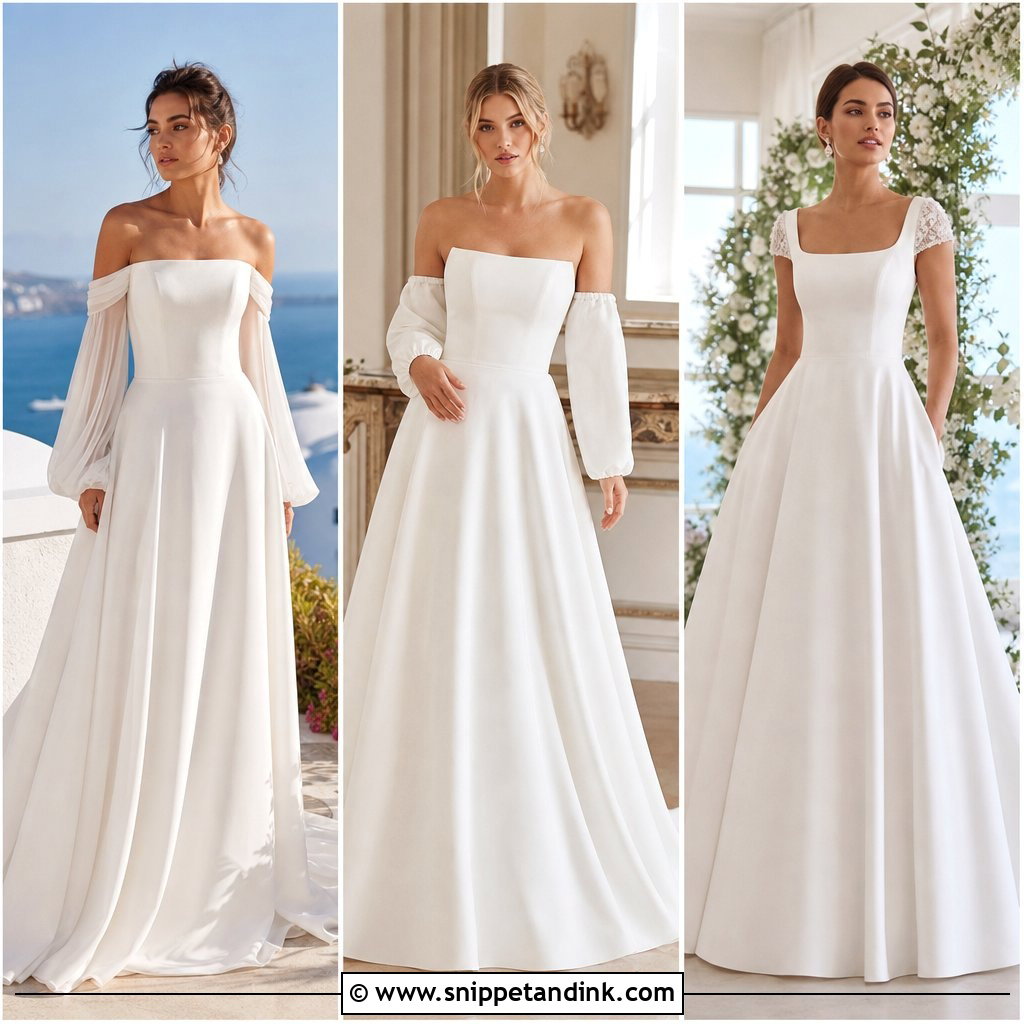
20. Modest Winter Wedding Dress With Sleeves
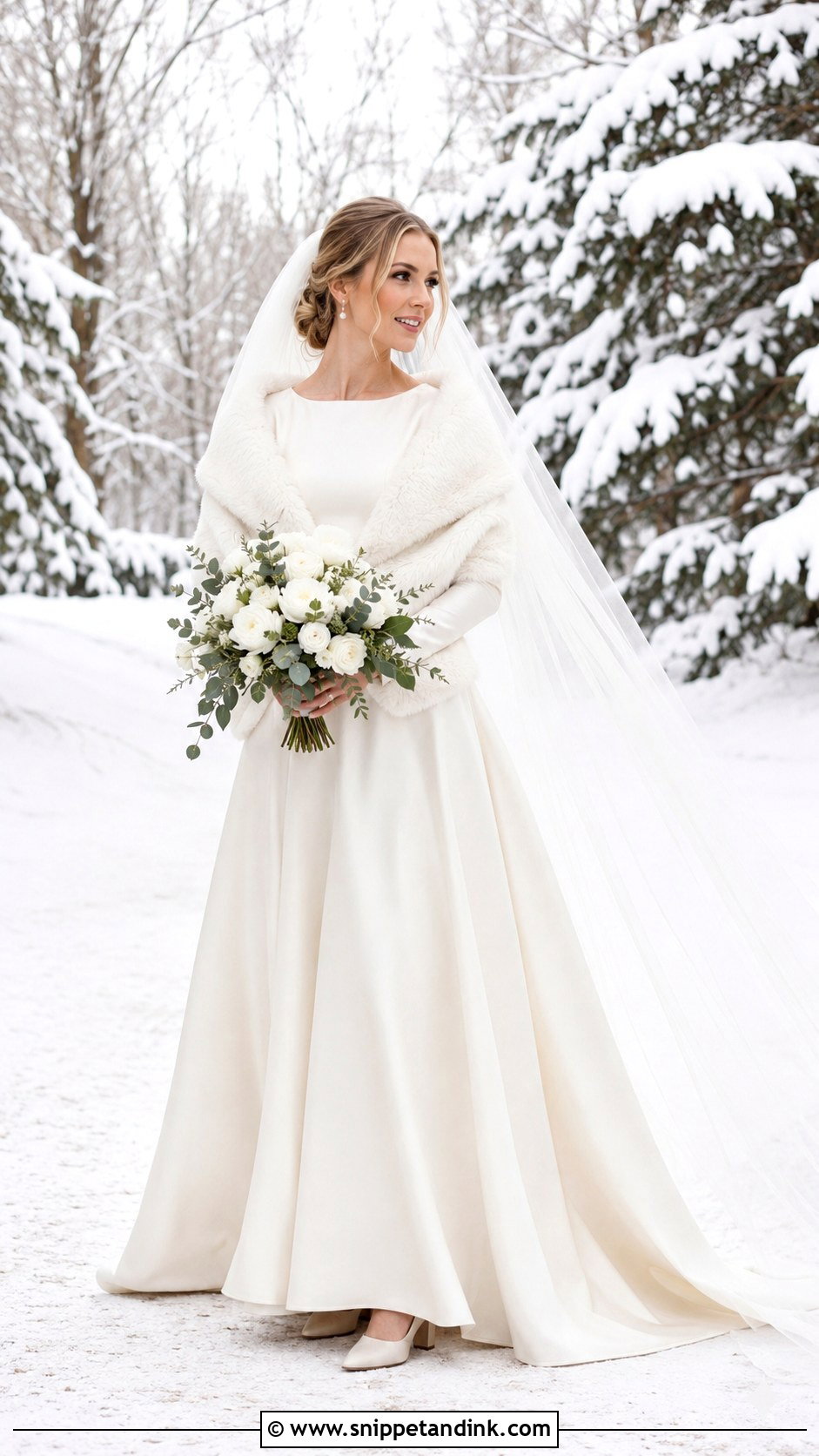
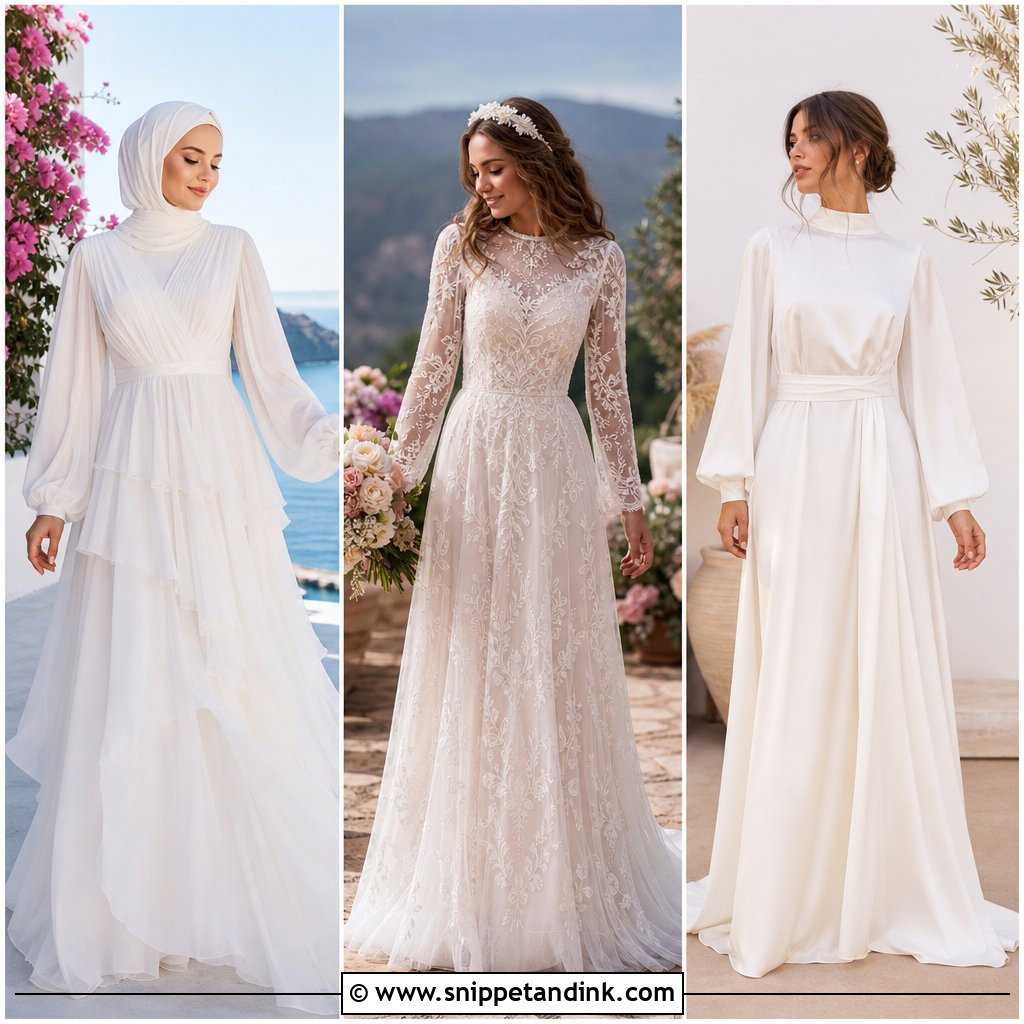
Winter is when long sleeves are easiest to love. Choose substantial satin, crepe or lined lace with a bateau or high scoop neck, and a full A-line skirt with room for a thin warm layer underneath. For outdoor photos, add a structured ivory coat, faux-fur wrap or lined cape and take it off indoors. Closed block heels grip wet paving better than sandals and keep your feet warmer. Finish with pearl earrings, a cathedral veil and an updo that survives a coat collar, with white roses and anemones. Take the coat to your final fitting so you can check it doesn’t crush the sleeve heads.
Will Long Sleeves Be Too Hot for a Summer Wedding?
They can be, but fabric matters far more than sleeve length. A loose chiffon sleeve in July is often more comfortable than a short sleeve in heavy satin, because air can move through it.
- Coolest: chiffon, georgette and embroidered tulle, especially in bishop or loose shapes.
- Middle: light lace over mesh and soft crepe, which breathe reasonably and crease less than you’d expect.
- Warmest: Mikado, heavy satin and densely beaded fabrics, which trap heat and add weight on the arms.
Ask what the lining is made of, since a polyester lining under silk lace can feel warmer than the lace itself. Sweat marks show readily on satin and pale silk, so stitch-in underarm shields are worth adding at the final fitting. They’re inexpensive and invisible from outside.
Plan the day around the heat too. Schedule outdoor portraits for early evening when the sun is lower, keep a fan with the bridal party and find out whether the reception room has air conditioning. If you want coverage only for the ceremony, detachable sleeves or a separate lace bolero give you the option to cool off later.
Lift Your Arms Before You Say Yes to the Sleeves
Long sleeves are worth the extra fitting attention. Whether your gown is minimal, romantic, vintage, boho or formal, the same checks apply: sleeves you can move in, a lined bodice, a neckline that stays put, a fabric weight that suits the season and a train you can manage. Bring your wedding shoes and undergarments to every fitting so the alterations are done on the real outfit. Then let the veil, jewellery, hair, flowers and any coat support the dress rather than compete with it. Choose the gown you can hug, eat and dance in without thinking about your arms.
You'll Like These Ideas:





Leave a Reply