
Most of the niqab brides I dress arrive having already been told what they can’t wear. I’d rather start from what works: opaque fabric, a loose line through the body, full sleeves, a face veil that matches the gown rather than fights it, and shoes you can stand in for hours. The ideas below are complete outfits, head to toe, because a niqab look succeeds or fails on how the layers sit together, not on the dress alone. High necklines, covered backs, capes, lace, satin and brocade are all easy to find in bridal shops now, which makes modest customization far simpler than it used to be. You’ll see classic white next to champagne, blush, green, blue, red and black, plus cultural pieces and simple nikah looks. Every one can be adjusted to your coverage, your family’s customs, your venue and the season.
Dressing in the Right Order So Nothing Shifts
A niqab bridal look is four or five layers on the head and two or three on the body, and the order you put them on decides whether they stay put. This is the sequence I use in the bridal room, and I’d ask whoever is helping you to practise it once at home.
- Underdress or slip first, then the gown, so the gown’s neckline can close over a smooth base.
- A fitted undercap next. It gives every pin something to grip and stops slippery fabrics sliding back off your hair.
- The khimar, pinned at the crown and under the chin so it frames the face evenly.
- The niqab, tied or looped over the khimar. Tie it snug but check you can turn your head fully without it pulling across the nose.
- Cape, dupatta or veil last, pinned into the undercap or khimar, never into the niqab itself, so its weight never drags the face covering down.
Use the pins with ball or pearl heads, not plain dressmaker pins, and count how many go in. I tell a sister or friend the number so the same number comes out at the end of the night. Magnetic pins are handy on chiffon, though they can slide on satin.
Eating, Drinking and Breathing Through a Long Day
The question most brides are too shy to ask at a fitting is how they’ll eat. A two- or three-layer niqab with a flip-up top layer solves part of it, but the simplest answer is a private room or a corner screened off from guests where you can lift the face covering for ten minutes. I’d plan that space with your coordinator well ahead.
- Keep a straw in your bag. You can drink under the niqab without lifting it.
- Choose a single-layer chiffon or georgette niqab for summer. Multi-layer versions are warm and steam up quickly.
- If you’re wearing eye makeup, set it with a setting spray. The niqab edge rubs at the lower lashes and mascara transfers to it.
- Pack a spare niqab in the same shade. Lipstick, food and sweat all mark the inside, and a fresh one before photos makes a visible difference.
Many families also want photos taken by a woman or kept private. Raise that with photographers before booking, not on the day, so the ones you speak to can say plainly whether they work that way.
1. Ivory Satin Niqab Wedding Dress
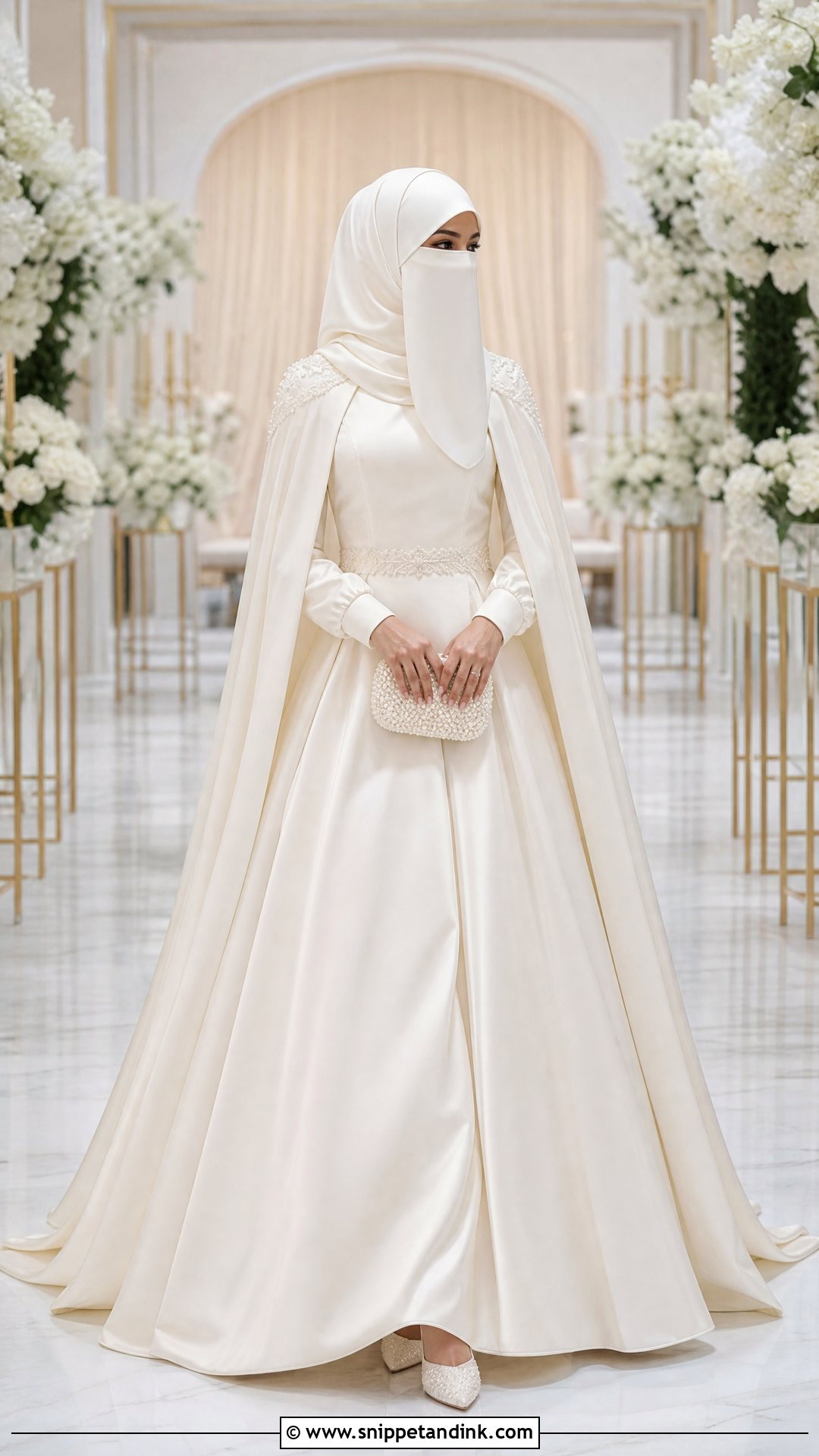
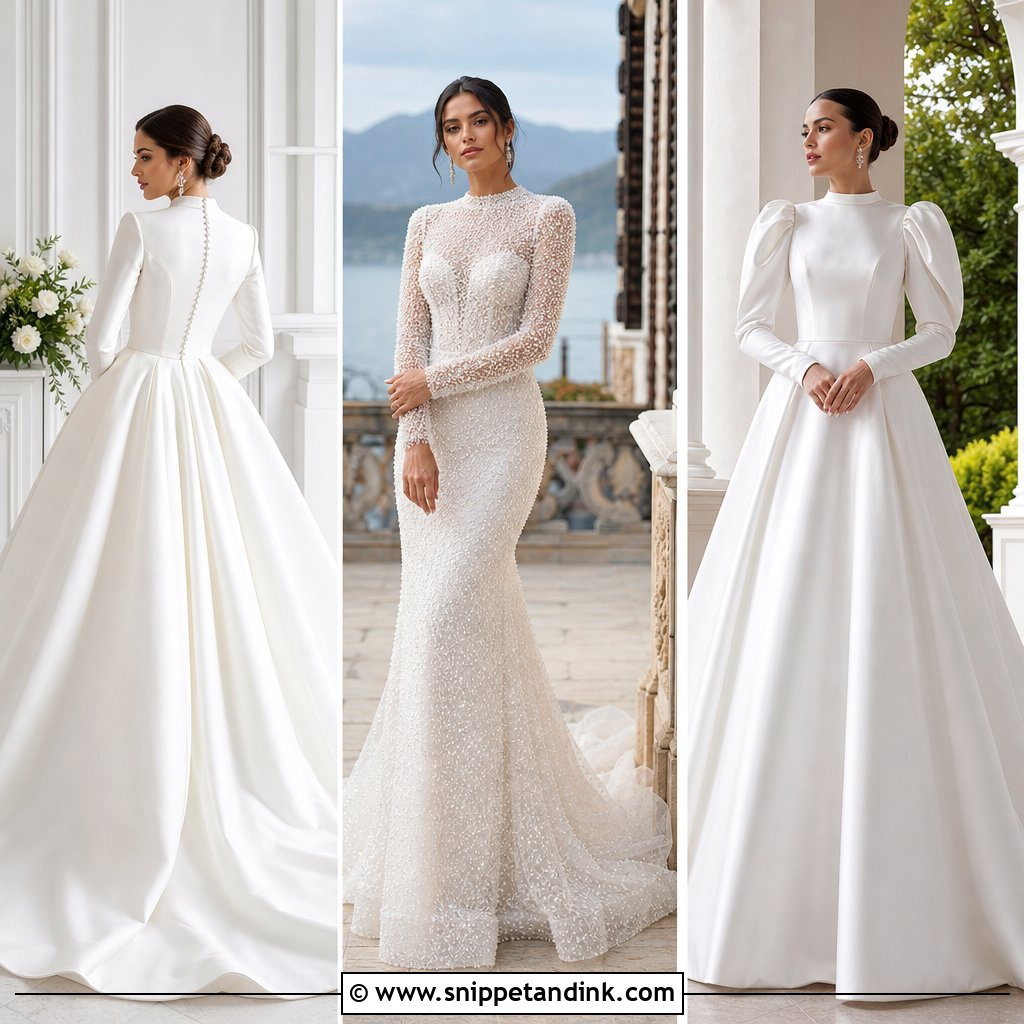
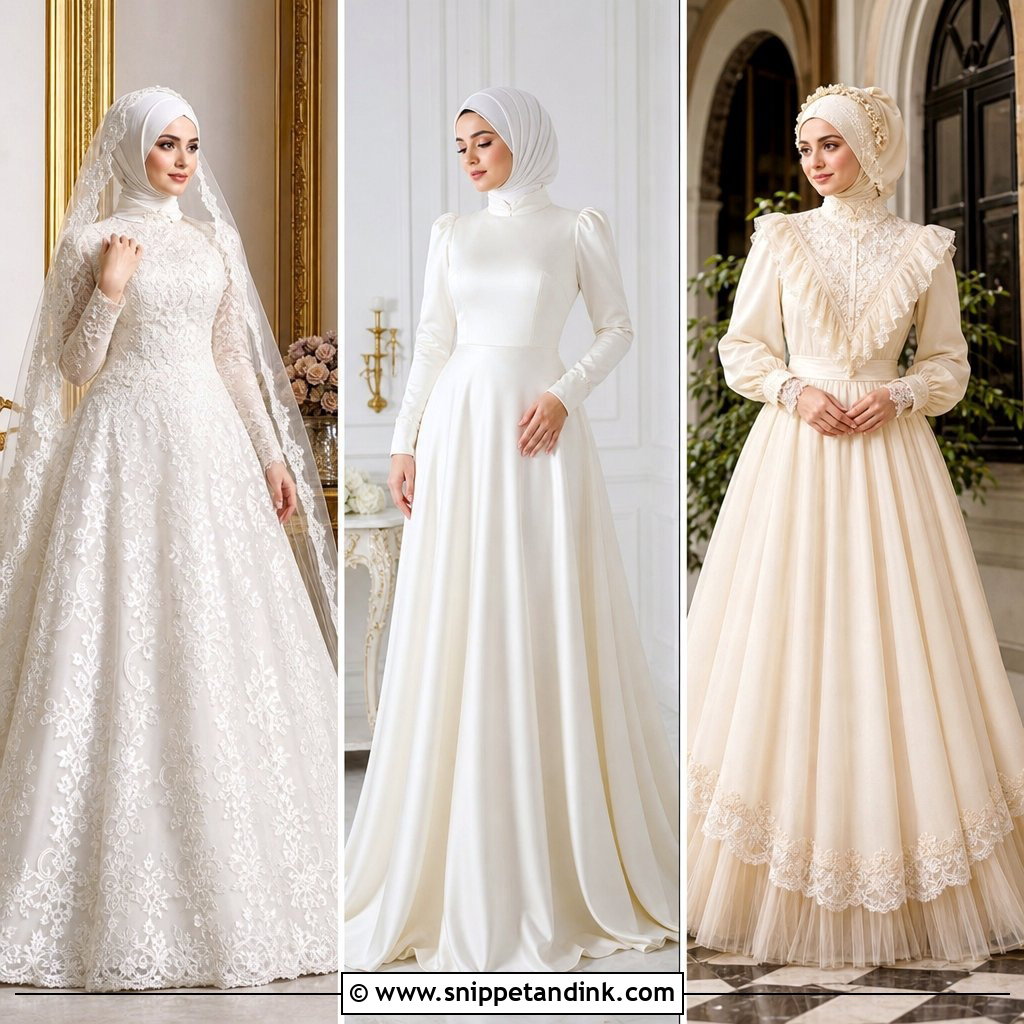
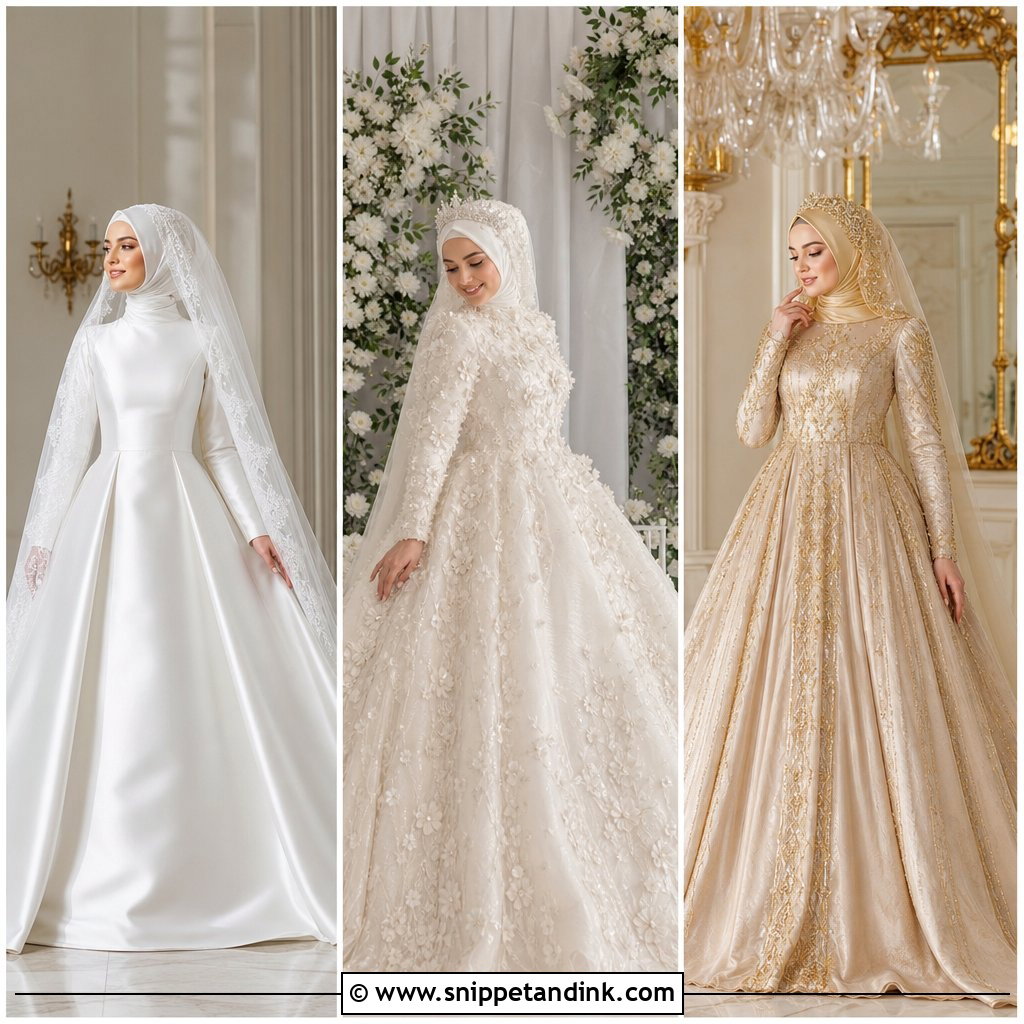
An ivory satin A-line is the gown I reach for when a bride wants something calm and classic. Look for an opaque lining, a high neck, fitted cuffs and a skirt that falls away from the body rather than skimming it. A matching ivory niqab keeps the colour story clean, and a light chiffon khimar adds movement at the shoulders. Closed-toe satin pumps, pearl earrings worn privately if that’s your preference, and a small pearl clutch finish it; a detachable satin cape can stand in for a veil at the entrance. Satin is unforgiving about shade. Ivory satin next to ivory chiffon can read as two different whites under warm venue bulbs, so I always hold every layer together under the actual lighting before anything is cut.
2. White Lace Niqab Wedding Dress
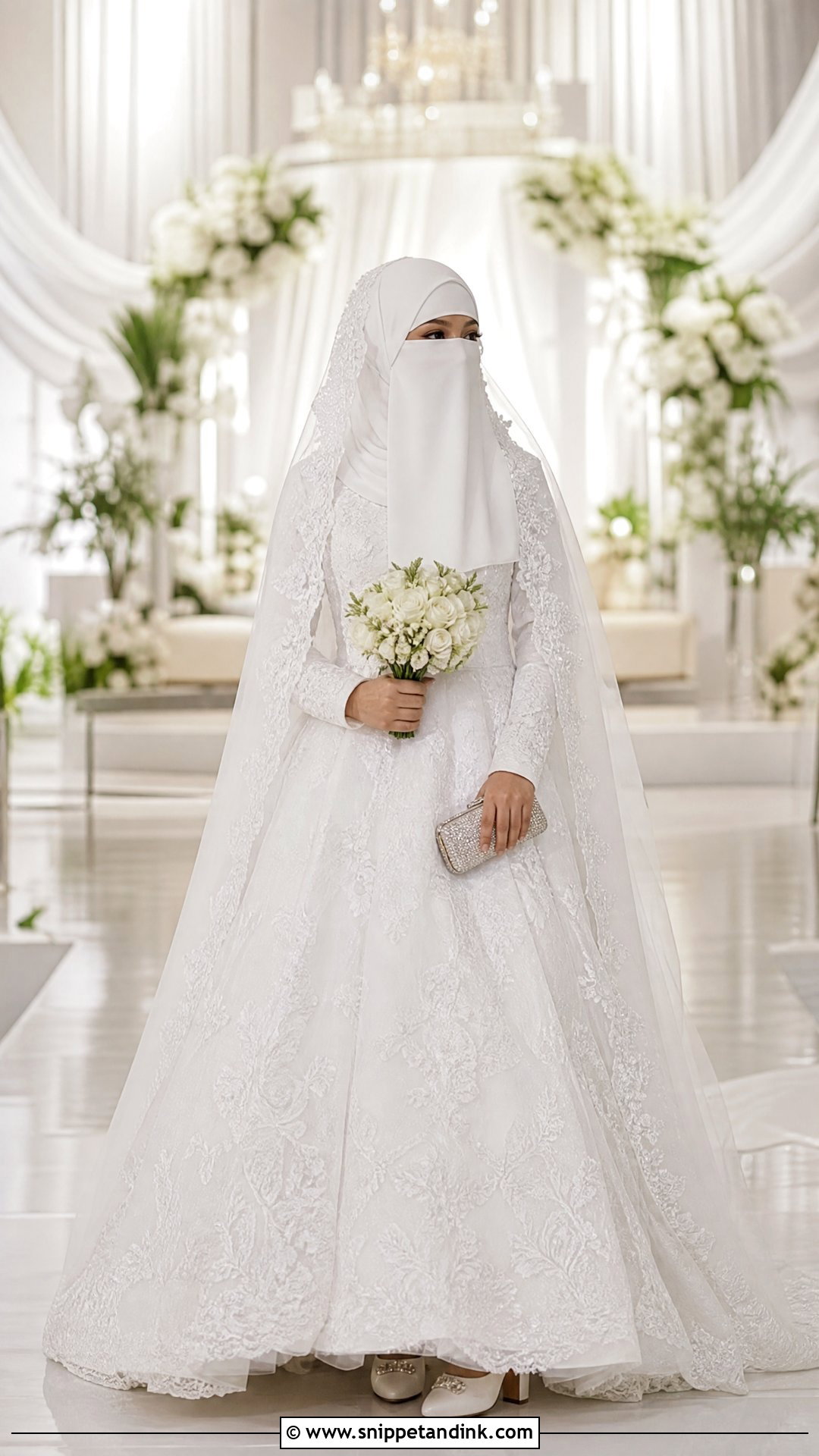
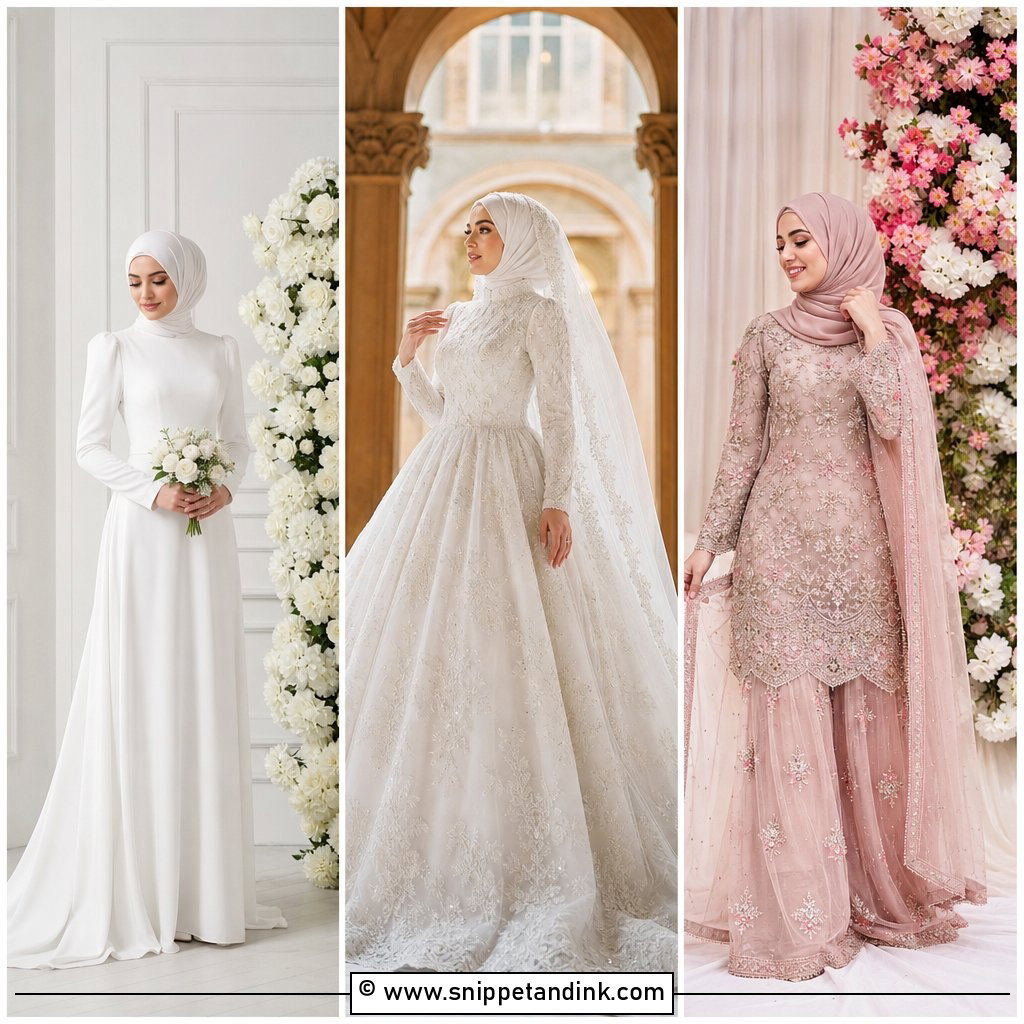
Lace gives a fully covered dress its detail without asking the silhouette to reveal anything. Start with a loose white ball gown with lace sleeves, an opaque bodice and a wide, lined skirt, then keep the niqab plain so the face covering isn’t competing with a pattern. A lace-edged khimar or long veil can echo the gown. White block heels and a small crystal bag are enough. The thing I check first on any lace gown is the backing: hold the sleeve against your own skin in daylight. Many off-the-rack lace sleeves are lined only to the elbow or left sheer at the shoulder, and that is usually a straightforward job for a seamstress if you catch it at the first fitting.
3. Pearl Abaya Niqab Wedding Dress
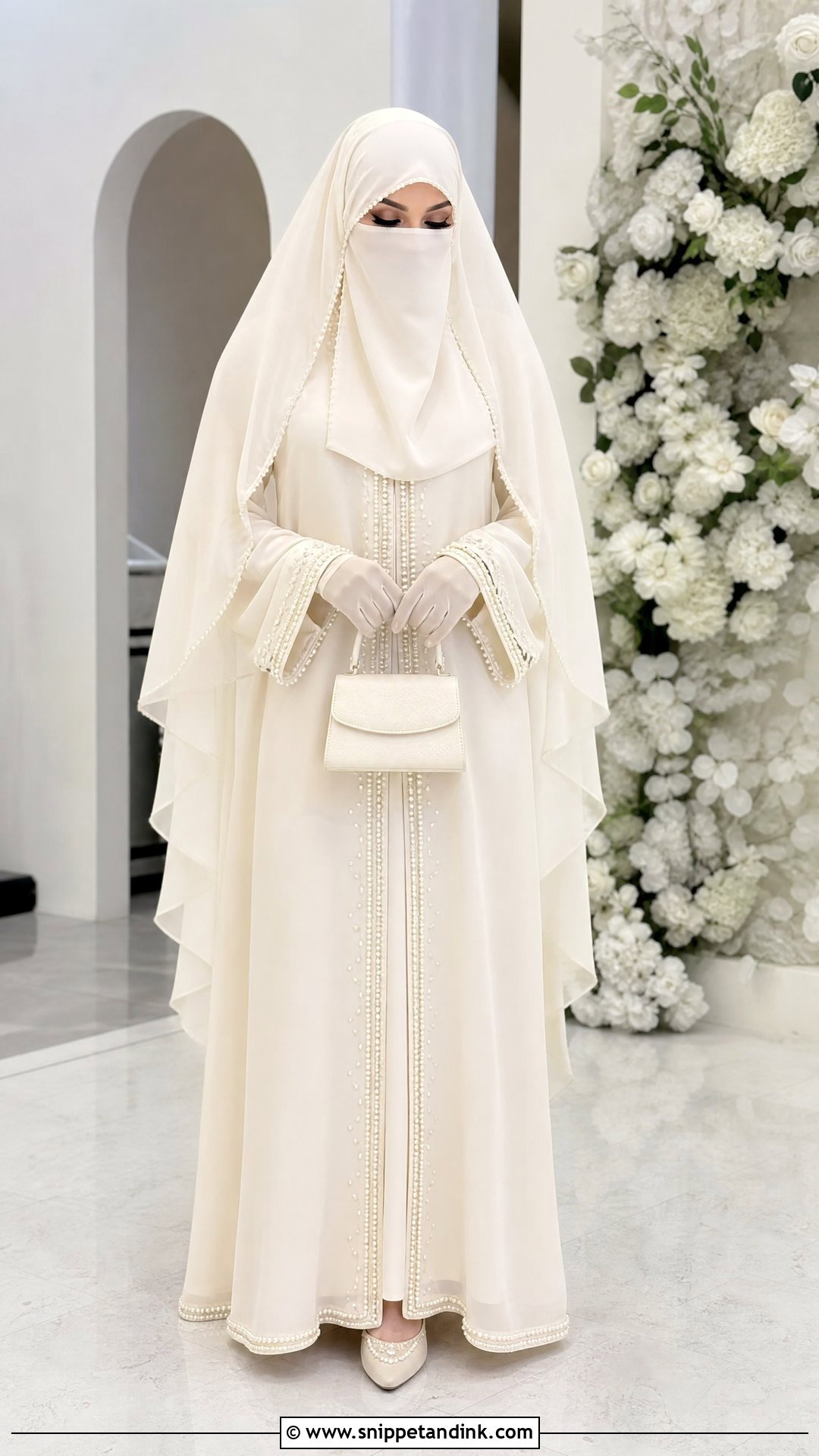
Scattered pearls turn a traditional bridal abaya into wedding wear without much effort. I prefer pearls placed along the sleeves, shoulders and hem rather than dense across the whole garment, which gets heavy and starts to pull the fabric. Wear it over an opaque, loose slip in the same colour, with a chiffon khimar and simple niqab for continuous coverage. Pearl-trimmed flats, a structured ivory mini bag and bridal gloves, if you like them, complete it. The abaya should skim the shoe without dragging. Ask your tailor to re-stitch every pearl individually; factory-glued pearls pop off on a khimar edge or bouquet ribbon, and you’ll find them on the floor by the end of the nikah.
4. Minimalist Crepe Niqab Wedding Dress
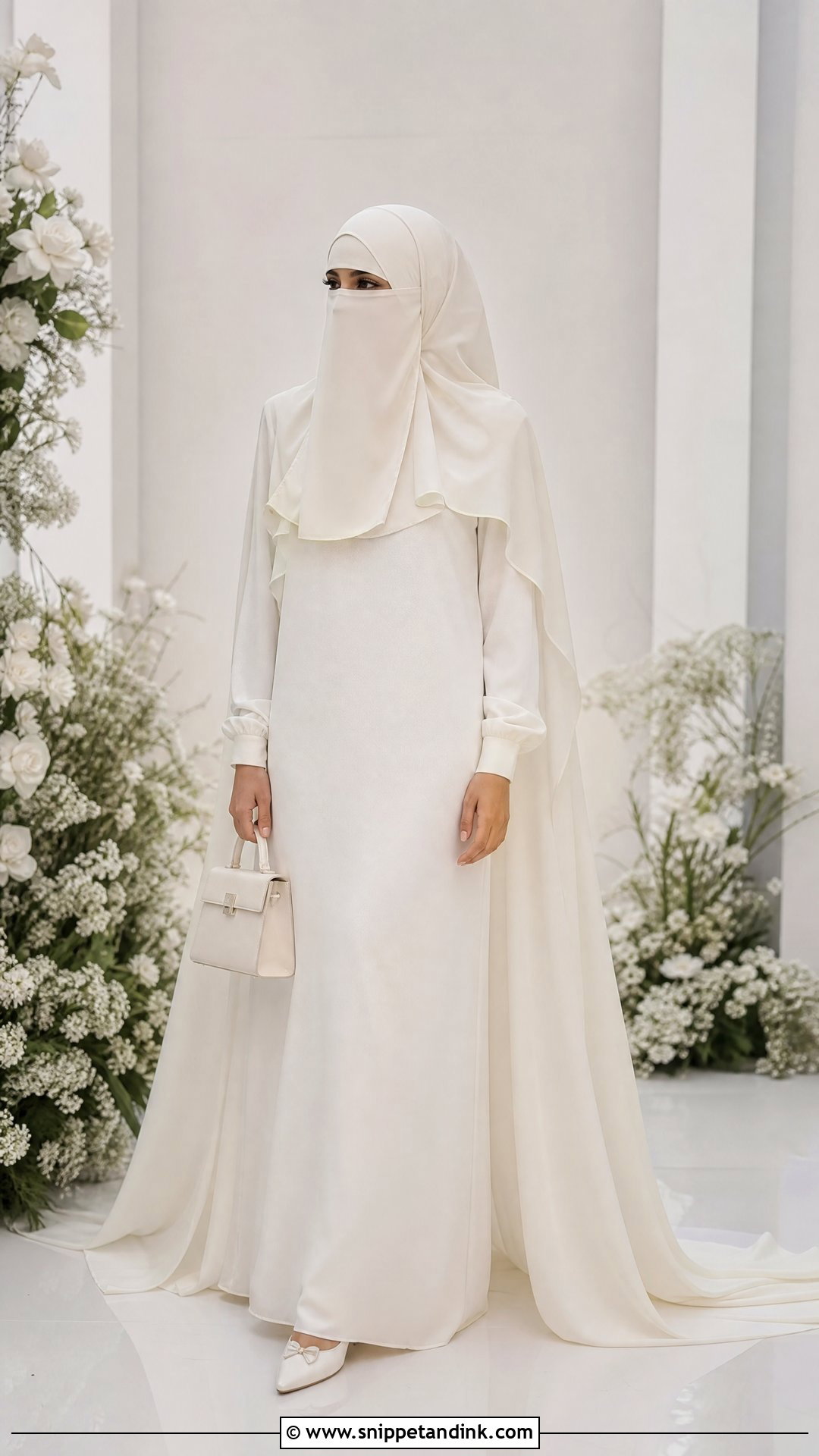
Heavy crepe in a relaxed column is the quietest option here, and it suits a small nikah at home or in a mosque hall. Pick a high neck, full sleeves, a covered back and a cut that doesn’t cling. Matte chiffon in soft white for the niqab keeps shine off the face. Add a shoulder-length khimar, a long, narrow cape and pointed closed-toe flats, with a small bouquet and a top-handle bag. My honest warning: a plain dress shows every seam, so the money you save on embellishment should go to the tailor. Have the hem set so you can sit and pray comfortably, then walk in it once more to be sure the line still falls cleanly to the floor.
5. Princess Niqab Wedding Dress With Veil
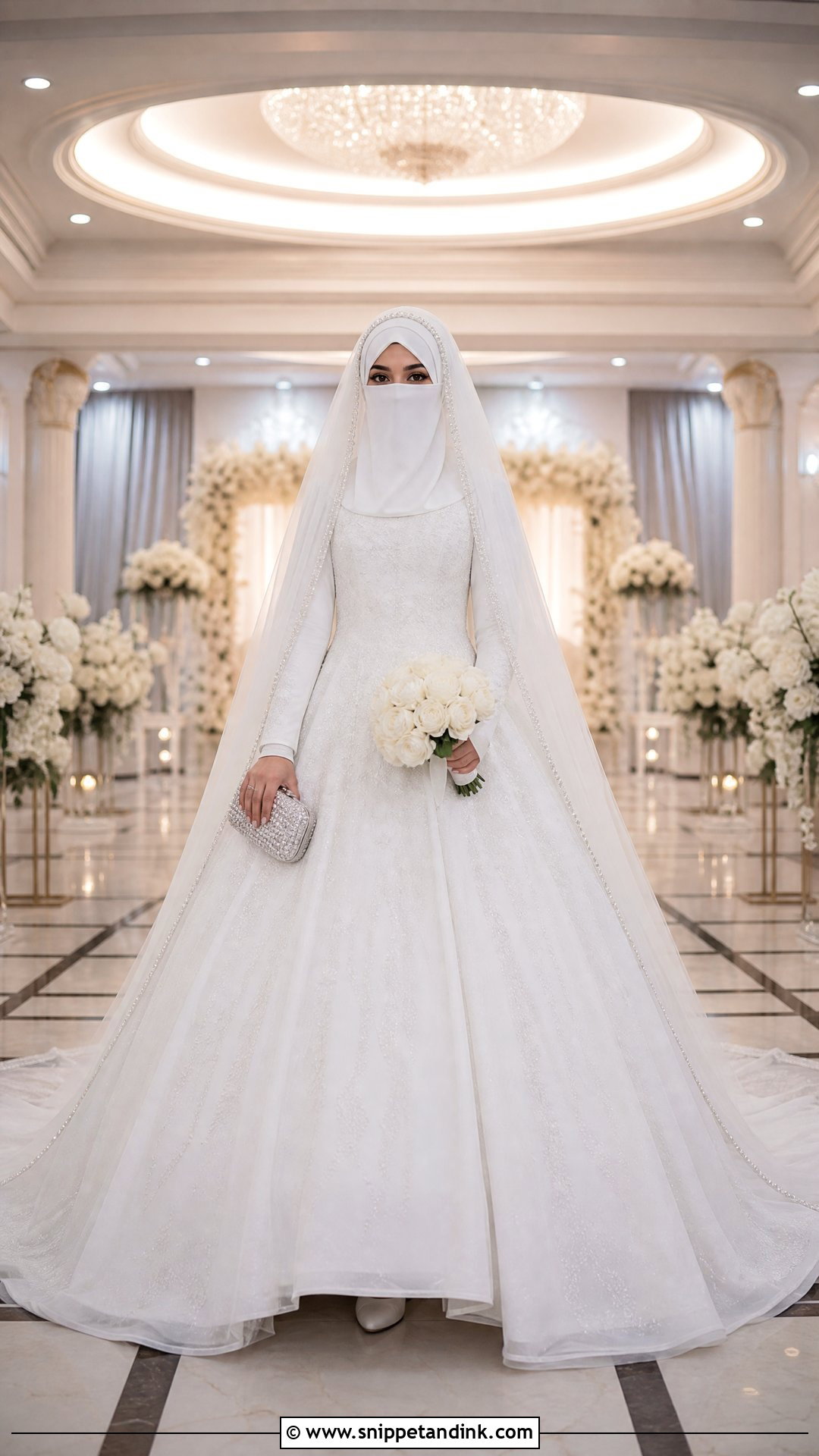
A princess gown gives you the big entrance while the coverage stays complete. The bodice should be opaque with long sleeves and a high neck, and the skirt needs a petticoat that is comfortable to sit in, not a stiff hoop. Pair it with a matching niqab, a fitted undercap and a smooth khimar that stays put under a cathedral veil, which can carry a narrow lace border or tiny pearls. Low block heels and a bouquet with a manageable handle matter more than you’d think with this much skirt. I talk most brides out of a heavy headpiece here: the undercap, khimar, niqab and veil are already four layers on the head, and a tiara on top tends to give a headache by the second hour.
6. Chiffon Khimar Niqab Wedding Dress
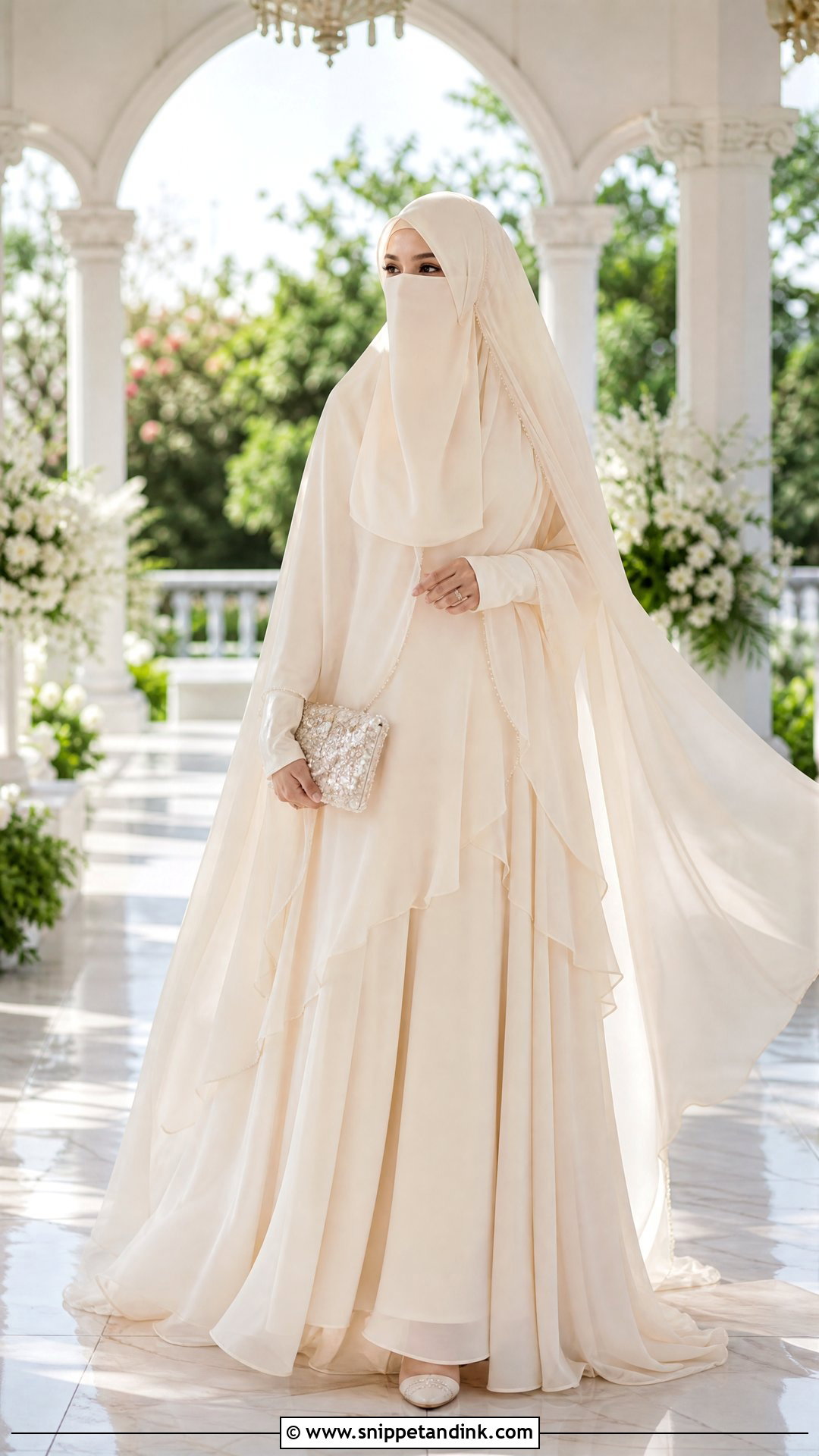
Chiffon layers suit spring and summer ceremonies because they move with you and don’t trap heat. Start with an opaque A-line underdress with loose sleeves and secure cuffs, add a flowing chiffon overlay, a long matching khimar and a single-layer niqab in white or ivory. I keep the khimar a little shorter than the back hem so you aren’t managing two trailing layers at once. Closed-toe flats or low heels and a beaded clutch are plenty. Chiffon goes see-through in direct sun, which surprises brides who only tried it on in a fitting room. Stand by a bright window in the full outfit before the day; if you can see your arm through the sleeve, the lining needs to be heavier.
7. Gold Embroidered Niqab Wedding Dress
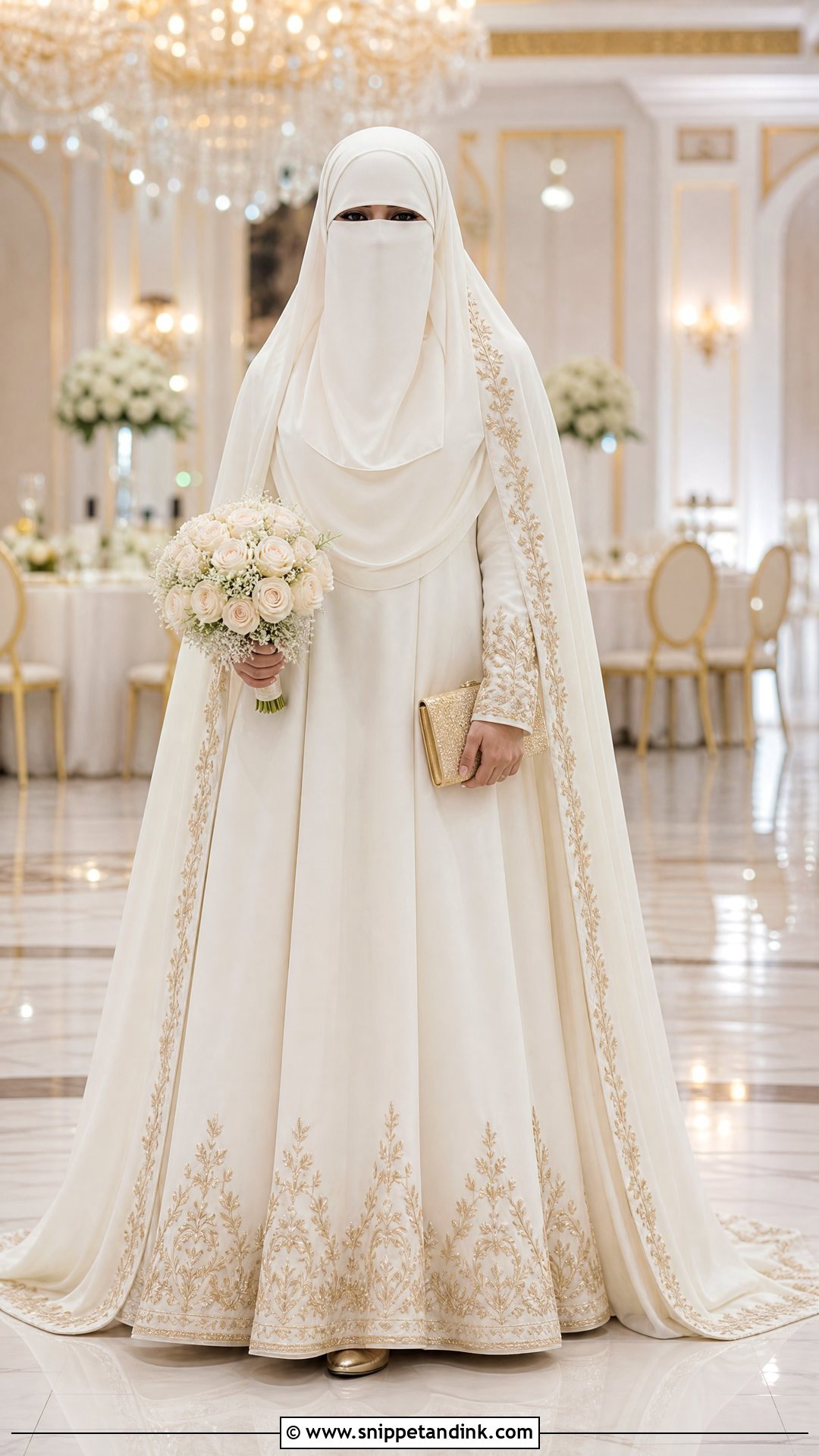
Gold embroidery brings warmth to an ivory gown, and it works best kept to the cuffs, neckline and lower skirt of a loose A-line. Keep the niqab and khimar plain ivory; an embroidered face covering on top of an embroidered dress is too much detail in one place. Gold closed-toe shoes, a small metallic clutch and cream flowers complete the palette, and a light ivory cape with a narrow gold border adds drama if you want it. Metallic thread is scratchy, so I ask for smooth work across the shoulders where the khimar rests. On undertone: warm skin tends to sit better with creamy ivory and yellow gold, cooler skin with a whiter ivory and paler, silvery gold. Compare all the fabrics together before you approve anything.
8. Champagne Brocade Niqab Wedding Dress
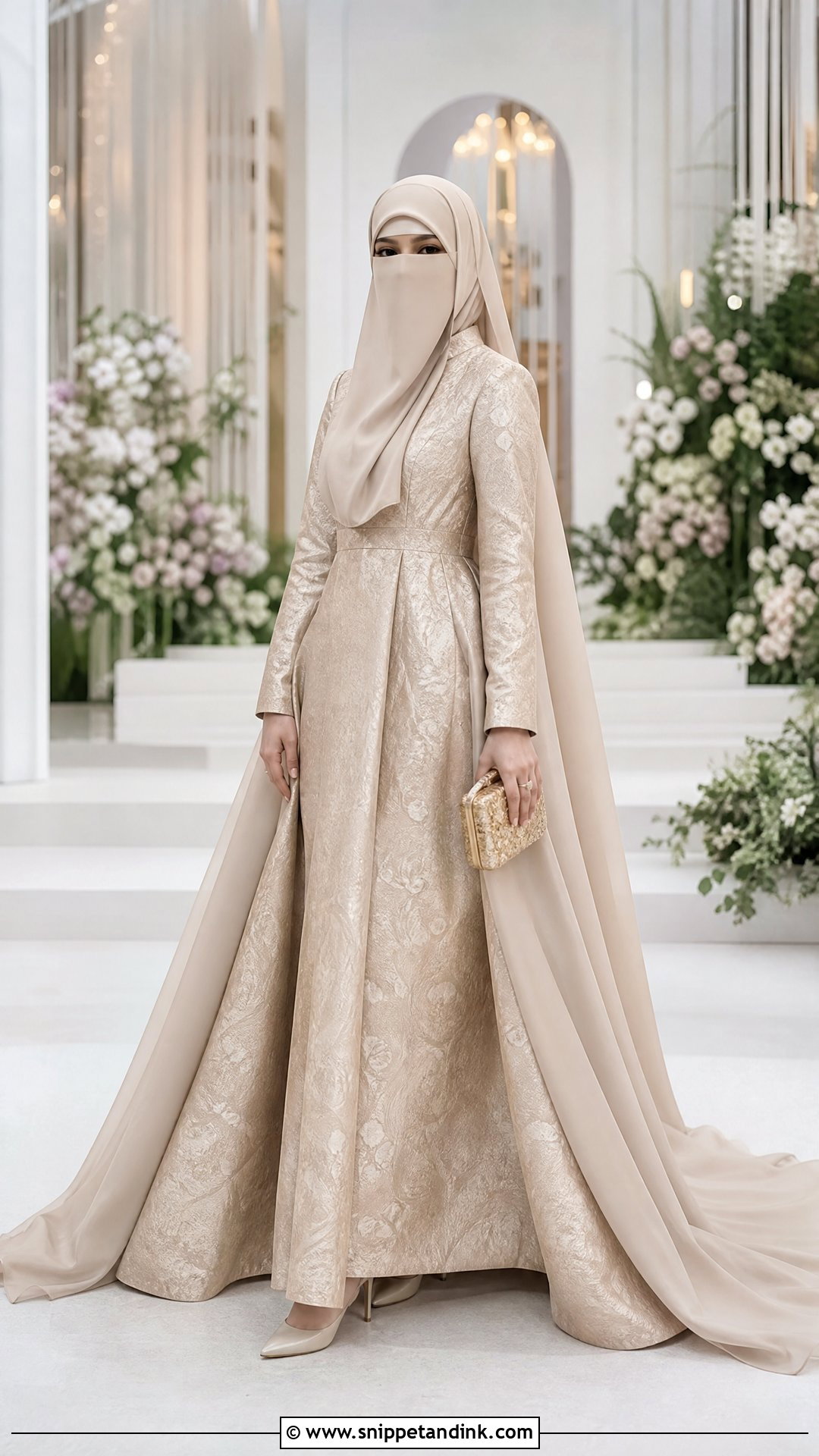
Champagne brocade gives colour and texture without leaving bridal territory. A structured gown with a loose bodice, full sleeves, a high collar and a softly flared skirt is the shape to look for, and the weave should look rich rather than glossy under indoor light. A matte champagne niqab and a plain chiffon khimar let the brocade stay the focus, finished with champagne pumps, a satin bag and understated gold. Brocade is heavy and doesn’t breathe well. I ask for a cotton lining in the bodice on long days, and I keep gathers away from the waist and shoulders so the fabric doesn’t add bulk. A detachable train gives you the bridal moment without making the whole dress out of weighty fabric.
9. Blush Floral Niqab Wedding Dress
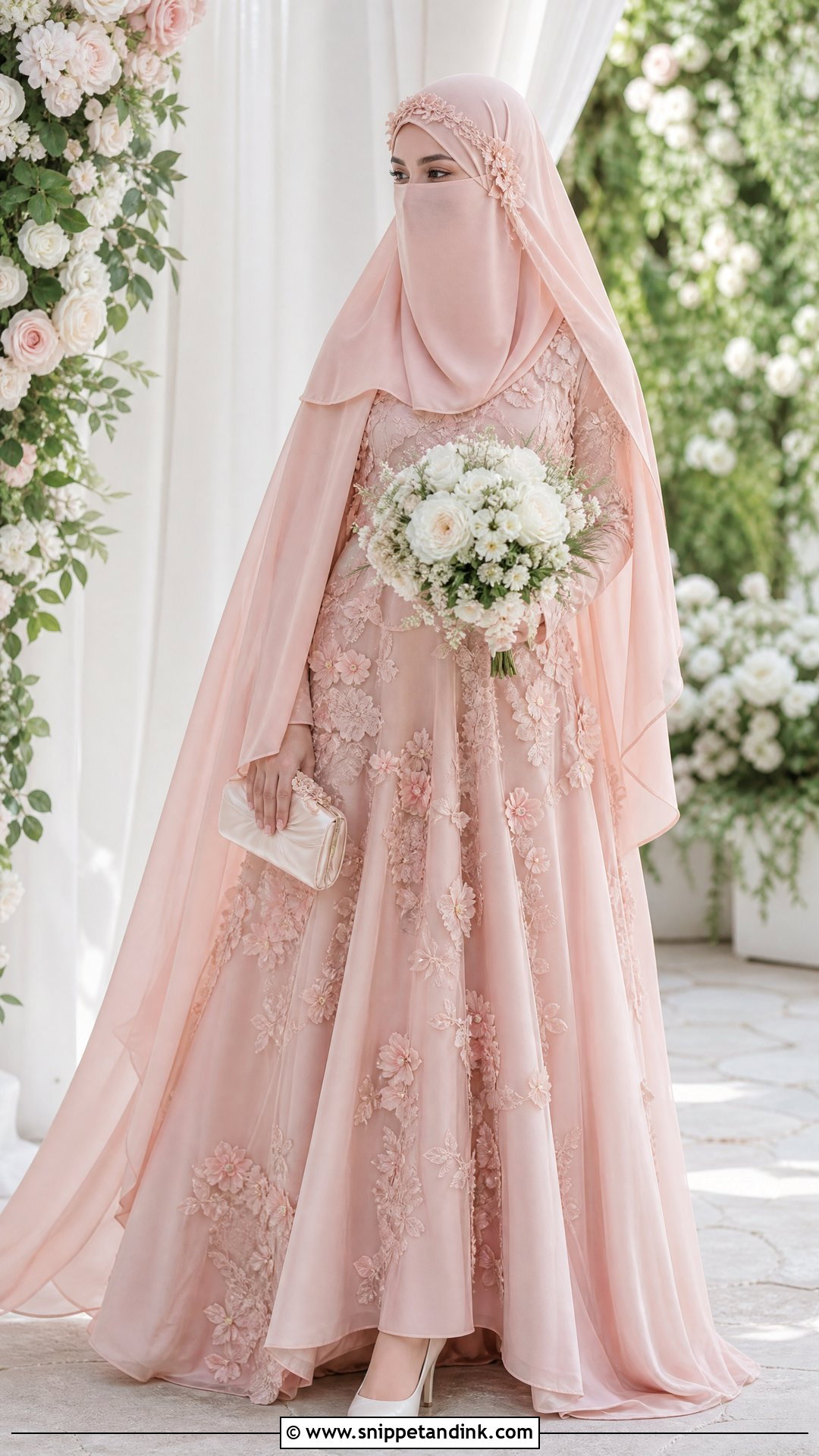
Blush is warmer than white but still reads as bridal, which makes it popular for daytime nikahs and garden venues. Choose a fully lined dress with long sleeves, a high neck and floral appliqués around the skirt, cuffs and cape. A plain blush niqab and matching khimar stop it from looking busy. Ivory closed-toe heels, a blush satin clutch and white flowers with muted greenery finish the look. Three-dimensional appliqués are where I see problems: placed on the inner arm, they rub all day and snag the outer veil. Ask for them on the outer sleeve and skirt only. And stay inside one blush family, since a peachy niqab beside a cool, pink gown looks like a mismatch in every photo.
10. Dusty Blue Niqab Wedding Dress
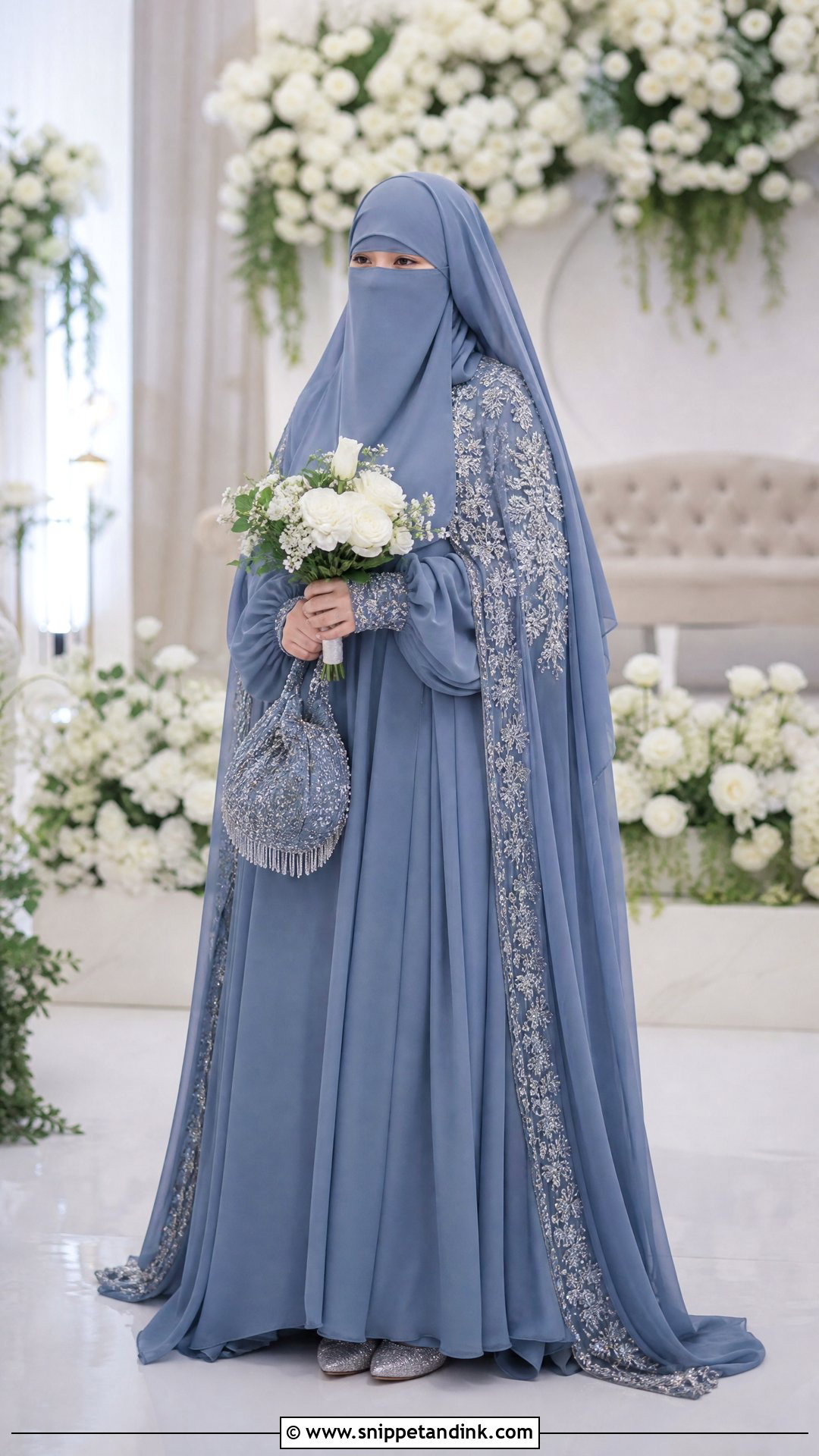
Dusty blue is calm and distinctive without being loud. A flowing georgette gown with an opaque lining, bishop sleeves, a covered neckline and a gently gathered skirt is a good base, with a khimar and niqab in a slightly lighter matte fabric. Silver flats, a beaded grey-blue bag and a white bouquet suit the cool palette, and a silver-embroidered cape adds formality for the entrance. Muted blues are the hardest colour I match. Dye lots vary, and bright royal blue next to dusty blue makes the softer shade look faded. Get physical swatches of every piece and look at them in daylight and under the venue’s lamps. A soft grey underlayer keeps the colour true where a white one would brighten it.
11. Sage Green Niqab Wedding Dress
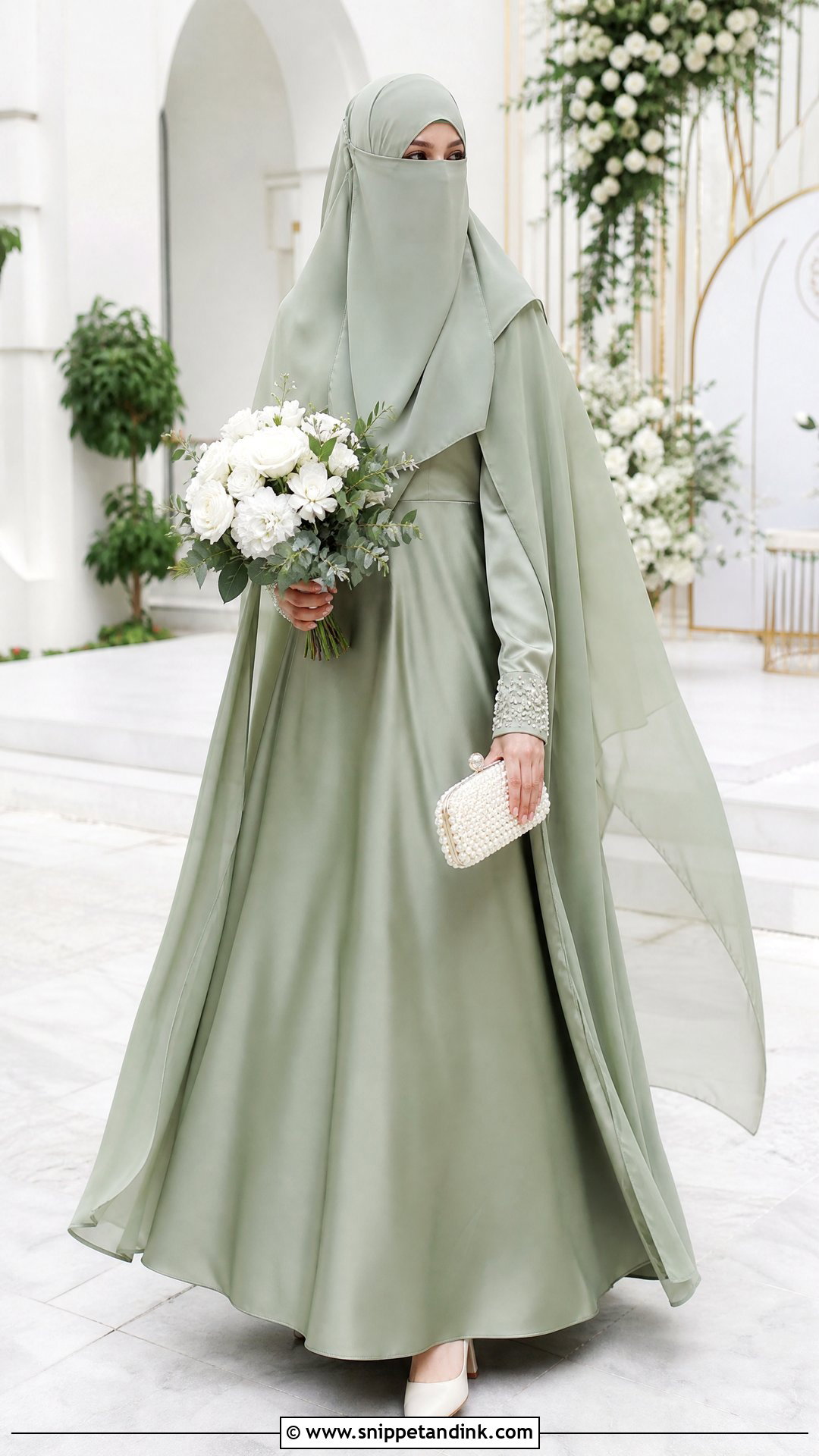
Sage feels fresh for outdoor and warm-weather weddings. Build it around a loose satin or crepe gown with full sleeves, a high neck and a softly flared hem, adding a matching sage niqab and a long chiffon khimar. Ivory shoes, a pearl clutch and white flowers with eucalyptus suit it, and a little pearl detail at the cuffs makes it bridal. Sage is a slippery colour: one maker’s sage leans olive, another’s leans grey. If your niqab and gown come from different suppliers, the difference shows clearly around the face, so I order them from the same bolt where possible. For grass or gravel, keep the hem just off the ground and choose block heels or flats.
12. Burgundy Velvet Niqab Wedding Dress
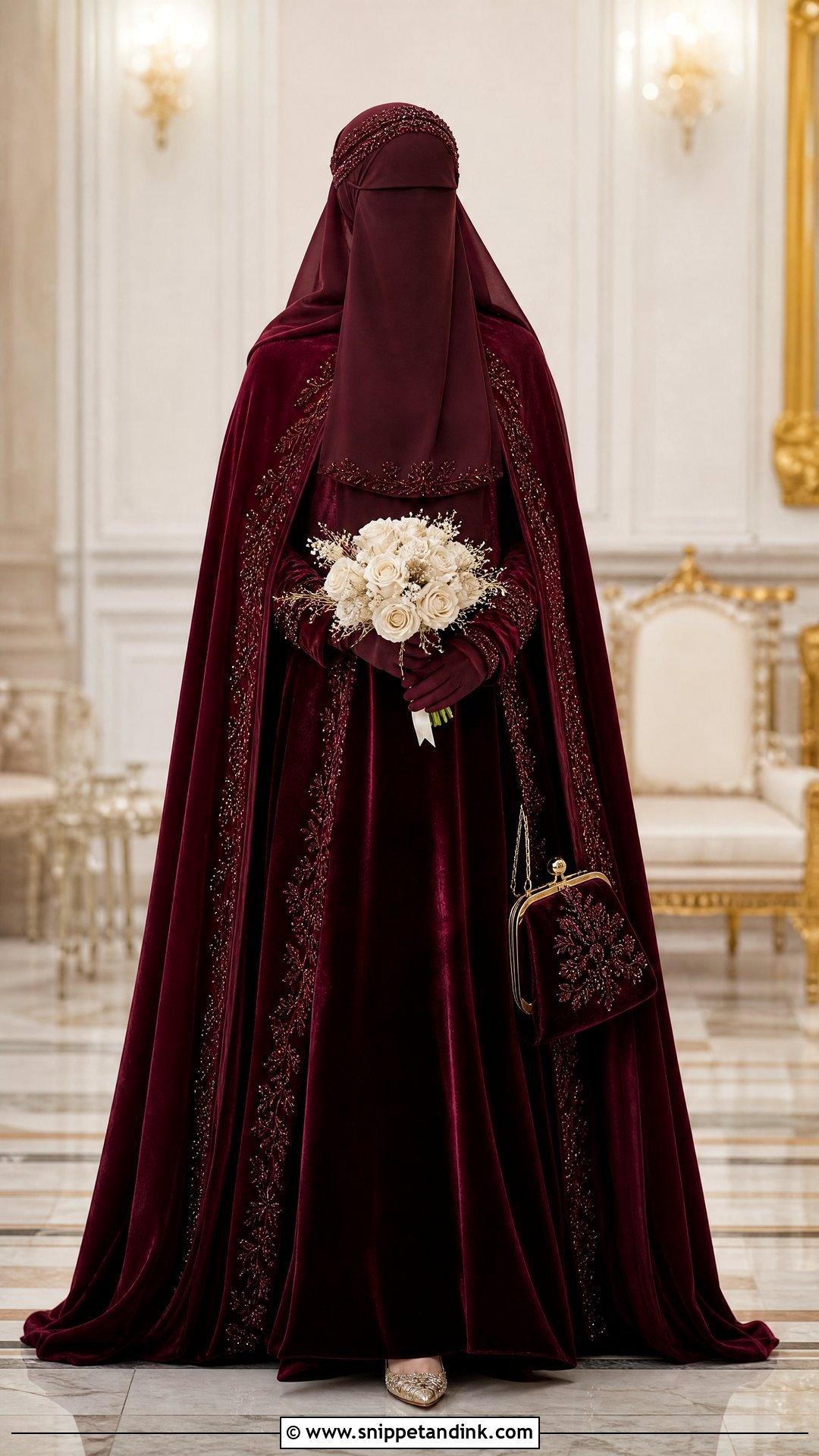
Burgundy velvet is a fall and winter choice and looks best in a warm indoor venue. Choose a loose princess-cut gown with an opaque high neck, full sleeves and controlled skirt volume. I don’t use velvet for every layer; a matte burgundy niqab and chiffon or crepe khimar keep the head light. Antique-gold flats, a structured burgundy bag and gold embroidery at the cuffs complete it, and a velvet cape can work for the entrance if it’s light and removable. Velvet has a nap, so every panel must be cut facing the same direction or one sleeve will look a shade darker in photos. Sit in it at a fitting, too, because velvet creases at the lap and those marks don’t steam out in five minutes.
13. Emerald Green Niqab Wedding Dress
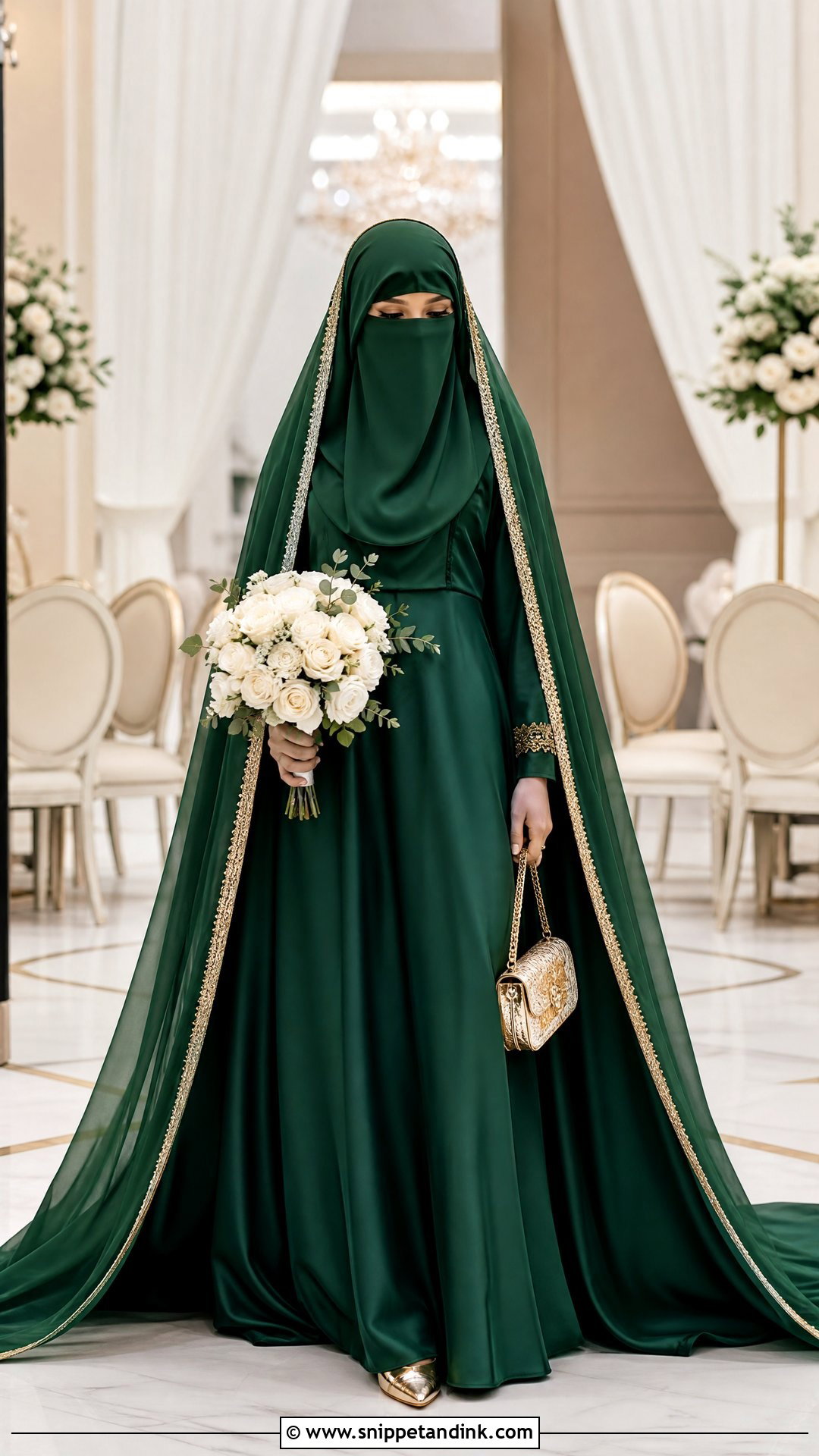
Emerald is for a bride who loves jewel tones and wants a confident, formal look. An opaque silk-look gown with a high collar, loose sleeves and a full A-line skirt pairs with a matching matte niqab, a long khimar and an emerald cape edged with subtle gold. Gold closed-toe shoes and a small metallic bag carry the colour scheme. Keep the bouquet mostly ivory so it shows against the green. If there’s beadwork, I place it at the cuffs and hem, not across the chest, where it crowds the face covering. Dark fabric swallows detail in dim rooms, so pick embroidery with real contrast and mention to your photographer that the dress is deep green so they light for it.
14. Black And Gold Niqab Wedding Dress
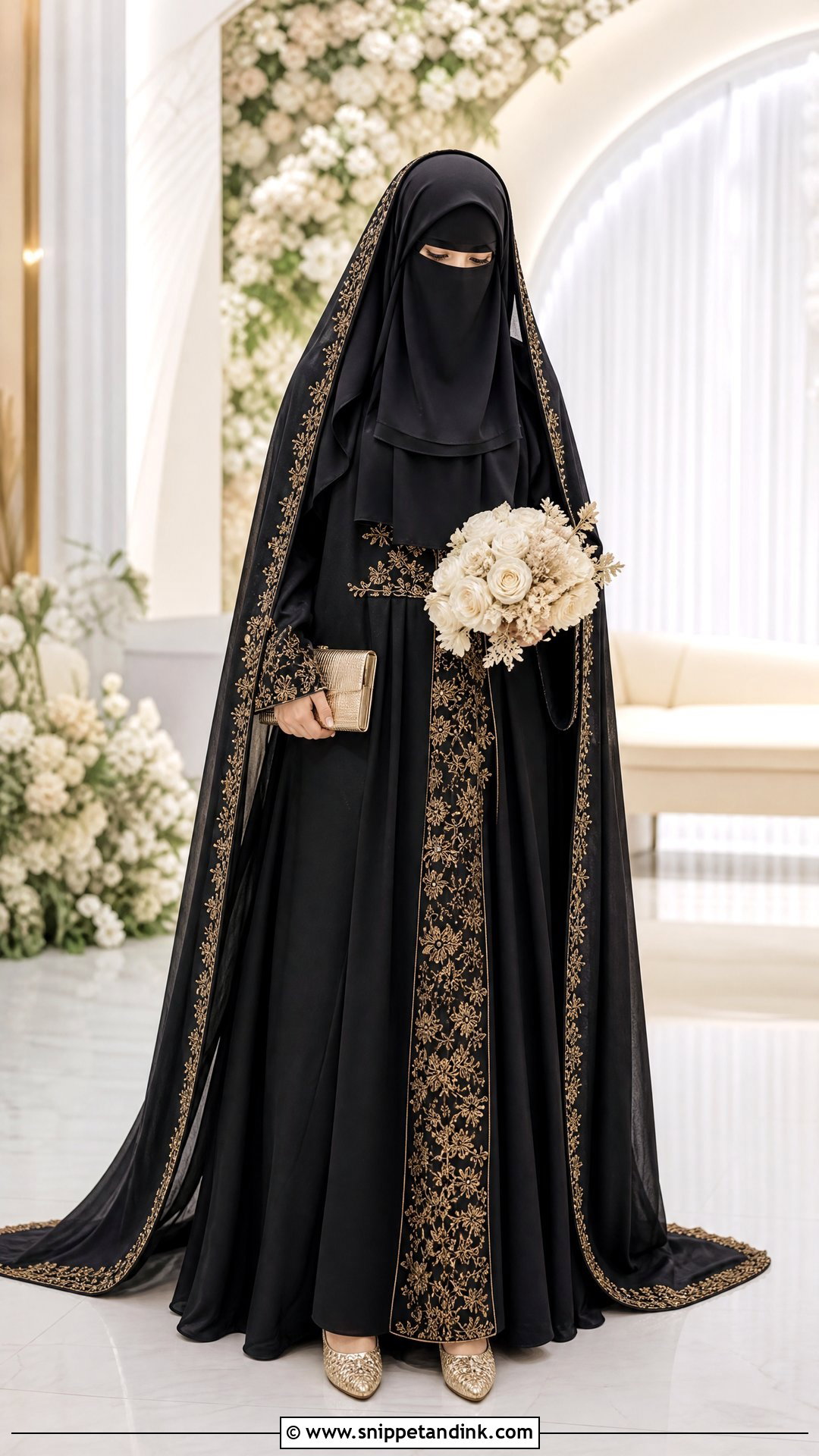
Black and gold is traditional in many families and very formal. Choose a closed black abaya in flowing nida, crepe or satin with gold embroidery framing the sleeves and front edges, over an opaque black underdress, with a black khimar and matching niqab. Gold closed-toe flats, a metallic clutch and cream flowers soften it, and a removable black cape with a gold hem moves well at the entrance. I keep the embroidery even and restrained so it reads as bridal rather than costume. Black is the hardest colour to photograph: in a dim hall it becomes a flat silhouette and every layer merges into one shape. Ask your photographer about lighting before the day, not during it.

15. White Kaftan Niqab Wedding Dress
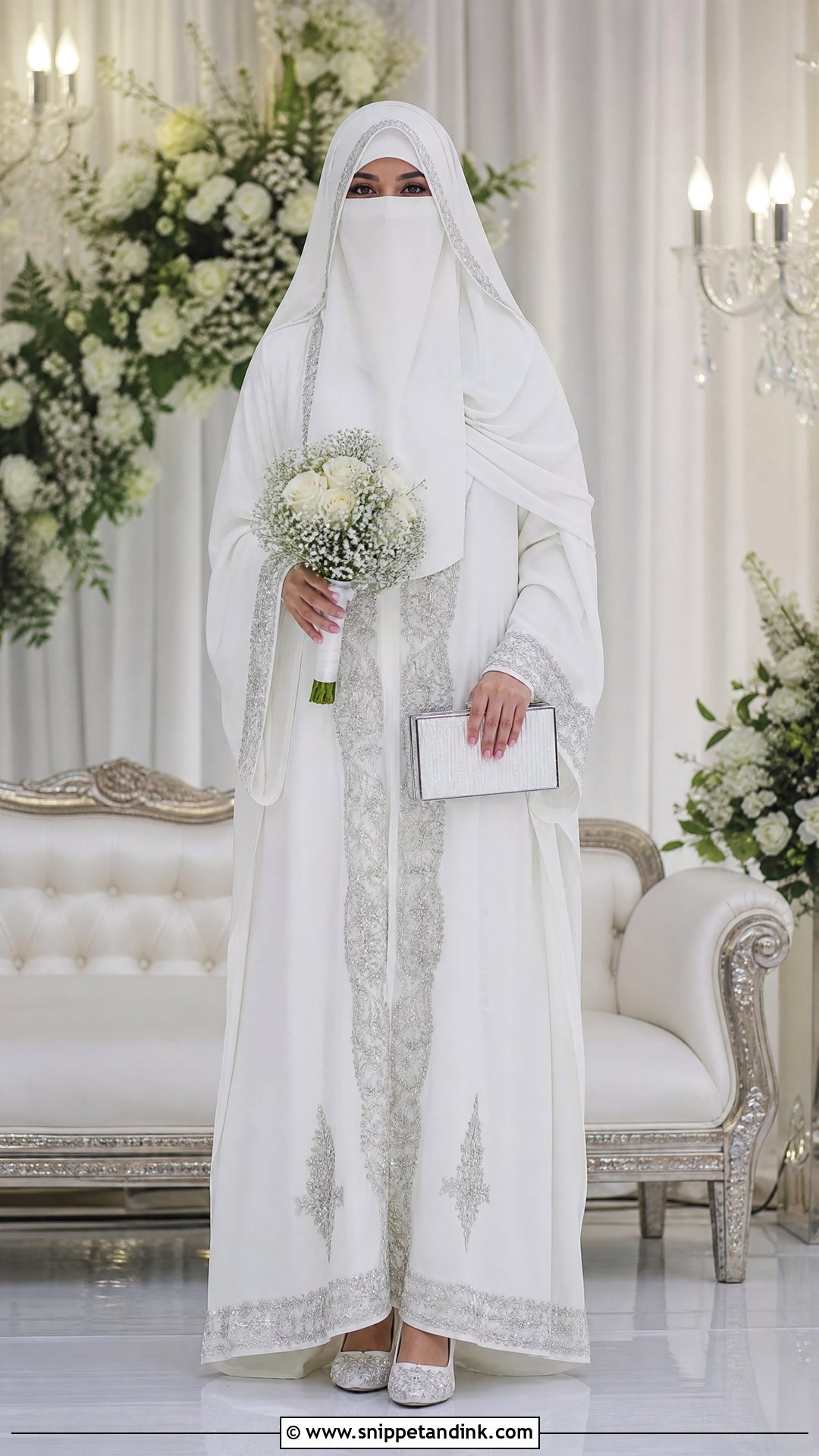
A white kaftan is the most comfortable dress on this list, and the vertical silver or pearl embroidery down the front gives it ceremony. Look for a loose, floor-length cut with full sleeves, a covered neckline and opaque lining, then add a smooth white niqab and a khimar that covers the shoulders. Silver flats, a white box clutch and a simple bouquet keep attention on the trim. If it comes with a belt, wear it loose or leave it off. Wide kaftan sleeves fall back when you raise your hands, so I add fitted inner cuffs that keep the forearms covered. Have the hem set at your exact shoe height; a kaftan that’s even two inches long gathers at the feet and trips you on stairs.
16. Moroccan Caftan Niqab Wedding Dress
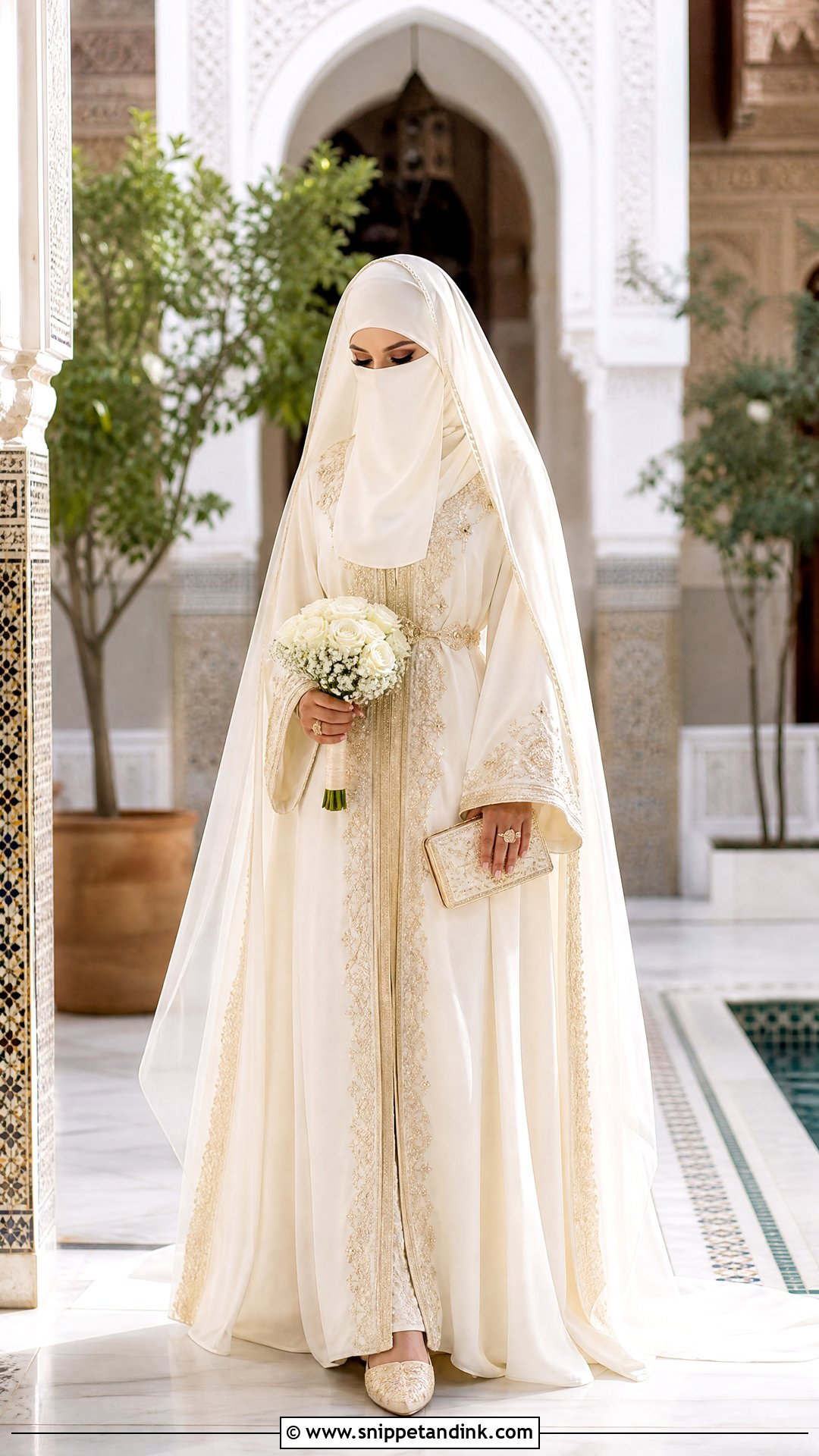
A Moroccan-inspired caftan carries strong cultural character, and its trim is often hand-finished work worth showing off. Choose ivory, cream or pale gold with opaque fabric, long sleeves, traditional-style trim and a loose floor-length shape. Add a matching niqab and a lightweight khimar sitting smoothly under any decorative head drape, with embroidered slippers or low heels and a metallic clutch. Layered caftans are heavier than they look on a hanger, and the weight lands on the shoulders. Sit in all the layers for twenty minutes at a fitting. Check that the traditional buttons and cords are firmly attached. Many families choose the colour and embroidery to reflect their own traditions, and I’d always follow that lead.
17. Turkish Niqab Wedding Dress
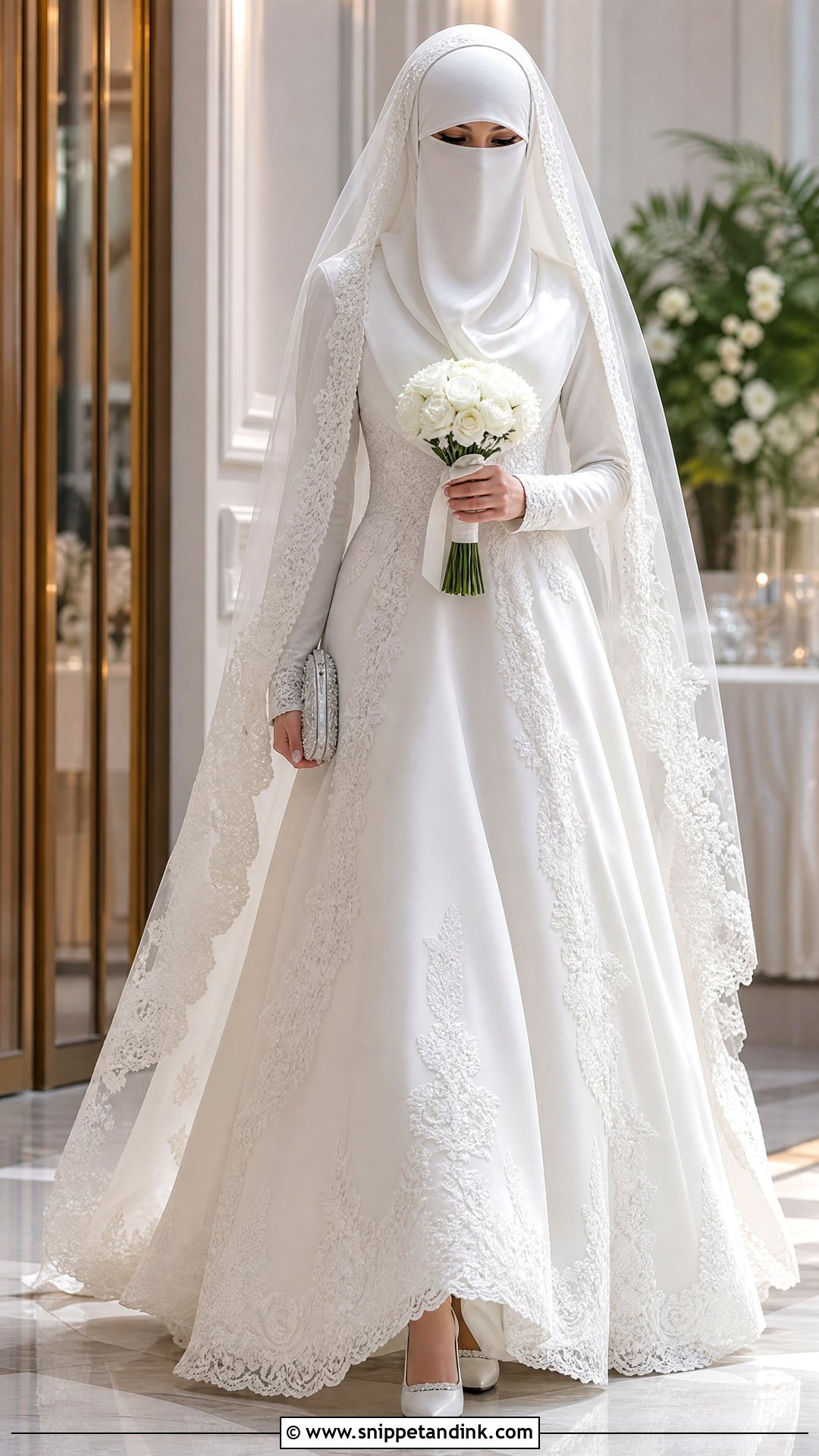
Turkish-inspired gowns tend to be more structured than the other styles here, with refined lace or beadwork and a clean A-line that extends into a modest train. Look for a high neck, fitted inner cuffs and opaque long sleeves. A matching white niqab and a khimar draped close to the shoulders sit well under a lace-edged outer veil. Pointed closed-toe heels, a crystal clutch and a compact white bouquet finish it. Keep the embellishment to the sleeves and skirt so the head stays balanced. Structured gowns are built close to the body, so I ask the tailor to add ease at the shoulders, arms and hips. If you can’t lift your arms to greet guests or bend for prayer, it needs letting out.
18. Pakistani Lehenga Niqab Wedding Dress
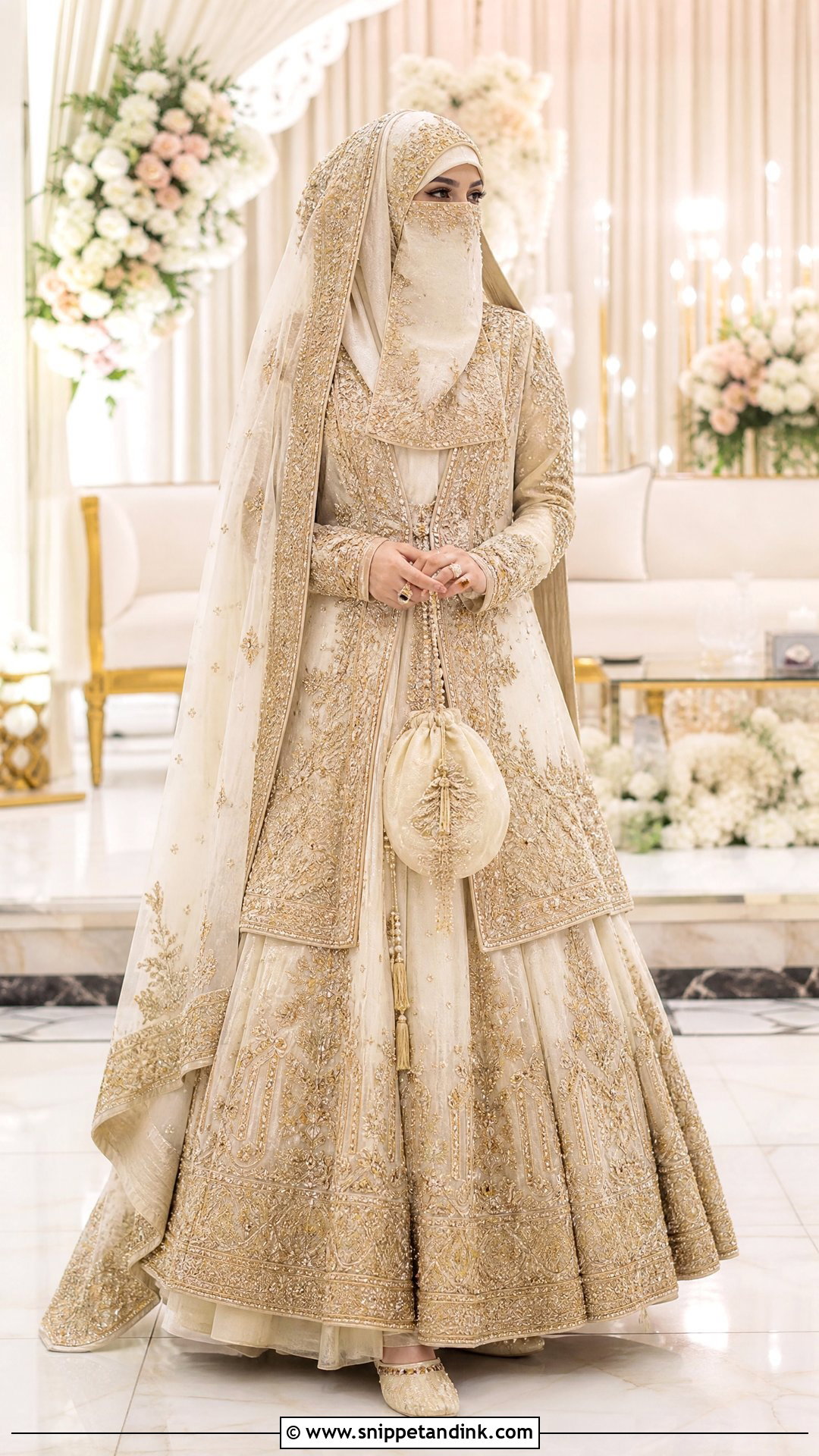
A modest Pakistani lehenga adapts well to full coverage once you lengthen the top. Choose a loose longline bridal top with a high neck, full sleeves and a hem well below the hips, over a wide, opaque lehenga skirt, with a generous dupatta draped over a coordinating khimar. A matching niqab, embroidered closed-toe shoes and a small potli bag complete it; ivory, gold, blush and red all work depending on the event. A heavily worked dupatta can weigh as much as a small bag. I pin it at the crown and both shoulders so the weight is spread out and never drags on the niqab ties or tilts it over your eyes. A lighter skirt lining helps a lot.
19. Red Sharara Niqab Wedding Dress
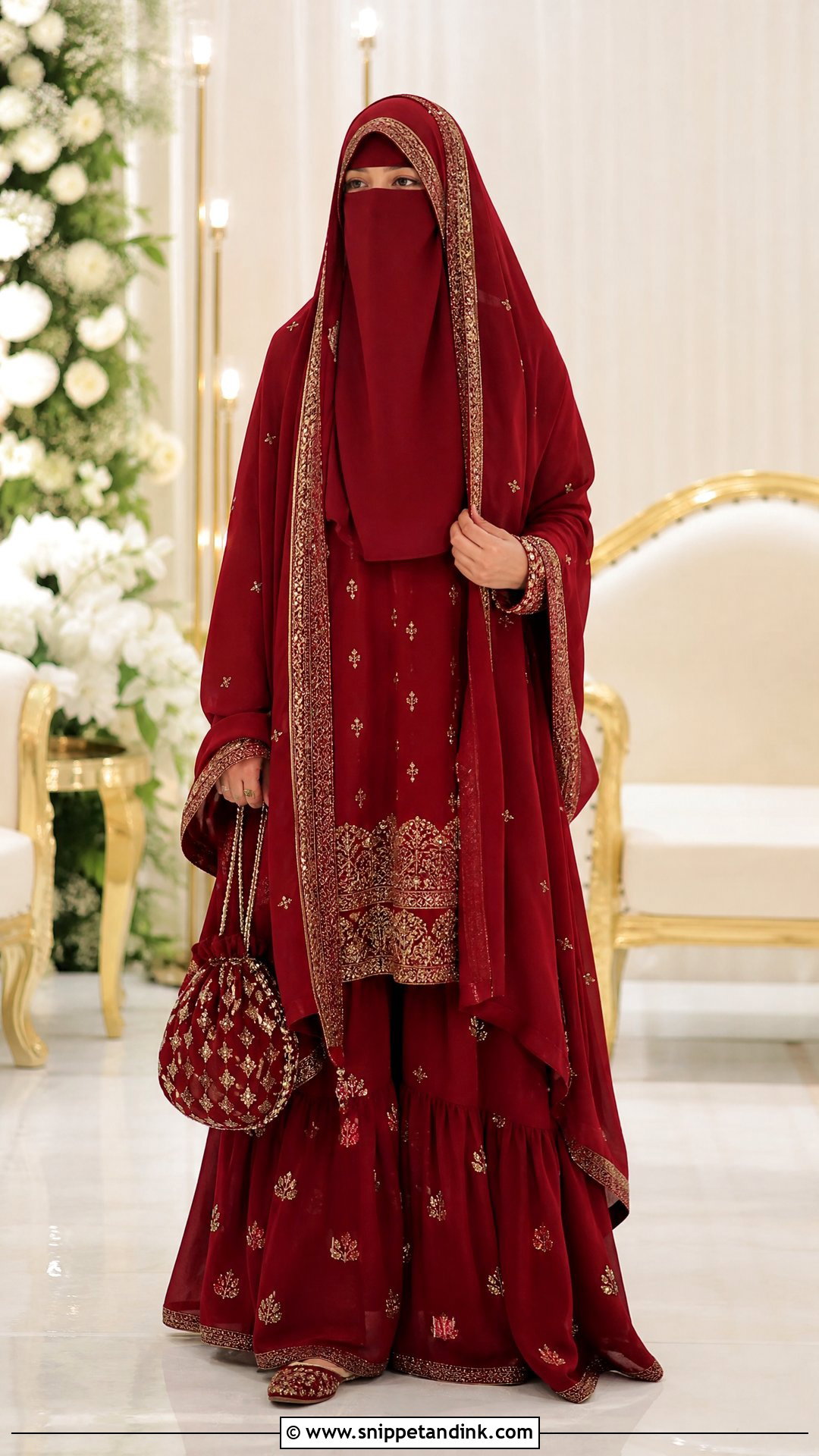
Deep red is the traditional choice in many South Asian families, and a sharara carries it well. Begin with a long, loose tunic with full sleeves, an opaque high neck and gold embroidery at the cuffs and hem, worn over wide sharara pants with enough length to keep coverage complete. A red khimar, matching niqab and a large embroidered dupatta go on top, with gold flats and a red potli bag. I keep head jewellery minimal because it fights with the layered veils. Sharara pants flare from the knee, and that volume catches on steps. At your fitting, climb a real staircase and sit on a low sofa in the whole outfit; that’s when length problems show.


20. Bridal Jilbab Niqab Wedding Dress
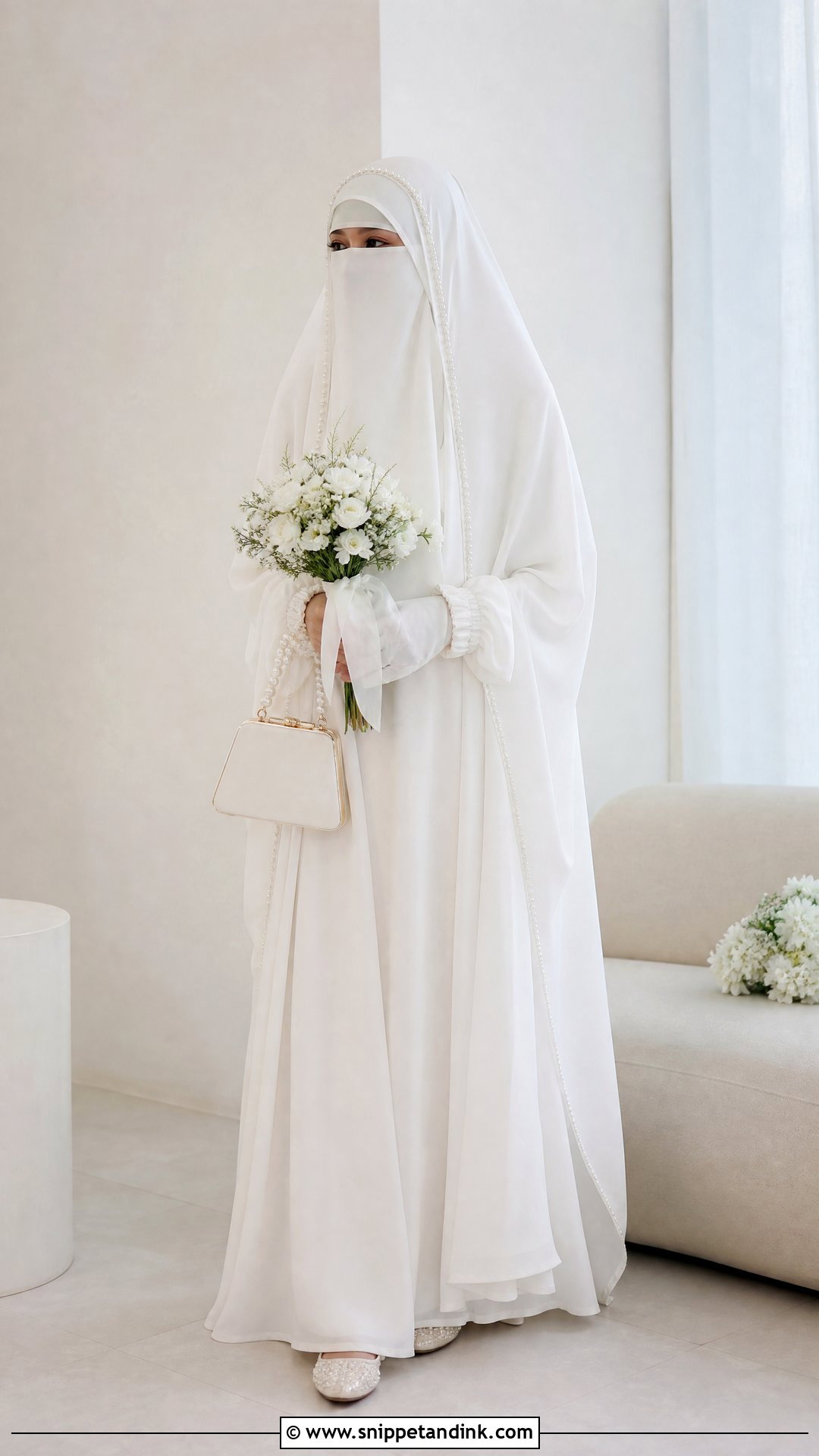
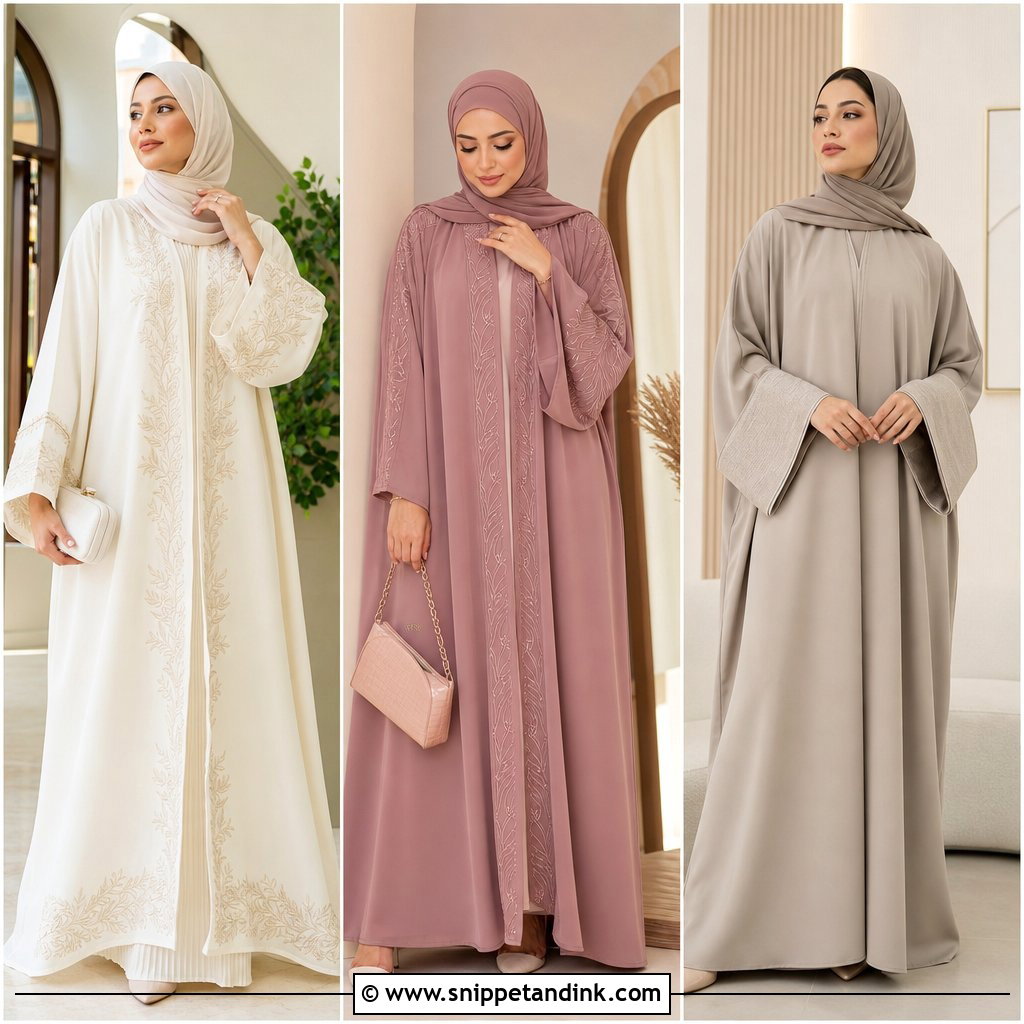
A bridal jilbab is the simplest, most covered option, and it can still feel special for a nikah. A flowing white or ivory one-piece with gathered sleeves, secure cuffs and a skirt falling loosely from the upper body is the shape, with a built-in or separate khimar and plain niqab in the same fabric family. Pearl-trimmed flats, a small ivory bag and a delicate bouquet add the bridal detail. Removable pearl cuffs or a lightly embellished cape can mark the ceremony itself. Thin jilbab fabric is the problem I see most: it shows the outline and colour of everything underneath. Pick a weight with real body, and set the length so it clears the floor during prayer.
21. Detachable Overskirt Niqab Wedding Dress
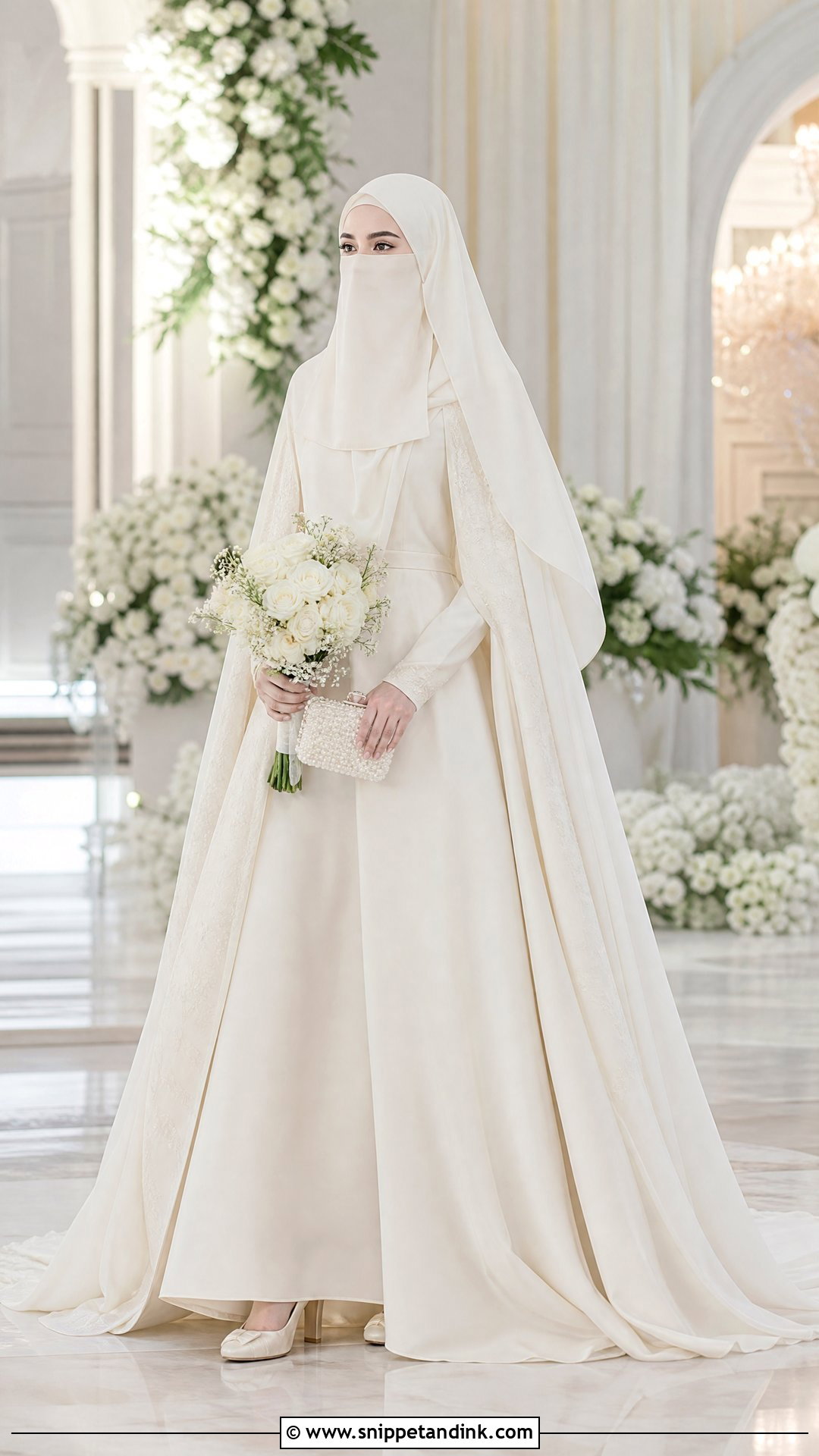
One gown, two looks: a detachable overskirt gives you volume for the ceremony and freedom afterwards. Start with an opaque, loose A-line with full sleeves and a high neck, add a full overskirt for the nikah, then remove it for walking and greeting guests. A matching niqab, smooth khimar and long cape keep it cohesive, with satin block heels and a pearl or crystal clutch. The fastening should sit securely without cinching the waist, and it shouldn’t show under the cape. Have a helper practise taking it off and putting it back at least twice. Insist the overskirt is cut from the same bolt as the gown, since a slightly different white shows up clearly in flash photos.
22. Cape Sleeve Niqab Wedding Dress
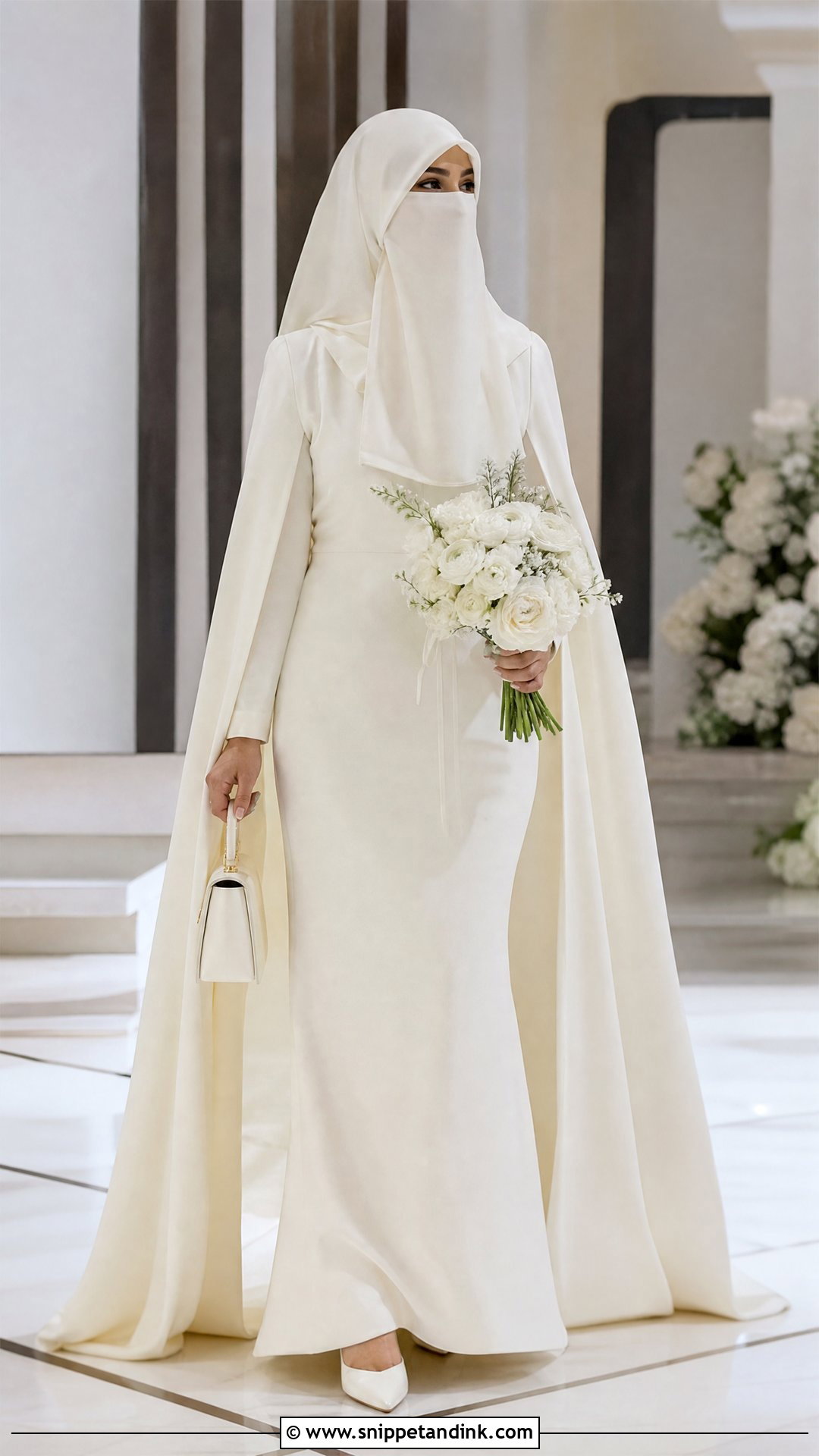
Cape sleeves add movement and an extra layer over the arms. Choose a fully lined crepe gown with a high neck, a loose silhouette and long cape panels attached at the shoulders or upper sleeves. A simple chiffon niqab and matching khimar keep the face uncluttered, with pointed closed-toe flats, a mini bag and a neat bouquet. Cape panels must stop above the floor or you’ll step on them every time you turn. I sew small wrist loops inside so you can hold the fabric while walking or posing. Skip heavy beading at the shoulder, where gown, khimar and cape all meet; three layers plus beads there is bulky and hot.
23. Pleated Satin Niqab Wedding Dress
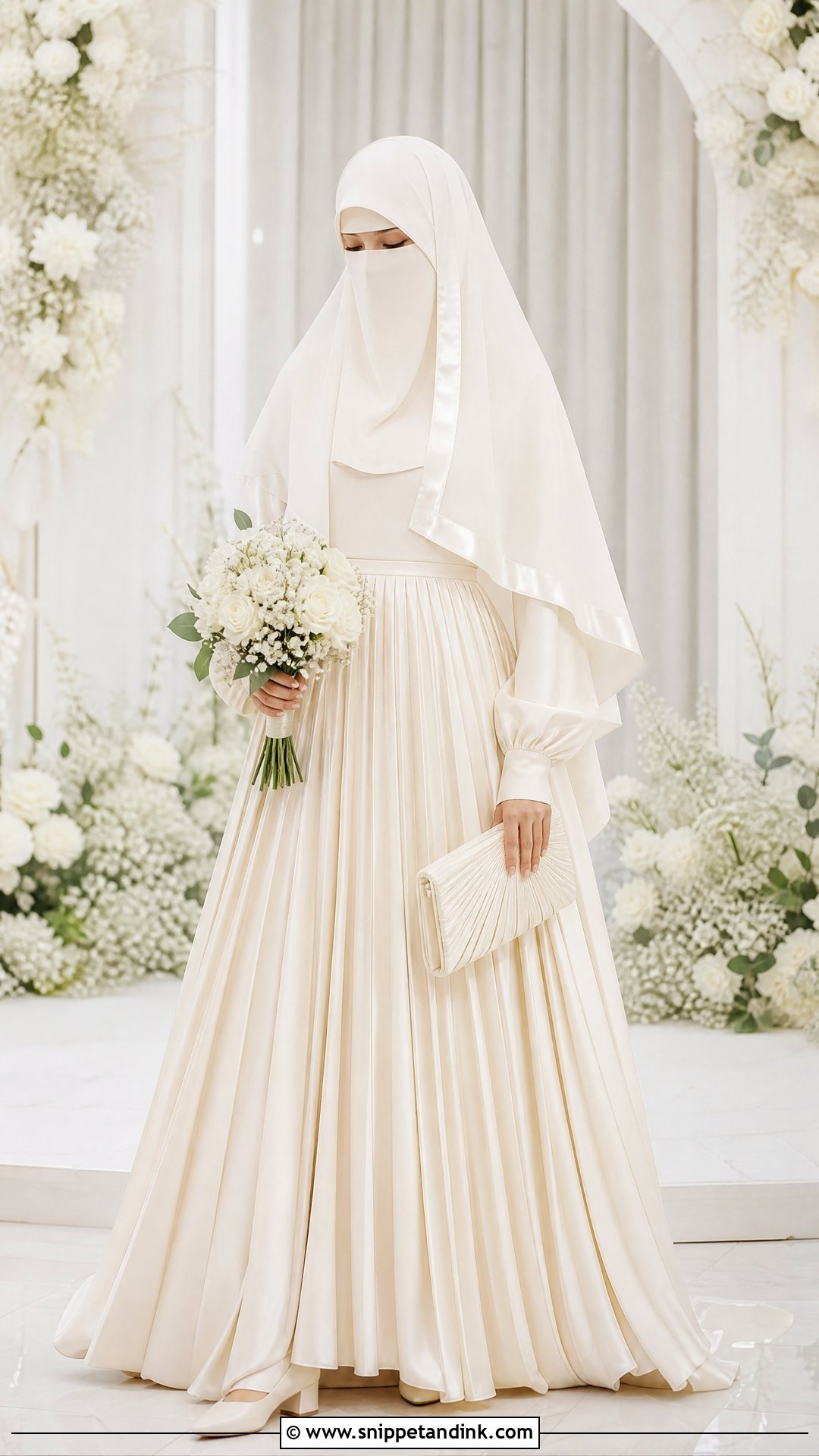
Fine pleats bring texture to satin without any embroidery at all. Select a loose dress with a pleated skirt, opaque bodice, high neck and full bishop sleeves finished with fitted cuffs, plus a plain satin-trimmed khimar and matte niqab in the same ivory. Low block heels, a pleated clutch and a white bouquet suit it. Keep the pleating below the upper torso or on controlled sleeve panels so you don’t add width where you don’t want it. Pleated satin flattens in a crowded garment bag. Hang it with room to breathe and have it professionally steamed rather than ironing at home, then try the whole outfit on again, because steaming can shift the hem by a little.
24. Plus Size Empire Waist Niqab Wedding Dress
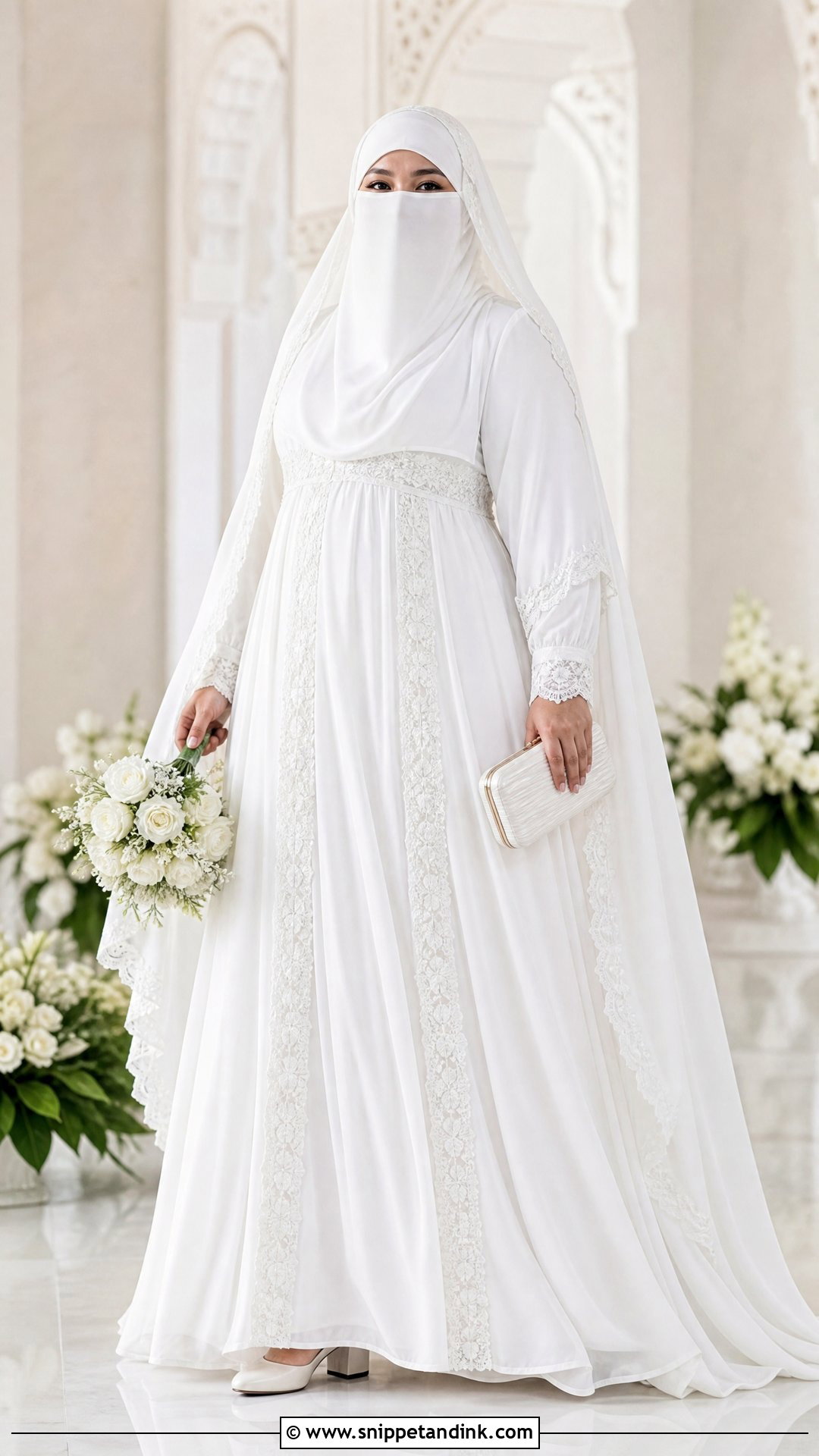
For plus-size brides I often suggest an empire waist, because the seam sits above the widest point and the skirt then falls freely. It should stay loose at the seam, with an opaque high neck, full sleeves and a layered A-line skirt. A matching niqab and long chiffon khimar give a clean line head to toe. Supportive closed-toe block heels or embellished flats and a clutch that’s easy to carry finish it. Soft vertical lace panels lengthen the line without looking busy. At alterations I focus on shoulder comfort, sleeve movement, hem length and room to sit, not the number on the label. Inner fastenings hold the khimar and cape in place without pulling at the head.



25. Simple Nikah Niqab Wedding Dress
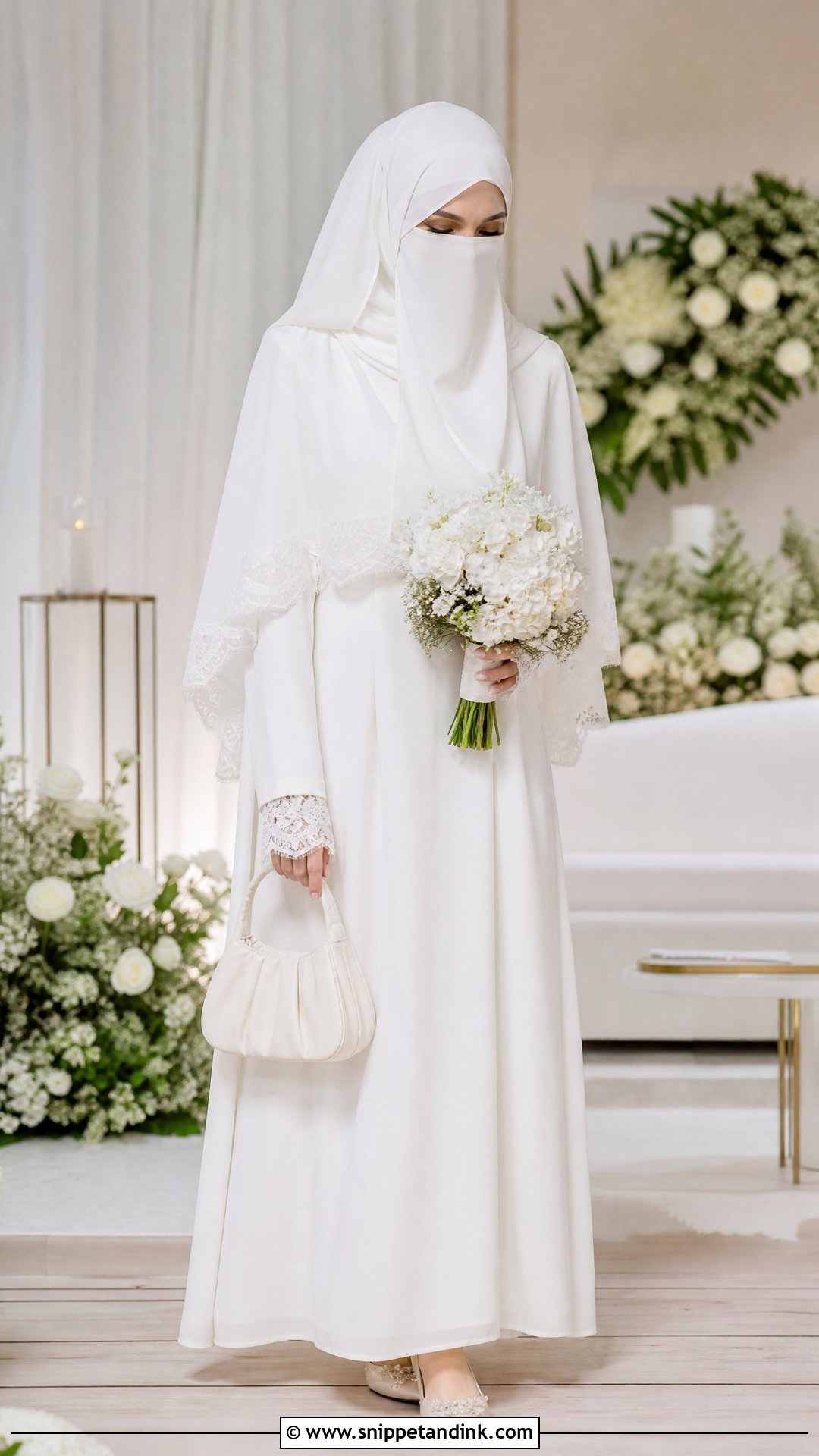
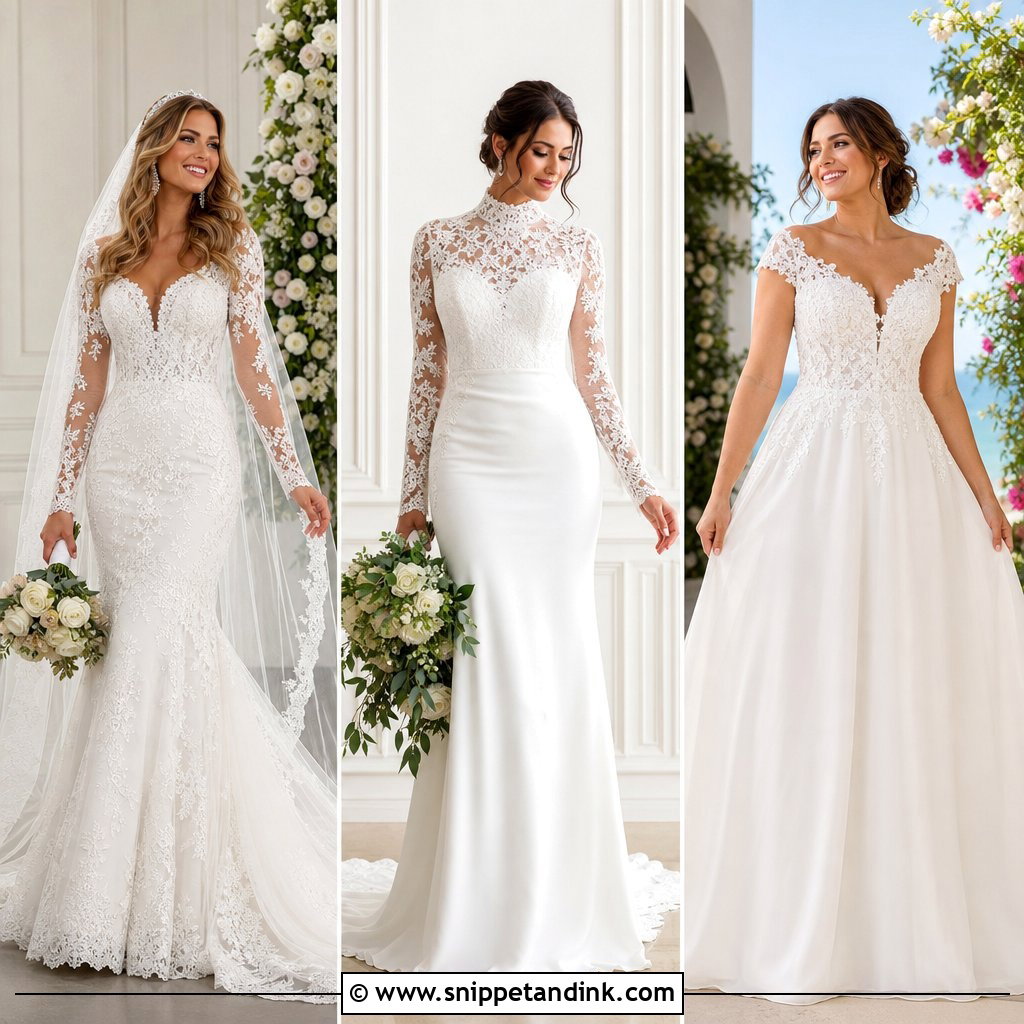
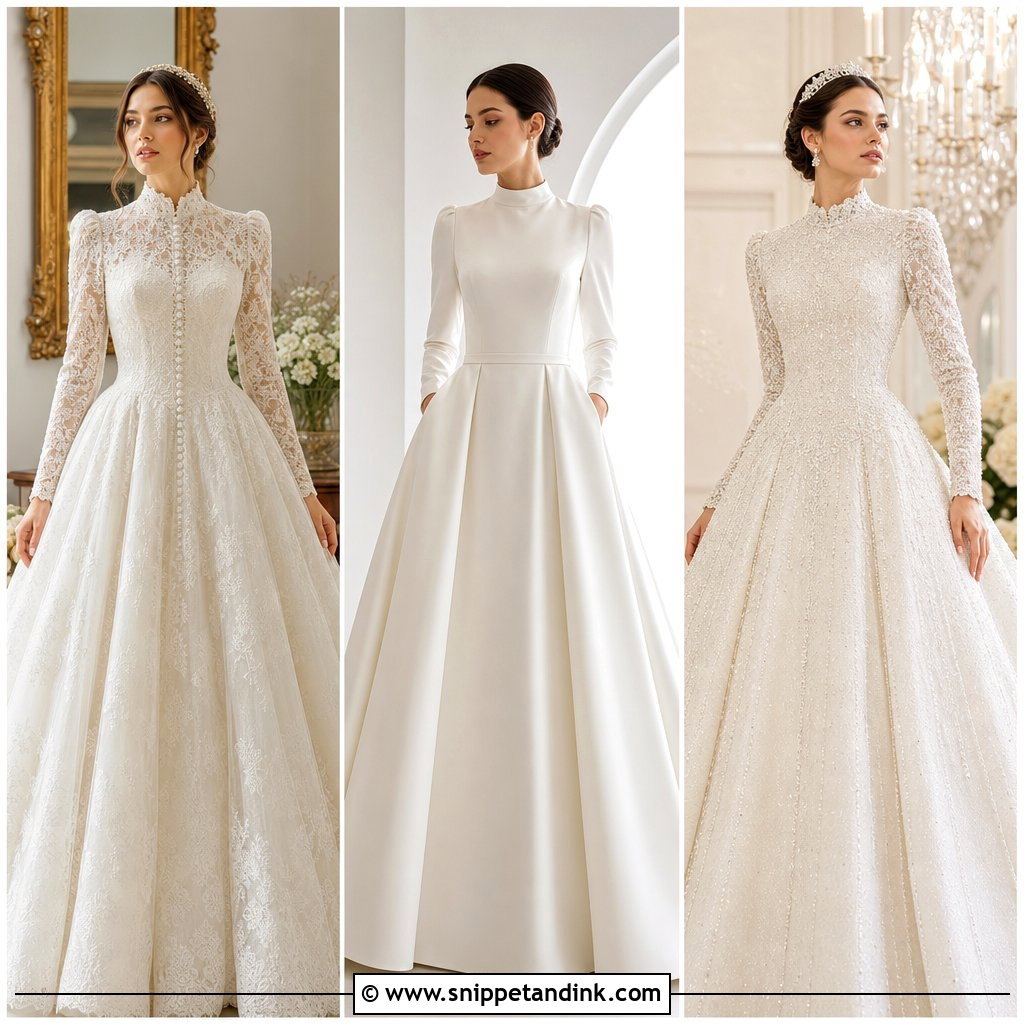
A simple nikah outfit still feels like bridalwear when the fit is right. Choose a white crepe or satin abaya dress with a high neck, loose full sleeves, lace-trimmed cuffs and a softly flared floor-length skirt, plus a matching chiffon khimar and a plain single-layer niqab. Pearl flats, a small ivory bag and a hand-tied white bouquet are enough, and a short lace-edged cape can come out for photos. Home ceremonies get warm quickly with family packed into one room, so I’d choose breathable crepe over satin there. Do a full movement test before the day: sit, walk, raise your arms. Nothing fancy needed; it just has to be opaque, secure and well tailored.
Ordering a Matching Niqab When the Dress Comes From Somewhere Else
Bridal shops rarely sell niqabs, so most brides buy the gown in one place and the face covering in another. That is where colour mismatches come from. I’d ask the bridal shop for a fabric offcut from the hem allowance once alterations start, and take it with you when you buy the niqab and khimar. If they can’t spare one, photograph the fabric next to a plain white sheet of paper in daylight; that gives the niqab maker a fairer reference than a screen shot.
Order the niqab early. Custom pieces from specialist makers can take several weeks, and you want time for a second attempt if the first shade is off. When it arrives, hold it against the gown in three lights: daylight, warm indoor bulbs and your phone flash. If it passes all three, it will pass in the photos.
Bring Every Layer to Every Fitting
The outfit that works is the one that respects your coverage and still lets you move, eat and greet people. Satin, lace, abayas, cultural garments, rich colours or a plain crepe column can all get you there. My one rule, repeated to every bride I dress: bring the complete outfit to alterations, including the niqab, khimar, cape and shoes, not just the dress. Look at every fabric in daylight and under the venue’s lighting, and test opacity, sleeve movement, niqab security and hem length together. That’s how a niqab look goes from coordinated on paper to comfortable on the day.
You'll Like These Ideas:




Leave a Reply