
Most of the hijabi brides I dress arrive having already fallen for a gown, then discover the sleeves are sheer illusion mesh or the back drops to the waist. So I start every appointment with coverage, not beauty: neckline height, sleeve lining, back closure and how opaque the fabric stays under a flash. The twenty gowns below all begin from that point, from clean satin A-lines to beaded lace and cape sleeves. With each one I’ve noted how I’d pair the matching headscarf, veil, shoes and bouquet, because a hijab changes the proportions of a dress far more than a loose hairstyle does. Treat it as one outfit from the crown down, and check the lining before you fall in love with the lace.
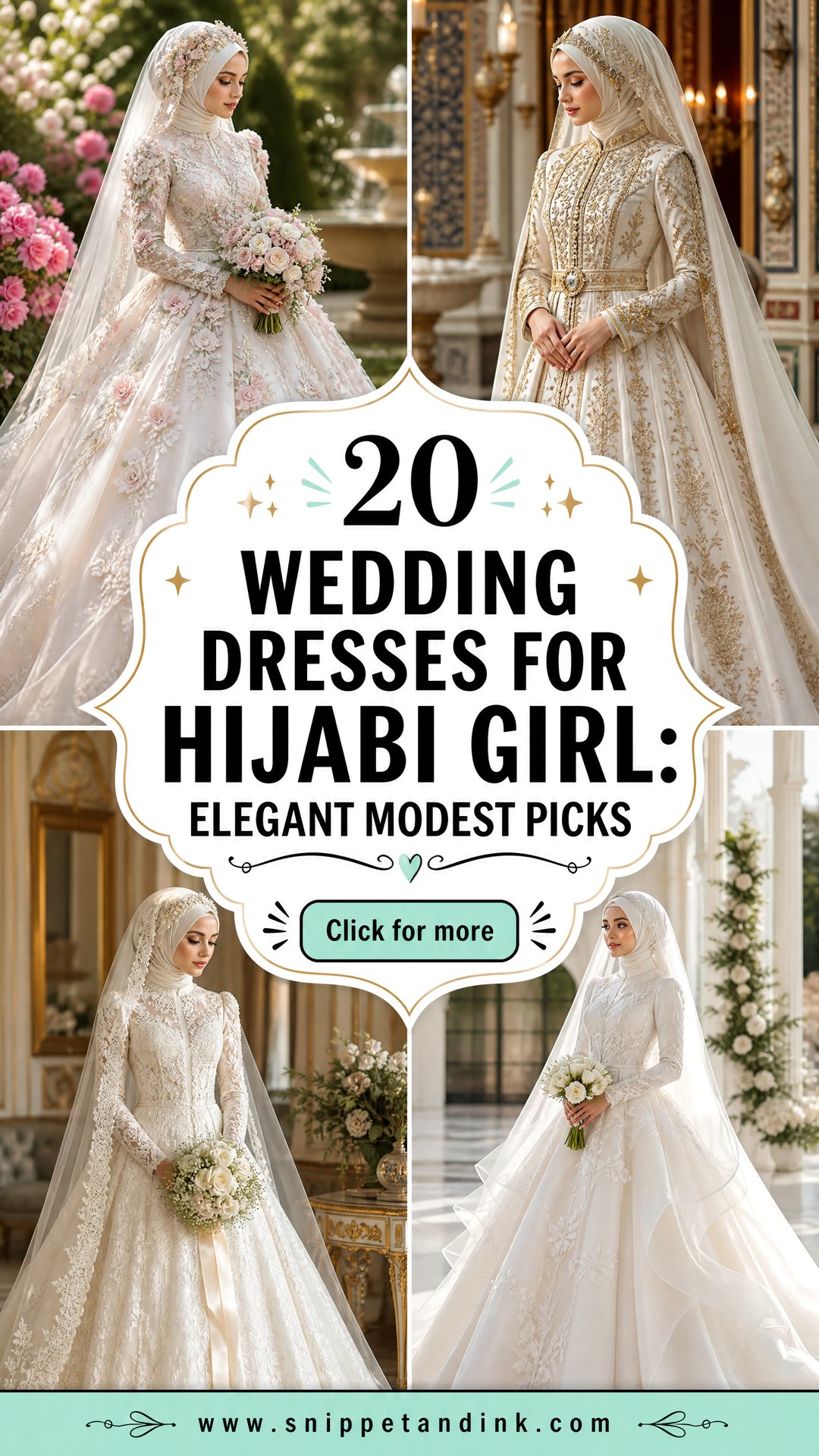
Turning an Ordinary Bridal Gown Into a Modest One
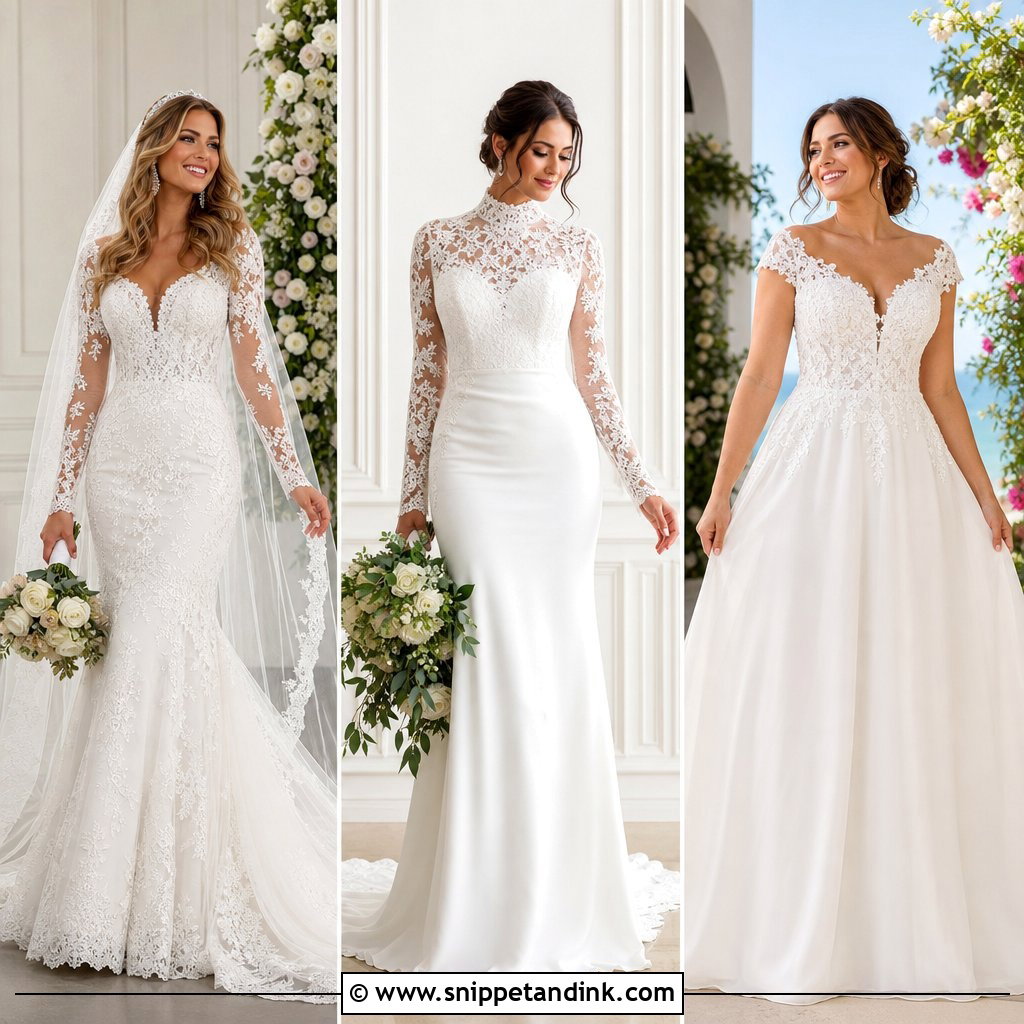
Many of the gowns hijabi brides love were never designed with coverage in mind, and that is fine. A skilled bridal seamstress can add a great deal, but some changes are far easier than others, and I’d rather you know that before buying a sample with a plunging back.
- Lining illusion sleeves and necklines is usually simple: a matching opaque fabric is cut to the same pattern and stitched underneath the mesh.
- Adding sleeves to a strapless or sleeveless gown is possible, but the lace or fabric has to be sourced to match, which can take weeks.
- Closing an open back means building a new panel and often moving the zip or buttons. It is the most involved job, so ask for a quote before ordering.
- Raising a neckline works best when the gown already has a high-cut lining underneath; cutting down never helps, so start higher than you think.
Made-to-order gowns typically need several months to arrive, and alterations are usually done in two or three fittings across the final weeks. Timelines vary by designer and seamstress, so ask both when you place the order. Bring the hijab you plan to wear to every fitting. A wrap adds bulk at the neck and shoulders, and a neckline that looks right on a bare neck can sit too low or too tight once fabric is folded over it.
1. Satin A-Line Hijab Wedding Dress
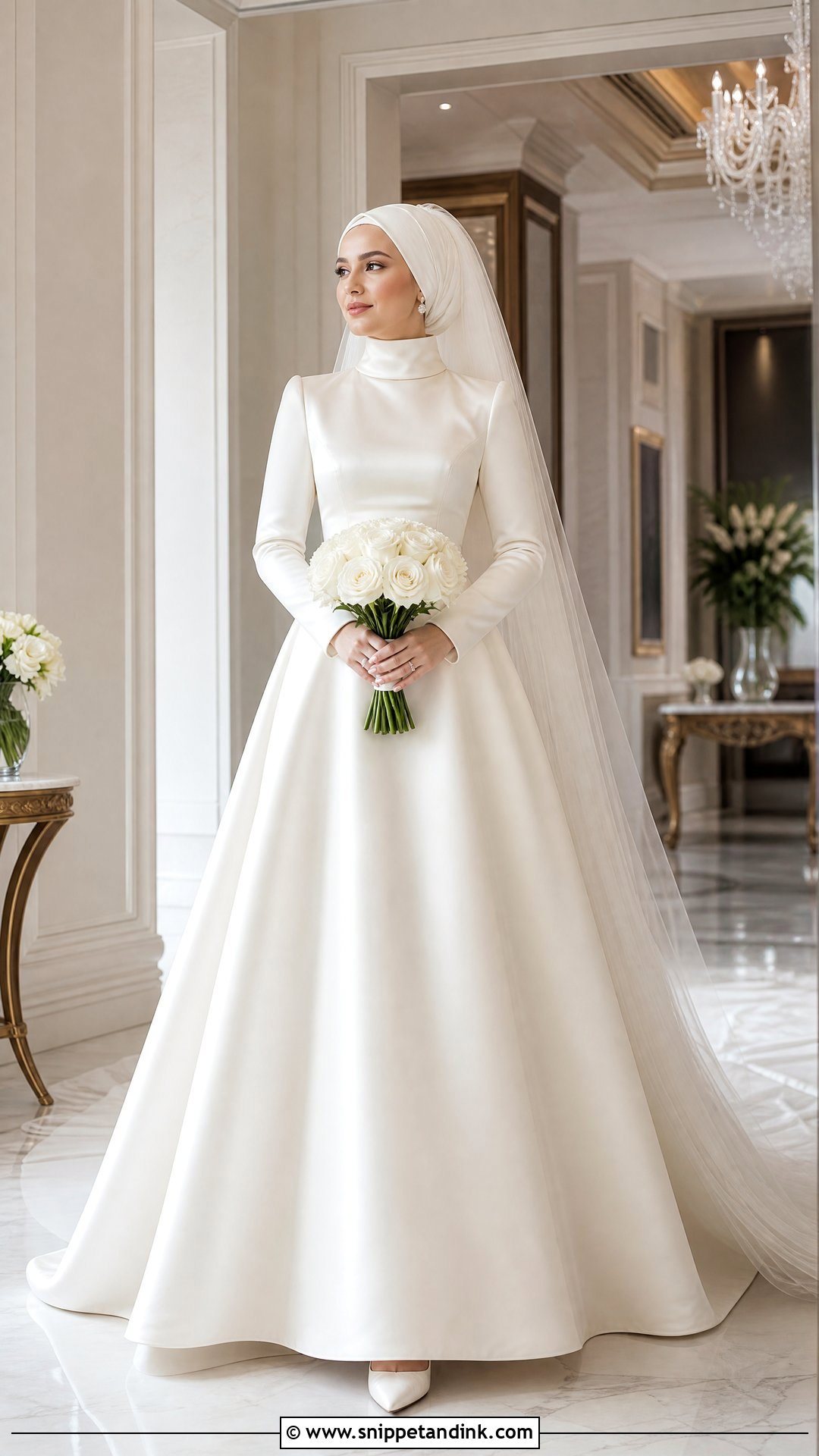
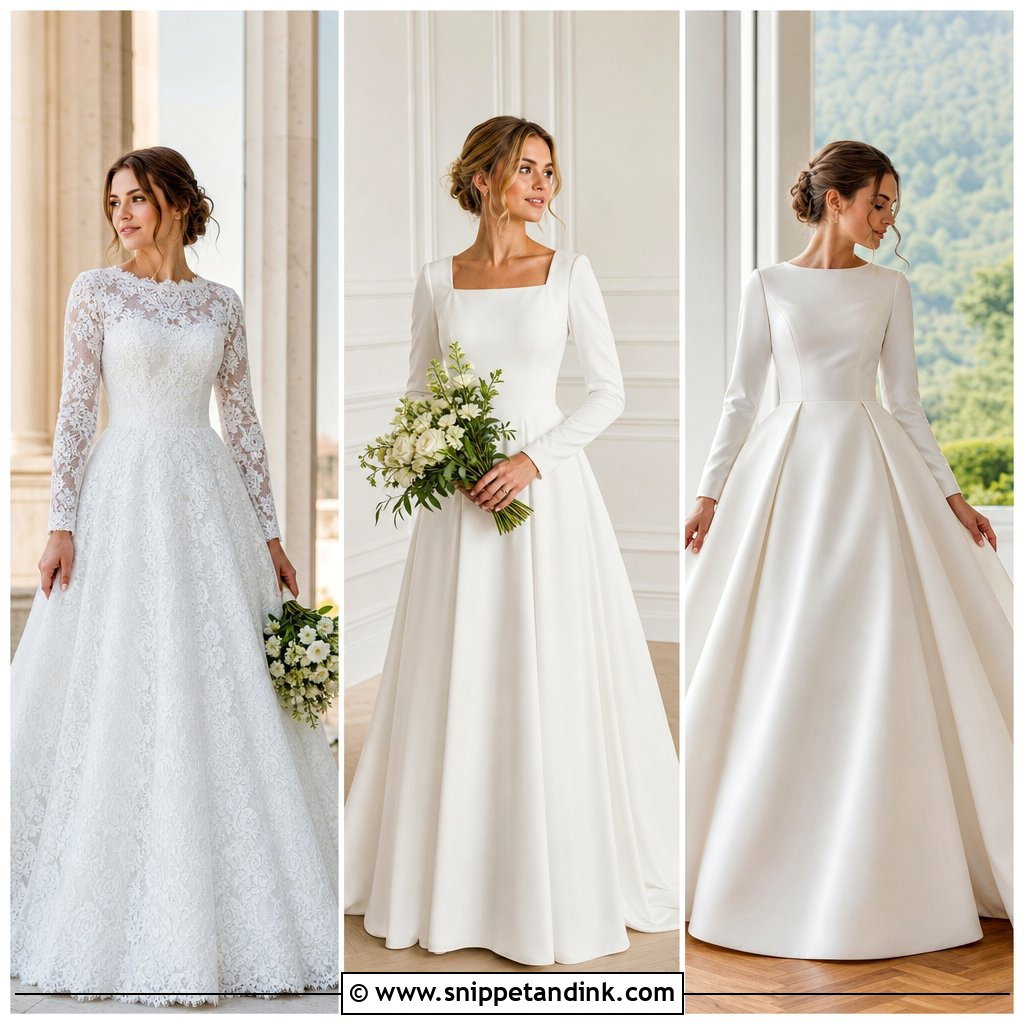
Satin forgives almost nothing, which is exactly why a clean A-line in it looks so finished. I look for a high round neck, fitted full-length sleeves and a bodice that releases at the natural waist rather than below it. Ivory satin warms most skin tones; bright white reads crisper and colder in daylight. A satin hijab cut from the same fabric, or a very close match, keeps the face framed without a seam of contrast at the jaw. Keep the veil long and plain. Ivory closed-toe pumps, pearl studs and a small white rose bouquet are all this needs, and it belongs in a hotel ballroom or a formal indoor nikah where the light is controlled.
2. Lace Ball Gown Hijab Wedding Dress
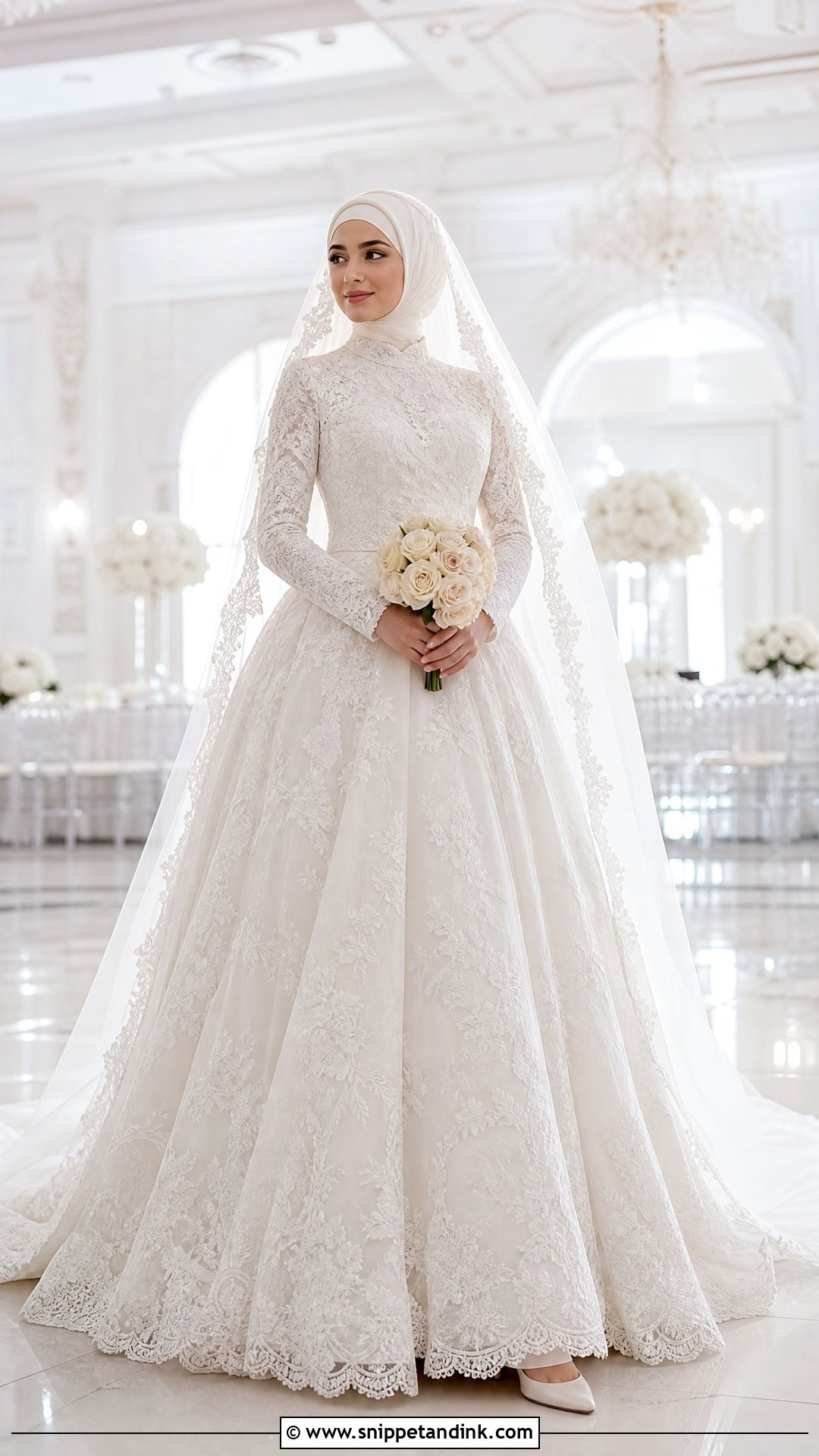
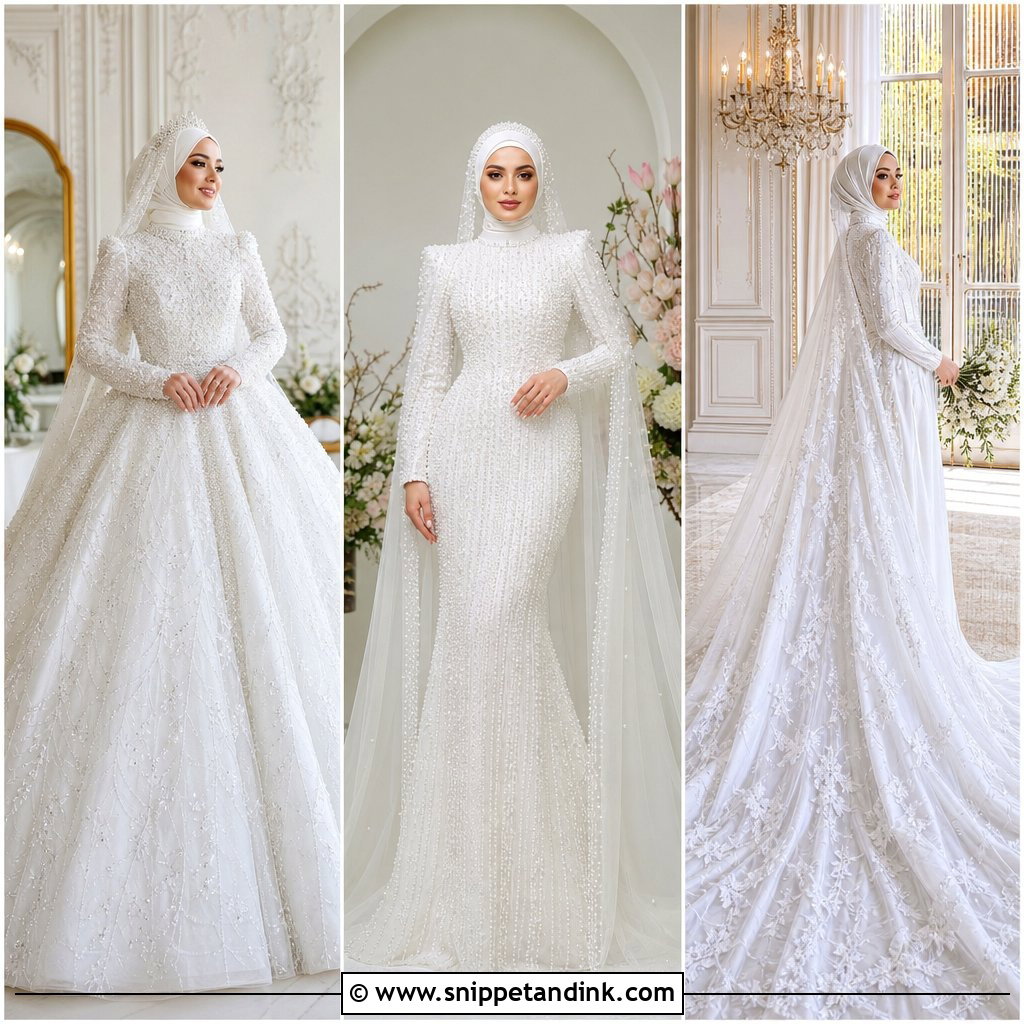
Lace sleeves are where modest brides get caught out. Unlined, corded lace shows skin through every gap, so I always ask the salon whether the sleeve lining is included or an alteration charge. On a ball gown, look for appliqués that travel from shoulder to skirt so the bodice and volume read as one piece. A plain ivory chiffon hijab lets the lace carry the texture, and a lace-edged cathedral veil repeats it at the back. Low block heels make a wide skirt far easier to steer. One crystal piece pinned over the hijab, a compact bouquet and very little jewelry is my limit here; any more and the lace starts fighting everything near it.
3. Beaded High-Neck Hijab Wedding Dress
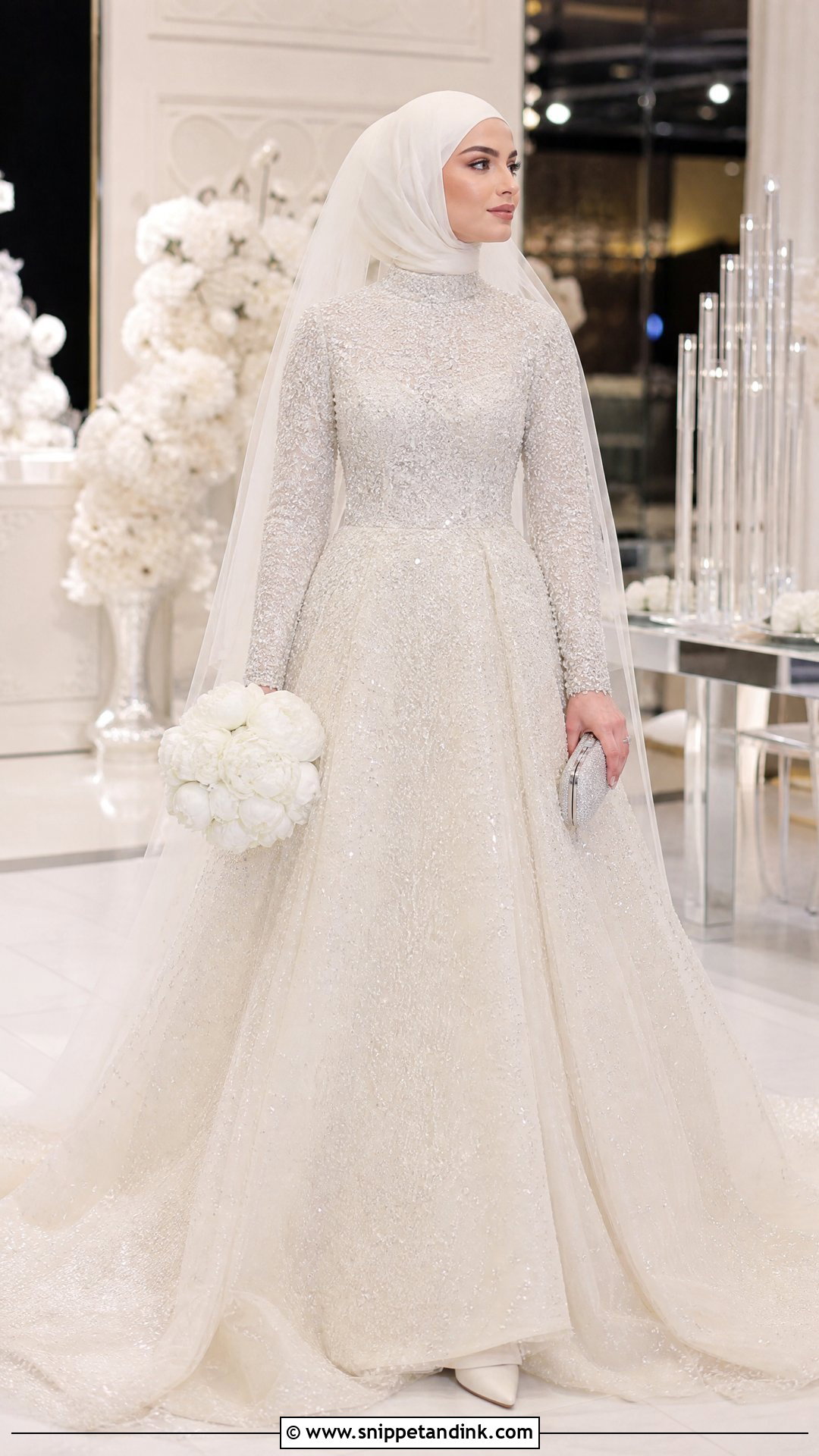
Beading reads best when it’s concentrated: bodice, shoulders and cuffs, with the A-line skirt left to move. Before anything else, run your forearm along the inside of the sleeve. Hand-sewn bugle beads can scratch at the cuff by hour four, and some salons will back the inside with a soft lining if you ask early. Choose a matte, opaque hijab in the exact ivory of the gown so the sparkle stays on the dress and off your face. A plain chapel veil keeps the beadwork visible from behind in photos. Closed pointed shoes, a crystal clutch and white peonies or roses finish it.
4. Minimalist Crepe Hijab Wedding Dress
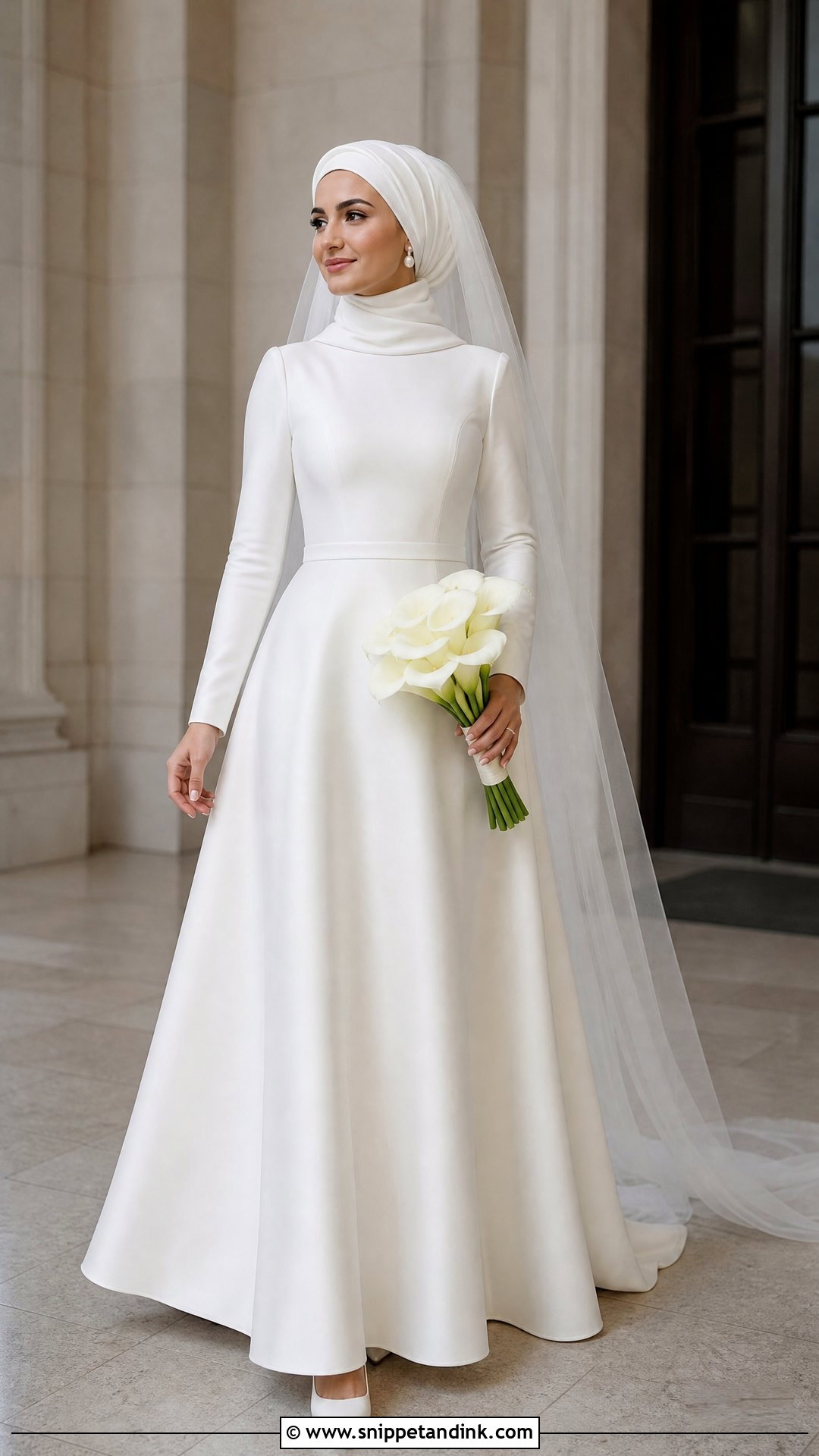
Crepe is my quiet favorite for brides who dislike fuss. A good weight drapes straight from the hip and doesn’t cling, which matters when you’ll be hugged by a hundred relatives. Ask for a high boat neck, straight sleeves, a defined waist and a gentle flare. The hijab wants to lie completely flat, so a matching crepe or chiffon wrap with no bulky folds at the back is better than anything layered. Pearl drops, white pointed pumps, a long plain veil and structured calla lilies keep the line clean. It is the gown I’d suggest for a courthouse, a minimal venue or a small reception with no crystal in sight.
5. Pearl Embellished Hijab Wedding Dress
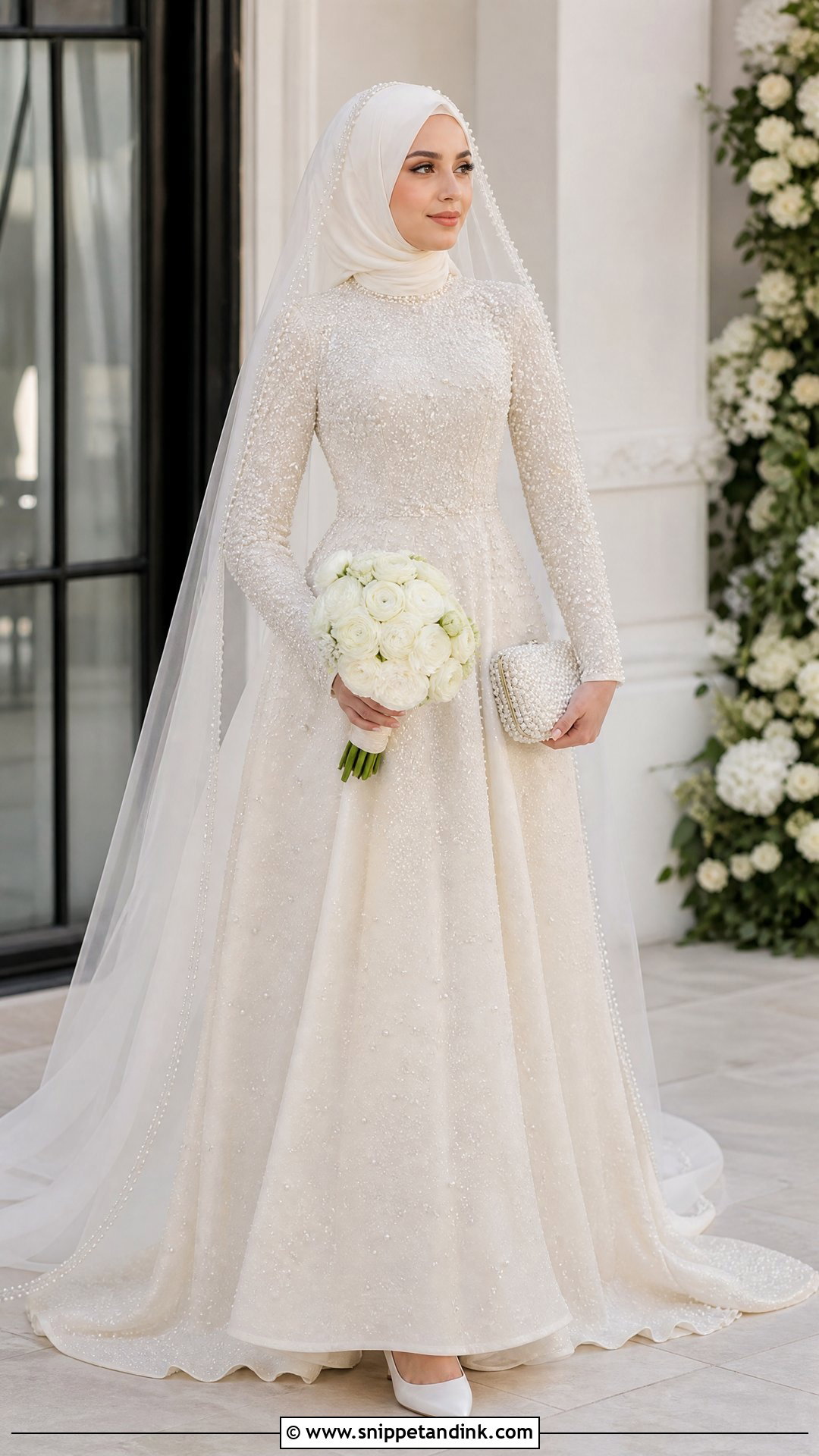
Scattered pearls give dimension without the hard flash that crystals throw back at a camera. On this A-line they run across the bodice, sleeves and upper skirt, often over tulle, so the lining underneath has to be fully opaque and close in shade. I check that the neckline rises high enough to meet the hijab with no gap when you turn your head. A plain chiffon hijab balances all those pearls, and a sheer veil with a narrow pearl edge ties the head to the gown. Pearl earrings, satin block heels and a pearl-handled clutch suit it, with loose white ranunculus. It moves easily from a morning ceremony to an evening dinner.
6. Cape Sleeve Hijab Wedding Dress
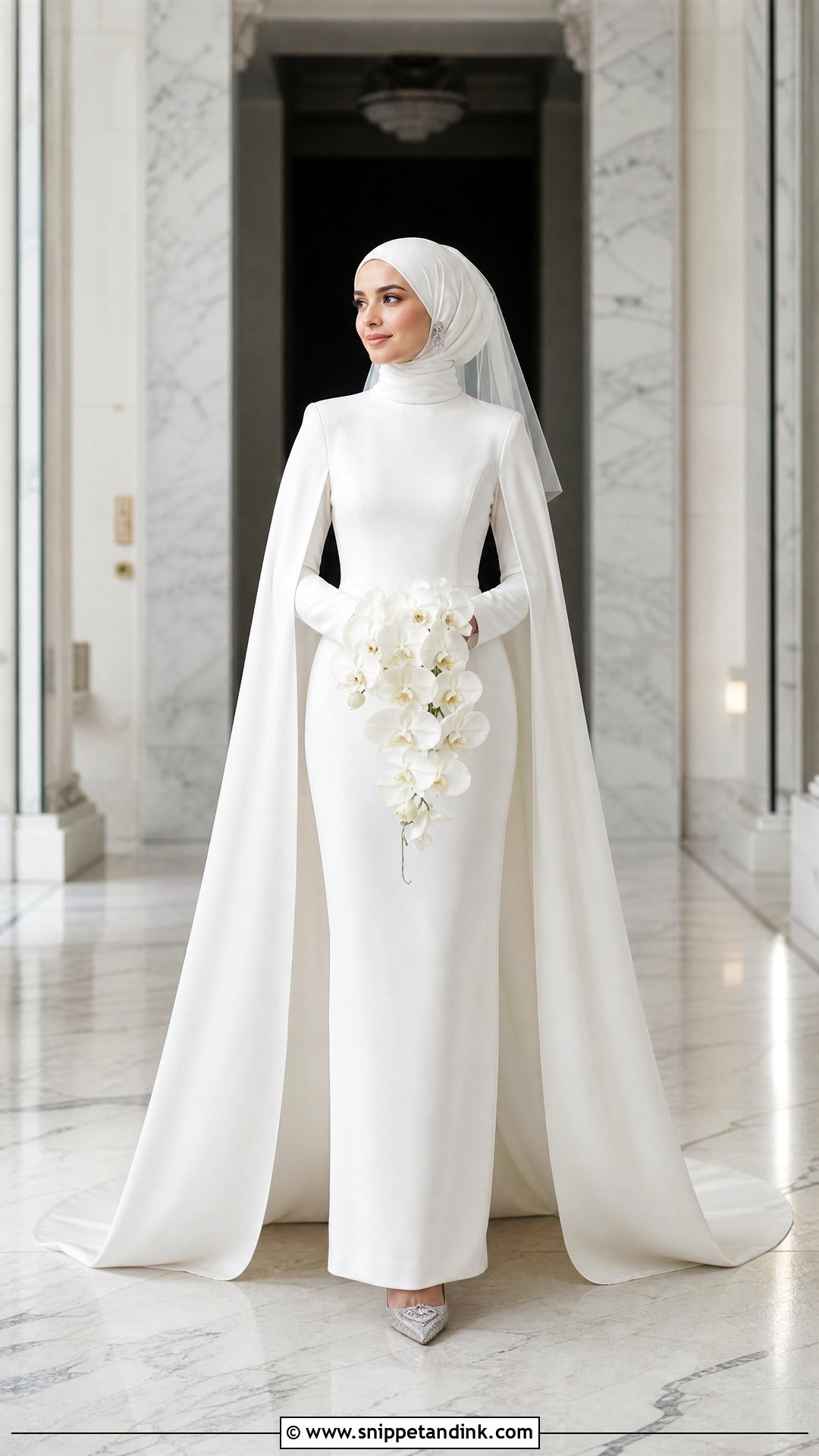
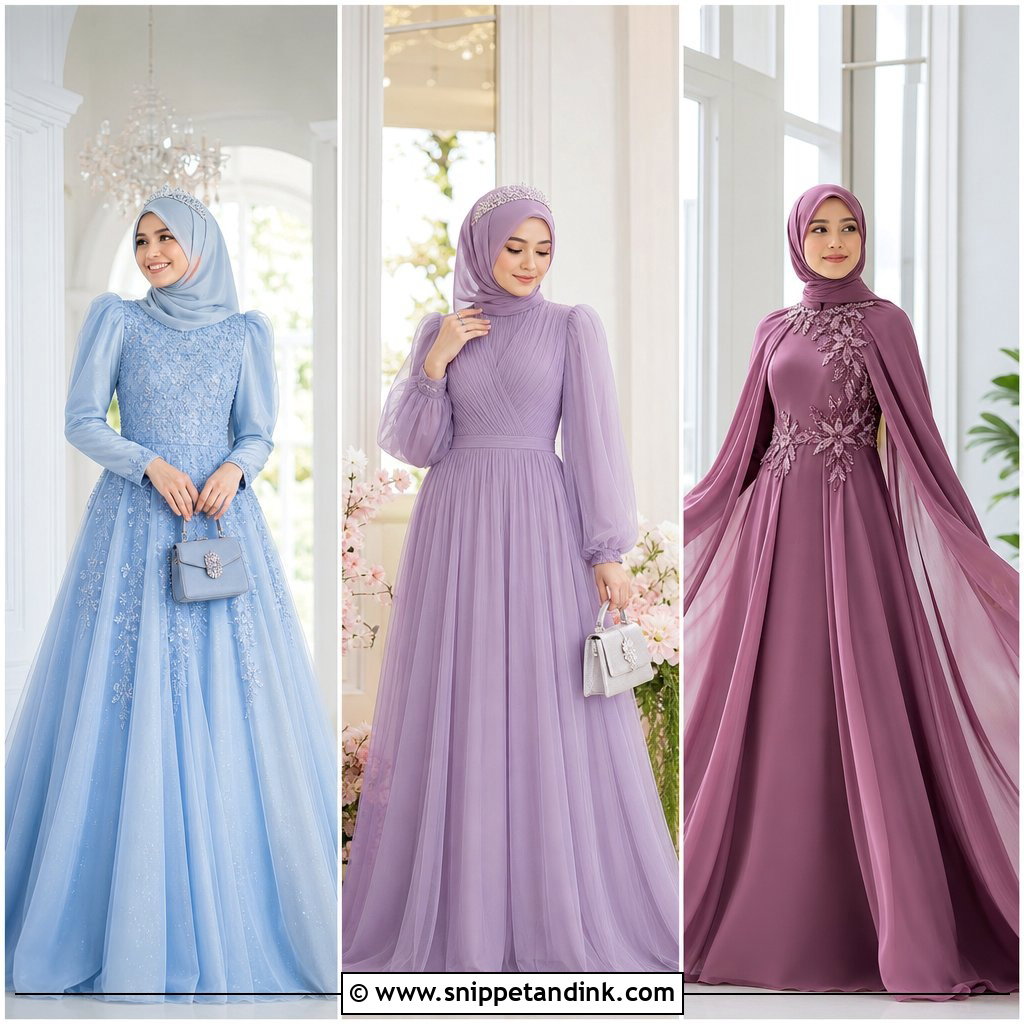
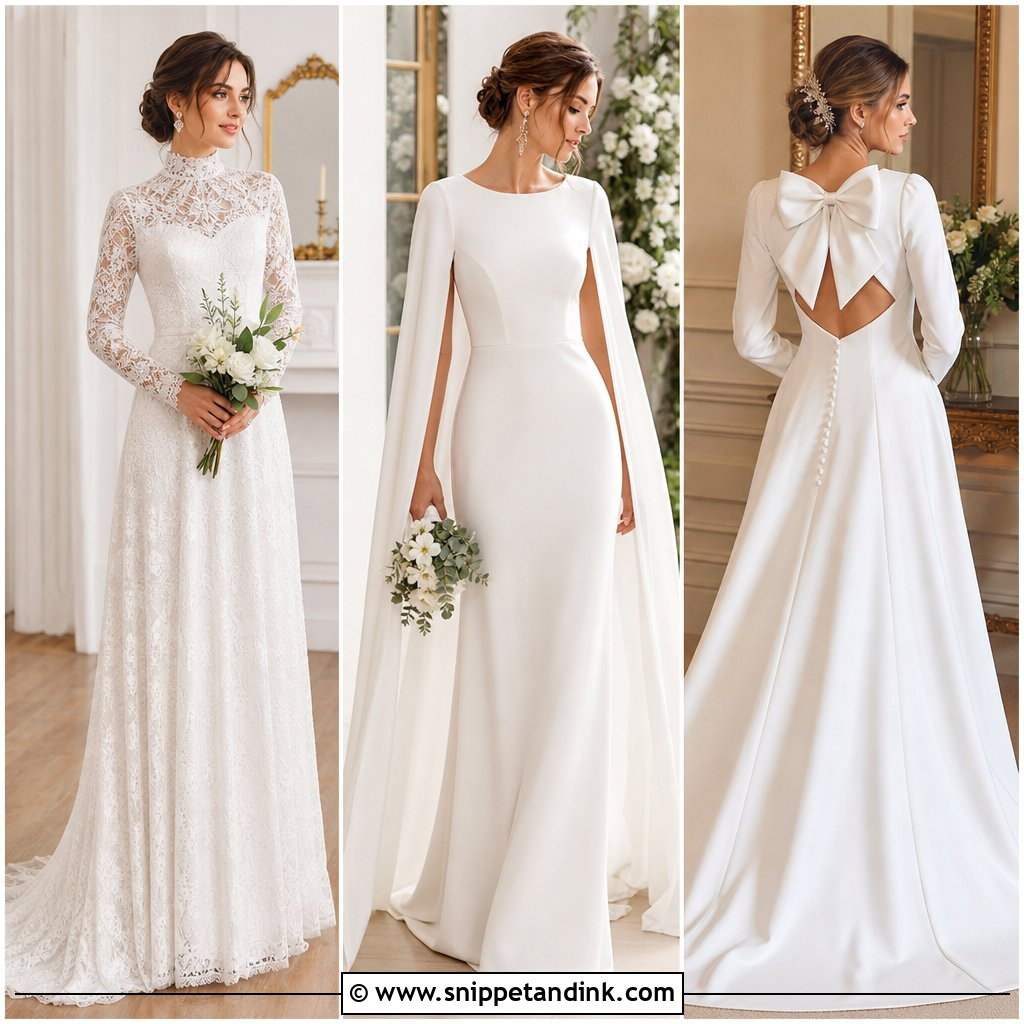
A cape gives movement without exposing anything, which is why so many of my modest brides end up here. The detail that matters is how the cape attaches. Snaps at the shoulder seam can pull the fabric when you raise your arms; a cape stitched into the seam and backed with fitted full-length sleeves stays put. Floor-length or trained capes look wonderful walking but need a plan for the reception, usually a hidden wrist loop. Pair with a smooth satin hijab and only a short plain veil, since two long layers behind you will tangle. Silver pumps, crystal studs, a slim bracelet over the cuff and tall white orchids keep it sleek.
7. Princess Ball Gown Hijab Wedding Dress
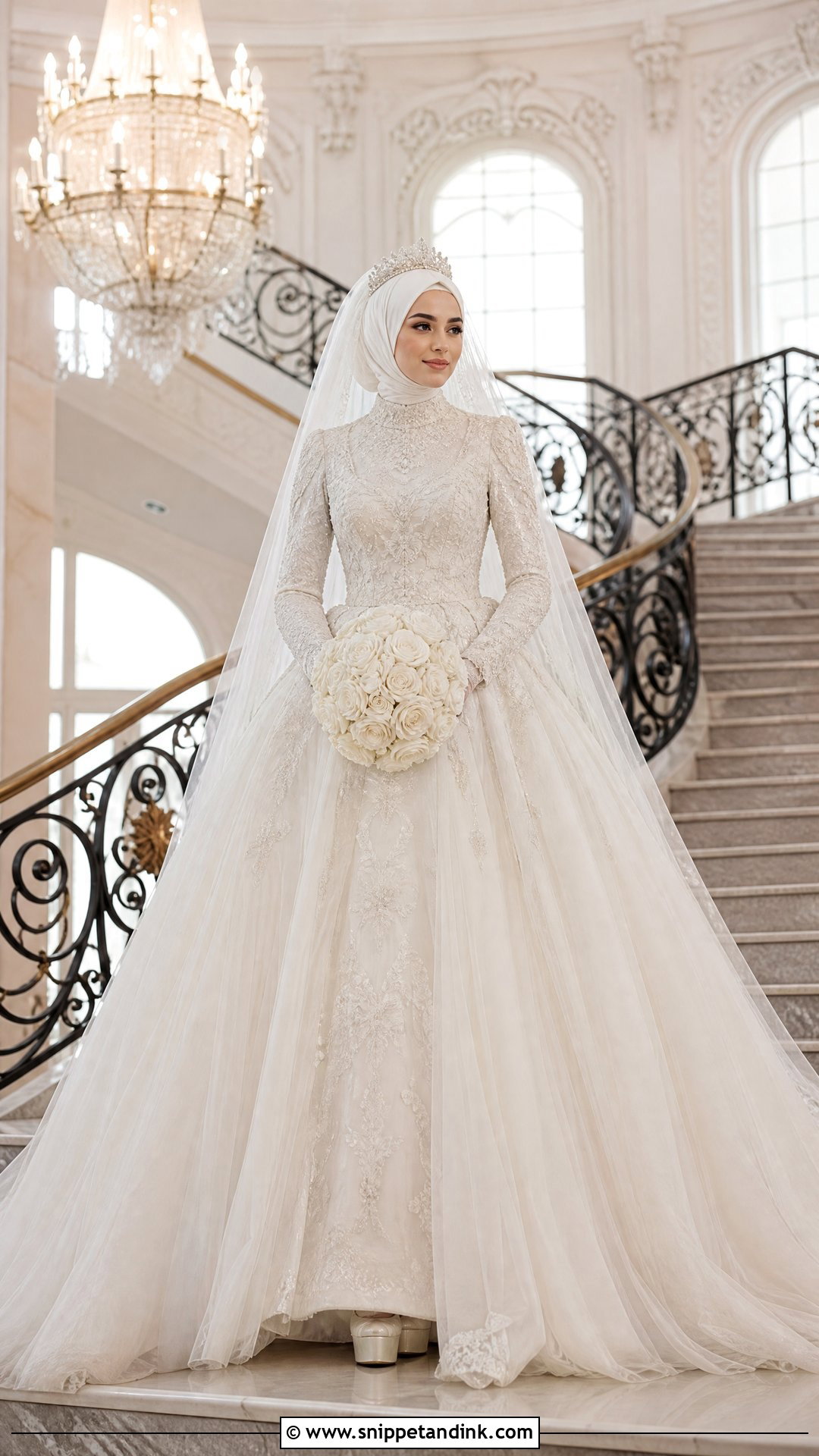
A princess ball gown is the one I see most often in nikah-to-walima weekends where the entrance matters. Insist on a structured bodice with a high neck, long sleeves and an opaque back that closes neatly above the waist. Tulle layers can build volume without the weight of satin, which your shoulders will thank you for by evening. Embroidery at bodice and hem keeps it from looking like plain netting. A fitted ivory hijab under a cathedral veil, held by a small crown or tiara, gives the height a gown this wide needs. Platform heels add inches unseen. Book a movement test: sit, turn and walk a staircase in it before the final fitting.
8. Chiffon A-Line Hijab Wedding Dress
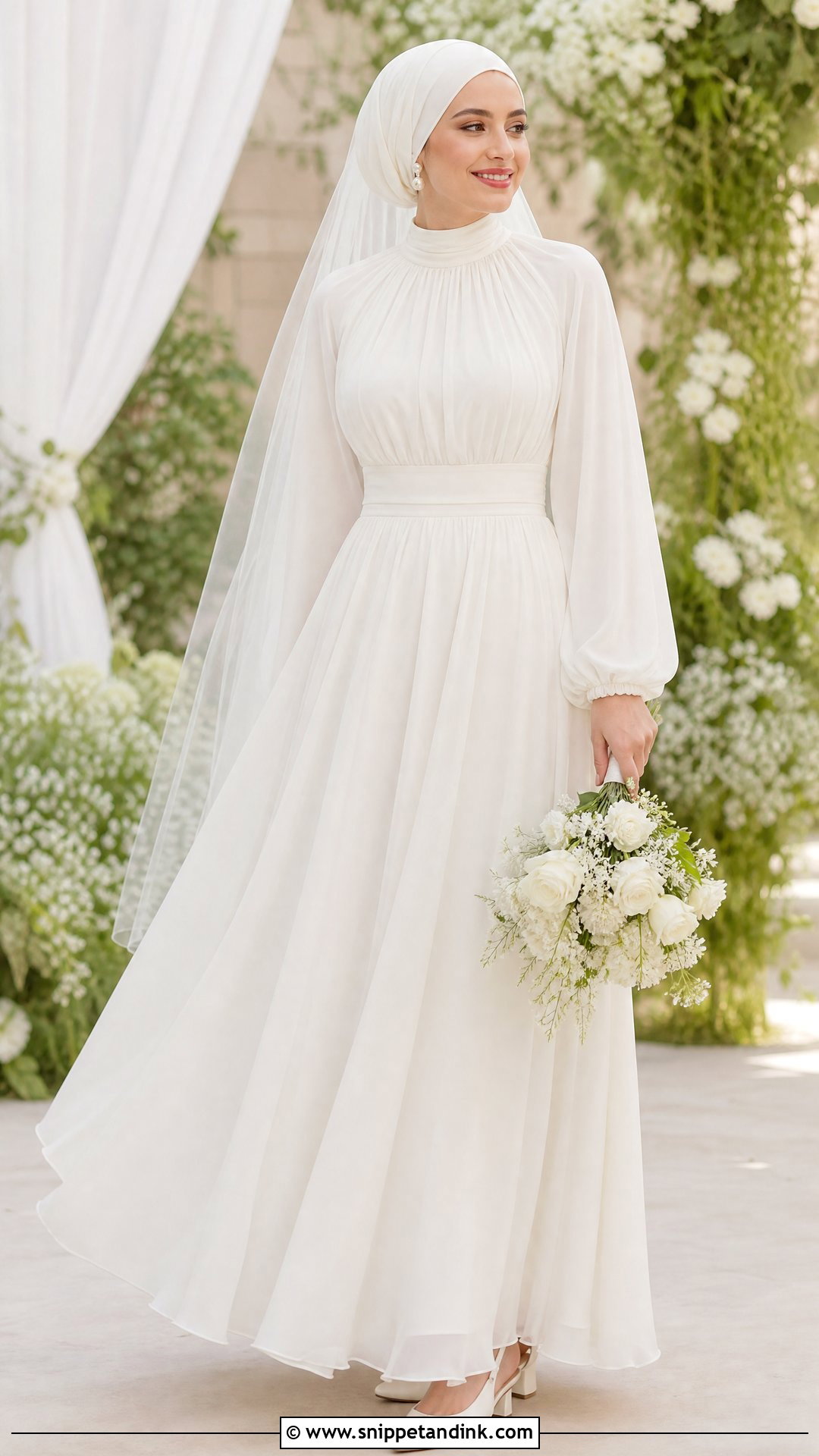
Chiffon is the easiest fabric to wear in heat, and the easiest to see through in direct sun. I hold any chiffon skirt up to a window before a bride commits, because a single layer over a thin lining can turn translucent outdoors. Look for full lining, loose bishop sleeves gathered into fitted cuffs, and a high gathered neckline. A matching chiffon hijab is lighter than satin and less bulky under a veil. Single-layer fingertip veil, closed slingbacks, small pearl earrings and pale greenery suit a garden or beach. Wind is the real enemy here, so I use hijab magnets plus pins and anchor the veil low.
9. Basque Waist Hijab Wedding Dress
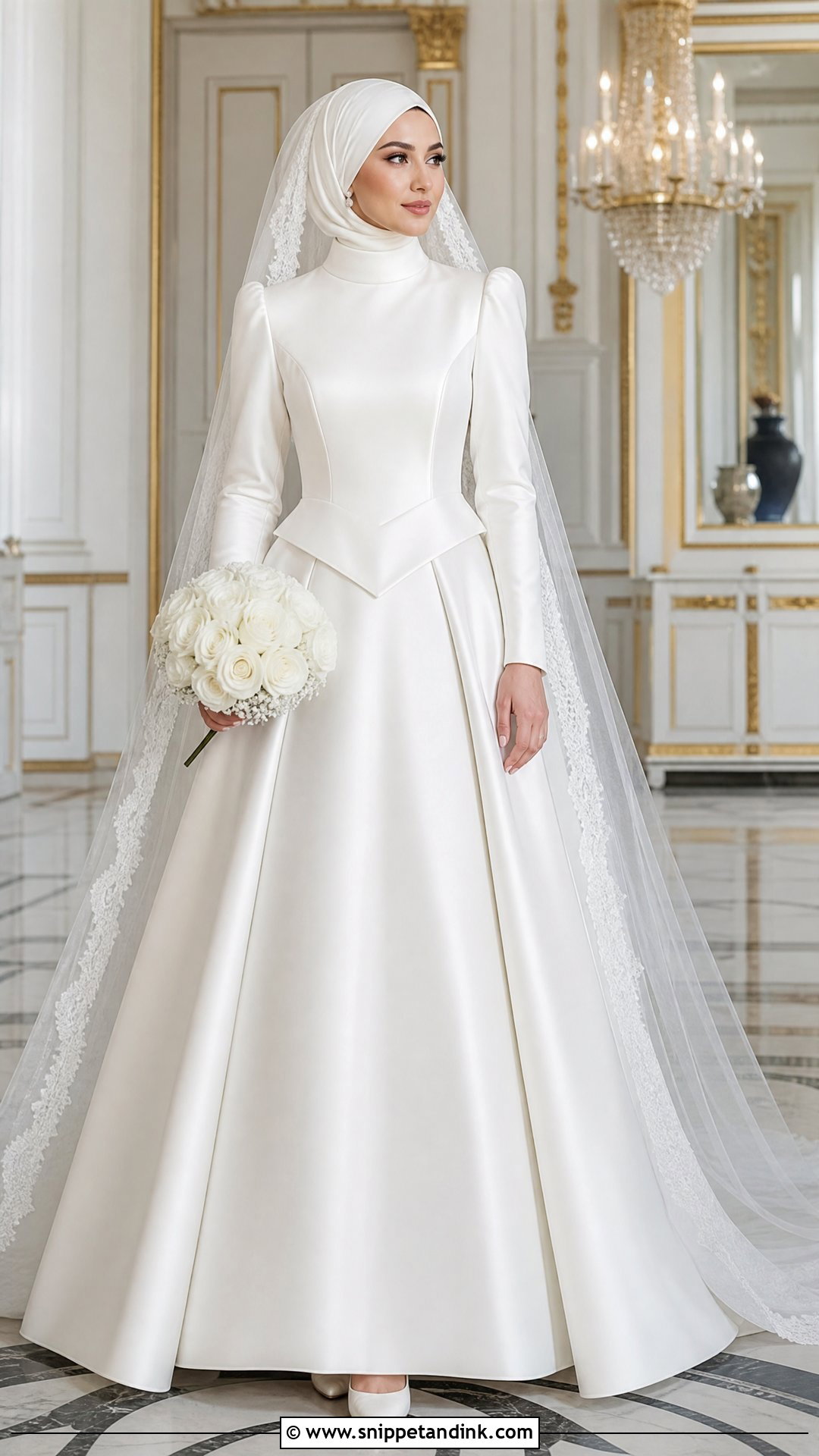
The basque waist dips into a soft V below the natural waistline, so it lengthens the torso without needing anything low at the neck. That point is also its weak spot. If the bodice is cut even slightly long for you, the tip digs in the moment you sit, so a precise fitting is non-negotiable. Ask for a high-neck version with full sleeves and an opaque, boned bodice. A wide satin or tulle skirt balances the fitted top. I’d style it with a smooth ivory hijab, a lace-trimmed cathedral veil, plain closed pumps, pearl earrings and white roses. Supportive, never restrictive, is the test at every fitting.
10. Pleated Satin Hijab Wedding Dress
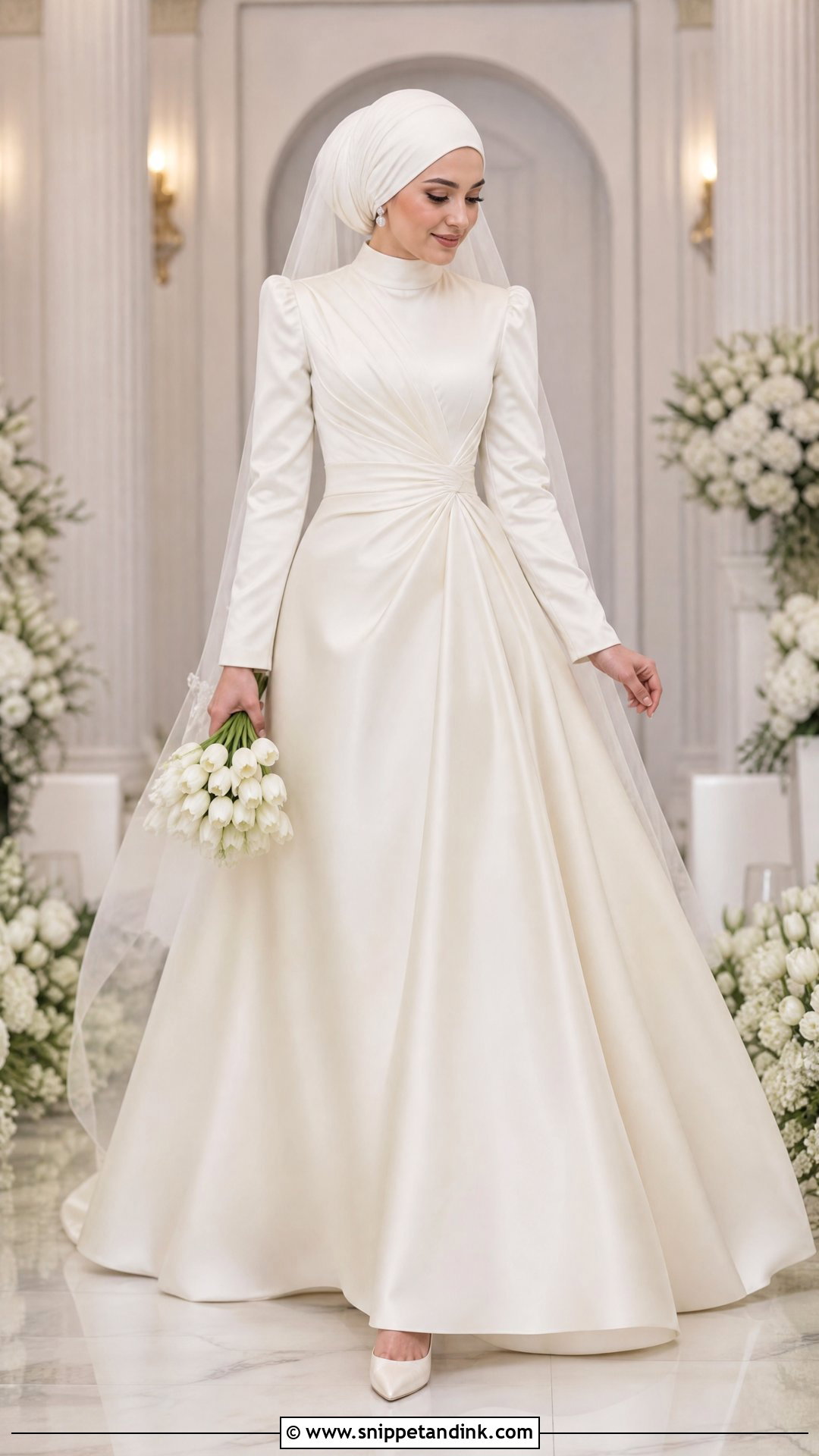
Pleating gives a plain satin gown its character, but only in one or two places. Waist, shoulders or cuffs, not all over. A high draped neckline and full sleeves handle coverage, and a softly gathered A-line leaves room to walk. Satin shows every ridge underneath it, so I always look at the gown under bright light for seam shadows and undergarment lines before the hem is done. Match the hijab to the satin but keep the wrap smooth; a pleated hijab against a pleated gown looks busy. A plain chapel veil, pointed pumps, small pearls and white tulips tied in ivory ribbon are enough.
11. Floral Appliqué Hijab Wedding Dress
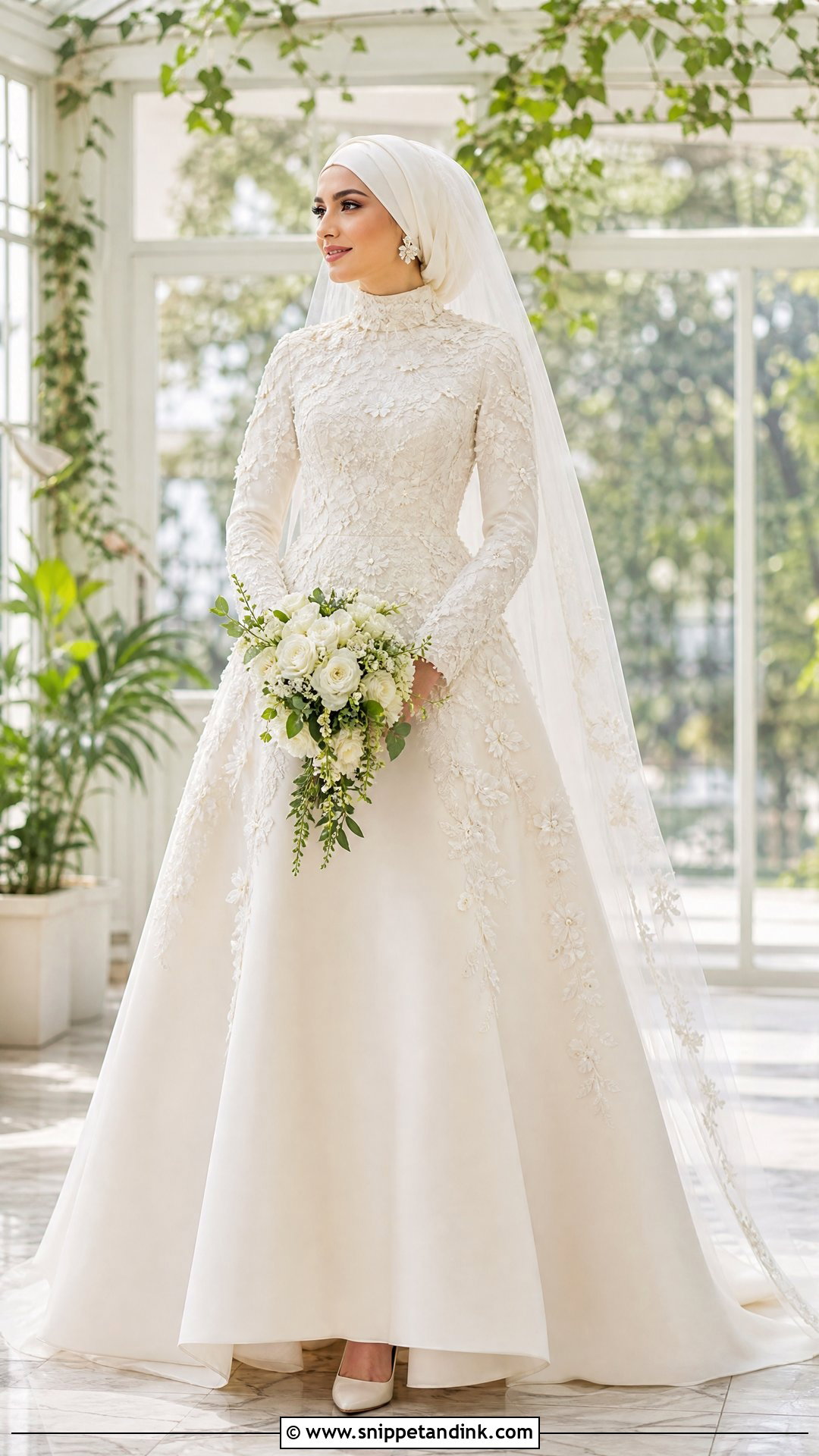
Three-dimensional flowers catch light from the side, which is why appliqué gowns look so rich in candid shots. The rule I follow is to concentrate them on the bodice, sleeves and upper skirt and leave the lower skirt quiet, or the dress starts to look heavy from across a room. Any sheer tulle needs opaque lining in a matched ivory, not a stark white that shows through as a different shade. A plain chiffon hijab and a veil with only a few appliqués near the edge keep things calm. Ivory heels, floral studs and a loose garden bouquet in white or blush, never a bright mixed bunch, suit a greenhouse or spring ceremony.
12. Ottoman-Inspired Hijab Wedding Dress
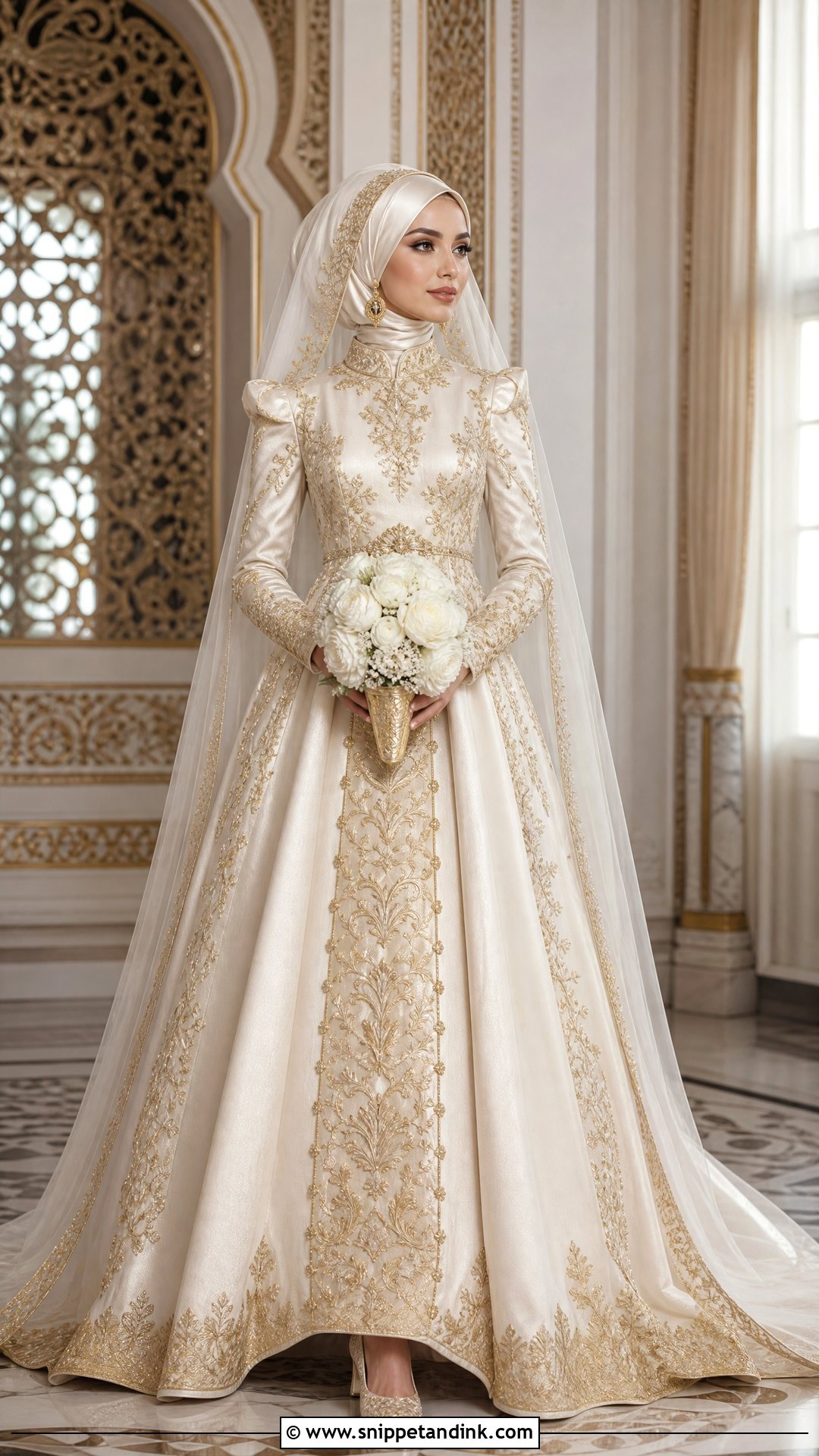
An Ottoman-inspired bridal gown borrows a high collar, structured shoulders and gold embroidery from court dress, and it suits a family that wants heritage visible in the photographs. My caution is weight. Metallic embroidery on a bodice is heavy, so I balance it with a lighter A-line skirt and a veil with only a gold edge. An ivory satin hijab works, or a draped head covering in the same tone. Keep the gold to the collar, cuffs and one other area; once it appears everywhere, the bride disappears under it. Antique-gold earrings, embroidered closed shoes and a small structured bouquet suit it.
13. Modest Mermaid Hijab Wedding Dress
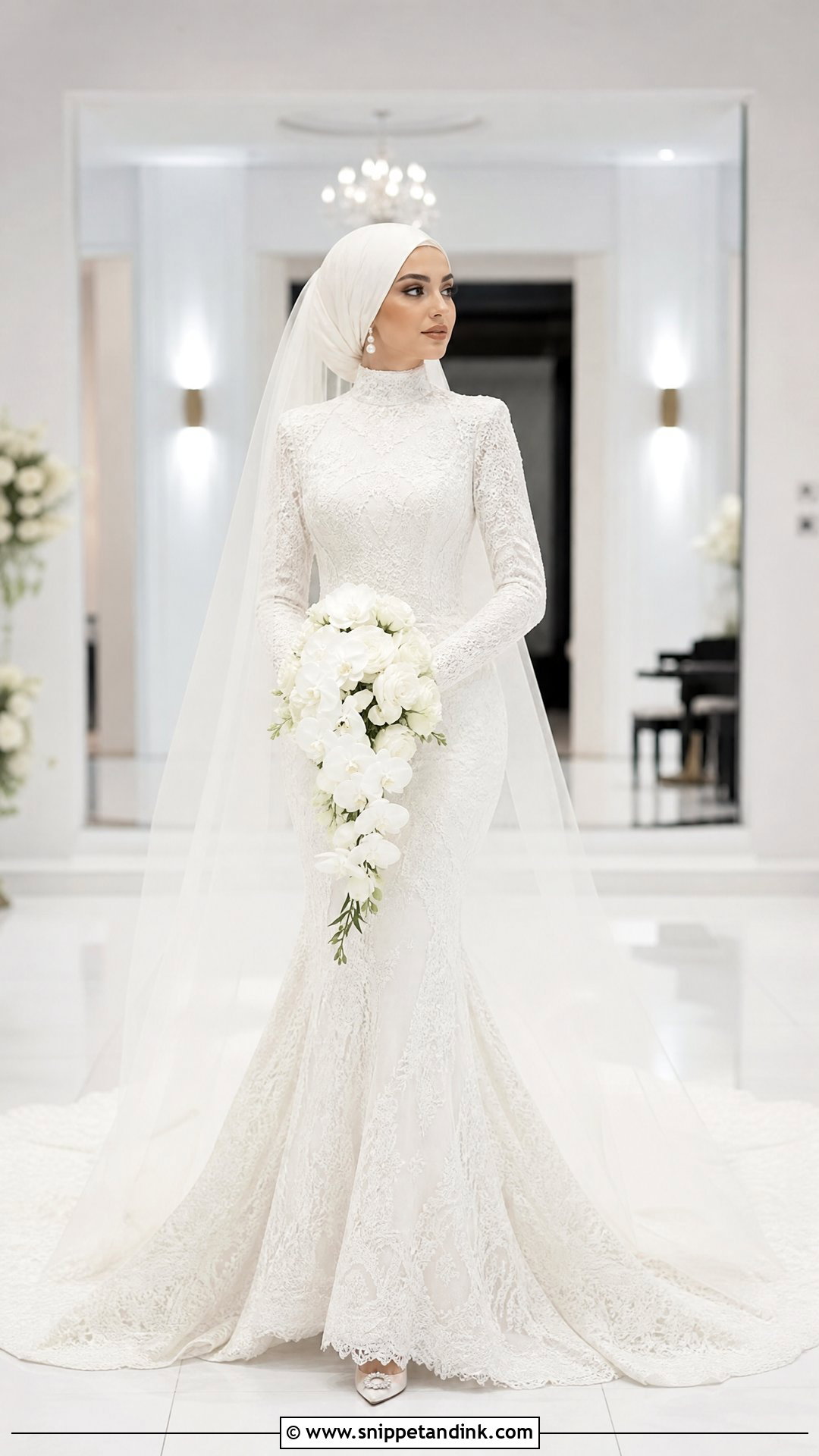
Mermaid and modesty can coexist, but the fit has to skim, not grip. I want the gown to follow the body gently and flare from the knee, with a high neck, opaque long sleeves and a covered back. Thin stretch fabric shows everything underneath, so matte crepe or properly lined lace is the safer base. At the fitting, climb a step and sit on a low chair. If you can’t, ask your seamstress about widening the flare slightly or adding a hidden inner panel, which keeps the shape and gives you back your stride. A satin hijab, a plain veil longer than the train, closed pointed heels and a cascading bouquet suit the long line.
14. Empire Waist Hijab Wedding Dress
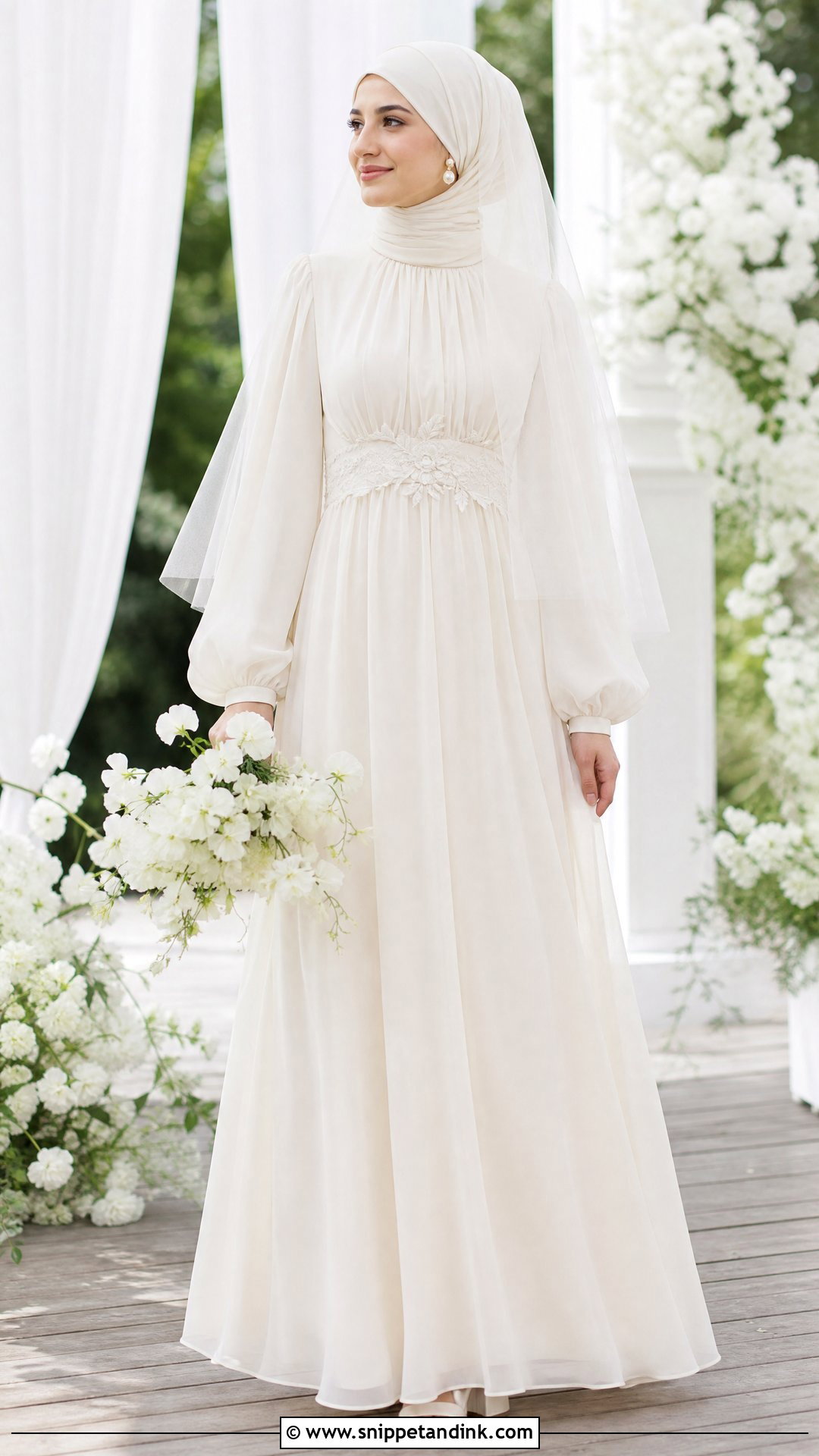
With the seam sitting just under the bust, an empire-waist dress drops straight to the floor and never presses on the stomach, which is why I suggest it to brides who want to eat, pray and dance without thinking about their bodice. Opaque chiffon or crepe, a gathered high neck and loose full sleeves keep it airy. A chiffon hijab wrapped close to the face and a shoulder-length veil suit the light proportions. A narrow embroidered band at the raised waist defines it better than a contrasting belt would. Low block heels, pearl drops and sweet peas finish a relaxed nikah or outdoor ceremony.
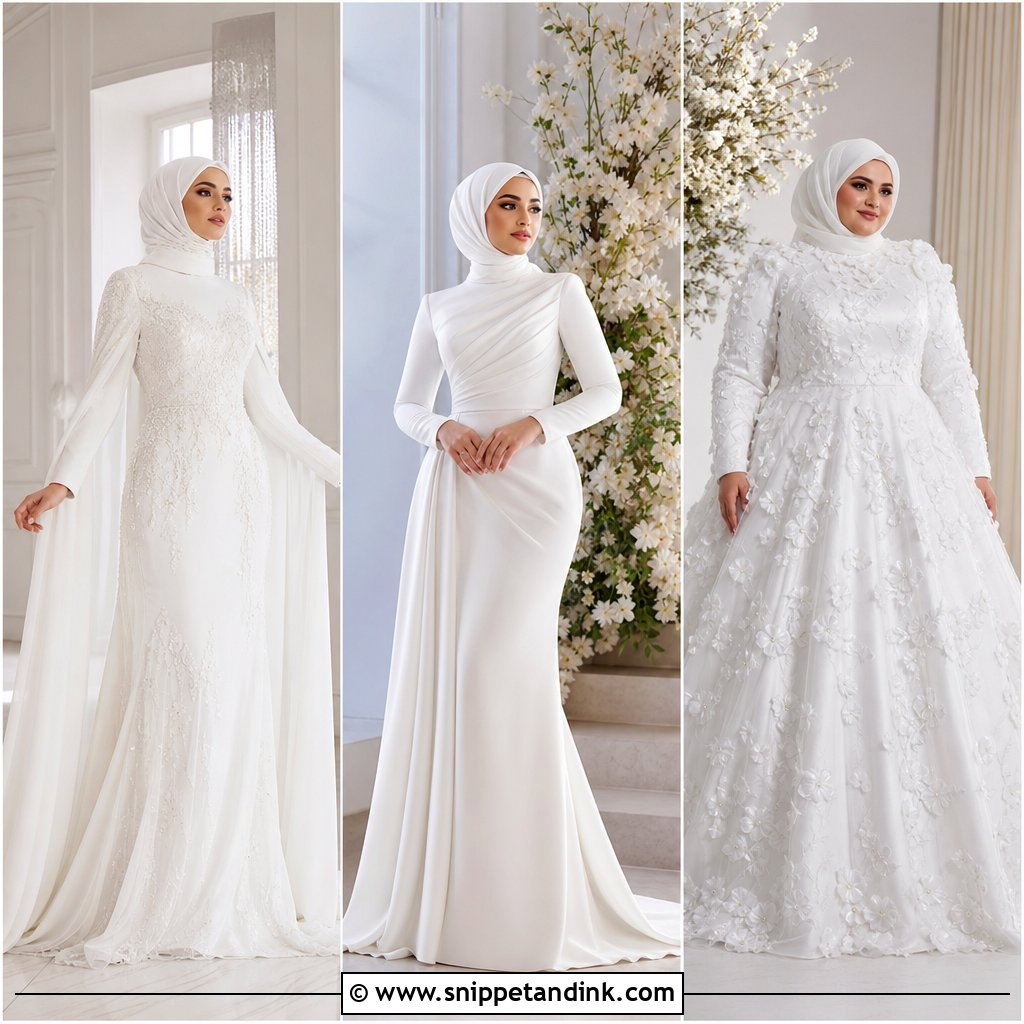


15. Tiered Tulle Hijab Wedding Dress
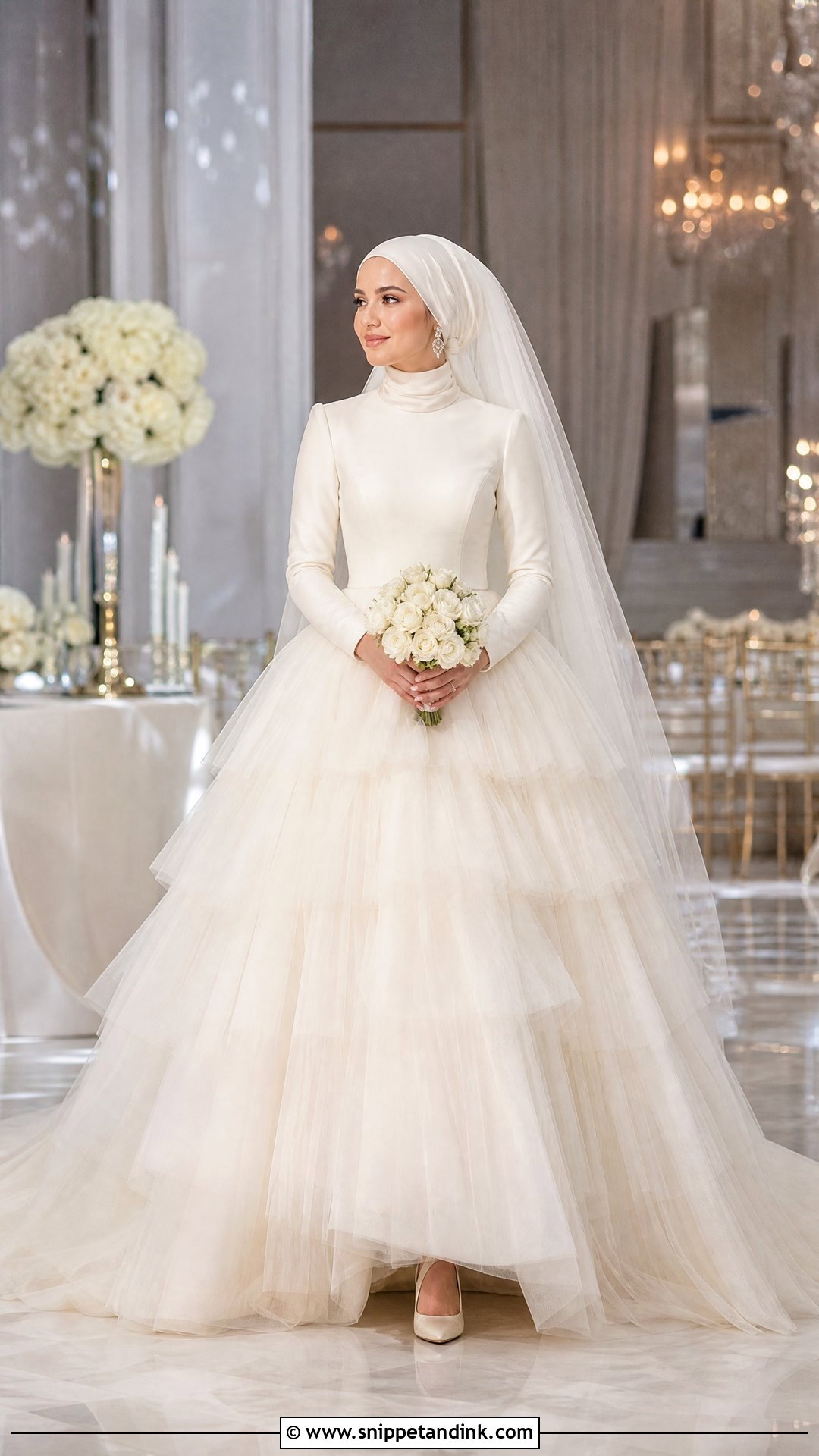
Tiers add movement, though each horizontal seam also cuts across your height. I check where every tier falls during alterations: too low and the whole gown looks shorter, slightly higher and the line stretches out again. Keep the bodice plain with full sleeves so the skirt carries the interest. Tulle is sheer, so the satin lining should run all the way to the floor, not stop at the knee. A smooth chiffon hijab, a fingertip veil, satin pumps, crystal earrings and a compact white bouquet are plenty. It has a playful mood that suits a daytime reception more than a formal ballroom.
16. Bow Back Hijab Wedding Dress
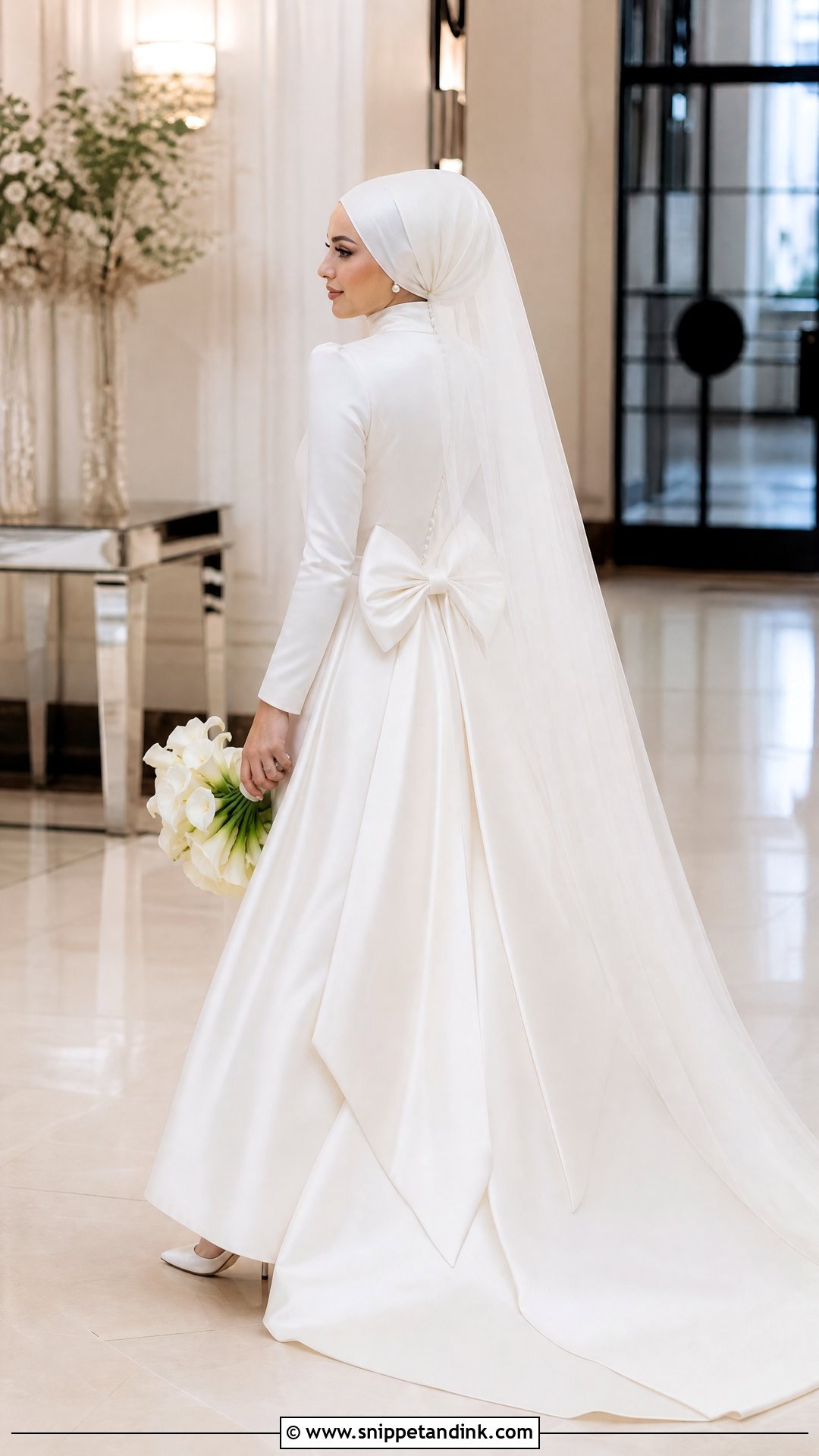
A bow at the back keeps the front calm and high while giving guests something to look at during the ceremony, when they mostly see you from behind. I prefer a removable bow on a structured satin A-line. It can come off for the reception if it gets in the way of sitting. The tails can fall over the skirt or reach toward the train. The one real question is the veil: a large bow and a long veil compete, so decide at the fitting whether the veil sits above it or tucks beneath. Minimal pearls, pointed pumps and white calla lilies keep the focus where it belongs.
17. Vintage Lace Hijab Wedding Dress
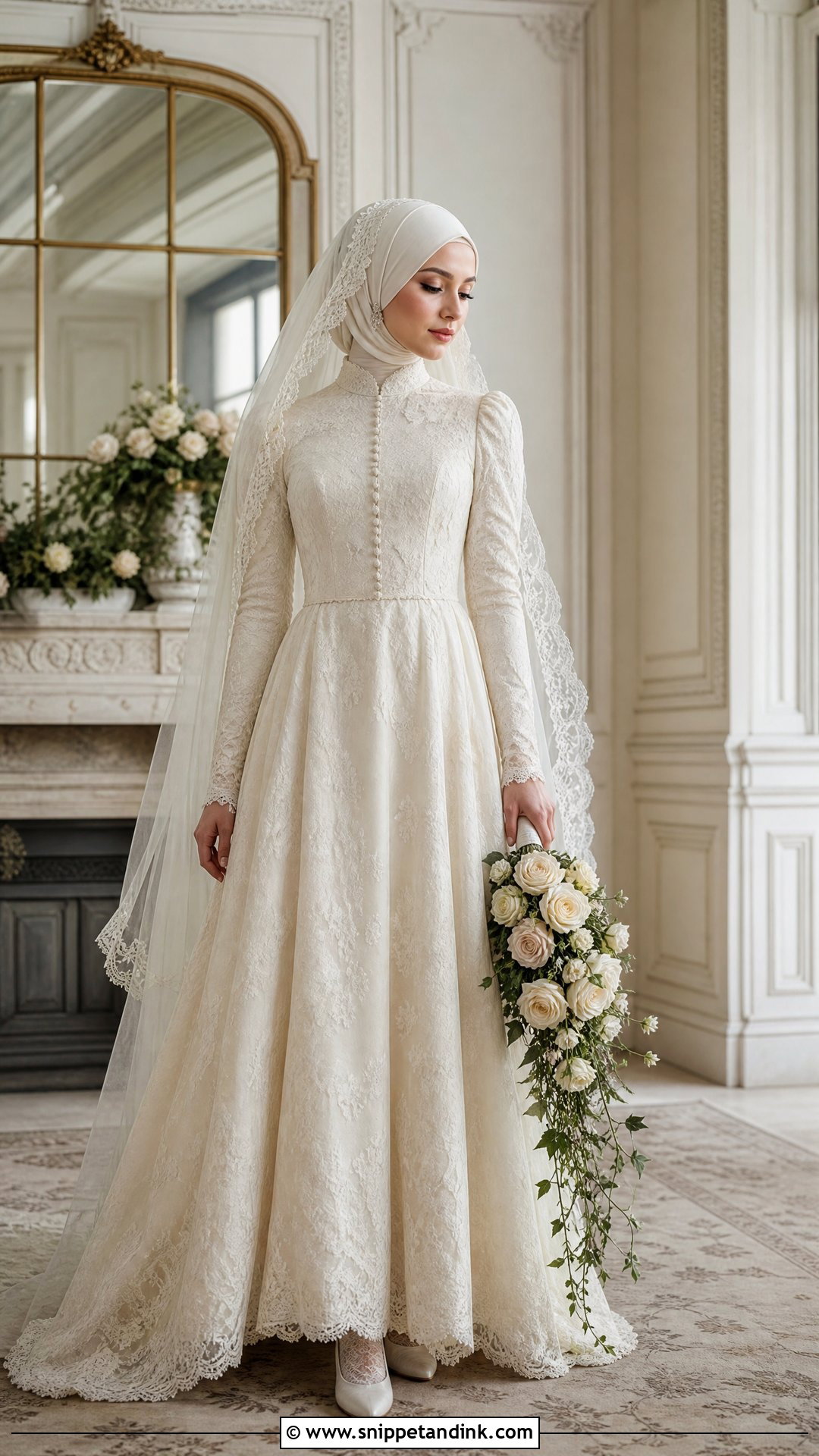
Vintage-style lace looks best over lining that is completely opaque across the neck, arms, chest and back, because older lace patterns are often more open than modern ones. Look for a high Victorian collar, fitted sleeves, covered buttons and a gentle A-line. I’d pair it with an ivory chiffon hijab and a lace-edged veil that echoes the gown rather than copies it exactly. A small vintage brooch near the veil attachment adds character. Stop at one or two antique pieces, though. Add a brooch, a heavy necklace and a lace fan together and the outfit tips into costume. Low closed heels, pearls and white roses with trailing greenery complete it.
18. Winter Velvet Hijab Wedding Dress
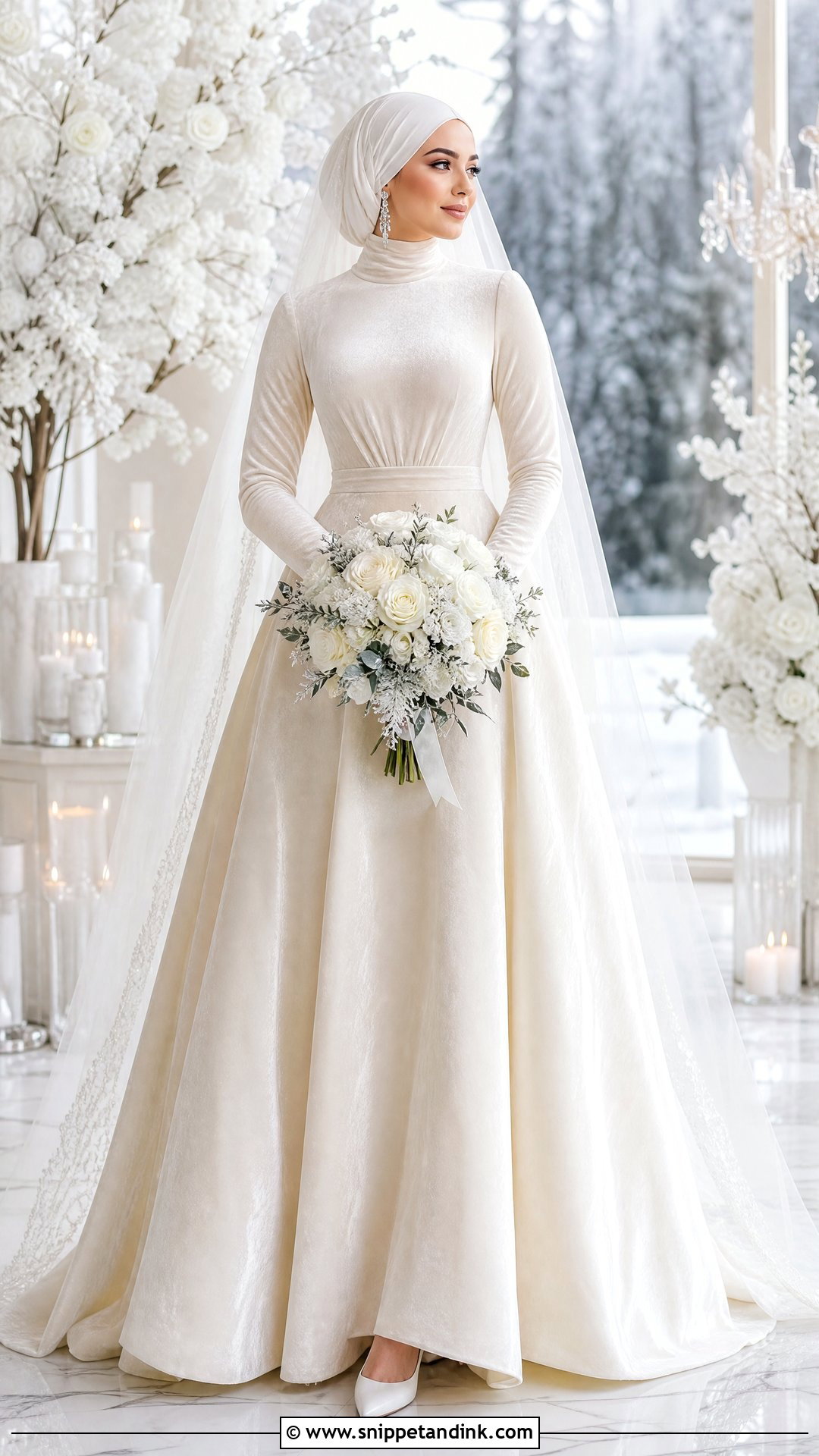
Velvet is warm, opaque and very forgiving for coverage, and it is also the fabric that changes most under different light. In a dim hall it can look almost grey; by a window it glows. I always view a velvet gown in both before the bride decides. Ask for a lightweight velvet with a high neck, long fitted sleeves, a defined waist and a soft flare, so you can move indoors without overheating. A smooth satin hijab keeps texture away from the face. Add a long tulle veil, velvet pumps and pearl or crystal earrings, with white roses and silver-green foliage. Steam from the inside only; pressing flattens the pile permanently.
19. Organza Hijab Wedding Dress
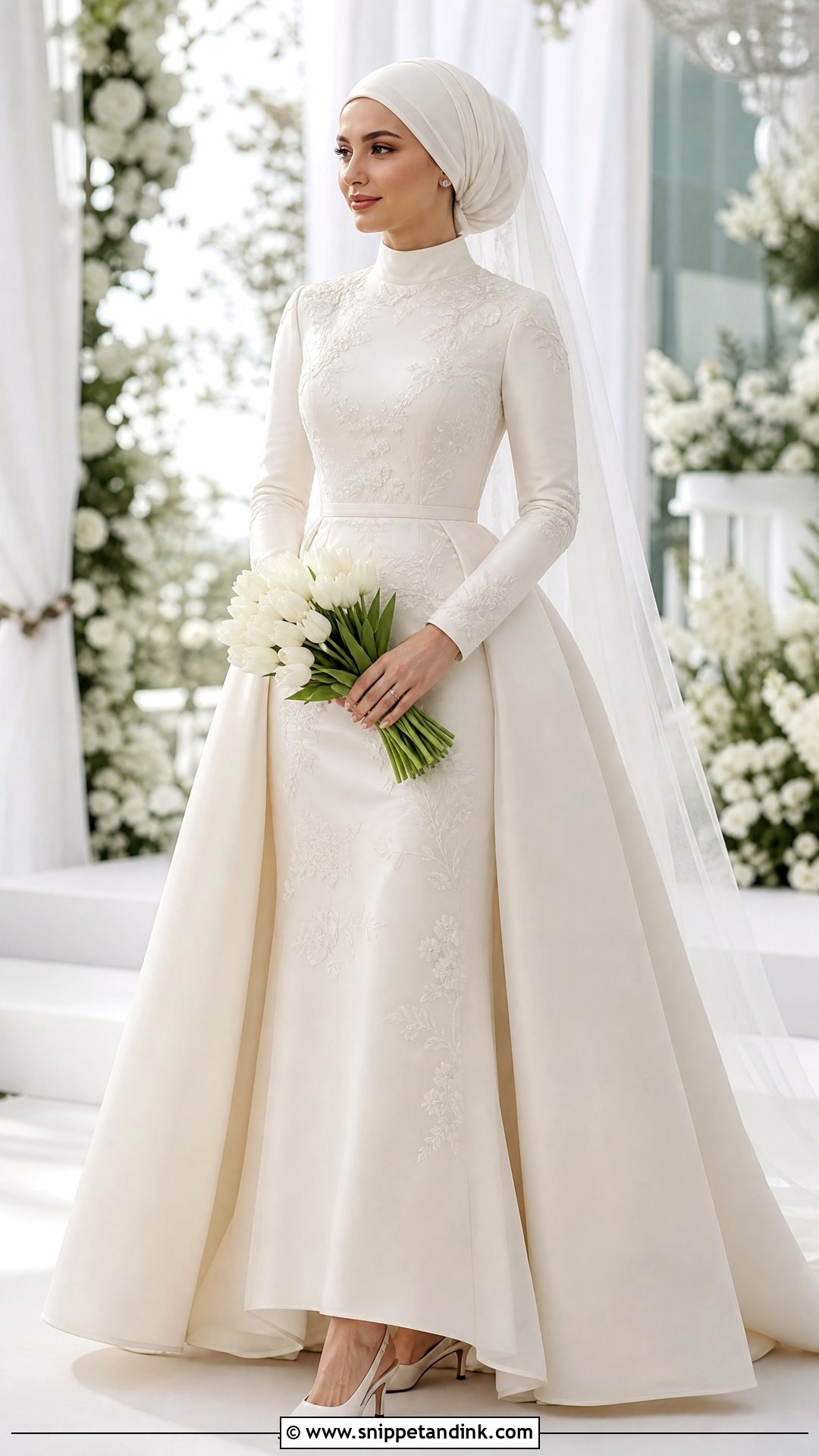
Organza is crisp and holds volume with far less weight than layered tulle or satin, but it is naturally sheer. So the bodice has to be opaque underneath, and I insist on a full underskirt beneath the structured organza overskirt, plus finished linings inside the sleeves. Small embroidered flowers or narrow satin edging add detail without hiding the airy quality. A matte chiffon hijab tones down organza’s slight sheen, and a long single-layer veil keeps things light. Closed slingbacks, small crystal earrings and white tulips suit a bright spring or summer venue. Stand in direct sun at the fitting to check the coverage.

20. Nikah Hijab Wedding Dress
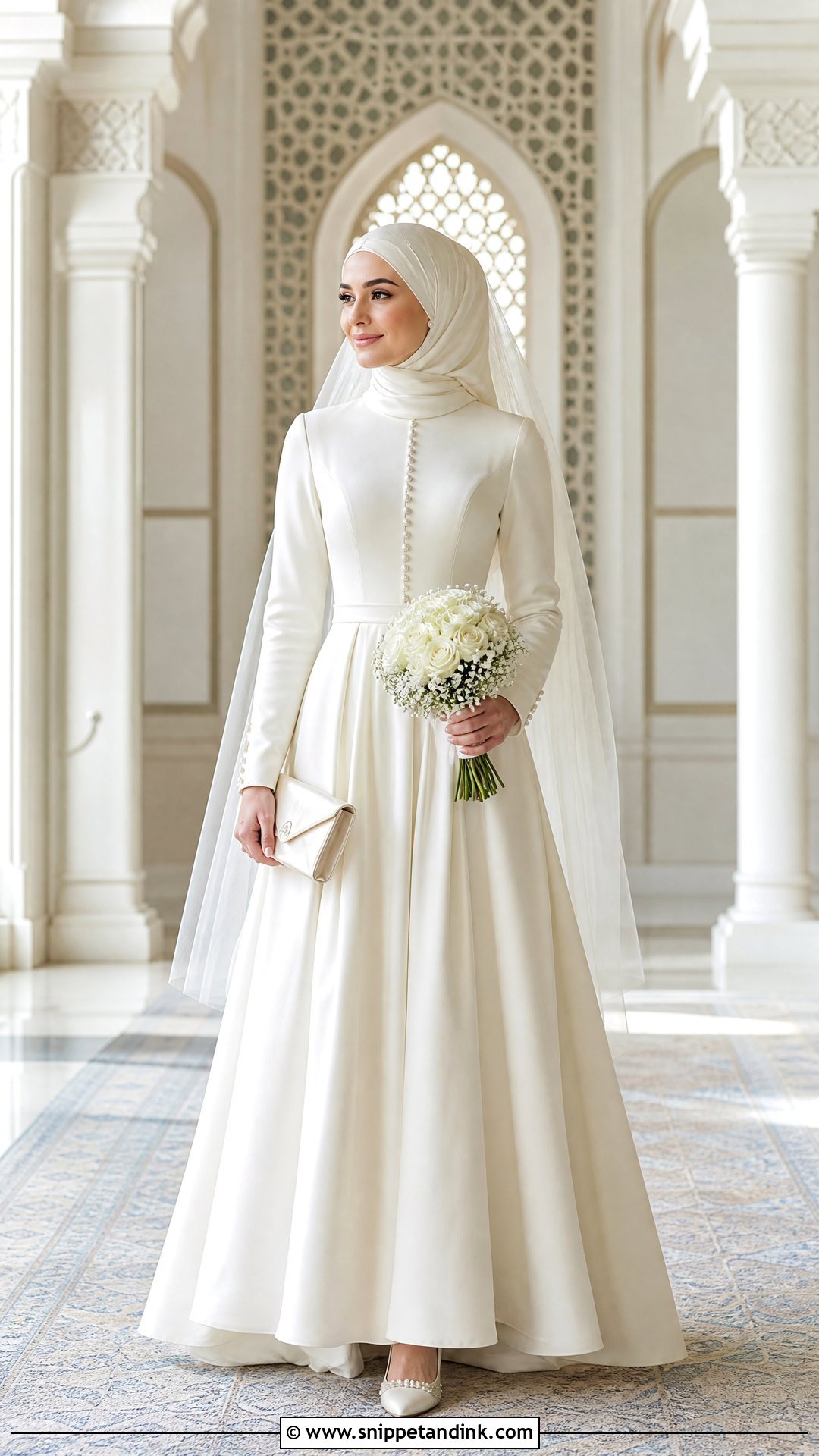
For a nikah, I often steer brides away from a big gown entirely. An ivory maxi dress with a high neck, full sleeves, a defined waist and a soft skirt lets you sit on the floor, stand to greet elders and perform prayer without managing a hoop. Embroidered cuffs, pearl buttons or light beading around the collar give it enough occasion. A matching chiffon hijab and a shoulder-length veil that lifts off easily after the ceremony keep you comfortable. Closed heels you can slip on and off, pearl studs, a small white rose bouquet and a satin clutch for essentials are all you need for a mosque, home or intimate venue.
Securing the Hijab and Veil Through a Long Day
The most common problem I fix on the morning is a veil dragging the hijab backward. A veil comb has nothing to grip on slippery satin, so it slides with every turn of the head.
Start With the Underscarf
A cotton or jersey underscarf cap holds pins far better than bare hair, and it stops a satin or chiffon hijab from sliding. Choose one in a shade close to the hijab so it doesn’t peek out at the forehead.
Anchor the Veil to Fabric, Not Hair
I sew a small loop or attach the veil comb to a band of the underscarf, then add two or three straight pins angled toward the crown. Magnets are lovely at the chin and shoulder, but they can’t take the pull of a cathedral veil on their own. Practice the whole wrap at your trial and time it. If it takes forty minutes with your hands, plan for an hour on a nervous morning.
Sitting, Praying and Changing Between Events
A wedding day for many hijabi brides includes a nikah, prayer times and a long reception, so the gown has to work through movement, not just standing photos. Sleeves that are too fitted at the elbow make wudu awkward; a hidden snap or a slightly looser cuff fixes that. Wide skirts need a bustle that someone other than you has practised. If you’re wearing a structured ball gown for the walima and something softer for the nikah, plan a private room and fifteen to twenty minutes for each change, including re-pinning. Pack a small kit: spare pins, a few magnets, safety pins, a lint roller and a white cloth for makeup marks on an ivory hijab.
Coverage, Comfort and the Gown That Feels Like Yours
Whichever of these you lean toward, the questions at the fitting stay the same: is the neckline high enough when you look down, are the sleeves lined, is the back covered when you raise your arms, and can you walk and sit without help? Treat the hijab and veil as part of the gown from the first appointment, not an add-on bought the week before. Good alterations and sensible shoes do more for the final picture than any amount of embellishment. Pick the dress you can pray, greet, eat and dance in while still feeling entirely like yourself.
You'll Like These Ideas:






Leave a Reply