
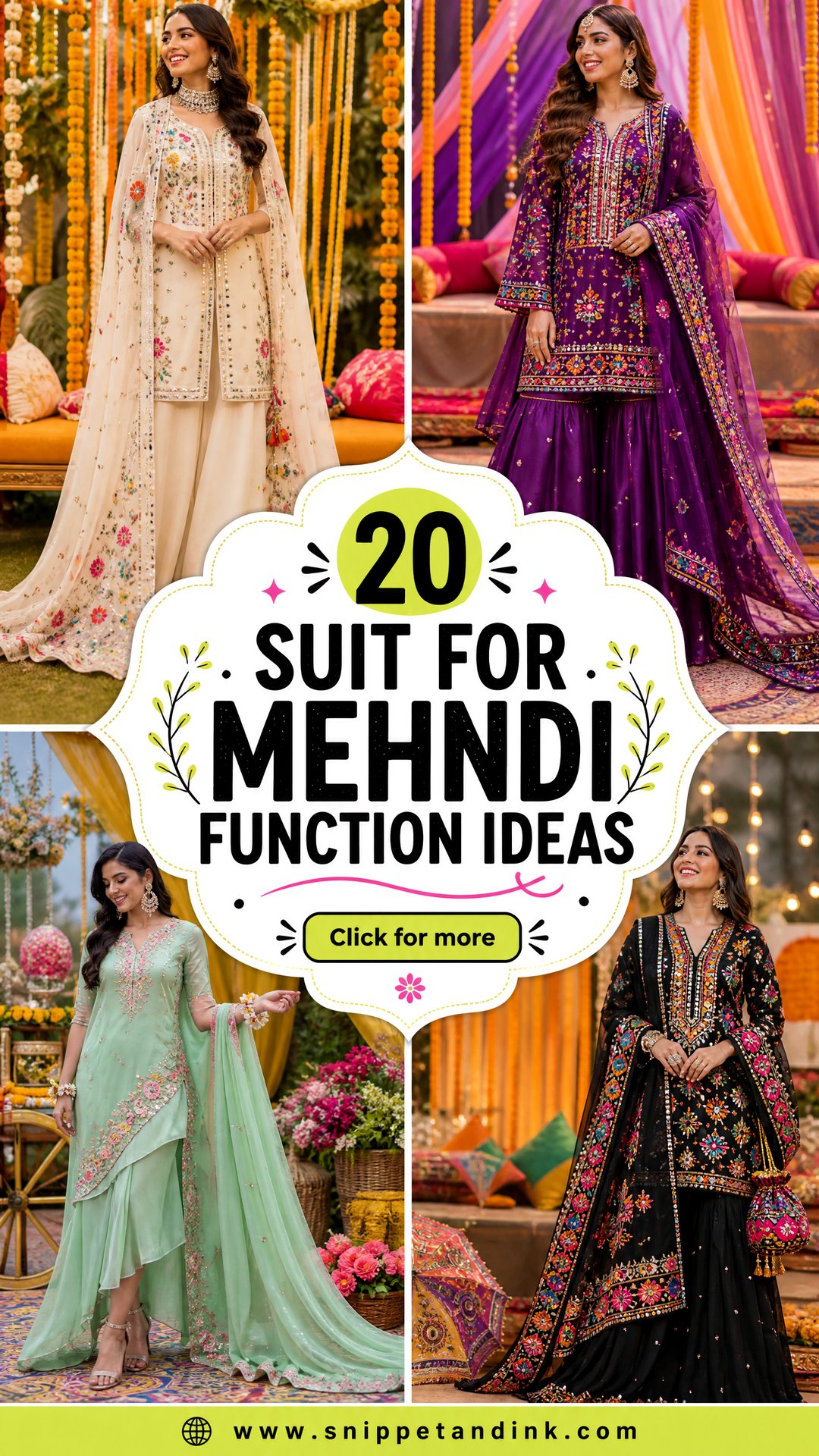
A festive suit for a mehndi celebration has a harder job than most wedding outfits. You’ll sit on low seating for long stretches, dance on uneven ground and, if you’re being decorated, keep your hands still while paste dries. When I dress a bride or her family for this function, I plan for those hours first and the photographs second. Yellow and green are still the traditional starting point, but coral, pink, turquoise and ivory all hold their own. Below are twenty complete suits for brides, bridesmaids, sisters and guests, from mirror-work shararas to floral Anarkalis, with the fit and fabric notes I’d give at a fitting.
Getting Dressed Before the Henna Goes On
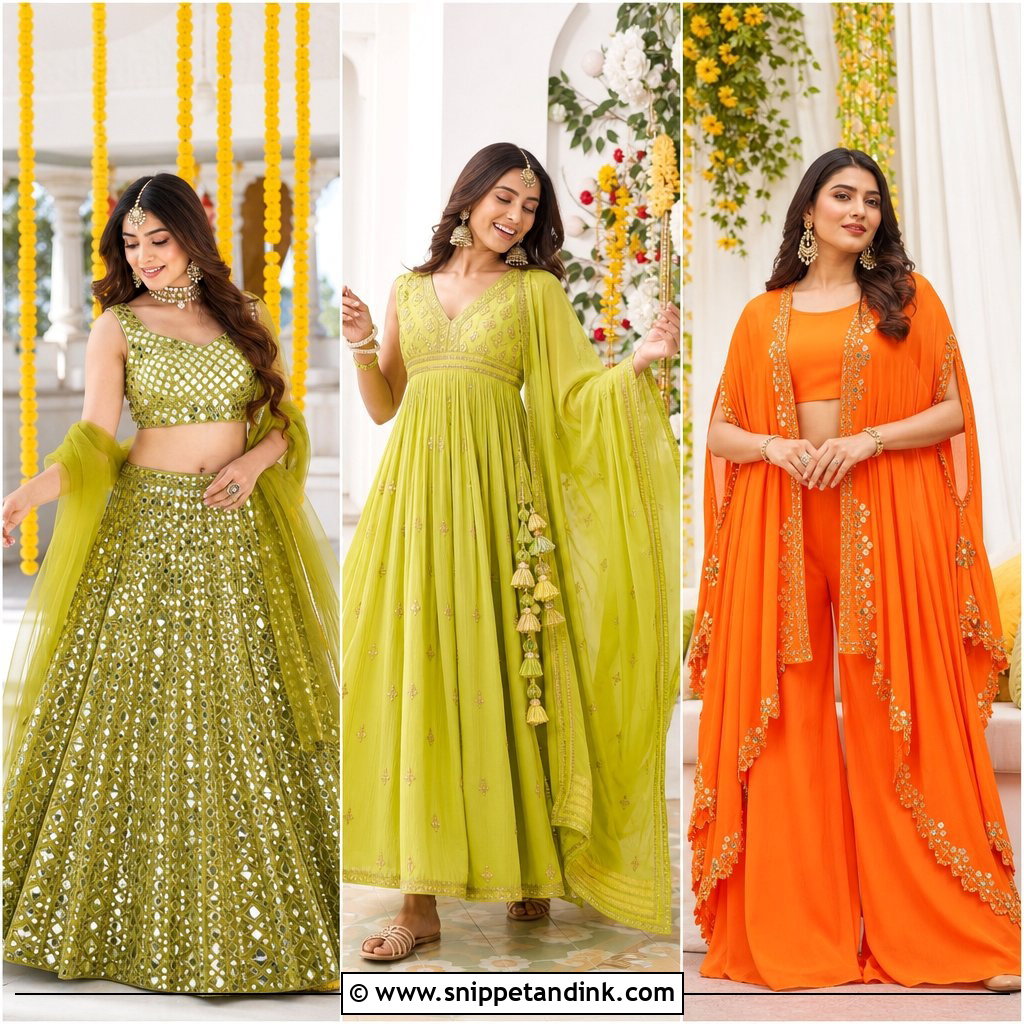
If you’re the bride, or anyone sitting for a full design, plan the outfit around the hours your hands and feet will be out of action. Paste has to stay on for a long time to stain deeply, and a smudge of wet henna leaves a mark on fabric that can be hard to lift. So I have my brides fully dressed, pinned and wearing their jewelry before the artist opens a cone.
- Pick sleeves that end above the elbow or roll back easily. Full sleeves with tight cuffs get pushed up by someone else, and that’s usually when they brush the paste.
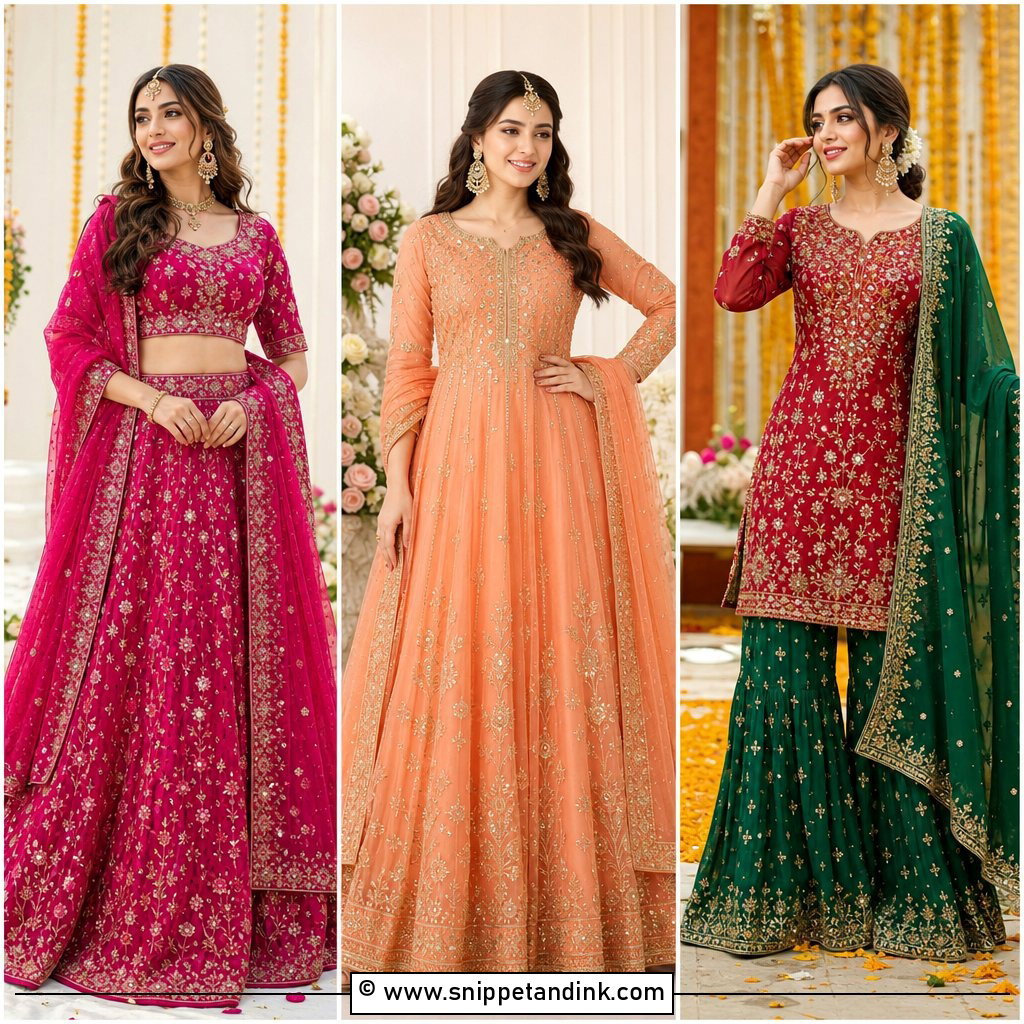
- Put on bangles, rings and earrings first. Nobody can fasten a jhumka with a freshly decorated hand.
- Pin the dupatta at the shoulder and again at the back so it can’t slide forward onto your palms.
- Wear a bottom you can sit cross-legged in or rest your feet up in: sharara, gharara, Patiala or palazzo. Churidars are fine for guests who aren’t having their feet done.
- Avoid fastenings you can’t reach. A drawstring or elastic waist saves a lot of fuss if you need the bathroom while your hands are drying.
Guests having a small design on one palm have it easier, but the same idea applies. Keep that hand away from the dupatta until the paste has dried and started to flake.
1. Yellow Sharara Suit for Mehndi
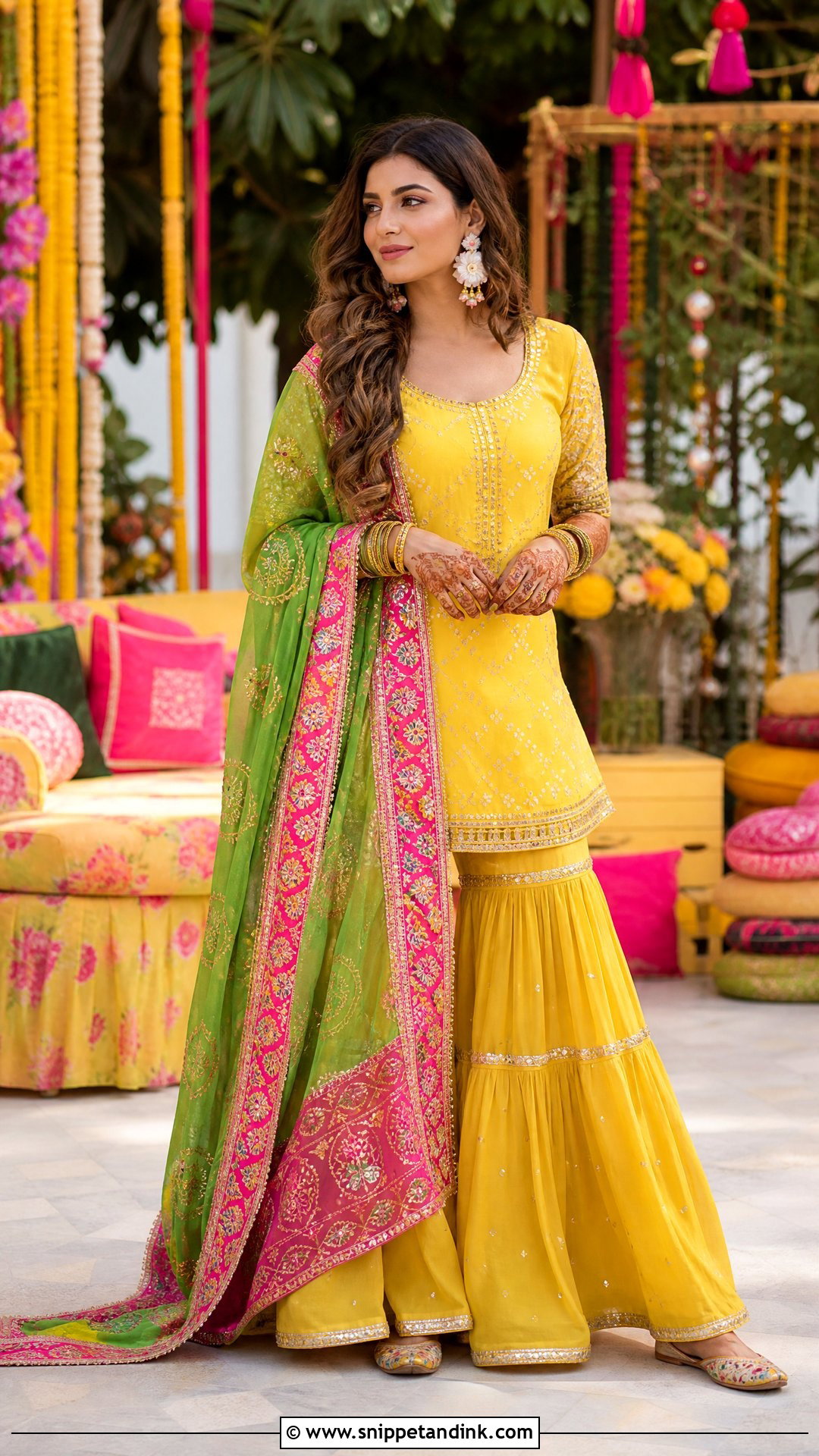
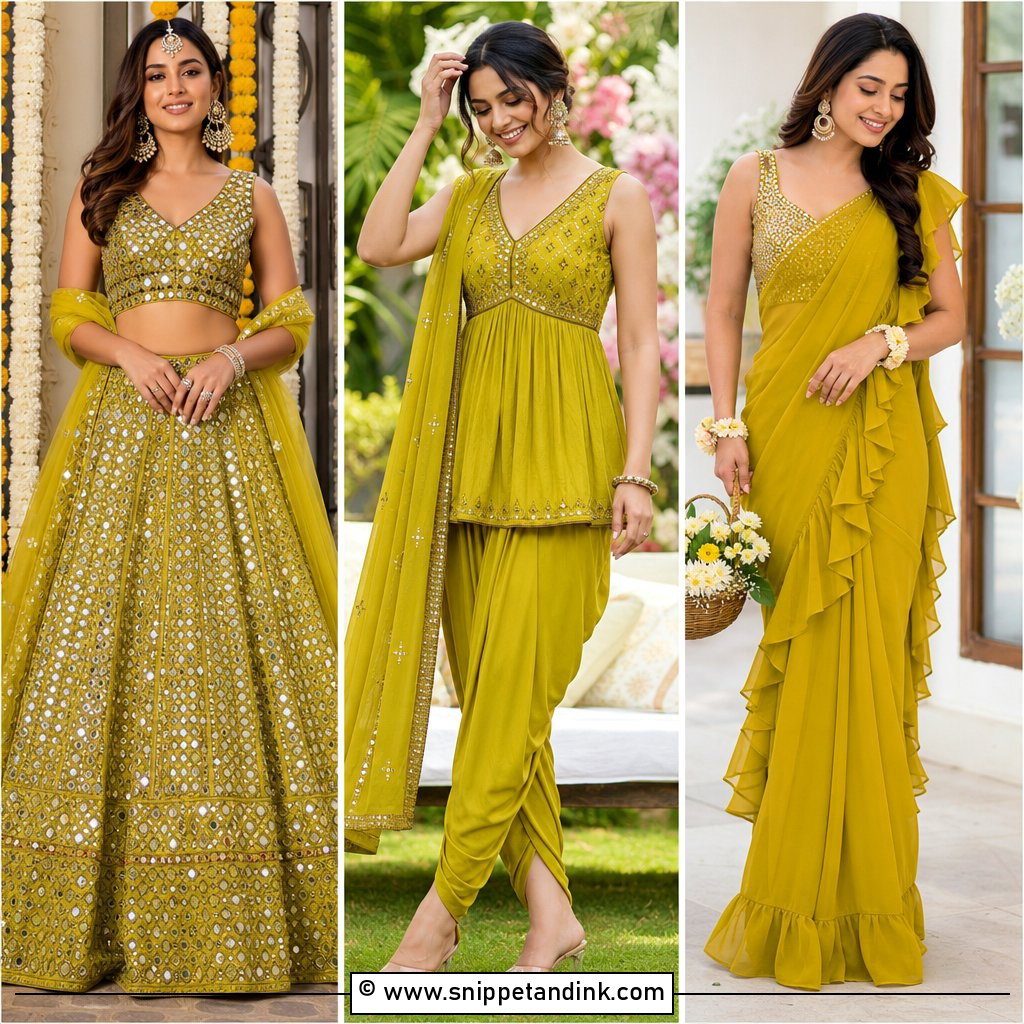
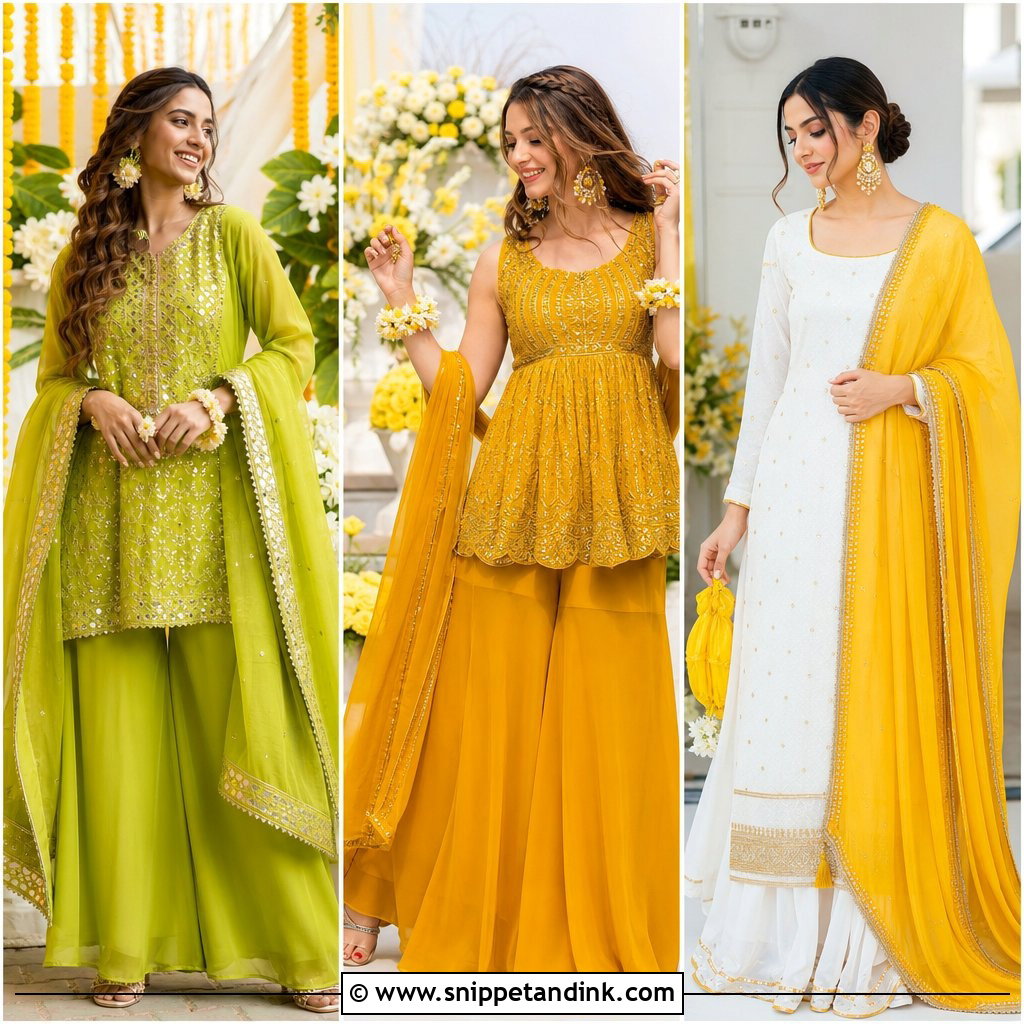
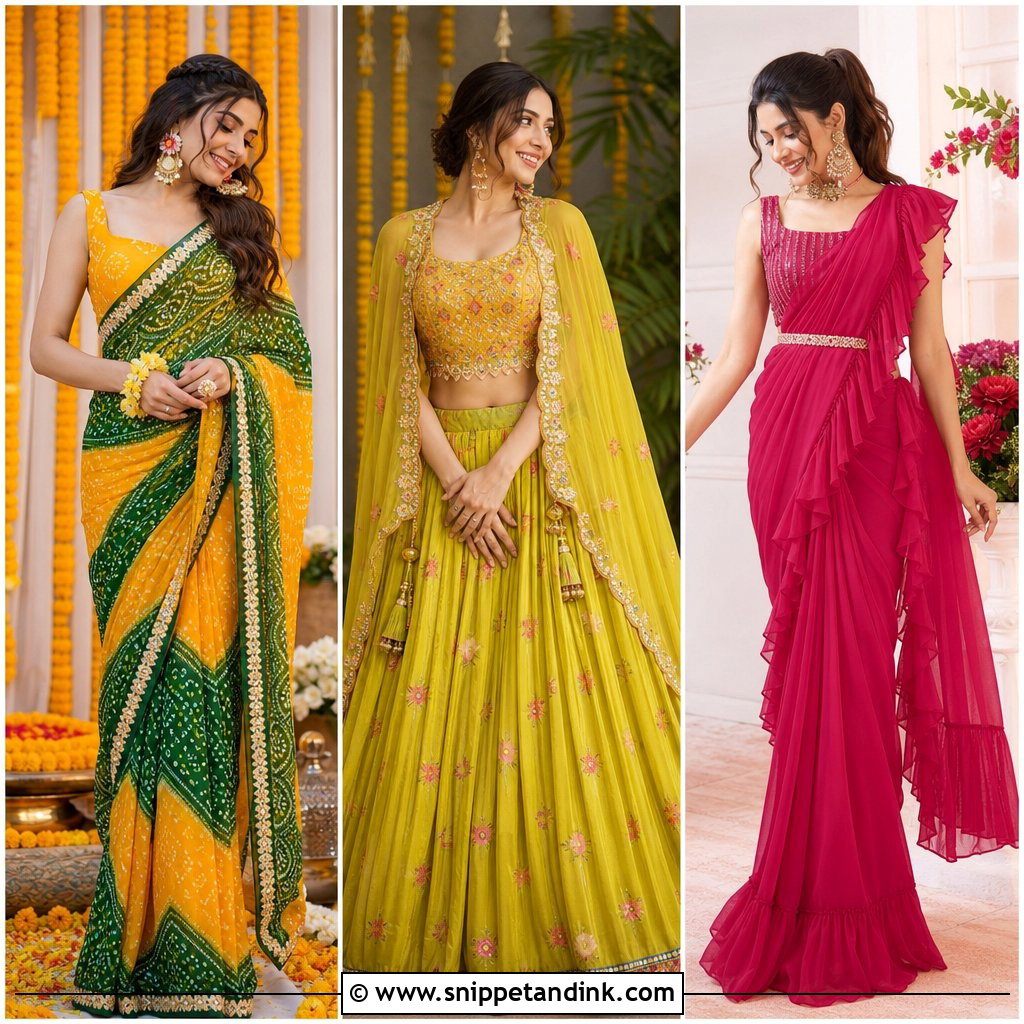
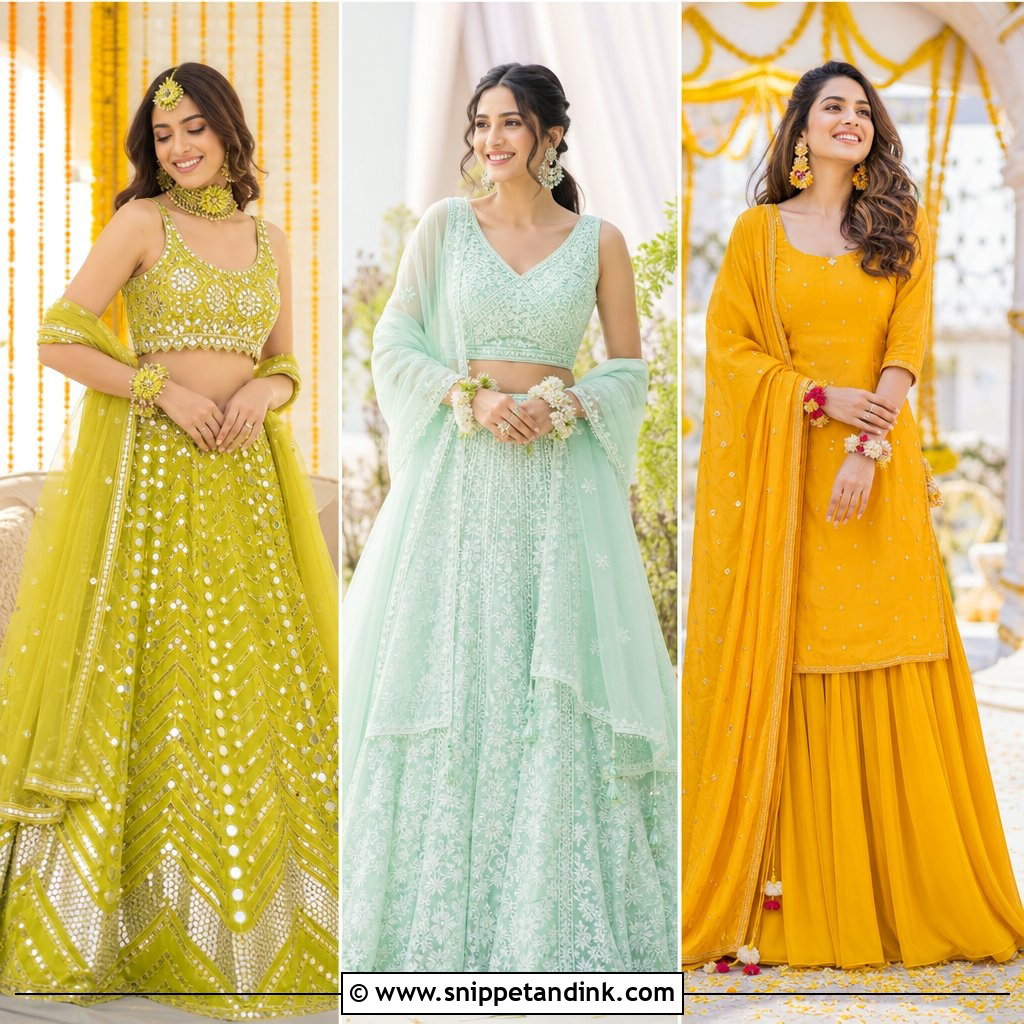
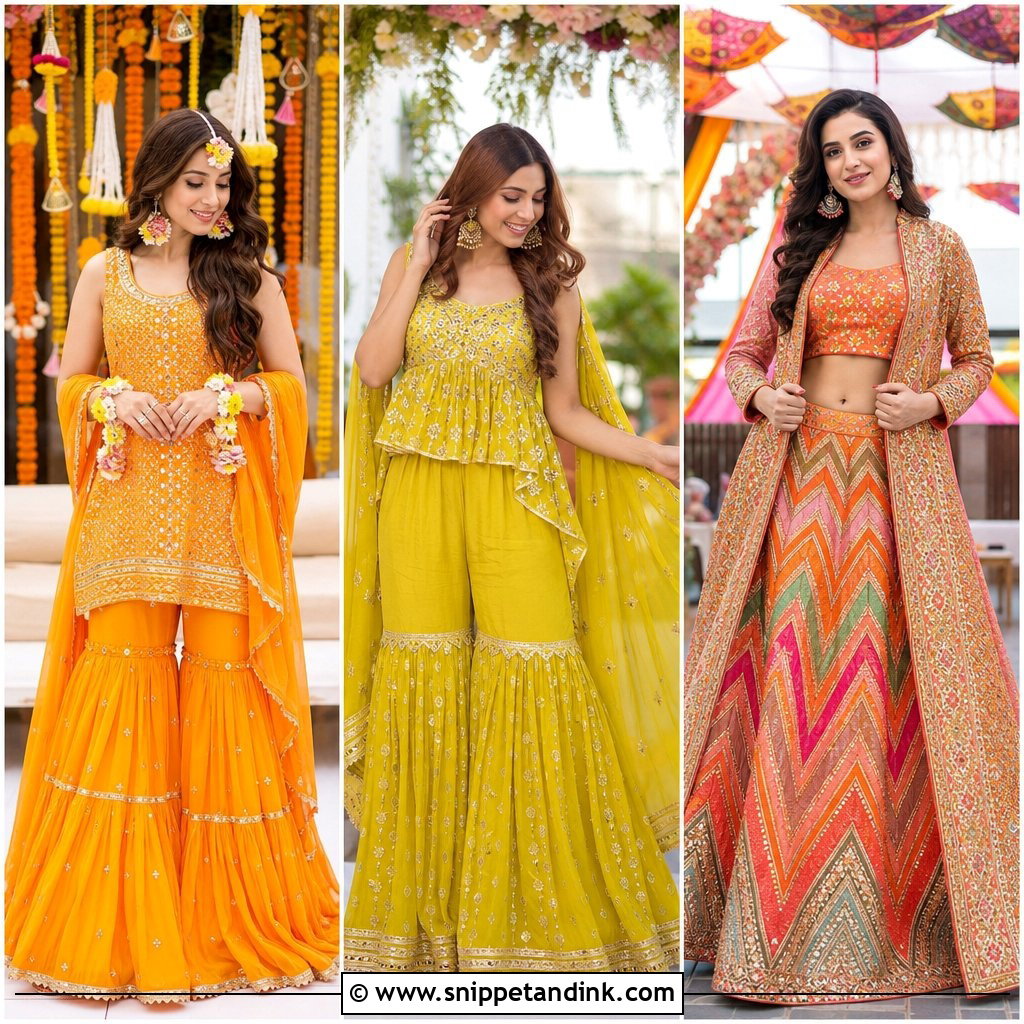
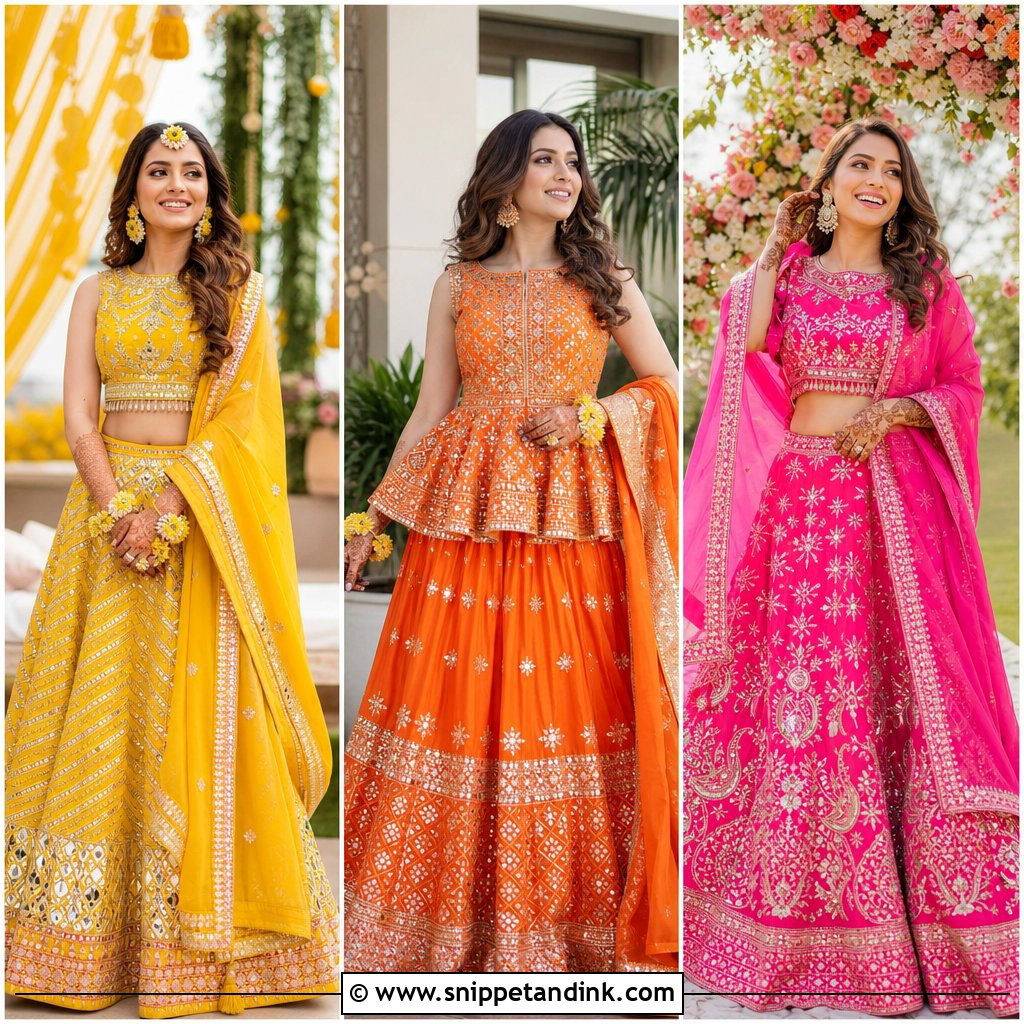
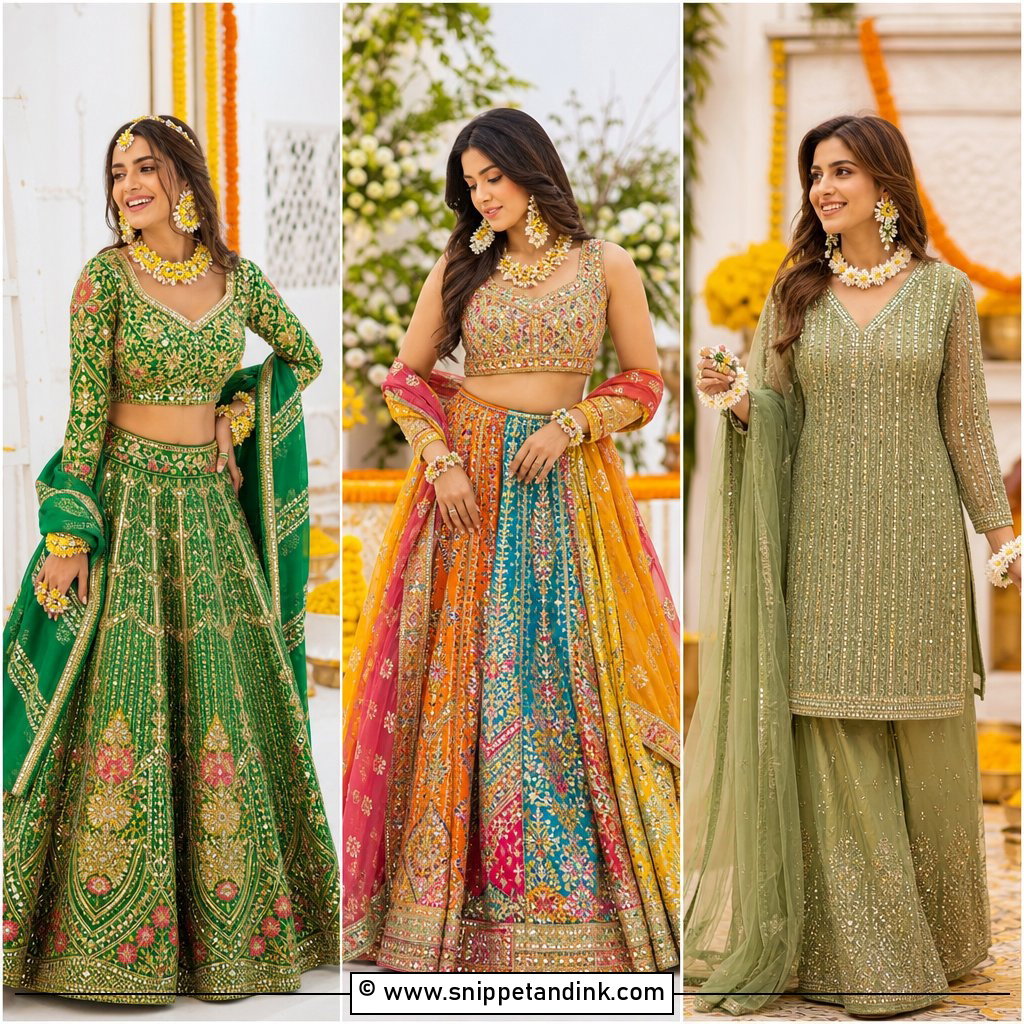
Yellow is the color most families expect at a daytime mehndi, and a short kurti over a flared sharara is the easiest way to wear it. Gota borders and small mirrors catch daylight without adding much weight. I always ask the tailor for generous flare from the knee down, because a narrow sharara rides up the moment you sit cross-legged on a gaddi. A green or pink dupatta gives the yellow some edge. Brides can take heavier neckline work; guests look better with less. If your hands are getting henna, pin the dupatta at the shoulder before the artist starts, since you won’t be able to fix it for an hour.
2. Green Mirror Work Suit for Mehndi
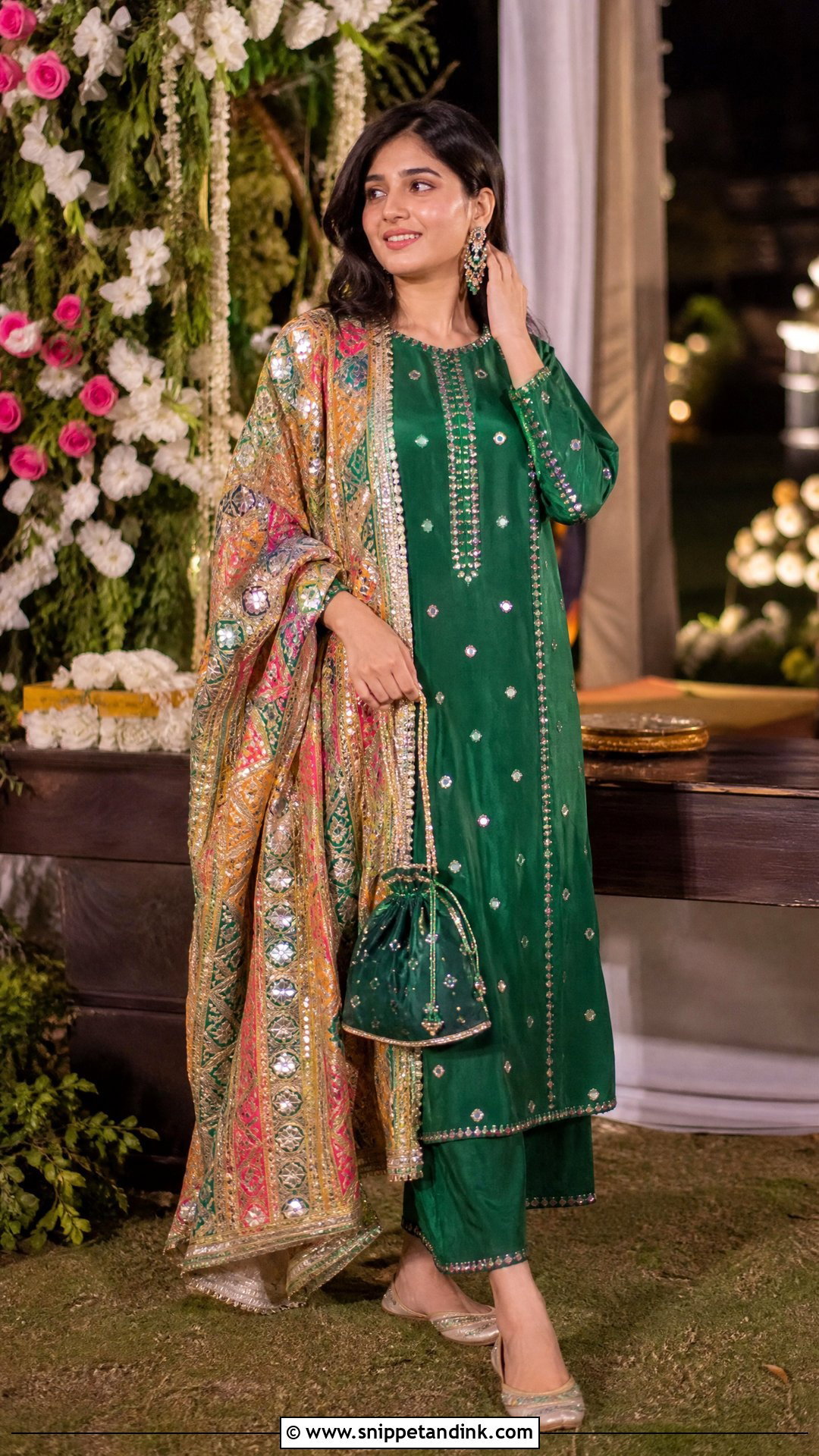
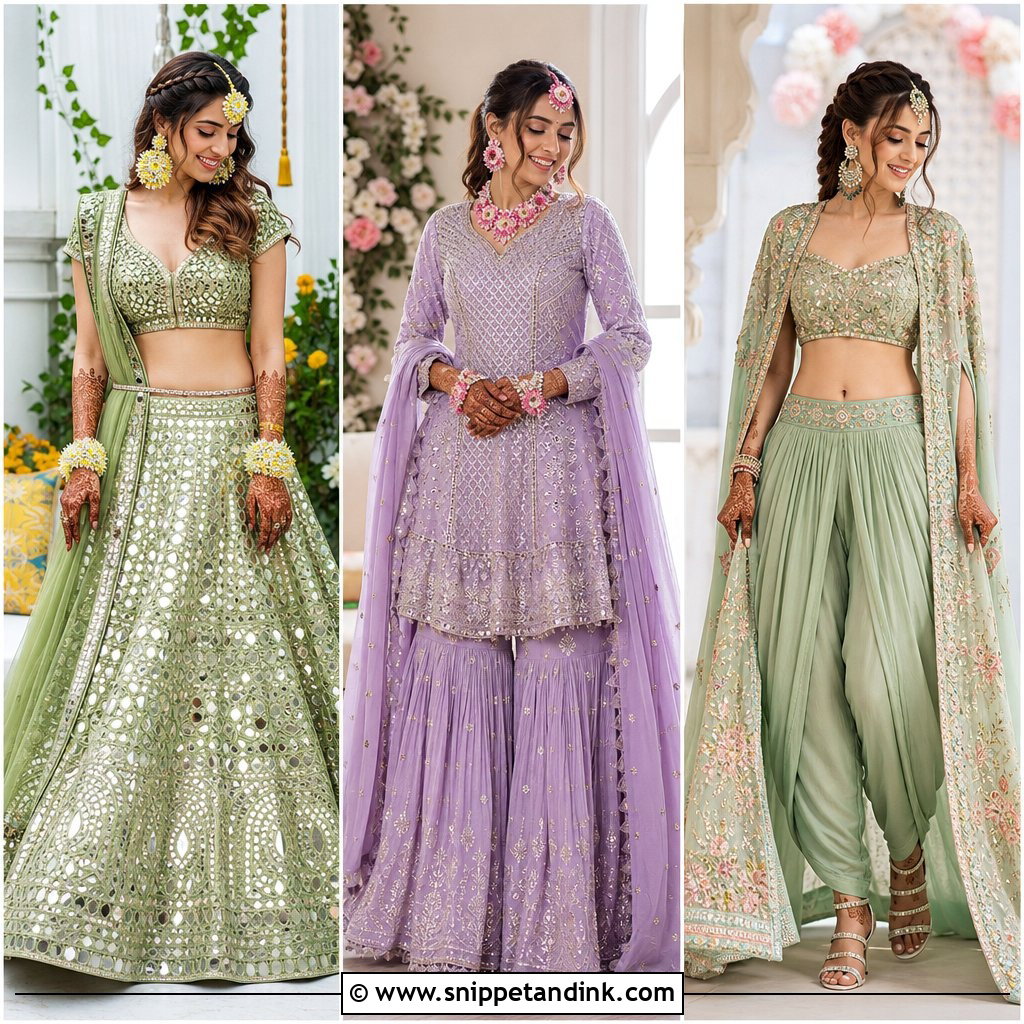
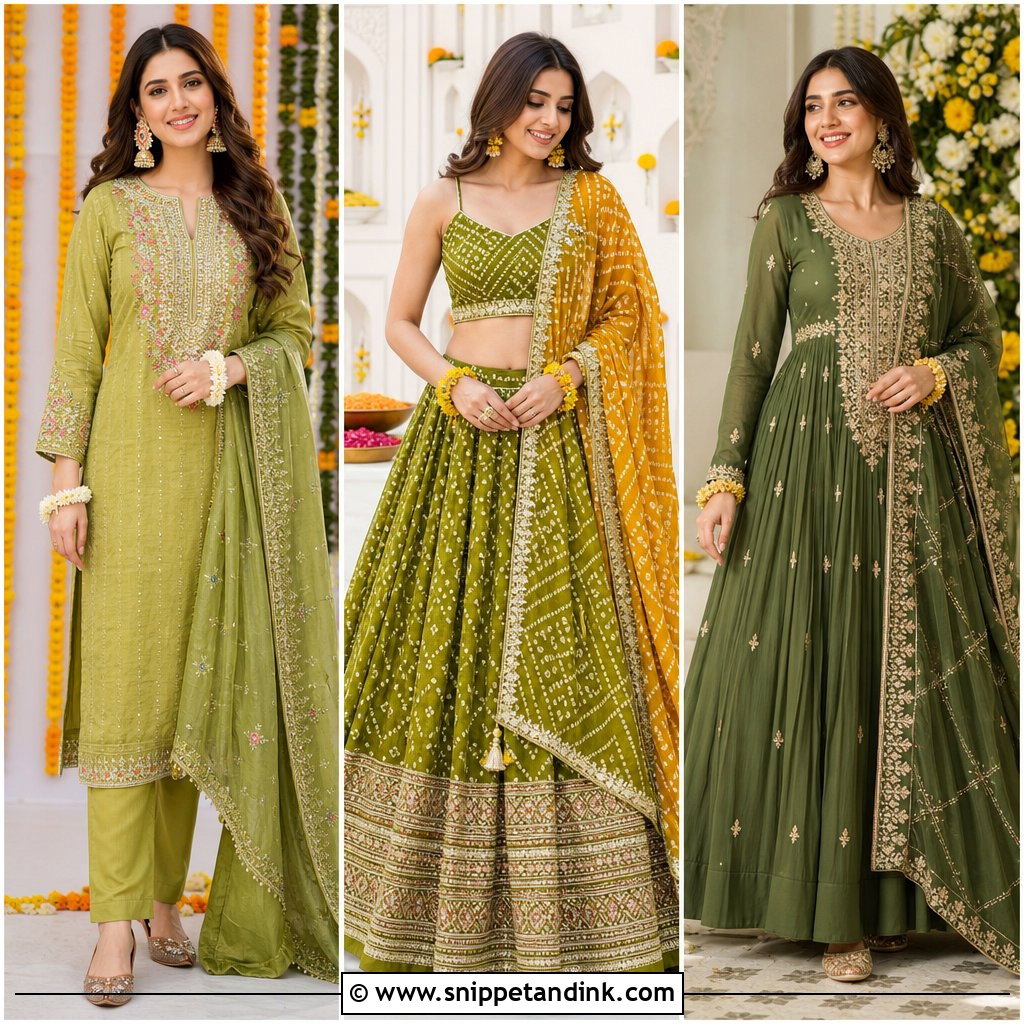
Rich green fabric and reflective mirror work is the classic mehndi pairing, and it earns its place: mirrors throw back fairy lights and diya flames in a way plain embroidery can’t. I’d keep the mirrors to the neckline, cuffs and hem. A kurta covered edge to edge gets heavy, and the stitched mirror backs can scratch the inner arm by the second hour. Emerald suits an evening function, while pistachio and parrot green read fresher in daylight. Matching trousers, a multicolor dupatta and a potli that hangs from the wrist keep your hands free. Keep the makeup soft so the mirrors carry the sparkle.
3. Floral Anarkali Suit for Mehndi
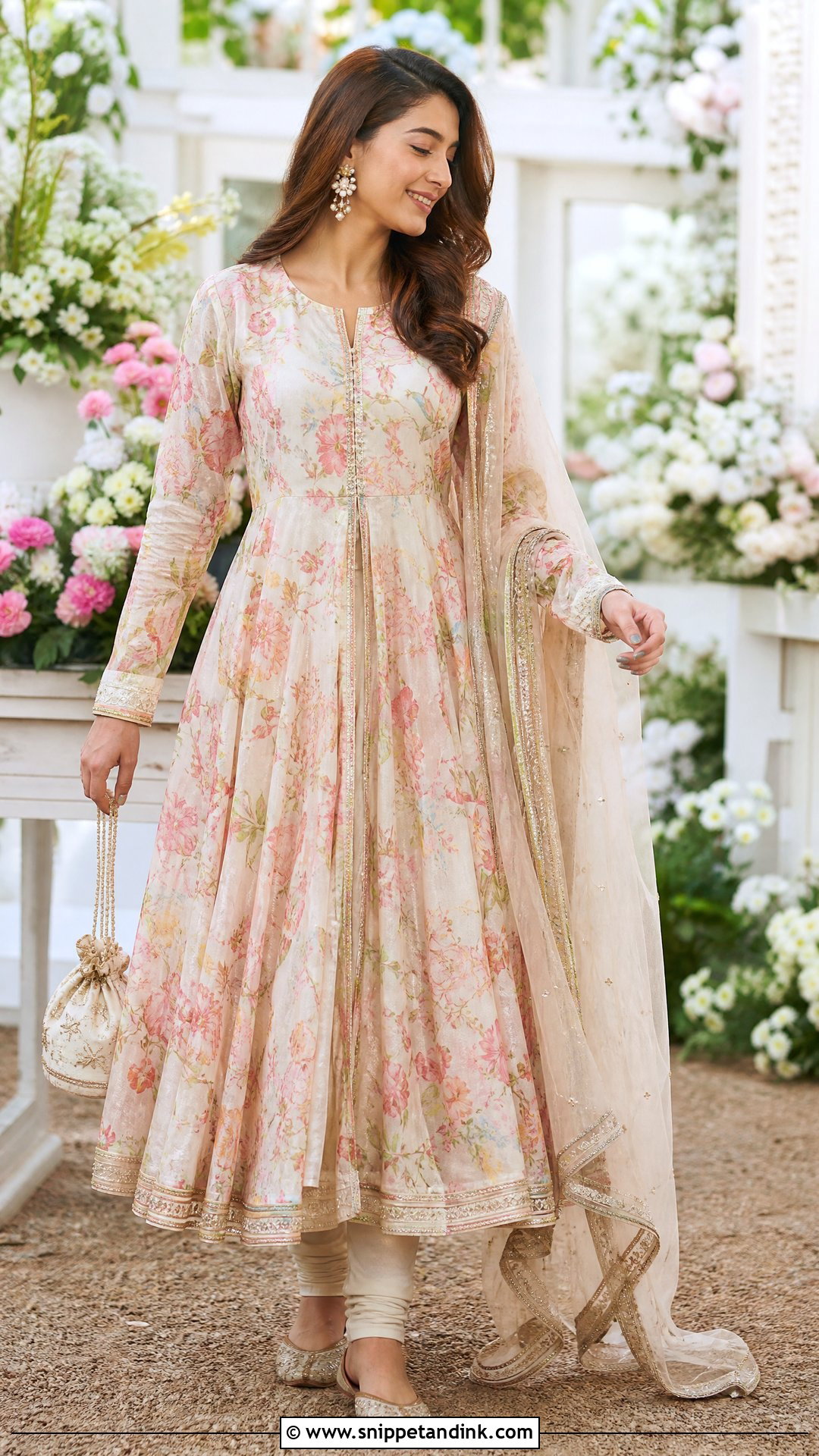
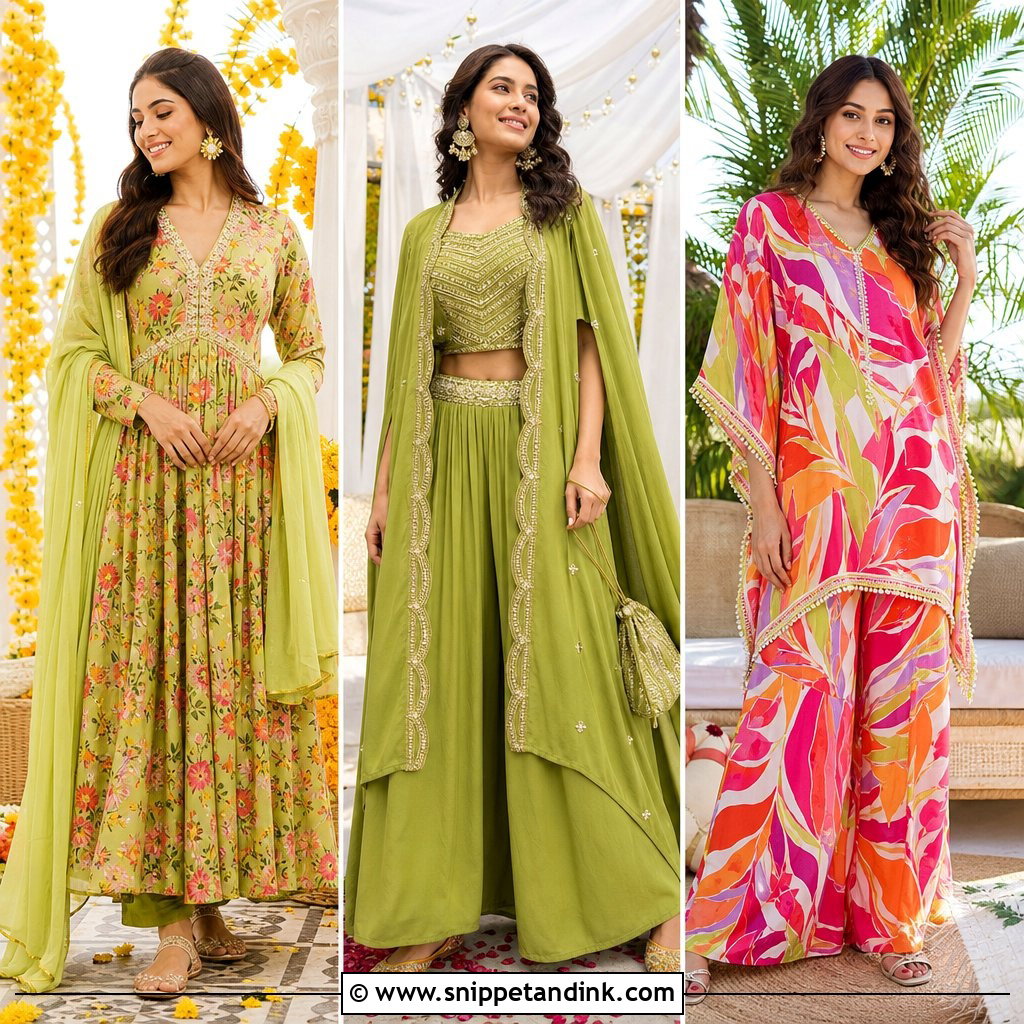
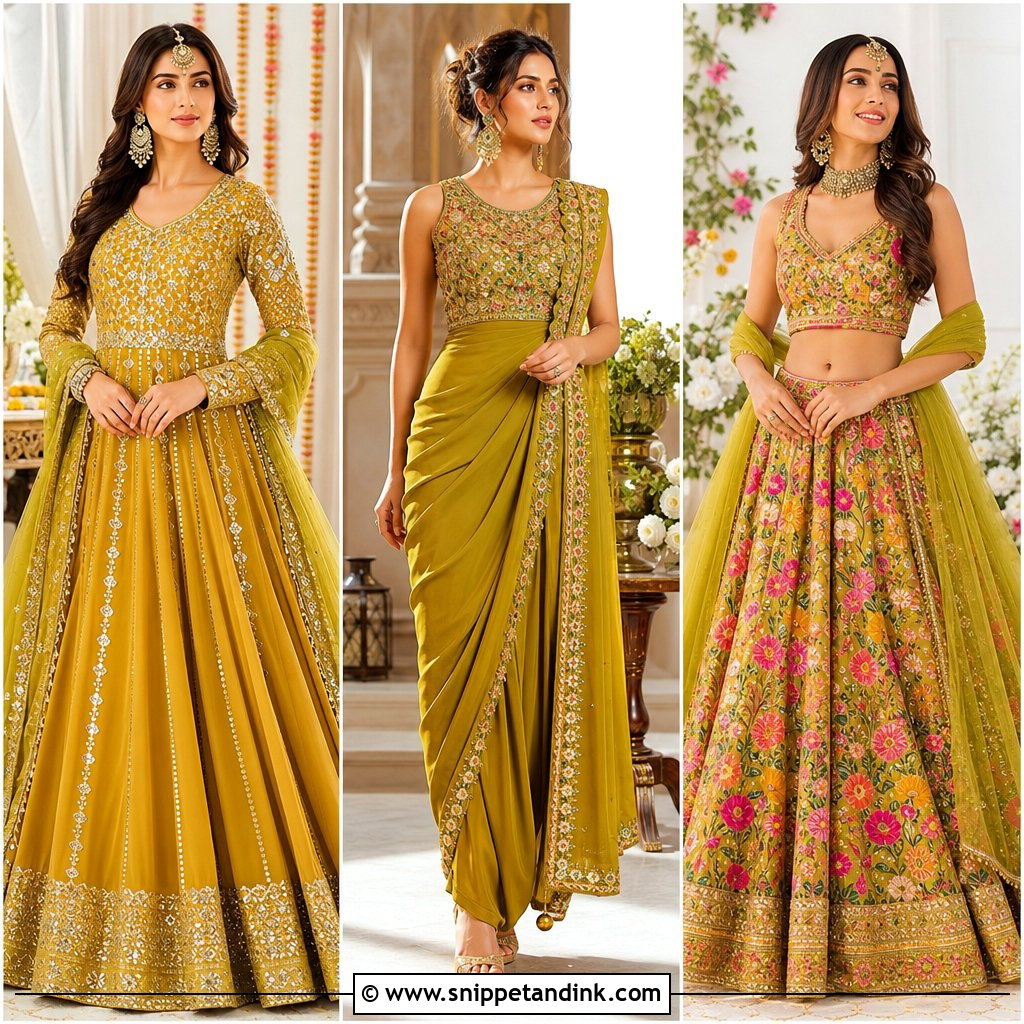
A printed Anarkali is the suit I reach for when the mehndi is outdoors in warm weather. Cotton-silk, georgette and chiffon all breathe, but look closely at the flare. Too little and the skirt clings as you cross the lawn; too much chiffon and it wraps around your legs in a breeze. Elbow sleeves are practical if your forearms aren’t being decorated. Pair it with a slim churidar and a sheer dupatta with a narrow border, and let bridesmaids each take a different floral colorway rather than identical prints. When the print is busy, I keep jewelry to pearl-and-floral earrings and leave the neck bare.
4. Pink Gharara Suit for Mehndi
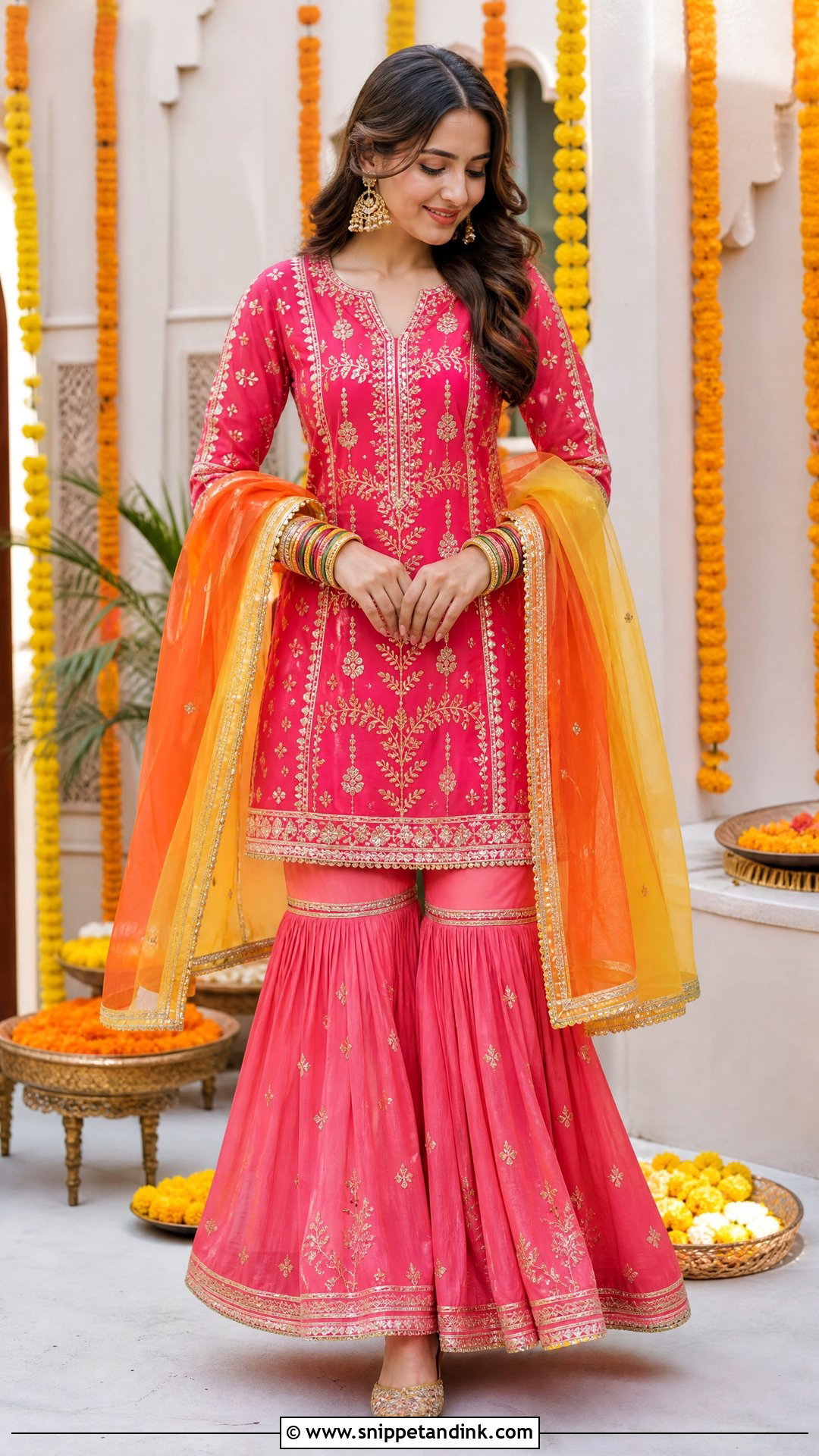
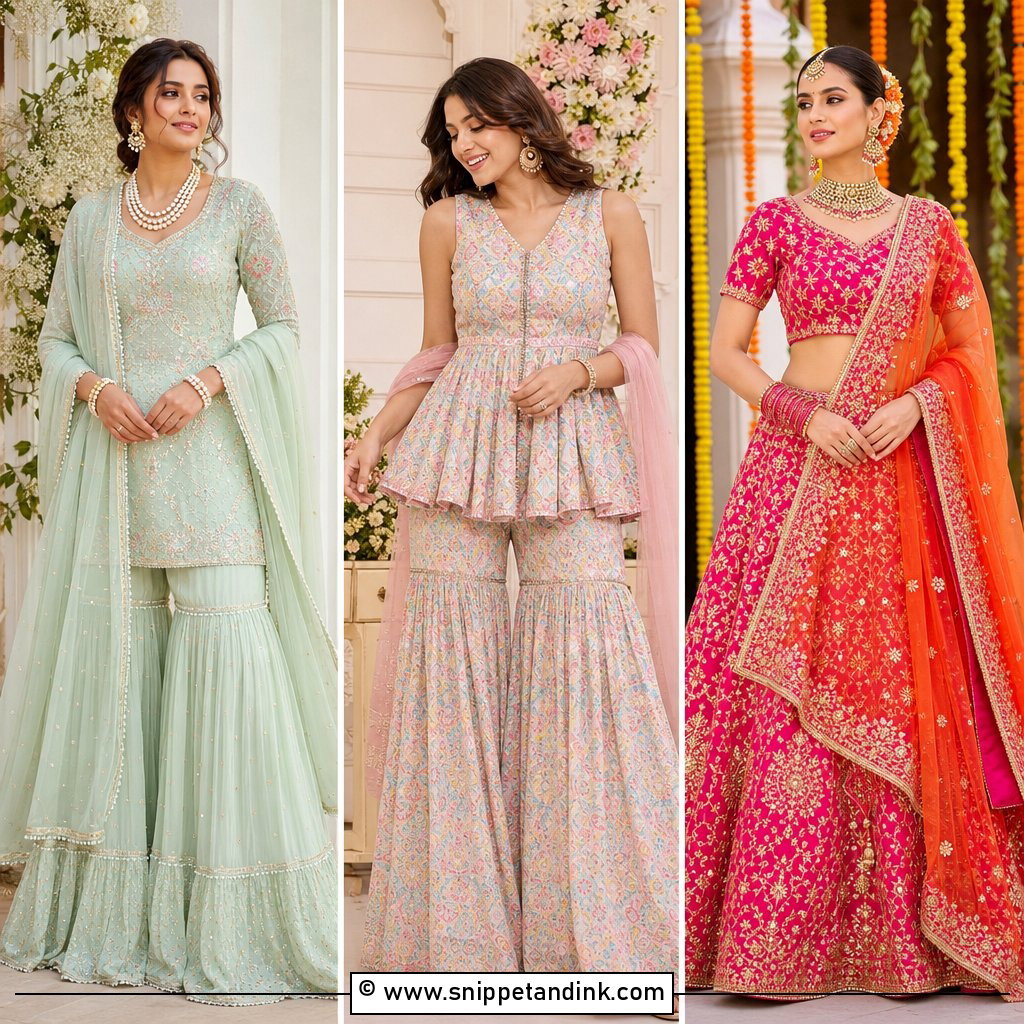
Pink is the easiest way to step away from green and yellow without looking off-theme. A gharara differs from a sharara in where the flare starts: it’s fitted to the knee, joined there, and then opens out, so you get drama below the knee with less fabric around the hips. That knee joint is where I check the fit hardest. Too high and the skirt looks short; too low and you can’t take a full stride. Fuchsia or rose with gota on the neckline, a yellow or orange organza dupatta and gold jhumkas are all it needs. Petite wearers do better with a slightly shorter kameez. Repeat the dupatta color once, in the shoes or the earrings, and stop there.
5. Mustard Palazzo Suit for Mehndi
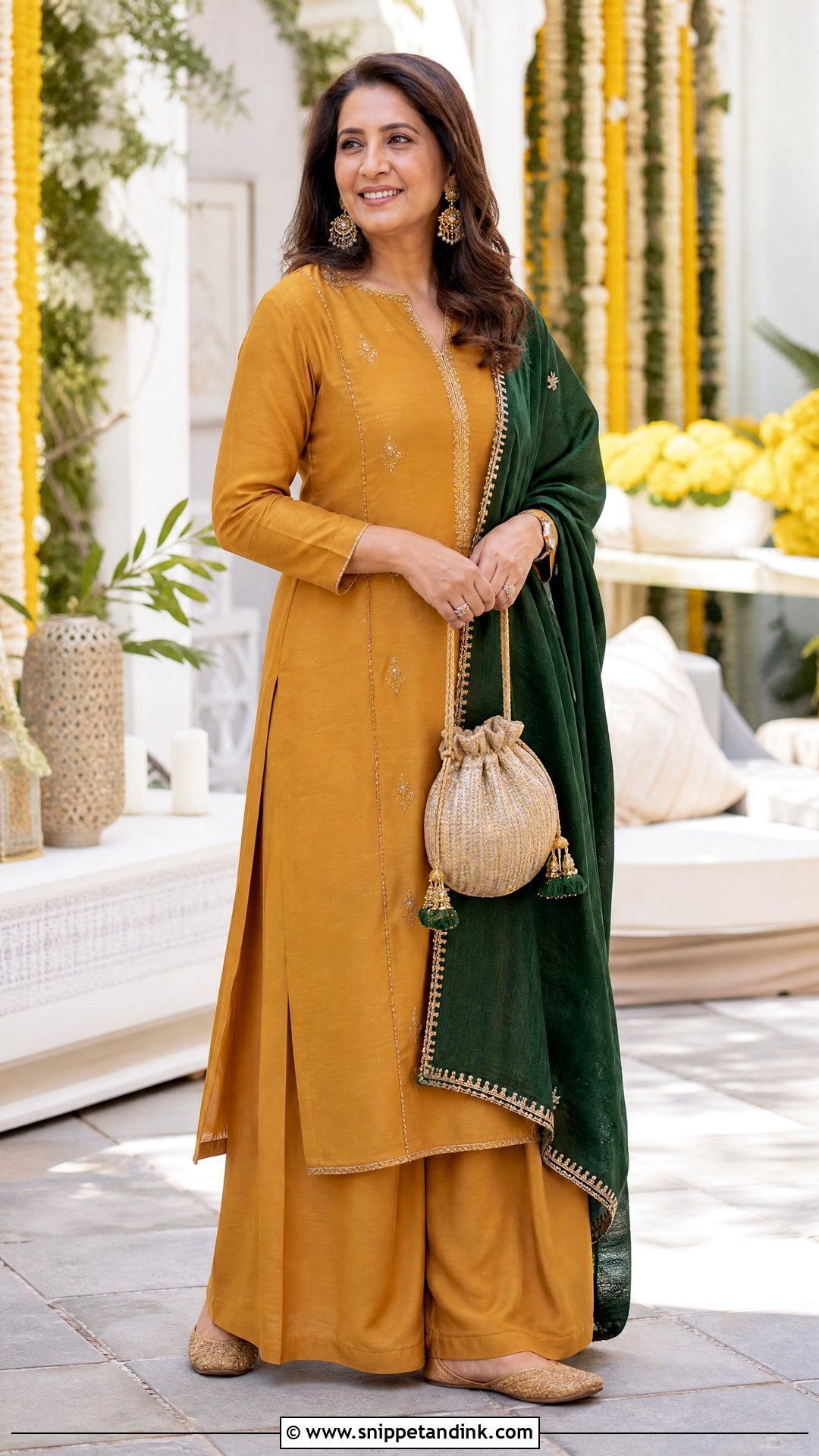
Mustard keeps you inside the traditional mehndi palette while looking a little more grown up than lemon yellow. A straight kurta with light zari or threadwork, wide palazzos and a rust or bottle-green dupatta give it depth, and antique gold with tan juttis sits well against the earthy tone. It’s the suit I most often suggest to mothers and aunts who want to look festive without competing with the bride. One fitting note matters more than the rest: hem the palazzo with the shoes you’ll actually wear, just clearing the floor. A palazzo that pools at the heel is easy to step on once the dancing starts.
6. Lime Green Peplum Sharara Suit
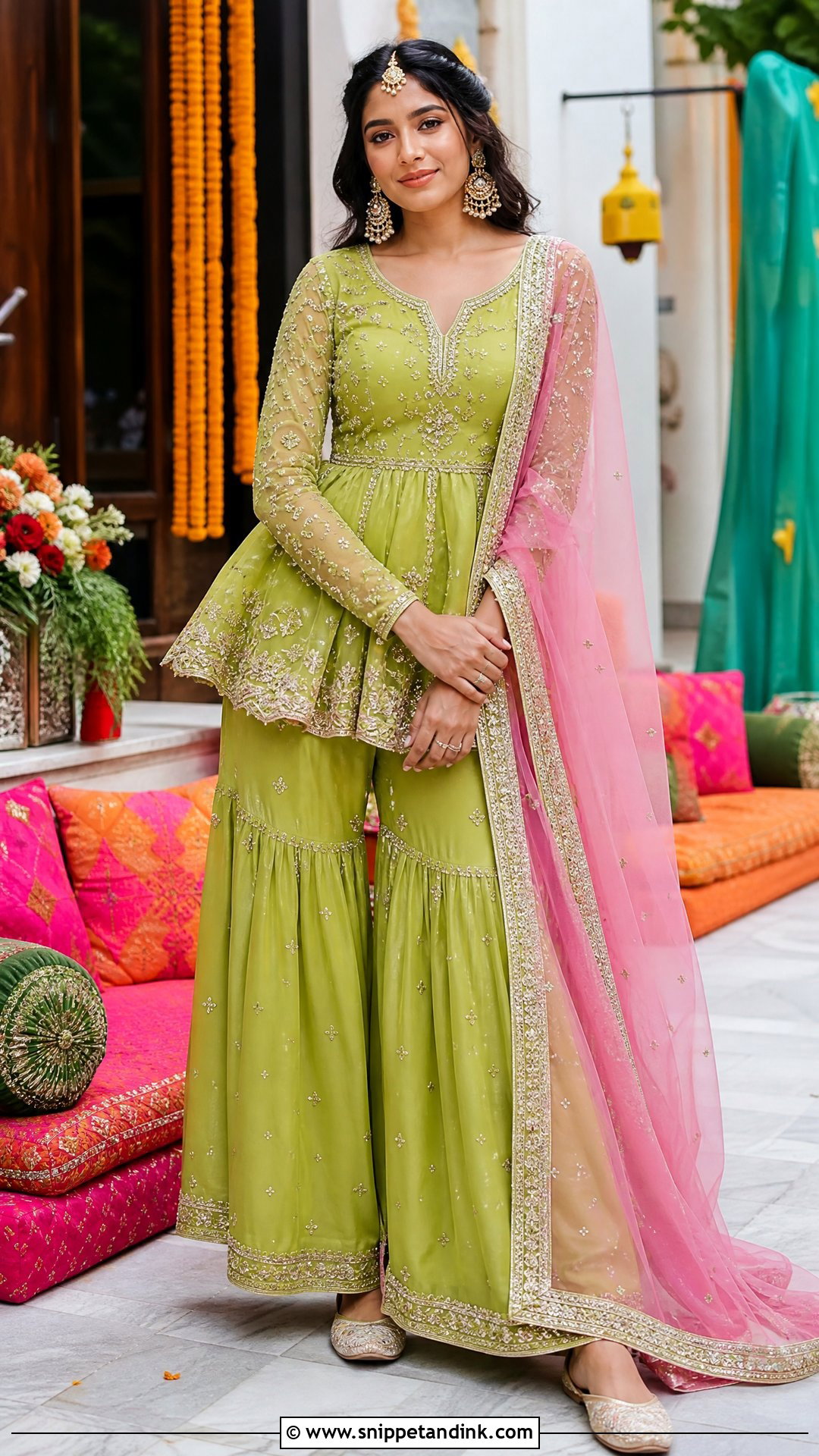
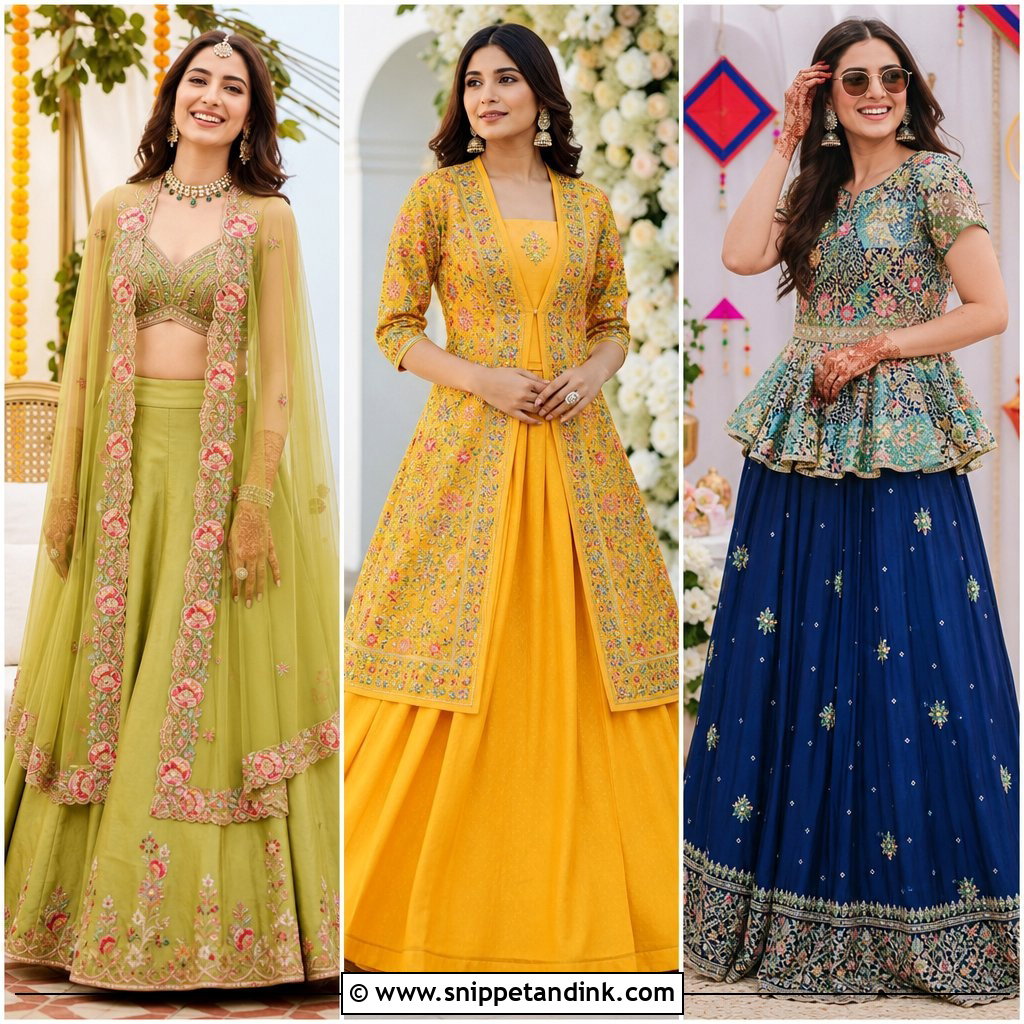
A peplum kurti over a sharara is young, light and very easy to dance in. Lime is loud on its own, so the embroidery should pull in other colors; pink, orange, turquoise, or gold accents stop it looking neon in photos. The peplum seam has to sit at your natural waist, because if it drops even an inch it shortens your legs. Drape a sheer dupatta over one shoulder and pin it so your hands stay free. Beaded juttis and a simple maang tikka finish it for close family. I give this one to bridesmaids performing in the choreographed dances, since nothing about it needs adjusting mid-routine.
7. Orange Angrakha Suit for Mehndi
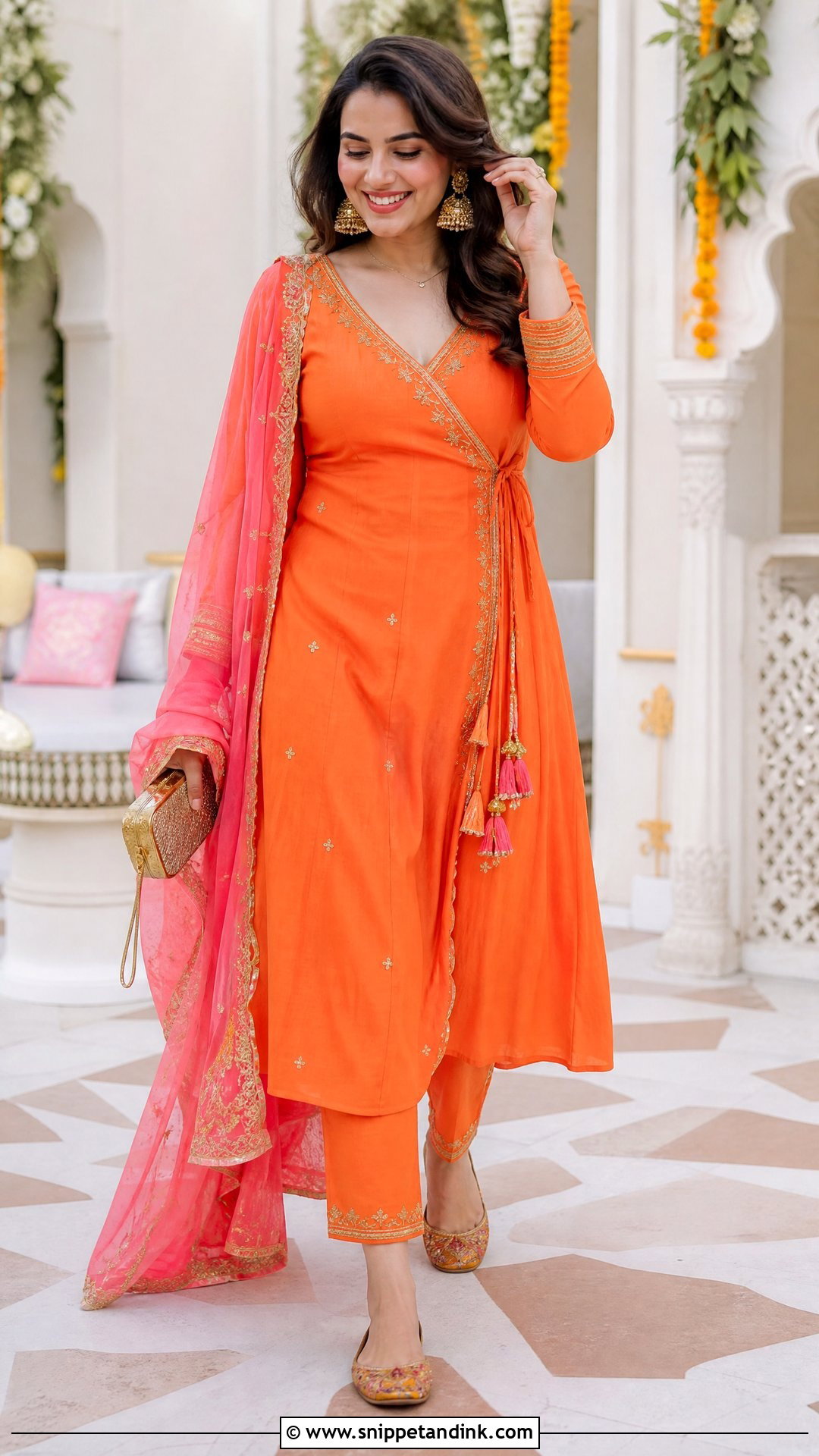
The Angrakha’s crossover bodice ties at the side, so it creates a waist on almost any figure. That crossover is also where things go wrong. On a fuller bust the overlap can gape when you lean forward or lift your arms to dance, so I ask for a stitched inner panel or a hidden hook under the tie. Choose a calf-length kurta with a gently flared hem, churidar or narrow trousers, and a pink or green dupatta so the orange stands out. Keep the tassels on the ties short. Long ones catch on chair arms and trail through wet henna.
8. White Suit With Phulkari Dupatta
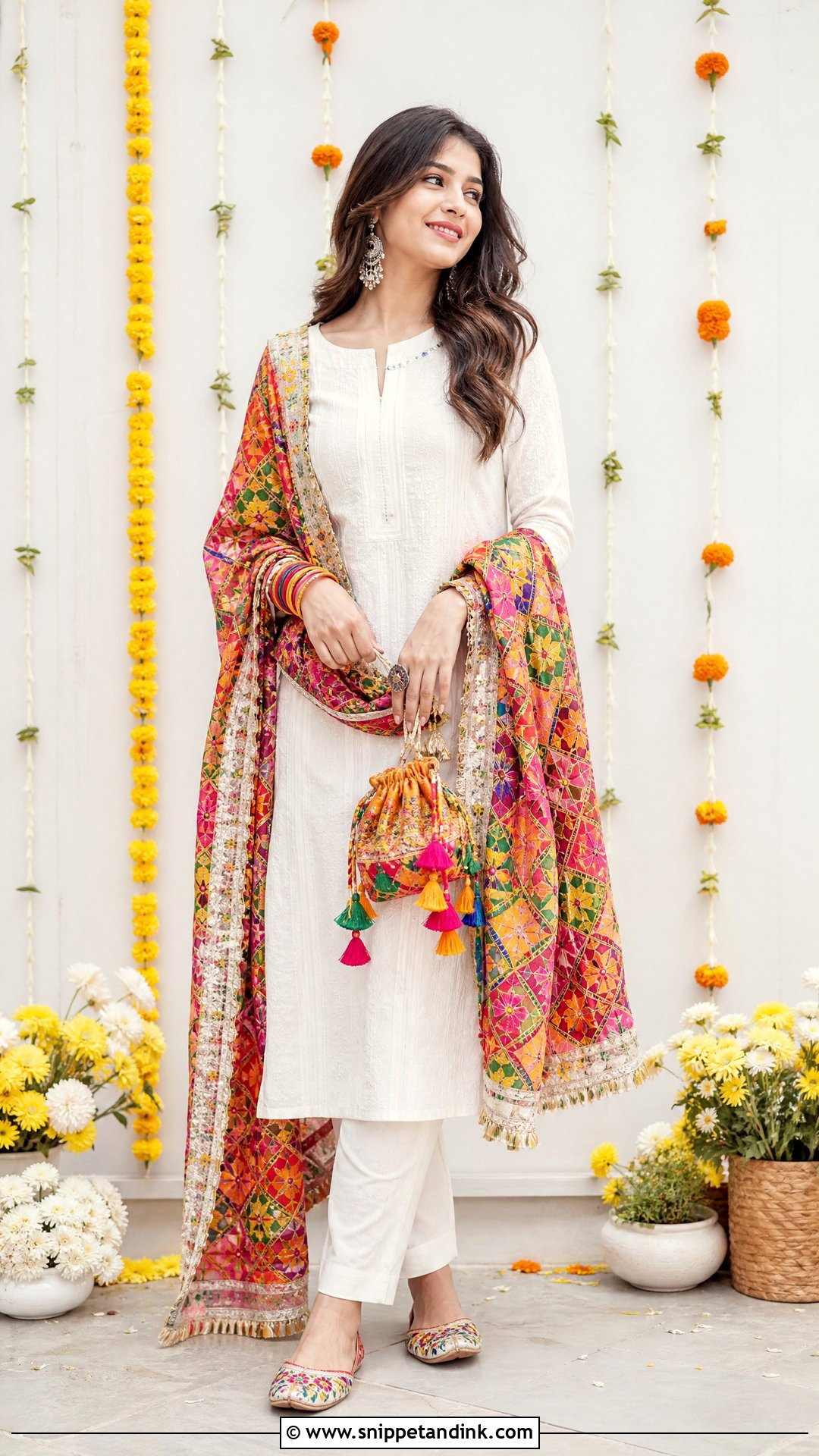
A plain white suit is really a frame for a Phulkari dupatta. The darning stitch in silk floss is what gives Phulkari its sheen, and a cotton-silk or chanderi kurta with very little embroidery lets that work show. Wear one end over the shoulder and let the rest fall open; wrapped around the arms, the motifs disappear. Colorful juttis and bangles can pick up shades from the threadwork. My caution with white: hold it up to daylight before you buy, because thin white chanderi can be see-through and only a full lining fixes that. Then keep it well away from anyone’s wet paste.
9. Turquoise Straight Suit for Mehndi
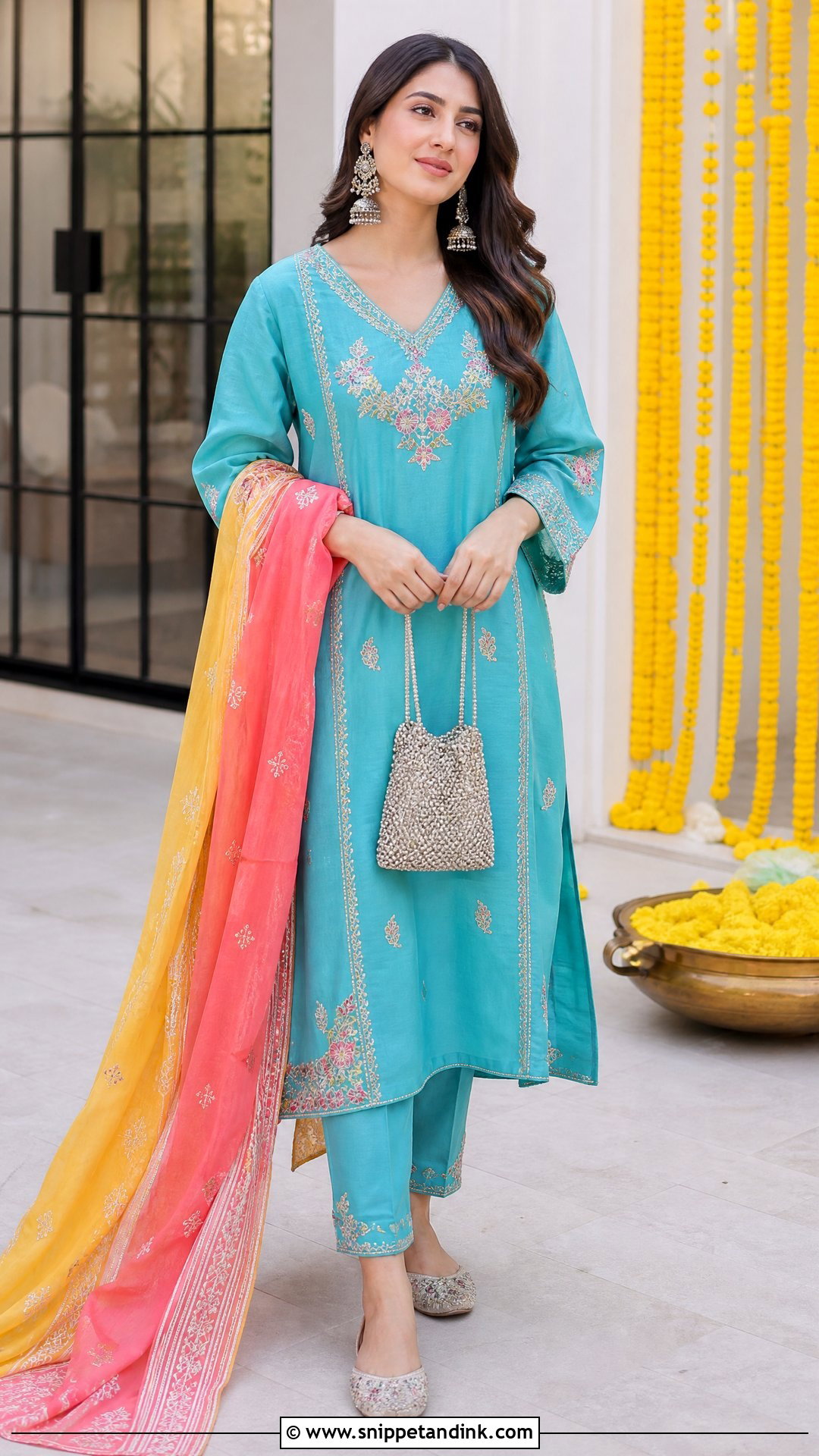
Turquoise is bright without belonging to the usual mehndi palette, which is exactly why it stands out in a courtyard full of yellow. A straight kurta with side slits and three-quarter sleeves over cigarette pants gives a narrow, modern line, and a coral or yellow dupatta warms it back up. This is the suit I suggest to guests who dislike volume. Sit down in the fitting room before you commit, though. Cigarette pants without some stretch pull tight across the knee on floor seating. A sleek braid or low bun finishes it cleanly.
10. Bandhani Suit for Mehndi
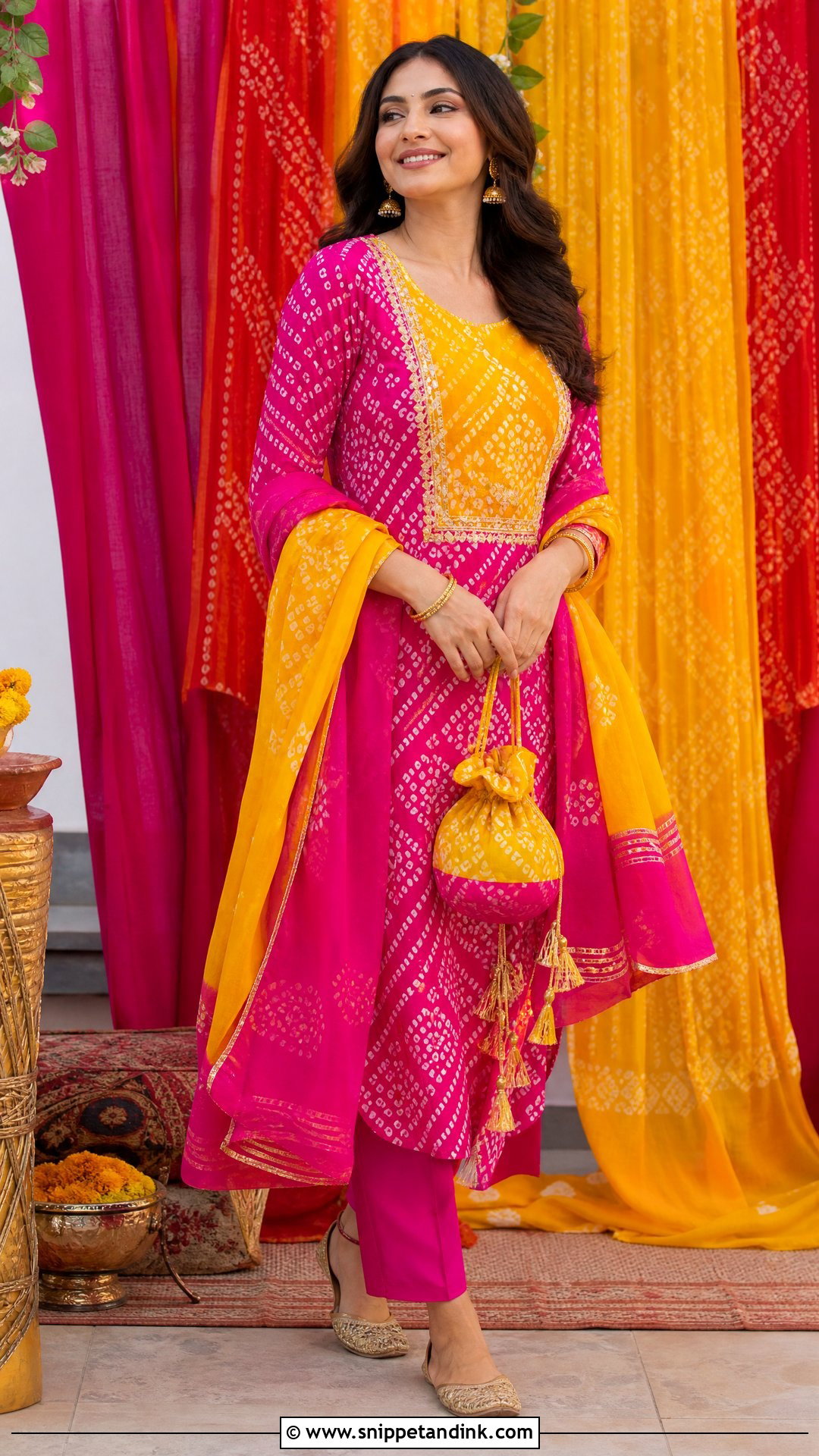
Colorful Bandhani patterns are made by tying tiny points of cloth before dyeing, so the texture is in the fabric before anyone adds embroidery. That’s why I keep the rest of a Bandhani suit plain: solid straight pants, and often a plain chiffon dupatta instead of a matching tie-dyed one. A kurta with princess seams gives shape, because loose Bandhani can look like a sack. Small gold jhumkas, thin bangles and a tasseled potli are plenty. Hand-dyed Bandhani can also bleed when wet, so don’t let a spilled drink sit on it next to a light dupatta.
11. Pastel Green Organza Suit for Mehndi
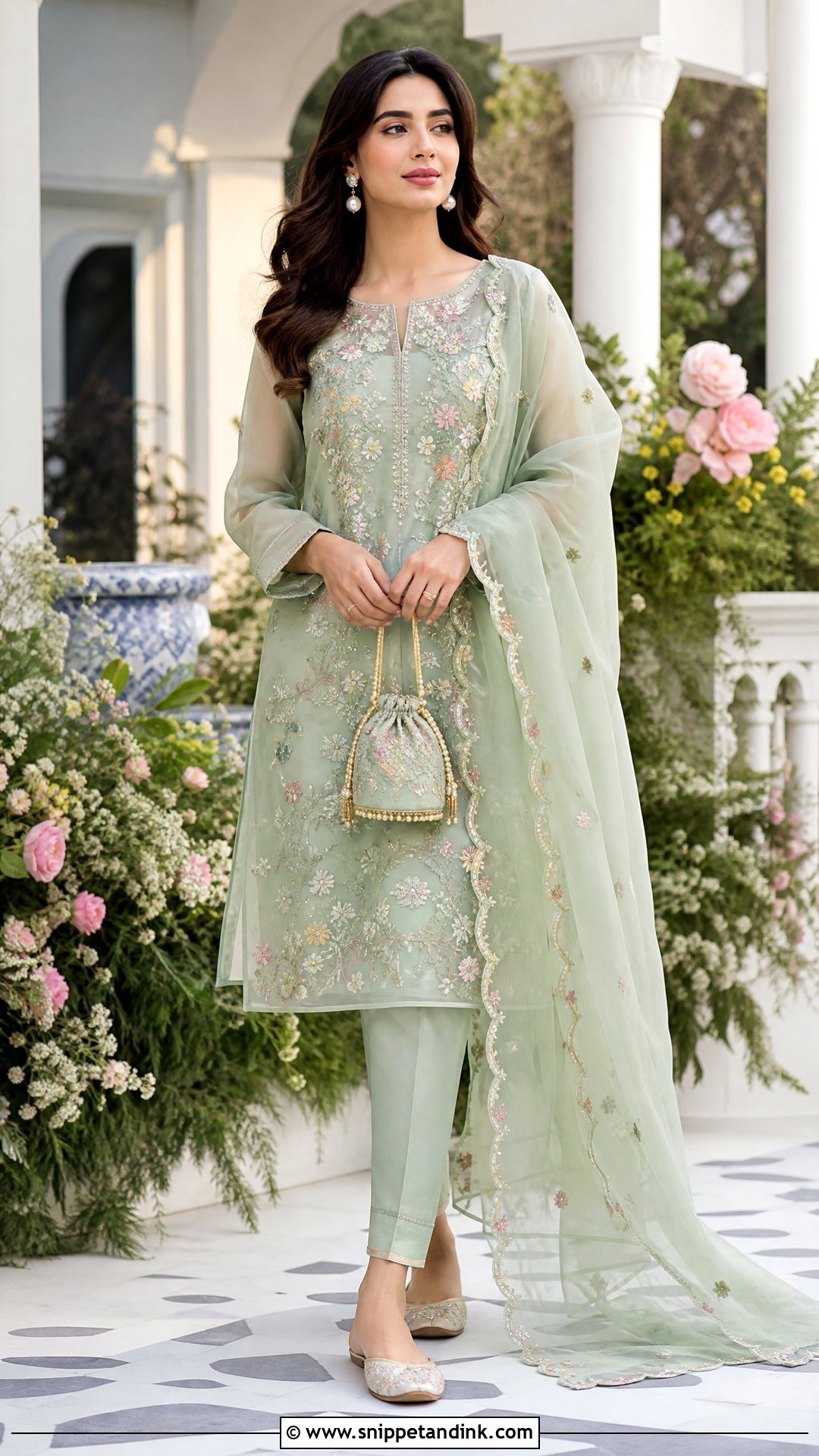
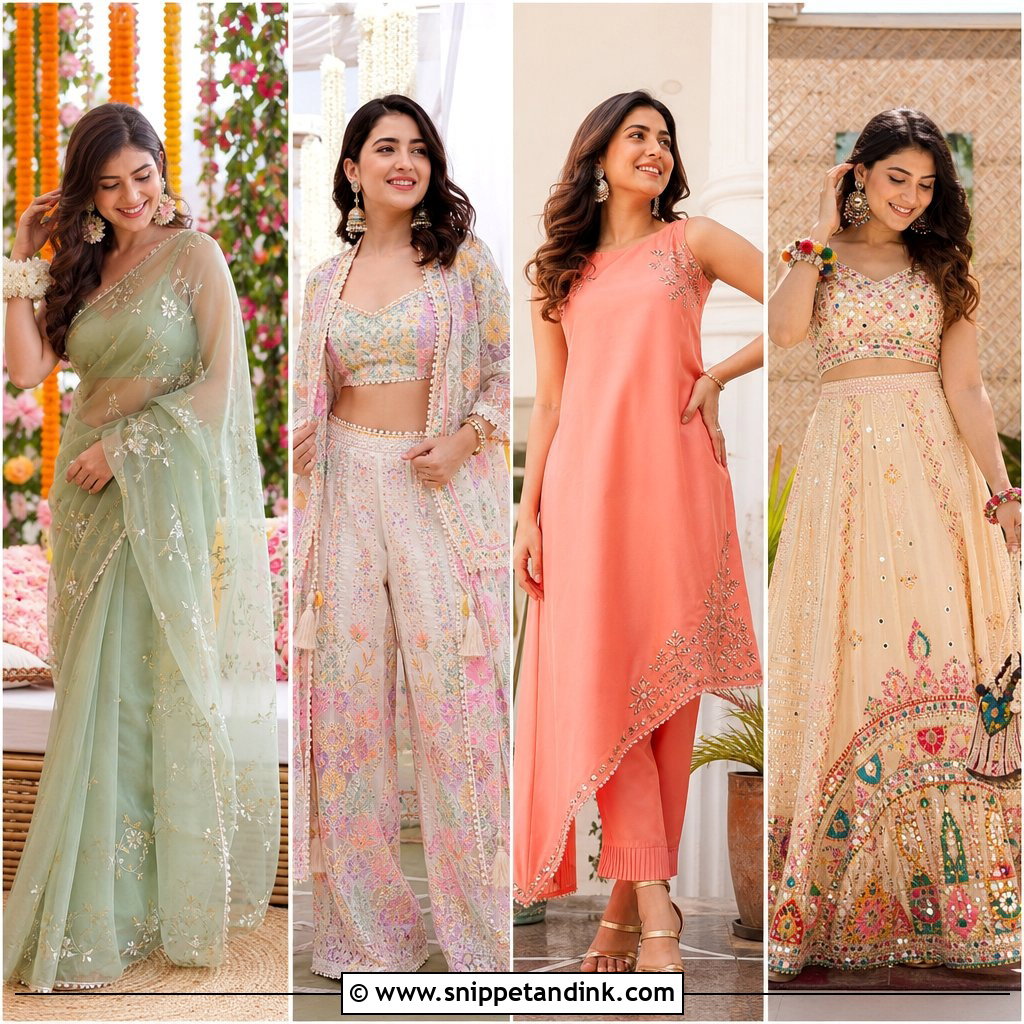
Organza holds its shape, which is what gives a pastel green suit that crisp, airy look in a garden. It’s also unforgiving. The fabric is stiff, so a tight armhole will rub within the first hour, and I check two things at every organza fitting: armhole comfort, and whether the kurta is lined with something soft like cotton or crepe. Delicate floral embroidery, scalloped edges, slim straight pants and pearl earrings keep the look quiet, while pink or lavender accents warm the pale green. Organza dupattas slide off the shoulder constantly. Pin it at two points, not one.
12. Coral Embroidered Pant Suit for Mehndi
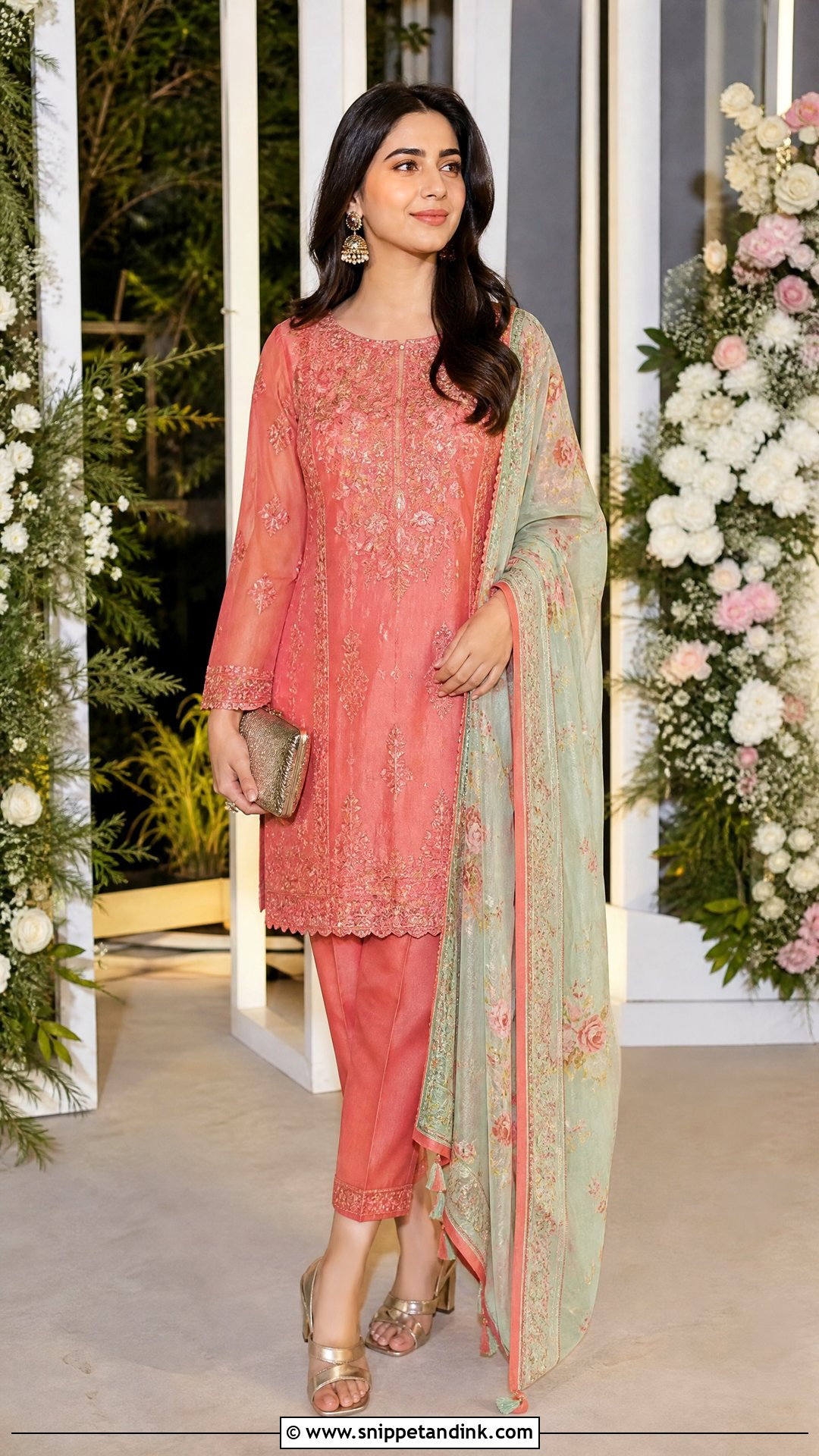
Coral sits between pink and orange, which is why it suits so many skin tones. A knee-length kurta with tonal thread embroidery and a scattering of sequins, tailored ankle-length pants and a mint or ivory dupatta make a neat evening outfit for a guest. Choose shoes for the floor you’ll stand on: block heels in a hall, flat juttis on grass. I’d leave the cuff bracelet at home if you’re getting henna. And run a hand down the inside of the sleeve before buying, since sequins stitched onto a stiff backing scratch the forearm all evening.
13. Multicolor Patiala Suit for Mehndi
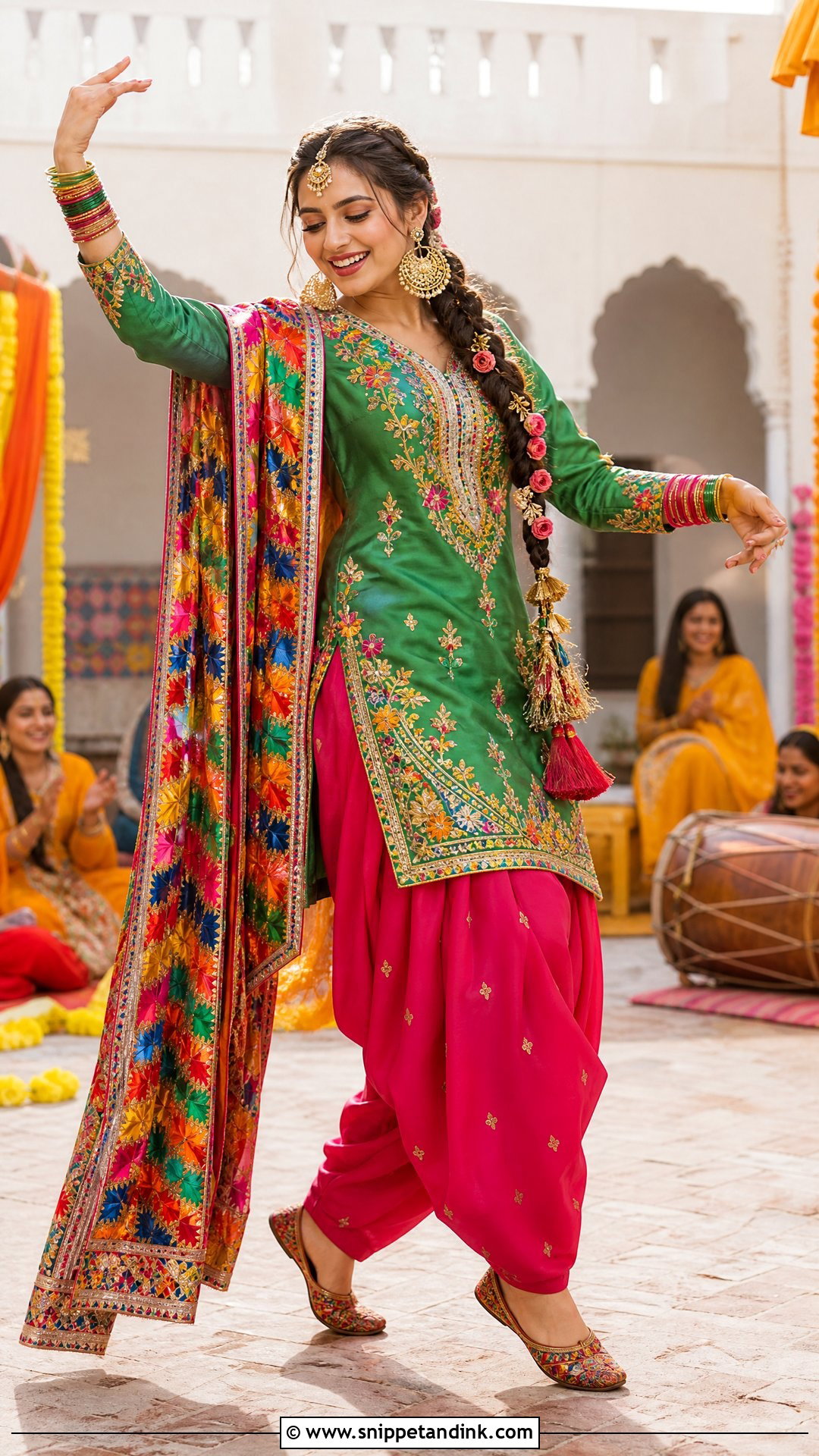
A Patiala suit carries more fabric in the salwar than almost any other bottom, pleated at the waist so it falls in heavy folds to a gathered ankle. That fullness is what makes it so good for bhangra and giddha. Start with a short kameez with colorful borders, add a contrasting salwar, and let a Phulkari or printed dupatta tie the shades together. Punjabi juttis, statement earrings and a paranda in the braid finish it. Because the salwar is so full, the kameez has to fit closely at the shoulders, or the whole outfit looks borrowed from someone bigger.
14. Blue Jacket Suit for Mehndi
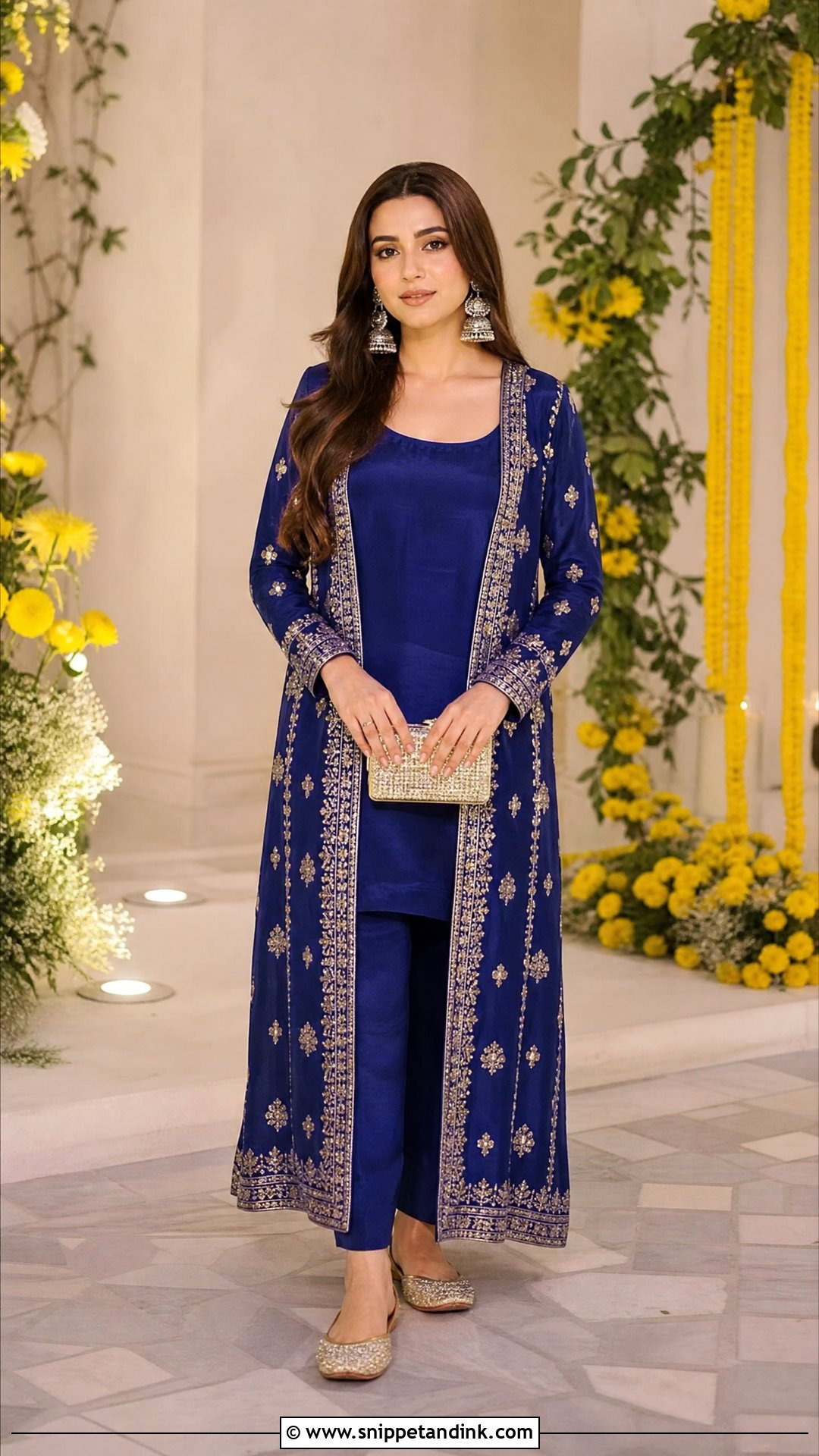
A jacket suit is my answer for anyone who hates managing a dupatta. A sleeveless or short-sleeved kurta and straight pants, with an open embroidered jacket on top, give you structure and a festive layer that stays put. Cobalt and peacock blue take lime, yellow and pink threadwork well, and a knee-length jacket draws a long line. For a henna session, the sleeveless layer underneath is ideal: slip the jacket off while the paste dries and put it back on once it has set. If the jacket is heavily worked, keep everything under it plain.
15. Magenta Dhoti Pant Suit for Mehndi
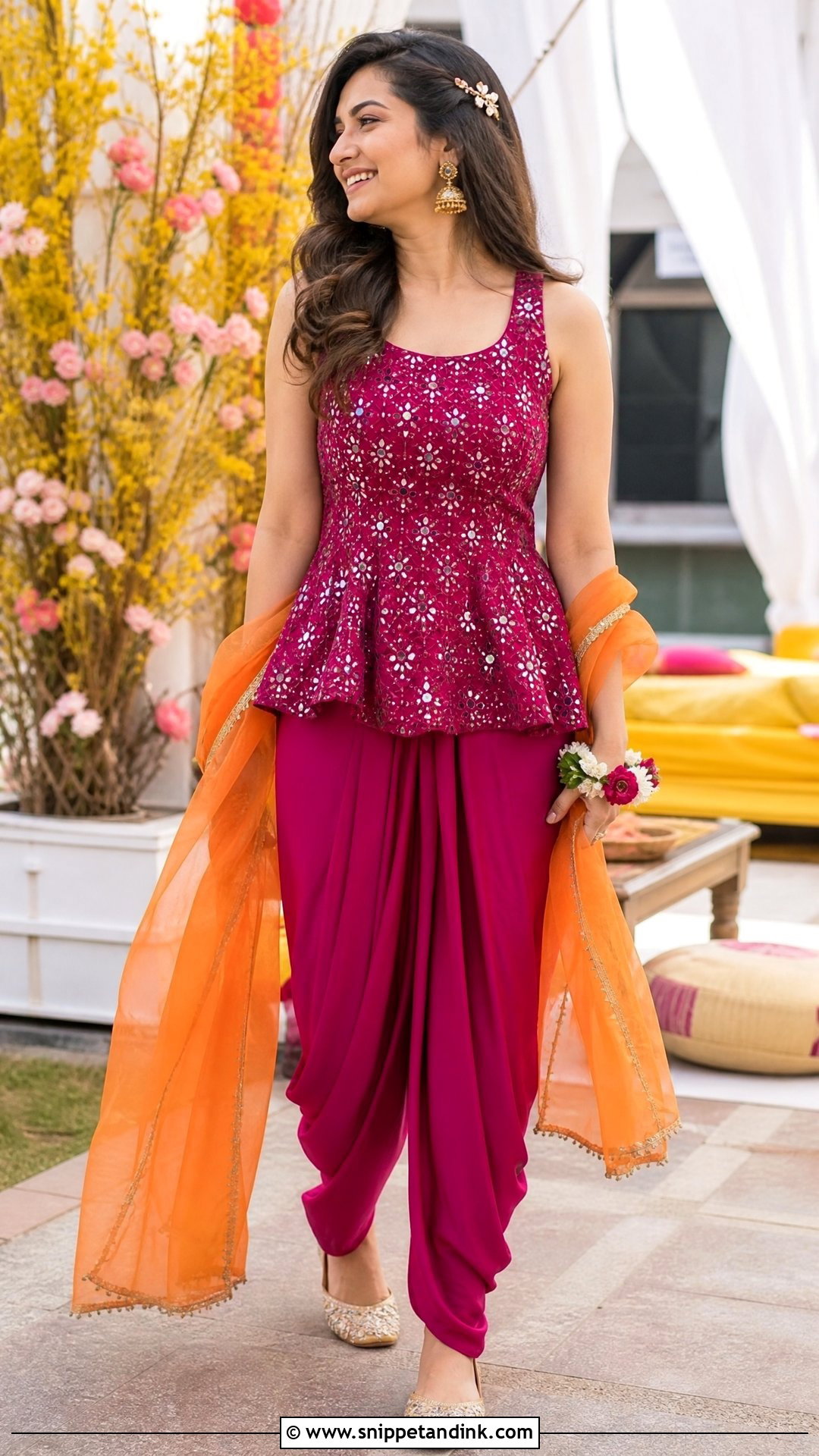
Dhoti pants are draped volume gathered into a fitted waistband, so whatever goes on top must be short and close to the body. A fitted magenta kurta or peplum with small mirrors or gota does that job. Check the waistband carefully at the fitting; dhoti pants carry their weight at the waist, and a loose band slips while you dance. Add a yellow or orange dupatta over one shoulder, or a cape-style drape if you’d rather not hold anything, with embellished flats and a hair accessory. Younger guests and bridesmaids who are tired of standard trouser suits tend to love this one.
16. Ivory Cape Suit for Mehndi
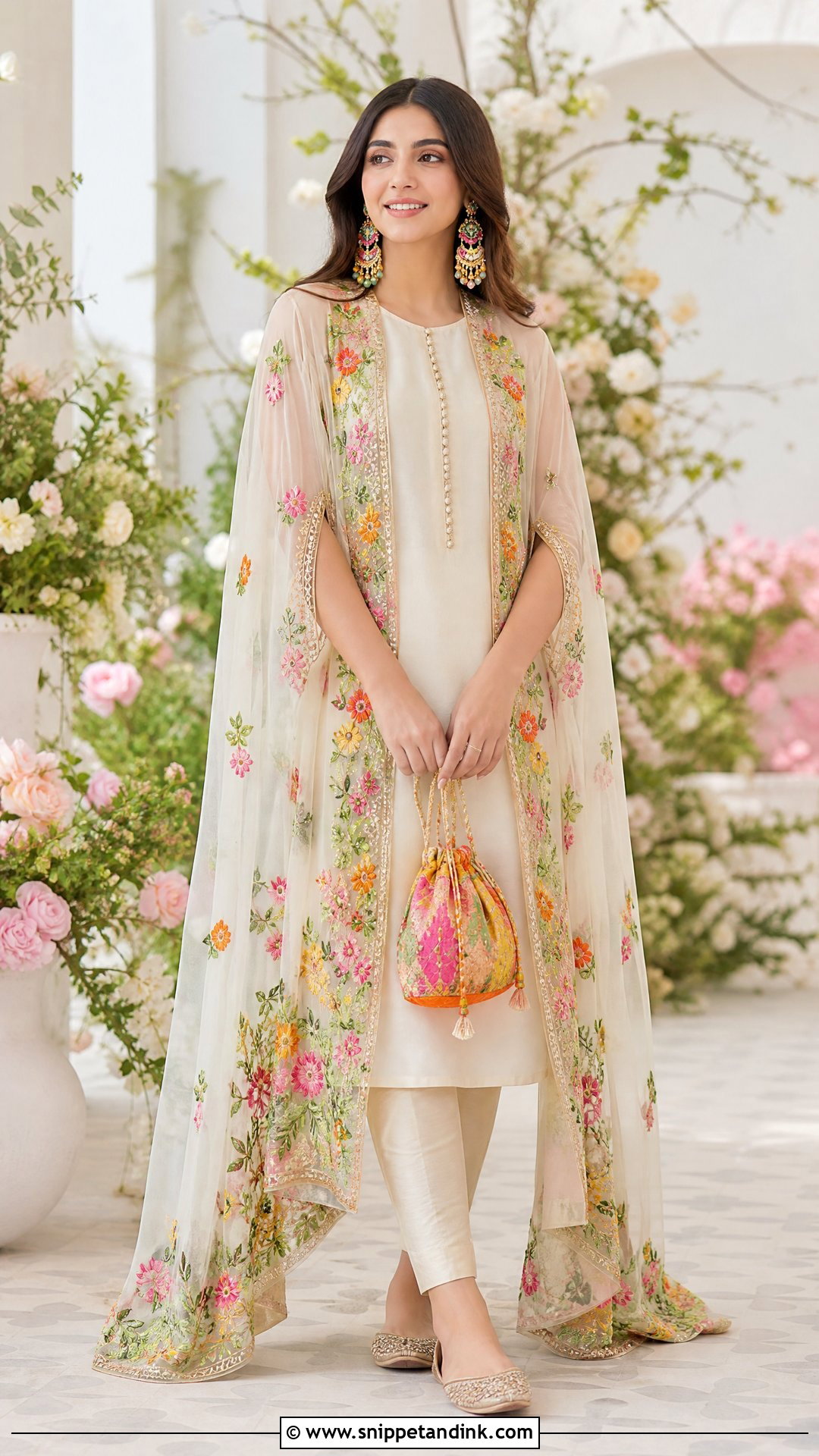
An ivory cape suit is a neutral base that lets colorful accessories do the festive work. A sleeveless straight kurta and narrow pants under a sheer cape embroidered with green, yellow, pink and orange flowers gives coverage and movement without a dupatta to manage. I’d stop the cape around the knee so the trousers still show. Two cautions, though. Make sure the ivory is fully lined, and check with the family that it won’t read as too bridal, since some households prefer guests stay out of pale shades near the bride. Bridesmaids can match their accessories to the wedding palette.
17. Purple Palazzo Suit for Mehndi
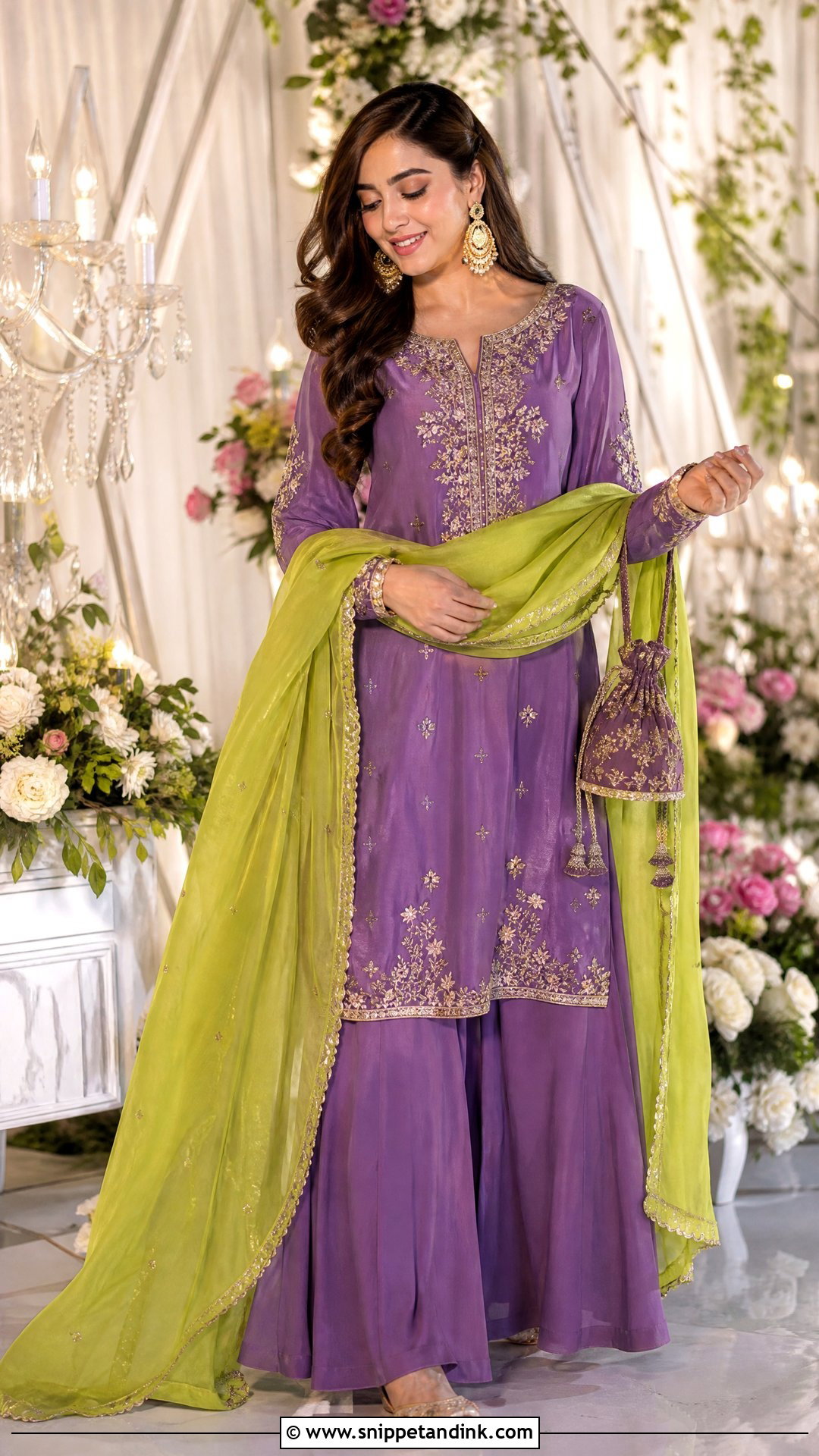
Purple isn’t a traditional mehndi shade, which makes it a good pick for a guest who wants to stand out quietly. Deep purple suits evening lamps; lilac and orchid look better in daylight, where dark purple can read almost black in shade. A medium-length kurta with gold or multicolor embroidery, fluid palazzos and a lime-green or mustard dupatta tie it back to the occasion. Shape the kurta slightly at the waist so it doesn’t fight the wide trousers. A side-swept braid suits the neckline.
18. Mint Asymmetrical Suit for Mehndi
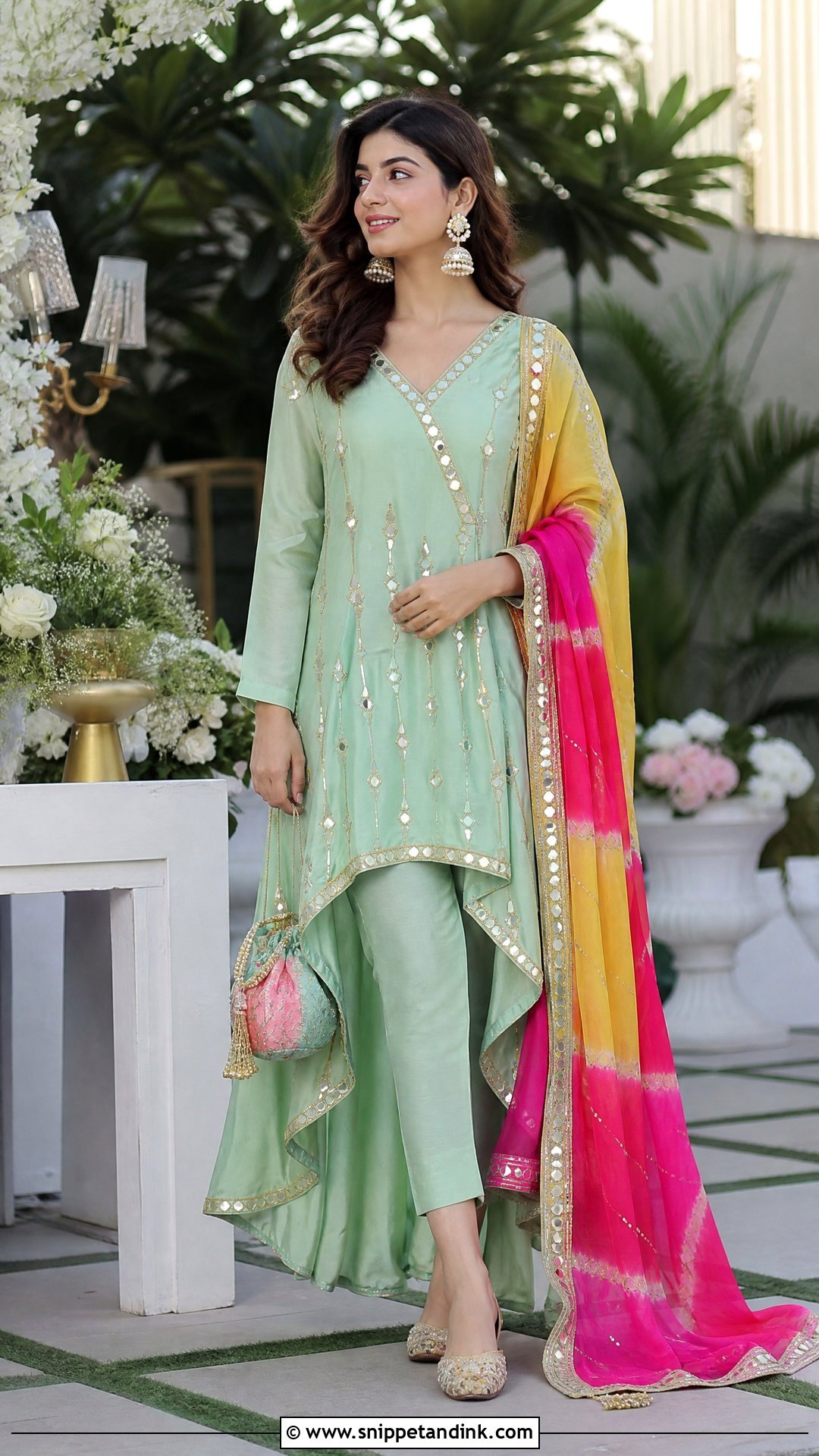
An asymmetrical mint suit relies on its hemline, so everything else should stay slim: fitted cigarette pants, light mirror work or scalloped edging, and a pink or printed dupatta for color. The test I always run is the seated one. Sit on a low cushion in the fitting room, because the short side of a high-low kurta rides up far more than it looks while you’re standing. Pearl jhumkas and a pastel potli keep it soft, and the angled hem gives your photos movement even when you’re standing still.
19. Red and Yellow Gota Suit for Mehndi
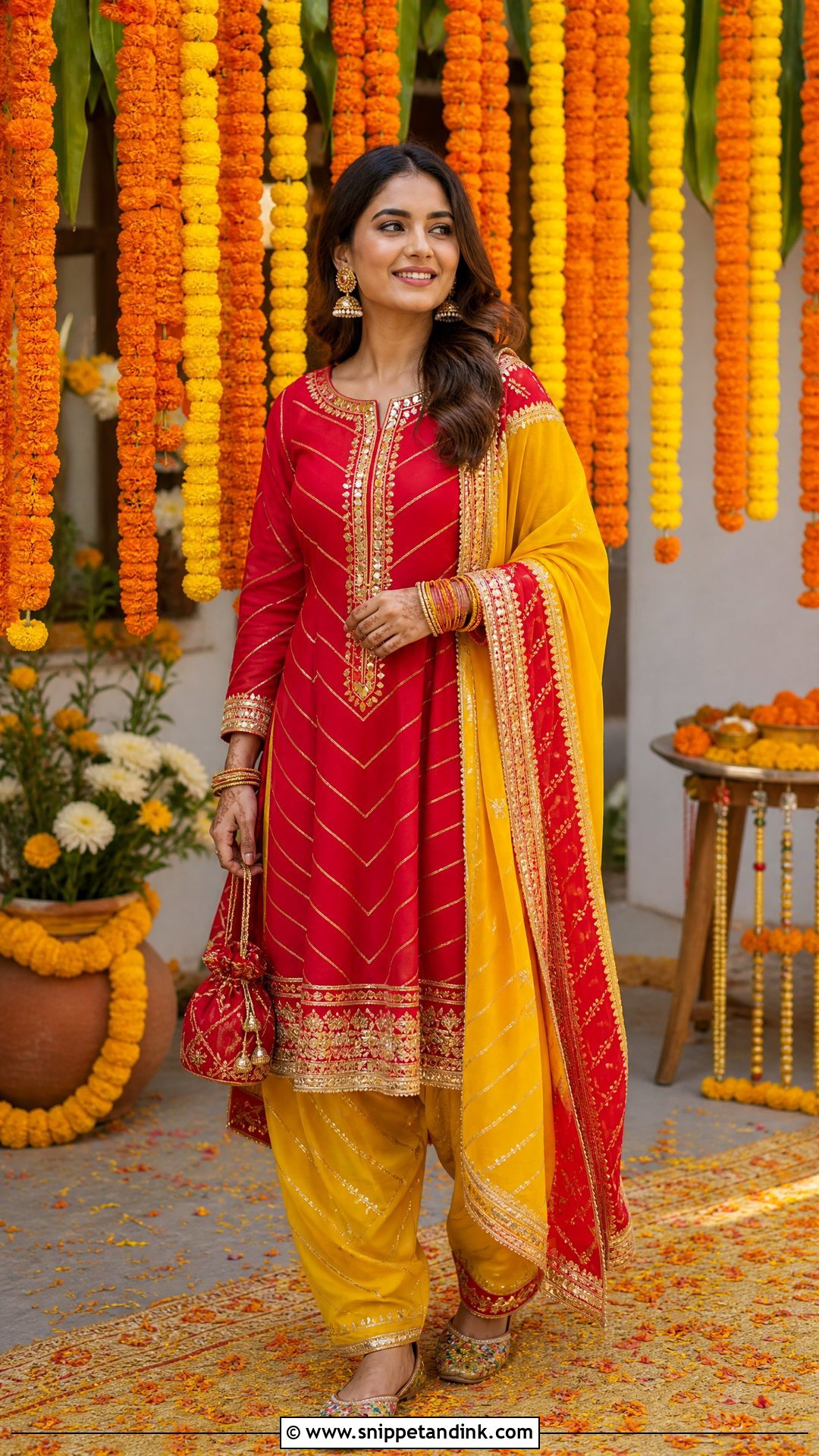
Red and yellow are as traditional as mehndi colors get, and together they’re visible from across a crowded courtyard. A red straight or A-line kurta with narrow gota borders, yellow trousers or a relaxed salwar, and a two-tone dupatta keep the outfit to those two shades. Sisters and cousins wear this well. Gota is metallic ribbon, stiffer and heavier than thread embroidery, so with substantial gota around the neckline I’d skip a necklace entirely and let earrings and bangles do the work. Soft eyes and a muted lip stop the face competing.
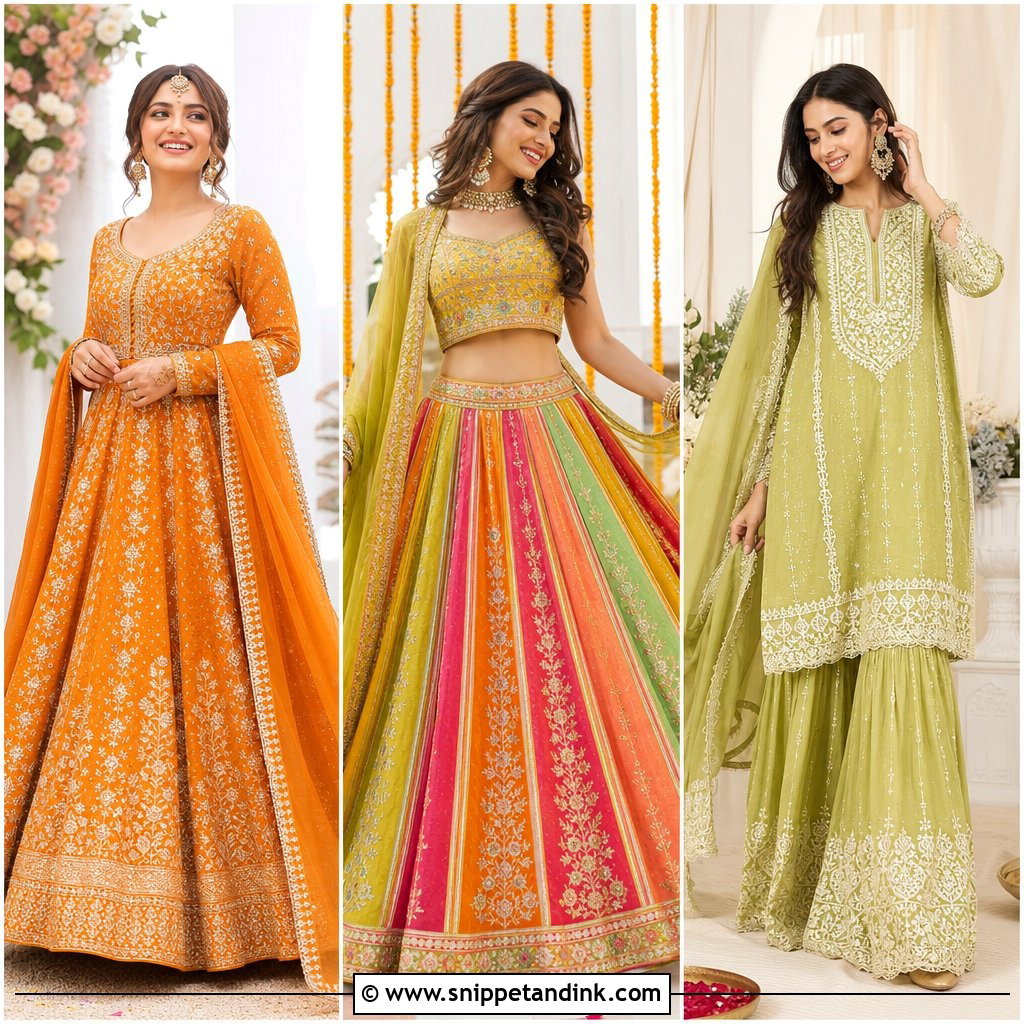
20. Black Multicolor Suit for Mehndi
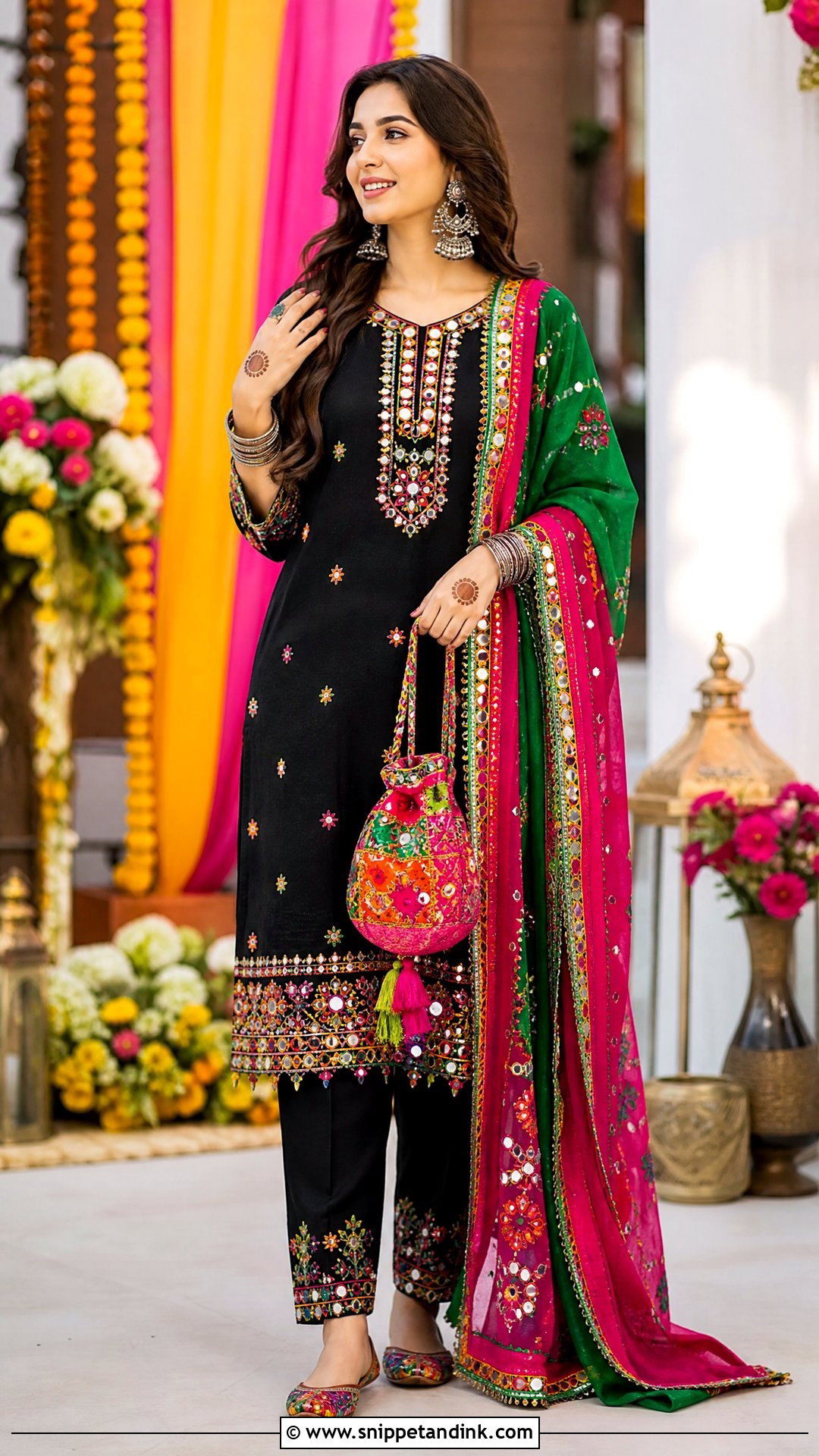
Some families avoid black at wedding functions, so ask about the household’s views before you choose it. Where it’s welcome, a black kurta with multicolor mirror work or bright floral threadwork looks festive in the evening, especially under string lights. Matching straight pants and a vivid pink or orange dupatta stop it from looking formal. Skip heavy velvet, though; mehndi functions run warm with crowds, dancing and lamps. Repeating the dupatta color in a bag or hair accessory pulls the whole outfit together.
Stitching an Unstitched Suit in Time
Many of these suits are sold as unstitched fabric sets, and the tailoring is where a mehndi outfit succeeds or fails. Tailors fill up quickly in wedding season, so I’d hand the fabric over at least three to four weeks ahead, and allow longer if there’s handwork still to finish. Turnaround varies a great deal between tailors, so agree on a date before you leave the shop. When you hand over the fabric, tell the tailor:
- How you’ll sit, so there’s room through the hip and seat for floor cushions.
- Your shoe height. Bring the actual juttis or heels so the hems are marked correctly.
- What lining you want. Ask for soft cotton or crepe under organza, net and pale colors.
- That you’d like a small loop or hidden button at the shoulder for the dupatta, so a safety pin isn’t the only thing holding it.
- When the trial fitting will be, with enough time left for one round of alterations.
Lifting a Henna Mark Off a Light Suit
Accidents happen, and they almost always happen on ivory, white or pastel. A fresh mark is far easier to treat than an old one, so deal with it that night rather than after the wedding weekend.
- Let the paste dry, then lift it off gently with a blunt edge. Rubbing wet paste pushes the dye deeper into the weave.
- Rinse from the back of the fabric with cold water. Hot water can set the stain.
- Work a little liquid detergent into the mark and let it sit before washing as the care label allows.
- Send silk, organza, chanderi and anything with zari or gota to a dry cleaner, and tell them it’s henna. Metallic work and fine silk don’t survive home scrubbing.
Be realistic about the result. Natural henna can leave a faint orange shadow on some fibers even after cleaning, which is the strongest argument I know for keeping pale suits well away from the artist’s table.
Sitting, Dancing and Henna Hands in One Outfit
Every suit here was picked for a long, busy function: hours on low seating, a dance floor, and hands that may be covered in paste. Start with your role and the time of day. Brides and close relatives can carry heavier work, while guests usually look better in lighter embroidery and simpler jewelry. Then rehearse in the finished outfit before the day. Sit cross-legged, raise your arms, walk a few steps in the shoes and check the lining in daylight. If it passes all of that, you can stop thinking about your clothes and enjoy the night.
You'll Like These Ideas:


Leave a Reply