
Camouflage on a wedding cake goes wrong in one predictable way: the pattern swallows everything else, and the cake ends up looking like a birthday cake for a hunting trip. The versions I’m happiest delivering treat camo as one ingredient. It might be a single tier, a ribbon, an edible wrap or a surprise inside the slices, set against ivory frosting, wood and greenery. Flavor matters too, and almond, maple, spice and red velvet all sit comfortably next to an outdoor theme. Below are twenty ways I’d approach it, with notes on what each one asks of the baker and where it can trip you up.
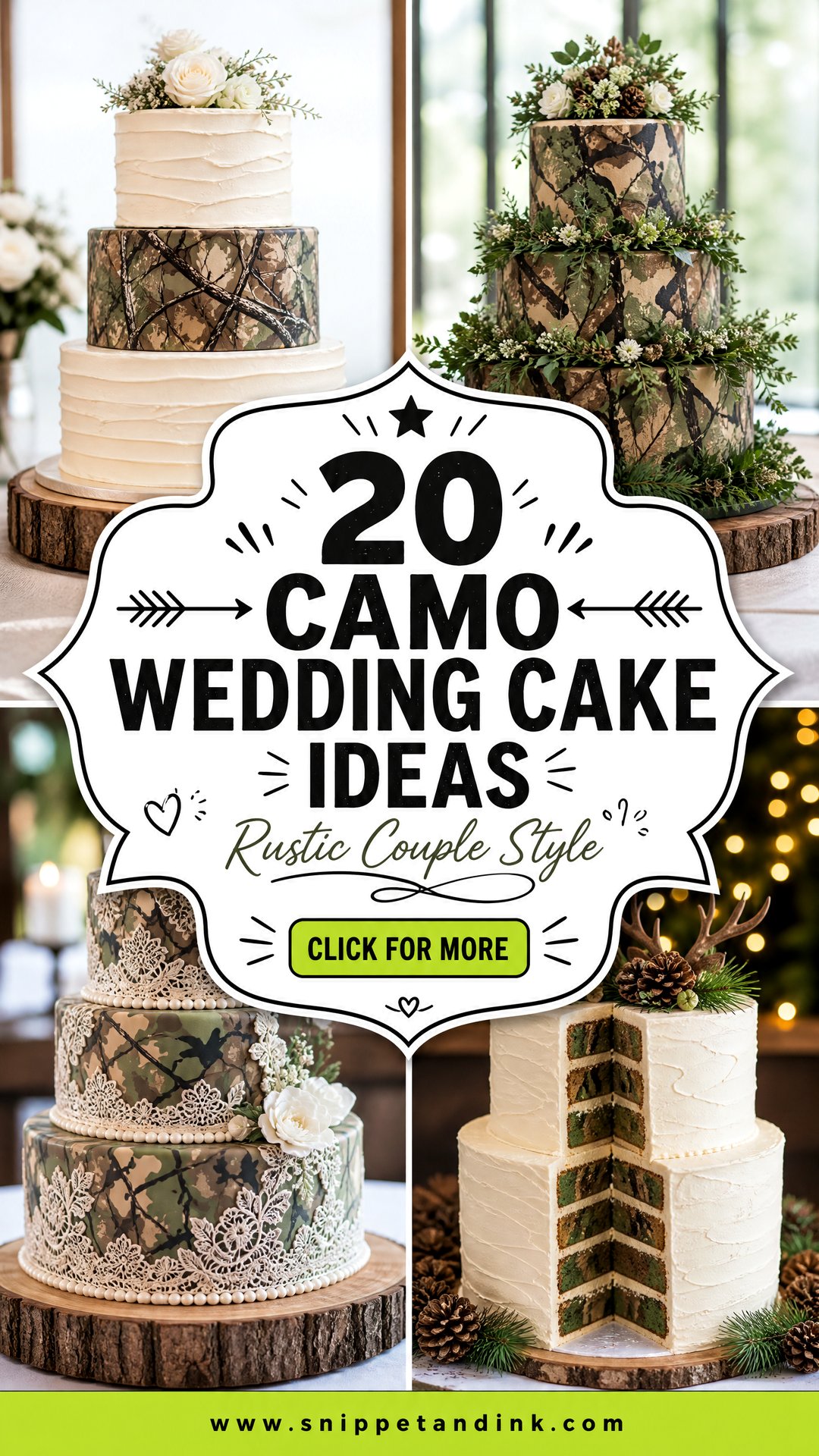
Four Ways a Baker Gets Camouflage Onto a Cake
Camo isn’t one technique. The method decides how crisp the pattern looks, how it copes with a warm room and how much labor goes into the quote, so it helps to know which one you’re asking for.
Hand-cut fondant patches
Three or four colored fondants are cut into shapes and smoothed together on the tier. This gives the cleanest edges and tolerates a little more warmth than buttercream does. It’s also the slowest method, so expect it to cost more per tier.
Patched buttercream
Colored buttercream is spread in patches and scraped smooth, which leaves softer, almost painted edges. Most guests prefer the taste. It’s the option that suffers most in heat, so I keep it for indoor or air-conditioned receptions.
Printed edible sheets
A camo print on a frosting sheet or wafer paper is wrapped around a tier. It’s quick and can copy a specific pattern closely. Printed colors can fade in strong sun, and the sheets soften on moist frosting, so I apply them as close to delivery as possible.
Colored batter inside
Nothing shows on the outside; the pattern only appears in the slices. Getting a true green and brown takes more coloring than people expect, so ask to see a cut sample at your tasting before you commit.
1. Camo Wedding Cake With Deer Topper
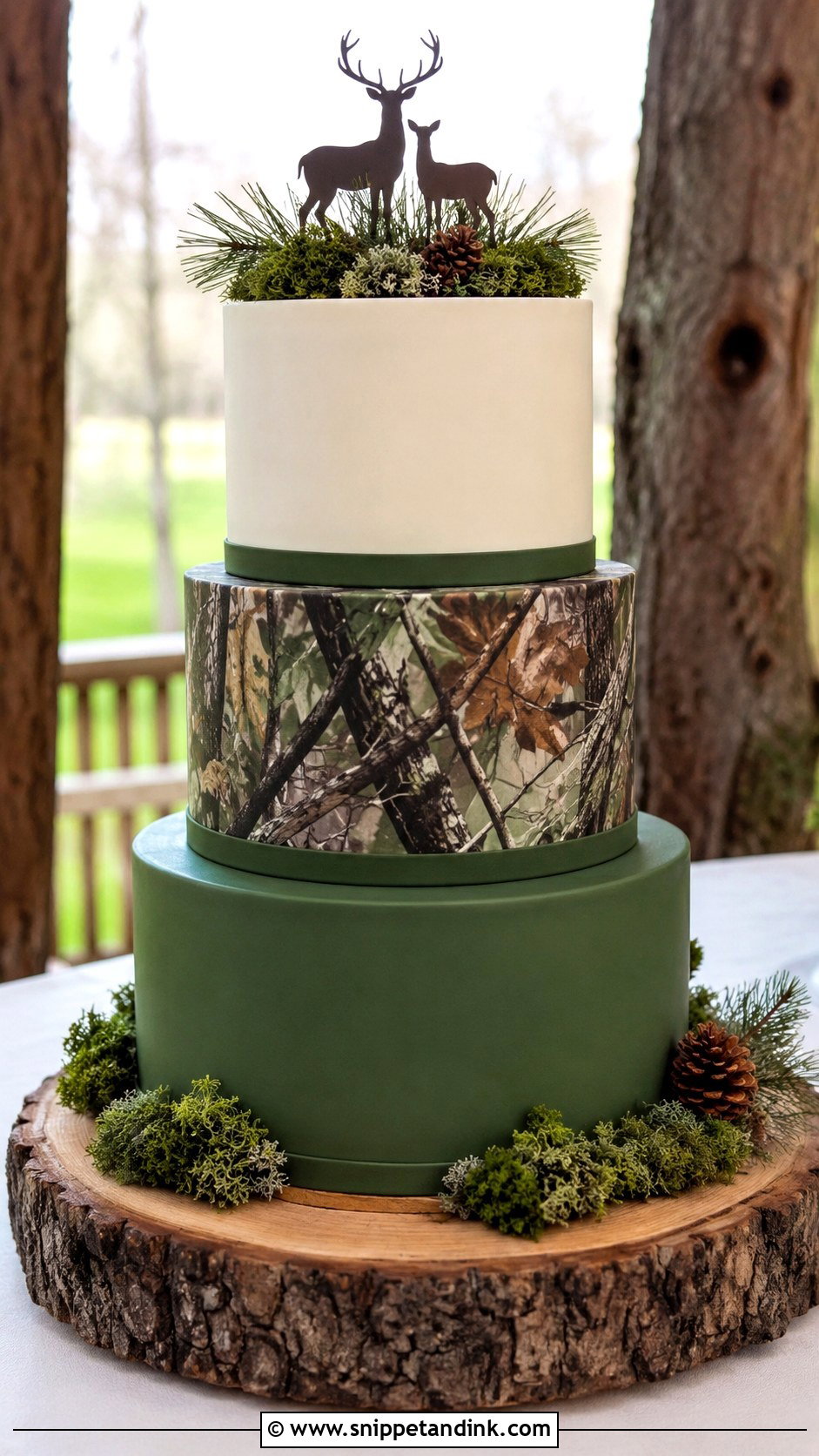
A pair of deer on top is the camo cake I’m asked for most, and it earns that because it tells the story in one glance. It suits barn weddings, woodland venues, hunting-inspired celebrations and fall receptions. The tiers underneath need to stay quiet: ivory buttercream on the bottom, a muted camo middle tier and a smooth top tier holding the silhouettes. Check the topper’s weight before the day. Heavy resin or metal deer sink into soft buttercream, so I set them on a small hidden board or push them in on dowels. Moss and a few pine sprigs on a wood slice base finish it.
2. Camo Wedding Cake With Burlap Ribbon
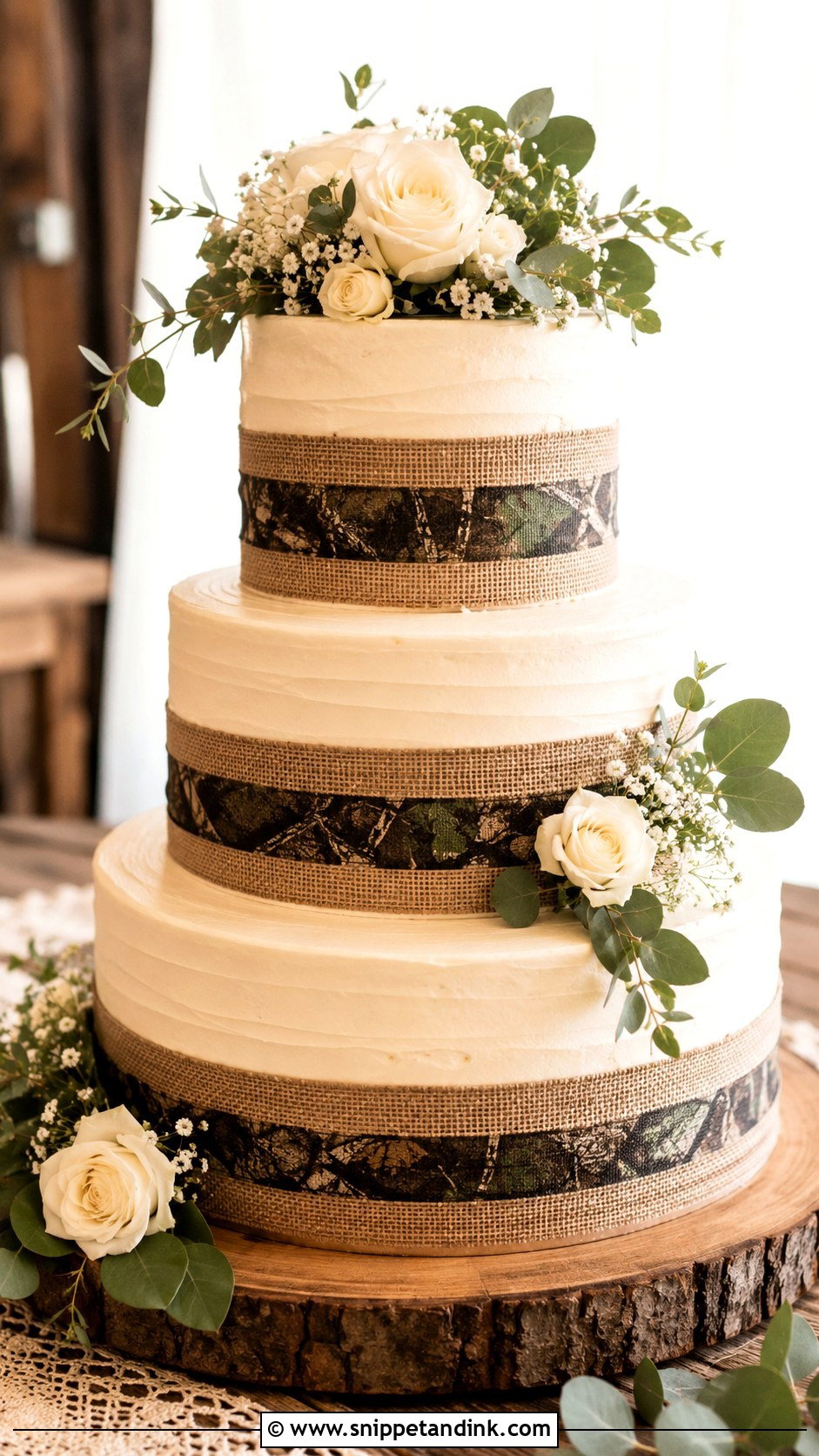
Burlap calms camouflage down because it adds texture without adding more pattern. I wrap it around each tier as a border, then lay a narrow camo ribbon over it, on white buttercream, cream fondant or semi-naked frosting. One warning from the kitchen: fabric pressed against buttercream soaks up butterfat and shows grease spots within an hour or two. I back every ribbon with a strip of acetate or parchment, or attach it to fondant only. Baby’s breath is the usual filler with burlap, but it shouldn’t touch the cake itself, so keep it on the board or swap in ivory spray roses.
3. Camo Wedding Cake With Wood Slice Base
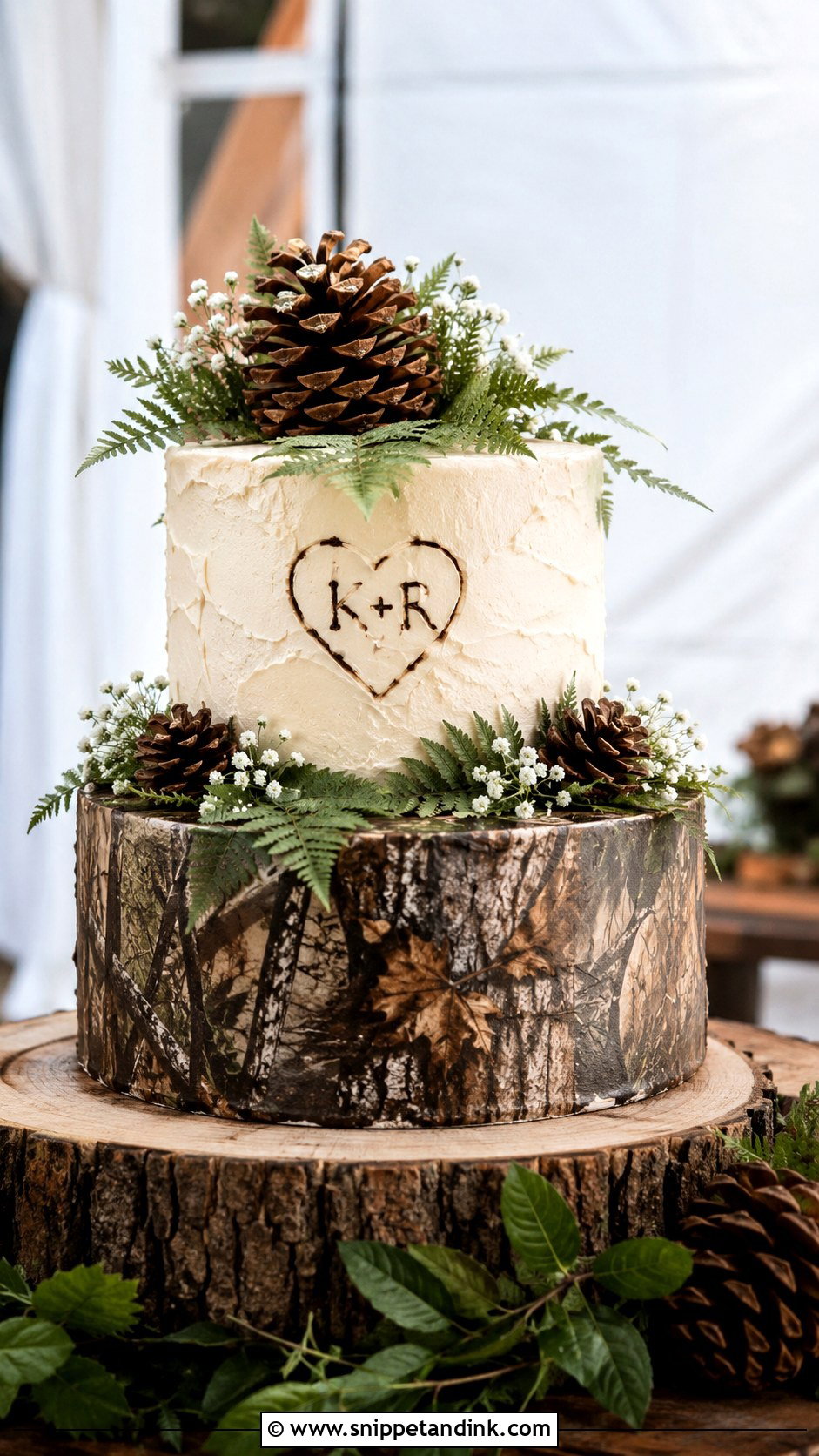
A wood slice grounds the whole display before anyone looks closely at the tiers. Two or three tiers with textured buttercream, a few edible camo patches and simple greenery sit well on it, and a vanilla, almond or spice cake matches the warmth. Raw wood isn’t a food surface, so the cake always goes on its own board first and the board sits on the slice. I also ask whoever supplies the slice to check it’s dry and flat, because a cupped slice makes a tiered cake lean. Pinecones and a little eucalyptus finish it, and it sits naturally on dessert tables dressed with lanterns and neutral runners.
4. Camo Wedding Cake With Orange Flowers
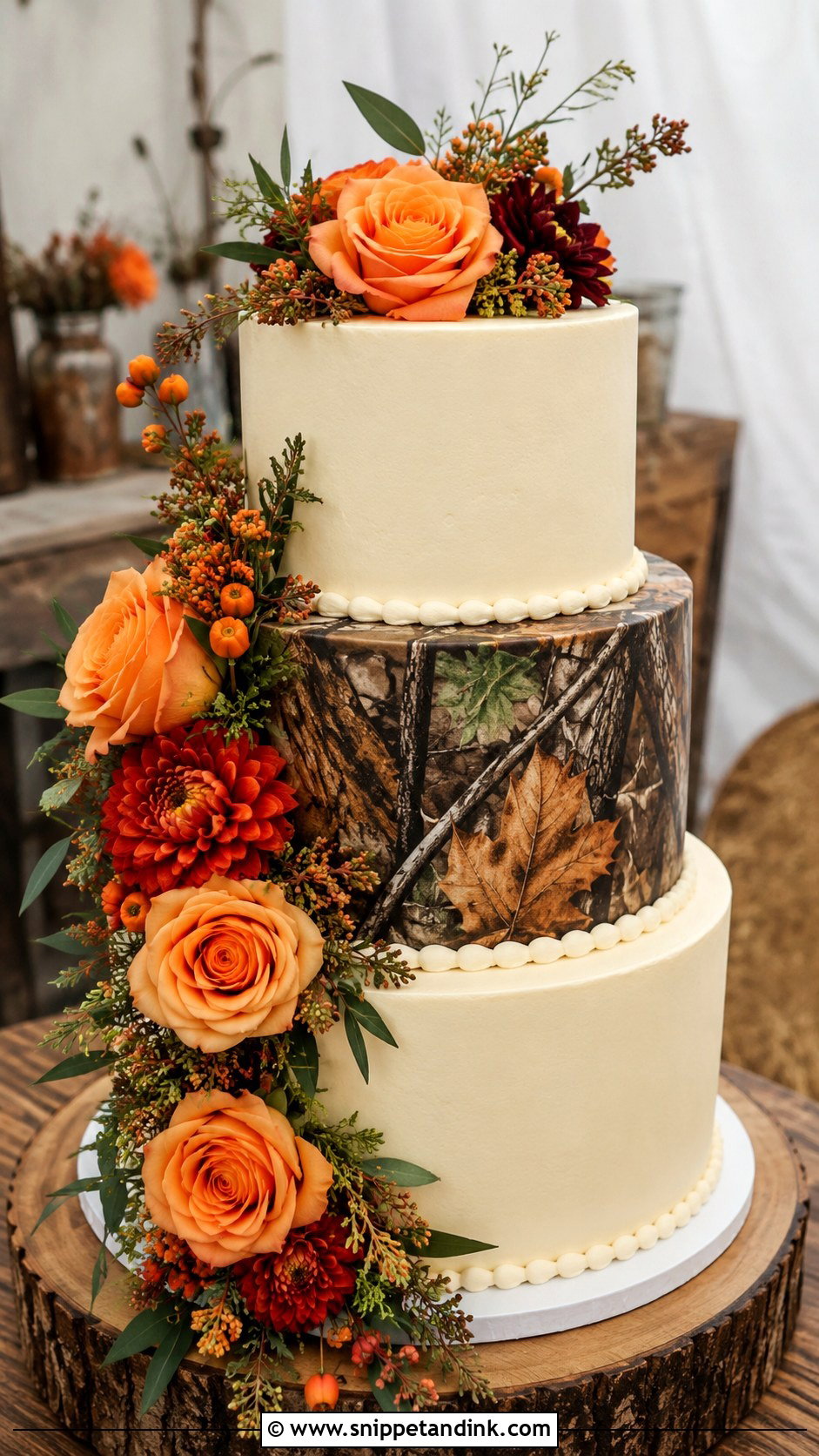
Orange is the color that makes camo look deliberate. Burnt orange pops against the green, brown and tan of the pattern, which is why this one belongs at fall weddings and country venues. My preferred layout is a camo tier between two ivory tiers, with flowers cascading from the top down one side. Sugar flowers hold up better than fresh ones when a cake sits out for hours, and I can match the exact shade. For fresh roses or dahlias I need pesticide-free stems from the florist so I can wrap and pick them. Keep the frosting smooth, since texture plus pattern plus strong color gets busy fast.
5. Camo Wedding Cake With Ivory Buttercream
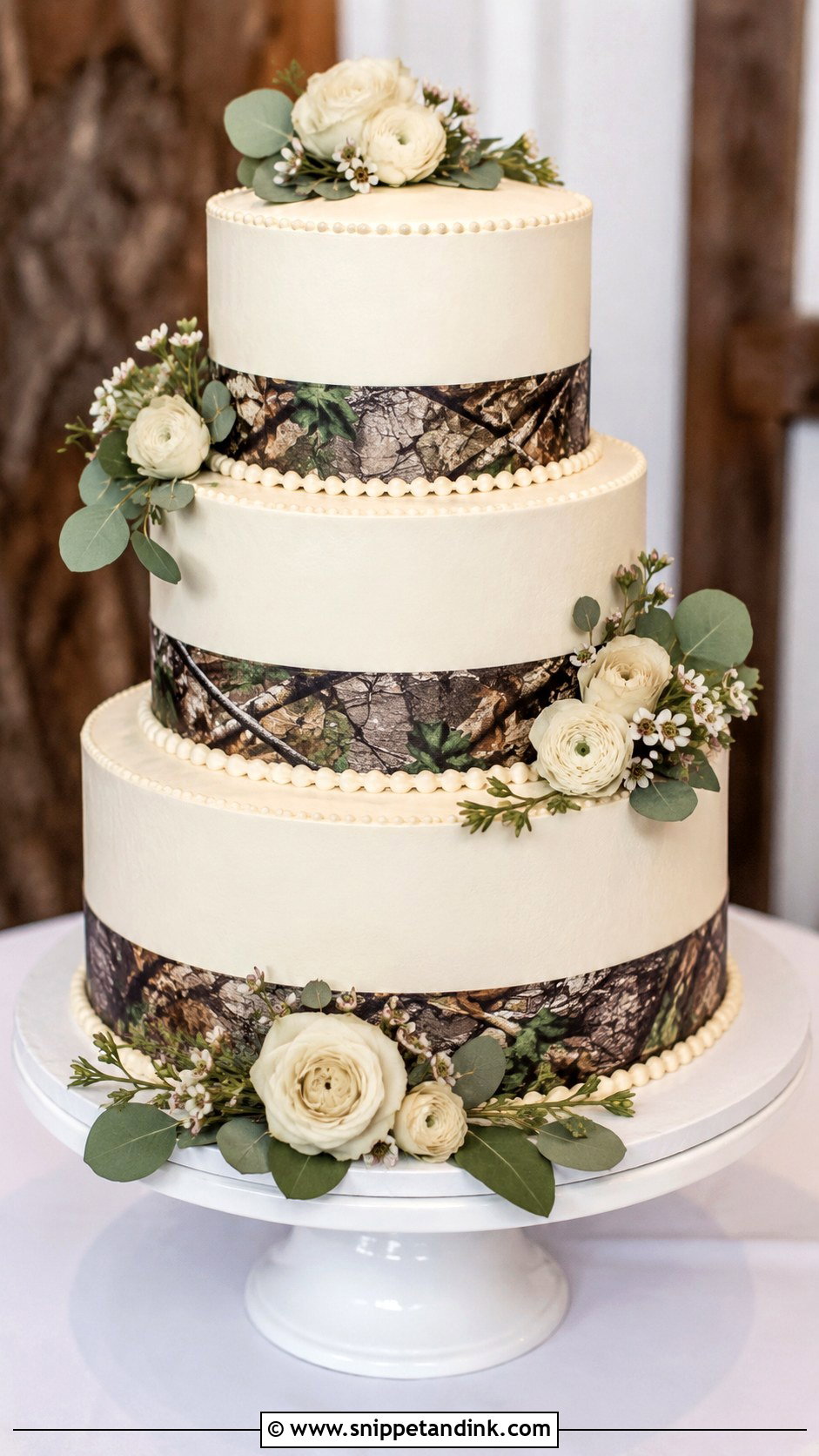
This is the version I suggest most often to couples who are unsure. Ivory buttercream carries the cake, and camo appears only as an accent: a band around the base, one patterned tier or a thin edible wrap. Guests read it as a wedding cake first and spot the personal twist second. Soft piping, small pearl details or some greenery keep it refined. Agree on the ivory itself in advance, though. A warm butter-yellow ivory and a cool white ivory change how green the camo looks next to them.
6. Camo Wedding Cake With Fondant Pattern
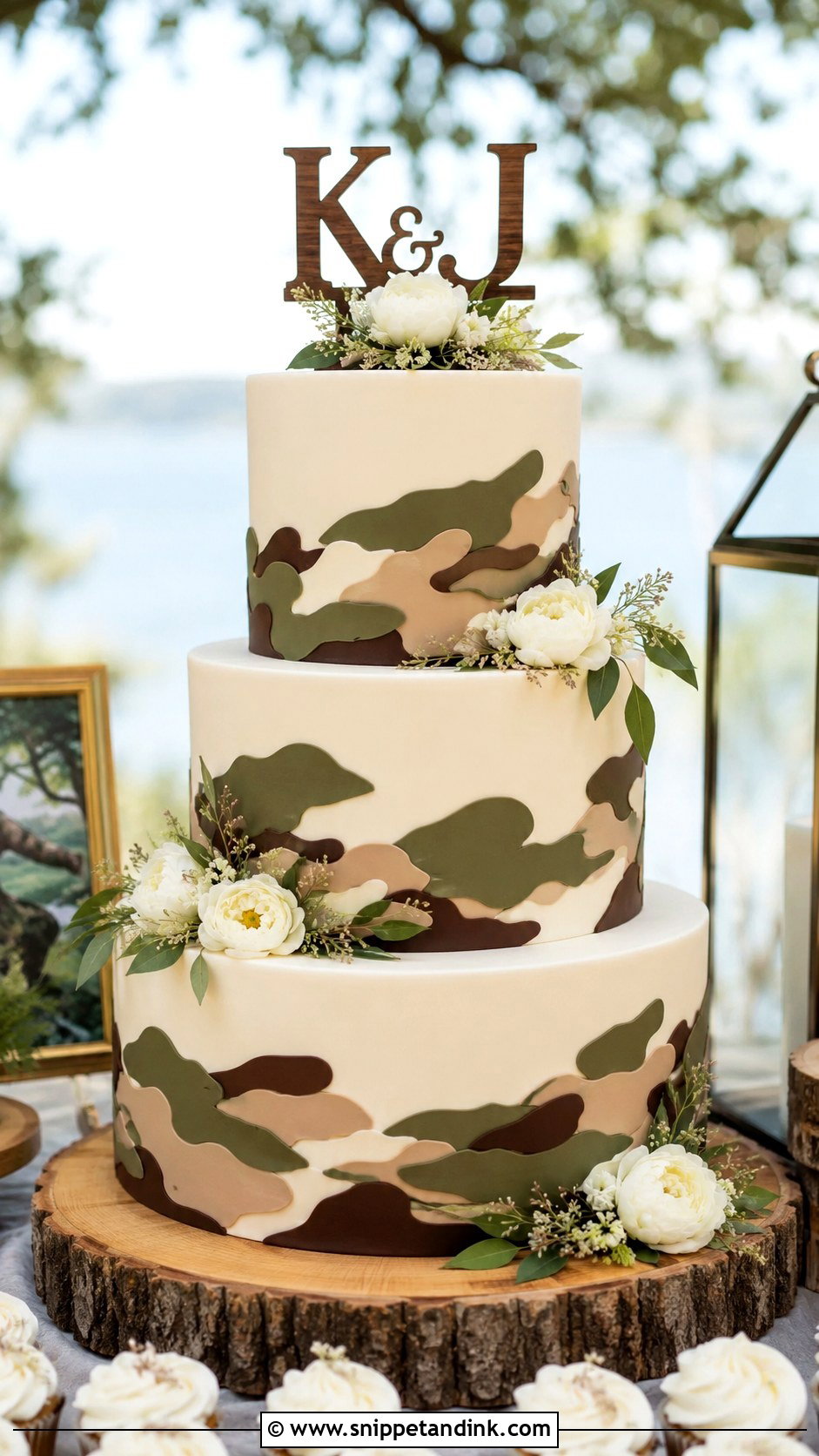
Fondant gives the sharpest camouflage. I cut the patches from rolled fondant in three or four colors and layer them so the edges stay crisp, which suits tall or formal cakes. Keep the shades muted, closer to sage and tan than saturated hunting green. You can cover one tier, alternate tiers or wrap the whole cake. Two cautions. Fondant sweats when a chilled cake meets a humid room, so I deliver it cool rather than fridge-cold. And deep greens and browns take a lot of coloring, which can leave a slightly bitter taste, so I often use pre-colored fondant for the darkest patches.
7. Camo Wedding Cake With Antler Topper
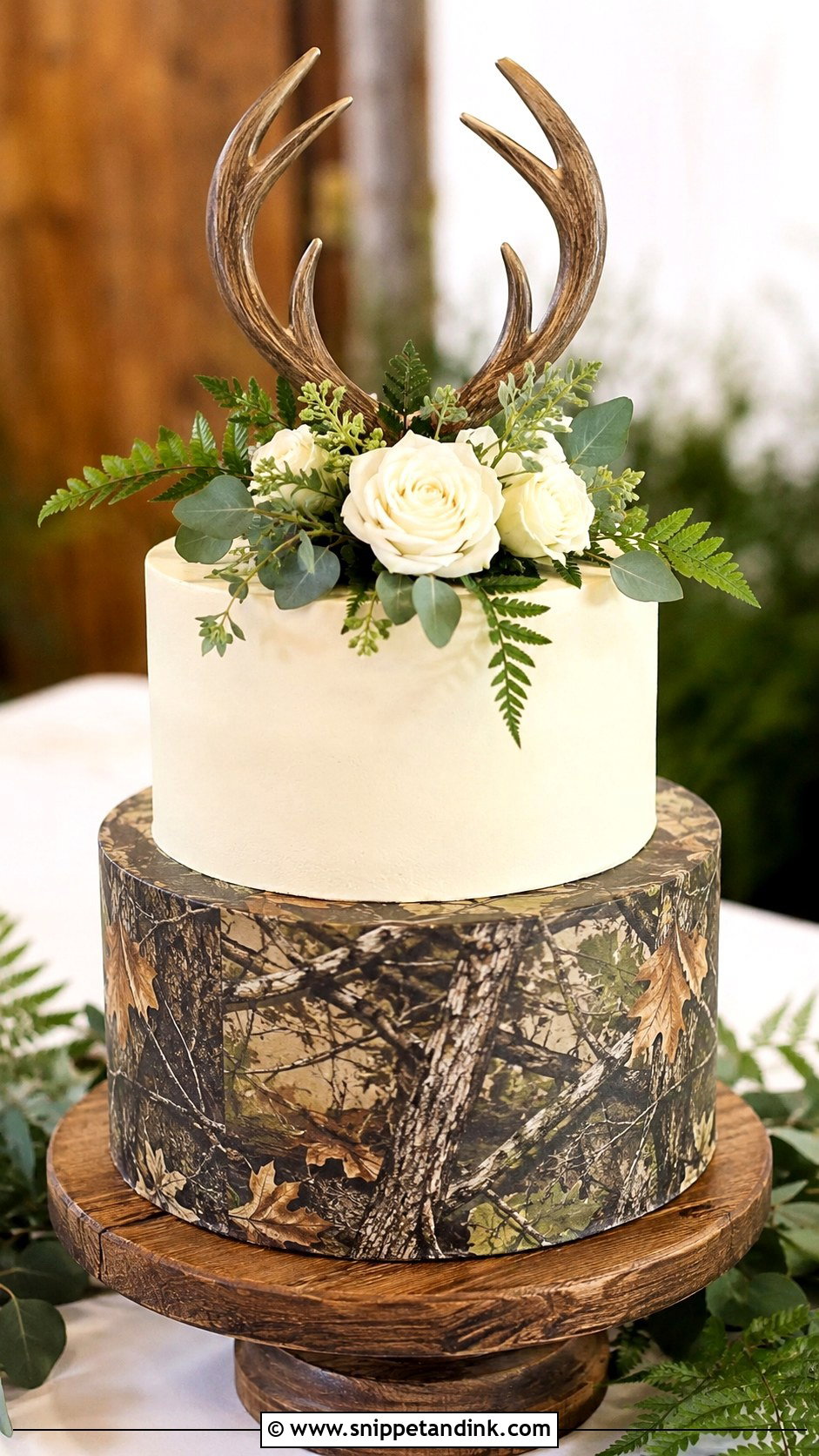
An antler topper says outdoors with very little else on the cake. Scale decides whether it works: the antlers should look like they belong to the top tier, not tower over it. White-painted antlers read softer, and natural brown leans woodland. Real antlers aren’t food-safe, so I stand them on a small acrylic disc instead of pushing them into the frosting. A few small roses or a sprig of eucalyptus at the base blends the topper into the tiers. Lodge, ranch and forest venues suit it best.
8. Camo Wedding Cake With Sunflower Accent
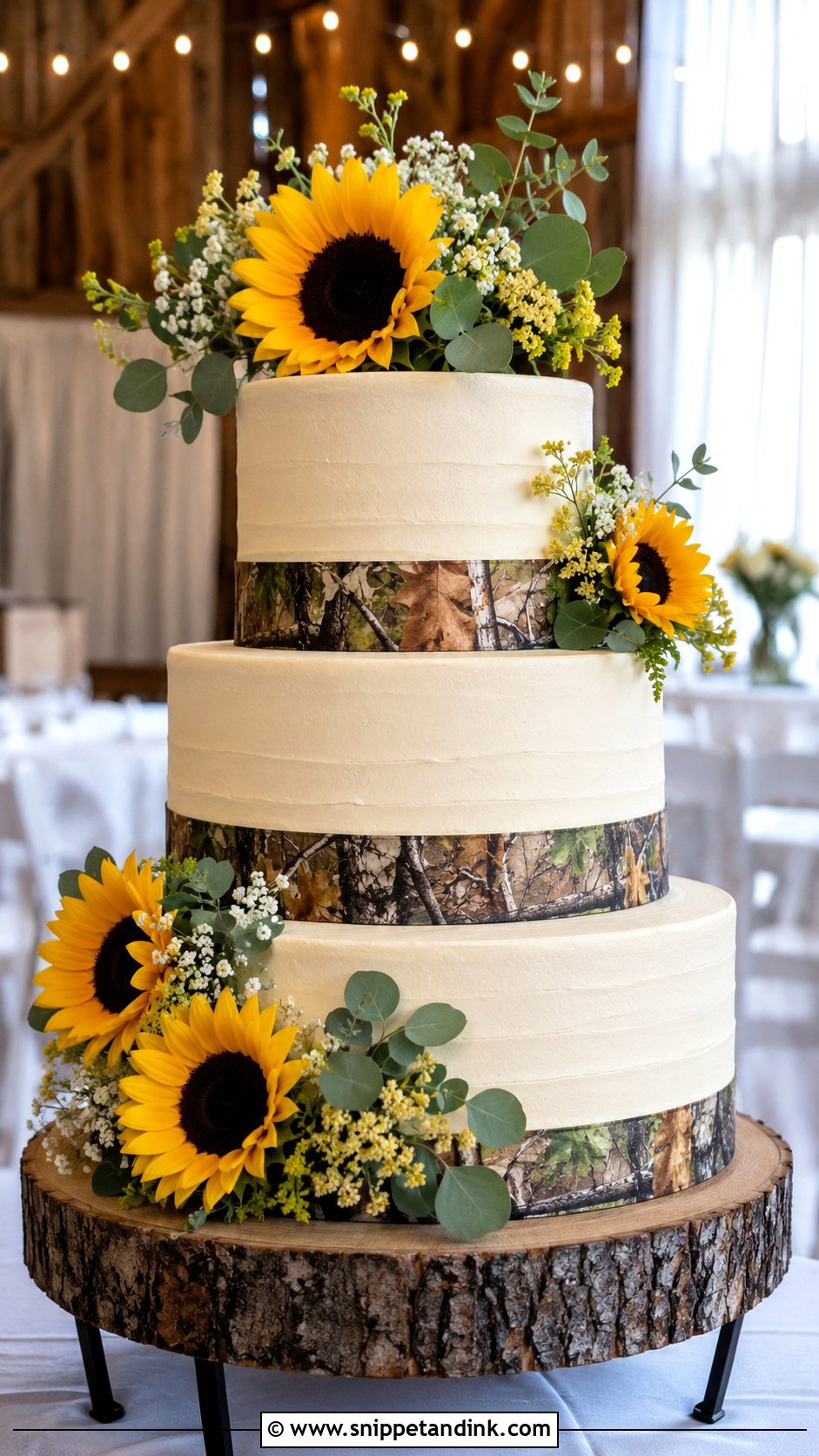
Sunflowers are so bold that the real job is restraint. Their yellow petals light up against the earthy pattern, and the dark centers tie back to the browns. I place them in small clusters, never a full wreath, on ivory buttercream with a camo ribbon, and two or three tiers on a wooden stand is plenty. Fresh sunflowers droop quickly out of water. For an afternoon outdoors I’d either add them at the venue or have them made in sugar. Late summer and early fall barn weddings are where this cake looks most at home.
9. Camo Wedding Cake With Naked Frosting
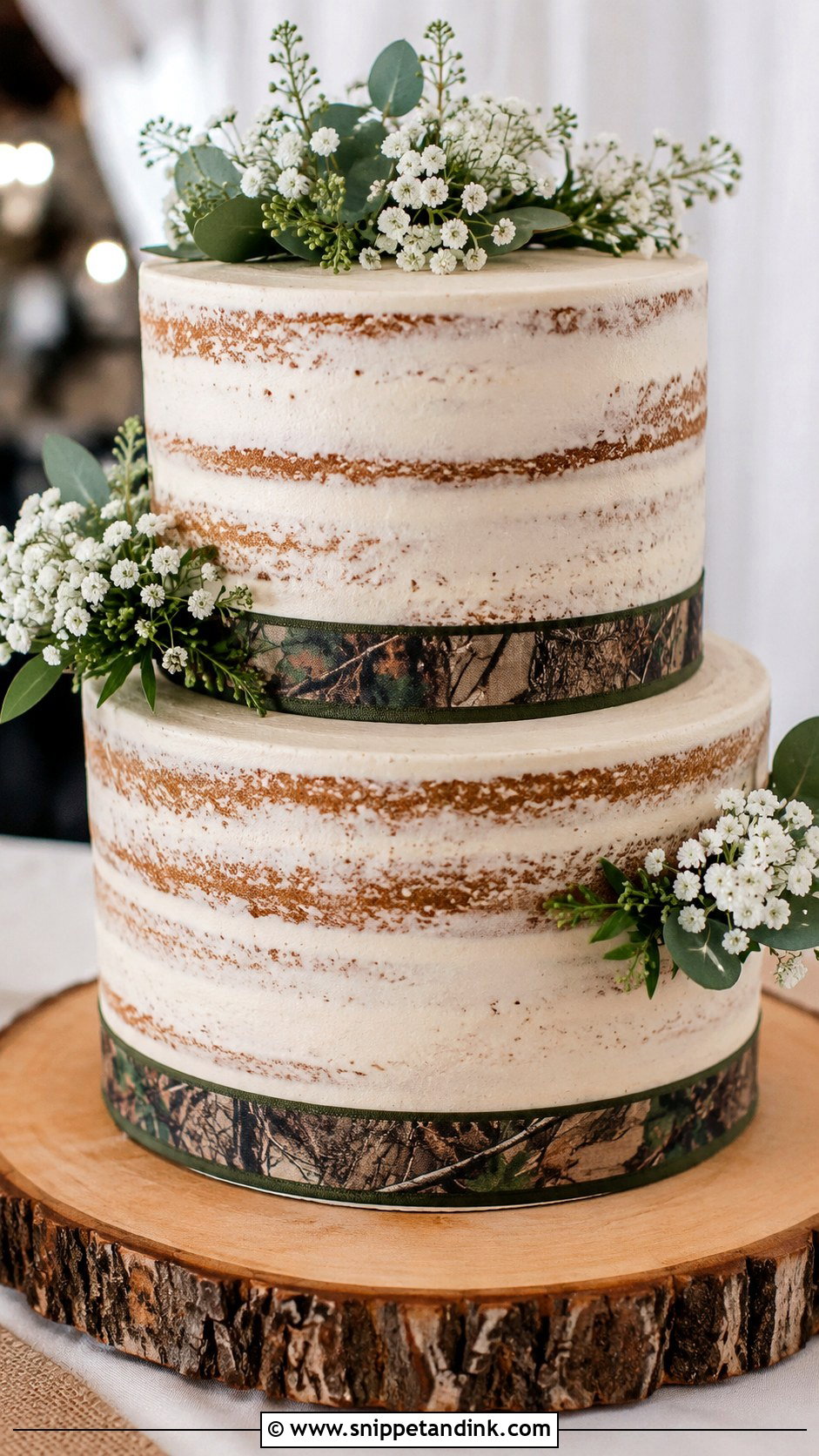
Naked frosting is already halfway to rustic, since the layers show through a thin scraped coat. I bring camo in lightly with a ribbon, a topper, some edible leaves or one small patterned tier. Vanilla, spice, carrot and maple cakes have a warm crumb color that suits the look. The trade-off is drying out. With so little frosting, exposed sponge stales faster in open air, so I assemble this cake late and want it set out no more than a couple of hours before cutting. It’s the most relaxed design here, made for a laid-back reception.
10. Camo Wedding Cake With Greenery
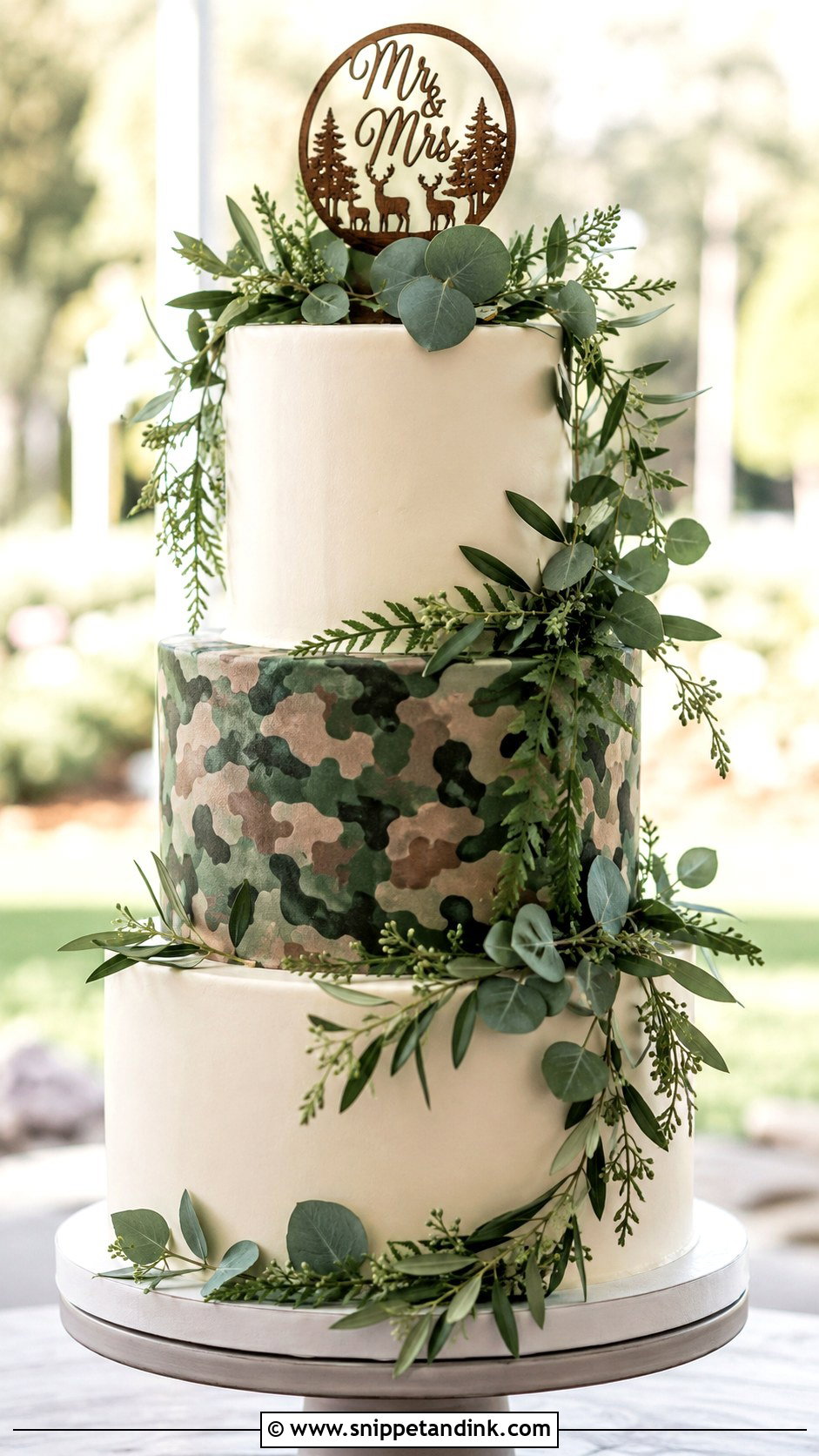
Eucalyptus, ferns, olive and pine already share camouflage’s palette, so they blend in instead of competing. Use greenery as a frame. Let it trail down one side, ring the base lightly or sit between tiers, and leave a smooth ivory cake with one camo tier visible underneath. Eucalyptus is my default because it doesn’t wilt fast, but its stems shouldn’t sit in frosting, so they go into flower picks first. A small initial topper or a little wooden sign is all the top needs.
11. Camo Wedding Cake With Lace Detail
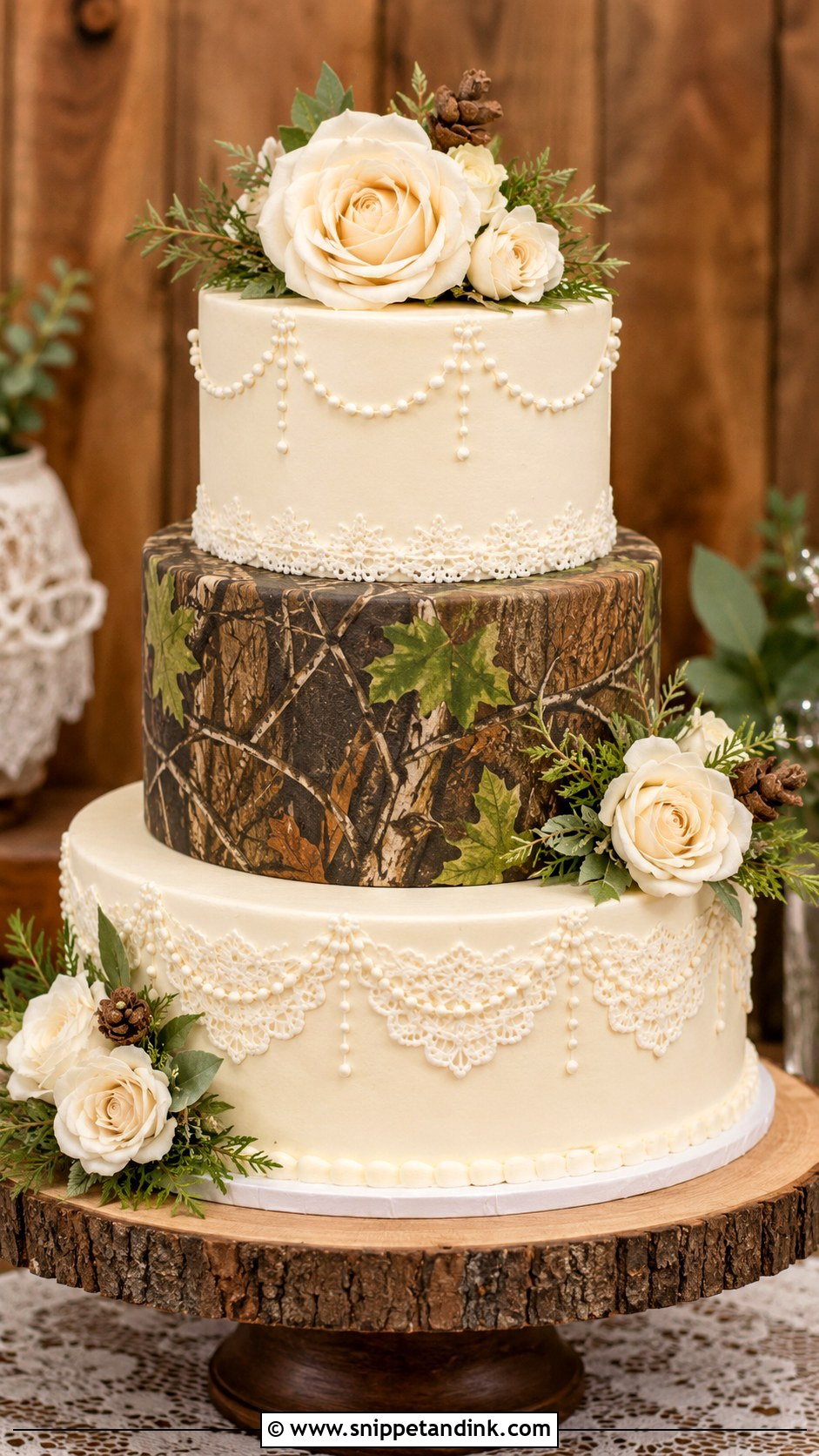
Rugged pattern against delicate lace is what makes this one interesting. I’d use piped lace or lace molded in fondant around the ivory tiers, then keep camo to one tier or a trim. A real cake-safe lace ribbon can work if it’s backed so butter doesn’t seep through, but molded lace looks cleaner up close. Keep the colors muted and skip extra decoration. A few ivory flowers or small pearls finish it. Anything more starts fighting the pattern.
12. Camo Wedding Cake With Chocolate Drip
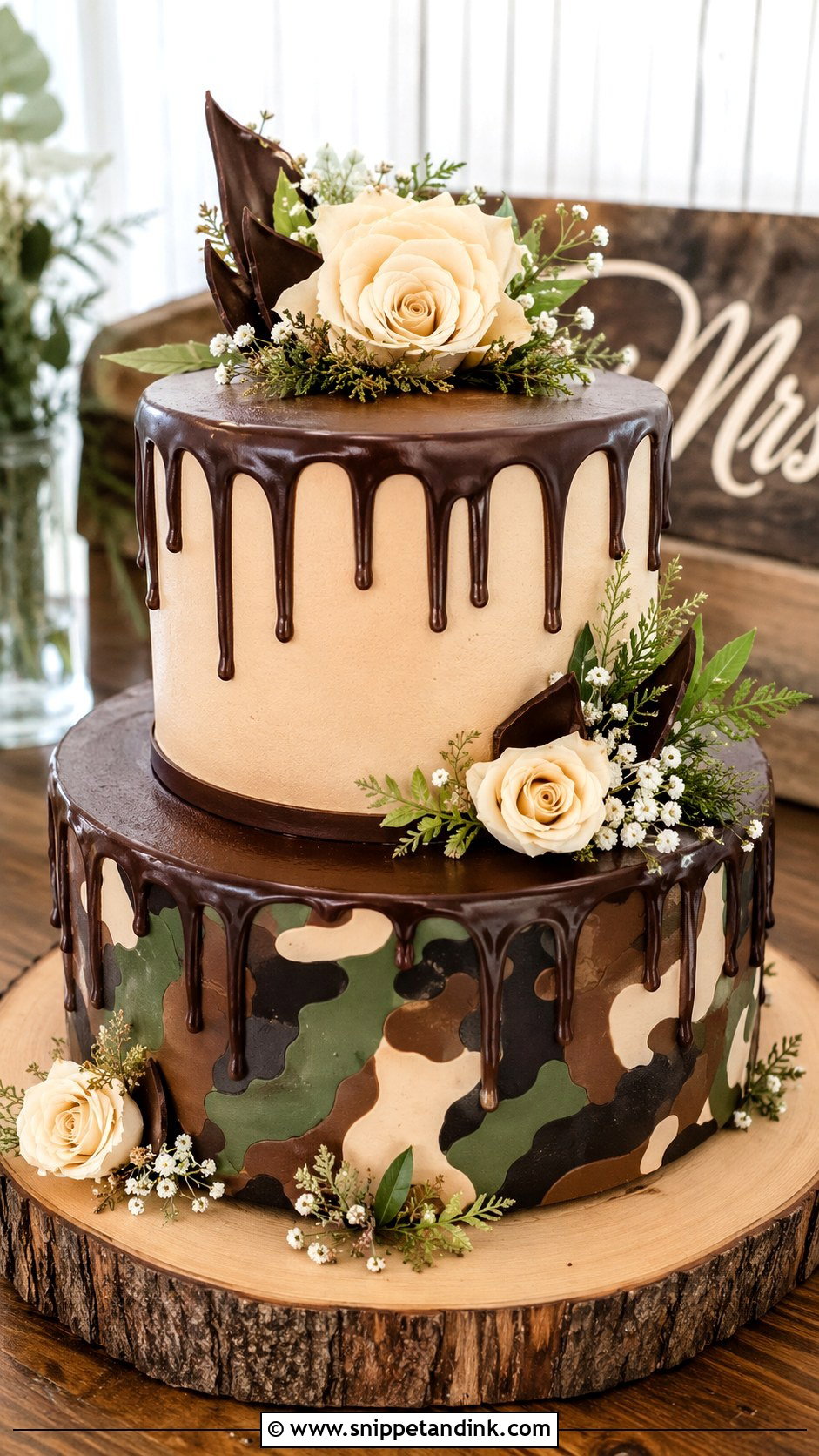
A ganache drip adds movement and makes the cake feel less formal. Chocolate, mocha, peanut butter and vanilla sponges all suit it. I use a smooth ivory or tan buttercream base, a camo wrap on one tier, then let chocolate ganache run from the top edge. Temperature makes or breaks a drip: too warm and it runs straight to the board, too cool and it stops in thick blobs. I test one drip on the back of the chilled cake before doing the front. Chocolate shards and a little greenery finish it on the dessert table.
13. Camo Wedding Cake With Monogram Topper
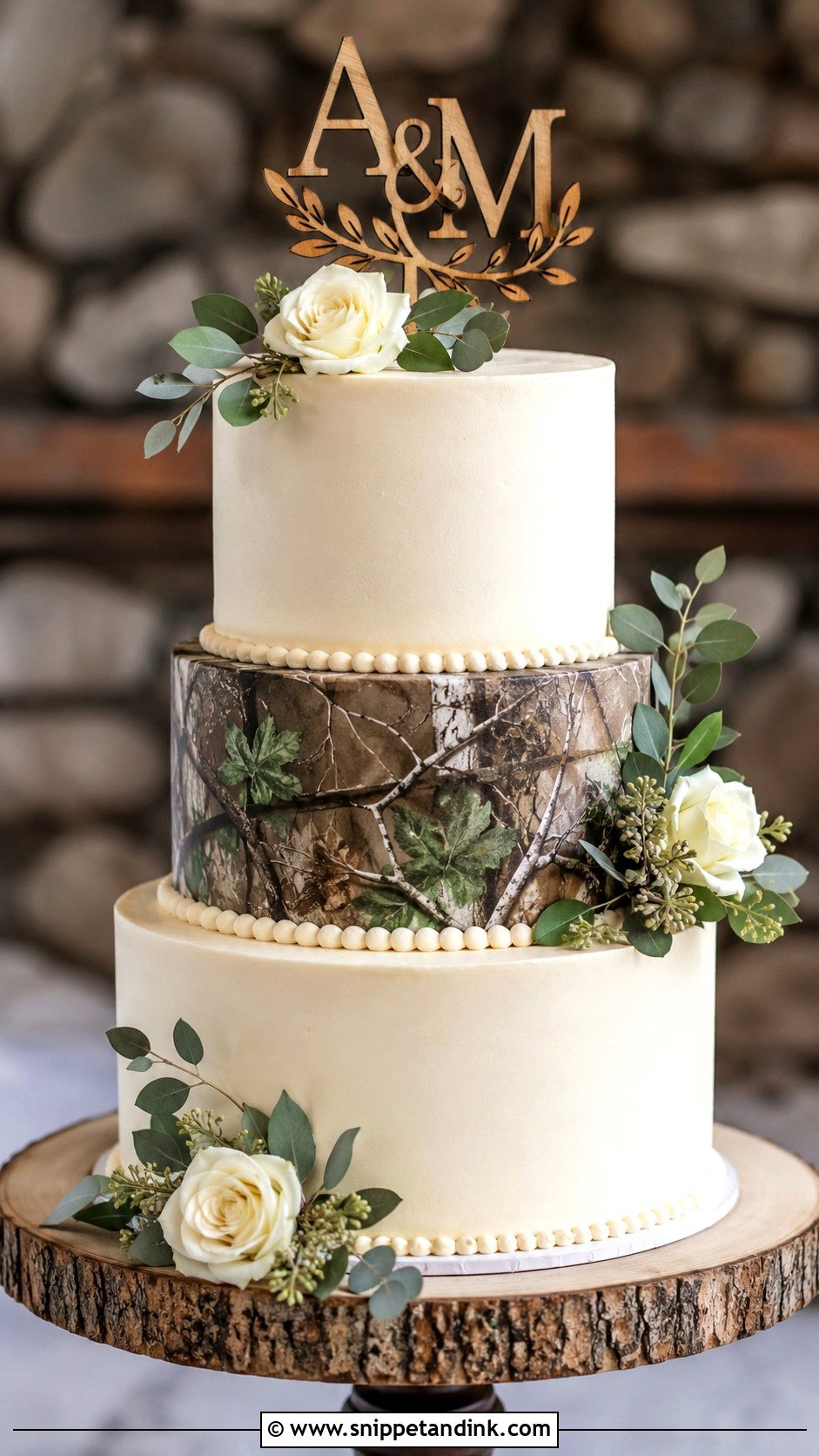
A monogram topper makes the cake read as a wedding cake first and lets the camo stay the meaningful detail. Wood, acrylic and metal toppers all work on a smooth top tier, with camo as the middle tier, the bottom border or a subtle wrap. I ask for the topper at least a week ahead so I can check its picks are long enough to reach a supported board and that the letters stand square. Ivory buttercream, tan accents and greenery keep everything cohesive.
14. Camo Wedding Cake With Red Velvet
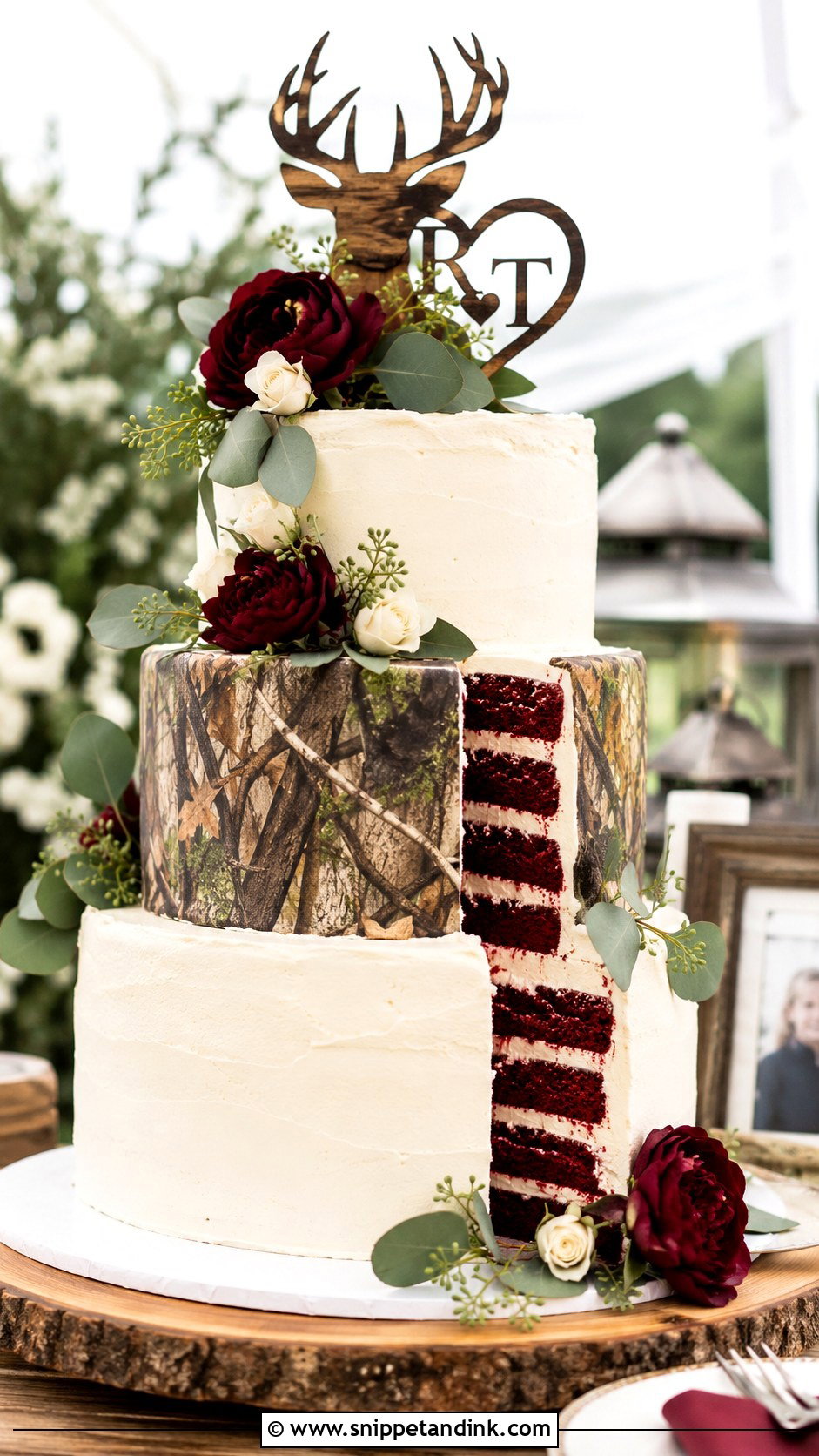
Red velvet is the inside surprise for a cake that looks earthy outside. The deep red crumb shows off in every slice, and cream cheese frosting keeps the flavor classic. Outside, I’d use ivory with a camo accent tier or ribbon, then burgundy flowers or small wood details to connect the inside to the outside. Cream cheese frosting is softer than standard buttercream and needs more chilling, so I often use it as the filling and coat the outside in a firmer buttercream for structure. It suits fall and winter weddings, and the color contrast reads well at a country reception.


15. Camo Wedding Cake With Black And White Tiers
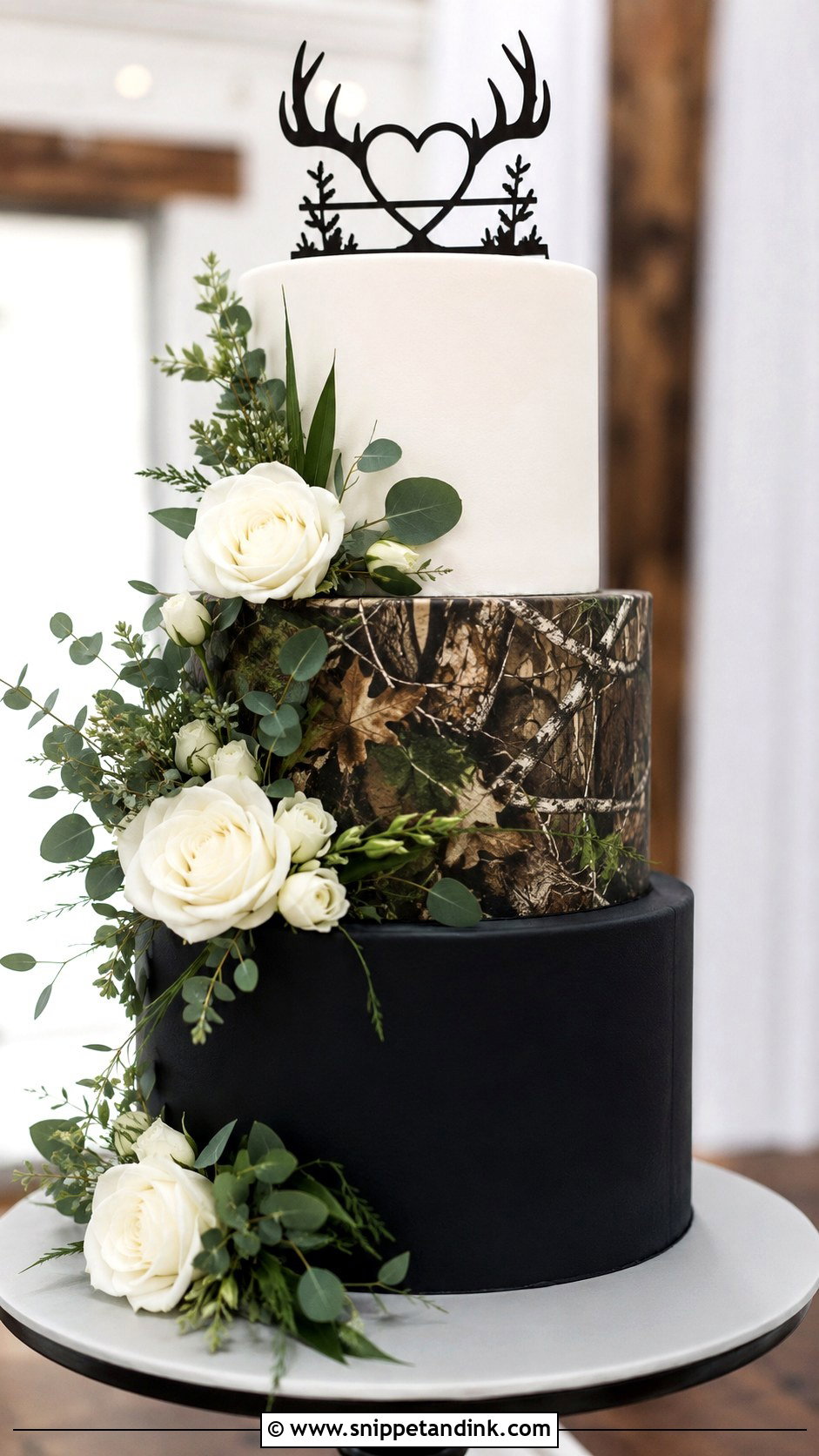
Black, white and camo make the sharpest cake in this list. Black adds weight, white keeps it bridal, and camo carries the outdoor personality. Limit the pattern to one accent tier, typically a black bottom tier, camo middle and white top. True black frosting needs heavy coloring and can stain mouths and fingers, so I keep black to a thin fondant coat or use a cocoa-darkened fondant. White flowers or a simple topper soften the stack.
16. Camo Wedding Cake With Country Flowers
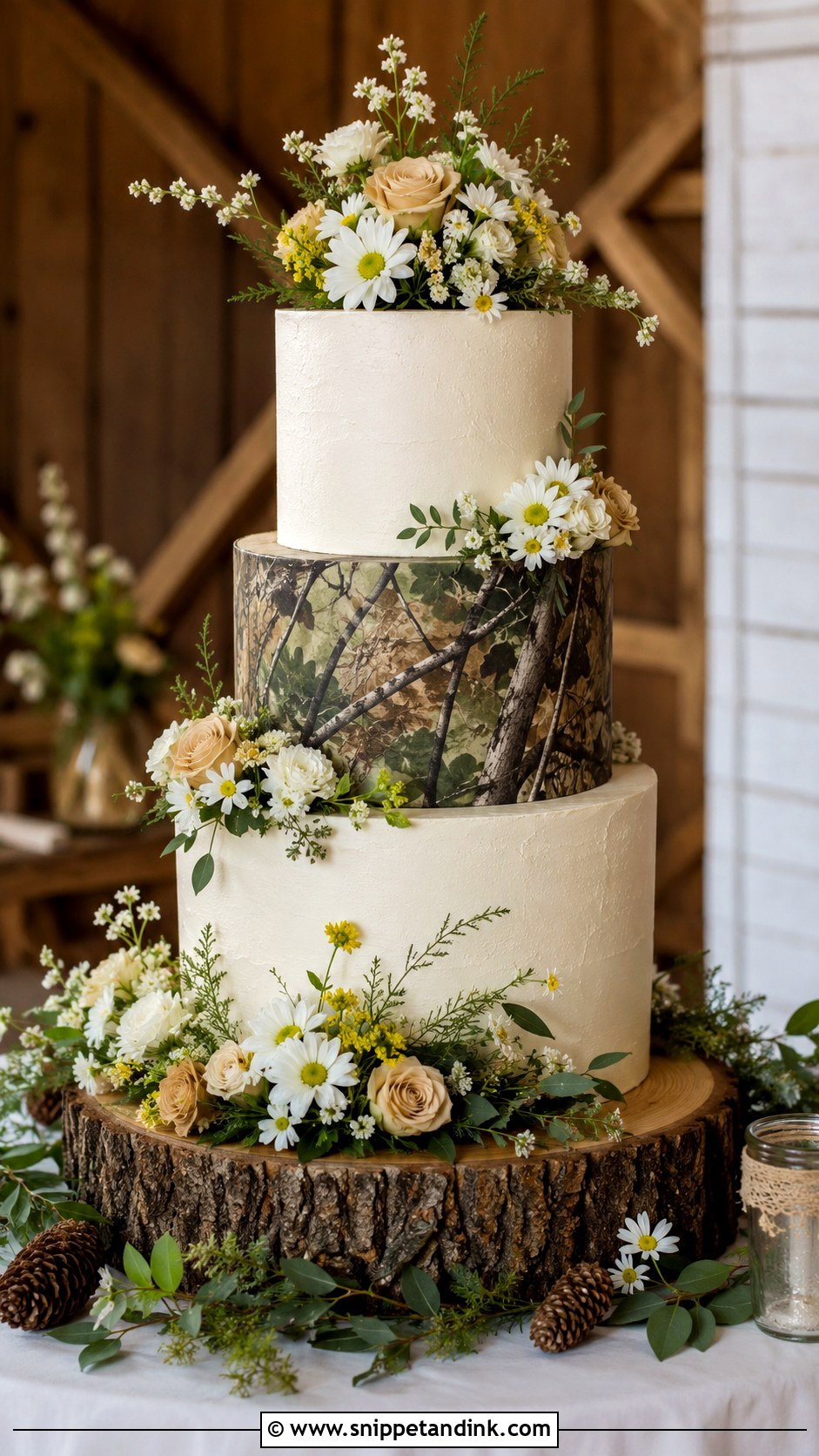
Daisies, small roses, wildflowers and soft filler give this cake a meadow feel when they’re arranged loosely. I pair them with ivory buttercream, one camo tier and a natural wooden base. Loose is harder than it looks, because each stem needs its own pick and its own angle to seem unplanned. Let the flavor follow the season, lemon in summer and spice in fall. Barn receptions and backyard weddings are where it belongs, and it shows the gentler side of a camo theme.
17. Camo Wedding Cake With Tree Bark Texture
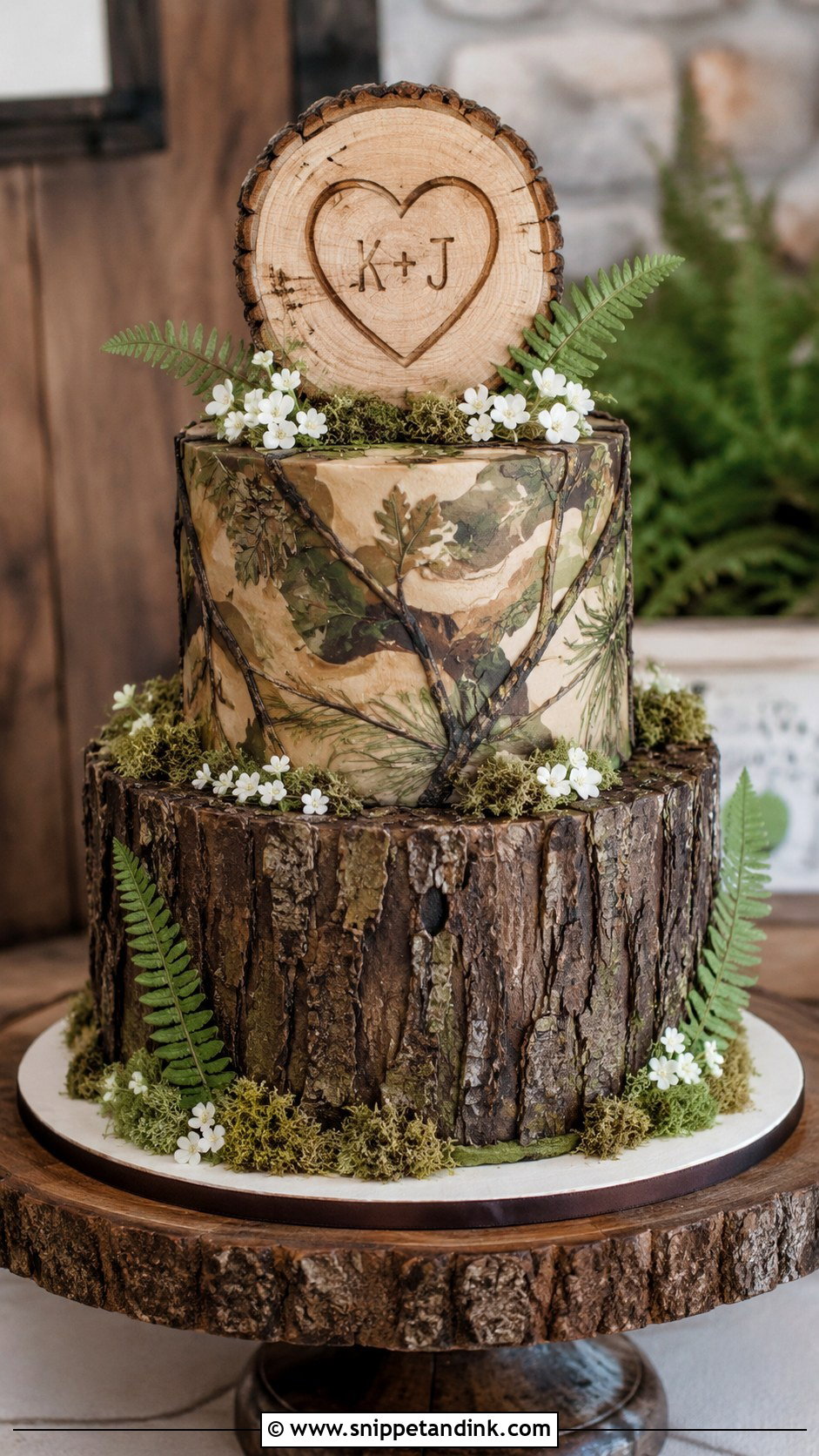
Bark texture suggests a forest without spelling it out. I create it with textured fondant, combed buttercream or modeling chocolate, and modeling chocolate gives the deepest grooves. Add a camo tier or trim so the theme stays clear. The palette works best kept earthy: ivory, tan, brown, moss green and soft gray. A carved initial topper and a few tiny white flowers complete it, and it’s a natural fit for forest weddings and lodge venues. Modeling chocolate softens with heat, so this is one I’d keep indoors.
18. Camo Wedding Cake With Cupcake Display
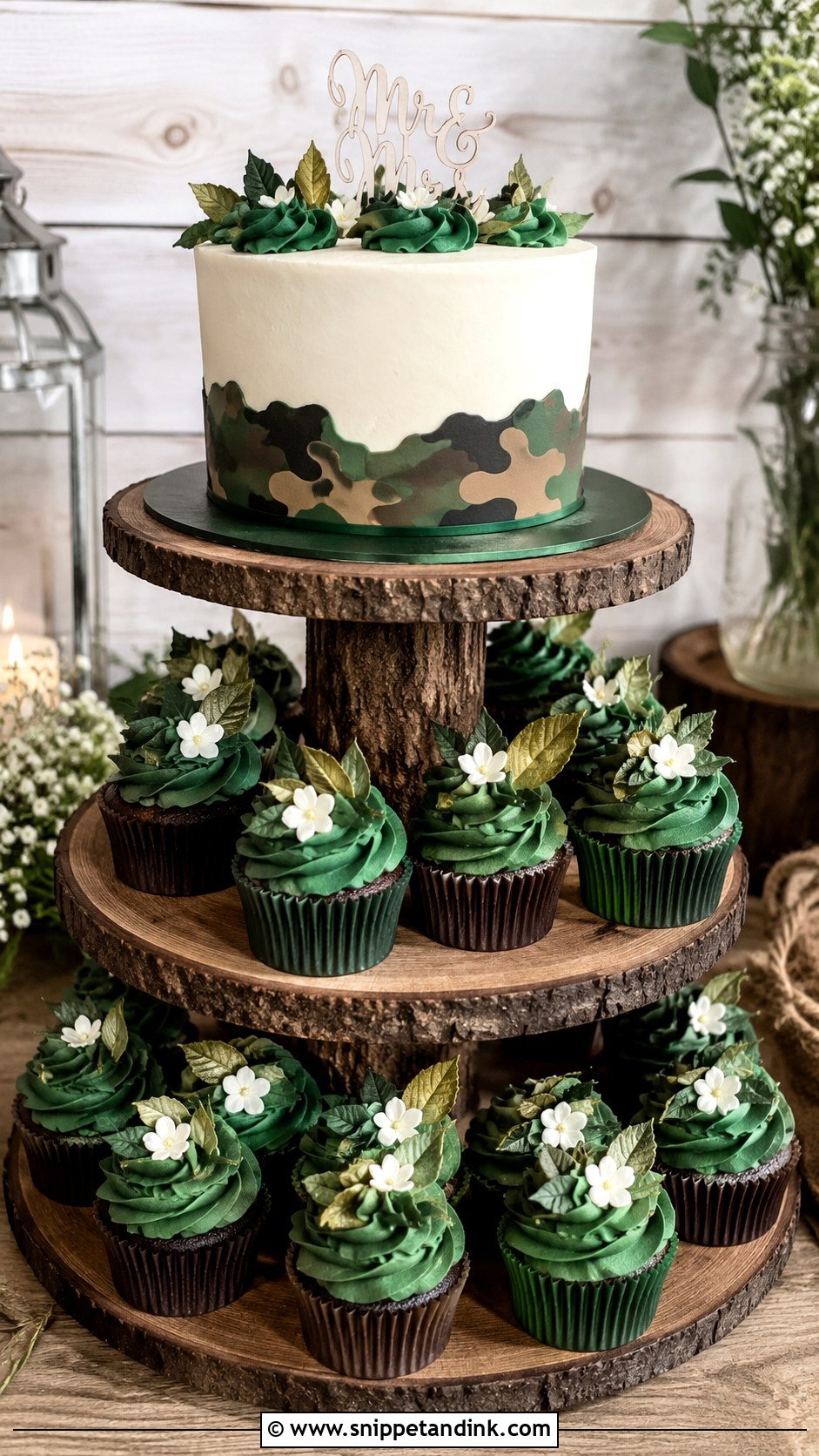
A cupcake display solves two problems at a large reception: serving is quicker and guests get a choice of flavors. I put a small cutting cake on top with ivory frosting and camo trim, and the cupcakes underneath in camo wrappers, green swirls or tiny leaf toppers. Vanilla, chocolate, spice and red velvet give a good spread. Order a few more than your head count, because cupcakes vanish faster than slices once guests can help themselves. Wood stands or tiered trays on a dessert table with greenery keep it in the same style as the cake.
19. Camo Wedding Cake With Gold Accent
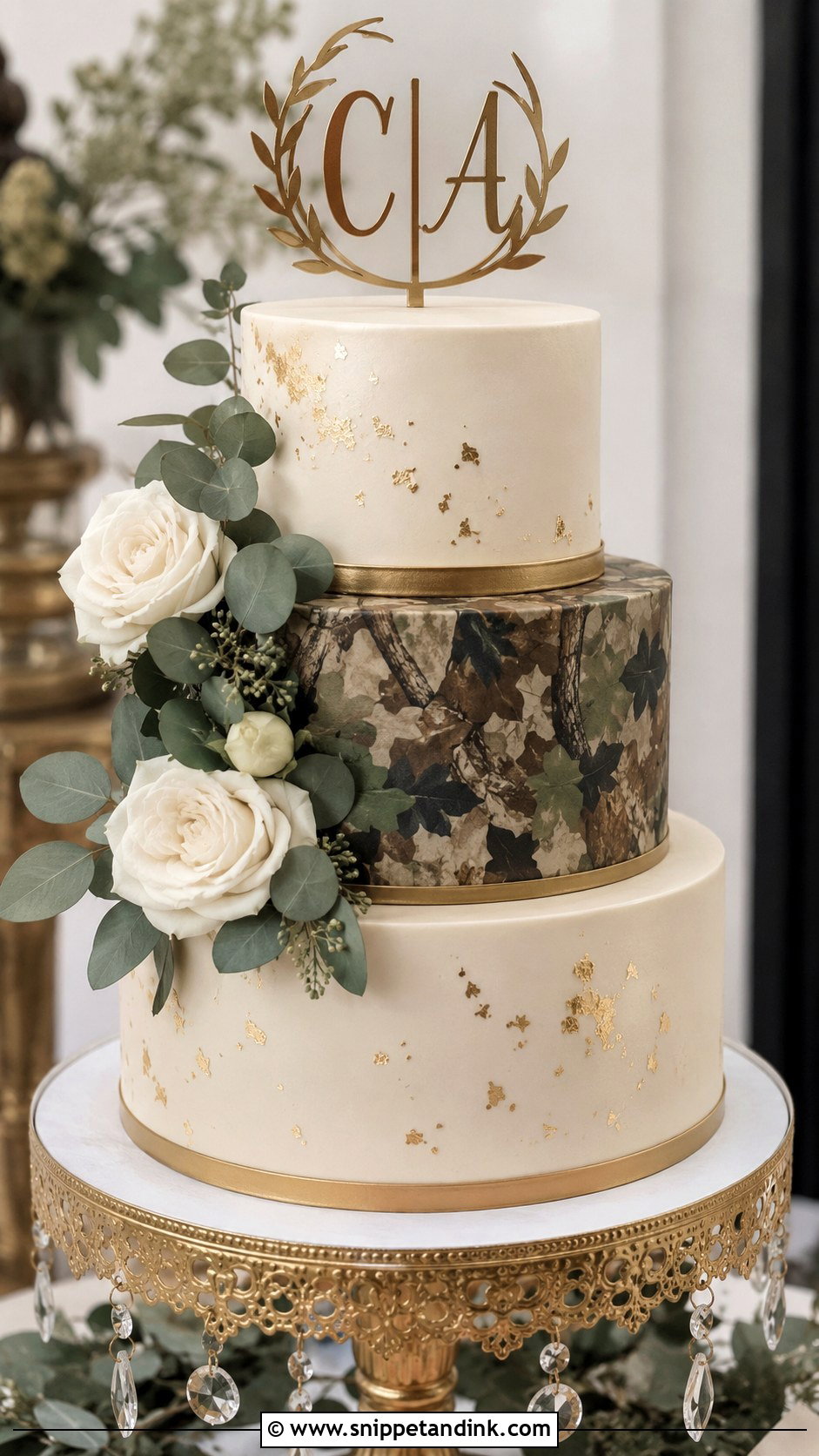
Gold makes camo more formal, and a little goes a long way. I use it on a topper, a thin tier border, a brushed fondant detail or a few edible flecks. Check that any gold dust is labeled edible; products sold as non-toxic or for decoration only aren’t meant to be eaten. With ivory frosting and muted camouflage, gold reads warm rather than flashy, which suits evening receptions and rustic glam weddings. White roses or soft tan florals keep the balance.

20. Camo Wedding Cake With Hidden Camo Layers
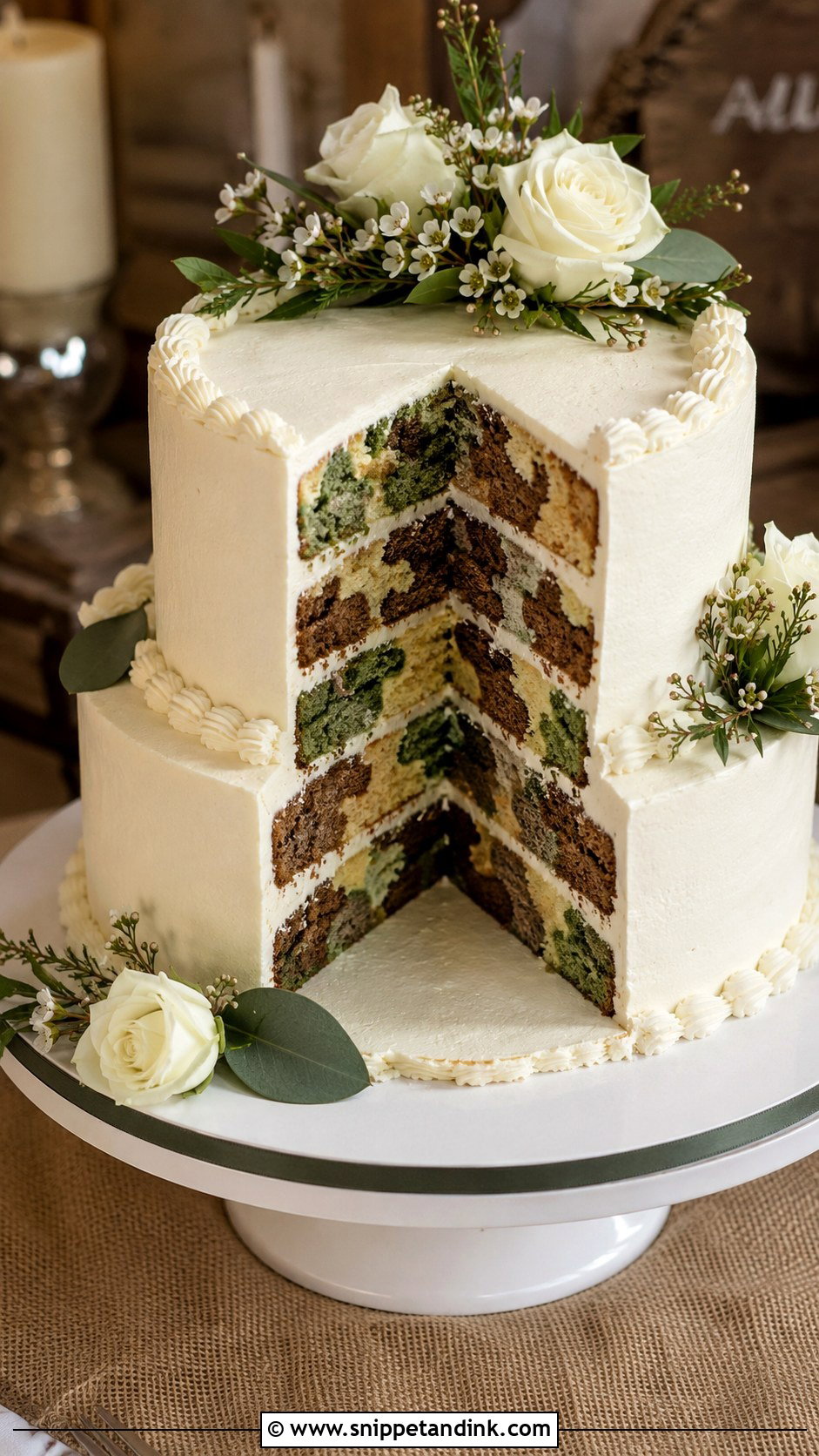
Hidden camo layers keep the outside traditional and save the surprise for the cut. The exterior is smooth ivory buttercream with simple florals and piping; inside, the batter is patched in green, tan, brown and cream. I drop the colored batters into the pan in spoonfuls rather than swirling them, because over-mixing blends everything into a muddy olive. Guests enjoy the theme without the reception feeling heavily patterned, and the reveal lands right at the cake cutting, when the cameras are already on you.
Bring the Fabric, Not a Screenshot
The most useful thing you can hand your cake designer is a scrap of the actual camo you’re using elsewhere, such as a piece of the groom’s vest, a ribbon or a napkin. Hunting prints and military woodland prints use different shapes and very different greens, and phone screens shift color badly. I match fondant to the fabric in daylight, never under kitchen lights.
At the first consultation I also want to know:
- where else the pattern appears (ties, boots, invitations), so the cake doesn’t repeat it once too often
- whether the cake is displayed indoors or outside, and what time it goes out
- any toppers, antlers or wood pieces you’re supplying, delivered about a week before the wedding
- your guest count, so tier sizes and any cupcakes are planned together
Lead times vary a lot, but autumn Saturdays book up early and a hand-cut fondant camo design takes days of work. Starting the conversation several months out gives you a real choice of designers.
A Barn in September Is Hard on Frosting
Most camo cakes end up at barns, lodges and open-air venues, which are exactly the places with little or no air conditioning. Buttercream starts to slump once a room gets warm, and all-butter recipes soften sooner than ones that include some shortening. In a hot barn I’ll suggest a firmer frosting, fondant on the lower tiers and a display spot away from windows and direct sun. I also set the cake out as late as the timeline allows.
What Shouldn’t Touch the Cake
Rustic decor brings plenty of things that aren’t food-safe: raw wood, real antlers, burlap, pinecones and many flowers and leaves. Each needs a barrier, whether that’s a board, a flower pick or a wrapped stem. A good baker will ask what’s coming to the table. If yours doesn’t, bring it up yourself.
How Much Camo Belongs on One Cake?
Camo can be as subtle or as bold as you like, and the right amount depends on the venue, the season and how formal the rest of the wedding is. Full camo fondant is the loudest choice, and ivory buttercream with a camo ribbon is the gentlest. Wood, greenery, antlers, burlap, sunflowers and bark tie the pattern to the room, while lace, gold and monograms pull it toward formal. My advice is to pick one camo moment and let everything else on the cake support it.
You'll Like These Ideas:









Leave a Reply