
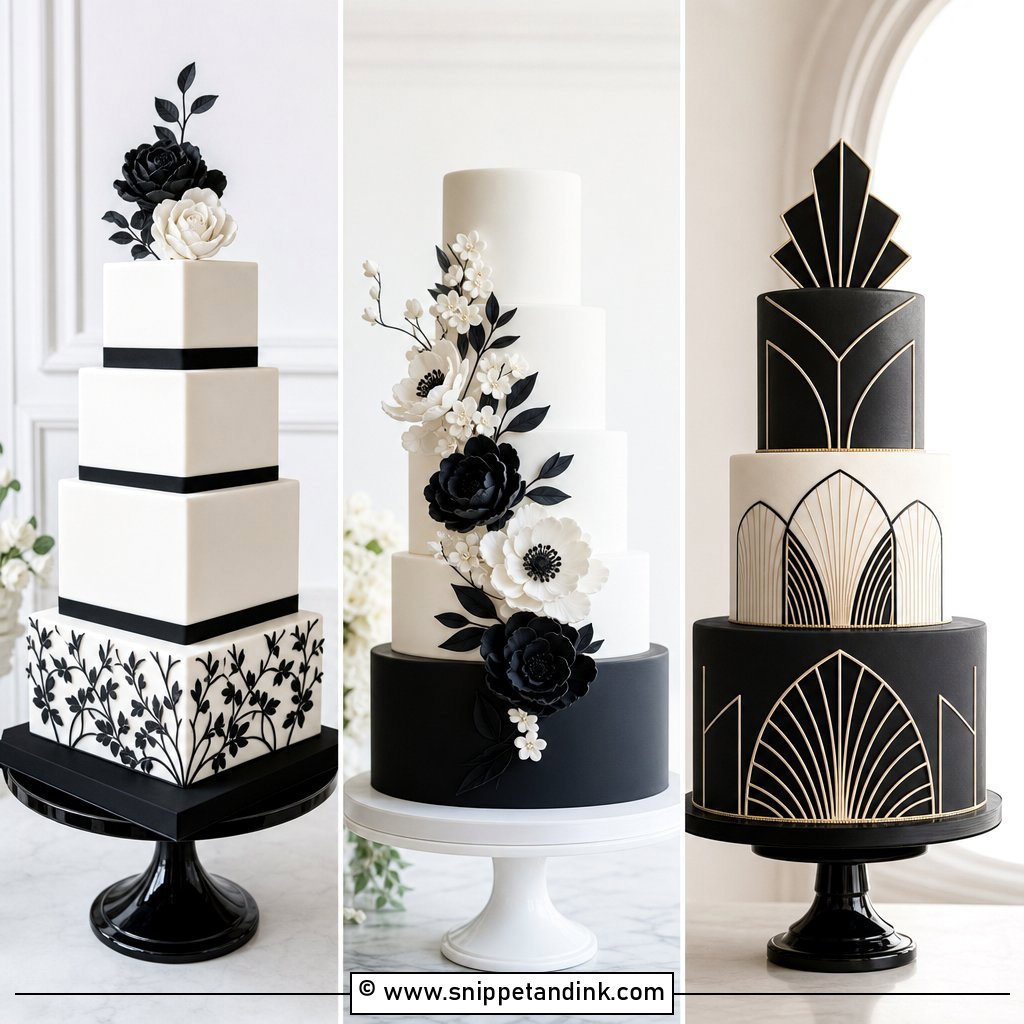
Black and white is the palette couples ask me for when they want a formal cake that won’t look dated in ten years. It can lean modern, vintage or very plain, and it works because the contrast does most of the decorating for you. Fondant bands, lace, damask, marble, stripes, flowers and full black tiers all appear below. The designs that hold up best in person share one thing: a single clear focal point. Three competing patterns across four tiers just look busy from across a room. Here are the cakes I’d build in this palette, with notes on what each one asks of the baker and the venue.

What Black Icing Does to Taste, Teeth and White Tiers
Couples fall for photos of jet-black tiers without knowing what goes into them. Black is the hardest color in cake decorating, and it changes how the cake eats as well as how it looks.
Getting a true black
Most bakers build black from a chocolate base, because starting with a dark buttercream or fondant needs far less gel coloring. Black buttercream also deepens as it rests, so I mix it a day ahead; colored the same morning, it often reads charcoal or faintly green. For a full black tier, ready-colored black fondant is the most reliable route.
Lips, tongues and flavor
Heavily colored icing can tint lips and tongues for a while, and very dark coloring can leave a slightly bitter edge. That’s why I keep black to the outer skin of a tier, to bands or to piping, and keep the filling and most of the frosting white. Guests can peel black fondant away. They can’t peel buttercream.
Black sitting next to white
Dark color can migrate into white icing in a humid room or wherever two soft surfaces touch. I let black elements firm up before they go against white and keep a cake board under every tier. Black fondant also shows every fingerprint and dusting of cornstarch, so it gets polished with a thin film of shortening before it leaves the kitchen.
1. Black And White Wedding Cake With Ribbon

Ribbon is the simplest way to keep this palette classic, and it’s one of the most forgiving designs to transport. I cover each tier in smooth white fondant or buttercream, then wrap a black band around the base. Real satin needs a strip of food-safe backing behind it, or the fat in buttercream seeps through and leaves greasy patches; an edible fondant ribbon avoids that entirely. Ballrooms, hotel receptions and black-tie dress codes suit it. Keep the tiers plain or add a few white sugar flowers to one side. I often make the bottom band wider than the upper ones, which visually grounds a tall cake.
2. Black And White Wedding Cake With Lace

Lace softens all that contrast, which is why this design reads romantic rather than stark. I start with a white base and use black lace as the main detail, piped in royal icing, set from an edible lace mat or cut as fondant appliqué. Piped black royal icing on white fondant can bleed slightly in a humid room, so for a summer barn I’d choose edible lace or fondant instead. Keep the flowers simple so the lace stays the focus; white roses, pearl dots and a narrow black border are plenty. Vintage venues, garden receptions and classic indoor weddings all suit it.
3. Black And White Striped Wedding Cake

Vertical stripes make a striped wedding cake look taller and more formal, while horizontal stripes look clean and modern. I usually stripe one or two tiers and leave the rest white, otherwise the stack starts to resemble hatboxes. A black tier with white stripes is the dramatic version. Balance the pattern with white sugar roses, a monogram or a smooth top tier. Stripes expose any lean instantly, so this is a design where I insist on proper doweling and check the cake table with a level before setup.
4. Black And White Damask Wedding Cake

Damask brings scrolls, floral shapes and repeating motifs, so it leans old-world and formal. The pattern is usually stenciled in royal icing or applied as cut fondant, and lining up the repeat around a round tier takes real time, which shows in the quote. Black damask on the middle tier of a white cake is the safe version; for more drama, run it on every other tier. Pearl borders, white sugar flowers and a tall silhouette suit it, and it looks right in historic venues, banquet halls and evening receptions.
5. Black And White Wedding Cake With Flowers

Flowers soften the sharp contrast, and they work either way round: a white cake with black accents, or black tiers carrying white blooms for more punch. White roses, anemones, orchids, peonies, and sugar blossoms all suit it. Black ribbon, black piping or a black lower tier ties the palette together. I place flowers in a diagonal cascade from the top tier to the base, which adds height and movement. If they’re fresh, the florist and I agree beforehand which stems go on the cake, because some popular wedding flowers aren’t food-safe and need wrapping or a barrier.
6. Black And White Marble Wedding Cake

A black and white marble wedding cake needs very little decoration, because the veining already gives the surface movement. I ask for soft grey veins with only a few black accents on white fondant. Heavy black veining reads as kitchen countertop rather than cake in photos. A single black tier or thin black border adds depth, and acrylic stands, simple florals and candlelit tables suit it. Marbled fondant is usually made by partly kneading colors together, so no two tiers come out identical. For a more formal finish, add white sugar orchids or pearls.
7. Black And White Wedding Cake With Pearls

Pearls look refined only when there aren’t too many of them. I use them as borders between tiers, clusters around sugar flowers or dots scattered over a black-and-white pattern. A white base keeps the cake bridal, while black ribbon or piping adds the contrast. Cover every surface and it starts to look like a costume piece. Hard dragée pearls can surprise a tooth, so on the parts that get sliced I use soft sugar paste pearls instead. Classic receptions, brunch weddings and formal evenings all fit the style.
8. Black And White Art Deco Wedding Cake

Art Deco depends on symmetry: sharp lines, fan shapes, stepped borders and geometric patterns. A tall white cake with black Deco detail is very formal and belongs at an evening wedding. Small metallic accents are optional, since the two colors carry it alone. Keep flowers minimal or use structured white blooms such as calla lilies. The geometry has to be exact, so I cut every piece from paper templates rather than freehand. Display it on a simple stand with candles nearby so the lines stay crisp.
9. Black And White Polka Dot Wedding Cake

Polka dots add a playful note without losing the classic feel. Small black dots on white look sweet and vintage; larger dots look modern. To keep it wedding-ready, pair the dots with smooth tiers, a black ribbon or white sugar flowers, or limit them to one accent tier. Black fondant dots stuck on with too much water can leave a faint grey halo on white, so I attach each one with a tiny dab of edible glue. It suits a cheerful dessert table that still has to look like a wedding.
10. Black And White Monogram Wedding Cake

A monogram makes a cake feel made for you without any complicated design work. It can sit on the front of the middle tier, on a topper or inside a small iced black frame, with a white cake and black borders giving it a clean background. Keep the lettering simple. Script that looks fine on a sketch can be unreadable from three meters away, which is where most guests stand. I finish it with tiny pearl dots, white flowers or thin black piping, and it fits traditional and formal weddings best.
11. Black And White Wedding Cake With Bow

A black fondant bow on a white cake has a tuxedo feel that suits formal weddings. Place it on the front of the middle tier, or wrap it around the base tier like a gift. A thin bow with flowing tails is softer; a large structured bow is more dramatic. Structured bows have to be made several days ahead so the loops dry firm, or they droop by the time the speeches start. Keep the rest of the cake smooth, with nothing more than white sugar flowers or a pearl border.
12. Black And White Buttercream Wedding Cake

Buttercream gives a softer finish than fondant, and plenty of couples prefer how it tastes. It can be smoothed, lightly textured, piped or ruffled. A white buttercream cake with black piping is the classic version. A full black buttercream tier is possible, but it takes a lot of coloring and can stain lips, which is why many couples settle on black details instead. Ask for sharp edges and restrained decoration. Keep it out of warm rooms, too, because buttercream softens long before fondant does.
13. Black And White Tiered Wedding Cake

A tall tiered cake is the most traditional choice for a formal celebration. Its height turns it into a centerpiece, and the palette makes every detail visible. Alternate white tiers with black accent tiers, or keep it mostly white with black bands and piping. Tall cakes need one repeated detail to hold them together, whether that’s ribbon, lace, pearls or a floral cascade. It’s the sensible route for a large guest list. Anything above four tiers needs a central dowel through the whole stack, and I’d always assemble it at the venue rather than drive it fully stacked.
14. Black And White Square Wedding Cake

A square wedding cake feels sleek and tailored, and the corners make even a classic palette look modern. Square tiers suit stripes, ribbon bands, monograms and geometric patterns because the lines stay straight. Stack them evenly for a clean look or offset them slightly for something more contemporary. White fondant with black borders is the safe option, softened by one cluster of white flowers on a corner. Sharp corners are harder to perfect than a round edge, so ask to see square cakes your baker has actually made.
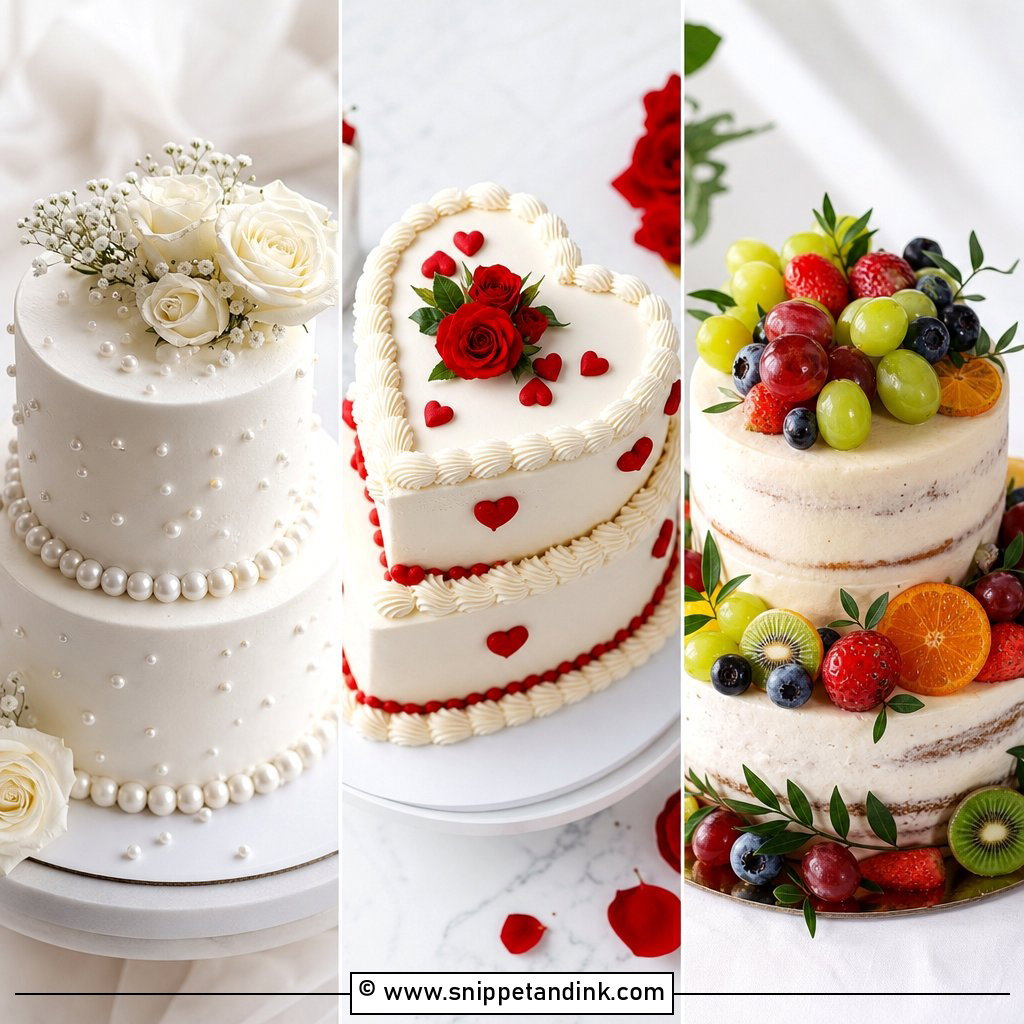
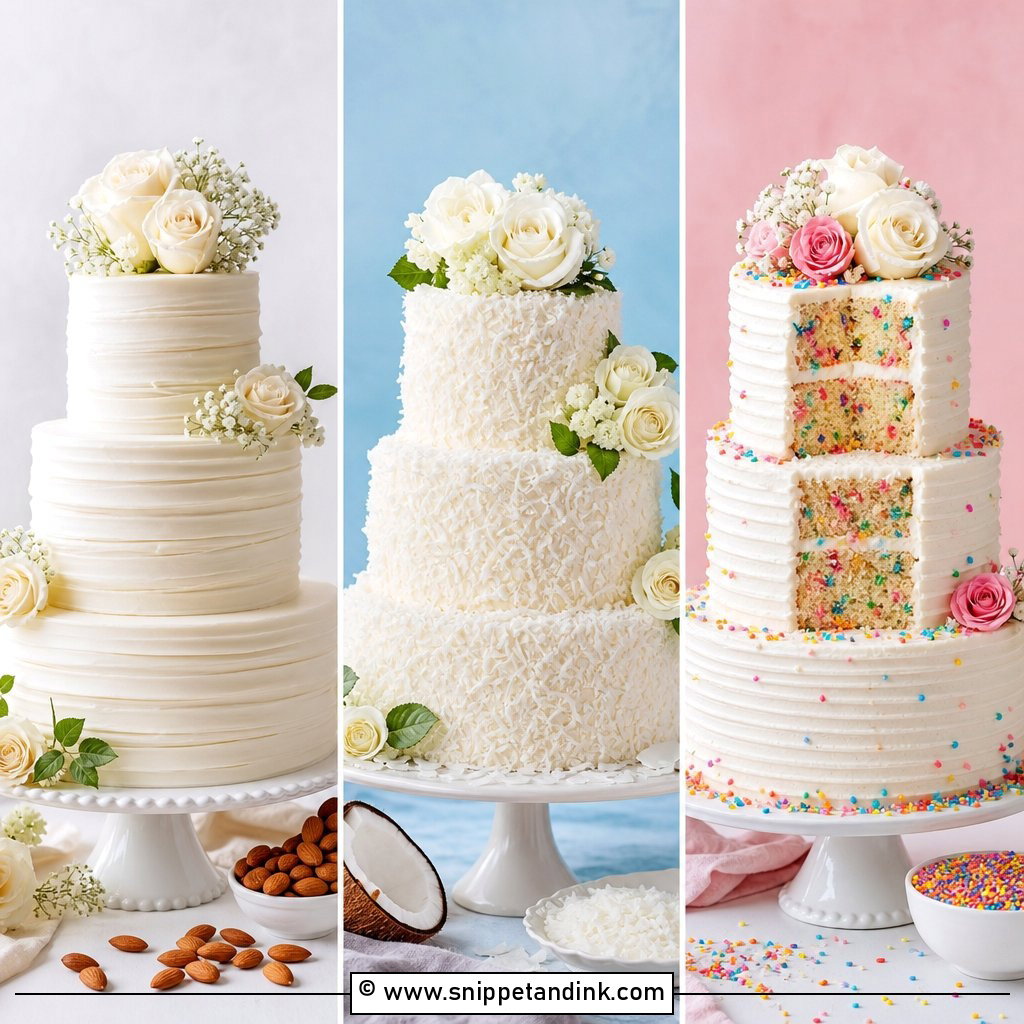
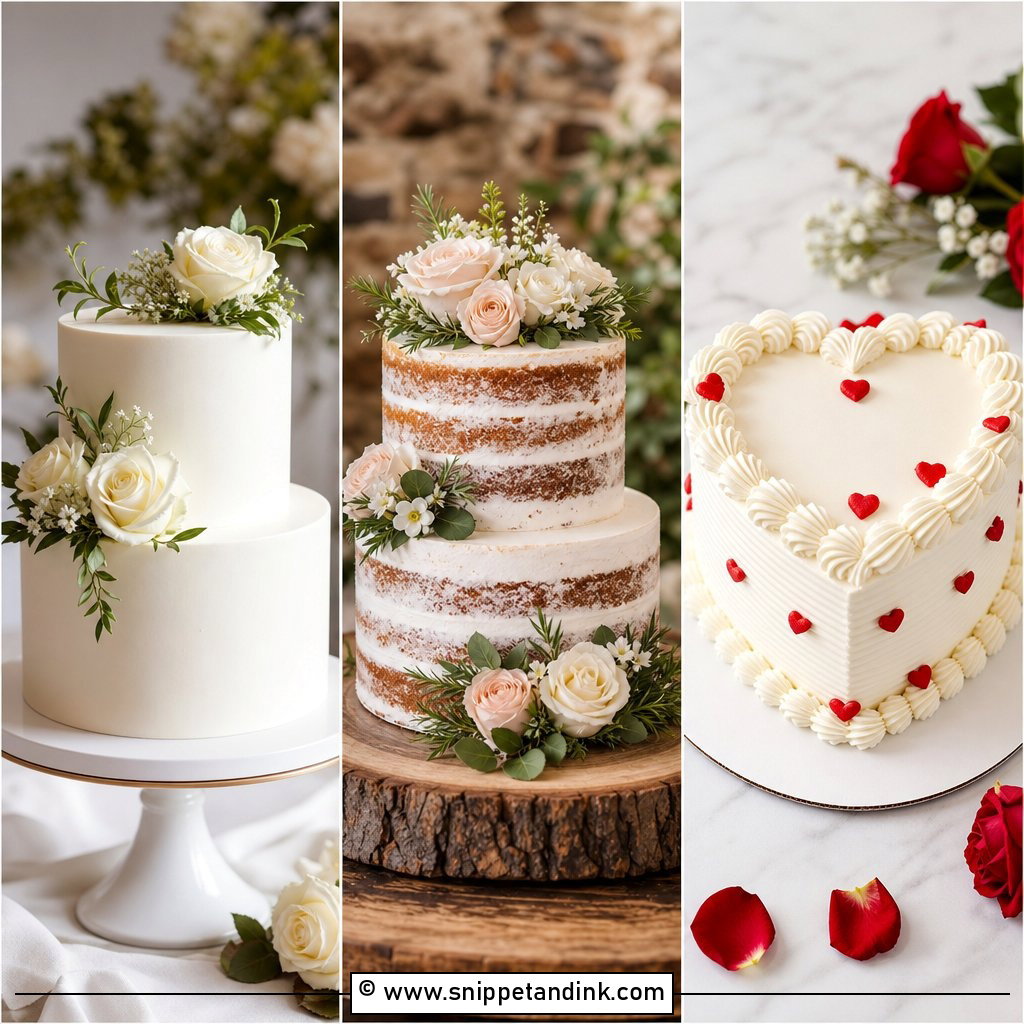
15. Black And White Wedding Cake With Roses

Roses are familiar and easy to style. White roses on a black tier look striking, while black ribbon on a white cake with roses feels more traditional. Sugar roses stay perfect all day. Fresh roses look lovely too when the florist and baker prepare them properly, usually with wrapped stems and nothing pushed straight into the sponge. A cascade suits a tall cake; small clusters suit a two-tier design. You keep the strong contrast, just with softer edges.
16. Black And White Wedding Cake With Ruffles

Ruffles add texture and movement. White ruffles feel soft and bridal, and black accents stop them from turning too sweet. I often put ruffles on the bottom tier only and keep the upper tiers in smooth fondant, or wrap a black ribbon around a white ruffled tier. Fondant ruffles keep their shape in a warm room far better than buttercream ruffles, which can slump. With that much texture already there, a small white flower topper or pearl border finishes it.
17. Black And White Minimalist Wedding Cake

Minimal design lives on negative space. A smooth white cake with one black line, a black base tier under plain white tiers or a single black floral accent is all it takes. Let the cake breathe instead of filling every tier. Modern venues, lofts and simple rooms suit it. The catch is that a minimal cake shows every flaw, so smooth sides, sharp edges and perfectly level tiers matter more here than on any heavily decorated design.
18. Black And White Wedding Cake With Calligraphy

A wedding cake with calligraphy feels personal and a little artistic. The writing can be initials, a short phrase or a repeating love-note pattern. Black edible ink and hand-piped script both work on smooth white fondant; ink gives finer lines, piping has more depth. Keep the words short so they stay readable. Thin black borders, small white flowers and round tiers suit it. Edible ink can feather on fondant that’s still soft, so I let covered tiers firm up overnight before any lettering goes on.
19. Black And White Two Tier Wedding Cake

Two tiers suit smaller weddings, elopements or a simple cake table. One option is a white top tier with black piping over a black bottom tier with white flowers; another is a white cake with one black ribbon and a small flower cluster. If your guest count outgrows two tiers, I’d suggest a plain kitchen cake cut behind the scenes rather than adding height you don’t want. Set it on a good stand with candles or simple florals around the base to give it presence.
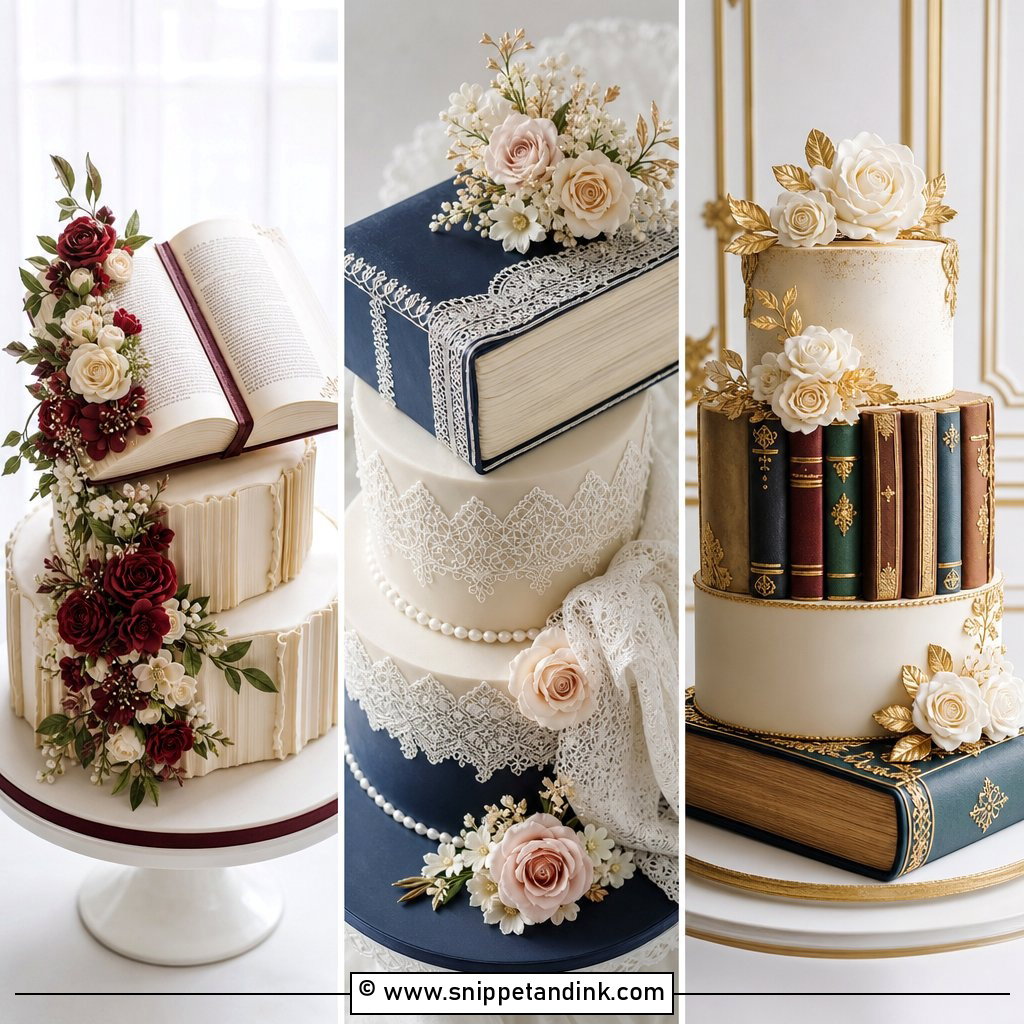
20. Black And White Wedding Cake With Anemones

Anemones often have white petals with dark centers, so they match the palette without any forcing. A white cake with black ribbon, black piping or a black lower tier suits them, with a small cluster on top or a loose cascade down one side. Fresh anemones wilt fairly quickly out of water, so for a long reception I’d make them in sugar or ask the florist to place them as late as possible. Either way, the flowers tie the decoration to the color scheme from the start.
Where a Dark Cake Should Stand, and How It Gets Cut
A dark cake absorbs heat. In a sunny window or an outdoor tent, black fondant softens and can start to sweat well before a white one does, and the buttercream underneath follows. Ask for the cake table in shade, away from heaters and stage lighting, and confirm when the venue will accept delivery so the cake isn’t standing out for hours before anyone sees it.
At the cutting
Black icing drags through white sponge if the knife isn’t cleaned between slices. Whoever cuts should use a long knife dipped in hot water, dried and wiped after every cut, and can peel black fondant panels off before plating. Tell your caterer in advance which tiers are black so they plan for it, and have them lift off any ribbon, wired flowers or topper onto a side plate before the first slice.
One Focal Point, Then Let the Contrast Work
Settle on one direction before you choose decorations: vintage with lace, formal with ribbon, modern with marble, romantic with roses or plain with one black line. That decision does more for the finished cake than any extra detail. Too many patterns make a cake feel busy, while one strong focal point makes it look deliberate. Bring photos of your venue, flowers, table styling and dress code to the tasting so the design fits the room it will stand in. Stripes, pearls, bows or anemones can each carry the table when everything else steps back.
You'll Like These Ideas:


Leave a Reply