
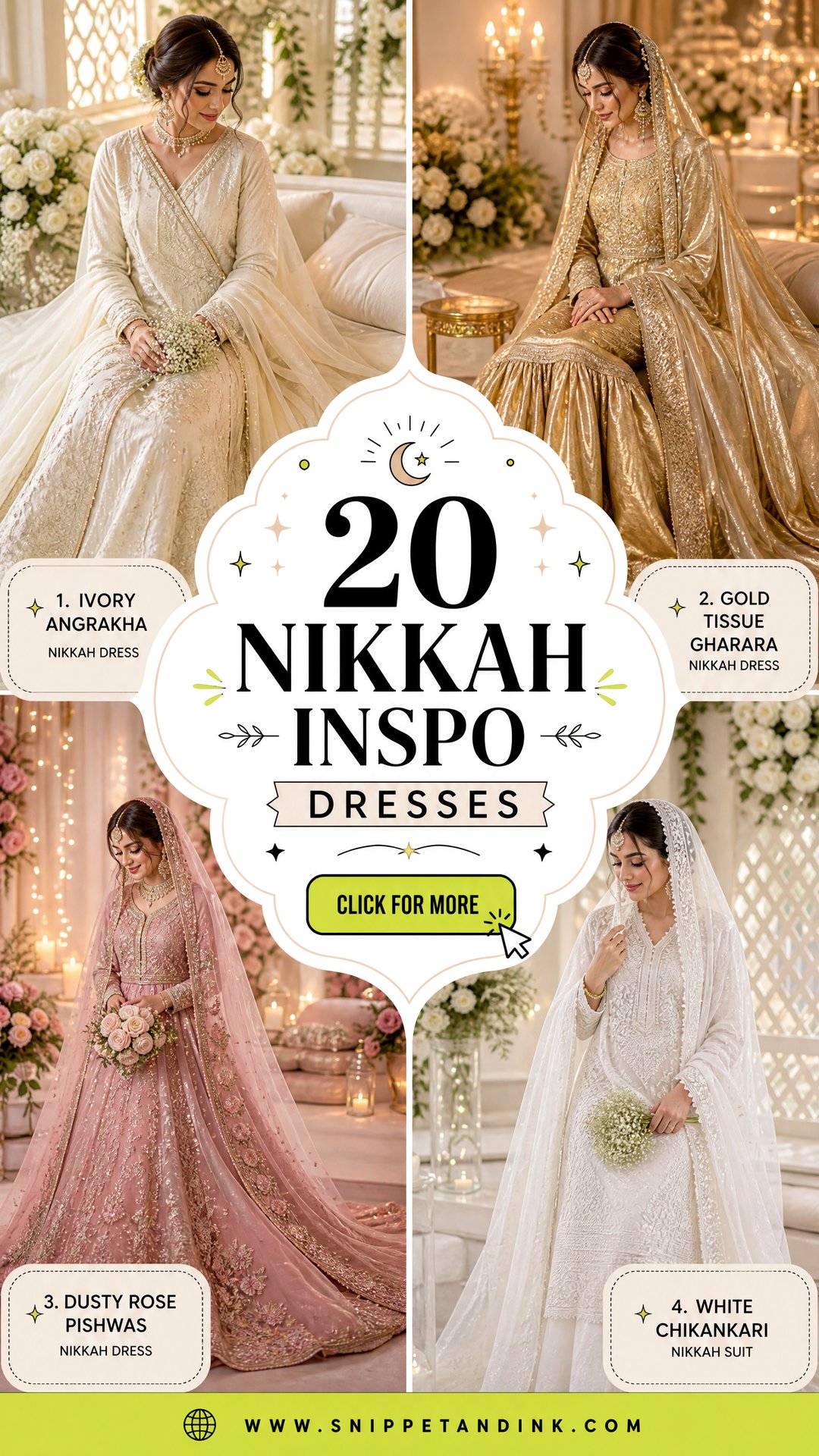
A Nikkah outfit has a harder job than most bridal clothes. You sit for the ijab and qubool, you lean over a table to sign, you greet elders for hours, and the dupatta has to stay where it was pinned the whole time. When I dress a Nikkah bride, coverage and movement come first and colour comes second. Ivory and white are still the most requested, but blush, sage, champagne, powder blue and deep red all hold their own on camera. Below are the full looks I’d put together for twenty different silhouettes, from a farshi gharara to a plain chikankari suit, with notes on what each one asks of you on the day.
Dressing for the Stage, the Floor Cushion and the Signing Table
Before we talk colour, I want to know three things about your ceremony: will you sit on a sofa, a stage or floor cushions, how long is the session with the imam, and will you wear hijab or only a dupatta over the hair? Those answers rule out more outfits than any mood board.
Sitting low or sitting long
Floor seating favours sharara, gharara and soft lehengas without stiff can-can. Pishwas and Anarkali skirts spread well when you sit, but they need trousers underneath. A farshi gharara on a low cushion is hard work; you will need help to stand.
Keeping the head covering in place
- Pin the dupatta to the hair or hijab cap at the crown and behind each ear, not only at the shoulder.
- Organza and net grip better than chiffon or silk, which slide on smooth hair.
- If you wear hijab, a cotton or jersey underscarf stops the veil from slipping on satin.
- Do a test: sign your name at a table, hug someone, then stand up. Whatever moved needs another pin.
Sleeves matter at the signing too. Wide embroidered cuffs drag across paper and catch ink, so I like a fitted cuff or a sleeve that ends just past the wrist bone.
1. Ivory Gharara Nikkah Dress
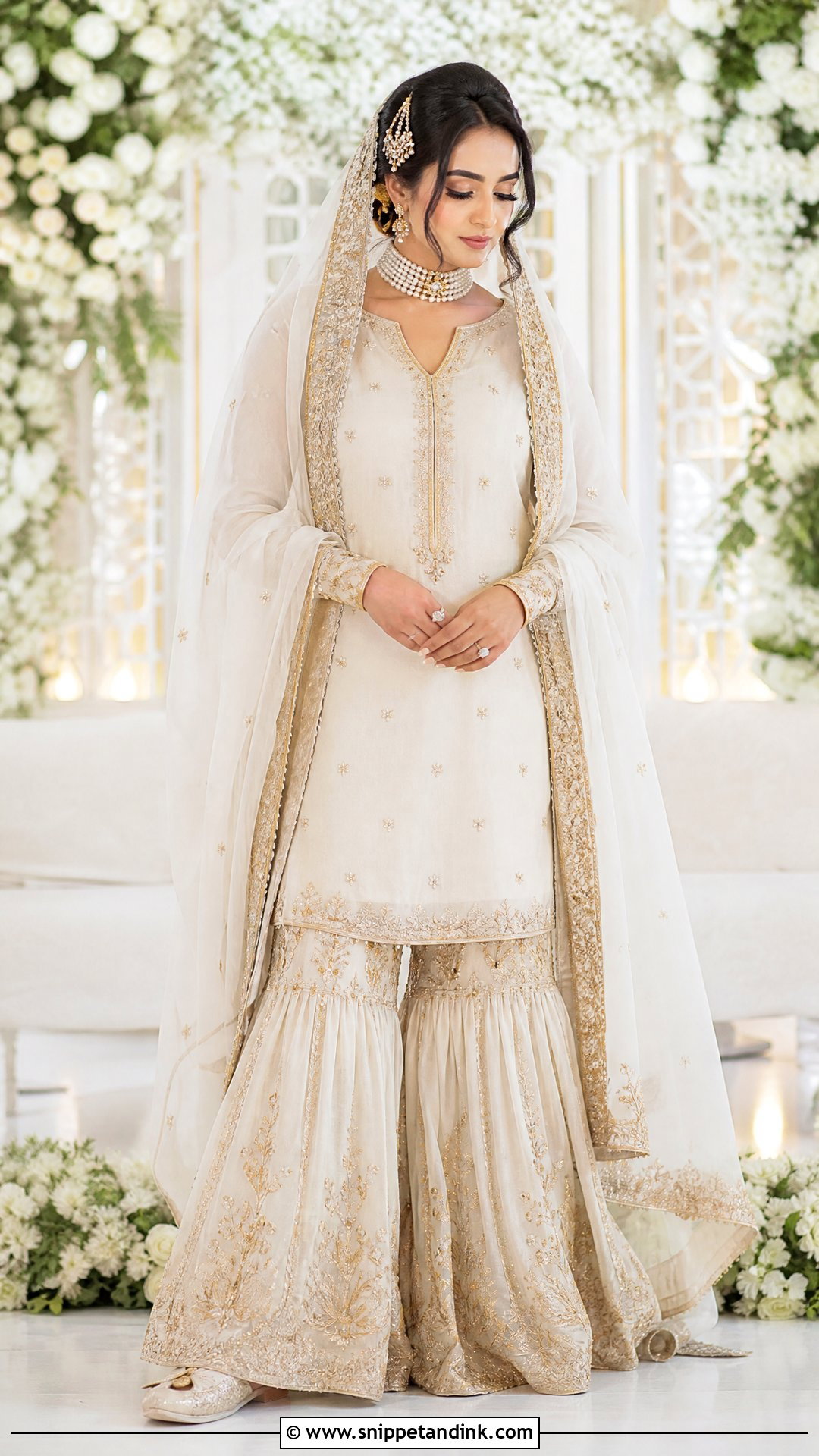
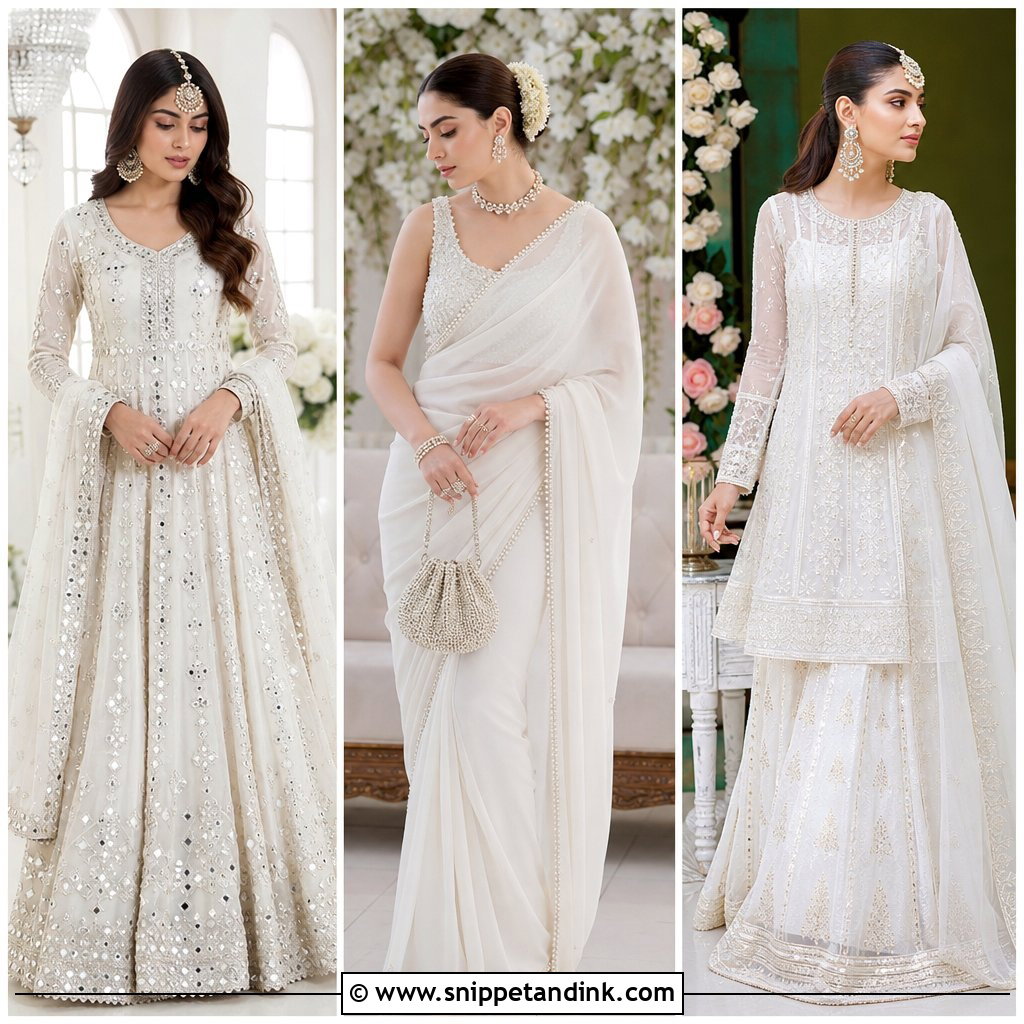
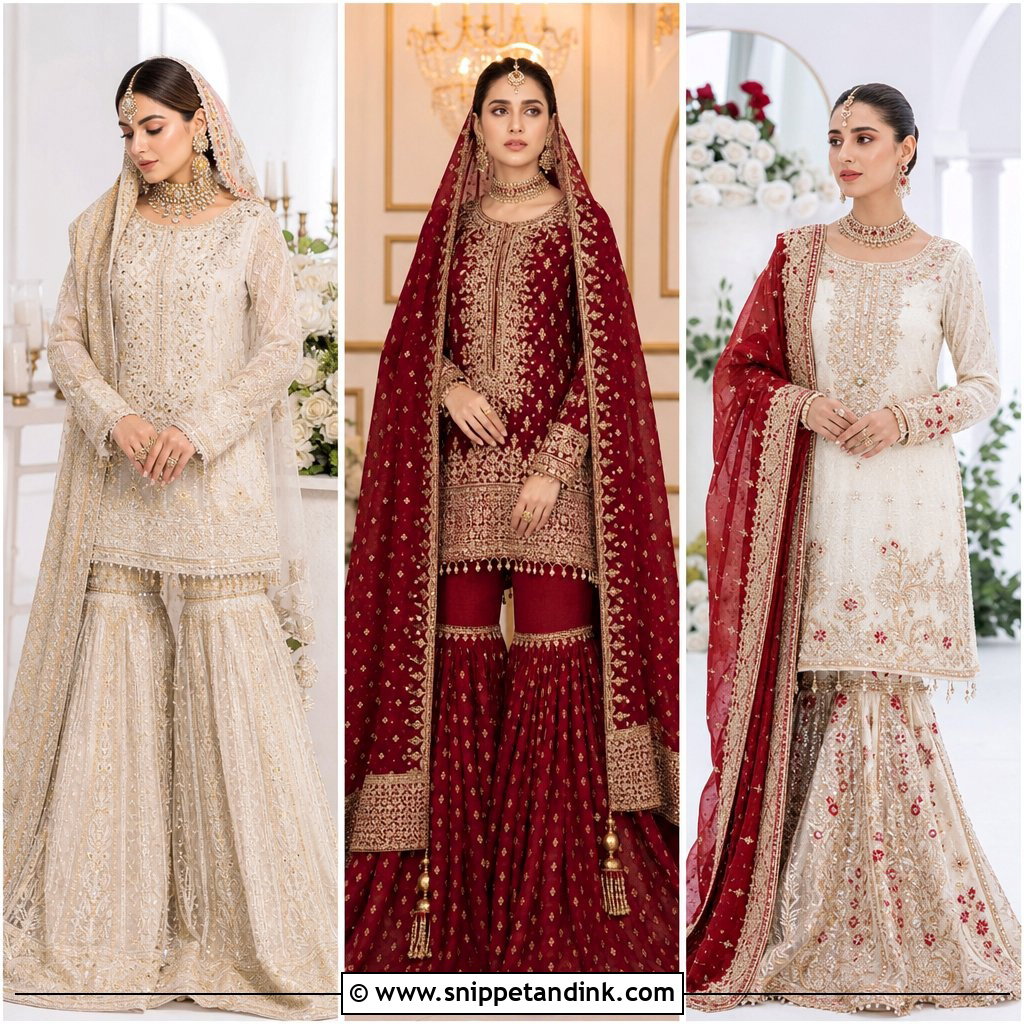
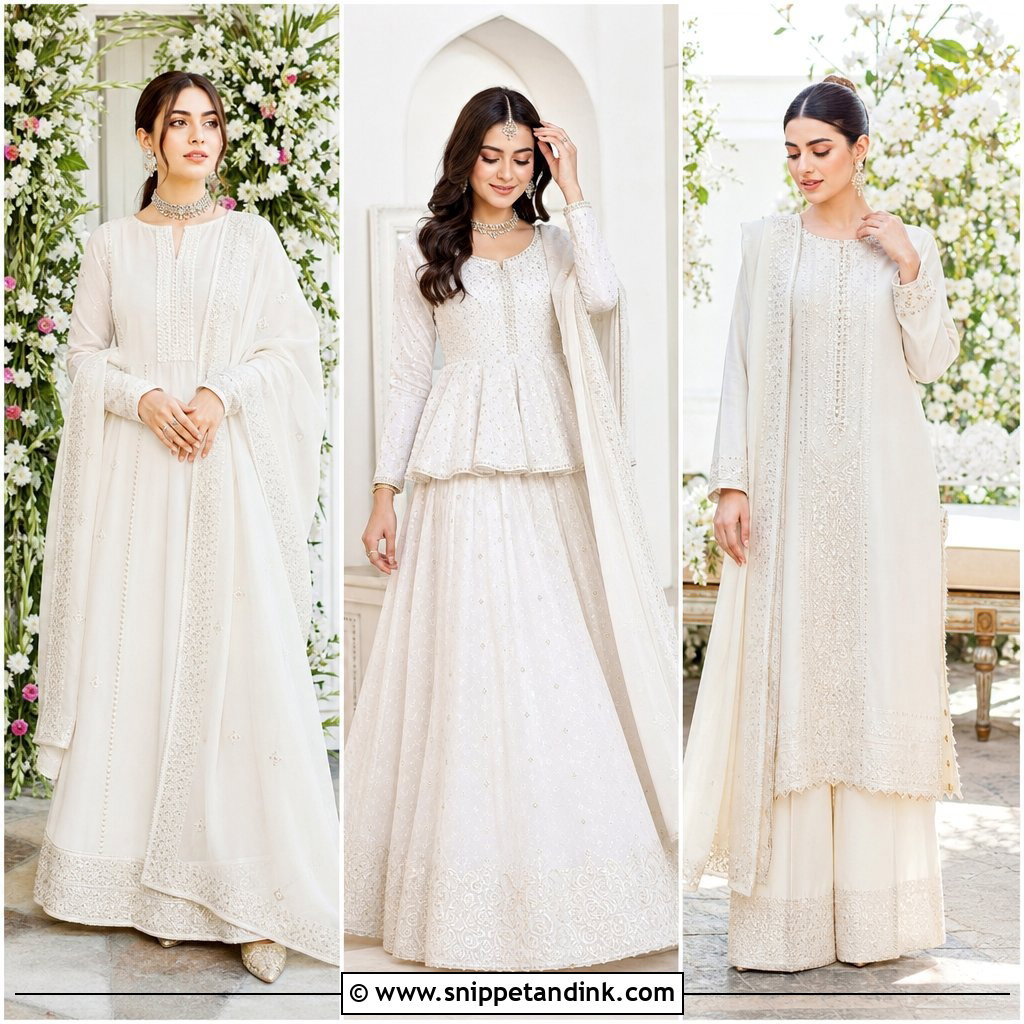
Ivory gharara is the outfit I reach for when a bride wants tradition without weight. A knee-length raw silk kurta with gold work only at the neckline, cuffs and hem keeps most of the heft off the shoulders. The gathers at the knee should be sewn flat and firm; if they puff, the whole silhouette looks shorter. I pair it with a sheer organza dupatta with a scalloped border, pinned at one shoulder and drawn over the head. Pearl drops, a slim gold choker and ivory khussas keep it quiet. Tonal embroidery reads as minimal; antique gold reads as richer, on exactly the same cut.
2. White Anarkali Nikkah Dress
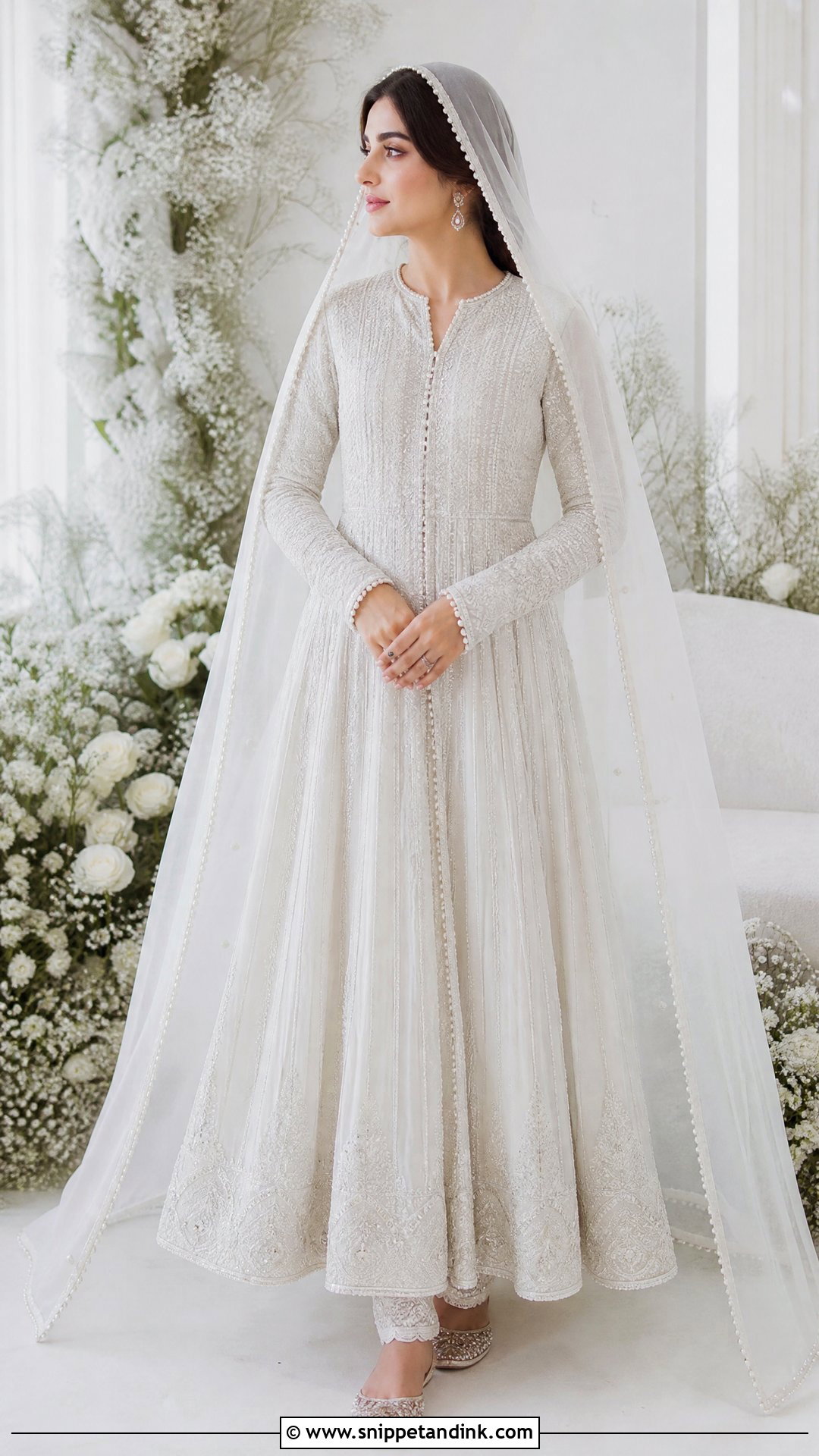
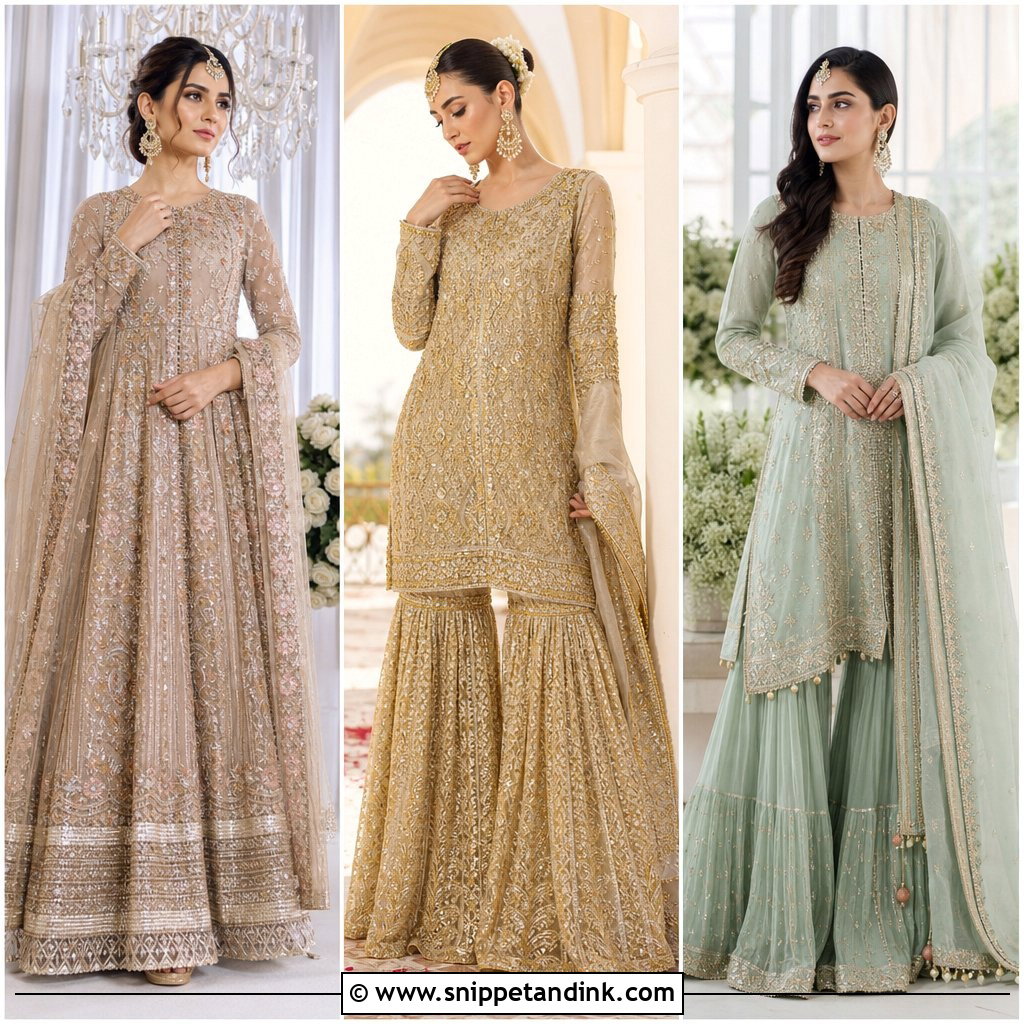
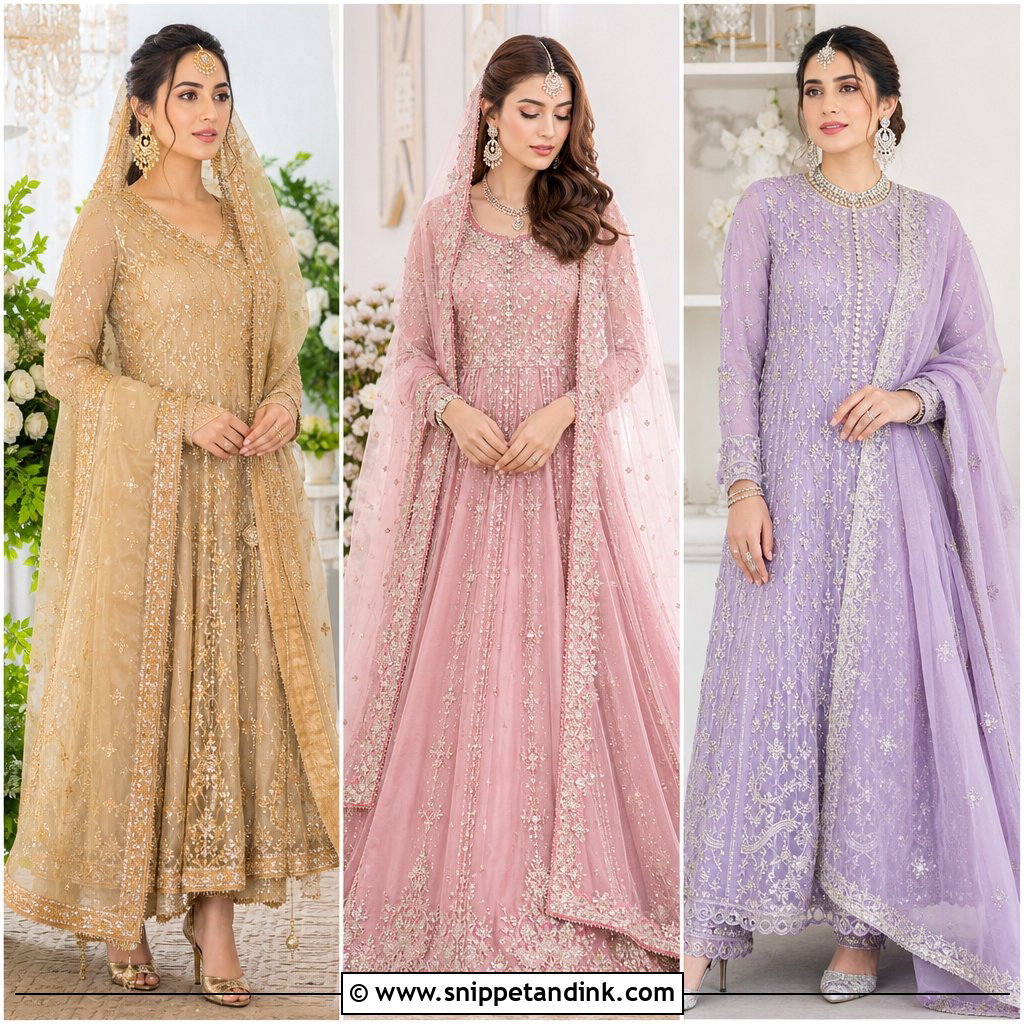
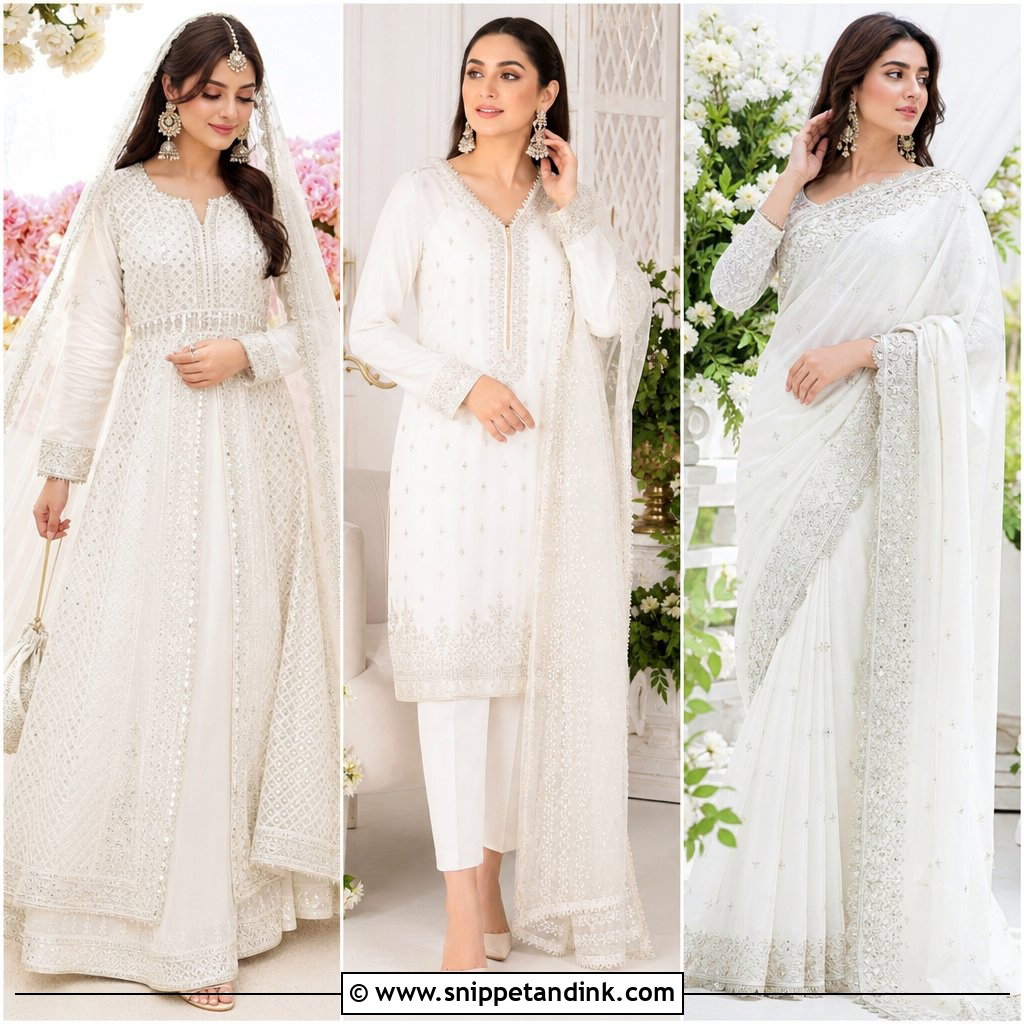
An Anarkali Nikkah dress gets its float from layers of chiffon, organza or fine net over raw silk. The hem is where I’m fussy: it should brush the floor in your actual shoes, not pool, because a pooled hem catches under your heel the first time you stand from the stage. Pearl beading and white threadwork stay refined; silver embroidery adds a little light. Wear it over fitted trousers with crystal flats and a pearl-edged veil. For hijab-wearing brides I pin a matching white wrap first and lay the veil over it, which stops the veil sliding on satin.
3. Blush Pink Sharara Nikkah Dress
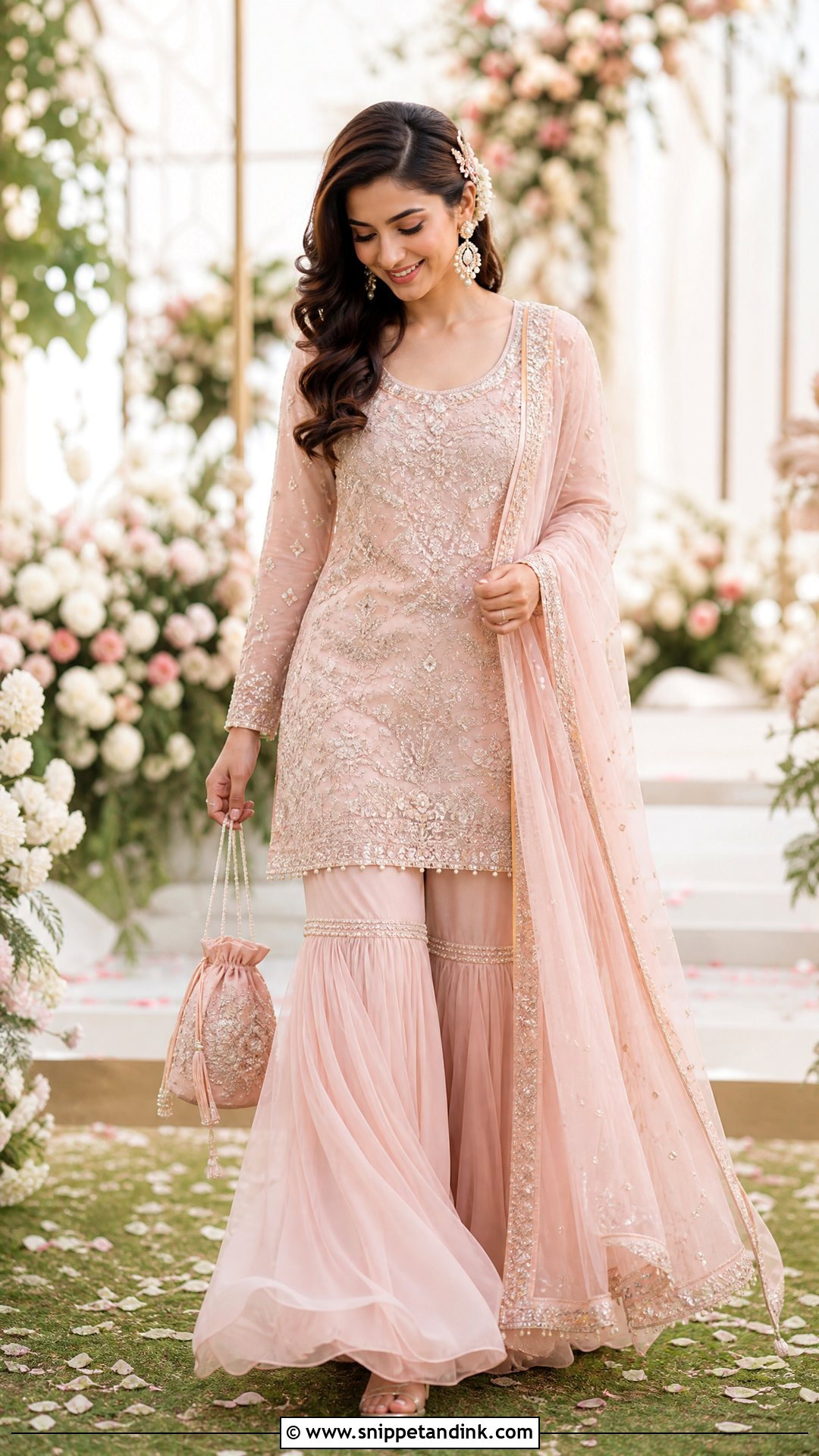
Blush sharara is my usual answer when a bride asks for colour that still reads as bridal. Chiffon or georgette sharara pants move well, but they also cling to static in dry, air-conditioned halls, so ask for a lining. Keep the embroidery in champagne, pale gold or tonal pink; bright gold against blush looks harsh in close-ups. A lightly sequinned dupatta, rose-gold sandals and a small potli finish it. A longer kurta gives more coverage. A mid-thigh cut shows off the flare, and that choice depends mostly on how much bending and greeting you’ll do.
4. Champagne Pishwas Nikkah Dress
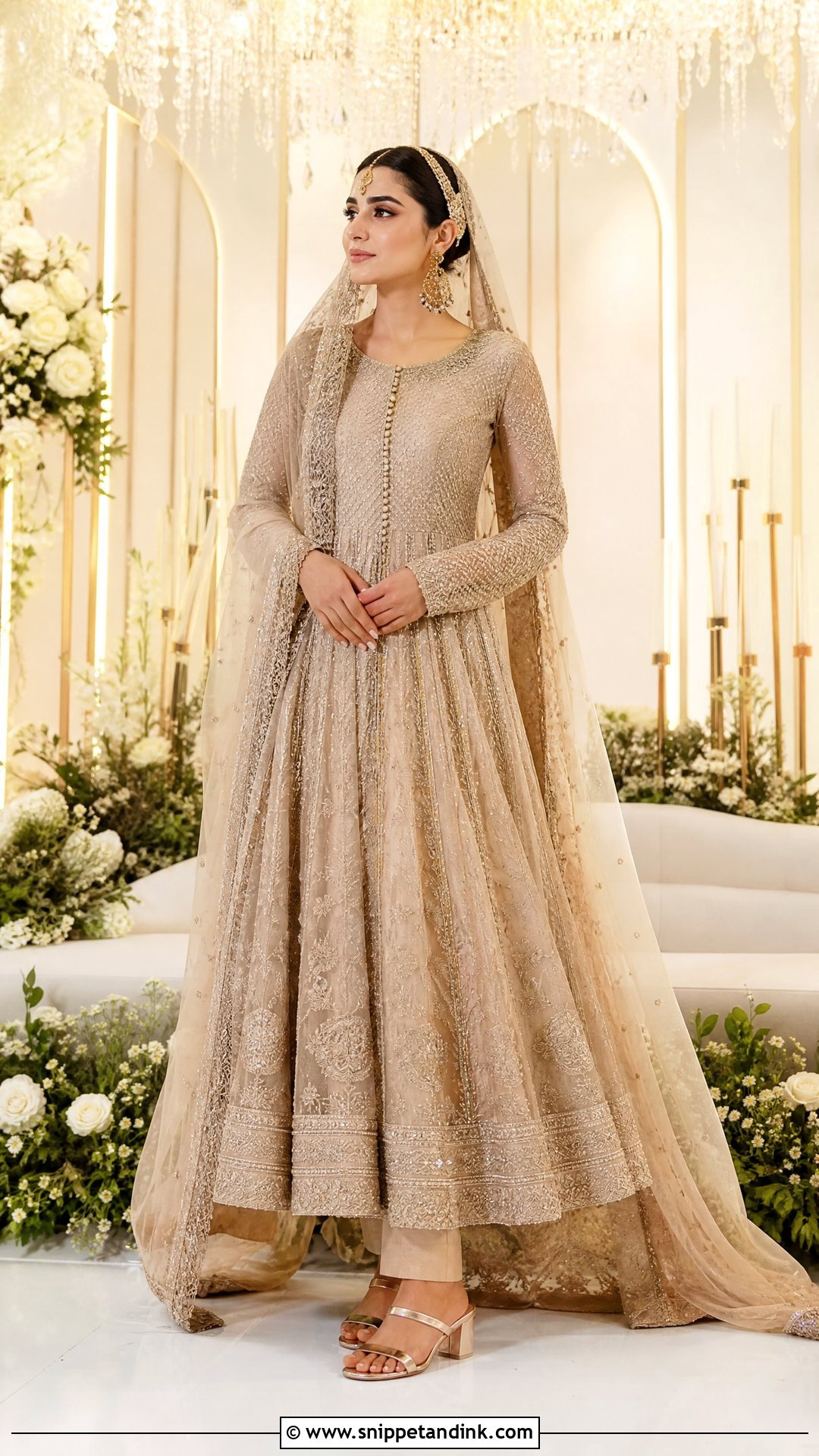
Champagne pishwas carries volume better than almost any other shape, because the panels fall from a fitted bodice rather than from the hips. Zardozi or dabka on the bodice gives definition without making the skirt heavy. Straight trousers underneath are non-negotiable for me; a panelled skirt swings open when you sit. A net dupatta with the embroidered border framing the face, antique gold earrings, a fine matha patti and block heels in the same champagne round it off. In portraits, let the skirt fall naturally. Spreading it into a full circle on the floor flattens the panels and hides the cut.
5. Sage Green Lehenga Nikkah Dress
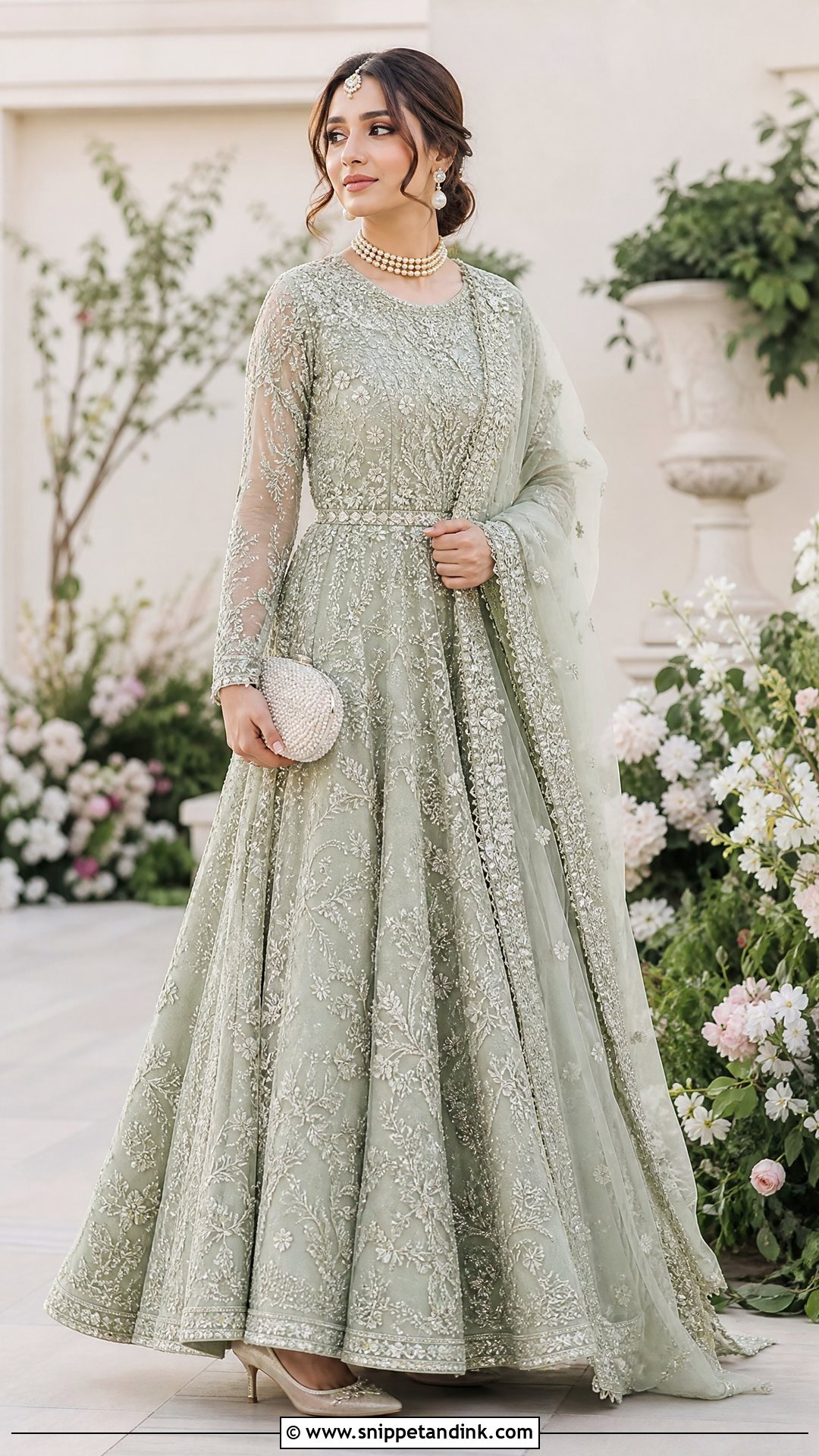
Sage is a quiet colour that skin tones rarely fight with, which is why I suggest it to brides nervous about stepping away from ivory. Choose a high-waisted lehenga and a long blouse that overlaps the waistband by at least two inches, so nothing shows when you raise your arms to hug. A softly rounded neckline sits well under pearls. Pin the sage dupatta with its ivory border over the head or across both shoulders. If the ceremony has floor seating, ask for a lighter can-can or none at all; a stiff lehenga on the floor pushes up into your lap.
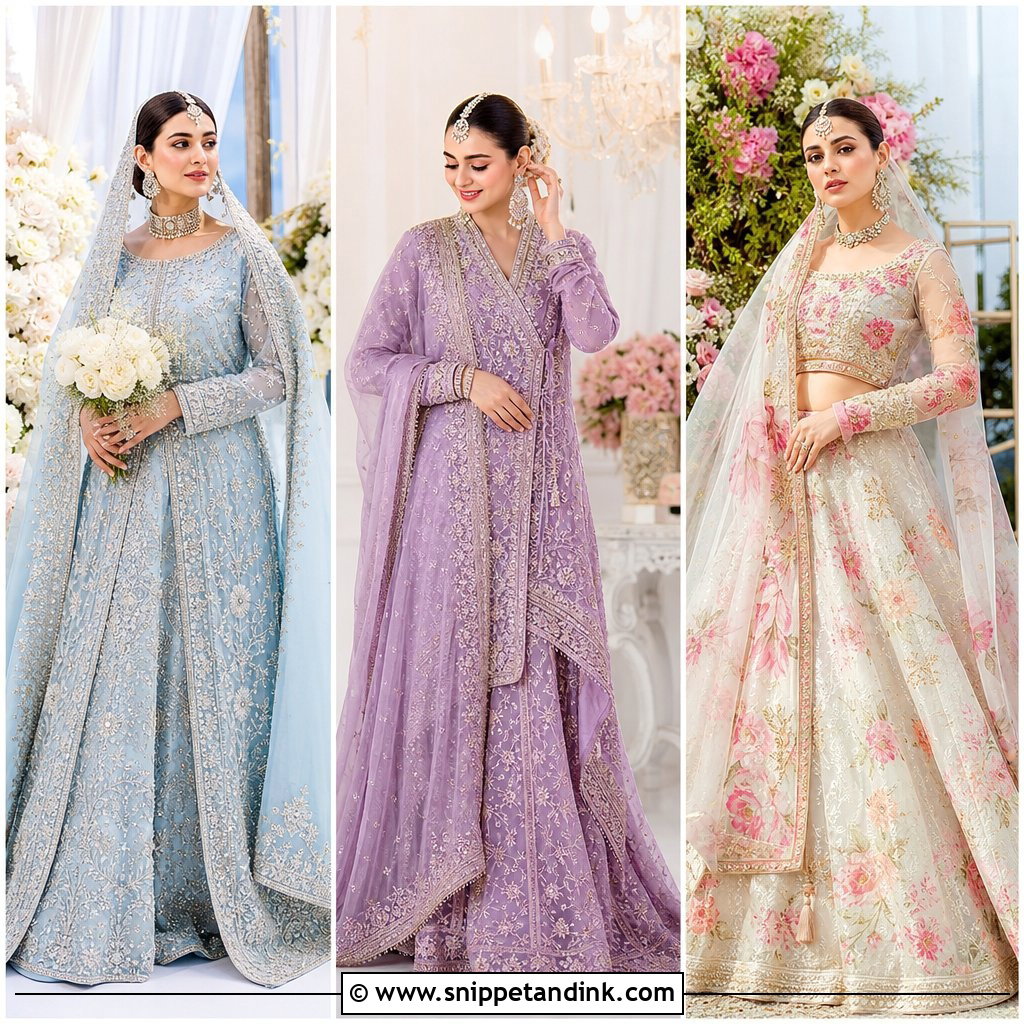
6. Powder Blue Maxi Nikkah Dress
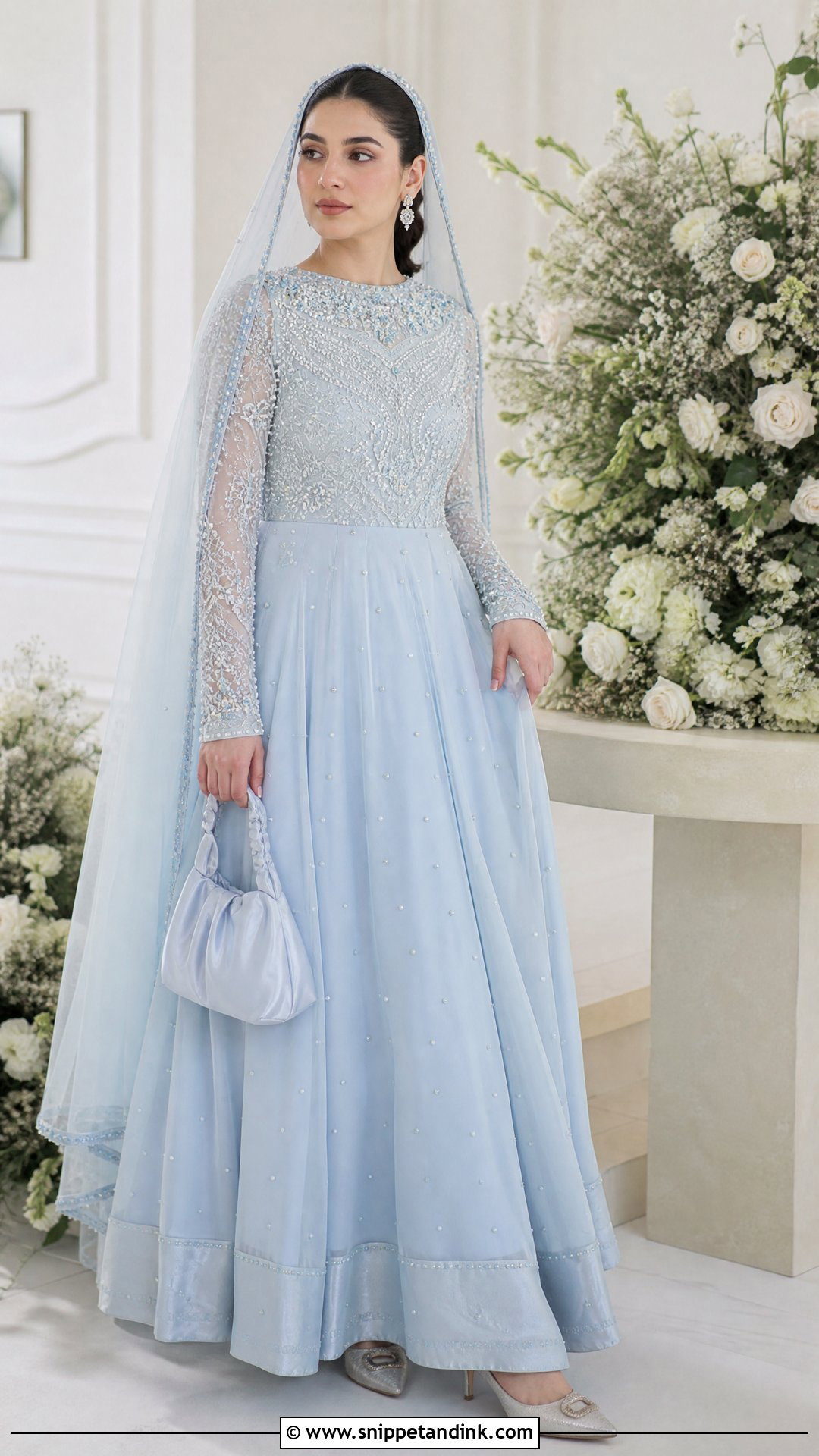
Powder blue works best on brides with cool or neutral undertones; on very warm skin it can look a little chalky in indoor light, so test it next to your face before you commit. A floor-length maxi with a fitted top and gentle flare keeps the shape clean. Sheer full sleeves with embroidered cuffs give coverage without bulk. Silver threadwork and small crystals suit the colour better than gold. A pale blue veil keeps it tonal, an ivory veil adds contrast. On a petite frame, the shoulders and waist must be tailored close, or the length swallows you.
7. Ivory Angrakha Nikkah Dress
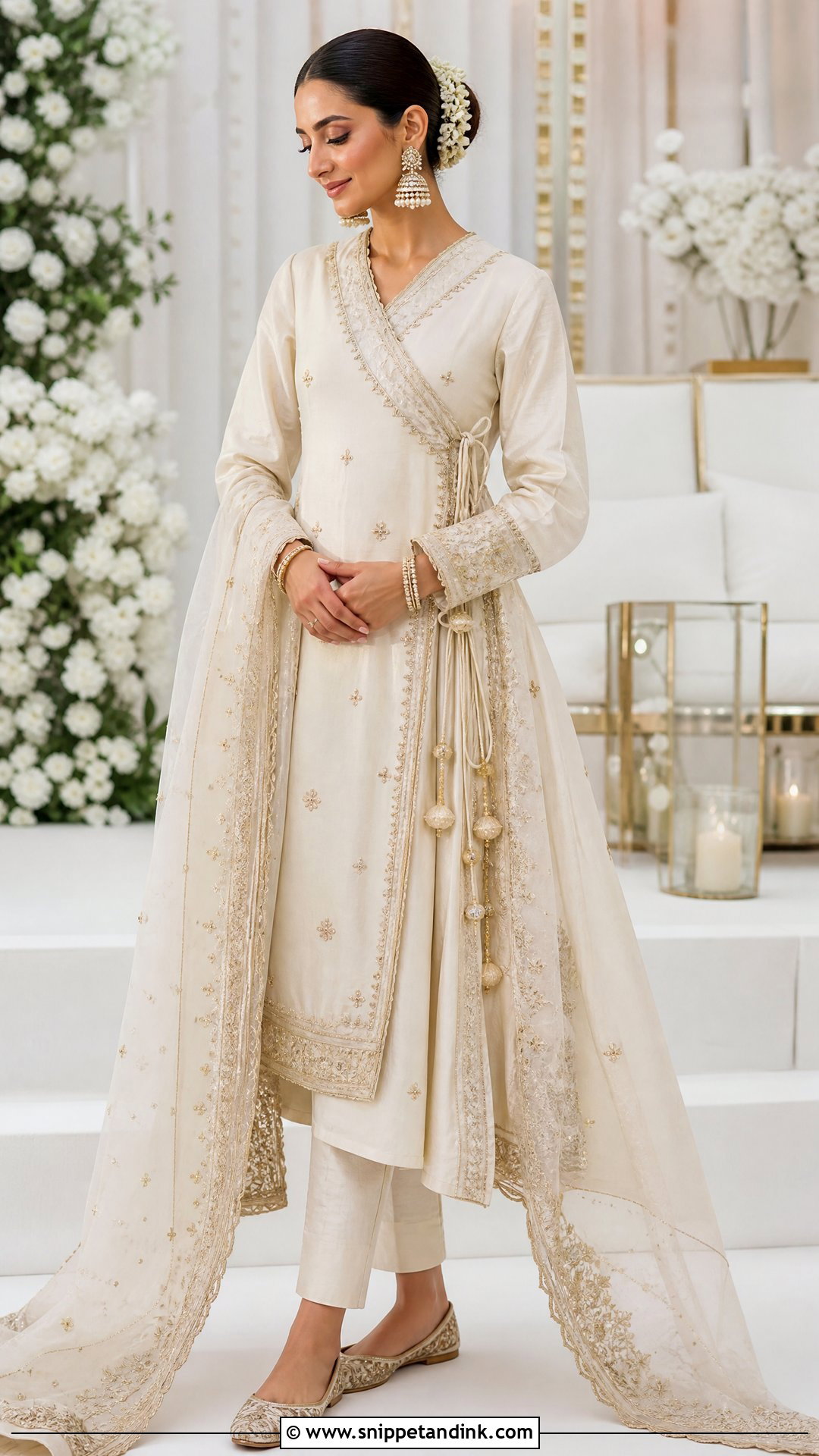
I love an angrakha for the diagonal line it draws across the body, but it is the least forgiving cut on this list. The crossover has to be anchored with an inner tie or hook, otherwise it gapes the moment you lean forward to sign. Keep the tassels on the side ties light; heavy ones swing and knock against the table. Wear it over straight raw silk trousers with khussas, pearl jhumkas and a slim bracelet stack. A narrow gold border on the dupatta follows the neckline instead of fighting it, and a low bun or neat hijab keeps attention on the wrap.
8. Pearl Embellished Nikkah Gown
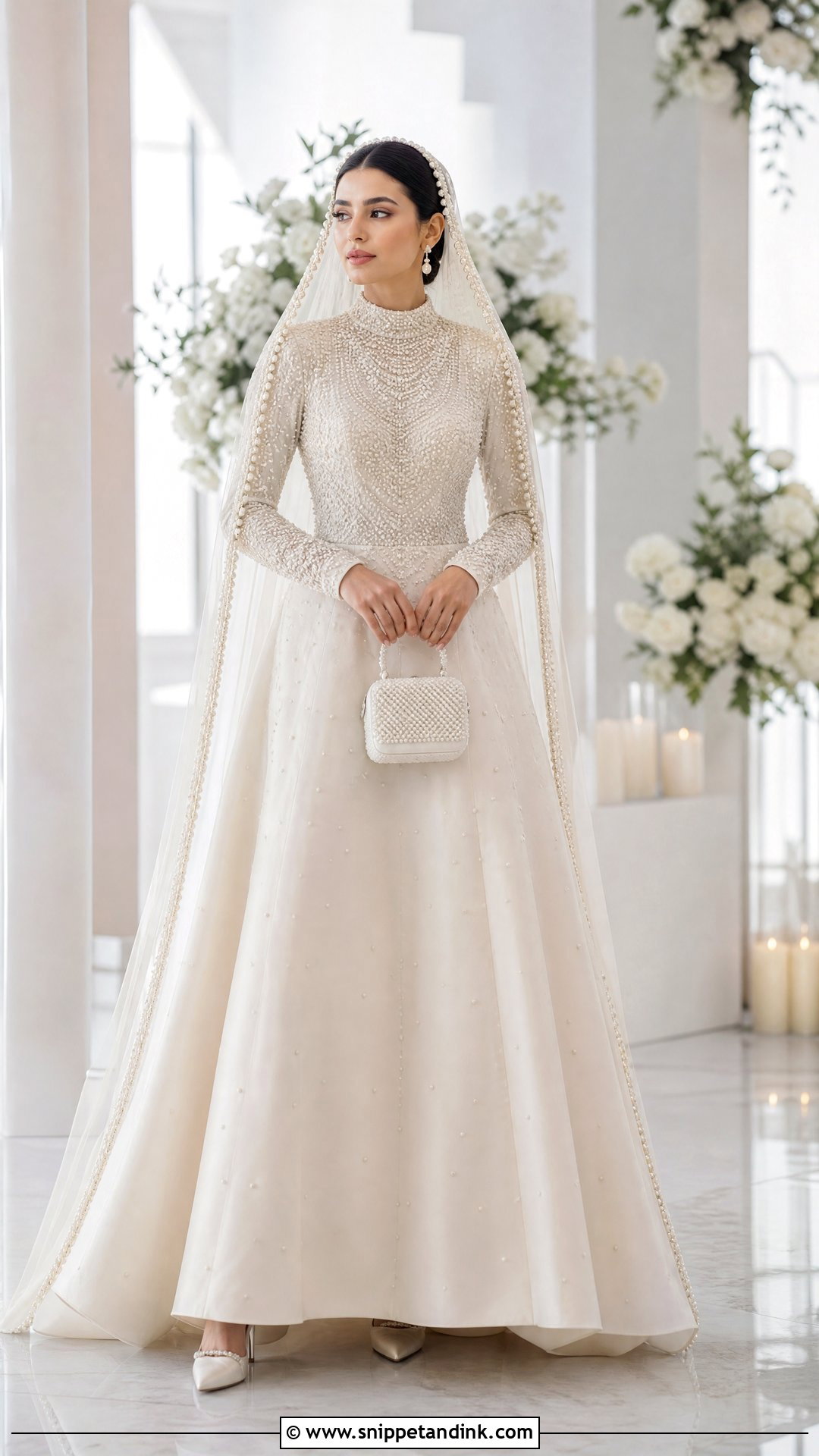
A pearl gown suits the bride who wants a Western shape with a ceremonial feel. I like the pearls clustered on the bodice and thinning toward the hem; even spacing all over looks busy and adds real weight to the skirt. An A-line with a high neck and full sleeves keeps coverage simple. Keep the base fabric ivory, cream or pale champagne so the pearls don’t look stuck on. Closed-toe satin heels, a structured mini bag and a long veil with a narrow pearl edge finish it. If there is a train, have a bustle or wrist loop sewn in before the final fitting.
9. Gold Tissue Gharara Nikkah Dress
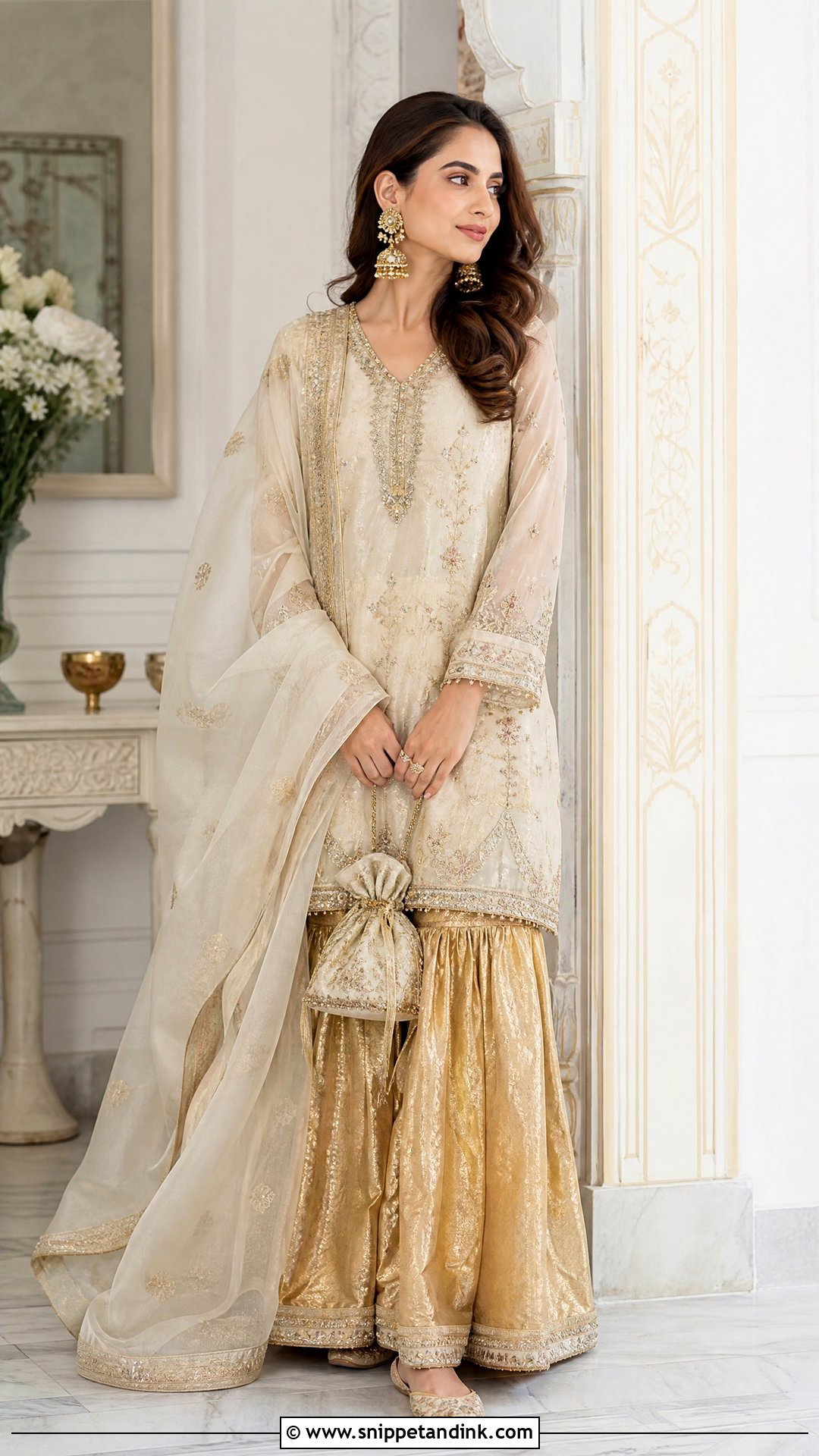
Gold tissue is woven with metallic yarn, so it shines on its own and creases sharply where it folds. That’s why I pair a tissue gharara with a cream or ivory kurta rather than another shiny layer. A short kurta shows the traditional gharara shape; a long one streamlines it. An ivory organza dupatta with a gold border ties both colours together. Antique gold jhumkas, khussas and a potli are plenty. Ask for a soft cotton lining, because bare tissue scratches, and check that the knee seam gives enough room to climb stage steps.
10. Dusty Rose Pishwas Nikkah Dress
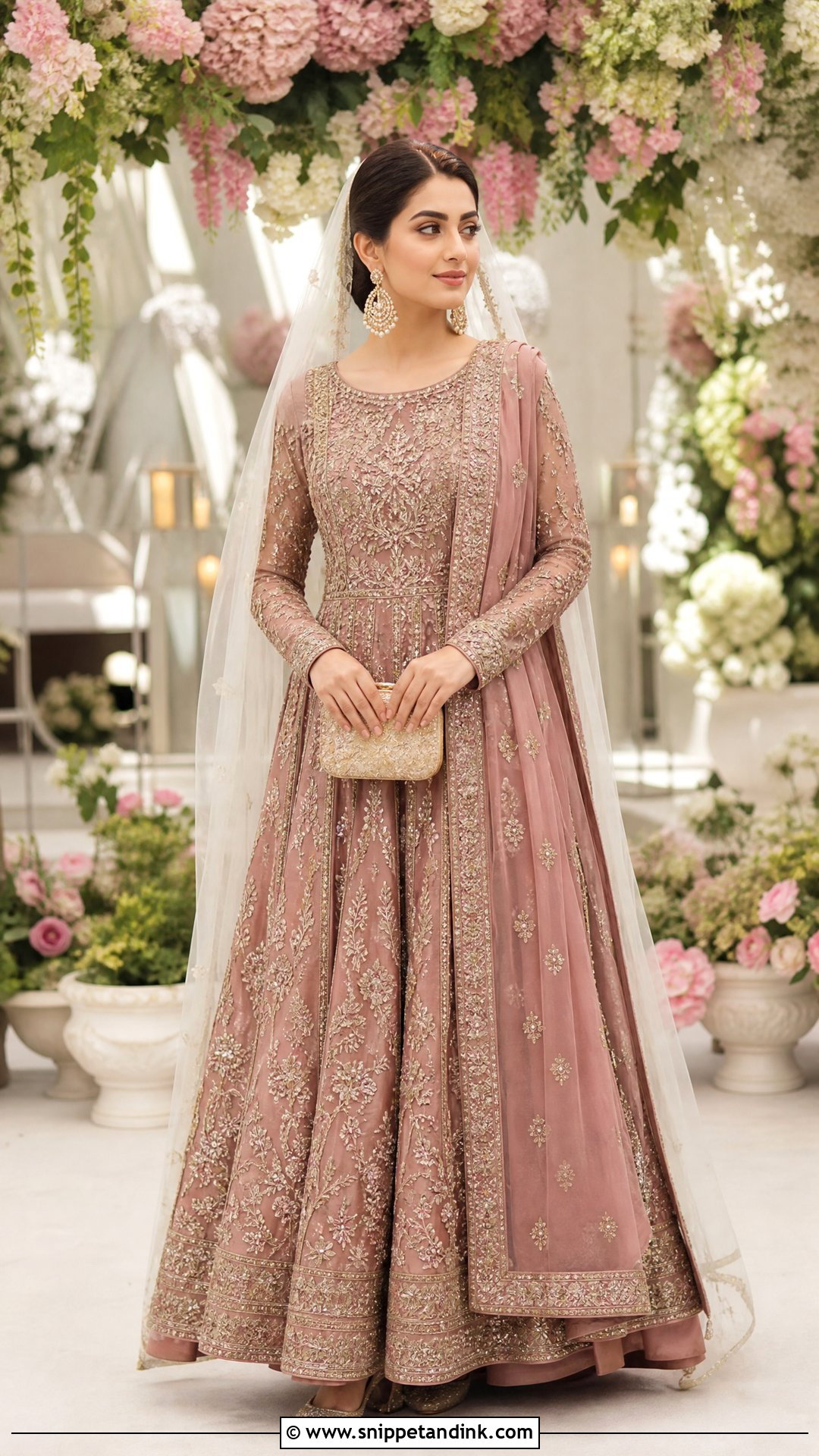
Dusty rose has enough depth to hold its colour in flash photography, where paler pinks can wash out. A paneled pishwas with a fitted bodice suits many body types because the skirt falls away from the waist instead of hugging the hips. Muted gold, rose and ivory embroidery keep it calm. Full sleeves and a higher back cover the modesty brief. I like a tonal dupatta on one shoulder and a lighter ivory veil over the head, though one tonal dupatta alone looks cleaner if you dislike layers.
11. White Chikankari Nikkah Suit
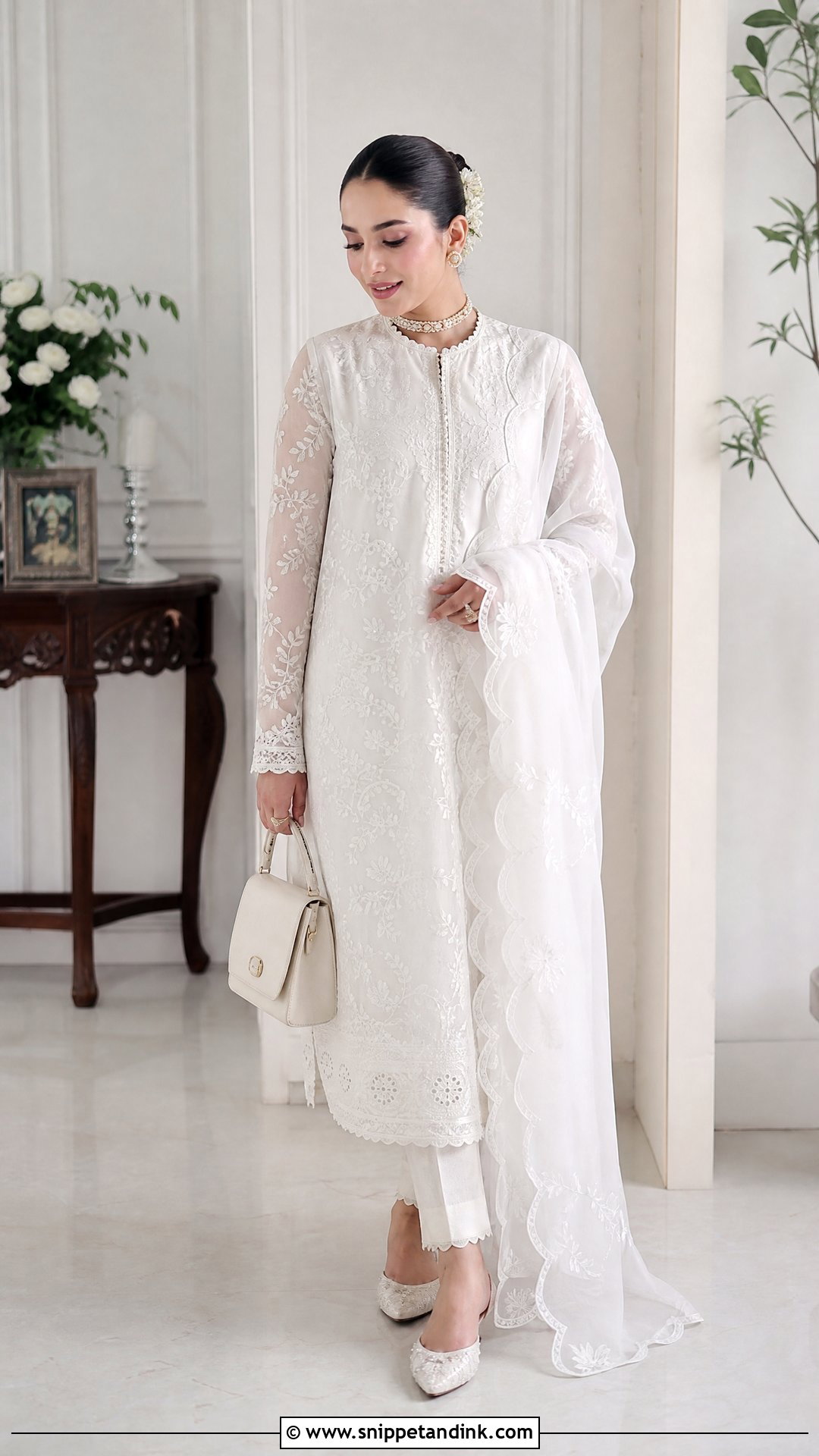
Chikankari is hand embroidery on fine cotton or georgette, and its charm is in texture you only see up close. That makes it right for a small home or courthouse Nikkah, where guests are close enough to notice. Dense work at the neckline and hem on a long straight kurta, with tailored cigarette trousers, is the classic shape. Always have the kurta lined; unlined chikankari goes sheer in daylight. Add a scalloped organza dupatta, pointed white flats and pearl studs. A statement choker or embroidered head veil is what tips it from festive to bridal.
12. Ivory Farshi Gharara Nikkah Dress
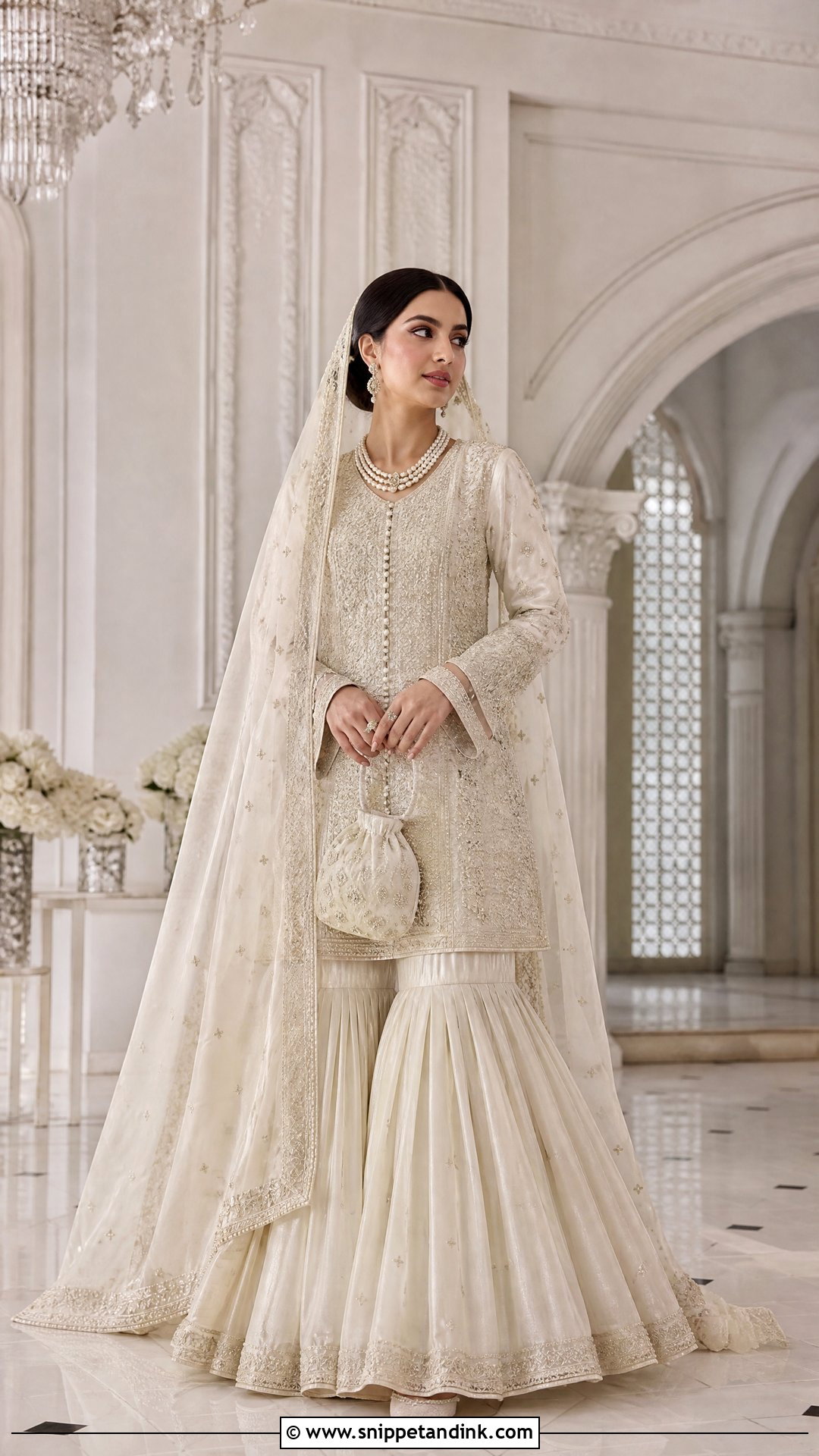
A farshi gharara trails behind your feet, and that’s the whole point and the whole difficulty. Keep the kurta fitted and the neckline clean so the volume stays below the knee. Practise walking in the full outfit, shoes included, at least once before the day; you have to kick the hem forward slightly with each step. I sew hidden loops into the back so the fabric can be lifted onto the wrist after the ceremony. Pearl jewellery, low heels and a sheer dupatta over the head finish it. Avoid this one on gravel, grass or narrow stairs.
13. Lavender Lehenga Nikkah Dress
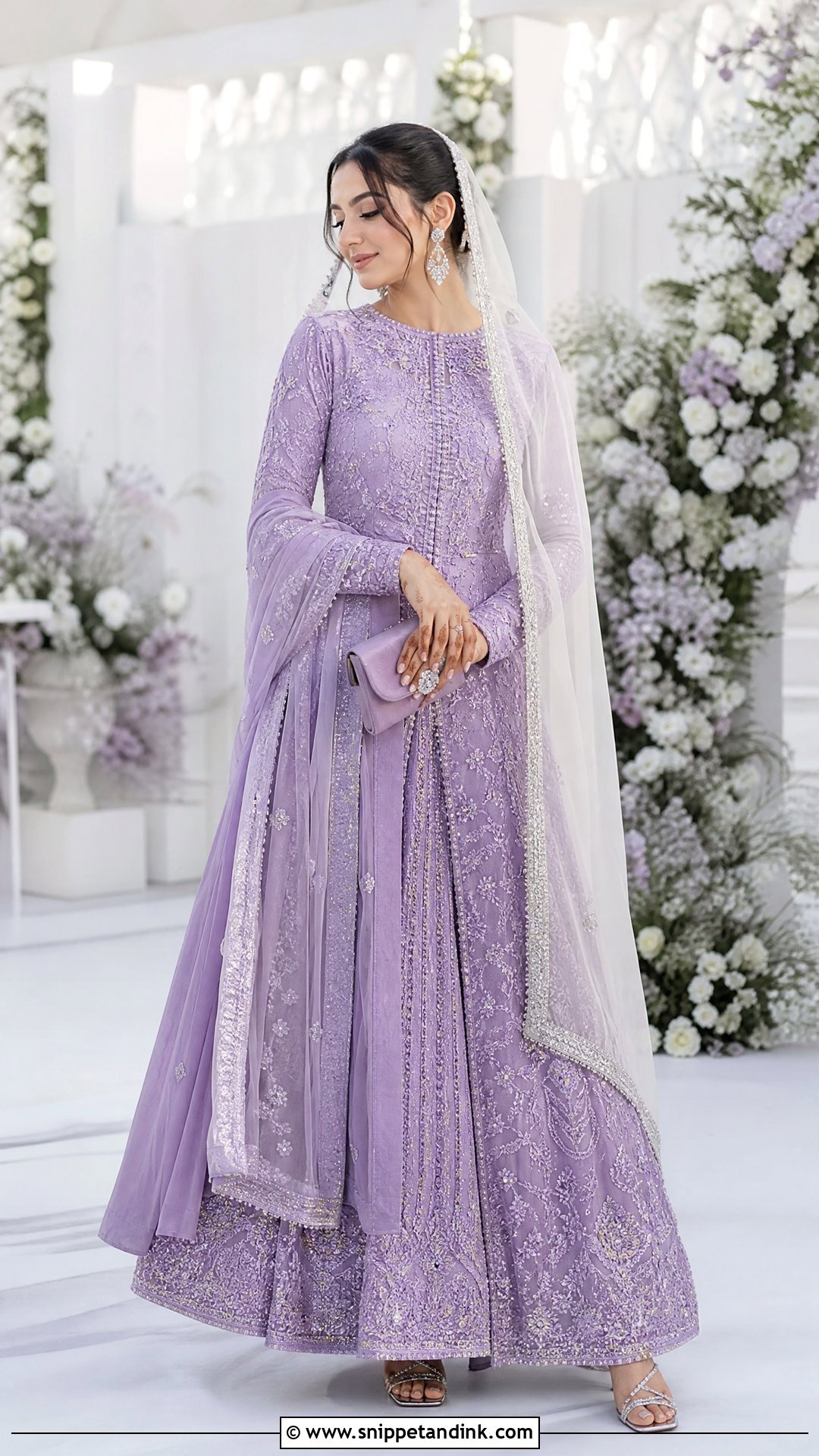
Lavender is the colour I’d steer you from if the venue lighting is warm and yellow, because it can turn faintly grey on camera. In daylight or cool LED light it reads soft and unusual. A flowing lehenga with tonal floral work and a long full-sleeved blouse gives continuous coverage and lengthens the frame. Edge the dupatta in silver or pearls, add crystal earrings and silver sandals, and keep the jewellery delicate. If the outfit feels too light to be bridal, a second ivory dupatta over the head fixes that quickly.
14. Ivory Cape Lehenga Nikkah Dress
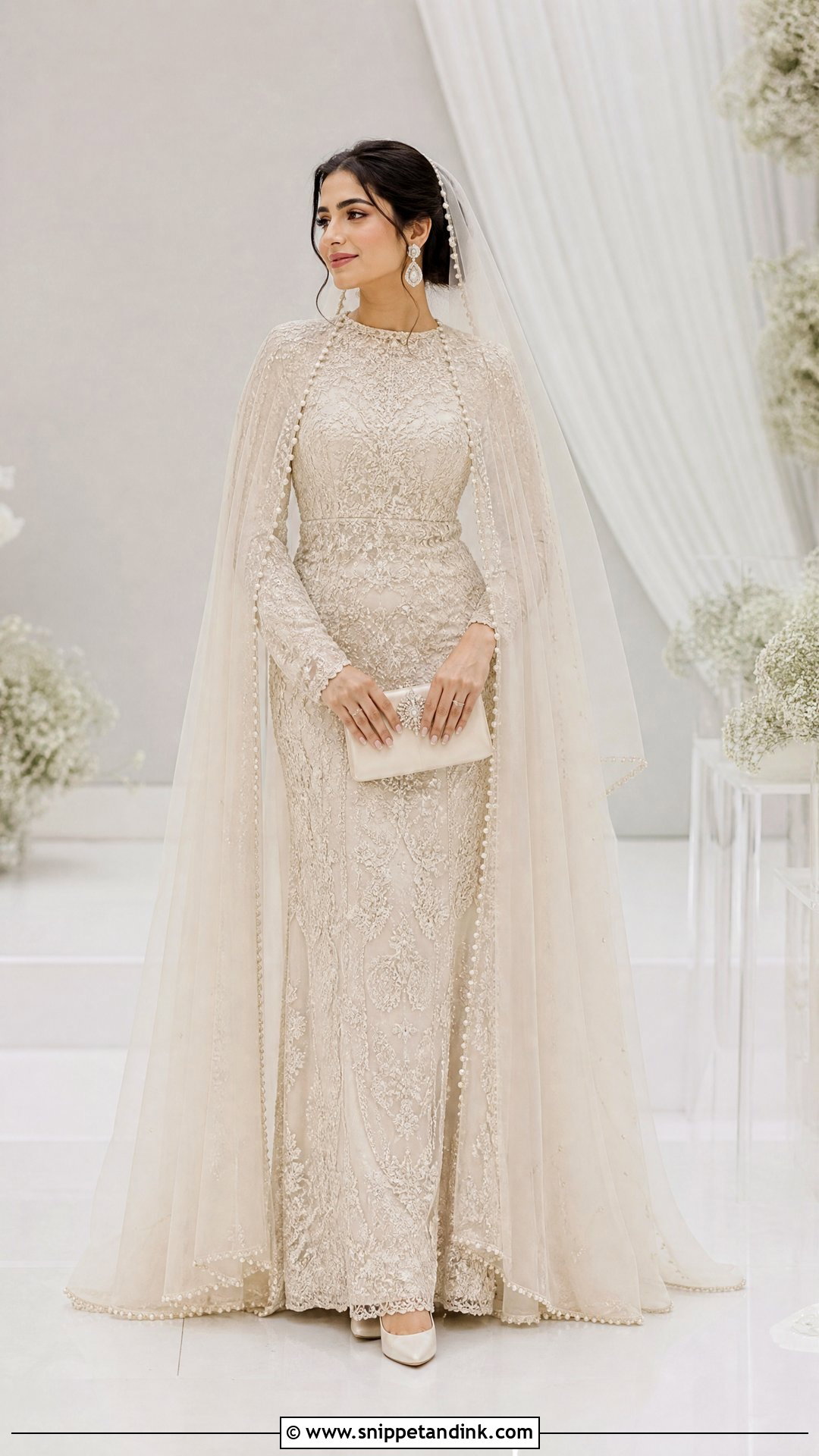
An ivory cape lehenga replaces the draped dupatta with a sheer cape fixed at the shoulders. The fixing point matters: I ask for the cape to be stitched or hooked to the blouse, not just pinned, because a pinned cape slides back every time you lift your arms. Pearl or embroidered edges give it movement. Keep the skirt’s embroidery near the hem so the upper half stays the focus. If you need a head covering, use a separate light veil that can come off without moving the cape.
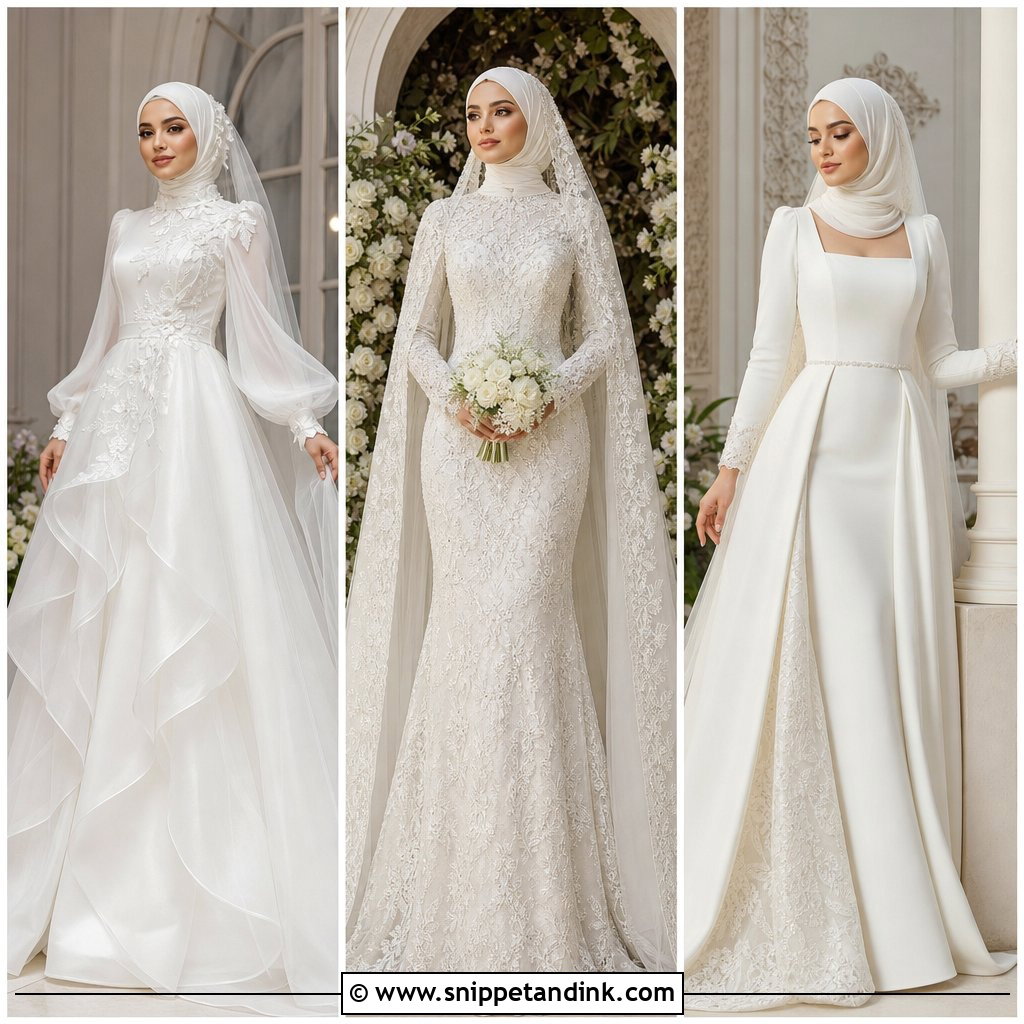
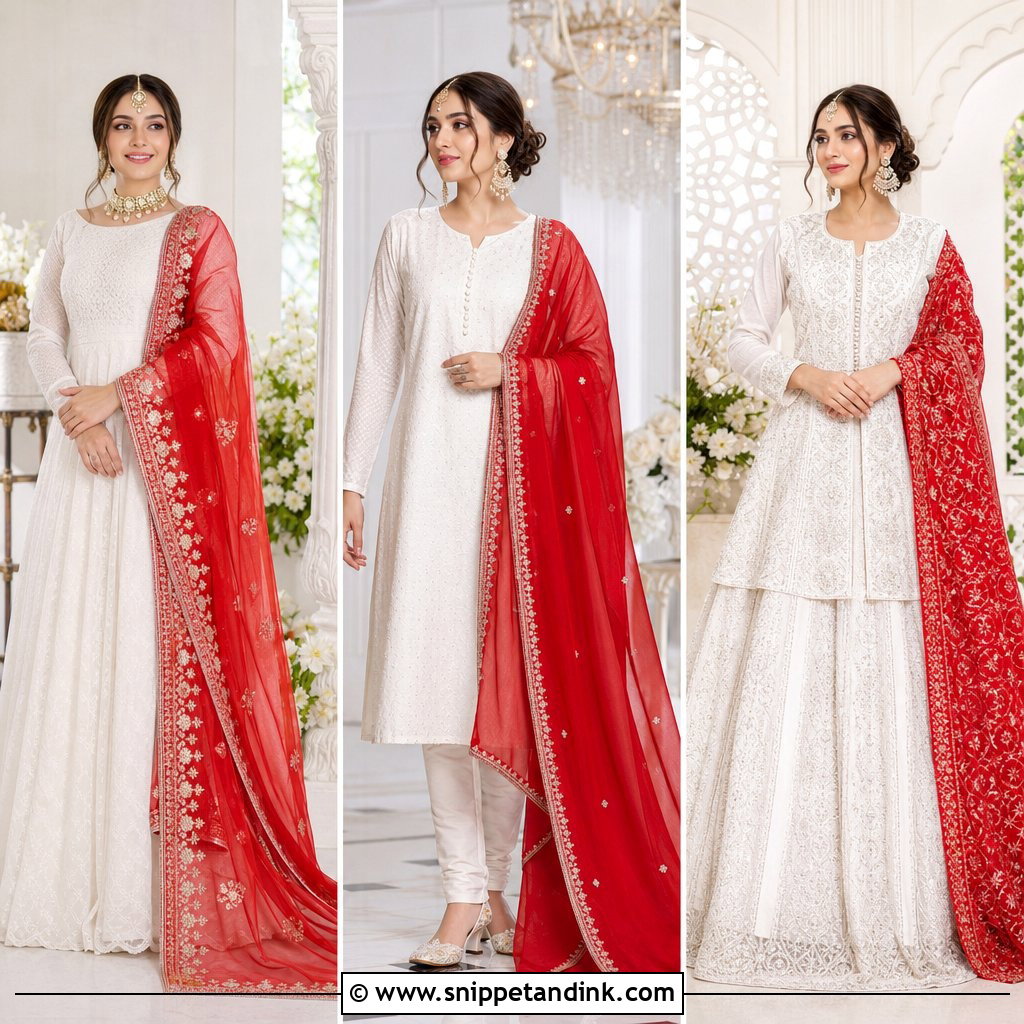
15. Deep Red Gharara Nikkah Dress
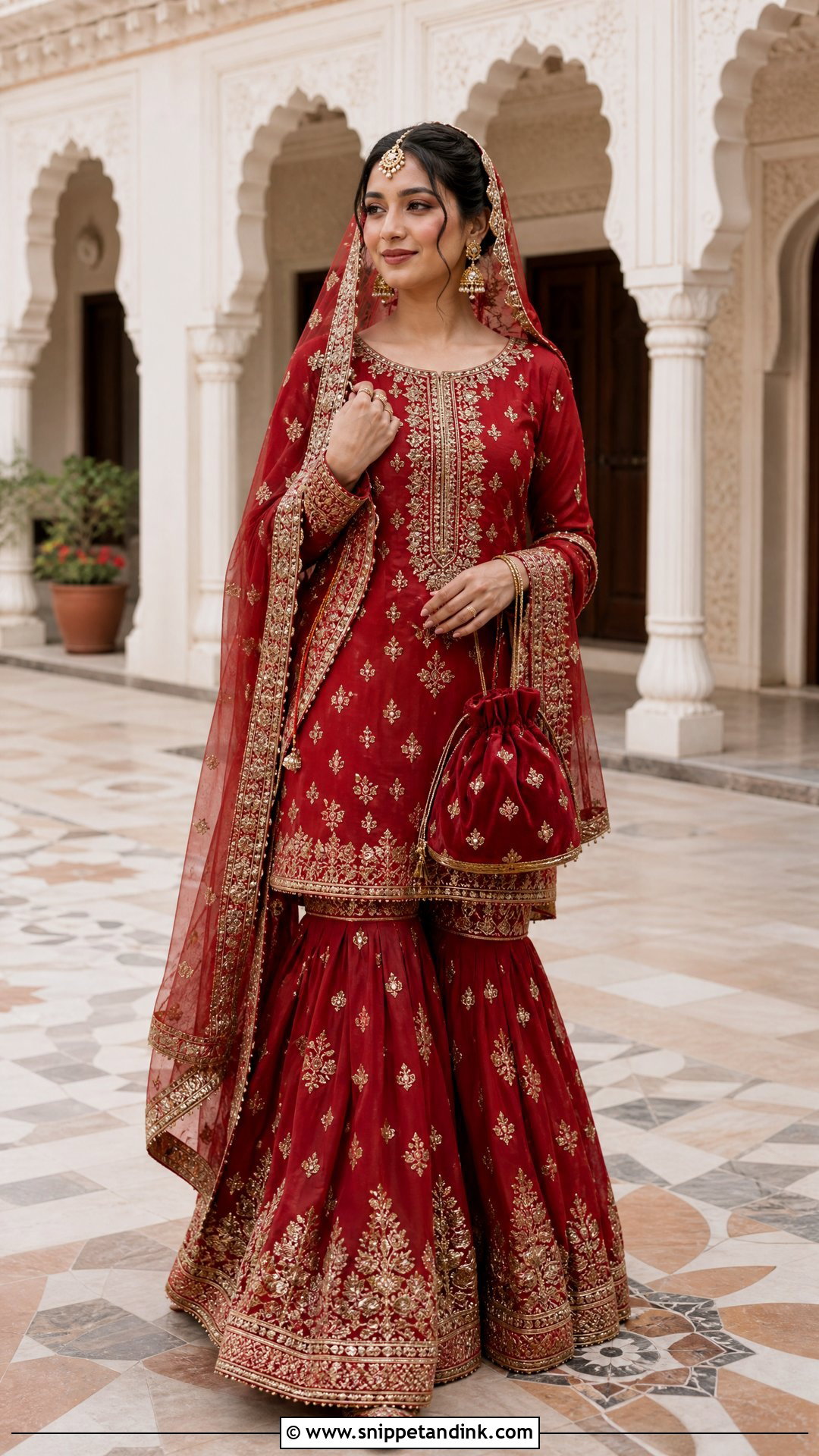
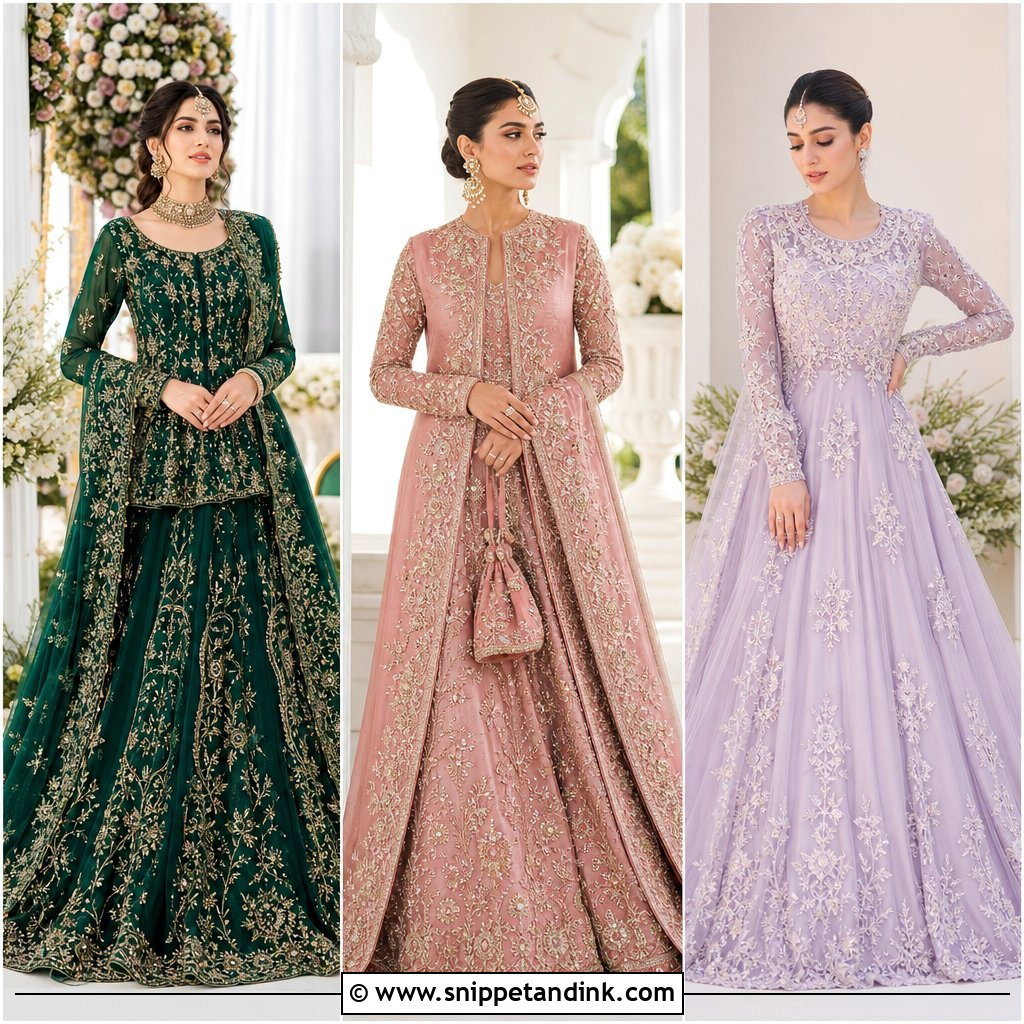
Deep red suits brides who want heritage colour without an oversized lehenga. A tailored kurta and matching gharara with antique gold at the knee and hem carry it. Leave visible red between the embroidered areas; when work covers every inch, red turns into gold from a distance. Pin a red dupatta with a gold border over the head and secure it at one shoulder. Gold jhumkas, a fine tikka, red-and-gold khussas and a potli are traditional choices. For makeup I’d keep the eyes bronze and the lip muted so the dress carries the colour.
16. Mint Green Sharara Nikkah Dress
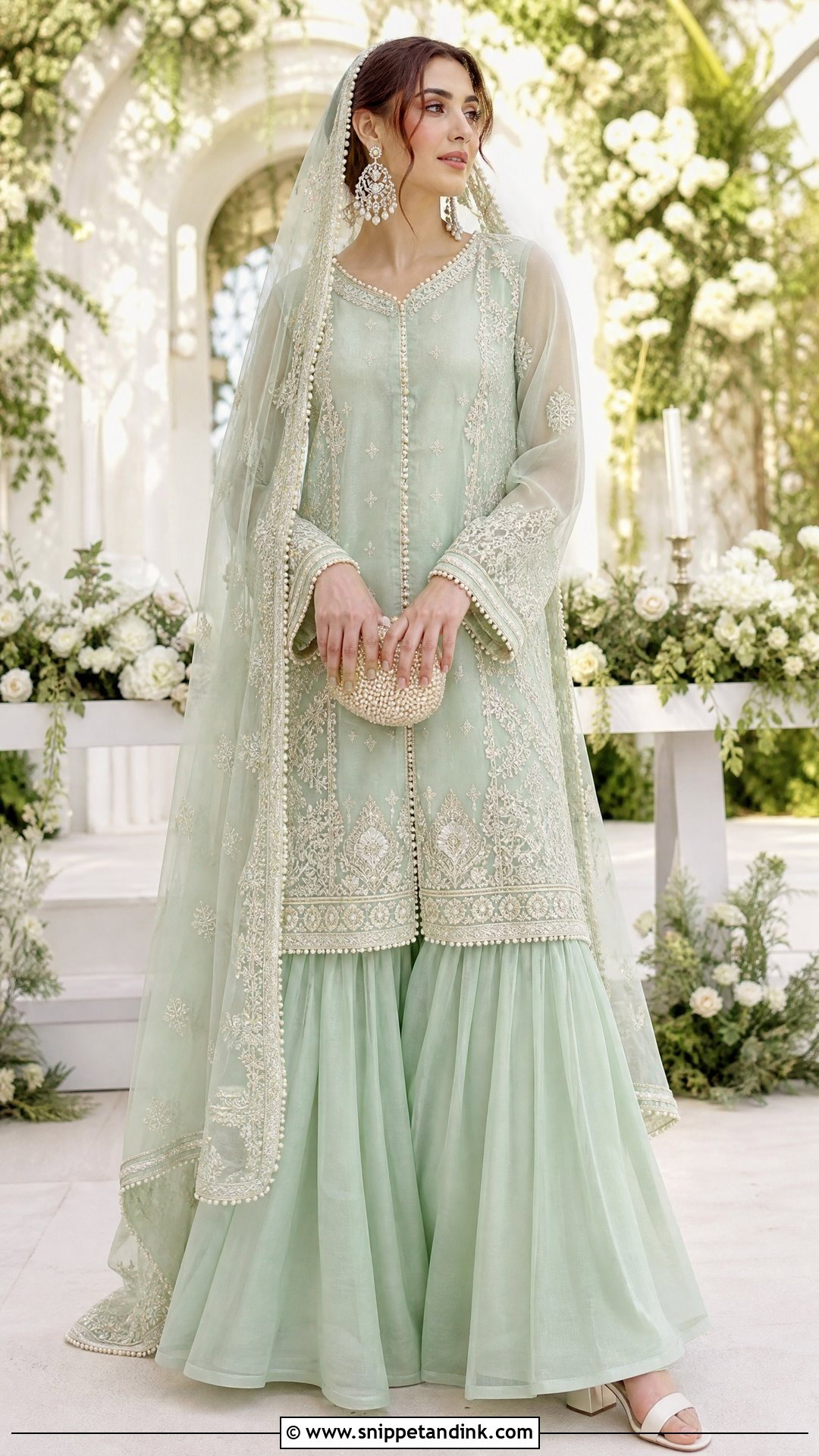
Mint is a daytime colour; under evening tungsten it can look slightly yellow, so I recommend it for morning or afternoon ceremonies. A long organza kurta with ivory threadwork over a flowing sharara in raw silk or chiffon gives you structure on top and movement below. Check where the sharara starts to flare: just above the knee is usually most flattering, any higher and it can overwhelm the kurta. Pearl accents on the dupatta, ivory block heels and chandelier earrings finish it, and pale gold accents warm it up.
17. Ivory Peplum Sharara Nikkah Dress
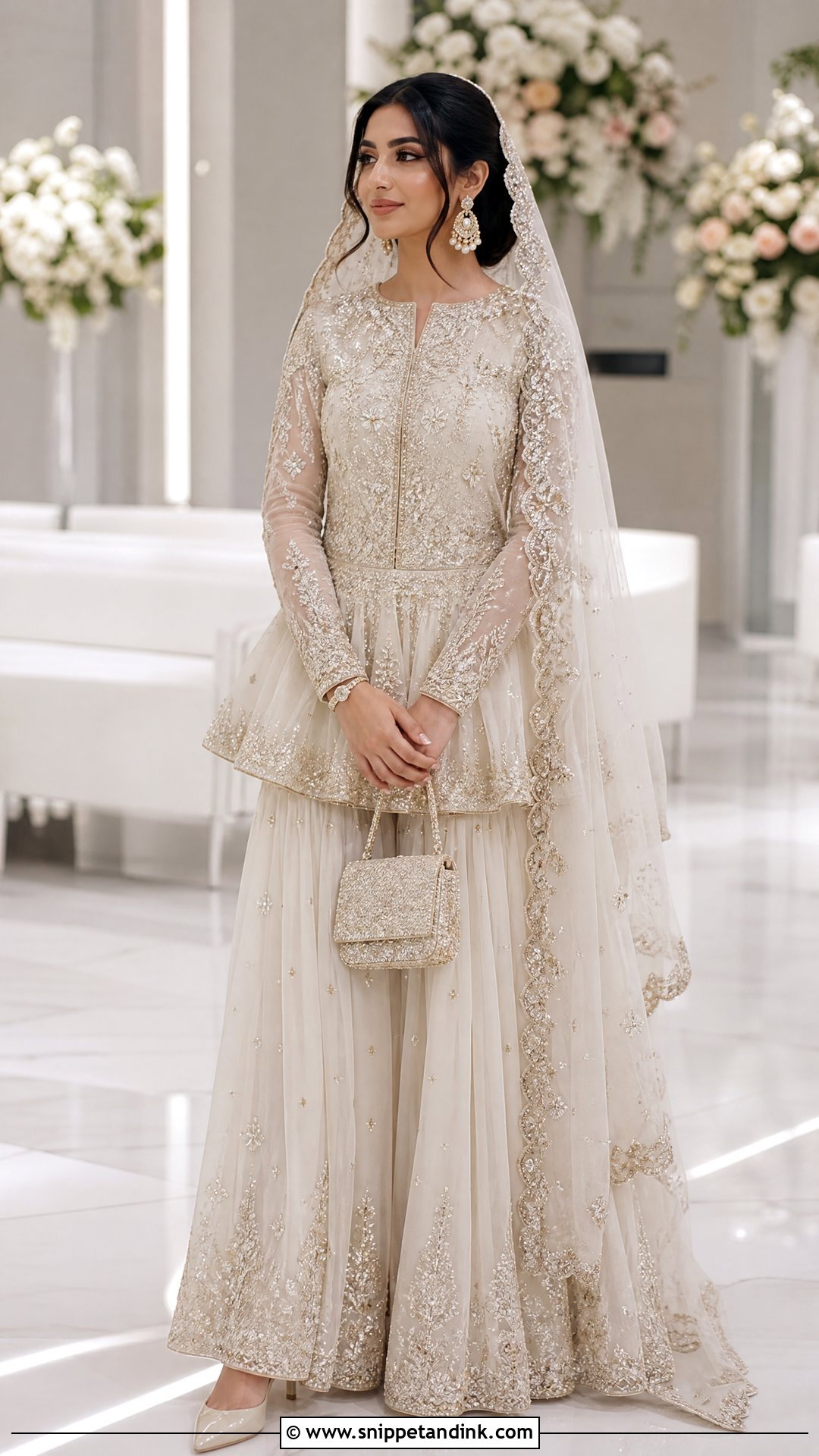
A peplum sharara gives you a defined waist and the ease of wide pants. The peplum should fall below the hip bone; a short one cuts the body in half visually. I check the waist seam with the bride seated, since that seam takes the strain for the whole ceremony. Delicate embroidery at the neckline, waist and cuffs is enough. A scalloped sheer dupatta softens the tailoring, and pointed ivory heels lengthen the leg line. For modesty, choose a longer peplum and full sleeves, or add an inner layer under a sheer neckline.
18. Blush Pink Angrakha Nikkah Dress
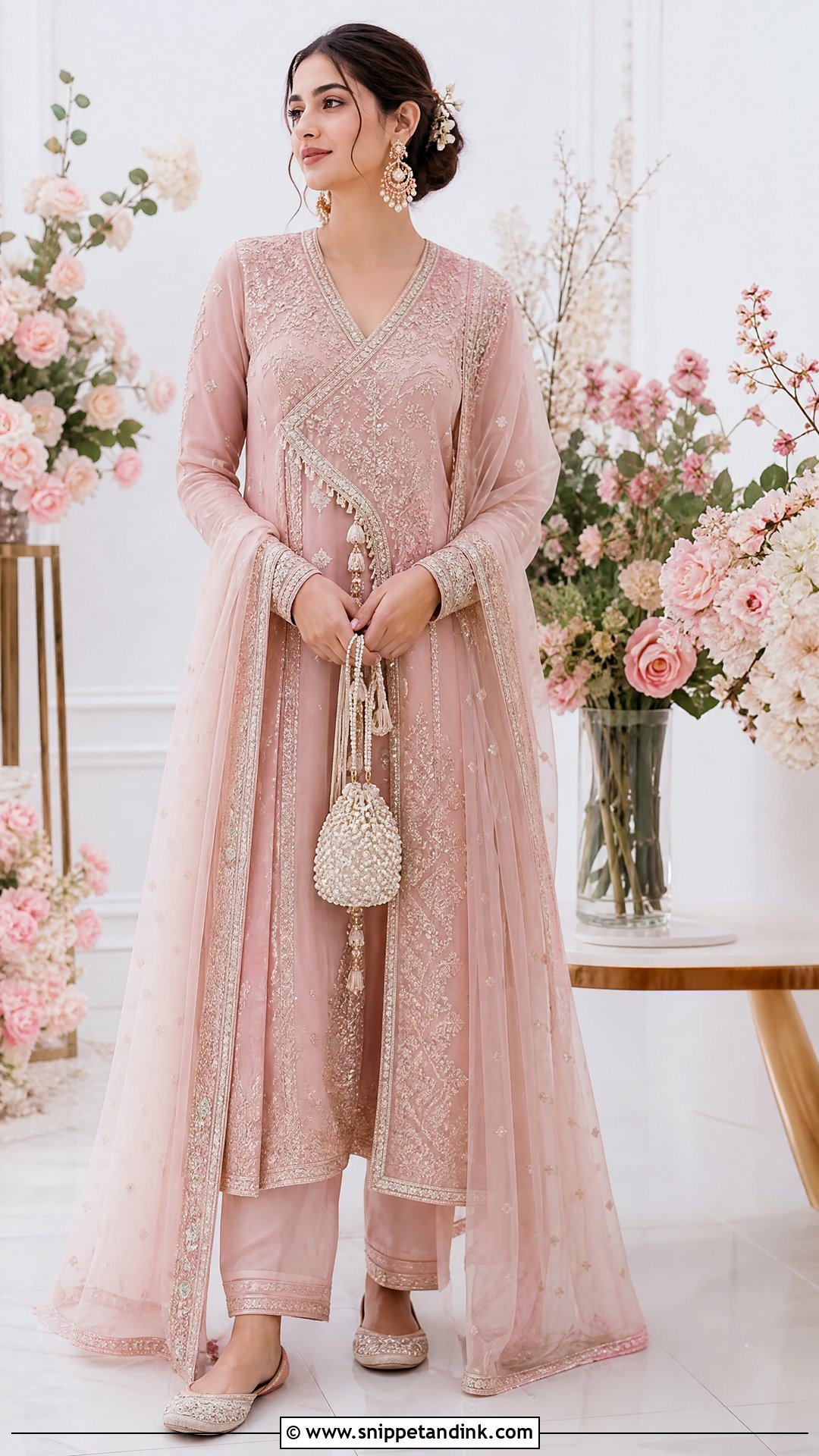
Blush angrakha is the softer cousin of the ivory version above, and the same rule applies: the crossover needs a secure inner closure. Calf length pairs with straight trousers; floor length can fall over a fitted bottom. A blush organza dupatta with champagne embroidery, rose-gold earrings and a pearl potli keep the palette delicate. If the dress carries floral motifs, pick one colour from them for the accessories rather than matching all of them. Fit at the bust and shoulder decides whether the wrap lies smooth or wrinkles.
19. White Saree Nikkah Dress
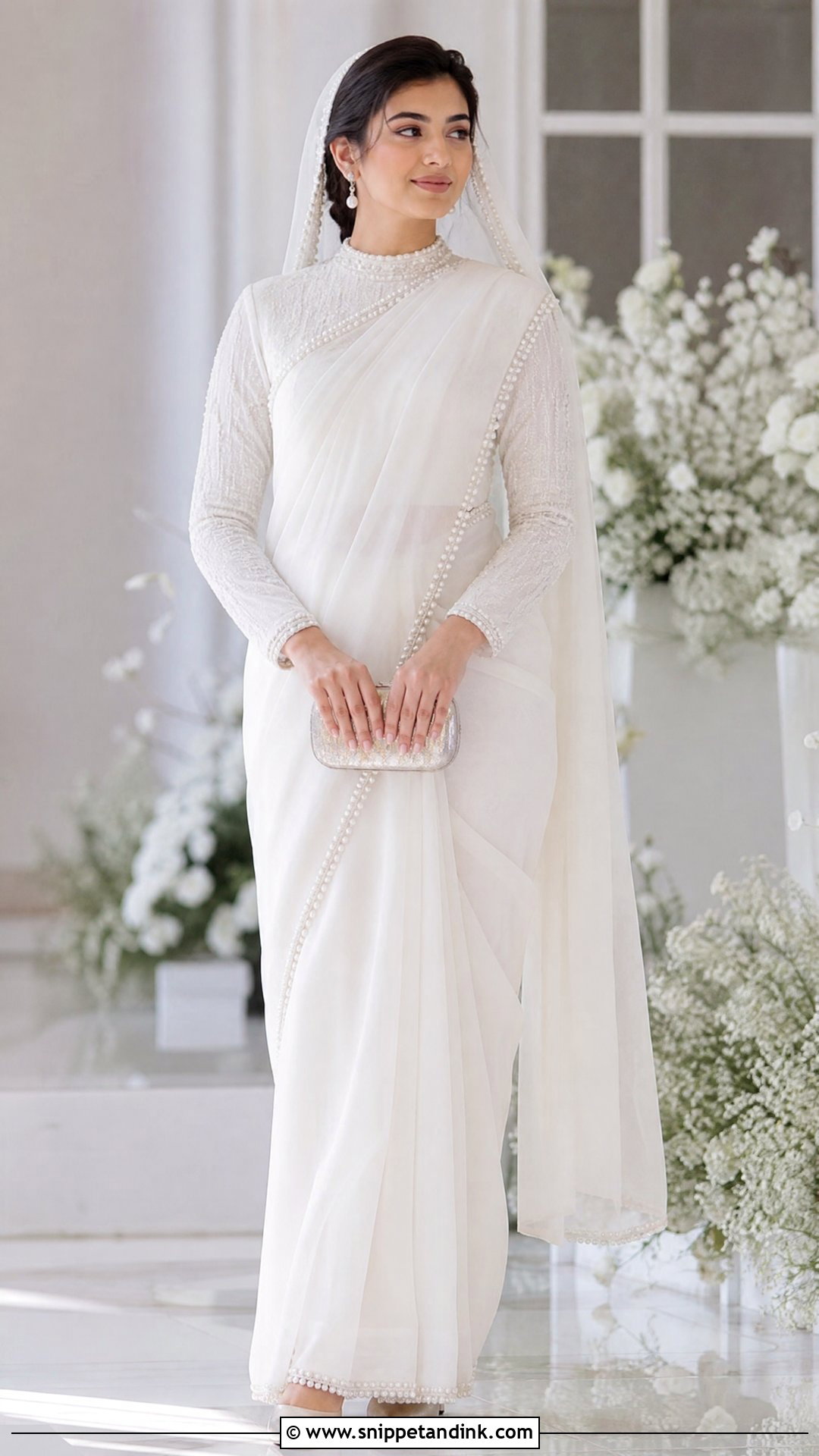
A white saree can work for a Nikkah when it’s styled for coverage: a long-sleeved blouse, higher neckline and closed back. Silk holds pleats best, while chiffon drapes softly but needs more pins. I pin the pleats at the waist and the pallu at the shoulder with at least two safety pins each, hidden under the fold, because a saree loosens with every sit and stand. A separate light veil goes over the head. Pearl earrings and metallic low heels are enough. An inner panel under the drape gives extra coverage at the midriff.
20. Ivory Lehenga With Red Dupatta Nikkah Dress
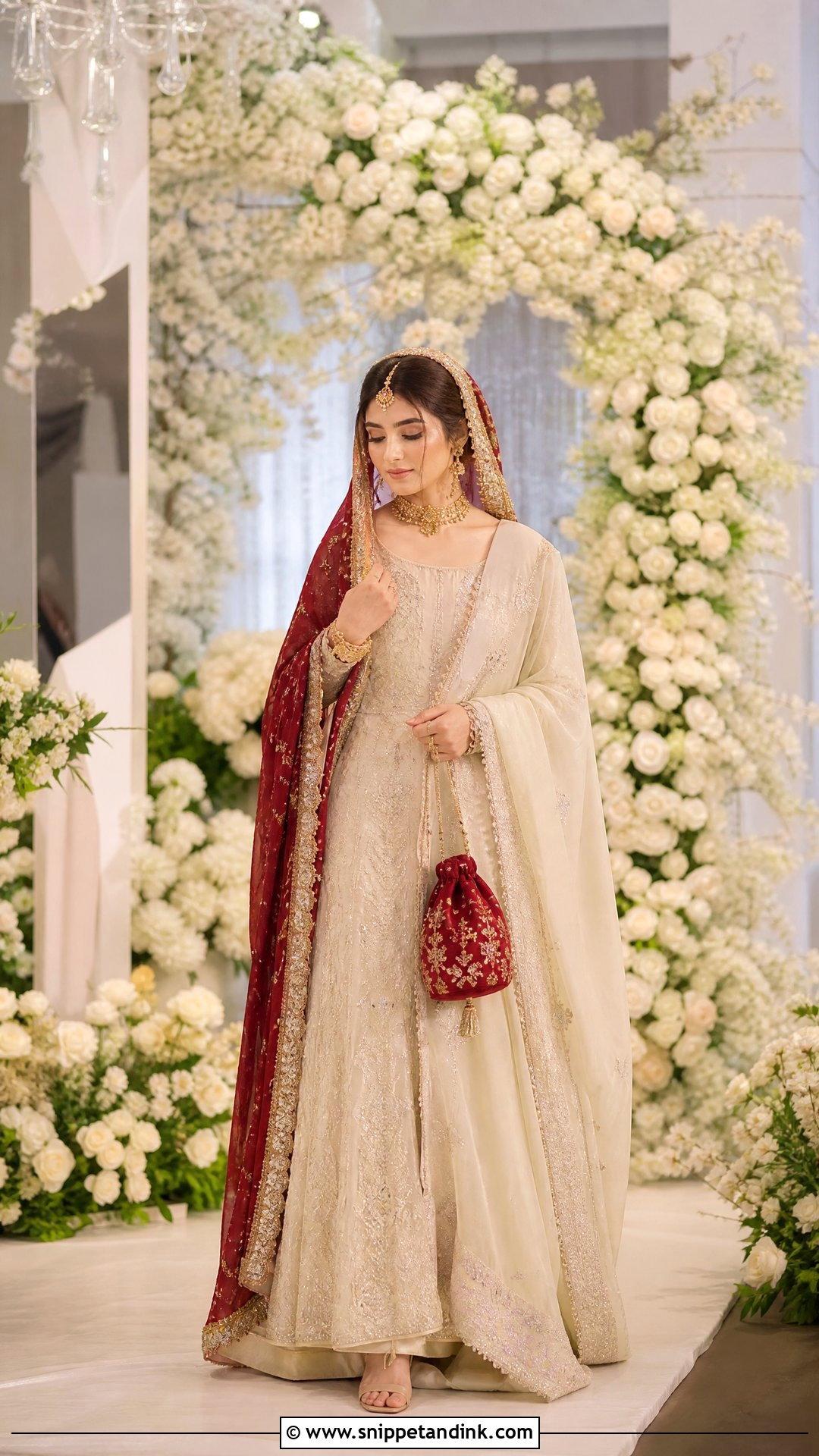
Ivory lehenga with a deep red dupatta is the answer for the bride who can’t choose between the two. Let the red be the focal point and keep the skirt lightly worked. Gold edging or fine zardozi on both pieces connects them. Put the red dupatta over the head and, if you like layers, a lighter ivory one across the shoulders. Keep the lehenga moderate in width; the contrast already does the work. Red dye can bleed onto ivory if it gets damp, so ask whether the dupatta has been colour-fixed.
How Long Embroidered Nikkah Wear Takes to Make
Hand embroidery is slow, and designers book up around wedding season. For a custom zardozi or dabka outfit I tell brides to place the order four to six months ahead. Ready-to-wear with alterations can be done in six to eight weeks. If the outfit is shipping from overseas, add time for transit and possible customs holds, and plan for two fittings once it arrives.
The fitting you shouldn’t skip
Have your last fitting in the shoes and undergarments you will actually wear, with the dupatta pinned the way it will be on the day. Sit, kneel, raise your arms and walk up a step. Most problems I see on the morning come from outfits that were only ever tried on standing still in front of a mirror.
After the ceremony
Store embroidered pieces folded in plain cotton or muslin, never plastic, which traps moisture and can tarnish metallic thread. Refold along different lines every few months so the embroidery doesn’t crack at the creases, and take heavy pieces to a dry cleaner who handles bridal work rather than washing them at home.
Fit Before Fabric, Every Time
Every outfit above can look bridal, and every one can fail if it pulls at the shoulders, slides off the head or traps you when you sit. Decide on your coverage and your seating first, then the silhouette, then the colour. Tailoring matters more than embroidery; a plain suit that fits reads as expensive, a heavy lehenga that doesn’t reads as borrowed. Let jewellery, shoes and dupatta support the dress. Then pick the chosen Nikkah dress that feels like you and your family’s traditions.
You'll Like These Ideas:


Leave a Reply