
Most of the modest brides I dress don’t start with the gown. They start with the questions nobody in a regular bridal shop asks: will this lace show skin under a flash, will the sleeve ride up when I hug my father, where does a veil attach when my hair is covered? The looks below run from white satin and lace ball gowns to lehengas, abayas and kaftans, and each comes with coordinated hijab styling, shoes and accessories that leave the dress in charge. As you read, picture how the scarf will sit against beading at the neck and how the sleeves move when your arms go up. Then try your shortlist in daylight and under a camera flash, because opacity is the thing that surprises people most.
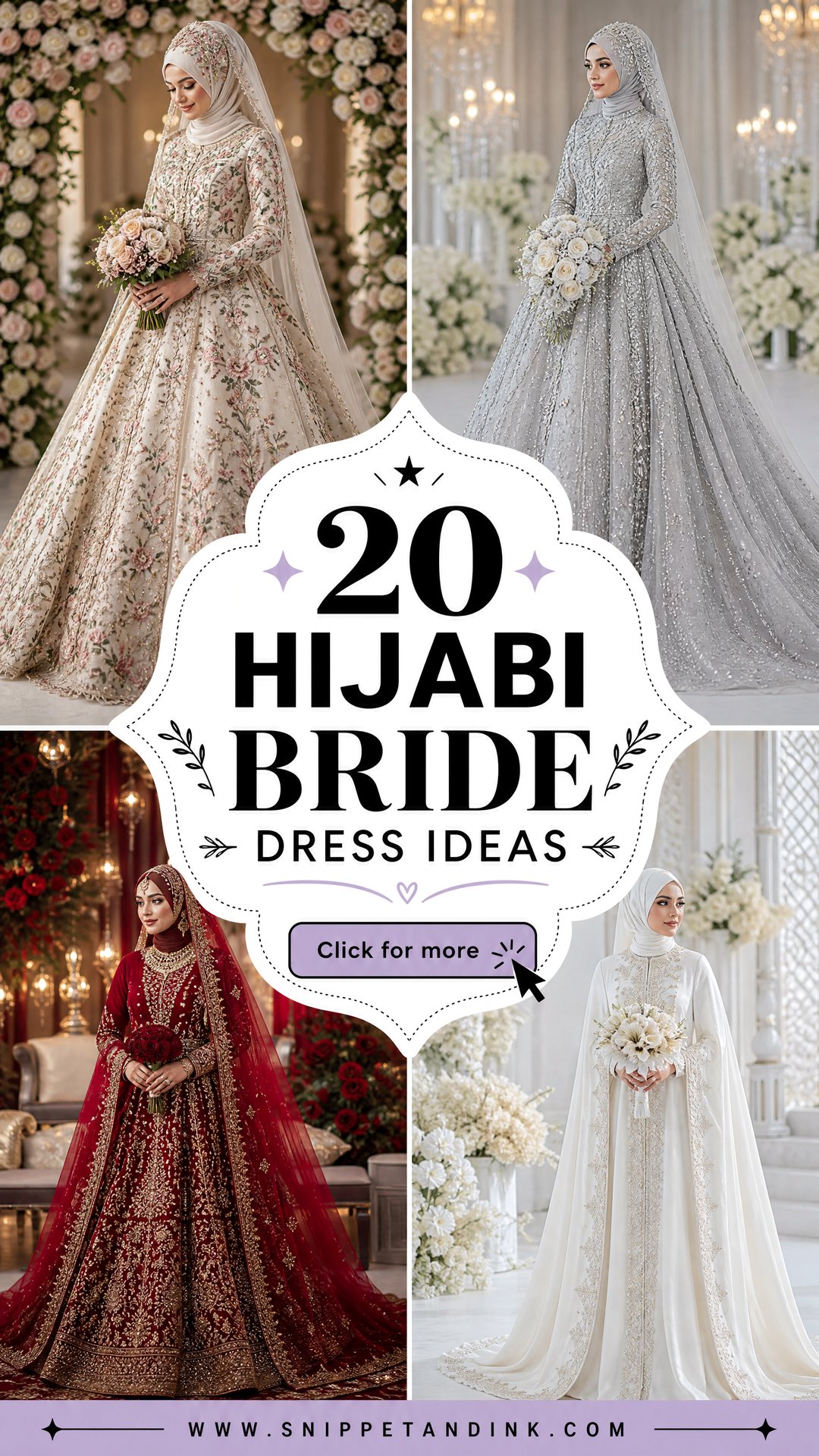
Turning a Sample Gown Into a Covered One
Very few gowns arrive in a bridal shop with the coverage hijabi brides want. Most of the dresses I help modify start strapless or with sheer illusion sleeves, and a good bridal tailor can change a lot. The catch is time. Made-to-order gowns often take several months to arrive, and modest additions need extra fittings on top of the usual alterations.
- Order early and ask the shop at the point of sale whether extra fabric or matching lace can be ordered with the gown. Matching it later is often impossible.
- Sleeves, a higher neckline and an opaque lining under lace are the usual three changes. Ask whether they can be built in at the factory, which looks cleaner than adding them afterwards.
- Bring your actual hijab, underscarf and wedding shoes to every fitting. The neckline height and hem length both depend on them.
- Hold a full flash photo test at the last fitting. Nude tulle and thin satin that looked opaque in the mirror can show through under a camera flash.
If a gown needs more than three of these changes, I usually suggest looking at designs built for modest brides from the start. Heavy modification adds cost and seams, and the result rarely sits as well as a dress designed for coverage.
1. White Satin A-Line Hijabi Bride Dress
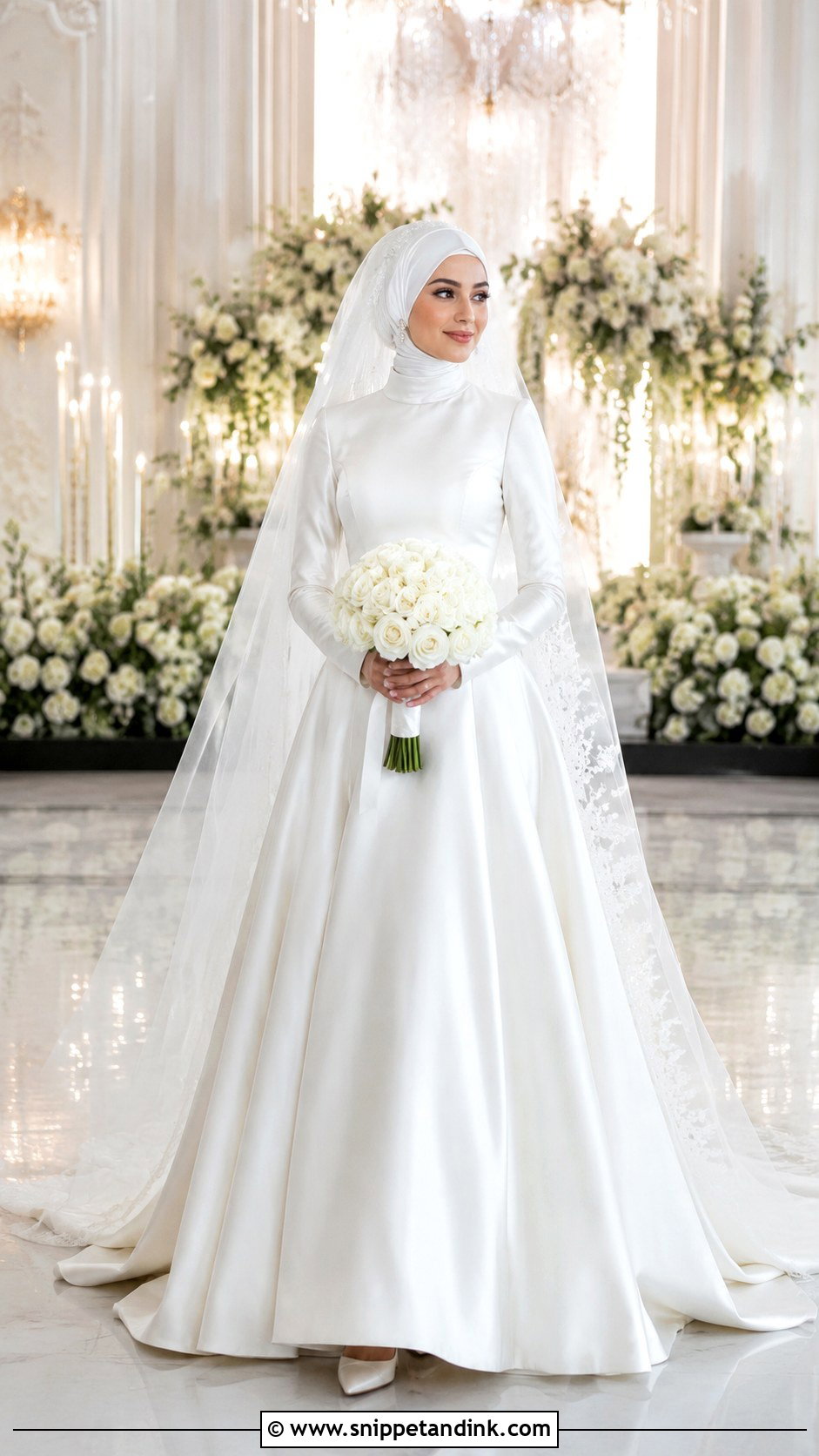
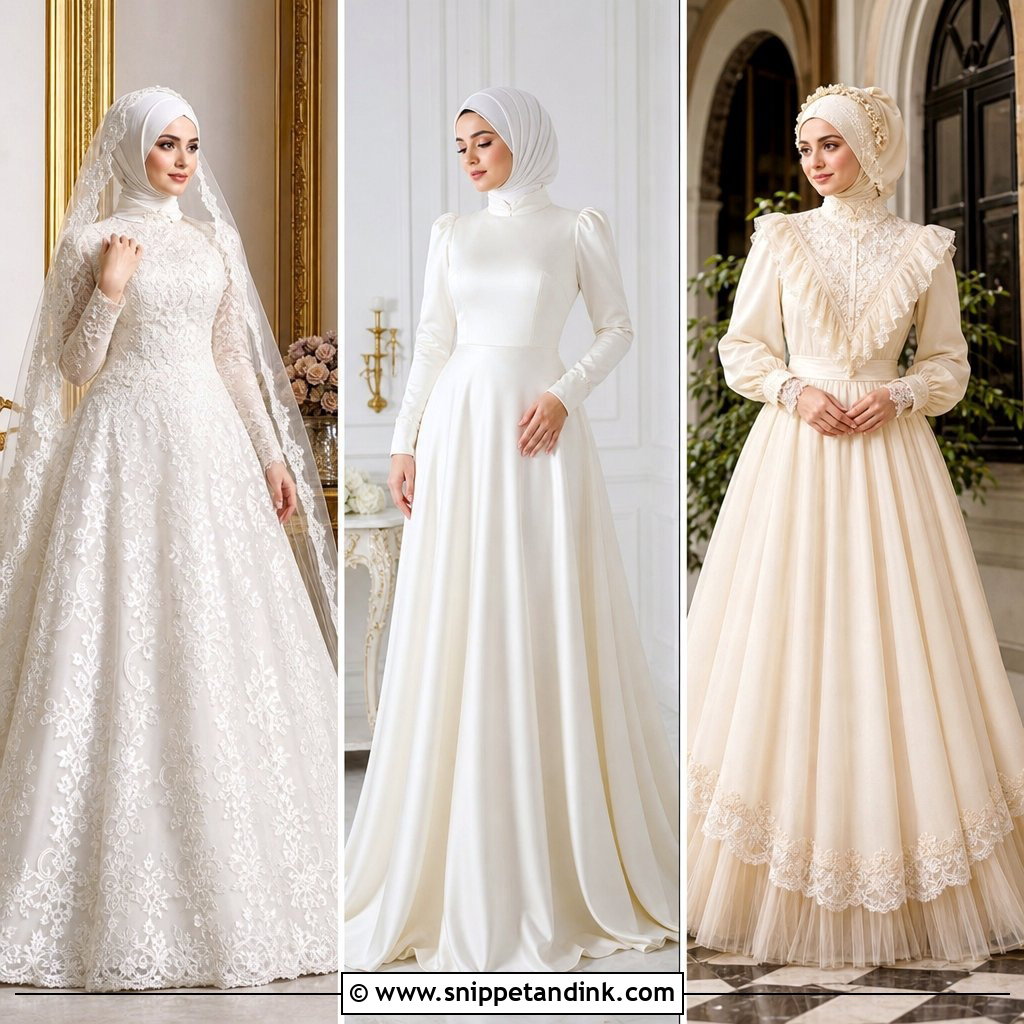
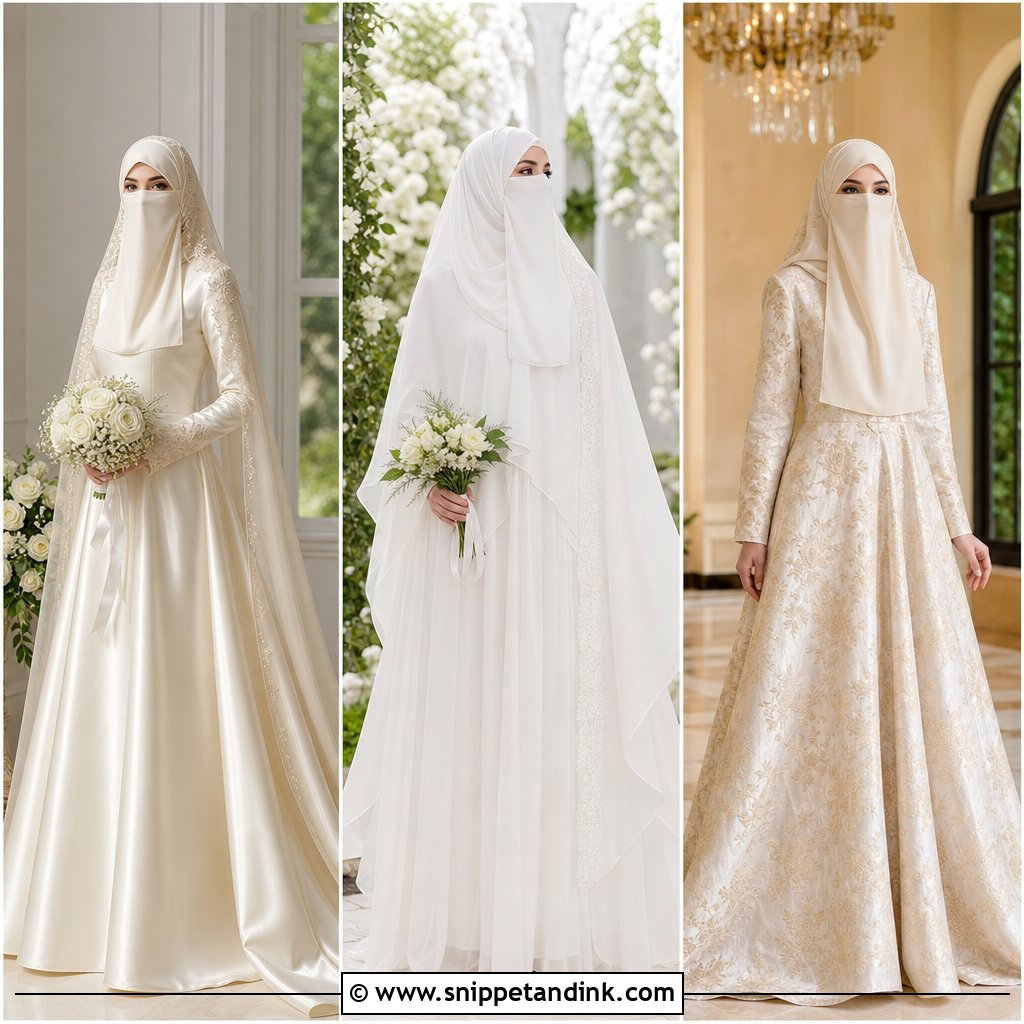
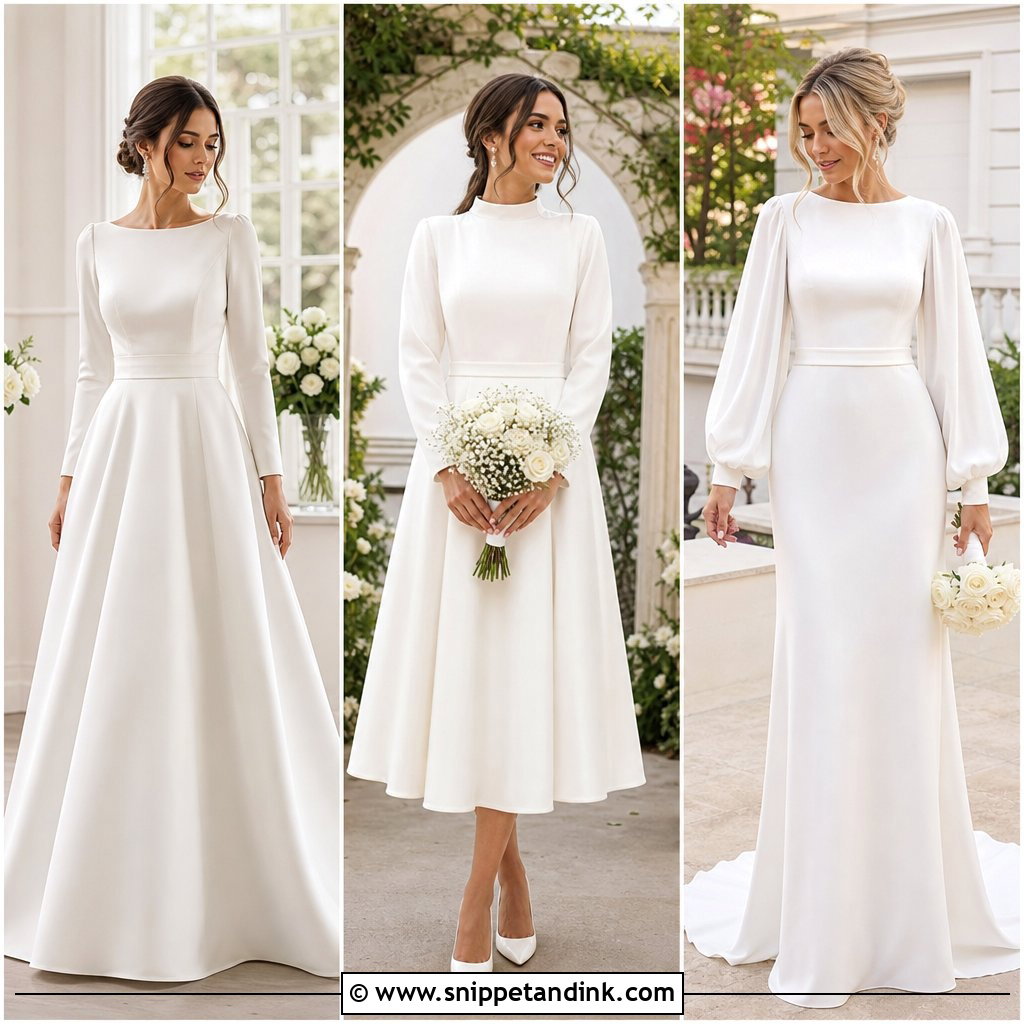
Satin is my first suggestion for full coverage because a heavy duchess or mikado satin is opaque on its own, with no lining tricks needed. An A-line with full sleeves, a high bateau neck and a fitted bodice is the most forgiving cut I know. Wrap an opaque chiffon or matte satin hijab neatly around the neck; shiny satin on satin can look like one block in photos, so I usually go matte on the scarf. A cathedral veil can sit over the hijab for the ceremony. Ivory pumps, pearl drops and white roses finish it, and a narrow crystal belt helps if the gown is completely plain.
2. Lace Ball Gown Hijabi Bride Dress
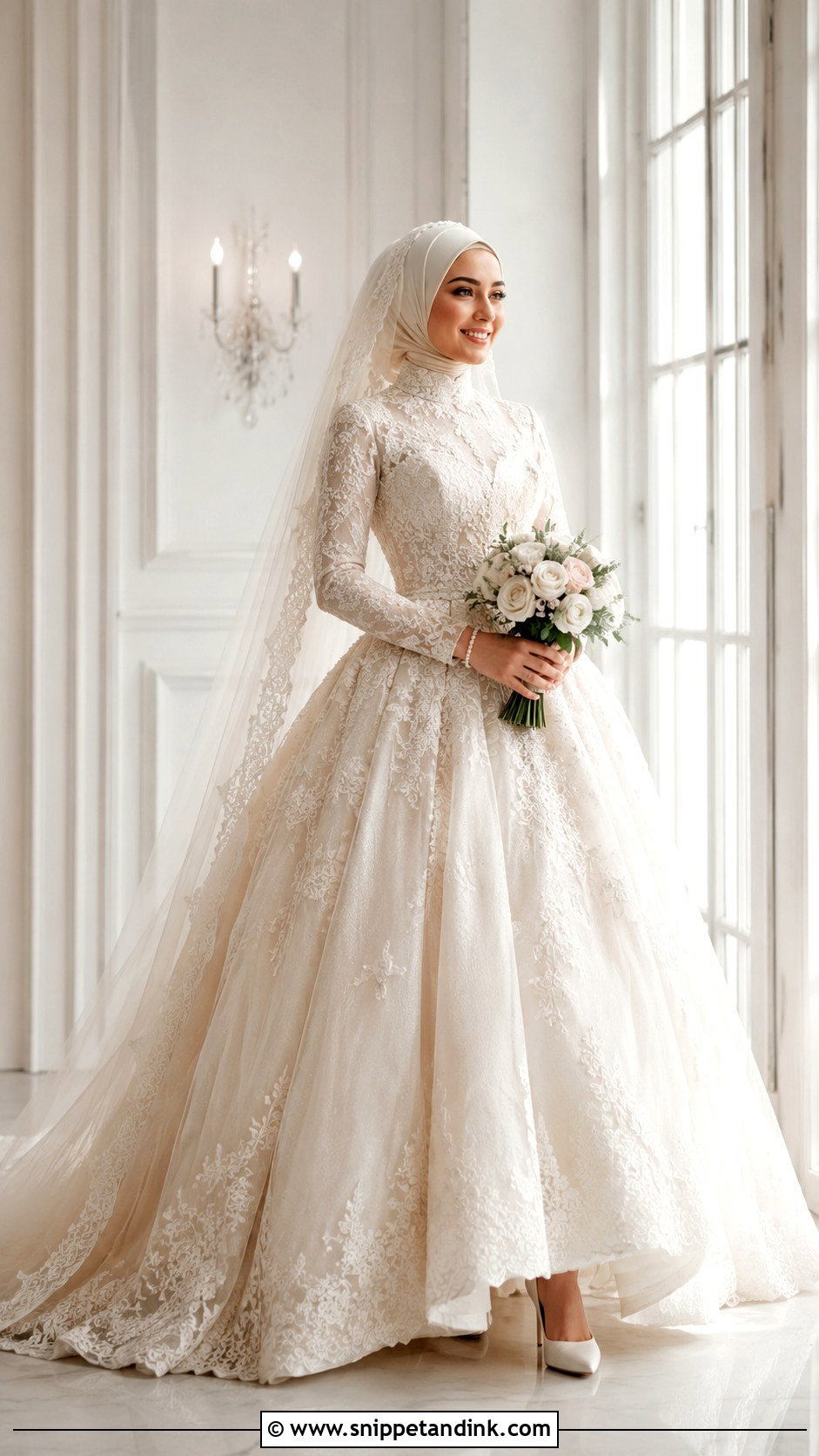
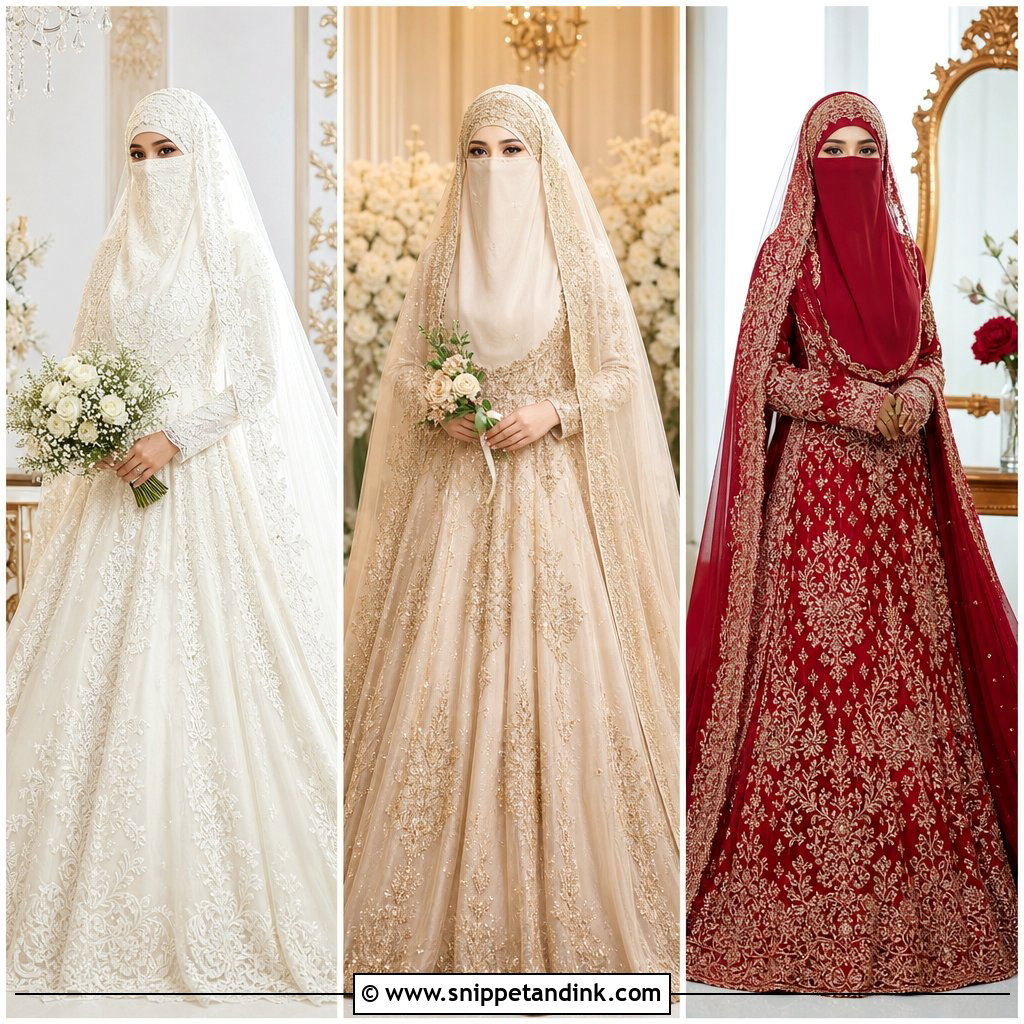
The thing to check on any lace gown is what sits behind the lace. Bridal lace is usually backed with a sheer nude tulle, which looks like skin in photos even when it is technically covered, so ask for an opaque ivory lining under the sleeves and neckline. A raised neckline built into the gown always looks better than an insert added later. Keep the hijab smooth so the lace pattern stays the focus. If you add a lace-edged veil, match the motif scale to the gown or the two will look unrelated. Before final alterations, raise both arms and sit down; lace sleeves are cut close and often pull at the shoulder.
3. Champagne Beaded Hijabi Bride Dress
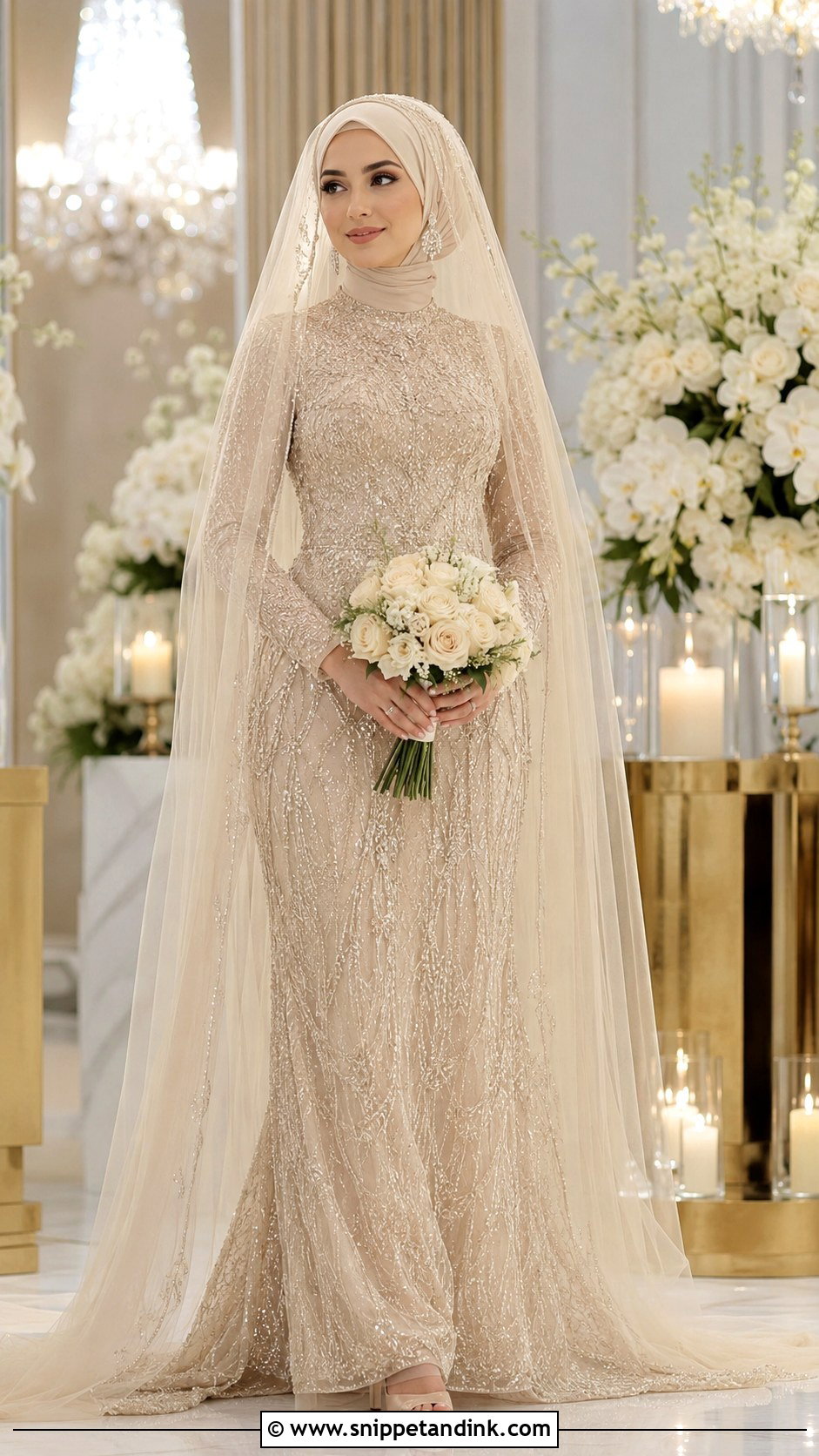
Champagne suits warmer and deeper skin tones that stark white can make look grey. A floor-length gown with tonal beadwork, fitted sleeves and a soft flare lets the crystals and pearls catch light without turning glittery. A champagne chiffon hijab and a veil with a narrow beaded edge keep the palette even. I always ask the tailor to line the inner sleeve and underarm where beadwork meets the bodice, because those beads rub skin raw over a long day. Block heels in nude or champagne help on uneven venue floors. Crystal earrings and cream and peach blooms finish it.
4. Pearl Embellished Hijabi Bride Dress
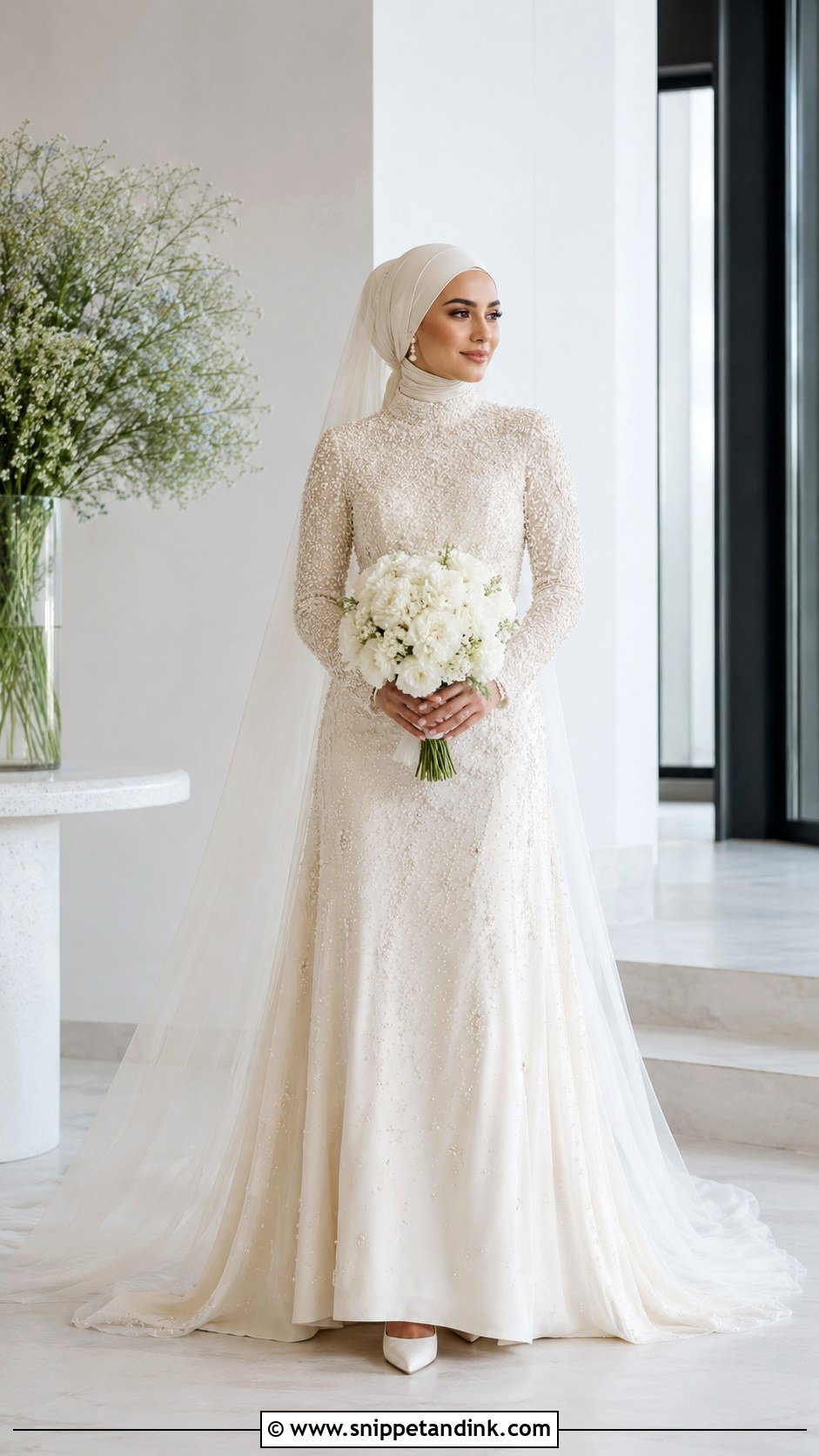
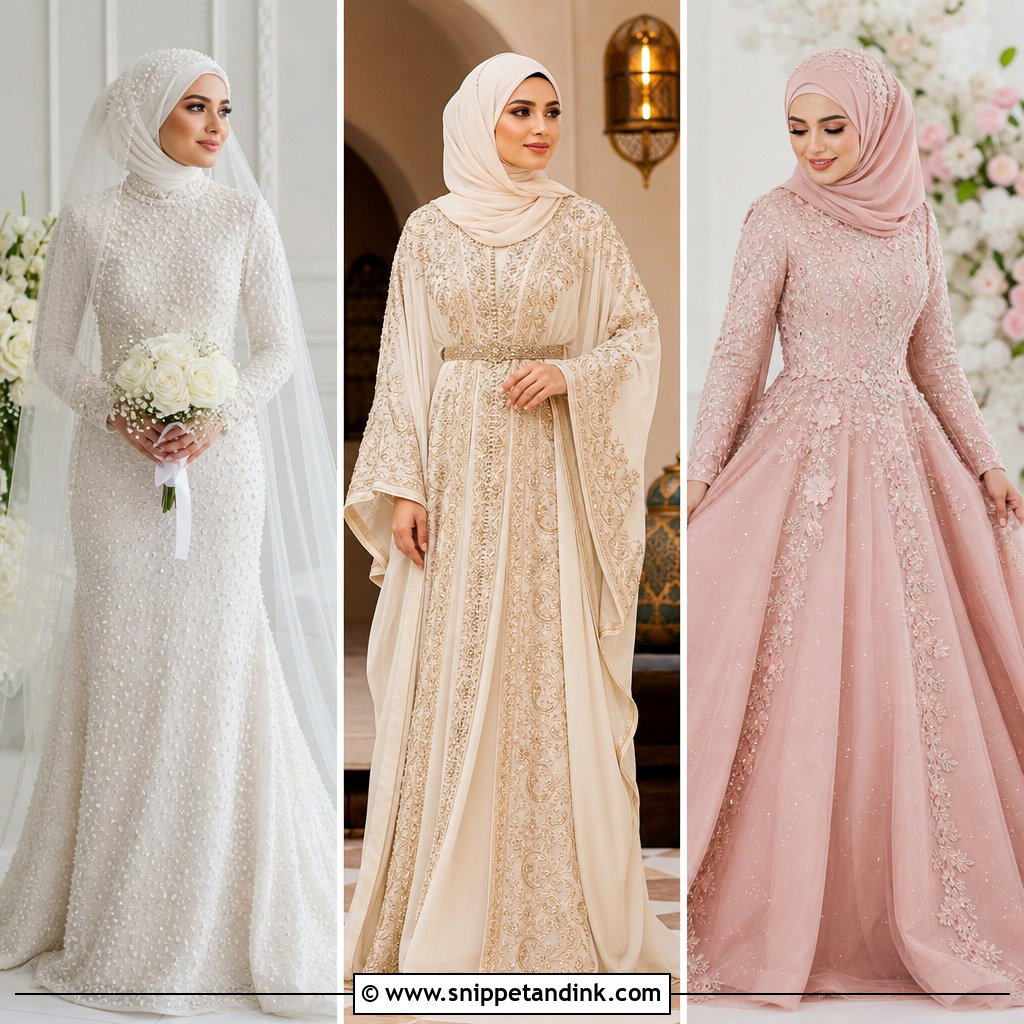
Scattered pearls keep a gown feeling light, while dense pearl coverage makes it heavy at the hem and pulls on the shoulders. A straight or gently flared shape with full sleeves and a clean high neck suits pearls best. Use an opaque ivory hijab with as few pins as you can manage and a plain long veil, since the dress already has texture. Pearl earrings, a slim bracelet and satin pumps finish it; leave the crown and the jeweled bag at home. At your last fitting, tug gently at the pearls on the cuffs, waist and side seams, where arms brush past them all day. Loose ones should be restitched before the wedding, not after.
5. Bridal Cape Hijabi Bride Dress
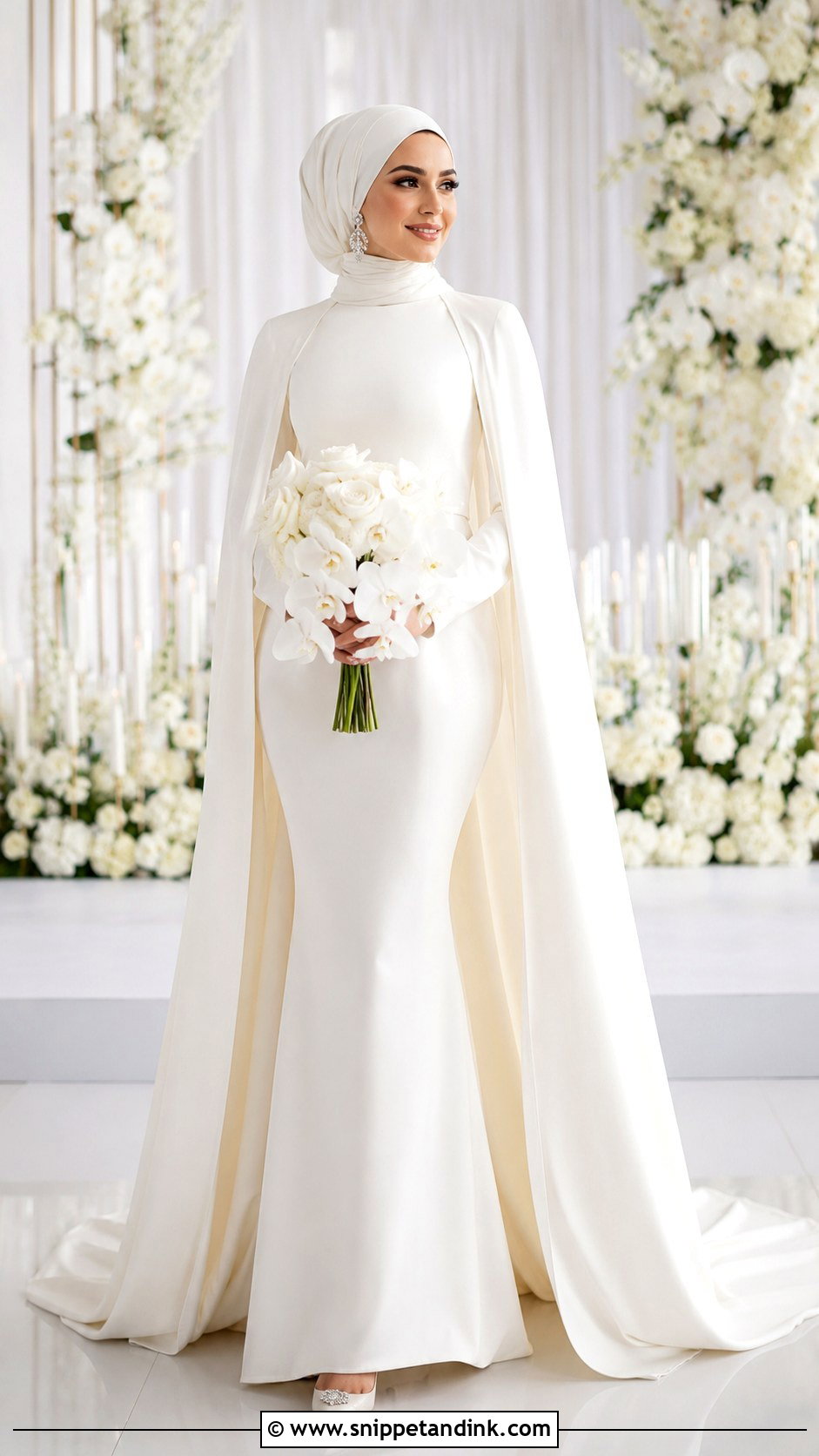
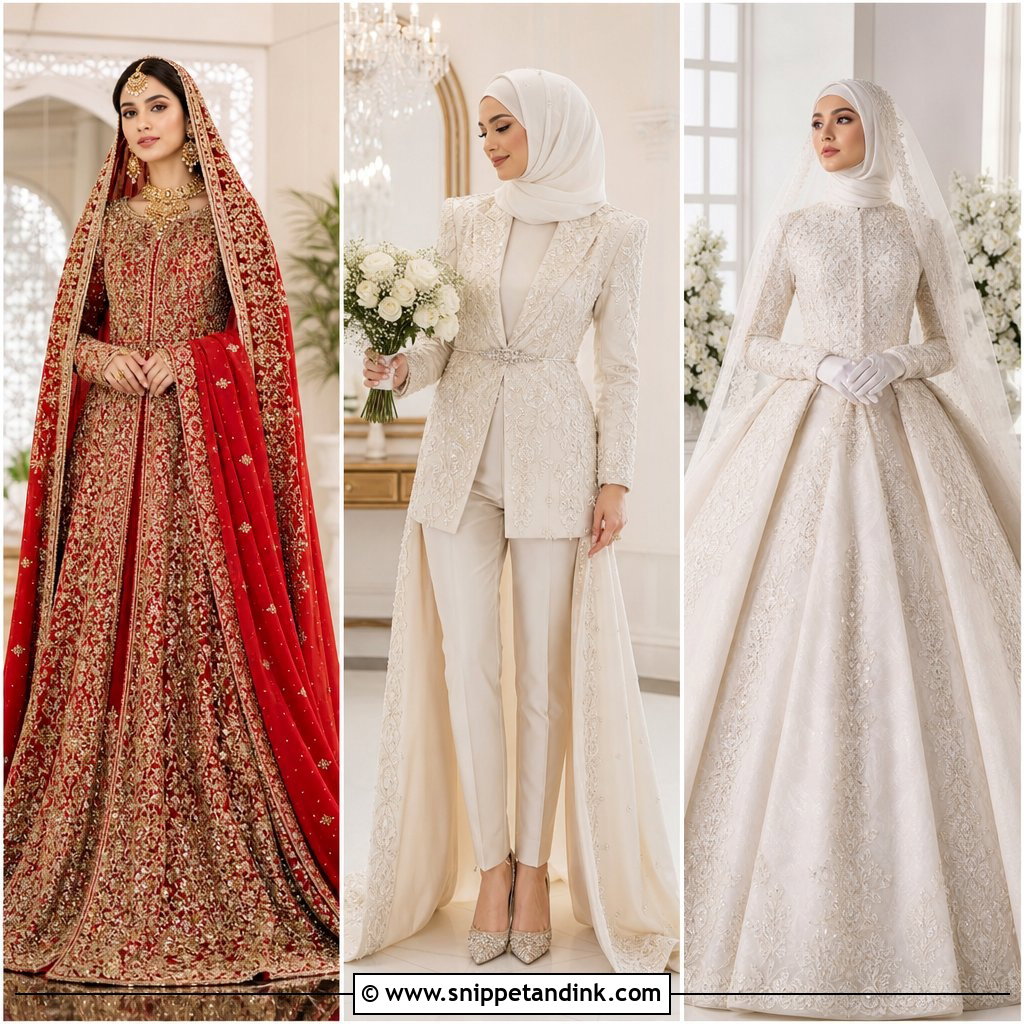
A cape is one of the easiest ways to add coverage to a gown you already love, and it moves beautifully when you walk. Start with a long-sleeved crepe or satin dress with a high neck, then add a floor-length cape that fastens at the shoulder seams. Where it fastens matters: a cape tied at the neck pulls on the hijab every time you turn, while one stitched or snapped at the shoulders stays put. A smooth ivory hijab keeps the upper half neat. Skip the veil if the cape already trails, because two long layers bunch. Practise turning and sitting so you learn to flick the cape out of the way.
6. Minimalist Crepe Hijabi Bride Dress
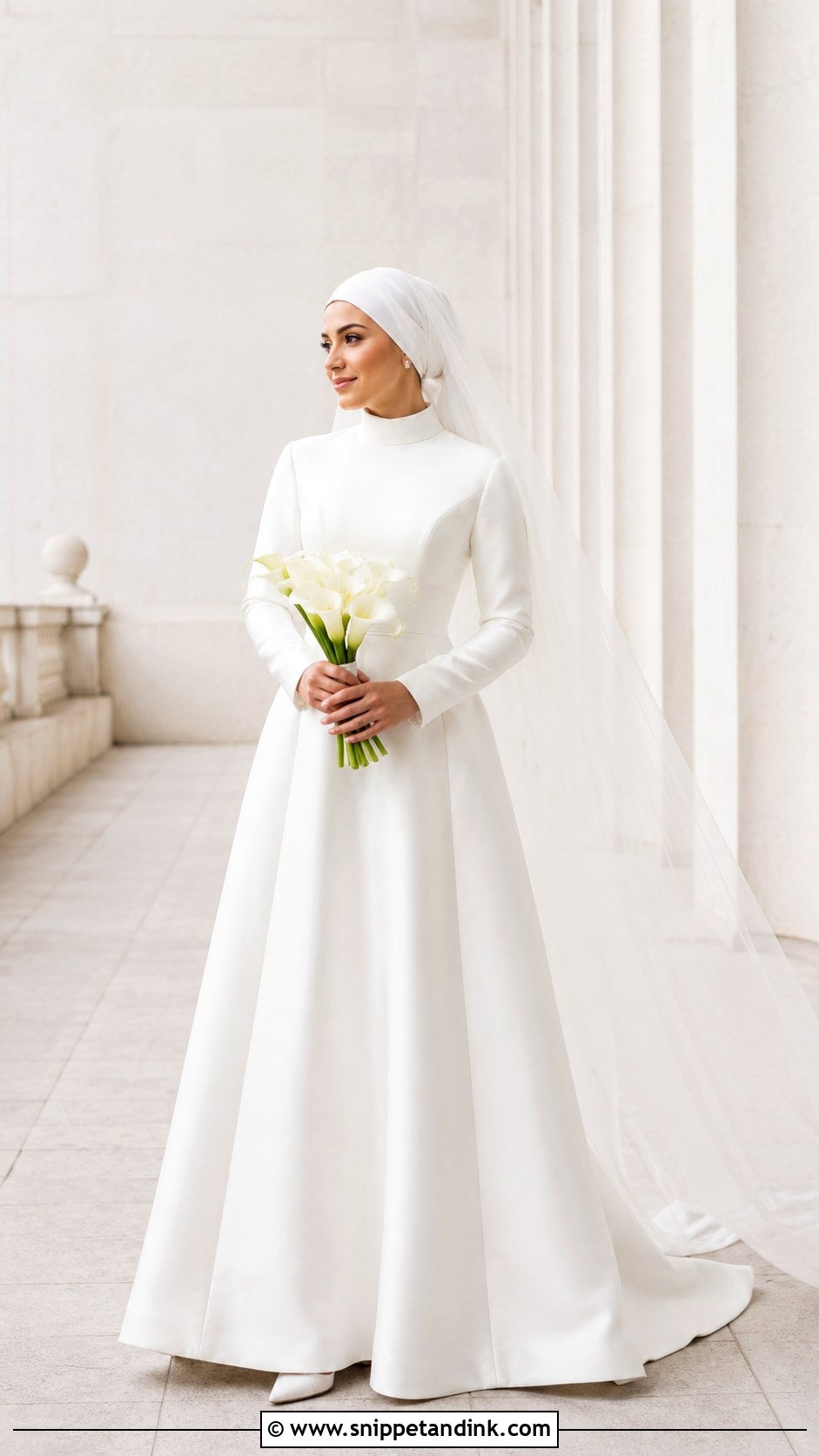
Plain crepe is unforgiving, and that’s the honest trade-off with a minimalist gown. There is no lace or beading to hide an uneven hem or a shoulder seam that sits too far out, so the tailoring has to be precise. Choose a crepe with real weight; thin crepe clings at the hips and turns slightly sheer in bright light. A matching matte hijab and a long plain veil give it movement. Pointed pumps, pearl studs and calla lilies or tulips suit the clean shape. Ask for clean finished seams inside and enough room through the upper arm to hug and dance.
7. Floral Embroidered Hijabi Bride Dress
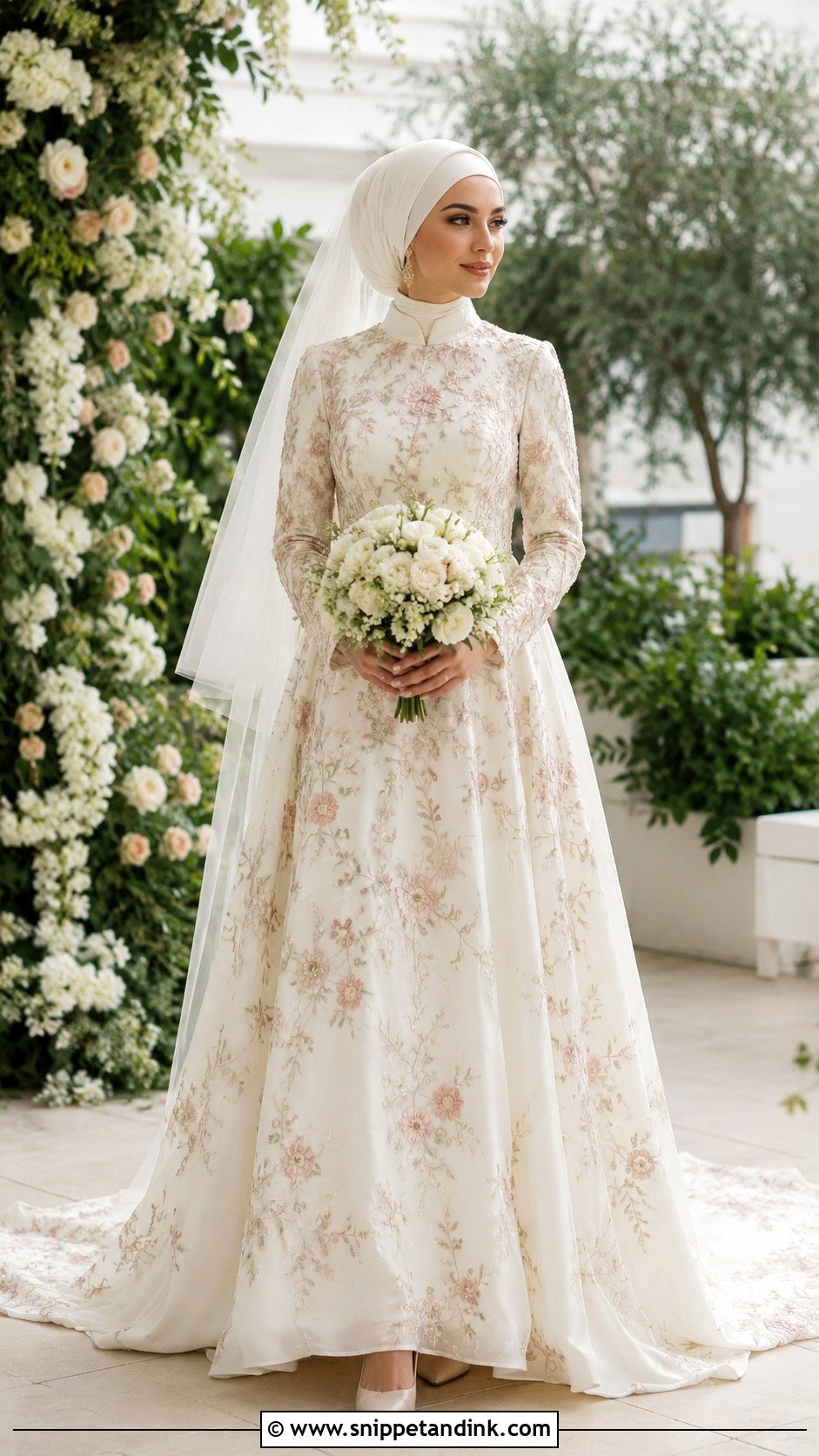
Embroidery brings colour in without abandoning ivory. Blush, sage or silver threadwork on an ivory base, with a high neck, full sleeves and an opaque lining, keeps the look bridal. An A-line or lightly gathered skirt gives the motifs room. Match the hijab to the gown’s base colour, not to a flower in the embroidery; a sage scarf next to the face draws the eye away from it. Delicate earrings can repeat one thread colour. Keep the bouquet simple. At fittings, I check that the large motifs sit symmetrically on both sleeves, since a flower that lands on one elbow and not the other looks wrong in every photo.
8. High Neck Tulle Hijabi Bride Dress
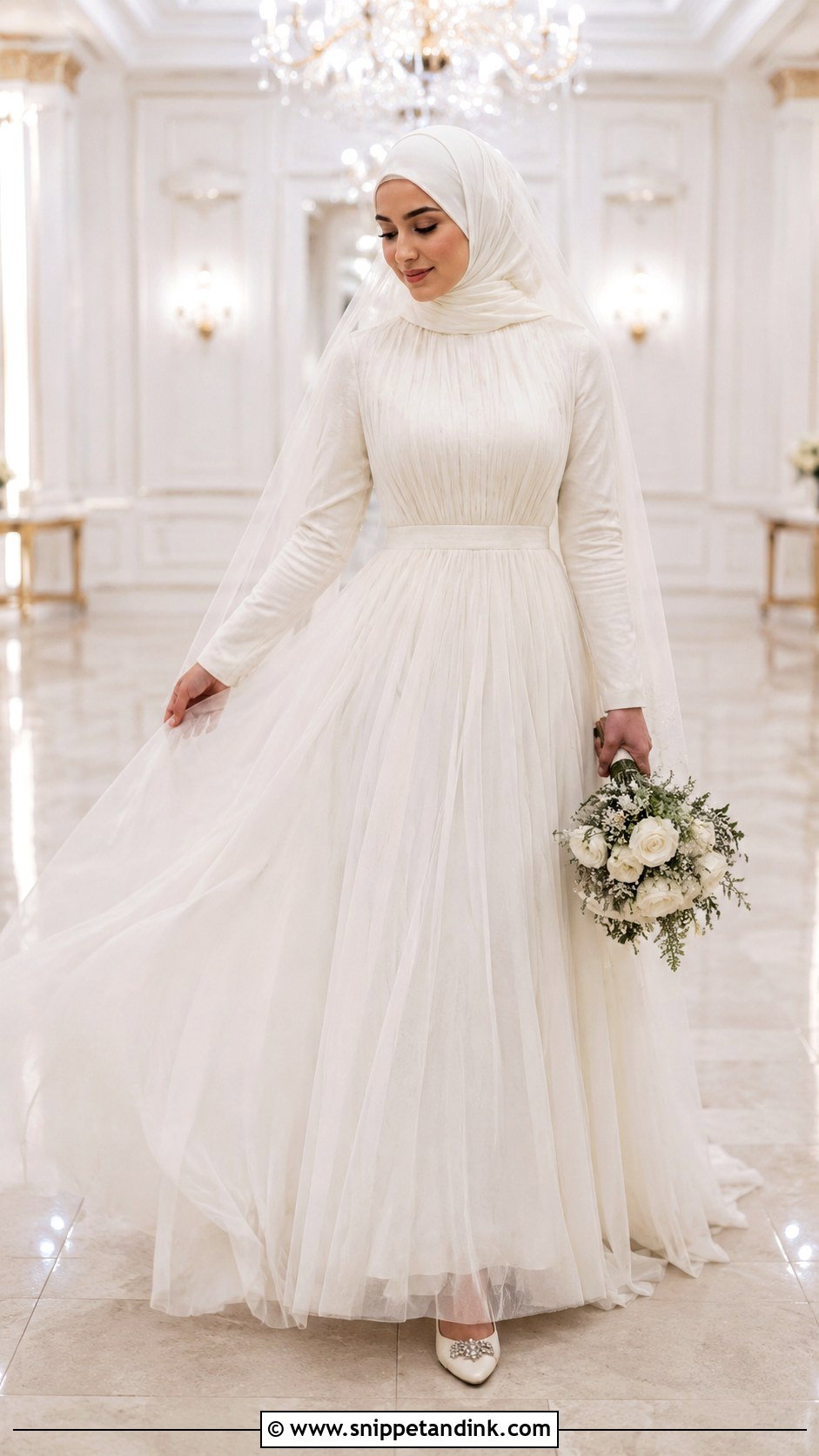
Tulle gives you volume without weight, which is welcome under a hijab and veil that already add layers at the head. Look for an opaque high-neck bodice, lined long sleeves and a tulle skirt lined to the floor; unlined tulle is see-through against light. A chiffon hijab and a fine tulle veil in the same ivory read as one soft column. Low block heels or embellished flats avoid catching the skirt. Watch your accessories: open-set rings, rough bracelets and beaded bags all snag tulle. A wrist loop or a simple bustle makes the reception easier.
9. Princess Ball Gown Hijabi Bride Dress
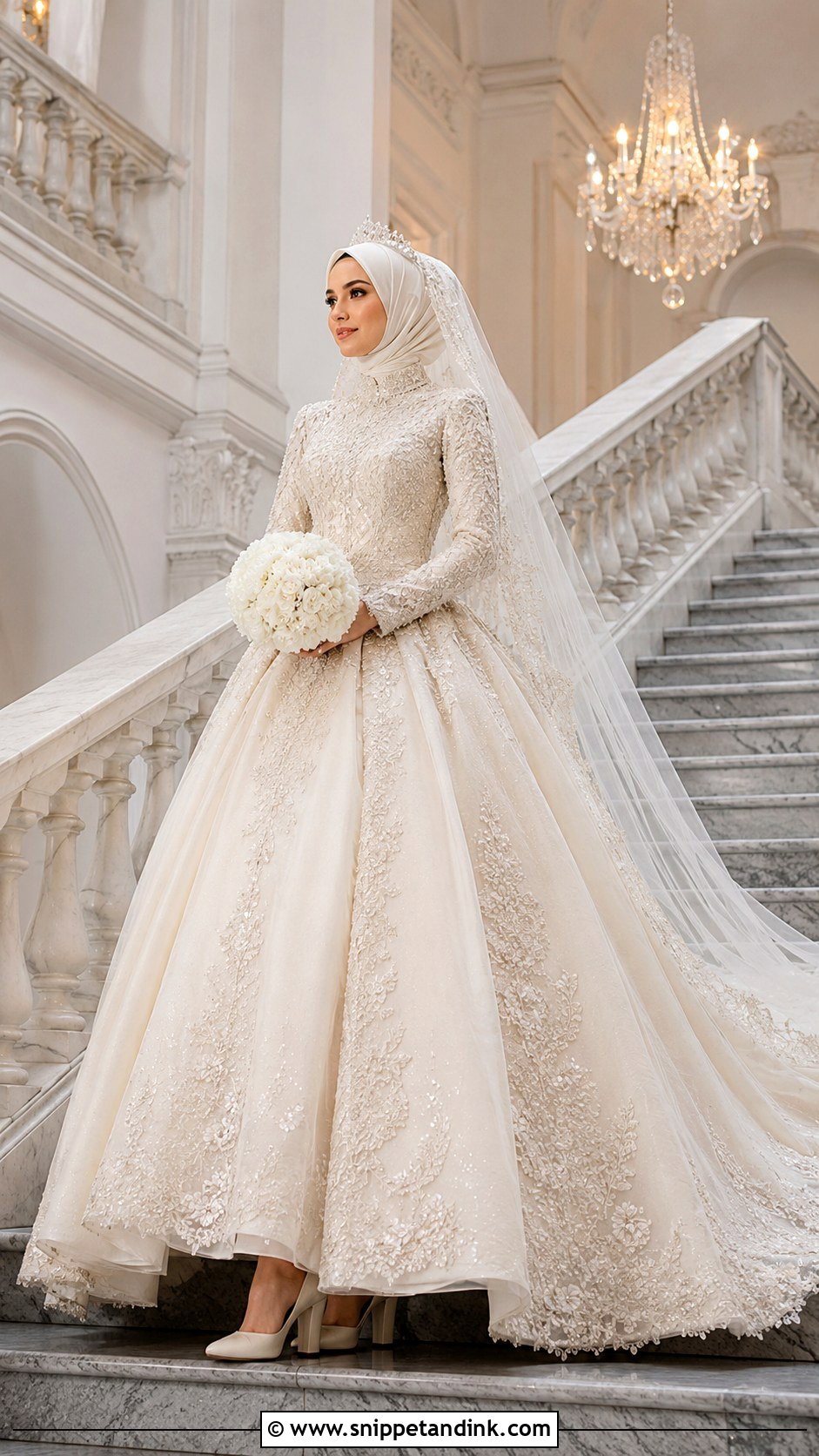
A princess ball gown needs a structured bodice to hold all that skirt, so expect some boning and a firm waist. Choose an opaque bodice with a high neck and long sleeves, and let lace appliqués or tonal embroidery add depth. A sleek hijab balances the width, while a cathedral veil carries the formality. Wear stable block heels, since no one will see them. A small tiara can sit over the hijab, but pin it to an underscarf rather than through the outer fabric, or it will pull and leave holes in chiffon. Have the front hem clear the floor slightly so you don’t kick it with every step.
10. Blush Pink Hijabi Bride Dress
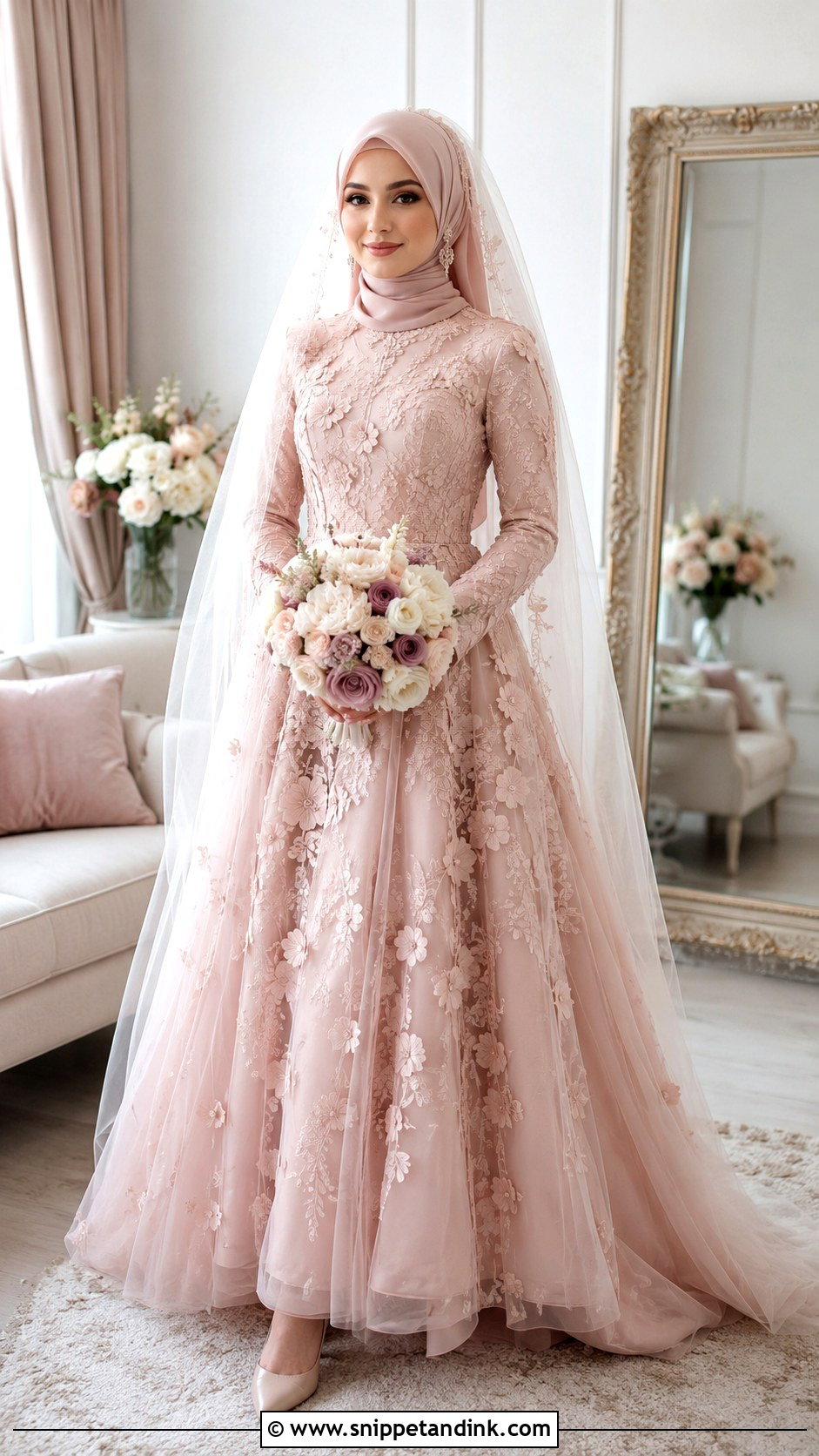
Blush is the colour I see most often change between the fitting room and the photos. Some pinks lean peach and some lean lilac, and warm indoor bulbs exaggerate whichever way the fabric already leans. Dusty blush tends to photograph better than bright pink. Choose a full-length gown with long sleeves, a high opaque neck and soft pleating or floral appliqué. A matching or slightly lighter pink hijab frames the face, and an ivory veil adds a clear bridal contrast. Hold fabric swatches against your face in daylight and under warm light before you commit.
11. Silver Embellished Hijabi Bride Dress
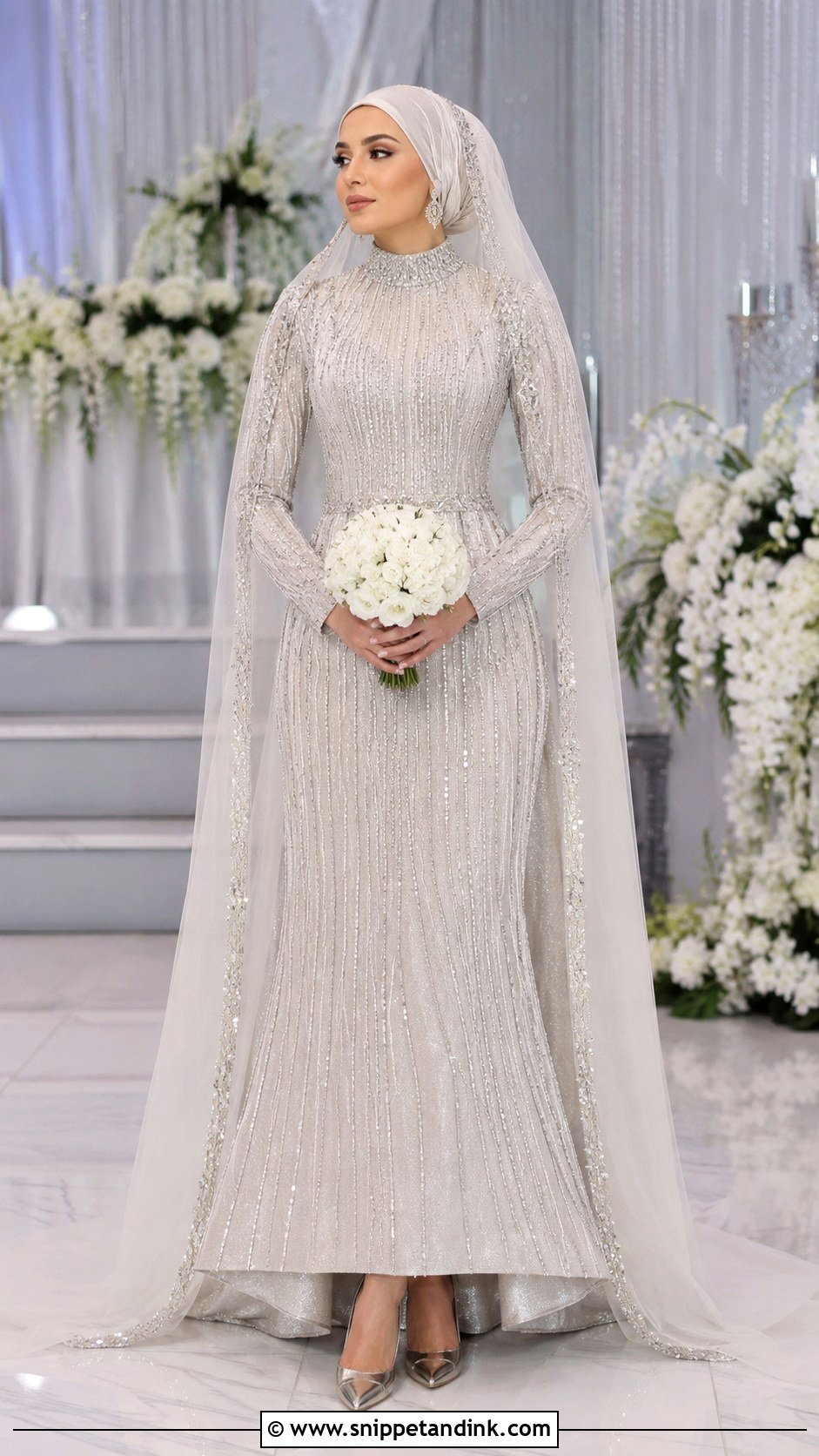
Silver suits an evening or indoor wedding, where it reads cool and luminous rather than cold. Start with ivory, pale grey or soft silver and choose vertical beadwork, which lengthens the body. A plain grey or ivory hijab keeps the face calm, and a sheer veil with a silver edge pulls it together. Silver ranges from blue to pewter, and the hijab, shoes and jewelry rarely match by accident, so compare them side by side under the same light. Soft grey-brown eye makeup suits the palette better than more sparkle.
12. Gold Embroidered Hijabi Bride Dress
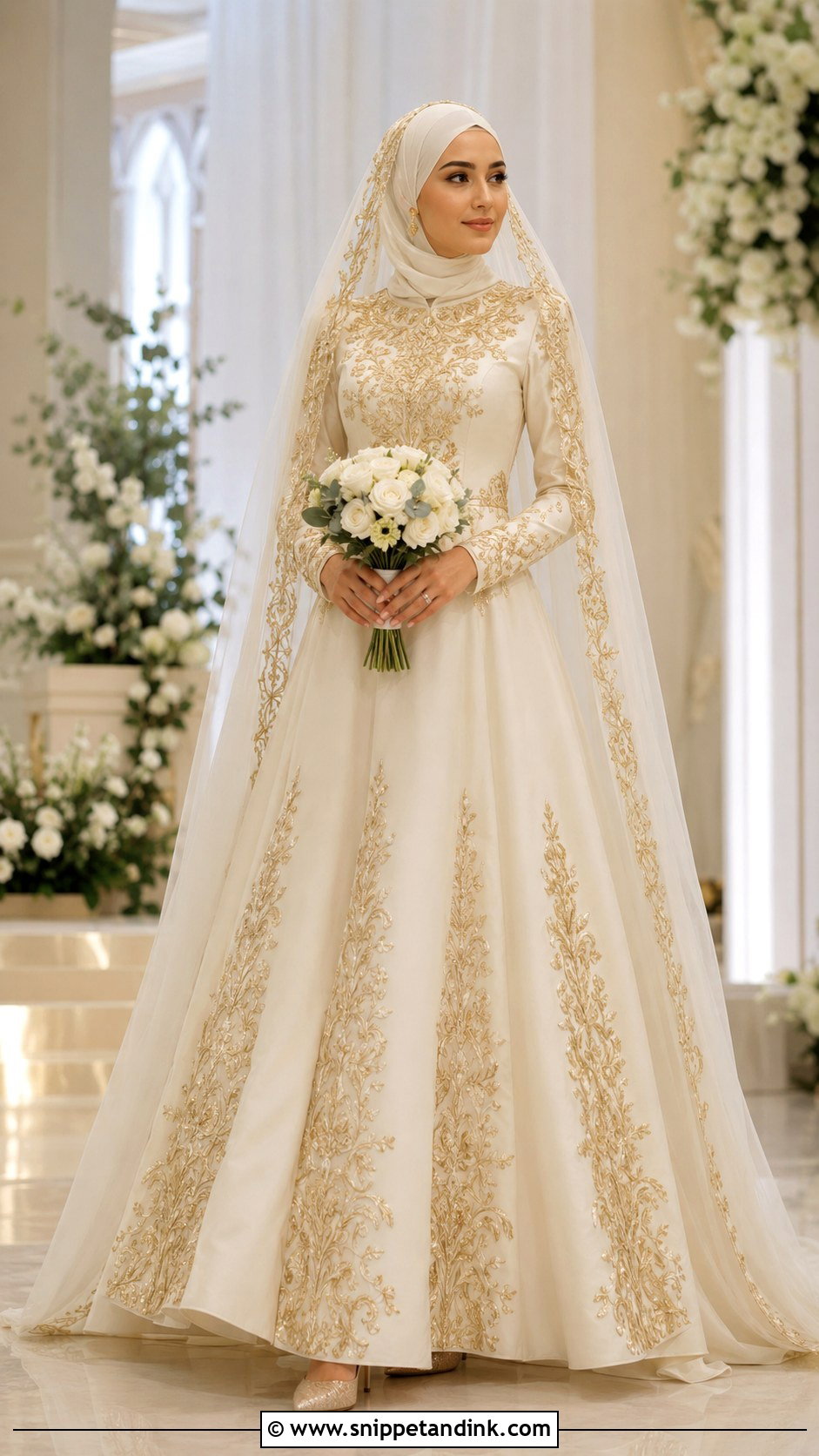
Gold thread is stiff, and that changes how the gown should be built. On an ivory, cream or champagne base, keep the heaviest goldwork on the bodice, cuffs and hem, and ask for a soft underlayer beneath the sleeves and neckline so the metallic thread doesn’t scratch for hours. A flowing A-line keeps it comfortable. A cream chiffon hijab and a veil with a narrow gold border echo the embroidery without copying it. One bracelet, small gold earrings and champagne heels are enough. Ivory flowers with soft greenery stop the whole look from becoming too matched.
13. Red Lehenga Hijabi Bride Dress
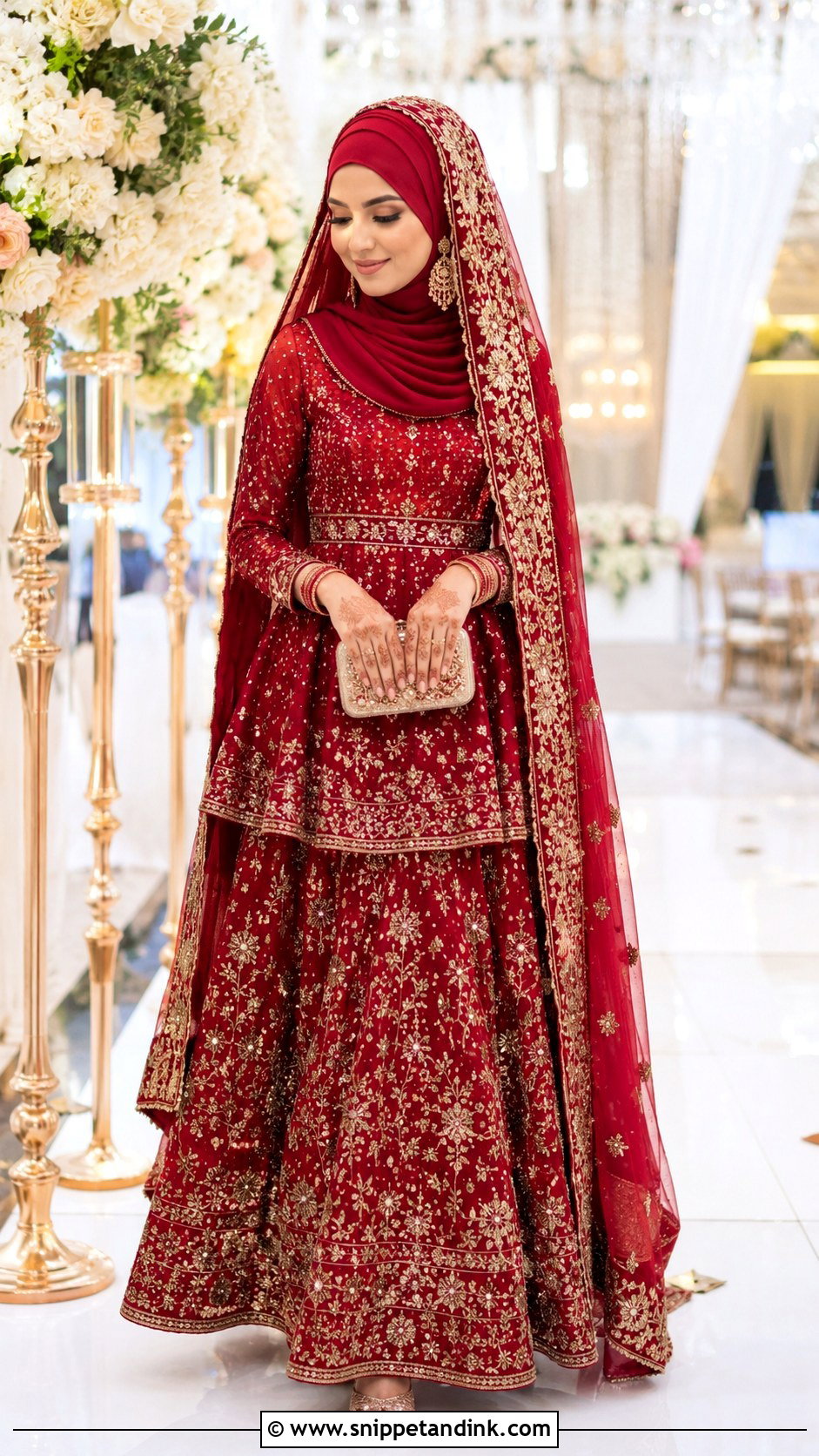
A red lehenga brings the full colour and ceremony of a South Asian celebration, and it adapts well to full coverage. Swap the short choli for a long tunic or peplum top that covers the midriff. Dense gold embroidery needs some plain red around it to rest the eye. Drape the dupatta over a matching red hijab, keeping the face frame smooth. A heavy dupatta should be spread across several hidden pins at the crown and shoulders; anchoring all its weight at one point drags the hijab back by the end of the night. Gold earrings, bangles and embellished closed-toe heels finish it.
14. Ivory Bridal Abaya Hijabi Bride Dress
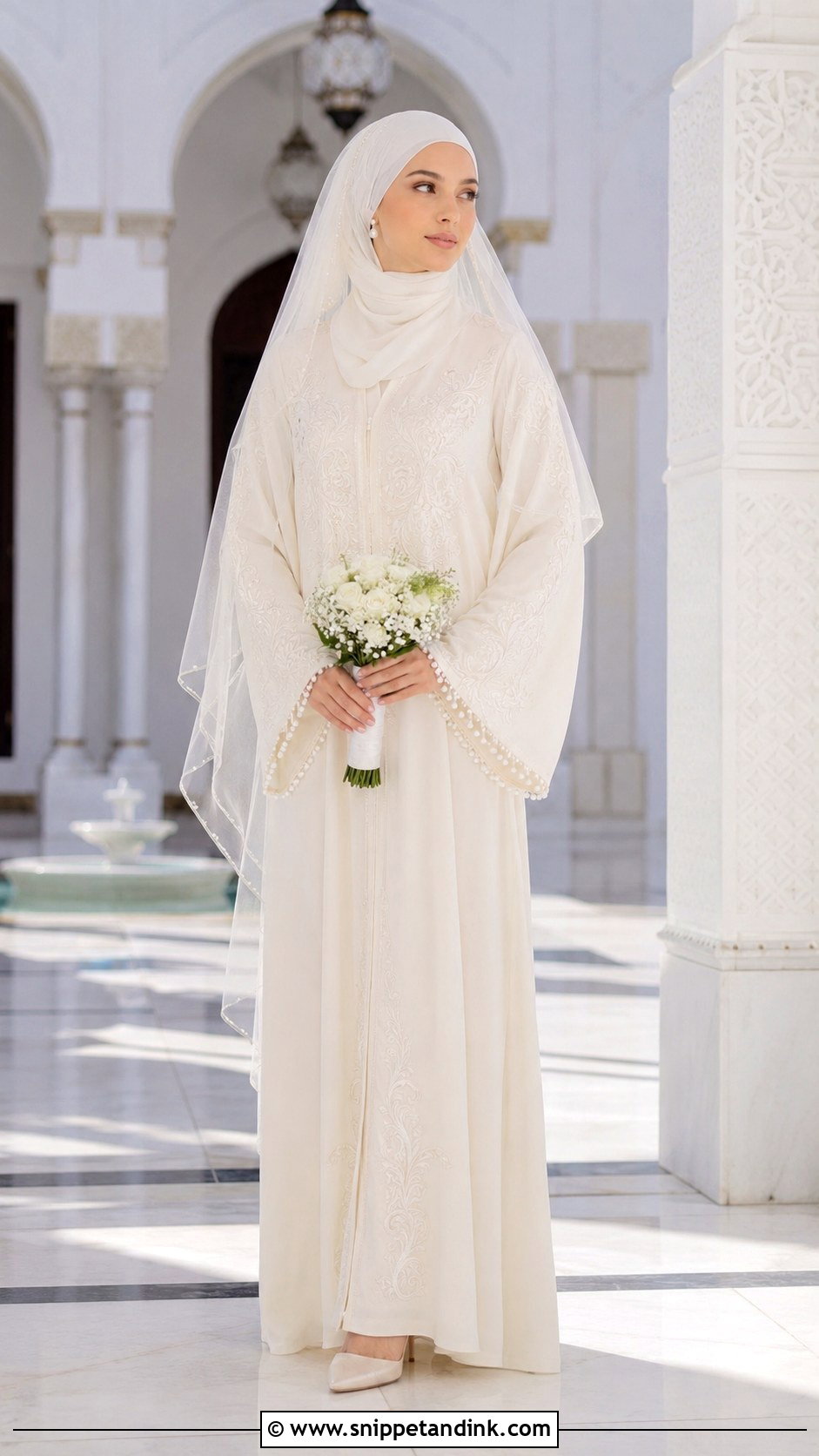
An ivory bridal abaya suits a small nikah or mosque ceremony where a big gown would feel out of place. Choose a closed-front design in opaque crepe, satin or lined chiffon, with pearl trim or tonal embroidery for a bridal touch. Wide sleeves are the detail to test: lift your hands as if signing the nikah contract, and see whether the forearm shows. If it does, a fitted inner sleeve fixes it without changing the outer shape. A matching ivory hijab, an optional light veil, low satin pumps and pearl earrings keep everything quiet and graceful.
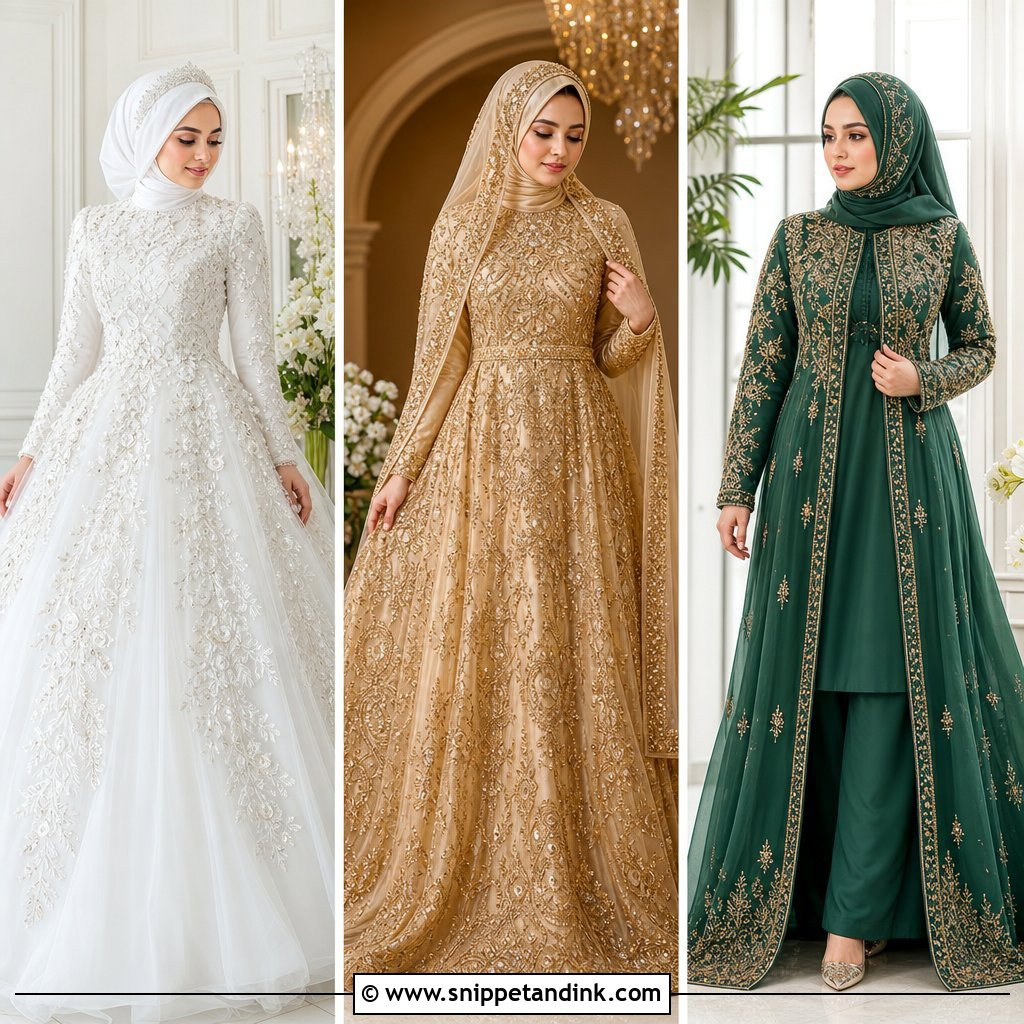

15. Modest Mermaid Hijabi Bride Dress
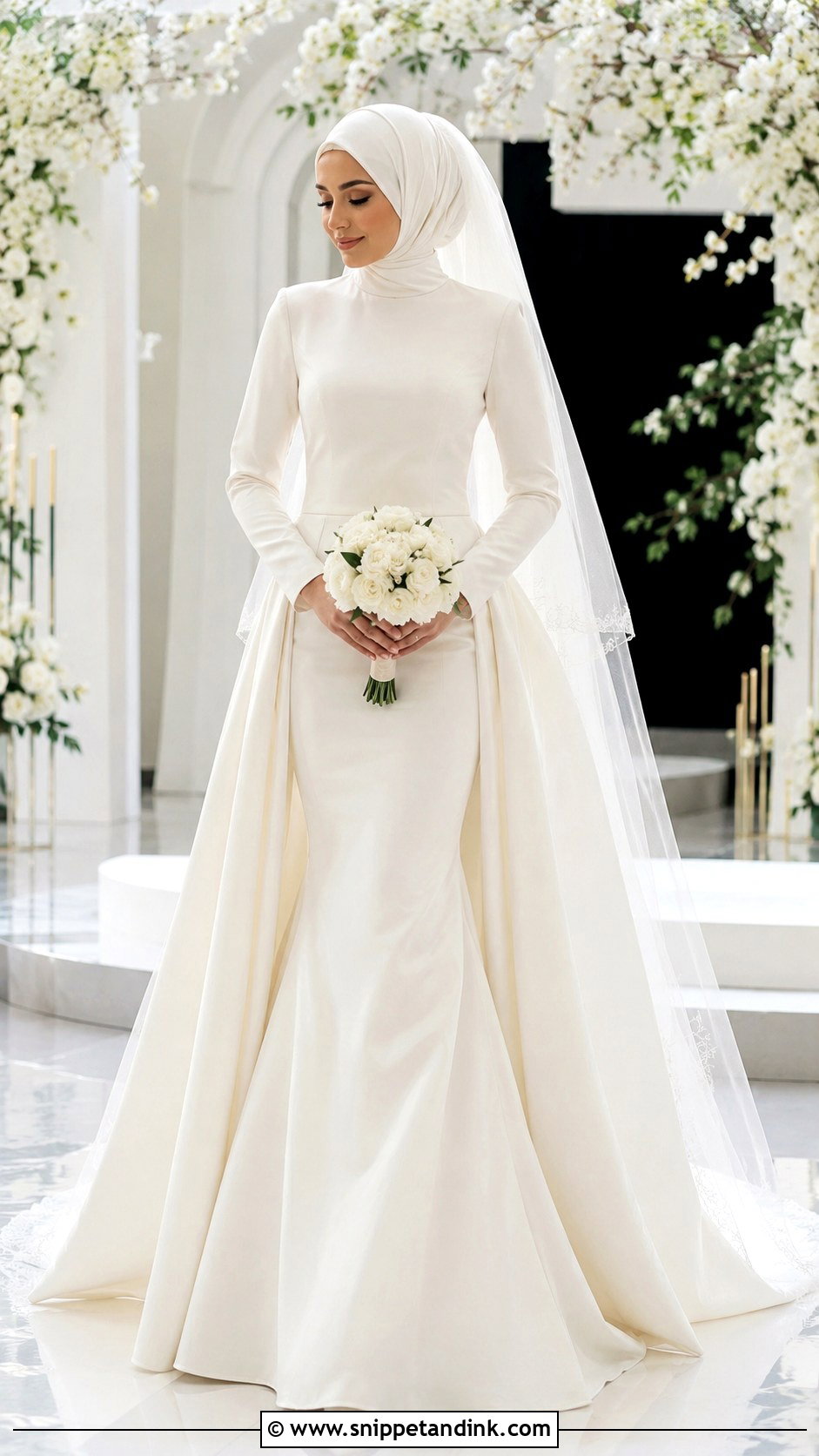
Mermaid is the hardest silhouette to make modest, and I’ll be honest that it doesn’t suit every bride who wants coverage. It works when the gown skims rather than grips, then flares from just below the knee. Opaque fabric, full sleeves, a raised neck and some draping across the hips all help. A detachable overskirt gives you a fuller ceremony look and a lighter reception one. Keep jewelry minimal, since the shape is the statement. Climb stairs and take long strides at the fitting. If you feel hobbled, ask the tailor to let out the side seams or raise the flare.
16. Tiered Tulle Hijabi Bride Dress
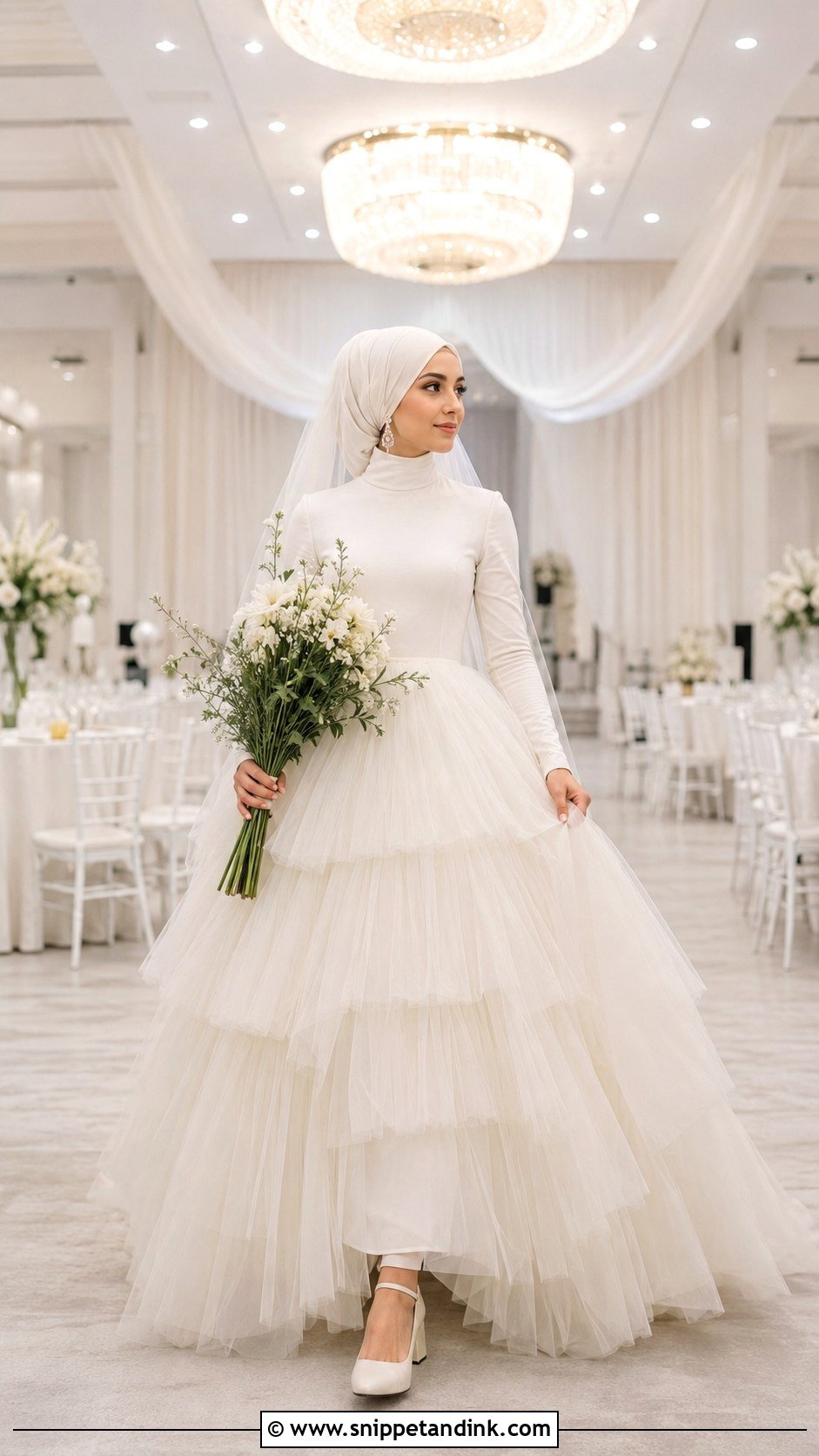
Tiers give a full skirt bounce, and they are lighter than a single gathered skirt of the same width. Keep the bodice simple: lined, high-necked, opaque sleeves. A smooth chiffon hijab and a plain fingertip veil stop the look from crowding. The lowest tier should sit just above the floor at the front. Tulle builds up static and clings to the lining in dry air, especially in winter, so steam the gown and walk in it before the day; a good lining and an anti-static spray on the inside help. A wrist loop makes the skirt manageable for photos.
17. Velvet Winter Hijabi Bride Dress
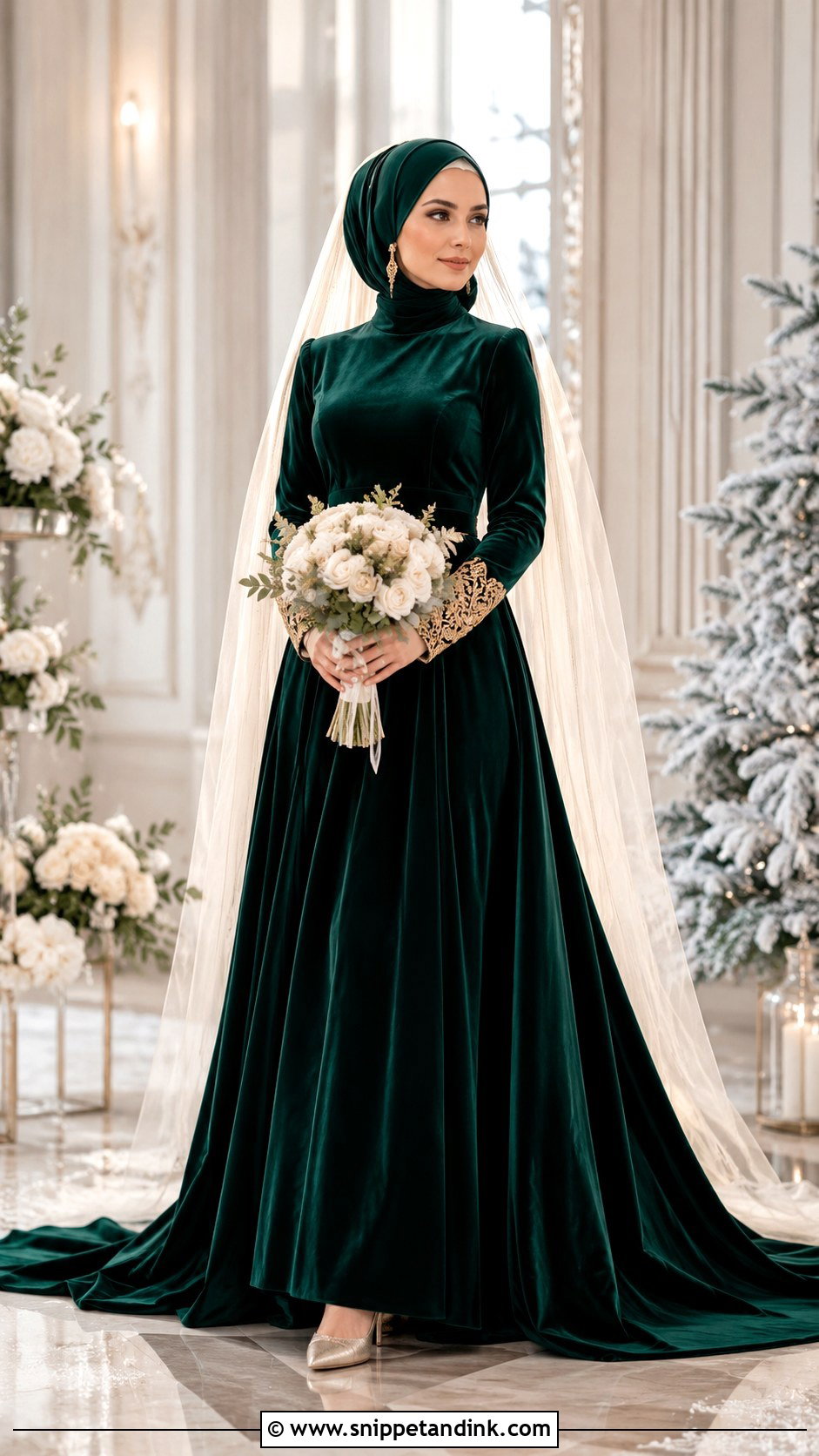
Velvet is the warmest fabric on this list and the most demanding to sew. Its pile has a direction, so every panel must be cut the same way, or one side of the skirt will look darker than the other in photos. Ivory, emerald, burgundy and midnight blue all work with long sleeves, a high neck and a flowing skirt. Limit embellishment to the cuffs or waist. Pair it with a thin matte chiffon hijab rather than jersey, because a thick scarf piled against a velvet collar feels bulky and hot. A light veil, closed pumps and cream flowers with winter greenery suit the weight of the fabric.
18. Floral Appliqué Hijabi Bride Dress
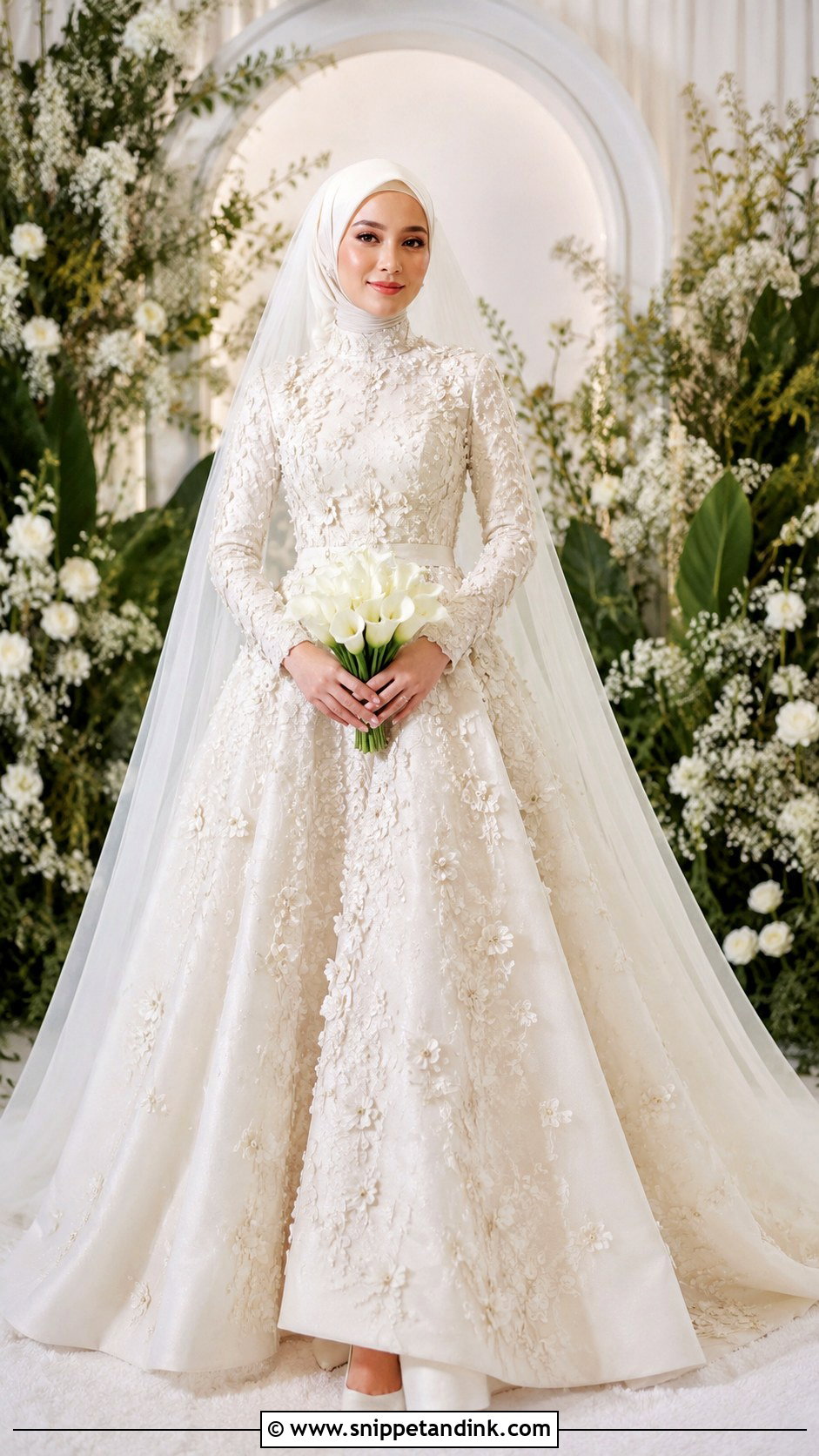
Raised appliqué flowers look lovely in a photo and are less pleasant at the underarm. Choose a gown where the flowers gather at the bodice, shoulders and hem with some plain fabric between them, and check that nothing bulky sits on the inner sleeve or side seam. An opaque lining, high neck and fitted sleeves give full coverage. A plain ivory hijab and simple veil let the texture lead. Satin heels, pearl studs and a single-variety bouquet keep it cohesive. If appliqués run down the train, plan a bustle that lifts them off the floor before dancing starts.
19. Two-Piece Hijabi Bride Dress
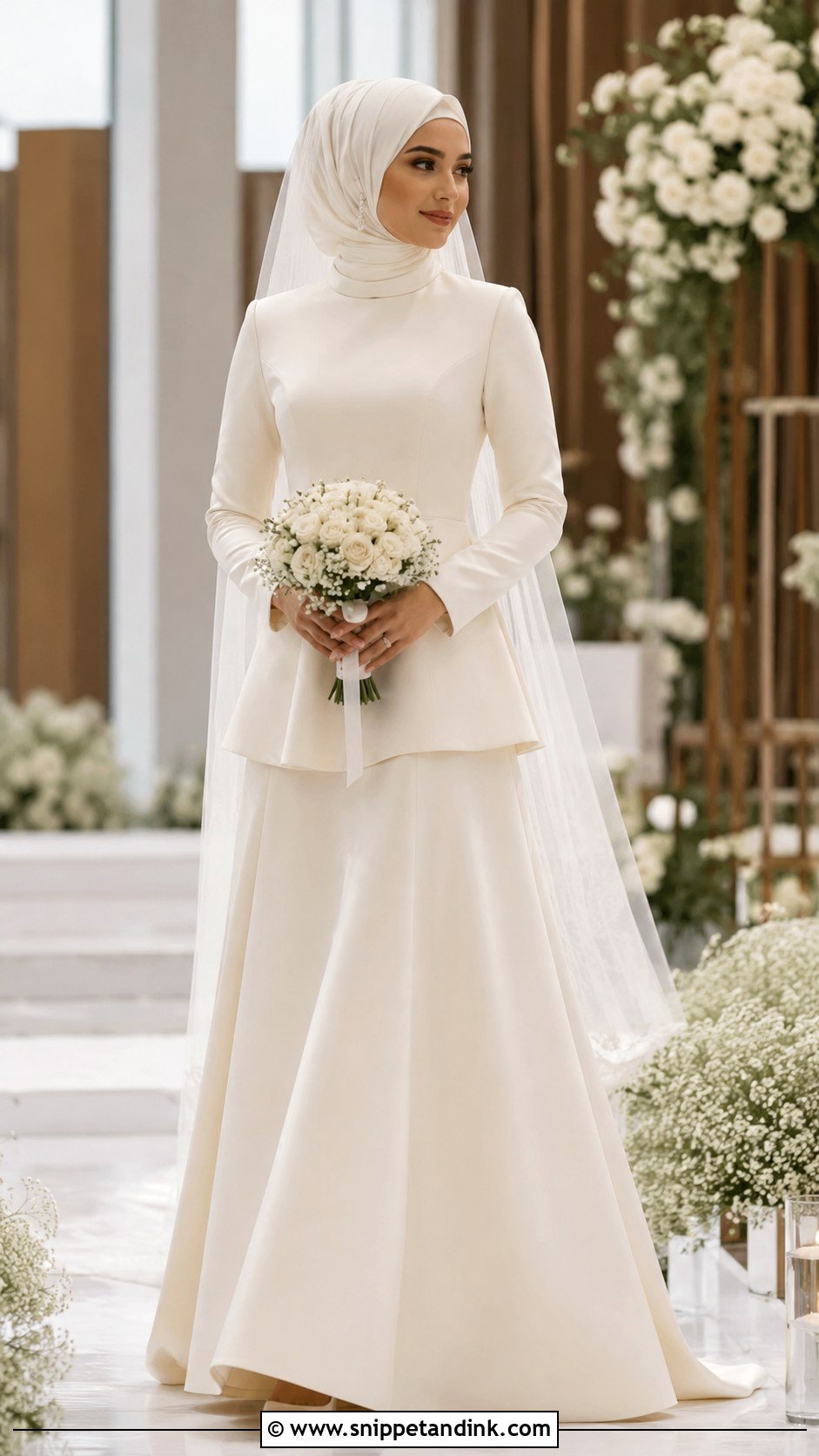
Separates solve a common fit problem: brides whose top and bottom halves are different sizes. With a two-piece, each part is altered on its own. Pair a long structured peplum top with a high neck and full sleeves with a floor-length A-line skirt in satin, brocade or embroidered crepe. The top must overlap the waistband by a good margin so nothing shows when you sit or raise your arms. Hidden hooks between top and skirt add security. A matching hijab, a long veil attached at the back and closed heels finish it.
20. White Bridal Kaftan Hijabi Bride Dress
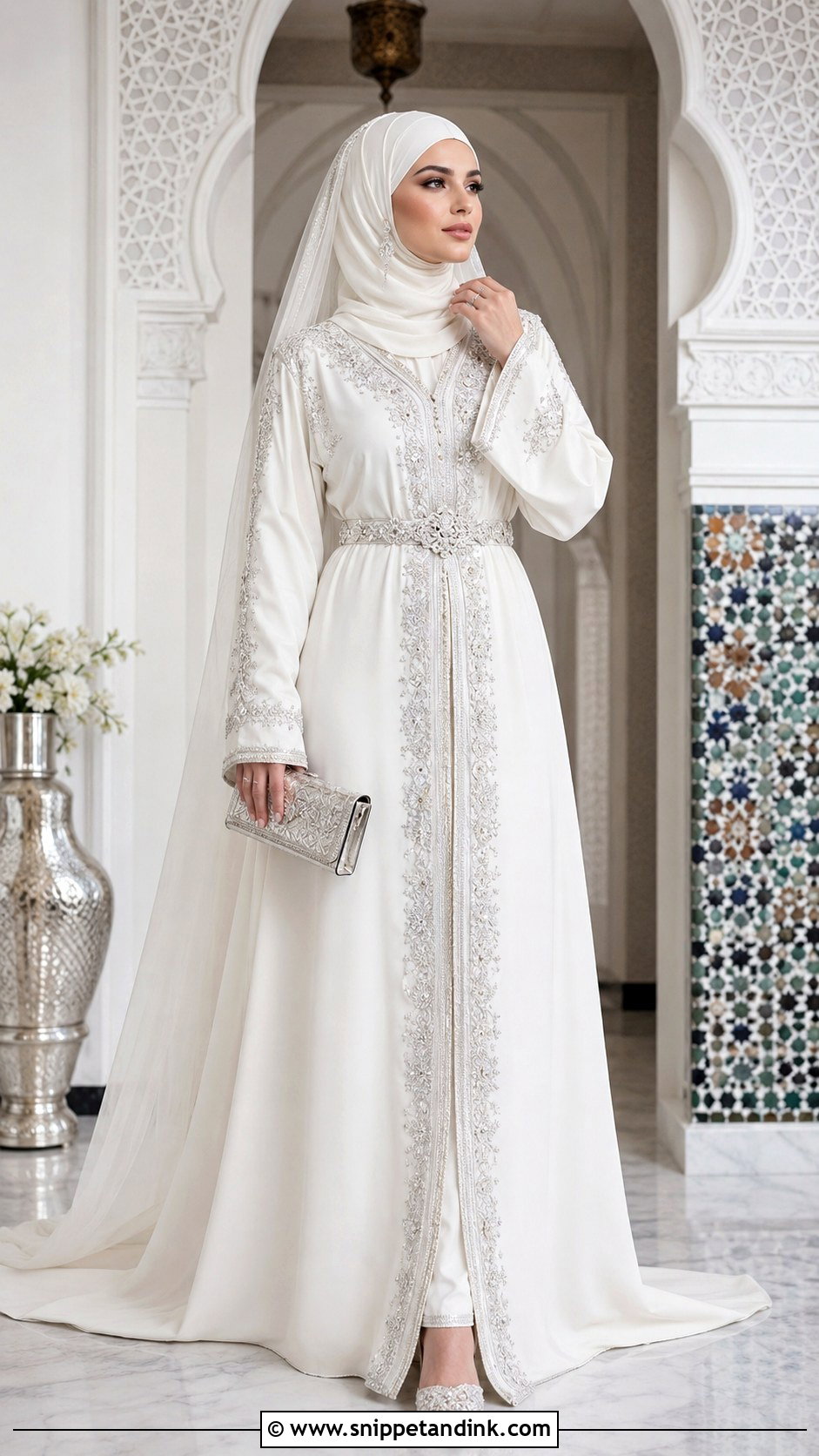
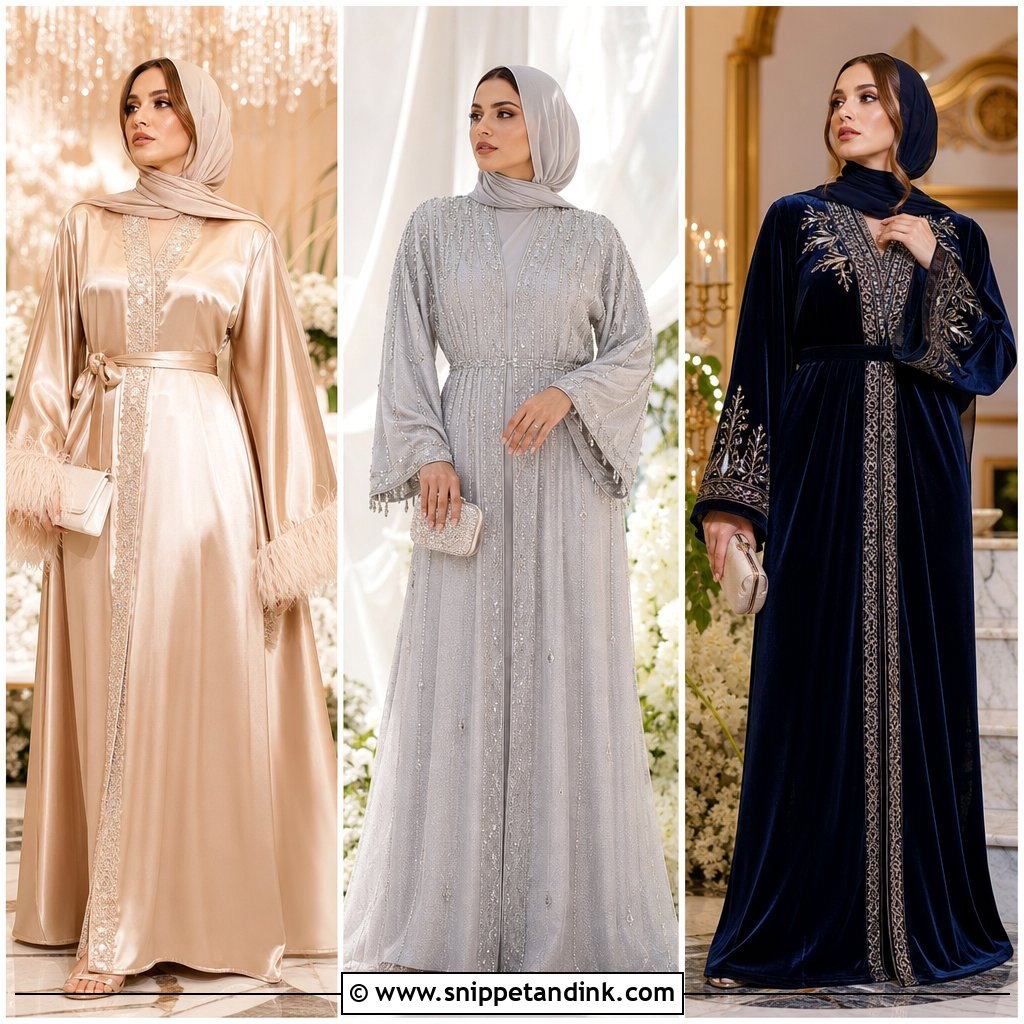
A white bridal kaftan gives generous coverage and a lot of room for ornate embroidery down the front. Choose a lined, floor-length design, and add shape with a waist seam or a decorative belt. If the belt is heavy with stones, wear little other jewelry. A smooth white hijab and a light veil fixed behind the crown suit it. Kaftan sleeves are often cut long and wide, so ask for them shortened to show your hands; otherwise they dip into food and catch on centrepieces. Hem it to the exact height of your wedding shoes.
Where the Veil Actually Attaches When Your Hair Is Covered
A veil comb is designed to grip hair. Over a slippery chiffon hijab it slides straight back, and the weight of a long veil drags the scarf with it. The fix is to build an anchor underneath.
Start with a grippy underscarf
A cotton or jersey bonnet holds pins far better than satin does. If you wear your hair in a bun, place the bun high at the crown so the veil comb has something to sit against. A small hair volumiser under the bonnet does the same job for shorter hair.
Pin through the layers, not just the top
Slide the comb in and secure it with two or three straight pins that pass through the outer scarf and catch the bonnet beneath. Magnetic hijab pins are easy on delicate fabric but they can’t carry a cathedral veil alone. Use them for the drape at the face and use proper pins at the crown.
Plan the change after the ceremony
Many brides remove a long veil before the reception. Ask someone you trust to learn which pins hold the veil and which hold the hijab, so it comes off without taking the scarf with it. A private corner and a hand mirror are worth arranging in advance.
A Modest Gown Should Feel Settled by the First Dance
The right modest gown is the one you stop thinking about after the first hour. Across this list there are satin and lace gowns, colourful lehengas, abayas, kaftans and modern two-piece sets, so start with the silhouette that makes you stand taller, then build the hijab, veil, shoes and jewelry around it. Test opacity, sleeve movement and scarf security under more than one kind of light. Good tailoring makes even a simple dress feel made for you. Above all, the outfit should match your celebration, your culture and your own understanding of modesty.
You'll Like These Ideas:






Leave a Reply