
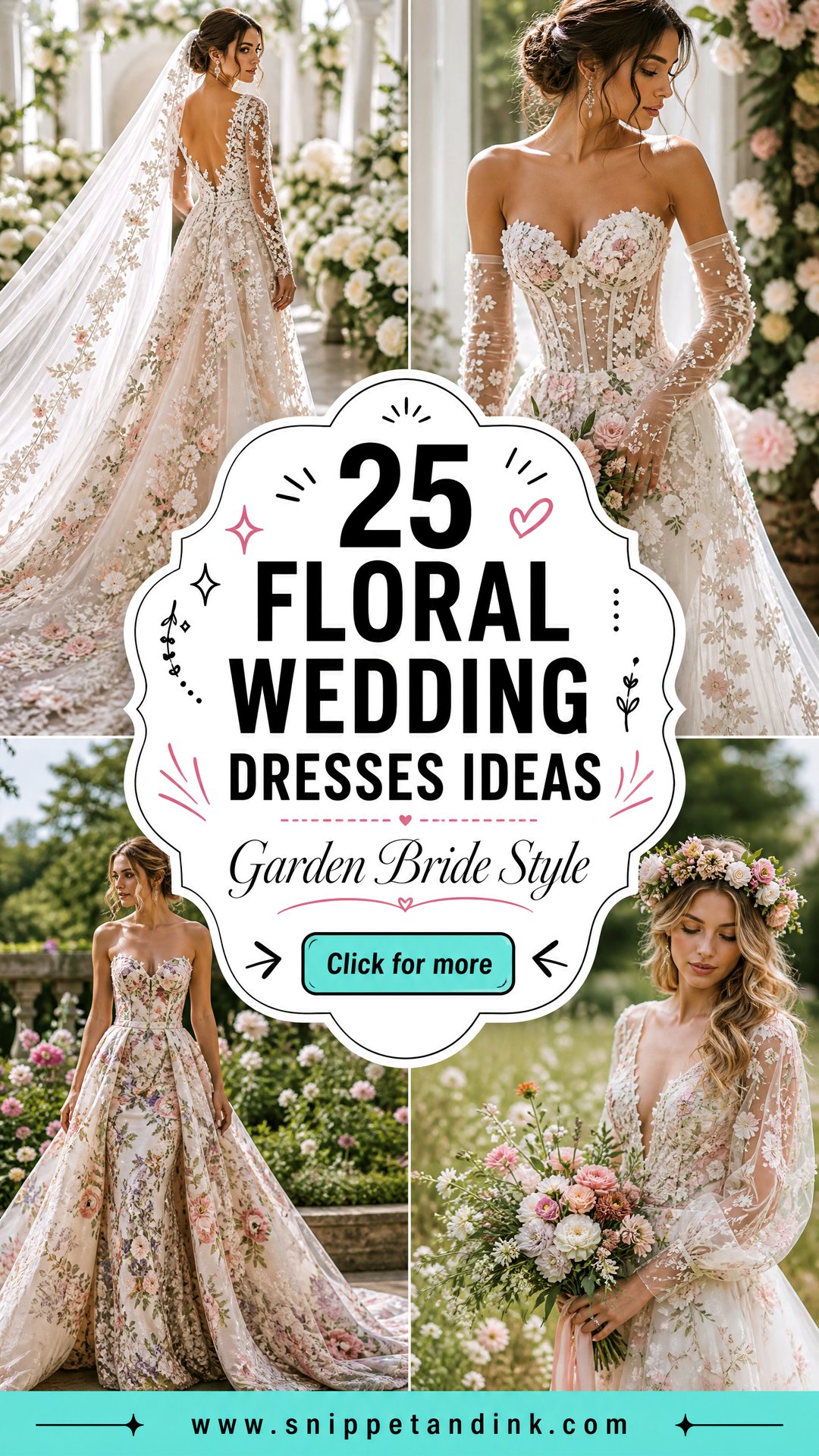
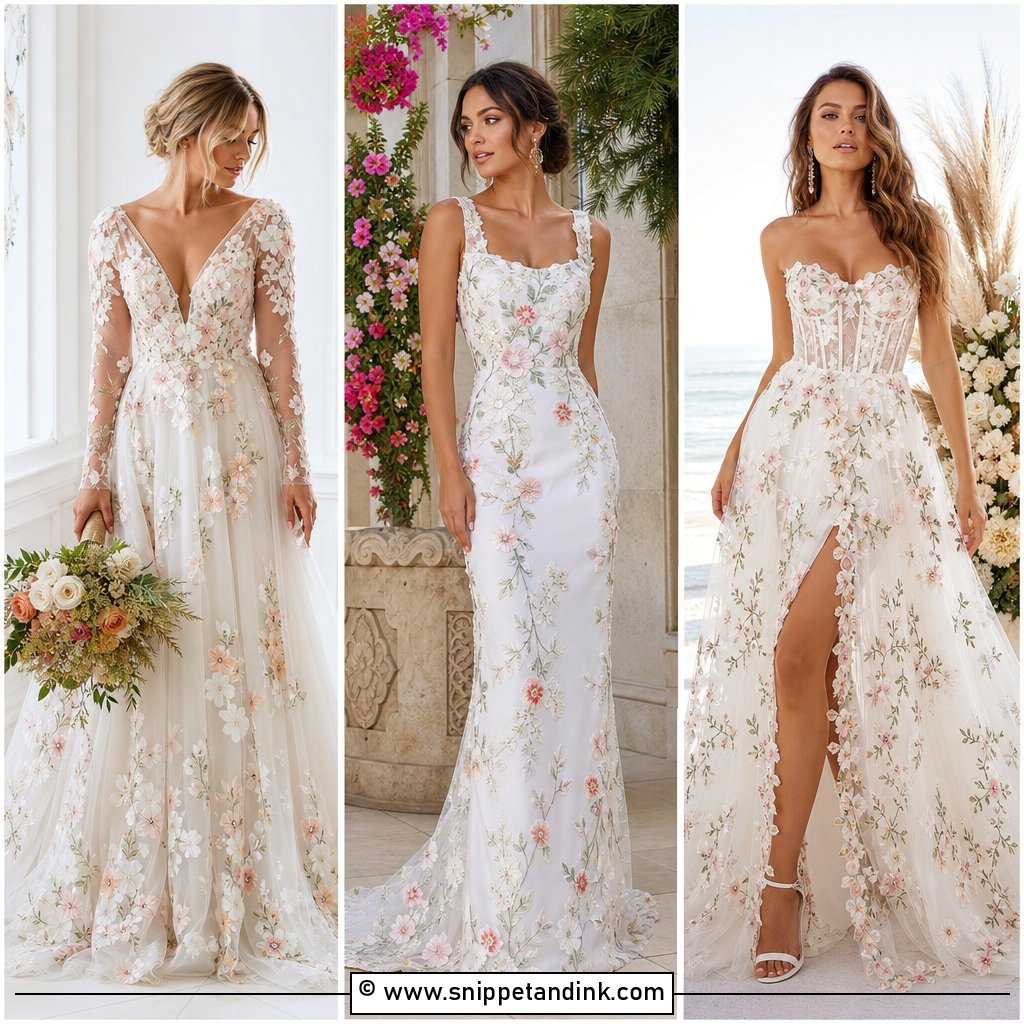
A gown covered in flowers is one of the most personal things a bride can wear, and also one of the easiest to get wrong. In fittings I see the full range: quiet lace blooms, embroidered vines, printed tulle, pastel petals and sculpted 3D flowers that stand off the skirt. Any of them can work in a garden, on a beach, at a courthouse or in a black-tie ballroom. What decides the result is balance: how much the dress is already saying, and how little everything around it needs to add. Each of the 25 looks below comes with the styling I would actually suggest for it.
Why Lace and Appliqué Gowns Need Extra Fitting Time
Floral gowns are slower to alter than plain ones, and that surprises a lot of brides. A satin hem can simply be shortened. A lace or appliqué hem cannot, because cutting through the motifs leaves a raw, broken edge. The flowers are lifted off by hand, the hem is taken up, and the appliqués are stitched back in place along the new line. The same happens when a seamstress takes in a lace bodice.
In practice that means booking your first fitting earlier than you would for a plain gown, often two to three months before the wedding, and leaving room for a third fitting rather than assuming two will do. Bring the shoes you will actually wear, because hem length is set to them. Ask where the bustle points will go too; on a skirt with raised flowers, the hooks should sit behind appliqués so they disappear when the train is lifted.
Questions I would ask at the first appointment
- Is the lace re-appliquéd by hand at the hem, or simply cut?
- Can the motifs be moved to cover a seam if the bodice is taken in?
- Is any spare lace or appliqué kept back for repairs?
- How will the bustle hold up under the weight of 3D flowers?
1. Floral Lace Wedding Dress With Cathedral Veil
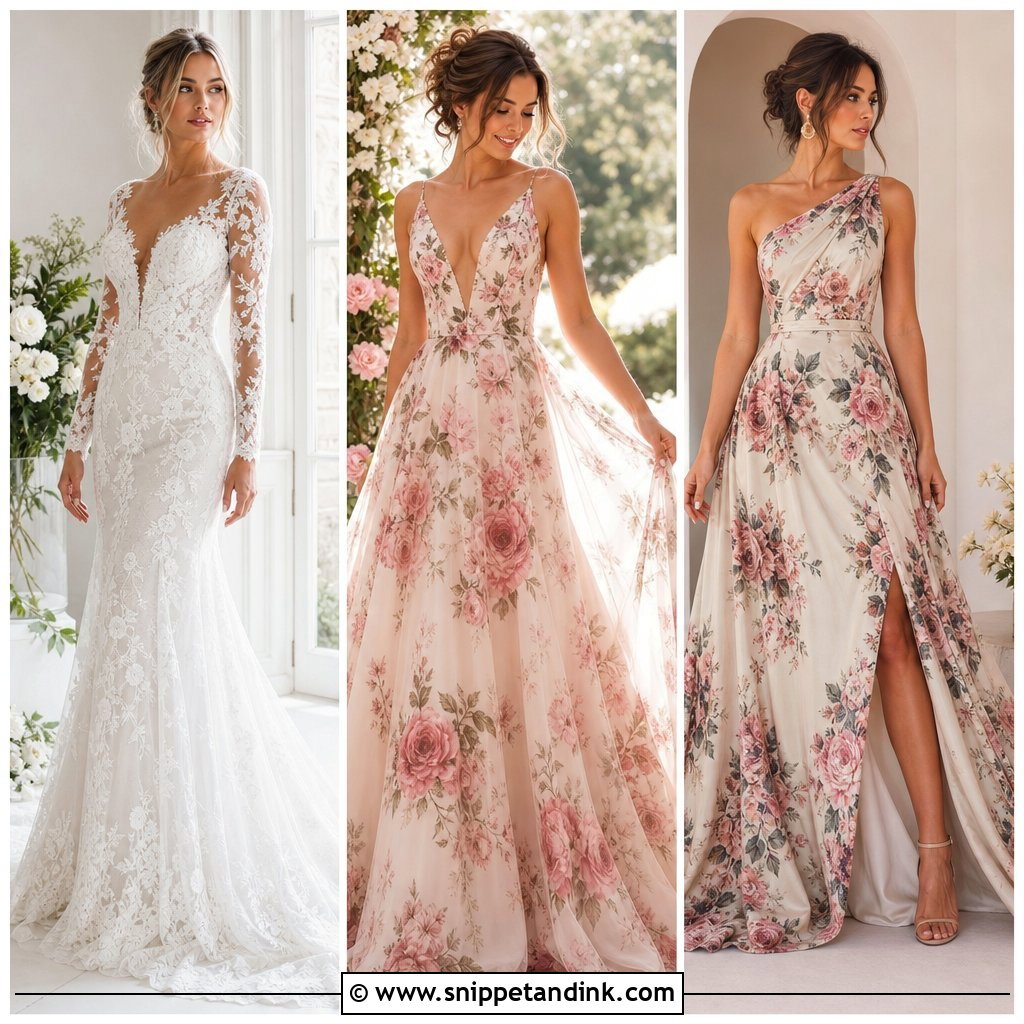
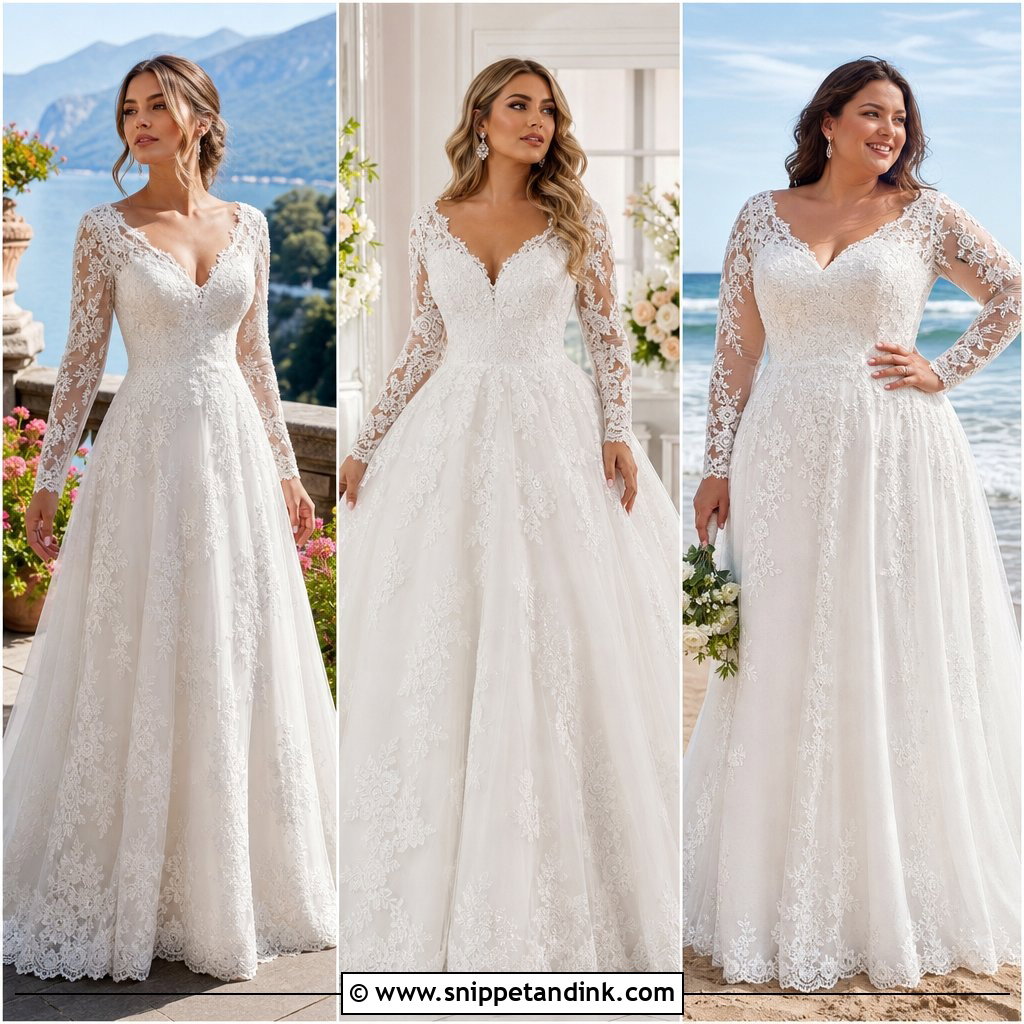
Lace with a cathedral veil is the most traditional pairing here, and it ages well in photos. The veil and the lace need to agree, though. A heavily edged veil laid over a busy lace bodice turns into visual noise, so I usually pair a plain cut-edge cathedral with a patterned gown. Ivory lace over a champagne lining warms the skin more than stark white. A fitted bodice with an A-line skirt moves easily down a long aisle, and pearl drops with a low bun keep the focus on the lace.
2. Floral A Line Wedding Dress With Pearl Accessories
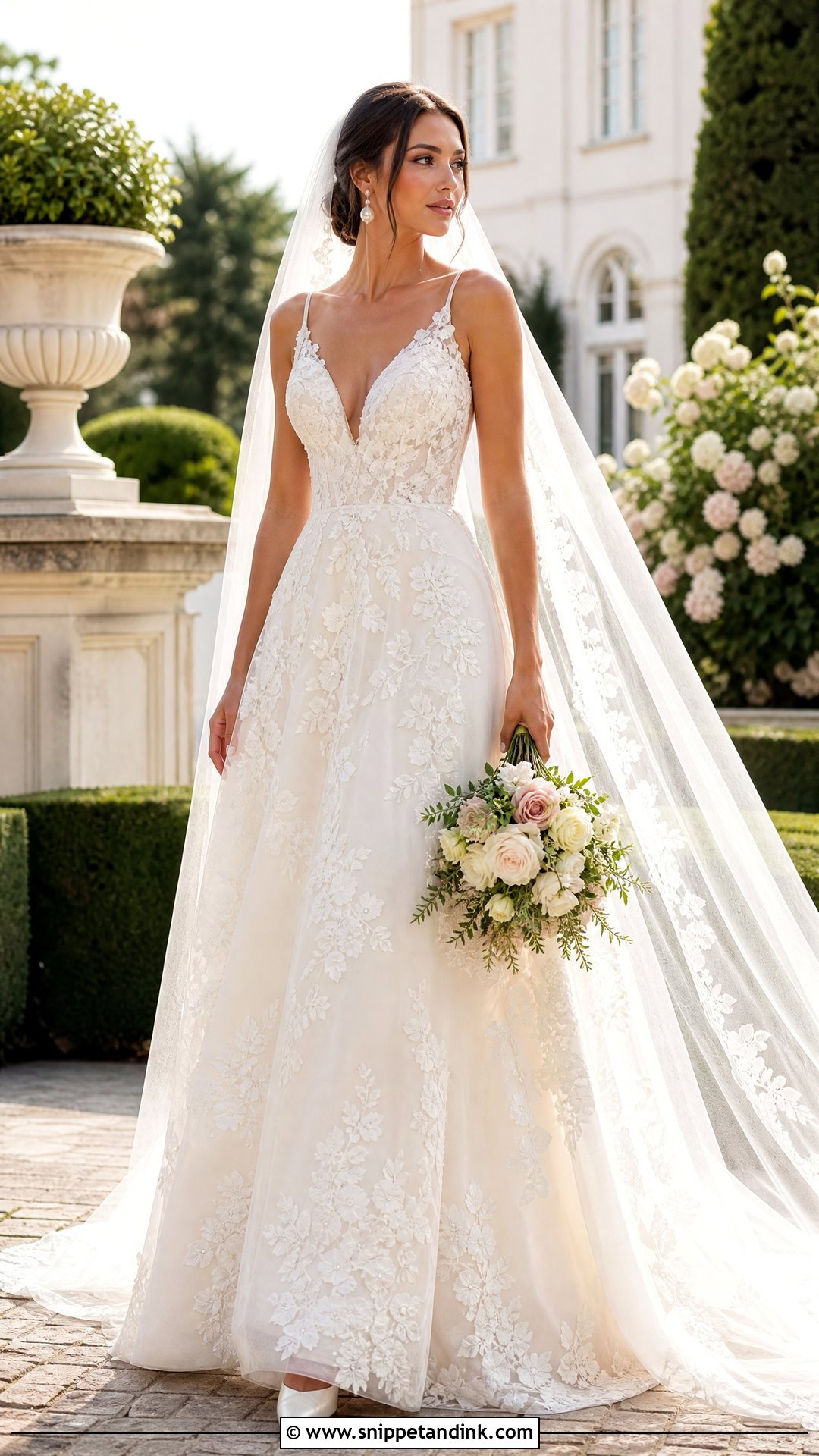
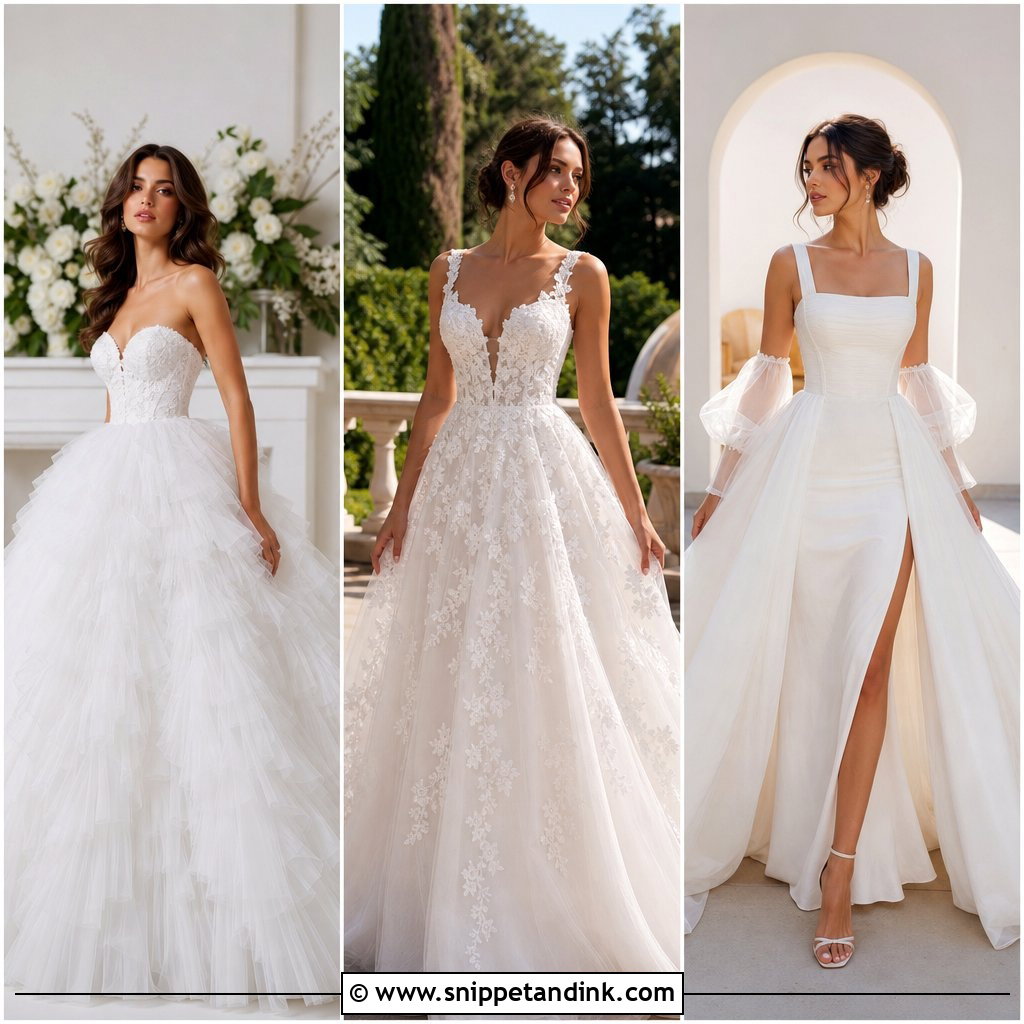
An A-line is my safest recommendation for a first fitting, because it skims the waist and falls away from the hips without asking much of your posture. On a floral version, scattered appliqués work better than an all-over print, since they let the eye rest. Pearls suit this cut without competing: studs, a fine bracelet and ivory block heels you can actually stand in through the reception. Finish with a fingertip veil, which ends where the skirt starts to flare.
3. 3D Floral Wedding Dress With Tulle Skirt
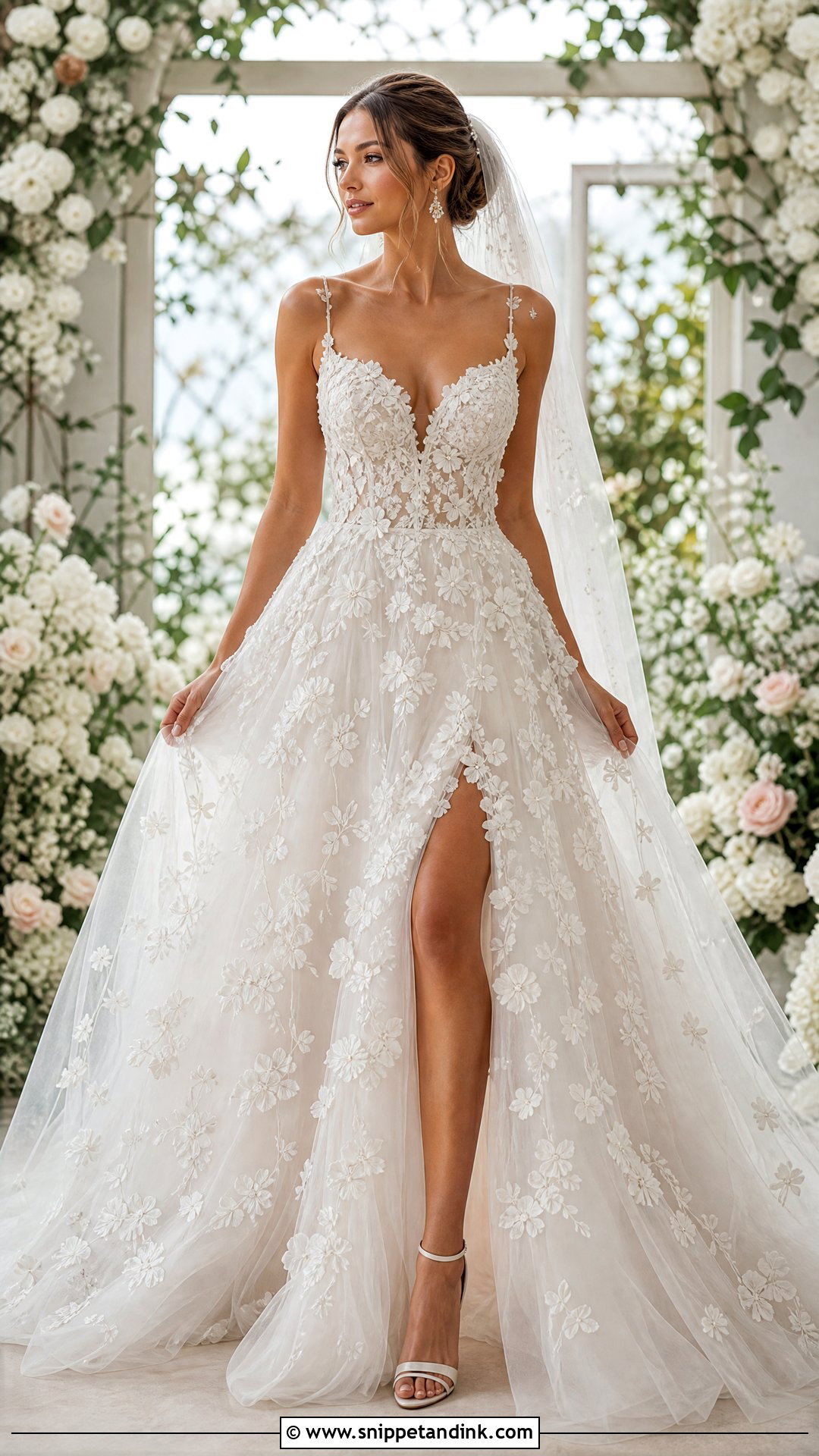
Raised 3D appliqués give real depth in photographs, because every petal casts a tiny shadow. They also crush. Sitting in a car or on a chair for a long dinner flattens the flowers on the back of the skirt, so I ask brides to sit and stand repeatedly at the final fitting and watch what happens. Tulle underneath keeps the skirt airy. Keep jewelry very small; a dress with this many blooms does not need another sparkle point. Spring estates and garden venues suit it, where the gown echoes what is growing around you.
4. Floral Embroidered Wedding Dress With Satin Heels
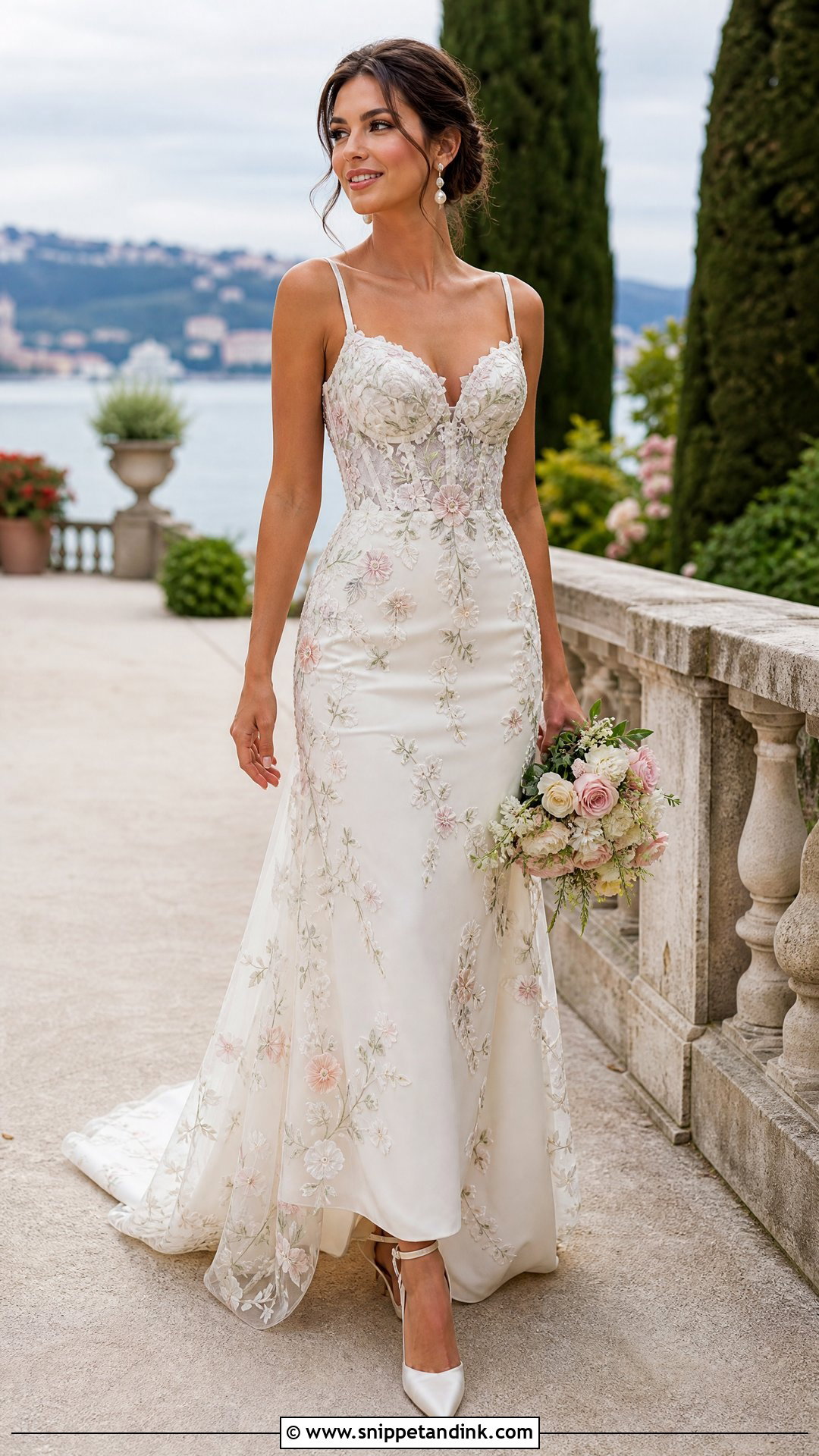
Embroidery is where a gown starts to feel handmade. White-on-white thread is subtle; colored stitching in blush, green or blue makes a bigger statement and changes how you style everything else. My rule for colored work is to take one shade from the embroidery and repeat it once, in the shoes or the ribbon on the bouquet, never both. Satin heels give a smooth contrast against textured stitching, and a plain sheer veil keeps the whole look from tipping into fussy.
5. Floral Ball Gown Wedding Dress With Simple Jewelry
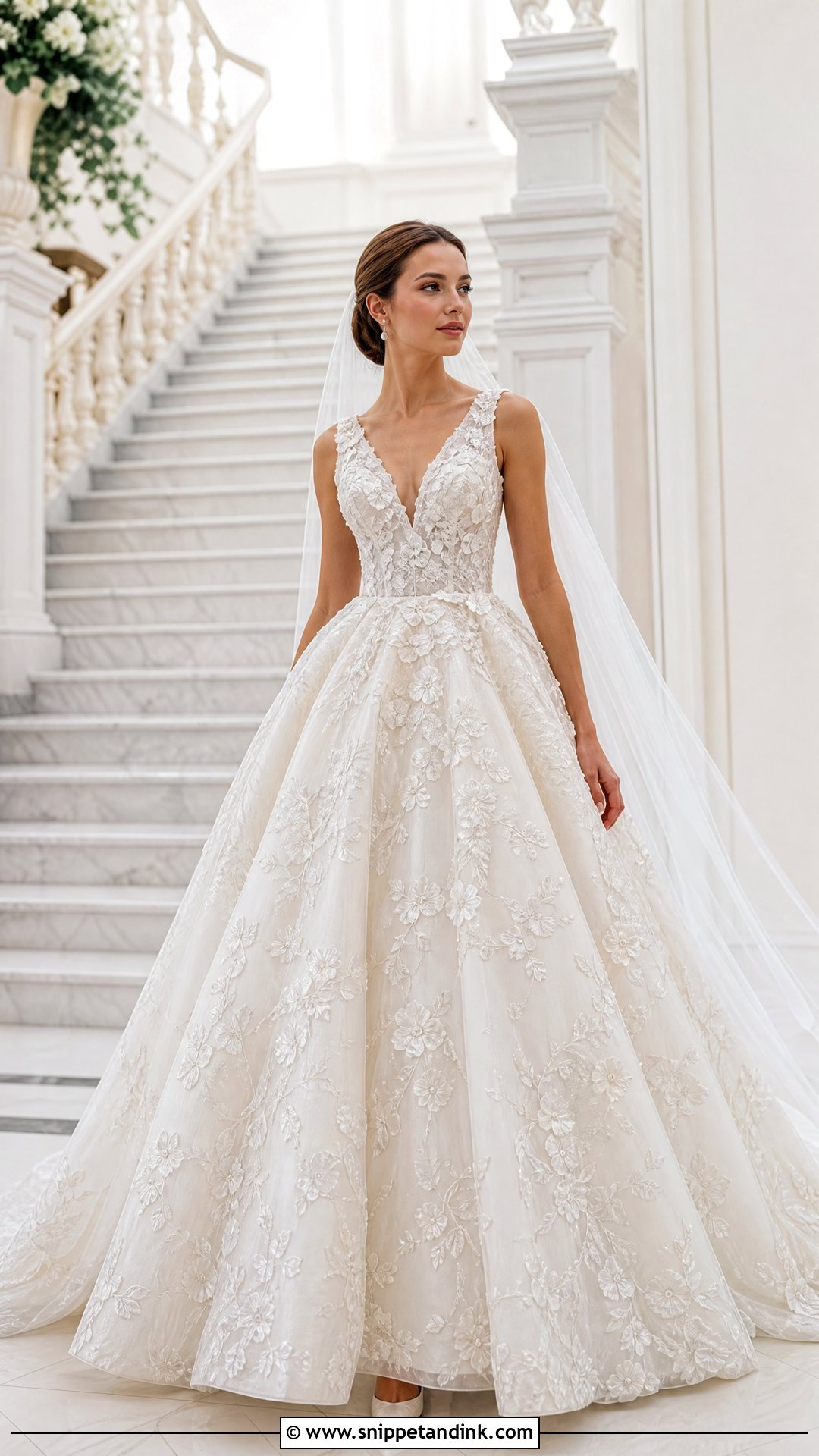
A floral ball gown wedding dress belongs in a large room with a long aisle, where the skirt has space to be seen. The structure matters more than the flowers. A well-boned bodice carries the weight of a full skirt so you are not hitching it up all evening, and I check that during the first fitting by having the bride lift her arms. Keep jewelry simple: small diamond or pearl earrings and classic pumps. If you add a long veil, choose a sheer one so it does not blur the lace beneath.
6. Floral Mermaid Wedding Dress With Long Veil
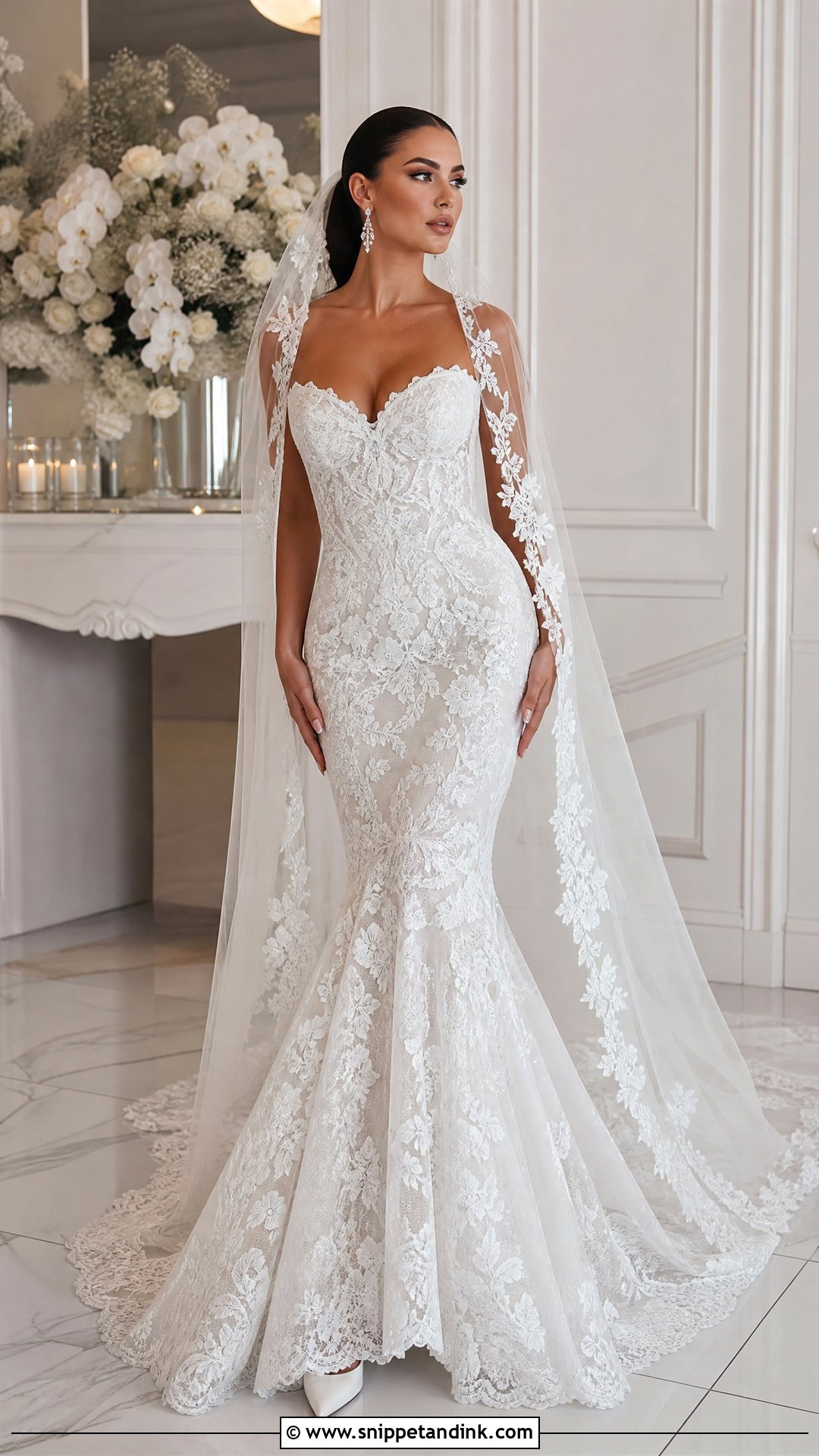
Mermaid gowns fit closely through the hips and flare at or just below the knee, and that flare point decides how well you can walk, sit and dance. Too low and you shuffle. Floral lace along the bodice and train softens the fitted outline. A long veil adds movement behind you, while a smooth updo and pointed heels keep the line long. If the train is dramatic, keep the bouquet medium-sized so it does not cut across the silhouette. Evening and indoor formal venues suit this shape best.
7. Floral Off Shoulder Wedding Dress With Drop Earrings
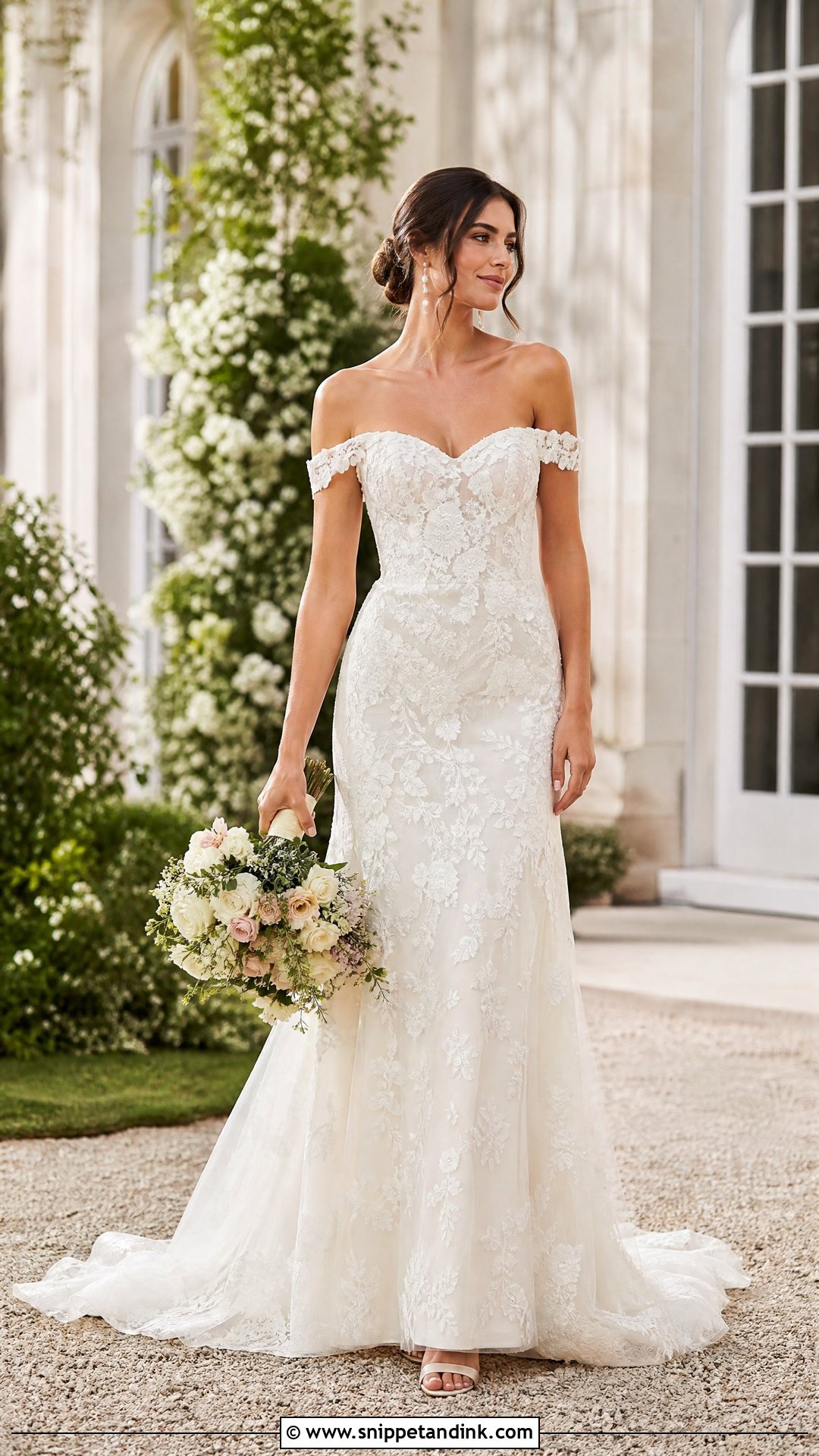
An off-shoulder neckline frames the collarbones, and floral appliqué straps make it soft rather than severe. The practical issue is staying power: off-shoulder bands need a grip inside and enough structure that they stay put when you hug or raise a glass. Drop earrings draw the eye up without crowding the neckline, and I would add a necklace only if the bodice is nearly plain. A low chignon or half-up style works, with a bouquet that repeats one of the flowers from the lace.
8. Floral Long Sleeve Wedding Dress With Low Bun
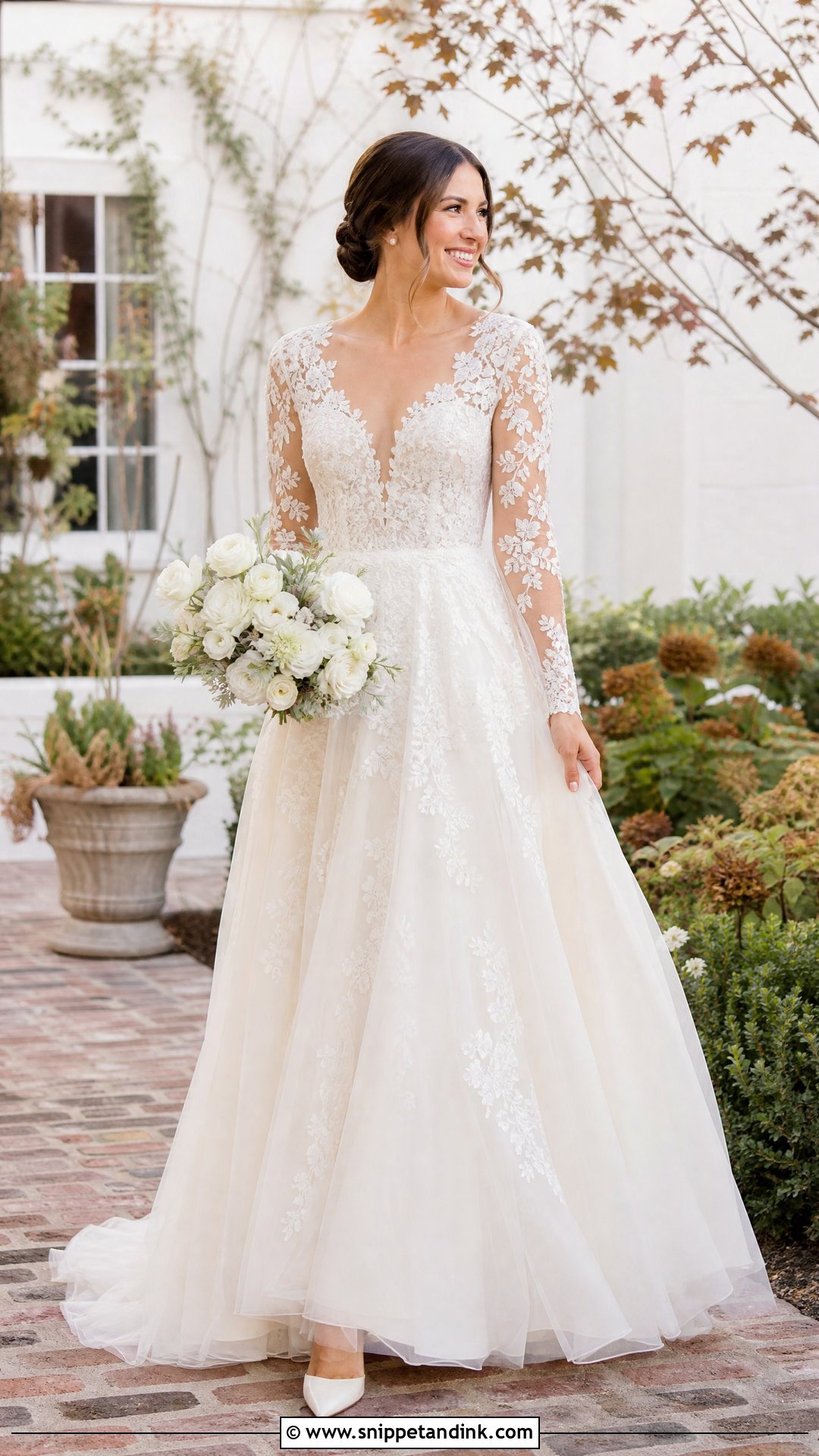
Sheer lace sleeves give coverage without the weight of a solid sleeve. The thing I look for is how the lace pattern is placed: good gowns mirror the motifs on both arms so they match in photos, while cheaper ones are cut wherever the fabric falls. A low bun keeps the neckline and back visible. Pearl studs and classic pumps are enough. Lighter lace works year-round, though autumn, winter and early spring are where this style earns its keep.
9. Floral Strapless Wedding Dress With Statement Veil
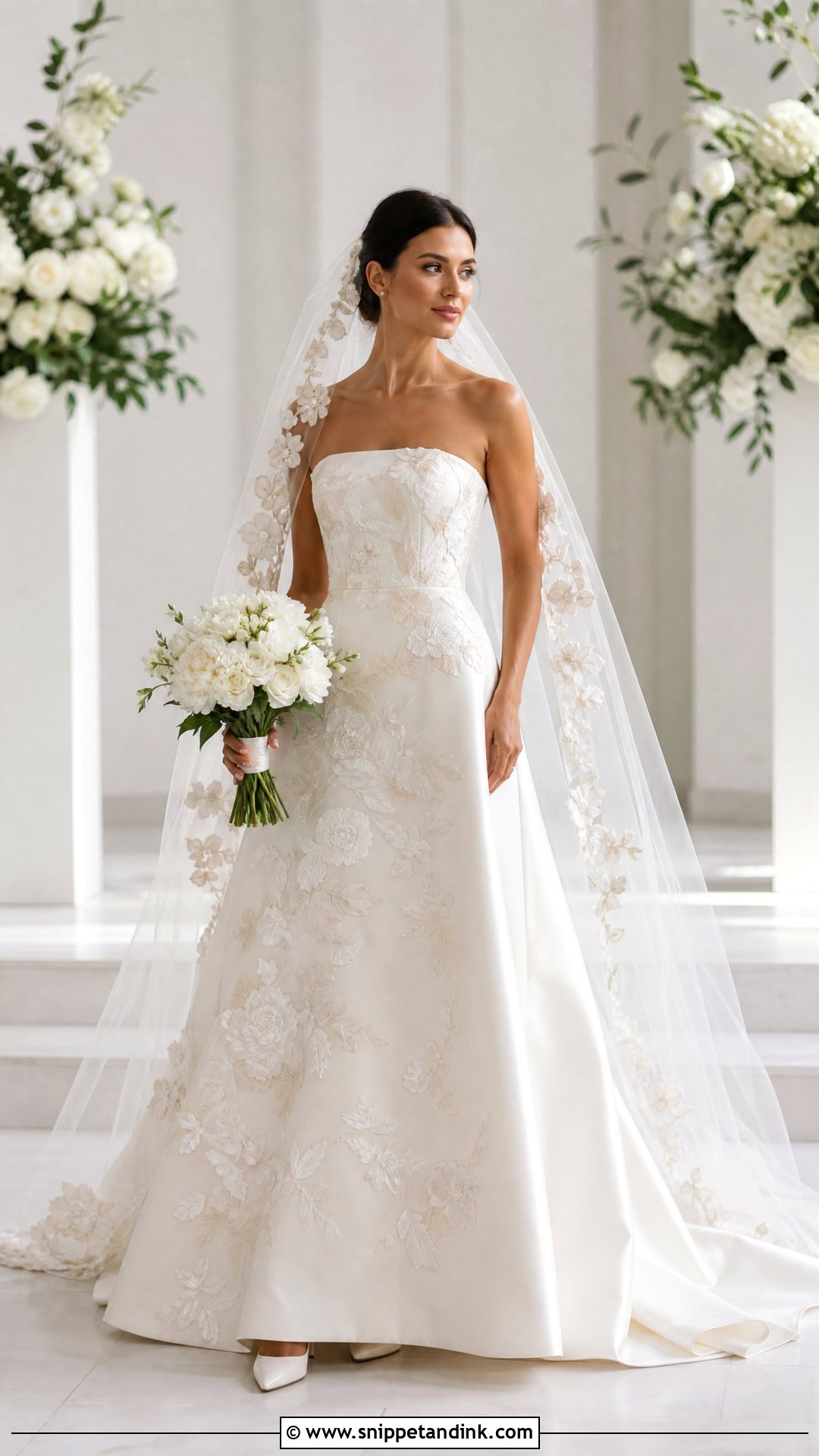
Strapless bodices let the pattern run uninterrupted from neckline to hem. Support is the issue I check first, because a strapless gown that relies on you pulling it up is a long day. The bodice should be built to hold on its own, with boning and a waist stay. A statement veil adds height without changing the dress; pick one with scattered embroidery or pearl trim if the gown is calm, or a plain edge if it is busy. Studs or small hoops, plus a sleek bun, keep the rest quiet.
10. Floral Corset Wedding Dress With Sheer Gloves
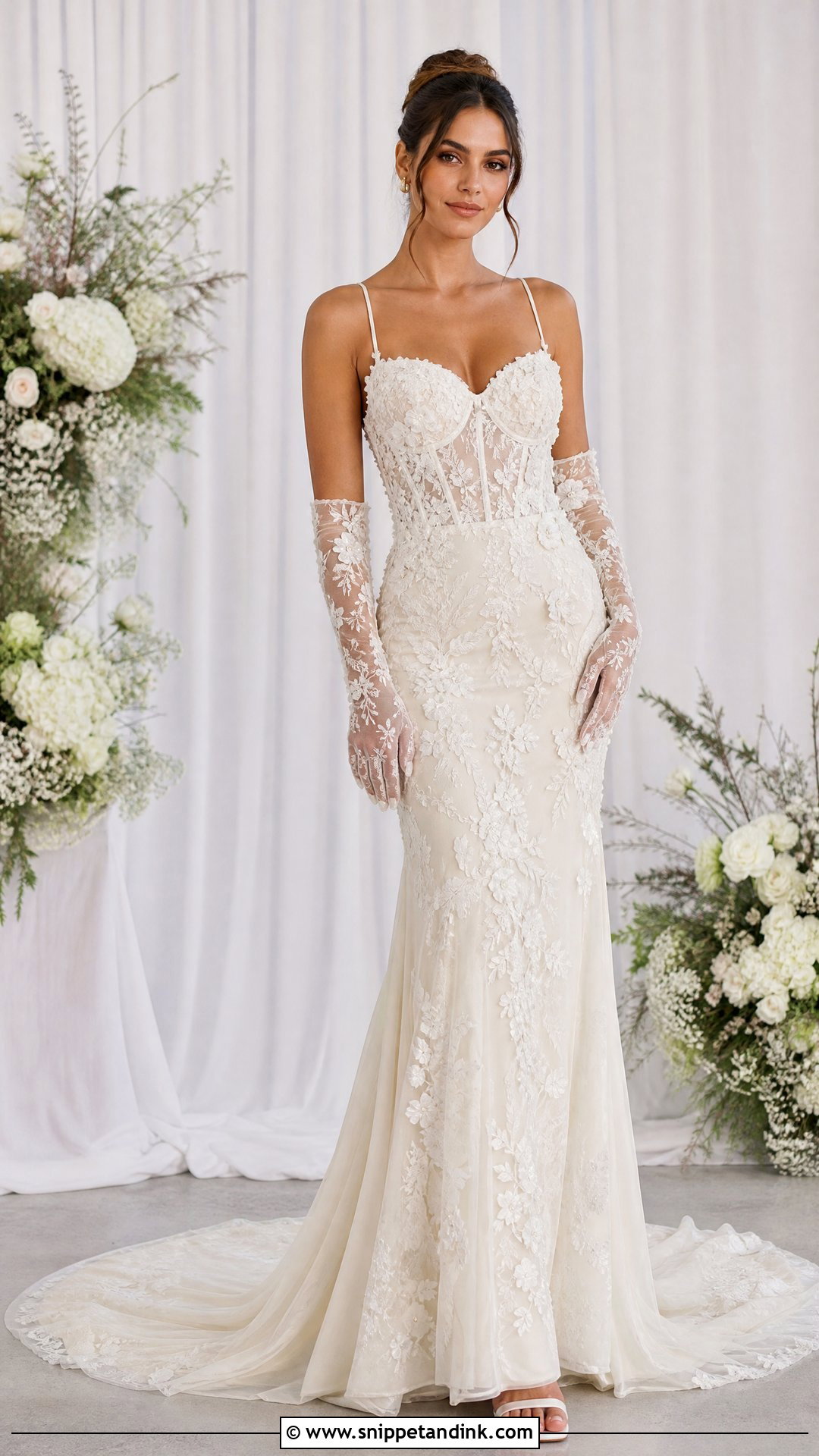
Corset bodices have become popular because the structure flatters, and floral lace keeps them from looking hard. Sheer gloves add an editorial note, as long as they are plain tulle or lightly dotted with pearls rather than heavily beaded. A word on gloves from fittings: remove one before the ring exchange, or choose a style with a finger loop so the ring can go on without a struggle. A flowing skirt balances the corset; a fitted one makes it sleeker.
11. Floral Tulle Wedding Dress With Blush Shoes
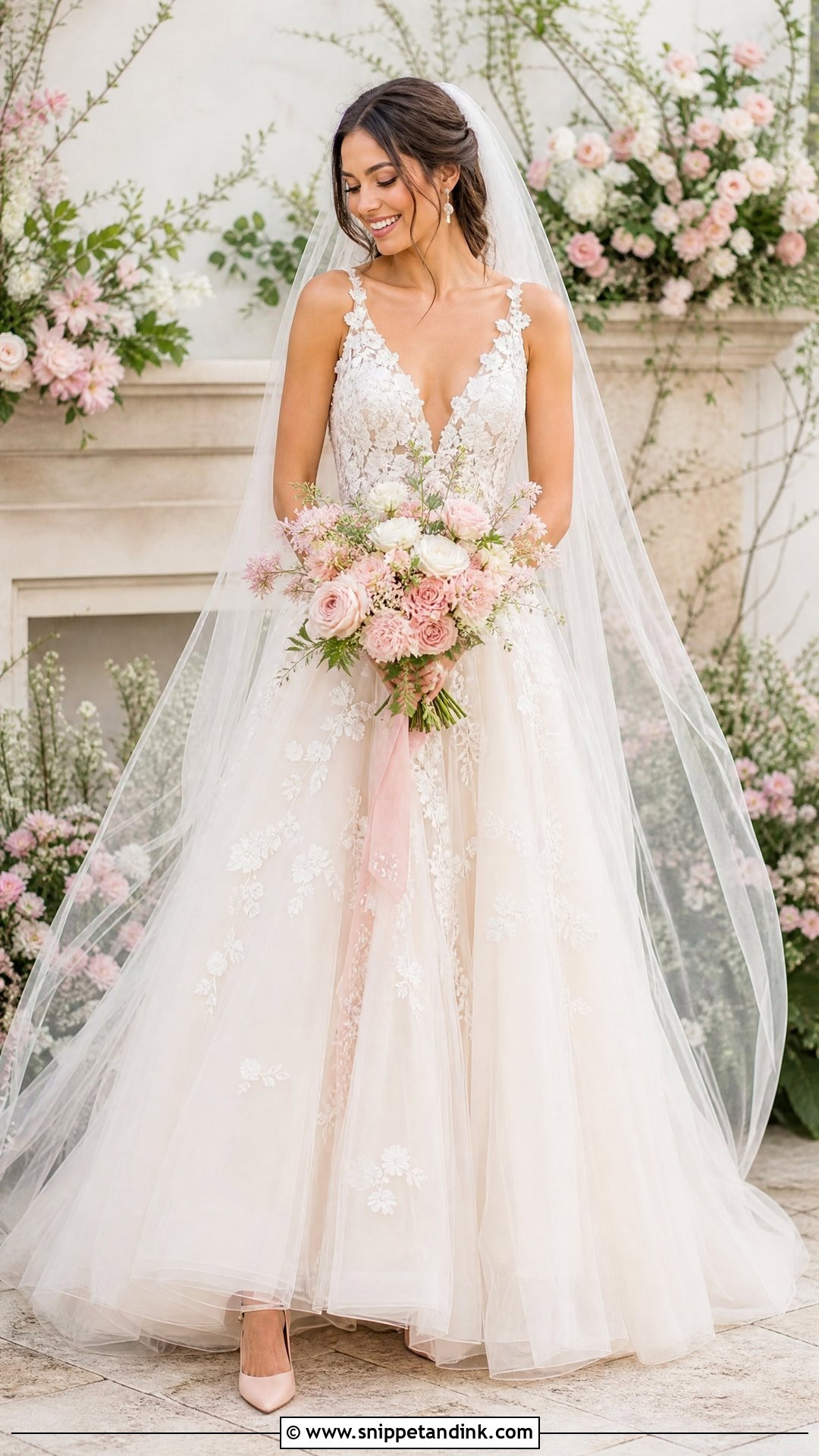
Tulle holds floral detail without weight, so the gown moves well in a breeze. Blush shoes add warmth under the skirt and tie in neatly if the embroidery has pastel thread. I tell brides to accept that tulle hems collect grass and dust at outdoor weddings; a bustle that lifts the hem off the lawn for the reception saves a lot of grief. A sheer veil and a bouquet in cream, pink and green finish it.
12. Floral Wedding Dress With Colorful Embroidery
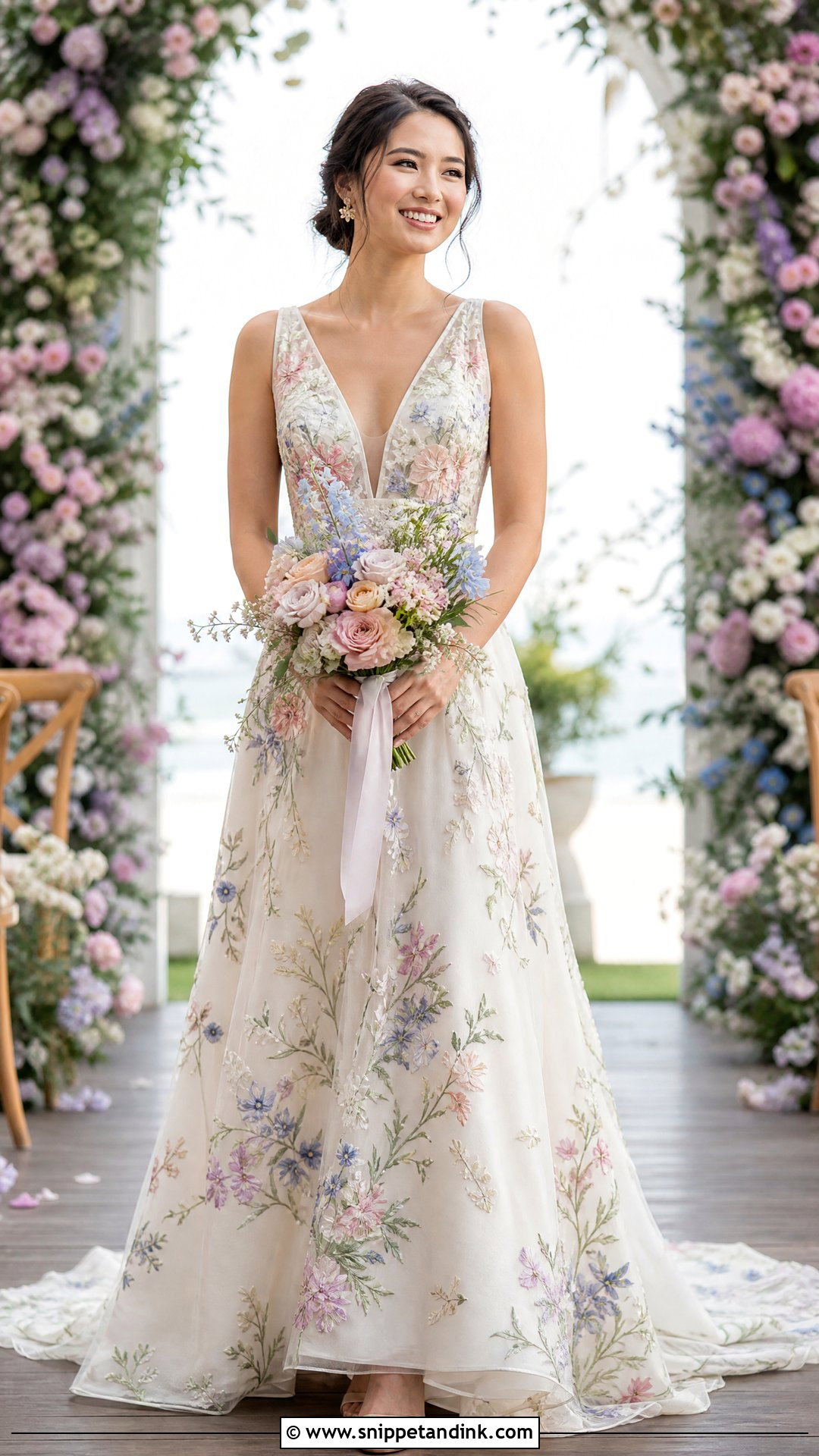
Ivory, white or champagne still forms the base here; the colorful embroidery does the personality work in blush, lavender, yellow or soft green. Let it lead the styling. Neutral shoes or one soft shade from the pattern, gold hoops or pearl studs, and a bouquet in matching tones are plenty. Look at colored embroidery in daylight before you commit, because indoor shop lighting can make pastels read warmer than they will outdoors.
13. Floral Mini Wedding Dress With Bow Heels
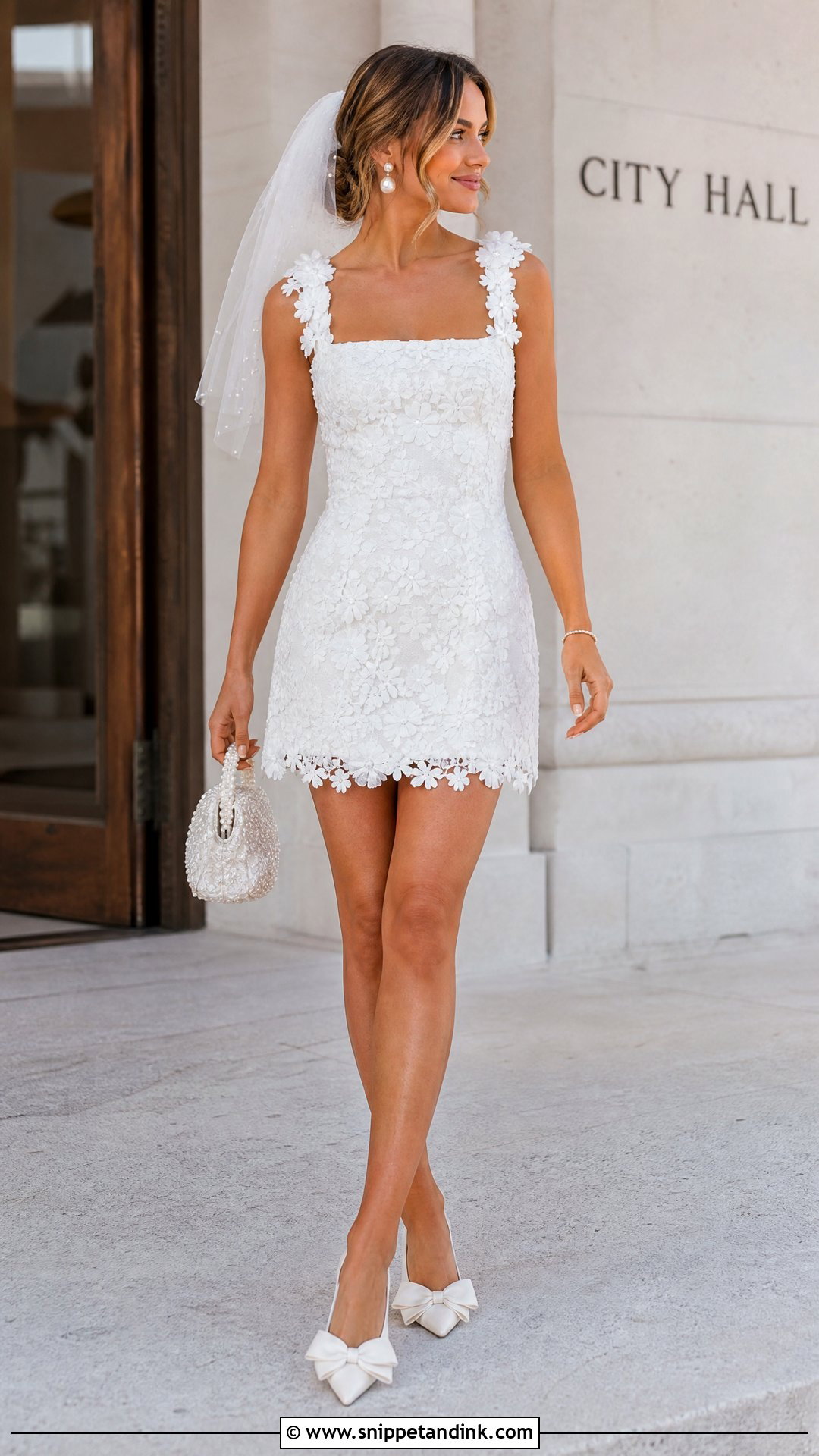
Short floral dresses suit courthouse weddings, rehearsal dinners, elopements and a second reception outfit. The shorter hem makes lace feel playful. Bow heels add a sweet touch, while a structured mini looks crisp and a soft tulle mini looks more romantic. A short veil or a hair bow keeps it clearly bridal. Check the length when you sit and when you dance, because a short lace hem rides up faster than you expect.
14. Floral Midi Wedding Dress With Block Heels
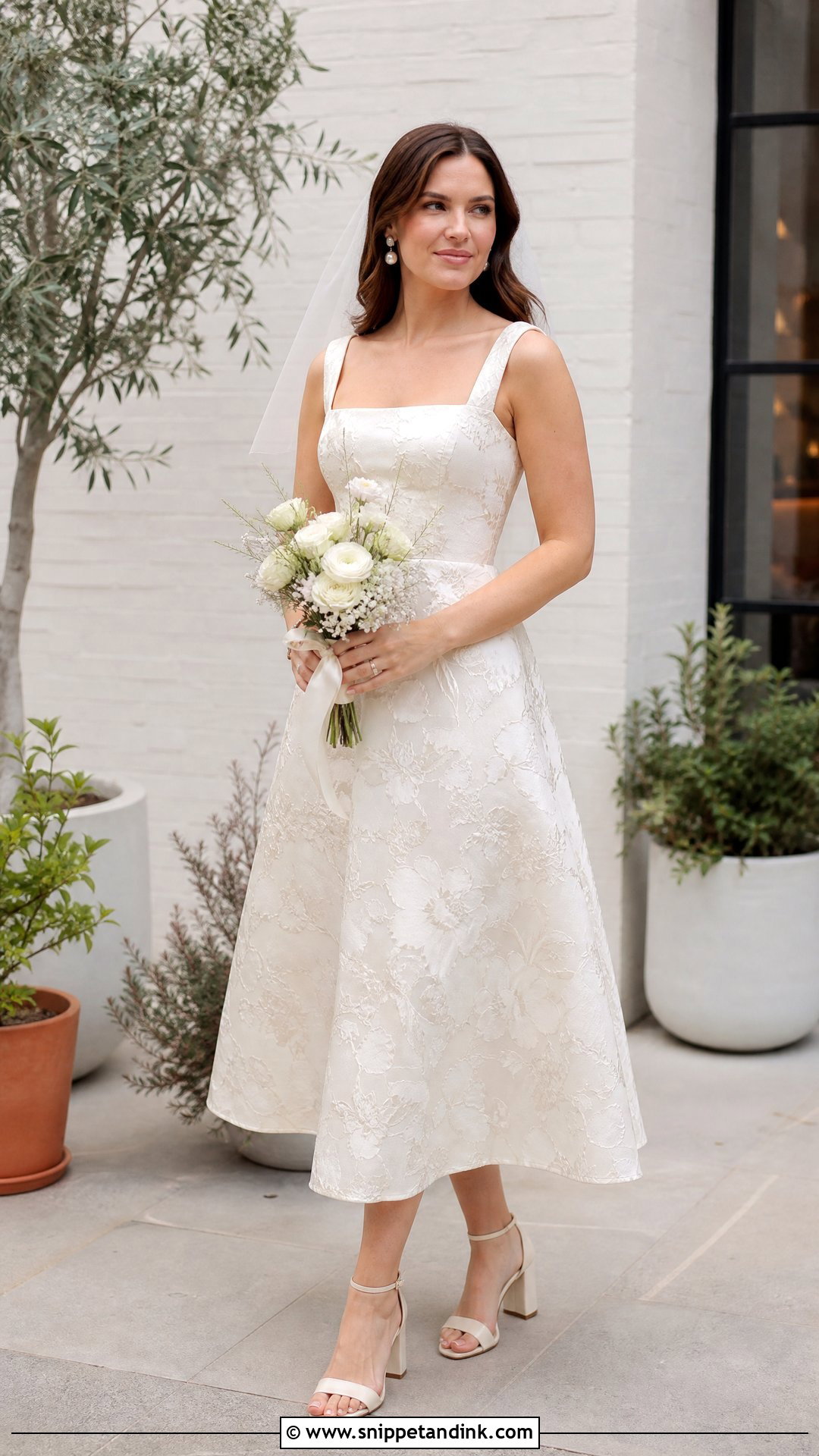
Midi length shows your shoes, so I choose the shoe with the dress, not after it. Block heels are steady on grass, gravel and rooftop decking. Floral jacquard, lace or embroidered organza keep the dress bridal at a shorter length. A short veil, pearl earrings and a neat bouquet are enough. This is the length I suggest for intimate lunches and courthouse ceremonies where a train would only be in the way.
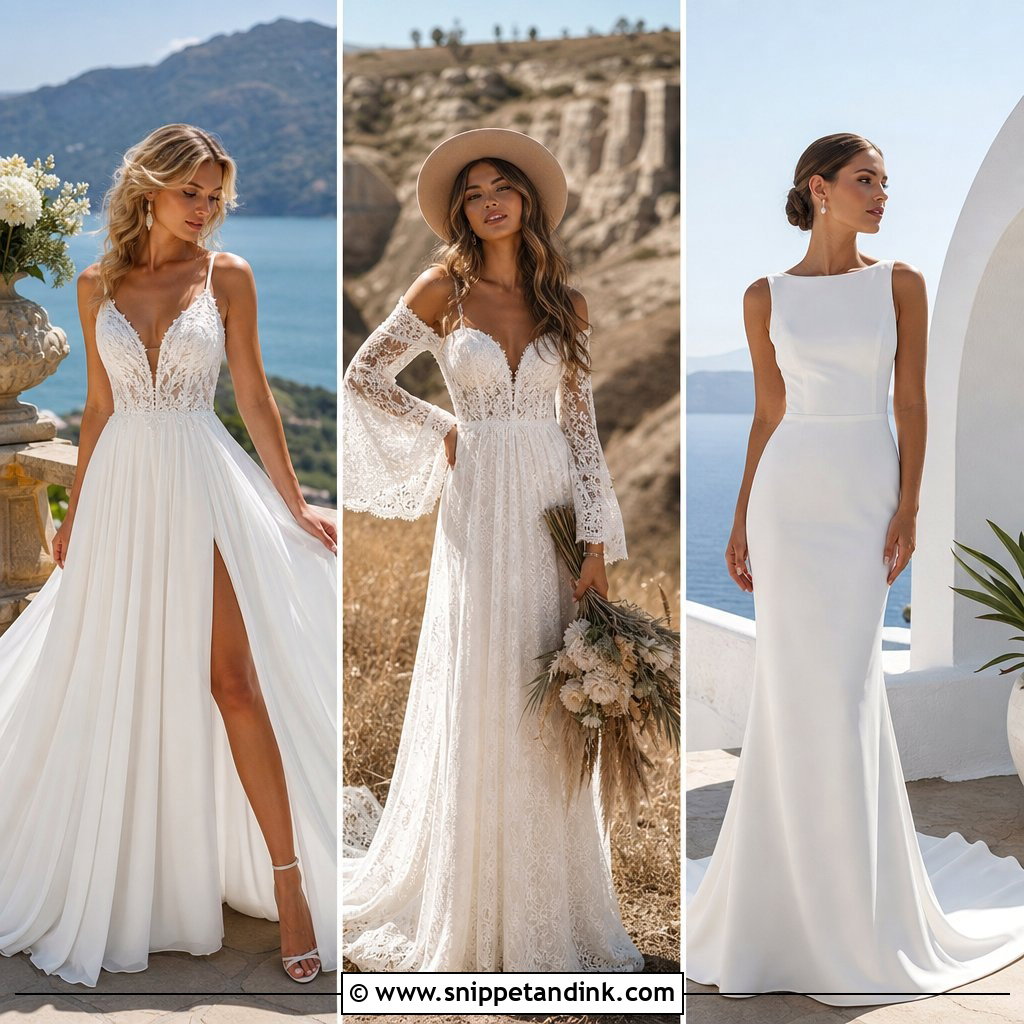
15. Floral Wedding Dress With Detachable Overskirt
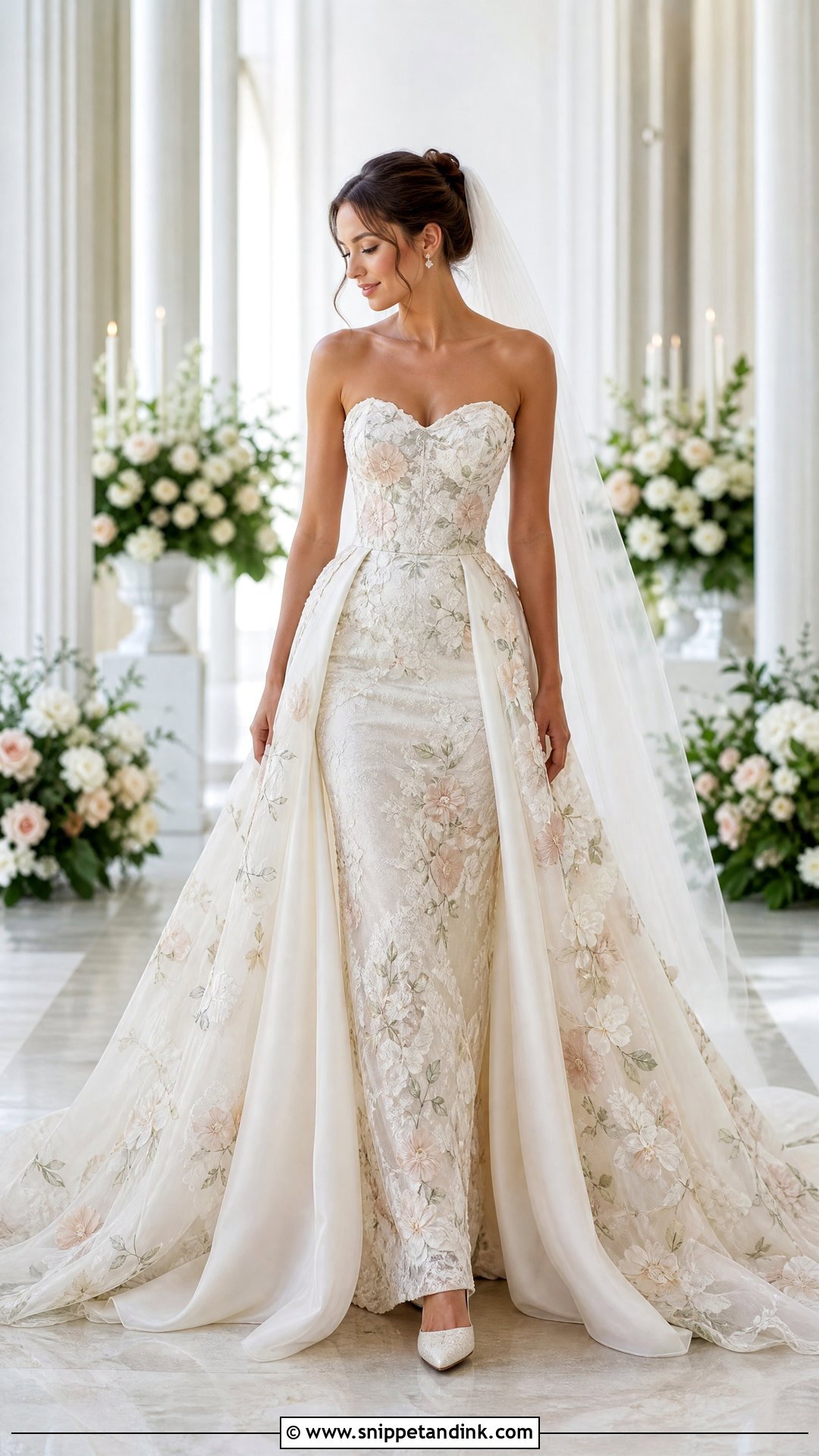
A detachable overskirt gives you a full ceremony silhouette and a slimmer reception gown underneath. Ask how it attaches. Hidden hooks or snaps are quicker than a row of buttons, and someone needs to practise removing it before the day, ideally the bridesmaid who will do it. Matching appliqué on both layers keeps the change from looking like two different dresses. Pointed heels, a sheer veil and small earrings are enough with this much going on.
16. Floral Wedding Dress With Square Neckline
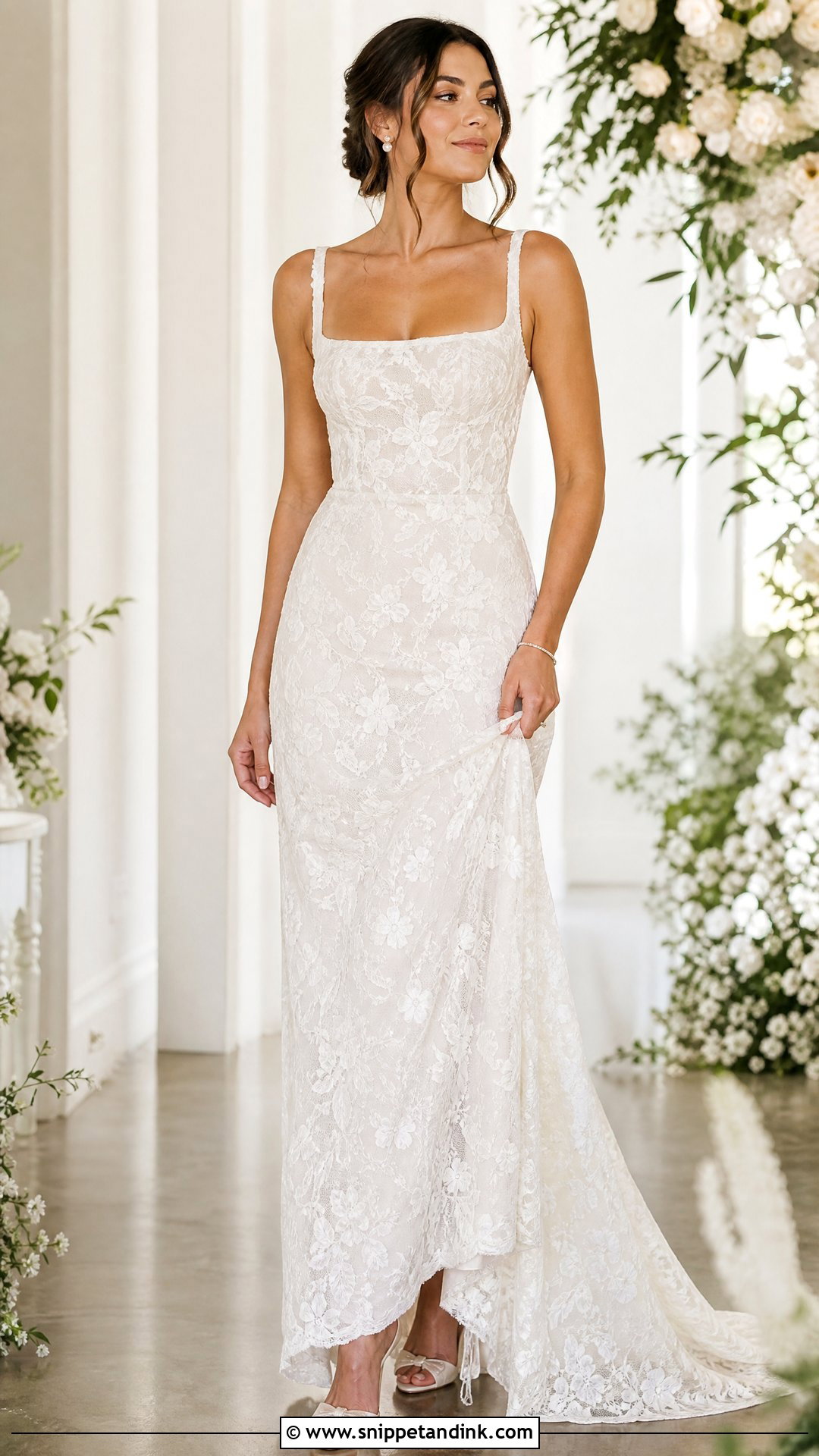
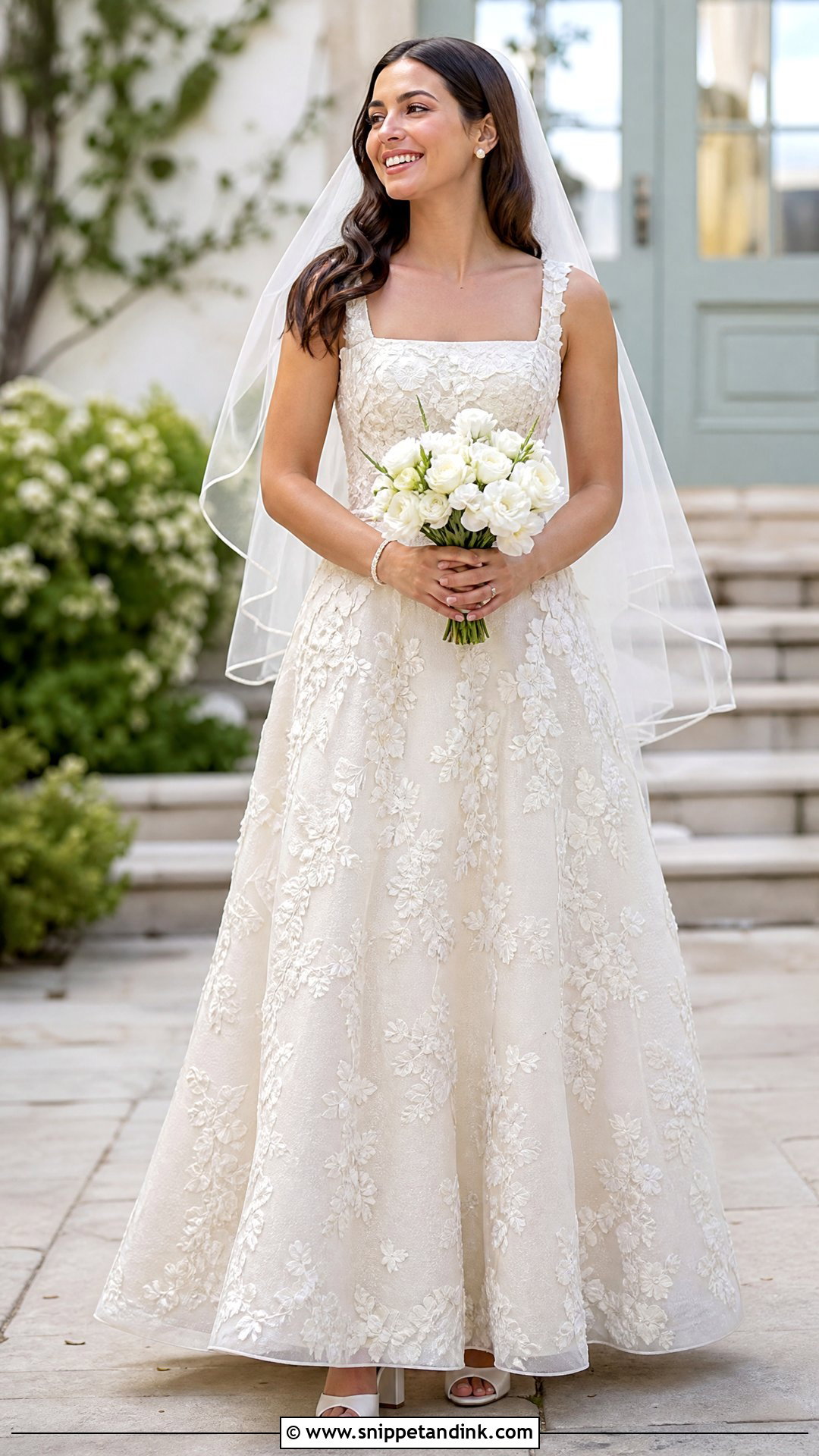
A square neckline frames the collarbones and looks modern without being revealing. It works with thin straps, long sleeves or a structured bodice, and floral lace softens the straight lines. Watch the width: a neckline that is too wide slides off narrow shoulders, which is something I adjust at nearly every fitting for this cut. Pearl studs and simple ivory heels, with a sleek bun or half-up hair, keep the neckline visible.
17. Floral Wedding Dress With V Neckline
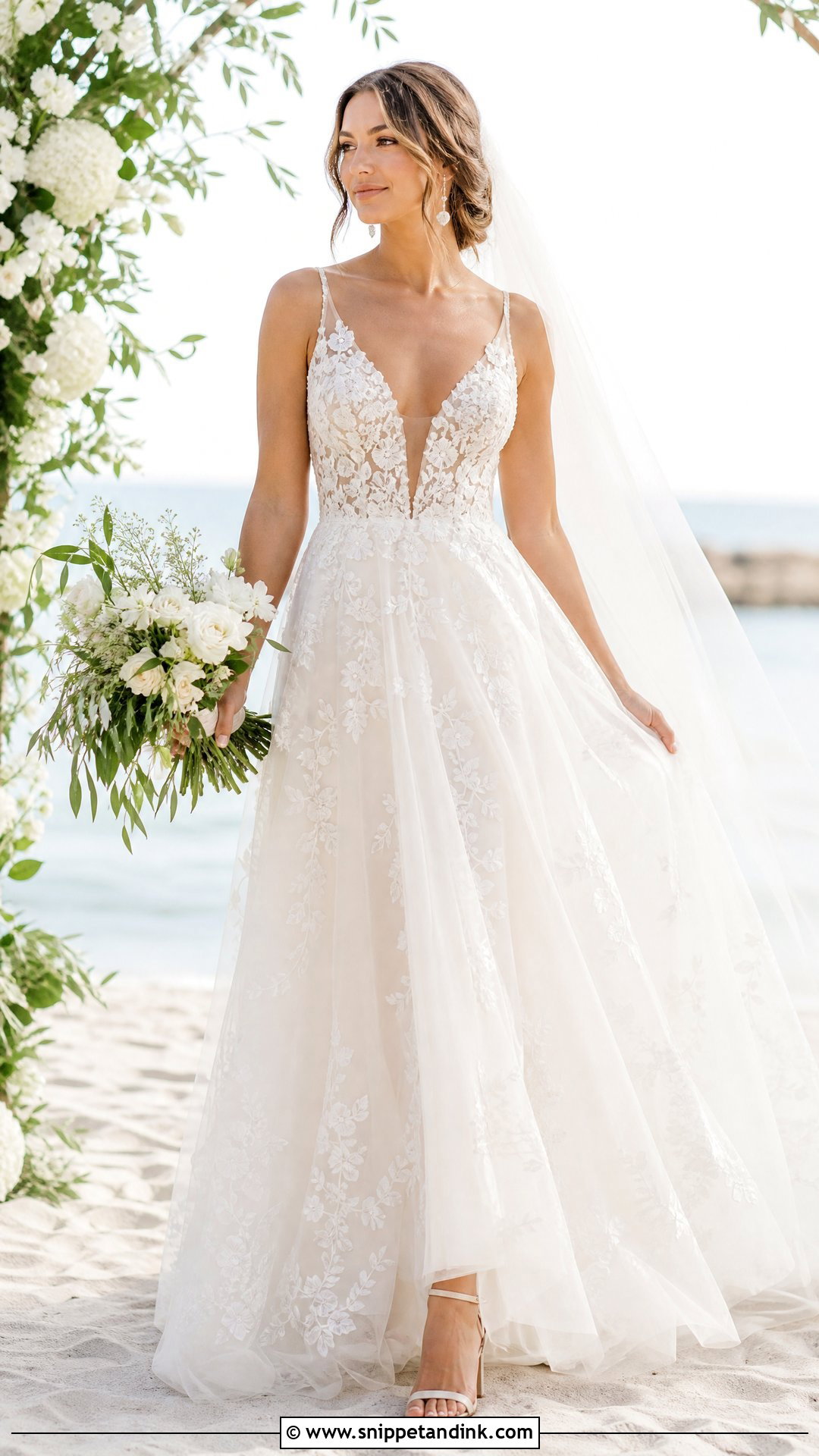
A V neckline lengthens the torso, and it suits a wide range of figures. If you want more coverage, an illusion V with sheer mesh and floral appliqué gives the same line with less skin. I would add a pendant only when the bodice is plain; otherwise earrings are enough. Slim heels and a veil with a plain edge balance it. It moves easily, which makes it a sensible choice for beach and outdoor ceremonies.
18. Floral Wedding Dress With Open Back
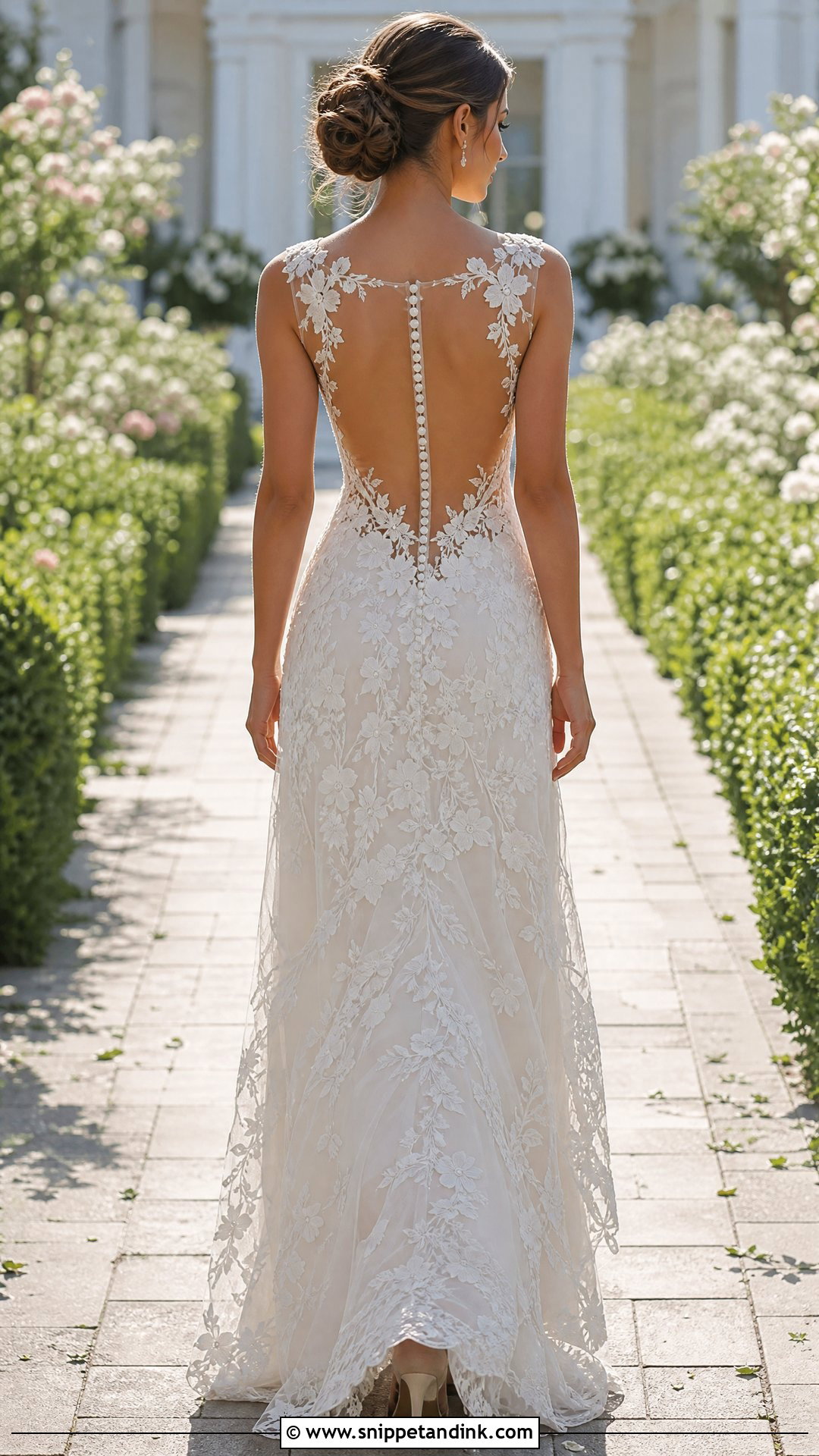
With an open back, the front can stay simple and the detail waits for the moment you walk away. Floral lace, sheer panels and covered buttons all work. The fitting point I watch is the edge of the back opening, which should lie flat against the skin rather than gape when you lean forward. Choose an updo or side-swept hair so the detail shows. A long veil adds ceremony drama; take it off later so the back gets its turn.
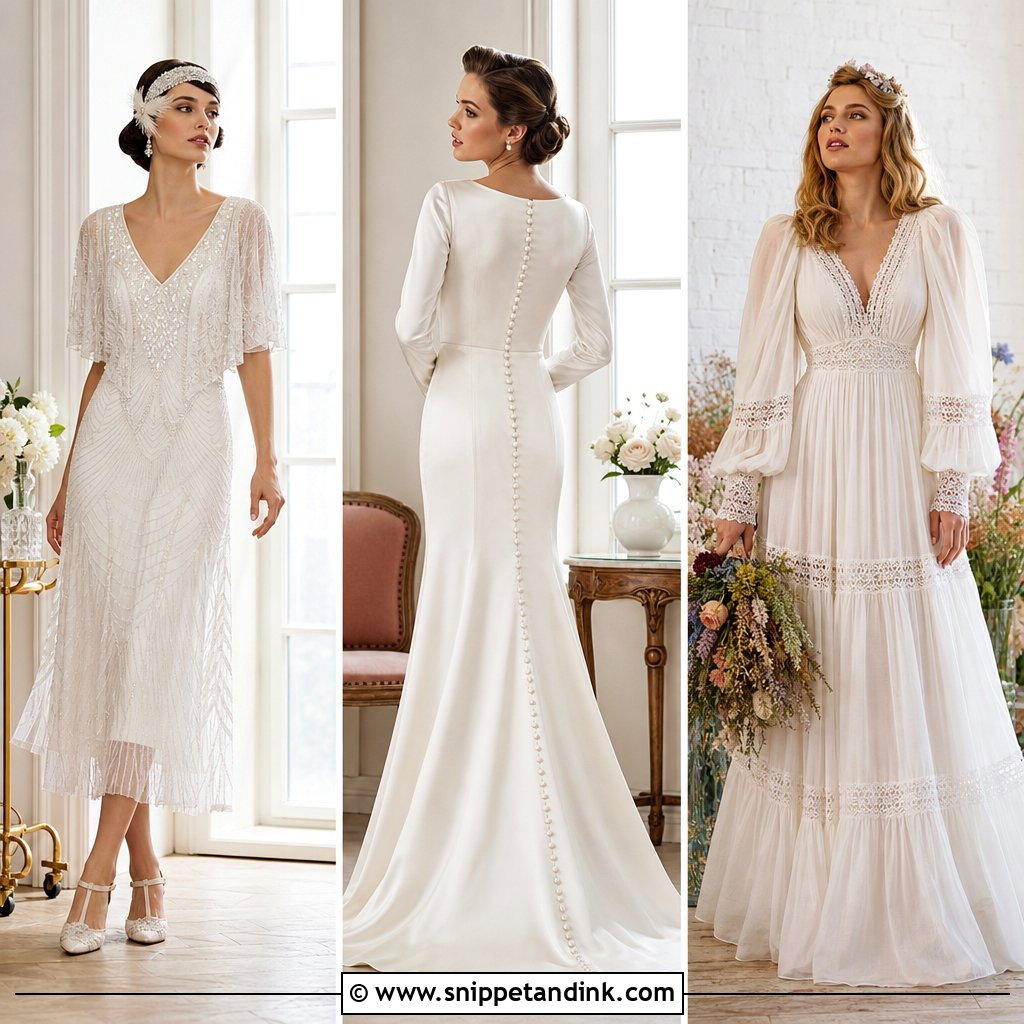
19. Floral Wedding Dress With Puff Sleeves
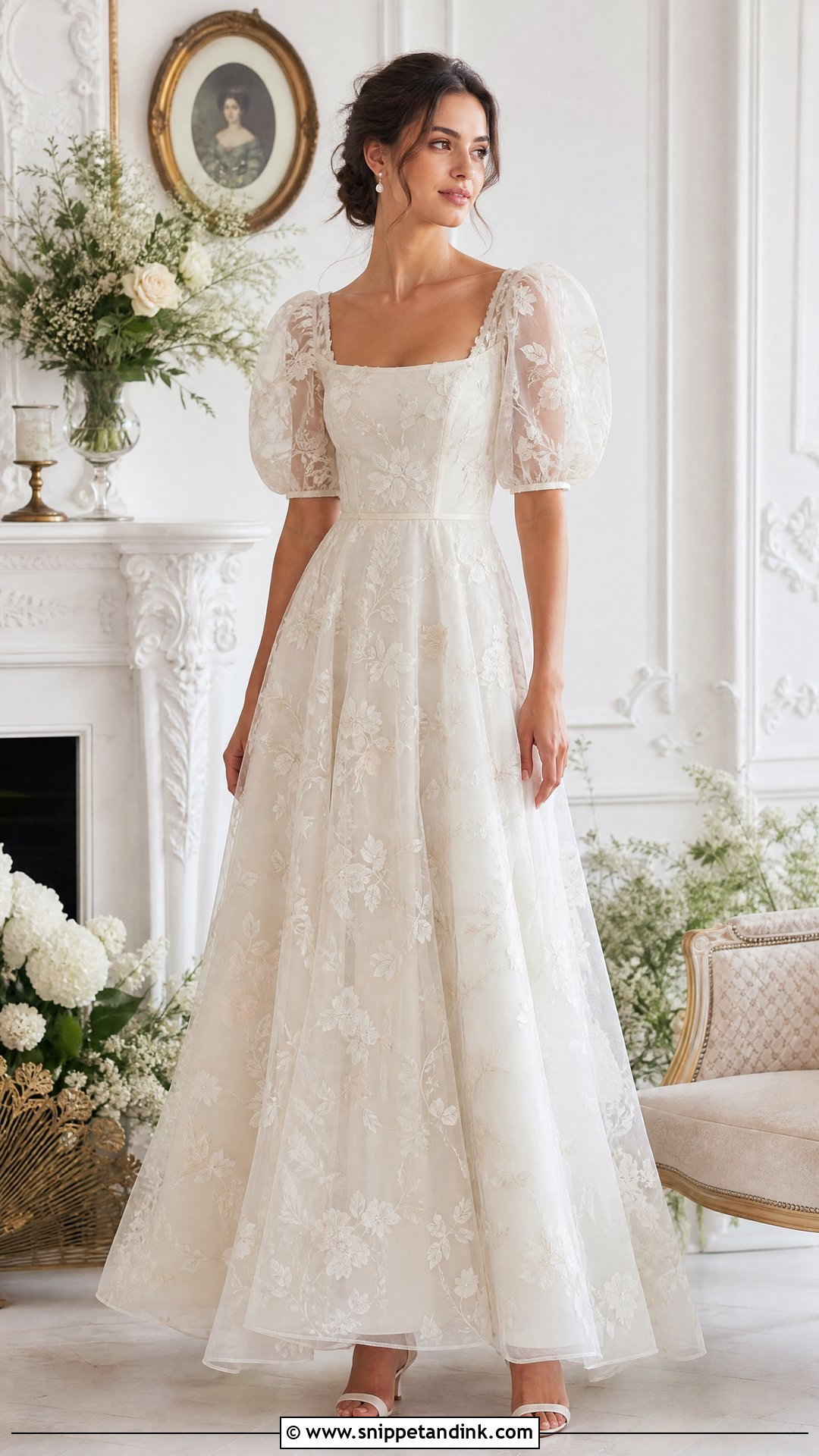
Puff sleeves carry a vintage note, and floral embroidery keeps the volume from looking heavy. Sheer sleeves feel delicate; structured ones are more dramatic. Balance them with a defined waist and a skirt you are comfortable in. A practical point: big sleeves can press against a sleeve-length veil or the edge of a cape, so try any veil with the gown, not separately. Keep jewelry small and hair smooth.
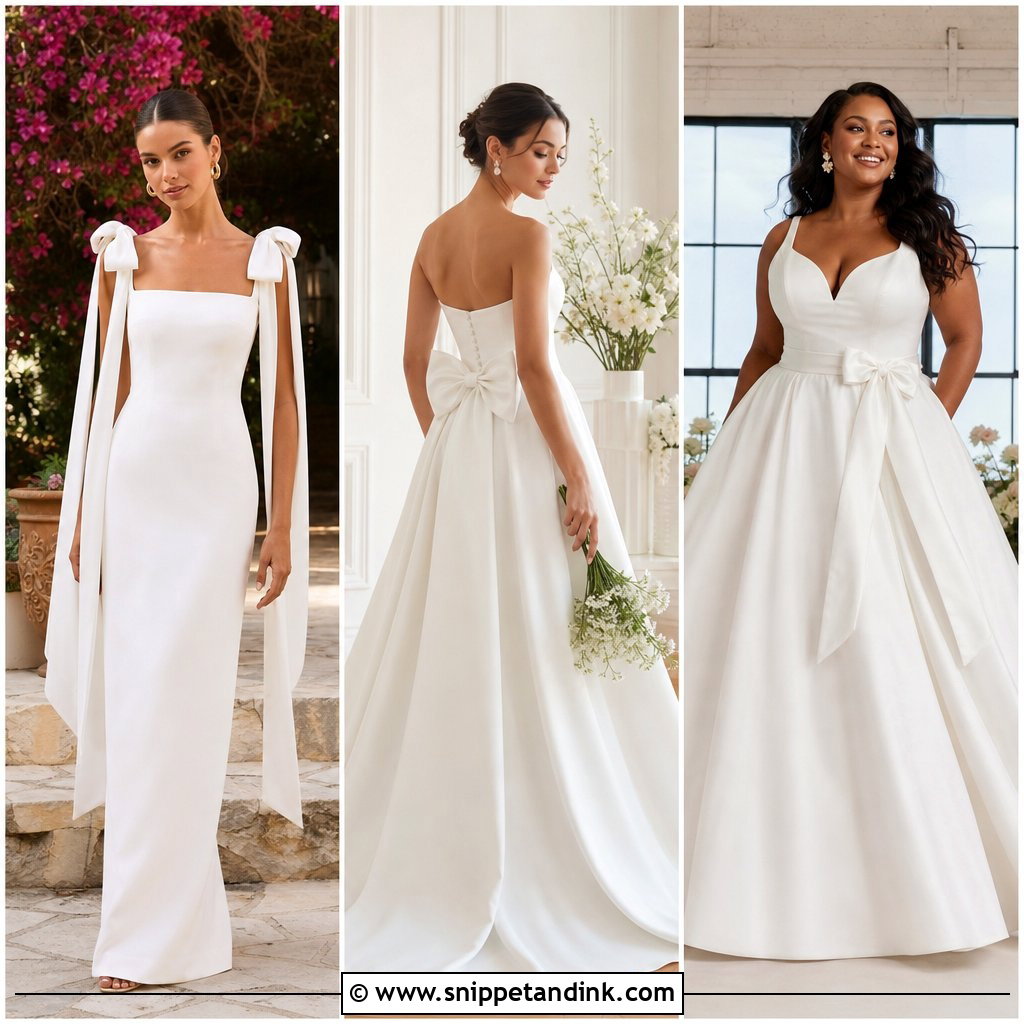

20. Floral Wedding Dress With Cape Veil
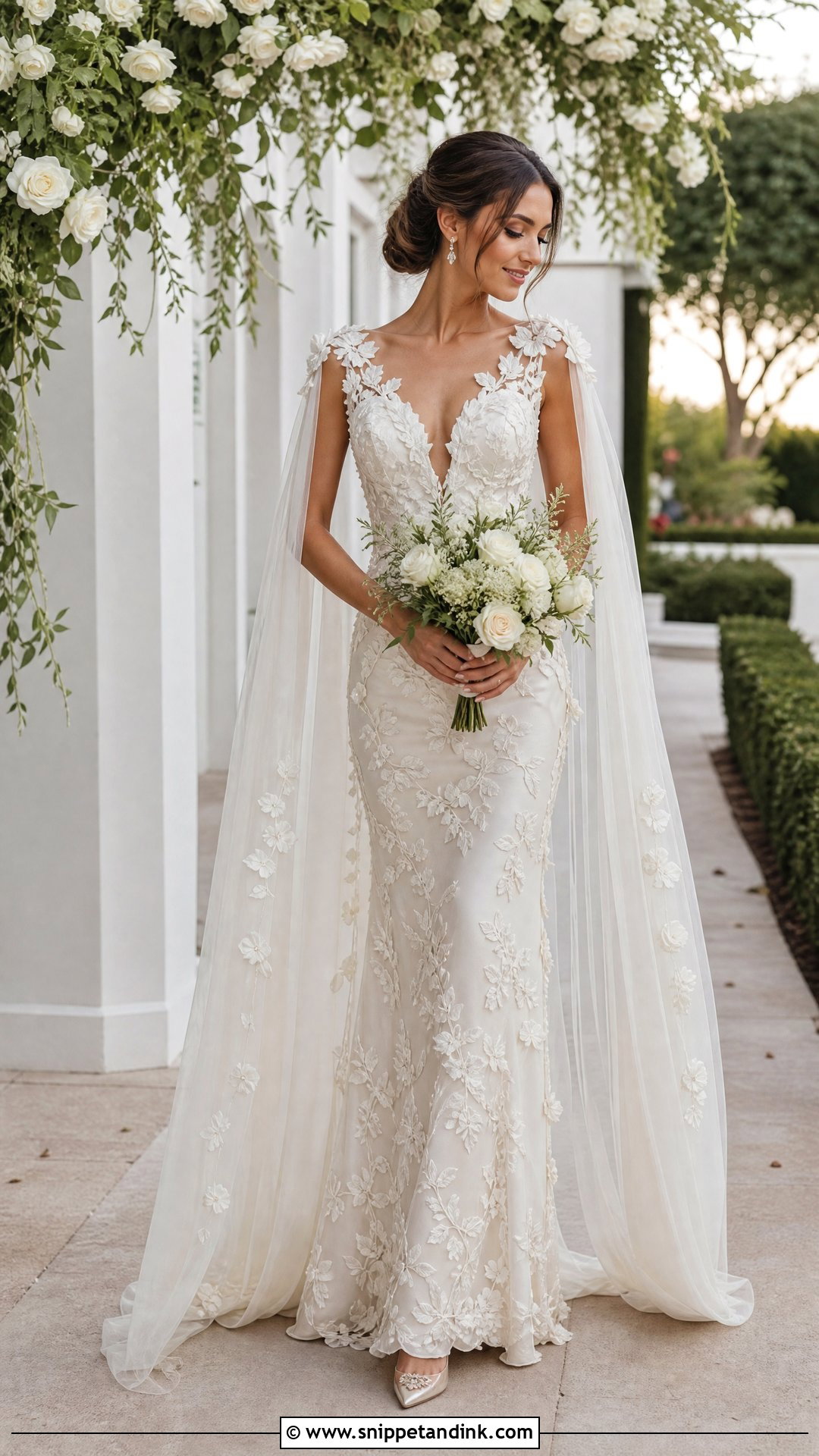
A cape veil gives you the movement of a veil without anything in your hair, attaching at the shoulders, neckline or back. Floral appliqué on the cape ties it to the gown. I check the attachment carefully, because a cape that pulls at the shoulders drags the neckline down every time you move your arms. Simple earrings, sleek heels and a soft bouquet keep the cape in focus. Outdoors it moves nicely as you walk.
21. Floral Wedding Dress With Floral Crown
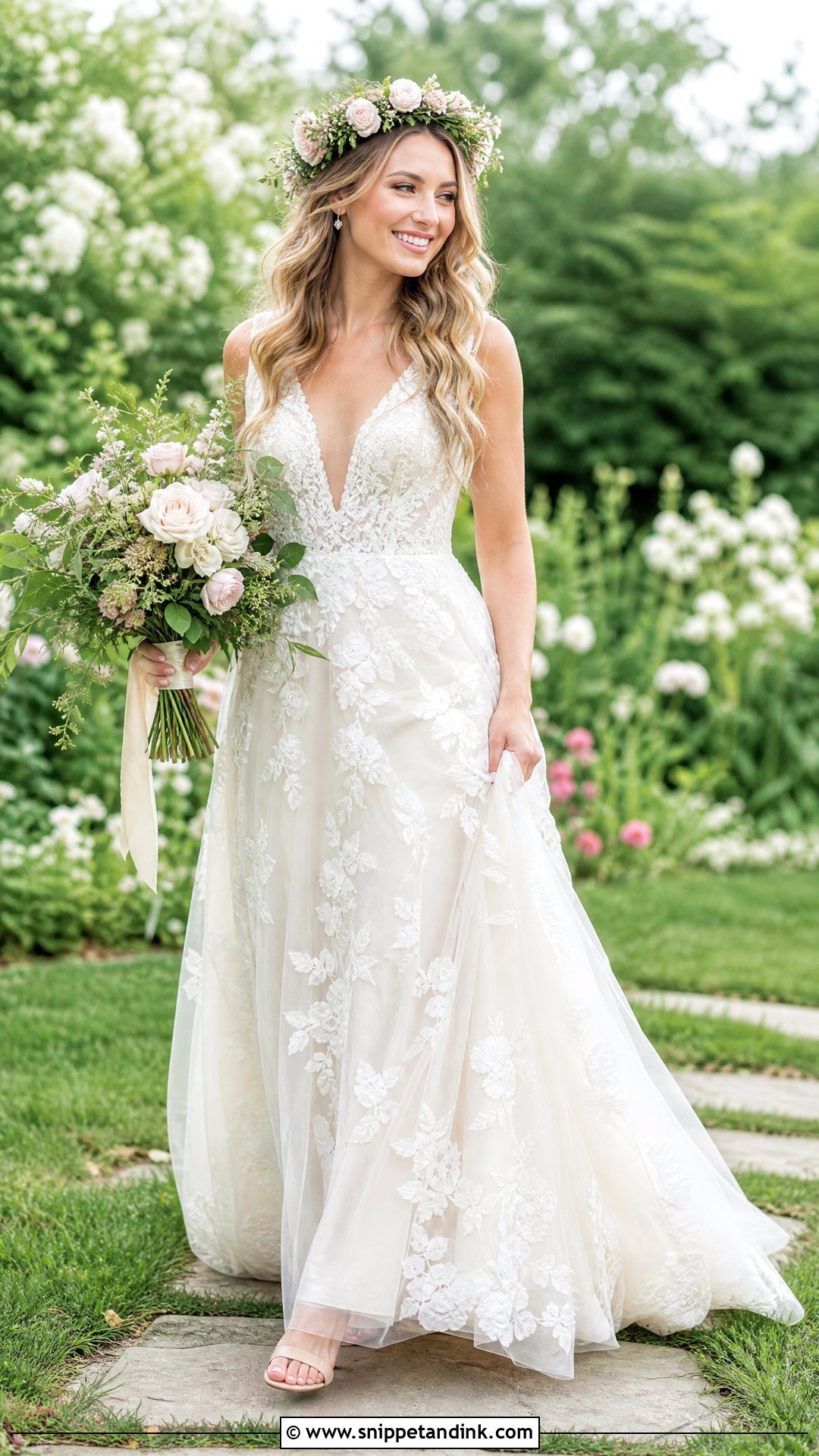
A crown of flowers suits garden, meadow, beach and woodland weddings, and the trick is scale. If the dress has bold flowers, keep the crown small and leafy. If the lace is delicate, a fuller crown can carry more impact. Fresh crowns wilt in heat, so I always ask the florist to make them last and to keep them chilled until the moment you put one on. Soft waves, a flowing skirt and comfortable sandals or low heels suit it, with tiny pearl earrings and nothing else.
22. Floral Wedding Dress With Blue Flowers
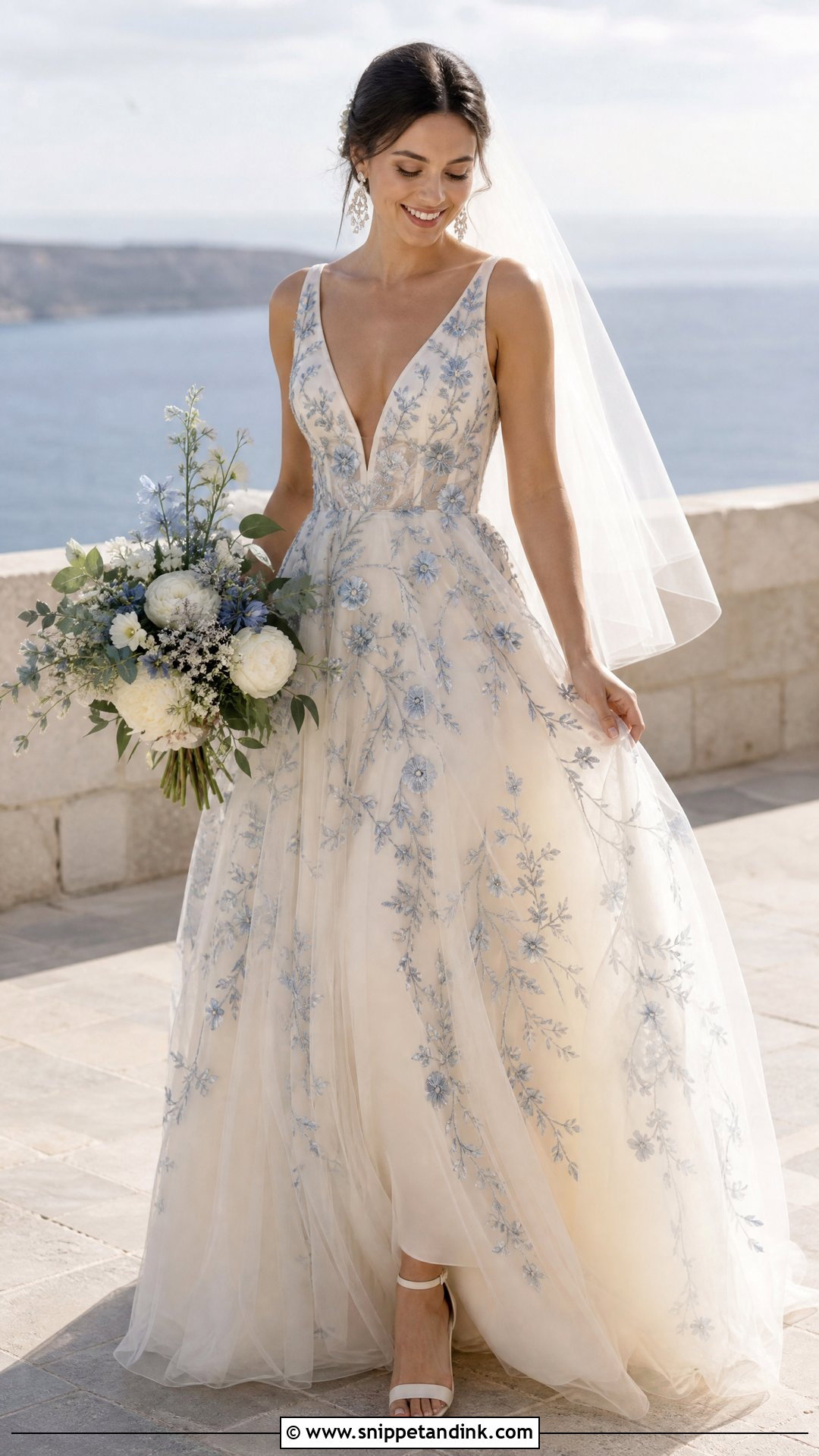
Adding blue flowers is a gentle way to bring color in, and it doubles as your something blue. The shade can range from powder to dusty blue or deeper watercolor tones. Silver or pearl jewelry and ivory heels keep it fresh, and a bouquet of white flowers with a few touches of blue ties it together. Keep makeup soft so the color reads as part of the gown rather than a costume. Spring and coastal weddings suit it well.
23. Floral Wedding Dress With Pink Flowers
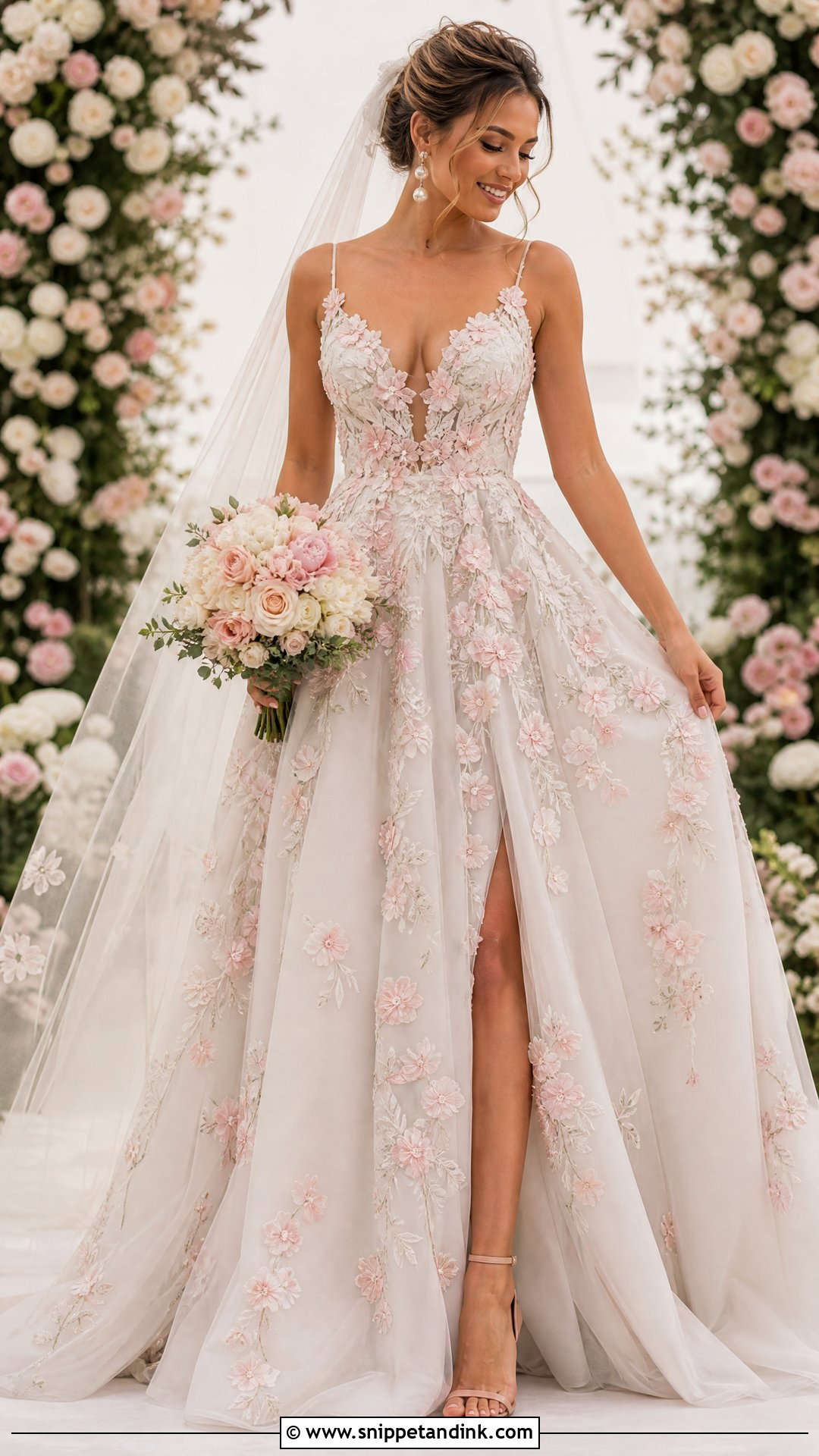
Pink flowers on ivory, nude or champagne look sweet in photos, but the shade of pink should match your skin. Warm rose suits warm undertones; cooler blush suits fair skin with pink undertones. Nude or blush heels and pearl earrings are enough, and if the embroidery is strong, keep the veil plain and sheer. A bouquet in cream, pink and greenery picks up the thread colors. Soft curls or a half-up style suit the mood.
24. Floral Wedding Dress With Green Vine Embroidery
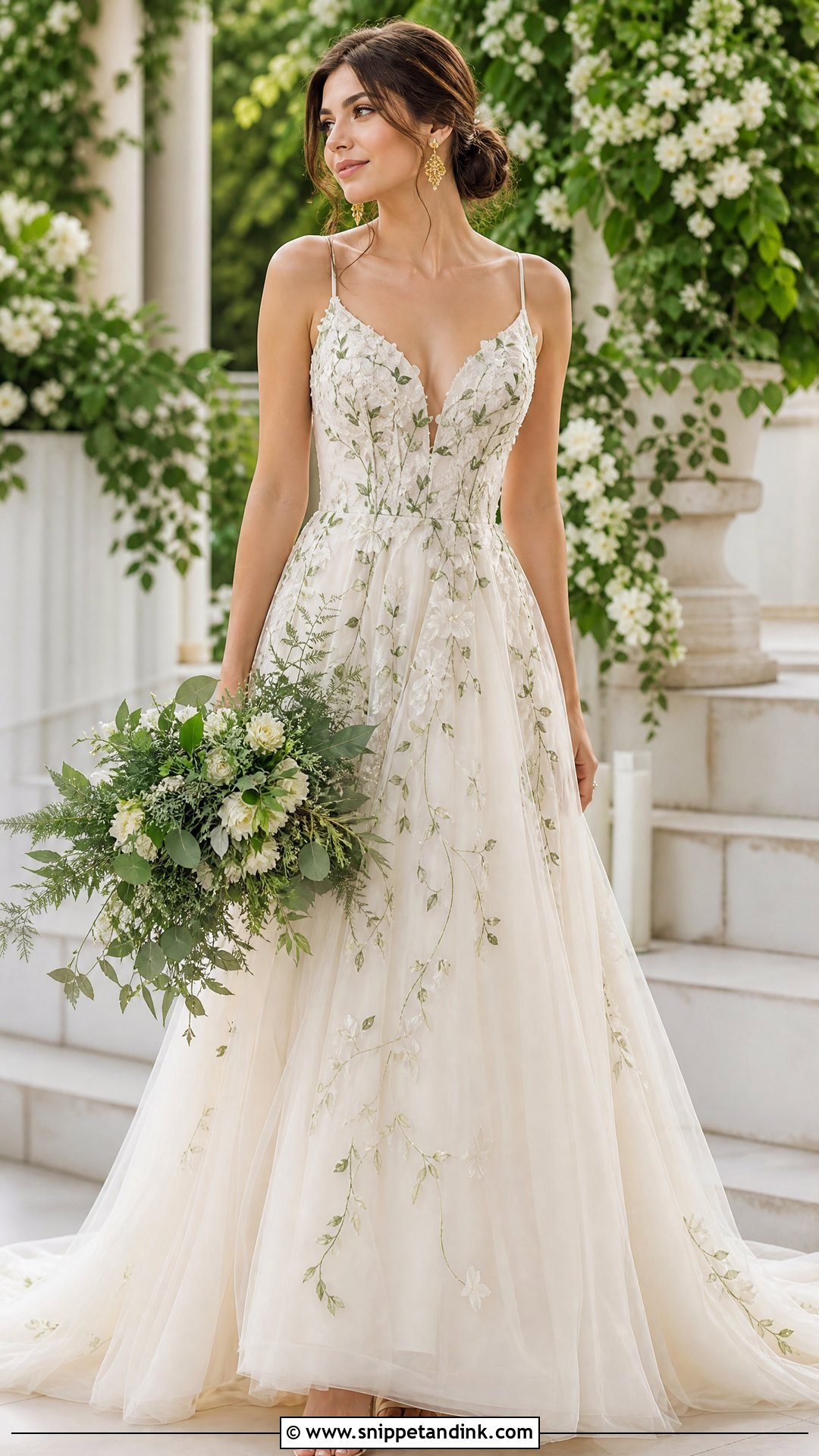
Green vine embroidery gives a botanical feel without bright color. It looks best on ivory tulle, soft lace or sheer sleeves, where the thread reads clearly. Simple ivory heels, gold or pearl jewelry and a bouquet heavy on greenery echo the vines. A loose low bun or natural waves fit the organic mood. Outdoor venues, conservatories, garden settings and backyards suit this gown, and it stays understated even up close.
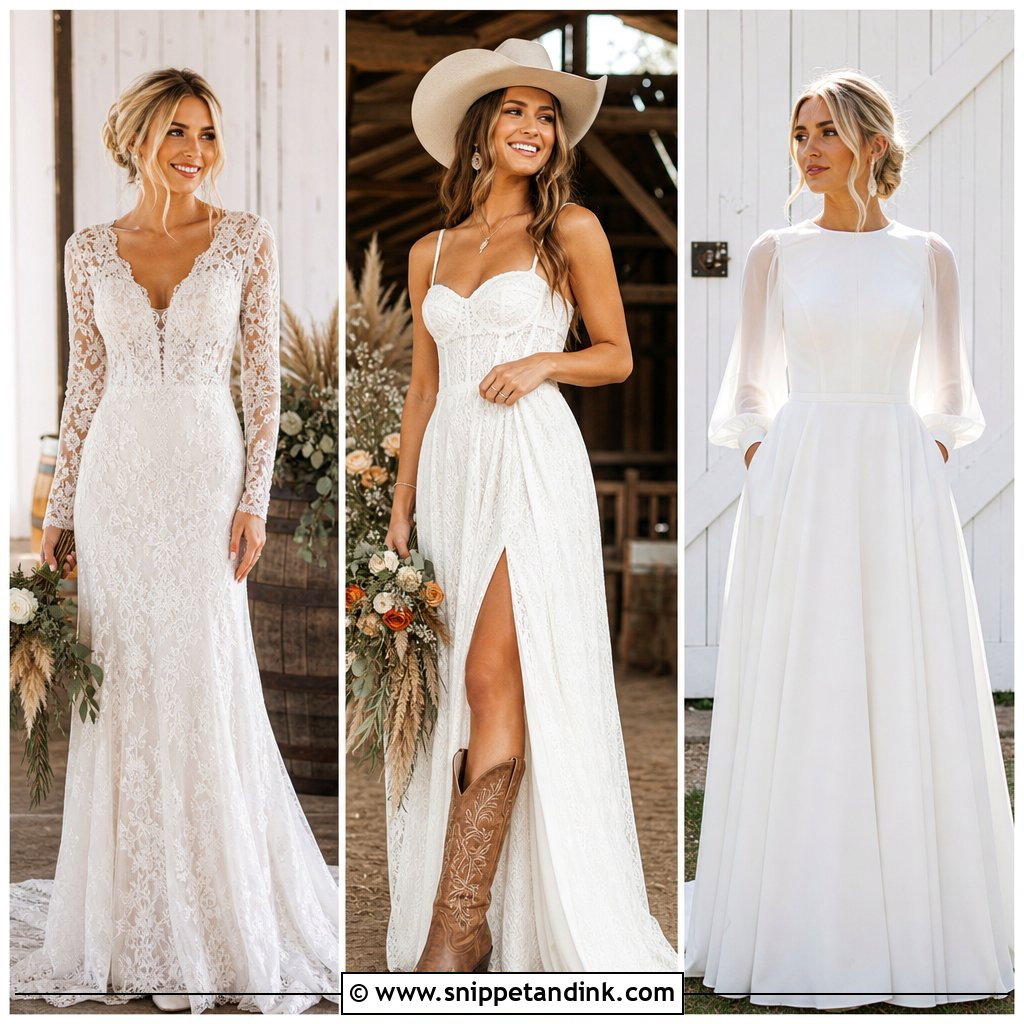
25. Floral Wedding Dress With Printed Organza Skirt
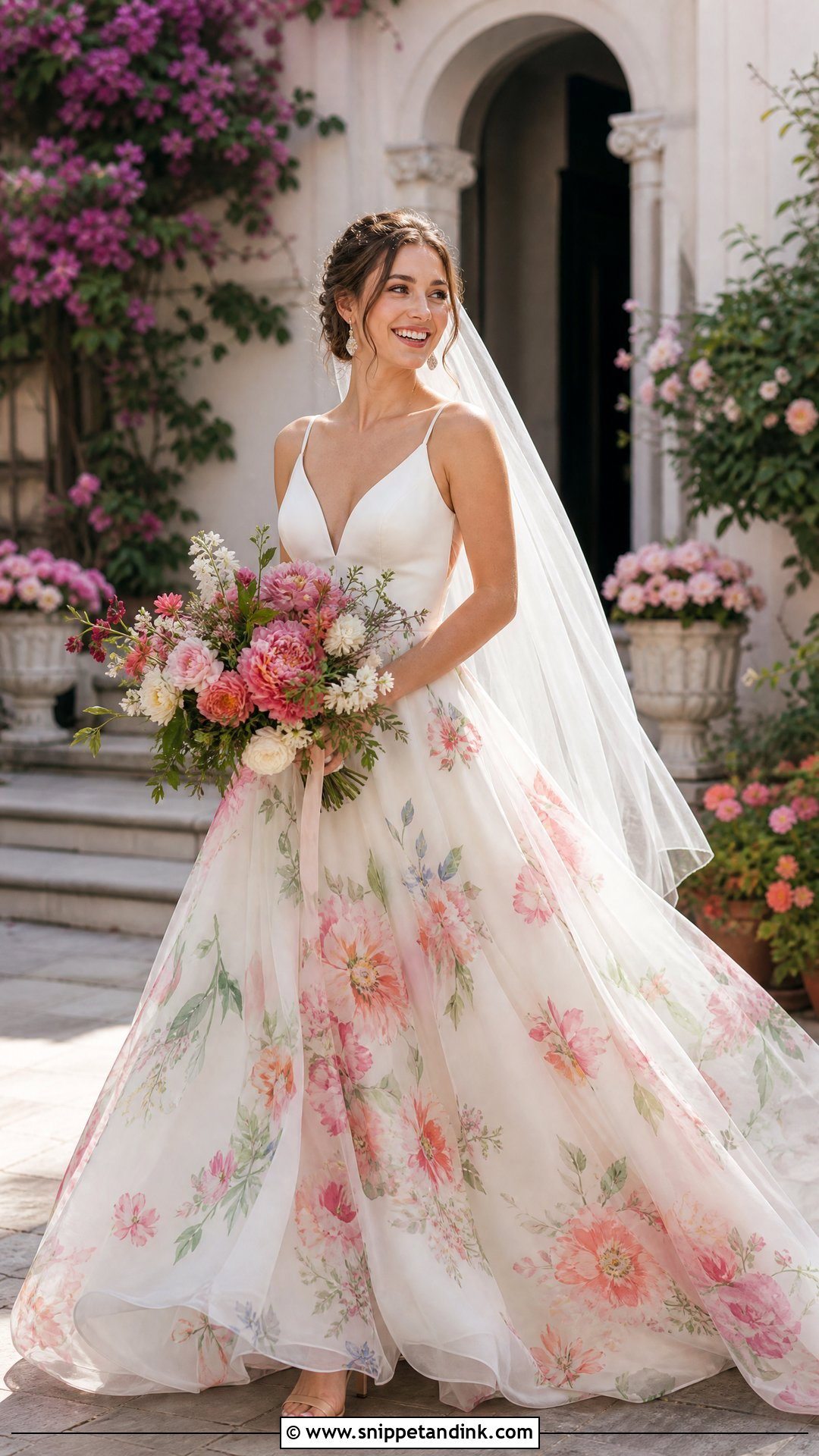
Printed organza holds its shape while staying light, which is why it suits floral prints that need room to show. A plain bodice keeps the print from looking busy. Organza does crease, and it marks if it gets wet, so carry an umbrella and keep the skirt away from damp grass where you can. Neutral heels, small earrings and a bouquet that pulls one or two colors from the print are enough. A plain veil keeps the skirt in focus.
Giving Your Florist the Embroidery, Not a Mood Board
A floral gown and a floral bouquet can either look like one idea or two competing ones. The difference usually comes down to what the florist was shown. A mood board gives a general feeling; a close-up photo of the embroidery taken in daylight, or a spare scrap of lace, shows the actual colors and flower shapes.
I suggest repeating one color from the dress in the bouquet and leaving the rest to greenery and white. Trying to copy every thread shade turns the bouquet into a costume piece. Scale matters as well: large 3D flowers on the skirt look better beside a looser, airier bouquet, while delicate lace can carry a fuller, rounder one. If the gown has blue or green thread, tell the florist early, since true blue flowers are limited and some are only available in certain seasons.
How 3D Flowers and Colored Thread Survive Storage
Garden weddings are hard on a hem, and floral gowns need gentler cleaning than plain ones. Raised appliqués can flatten or come loose in a standard dry-clean, and colored embroidery should be tested for colorfastness before any solvent touches it. Take the gown to a cleaner who handles bridal work, and point out every grass or wine mark rather than assuming they will find them.
For storage, I pad the 3D flowers with acid-free tissue so they keep their shape, and fold the gown in a breathable box rather than hanging it by the straps, which stretch under the weight of a beaded or lace skirt over the years. Keep it out of sunlight. Pastel thread fades long before ivory tulle does, and that is the first thing you would notice when you open the box again.
Let the Flowers on the Gown Set the Rules
Every look here is a version of one idea: let the flowers on the dress lead, and make everything else answer to them. Lace keeps it classic, a corset bodice makes it modern, colored embroidery adds personality and tulle, organza or 3D appliqué add drama. Pick the gown that suits your venue and your comfort first. Then choose the veil, shoes, jewelry and bouquet by asking what the dress is already saying, and add only what it is missing.
You'll Like These Ideas:


Leave a Reply