
A floral cake ties the dessert to the bouquet and the tables, and it’s one of the requests I get most from couples who care more about flowers than about tiers of sugar work. Some want roses and peonies on smooth ivory; others want pressed petals, sugar flowers, strong colour or a meadow of stems around the base. Each choice changes how the cake is built, delivered and kept safe to eat. The ideas below come with what I’d want a couple to know before they commit, from which flowers can touch frosting to how each style copes with a warm room.
Which Blooms Can Touch Buttercream and Which Need a Barrier
Most flowers from a florist are grown to be looked at, not eaten, and they’re often treated with pesticides or preservatives. Several popular wedding flowers are also toxic. So before any design gets locked in, I sort the flowers into three groups.
Edible when grown for food
Violas, pansies, culinary lavender, chamomile, cornflowers, calendula and unsprayed roses. These can sit directly on frosting or be pressed into it, as long as they come from a supplier that grows them as food.
Decoration only, with a barrier
Florist roses, orchids, peonies, sunflowers, tulips and most greenery. Stems get wrapped in floral tape and pushed into food-safe picks or straws, and blooms sit on small parchment discs rather than on bare frosting. They come off before the cake is cut.
Keep them away from the cake
Lily of the valley, hydrangea, sweet pea, delphinium, foxglove and oleander. I’d recreate these in sugar, or put them in the arrangement around the cake table instead. Ranunculus, anemone and eucalyptus I’d treat with extra caution and never in direct contact.
1. Rose Bouquet Wedding Cake
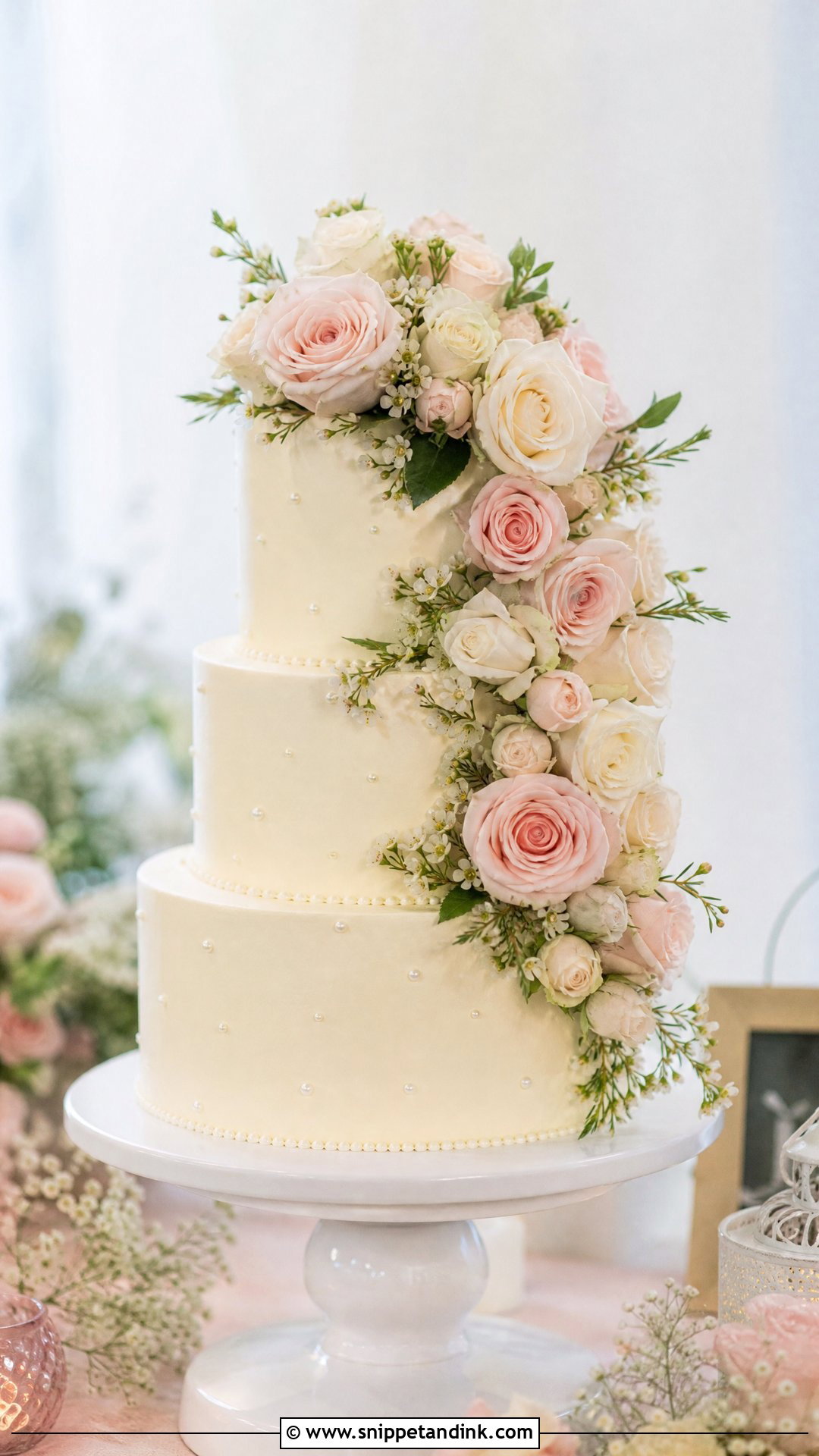
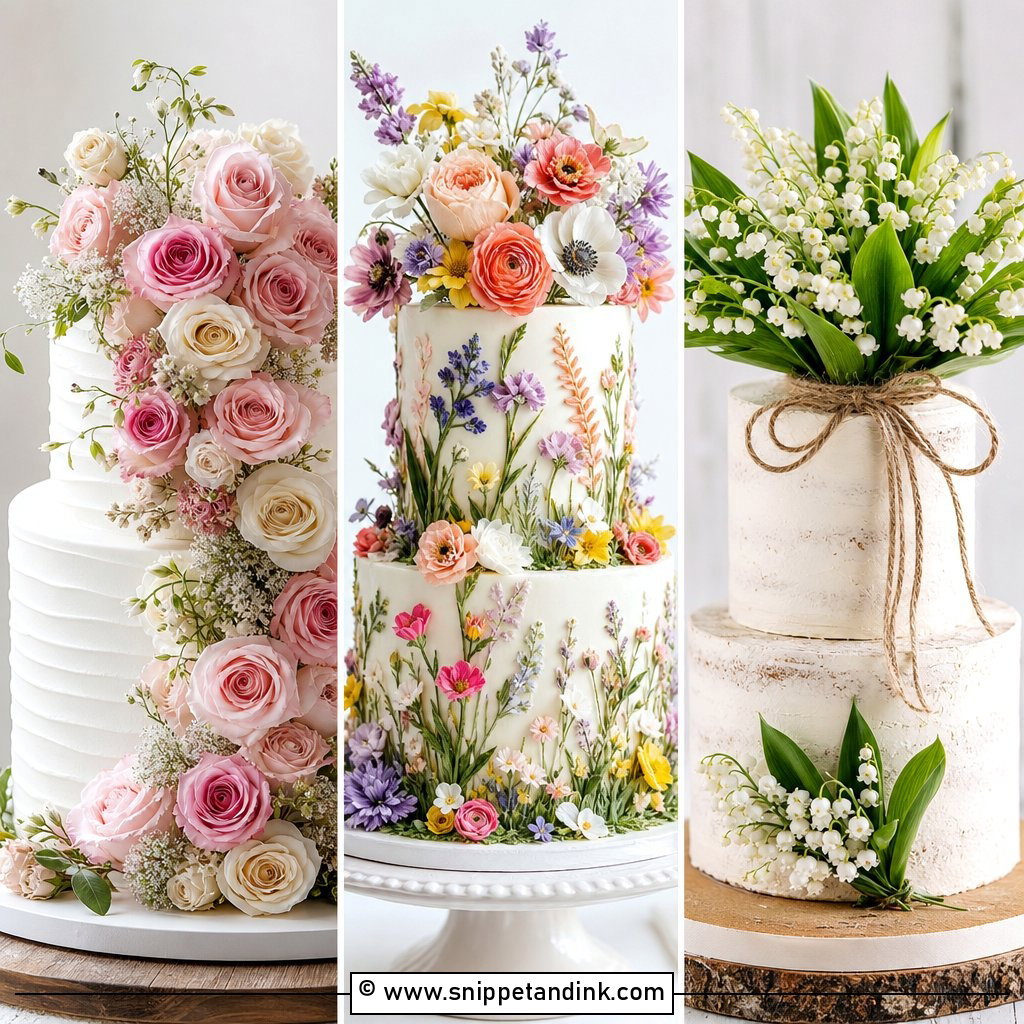
Roses suit almost every wedding, which is why they’re still the cake flower I’m asked for most. On a formal fondant cake I’d use sugar roses, because the petals can be shaped crisply and won’t brown at the edges under lights. For a garden wedding, fresh garden roses clustered between tiers look softer. Unsprayed roses are one of the safer fresh flowers to put near cake, but florist roses usually aren’t grown as food, so I still wrap the stems and keep them off the frosting surface. Matching the shades to the bridal bouquet takes one photo shared between baker and florist.
2. Peony Bouquet Wedding Cake
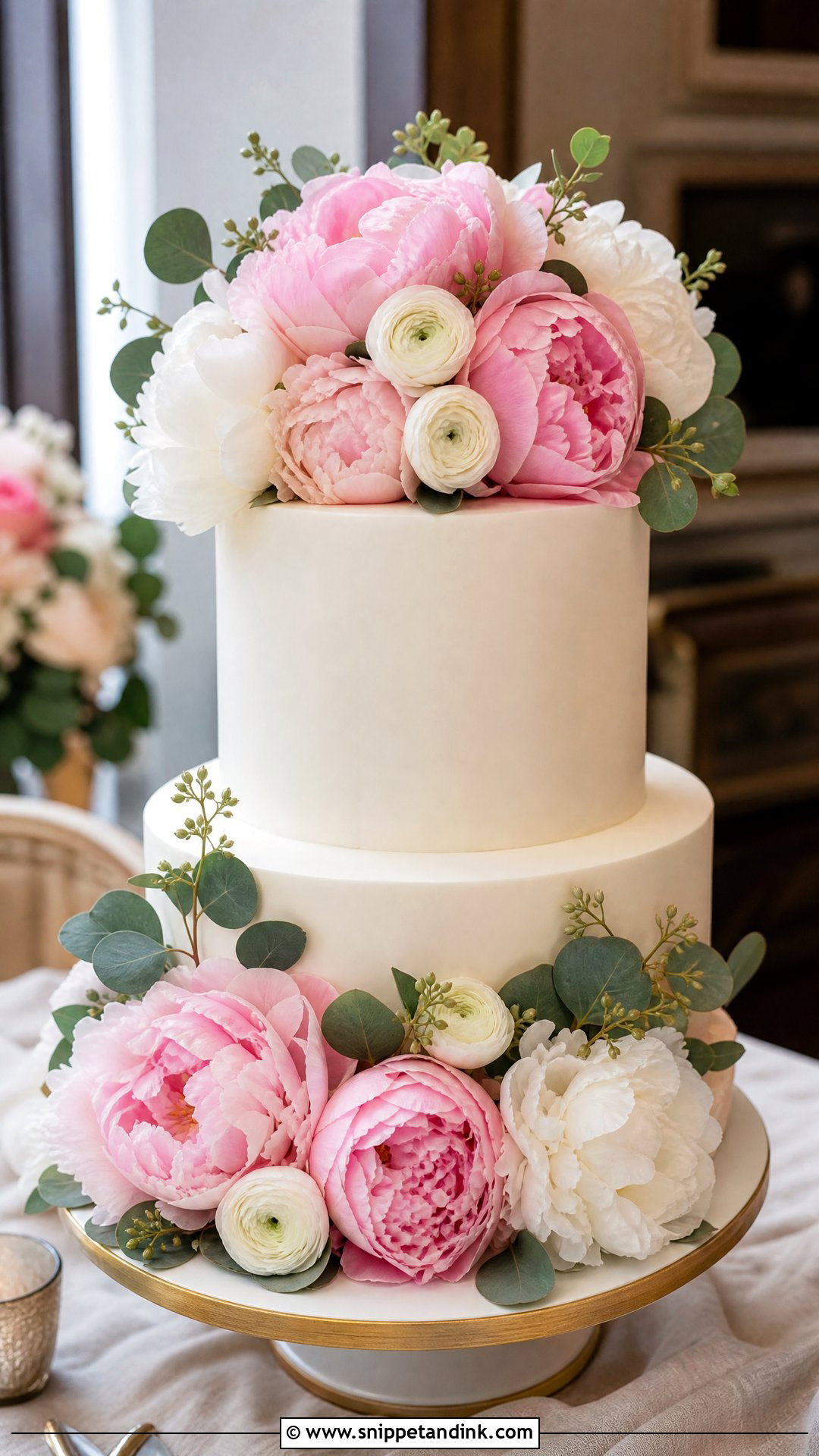
Peonies are big, so you need very few. Two or three on the top tier and one at the base look finished. Fresh peonies open fast in a warm room, and a bud that’s tight at 2 p.m. can be blown and dropping petals onto the cake by the cutting, so I ask the florist for blooms that are just starting to open. Outside their spring window, sugar peonies are the better route; they hold the same ruffled shape and don’t wilt. Soft buttercream texture suits them, and so do clean fondant tiers.
3. Wildflower Bouquet Wedding Cake
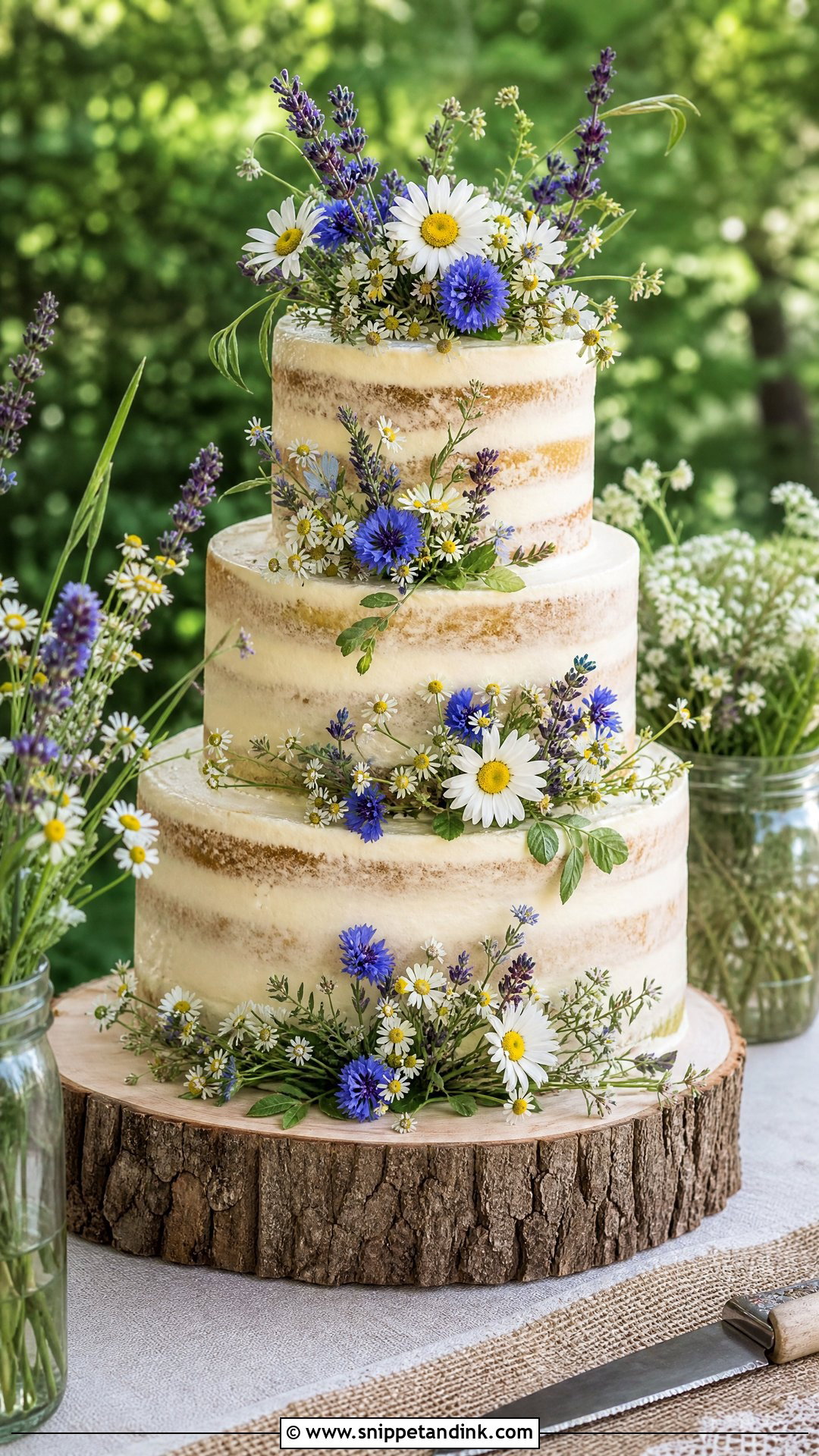
A wildflower bouquet wedding cake should look gathered, not arranged. I use small blooms in airy clusters, chamomile, cornflowers, lavender and tiny daisies, across a white or semi-naked cake. Several of those are edible varieties, which makes this one of the easier floral cakes to keep food-safe if the flowers are grown for eating. Semi-naked cakes dry out faster than fully frosted ones, so I won’t finish one more than a few hours before it’s served. Barns, backyards and outdoor receptions suit it best.
4. Pressed Flower Wedding Cake
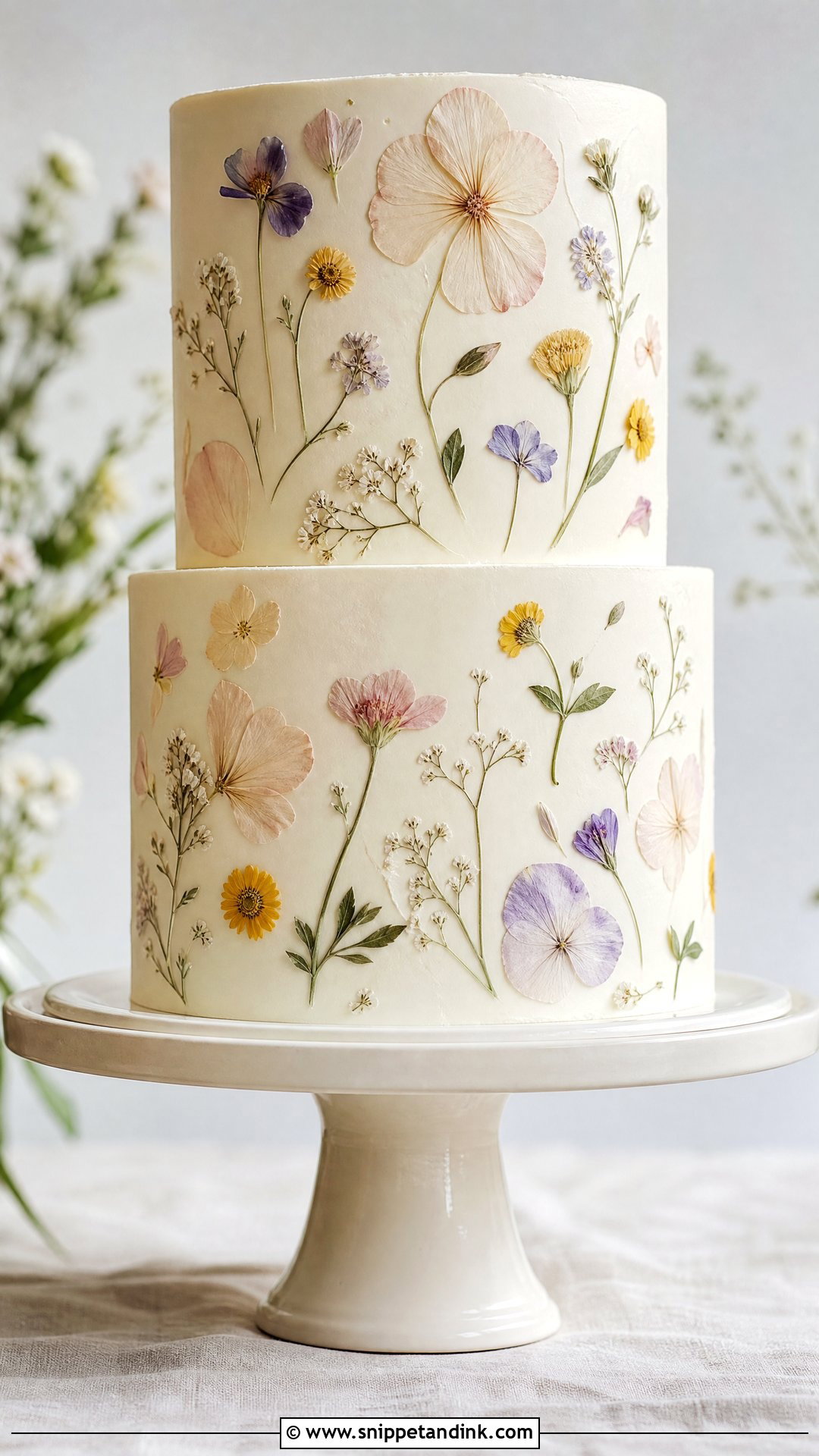
Pressed flowers lie flat against the frosting, so they’re the one floral decoration that’s genuinely part of the cake surface. That’s exactly why they need to be edible varieties: violas, pansies, cornflower petals, calendula and small leaves pressed and dried for the purpose. I press them onto a chilled cake so the buttercream doesn’t smear around the petals. Keep the base pale; an ivory or white cake lets every petal show. It’s light and handmade-looking, and it photographs well up close.
5. Cascading Flower Wedding Cake
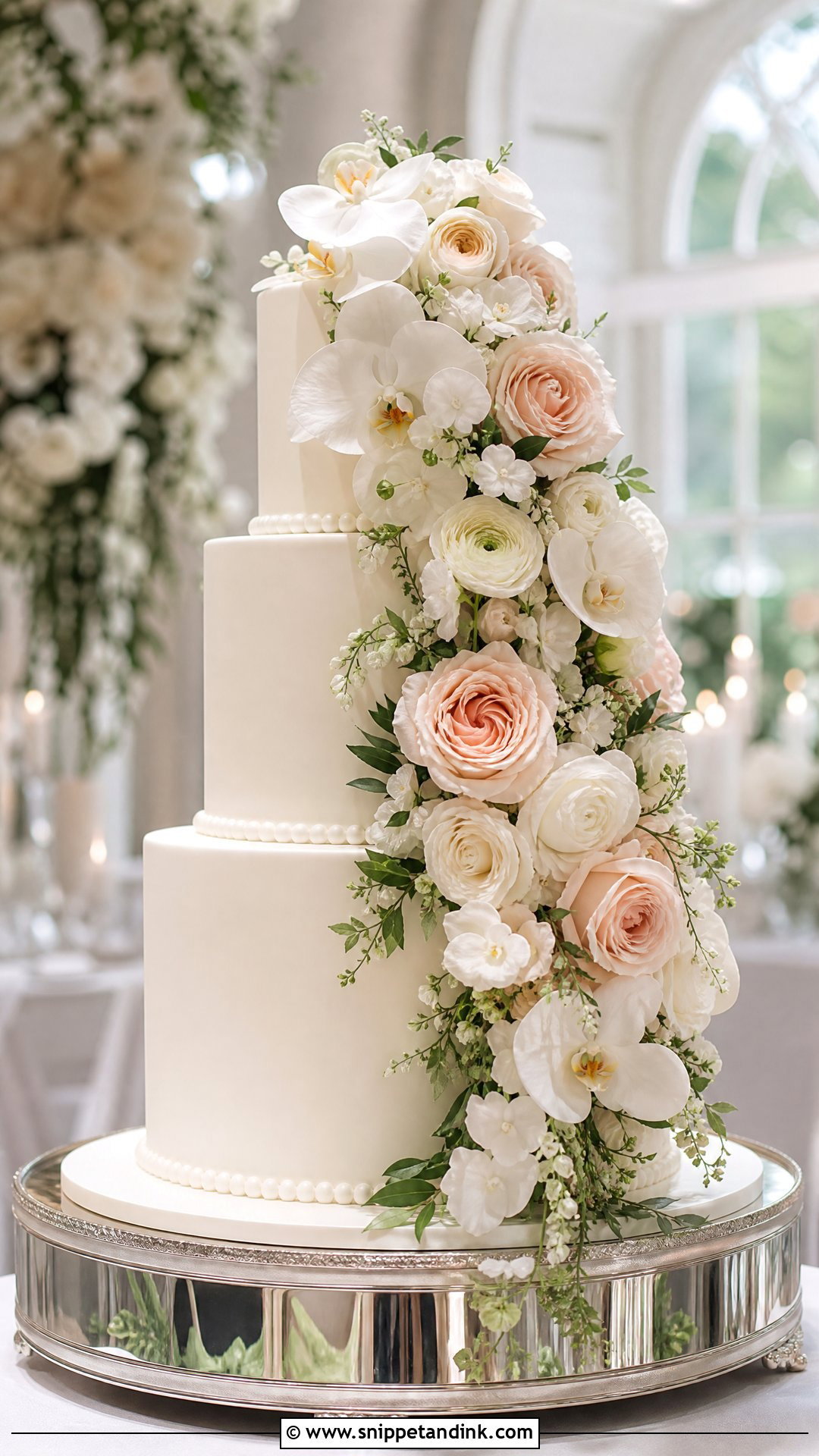
A cascade runs from the top tier down one side, like a bouquet draped over the cake. It needs height to fall properly, so I’d suggest three tiers or more. Roses, orchids, ranunculus, sweet peas and greenery all work, but fresh stems can’t be pushed straight into the cake; I use food-safe picks or wrapped stems, and many of those flowers aren’t edible. Sweet peas in particular shouldn’t touch frosting. Keep the frosting plain so the cascade leads. It suits ballrooms and estates.
6. Garden Bouquet Wedding Cake
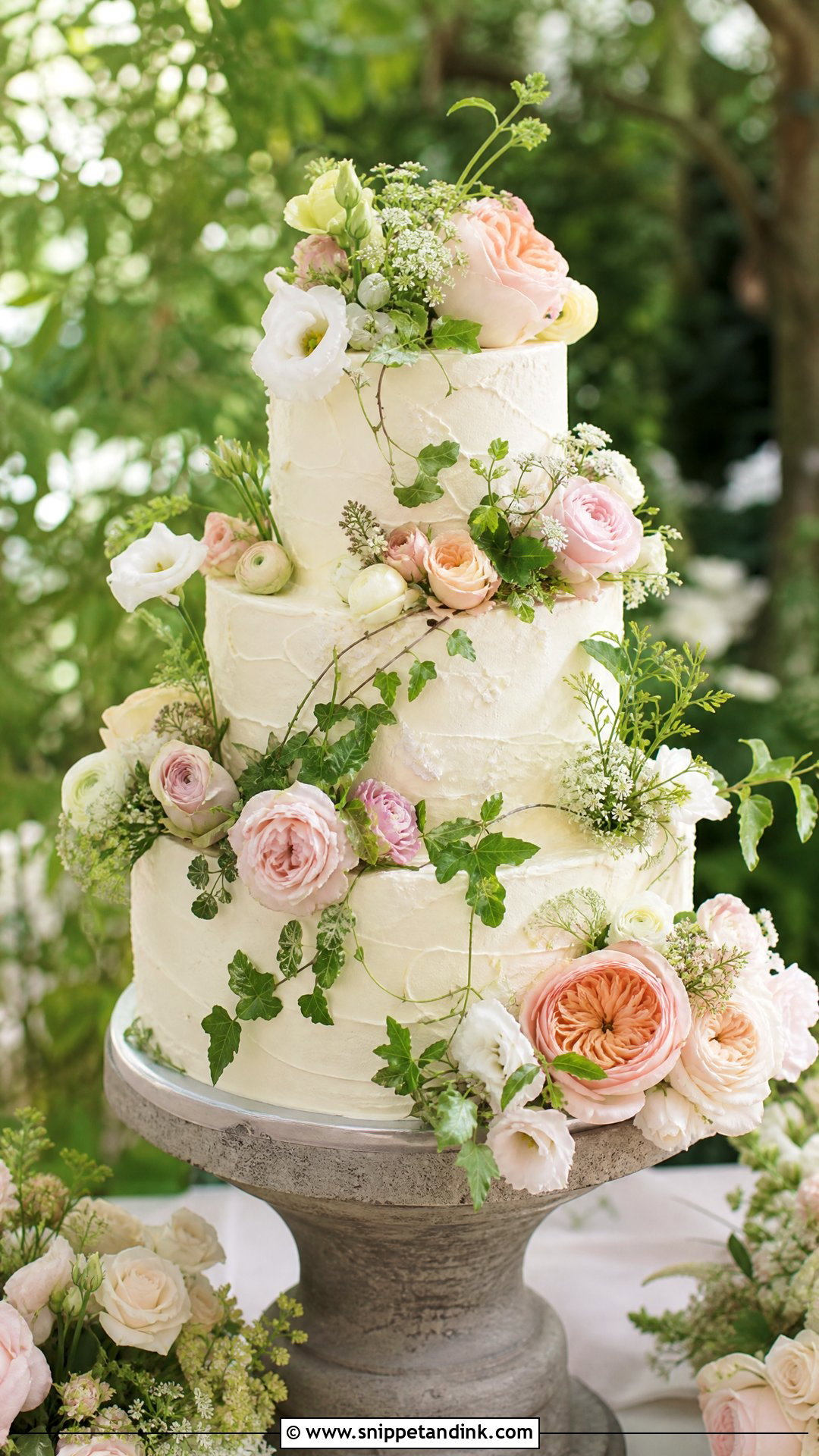
A garden bouquet cake looks as if flowers are growing up around it, which makes it feel loose and natural. Garden roses, ranunculus, lisianthus, ivy and soft herbs all fit, and textured buttercream adds warmth. The thing that keeps it from looking chaotic is restraint in colour. I limit the palette to three or four shades, matched to the bridal bouquet and table flowers. It suits spring, summer and outdoor receptions, though buttercream softens in direct sun, so I’d keep the cake in shade until it’s served.
7. Orchid Bouquet Wedding Cake
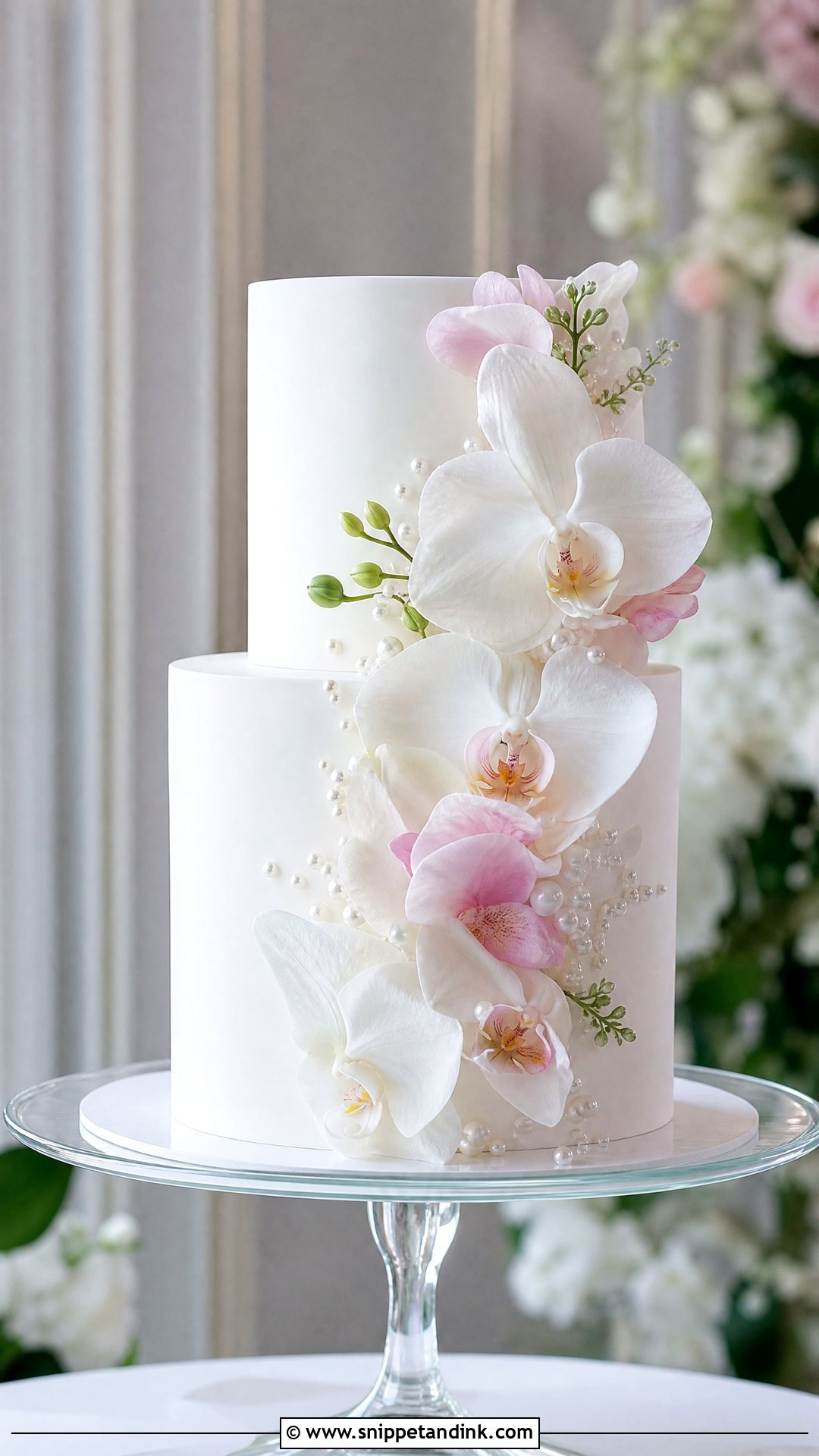
Orchids are sculptural and they hold up well out of water for a few hours, which makes them practical on a cake. White phalaenopsis on clean fondant looks crisp; pink, purple or peach orchids add colour. I place them in a cascade or in neat clusters between tiers. Minimal greenery keeps the design refined, and orchids suit hotels, beaches and evening receptions. Many couples like that a cascade of orchids gives a cake movement without much bulk.
8. Lily Of The Valley Wedding Cake
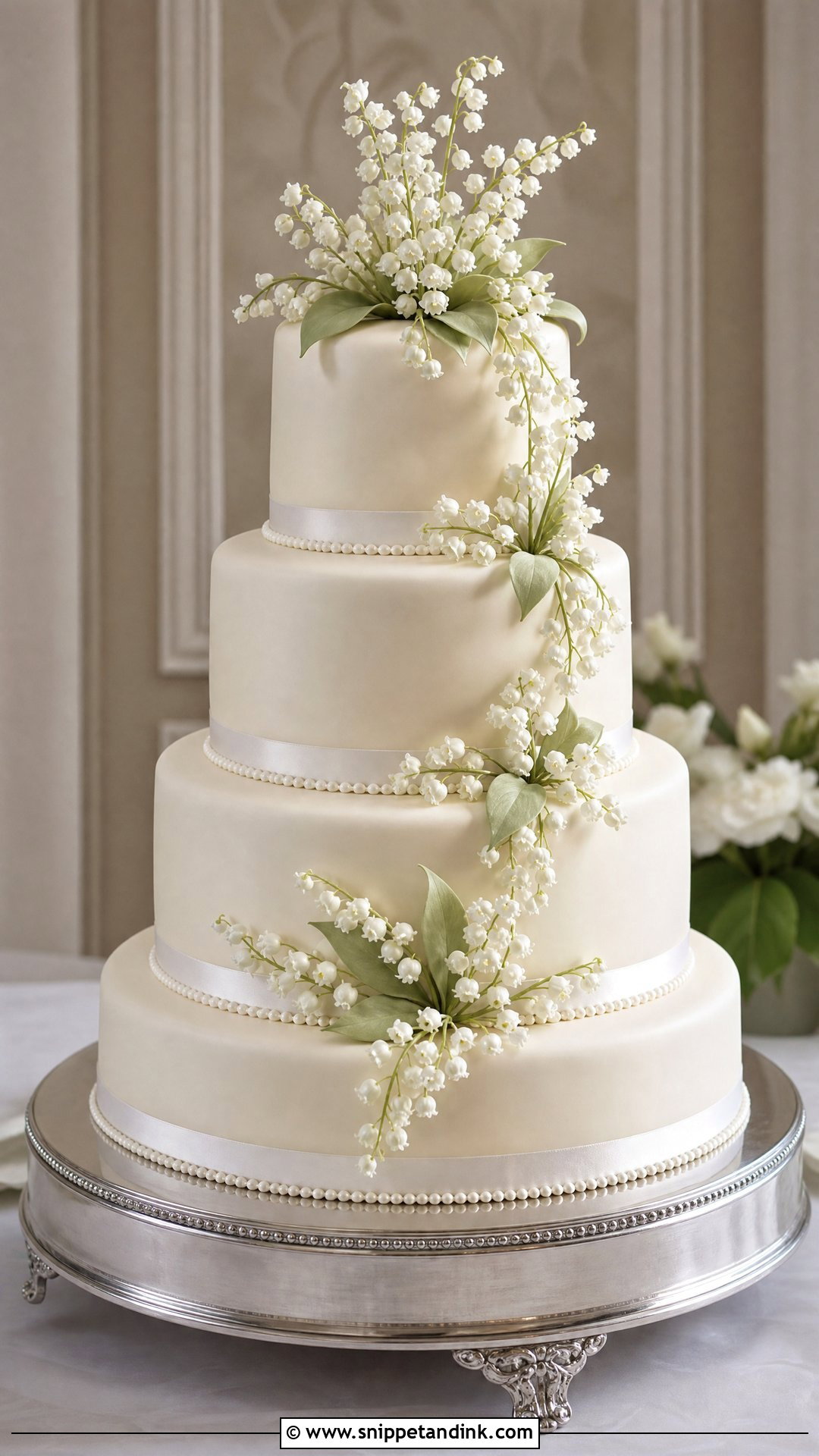
A lily of the valley wedding cake is delicate and very traditional, and I’ll only make it with sugar flowers. Real lily of the valley is poisonous, and that includes the water it stands in, so it should never be placed on or near a cake. Sugar versions are tiny bell shapes piped or modelled on wires, and they look best on clean white or ivory. A small top bouquet, a light cascade or a thin wreath around a tier all work. Because each bell is made by hand, I’d allow extra lead time for this design.
9. Hydrangea Bouquet Wedding Cake
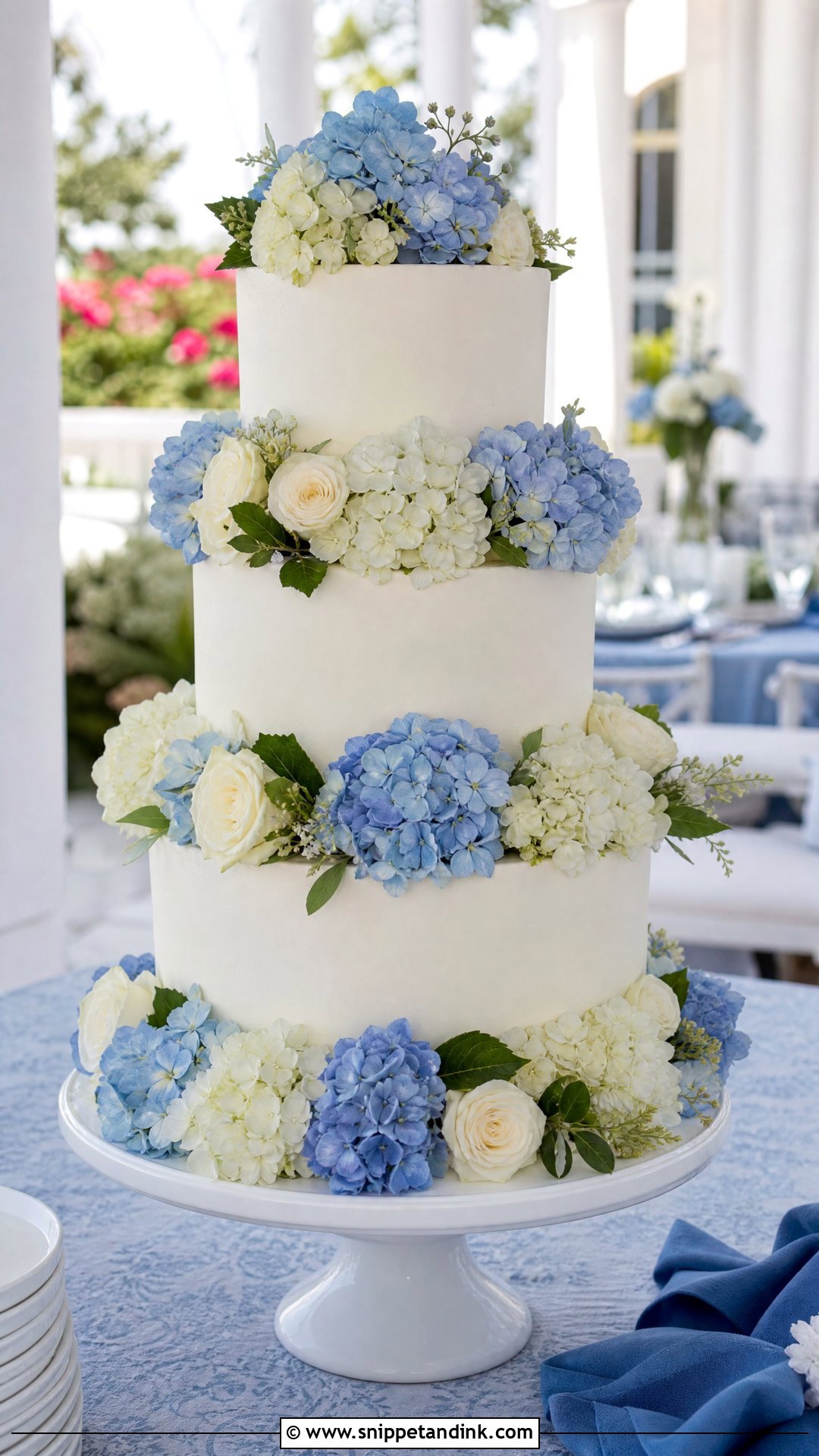
Hydrangeas give a lot of coverage with few stems, which helps on a budget. They’re also not edible, so on a cake they must sit on a barrier, a small disc of parchment or a cake board, and never be pushed into the frosting. Fresh hydrangeas wilt quickly out of water, so I’d add them as late as possible. Blue, white, lavender and pale green suit coastal and garden weddings. Simple frosting and clean lines let the clusters stand out, and mixing in roses or lisianthus softens the shape.
10. Baby Breath Wedding Cake
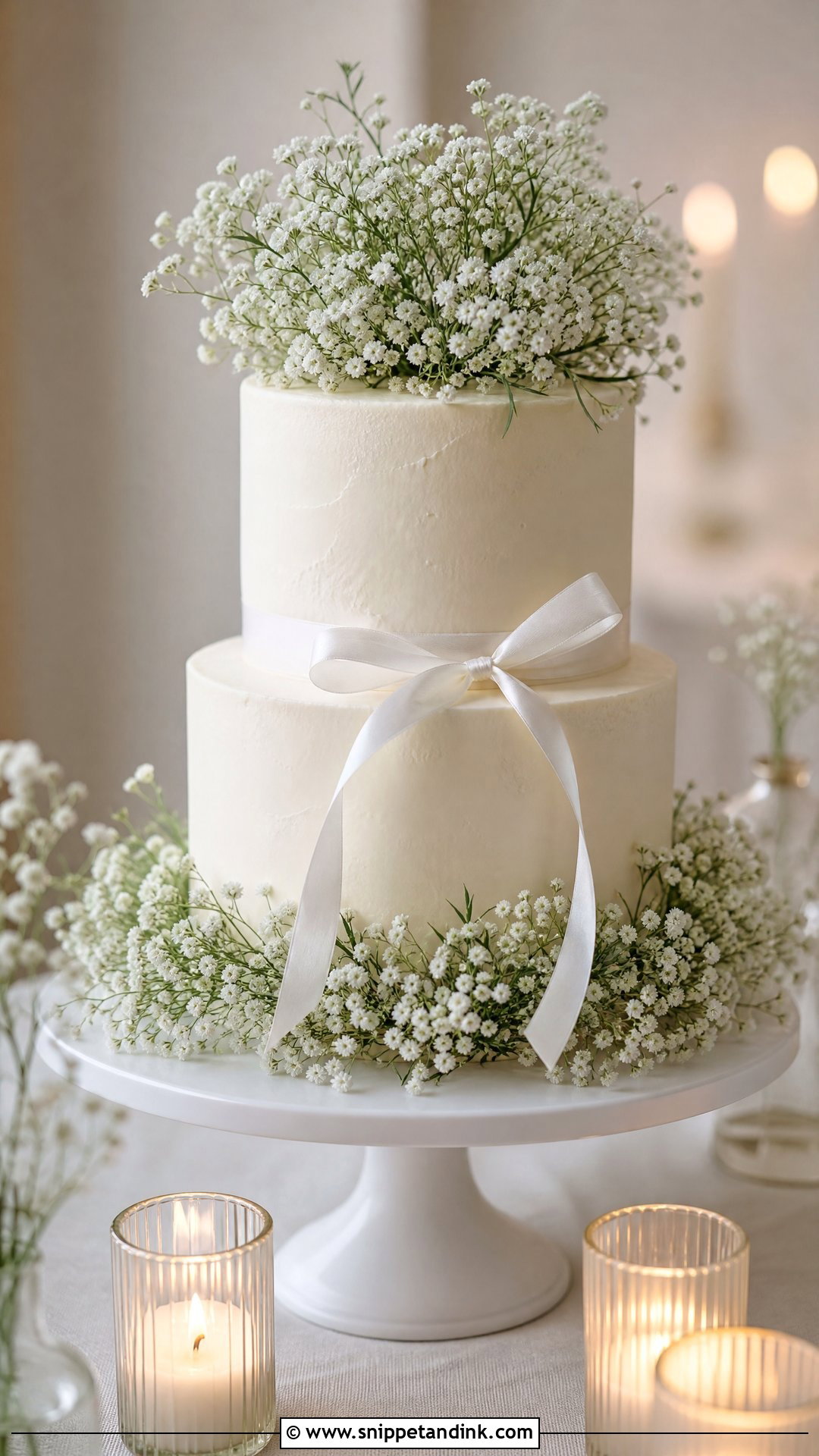
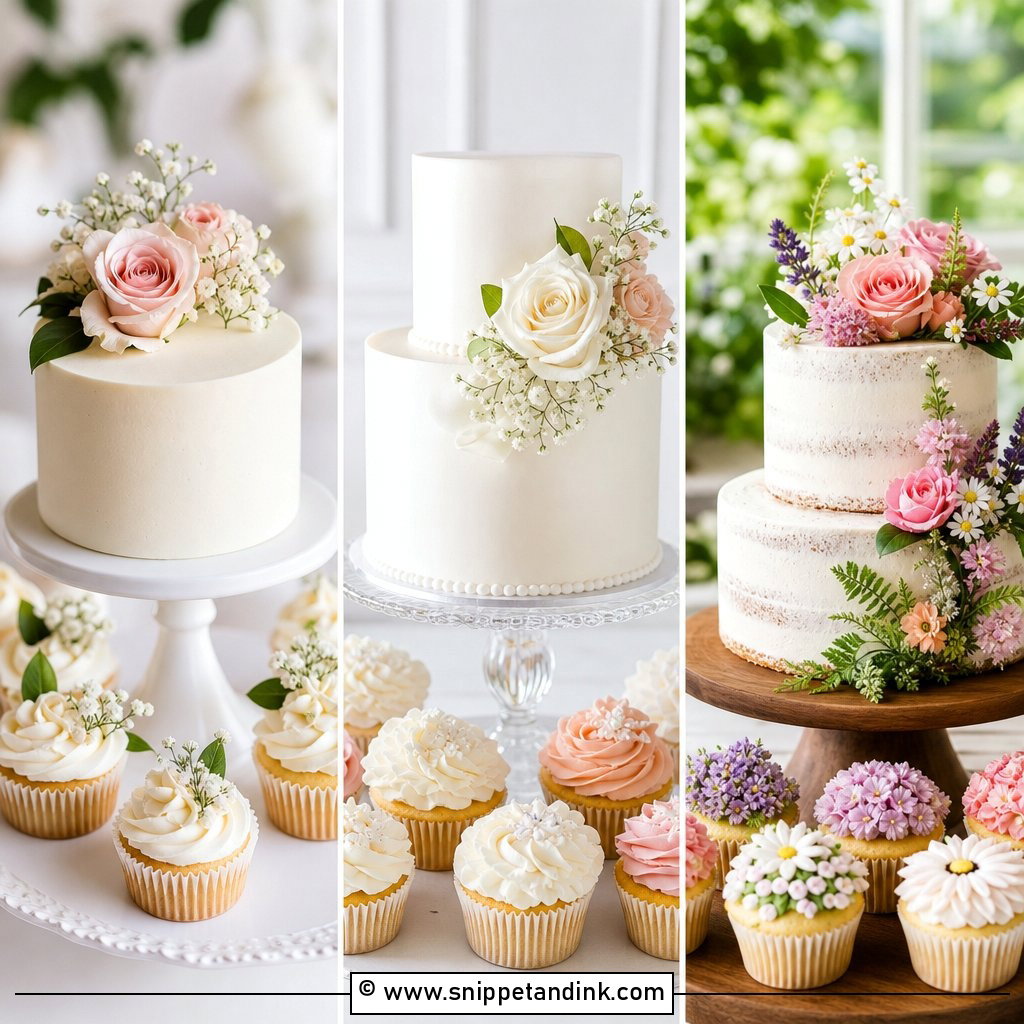
Baby’s breath is airy and inexpensive, but it can irritate skin and isn’t something to eat, so I wrap the stems and keep the clusters off the cut surface. Small bunches look intentional; covering every tier looks like packing material. It pairs with smooth buttercream, semi-naked frosting or rustic textures. Adding white roses or greenery gives depth. Minimalist weddings, barns and simple chapels suit it.
11. Sunflower Bouquet Wedding Cake
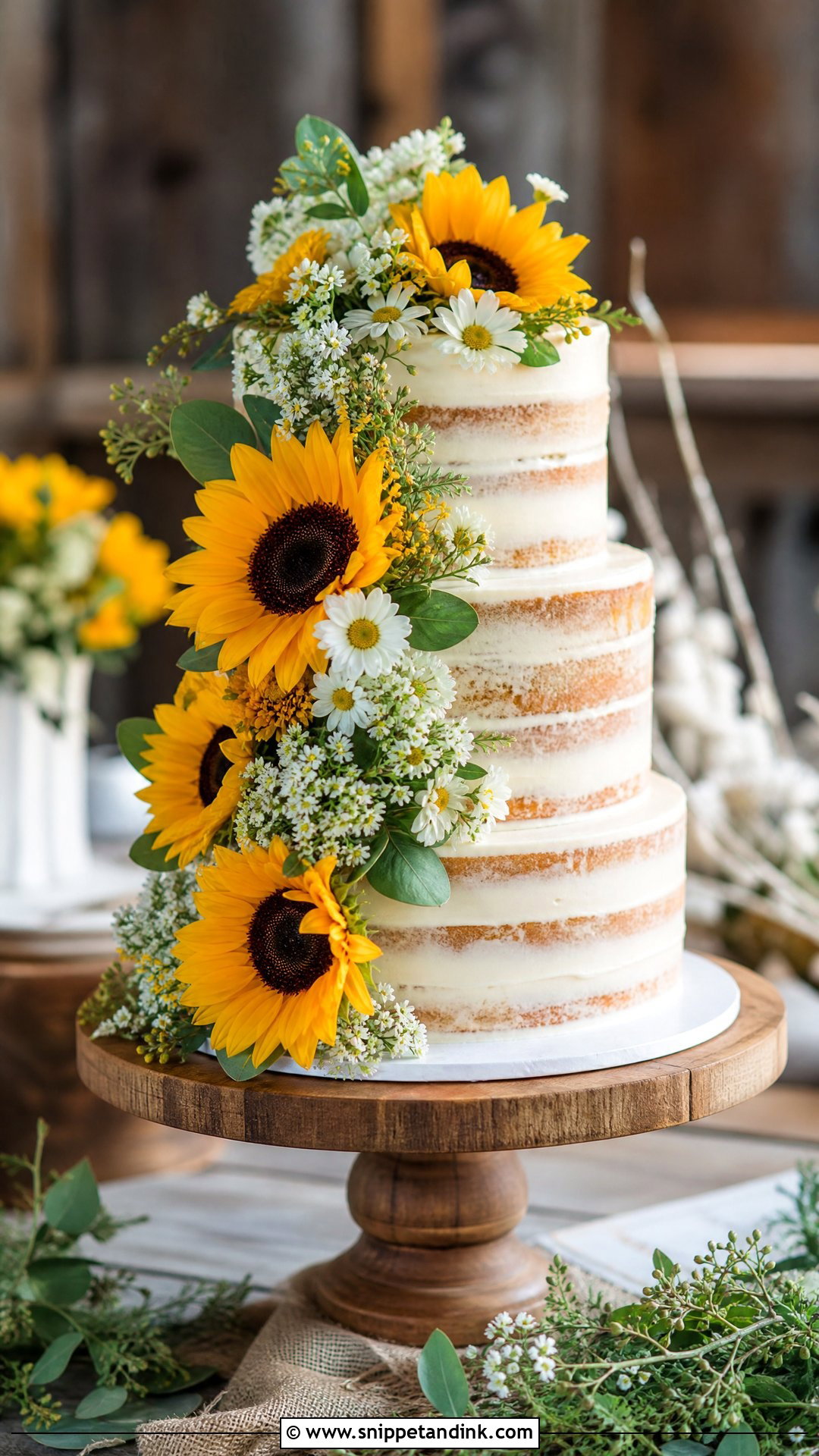
Sunflowers are bold and heavy-headed, which means they need support on a cake. I use a wrapped stem in a food-safe pick and angle the head slightly so it doesn’t tip forward. A few large blooms make more of an impact than many crowded together. A white, ivory or semi-naked cake with greenery, chamomile or small white flowers softens the yellow. Barn weddings, outdoor receptions and late-summer dates suit it.
12. Lavender Bouquet Wedding Cake
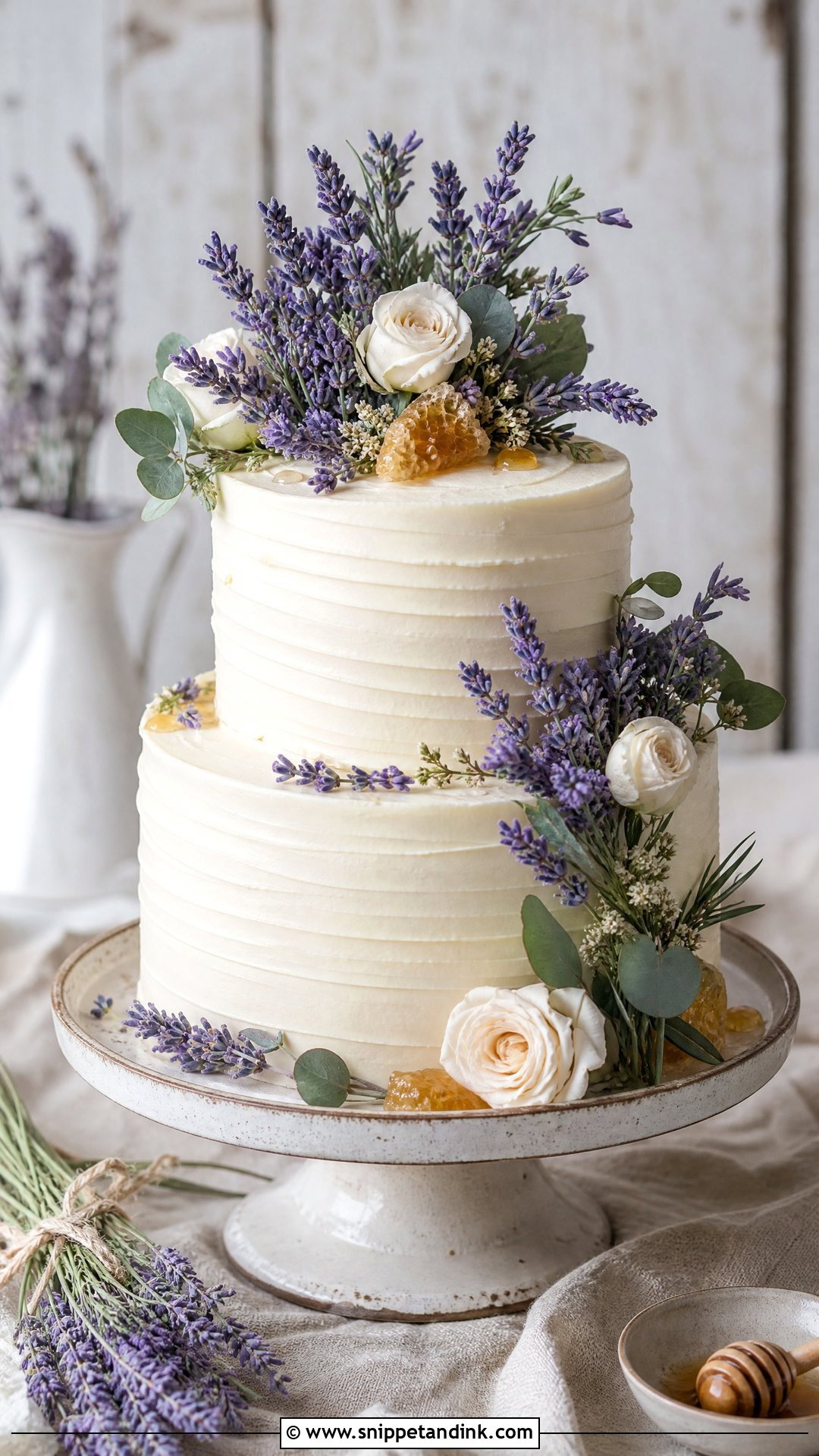
A lavender bouquet wedding cake can be edible, as culinary lavender is grown for exactly that. Pressed into the sides or bundled with white roses, it gives a soft purple accent. Flavour matters: lemon, vanilla or honey sponge pairs well, and a little lavender in the syrup ties it together. I’d use it sparingly in the flavour, since too much tastes soapy. Smooth buttercream or a watercolour lavender wash keeps the frosting light.
13. Daisy Bouquet Wedding Cake
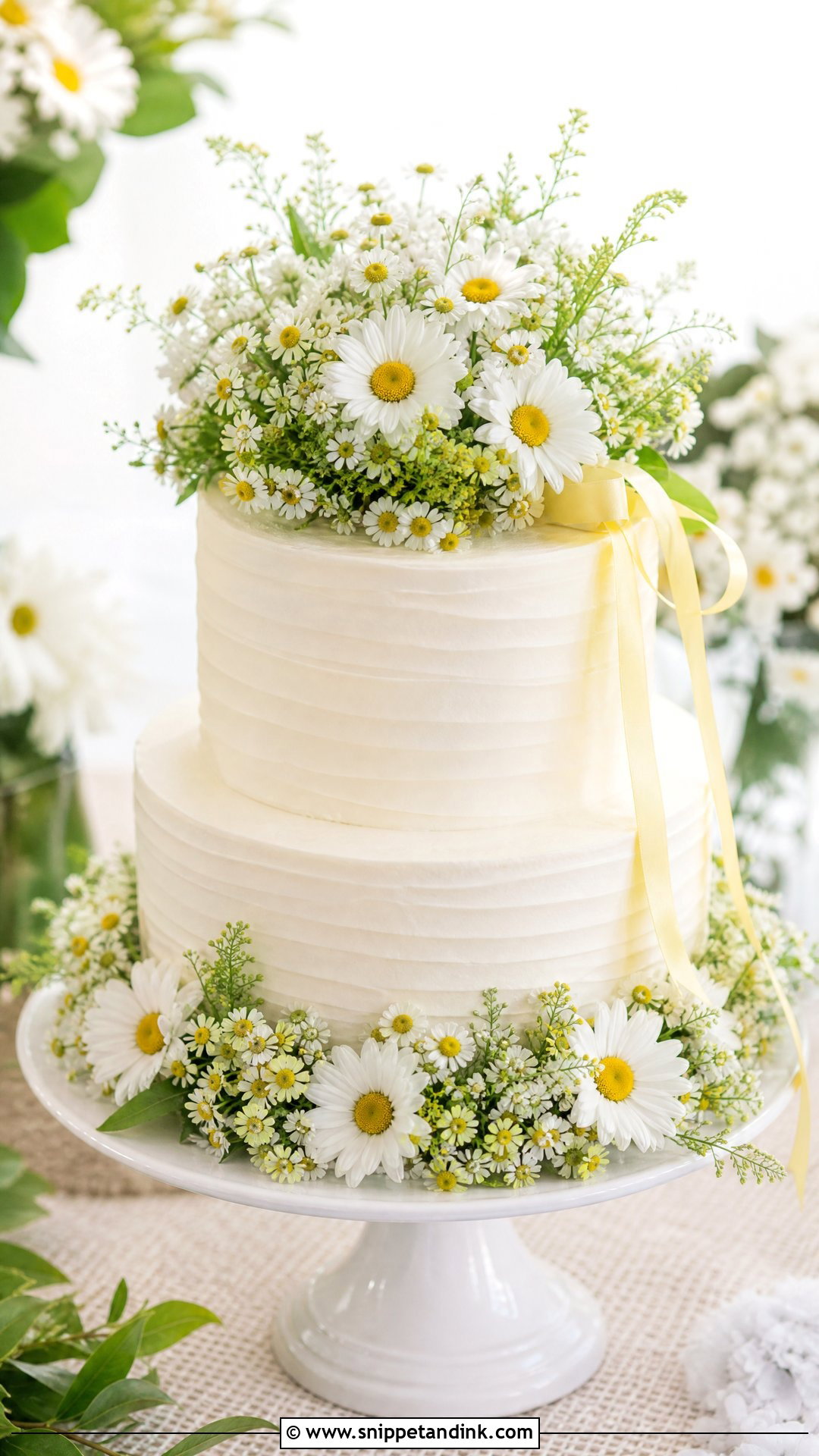
Daisies feel relaxed, and they’re fun on a casual or spring wedding cake. Common florist daisies aren’t food-grade, so I wrap them or use sugar or edible daisy varieties placed against the frosting. White daisies with yellow centres look sharp against white buttercream or a semi-naked finish. A crown on top, a wreath around the base or scattered accents all work. Chamomile or tiny wildflowers fill it out.
14. Tulip Bouquet Wedding Cake
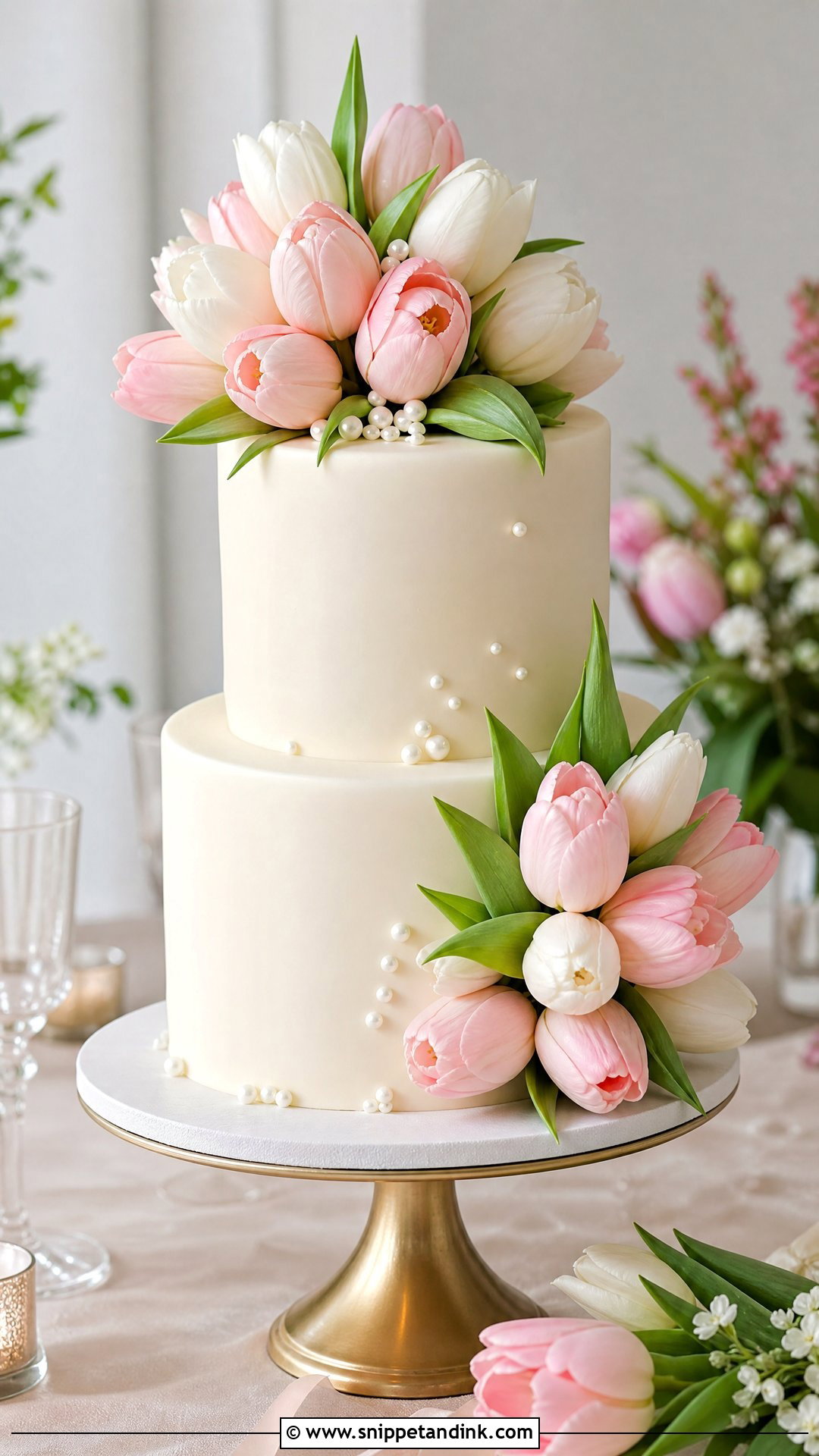
Tulips keep growing after they’re cut and bend toward light, so a tulip that’s upright at noon can lean by evening. I use them low and close to the cake, or trim them short. Their simple shape suits smooth frosting and minimal decoration. White tulips look classic, blush is softer and brighter colours are playful. A neat topper, a side cluster or a low ring around the base works. Vanilla or almond sponge pairs well with a spring look.

15. Ranunculus Bouquet Wedding Cake
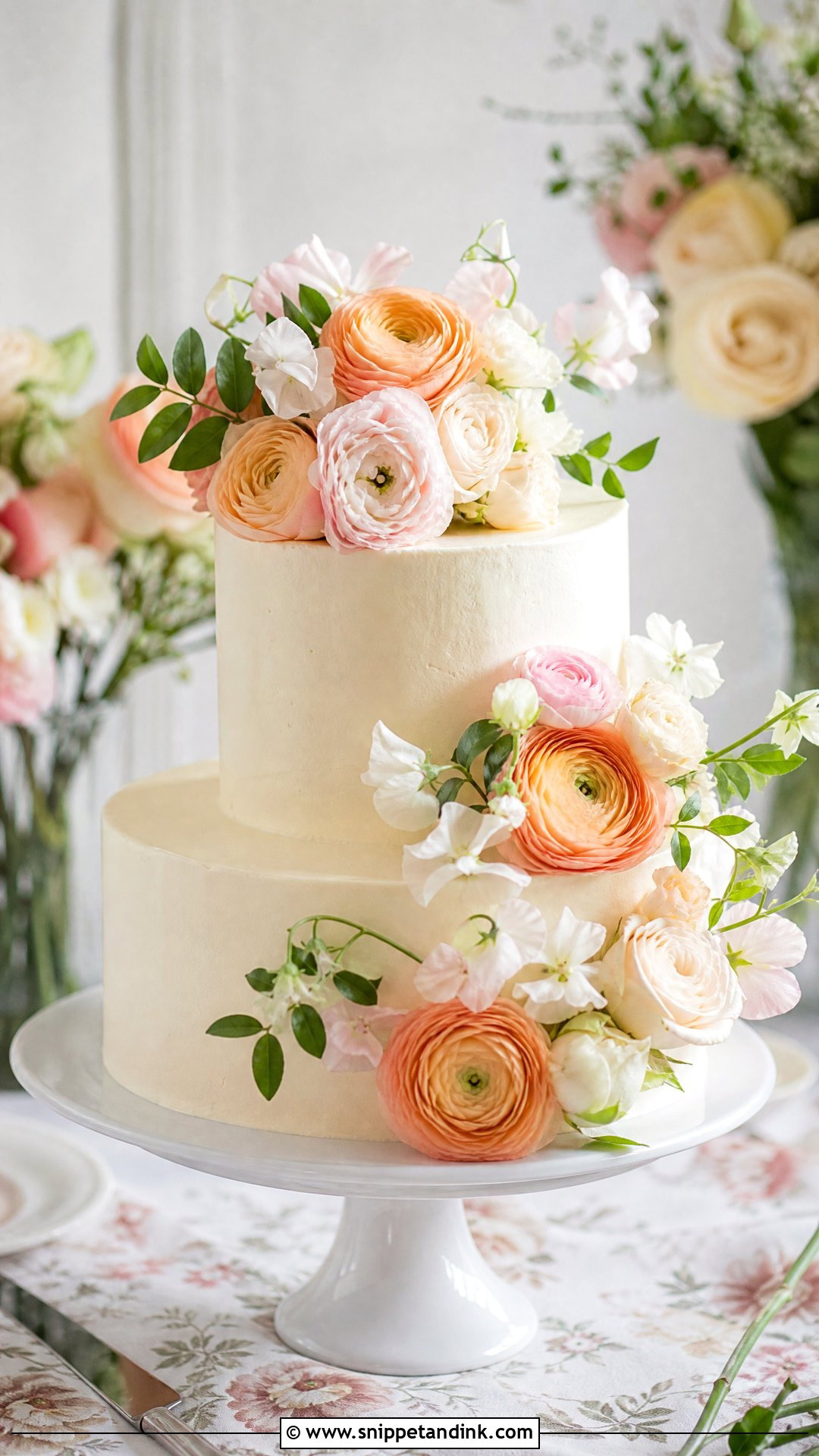
A ranunculus bouquet wedding cake gives a rose-like softness with more layered petals. Ranunculus belong to the buttercup family, which can irritate if eaten, so I treat them as decoration only, wrapped and kept on a barrier. They come in blush, cream, peach, coral and burgundy, and because they’re medium-sized, they mix easily with greenery, sweet peas and small filler blooms. Smooth buttercream or fondant keeps the petals as the focus.
16. Anemone Bouquet Wedding Cake
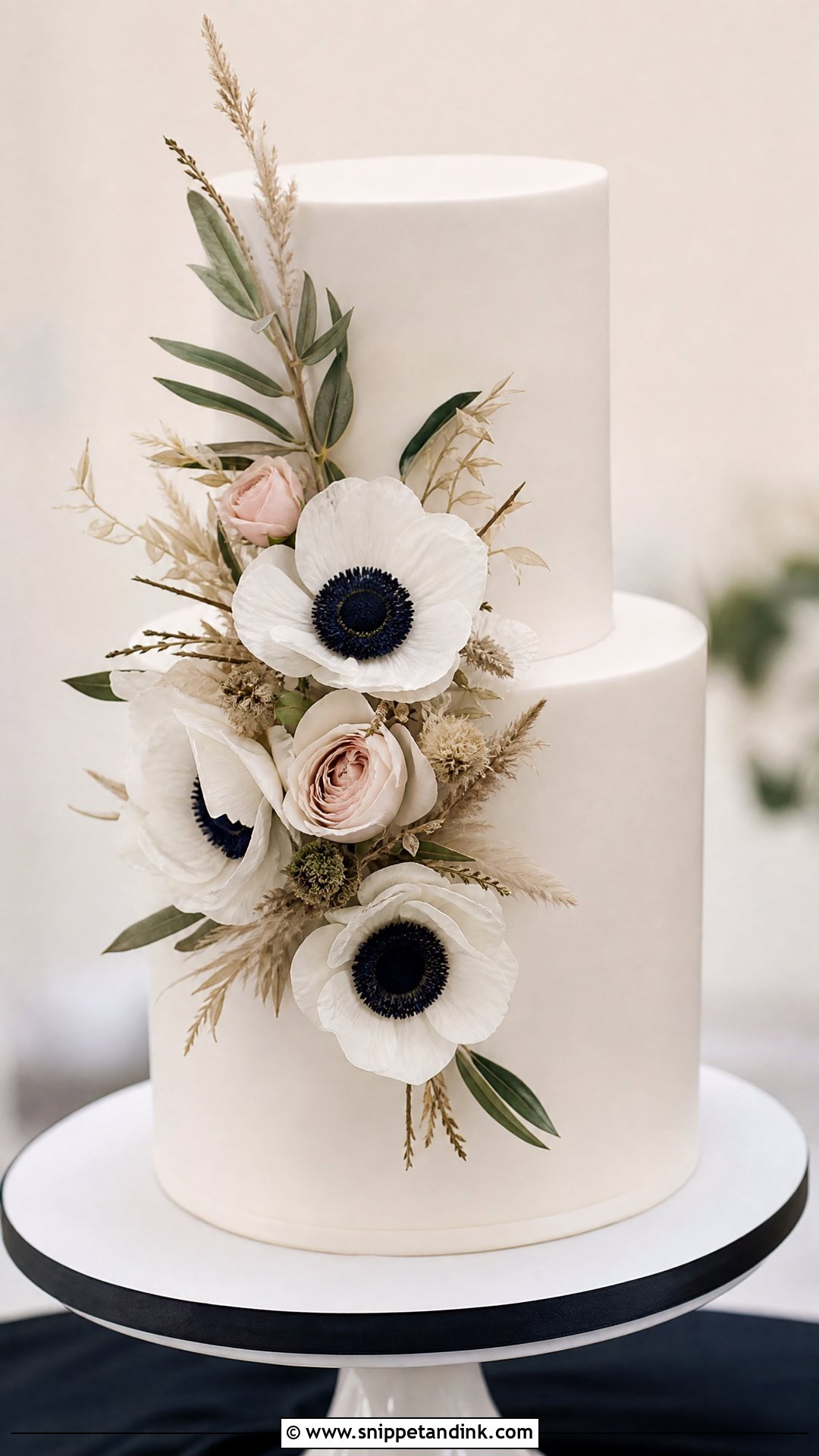
White anemones with dark centres give a cake contrast without any harsh colour. They’re in the same plant family as ranunculus, so the same rule applies: decoration only, on a barrier. Against ivory buttercream or fondant they look graphic and modern. A few go a long way. Soft greenery, blush roses or dried accents warm them up. Anemones are a cool-season flower, so they’re easiest to get in late winter and spring. They match modern stationery well.
17. Blush Bouquet Wedding Cake
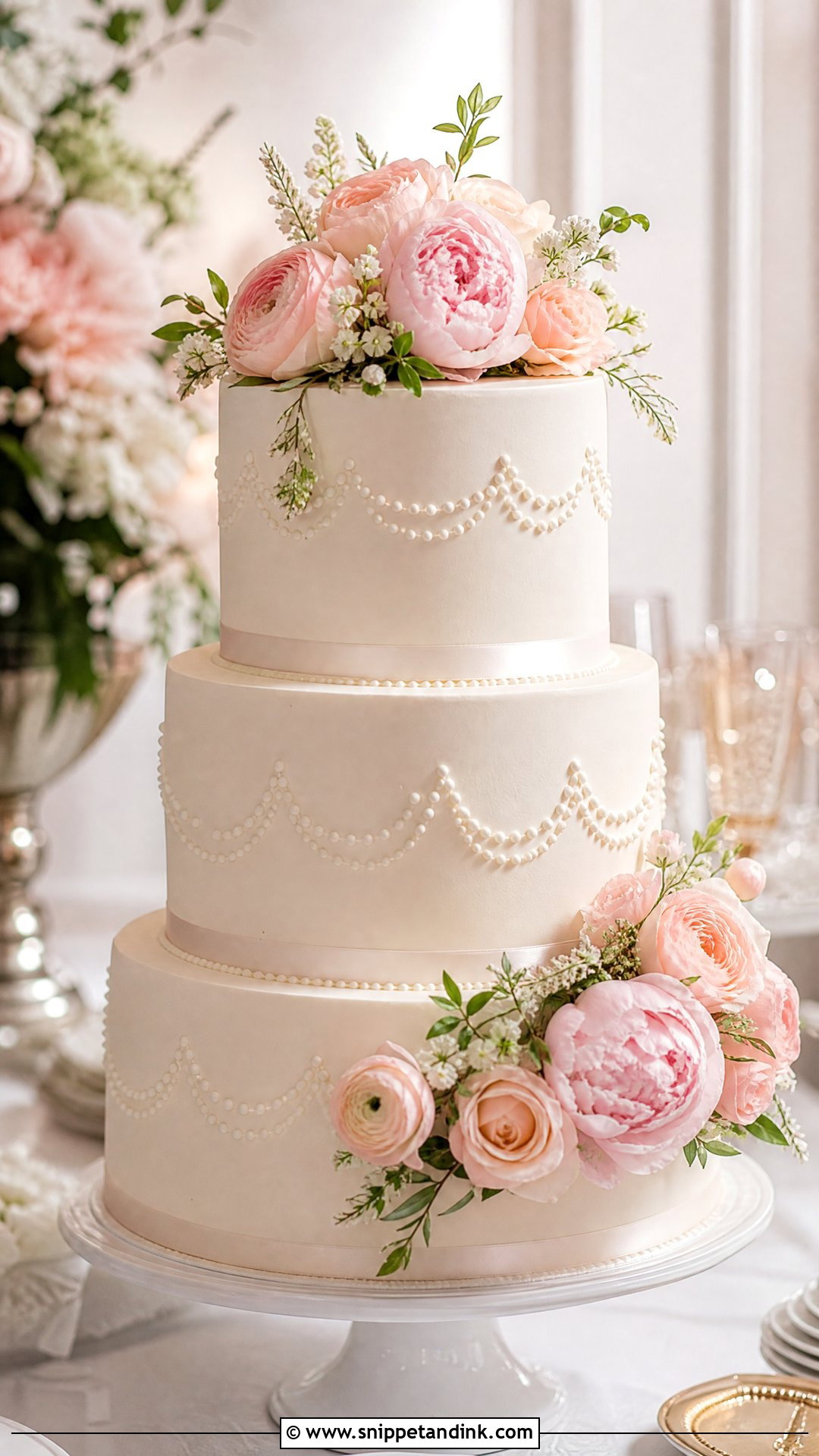
Blush flowers suit nearly every palette and season, which is why I recommend them when a couple can’t decide. Blush roses, peonies, ranunculus or lisianthus on white or ivory. A formal cake gets smooth fondant and sugar flowers; a relaxed one gets textured buttercream and fresh blooms. A little greenery or pearl detail adds dimension. The colour should be consistent across the flowers, since mismatched pinks look accidental.
18. White Flower Bouquet Wedding Cake
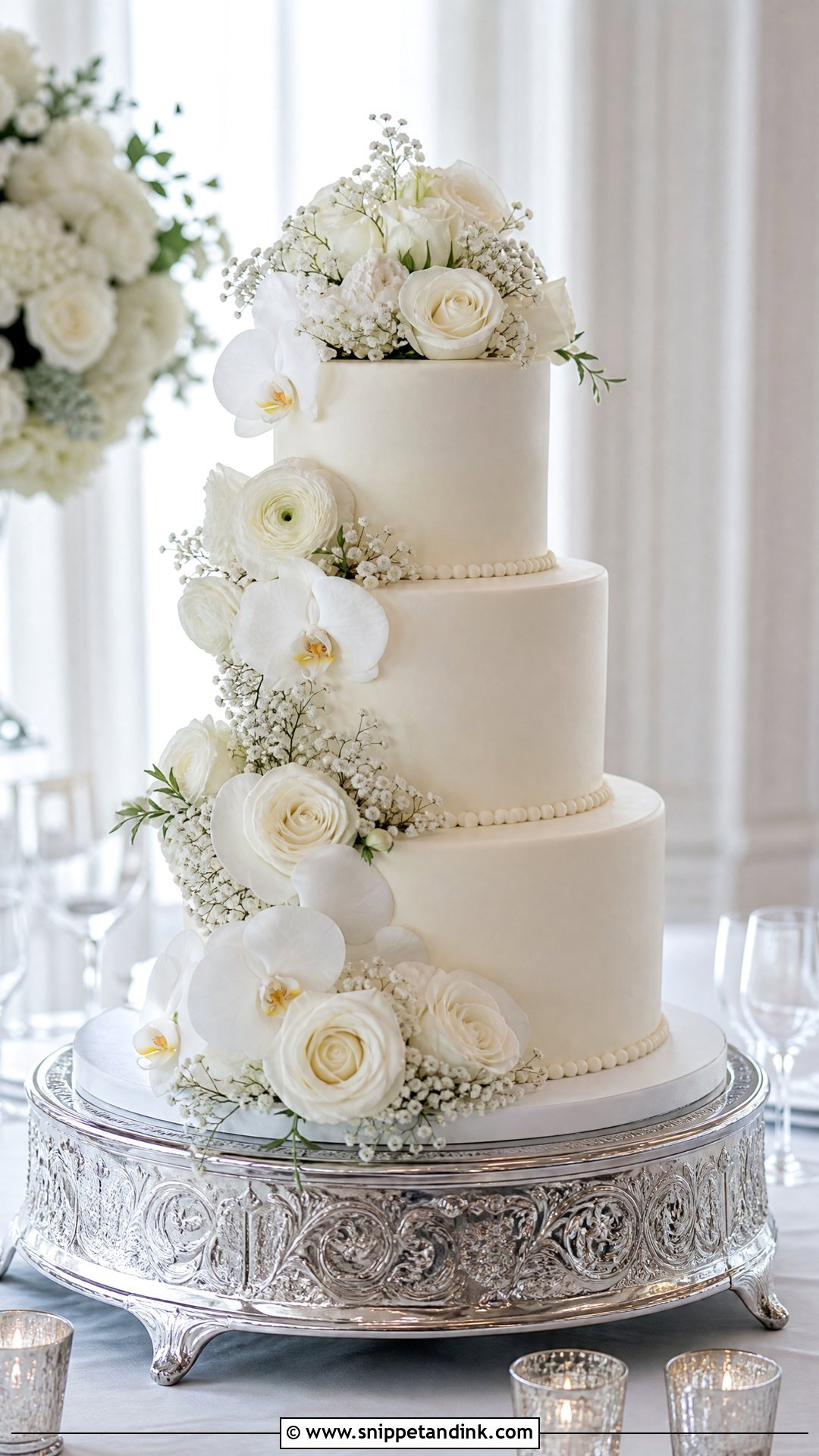
An all-white floral cake can look flat if every bloom has the same shape. I vary them: a round rose, a pointed orchid, a frilly ranunculus, a cloud of baby’s breath. Different textures read even when the colour doesn’t change. Smooth fondant or crisp buttercream shows them off, and soft piping, pearl details or a satin ribbon add more texture. It suits chapels, ballrooms and garden tents.
19. Pastel Bouquet Wedding Cake
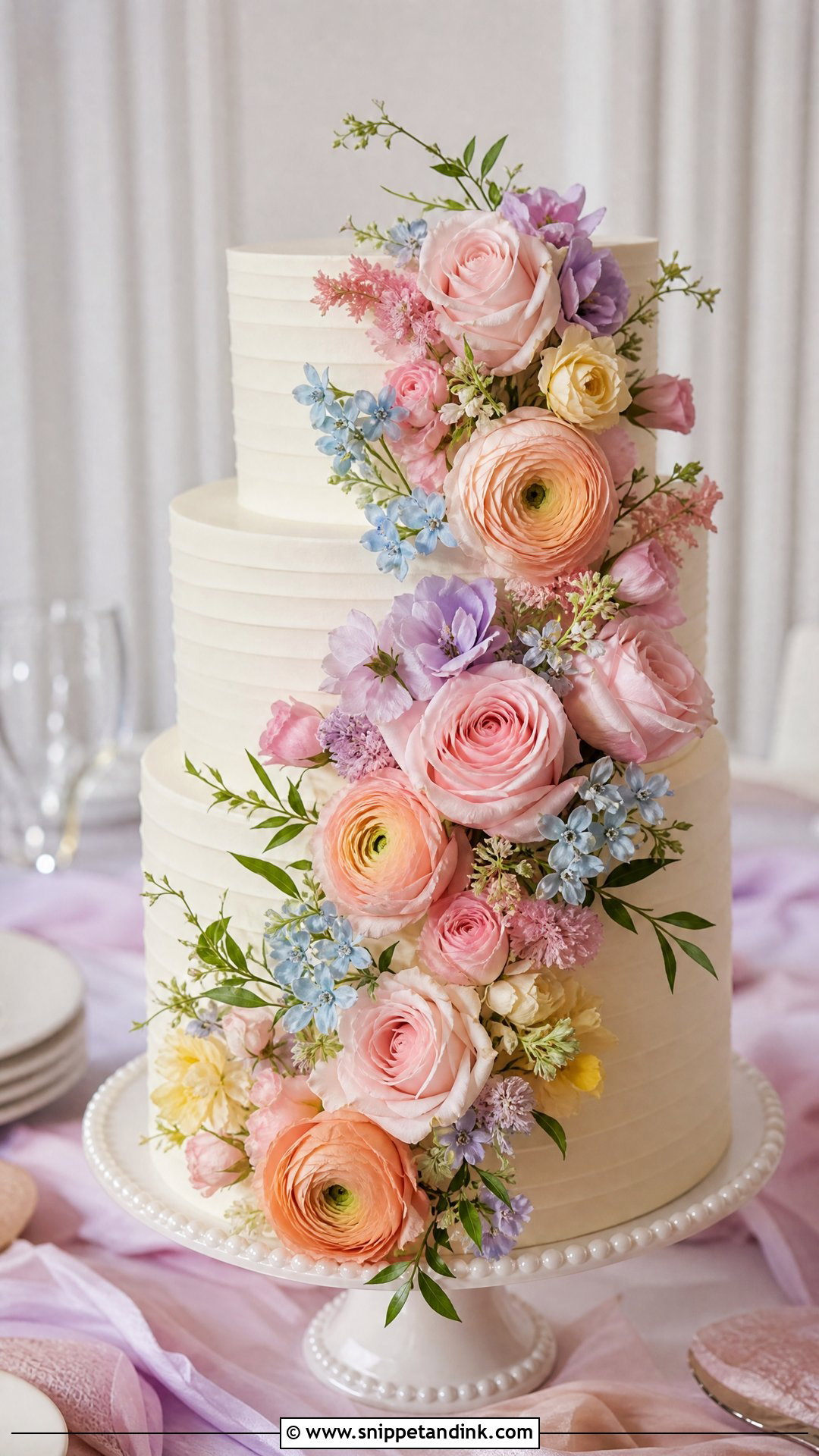
Pastel flowers in pale pink, peach, lavender, butter yellow and baby blue create a watercolour effect, and the cake underneath should stay plain. White buttercream or ivory fondant works. I mix small and medium flowers so it looks balanced. Pearl accents, soft ribbons and delicate greenery suit pastels. It’s colourful without being loud, which is why spring and summer couples tend to like it.
20. Boho Bouquet Wedding Cake
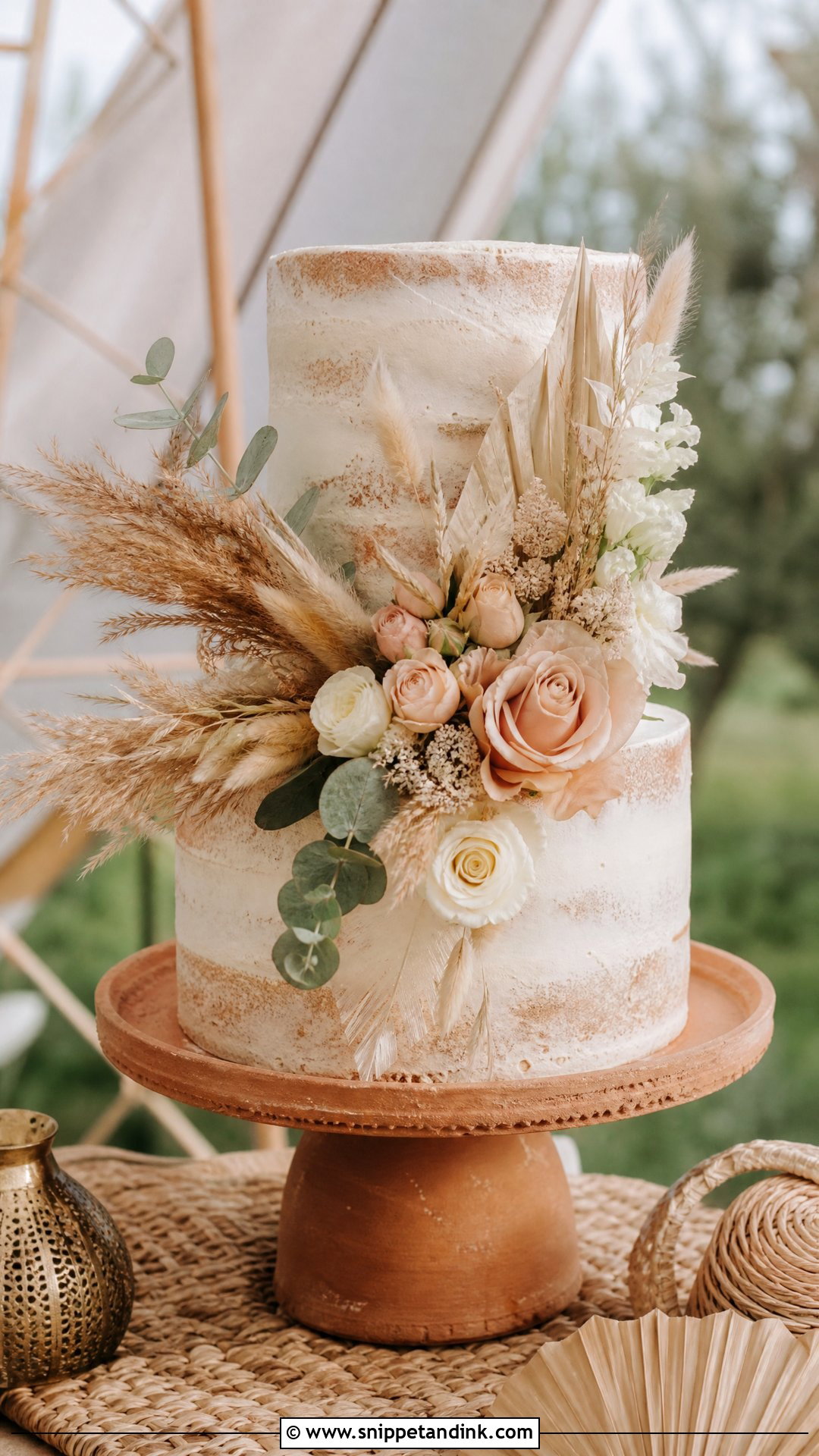
Boho cakes often use dried flowers, grasses and muted roses, and dried stems shed. Pampas and bunny tail grass drop fibres onto the frosting, so I seal dried pieces with a light spray before they go anywhere near the cake and keep them away from the slice zone. Semi-naked or textured buttercream suits the theme. A cream, tan, blush, rust and sage palette keeps it coordinated. The bouquet can sit on top, wrap the base or flow down one side.
21. Rustic Bouquet Wedding Cake
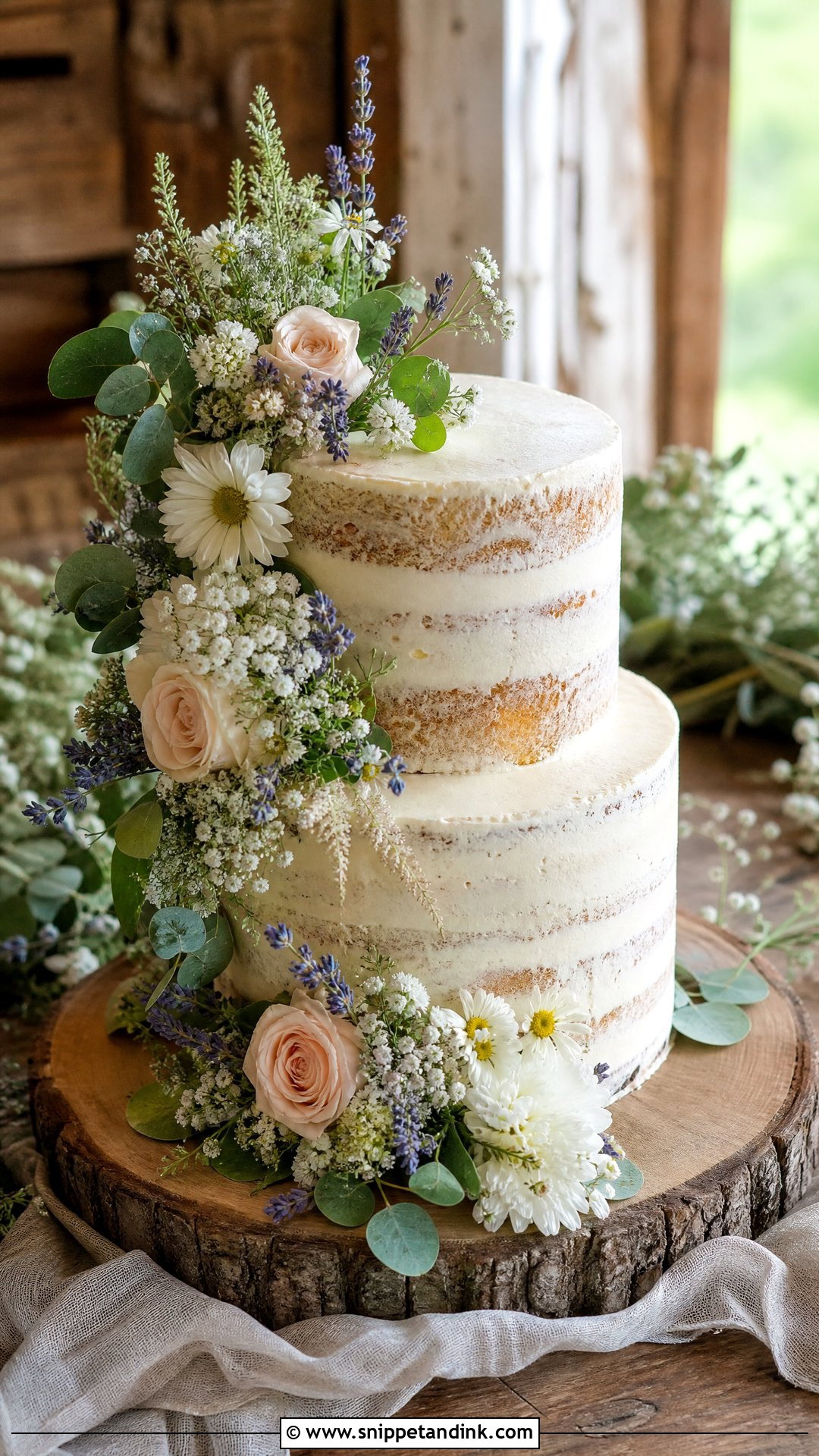
Rustic cakes are usually semi-naked with fresh flowers and greenery, set on a wood stand. Roses, daisies, baby’s breath, lavender and small wildflowers fit. Eucalyptus is popular but it isn’t edible and has a strong oil, so I keep it wrapped and on a barrier rather than in direct contact. Olive leaves and herbs like rosemary add texture safely. Grouping the flowers like a real bouquet keeps it looking styled rather than randomly decorated.
22. Minimalist Bouquet Wedding Cake
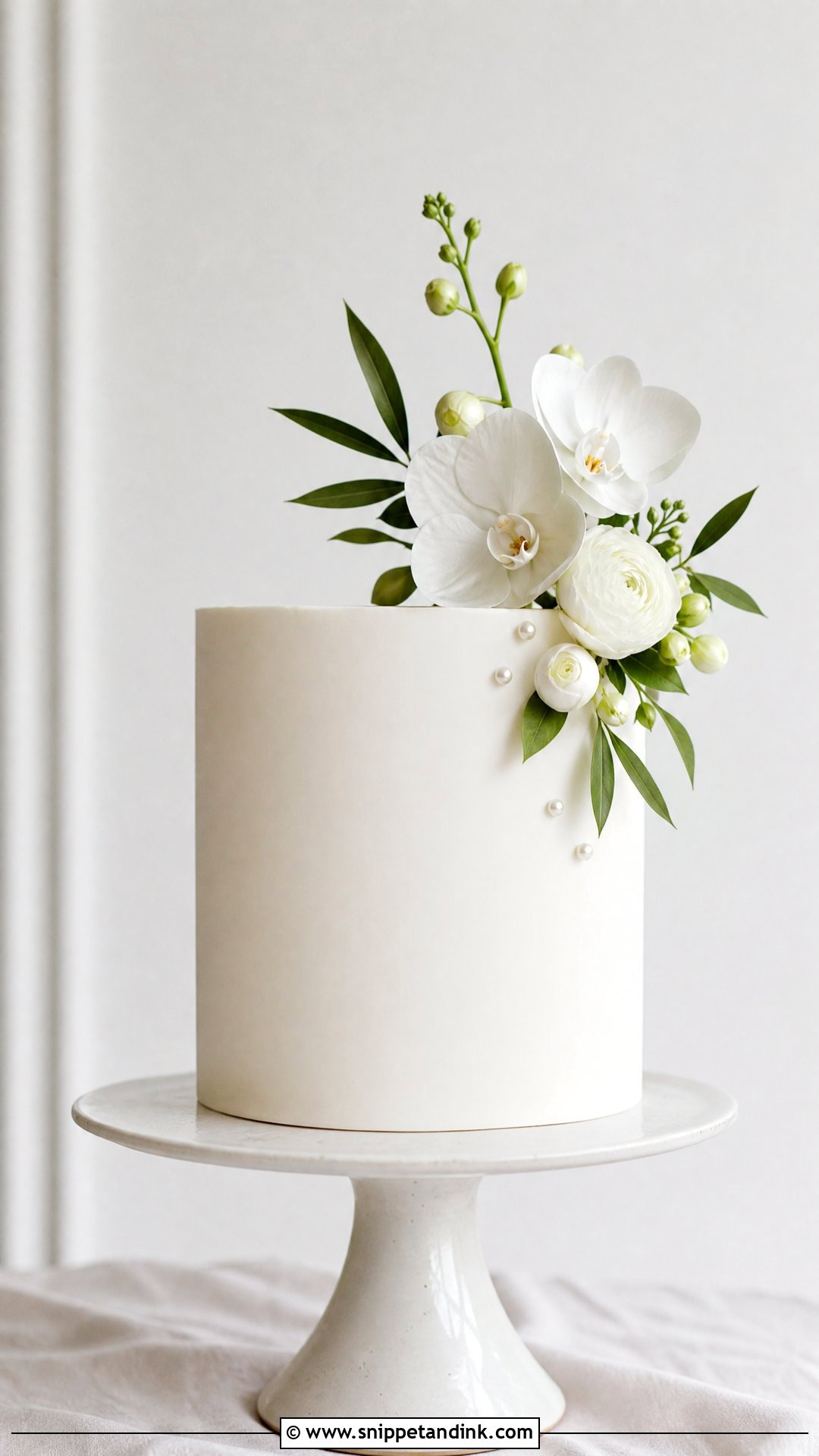
A minimalist floral cake relies on empty space, so the finish has to be perfect; every bump in the frosting shows when there’s nothing to distract from it. A smooth white or ivory cake with one small cluster or a single topper. White roses, orchids, tulips or ranunculus suit it best. Modern weddings, courthouse receptions and intimate dinners suit it. A slim cake stand and simple table styling keep the look clean.
23. Colorful Bouquet Wedding Cake
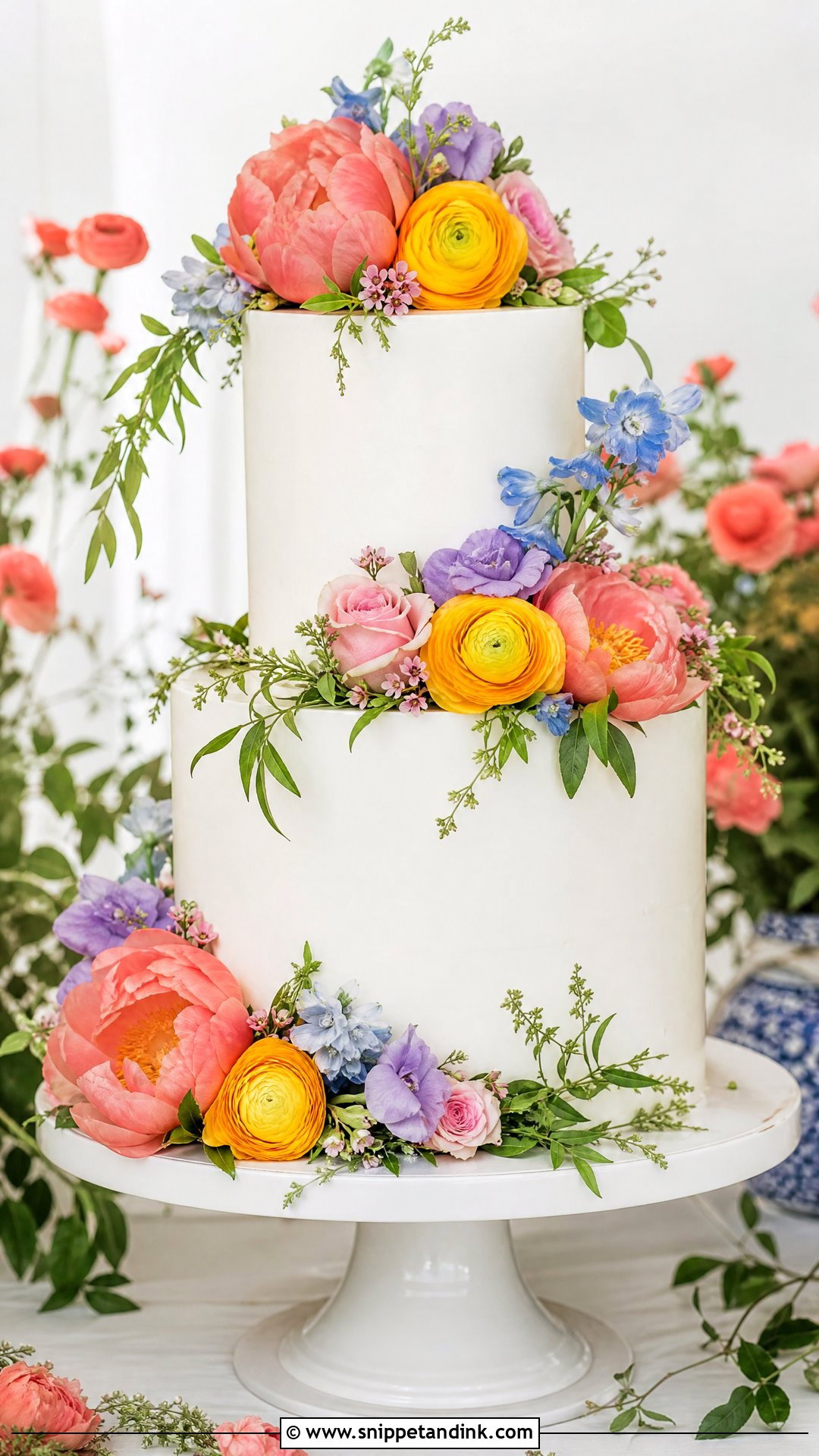
Bright colour works if it’s placed with confidence. I use full clusters of bright roses, coral peonies, yellow ranunculus, blue delphinium or purple lisianthus rather than scattered pieces, which look busy. A clean white cake base keeps the colours from fighting. Delphinium is toxic, so it stays wrapped and off the frosting. The colours should come from the bridal bouquet or tablescape so the cake belongs in the room.
24. Sugar Flower Bouquet Wedding Cake
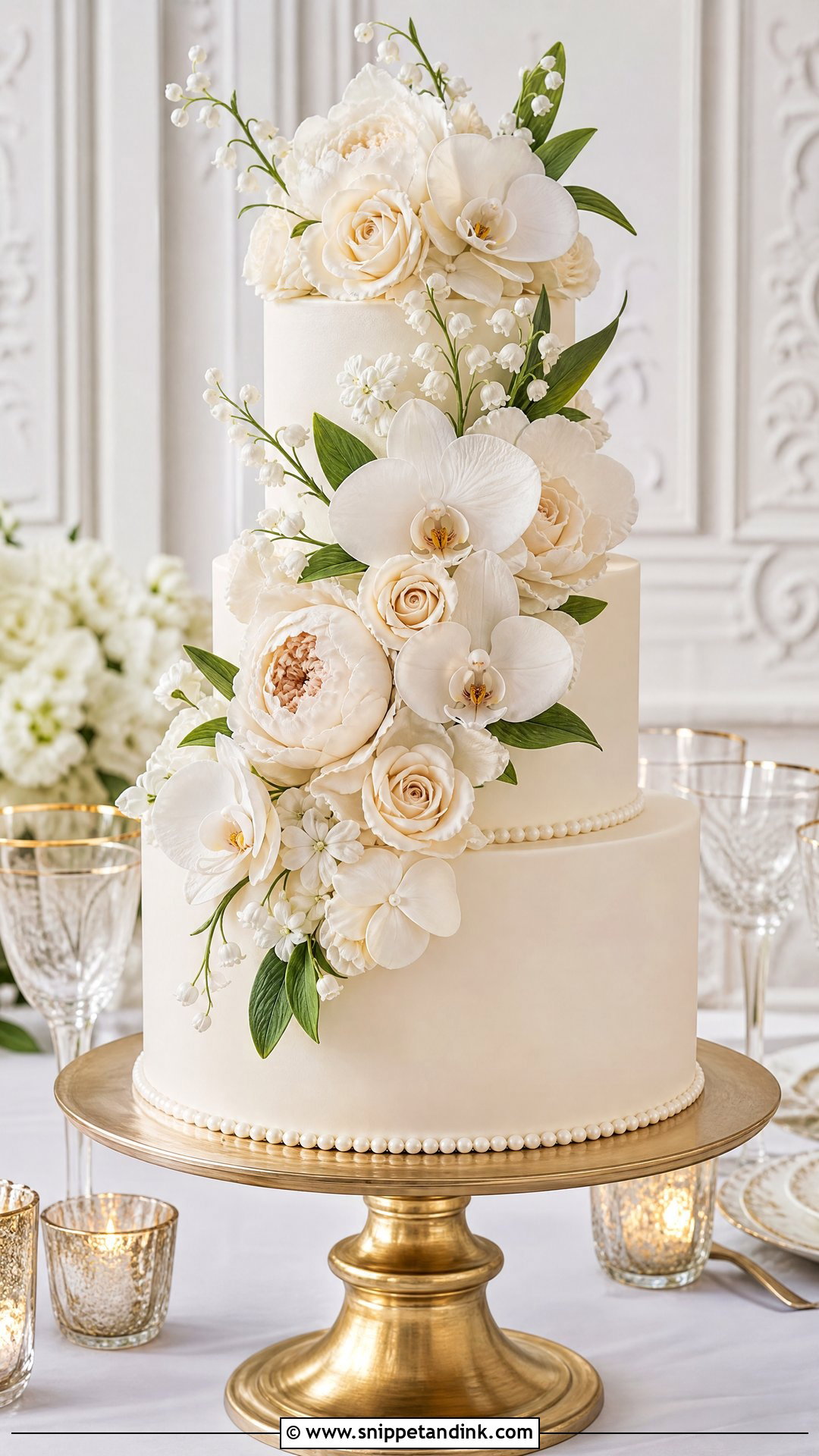
Sugar flowers are the most reliable option for a warm room, a long display or a flower that isn’t edible or isn’t in season. They’re made petal by petal from gum paste, wired, dried and dusted with colour, which takes time, so I’d book them well ahead. Humidity is their weak spot: gum paste softens and droops in a very humid room. Smooth fondant is the cleanest background. Most couples keep the sugar flowers as a keepsake, as they’re technically edible but hard and wired.
25. Buttercream Flower Bouquet Wedding Cake
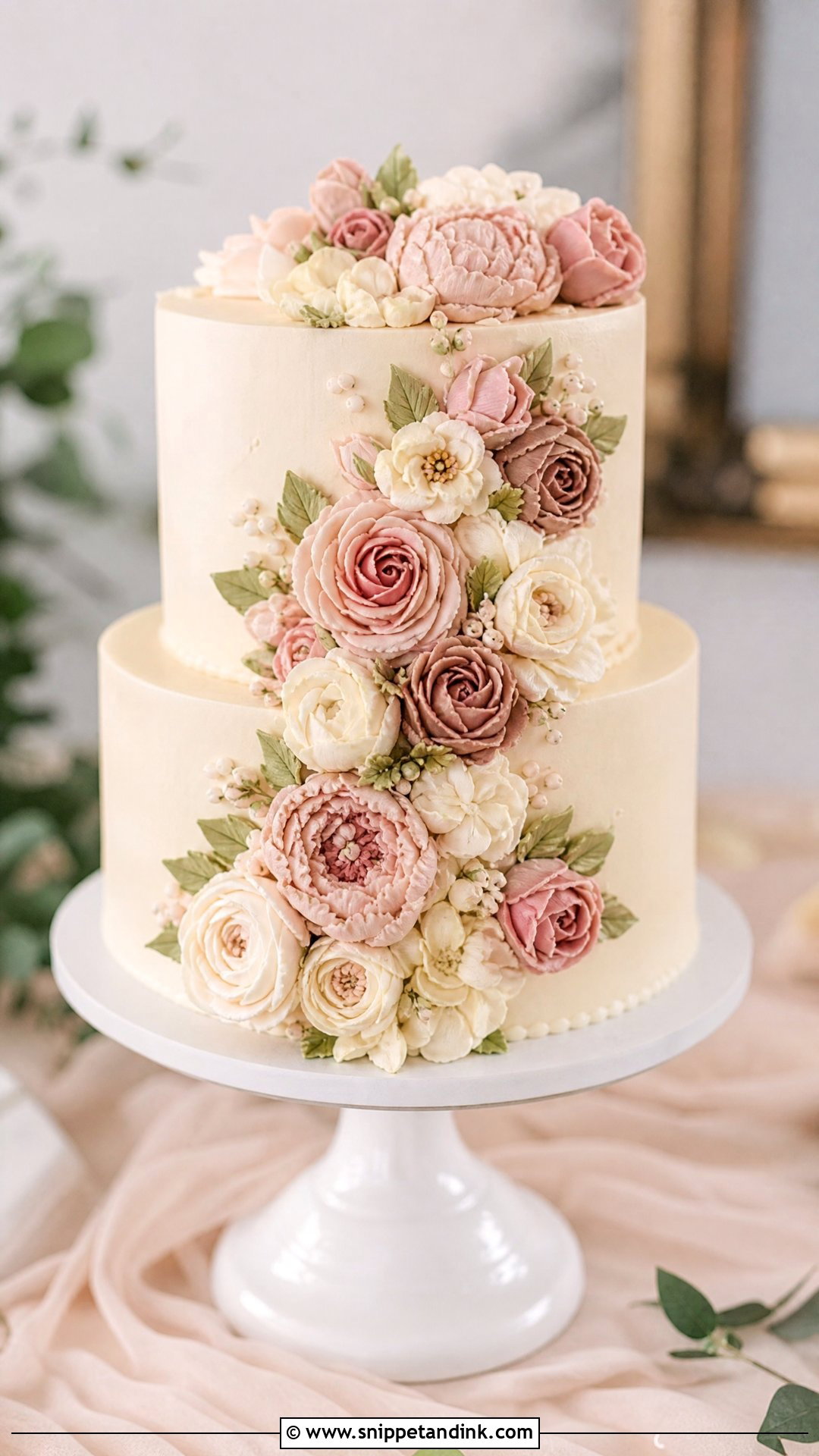
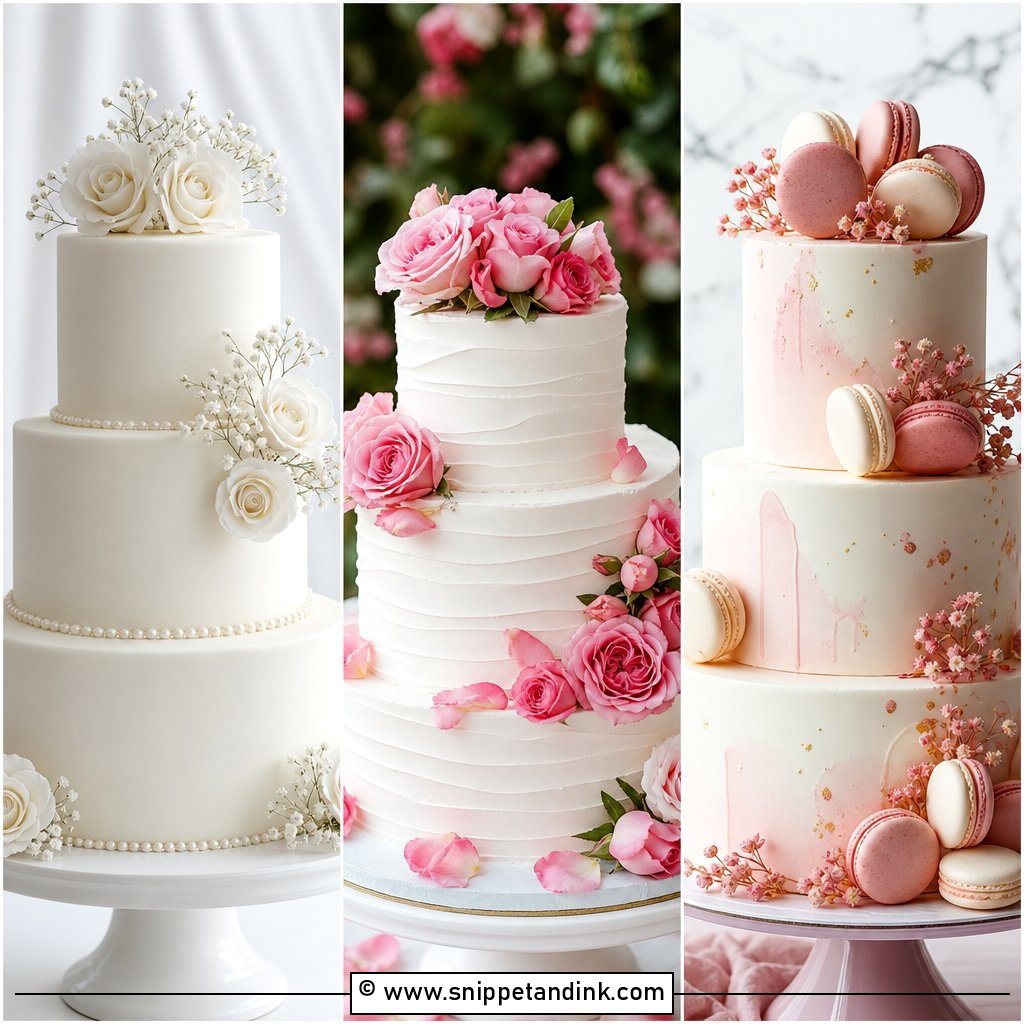
Piped buttercream flowers are the fully edible option, since the bloom is the frosting. Roses, peonies, blossoms, leaves and buds are piped directly onto the cake in the wedding colours. They’re softer than sugar flowers and sensitive to heat; in a hot room the petals lose their edges, so I’d keep this cake cool until serving. A white or pastel base shows them clearly. The style leans slightly vintage, though it can look fresh with a modern palette.
26. Floral Wreath Wedding Cake
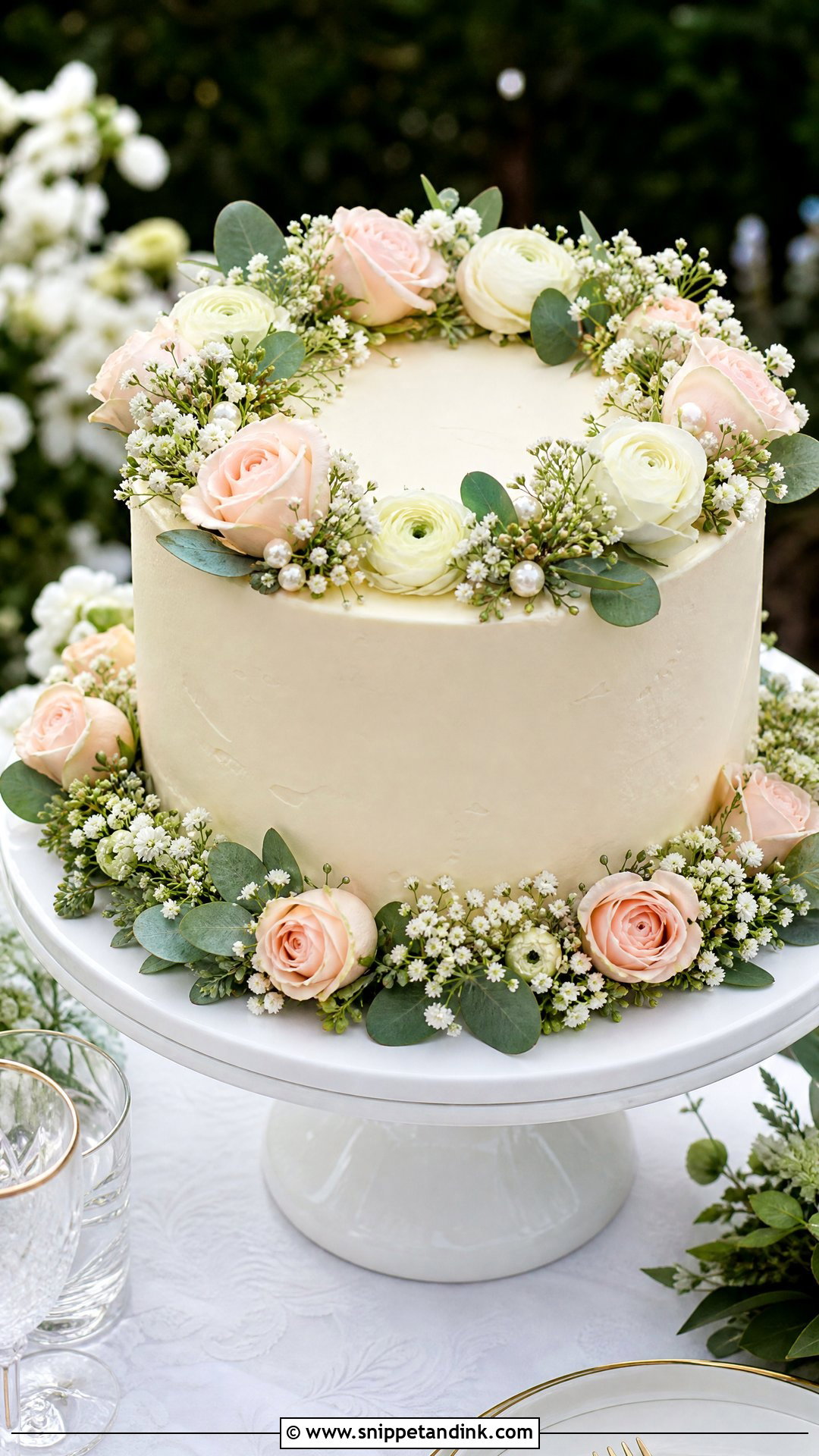
A floral wreath cake uses flowers in a circle around the top, middle or base. It’s balanced and photographs well from any side. Roses, baby’s breath, greenery, ranunculus and small wildflowers all work in wreath form. If the wreath sits at a tier join, the flowers rest on the board edge rather than in the frosting, which is easier to keep food-safe. It works on a single tier or several. Keep the circle shape clear.
27. Cake Meadow Wedding Cake
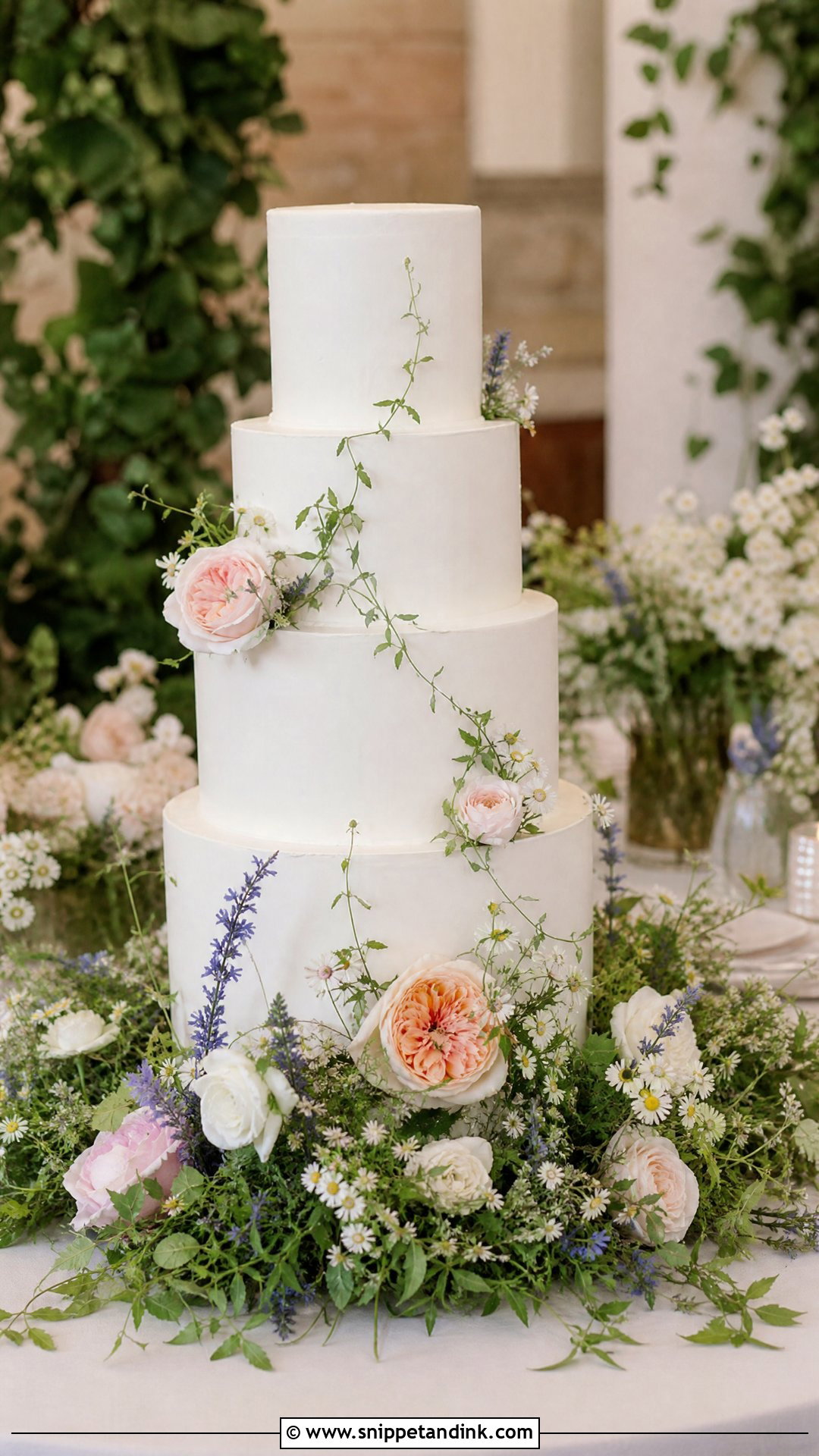
A cake meadow sets the cake inside a low field of flowers on the table, so the cake itself stays clean and the flowers never touch it. That’s a real advantage if the couple wants flowers that aren’t food-safe. The flowers usually sit in low trays of water or soaked floral foam hidden under greenery. It needs a wide table. Matching the meadow blooms to the bridal bouquet ties the table together. It suits gardens, tents and outdoor venues.
28. Single Tier Bouquet Wedding Cake
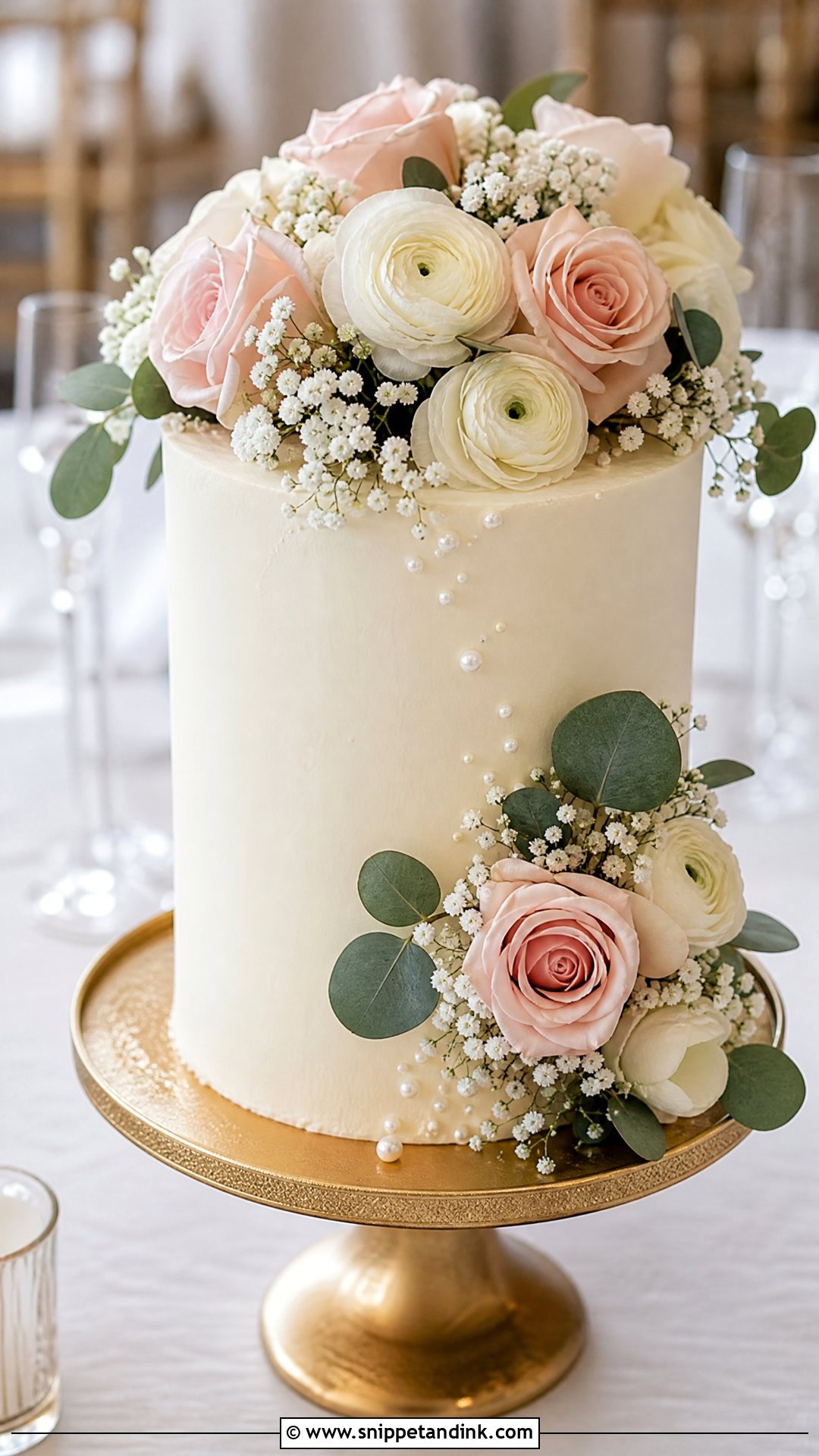
A single tier works for elopements, small weddings and couples serving other desserts. I’d make it a little taller than standard, an extra layer or two, so it reads as a centrepiece. Flowers should be scaled down to suit; a full-size bridal bouquet on one tier swamps it. Smooth buttercream, soft piping or a semi-naked finish all work. It’s easy to display on a small table.
29. Three Tier Bouquet Wedding Cake
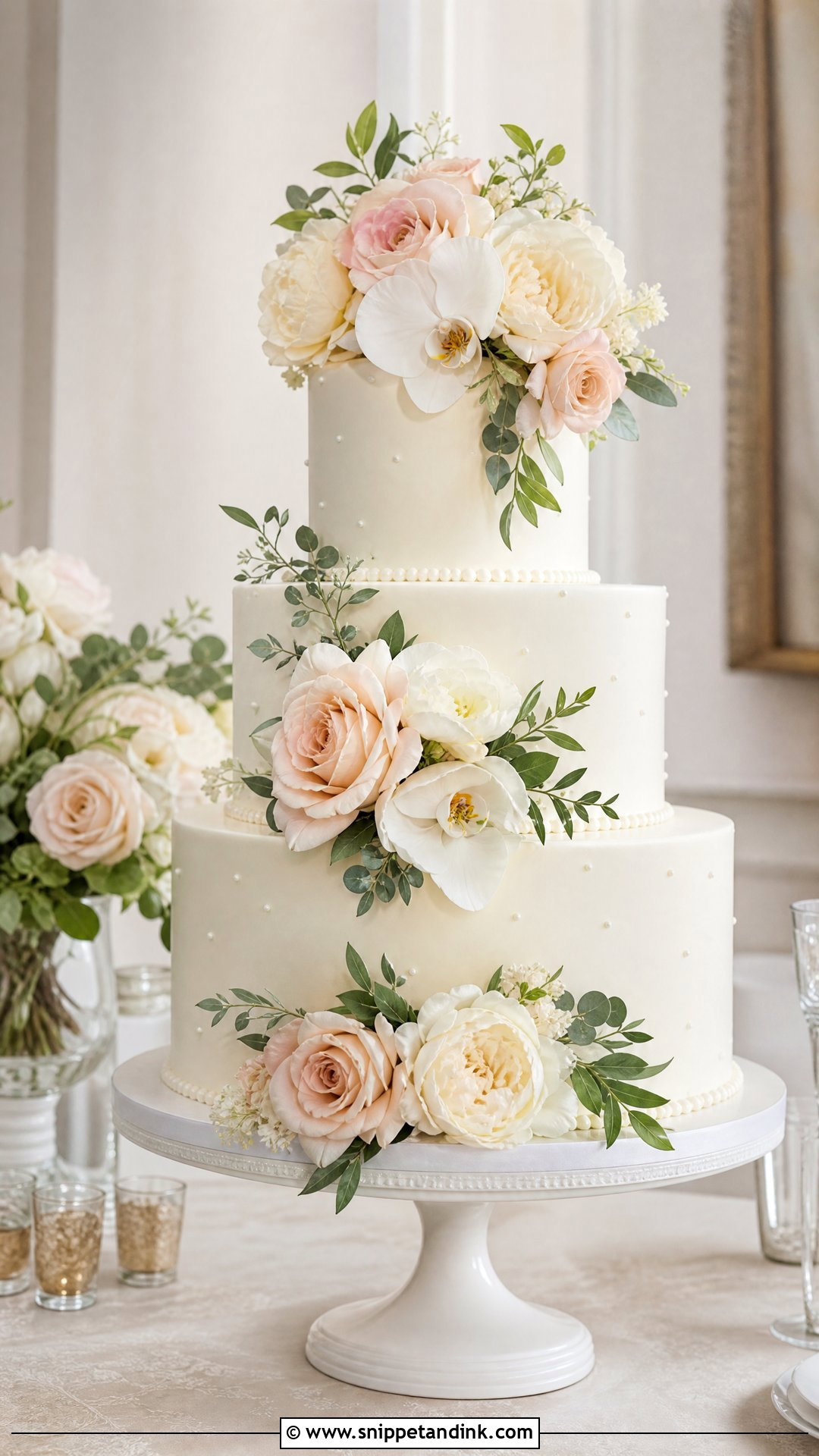
Three tiers give enough height for a topper, side flowers and a base arrangement without dominating a room. Taller tiered cakes need internal dowels and a central support so the weight of upper tiers and flowers doesn’t sink the lower ones. A cascade adds drama, wreaths add balance and small clusters look clean. White, ivory or pale blush frosting keeps flowers as the focus. It has presence in wide reception photos.
30. Round Bouquet Wedding Cake
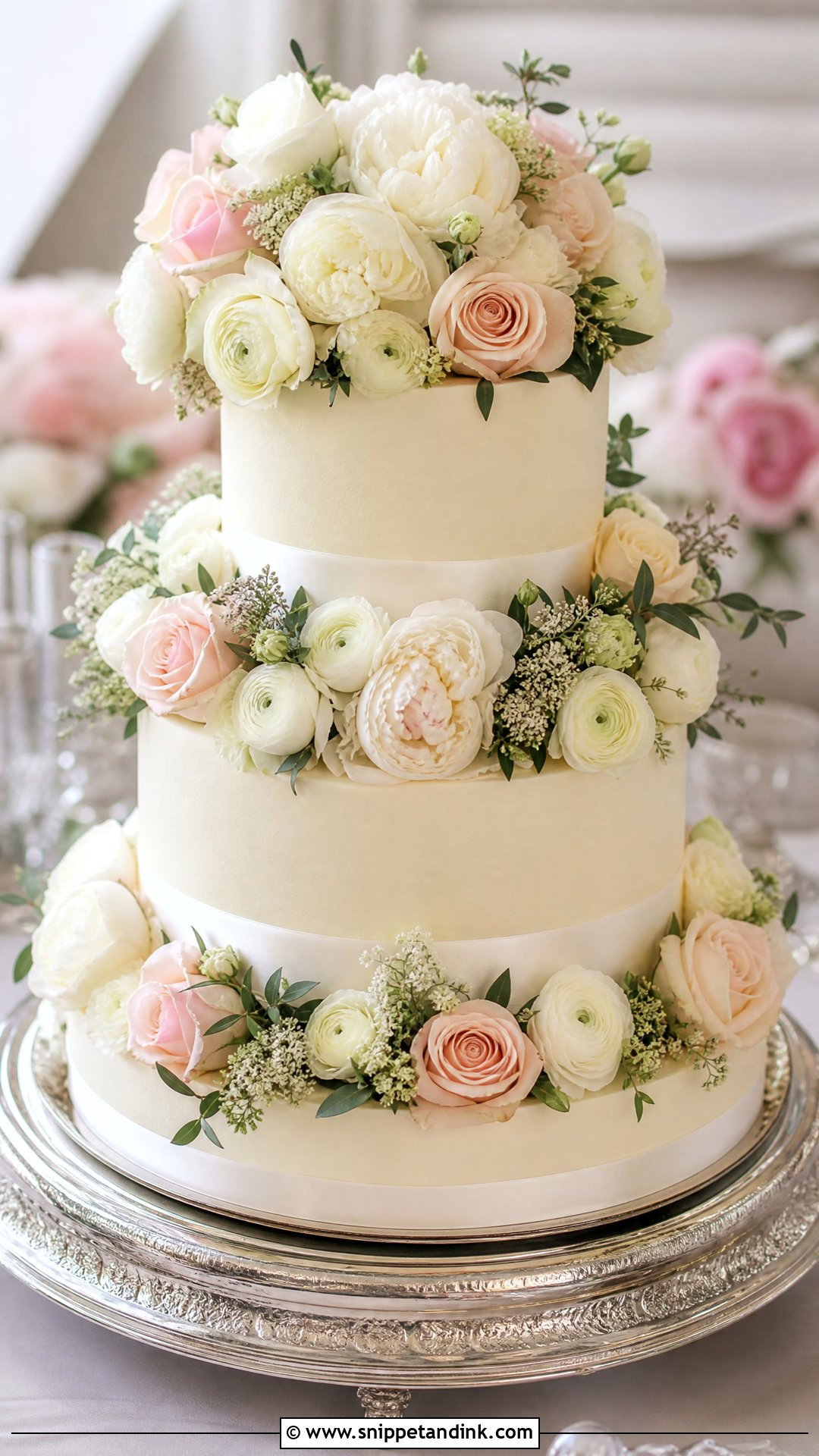
Round tiers are the classic shape and they work with nearly every floral style. The curves soften roses, peonies, orchids, wildflowers and greenery. A single bouquet on top keeps it simple; flowers between tiers make it fuller. Smooth frosting looks formal, textured buttercream more relaxed. Round cakes also cut more predictably than square or hexagonal ones, which helps whoever is slicing at the reception.
Who Dresses the Cake, and How Late
Fresh flowers on a cake should go on as close to the reception as possible. Cut flowers out of water start to wilt within a few hours, and a cake that’s been finished in the morning and left in a warm room can look tired by the time it’s cut.
- Decide in writing whether the baker or the florist places the flowers. Florists often assume the baker will, and vice versa.
- Ask the florist to set aside the cake stems, conditioned and ready, with the colours matched to the bouquet.
- Plan for the person placing them to arrive after the cake is set up but before guests enter.
- Have someone remove the flowers before cutting, along with any picks or wires.
Sugar flowers take this pressure off. They can be placed at the bakery and travel on the cake, or be added at the venue in minutes. If the reception is outdoors in summer or the couple wants a long display before cutting, sugar or piped flowers will look the same at 9 p.m. as they did at 4 p.m.
Getting the Baker and Florist on the Same Page
A floral cake links the dessert to the flowers, which is often what couples care about most. Roses, peonies, wildflowers, orchids, pressed petals and piped blooms can all fit a venue and palette. Plan the flowers with both your baker and florist, confirm which fresh stems are safe near food, and decide who places them and when. Think about the season and room temperature too. A well-planned floral cake does double duty as a centrepiece on the reception table.
You'll Like These Ideas:




Leave a Reply