
A sunflower is one of the easiest flowers to read at a glance, which is exactly why it suits a cake small enough to sit in one hand. When I plan individual cakes for a late-summer reception, each one has to work as its own little centerpiece, so the flower carries most of the design and the frosting stays quiet. That restraint matters on a crowded dessert table, where forty or eighty tiny cakes either look like a planned display or like clutter. Below are the twenty finishes I’d actually put in front of a couple, from bare sponge with a single bloom to fondant with gold edging, with notes on which ones cope with heat, distance and a long reception.

Real, Sugar or Piped: Deciding What the Sunflower Is Made Of
Before we talk frosting, settle the flower. It changes the price, the lead time and how the cakes survive the afternoon, and it’s the question I ask first at every tasting.
Fresh sunflowers
They look the most alive and cost the least to add, but they’re heavy for a cake only a few inches wide. A full-size head will sink into buttercream, so for mini cakes I use the smallest varieties or just the bloom with a short stem. Stems get wrapped in floral tape and pushed into a straw or set on a small disc of parchment so sap never touches the cake. Sunflowers also drop pollen, which stains ivory frosting, so I brush the centers before placing them. Fresh blooms go on the same day, ideally at the venue.
Sugar sunflowers
Gum paste flowers are made weeks ahead, don’t wilt in heat and look identical across every cake. They’re the slowest option to produce, because each petal is cut, veined and dried, and that labor shows in the quote. Most guests won’t eat them, and some keep them as a favor.
Piped buttercream petals
Piped flowers are fully edible and fast, which makes them the practical choice for a hundred cupcakes. They soften in heat, though, and pointed petal tips are the first thing to droop on a warm terrace. For an outdoor summer reception I’d pipe with a firmer, higher-butterfat buttercream and keep the cakes chilled until service.
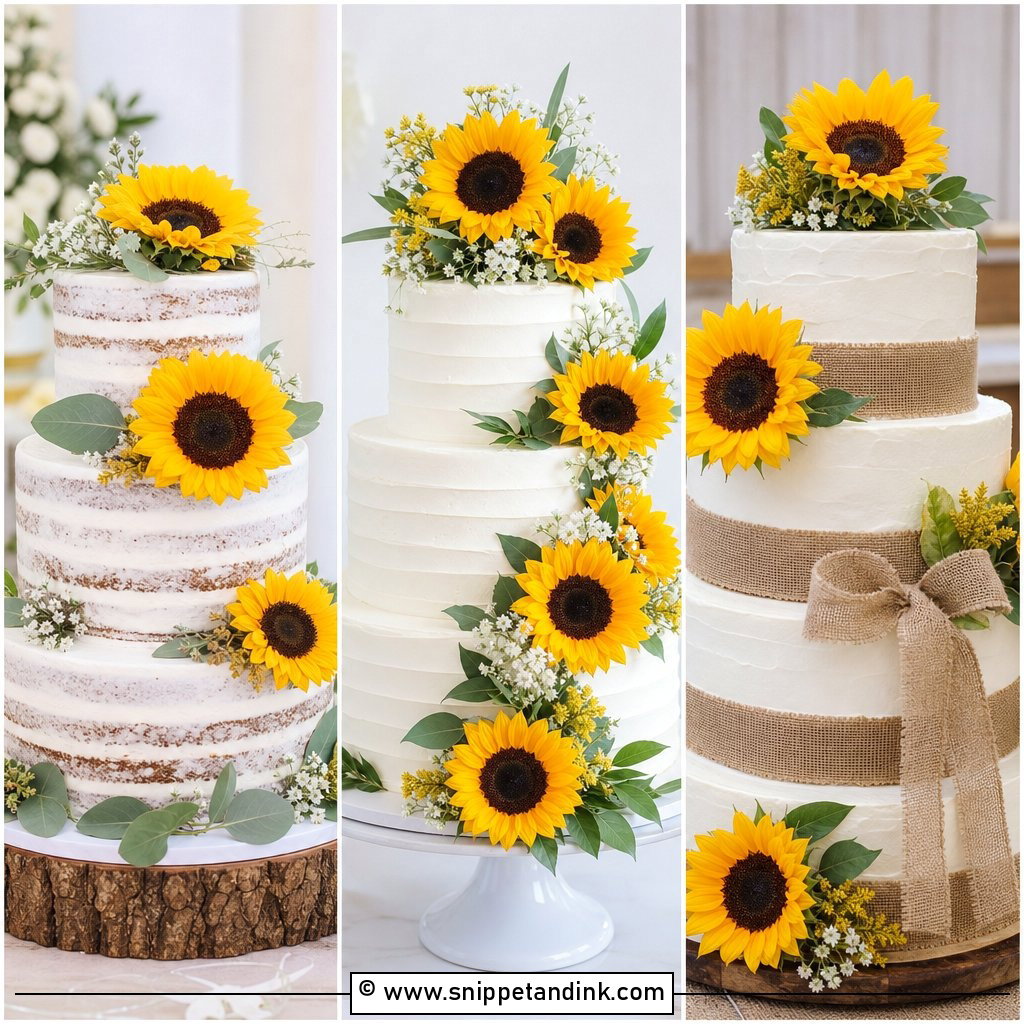
1. Sunflower Mini Naked Cake

This is the most forgiving style to produce in bulk, which is why I suggest it for larger guest counts. A sunflower mini naked cake shows its layers, so the sponge has to be even and level; a domed vanilla or lemon layer looks sloppy once only a scrape of buttercream covers it. The trade-off is drying. Exposed sponge starts to stale within a few hours of air, so I brush the layers with syrup and box each cake until it goes out. One small bloom, two leaves and a wood slice underneath is all the styling it wants.
2. Sunflower Mini Buttercream Cake

Smooth ivory buttercream on a three or four inch round is harder than it looks, because a small cake has less surface to hide a bulge or an air bubble. I chill each one between the crumb coat and the final coat, then finish with a hot bench scraper so the sides come out crisp. A single sunflower set slightly off center reads more relaxed than one plonked in the middle, and a faint yellow tint in the buttercream warms the whole cake if your palette leans golden rather than white.
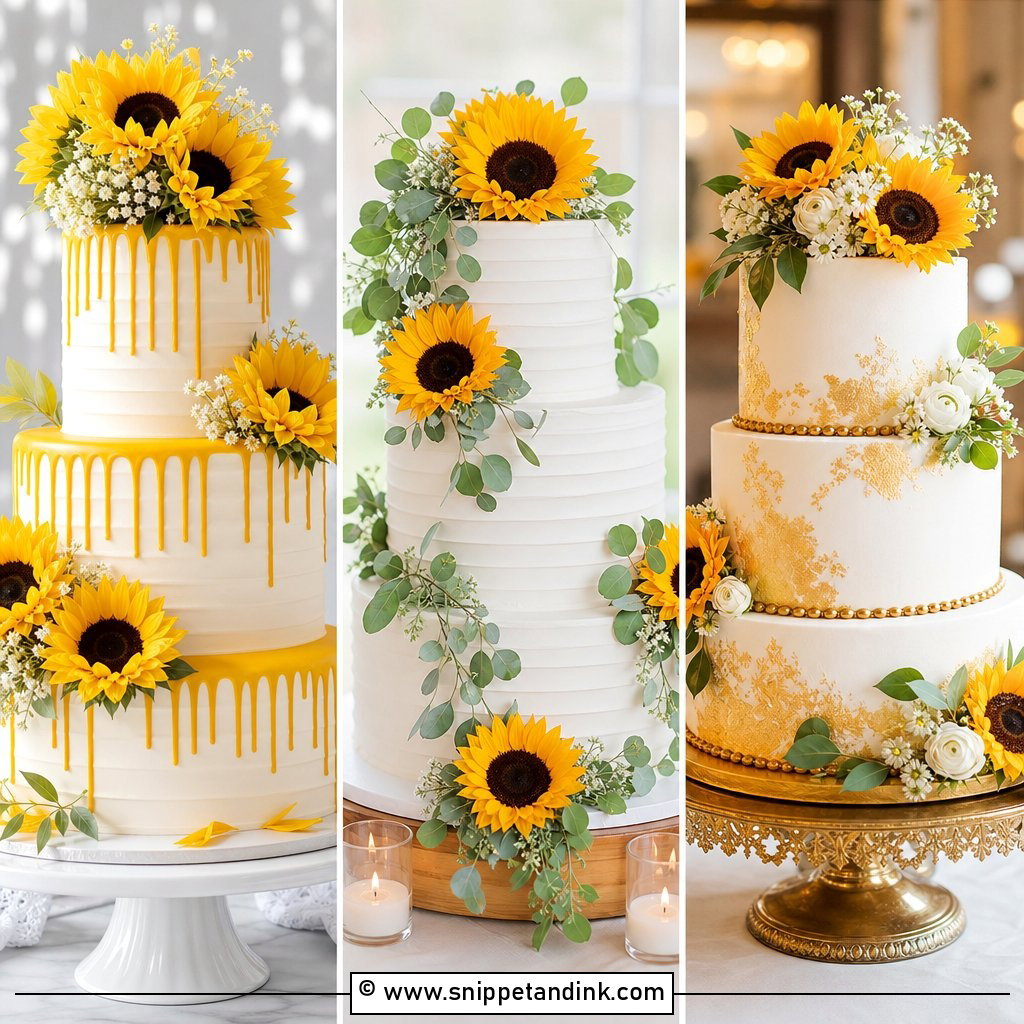
3. Sunflower Mini Drip Cake

Drips on miniature cakes have to be thinner than you’d think. On a full tier a drip runs a few inches; on a mini cake the same pour can reach the board and pool. I test the ganache or white chocolate on a cold cake and let it set slightly warmer than body temperature so it stops halfway down. Honey glaze is pretty but stays tacky, so I keep it for cakes served soon after setting out. Lemon or caramel layers sit well under a yellow drip, and a pinch of gold flake is enough decoration.
4. Sunflower Mini Tiered Cake

Two tiers on a mini cake means supporting a top layer that might only be two inches across. I still dowel it, because a soft buttercream tier will sink into the one below over a warm afternoon. These work best as statement pieces for the sweetheart table or one per guest table rather than one per person, since each is slow to stack and finish. Ivory with sage or dusty blue ribbon at the base keeps a small sunflower as the brightest point.
5. Sunflower Mini Bundt Cake

Bundt pans do the decorating for you, and that’s the real appeal here. A thin vanilla or lemon glaze runs into the flutes and catches the light without any piping at all. I let the glaze set fully before adding a bloom in the center hole, otherwise petals slide. Spice, almond and brown sugar batters hold up best, since a bundt is a denser cake that stays moist on an outdoor table longer than a light sponge.
6. Sunflower Mini Lemon Cake

Lemon sponge already sits in the sunflower palette, so the flavor and the decoration agree with each other. I usually fill with lemon curd and a thin layer of buttercream, though curd is soft and needs a firm buttercream dam around the edge or it squeezes out when the cake is stacked. Fresh lemon slices look bright when placed but weep onto the frosting within a couple of hours; candied slices or yellow petals last far longer on display. This one tastes as light as it looks, which guests appreciate after a heavy dinner.
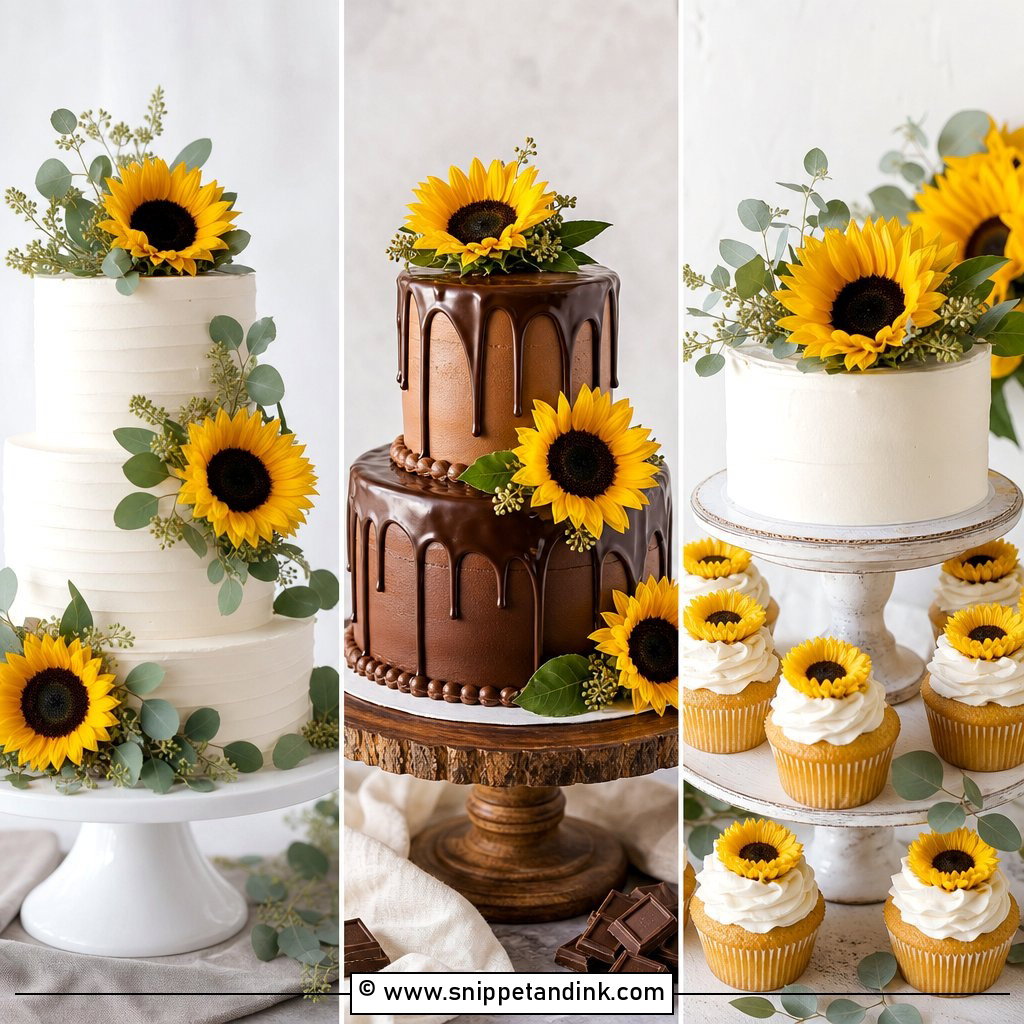
7. Sunflower Mini Chocolate Cake

Dark chocolate sponge makes yellow petals glow in a way ivory frosting can’t. That contrast suits fall weddings and evening receptions with warm lighting. I’d finish with chocolate buttercream or a set ganache rather than a whipped frosting, because ganache firms up and protects the edges in transport. Be aware that sugar sunflowers can bleed yellow color onto wet ganache, so I let the ganache set fully before placing anything on top. A few chocolate shavings at the base are enough texture.
8. Sunflower Mini Carrot Cake

Carrot cake is dense and moist, which makes it one of the sturdiest mini cakes to move and serve. The catch is cream cheese frosting: it’s softer than buttercream and must stay refrigerated until close to serving, so I plan it for receptions where the cakes can come out of the fridge in the last hour. The batter can carry carrot, cinnamon, nutmeg and chopped walnuts, and a ring of toasted nuts at the base hides any wobble in the frosting line. Check your guest list for nut allergies before committing to that garnish.
9. Sunflower Mini Cupcake Cake

Cupcakes styled as tiny cakes are the fastest way to serve a big crowd, since nothing needs cutting and guests eat them by hand. To make them read as wedding desserts rather than a bake sale, I pipe a tall dome and finish with sunflower piping: yellow leaf-tip petals around a center of chocolate sprinkles or chopped dark chocolate. A leaf tip gives the pointed sunflower petal shape; a star tip looks more like a daisy. Keep the yellow at a soft butter shade and the tower looks coordinated.
10. Sunflower Mini Fondant Cake

Fondant gives the most consistent result across a hundred cakes, which is the main reason to choose it. Every cake leaves my table with the same sharp edge and the same smooth top. It also seals the cake, so the sponge stays moist longer than under buttercream. The downside is that many guests peel fondant off, so I keep the layer thin and the cake underneath well flavored. A sugar sunflower on top or a cut-out appliqué on the side pairs with a fine gold line or a monogram for a formal reception.
11. Sunflower Mini Watercolor Cake

Watercolor effects are done with petal dust or thinned gel color brushed onto a chilled cake. On buttercream I work fast with a soft brush because the surface warms under my hand; on fondant there’s more time to blend. Keep the color pale and let white show through, or it stops reading as watercolor and just looks patchy. One painted or edible floral accent on top gives the eye somewhere to land. Bear in mind that no two will match exactly, which is part of the charm.
12. Sunflower Mini Rustic Cake

Rustic finishes are kind to bakers and couples alike, because texture hides small imperfections and holds up better in heat than a mirror-smooth coat. I create ridges with a comb scraper or a palette knife, and a semi-naked finish lets some sponge show. Vanilla honey, spice and brown sugar flavors suit the look. Skip real burlap against the frosting; it sheds fibers. A ribbon around the board, a sprig of greenery and a wood slice or stoneware plate do the job without fiber in anyone’s slice.
13. Sunflower Mini Boho Cake

Boho styling is about one sunflower plus a couple of dried textures, not a whole meadow on a four inch cake. I see this one go wrong when every element from the bouquet ends up on the dessert and it looks crowded. Dried grasses and pampas grass accents are not food, so they need to sit on the board or be wrapped at the stem before touching frosting. Textured buttercream sides, a chai or vanilla bean sponge and a beige table setting carry the rest of the mood.
14. Sunflower Mini Pearl Cake

Edible sugar pearls are hard, and that’s worth knowing before you order a full border of them. On a mini cake I prefer piped buttercream pearls, which look nearly identical in photos and are pleasant to bite. If you love the shine of dragées, scatter a few rather than pressing a dense ring. White buttercream with one sunflower and a row of pearls suits white-and-gold palettes. Almond, champagne-style or lemon sponge fits that classic feel.
15. Sunflower Mini Gold Cake

Gold leaf is delicate to apply on a small cake because it tears on contact with damp frosting. I set the cake firm in the fridge, then lay the leaf with a dry brush. Brushed gold edges are painted with edible luster mixed with a little alcohol, which evaporates and leaves the shine behind. Under warm evening light, gold picks up candlelight, so I keep it to an edge or a fleck near the flower. Caramel and honey flavors suit the warm tone.
16. Sunflower Mini Greenery Cake

Here’s where I check every leaf twice. Eucalyptus is often used on cakes, but it isn’t safe to eat, so any sprig goes on with wrapped stems or sits on the board beside the cake. Rosemary, thyme and small olive leaves are safer bets. Ivory buttercream makes green and yellow both pop, and lemon or almond sponge keeps the flavor light. Your baker and florist should agree in advance on who supplies the greenery, so nothing sprayed with pesticide ends up on a cake.
17. Sunflower Mini Lace Cake

Lace on a small cake can be done three ways, and each behaves differently. Silicone lace mats give the finest detail but need a firm cake and dry air to release cleanly. Piped buttercream lace is slower but looks handmade, and stencils pressed with royal icing are quick and even. On a four inch cake I keep the lace to a band rather than covering the whole side, so the sunflower still has room. A thin yellow ribbon or a pearl border finishes it, and vanilla, almond or lemon cake fits the vintage feel.
18. Sunflower Mini Square Cake

Square mini cakes look orderly in long rows on a dessert table, which suits modern receptions. Sharp corners are the hard part: buttercream rounds off at corners as the cake warms, so if you want crisp edges into the evening, fondant is the safer finish. I place the sunflower on one corner with a couple of leaves and leave the remaining surface clear. A narrow gold edge or a soft yellow drip on one side adds enough detail.
19. Sunflower Mini Ombre Cake

An ombre on a small cake has less height to fade across, so I limit it to two or three shades from ivory into pale or honey yellow. I spread each band, then sweep a scraper around in one pass to blend; more passes make it muddy. Buttercream blends far better than fondant here. The sunflower on top ties the gradient to the theme, and I keep everything else off the sides so the color does the talking. Lemon, honey or almond sponge sits comfortably under it, and it holds its own in photos without looking dated later.
20. Sunflower Mini Table Cake

One small cake per reception table is my favorite compromise between individual cakes and a single big tier. Guests share and serve it themselves, and it doubles as a centerpiece until dessert. A six inch, two-layer round with one or two sunflowers feeds most tables of eight to ten modestly, especially when the meal is generous. Plan a knife, a server and plates at each table, or someone ends up cutting with a dinner knife. Vanilla, lemon, almond or chocolate are safe flavors when you don’t know every guest’s taste.
Eighty Small Cakes Need a Delivery Plan
Couples often expect mini cakes to cost less than a tiered cake. Usually they don’t. Every cake is filled, crumb coated, chilled, finished and decorated on its own, so the labor per serving is higher even though each one is small. I’d talk about budget with your baker early and decide whether every guest needs one or whether a mix of mini cakes and a sheet cake in the kitchen makes more sense.
Sizes and how much cake that really is
A three inch round is a generous single portion. A four inch two-layer cake is closer to two portions, and many guests leave half after a big meal. If you’re serving one per person, smaller is kinder to the budget and to waste.
Transport and setup
- Each cake travels in its own box or in a tray with cut-outs so they can’t slide into each other.
- Buttercream and cream cheese cakes stay chilled until about an hour before guests see them, longer in an air-conditioned room.
- Fresh sunflowers and fruit go on at the venue, not in the kitchen the night before.
- Ask your baker how long setup takes for the full count; arranging dozens of small cakes takes far longer than placing one tier.
- Agree on who supplies plates and forks; a mini cake still needs a fork.
Lead time varies by baker and by flower choice. Sugar sunflowers in quantity often need ordering a couple of months ahead, while piped versions can usually be booked closer to the date. Confirm the final guest count early, because every extra mini cake is another one to finish by hand.
One Bloom per Cake Is Usually Enough
A good set of sunflower mini cakes comes down to one strong bloom per cake, a finish that suits your venue’s temperature and a plan for how they reach the table in one piece. Rustic textures and fondant both hold well outdoors; smooth buttercream and fresh fruit want shade and a short display window. Start with your venue and season, then pick a flavor and finish, and the sunflower will do the rest.
You'll Like These Ideas:


Leave a Reply