
A black cake with silver detailing is one of the boldest things you can put on a dessert table, and one of the hardest to get right. Done well, it reads like evening wear: Art Deco ballrooms, candlelit winter receptions, moody garden weddings. Done badly, it looks heavy and the icing leaves guests with grey smiles. The difference is mostly balance, with texture, flowers and metal breaking up the black, plus a few technical choices about how the colour is made. The twenty designs below are grouped loosely from romantic to graphic, and I’ve added notes on finish and practicality to each one.
How Black Icing Is Made, and Why It Matters to Your Guests
True black is the hardest colour I make. Plain white buttercream or fondant needs a large amount of gel colour to move past slate grey, and at that concentration it can taste faintly bitter and leave grey lips and teeth. That’s not something you want at a wedding with a photographer two metres away.
My approach is to start dark. Chocolate buttercream or chocolate fondant needs far less colour to reach black, and I mix it a day ahead because black keeps developing as it rests. Some bakers also use black cocoa, which darkens the colour and adds a deep cocoa flavour. When you’re comparing quotes, ask each baker these three questions:
- Is the black on the outside only, or through the filling too? Black on the outside with a light sponge inside is kinder to mouths and to white dresses.
- What base do you start from? A chocolate or cocoa base is a good sign.
- Can I taste the black icing at the tasting, not just the flavours inside?
1. Black And Silver Wedding Cake With Roses
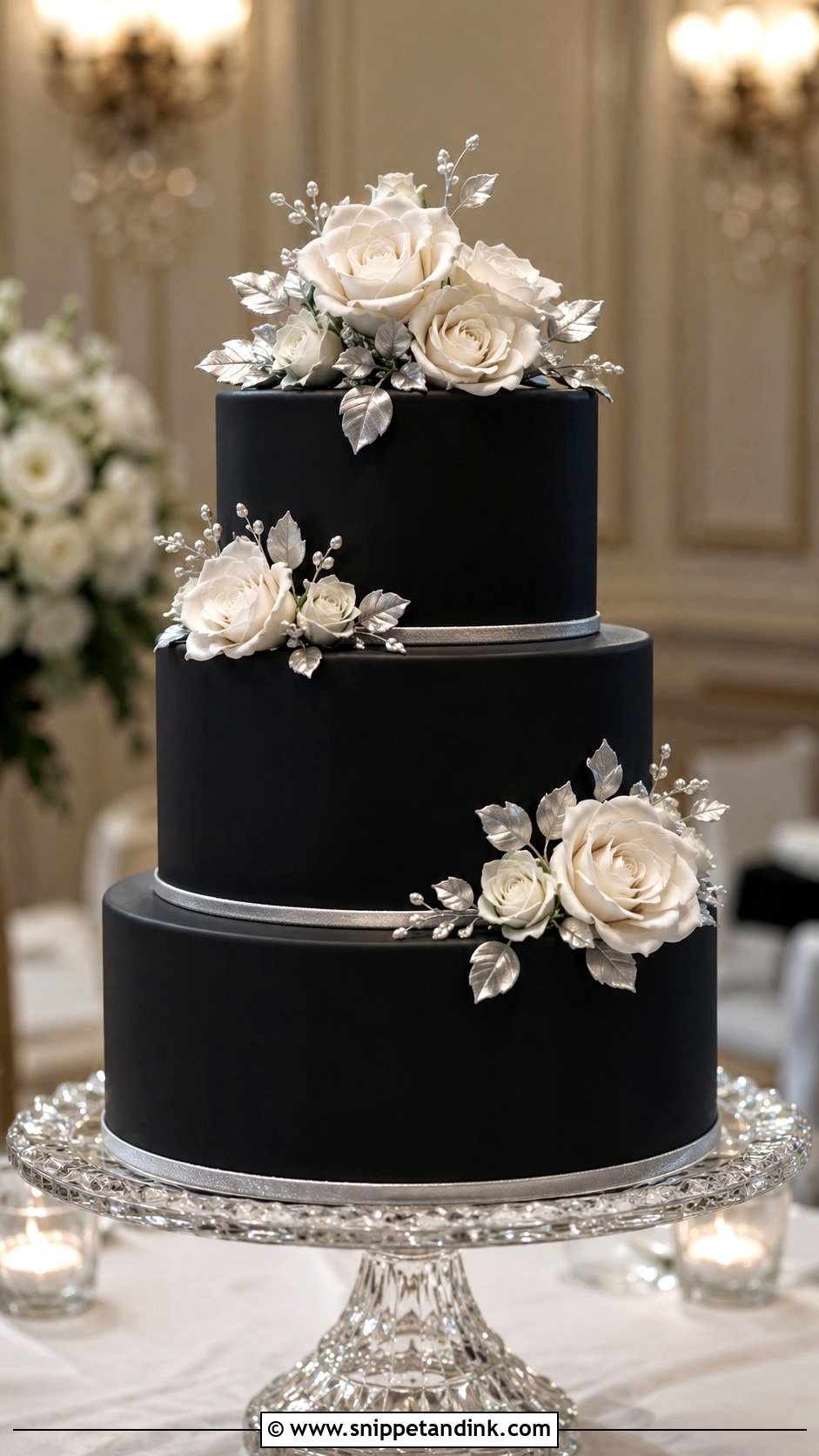
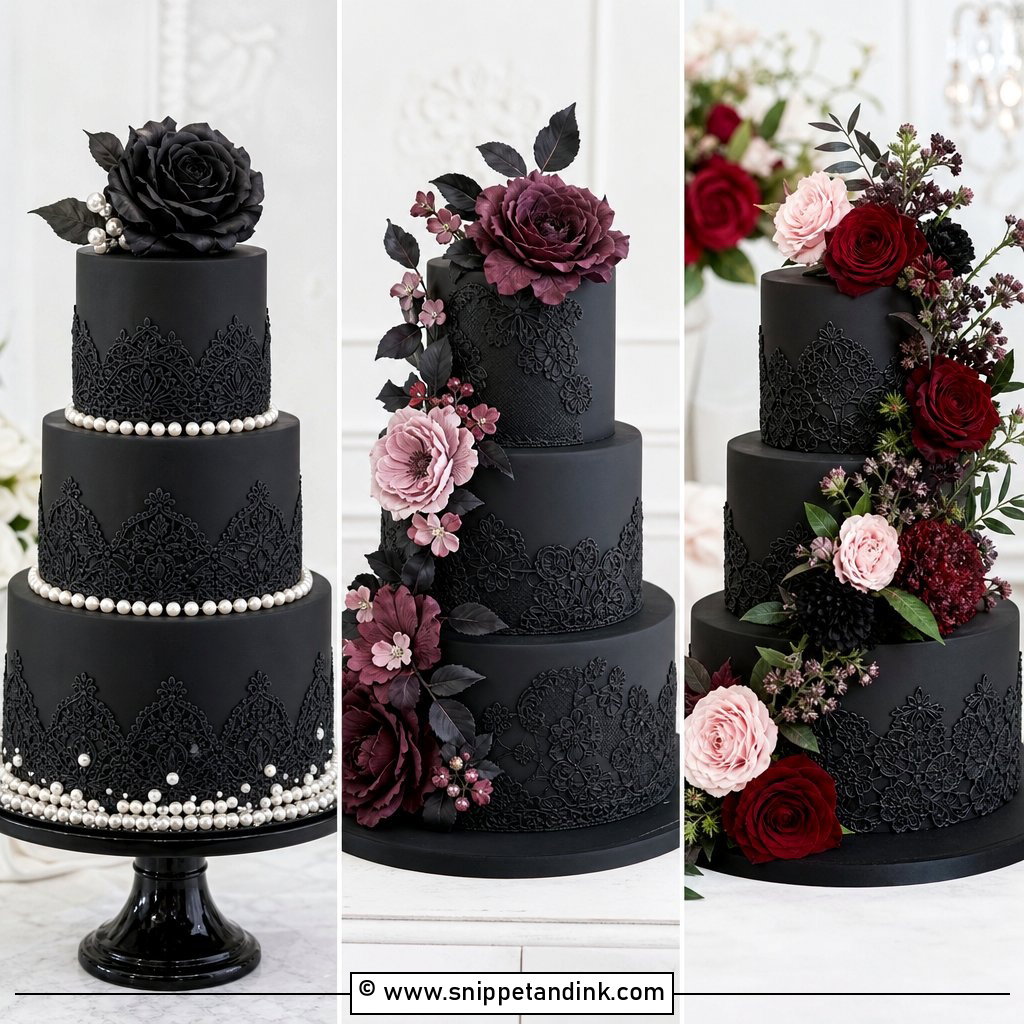
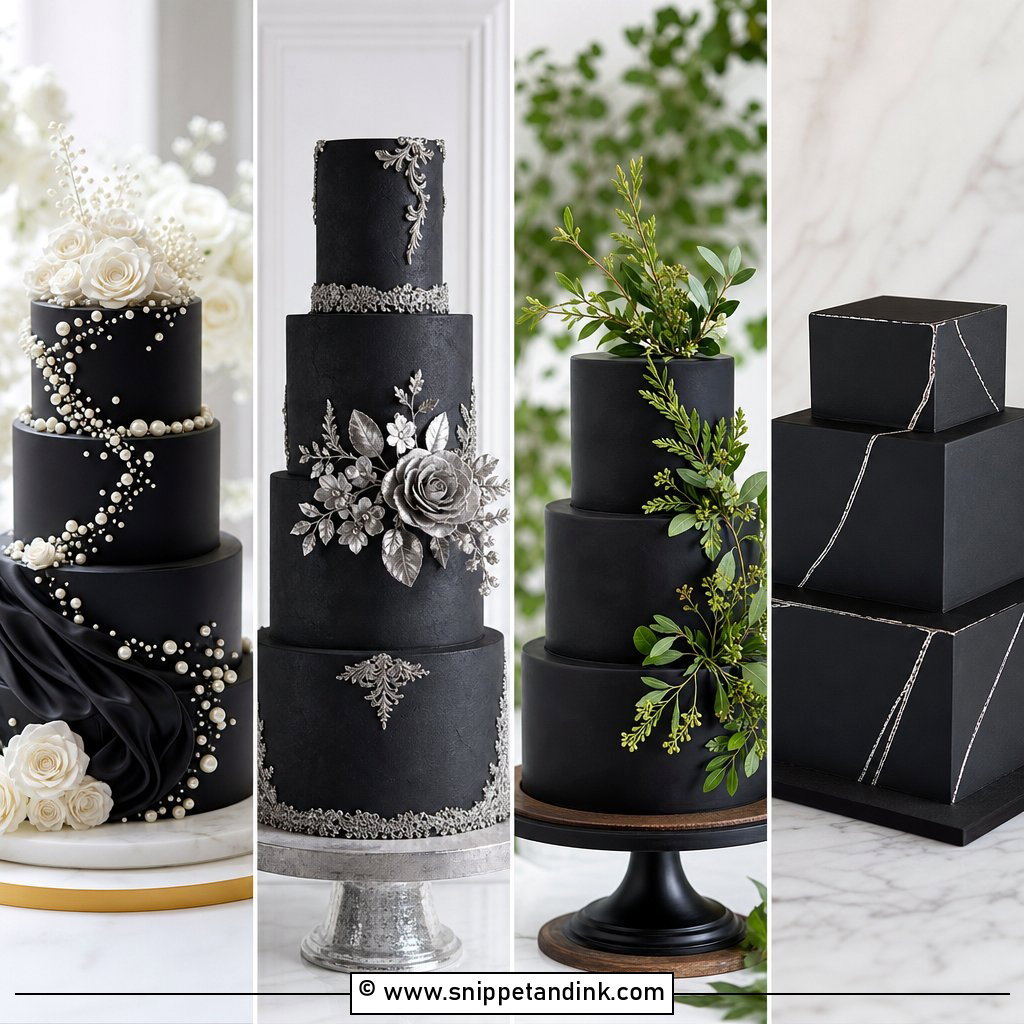
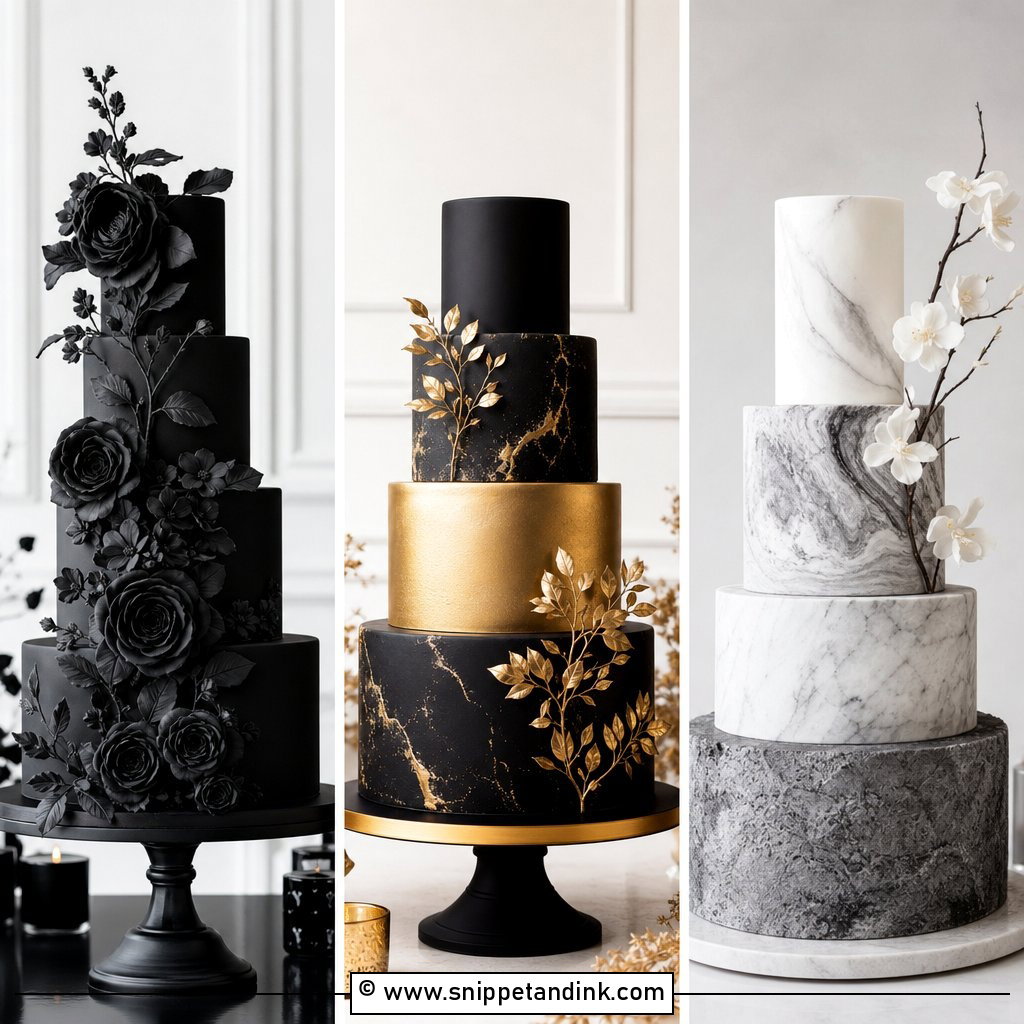
Roses are the quickest way to make a black cake feel bridal. Black tiers give the formal backbone, silver leaf or piping adds light, and the flowers do the softening. White roses give the cleanest contrast; burgundy keeps everything moody; black sugar roses with silver dust turn it into something closer to couture. If you go with fresh roses, I wrap the stems and keep them off the icing with a small barrier, since florist roses are rarely grown as food. Crystal, velvet or mirrored decor in the room picks up the silver well.
2. Black And Silver Marble Wedding Cake
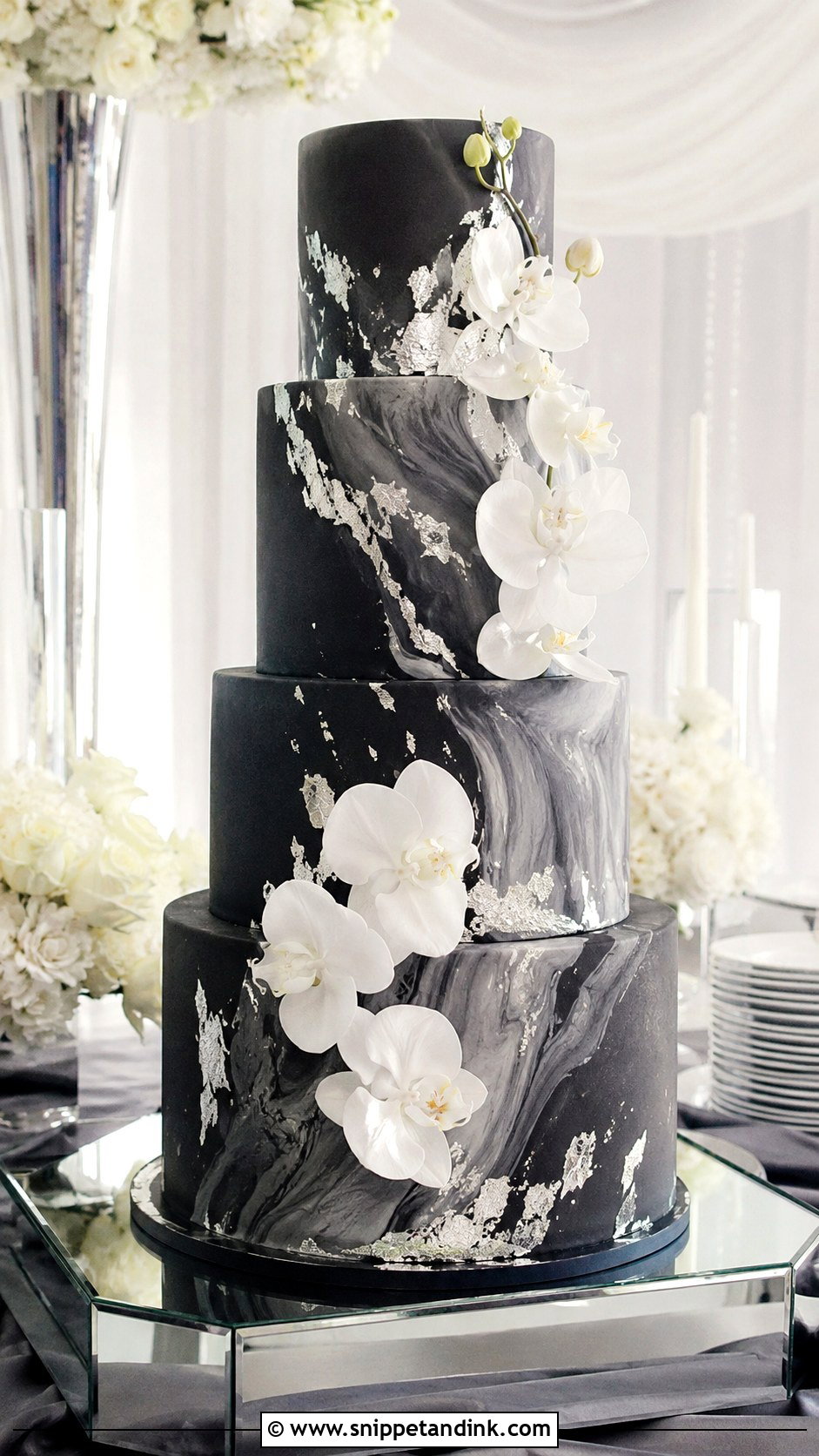
Marble works because it gives a black cake texture without adding decorations. Charcoal, grey, black and silver are folded together so the surface looks like polished stone. On fondant I knead the colours only part of the way, then roll; overwork it and the veins blur into flat grey. Ask for controlled, sparse veining on tall tiers, since busy swirls stacked three or four high look chaotic. A couple of silver leaf patches and simple white orchids, roses or calla lilies are all it needs.
3. Black And Silver Drip Wedding Cake
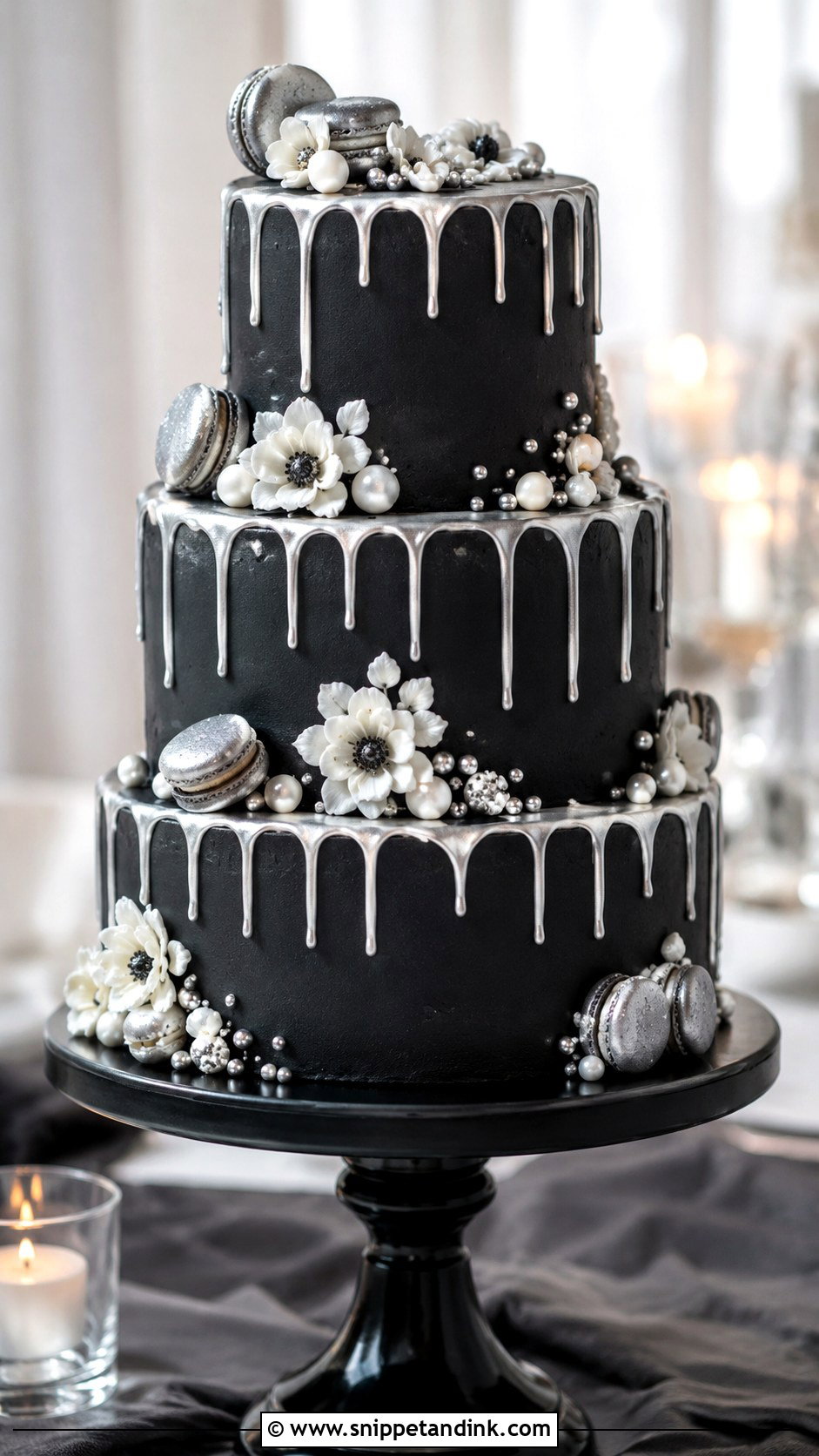
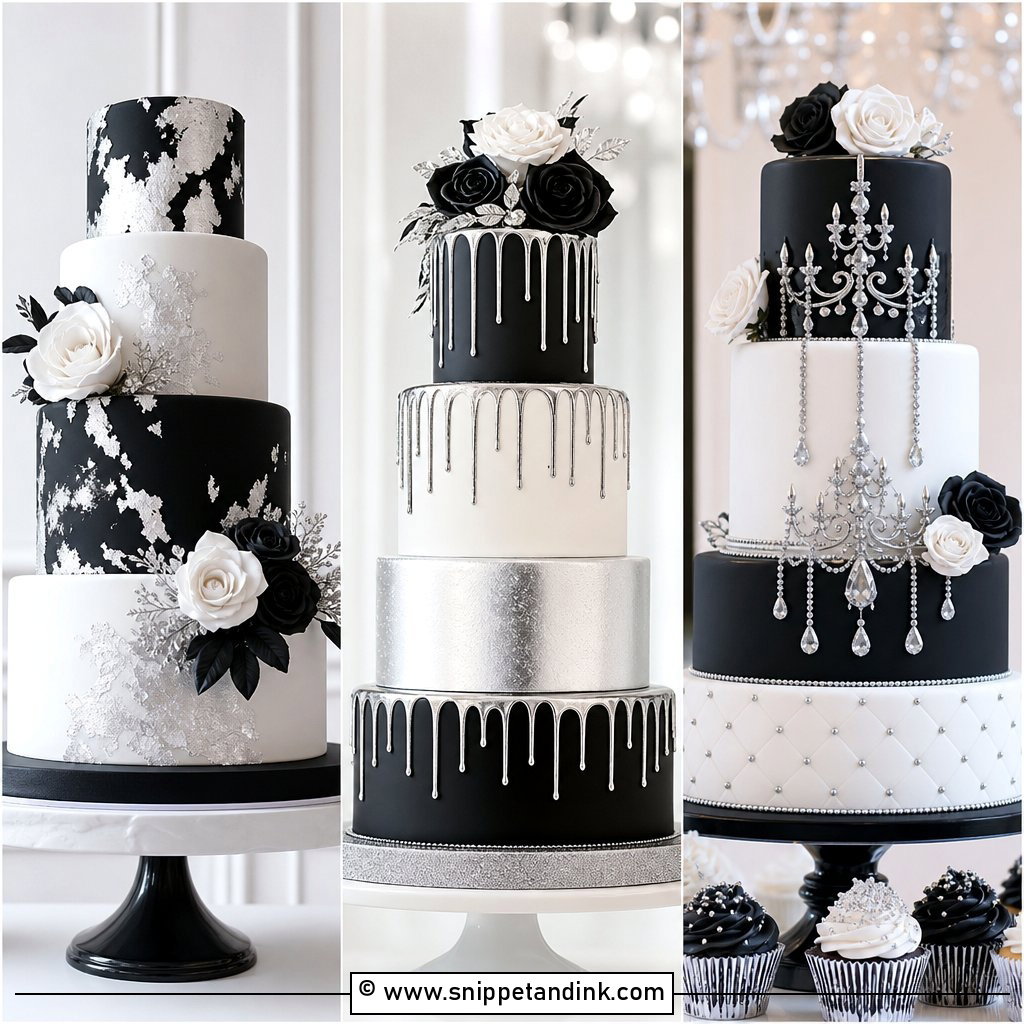
A drip is fun, but on a formal black cake it has to look deliberate. The silver drip is usually a white chocolate ganache coloured and then painted or sprayed with metallic, and its consistency decides everything: too warm and it runs to the board, too cool and it sits in stubby blobs. I test one drip on the back of the cake before committing to the front. Chocolate sponge is the natural choice inside. Silver macarons, pearl sprinkles or a small topper finish it, and pairing one black tier with an ivory or grey tier keeps it lighter.
4. Black And Silver Geode Wedding Cake
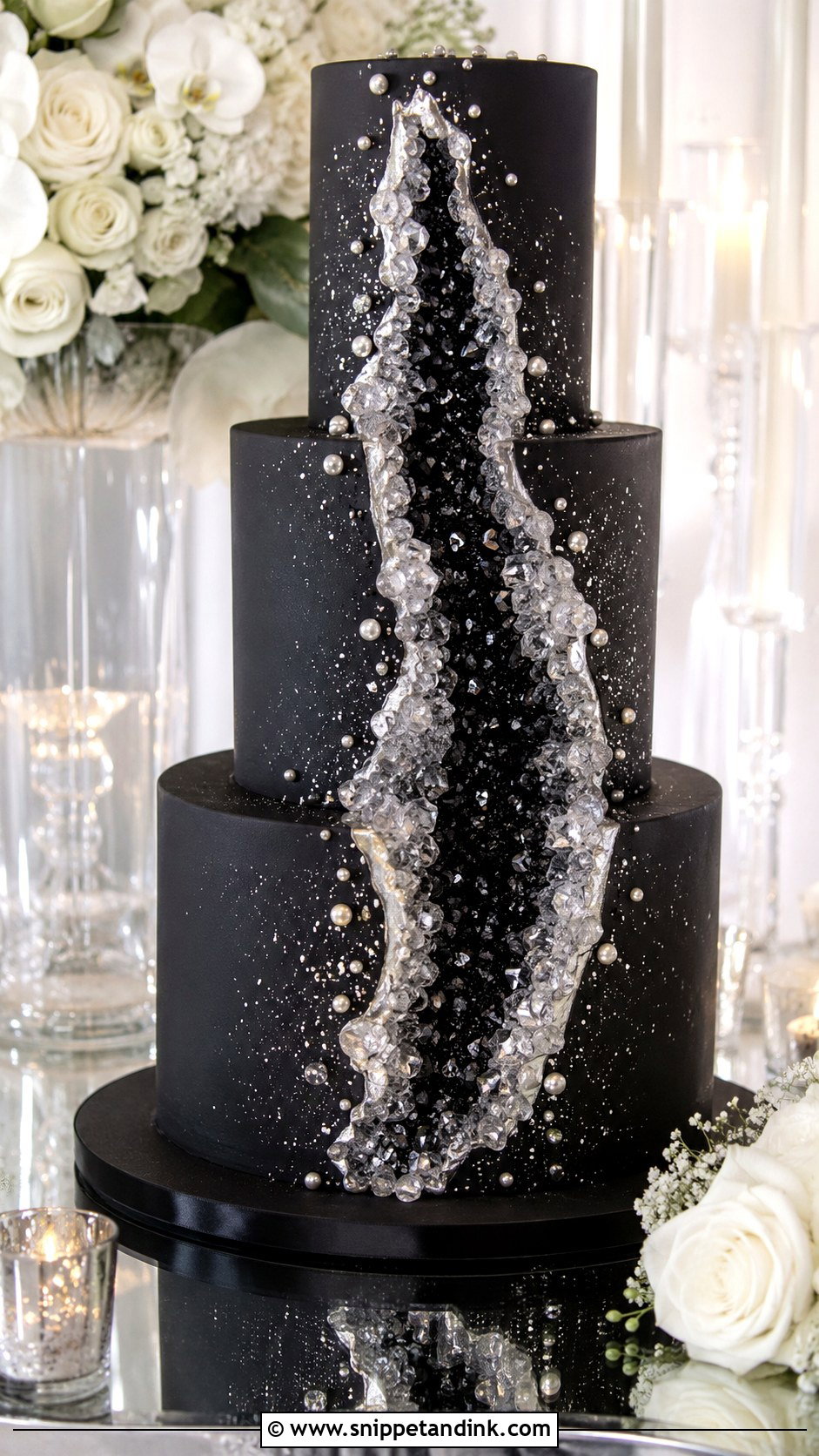
A geode cake has a carved cavity filled with crystals that look like a split rock, and against black icing the effect is dramatic. The crystals are usually rock candy or isomalt, and both dislike humidity, so this design is a poor fit for a summer marquee or a hot, steamy room, where the sugar can turn tacky and dull. Keep the rest of the cake plain; flowers compete with the crystal. A tall three-tier shape gives the cavity enough height, and a mirrored stand bounces the silver back into the room.
5. Black And Silver Art Deco Wedding Cake
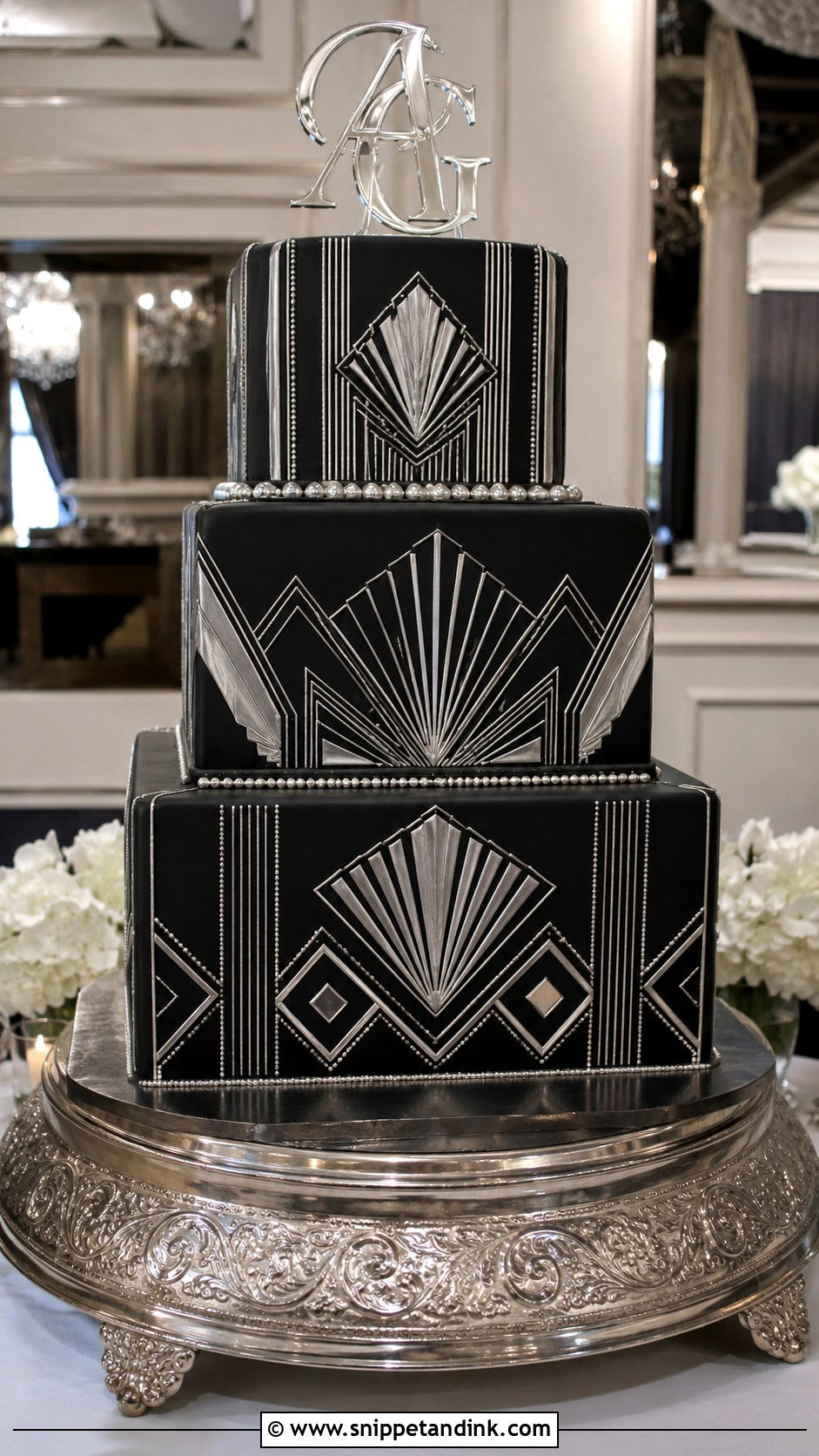
A black and silver Art Deco design suits black-tie, city venues and anything with a jazz-age mood: fan motifs, stepped borders, sharp geometric lines. Square tiers emphasise the architecture, but round ones work if the pattern is crisp. Deco lives or dies on symmetry, so I measure and score the guide lines into the fondant before painting a single fan. A small silver monogram or stepped topper finishes it without tipping the cake into fancy dress.
6. Black And Silver Sequin Wedding Cake
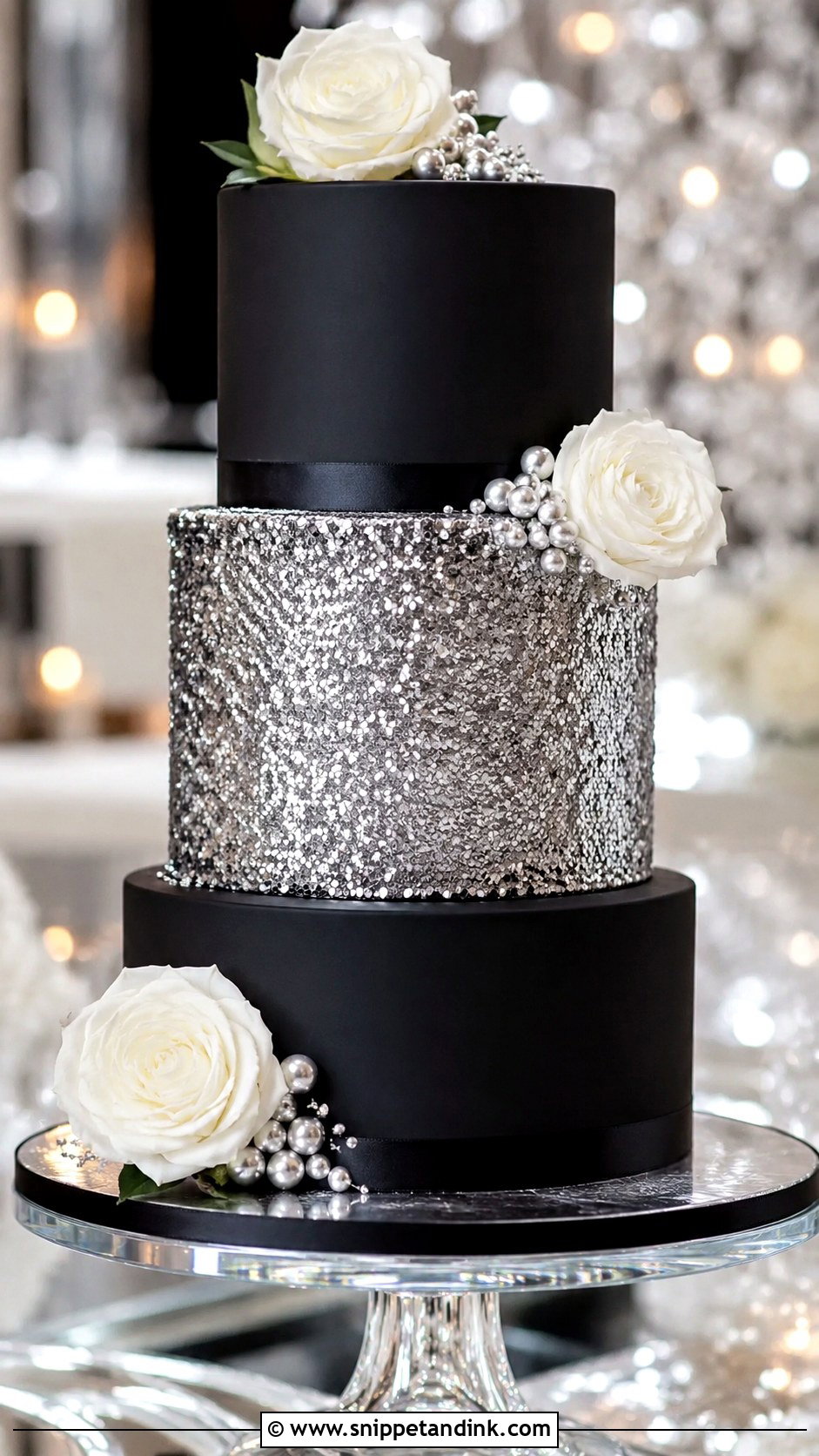
Edible sequins make one tier glitter from every angle. I cover just one tier and leave the others smooth black, otherwise you end up with a disco ball. Middle or bottom placement anchors the cake visually. Each sequin is pressed on by hand, so it’s a slow, labour-heavy finish and that shows up in the quote. White flowers, black satin ribbon or silver pearls complete it. It’s at home in a hotel ballroom with metallic linens and lots of candlelight.
7. Black And Silver Floral Wedding Cake
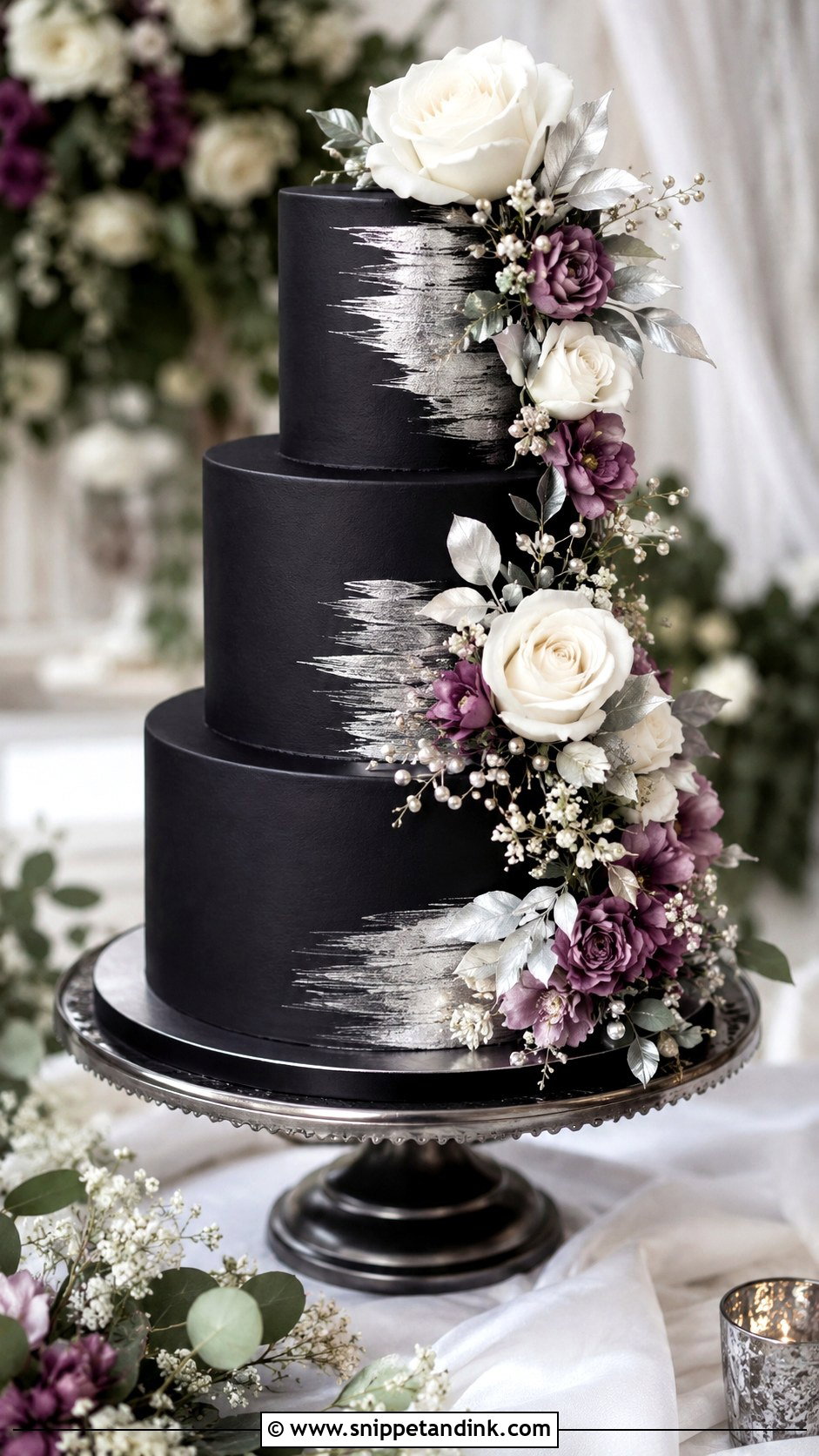
A black ground makes almost any flower look vivid. White blooms keep it classic, while mauve, plum or dusty blue feel softer and more seasonal. I usually suggest sugar flowers when the colour has to be exact or the cake will be on display for hours, because fresh petals start to wilt and brown against warm icing as the evening goes on. Keep the silver light here, a painted tier edge or a few metallic leaves, so the flowers stay in charge. Formal gardens and romantic indoor venues suit it.
8. Black And Silver Ombre Wedding Cake
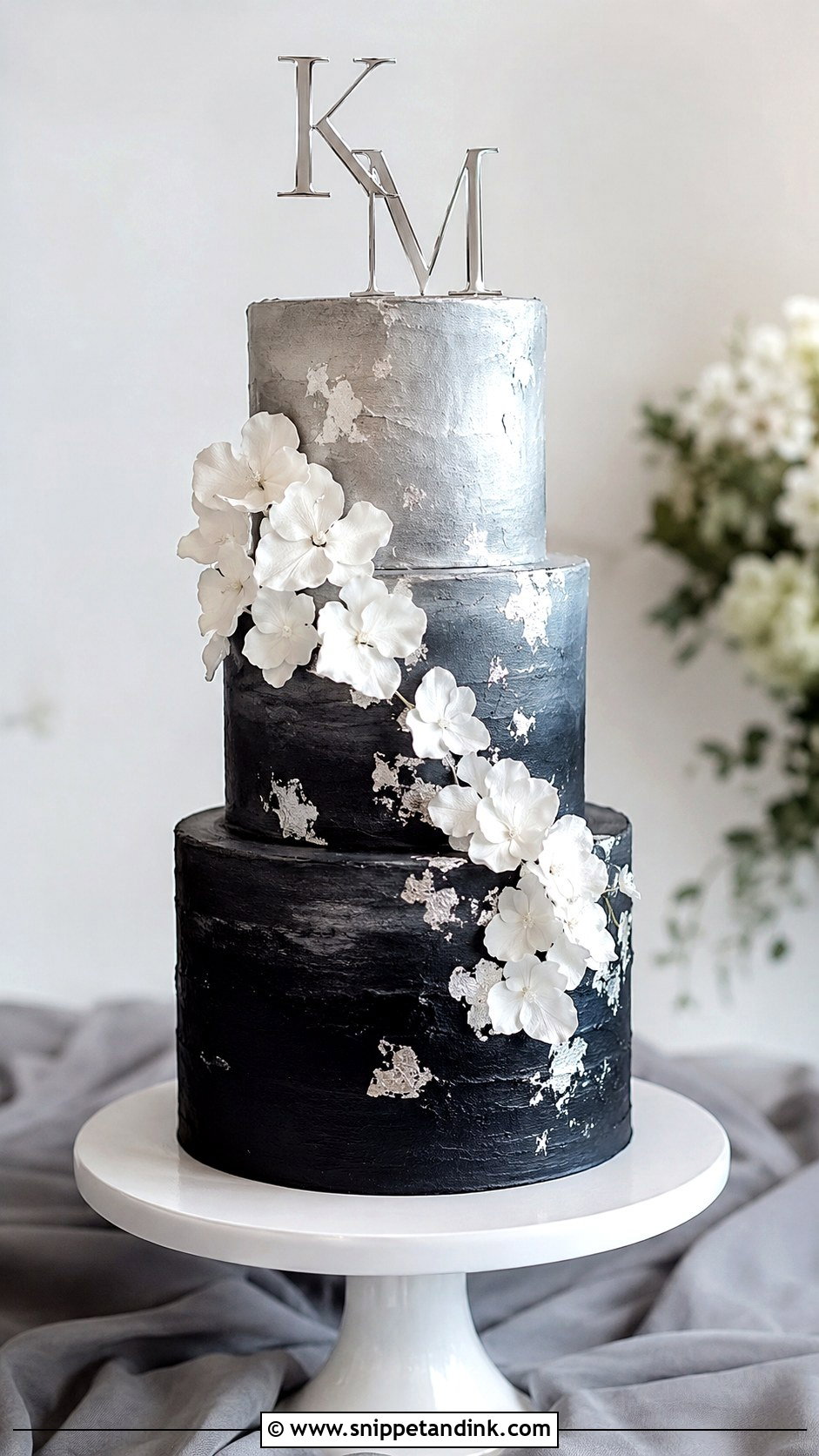
An ombre runs from black through charcoal and grey to silver, so the darkness is spread rather than solid. It’s the version I’d suggest to couples who love the palette but worry a full black cake will look severe. Buttercream gives a textured fade; fondant gives a smooth, more formal one, though it takes separate batches of each shade. A band of silver leaf where two tones meet hides the transition and adds shine. A simple silver initials topper or a small cluster of white sugar flowers is enough on top.
9. Black And Silver Buttercream Wedding Cake
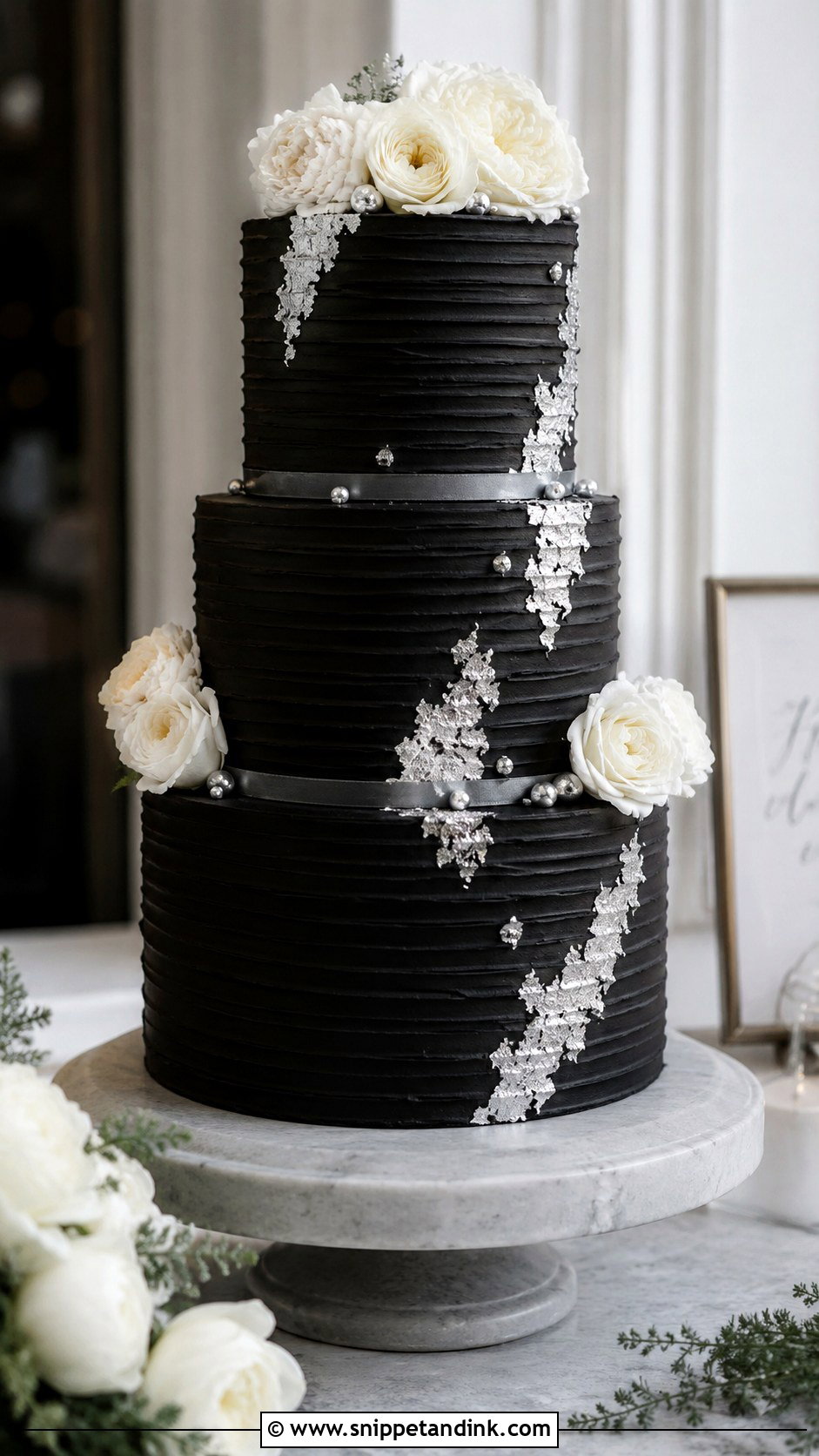
Buttercream gives a softer, more relaxed surface than fondant: smooth, lightly ridged or marked with palette-knife strokes. Black buttercream is tricky, though. It takes a lot of colour to get past grey, and heavy dye can taste bitter and stain mouths. I start from a chocolate buttercream, add black gel, and leave it covered for several hours because the colour keeps deepening as it rests. Inside, vanilla, chocolate, almond or red velvet all work. Silver leaf, edible pearls and fine piping make it a wedding cake. One black tier with the rest in grey or ivory keeps it from feeling heavy.
10. Black And Silver Fondant Wedding Cake
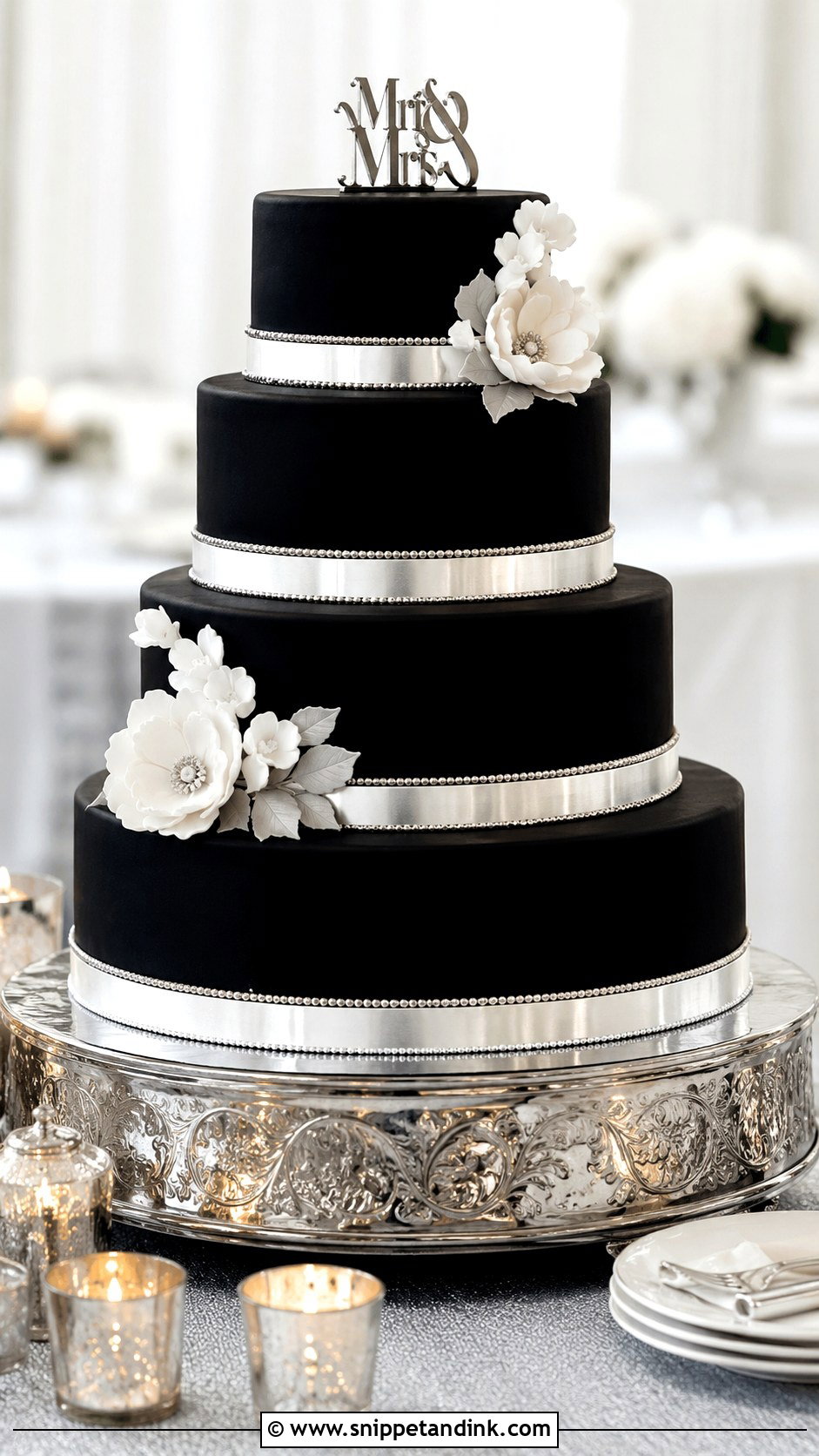
Fondant gives the sharpest edges and the smoothest surface for metallic work: silver bands, pressed patterns, stencils, painted borders. It holds its shape for hours on display, which matters at a long reception. The trade-off is that black fondant shows every speck of dust, cornflour and fingerprint, so I roll it on a greased surface instead of a dusted one and handle it with gloves. A whole black fondant cake is intense; a white floral, silver trim or a single light grey tier calms it down for black tie.
11. Black And Silver Lace Wedding Cake
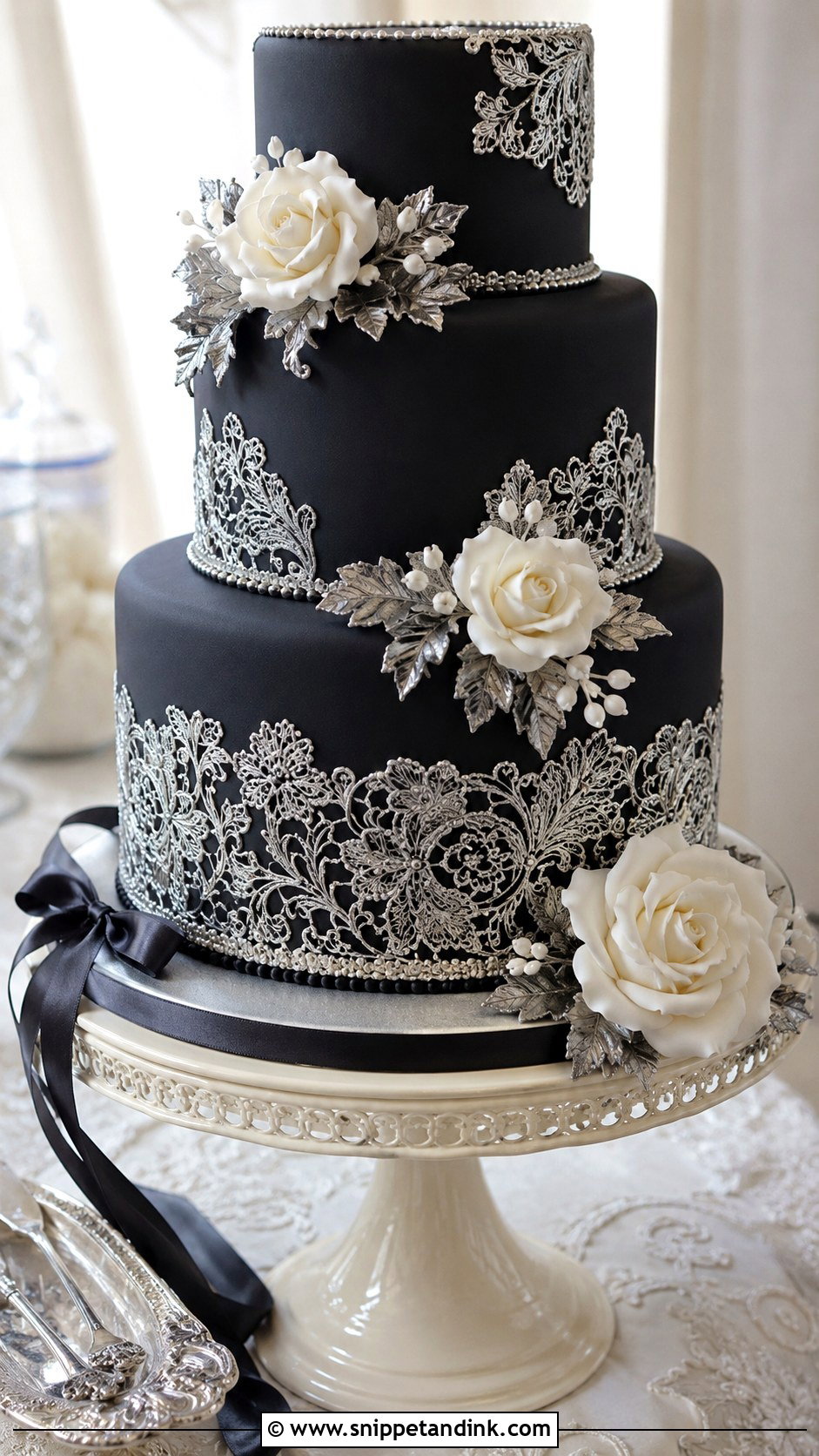
Lace on cake is piped, stencilled or made from flexible edible lace set in a mat. Silver lace over black looks like a formal fabric, and if your dress has lace, I can often match the motif from a photo of the gown. Edible lace sheets go brittle in dry air and soft in humidity, so I apply them on the day of delivery. Keep the rest simple: a few sugar roses, small pearls, or a satin ribbon at the base. Classic receptions and elegant halls suit it.
12. Black And Silver Pearl Wedding Cake
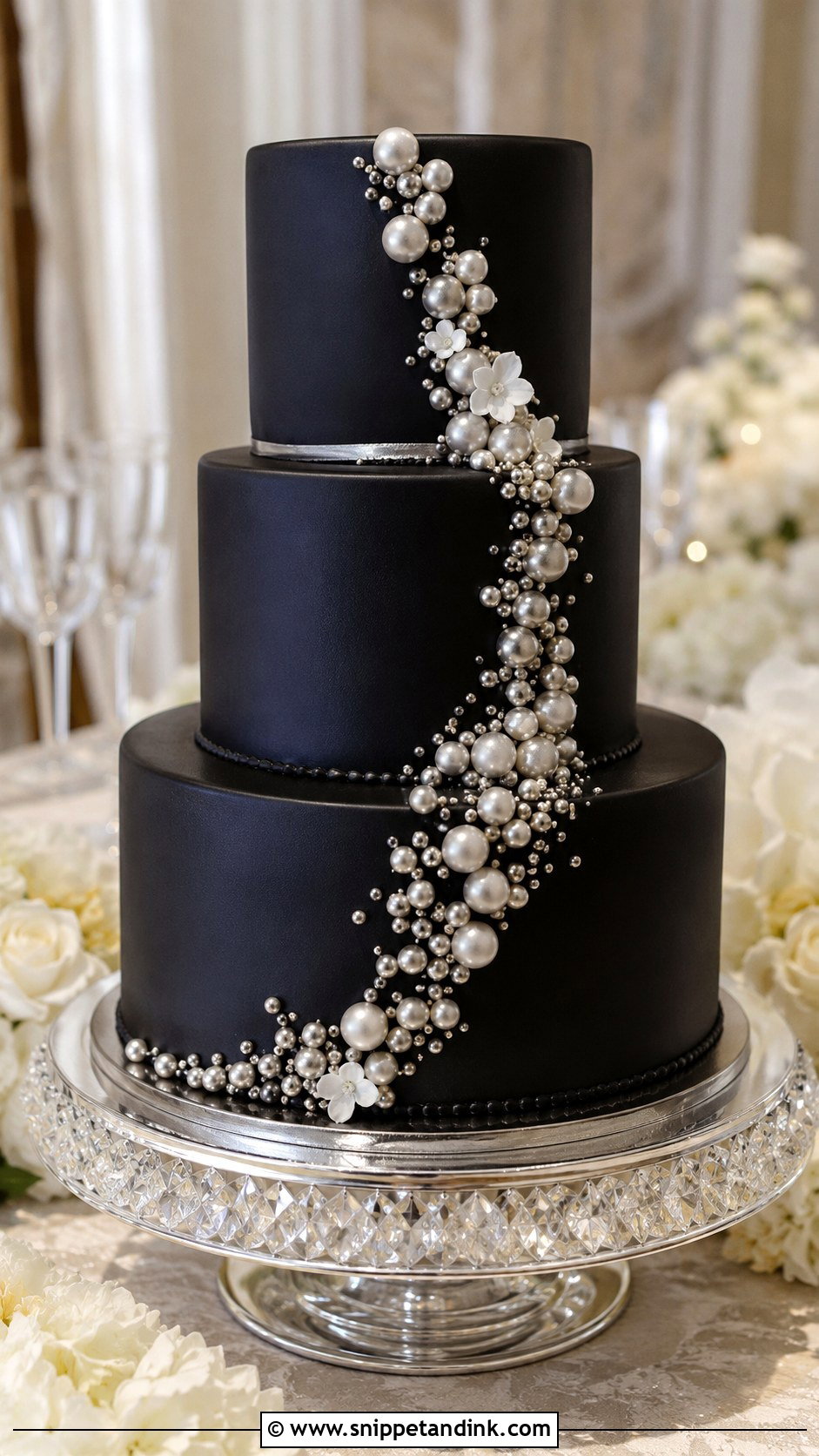
Pearls bring refinement without big flowers or patterns. Silver dragées line tier borders, scatter lightly over the surface or fall in a neat cascade, and against black they look bright and delicate. Pair them with smooth fondant, satin-finish buttercream or a simple silver ribbon. One honest caution: hard metallic dragées can be tough on teeth, and in some places they’re sold as decoration only, so I’d ask your baker exactly what they’re using. White roses or small sugar blossoms add romance if you want it.
13. Black And Silver Minimalist Wedding Cake
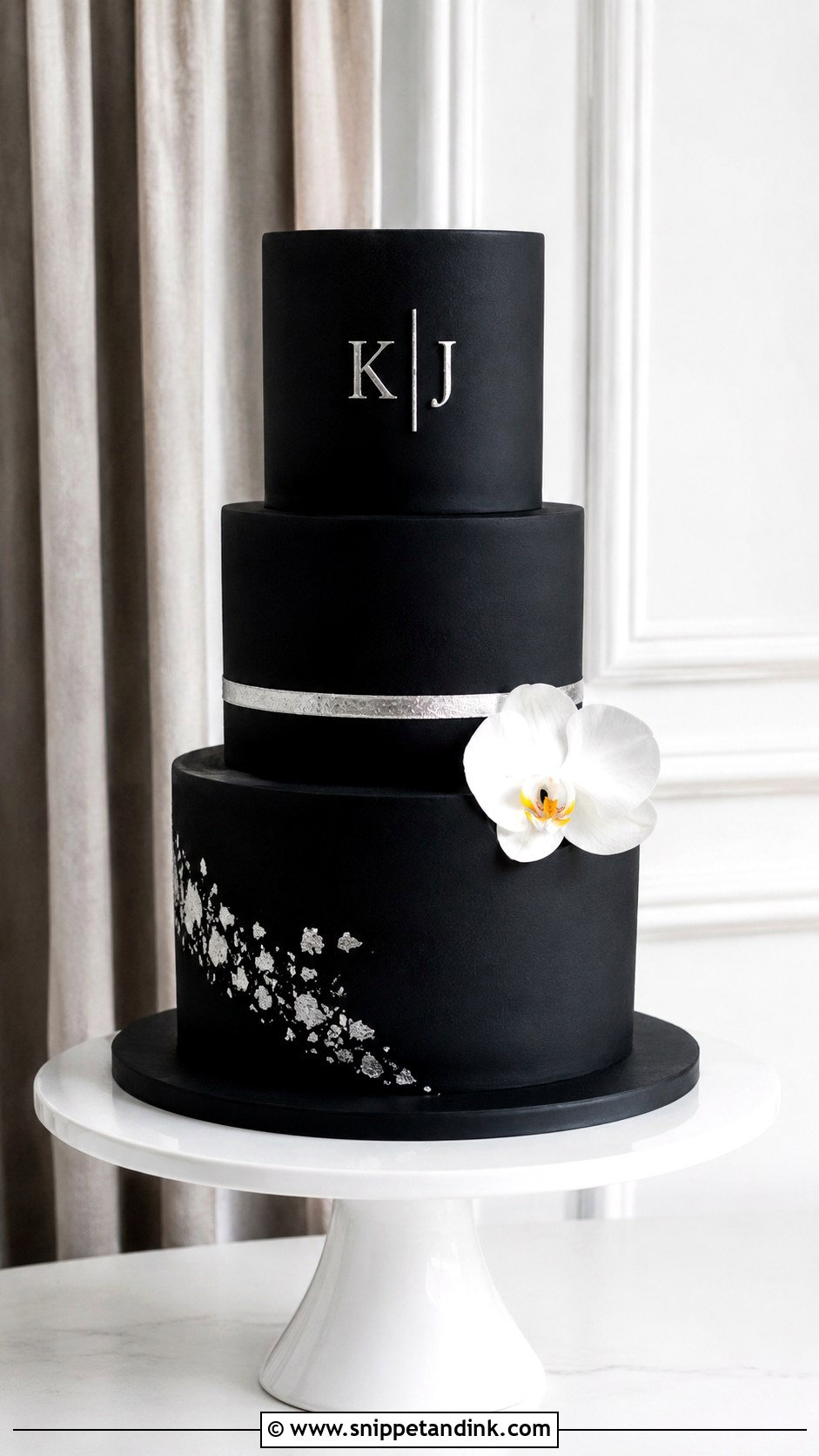
Minimal black cakes are about restraint: smooth tiers, a single silver accent, almost nothing else. That accent might be a thin metallic band, one brushstroke, a small monogram or a clean topper. Because there’s nothing to hide behind, the finish has to be flawless, with dead-straight edges and no bulges where the tiers settle. Loft weddings, galleries, rooftops and sleek hotels suit it. If you want a bridal hint, one white flower or a small orchid spray is plenty.
14. Black And Silver Tall Wedding Cake
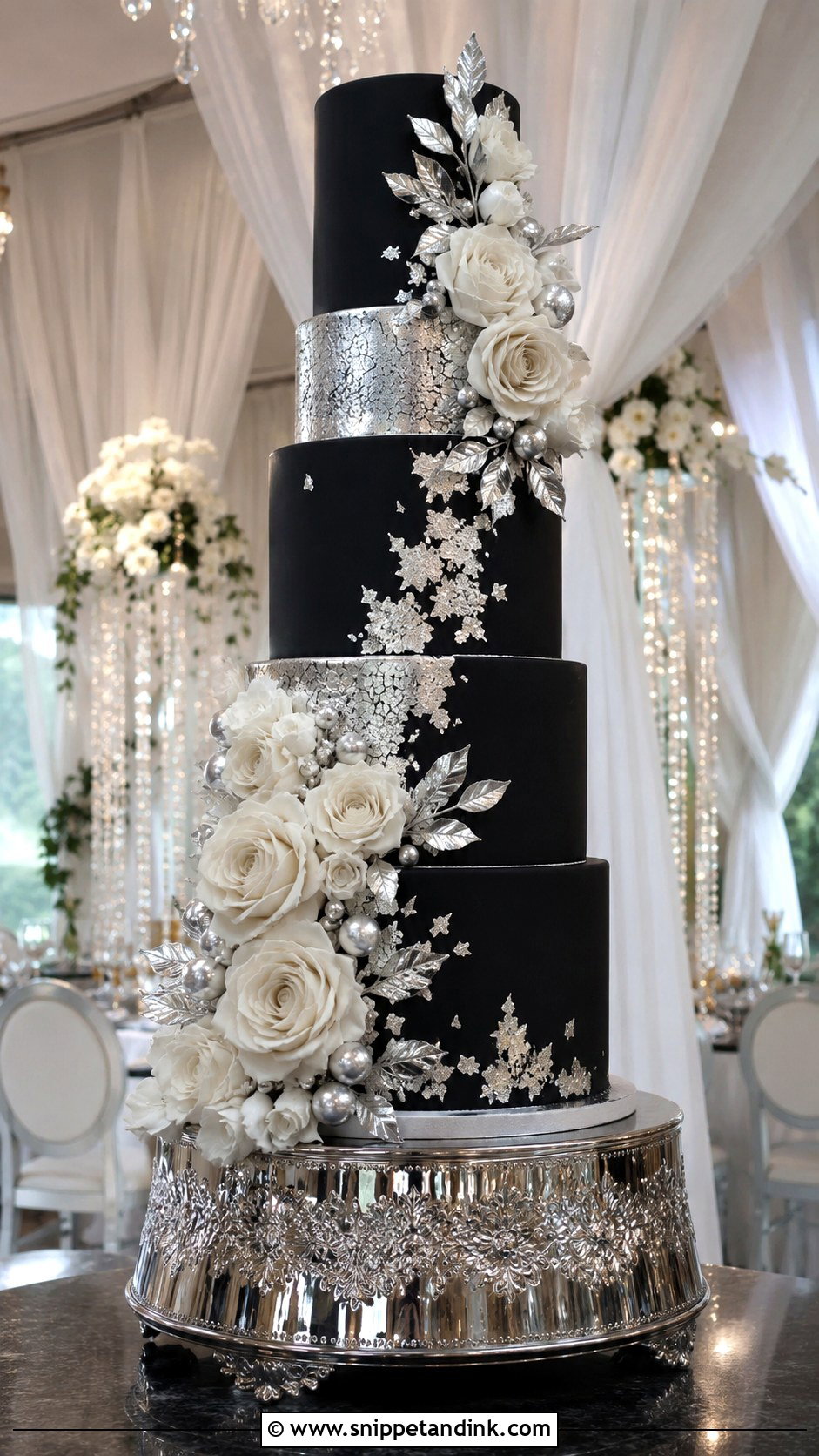
A tall wedding cake in black and silver has real presence in a big room. Mix black tiers with silver textured tiers, or keep every tier black with silver borders and flowers. Height adds weight, so I dowel and plate every tier, and very tall cakes are often assembled at the venue rather than driven fully stacked. Keep the patterns consistent; a different design on each of five tiers looks busy. A smooth finish, silver leaf and one cascading arrangement let the height speak.
15. Black And Silver Square Wedding Cake
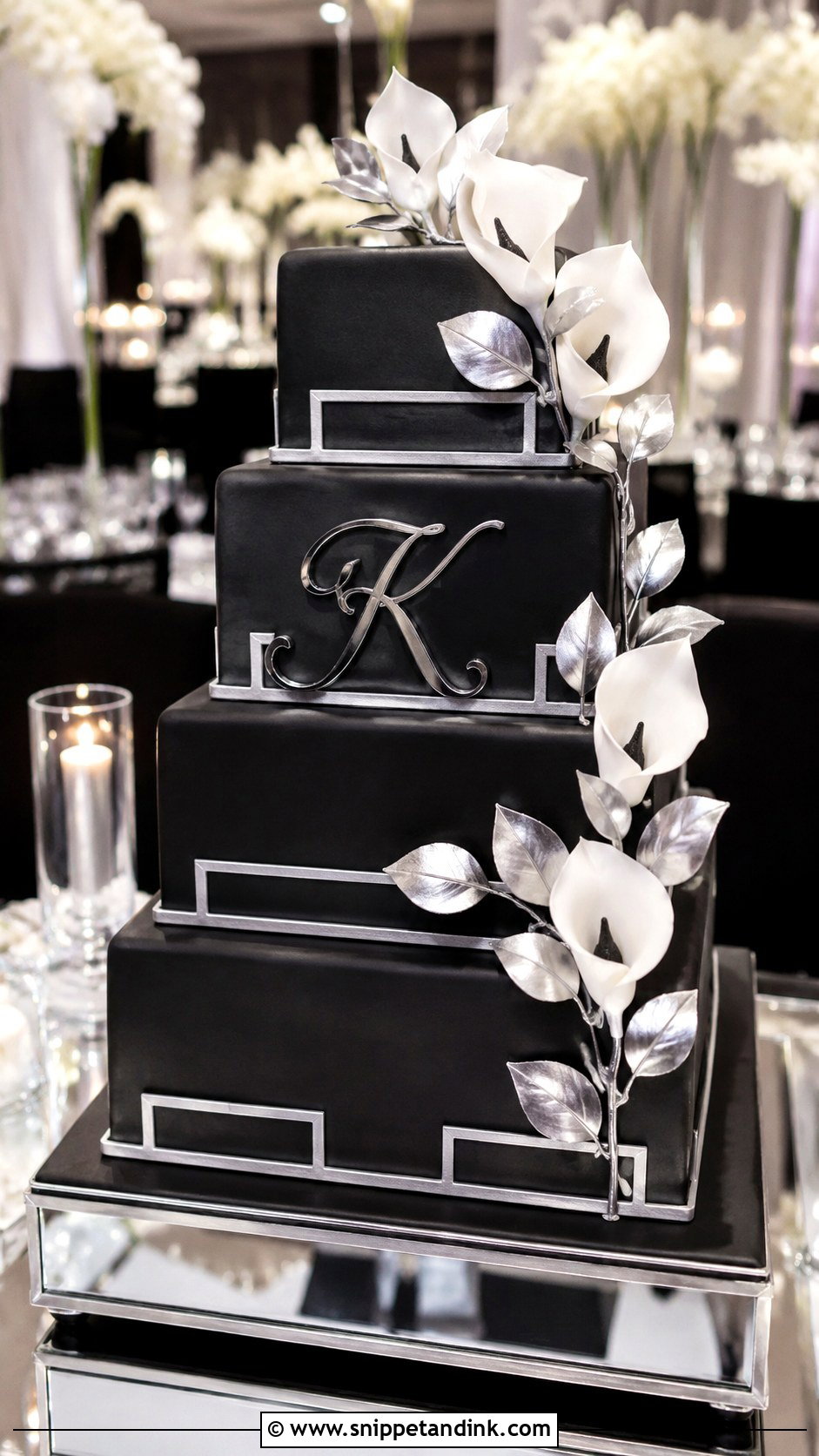
Square tiers look crisper and more architectural than round ones, and the corners make silver borders, geometric patterns and Deco details stand out. Stack them evenly for a classic outline or offset them slightly for something contemporary. Fondant is the right finish here; I’d steer you away from square buttercream because sharp corners are very hard to hold in soft icing for a whole evening. White flowers, silver leaf or a monogram complete it. Square cakes also cut into neat, even portions, which caterers like.
16. Black And Silver Wedding Cake With Orchids
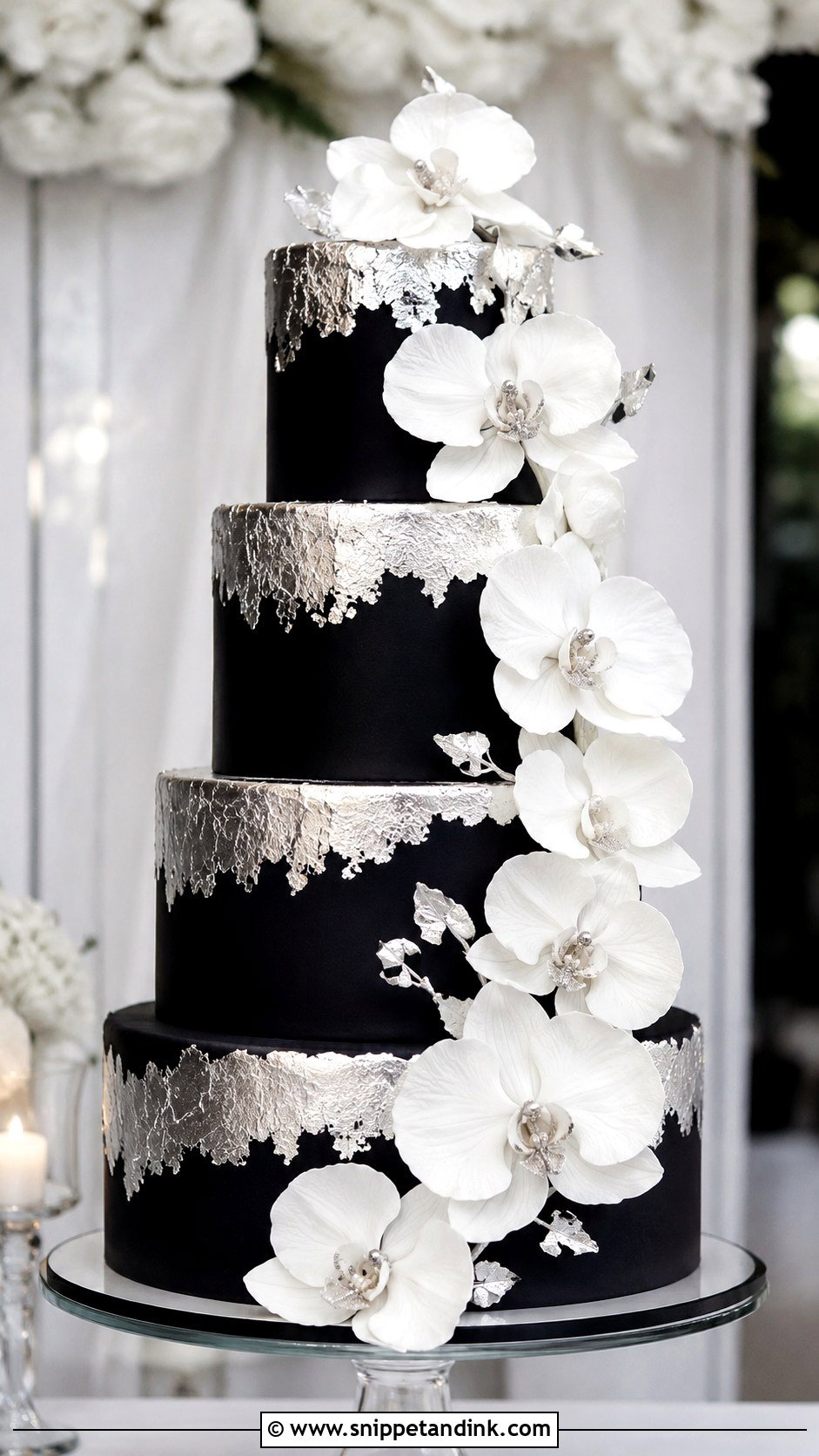
Orchids against black icing look clean and sculptural, and white ones give the strongest contrast. They’re also one of the more practical fresh flowers for cakes, since many hold up well out of water for a few hours, though I still ask the florist which variety and how it was grown. Set them in a loose cascade down one side for movement. Smooth, plain tiers keep the flower shapes readable, and a silver painted edge adds shine without stealing focus. It suits modern weddings and destination-feel receptions.
17. Black And Silver Wedding Cake With Silver Leaf
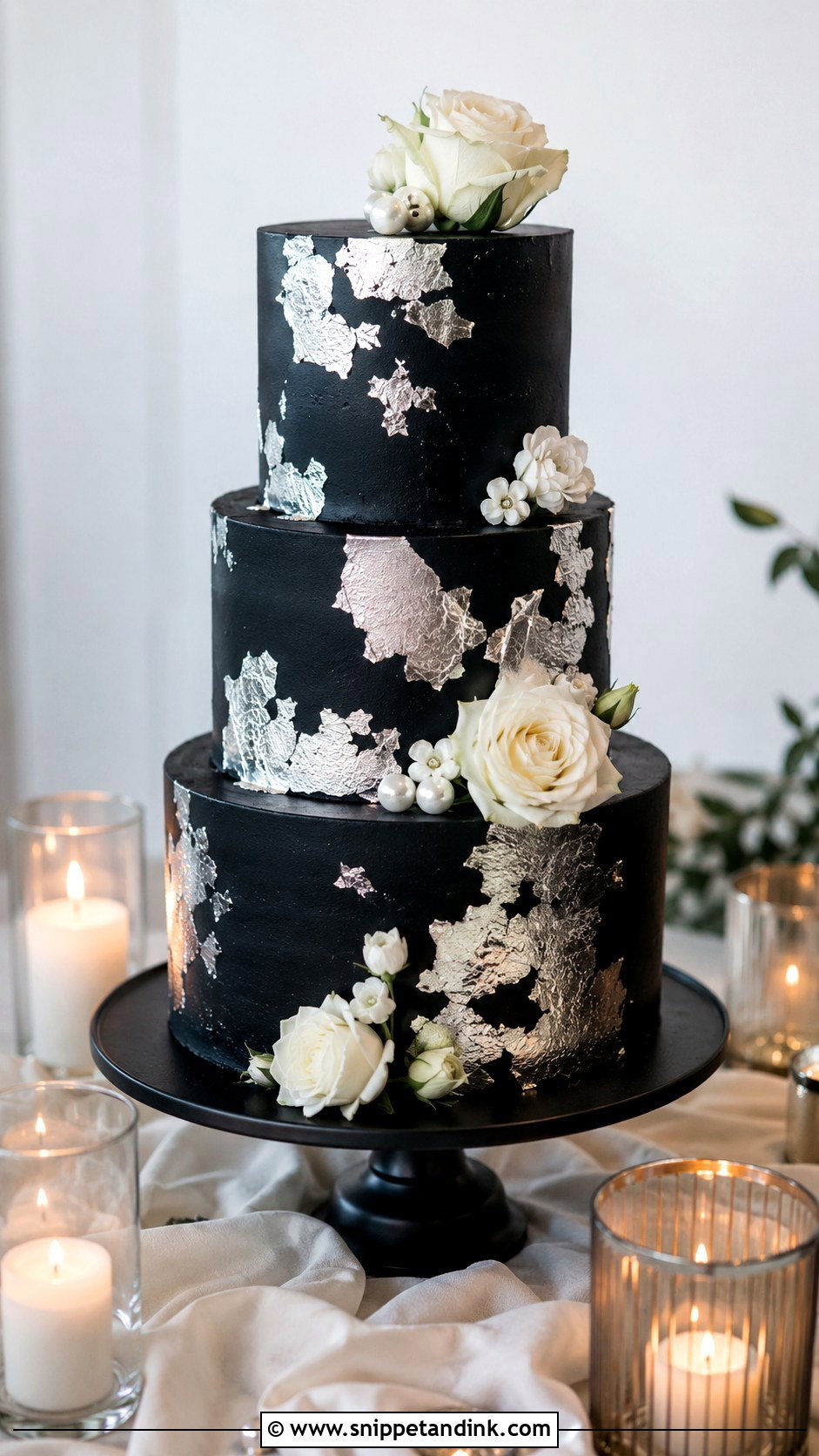
Silver leaf is the most effective single detail on a black cake. It catches light in an irregular, almost natural way. Scatter it across the tiers, lay it in big patches, or edge each tier for a faint glow. I apply it with a dry brush onto very lightly moistened icing; too much moisture and the leaf tarnishes or wrinkles. It works on buttercream or fondant, with fondant giving the cleanest gallery-like finish. Add a few white blooms for softness or leave it flower-free for a modern look under candlelight.
18. Black And Silver Wedding Cake With Monogram
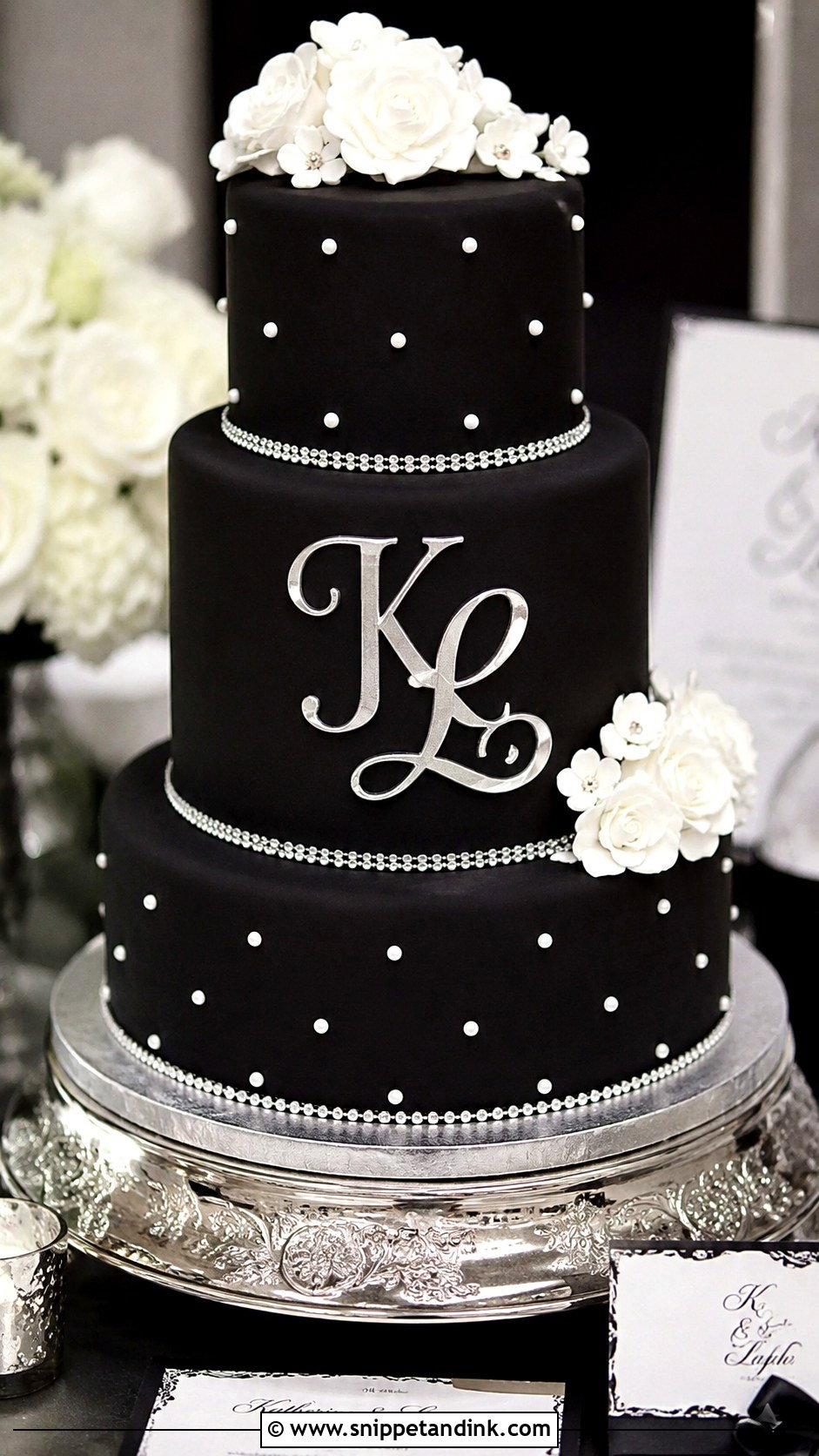
A monogram makes a black cake personal while keeping it formal. Your initials can sit in silver on the front tier, become the topper, or repeat as a pattern. It needs to be the star, so I clear other decoration away from it. Smooth black tiers make the best background, with silver borders and small pearls framing the letters. Send your invitation file to the baker; matching the typeface to your stationery ties the cake to the rest of the day.
19. Black And Silver Celestial Wedding Cake
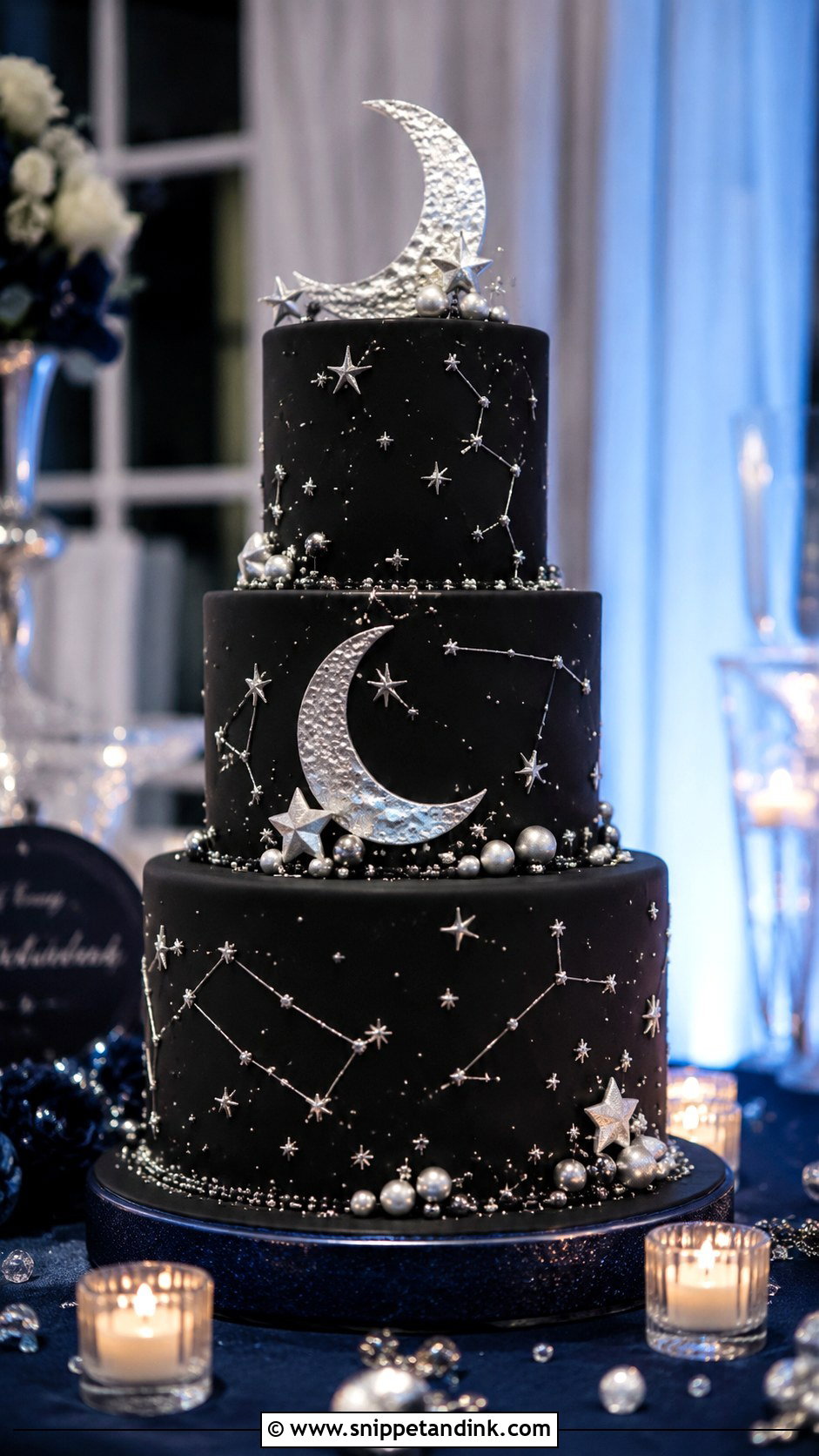
A celestial cake brings a dreamy night-sky feeling to the room: silver moons, stars, constellations and tiny pearls on black tiers. Keep stars small and scattered or it can tip into a child’s birthday cake. I usually hand-paint the constellations with a fine brush and edible silver paint, then flick a little shimmer for distant stars. A crescent moon topper or silver constellation band makes it memorable. Evening and outdoor receptions suit it. Deep blue accents only belong if they’re already in your palette.
20. Black And Silver Vintage Wedding Cake
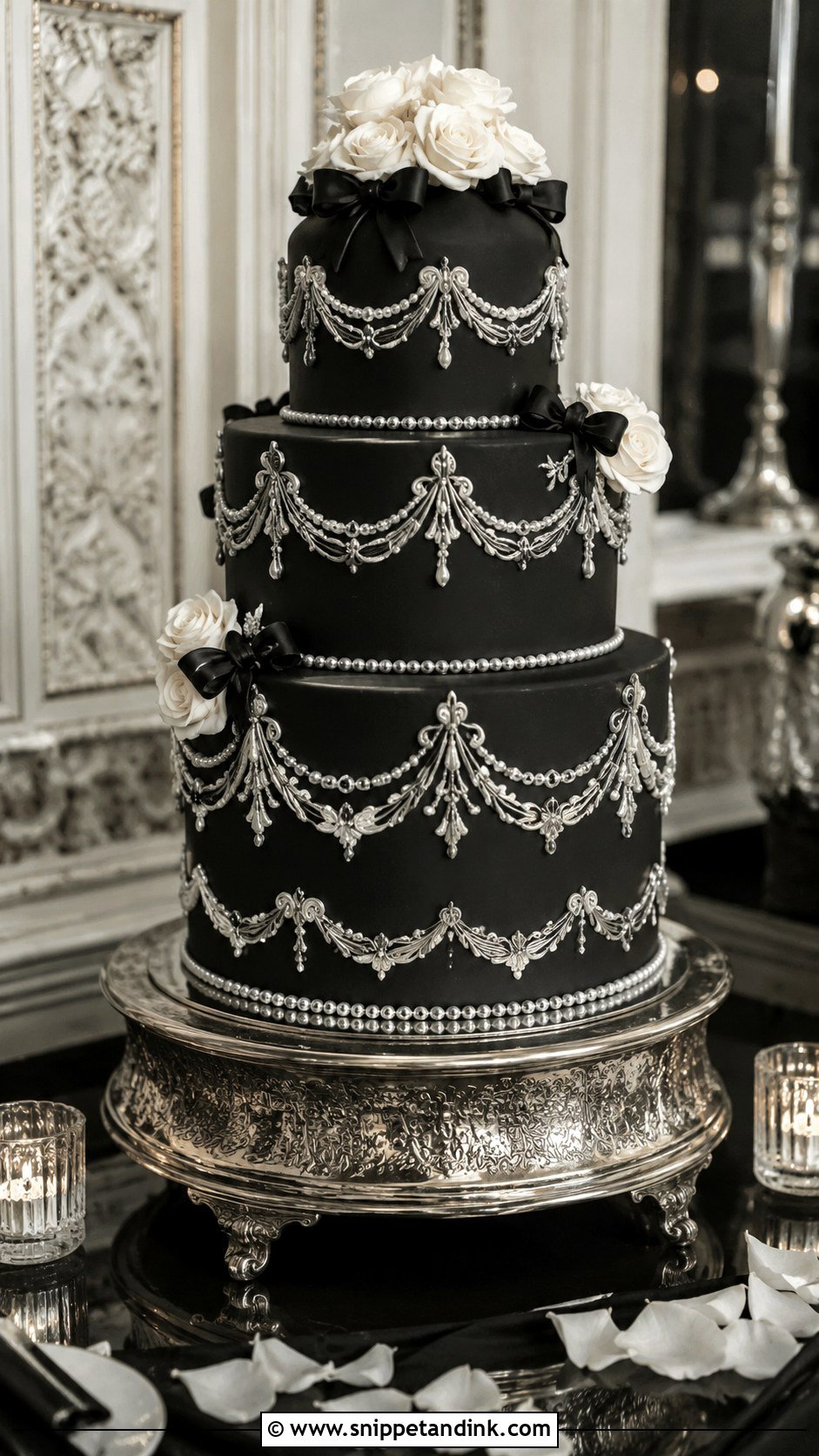
Vintage piping, like Lambeth-style borders, swags and over-piped scrolls, looks striking in silver on black, and the detail softens what could be a severe cake. It is time-consuming work, done layer by layer with drying time between, so allow for that in your order date. Keep the palette tight with black, silver and a few white accents. A heart-shaped tier feels current, while round tiers feel classic. It’s at its best in historic venues and at formal receptions with a nostalgic mood.
Which Silver on the Cake Can Actually Be Eaten
Silver is where cake decorating gets confusing, because several products look identical on the cake and are labelled very differently. Rules also vary between countries, so I’d always have the baker confirm what they use.
- Edible silver leaf: thin beaten silver sold for food use in many places, though not approved everywhere. It’s tasteless and used in tiny amounts.
- Silver dragées and sugar pearls: some are fully edible sugar with a pearlescent coat; hard metallic ones are sold as decoration only in some markets and are best removed before serving.
- Lustre dusts and metallic paints: check for the word edible. A label that just says non-toxic usually means safe to touch, not meant to be eaten.
- Wired sugar flowers and metallic toppers: decorative. They come off before cutting.
A good plan is to keep anything questionable on parts of the cake that get removed, like the topper, the flowers and the board, and use clearly edible shimmer on what guests will eat.
Heat, Condensation and Candlelight on a Dark Cake
Black surfaces absorb heat. In direct sun or under a spotlight, a black buttercream cake softens faster than a white one, so I ask where the cake table sits before I commit to buttercream. Fondant is the safer finish for a warm room or a long display.
The other risk is condensation. A cake brought straight from a cold fridge into a warm hall beads with moisture, and on black fondant those droplets dry as dull spots and can make metallic paint run. I let a chilled cake come up to temperature in its box before unboxing, and I’d ask your venue to keep the cake out of the kitchen’s walk-in once it’s set up. Candles are fine nearby, but not under sugar flowers or isomalt, which melt.
Is a Black Cake Right for Your Reception Room?
Black and silver can be sleek, romantic, vintage or glamorous, and the finish decides which. Black brings the drama and silver brings light; flowers, pearls, marble, lace, geodes and clean metallic lines each push the mood a different way. For a softer cake, use black as an accent or surround it with white blooms. For a centrepiece with presence, choose smooth black tiers with silver leaf, sequins or Deco lines. Whichever you pick, ask your baker how they’ll make the black and which silver is edible before you sign off the design.
You'll Like These Ideas:



Leave a Reply