
A black, white and silver cake suits the formal end of the wedding spectrum: ballrooms, rooftop dinners in winter, art deco rooms with mirrored tables. What makes the palette work is that each color has a job. White keeps the cake reading as a wedding cake, black draws the outline, and silver adds light without the warmth of gold. In my studio the first question I ask is which of the three should lead, because a cake that splits the attention evenly usually ends up looking like a chessboard. The twenty designs below range from pearl and satin ribbon softness to full black fondant tiers, and I’ve added notes on how each one behaves once it leaves the kitchen.
Black Icing and Edible Silver Need a Plan Before the Design
Black is the hardest color I make. White fondant or buttercream needs a heavy dose of gel color to get past dark grey, and that much coloring can turn the icing bitter and soft. My workaround is to start from a dark cocoa base, add black gel, then let it rest overnight because the shade deepens as it sits. Black buttercream also stains lips and teeth, which matters when guests are eating it in a photo booth an hour later.
Silver brings its own question: is it actually food? Edible silver leaf and food-grade metallic paints exist, but many shimmer dusts are sold as non-toxic or for decoration only, which means they’re not meant to be eaten. Ask your baker directly what they use on each part of the cake. If a decoration is decorative-only, it should sit on a piece that gets removed before slicing.
Questions worth asking at the tasting
- Will the black be fondant, buttercream or a painted detail, and how does it taste?
- Which silver elements are edible, and which are removed before cutting?
- Is any part of the design applied on site rather than in the kitchen?
- How long can the finished cake sit out at the venue’s room temperature?
1. Black White And Silver Tiered Wedding Cake
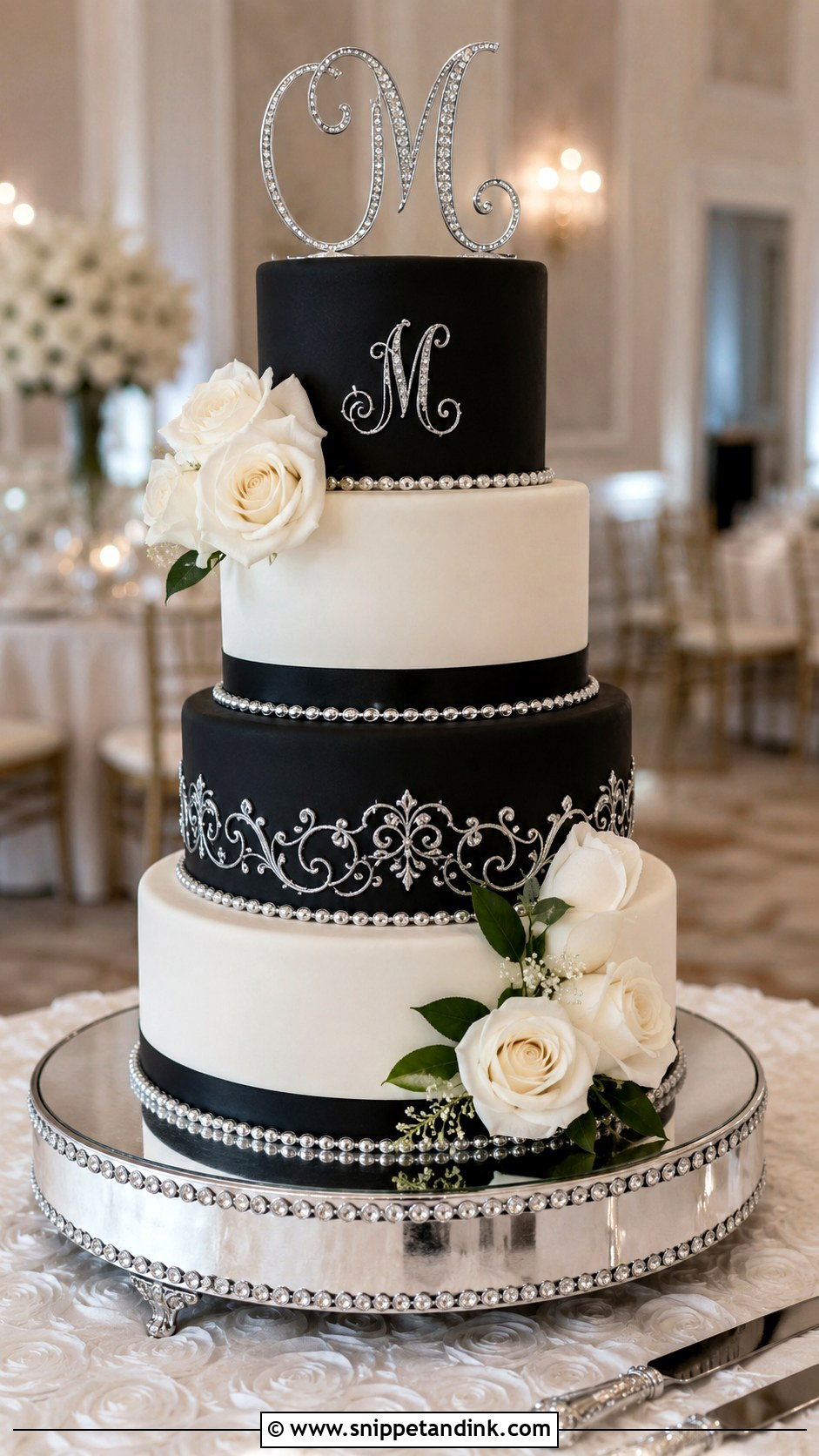
Height is the whole point of a tiered design in this palette, so I usually build three or four white tiers and let black arrive as bands, a single fondant tier or silver separators between layers. Separators add drama but also add risk: every gap is a place where dowels have to be perfectly level, and a slightly tilted tier is far more obvious against black than against ivory. Keep the finish smooth, choose one silver source (edible leaf, piped pearls or a monogram, not all three) and stick to white or ivory flowers. In a ballroom the clean blocks of color read from the back of the room.
2. Black And White Wedding Cake With Silver Leaf
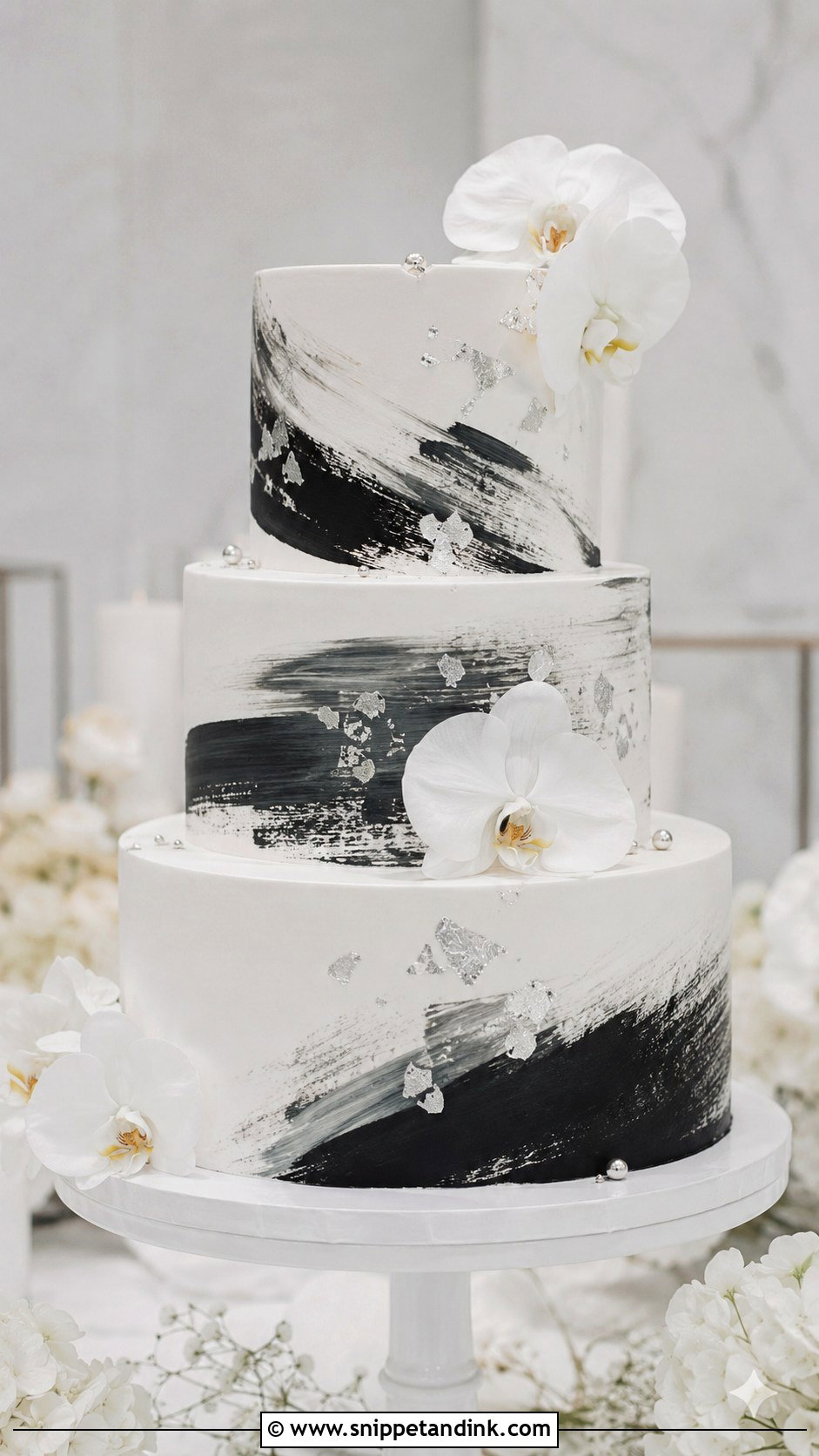
Silver leaf is the quickest way to make black and white look expensive, and it’s also the easiest to overdo. I apply it with a dry brush onto a lightly tacky surface, and I treat it like jewelry: a few torn edges along a black brushstroke panel, or a broken rim around one dark tier. It only shines on a very smooth base, so this belongs on fondant or a chilled, sharply finished buttercream. For flowers, white roses, anemones, orchids or sugar blossoms keep it bridal. Be aware that leaf flakes on touch, so it gets applied at the very end, never before transport.
3. Black White And Silver Marble Wedding Cake
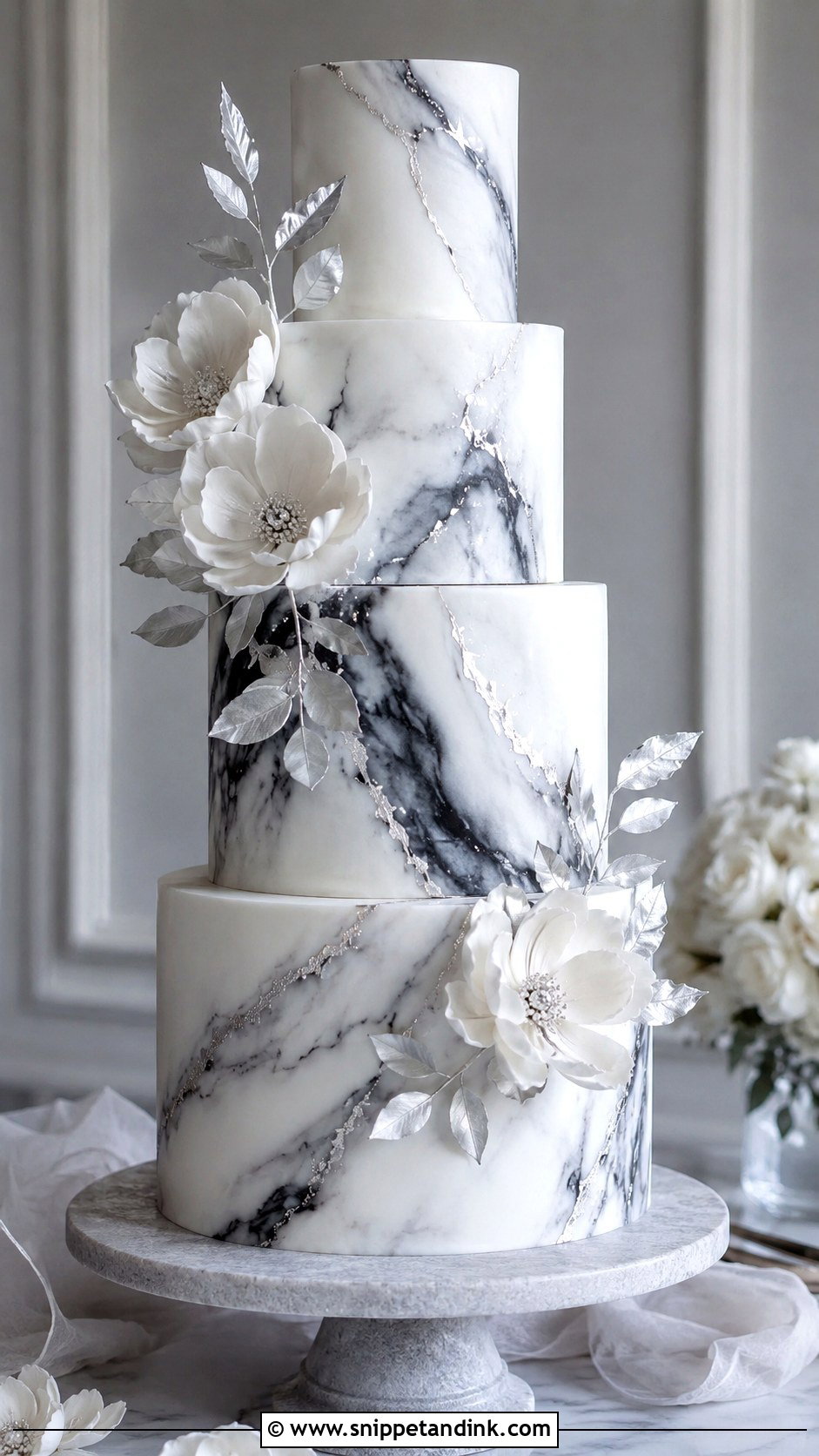
Marble softens the contrast because the colors bleed into each other instead of meeting at a hard line. I fold charcoal and black into white fondant and stop kneading early; one fold too many and the veins turn into a muddy grey. Thin silver veining painted on afterwards gives the stone effect its polish. A tall three-tier cake looks best when each tier shows a slightly different pattern, which happens naturally because no two marbled sheets match. Leave the surface mostly bare. A couple of white blooms or a small black topper is enough.
4. Black White And Silver Drip Wedding Cake
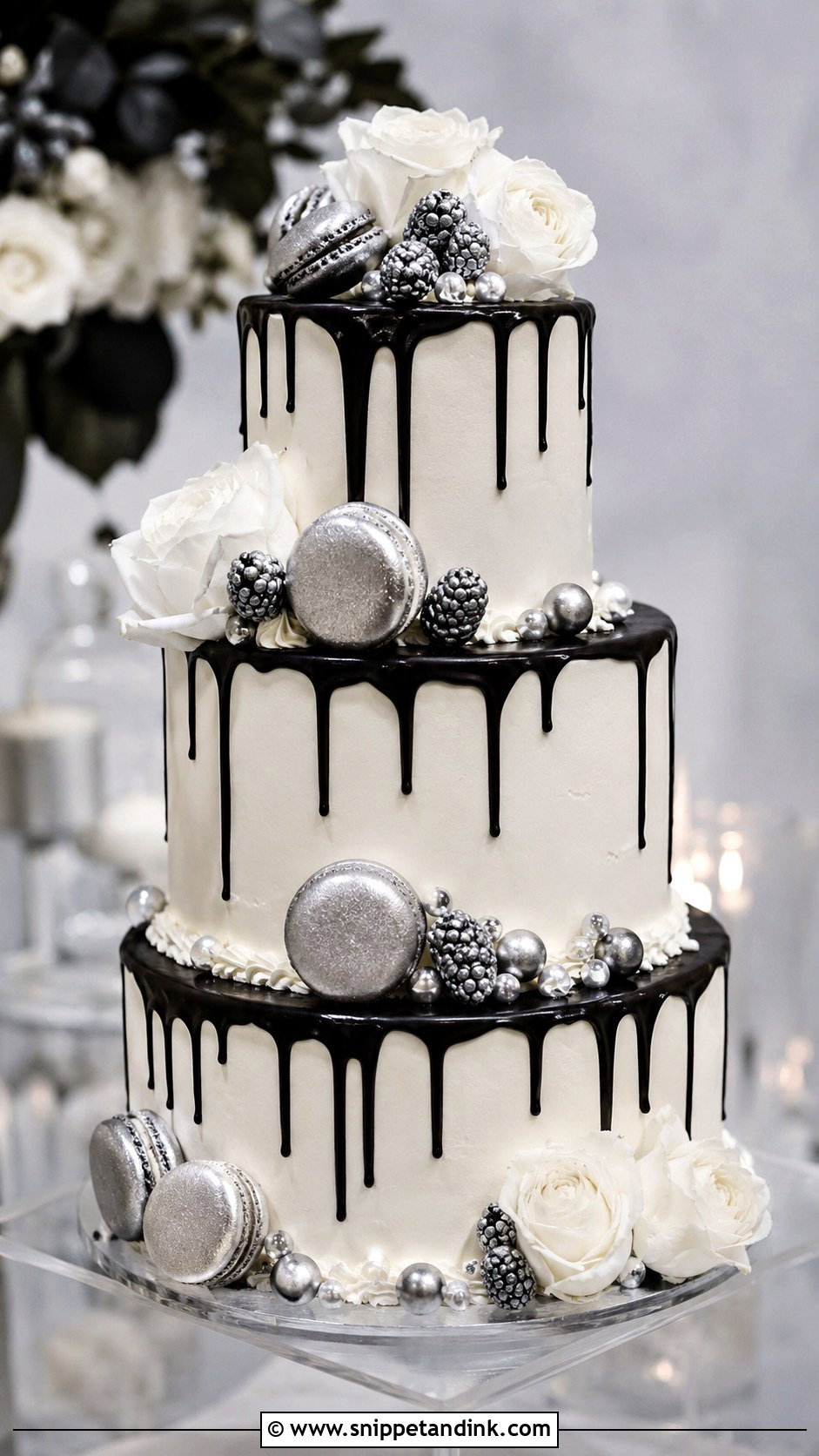
Drips bring a bit of fun into an otherwise formal palette. Glossy black ganache over white buttercream gives the sharpest contrast, and silver sprinkles, edible pearls or metallic macarons finish the top. The reverse, a white chocolate drip on black buttercream, is moodier. The temperature of the ganache decides everything: too warm and it runs to the board, too cool and it stops in stubby blobs. I test one drip on the back of a chilled cake before doing the front. This design suits smaller weddings and dessert tables more than a five-tier showpiece, since long drips on tall tiers rarely stay even.
5. Black White And Silver Art Deco Wedding Cake
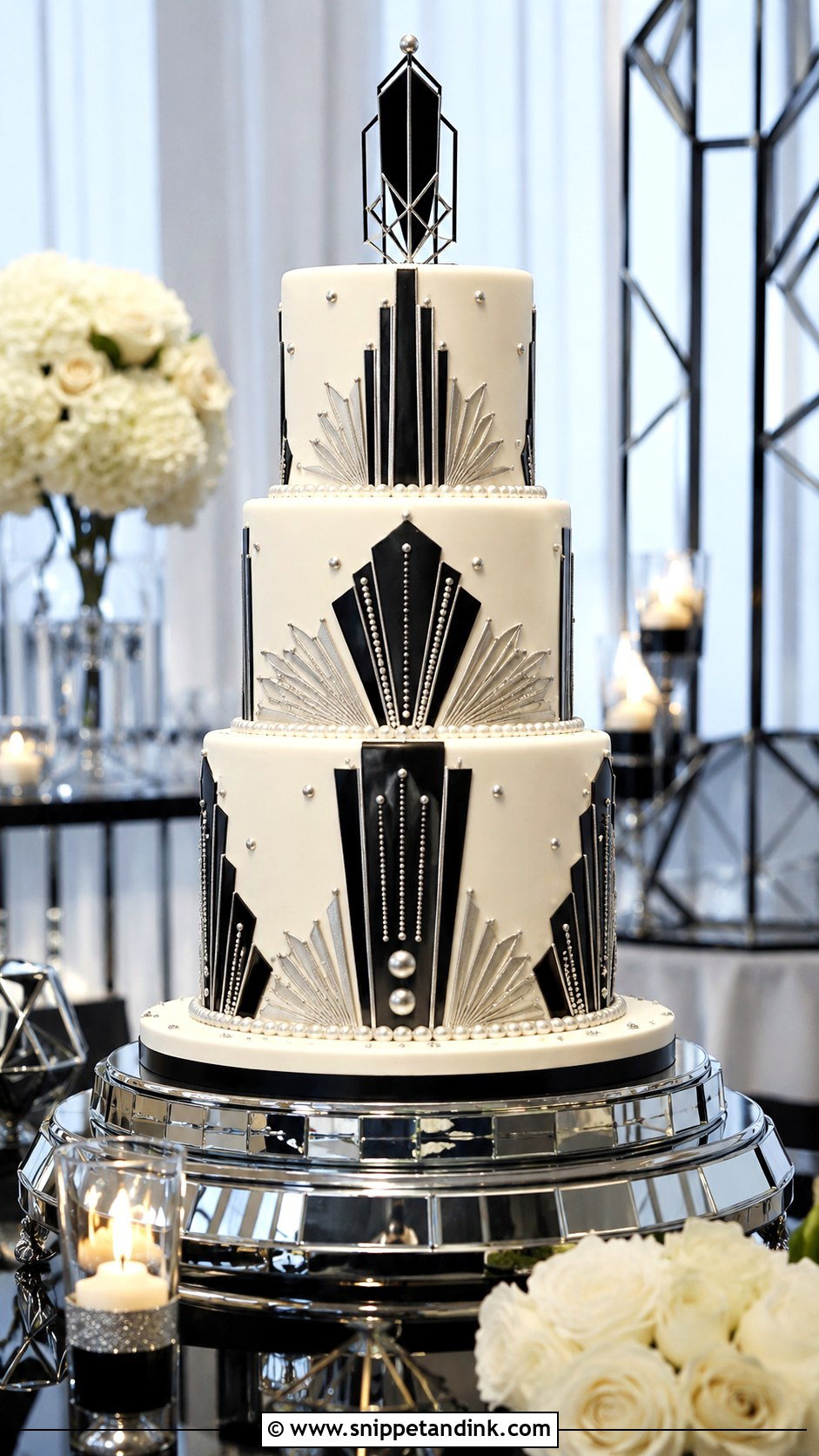
Art deco and this palette belong together. Fans, sunbursts, stepped tiers and metallic lines borrowed from 1920s architecture all read clearly in black, white and silver. A white base with black panels and silver piping stays bold without going dark; black tiers with silver sunbursts are the more dramatic version. Symmetry is non-negotiable here, so I measure and mark panel positions with a turntable and a ruler before anything is cut. On a mirrored stand at a black-tie wedding it looks entirely at home.
6. Black White And Silver Floral Wedding Cake
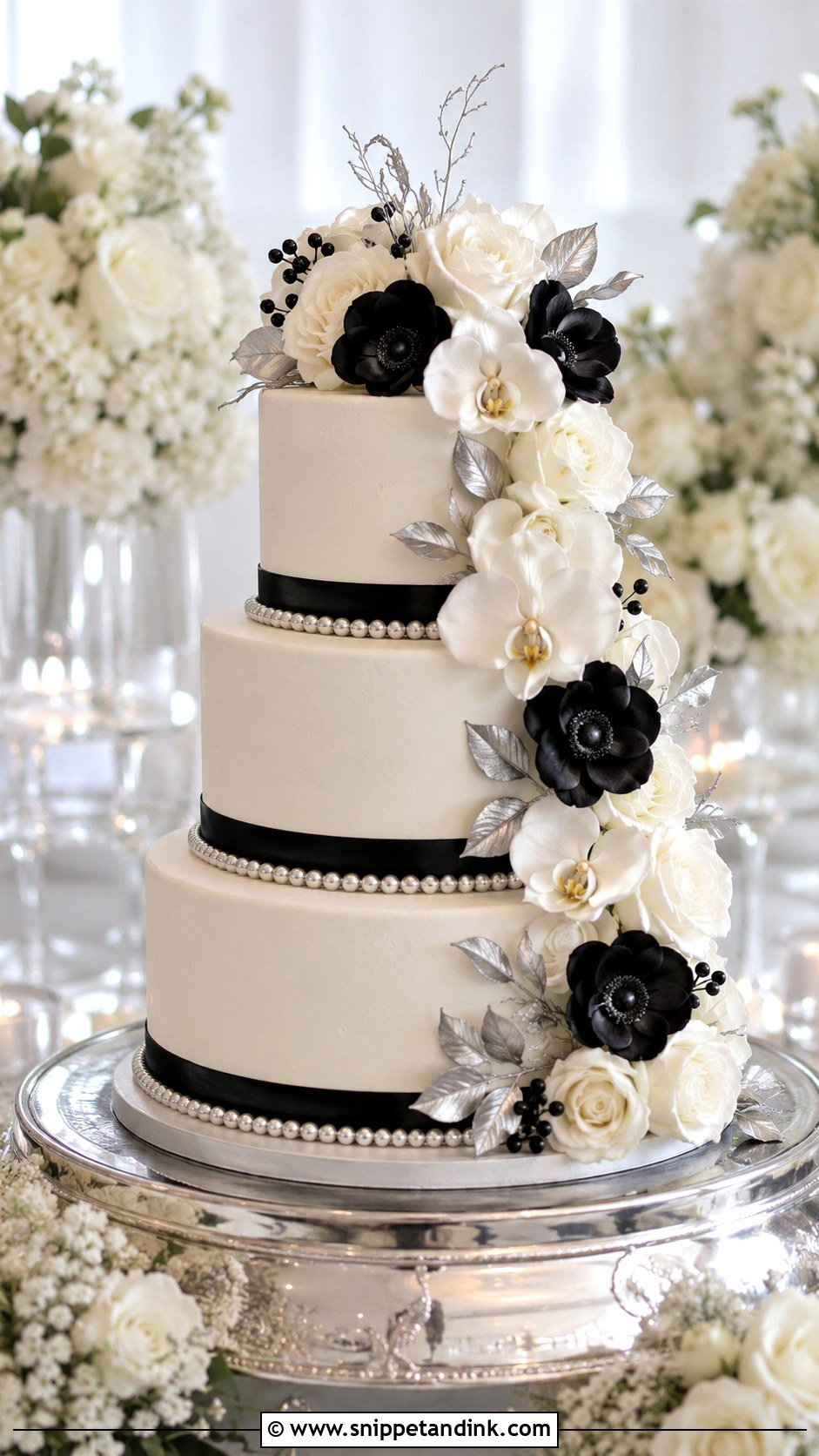
Flowers stop black and silver from feeling severe. A white tiered cake with black ribbon bands, silver pearl borders and one cascade of fresh roses, orchids, ranunculus or anemones is easy to love. If the florist is supplying blooms, they need to be pesticide-free and kept off the cake surface with a barrier, because cut stems weep sap into icing. Black sugar flowers mixed with white blooms give stronger contrast. Group everything in one main cascade; flowers dotted across every tier make the cake look crowded.
7. Black White And Silver Pearl Wedding Cake
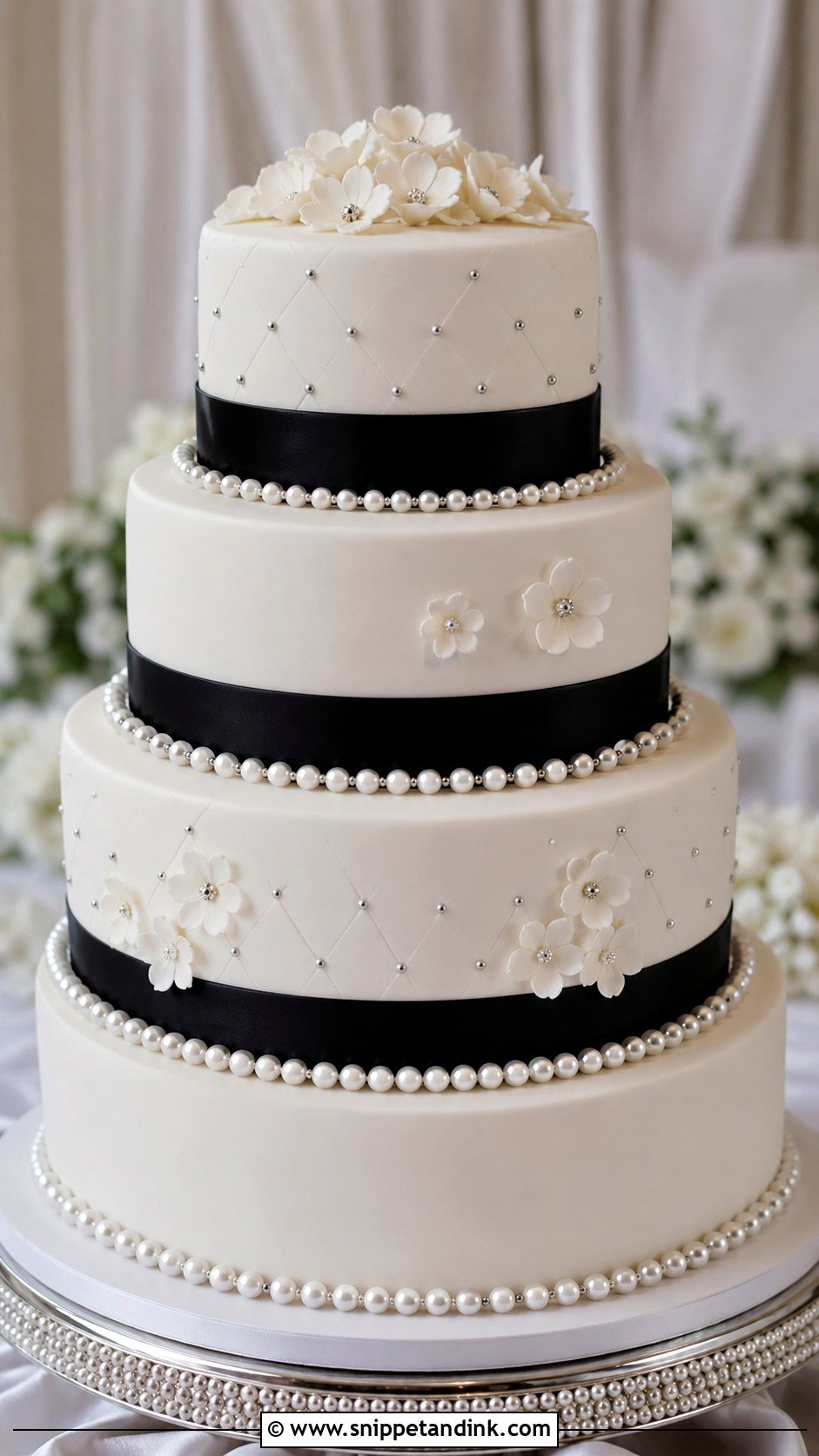
Pearls give texture and shine without needing large decorations. On a white fondant cake with black satin ribbon, a silver pearl border at each tier base is classic. For more detail, run pearl beading down one side, or mix tiny silver dragees with white sugar pearls for a layered jewelry look. Real ribbon needs a strip of fondant or a food-safe backing behind it, otherwise the fat in the cake creeps into the satin and leaves greasy patches. Spacing matters more than quantity, so I pipe or place pearls with a template rather than by eye.
8. Black White And Silver Bow Wedding Cake
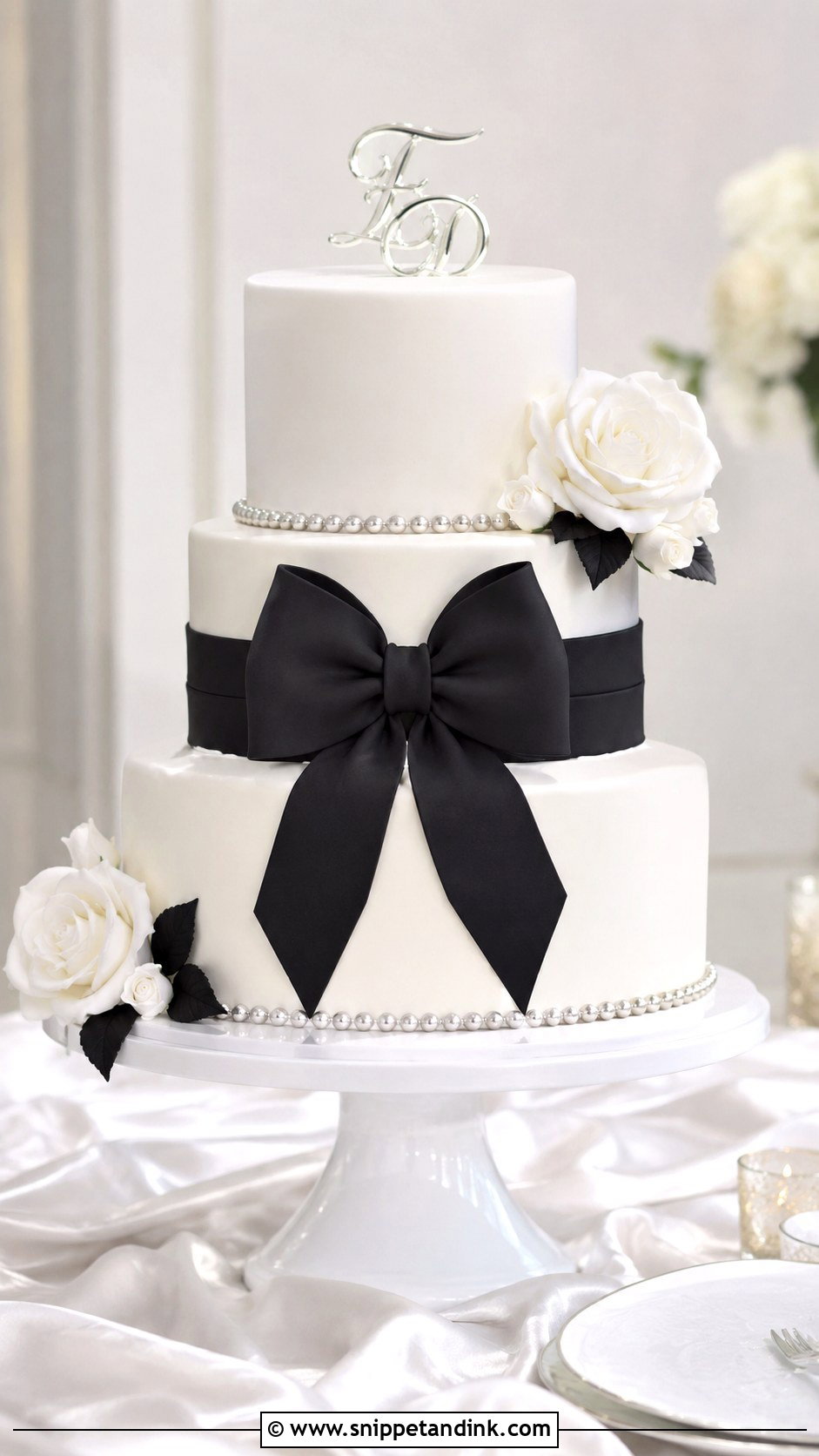
A bow sounds sweet, but in crisp black on a smooth white cake it reads like couture. The black fondant bow can sit on the middle tier, trail down one side, or wrap the base like a formal gift. I make the loops a few days ahead and let them dry over tubes so they hold their shape; a bow made the same day sags by the reception. Keep the rest of the tier plain. A small silver monogram topper is the only extra I’d add.
9. Black White And Silver Square Wedding Cake
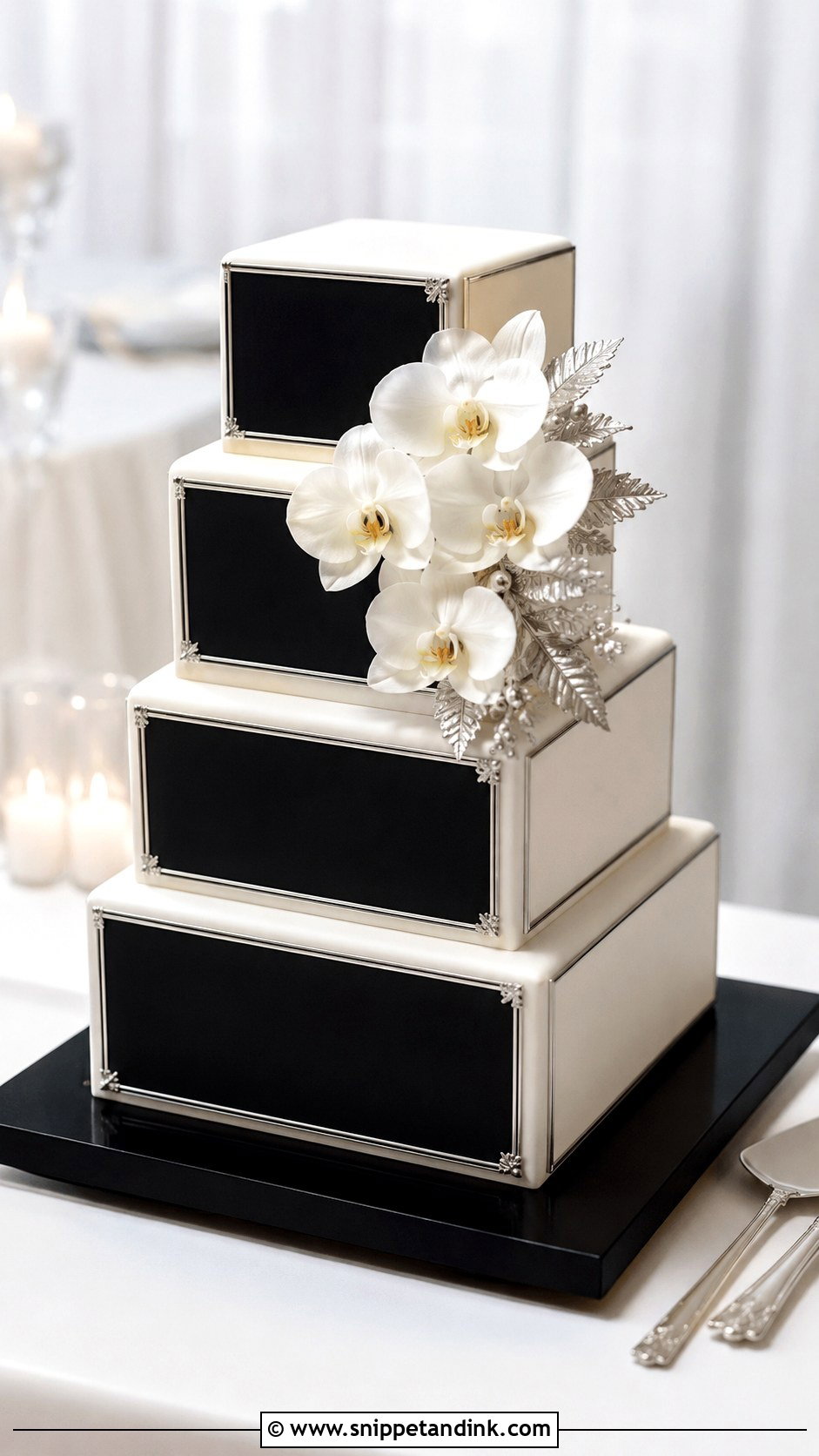
Square tiers make every black and silver line look architectural, which is exactly why they’re unforgiving. Each corner has to be sharp, and every panel has to sit flush, because the eye follows straight edges and finds every wobble. Stacked white squares with black side panels and silver piping along the corners is the classic layout; alternating black and white squares with silver separators is bolder. These suit hotel weddings and minimalist city venues. One cluster of white flowers or a silver topper keeps it balanced, and I’d expect a square design to take more decorating time than a round one of the same size.
10. Black White And Silver Buttercream Wedding Cake
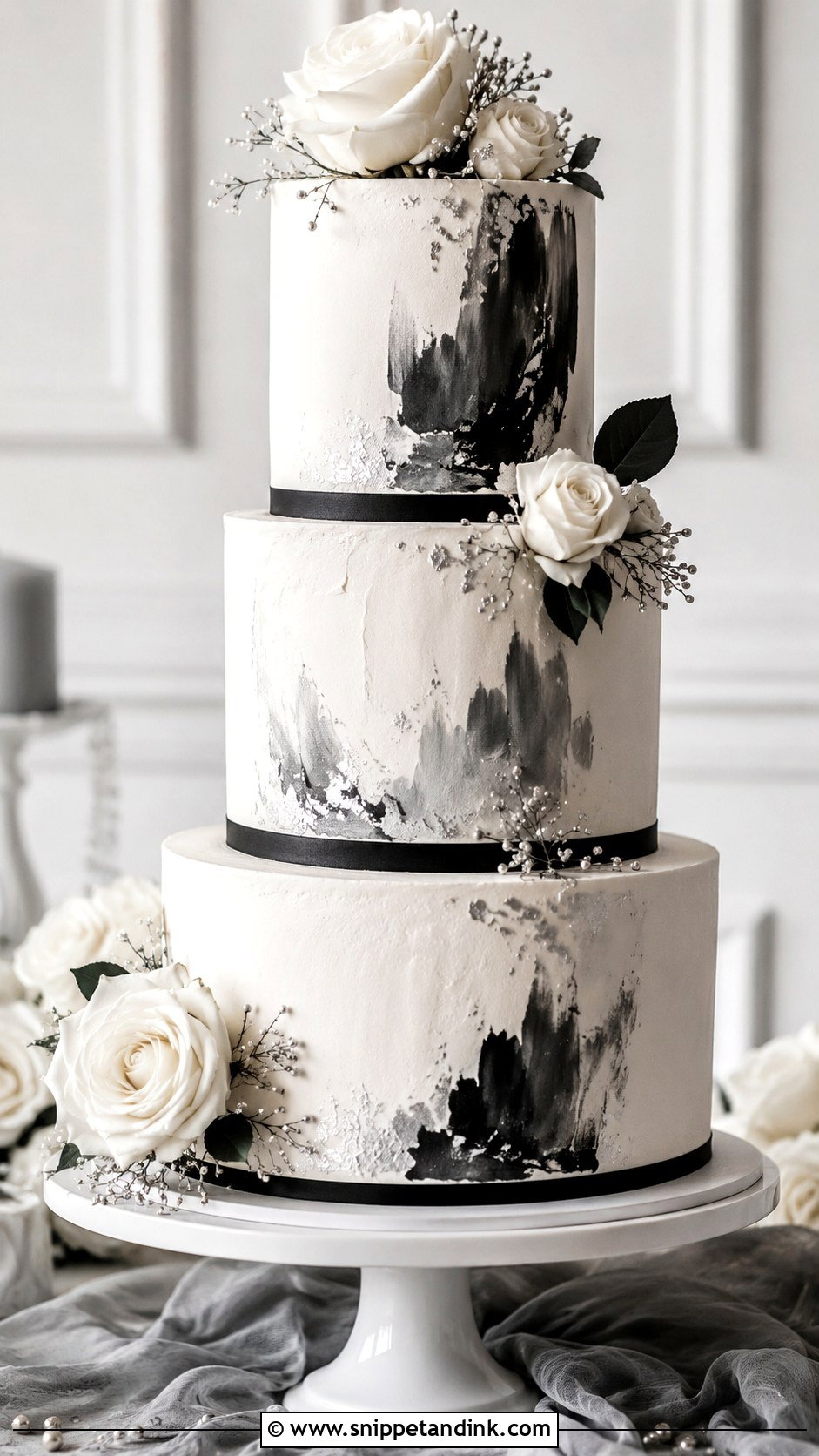
Buttercream can carry this palette, though I use black differently on it. Deep black buttercream needs a lot of coloring, it can taste bitter, and it stains lips and teeth at the table. So on buttercream I keep black as a painted detail, a ribbon or a single accent tier, and let white buttercream do the main work with silver leaf and fine piping. Smooth and chilled gives a clean modern edge, while a lightly textured finish feels more relaxed. It’s the version I’d suggest to couples who care as much about the eating as the look.
11. Black White And Silver Fondant Wedding Cake
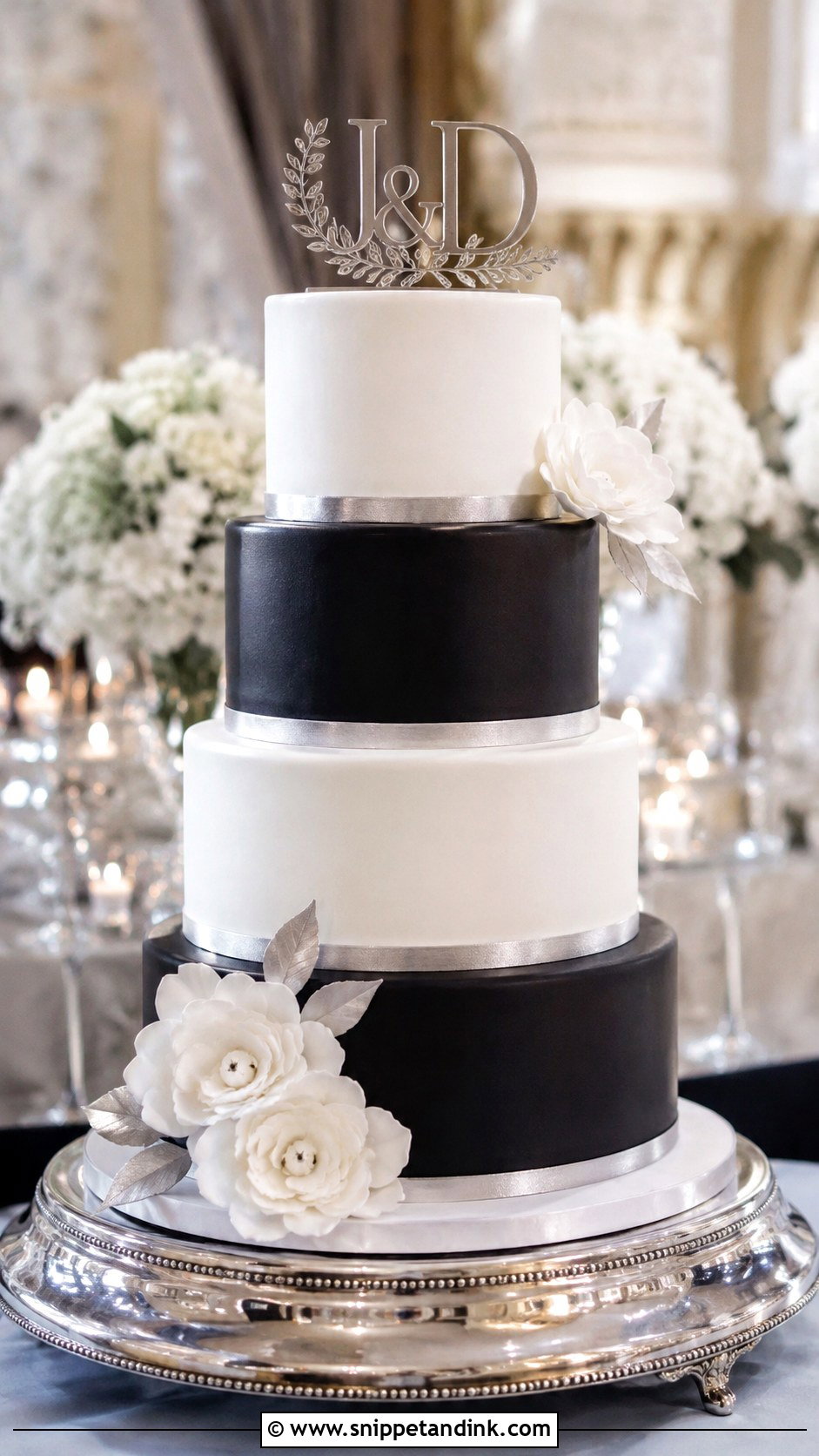
Fondant is the most reliable surface for sharp patterns in this palette. Stripes, marble, lace, metallic leaf, bows and geometric work all need a smooth canvas, and fondant gives clean black and white tiers without the texture of buttercream showing through. For silver, I use edible metallic paint, pearl borders or thin fondant trim. Pre-colored black fondant is much easier to work than white I’ve dyed myself, and it cracks less at the edges. Keep the flavors inside familiar, vanilla almond, chocolate or red velvet, because plenty of guests peel fondant off and eat only the sponge.
12. Black White And Silver Lace Wedding Cake
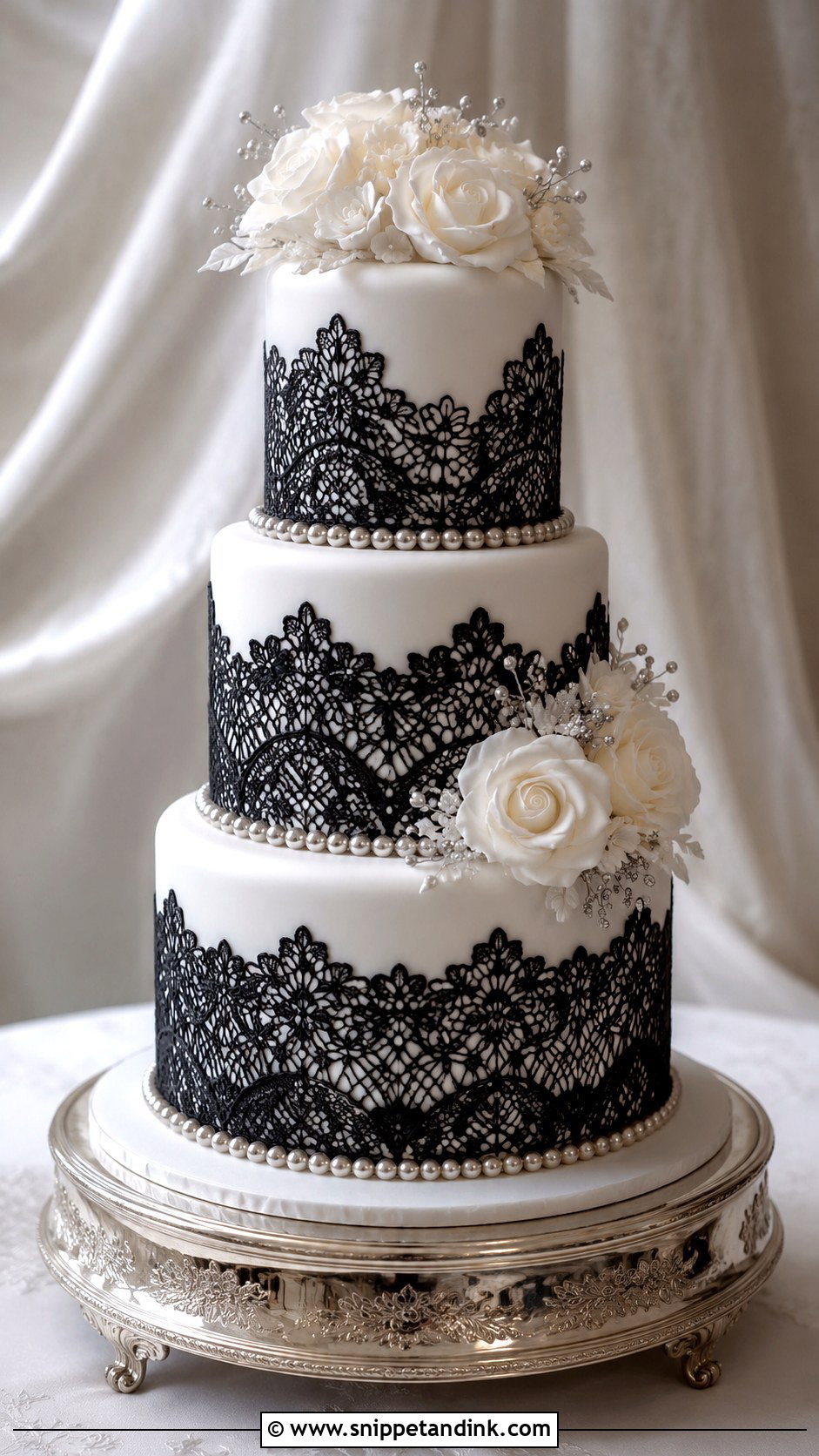
Lace softens the palette and nods to a vintage dress. On white fondant I either pipe black lace freehand or set edible lace appliques, then finish with tiny silver pearls. The reverse, a black tier with white lace, is more dramatic. Edible lace mats need humidity on their side: in a damp room they go limp and stick, in a very dry one they crack when bent around a tier. A consistent, delicate pattern looks refined, while a heavy one reads like a doily. Add a few white sugar flowers or a slim silver ribbon and stop there.
13. Black White And Silver Geometric Wedding Cake
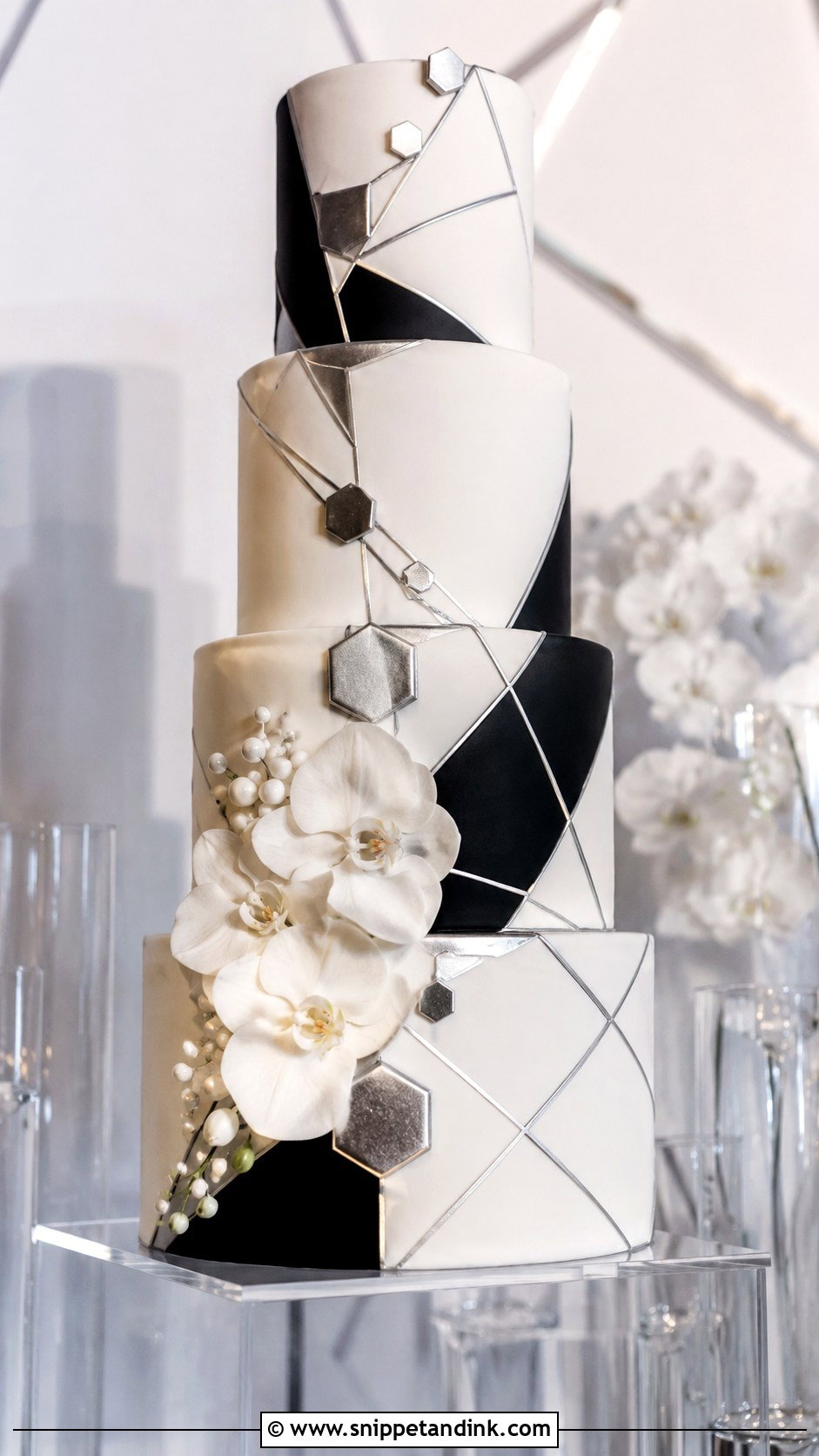
Geometric designs suit couples who’d rather have shapes than flowers. Hexagon tiers, triangle patterns, angled color blocks or thin silver lines across smooth fondant all work, and I cut every piece from a paper template so the angles repeat exactly. A black base tier with white upper tiers and silver accents is the layout I return to most. Height gives the pattern room to breathe, so tall and structured beats short and wide. One small flower cluster is fine if you need softness, but the shapes should stay the focus.
14. Black White And Silver Sequin Wedding Cake
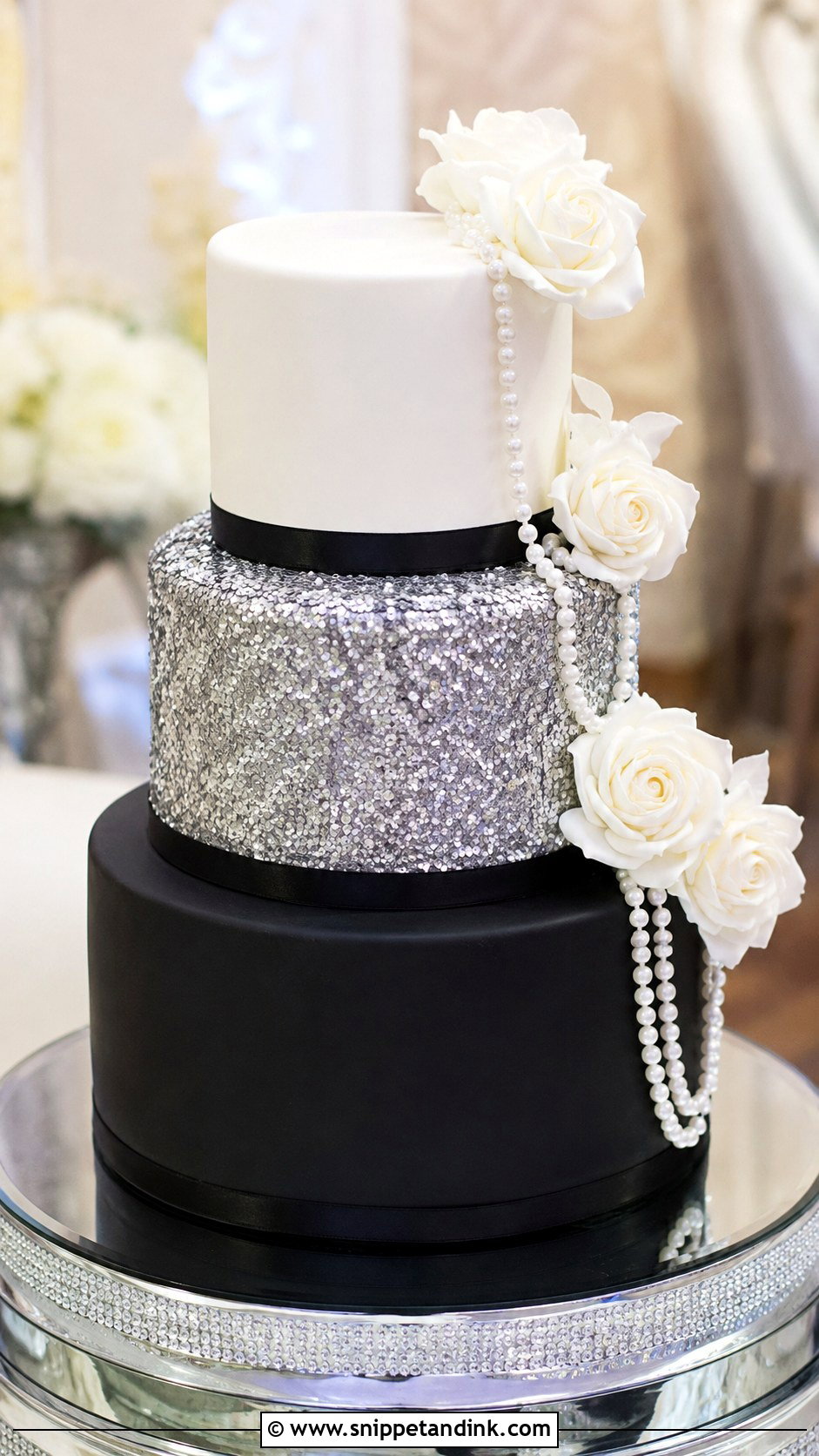
Sequins belong on one tier only. A white top tier, a silver sequin middle and a black base is a strong layout, and the smooth tiers on either side let the sparkle stand out. Edible sequins are pressed on one by one or applied in sheets, and they add weight, so the tier underneath needs proper support dowels. Finish with simple white flowers, a black ribbon or a small acrylic topper. Under evening candlelight the silver throws back points of light across the dessert table.
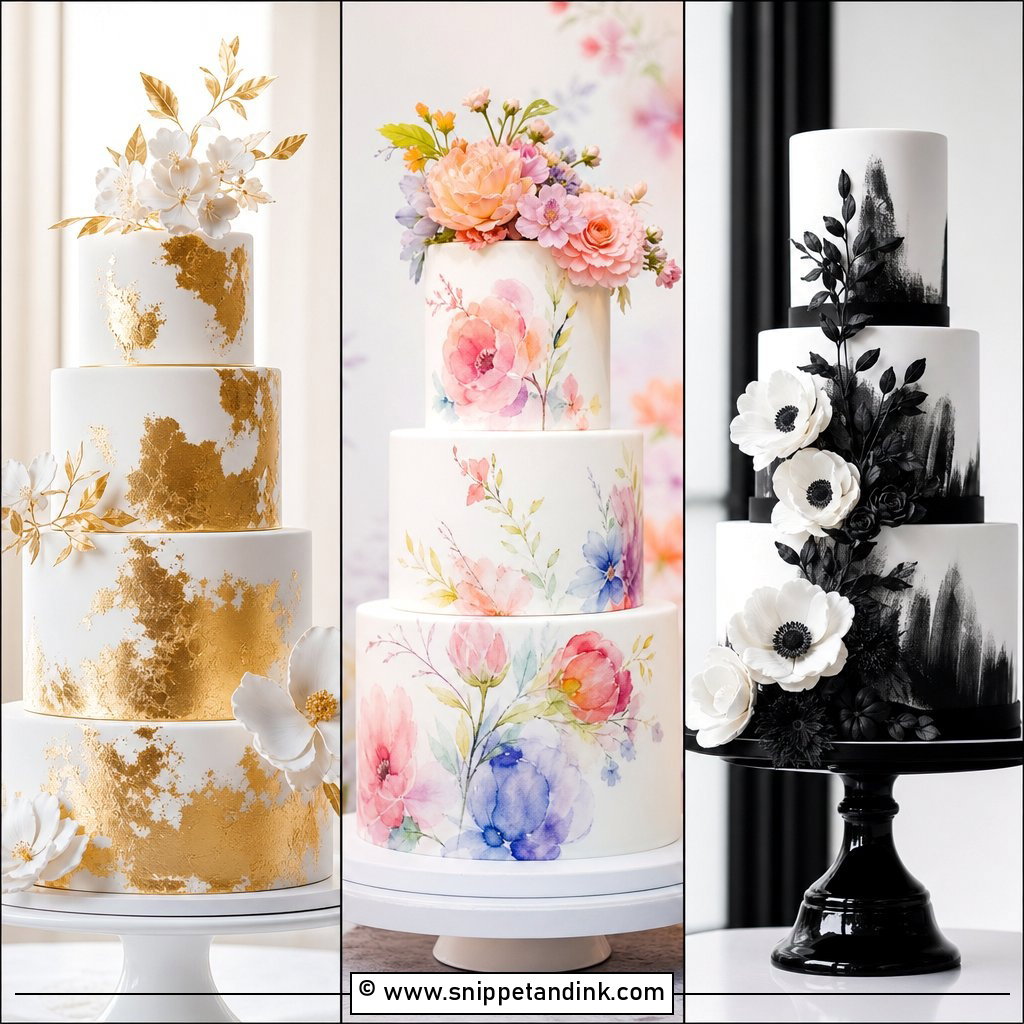


15. Black White And Silver Ombre Wedding Cake
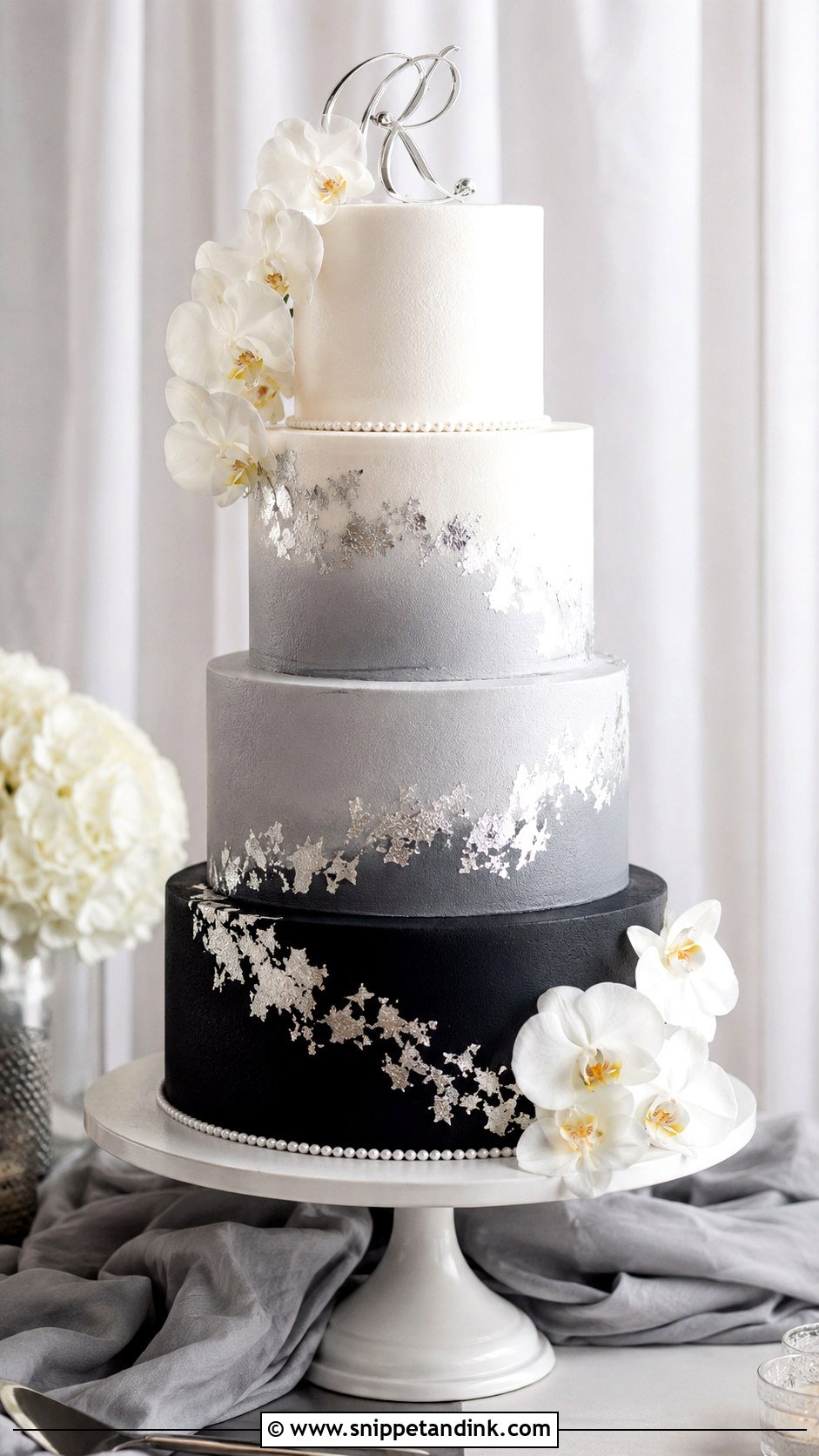
Ombre lets you use black without committing to a black tier. The color fades from white at the top through silver grey to black at the base. On fondant I color three or four separate batches and cover each tier in its own shade; on buttercream I blend on the turntable, which gives a softer graduation. Silver leaf on the grey band or pearl borders between tiers adds detail. Keep flowers simple, white roses or orchids, so they don’t interrupt the gradient.
16. Black White And Silver Striped Wedding Cake
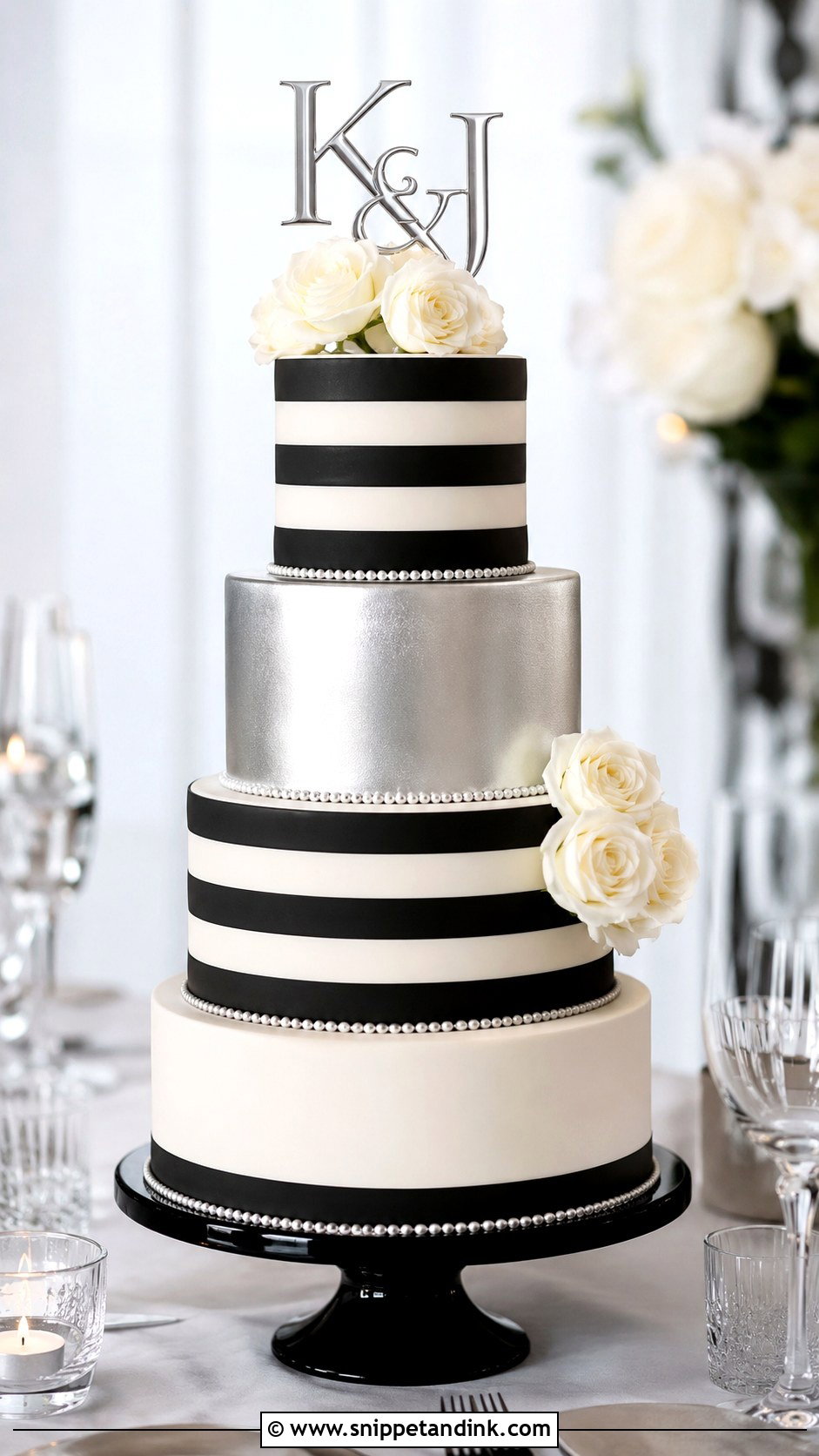
Stripes are graphic, and the direction changes the mood. Black and white horizontal stripes look bold, while vertical stripes add height and feel more formal. A silver trim between stripes, or one silver tier, breaks up the pattern. Stripes have to be perfectly even, so fondant strips cut with a ruler and a strip cutter are the cleanest route; piped buttercream stripes always drift a little. White flowers or a simple silver topper keep it from looking busy at a modern black-tie reception.
17. Black White And Silver Minimalist Wedding Cake
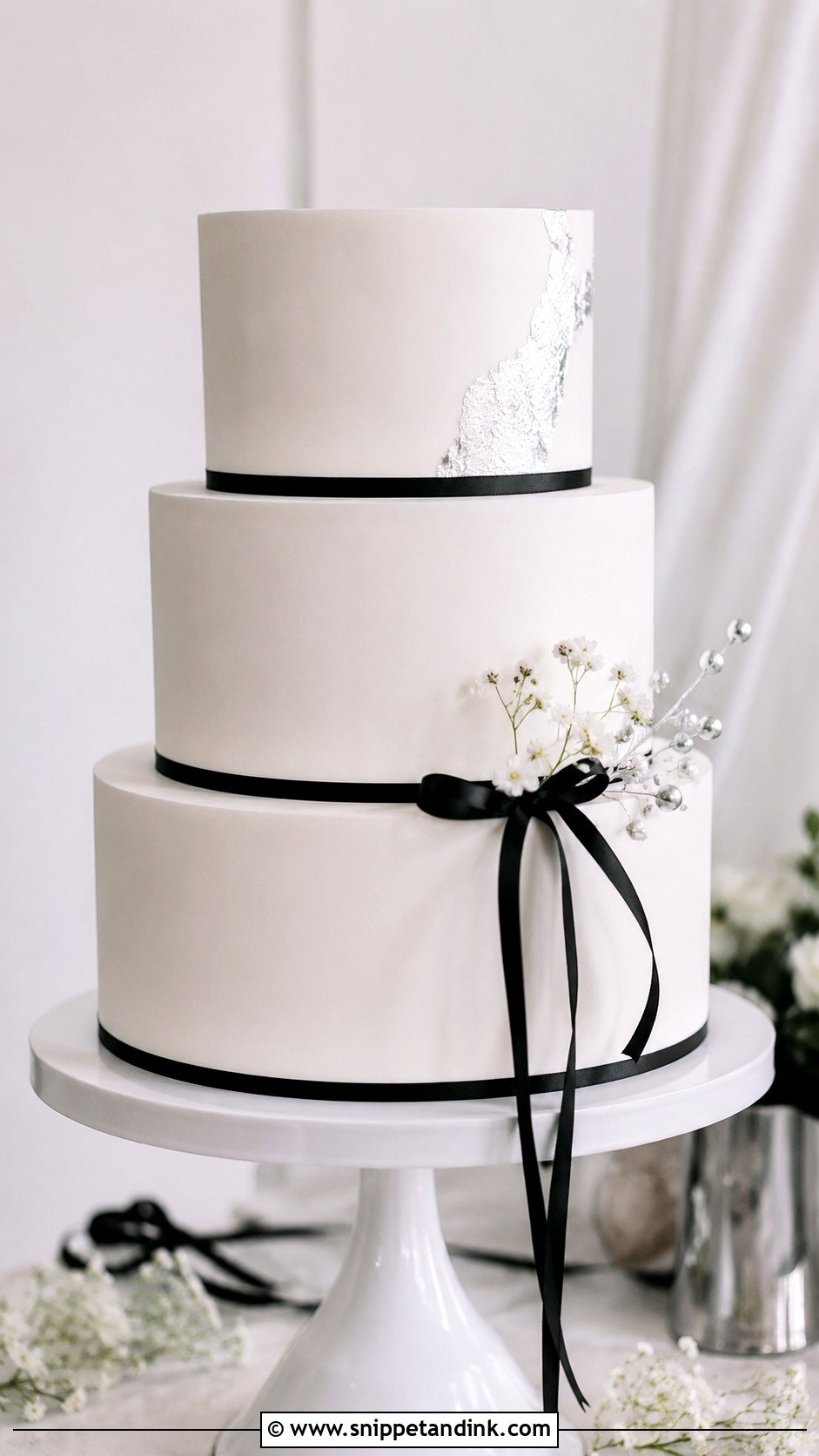
Minimalist is where workmanship shows most. Smooth white tiers, one thin black line at each base and a small patch of silver leaf on one side is all this design has, so there’s nothing to hide a bulge, an air bubble or a soft edge. I’d only order this from a baker whose portfolio shows truly sharp edges. Style it on a plain white stand with uncluttered table styling, and the cake will match a modern wedding without taking over the room.
18. Black White And Silver Chandelier Wedding Cake
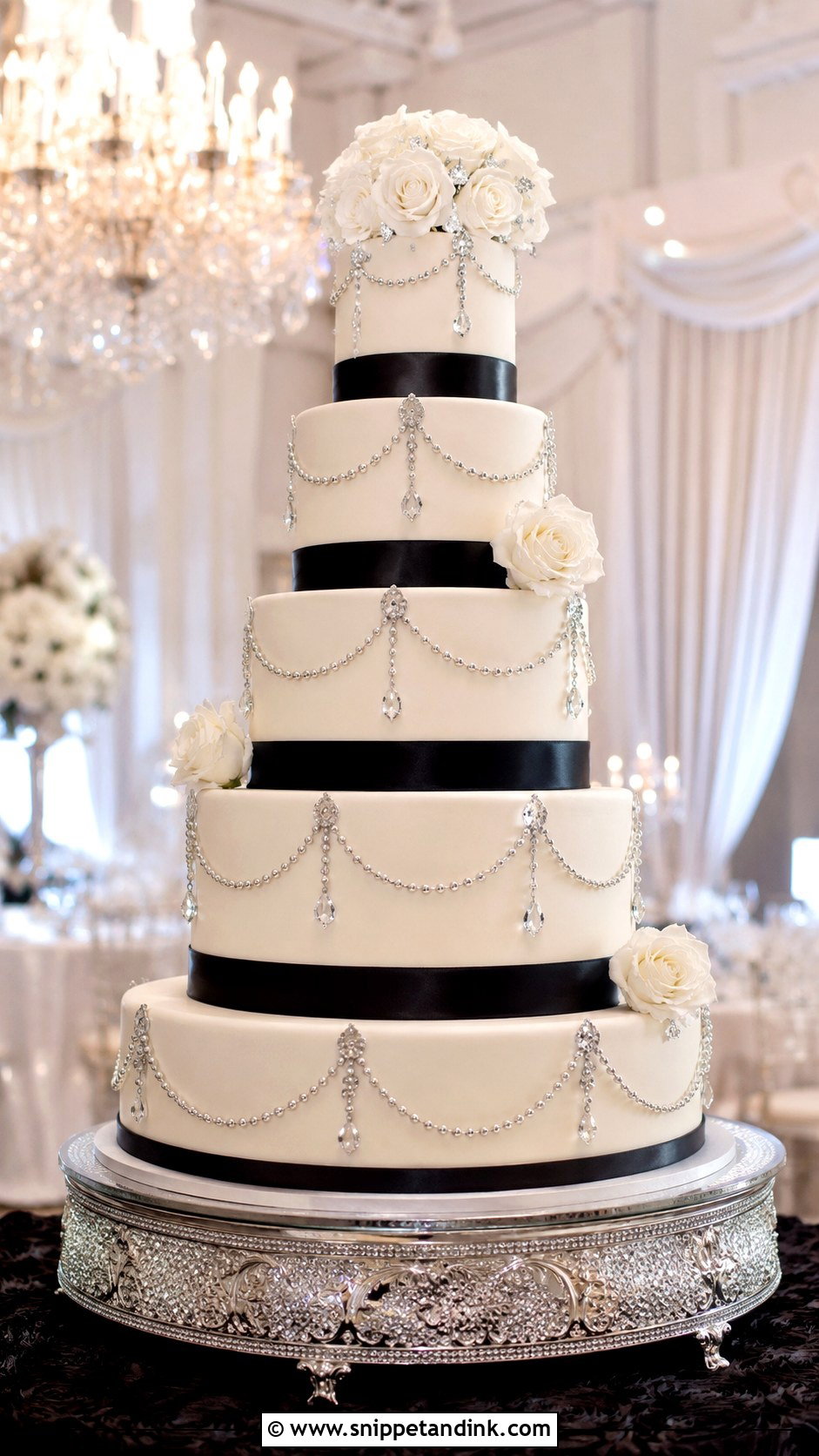
A chandelier cake is built to be a showpiece. Tall tiers carry silver dragee garlands, hanging sugar pearls or delicate piping, and the stand often echoes the chandelier shape for a dramatic dessert display. Hanging details are the fragile part, so I attach them on site after the tiers are stacked. Keep the base mostly white so the silver stays visible, and bring black in as ribbon bands, lace panels or one deep accent tier. It suits a ballroom with crystal lighting better than anywhere else.
19. Black White And Silver Monogram Wedding Cake
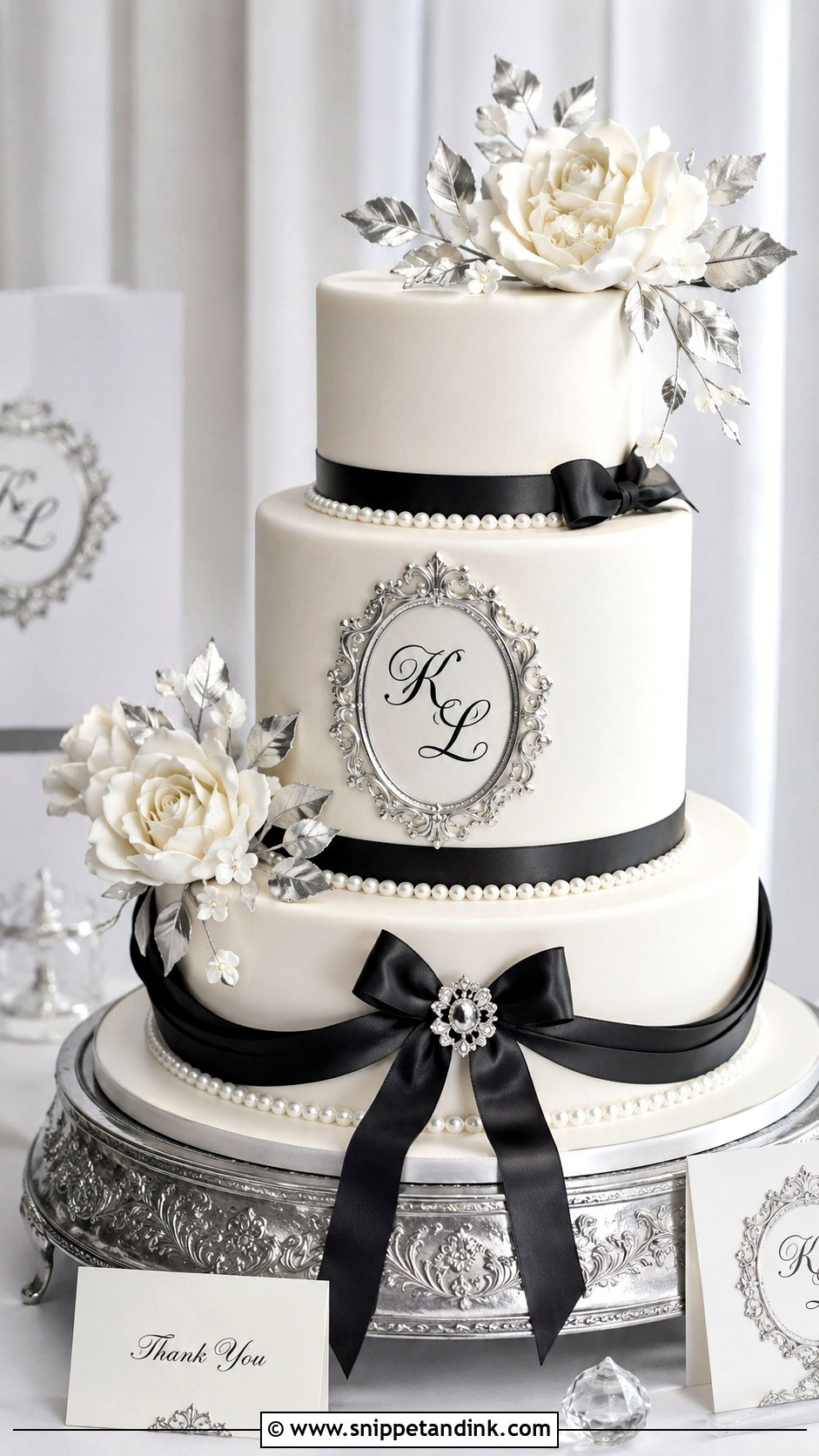
A monogram makes the cake personal while keeping it formal. The silver initials sit on the front of a smooth white tier, framed with black ribbon, pearl piping or thin silver trim, and they work on two-tier, three-tier or tall stacked cakes. Legibility comes first, so keep decorations nearby simple. I ask couples for the exact lettering from their invitations and cut or pipe the monogram to match it, which ties the cake to the stationery and signage. White flowers or black sugar bows can add polish as long as they don’t cover the letters.

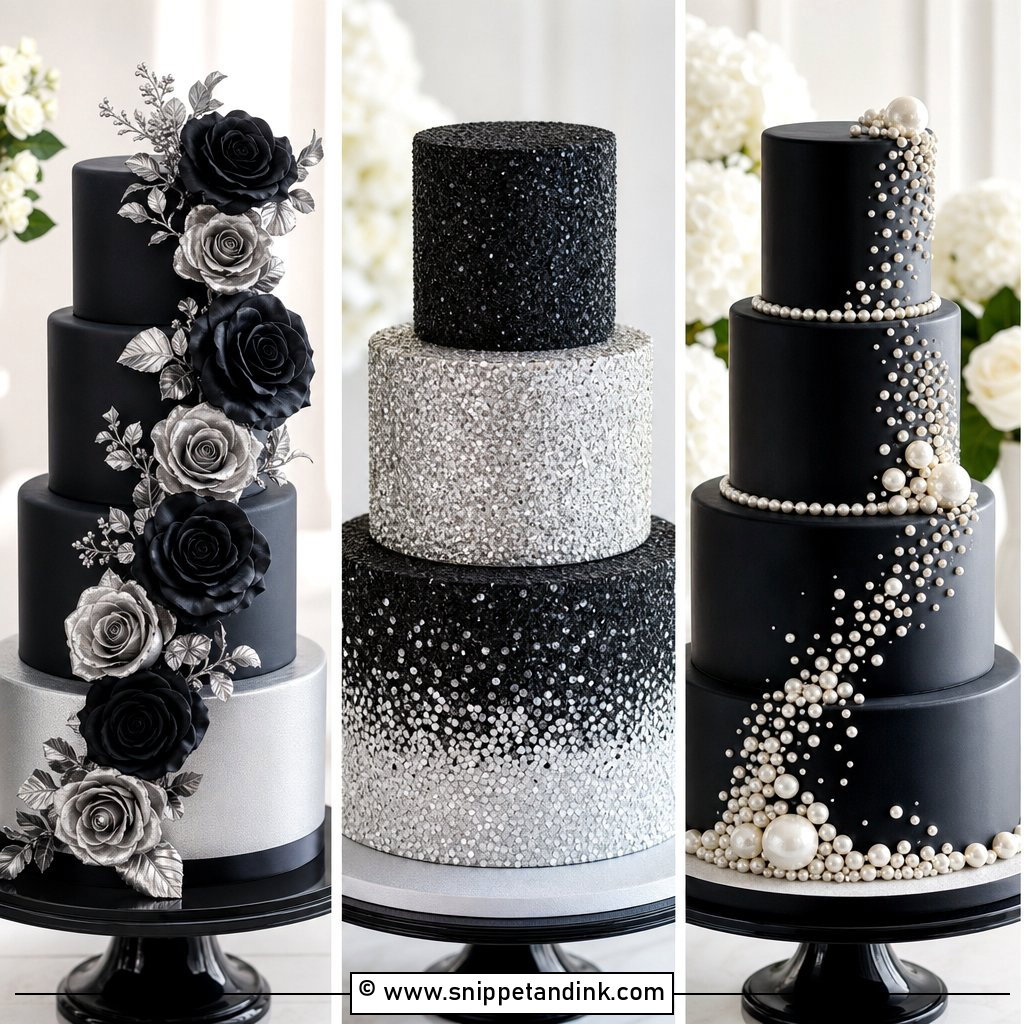

20. Black White And Silver Cupcake Wedding Cake
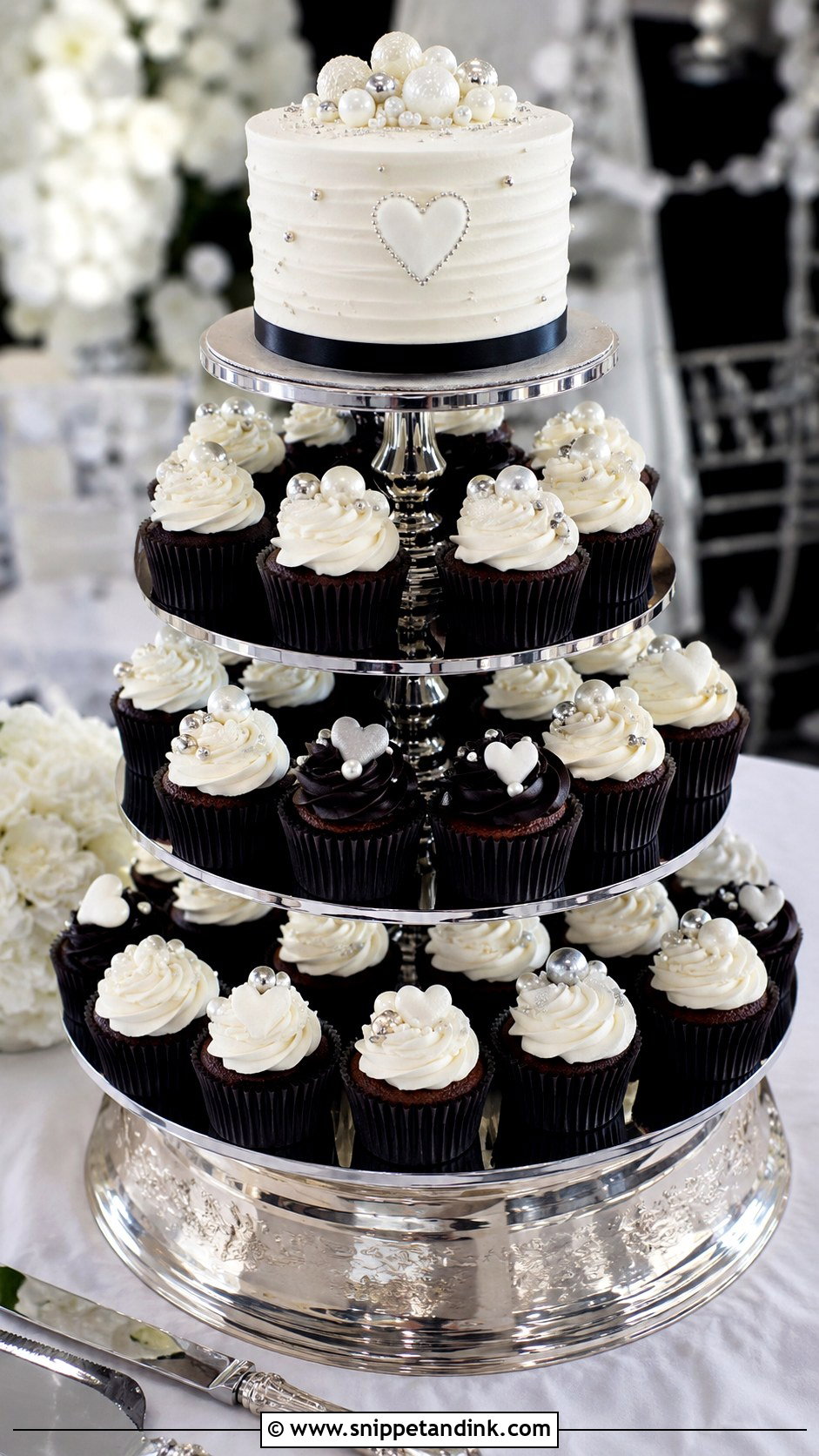
A cupcake wedding cake is the practical answer for a large guest list. A small cutting cake sits on top, white with black ribbon and silver pearls, while the tiers below hold cupcakes in white buttercream swirls with black liners, silver sprinkles or tiny fondant hearts. Serving takes minutes instead of needing a cutting station. Use foil-lined black liners, since plain paper ones can go greasy and lose their color once the cupcakes are baked. Coordinate the flavors, vanilla, chocolate and almond for example, and a polished silver stand pulls the table together.
How Venue Lighting Changes Black and Silver on the Night
Silver looks bright in my studio under daylight bulbs and can turn flat grey under warm tungsten or candlelight. Black does the opposite of what people expect in photos: it soaks up light, so fine piping on a black tier can disappear unless there’s a light source nearby. When I set up, I ask where the main lights and windows are and angle the most detailed side of the cake toward them.
Heat is the other concern. A dark fondant tier near a sunny window or a spotlight absorbs warmth faster than white, and the buttercream underneath softens. Cakes brought straight from a cold van into a warm room can also sweat, leaving beads of moisture that dull silver leaf and pull at the black. I’d rather deliver a little earlier and let the cake settle at room temperature before the final silver touches go on.
Place the table away from heaters and direct sun, give it a plain backdrop so the black outline reads, and keep a white or mirrored stand if the cake is mostly dark. Those three choices do more for how the cake photographs than any extra decoration.
Deciding Which of the Three Colors Leads
This palette stretches from soft to severe depending on the balance you give it. A white-led cake feels bridal and classic, a black-led cake feels bold and fashion-inspired, and a silver-led cake turns glamorous. Settle that first, then pick one technique, whether it’s marble, lace, pearls, stripes or deco panels, rather than stacking several. Bring clear photos to your consultation and point at what you love in each, because I can combine a tier shape from one with a detail from another. Restraint is what makes these cakes look expensive in the room and in your photos.
You'll Like These Ideas:





Leave a Reply