
Blue is one of the trickiest colours I mix for a wedding cake, and silver is one of the trickiest finishes to apply well, which is exactly why the pairing rewards a little planning. Dusty blue reads calm, navy reads formal, and icy blue suits a winter ballroom without tipping into holiday decor. Silver can arrive as leaf, edible pearls, piping, lustre or a crisp metallic band. The 20 designs below cover all of those, and alongside each I’ve noted what it asks of your baker and how it behaves once the cake leaves the kitchen.
Getting a Blue That Stays Blue From Mixing Bowl to Reception
Blue icing changes more than most people expect between the tasting and the reception. Here’s what I watch for when I mix it.
Light fades it
Blue and purple food colours fade in strong light, especially sunlight and bright fluorescent tubes. A cake on display for a few hours by a sunny window can come out noticeably paler on the side facing the glass. I’d always ask the venue where the cake table goes, and keep it out of direct sun.
Colour develops overnight
Tinted buttercream and fondant darken as they rest. I mix deep shades a day ahead and stop a little lighter than the target, because navy mixed to the right shade on the day often ends up near black by morning.
Butter turns it green
Buttercream is naturally yellowish, and yellow plus blue is green. For pale and dusty blues I whiten the base first, or choose a meringue buttercream that pipes paler. If your swatch is an icy, cool blue, mention it at the tasting so I can plan for it.
1. Dusty Blue And Silver Wedding Cake
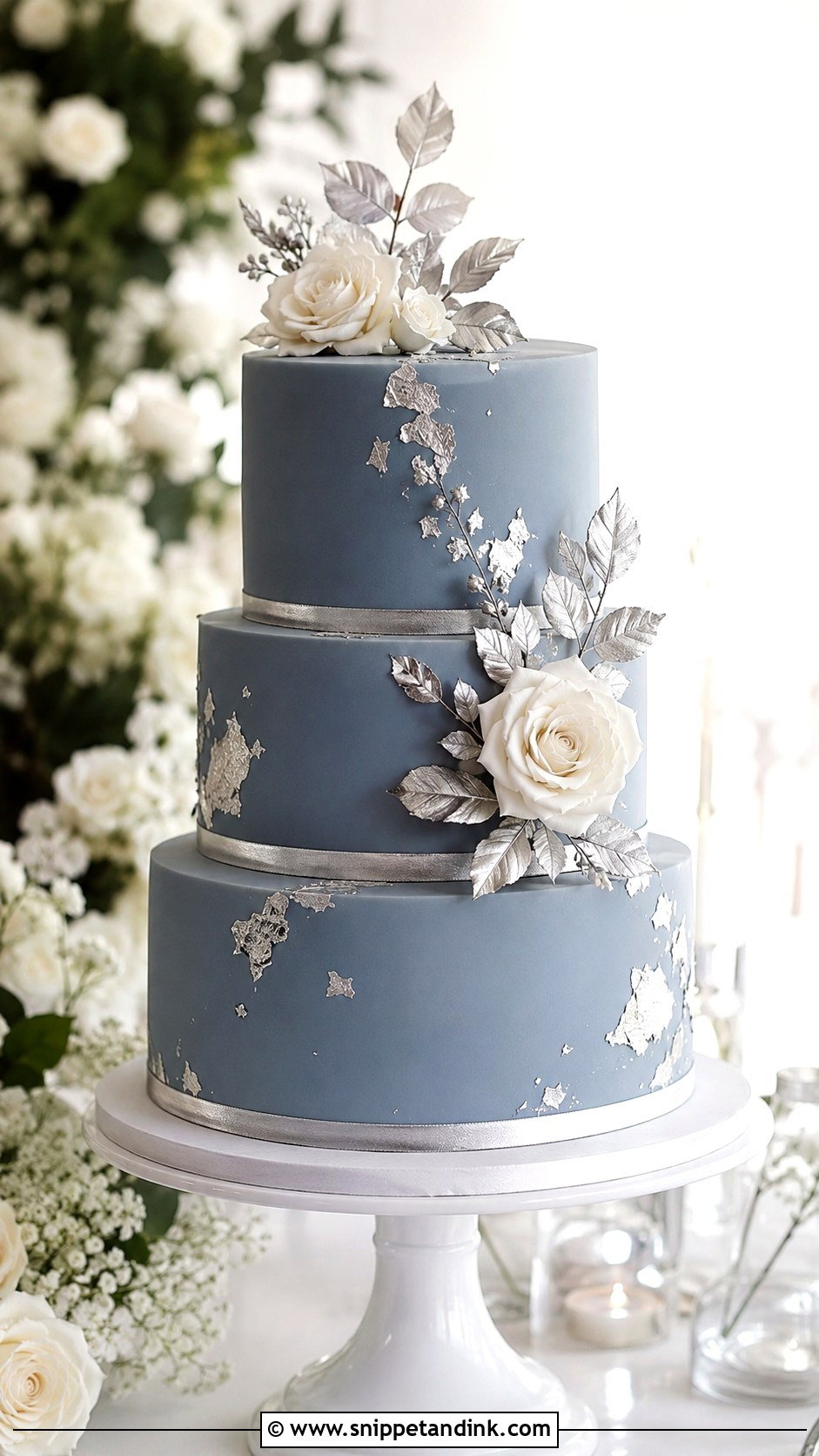
Dusty blue is the shade I’m asked for most, and the one I tint most carefully. A true dusty blue needs a whisper of grey or black in the buttercream; without it you get a baby blue that fights the silver instead of sitting beside it. Three smooth tiers with slim silver bands and white sugar flowers is a balanced layout. I place silver leaf in small, deliberate patches so it looks chosen rather than scattered. Keep the flowers simple and let the colour do the work.
2. Navy Blue And Silver Wedding Cake
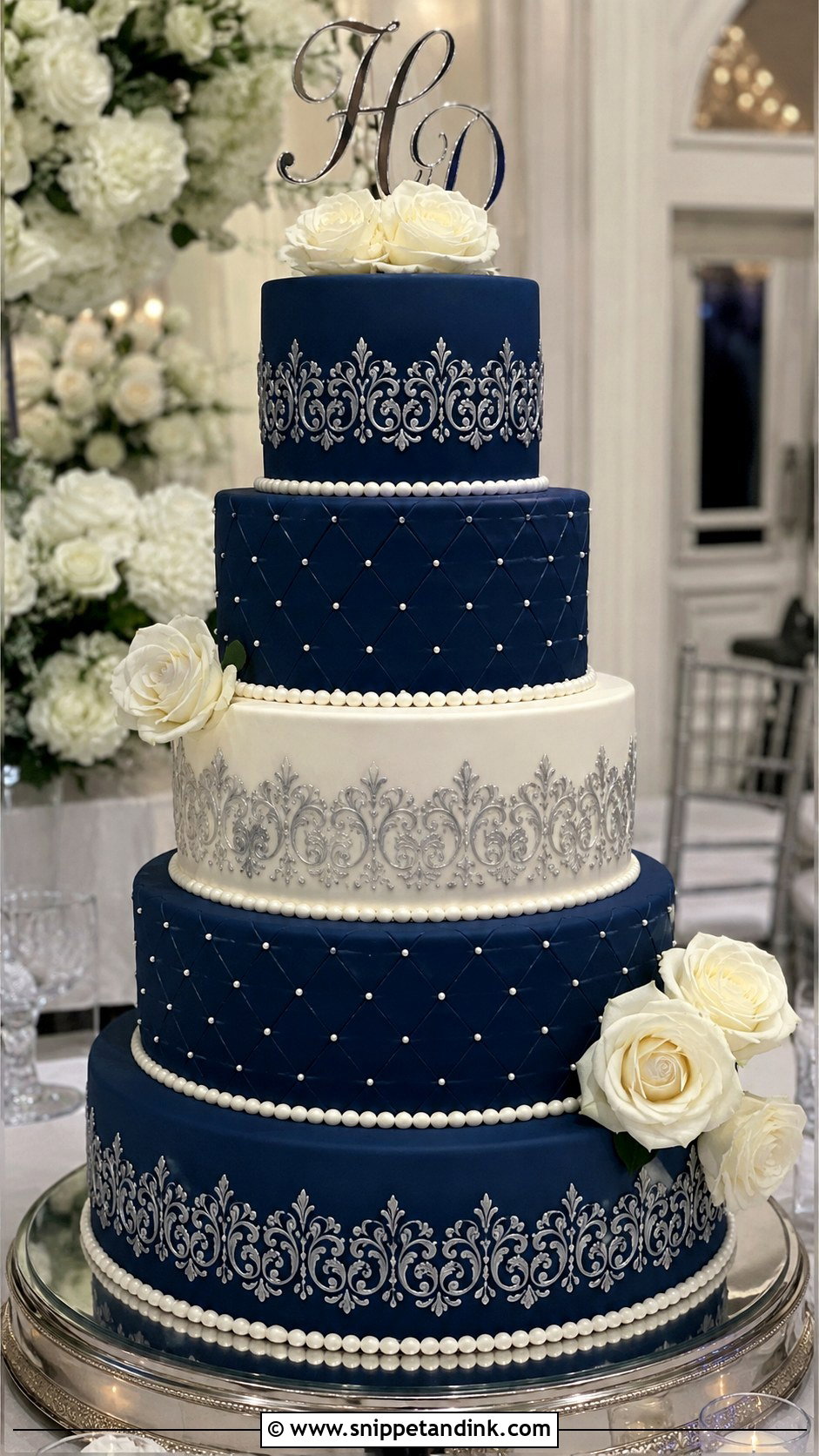
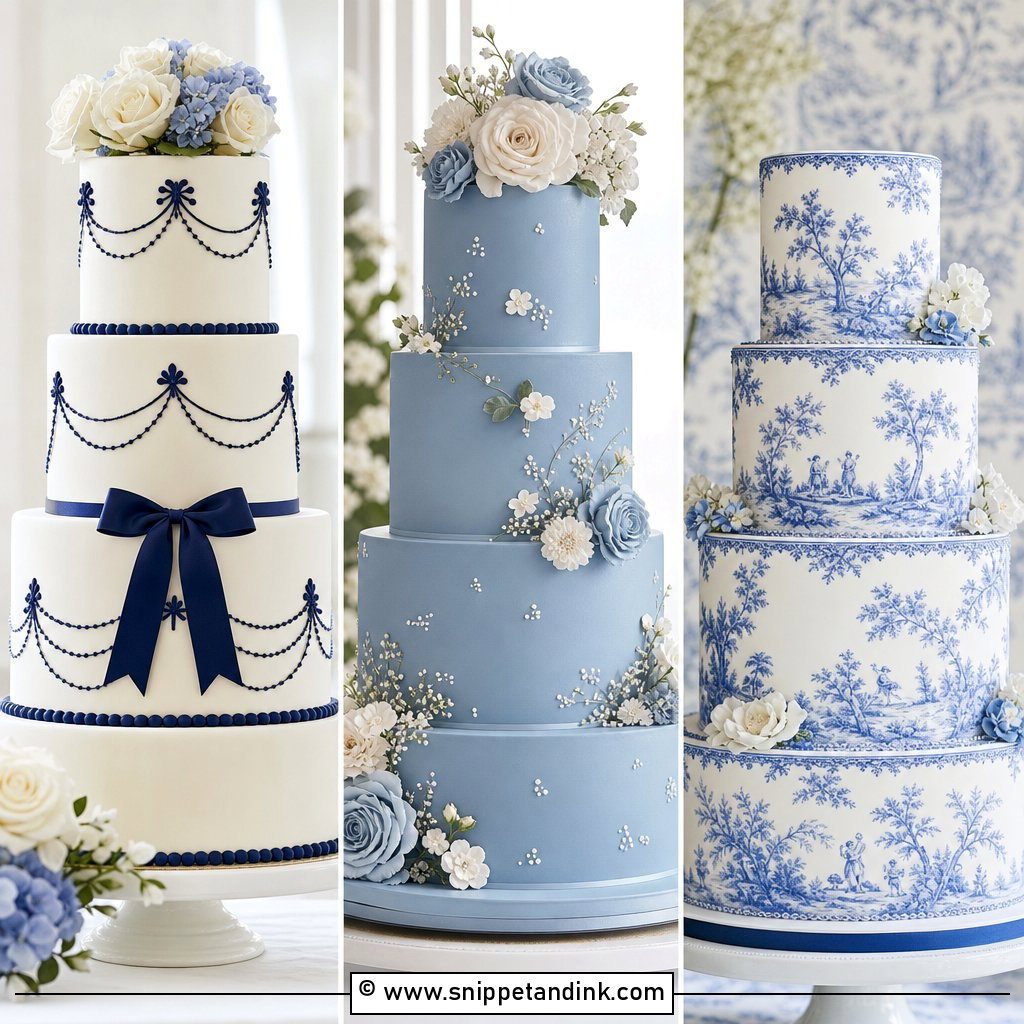
Navy gives a cake real depth, and silver keeps it formal rather than heavy. I’d usually cover navy tiers in fondant, because deep navy buttercream takes so much colour that it can taste slightly bitter and leaves blue on teeth. Mixing one or two navy tiers with ivory tiers lightens the whole cake. Silver stencil patterns, metallic borders or a monogram make it feel custom. White roses, blue hydrangeas or silver-toned leaves finish it, and it sits naturally in a room with chandeliers or mirrored details.
3. Royal Blue And Silver Wedding Cake
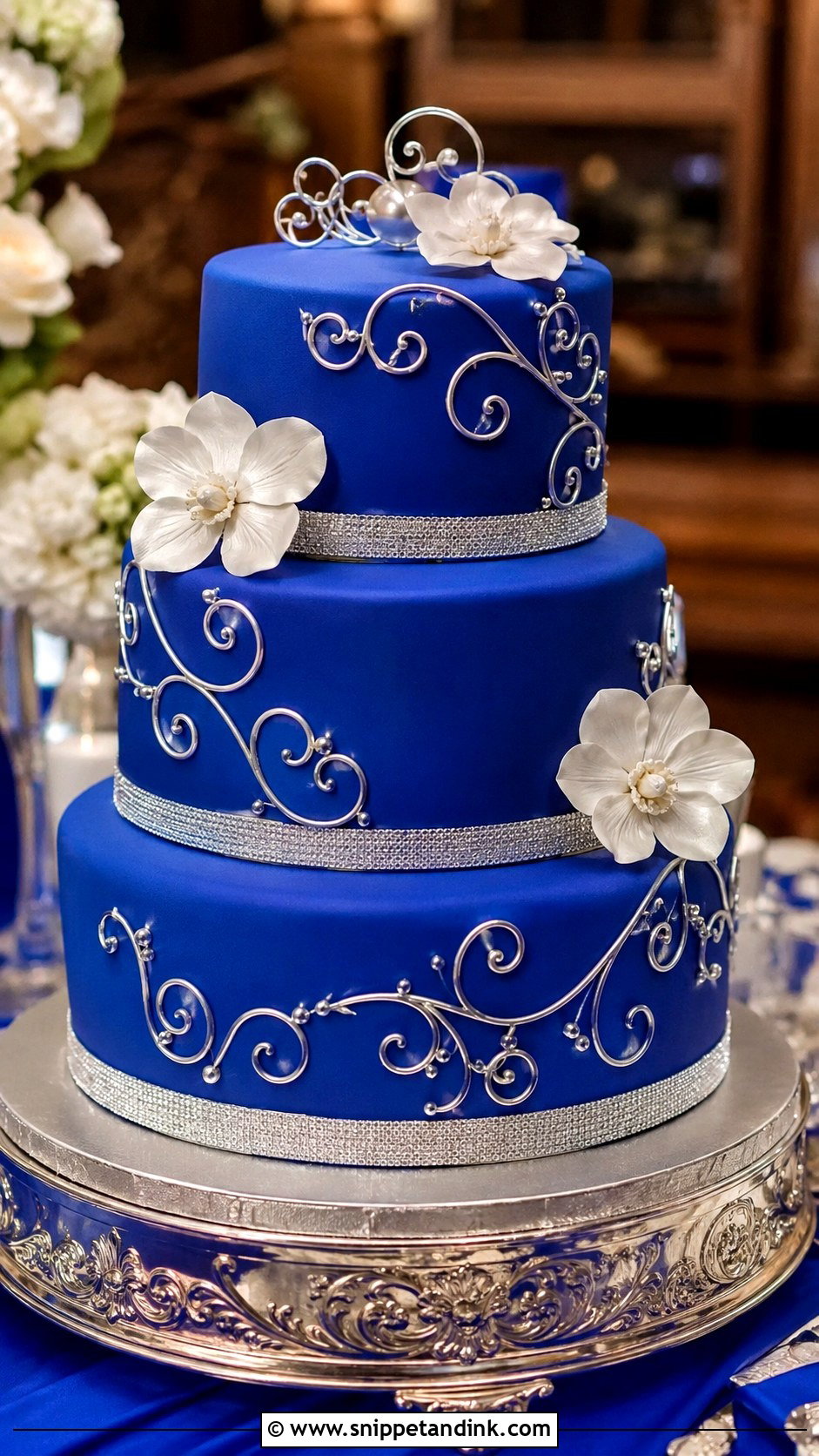
Royal blue is a confident colour, and it shows up strongly in photos. Scrollwork, edible pearls and white flowers on a royal blue base can look regal; I keep it current by limiting the silver to structured details such as bands, lace or geometric lines rather than ornate swirls everywhere. Underneath, vanilla, almond or white chocolate sponge gives a pale crumb that looks clean when sliced. If the reception has blue uplighting, check the cake colour under it at the venue, since coloured light can make royal blue look almost purple.
4. Light Blue And Silver Wedding Cake
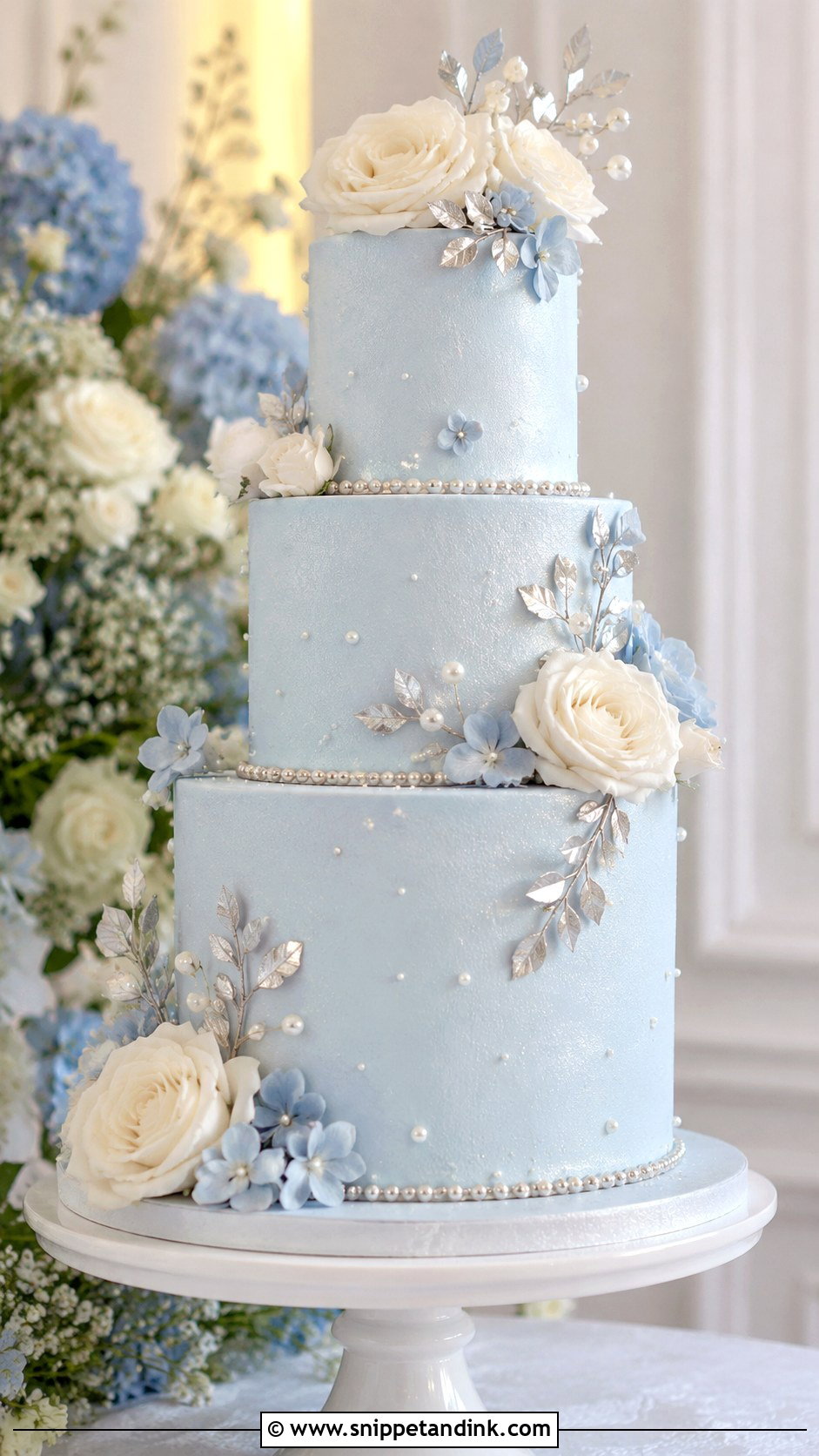
Pale blue is airy and pairs with most palettes, but it’s the shade most likely to drift. Too much yellow in a butter-heavy buttercream turns a light blue faintly green, so I whiten the base first and then tint. Silver here works as edible shimmer, small leaves, thin bands or delicate piping. A pale blue buttercream with a silver pearl border and white blooms suits a daytime reception. A few pale blue sugar flowers tie the top tier back to the base colour.
5. Blue Ombre Silver Wedding Cake
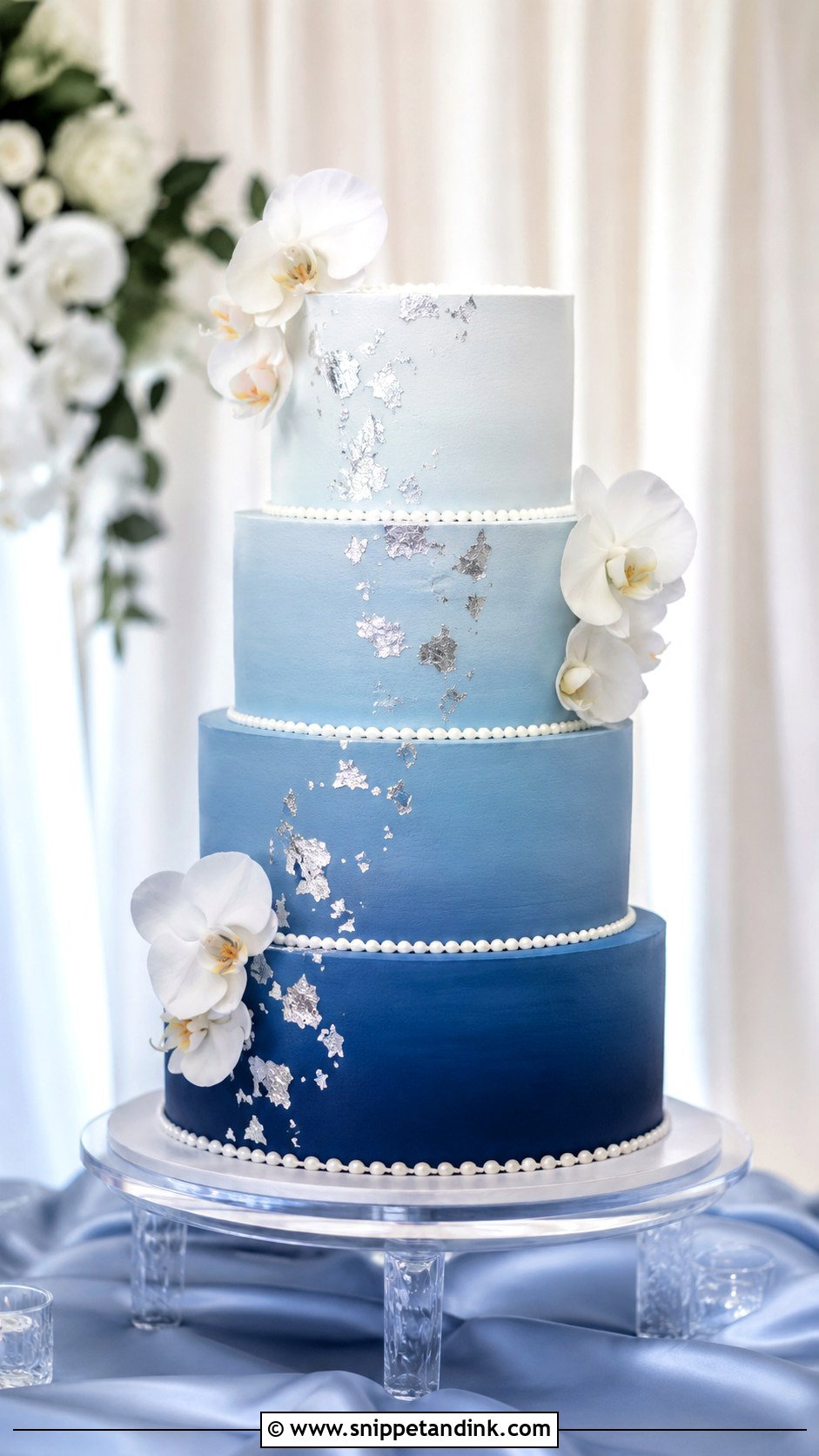
Ombre needs height; on a two-tier cake the colour change looks abrupt. On taller cakes I fade from deep navy at the base to pale blue on top, mixing each shade from the same starting blue so the steps feel related. Silver leaf or pearls sit at each colour change to soften the join. Buttercream gives a softer fade, fondant sharper steps. Make sure the silver follows the direction of the gradient so the blue ombre silver wedding cake reads as one design from bottom to top.
6. Silver Leaf Blue Wedding Cake
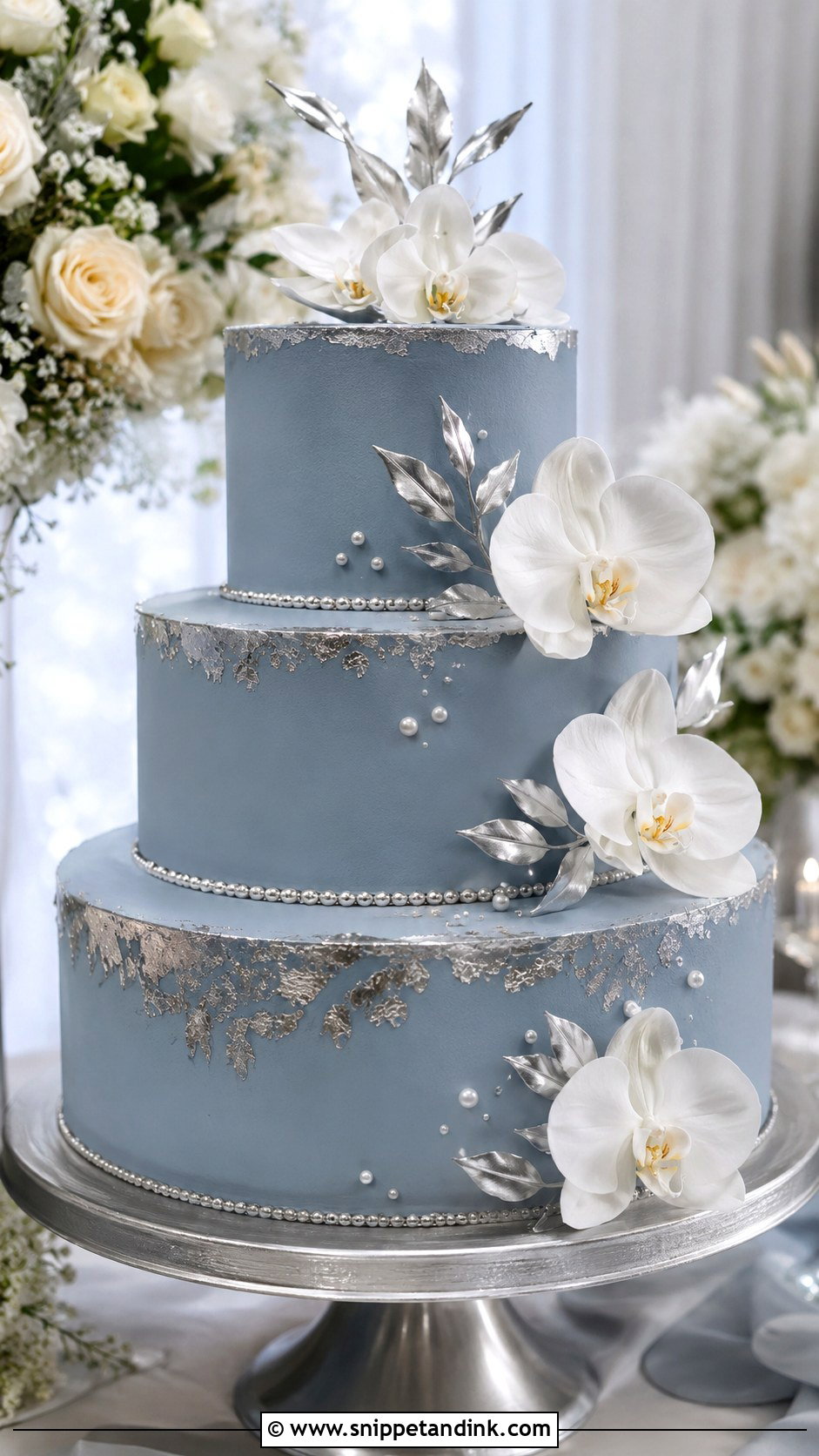
Silver leaf is the quickest way I know to make a plain blue wedding cake look finished. It’s extremely thin, so I apply it with a dry brush onto a slightly tacky surface; a buttercream that’s just chilled firm is ideal. I place it in uneven patches along edges, corners and tier transitions rather than covering everything. It works on dusty blue, navy, slate or icy blue. White orchids, roses or small blue sugar flowers give contrast, and you need very little else.
7. Blue Marble Silver Wedding Cake
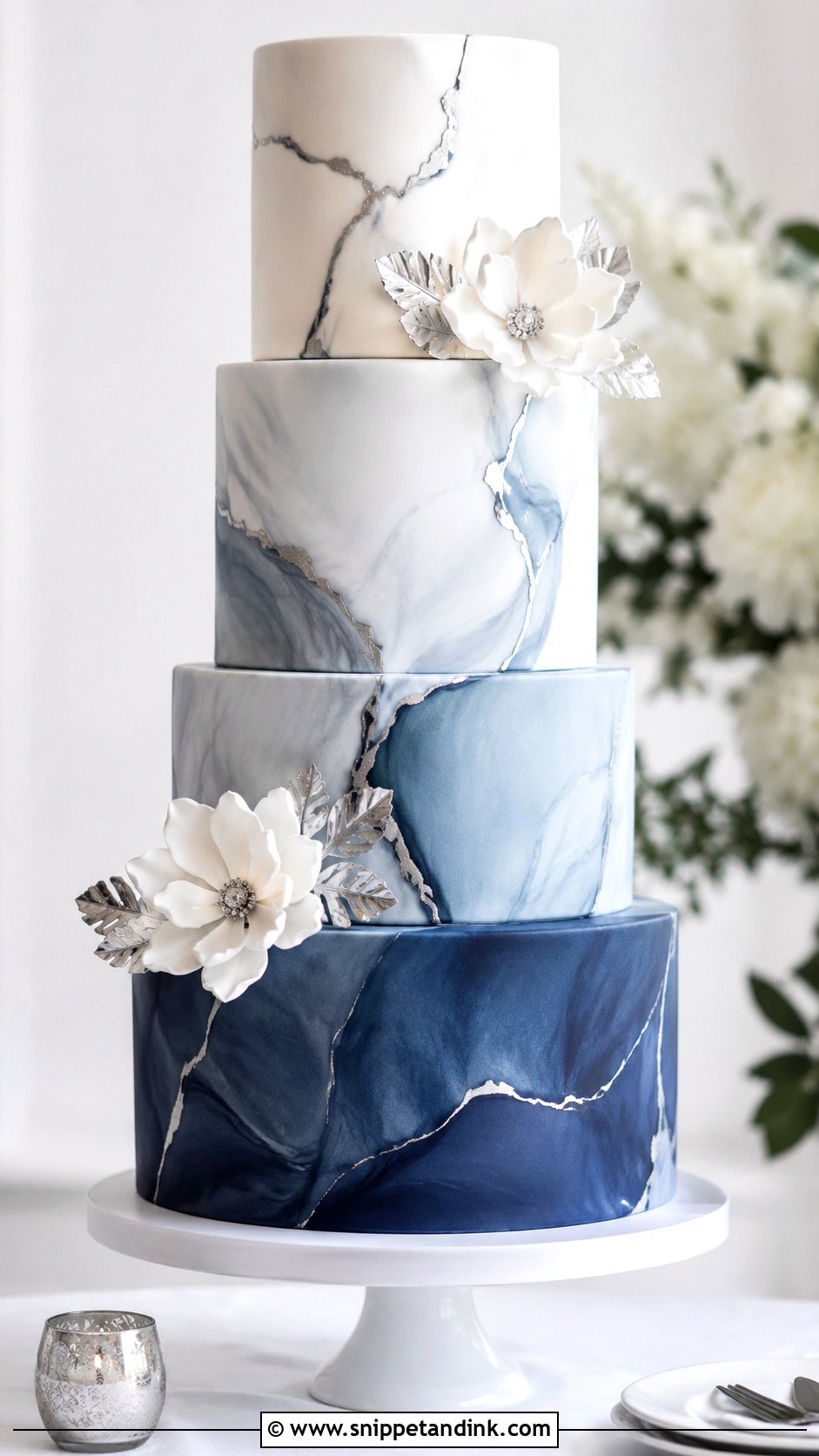
Marbling is done in the fondant before it goes on the cake, by twisting white, pale blue, slate and navy together and rolling them out, so no two cakes look identical. That surface stays smooth and stone-like, which is why I’d do this one in fondant rather than buttercream. The silver veins are painted afterwards with an edible metallic and a fine brush. Ask for thin, broken lines like real stone; thick, continuous stripes look painted on. Keep the tier shapes plain and add only a few white flowers or silver sugar leaves.
8. Silver Drip Blue Wedding Cake
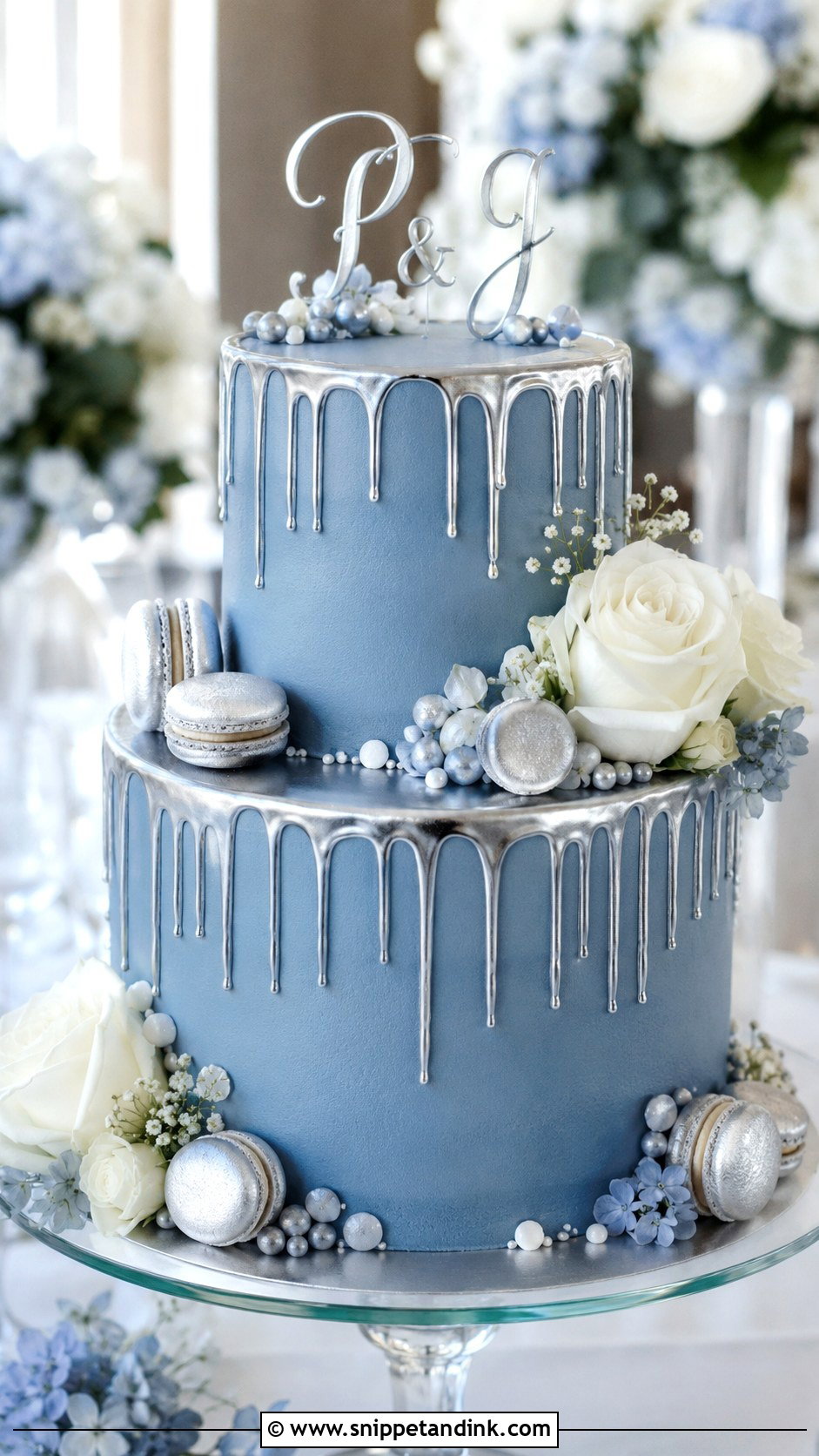
A silver drip is made from ganache or a candy melt tinted and then painted or sprayed metallic once set. The base can be dusty blue, navy or pale blue. Getting the drips even comes down to temperature: ganache that’s too warm runs to the board, too cool and it sits in stubby blobs, so I test a drip on the chilled cake before going round. A thinner drip looks more refined. White flowers, silver macarons, sugar pearls or a simple topper complete it.
9. Blue And Silver Geode Wedding Cake
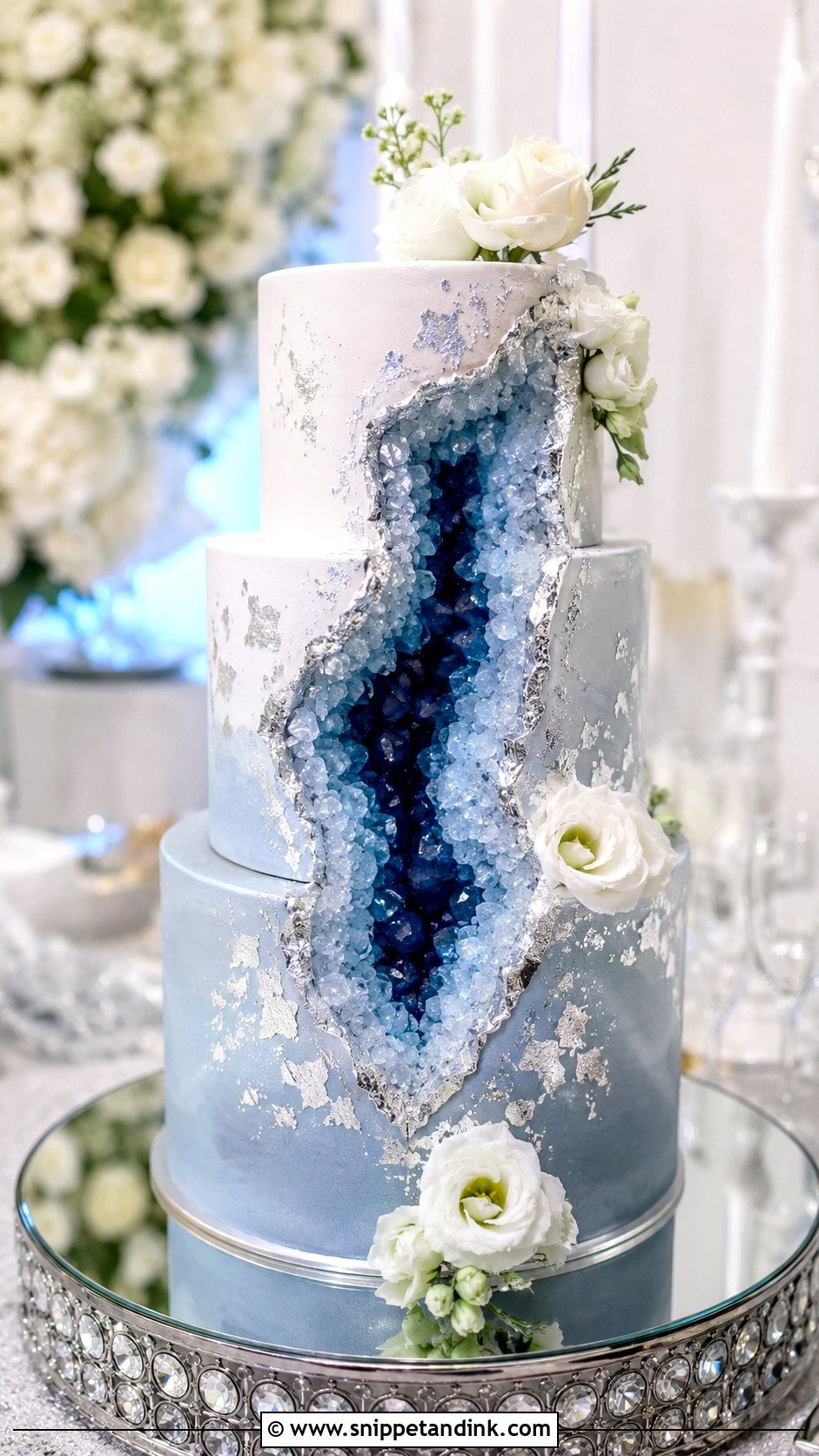
Geode cakes are carved: a section of the tier is cut away and filled with blue rock candy crystals, then the edge is painted silver. Rock candy and isomalt are sensitive to humidity and can turn sticky or cloudy if the cake sits in a warm, damp room for hours, so I’d keep this one indoors. Sapphire, aqua and dusty blue all look good in the crystals. The rest of the cake should stay plain, with smooth fondant and sharp tiers, so the cut-out has room.
10. Blue And Silver Floral Wedding Cake
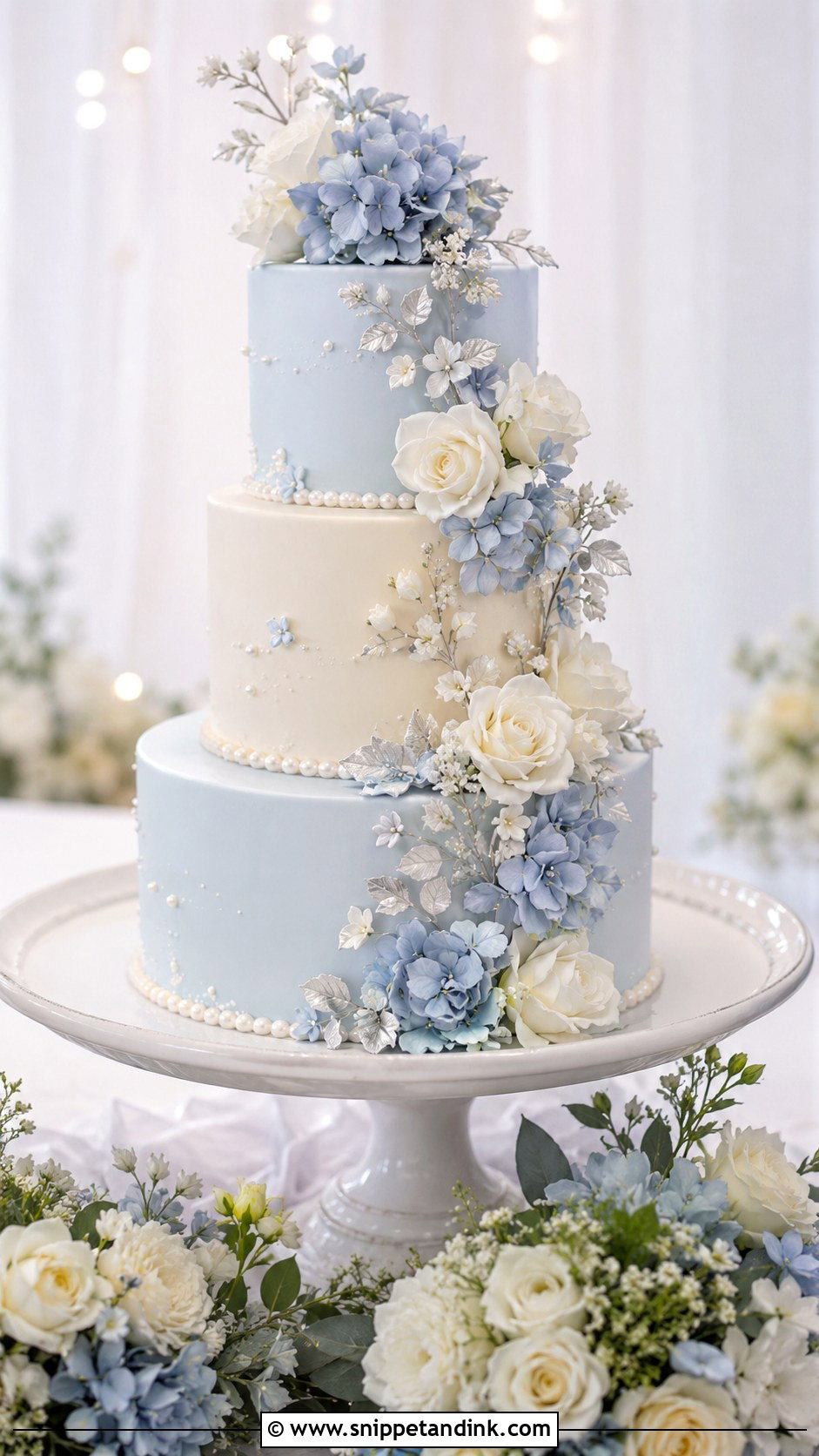
Florals give the most room for personal touches. Blue sugar flowers, fresh white blooms, silver foliage or piped flowers all work on a pale blue or ivory base. If you’re using fresh flowers, your florist and baker need to agree on which stems touch the cake: some popular flowers aren’t food safe, so I wrap stems and use a barrier under each cluster. Cascade them down the tiers for a formal look or cluster them at top and base for something simpler, and match them to the bouquet.
11. Blue And Silver Pearl Wedding Cake
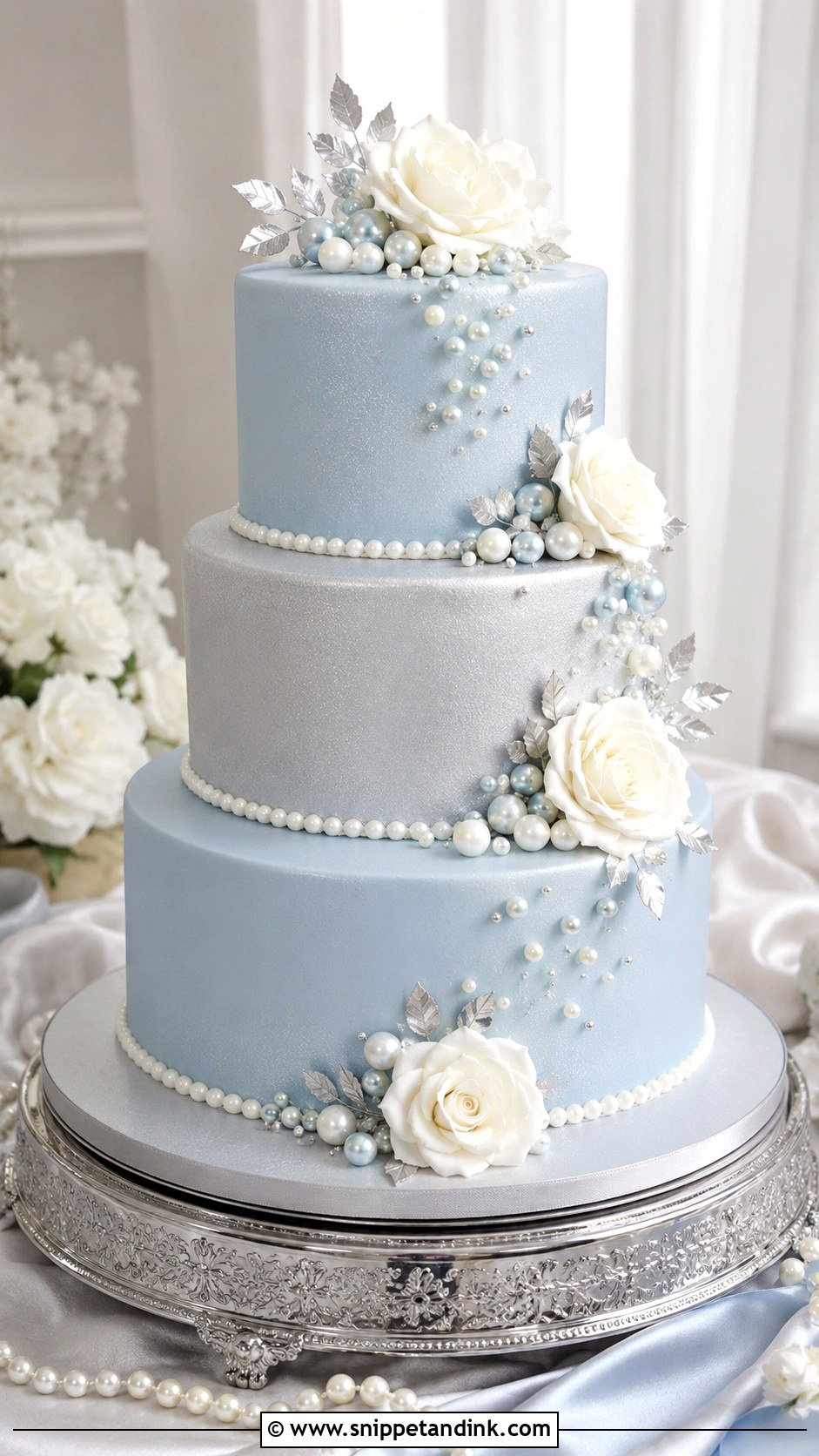
Pearls are easy to overdo. I either border the base of each tier with a neat pearl line or scatter a few clusters around the sugar flowers, never both on the same cake. A soft blue base with a little silver shimmer and white pearls looks delicate. If your dress has pearl or beaded detail, the cake can echo it. Buttercream gives a softer finish, fondant a smoother one, and edible pearls stick better to fondant, which matters on a warm day.
12. Blue And Silver Lace Wedding Cake
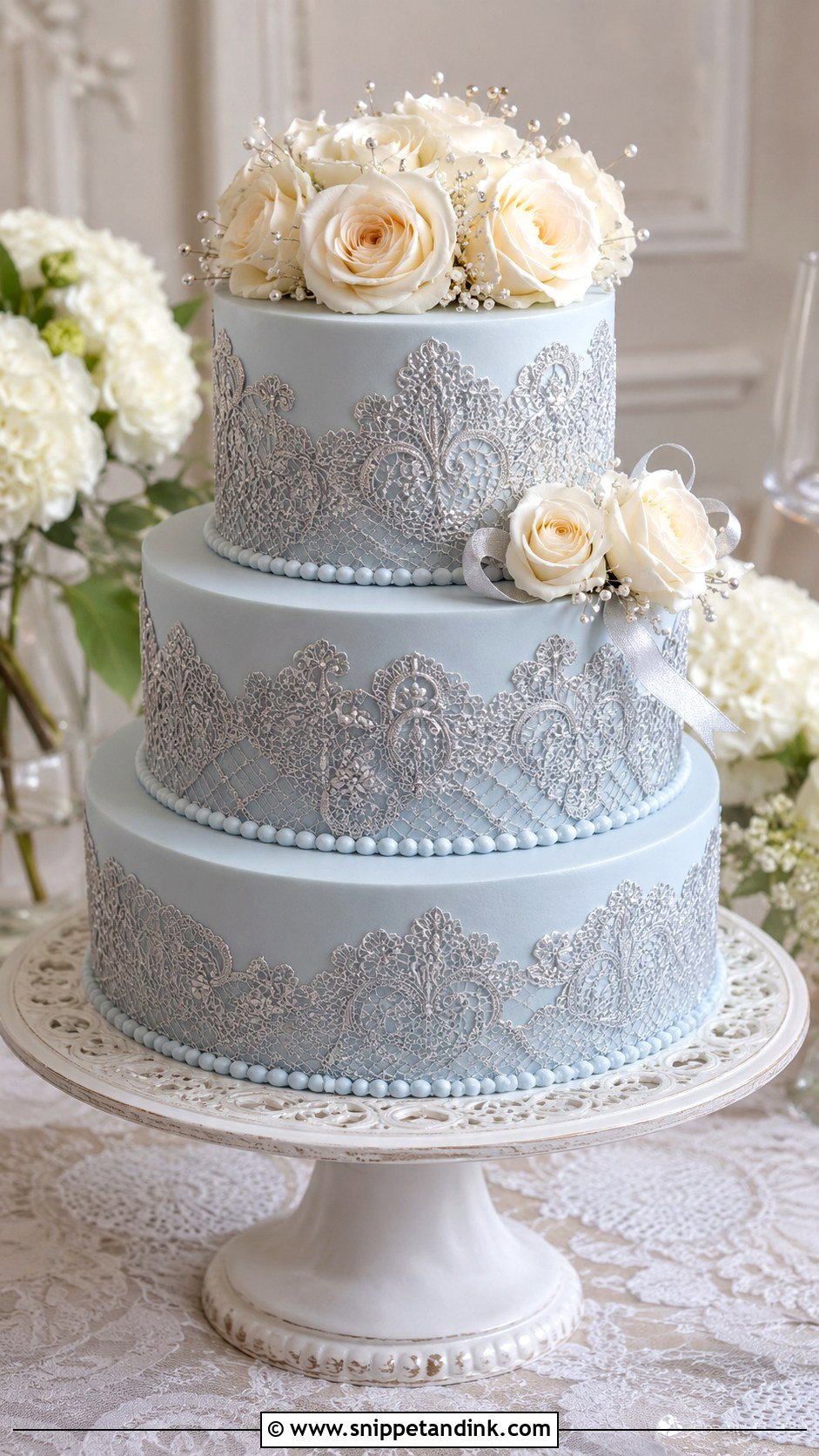
Lace on cake comes three ways: piped in royal icing, pressed from a silicone mat as edible lace, or stencilled. Edible lace is the most delicate-looking, but it softens in humidity and is best applied on the day. Pale blue tiers with silver lace feel bridal; navy with silver lace feels formal. The design sits well beside satin linens, a lace gown and vintage decor. Keep the tier shapes simple, and add white roses, small pearls or a silver ribbon band at most.
13. Blue And Silver Square Wedding Cake
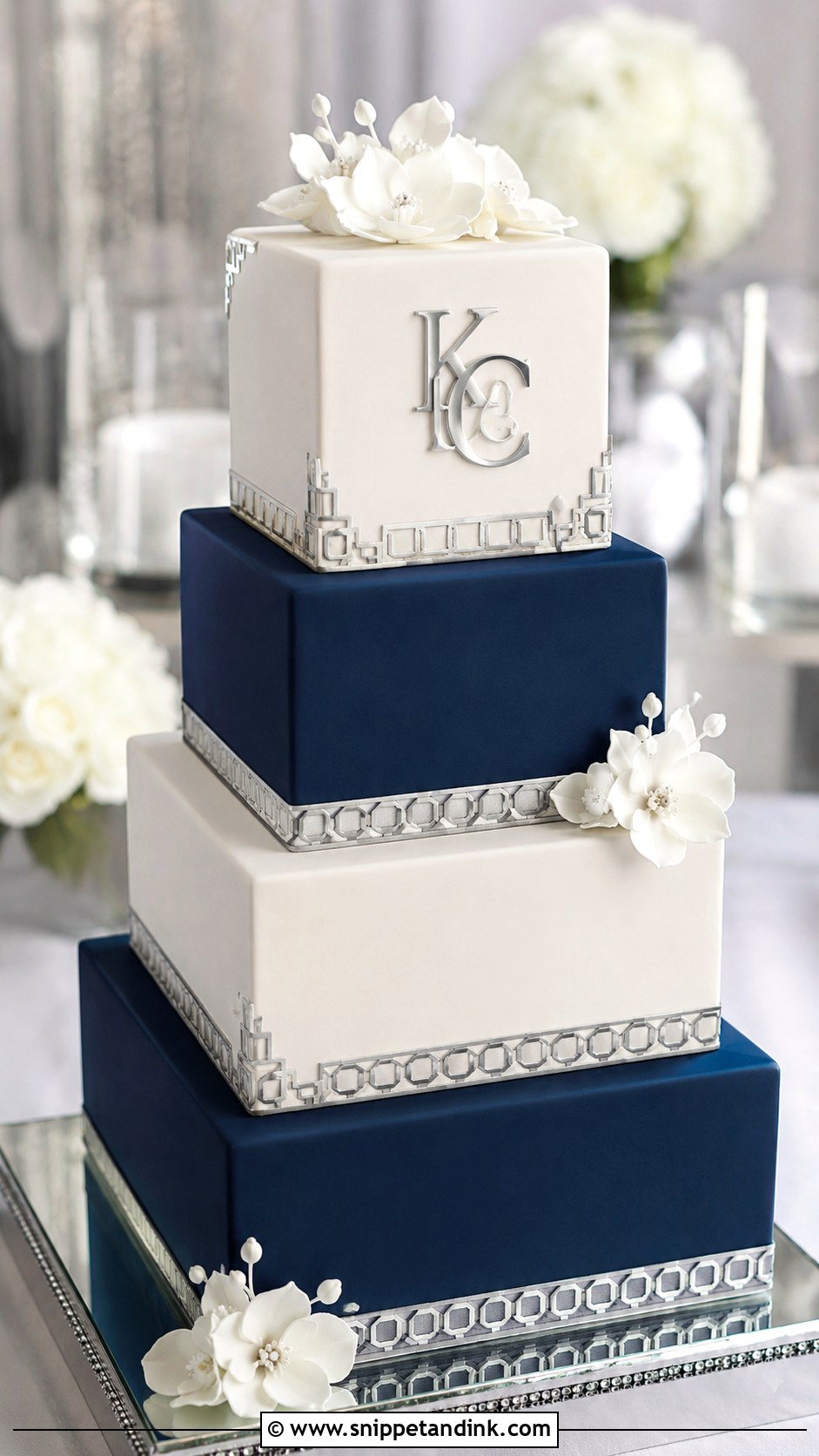
Square tiers are harder to cover neatly than round ones, because fondant has to stretch around four corners without tearing or pleating, so check that your baker is comfortable with them. When done well they look architectural and suit silver bands, monograms or Art Deco geometry. Navy fondant with silver bands, dusty blue buttercream with silver corners, or alternating blue and white tiers all work. A mirrored stand suits it. I’d soften one side with a spray of white flowers or pale blue petals.
14. Blue And Silver Buttercream Wedding Cake
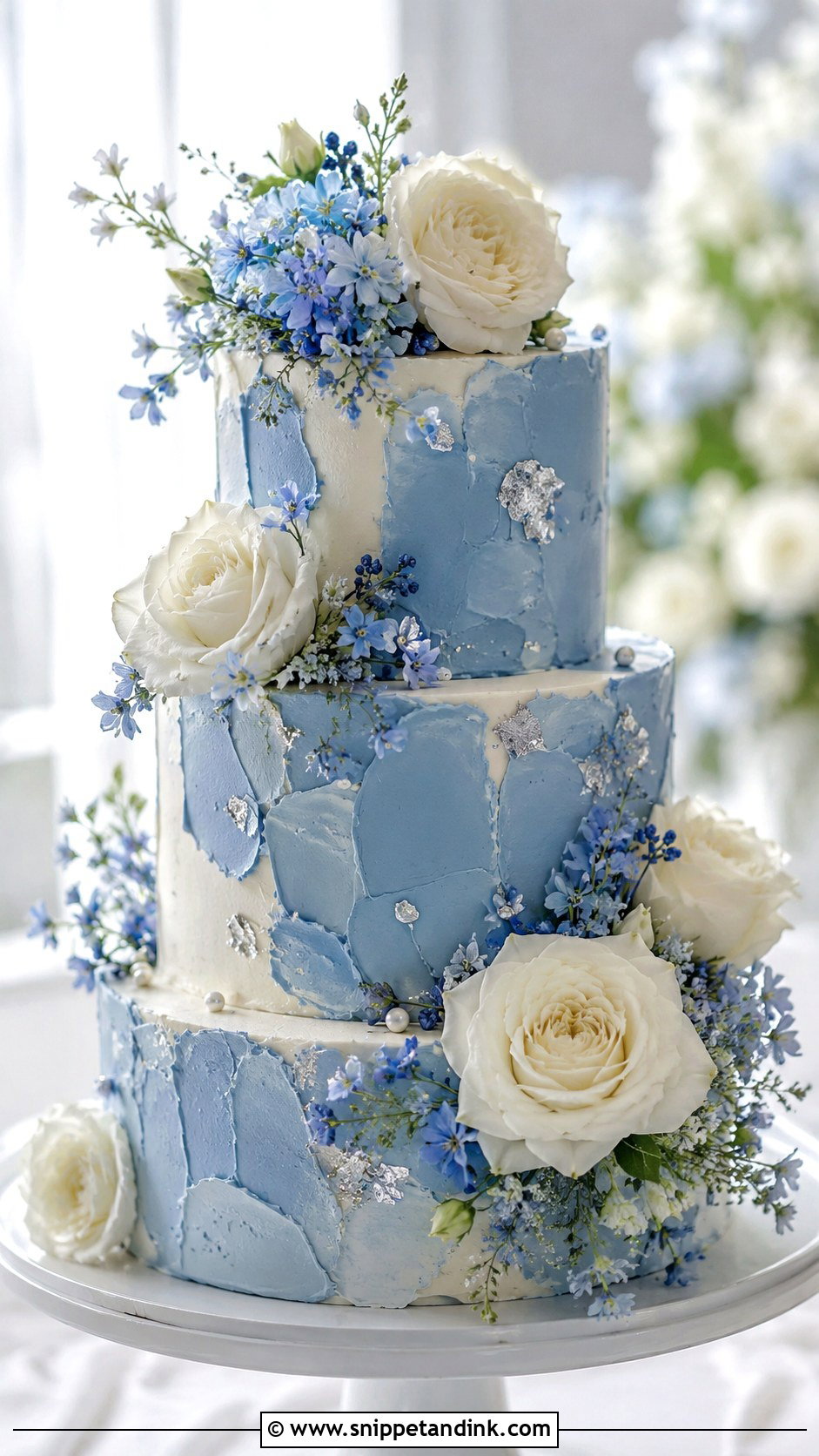
Buttercream reads softer and warmer in photos than fondant, and that’s its charm. Smooth sides, gentle ridges or palette-knife strokes all suit dusty blue with silver leaf. The trade-off is heat: buttercream softens above room temperature, and silver leaf can slide on a soft surface, so outdoors in summer the cake needs shade and should come out as late as possible. Keep the silver light; silver pearls, a few white flowers or a simple topper are enough.
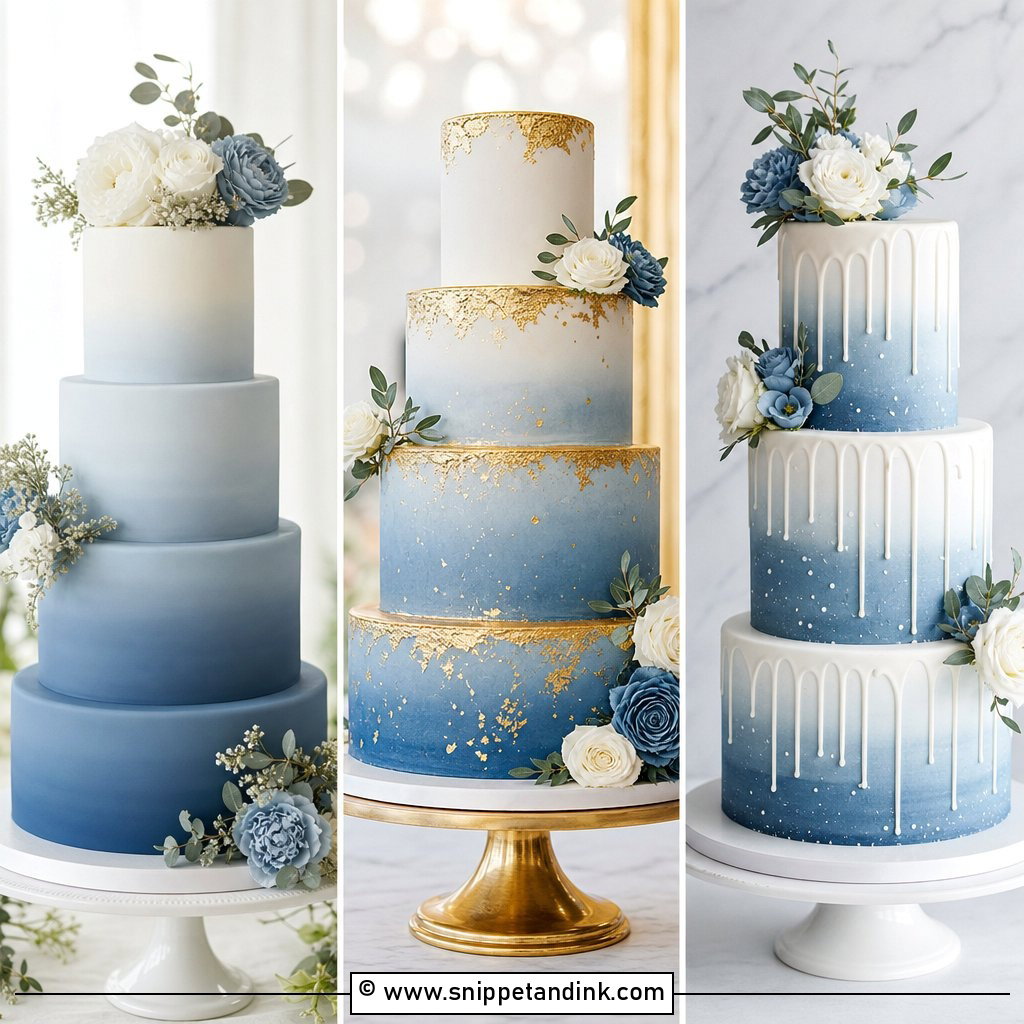
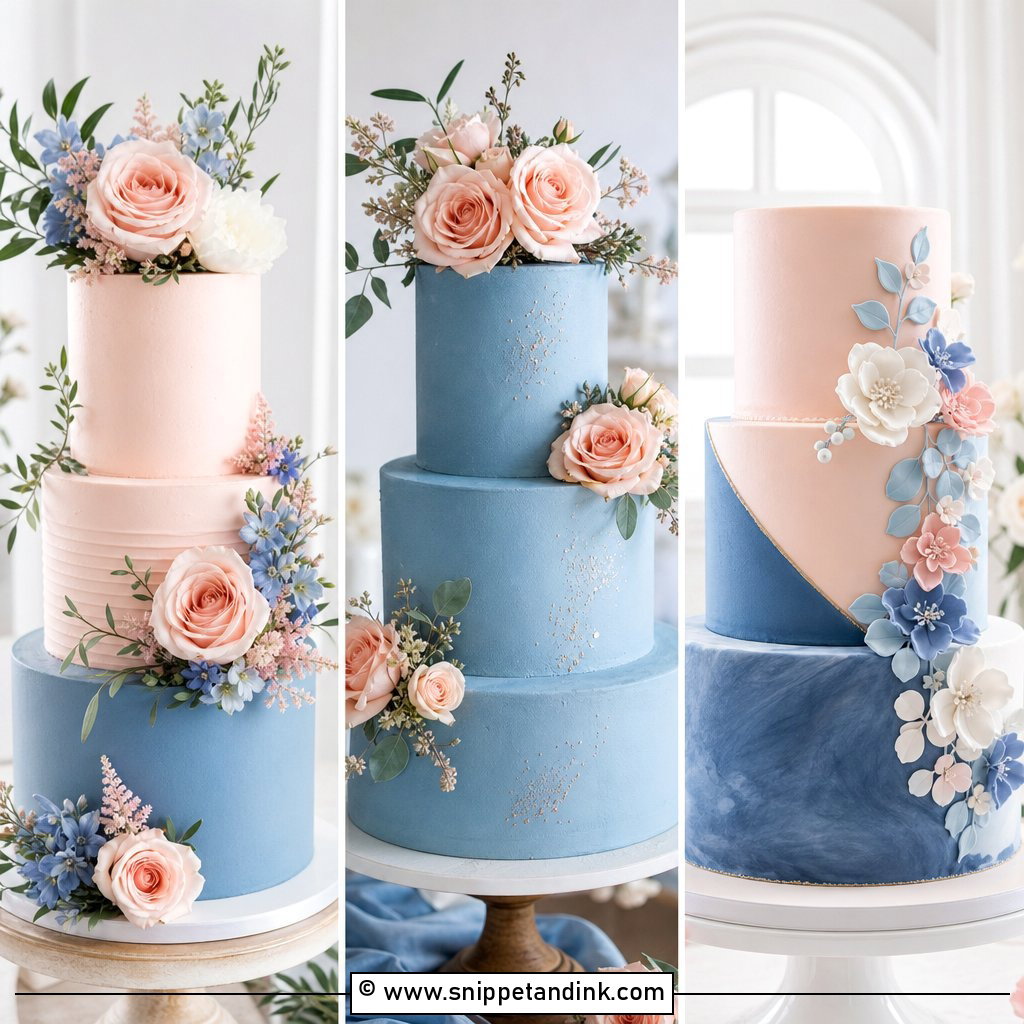

15. Blue And Silver Fondant Wedding Cake
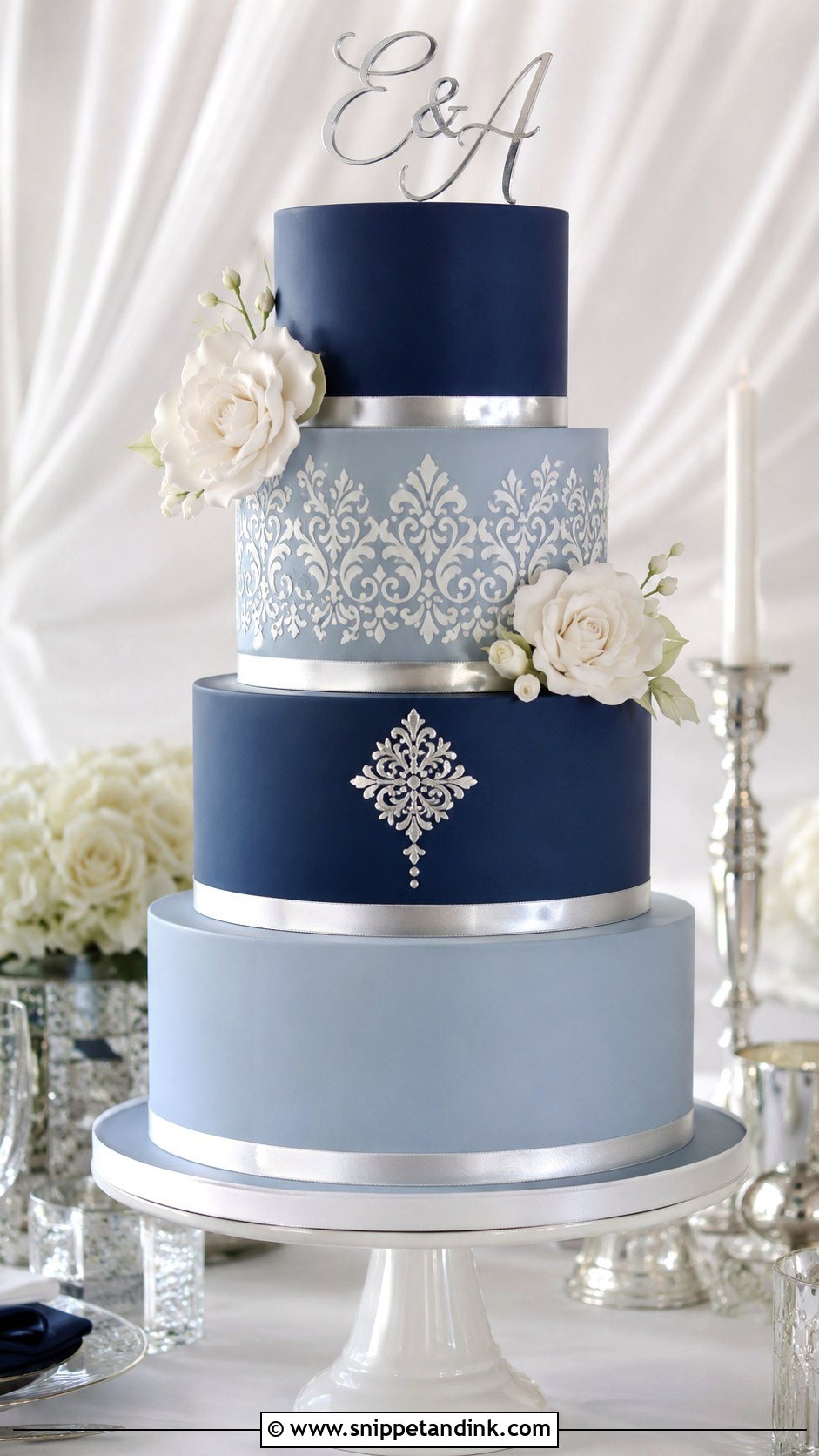
Fondant gives the sharpest finish and the cleanest colour blocks, which is why I reach for it with metallic bands, stencils, bows and sculpted sugar flowers. Navy with silver feels formal; pale blue with silver lace softens it. On tall cakes each tier can carry its own clear pattern. Use a fine shimmer rather than heavy glitter, and remember fondant must not go into the fridge once decorated, since it can sweat when it comes back out into a warm room.
16. Blue And Silver Art Deco Wedding Cake
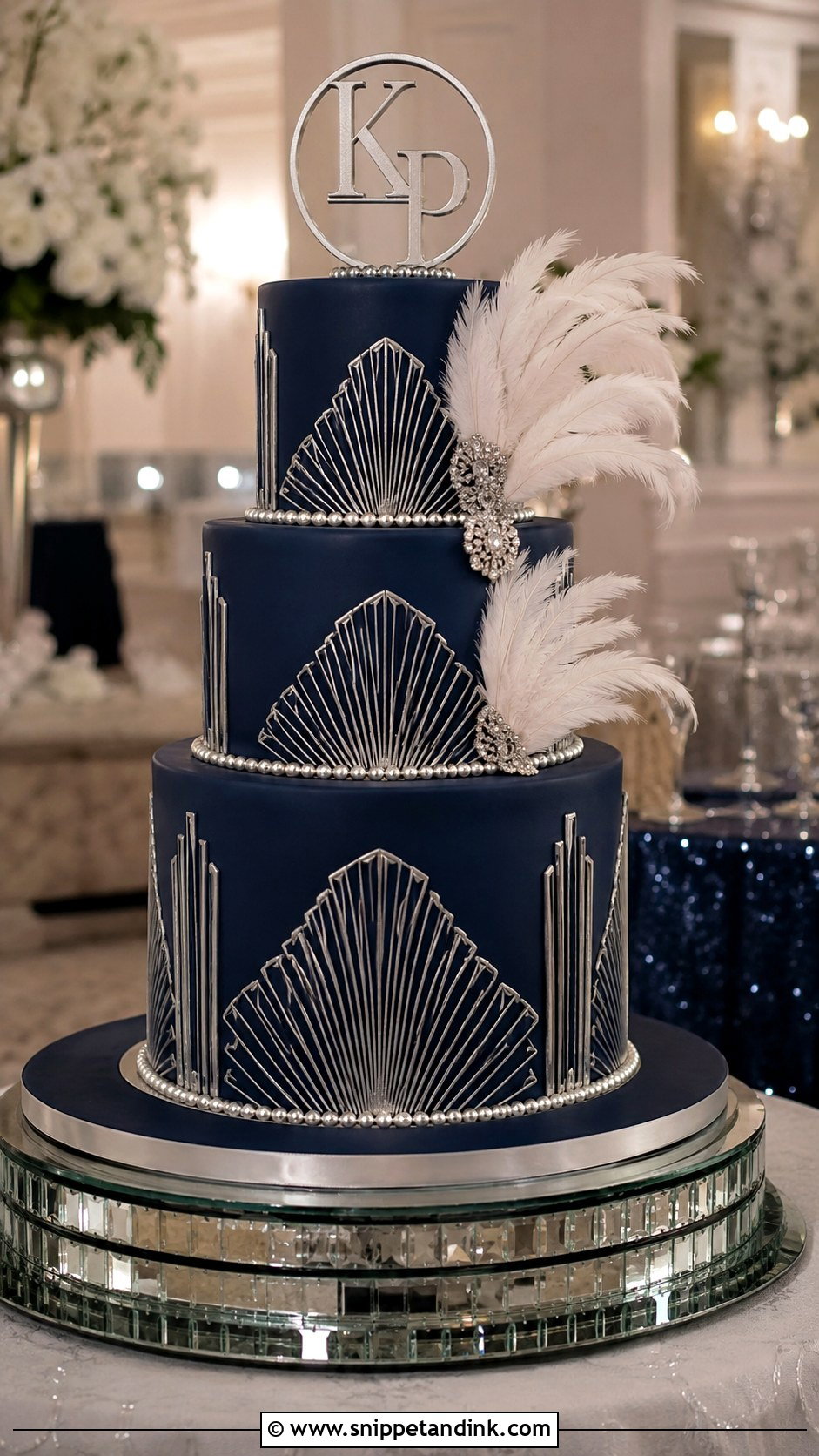
Art Deco cakes depend on precision: the fan patterns and straight lines have to be crisp, or the style falls apart. Think navy or midnight blue tiers with silver fans, pearl borders and geometric bands. A tall shape gives the lines room. Sugar feathers, silver pearls or a sleek monogram topper add to it. It suits ballrooms and formal evening receptions, and because blue and silver are classic, the drama stays controlled.
17. Blue And Silver Snowflake Wedding Cake
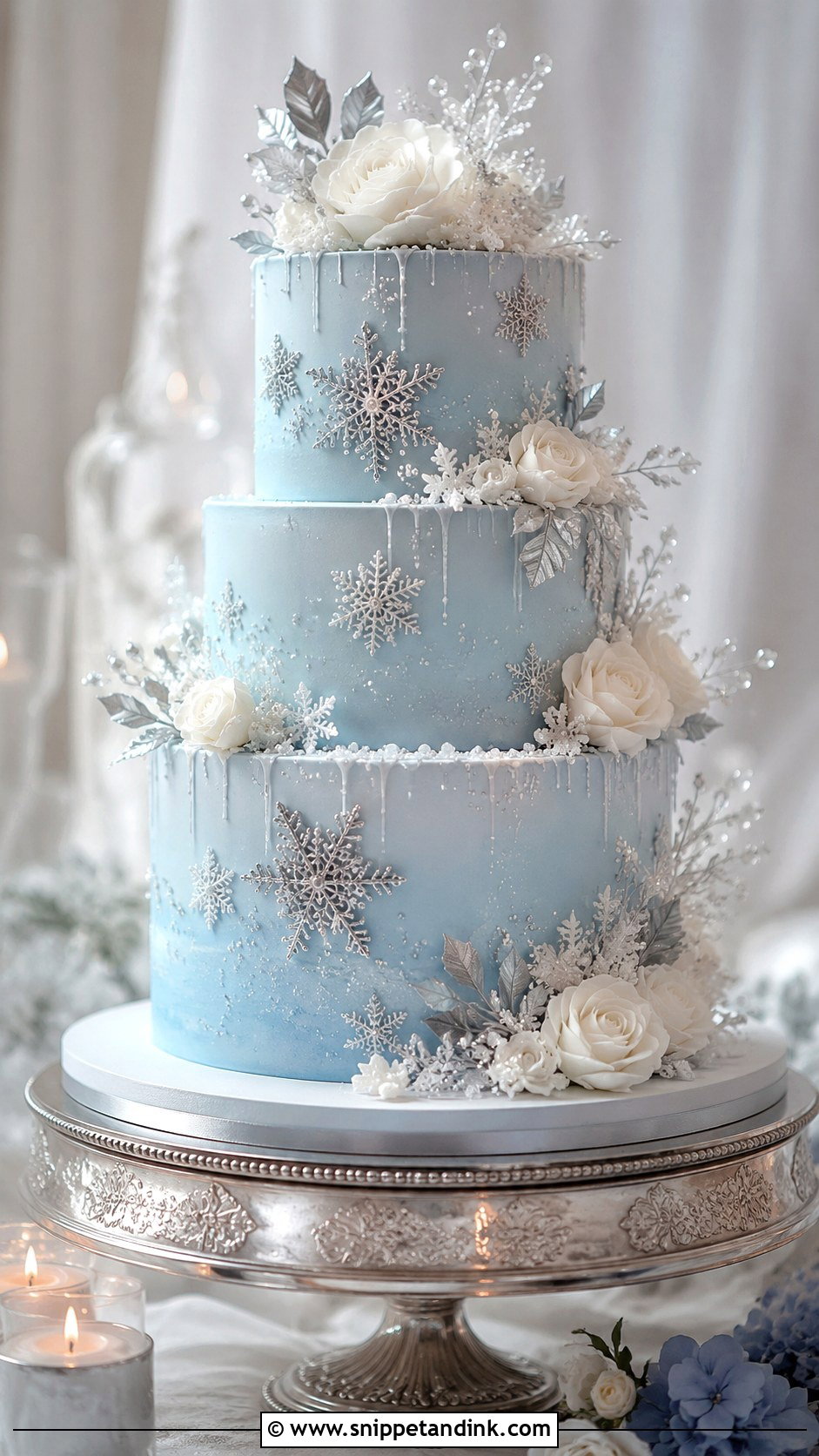
Snowflakes can tip into Christmas very quickly, so I keep them small and placed sparingly. Icy blue tiers with silver snowflake details, pearl shimmer and white sugar flowers feel wintry without the holiday theme. A light blue base with silver sparkle can look like frosted glass; navy gives a deeper evening feel. White roses or sugar crystals add texture. This suits winter weddings and mountain venues.
18. Blue And Silver Watercolor Wedding Cake
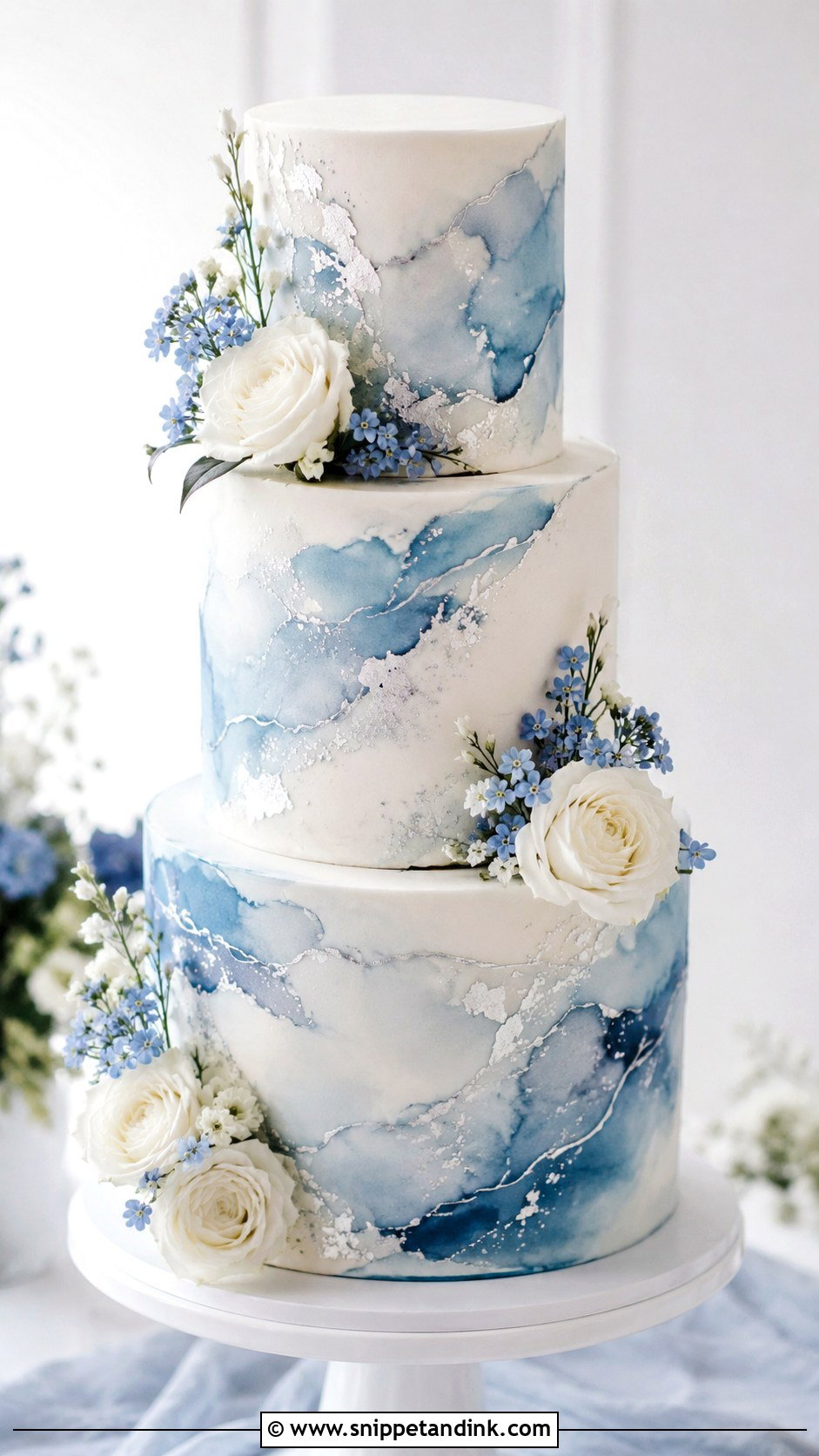
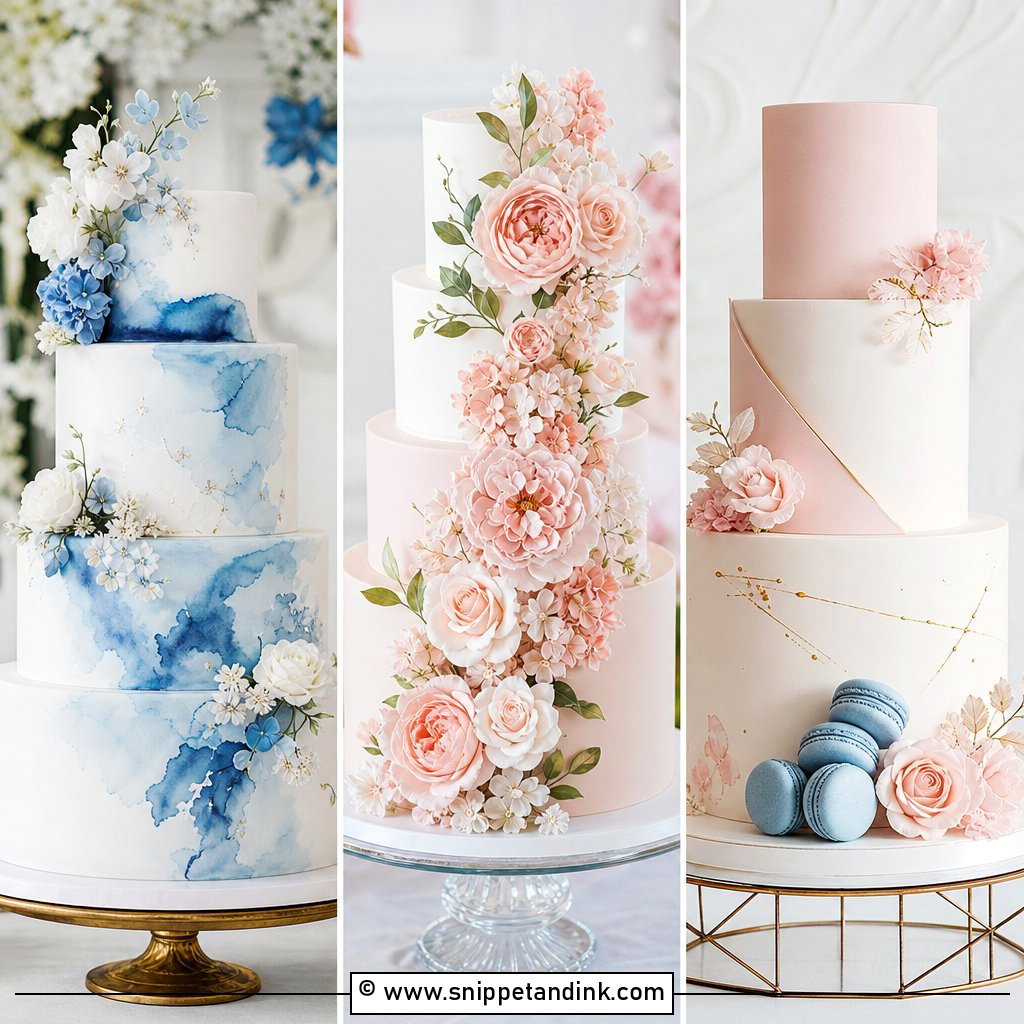
Watercolour effects are painted by hand onto the cake with thinned colour, moving through dusty blue, slate and pale sky blue. On buttercream I’d do it with a palette knife and softened colour rather than brushes; fondant takes real brushwork more easily. Silver goes on last, as thin painted lines, scattered leaf or edging. Keep flowers to white roses or tiny blue blossoms so the painting stays the main event.
19. Blue And Silver Ruffle Wedding Cake
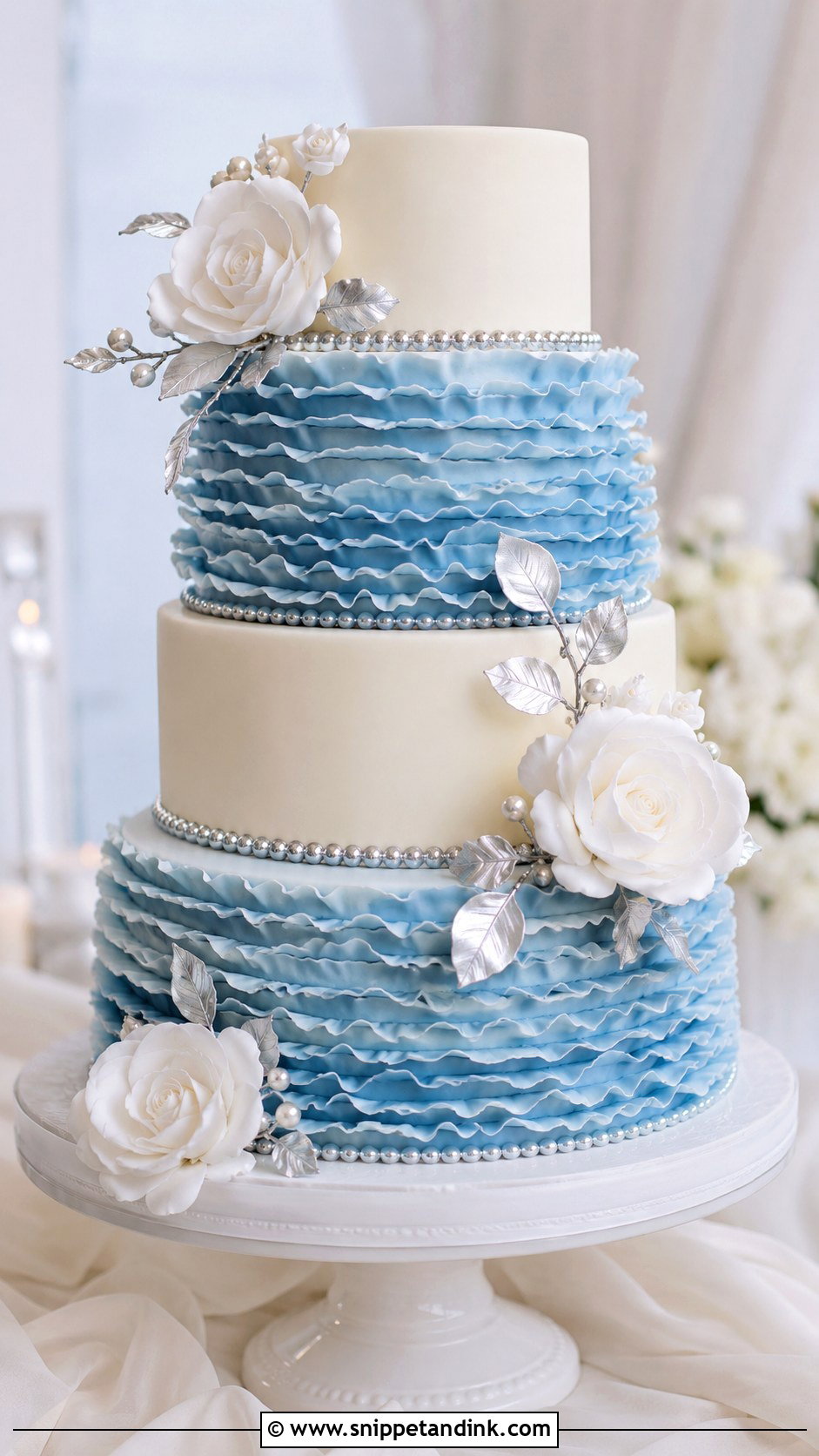
Ruffles are cut from thin fondant or modelling paste and attached one layer at a time, so they take time and add weight. I limit them to one tier or a cascade down one side, with smooth tiers around them. Pale blue ruffles with silver pearl edges feel romantic; navy ruffles with silver leaf feel dramatic. A small flower cluster or silver topper is enough to finish. The layered texture echoes fabric, which is why ruffles pair well with a full gown.
20. Blue And Silver Minimalist Wedding Cake
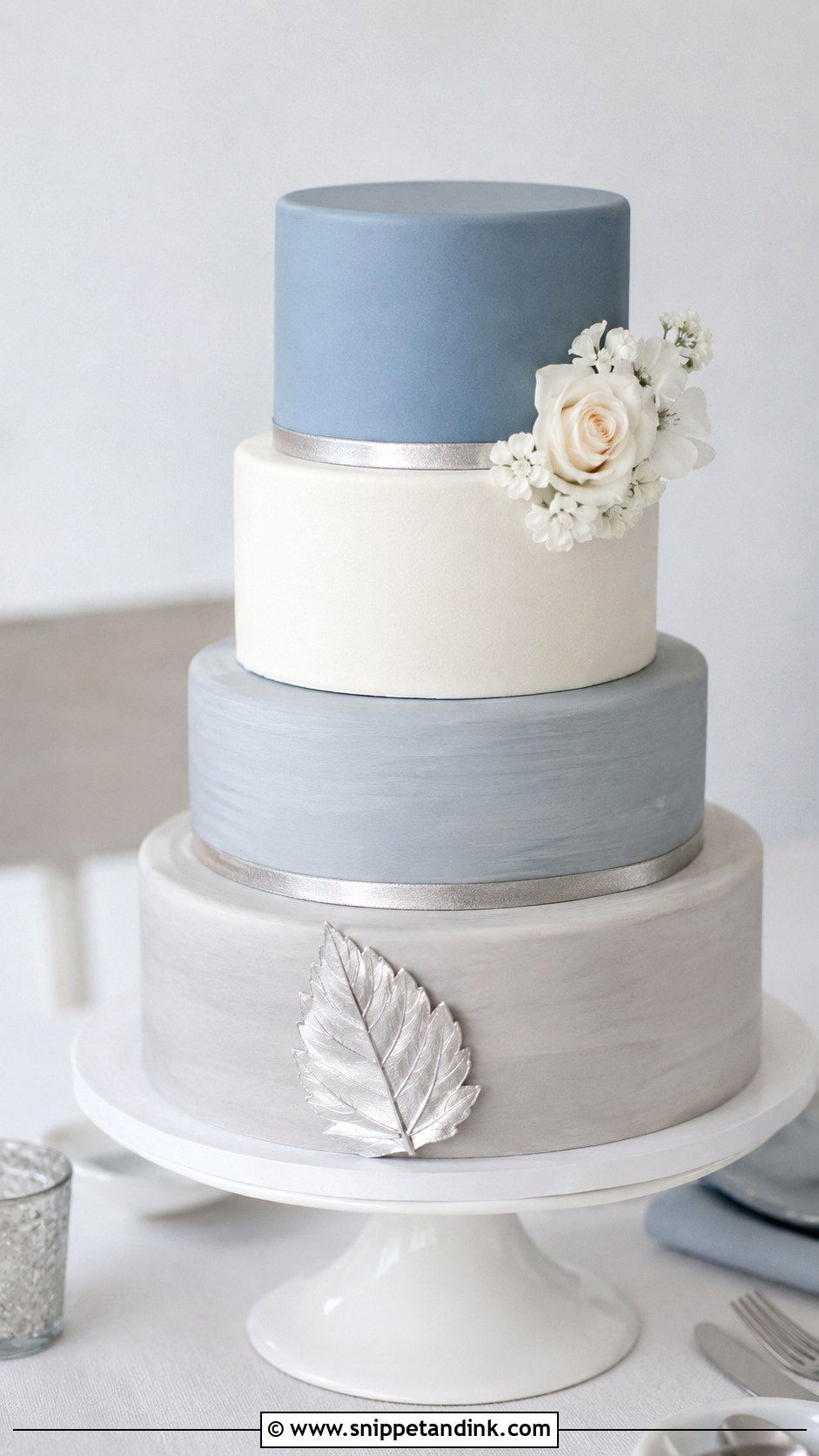
Minimal cakes leave nowhere to hide, so the finish has to be close to flawless. One smooth blue tier, one ivory and one with a barely-there silver accent can be enough, or thin bands with a single leaf. Dusty blue keeps it romantic; navy makes it formal. Put it on a simple white stand on an uncluttered table and it will look calm and intentional rather than unfinished.
Edible Silver, Decorative Silver, and Which Goes Where
Not every silver finish on a cake is meant to be eaten, and couples are often surprised by that. Some metallic dusts and sprays are labelled non-toxic rather than edible; they’re fine on parts that get removed before serving, like a topper, wired sugar flowers or a decorative board, but they shouldn’t go on the icing that gets sliced and plated. Edible silver leaf and edible lustre are a different product, made for food.
- Ask your baker which silver they use on each part of the design and whether it is labelled edible.
- Keep non-edible sparkle on removable pieces, and tell the caterer which parts come off before cutting.
- Expect silver leaf to look slightly softer under warm reception lighting than in daylight; it reflects whatever light is around it.
- If you want a mirror-like band, a printed or painted metallic ribbon of fondant usually stays crisper all evening than leaf, which can crease.
Silver and blue also sit differently next to other metals. If your table has gold cutlery or brass candle holders, I’d suggest letting the cake’s silver be the only metallic on that table, or the two will clash in photos.
Start With One Blue, Then Let the Silver Follow
Most of the cakes that work best here commit to one main blue and use silver as a supporting detail with a clear purpose. Bring your florist’s palette, a fabric swatch from your linens and a photo of your venue’s lighting to the tasting, and I can tint to match. Florals and lace lean romantic, marble and square tiers lean modern, and geodes or drips add drama. Whichever you choose, the cake should belong to the room it stands in.
You'll Like These Ideas:




Leave a Reply