
Silver is the cooler, quieter metal, and on a pink cake it behaves very differently from gold. It sharpens blush instead of warming it, and in low light it can drift toward grey, which is the main thing I design around. Most of the cakes below keep silver to a band, a border of pearls or a scattering of leaf. A few go further with mirrored tiers, edible sequins or a crystal geode. I’ve added notes on how each one is built and where it struggles, so you can walk into a tasting knowing what to ask for.
Why Silver Can Look Grey on the Night
Silver is a mirror. It shows whatever is around it, so under bright light it flashes, and in a dim room it picks up shadow and reads as flat grey. Gold has warmth of its own to fall back on; silver doesn’t. That changes how I place it. I put silver on edges and raised details that catch light, like a band, a pearl border or the rim of a sequin tier, rather than spreading it across a broad flat surface that will sit in shade.
Pick a pink that likes silver
Cool pinks with a hint of blue, such as rose, mauve and pale orchid, sit comfortably beside silver. Peachy or salmon blush can look slightly dirty next to it, because the warm pink and the cold metal argue. If your palette is a warm blush, consider pearl or a champagne-toned silver instead of bright chrome.
One more thing to raise with your baker: some metallic silver decorations, including certain dragées and lusters, are sold for decoration only rather than as food, depending on where you live. A good cake designer will know which of their products are edible and will tell you which pieces should come off before slicing.
1. Pink And Silver Wedding Cake
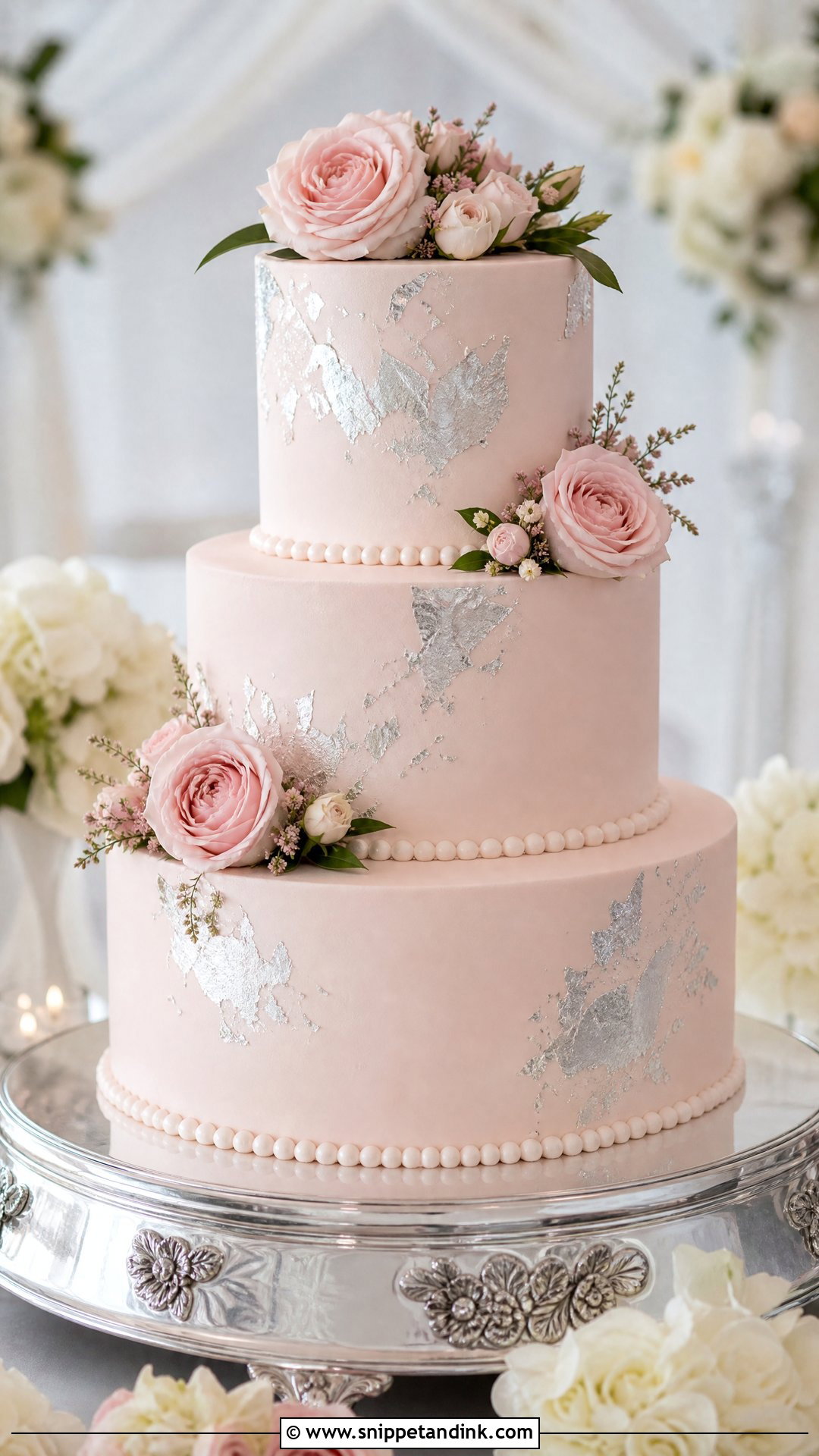
This is the all-rounder: a blush base with silver arriving through leaf, a thin band, a pearl border or a small topper. I like it on three tiers, because each tier can carry its own texture. Smooth pink buttercream on the bottom, brushed silver fondant in the middle and a plain top tier with flowers is a layout that never looks crowded. Keep the flowers close to blush and ivory. Bright fuchsia next to silver starts to look like a party cake rather than a wedding one.
2. Blush Pink And Silver Wedding Cake
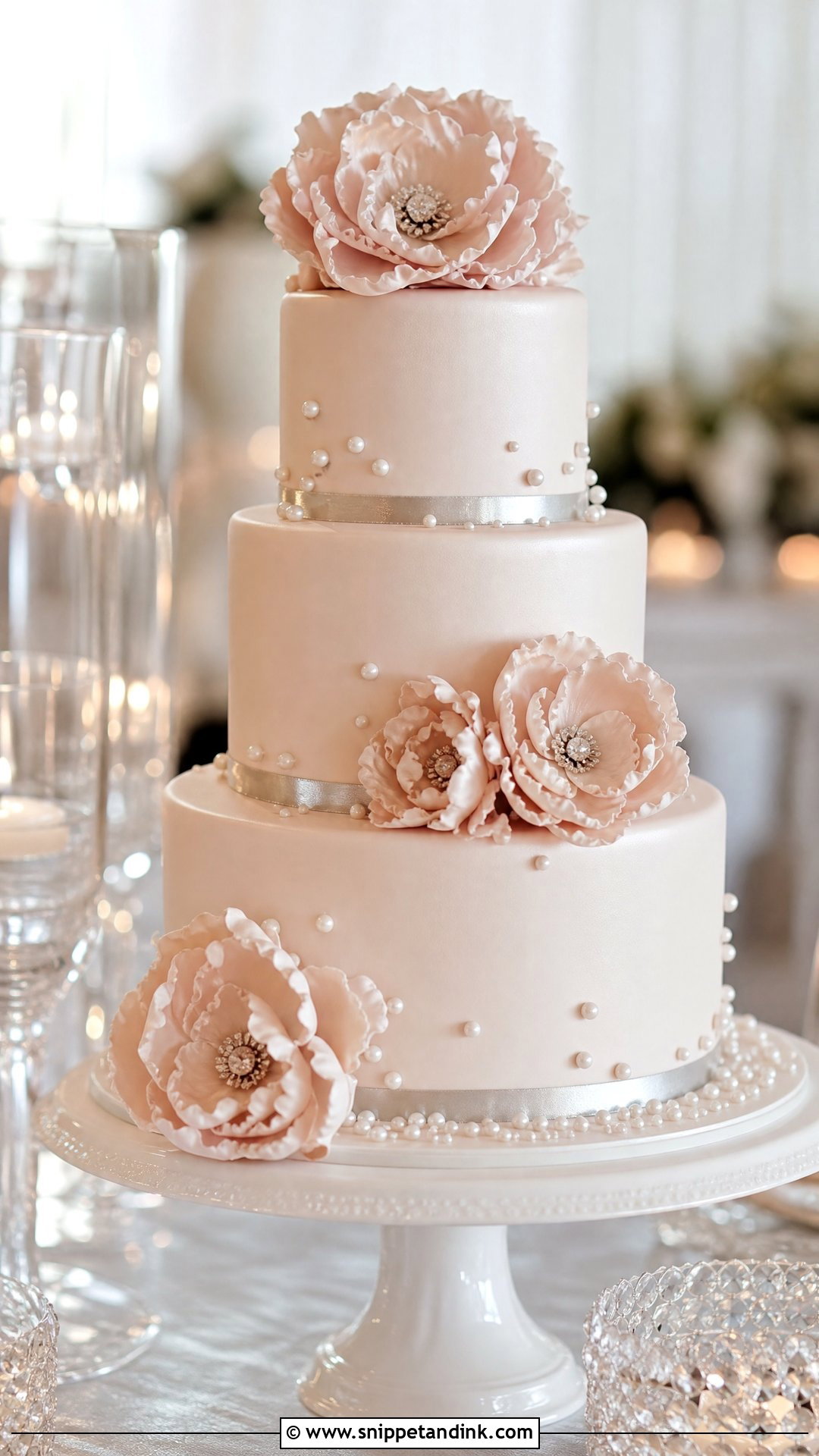
Blush stays soft enough to sit beside white flowers, crystal glassware and silver flatware without fighting any of it. I finish these in buttercream or fondant with a satin sheen, then add silver leaf in a few torn patches, a narrow ribbon at the base of each tier or a ring of tiny sugar pearls. A ribbon needs a strip of greaseproof backing or the butter seeps through and stains it. Top it with blush garden roses, pale pink peonies or sugar blossoms in a loose diagonal.
3. Pink And Silver Tiered Wedding Cake
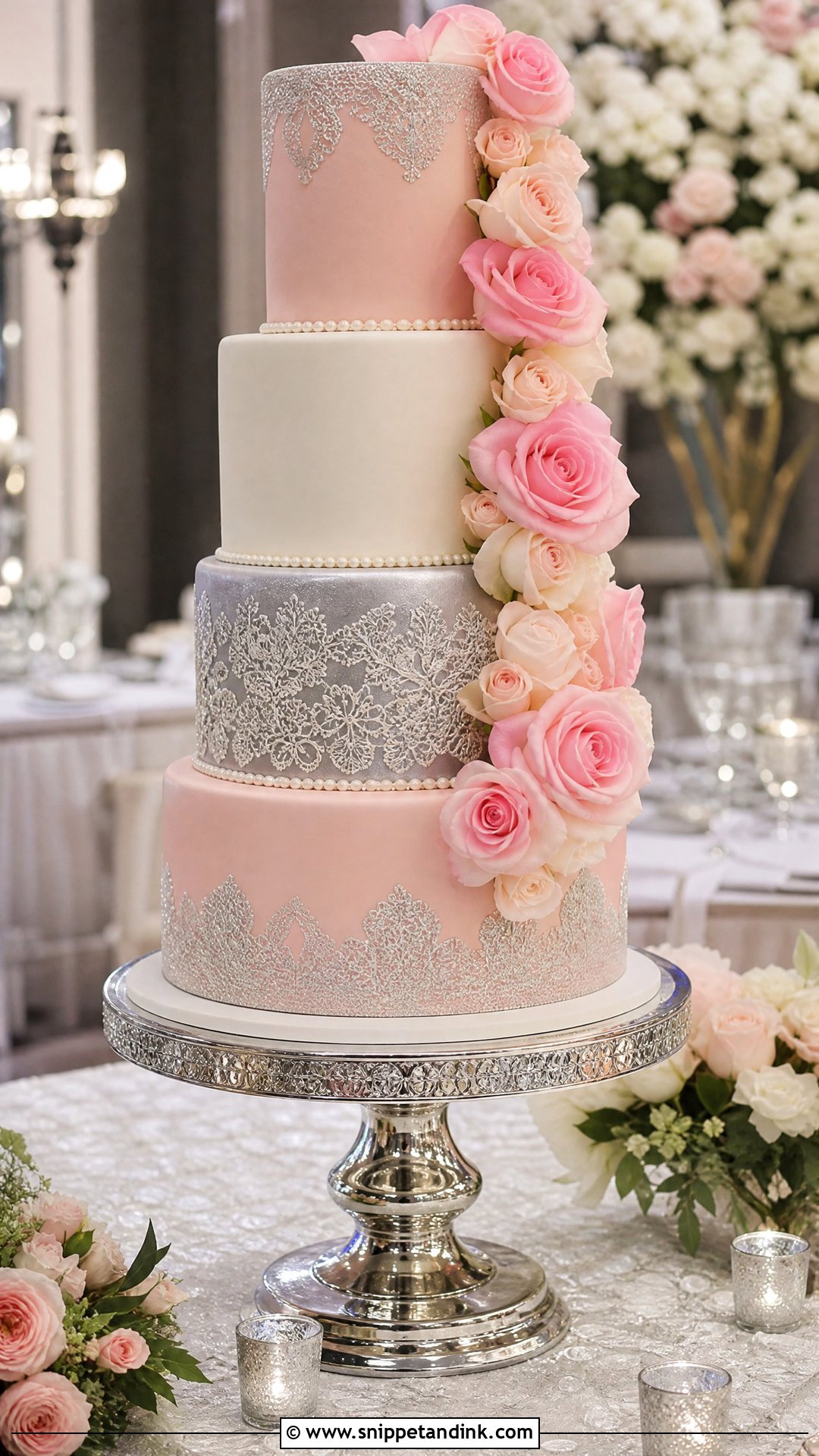
Height is what a tiered cake gives you, and three to five tiers is a decision made by guest count and ceiling height, not just looks. I alternate pink and white tiers so the silver detail has a clean background. A blush bottom tier grounds the design, and a silver lace tier or a stenciled metallic tier in the middle adds the shine. Every tier above the base needs its own board and supports, and anything over four tiers I stack on site. Place flowers only where they help the outline, between tiers or flowing off one side.
4. Pink And Silver Drip Wedding Cake
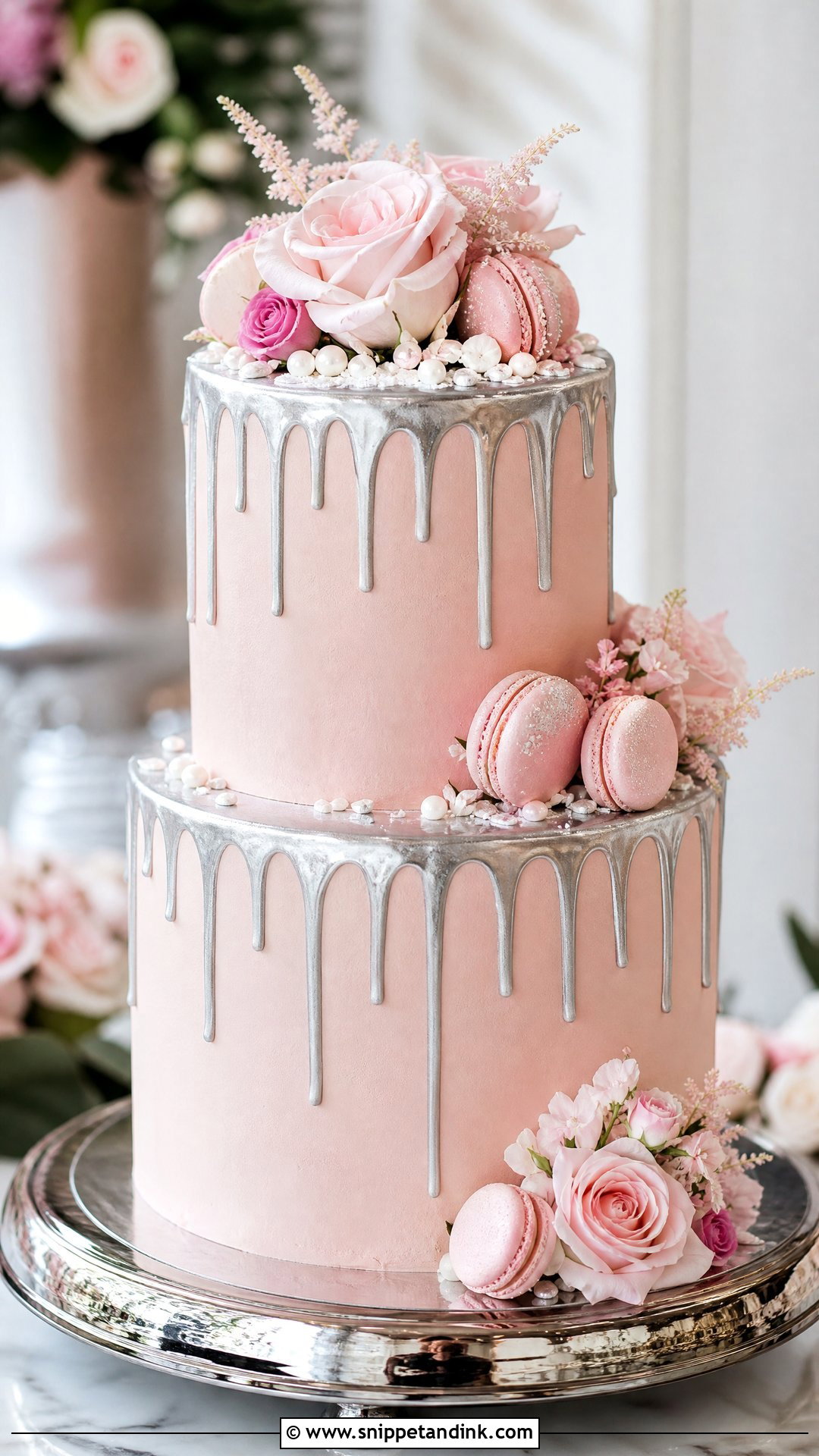
The drip should look deliberate. I chill the pink buttercream tier hard, then run a metallic silver ganache-style drip from the edge with a squeeze bottle, testing the ganache temperature on the back of a cold tier first. Too warm and it runs to the board; too cool and it stops in blobs. One drip tier, perhaps repeated faintly lower down, is plenty. Pile macarons, sugar roses or silver-dusted meringues on top, and keep everything else in pink, white and pearl so the metal stays the only shiny thing.
5. Pink And Silver Ombre Wedding Cake
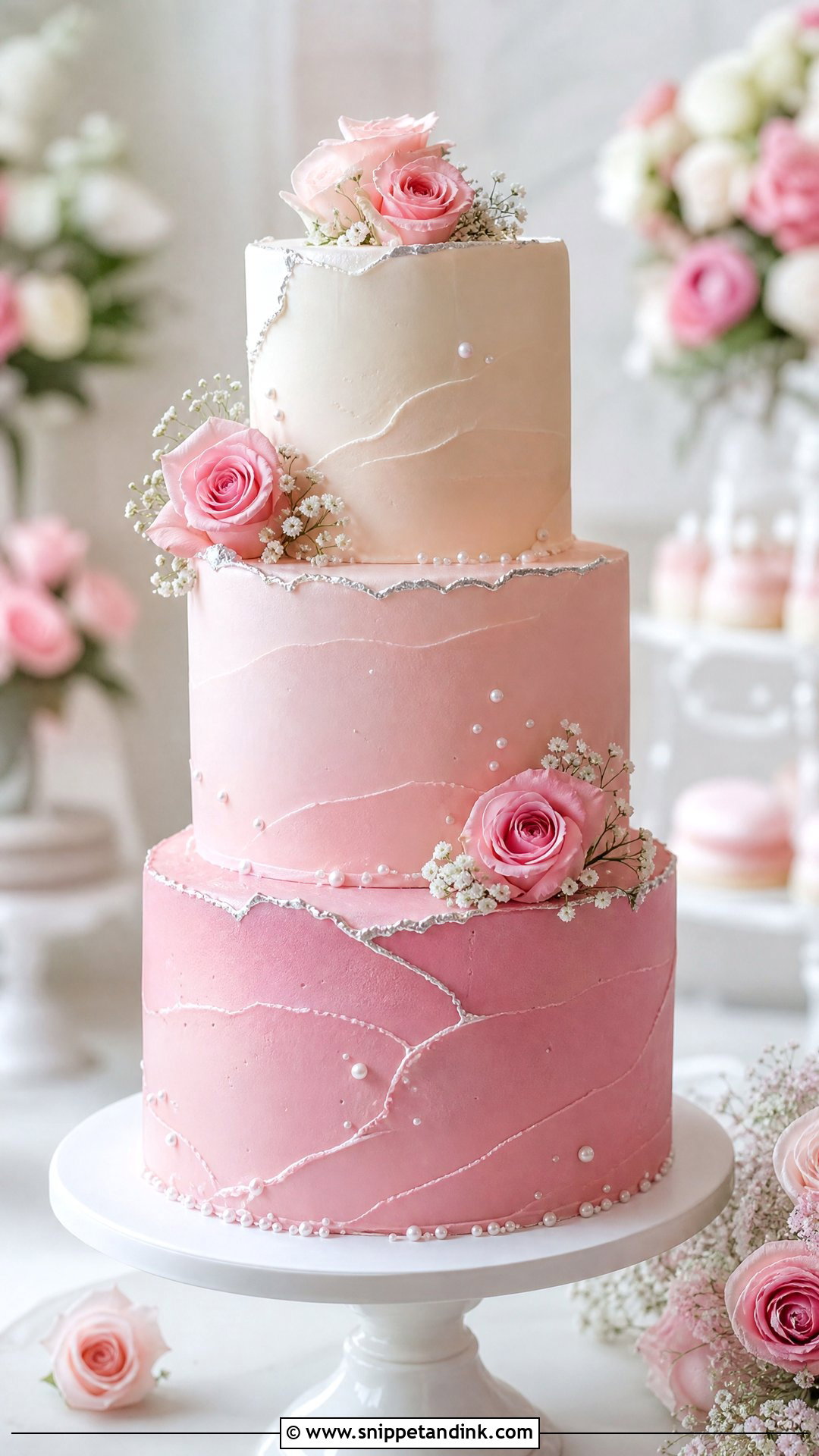
Ombre shows off pink better than one flat shade can. The bottom tier starts in deeper rose and the color lifts toward blush and ivory at the top, with silver kept to an accent, a thin leaf edge or a monogram topper. In buttercream the fade looks hand-finished; in fondant it’s cleaner and more formal, but each tier has to be colored separately, so the steps between shades show. Ombre suits spring receptions because the lightest tier sits highest, where daylight catches it.
6. Pink And Silver Marble Wedding Cake
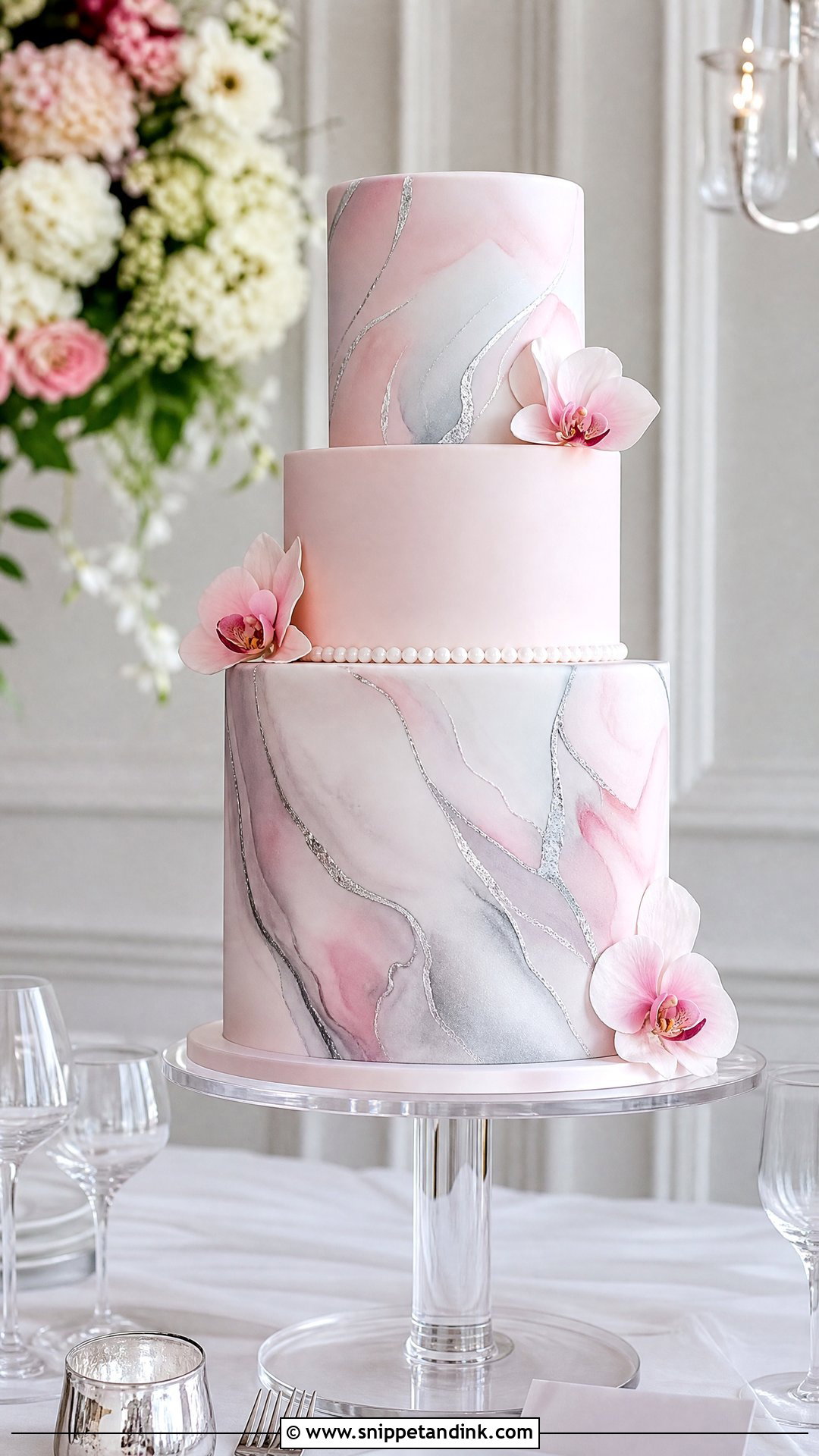
Silver marble needs restraint. I blend blush, white and a whisper of grey fondant, then pick out a few veins with edible silver, leaving plenty of plain white so the pattern breathes. Overworked marble looks muddy. Two tiers suit a small wedding; three give the veining more room. A couple of sugar roses or orchids near the base is enough, and a clear acrylic or silver cake stand keeps the whole thing looking clean.
7. Pink And Silver Geode Wedding Cake
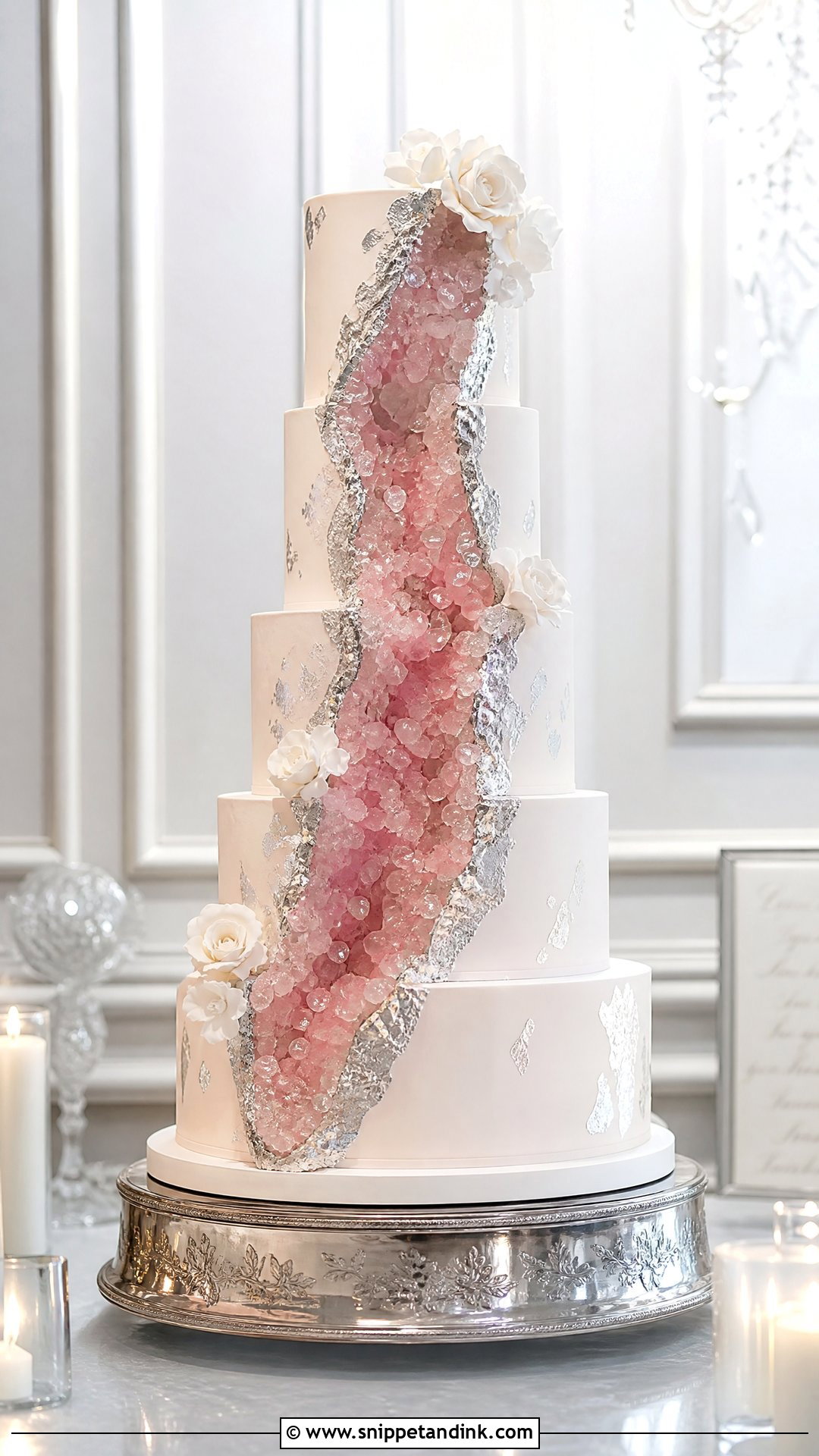
Run the geode vertically down one side of a tall tiered cake and it reads like a seam of crystal through stone. The crystals are usually isomalt or rock candy in pale pink, set into a channel carved through the icing and edged with silver leaf. Pale blush or dusty mauve around it keeps the effect romantic rather than neon. I warn couples that isomalt pieces come out before slicing. Flowers should stay minimal, a few small ivory blooms at most.
8. Pink And Silver Floral Wedding Cake
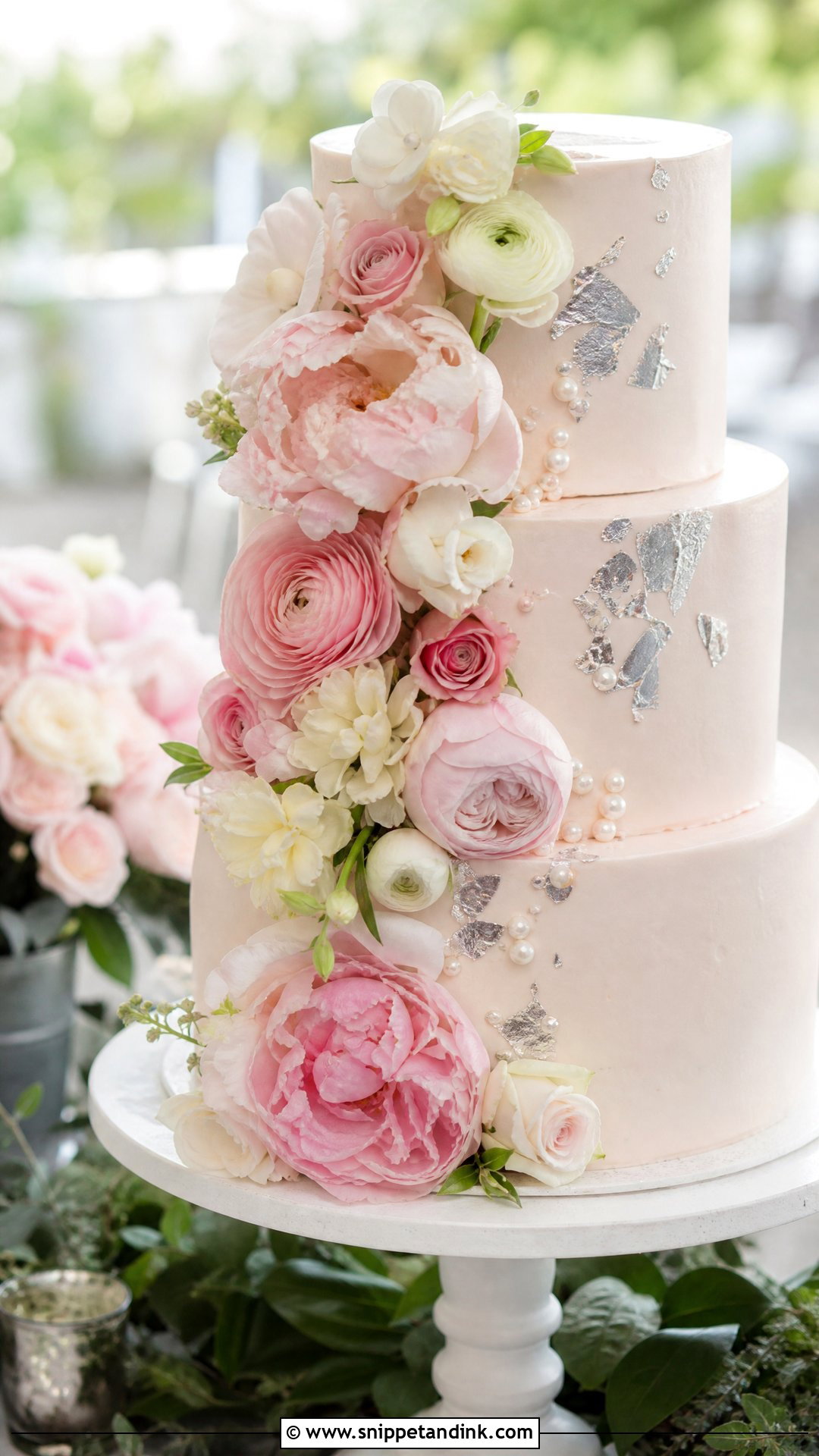
Flowers on a cake can be fresh, sugar or wafer paper, and the choice is often decided by the venue and the weather as much as by budget. Fresh blooms need to be food-safe and wrapped at the stem. Sugar flowers survive heat but take weeks to make. Wafer paper is light and translucent but wilts in humidity. Blush roses, peonies, ranunculus and sweet peas all sit well against silver leaf placed lightly around them. The arrangement can cascade down a side, wrap one tier or sit between tiers for a garden feel.
9. Pink And Silver Buttercream Wedding Cake
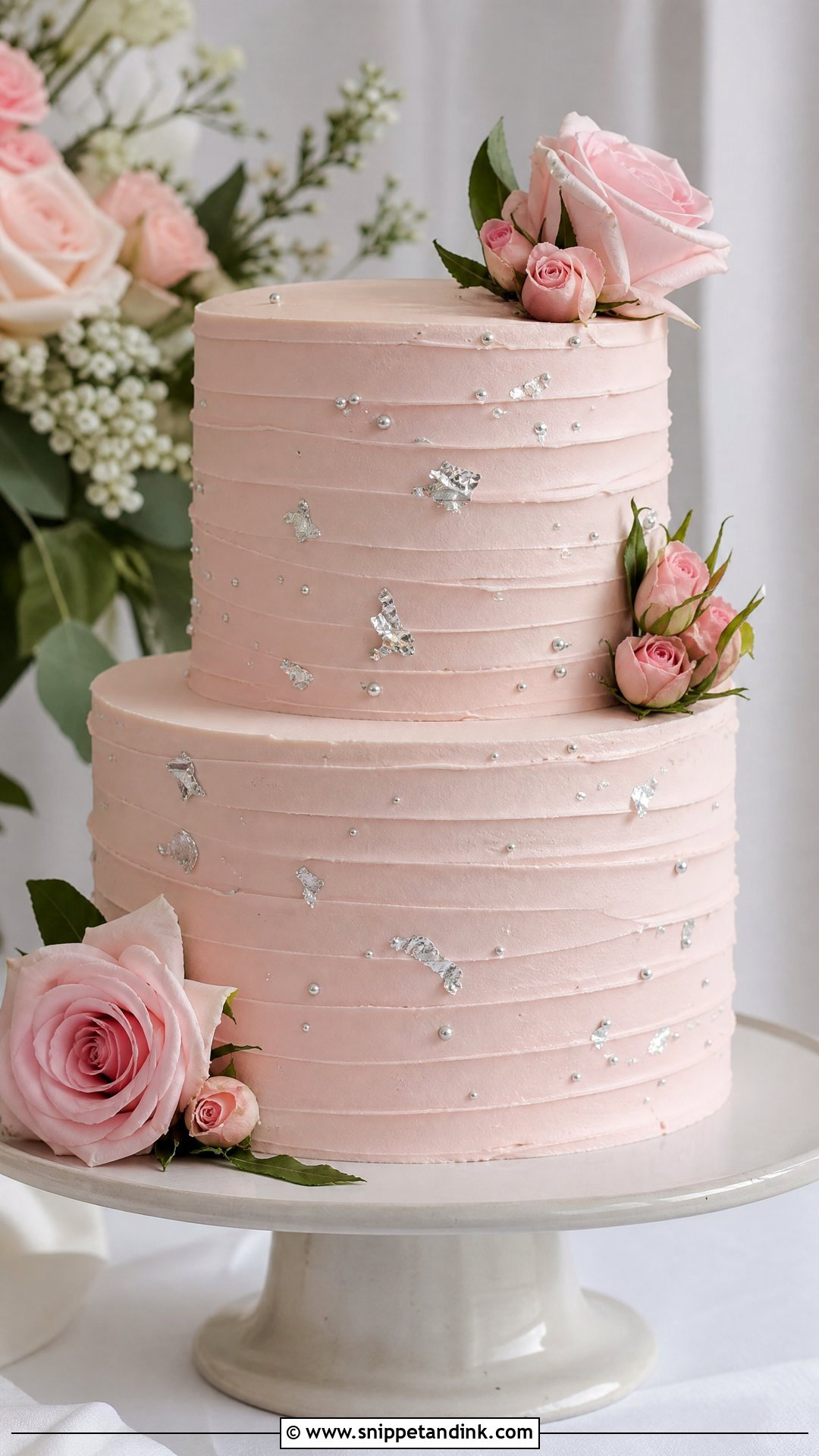
Buttercream gives the most handmade finish here, with smooth sides, soft ridges or palette-knife texture. I tint it blush, rose or dusty mauve, then add silver sugar pearls, a patch of leaf or a slim topper. It’s less stiff-looking than fondant and nicer to eat. The catch is that silver leaf only sits flat on cold, firm buttercream, so I gild after chilling and keep the cake cool. Leave space between blooms so the frosting texture still shows.
10. Pink And Silver Fondant Wedding Cake
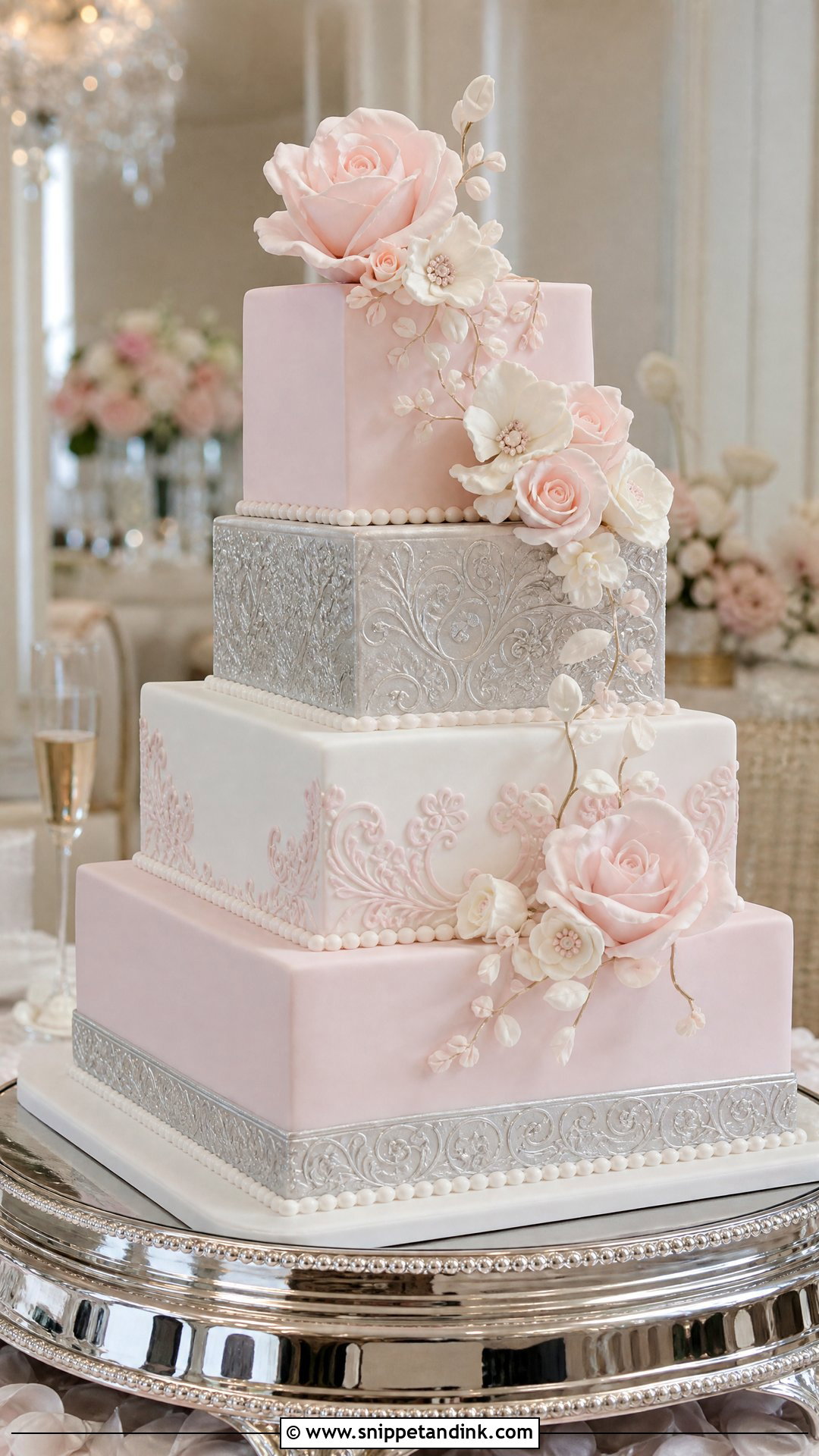
Fondant is where sharp edges and metallic detail look their best. Embossed patterns, a fully silvered tier, stenciled lace and raised pearl borders all stay crisp on it, and it supports sculpted flowers without sagging. For a black-tie reception I’d pair a pale pink fondant base with one silver tier and nothing else competing. Inside, keep the flavor crowd-friendly: vanilla, almond, champagne or strawberry. Many guests peel fondant off, so the sponge has to stand on its own.
11. Pink And Silver Vintage Wedding Cake
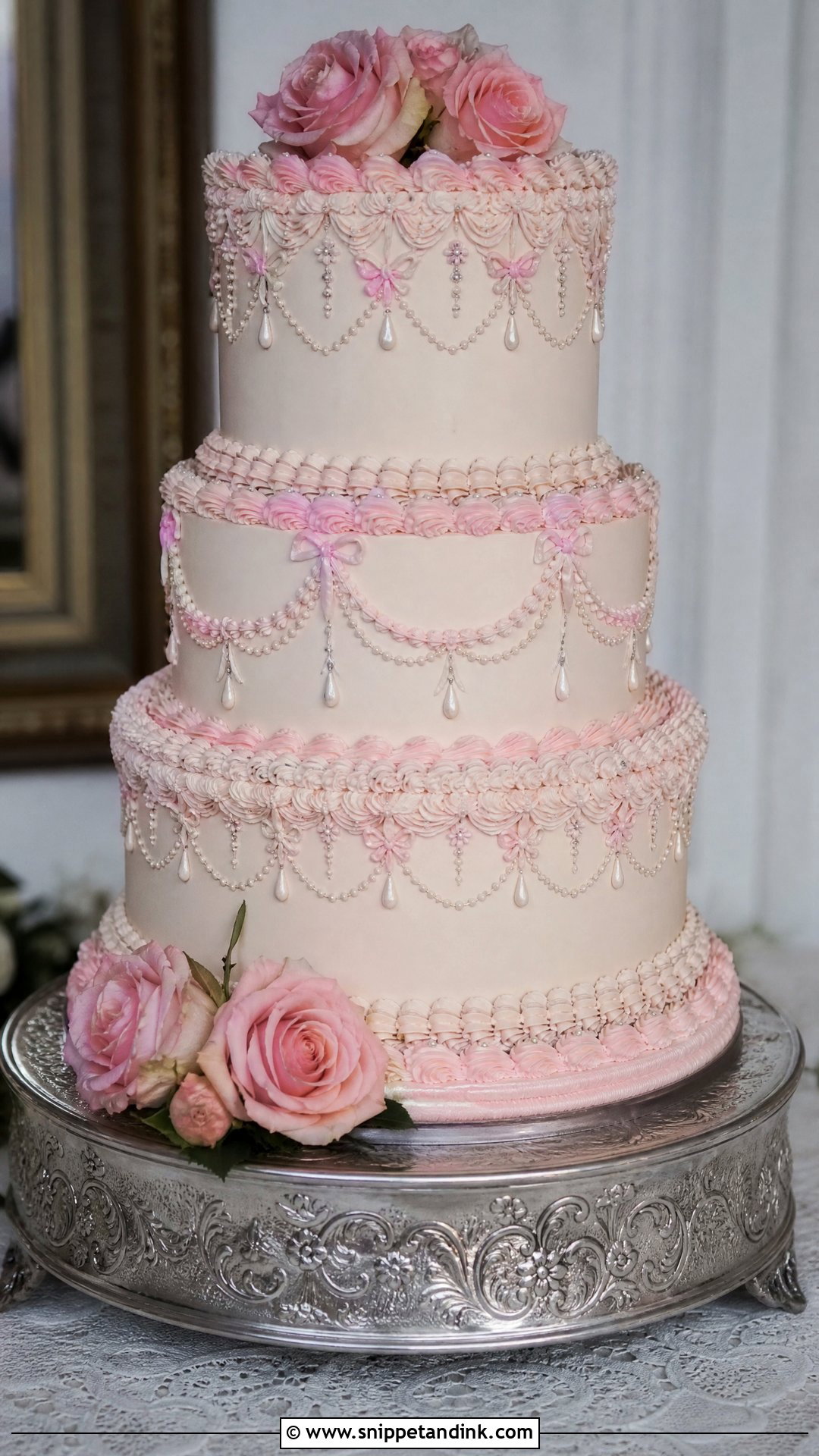
Vintage cakes are all about piping. Lambeth-style borders, shells, ruffles and tiny piped bows go on in pale pink buttercream, and silver dragées or pearl drops add the shine. A single tall cake looks chic; two or three stacked tiers feel more formal. What separates good vintage from messy vintage is repetition. Every swag the same width, every shell the same size. It sits naturally on a table with lace linens and mismatched vintage plates.
12. Pink And Silver Pearl Wedding Cake
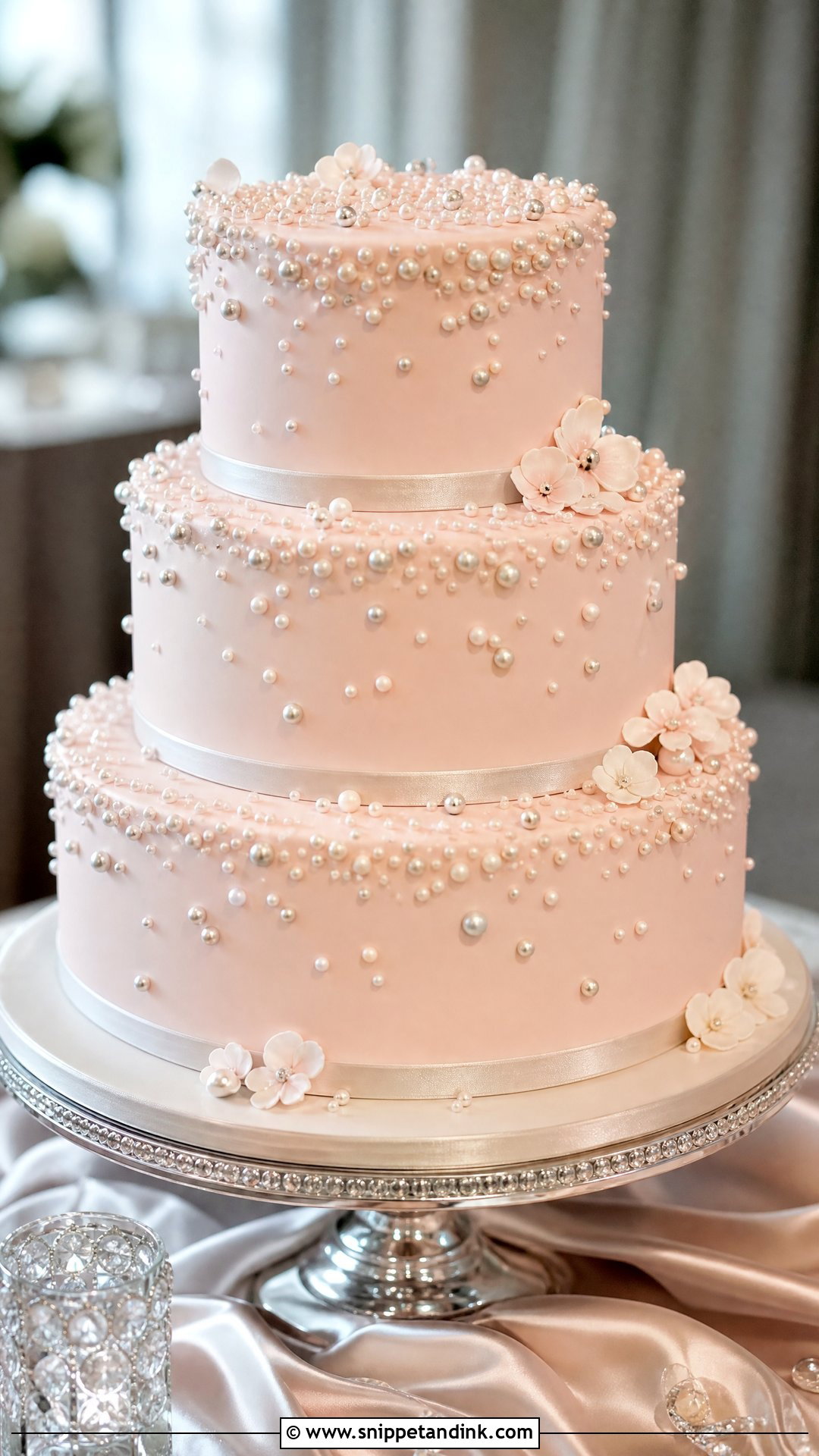
Pearls are the gentlest way to bring silver in. On a blush base I press edible pearls into neat borders, loose clusters or a gradient that thins out up the tiers, then mix a few silver-dusted ones among the white. Pearlized luster brushed over the fondant ties it together. The texture is the decoration here, so I keep flowers to a minimum. It’s very much a bride’s cake, at home beside satin cloths and crystal.
13. Pink And Silver Sequin Wedding Cake
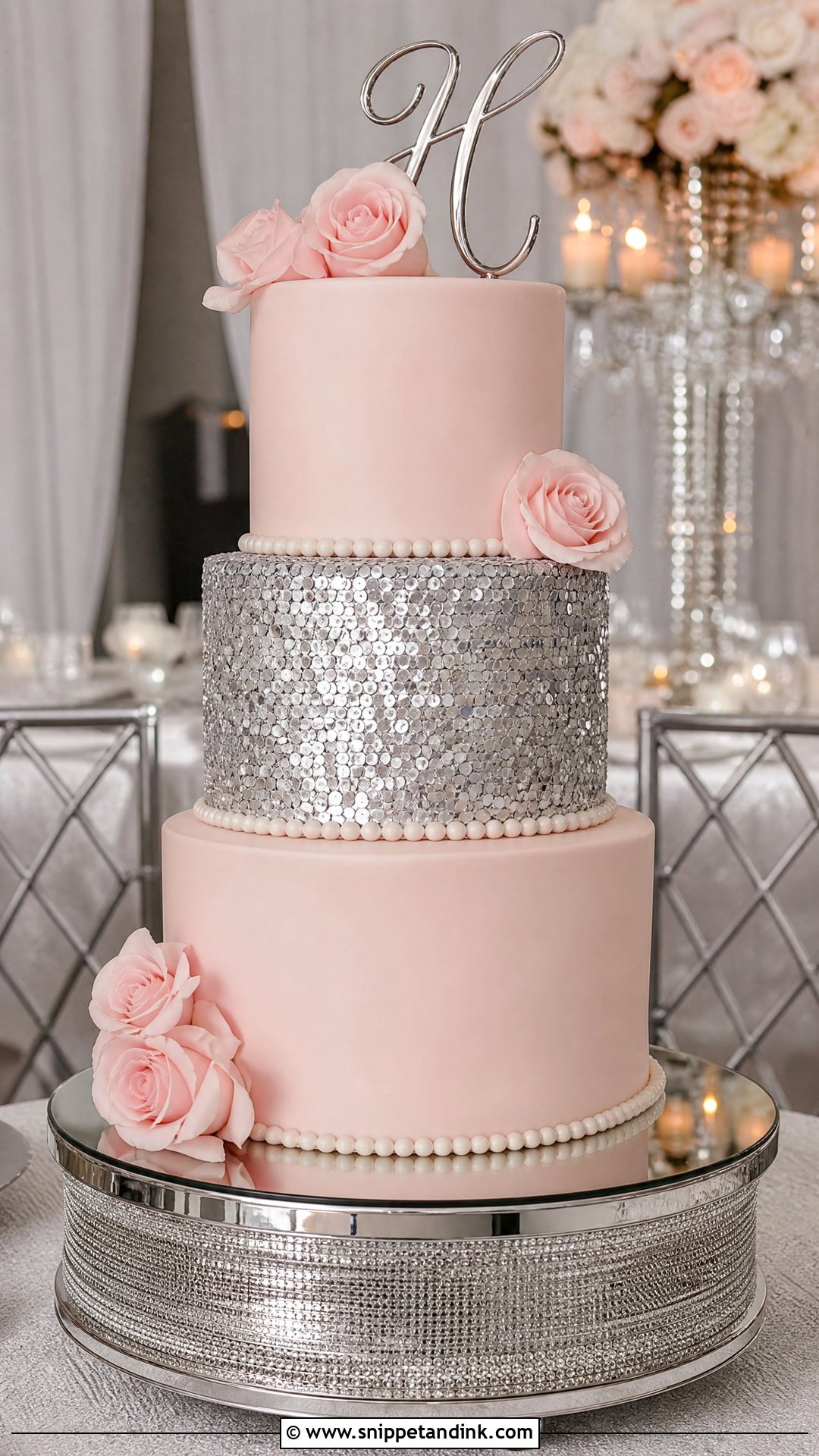
Sequins on a cake are edible discs, usually gelatin or sugar based, pressed on one by one or applied in sheets. A full sequin tier catches every light in the room, so I place it in the middle between plain blush tiers to keep the cake from feeling like a disco ball. A front-facing panel is a lighter alternative. This design comes alive in evening receptions with candlelight or spotlights; in flat daylight the shimmer is much quieter than in the photos you’ve saved. Finish with a few roses or white orchids.
14. Pink And Silver Lace Wedding Cake
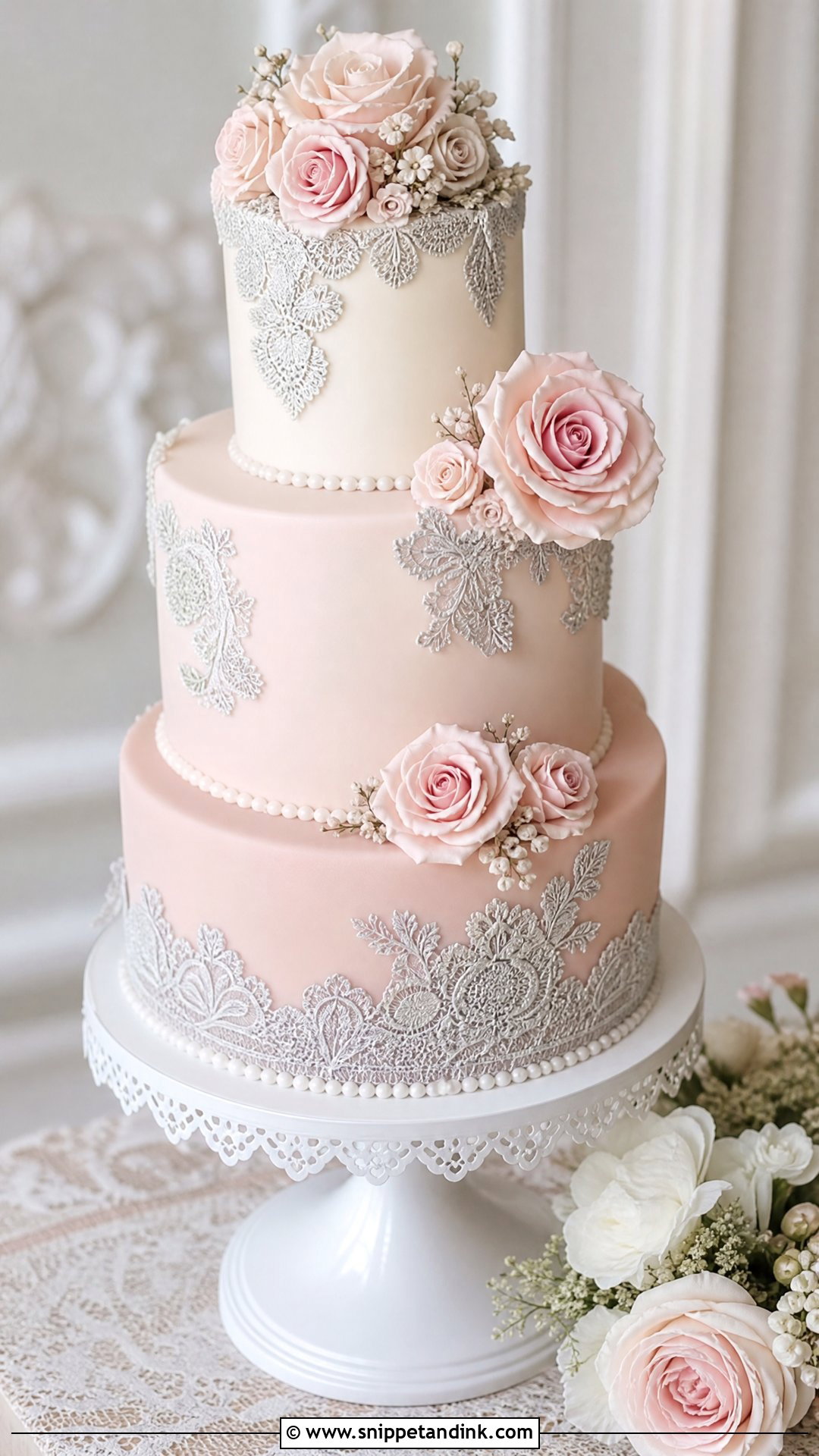
Lace can be fondant appliqué, edible lace sheets or piped royal icing, and silver lace usually means painting over one of those with metallic luster. I’d pair a blush lace tier with plain white tiers and small pearl borders. Bring a photo of your dress if it has lace; picking up its motif is the detail people comment on. Keep flowers simple so the lace stays the main decoration.
15. Pink And Silver Watercolor Wedding Cake
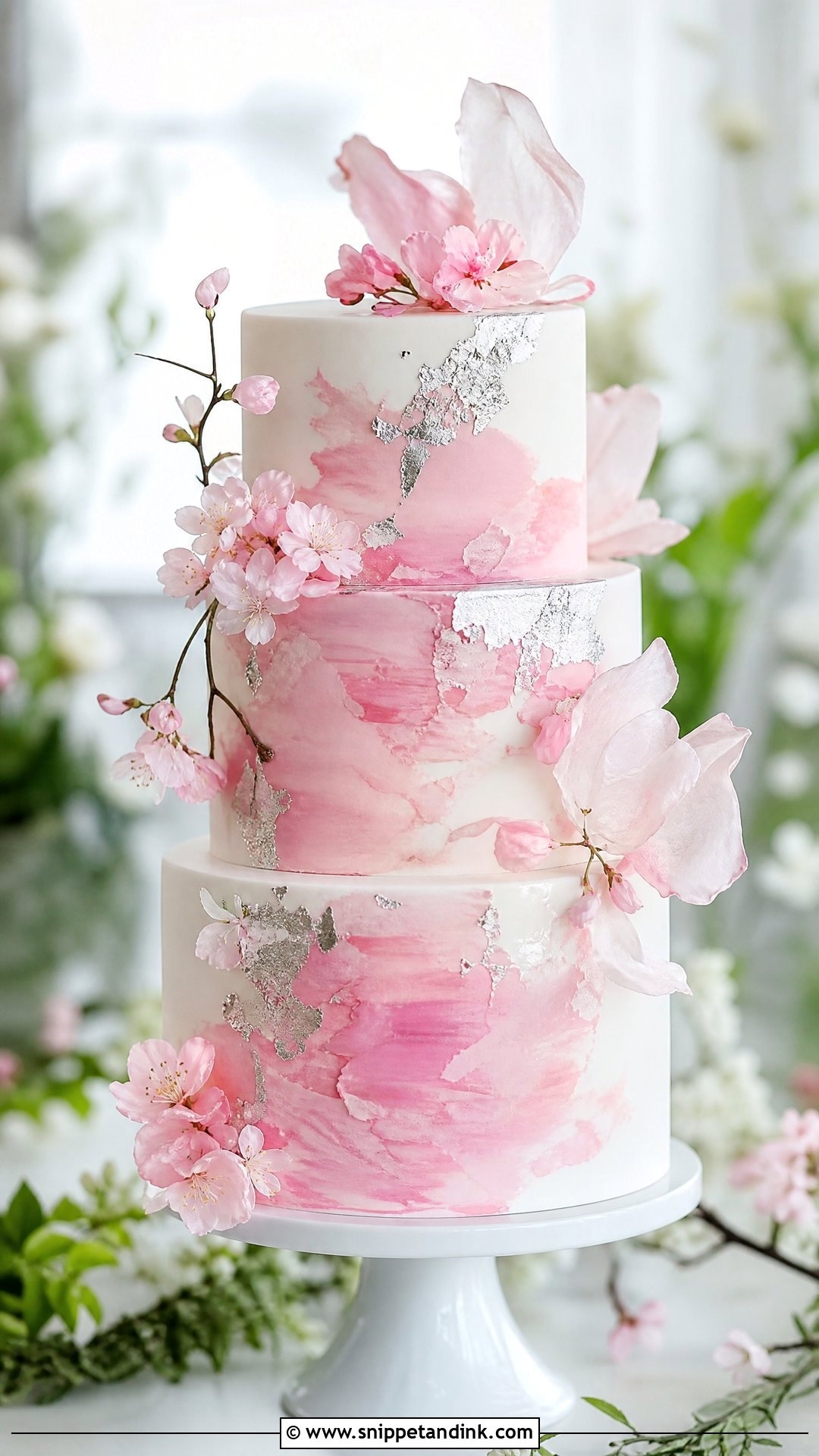
Watercolor tiers are hand-painted, with pink and pale rose washes laid over white fondant using thinned gel color, or swept on in buttercream for a looser effect. The art is in leaving white space. Heavy color turns it into a painted cake rather than a watercolor one. A little silver leaf where the washes meet adds light. I’d suit it to a light-filled venue or a garden party, with a few fresh flowers or wafer paper petals for movement.
16. Pink And Silver Rose Wedding Cake
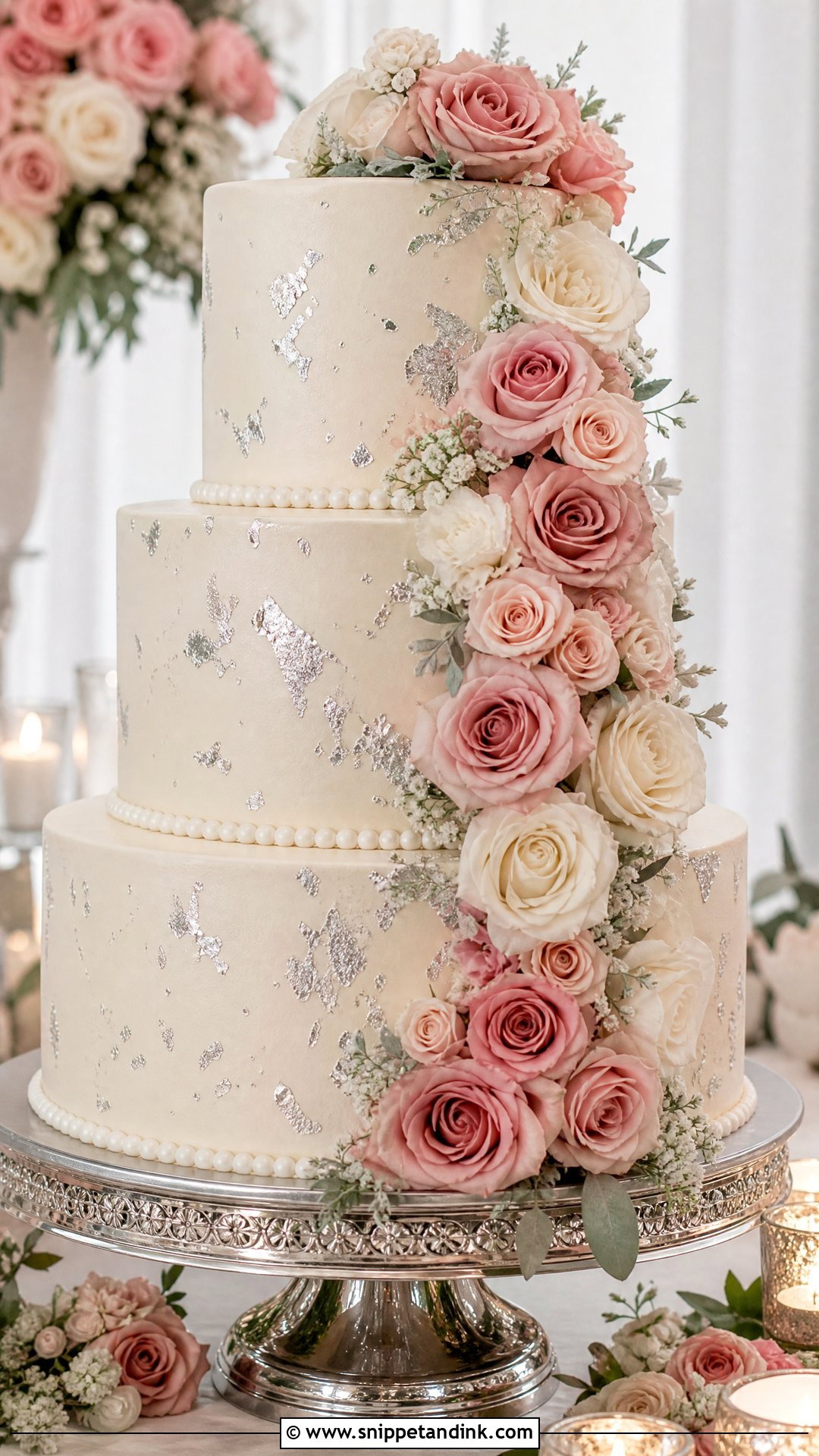
Roses go with nearly every reception style, and they let you choose where the pink lives: in the cake itself, or in the flowers on a plain white cake. Silver shows up as thin leaf, pearl borders or a small monogram. For drama, cascade roses from the top tier down one side; for something simpler, set small clusters between tiers. Blush, dusty pink and ivory roses keep the silver looking soft. Deep magenta tends to make silver look cold.
17. Pink And Silver Champagne Wedding Cake
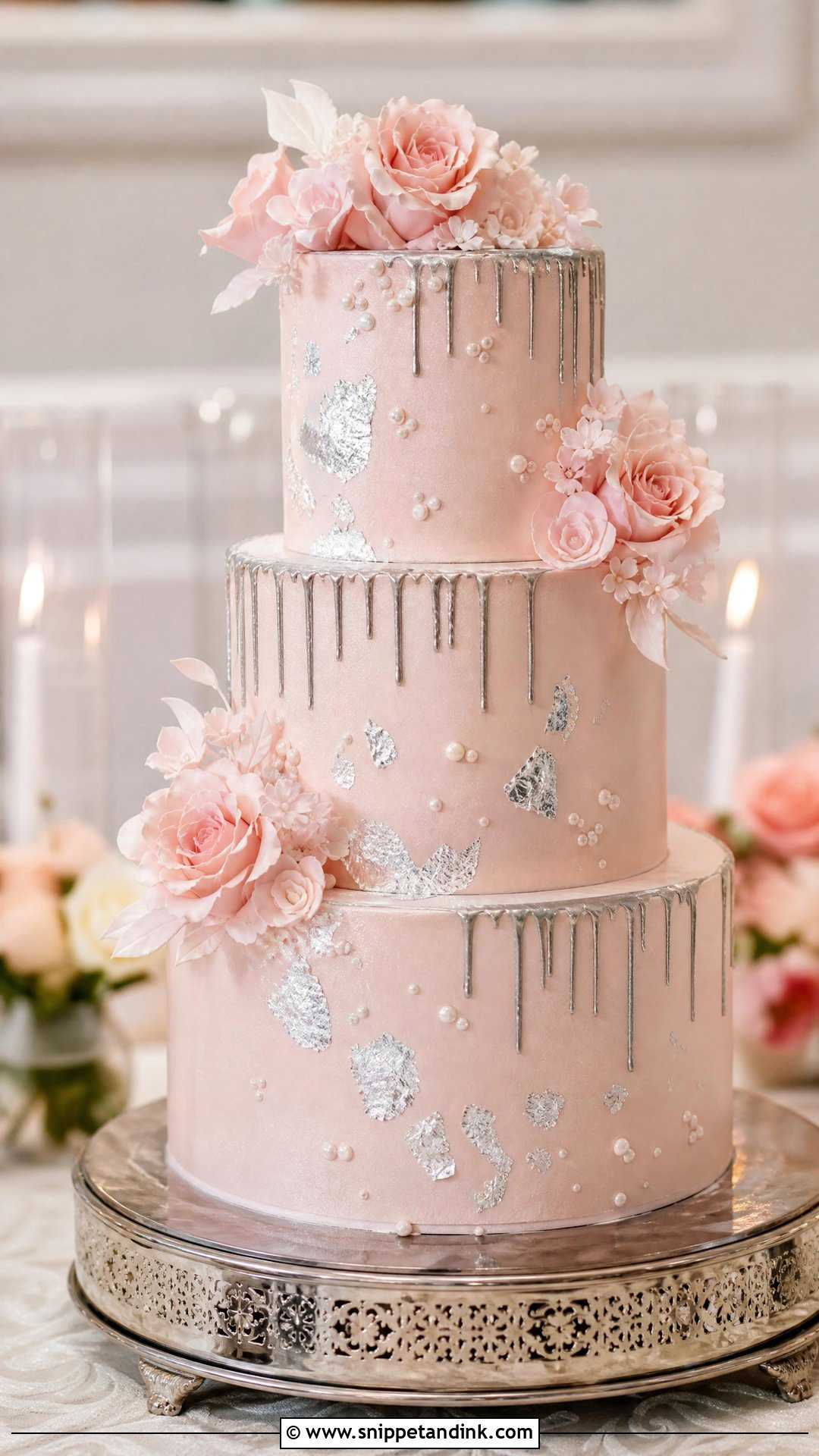
This is the one where flavor drives the design. Pink champagne cake has a pale blush crumb, so a slice looks as good as the outside, and it pairs with strawberry, raspberry, vanilla or rose buttercream. Outside, I’d use smooth blush frosting with a little silver leaf and clusters of small sugar pearls as bubbles. Keep it subtle and the champagne idea reads as a wink, not a theme. Ask your baker whether the champagne flavor comes from real wine or a flavoring, since the alcohol largely bakes off either way.
18. Pink And Silver Heart Wedding Cake
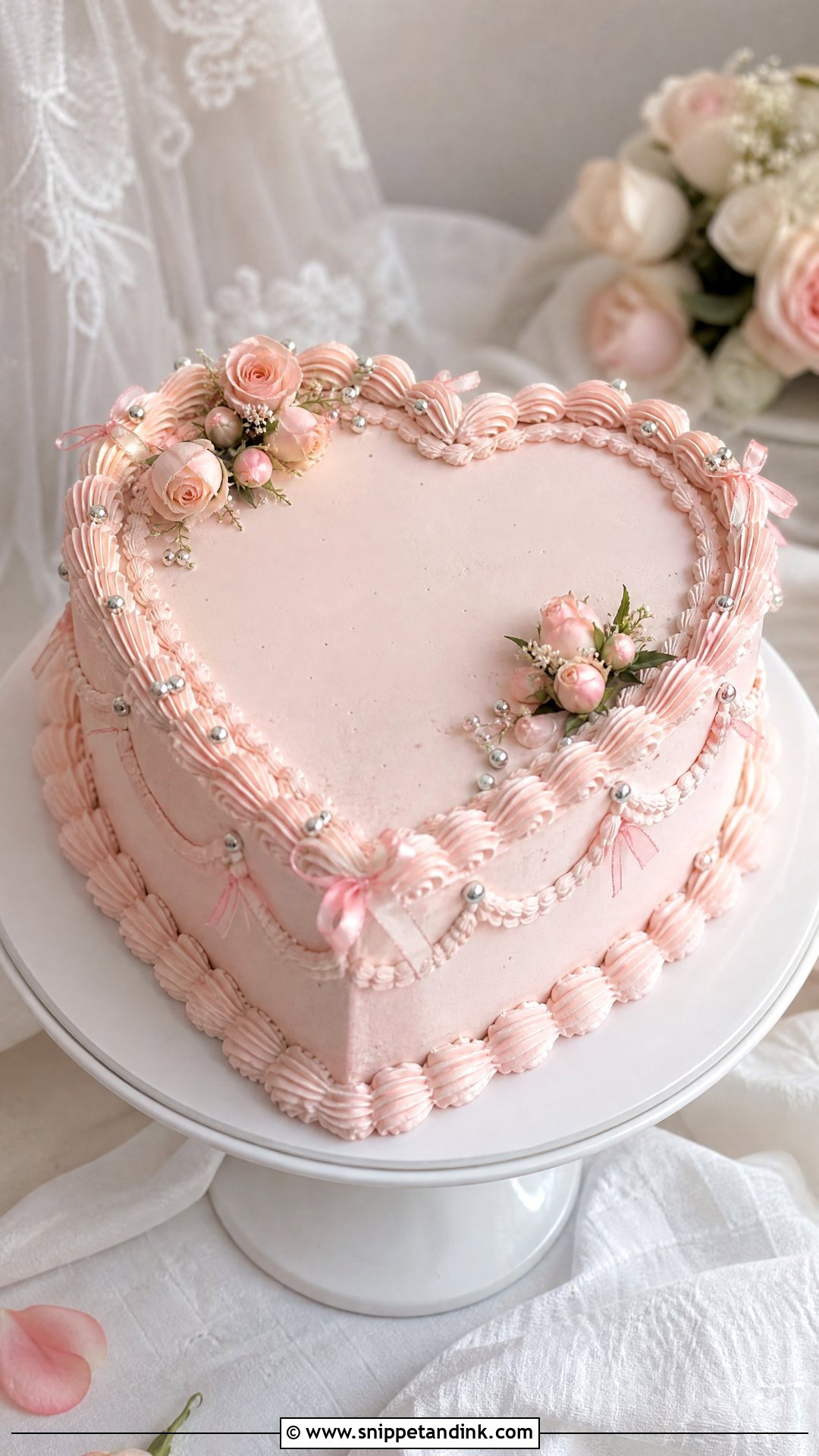
A heart-shaped cake suits small weddings: a single tier for an elopement or bridal lunch, or a stacked version for a dessert table. Pale pink buttercream with vintage piping, silver pearls and a scripted silver topper is the classic treatment. The shape is the point, so don’t bury the top in flowers. Piped borders, a few tiny bows and two or three blush blooms keep the outline clear. Heart tins are fiddly to level, so expect a slightly higher price than a round of similar size.
19. Pink And Silver Square Wedding Cake
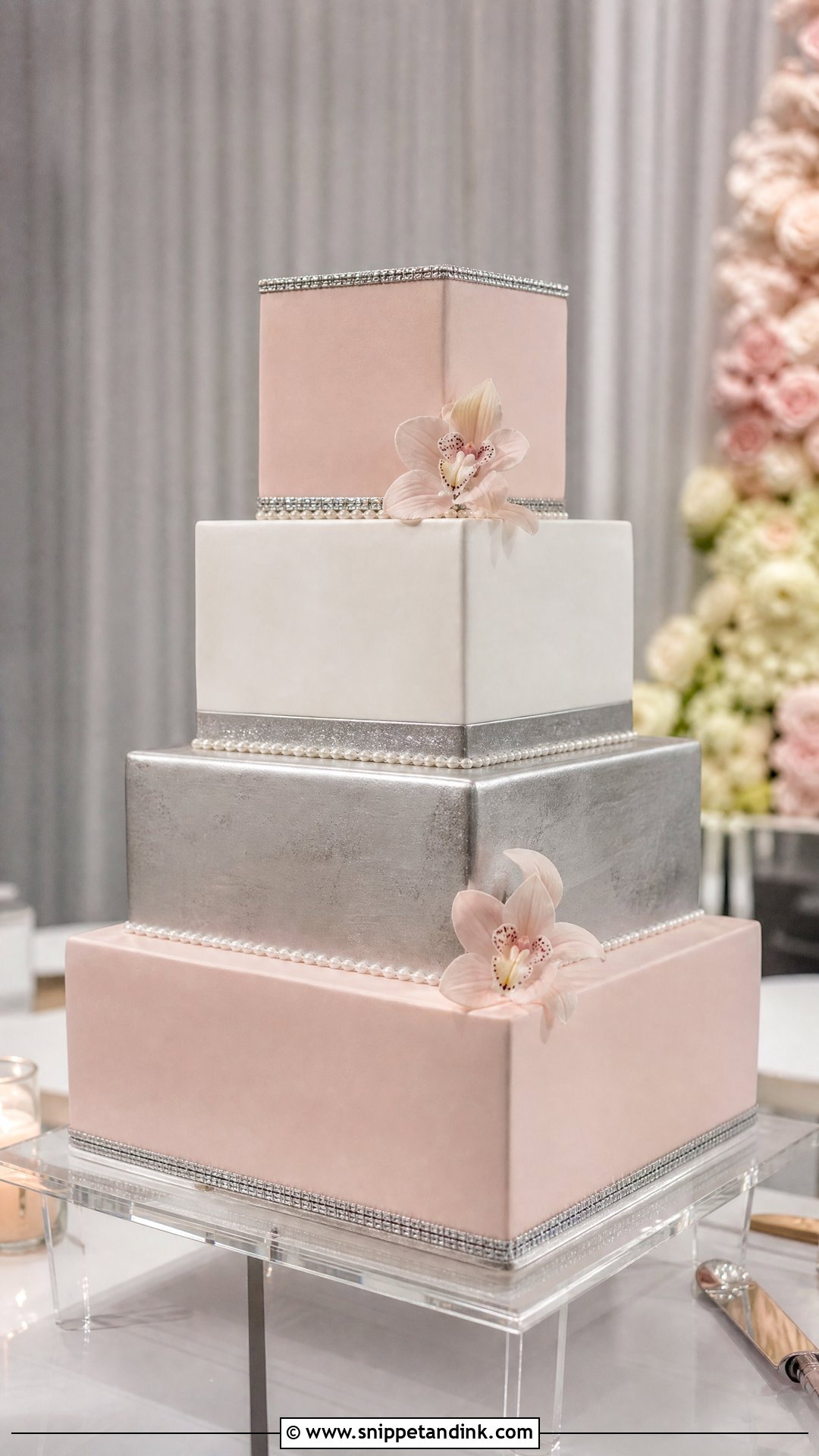
Square tiers suit city venues and sleek decor. They take metallic bands and geometric detail well, and silver edging traced around each tier makes the outline sharper still. I’d stack blush fondant, white fondant and one silver accent tier, then add orchids or roses on a single corner. The shape is already bold, so decoration should be neat and sparing. Square tiers also slice into more portions than rounds of the same width, which helps with large guest counts.

20. Pink And Silver Cupcake Wedding Cake
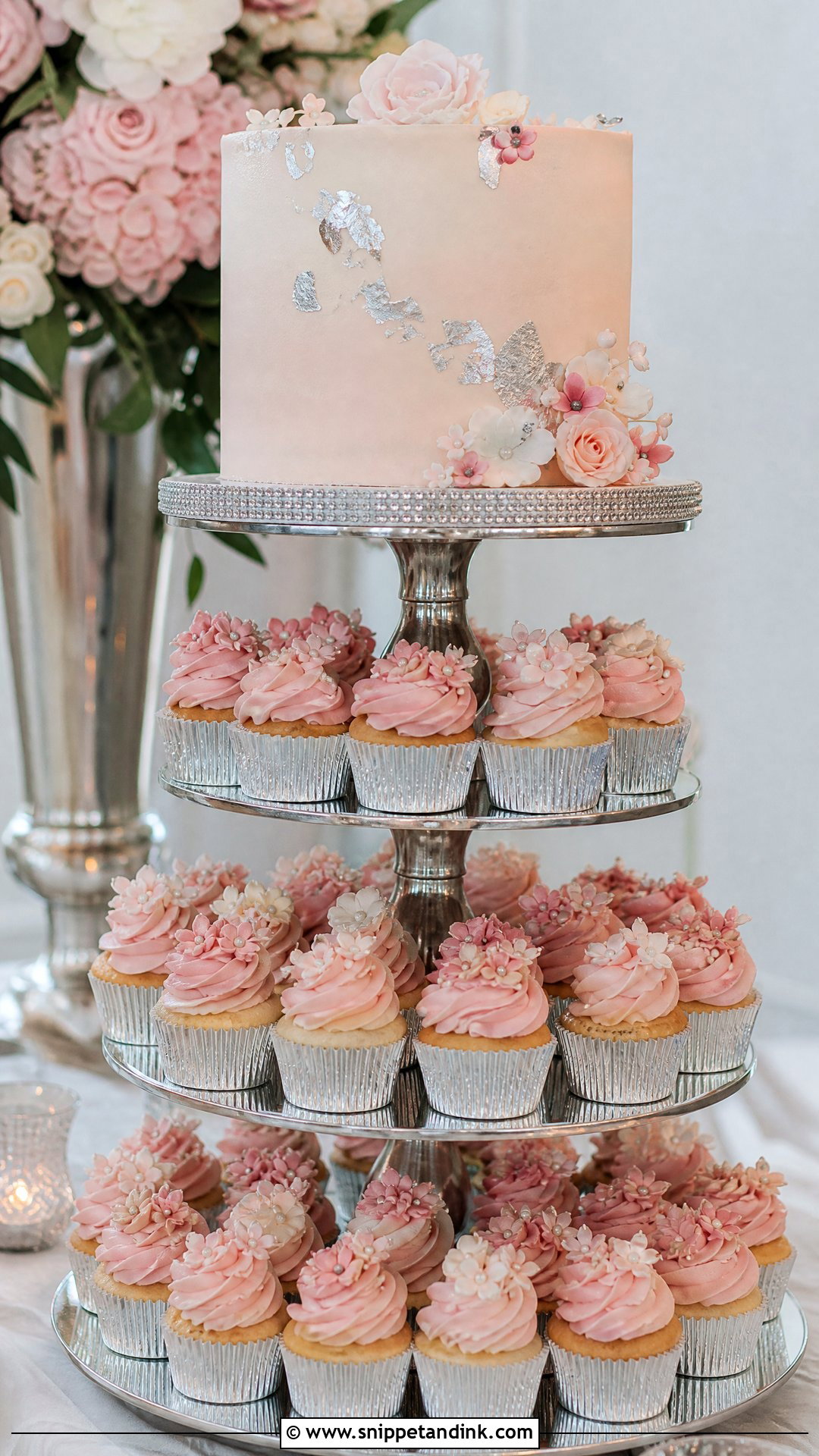
Cupcake towers are the practical choice: a small cutting cake on top, with matching cupcakes below that guests can grab without waiting for plating. Pink buttercream swirls, silver foil liners, pearl sprinkles and tiny sugar flowers tie the cupcakes to the cutting cake, which gets blush frosting, silver leaf and a floral topper. It moves dessert service along quickly at large or casual receptions. Style the tower with candles and a silver stand so it reads as one piece rather than a tray of cakes.
How a Metallic Cake Comes Together, Week by Week
Silver work, sugar flowers and sequin tiers all add hand time, so these cakes need more lead than a plain buttercream. Timings vary by baker and season, but the order is usually the same:
- Several months out, book the baker. Popular cake designers fill their summer Saturdays early, and only so many tiered cakes fit in one kitchen in a weekend.
- Two to four months out, have the tasting. Bring fabric swatches, a flower list and a photo of the venue lighting, not only inspiration pictures.
- About a month out, confirm the final design, guest count and stand. Changing tier sizes after this point is hard.
- Two to three weeks out, sugar flowers and molded pieces are made so they have time to dry fully.
- In the last few days, sponges are baked, filled, crumb coated and finished, with metallic details added near the end so they stay bright.
- On the day, the cake is delivered and stacked or finished in place, ideally after the room has been set and before guests arrive.
The step couples forget is the room. Ask the venue where the cake will stand and how warm that spot gets by evening. A cake beside a sunny window or a heater softens in ways no recipe can fully prevent, and silver leaf on a softening surface wrinkles fast.
One Mood First, Then the Metal
Pink and silver can go soft, glamorous or vintage, so decide on one mood before you add a single detail. Blush frosting, white flowers, pearls and a little leaf give the quiet version. A sequin tier, a geode or a silver drip is the bolder end. Watercolor, lace and buttercream florals land somewhere in between. Then hold the design up against your venue lighting, flowers and table decor, and cut anything that doesn’t earn its place.
You'll Like These Ideas:









Leave a Reply