
Black lace on a wedding cake can go vintage, gothic, formal or quietly romantic, and the difference comes down to what sits around the lace: ivory or black icing, sugar flowers, a little metal, the shape of the tiers. Lace is also a forgiving texture. It adds detail without the clutter you get from piling on decorations. Pick one clear direction before you meet your baker, such as black lace over white fondant, matte black tiers with sugar flowers, or a fine stencil wrapped around a sleek cake. Below are twenty variations, each with what I’d watch for if I were making it.
Piped, Stenciled or Cast: How Cake Lace Is Actually Made
When a couple shows me a lace cake photo, the first thing I work out is which technique made it. They look similar from a distance but behave very differently, cost different amounts of time, and suit different icings.
Hand-piped royal icing
Fine royal icing piped straight onto the tier. It gives the most delicate, organic lines and can copy a specific pattern from your gown. It’s also the slowest method by far, so it’s priced accordingly. Black royal icing can bleed into white fondant if the surface gets damp, which is why I pipe it onto a fully dry cake.
Stenciled lace
Royal icing scraped through a stencil held against the cake. It’s sharp and even, with a flatter, printed look. It works on fondant and on well-chilled, crusted buttercream, and it’s quicker than piping, which helps when the lace goes all the way around several tiers.
Cast edible lace
A sugar-based lace mix spread into a silicone mat, dried, and peeled out as a flexible sheet. It has real depth and drapes like fabric. It’s sensitive to the air, though: in dry rooms it turns brittle and can crack, and in humid weather it goes limp and sticky. I store it sealed and apply it on the delivery day.
Molded appliqué
Pieces of fondant or gum paste pressed in lace molds and stuck on individually. It suits heavy, three-dimensional laces and holds up best in warm venues.
1. Black Lace Wedding Cake With White Fondant
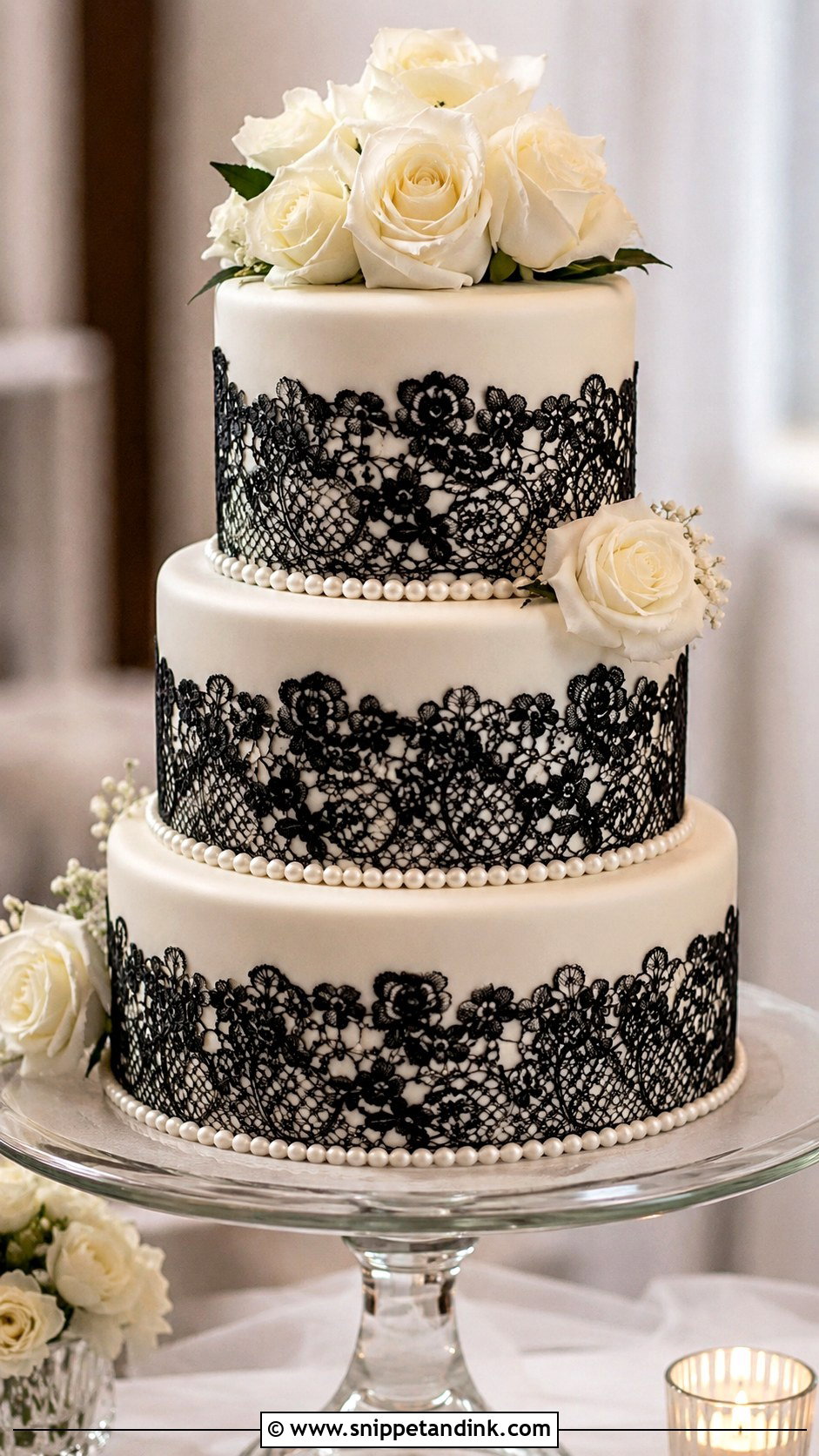
White fondant with black lace is the classic version, and the one I make most for black tie and ballroom receptions. The white keeps it bridal; the black does all the drama. Everything depends on the fondant being glass-smooth, because lace laid over a bump or an air bubble shows it immediately. The lace itself can be piped by hand, cast as edible lace, or stenciled, and each gives a slightly different line. Keep the flowers plain, white roses or ivory orchids, so the pattern stays in charge.
2. Black Lace Wedding Cake With Gold Accents
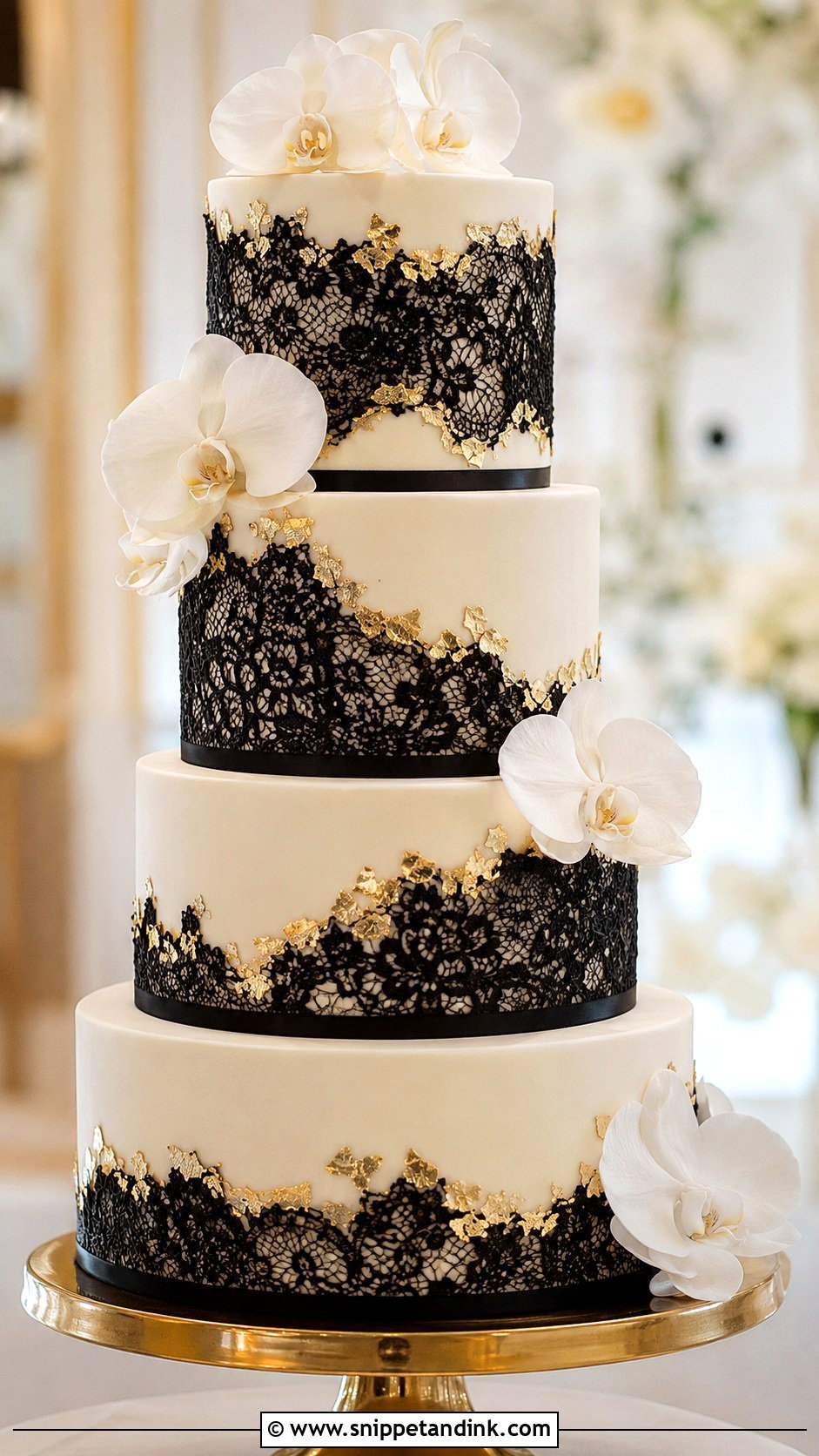
Gold warms black lace up and takes the edge off its severity. I like it in small doses: a painted line along each tier edge, a gold-centered flower, or a few metallic beads where lace motifs meet. A white, ivory or pale champagne base lets both the lace and the gold read clearly. The mistake I see most is gold painted over the lace itself, which flattens the pattern into a blur. Keep the metal beside the lace, never on top of it.
3. Black Lace Wedding Cake With Red Roses
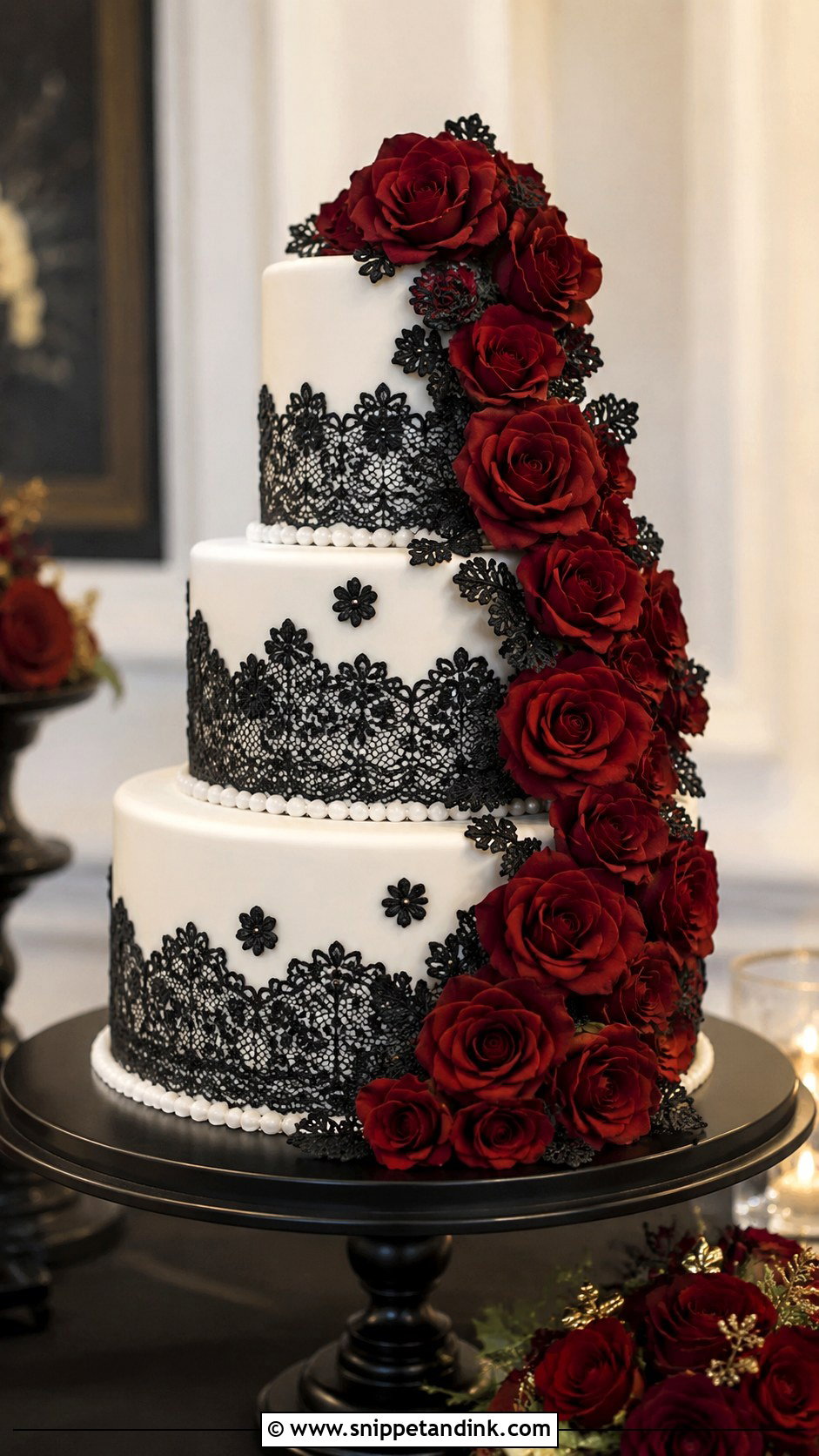
Red roses against black lace is the most romantic pairing on this list. On white fondant with lace around one or two tiers, it’s softer; on matte black tiers with deep red sugar roses, it’s theatrical. I group the roses deliberately, either in a cascade down one side or tucked into the gaps between tiers. Deep red sugar flowers take a lot of coloring and can bleed if they touch damp icing, so they’re dried for several days and set on at the last stage.
4. Black Lace Wedding Cake With Pearl Details
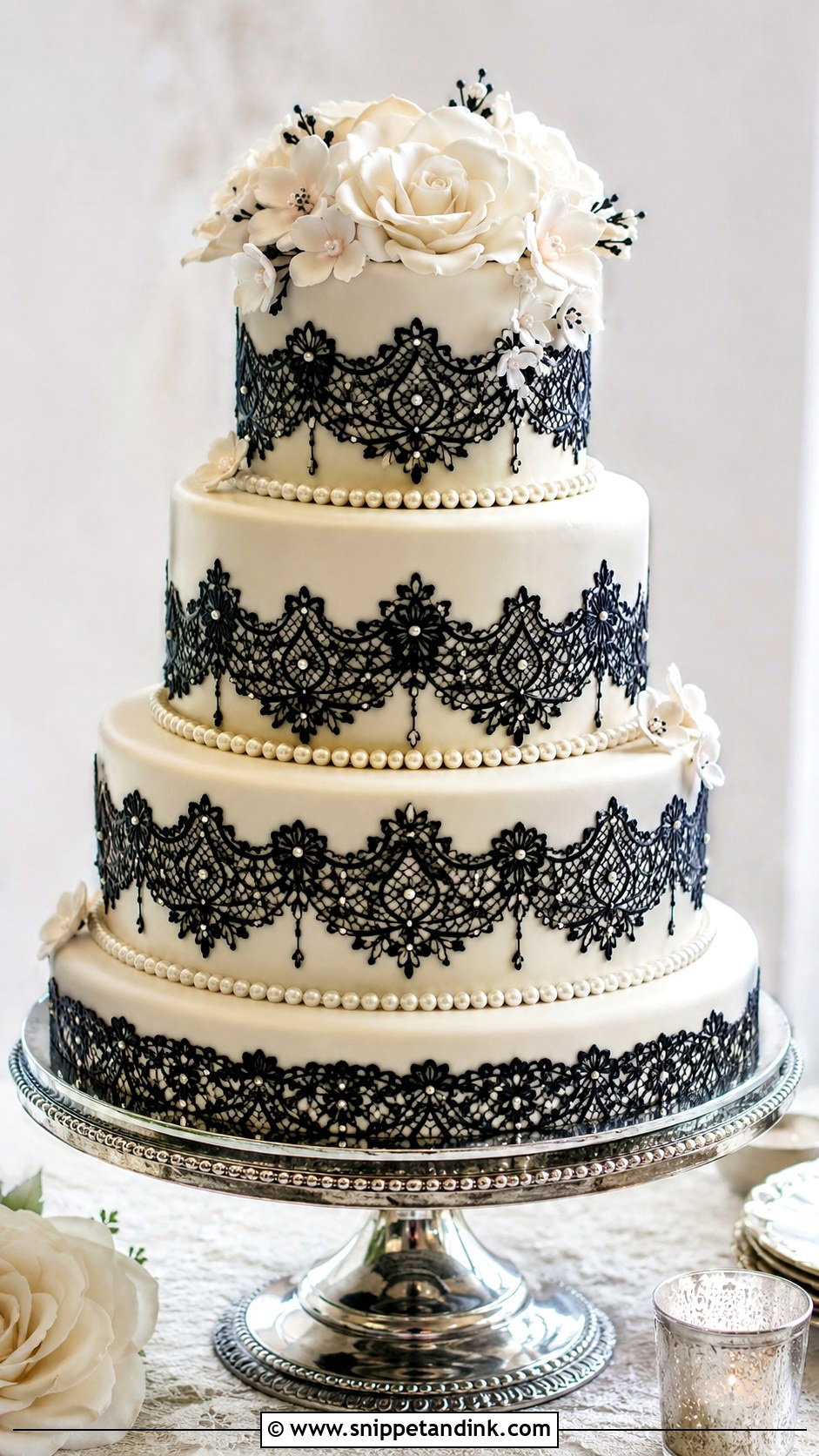
Tiny edible pearls placed along lace edges, borders or flower centers give the lace a finished, jewelry-like edge. A white fondant base is the safest background, though pearlized ivory buttercream is warmer if your venue is candlelit. I place pearls with a dot of piping gel and tweezers, one at a time; rolling them on looks scattered. A plain silver, glass or white stand keeps attention on the cake rather than the stand.
5. Black Lace Wedding Cake With Sugar Flowers
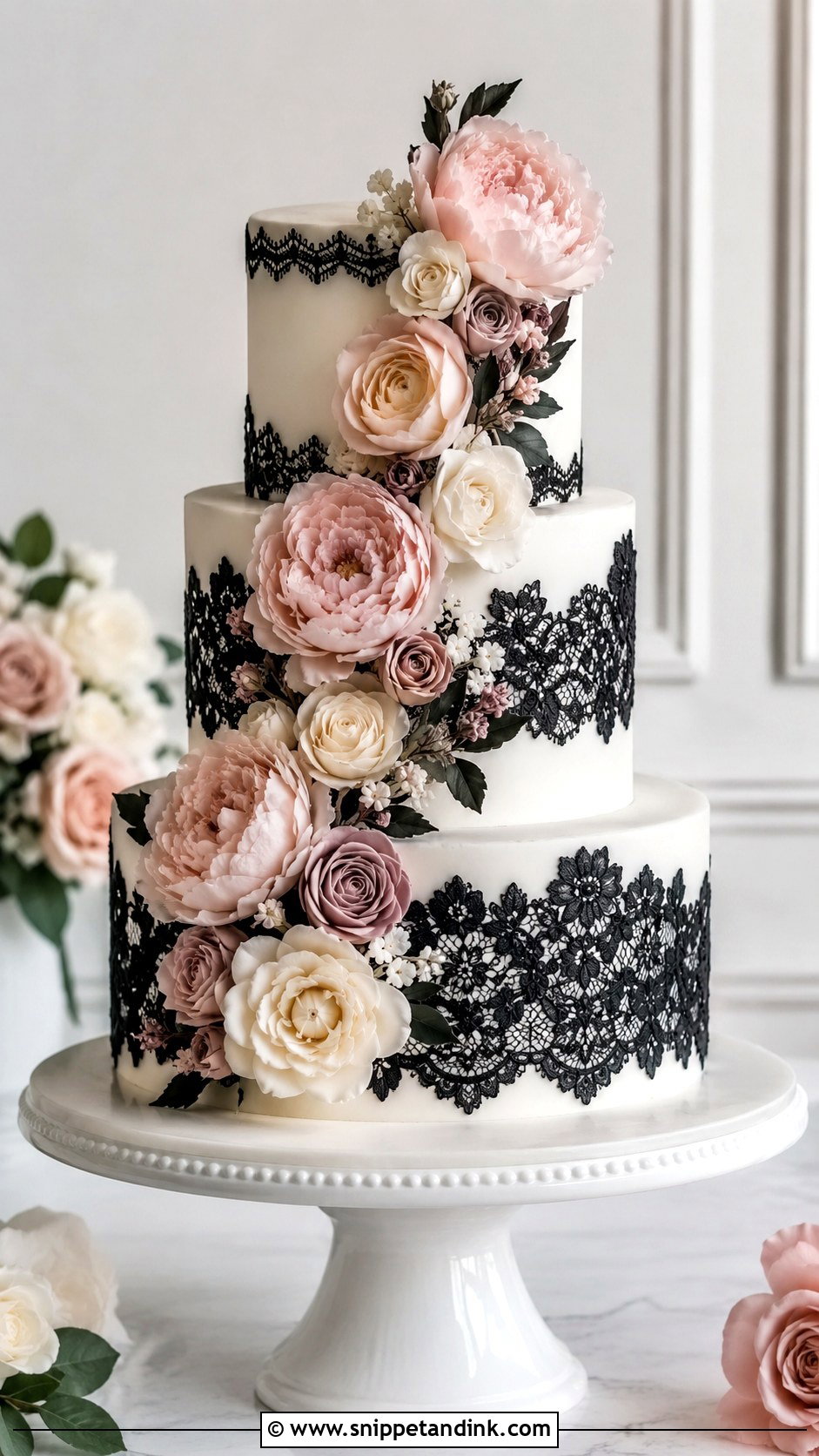
Sugar flowers stop black lace from feeling cold. White roses, blush peonies, ivory ranunculus or pale mauve blooms all work. I place them in a diagonal cascade, between tiers, or as a topper, and I try to leave some lace bare around them so the two textures don’t merge into one mass. Sugar flowers are made weeks ahead and keep well in a dry box, which takes pressure off the wedding week. The combination of hard lace and soft petals is what the camera picks up.
6. Black Lace Wedding Cake With Black Fondant
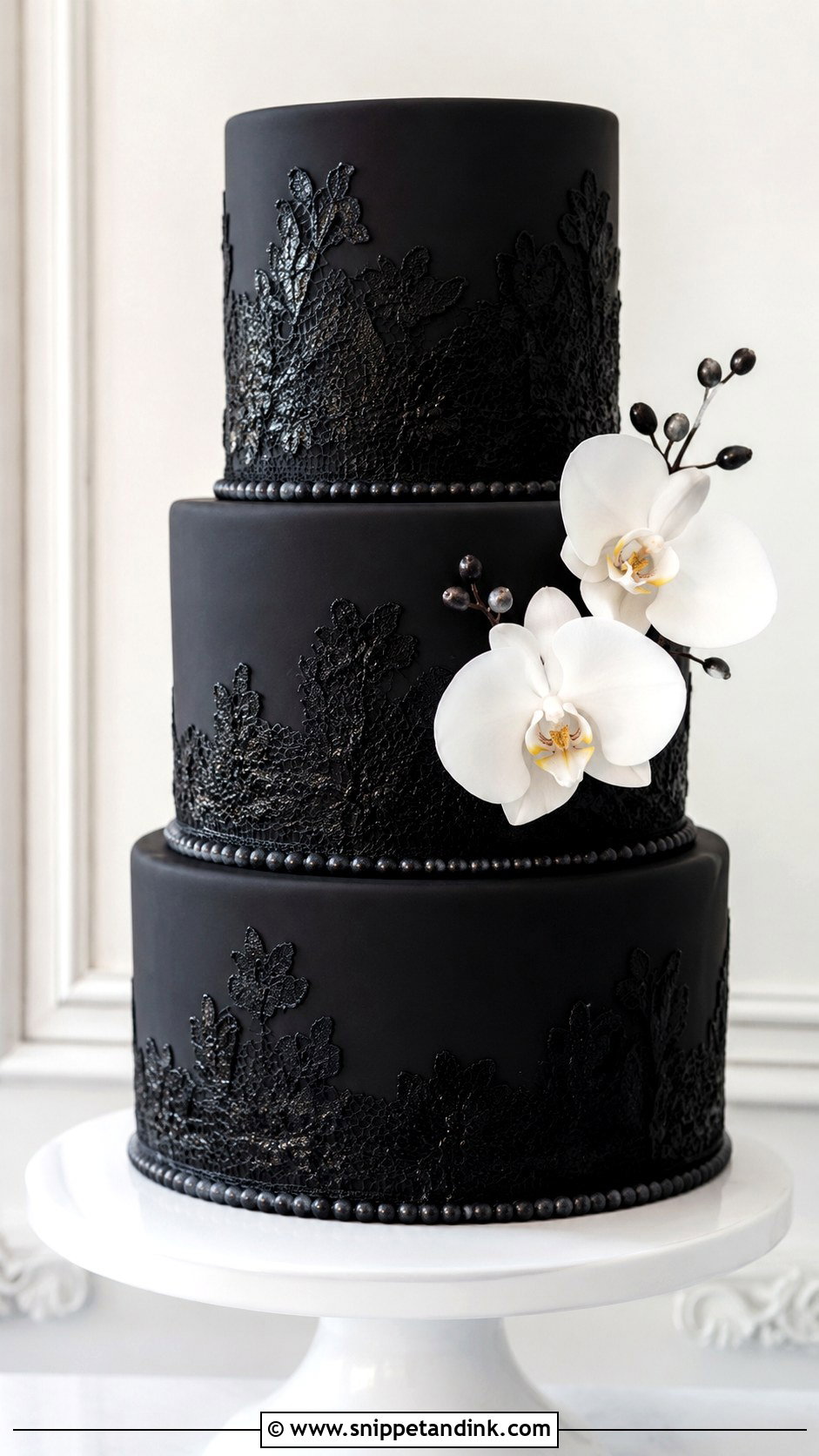
Black lace on black fondant is all about texture, since there’s no color contrast to help. Glossy lace on matte fondant, raised piping, or charcoal lace over deep black tiers all create a tone-on-tone effect. Honestly, I’d only recommend this one if your reception is bright. In a dim, candlelit room, the lace disappears and photos show a black cylinder. A small white floral cluster or a metallic topper gives the eye somewhere to land.
7. Black Lace Wedding Cake With Ivory Buttercream
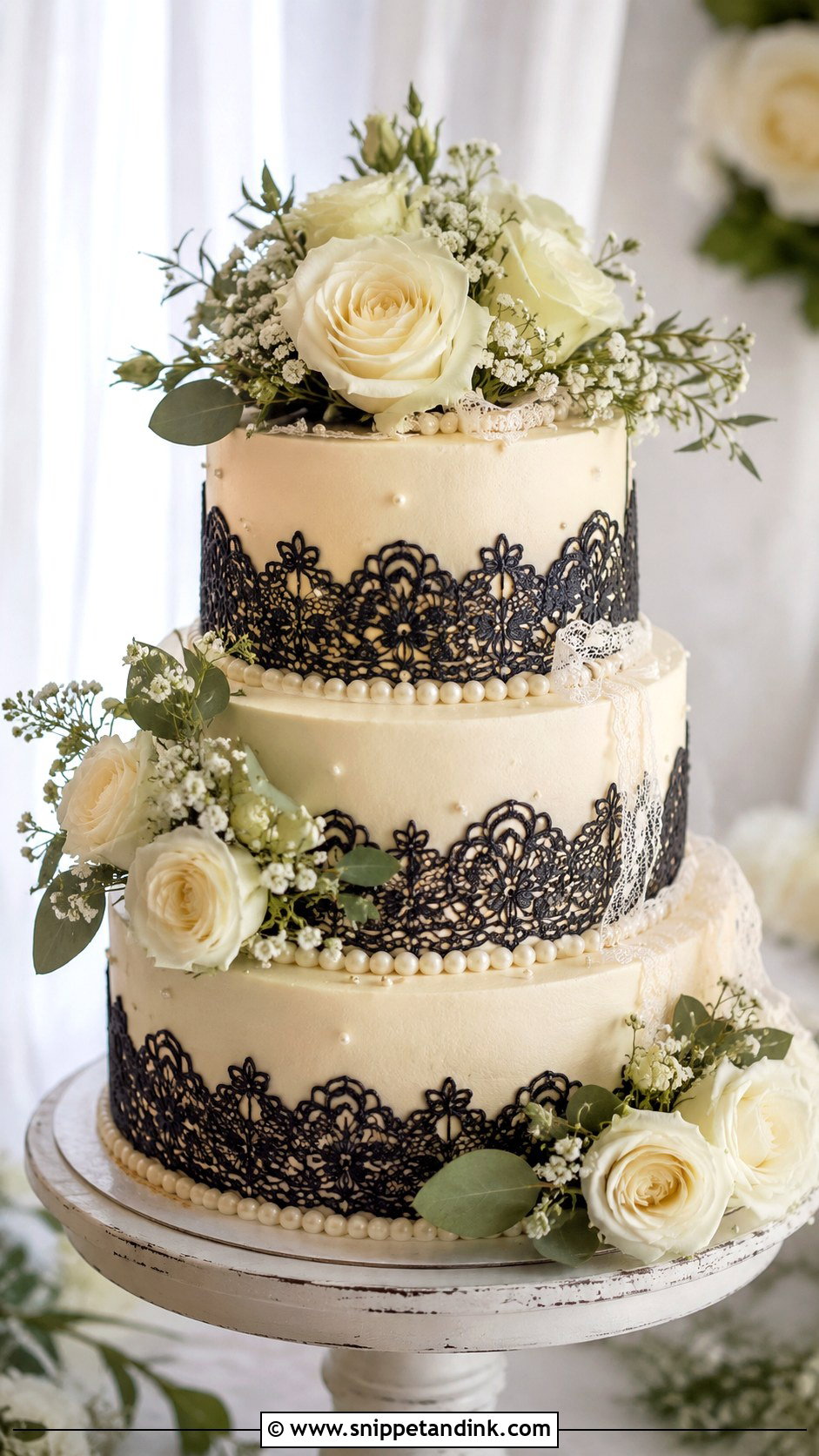
Ivory buttercream is warmer and softer than white fondant, and it suits garden weddings and historic venues with candlelit tables. Buttercream is too soft for heavy lace, so I either pipe directly onto chilled, crusted icing or use edible lace made separately and pressed on gently. A semi-smooth finish feels handmade, but a smooth one makes the lace crisper. Small greenery, ivory blooms or a pearl border finish it without making it formal.
8. Black Lace Wedding Cake With Silver Details
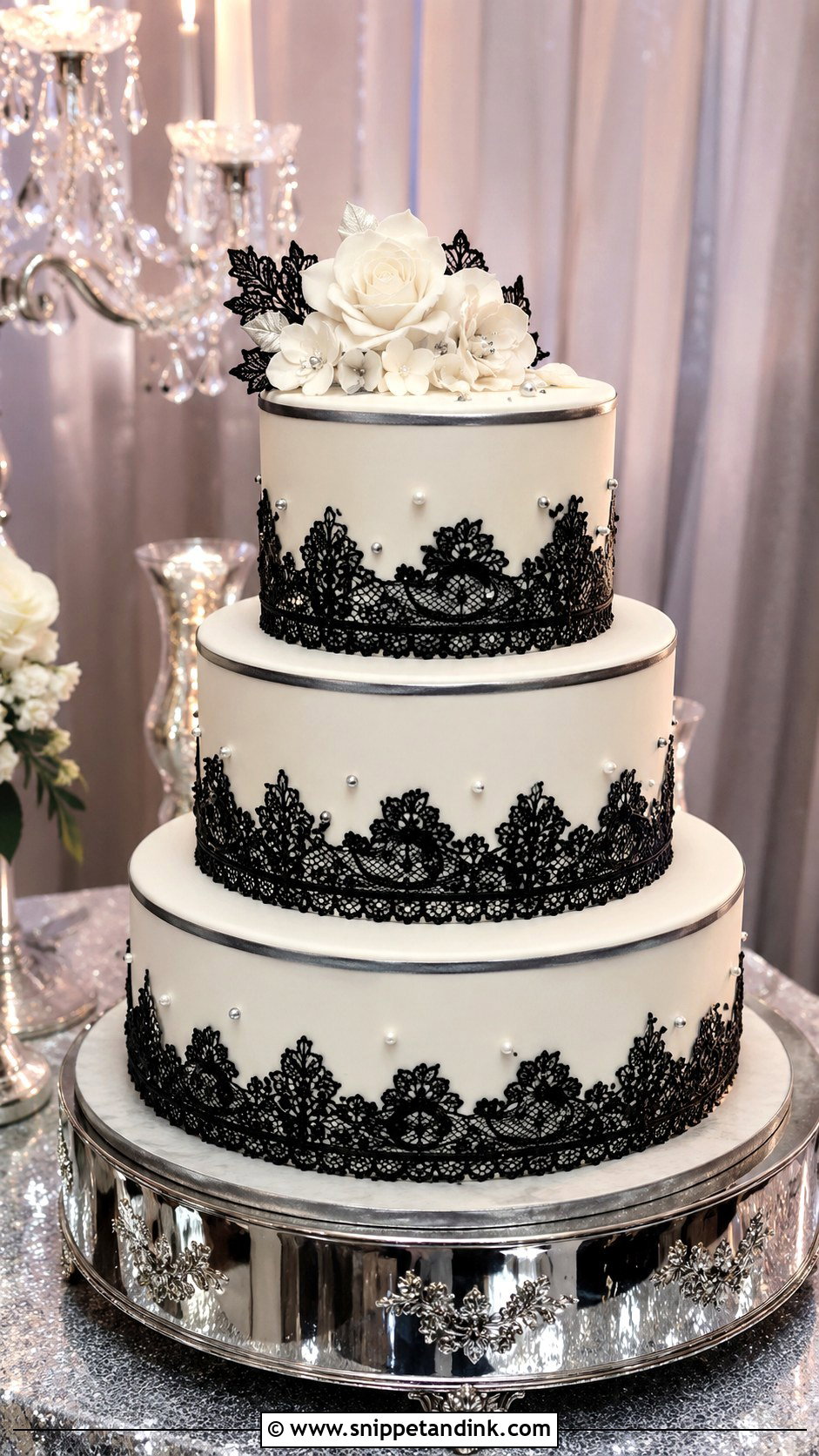
Silver is cooler than gold, and it sits nicely with crystal, glass and mirrored decor. White fondant with black lace and silver edging feels very formal; black fondant with silver lace leans sleek and fashion-forward. Silver can be painted borders, edible foil, small pearls or a thin monogram. Edible silver paint is brushed on in thin coats, since a thick coat cracks as it dries. Keep it delicate so it frames the lace.
9. Black Lace Wedding Cake With Blush Flowers
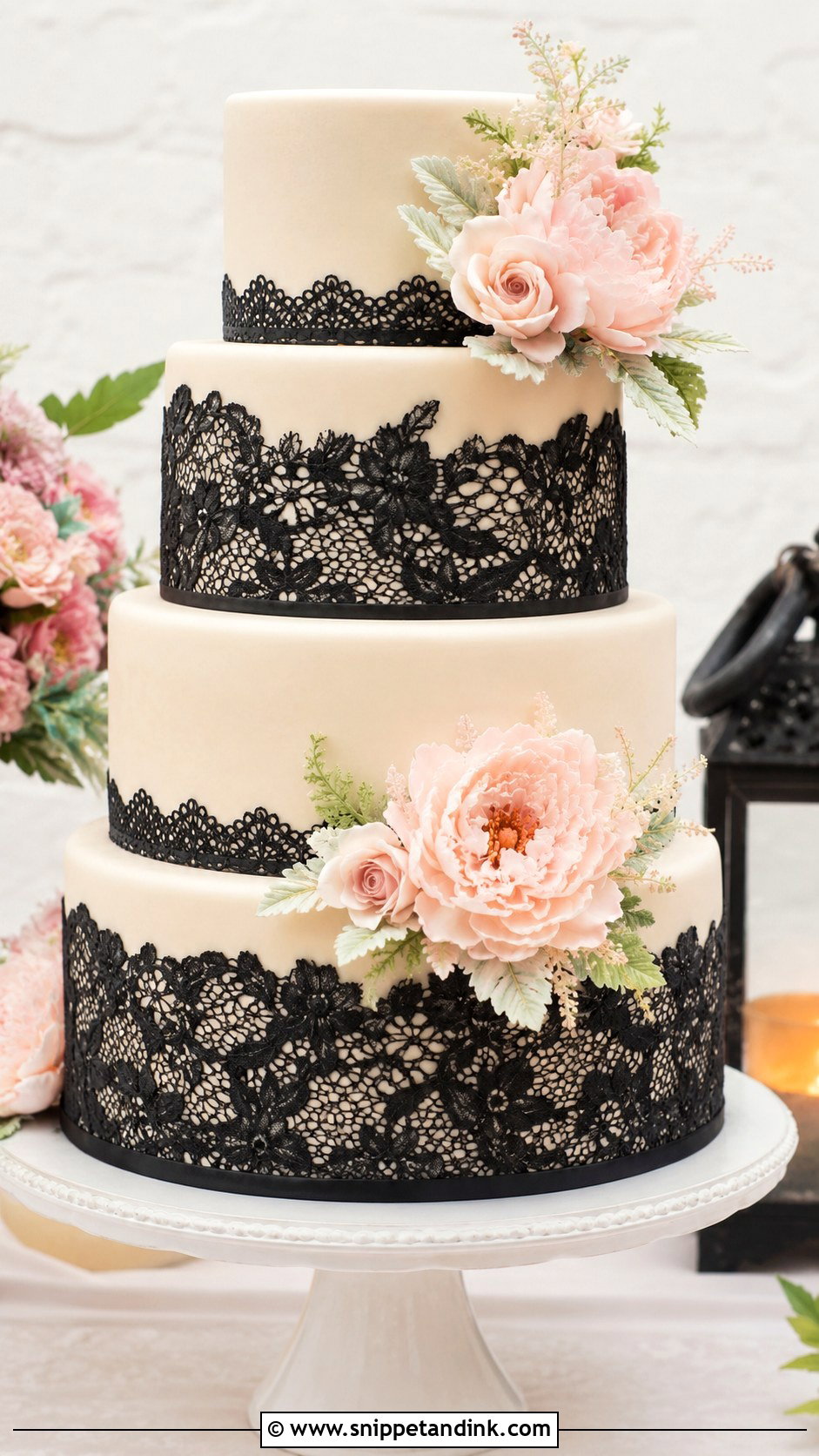
Blush flowers soften black lace more than any other color, and the pairing feels modern rather than sugary. I’d use a white, ivory or barely-there blush base, black lace on one or more tiers, and blush sugar flowers along the side. A small amount of greenery bridges the lace and the flowers, but too much makes the palette muddy. This suits spring weddings especially well.
10. Black Lace Wedding Cake With A Lace Topper
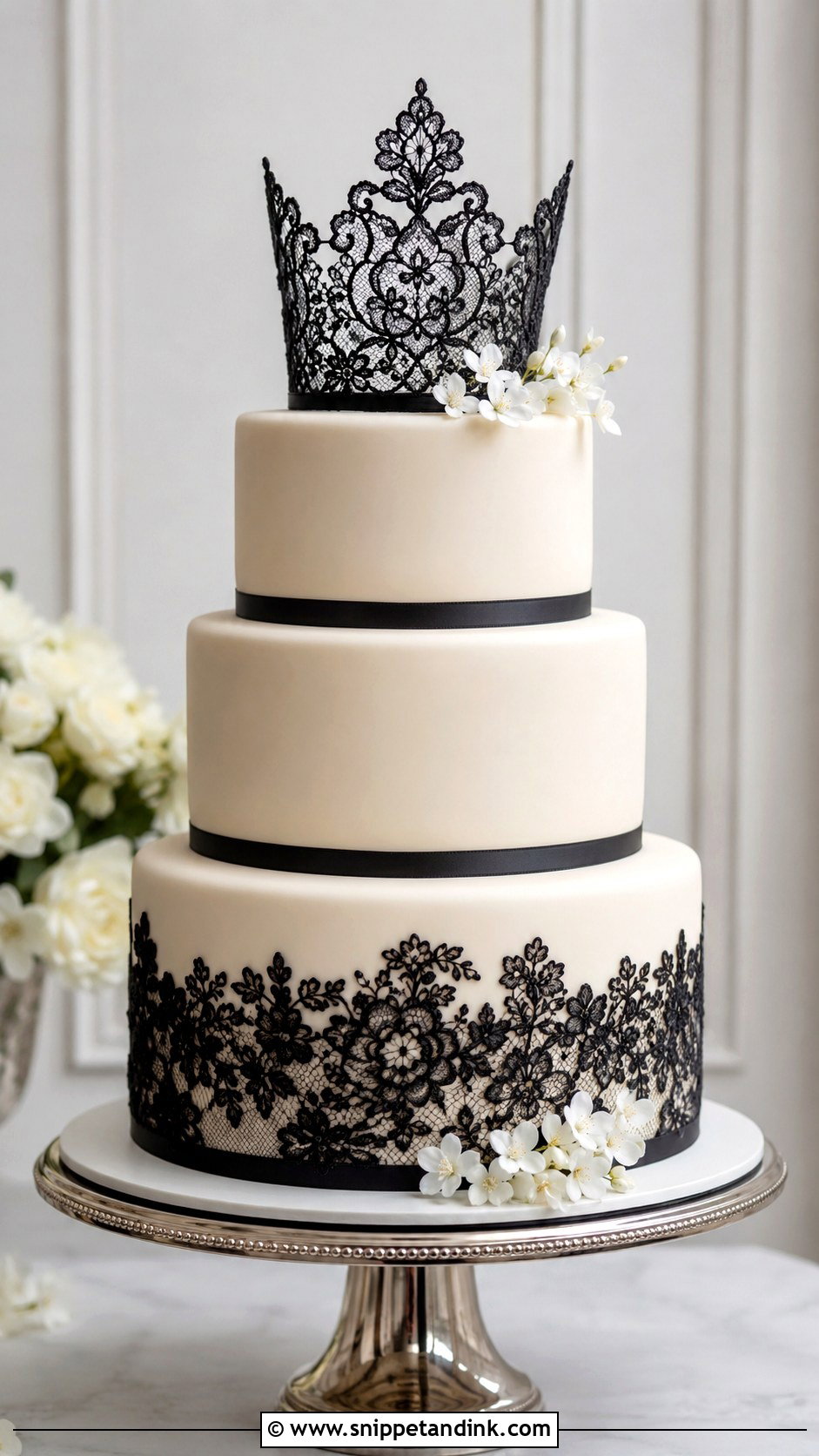
A lace topper puts the focal point at the top: a delicate edible lace crown, a sugar bow with lace texture, or a monogram framed in lace. Freestanding lace needs to dry rigid, so it’s made in advance and supported with a hidden wire or a sugar base. Keep the tiers below clean, perhaps with lace only around the bottom tier and a thin black ribbon at each base, so the topper isn’t competing.
11. Black Lace Wedding Cake With Ombre Tiers
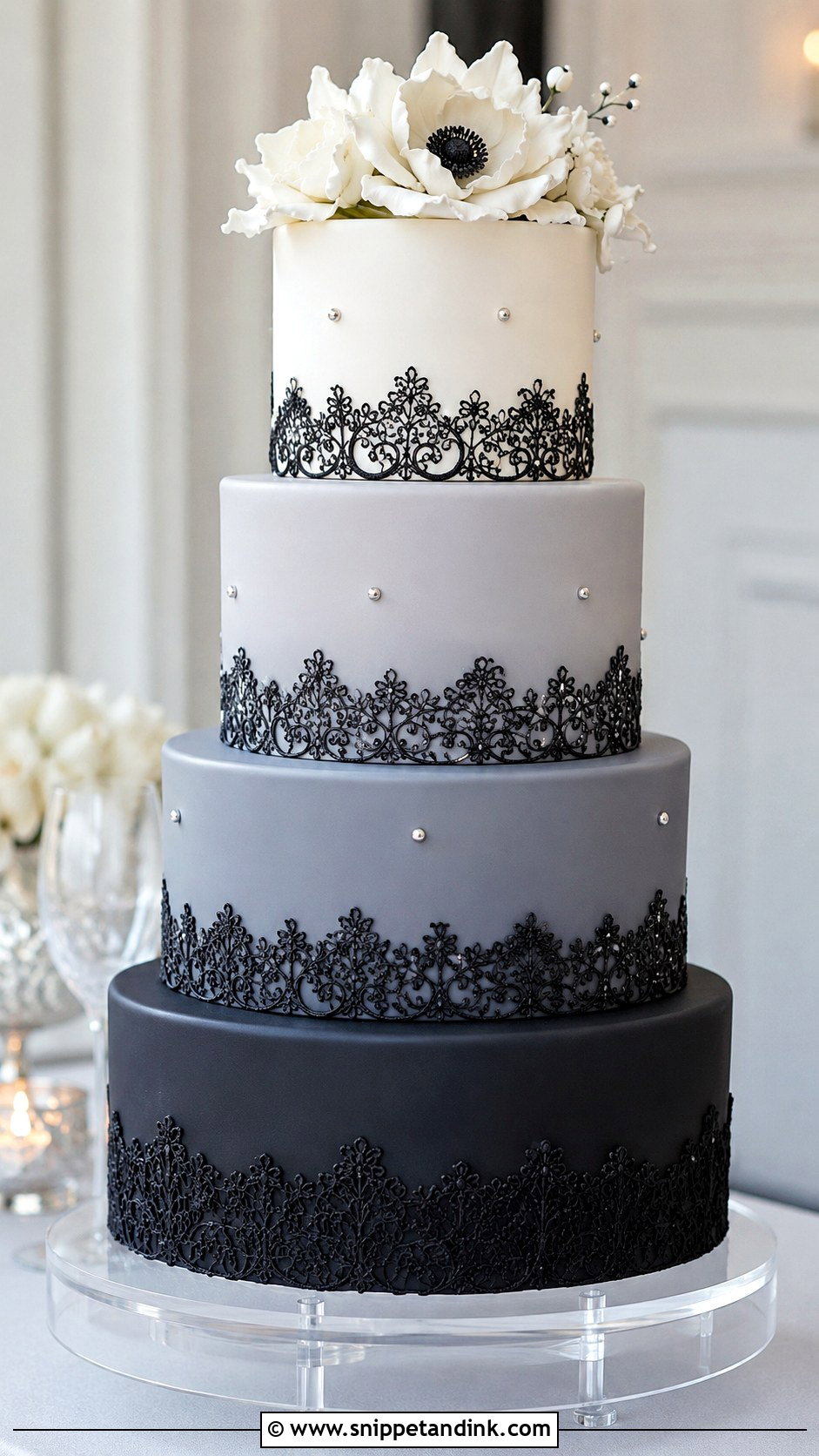
Ombre tiers fading from white to gray to black, or ivory to charcoal, give black lace a modern setting. Lace can go on the lightest tiers for contrast or on the darkest for subtle texture. The fade only looks smooth if each tier’s color is mixed from the same batch, stepped up gradually; mix them separately and you get jumps. Plain round tiers keep the gradient clean. A slim topper or a few metallic touches are enough.
12. Black Lace Wedding Cake With Vintage Piping
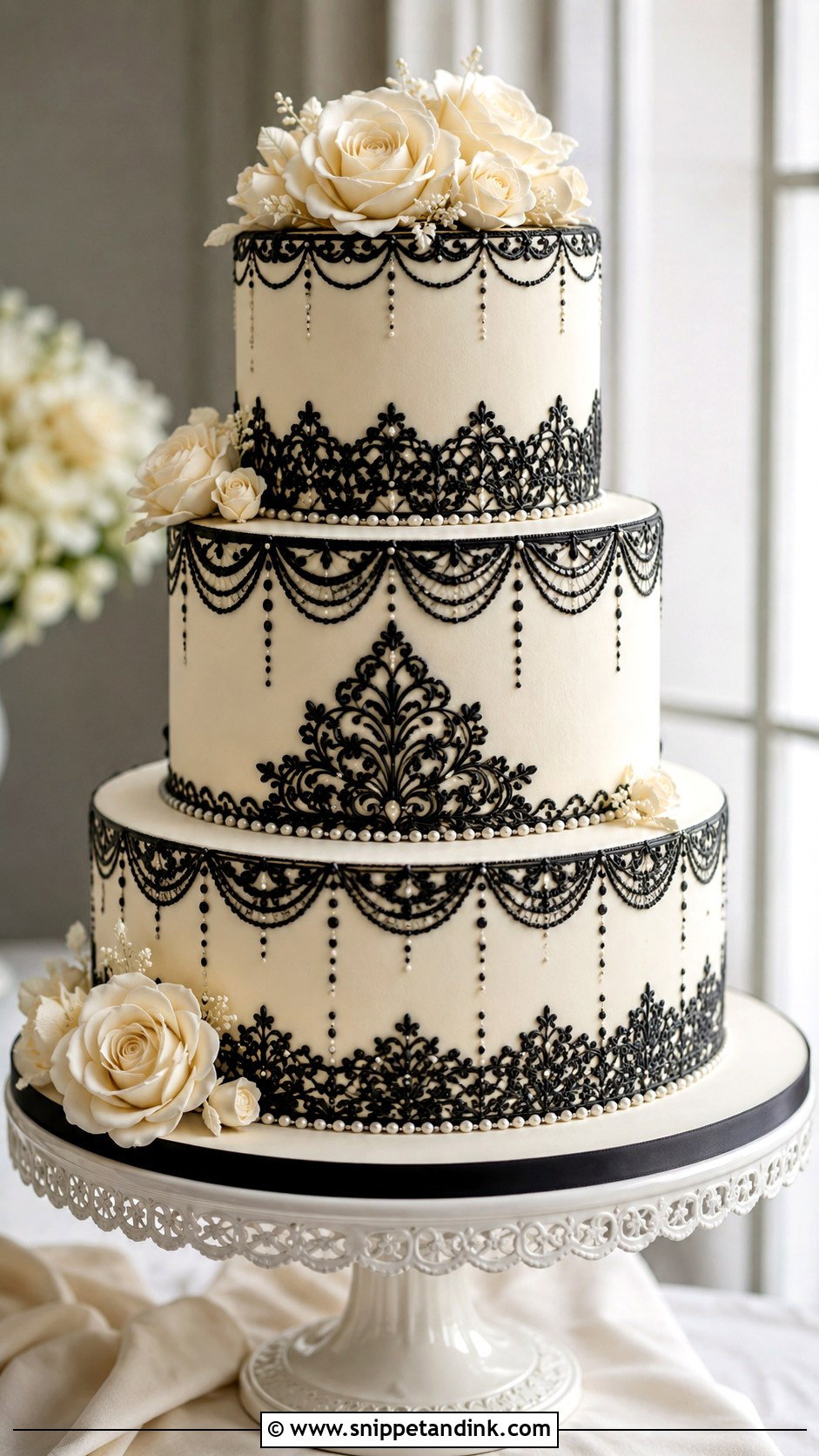
Vintage piping and black lace both trade in fine, repeating pattern, which makes them natural partners. Scalloped borders, shells, dots and scrollwork on a white or ivory base keep it bridal; black piping makes it dramatic. The risk is crowding, so I’d pair one or two heavily piped tiers with smoother ones that give the eye a rest. This suits heirloom table settings and vintage-style gowns.
13. Black Lace Wedding Cake With Fresh Flowers
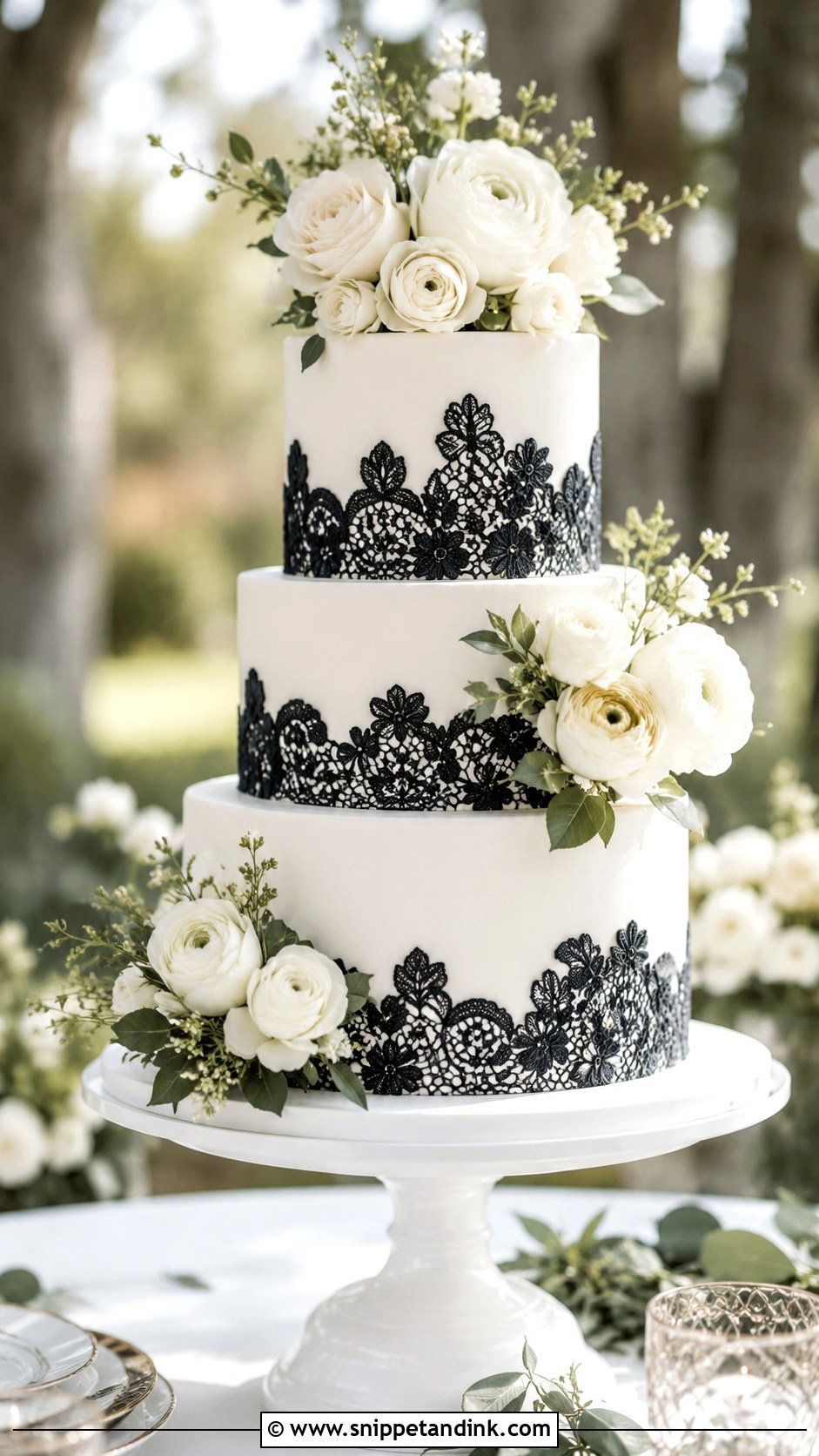
Fresh flowers keep a lace cake feeling seasonal: white roses, anemones, ranunculus, orchids or soft greenery. A white fondant or ivory buttercream base keeps both lace and flowers clear. Your florist and baker need to agree who supplies and places the flowers, and they need to be pesticide-free with stems wrapped or sealed before touching the cake. I place blooms in clusters, often on a diagonal line, so the lace pattern stays visible.
14. Black Lace Wedding Cake With A Black Bow
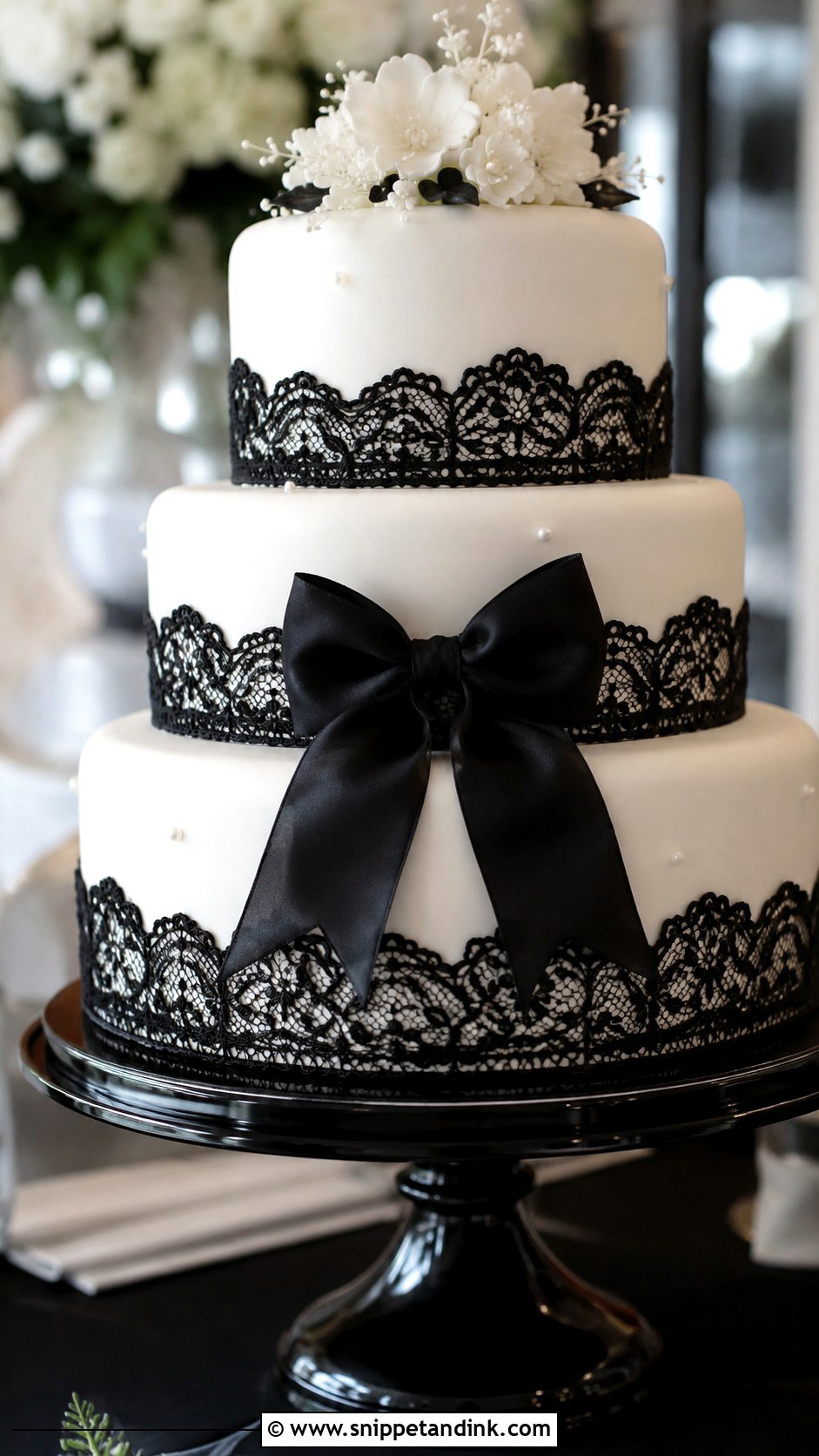
A black bow on a lace cake reads like black tie dressing, a bit like a sash on a gown. It can be fondant, gum paste, or real ribbon with a food-safe barrier between ribbon and icing, since satin soaks up butter and leaves a grease line. Put the bow on one tier only. A large bow on the middle tier feels classic; a slim one at the base is subtler. A few pearl dots or white flowers add softness.

15. Black Lace Wedding Cake With Marble Fondant
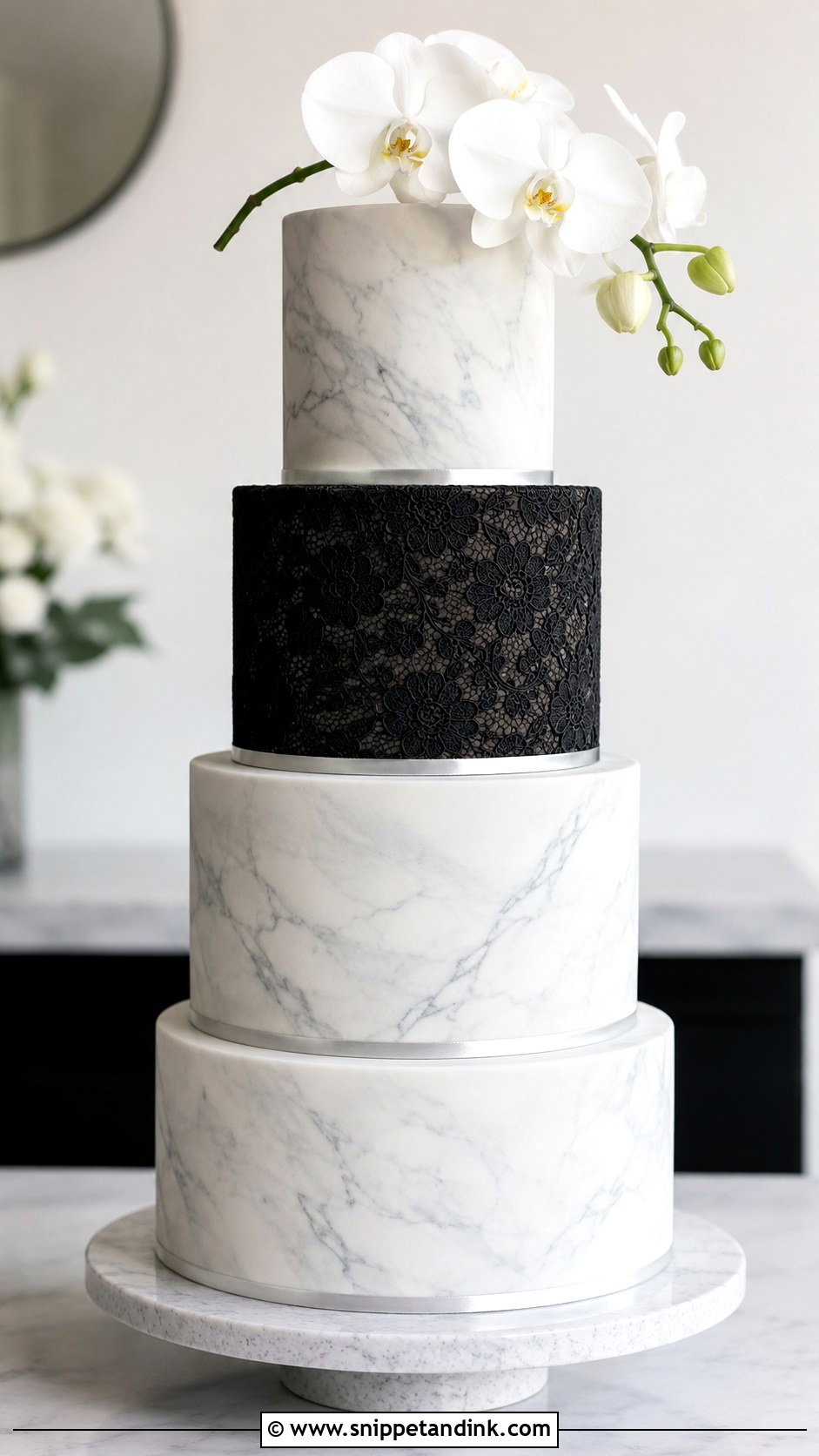
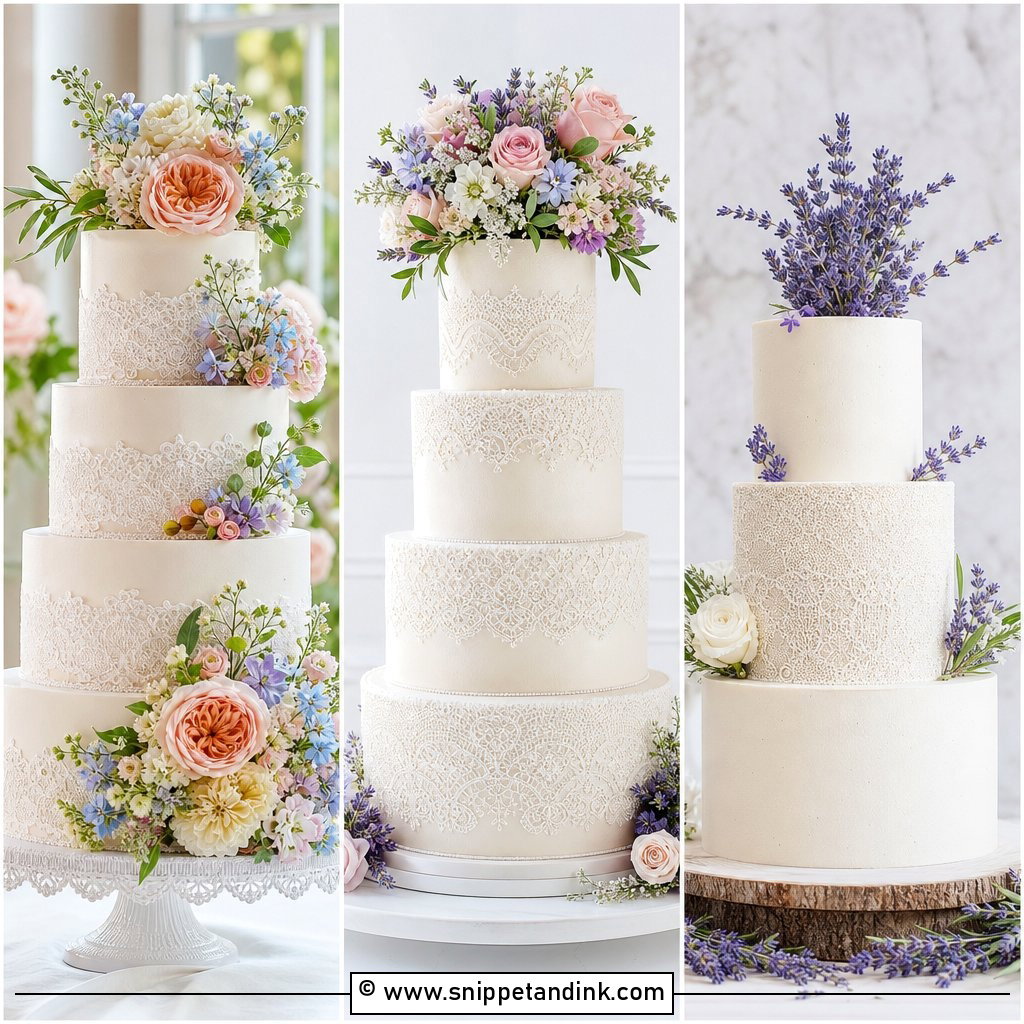
Marble fondant already has movement, so lace on top needs restraint. White and gray marble makes the lace look artistic; black marble is moodier. I’d put lace on one statement tier and keep the others smooth, then pick out the veining with a little silver or gold. This suits gallery-style venues and couples who want something away from the all-white cake.
16. Black Lace Wedding Cake With Cascading Flowers
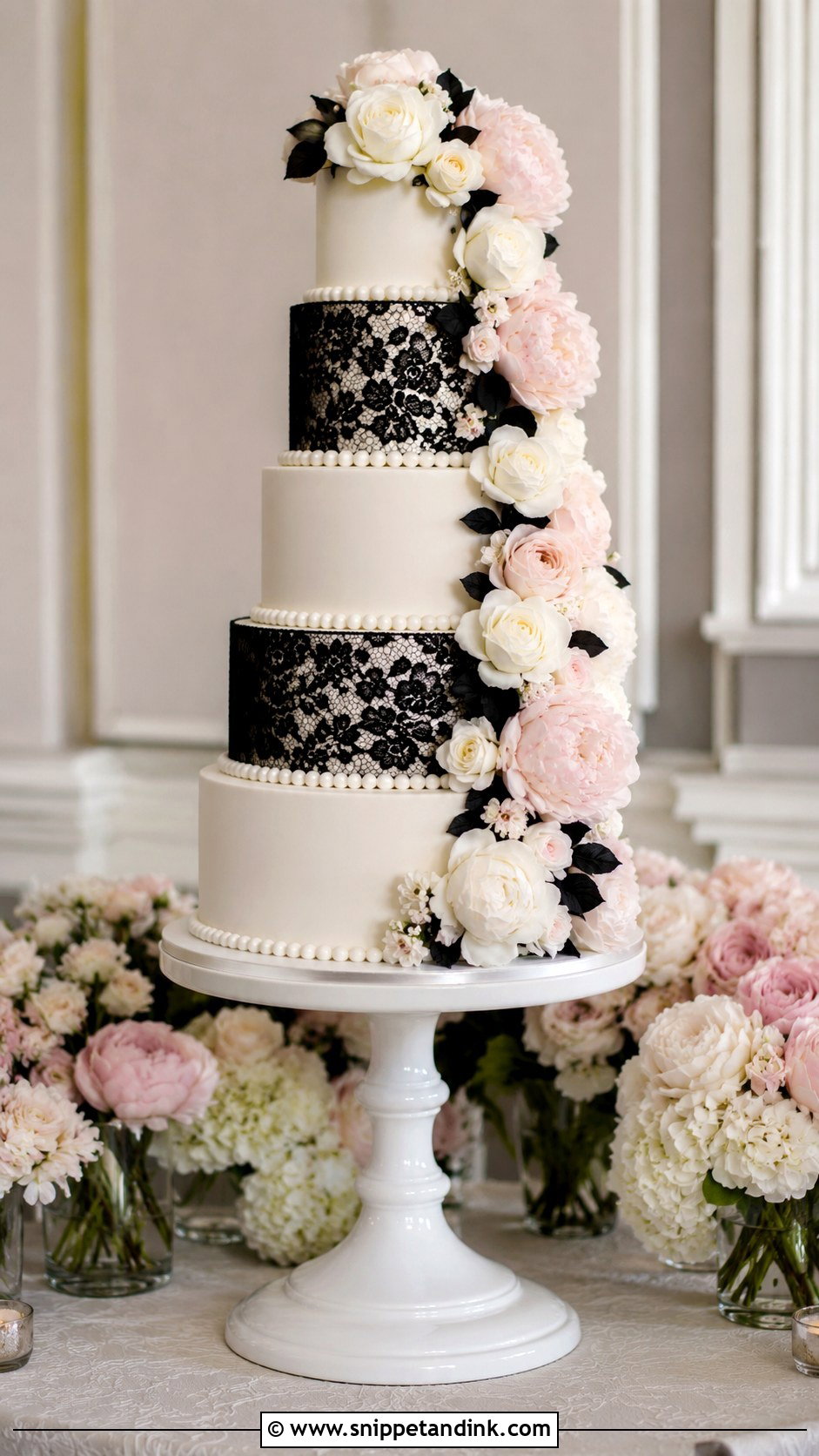
A floral cascade from the top tier down one side gives a lace cake height and movement, and it reads from across a big room. White, ivory, blush or deep red flowers all work, depending on mood. I alternate lace-covered tiers with plain ones so the cascade has a clean background to fall across. Keep the cascade narrow. Wide cascades make a tall cake look squat.
17. Black Lace Wedding Cake With Square Tiers
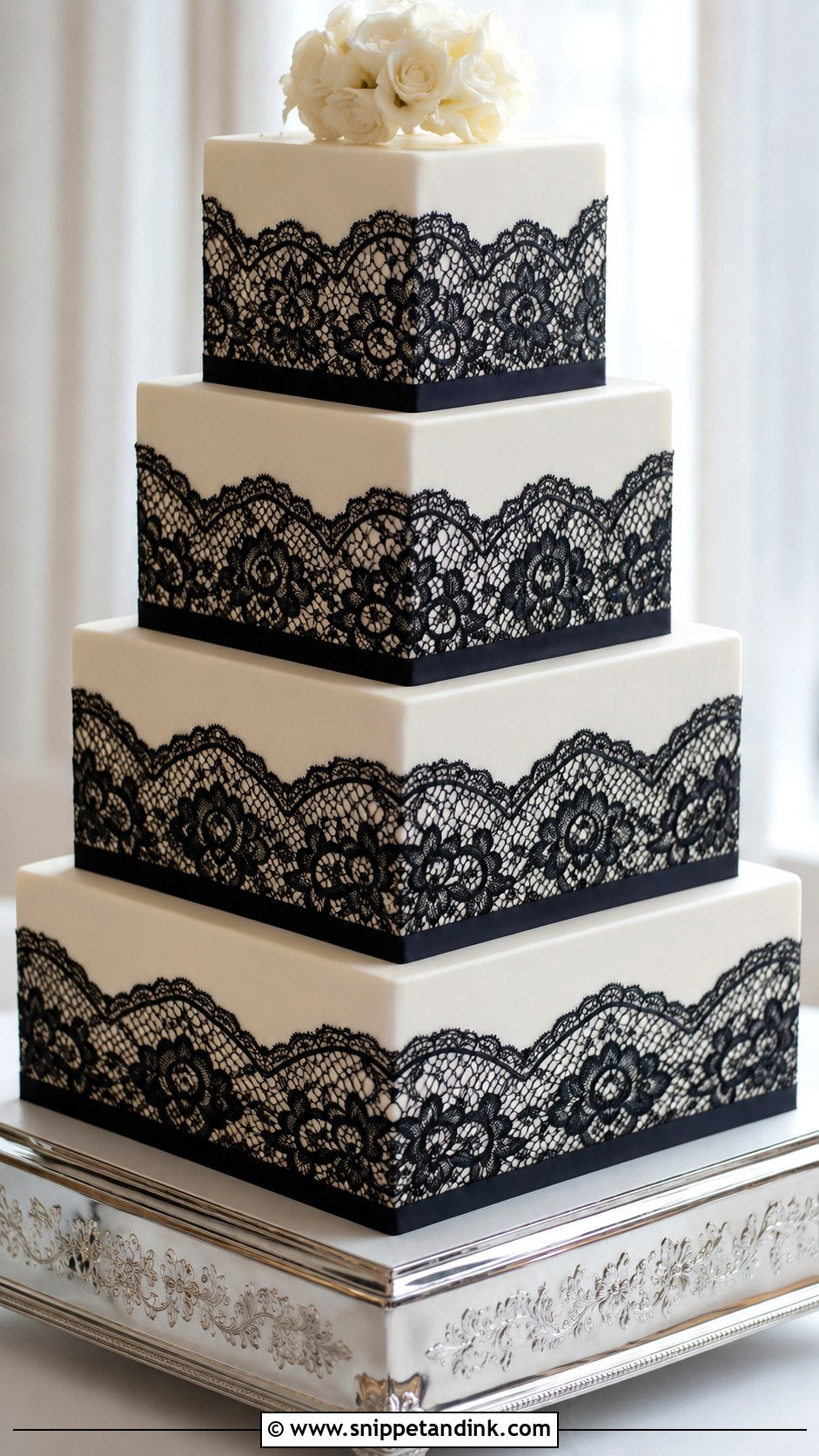
Square tiers make black lace look tailored, almost like panels on a structured dress. White fondant with black lace on each face is crisp; black fondant with white lace is bolder. Square cakes are less forgiving than rounds, because every corner has to be sharp and every side flat, so ask to see photos of your baker’s previous square work. Keep borders thin and finish with a small floral topper, a monogram or a metallic edge.
18. Black Lace Wedding Cake With Floral Lace
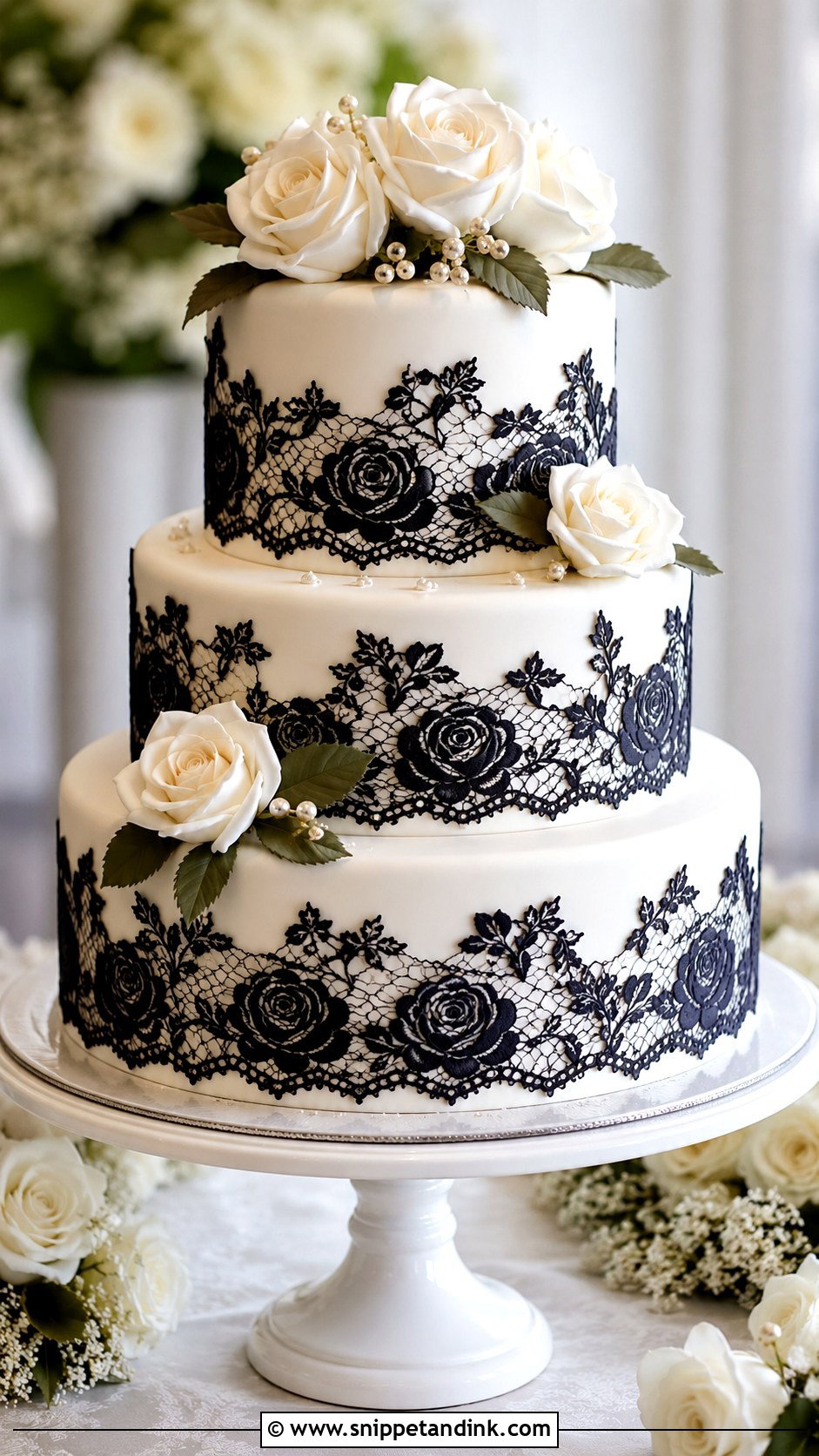
Floral lace, with roses, vines, leaves and small blossoms in the pattern, is softer than geometric or Chantilly-style lace and avoids the heavy gothic look. A white or ivory base gives it room. Wrap each tier fully, or place panels on one side only. I like to repeat one flower from the lace as a sugar flower, rose lace with ivory sugar roses for example, which ties the cake together. It rewards close-up detail photos.
19. Black Lace Wedding Cake With Geometric Tiers
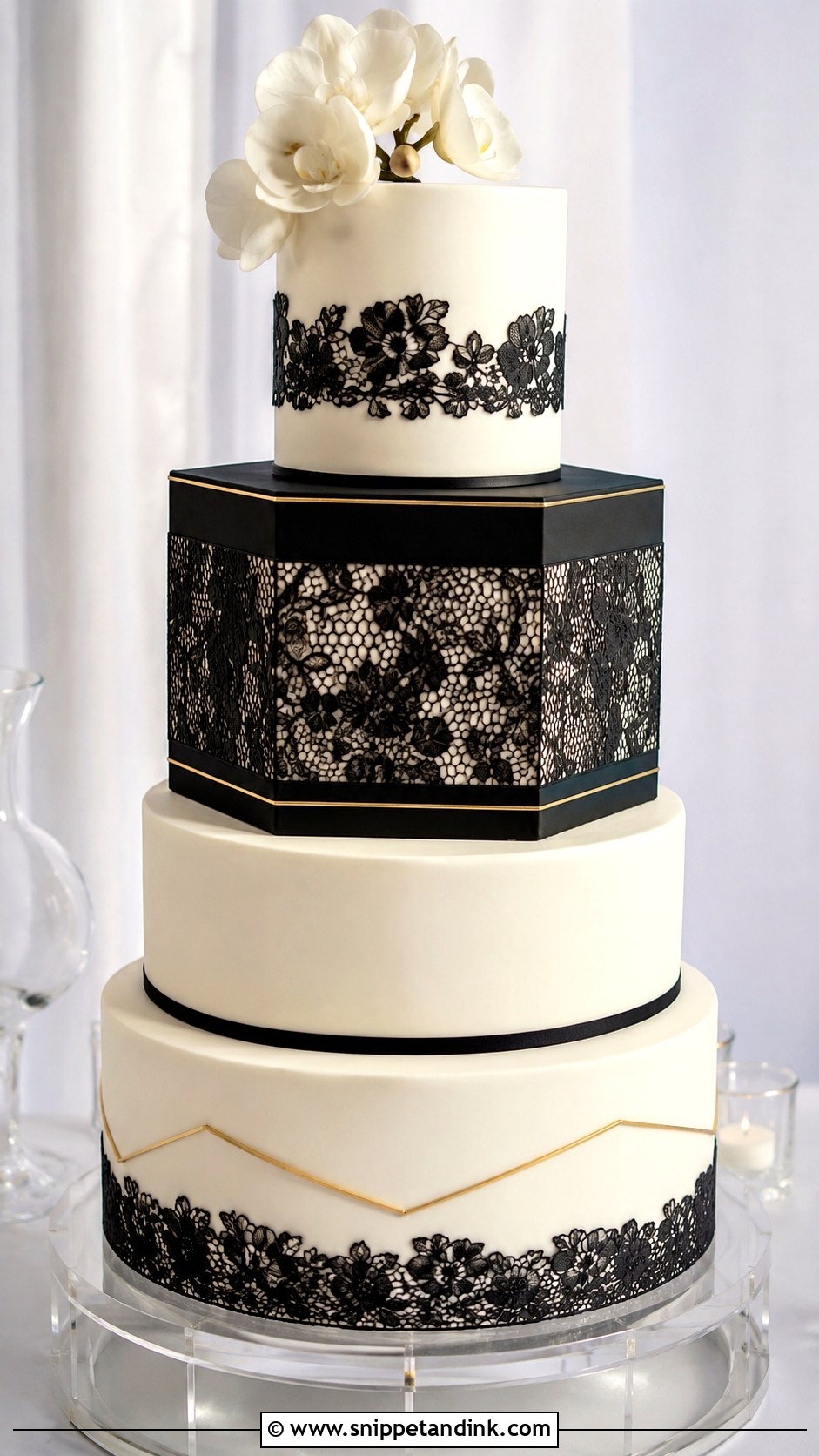
Geometric tiers, hexagons, double-barrels or mixed heights, give black lace a fresh, fashion-forward shape. I’d use lace on one or two tiers and let the shape carry the rest. White fondant with black lace panels is clean; matte black with raised lace is more dramatic. Lace on a hexagon has to be cut and matched at each corner, which takes time, so expect that to show in the quote. A few white flowers or thin gold lines add warmth.



20. Black Lace Wedding Cake With A Monogram
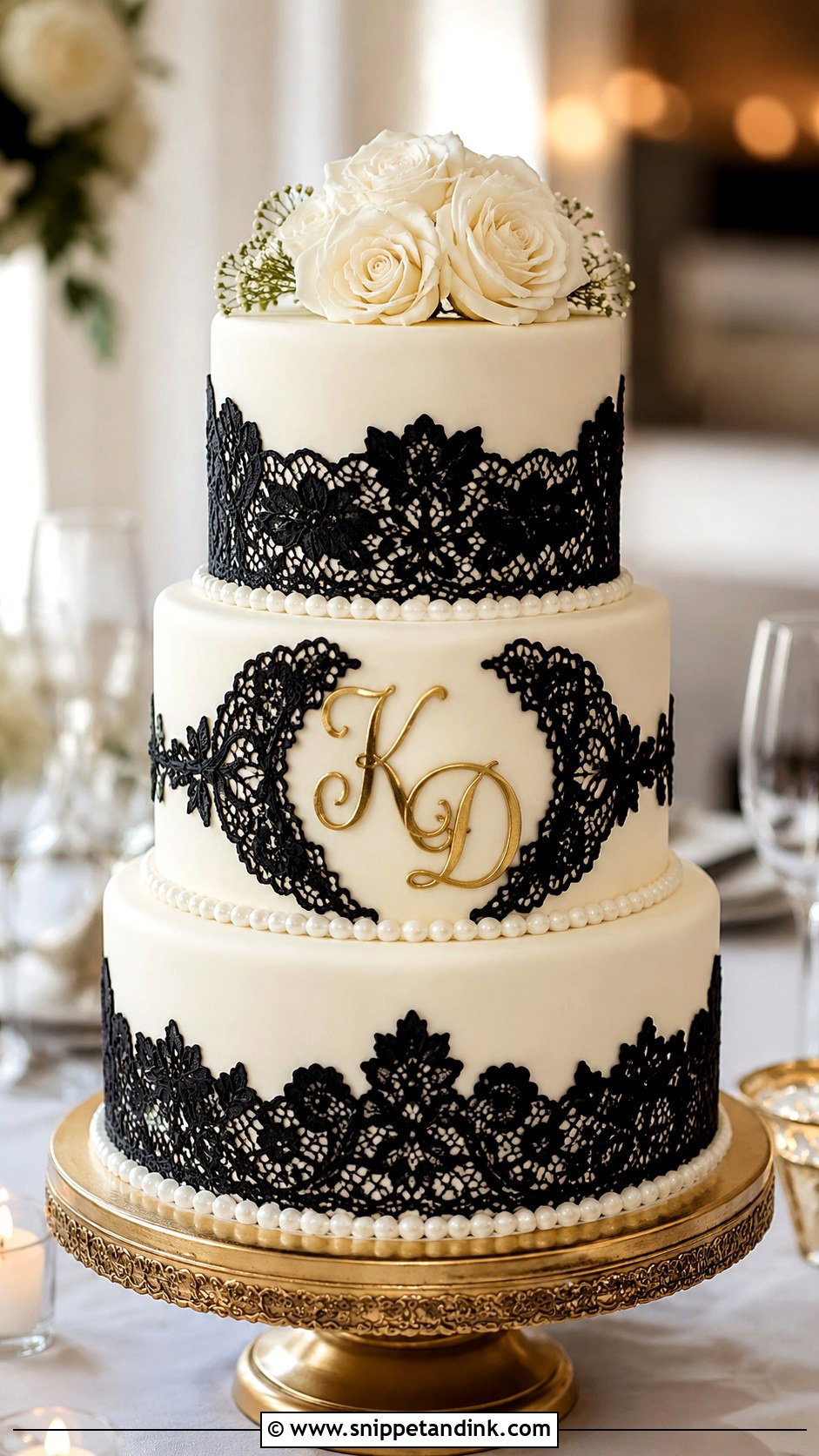
A monogram adds a personal touch when it sits on a smooth tier between lace-covered ones, or inside a lace frame. White fondant with black lace and a black or gold monogram feels classic and formal; ivory buttercream with thin black piping is softer. Choose a letter style that stays readable from a few meters away. Elaborate script often looks like a squiggle in wide shots.
Bring Your Dress Lace to the Tasting
If you want the cake to echo your gown, bring a clear close-up photo of the lace, or ask your bridal shop for an offcut. Different laces translate into sugar in different ways.
- Fine, floral Chantilly-style lace with a net background translates best as hand piping or a fine stencil.
- Corded lace with a raised outline, like Alençon, comes out well as cast lace with piped edging on top.
- Heavy guipure, with bold motifs and no net, is best recreated with molded appliqué pieces.
Tell your baker how much of the cake you want covered, too. Lace on one tier against a plain background usually looks more expensive than lace everywhere, and it changes the quote a lot.
Where black on white can go wrong
Black and white show every mistake. Condensation from a cold-to-warm move can make black icing streak into white fondant, so a cake should never go from a fridge straight into a hot room. Fingerprints and crumbs show on black and on white alike, which is why I ask venues to leave the cake untouched once it’s placed. And a black lace cake under colored uplighting can look purple or green, so check what color the lighting will be near the cake table.
Let the Lace Lead and Keep Everything Else Quiet
Black lace works on a wedding cake when one idea leads and everything else supports it. White fondant with black lace is classic, black on black is bold, blush flowers bring romance, and metallics make it formal. Consider your venue lighting, your dress and your flowers before deciding. Then give your baker clear references and let the lace be the detail people lean in to look at.
You'll Like These Ideas:



Leave a Reply