
Butterflies are one of the few cake decorations that add movement. A cake is a still object, and a few wings angled as if they’ve just landed make it feel alive. The line I watch with every butterfly design is the one between delicate and childish. Fine sugar or wafer paper wings, pearl details, soft buttercream and pressed flowers keep it bridal; bright, cartoon-shaped butterflies don’t. You can use a single topper or send a whole cascade up the tiers. The ideas below run from very quiet to very full, with notes on how each one is actually made and how it holds up on the day.
Wafer Paper, Gum Paste or Isomalt Wings in a Warm Room
Before we talk color, I ask what the butterflies will be made of, because that decides how the cake behaves in your venue. Each material has a different weak spot.
- Gum paste: dries hard and holds a crisp wing. It is brittle, so wings snap if knocked, and it softens in very humid air. It is made days or weeks ahead.
- Wafer paper: the thinnest and most realistic. It hates moisture, curling against wet buttercream or in a humid marquee, so it needs a barrier and late placement.
- Isomalt: clear, glassy wings that catch light. It gets sticky in humidity and can cloud, so I would only use it in an air-conditioned room.
- Chocolate: sturdy and fully edible, but it melts quickly near a window or a candle.
For a summer garden reception, I usually suggest gum paste on a fondant cake. For a cool indoor winter venue, wafer paper and isomalt both behave.
1. Butterfly Wedding Cake With Sugar Butterflies
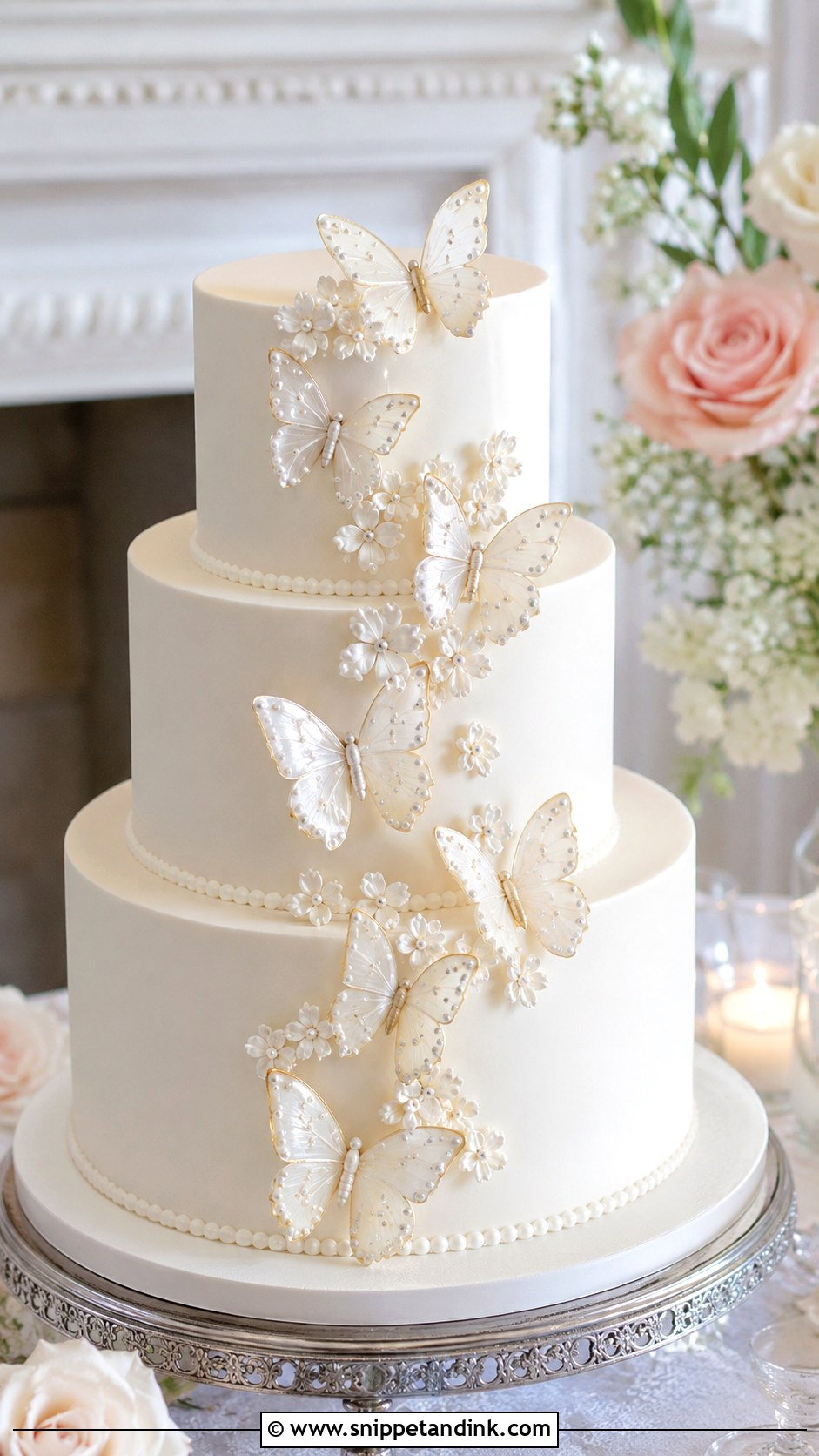
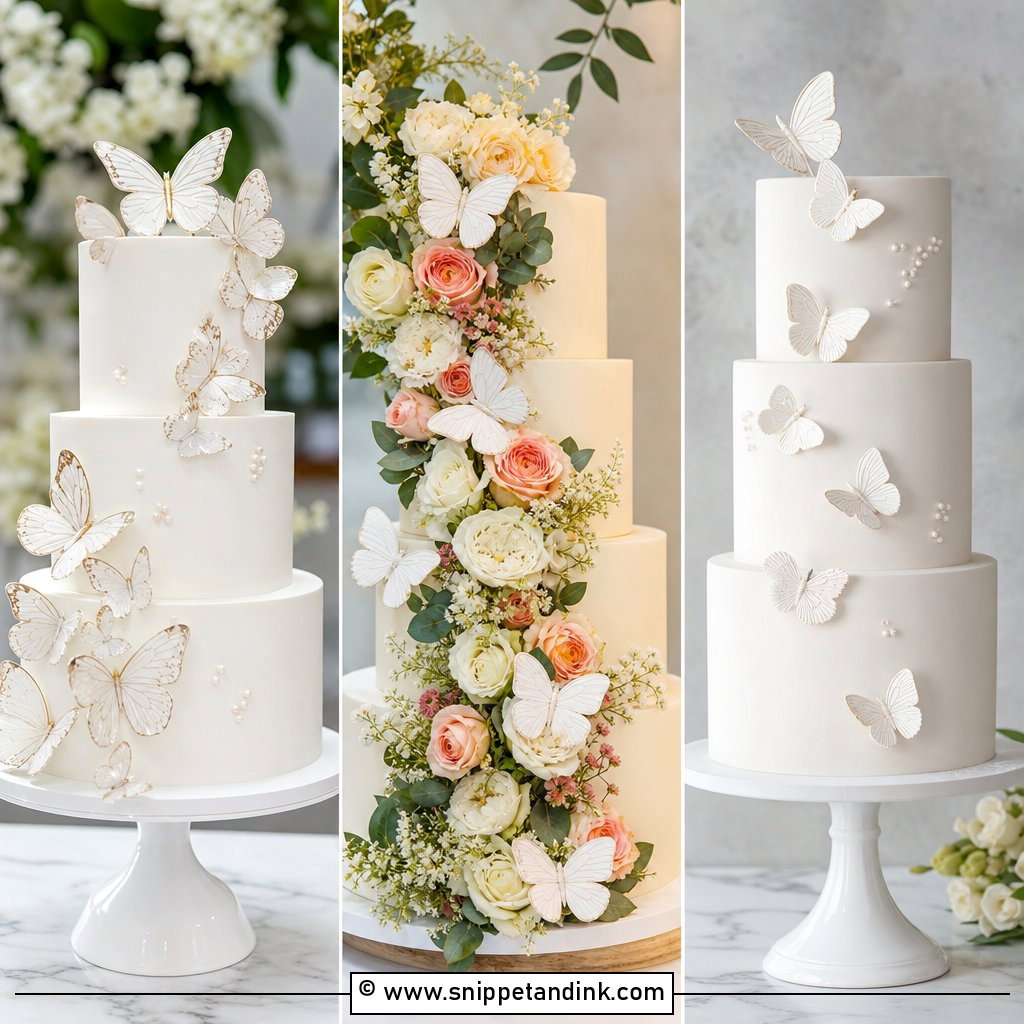
Sugar butterflies are the classic, and for good reason: gum paste dries hard, holds a crisp wing shape and keeps its color. I cut and vein them, then dry each pair of wings over a folded card so they set at an angle, which takes a few days, so they’re made well ahead of the bake. Placement is where the design happens. I set them as if they’re rising up the tiers, larger near the bottom and smaller as they climb, so the eye travels upward. A smooth white fondant or clean buttercream with little else lets them do the work. Tiny pearls or a few flowers can join them, but crowding kills the sense of flight.
2. Butterfly Wedding Cake With Fresh Flowers
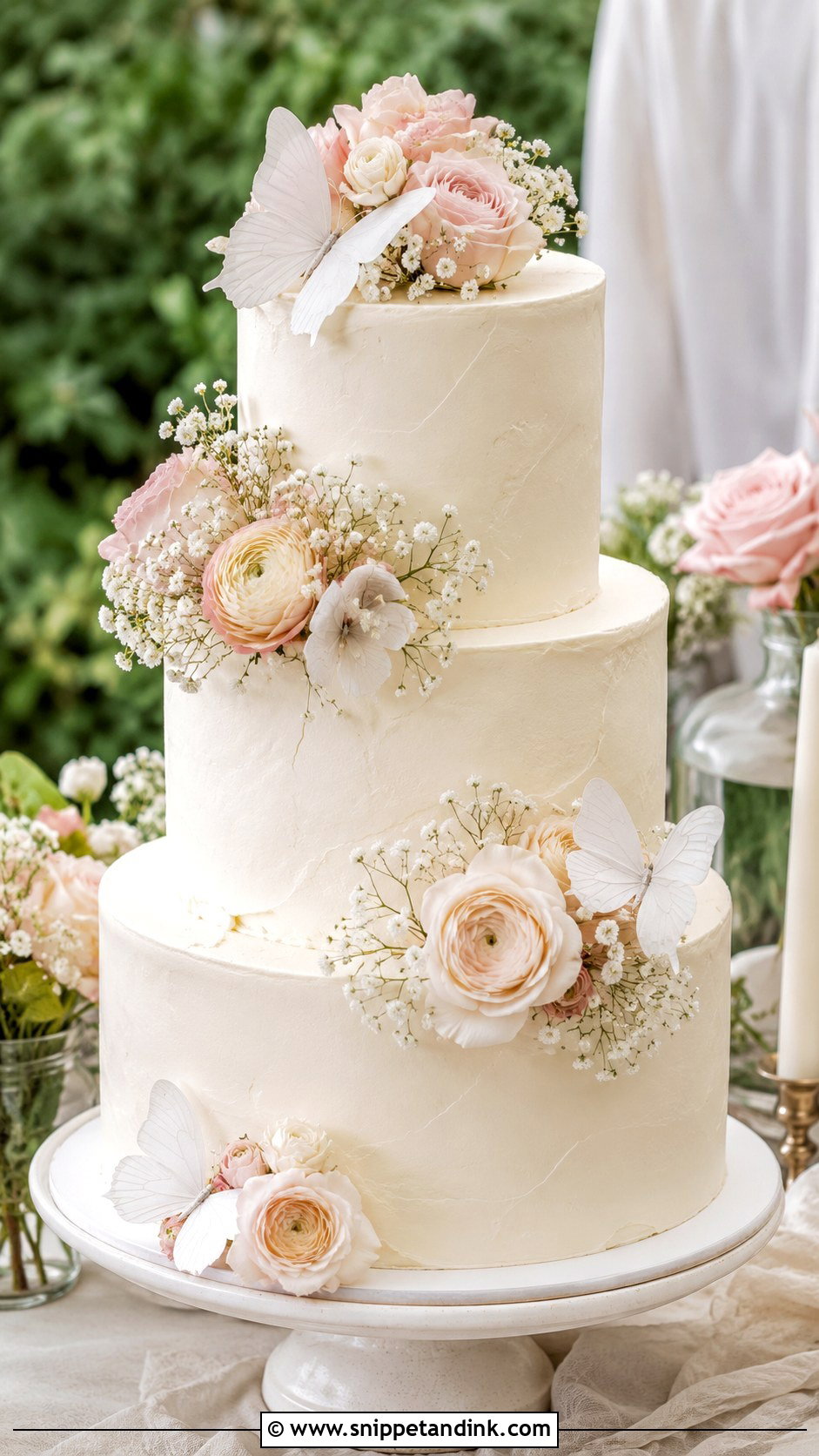
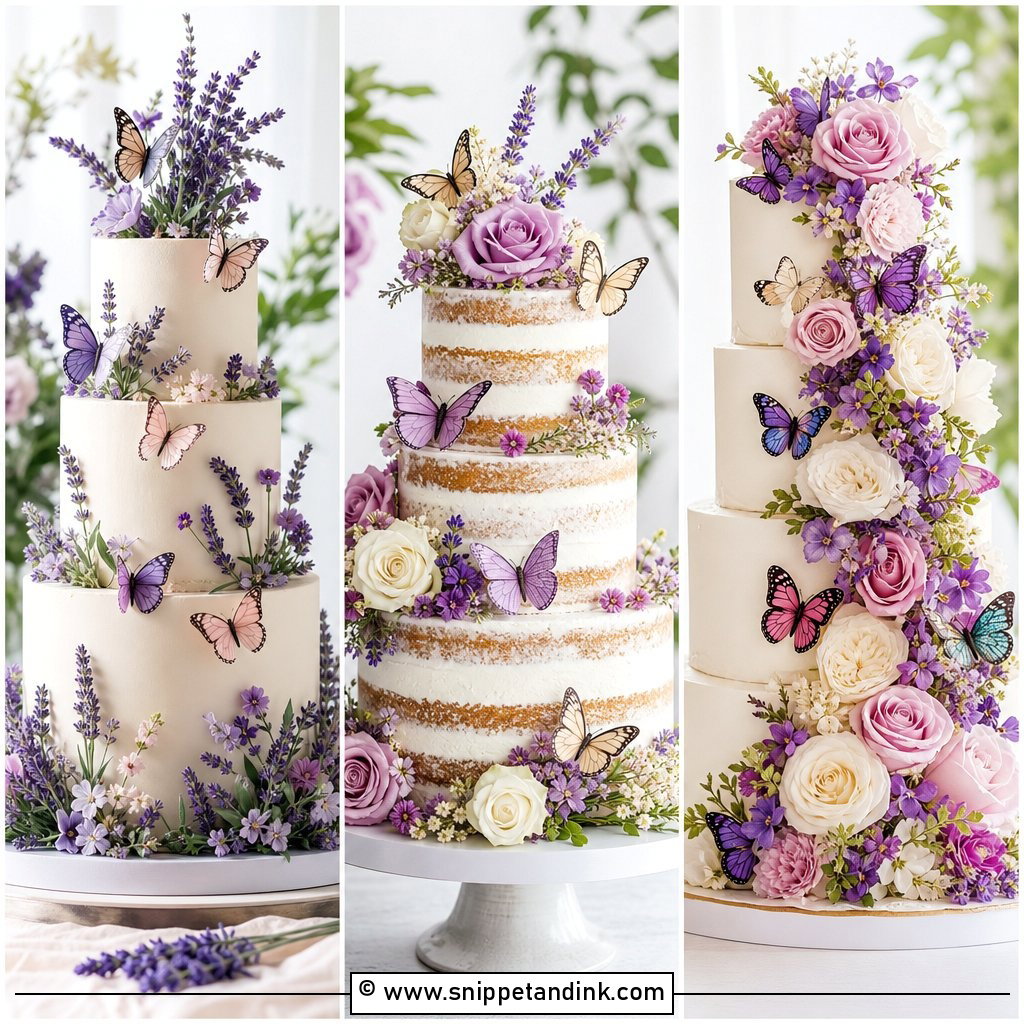
Fresh flowers and butterflies make sense together, since one naturally draws the other. Roses, ranunculus, peonies, sweet peas and gypsophila all sit well with fine wings. Keep the butterfly colors a shade lighter than the flowers so they don’t get lost: ivory or rose-gold wings next to blush blooms, for instance. A three-tier cake with flowers tucked between the tiers looks full without hiding the cake. The part couples rarely think about is safety. Many popular wedding flowers are not food-safe, and some are toxic, so I insist that stems are wrapped and put into posy picks, never pushed straight into the sponge, and I talk to the florist about which blooms are going near the icing.
3. White Butterfly Wedding Cake
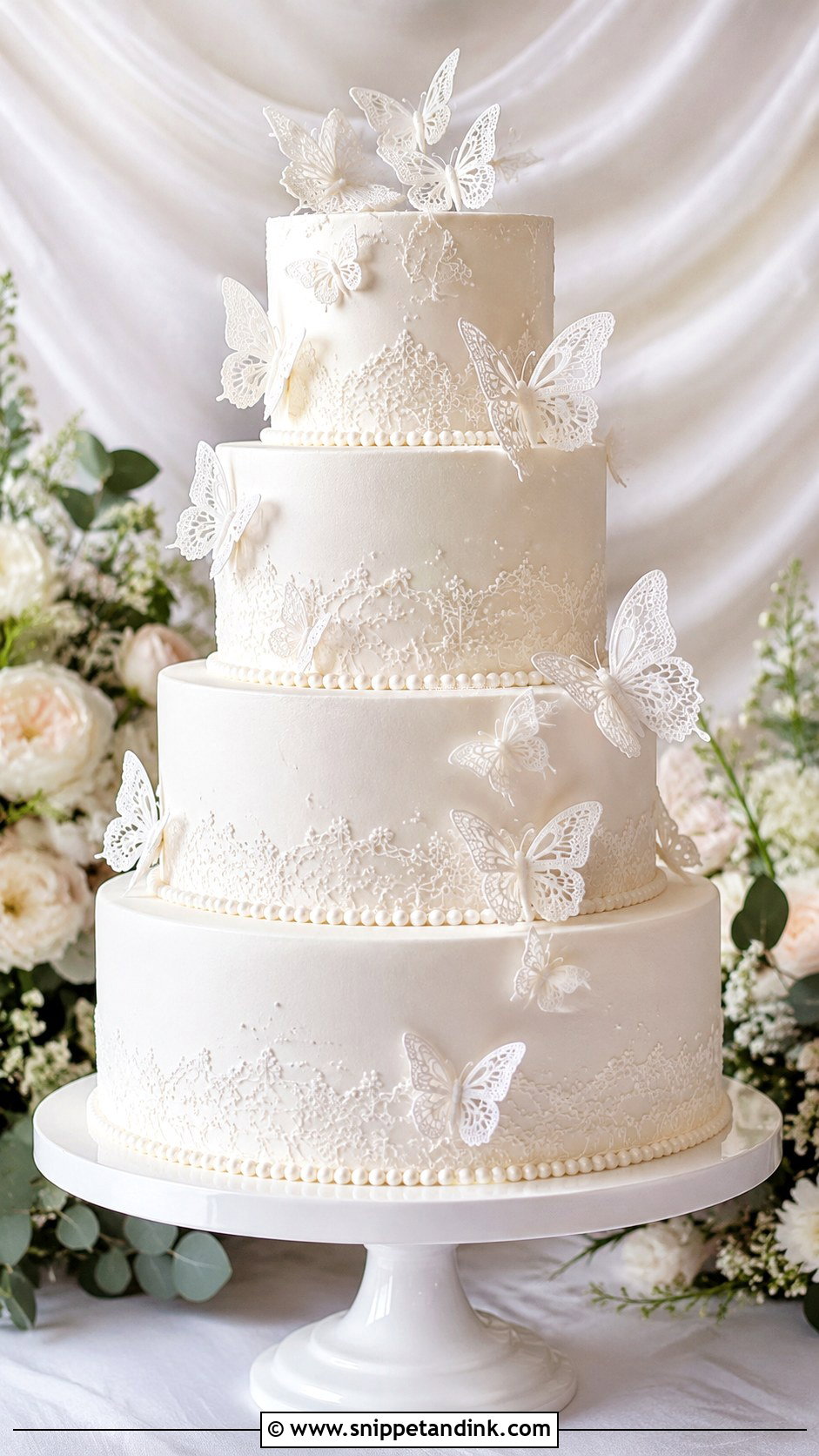
A white butterfly wedding cake relies entirely on texture, because there’s no color to carry interest. I’d add one textured element: a quilted tier, a pearl border, soft ruffles, or lace piping. White wafer paper wings look airy; gum paste wings with a light pearl dust look more formal under evening lights. White on white also needs good lighting at the venue, as a cake placed in a dim corner can end up looking flat and grey in photos.
4. Pink Butterfly Wedding Cake
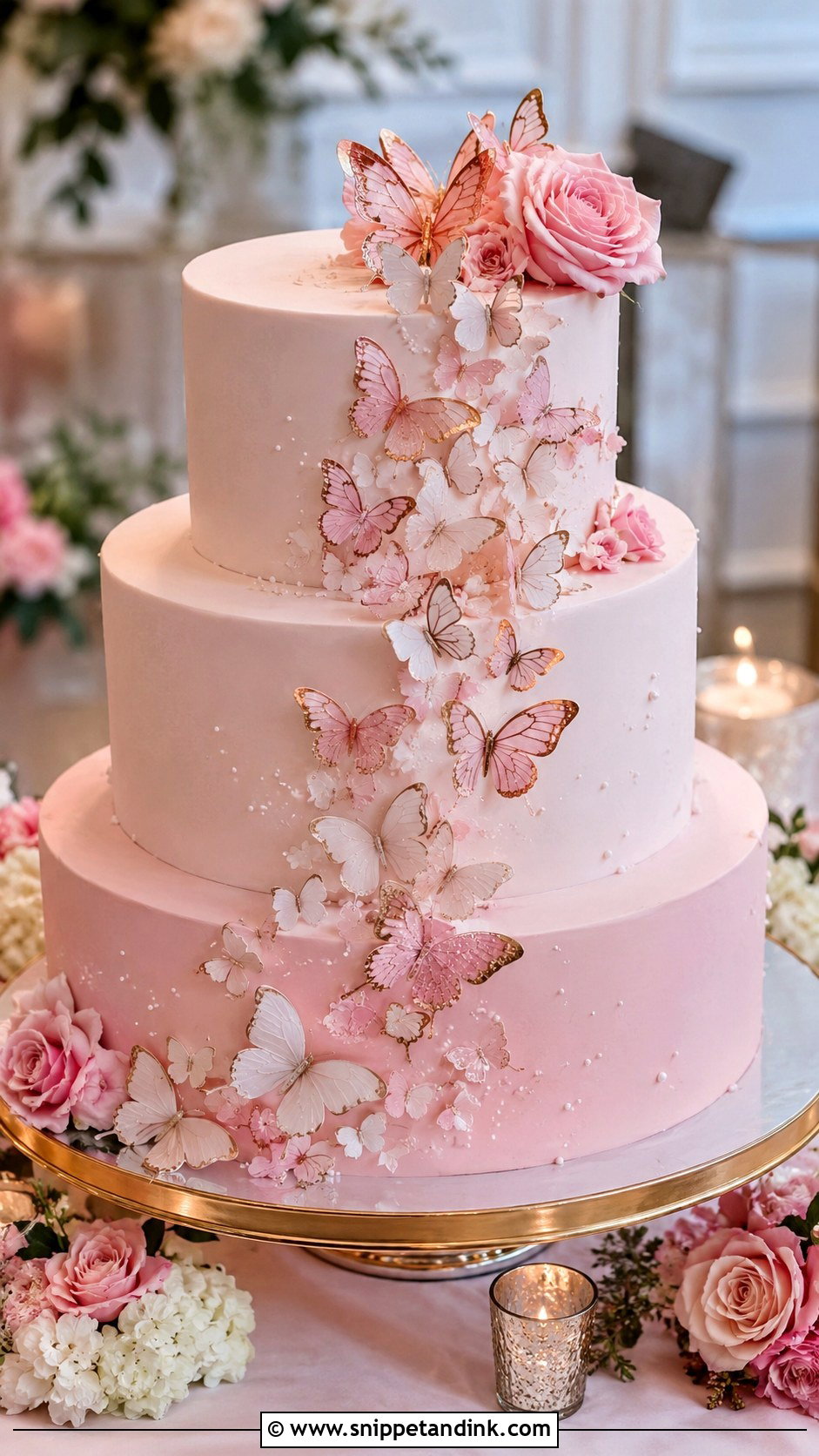
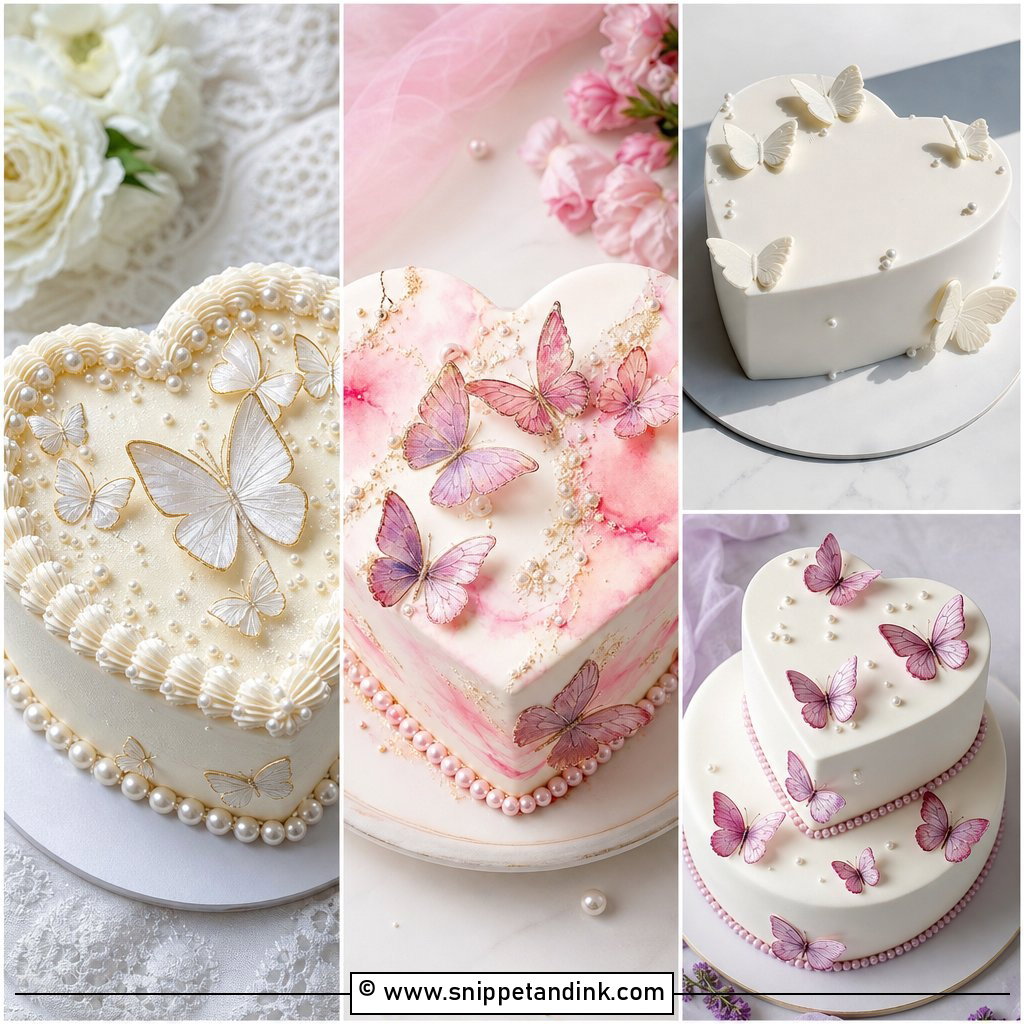
Pink can tip into a child’s birthday cake quickly, so the shade matters more than anything else. Dusty rose, blush, mauve and peachy pink look grown-up, especially next to gold; bright bubblegum doesn’t. A pale pink buttercream base, ombre pink tiers, or a white cake with pink wings all work. If you’re planning a drip, keep it light and controlled, as heavy drips fight with the butterflies for attention. A gentle cascade from top tier to bottom gives the eye one clear path.
5. Blue Butterfly Wedding Cake
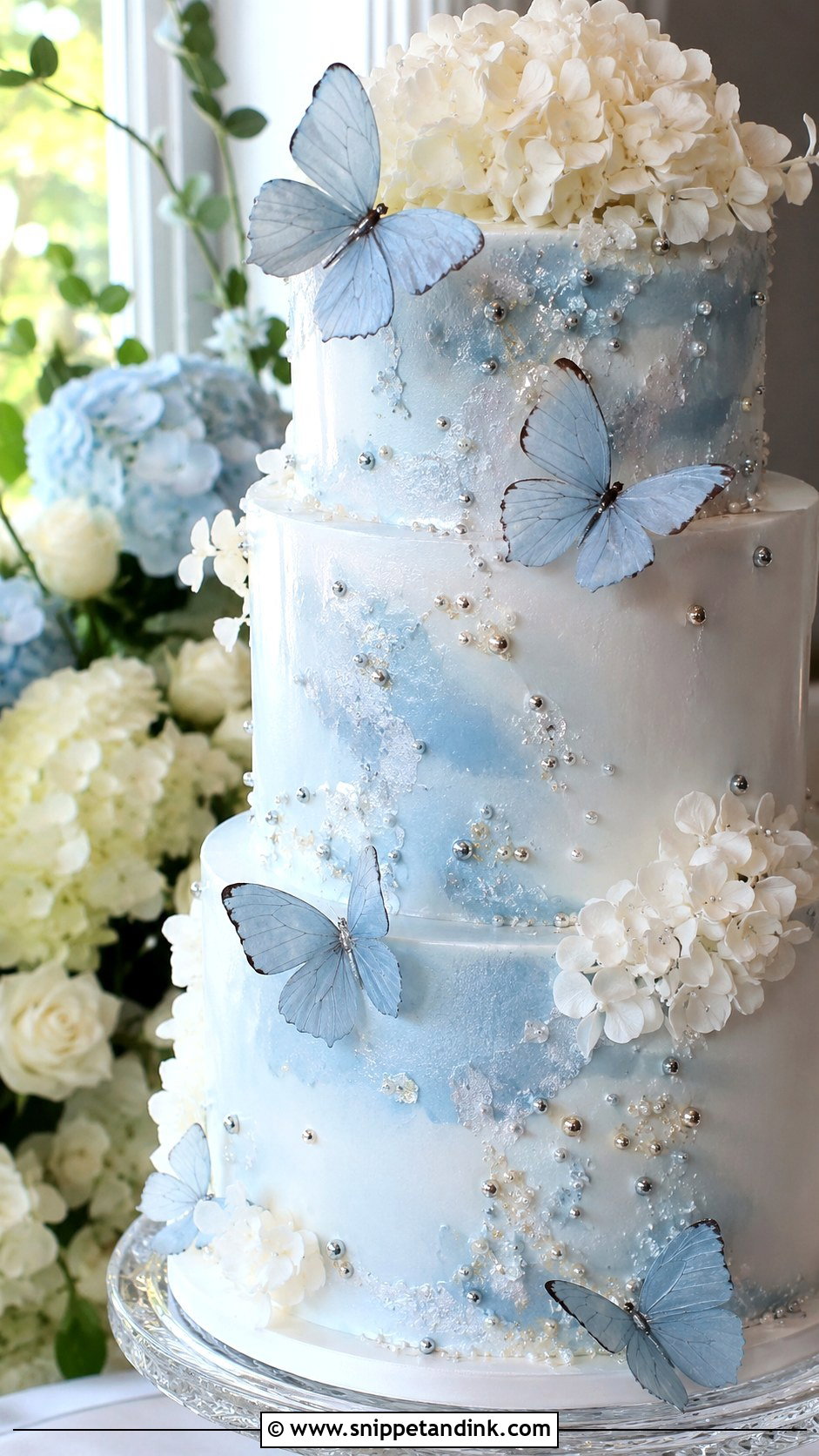
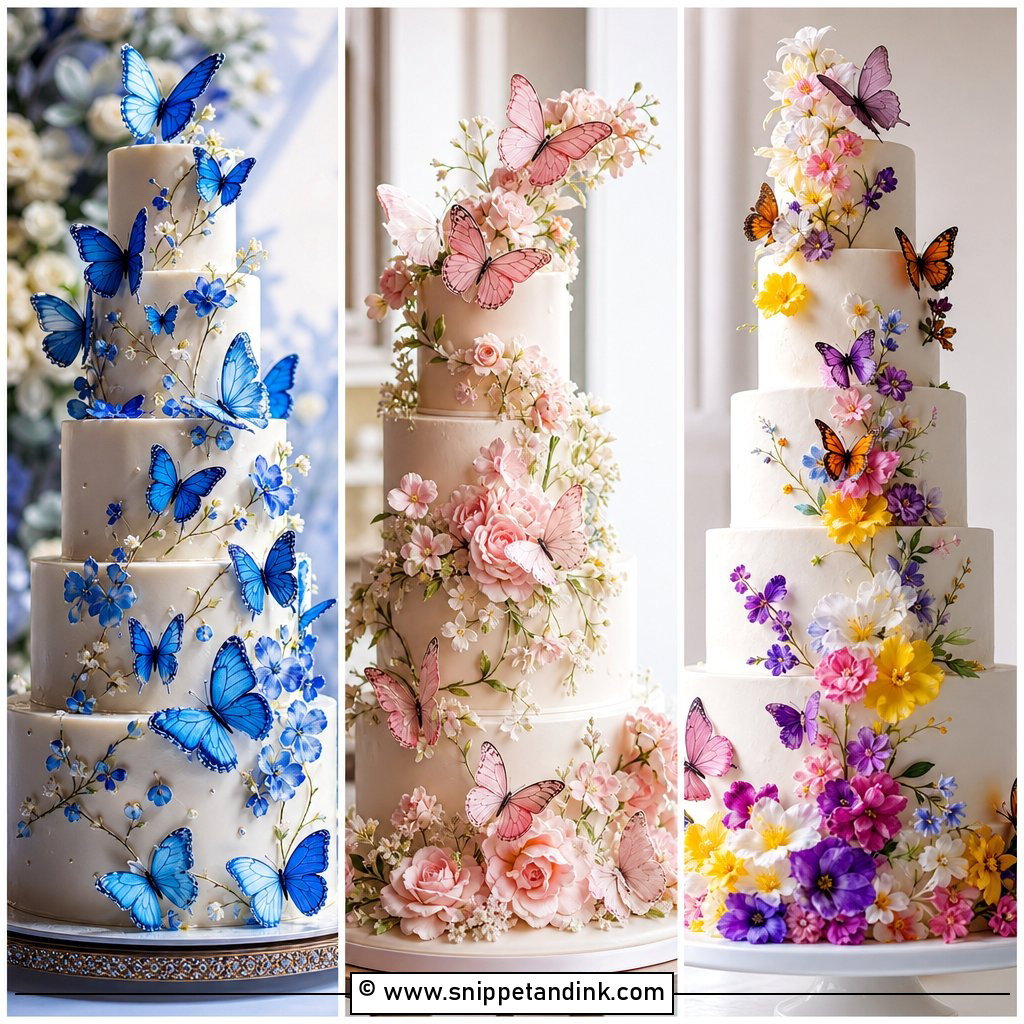
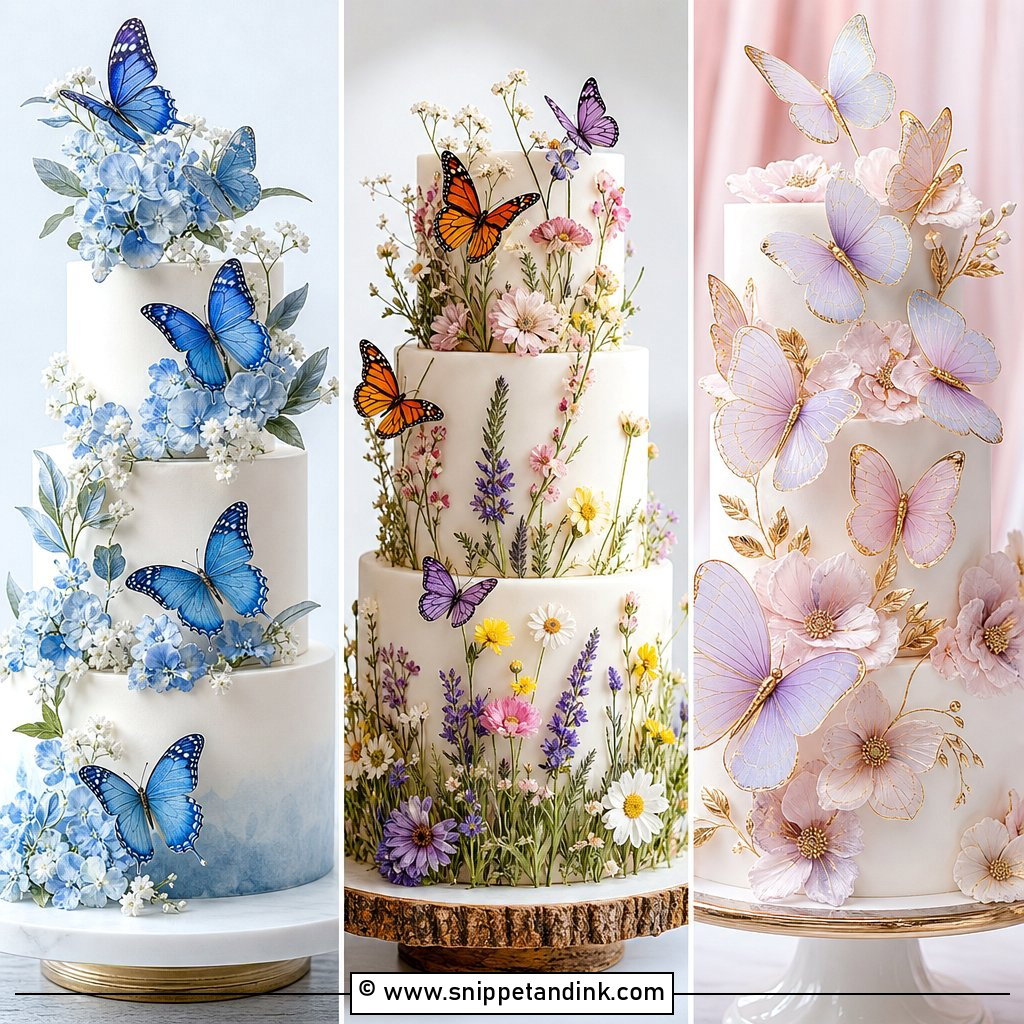
A blue butterfly wedding cake is a fresh way to bring in something blue, and it suits coastal and spring weddings. Pale blue buttercream, a watercolor fondant or white tiers with blue wings all work. Blue is a tricky color in buttercream, though: it tends to fade when a cake sits in daylight, and if the butter is very yellow, blue can drift toward green. I whiten the buttercream first so the blue stays true. Ivory, silver and pearl soften it; royal or dusty blue wings on white make it bolder. Hydrangeas and white roses are natural partners.
6. Gold Butterfly Wedding Cake
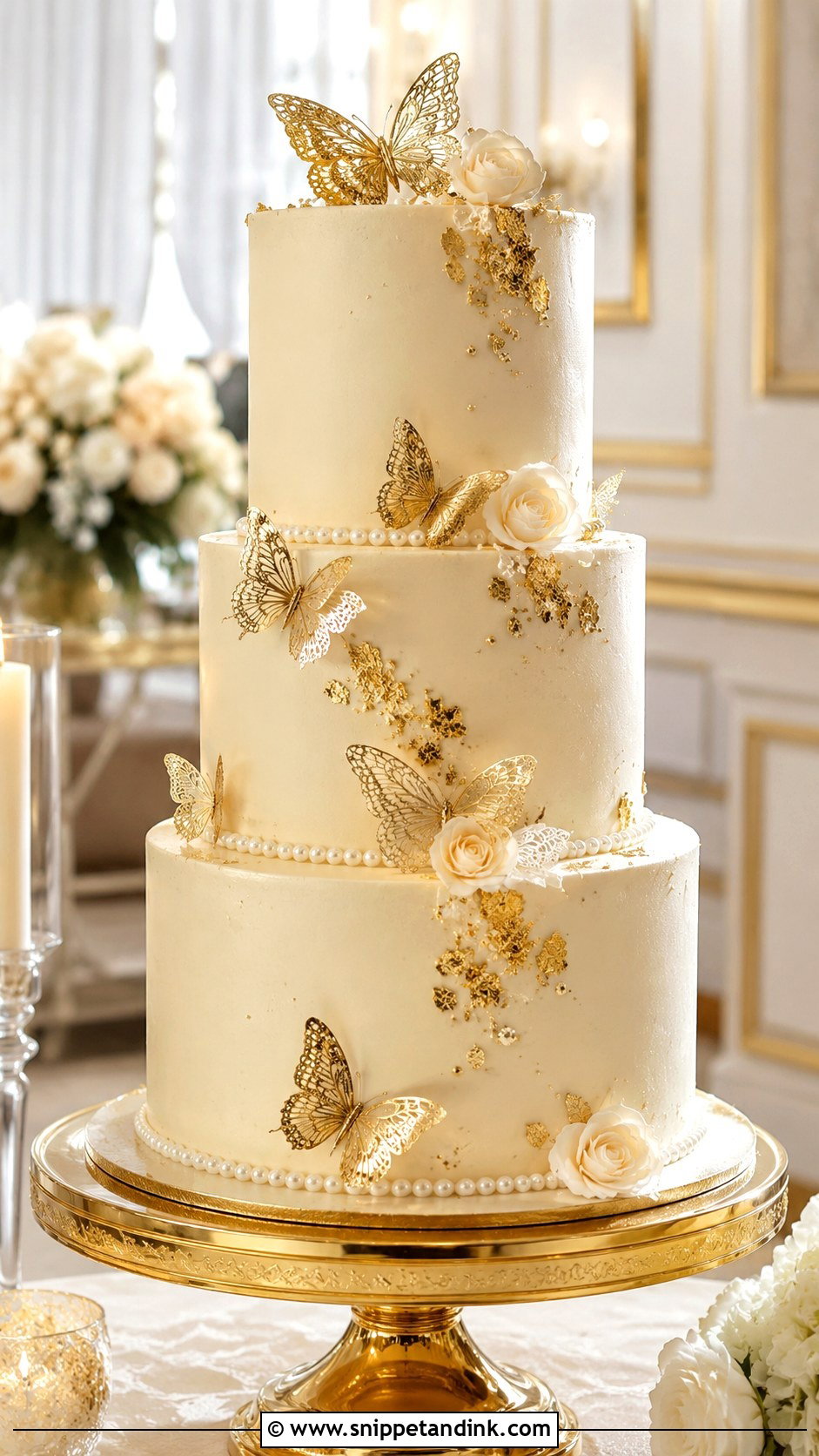
Gold butterflies change the mood of a plain cake entirely, turning it into something for a ballroom or an evening reception. Edible gold leaf, champagne pearls or a fine gold drip can tie it together. I prefer warm ivory icing to bright white underneath, since gold against stark white can look harsh, while ivory makes it softer and richer. Cluster the butterflies near the top tier or let them climb. Bear in mind that metallic finishes look very different under candlelight than in daylight, so check a sample under similar light.
7. Butterfly Wedding Cake With Pearl Details
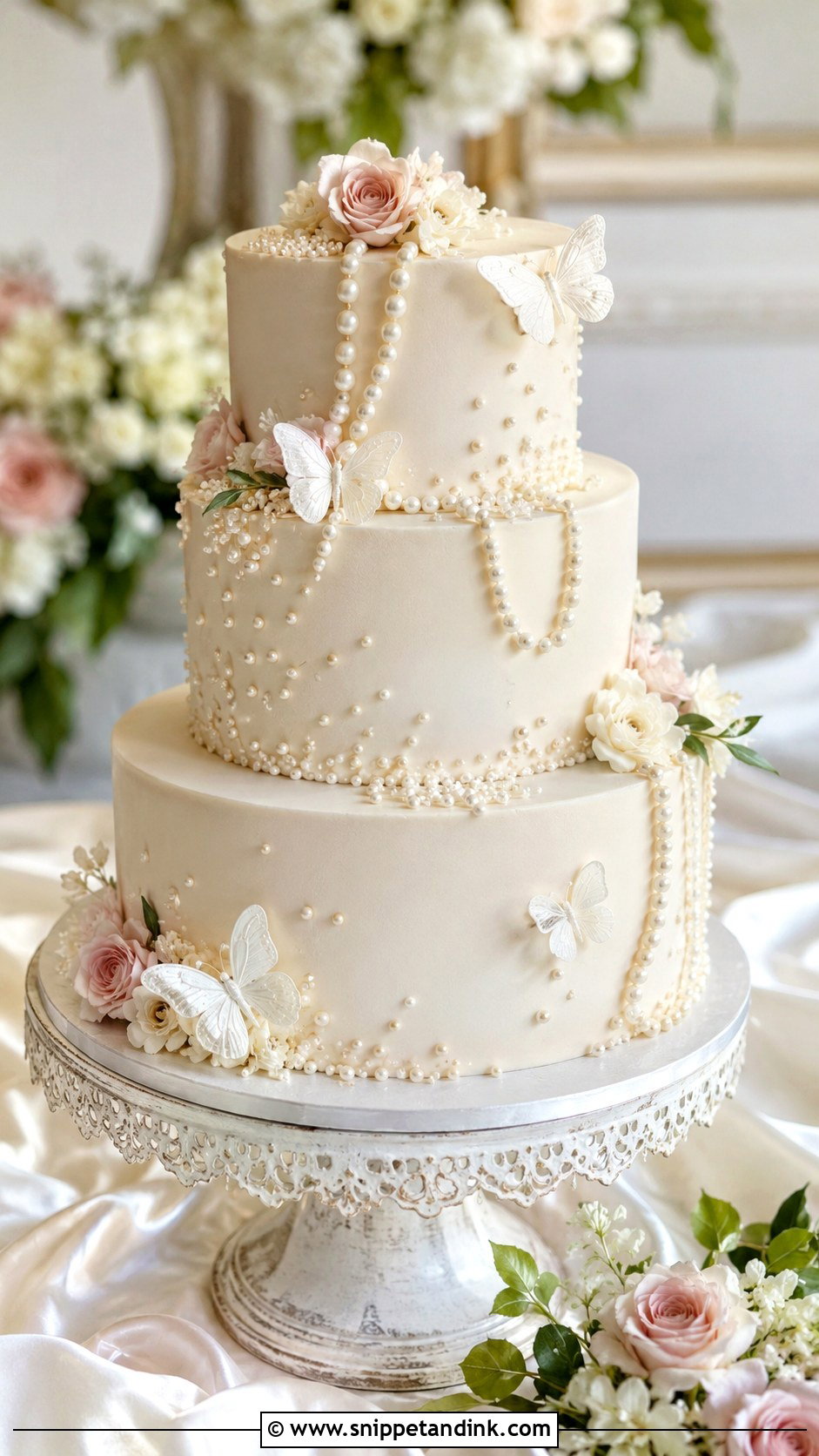
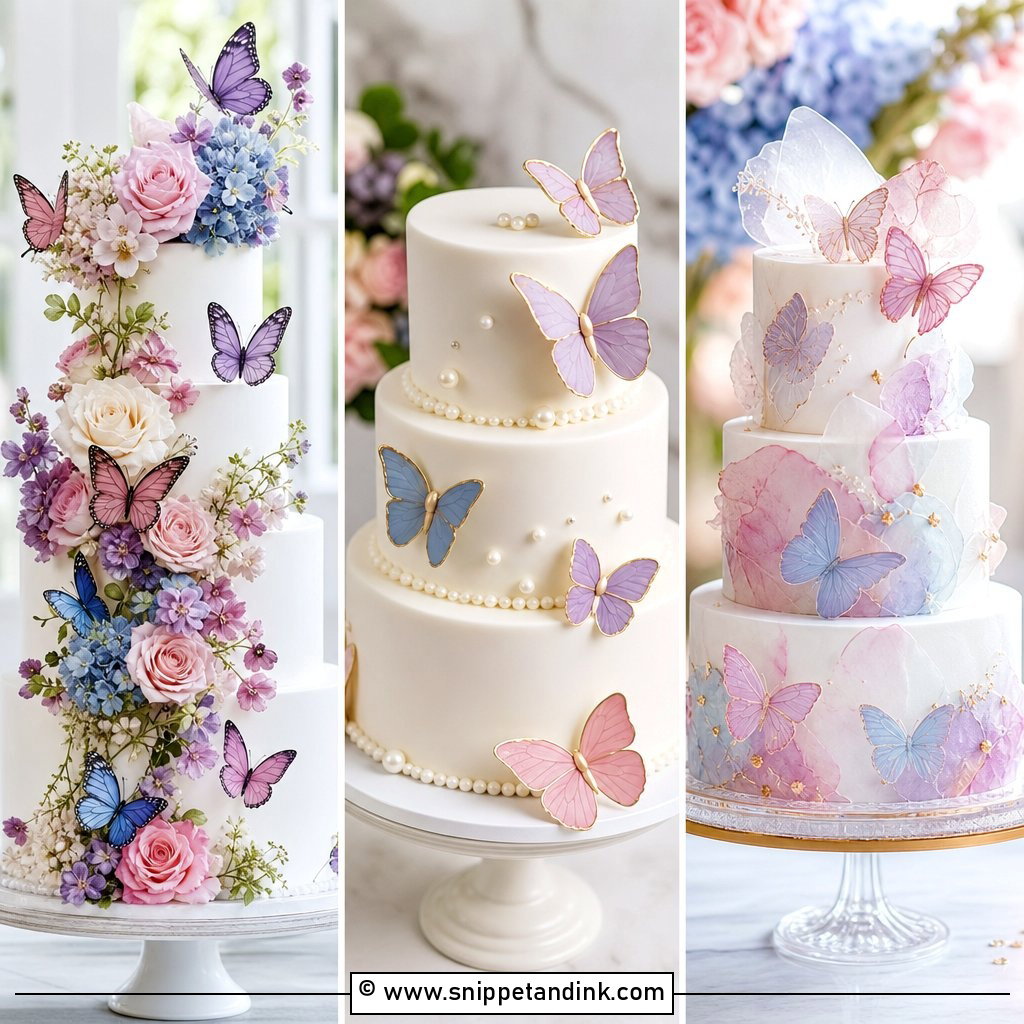
Pearls and butterflies share the same scale and softness, which is why they sit so well together. Tiny edible pearls around tier borders, scattered over smooth buttercream, or a pearlized fondant all work. Keep the palette in white, ivory, champagne or blush. Keep the wings small too, so they and the pearls don’t compete. Edible pearls are hard, so I keep them to borders and away from the slices people bite into first. In photos, they catch the light gently instead of glittering.
8. Butterfly Wedding Cake With Lace
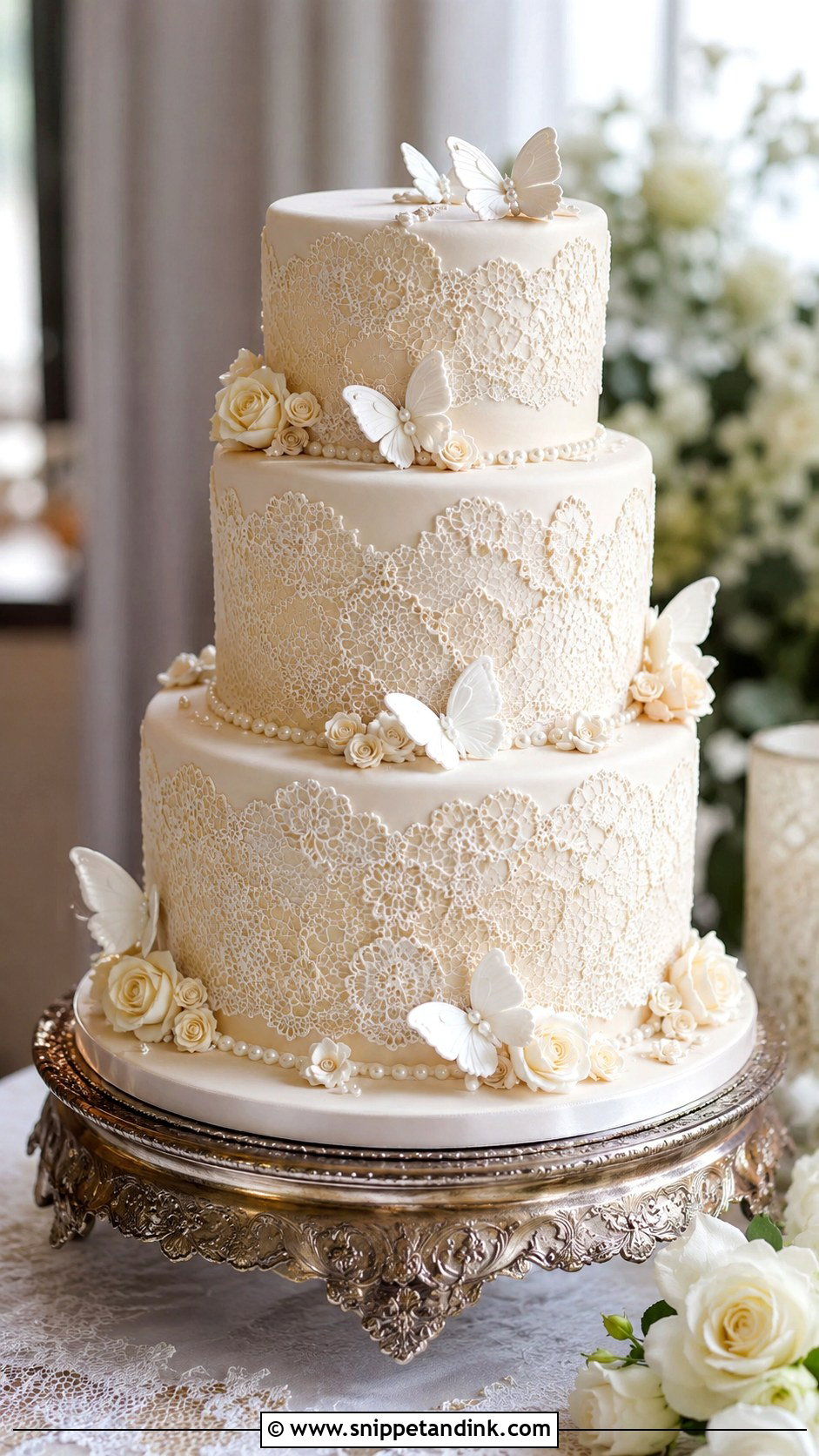
Lace on a cake can be made with fondant moulds, piped royal icing, or stencilled over buttercream, and each looks different. Moulded lace is crisp and even; piped lace looks more handmade. If your dress has lace, bring a close-up photo of it, and I can echo one motif from it rather than copying the whole pattern. Ivory, soft white and champagne suit lace best, with small butterflies in matching shades. Keep the tier shapes simple so the texture can stand out. A word on buttercream: stencilled lace over buttercream softens in warm rooms, so for a summer reception I’d choose fondant.
9. Butterfly Wedding Cake With Watercolor Butterflies
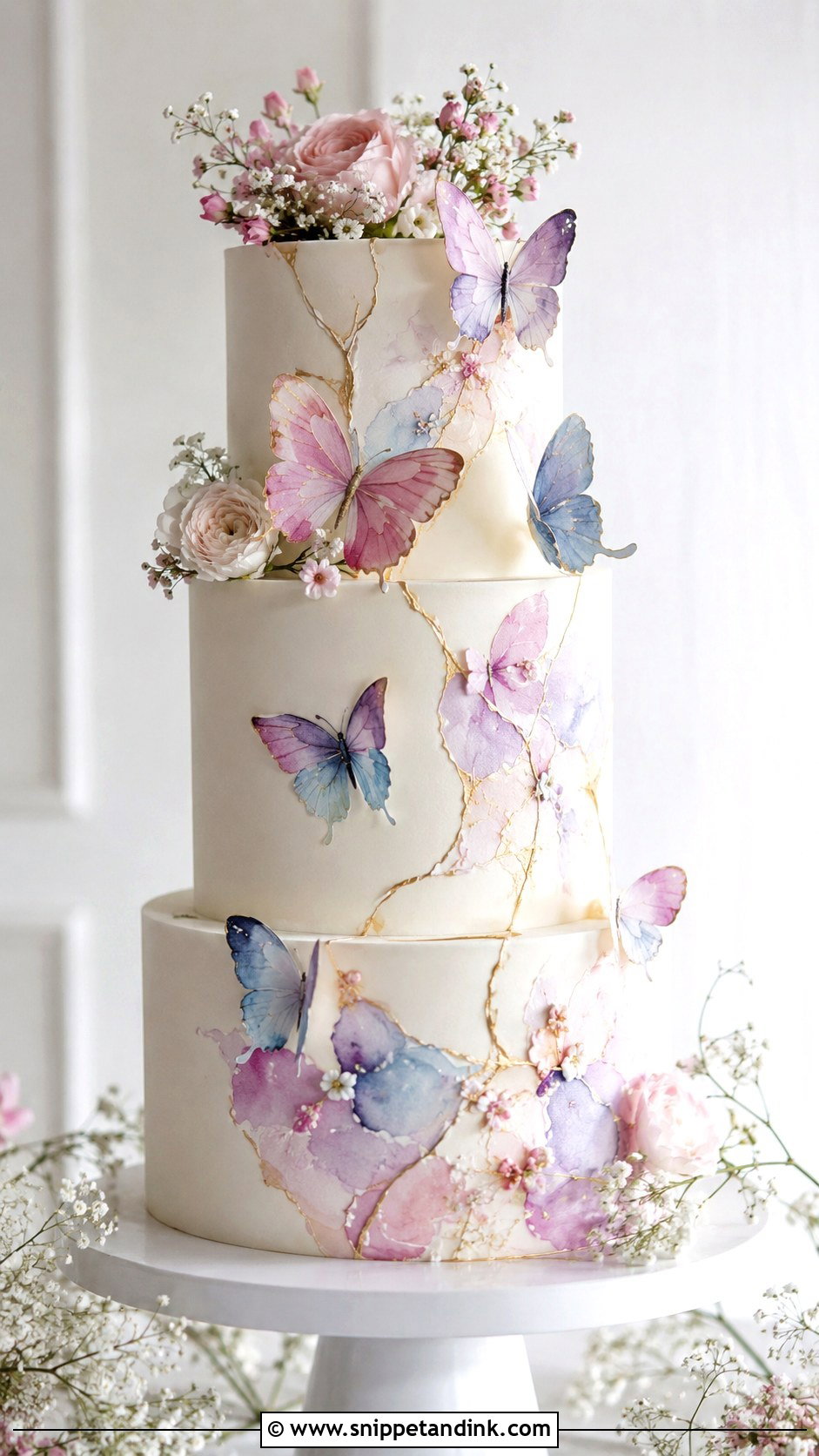
A cake with watercolor butterflies moves the theme from 3D decoration to painting. I paint the wings straight onto fondant with diluted gel colors, or print and cut them from wafer paper, and soft washes of blush, lavender, blue, peach or sage give that airy look. Painting needs a firm, dry surface, which is why this one is nearly always fondant over round tiers rather than buttercream. Thin gold lines and light florals suit it. It’s a good choice for outdoor weddings because there are few raised pieces to wilt.
10. Butterfly Wedding Cake With Buttercream Flowers
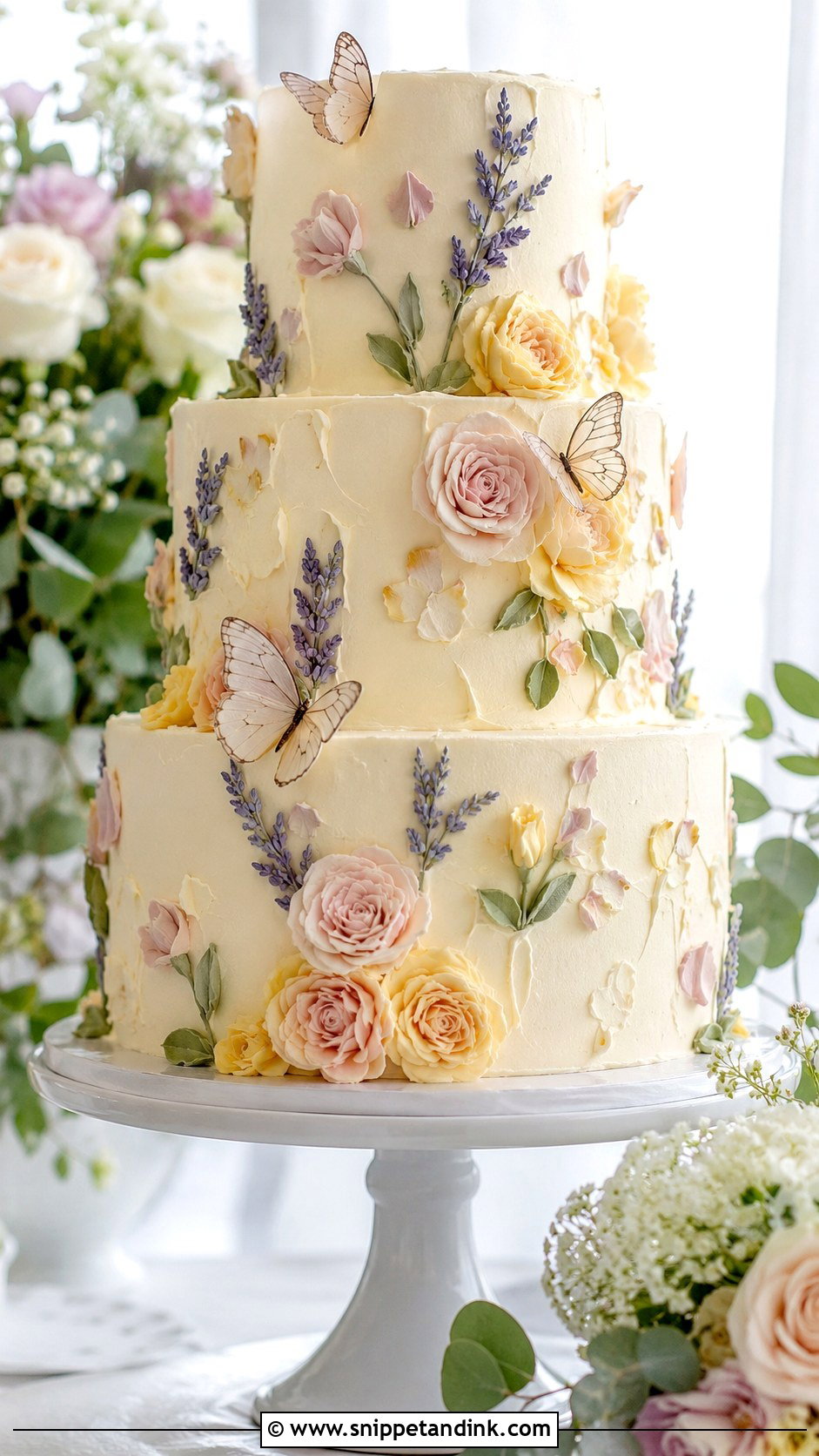
Piped buttercream flowers make the whole cake edible, which some couples really value. Roses, blossoms, leaves and vines go straight onto the cake, and wafer paper or sugar butterflies then sit among them as if resting in a garden. Pale buttercream over a vanilla, almond or lemon sponge suits it. Ivory, blush, sage, lavender and peach are wedding-friendly colors. The honest trade-off: piped flowers soften and slump in heat. If your reception is in a warm marquee, the cake needs to stay chilled until close to cutting time.
11. Butterfly Wedding Cake With Fondant Tiers
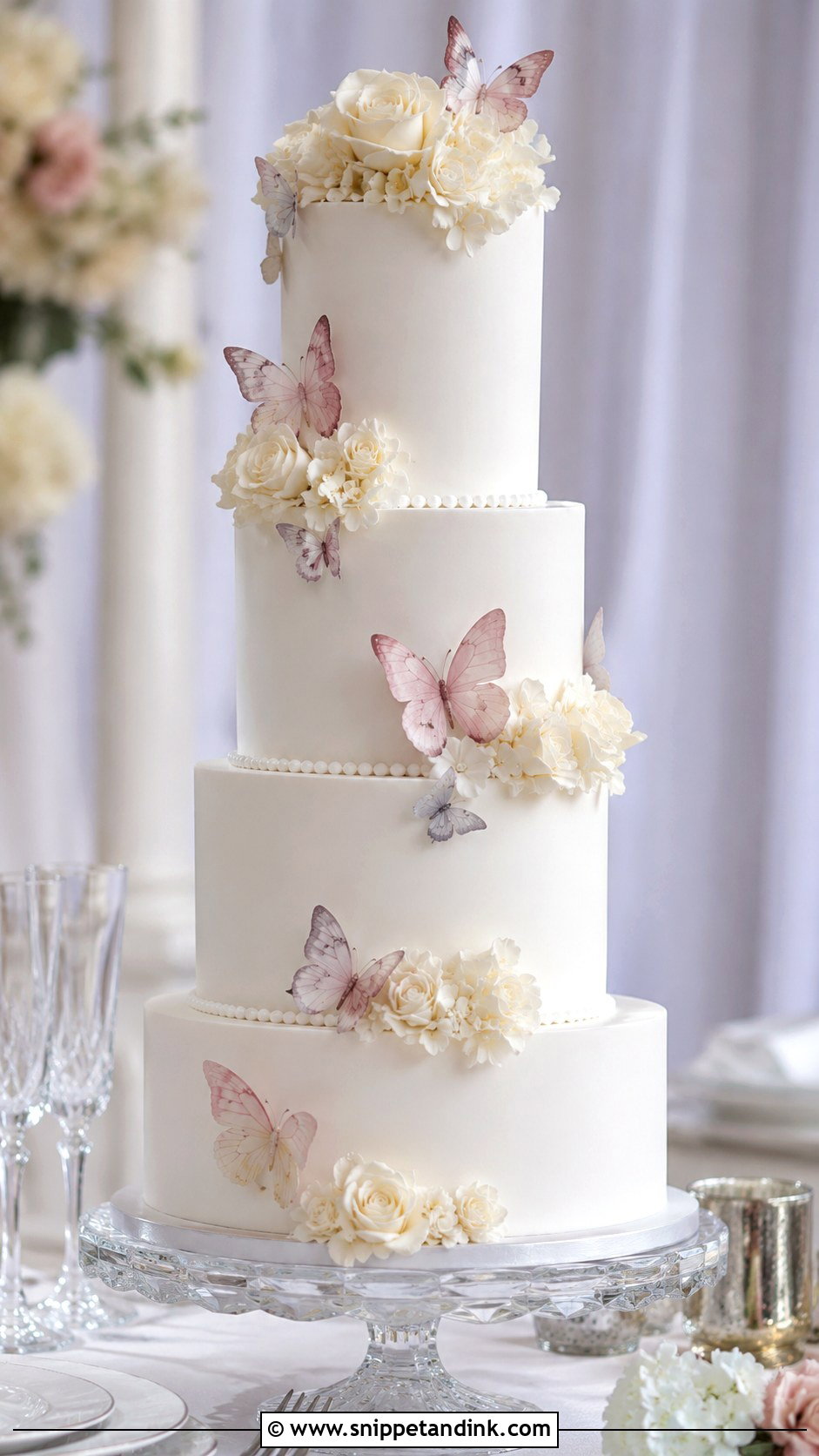
Fondant gives you a smooth, crisp surface that looks sharp in photos and holds up to butterfly decorations, painting, pearls, lace or metallic leaf. It’s my usual choice for taller cakes and formal rooms because it hides the structure underneath and resists warm air better than buttercream. Soft colors like ivory, blush, champagne or pale blue keep it bridal. One thing to know: fondant can sweat if a cake goes from a cold fridge into a humid room, so I let it come up to temperature in its box before the box comes off. Sugar, wafer or painted butterflies all suit it.
12. Butterfly Wedding Cake With Wafer Paper Butterflies
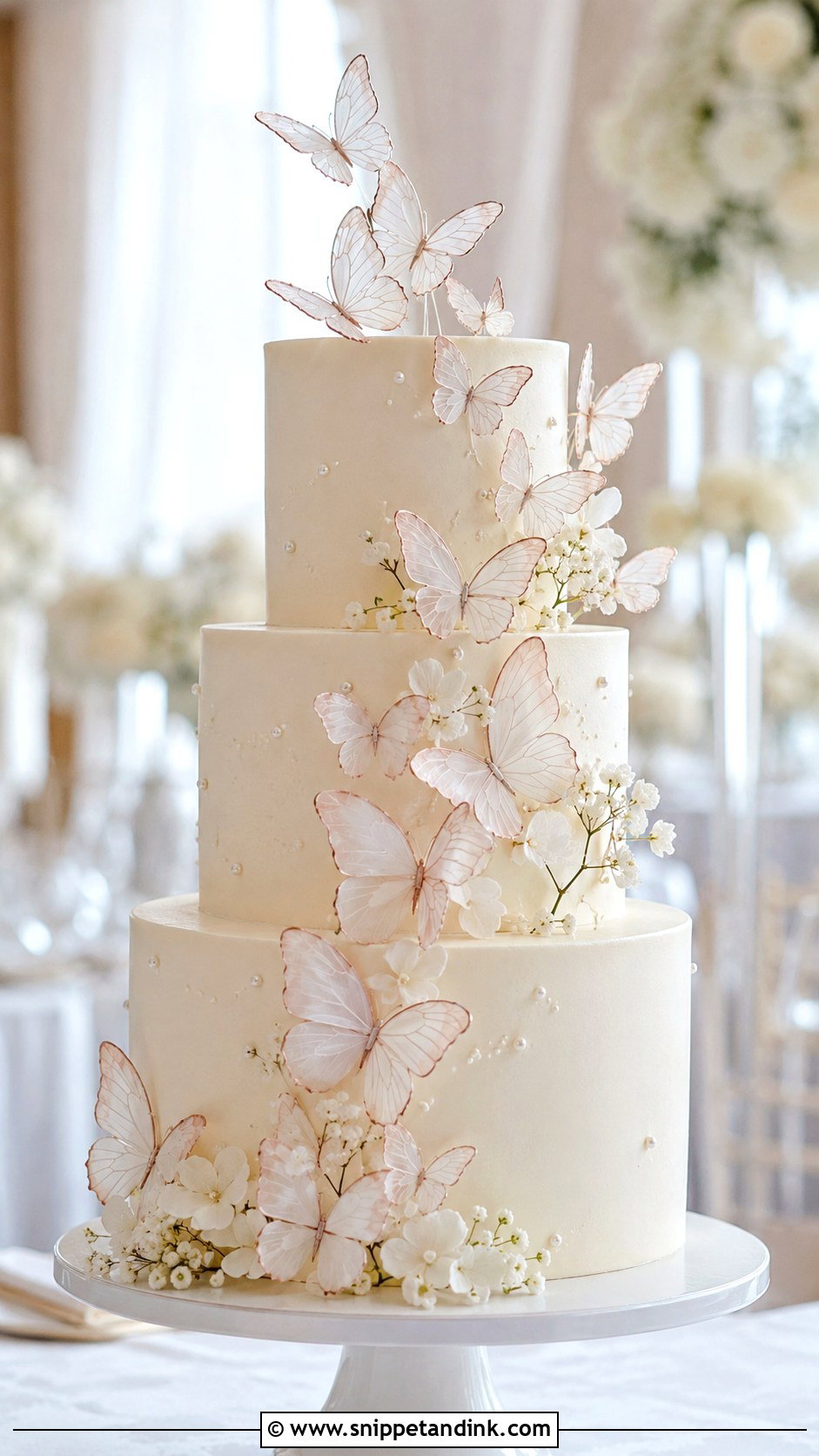
Wafer paper wings are the most weightless-looking butterflies you can put on a cake. The paper is thin enough to bend into a natural wing angle, and a little color or a metallic edge makes them look almost real. The weakness is moisture. Wafer paper curls and goes limp if it touches wet buttercream or sits in a humid room, so I attach them with a dab of melted chocolate or set them on wires into picks. Mixing sizes makes the cake feel natural. Small wings near the base with larger ones higher up give it lift.
13. Butterfly Wedding Cake With Floral Cascade
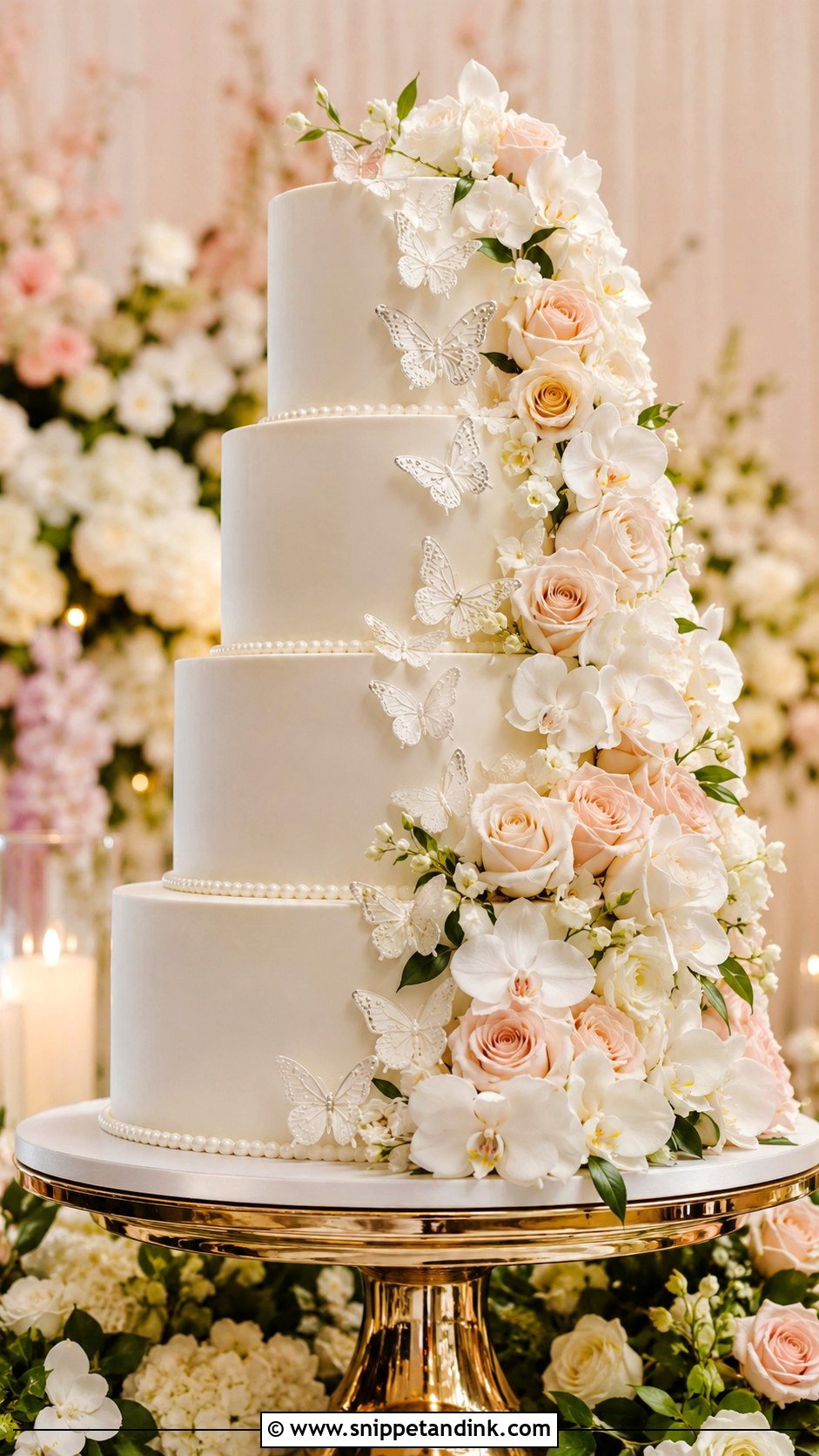
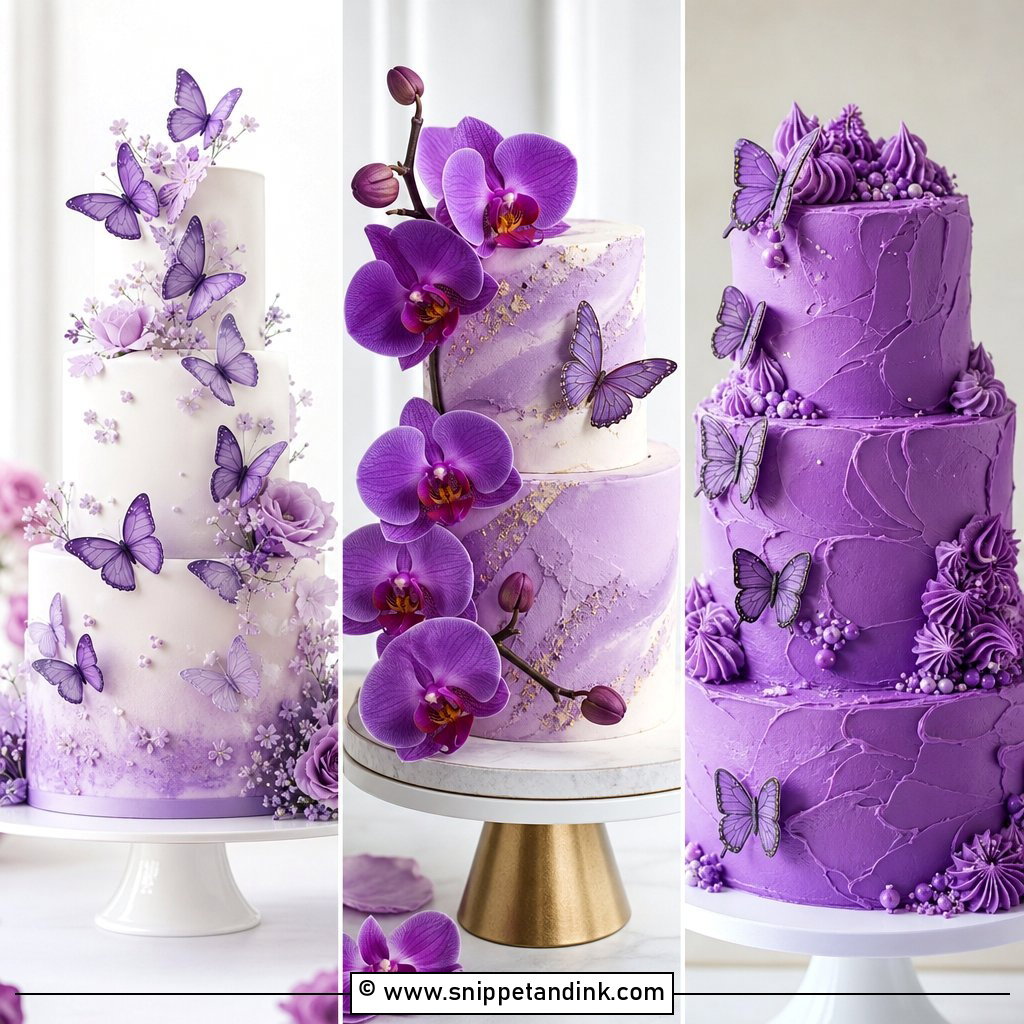
A floral cascade running from the top tier down one side gives the butterflies an obvious path to follow. Three or four tiers give the cascade enough height to look intentional. Roses, orchids, garden flowers or sugar flowers all work, depending on the feel of the day. Place the butterflies along that line rather than scattering them around the cake, or the design starts to look messy. A plain base lets the cascade be the focal point. I build the cascade on site, because a cake travelling with heavy flowers on one side can shift.
14. Butterfly Wedding Cake With Pastel Colors
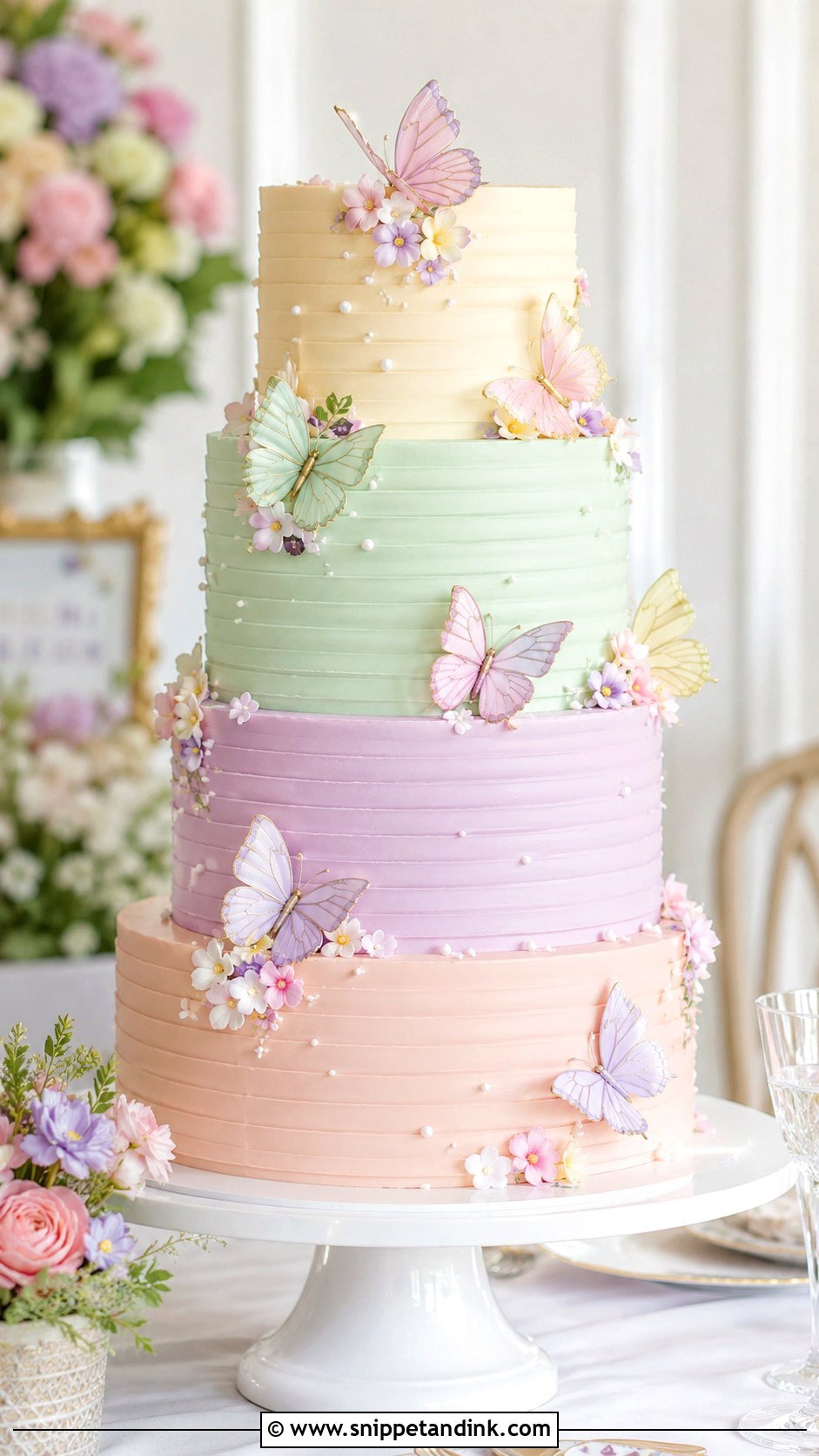
Pastel butterflies feel springlike and garden-fresh. Blush, lavender, mint, pale yellow, peach and baby blue can go on the tiers, the wings or the flowers around a white cake. The trick is choosing muted pastels and using no more than three, because a rainbow of bright shades looks like a party for a child. A light ombre is a nice way to blend them. Pearls, smooth buttercream or wafer paper wings add texture without more color.

15. Butterfly Wedding Cake With Ombre Tiers
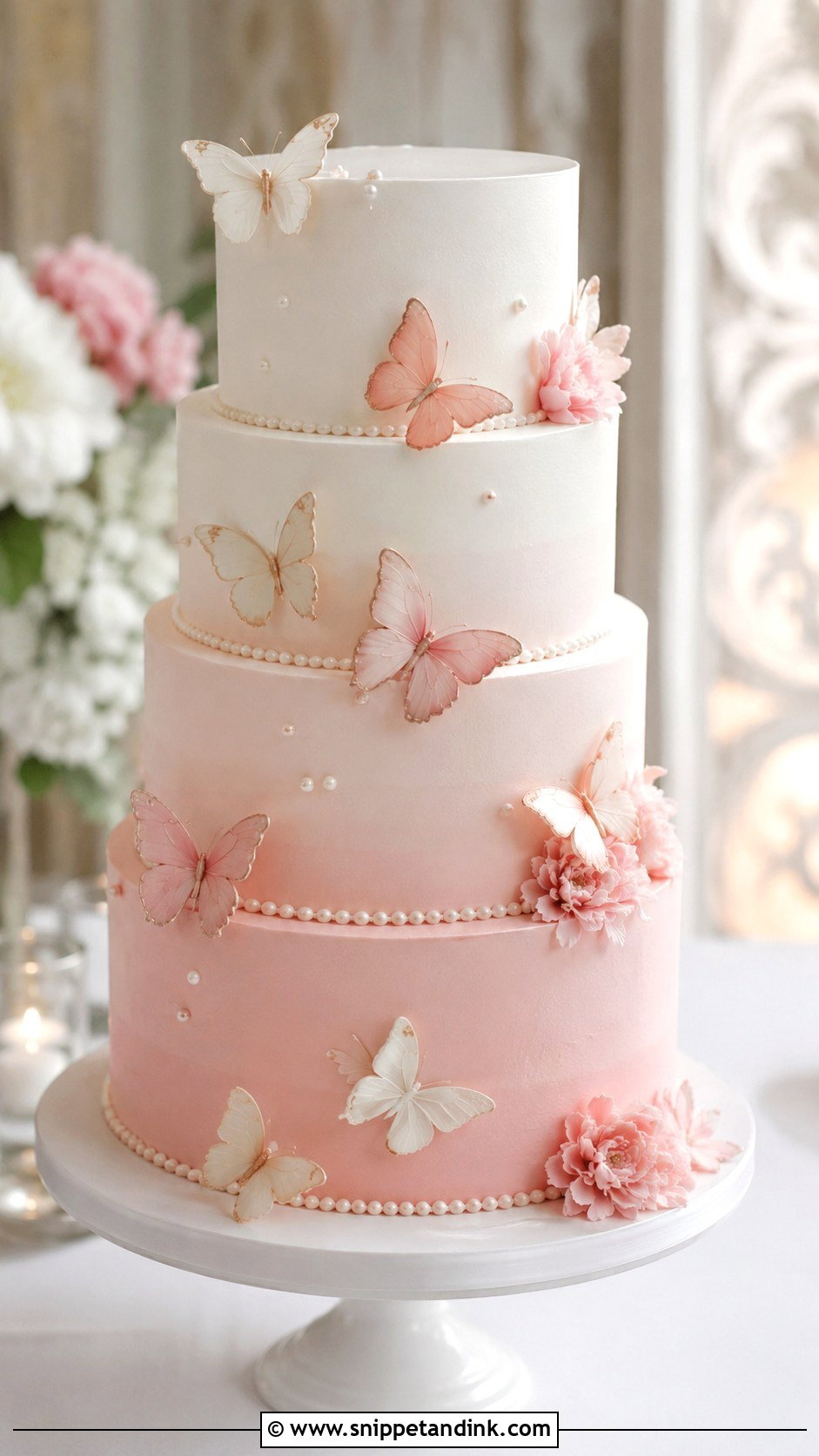
Ombre tiers give the cake a color story: white to blush, ivory to champagne, pale blue to white, or lavender to soft pink. Butterflies placed across the changing colors make the gradient feel like it’s moving. Buttercream gives a softer blend; fondant gives each tier a clean, distinct shade. The more steps in the gradient, the more careful I have to be with color matching between batches, which is why I mix all the shades at once. A few sugar wings, a thin pearl border and a little greenery are enough.
16. Butterfly Wedding Cake With Garden Theme
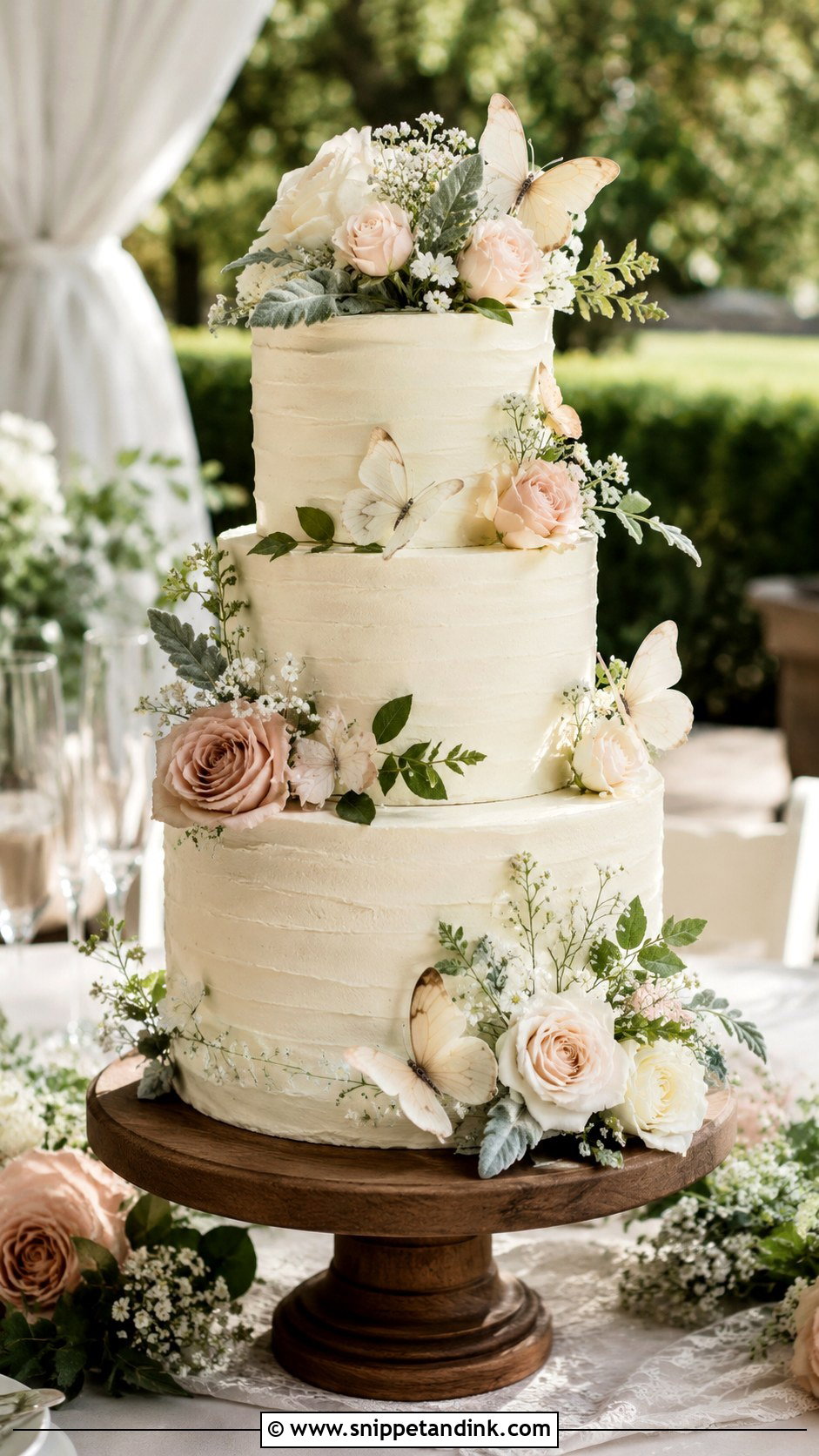
A garden cake layers flowers, greenery, vines and wings into something that looks gathered rather than designed. It suits estates, backyards and spring venues. Sage leaves, ivory flowers, blush roses and small butterflies balance well. The cake can be smooth, semi-naked or lightly textured. Semi-naked cakes dry out faster once exposed, so I’d only use that finish when the cake is assembled close to the reception. Don’t let the greenery take over, or the wings get buried. A wooden stand suits it.
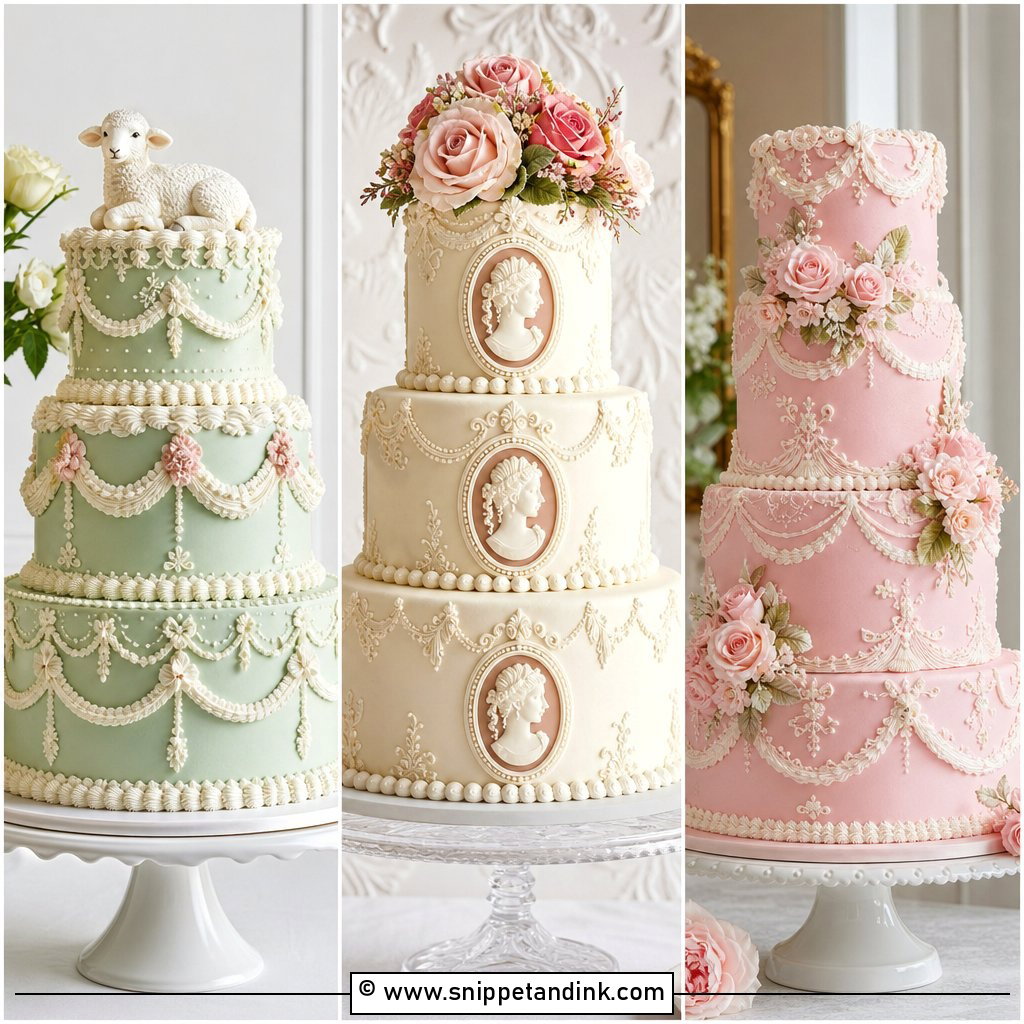
17. Butterfly Wedding Cake With Vintage Style
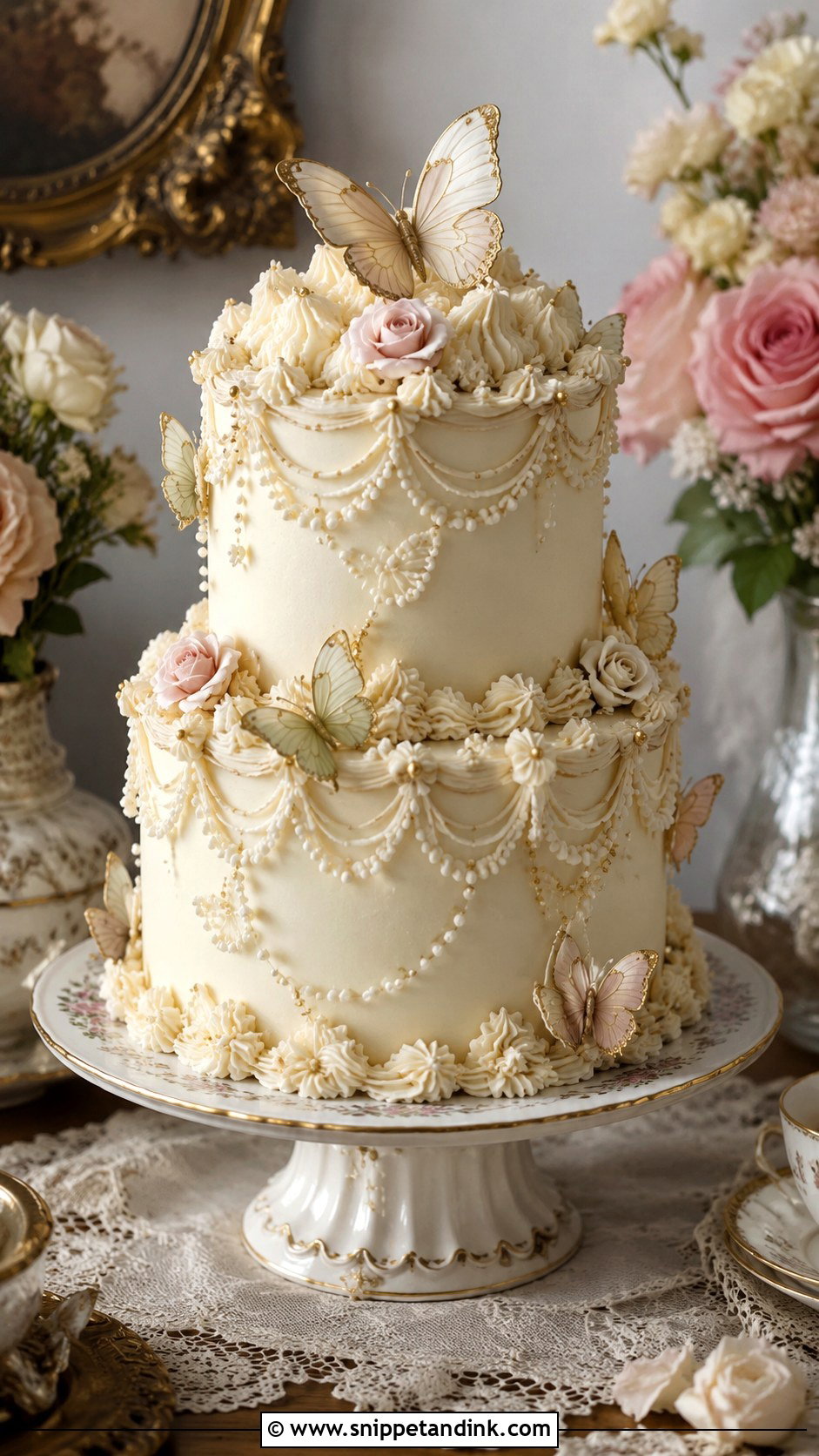
Vintage style usually means ivory icing, piped borders, lace, pearls and soft pastel wings. Lambeth piping, with its layered over-piped borders, can look wonderful if it’s kept restrained. Small sugar flowers, antique gold or a classic topper finish it off. Vintage details pile up fast, so I ask couples to pick two or three features and let them lead. It suits historic venues and tea gardens. Lambeth work is time-consuming, so it tends to cost more than a smooth cake of the same size.
18. Butterfly Wedding Cake With Minimalist Style
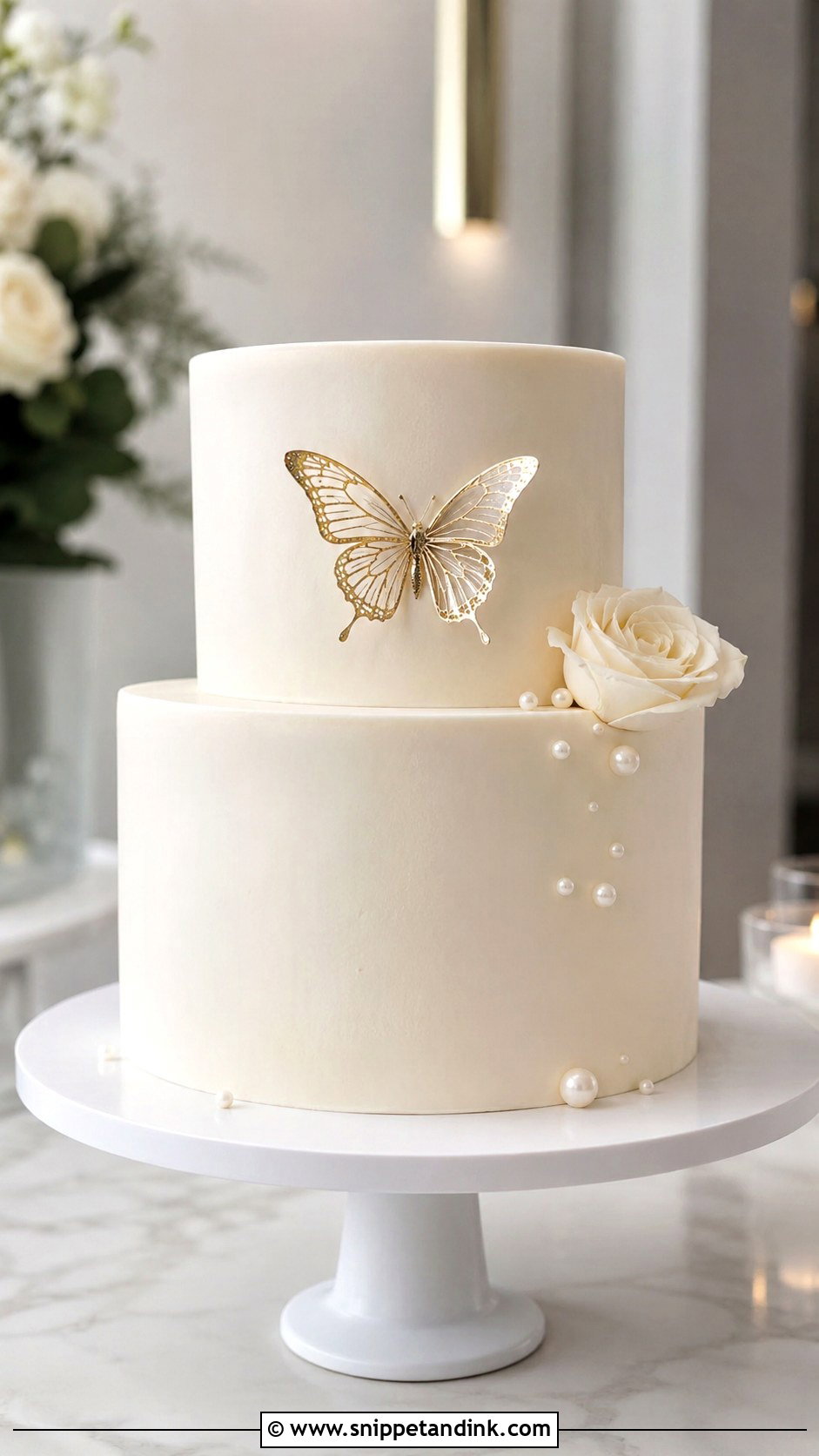
A minimalist butterfly cake rests on restraint: one or two wings placed well, and a lot of empty icing. Smooth white or ivory buttercream works best, perhaps with a single gold butterfly on top or a couple of small wafer wings beside one flower. Empty space is the design, so the finish has to be flawless, because there’s nothing to hide a dent or air bubble. A sleek stand and neutral table styling keep it calm. Modern venues and small weddings suit it.
19. Butterfly Wedding Cake With Pressed Flowers
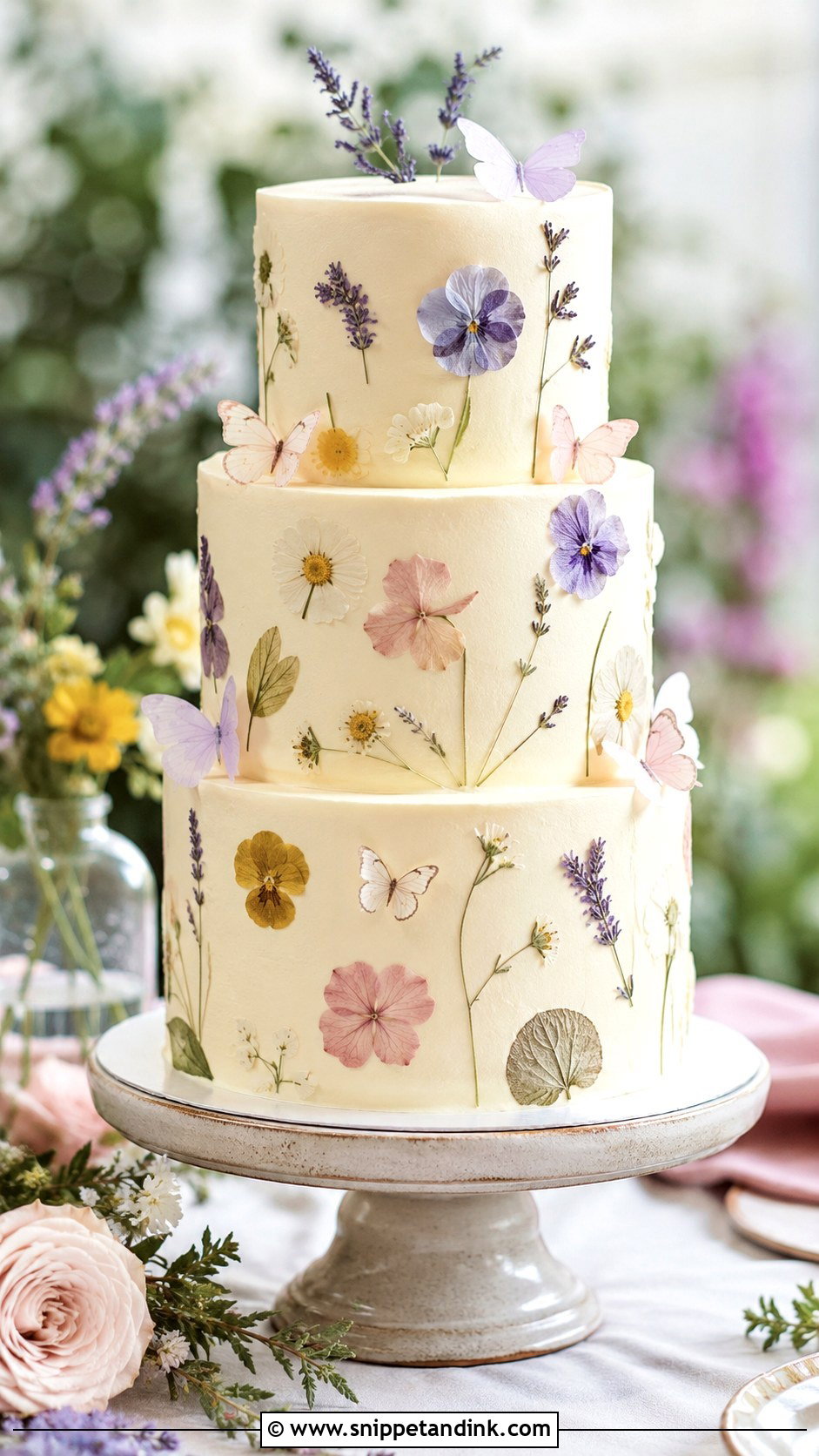
Pressed edible flowers laid flat against the icing give a meadow-like effect, with tiny butterflies tucked between them. Ivory, lavender, pale yellow, blush and sage work best. I press the flowers onto a smooth surface with a little piping gel, and they need to go on within a day or so of serving, as they can darken against moist buttercream. It’s a detailed, handmade look that suits smaller weddings, where guests get close enough to see each petal. Outdoor spring receptions are a natural fit.

20. Butterfly Wedding Cake With Butterfly Topper
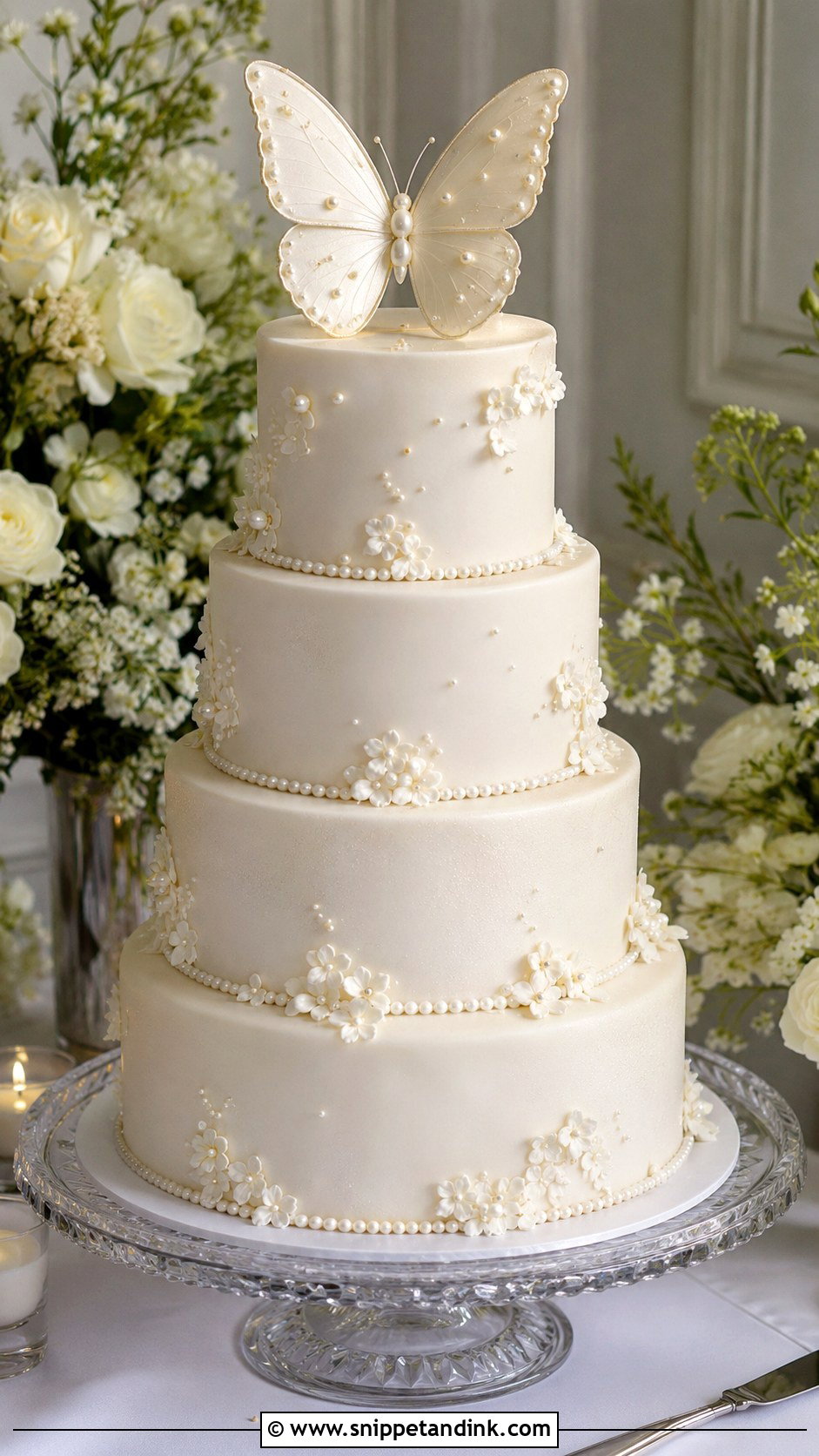
A butterfly topper is the lightest way to include the theme. It can be sugar, wafer paper, acrylic or edible paper. One oversized butterfly on a plain white cake looks modern; a gold or pearl one looks more formal. It also finishes a cake that already has flowers, ruffles or piping. If you go for a non-edible acrylic topper, it needs a food-safe barrier where it meets the cake. Sugar toppers can be dried and kept as a keepsake, which is something non-edible ones can’t offer in quite the same way.
How the Butterflies Travel and Get Fixed On
Butterflies almost never travel on a cake. The tiers go in the van stacked and chilled, and the wings go in a separate box with tissue under each one. Everything delicate goes on at the venue, after the cake is on its table.
At the venue
- The cake goes on its final table first, away from windows, heaters and the dance floor.
- Wired butterflies go into food-safe posy picks so no wire touches the sponge.
- Flat or wafer wings are fixed with a dot of melted chocolate or royal icing, which sets in a minute and doesn’t soak the paper.
- Fresh flowers come last, prepared and wrapped by whoever is supplying them.
Give your baker the venue’s setup time and contact person. A cake designer who arrives to find the room locked loses the time she needed for the delicate work.
Cutting and keeping
Wired and non-edible pieces come off before the cake is cut, so tell your caterer or venue they are there. A gum paste butterfly from the top tier can be kept as a keepsake if it stays somewhere dry, in a box away from sunlight; damp is what ruins it.
A Cake That Looks Like Something Just Landed on It
Butterflies can fit almost any style of wedding once the colors, textures and materials suit the setting. One topper on a white cake feels modern; a floral cascade with sugar wings feels lush. Ivory icing with fine butterflies stays classic; gold, ombre, watercolor and garden designs are more eye-catching. Match the cake to your venue, the time of year and your flowers. Talk to your baker early about which wing material will survive your room, and the rest of the design will follow from that.
You'll Like These Ideas:




Leave a Reply