
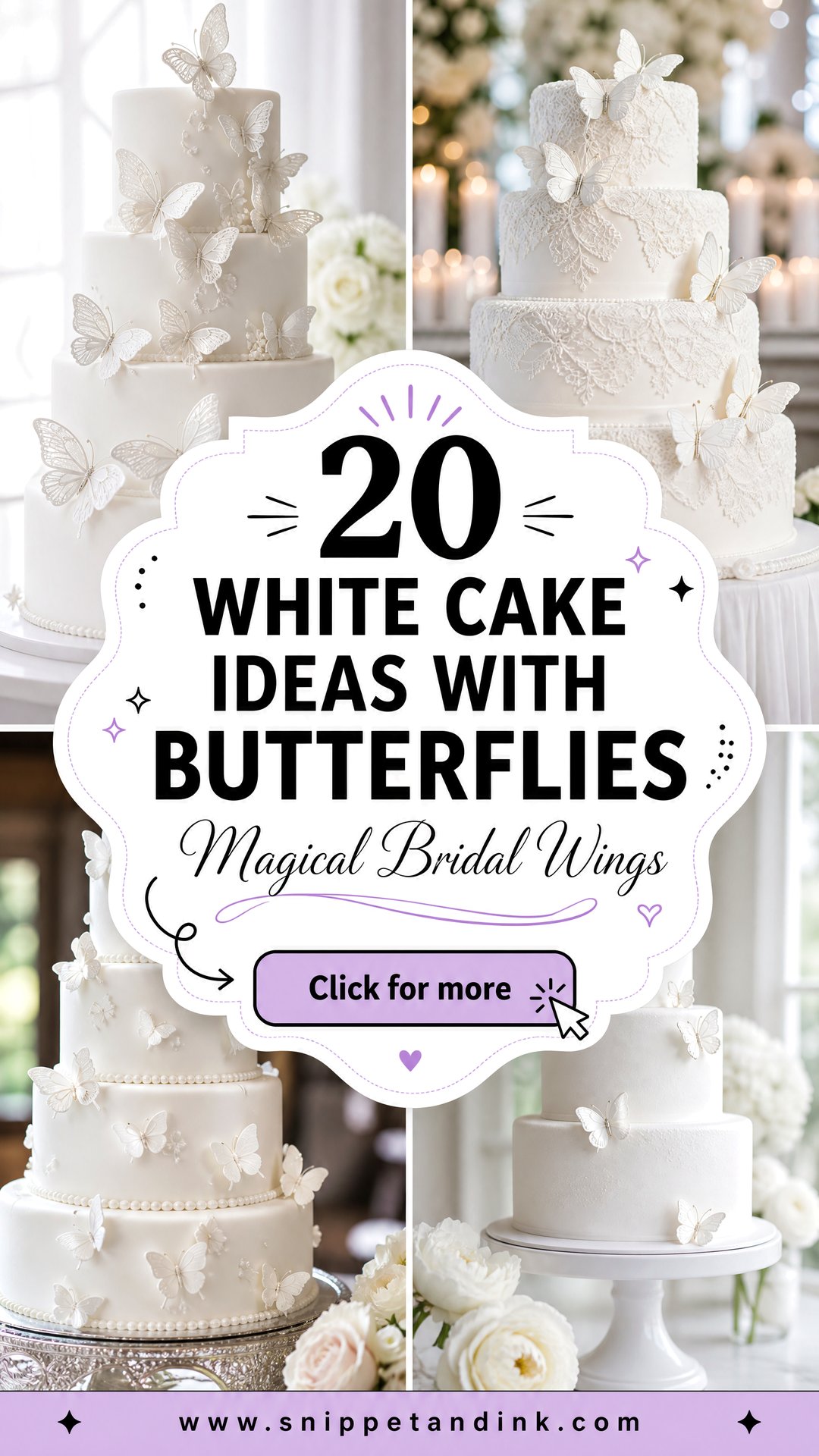
Butterflies are one of the few cake decorations that suggest movement on something that has to sit perfectly still for hours. White wedding cakes with butterflies get their life from the wings, while the white keeps them bridal, which is why they suit garden parties and ballrooms alike. What you make them from changes everything: wafer paper is airy and translucent, sugar paste is crisp and holds detail, and a few edible pearls can turn either into something formal. The best designs look as though each butterfly chose its own spot. Here are twenty ways to do it, and what I watch for in each.
Wafer Paper, Sugar Paste or Chocolate: Wings That Suit Your Venue
Every butterfly on a cake is made from something, and each material behaves differently once it meets frosting, air and heat. This is the first conversation I have with couples who want butterflies, before we talk about placement or color.
Wafer paper
Thin, translucent and almost weightless, so it looks the most like a real wing. It’s also the most sensitive to moisture. Humid rooms make it droop, and direct contact with buttercream softens it. I use it on fondant, or on buttercream with a small barrier underneath, and I keep it boxed with a desiccant pack until set-up.
Sugar paste or gum paste
Rolled thin and dried over a folded card so the wings set at an angle. It holds sharp edges and painted detail well and copes better with humidity, but it’s brittle once dry and snaps if knocked. These can be made weeks ahead, which helps with a busy wedding season.
Chocolate or candy melts
Piped onto acetate and set in a fold, these are sturdy and taste good, but white chocolate softens in a warm room and can mark if handled. Fine for a cool indoor reception, risky in a marquee in July.
Printed or acetate butterflies sold as cake decorations are often not edible at all. They’re fine on a topper or a wired pick, but if you’d rather every piece on the cake be food, say so when you order.
1. White Butterfly Wedding Cake With Sugar Flowers
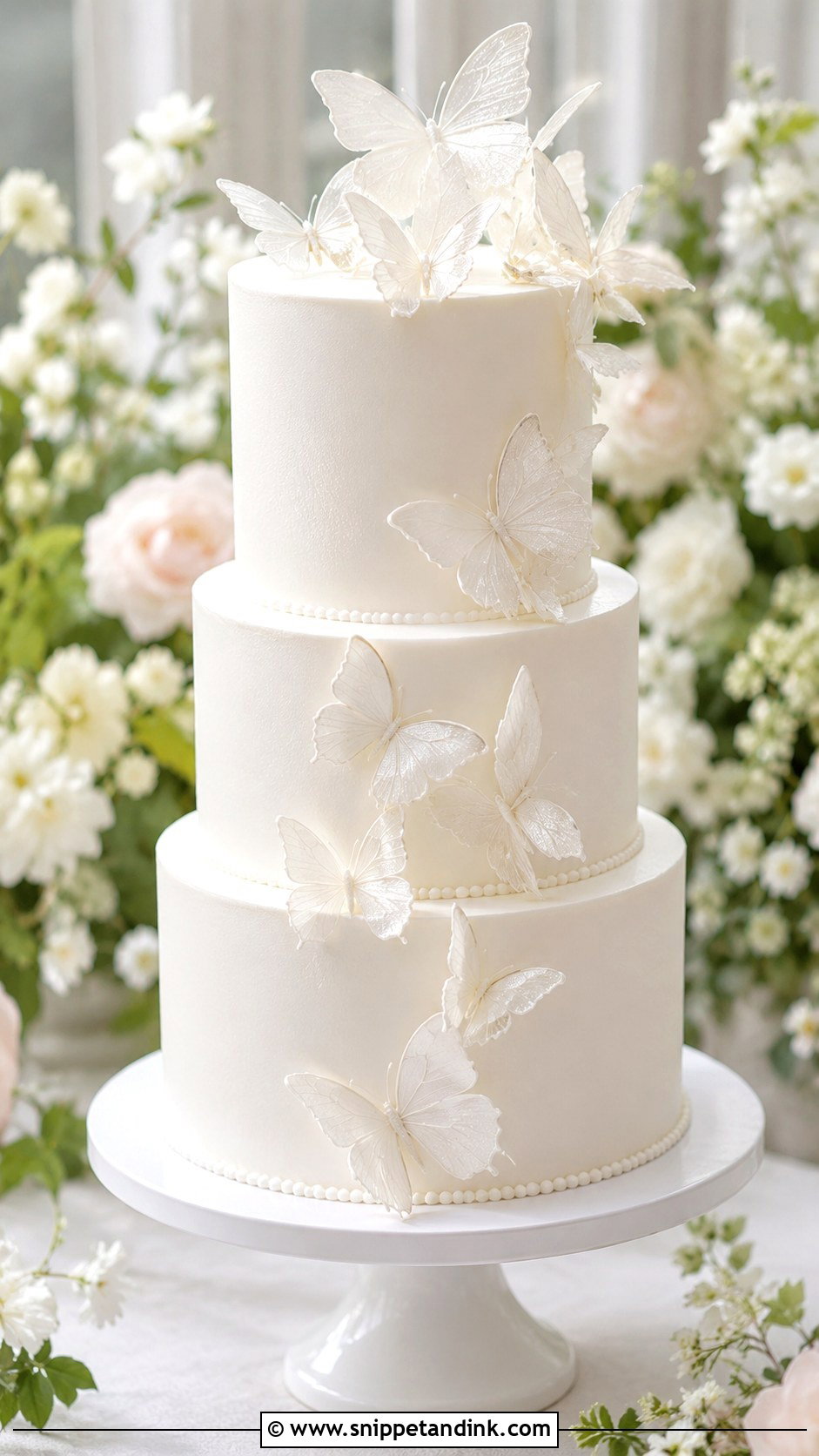
Sugar flowers and butterflies are a natural pair, and on two or three smooth white tiers they make the classic version of this theme. I’d group sugar roses, peonies or hydrangea down one side and let small white butterflies sit at the edges of the cluster, never in the middle of it where they’d disappear. Keep every flower white, ivory or very pale cream so the butterflies read as part of the arrangement. A pearl center on a few blooms or a faint shimmer on the wings is plenty of polish.
2. White Butterfly Wedding Cake With Pearl Details
Pearls add weight, butterflies add lightness, and the balance between them sets the tone. For a clean look, I run tiny edible pearls around the base of each tier and set white wafer paper butterflies in a soft diagonal trail. For something more formal, pearl clusters can sit at the butterfly bodies or form a border on every tier. Spacing is the whole skill. I lay the pearls out on the board before they go on the cake, since once they’re pressed into frosting, moving one leaves a mark.
3. White Butterfly Wedding Cake With Wafer Paper Butterflies
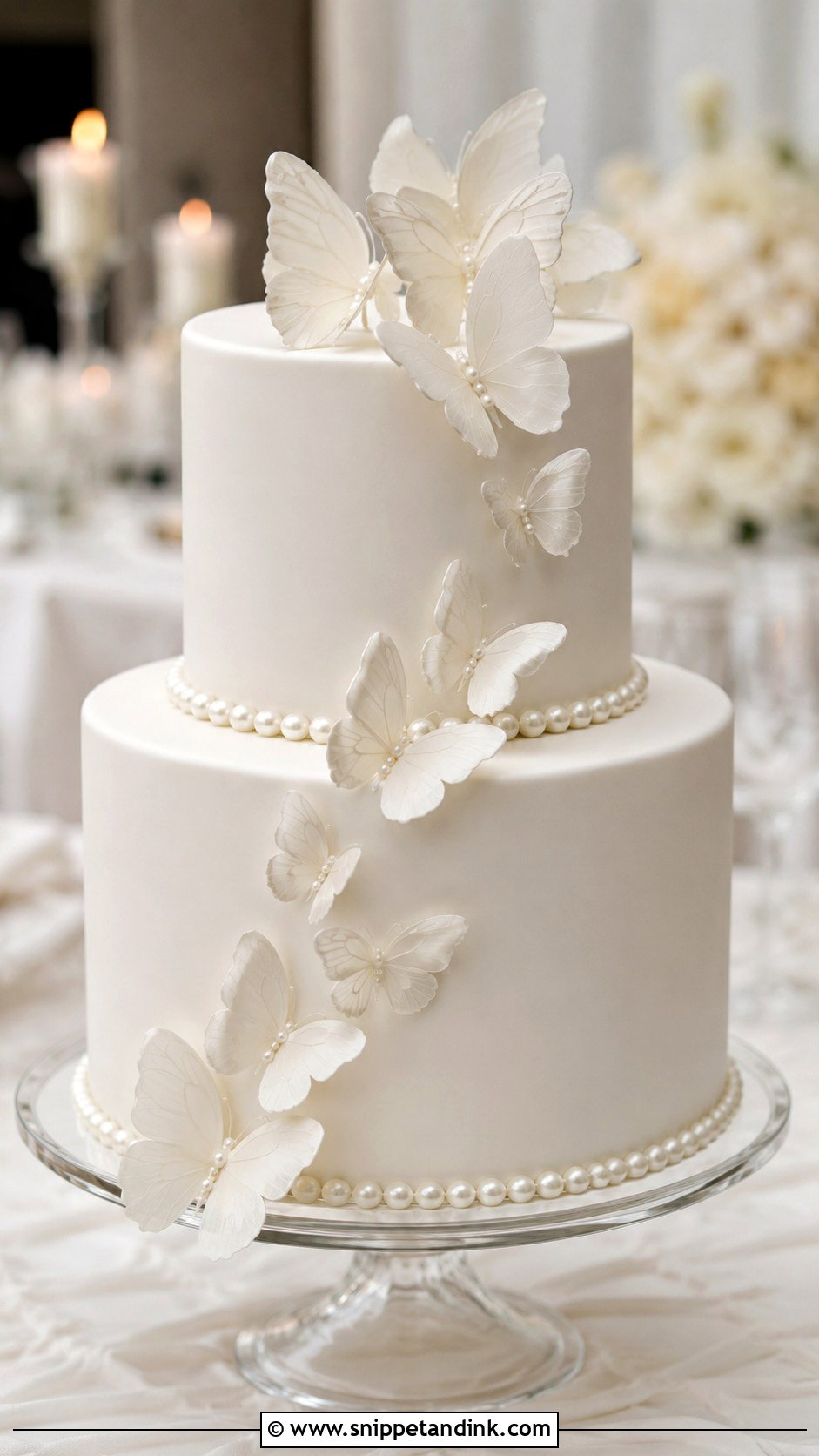
Wafer paper gives you the lightest butterflies possible; I cut them, fold the wings along the body, and dry them propped in a V so they look as if they’re resting with wings half open. They need a dry surface, though. Pressed straight onto soft buttercream, wafer paper absorbs moisture and goes limp or curls within hours, so I attach each one with a small dab of royal icing or set it on a tiny disc of fondant. All-white looks modern; a dusting of pearl shimmer adds dimension. Spring and summer suit it, as long as the room isn’t humid.
4. White Butterfly Wedding Cake With Buttercream Texture
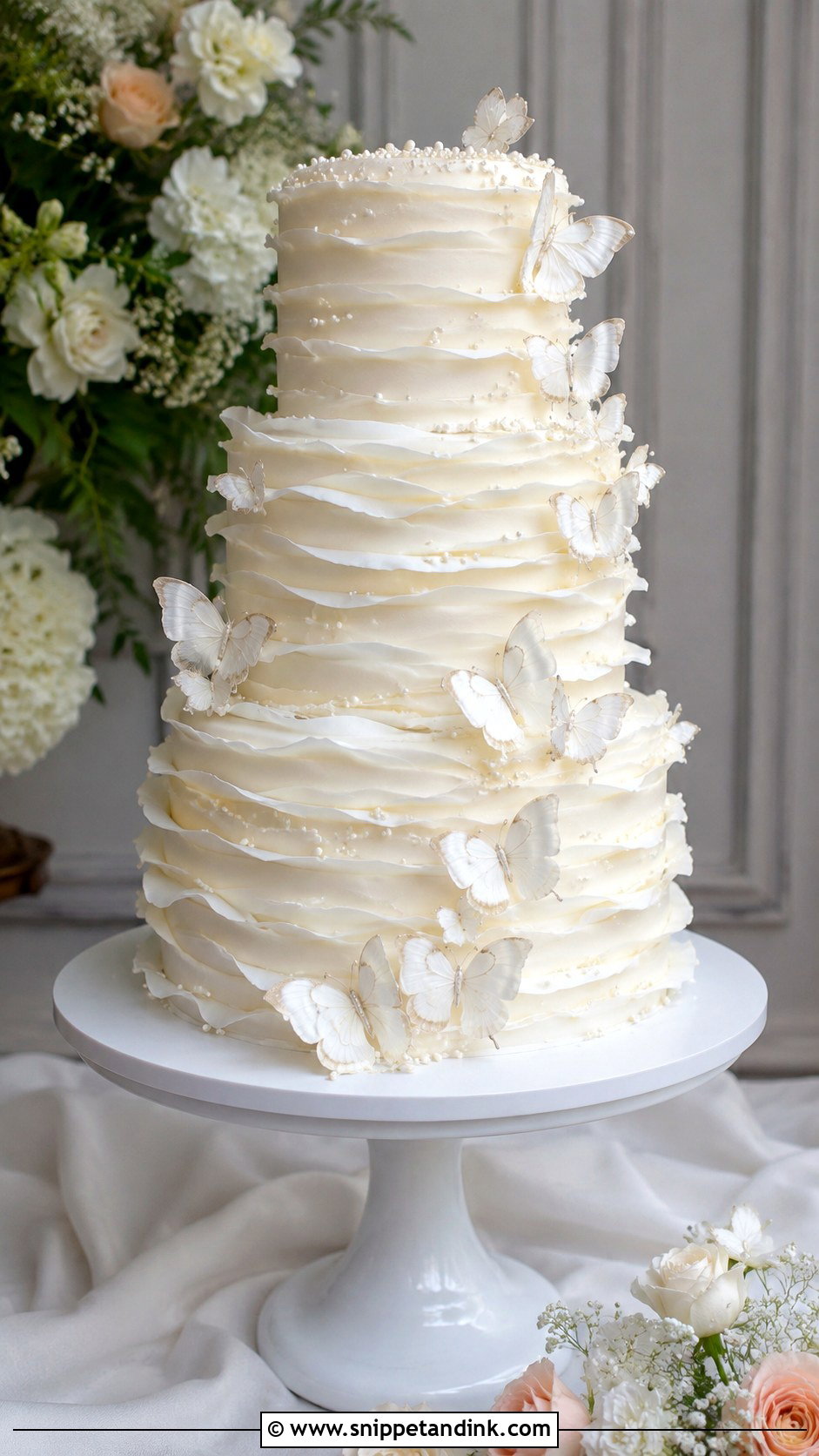
Texture gives a white-on-white cake depth without adding color. Gentle horizontal combed lines, palette knife swirls or a soft stucco finish all catch shadow, which is what makes white frosting show up on camera. I place butterflies along the ridges so they look like they’ve settled into the grooves. Mix a few larger butterflies with several small ones; uniform sizes against a textured surface look like a pattern rather than something living. This one suits couples who want the cake to feel handmade.
5. White Butterfly Wedding Cake With Fondant Finish
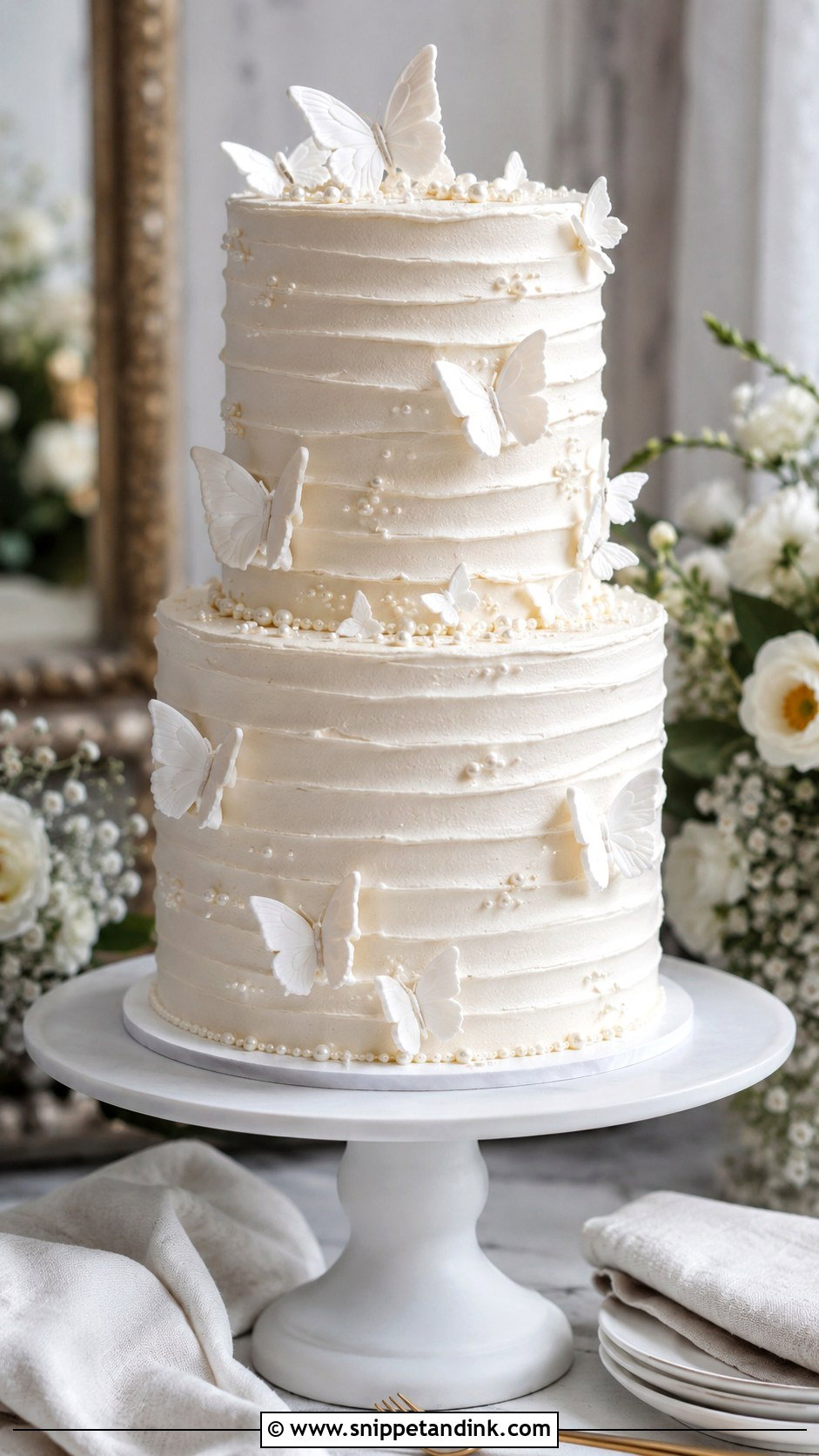
Fondant gives the cleanest canvas for butterflies, with sharp edges that make the butterfly details look crisp. It also solves the moisture issue, since wafer paper and sugar butterflies stay dry on fondant far longer than on buttercream. A neat cascade down one side or a light scattering both suit formal rooms. A thin pearl trim or an embossed pattern adds detail, but I’d stop there. On a polished fondant cake, five well-placed butterflies say more than twenty.
6. White Butterfly Wedding Cake With Gold Accents
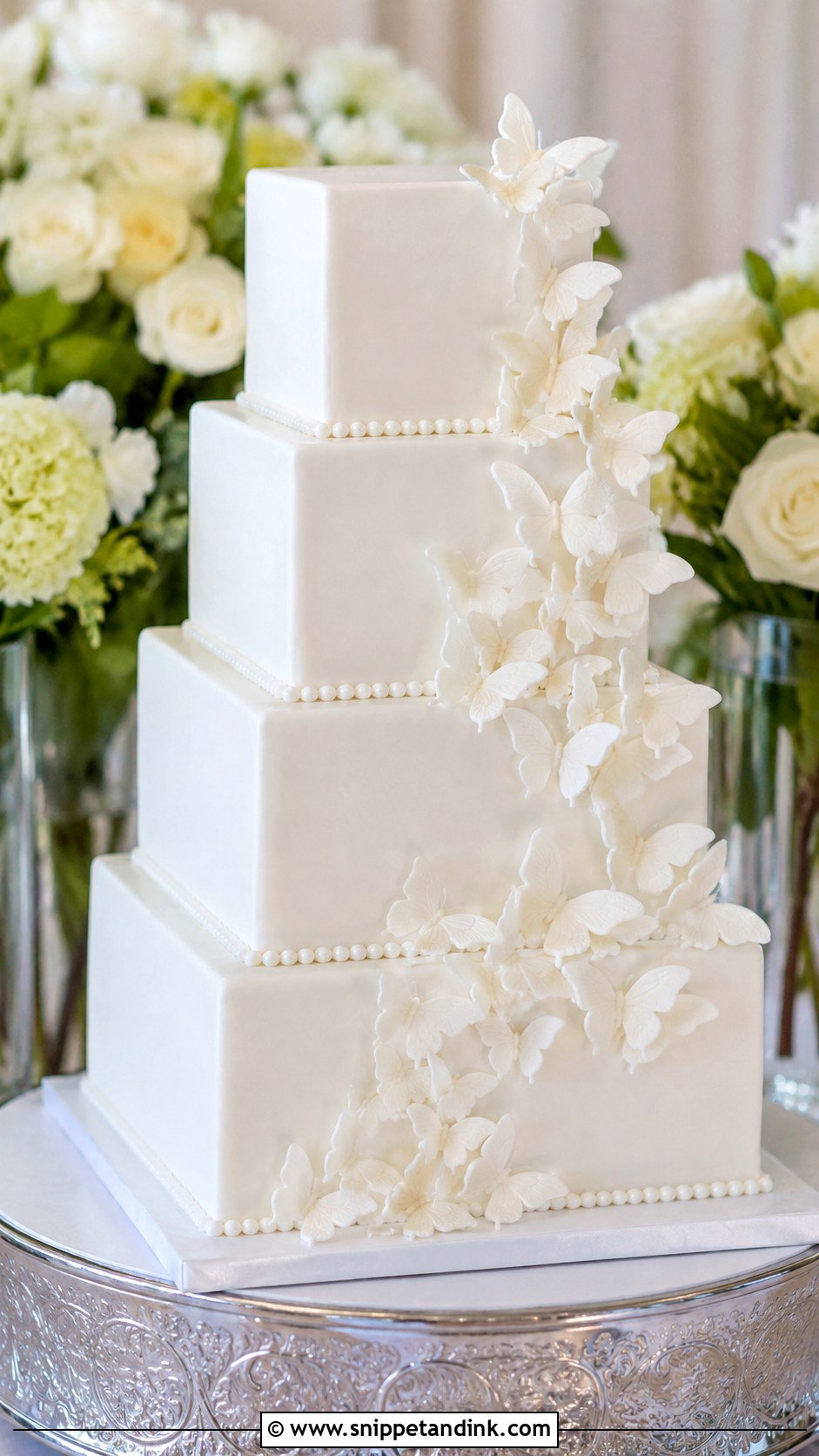
Gold should be a highlight on this cake, never the base. I keep it to a thin painted edge on a tier, a few flakes of leaf or a line traced along the wing edges, and I paint the wings before they go on the cake, because steadying a fragile butterfly while painting it in place is how wings snap. Evening receptions and warm lighting suit the shine. A diagonal trail of white butterflies with only a few gold-edged ones reads as deliberate and expensive.
7. White Butterfly Wedding Cake With Fresh Flowers
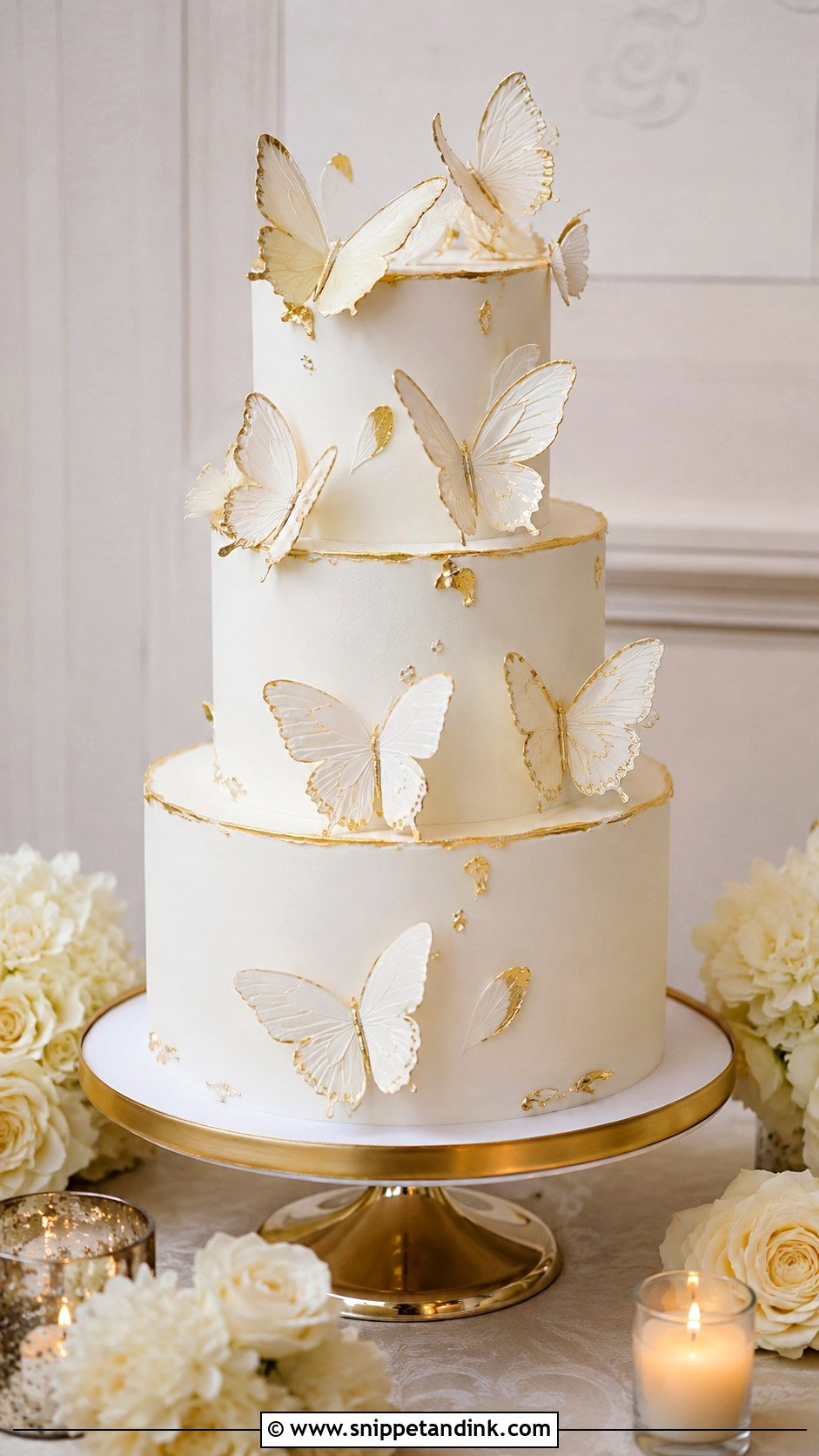
Fresh flowers bring a natural garden feel. White roses, orchids, ranunculus and baby’s breath can frame the tiers while butterflies sit near them as if they’ve just landed. I group the flowers in two or three clusters rather than dotting them everywhere. Every stem should be wrapped or set in a food-safe pick, and the flower choice agreed with both your baker and your florist, since some popular blooms aren’t safe near food. The butterflies go on last, after the flowers are in place.
8. White Butterfly Wedding Cake With Lace Piping
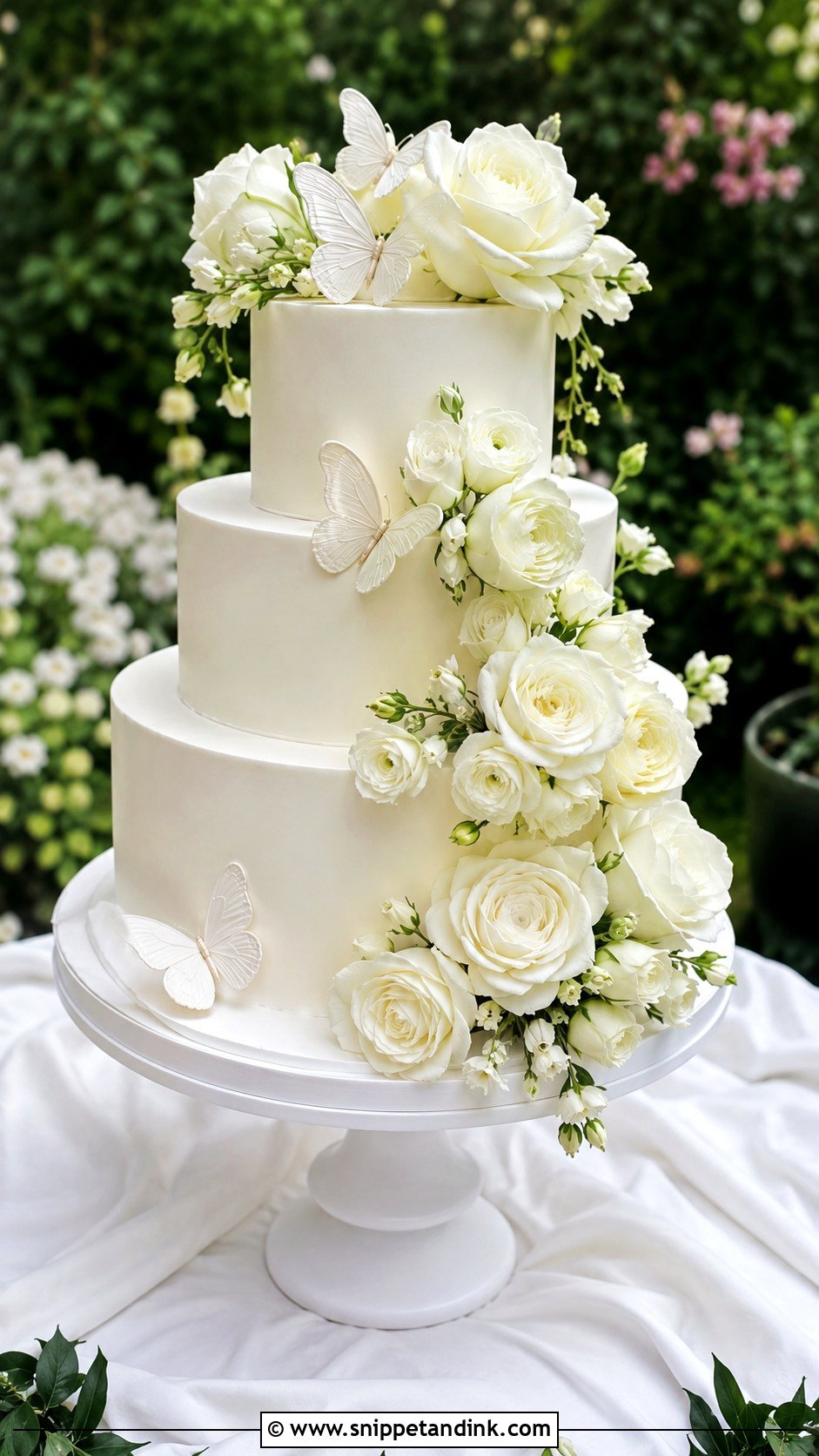
Piped lace, scrolls, small floral patterns and lace borders give a white cake a vintage, chapel-wedding feel. The butterflies stop the lace looking too stiff. I pipe in white or ivory royal icing for crisp lines on fondant, or buttercream for a softer effect. Sugar butterflies set along the lace pattern can look like part of it. If your gown has lace, a photo of the motif lets me echo it in the piping.
9. White Butterfly Wedding Cake With Ruffle Tiers
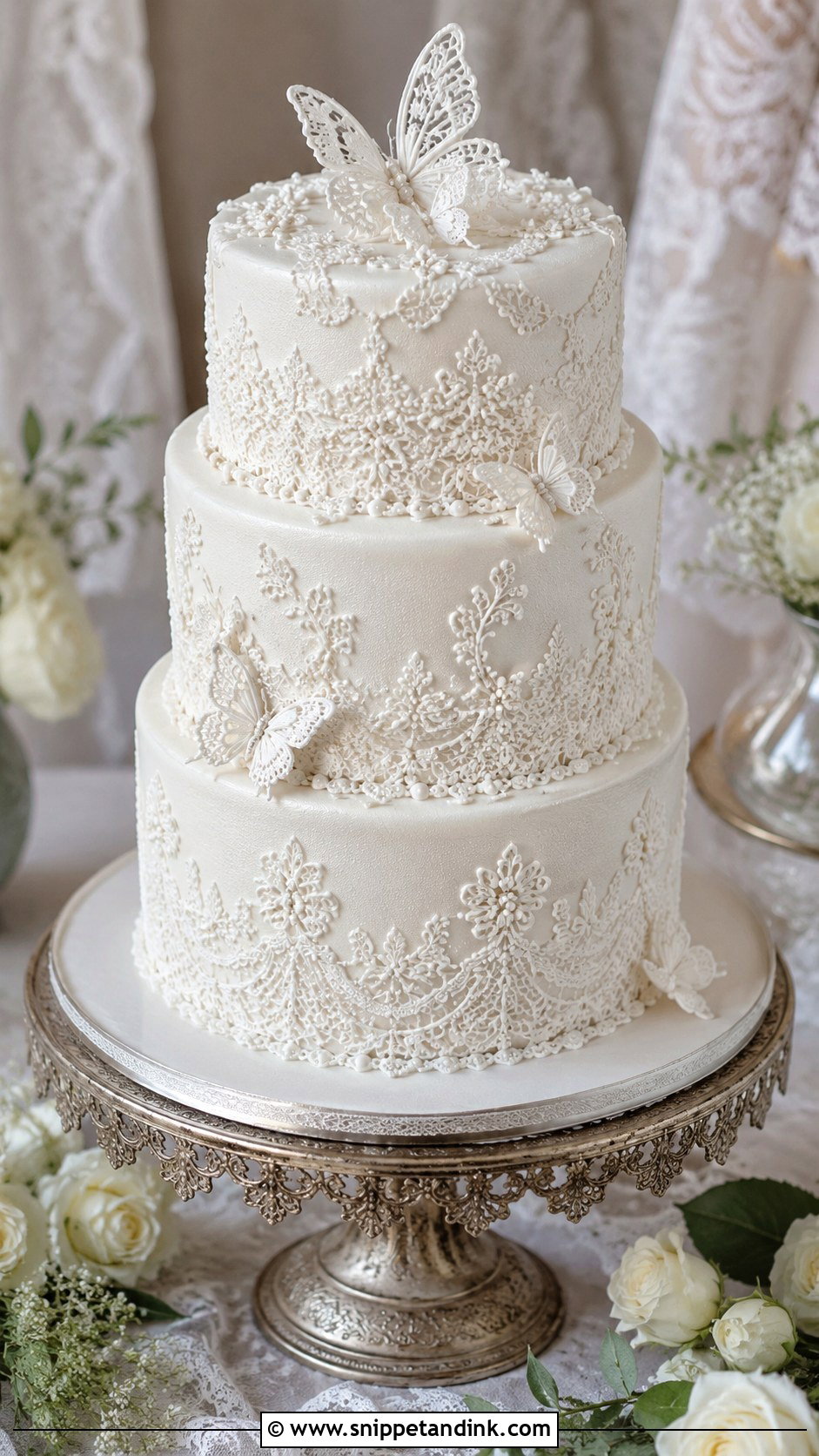
Ruffled tiers look like layers of a skirt, especially when the frosting is piped in thin waves. Butterflies can sit on a smooth top tier, tuck into the folds or climb in a gentle upward trail. Thick ruffles swallow small butterflies, so I’d keep the ruffles fine and the butterflies a size up from what you’d use on a smooth tier. Buttercream ruffles are soft and fragile, which is another reason to place butterflies on firm points rather than pressing into the folds.
10. White Butterfly Wedding Cake With Cascading Butterflies
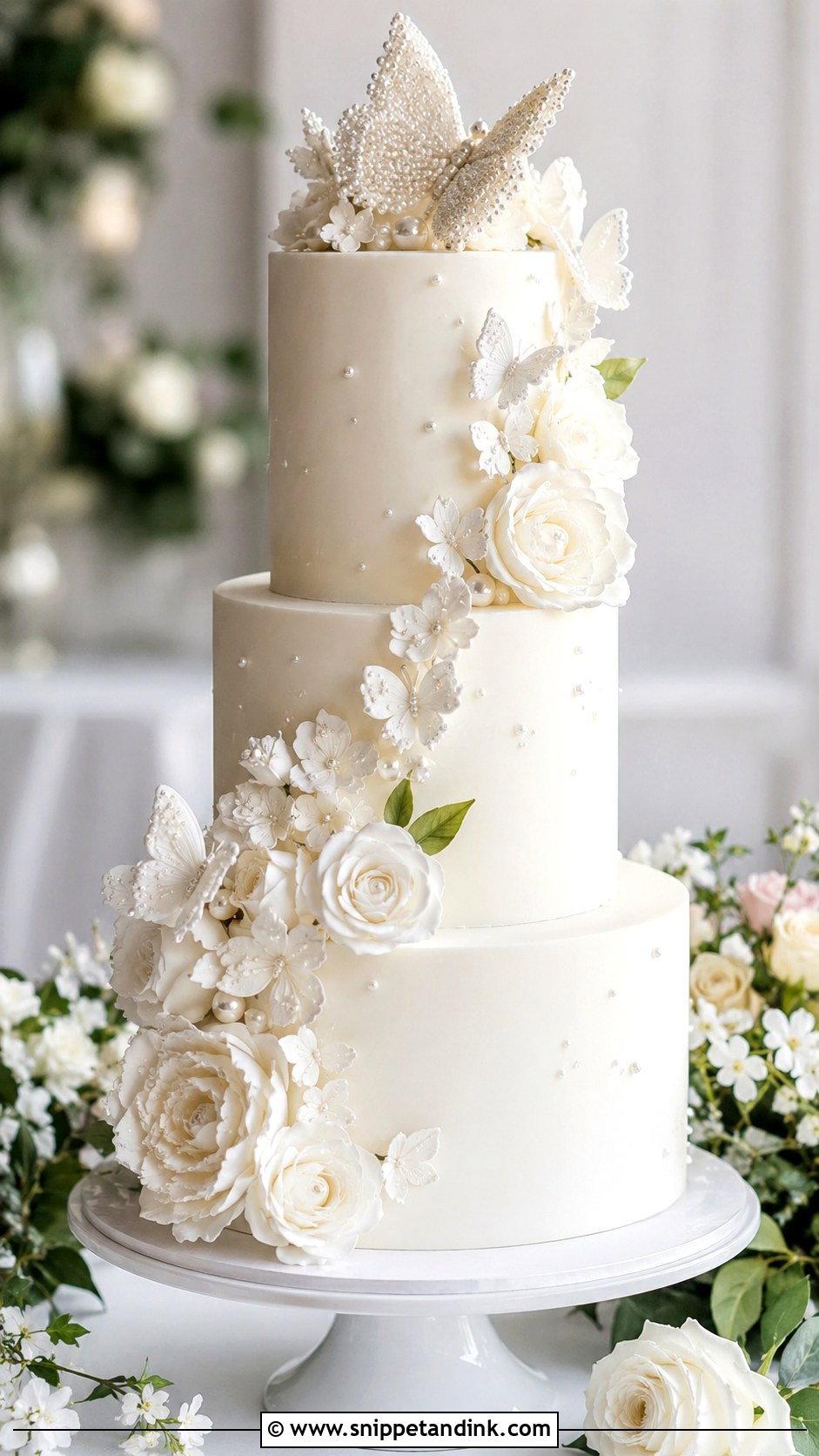
When the butterflies are the main feature, a cascading butterfly cake lets them flow from the top tier to the bottom in a diagonal line. Graduate the sizes: larger butterflies near the top and at the focal points, tiny ones filling the gaps toward the edges. I usually make a third more butterflies than I need, because some always break in transit and others turn out not to fit the line. It works on buttercream, fondant or a light texture. Leave the rest of the cake plain.
11. White Butterfly Wedding Cake With Monogram Topper
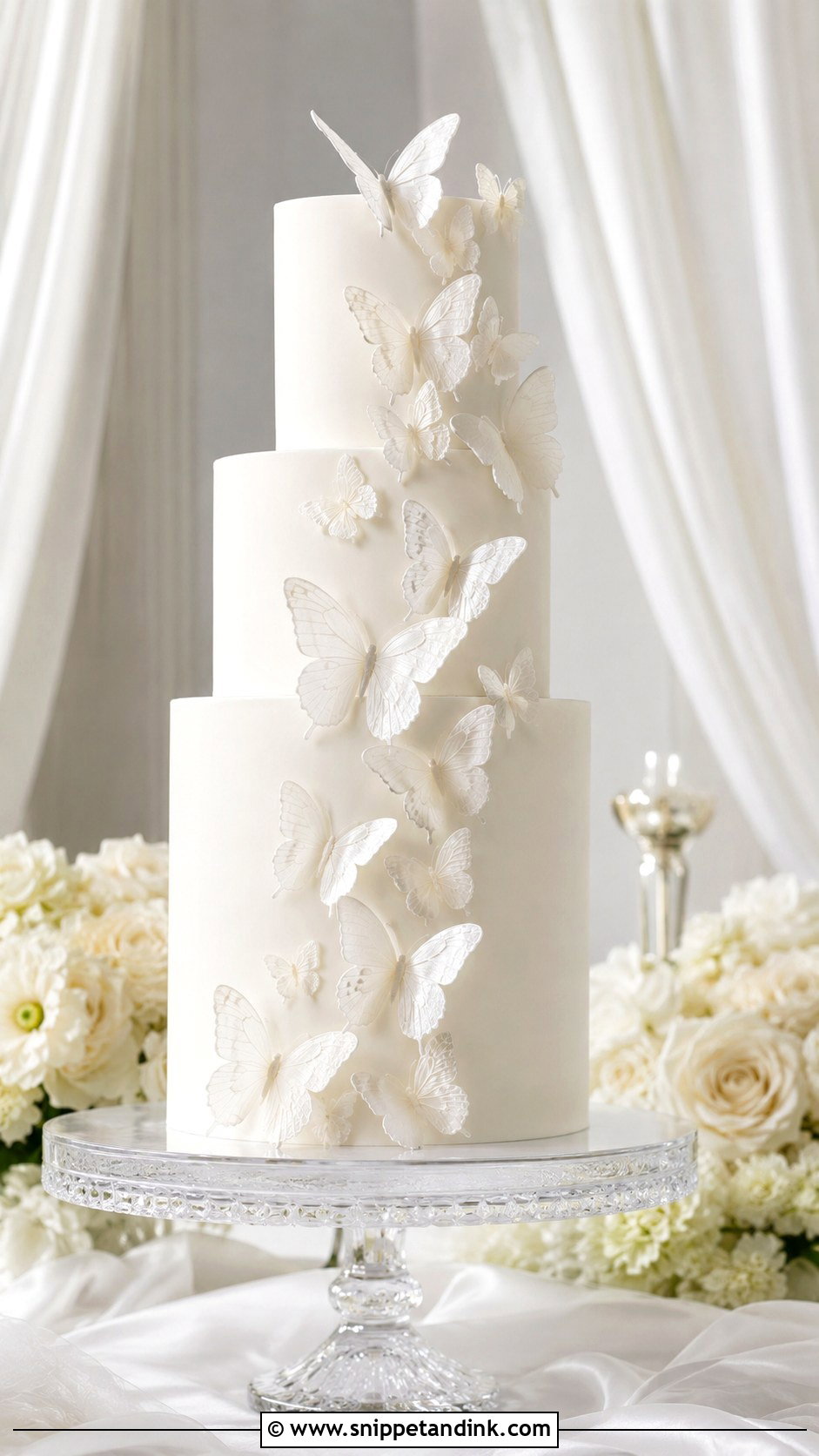
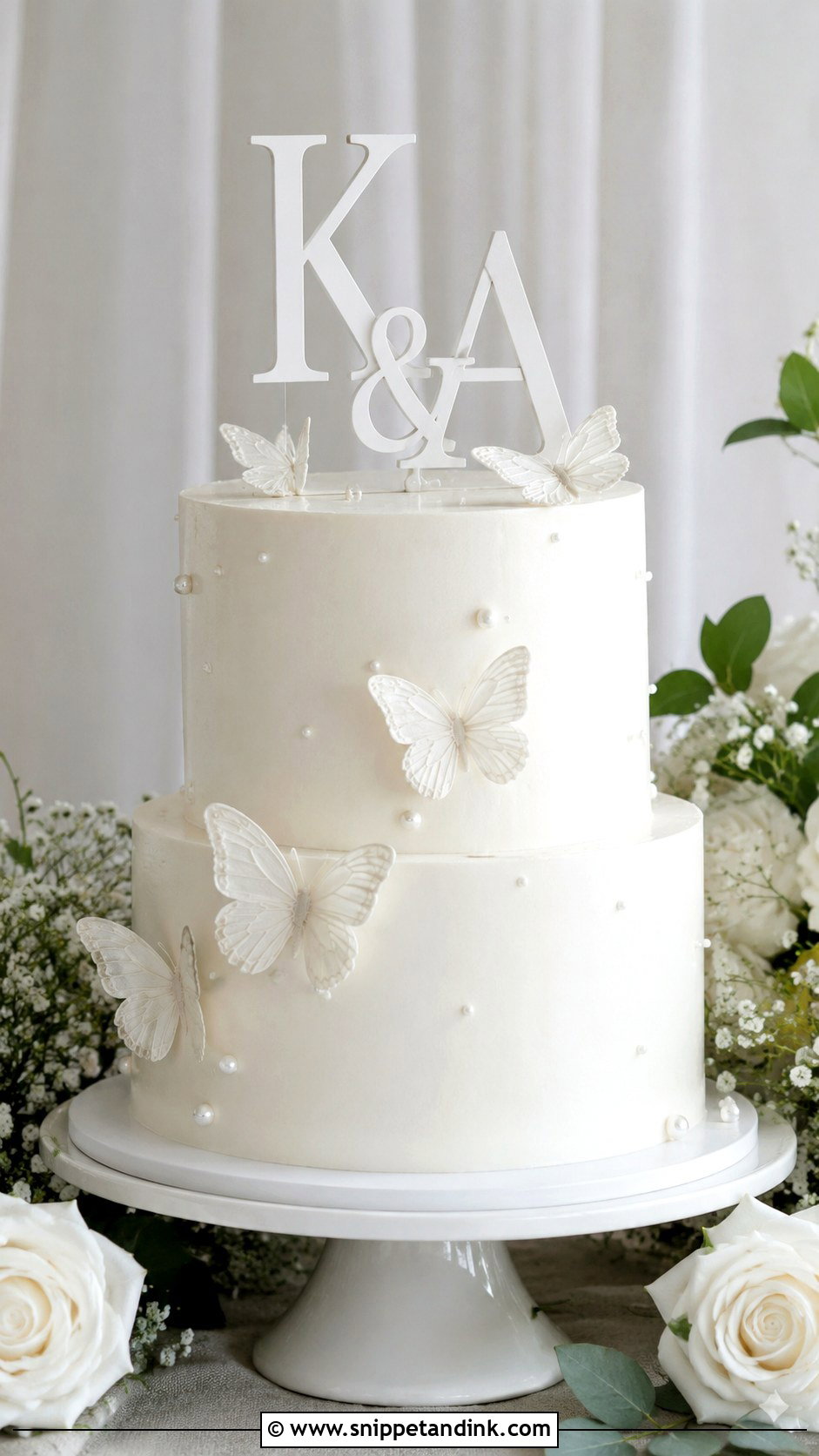
A monogram topper makes a butterfly cake personal. Acrylic, sugar or a metal-look topper all work if the design stays simple and doesn’t fight the butterflies for attention. I set the monogram on the top tier first, then arrange the butterflies around it or trailing from it down one side. Acrylic toppers have long spikes, so make sure your baker knows the tier height and can support it. Pearl borders or smooth fondant keep it polished.
12. White Butterfly Wedding Cake With Orchid Flowers
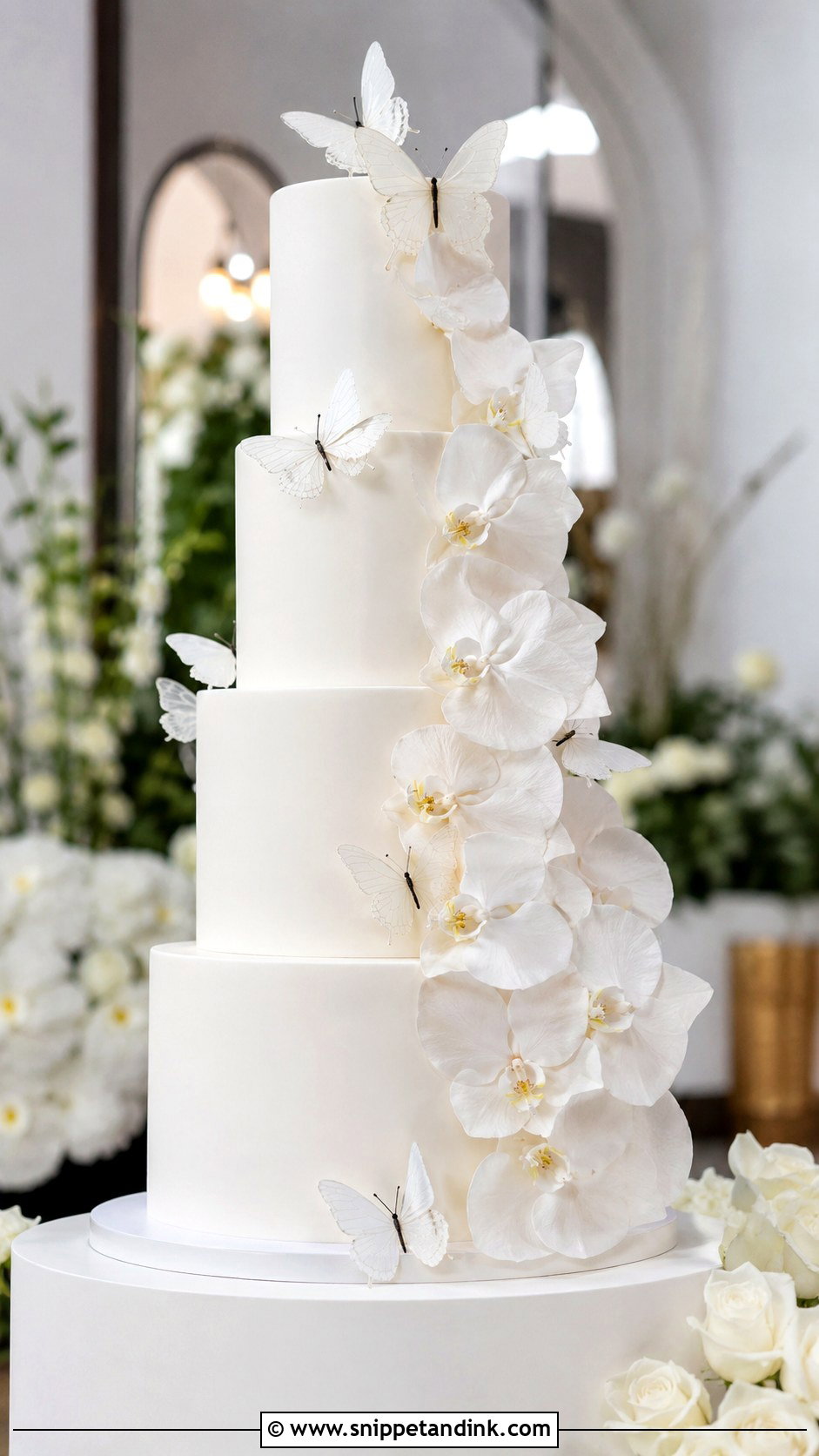
Phalaenopsis orchids have a flat, clean shape that sits well beside butterflies, and in white they look modern. I lay them along one side of the tiers and add small wafer paper butterflies near the petals. Real orchids are delicate and bruise easily, so sugar orchids are the safer choice for a long reception or a hot venue. Smooth fondant or very sleek buttercream keeps the look sharp. Tiny pearls or a soft shimmer on the wings add detail. It suits upscale and tropical garden venues.
13. White Butterfly Wedding Cake With Baby’s Breath
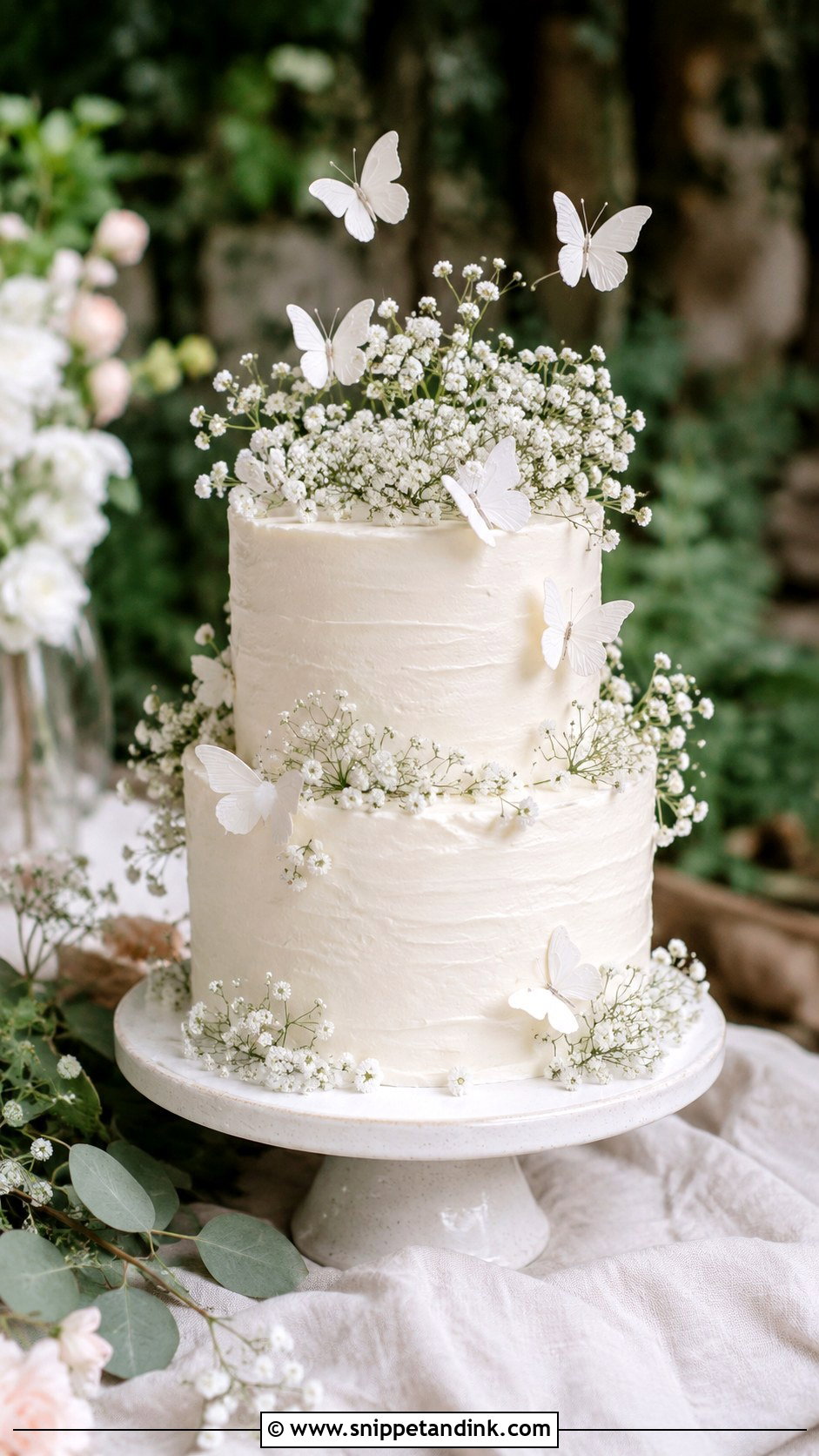
Baby’s breath gives a soft, cloud-like look, but I’d treat it carefully: gypsophila is generally considered mildly toxic, so it should never be pushed into cake and is best used on the board or wrapped and kept clear of the frosting. Sugar baby’s breath avoids the issue entirely. Small clusters at the base or between tiers with butterflies floating above suit rustic gardens and outdoor receptions. A lightly textured buttercream finish matches the relaxed feel. Keep the butterflies small and thin to match the flowers’ scale.
14. White Butterfly Wedding Cake With Silver Accents
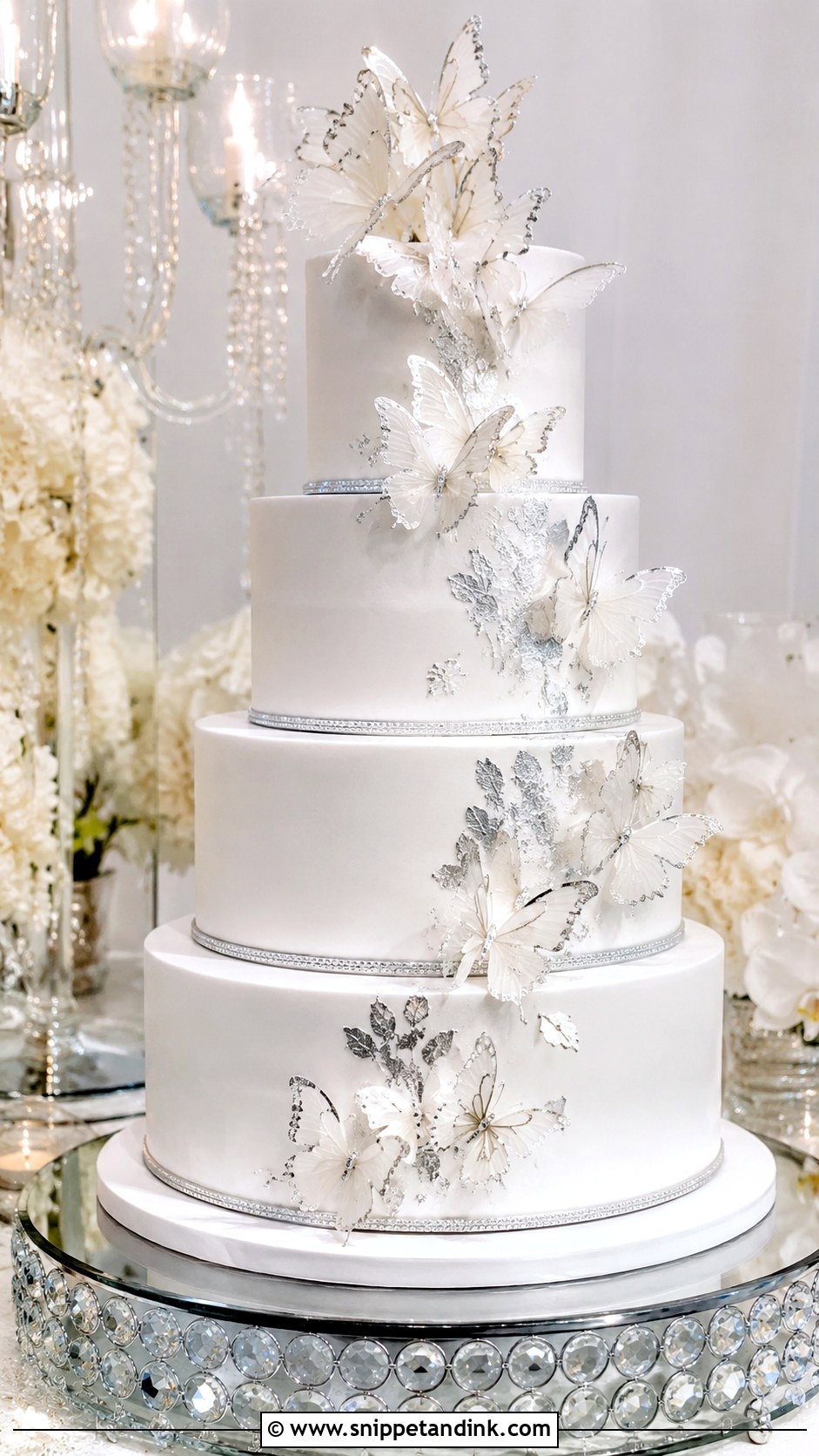
Silver gives the cake a cool glow that sits well with mirrored decor and crystal details. I’d use silver leaf sparingly, a thin silver ribbon at each tier base, or a soft silver shimmer on the wings, keeping the cake reading white first. Smooth fondant gives the cleanest look. A few raised butterflies with silver-edged wings look delicate. If you use ribbon, ask for it to be lined so frosting fat doesn’t stain it.



15. White Butterfly Wedding Cake With Round Tiers
Round tiers make butterfly placement easy because the curve lets the wings wrap naturally around each layer. They can be small and sweet or tall and dramatic. Smooth buttercream reads soft; fondant gives sharper edges. Butterflies can spiral loosely up the cake, cascade down one side or gather in a few clusters. For couples who want a traditional shape with a whimsical detail, this is the obvious starting point.
16. White Butterfly Wedding Cake With Square Tiers
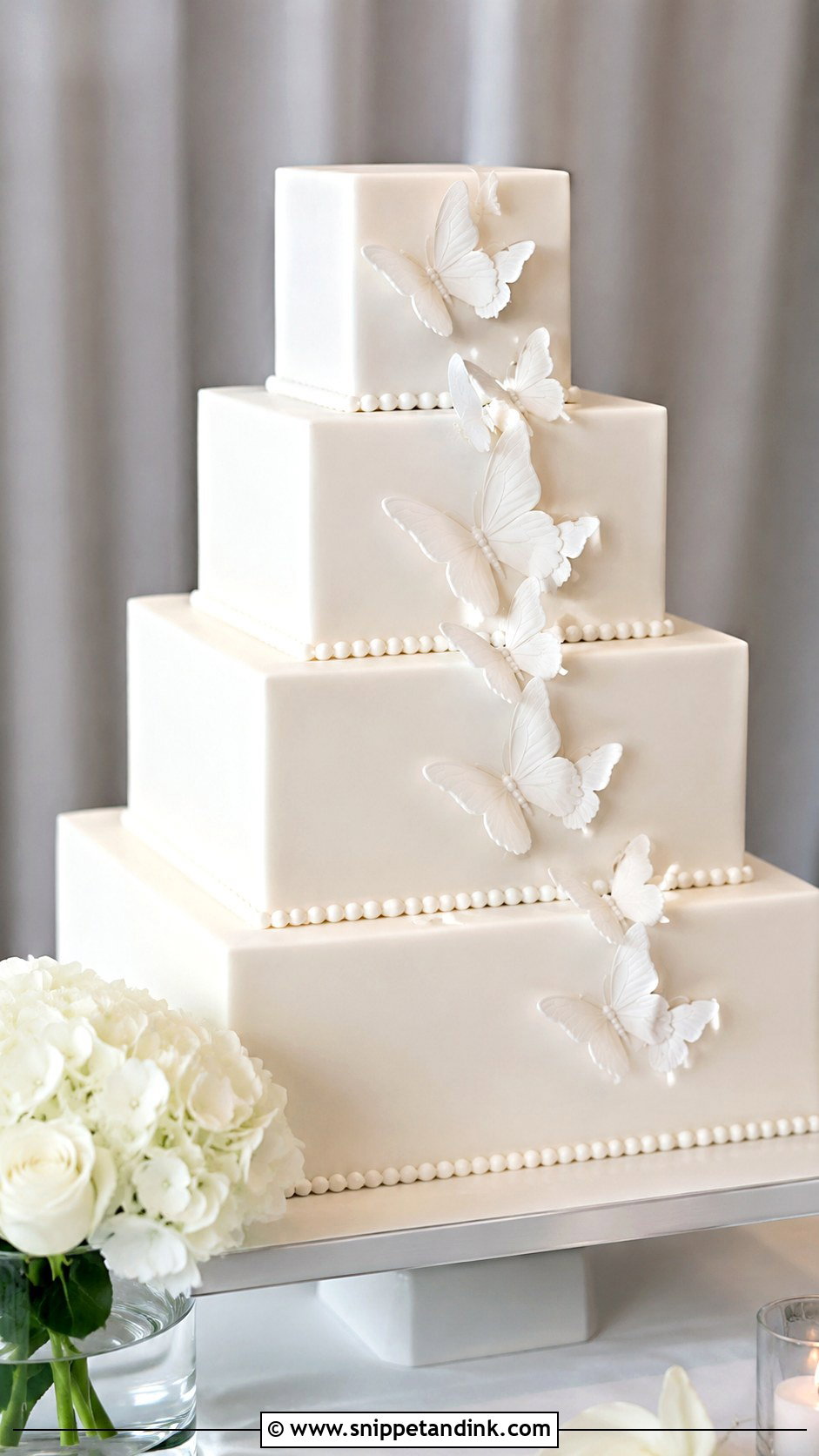
Square tiers feel architectural, and butterflies are a good counterpoint to all those straight lines. The shape depends on crisp corners, so fondant or a very firm buttercream is a must. I’d place butterflies at the corners, along one front edge, or in a diagonal path that crosses the edges, which breaks up the boxiness. A thin pearl trim or simple white piping adds detail. Structured shape plus fragile wings makes the contrast.
17. White Butterfly Wedding Cake With Tall Tiers
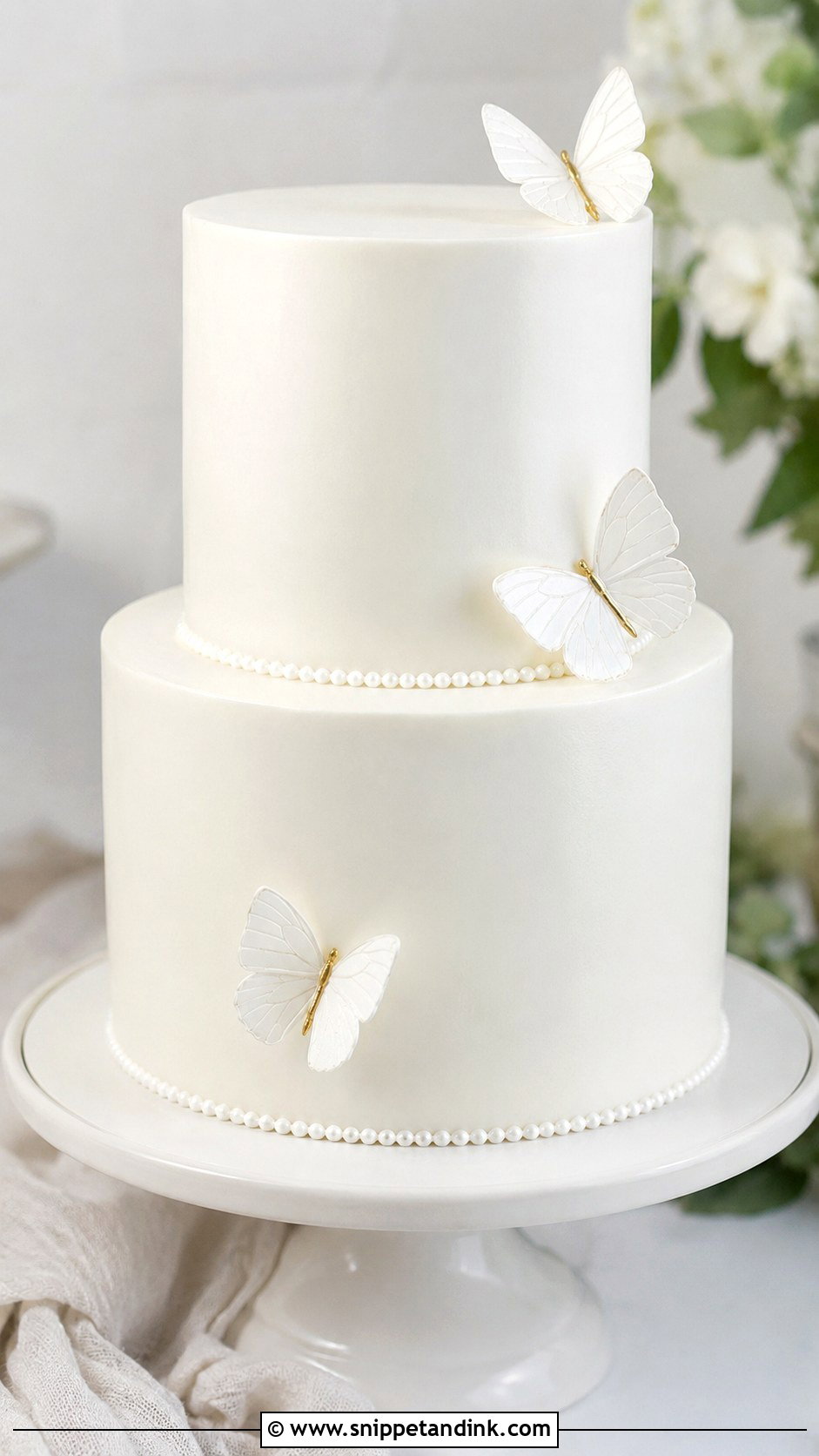
Extra-tall tiers give you a grand cake without many layers, and the height gives butterflies room to travel. A vertical trail, a cluster near the top or a wrap around one side all work. Smooth buttercream or fondant keeps the tall sides clean. Tall tiers need more internal support and are often stacked at the venue, so I add the butterflies once the cake is assembled on site rather than risking them in transport.
18. White Butterfly Wedding Cake With Floral Cascade
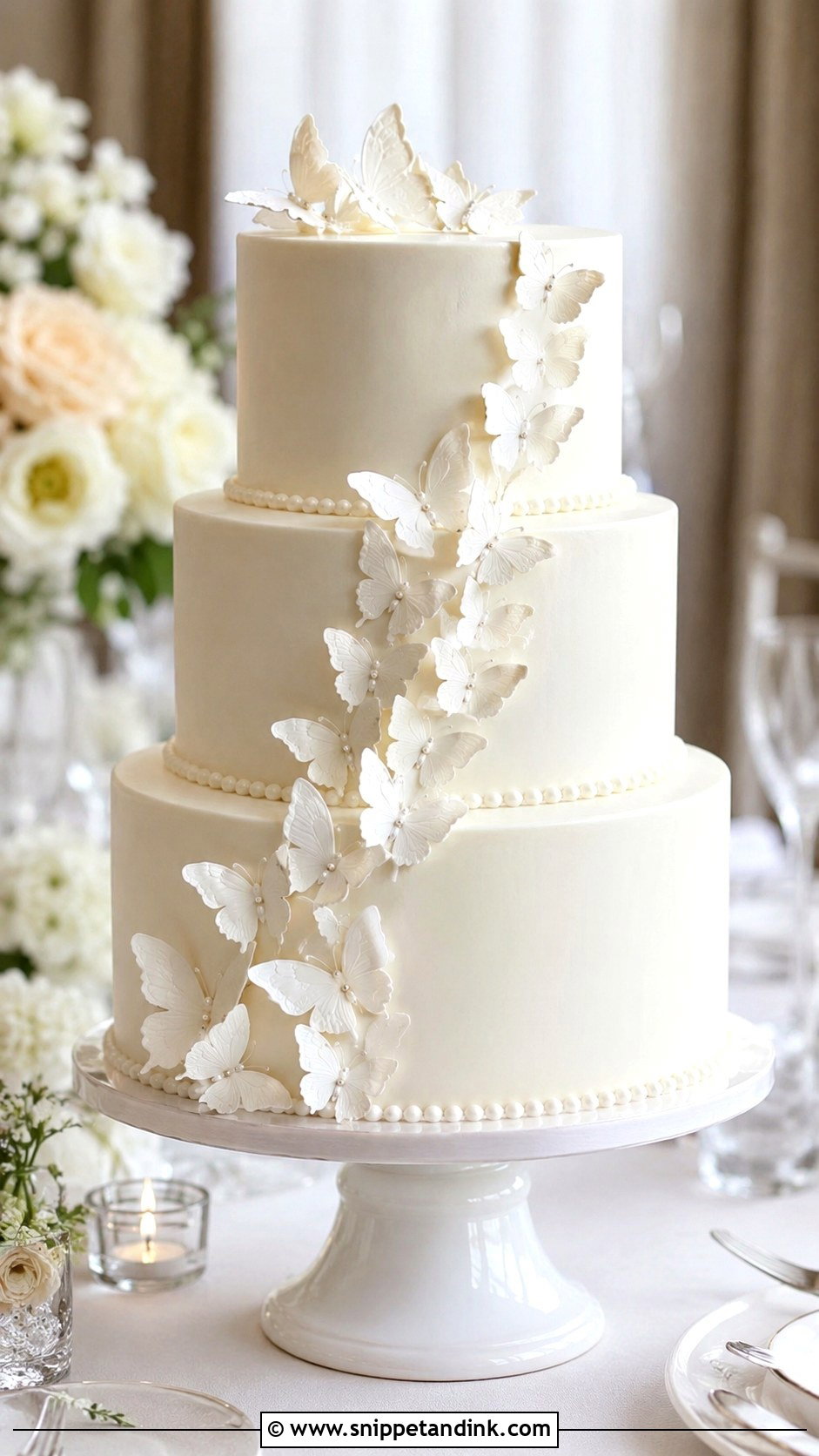
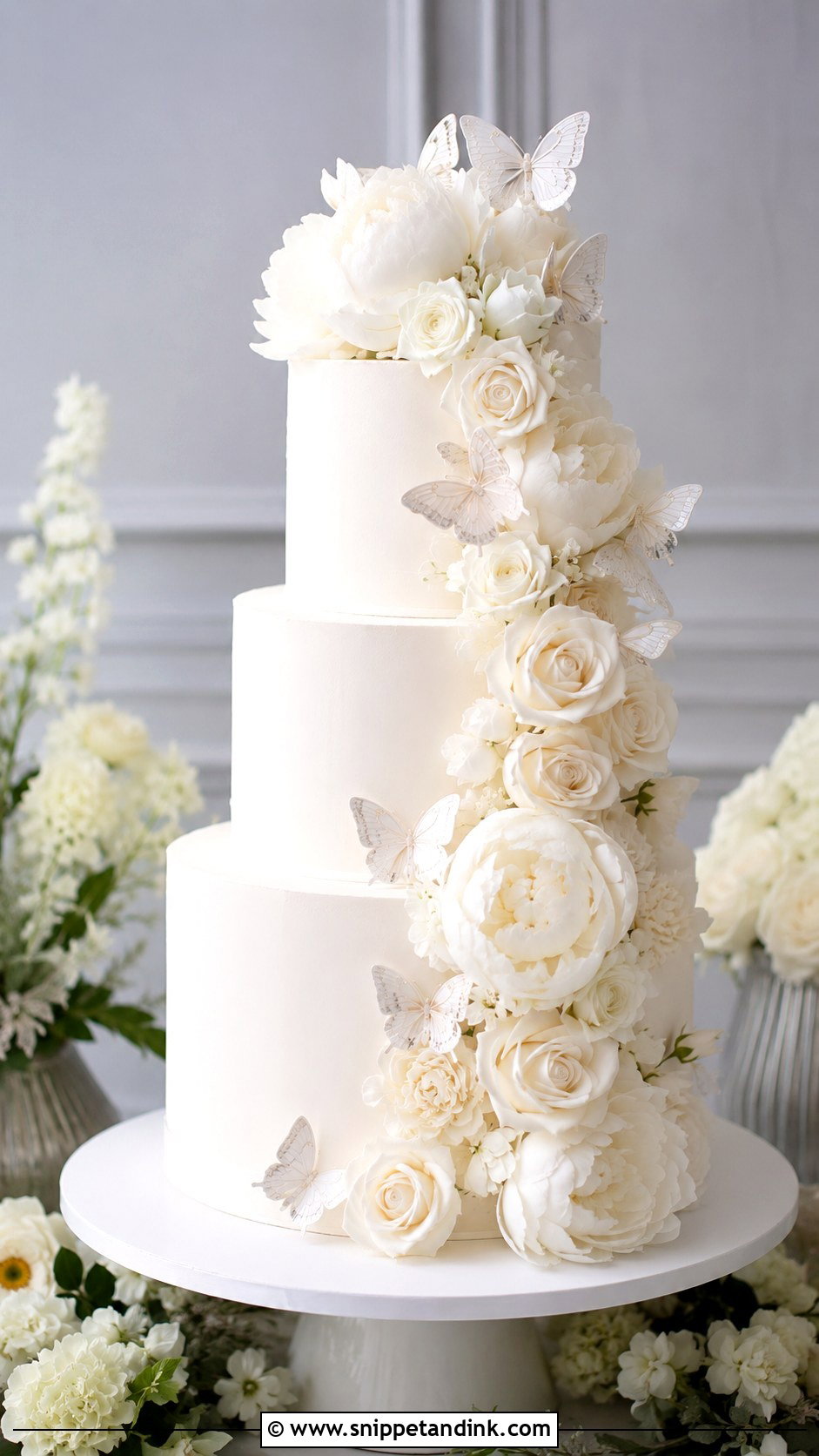
A floral cascade with butterflies tucked between the blooms is the fullest version of this theme. White roses, peonies, orchids or sugar blossoms all suit it. The cascade needs to stay airy; if it’s too dense, the butterflies look stuck on rather than moving through the flowers. I angle each butterfly slightly differently, some with wings open and some closed, so they read as caught mid-flight. The cake still stays mostly white.
19. White Butterfly Wedding Cake With Minimal Butterflies
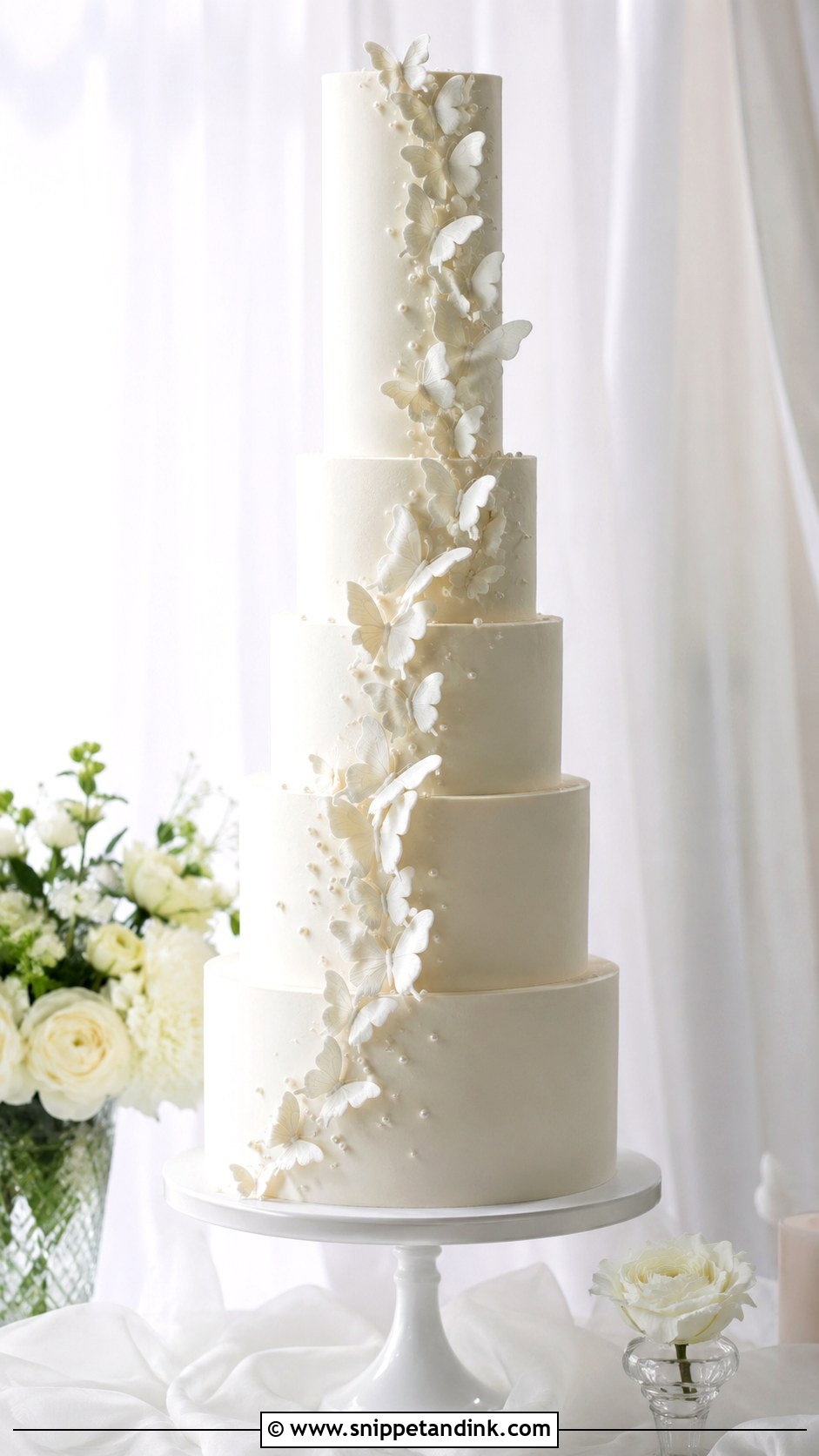
Minimal means a smooth white cake and only a handful of butterflies: perhaps one on the top tier, two on the middle and a small one near the base. The empty space is part of the design, so resist filling it. With so little decoration, each butterfly has to be flawless, and the frosting smooth enough that nothing distracts. A thin piped border or a pearl base finishes it. Modern decor and neutral tables suit it.



20. White Butterfly Wedding Cake With Garden Style
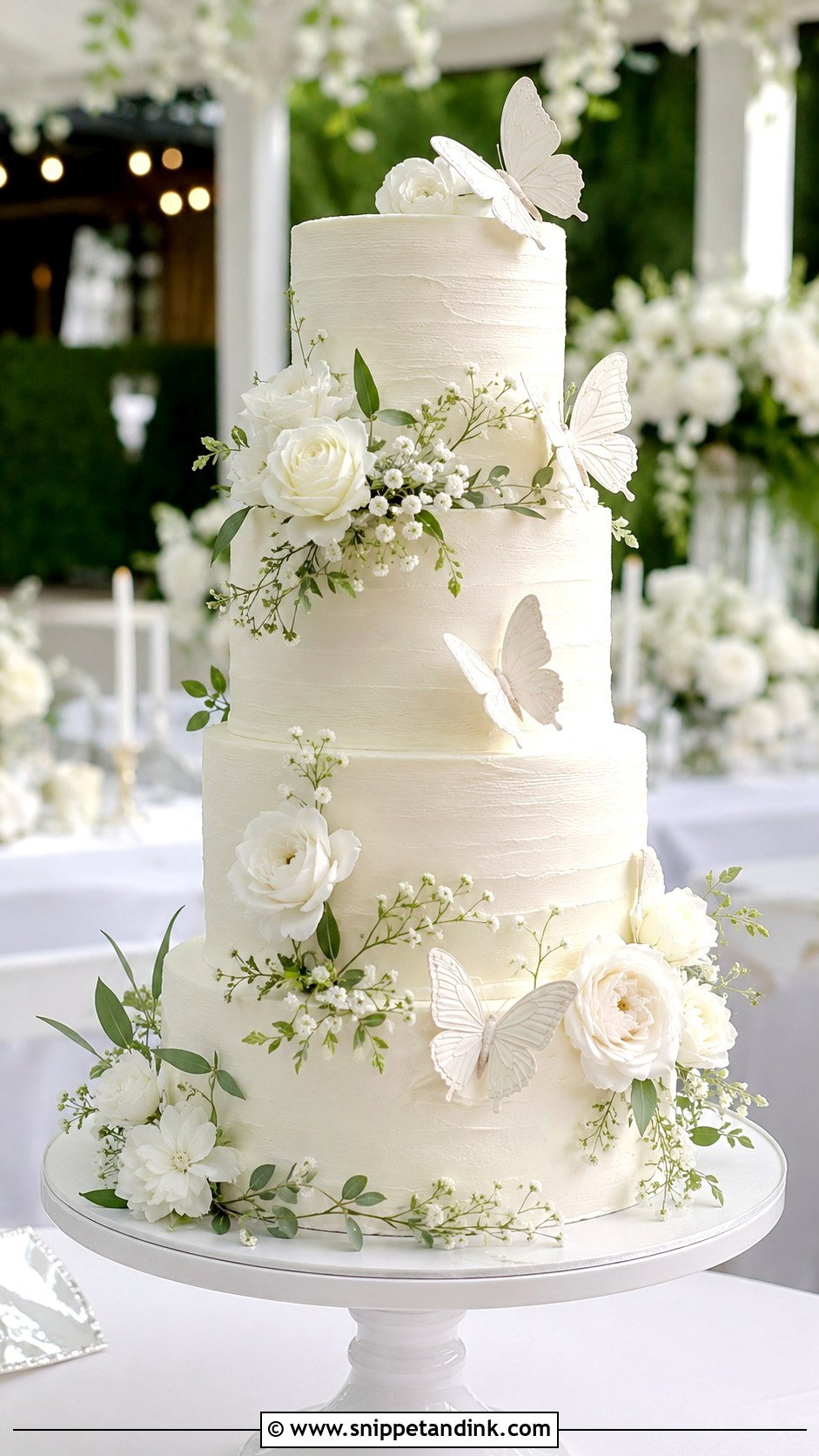
Garden style brings in white flowers, soft greenery, tiny sugar blossoms and butterflies of different sizes placed as if they’re drifting through. Buttercream suits the organic feel better than fondant. Greenery should be food-safe or sugar, and placed on a barrier, since many decorative leaves aren’t meant to touch food. A plain stand and linen table complete it, and it’s a natural fit for outdoor and spring receptions.
Making a Trail of Butterflies Look Like They Just Landed
Butterflies placed in a neat row look like stickers. The ones that look alive follow a few rules I use on every cake.
- Vary the size. Two or three sizes, with the large ones as anchors and small ones drifting away from them.
- Vary the wing angle. Some nearly flat, some folded up into a V, one or two seen almost side-on.
- Point them in the same general direction, as if they’re travelling together, but not in lockstep.
- Use odd numbers in each cluster. Three or five looks natural; four looks arranged.
- Leave gaps. A trail with breaks reads as movement; a solid line reads as a border.
I place the last butterflies at the venue, after delivery and stacking, using a dot of royal icing or a small piece of fondant as glue. That way breakages on the road don’t matter, and I can step back, look at the cake from where your guests will see it, and move one or two before the room fills up.
How Many Butterflies Is Too Many?
The answer depends on the style you start from. Smooth fondant feels formal, buttercream romantic, ruffles soft, floral cascades lush, and the butterfly count should follow. A minimal cake might carry five; a full cascade, dozens. I’d settle the base style first, then decide how loud the butterflies should be, and leave a little empty frosting in every case so the eye has somewhere to rest. With careful spacing and wings that are made for your venue’s conditions, the cake will look right in photos and still be intact when the knife goes in.
You'll Like These Ideas:







Leave a Reply