
A lily cake works when the lily is the whole idea, not a flower tucked on at the last minute. Real lilies, callas included, aren’t something I let near frosting: the plants are irritating if eaten and the pollen stains everything it touches. So nearly every lily cake I make carries sugar lilies, gum paste petals wired and dried by hand, or wafer paper versions, with any fresh stems kept on the table around the cake. Below are the versions couples ask me for, from plain white tiers to black callas, with what each one demands from the baker and from you.
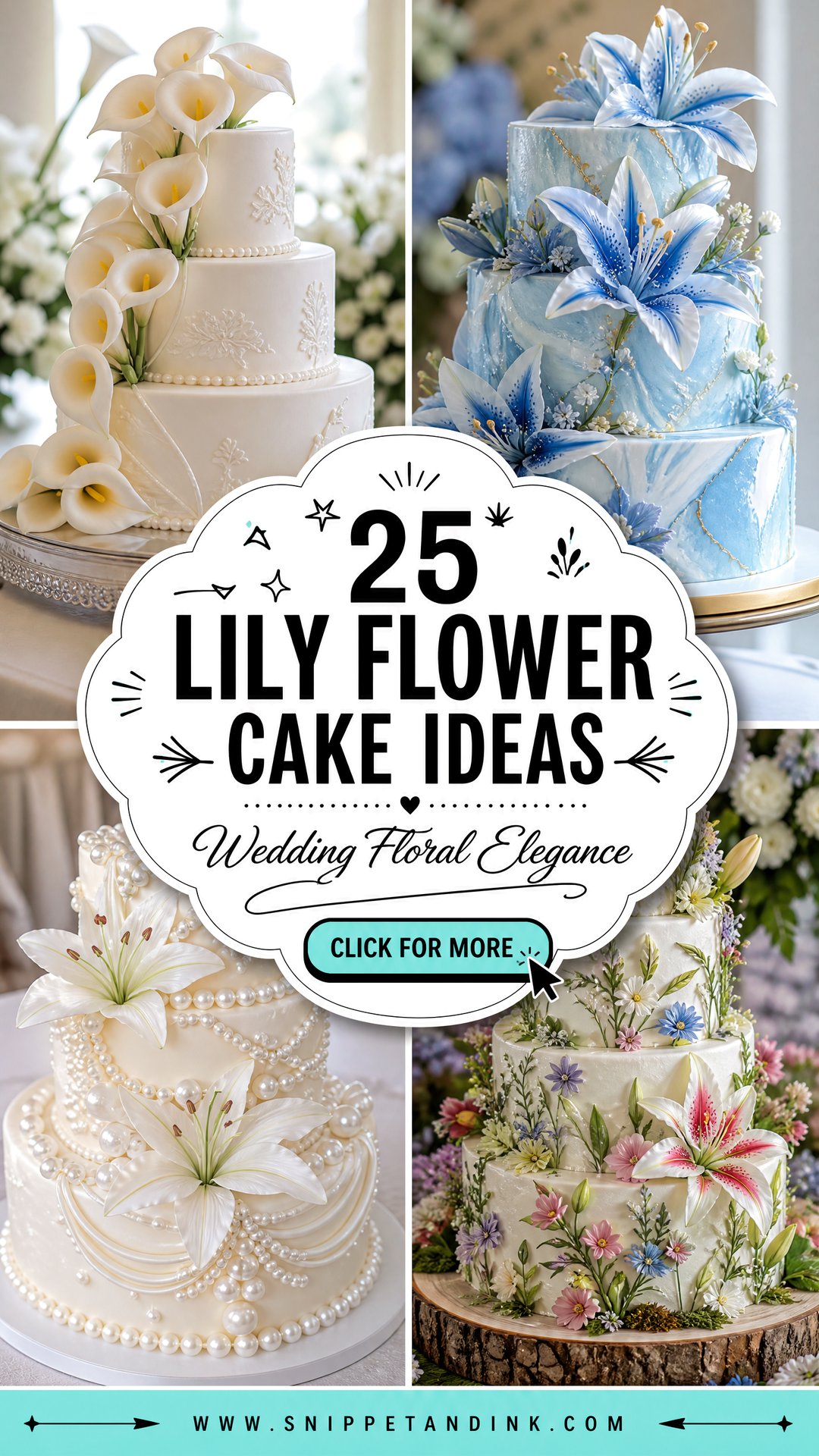
Calla, Oriental or Asiatic? Name Your Lily Before You Order
“Lily” covers very different flowers, and the one you picture decides how the cake looks and how long it takes me. I ask couples to send a photo of the actual bloom, because the word alone gets interpreted three ways.
- Calla: one smooth curled petal around a central spike. Sleek and modern, the fastest to make, and it sits close to the cake.
- Oriental (stargazer type): six large petals that curl back, often freckled and ruffled at the edges. Very realistic in sugar, but each one is big and slow to wire and paint.
- Asiatic and trumpet lilies: upright or flared, cleaner petals, good for bright colors like orange and yellow.
Scale matters too. A full open oriental can span a whole small tier, so on a two-tier cake I’d use buds and half-open flowers rather than three giant blooms. Callas stay slim and suit tall, narrow cakes.
1. White Lily Wedding Cake
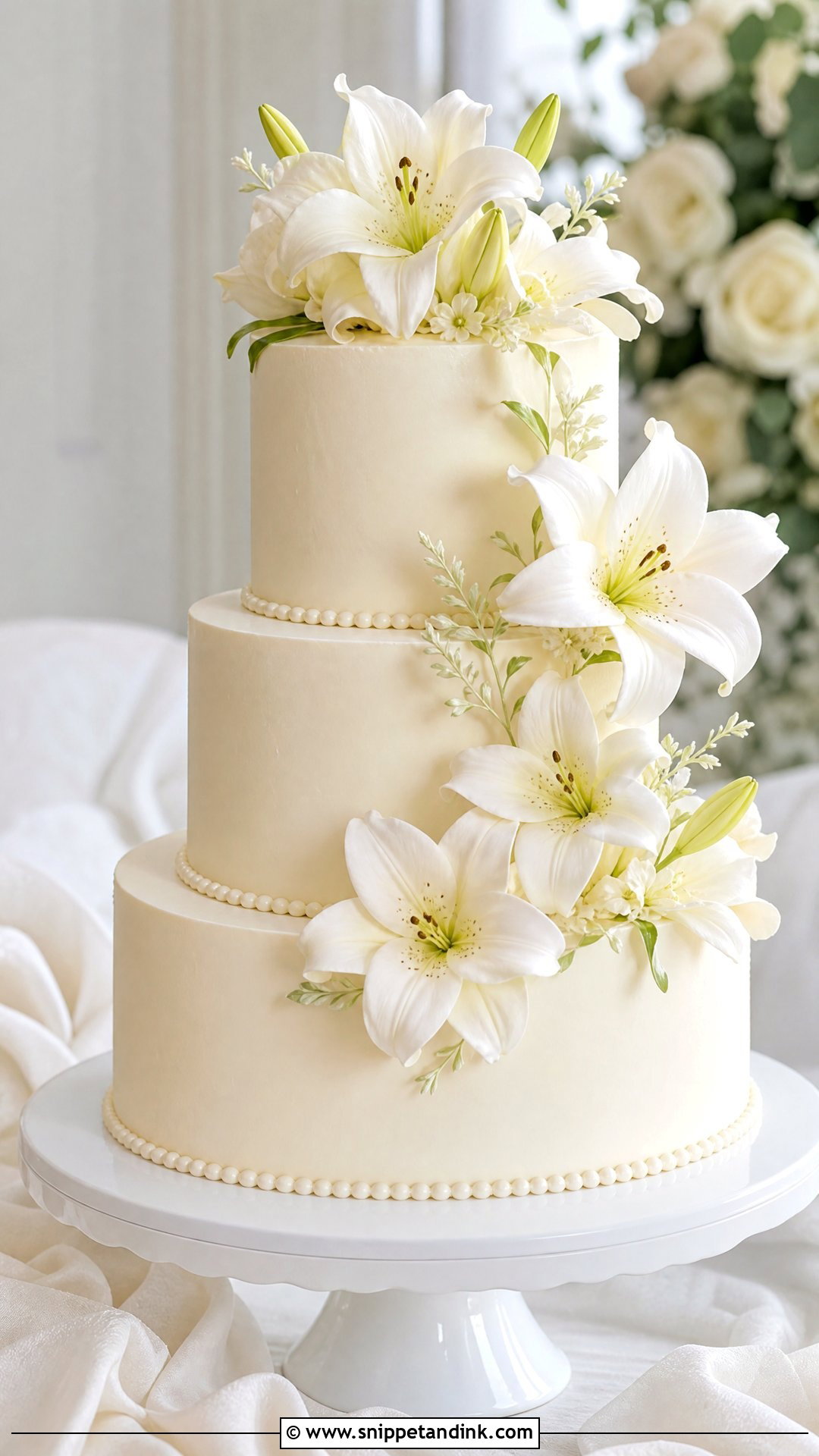
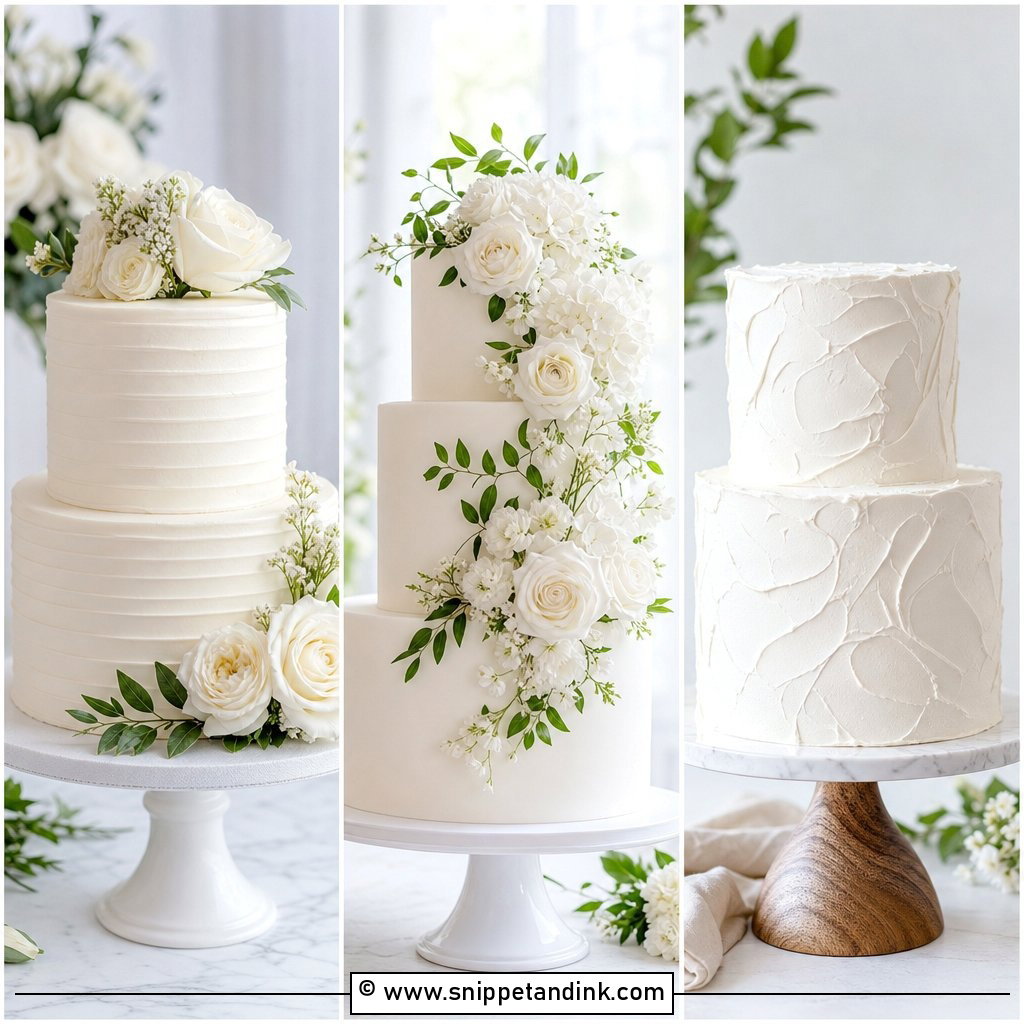
White on ivory is the version I’m asked for most, and the hardest to make look alive. Pure white sugar petals against ivory buttercream can flatten into one pale shape, so I dust the throat of each lily with a whisper of green and leave the stamens a soft gold. Placed in a loose diagonal across the tiers, three or four open blooms carry the cake. Vanilla, almond, coconut or champagne sponge suits a church or ballroom reception. Resist adding more flowers; a gap between blooms reads as confidence.
2. Calla Lily Wedding Cake
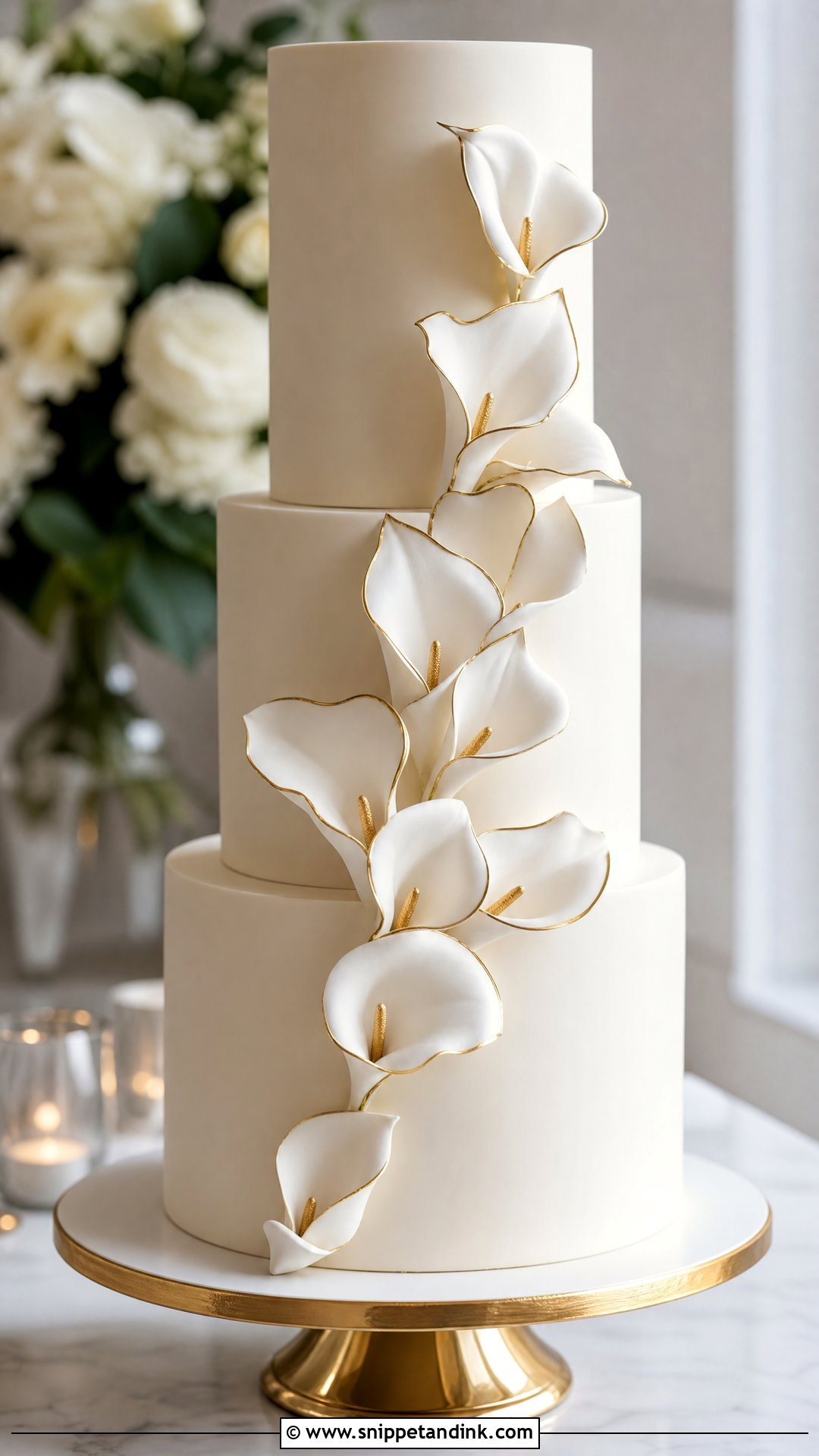
Callas are the quickest lily to make in sugar, one curled spathe around a spadix, and that simplicity is their appeal. They need tall tiers and almost nothing else on the cake. White callas on ivory fondant are crisp; plum or near-black ones make an evening cake. I curve each flower to follow the tier, so they look like they grew there rather than being stuck on. A thin gold band is about the most I’d add, with vanilla bean, lemon or white chocolate inside.
3. Pink Lily Wedding Cake
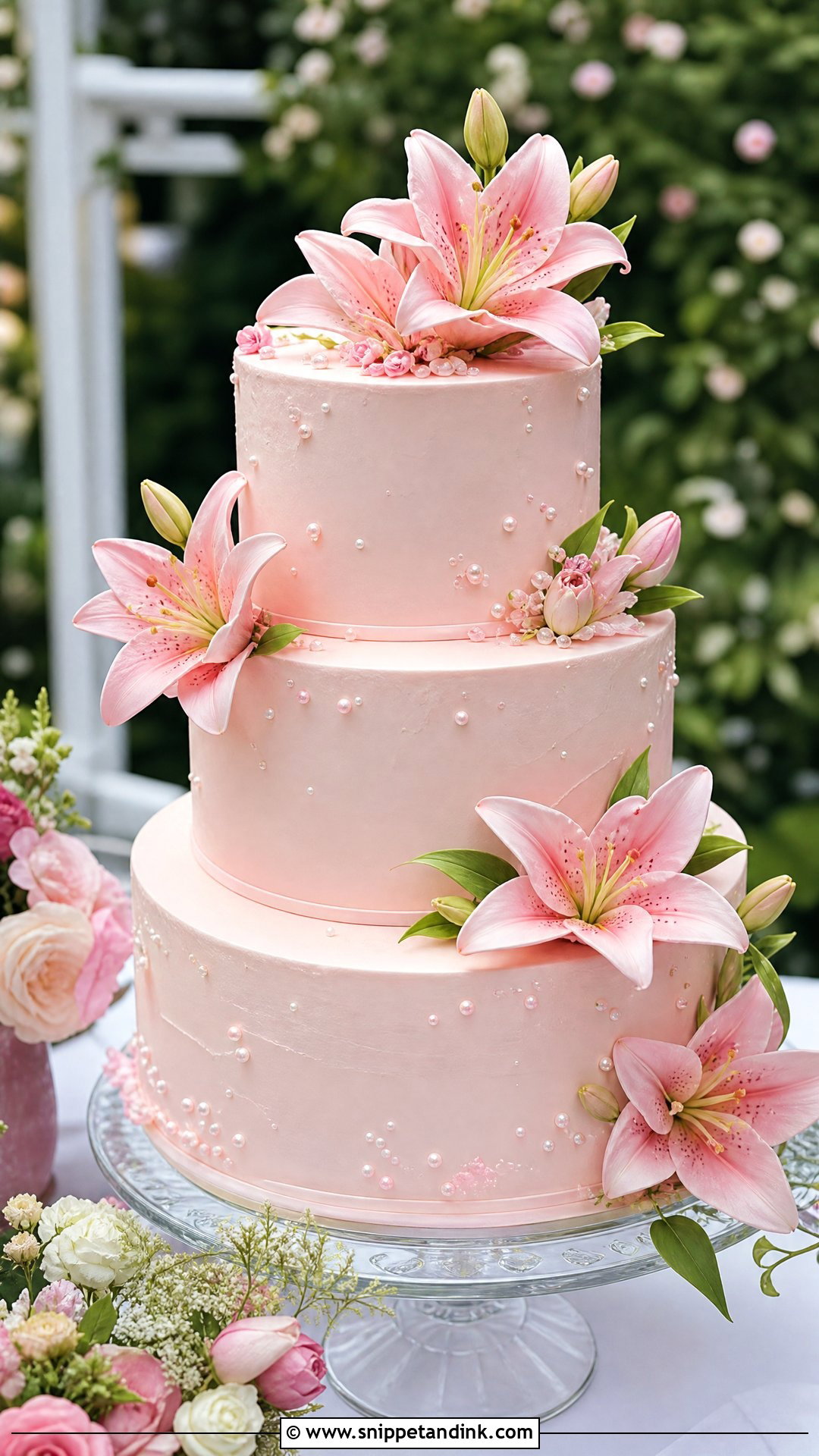
Pink lilies on blush buttercream risk disappearing into the frosting, which is why I petal-dust each flower in two or three tones, from pale blush at the tips to dusty rose near the center. That gradient gives depth even from across a tent. Pale green leaves and a few pearls finish it. Strawberry, raspberry or a rose-scented sponge echo the color. It suits a spring garden party and works best when the frosting is a shade lighter than the palest petal.
4. Purple Lily Wedding Cake
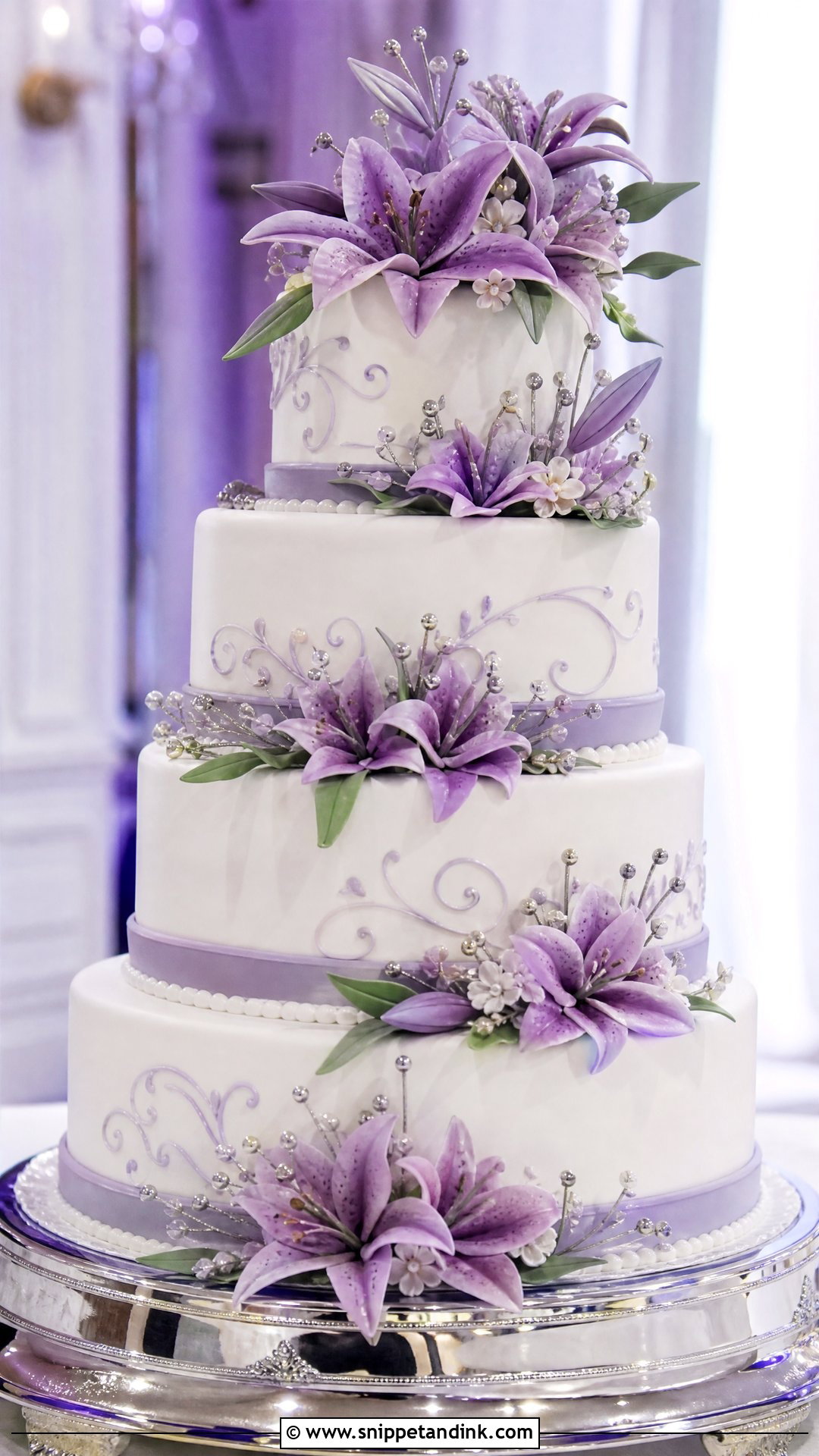
Purple shifts mood more than any other lily color. Lavender reads soft and dreamy; deep violet and plum feel formal and rich. I set the flowers against white or very pale lavender frosting so they have something to stand out from. Be aware that purple petal dust can fade under strong daylight, so I keep these cakes out of sun until serving. Silver accents keep it cool. Blackberry, chocolate and lavender honey all suit it.
5. Orange Lily Wedding Cake
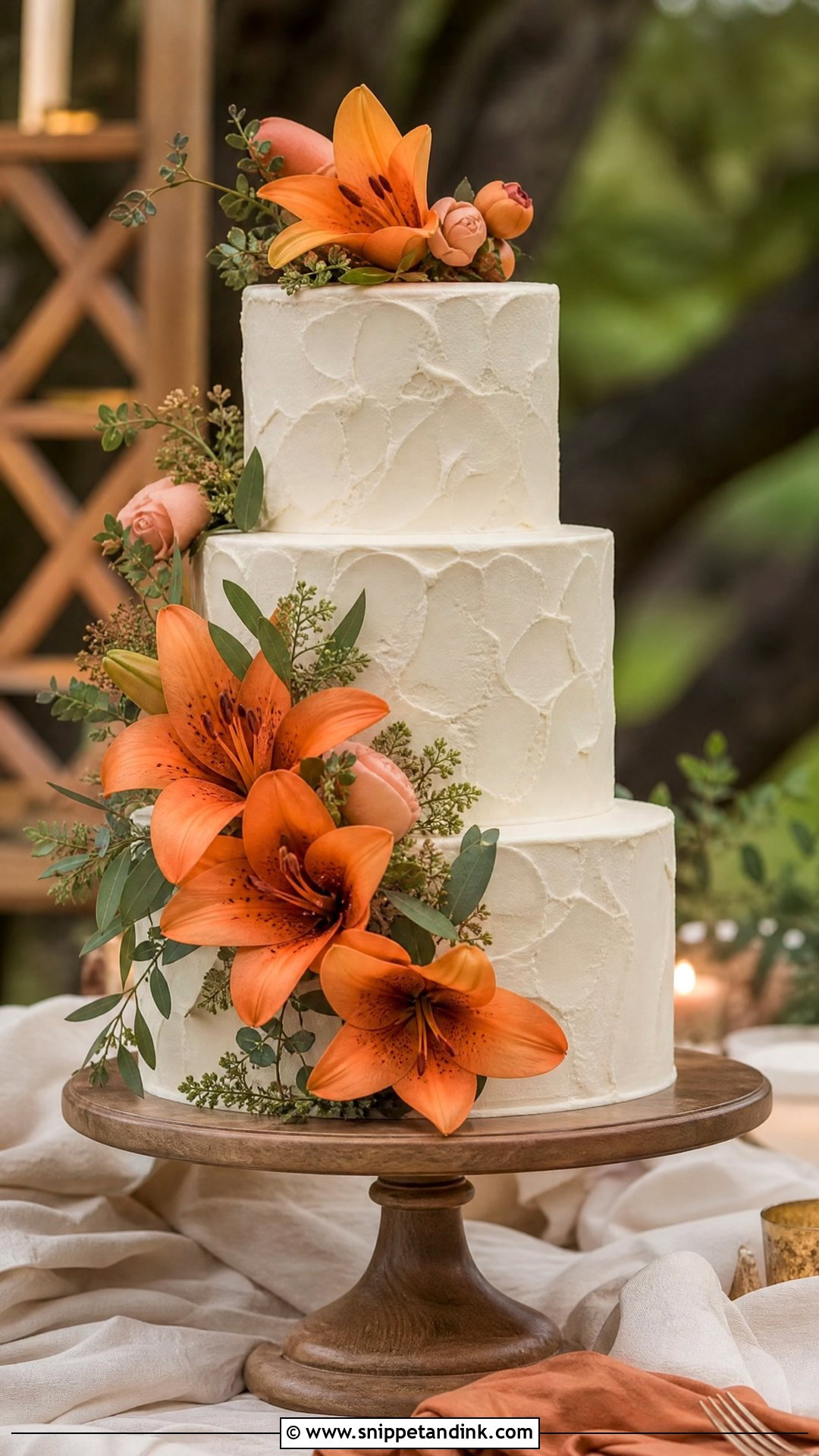
Orange is the lily I suggest for late summer, autumn and desert weddings, but used sparingly. Ivory frosting with a few tiger-orange sugar lilies, peach buds and muted greenery stays bridal; a fully orange cake can tip into Halloween. I paint the freckles on each petal by hand with a fine brush, which is where these flowers start to look real. Citrus, carrot, spice or vanilla with orange blossom filling sit happily inside, and a lightly textured buttercream keeps it relaxed.
6. Yellow Lily Wedding Cake
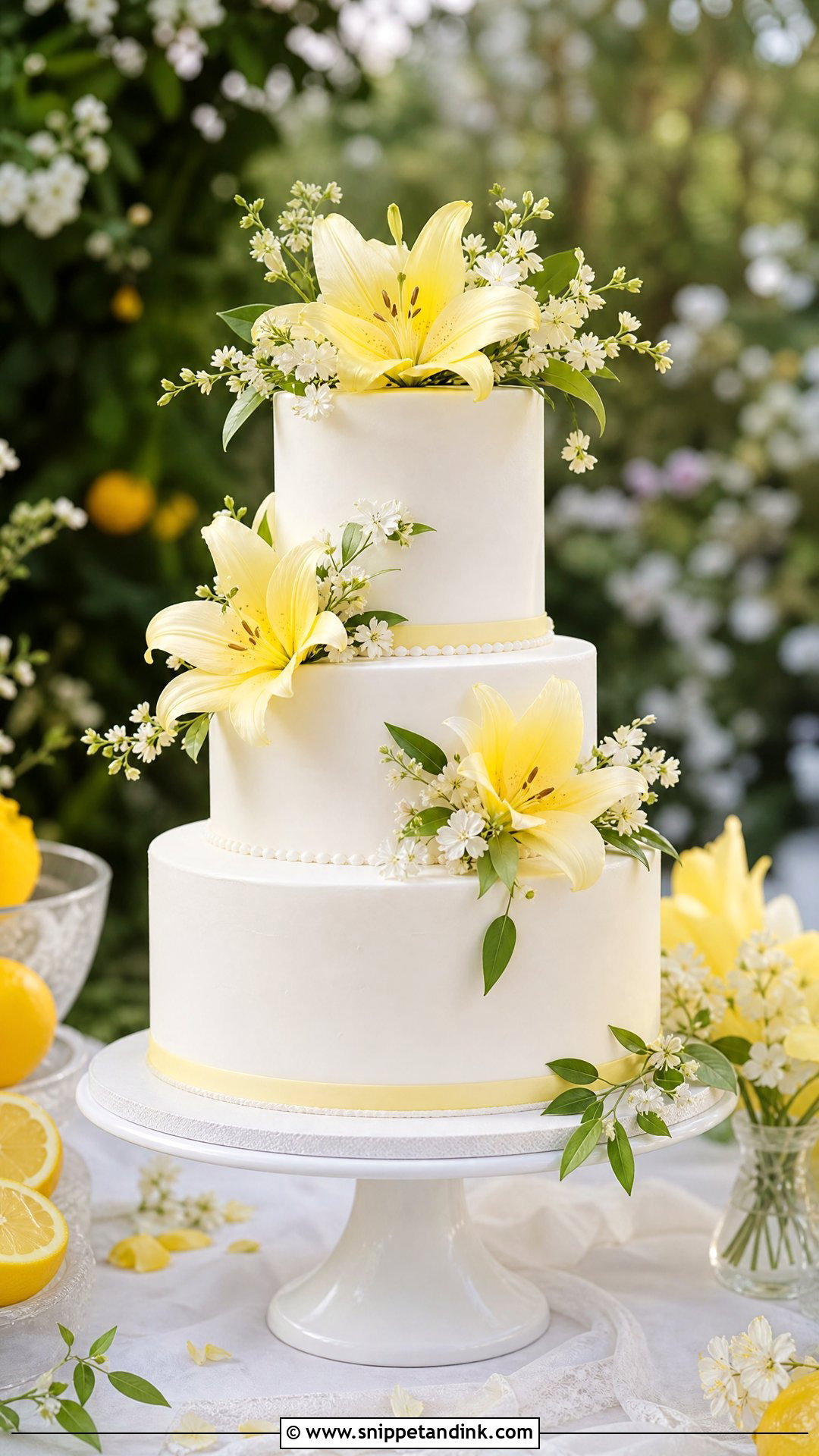
Yellow lilies bring sunshine to brunch weddings and garden venues. Pale lemon petals on white buttercream look gentle; golden yellow is warmer and bolder. Yellow is also the color most likely to look cheap if it’s flat, so I shade the petal bases slightly deeper and keep dark details out. Small white blossoms and soft green leaves balance it. Lemon is the obvious flavor, and coconut or honey sponge work too.
7. Blue Lily Wedding Cake
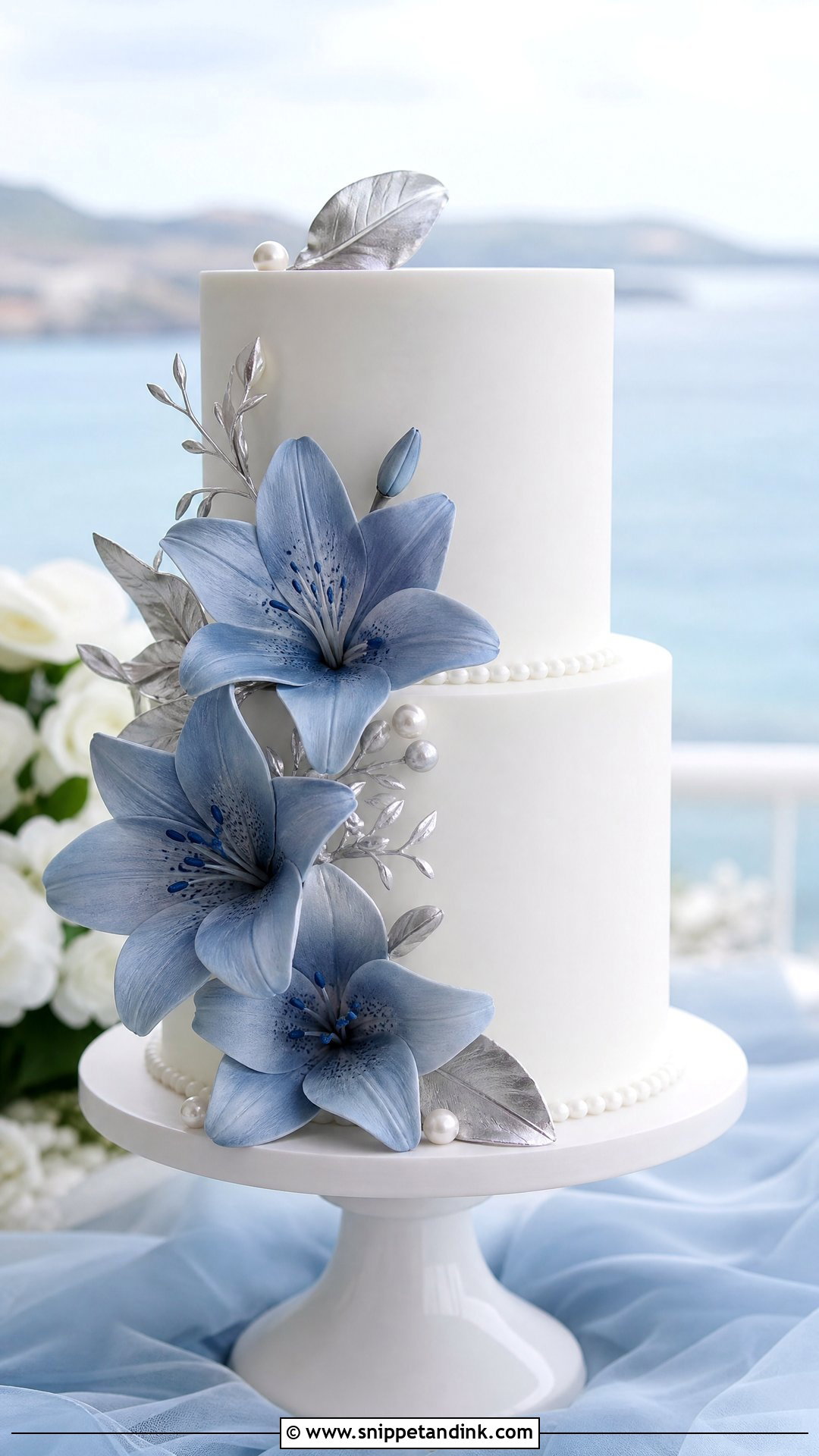
Blue lilies don’t exist in nature, which is exactly why sugar is useful: I can mix dusty blue, powder blue or navy to match your linens. A white frosted cake with blue lilies reads crisp and calm for coastal or winter weddings. Silver leaf, pearl beads or a smooth fondant finish make it more formal. I space the flowers out because blue en masse can look heavy. Blueberry, lemon or white chocolate fit the palette.
8. Black Lily Wedding Cake
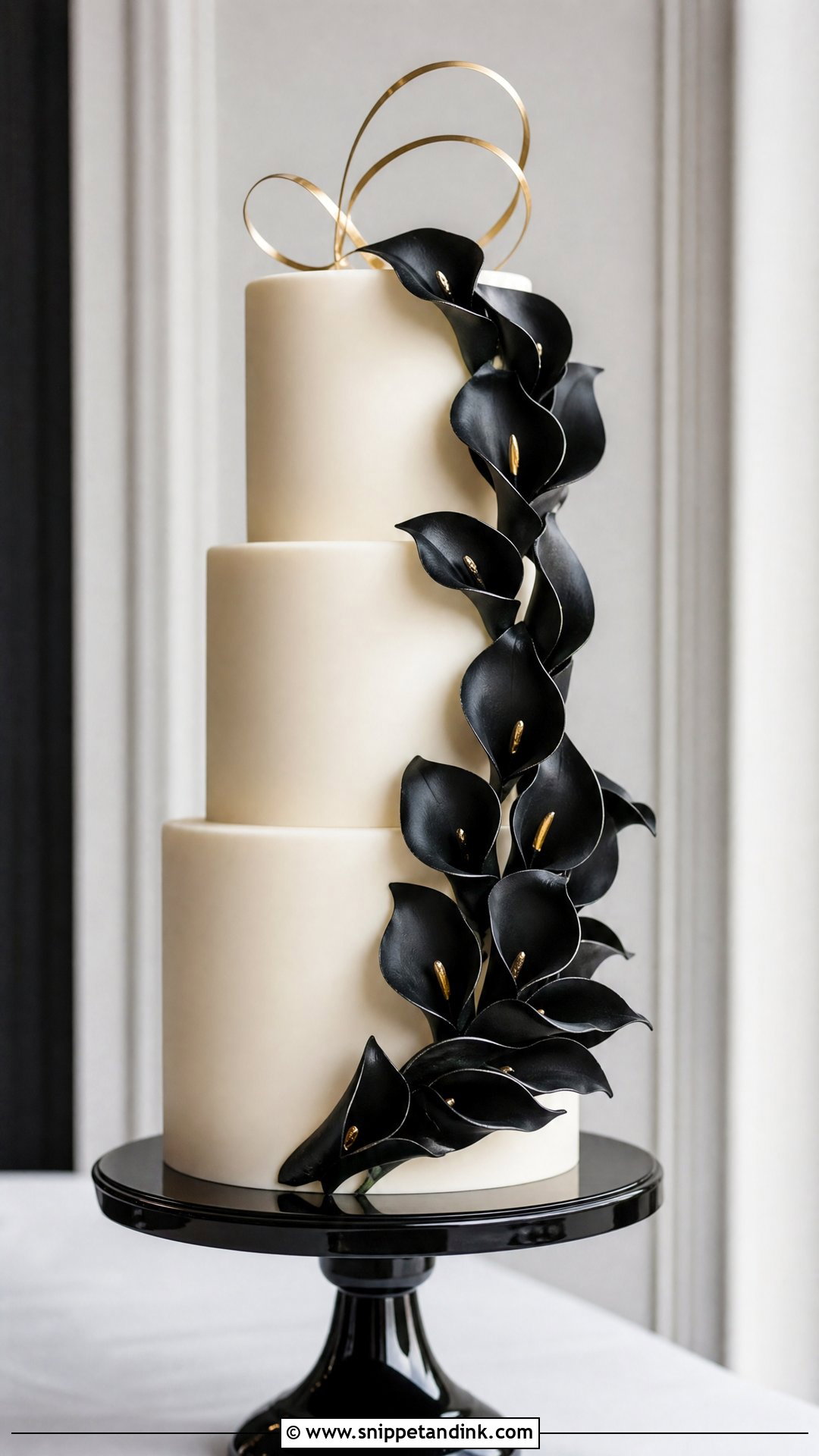
Black works as an accent, not the whole cake. A white, ivory or pale gray cake with two or three black sugar callas gives the strongest contrast. Black coloring is heavy on dye, so I color the gum paste rather than painting the surface, which avoids grey streaks and stained fingers. Thin black piping, a ribbon or a touch of gold finish it. Chocolate, espresso and red velvet suit an evening reception. Keep the silhouette clean.
9. Red Lily Wedding Cake
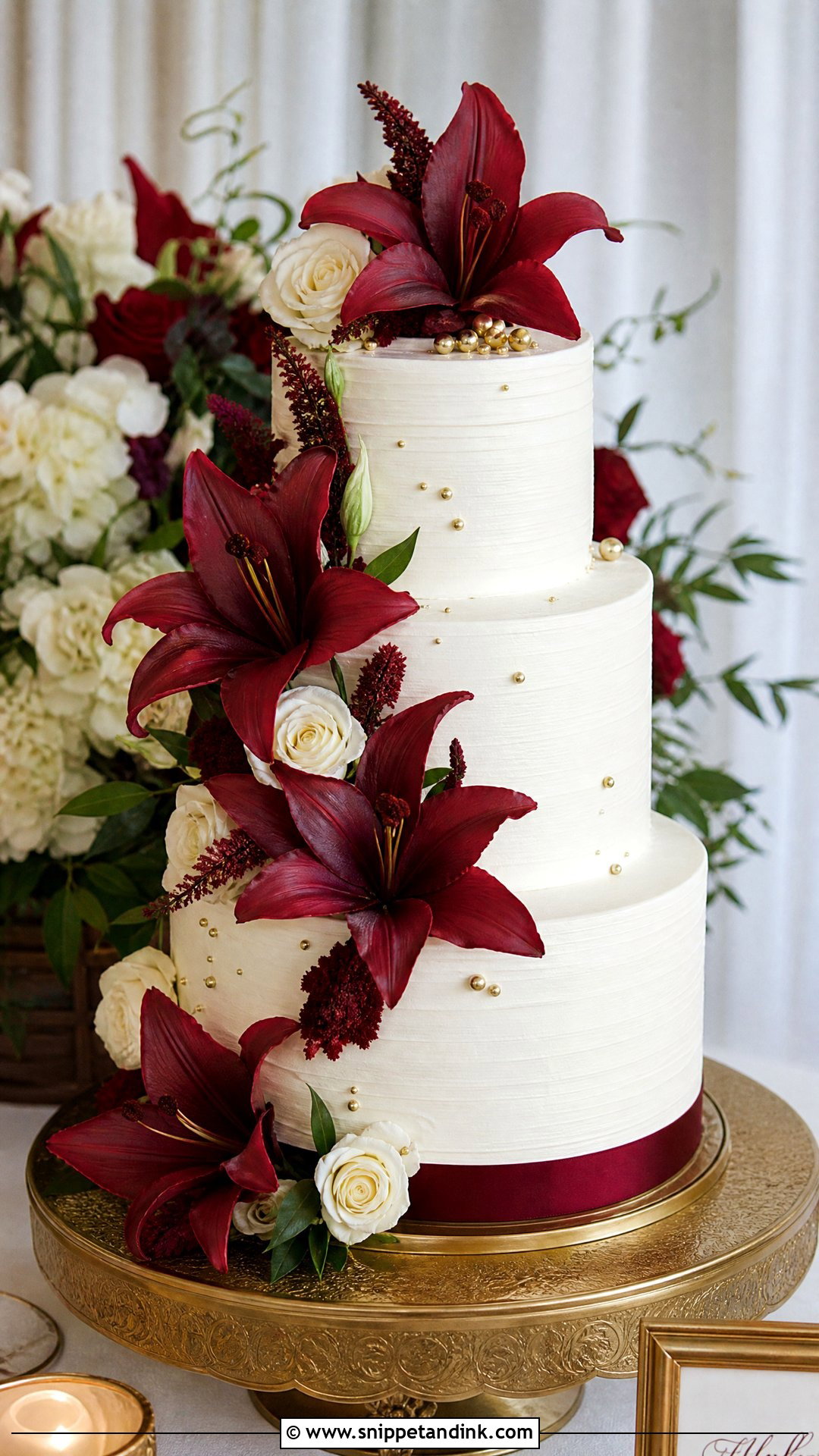
Deep red lilies on white, ivory or champagne frosting give an intense floral focus. With gold and smooth fondant it turns formal; with greenery and textured buttercream, garden. Red dust is another color that bleeds if it gets damp, so I seal the finished petals before they go anywhere near a moist surface. One side cascade or a top cluster works better than flowers dotted everywhere. Red velvet, dark chocolate and raspberry vanilla match the color story.
10. Lily Cascade Wedding Cake
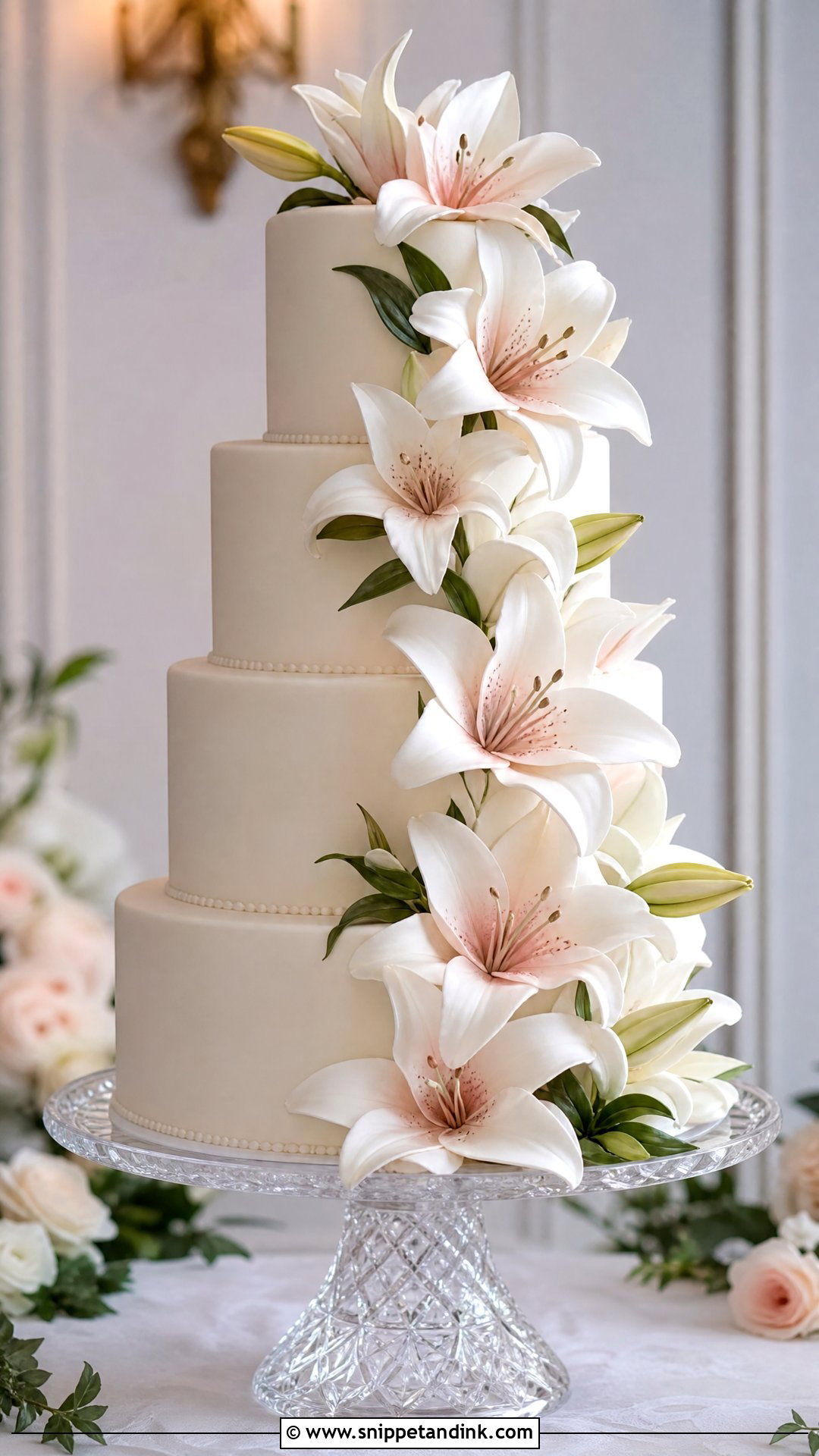
In a cascade, lilies flow from the top tier down one side like a waterfall. They need room to travel, so I’d only do this on three or four tiers. Every wired flower goes into a food-safe posy pick, never straight into the sponge, and the heaviest blooms sit low where the cake is strongest. White lilies are classic; blush, purple or orange make it more colorful. Smooth fondant or soft buttercream both work, finished with leaves and tiny filler blossoms so the cascade looks grown rather than glued on.
11. Lily And Rose Wedding Cake
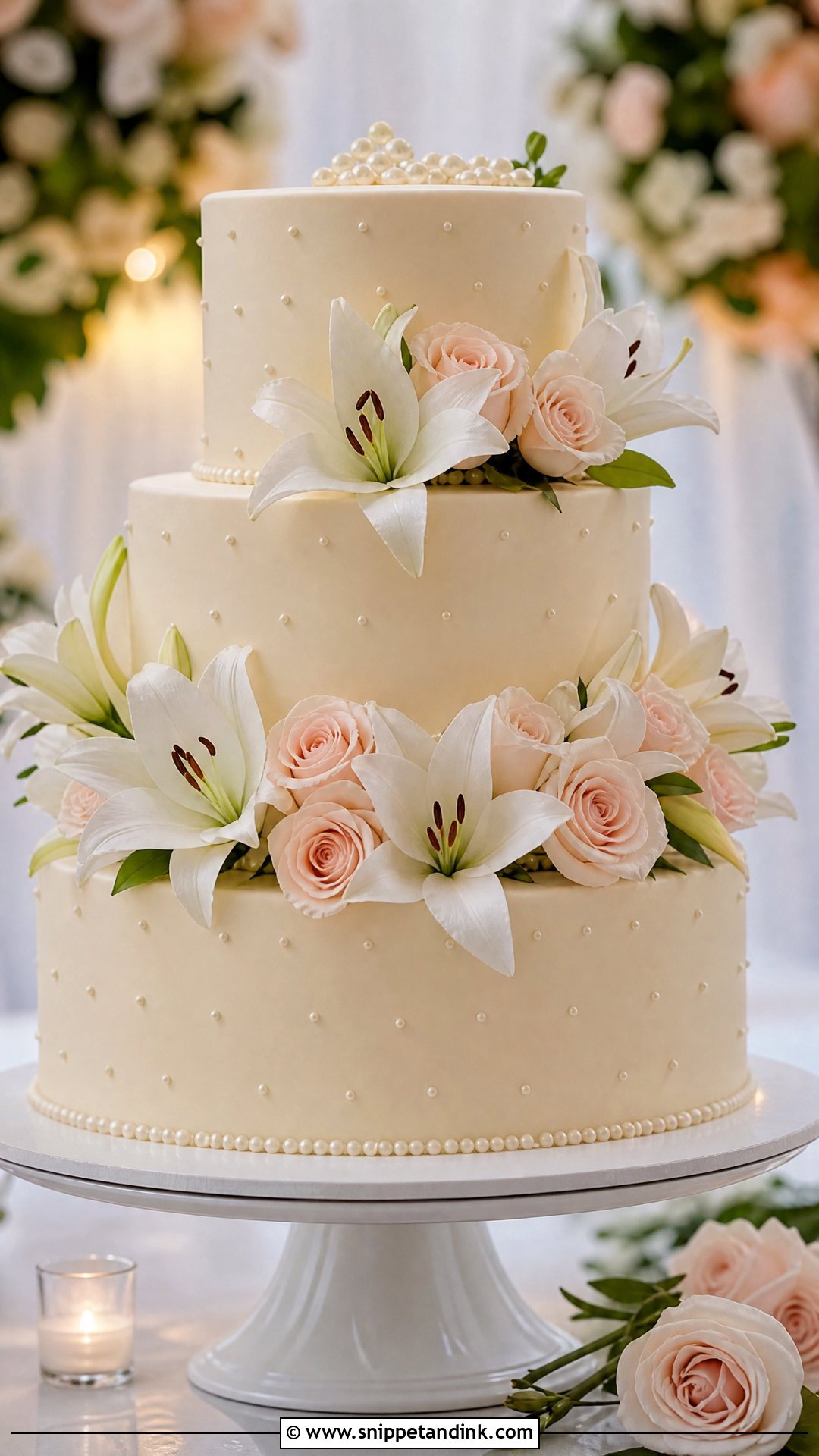
Lilies give height and line; roses give fullness. Pairing them on ivory buttercream, blush fondant or champagne tiers is a classic combination, but scale is everything. I let three or four big lilies lead and tuck smaller roses around their bases as support. Too many roses and the lilies get lost. White lilies with blush roses are soft; red lilies with ivory roses push contrast. Vanilla, almond and raspberry sponges suit it.
12. Lily And Orchid Wedding Cake
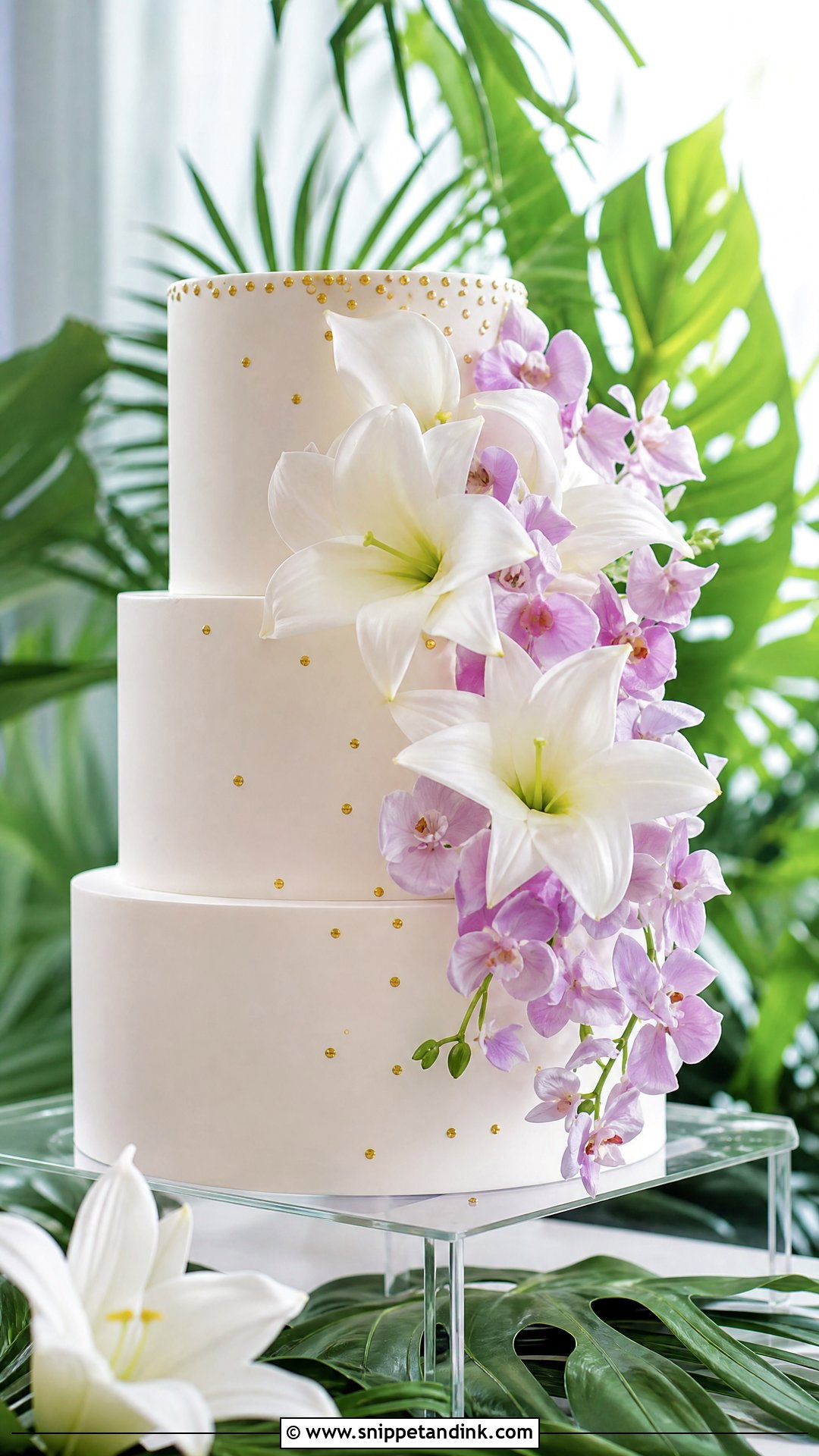
Two dramatic flower shapes on one cake means the design has to be very controlled. White calla lilies with pale orchids on smooth fondant feel at home at a destination or hotel reception, and purple orchids with white lilies go bolder. Phalaenopsis orchids are delicate in sugar and their thin petals soften in humidity, so I keep tropical-venue versions in air conditioning until the last moment. Group the flowers in one sweeping cluster. Coconut, passion fruit or white chocolate fit the look.
13. Lily And Greenery Wedding Cake
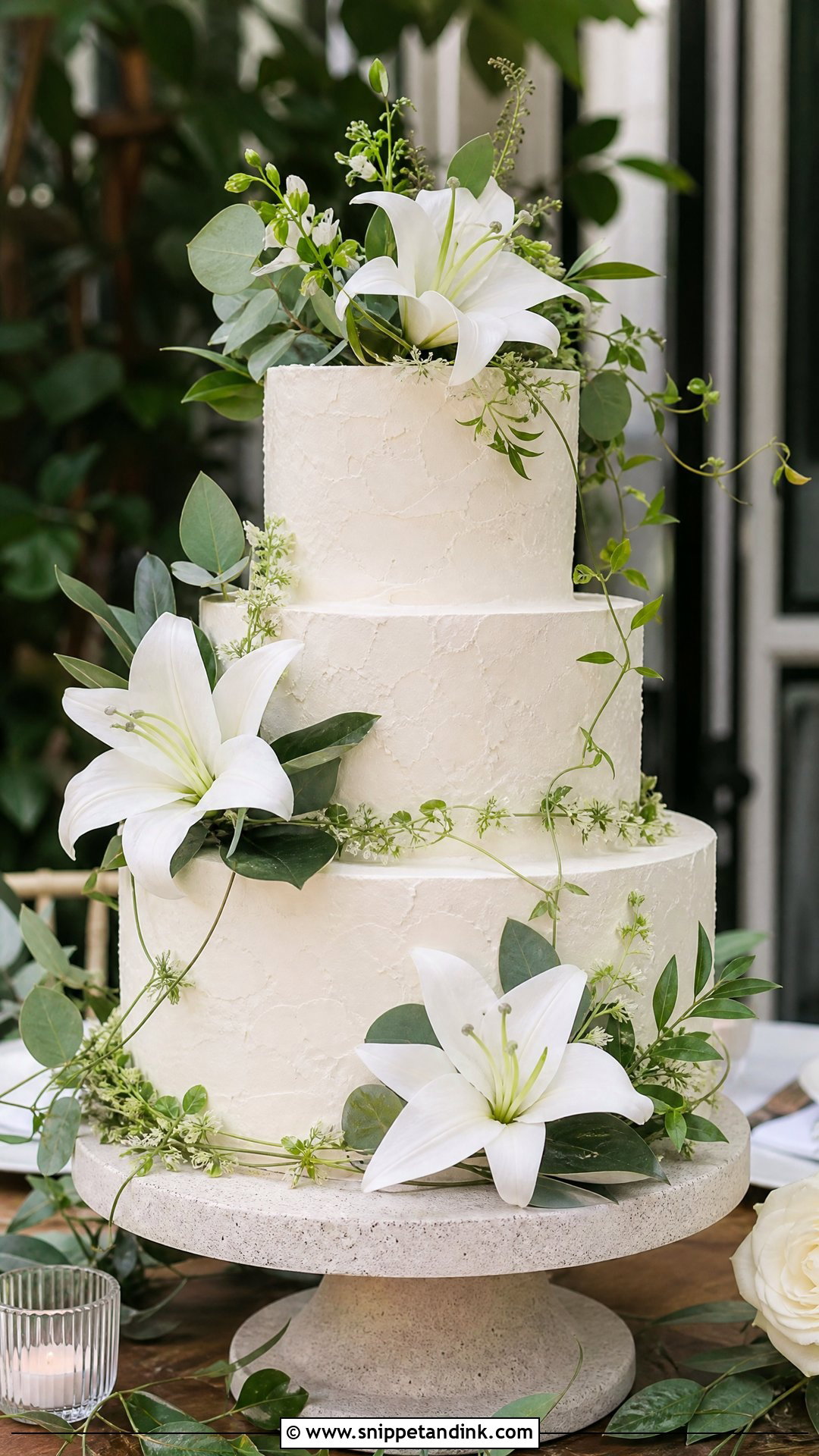
Greenery makes sugar lilies look freshly cut. Eucalyptus, olive leaves, ferns or piped vines all work, on textured buttercream for a rustic room or smooth fondant for something cleaner. If any real foliage is used, it has to be food-safe and pesticide-free, and I wrap and pick it like a flower; plenty of popular greenery isn’t safe on a cake, so I often make the leaves in sugar too. A loose diagonal looks the most natural. Lemon, pistachio and almond sponges match.
14. Lily Buttercream Wedding Cake
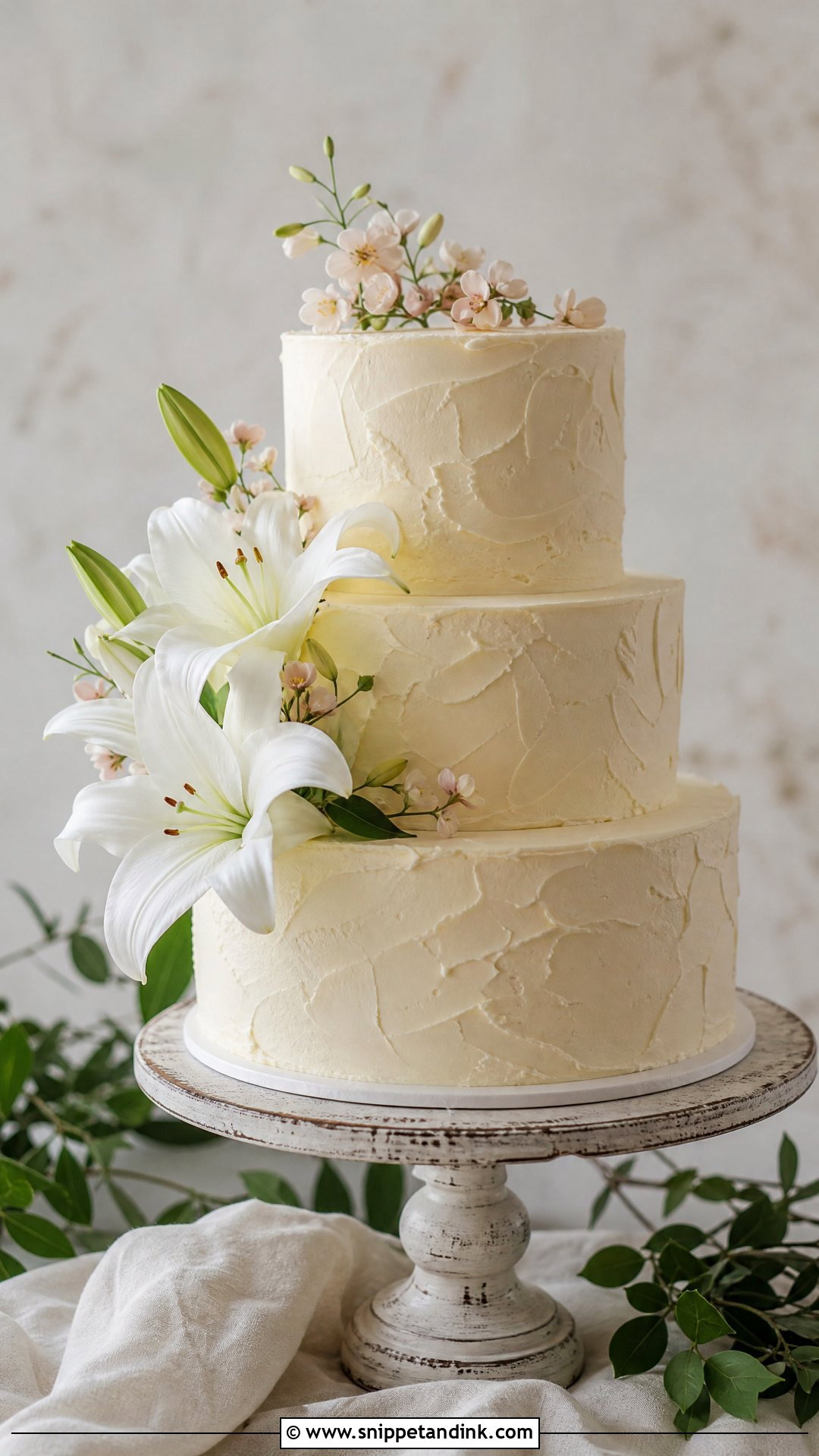
Buttercream gives a softer, handmade base than fondant, smoothed, lightly textured or swept with palette strokes. The trade-off is weight: sugar lilies are heavy and buttercream is soft, so I insert supports or a hidden pick under each cluster rather than resting flowers on the surface. One side cluster or a gentle cascade is plenty. Vanilla, lemon and strawberry are favorites for barn and garden receptions.
15. Lily Fondant Wedding Cake
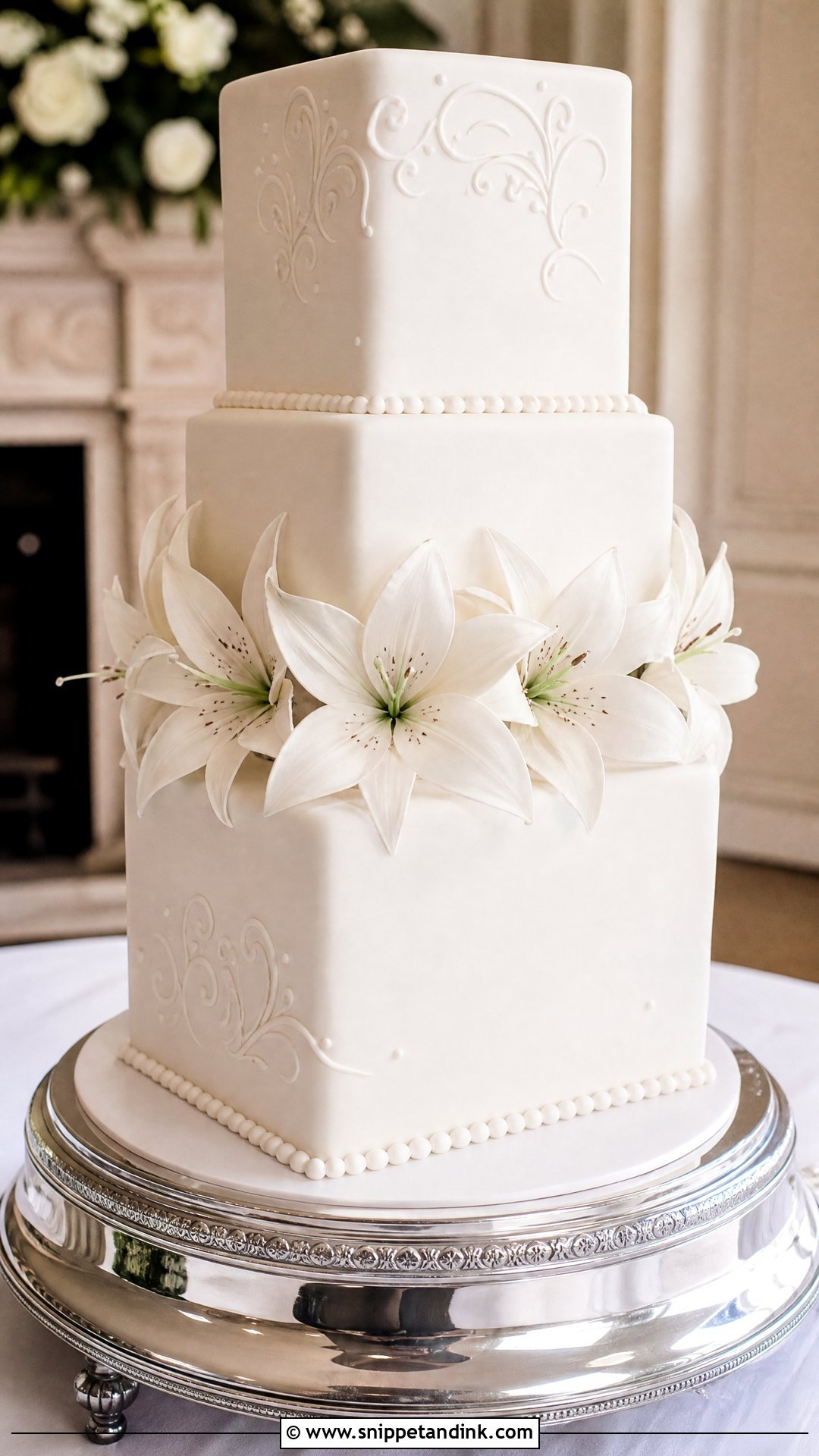
Fondant gives the crisp surface that makes sugar petals look sharp, and it handles tall tiered cakes and sharp edges well. White or ivory fondant with handmade lilies feels polished from every side. I can emboss a pattern, pipe pearl borders or press a light lace texture before the flowers go on, without stealing focus. Keep the palette to one or two colors and let the petal shapes decorate. Red velvet, vanilla and lemon all hide well under it.
16. Lily Lace Wedding Cake
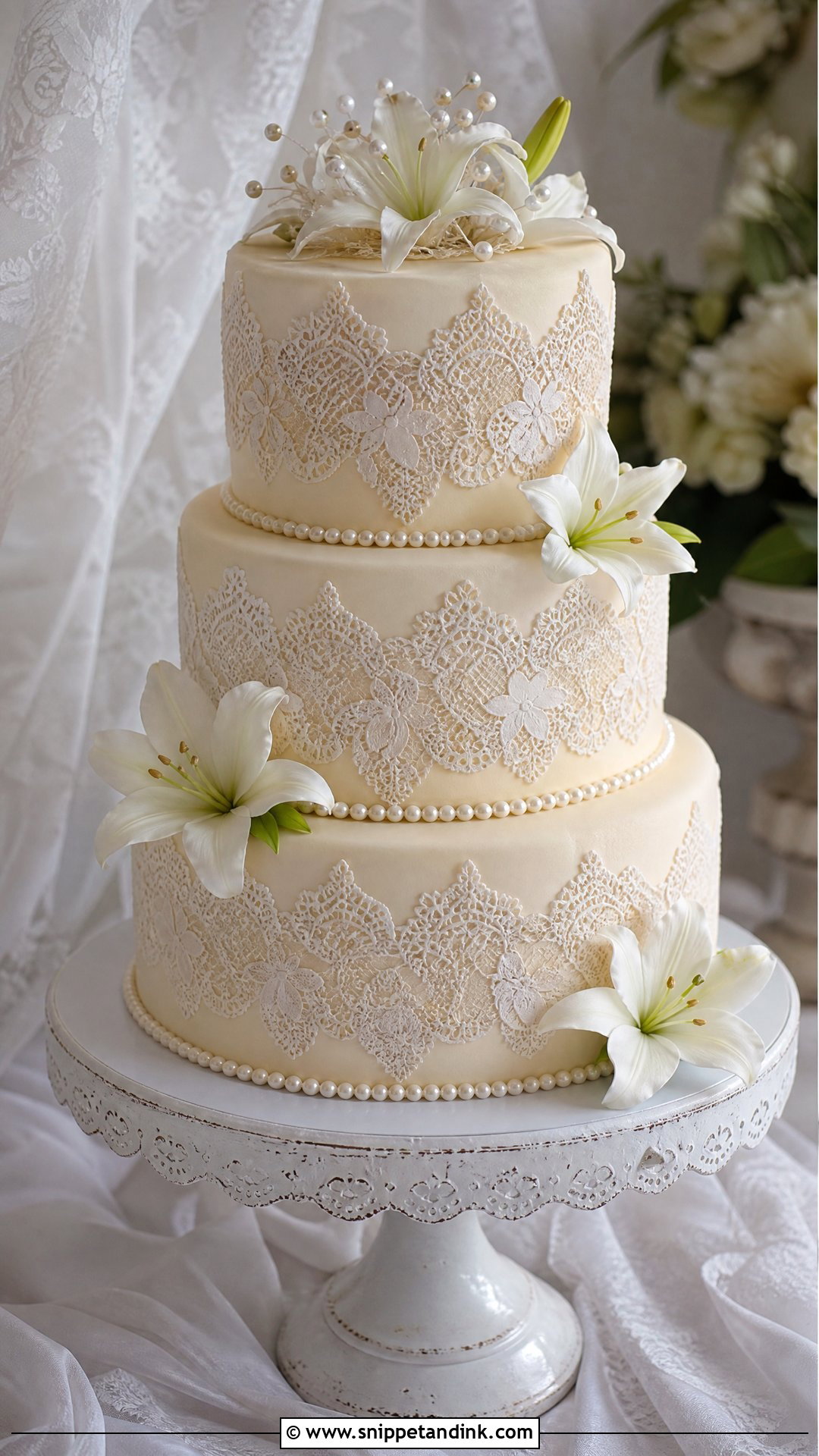
Lace and lilies are both detailed, so one has to back off. I usually keep lace to a band or one panel and set a few large sugar lilies at the tier edges. Edible lace comes from silicone mats, piped work takes much longer, and fondant appliques sit in between. White lace on ivory stays soft; champagne lace reads warmer and more vintage. Almond, vanilla bean or champagne sponge suit an estate venue.
17. Lily Pearl Wedding Cake
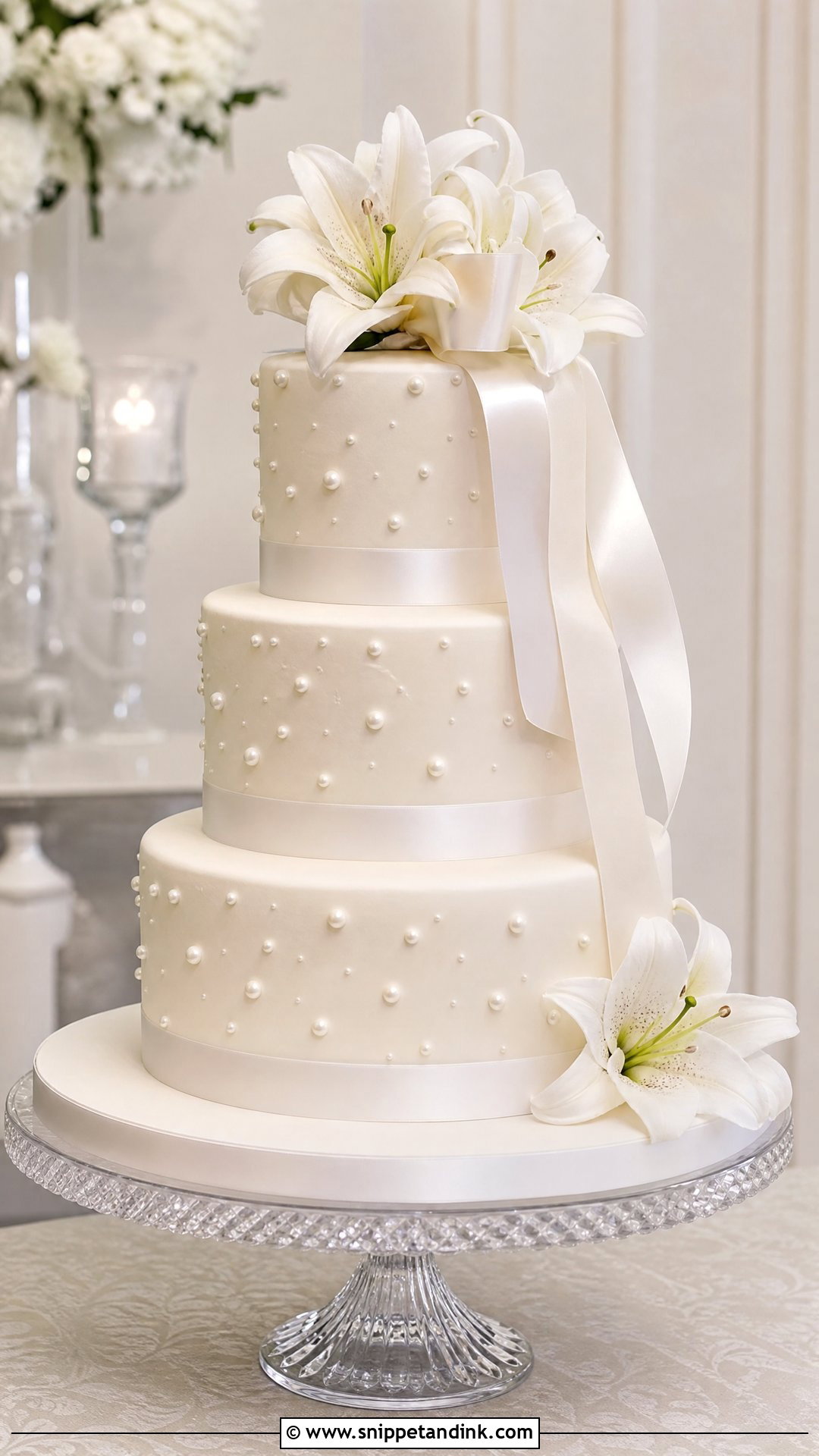
Pearls can be tiny borders, scattered dots or beaded patterns, alongside white lilies or callas. On a smooth surface each bead stands out cleanly, which is why I avoid this on rough buttercream. The common mistake is piling pearls and flowers into the same area. I put pearls on the tiers the flowers don’t touch, so the eye moves between them. Coconut, almond and white chocolate keep it classic for a black-tie room.
18. Lily Gold Wedding Cake
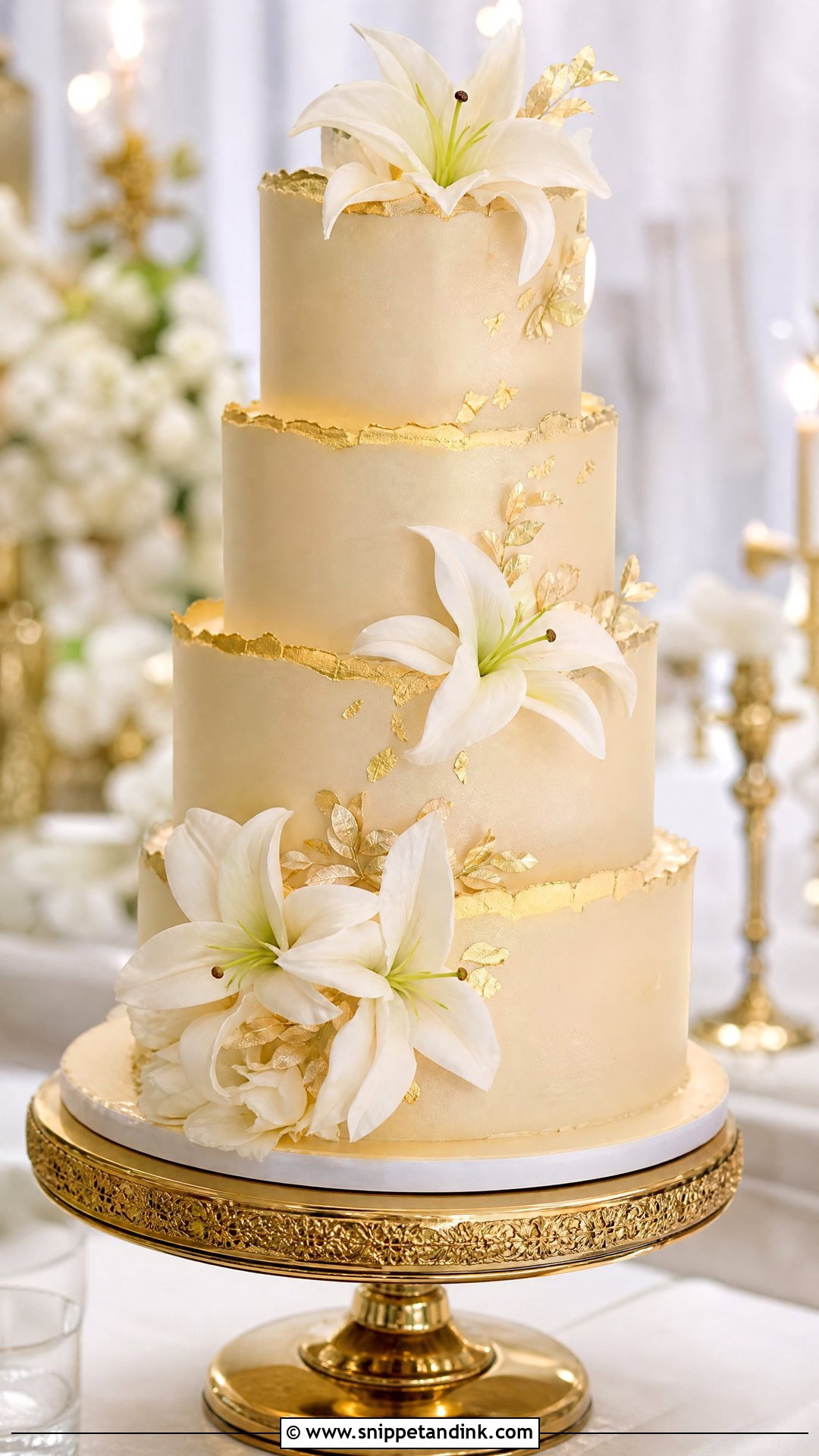
Gold works with lilies when it supports them: thin tier edges, a brushed metallic band, a few flakes of leaf. I paint gold only on dry, firm surfaces, so the cake is finished and set before any metallic goes on. White, cream, blush and champagne lilies all suit it. Caramel, chocolate hazelnut and vanilla champagne match the richness. Use gold in small, deliberate spots so the cake still feels restrained.
19. Lily Silver Wedding Cake
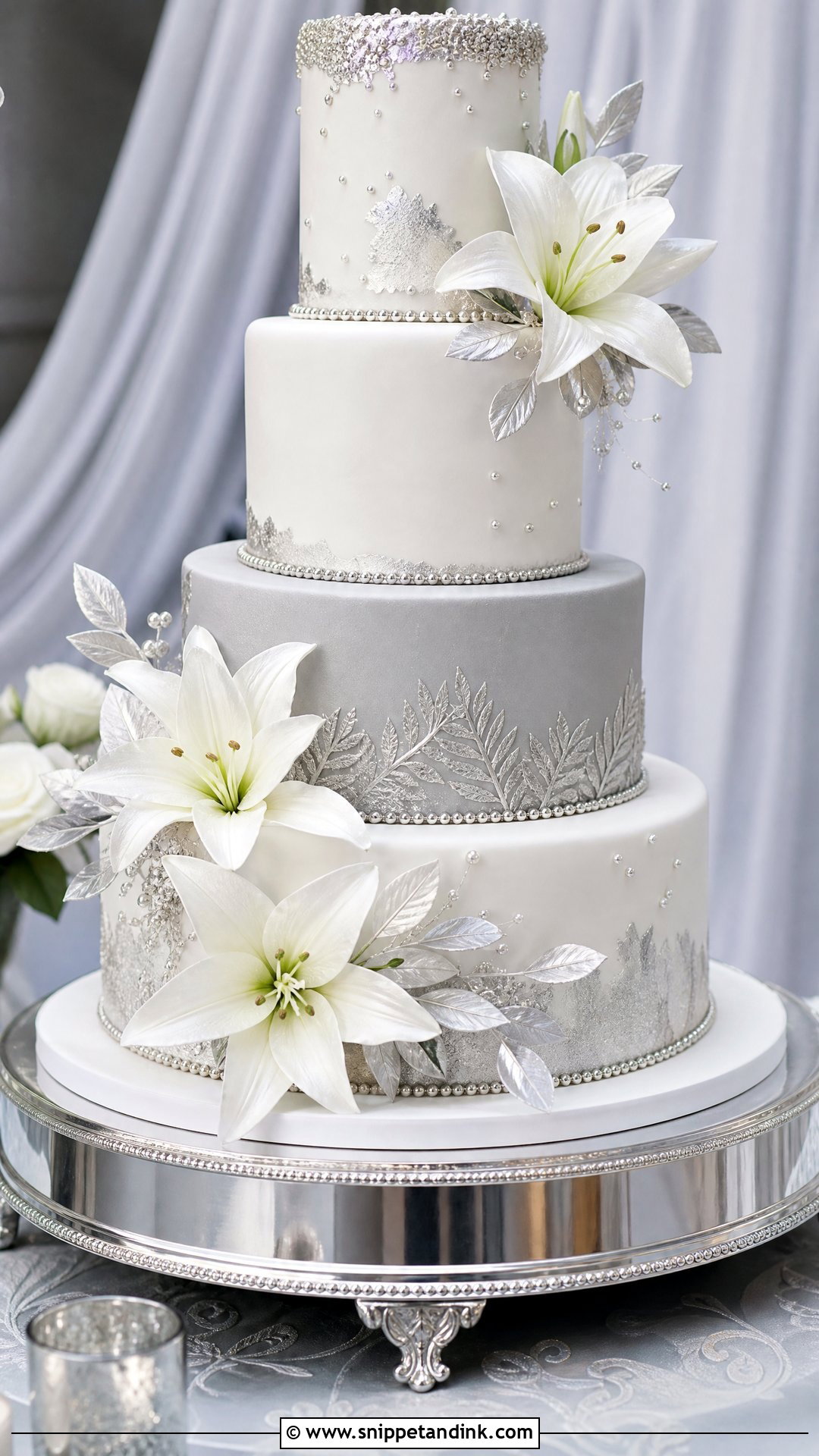
Silver keeps the palette cool, pairing well with white, blue or lavender lilies on soft gray or white frosting. Silver leaf, silver dragees, a metallic ribbon or a light shimmer all work, and smooth frosting keeps them clean. Some silver decorations are labelled for decoration only, so I check what’s edible and remove anything that isn’t before cutting. Winter and mirrored-decor receptions suit it, with white chocolate or blueberry sponge.


20. Lily Rustic Wedding Cake
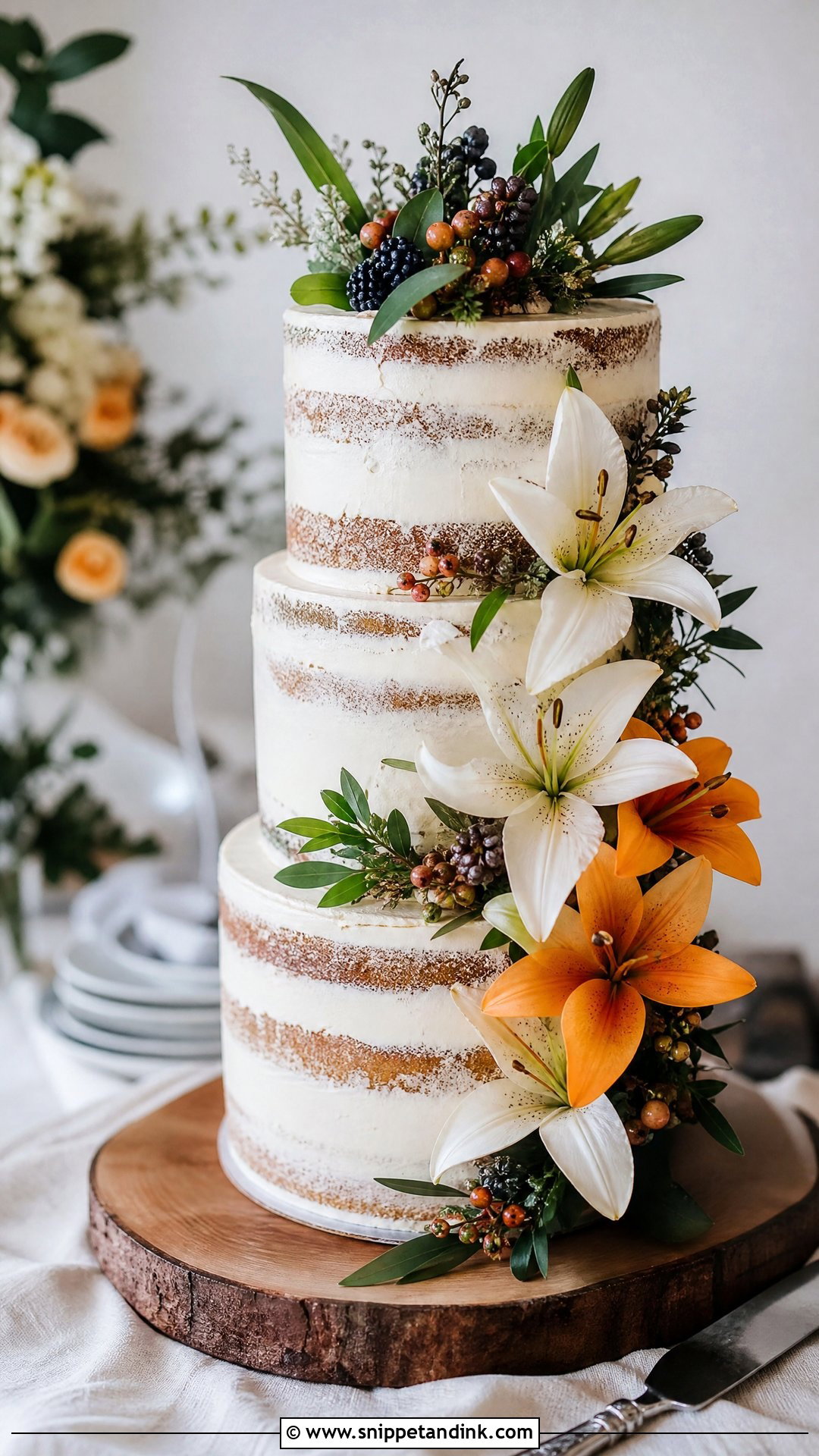
Rustic lily cakes trade smoothness for semi naked buttercream, soft ridges or rough texture. White or orange sugar lilies add a formal note against that relaxed finish, and sugar berries or a wooden stand complete it. The contrast is the point. Exposed sponge dries faster, so semi naked cakes are assembled as late as I can manage. Carrot, spice and lemon cakes fit barn and countryside weddings.
21. Lily Garden Wedding Cake
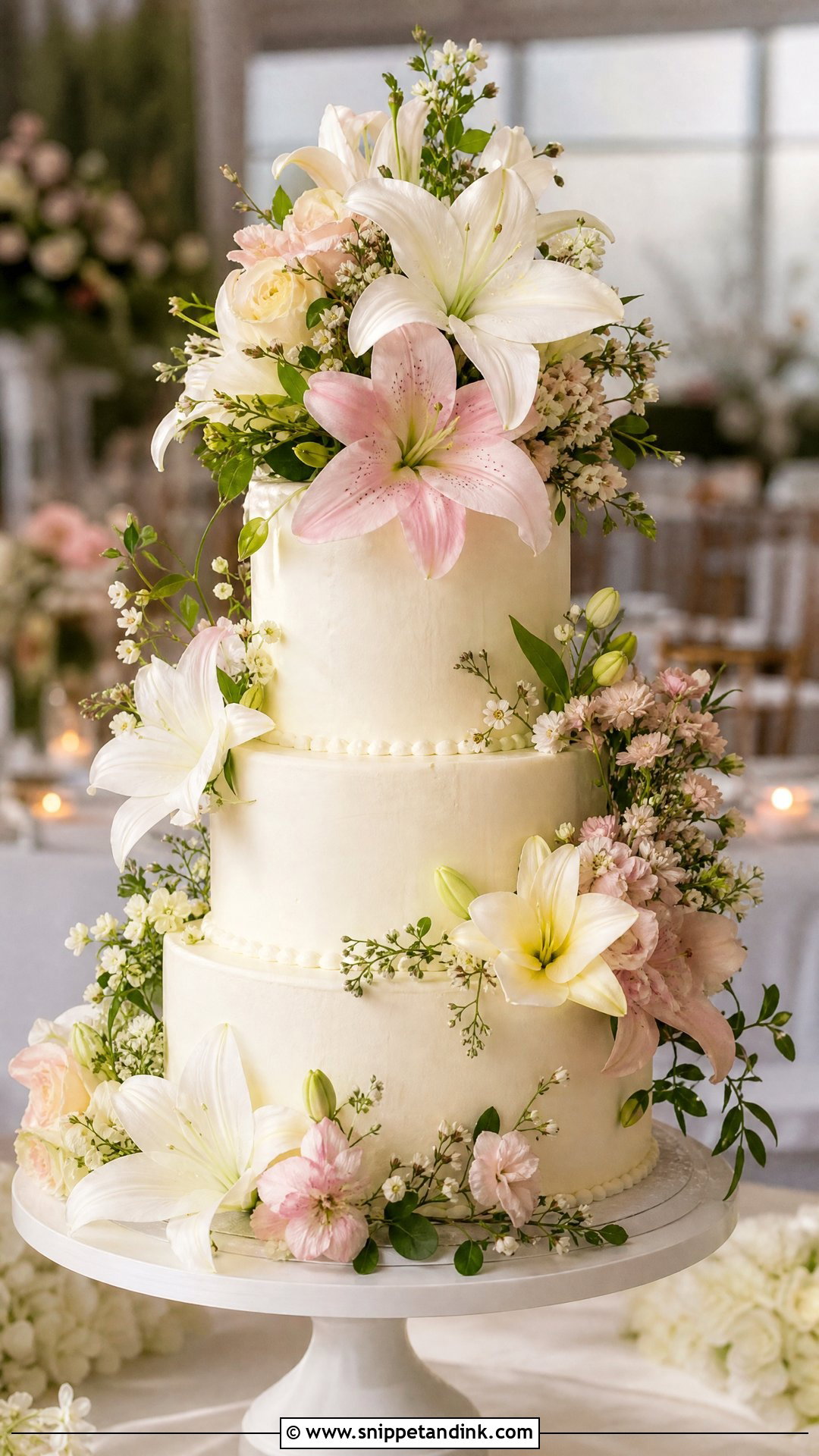
A garden version gathers sugar lilies with softer companion flowers and loose greenery, on light buttercream or fondant. Blush, white, lavender and pale yellow are the usual palette. On three tiers I either fill the gaps between layers or run a loose cascade. Lemon, strawberry or an elderflower sponge suit the mood. I keep colors natural because overly saturated sugar flowers stop looking like a garden and start looking like a toy.
22. Lily Beach Wedding Cake
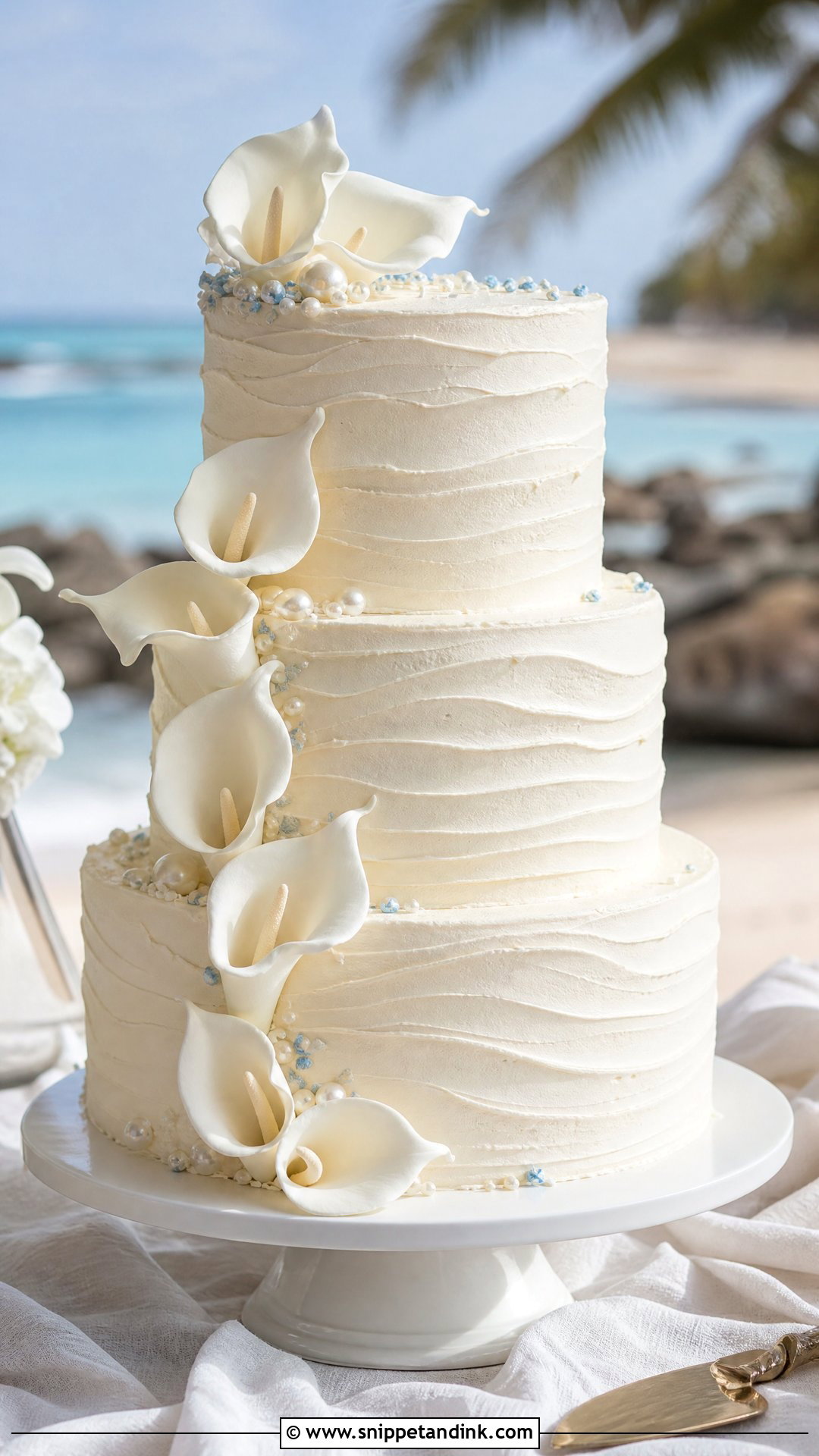
White callas suit a beach because their shape is clean and needs little else. Ivory or pale blue frosting, a wave-like buttercream texture and a few pearls keep it seaside without themed props. Sea air is humid, and humidity softens gum paste, so on the beach I’d keep the cake inside until close to serving. Coconut, lime and passion fruit fit. Avoid heavy formal decorations; let the lilies and the frosting do the work.
23. Lily Minimalist Wedding Cake
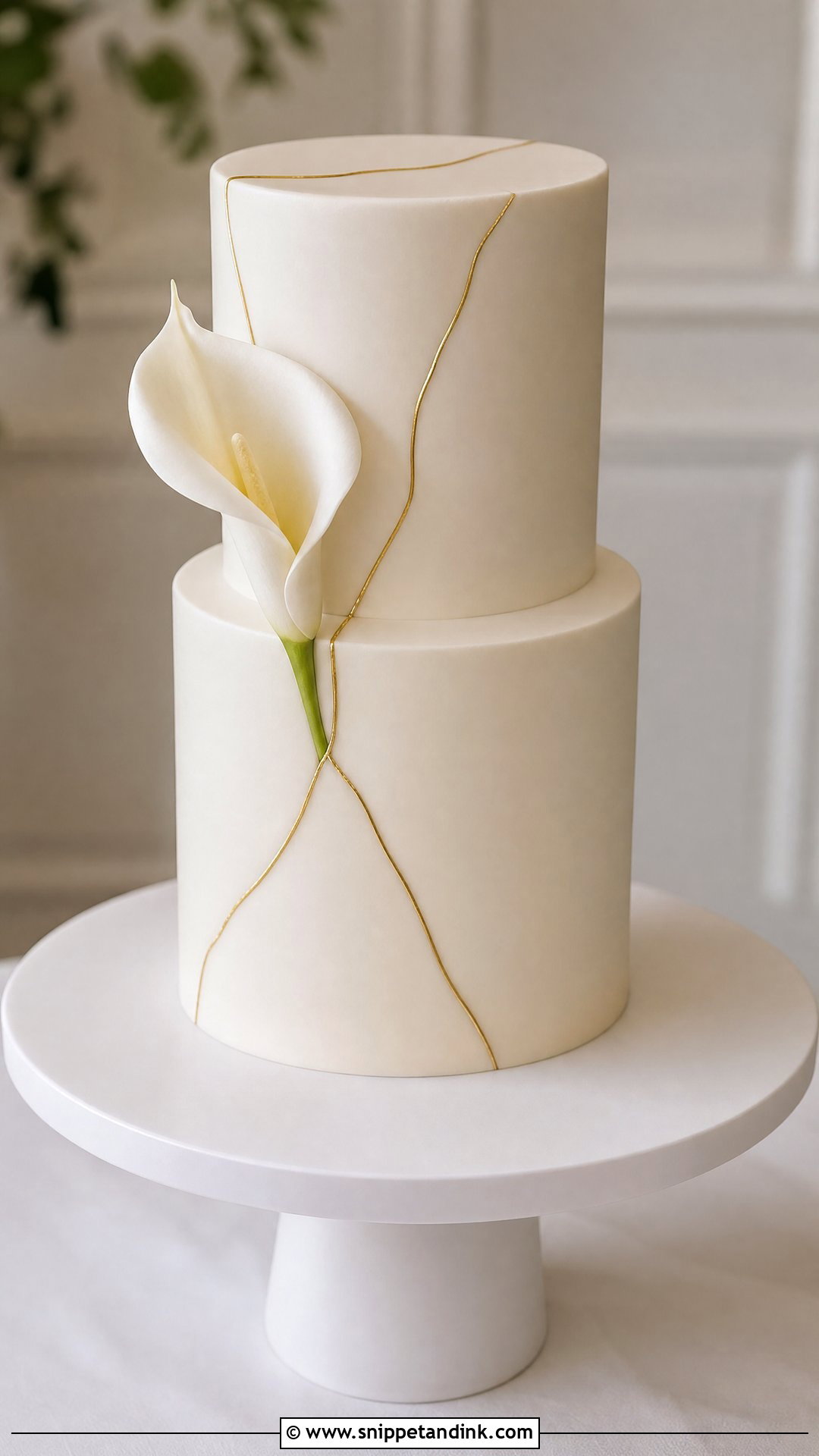
Minimal means one strong floral moment on a smooth white or ivory cake: a single sculptural calla or a small cluster on one side. With so little on the cake, every flaw shows, so the finish has to be immaculate and the one flower has to be my best work. A thin black, gold or pearl border can add definition. Intimate weddings and city venues suit this restraint, with vanilla, almond or lemon inside.
24. Lily Watercolor Wedding Cake
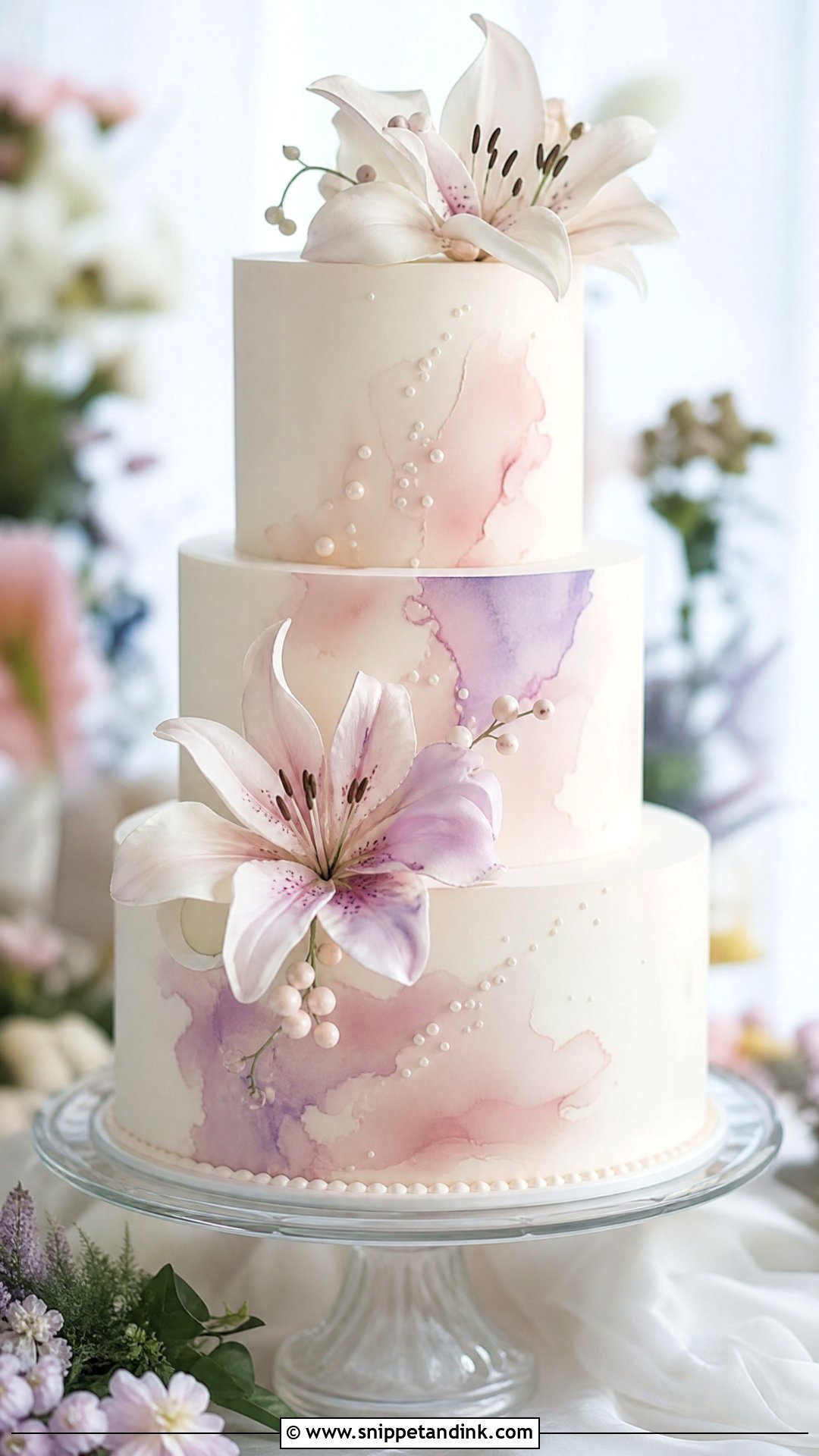
Watercolor tiers carry pale washes of blush, lavender, yellow or blue blended into the base color, with sugar lilies dusted in matching tones. On fondant I paint with diluted color and stop before the layers get muddy, which happens fast if you keep adding. The idea is for the lilies to seem to bloom out of the painted color. Lemon raspberry, lavender vanilla and almond suit creative and garden weddings.
25. Lily Tiered Wedding Cake
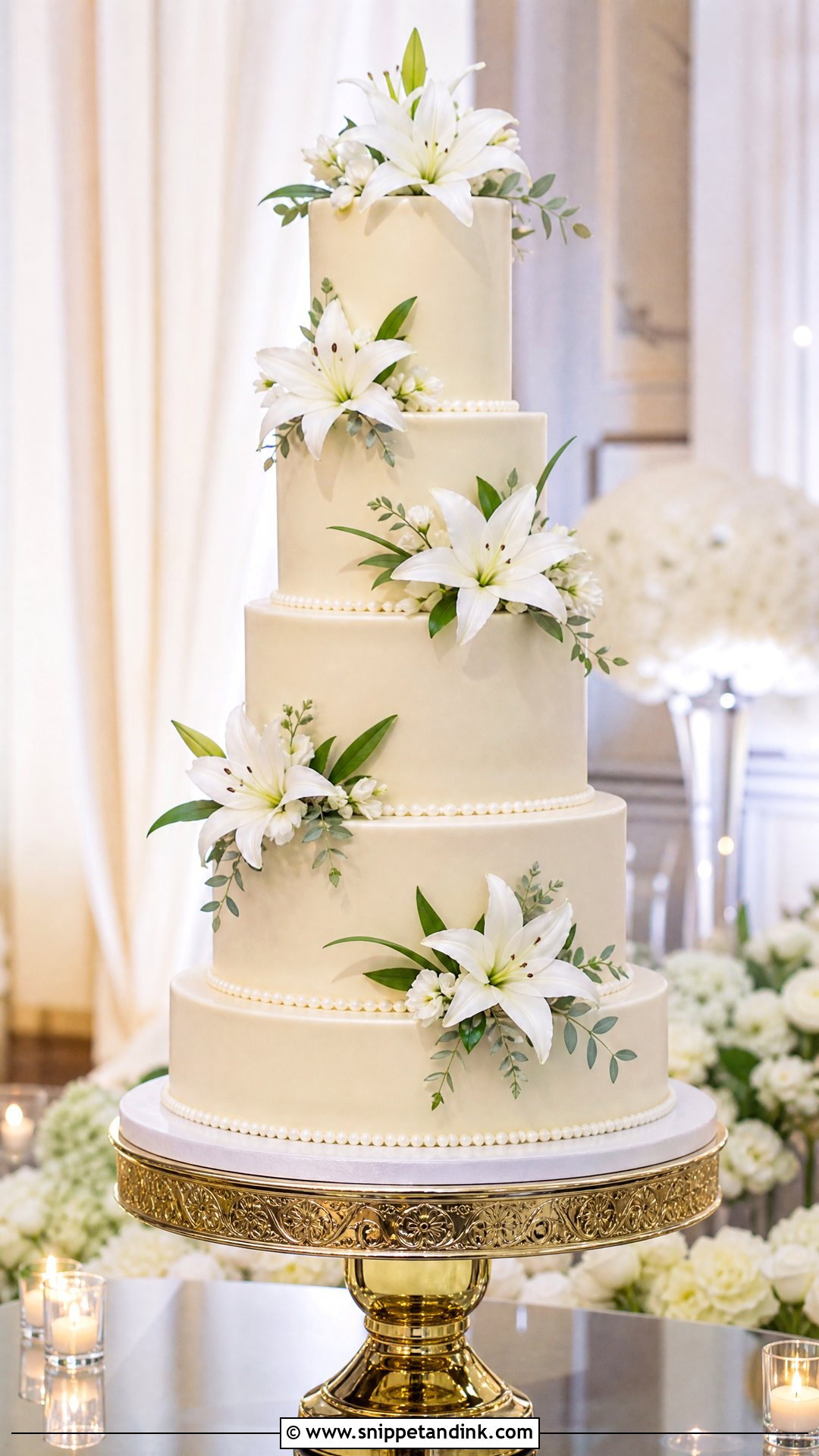
A lily tiered wedding cake with three, four or five tiers gives room for clusters, cascades or alternating tier accents. White lilies stay formal; blush, purple or gold-toned ones add personality. Smooth fondant feels grand and buttercream softer. On cakes this tall, I stack on site and place flowers last, so nothing gets crushed on the drive. The best ones have clear spacing and a strong line from top to bottom, and any flavor works inside.
Why Sugar Lilies Set Your Order Date
Each sugar lily is built petal by petal: rolled thin, veined, wired, curved over a former and left to dry before it can be dusted, steamed to soften the powder and assembled. The drying alone takes days, and humid weather slows it. That’s why I want the flowers confirmed well ahead, and why a last-minute change of color is often the one thing I can’t do.
The upside is that they last. Sugar flowers aren’t really meant for eating, and many couples lift them off before the cake is cut and keep them in a dry, dust-free box as a keepsake. Kept away from damp and direct sun, they hold their shape for years.
Real Lilies on the Cake Table: A Few Cautions
Fresh lilies around the cake can look wonderful, but I ask the florist to snip off the pollen-heavy anthers first, since the orange dust stains white frosting and linens and won’t come out. Strongly scented varieties can also overpower a dessert table in a warm room, so I’d keep them a little away from the cake itself. If you plan to take arrangements home and have cats, skip true lilies entirely; they’re dangerous to cats even in small amounts.
A Lily Cake Should Have One Star, Not Five
Lilies can turn a cake soft, bold, rustic or glamorous depending on color and finish, but they always need to be the main idea. Give them room and stop adding before the cake gets busy. Sugar, gum paste and wafer paper lilies give you a realistic bloom and a cake that’s safe to serve, with fresh stems kept on the table around it. White callas, blush garden lilies, black accents or a full cascade can all be matched to your venue; bring a photo of your bouquet to the tasting and I’ll build the flowers from there.
You'll Like These Ideas:











Leave a Reply