
Butterflies give a tall cake something most decorations can’t: the sense that it’s moving. On three tiers, a butterfly wedding cake can read as classic, modern, whimsical or grand, and the difference comes from colour, flowers, frosting and how the wings are placed. They sit happily alongside pearls, pressed flowers, fondant, edible gold and smooth buttercream. What I watch for is a cake where the butterflies look stuck on as an afterthought. Below are twenty versions I’d make, each with a note on what the butterflies are made of and how they behave once the cake leaves my kitchen.
Which Butterfly Material Survives Your Venue
The butterflies in inspiration photos are made from very different materials, and each reacts to heat and humidity in its own way. I always ask about the venue and the season before suggesting one.
- Wafer paper: almost weightless and slightly translucent, so it looks the most real. It softens and curls in humid air or on damp frosting, which makes it a risk outdoors in summer.
- Gum paste: dries hard and holds a lifted wing well, and can be made weeks ahead. It’s heavier, and it’s best treated as decoration rather than something to eat.
- Chocolate or candy melts: edible and glossy, but they soften and warp in a warm room or in sun.
- Isomalt or clear sugar: glass-like and very striking, but humidity makes it sticky and cloudy.
- Paper, acetate or fabric: not edible at all. If you use them, they should sit on picks and be removed before cutting.
For a hot, humid or outdoor wedding, I’d lean on gum paste. In an air-conditioned room, wafer paper gives the most delicate result.
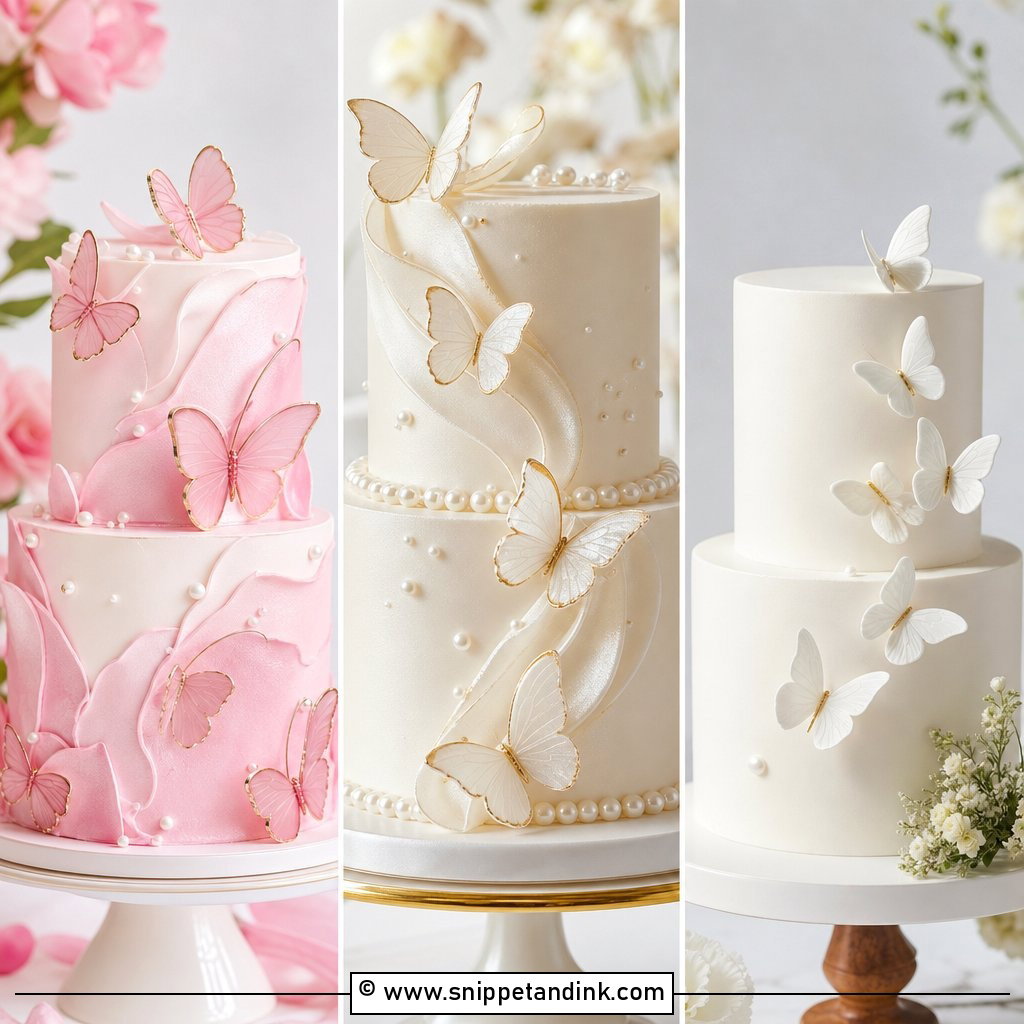
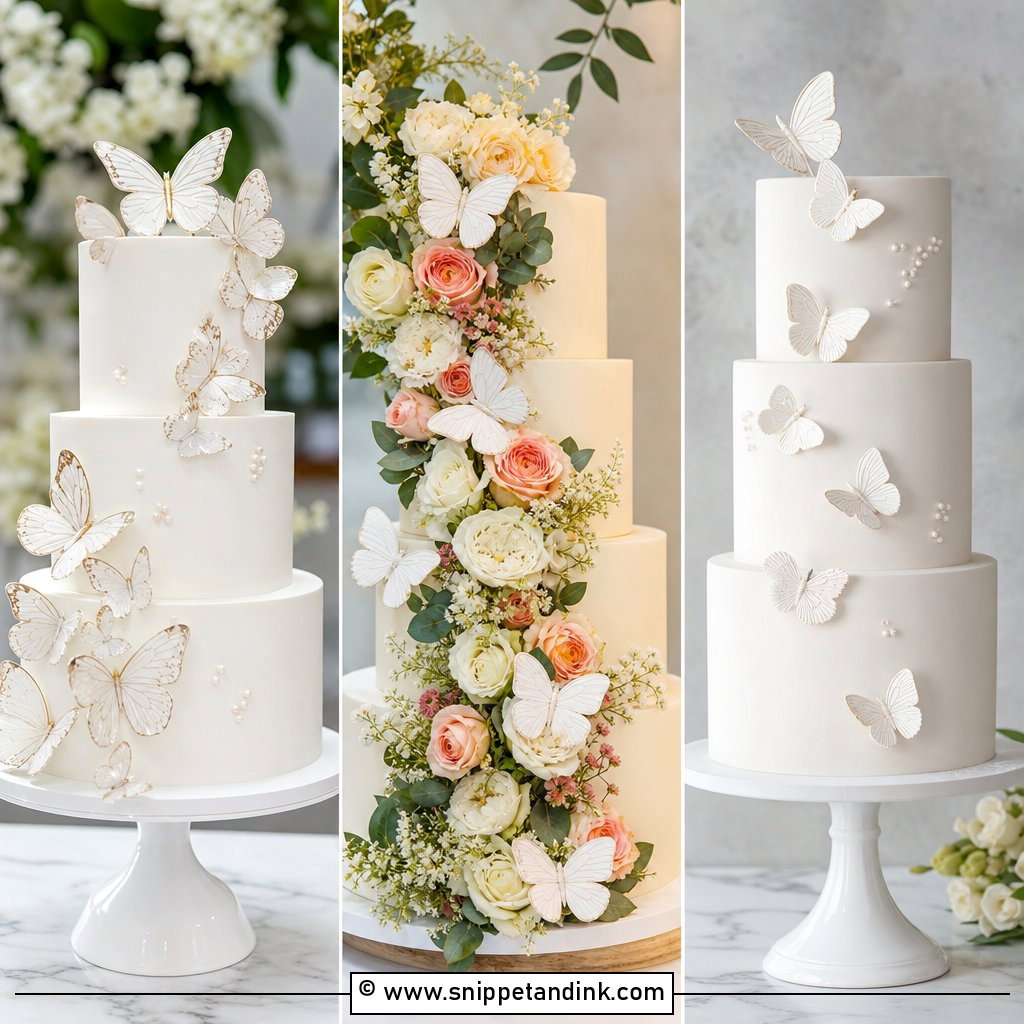
1. White 3 Tier Butterfly Wedding Cake
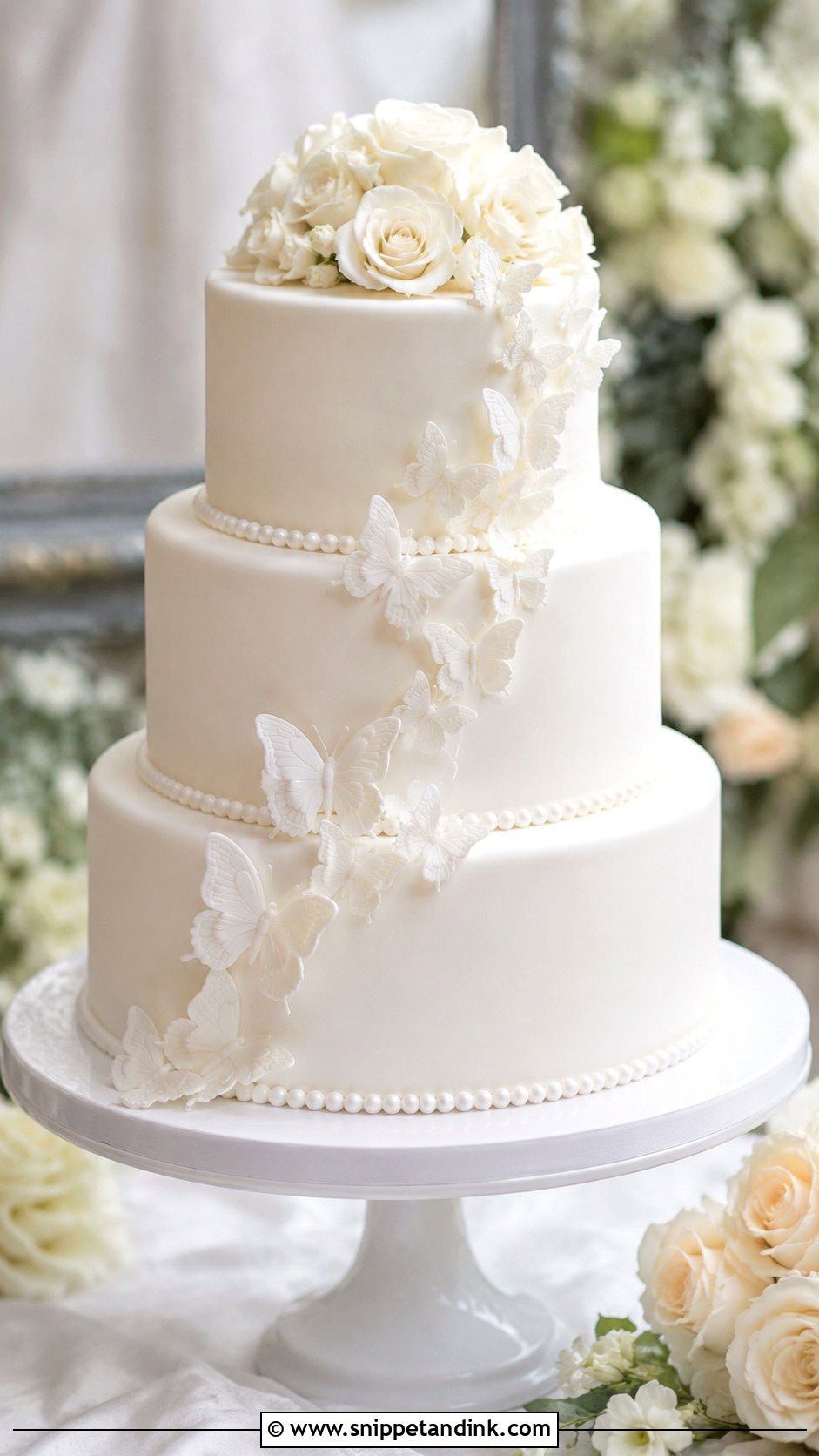
All-white is where I’d send anyone unsure, since every butterfly shows up against it without the cake looking busy. Fondant gives a ballroom polish, and buttercream feels warmer. I cut white sugar butterflies in at least three sizes and set them rising up the tiers, smallest at the top, because same-sized wings in a row look like a border rather than a flight. Pearl borders, white roses and a few tiny blossoms keep it bridal. It suits a church, a garden or a hotel ballroom equally.
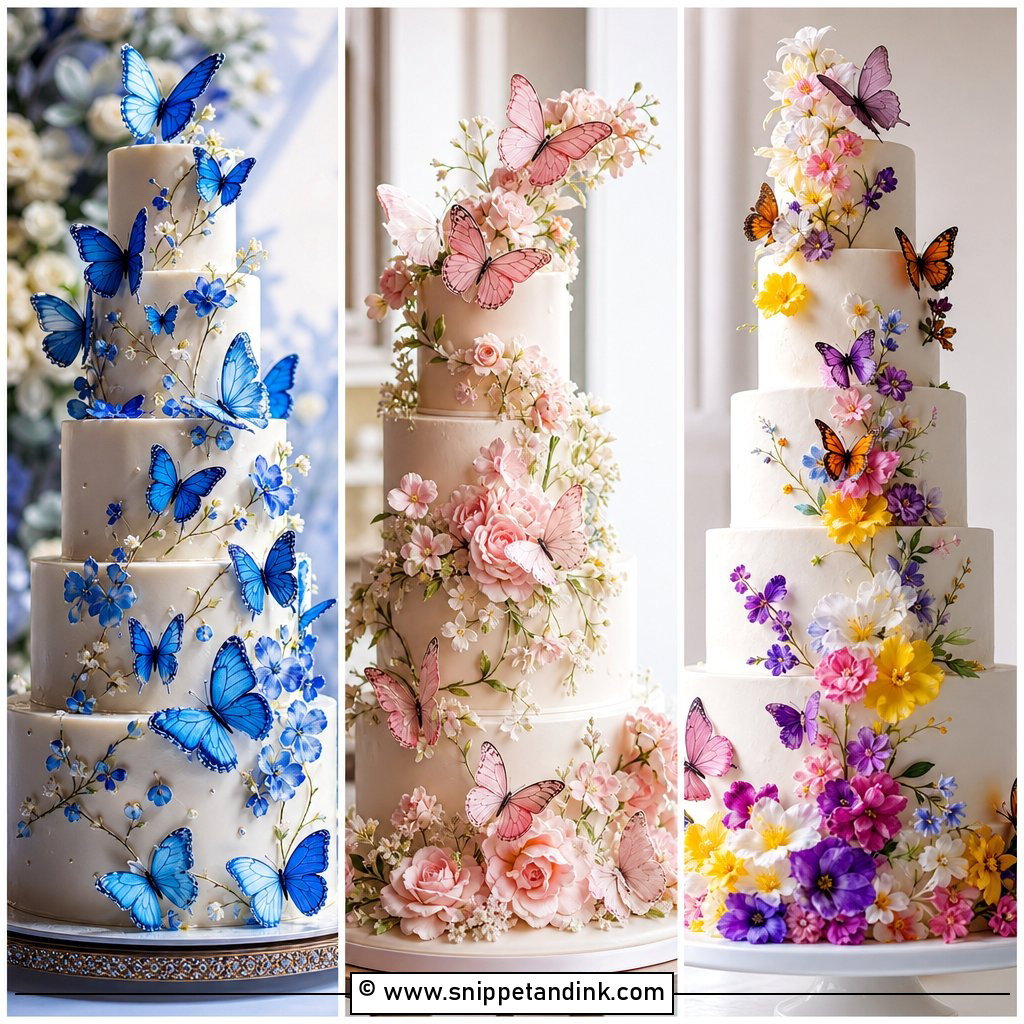
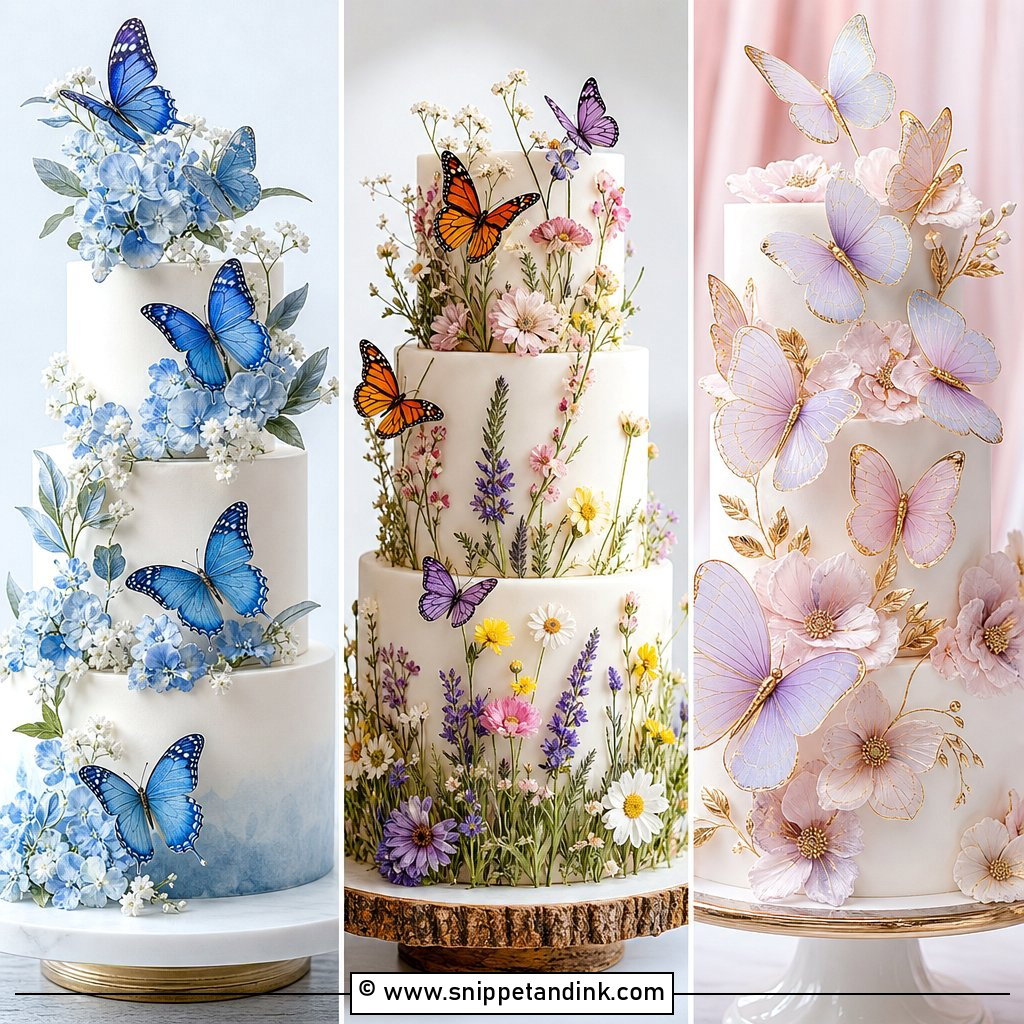
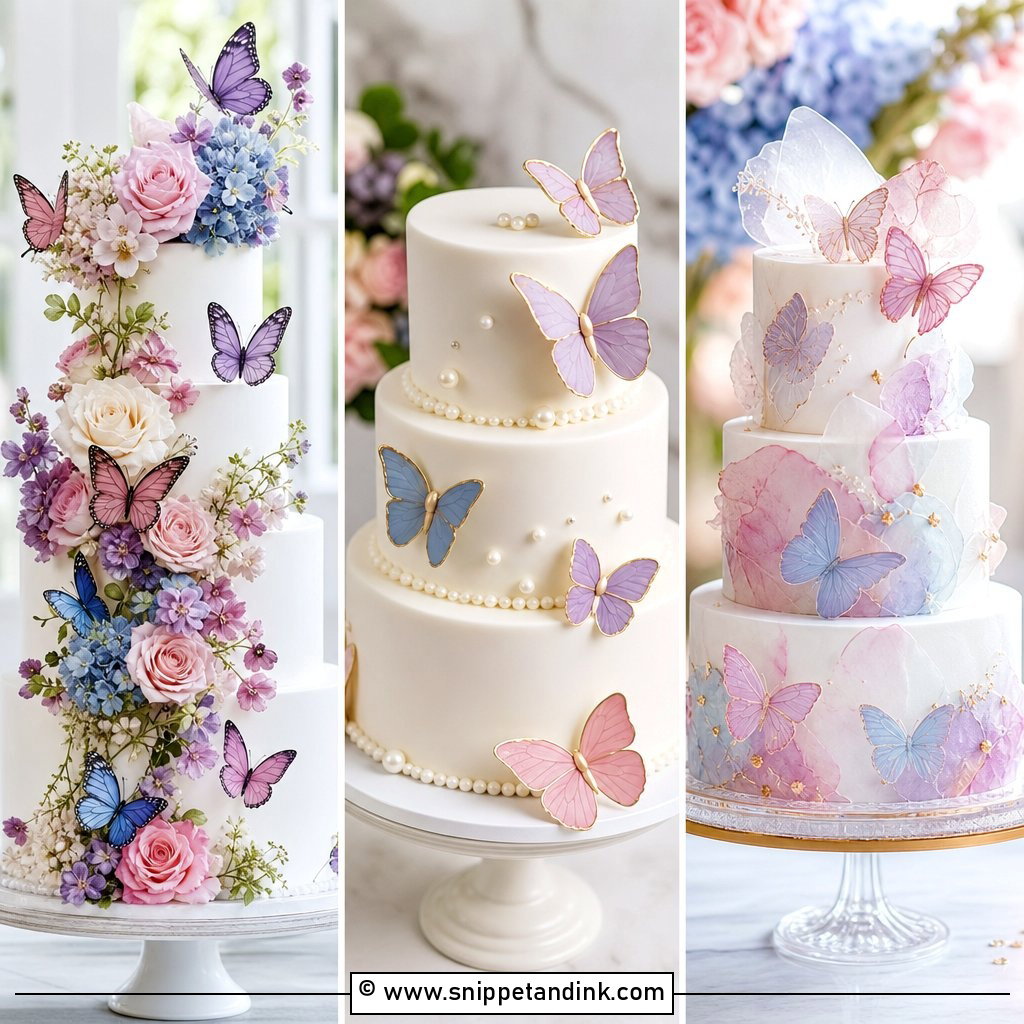
2. Blue Butterfly 3 Tier Wedding Cake
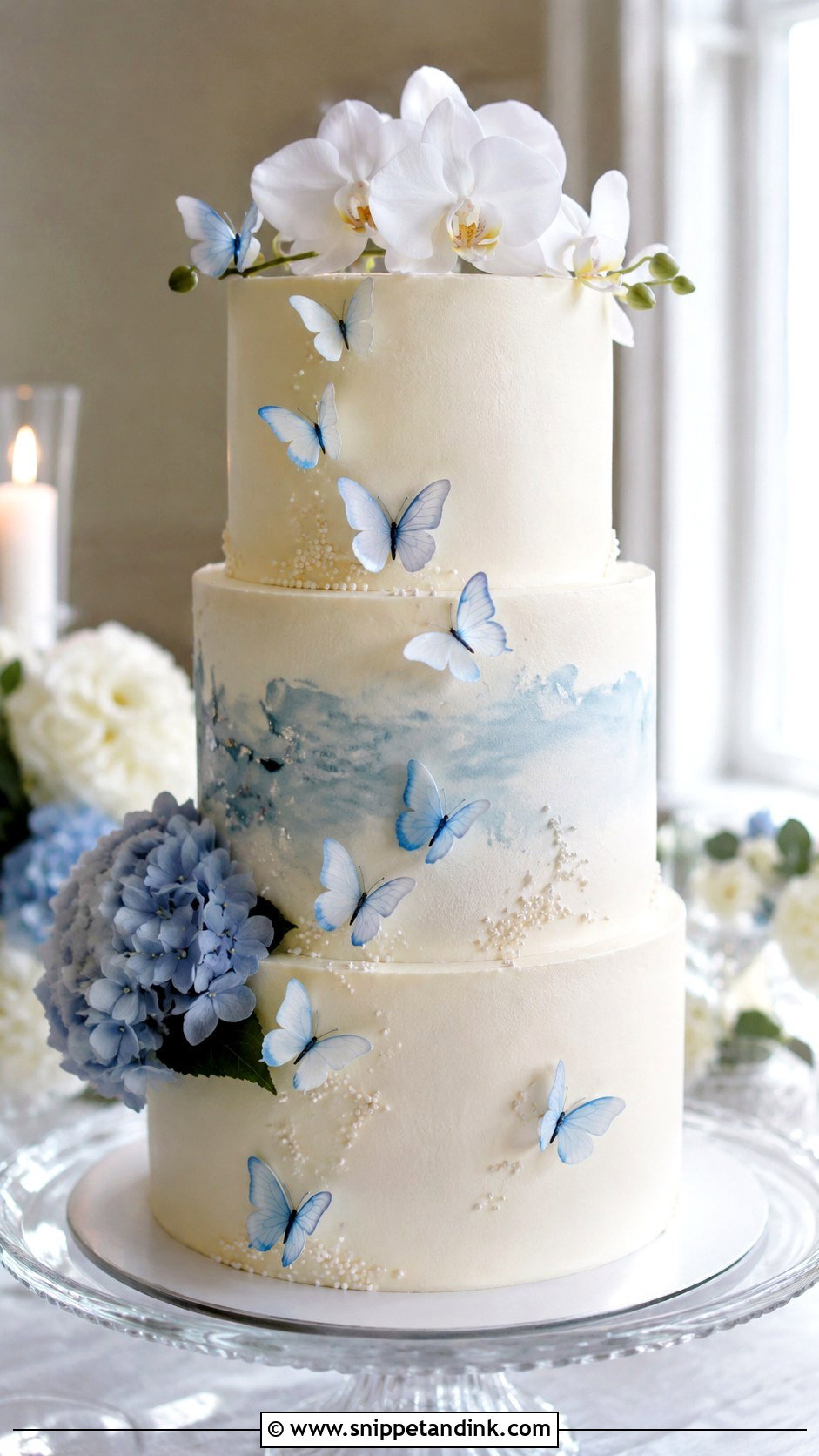
Blue butterflies on ivory frosting give you a soft colour story and an easy “something blue.” Pale blue stays airy, while deeper blue makes the wings sharper in photos. The tiers can stay white with blue only on the wings, or one tier can carry a light watercolour wash. Silver pearls, white orchids and pale hydrangea pair well. Blue colouring is one of the trickier shades to keep stable on sugar, and strong light can shift it, so I keep the cake out of direct sun until it’s cut. Spring weddings and coastal venues suit it best.
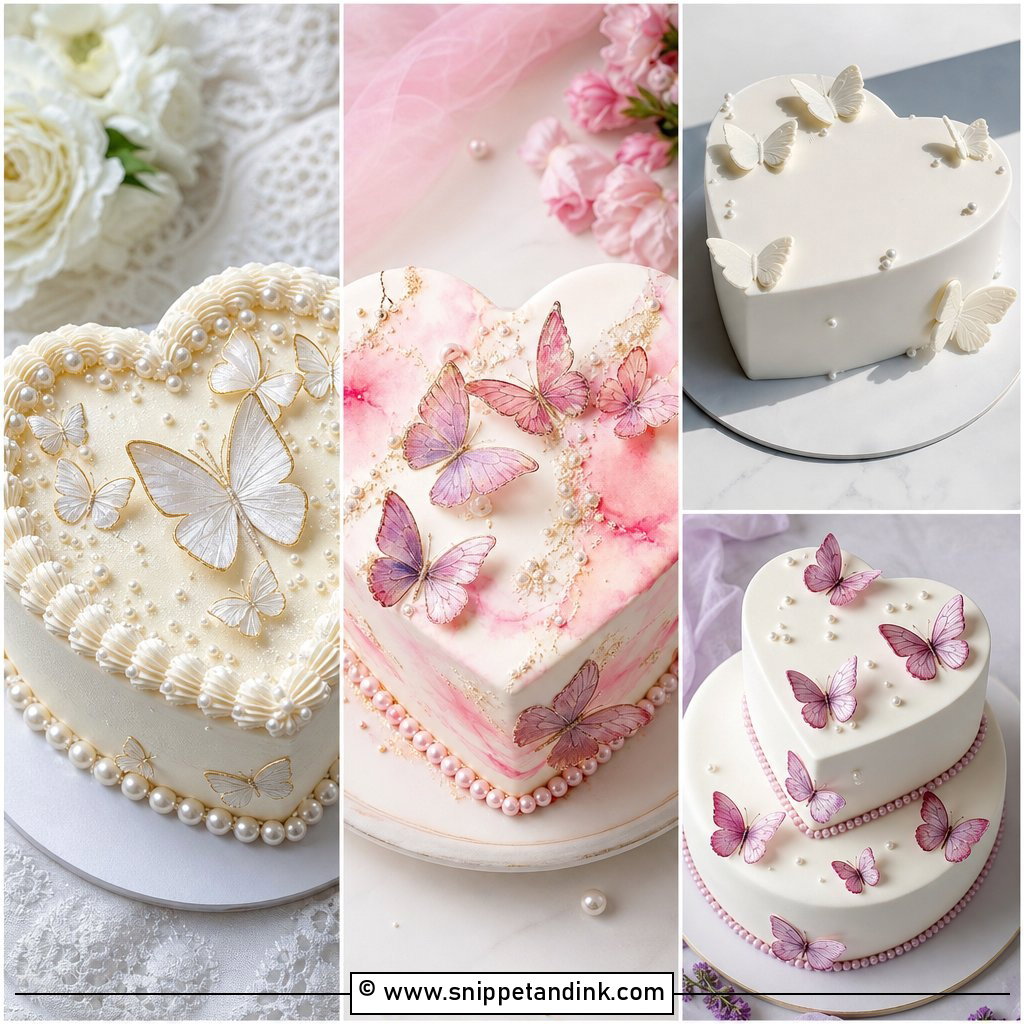
3. Pink Butterfly 3 Tier Wedding Cake
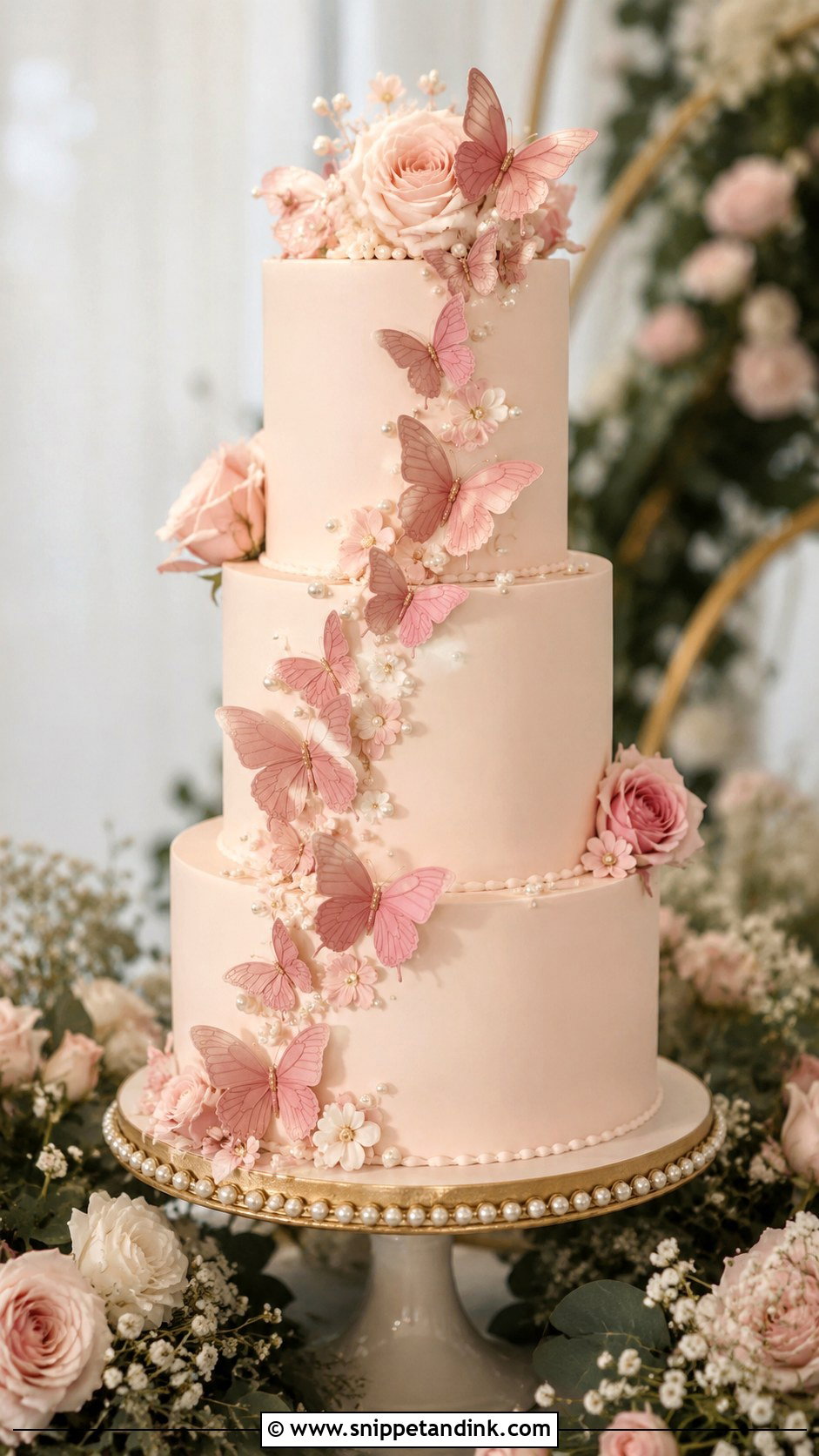
Pink can tip into a child’s birthday cake fast, and the fix is choosing the shade carefully. Blush, dusty rose and champagne pink all look grown-up. I keep the base ivory or barely pink and send the butterflies diagonally from the bottom tier to the top, with roses, ranunculus and a few sugar blossoms along the same line. For a more modern take, one tier gets a pale pink ombré in buttercream and the other two stay smooth. Garden weddings and brunch receptions are its natural home.
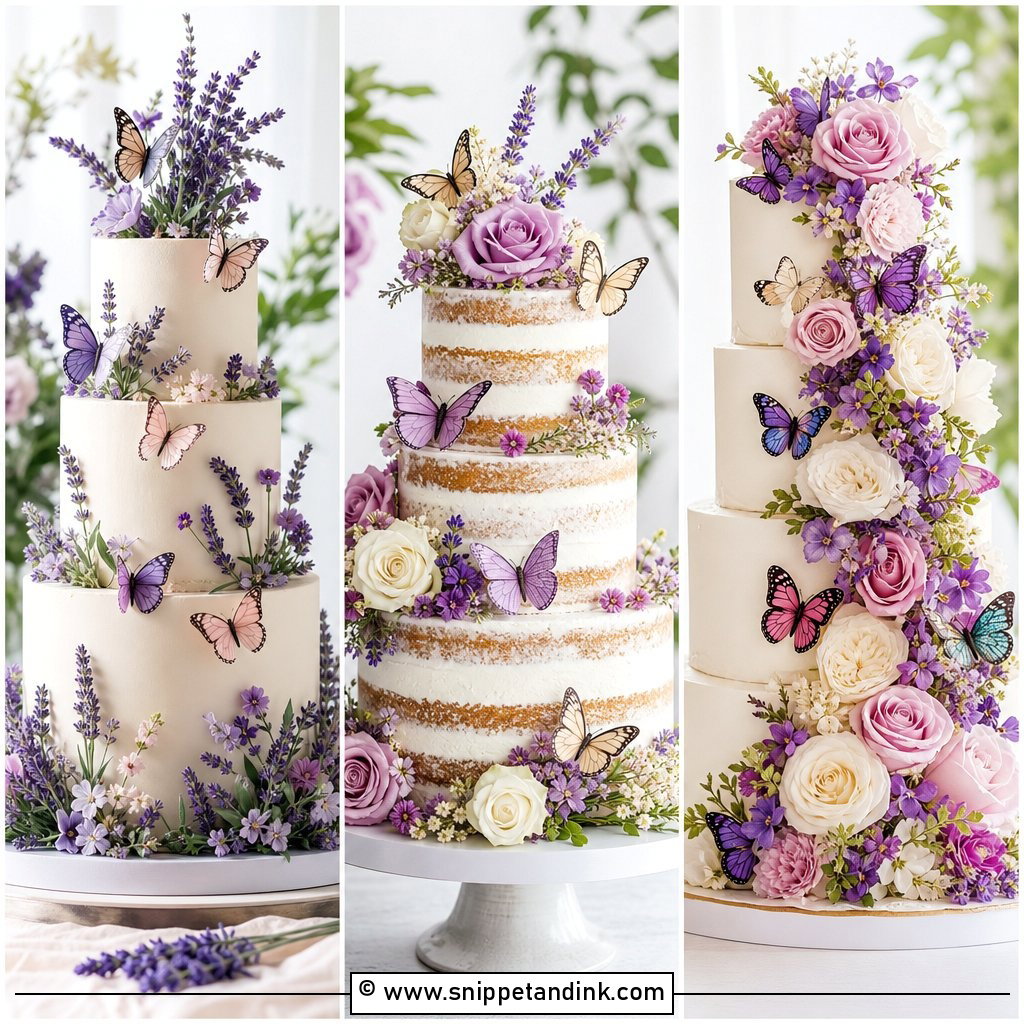
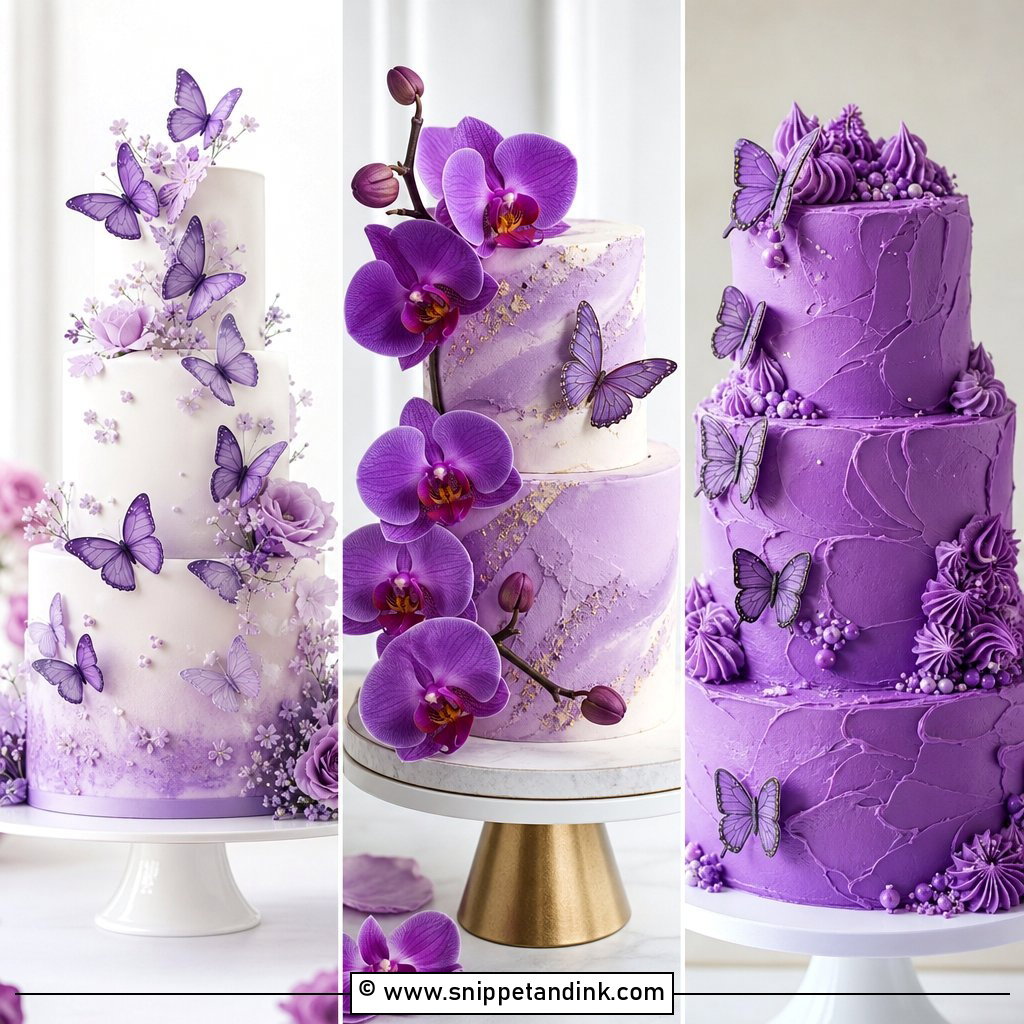
4. Purple Butterfly 3 Tier Wedding Cake
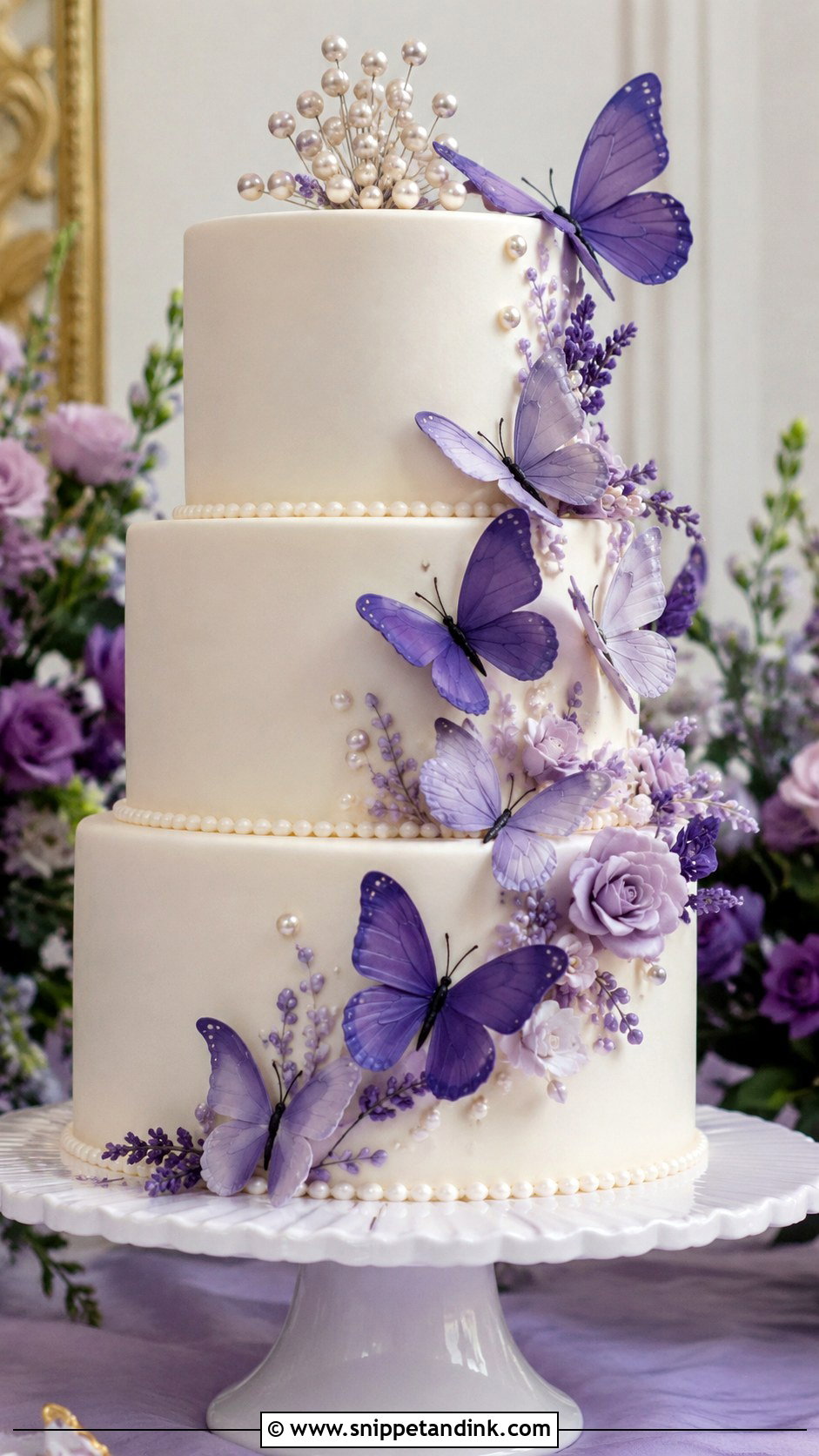
Of all the colour versions, the purple butterfly 3 tier wedding cake feels the most magical to me. Lavender wings read as spring, while plum or violet bring drama to an evening reception. A white or ivory base keeps the purple from taking over. Lavender sprigs, lilac sugar flowers or soft hydrangea finish it. Purple frosting is notorious for turning greyish or blue as it sits, so I keep the purple on the sugar butterflies rather than the buttercream. Arrange the wings in a gentle cascade, not evenly spaced around the cake.
5. Gold Butterfly 3 Tier Wedding Cake
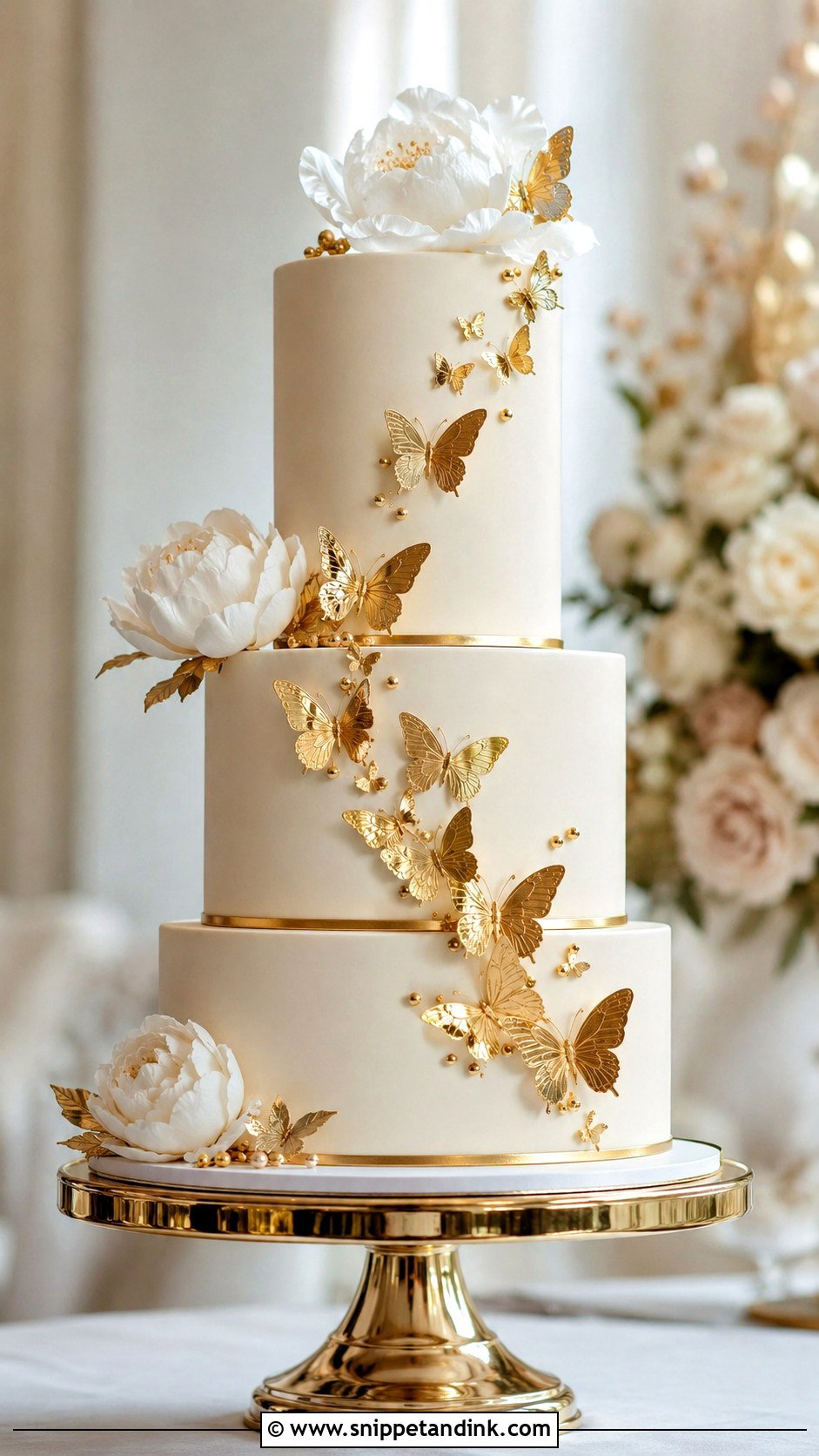
Gold wings make a plain white cake look expensive in one move. The rule is restraint. Gold butterflies are the statement, so the frosting stays smooth and the flowers simple, with ivory roses, white peonies and a few pearls. A thin gold trim around each tier can tie it together. Metallic finishes come in edible and decorative-only versions, and anything that touches the cake should be the edible kind. Under warm reception lighting the wings catch the glow, which makes it a natural pick for a ballroom or black-tie evening.
6. Floral 3 Tier Butterfly Wedding Cake
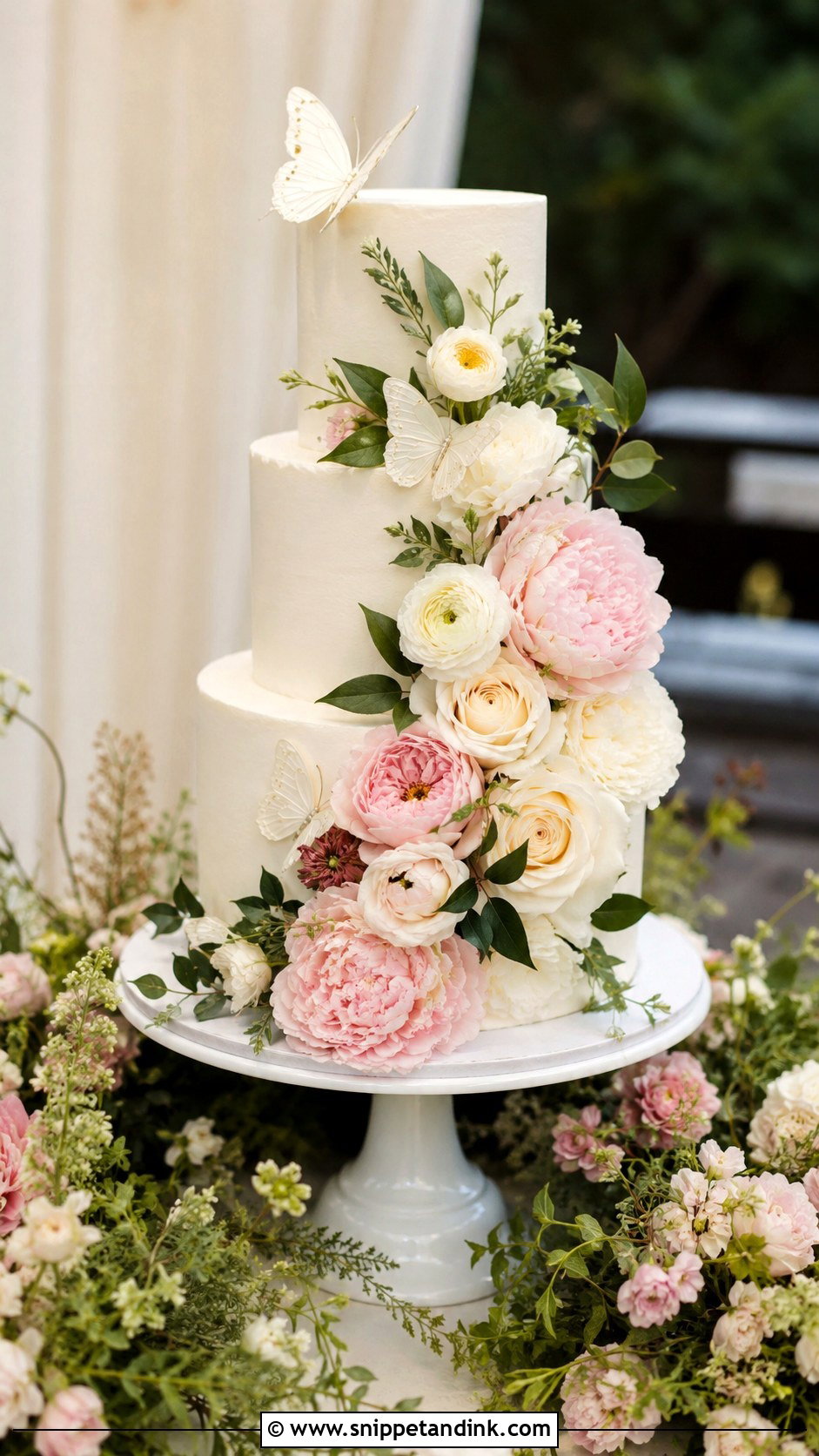
Butterflies and flowers should look like one scene, with the wings settling among the blooms rather than floating on their own. I match the flowers to the bouquet, often roses, peonies or ranunculus, and run one cascade down a side so the butterflies have a path to follow. Fresh stems need wrapping or a pick before they go into cake, so your florist and baker should talk before the day. Buttercream keeps it soft, fondant cleaner. It belongs at a reception with lush centrepieces.
7. Simple 3 Tier Butterfly Wedding Cake
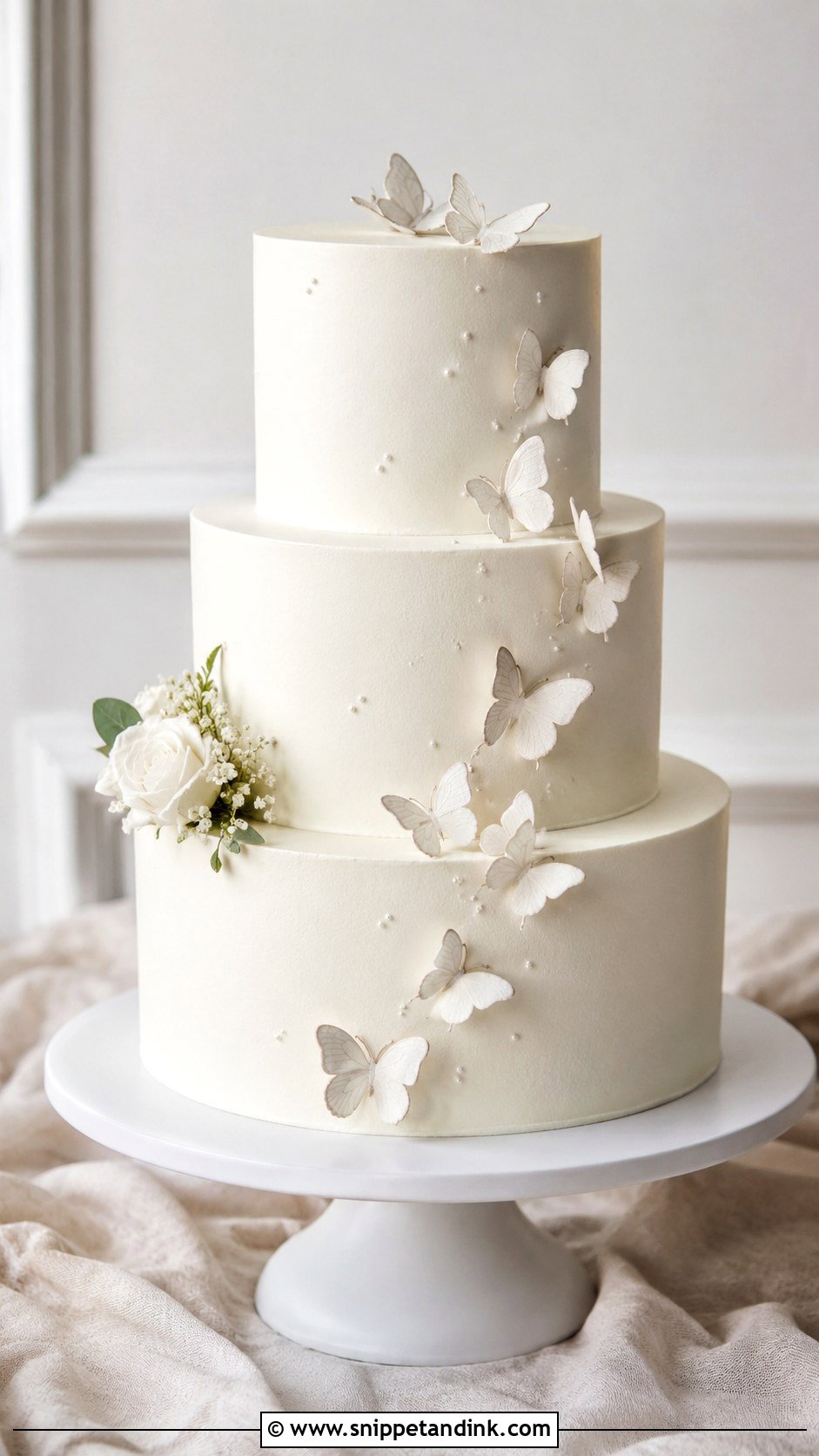
Fewer butterflies, placed well, usually beat many. I start with smooth white or ivory buttercream and add five to seven delicate wings in a loose diagonal trail across the tiers, then stop. A few tiny pearls, soft piping or one small flower cluster is the whole finish. With so little decoration, every flaw in the frosting shows, so this design is really a test of the baker’s sharp edges and level stacking. Get those right and it looks quietly expensive next to minimal decor.
8. Rustic 3 Tier Butterfly Wedding Cake
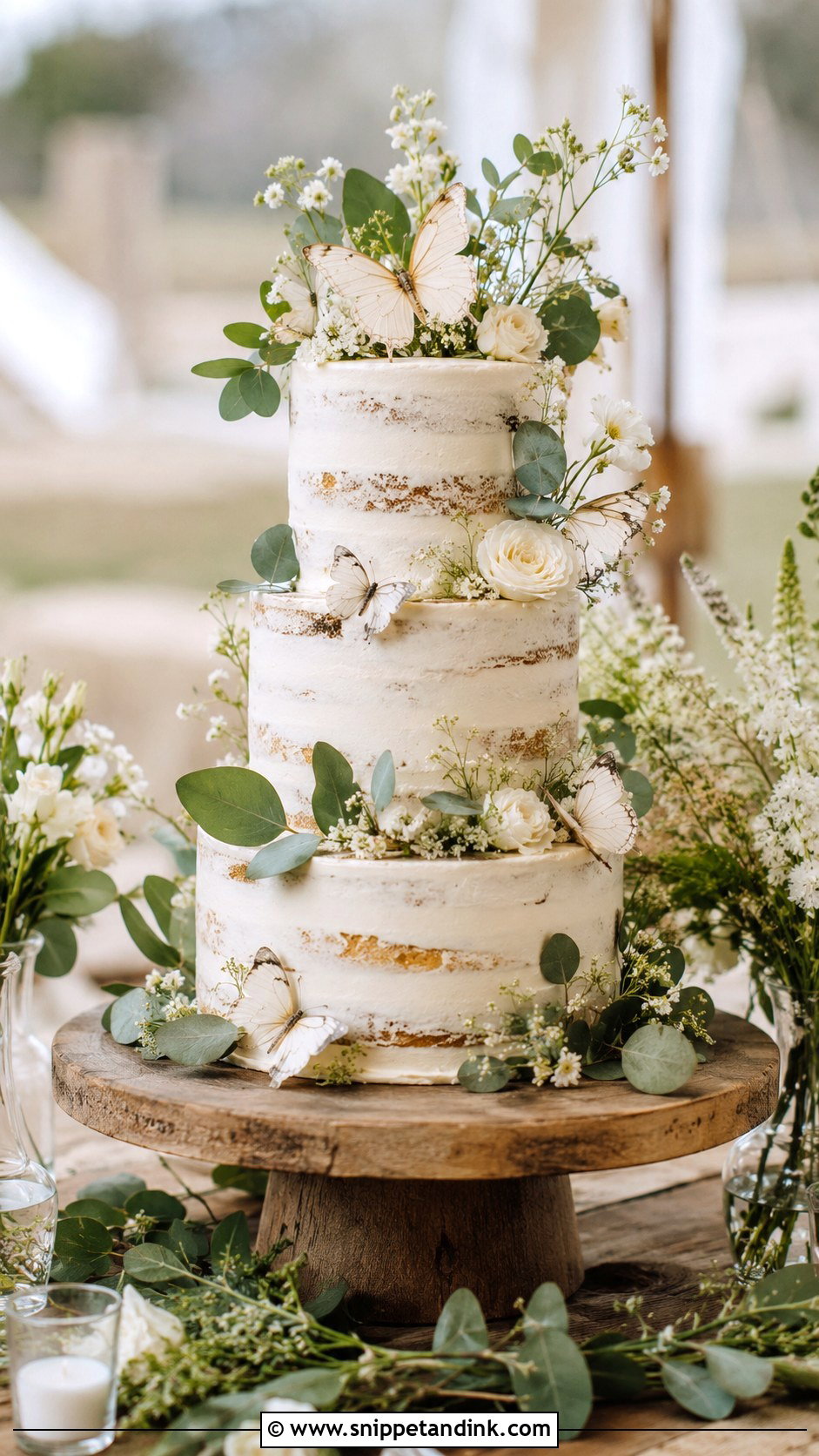
Semi-naked buttercream, with a little sponge showing through, gives a barn or meadow wedding the right feel. Cream or ivory butterflies, wildflowers, small roses and a bit of eucalyptus finish it, on a wooden stand. Two cautions from experience. Exposed sponge dries out faster, so I brush the layers with syrup and assemble late. Eucalyptus and many wildflowers aren’t food-safe, so their stems must be wrapped and kept off the cake surface. Keep the butterfly colours gentle so it still feels bridal.
9. Modern 3 Tier Butterfly Wedding Cake
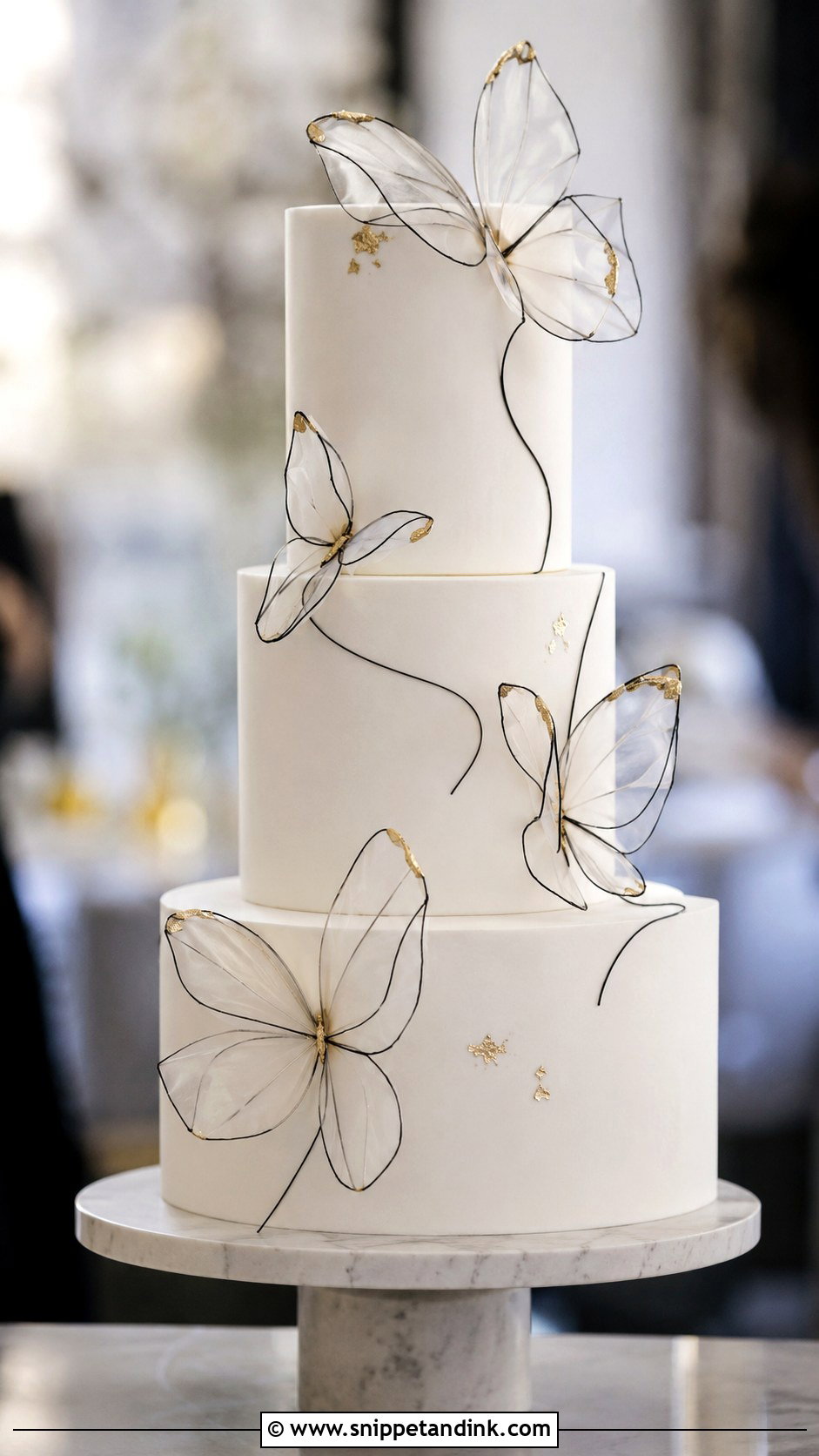
Modern butterfly cakes work by subtraction. I use fewer, larger butterflies in a sculptural group, on square or extra-tall round tiers, in white fondant, smooth buttercream or a monochrome palette. Then one bold detail: black piping, a gold edge or translucent wafer paper wings. Large wings need support, so I wire them into a small group and anchor the wires in a food-safe pick, never straight into the sponge. City weddings, galleries and rooftop receptions suit this look.
10. Pearl 3 Tier Butterfly Wedding Cake
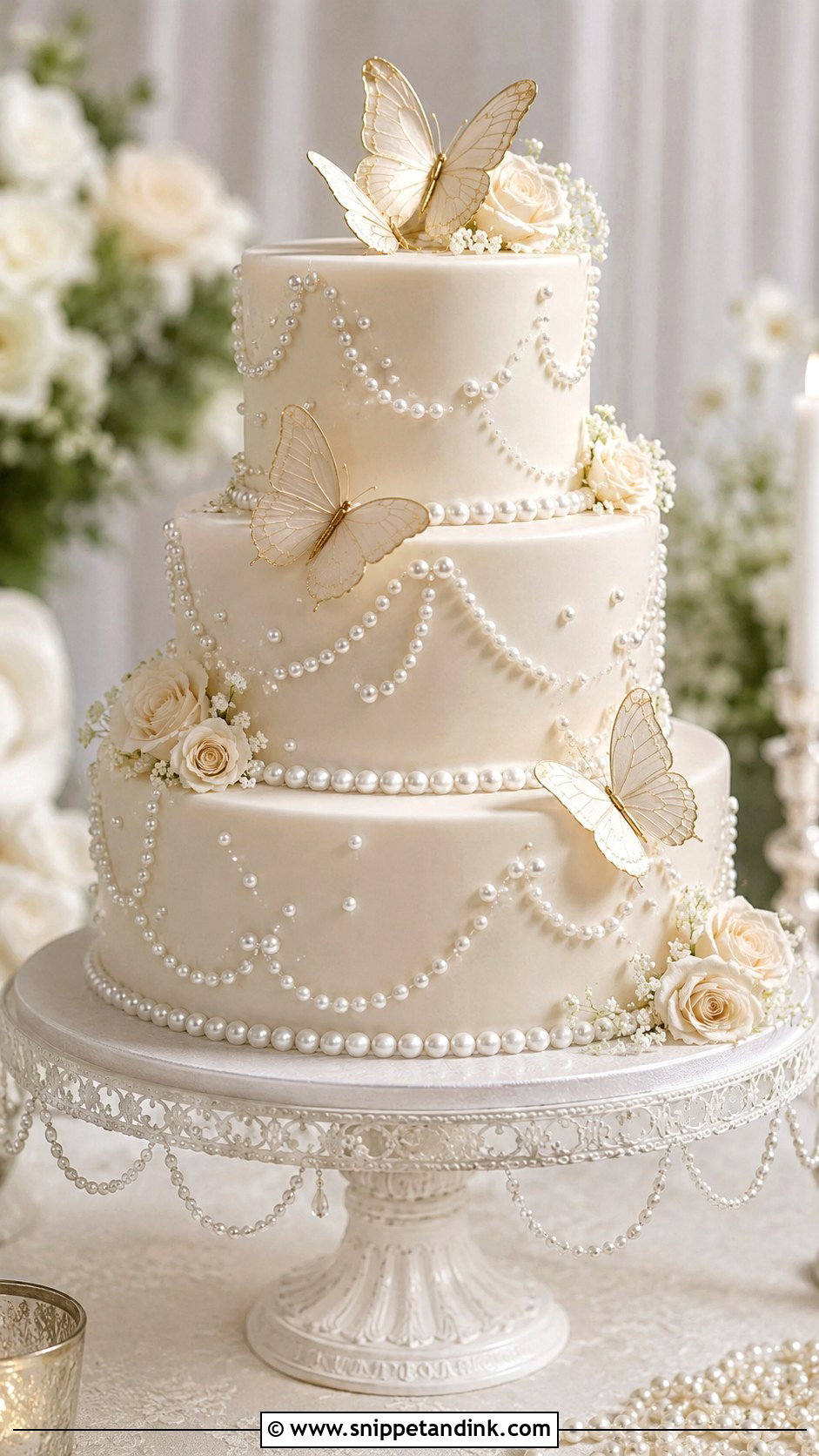
Pearls can do more than edge a tier. I use them as borders, scattered accents or fine trails that lead the eye from one butterfly to the next, on an ivory or white base. White, champagne or pale blush sugar butterflies sit best with them. Small rose clusters are optional, and many couples prefer it with no flowers at all. If the bride is wearing pearl jewelry, this cake ties straight back to her look. Detailed without being loud, it suits a chapel ceremony or a vintage-inspired reception.
11. Buttercream 3 Tier Butterfly Wedding Cake
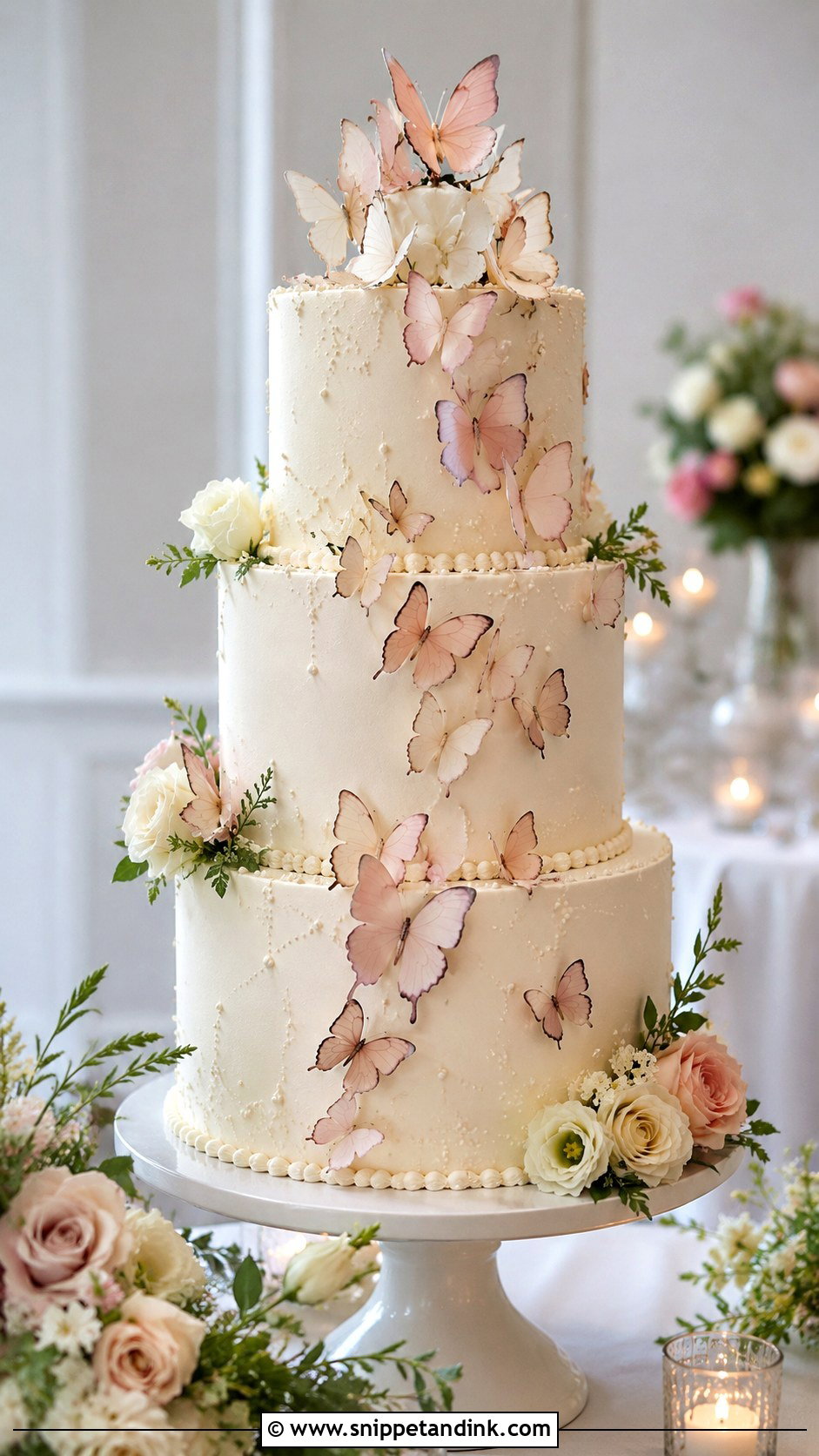
Soft buttercream sides and light wings belong together. Smooth frosting looks clean, while a gentle texture feels handmade. Wafer paper butterflies are my usual pairing because they weigh almost nothing and can be set at an angle so they seem to lift. The catch is moisture. Wafer paper softens, curls and can dissolve where it touches damp frosting, so I attach it with a dot of firm buttercream at the body only. A ruffle edge or tiny piped dots add charm. Less formal than fondant, it suits spring and summer receptions indoors.
12. Fondant 3 Tier Butterfly Wedding Cake
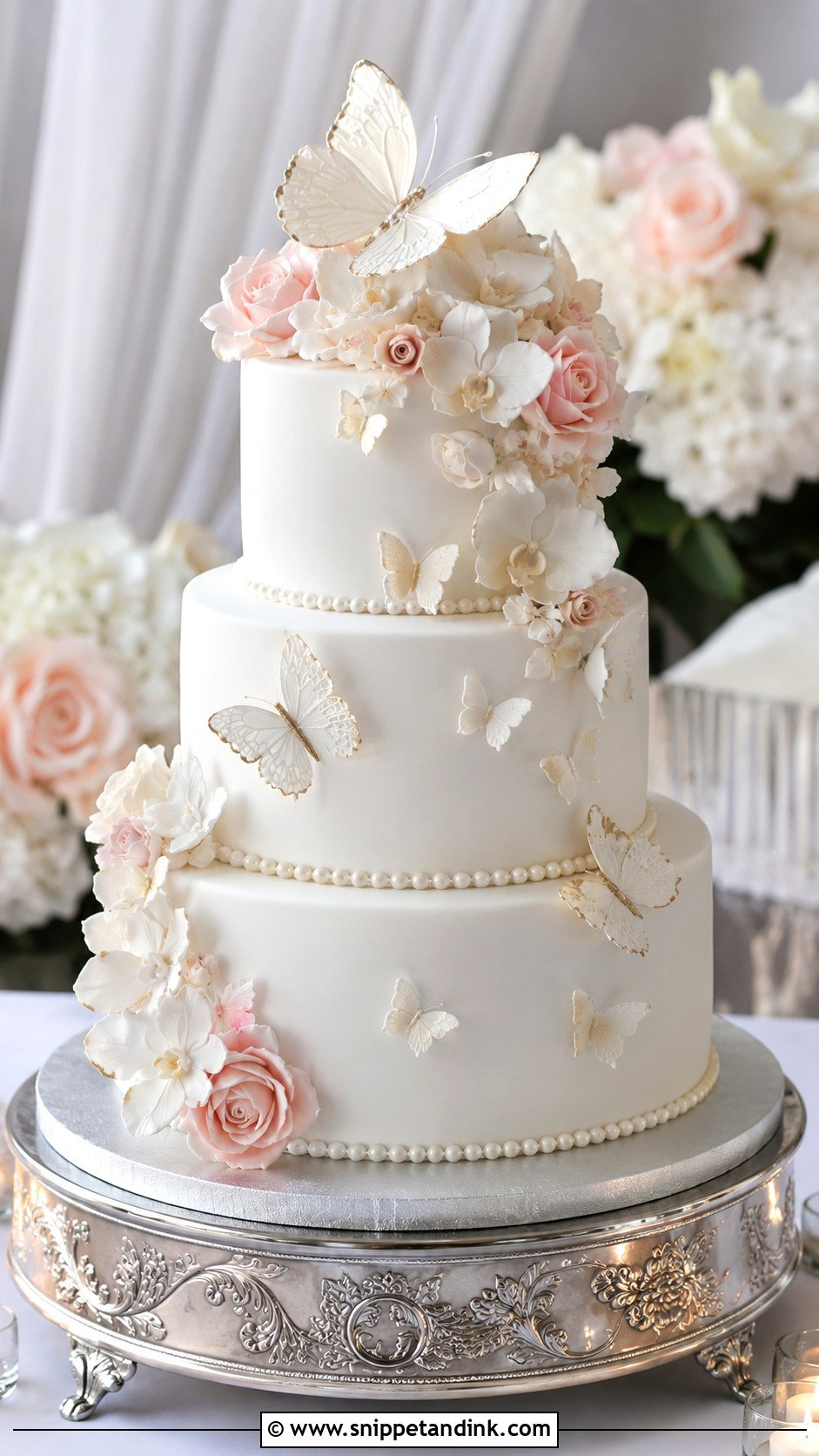
Fondant is what I reach for when a design needs crisp edges and exact placement. It gives a smooth, firm surface for detailed sugar butterflies, gum paste flowers, pearl borders and metallic accents, and holds sharp shapes and tall tiers better than buttercream. Keep the colours limited, perhaps ivory with blush or lavender and a touch of gold. Fondant does sweat if a cold cake meets a warm room, so a fondant cake should stay at a cool room temperature rather than going in and out of the fridge. Formal venues get the most from it.
13. Watercolor 3 Tier Butterfly Wedding Cake
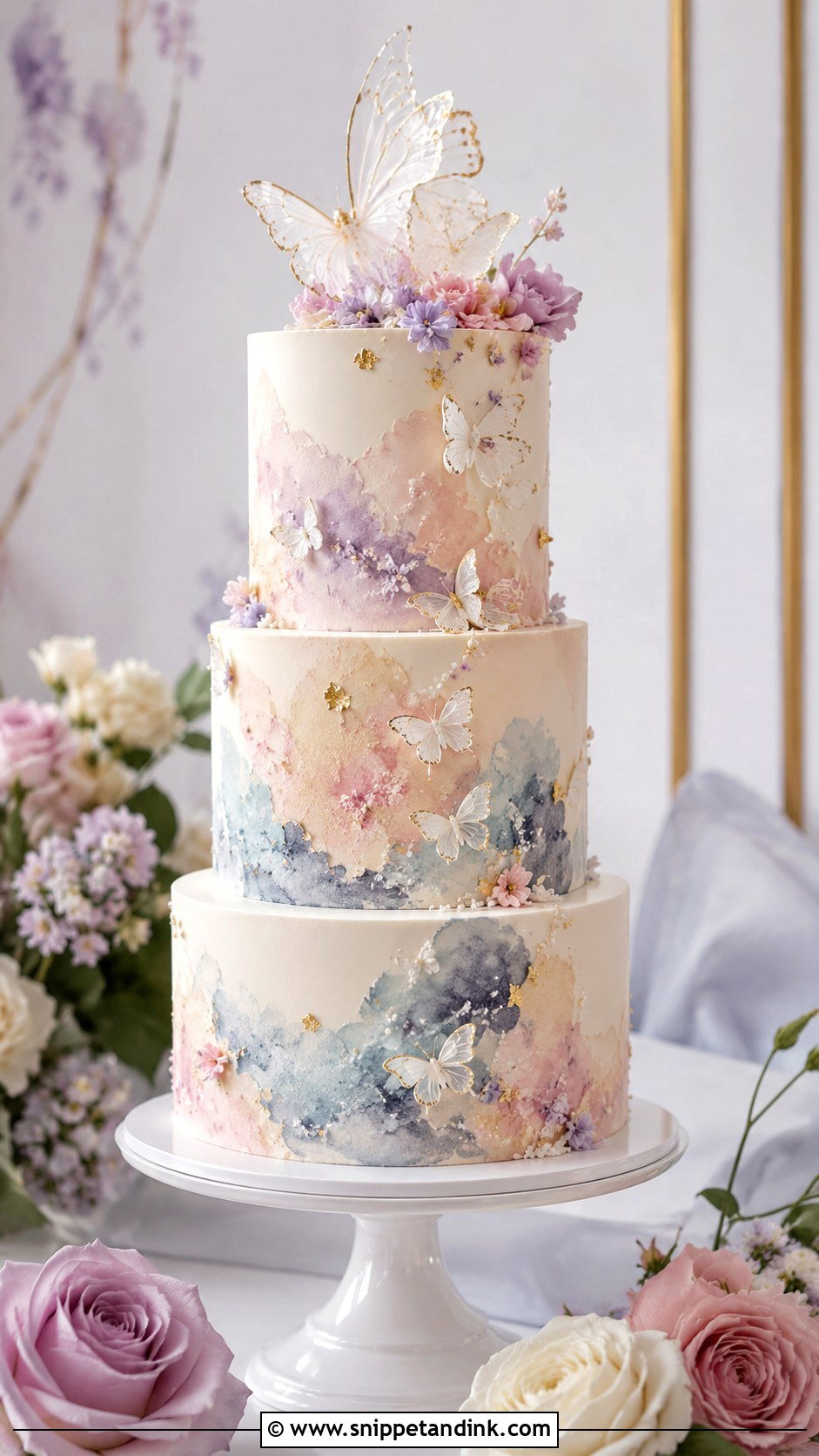
Painted cakes need a light hand. I brush thin washes of pale pink, blue, lavender or peach on the tiers, letting them stay uneven like dyed silk, and stop before the colour gets heavy. The butterflies can pick up the painted shades or stay white for contrast. A few edible gold flecks or soft sugar flowers add a bridal finish. Watercolour is far easier on fondant than buttercream, which smears under the brush. Creative couples and sunset-inspired palettes suit it.
14. Garden 3 Tier Butterfly Wedding Cake
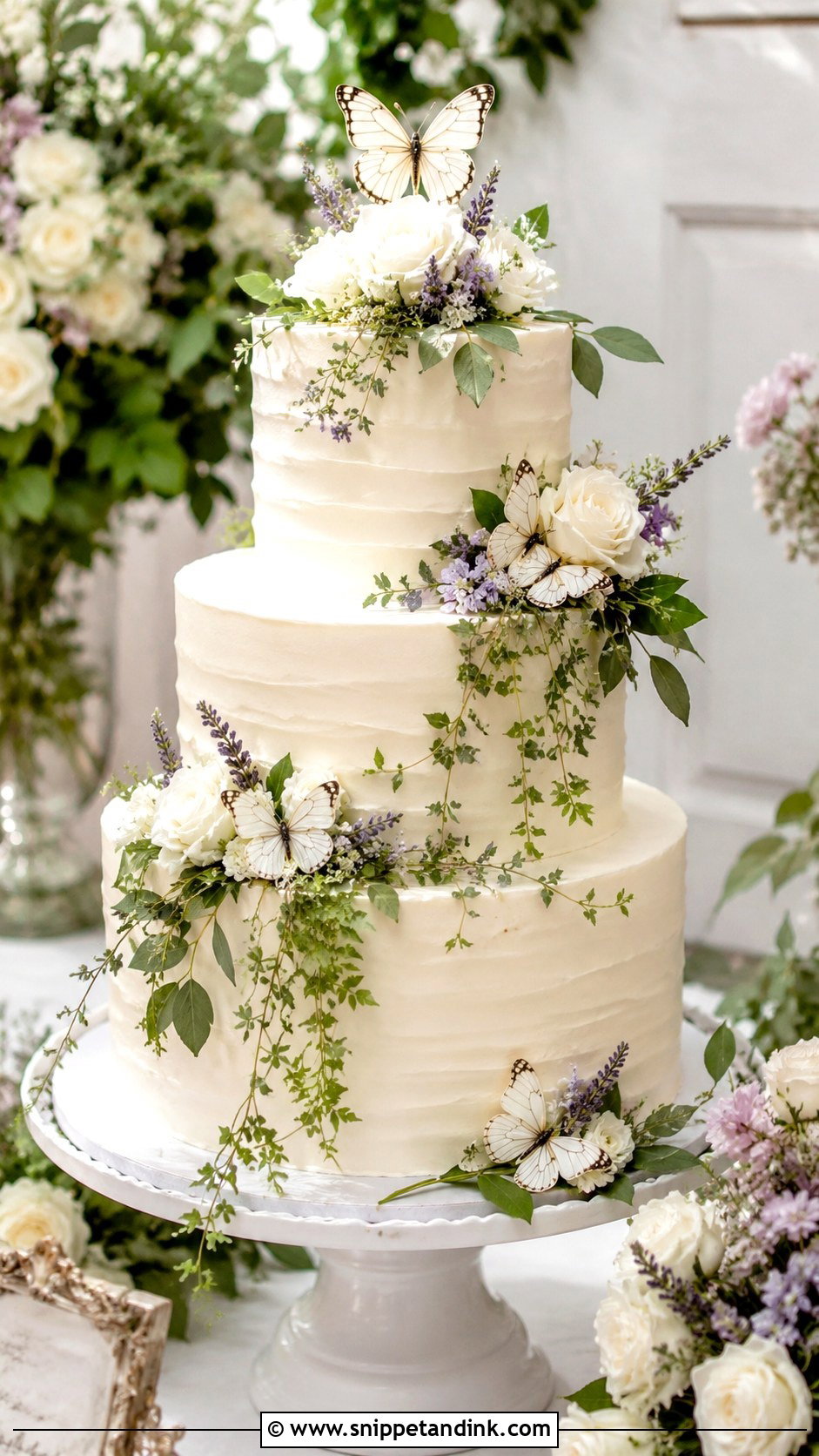
Picture butterflies that have just landed on a flower bed. That’s the garden cake: soft buttercream, trailing greenery, sugar flowers and wings tucked among the blooms. White roses, lavender and small chamomile-style blossoms build the scene. Restraint keeps it from looking crowded, so one floral cascade down a side works better than flowers everywhere. Real lavender and greenery should be food-safe or kept off the frosting. Greenhouse venues and botanical gardens are made for this one.
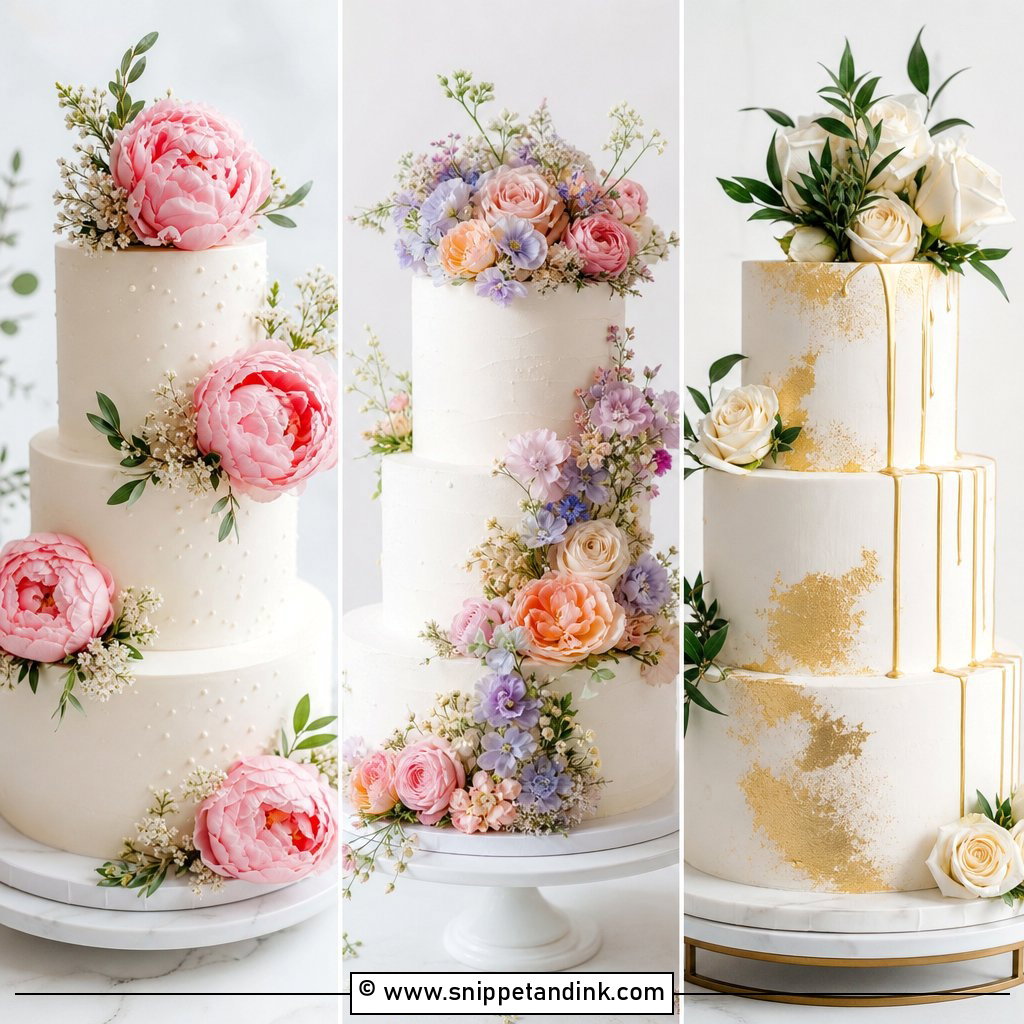

15. Green Butterfly 3 Tier Wedding Cake
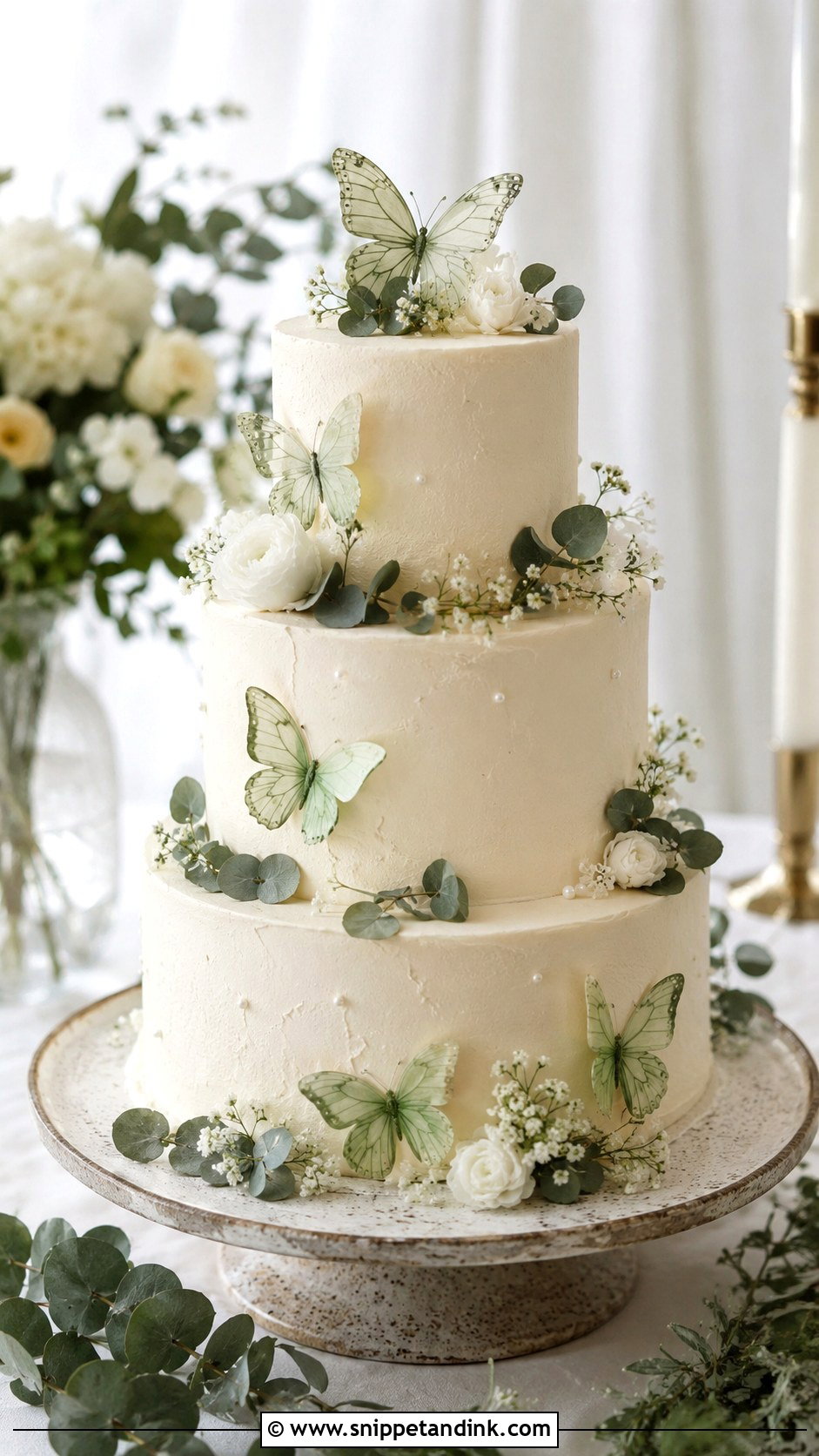
Green butterflies surprise people, and sage is the easiest shade to use at a wedding. Ivory tiers, sage wings, eucalyptus kept off the frosting, white flowers and a few pearls make a calm, organic cake. One pale green tier between two ivory ones gives balance. Sage on sugar can look grey under cool lighting, so I test a wing in the venue’s light when I can. It pairs well with neutral bridesmaid dresses and greenery-heavy decor in a garden or woodland setting.
16. Black And White 3 Tier Butterfly Wedding Cake
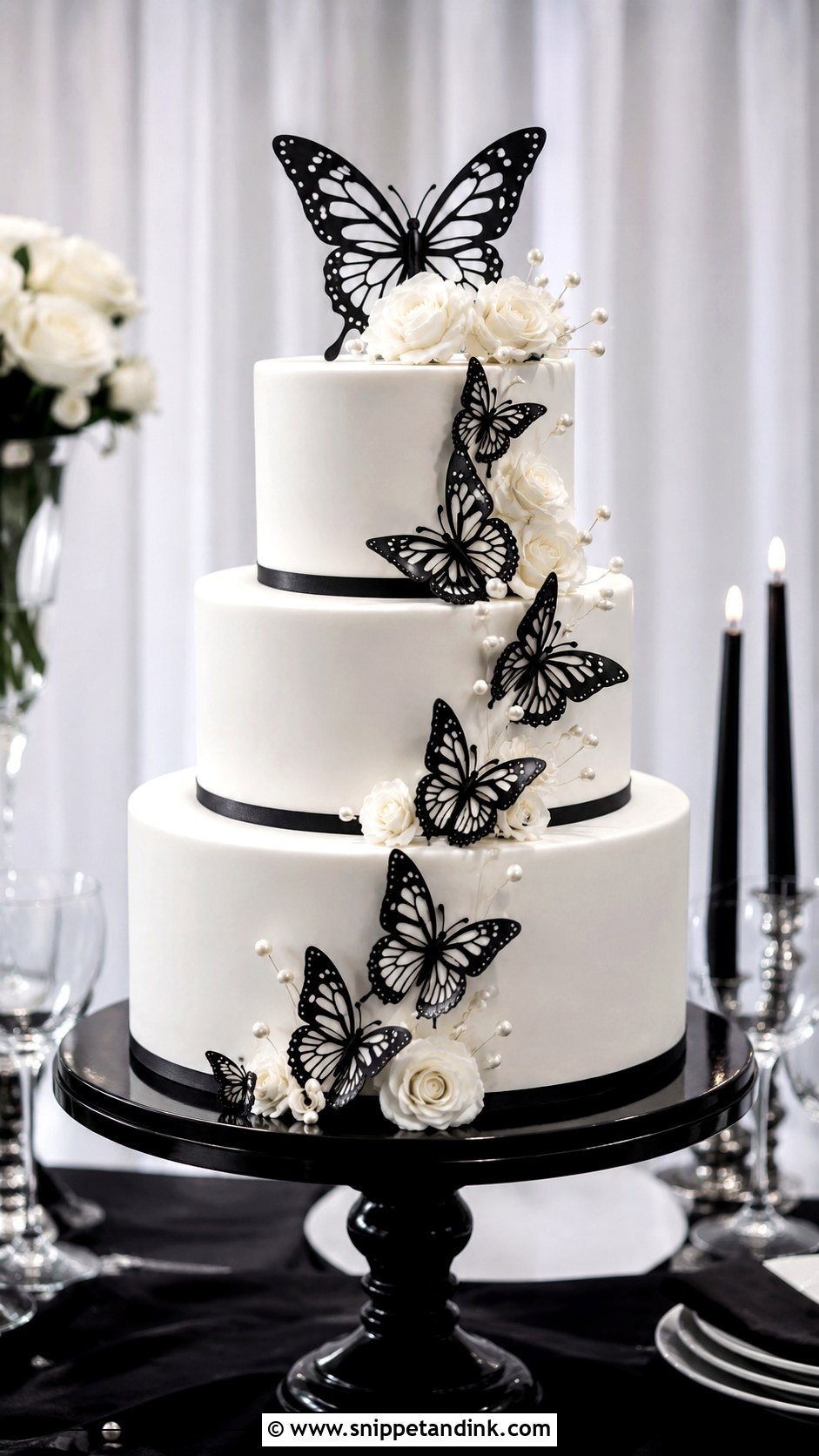
Black on white is the most graphic version of this cake, and every wing reads clearly from across the room. I put black wafer paper butterflies on a white base, sometimes with thin black bands at each tier. Black colouring is very concentrated and can stain lips and teeth, which is another reason I keep it to the butterflies rather than the frosting. Flowers stay minimal: a few white roses, anemone-style blooms or pearls. It fits an evening reception with a dramatic edge.
17. Ombre 3 Tier Butterfly Wedding Cake
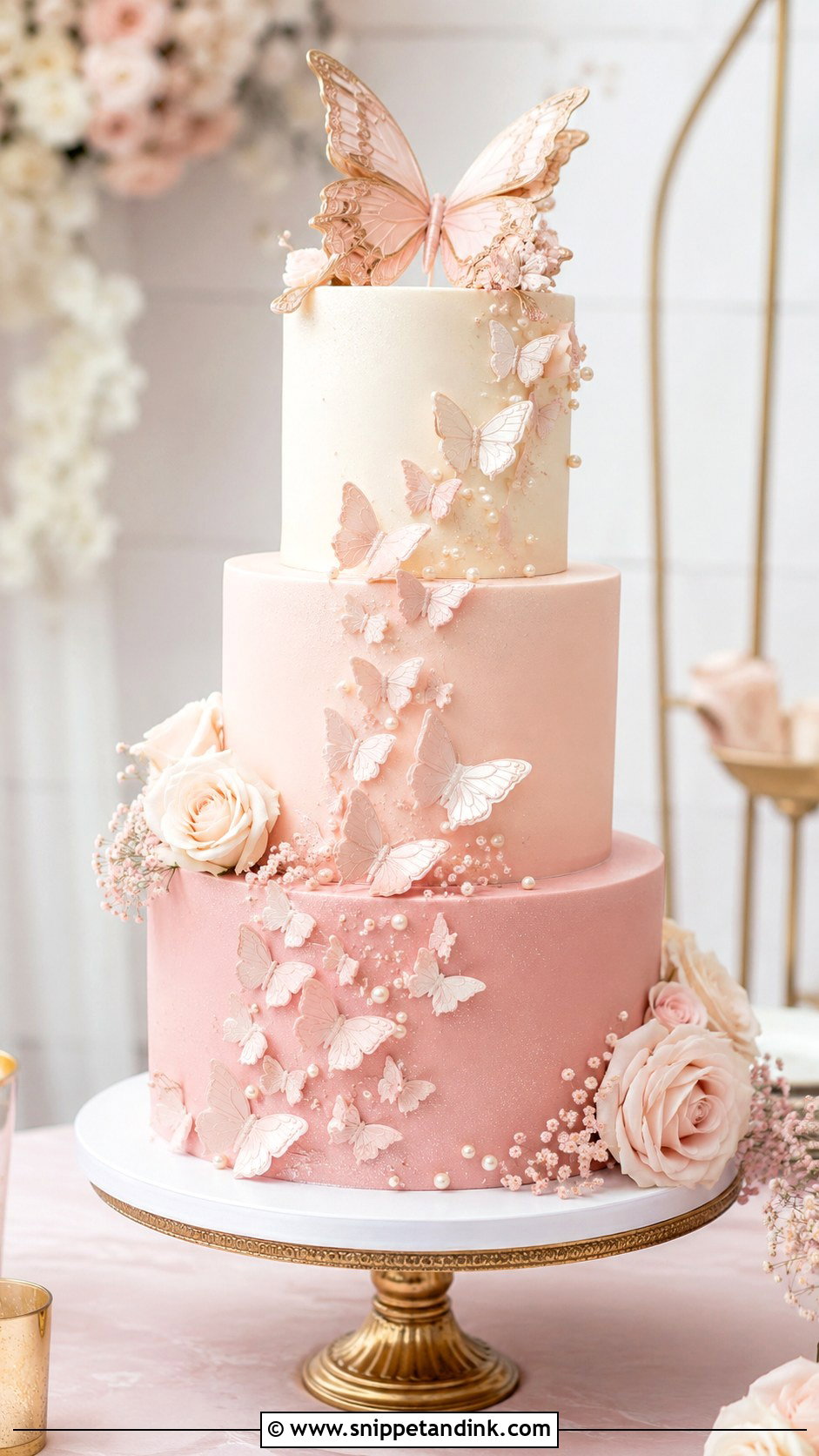
Colour can climb the cake from bottom to top: blush to ivory, blue to white, lavender to pale grey or peach to cream. I make the butterflies follow the same fade, darker near the base and lighter near the top, which makes the flight look natural. Buttercream blends the tiers more softly, fondant gives cleaner steps between shades. Keep flowers to a minimum so the gradient stays visible. Romantic outdoor receptions suit it, especially for couples who want colour without a bold cake.
18. Tall 3 Tier Butterfly Wedding Cake
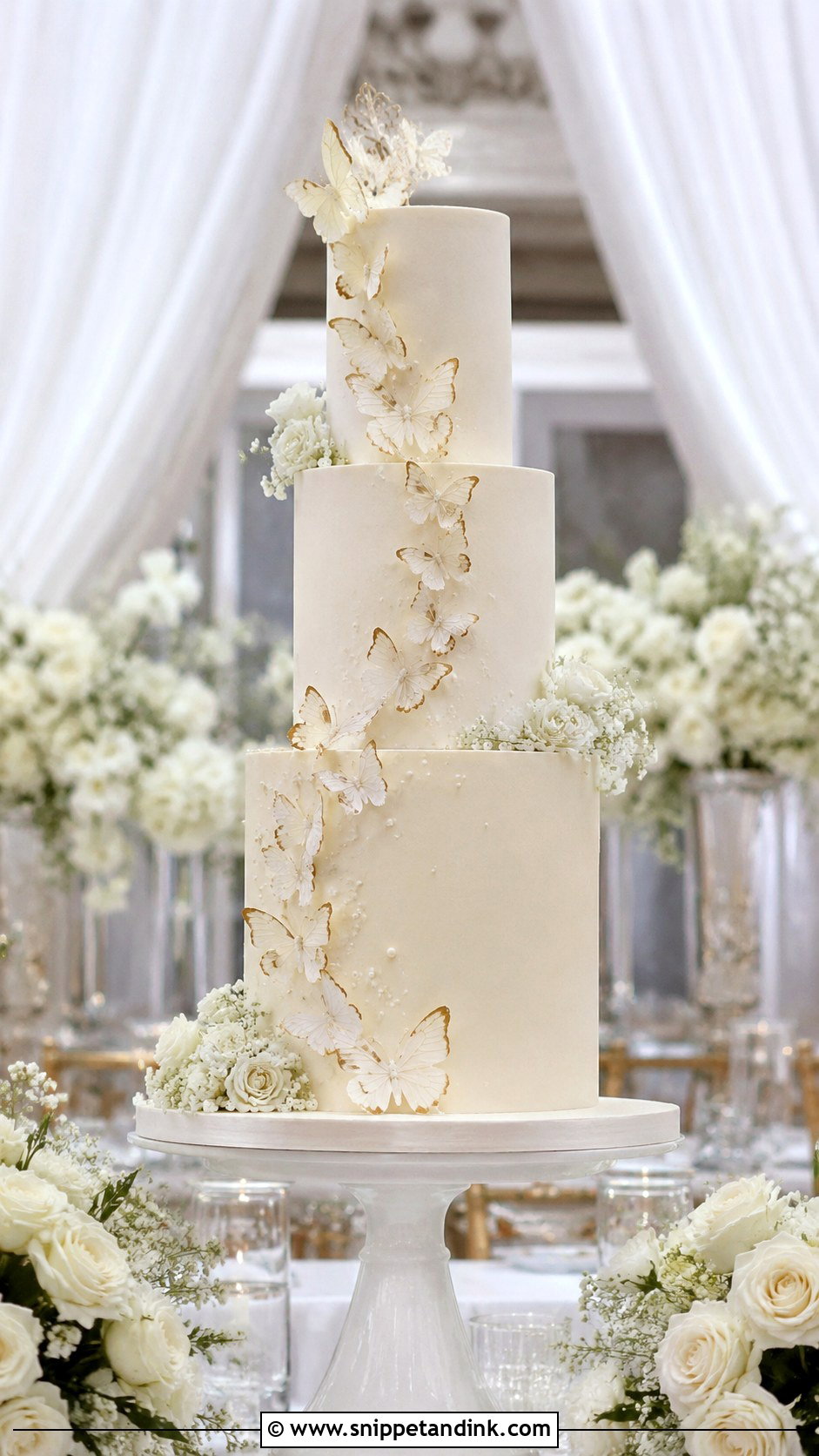
Extra-tall tiers give butterflies room to fly. Each tier is built higher than standard, which makes the cake look grand in photos and lets me set butterflies in a rising trail with real space between them. Height needs engineering, though. Tall tiers usually need an internal board halfway up as well as dowels, otherwise they bulge. Sharp fondant or buttercream edges make the height look intentional, with one flower cluster near the base and one near the top. Big rooms with high ceilings need a cake like this.
19. Square 3 Tier Butterfly Wedding Cake
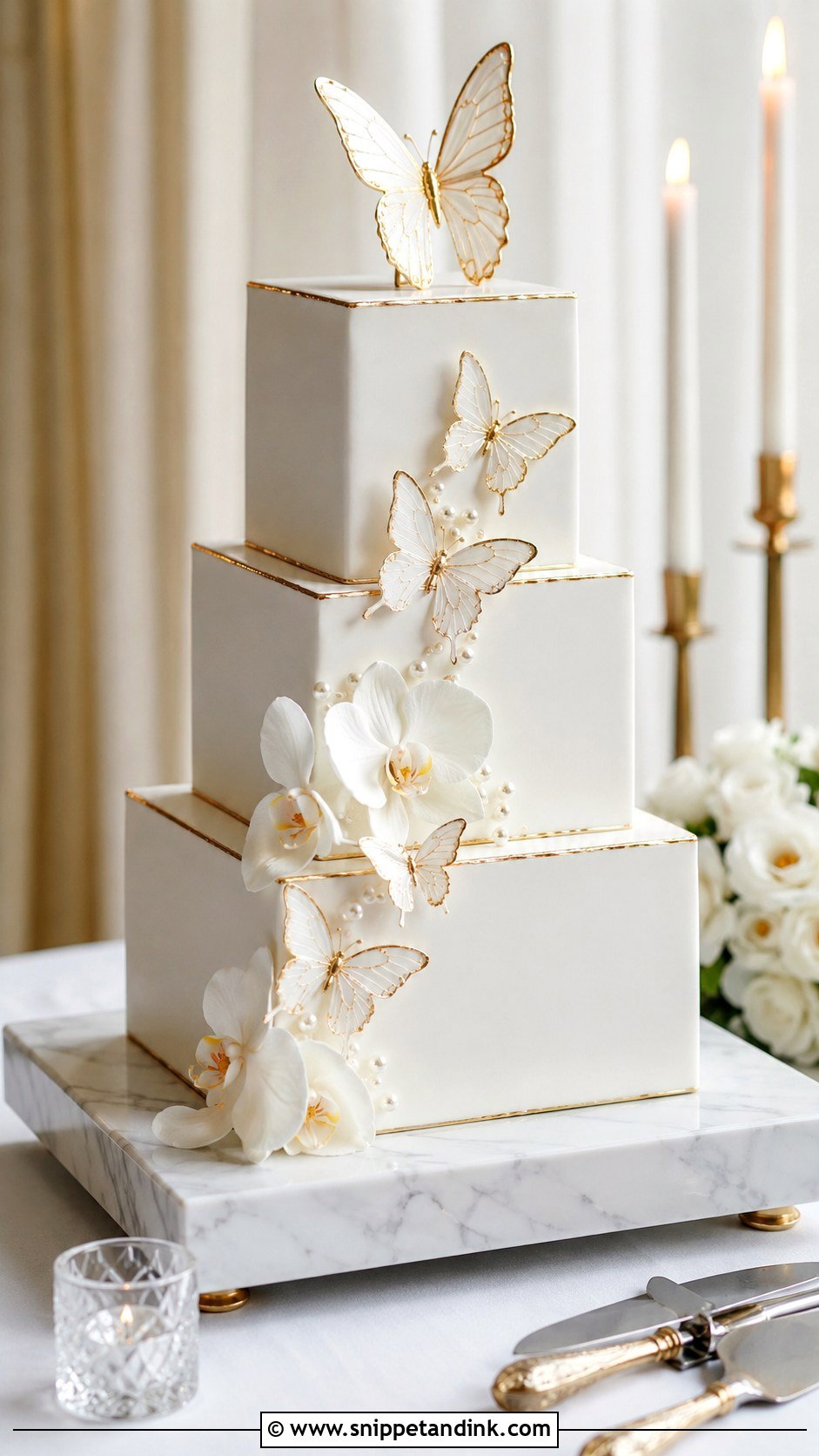
Square tiers change the whole read of a butterfly cake. The corners give it structure, and the butterflies can sit along the edges, across the front face or in a diagonal from tier to tier. Smooth fondant suits it best, since buttercream corners are hard to keep sharp, and they show every soft spot. White orchids, gold trim or pearls polish it. Square cakes also cut into neat portions, which caterers appreciate. Contemporary hotel venues suit it well.



20. Luxury 3 Tier Butterfly Wedding Cake
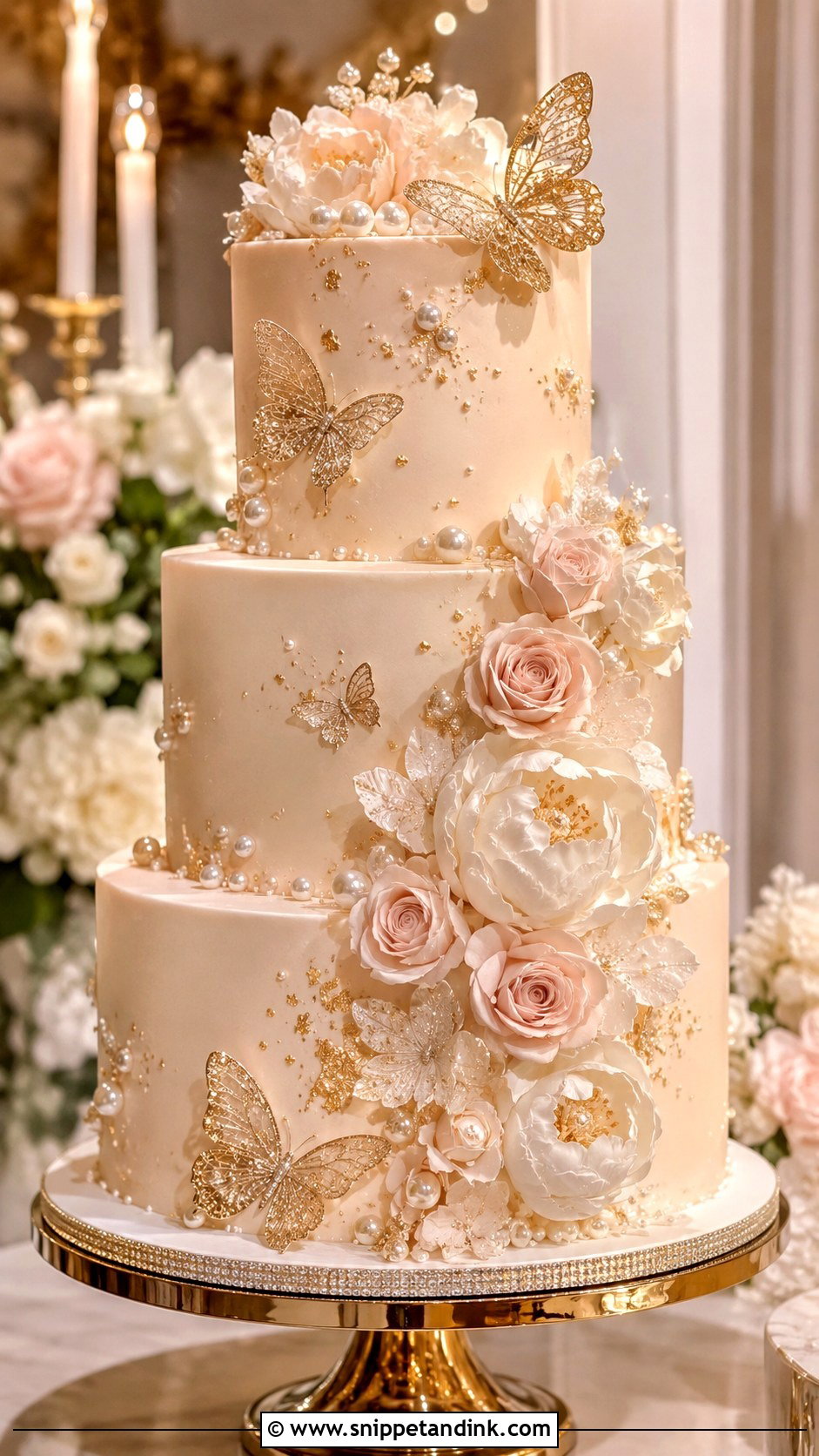
Luxury here means detail placed with care, not more of everything. I start with a flawless ivory or white base, then add metallic butterflies, sugar flowers, pearls and a little edible gold, gathered in one cascade or around one focal area so the eye has somewhere to rest. Tall tiers, sharp edges and premium flowers set the tone. I keep the palette to ivory, champagne, blush and gold. Formal weddings in grand venues are where it belongs, and the sugar work can be kept as a souvenir.
Placing Butterflies So They Look Like They Landed
Butterflies spaced evenly around a cake look like a pattern. Real ones gather and drift. When I place them, I pick one direction of travel, usually a diagonal rising from the bottom tier, and let them thin out as they go. Odd numbers in small groups look more natural than pairs, and mixing at least three sizes stops them from looking stamped out.
The wings matter as much as the placement. I dry gum paste and wafer paper butterflies resting in a folded card so the wings set at an angle, as if mid-flap. Flat wings pressed against the side of a tier look like stickers. One or two butterflies on the cake stand or the table beside it make the scene feel less contained.
Adding them at the venue
I fix delicate wings on site, after the tiers are stacked, because they’re the first thing to break in transport. Ask your baker whether this is part of setup, and plan for a few spare butterflies in the box in case one snaps.
Wings, Frosting and Flowers Should Tell One Story
A three-tier butterfly cake can be soft, classic, colourful, rustic, modern or grand, and the styling decides which. What matters most is that the butterflies belong to the rest of the cake, matching the frosting, the flowers, the stand and the mood of the reception. Ivory, pearls and white sugar wings give a classic cake. Blush, lavender and garden flowers lean romantic. Black and white, gold or tall sculptural tiers bring drama. Choose the butterfly material for your venue first, then build the design around it.
You'll Like These Ideas:




Leave a Reply